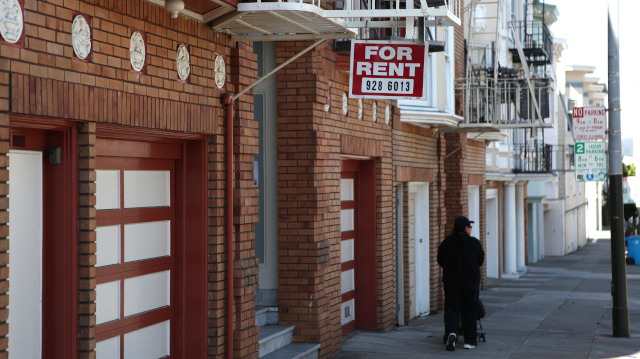
It seems that almost everyone in the Bay Area has a housing horror story to tell. Anecdotes abound of renters spending months looking for a new place, and the pound of flesh extracted when they do find one. Equally scary are the stories from aspiring, seemingly qualified homeowners who are turned away by banks.
Throughout 2014, KQED brought out the facts and stories behind the Bay Area housing crisis as part of our series called ‘Priced Out.’ We told the stories of people struggling and surviving amidst the increasing cost of living. We examined the changing neighborhoods and cities in the Bay Area, looked at who is getting evicted and why, as well as the potential solutions that have emerged.
Albany Struggles with Homelessness at the Bulb, Faces Lawsuits
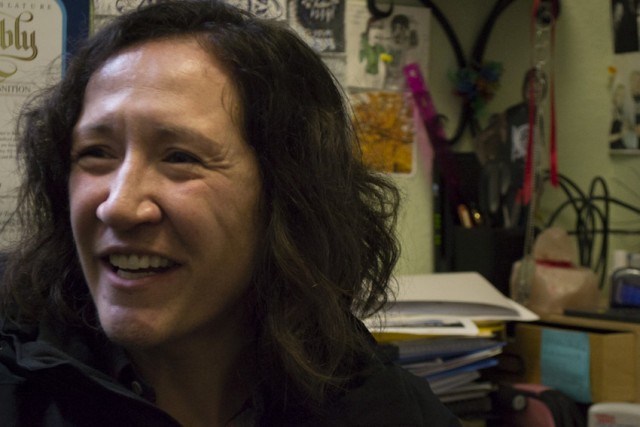
Center for S.F.’s Homeless Youth Closing – Loss of ‘a Space to Just Be OK’
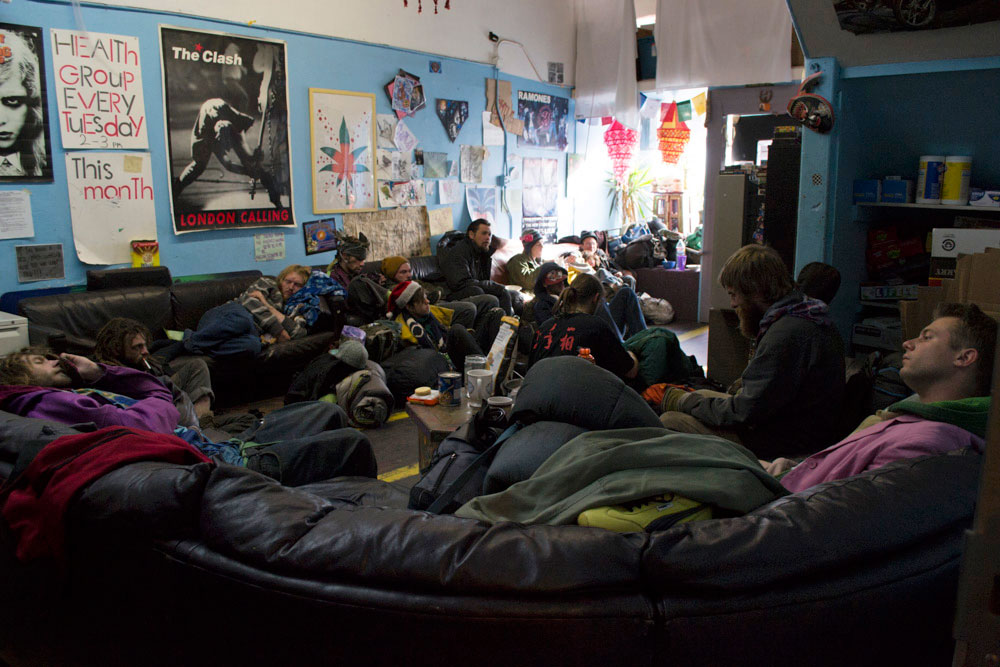
The Haight's Homeless Youth Drop-in Center Closing Down
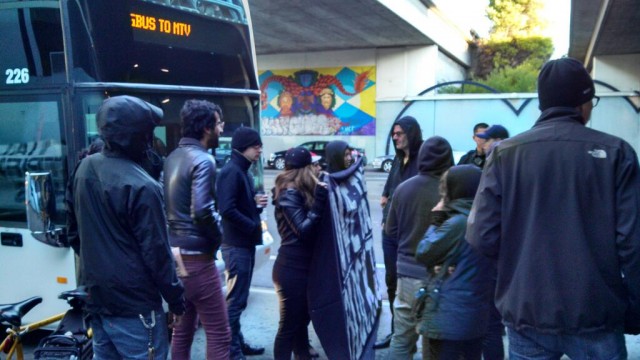
Google Bus Protesters' Manifesto: 'Get Out of Oakland!'
San Francisco's In-law Units Home to Most Vulnerable Tenants
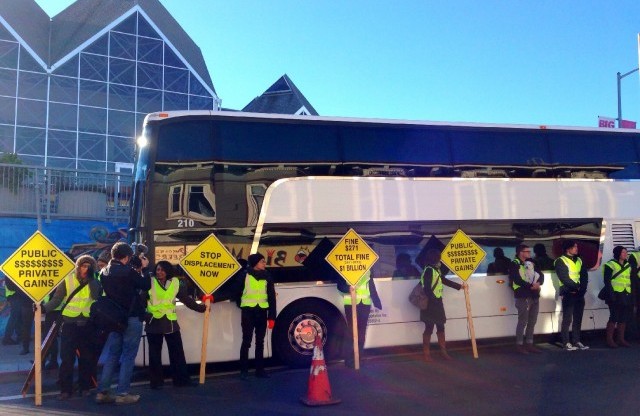
San Francisco 'Displacement' Activists Take to Streets and Block a Google Bus
Six Ways the Bay Area Can Help Its Housing Affordability Problem
Bay Area Authors, Activists and Listeners Weigh In on Gentrification
San Francisco City Hall Hearing Puts a Face on Ellis Act Evictions
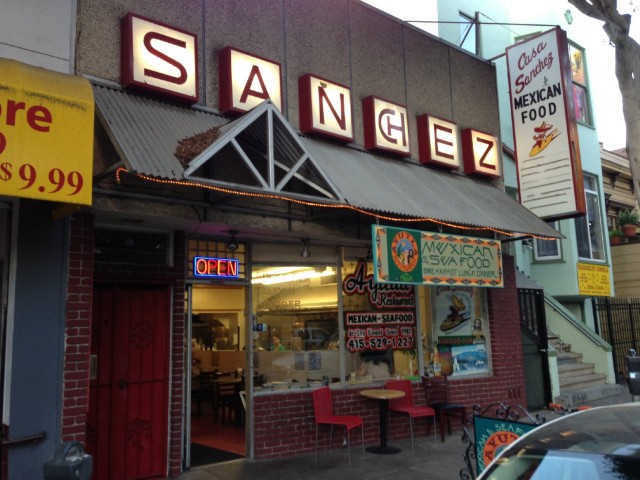
Mission District Restaurant Landlord Keeps Rent Low, Flavor Local
San Francisco Officials, Tenants Still Fighting Market Street Eviction
5 Reasons Landlords Say They're Not to Blame for High Rents and Evictions
window.__IS_SSR__=true
window.__INITIAL_STATE__={
"attachmentsReducer": {
"audio_0": {
"type": "attachments",
"id": "audio_0",
"imgSizes": {
"kqedFullSize": {
"file": "https://ww2.kqed.org/news/wp-content/themes/KQED-unified/img/audio_bgs/background0.jpg"
}
}
},
"audio_1": {
"type": "attachments",
"id": "audio_1",
"imgSizes": {
"kqedFullSize": {
"file": "https://ww2.kqed.org/news/wp-content/themes/KQED-unified/img/audio_bgs/background1.jpg"
}
}
},
"audio_2": {
"type": "attachments",
"id": "audio_2",
"imgSizes": {
"kqedFullSize": {
"file": "https://ww2.kqed.org/news/wp-content/themes/KQED-unified/img/audio_bgs/background2.jpg"
}
}
},
"audio_3": {
"type": "attachments",
"id": "audio_3",
"imgSizes": {
"kqedFullSize": {
"file": "https://ww2.kqed.org/news/wp-content/themes/KQED-unified/img/audio_bgs/background3.jpg"
}
}
},
"audio_4": {
"type": "attachments",
"id": "audio_4",
"imgSizes": {
"kqedFullSize": {
"file": "https://ww2.kqed.org/news/wp-content/themes/KQED-unified/img/audio_bgs/background4.jpg"
}
}
},
"placeholder": {
"type": "attachments",
"id": "placeholder",
"imgSizes": {
"thumbnail": {
"file": "https://cdn.kqed.org/wp-content/uploads/2024/12/KQED-Default-Image-816638274-2000x1333-1-160x107.jpg",
"width": 160,
"height": 107,
"mimeType": "image/jpeg"
},
"medium": {
"file": "https://cdn.kqed.org/wp-content/uploads/2024/12/KQED-Default-Image-816638274-2000x1333-1-800x533.jpg",
"width": 800,
"height": 533,
"mimeType": "image/jpeg"
},
"medium_large": {
"file": "https://cdn.kqed.org/wp-content/uploads/2024/12/KQED-Default-Image-816638274-2000x1333-1-768x512.jpg",
"width": 768,
"height": 512,
"mimeType": "image/jpeg"
},
"large": {
"file": "https://cdn.kqed.org/wp-content/uploads/2024/12/KQED-Default-Image-816638274-2000x1333-1-1020x680.jpg",
"width": 1020,
"height": 680,
"mimeType": "image/jpeg"
},
"1536x1536": {
"file": "https://cdn.kqed.org/wp-content/uploads/2024/12/KQED-Default-Image-816638274-2000x1333-1-1536x1024.jpg",
"width": 1536,
"height": 1024,
"mimeType": "image/jpeg"
},
"fd-lrg": {
"file": "https://cdn.kqed.org/wp-content/uploads/2024/12/KQED-Default-Image-816638274-2000x1333-1-1536x1024.jpg",
"width": 1536,
"height": 1024,
"mimeType": "image/jpeg"
},
"fd-med": {
"file": "https://cdn.kqed.org/wp-content/uploads/2024/12/KQED-Default-Image-816638274-2000x1333-1-1020x680.jpg",
"width": 1020,
"height": 680,
"mimeType": "image/jpeg"
},
"fd-sm": {
"file": "https://cdn.kqed.org/wp-content/uploads/2024/12/KQED-Default-Image-816638274-2000x1333-1-800x533.jpg",
"width": 800,
"height": 533,
"mimeType": "image/jpeg"
},
"post-thumbnail": {
"file": "https://cdn.kqed.org/wp-content/uploads/2024/12/KQED-Default-Image-816638274-2000x1333-1-672x372.jpg",
"width": 672,
"height": 372,
"mimeType": "image/jpeg"
},
"twentyfourteen-full-width": {
"file": "https://cdn.kqed.org/wp-content/uploads/2024/12/KQED-Default-Image-816638274-2000x1333-1-1038x576.jpg",
"width": 1038,
"height": 576,
"mimeType": "image/jpeg"
},
"xxsmall": {
"file": "https://cdn.kqed.org/wp-content/uploads/2024/12/KQED-Default-Image-816638274-2000x1333-1-160x107.jpg",
"width": 160,
"height": 107,
"mimeType": "image/jpeg"
},
"xsmall": {
"file": "https://cdn.kqed.org/wp-content/uploads/2024/12/KQED-Default-Image-816638274-2000x1333-1-672x372.jpg",
"width": 672,
"height": 372,
"mimeType": "image/jpeg"
},
"small": {
"file": "https://cdn.kqed.org/wp-content/uploads/2024/12/KQED-Default-Image-816638274-2000x1333-1-672x372.jpg",
"width": 672,
"height": 372,
"mimeType": "image/jpeg"
},
"xlarge": {
"file": "https://cdn.kqed.org/wp-content/uploads/2024/12/KQED-Default-Image-816638274-2000x1333-1-1020x680.jpg",
"width": 1020,
"height": 680,
"mimeType": "image/jpeg"
},
"full-width": {
"file": "https://cdn.kqed.org/wp-content/uploads/2024/12/KQED-Default-Image-816638274-2000x1333-1-1920x1280.jpg",
"width": 1920,
"height": 1280,
"mimeType": "image/jpeg"
},
"guest-author-32": {
"file": "https://cdn.kqed.org/wp-content/uploads/2025/01/KQED-Default-Image-816638274-1333x1333-1-160x160.jpg",
"width": 32,
"height": 32,
"mimeType": "image/jpeg"
},
"guest-author-50": {
"file": "https://cdn.kqed.org/wp-content/uploads/2025/01/KQED-Default-Image-816638274-1333x1333-1-160x160.jpg",
"width": 50,
"height": 50,
"mimeType": "image/jpeg"
},
"guest-author-64": {
"file": "https://cdn.kqed.org/wp-content/uploads/2025/01/KQED-Default-Image-816638274-1333x1333-1-160x160.jpg",
"width": 64,
"height": 64,
"mimeType": "image/jpeg"
},
"guest-author-96": {
"file": "https://cdn.kqed.org/wp-content/uploads/2025/01/KQED-Default-Image-816638274-1333x1333-1-160x160.jpg",
"width": 96,
"height": 96,
"mimeType": "image/jpeg"
},
"guest-author-128": {
"file": "https://cdn.kqed.org/wp-content/uploads/2025/01/KQED-Default-Image-816638274-1333x1333-1-160x160.jpg",
"width": 128,
"height": 128,
"mimeType": "image/jpeg"
},
"detail": {
"file": "https://cdn.kqed.org/wp-content/uploads/2025/01/KQED-Default-Image-816638274-1333x1333-1-160x160.jpg",
"width": 160,
"height": 160,
"mimeType": "image/jpeg"
},
"kqedFullSize": {
"file": "https://cdn.kqed.org/wp-content/uploads/2024/12/KQED-Default-Image-816638274-2000x1333-1.jpg",
"width": 2000,
"height": 1333
}
}
},
"news_111666": {
"type": "attachments",
"id": "news_111666",
"meta": {
"index": "attachments_1716263798",
"site": "news",
"id": "111666",
"found": true
},
"parent": 111655,
"imgSizes": {
"kqedFullSize": {
"file": "https://ww2.kqed.org/app/uploads/sites/10/2013/09/Albanybulb_11sept2013-640.jpg",
"width": 640,
"height": 427
}
},
"publishDate": 1379534210,
"modified": 1379534210,
"caption": "Recylced metal sculptures by Osha Neumann, an advocate for the residents living on the Albany Bulb, can be found on the north shore of the small peninsula. (Sara Bloomberg/KQED)",
"description": null,
"title": "Albanybulb_11sept2013-640",
"credit": null,
"status": "inherit",
"isLoading": false,
"fetchFailed": false
},
"news_121690": {
"type": "attachments",
"id": "news_121690",
"meta": {
"index": "attachments_1716263798",
"site": "news",
"id": "121690",
"found": true
},
"parent": 0,
"imgSizes": {
"kqedFullSize": {
"file": "https://ww2.kqed.org/app/uploads/sites/10/2013/12/7979scr_116e88b4df8955c-e1387817093381.jpg",
"width": 640,
"height": 427
}
},
"publishDate": 1387681052,
"modified": 1387681052,
"caption": "Jennifer \"Yeah Yeah\" Cowles is an outreach counselor at the Homeless Youth Alliance, where she has worked since the mid-1990s. A lot of people have misconceptions about the youth on the streets, she said, and part of the mission of the organization is to educate the rest of the community about issues that affect homeless youth. (Sara Bloomberg/KQED)",
"description": null,
"title": "Homeless Youth Alliance",
"credit": null,
"status": "inherit",
"isLoading": false,
"fetchFailed": false
},
"news_121564": {
"type": "attachments",
"id": "news_121564",
"meta": {
"index": "attachments_1716263798",
"site": "news",
"id": "121564",
"found": true
},
"parent": 121530,
"imgSizes": {
"kqedFullSize": {
"file": "https://ww2.kqed.org/app/uploads/sites/10/2013/12/homelessyouthalliance-light.jpg",
"width": 1000,
"height": 667
}
},
"publishDate": 1387584432,
"modified": 1387584432,
"caption": "Homeless youth rest and watch television at the Homeless Youth Alliance on Dec. 18, 2013, seven days before the organization has to close its doors to prepare to move everything into storage. (Sara Bloomberg/KQED)",
"description": "Homeless youth rest and watch television at the Homeless Youth Alliance on Dec. 18, 2013, seven days before the organization has to close its doors to prepare to move everything into storage. (Sara Bloomberg/KQED)",
"title": "homelessyouthalliance-light",
"credit": null,
"status": "inherit",
"isLoading": false,
"fetchFailed": false
},
"news_121449": {
"type": "attachments",
"id": "news_121449",
"meta": {
"index": "attachments_1716263798",
"site": "news",
"id": "121449",
"found": true
},
"parent": 121445,
"imgSizes": {
"kqedFullSize": {
"file": "https://ww2.kqed.org/app/uploads/sites/10/2013/12/macarthurbus-e1387562289874.jpg",
"width": 640,
"height": 360
}
},
"publishDate": 1387562252,
"modified": 1387562252,
"caption": "A Google bus halted by protesters Friday morning at Oakland's MacArthur BART station. (Grace Rubenstein/KQED)",
"description": null,
"title": "macarthurbus",
"credit": null,
"status": "inherit",
"isLoading": false,
"fetchFailed": false
},
"news_120963": {
"type": "attachments",
"id": "news_120963",
"meta": {
"index": "attachments_1716263798",
"site": "news",
"id": "120963",
"found": true
},
"parent": 120916,
"imgSizes": {
"kqedFullSize": {
"file": "https://ww2.kqed.org/app/uploads/sites/10/2013/12/RS7298_Houses_in_San_Francisco-scr-e1387246686785.jpg",
"width": 640,
"height": 274
}
},
"publishDate": 1387246674,
"modified": 1387246674,
"caption": "City officials estimate there are more than 40,000 illegal in-law units in San Francisco. (Wikimedia Commons)",
"description": "City officials estimate there are more than 40,000 illegal in-law units in San Francisco. (Wikimedia Commons)",
"title": "RS7298_Houses_in_San_Francisco-scr",
"credit": null,
"status": "inherit",
"isLoading": false,
"fetchFailed": false
},
"news_120270": {
"type": "attachments",
"id": "news_120270",
"meta": {
"index": "attachments_1716263798",
"site": "news",
"id": "120270",
"found": true
},
"parent": 120264,
"imgSizes": {
"kqedFullSize": {
"file": "https://ww2.kqed.org/app/uploads/sites/10/2013/12/11293201603_070575a91a_o-e1386615496451.jpg",
"width": 640,
"height": 416
}
},
"publishDate": 1386615439,
"modified": 1386615439,
"caption": "In a December protest, activists surround a Google bus at 24th and Valencia streets Monday in protest aimed at evictions and displacement in San Francisco's Mission District. (Steve Rhodes via Flickr)",
"description": "In a December protest, activists surround a Google bus at 24th and Valencia streets Monday in protest aimed at evictions and displacement in San Francisco's Mission District. (Steve Rhodes via Flickr)",
"title": "Google Bus",
"credit": null,
"status": "inherit",
"isLoading": false,
"fetchFailed": false
},
"news_104070": {
"type": "attachments",
"id": "news_104070",
"meta": {
"index": "attachments_1716263798",
"site": "news",
"id": "104070",
"found": true
},
"parent": 104008,
"imgSizes": {
"kqedFullSize": {
"file": "https://ww2.kqed.org/app/uploads/sites/10/2013/07/EastPalo-housing.jpg",
"width": 640,
"height": 360
}
},
"publishDate": 1374187908,
"modified": 1374187908,
"caption": null,
"description": null,
"title": "EastPalo-housing",
"credit": null,
"status": "inherit",
"isLoading": false,
"fetchFailed": false
},
"news_118658": {
"type": "attachments",
"id": "news_118658",
"meta": {
"index": "attachments_1716263798",
"site": "news",
"id": "118658",
"found": true
},
"parent": 118502,
"imgSizes": {
"kqedFullSize": {
"file": "https://ww2.kqed.org/app/uploads/sites/10/2013/11/10300713853_7440c14824_z.jpg",
"width": 640,
"height": 424
}
},
"publishDate": 1384817446,
"modified": 1384817446,
"caption": "In October 2013, marchers protested gentrification in San Francisco's Mission District. (Steve Rhodes / Flickr)",
"description": "In October 2013, marchers protested gentrification in San Francisco's Mission District. (Steve Rhodes / Flickr)",
"title": "10300713853_7440c14824_z",
"credit": null,
"status": "inherit",
"isLoading": false,
"fetchFailed": false
},
"news_116520": {
"type": "attachments",
"id": "news_116520",
"meta": {
"index": "attachments_1716263798",
"site": "news",
"id": "116520",
"found": true
},
"parent": 116475,
"imgSizes": {
"kqedFullSize": {
"file": "https://ww2.kqed.org/app/uploads/sites/10/2013/10/7291_transform.jpg",
"width": 640,
"height": 359
}
},
"publishDate": 1383169762,
"modified": 1383169762,
"caption": "File photo of San Francisco. (Justin Sullivan/Getty Images)",
"description": "A for rent sign July 8, 2009 in San Francisco, California.",
"title": "Vacancy Rate For U.S. Apartments Reaches Highest Rate In 20 Years",
"credit": null,
"status": "inherit",
"isLoading": false,
"fetchFailed": false
},
"news_118143": {
"type": "attachments",
"id": "news_118143",
"meta": {
"index": "attachments_1716263798",
"site": "news",
"id": "118143",
"found": true
},
"parent": 118127,
"imgSizes": {
"kqedFullSize": {
"file": "https://ww2.kqed.org/app/uploads/sites/10/2013/11/Casa-Sanchez-e1384398917297.jpg",
"width": 640,
"height": 480
}
},
"publishDate": 1384398838,
"modified": 1384398838,
"caption": "Ayutla restaurant now operates in the old Casa Sanchez space in San Francisco's Mission District. (Sam Harnett / KQED)",
"description": "Ayutla restaurant now operates in the old Casa Sanchez space in San Francisco's Mission District. (Sam Harnett / KQED)",
"title": "Casa Sanchez",
"credit": null,
"status": "inherit",
"isLoading": false,
"fetchFailed": false
},
"news_118012": {
"type": "attachments",
"id": "news_118012",
"meta": {
"index": "attachments_1716263798",
"site": "news",
"id": "118012",
"found": true
},
"parent": 117919,
"imgSizes": {
"kqedFullSize": {
"file": "https://ww2.kqed.org/app/uploads/sites/10/2013/11/RS7539_1049_market_0330_web-e1384365558484.jpg",
"width": 640,
"height": 427
}
},
"publishDate": 1384316036,
"modified": 1384316036,
"caption": "1049 Market St. tenant Melissa Bracero said in November she would probably have to leave the city if she's evicted. (Sara Bloomberg/KQED). ",
"description": "1049 Market St. tenant Melissa Bracero said in November she would probably have to leave the city if she's evicted. (Sara Bloomberg/KQED). ",
"title": "Mid-Market Eviction",
"credit": null,
"status": "inherit",
"isLoading": false,
"fetchFailed": false
},
"news_103809": {
"type": "attachments",
"id": "news_103809",
"meta": {
"index": "attachments_1716263798",
"site": "news",
"id": "103809",
"found": true
},
"parent": 103615,
"imgSizes": {
"kqedFullSize": {
"file": "https://ww2.kqed.org/app/uploads/sites/10/2013/07/forrent.jpg",
"width": 640,
"height": 360
}
},
"publishDate": 1374008652,
"modified": 1374008652,
"caption": "(iStock image)",
"description": null,
"title": "forrent",
"credit": null,
"status": "inherit",
"isLoading": false,
"fetchFailed": false
}
},
"audioPlayerReducer": {
"postId": "stream_live",
"isPaused": true,
"isPlaying": false,
"pfsActive": false,
"pledgeModalIsOpen": true,
"playerDrawerIsOpen": false,
"liveAudioPlayStartedAt": 0,
"liveAudioPlayContext": ""
},
"authorsReducer": {
"astupi": {
"type": "authors",
"id": "70",
"meta": {
"index": "authors_1716337520",
"id": "70",
"found": true
},
"name": "Amanda Stupi",
"firstName": "Amanda",
"lastName": "Stupi",
"slug": "astupi",
"email": "astupi@kqed.org",
"display_author_email": false,
"staff_mastheads": [],
"title": "Senior Engagement Producer",
"bio": "Amanda joined KQED Science’s engagement team as a Senior Audience Engagement Strategist in the spring of 2019. She has helped craft messaging around wildfires, the coronavirus pandemic, climate change and many other stories. She has also brought KQED Science to new platforms such as Reddit’s Ask Me Anything series. Prior to joining KQED Science, Amanda spent seven years as an engagement producer with Forum, KQED’s daily live call-in show. She got her start in radio at KALW's weekly call in show, City Visions, before going on to an internship and stint at NPR's Talk of the Nation.\r\n\r\nPrior to journalism, Amanda taught English at Lowell High School. She's a native of Petaluma and currently lives under the \"South San Francisco the Industrial City\" sign in South City. She believes that engagement is vital to news’s future and that good journalism listens as much as it asks questions.",
"avatar": "https://secure.gravatar.com/avatar/e981c503e5c162da701dcaccfbf87e35?s=600&d=blank&r=g",
"twitter": null,
"facebook": null,
"instagram": null,
"linkedin": null,
"sites": [
{
"site": "arts",
"roles": [
"Contributor"
]
},
{
"site": "news",
"roles": [
"editor"
]
},
{
"site": "pop",
"roles": [
"contributor"
]
},
{
"site": "stateofhealth",
"roles": [
"editor"
]
},
{
"site": "science",
"roles": []
},
{
"site": "perspectives",
"roles": [
"editor"
]
}
],
"headData": {
"title": "Amanda Stupi | KQED",
"description": "Senior Engagement Producer",
"ogImgSrc": "https://secure.gravatar.com/avatar/e981c503e5c162da701dcaccfbf87e35?s=600&d=blank&r=g",
"twImgSrc": "https://secure.gravatar.com/avatar/e981c503e5c162da701dcaccfbf87e35?s=600&d=blank&r=g"
},
"isLoading": false,
"link": "/author/astupi"
},
"bgoebel": {
"type": "authors",
"id": "214",
"meta": {
"index": "authors_1716337520",
"id": "214",
"found": true
},
"name": "Bryan Goebel",
"firstName": "Bryan",
"lastName": "Goebel",
"slug": "bgoebel",
"email": "bgoebel@kqed.org",
"display_author_email": false,
"staff_mastheads": [],
"title": null,
"bio": "Bryan Goebel is a reporter focused on transportation and housing issues. He was previously the editor of Streetsblog San Francisco, and an anchor/editor at KCBS Radio. He's a lifelong Californian and has also worked at radio stations in Barstow, Redding and Sacramento.",
"avatar": "https://secure.gravatar.com/avatar/7fdd6b065bfe9a23a71bcfa80848df88?s=600&d=blank&r=g",
"twitter": "velobry",
"facebook": null,
"instagram": null,
"linkedin": null,
"sites": [
{
"site": "news",
"roles": [
"subscriber"
]
},
{
"site": "stateofhealth",
"roles": [
"subscriber"
]
}
],
"headData": {
"title": "Bryan Goebel | KQED",
"description": null,
"ogImgSrc": "https://secure.gravatar.com/avatar/7fdd6b065bfe9a23a71bcfa80848df88?s=600&d=blank&r=g",
"twImgSrc": "https://secure.gravatar.com/avatar/7fdd6b065bfe9a23a71bcfa80848df88?s=600&d=blank&r=g"
},
"isLoading": false,
"link": "/author/bgoebel"
},
"danbrekke": {
"type": "authors",
"id": "222",
"meta": {
"index": "authors_1716337520",
"id": "222",
"found": true
},
"name": "Dan Brekke",
"firstName": "Dan",
"lastName": "Brekke",
"slug": "danbrekke",
"email": "dbrekke@kqed.org",
"display_author_email": true,
"staff_mastheads": [
"news",
"science"
],
"title": "KQED Editor and Reporter",
"bio": "Dan Brekke is a reporter and editor for KQED News, responsible for coverage of topics ranging from California water issues to the Bay Area's transportation challenges. In a newsroom career that began in Chicago in 1972, Dan has worked for \u003cem>The San Francisco Examiner,\u003c/em> Wired and TechTV and has been published in The New York Times, The New York Times Magazine, Business 2.0, Salon and elsewhere.\r\n\r\nSince joining KQED in 2007, Dan has reported, edited and produced both radio and online features and breaking news pieces. He has shared as both editor and reporter in four Society of Professional Journalists Norcal Excellence in Journalism awards and one Edward R. Murrow regional award. He was chosen for a spring 2017 residency at the Mesa Refuge to advance his research on California salmon.\r\n\r\nEmail Dan at: \u003ca href=\"mailto:dbrekke@kqed.org\">dbrekke@kqed.org\u003c/a>\r\n\r\n\u003cstrong>Twitter:\u003c/strong> \u003ca href=\"https://twitter.com/danbrekke\" rel=\"noopener noreferrer\">twitter.com/danbrekke\u003c/a>\r\n\u003cstrong>Facebook:\u003c/strong> \u003ca href=\"https://www.facebook.com/danbrekke\" rel=\"noopener noreferrer\">www.facebook.com/danbrekke\u003c/a>\r\n\u003cstrong>LinkedIn:\u003c/strong> \u003ca href=\"https://www.linkedin.com/in/danbrekke\" rel=\"noopener noreferrer\">www.linkedin.com/in/danbrekke\u003c/a>",
"avatar": "https://secure.gravatar.com/avatar/8f1f0d2a978fb3b23426c922c7e2af558fa36905b49c4ce76a97dc3c72d27226?s=600&d=mm&r=g",
"twitter": "danbrekke",
"bluesky": null,
"facebook": null,
"instagram": "https://www.instagram.com/dan.brekke/",
"linkedin": "https://www.linkedin.com/in/danbrekke/",
"sites": [
{
"site": "news",
"roles": [
"administrator",
"create_posts"
]
},
{
"site": "stateofhealth",
"roles": [
"editor"
]
},
{
"site": "science",
"roles": [
"editor"
]
},
{
"site": "quest",
"roles": [
"contributor"
]
},
{
"site": "food",
"roles": [
"contributor"
]
},
{
"site": "forum",
"roles": [
"contributor"
]
},
{
"site": "elections",
"roles": [
"editor"
]
},
{
"site": "liveblog",
"roles": [
"editor"
]
}
],
"headData": {
"title": "Dan Brekke | KQED",
"description": "KQED Editor and Reporter",
"ogImgSrc": "https://secure.gravatar.com/avatar/8f1f0d2a978fb3b23426c922c7e2af558fa36905b49c4ce76a97dc3c72d27226?s=600&d=mm&r=g",
"twImgSrc": "https://secure.gravatar.com/avatar/8f1f0d2a978fb3b23426c922c7e2af558fa36905b49c4ce76a97dc3c72d27226?s=600&d=mm&r=g"
},
"isLoading": false,
"link": "/author/danbrekke"
},
"kqed": {
"type": "authors",
"id": "236",
"meta": {
"index": "authors_1716337520",
"id": "236",
"found": true
},
"name": "KQED News Staff",
"firstName": "KQED News Staff",
"lastName": null,
"slug": "kqed",
"email": "faq@kqed.org",
"display_author_email": false,
"staff_mastheads": [],
"title": null,
"bio": null,
"avatar": "https://secure.gravatar.com/avatar/ef0e801a68c4c54afa9180db14084167?s=600&d=blank&r=g",
"twitter": null,
"facebook": null,
"instagram": null,
"linkedin": null,
"sites": [
{
"site": "arts",
"roles": [
"contributor"
]
},
{
"site": "news",
"roles": [
"editor"
]
},
{
"site": "futureofyou",
"roles": [
"author"
]
}
],
"headData": {
"title": "KQED News Staff | KQED",
"description": null,
"ogImgSrc": "https://secure.gravatar.com/avatar/ef0e801a68c4c54afa9180db14084167?s=600&d=blank&r=g",
"twImgSrc": "https://secure.gravatar.com/avatar/ef0e801a68c4c54afa9180db14084167?s=600&d=blank&r=g"
},
"isLoading": false,
"link": "/author/kqed"
},
"aemslie": {
"type": "authors",
"id": "3206",
"meta": {
"index": "authors_1716337520",
"id": "3206",
"found": true
},
"name": "Alex Emslie",
"firstName": "Alex",
"lastName": "Emslie",
"slug": "aemslie",
"email": "aemslie@kqed.org",
"display_author_email": true,
"staff_mastheads": [
"news"
],
"title": "KQED Senior Editor",
"bio": "Alex Emslie is senior editor of talent and development at KQED, where he manages dozens of early career journalists and oversees news department internships.\r\n\r\nHe is a former carpenter and proud graduate of City College of San Francisco and San Francisco State University, where he studied journalism and criminal justice before joining KQED in 2013.\r\n\r\nAlex produced investigative journalism focused on \u003ca href=\"https://www.kqed.org/news/11667594/the-trials-of-marvin-mutch-video\">criminal justice\u003c/a> and policing for most of a decade. He has broken major stories about \u003ca href=\"https://www.kqed.org/news/135682/amid-a-series-of-vallejo-police-shootings-one-officers-name-stands-out\">police use of deadly force\u003c/a>, \u003ca href=\"https://www.kqed.org/news/10454955/racist-texts-prompt-sfpd-internal-investigation\">officer misconduct\u003c/a> and \u003ca href=\"https://www.kqed.org/news/11712239/terrorist-or-troll-judge-to-weigh-whether-oakland-man-really-intended-to-attack-bay-area\">other\u003c/a> \u003ca href=\"https://www.kqed.org/news/11221414/hayward-paid-159000-to-husband-of-retired-police-chief-documents-show\">high\u003c/a>-\u003ca href=\"https://www.kqed.org/news/10622762/the-forgotten-tracking-two-homicides-in-san-francisco-public-housing\">profile\u003c/a> \u003ca href=\"https://www.kqed.org/news/11624516/federal-agency-promoted-ranger-just-months-after-his-gun-was-stolen-and-used-in-steinle-killing\">cases\u003c/a>. He co-founded the \u003ca href=\"https://projects.scpr.org/california-reporting-project/\">California Reporting Project\u003c/a> in 2019 to obtain and report on previously confidential police internal investigations. The effort produced well over 100 original stories and changed the course of multiple criminal cases.\r\n\r\nHis work has been recognized with numerous journalism awards, including a national Edward R. Murrow award for several years of \u003ca href=\"https://www.kqed.org/news/11688481/sfpd-officers-in-mario-woods-case-recount-shooting-in-newly-filed-depositions\">reporting\u003c/a> on the San Francisco Police shooting of Mario Woods. His \u003ca href=\"https://www.kqed.org/news/147854/half-of-those-killed-by-san-francisco-police-are-mentally-ill\">reporting\u003c/a> on police killings of people in psychiatric crisis was cited in amicus briefs before the U.S. Supreme Court.\r\n\r\nAlex now enjoys mentoring the next generation of journalists at KQED.",
"avatar": "https://secure.gravatar.com/avatar/e691e65209f20e9da202bd730ead5663?s=600&d=blank&r=g",
"twitter": "SFNewsReporter",
"facebook": null,
"instagram": null,
"linkedin": null,
"sites": [
{
"site": "arts",
"roles": [
"editor"
]
},
{
"site": "news",
"roles": [
"editor"
]
},
{
"site": "mindshift",
"roles": [
"editor"
]
},
{
"site": "stateofhealth",
"roles": [
"editor"
]
},
{
"site": "science",
"roles": [
"administrator"
]
}
],
"headData": {
"title": "Alex Emslie | KQED",
"description": "KQED Senior Editor",
"ogImgSrc": "https://secure.gravatar.com/avatar/e691e65209f20e9da202bd730ead5663?s=600&d=blank&r=g",
"twImgSrc": "https://secure.gravatar.com/avatar/e691e65209f20e9da202bd730ead5663?s=600&d=blank&r=g"
},
"isLoading": false,
"link": "/author/aemslie"
}
},
"pagesReducer": {
"news_series_priced-out": {
"type": "terms",
"id": "news_18549",
"meta": {
"index": "terms_1716263798",
"site": "news",
"id": "18549",
"score": 14.650328
},
"featImg": null,
"name": "Priced Out",
"description": "It seems that almost everyone in the Bay Area has a housing horror story to tell. Anecdotes abound of renters spending months looking for a new place, and the pound of flesh extracted when they do find one. Equally scary are the stories from aspiring, seemingly qualified homeowners who are turned away by banks. \r\n \r\nThroughout 2014, KQED brought out the facts and stories behind the Bay Area housing crisis as part of our series called ‘Priced Out.’ We told the stories of people struggling and surviving amidst the increasing cost of living. We examined the changing neighborhoods and cities in the Bay Area, looked at who is getting evicted and why, as well as the potential solutions that have emerged.",
"taxonomy": "series",
"headData": {
"twImgId": null,
"twTitle": null,
"ogTitle": null,
"ogImgId": null,
"twDescription": null,
"description": "It seems that almost everyone in the Bay Area has a housing horror story to tell. Anecdotes abound of renters spending months looking for a new place, and the pound of flesh extracted when they do find one. Equally scary are the stories from aspiring, seemingly qualified homeowners who are turned away by banks. Throughout 2014, KQED brought out the facts and stories behind the Bay Area housing crisis as part of our series called ‘Priced Out.’ We told the stories of people struggling and surviving amidst the increasing cost of living. We examined the changing neighborhoods and cities in the Bay Area, looked at who is getting evicted and why, as well as the potential solutions that have emerged.",
"title": "Priced Out Archives | KQED News",
"ogDescription": null
},
"ttid": 5066,
"slug": "priced-out",
"isLoading": false,
"title": "Priced Out",
"pageMeta": {
"site": "news",
"WpPageTemplate": "page-topic-editorial",
"currentPage": 10
},
"blocks": [
{
"blockName": "kqed/company-paragraph",
"content": "It seems that almost everyone in the Bay Area has a housing horror story to tell. Anecdotes abound of renters spending months looking for a new place, and the pound of flesh extracted when they do find one. Equally scary are the stories from aspiring, seemingly qualified homeowners who are turned away by banks. \r\n \r\nThroughout 2014, KQED brought out the facts and stories behind the Bay Area housing crisis as part of our series called ‘Priced Out.’ We told the stories of people struggling and surviving amidst the increasing cost of living. We examined the changing neighborhoods and cities in the Bay Area, looked at who is getting evicted and why, as well as the potential solutions that have emerged."
},
{
"blockName": "kqed/post-list",
"attrs": {
"layout": "cardArticle2",
"query": "posts/news?series=priced-out",
"seeMore": false,
"paginated": true,
"page": 10
}
},
{
"blockName": "kqed/ad"
}
]
}
},
"pfsSessionReducer": {},
"postsReducer": {
"stream_live": {
"type": "live",
"id": "stream_live",
"audioUrl": "https://streams.kqed.org/kqedradio",
"title": "Live Stream",
"excerpt": "Live Stream information currently unavailable.",
"link": "/radio",
"featImg": "",
"label": {
"name": "KQED Live",
"link": "/"
}
},
"stream_kqedNewscast": {
"type": "posts",
"id": "stream_kqedNewscast",
"audioUrl": "https://www.kqed.org/.stream/anon/radio/RDnews/newscast.mp3?_=1",
"title": "KQED Newscast",
"featImg": "",
"label": {
"name": "88.5 FM",
"link": "/"
}
},
"news_122424": {
"type": "posts",
"id": "news_122424",
"meta": {
"index": "posts_1716263798",
"site": "news",
"id": "122424",
"score": null,
"sort": [
1388687882000
]
},
"parent": 0,
"labelTerm": {
"site": "news",
"term": 6944
},
"blocks": [],
"publishDate": 1388687882,
"format": "aside",
"disqusTitle": "Albany Struggles with Homelessness at the Bulb, Faces Lawsuits",
"title": "Albany Struggles with Homelessness at the Bulb, Faces Lawsuits",
"headTitle": "SF Homeless Project | News Fix | KQED News",
"content": "\u003cfigure id=\"attachment_112193\" class=\"wp-caption aligncenter\" style=\"max-width: 640px\">\u003ca href=\"http://ww2.kqed.org/news/2013/09/18/albany-bulb-homeless/albanybulb-11sept2013-640/\" rel=\"attachment wp-att-112193\">\u003cimg class=\"size-full wp-image-112193\" src=\"http://ww2.kqed.org/news/wp-content/uploads/sites/10/2013/09/albanybulb-11sept2013-640.jpg\" alt=\"Recycled metal sculpture by Osha Neumann, an advocate for the residents living on the Albany Bulb, can be found on the north shore of the small peninsula. (Sara Bloomberg/KQED)\" width=\"640\" height=\"410\">\u003c/a>\u003cfigcaption class=\"wp-caption-text\">Recycled metal sculpture by Osha Neumann, an advocate for the residents living on the Albany Bulb, can be found on the north shore of the small peninsula. (Sara Bloomberg/KQED)\u003c/figcaption>\u003c/figure>\n\u003cp>[soundcloud url=\"https://api.soundcloud.com/tracks/127574333\" params=\"color=ff5500&auto_play=false&hide_related=false&show_comments=true&show_user=true&show_reposts=false\" width=\"100%\" height=\"166\" iframe=\"true\" /]\u003c/p>\n\u003cp>Much of the attention over the housing crisis in the Bay Area falls on the most visual stories in larger cities, like the \u003ca href=\"http://ww2.kqed.org/news/2013/12/09/activists/\" target=\"_blank\">tech employee buses \u003c/a>that have become icons for displacement in San Francisco and Oakland.\u003c/p>\n\u003cp>But cities on the outskirts of the metropolis are also running into conflicts over affordable housing, homelessness and the responsibilities of governments with smaller budgets. \u003c/p>\n\u003caside class=\"pullquote alignleft\"> Much of the attention over the housing crisis in the Bay Area falls on the most visual stories in larger cities. \u003c/aside>\n\u003cp>Housing and homelessness are the subjects of two lawsuits against the City of Albany, a town at the northern tip of Alameda County with a population of less than 20,000. The city has been working for six months to \u003ca href=\"http://ww2.kqed.org/news/2013/09/18/albany-bulb-homeless/\" target=\"_blank\">evict a longstanding tent village\u003c/a> on a chunk of land sticking into the East Bay called the Albany Bulb.\u003c/p>\n\u003cp>The land was formed as a construction materials dump, but since the early 1990s, it’s housed a camp of people who would otherwise be homeless. The Bulb is also the capstone in a three-decade effort to create the McLaughlin East Shore State Park, which would finally transfer control of the land from Albany to the state parks system.\u003c/p>\n\u003cp>[ad fullwidth]\u003c/p>\n\u003cp>\u003cstrong>City Plan\u003c/strong>\u003c/p>\n\u003cp>The city contracted with the nonprofit \u003ca href=\"http://bfhp.org/\" target=\"_blank\">Berkeley Food and Housing Project\u003c/a> in May to connect Bulb residents with services and help them find a place to live. The city hired Oakland-based \u003ca href=\"http://operationdignity.org/services-2/\" target=\"_blank\">Operation Dignity\u003c/a> to open a temporary 30-bed shelter near the Bulb in late November. That part of the city’s park transition plan is costing more than $300,000 for six months of shelter.\u003c/p>\n\u003cp>“We don’t live in the best of all possible worlds,” City Councilman Michael Barnes said when the council voted to finally approve Albany’s park transition plan in October. “I think the plan we have is a good one. People will move a few hundred yards off the Bulb into trailers. They will be warm. They will be dry. There will be showers. They will have food supplied to them. They will have toiletries supplied to them. Their dogs will be there.”\u003c/p>\n\u003cp>So far, the shelters have not caught on with the Bulb residents. Only three to four people have been using them per night, according to the city.\u003c/p>\n\u003cp>Berkeley Food and Housing Project’s outreach has had some success, however. The nonprofit has connected four people with permanent housing since summer, although none of their apartments are in Albany.\u003c/p>\n\u003cp>Professional cook Bradley Anthony was the first Bulb resident to move into a permanent home though the effort. He had been living at the camp for about six months.\u003c/p>\n\u003cp>“Because I was employed, I knew it would be much easier for me,” he said outside his new home, a room in West Oakland. “It was pretty simple I guess, I mean comparatively speaking to what other people are going to be going through, I’m very lucky.”\u003c/p>\n\u003cp>Anthony said he moved to the Bulb last spring after he got laid off. Another job he had lined up took longer to come through than expected, and he couldn’t pay rent.\u003c/p>\n\u003cp>So he got in touch with his sister, April Anthony, who has lived at the Bulb for almost five years.\u003c/p>\n\u003cp>“I love it here, and I’m grateful for having been able to stay here,” April Anthony said. “As a single female homeless person, it beats the streets, there’s no doubt about it, and we have developed a community here, which is the last thing I thought I’d see. You know, but we’re all like a big family now. It’s kind of messed up that they’re going to break us apart.”\u003c/p>\n\u003cp>The Anthony siblings are two examples of the Bulb’s heterogeneous population. Bradley Anthony said he had never been homeless except for those recent six months. He said the process of getting into housing was pretty easy once outreach workers realized he had a full-time job.\u003c/p>\n\u003cp>“I was one of the few people that fit the criteria,” he said. \u003c/p>\n\u003caside class=\"pullquote alignleft\"> Anthony said he moved to the Bulb last spring after he got laid off. \u003c/aside>\n\u003cp>April Anthony, however, meets the federal definition of chronic homelessness. She has a physical disability that makes it difficult for her to walk, and bi-polar disorder, and she’s lived outdoors for more than a year. Like many of the people living on the Bulb, she makes a few hundred dollars a month selling art and doing odd jobs.\u003c/p>\n\u003cp>“We don’t have guaranteed monthly income, and that’s been a major killer,” she said.\u003c/p>\n\u003cp>\u003cstrong>Coming to Grips\u003c/strong>\u003c/p>\n\u003cp>Albany realtor Francesco Papalia seems a little sheepish when he claims to have started the whole controversy, or at least the most recent round of it. He used his position as chair of Albany’s Waterfront Committee to form a homelessness task force in the city about a year and a half ago.\u003c/p>\n\u003cp>“If someone was homeless and fell down on the street or was sleeping in someone’s backyard, there was absolutely no one in the city whose job it was to help them,” he said.\u003c/p>\n\u003cp>The city council directed the task force to study the issue and present options for addressing homelessness in Albany, which is mostly concentrated at the Bulb. The task force delivered \u003ca href=\"http://albanyca.granicus.com/MetaViewer.php?meta_id=65499&view=&showpdf=1\" target=\"_blank\">several options\u003c/a> to the city in May, and the city council voted to pursue eviction under Albany’s “no-camping” ordinance with limited support services.\u003c/p>\n\u003cp>And at the same meeting, the council recommended task force members form an advocacy group, essentially dissolving it as a part of the city government.\u003c/p>\n\u003cp>“People were shocked,” Papalia said. “It was like, what just happened?”\u003c/p>\n\u003cp>Members of the task force did reorganize into an advocacy group, the Albany Housing Advocates, which is now suing the city in federal court.\u003c/p>\n\u003cp>\u003cstrong>A Federal Case\u003c/strong>\u003c/p>\n\u003cp>The Albany Housing Advocates, April Anthony and 28 other Bulb residents are suing the city to delay the eviction. The plaintiffs say physical or mental disabilities prevent them from using the city’s temporary shelter that opened in late November, and they should have more time to find permanent housing, preferably in Albany.\u003c/p>\n\u003cp>The lawsuit argues the city’s plan violates the Americans with Disabilities Act, 4\u003csup>th\u003c/sup> Amendment protections against unreasonable search and seizure, and the 14\u003csup>th\u003c/sup> Amendment right to due process.\u003c/p>\n\u003cp>The suit says Albany plans to remove people from relative safety at the camp even though the city “does not have a single permanent shelter, transitional house, or available unit of subsidized housing.” \u003c/p>\n\u003caside class=\"pullquote alignleft\"> The Albany Housing Advocates and 29 Bulb residents are suing the city to delay the eviction. \u003c/aside>\n\u003cp>Jennifer Wolch is the dean of UC Berkeley’s College of Environmental Design. She gets a little frustrated when she hears cities are addressing homelessness through temporary means, whether it be short-term housing or portable shelters.\u003c/p>\n\u003cp>“Those kinds of solutions simply kick the can down the road,” she said. “That was the dominant solution in 1985 – build shelter beds. They don’t work very well. They keep people on this kind of cycle – street to shelter to jail to hospital that’s terrible for people and very expensive.”\u003c/p>\n\u003cp>Wolch has studied homelessness since the 1980s, and she has published research on homeless encampments in southern California. She said cities can best address homelessness through supportive housing, which combines an affordable, permanent place to live with on-site case workers and other services.\u003c/p>\n\u003cp>But Albany doesn’t have any supportive housing units. Alameda County has more than 2,000 units. Berkeley, Albany’s larger neighbor to the south, has more than 100 units of supportive housing.\u003c/p>\n\u003cp>Robert Cheasty was mayor of Albany in 1999, when the city last grappled with the camp at the Bulb. Now he advocates for the state park transfer.\u003c/p>\n\u003cp>“As a small city, you can’t have every possible service,” he said. “It’s just not feasible. So you rely on the county, you contribute to the county, or you partner with another city.”\u003c/p>\n\u003cp>Still, services for the homeless work better when they aren’t giant, centralized projects, according to Wolch.\u003c/p>\n\u003cp>“If Albany would acknowledge that they had about 50 people at any one time who needed services and needed shelter and needed long-term support, then there’s no reason that they couldn’t address that need,” she said. “And in fact, homelessness and homeless service provision and supportive housing is much better done on a small scale.”\u003c/p>\n\u003cp>\u003cstrong>The Housing Element\u003c/strong>\u003c/p>\n\u003cp>Affordable housing is the subject of another lawsuit concerning Albany’s obligations to the poor and homeless. This one is in Alameda County Superior Court.\u003c/p>\n\u003cp>State law requires all California cities and counties to plan for housing at all income levels. It’s called the housing element of the general plan, and their due approximately every seven years. Albany’s last approved plan was filed in 1992. The city turned in an updated draft for the 2007 to 2014 period in October – more than a little late.\u003c/p>\n\u003cp>That process has already spurred the city to remove restrictions on building a permanent emergency shelter, and the draft recommends doing something similar for transitional and supportive housing.\u003c/p>\n\u003cp>\u003cstrong>Deja Vu\u003c/strong>\u003c/p>\n\u003cp>This isn’t the first time the city has grappled with its homeless population. In fact, the present saga is a near duplicate of one in 1999, when Albany used the same contractor to build a temporary shelter near the Bulb and evicted the camp.\u003c/p>\n\u003cp>Berkeley Human Welfare Commissioner Dan McMullan lived at the camp in 1999. He lost his right leg in a motorcycle accident and spent about a decade homeless in Berkeley and Albany. \u003c/p>\n\u003caside class=\"pullquote alignleft\"> The present saga is a near duplicate of one at the Bulb back in 1999. \u003c/aside>\n\u003cp>“The reason I was homeless was because I was disabled,” he said. “People that work with homeless people know, scratch any homeless person and you’ll find a disability. And they do nothing in Albany for people with disabilities who are homeless. And it’s amazing to me that after all these years, they’re going to try to pull the same move again.”\u003c/p>\n\u003cp>Albany Mayor Peggy Thomsen declined interview requests from KQED. Albany’s mayor is part of the city council, and she is the only current member who was also a councilmember 15 years ago.\u003c/p>\n\u003cp>“We did, I believe, have a humane relocation of the people at that time,” she said at a public meeting. “I personally went out to the Bulb to where the food was delivered into the portables. I would be happy to have lived in one myself. They were very, very clean.”\u003c/p>\n\u003cp>McMullan said his ideal solution would be to improve the lot of people at the Bulb, maybe with a transitional shelter there, including fresh water and working plumbing. That way, people could camp there until they found permanent housing.\u003c/p>\n\u003cp>Albany’s disbanded homelessness task force had a similar suggestion, which they called the dignity village model, based on a \u003ca href=\"http://www.dignityvillage.org/index.php/14-dignity-news-articles/72-wecome-friends\" target=\"_blank\">self-governing community in Portland\u003c/a>.\u003c/p>\n\u003cp>But the city isn’t pursuing that plan, and the task force was concerned that building a dignity village at the Bulb might prolong people living in harsh conditions.\u003c/p>\n\u003cp>UC Berkeley’s Wolch described a similar, now closed \u003ca href=\"http://domevillage.tedhayes.us/\" target=\"_blank\">Dome Village\u003c/a> in Los Angeles.\u003c/p>\n\u003cp>[ad floatright]\u003c/p>\n\u003cp>“The challenge with those kinds of experiments is you want to make sure you’re not validating a model that says, ‘well people really don’t need housing' -- that it’s okay for people not to be provided with real housing,” she said. “It’s a slippery slope. As a society, do we want to give up on a goal that says people should have decent, safe, sanitary, conventional housing, whether they can earn enough to pay for it on the market or not?”\u003c/p>\n\n",
"disqusIdentifier": "122424 http://ww2.kqed.org/news/?p=122424",
"disqusUrl": "https://ww2.kqed.org/news/2014/01/02/albany-struggles-with-homelessness-at-the-bulb-faces-lawsuits/",
"stats": {
"hasVideo": false,
"hasChartOrMap": false,
"hasAudio": false,
"hasPolis": false,
"wordCount": 2127,
"hasGoogleForm": false,
"hasGallery": false,
"hasHearkenModule": false,
"iframeSrcs": [],
"paragraphCount": 55
},
"modified": 1466559440,
"excerpt": "Very few of the residents of a tent city have chosen to move into temporary shelters set up nearby.",
"headData": {
"twImgId": "",
"twTitle": "",
"ogTitle": "",
"ogImgId": "",
"twDescription": "",
"description": "Very few of the residents of a tent city have chosen to move into temporary shelters set up nearby.",
"title": "Albany Struggles with Homelessness at the Bulb, Faces Lawsuits | KQED",
"ogDescription": "",
"schema": {
"@context": "https://schema.org",
"@type": "NewsArticle",
"headline": "Albany Struggles with Homelessness at the Bulb, Faces Lawsuits",
"datePublished": "2014-01-02T10:38:02-08:00",
"dateModified": "2016-06-21T18:37:20-07:00",
"image": "https://cdn.kqed.org/wp-content/uploads/2020/02/KQED-OG-Image@1x.png",
"isAccessibleForFree": "True",
"publisher": {
"@type": "NewsMediaOrganization",
"@id": "https://www.kqed.org/#organization",
"name": "KQED",
"logo": "https://cdn.kqed.org/wp-content/uploads/2020/02/KQED-OG-Image@1x.png",
"url": "https://www.kqed.org",
"sameAs": [
"https://www.facebook.com/KQED",
"https://twitter.com/KQED",
"https://www.instagram.com/kqed/",
"https://www.tiktok.com/@kqedofficial",
"https://www.linkedin.com/company/kqed",
"https://www.youtube.com/channel/UCeC0IOo7i1P_61zVUWbJ4nw"
]
}
}
},
"guestAuthors": [],
"slug": "albany-struggles-with-homelessness-at-the-bulb-faces-lawsuits",
"status": "publish",
"customPermalink": "2014/01/02/122424/albany-homnelessness-lawsuits/",
"path": "/news/122424/albany-struggles-with-homelessness-at-the-bulb-faces-lawsuits",
"audioTrackLength": null,
"parsedContent": [
{
"type": "contentString",
"content": "\u003cdiv class=\"post-body\">\u003cp>\u003cfigure id=\"attachment_112193\" class=\"wp-caption aligncenter\" style=\"max-width: 640px\">\u003ca href=\"http://ww2.kqed.org/news/2013/09/18/albany-bulb-homeless/albanybulb-11sept2013-640/\" rel=\"attachment wp-att-112193\">\u003cimg class=\"size-full wp-image-112193\" src=\"http://ww2.kqed.org/news/wp-content/uploads/sites/10/2013/09/albanybulb-11sept2013-640.jpg\" alt=\"Recycled metal sculpture by Osha Neumann, an advocate for the residents living on the Albany Bulb, can be found on the north shore of the small peninsula. (Sara Bloomberg/KQED)\" width=\"640\" height=\"410\">\u003c/a>\u003cfigcaption class=\"wp-caption-text\">Recycled metal sculpture by Osha Neumann, an advocate for the residents living on the Albany Bulb, can be found on the north shore of the small peninsula. (Sara Bloomberg/KQED)\u003c/figcaption>\u003c/figure>\n\u003cp>\u003c/p>\u003cp>\u003cdiv class='utils-parseShortcode-shortcodes-__shortcodes__shortcodeWrapper'>\n \u003ciframe width='100%' height='166'\n scrolling='no' frameborder='no'\n src='https://w.soundcloud.com/player/?url=https://api.soundcloud.com/tracks/127574333&visual=true&color=ff5500&auto_play=false&hide_related=false&show_comments=true&show_user=true&show_reposts=false'\n title='https://api.soundcloud.com/tracks/127574333'>\n \u003c/iframe>\n \u003c/div>\u003c/p>\u003cp>\u003c/p>\n\u003cp>Much of the attention over the housing crisis in the Bay Area falls on the most visual stories in larger cities, like the \u003ca href=\"http://ww2.kqed.org/news/2013/12/09/activists/\" target=\"_blank\">tech employee buses \u003c/a>that have become icons for displacement in San Francisco and Oakland.\u003c/p>\n\u003cp>But cities on the outskirts of the metropolis are also running into conflicts over affordable housing, homelessness and the responsibilities of governments with smaller budgets. \u003c/p>\n\u003caside class=\"pullquote alignleft\"> Much of the attention over the housing crisis in the Bay Area falls on the most visual stories in larger cities. \u003c/aside>\n\u003cp>Housing and homelessness are the subjects of two lawsuits against the City of Albany, a town at the northern tip of Alameda County with a population of less than 20,000. The city has been working for six months to \u003ca href=\"http://ww2.kqed.org/news/2013/09/18/albany-bulb-homeless/\" target=\"_blank\">evict a longstanding tent village\u003c/a> on a chunk of land sticking into the East Bay called the Albany Bulb.\u003c/p>\n\u003cp>The land was formed as a construction materials dump, but since the early 1990s, it’s housed a camp of people who would otherwise be homeless. The Bulb is also the capstone in a three-decade effort to create the McLaughlin East Shore State Park, which would finally transfer control of the land from Albany to the state parks system.\u003c/p>\n\u003cp>\u003c/p>\u003c/div>",
"attributes": {
"named": {},
"numeric": []
}
},
{
"type": "component",
"content": "",
"name": "ad",
"attributes": {
"named": {
"label": "fullwidth"
},
"numeric": [
"fullwidth"
]
}
},
{
"type": "contentString",
"content": "\u003cdiv class=\"post-body\">\u003cp>\u003c/p>\n\u003cp>\u003cstrong>City Plan\u003c/strong>\u003c/p>\n\u003cp>The city contracted with the nonprofit \u003ca href=\"http://bfhp.org/\" target=\"_blank\">Berkeley Food and Housing Project\u003c/a> in May to connect Bulb residents with services and help them find a place to live. The city hired Oakland-based \u003ca href=\"http://operationdignity.org/services-2/\" target=\"_blank\">Operation Dignity\u003c/a> to open a temporary 30-bed shelter near the Bulb in late November. That part of the city’s park transition plan is costing more than $300,000 for six months of shelter.\u003c/p>\n\u003cp>“We don’t live in the best of all possible worlds,” City Councilman Michael Barnes said when the council voted to finally approve Albany’s park transition plan in October. “I think the plan we have is a good one. People will move a few hundred yards off the Bulb into trailers. They will be warm. They will be dry. There will be showers. They will have food supplied to them. They will have toiletries supplied to them. Their dogs will be there.”\u003c/p>\n\u003cp>So far, the shelters have not caught on with the Bulb residents. Only three to four people have been using them per night, according to the city.\u003c/p>\n\u003cp>Berkeley Food and Housing Project’s outreach has had some success, however. The nonprofit has connected four people with permanent housing since summer, although none of their apartments are in Albany.\u003c/p>\n\u003cp>Professional cook Bradley Anthony was the first Bulb resident to move into a permanent home though the effort. He had been living at the camp for about six months.\u003c/p>\n\u003cp>“Because I was employed, I knew it would be much easier for me,” he said outside his new home, a room in West Oakland. “It was pretty simple I guess, I mean comparatively speaking to what other people are going to be going through, I’m very lucky.”\u003c/p>\n\u003cp>Anthony said he moved to the Bulb last spring after he got laid off. Another job he had lined up took longer to come through than expected, and he couldn’t pay rent.\u003c/p>\n\u003cp>So he got in touch with his sister, April Anthony, who has lived at the Bulb for almost five years.\u003c/p>\n\u003cp>“I love it here, and I’m grateful for having been able to stay here,” April Anthony said. “As a single female homeless person, it beats the streets, there’s no doubt about it, and we have developed a community here, which is the last thing I thought I’d see. You know, but we’re all like a big family now. It’s kind of messed up that they’re going to break us apart.”\u003c/p>\n\u003cp>The Anthony siblings are two examples of the Bulb’s heterogeneous population. Bradley Anthony said he had never been homeless except for those recent six months. He said the process of getting into housing was pretty easy once outreach workers realized he had a full-time job.\u003c/p>\n\u003cp>“I was one of the few people that fit the criteria,” he said. \u003c/p>\n\u003caside class=\"pullquote alignleft\"> Anthony said he moved to the Bulb last spring after he got laid off. \u003c/aside>\n\u003cp>April Anthony, however, meets the federal definition of chronic homelessness. She has a physical disability that makes it difficult for her to walk, and bi-polar disorder, and she’s lived outdoors for more than a year. Like many of the people living on the Bulb, she makes a few hundred dollars a month selling art and doing odd jobs.\u003c/p>\n\u003cp>“We don’t have guaranteed monthly income, and that’s been a major killer,” she said.\u003c/p>\n\u003cp>\u003cstrong>Coming to Grips\u003c/strong>\u003c/p>\n\u003cp>Albany realtor Francesco Papalia seems a little sheepish when he claims to have started the whole controversy, or at least the most recent round of it. He used his position as chair of Albany’s Waterfront Committee to form a homelessness task force in the city about a year and a half ago.\u003c/p>\n\u003cp>“If someone was homeless and fell down on the street or was sleeping in someone’s backyard, there was absolutely no one in the city whose job it was to help them,” he said.\u003c/p>\n\u003cp>The city council directed the task force to study the issue and present options for addressing homelessness in Albany, which is mostly concentrated at the Bulb. The task force delivered \u003ca href=\"http://albanyca.granicus.com/MetaViewer.php?meta_id=65499&view=&showpdf=1\" target=\"_blank\">several options\u003c/a> to the city in May, and the city council voted to pursue eviction under Albany’s “no-camping” ordinance with limited support services.\u003c/p>\n\u003cp>And at the same meeting, the council recommended task force members form an advocacy group, essentially dissolving it as a part of the city government.\u003c/p>\n\u003cp>“People were shocked,” Papalia said. “It was like, what just happened?”\u003c/p>\n\u003cp>Members of the task force did reorganize into an advocacy group, the Albany Housing Advocates, which is now suing the city in federal court.\u003c/p>\n\u003cp>\u003cstrong>A Federal Case\u003c/strong>\u003c/p>\n\u003cp>The Albany Housing Advocates, April Anthony and 28 other Bulb residents are suing the city to delay the eviction. The plaintiffs say physical or mental disabilities prevent them from using the city’s temporary shelter that opened in late November, and they should have more time to find permanent housing, preferably in Albany.\u003c/p>\n\u003cp>The lawsuit argues the city’s plan violates the Americans with Disabilities Act, 4\u003csup>th\u003c/sup> Amendment protections against unreasonable search and seizure, and the 14\u003csup>th\u003c/sup> Amendment right to due process.\u003c/p>\n\u003cp>The suit says Albany plans to remove people from relative safety at the camp even though the city “does not have a single permanent shelter, transitional house, or available unit of subsidized housing.” \u003c/p>\n\u003caside class=\"pullquote alignleft\"> The Albany Housing Advocates and 29 Bulb residents are suing the city to delay the eviction. \u003c/aside>\n\u003cp>Jennifer Wolch is the dean of UC Berkeley’s College of Environmental Design. She gets a little frustrated when she hears cities are addressing homelessness through temporary means, whether it be short-term housing or portable shelters.\u003c/p>\n\u003cp>“Those kinds of solutions simply kick the can down the road,” she said. “That was the dominant solution in 1985 – build shelter beds. They don’t work very well. They keep people on this kind of cycle – street to shelter to jail to hospital that’s terrible for people and very expensive.”\u003c/p>\n\u003cp>Wolch has studied homelessness since the 1980s, and she has published research on homeless encampments in southern California. She said cities can best address homelessness through supportive housing, which combines an affordable, permanent place to live with on-site case workers and other services.\u003c/p>\n\u003cp>But Albany doesn’t have any supportive housing units. Alameda County has more than 2,000 units. Berkeley, Albany’s larger neighbor to the south, has more than 100 units of supportive housing.\u003c/p>\n\u003cp>Robert Cheasty was mayor of Albany in 1999, when the city last grappled with the camp at the Bulb. Now he advocates for the state park transfer.\u003c/p>\n\u003cp>“As a small city, you can’t have every possible service,” he said. “It’s just not feasible. So you rely on the county, you contribute to the county, or you partner with another city.”\u003c/p>\n\u003cp>Still, services for the homeless work better when they aren’t giant, centralized projects, according to Wolch.\u003c/p>\n\u003cp>“If Albany would acknowledge that they had about 50 people at any one time who needed services and needed shelter and needed long-term support, then there’s no reason that they couldn’t address that need,” she said. “And in fact, homelessness and homeless service provision and supportive housing is much better done on a small scale.”\u003c/p>\n\u003cp>\u003cstrong>The Housing Element\u003c/strong>\u003c/p>\n\u003cp>Affordable housing is the subject of another lawsuit concerning Albany’s obligations to the poor and homeless. This one is in Alameda County Superior Court.\u003c/p>\n\u003cp>State law requires all California cities and counties to plan for housing at all income levels. It’s called the housing element of the general plan, and their due approximately every seven years. Albany’s last approved plan was filed in 1992. The city turned in an updated draft for the 2007 to 2014 period in October – more than a little late.\u003c/p>\n\u003cp>That process has already spurred the city to remove restrictions on building a permanent emergency shelter, and the draft recommends doing something similar for transitional and supportive housing.\u003c/p>\n\u003cp>\u003cstrong>Deja Vu\u003c/strong>\u003c/p>\n\u003cp>This isn’t the first time the city has grappled with its homeless population. In fact, the present saga is a near duplicate of one in 1999, when Albany used the same contractor to build a temporary shelter near the Bulb and evicted the camp.\u003c/p>\n\u003cp>Berkeley Human Welfare Commissioner Dan McMullan lived at the camp in 1999. He lost his right leg in a motorcycle accident and spent about a decade homeless in Berkeley and Albany. \u003c/p>\n\u003caside class=\"pullquote alignleft\"> The present saga is a near duplicate of one at the Bulb back in 1999. \u003c/aside>\n\u003cp>“The reason I was homeless was because I was disabled,” he said. “People that work with homeless people know, scratch any homeless person and you’ll find a disability. And they do nothing in Albany for people with disabilities who are homeless. And it’s amazing to me that after all these years, they’re going to try to pull the same move again.”\u003c/p>\n\u003cp>Albany Mayor Peggy Thomsen declined interview requests from KQED. Albany’s mayor is part of the city council, and she is the only current member who was also a councilmember 15 years ago.\u003c/p>\n\u003cp>“We did, I believe, have a humane relocation of the people at that time,” she said at a public meeting. “I personally went out to the Bulb to where the food was delivered into the portables. I would be happy to have lived in one myself. They were very, very clean.”\u003c/p>\n\u003cp>McMullan said his ideal solution would be to improve the lot of people at the Bulb, maybe with a transitional shelter there, including fresh water and working plumbing. That way, people could camp there until they found permanent housing.\u003c/p>\n\u003cp>Albany’s disbanded homelessness task force had a similar suggestion, which they called the dignity village model, based on a \u003ca href=\"http://www.dignityvillage.org/index.php/14-dignity-news-articles/72-wecome-friends\" target=\"_blank\">self-governing community in Portland\u003c/a>.\u003c/p>\n\u003cp>But the city isn’t pursuing that plan, and the task force was concerned that building a dignity village at the Bulb might prolong people living in harsh conditions.\u003c/p>\n\u003cp>UC Berkeley’s Wolch described a similar, now closed \u003ca href=\"http://domevillage.tedhayes.us/\" target=\"_blank\">Dome Village\u003c/a> in Los Angeles.\u003c/p>\n\u003cp>\u003c/p>\u003c/div>",
"attributes": {
"named": {},
"numeric": []
}
},
{
"type": "component",
"content": "",
"name": "ad",
"attributes": {
"named": {
"label": "floatright"
},
"numeric": [
"floatright"
]
}
},
{
"type": "contentString",
"content": "\u003cdiv class=\"post-body\">\u003cp>\u003c/p>\n\u003cp>“The challenge with those kinds of experiments is you want to make sure you’re not validating a model that says, ‘well people really don’t need housing' -- that it’s okay for people not to be provided with real housing,” she said. “It’s a slippery slope. As a society, do we want to give up on a goal that says people should have decent, safe, sanitary, conventional housing, whether they can earn enough to pay for it on the market or not?”\u003c/p>\n\n\u003c/div>\u003c/p>",
"attributes": {
"named": {},
"numeric": []
}
}
],
"link": "/news/122424/albany-struggles-with-homelessness-at-the-bulb-faces-lawsuits",
"authors": [
"3206"
],
"programs": [
"news_6944"
],
"series": [
"news_18549",
"news_19491"
],
"categories": [
"news_6266"
],
"tags": [
"news_4860",
"news_4020",
"news_854"
],
"featImg": "news_111666",
"label": "news_6944"
},
"news_121729": {
"type": "posts",
"id": "news_121729",
"meta": {
"index": "posts_1716263798",
"site": "news",
"id": "121729",
"score": null,
"sort": [
1387824601000
]
},
"guestAuthors": [],
"slug": "center-for-s-f-s-homeless-youth-closing-loss-of-a-space-to-just-be-ok",
"title": "Center for S.F.’s Homeless Youth Closing – Loss of ‘a Space to Just Be OK’",
"publishDate": 1387824601,
"format": "aside",
"headTitle": "Center for S.F.’s Homeless Youth Closing – Loss of ‘a Space to Just Be OK’ | KQED",
"labelTerm": {
"term": 6944,
"site": "news"
},
"content": "\u003cfigure id=\"attachment_121690\" class=\"wp-caption aligncenter\" style=\"max-width: 640px\">\u003ca href=\"http://ww2.kqed.org/news/2013/12/21/homeless-youth-worker-recalls/7979scr_116e88b4df8955c/\" rel=\"attachment wp-att-121690\">\u003cimg loading=\"lazy\" decoding=\"async\" class=\"size-medium wp-image-121690\" src=\"http://ww2.kqed.org/news/wp-content/uploads/sites/10/2013/12/7979scr_116e88b4df8955c-640x426.jpg\" alt=\"Jennifer "Yeah Yeah" Cowles is an outreach counselor at the Homeless Youth Alliance, where she has worked since the mid-1990s. A lot of people have misconceptions about the youth on the streets, she says, and part of her group's misswion is to educate the rest of the community about issues that affect homeless youth. (Sara Bloomberg/KQED)\" width=\"640\" height=\"426\">\u003c/a>\u003cfigcaption class=\"wp-caption-text\">Jennifer “Yeah Yeah” Cowles is an outreach counselor at the Homeless Youth Alliance, where she has worked since the mid-1990s. A lot of people have misconceptions about the youth on the streets, she says, and part of her group’s mission is to educate the rest of the community about issues that affect homeless youth. (Sara Bloomberg/KQED)\u003c/figcaption>\u003c/figure>\n\u003cp>When photographer Sara Bloomberg and I visited the \u003ca href=\"http://www.homelessyouthalliance.org/\" target=\"_blank\" rel=\"noopener\">Homeless Youth Alliance\u003c/a> last week to \u003ca href=\"http://ww2.kqed.org/news/2013/12/20/homeless-youth-alliance-prepares-to-close-on-christmas/\">do a story\u003c/a> about its imminent closure, we met a counselor at the drop-in center who said she discovered the organization when she was a homeless youth herself.\u003c/p>\n\u003cp>Jennifer “Yeah Yeah” Cowles is a native San Franciscan who ran away from home when she was a teenager in the ’90s. She took refuge in the Haight, and got help from the Haight Ashbury Youth Outreach Team, then part of the Haight Ashbury Free Clinic, which later became the Homeless Youth Alliance.\u003c/p>\n\u003cp>Here, in her own words, she reflects on the nonprofit’s work helping young people living on the streets.\u003c/p>\n\u003cp>[soundcloud url=”https://api.soundcloud.com/tracks/126089867?secret_token=s-6kHi5″ params=”color=ff6600&auto_play=false&show_artwork=true” width=”100%” height=”166″ iframe=”true” /]\u003c/p>\n\u003cp>As we reported last week, the alliance is being kicked out of its building in the Upper Haight. The staff is hoping for a holiday miracle, but as of today, the nonprofit’s drop-in center is set to close on Christmas Day, after an annual holiday gathering and meal. It will be an emotional and difficult time for staffers like Cowles and the young people who depend on the organization.\u003c/p>\n\u003cp>[ad fullwidth]\u003c/p>\n\u003cp>“It kills me that there’s going to be all these kids who aren’t going to be afforded the simpleness of just a space where you can come in, and sit down, and grab something to eat, and just be OK for two hours a day,” said Cowles.\u003c/p>\n\u003cp>The staff is trying to secure a new home in the Upper Haight with help from merchants, neighbors and Bevan Dufty, the director of Housing Opportunity, Partnerships and Engagement for Mayor Ed Lee. “We’re here because the kids are here, and we’re not going to leave,” said Cowles.\u003c/p>\n\u003cp>The saving grace, she said, is the staff. They all plan to stay on board, and go mobile, taking their mission to the streets. While that’s a far cry from a cozy drop-in center, it will still provide critical services. One of the main outreach locations will be Golden Gate Park, where many kids are forced to sleep.\u003c/p>\n\u003cp>“We did have a time when we didn’t have a center and I think what happened then is we worked with less kids but we got to know them in a much closer way,” said Mary Howe, the alliance’s founder and executive director. “That’s the beauty of being able to just be in the park all day. You can take a walk and sit down with someone and have a half-hour with them to really get to know them and their circumstance.”\u003c/p>\n\u003cp>According to the city’s \u003ca href=\"http://www.sfgov3.org/modules/showdocument.aspx?documentid=4819\">latest homeless count\u003c/a>, there are 1,768 homeless youth in San Francisco between the ages of 18 and 24. Only 14 percent of them are living in shelters.\u003c/p>\n\u003cp>Right now, the small nonprofit needs all the help it can get. Howe is asking for \u003ca href=\"https://www.justgive.org/basket?acton=donate&ein=94-3213100&designation=Homeless+Youth+Alliance\">donations\u003c/a> to help fund a service van and eventually a new drop-in center. \u003c/p>\n\u003cp>\u003c/p>\n\u003cp>She says: “Even if you don’t donate, just treat people as human beings. Look people in the eye and just say hello and acknowledge that people, whether they have a house or not, are individuals. I think that’s something that’s lacking in San Francisco.”\u003c/p>\n\n",
"blocks": [],
"excerpt": "Unless there's a last-minute reprieve, the Haight Street drop-in center will shut down on Christmas Day.",
"status": "publish",
"parent": 0,
"modified": 1740611812,
"stats": {
"hasAudio": false,
"hasVideo": false,
"hasChartOrMap": false,
"iframeSrcs": [],
"hasGoogleForm": false,
"hasGallery": false,
"hasHearkenModule": false,
"hasPolis": false,
"paragraphCount": 14,
"wordCount": 674
},
"headData": {
"title": "Center for S.F.’s Homeless Youth Closing – Loss of ‘a Space to Just Be OK’ | KQED",
"description": "Unless there's a last-minute reprieve, the Haight Street drop-in center will shut down on Christmas Day.",
"ogTitle": "",
"ogDescription": "",
"ogImgId": "",
"twTitle": "",
"twDescription": "",
"twImgId": "",
"schema": {
"@context": "https://schema.org",
"@type": "NewsArticle",
"headline": "Center for S.F.’s Homeless Youth Closing – Loss of ‘a Space to Just Be OK’",
"datePublished": "2013-12-23T10:50:01-08:00",
"dateModified": "2025-02-26T15:16:52-08:00",
"image": "https://cdn.kqed.org/wp-content/uploads/2020/02/KQED-OG-Image@1x.png",
"isAccessibleForFree": "True",
"publisher": {
"@type": "NewsMediaOrganization",
"@id": "https://www.kqed.org/#organization",
"name": "KQED",
"logo": "https://cdn.kqed.org/wp-content/uploads/2020/02/KQED-OG-Image@1x.png",
"url": "https://www.kqed.org",
"sameAs": [
"https://www.facebook.com/KQED",
"https://twitter.com/KQED",
"https://www.instagram.com/kqed/",
"https://www.tiktok.com/@kqedofficial",
"https://www.linkedin.com/company/kqed",
"https://www.youtube.com/channel/UCeC0IOo7i1P_61zVUWbJ4nw"
]
}
}
},
"sticky": false,
"customPermalink": "2013/12/22/homeless-youth-counselor-kids-golden-gate-park/",
"path": "/news/121729/center-for-s-f-s-homeless-youth-closing-loss-of-a-space-to-just-be-ok",
"audioTrackLength": null,
"parsedContent": [
{
"type": "contentString",
"content": "\u003cdiv class=\"post-body\">\u003cp>\u003cfigure id=\"attachment_121690\" class=\"wp-caption aligncenter\" style=\"max-width: 640px\">\u003ca href=\"http://ww2.kqed.org/news/2013/12/21/homeless-youth-worker-recalls/7979scr_116e88b4df8955c/\" rel=\"attachment wp-att-121690\">\u003cimg loading=\"lazy\" decoding=\"async\" class=\"size-medium wp-image-121690\" src=\"http://ww2.kqed.org/news/wp-content/uploads/sites/10/2013/12/7979scr_116e88b4df8955c-640x426.jpg\" alt=\"Jennifer "Yeah Yeah" Cowles is an outreach counselor at the Homeless Youth Alliance, where she has worked since the mid-1990s. A lot of people have misconceptions about the youth on the streets, she says, and part of her group's misswion is to educate the rest of the community about issues that affect homeless youth. (Sara Bloomberg/KQED)\" width=\"640\" height=\"426\">\u003c/a>\u003cfigcaption class=\"wp-caption-text\">Jennifer “Yeah Yeah” Cowles is an outreach counselor at the Homeless Youth Alliance, where she has worked since the mid-1990s. A lot of people have misconceptions about the youth on the streets, she says, and part of her group’s mission is to educate the rest of the community about issues that affect homeless youth. (Sara Bloomberg/KQED)\u003c/figcaption>\u003c/figure>\n\u003cp>When photographer Sara Bloomberg and I visited the \u003ca href=\"http://www.homelessyouthalliance.org/\" target=\"_blank\" rel=\"noopener\">Homeless Youth Alliance\u003c/a> last week to \u003ca href=\"http://ww2.kqed.org/news/2013/12/20/homeless-youth-alliance-prepares-to-close-on-christmas/\">do a story\u003c/a> about its imminent closure, we met a counselor at the drop-in center who said she discovered the organization when she was a homeless youth herself.\u003c/p>\n\u003cp>Jennifer “Yeah Yeah” Cowles is a native San Franciscan who ran away from home when she was a teenager in the ’90s. She took refuge in the Haight, and got help from the Haight Ashbury Youth Outreach Team, then part of the Haight Ashbury Free Clinic, which later became the Homeless Youth Alliance.\u003c/p>\n\u003cp>Here, in her own words, she reflects on the nonprofit’s work helping young people living on the streets.\u003c/p>\n\u003cp>\u003c/p>\u003cp>\u003cdiv class='utils-parseShortcode-shortcodes-__shortcodes__shortcodeWrapper'>\n \u003ciframe width='”100%”' height='”166″'\n scrolling='no' frameborder='no'\n src='https://w.soundcloud.com/player/?url=”https://api.soundcloud.com/tracks/126089867?secret_token=s-6kHi5″&visual=true&”color=ff6600&auto_play=false&show_artwork=true”'\n title='”https://api.soundcloud.com/tracks/126089867?secret_token=s-6kHi5″'>\n \u003c/iframe>\n \u003c/div>\u003c/p>\u003cp>\u003c/p>\n\u003cp>As we reported last week, the alliance is being kicked out of its building in the Upper Haight. The staff is hoping for a holiday miracle, but as of today, the nonprofit’s drop-in center is set to close on Christmas Day, after an annual holiday gathering and meal. It will be an emotional and difficult time for staffers like Cowles and the young people who depend on the organization.\u003c/p>\n\u003cp>\u003c/p>\u003c/div>",
"attributes": {
"named": {},
"numeric": []
}
},
{
"type": "component",
"content": "",
"name": "ad",
"attributes": {
"named": {
"label": "fullwidth"
},
"numeric": [
"fullwidth"
]
}
},
{
"type": "contentString",
"content": "\u003cdiv class=\"post-body\">\u003cp>\u003c/p>\n\u003cp>“It kills me that there’s going to be all these kids who aren’t going to be afforded the simpleness of just a space where you can come in, and sit down, and grab something to eat, and just be OK for two hours a day,” said Cowles.\u003c/p>\n\u003cp>The staff is trying to secure a new home in the Upper Haight with help from merchants, neighbors and Bevan Dufty, the director of Housing Opportunity, Partnerships and Engagement for Mayor Ed Lee. “We’re here because the kids are here, and we’re not going to leave,” said Cowles.\u003c/p>\n\u003cp>The saving grace, she said, is the staff. They all plan to stay on board, and go mobile, taking their mission to the streets. While that’s a far cry from a cozy drop-in center, it will still provide critical services. One of the main outreach locations will be Golden Gate Park, where many kids are forced to sleep.\u003c/p>\n\u003cp>“We did have a time when we didn’t have a center and I think what happened then is we worked with less kids but we got to know them in a much closer way,” said Mary Howe, the alliance’s founder and executive director. “That’s the beauty of being able to just be in the park all day. You can take a walk and sit down with someone and have a half-hour with them to really get to know them and their circumstance.”\u003c/p>\n\u003cp>According to the city’s \u003ca href=\"http://www.sfgov3.org/modules/showdocument.aspx?documentid=4819\">latest homeless count\u003c/a>, there are 1,768 homeless youth in San Francisco between the ages of 18 and 24. Only 14 percent of them are living in shelters.\u003c/p>\n\u003cp>Right now, the small nonprofit needs all the help it can get. Howe is asking for \u003ca href=\"https://www.justgive.org/basket?acton=donate&ein=94-3213100&designation=Homeless+Youth+Alliance\">donations\u003c/a> to help fund a service van and eventually a new drop-in center. \u003c/p>\n\u003cp>\u003c/p>\n\u003cp>She says: “Even if you don’t donate, just treat people as human beings. Look people in the eye and just say hello and acknowledge that people, whether they have a house or not, are individuals. I think that’s something that’s lacking in San Francisco.”\u003c/p>\n\n\u003c/div>\u003c/p>",
"attributes": {
"named": {},
"numeric": []
}
}
],
"link": "/news/121729/center-for-s-f-s-homeless-youth-closing-loss-of-a-space-to-just-be-ok",
"authors": [
"214"
],
"programs": [
"news_6944"
],
"series": [
"news_18549"
],
"categories": [
"news_6266",
"news_8"
],
"tags": [
"news_3921",
"news_357",
"news_4020",
"news_1775",
"news_38"
],
"featImg": "news_121690",
"label": "news_6944"
},
"news_121530": {
"type": "posts",
"id": "news_121530",
"meta": {
"index": "posts_1716263798",
"site": "news",
"id": "121530",
"score": null,
"sort": [
1387586406000
]
},
"guestAuthors": [],
"slug": "the-haights-homeless-youth-alliance-to-close-on-christmas",
"title": "The Haight's Homeless Youth Drop-in Center Closing Down",
"publishDate": 1387586406,
"format": "aside",
"headTitle": "The Haight’s Homeless Youth Drop-in Center Closing Down | KQED",
"labelTerm": {
"term": 6944,
"site": "news"
},
"content": "\u003cp>\u003ca href=\"http://ww2.kqed.org/news/wp-content/uploads/sites/10/2013/12/homelessyouthalliance-light.jpg\">\u003cimg loading=\"lazy\" decoding=\"async\" class=\"size-medium wp-image-121564\" src=\"http://ww2.kqed.org/news/wp-content/uploads/sites/10/2013/12/homelessyouthalliance-light-640x426.jpg\" alt=\"Homeless youth rest and watch television at the Homeless Youth Alliance on Dec. 18, 2013, seven days before the organization has to close its doors to prepare to move everything into storage. (Sara Bloomberg/KQED)\" width=\"640\" height=\"426\">\u003c/a>\u003c/p>\n\u003cp>\u003ciframe loading=\"lazy\" src=\"https://w.soundcloud.com/player/?url=https%3A//api.soundcloud.com/tracks/125823000&color=ff6600&auto_play=false&show_artwork=true\" frameborder=\"no\" scrolling=\"no\" width=\"100%\" height=\"166\">\u003c/iframe>\u003c/p>\n\u003cp>A San Francisco nonprofit that has served as a lifeline to young homeless people in the Haight for more than a decade is being forced to leave its home. \u003ca href=\"http://www.homelessyouthalliance.org/\">Homeless Youth Alliance\u003c/a> will lock its doors for good on Christmas Day, pending a last-minute reprieve.\u003c/p>\n\u003cp>“Our lease has been terminated,” explained Mary Howe, the founder and executive director. “San Francisco is in the biggest housing crisis there is. So, you’re seeing rents for property both residential and commercial go up dramatically, and it’s been really impossible to this point to secure a location to move into.”\u003c/p>\n\u003cp>Since 2001, Howe estimates thousands of kids ages 13 to 29 have been welcomed at the organization’s drop-in center in a gray, Edwardian-era building at 1696 Haight Street, just a few blocks from Golden Gate Park.\u003c/p>\n\u003cp>[ad fullwidth]\u003c/p>\n\u003cp>There, they can get a hot meal, a shower, medical treatment and even a clean needle. About 50 to 100 kids pack the center on a typical day.\u003c/p>\n\u003cp>“People are not really ready to make life changes and move beyond the street if they can’t eat and sleep and get medical care, and have someone to talk to and just have a space to like, be,” said Howe, who was once a homeless youth herself.\u003c/p>\n\u003cfigure id=\"attachment_121553\" class=\"wp-caption alignright\" style=\"max-width: 346px\">\u003ca href=\"http://ww2.kqed.org/news/wp-content/uploads/sites/10/2013/12/RS7977_homeless_youth_alliance_dec2013_0359_web.jpg\">\u003cimg loading=\"lazy\" decoding=\"async\" class=\" wp-image-121553 \" src=\"http://ww2.kqed.org/news/wp-content/uploads/sites/10/2013/12/RS7977_homeless_youth_alliance_dec2013_0359_web-640x426.jpg\" alt=\"Mary Howe talks to Ulysses, a homeless man who has used the services at the Homeless Youth Alliance, near Stanyan and Haight streets. (Sara Bloomgberg/KQED)\" width=\"346\" height=\"230\">\u003c/a>\u003cfigcaption class=\"wp-caption-text\">Mary Howe talks to Ulysses, a homeless man who has used the services at the Homeless Youth Alliance, near Stanyan and Haight streets. (Sara Bloomberg/KQED)\u003c/figcaption>\u003c/figure>\n\u003cp>She pleaded with the property management company for an extension, and even offered to pay more rent, to no avail.\u003c/p>\n\u003cp>The manager, Paul Gaetano, said the Homeless Youth Alliance has been a great tenant, and always paid rent on time, but the building needs to be retrofitted and remodeled and it would be “easier for everyone if they vacate.”\u003c/p>\n\u003cp>When asked if the Homeless Youth Alliance could return after the work, Gaetano said the space would be rented to a new commercial tenant, a decision made by the owners.\u003c/p>\n\u003cp>One of those owners, Dr. David Smith, is the founder of the Haight Ashbury Free Clinic, which has a similar mission.\u003c/p>\n\u003cp>“He has long supported our work, and donates, but he’s not the only owner in that partnership. And I think their original mission got lost along the way,” said Howe.\u003c/p>\n\u003cp>At Golden Gate Park, where many kids are forced to sleep, a 27-year-old woman with curly red hair named Shortcake said she has been coming to the alliance since she was a teen, and dreads its pending closure.\u003c/p>\n\u003cp>“It’s tragic. I don’t think everyone’s prepared for exactly how bad it’s going to get out here,” she said. “It’s just going to make things 10 times worse.”\u003c/p>\n\u003cp>But Howe said she’s committed to stay in the neighborhood, and has the support of merchants and neighbors. An \u003ca href=\"http://petitions.moveon.org/sign/stop-the-closing-of-homeless\">online petition\u003c/a> to elected officials and the owner of the building urging them to stop the closure has garnered more than 3,000 signatures.\u003c/p>\n\u003cp>Meantime, the Alliance is looking for a van to provide mobile services, and space for a new center in the Upper Haight.\u003c/p>\n\u003cp>“We’re definitely very committed to staying with this population,” Howe said. “The Haight will always have this influx of kids who are escaping something and looking for something better.”\u003c/p>\n\u003cp>Bevan Dufty, the mayor’s point person on homelessness, described the Homeless Youth Alliance’s work as “magical,” and said he’s trying to help secure a property.\u003c/p>\n\u003cfigure id=\"attachment_121556\" class=\"wp-caption alignleft\" style=\"max-width: 296px\">\u003ca href=\"http://ww2.kqed.org/news/wp-content/uploads/sites/10/2013/12/7978_transform.jpg\">\u003cimg loading=\"lazy\" decoding=\"async\" class=\" wp-image-121556 \" src=\"http://ww2.kqed.org/news/wp-content/uploads/sites/10/2013/12/7978_transform-549x640.jpg\" alt=\"Shortcake, 27, has been going to the Homeless Youth Alliance for 10 years. She has two dogs and doesn't know how she'll be able to feed them after the organization loses its space at the end of the month. "It's gonna be really tragic to see them to," she said. (Sara Bloomgberg/KQED)\" width=\"296\" height=\"346\">\u003c/a>\u003cfigcaption class=\"wp-caption-text\">Shortcake, 27, has been going to the Homeless Youth Alliance for 10 years. She has two dogs and doesn’t know how she’ll be able to feed them after the organization loses its space at the end of the month. “It’s gonna be really tragic to see them go,” she said. (Sara Bloomberg/KQED)\u003c/figcaption>\u003c/figure>\n\u003cp>“We’re looking at opportunities where they arise. And so I don’t know. We’re going to do our best,” he said.\u003c/p>\n\u003cp>For Howe, it’s hard to leave a place she’s grown so attached to, even though she and her small staff plan to set up a mobile center.\u003c/p>\n\u003cp>“It’s still heartbreaking, and I would rather have it stay the way it is, but I do think that good will come of it,” she said.\u003c/p>\n\u003cp>Every Christmas Day for the past five years, neighbors of the Homeless Youth Alliance have brought a holiday meal to the kids.\u003c/p>\n\u003cp>“It’s really amazing, like 20 people cook food, and bring it to the drop-in and serve the kids,” said Howe.\u003c/p>\n\u003cp>But after this Christmas Day, the tradition ends.\u003c/p>\n\u003cp>\u003c/p>\n\u003cp>When the meal is over, Howe and her staff will lock the doors, spend a week packing, and on New Year’s Day, they’ll hit the streets.\u003c/p>\n\n",
"blocks": [],
"excerpt": "Center offered homeless youth hot meals, showers, medical treatment and someone to talk to.",
"status": "publish",
"parent": 0,
"modified": 1740611818,
"stats": {
"hasAudio": true,
"hasVideo": false,
"hasChartOrMap": false,
"iframeSrcs": [],
"hasGoogleForm": false,
"hasGallery": false,
"hasHearkenModule": false,
"hasPolis": false,
"paragraphCount": 27,
"wordCount": 854
},
"headData": {
"title": "The Haight's Homeless Youth Drop-in Center Closing Down | KQED",
"description": "Center offered homeless youth hot meals, showers, medical treatment and someone to talk to.",
"ogTitle": "",
"ogDescription": "",
"ogImgId": "",
"twTitle": "",
"twDescription": "",
"twImgId": "",
"schema": {
"@context": "https://schema.org",
"@type": "NewsArticle",
"headline": "The Haight's Homeless Youth Drop-in Center Closing Down",
"datePublished": "2013-12-20T16:40:06-08:00",
"dateModified": "2025-02-26T15:16:58-08:00",
"image": "https://cdn.kqed.org/wp-content/uploads/2020/02/KQED-OG-Image@1x.png",
"isAccessibleForFree": "True",
"publisher": {
"@type": "NewsMediaOrganization",
"@id": "https://www.kqed.org/#organization",
"name": "KQED",
"logo": "https://cdn.kqed.org/wp-content/uploads/2020/02/KQED-OG-Image@1x.png",
"url": "https://www.kqed.org",
"sameAs": [
"https://www.facebook.com/KQED",
"https://twitter.com/KQED",
"https://www.instagram.com/kqed/",
"https://www.tiktok.com/@kqedofficial",
"https://www.linkedin.com/company/kqed",
"https://www.youtube.com/channel/UCeC0IOo7i1P_61zVUWbJ4nw"
]
}
}
},
"sticky": false,
"customPermalink": "2013/12/20/homeless-youth-alliance-prepares-to-close-on-christmas/",
"path": "/news/121530/the-haights-homeless-youth-alliance-to-close-on-christmas",
"audioTrackLength": null,
"parsedContent": [
{
"type": "contentString",
"content": "\u003cdiv class=\"post-body\">\u003cp>\u003cp>\u003ca href=\"http://ww2.kqed.org/news/wp-content/uploads/sites/10/2013/12/homelessyouthalliance-light.jpg\">\u003cimg loading=\"lazy\" decoding=\"async\" class=\"size-medium wp-image-121564\" src=\"http://ww2.kqed.org/news/wp-content/uploads/sites/10/2013/12/homelessyouthalliance-light-640x426.jpg\" alt=\"Homeless youth rest and watch television at the Homeless Youth Alliance on Dec. 18, 2013, seven days before the organization has to close its doors to prepare to move everything into storage. (Sara Bloomberg/KQED)\" width=\"640\" height=\"426\">\u003c/a>\u003c/p>\n\u003cp>\u003ciframe loading=\"lazy\" src=\"https://w.soundcloud.com/player/?url=https%3A//api.soundcloud.com/tracks/125823000&color=ff6600&auto_play=false&show_artwork=true\" frameborder=\"no\" scrolling=\"no\" width=\"100%\" height=\"166\">\u003c/iframe>\u003c/p>\n\u003cp>A San Francisco nonprofit that has served as a lifeline to young homeless people in the Haight for more than a decade is being forced to leave its home. \u003ca href=\"http://www.homelessyouthalliance.org/\">Homeless Youth Alliance\u003c/a> will lock its doors for good on Christmas Day, pending a last-minute reprieve.\u003c/p>\n\u003cp>“Our lease has been terminated,” explained Mary Howe, the founder and executive director. “San Francisco is in the biggest housing crisis there is. So, you’re seeing rents for property both residential and commercial go up dramatically, and it’s been really impossible to this point to secure a location to move into.”\u003c/p>\n\u003cp>Since 2001, Howe estimates thousands of kids ages 13 to 29 have been welcomed at the organization’s drop-in center in a gray, Edwardian-era building at 1696 Haight Street, just a few blocks from Golden Gate Park.\u003c/p>\n\u003cp>\u003c/p>\u003c/div>",
"attributes": {
"named": {},
"numeric": []
}
},
{
"type": "component",
"content": "",
"name": "ad",
"attributes": {
"named": {
"label": "fullwidth"
},
"numeric": [
"fullwidth"
]
}
},
{
"type": "contentString",
"content": "\u003cdiv class=\"post-body\">\u003cp>\u003c/p>\n\u003cp>There, they can get a hot meal, a shower, medical treatment and even a clean needle. About 50 to 100 kids pack the center on a typical day.\u003c/p>\n\u003cp>“People are not really ready to make life changes and move beyond the street if they can’t eat and sleep and get medical care, and have someone to talk to and just have a space to like, be,” said Howe, who was once a homeless youth herself.\u003c/p>\n\u003cfigure id=\"attachment_121553\" class=\"wp-caption alignright\" style=\"max-width: 346px\">\u003ca href=\"http://ww2.kqed.org/news/wp-content/uploads/sites/10/2013/12/RS7977_homeless_youth_alliance_dec2013_0359_web.jpg\">\u003cimg loading=\"lazy\" decoding=\"async\" class=\" wp-image-121553 \" src=\"http://ww2.kqed.org/news/wp-content/uploads/sites/10/2013/12/RS7977_homeless_youth_alliance_dec2013_0359_web-640x426.jpg\" alt=\"Mary Howe talks to Ulysses, a homeless man who has used the services at the Homeless Youth Alliance, near Stanyan and Haight streets. (Sara Bloomgberg/KQED)\" width=\"346\" height=\"230\">\u003c/a>\u003cfigcaption class=\"wp-caption-text\">Mary Howe talks to Ulysses, a homeless man who has used the services at the Homeless Youth Alliance, near Stanyan and Haight streets. (Sara Bloomberg/KQED)\u003c/figcaption>\u003c/figure>\n\u003cp>She pleaded with the property management company for an extension, and even offered to pay more rent, to no avail.\u003c/p>\n\u003cp>The manager, Paul Gaetano, said the Homeless Youth Alliance has been a great tenant, and always paid rent on time, but the building needs to be retrofitted and remodeled and it would be “easier for everyone if they vacate.”\u003c/p>\n\u003cp>When asked if the Homeless Youth Alliance could return after the work, Gaetano said the space would be rented to a new commercial tenant, a decision made by the owners.\u003c/p>\n\u003cp>One of those owners, Dr. David Smith, is the founder of the Haight Ashbury Free Clinic, which has a similar mission.\u003c/p>\n\u003cp>“He has long supported our work, and donates, but he’s not the only owner in that partnership. And I think their original mission got lost along the way,” said Howe.\u003c/p>\n\u003cp>At Golden Gate Park, where many kids are forced to sleep, a 27-year-old woman with curly red hair named Shortcake said she has been coming to the alliance since she was a teen, and dreads its pending closure.\u003c/p>\n\u003cp>“It’s tragic. I don’t think everyone’s prepared for exactly how bad it’s going to get out here,” she said. “It’s just going to make things 10 times worse.”\u003c/p>\n\u003cp>But Howe said she’s committed to stay in the neighborhood, and has the support of merchants and neighbors. An \u003ca href=\"http://petitions.moveon.org/sign/stop-the-closing-of-homeless\">online petition\u003c/a> to elected officials and the owner of the building urging them to stop the closure has garnered more than 3,000 signatures.\u003c/p>\n\u003cp>Meantime, the Alliance is looking for a van to provide mobile services, and space for a new center in the Upper Haight.\u003c/p>\n\u003cp>“We’re definitely very committed to staying with this population,” Howe said. “The Haight will always have this influx of kids who are escaping something and looking for something better.”\u003c/p>\n\u003cp>Bevan Dufty, the mayor’s point person on homelessness, described the Homeless Youth Alliance’s work as “magical,” and said he’s trying to help secure a property.\u003c/p>\n\u003cfigure id=\"attachment_121556\" class=\"wp-caption alignleft\" style=\"max-width: 296px\">\u003ca href=\"http://ww2.kqed.org/news/wp-content/uploads/sites/10/2013/12/7978_transform.jpg\">\u003cimg loading=\"lazy\" decoding=\"async\" class=\" wp-image-121556 \" src=\"http://ww2.kqed.org/news/wp-content/uploads/sites/10/2013/12/7978_transform-549x640.jpg\" alt=\"Shortcake, 27, has been going to the Homeless Youth Alliance for 10 years. She has two dogs and doesn't know how she'll be able to feed them after the organization loses its space at the end of the month. "It's gonna be really tragic to see them to," she said. (Sara Bloomgberg/KQED)\" width=\"296\" height=\"346\">\u003c/a>\u003cfigcaption class=\"wp-caption-text\">Shortcake, 27, has been going to the Homeless Youth Alliance for 10 years. She has two dogs and doesn’t know how she’ll be able to feed them after the organization loses its space at the end of the month. “It’s gonna be really tragic to see them go,” she said. (Sara Bloomberg/KQED)\u003c/figcaption>\u003c/figure>\n\u003cp>“We’re looking at opportunities where they arise. And so I don’t know. We’re going to do our best,” he said.\u003c/p>\n\u003cp>For Howe, it’s hard to leave a place she’s grown so attached to, even though she and her small staff plan to set up a mobile center.\u003c/p>\n\u003cp>“It’s still heartbreaking, and I would rather have it stay the way it is, but I do think that good will come of it,” she said.\u003c/p>\n\u003cp>Every Christmas Day for the past five years, neighbors of the Homeless Youth Alliance have brought a holiday meal to the kids.\u003c/p>\n\u003cp>“It’s really amazing, like 20 people cook food, and bring it to the drop-in and serve the kids,” said Howe.\u003c/p>\n\u003cp>But after this Christmas Day, the tradition ends.\u003c/p>\n\u003cp>\u003c/p>\n\u003cp>When the meal is over, Howe and her staff will lock the doors, spend a week packing, and on New Year’s Day, they’ll hit the streets.\u003c/p>\n\n\u003c/div>\u003c/p>",
"attributes": {
"named": {},
"numeric": []
}
}
],
"link": "/news/121530/the-haights-homeless-youth-alliance-to-close-on-christmas",
"authors": [
"214"
],
"programs": [
"news_6944"
],
"series": [
"news_18549"
],
"categories": [
"news_6266"
],
"tags": [
"news_4020",
"news_854",
"news_38"
],
"featImg": "news_121564",
"label": "news_6944"
},
"news_121519": {
"type": "posts",
"id": "news_121519",
"meta": {
"index": "posts_1716263798",
"site": "news",
"id": "121519",
"score": null,
"sort": [
1387580134000
]
},
"guestAuthors": [],
"slug": "google-bus-protesters-manifesto-get-out-of-oakland",
"title": "Google Bus Protesters' Manifesto: 'Get Out of Oakland!'",
"publishDate": 1387580134,
"format": "aside",
"headTitle": "Google Bus Protesters’ Manifesto: ‘Get Out of Oakland!’ | KQED",
"labelTerm": {
"term": 6944,
"site": "news"
},
"content": "\u003cfigure id=\"attachment_121520\" class=\"wp-caption aligncenter\" style=\"max-width: 499px\">\u003ca href=\"http://ww2.kqed.org/news/2013/12/20/google-bus-protesters-manifesto-get-o/bb9rngecuaa8f32/\" rel=\"attachment wp-att-121520\">\u003cimg loading=\"lazy\" decoding=\"async\" src=\"http://ww2.kqed.org/news/wp-content/uploads/sites/10/2013/12/Bb9RnGeCUAA8F32.png\" alt=\"Flyer distributed by Google bus protesters in West Oakland, as posted to Twitter. \" width=\"499\" height=\"767\" class=\"size-full wp-image-121520\">\u003c/a>\u003cfigcaption class=\"wp-caption-text\">Flyer distributed by Google bus protesters in West Oakland, \u003ca href=\"http://t.co/HN96VRk5ey\" target=\"_blank\" rel=\"noopener\">as posted to Twitter.\u003c/a>\u003c/figcaption>\u003c/figure>\n\u003cp>\u003cstrong>Here’s the full text of a flyer handed out by \u003ca href=\"http://ww2.kqed.org/news/2013/12/20/eviction-protesters-oakland-san-francisco-target-silicon-valley-buses\" target=\"_blank\" rel=\"noopener\">protesters in West Oakland\u003c/a> on Friday morning. \u003c/strong>\u003c/p>\n\u003cblockquote>\u003cp>In case you’re wondering why this happened, we’ll be extremely clear. The people outside your Google bus serve you coffee, watch your kids, have sex with you for money, make you food, and are being driven out of their neighborhoods. While you guys live fat as hogs with your free 24/7 buffets, everyone else is scraping the bottom of their wallets, barely existing in this expensive world that you and your chums have helped create. \u003c/p>\n\u003cp>You are not innocent victims. Without you, the housing prices would not be rising and we would not be facing eviction and foreclosure. You, your employers, and the housing speculators are to blame for this new crisis, so much more awful than the last one. You live your comfortable lives surrounded by poverty, homelessness, and death, seemingly oblivious to everything around you, lost in the big bucks and success. But look around, see the violence and degradation out there? This is the world that you have created, and you are clearly on the wrong side. \u003c/p>\n\u003cp>Predictably, you might even believe that the technologies you create serve the betterment of all humans. But in reality, the benefactors of technological development are advertisers, the wealthy, the powerful, and the NSA analysts running dragnet surveillance over email, phone calls, and social media. \u003c/p>\n\u003cp>If you want a Bay Area where the ultra-rich are pitted against hundreds of thousands of poor people, keep doing what you’re doing. You’ll have a nice revolution outside your door. But if you want out then you should quit your jobs, cash out, and go live a life that doesn’t completely fuck up someone else’s. \u003c/p>\n\u003cp>GET THE FUCK OUT OF OAKLAND!\u003c/p>\u003c/blockquote>\n\u003cp>[ad fullwidth]\u003c/p>\u003cp>\u003c/p>\n",
"blocks": [],
"excerpt": "A denunciation of the tech sector and its workers as protest over Silicon Valley shuttles escalates. ",
"status": "publish",
"parent": 0,
"modified": 1725923354,
"stats": {
"hasAudio": false,
"hasVideo": false,
"hasChartOrMap": false,
"iframeSrcs": [],
"hasGoogleForm": false,
"hasGallery": false,
"hasHearkenModule": false,
"hasPolis": false,
"paragraphCount": 8,
"wordCount": 324
},
"headData": {
"title": "Google Bus Protesters' Manifesto: 'Get Out of Oakland!' | KQED",
"description": "A denunciation of the tech sector and its workers as protest over Silicon Valley shuttles escalates. ",
"ogTitle": "",
"ogDescription": "",
"ogImgId": "",
"twTitle": "",
"twDescription": "",
"twImgId": "",
"schema": {
"@context": "https://schema.org",
"@type": "NewsArticle",
"headline": "Google Bus Protesters' Manifesto: 'Get Out of Oakland!'",
"datePublished": "2013-12-20T14:55:34-08:00",
"dateModified": "2024-09-09T16:09:14-07:00",
"image": "https://cdn.kqed.org/wp-content/uploads/2020/02/KQED-OG-Image@1x.png",
"isAccessibleForFree": "True",
"publisher": {
"@type": "NewsMediaOrganization",
"@id": "https://www.kqed.org/#organization",
"name": "KQED",
"logo": "https://cdn.kqed.org/wp-content/uploads/2020/02/KQED-OG-Image@1x.png",
"url": "https://www.kqed.org",
"sameAs": [
"https://www.facebook.com/KQED",
"https://twitter.com/KQED",
"https://www.instagram.com/kqed/",
"https://www.tiktok.com/@kqedofficial",
"https://www.linkedin.com/company/kqed",
"https://www.youtube.com/channel/UCeC0IOo7i1P_61zVUWbJ4nw"
]
}
}
},
"sticky": false,
"customPermalink": "2013/12/20/google-bus-protesters-manifesto-get-o/",
"path": "/news/121519/google-bus-protesters-manifesto-get-out-of-oakland",
"audioTrackLength": null,
"parsedContent": [
{
"type": "contentString",
"content": "\u003cdiv class=\"post-body\">\u003cp>\u003cfigure id=\"attachment_121520\" class=\"wp-caption aligncenter\" style=\"max-width: 499px\">\u003ca href=\"http://ww2.kqed.org/news/2013/12/20/google-bus-protesters-manifesto-get-o/bb9rngecuaa8f32/\" rel=\"attachment wp-att-121520\">\u003cimg loading=\"lazy\" decoding=\"async\" src=\"http://ww2.kqed.org/news/wp-content/uploads/sites/10/2013/12/Bb9RnGeCUAA8F32.png\" alt=\"Flyer distributed by Google bus protesters in West Oakland, as posted to Twitter. \" width=\"499\" height=\"767\" class=\"size-full wp-image-121520\">\u003c/a>\u003cfigcaption class=\"wp-caption-text\">Flyer distributed by Google bus protesters in West Oakland, \u003ca href=\"http://t.co/HN96VRk5ey\" target=\"_blank\" rel=\"noopener\">as posted to Twitter.\u003c/a>\u003c/figcaption>\u003c/figure>\n\u003cp>\u003cstrong>Here’s the full text of a flyer handed out by \u003ca href=\"http://ww2.kqed.org/news/2013/12/20/eviction-protesters-oakland-san-francisco-target-silicon-valley-buses\" target=\"_blank\" rel=\"noopener\">protesters in West Oakland\u003c/a> on Friday morning. \u003c/strong>\u003c/p>\n\u003cblockquote>\u003cp>In case you’re wondering why this happened, we’ll be extremely clear. The people outside your Google bus serve you coffee, watch your kids, have sex with you for money, make you food, and are being driven out of their neighborhoods. While you guys live fat as hogs with your free 24/7 buffets, everyone else is scraping the bottom of their wallets, barely existing in this expensive world that you and your chums have helped create. \u003c/p>\n\u003cp>You are not innocent victims. Without you, the housing prices would not be rising and we would not be facing eviction and foreclosure. You, your employers, and the housing speculators are to blame for this new crisis, so much more awful than the last one. You live your comfortable lives surrounded by poverty, homelessness, and death, seemingly oblivious to everything around you, lost in the big bucks and success. But look around, see the violence and degradation out there? This is the world that you have created, and you are clearly on the wrong side. \u003c/p>\n\u003cp>Predictably, you might even believe that the technologies you create serve the betterment of all humans. But in reality, the benefactors of technological development are advertisers, the wealthy, the powerful, and the NSA analysts running dragnet surveillance over email, phone calls, and social media. \u003c/p>\n\u003cp>If you want a Bay Area where the ultra-rich are pitted against hundreds of thousands of poor people, keep doing what you’re doing. You’ll have a nice revolution outside your door. But if you want out then you should quit your jobs, cash out, and go live a life that doesn’t completely fuck up someone else’s. \u003c/p>\n\u003cp>GET THE FUCK OUT OF OAKLAND!\u003c/p>\u003c/blockquote>\n\u003cp>\u003c/p>\u003c/div>",
"attributes": {
"named": {},
"numeric": []
}
},
{
"type": "component",
"content": "",
"name": "ad",
"attributes": {
"named": {
"label": "fullwidth"
},
"numeric": [
"fullwidth"
]
}
},
{
"type": "contentString",
"content": "\u003cdiv class=\"post-body\">\u003cp>\u003c/p>\u003cp>\u003c/p>\n\u003c/div>\u003c/p>",
"attributes": {
"named": {},
"numeric": []
}
}
],
"link": "/news/121519/google-bus-protesters-manifesto-get-out-of-oakland",
"authors": [
"222"
],
"programs": [
"news_6944"
],
"series": [
"news_18549"
],
"categories": [
"news_6266",
"news_8"
],
"tags": [
"news_3921",
"news_20013",
"news_5046",
"news_93",
"news_5269",
"news_1775",
"news_1963"
],
"featImg": "news_121449",
"label": "news_6944"
},
"news_120916": {
"type": "posts",
"id": "news_120916",
"meta": {
"index": "posts_1716263798",
"site": "news",
"id": "120916",
"score": null,
"sort": [
1387288807000
]
},
"guestAuthors": [],
"slug": "san-franciscos-in-law-units-home-to-most-vulnerable-tenants",
"title": "San Francisco's In-law Units Home to Most Vulnerable Tenants",
"publishDate": 1387288807,
"format": "aside",
"headTitle": "San Francisco’s In-law Units Home to Most Vulnerable Tenants | KQED",
"labelTerm": {
"term": 6944,
"site": "news"
},
"content": "\u003cfigure id=\"attachment_120963\" class=\"wp-caption aligncenter\" style=\"max-width: 640px\">\u003ca href=\"http://ww2.kqed.org/news/2013/12/16/120916/rs7298_houses_in_san_francisco-scr/\" rel=\"attachment wp-att-120963\">\u003cimg loading=\"lazy\" decoding=\"async\" class=\"size-full wp-image-120963 \" src=\"http://ww2.kqed.org/news/wp-content/uploads/sites/10/2013/12/RS7298_Houses_in_San_Francisco-scr-e1387246686785.jpg\" alt=\"City officials estimate there are more than 40,000 illegal in-law units in San Francisco. (Wikimedia Commons)\" width=\"640\" height=\"274\">\u003c/a>\u003cfigcaption class=\"wp-caption-text\">City officials estimate there are more than 40,000 illegal in-law units in San Francisco. (Wikimedia Commons)\u003c/figcaption>\u003c/figure>\n\u003cp>Tens of thousands of San Franciscans are living in illegal apartments known as in-law units. Tenants in this shadow housing market are often low-income and vulnerable to eviction.\u003c/p>\n\u003cp>While many in-law apartments are not up to code, city officials say they’re an important \u003ca href=\"http://www.sfgate.com/bayarea/article/S-F-in-law-proposal-would-make-units-legal-5011267.php\">source of affordable housing\u003c/a>. That’s one reason why a San Francisco supervisor wants to \u003ca href=\"https://livablecity.org/livable-city-joins-broad-based-effort-to-legalize-existing-in-law-units/\">legalize\u003c/a> them.\u003c/p>\n\u003cp>For the past year, 65-year-old Kai Man Lee, a recent immigrant from Hong Kong, has been living with his wife and son in an illegal unit in the Outer Sunset. \u003c/p>\n\u003caside class=\"pullquote alignleft\">Illegal in-laws are often small apartments hidden from street view, and tucked in the garages and basements of single-family homes. Some lack basics, like heating, and kitchens.\u003c/aside>\n\u003cp>At the \u003ca href=\"http://www.advancingjustice-alc.org/\" target=\"_blank\" rel=\"noopener\">Asian Law Caucus\u003c/a>, Lee spoke through a translator to explain he’s now being evicted:\u003c/p>\n\u003cp>“When I started renting the place my landlord told me the unit is a legal unit. That I don’t have to worry about anything. A year later the landlord asked me to move out. The landlord said the unit is actually illegal.”\u003c/p>\n\u003cp>[ad fullwidth]\u003c/p>\n\u003cp>Lee’s family can’t afford most legal units because they struggle to get by on $20,000 a year, just above the federal poverty level.\u003c/p>\n\u003cp>Illegal in-laws are often small apartments hidden from street view, and tucked in the garages and basements of single-family homes. Some lack basics like heating and kitchens.\u003c/p>\n\u003cp>City officials estimate there are more than 40,000 of these in-law units in the city. Many were built after World War II.\u003c/p>\n\u003cp>Supervisor David Chiu is \u003ca href=\"http://chiuassembly.ngpvanhost.com/form/36310271995674624\">sponsoring\u003c/a> the ordinance to legalize them, as one fix to the city’s affordable housing crisis.\u003c/p>\n\u003cp>“For decades, we have had a shadow economy in San Francisco involving these technically illegal in-law units that were housing thousands of immigrants, seniors, families — many of our lowest-income and longest-term residents,” Chiu said.\u003c/p>\n\u003cp>City building inspectors don’t go after illegal units unless there are complaints. Every year the department takes about 100 units off the market for code violations.\u003c/p>\n\u003cp>Some landlords report their own illegal unit so the city will remove it from the market. Then they can evict the tenants, sell the house as a single-family home or raise the rent for new tenants.\u003c/p>\n\u003cp>Omar Calimbas with the Asian Law Caucus says this is one reason why landlords evict families like the Lees without consequences.\u003c/p>\n\u003cp>“The landlord can do that because there is no regulatory mechanism for tracking what a landlord does to that property, to that unit, once it’s removed from housing permanently,” Calimbas said.\u003c/p>\n\u003cp>Chiu and others say they don’t want to lose these affordable rentals.\u003c/p>\n\u003cp>In the past, Chiu says neighborhood groups opposed to density have blocked efforts to legalize, but, he says, things are different now.\u003c/p>\n\u003cp>“We’re in the midst of an affordability crisis,” Chiu said. “We’ve had skyrocketing eviction rates. We’ve had way too many families who are being pushed out of the city, and I think this is the right time for us to change our city’s policy toward in-laws.”\u003c/p>\n\u003cp>Chiu’s ordinance would simplify the process for landlords, but the details are still being worked out. The apartments would have to meet state health and safety codes, including having a working kitchen and bathroom.\u003c/p>\n\u003cp>Groups that represent landlords haven’t taken a formal position on the ordinance.\u003c/p>\n\u003cp>Henry Karnilowicz with the San Francisco Small Property Owners Association doesn’t think many landlords would take advantage of it.\u003c/p>\n\u003cp>“To legalize these units, it’s going to cost some money, and it might not be cheap,” Karnilowicz said. “It could be 50, 60, a hundred thousand, who knows how much that’ll be even.”\u003c/p>\n\u003cp>While the cost of bringing a unit up to state code might be prohibitively expensive for some landlords, building inspectors would have discretion to waive city requirements.\u003c/p>\n\u003cp>Ted Gullickson with the \u003ca href=\"http://www.sftu.org/\" target=\"_blank\" rel=\"noopener\">San Francisco Tenants Union\u003c/a> is helping to write the measure.\u003c/p>\n\u003cp>He says two big things in the measure would help landlords legalize their units. One, it would change current zoning rules that don’t allow density. And two, it would not require street parking for a legal unit.\u003c/p>\n\u003cp>“Those requirements have always been fatal to any illegal units where the landlords actually wanted to legalize after being cited, because you just can’t get past those,” Gullickson said.\u003c/p>\n\u003cp>If this attempt to legalize in-law units passes, Kai Man Lee says it will take a lot of stress off tenants, and landlords.\u003c/p>\n\u003cp>But this debate isn’t helping the Lees right now. They’re going to have to move into another in-law that costs twice as much and is worse than their current apartment.\u003c/p>\n\u003cp>“The new place doesn’t have a sink, doesn’t even have a kitchen area, not even a refrigerator for him to wash any of his produce, or wash anything to prepare for dinner,” said Lee through a translator. “Most of the time he will have to prepare in the bathroom because that’s the only place that he can do it.”\u003c/p>\n\u003cp>Chiu’s ordinance is currently in a public review period and must be considered by the Planning Commission before it goes to the Board of Supervisors.\u003c/p>\n\u003cp>\u003c/p>\n\u003cp>\u003ciframe loading=\"lazy\" src=\"https://w.soundcloud.com/player/?url=https%3A//api.soundcloud.com/tracks/125331115&color=ff6600&auto_play=false&show_artwork=true\" frameborder=\"no\" scrolling=\"no\" width=\"100%\" height=\"166\">\u003c/iframe>\u003c/p>\n\n",
"blocks": [],
"excerpt": "New effort to legalize them, bring them up to code, as one fix to city's affordable-housing crisis.",
"status": "publish",
"parent": 0,
"modified": 1721105899,
"stats": {
"hasAudio": true,
"hasVideo": false,
"hasChartOrMap": false,
"iframeSrcs": [],
"hasGoogleForm": false,
"hasGallery": false,
"hasHearkenModule": false,
"hasPolis": false,
"paragraphCount": 32,
"wordCount": 955
},
"headData": {
"title": "San Francisco's In-law Units Home to Most Vulnerable Tenants | KQED",
"description": "New effort to legalize them, bring them up to code, as one fix to city's affordable-housing crisis.",
"ogTitle": "",
"ogDescription": "",
"ogImgId": "",
"twTitle": "",
"twDescription": "",
"twImgId": "",
"schema": {
"@context": "https://schema.org",
"@type": "NewsArticle",
"headline": "San Francisco's In-law Units Home to Most Vulnerable Tenants",
"datePublished": "2013-12-17T06:00:07-08:00",
"dateModified": "2024-07-15T21:58:19-07:00",
"image": "https://cdn.kqed.org/wp-content/uploads/2020/02/KQED-OG-Image@1x.png",
"isAccessibleForFree": "True",
"publisher": {
"@type": "NewsMediaOrganization",
"@id": "https://www.kqed.org/#organization",
"name": "KQED",
"logo": "https://cdn.kqed.org/wp-content/uploads/2020/02/KQED-OG-Image@1x.png",
"url": "https://www.kqed.org",
"sameAs": [
"https://www.facebook.com/KQED",
"https://twitter.com/KQED",
"https://www.instagram.com/kqed/",
"https://www.tiktok.com/@kqedofficial",
"https://www.linkedin.com/company/kqed",
"https://www.youtube.com/channel/UCeC0IOo7i1P_61zVUWbJ4nw"
]
}
}
},
"sticky": false,
"customPermalink": "2013/12/16/120916/in-law-units-San-Francisco/",
"path": "/news/120916/san-franciscos-in-law-units-home-to-most-vulnerable-tenants",
"audioTrackLength": null,
"parsedContent": [
{
"type": "contentString",
"content": "\u003cdiv class=\"post-body\">\u003cp>\u003cfigure id=\"attachment_120963\" class=\"wp-caption aligncenter\" style=\"max-width: 640px\">\u003ca href=\"http://ww2.kqed.org/news/2013/12/16/120916/rs7298_houses_in_san_francisco-scr/\" rel=\"attachment wp-att-120963\">\u003cimg loading=\"lazy\" decoding=\"async\" class=\"size-full wp-image-120963 \" src=\"http://ww2.kqed.org/news/wp-content/uploads/sites/10/2013/12/RS7298_Houses_in_San_Francisco-scr-e1387246686785.jpg\" alt=\"City officials estimate there are more than 40,000 illegal in-law units in San Francisco. (Wikimedia Commons)\" width=\"640\" height=\"274\">\u003c/a>\u003cfigcaption class=\"wp-caption-text\">City officials estimate there are more than 40,000 illegal in-law units in San Francisco. (Wikimedia Commons)\u003c/figcaption>\u003c/figure>\n\u003cp>Tens of thousands of San Franciscans are living in illegal apartments known as in-law units. Tenants in this shadow housing market are often low-income and vulnerable to eviction.\u003c/p>\n\u003cp>While many in-law apartments are not up to code, city officials say they’re an important \u003ca href=\"http://www.sfgate.com/bayarea/article/S-F-in-law-proposal-would-make-units-legal-5011267.php\">source of affordable housing\u003c/a>. That’s one reason why a San Francisco supervisor wants to \u003ca href=\"https://livablecity.org/livable-city-joins-broad-based-effort-to-legalize-existing-in-law-units/\">legalize\u003c/a> them.\u003c/p>\n\u003cp>For the past year, 65-year-old Kai Man Lee, a recent immigrant from Hong Kong, has been living with his wife and son in an illegal unit in the Outer Sunset. \u003c/p>\n\u003caside class=\"pullquote alignleft\">Illegal in-laws are often small apartments hidden from street view, and tucked in the garages and basements of single-family homes. Some lack basics, like heating, and kitchens.\u003c/aside>\n\u003cp>At the \u003ca href=\"http://www.advancingjustice-alc.org/\" target=\"_blank\" rel=\"noopener\">Asian Law Caucus\u003c/a>, Lee spoke through a translator to explain he’s now being evicted:\u003c/p>\n\u003cp>“When I started renting the place my landlord told me the unit is a legal unit. That I don’t have to worry about anything. A year later the landlord asked me to move out. The landlord said the unit is actually illegal.”\u003c/p>\n\u003cp>\u003c/p>\u003c/div>",
"attributes": {
"named": {},
"numeric": []
}
},
{
"type": "component",
"content": "",
"name": "ad",
"attributes": {
"named": {
"label": "fullwidth"
},
"numeric": [
"fullwidth"
]
}
},
{
"type": "contentString",
"content": "\u003cdiv class=\"post-body\">\u003cp>\u003c/p>\n\u003cp>Lee’s family can’t afford most legal units because they struggle to get by on $20,000 a year, just above the federal poverty level.\u003c/p>\n\u003cp>Illegal in-laws are often small apartments hidden from street view, and tucked in the garages and basements of single-family homes. Some lack basics like heating and kitchens.\u003c/p>\n\u003cp>City officials estimate there are more than 40,000 of these in-law units in the city. Many were built after World War II.\u003c/p>\n\u003cp>Supervisor David Chiu is \u003ca href=\"http://chiuassembly.ngpvanhost.com/form/36310271995674624\">sponsoring\u003c/a> the ordinance to legalize them, as one fix to the city’s affordable housing crisis.\u003c/p>\n\u003cp>“For decades, we have had a shadow economy in San Francisco involving these technically illegal in-law units that were housing thousands of immigrants, seniors, families — many of our lowest-income and longest-term residents,” Chiu said.\u003c/p>\n\u003cp>City building inspectors don’t go after illegal units unless there are complaints. Every year the department takes about 100 units off the market for code violations.\u003c/p>\n\u003cp>Some landlords report their own illegal unit so the city will remove it from the market. Then they can evict the tenants, sell the house as a single-family home or raise the rent for new tenants.\u003c/p>\n\u003cp>Omar Calimbas with the Asian Law Caucus says this is one reason why landlords evict families like the Lees without consequences.\u003c/p>\n\u003cp>“The landlord can do that because there is no regulatory mechanism for tracking what a landlord does to that property, to that unit, once it’s removed from housing permanently,” Calimbas said.\u003c/p>\n\u003cp>Chiu and others say they don’t want to lose these affordable rentals.\u003c/p>\n\u003cp>In the past, Chiu says neighborhood groups opposed to density have blocked efforts to legalize, but, he says, things are different now.\u003c/p>\n\u003cp>“We’re in the midst of an affordability crisis,” Chiu said. “We’ve had skyrocketing eviction rates. We’ve had way too many families who are being pushed out of the city, and I think this is the right time for us to change our city’s policy toward in-laws.”\u003c/p>\n\u003cp>Chiu’s ordinance would simplify the process for landlords, but the details are still being worked out. The apartments would have to meet state health and safety codes, including having a working kitchen and bathroom.\u003c/p>\n\u003cp>Groups that represent landlords haven’t taken a formal position on the ordinance.\u003c/p>\n\u003cp>Henry Karnilowicz with the San Francisco Small Property Owners Association doesn’t think many landlords would take advantage of it.\u003c/p>\n\u003cp>“To legalize these units, it’s going to cost some money, and it might not be cheap,” Karnilowicz said. “It could be 50, 60, a hundred thousand, who knows how much that’ll be even.”\u003c/p>\n\u003cp>While the cost of bringing a unit up to state code might be prohibitively expensive for some landlords, building inspectors would have discretion to waive city requirements.\u003c/p>\n\u003cp>Ted Gullickson with the \u003ca href=\"http://www.sftu.org/\" target=\"_blank\" rel=\"noopener\">San Francisco Tenants Union\u003c/a> is helping to write the measure.\u003c/p>\n\u003cp>He says two big things in the measure would help landlords legalize their units. One, it would change current zoning rules that don’t allow density. And two, it would not require street parking for a legal unit.\u003c/p>\n\u003cp>“Those requirements have always been fatal to any illegal units where the landlords actually wanted to legalize after being cited, because you just can’t get past those,” Gullickson said.\u003c/p>\n\u003cp>If this attempt to legalize in-law units passes, Kai Man Lee says it will take a lot of stress off tenants, and landlords.\u003c/p>\n\u003cp>But this debate isn’t helping the Lees right now. They’re going to have to move into another in-law that costs twice as much and is worse than their current apartment.\u003c/p>\n\u003cp>“The new place doesn’t have a sink, doesn’t even have a kitchen area, not even a refrigerator for him to wash any of his produce, or wash anything to prepare for dinner,” said Lee through a translator. “Most of the time he will have to prepare in the bathroom because that’s the only place that he can do it.”\u003c/p>\n\u003cp>Chiu’s ordinance is currently in a public review period and must be considered by the Planning Commission before it goes to the Board of Supervisors.\u003c/p>\n\u003cp>\u003c/p>\n\u003cp>\u003ciframe loading=\"lazy\" src=\"https://w.soundcloud.com/player/?url=https%3A//api.soundcloud.com/tracks/125331115&color=ff6600&auto_play=false&show_artwork=true\" frameborder=\"no\" scrolling=\"no\" width=\"100%\" height=\"166\">\u003c/iframe>\u003c/p>\n\n\u003c/div>\u003c/p>",
"attributes": {
"named": {},
"numeric": []
}
}
],
"link": "/news/120916/san-franciscos-in-law-units-home-to-most-vulnerable-tenants",
"authors": [
"214"
],
"programs": [
"news_6944"
],
"series": [
"news_18549"
],
"categories": [
"news_6266"
],
"tags": [
"news_3921",
"news_1775",
"news_38"
],
"featImg": "news_120963",
"label": "news_6944"
},
"news_120264": {
"type": "posts",
"id": "news_120264",
"meta": {
"index": "posts_1716263798",
"site": "news",
"id": "120264",
"score": null,
"sort": [
1386615676000
]
},
"parent": 0,
"labelTerm": {
"site": "news",
"term": 6944
},
"blocks": [],
"publishDate": 1386615676,
"format": "aside",
"disqusTitle": "San Francisco 'Displacement' Activists Take to Streets and Block a Google Bus",
"title": "San Francisco 'Displacement' Activists Take to Streets and Block a Google Bus",
"headTitle": "Priced Out | News Fix | KQED News",
"content": "\u003cfigure id=\"attachment_120270\" class=\"wp-caption aligncenter\" style=\"max-width: 640px\">\u003ca href=\"http://ww2.kqed.org/news/2013/12/09/activists/11293201603_070575a91a_o/\" rel=\"attachment wp-att-120270\">\u003cimg src=\"http://ww2.kqed.org/news/wp-content/uploads/sites/10/2013/12/11293201603_070575a91a_o-640x480.jpg\" alt=\"Protesters surround a Google bus at 24th and Valencia streets Monday in action aimed at evictions and displacement in San Francisco's Mission District. (Steve Rhodes)\" width=\"640\" height=\"480\" class=\"size-medium wp-image-120270\">\u003c/a>\u003cfigcaption class=\"wp-caption-text\">Protesters surround a Google bus at 24th and Valencia streets Monday in action aimed at evictions and displacement in San Francisco's Mission District. (Steve Rhodes)\u003c/figcaption>\u003c/figure>\n\u003cp>\u003cstrong>Update:\u003c/strong> \u003ca href=\"http://ww2.kqed.org/news/2013/12/09/google-bus-protest-most-entertaining-moment-was-staged/\" target=\"_blank\">Angry Confrontation at Protest Apparently Staged\u003c/a>\u003c/p>\n\u003cp>\u003cstrong>Original post: \u003c/strong>Activists of the anti-eviction, neighborhood-preservation, we're-not-so-happy-with-the-techie-invasion stripe drew a crowd of media and plenty attention this morning by blocking a bus headed for Google's Mountain View campus. \u003c/p>\n\u003cp>Below is part of the group's press release, followed by a Storify rounding up coverage from people who were (unlike your office-bound blogger) covering the action out on the street. \u003c/p>\n\u003cblockquote>\u003cp>\u003cstrong>Google Bus \"Ticketed' and Blocked by Activists in the Mission this Morning\u003cbr>\n**8:30 AM PST on Valencia Street at 24th Street**\u003cbr>\n \u003c/strong>\u003cbr>\nSan Francisco, CA. Activists dressed as public safety officers from the newly created \"Displacement and Neighborhood Impact Agency\" will ticket the Google Bus this morning for violations including paying no taxes to the city of San Francisco while helping make the city the most expensive in the country. \u003c/p>\n\u003cp>Tickets will charge the Google Bus with a serious violation of the actual California Vehicle Code for waiting in public bus stops: $271 per violation; $1 Billion for the combined use of over 200 stops in the past 2 years. If the city were to actually enforce the law against private shuttle buses, it could raise substantial amounts of money to improve public services and transportation, fight no-fault evictions and build affordable housing at a time when evictions and displacement are at a 12-year high.\u003c/p>\u003c/blockquote>\n\u003cdiv class=\"storify\">\u003ciframe src=\"//storify.com/danbrekke/mission-district-google-bus-protest/embed\" width=\"100%\" height=\"750\" frameborder=\"no\">\u003c/iframe>[\u003ca href=\"//storify.com/danbrekke/mission-district-google-bus-protest\" target=\"_blank\">View the story \"Mission District Google Bus Protest \" on Storify\u003c/a>]\u003c/div>\n\u003cp>[ad fullwidth]\u003c/p>\u003cp>\u003c/p>\n",
"disqusIdentifier": "120264 http://ww2.kqed.org/news/?p=120264",
"disqusUrl": "https://ww2.kqed.org/news/2013/12/09/san-francisco-displacement-activists-take-to-streets-and-block-a-google-bus/",
"stats": {
"hasVideo": false,
"hasChartOrMap": false,
"hasAudio": false,
"hasPolis": false,
"wordCount": 274,
"hasGoogleForm": false,
"hasGallery": false,
"hasHearkenModule": false,
"iframeSrcs": [],
"paragraphCount": 7
},
"modified": 1386624059,
"excerpt": "Protesters issue mock citation to company for using Muni bus stops without paying. ",
"headData": {
"twImgId": "",
"twTitle": "",
"ogTitle": "",
"ogImgId": "",
"twDescription": "",
"description": "Protesters issue mock citation to company for using Muni bus stops without paying. ",
"title": "San Francisco 'Displacement' Activists Take to Streets and Block a Google Bus | KQED",
"ogDescription": "",
"schema": {
"@context": "https://schema.org",
"@type": "NewsArticle",
"headline": "San Francisco 'Displacement' Activists Take to Streets and Block a Google Bus",
"datePublished": "2013-12-09T11:01:16-08:00",
"dateModified": "2013-12-09T13:20:59-08:00",
"image": "https://cdn.kqed.org/wp-content/uploads/2020/02/KQED-OG-Image@1x.png",
"isAccessibleForFree": "True",
"publisher": {
"@type": "NewsMediaOrganization",
"@id": "https://www.kqed.org/#organization",
"name": "KQED",
"logo": "https://cdn.kqed.org/wp-content/uploads/2020/02/KQED-OG-Image@1x.png",
"url": "https://www.kqed.org",
"sameAs": [
"https://www.facebook.com/KQED",
"https://twitter.com/KQED",
"https://www.instagram.com/kqed/",
"https://www.tiktok.com/@kqedofficial",
"https://www.linkedin.com/company/kqed",
"https://www.youtube.com/channel/UCeC0IOo7i1P_61zVUWbJ4nw"
]
}
}
},
"guestAuthors": [],
"slug": "san-francisco-displacement-activists-take-to-streets-and-block-a-google-bus",
"status": "publish",
"customPermalink": "2013/12/09/activists/",
"path": "/news/120264/san-francisco-displacement-activists-take-to-streets-and-block-a-google-bus",
"audioTrackLength": null,
"parsedContent": [
{
"type": "contentString",
"content": "\u003cdiv class=\"post-body\">\u003cp>\u003cfigure id=\"attachment_120270\" class=\"wp-caption aligncenter\" style=\"max-width: 640px\">\u003ca href=\"http://ww2.kqed.org/news/2013/12/09/activists/11293201603_070575a91a_o/\" rel=\"attachment wp-att-120270\">\u003cimg src=\"http://ww2.kqed.org/news/wp-content/uploads/sites/10/2013/12/11293201603_070575a91a_o-640x480.jpg\" alt=\"Protesters surround a Google bus at 24th and Valencia streets Monday in action aimed at evictions and displacement in San Francisco's Mission District. (Steve Rhodes)\" width=\"640\" height=\"480\" class=\"size-medium wp-image-120270\">\u003c/a>\u003cfigcaption class=\"wp-caption-text\">Protesters surround a Google bus at 24th and Valencia streets Monday in action aimed at evictions and displacement in San Francisco's Mission District. (Steve Rhodes)\u003c/figcaption>\u003c/figure>\n\u003cp>\u003cstrong>Update:\u003c/strong> \u003ca href=\"http://ww2.kqed.org/news/2013/12/09/google-bus-protest-most-entertaining-moment-was-staged/\" target=\"_blank\">Angry Confrontation at Protest Apparently Staged\u003c/a>\u003c/p>\n\u003cp>\u003cstrong>Original post: \u003c/strong>Activists of the anti-eviction, neighborhood-preservation, we're-not-so-happy-with-the-techie-invasion stripe drew a crowd of media and plenty attention this morning by blocking a bus headed for Google's Mountain View campus. \u003c/p>\n\u003cp>Below is part of the group's press release, followed by a Storify rounding up coverage from people who were (unlike your office-bound blogger) covering the action out on the street. \u003c/p>\n\u003cblockquote>\u003cp>\u003cstrong>Google Bus \"Ticketed' and Blocked by Activists in the Mission this Morning\u003cbr>\n**8:30 AM PST on Valencia Street at 24th Street**\u003cbr>\n \u003c/strong>\u003cbr>\nSan Francisco, CA. Activists dressed as public safety officers from the newly created \"Displacement and Neighborhood Impact Agency\" will ticket the Google Bus this morning for violations including paying no taxes to the city of San Francisco while helping make the city the most expensive in the country. \u003c/p>\n\u003cp>Tickets will charge the Google Bus with a serious violation of the actual California Vehicle Code for waiting in public bus stops: $271 per violation; $1 Billion for the combined use of over 200 stops in the past 2 years. If the city were to actually enforce the law against private shuttle buses, it could raise substantial amounts of money to improve public services and transportation, fight no-fault evictions and build affordable housing at a time when evictions and displacement are at a 12-year high.\u003c/p>\u003c/blockquote>\n\u003cdiv class=\"storify\">\u003ciframe src=\"//storify.com/danbrekke/mission-district-google-bus-protest/embed\" width=\"100%\" height=\"750\" frameborder=\"no\">\u003c/iframe>[\u003ca href=\"//storify.com/danbrekke/mission-district-google-bus-protest\" target=\"_blank\">View the story \"Mission District Google Bus Protest \" on Storify\u003c/a>]\u003c/div>\n\u003cp>\u003c/p>\u003c/div>",
"attributes": {
"named": {},
"numeric": []
}
},
{
"type": "component",
"content": "",
"name": "ad",
"attributes": {
"named": {
"label": "fullwidth"
},
"numeric": [
"fullwidth"
]
}
},
{
"type": "contentString",
"content": "\u003cdiv class=\"post-body\">\u003cp>\u003c/p>\u003cp>\u003c/p>\n\u003c/div>\u003c/p>",
"attributes": {
"named": {},
"numeric": []
}
}
],
"link": "/news/120264/san-francisco-displacement-activists-take-to-streets-and-block-a-google-bus",
"authors": [
"222"
],
"programs": [
"news_6944"
],
"series": [
"news_18549"
],
"categories": [
"news_6266",
"news_248"
],
"tags": [
"news_1775",
"news_5266",
"news_137"
],
"featImg": "news_120270",
"label": "news_6944"
},
"news_119368": {
"type": "posts",
"id": "news_119368",
"meta": {
"index": "posts_1716263798",
"site": "news",
"id": "119368",
"score": null,
"sort": [
1385760701000
]
},
"guestAuthors": [],
"slug": "six-ways-the-bay-area-can-help-its-housing-affordability-problem",
"title": "Six Ways the Bay Area Can Help Its Housing Affordability Problem",
"publishDate": 1385760701,
"format": "aside",
"headTitle": "Six Ways the Bay Area Can Help Its Housing Affordability Problem | KQED",
"labelTerm": {
"term": 6944,
"site": "news"
},
"content": "\u003cfigure id=\"attachment_118632\" class=\"wp-caption alignright\" style=\"max-width: 442px\">\u003ca href=\"http://ww2.kqed.org/news/2013/11/15/listeners-weigh-in-gentricication-is-_____________/attachment/93075709/\" rel=\"attachment wp-att-118632\">\u003cimg loading=\"lazy\" decoding=\"async\" class=\"size-full wp-image-118632 \" src=\"http://ww2.kqed.org/news/wp-content/uploads/sites/10/2013/11/93075709.jpg\" alt=\"Thinkstock Image\" width=\"442\" height=\"386\">\u003c/a>\u003cfigcaption class=\"wp-caption-text\">Thinkstock Image\u003c/figcaption>\u003c/figure>\n\u003cp>In nearly every \u003ca href=\"http://www.kqed.org/radio/programs/forum/\" target=\"_blank\" rel=\"noopener\">Forum\u003c/a> show on \u003ca href=\"http://ww2.kqed.org/news/series/priced-out/\" target=\"_blank\" rel=\"noopener\">Priced Out\u003c/a>, KQED’s series on affordable housing in the Bay Area, many listeners and commenters opine, to paraphrase, “Build Baby Build.” That is to say, San Francisco simply needs to accept its popularity and booming economy and build more housing.\u003c/p>\n\u003cp>So Forum decided to take up the question, “\u003ca href=\"http://www.kqed.org/a/forum/R201311251000\" target=\"_blank\" rel=\"noopener\">Can the Bay Area build its way out of a lack of affordable housing?\u003c/a>” The answer, to paraphrase again, is “It’s complicated.”\u003c/p>\n\u003cp>While Forum guests agreed that building needs to be part of the solution, they also agreed that creating housing is a complex problem, requiring a multi-pronged, nuanced approach.\u003c/p>\n\u003cp>If you’re a person who enjoys listening, the full Forum show is online \u003ca href=\"http://www.kqed.org/a/forum/R201311251000\" target=\"_blank\" rel=\"noopener\">here\u003c/a>. But if you’re short on time and just want the highlights, this post’s for you:\u003c/p>\n\u003cp>\u003cstrong>1.Work backwards\u003cbr>\n\u003c/strong>\u003c/p>\n\u003cp>[ad fullwidth]\u003c/p>\n\u003cp>There are so many places for a new housing development to start — a plot of land, a vacant building, heck, just the need for housing itself is a starting point. But according to Peter Cohen, co-director of the \u003ca href=\"http://www.sfccho.org/\">Council of Community Housing Organization\u003c/a>, the best way to ensure affordable housing is to first consider who will live in a given building, and then take the steps necessary to achieve housing for that population. \u003cspan style=\"color: #000000\">If Bay Area officials are serious about providing housing for the middle class, they need to start with that in mind.\u003c/span>\u003c/p>\n\u003cp>“Affordable housing is typically built for a very specific income-level of household and also for a particular population. Maybe it’s built for seniors, maybe it’s for families, and maybe it’s for transitional-age youth. So the calculation at the front – of how much those rents or those ownership prices will be — is already known, and then that works backwards into operating costs and construction costs, and the subsidy is calculated from there. But it’s very intentional about who we are building for.”\u003c/p>\n\u003cp>\u003cstrong>2. Prioritize regional solutions \u003c/strong>\u003c/p>\n\u003cp>Too often San Francisco gets all the attention. But unfortunately a lack of middle-class-friendly housing is not unique to San Francisco, and the solution won’t be found within its 49 square miles.\u003c/p>\n\u003cp>“The rest of the region has not done its share,” said Gabriel Metcalf, executive director of \u003ca href=\"http://www.spur.org/\">SPUR\u003c/a>, a San Francisco-based urban planning organization. “It has not either permitted enough affordable housing or simply has not created walkable places. So the pressure on San Francisco is all the greater. We need help from the rest of the region to solve this.”\u003c/p>\n\u003caside class=\"pullquote alignleft\">‘That’s the problem – the places where it’s good to build a lot of new housing for the regional growth is also where you have the greatest degree of gentrification.’\u003c/aside>\n\u003cp>Cohen points out that some regional planning does take place, specifically at the hands of the \u003ca href=\"http://www.abag.ca.gov/planning/housingneeds/\" target=\"_blank\" rel=\"noopener\">Association of Bay Area Governments\u003c/a>.\u003c/p>\n\u003cp>“The state on a regular basis, every 5 to 7 years, comes up with some calculations of projected housing needs based on the growing workforce in every part of the state of California,” said Cohen. “The Bay Area gets what is called a ‘\u003ca href=\"http://www.abag.ca.gov/planning/housingneeds/index.html\" target=\"_blank\" rel=\"noopener\">Regional Housing Needs Allocation\u003c/a>.’ Those, in turn, are distributed to each county and city as their share of the housing production that they need to produce over the next 5 to 7 years. And that’s broken down by affordability level. San Francisco has its share, Burlingame has its share, Concord has its share. The crisis we’re in on a regional level is not a whole lot different from San Francisco, except the factors are different. We are dramatically underproducing low-income housing and middle-income housing across the region, and from a numbers standpoint, overproducing market-rate housing. So there is a structural problem with the market relative to need.”\u003c/p>\n\u003cp>But often, despite a region’s good intentions, \u003ca href=\"http://www.contracostatimes.com/contracostatimes/ci_24562439/lafayette-mayor-homeowners-debate-growth-at-state-city\" target=\"_blank\" rel=\"noopener\">local officials have a hard time getting their communities on board\u003c/a> with such plans. And that brings us to our next point.\u003c/p>\n\u003cp>\u003cstrong>3. Drop the NIMBY-ism\u003c/strong>\u003c/p>\n\u003cp>“[NIMBY-ism] is probably the biggest problem we face,” said Karen Chapple, associate director of the \u003ca href=\"http://iurd.berkeley.edu/\">Institute for Urban and Regional Development\u003c/a> at UC Berkeley. “We don’t have an easy solution. I think it’s changing over time as people see that their own kids can’t live in their cities. Eventually they come to their senses, but they’re still going to fight the apartment building on their block.”\u003c/p>\n\u003cp>\u003cstrong>4. Consider public transportation when planning and pricing\u003c/strong>\u003c/p>\n\u003cp>In an October \u003ca href=\"http://www.kqed.org/a/forum/R201310311000\" target=\"_blank\" rel=\"noopener\">discussion on the state of the Bay Area real estate market\u003c/a>, Carolyn Said, who covers economics and real estate for the San Francisco Chronicle, made the point that Solano County is a great place to live if you can work an off-schedule or work from home. In other words, if you don’t have to commute. Some of the least affordable (or should we say “less expensive”) areas in the Bay Area remain that way because a lack of transit infrastructure makes them less appealing.\u003c/p>\n\u003cp>According to Chapple, public transit needs to be part of the affordable housing discussion.\u003c/p>\n\u003cp>“Our cost of housing is not just how much we pay for rent and utilities, or mortgage and utilities,” said Chapple. “It’s also location, and how much that is costing us. How efficient is the location?\u003c/p>\n\u003cp>“We need to think of transportation costs as part of this overall affordability question, which is where the regional issue becomes so salient… \u003cspan style=\"color: #000000\">We think we’re adding affordability out in Antioch, but in reality, we’re actually adding more transportation costs.\u003c/span>\u003c/p>\n\u003cp>“We need to be very strategic in thinking about where we’re going to put this housing,” Chapple continued. “So let’s look at our corridors, because that’s where there isn’t that much community objection. Let’s look at El Camino Real, let’s look at San Pablo Avenue, let’s look at Telegraph Avenue, and let’s incentivize building on these corridors.”\u003c/p>\n\u003cp>But Peter Cohen warns that vulnerable populations often live along those transportation corridors and he cites concerns with \u003ca href=\"http://onebayarea.org/regional-initiatives/plan-bay-area.html\" target=\"_blank\" rel=\"noopener\">Plan Bay Area\u003c/a>, a regional transportation and housing plan aimed at accommodating growth while reducing greenhouse gas emissions.\u003c/p>\n\u003cp>“\u003ca href=\"http://www.kqed.org/a/forum/R201307220900\" target=\"_blank\" rel=\"noopener\">Plan Bay Area\u003c/a> is essentially a growth vision for all the population of the region over the next 20 years or so, and 75 percent of it goes into those El Camino Real corridors or those urbanized neighborhoods,” said Cohen. “Which, from a land use standpoint and an urbanism standpoint, is good. … [But] if you overlay that with where there are communities that are actually vulnerable for displacement – gentrification displacement – it’s a very close match. That’s the problem – the places where it’s good to build a lot of new housing for the regional growth is also where you have the greatest degree of gentrification.”\u003c/p>\n\u003cp>\u003cstrong>5. Show affordable housing the money\u003cbr>\n\u003c/strong>\u003c/p>\n\u003cp>Cohen also goes on to criticize Plan Bay Area for its lack of monetary teeth:\u003c/p>\n\u003cp>“There’s no funding source for the affordable housing that’s necessary to make that kind of vision work,” he said. “It’s just basically a numerical game plan and then the market builds. But the market only builds for a segment of that need and without the money, what you have is a recipe for displacement.”\u003c/p>\n\u003cp>Just how much does it cost to build affordable or subsidized housing? A lot.\u003c/p>\n\u003cp>“It probably costs, depending on who you’re building for, a few hundred thousand dollars in subsidies per unit,” said Gabriel Metcalf. “And maybe a third of that [comes from local sources]. So call it a $100,000 in subsidy, locally, per unit. You can kind of multiply that by how many people you want to help, and you can help thousands of people, but there will still be hundreds of thousands of people who are not going to get one of those units.”\u003c/p>\n\u003cp>\u003cstrong>6. Think beyond the single-family unit\u003cbr>\n\u003c/strong>\u003c/p>\n\u003cp>“We did a study on the East Bay of the potential for building in-law units, and compared it to the potential for building multi-family buildings, and we found that about half of our in-field developments should be coming from in-law units,” said Karen Chapple. “In many of our larger lots it’s very hard to assemble, it’s very expensive. It can cost one quarter the amount to build an in-law unit in the back of a single-family home. That said, it does need to be price controlled.”\u003c/p>\n\u003cp>San Francisco city officials are starting to recognize the role that secondary units can play in easing the housing crunch. San Francisco Supervisor Scott Wiener has \u003ca href=\"http://www.ebar.com/news/article.php?sec=news&article=69198\" target=\"_blank\" rel=\"noopener\">proposed allowing in-law units to be built in his district\u003c/a> and Board of Supervisor President David Chiu introduced legislation that would \u003ca href=\"http://www.sfgate.com/bayarea/article/S-F-in-law-proposal-would-make-units-legal-5011267.php\" target=\"_blank\" rel=\"noopener\">legalize existing secondary units\u003c/a> that were built illegally.\u003c/p>\n\u003cp>[ad floatright]\u003c/p>\n\u003cp>What do you think Bay Area officials should do to increase the amount of affordable housing in the region? We welcome your suggestions in the comments below.\u003c/p>\n\n",
"blocks": [],
"excerpt": "Creating affordable housing requires a multi-pronged, nuanced approach. Experts suggest some solutions.",
"status": "publish",
"parent": 0,
"modified": 1725923360,
"stats": {
"hasAudio": false,
"hasVideo": false,
"hasChartOrMap": false,
"iframeSrcs": [],
"hasGoogleForm": false,
"hasGallery": false,
"hasHearkenModule": false,
"hasPolis": false,
"paragraphCount": 34,
"wordCount": 1612
},
"headData": {
"title": "Six Ways the Bay Area Can Help Its Housing Affordability Problem | KQED",
"description": "Creating affordable housing requires a multi-pronged, nuanced approach. Experts suggest some solutions.",
"ogTitle": "",
"ogDescription": "",
"ogImgId": "",
"twTitle": "",
"twDescription": "",
"twImgId": "",
"schema": {
"@context": "https://schema.org",
"@type": "NewsArticle",
"headline": "Six Ways the Bay Area Can Help Its Housing Affordability Problem",
"datePublished": "2013-11-29T13:31:41-08:00",
"dateModified": "2024-09-09T16:09:20-07:00",
"image": "https://cdn.kqed.org/wp-content/uploads/2020/02/KQED-OG-Image@1x.png",
"isAccessibleForFree": "True",
"publisher": {
"@type": "NewsMediaOrganization",
"@id": "https://www.kqed.org/#organization",
"name": "KQED",
"logo": "https://cdn.kqed.org/wp-content/uploads/2020/02/KQED-OG-Image@1x.png",
"url": "https://www.kqed.org",
"sameAs": [
"https://www.facebook.com/KQED",
"https://twitter.com/KQED",
"https://www.instagram.com/kqed/",
"https://www.tiktok.com/@kqedofficial",
"https://www.linkedin.com/company/kqed",
"https://www.youtube.com/channel/UCeC0IOo7i1P_61zVUWbJ4nw"
]
}
}
},
"sticky": false,
"customPermalink": "2013/11/26/can-the-bay-area-build-its-way-to-affordable-housing-its-complicated/",
"path": "/news/119368/six-ways-the-bay-area-can-help-its-housing-affordability-problem",
"audioTrackLength": null,
"parsedContent": [
{
"type": "contentString",
"content": "\u003cdiv class=\"post-body\">\u003cp>\u003cfigure id=\"attachment_118632\" class=\"wp-caption alignright\" style=\"max-width: 442px\">\u003ca href=\"http://ww2.kqed.org/news/2013/11/15/listeners-weigh-in-gentricication-is-_____________/attachment/93075709/\" rel=\"attachment wp-att-118632\">\u003cimg loading=\"lazy\" decoding=\"async\" class=\"size-full wp-image-118632 \" src=\"http://ww2.kqed.org/news/wp-content/uploads/sites/10/2013/11/93075709.jpg\" alt=\"Thinkstock Image\" width=\"442\" height=\"386\">\u003c/a>\u003cfigcaption class=\"wp-caption-text\">Thinkstock Image\u003c/figcaption>\u003c/figure>\n\u003cp>In nearly every \u003ca href=\"http://www.kqed.org/radio/programs/forum/\" target=\"_blank\" rel=\"noopener\">Forum\u003c/a> show on \u003ca href=\"http://ww2.kqed.org/news/series/priced-out/\" target=\"_blank\" rel=\"noopener\">Priced Out\u003c/a>, KQED’s series on affordable housing in the Bay Area, many listeners and commenters opine, to paraphrase, “Build Baby Build.” That is to say, San Francisco simply needs to accept its popularity and booming economy and build more housing.\u003c/p>\n\u003cp>So Forum decided to take up the question, “\u003ca href=\"http://www.kqed.org/a/forum/R201311251000\" target=\"_blank\" rel=\"noopener\">Can the Bay Area build its way out of a lack of affordable housing?\u003c/a>” The answer, to paraphrase again, is “It’s complicated.”\u003c/p>\n\u003cp>While Forum guests agreed that building needs to be part of the solution, they also agreed that creating housing is a complex problem, requiring a multi-pronged, nuanced approach.\u003c/p>\n\u003cp>If you’re a person who enjoys listening, the full Forum show is online \u003ca href=\"http://www.kqed.org/a/forum/R201311251000\" target=\"_blank\" rel=\"noopener\">here\u003c/a>. But if you’re short on time and just want the highlights, this post’s for you:\u003c/p>\n\u003cp>\u003cstrong>1.Work backwards\u003cbr>\n\u003c/strong>\u003c/p>\n\u003cp>\u003c/p>\u003c/div>",
"attributes": {
"named": {},
"numeric": []
}
},
{
"type": "component",
"content": "",
"name": "ad",
"attributes": {
"named": {
"label": "fullwidth"
},
"numeric": [
"fullwidth"
]
}
},
{
"type": "contentString",
"content": "\u003cdiv class=\"post-body\">\u003cp>\u003c/p>\n\u003cp>There are so many places for a new housing development to start — a plot of land, a vacant building, heck, just the need for housing itself is a starting point. But according to Peter Cohen, co-director of the \u003ca href=\"http://www.sfccho.org/\">Council of Community Housing Organization\u003c/a>, the best way to ensure affordable housing is to first consider who will live in a given building, and then take the steps necessary to achieve housing for that population. \u003cspan style=\"color: #000000\">If Bay Area officials are serious about providing housing for the middle class, they need to start with that in mind.\u003c/span>\u003c/p>\n\u003cp>“Affordable housing is typically built for a very specific income-level of household and also for a particular population. Maybe it’s built for seniors, maybe it’s for families, and maybe it’s for transitional-age youth. So the calculation at the front – of how much those rents or those ownership prices will be — is already known, and then that works backwards into operating costs and construction costs, and the subsidy is calculated from there. But it’s very intentional about who we are building for.”\u003c/p>\n\u003cp>\u003cstrong>2. Prioritize regional solutions \u003c/strong>\u003c/p>\n\u003cp>Too often San Francisco gets all the attention. But unfortunately a lack of middle-class-friendly housing is not unique to San Francisco, and the solution won’t be found within its 49 square miles.\u003c/p>\n\u003cp>“The rest of the region has not done its share,” said Gabriel Metcalf, executive director of \u003ca href=\"http://www.spur.org/\">SPUR\u003c/a>, a San Francisco-based urban planning organization. “It has not either permitted enough affordable housing or simply has not created walkable places. So the pressure on San Francisco is all the greater. We need help from the rest of the region to solve this.”\u003c/p>\n\u003caside class=\"pullquote alignleft\">‘That’s the problem – the places where it’s good to build a lot of new housing for the regional growth is also where you have the greatest degree of gentrification.’\u003c/aside>\n\u003cp>Cohen points out that some regional planning does take place, specifically at the hands of the \u003ca href=\"http://www.abag.ca.gov/planning/housingneeds/\" target=\"_blank\" rel=\"noopener\">Association of Bay Area Governments\u003c/a>.\u003c/p>\n\u003cp>“The state on a regular basis, every 5 to 7 years, comes up with some calculations of projected housing needs based on the growing workforce in every part of the state of California,” said Cohen. “The Bay Area gets what is called a ‘\u003ca href=\"http://www.abag.ca.gov/planning/housingneeds/index.html\" target=\"_blank\" rel=\"noopener\">Regional Housing Needs Allocation\u003c/a>.’ Those, in turn, are distributed to each county and city as their share of the housing production that they need to produce over the next 5 to 7 years. And that’s broken down by affordability level. San Francisco has its share, Burlingame has its share, Concord has its share. The crisis we’re in on a regional level is not a whole lot different from San Francisco, except the factors are different. We are dramatically underproducing low-income housing and middle-income housing across the region, and from a numbers standpoint, overproducing market-rate housing. So there is a structural problem with the market relative to need.”\u003c/p>\n\u003cp>But often, despite a region’s good intentions, \u003ca href=\"http://www.contracostatimes.com/contracostatimes/ci_24562439/lafayette-mayor-homeowners-debate-growth-at-state-city\" target=\"_blank\" rel=\"noopener\">local officials have a hard time getting their communities on board\u003c/a> with such plans. And that brings us to our next point.\u003c/p>\n\u003cp>\u003cstrong>3. Drop the NIMBY-ism\u003c/strong>\u003c/p>\n\u003cp>“[NIMBY-ism] is probably the biggest problem we face,” said Karen Chapple, associate director of the \u003ca href=\"http://iurd.berkeley.edu/\">Institute for Urban and Regional Development\u003c/a> at UC Berkeley. “We don’t have an easy solution. I think it’s changing over time as people see that their own kids can’t live in their cities. Eventually they come to their senses, but they’re still going to fight the apartment building on their block.”\u003c/p>\n\u003cp>\u003cstrong>4. Consider public transportation when planning and pricing\u003c/strong>\u003c/p>\n\u003cp>In an October \u003ca href=\"http://www.kqed.org/a/forum/R201310311000\" target=\"_blank\" rel=\"noopener\">discussion on the state of the Bay Area real estate market\u003c/a>, Carolyn Said, who covers economics and real estate for the San Francisco Chronicle, made the point that Solano County is a great place to live if you can work an off-schedule or work from home. In other words, if you don’t have to commute. Some of the least affordable (or should we say “less expensive”) areas in the Bay Area remain that way because a lack of transit infrastructure makes them less appealing.\u003c/p>\n\u003cp>According to Chapple, public transit needs to be part of the affordable housing discussion.\u003c/p>\n\u003cp>“Our cost of housing is not just how much we pay for rent and utilities, or mortgage and utilities,” said Chapple. “It’s also location, and how much that is costing us. How efficient is the location?\u003c/p>\n\u003cp>“We need to think of transportation costs as part of this overall affordability question, which is where the regional issue becomes so salient… \u003cspan style=\"color: #000000\">We think we’re adding affordability out in Antioch, but in reality, we’re actually adding more transportation costs.\u003c/span>\u003c/p>\n\u003cp>“We need to be very strategic in thinking about where we’re going to put this housing,” Chapple continued. “So let’s look at our corridors, because that’s where there isn’t that much community objection. Let’s look at El Camino Real, let’s look at San Pablo Avenue, let’s look at Telegraph Avenue, and let’s incentivize building on these corridors.”\u003c/p>\n\u003cp>But Peter Cohen warns that vulnerable populations often live along those transportation corridors and he cites concerns with \u003ca href=\"http://onebayarea.org/regional-initiatives/plan-bay-area.html\" target=\"_blank\" rel=\"noopener\">Plan Bay Area\u003c/a>, a regional transportation and housing plan aimed at accommodating growth while reducing greenhouse gas emissions.\u003c/p>\n\u003cp>“\u003ca href=\"http://www.kqed.org/a/forum/R201307220900\" target=\"_blank\" rel=\"noopener\">Plan Bay Area\u003c/a> is essentially a growth vision for all the population of the region over the next 20 years or so, and 75 percent of it goes into those El Camino Real corridors or those urbanized neighborhoods,” said Cohen. “Which, from a land use standpoint and an urbanism standpoint, is good. … [But] if you overlay that with where there are communities that are actually vulnerable for displacement – gentrification displacement – it’s a very close match. That’s the problem – the places where it’s good to build a lot of new housing for the regional growth is also where you have the greatest degree of gentrification.”\u003c/p>\n\u003cp>\u003cstrong>5. Show affordable housing the money\u003cbr>\n\u003c/strong>\u003c/p>\n\u003cp>Cohen also goes on to criticize Plan Bay Area for its lack of monetary teeth:\u003c/p>\n\u003cp>“There’s no funding source for the affordable housing that’s necessary to make that kind of vision work,” he said. “It’s just basically a numerical game plan and then the market builds. But the market only builds for a segment of that need and without the money, what you have is a recipe for displacement.”\u003c/p>\n\u003cp>Just how much does it cost to build affordable or subsidized housing? A lot.\u003c/p>\n\u003cp>“It probably costs, depending on who you’re building for, a few hundred thousand dollars in subsidies per unit,” said Gabriel Metcalf. “And maybe a third of that [comes from local sources]. So call it a $100,000 in subsidy, locally, per unit. You can kind of multiply that by how many people you want to help, and you can help thousands of people, but there will still be hundreds of thousands of people who are not going to get one of those units.”\u003c/p>\n\u003cp>\u003cstrong>6. Think beyond the single-family unit\u003cbr>\n\u003c/strong>\u003c/p>\n\u003cp>“We did a study on the East Bay of the potential for building in-law units, and compared it to the potential for building multi-family buildings, and we found that about half of our in-field developments should be coming from in-law units,” said Karen Chapple. “In many of our larger lots it’s very hard to assemble, it’s very expensive. It can cost one quarter the amount to build an in-law unit in the back of a single-family home. That said, it does need to be price controlled.”\u003c/p>\n\u003cp>San Francisco city officials are starting to recognize the role that secondary units can play in easing the housing crunch. San Francisco Supervisor Scott Wiener has \u003ca href=\"http://www.ebar.com/news/article.php?sec=news&article=69198\" target=\"_blank\" rel=\"noopener\">proposed allowing in-law units to be built in his district\u003c/a> and Board of Supervisor President David Chiu introduced legislation that would \u003ca href=\"http://www.sfgate.com/bayarea/article/S-F-in-law-proposal-would-make-units-legal-5011267.php\" target=\"_blank\" rel=\"noopener\">legalize existing secondary units\u003c/a> that were built illegally.\u003c/p>\n\u003cp>\u003c/p>\u003c/div>",
"attributes": {
"named": {},
"numeric": []
}
},
{
"type": "component",
"content": "",
"name": "ad",
"attributes": {
"named": {
"label": "floatright"
},
"numeric": [
"floatright"
]
}
},
{
"type": "contentString",
"content": "\u003cdiv class=\"post-body\">\u003cp>\u003c/p>\n\u003cp>What do you think Bay Area officials should do to increase the amount of affordable housing in the region? We welcome your suggestions in the comments below.\u003c/p>\n\n\u003c/div>\u003c/p>",
"attributes": {
"named": {},
"numeric": []
}
}
],
"link": "/news/119368/six-ways-the-bay-area-can-help-its-housing-affordability-problem",
"authors": [
"70"
],
"programs": [
"news_6944"
],
"series": [
"news_18549"
],
"categories": [
"news_1758",
"news_6266",
"news_248",
"news_1397"
],
"tags": [
"news_3921",
"news_20013",
"news_1775",
"news_19904",
"news_3729",
"news_2520",
"news_854",
"news_579",
"news_18541",
"news_2081",
"news_4981"
],
"featImg": "news_104070",
"label": "news_6944"
},
"news_118502": {
"type": "posts",
"id": "news_118502",
"meta": {
"index": "posts_1716263798",
"site": "news",
"id": "118502",
"score": null,
"sort": [
1384828953000
]
},
"guestAuthors": [],
"slug": "bay-area-authors-activists-and-listeners-weigh-in-on-gentrification",
"title": "Bay Area Authors, Activists and Listeners Weigh In on Gentrification",
"publishDate": 1384828953,
"format": "aside",
"headTitle": "Bay Area Authors, Activists and Listeners Weigh In on Gentrification | KQED",
"labelTerm": {
"term": 6944,
"site": "news"
},
"content": "\u003cfigure id=\"attachment_118658\" class=\"wp-caption alignnone\" style=\"max-width: 640px\">\u003ca href=\"http://ww2.kqed.org/news/2013/11/15/listeners-weigh-in-gentricication-is-_____________/10300713853_7440c14824_z/\" rel=\"attachment wp-att-118658\">\u003cimg loading=\"lazy\" decoding=\"async\" class=\"size-full wp-image-118658\" src=\"http://ww2.kqed.org/news/wp-content/uploads/sites/10/2013/11/10300713853_7440c14824_z.jpg\" alt=\"In October 2013, marchers protested gentrification in San Francisco's Mission District. (Steve Rhodes / Flickr)\" width=\"640\" height=\"424\">\u003c/a>\u003cfigcaption class=\"wp-caption-text\">In October 2013, marchers protested gentrification in San Francisco’s Mission District. (Steve Rhodes / Flickr)\u003c/figcaption>\u003c/figure>\n\u003cp>“Gentrification,” and its loaded meanings in debates over race, class and displacement, is getting tossed around a lot these days. Recently, \u003ca href=\"http://www.kqed.org/a/forum/R201311111000\" target=\"_blank\" rel=\"noopener\">Forum\u003c/a> asked some authors and activists in the Bay Area to share their take on gentrification and what it means in the Bay Area.\u003c/p>\n\u003cp>Here are a few choice quotes from guests, as well as from listeners who shared their thoughts on how to complete this phrase: “Gentrification is _______.”\u003c/p>\n\u003cp>\u003cbr clear=\"all\">\u003cbr>\n“San Francisco was the capital of the West, it’s been a city with a huge identity and cultural contribution for 160 years or so, and now it feels like it’s becoming a suburb of Silicon Valley.”\u003c/p>\n\u003cp style=\"text-align: right\">\u003cem>— \u003cstrong>Rebecca Solnit\u003c/strong>, author of “Hollow City: Gentrification and the Eviction of Urban Culture”\u003c/em>\u003c/p>\n\u003cp>\u003cbr clear=\"all\">\u003cbr>\n“If we don’t have a denser city, then it seems almost certain that the tech workers, the people who just made millions in that Twitter IPO, will buy up all available real estate and we’ll see an acceleration of the problem that we’re seeing now.”\u003c/p>\n\u003cp>[ad fullwidth]\u003c/p>\n\u003cp style=\"text-align: right\">\u003cem>— \u003cstrong>Farhad Manjoo\u003c/strong>, technology columnist for the Wall Street Journal\u003c/em>\u003c/p>\n\u003cp>\u003cbr clear=\"all\">\u003cbr>\n“We’re getting rising inequality in the city. There are well-known ways in economics to fix that. We could just raise taxes on people. … That’s a conversation to have. But it seems like a lot of times we’re not having these conversations because we get sort of stopped at the first step, which is ‘Do we want these people here?’ Not ‘What should we do about the fact that people are coming here?'”\u003c/p>\n\u003cp style=\"text-align: right\">\u003cem>— \u003cstrong>Farhad Manjoo\u003c/strong>\u003c/em>\u003c/p>\n\u003cp>\u003cbr clear=\"all\">\u003cbr>\n“In many cases, gentrification, which I like to call ‘neo-colonialism’ is actually taking place in areas where people of color were forced to settle. West Oakland and East Oakland were the places that welcomed the black people in Oakland during the Northern Migrations that took place after emancipation and after the World War. … So we have areas where you were forced to purchase or where economics allowed you to live that are now being overwritten, and these people are going to places like Antioch, Pittsburg, Tracy, where there are no jobs. And the same basic problems that made West Oakland under-served and economically unviable exist in those places.”\u003c/p>\n\u003cp style=\"text-align: right\">\u003cem>— \u003cstrong>Ayodele Nzinga\u003c/strong>, artistic director for The Lower Bottom Playaz\u003c/em>\u003c/p>\n\u003cp>\u003cbr clear=\"all\">\u003cbr>\n“If a white person on my staff moves to Oakland, West Oakland, takes a unit up, are they gentry because they’re white, even if their income is only $35,000, $40,000 or $45,000? It used to be the gentry meant more affluent people, and it wasn’t a race-based analysis. When race gets into it, as it’s gotten in the Mission and West Oakland, it gets more complex.”\u003c/p>\n\u003cp style=\"text-align: right\">\u003cem>— \u003cstrong>Randy Shaw\u003c/strong>, director of the Tenderloin Housing Clinic in San Francisco\u003c/em>\u003c/p>\n\u003cp>\u003cbr clear=\"all\">\u003cbr>\n“A lot of the city isn’t totally transformed by tech culture. I find it odd that activists that have had such great victories over the past 30 years now suddenly believe that in a three-year period all of those victories have been destroyed by tech, because I don’t think it’s true. I think our progressive values… have actually reshaped tech.”\u003c/p>\n\u003cp style=\"text-align: right\">\u003cem>— \u003cstrong>Randy Shaw\u003c/strong>\u003c/em>\u003c/p>\n\u003cp>\u003cbr clear=\"all\">\u003cbr>\n“There are incredibly diverse neighborhoods in Oakland that are still very affordable. We would love new buyers to come in and bring new energy. If that’s gentrification, bring it on!”\u003c/p>\n\u003cp style=\"text-align: right\">\u003cem>— A listener named \u003cstrong>Christina\u003c/strong>\u003c/em>\u003c/p>\n\u003cp>You can listen to the complete Forum discussion by\u003ca href=\"http://www.kqed.org/a/forum/R201311111000\" target=\"_blank\" rel=\"noopener\"> clicking here\u003c/a>.\u003c/p>\n\u003cp>\u003c/p>\n\u003cp>And here are what listeners had to say:\u003c/p>\n\u003cdiv class=\"storify\">\u003ciframe loading=\"lazy\" src=\"//storify.com/KQEDForum/gentrification-is/embed?header=false\" frameborder=\"no\" width=\"100%\" height=\"750\">\u003c/iframe>[\u003ca href=\"//storify.com/KQEDForum/gentrification-is\" target=\"_blank\" rel=\"noopener\">View the story “Gentrification is ________.” on Storify\u003c/a>]\u003c/div>\n\n",
"blocks": [],
"excerpt": "What, exactly, does the word mean? Voices from the community say what they think.",
"status": "publish",
"parent": 0,
"modified": 1725923369,
"stats": {
"hasAudio": false,
"hasVideo": false,
"hasChartOrMap": true,
"iframeSrcs": [
"//storify.com/KQEDForum/gentrification-is/embed"
],
"hasGoogleForm": false,
"hasGallery": false,
"hasHearkenModule": false,
"hasPolis": false,
"paragraphCount": 13,
"wordCount": 665
},
"headData": {
"title": "Bay Area Authors, Activists and Listeners Weigh In on Gentrification | KQED",
"description": "What, exactly, does the word mean? Voices from the community say what they think.",
"ogTitle": "",
"ogDescription": "",
"ogImgId": "",
"twTitle": "",
"twDescription": "",
"twImgId": "",
"schema": {
"@context": "https://schema.org",
"@type": "NewsArticle",
"headline": "Bay Area Authors, Activists and Listeners Weigh In on Gentrification",
"datePublished": "2013-11-18T18:42:33-08:00",
"dateModified": "2024-09-09T16:09:29-07:00",
"image": "https://cdn.kqed.org/wp-content/uploads/2020/02/KQED-OG-Image@1x.png",
"isAccessibleForFree": "True",
"publisher": {
"@type": "NewsMediaOrganization",
"@id": "https://www.kqed.org/#organization",
"name": "KQED",
"logo": "https://cdn.kqed.org/wp-content/uploads/2020/02/KQED-OG-Image@1x.png",
"url": "https://www.kqed.org",
"sameAs": [
"https://www.facebook.com/KQED",
"https://twitter.com/KQED",
"https://www.instagram.com/kqed/",
"https://www.tiktok.com/@kqedofficial",
"https://www.linkedin.com/company/kqed",
"https://www.youtube.com/channel/UCeC0IOo7i1P_61zVUWbJ4nw"
]
}
}
},
"sticky": false,
"customPermalink": "2013/11/15/listeners-weigh-in-gentricication-is-_____________/",
"path": "/news/118502/bay-area-authors-activists-and-listeners-weigh-in-on-gentrification",
"audioTrackLength": null,
"parsedContent": [
{
"type": "contentString",
"content": "\u003cdiv class=\"post-body\">\u003cp>\u003cfigure id=\"attachment_118658\" class=\"wp-caption alignnone\" style=\"max-width: 640px\">\u003ca href=\"http://ww2.kqed.org/news/2013/11/15/listeners-weigh-in-gentricication-is-_____________/10300713853_7440c14824_z/\" rel=\"attachment wp-att-118658\">\u003cimg loading=\"lazy\" decoding=\"async\" class=\"size-full wp-image-118658\" src=\"http://ww2.kqed.org/news/wp-content/uploads/sites/10/2013/11/10300713853_7440c14824_z.jpg\" alt=\"In October 2013, marchers protested gentrification in San Francisco's Mission District. (Steve Rhodes / Flickr)\" width=\"640\" height=\"424\">\u003c/a>\u003cfigcaption class=\"wp-caption-text\">In October 2013, marchers protested gentrification in San Francisco’s Mission District. (Steve Rhodes / Flickr)\u003c/figcaption>\u003c/figure>\n\u003cp>“Gentrification,” and its loaded meanings in debates over race, class and displacement, is getting tossed around a lot these days. Recently, \u003ca href=\"http://www.kqed.org/a/forum/R201311111000\" target=\"_blank\" rel=\"noopener\">Forum\u003c/a> asked some authors and activists in the Bay Area to share their take on gentrification and what it means in the Bay Area.\u003c/p>\n\u003cp>Here are a few choice quotes from guests, as well as from listeners who shared their thoughts on how to complete this phrase: “Gentrification is _______.”\u003c/p>\n\u003cp>\u003cbr clear=\"all\">\u003cbr>\n“San Francisco was the capital of the West, it’s been a city with a huge identity and cultural contribution for 160 years or so, and now it feels like it’s becoming a suburb of Silicon Valley.”\u003c/p>\n\u003cp style=\"text-align: right\">\u003cem>— \u003cstrong>Rebecca Solnit\u003c/strong>, author of “Hollow City: Gentrification and the Eviction of Urban Culture”\u003c/em>\u003c/p>\n\u003cp>\u003cbr clear=\"all\">\u003cbr>\n“If we don’t have a denser city, then it seems almost certain that the tech workers, the people who just made millions in that Twitter IPO, will buy up all available real estate and we’ll see an acceleration of the problem that we’re seeing now.”\u003c/p>\n\u003cp>\u003c/p>\u003c/div>",
"attributes": {
"named": {},
"numeric": []
}
},
{
"type": "component",
"content": "",
"name": "ad",
"attributes": {
"named": {
"label": "fullwidth"
},
"numeric": [
"fullwidth"
]
}
},
{
"type": "contentString",
"content": "\u003cdiv class=\"post-body\">\u003cp>\u003c/p>\n\u003cp style=\"text-align: right\">\u003cem>— \u003cstrong>Farhad Manjoo\u003c/strong>, technology columnist for the Wall Street Journal\u003c/em>\u003c/p>\n\u003cp>\u003cbr clear=\"all\">\u003cbr>\n“We’re getting rising inequality in the city. There are well-known ways in economics to fix that. We could just raise taxes on people. … That’s a conversation to have. But it seems like a lot of times we’re not having these conversations because we get sort of stopped at the first step, which is ‘Do we want these people here?’ Not ‘What should we do about the fact that people are coming here?'”\u003c/p>\n\u003cp style=\"text-align: right\">\u003cem>— \u003cstrong>Farhad Manjoo\u003c/strong>\u003c/em>\u003c/p>\n\u003cp>\u003cbr clear=\"all\">\u003cbr>\n“In many cases, gentrification, which I like to call ‘neo-colonialism’ is actually taking place in areas where people of color were forced to settle. West Oakland and East Oakland were the places that welcomed the black people in Oakland during the Northern Migrations that took place after emancipation and after the World War. … So we have areas where you were forced to purchase or where economics allowed you to live that are now being overwritten, and these people are going to places like Antioch, Pittsburg, Tracy, where there are no jobs. And the same basic problems that made West Oakland under-served and economically unviable exist in those places.”\u003c/p>\n\u003cp style=\"text-align: right\">\u003cem>— \u003cstrong>Ayodele Nzinga\u003c/strong>, artistic director for The Lower Bottom Playaz\u003c/em>\u003c/p>\n\u003cp>\u003cbr clear=\"all\">\u003cbr>\n“If a white person on my staff moves to Oakland, West Oakland, takes a unit up, are they gentry because they’re white, even if their income is only $35,000, $40,000 or $45,000? It used to be the gentry meant more affluent people, and it wasn’t a race-based analysis. When race gets into it, as it’s gotten in the Mission and West Oakland, it gets more complex.”\u003c/p>\n\u003cp style=\"text-align: right\">\u003cem>— \u003cstrong>Randy Shaw\u003c/strong>, director of the Tenderloin Housing Clinic in San Francisco\u003c/em>\u003c/p>\n\u003cp>\u003cbr clear=\"all\">\u003cbr>\n“A lot of the city isn’t totally transformed by tech culture. I find it odd that activists that have had such great victories over the past 30 years now suddenly believe that in a three-year period all of those victories have been destroyed by tech, because I don’t think it’s true. I think our progressive values… have actually reshaped tech.”\u003c/p>\n\u003cp style=\"text-align: right\">\u003cem>— \u003cstrong>Randy Shaw\u003c/strong>\u003c/em>\u003c/p>\n\u003cp>\u003cbr clear=\"all\">\u003cbr>\n“There are incredibly diverse neighborhoods in Oakland that are still very affordable. We would love new buyers to come in and bring new energy. If that’s gentrification, bring it on!”\u003c/p>\n\u003cp style=\"text-align: right\">\u003cem>— A listener named \u003cstrong>Christina\u003c/strong>\u003c/em>\u003c/p>\n\u003cp>You can listen to the complete Forum discussion by\u003ca href=\"http://www.kqed.org/a/forum/R201311111000\" target=\"_blank\" rel=\"noopener\"> clicking here\u003c/a>.\u003c/p>\n\u003cp>\u003c/p>\n\u003cp>And here are what listeners had to say:\u003c/p>\n\u003cdiv class=\"storify\">\u003ciframe loading=\"lazy\" src=\"//storify.com/KQEDForum/gentrification-is/embed?header=false\" frameborder=\"no\" width=\"100%\" height=\"750\">\u003c/iframe>[\u003ca href=\"//storify.com/KQEDForum/gentrification-is\" target=\"_blank\" rel=\"noopener\">View the story “Gentrification is ________.” on Storify\u003c/a>]\u003c/div>\n\n\u003c/div>\u003c/p>",
"attributes": {
"named": {},
"numeric": []
}
}
],
"link": "/news/118502/bay-area-authors-activists-and-listeners-weigh-in-on-gentrification",
"authors": [
"70"
],
"programs": [
"news_6944"
],
"series": [
"news_18549"
],
"categories": [
"news_6266",
"news_8",
"news_248"
],
"tags": [
"news_3921",
"news_18545",
"news_20013",
"news_4613",
"news_1775",
"news_854",
"news_2162",
"news_38"
],
"featImg": "news_118658",
"label": "news_6944"
},
"news_118378": {
"type": "posts",
"id": "news_118378",
"meta": {
"index": "posts_1716263798",
"site": "news",
"id": "118378",
"score": null,
"sort": [
1384533550000
]
},
"guestAuthors": [],
"slug": "san-francisco-city-hall-hearing-puts-a-face-on-ellis-act-evictions",
"title": "San Francisco City Hall Hearing Puts a Face on Ellis Act Evictions",
"publishDate": 1384533550,
"format": "aside",
"headTitle": "San Francisco City Hall Hearing Puts a Face on Ellis Act Evictions | KQED",
"labelTerm": {
"term": 6944,
"site": "news"
},
"content": "\u003cfigure id=\"attachment_118413\" class=\"wp-caption alignleft\" style=\"max-width: 640px\">\u003ca href=\"http://ww2.kqed.org/news/2013/11/14/san-francisco-city-hall-hearing-puts-a-face-on-ellis-act-evictions/img_3160/\" rel=\"attachment wp-att-118413\">\u003cimg loading=\"lazy\" decoding=\"async\" class=\"size-full wp-image-118413\" src=\"http://ww2.kqed.org/news/wp-content/uploads/sites/10/2013/11/IMG_3160-e1384530074475.jpg\" alt=\"Tenants facing evictions hold a rally outside San Francisco City Hall Thursday (Bryan Goebel/KQED)\" width=\"640\" height=\"451\">\u003c/a>\u003cfigcaption class=\"wp-caption-text\">Tenants facing eviction hold a rally outside San Francisco City Hall Thursday (Bryan Goebel/KQED)\u003c/figcaption>\u003c/figure>\n\u003cp>Dozens of San Franciscans fearful of being uprooted from their homes, and some who have already been displaced, lined up at City Hall Thursday to tell their stories during a hearing on \u003ca href=\"http://ww2.kqed.org/news/2013/11/07/117540/Priced-Out-Ellis-Act-San-Francisco-eviction\">Ellis Act\u003c/a> evictions sweeping the city.\u003c/p>\n\u003cp>The sometimes emotional testimony included a man living with AIDS in the Castro, a mom who has been homeless for three months and a senior who has lived in the Mission for more than three decades.\u003c/p>\n\u003cp>“We are fighting, I think, for the soul of San Francisco,” said Supervisor David Campos, who called the hearing before the Neighborhood Services and Safety Committee “to put a human face to what’s happening.”\u003c/p>\n\u003cp>“We have a tale of two cities,” he said. “We have a small segment of the population that is doing extremely well, and the economy certainly is booming for many people, but the vast majority of individuals are, in fact, struggling to stay in San Francisco.”\u003c/p>\n\u003cp>Budget and legislative analyst Fred Brousseau presented \u003ca href=\"http://www.sfbos.org/Modules/ShowDocument.aspx?documentid=47040\" target=\"_blank\">a just-completed study\u003c/a> that found 162 \u003ca href=\"http://ww2.kqed.org/news/2013/11/07/117540/Priced-Out-Ellis-Act-San-Francisco-eviction\" target=\"_blank\">Ellis Act\u003c/a> evictions in the 12 months ending last Sept. 30. The act allows landlords to evict tenants in order to get out of the rental business.\u003c/p>\n\u003cp>[ad fullwidth]\u003c/p>\n\u003cp>[contextly_sidebar id=”20dea849ee67276a47c7386f7a35d71c”]\u003c/p>\n\u003cp>Brousseau noted the evictions through September amount to a 145 percent increase compared to the previous 12 months. The figure is likely much higher, he said, because it doesn’t account for tenants who accepted buyouts. The neighborhood with the highest number of Ellis Act evictions was the Mission, followed by the Castro.\u003c/p>\n\u003cp>The increased number of evictions is hitting a city where more and more residents are struggling to keep up with higher rents. Brousseau’s report says 42 percent of San Francisco households are “rent burdened,” meaning they spend more than 30 percent of their household income on rent. The number was highest in the Bayview, Excelsior and Visitacion Valley neighborhoods, where 57 percent of households are considered rent burdened.\u003c/p>\n\u003cp>“The fear is real and it’s based on facts that we now have,” said Supervisor Eric Mar.\u003c/p>\n\u003cp>Through a translator, Anna Gutierrez with the housing justice and immigrant rights nonprofit \u003ca href=\"http://www.cjjc.org/\">Just Cause\u003c/a>, described in Spanish how she is facing an imminent eviction from her Mission home, where she has lived for 35 years.\u003c/p>\n\u003cp>“This injustice has to end now,” she said. “I have seen too many of my neighbors evicted and it doesn’t seem to stop.”\u003c/p>\n\u003cp>Beverly Upton, who has helped women find shelter and housing in her role as director of the San Francisco Domestic Violence Consortium, said she and her neighbor are facing Ellis Act evictions from her building on Gough Street, where she has lived for 25 years.\u003c/p>\n\u003cp>“We’ve never been late on our rent. We’ve never asked for any big improvements,” she said. “Once the advocates and the organizers and the artists are gone, who will be left to care about our city?”\u003c/p>\n\u003cp>The testimony included a lone landlord, Andrew Long, who argued that small property owners are also hurting.\u003c/p>\n\u003cp>“Your rent laws need to be more even-handed for landlords,” he said. “You’re driving landlords, especially small landlords, out of business.”\u003c/p>\n\u003cp>\u003cstrong>Exploring ways to curb evictions\u003c/strong>\u003c/p>\n\u003cp>Campos said it’s important for the city “to have a united front to tackle this crisis.” He’s exploring a number of measures to curb evictions, including a moratorium on all Ellis Act evictions. That would require state legislation, which Campos said he is working on with Assemblymember Tom Ammiano.\u003c/p>\n\u003cp>Campos has also introduced legislation to create a mechanism for tenants to file complaints when they are harassed by landlords. He’s also asked the city attorney to draft a bill that would double the amount of relocation assistance landlords must provide to tenants under the Ellis Act, and is exploring a measure that would require landlords to report buyouts to the Rent Board.\u003c/p>\n\u003cp>Meantime, Mayor Ed Lee announced Thursday that he’s formed a “broad coalition” of elected officials, tenants groups and other organizations “to help address the issue of affordability for working-class families in California’s major metropolitan areas.”\u003c/p>\n\u003cp>“We have to protect our valuable housing stock and prevent Ellis Act evictions that displace longtime tenants and do nothing to add needed housing in our City,” Lee said in a statement.\u003c/p>\n\u003cp>\u003cstrong>Below: Report on evictions in San Francisco by budget and legislative analyst Fred Brousseau:\u003c/strong>\u003c/p>\n\u003cp>\u003c/p>\n\u003cp>\u003ciframe loading=\"lazy\" id=\"doc_46850\" src=\"//www.scribd.com/embeds/184465909/content?start_page=1&view_mode=scroll&show_recommendations=true\" frameborder=\"0\" scrolling=\"no\" width=\"100%\" height=\"600\">\u003c/iframe>\u003c/p>\n\n",
"blocks": [],
"excerpt": "With new data showing a rising tide of evictions, those struggling to hang on to housing speak out. ",
"status": "publish",
"parent": 0,
"modified": 1738785264,
"stats": {
"hasAudio": false,
"hasVideo": false,
"hasChartOrMap": true,
"iframeSrcs": [
"//www.scribd.com/embeds/184465909/content"
],
"hasGoogleForm": false,
"hasGallery": false,
"hasHearkenModule": false,
"hasPolis": false,
"paragraphCount": 24,
"wordCount": 793
},
"headData": {
"title": "San Francisco City Hall Hearing Puts a Face on Ellis Act Evictions | KQED",
"description": "With new data showing a rising tide of evictions, those struggling to hang on to housing speak out. ",
"ogTitle": "",
"ogDescription": "",
"ogImgId": "",
"twTitle": "",
"twDescription": "",
"twImgId": "",
"schema": {
"@context": "https://schema.org",
"@type": "NewsArticle",
"headline": "San Francisco City Hall Hearing Puts a Face on Ellis Act Evictions",
"datePublished": "2013-11-15T08:39:10-08:00",
"dateModified": "2025-02-05T11:54:24-08:00",
"image": "https://cdn.kqed.org/wp-content/uploads/2020/02/KQED-OG-Image@1x.png",
"isAccessibleForFree": "True",
"publisher": {
"@type": "NewsMediaOrganization",
"@id": "https://www.kqed.org/#organization",
"name": "KQED",
"logo": "https://cdn.kqed.org/wp-content/uploads/2020/02/KQED-OG-Image@1x.png",
"url": "https://www.kqed.org",
"sameAs": [
"https://www.facebook.com/KQED",
"https://twitter.com/KQED",
"https://www.instagram.com/kqed/",
"https://www.tiktok.com/@kqedofficial",
"https://www.linkedin.com/company/kqed",
"https://www.youtube.com/channel/UCeC0IOo7i1P_61zVUWbJ4nw"
]
}
}
},
"sticky": false,
"customPermalink": "2013/11/14/san-francisco-city-hall-hearing-puts-a-face-on-ellis-act-evictions/",
"path": "/news/118378/san-francisco-city-hall-hearing-puts-a-face-on-ellis-act-evictions",
"audioTrackLength": null,
"parsedContent": [
{
"type": "contentString",
"content": "\u003cdiv class=\"post-body\">\u003cp>\u003cfigure id=\"attachment_118413\" class=\"wp-caption alignleft\" style=\"max-width: 640px\">\u003ca href=\"http://ww2.kqed.org/news/2013/11/14/san-francisco-city-hall-hearing-puts-a-face-on-ellis-act-evictions/img_3160/\" rel=\"attachment wp-att-118413\">\u003cimg loading=\"lazy\" decoding=\"async\" class=\"size-full wp-image-118413\" src=\"http://ww2.kqed.org/news/wp-content/uploads/sites/10/2013/11/IMG_3160-e1384530074475.jpg\" alt=\"Tenants facing evictions hold a rally outside San Francisco City Hall Thursday (Bryan Goebel/KQED)\" width=\"640\" height=\"451\">\u003c/a>\u003cfigcaption class=\"wp-caption-text\">Tenants facing eviction hold a rally outside San Francisco City Hall Thursday (Bryan Goebel/KQED)\u003c/figcaption>\u003c/figure>\n\u003cp>Dozens of San Franciscans fearful of being uprooted from their homes, and some who have already been displaced, lined up at City Hall Thursday to tell their stories during a hearing on \u003ca href=\"http://ww2.kqed.org/news/2013/11/07/117540/Priced-Out-Ellis-Act-San-Francisco-eviction\">Ellis Act\u003c/a> evictions sweeping the city.\u003c/p>\n\u003cp>The sometimes emotional testimony included a man living with AIDS in the Castro, a mom who has been homeless for three months and a senior who has lived in the Mission for more than three decades.\u003c/p>\n\u003cp>“We are fighting, I think, for the soul of San Francisco,” said Supervisor David Campos, who called the hearing before the Neighborhood Services and Safety Committee “to put a human face to what’s happening.”\u003c/p>\n\u003cp>“We have a tale of two cities,” he said. “We have a small segment of the population that is doing extremely well, and the economy certainly is booming for many people, but the vast majority of individuals are, in fact, struggling to stay in San Francisco.”\u003c/p>\n\u003cp>Budget and legislative analyst Fred Brousseau presented \u003ca href=\"http://www.sfbos.org/Modules/ShowDocument.aspx?documentid=47040\" target=\"_blank\">a just-completed study\u003c/a> that found 162 \u003ca href=\"http://ww2.kqed.org/news/2013/11/07/117540/Priced-Out-Ellis-Act-San-Francisco-eviction\" target=\"_blank\">Ellis Act\u003c/a> evictions in the 12 months ending last Sept. 30. The act allows landlords to evict tenants in order to get out of the rental business.\u003c/p>\n\u003cp>\u003c/p>\u003c/div>",
"attributes": {
"named": {},
"numeric": []
}
},
{
"type": "component",
"content": "",
"name": "ad",
"attributes": {
"named": {
"label": "fullwidth"
},
"numeric": [
"fullwidth"
]
}
},
{
"type": "contentString",
"content": "\u003cdiv class=\"post-body\">\u003cp>\u003c/p>\n\u003cp>\u003c/p>\u003cp>\u003c/p>\u003cp>\u003c/p>\n\u003cp>Brousseau noted the evictions through September amount to a 145 percent increase compared to the previous 12 months. The figure is likely much higher, he said, because it doesn’t account for tenants who accepted buyouts. The neighborhood with the highest number of Ellis Act evictions was the Mission, followed by the Castro.\u003c/p>\n\u003cp>The increased number of evictions is hitting a city where more and more residents are struggling to keep up with higher rents. Brousseau’s report says 42 percent of San Francisco households are “rent burdened,” meaning they spend more than 30 percent of their household income on rent. The number was highest in the Bayview, Excelsior and Visitacion Valley neighborhoods, where 57 percent of households are considered rent burdened.\u003c/p>\n\u003cp>“The fear is real and it’s based on facts that we now have,” said Supervisor Eric Mar.\u003c/p>\n\u003cp>Through a translator, Anna Gutierrez with the housing justice and immigrant rights nonprofit \u003ca href=\"http://www.cjjc.org/\">Just Cause\u003c/a>, described in Spanish how she is facing an imminent eviction from her Mission home, where she has lived for 35 years.\u003c/p>\n\u003cp>“This injustice has to end now,” she said. “I have seen too many of my neighbors evicted and it doesn’t seem to stop.”\u003c/p>\n\u003cp>Beverly Upton, who has helped women find shelter and housing in her role as director of the San Francisco Domestic Violence Consortium, said she and her neighbor are facing Ellis Act evictions from her building on Gough Street, where she has lived for 25 years.\u003c/p>\n\u003cp>“We’ve never been late on our rent. We’ve never asked for any big improvements,” she said. “Once the advocates and the organizers and the artists are gone, who will be left to care about our city?”\u003c/p>\n\u003cp>The testimony included a lone landlord, Andrew Long, who argued that small property owners are also hurting.\u003c/p>\n\u003cp>“Your rent laws need to be more even-handed for landlords,” he said. “You’re driving landlords, especially small landlords, out of business.”\u003c/p>\n\u003cp>\u003cstrong>Exploring ways to curb evictions\u003c/strong>\u003c/p>\n\u003cp>Campos said it’s important for the city “to have a united front to tackle this crisis.” He’s exploring a number of measures to curb evictions, including a moratorium on all Ellis Act evictions. That would require state legislation, which Campos said he is working on with Assemblymember Tom Ammiano.\u003c/p>\n\u003cp>Campos has also introduced legislation to create a mechanism for tenants to file complaints when they are harassed by landlords. He’s also asked the city attorney to draft a bill that would double the amount of relocation assistance landlords must provide to tenants under the Ellis Act, and is exploring a measure that would require landlords to report buyouts to the Rent Board.\u003c/p>\n\u003cp>Meantime, Mayor Ed Lee announced Thursday that he’s formed a “broad coalition” of elected officials, tenants groups and other organizations “to help address the issue of affordability for working-class families in California’s major metropolitan areas.”\u003c/p>\n\u003cp>“We have to protect our valuable housing stock and prevent Ellis Act evictions that displace longtime tenants and do nothing to add needed housing in our City,” Lee said in a statement.\u003c/p>\n\u003cp>\u003cstrong>Below: Report on evictions in San Francisco by budget and legislative analyst Fred Brousseau:\u003c/strong>\u003c/p>\n\u003cp>\u003c/p>\n\u003cp>\u003ciframe loading=\"lazy\" id=\"doc_46850\" src=\"//www.scribd.com/embeds/184465909/content?start_page=1&view_mode=scroll&show_recommendations=true\" frameborder=\"0\" scrolling=\"no\" width=\"100%\" height=\"600\">\u003c/iframe>\u003c/p>\n\n\u003c/div>\u003c/p>",
"attributes": {
"named": {},
"numeric": []
}
}
],
"link": "/news/118378/san-francisco-city-hall-hearing-puts-a-face-on-ellis-act-evictions",
"authors": [
"214"
],
"programs": [
"news_6944"
],
"series": [
"news_18549"
],
"categories": [
"news_6266"
],
"tags": [
"news_1775",
"news_20967",
"news_38"
],
"featImg": "news_116520",
"label": "news_6944"
},
"news_118127": {
"type": "posts",
"id": "news_118127",
"meta": {
"index": "posts_1716263798",
"site": "news",
"id": "118127",
"score": null,
"sort": [
1384437634000
]
},
"guestAuthors": [],
"slug": "s-f-mission-restaurant-landlord-keeps-rent-low-flavor-local",
"title": "Mission District Restaurant Landlord Keeps Rent Low, Flavor Local",
"publishDate": 1384437634,
"format": "aside",
"headTitle": "Mission District Restaurant Landlord Keeps Rent Low, Flavor Local | KQED",
"labelTerm": {
"term": 6944,
"site": "news"
},
"content": "\u003cp>\u003cstrong>By Sam Harnett\u003c/strong>\u003c/p>\n\u003cfigure id=\"attachment_118143\" class=\"wp-caption aligncenter\" style=\"max-width: 640px\">\u003ca href=\"http://ww2.kqed.org/news/2013/11/13/118127/Mission-District-landlord-Casa-Sanchez-gentrification/casa-sanchez/\" rel=\"attachment wp-att-118143\">\u003cimg loading=\"lazy\" decoding=\"async\" class=\"size-full wp-image-118143 \" src=\"http://ww2.kqed.org/news/wp-content/uploads/sites/10/2013/11/Casa-Sanchez-e1384398917297.jpg\" alt=\"Ayutla restaurant now operates in the old Casa Sanchez space in San Francisco's Mission District. (Sam Harnett / KQED)\" width=\"640\" height=\"480\">\u003c/a>\u003cfigcaption class=\"wp-caption-text\">Ayutla restaurant now operates in the old Casa Sanchez space in San Francisco’s Mission District. (Sam Harnett / KQED)\u003c/figcaption>\u003c/figure>\n\u003cp>San Francisco’s longtime tenants count on rent control to keep their housing costs down. But if you’re a small business owner in a hot neighborhood, there’s not much to stop a landlord from jacking up your rent once the lease is up.\u003c/p>\n\u003cp>In the Mission District, many landlords of commercial spaces \u003cem>are\u003c/em> raising rents. They’re cashing in on the demand for new businesses that serve tech workers. But at least one pair of landlords in the neighborhood is not going that route — Bob and Marta Sanchez.\u003c/p>\n\u003cp>When their mother passed away two years ago, Bob and his sister Marta inherited the old \u003ca href=\"http://en.wikipedia.org/wiki/Casa_Sanchez_Foods\">Casa Sanchez\u003c/a> restaurant on 24th Street, between York and Hampshire streets. The siblings decided they didn’t want to just rent to the highest bidder. Instead, they rented to a local family of Latino restaurateurs who had been displaced from their previous restaurant, also on 24th Street, when the owner redeveloped the building. Marta Sanchez says she and her brother wanted to give them one last shot in the neighborhood.\u003c/p>\n\u003cp>[contextly_sidebar id=”2dcf7643b4fd8844333c808eacce71e7″]\u003c/p>\n\u003cp>Lower 24th Street, where 89-year-old Casa Sanchez sits and which still has the highest concentration of Latino-owned businesses in the city, is the heart of the Latino Mission district. It stretches from the BART station on Mission Street east to Potrero Hill. It runs perpendicular to Valencia Street, which has seen rapid gentrification and an influx of new restaurants and shops over the last decade. And it is now at the front line in the city’s growing turmoil over tech-driven gentrification.\u003c/p>\n\u003cp>[ad fullwidth]\u003c/p>\n\u003cp>This stretch of 24th Street has had a tumultuous past. It was known in previous decades for gang violence and drug dealing. Marta Sanchez says that in the ‘80s, tortilla companies fought for turf at the street’s taco joints in what came to be called the “tortilla wars.” She says it grew so heated that tortilla delivery men were said to carry guns.\u003c/p>\n\u003cp>Those years also saw a burst of Latino pride and activism on the street. Community and arts organizations sprang up, like the \u003ca href=\"http://www.precitaeyes.org/\">Precita Eyes Mural Arts and Visitor Center\u003c/a> and \u003ca href=\"http://www.galeriadelaraza.org/\">Galeria de la Raza\u003c/a>, a gallery that displays Latino and Chicano art. The alleyways and storefronts up and down the street are still covered with giant murals painted by graffiti artists during that time.\u003c/p>\n\u003cfigure id=\"attachment_118152\" class=\"wp-caption alignright\" style=\"max-width: 300px\">\u003ca href=\"http://ww2.kqed.org/news/2013/11/13/118127/Mission-District-landlord-Casa-Sanchez-gentrification/24th-street-033/\" rel=\"attachment wp-att-118152\">\u003cimg loading=\"lazy\" decoding=\"async\" class=\"size-full wp-image-118152 \" src=\"http://ww2.kqed.org/news/wp-content/uploads/sites/10/2013/11/24th-street-033-e1384406845841.jpg\" alt='Outdoor art at Galeria de la Raza depicts the \"death\" of the Mission due to evictions. (Sam Harnett / KQED)' width=\"300\" height=\"225\">\u003c/a>\u003cfigcaption class=\"wp-caption-text\">Outdoor art at Galeria de la Raza depicts the “death” of the Mission due to evictions. (Sam Harnett / KQED)\u003c/figcaption>\u003c/figure>\n\u003cp>Today, upscale restaurants and cafes have popped up. On weekends, a long line forms at Wise Sons, a Jewish-inspired deli where Mark Zuckerberg has been seen dining — he is reported to have bought a house several blocks west toward Noe Valley. Tour groups now come through to see the murals, and Google employee buses stop near the BART station on their way to the tech campuses on the Peninsula and in the South Bay.\u003c/p>\n\u003cp>At a \u003ca href=\"http://missionlocal.org/2013/10/live-anti-evictions-protest-on-24th-street/\">rally \u003c/a>last month, protesters marched down 24th Street to call attention to the impact of the Mission’s rapid gentrification. “24th Street is not for sale!” they chanted. “No more evictions!” One speaker demanded that “the city provide incentives to keep long-term businesses in the Mission.” The message was clear: This isn’t just about displaced residents, but displaced businesses. The march started by Casa Sanchez.\u003c/p>\n\u003cp>Marta Sanchez says the restaurant has always been a \u003ca href=\"http://www.casasanchez.com/Index.html\">family business\u003c/a>. Her grandparents made tortillas initially, but during the tortilla wars, they concentrated on chips and salsa instead. It was safer. They concocted their first batches at a table inside the restaurant. Later, the company made national headlines by offering free lunches for life to anyone who got a tattoo of the Casa Sanchez logo — a boy in a sombrero riding a corn cob rocket.\u003c/p>\n\u003cp>Sanchez’s mother ran the restaurant for years. A neighborhood matriarch, she held sway from a chair in the corner of the room – she actually died while sitting in that chair. When she passed away in 2011, they made a shrine for her in one of the patio booths out back. Inside the restaurant, there’s a picture of her up on the wall, painted like an old Mexican fresco.\u003c/p>\n\u003cp>Since then, Marta Sanchez says she and her brother have been flooded with offers to lease or sell the place. She says a chef from a famous San Francisco restaurant came in and offered her $200,000 up front just to sign the lease. But she and Bob decided to turn it down.\u003c/p>\n\u003cp>“We had a family meeting,” Sanchez says, “and I just gave a lot of credit to my brother, because he was paying the mortgage after my mom passed away and he didn’t have to do that — he could have taken the $200,000.”\u003c/p>\n\u003cp>In the end, they decided to go with the Banuelos family, who opened a taqueria called Ayutla in the Casa Sanchez space in mid-2012. The family is paying far less than market rate to rent the space. But Marta Sanchez and Maria Elena Banuelos knew each other from grade school, and knew each other on 24th Street.\u003c/p>\n\u003caside class=\"pullquote alignleft\">‘If you have to pay a mortgage and you really need the money, and people keep waving money at you, eventually you are going to take it.’\u003c/aside>\n\u003cp>Emilia Estrada is part of the Banuelos family. She says “the owner Bob Sanchez, he’s a very nice man, and he was able to accommodate us.”\u003c/p>\n\u003cp>The Banuelos have run restaurants in the Mission for almost 40 years. Their most recent was La Posta, on 24th Street. “It was so sad when they demolished La Posta,” Estrada says. “That one was really, really nice.” Now, where the restaurant used to be, are condos and new retail spaces.\u003c/p>\n\u003cp>Erick Arguello runs the \u003ca href=\"http://www.lower24thstreet.org/english/index.html\">Lower 24th Street Merchant & Neighbors Association\u003c/a>. To illustrate the rapid gentrification, he points out two properties side by side on the street. One was left to a brother and the other to a sister. The brother’s property was turned into condos, while the sister kept her building as an independently owned boutique. All up and down the street you can see this kind of uneven development.\u003c/p>\n\u003cp>Arguello says the reason 24th Street hasn’t changed entirely is because many businesses actually own their buildings — that’s how the Latino barber shops, churches and knickknack shops can afford to stay. Without them, Arguello says, this would be the Mission in name only. Maybe it would be called “Mission Viejo” (Old Mission), he says, or some other kind of made-up real estate term.\u003c/p>\n\u003cp>The Sanchezes made an emotional decision about renting Casa Sanchez, not an economic one. They are keeping the rent low so a local business can stay in the neighborhood. But not everyone has the resources to rent below market rate.\u003c/p>\n\u003cfigure id=\"attachment_118153\" class=\"wp-caption alignright\" style=\"max-width: 300px\">\u003ca href=\"http://ww2.kqed.org/news/2013/11/13/118127/Mission-District-landlord-Casa-Sanchez-gentrification/marta/\" rel=\"attachment wp-att-118153\">\u003cimg loading=\"lazy\" decoding=\"async\" class=\"size-full wp-image-118153 \" src=\"http://ww2.kqed.org/news/wp-content/uploads/sites/10/2013/11/Marta-e1384406454610.jpg\" alt=\"Marta Sanchez at Casa Sanchez. (Sam Harnett / KQED)\" width=\"300\" height=\"225\">\u003c/a>\u003cfigcaption class=\"wp-caption-text\">Marta Sanchez at Casa Sanchez. (Sam Harnett / KQED)\u003c/figcaption>\u003c/figure>\n\u003cp>“It’s not easy,” Marta Sanchez says, “because if you have to pay a mortgage and you really need the money, and people keep waving that amount of money at you, eventually you are going to take it.\u003c/p>\n\u003cp>“You can’t be blamed for it,” she says, “because there is only so much you can do on behalf of your values with the community.”\u003c/p>\n\u003cp>Across the bay, Berkeley became one of the few U.S. cities \u003ca href=\"http://www.berkeleyside.com/wp-content/uploads/2011/01/Quotaorigin.pdf\" target=\"_blank\" rel=\"noopener\">to ever attempt to impose commercial rent control\u003c/a> in the late 1970s and 1980s. But its laws, which denied landlords the right to occupy their own property when leases expired, were \u003ca href=\"http://www.leagle.com/decision/19871475655FSupp820_11339\" target=\"_blank\" rel=\"noopener\">struck down\u003c/a> in federal court for violating the U.S. Constitution’s \u003ca href=\"http://press-pubs.uchicago.edu/founders/tocs/a1_10_1.html\" target=\"_blank\" rel=\"noopener\">contract clause\u003c/a>. Berkeley amended its ordinances to satisfy that shortcoming, but the state then enacted a law pre-empting further local attempts at commercial rent control.\u003c/p>\n\u003cp>The \u003ca href=\"http://www.sfgate.com/business/article/Ammiano-Wants-to-End-Ban-on-Commercial-Rent-2951202.php\" target=\"_blank\" rel=\"noopener\">impact of the law\u003c/a> is that in San Francisco, as elsewhere, businesses live or die at the whim of their landlords.\u003c/p>\n\u003cp>Casa Sanchez has been hosting punk music and other live music events at nights, free for patrons of Ayutla, and partly to help make ends meet. Marta Sanchez says what the Banuelos family pays in rent barely covers the mortgage. She hopes some of the young hipsters and techies moving into the neighborhood will come in for burritos and help them stay in business.\u003c/p>\n\u003cp>[ad floatright]\u003c/p>\n\u003cp>\u003ciframe loading=\"lazy\" width=\"100%\" height=\"166\" scrolling=\"no\" frameborder=\"no\" src=\"https://w.soundcloud.com/player/?url=https%3A//api.soundcloud.com/tracks/121406421%3Fsecret_token%3Ds-H7xZh\">\u003c/iframe>\u003c/p>\n\n",
"blocks": [],
"excerpt": "San Francisco owners of Casa Sanchez opt to rent to local business instead of to highest bidders.",
"status": "publish",
"parent": 0,
"modified": 1721149359,
"stats": {
"hasAudio": true,
"hasVideo": false,
"hasChartOrMap": false,
"iframeSrcs": [],
"hasGoogleForm": false,
"hasGallery": false,
"hasHearkenModule": false,
"hasPolis": false,
"paragraphCount": 28,
"wordCount": 1464
},
"headData": {
"title": "Mission District Restaurant Landlord Keeps Rent Low, Flavor Local | KQED",
"description": "San Francisco owners of Casa Sanchez opt to rent to local business instead of to highest bidders.",
"ogTitle": "",
"ogDescription": "",
"ogImgId": "",
"twTitle": "",
"twDescription": "",
"twImgId": "",
"schema": {
"@context": "https://schema.org",
"@type": "NewsArticle",
"headline": "Mission District Restaurant Landlord Keeps Rent Low, Flavor Local",
"datePublished": "2013-11-14T06:00:34-08:00",
"dateModified": "2024-07-16T10:02:39-07:00",
"image": "https://cdn.kqed.org/wp-content/uploads/2020/02/KQED-OG-Image@1x.png",
"isAccessibleForFree": "True",
"publisher": {
"@type": "NewsMediaOrganization",
"@id": "https://www.kqed.org/#organization",
"name": "KQED",
"logo": "https://cdn.kqed.org/wp-content/uploads/2020/02/KQED-OG-Image@1x.png",
"url": "https://www.kqed.org",
"sameAs": [
"https://www.facebook.com/KQED",
"https://twitter.com/KQED",
"https://www.instagram.com/kqed/",
"https://www.tiktok.com/@kqedofficial",
"https://www.linkedin.com/company/kqed",
"https://www.youtube.com/channel/UCeC0IOo7i1P_61zVUWbJ4nw"
]
}
}
},
"sticky": false,
"customPermalink": "2013/11/13/118127/Mission-District-landlord-Casa-Sanchez-gentrification/",
"path": "/news/118127/s-f-mission-restaurant-landlord-keeps-rent-low-flavor-local",
"audioTrackLength": null,
"parsedContent": [
{
"type": "contentString",
"content": "\u003cdiv class=\"post-body\">\u003cp>\u003cp>\u003cstrong>By Sam Harnett\u003c/strong>\u003c/p>\n\u003cfigure id=\"attachment_118143\" class=\"wp-caption aligncenter\" style=\"max-width: 640px\">\u003ca href=\"http://ww2.kqed.org/news/2013/11/13/118127/Mission-District-landlord-Casa-Sanchez-gentrification/casa-sanchez/\" rel=\"attachment wp-att-118143\">\u003cimg loading=\"lazy\" decoding=\"async\" class=\"size-full wp-image-118143 \" src=\"http://ww2.kqed.org/news/wp-content/uploads/sites/10/2013/11/Casa-Sanchez-e1384398917297.jpg\" alt=\"Ayutla restaurant now operates in the old Casa Sanchez space in San Francisco's Mission District. (Sam Harnett / KQED)\" width=\"640\" height=\"480\">\u003c/a>\u003cfigcaption class=\"wp-caption-text\">Ayutla restaurant now operates in the old Casa Sanchez space in San Francisco’s Mission District. (Sam Harnett / KQED)\u003c/figcaption>\u003c/figure>\n\u003cp>San Francisco’s longtime tenants count on rent control to keep their housing costs down. But if you’re a small business owner in a hot neighborhood, there’s not much to stop a landlord from jacking up your rent once the lease is up.\u003c/p>\n\u003cp>In the Mission District, many landlords of commercial spaces \u003cem>are\u003c/em> raising rents. They’re cashing in on the demand for new businesses that serve tech workers. But at least one pair of landlords in the neighborhood is not going that route — Bob and Marta Sanchez.\u003c/p>\n\u003cp>When their mother passed away two years ago, Bob and his sister Marta inherited the old \u003ca href=\"http://en.wikipedia.org/wiki/Casa_Sanchez_Foods\">Casa Sanchez\u003c/a> restaurant on 24th Street, between York and Hampshire streets. The siblings decided they didn’t want to just rent to the highest bidder. Instead, they rented to a local family of Latino restaurateurs who had been displaced from their previous restaurant, also on 24th Street, when the owner redeveloped the building. Marta Sanchez says she and her brother wanted to give them one last shot in the neighborhood.\u003c/p>\n\u003cp>\u003c/p>\u003cp>\u003c/p>\u003cp>\u003c/p>\n\u003cp>Lower 24th Street, where 89-year-old Casa Sanchez sits and which still has the highest concentration of Latino-owned businesses in the city, is the heart of the Latino Mission district. It stretches from the BART station on Mission Street east to Potrero Hill. It runs perpendicular to Valencia Street, which has seen rapid gentrification and an influx of new restaurants and shops over the last decade. And it is now at the front line in the city’s growing turmoil over tech-driven gentrification.\u003c/p>\n\u003cp>\u003c/p>\u003c/div>",
"attributes": {
"named": {},
"numeric": []
}
},
{
"type": "component",
"content": "",
"name": "ad",
"attributes": {
"named": {
"label": "fullwidth"
},
"numeric": [
"fullwidth"
]
}
},
{
"type": "contentString",
"content": "\u003cdiv class=\"post-body\">\u003cp>\u003c/p>\n\u003cp>This stretch of 24th Street has had a tumultuous past. It was known in previous decades for gang violence and drug dealing. Marta Sanchez says that in the ‘80s, tortilla companies fought for turf at the street’s taco joints in what came to be called the “tortilla wars.” She says it grew so heated that tortilla delivery men were said to carry guns.\u003c/p>\n\u003cp>Those years also saw a burst of Latino pride and activism on the street. Community and arts organizations sprang up, like the \u003ca href=\"http://www.precitaeyes.org/\">Precita Eyes Mural Arts and Visitor Center\u003c/a> and \u003ca href=\"http://www.galeriadelaraza.org/\">Galeria de la Raza\u003c/a>, a gallery that displays Latino and Chicano art. The alleyways and storefronts up and down the street are still covered with giant murals painted by graffiti artists during that time.\u003c/p>\n\u003cfigure id=\"attachment_118152\" class=\"wp-caption alignright\" style=\"max-width: 300px\">\u003ca href=\"http://ww2.kqed.org/news/2013/11/13/118127/Mission-District-landlord-Casa-Sanchez-gentrification/24th-street-033/\" rel=\"attachment wp-att-118152\">\u003cimg loading=\"lazy\" decoding=\"async\" class=\"size-full wp-image-118152 \" src=\"http://ww2.kqed.org/news/wp-content/uploads/sites/10/2013/11/24th-street-033-e1384406845841.jpg\" alt='Outdoor art at Galeria de la Raza depicts the \"death\" of the Mission due to evictions. (Sam Harnett / KQED)' width=\"300\" height=\"225\">\u003c/a>\u003cfigcaption class=\"wp-caption-text\">Outdoor art at Galeria de la Raza depicts the “death” of the Mission due to evictions. (Sam Harnett / KQED)\u003c/figcaption>\u003c/figure>\n\u003cp>Today, upscale restaurants and cafes have popped up. On weekends, a long line forms at Wise Sons, a Jewish-inspired deli where Mark Zuckerberg has been seen dining — he is reported to have bought a house several blocks west toward Noe Valley. Tour groups now come through to see the murals, and Google employee buses stop near the BART station on their way to the tech campuses on the Peninsula and in the South Bay.\u003c/p>\n\u003cp>At a \u003ca href=\"http://missionlocal.org/2013/10/live-anti-evictions-protest-on-24th-street/\">rally \u003c/a>last month, protesters marched down 24th Street to call attention to the impact of the Mission’s rapid gentrification. “24th Street is not for sale!” they chanted. “No more evictions!” One speaker demanded that “the city provide incentives to keep long-term businesses in the Mission.” The message was clear: This isn’t just about displaced residents, but displaced businesses. The march started by Casa Sanchez.\u003c/p>\n\u003cp>Marta Sanchez says the restaurant has always been a \u003ca href=\"http://www.casasanchez.com/Index.html\">family business\u003c/a>. Her grandparents made tortillas initially, but during the tortilla wars, they concentrated on chips and salsa instead. It was safer. They concocted their first batches at a table inside the restaurant. Later, the company made national headlines by offering free lunches for life to anyone who got a tattoo of the Casa Sanchez logo — a boy in a sombrero riding a corn cob rocket.\u003c/p>\n\u003cp>Sanchez’s mother ran the restaurant for years. A neighborhood matriarch, she held sway from a chair in the corner of the room – she actually died while sitting in that chair. When she passed away in 2011, they made a shrine for her in one of the patio booths out back. Inside the restaurant, there’s a picture of her up on the wall, painted like an old Mexican fresco.\u003c/p>\n\u003cp>Since then, Marta Sanchez says she and her brother have been flooded with offers to lease or sell the place. She says a chef from a famous San Francisco restaurant came in and offered her $200,000 up front just to sign the lease. But she and Bob decided to turn it down.\u003c/p>\n\u003cp>“We had a family meeting,” Sanchez says, “and I just gave a lot of credit to my brother, because he was paying the mortgage after my mom passed away and he didn’t have to do that — he could have taken the $200,000.”\u003c/p>\n\u003cp>In the end, they decided to go with the Banuelos family, who opened a taqueria called Ayutla in the Casa Sanchez space in mid-2012. The family is paying far less than market rate to rent the space. But Marta Sanchez and Maria Elena Banuelos knew each other from grade school, and knew each other on 24th Street.\u003c/p>\n\u003caside class=\"pullquote alignleft\">‘If you have to pay a mortgage and you really need the money, and people keep waving money at you, eventually you are going to take it.’\u003c/aside>\n\u003cp>Emilia Estrada is part of the Banuelos family. She says “the owner Bob Sanchez, he’s a very nice man, and he was able to accommodate us.”\u003c/p>\n\u003cp>The Banuelos have run restaurants in the Mission for almost 40 years. Their most recent was La Posta, on 24th Street. “It was so sad when they demolished La Posta,” Estrada says. “That one was really, really nice.” Now, where the restaurant used to be, are condos and new retail spaces.\u003c/p>\n\u003cp>Erick Arguello runs the \u003ca href=\"http://www.lower24thstreet.org/english/index.html\">Lower 24th Street Merchant & Neighbors Association\u003c/a>. To illustrate the rapid gentrification, he points out two properties side by side on the street. One was left to a brother and the other to a sister. The brother’s property was turned into condos, while the sister kept her building as an independently owned boutique. All up and down the street you can see this kind of uneven development.\u003c/p>\n\u003cp>Arguello says the reason 24th Street hasn’t changed entirely is because many businesses actually own their buildings — that’s how the Latino barber shops, churches and knickknack shops can afford to stay. Without them, Arguello says, this would be the Mission in name only. Maybe it would be called “Mission Viejo” (Old Mission), he says, or some other kind of made-up real estate term.\u003c/p>\n\u003cp>The Sanchezes made an emotional decision about renting Casa Sanchez, not an economic one. They are keeping the rent low so a local business can stay in the neighborhood. But not everyone has the resources to rent below market rate.\u003c/p>\n\u003cfigure id=\"attachment_118153\" class=\"wp-caption alignright\" style=\"max-width: 300px\">\u003ca href=\"http://ww2.kqed.org/news/2013/11/13/118127/Mission-District-landlord-Casa-Sanchez-gentrification/marta/\" rel=\"attachment wp-att-118153\">\u003cimg loading=\"lazy\" decoding=\"async\" class=\"size-full wp-image-118153 \" src=\"http://ww2.kqed.org/news/wp-content/uploads/sites/10/2013/11/Marta-e1384406454610.jpg\" alt=\"Marta Sanchez at Casa Sanchez. (Sam Harnett / KQED)\" width=\"300\" height=\"225\">\u003c/a>\u003cfigcaption class=\"wp-caption-text\">Marta Sanchez at Casa Sanchez. (Sam Harnett / KQED)\u003c/figcaption>\u003c/figure>\n\u003cp>“It’s not easy,” Marta Sanchez says, “because if you have to pay a mortgage and you really need the money, and people keep waving that amount of money at you, eventually you are going to take it.\u003c/p>\n\u003cp>“You can’t be blamed for it,” she says, “because there is only so much you can do on behalf of your values with the community.”\u003c/p>\n\u003cp>Across the bay, Berkeley became one of the few U.S. cities \u003ca href=\"http://www.berkeleyside.com/wp-content/uploads/2011/01/Quotaorigin.pdf\" target=\"_blank\" rel=\"noopener\">to ever attempt to impose commercial rent control\u003c/a> in the late 1970s and 1980s. But its laws, which denied landlords the right to occupy their own property when leases expired, were \u003ca href=\"http://www.leagle.com/decision/19871475655FSupp820_11339\" target=\"_blank\" rel=\"noopener\">struck down\u003c/a> in federal court for violating the U.S. Constitution’s \u003ca href=\"http://press-pubs.uchicago.edu/founders/tocs/a1_10_1.html\" target=\"_blank\" rel=\"noopener\">contract clause\u003c/a>. Berkeley amended its ordinances to satisfy that shortcoming, but the state then enacted a law pre-empting further local attempts at commercial rent control.\u003c/p>\n\u003cp>The \u003ca href=\"http://www.sfgate.com/business/article/Ammiano-Wants-to-End-Ban-on-Commercial-Rent-2951202.php\" target=\"_blank\" rel=\"noopener\">impact of the law\u003c/a> is that in San Francisco, as elsewhere, businesses live or die at the whim of their landlords.\u003c/p>\n\u003cp>Casa Sanchez has been hosting punk music and other live music events at nights, free for patrons of Ayutla, and partly to help make ends meet. Marta Sanchez says what the Banuelos family pays in rent barely covers the mortgage. She hopes some of the young hipsters and techies moving into the neighborhood will come in for burritos and help them stay in business.\u003c/p>\n\u003cp>\u003c/p>\u003c/div>",
"attributes": {
"named": {},
"numeric": []
}
},
{
"type": "component",
"content": "",
"name": "ad",
"attributes": {
"named": {
"label": "floatright"
},
"numeric": [
"floatright"
]
}
},
{
"type": "contentString",
"content": "\u003cdiv class=\"post-body\">\u003cp>\u003c/p>\n\u003cp>\u003ciframe loading=\"lazy\" width=\"100%\" height=\"166\" scrolling=\"no\" frameborder=\"no\" src=\"https://w.soundcloud.com/player/?url=https%3A//api.soundcloud.com/tracks/121406421%3Fsecret_token%3Ds-H7xZh\">\u003c/iframe>\u003c/p>\n\n\u003c/div>\u003c/p>",
"attributes": {
"named": {},
"numeric": []
}
}
],
"link": "/news/118127/s-f-mission-restaurant-landlord-keeps-rent-low-flavor-local",
"authors": [
"236"
],
"programs": [
"news_6944"
],
"series": [
"news_18549"
],
"categories": [
"news_8"
],
"tags": [
"news_4613",
"news_38"
],
"featImg": "news_118143",
"label": "news_6944"
},
"news_117919": {
"type": "posts",
"id": "news_117919",
"meta": {
"index": "posts_1716263798",
"site": "news",
"id": "117919",
"score": null,
"sort": [
1384365971000
]
},
"parent": 0,
"labelTerm": {
"site": "news",
"term": 6944
},
"blocks": [],
"publishDate": 1384365971,
"format": "aside",
"disqusTitle": "San Francisco Officials, Tenants Still Fighting Market Street Eviction",
"title": "San Francisco Officials, Tenants Still Fighting Market Street Eviction",
"headTitle": "Priced Out | News Fix | KQED News",
"content": "\u003cfigure id=\"attachment_118012\" class=\"wp-caption aligncenter\" style=\"max-width: 640px\">\u003ca href=\"http://ww2.kqed.org/news/2013/11/12/despite-citys-help-sf-tenants-still-fighting-mid-market-eviction/rs7539_1049_market_0330_web/\" rel=\"attachment wp-att-118012\">\u003cimg class=\"size-full wp-image-118012\" src=\"http://ww2.kqed.org/news/wp-content/uploads/sites/10/2013/11/RS7539_1049_market_0330_web-e1384365558484.jpg\" alt=\"1049 Market St. tenant Melissa Bracero says she would probably have to leave the city if she's evicted. (Sara Bloomberg/KQED). \" width=\"640\" height=\"427\">\u003c/a>\u003cfigcaption class=\"wp-caption-text\">1049 Market St. tenant Melissa Bracero says she would probably have to leave the city if she's evicted. (Sara Bloomberg/KQED)\u003c/figcaption>\u003c/figure>\n\u003cp>A \u003ca href=\"https://sites.google.com/site/1049market/\">group of tenants\u003c/a> fighting orders to leave their affordable artist live/work lofts in San Francisco's Mid-Market neighborhood say the landlord has not withdrawn the eviction notices, despite pressure from Mayor Ed Lee and other city officials.\u003c/p>\n\u003cp>The tenants held a noon protest Tuesday outside the 83-unit building at 1049 Market St., calling on owners John Gall and Amy Bogart to stop the evictions by Thanksgiving. The tenants are mostly artists, and include seniors and people with disabilities. Their 60-day eviction notices would take effect just before the holidays.\u003c/p>\n\u003cp>“What kind of human being evicts people during the holidays?” said Tommi Avicolli Mecca of the \u003ca href=\"http://www.hrcsf.org/\">Housing Rights Committee\u003c/a> of San Francisco.\u003c/p>\n\u003cp>The seven-story building, built in 1907 as a furniture store, is zoned for commercial use. The owners had been trying to bring the units up to code for residential use.\u003c/p>\n\u003caside class=\"pullquote alignleft\">Landlords say city rules have forced them to evict tenants. The city and housing activists insist that's not the case.\u003c/aside>\n\u003cp>\"It has long been our belief that this was achievable and we would be able to keep this unique and affordable community,\" stated a Sept. 13 memo to tenants from the landlord. But it went on to inform them that \"we were not able to overcome the city of San Francisco's overly restrictive building code requirements.\"\u003c/p>\n\u003cp>[ad fullwidth]\u003c/p>\n\u003cp>\"Per these city orders, the building must currently be vacated,\" the memo said.\u003c/p>\n\u003cp>The owners obtained permits to convert the building into offices and began issuing eviction orders in late September. Tenants quickly organized, and got housing activists involved. They persuaded Mayor Lee, Supervisor Jane Kim, who represents the neighborhood, and the Department of Building Inspection to intervene. The city subsequently withdrew the permits and offered to work with Gall and his partners to grandfather in residential code violations, namely units that don't have windows.\u003c/p>\n\u003cp>\"Contrary to owner Gall’s claims, the Department of Building Inspection has never pushed him or any prior owner to evict the tenants of 1049 Market,\" Randy Shaw, the director of the Tenderloin Housing Clinic, \u003ca href=\"http://www.beyondchron.org/articles/Mayor_Lee_Supervisor_Kim_DBI_Director_Hui_Unite_to_Stop_Market_Street_Evictions_11960.html\">wrote on Beyond Chron\u003c/a>. \"In fact, since DBI and its public commission was created through a 1994 ballot initiative that I authored (Proposition G), it has not pushed for the eviction of any tenants (a sharp break from its predecessor Bureau of Building Inspection, which prioritized closing down in-law apartments).\"\u003c/p>\n\u003cp>[contextly_sidebar id=\"613f376ea31a6b96b3b6b8e989ea54bb\"]\u003c/p>\n\u003cp>Housing activists lauded the intervention as a model that could be used to prevent evictions in other commercial buildings.\u003c/p>\n\u003cp>“The city has provided the landlord with everything he needs to legalize these units and there’s nothing stopping him from doing that, nothing,” said Avicolli Mecca.\u003c/p>\n\u003cp>Tenants say they've had no direct line of communication with Gall and no indication he's backing down. The \u003ca href=\"http://www.sfbg.com/politics/2013/11/12/mid-market-landlord-appeals-tenants-face-holiday-evictions\">Bay Guardian reports\u003c/a> Gall has appealed the city's permit suspensions.\u003c/p>\n\u003cp>\"We're dying to hear from him and what he has to say,\" said tenant Jonathan Stoker. \"We want to keep our homes. It shouldn't be up to the highest bidder, because if that happens it'll change the face of this whole city, and where are we going to go?\"\u003c/p>\n\u003cp>Gall, a Stanford grad and former major league baseball player, did not return KQED's phone calls but recently \u003ca href=\"http://www.sfexaminer.com/sanfrancisco/san-francisco-intercedes-in-mid-market-eviction-fight/Content?oid=2618959\">told the San Francisco Examiner's Chris Roberts \u003c/a> that he was \"still trying to figure out the situation.\"\u003c/p>\n\u003cp>Kim, the city supervisor, has asked Gall to rescind the eviction notices. Last week, she said \"he is committed to exploring a no-eviction pathway with his investors to preserve the affordable units at 1049 Market Street.\"\u003c/p>\n\u003cp>As the Examiner \u003ca href=\"http://www.sfexaminer.com/sanfrancisco/market-street-building-evictions-could-be-largest-san-francisco-ouster-in-decades/Content?oid=2599843\">first reported\u003c/a>, the eviction would be one of the largest in the city’s history. Housing activists say it's part of a wave of evictions hitting San Francisco, brought on by the hot housing market and tech boom. The Mid-Market building is just a few blocks from Twitter headquarters in an area Mayor Lee has prioritized for revitalization.\u003c/p>\n\u003cp>\"We're all really on edge,\" said Naomi Cooper, a 65-year-old public school teacher who's lived in the building for 13 years and will be forced to leave just before Christmas if the eviction notices stand. \"I feel like there should be a place for me here. I've given a lot to this city.\"\u003c/p>\n\u003cp>The \u003ca href=\"http://www.sfofficelofts.com/LiveWork.html\">live/work lofts\u003c/a>, which vary in size from 200 to 500 square feet, rent for between $900 and $1,000 a month, and include kitchens and shared bathrooms.\u003c/p>\n\u003cp>\u003c/p>\n\u003cp>\"It's been a great blessing,\" said Melissa Bracero, a part-time accountant and clothing designer, who invited reporters into her loft overlooking Market Street. \"We hope to be here in a year and not saying, 'Oh, we've left this city for good.'\"\u003c/p>\n\n",
"disqusIdentifier": "117919 http://ww2.kqed.org/news/?p=117919",
"disqusUrl": "https://ww2.kqed.org/news/2013/11/13/san-francisco-officials-tenants-still-fighting-market-street-eviction/",
"stats": {
"hasVideo": false,
"hasChartOrMap": false,
"hasAudio": false,
"hasPolis": false,
"wordCount": 841,
"hasGoogleForm": false,
"hasGallery": false,
"hasHearkenModule": false,
"iframeSrcs": [],
"paragraphCount": 21
},
"modified": 1384468618,
"excerpt": "City and housing activists say they want to work with landlord who plans to evict dozens of tenants. ",
"headData": {
"twImgId": "",
"twTitle": "",
"ogTitle": "",
"ogImgId": "",
"twDescription": "",
"description": "City and housing activists say they want to work with landlord who plans to evict dozens of tenants. ",
"title": "San Francisco Officials, Tenants Still Fighting Market Street Eviction | KQED",
"ogDescription": "",
"schema": {
"@context": "https://schema.org",
"@type": "NewsArticle",
"headline": "San Francisco Officials, Tenants Still Fighting Market Street Eviction",
"datePublished": "2013-11-13T10:06:11-08:00",
"dateModified": "2013-11-14T14:36:58-08:00",
"image": "https://cdn.kqed.org/wp-content/uploads/2020/02/KQED-OG-Image@1x.png",
"isAccessibleForFree": "True",
"publisher": {
"@type": "NewsMediaOrganization",
"@id": "https://www.kqed.org/#organization",
"name": "KQED",
"logo": "https://cdn.kqed.org/wp-content/uploads/2020/02/KQED-OG-Image@1x.png",
"url": "https://www.kqed.org",
"sameAs": [
"https://www.facebook.com/KQED",
"https://twitter.com/KQED",
"https://www.instagram.com/kqed/",
"https://www.tiktok.com/@kqedofficial",
"https://www.linkedin.com/company/kqed",
"https://www.youtube.com/channel/UCeC0IOo7i1P_61zVUWbJ4nw"
]
}
}
},
"guestAuthors": [],
"slug": "san-francisco-officials-tenants-still-fighting-market-street-eviction",
"status": "publish",
"customPermalink": "2013/11/12/despite-citys-help-sf-tenants-still-fighting-mid-market-eviction/",
"path": "/news/117919/san-francisco-officials-tenants-still-fighting-market-street-eviction",
"audioTrackLength": null,
"parsedContent": [
{
"type": "contentString",
"content": "\u003cdiv class=\"post-body\">\u003cp>\u003cfigure id=\"attachment_118012\" class=\"wp-caption aligncenter\" style=\"max-width: 640px\">\u003ca href=\"http://ww2.kqed.org/news/2013/11/12/despite-citys-help-sf-tenants-still-fighting-mid-market-eviction/rs7539_1049_market_0330_web/\" rel=\"attachment wp-att-118012\">\u003cimg class=\"size-full wp-image-118012\" src=\"http://ww2.kqed.org/news/wp-content/uploads/sites/10/2013/11/RS7539_1049_market_0330_web-e1384365558484.jpg\" alt=\"1049 Market St. tenant Melissa Bracero says she would probably have to leave the city if she's evicted. (Sara Bloomberg/KQED). \" width=\"640\" height=\"427\">\u003c/a>\u003cfigcaption class=\"wp-caption-text\">1049 Market St. tenant Melissa Bracero says she would probably have to leave the city if she's evicted. (Sara Bloomberg/KQED)\u003c/figcaption>\u003c/figure>\n\u003cp>A \u003ca href=\"https://sites.google.com/site/1049market/\">group of tenants\u003c/a> fighting orders to leave their affordable artist live/work lofts in San Francisco's Mid-Market neighborhood say the landlord has not withdrawn the eviction notices, despite pressure from Mayor Ed Lee and other city officials.\u003c/p>\n\u003cp>The tenants held a noon protest Tuesday outside the 83-unit building at 1049 Market St., calling on owners John Gall and Amy Bogart to stop the evictions by Thanksgiving. The tenants are mostly artists, and include seniors and people with disabilities. Their 60-day eviction notices would take effect just before the holidays.\u003c/p>\n\u003cp>“What kind of human being evicts people during the holidays?” said Tommi Avicolli Mecca of the \u003ca href=\"http://www.hrcsf.org/\">Housing Rights Committee\u003c/a> of San Francisco.\u003c/p>\n\u003cp>The seven-story building, built in 1907 as a furniture store, is zoned for commercial use. The owners had been trying to bring the units up to code for residential use.\u003c/p>\n\u003caside class=\"pullquote alignleft\">Landlords say city rules have forced them to evict tenants. The city and housing activists insist that's not the case.\u003c/aside>\n\u003cp>\"It has long been our belief that this was achievable and we would be able to keep this unique and affordable community,\" stated a Sept. 13 memo to tenants from the landlord. But it went on to inform them that \"we were not able to overcome the city of San Francisco's overly restrictive building code requirements.\"\u003c/p>\n\u003cp>\u003c/p>\u003c/div>",
"attributes": {
"named": {},
"numeric": []
}
},
{
"type": "component",
"content": "",
"name": "ad",
"attributes": {
"named": {
"label": "fullwidth"
},
"numeric": [
"fullwidth"
]
}
},
{
"type": "contentString",
"content": "\u003cdiv class=\"post-body\">\u003cp>\u003c/p>\n\u003cp>\"Per these city orders, the building must currently be vacated,\" the memo said.\u003c/p>\n\u003cp>The owners obtained permits to convert the building into offices and began issuing eviction orders in late September. Tenants quickly organized, and got housing activists involved. They persuaded Mayor Lee, Supervisor Jane Kim, who represents the neighborhood, and the Department of Building Inspection to intervene. The city subsequently withdrew the permits and offered to work with Gall and his partners to grandfather in residential code violations, namely units that don't have windows.\u003c/p>\n\u003cp>\"Contrary to owner Gall’s claims, the Department of Building Inspection has never pushed him or any prior owner to evict the tenants of 1049 Market,\" Randy Shaw, the director of the Tenderloin Housing Clinic, \u003ca href=\"http://www.beyondchron.org/articles/Mayor_Lee_Supervisor_Kim_DBI_Director_Hui_Unite_to_Stop_Market_Street_Evictions_11960.html\">wrote on Beyond Chron\u003c/a>. \"In fact, since DBI and its public commission was created through a 1994 ballot initiative that I authored (Proposition G), it has not pushed for the eviction of any tenants (a sharp break from its predecessor Bureau of Building Inspection, which prioritized closing down in-law apartments).\"\u003c/p>\n\u003cp>\u003c/p>\u003cp>\u003c/p>\u003cp>\u003c/p>\n\u003cp>Housing activists lauded the intervention as a model that could be used to prevent evictions in other commercial buildings.\u003c/p>\n\u003cp>“The city has provided the landlord with everything he needs to legalize these units and there’s nothing stopping him from doing that, nothing,” said Avicolli Mecca.\u003c/p>\n\u003cp>Tenants say they've had no direct line of communication with Gall and no indication he's backing down. The \u003ca href=\"http://www.sfbg.com/politics/2013/11/12/mid-market-landlord-appeals-tenants-face-holiday-evictions\">Bay Guardian reports\u003c/a> Gall has appealed the city's permit suspensions.\u003c/p>\n\u003cp>\"We're dying to hear from him and what he has to say,\" said tenant Jonathan Stoker. \"We want to keep our homes. It shouldn't be up to the highest bidder, because if that happens it'll change the face of this whole city, and where are we going to go?\"\u003c/p>\n\u003cp>Gall, a Stanford grad and former major league baseball player, did not return KQED's phone calls but recently \u003ca href=\"http://www.sfexaminer.com/sanfrancisco/san-francisco-intercedes-in-mid-market-eviction-fight/Content?oid=2618959\">told the San Francisco Examiner's Chris Roberts \u003c/a> that he was \"still trying to figure out the situation.\"\u003c/p>\n\u003cp>Kim, the city supervisor, has asked Gall to rescind the eviction notices. Last week, she said \"he is committed to exploring a no-eviction pathway with his investors to preserve the affordable units at 1049 Market Street.\"\u003c/p>\n\u003cp>As the Examiner \u003ca href=\"http://www.sfexaminer.com/sanfrancisco/market-street-building-evictions-could-be-largest-san-francisco-ouster-in-decades/Content?oid=2599843\">first reported\u003c/a>, the eviction would be one of the largest in the city’s history. Housing activists say it's part of a wave of evictions hitting San Francisco, brought on by the hot housing market and tech boom. The Mid-Market building is just a few blocks from Twitter headquarters in an area Mayor Lee has prioritized for revitalization.\u003c/p>\n\u003cp>\"We're all really on edge,\" said Naomi Cooper, a 65-year-old public school teacher who's lived in the building for 13 years and will be forced to leave just before Christmas if the eviction notices stand. \"I feel like there should be a place for me here. I've given a lot to this city.\"\u003c/p>\n\u003cp>The \u003ca href=\"http://www.sfofficelofts.com/LiveWork.html\">live/work lofts\u003c/a>, which vary in size from 200 to 500 square feet, rent for between $900 and $1,000 a month, and include kitchens and shared bathrooms.\u003c/p>\n\u003cp>\u003c/p>\n\u003cp>\"It's been a great blessing,\" said Melissa Bracero, a part-time accountant and clothing designer, who invited reporters into her loft overlooking Market Street. \"We hope to be here in a year and not saying, 'Oh, we've left this city for good.'\"\u003c/p>\n\n\u003c/div>\u003c/p>",
"attributes": {
"named": {},
"numeric": []
}
}
],
"link": "/news/117919/san-francisco-officials-tenants-still-fighting-market-street-eviction",
"authors": [
"214"
],
"programs": [
"news_6944"
],
"series": [
"news_18549"
],
"categories": [
"news_6266"
],
"tags": [
"news_3921",
"news_1775",
"news_38"
],
"featImg": "news_118012",
"label": "news_6944"
},
"news_117694": {
"type": "posts",
"id": "news_117694",
"meta": {
"index": "posts_1716263798",
"site": "news",
"id": "117694",
"score": null,
"sort": [
1384289992000
]
},
"guestAuthors": [],
"slug": "five-reasons-not-to-blame-landlords-for-hard-times-in-bay-area-rental-market",
"title": "5 Reasons Landlords Say They're Not to Blame for High Rents and Evictions",
"publishDate": 1384289992,
"format": "aside",
"headTitle": "5 Reasons Landlords Say They’re Not to Blame for High Rents and Evictions | KQED",
"labelTerm": {
"term": 6944,
"site": "news"
},
"content": "\u003cfigure id=\"attachment_103809\" class=\"wp-caption aligncenter\" style=\"max-width: 640px\">\u003ca href=\"http://ww2.kqed.org/news/2013/07/15/103615/84000-family-four-san-francisco/forrent/\" rel=\"attachment wp-att-103809\">\u003cimg loading=\"lazy\" decoding=\"async\" class=\"size-full wp-image-103809\" src=\"http://ww2.kqed.org/news/wp-content/uploads/sites/10/2013/07/forrent.jpg\" alt=\"(iStock image)\" width=\"640\" height=\"360\">\u003c/a>\u003cfigcaption class=\"wp-caption-text\">(iStock image)\u003c/figcaption>\u003c/figure>\n\u003cp>If you want a crowd to turn against you, then just tell people you’re a landlord. In some circles, those who own property and rent to others rank near the top of regional public enemies, alongside tech workers, Dodger fans, and oh, I don’t know, people who kick puppies for fun.\u003c/p>\n\u003cp>But are landlords really to blame for \u003ca href=\"http://www.sfgate.com/realestate/article/Rents-soaring-across-region-4924282.php\" target=\"_blank\">soaring rents\u003c/a>, \u003ca href=\"http://www.sfbos.org/Modules/ShowDocument.aspx?documentid=47040\" target=\"_blank\">increased evictions\u003c/a> and \u003ca href=\"http://www.modernluxury.com/san-francisco/story/how-much-tech-can-one-city-take\" target=\"_blank\">the much-bemoaned changing culture\u003c/a> of the Bay Area?\u003c/p>\n\u003cp>Without a doubt, they’re one of the big players at the table when we talk about increasing rents and evictions. But as a number of “Forum” commenters have pointed out, there are many factors that add to the problem of scarce, expensive housing, including the relatively small slice of land available for development in the inner Bay Area and the increased competition for housing as the regional economy improves.\u003c/p>\n\u003cp>As KQED’s “Priced Out” series continues, we’re hearing a whole spectrum of views on housing prices and evictions. Here’s a brief list of reasons landlords say they’re not responsible for the current rental housing crunch. The quotes below are from KQED’s “Forum” last Friday: \u003ca href=\"http://www.kqed.org/a/forum/R201311080900\" target=\"_blank\">Evictions on the Rise in San Francisco\u003c/a>. You can listen to the show in its entirety by \u003ca href=\"http://www.kqed.org/a/forum/R201311080900\" target=\"_blank\">clicking here\u003c/a>.\u003c/p>\n\u003cp>\u003cstrong>1. Not All Landlords Are Created Equal\u003c/strong>\u003c/p>\n\u003cp>[ad fullwidth]\u003c/p>\n\u003cp>The “Forum” hour featured lots of complaints about big real-estate firms and corporate-style landlords raising rents and evicting tenants. But the Bay Area has plenty of small landlords who have a completely different way of doing business.\u003c/p>\n\u003cp>One property owner, referred to only as “Jeanne” at her request, said she was a “mom-and-pop landlord” running a business “not any different than owning a bakery.” Jeanne’s family has been in San Francisco “for over a hundred years,” and her mother bought a building 40 years ago. “That’s what supported our family. We are not part of the affluent class. Now that I have a family, I cannot afford to move out of the one-bedroom apartment in this building.” Jeanne said her family has developed relationships with their tenants, helping to take care of them as they age.\u003c/p>\n\u003caside class=\"pullquote alignleft\">‘We are not part of the affluent class. Now that I have a family, I cannot afford to move out of my one-bedroom apartment.’\u003c/aside>\n\u003cp>\u003cstrong>2. Landlords Get Screwed, Too\u003c/strong>\u003c/p>\n\u003cp>Chances are that at some point, your landlord has suffered at the hands of bad tenants or life circumstances. Mike in San Francisco called in during the show to share the story of what sounds like a generous landlord who found himself needing money because of health problems:\u003c/p>\n\u003cblockquote>\u003cp>My wife’s uncle had two tenants in a building in the Marina and for 30 plus years he never raised the rent. He was a wonderful landlord. And he got dementia and needed to go into assisted care and the family needed to sell the building and what I don’t understand is — the two tenants who are in there — the longer you stay, you earn basically equity in the building. Because whoever wants to buy that building has to give those two tenants a huge payout in order to get them out of the building or keep them at $300 a month. You know, no matter whether you’re a teacher or whatever your role is in the community, at a certain point there has to be some way to measure the fact that you have been the beneficiary of when you have a great landlord.”\u003c/p>\u003c/blockquote>\n\u003cp>As easy as it is to vilify landlords for evicting tenants so that they can sell a property, some landlords may simply need the money. When you consider that possibility, selling to the highest bidder seems more a logical economic decision and less an act of greed.\u003c/p>\n\u003cp>And let’s not forget that just as all landlords are not created equal, neither are tenants. Jeanne praised many of her tenants but added, “We also have tenants who destroy the property, who harass other tenants, who steal and vandalize, and we can’t get them out.”\u003c/p>\n\u003cp>\u003cstrong>3. The Rules Have Changed for Many Landlords\u003c/strong>\u003c/p>\n\u003cp>The deal has changed for some longtime landlords in cities such as San Francisco, Berkeley and Oakland, which have approved rent control laws over the years. Sara Shortt, executive director of the Housing Rights Committee of San Francisco, a tenants’ group, said on the show that “landlords know what they’ve gotten into when they buy property, and they know what our laws are and they’ve decided to sign up.”\u003c/p>\n\u003cp>But that’s not always the case. As Jeanne and other listeners pointed out — many landlords bought their buildings before rent control was on the books.\u003c/p>\n\u003cp>\u003cstrong>4. Landlords Have Some Decent Ideas\u003c/strong>\u003c/p>\n\u003cp>Throughout \u003ca href=\"http://ww2.kqed.org/news/series/priced-out/\" target=\"_blank\">KQED’s Priced Out\u003c/a> series, many listeners and readers have asked about solutions to the issues of rising rents and evictions, only to be told that under current market conditions, there’s \u003ca href=\"http://www.kqed.org/a/forum/R201310311000\" target=\"_blank\">little hope\u003c/a> things will get better soon.\u003c/p>\n\u003cp>But there are some ideas out there. Janan New, executive director of the San Francisco Apartment Association, said there’s a lot San Francisco could learn from New York:\u003c/p>\n\u003cblockquote>\u003cp>“New York every year does a housing study, and they put out a book of statistics about the market and what rents are, what exists [in terms of] housing that’s available — we should be doing that here. … They have a department of housing and everything is run through there. We’re fragmentized here, where we have several different departments in housing — nobody knows what the other department is doing. …\u003c/p>\n\u003cp>“… The other thing that New York has that’s different than San Francisco is their owner-occupied buildings are exempt from rent control. Our owner-occupied buildings were put under rent control in 1991 and they were exempt prior to that. And it worked a lot better. It allowed for flexibility for mom-and-pop owners to cut deals with their tenants, feed their tenants and not be punished for that.”\u003c/p>\u003c/blockquote>\n\u003caside class=\"pullquote alignleft\">‘We created 13,000 jobs last year, and we put 120 new housing units on the market. I don’t think we can continue this way.’\u003c/aside>\n\u003cp>\u003cstrong>5. It’s Not All Their Fault\u003c/strong>\u003c/p>\n\u003cp>There are lots of causes for the lack of housing, especially affordable housing, in the Bay Area: the economy, the physical landscape and \u003ca href=\"http://articles.latimes.com/2012/aug/12/local/la-me-affordable-housing-20120813\" target=\"_blank\">the loss of redevelopment mone\u003c/a>y that allowed cities to help get more housing built.\u003c/p>\n\u003cp>Janan New of the San Francisco Apartment Association noted there’s a basic imbalance between what’s happening in the city’s labor market and what’s happening in the housing market:\u003c/p>\n\u003cblockquote>\u003cp>“We created basically 13,000 jobs last year” said New, “and we put 120 new housing units on the market. So I don’t think we can continue this way without further cannibalization of the rental housing stock because people want to come here, people are going to continue to come here. And they need a place to live.”\u003c/p>\u003c/blockquote>\n\u003cp>In a rare moment of agreement, both New and Sara Shortt, of the Housing Rights Committee, acknowledged that one must look at the “broader context” of the housing market.\u003c/p>\n\u003cp>[ad floatright]\u003c/p>\n\u003cp>Said Shortt:\u003c/p>\n\u003cblockquote>\u003cp>“We also have the hoarding issue… We also have people who have \u003ca href=\"http://en.wikipedia.org/wiki/Pied-%C3%A0-terre\" target=\"_blank\">pied-à-terres\u003c/a> in the city now, it’s their second, maybe third rental unit that they have, or they have it on top of a home ownership unit. We have people who are doing the \u003ca href=\"https://www.airbnb.com/\" target=\"_blank\">Airbnb\u003c/a> thing where they are holding the units off the market and they’re renting them out just as vacation rentals… We’re seeing more and more of those types of things.”\u003c/p>\u003c/blockquote>\n\n",
"blocks": [],
"excerpt": "Do property owners deserve all the blame for spiking rents and a rising number of evictions? Think again. ",
"status": "publish",
"parent": 0,
"modified": 1738786075,
"stats": {
"hasAudio": false,
"hasVideo": false,
"hasChartOrMap": false,
"iframeSrcs": [],
"hasGoogleForm": false,
"hasGallery": false,
"hasHearkenModule": false,
"hasPolis": false,
"paragraphCount": 29,
"wordCount": 1367
},
"headData": {
"title": "5 Reasons Landlords Say They're Not to Blame for High Rents and Evictions | KQED",
"description": "Do property owners deserve all the blame for spiking rents and a rising number of evictions? Think again. ",
"ogTitle": "",
"ogDescription": "",
"ogImgId": "",
"twTitle": "",
"twDescription": "",
"twImgId": "",
"schema": {
"@context": "https://schema.org",
"@type": "NewsArticle",
"headline": "5 Reasons Landlords Say They're Not to Blame for High Rents and Evictions",
"datePublished": "2013-11-12T12:59:52-08:00",
"dateModified": "2025-02-05T12:07:55-08:00",
"image": "https://cdn.kqed.org/wp-content/uploads/2020/02/KQED-OG-Image@1x.png",
"isAccessibleForFree": "True",
"publisher": {
"@type": "NewsMediaOrganization",
"@id": "https://www.kqed.org/#organization",
"name": "KQED",
"logo": "https://cdn.kqed.org/wp-content/uploads/2020/02/KQED-OG-Image@1x.png",
"url": "https://www.kqed.org",
"sameAs": [
"https://www.facebook.com/KQED",
"https://twitter.com/KQED",
"https://www.instagram.com/kqed/",
"https://www.tiktok.com/@kqedofficial",
"https://www.linkedin.com/company/kqed",
"https://www.youtube.com/channel/UCeC0IOo7i1P_61zVUWbJ4nw"
]
}
}
},
"sticky": false,
"customPermalink": "2013/11/08/bay-area-landlords-role-in-evictions-higher-rents/",
"path": "/news/117694/five-reasons-not-to-blame-landlords-for-hard-times-in-bay-area-rental-market",
"audioTrackLength": null,
"parsedContent": [
{
"type": "contentString",
"content": "\u003cdiv class=\"post-body\">\u003cp>\u003cfigure id=\"attachment_103809\" class=\"wp-caption aligncenter\" style=\"max-width: 640px\">\u003ca href=\"http://ww2.kqed.org/news/2013/07/15/103615/84000-family-four-san-francisco/forrent/\" rel=\"attachment wp-att-103809\">\u003cimg loading=\"lazy\" decoding=\"async\" class=\"size-full wp-image-103809\" src=\"http://ww2.kqed.org/news/wp-content/uploads/sites/10/2013/07/forrent.jpg\" alt=\"(iStock image)\" width=\"640\" height=\"360\">\u003c/a>\u003cfigcaption class=\"wp-caption-text\">(iStock image)\u003c/figcaption>\u003c/figure>\n\u003cp>If you want a crowd to turn against you, then just tell people you’re a landlord. In some circles, those who own property and rent to others rank near the top of regional public enemies, alongside tech workers, Dodger fans, and oh, I don’t know, people who kick puppies for fun.\u003c/p>\n\u003cp>But are landlords really to blame for \u003ca href=\"http://www.sfgate.com/realestate/article/Rents-soaring-across-region-4924282.php\" target=\"_blank\">soaring rents\u003c/a>, \u003ca href=\"http://www.sfbos.org/Modules/ShowDocument.aspx?documentid=47040\" target=\"_blank\">increased evictions\u003c/a> and \u003ca href=\"http://www.modernluxury.com/san-francisco/story/how-much-tech-can-one-city-take\" target=\"_blank\">the much-bemoaned changing culture\u003c/a> of the Bay Area?\u003c/p>\n\u003cp>Without a doubt, they’re one of the big players at the table when we talk about increasing rents and evictions. But as a number of “Forum” commenters have pointed out, there are many factors that add to the problem of scarce, expensive housing, including the relatively small slice of land available for development in the inner Bay Area and the increased competition for housing as the regional economy improves.\u003c/p>\n\u003cp>As KQED’s “Priced Out” series continues, we’re hearing a whole spectrum of views on housing prices and evictions. Here’s a brief list of reasons landlords say they’re not responsible for the current rental housing crunch. The quotes below are from KQED’s “Forum” last Friday: \u003ca href=\"http://www.kqed.org/a/forum/R201311080900\" target=\"_blank\">Evictions on the Rise in San Francisco\u003c/a>. You can listen to the show in its entirety by \u003ca href=\"http://www.kqed.org/a/forum/R201311080900\" target=\"_blank\">clicking here\u003c/a>.\u003c/p>\n\u003cp>\u003cstrong>1. Not All Landlords Are Created Equal\u003c/strong>\u003c/p>\n\u003cp>\u003c/p>\u003c/div>",
"attributes": {
"named": {},
"numeric": []
}
},
{
"type": "component",
"content": "",
"name": "ad",
"attributes": {
"named": {
"label": "fullwidth"
},
"numeric": [
"fullwidth"
]
}
},
{
"type": "contentString",
"content": "\u003cdiv class=\"post-body\">\u003cp>\u003c/p>\n\u003cp>The “Forum” hour featured lots of complaints about big real-estate firms and corporate-style landlords raising rents and evicting tenants. But the Bay Area has plenty of small landlords who have a completely different way of doing business.\u003c/p>\n\u003cp>One property owner, referred to only as “Jeanne” at her request, said she was a “mom-and-pop landlord” running a business “not any different than owning a bakery.” Jeanne’s family has been in San Francisco “for over a hundred years,” and her mother bought a building 40 years ago. “That’s what supported our family. We are not part of the affluent class. Now that I have a family, I cannot afford to move out of the one-bedroom apartment in this building.” Jeanne said her family has developed relationships with their tenants, helping to take care of them as they age.\u003c/p>\n\u003caside class=\"pullquote alignleft\">‘We are not part of the affluent class. Now that I have a family, I cannot afford to move out of my one-bedroom apartment.’\u003c/aside>\n\u003cp>\u003cstrong>2. Landlords Get Screwed, Too\u003c/strong>\u003c/p>\n\u003cp>Chances are that at some point, your landlord has suffered at the hands of bad tenants or life circumstances. Mike in San Francisco called in during the show to share the story of what sounds like a generous landlord who found himself needing money because of health problems:\u003c/p>\n\u003cblockquote>\u003cp>My wife’s uncle had two tenants in a building in the Marina and for 30 plus years he never raised the rent. He was a wonderful landlord. And he got dementia and needed to go into assisted care and the family needed to sell the building and what I don’t understand is — the two tenants who are in there — the longer you stay, you earn basically equity in the building. Because whoever wants to buy that building has to give those two tenants a huge payout in order to get them out of the building or keep them at $300 a month. You know, no matter whether you’re a teacher or whatever your role is in the community, at a certain point there has to be some way to measure the fact that you have been the beneficiary of when you have a great landlord.”\u003c/p>\u003c/blockquote>\n\u003cp>As easy as it is to vilify landlords for evicting tenants so that they can sell a property, some landlords may simply need the money. When you consider that possibility, selling to the highest bidder seems more a logical economic decision and less an act of greed.\u003c/p>\n\u003cp>And let’s not forget that just as all landlords are not created equal, neither are tenants. Jeanne praised many of her tenants but added, “We also have tenants who destroy the property, who harass other tenants, who steal and vandalize, and we can’t get them out.”\u003c/p>\n\u003cp>\u003cstrong>3. The Rules Have Changed for Many Landlords\u003c/strong>\u003c/p>\n\u003cp>The deal has changed for some longtime landlords in cities such as San Francisco, Berkeley and Oakland, which have approved rent control laws over the years. Sara Shortt, executive director of the Housing Rights Committee of San Francisco, a tenants’ group, said on the show that “landlords know what they’ve gotten into when they buy property, and they know what our laws are and they’ve decided to sign up.”\u003c/p>\n\u003cp>But that’s not always the case. As Jeanne and other listeners pointed out — many landlords bought their buildings before rent control was on the books.\u003c/p>\n\u003cp>\u003cstrong>4. Landlords Have Some Decent Ideas\u003c/strong>\u003c/p>\n\u003cp>Throughout \u003ca href=\"http://ww2.kqed.org/news/series/priced-out/\" target=\"_blank\">KQED’s Priced Out\u003c/a> series, many listeners and readers have asked about solutions to the issues of rising rents and evictions, only to be told that under current market conditions, there’s \u003ca href=\"http://www.kqed.org/a/forum/R201310311000\" target=\"_blank\">little hope\u003c/a> things will get better soon.\u003c/p>\n\u003cp>But there are some ideas out there. Janan New, executive director of the San Francisco Apartment Association, said there’s a lot San Francisco could learn from New York:\u003c/p>\n\u003cblockquote>\u003cp>“New York every year does a housing study, and they put out a book of statistics about the market and what rents are, what exists [in terms of] housing that’s available — we should be doing that here. … They have a department of housing and everything is run through there. We’re fragmentized here, where we have several different departments in housing — nobody knows what the other department is doing. …\u003c/p>\n\u003cp>“… The other thing that New York has that’s different than San Francisco is their owner-occupied buildings are exempt from rent control. Our owner-occupied buildings were put under rent control in 1991 and they were exempt prior to that. And it worked a lot better. It allowed for flexibility for mom-and-pop owners to cut deals with their tenants, feed their tenants and not be punished for that.”\u003c/p>\u003c/blockquote>\n\u003caside class=\"pullquote alignleft\">‘We created 13,000 jobs last year, and we put 120 new housing units on the market. I don’t think we can continue this way.’\u003c/aside>\n\u003cp>\u003cstrong>5. It’s Not All Their Fault\u003c/strong>\u003c/p>\n\u003cp>There are lots of causes for the lack of housing, especially affordable housing, in the Bay Area: the economy, the physical landscape and \u003ca href=\"http://articles.latimes.com/2012/aug/12/local/la-me-affordable-housing-20120813\" target=\"_blank\">the loss of redevelopment mone\u003c/a>y that allowed cities to help get more housing built.\u003c/p>\n\u003cp>Janan New of the San Francisco Apartment Association noted there’s a basic imbalance between what’s happening in the city’s labor market and what’s happening in the housing market:\u003c/p>\n\u003cblockquote>\u003cp>“We created basically 13,000 jobs last year” said New, “and we put 120 new housing units on the market. So I don’t think we can continue this way without further cannibalization of the rental housing stock because people want to come here, people are going to continue to come here. And they need a place to live.”\u003c/p>\u003c/blockquote>\n\u003cp>In a rare moment of agreement, both New and Sara Shortt, of the Housing Rights Committee, acknowledged that one must look at the “broader context” of the housing market.\u003c/p>\n\u003cp>\u003c/p>\u003c/div>",
"attributes": {
"named": {},
"numeric": []
}
},
{
"type": "component",
"content": "",
"name": "ad",
"attributes": {
"named": {
"label": "floatright"
},
"numeric": [
"floatright"
]
}
},
{
"type": "contentString",
"content": "\u003cdiv class=\"post-body\">\u003cp>\u003c/p>\n\u003cp>Said Shortt:\u003c/p>\n\u003cblockquote>\u003cp>“We also have the hoarding issue… We also have people who have \u003ca href=\"http://en.wikipedia.org/wiki/Pied-%C3%A0-terre\" target=\"_blank\">pied-à-terres\u003c/a> in the city now, it’s their second, maybe third rental unit that they have, or they have it on top of a home ownership unit. We have people who are doing the \u003ca href=\"https://www.airbnb.com/\" target=\"_blank\">Airbnb\u003c/a> thing where they are holding the units off the market and they’re renting them out just as vacation rentals… We’re seeing more and more of those types of things.”\u003c/p>\u003c/blockquote>\n\n\u003c/div>\u003c/p>",
"attributes": {
"named": {},
"numeric": []
}
}
],
"link": "/news/117694/five-reasons-not-to-blame-landlords-for-hard-times-in-bay-area-rental-market",
"authors": [
"70"
],
"programs": [
"news_6944"
],
"series": [
"news_18549"
],
"categories": [
"news_1758",
"news_6266",
"news_248"
],
"tags": [
"news_1775",
"news_20967",
"news_38"
],
"featImg": "news_103809",
"label": "news_6944"
}
},
"podcastsReducer": {
"isFetching": false,
"fetchFailed": false,
"hasFetched": false,
"podcasts": {}
},
"radioProgramsReducer": {
"isFetching": false,
"fetchFailed": false,
"hasFetched": false,
"radioPrograms": {}
},
"radioSearchSegmentsReducer": {},
"programsReducer": {
"all-things-considered": {
"id": "all-things-considered",
"title": "All Things Considered",
"info": "Every weekday, \u003cem>All Things Considered\u003c/em> hosts Robert Siegel, Audie Cornish, Ari Shapiro, and Kelly McEvers present the program's trademark mix of news, interviews, commentaries, reviews, and offbeat features. Michel Martin hosts on the weekends.",
"airtime": "MON-FRI 1pm-2pm, 4:30pm-6:30pm\u003cbr />SAT-SUN 5pm-6pm",
"imageSrc": "https://cdn.kqed.org/wp-content/uploads/2024/04/All-Things-Considered-Podcast-Tile-360x360-1.jpg",
"officialWebsiteLink": "https://www.npr.org/programs/all-things-considered/",
"meta": {
"site": "news",
"source": "npr"
},
"link": "/radio/program/all-things-considered"
},
"american-suburb-podcast": {
"id": "american-suburb-podcast",
"title": "American Suburb: The Podcast",
"tagline": "The flip side of gentrification, told through one town",
"info": "Gentrification is changing cities across America, forcing people from neighborhoods they have long called home. Call them the displaced. Now those priced out of the Bay Area are looking for a better life in an unlikely place. American Suburb follows this migration to one California town along the Delta, 45 miles from San Francisco. But is this once sleepy suburb ready for them?",
"imageSrc": "https://cdn.kqed.org/wp-content/uploads/2024/04/American-Suburb-Podcast-Tile-703x703-1.jpg",
"officialWebsiteLink": "/news/series/american-suburb-podcast",
"meta": {
"site": "news",
"source": "kqed",
"order": 19
},
"link": "/news/series/american-suburb-podcast/",
"subscribe": {
"npr": "https://rpb3r.app.goo.gl/RBrW",
"apple": "https://itunes.apple.com/WebObjects/MZStore.woa/wa/viewPodcast?mt=2&id=1287748328",
"tuneIn": "https://tunein.com/radio/American-Suburb-p1086805/",
"rss": "https://ww2.kqed.org/news/series/american-suburb-podcast/feed/podcast",
"google": "https://podcasts.google.com/feed/aHR0cHM6Ly9mZWVkcy5tZWdhcGhvbmUuZm0vS1FJTkMzMDExODgxNjA5"
}
},
"baycurious": {
"id": "baycurious",
"title": "Bay Curious",
"tagline": "Exploring the Bay Area, one question at a time",
"info": "KQED’s new podcast, Bay Curious, gets to the bottom of the mysteries — both profound and peculiar — that give the Bay Area its unique identity. And we’ll do it with your help! You ask the questions. You decide what Bay Curious investigates. And you join us on the journey to find the answers.",
"imageSrc": "https://cdn.kqed.org/wp-content/uploads/2024/04/Bay-Curious-Podcast-Tile-703x703-1.jpg",
"imageAlt": "KQED Bay Curious",
"officialWebsiteLink": "/news/series/baycurious",
"meta": {
"site": "news",
"source": "kqed",
"order": 3
},
"link": "/podcasts/baycurious",
"subscribe": {
"apple": "https://podcasts.apple.com/us/podcast/bay-curious/id1172473406",
"npr": "https://www.npr.org/podcasts/500557090/bay-curious",
"rss": "https://ww2.kqed.org/news/category/bay-curious-podcast/feed/podcast",
"amazon": "https://music.amazon.com/podcasts/9a90d476-aa04-455d-9a4c-0871ed6216d4/bay-curious",
"stitcher": "https://www.stitcher.com/podcast/kqed/bay-curious",
"spotify": "https://open.spotify.com/show/6O76IdmhixfijmhTZLIJ8k"
}
},
"bbc-world-service": {
"id": "bbc-world-service",
"title": "BBC World Service",
"info": "The day's top stories from BBC News compiled twice daily in the week, once at weekends.",
"airtime": "MON-FRI 9pm-10pm, TUE-FRI 1am-2am",
"imageSrc": "https://cdn.kqed.org/wp-content/uploads/2024/04/BBC-World-Service-Podcast-Tile-360x360-1.jpg",
"officialWebsiteLink": "https://www.bbc.co.uk/sounds/play/live:bbc_world_service",
"meta": {
"site": "news",
"source": "BBC World Service"
},
"link": "/radio/program/bbc-world-service",
"subscribe": {
"apple": "https://itunes.apple.com/us/podcast/global-news-podcast/id135067274?mt=2",
"tuneIn": "https://tunein.com/radio/BBC-World-Service-p455581/",
"rss": "https://podcasts.files.bbci.co.uk/p02nq0gn.rss"
}
},
"californiareport": {
"id": "californiareport",
"title": "The California Report",
"tagline": "California, day by day",
"info": "KQED’s statewide radio news program providing daily coverage of issues, trends and public policy decisions.",
"imageSrc": "https://cdn.kqed.org/wp-content/uploads/2024/04/The-California-Report-Podcast-Tile-703x703-1.jpg",
"imageAlt": "KQED The California Report",
"officialWebsiteLink": "/californiareport",
"meta": {
"site": "news",
"source": "kqed",
"order": 8
},
"link": "/californiareport",
"subscribe": {
"apple": "https://podcasts.apple.com/us/podcast/kqeds-the-california-report/id79681292",
"amazon": "https://music.amazon.com/podcasts/26099305-72af-4542-9dde-ac1807fe36d5/kqed-s-the-california-report",
"npr": "https://www.npr.org/podcasts/432285393/the-california-report",
"stitcher": "https://www.stitcher.com/podcast/kqedfm-kqeds-the-california-report-podcast-8838",
"rss": "https://ww2.kqed.org/news/tag/tcram/feed/podcast"
}
},
"californiareportmagazine": {
"id": "californiareportmagazine",
"title": "The California Report Magazine",
"tagline": "Your state, your stories",
"info": "Every week, The California Report Magazine takes you on a road trip for the ears: to visit the places and meet the people who make California unique. The in-depth storytelling podcast from the California Report.",
"airtime": "FRI 4:30pm-5pm, 6:30pm-7pm, 11pm-11:30pm",
"imageSrc": "https://cdn.kqed.org/wp-content/uploads/2024/04/The-California-Report-Magazine-Podcast-Tile-703x703-1.jpg",
"imageAlt": "KQED The California Report Magazine",
"officialWebsiteLink": "/californiareportmagazine",
"meta": {
"site": "news",
"source": "kqed",
"order": 10
},
"link": "/californiareportmagazine",
"subscribe": {
"apple": "https://podcasts.apple.com/us/podcast/the-california-report-magazine/id1314750545",
"google": "https://podcasts.google.com/feed/aHR0cHM6Ly9mZWVkcy5tZWdhcGhvbmUuZm0vS1FJTkM3NjkwNjk1OTAz",
"npr": "https://www.npr.org/podcasts/564733126/the-california-report-magazine",
"stitcher": "https://www.stitcher.com/podcast/kqed/the-california-report-magazine",
"rss": "https://ww2.kqed.org/news/tag/tcrmag/feed/podcast"
}
},
"city-arts": {
"id": "city-arts",
"title": "City Arts & Lectures",
"info": "A one-hour radio program to hear celebrated writers, artists and thinkers address contemporary ideas and values, often discussing the creative process. Please note: tapes or transcripts are not available",
"imageSrc": "https://ww2.kqed.org/radio/wp-content/uploads/sites/50/2018/05/cityartsandlecture-300x300.jpg",
"officialWebsiteLink": "https://www.cityarts.net/",
"airtime": "SUN 1pm-2pm, TUE 10pm, WED 1am",
"meta": {
"site": "news",
"source": "City Arts & Lectures"
},
"link": "https://www.cityarts.net",
"subscribe": {
"tuneIn": "https://tunein.com/radio/City-Arts-and-Lectures-p692/",
"rss": "https://www.cityarts.net/feed/"
}
},
"closealltabs": {
"id": "closealltabs",
"title": "Close All Tabs",
"tagline": "Your irreverent guide to the trends redefining our world",
"info": "Close All Tabs breaks down how digital culture shapes our world through thoughtful insights and irreverent humor.",
"imageSrc": "https://cdn.kqed.org/wp-content/uploads/2025/02/CAT_2_Tile-scaled.jpg",
"imageAlt": "KQED Close All Tabs",
"officialWebsiteLink": "/podcasts/closealltabs",
"meta": {
"site": "news",
"source": "kqed",
"order": 1
},
"link": "/podcasts/closealltabs",
"subscribe": {
"apple": "https://podcasts.apple.com/us/podcast/close-all-tabs/id214663465",
"rss": "https://feeds.megaphone.fm/KQINC6993880386",
"amazon": "https://music.amazon.com/podcasts/92d9d4ac-67a3-4eed-b10a-fb45d45b1ef2/close-all-tabs",
"spotify": "https://open.spotify.com/show/6LAJFHnGK1pYXYzv6SIol6?si=deb0cae19813417c"
}
},
"code-switch-life-kit": {
"id": "code-switch-life-kit",
"title": "Code Switch / Life Kit",
"info": "\u003cem>Code Switch\u003c/em>, which listeners will hear in the first part of the hour, has fearless and much-needed conversations about race. Hosted by journalists of color, the show tackles the subject of race head-on, exploring how it impacts every part of society — from politics and pop culture to history, sports and more.\u003cbr />\u003cbr />\u003cem>Life Kit\u003c/em>, which will be in the second part of the hour, guides you through spaces and feelings no one prepares you for — from finances to mental health, from workplace microaggressions to imposter syndrome, from relationships to parenting. The show features experts with real world experience and shares their knowledge. Because everyone needs a little help being human.\u003cbr />\u003cbr />\u003ca href=\"https://www.npr.org/podcasts/510312/codeswitch\">\u003cem>Code Switch\u003c/em> offical site and podcast\u003c/a>\u003cbr />\u003ca href=\"https://www.npr.org/lifekit\">\u003cem>Life Kit\u003c/em> offical site and podcast\u003c/a>\u003cbr />",
"airtime": "SUN 9pm-10pm",
"imageSrc": "https://cdn.kqed.org/wp-content/uploads/2024/04/Code-Switch-Life-Kit-Podcast-Tile-360x360-1.jpg",
"meta": {
"site": "radio",
"source": "npr"
},
"link": "/radio/program/code-switch-life-kit",
"subscribe": {
"apple": "https://podcasts.apple.com/podcast/1112190608?mt=2&at=11l79Y&ct=nprdirectory",
"google": "https://podcasts.google.com/feed/aHR0cHM6Ly93d3cubnByLm9yZy9yc3MvcG9kY2FzdC5waHA_aWQ9NTEwMzEy",
"spotify": "https://open.spotify.com/show/3bExJ9JQpkwNhoHvaIIuyV",
"rss": "https://feeds.npr.org/510312/podcast.xml"
}
},
"commonwealth-club": {
"id": "commonwealth-club",
"title": "Commonwealth Club of California Podcast",
"info": "The Commonwealth Club of California is the nation's oldest and largest public affairs forum. As a non-partisan forum, The Club brings to the public airwaves diverse viewpoints on important topics. The Club's weekly radio broadcast - the oldest in the U.S., dating back to 1924 - is carried across the nation on public radio stations and is now podcasting. Our website archive features audio of our recent programs, as well as selected speeches from our long and distinguished history. This podcast feed is usually updated twice a week and is always un-edited.",
"airtime": "THU 10pm, FRI 1am",
"imageSrc": "https://cdn.kqed.org/wp-content/uploads/2024/04/Commonwealth-Club-Podcast-Tile-360x360-1.jpg",
"officialWebsiteLink": "https://www.commonwealthclub.org/podcasts",
"meta": {
"site": "news",
"source": "Commonwealth Club of California"
},
"link": "/radio/program/commonwealth-club",
"subscribe": {
"apple": "https://itunes.apple.com/us/podcast/commonwealth-club-of-california-podcast/id976334034?mt=2",
"google": "https://podcasts.google.com/feed/aHR0cDovL3d3dy5jb21tb253ZWFsdGhjbHViLm9yZy9hdWRpby9wb2RjYXN0L3dlZWtseS54bWw",
"tuneIn": "https://tunein.com/radio/Commonwealth-Club-of-California-p1060/"
}
},
"forum": {
"id": "forum",
"title": "Forum",
"tagline": "The conversation starts here",
"info": "KQED’s live call-in program discussing local, state, national and international issues, as well as in-depth interviews.",
"airtime": "MON-FRI 9am-11am, 10pm-11pm",
"imageSrc": "https://cdn.kqed.org/wp-content/uploads/2024/04/Forum-Podcast-Tile-703x703-1.jpg",
"imageAlt": "KQED Forum with Mina Kim and Alexis Madrigal",
"officialWebsiteLink": "/forum",
"meta": {
"site": "news",
"source": "kqed",
"order": 9
},
"link": "/forum",
"subscribe": {
"apple": "https://podcasts.apple.com/us/podcast/kqeds-forum/id73329719",
"google": "https://podcasts.google.com/feed/aHR0cHM6Ly9mZWVkcy5tZWdhcGhvbmUuZm0vS1FJTkM5NTU3MzgxNjMz",
"npr": "https://www.npr.org/podcasts/432307980/forum",
"stitcher": "https://www.stitcher.com/podcast/kqedfm-kqeds-forum-podcast",
"rss": "https://feeds.megaphone.fm/KQINC9557381633"
}
},
"freakonomics-radio": {
"id": "freakonomics-radio",
"title": "Freakonomics Radio",
"info": "Freakonomics Radio is a one-hour award-winning podcast and public-radio project hosted by Stephen Dubner, with co-author Steve Levitt as a regular guest. It is produced in partnership with WNYC.",
"imageSrc": "https://ww2.kqed.org/news/wp-content/uploads/sites/10/2018/05/freakonomicsRadio.png",
"officialWebsiteLink": "http://freakonomics.com/",
"airtime": "SUN 1am-2am, SAT 3pm-4pm",
"meta": {
"site": "radio",
"source": "WNYC"
},
"link": "/radio/program/freakonomics-radio",
"subscribe": {
"npr": "https://rpb3r.app.goo.gl/4s8b",
"apple": "https://itunes.apple.com/us/podcast/freakonomics-radio/id354668519",
"tuneIn": "https://tunein.com/podcasts/WNYC-Podcasts/Freakonomics-Radio-p272293/",
"rss": "https://feeds.feedburner.com/freakonomicsradio"
}
},
"fresh-air": {
"id": "fresh-air",
"title": "Fresh Air",
"info": "Hosted by Terry Gross, \u003cem>Fresh Air from WHYY\u003c/em> is the Peabody Award-winning weekday magazine of contemporary arts and issues. One of public radio's most popular programs, Fresh Air features intimate conversations with today's biggest luminaries.",
"airtime": "MON-FRI 7pm-8pm",
"imageSrc": "https://cdn.kqed.org/wp-content/uploads/2024/04/Fresh-Air-Podcast-Tile-360x360-1.jpg",
"officialWebsiteLink": "https://www.npr.org/programs/fresh-air/",
"meta": {
"site": "radio",
"source": "npr"
},
"link": "/radio/program/fresh-air",
"subscribe": {
"npr": "https://rpb3r.app.goo.gl/4s8b",
"apple": "https://itunes.apple.com/WebObjects/MZStore.woa/wa/viewPodcast?s=143441&mt=2&id=214089682&at=11l79Y&ct=nprdirectory",
"tuneIn": "https://tunein.com/radio/Fresh-Air-p17/",
"rss": "https://feeds.npr.org/381444908/podcast.xml"
}
},
"here-and-now": {
"id": "here-and-now",
"title": "Here & Now",
"info": "A live production of NPR and WBUR Boston, in collaboration with stations across the country, Here & Now reflects the fluid world of news as it's happening in the middle of the day, with timely, in-depth news, interviews and conversation. Hosted by Robin Young, Jeremy Hobson and Tonya Mosley.",
"airtime": "MON-THU 11am-12pm",
"imageSrc": "https://cdn.kqed.org/wp-content/uploads/2024/04/Here-And-Now-Podcast-Tile-360x360-1.jpg",
"officialWebsiteLink": "http://www.wbur.org/hereandnow",
"meta": {
"site": "news",
"source": "npr"
},
"link": "/radio/program/here-and-now",
"subsdcribe": {
"apple": "https://itunes.apple.com/WebObjects/MZStore.woa/wa/viewPodcast?mt=2&id=426698661",
"tuneIn": "https://tunein.com/radio/Here--Now-p211/",
"rss": "https://feeds.npr.org/510051/podcast.xml"
}
},
"hidden-brain": {
"id": "hidden-brain",
"title": "Hidden Brain",
"info": "Shankar Vedantam uses science and storytelling to reveal the unconscious patterns that drive human behavior, shape our choices and direct our relationships.",
"imageSrc": "https://ww2.kqed.org/radio/wp-content/uploads/sites/50/2018/05/hiddenbrain.jpg",
"officialWebsiteLink": "https://www.npr.org/series/423302056/hidden-brain",
"airtime": "SUN 7pm-8pm",
"meta": {
"site": "news",
"source": "NPR"
},
"link": "/radio/program/hidden-brain",
"subscribe": {
"apple": "https://itunes.apple.com/us/podcast/hidden-brain/id1028908750?mt=2",
"tuneIn": "https://tunein.com/podcasts/Science-Podcasts/Hidden-Brain-p787503/",
"rss": "https://feeds.npr.org/510308/podcast.xml"
}
},
"how-i-built-this": {
"id": "how-i-built-this",
"title": "How I Built This with Guy Raz",
"info": "Guy Raz dives into the stories behind some of the world's best known companies. How I Built This weaves a narrative journey about innovators, entrepreneurs and idealists—and the movements they built.",
"imageSrc": "https://ww2.kqed.org/news/wp-content/uploads/sites/10/2018/05/howIBuiltThis.png",
"officialWebsiteLink": "https://www.npr.org/podcasts/510313/how-i-built-this",
"airtime": "SUN 7:30pm-8pm",
"meta": {
"site": "news",
"source": "npr"
},
"link": "/radio/program/how-i-built-this",
"subscribe": {
"npr": "https://rpb3r.app.goo.gl/3zxy",
"apple": "https://itunes.apple.com/us/podcast/how-i-built-this-with-guy-raz/id1150510297?mt=2",
"tuneIn": "https://tunein.com/podcasts/Arts--Culture-Podcasts/How-I-Built-This-p910896/",
"rss": "https://feeds.npr.org/510313/podcast.xml"
}
},
"hyphenacion": {
"id": "hyphenacion",
"title": "Hyphenación",
"tagline": "Where conversation and cultura meet",
"info": "What kind of no sabo word is Hyphenación? For us, it’s about living within a hyphenation. Like being a third-gen Mexican-American from the Texas border now living that Bay Area Chicano life. Like Xorje! Each week we bring together a couple of hyphenated Latinos to talk all about personal life choices: family, careers, relationships, belonging … everything is on the table. ",
"imageSrc": "https://cdn.kqed.org/wp-content/uploads/2025/03/Hyphenacion_FinalAssets_PodcastTile.png",
"imageAlt": "KQED Hyphenación",
"officialWebsiteLink": "/podcasts/hyphenacion",
"meta": {
"site": "news",
"source": "kqed",
"order": 15
},
"link": "/podcasts/hyphenacion",
"subscribe": {
"apple": "https://podcasts.apple.com/us/podcast/hyphenaci%C3%B3n/id1191591838",
"spotify": "https://open.spotify.com/show/2p3Fifq96nw9BPcmFdIq0o?si=39209f7b25774f38",
"youtube": "https://www.youtube.com/c/kqedarts",
"amazon": "https://music.amazon.com/podcasts/6c3dd23c-93fb-4aab-97ba-1725fa6315f1/hyphenaci%C3%B3n",
"rss": "https://feeds.megaphone.fm/KQINC2275451163"
}
},
"jerrybrown": {
"id": "jerrybrown",
"title": "The Political Mind of Jerry Brown",
"tagline": "Lessons from a lifetime in politics",
"info": "The Political Mind of Jerry Brown brings listeners the wisdom of the former Governor, Mayor, and presidential candidate. Scott Shafer interviewed Brown for more than 40 hours, covering the former governor's life and half-century in the political game – and Brown has some lessons he'd like to share. ",
"imageSrc": "https://cdn.kqed.org/wp-content/uploads/2024/04/The-Political-Mind-of-Jerry-Brown-Podcast-Tile-703x703-1.jpg",
"imageAlt": "KQED The Political Mind of Jerry Brown",
"officialWebsiteLink": "/podcasts/jerrybrown",
"meta": {
"site": "news",
"source": "kqed",
"order": 18
},
"link": "/podcasts/jerrybrown",
"subscribe": {
"npr": "https://www.npr.org/podcasts/790253322/the-political-mind-of-jerry-brown",
"apple": "https://itunes.apple.com/us/podcast/id1492194549",
"rss": "https://ww2.kqed.org/news/series/jerrybrown/feed/podcast/",
"tuneIn": "http://tun.in/pjGcK",
"stitcher": "https://www.stitcher.com/podcast/kqed/the-political-mind-of-jerry-brown",
"spotify": "https://open.spotify.com/show/54C1dmuyFyKMFttY6X2j6r?si=K8SgRCoISNK6ZbjpXrX5-w",
"amazon": "https://music.amazon.com/podcasts/44420f75-3b0e-4301-ab3b-16da6b09e543/the-political-mind-of-jerry-brown"
}
},
"latino-usa": {
"id": "latino-usa",
"title": "Latino USA",
"airtime": "MON 1am-2am, SUN 6pm-7pm",
"info": "Latino USA, the radio journal of news and culture, is the only national, English-language radio program produced from a Latino perspective.",
"imageSrc": "https://ww2.kqed.org/radio/wp-content/uploads/sites/50/2018/04/latinoUsa.jpg",
"officialWebsiteLink": "http://latinousa.org/",
"meta": {
"site": "news",
"source": "npr"
},
"link": "/radio/program/latino-usa",
"subscribe": {
"npr": "https://rpb3r.app.goo.gl/xtTd",
"apple": "https://itunes.apple.com/WebObjects/MZStore.woa/wa/viewPodcast?s=143441&mt=2&id=79681317&at=11l79Y&ct=nprdirectory",
"tuneIn": "https://tunein.com/radio/Latino-USA-p621/",
"rss": "https://feeds.npr.org/510016/podcast.xml"
}
},
"marketplace": {
"id": "marketplace",
"title": "Marketplace",
"info": "Our flagship program, helmed by Kai Ryssdal, examines what the day in money delivered, through stories, conversations, newsworthy numbers and more. Updated Monday through Friday at about 3:30 p.m. PT.",
"airtime": "MON-FRI 4pm-4:30pm, MON-WED 6:30pm-7pm",
"imageSrc": "https://cdn.kqed.org/wp-content/uploads/2024/04/Marketplace-Podcast-Tile-360x360-1.jpg",
"officialWebsiteLink": "https://www.marketplace.org/",
"meta": {
"site": "news",
"source": "American Public Media"
},
"link": "/radio/program/marketplace",
"subscribe": {
"apple": "https://itunes.apple.com/WebObjects/MZStore.woa/wa/viewPodcast?s=143441&mt=2&id=201853034&at=11l79Y&ct=nprdirectory",
"tuneIn": "https://tunein.com/radio/APM-Marketplace-p88/",
"rss": "https://feeds.publicradio.org/public_feeds/marketplace-pm/rss/rss"
}
},
"masters-of-scale": {
"id": "masters-of-scale",
"title": "Masters of Scale",
"info": "Masters of Scale is an original podcast in which LinkedIn co-founder and Greylock Partner Reid Hoffman sets out to describe and prove theories that explain how great entrepreneurs take their companies from zero to a gazillion in ingenious fashion.",
"airtime": "Every other Wednesday June 12 through October 16 at 8pm (repeats Thursdays at 2am)",
"imageSrc": "https://cdn.kqed.org/wp-content/uploads/2024/04/Masters-of-Scale-Podcast-Tile-360x360-1.jpg",
"officialWebsiteLink": "https://mastersofscale.com/",
"meta": {
"site": "radio",
"source": "WaitWhat"
},
"link": "/radio/program/masters-of-scale",
"subscribe": {
"apple": "http://mastersofscale.app.link/",
"rss": "https://rss.art19.com/masters-of-scale"
}
},
"mindshift": {
"id": "mindshift",
"title": "MindShift",
"tagline": "A podcast about the future of learning and how we raise our kids",
"info": "The MindShift podcast explores the innovations in education that are shaping how kids learn. Hosts Ki Sung and Katrina Schwartz introduce listeners to educators, researchers, parents and students who are developing effective ways to improve how kids learn. We cover topics like how fed-up administrators are developing surprising tactics to deal with classroom disruptions; how listening to podcasts are helping kids develop reading skills; the consequences of overparenting; and why interdisciplinary learning can engage students on all ends of the traditional achievement spectrum. This podcast is part of the MindShift education site, a division of KQED News. KQED is an NPR/PBS member station based in San Francisco. You can also visit the MindShift website for episodes and supplemental blog posts or tweet us \u003ca href=\"https://twitter.com/MindShiftKQED\">@MindShiftKQED\u003c/a> or visit us at \u003ca href=\"/mindshift\">MindShift.KQED.org\u003c/a>",
"imageSrc": "https://cdn.kqed.org/wp-content/uploads/2024/04/Mindshift-Podcast-Tile-703x703-1.jpg",
"imageAlt": "KQED MindShift: How We Will Learn",
"officialWebsiteLink": "/mindshift/",
"meta": {
"site": "news",
"source": "kqed",
"order": 12
},
"link": "/podcasts/mindshift",
"subscribe": {
"apple": "https://podcasts.apple.com/us/podcast/mindshift-podcast/id1078765985",
"google": "https://podcasts.google.com/feed/aHR0cHM6Ly9mZWVkcy5tZWdhcGhvbmUuZm0vS1FJTkM1NzY0NjAwNDI5",
"npr": "https://www.npr.org/podcasts/464615685/mind-shift-podcast",
"stitcher": "https://www.stitcher.com/podcast/kqed/stories-teachers-share",
"spotify": "https://open.spotify.com/show/0MxSpNYZKNprFLCl7eEtyx"
}
},
"morning-edition": {
"id": "morning-edition",
"title": "Morning Edition",
"info": "\u003cem>Morning Edition\u003c/em> takes listeners around the country and the world with multi-faceted stories and commentaries every weekday. Hosts Steve Inskeep, David Greene and Rachel Martin bring you the latest breaking news and features to prepare you for the day.",
"airtime": "MON-FRI 3am-9am",
"imageSrc": "https://cdn.kqed.org/wp-content/uploads/2024/04/Morning-Edition-Podcast-Tile-360x360-1.jpg",
"officialWebsiteLink": "https://www.npr.org/programs/morning-edition/",
"meta": {
"site": "news",
"source": "npr"
},
"link": "/radio/program/morning-edition"
},
"onourwatch": {
"id": "onourwatch",
"title": "On Our Watch",
"tagline": "Deeply-reported investigative journalism",
"info": "For decades, the process for how police police themselves has been inconsistent – if not opaque. In some states, like California, these proceedings were completely hidden. After a new police transparency law unsealed scores of internal affairs files, our reporters set out to examine these cases and the shadow world of police discipline. On Our Watch brings listeners into the rooms where officers are questioned and witnesses are interrogated to find out who this system is really protecting. Is it the officers, or the public they've sworn to serve?",
"imageSrc": "https://cdn.kqed.org/wp-content/uploads/2024/04/On-Our-Watch-Podcast-Tile-703x703-1.jpg",
"imageAlt": "On Our Watch from NPR and KQED",
"officialWebsiteLink": "/podcasts/onourwatch",
"meta": {
"site": "news",
"source": "kqed",
"order": 11
},
"link": "/podcasts/onourwatch",
"subscribe": {
"apple": "https://podcasts.apple.com/podcast/id1567098962",
"google": "https://podcasts.google.com/feed/aHR0cHM6Ly9mZWVkcy5ucHIub3JnLzUxMDM2MC9wb2RjYXN0LnhtbD9zYz1nb29nbGVwb2RjYXN0cw",
"npr": "https://rpb3r.app.goo.gl/onourwatch",
"spotify": "https://open.spotify.com/show/0OLWoyizopu6tY1XiuX70x",
"tuneIn": "https://tunein.com/radio/On-Our-Watch-p1436229/",
"stitcher": "https://www.stitcher.com/show/on-our-watch",
"rss": "https://feeds.npr.org/510360/podcast.xml"
}
},
"on-the-media": {
"id": "on-the-media",
"title": "On The Media",
"info": "Our weekly podcast explores how the media 'sausage' is made, casts an incisive eye on fluctuations in the marketplace of ideas, and examines threats to the freedom of information and expression in America and abroad. For one hour a week, the show tries to lift the veil from the process of \"making media,\" especially news media, because it's through that lens that we see the world and the world sees us",
"airtime": "SUN 2pm-3pm, MON 12am-1am",
"imageSrc": "https://ww2.kqed.org/radio/wp-content/uploads/sites/50/2018/04/onTheMedia.png",
"officialWebsiteLink": "https://www.wnycstudios.org/shows/otm",
"meta": {
"site": "news",
"source": "wnyc"
},
"link": "/radio/program/on-the-media",
"subscribe": {
"apple": "https://itunes.apple.com/us/podcast/on-the-media/id73330715?mt=2",
"tuneIn": "https://tunein.com/radio/On-the-Media-p69/",
"rss": "http://feeds.wnyc.org/onthemedia"
}
},
"pbs-newshour": {
"id": "pbs-newshour",
"title": "PBS NewsHour",
"info": "Analysis, background reports and updates from the PBS NewsHour putting today's news in context.",
"airtime": "MON-FRI 3pm-4pm",
"imageSrc": "https://cdn.kqed.org/wp-content/uploads/2024/04/PBS-News-Hour-Podcast-Tile-360x360-1.jpg",
"officialWebsiteLink": "https://www.pbs.org/newshour/",
"meta": {
"site": "news",
"source": "pbs"
},
"link": "/radio/program/pbs-newshour",
"subscribe": {
"apple": "https://itunes.apple.com/us/podcast/pbs-newshour-full-show/id394432287?mt=2",
"tuneIn": "https://tunein.com/radio/PBS-NewsHour---Full-Show-p425698/",
"rss": "https://www.pbs.org/newshour/feeds/rss/podcasts/show"
}
},
"perspectives": {
"id": "perspectives",
"title": "Perspectives",
"tagline": "KQED's series of daily listener commentaries since 1991",
"info": "KQED's series of daily listener commentaries since 1991.",
"imageSrc": "https://cdn.kqed.org/wp-content/uploads/2025/01/Perspectives_Tile_Final.jpg",
"imageAlt": "KQED Perspectives",
"officialWebsiteLink": "/perspectives/",
"meta": {
"site": "radio",
"source": "kqed",
"order": 14
},
"link": "/perspectives",
"subscribe": {
"apple": "https://podcasts.apple.com/us/podcast/id73801135",
"npr": "https://www.npr.org/podcasts/432309616/perspectives",
"rss": "https://ww2.kqed.org/perspectives/category/perspectives/feed/",
"google": "https://podcasts.google.com/feed/aHR0cHM6Ly93dzIua3FlZC5vcmcvcGVyc3BlY3RpdmVzL2NhdGVnb3J5L3BlcnNwZWN0aXZlcy9mZWVkLw"
}
},
"planet-money": {
"id": "planet-money",
"title": "Planet Money",
"info": "The economy explained. Imagine you could call up a friend and say, Meet me at the bar and tell me what's going on with the economy. Now imagine that's actually a fun evening.",
"airtime": "SUN 3pm-4pm",
"imageSrc": "https://ww2.kqed.org/radio/wp-content/uploads/sites/50/2018/04/planetmoney.jpg",
"officialWebsiteLink": "https://www.npr.org/sections/money/",
"meta": {
"site": "news",
"source": "npr"
},
"link": "/radio/program/planet-money",
"subscribe": {
"npr": "https://rpb3r.app.goo.gl/M4f5",
"apple": "https://itunes.apple.com/us/podcast/planet-money/id290783428?mt=2",
"tuneIn": "https://tunein.com/podcasts/Business--Economics-Podcasts/Planet-Money-p164680/",
"rss": "https://feeds.npr.org/510289/podcast.xml"
}
},
"politicalbreakdown": {
"id": "politicalbreakdown",
"title": "Political Breakdown",
"tagline": "Politics from a personal perspective",
"info": "Political Breakdown is a new series that explores the political intersection of California and the nation. Each week hosts Scott Shafer and Marisa Lagos are joined with a new special guest to unpack politics -- with personality — and offer an insider’s glimpse at how politics happens.",
"airtime": "THU 6:30pm-7pm",
"imageSrc": "https://cdn.kqed.org/wp-content/uploads/2024/04/Political-Breakdown-2024-Podcast-Tile-703x703-1.jpg",
"imageAlt": "KQED Political Breakdown",
"officialWebsiteLink": "/podcasts/politicalbreakdown",
"meta": {
"site": "radio",
"source": "kqed",
"order": 5
},
"link": "/podcasts/politicalbreakdown",
"subscribe": {
"apple": "https://podcasts.apple.com/us/podcast/political-breakdown/id1327641087",
"amazon": "https://music.amazon.com/podcasts/e0c2d153-ad36-4c8d-901d-f1da6a724824/political-breakdown",
"npr": "https://www.npr.org/podcasts/572155894/political-breakdown",
"stitcher": "https://www.stitcher.com/podcast/kqed/political-breakdown",
"spotify": "https://open.spotify.com/show/07RVyIjIdk2WDuVehvBMoN",
"rss": "https://ww2.kqed.org/news/tag/political-breakdown/feed/podcast"
}
},
"possible": {
"id": "possible",
"title": "Possible",
"info": "Possible is hosted by entrepreneur Reid Hoffman and writer Aria Finger. Together in Possible, Hoffman and Finger lead enlightening discussions about building a brighter collective future. The show features interviews with visionary guests like Trevor Noah, Sam Altman and Janette Sadik-Khan. Possible paints an optimistic portrait of the world we can create through science, policy, business, art and our shared humanity. It asks: What if everything goes right for once? How can we get there? Each episode also includes a short fiction story generated by advanced AI GPT-4, serving as a thought-provoking springboard to speculate how humanity could leverage technology for good.",
"airtime": "SUN 2pm",
"imageSrc": "https://cdn.kqed.org/wp-content/uploads/2024/04/Possible-Podcast-Tile-360x360-1.jpg",
"officialWebsiteLink": "https://www.possible.fm/",
"meta": {
"site": "news",
"source": "Possible"
},
"link": "/radio/program/possible",
"subscribe": {
"apple": "https://podcasts.apple.com/us/podcast/possible/id1677184070",
"spotify": "https://open.spotify.com/show/730YpdUSNlMyPQwNnyjp4k"
}
},
"pri-the-world": {
"id": "pri-the-world",
"title": "PRI's The World: Latest Edition",
"info": "Each weekday, host Marco Werman and his team of producers bring you the world's most interesting stories in an hour of radio that reminds us just how small our planet really is.",
"airtime": "MON-FRI 2pm-3pm",
"imageSrc": "https://cdn.kqed.org/wp-content/uploads/2024/04/The-World-Podcast-Tile-360x360-1.jpg",
"officialWebsiteLink": "https://www.pri.org/programs/the-world",
"meta": {
"site": "news",
"source": "PRI"
},
"link": "/radio/program/pri-the-world",
"subscribe": {
"apple": "https://itunes.apple.com/us/podcast/pris-the-world-latest-edition/id278196007?mt=2",
"tuneIn": "https://tunein.com/podcasts/News--Politics-Podcasts/PRIs-The-World-p24/",
"rss": "http://feeds.feedburner.com/pri/theworld"
}
},
"radiolab": {
"id": "radiolab",
"title": "Radiolab",
"info": "A two-time Peabody Award-winner, Radiolab is an investigation told through sounds and stories, and centered around one big idea. In the Radiolab world, information sounds like music and science and culture collide. Hosted by Jad Abumrad and Robert Krulwich, the show is designed for listeners who demand skepticism, but appreciate wonder. WNYC Studios is the producer of other leading podcasts including Freakonomics Radio, Death, Sex & Money, On the Media and many more.",
"airtime": "SUN 12am-1am, SAT 2pm-3pm",
"imageSrc": "https://ww2.kqed.org/radio/wp-content/uploads/sites/50/2018/04/radiolab1400.png",
"officialWebsiteLink": "https://www.wnycstudios.org/shows/radiolab/",
"meta": {
"site": "science",
"source": "WNYC"
},
"link": "/radio/program/radiolab",
"subscribe": {
"apple": "https://itunes.apple.com/us/podcast/radiolab/id152249110?mt=2",
"tuneIn": "https://tunein.com/radio/RadioLab-p68032/",
"rss": "https://feeds.wnyc.org/radiolab"
}
},
"reveal": {
"id": "reveal",
"title": "Reveal",
"info": "Created by The Center for Investigative Reporting and PRX, Reveal is public radios first one-hour weekly radio show and podcast dedicated to investigative reporting. Credible, fact based and without a partisan agenda, Reveal combines the power and artistry of driveway moment storytelling with data-rich reporting on critically important issues. The result is stories that inform and inspire, arming our listeners with information to right injustices, hold the powerful accountable and improve lives.Reveal is hosted by Al Letson and showcases the award-winning work of CIR and newsrooms large and small across the nation. In a radio and podcast market crowded with choices, Reveal focuses on important and often surprising stories that illuminate the world for our listeners.",
"airtime": "SAT 4pm-5pm",
"imageSrc": "https://ww2.kqed.org/radio/wp-content/uploads/sites/50/2018/04/reveal300px.png",
"officialWebsiteLink": "https://www.revealnews.org/episodes/",
"meta": {
"site": "news",
"source": "npr"
},
"link": "/radio/program/reveal",
"subscribe": {
"apple": "https://itunes.apple.com/us/podcast/reveal/id886009669",
"tuneIn": "https://tunein.com/radio/Reveal-p679597/",
"rss": "http://feeds.revealradio.org/revealpodcast"
}
},
"rightnowish": {
"id": "rightnowish",
"title": "Rightnowish",
"tagline": "Art is where you find it",
"info": "Rightnowish digs into life in the Bay Area right now… ish. Journalist Pendarvis Harshaw takes us to galleries painted on the sides of liquor stores in West Oakland. We'll dance in warehouses in the Bayview, make smoothies with kids in South Berkeley, and listen to classical music in a 1984 Cutlass Supreme in Richmond. Every week, Pen talks to movers and shakers about how the Bay Area shapes what they create, and how they shape the place we call home.",
"imageSrc": "https://cdn.kqed.org/wp-content/uploads/2024/04/Rightnowish-Podcast-Tile-500x500-1.jpg",
"imageAlt": "KQED Rightnowish with Pendarvis Harshaw",
"officialWebsiteLink": "/podcasts/rightnowish",
"meta": {
"site": "arts",
"source": "kqed",
"order": 16
},
"link": "/podcasts/rightnowish",
"subscribe": {
"npr": "https://www.npr.org/podcasts/721590300/rightnowish",
"rss": "https://ww2.kqed.org/arts/programs/rightnowish/feed/podcast",
"apple": "https://podcasts.apple.com/us/podcast/rightnowish/id1482187648",
"stitcher": "https://www.stitcher.com/podcast/kqed/rightnowish",
"google": "https://podcasts.google.com/feed/aHR0cHM6Ly9mZWVkcy5tZWdhcGhvbmUuZm0vS1FJTkMxMjU5MTY3NDc4",
"spotify": "https://open.spotify.com/show/7kEJuafTzTVan7B78ttz1I"
}
},
"science-friday": {
"id": "science-friday",
"title": "Science Friday",
"info": "Science Friday is a weekly science talk show, broadcast live over public radio stations nationwide. Each week, the show focuses on science topics that are in the news and tries to bring an educated, balanced discussion to bear on the scientific issues at hand. Panels of expert guests join host Ira Flatow, a veteran science journalist, to discuss science and to take questions from listeners during the call-in portion of the program.",
"airtime": "FRI 11am-1pm",
"imageSrc": "https://cdn.kqed.org/wp-content/uploads/2024/04/Science-Friday-Podcast-Tile-360x360-1.jpg",
"officialWebsiteLink": "https://www.wnycstudios.org/shows/science-friday",
"meta": {
"site": "news",
"source": "npr"
},
"link": "/radio/program/science-friday",
"subscribe": {
"apple": "https://itunes.apple.com/WebObjects/MZStore.woa/wa/viewPodcast?s=143441&mt=2&id=73329284&at=11l79Y&ct=nprdirectory",
"tuneIn": "https://tunein.com/radio/Science-Friday-p394/",
"rss": "http://feeds.wnyc.org/science-friday"
}
},
"snap-judgment": {
"id": "snap-judgment",
"title": "Snap Judgment",
"tagline": "Real stories with killer beats",
"info": "The Snap Judgment radio show and podcast mixes real stories with killer beats to produce cinematic, dramatic radio. Snap's musical brand of storytelling dares listeners to see the world through the eyes of another. This is storytelling... with a BEAT!! Snap first aired on public radio stations nationwide in July 2010. Today, Snap Judgment airs on over 450 public radio stations and is brought to the airwaves by KQED & PRX.",
"airtime": "SAT 1pm-2pm, 9pm-10pm",
"imageSrc": "https://cdn.kqed.org/wp-content/uploads/2024/05/Snap-Judgment-Podcast-Tile-703x703-1.jpg",
"imageAlt": "KQED Snap Judgment",
"officialWebsiteLink": "https://snapjudgment.org",
"meta": {
"site": "arts",
"source": "kqed",
"order": 4
},
"link": "https://snapjudgment.org",
"subscribe": {
"apple": "https://podcasts.apple.com/us/podcast/snap-judgment/id283657561",
"npr": "https://www.npr.org/podcasts/449018144/snap-judgment",
"stitcher": "https://www.pandora.com/podcast/snap-judgment/PC:241?source=stitcher-sunset",
"spotify": "https://open.spotify.com/show/3Cct7ZWmxHNAtLgBTqjC5v",
"rss": "https://snap.feed.snapjudgment.org/"
}
},
"soldout": {
"id": "soldout",
"title": "SOLD OUT: Rethinking Housing in America",
"tagline": "A new future for housing",
"info": "Sold Out: Rethinking Housing in America",
"imageSrc": "https://cdn.kqed.org/wp-content/uploads/2024/04/Sold-Out-Podcast-Tile-703x703-1.jpg",
"imageAlt": "KQED Sold Out: Rethinking Housing in America",
"officialWebsiteLink": "/podcasts/soldout",
"meta": {
"site": "news",
"source": "kqed",
"order": 13
},
"link": "/podcasts/soldout",
"subscribe": {
"npr": "https://www.npr.org/podcasts/911586047/s-o-l-d-o-u-t-a-new-future-for-housing",
"apple": "https://podcasts.apple.com/us/podcast/introducing-sold-out-rethinking-housing-in-america/id1531354937",
"rss": "https://feeds.megaphone.fm/soldout",
"spotify": "https://open.spotify.com/show/38dTBSk2ISFoPiyYNoKn1X",
"stitcher": "https://www.stitcher.com/podcast/kqed/sold-out-rethinking-housing-in-america",
"tunein": "https://tunein.com/radio/SOLD-OUT-Rethinking-Housing-in-America-p1365871/"
}
},
"spooked": {
"id": "spooked",
"title": "Spooked",
"tagline": "True-life supernatural stories",
"info": "",
"imageSrc": "https://cdn.kqed.org/wp-content/uploads/2024/10/Spooked-Podcast-Tile-703x703-1.jpg",
"imageAlt": "KQED Spooked",
"officialWebsiteLink": "https://spookedpodcast.org/",
"meta": {
"site": "news",
"source": "kqed",
"order": 7
},
"link": "https://spookedpodcast.org/",
"subscribe": {
"apple": "https://podcasts.apple.com/us/podcast/spooked/id1279361017",
"npr": "https://www.npr.org/podcasts/549547848/snap-judgment-presents-spooked",
"spotify": "https://open.spotify.com/show/76571Rfl3m7PLJQZKQIGCT",
"rss": "https://feeds.simplecast.com/TBotaapn"
}
},
"tech-nation": {
"id": "tech-nation",
"title": "Tech Nation Radio Podcast",
"info": "Tech Nation is a weekly public radio program, hosted by Dr. Moira Gunn. Founded in 1993, it has grown from a simple interview show to a multi-faceted production, featuring conversations with noted technology and science leaders, and a weekly science and technology-related commentary.",
"airtime": "FRI 10pm",
"imageSrc": "https://cdn.kqed.org/wp-content/uploads/2024/04/Tech-Nation-Radio-Podcast-Tile-360x360-1.jpg",
"officialWebsiteLink": "http://technation.podomatic.com/",
"meta": {
"site": "science",
"source": "Tech Nation Media"
},
"link": "/radio/program/tech-nation",
"subscribe": {
"rss": "https://technation.podomatic.com/rss2.xml"
}
},
"ted-radio-hour": {
"id": "ted-radio-hour",
"title": "TED Radio Hour",
"info": "The TED Radio Hour is a journey through fascinating ideas, astonishing inventions, fresh approaches to old problems, and new ways to think and create.",
"airtime": "SUN 3pm-4pm, SAT 10pm-11pm",
"imageSrc": "https://ww2.kqed.org/radio/wp-content/uploads/sites/50/2018/04/tedRadioHour.jpg",
"officialWebsiteLink": "https://www.npr.org/programs/ted-radio-hour/?showDate=2018-06-22",
"meta": {
"site": "news",
"source": "npr"
},
"link": "/radio/program/ted-radio-hour",
"subscribe": {
"npr": "https://rpb3r.app.goo.gl/8vsS",
"apple": "https://itunes.apple.com/WebObjects/MZStore.woa/wa/viewPodcast?s=143441&mt=2&id=523121474&at=11l79Y&ct=nprdirectory",
"tuneIn": "https://tunein.com/radio/TED-Radio-Hour-p418021/",
"rss": "https://feeds.npr.org/510298/podcast.xml"
}
},
"thebay": {
"id": "thebay",
"title": "The Bay",
"tagline": "Local news to keep you rooted",
"info": "Host Devin Katayama walks you through the biggest story of the day with reporters and newsmakers.",
"imageSrc": "https://cdn.kqed.org/wp-content/uploads/2024/04/The-Bay-Podcast-Tile-703x703-1.jpg",
"imageAlt": "KQED The Bay",
"officialWebsiteLink": "/podcasts/thebay",
"meta": {
"site": "radio",
"source": "kqed",
"order": 2
},
"link": "/podcasts/thebay",
"subscribe": {
"apple": "https://podcasts.apple.com/us/podcast/the-bay/id1350043452",
"amazon": "https://music.amazon.com/podcasts/d800ea4c-7a2c-42f2-b861-edaf78a5db0b/the-bay",
"npr": "https://www.npr.org/podcasts/586725995/the-bay",
"stitcher": "https://www.stitcher.com/podcast/kqed/the-bay",
"spotify": "https://open.spotify.com/show/4BIKBKIujizLHlIlBNaAqQ",
"rss": "https://feeds.megaphone.fm/KQINC8259786327"
}
},
"thelatest": {
"id": "thelatest",
"title": "The Latest",
"tagline": "Trusted local news in real time",
"info": "",
"imageSrc": "https://cdn.kqed.org/wp-content/uploads/2025/05/The-Latest-2025-Podcast-Tile-703x703-1.jpg",
"imageAlt": "KQED The Latest",
"officialWebsiteLink": "/thelatest",
"meta": {
"site": "news",
"source": "kqed",
"order": 6
},
"link": "/thelatest",
"subscribe": {
"apple": "https://podcasts.apple.com/us/podcast/the-latest-from-kqed/id1197721799",
"npr": "https://www.npr.org/podcasts/1257949365/the-latest-from-k-q-e-d",
"spotify": "https://open.spotify.com/show/5KIIXMgM9GTi5AepwOYvIZ?si=bd3053fec7244dba",
"rss": "https://feeds.megaphone.fm/KQINC9137121918"
}
},
"theleap": {
"id": "theleap",
"title": "The Leap",
"tagline": "What if you closed your eyes, and jumped?",
"info": "Stories about people making dramatic, risky changes, told by award-winning public radio reporter Judy Campbell.",
"imageSrc": "https://cdn.kqed.org/wp-content/uploads/2024/04/The-Leap-Podcast-Tile-703x703-1.jpg",
"imageAlt": "KQED The Leap",
"officialWebsiteLink": "/podcasts/theleap",
"meta": {
"site": "news",
"source": "kqed",
"order": 17
},
"link": "/podcasts/theleap",
"subscribe": {
"apple": "https://podcasts.apple.com/us/podcast/the-leap/id1046668171",
"npr": "https://www.npr.org/podcasts/447248267/the-leap",
"stitcher": "https://www.stitcher.com/podcast/kqed/the-leap",
"spotify": "https://open.spotify.com/show/3sSlVHHzU0ytLwuGs1SD1U",
"rss": "https://ww2.kqed.org/news/programs/the-leap/feed/podcast"
}
},
"the-moth-radio-hour": {
"id": "the-moth-radio-hour",
"title": "The Moth Radio Hour",
"info": "Since its launch in 1997, The Moth has presented thousands of true stories, told live and without notes, to standing-room-only crowds worldwide. Moth storytellers stand alone, under a spotlight, with only a microphone and a roomful of strangers. The storyteller and the audience embark on a high-wire act of shared experience which is both terrifying and exhilarating. Since 2008, The Moth podcast has featured many of our favorite stories told live on Moth stages around the country. For information on all of our programs and live events, visit themoth.org.",
"airtime": "SAT 8pm-9pm and SUN 11am-12pm",
"imageSrc": "https://ww2.kqed.org/radio/wp-content/uploads/sites/50/2018/04/theMoth.jpg",
"officialWebsiteLink": "https://themoth.org/",
"meta": {
"site": "arts",
"source": "prx"
},
"link": "/radio/program/the-moth-radio-hour",
"subscribe": {
"apple": "https://itunes.apple.com/us/podcast/the-moth-podcast/id275699983?mt=2",
"tuneIn": "https://tunein.com/radio/The-Moth-p273888/",
"rss": "http://feeds.themoth.org/themothpodcast"
}
},
"the-new-yorker-radio-hour": {
"id": "the-new-yorker-radio-hour",
"title": "The New Yorker Radio Hour",
"info": "The New Yorker Radio Hour is a weekly program presented by the magazine's editor, David Remnick, and produced by WNYC Studios and The New Yorker. Each episode features a diverse mix of interviews, profiles, storytelling, and an occasional burst of humor inspired by the magazine, and shaped by its writers, artists, and editors. This isn't a radio version of a magazine, but something all its own, reflecting the rich possibilities of audio storytelling and conversation. Theme music for the show was composed and performed by Merrill Garbus of tUnE-YArDs.",
"airtime": "SAT 10am-11am",
"imageSrc": "https://cdn.kqed.org/wp-content/uploads/2024/04/The-New-Yorker-Podcast-Tile-360x360-1.jpg",
"officialWebsiteLink": "https://www.wnycstudios.org/shows/tnyradiohour",
"meta": {
"site": "arts",
"source": "WNYC"
},
"link": "/radio/program/the-new-yorker-radio-hour",
"subscribe": {
"apple": "https://itunes.apple.com/us/podcast/id1050430296",
"tuneIn": "https://tunein.com/podcasts/WNYC-Podcasts/New-Yorker-Radio-Hour-p803804/",
"rss": "https://feeds.feedburner.com/newyorkerradiohour"
}
},
"the-sam-sanders-show": {
"id": "the-sam-sanders-show",
"title": "The Sam Sanders Show",
"info": "One of public radio's most dynamic voices, Sam Sanders helped launch The NPR Politics Podcast and hosted NPR's hit show It's Been A Minute. Now, the award-winning host returns with something brand new, The Sam Sanders Show. Every week, Sam Sanders and friends dig into the culture that shapes our lives: what's driving the biggest trends, how artists really think, and even the memes you can't stop scrolling past. Sam is beloved for his way of unpacking the world and bringing you up close to fresh currents and engaging conversations. The Sam Sanders Show is smart, funny and always a good time.",
"airtime": "FRI 12-1pm AND SAT 11am-12pm",
"imageSrc": "https://cdn.kqed.org/wp-content/uploads/2025/11/The-Sam-Sanders-Show-Podcast-Tile-400x400-1.jpg",
"officialWebsiteLink": "https://www.kcrw.com/shows/the-sam-sanders-show/latest",
"meta": {
"site": "arts",
"source": "KCRW"
},
"link": "https://www.kcrw.com/shows/the-sam-sanders-show/latest",
"subscribe": {
"rss": "https://feed.cdnstream1.com/zjb/feed/download/ac/28/59/ac28594c-e1d0-4231-8728-61865cdc80e8.xml"
}
},
"the-splendid-table": {
"id": "the-splendid-table",
"title": "The Splendid Table",
"info": "\u003cem>The Splendid Table\u003c/em> hosts our nation's conversations about cooking, sustainability and food culture.",
"imageSrc": "https://cdn.kqed.org/wp-content/uploads/2024/04/The-Splendid-Table-Podcast-Tile-360x360-1.jpg",
"officialWebsiteLink": "https://www.splendidtable.org/",
"airtime": "SUN 10-11 pm",
"meta": {
"site": "radio",
"source": "npr"
},
"link": "/radio/program/the-splendid-table"
},
"this-american-life": {
"id": "this-american-life",
"title": "This American Life",
"info": "This American Life is a weekly public radio show, heard by 2.2 million people on more than 500 stations. Another 2.5 million people download the weekly podcast. It is hosted by Ira Glass, produced in collaboration with Chicago Public Media, delivered to stations by PRX The Public Radio Exchange, and has won all of the major broadcasting awards.",
"airtime": "SAT 12pm-1pm, 7pm-8pm",
"imageSrc": "https://ww2.kqed.org/radio/wp-content/uploads/sites/50/2018/04/thisAmericanLife.png",
"officialWebsiteLink": "https://www.thisamericanlife.org/",
"meta": {
"site": "news",
"source": "wbez"
},
"link": "/radio/program/this-american-life",
"subscribe": {
"apple": "https://itunes.apple.com/WebObjects/MZStore.woa/wa/viewPodcast?s=143441&mt=2&id=201671138&at=11l79Y&ct=nprdirectory",
"rss": "https://www.thisamericanlife.org/podcast/rss.xml"
}
},
"tinydeskradio": {
"id": "tinydeskradio",
"title": "Tiny Desk Radio",
"info": "We're bringing the best of Tiny Desk to the airwaves, only on public radio.",
"airtime": "SUN 8pm and SAT 9pm",
"imageSrc": "https://cdn.kqed.org/wp-content/uploads/2025/04/300x300-For-Member-Station-Logo-Tiny-Desk-Radio-@2x.png",
"officialWebsiteLink": "https://www.npr.org/series/g-s1-52030/tiny-desk-radio",
"meta": {
"site": "news",
"source": "npr"
},
"link": "/radio/program/tinydeskradio",
"subscribe": {
"rss": "https://feeds.npr.org/g-s1-52030/rss.xml"
}
},
"wait-wait-dont-tell-me": {
"id": "wait-wait-dont-tell-me",
"title": "Wait Wait... Don't Tell Me!",
"info": "Peter Sagal and Bill Kurtis host the weekly NPR News quiz show alongside some of the best and brightest news and entertainment personalities.",
"airtime": "SUN 10am-11am, SAT 11am-12pm, SAT 6pm-7pm",
"imageSrc": "https://cdn.kqed.org/wp-content/uploads/2024/04/Wait-Wait-Podcast-Tile-300x300-1.jpg",
"officialWebsiteLink": "https://www.npr.org/programs/wait-wait-dont-tell-me/",
"meta": {
"site": "news",
"source": "npr"
},
"link": "/radio/program/wait-wait-dont-tell-me",
"subscribe": {
"npr": "https://rpb3r.app.goo.gl/Xogv",
"apple": "https://itunes.apple.com/WebObjects/MZStore.woa/wa/viewPodcast?s=143441&mt=2&id=121493804&at=11l79Y&ct=nprdirectory",
"tuneIn": "https://tunein.com/radio/Wait-Wait-Dont-Tell-Me-p46/",
"rss": "https://feeds.npr.org/344098539/podcast.xml"
}
},
"weekend-edition-saturday": {
"id": "weekend-edition-saturday",
"title": "Weekend Edition Saturday",
"info": "Weekend Edition Saturday wraps up the week's news and offers a mix of analysis and features on a wide range of topics, including arts, sports, entertainment, and human interest stories. The two-hour program is hosted by NPR's Peabody Award-winning Scott Simon.",
"airtime": "SAT 5am-10am",
"imageSrc": "https://cdn.kqed.org/wp-content/uploads/2024/04/Weekend-Edition-Podcast-Tile-360x360-1.jpg",
"officialWebsiteLink": "https://www.npr.org/programs/weekend-edition-saturday/",
"meta": {
"site": "news",
"source": "npr"
},
"link": "/radio/program/weekend-edition-saturday"
},
"weekend-edition-sunday": {
"id": "weekend-edition-sunday",
"title": "Weekend Edition Sunday",
"info": "Weekend Edition Sunday features interviews with newsmakers, artists, scientists, politicians, musicians, writers, theologians and historians. The program has covered news events from Nelson Mandela's 1990 release from a South African prison to the capture of Saddam Hussein.",
"airtime": "SUN 5am-10am",
"imageSrc": "https://cdn.kqed.org/wp-content/uploads/2024/04/Weekend-Edition-Podcast-Tile-360x360-1.jpg",
"officialWebsiteLink": "https://www.npr.org/programs/weekend-edition-sunday/",
"meta": {
"site": "news",
"source": "npr"
},
"link": "/radio/program/weekend-edition-sunday"
}
},
"racesReducer": {},
"racesGenElectionReducer": {},
"racesGenElection2026Reducer": {},
"racesGenElection2026PresidentialReducer": {},
"radioSchedulesReducer": {},
"listsReducer": {
"posts/news?series=priced-out": {
"isFetching": false,
"latestQuery": {
"from": 108,
"size": 12
},
"vitalsOnly": false,
"totalRequested": 12,
"isLoading": false,
"isLoadingMore": true,
"total": {
"value": 124,
"relation": "eq"
},
"items": [
"news_122424",
"news_121729",
"news_121530",
"news_121519",
"news_120916",
"news_120264",
"news_119368",
"news_118502",
"news_118378",
"news_118127",
"news_117919",
"news_117694"
],
"complete": true
}
},
"recallGuideReducer": {
"intros": {},
"policy": {},
"candidates": {}
},
"savedArticleReducer": {
"articles": [],
"status": {}
},
"newslettersReducer": {
"isFetching": false,
"fetchFailed": false,
"hasFetched": false,
"newsletters": {},
"isSubscribing": false,
"isUnsubscribing": false,
"subscribedNewsletters": {}
},
"termsReducer": {
"about": {
"name": "About",
"type": "terms",
"id": "about",
"slug": "about",
"link": "/about",
"taxonomy": "site"
},
"arts": {
"name": "Arts & Culture",
"grouping": [
"arts",
"pop",
"trulyca"
],
"description": "KQED Arts provides daily in-depth coverage of the Bay Area's music, art, film, performing arts, literature and arts news, as well as cultural commentary and criticism.",
"type": "terms",
"id": "arts",
"slug": "arts",
"link": "/arts",
"taxonomy": "site"
},
"artschool": {
"name": "Art School",
"parent": "arts",
"type": "terms",
"id": "artschool",
"slug": "artschool",
"link": "/artschool",
"taxonomy": "site"
},
"bayareabites": {
"name": "KQED food",
"grouping": [
"food",
"bayareabites",
"checkplease"
],
"parent": "food",
"type": "terms",
"id": "bayareabites",
"slug": "bayareabites",
"link": "/food",
"taxonomy": "site"
},
"bayareahiphop": {
"name": "Bay Area Hiphop",
"type": "terms",
"id": "bayareahiphop",
"slug": "bayareahiphop",
"link": "/bayareahiphop",
"taxonomy": "site"
},
"campaign21": {
"name": "Campaign 21",
"type": "terms",
"id": "campaign21",
"slug": "campaign21",
"link": "/campaign21",
"taxonomy": "site"
},
"careers": {
"name": "Careers",
"type": "terms",
"id": "careers",
"slug": "careers",
"link": "/careers",
"taxonomy": "site"
},
"checkplease": {
"name": "KQED food",
"grouping": [
"food",
"bayareabites",
"checkplease"
],
"parent": "food",
"type": "terms",
"id": "checkplease",
"slug": "checkplease",
"link": "/food",
"taxonomy": "site"
},
"education": {
"name": "Education",
"grouping": [
"education"
],
"type": "terms",
"id": "education",
"slug": "education",
"link": "/education",
"taxonomy": "site"
},
"elections": {
"name": "Elections",
"type": "terms",
"id": "elections",
"slug": "elections",
"link": "/elections",
"taxonomy": "site"
},
"events": {
"name": "Events",
"type": "terms",
"id": "events",
"slug": "events",
"link": "/events",
"taxonomy": "site"
},
"event": {
"name": "Event",
"alias": "events",
"type": "terms",
"id": "event",
"slug": "event",
"link": "/event",
"taxonomy": "site"
},
"filmschoolshorts": {
"name": "Film School Shorts",
"type": "terms",
"id": "filmschoolshorts",
"slug": "filmschoolshorts",
"link": "/filmschoolshorts",
"taxonomy": "site"
},
"food": {
"name": "KQED food",
"grouping": [
"food",
"bayareabites",
"checkplease"
],
"type": "terms",
"id": "food",
"slug": "food",
"link": "/food",
"taxonomy": "site"
},
"forum": {
"name": "Forum",
"relatedContentQuery": "posts/forum?",
"parent": "news",
"type": "terms",
"id": "forum",
"slug": "forum",
"link": "/forum",
"taxonomy": "site"
},
"futureofyou": {
"name": "Future of You",
"grouping": [
"science",
"futureofyou"
],
"parent": "science",
"type": "terms",
"id": "futureofyou",
"slug": "futureofyou",
"link": "/futureofyou",
"taxonomy": "site"
},
"jpepinheart": {
"name": "KQED food",
"relatedContentQuery": "posts/food,bayareabites,checkplease",
"parent": "food",
"type": "terms",
"id": "jpepinheart",
"slug": "jpepinheart",
"link": "/food",
"taxonomy": "site"
},
"liveblog": {
"name": "Live Blog",
"type": "terms",
"id": "liveblog",
"slug": "liveblog",
"link": "/liveblog",
"taxonomy": "site"
},
"livetv": {
"name": "Live TV",
"parent": "tv",
"type": "terms",
"id": "livetv",
"slug": "livetv",
"link": "/livetv",
"taxonomy": "site"
},
"lowdown": {
"name": "The Lowdown",
"relatedContentQuery": "posts/lowdown?",
"parent": "news",
"type": "terms",
"id": "lowdown",
"slug": "lowdown",
"link": "/lowdown",
"taxonomy": "site"
},
"mindshift": {
"name": "Mindshift",
"parent": "news",
"description": "MindShift explores the future of education by highlighting the innovative – and sometimes counterintuitive – ways educators and parents are helping all children succeed.",
"type": "terms",
"id": "mindshift",
"slug": "mindshift",
"link": "/mindshift",
"taxonomy": "site"
},
"news": {
"name": "News",
"grouping": [
"news",
"forum"
],
"type": "terms",
"id": "news",
"slug": "news",
"link": "/news",
"taxonomy": "site"
},
"newsletters": {
"name": "newsletters",
"type": "terms",
"id": "newsletters",
"slug": "newsletters",
"link": "/newsletters",
"taxonomy": "site"
},
"perspectives": {
"name": "Perspectives",
"parent": "radio",
"type": "terms",
"id": "perspectives",
"slug": "perspectives",
"link": "/perspectives",
"taxonomy": "site"
},
"podcasts": {
"name": "Podcasts",
"type": "terms",
"id": "podcasts",
"slug": "podcasts",
"link": "/podcasts",
"taxonomy": "site"
},
"pop": {
"name": "Pop",
"parent": "arts",
"type": "terms",
"id": "pop",
"slug": "pop",
"link": "/pop",
"taxonomy": "site"
},
"pressroom": {
"name": "Pressroom",
"type": "terms",
"id": "pressroom",
"slug": "pressroom",
"link": "/pressroom",
"taxonomy": "site"
},
"quest": {
"name": "Quest",
"parent": "science",
"type": "terms",
"id": "quest",
"slug": "quest",
"link": "/quest",
"taxonomy": "site"
},
"radio": {
"name": "Radio",
"grouping": [
"forum",
"perspectives"
],
"description": "Listen to KQED Public Radio – home of Forum and The California Report – on 88.5 FM in San Francisco, 89.3 FM in Sacramento, 88.3 FM in Santa Rosa and 88.1 FM in Martinez.",
"type": "terms",
"id": "radio",
"slug": "radio",
"link": "/radio",
"taxonomy": "site"
},
"root": {
"name": "KQED",
"image": "https://ww2.kqed.org/app/uploads/2020/02/KQED-OG-Image@1x.png",
"imageWidth": 1200,
"imageHeight": 630,
"headData": {
"title": "KQED | News, Radio, Podcasts, TV | Public Media for Northern California",
"description": "KQED provides public radio, television, and independent reporting on issues that matter to the Bay Area. We’re the NPR and PBS member station for Northern California."
},
"type": "terms",
"id": "root",
"slug": "root",
"link": "/root",
"taxonomy": "site"
},
"science": {
"name": "Science",
"grouping": [
"science",
"futureofyou"
],
"description": "KQED Science brings you award-winning science and environment coverage from the Bay Area and beyond.",
"type": "terms",
"id": "science",
"slug": "science",
"link": "/science",
"taxonomy": "site"
},
"stateofhealth": {
"name": "State of Health",
"parent": "science",
"type": "terms",
"id": "stateofhealth",
"slug": "stateofhealth",
"link": "/stateofhealth",
"taxonomy": "site"
},
"support": {
"name": "Support",
"type": "terms",
"id": "support",
"slug": "support",
"link": "/support",
"taxonomy": "site"
},
"thedolist": {
"name": "The Do List",
"parent": "arts",
"type": "terms",
"id": "thedolist",
"slug": "thedolist",
"link": "/thedolist",
"taxonomy": "site"
},
"trulyca": {
"name": "Truly CA",
"grouping": [
"arts",
"pop",
"trulyca"
],
"parent": "arts",
"type": "terms",
"id": "trulyca",
"slug": "trulyca",
"link": "/trulyca",
"taxonomy": "site"
},
"tv": {
"name": "TV",
"type": "terms",
"id": "tv",
"slug": "tv",
"link": "/tv",
"taxonomy": "site"
},
"voterguide": {
"name": "Voter Guide",
"parent": "elections",
"alias": "elections",
"type": "terms",
"id": "voterguide",
"slug": "voterguide",
"link": "/voterguide",
"taxonomy": "site"
},
"guiaelectoral": {
"name": "Guia Electoral",
"parent": "elections",
"alias": "elections",
"type": "terms",
"id": "guiaelectoral",
"slug": "guiaelectoral",
"link": "/guiaelectoral",
"taxonomy": "site"
},
"news_series_priced-out": {
"isLoading": true
},
"news_18549": {
"type": "terms",
"id": "news_18549",
"meta": {
"index": "terms_1716263798",
"site": "news",
"id": "18549",
"found": true
},
"relationships": {},
"featImg": null,
"name": "Priced Out",
"description": "It seems that almost everyone in the Bay Area has a housing horror story to tell. Anecdotes abound of renters spending months looking for a new place, and the pound of flesh extracted when they do find one. Equally scary are the stories from aspiring, seemingly qualified homeowners who are turned away by banks. \r\n \r\nThroughout 2014, KQED brought out the facts and stories behind the Bay Area housing crisis as part of our series called ‘Priced Out.’ We told the stories of people struggling and surviving amidst the increasing cost of living. We examined the changing neighborhoods and cities in the Bay Area, looked at who is getting evicted and why, as well as the potential solutions that have emerged.",
"taxonomy": "series",
"headData": {
"twImgId": null,
"twTitle": null,
"ogTitle": null,
"ogImgId": null,
"twDescription": null,
"description": "It seems that almost everyone in the Bay Area has a housing horror story to tell. Anecdotes abound of renters spending months looking for a new place, and the pound of flesh extracted when they do find one. Equally scary are the stories from aspiring, seemingly qualified homeowners who are turned away by banks. Throughout 2014, KQED brought out the facts and stories behind the Bay Area housing crisis as part of our series called ‘Priced Out.’ We told the stories of people struggling and surviving amidst the increasing cost of living. We examined the changing neighborhoods and cities in the Bay Area, looked at who is getting evicted and why, as well as the potential solutions that have emerged.",
"title": "Priced Out Archives | KQED News",
"ogDescription": null
},
"ttid": 5066,
"slug": "priced-out",
"isLoading": false,
"link": "/news/series/priced-out"
},
"news_6944": {
"type": "terms",
"id": "news_6944",
"meta": {
"index": "terms_1716263798",
"site": "news",
"id": "6944",
"found": true
},
"relationships": {},
"featImg": "https://ww2.kqed.org/app/uploads/sites/10/2014/10/News-Fix-Logo-Web-Banners-04.png",
"name": "News Fix",
"description": null,
"taxonomy": "program",
"headData": {
"twImgId": null,
"twTitle": null,
"ogTitle": null,
"ogImgId": null,
"twDescription": null,
"description": "The News Fix is a daily news podcast from KQED that breaks down the latest headlines and provides in-depth analysis of the stories that matter to the Bay Area.",
"title": "News Fix - Daily Dose of Bay Area News | KQED",
"ogDescription": null
},
"ttid": 6968,
"slug": "news-fix",
"isLoading": false,
"link": "/news/program/news-fix"
},
"news_19491": {
"type": "terms",
"id": "news_19491",
"meta": {
"index": "terms_1716263798",
"site": "news",
"id": "19491",
"found": true
},
"relationships": {},
"featImg": "https://ww2.kqed.org/app/uploads/sites/10/2016/06/SFHomeless_long_Horizontal-02-e1467163328567.png",
"name": "SF Homeless Project",
"description": "Thousands of people are homeless in San Francisco, and even more throughout the Bay Area. Despite years of concern and millions of dollars of investment, the problem persists.\r\n\r\nWho are the people who live on the streets and on the edge of homelessness? Why have we failed to create lasting change? And are there solutions that offer hope for the future? \u003cstrong>As part of a collaboration with dozens of Bay Area news organizations, KQED is exploring these questions, and more.\u003c/strong>",
"taxonomy": "series",
"headData": {
"twImgId": null,
"twTitle": null,
"ogTitle": null,
"ogImgId": null,
"twDescription": null,
"description": "KQED's SF Homeless Project is an in-depth look at homelessness in SF. We explore the causes, the challenges, and the efforts being made to address this crisis.",
"title": "SF Homeless Project: Diving into Homelessness in SF | KQED",
"ogDescription": null
},
"ttid": 19508,
"slug": "sf-homeless-project",
"isLoading": false,
"link": "/news/series/sf-homeless-project"
},
"news_6266": {
"type": "terms",
"id": "news_6266",
"meta": {
"index": "terms_1716263798",
"site": "news",
"id": "6266",
"found": true
},
"relationships": {},
"featImg": null,
"name": "Housing",
"description": null,
"taxonomy": "category",
"headData": {
"twImgId": null,
"twTitle": null,
"ogTitle": null,
"ogImgId": null,
"twDescription": null,
"description": null,
"title": "Housing Archives | KQED News",
"ogDescription": null
},
"ttid": 6290,
"slug": "housing",
"isLoading": false,
"link": "/news/category/housing"
},
"news_4860": {
"type": "terms",
"id": "news_4860",
"meta": {
"index": "terms_1716263798",
"site": "news",
"id": "4860",
"found": true
},
"relationships": {},
"featImg": null,
"name": "Albany Bulb",
"description": null,
"taxonomy": "tag",
"headData": {
"twImgId": null,
"twTitle": null,
"ogTitle": null,
"ogImgId": null,
"twDescription": null,
"description": null,
"title": "Albany Bulb Archives | KQED News",
"ogDescription": null
},
"ttid": 4879,
"slug": "albany-bulb",
"isLoading": false,
"link": "/news/tag/albany-bulb"
},
"news_4020": {
"type": "terms",
"id": "news_4020",
"meta": {
"index": "terms_1716263798",
"site": "news",
"id": "4020",
"found": true
},
"relationships": {},
"name": "Homelessness",
"slug": "homelessness",
"taxonomy": "tag",
"description": null,
"featImg": null,
"headData": {
"title": "Homelessness | KQED News",
"description": null,
"ogTitle": null,
"ogDescription": null,
"ogImgId": null,
"twTitle": null,
"twDescription": null,
"twImgId": null,
"metaRobotsNoIndex": "index"
},
"ttid": 4039,
"isLoading": false,
"link": "/news/tag/homelessness"
},
"news_854": {
"type": "terms",
"id": "news_854",
"meta": {
"index": "terms_1716263798",
"site": "news",
"id": "854",
"found": true
},
"relationships": {},
"featImg": null,
"name": "Poverty Issues",
"description": null,
"taxonomy": "tag",
"headData": {
"twImgId": null,
"twTitle": null,
"ogTitle": null,
"ogImgId": null,
"twDescription": null,
"description": null,
"title": "Poverty Issues Archives | KQED News",
"ogDescription": null
},
"ttid": 864,
"slug": "poverty-issues",
"isLoading": false,
"link": "/news/tag/poverty-issues"
},
"news_8": {
"type": "terms",
"id": "news_8",
"meta": {
"index": "terms_1716263798",
"site": "news",
"id": "8",
"found": true
},
"relationships": {},
"featImg": null,
"name": "News",
"description": null,
"taxonomy": "category",
"headData": {
"twImgId": null,
"twTitle": null,
"ogTitle": null,
"ogImgId": null,
"twDescription": null,
"description": null,
"title": "News Archives | KQED News",
"ogDescription": null
},
"ttid": 8,
"slug": "news",
"isLoading": false,
"link": "/news/category/news"
},
"news_3921": {
"type": "terms",
"id": "news_3921",
"meta": {
"index": "terms_1716263798",
"site": "news",
"id": "3921",
"found": true
},
"relationships": {},
"featImg": null,
"name": "affordable housing",
"description": null,
"taxonomy": "tag",
"headData": {
"twImgId": null,
"twTitle": null,
"ogTitle": null,
"ogImgId": null,
"twDescription": null,
"description": null,
"title": "affordable housing Archives | KQED News",
"ogDescription": null
},
"ttid": 3940,
"slug": "affordable-housing",
"isLoading": false,
"link": "/news/tag/affordable-housing"
},
"news_357": {
"type": "terms",
"id": "news_357",
"meta": {
"index": "terms_1716263798",
"site": "news",
"id": "357",
"found": true
},
"relationships": {},
"featImg": null,
"name": "Haight",
"description": null,
"taxonomy": "tag",
"headData": {
"twImgId": null,
"twTitle": null,
"ogTitle": null,
"ogImgId": null,
"twDescription": null,
"description": null,
"title": "Haight Archives | KQED News",
"ogDescription": null
},
"ttid": 365,
"slug": "haight",
"isLoading": false,
"link": "/news/tag/haight"
},
"news_1775": {
"type": "terms",
"id": "news_1775",
"meta": {
"index": "terms_1716263798",
"site": "news",
"id": "1775",
"found": true
},
"relationships": {},
"featImg": null,
"name": "housing",
"description": null,
"taxonomy": "tag",
"headData": {
"twImgId": null,
"twTitle": null,
"ogTitle": null,
"ogImgId": null,
"twDescription": null,
"description": null,
"title": "housing Archives | KQED News",
"ogDescription": null
},
"ttid": 1790,
"slug": "housing",
"isLoading": false,
"link": "/news/tag/housing"
},
"news_38": {
"type": "terms",
"id": "news_38",
"meta": {
"index": "terms_1716263798",
"site": "news",
"id": "38",
"found": true
},
"relationships": {},
"featImg": null,
"name": "San Francisco",
"description": null,
"taxonomy": "tag",
"headData": {
"twImgId": null,
"twTitle": null,
"ogTitle": null,
"ogImgId": null,
"twDescription": null,
"description": null,
"title": "San Francisco Archives | KQED News",
"ogDescription": null
},
"ttid": 58,
"slug": "san-francisco",
"isLoading": false,
"link": "/news/tag/san-francisco"
},
"news_20013": {
"type": "terms",
"id": "news_20013",
"meta": {
"index": "terms_1716263798",
"site": "news",
"id": "20013",
"found": true
},
"relationships": {},
"featImg": null,
"name": "education",
"description": null,
"taxonomy": "tag",
"headData": {
"twImgId": null,
"twTitle": null,
"ogTitle": null,
"ogImgId": null,
"twDescription": null,
"description": null,
"title": "education Archives | KQED News",
"ogDescription": null
},
"ttid": 20030,
"slug": "education",
"isLoading": false,
"link": "/news/tag/education"
},
"news_5046": {
"type": "terms",
"id": "news_5046",
"meta": {
"index": "terms_1716263798",
"site": "news",
"id": "5046",
"found": true
},
"relationships": {},
"featImg": null,
"name": "Ellis Act",
"description": null,
"taxonomy": "tag",
"headData": {
"twImgId": null,
"twTitle": null,
"ogTitle": null,
"ogImgId": null,
"twDescription": null,
"description": null,
"title": "Ellis Act Archives | KQED News",
"ogDescription": null
},
"ttid": 5067,
"slug": "ellis-act",
"isLoading": false,
"link": "/news/tag/ellis-act"
},
"news_93": {
"type": "terms",
"id": "news_93",
"meta": {
"index": "terms_1716263798",
"site": "news",
"id": "93",
"found": true
},
"relationships": {},
"featImg": null,
"name": "Google",
"description": null,
"taxonomy": "tag",
"headData": {
"twImgId": null,
"twTitle": null,
"ogTitle": null,
"ogImgId": null,
"twDescription": null,
"description": null,
"title": "Google Archives | KQED News",
"ogDescription": null
},
"ttid": 96,
"slug": "google",
"isLoading": false,
"link": "/news/tag/google"
},
"news_5269": {
"type": "terms",
"id": "news_5269",
"meta": {
"index": "terms_1716263798",
"site": "news",
"id": "5269",
"found": true
},
"relationships": {},
"featImg": null,
"name": "Google buses",
"description": null,
"taxonomy": "tag",
"headData": {
"twImgId": null,
"twTitle": null,
"ogTitle": null,
"ogImgId": null,
"twDescription": null,
"description": null,
"title": "Google buses Archives | KQED News",
"ogDescription": null
},
"ttid": 5291,
"slug": "google-buses",
"isLoading": false,
"link": "/news/tag/google-buses"
},
"news_1963": {
"type": "terms",
"id": "news_1963",
"meta": {
"index": "terms_1716263798",
"site": "news",
"id": "1963",
"found": true
},
"relationships": {},
"featImg": null,
"name": "Occupy Oakland",
"description": null,
"taxonomy": "tag",
"headData": {
"twImgId": null,
"twTitle": null,
"ogTitle": null,
"ogImgId": null,
"twDescription": null,
"description": null,
"title": "Occupy Oakland Archives | KQED News",
"ogDescription": null
},
"ttid": 1978,
"slug": "occupy-oakland",
"isLoading": false,
"link": "/news/tag/occupy-oakland"
},
"news_248": {
"type": "terms",
"id": "news_248",
"meta": {
"index": "terms_1716263798",
"site": "news",
"id": "248",
"found": true
},
"relationships": {},
"featImg": null,
"name": "Technology",
"description": null,
"taxonomy": "category",
"headData": {
"twImgId": null,
"twTitle": null,
"ogTitle": null,
"ogImgId": null,
"twDescription": null,
"description": null,
"title": "Technology Archives | KQED News",
"ogDescription": null
},
"ttid": 256,
"slug": "technology",
"isLoading": false,
"link": "/news/category/technology"
},
"news_5266": {
"type": "terms",
"id": "news_5266",
"meta": {
"index": "terms_1716263798",
"site": "news",
"id": "5266",
"found": true
},
"relationships": {},
"featImg": null,
"name": "price out",
"description": null,
"taxonomy": "tag",
"headData": {
"twImgId": null,
"twTitle": null,
"ogTitle": null,
"ogImgId": null,
"twDescription": null,
"description": null,
"title": "price out Archives | KQED News",
"ogDescription": null
},
"ttid": 5288,
"slug": "price-out",
"isLoading": false,
"link": "/news/tag/price-out"
},
"news_137": {
"type": "terms",
"id": "news_137",
"meta": {
"index": "terms_1716263798",
"site": "news",
"id": "137",
"found": true
},
"relationships": {},
"featImg": null,
"name": "real estate",
"description": null,
"taxonomy": "tag",
"headData": {
"twImgId": null,
"twTitle": null,
"ogTitle": null,
"ogImgId": null,
"twDescription": null,
"description": null,
"title": "real estate Archives | KQED News",
"ogDescription": null
},
"ttid": 141,
"slug": "real-estate",
"isLoading": false,
"link": "/news/tag/real-estate"
},
"news_1758": {
"type": "terms",
"id": "news_1758",
"meta": {
"index": "terms_1716263798",
"site": "news",
"id": "1758",
"found": true
},
"relationships": {},
"featImg": null,
"name": "Economy",
"description": null,
"taxonomy": "category",
"headData": {
"twImgId": null,
"twTitle": null,
"ogTitle": null,
"ogImgId": null,
"twDescription": null,
"description": "Full coverage of the economy",
"title": "Economy Archives | KQED News",
"ogDescription": null
},
"ttid": 2648,
"slug": "economy",
"isLoading": false,
"link": "/news/category/economy"
},
"news_1397": {
"type": "terms",
"id": "news_1397",
"meta": {
"index": "terms_1716263798",
"site": "news",
"id": "1397",
"found": true
},
"relationships": {},
"featImg": null,
"name": "Transportation",
"description": null,
"taxonomy": "category",
"headData": {
"twImgId": null,
"twTitle": null,
"ogTitle": null,
"ogImgId": null,
"twDescription": null,
"description": null,
"title": "Transportation Archives | KQED News",
"ogDescription": null
},
"ttid": 1409,
"slug": "transportation",
"isLoading": false,
"link": "/news/category/transportation"
},
"news_19904": {
"type": "terms",
"id": "news_19904",
"meta": {
"index": "terms_1716263798",
"site": "news",
"id": "19904",
"found": true
},
"relationships": {},
"name": "Labor",
"slug": "labor",
"taxonomy": "tag",
"description": null,
"featImg": null,
"headData": {
"title": "Labor | KQED News",
"description": null,
"ogTitle": null,
"ogDescription": null,
"ogImgId": null,
"twTitle": null,
"twDescription": null,
"twImgId": null
},
"ttid": 19921,
"isLoading": false,
"link": "/news/tag/labor"
},
"news_3729": {
"type": "terms",
"id": "news_3729",
"meta": {
"index": "terms_1716263798",
"site": "news",
"id": "3729",
"found": true
},
"relationships": {},
"featImg": null,
"name": "Marin County",
"description": null,
"taxonomy": "tag",
"headData": {
"twImgId": null,
"twTitle": null,
"ogTitle": null,
"ogImgId": null,
"twDescription": null,
"description": null,
"title": "Marin County Archives | KQED News",
"ogDescription": null
},
"ttid": 3747,
"slug": "marin-county",
"isLoading": false,
"link": "/news/tag/marin-county"
},
"news_2520": {
"type": "terms",
"id": "news_2520",
"meta": {
"index": "terms_1716263798",
"site": "news",
"id": "2520",
"found": true
},
"relationships": {},
"featImg": null,
"name": "Napa",
"description": null,
"taxonomy": "tag",
"headData": {
"twImgId": null,
"twTitle": null,
"ogTitle": null,
"ogImgId": null,
"twDescription": null,
"description": null,
"title": "Napa Archives | KQED News",
"ogDescription": null
},
"ttid": 2535,
"slug": "napa",
"isLoading": false,
"link": "/news/tag/napa"
},
"news_579": {
"type": "terms",
"id": "news_579",
"meta": {
"index": "terms_1716263798",
"site": "news",
"id": "579",
"found": true
},
"relationships": {},
"featImg": null,
"name": "Richmond",
"description": null,
"taxonomy": "tag",
"headData": {
"twImgId": null,
"twTitle": null,
"ogTitle": null,
"ogImgId": null,
"twDescription": null,
"description": null,
"title": "Richmond Archives | KQED News",
"ogDescription": null
},
"ttid": 2717,
"slug": "richmond",
"isLoading": false,
"link": "/news/tag/richmond"
},
"news_18541": {
"type": "terms",
"id": "news_18541",
"meta": {
"index": "terms_1716263798",
"site": "news",
"id": "18541",
"found": true
},
"relationships": {},
"featImg": null,
"name": "San Jose",
"description": null,
"taxonomy": "tag",
"headData": {
"twImgId": null,
"twTitle": null,
"ogTitle": null,
"ogImgId": null,
"twDescription": null,
"description": null,
"title": "San Jose Archives | KQED News",
"ogDescription": null
},
"ttid": 91,
"slug": "san-jose",
"isLoading": false,
"link": "/news/tag/san-jose"
},
"news_2081": {
"type": "terms",
"id": "news_2081",
"meta": {
"index": "terms_1716263798",
"site": "news",
"id": "2081",
"found": true
},
"relationships": {},
"featImg": null,
"name": "Seniors",
"description": null,
"taxonomy": "tag",
"headData": {
"twImgId": null,
"twTitle": null,
"ogTitle": null,
"ogImgId": null,
"twDescription": null,
"description": null,
"title": "Seniors Archives | KQED News",
"ogDescription": null
},
"ttid": 2096,
"slug": "seniors",
"isLoading": false,
"link": "/news/tag/seniors"
},
"news_4981": {
"type": "terms",
"id": "news_4981",
"meta": {
"index": "terms_1716263798",
"site": "news",
"id": "4981",
"found": true
},
"relationships": {},
"featImg": null,
"name": "Sonoma County",
"description": null,
"taxonomy": "tag",
"headData": {
"twImgId": null,
"twTitle": null,
"ogTitle": null,
"ogImgId": null,
"twDescription": null,
"description": null,
"title": "Sonoma County Archives | KQED News",
"ogDescription": null
},
"ttid": 5000,
"slug": "sonoma-county",
"isLoading": false,
"link": "/news/tag/sonoma-county"
},
"news_18545": {
"type": "terms",
"id": "news_18545",
"meta": {
"index": "terms_1716263798",
"site": "news",
"id": "18545",
"found": true
},
"relationships": {},
"featImg": null,
"name": "Economy",
"description": null,
"taxonomy": "tag",
"headData": {
"twImgId": null,
"twTitle": null,
"ogTitle": null,
"ogImgId": null,
"twDescription": null,
"description": null,
"title": "Economy Archives | KQED News",
"ogDescription": null
},
"ttid": 1771,
"slug": "economy",
"isLoading": false,
"link": "/news/tag/economy"
},
"news_4613": {
"type": "terms",
"id": "news_4613",
"meta": {
"index": "terms_1716263798",
"site": "news",
"id": "4613",
"found": true
},
"relationships": {},
"featImg": null,
"name": "gentrification",
"description": null,
"taxonomy": "tag",
"headData": {
"twImgId": null,
"twTitle": null,
"ogTitle": null,
"ogImgId": null,
"twDescription": null,
"description": null,
"title": "gentrification Archives | KQED News",
"ogDescription": null
},
"ttid": 4632,
"slug": "gentrification",
"isLoading": false,
"link": "/news/tag/gentrification"
},
"news_2162": {
"type": "terms",
"id": "news_2162",
"meta": {
"index": "terms_1716263798",
"site": "news",
"id": "2162",
"found": true
},
"relationships": {},
"featImg": null,
"name": "Racial Issues",
"description": null,
"taxonomy": "tag",
"headData": {
"twImgId": null,
"twTitle": null,
"ogTitle": null,
"ogImgId": null,
"twDescription": null,
"description": null,
"title": "Racial Issues Archives | KQED News",
"ogDescription": null
},
"ttid": 2177,
"slug": "racial-issues",
"isLoading": false,
"link": "/news/tag/racial-issues"
},
"news_20967": {
"type": "terms",
"id": "news_20967",
"meta": {
"index": "terms_1716263798",
"site": "news",
"id": "20967",
"found": true
},
"relationships": {},
"featImg": null,
"name": "Rent",
"description": null,
"taxonomy": "tag",
"headData": {
"twImgId": null,
"twTitle": null,
"ogTitle": null,
"ogImgId": null,
"twDescription": null,
"description": null,
"title": "Rent Archives | KQED News",
"ogDescription": null
},
"ttid": 20984,
"slug": "rent",
"isLoading": false,
"link": "/news/tag/rent"
}
},
"userPermissionsReducer": {
"wpLoggedIn": false
},
"eventsReducer": {},
"fssReducer": {},
"tvDailyScheduleReducer": {},
"tvWeeklyScheduleReducer": {},
"tvPrimetimeScheduleReducer": {},
"tvMonthlyScheduleReducer": {},
"userAccountReducer": {
"user": {
"email": null,
"emailStatus": "EMAIL_UNVALIDATED",
"loggedStatus": "LOGGED_OUT",
"loggingChecked": false,
"articles": [],
"firstName": null,
"lastName": null,
"phoneNumber": null,
"fetchingMembership": false,
"membershipError": false,
"memberships": [
{
"id": null,
"startDate": null,
"firstName": null,
"lastName": null,
"familyNumber": null,
"memberNumber": null,
"memberSince": null,
"expirationDate": null,
"pfsEligible": false,
"isSustaining": false,
"membershipLevel": "Prospect",
"membershipStatus": "Non Member",
"lastGiftDate": null,
"renewalDate": null,
"lastDonationAmount": null
}
]
},
"authModal": {
"isOpen": false,
"view": "LANDING_VIEW"
},
"error": null
},
"youthMediaReducer": {},
"checkPleaseReducer": {
"filterData": {
"region": {
"key": "Restaurant Region",
"filters": [
"Any Region"
]
},
"cuisine": {
"key": "Restaurant Cuisine",
"filters": [
"Any Cuisine"
]
}
},
"restaurantDataById": {},
"restaurantIdsSorted": [],
"error": null
},
"userAgentReducer": {
"userAgent": "Mozilla/5.0 AppleWebKit/537.36 (KHTML, like Gecko; compatible; ClaudeBot/1.0; +claudebot@anthropic.com)",
"isBot": true
},
"requestOutcomesReducer": {
"notFound": []
}
}