window.__IS_SSR__=true
window.__INITIAL_STATE__={
"attachmentsReducer": {
"audio_0": {
"type": "attachments",
"id": "audio_0",
"imgSizes": {
"kqedFullSize": {
"file": "https://ww2.kqed.org/news/wp-content/themes/KQED-unified/img/audio_bgs/background0.jpg"
}
}
},
"audio_1": {
"type": "attachments",
"id": "audio_1",
"imgSizes": {
"kqedFullSize": {
"file": "https://ww2.kqed.org/news/wp-content/themes/KQED-unified/img/audio_bgs/background1.jpg"
}
}
},
"audio_2": {
"type": "attachments",
"id": "audio_2",
"imgSizes": {
"kqedFullSize": {
"file": "https://ww2.kqed.org/news/wp-content/themes/KQED-unified/img/audio_bgs/background2.jpg"
}
}
},
"audio_3": {
"type": "attachments",
"id": "audio_3",
"imgSizes": {
"kqedFullSize": {
"file": "https://ww2.kqed.org/news/wp-content/themes/KQED-unified/img/audio_bgs/background3.jpg"
}
}
},
"audio_4": {
"type": "attachments",
"id": "audio_4",
"imgSizes": {
"kqedFullSize": {
"file": "https://ww2.kqed.org/news/wp-content/themes/KQED-unified/img/audio_bgs/background4.jpg"
}
}
},
"placeholder": {
"type": "attachments",
"id": "placeholder",
"imgSizes": {
"thumbnail": {
"file": "https://cdn.kqed.org/wp-content/uploads/2024/12/KQED-Default-Image-816638274-2000x1333-1-160x107.jpg",
"width": 160,
"height": 107,
"mimeType": "image/jpeg"
},
"medium": {
"file": "https://cdn.kqed.org/wp-content/uploads/2024/12/KQED-Default-Image-816638274-2000x1333-1-800x533.jpg",
"width": 800,
"height": 533,
"mimeType": "image/jpeg"
},
"medium_large": {
"file": "https://cdn.kqed.org/wp-content/uploads/2024/12/KQED-Default-Image-816638274-2000x1333-1-768x512.jpg",
"width": 768,
"height": 512,
"mimeType": "image/jpeg"
},
"large": {
"file": "https://cdn.kqed.org/wp-content/uploads/2024/12/KQED-Default-Image-816638274-2000x1333-1-1020x680.jpg",
"width": 1020,
"height": 680,
"mimeType": "image/jpeg"
},
"1536x1536": {
"file": "https://cdn.kqed.org/wp-content/uploads/2024/12/KQED-Default-Image-816638274-2000x1333-1-1536x1024.jpg",
"width": 1536,
"height": 1024,
"mimeType": "image/jpeg"
},
"fd-lrg": {
"file": "https://cdn.kqed.org/wp-content/uploads/2024/12/KQED-Default-Image-816638274-2000x1333-1-1536x1024.jpg",
"width": 1536,
"height": 1024,
"mimeType": "image/jpeg"
},
"fd-med": {
"file": "https://cdn.kqed.org/wp-content/uploads/2024/12/KQED-Default-Image-816638274-2000x1333-1-1020x680.jpg",
"width": 1020,
"height": 680,
"mimeType": "image/jpeg"
},
"fd-sm": {
"file": "https://cdn.kqed.org/wp-content/uploads/2024/12/KQED-Default-Image-816638274-2000x1333-1-800x533.jpg",
"width": 800,
"height": 533,
"mimeType": "image/jpeg"
},
"post-thumbnail": {
"file": "https://cdn.kqed.org/wp-content/uploads/2024/12/KQED-Default-Image-816638274-2000x1333-1-672x372.jpg",
"width": 672,
"height": 372,
"mimeType": "image/jpeg"
},
"twentyfourteen-full-width": {
"file": "https://cdn.kqed.org/wp-content/uploads/2024/12/KQED-Default-Image-816638274-2000x1333-1-1038x576.jpg",
"width": 1038,
"height": 576,
"mimeType": "image/jpeg"
},
"xxsmall": {
"file": "https://cdn.kqed.org/wp-content/uploads/2024/12/KQED-Default-Image-816638274-2000x1333-1-160x107.jpg",
"width": 160,
"height": 107,
"mimeType": "image/jpeg"
},
"xsmall": {
"file": "https://cdn.kqed.org/wp-content/uploads/2024/12/KQED-Default-Image-816638274-2000x1333-1-672x372.jpg",
"width": 672,
"height": 372,
"mimeType": "image/jpeg"
},
"small": {
"file": "https://cdn.kqed.org/wp-content/uploads/2024/12/KQED-Default-Image-816638274-2000x1333-1-672x372.jpg",
"width": 672,
"height": 372,
"mimeType": "image/jpeg"
},
"xlarge": {
"file": "https://cdn.kqed.org/wp-content/uploads/2024/12/KQED-Default-Image-816638274-2000x1333-1-1020x680.jpg",
"width": 1020,
"height": 680,
"mimeType": "image/jpeg"
},
"full-width": {
"file": "https://cdn.kqed.org/wp-content/uploads/2024/12/KQED-Default-Image-816638274-2000x1333-1-1920x1280.jpg",
"width": 1920,
"height": 1280,
"mimeType": "image/jpeg"
},
"guest-author-32": {
"file": "https://cdn.kqed.org/wp-content/uploads/2025/01/KQED-Default-Image-816638274-1333x1333-1-160x160.jpg",
"width": 32,
"height": 32,
"mimeType": "image/jpeg"
},
"guest-author-50": {
"file": "https://cdn.kqed.org/wp-content/uploads/2025/01/KQED-Default-Image-816638274-1333x1333-1-160x160.jpg",
"width": 50,
"height": 50,
"mimeType": "image/jpeg"
},
"guest-author-64": {
"file": "https://cdn.kqed.org/wp-content/uploads/2025/01/KQED-Default-Image-816638274-1333x1333-1-160x160.jpg",
"width": 64,
"height": 64,
"mimeType": "image/jpeg"
},
"guest-author-96": {
"file": "https://cdn.kqed.org/wp-content/uploads/2025/01/KQED-Default-Image-816638274-1333x1333-1-160x160.jpg",
"width": 96,
"height": 96,
"mimeType": "image/jpeg"
},
"guest-author-128": {
"file": "https://cdn.kqed.org/wp-content/uploads/2025/01/KQED-Default-Image-816638274-1333x1333-1-160x160.jpg",
"width": 128,
"height": 128,
"mimeType": "image/jpeg"
},
"detail": {
"file": "https://cdn.kqed.org/wp-content/uploads/2025/01/KQED-Default-Image-816638274-1333x1333-1-160x160.jpg",
"width": 160,
"height": 160,
"mimeType": "image/jpeg"
},
"kqedFullSize": {
"file": "https://cdn.kqed.org/wp-content/uploads/2024/12/KQED-Default-Image-816638274-2000x1333-1.jpg",
"width": 2000,
"height": 1333
}
}
},
"news_12011991": {
"type": "attachments",
"id": "news_12011991",
"meta": {
"index": "attachments_1716263798",
"site": "news",
"id": "12011991",
"found": true
},
"title": "241031-Recycling Campaign Flyers-JCL-02-KQED",
"publishDate": 1730409414,
"status": "inherit",
"parent": 0,
"modified": 1730483288,
"caption": "Campaigns and political groups are sending out tons of these mailers. Where do they end up?",
"credit": "Juan Carlos Lara/KQED",
"altTag": null,
"description": null,
"imgSizes": {
"medium": {
"file": "https://cdn.kqed.org/wp-content/uploads/sites/10/2024/10/241031-Recycling-Campaign-Flyers-JCL-02-KQED-1-800x533.jpg",
"width": 800,
"height": 533,
"mimeType": "image/jpeg"
},
"large": {
"file": "https://cdn.kqed.org/wp-content/uploads/sites/10/2024/10/241031-Recycling-Campaign-Flyers-JCL-02-KQED-1-1020x680.jpg",
"width": 1020,
"height": 680,
"mimeType": "image/jpeg"
},
"thumbnail": {
"file": "https://cdn.kqed.org/wp-content/uploads/sites/10/2024/10/241031-Recycling-Campaign-Flyers-JCL-02-KQED-1-160x107.jpg",
"width": 160,
"height": 107,
"mimeType": "image/jpeg"
},
"1536x1536": {
"file": "https://cdn.kqed.org/wp-content/uploads/sites/10/2024/10/241031-Recycling-Campaign-Flyers-JCL-02-KQED-1-1536x1024.jpg",
"width": 1536,
"height": 1024,
"mimeType": "image/jpeg"
},
"post-thumbnail": {
"file": "https://cdn.kqed.org/wp-content/uploads/sites/10/2024/10/241031-Recycling-Campaign-Flyers-JCL-02-KQED-1-672x372.jpg",
"width": 672,
"height": 372,
"mimeType": "image/jpeg"
},
"twentyfourteen-full-width": {
"file": "https://cdn.kqed.org/wp-content/uploads/sites/10/2024/10/241031-Recycling-Campaign-Flyers-JCL-02-KQED-1-1038x576.jpg",
"width": 1038,
"height": 576,
"mimeType": "image/jpeg"
},
"full-width": {
"file": "https://cdn.kqed.org/wp-content/uploads/sites/10/2024/10/241031-Recycling-Campaign-Flyers-JCL-02-KQED-1-1920x1280.jpg",
"width": 1920,
"height": 1280,
"mimeType": "image/jpeg"
},
"kqedFullSize": {
"file": "https://cdn.kqed.org/wp-content/uploads/sites/10/2024/10/241031-Recycling-Campaign-Flyers-JCL-02-KQED-1.jpg",
"width": 2000,
"height": 1333
}
},
"isLoading": false,
"fetchFailed": false
},
"news_12011588": {
"type": "attachments",
"id": "news_12011588",
"meta": {
"index": "attachments_1716263798",
"site": "news",
"id": "12011588",
"found": true
},
"title": "241029-OAKLANDSCHOLARSHIPSTUDENTS-17-BL-KQED",
"publishDate": 1730242132,
"status": "inherit",
"parent": 0,
"modified": 1730242192,
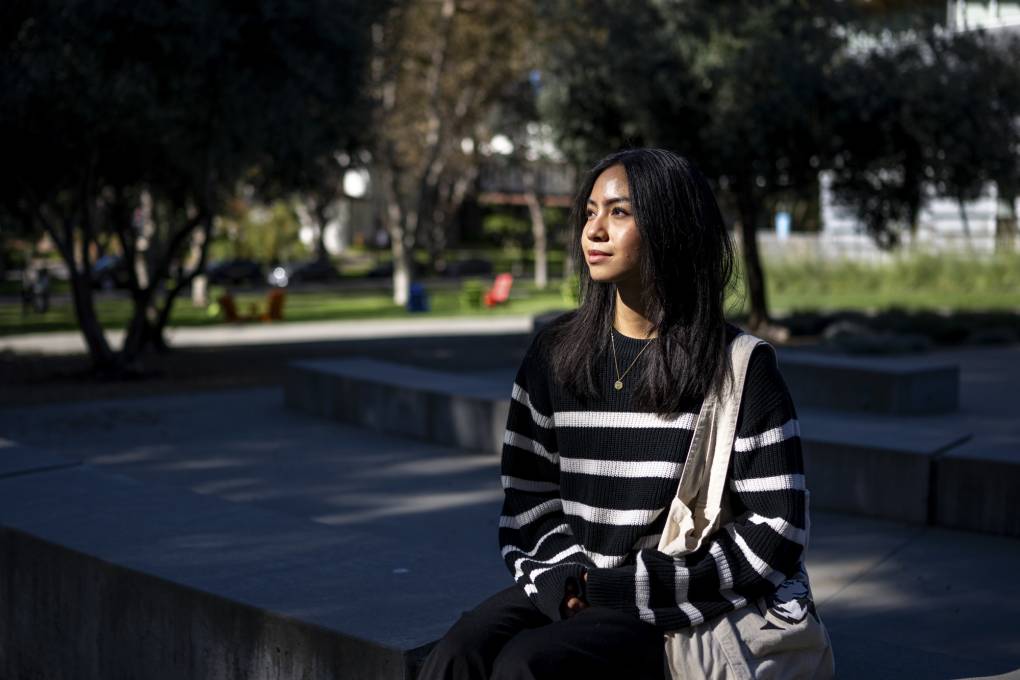
"caption": "Student Angela Vergara sits on the Northeastern University campus in Oakland on Oct. 29, 2024. Vergara received an Oakland Opportunity Scholarship to attend the university through Upward Bound, a federally funded program that helps first-generation college students from underrepresented communities.",
"credit": "Beth LaBerge/KQED",
"altTag": null,
"description": null,
"imgSizes": {
"medium": {
"file": "https://cdn.kqed.org/wp-content/uploads/sites/10/2024/10/241029-OAKLANDSCHOLARSHIPSTUDENTS-17-BL-KQED-800x533.jpg",
"width": 800,
"height": 533,
"mimeType": "image/jpeg"
},
"large": {
"file": "https://cdn.kqed.org/wp-content/uploads/sites/10/2024/10/241029-OAKLANDSCHOLARSHIPSTUDENTS-17-BL-KQED-1020x680.jpg",
"width": 1020,
"height": 680,
"mimeType": "image/jpeg"
},
"thumbnail": {
"file": "https://cdn.kqed.org/wp-content/uploads/sites/10/2024/10/241029-OAKLANDSCHOLARSHIPSTUDENTS-17-BL-KQED-160x107.jpg",
"width": 160,
"height": 107,
"mimeType": "image/jpeg"
},
"1536x1536": {
"file": "https://cdn.kqed.org/wp-content/uploads/sites/10/2024/10/241029-OAKLANDSCHOLARSHIPSTUDENTS-17-BL-KQED-1536x1024.jpg",
"width": 1536,
"height": 1024,
"mimeType": "image/jpeg"
},
"post-thumbnail": {
"file": "https://cdn.kqed.org/wp-content/uploads/sites/10/2024/10/241029-OAKLANDSCHOLARSHIPSTUDENTS-17-BL-KQED-672x372.jpg",
"width": 672,
"height": 372,
"mimeType": "image/jpeg"
},
"twentyfourteen-full-width": {
"file": "https://cdn.kqed.org/wp-content/uploads/sites/10/2024/10/241029-OAKLANDSCHOLARSHIPSTUDENTS-17-BL-KQED-1038x576.jpg",
"width": 1038,
"height": 576,
"mimeType": "image/jpeg"
},
"full-width": {
"file": "https://cdn.kqed.org/wp-content/uploads/sites/10/2024/10/241029-OAKLANDSCHOLARSHIPSTUDENTS-17-BL-KQED-1920x1280.jpg",
"width": 1920,
"height": 1280,
"mimeType": "image/jpeg"
},
"kqedFullSize": {
"file": "https://cdn.kqed.org/wp-content/uploads/sites/10/2024/10/241029-OAKLANDSCHOLARSHIPSTUDENTS-17-BL-KQED.jpg",
"width": 2000,
"height": 1333
}
},
"isLoading": false,
"fetchFailed": false
},
"news_12007898": {
"type": "attachments",
"id": "news_12007898",
"meta": {
"index": "attachments_1716263798",
"site": "news",
"id": "12007898",
"found": true
},
"title": "A UPTE-CWA union meeting at UCSF on Oct. 3, 2024.",
"publishDate": 1728010573,
"status": "inherit",
"parent": 0,
"modified": 1730398919,
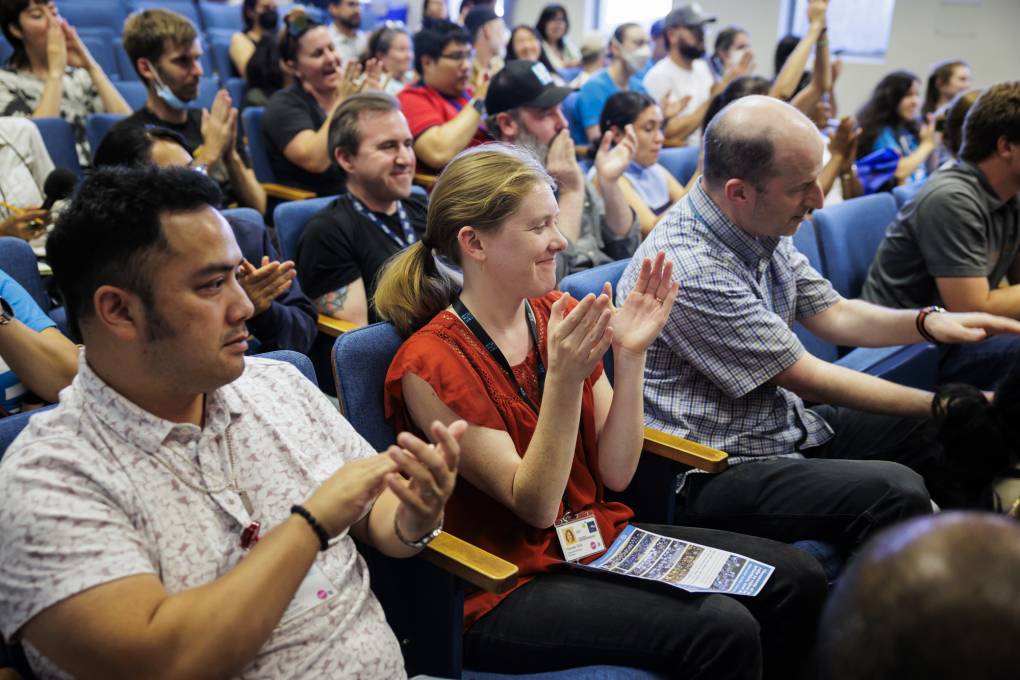
"caption": "The audience applauds the speakers at a UPTE-CWA union meeting at UCSF on Oct. 3, 2024.",
"credit": "Martin do Nascimento/KQED",
"altTag": null,
"description": null,
"imgSizes": {
"medium": {
"file": "https://cdn.kqed.org/wp-content/uploads/sites/10/2024/10/241003-UCSF-CLINICAL-SOCIAL-WORKERS-MD-06-KQED-800x533.jpg",
"width": 800,
"height": 533,
"mimeType": "image/jpeg"
},
"large": {
"file": "https://cdn.kqed.org/wp-content/uploads/sites/10/2024/10/241003-UCSF-CLINICAL-SOCIAL-WORKERS-MD-06-KQED-1020x680.jpg",
"width": 1020,
"height": 680,
"mimeType": "image/jpeg"
},
"thumbnail": {
"file": "https://cdn.kqed.org/wp-content/uploads/sites/10/2024/10/241003-UCSF-CLINICAL-SOCIAL-WORKERS-MD-06-KQED-160x107.jpg",
"width": 160,
"height": 107,
"mimeType": "image/jpeg"
},
"1536x1536": {
"file": "https://cdn.kqed.org/wp-content/uploads/sites/10/2024/10/241003-UCSF-CLINICAL-SOCIAL-WORKERS-MD-06-KQED-1536x1024.jpg",
"width": 1536,
"height": 1024,
"mimeType": "image/jpeg"
},
"post-thumbnail": {
"file": "https://cdn.kqed.org/wp-content/uploads/sites/10/2024/10/241003-UCSF-CLINICAL-SOCIAL-WORKERS-MD-06-KQED-672x372.jpg",
"width": 672,
"height": 372,
"mimeType": "image/jpeg"
},
"twentyfourteen-full-width": {
"file": "https://cdn.kqed.org/wp-content/uploads/sites/10/2024/10/241003-UCSF-CLINICAL-SOCIAL-WORKERS-MD-06-KQED-1038x576.jpg",
"width": 1038,
"height": 576,
"mimeType": "image/jpeg"
},
"full-width": {
"file": "https://cdn.kqed.org/wp-content/uploads/sites/10/2024/10/241003-UCSF-CLINICAL-SOCIAL-WORKERS-MD-06-KQED-1920x1280.jpg",
"width": 1920,
"height": 1280,
"mimeType": "image/jpeg"
},
"kqedFullSize": {
"file": "https://cdn.kqed.org/wp-content/uploads/sites/10/2024/10/241003-UCSF-CLINICAL-SOCIAL-WORKERS-MD-06-KQED.jpg",
"width": 2000,
"height": 1333
}
},
"isLoading": false,
"fetchFailed": false
},
"news_12008946": {
"type": "attachments",
"id": "news_12008946",
"meta": {
"index": "attachments_1716263798",
"site": "news",
"id": "12008946",
"found": true
},
"title": "PamelaPriceAntiRecall1",
"publishDate": 1728595078,
"status": "inherit",
"parent": 12008868,
"modified": 1730346315,
"caption": "Alameda County District Attorney Pamela Price speaks at a press conference on Oct. 10, 2024, at Everett & Jones Barbeque in Oakland's Jack London Square. The event, hosted by Protect the Win, was part of Price's anti-recall campaign.",
"credit": "Annelise Finney/KQED",
"altTag": null,
"description": null,
"imgSizes": {
"medium": {
"file": "https://cdn.kqed.org/wp-content/uploads/sites/10/2024/10/PamelaPriceAntiRecall1-800x600.jpg",
"width": 800,
"height": 600,
"mimeType": "image/jpeg"
},
"large": {
"file": "https://cdn.kqed.org/wp-content/uploads/sites/10/2024/10/PamelaPriceAntiRecall1-1020x765.jpg",
"width": 1020,
"height": 765,
"mimeType": "image/jpeg"
},
"thumbnail": {
"file": "https://cdn.kqed.org/wp-content/uploads/sites/10/2024/10/PamelaPriceAntiRecall1-160x120.jpg",
"width": 160,
"height": 120,
"mimeType": "image/jpeg"
},
"1536x1536": {
"file": "https://cdn.kqed.org/wp-content/uploads/sites/10/2024/10/PamelaPriceAntiRecall1-1536x1152.jpg",
"width": 1536,
"height": 1152,
"mimeType": "image/jpeg"
},
"post-thumbnail": {
"file": "https://cdn.kqed.org/wp-content/uploads/sites/10/2024/10/PamelaPriceAntiRecall1-672x372.jpg",
"width": 672,
"height": 372,
"mimeType": "image/jpeg"
},
"twentyfourteen-full-width": {
"file": "https://cdn.kqed.org/wp-content/uploads/sites/10/2024/10/PamelaPriceAntiRecall1-1038x576.jpg",
"width": 1038,
"height": 576,
"mimeType": "image/jpeg"
},
"full-width": {
"file": "https://cdn.kqed.org/wp-content/uploads/sites/10/2024/10/PamelaPriceAntiRecall1-1920x1440.jpg",
"width": 1920,
"height": 1440,
"mimeType": "image/jpeg"
},
"kqedFullSize": {
"file": "https://cdn.kqed.org/wp-content/uploads/sites/10/2024/10/PamelaPriceAntiRecall1.jpg",
"width": 2000,
"height": 1500
}
},
"isLoading": false,
"fetchFailed": false
},
"news_11948331": {
"type": "attachments",
"id": "news_11948331",
"meta": {
"index": "attachments_1716263798",
"site": "news",
"id": "11948331",
"found": true
},
"title": "RS55916_058_KQED_OaklandTeacherStrike_04292022-qut",
"publishDate": 1683062568,
"status": "inherit",
"parent": 11948320,
"modified": 1772216225,
"caption": "Oakland teachers and students listen to speakers during a rally as part of a one-day walkout on April 29, 2022, to protest the Oakland Unified School District's planned closures. Teachers represented by the Oakland Education Association may go on strike once again on Thursday.",
"credit": "Beth LaBerge/KQED",
"altTag": "An older Black man stands outside at a rally, with a sign hanging from his neck that says: 'Fund Public Schools.'",
"description": null,
"imgSizes": {
"medium": {
"file": "https://cdn.kqed.org/wp-content/uploads/sites/10/2023/05/RS55916_058_KQED_OaklandTeacherStrike_04292022-qut-800x533.jpg",
"width": 800,
"height": 533,
"mimeType": "image/jpeg"
},
"large": {
"file": "https://cdn.kqed.org/wp-content/uploads/sites/10/2023/05/RS55916_058_KQED_OaklandTeacherStrike_04292022-qut-1020x680.jpg",
"width": 1020,
"height": 680,
"mimeType": "image/jpeg"
},
"thumbnail": {
"file": "https://cdn.kqed.org/wp-content/uploads/sites/10/2023/05/RS55916_058_KQED_OaklandTeacherStrike_04292022-qut-160x107.jpg",
"width": 160,
"height": 107,
"mimeType": "image/jpeg"
},
"1536x1536": {
"file": "https://cdn.kqed.org/wp-content/uploads/sites/10/2023/05/RS55916_058_KQED_OaklandTeacherStrike_04292022-qut-1536x1024.jpg",
"width": 1536,
"height": 1024,
"mimeType": "image/jpeg"
},
"post-thumbnail": {
"file": "https://cdn.kqed.org/wp-content/uploads/sites/10/2023/05/RS55916_058_KQED_OaklandTeacherStrike_04292022-qut-672x372.jpg",
"width": 672,
"height": 372,
"mimeType": "image/jpeg"
},
"twentyfourteen-full-width": {
"file": "https://cdn.kqed.org/wp-content/uploads/sites/10/2023/05/RS55916_058_KQED_OaklandTeacherStrike_04292022-qut-1038x576.jpg",
"width": 1038,
"height": 576,
"mimeType": "image/jpeg"
},
"kqedFullSize": {
"file": "https://cdn.kqed.org/wp-content/uploads/sites/10/2023/05/RS55916_058_KQED_OaklandTeacherStrike_04292022-qut.jpg",
"width": 1920,
"height": 1280
}
},
"isLoading": false,
"fetchFailed": false
},
"news_12008445": {
"type": "attachments",
"id": "news_12008445",
"meta": {
"index": "attachments_1716263798",
"site": "news",
"id": "12008445",
"found": true
},
"title": "20240930_CEQACHILDCARE_GC-45-KQED",
"publishDate": 1728408278,
"status": "inherit",
"parent": 0,
"modified": 1728408351,
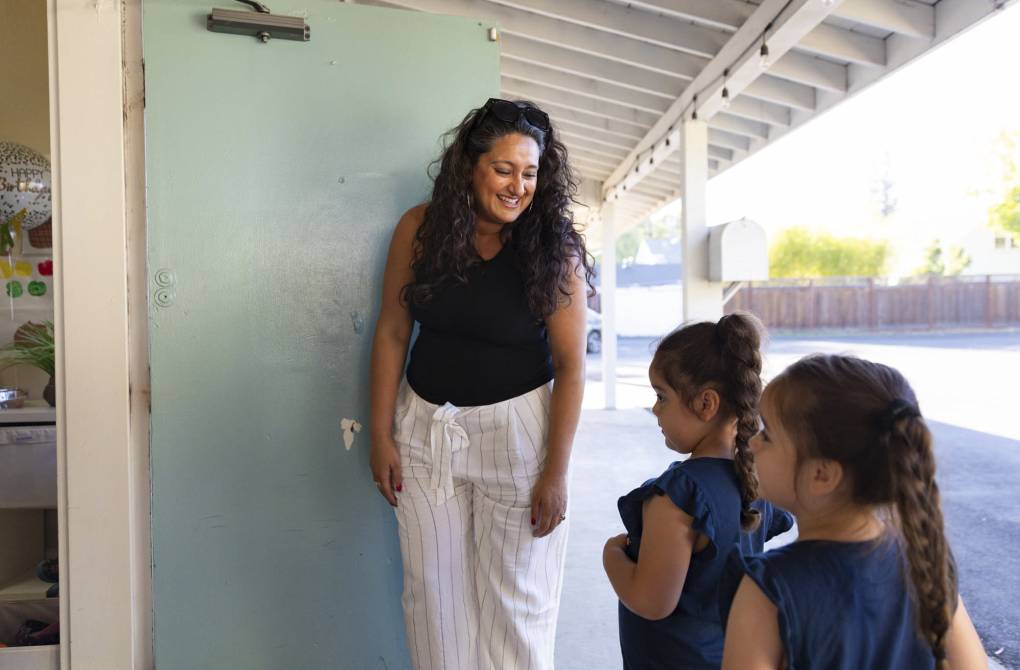
"caption": "Milli Pintacsi, Founder of Le Petit Elephant Nursery and Preschool, smiles as she says goodbye to students getting picked up, on September 30, 2024.",
"credit": "Gina Castro/KQED",
"altTag": null,
"description": null,
"imgSizes": {
"medium": {
"file": "https://cdn.kqed.org/wp-content/uploads/sites/10/2024/10/20240930_CEQACHILDCARE_GC-45-KQED-800x526.jpg",
"width": 800,
"height": 526,
"mimeType": "image/jpeg"
},
"large": {
"file": "https://cdn.kqed.org/wp-content/uploads/sites/10/2024/10/20240930_CEQACHILDCARE_GC-45-KQED-1020x670.jpg",
"width": 1020,
"height": 670,
"mimeType": "image/jpeg"
},
"thumbnail": {
"file": "https://cdn.kqed.org/wp-content/uploads/sites/10/2024/10/20240930_CEQACHILDCARE_GC-45-KQED-160x105.jpg",
"width": 160,
"height": 105,
"mimeType": "image/jpeg"
},
"1536x1536": {
"file": "https://cdn.kqed.org/wp-content/uploads/sites/10/2024/10/20240930_CEQACHILDCARE_GC-45-KQED-1536x1009.jpg",
"width": 1536,
"height": 1009,
"mimeType": "image/jpeg"
},
"post-thumbnail": {
"file": "https://cdn.kqed.org/wp-content/uploads/sites/10/2024/10/20240930_CEQACHILDCARE_GC-45-KQED-672x372.jpg",
"width": 672,
"height": 372,
"mimeType": "image/jpeg"
},
"twentyfourteen-full-width": {
"file": "https://cdn.kqed.org/wp-content/uploads/sites/10/2024/10/20240930_CEQACHILDCARE_GC-45-KQED-1038x576.jpg",
"width": 1038,
"height": 576,
"mimeType": "image/jpeg"
},
"full-width": {
"file": "https://cdn.kqed.org/wp-content/uploads/sites/10/2024/10/20240930_CEQACHILDCARE_GC-45-KQED-1920x1261.jpg",
"width": 1920,
"height": 1261,
"mimeType": "image/jpeg"
},
"kqedFullSize": {
"file": "https://cdn.kqed.org/wp-content/uploads/sites/10/2024/10/20240930_CEQACHILDCARE_GC-45-KQED.jpg",
"width": 2000,
"height": 1314
}
},
"isLoading": false,
"fetchFailed": false
},
"news_11966840": {
"type": "attachments",
"id": "news_11966840",
"meta": {
"index": "attachments_1716263798",
"site": "news",
"id": "11966840",
"found": true
},
"parent": 0,
"imgSizes": {
"twentyfourteen-full-width": {
"file": "https://ww2.kqed.org/app/uploads/sites/10/2023/11/231108-DEPAPE-PELOSI-BODY-CAMERA-KQED-1038x576.jpg",
"width": 1038,
"mimeType": "image/jpeg",
"height": 576
},
"thumbnail": {
"file": "https://ww2.kqed.org/app/uploads/sites/10/2023/11/231108-DEPAPE-PELOSI-BODY-CAMERA-KQED-160x107.jpg",
"width": 160,
"mimeType": "image/jpeg",
"height": 107
},
"post-thumbnail": {
"file": "https://ww2.kqed.org/app/uploads/sites/10/2023/11/231108-DEPAPE-PELOSI-BODY-CAMERA-KQED-672x372.jpg",
"width": 672,
"mimeType": "image/jpeg",
"height": 372
},
"kqedFullSize": {
"file": "https://ww2.kqed.org/app/uploads/sites/10/2023/11/231108-DEPAPE-PELOSI-BODY-CAMERA-KQED.jpg",
"width": 2000,
"height": 1334
},
"large": {
"file": "https://ww2.kqed.org/app/uploads/sites/10/2023/11/231108-DEPAPE-PELOSI-BODY-CAMERA-KQED-1020x680.jpg",
"width": 1020,
"mimeType": "image/jpeg",
"height": 680
},
"1536x1536": {
"file": "https://ww2.kqed.org/app/uploads/sites/10/2023/11/231108-DEPAPE-PELOSI-BODY-CAMERA-KQED-1536x1025.jpg",
"width": 1536,
"mimeType": "image/jpeg",
"height": 1025
},
"full-width": {
"file": "https://ww2.kqed.org/app/uploads/sites/10/2023/11/231108-DEPAPE-PELOSI-BODY-CAMERA-KQED-1920x1281.jpg",
"width": 1920,
"mimeType": "image/jpeg",
"height": 1281
},
"medium": {
"file": "https://ww2.kqed.org/app/uploads/sites/10/2023/11/231108-DEPAPE-PELOSI-BODY-CAMERA-KQED-800x534.jpg",
"width": 800,
"mimeType": "image/jpeg",
"height": 534
}
},
"publishDate": 1699489012,
"modified": 1699490331,
"caption": "A screen capture from SFPD Body Camera Footage of the attack on Paul Pelosi on Oct. 28, 2022.",
"description": null,
"title": "231108-DEPAPE PELOSI BODY CAMERA-KQED",
"credit": "Courtesy of SFPD",
"status": "inherit",
"altTag": "Two people stand beside each other inside the entryway of a home.",
"isLoading": false,
"fetchFailed": false
},
"news_11991871": {
"type": "attachments",
"id": "news_11991871",
"meta": {
"index": "attachments_1716263798",
"site": "news",
"id": "11991871",
"found": true
},
"title": "005_KQED_SanFrancisco_SafeSleepingVillage_05142020",
"publishDate": 1719343564,
"status": "inherit",
"parent": 11991834,
"modified": 1719343645,
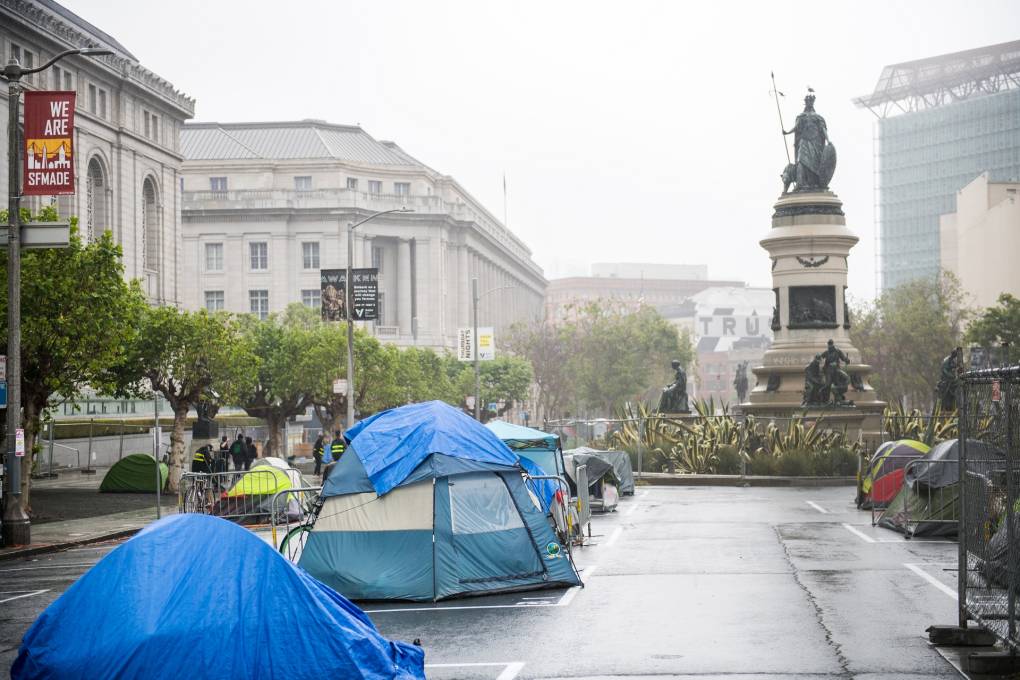
"caption": "The Bay Area needs an additional $9.5 billion to reduce street homelessness by 75% over the next five years, according to a report released Tuesday by the research nonprofit All Home. ",
"credit": "Beth LaBerge/KQED",
"altTag": null,
"description": null,
"imgSizes": {
"medium": {
"file": "https://cdn.kqed.org/wp-content/uploads/sites/10/2024/06/005_KQED_SanFrancisco_SafeSleepingVillage_05142020-800x533.jpg",
"width": 800,
"height": 533,
"mimeType": "image/jpeg"
},
"large": {
"file": "https://cdn.kqed.org/wp-content/uploads/sites/10/2024/06/005_KQED_SanFrancisco_SafeSleepingVillage_05142020-1020x680.jpg",
"width": 1020,
"height": 680,
"mimeType": "image/jpeg"
},
"thumbnail": {
"file": "https://cdn.kqed.org/wp-content/uploads/sites/10/2024/06/005_KQED_SanFrancisco_SafeSleepingVillage_05142020-160x107.jpg",
"width": 160,
"height": 107,
"mimeType": "image/jpeg"
},
"1536x1536": {
"file": "https://cdn.kqed.org/wp-content/uploads/sites/10/2024/06/005_KQED_SanFrancisco_SafeSleepingVillage_05142020-1536x1024.jpg",
"width": 1536,
"height": 1024,
"mimeType": "image/jpeg"
},
"post-thumbnail": {
"file": "https://cdn.kqed.org/wp-content/uploads/sites/10/2024/06/005_KQED_SanFrancisco_SafeSleepingVillage_05142020-672x372.jpg",
"width": 672,
"height": 372,
"mimeType": "image/jpeg"
},
"twentyfourteen-full-width": {
"file": "https://cdn.kqed.org/wp-content/uploads/sites/10/2024/06/005_KQED_SanFrancisco_SafeSleepingVillage_05142020-1038x576.jpg",
"width": 1038,
"height": 576,
"mimeType": "image/jpeg"
},
"kqedFullSize": {
"file": "https://cdn.kqed.org/wp-content/uploads/sites/10/2024/06/005_KQED_SanFrancisco_SafeSleepingVillage_05142020.jpg",
"width": 1920,
"height": 1280
}
},
"isLoading": false,
"fetchFailed": false
},
"news_12010829": {
"type": "attachments",
"id": "news_12010829",
"meta": {
"index": "attachments_1716263798",
"site": "news",
"id": "12010829",
"found": true
},
"title": "241023-SFUSDSUPERINTENDENT-12-BL-KQED",
"publishDate": 1729719379,
"status": "inherit",
"parent": 0,
"modified": 1730234813,
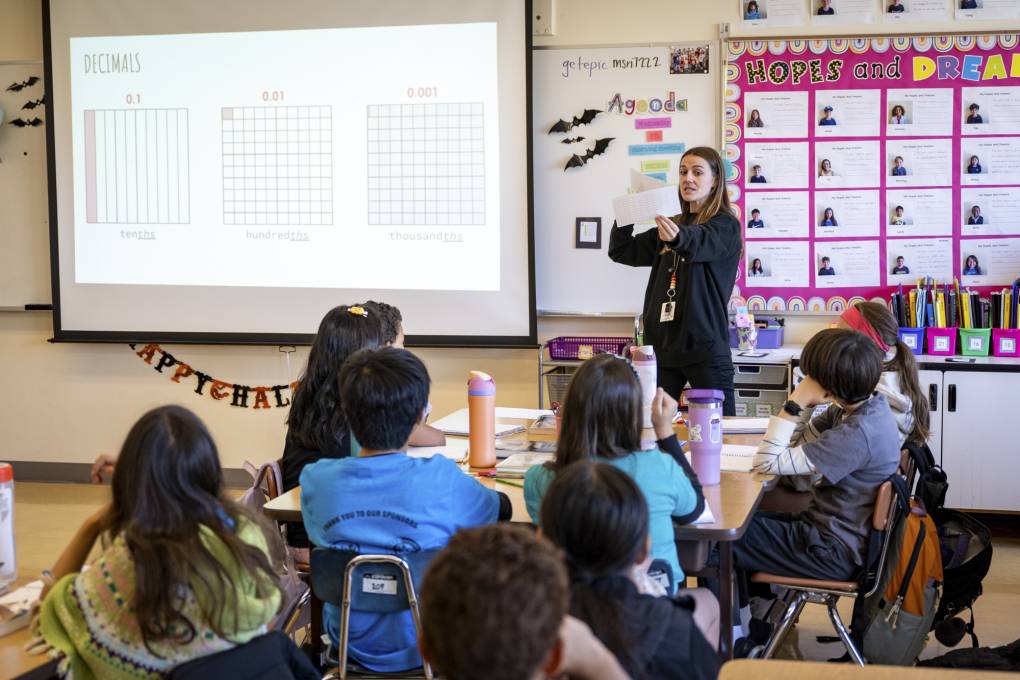
"caption": "Katie Dorset teaches a class at Yick Wo Alternative Elementary School in San Francisco on Oct. 23, 2024, when new Superintendent Maria Su visited the campus.",
"credit": "Beth LaBerge/KQED",
"altTag": null,
"description": null,
"imgSizes": {
"medium": {
"file": "https://cdn.kqed.org/wp-content/uploads/sites/10/2024/10/241023-SFUSDSUPERINTENDENT-12-BL-KQED-800x533.jpg",
"width": 800,
"height": 533,
"mimeType": "image/jpeg"
},
"large": {
"file": "https://cdn.kqed.org/wp-content/uploads/sites/10/2024/10/241023-SFUSDSUPERINTENDENT-12-BL-KQED-1020x680.jpg",
"width": 1020,
"height": 680,
"mimeType": "image/jpeg"
},
"thumbnail": {
"file": "https://cdn.kqed.org/wp-content/uploads/sites/10/2024/10/241023-SFUSDSUPERINTENDENT-12-BL-KQED-160x107.jpg",
"width": 160,
"height": 107,
"mimeType": "image/jpeg"
},
"1536x1536": {
"file": "https://cdn.kqed.org/wp-content/uploads/sites/10/2024/10/241023-SFUSDSUPERINTENDENT-12-BL-KQED-1536x1024.jpg",
"width": 1536,
"height": 1024,
"mimeType": "image/jpeg"
},
"post-thumbnail": {
"file": "https://cdn.kqed.org/wp-content/uploads/sites/10/2024/10/241023-SFUSDSUPERINTENDENT-12-BL-KQED-672x372.jpg",
"width": 672,
"height": 372,
"mimeType": "image/jpeg"
},
"twentyfourteen-full-width": {
"file": "https://cdn.kqed.org/wp-content/uploads/sites/10/2024/10/241023-SFUSDSUPERINTENDENT-12-BL-KQED-1038x576.jpg",
"width": 1038,
"height": 576,
"mimeType": "image/jpeg"
},
"full-width": {
"file": "https://cdn.kqed.org/wp-content/uploads/sites/10/2024/10/241023-SFUSDSUPERINTENDENT-12-BL-KQED-1920x1280.jpg",
"width": 1920,
"height": 1280,
"mimeType": "image/jpeg"
},
"kqedFullSize": {
"file": "https://cdn.kqed.org/wp-content/uploads/sites/10/2024/10/241023-SFUSDSUPERINTENDENT-12-BL-KQED.jpg",
"width": 2000,
"height": 1333
}
},
"isLoading": false,
"fetchFailed": false
},
"news_12004813": {
"type": "attachments",
"id": "news_12004813",
"meta": {
"index": "attachments_1716263798",
"site": "news",
"id": "12004813",
"found": true
},
"title": "091024_PresidentialDebate_FM_CM-04-scaled",
"publishDate": 1726437006,
"status": "inherit",
"parent": 12004810,
"modified": 1730221601,
"caption": "People watch the presidential debate between former President Donald Trump and Vice President Kamala Harris at KQED headquarters in San Francisco on Sept. 10, 2024.",
"credit": "Florence Middleton/CalMatters",
"altTag": "Several people are sitting facing a split screen showing a man and a woman.",
"description": null,
"imgSizes": {
"medium": {
"file": "https://cdn.kqed.org/wp-content/uploads/sites/10/2024/09/091024_PresidentialDebate_FM_CM-04-scaled-1-800x534.jpg",
"width": 800,
"height": 534,
"mimeType": "image/jpeg"
},
"large": {
"file": "https://cdn.kqed.org/wp-content/uploads/sites/10/2024/09/091024_PresidentialDebate_FM_CM-04-scaled-1-1020x681.jpg",
"width": 1020,
"height": 681,
"mimeType": "image/jpeg"
},
"thumbnail": {
"file": "https://cdn.kqed.org/wp-content/uploads/sites/10/2024/09/091024_PresidentialDebate_FM_CM-04-scaled-1-160x107.jpg",
"width": 160,
"height": 107,
"mimeType": "image/jpeg"
},
"1536x1536": {
"file": "https://cdn.kqed.org/wp-content/uploads/sites/10/2024/09/091024_PresidentialDebate_FM_CM-04-scaled-1-1536x1025.jpg",
"width": 1536,
"height": 1025,
"mimeType": "image/jpeg"
},
"2048x2048": {
"file": "https://cdn.kqed.org/wp-content/uploads/sites/10/2024/09/091024_PresidentialDebate_FM_CM-04-scaled-1-2048x1366.jpg",
"width": 2048,
"height": 1366,
"mimeType": "image/jpeg"
},
"post-thumbnail": {
"file": "https://cdn.kqed.org/wp-content/uploads/sites/10/2024/09/091024_PresidentialDebate_FM_CM-04-scaled-1-672x372.jpg",
"width": 672,
"height": 372,
"mimeType": "image/jpeg"
},
"twentyfourteen-full-width": {
"file": "https://cdn.kqed.org/wp-content/uploads/sites/10/2024/09/091024_PresidentialDebate_FM_CM-04-scaled-1-1038x576.jpg",
"width": 1038,
"height": 576,
"mimeType": "image/jpeg"
},
"full-width": {
"file": "https://cdn.kqed.org/wp-content/uploads/sites/10/2024/09/091024_PresidentialDebate_FM_CM-04-scaled-1-1920x1281.jpg",
"width": 1920,
"height": 1281,
"mimeType": "image/jpeg"
},
"kqedFullSize": {
"file": "https://cdn.kqed.org/wp-content/uploads/sites/10/2024/09/091024_PresidentialDebate_FM_CM-04-scaled-1.jpg",
"width": 2560,
"height": 1708
}
},
"isLoading": false,
"fetchFailed": false
},
"news_12011323": {
"type": "attachments",
"id": "news_12011323",
"meta": {
"index": "attachments_1716263798",
"site": "news",
"id": "12011323",
"found": true
},
"title": "20241025_YOUNGVOTERSGAZA_GC-10-KQED",
"publishDate": 1730134363,
"status": "inherit",
"parent": 0,
"modified": 1730157091,
"caption": "'By voting for Harris, I feel like there’s a shot of getting a cease-fire,' said Halimah Houston, 20. Houston previously told KQED she wouldn't vote for Joe Biden.",
"credit": "Gina Castro/KQED",
"altTag": null,
"description": null,
"imgSizes": {
"medium": {
"file": "https://cdn.kqed.org/wp-content/uploads/sites/10/2024/10/20241025_YOUNGVOTERSGAZA_GC-10-KQED-800x533.jpg",
"width": 800,
"height": 533,
"mimeType": "image/jpeg"
},
"large": {
"file": "https://cdn.kqed.org/wp-content/uploads/sites/10/2024/10/20241025_YOUNGVOTERSGAZA_GC-10-KQED-1020x680.jpg",
"width": 1020,
"height": 680,
"mimeType": "image/jpeg"
},
"thumbnail": {
"file": "https://cdn.kqed.org/wp-content/uploads/sites/10/2024/10/20241025_YOUNGVOTERSGAZA_GC-10-KQED-160x107.jpg",
"width": 160,
"height": 107,
"mimeType": "image/jpeg"
},
"1536x1536": {
"file": "https://cdn.kqed.org/wp-content/uploads/sites/10/2024/10/20241025_YOUNGVOTERSGAZA_GC-10-KQED-1536x1024.jpg",
"width": 1536,
"height": 1024,
"mimeType": "image/jpeg"
},
"post-thumbnail": {
"file": "https://cdn.kqed.org/wp-content/uploads/sites/10/2024/10/20241025_YOUNGVOTERSGAZA_GC-10-KQED-672x372.jpg",
"width": 672,
"height": 372,
"mimeType": "image/jpeg"
},
"twentyfourteen-full-width": {
"file": "https://cdn.kqed.org/wp-content/uploads/sites/10/2024/10/20241025_YOUNGVOTERSGAZA_GC-10-KQED-1038x576.jpg",
"width": 1038,
"height": 576,
"mimeType": "image/jpeg"
},
"full-width": {
"file": "https://cdn.kqed.org/wp-content/uploads/sites/10/2024/10/20241025_YOUNGVOTERSGAZA_GC-10-KQED-1920x1280.jpg",
"width": 1920,
"height": 1280,
"mimeType": "image/jpeg"
},
"kqedFullSize": {
"file": "https://cdn.kqed.org/wp-content/uploads/sites/10/2024/10/20241025_YOUNGVOTERSGAZA_GC-10-KQED.jpg",
"width": 2000,
"height": 1333
}
},
"isLoading": false,
"fetchFailed": false
},
"news_12010730": {
"type": "attachments",
"id": "news_12010730",
"meta": {
"index": "attachments_1716263798",
"site": "news",
"id": "12010730",
"found": true
},
"title": "20241022_SCHOOLDISTRICTHOUSING_GC-10-KQED",
"publishDate": 1729710279,
"status": "inherit",
"parent": 0,
"modified": 1729882204,
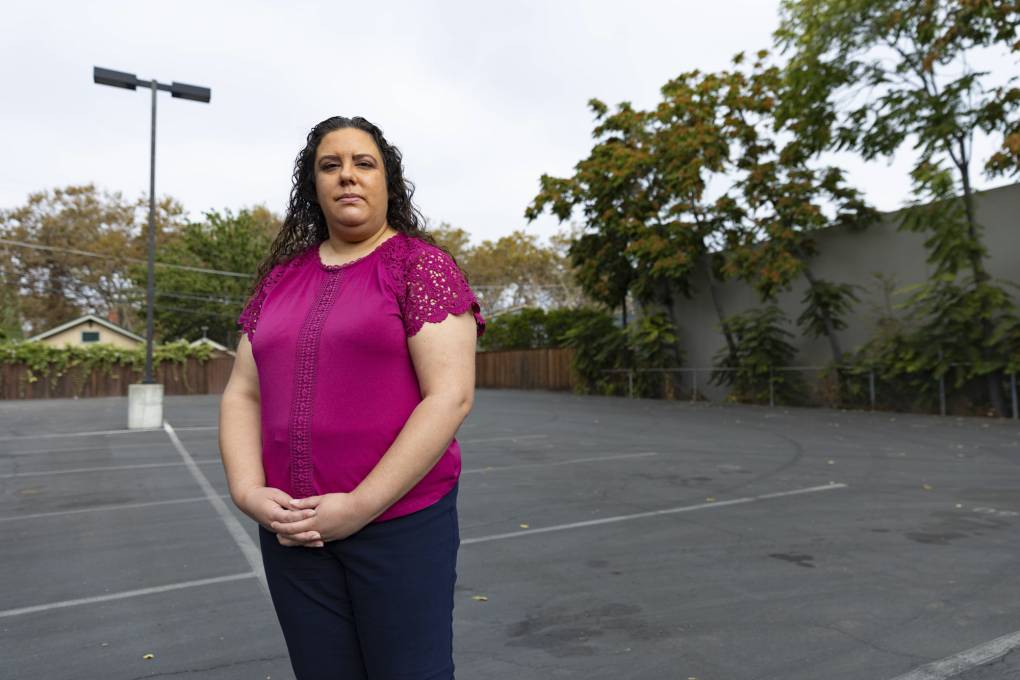
"caption": "Renata Sanchez, president of the San José Teachers Association, poses for a photo at an employee parking lot, the proposed site for educator housing, in San José on Oct. 22.",
"credit": "Gina Castro/KQED",
"altTag": null,
"description": null,
"imgSizes": {
"medium": {
"file": "https://cdn.kqed.org/wp-content/uploads/sites/10/2024/10/20241022_SCHOOLDISTRICTHOUSING_GC-10-KQED-800x533.jpg",
"width": 800,
"height": 533,
"mimeType": "image/jpeg"
},
"large": {
"file": "https://cdn.kqed.org/wp-content/uploads/sites/10/2024/10/20241022_SCHOOLDISTRICTHOUSING_GC-10-KQED-1020x680.jpg",
"width": 1020,
"height": 680,
"mimeType": "image/jpeg"
},
"thumbnail": {
"file": "https://cdn.kqed.org/wp-content/uploads/sites/10/2024/10/20241022_SCHOOLDISTRICTHOUSING_GC-10-KQED-160x107.jpg",
"width": 160,
"height": 107,
"mimeType": "image/jpeg"
},
"1536x1536": {
"file": "https://cdn.kqed.org/wp-content/uploads/sites/10/2024/10/20241022_SCHOOLDISTRICTHOUSING_GC-10-KQED-1536x1024.jpg",
"width": 1536,
"height": 1024,
"mimeType": "image/jpeg"
},
"post-thumbnail": {
"file": "https://cdn.kqed.org/wp-content/uploads/sites/10/2024/10/20241022_SCHOOLDISTRICTHOUSING_GC-10-KQED-672x372.jpg",
"width": 672,
"height": 372,
"mimeType": "image/jpeg"
},
"twentyfourteen-full-width": {
"file": "https://cdn.kqed.org/wp-content/uploads/sites/10/2024/10/20241022_SCHOOLDISTRICTHOUSING_GC-10-KQED-1038x576.jpg",
"width": 1038,
"height": 576,
"mimeType": "image/jpeg"
},
"full-width": {
"file": "https://cdn.kqed.org/wp-content/uploads/sites/10/2024/10/20241022_SCHOOLDISTRICTHOUSING_GC-10-KQED-1920x1280.jpg",
"width": 1920,
"height": 1280,
"mimeType": "image/jpeg"
},
"kqedFullSize": {
"file": "https://cdn.kqed.org/wp-content/uploads/sites/10/2024/10/20241022_SCHOOLDISTRICTHOUSING_GC-10-KQED.jpg",
"width": 2000,
"height": 1333
}
},
"isLoading": false,
"fetchFailed": false
}
},
"audioPlayerReducer": {
"postId": "stream_live",
"isPaused": true,
"isPlaying": false,
"pfsActive": false,
"pledgeModalIsOpen": true,
"playerDrawerIsOpen": false,
"liveAudioPlayStartedAt": 0,
"liveAudioPlayContext": ""
},
"authorsReducer": {
"fjhabvala": {
"type": "authors",
"id": "8659",
"meta": {
"index": "authors_1716337520",
"id": "8659",
"found": true
},
"name": "Farida Jhabvala Romero",
"firstName": "Farida",
"lastName": "Jhabvala Romero",
"slug": "fjhabvala",
"email": "fjhabvala@kqed.org",
"display_author_email": true,
"staff_mastheads": [
"news"
],
"title": "KQED Contributor",
"bio": "Farida Jhabvala Romero is a Labor Correspondent for KQED. She previously covered immigration. Farida was \u003ca href=\"https://www.ccnma.org/2022-most-influential-latina-journalists\">named\u003c/a> one of the 10 Most Influential Latina Journalists in California in 2022 by the California Chicano News Media Association. Her work has won awards from the Society of Professional Journalists (Northern California), as well as a national and regional Edward M. Murrow Award for the collaborative reporting projects “Dangerous Air” and “Graying California.” Before joining KQED, Farida worked as a producer at Radio Bilingüe, a national public radio network. Farida earned her master’s degree in journalism from Stanford University.",
"avatar": "https://secure.gravatar.com/avatar/f9f022d4e2609741874222a1e9d41f48fea74011aa7c615eef91d9a50c944ebe?s=600&d=blank&r=g",
"twitter": "FaridaJhabvala",
"bluesky": null,
"facebook": null,
"instagram": null,
"linkedin": "https://www.linkedin.com/in/faridajhabvala/",
"sites": [
{
"site": "news",
"roles": [
"editor"
]
},
{
"site": "stateofhealth",
"roles": [
"author"
]
},
{
"site": "liveblog",
"roles": [
"author"
]
}
],
"headData": {
"title": "Farida Jhabvala Romero | KQED",
"description": "KQED Contributor",
"ogImgSrc": "https://secure.gravatar.com/avatar/f9f022d4e2609741874222a1e9d41f48fea74011aa7c615eef91d9a50c944ebe?s=600&d=blank&r=g",
"twImgSrc": "https://secure.gravatar.com/avatar/f9f022d4e2609741874222a1e9d41f48fea74011aa7c615eef91d9a50c944ebe?s=600&d=blank&r=g"
},
"isLoading": false,
"link": "/author/fjhabvala"
},
"vrancano": {
"type": "authors",
"id": "11276",
"meta": {
"index": "authors_1716337520",
"id": "11276",
"found": true
},
"name": "Vanessa Rancaño",
"firstName": "Vanessa",
"lastName": "Rancaño",
"slug": "vrancano",
"email": "vrancano@kqed.org",
"display_author_email": false,
"staff_mastheads": [
"news"
],
"title": "Reporter",
"bio": "Vanessa Rancaño is a features reporter for KQED. She’s also covered homelessness and education for the station and reported from the Central Valley. Her work has aired across public radio, from flagship national news shows to longform narrative podcasts. Before taking up a mic, she worked as a freelance print journalist. She’s been recognized with a number of national and regional awards. Vanessa grew up in California's Central Valley. She's a former NPR Kroc Fellow, and a graduate of the UC Berkeley Graduate School of Journalism.",
"avatar": "https://secure.gravatar.com/avatar/b3a383dfb0e7ee1c17568f2cf067904ab654d6e3de9743fc661f3c788ade1bed?s=600&d=blank&r=g",
"twitter": "vanessarancano",
"bluesky": null,
"facebook": null,
"instagram": null,
"linkedin": null,
"sites": [
{
"site": "arts",
"roles": [
"editor"
]
},
{
"site": "news",
"roles": [
"editor"
]
},
{
"site": "liveblog",
"roles": [
"contributor"
]
}
],
"headData": {
"title": "Vanessa Rancaño | KQED",
"description": "Reporter",
"ogImgSrc": "https://secure.gravatar.com/avatar/b3a383dfb0e7ee1c17568f2cf067904ab654d6e3de9743fc661f3c788ade1bed?s=600&d=blank&r=g",
"twImgSrc": "https://secure.gravatar.com/avatar/b3a383dfb0e7ee1c17568f2cf067904ab654d6e3de9743fc661f3c788ade1bed?s=600&d=blank&r=g"
},
"isLoading": false,
"link": "/author/vrancano"
},
"abandlamudi": {
"type": "authors",
"id": "11672",
"meta": {
"index": "authors_1716337520",
"id": "11672",
"found": true
},
"name": "Adhiti Bandlamudi",
"firstName": "Adhiti",
"lastName": "Bandlamudi",
"slug": "abandlamudi",
"email": "abandlamudi@kqed.org",
"display_author_email": false,
"staff_mastheads": [
"news"
],
"title": "KQED Housing Reporter",
"bio": "Adhiti Bandlamudi reports for KQED's Housing desk. She focuses on how housing gets built across the Bay Area. Before joining KQED in 2020, she reported for WUNC in Durham, North Carolina, WABE in Atlanta, Georgia and Capital Public Radio in Sacramento. In 2017, she was awarded a Kroc Fellowship at NPR where she reported on everything from sprinkles to the Golden State Killer's arrest. When she's not reporting, she's baking new recipes in her kitchen or watching movies with friends and family. She's originally from Georgia and has strong opinions about Great British Bake Off.",
"avatar": "https://secure.gravatar.com/avatar/868129c8b257bb99a3500e2c86a65400?s=600&d=mm&r=g",
"twitter": "oddity_adhiti",
"facebook": null,
"instagram": null,
"linkedin": null,
"sites": [
{
"site": "arts",
"roles": [
"author"
]
},
{
"site": "news",
"roles": [
"editor"
]
},
{
"site": "liveblog",
"roles": [
"author"
]
}
],
"headData": {
"title": "Adhiti Bandlamudi | KQED",
"description": "KQED Housing Reporter",
"ogImgSrc": "https://secure.gravatar.com/avatar/868129c8b257bb99a3500e2c86a65400?s=600&d=mm&r=g",
"twImgSrc": "https://secure.gravatar.com/avatar/868129c8b257bb99a3500e2c86a65400?s=600&d=mm&r=g"
},
"isLoading": false,
"link": "/author/abandlamudi"
},
"eromero": {
"type": "authors",
"id": "11746",
"meta": {
"index": "authors_1716337520",
"id": "11746",
"found": true
},
"name": "Ezra David Romero",
"firstName": "Ezra David",
"lastName": "Romero",
"slug": "eromero",
"email": "eromero@kqed.org",
"display_author_email": true,
"staff_mastheads": [
"news",
"science"
],
"title": "Climate Reporter",
"bio": "Ezra David Romero is a climate reporter for KQED News. He covers the absence and excess of water in the Bay Area — think sea level rise, flooding and drought. For nearly a decade he’s covered how warming temperatures are altering the lives of Californians. He’s reported on farmers worried their pistachio trees aren’t getting enough sleep, families desperate for water, scientists studying dying giant sequoias, and alongside firefighters containing wildfires. His work has appeared on local stations across California and nationally on public radio shows like Morning Edition, Here and Now, All Things Considered and Science Friday. ",
"avatar": "https://secure.gravatar.com/avatar/c76404d287c10ed40224227551ac36e24352c7306f106632caf6fead76f8801f?s=600&d=blank&r=g",
"twitter": "ezraromero",
"bluesky": null,
"facebook": null,
"instagram": null,
"linkedin": null,
"sites": [
{
"site": "arts",
"roles": [
"editor"
]
},
{
"site": "news",
"roles": [
"editor"
]
},
{
"site": "science",
"roles": [
"editor"
]
},
{
"site": "liveblog",
"roles": [
"author"
]
}
],
"headData": {
"title": "Ezra David Romero | KQED",
"description": "Climate Reporter",
"ogImgSrc": "https://secure.gravatar.com/avatar/c76404d287c10ed40224227551ac36e24352c7306f106632caf6fead76f8801f?s=600&d=blank&r=g",
"twImgSrc": "https://secure.gravatar.com/avatar/c76404d287c10ed40224227551ac36e24352c7306f106632caf6fead76f8801f?s=600&d=blank&r=g"
},
"isLoading": false,
"link": "/author/eromero"
},
"jlara": {
"type": "authors",
"id": "11761",
"meta": {
"index": "authors_1716337520",
"id": "11761",
"found": true
},
"name": "Juan Carlos Lara",
"firstName": "Juan Carlos",
"lastName": "Lara",
"slug": "jlara",
"email": "jlara@kqed.org",
"display_author_email": false,
"staff_mastheads": [],
"title": "KQED Contributor",
"bio": null,
"avatar": "https://secure.gravatar.com/avatar/19e2052b9b05657c5ff2af2121846e9c?s=600&d=blank&r=g",
"twitter": null,
"facebook": null,
"instagram": null,
"linkedin": null,
"sites": [
{
"site": "arts",
"roles": [
"editor"
]
},
{
"site": "news",
"roles": [
"editor"
]
},
{
"site": "forum",
"roles": [
"editor"
]
},
{
"site": "liveblog",
"roles": [
"contributor"
]
}
],
"headData": {
"title": "Juan Carlos Lara | KQED",
"description": "KQED Contributor",
"ogImgSrc": "https://secure.gravatar.com/avatar/19e2052b9b05657c5ff2af2121846e9c?s=600&d=blank&r=g",
"twImgSrc": "https://secure.gravatar.com/avatar/19e2052b9b05657c5ff2af2121846e9c?s=600&d=blank&r=g"
},
"isLoading": false,
"link": "/author/jlara"
},
"afinney": {
"type": "authors",
"id": "11772",
"meta": {
"index": "authors_1716337520",
"id": "11772",
"found": true
},
"name": "Annelise Finney",
"firstName": "Annelise",
"lastName": "Finney",
"slug": "afinney",
"email": "afinney@kqed.org",
"display_author_email": false,
"staff_mastheads": [],
"title": "Reporter",
"bio": "Annelise reports on reparations in California and East Bay politics. She co-produced the Sunday Music Drop, a limited-term radio series featuring Bay Area musicians that aired between Sept 2022 and Oct 2024. She joined KQED in 2021 as a general assignment reporter and is an alumna of KALW's Audio Academy. She was born and raised in the East Bay. She is currently away from KQED completing a year-long reporting project in Berlin, Germany as a Alexander Von Humboldt German Chancellor Fellow.",
"avatar": "https://secure.gravatar.com/avatar/b439010ea6540bec1060ee74b3c94314480991106a4a84e774fe5a0fd6605878?s=600&d=mm&r=g",
"twitter": null,
"bluesky": null,
"facebook": null,
"instagram": null,
"linkedin": null,
"sites": [
{
"site": "news",
"roles": [
"subscriber"
]
},
{
"site": "liveblog",
"roles": [
"subscriber"
]
}
],
"headData": {
"title": "Annelise Finney | KQED",
"description": "Reporter",
"ogImgSrc": "https://secure.gravatar.com/avatar/b439010ea6540bec1060ee74b3c94314480991106a4a84e774fe5a0fd6605878?s=600&d=mm&r=g",
"twImgSrc": "https://secure.gravatar.com/avatar/b439010ea6540bec1060ee74b3c94314480991106a4a84e774fe5a0fd6605878?s=600&d=mm&r=g"
},
"isLoading": false,
"link": "/author/afinney"
},
"daisynguyen": {
"type": "authors",
"id": "11829",
"meta": {
"index": "authors_1716337520",
"id": "11829",
"found": true
},
"name": "Daisy Nguyen",
"firstName": "Daisy",
"lastName": "Nguyen",
"slug": "daisynguyen",
"email": "daisynguyen@kqed.org",
"display_author_email": true,
"staff_mastheads": [
"news"
],
"title": "KQED Contributor",
"bio": "I have covered early childhood education and child care for KQED since 2022. I focus on policies aimed at increasing access to early care and education and how they shape individual lives. I've been a journalist for more than two decades, with most of that time devoted to covering breaking news throughout California for The Associated Press. I grew up in San Francisco and studied at UC Davis and Columbia University's Graduate School of Journalism. I live in Oakland with my husband and two kids.",
"avatar": "https://secure.gravatar.com/avatar/2da2127c27f7143b53ebd419800fd55f?s=600&d=blank&r=g",
"twitter": null,
"facebook": null,
"instagram": null,
"linkedin": "https://www.linkedin.com/in/daisynguyen/",
"sites": [
{
"site": "news",
"roles": [
"author"
]
},
{
"site": "liveblog",
"roles": [
"author"
]
}
],
"headData": {
"title": "Daisy Nguyen | KQED",
"description": "KQED Contributor",
"ogImgSrc": "https://secure.gravatar.com/avatar/2da2127c27f7143b53ebd419800fd55f?s=600&d=blank&r=g",
"twImgSrc": "https://secure.gravatar.com/avatar/2da2127c27f7143b53ebd419800fd55f?s=600&d=blank&r=g"
},
"isLoading": false,
"link": "/author/daisynguyen"
},
"kdebenedetti": {
"type": "authors",
"id": "11913",
"meta": {
"index": "authors_1716337520",
"id": "11913",
"found": true
},
"name": "Katie DeBenedetti",
"firstName": "Katie",
"lastName": "DeBenedetti",
"slug": "kdebenedetti",
"email": "kdebenedetti@kqed.org",
"display_author_email": false,
"staff_mastheads": [
"news",
"science"
],
"title": "KQED Contributor",
"bio": "Katie DeBenedetti is a digital reporter covering daily news for the Express Desk. Prior to joining KQED as a culture reporting intern in January 2024, she covered education and city government for the Napa Valley Register.",
"avatar": "https://secure.gravatar.com/avatar/6e31073cb8f7e4214ab03f42771d0f45?s=600&d=blank&r=g",
"twitter": null,
"facebook": null,
"instagram": null,
"linkedin": null,
"sites": [
{
"site": "news",
"roles": [
"author"
]
},
{
"site": "science",
"roles": [
"author"
]
},
{
"site": "liveblog",
"roles": [
"author"
]
}
],
"headData": {
"title": "Katie DeBenedetti | KQED",
"description": "KQED Contributor",
"ogImgSrc": "https://secure.gravatar.com/avatar/6e31073cb8f7e4214ab03f42771d0f45?s=600&d=blank&r=g",
"twImgSrc": "https://secure.gravatar.com/avatar/6e31073cb8f7e4214ab03f42771d0f45?s=600&d=blank&r=g"
},
"isLoading": false,
"link": "/author/kdebenedetti"
},
"bkrans": {
"type": "authors",
"id": "11923",
"meta": {
"index": "authors_1716337520",
"id": "11923",
"found": true
},
"name": "Brian Krans",
"firstName": "Brian",
"lastName": "Krans",
"slug": "bkrans",
"email": "bkrans@kqed.org",
"display_author_email": false,
"staff_mastheads": [
"news"
],
"title": "KQED Contributing Reporter",
"bio": "Brian Krans is an award-winning local news and investigative reporter who has been proudly working as a general assignment reporter for KQED since August 2023. He lives in Richmond, where he also reports on air pollution for Richmondside. He is also a founding member of the Vallejo Sun.",
"avatar": "https://secure.gravatar.com/avatar/71fa91f931774612559f7640390b53d9c2840ff72b20f195a25239aab2d9fbb9?s=600&d=blank&r=g",
"twitter": "citizenkrans",
"bluesky": null,
"facebook": null,
"instagram": null,
"linkedin": null,
"sites": [
{
"site": "news",
"roles": [
"editor"
]
}
],
"headData": {
"title": "Brian Krans | KQED",
"description": "KQED Contributing Reporter",
"ogImgSrc": "https://secure.gravatar.com/avatar/71fa91f931774612559f7640390b53d9c2840ff72b20f195a25239aab2d9fbb9?s=600&d=blank&r=g",
"twImgSrc": "https://secure.gravatar.com/avatar/71fa91f931774612559f7640390b53d9c2840ff72b20f195a25239aab2d9fbb9?s=600&d=blank&r=g"
},
"isLoading": false,
"link": "/author/bkrans"
}
},
"pagesReducer": {
"news_category_local": {
"type": "terms",
"id": "news_28250",
"meta": {
"index": "terms_1716263798",
"site": "news",
"id": "28250",
"score": 12.940872
},
"featImg": null,
"name": "Local",
"description": null,
"taxonomy": "category",
"headData": {
"twImgId": null,
"twTitle": null,
"ogTitle": null,
"ogImgId": null,
"twDescription": null,
"description": null,
"title": "Local Archives | KQED News",
"ogDescription": null
},
"ttid": 28267,
"slug": "local",
"isLoading": false,
"title": "Local",
"pageMeta": {
"site": "news",
"WpPageTemplate": "page-topic-editorial",
"currentPage": 136
},
"blocks": [
{
"blockName": "kqed/post-list",
"attrs": {
"layout": "cardArticle2",
"query": "posts/news?category=local",
"seeMore": false,
"paginated": true,
"page": 136
}
},
{
"blockName": "kqed/ad"
}
]
}
},
"pfsSessionReducer": {},
"postsReducer": {
"stream_live": {
"type": "live",
"id": "stream_live",
"audioUrl": "https://streams.kqed.org/kqedradio",
"title": "Live Stream",
"excerpt": "Live Stream information currently unavailable.",
"link": "/radio",
"featImg": "",
"label": {
"name": "KQED Live",
"link": "/"
}
},
"stream_kqedNewscast": {
"type": "posts",
"id": "stream_kqedNewscast",
"audioUrl": "https://www.kqed.org/.stream/anon/radio/RDnews/newscast.mp3?_=1",
"title": "KQED Newscast",
"featImg": "",
"label": {
"name": "88.5 FM",
"link": "/"
}
},
"news_12011896": {
"type": "posts",
"id": "news_12011896",
"meta": {
"index": "posts_1716263798",
"site": "news",
"id": "12011896",
"score": null,
"sort": [
1730484155000
]
},
"guestAuthors": [],
"slug": "san-francisco-is-buried-in-campaign-mailers-heres-where-they-end-up",
"title": "San Francisco Is Buried in Campaign Mailers. Here’s Where They End Up",
"publishDate": 1730484155,
"format": "standard",
"headTitle": "San Francisco Is Buried in Campaign Mailers. Here’s Where They End Up | KQED",
"labelTerm": {},
"content": "\u003cp>The end of the \u003ca href=\"https://www.kqed.org/voterguide\">2024 election season\u003c/a> is just days away, bringing — for better or worse — a conclusion to the uncertainty over who will hold the offices of power come next year.\u003c/p>\n\u003cp>Another ray of light awaits us just beyond the horizon: the unceasing avalanche of campaign flyers will finally stop. But in the meantime, where do they all end up?\u003c/p>\n\u003cp>When I check my mail lately, I’m confronted by a mass of colorful ads praising one candidate or measure or condemning another. And although I already know who I’m voting for, the flyers keep coming. They clog my mailbox and litter the streets.\u003c/p>\n\u003cp>And I know I’m not alone in this. Campaigns and political groups are sending out tons of these mailers, especially in San Francisco, where a contentious \u003ca href=\"https://www.kqed.org/news/tag/san-francisco-mayor-election\">mayoral race\u003c/a> has become the \u003ca href=\"https://www.kqed.org/news/12010904/whos-pouring-millions-into-san-franciscos-expensive-mayors-race\">city’s most expensive in recent history\u003c/a>.\u003c/p>\n\u003cp>In the last two weeks of October alone, Supervisor \u003ca href=\"https://www.kqed.org/news/12012016/aaron-peskin-sees-boost-in-final-stretch-for-sf-mayor-can-he-keep-momentum-up\">Aaron Peskin’s mayoral campaign\u003c/a> sent out over 225,000 mailers, according to public filings with the San Francisco Ethics Commission. They cost his campaign roughly $175,000.\u003c/p>\n\u003cp>[ad fullwidth]\u003c/p>\n\u003cp>“Aaron Peskin gets things done,” reads the mailer, showing the Board of Supervisors president shaking hands and smiling. The flip side includes quotes from notable supporters singing his praises.\u003c/p>\n\u003cp>For those who live with roommates, as I do, it’s common to see duplicates of the same flyer addressed to each voting-age member of the household.\u003c/p>\n\u003cp>Needless to say, all of the mailers I receive end up in the recycling bin, off to parts unknown.\u003c/p>\n\u003cp>Enter Robert Reed, spokesperson for Recology, San Francisco’s recycling company.\u003c/p>\n\u003cp>“This is the biggest season for campaign mailers … so, yes, we’re seeing more of them here,” Reed said during a recent tour of Recycle Central, a processing facility on Pier 96.\u003c/p>\n\u003cfigure id=\"attachment_12011992\" class=\"wp-caption aligncenter\" style=\"max-width: 2000px\">\u003cimg loading=\"lazy\" decoding=\"async\" class=\"size-full wp-image-12011992\" src=\"https://cdn.kqed.org/wp-content/uploads/sites/10/2024/10/241031-Recycling-Campaign-Flyers-JCL-03-KQED.jpg\" alt=\"\" width=\"2000\" height=\"1500\" srcset=\"https://cdn.kqed.org/wp-content/uploads/sites/10/2024/10/241031-Recycling-Campaign-Flyers-JCL-03-KQED.jpg 2000w, https://cdn.kqed.org/wp-content/uploads/sites/10/2024/10/241031-Recycling-Campaign-Flyers-JCL-03-KQED-800x600.jpg 800w, https://cdn.kqed.org/wp-content/uploads/sites/10/2024/10/241031-Recycling-Campaign-Flyers-JCL-03-KQED-1020x765.jpg 1020w, https://cdn.kqed.org/wp-content/uploads/sites/10/2024/10/241031-Recycling-Campaign-Flyers-JCL-03-KQED-160x120.jpg 160w, https://cdn.kqed.org/wp-content/uploads/sites/10/2024/10/241031-Recycling-Campaign-Flyers-JCL-03-KQED-1536x1152.jpg 1536w, https://cdn.kqed.org/wp-content/uploads/sites/10/2024/10/241031-Recycling-Campaign-Flyers-JCL-03-KQED-1920x1440.jpg 1920w\" sizes=\"(max-width: 2000px) 100vw, 2000px\">\u003cfigcaption class=\"wp-caption-text\">At Recology, hundreds of tons of recycling is loaded daily onto conveyor belts where the materials are sorted. \u003ccite>(Juan Carlos Lara/KQED)\u003c/cite>\u003c/figcaption>\u003c/figure>\n\u003cp>Every day, Recology trucks bring roughly 450 tons of recycling to the site. Those materials are then loaded onto conveyor belts, where nonrecyclable materials are pulled out, and the rest are separated into categories through a mix of by-hand and machine sorting.\u003c/p>\n\u003cp>On the conveyor belt, the boldly colored mailers stood out, dotting the blur of moving waste.\u003c/p>\n\u003cp>Reed explained that, as far as paper goes, recyclers are happy to get campaign mailers because they’re printed on high-grade stuff.\u003c/p>\n\u003cp>“These oversized postcards are printed on a paper called cardstock, and it has a long fiber, and it’s a heavy paper,” Reed said. “You can feel the quality of it. It is high-quality paper, and we want to make sure that it gets recycled.”[aside label=\"From the 2024 Voter Guide\" link1='https://www.kqed.org/voterguide/sanfrancisco,San Francisco: Your Voter Guide to Navigate the Candidates and Issues on Your Ballot' hero=https://cdn.kqed.org/wp-content/uploads/sites/80/2024/02/Aside-Voter-Guide-Local-Elections-San-Francisco-1200x1200-1.png]\u003c/p>\n\u003cp>Reed reached into the bunch and quickly plucked out a few.\u003c/p>\n\u003cp>They included one supporting \u003ca href=\"https://www.kqed.org/news/12001601/city-hall-outsider-daniel-lurie-wants-to-clean-up-local-government\">Daniel Lurie’s campaign for mayor\u003c/a>, another denouncing Lurie as the “trust fund guy” — referencing the fact that he is heir to the Levi Strauss fortune — and another in support of Supervisor Catherine Stefani’s run for the California Assembly.\u003c/p>\n\u003cp>After the paper products are isolated, they’re compressed into large bales and moved by forklift onto shipping containers.\u003c/p>\n\u003cp>“We sort and bale over 100 bales of mixed paper here at Recycle Central every day. On a good day, it’s 130 bales,” Reed said. “They then go to a paper mill where they’re made into new paper products like cereal boxes. And that’s good. That saves trees.”\u003c/p>\n\u003cp>\u003c/p>\n\u003cp>And who knows, maybe after a few cycles of paper reincarnation, that discarded paper will come back as a new mailer for the next election.\u003c/p>\n\n",
"blocks": [],
"excerpt": "As Election Day nears, hundreds of thousands of political ads have stuffed San Franciscans’ mailboxes. It makes for a busy time for the city’s recycling company.",
"status": "publish",
"parent": 0,
"modified": 1730493365,
"stats": {
"hasAudio": false,
"hasVideo": false,
"hasChartOrMap": false,
"iframeSrcs": [],
"hasGoogleForm": false,
"hasGallery": false,
"hasHearkenModule": false,
"hasPolis": false,
"paragraphCount": 21,
"wordCount": 688
},
"headData": {
"title": "San Francisco Is Buried in Campaign Mailers. Here’s Where They End Up | KQED",
"description": "As Election Day nears, hundreds of thousands of political ads have stuffed San Franciscans’ mailboxes. It makes for a busy time for the city’s recycling company.",
"ogTitle": "",
"ogDescription": "",
"ogImgId": "",
"twTitle": "",
"twDescription": "",
"twImgId": "",
"schema": {
"@context": "https://schema.org",
"@type": "NewsArticle",
"headline": "San Francisco Is Buried in Campaign Mailers. Here’s Where They End Up",
"datePublished": "2024-11-01T11:02:35-07:00",
"dateModified": "2024-11-01T13:36:05-07:00",
"image": "https://cdn.kqed.org/wp-content/uploads/2020/02/KQED-OG-Image@1x.png",
"isAccessibleForFree": "True",
"publisher": {
"@type": "NewsMediaOrganization",
"@id": "https://www.kqed.org/#organization",
"name": "KQED",
"logo": "https://cdn.kqed.org/wp-content/uploads/2020/02/KQED-OG-Image@1x.png",
"url": "https://www.kqed.org",
"sameAs": [
"https://www.facebook.com/KQED",
"https://twitter.com/KQED",
"https://www.instagram.com/kqed/",
"https://www.tiktok.com/@kqedofficial",
"https://www.linkedin.com/company/kqed",
"https://www.youtube.com/channel/UCeC0IOo7i1P_61zVUWbJ4nw"
]
}
}
},
"source": "Commentary",
"audioUrl": "https://traffic.omny.fm/d/clips/0af137ef-751e-4b19-a055-aaef00d2d578/ffca7e9f-6831-41c5-bcaf-aaef00f5a073/ef5ff8c8-d6c9-45a9-8b2b-b21a013b2428/audio.mp3",
"sticky": false,
"nprStoryId": "kqed-12011896",
"excludeFromSiteSearch": "Include",
"articleAge": "0",
"path": "/news/12011896/san-francisco-is-buried-in-campaign-mailers-heres-where-they-end-up",
"audioTrackLength": null,
"parsedContent": [
{
"type": "contentString",
"content": "\u003cdiv class=\"post-body\">\u003cp>\u003cp>The end of the \u003ca href=\"https://www.kqed.org/voterguide\">2024 election season\u003c/a> is just days away, bringing — for better or worse — a conclusion to the uncertainty over who will hold the offices of power come next year.\u003c/p>\n\u003cp>Another ray of light awaits us just beyond the horizon: the unceasing avalanche of campaign flyers will finally stop. But in the meantime, where do they all end up?\u003c/p>\n\u003cp>When I check my mail lately, I’m confronted by a mass of colorful ads praising one candidate or measure or condemning another. And although I already know who I’m voting for, the flyers keep coming. They clog my mailbox and litter the streets.\u003c/p>\n\u003cp>And I know I’m not alone in this. Campaigns and political groups are sending out tons of these mailers, especially in San Francisco, where a contentious \u003ca href=\"https://www.kqed.org/news/tag/san-francisco-mayor-election\">mayoral race\u003c/a> has become the \u003ca href=\"https://www.kqed.org/news/12010904/whos-pouring-millions-into-san-franciscos-expensive-mayors-race\">city’s most expensive in recent history\u003c/a>.\u003c/p>\n\u003cp>In the last two weeks of October alone, Supervisor \u003ca href=\"https://www.kqed.org/news/12012016/aaron-peskin-sees-boost-in-final-stretch-for-sf-mayor-can-he-keep-momentum-up\">Aaron Peskin’s mayoral campaign\u003c/a> sent out over 225,000 mailers, according to public filings with the San Francisco Ethics Commission. They cost his campaign roughly $175,000.\u003c/p>\n\u003cp>\u003c/p>\u003c/div>",
"attributes": {
"named": {},
"numeric": []
}
},
{
"type": "component",
"content": "",
"name": "ad",
"attributes": {
"named": {
"label": "fullwidth"
},
"numeric": [
"fullwidth"
]
}
},
{
"type": "contentString",
"content": "\u003cdiv class=\"post-body\">\u003cp>\u003c/p>\n\u003cp>“Aaron Peskin gets things done,” reads the mailer, showing the Board of Supervisors president shaking hands and smiling. The flip side includes quotes from notable supporters singing his praises.\u003c/p>\n\u003cp>For those who live with roommates, as I do, it’s common to see duplicates of the same flyer addressed to each voting-age member of the household.\u003c/p>\n\u003cp>Needless to say, all of the mailers I receive end up in the recycling bin, off to parts unknown.\u003c/p>\n\u003cp>Enter Robert Reed, spokesperson for Recology, San Francisco’s recycling company.\u003c/p>\n\u003cp>“This is the biggest season for campaign mailers … so, yes, we’re seeing more of them here,” Reed said during a recent tour of Recycle Central, a processing facility on Pier 96.\u003c/p>\n\u003cfigure id=\"attachment_12011992\" class=\"wp-caption aligncenter\" style=\"max-width: 2000px\">\u003cimg loading=\"lazy\" decoding=\"async\" class=\"size-full wp-image-12011992\" src=\"https://cdn.kqed.org/wp-content/uploads/sites/10/2024/10/241031-Recycling-Campaign-Flyers-JCL-03-KQED.jpg\" alt=\"\" width=\"2000\" height=\"1500\" srcset=\"https://cdn.kqed.org/wp-content/uploads/sites/10/2024/10/241031-Recycling-Campaign-Flyers-JCL-03-KQED.jpg 2000w, https://cdn.kqed.org/wp-content/uploads/sites/10/2024/10/241031-Recycling-Campaign-Flyers-JCL-03-KQED-800x600.jpg 800w, https://cdn.kqed.org/wp-content/uploads/sites/10/2024/10/241031-Recycling-Campaign-Flyers-JCL-03-KQED-1020x765.jpg 1020w, https://cdn.kqed.org/wp-content/uploads/sites/10/2024/10/241031-Recycling-Campaign-Flyers-JCL-03-KQED-160x120.jpg 160w, https://cdn.kqed.org/wp-content/uploads/sites/10/2024/10/241031-Recycling-Campaign-Flyers-JCL-03-KQED-1536x1152.jpg 1536w, https://cdn.kqed.org/wp-content/uploads/sites/10/2024/10/241031-Recycling-Campaign-Flyers-JCL-03-KQED-1920x1440.jpg 1920w\" sizes=\"(max-width: 2000px) 100vw, 2000px\">\u003cfigcaption class=\"wp-caption-text\">At Recology, hundreds of tons of recycling is loaded daily onto conveyor belts where the materials are sorted. \u003ccite>(Juan Carlos Lara/KQED)\u003c/cite>\u003c/figcaption>\u003c/figure>\n\u003cp>Every day, Recology trucks bring roughly 450 tons of recycling to the site. Those materials are then loaded onto conveyor belts, where nonrecyclable materials are pulled out, and the rest are separated into categories through a mix of by-hand and machine sorting.\u003c/p>\n\u003cp>On the conveyor belt, the boldly colored mailers stood out, dotting the blur of moving waste.\u003c/p>\n\u003cp>Reed explained that, as far as paper goes, recyclers are happy to get campaign mailers because they’re printed on high-grade stuff.\u003c/p>\n\u003cp>“These oversized postcards are printed on a paper called cardstock, and it has a long fiber, and it’s a heavy paper,” Reed said. “You can feel the quality of it. It is high-quality paper, and we want to make sure that it gets recycled.”\u003c/p>\u003c/div>",
"attributes": {
"named": {},
"numeric": []
}
},
{
"type": "component",
"content": "",
"name": "aside",
"attributes": {
"named": {
"label": "From the 2024 Voter Guide ",
"link1": "https://www.kqed.org/voterguide/sanfrancisco,San Francisco: Your Voter Guide to Navigate the Candidates and Issues on Your Ballot",
"hero": "https://cdn.kqed.org/wp-content/uploads/sites/80/2024/02/Aside-Voter-Guide-Local-Elections-San-Francisco-1200x1200-1.png"
},
"numeric": []
}
},
{
"type": "contentString",
"content": "\u003cdiv class=\"post-body\">\u003cp>\u003c/p>\n\u003cp>Reed reached into the bunch and quickly plucked out a few.\u003c/p>\n\u003cp>They included one supporting \u003ca href=\"https://www.kqed.org/news/12001601/city-hall-outsider-daniel-lurie-wants-to-clean-up-local-government\">Daniel Lurie’s campaign for mayor\u003c/a>, another denouncing Lurie as the “trust fund guy” — referencing the fact that he is heir to the Levi Strauss fortune — and another in support of Supervisor Catherine Stefani’s run for the California Assembly.\u003c/p>\n\u003cp>After the paper products are isolated, they’re compressed into large bales and moved by forklift onto shipping containers.\u003c/p>\n\u003cp>“We sort and bale over 100 bales of mixed paper here at Recycle Central every day. On a good day, it’s 130 bales,” Reed said. “They then go to a paper mill where they’re made into new paper products like cereal boxes. And that’s good. That saves trees.”\u003c/p>\n\u003cp>\u003c/p>\n\u003cp>And who knows, maybe after a few cycles of paper reincarnation, that discarded paper will come back as a new mailer for the next election.\u003c/p>\n\n\u003c/div>\u003c/p>",
"attributes": {
"named": {},
"numeric": []
}
}
],
"link": "/news/12011896/san-francisco-is-buried-in-campaign-mailers-heres-where-they-end-up",
"authors": [
"11761"
],
"categories": [
"news_31795",
"news_28250",
"news_8",
"news_13"
],
"tags": [
"news_34647",
"news_31116",
"news_23394",
"news_34377",
"news_17968",
"news_903",
"news_382"
],
"featImg": "news_12011991",
"label": "source_news_12011896"
},
"news_12011539": {
"type": "posts",
"id": "news_12011539",
"meta": {
"index": "posts_1716263798",
"site": "news",
"id": "12011539",
"score": null,
"sort": [
1730471451000
]
},
"guestAuthors": [],
"slug": "many-oakland-students-dont-go-to-college-this-new-scholarship-gives-some-a-chance",
"title": "Many Oakland Students Don’t Go to College. This New Scholarship Gives Some a Chance",
"publishDate": 1730471451,
"format": "standard",
"headTitle": "Many Oakland Students Don’t Go to College. This New Scholarship Gives Some a Chance | KQED",
"labelTerm": {
"site": "news"
},
"content": "\u003cp>It’s been about a year since Angela Vergara anxiously opened an email in her Oakland Tech guidance counselor’s office that would change her life.\u003c/p>\n\u003cp>She was venting to her counselor about the stress of waiting for college decisions when the message from Northeastern University Oakland arrived in her inbox — she had gotten into a new partner program between the university and \u003ca href=\"https://www.kqed.org/news/tag/oakland-unified-school-district\">Oakland Unified School District\u003c/a> offering admission and funding for four years of college.\u003c/p>\n\u003cp>“I cried when I saw it. I had to take a lap around the school; I could not believe it,” Vergara said this week, walking past her dorm room and the grassy, secluded campus’ mental health center. “I called my mom right away, like, ‘Mom, you won’t believe it,’ and she also cried — we all cried. It was just a really, really amazing opportunity.”\u003c/p>\n\u003cp>[ad fullwidth]\u003c/p>\n\u003cp>Vergara, who moved to Oakland from the Philippines in middle school, is one of seven OUSD students who started at Northeastern’s Bay Area campus this fall through the Oakland Opportunity Scholarship Program. They are the first class to enroll in the scholarship program since Northeastern University opened on the former site of Mills College in 2022 after the two merged.\u003c/p>\n\u003cp>Vergara applied to many schools, but she was considering going to a community college for two years to lessen the financial burden on her parents, who are already putting her two sisters — all of them first-generation college students — through school.\u003c/p>\n\u003cp>Through the Oakland Opportunity Scholarship Program, she will be able to graduate without debt or straining her parents’ finances. Students — who must qualify for a Pell Grant, which is awarded to students with \u003ca href=\"https://studentaid.gov/understand-aid/types/grants/pell\">great financial need\u003c/a> — receive free tuition, room and board for four years of education, which comes out to more than $340,000 each, according to OUSD spokesperson John Sasaki.\u003c/p>\n\u003cfigure id=\"attachment_12011589\" class=\"wp-caption aligncenter\" style=\"max-width: 2000px\">\u003cimg loading=\"lazy\" decoding=\"async\" class=\"size-full wp-image-12011589\" src=\"https://cdn.kqed.org/wp-content/uploads/sites/10/2024/10/241029-OAKLANDSCHOLARSHIPSTUDENTS-26-BL-KQED.jpg\" alt=\"\" width=\"2000\" height=\"1333\" srcset=\"https://cdn.kqed.org/wp-content/uploads/sites/10/2024/10/241029-OAKLANDSCHOLARSHIPSTUDENTS-26-BL-KQED.jpg 2000w, https://cdn.kqed.org/wp-content/uploads/sites/10/2024/10/241029-OAKLANDSCHOLARSHIPSTUDENTS-26-BL-KQED-800x533.jpg 800w, https://cdn.kqed.org/wp-content/uploads/sites/10/2024/10/241029-OAKLANDSCHOLARSHIPSTUDENTS-26-BL-KQED-1020x680.jpg 1020w, https://cdn.kqed.org/wp-content/uploads/sites/10/2024/10/241029-OAKLANDSCHOLARSHIPSTUDENTS-26-BL-KQED-160x107.jpg 160w, https://cdn.kqed.org/wp-content/uploads/sites/10/2024/10/241029-OAKLANDSCHOLARSHIPSTUDENTS-26-BL-KQED-1536x1024.jpg 1536w, https://cdn.kqed.org/wp-content/uploads/sites/10/2024/10/241029-OAKLANDSCHOLARSHIPSTUDENTS-26-BL-KQED-1920x1280.jpg 1920w\" sizes=\"(max-width: 2000px) 100vw, 2000px\">\u003cfigcaption class=\"wp-caption-text\">The campus of Northeastern University, formerly Mills College, on Oct. 29, 2024. \u003ccite>(Beth LaBerge/KQED)\u003c/cite>\u003c/figcaption>\u003c/figure>\n\u003cp>The program is an extension of a similar one on Northeastern University’s Boston campus. Officials hope to expand the Oakland program from seven to 10 students in future years.\u003c/p>\n\u003cp>“It seemed natural when we came to Oakland to bring that kind of program here, where we’re equally invested in growing and supporting the greater Oakland community,” Northeastern Oakland Dean Daniel Sachs told KQED. “One of those ways, of course, is by supporting the youth and the students in the public school system.”\u003c/p>\n\u003cp>Oakland public schools have had more than their share of problems. Amid steadily declining enrollment, the district faces a huge budget deficit that could lead to a proposal to \u003ca href=\"https://www.kqed.org/news/12011731/oakland-school-closures-are-back-on-the-table-less-than-2-years-after-plan-was-axed\">shutter some campuses\u003c/a>, and a persistent lead contamination issue plaguing many of its schools is likely to \u003ca href=\"https://www.kqed.org/news/12007326/lead-problems-in-oakland-schools-drinking-water-could-cost-over-50-million-to-fix\">cost tens of millions of dollars to fix\u003c/a>.\u003c/p>\n\u003cp>Many students who come up through the embattled Oakland school district don’t end up in college.\u003c/p>\n\u003cp>In 2020, only about 44% of OUSD graduates enrolled in a four-year university or community college. That’s far below the 72% of Bay Area graduates who went to college that year, according to the Public Policy Institute of California.\u003c/p>\n\u003cp>[aside postID=news_12011731 hero='https://cdn.kqed.org/wp-content/uploads/sites/10/2022/04/GettyImages-1382772776.jpg']\u003c/p>\n\u003cp>Last year’s figures showed improvement, with about 35% of OUSD’s graduating seniors enrolling in four-year universities and 20% more in two-year programs, but Oakland is still behind the curve.\u003c/p>\n\u003cp>A scholarship model like the Oakland Opportunity program, though, helps students not only get into college but earn a degree, said Tolani Britton, a professor at UC Berkeley’s School of Education.\u003c/p>\n\u003cp>“Part of what the research tells us is that it’s not simply that students need more information to get to and through college. They need wraparound services,” she said. “Students are actually guaranteed housing, food, tuition and fees so that they can put their energies in many ways towards succeeding in that environment as opposed to trying to figure out how they stay there.”\u003c/p>\n\u003cp>The scholarship students applied through the general Northeastern application and selected the Oakland campus as their top choice for their first year. Most were nominated by a counselor or another staff member at their high school.\u003c/p>\n\u003cp>After the OUSD students complete their first year in Oakland, they can choose to stay in the Bay Area or transfer to any of Northeastern’s 13 campuses in three countries.\u003c/p>\n\u003cp>If more local students attend college close to home and potentially join the workforce there after they graduate, it benefits the whole community economically, Britton said. But whether they stay in the area or not, it can also affect future generations of students.\u003c/p>\n\u003cp>“In addition to the resources you’re bringing after you graduate to your family, there’s also, I absolutely believe, a role model factor, particularly if you’re still local,” Britton said. “You may have that younger cousin who didn’t necessarily see four-year college as a possibility. That younger cousin then sees you graduate and the opportunity that you had. It means something about what is possible.”\u003c/p>\n\u003cfigure id=\"attachment_12011587\" class=\"wp-caption aligncenter\" style=\"max-width: 2000px\">\u003cimg loading=\"lazy\" decoding=\"async\" class=\"size-full wp-image-12011587\" src=\"https://cdn.kqed.org/wp-content/uploads/sites/10/2024/10/241029-OAKLANDSCHOLARSHIPSTUDENTS-12-BL-KQED.jpg\" alt=\"\" width=\"2000\" height=\"1333\" srcset=\"https://cdn.kqed.org/wp-content/uploads/sites/10/2024/10/241029-OAKLANDSCHOLARSHIPSTUDENTS-12-BL-KQED.jpg 2000w, https://cdn.kqed.org/wp-content/uploads/sites/10/2024/10/241029-OAKLANDSCHOLARSHIPSTUDENTS-12-BL-KQED-800x533.jpg 800w, https://cdn.kqed.org/wp-content/uploads/sites/10/2024/10/241029-OAKLANDSCHOLARSHIPSTUDENTS-12-BL-KQED-1020x680.jpg 1020w, https://cdn.kqed.org/wp-content/uploads/sites/10/2024/10/241029-OAKLANDSCHOLARSHIPSTUDENTS-12-BL-KQED-160x107.jpg 160w, https://cdn.kqed.org/wp-content/uploads/sites/10/2024/10/241029-OAKLANDSCHOLARSHIPSTUDENTS-12-BL-KQED-1536x1024.jpg 1536w, https://cdn.kqed.org/wp-content/uploads/sites/10/2024/10/241029-OAKLANDSCHOLARSHIPSTUDENTS-12-BL-KQED-1920x1280.jpg 1920w\" sizes=\"(max-width: 2000px) 100vw, 2000px\">\u003cfigcaption class=\"wp-caption-text\">Angela Vergara is one of seven OUSD students who started at Northeastern’s Bay Area campus this fall through the Oakland Opportunity Scholarship Program. \u003ccite>(Beth LaBerge/KQED)\u003c/cite>\u003c/figcaption>\u003c/figure>\n\u003cp>Vergara, who is studying politics, philosophy and economics, plans to transfer to Boston next fall.\u003c/p>\n\u003cp>“I’m definitely making the most out of my opportunity,” she said. “My plan is [that] after this year, I’m going to transition to Boston and then hopefully London and as many campuses as I can.”\u003c/p>\n\u003cp>She’s most excited about the opportunity to do one of Northeastern’s cooperative education programs, which connect students with semester-long, full-time work experiences. Vergara isn’t 100% sure what she wants to pursue after graduation, but she said she hopes to explore law during her co-op semester.\u003c/p>\n\u003cp>“The campus is in the heart of Boston, which opens you up to so many opportunities,” she said. “There’s lots of law firms there that [Northeastern] has connections with.”\u003c/p>\n\u003cp>While she’s in Oakland, though, she’s already taking full advantage of the school’s resources. She’s a part of the campus’ Trailblazer Program, which connects first-generation students before they begin their first year and provides them with additional advising and monthly meetings to learn about campus resources.[aside postID=news_12007326 hero='https://cdn.kqed.org/wp-content/uploads/sites/10/2024/08/240827-OUSD-LEAD-FOLO-MD-03-KQED.jpg']\u003c/p>\n\u003cp>Vergara took a school-sponsored trip to Lake Tahoe this fall and has joined clubs on campus, like the Women’s Interdisciplinary Society of Entrepreneurship, whose tech networking event she was headed to with her roommate Tuesday afternoon. Then, she was rushing over to economics office hours and studying for midterms later in the week.\u003c/p>\n\u003cp>She said navigating the first few weeks of freshman year has been challenging but exciting.\u003c/p>\n\u003cp>“At first, it was overwhelming because I’m new to campus; I didn’t know anything,” she said. “But I just remember we’re all in the same boat.”\u003c/p>\n\u003cp>[ad floatright]\u003c/p>\n",
"blocks": [],
"excerpt": "A partnership between the Oakland Unified School District and Northeastern University Oakland has its first class of students attending college tuition-free this fall.",
"status": "publish",
"parent": 0,
"modified": 1730501617,
"stats": {
"hasAudio": false,
"hasVideo": false,
"hasChartOrMap": false,
"iframeSrcs": [],
"hasGoogleForm": false,
"hasGallery": false,
"hasHearkenModule": false,
"hasPolis": false,
"paragraphCount": 29,
"wordCount": 1251
},
"headData": {
"title": "Many Oakland Students Don’t Go to College. This New Scholarship Gives Some a Chance | KQED",
"description": "A partnership between the Oakland Unified School District and Northeastern University Oakland has its first class of students attending college tuition-free this fall.",
"ogTitle": "",
"ogDescription": "",
"ogImgId": "",
"twTitle": "",
"twDescription": "",
"twImgId": "",
"schema": {
"@context": "https://schema.org",
"@type": "NewsArticle",
"headline": "Many Oakland Students Don’t Go to College. This New Scholarship Gives Some a Chance",
"datePublished": "2024-11-01T07:30:51-07:00",
"dateModified": "2024-11-01T15:53:37-07:00",
"image": "https://cdn.kqed.org/wp-content/uploads/2020/02/KQED-OG-Image@1x.png",
"isAccessibleForFree": "True",
"publisher": {
"@type": "NewsMediaOrganization",
"@id": "https://www.kqed.org/#organization",
"name": "KQED",
"logo": "https://cdn.kqed.org/wp-content/uploads/2020/02/KQED-OG-Image@1x.png",
"url": "https://www.kqed.org",
"sameAs": [
"https://www.facebook.com/KQED",
"https://twitter.com/KQED",
"https://www.instagram.com/kqed/",
"https://www.tiktok.com/@kqedofficial",
"https://www.linkedin.com/company/kqed",
"https://www.youtube.com/channel/UCeC0IOo7i1P_61zVUWbJ4nw"
]
}
}
},
"sticky": false,
"nprStoryId": "kqed-12011539",
"excludeFromSiteSearch": "Include",
"articleAge": "0",
"path": "/news/12011539/many-oakland-students-dont-go-to-college-this-new-scholarship-gives-some-a-chance",
"audioTrackLength": null,
"parsedContent": [
{
"type": "contentString",
"content": "\u003cdiv class=\"post-body\">\u003cp>\u003cp>It’s been about a year since Angela Vergara anxiously opened an email in her Oakland Tech guidance counselor’s office that would change her life.\u003c/p>\n\u003cp>She was venting to her counselor about the stress of waiting for college decisions when the message from Northeastern University Oakland arrived in her inbox — she had gotten into a new partner program between the university and \u003ca href=\"https://www.kqed.org/news/tag/oakland-unified-school-district\">Oakland Unified School District\u003c/a> offering admission and funding for four years of college.\u003c/p>\n\u003cp>“I cried when I saw it. I had to take a lap around the school; I could not believe it,” Vergara said this week, walking past her dorm room and the grassy, secluded campus’ mental health center. “I called my mom right away, like, ‘Mom, you won’t believe it,’ and she also cried — we all cried. It was just a really, really amazing opportunity.”\u003c/p>\n\u003cp>\u003c/p>\u003c/div>",
"attributes": {
"named": {},
"numeric": []
}
},
{
"type": "component",
"content": "",
"name": "ad",
"attributes": {
"named": {
"label": "fullwidth"
},
"numeric": [
"fullwidth"
]
}
},
{
"type": "contentString",
"content": "\u003cdiv class=\"post-body\">\u003cp>\u003c/p>\n\u003cp>Vergara, who moved to Oakland from the Philippines in middle school, is one of seven OUSD students who started at Northeastern’s Bay Area campus this fall through the Oakland Opportunity Scholarship Program. They are the first class to enroll in the scholarship program since Northeastern University opened on the former site of Mills College in 2022 after the two merged.\u003c/p>\n\u003cp>Vergara applied to many schools, but she was considering going to a community college for two years to lessen the financial burden on her parents, who are already putting her two sisters — all of them first-generation college students — through school.\u003c/p>\n\u003cp>Through the Oakland Opportunity Scholarship Program, she will be able to graduate without debt or straining her parents’ finances. Students — who must qualify for a Pell Grant, which is awarded to students with \u003ca href=\"https://studentaid.gov/understand-aid/types/grants/pell\">great financial need\u003c/a> — receive free tuition, room and board for four years of education, which comes out to more than $340,000 each, according to OUSD spokesperson John Sasaki.\u003c/p>\n\u003cfigure id=\"attachment_12011589\" class=\"wp-caption aligncenter\" style=\"max-width: 2000px\">\u003cimg loading=\"lazy\" decoding=\"async\" class=\"size-full wp-image-12011589\" src=\"https://cdn.kqed.org/wp-content/uploads/sites/10/2024/10/241029-OAKLANDSCHOLARSHIPSTUDENTS-26-BL-KQED.jpg\" alt=\"\" width=\"2000\" height=\"1333\" srcset=\"https://cdn.kqed.org/wp-content/uploads/sites/10/2024/10/241029-OAKLANDSCHOLARSHIPSTUDENTS-26-BL-KQED.jpg 2000w, https://cdn.kqed.org/wp-content/uploads/sites/10/2024/10/241029-OAKLANDSCHOLARSHIPSTUDENTS-26-BL-KQED-800x533.jpg 800w, https://cdn.kqed.org/wp-content/uploads/sites/10/2024/10/241029-OAKLANDSCHOLARSHIPSTUDENTS-26-BL-KQED-1020x680.jpg 1020w, https://cdn.kqed.org/wp-content/uploads/sites/10/2024/10/241029-OAKLANDSCHOLARSHIPSTUDENTS-26-BL-KQED-160x107.jpg 160w, https://cdn.kqed.org/wp-content/uploads/sites/10/2024/10/241029-OAKLANDSCHOLARSHIPSTUDENTS-26-BL-KQED-1536x1024.jpg 1536w, https://cdn.kqed.org/wp-content/uploads/sites/10/2024/10/241029-OAKLANDSCHOLARSHIPSTUDENTS-26-BL-KQED-1920x1280.jpg 1920w\" sizes=\"(max-width: 2000px) 100vw, 2000px\">\u003cfigcaption class=\"wp-caption-text\">The campus of Northeastern University, formerly Mills College, on Oct. 29, 2024. \u003ccite>(Beth LaBerge/KQED)\u003c/cite>\u003c/figcaption>\u003c/figure>\n\u003cp>The program is an extension of a similar one on Northeastern University’s Boston campus. Officials hope to expand the Oakland program from seven to 10 students in future years.\u003c/p>\n\u003cp>“It seemed natural when we came to Oakland to bring that kind of program here, where we’re equally invested in growing and supporting the greater Oakland community,” Northeastern Oakland Dean Daniel Sachs told KQED. “One of those ways, of course, is by supporting the youth and the students in the public school system.”\u003c/p>\n\u003cp>Oakland public schools have had more than their share of problems. Amid steadily declining enrollment, the district faces a huge budget deficit that could lead to a proposal to \u003ca href=\"https://www.kqed.org/news/12011731/oakland-school-closures-are-back-on-the-table-less-than-2-years-after-plan-was-axed\">shutter some campuses\u003c/a>, and a persistent lead contamination issue plaguing many of its schools is likely to \u003ca href=\"https://www.kqed.org/news/12007326/lead-problems-in-oakland-schools-drinking-water-could-cost-over-50-million-to-fix\">cost tens of millions of dollars to fix\u003c/a>.\u003c/p>\n\u003cp>Many students who come up through the embattled Oakland school district don’t end up in college.\u003c/p>\n\u003cp>In 2020, only about 44% of OUSD graduates enrolled in a four-year university or community college. That’s far below the 72% of Bay Area graduates who went to college that year, according to the Public Policy Institute of California.\u003c/p>\n\u003cp>\u003c/p>\u003c/div>",
"attributes": {
"named": {},
"numeric": []
}
},
{
"type": "component",
"content": "",
"name": "aside",
"attributes": {
"named": {
"postid": "news_12011731",
"hero": "https://cdn.kqed.org/wp-content/uploads/sites/10/2022/04/GettyImages-1382772776.jpg",
"label": ""
},
"numeric": []
}
},
{
"type": "contentString",
"content": "\u003cdiv class=\"post-body\">\u003cp>\u003c/p>\n\u003cp>Last year’s figures showed improvement, with about 35% of OUSD’s graduating seniors enrolling in four-year universities and 20% more in two-year programs, but Oakland is still behind the curve.\u003c/p>\n\u003cp>A scholarship model like the Oakland Opportunity program, though, helps students not only get into college but earn a degree, said Tolani Britton, a professor at UC Berkeley’s School of Education.\u003c/p>\n\u003cp>“Part of what the research tells us is that it’s not simply that students need more information to get to and through college. They need wraparound services,” she said. “Students are actually guaranteed housing, food, tuition and fees so that they can put their energies in many ways towards succeeding in that environment as opposed to trying to figure out how they stay there.”\u003c/p>\n\u003cp>The scholarship students applied through the general Northeastern application and selected the Oakland campus as their top choice for their first year. Most were nominated by a counselor or another staff member at their high school.\u003c/p>\n\u003cp>After the OUSD students complete their first year in Oakland, they can choose to stay in the Bay Area or transfer to any of Northeastern’s 13 campuses in three countries.\u003c/p>\n\u003cp>If more local students attend college close to home and potentially join the workforce there after they graduate, it benefits the whole community economically, Britton said. But whether they stay in the area or not, it can also affect future generations of students.\u003c/p>\n\u003cp>“In addition to the resources you’re bringing after you graduate to your family, there’s also, I absolutely believe, a role model factor, particularly if you’re still local,” Britton said. “You may have that younger cousin who didn’t necessarily see four-year college as a possibility. That younger cousin then sees you graduate and the opportunity that you had. It means something about what is possible.”\u003c/p>\n\u003cfigure id=\"attachment_12011587\" class=\"wp-caption aligncenter\" style=\"max-width: 2000px\">\u003cimg loading=\"lazy\" decoding=\"async\" class=\"size-full wp-image-12011587\" src=\"https://cdn.kqed.org/wp-content/uploads/sites/10/2024/10/241029-OAKLANDSCHOLARSHIPSTUDENTS-12-BL-KQED.jpg\" alt=\"\" width=\"2000\" height=\"1333\" srcset=\"https://cdn.kqed.org/wp-content/uploads/sites/10/2024/10/241029-OAKLANDSCHOLARSHIPSTUDENTS-12-BL-KQED.jpg 2000w, https://cdn.kqed.org/wp-content/uploads/sites/10/2024/10/241029-OAKLANDSCHOLARSHIPSTUDENTS-12-BL-KQED-800x533.jpg 800w, https://cdn.kqed.org/wp-content/uploads/sites/10/2024/10/241029-OAKLANDSCHOLARSHIPSTUDENTS-12-BL-KQED-1020x680.jpg 1020w, https://cdn.kqed.org/wp-content/uploads/sites/10/2024/10/241029-OAKLANDSCHOLARSHIPSTUDENTS-12-BL-KQED-160x107.jpg 160w, https://cdn.kqed.org/wp-content/uploads/sites/10/2024/10/241029-OAKLANDSCHOLARSHIPSTUDENTS-12-BL-KQED-1536x1024.jpg 1536w, https://cdn.kqed.org/wp-content/uploads/sites/10/2024/10/241029-OAKLANDSCHOLARSHIPSTUDENTS-12-BL-KQED-1920x1280.jpg 1920w\" sizes=\"(max-width: 2000px) 100vw, 2000px\">\u003cfigcaption class=\"wp-caption-text\">Angela Vergara is one of seven OUSD students who started at Northeastern’s Bay Area campus this fall through the Oakland Opportunity Scholarship Program. \u003ccite>(Beth LaBerge/KQED)\u003c/cite>\u003c/figcaption>\u003c/figure>\n\u003cp>Vergara, who is studying politics, philosophy and economics, plans to transfer to Boston next fall.\u003c/p>\n\u003cp>“I’m definitely making the most out of my opportunity,” she said. “My plan is [that] after this year, I’m going to transition to Boston and then hopefully London and as many campuses as I can.”\u003c/p>\n\u003cp>She’s most excited about the opportunity to do one of Northeastern’s cooperative education programs, which connect students with semester-long, full-time work experiences. Vergara isn’t 100% sure what she wants to pursue after graduation, but she said she hopes to explore law during her co-op semester.\u003c/p>\n\u003cp>“The campus is in the heart of Boston, which opens you up to so many opportunities,” she said. “There’s lots of law firms there that [Northeastern] has connections with.”\u003c/p>\n\u003cp>While she’s in Oakland, though, she’s already taking full advantage of the school’s resources. She’s a part of the campus’ Trailblazer Program, which connects first-generation students before they begin their first year and provides them with additional advising and monthly meetings to learn about campus resources.\u003c/p>\u003c/div>",
"attributes": {
"named": {},
"numeric": []
}
},
{
"type": "component",
"content": "",
"name": "aside",
"attributes": {
"named": {
"postid": "news_12007326",
"hero": "https://cdn.kqed.org/wp-content/uploads/sites/10/2024/08/240827-OUSD-LEAD-FOLO-MD-03-KQED.jpg",
"label": ""
},
"numeric": []
}
},
{
"type": "contentString",
"content": "\u003cdiv class=\"post-body\">\u003cp>\u003c/p>\n\u003cp>Vergara took a school-sponsored trip to Lake Tahoe this fall and has joined clubs on campus, like the Women’s Interdisciplinary Society of Entrepreneurship, whose tech networking event she was headed to with her roommate Tuesday afternoon. Then, she was rushing over to economics office hours and studying for midterms later in the week.\u003c/p>\n\u003cp>She said navigating the first few weeks of freshman year has been challenging but exciting.\u003c/p>\n\u003cp>“At first, it was overwhelming because I’m new to campus; I didn’t know anything,” she said. “But I just remember we’re all in the same boat.”\u003c/p>\n\u003cp>\u003c/p>\u003c/div>",
"attributes": {
"named": {},
"numeric": []
}
},
{
"type": "component",
"content": "",
"name": "ad",
"attributes": {
"named": {
"label": "floatright"
},
"numeric": [
"floatright"
]
}
},
{
"type": "contentString",
"content": "\u003cdiv class=\"post-body\">\u003cp>\u003c/p>\n\u003c/div>\u003c/p>",
"attributes": {
"named": {},
"numeric": []
}
}
],
"link": "/news/12011539/many-oakland-students-dont-go-to-college-this-new-scholarship-gives-some-a-chance",
"authors": [
"11913"
],
"categories": [
"news_31795",
"news_18540",
"news_19906",
"news_28250",
"news_8"
],
"tags": [
"news_20013",
"news_27626",
"news_34054",
"news_1826",
"news_3366"
],
"featImg": "news_12011588",
"label": "news"
},
"news_12011878": {
"type": "posts",
"id": "news_12011878",
"meta": {
"index": "posts_1716263798",
"site": "news",
"id": "12011878",
"score": null,
"sort": [
1730398295000
]
},
"guestAuthors": [],
"slug": "thousands-of-uc-san-francisco-workers-are-preparing-to-strike",
"title": "Thousands of UC San Francisco Workers Are Preparing to Strike",
"publishDate": 1730398295,
"format": "standard",
"headTitle": "Thousands of UC San Francisco Workers Are Preparing to Strike | KQED",
"labelTerm": {
"site": "news"
},
"content": "\u003cp>Shawn Singh said he feels angry that the \u003ca href=\"https://www.kqed.org/news/tag/san-francisco\">San Francisco\u003c/a> hospital emergency room where he works is so understaffed that patients often wait too long to get a bed.\u003c/p>\n\u003cp>The UC San Francisco nurse case manager said he often assesses adults facing heart problems, kidney failure, septic shock and other life-threatening conditions as they lie on gurneys or sit in crowded hallways, denied the dignity of a private space.\u003c/p>\n\u003cp>“They’re in their most vulnerable moments with people walking by them in a hallway — in a public hall receiving care while they wait for a bed upstairs — because there is just not enough staff to be able to plan discharges for patients and make rooms available,” Singh, a 34-year-old San Jose native, said.\u003c/p>\n\u003cp>[ad fullwidth]\u003c/p>\n\u003cp>In the five years Singh has worked at UCSF, he said hiring and retention problems have worsened, squeezing overworked employees and delaying patient care. The university has largely ignored pleas to improve working conditions, including during current labor contract negotiations that started in June, Singh added.\u003c/p>\n\u003cp>He’s ready to strike as a last resort.\u003c/p>\n\u003cp>“I’m there to fight for my patients,” he said. “The university is not bargaining with us in good faith. They’re not going to the table with the sense of urgency that we want them to have to be able to hire more staff, retain staff.”\u003c/p>\n\u003cp>More than 4,000 health care, research and technical workers at UCSF authorized their union to call a strike over what they say is the university’s failure to bargain in good faith about short staffing and other top concerns. The members’ vote, which concluded Wednesday, passed with 98% support, according to the University Professional and Technical Employees Local 9119, which represents more than 19,000 physician assistants, optometrists, clinical lab scientists and other UC employees statewide.\u003c/p>\n\u003cp>The threat of a walkout at UCSF comes as 37,000 UC service and patient care workers with a separate union, the American Federation of State, County and Municipal Employees Local 3299, are also preparing for a potential statewide walkout. That strike authorization vote passed with 99% support, AFSCME said Thursday.\u003c/p>\n\u003cp>Both unions filed unfair labor practice charges with the California Public Employment Relations Board this month, alleging that the university has refused to provide essential job vacancy and financial data needed to assess the extent of staffing crisis and develop solutions in ongoing contract negotiations.\u003c/p>\n\u003cp>The charges maintain that the state’s \u003ca href=\"https://ucnet.universityofcalifornia.edu/employee-news/more-wins-for-uc-employees-in-2024/\">third-largest employer\u003c/a> has also acted illegally by announcing it intends to significantly increase employee health care costs, as outlined in an email to staffers, without negotiating over the changes. Health care workers said the move will exacerbate recruitment and retention issues.\u003c/p>\n\u003cfigure id=\"attachment_12011885\" class=\"wp-caption aligncenter\" style=\"max-width: 2000px\">\u003cimg loading=\"lazy\" decoding=\"async\" class=\"size-full wp-image-12011885\" src=\"https://cdn.kqed.org/wp-content/uploads/sites/10/2024/10/3050240908_520abecbfb_o_qed.jpg\" alt=\"\" width=\"2000\" height=\"1156\" srcset=\"https://cdn.kqed.org/wp-content/uploads/sites/10/2024/10/3050240908_520abecbfb_o_qed.jpg 2000w, https://cdn.kqed.org/wp-content/uploads/sites/10/2024/10/3050240908_520abecbfb_o_qed-800x462.jpg 800w, https://cdn.kqed.org/wp-content/uploads/sites/10/2024/10/3050240908_520abecbfb_o_qed-1020x590.jpg 1020w, https://cdn.kqed.org/wp-content/uploads/sites/10/2024/10/3050240908_520abecbfb_o_qed-160x92.jpg 160w, https://cdn.kqed.org/wp-content/uploads/sites/10/2024/10/3050240908_520abecbfb_o_qed-1536x888.jpg 1536w, https://cdn.kqed.org/wp-content/uploads/sites/10/2024/10/3050240908_520abecbfb_o_qed-1920x1110.jpg 1920w\" sizes=\"(max-width: 2000px) 100vw, 2000px\">\u003cfigcaption class=\"wp-caption-text\">The threat of a walkout at UCSF grew this week as two unions voted to authorize strikes.\u003c/figcaption>\u003c/figure>\n\u003cp>About 36% of UCSF employees said they felt burned out always or very often on the job, higher than the national health care average of 29%, according to a university staff survey last year. Patients spend an hour longer on average at the UCSF Medical Center emergency department where Singh works, compared to wait times at other large hospitals in the state and nationwide, according to \u003ca href=\"https://www.medicare.gov/care-compare/details/hospital/050454/view-all?city=San%20Francisco&state=CA&zipcode=\">Medicare.gov figures\u003c/a>.\u003c/p>\n\u003cp>Heather Hansen, a spokesperson for UC’s Office of the President, said the strike authorization votes by UPTE and AFSCME were disheartening but not surprising.\u003c/p>\n\u003cp>“It seems that no matter what we presented at the table, UPTE’s move towards a strike was a foregone conclusion,” Hansen said in a statement. “We are disappointed and hope UPTE can reconsider its position and continue earnestly bargaining towards a mutually beneficial agreement.”\u003c/p>\n\u003cp>She added that the university’s teams will keep bargaining across the system on proposals that include \u003ca href=\"https://ucnet.universityofcalifornia.edu/resources/employment-policies-contracts/negotiation-updates/upte-news/\">salary raises\u003c/a> for UPTE members of 5% in 2025, 3% in 2026 and 3% in 2027. UC has also offered to increase pay for AFSCME workers by 26% over a five-year contract, according to Hansen.\u003c/p>\n\u003cp>She said the university is working to produce information on vacancy rate and other data “on a rolling basis.” Hansen added that health insurance contribution rates for UPTE-represented employees are under negotiation, with UC \u003ca href=\"https://ucnet.universityofcalifornia.edu/labor-news/upte-oct-3-4/\">offering credits\u003c/a> to help offset these costs, though the union considers them insufficient.\u003c/p>\n\u003cp>“Bad faith has a clear and legal definition under the Higher Education Employer-Employee Relations Act, and we look forward to the Public Employment Relations Board reviewing and determining the merits of the charge,” Hansen said.\u003c/p>\n\u003cp>UC’s response to those charges is due Nov. 27, after the university requested and received an extension, according to Felix De La Torre, general counsel with the California Public Employment Relations Board. If an agency attorney finds enough evidence of an unfair practice by UC, the agency would issue a \u003ca href=\"https://perb.ca.gov/how-to-file-an-unfair-practice-charge/\">complaint\u003c/a> and move the case to a settlement conference.\u003c/p>\n\u003cp>[aside postID=news_12007779 hero='https://cdn.kqed.org/wp-content/uploads/sites/10/2024/10/241003-UCSF-CLINICAL-SOCIAL-WORKERS-MD-04-KQED.jpg']\u003c/p>\n\u003cp>Nationwide, short staffing is a common concern for hospital employees due to burnout and turnover, as many employers are generally opposed to investing more in their workforce because of the costs, according to Rebecca Givan, an associate professor of labor studies at Rutgers University.\u003c/p>\n\u003cp>“If they can get away with lower staffing levels, they can increase their revenue,” Givans, who has followed the health care industry for 25 years, said. “And so they would prefer to do that.”\u003c/p>\n\u003cp>The health care industry is very competitive and employers — even those in public and nonprofit institutions — are focused on revenue and minimizing costs. Employers tend to make investments they believe will help them compete for patients, Givans said.\u003c/p>\n\u003cp>“They have to be in that sort of arms race to have flashier buildings and more amenities and better branding and advertising campaigns — and all of those things which aren’t really directly related to patient care,” Givans said. “But that’s the health care economy that we’re in.”\u003c/p>\n\u003cp>Liz Perlman, executive director at AFSCME Local 3299, said UC is prioritizing raises for top executives and \u003ca href=\"https://www.latimes.com/california/story/2024-09-20/uc-chancellors-get-big-raises#:~:text=University%20of%20California%20chancellors%20will,did%20not%20receive%20salary%20adjustments.\">chancellors\u003c/a> and the construction of new hospitals in San Francisco, Oakland, Sacramento, and elsewhere while keeping facilities dangerously understaffed and paying too little to many frontline staffers.\u003c/p>\n\u003cp>“Ultimately, we want more care. We want to provide more services,” Perlman said. “But the problem is, if you build buildings but you don’t take care of the people who work inside them, frankly, the buildings are worthless.”\u003c/p>\n\u003cp>[ad floatright]\u003c/p>\n",
"blocks": [],
"excerpt": "More than 4,000 UCSF health care, research and technical employees voted to authorize a strike over short staffing, health care costs and delayed patient care.\r\n",
"status": "publish",
"parent": 0,
"modified": 1730414541,
"stats": {
"hasAudio": false,
"hasVideo": false,
"hasChartOrMap": false,
"iframeSrcs": [],
"hasGoogleForm": false,
"hasGallery": false,
"hasHearkenModule": false,
"hasPolis": false,
"paragraphCount": 26,
"wordCount": 1126
},
"headData": {
"title": "Thousands of UC San Francisco Workers Are Preparing to Strike | KQED",
"description": "More than 4,000 UCSF health care, research and technical employees voted to authorize a strike over short staffing, health care costs and delayed patient care.\r\n",
"ogTitle": "",
"ogDescription": "",
"ogImgId": "",
"twTitle": "",
"twDescription": "",
"twImgId": "",
"schema": {
"@context": "https://schema.org",
"@type": "NewsArticle",
"headline": "Thousands of UC San Francisco Workers Are Preparing to Strike",
"datePublished": "2024-10-31T11:11:35-07:00",
"dateModified": "2024-10-31T15:42:21-07:00",
"image": "https://cdn.kqed.org/wp-content/uploads/2020/02/KQED-OG-Image@1x.png",
"isAccessibleForFree": "True",
"publisher": {
"@type": "NewsMediaOrganization",
"@id": "https://www.kqed.org/#organization",
"name": "KQED",
"logo": "https://cdn.kqed.org/wp-content/uploads/2020/02/KQED-OG-Image@1x.png",
"url": "https://www.kqed.org",
"sameAs": [
"https://www.facebook.com/KQED",
"https://twitter.com/KQED",
"https://www.instagram.com/kqed/",
"https://www.tiktok.com/@kqedofficial",
"https://www.linkedin.com/company/kqed",
"https://www.youtube.com/channel/UCeC0IOo7i1P_61zVUWbJ4nw"
]
}
}
},
"audioUrl": "https://traffic.omny.fm/d/clips/0af137ef-751e-4b19-a055-aaef00d2d578/ffca7e9f-6831-4[…]f-aaef00f5a073/b656dd3d-c3fd-4dd0-bcec-b21a0155f37a/audio.mp3",
"sticky": false,
"nprStoryId": "kqed-12011878",
"excludeFromSiteSearch": "Include",
"articleAge": "0",
"path": "/news/12011878/thousands-of-uc-san-francisco-workers-are-preparing-to-strike",
"audioTrackLength": null,
"parsedContent": [
{
"type": "contentString",
"content": "\u003cdiv class=\"post-body\">\u003cp>\u003cp>Shawn Singh said he feels angry that the \u003ca href=\"https://www.kqed.org/news/tag/san-francisco\">San Francisco\u003c/a> hospital emergency room where he works is so understaffed that patients often wait too long to get a bed.\u003c/p>\n\u003cp>The UC San Francisco nurse case manager said he often assesses adults facing heart problems, kidney failure, septic shock and other life-threatening conditions as they lie on gurneys or sit in crowded hallways, denied the dignity of a private space.\u003c/p>\n\u003cp>“They’re in their most vulnerable moments with people walking by them in a hallway — in a public hall receiving care while they wait for a bed upstairs — because there is just not enough staff to be able to plan discharges for patients and make rooms available,” Singh, a 34-year-old San Jose native, said.\u003c/p>\n\u003cp>\u003c/p>\u003c/div>",
"attributes": {
"named": {},
"numeric": []
}
},
{
"type": "component",
"content": "",
"name": "ad",
"attributes": {
"named": {
"label": "fullwidth"
},
"numeric": [
"fullwidth"
]
}
},
{
"type": "contentString",
"content": "\u003cdiv class=\"post-body\">\u003cp>\u003c/p>\n\u003cp>In the five years Singh has worked at UCSF, he said hiring and retention problems have worsened, squeezing overworked employees and delaying patient care. The university has largely ignored pleas to improve working conditions, including during current labor contract negotiations that started in June, Singh added.\u003c/p>\n\u003cp>He’s ready to strike as a last resort.\u003c/p>\n\u003cp>“I’m there to fight for my patients,” he said. “The university is not bargaining with us in good faith. They’re not going to the table with the sense of urgency that we want them to have to be able to hire more staff, retain staff.”\u003c/p>\n\u003cp>More than 4,000 health care, research and technical workers at UCSF authorized their union to call a strike over what they say is the university’s failure to bargain in good faith about short staffing and other top concerns. The members’ vote, which concluded Wednesday, passed with 98% support, according to the University Professional and Technical Employees Local 9119, which represents more than 19,000 physician assistants, optometrists, clinical lab scientists and other UC employees statewide.\u003c/p>\n\u003cp>The threat of a walkout at UCSF comes as 37,000 UC service and patient care workers with a separate union, the American Federation of State, County and Municipal Employees Local 3299, are also preparing for a potential statewide walkout. That strike authorization vote passed with 99% support, AFSCME said Thursday.\u003c/p>\n\u003cp>Both unions filed unfair labor practice charges with the California Public Employment Relations Board this month, alleging that the university has refused to provide essential job vacancy and financial data needed to assess the extent of staffing crisis and develop solutions in ongoing contract negotiations.\u003c/p>\n\u003cp>The charges maintain that the state’s \u003ca href=\"https://ucnet.universityofcalifornia.edu/employee-news/more-wins-for-uc-employees-in-2024/\">third-largest employer\u003c/a> has also acted illegally by announcing it intends to significantly increase employee health care costs, as outlined in an email to staffers, without negotiating over the changes. Health care workers said the move will exacerbate recruitment and retention issues.\u003c/p>\n\u003cfigure id=\"attachment_12011885\" class=\"wp-caption aligncenter\" style=\"max-width: 2000px\">\u003cimg loading=\"lazy\" decoding=\"async\" class=\"size-full wp-image-12011885\" src=\"https://cdn.kqed.org/wp-content/uploads/sites/10/2024/10/3050240908_520abecbfb_o_qed.jpg\" alt=\"\" width=\"2000\" height=\"1156\" srcset=\"https://cdn.kqed.org/wp-content/uploads/sites/10/2024/10/3050240908_520abecbfb_o_qed.jpg 2000w, https://cdn.kqed.org/wp-content/uploads/sites/10/2024/10/3050240908_520abecbfb_o_qed-800x462.jpg 800w, https://cdn.kqed.org/wp-content/uploads/sites/10/2024/10/3050240908_520abecbfb_o_qed-1020x590.jpg 1020w, https://cdn.kqed.org/wp-content/uploads/sites/10/2024/10/3050240908_520abecbfb_o_qed-160x92.jpg 160w, https://cdn.kqed.org/wp-content/uploads/sites/10/2024/10/3050240908_520abecbfb_o_qed-1536x888.jpg 1536w, https://cdn.kqed.org/wp-content/uploads/sites/10/2024/10/3050240908_520abecbfb_o_qed-1920x1110.jpg 1920w\" sizes=\"(max-width: 2000px) 100vw, 2000px\">\u003cfigcaption class=\"wp-caption-text\">The threat of a walkout at UCSF grew this week as two unions voted to authorize strikes.\u003c/figcaption>\u003c/figure>\n\u003cp>About 36% of UCSF employees said they felt burned out always or very often on the job, higher than the national health care average of 29%, according to a university staff survey last year. Patients spend an hour longer on average at the UCSF Medical Center emergency department where Singh works, compared to wait times at other large hospitals in the state and nationwide, according to \u003ca href=\"https://www.medicare.gov/care-compare/details/hospital/050454/view-all?city=San%20Francisco&state=CA&zipcode=\">Medicare.gov figures\u003c/a>.\u003c/p>\n\u003cp>Heather Hansen, a spokesperson for UC’s Office of the President, said the strike authorization votes by UPTE and AFSCME were disheartening but not surprising.\u003c/p>\n\u003cp>“It seems that no matter what we presented at the table, UPTE’s move towards a strike was a foregone conclusion,” Hansen said in a statement. “We are disappointed and hope UPTE can reconsider its position and continue earnestly bargaining towards a mutually beneficial agreement.”\u003c/p>\n\u003cp>She added that the university’s teams will keep bargaining across the system on proposals that include \u003ca href=\"https://ucnet.universityofcalifornia.edu/resources/employment-policies-contracts/negotiation-updates/upte-news/\">salary raises\u003c/a> for UPTE members of 5% in 2025, 3% in 2026 and 3% in 2027. UC has also offered to increase pay for AFSCME workers by 26% over a five-year contract, according to Hansen.\u003c/p>\n\u003cp>She said the university is working to produce information on vacancy rate and other data “on a rolling basis.” Hansen added that health insurance contribution rates for UPTE-represented employees are under negotiation, with UC \u003ca href=\"https://ucnet.universityofcalifornia.edu/labor-news/upte-oct-3-4/\">offering credits\u003c/a> to help offset these costs, though the union considers them insufficient.\u003c/p>\n\u003cp>“Bad faith has a clear and legal definition under the Higher Education Employer-Employee Relations Act, and we look forward to the Public Employment Relations Board reviewing and determining the merits of the charge,” Hansen said.\u003c/p>\n\u003cp>UC’s response to those charges is due Nov. 27, after the university requested and received an extension, according to Felix De La Torre, general counsel with the California Public Employment Relations Board. If an agency attorney finds enough evidence of an unfair practice by UC, the agency would issue a \u003ca href=\"https://perb.ca.gov/how-to-file-an-unfair-practice-charge/\">complaint\u003c/a> and move the case to a settlement conference.\u003c/p>\n\u003cp>\u003c/p>\u003c/div>",
"attributes": {
"named": {},
"numeric": []
}
},
{
"type": "component",
"content": "",
"name": "aside",
"attributes": {
"named": {
"postid": "news_12007779",
"hero": "https://cdn.kqed.org/wp-content/uploads/sites/10/2024/10/241003-UCSF-CLINICAL-SOCIAL-WORKERS-MD-04-KQED.jpg",
"label": ""
},
"numeric": []
}
},
{
"type": "contentString",
"content": "\u003cdiv class=\"post-body\">\u003cp>\u003c/p>\n\u003cp>Nationwide, short staffing is a common concern for hospital employees due to burnout and turnover, as many employers are generally opposed to investing more in their workforce because of the costs, according to Rebecca Givan, an associate professor of labor studies at Rutgers University.\u003c/p>\n\u003cp>“If they can get away with lower staffing levels, they can increase their revenue,” Givans, who has followed the health care industry for 25 years, said. “And so they would prefer to do that.”\u003c/p>\n\u003cp>The health care industry is very competitive and employers — even those in public and nonprofit institutions — are focused on revenue and minimizing costs. Employers tend to make investments they believe will help them compete for patients, Givans said.\u003c/p>\n\u003cp>“They have to be in that sort of arms race to have flashier buildings and more amenities and better branding and advertising campaigns — and all of those things which aren’t really directly related to patient care,” Givans said. “But that’s the health care economy that we’re in.”\u003c/p>\n\u003cp>Liz Perlman, executive director at AFSCME Local 3299, said UC is prioritizing raises for top executives and \u003ca href=\"https://www.latimes.com/california/story/2024-09-20/uc-chancellors-get-big-raises#:~:text=University%20of%20California%20chancellors%20will,did%20not%20receive%20salary%20adjustments.\">chancellors\u003c/a> and the construction of new hospitals in San Francisco, Oakland, Sacramento, and elsewhere while keeping facilities dangerously understaffed and paying too little to many frontline staffers.\u003c/p>\n\u003cp>“Ultimately, we want more care. We want to provide more services,” Perlman said. “But the problem is, if you build buildings but you don’t take care of the people who work inside them, frankly, the buildings are worthless.”\u003c/p>\n\u003cp>\u003c/p>\u003c/div>",
"attributes": {
"named": {},
"numeric": []
}
},
{
"type": "component",
"content": "",
"name": "ad",
"attributes": {
"named": {
"label": "floatright"
},
"numeric": [
"floatright"
]
}
},
{
"type": "contentString",
"content": "\u003cdiv class=\"post-body\">\u003cp>\u003c/p>\n\u003c/div>\u003c/p>",
"attributes": {
"named": {},
"numeric": []
}
}
],
"link": "/news/12011878/thousands-of-uc-san-francisco-workers-are-preparing-to-strike",
"authors": [
"8659"
],
"categories": [
"news_457",
"news_34551",
"news_28250",
"news_8"
],
"tags": [
"news_27626",
"news_18543",
"news_24939",
"news_24590",
"news_38",
"news_922"
],
"featImg": "news_12007898",
"label": "news"
},
"news_12011550": {
"type": "posts",
"id": "news_12011550",
"meta": {
"index": "posts_1716263798",
"site": "news",
"id": "12011550",
"score": null,
"sort": [
1730372724000
]
},
"guestAuthors": [],
"slug": "as-recall-vote-nears-alameda-county-da-says-shes-faced-resistance-her-entire-term",
"title": "As Recall Vote Nears, Alameda County DA Says She’s Faced Resistance Her Entire Term",
"publishDate": 1730372724,
"format": "standard",
"headTitle": "As Recall Vote Nears, Alameda County DA Says She’s Faced Resistance Her Entire Term | KQED",
"labelTerm": {
"site": "news"
},
"content": "\u003cp>It’s been a tough few weeks for Alameda County District Attorney Price, who \u003ca href=\"https://www.kqed.org/voterguide/alameda/races#district-attorney-recall\">faces a recall election\u003c/a> Tuesday.\u003c/p>\n\u003cp>The recall has been endorsed by her longtime political opponent, former Alameda County District Attorney \u003ca href=\"https://www.kqed.org/news/12010683/former-alameda-county-da-nancy-omalley-endorses-recall-pamela-price\">Nancy O’Malley\u003c/a>, the \u003ca href=\"https://www.sfchronicle.com/opinion/editorials/article/endorsement-pamela-price-recall-alameda-da-19831707.php\">\u003cem>San Francisco Chronicle\u003c/em>\u003c/a> and the \u003ca href=\"https://www.mercurynews.com/2024/10/25/alameda-county-district-attorney-recall-pamela-price-editorial/\">\u003cem>East Bay Times\u003c/em>\u003c/a>. Rep. Eric Swalwell (D-Dublin), who represents southeastern Alameda County, \u003ca href=\"https://www.kqed.org/news/12007542/recall-targeting-alameda-county-da-is-endorsed-by-east-bay-congressman\">supports the recall\u003c/a> and is \u003ca href=\"https://www.dropbox.com/scl/fi/g5dfnv45ya1mpn74zxf8l/SWALWELL-Price-Ltr-FINAL.pdf?rlkey=ytiyanej1fmu9o486crarpuww&e=1&st=mcxu8m10&dl=0\">threatening to sue\u003c/a> Price for defamation after her anti-recall campaign suggested in a \u003ca href=\"https://www.facebook.com/photo/?fbid=845953397720684&set=a.159982962984401\">Facebook post\u003c/a> that Swalwell engaged in misconduct during his time as a deputy district attorney under O’Malley.\u003c/p>\n\u003cp>According to a poll released last week by the Oakland Chamber of Commerce, 56% of Oakland voters support the recall. Oakland is the county’s largest city and was home to much of her \u003ca href=\"https://www.berkeleyside.org/2022/12/23/berkeley-vote-california-alameda-county-election-2022-maps\">base\u003c/a> in 2022.\u003c/p>\n\u003cp>So far, about 16% of Alameda County voters have returned their ballots, according to Political Data, Inc. That could mean the vast majority of voters are still making up their minds.\u003c/p>\n\u003cp>Before Price’s inauguration in January 2023, KQED spoke to her about her \u003ca href=\"https://www.kqed.org/news/11935709/change-is-hard-alameda-da-elect-pamela-price-talks-about-the-road-ahead\">vision for the office\u003c/a>. In an Oct. 24 conversation with KQED, Price described the challenges of leading the office through a transition, responded to criticism and outlined what she will do if she defeats the recall.\u003c/p>\n\u003cp>\u003cem>The interview has been edited for brevity and clarity\u003c/em>.\u003c/p>\n\u003cp>[ad fullwidth]\u003c/p>\n\u003cp>\u003cstrong>Making big transitions in any office is hard, especially when some of the people who are in office don’t want that change. What have you prioritized?\u003c/strong>\u003c/p>\n\u003cp>My first priority was to stabilize the workforce. We had to calm everybody down and make sure that we were addressing what people’s fears were, what their needs were and that they had a decent place to work. There’s a lot of trauma in the office, and it may be that it’s secondary trauma from the work that we do. So, we amplified the mental health resources. We did a lot of improvements to the physical plant and started majorly working on the technology because the office was, as my IT person says, literally in the Stone Age in terms of how they use the technology. A lot of training needed to happen and still needs to happen to get people to use the technology, and then also to be able to work more efficiently.\u003c/p>\n\u003cp>[aside postID=news_12009700 hero='https://cdn.kqed.org/wp-content/uploads/sites/10/2024/10/20240608_PriceRecallKickoff_GC-11_qed.jpg']\u003c/p>\n\u003cp>\u003cstrong>What are some things that you had to let go of?\u003c/strong>\u003c/p>\n\u003cp>There are practices in this office that I think I know are not serving this community, but it’s how we’ve always done it. This issue around arrest warrants in this county — we mail out notifications to people that they have a court date. And if they don’t come to a court date, a bench warrant may be issued, but we don’t communicate that very well. Bail is another problem in this community. We had to say, “OK, what is the long-term impact of changing money bail, and how does that interact with our other partners in the criminal justice system?” It’s been a longer discussion around how we fix money bail out in Alameda County. It’s also been a longer discussion about how we address some of the in-custody deaths at Santa Rosa County Jail. Very serious issues, but we just kind of scratched the surface. My sense is that we’ve done amazing things, but we would have been able to move faster if we did not have so much resistance both within and without.\u003c/p>\n\u003cp>\u003cstrong>How do you think the last two years would have been different if you hadn’t had to focus on responding to a recall effort?\u003c/strong>\u003c/p>\n\u003cp>I think the anxiety that people in office are feeling now would not have ever risen to this level, and it would have allowed them to be more open about the challenges that they were facing. I think that once the people who no longer wanted to be here found an opportunity and got support for having a recall, it undermined the stability of the people who were here. That they were under pressure. We have 422 employees. These folks come to work every day committed to do their job the best that they can do. And on the outside, all that they are hearing over and over again — that they’re doing a terrible job. That the DA is creating a hostile work environment. It demoralizes my team. I think that we would have been able to heal and reduce some of the anxiety that people felt about change and the transition if we had not had a lot of fomenting from the outside and people trying to destabilize the office. There’s a lot to do, and we’ve stayed focused, and we have done a lot. I don’t know that we would have done more, but I think it just would have been a lot easier for us.\u003c/p>\n\u003cfigure id=\"attachment_11955803\" class=\"wp-caption aligncenter\" style=\"max-width: 2000px\">\u003cimg loading=\"lazy\" decoding=\"async\" class=\"size-full wp-image-11955803\" src=\"https://cdn.kqed.org/wp-content/uploads/sites/10/2023/07/230715-PAMELA-PRICE-JY-016-KQED.jpg\" alt=\"A Black woman wearing a dark, sleeveless floral-printed dress, stands with her hands together in an office filled with books.\" width=\"2000\" height=\"1333\" srcset=\"https://cdn.kqed.org/wp-content/uploads/sites/10/2023/07/230715-PAMELA-PRICE-JY-016-KQED.jpg 2000w, https://cdn.kqed.org/wp-content/uploads/sites/10/2023/07/230715-PAMELA-PRICE-JY-016-KQED-800x533.jpg 800w, https://cdn.kqed.org/wp-content/uploads/sites/10/2023/07/230715-PAMELA-PRICE-JY-016-KQED-1020x680.jpg 1020w, https://cdn.kqed.org/wp-content/uploads/sites/10/2023/07/230715-PAMELA-PRICE-JY-016-KQED-160x107.jpg 160w, https://cdn.kqed.org/wp-content/uploads/sites/10/2023/07/230715-PAMELA-PRICE-JY-016-KQED-1536x1024.jpg 1536w, https://cdn.kqed.org/wp-content/uploads/sites/10/2023/07/230715-PAMELA-PRICE-JY-016-KQED-1920x1280.jpg 1920w\" sizes=\"(max-width: 2000px) 100vw, 2000px\">\u003cfigcaption class=\"wp-caption-text\">Alameda County District Attorney Pamela Price at her office in Oakland on July 16, 2023. \u003ccite>(Juliana Yamada/KQED)\u003c/cite>\u003c/figcaption>\u003c/figure>\n\u003cp>\u003cstrong>Your administration has had some caustic exchanges, sometimes on social media, with the county sheriff’s office, the governor, the California Highway Patrol, and the former district attorney you replaced, Nancy O’Malley. Why do you think there have been so many disagreements between high-level officials and your administration?\u003c/strong>\u003c/p>\n\u003cp>Law enforcement has for decades controlled the decision-making and the conversation about what justice looks like in district attorney’s offices. In November of 2022, the voters said we want to have a different conversation. It was driven by our efforts in 2018 to show people that the district attorney’s office is an elected office, and that it belongs to this community, and that we should have a voice in determining what kind of justice we’re going to be receiving from our district attorney’s office. The conversation became more intense nationally in the George Floyd period. For the most part, law enforcement and police unions weren’t really part of that conversation. Not in Alameda County. So it was only after we won that suddenly they woke up and said, “Wait a minute, somebody else who we don’t control is now leading that conversation.” I think that that’s part of the backlash and what people have to anticipate when you have a change as dramatic as the one that we’ve had in Alameda County.\u003c/p>\n\u003cp>\u003cem>[\u003cstrong>Editor’s note:\u003c/strong> Price unsuccessfully ran against O’Malley in 2018.]\u003c/em>\u003c/p>\n\u003cp>[aside postID=news_12001150 hero='https://cdn.kqed.org/wp-content/uploads/sites/10/2024/08/240821-ANTIRECALL-AF-05-KQED.jpg']\u003c/p>\n\u003cp>\u003cstrong>Critics have accused you of nepotism, in part because of the hiring of Antwon Cloird, with whom you have a personal relationship. They’ve also accused you of hiring unqualified employees. In response, you’ve pointed out that O’Malley hired her sister and said you are being held to a double standard. Do you think it’s unfair for the public to want those practices to stop?\u003c/strong>\u003c/p>\n\u003cp>I don’t know that the public is requesting that it not happen anymore. I think that the critics are political operatives and have made this a political issue. My predecessor hired far more family members than just her sister. Her predecessor hired the family members of judges in this county. That was a way of creating the kind of familial relationships between this office and the Alameda County bench that continue to exist. I have 11 employees whose parents were either judges or they worked in this office. This was a legacy office for many, many decades. The branch head of our East County Hall of Justice is Jim Meehan. His father hired him 38 years ago. So it’s not something that just recently happened. The county has never had an anti-nepotism policy. So, I think that to the extent that some people have expressed concerns about my hiring practices, I just find it interesting that no one was concerned about the hiring practices until the Black woman became the district attorney.\u003c/p>\n\u003cp>\u003cem>[\u003cstrong>Editor’s note:\u003c/strong> John J. Meehan, the father of Jim Meehan, served as Alameda County District Attorney between 1981-1994. KQED could not confirm that an additional 10 employees in the office are related to judges or have family members who are current or former employees.]\u003c/em>\u003c/p>\n\u003cfigure id=\"attachment_11989848\" class=\"wp-caption aligncenter\" style=\"max-width: 1920px\">\u003cimg loading=\"lazy\" decoding=\"async\" class=\"size-full wp-image-11989848\" src=\"https://cdn.kqed.org/wp-content/uploads/sites/10/2024/06/20240608_PriceRecallKickoff_GC-35_qut.jpg\" alt=\"\" width=\"1920\" height=\"1280\" srcset=\"https://cdn.kqed.org/wp-content/uploads/sites/10/2024/06/20240608_PriceRecallKickoff_GC-35_qut.jpg 1920w, https://cdn.kqed.org/wp-content/uploads/sites/10/2024/06/20240608_PriceRecallKickoff_GC-35_qut-800x533.jpg 800w, https://cdn.kqed.org/wp-content/uploads/sites/10/2024/06/20240608_PriceRecallKickoff_GC-35_qut-1020x680.jpg 1020w, https://cdn.kqed.org/wp-content/uploads/sites/10/2024/06/20240608_PriceRecallKickoff_GC-35_qut-160x107.jpg 160w, https://cdn.kqed.org/wp-content/uploads/sites/10/2024/06/20240608_PriceRecallKickoff_GC-35_qut-1536x1024.jpg 1536w\" sizes=\"(max-width: 1920px) 100vw, 1920px\">\u003cfigcaption class=\"wp-caption-text\">Brenda Grisham and Carl Chan, leaders of the campaign to recall Alameda County District Attorney Pamela Price, join demonstrators as they yell chants during a kickoff rally outside the René C. Davidson Courthouse in Oakland on June 8, 2024. \u003ccite>(Gina Castro/KQED)\u003c/cite>\u003c/figcaption>\u003c/figure>\n\u003cp>\u003cstrong>The San Francisco Chronicle reported that more than 1,000 misdemeanor crimes will go unevaluated and uncharged after your office allows the statute of limitations on them to expire. You’ve acknowledged there is a backlog and an unknown number of police reports have now passed the statute of limitations. Why should Alameda County residents who may become the victims of crime trust your office will evaluate their case?\u003c/strong>\u003c/p>\n\u003cp>Because that is what we do every day. We receive over 12,000 police reports from 22 different police agencies. The problem that was identified and highlighted at the Wiley W. Manuel Courthouse apparently has existed for decades, and it was only revealed to us when we began asking questions about certain cases. We started digging into it, and what I found is that a backlog of unreviewed reports had become normalized because of the workload. It was normalized for people to be overwhelmed in the work that they were doing. And they didn’t have the kind of systems in place to support them in their work. What the public should know is that now we understand what the problem is, and we’ve done a deep dive. The team that I said I would put on to this problem on Monday, Oct. 21, actually has started. We now have four and five lawyers who are going to address the backlog. My IT team successfully modified the computer system Wednesday, Oct. 23. We’ve determined it’s not a thousand cases [that passed the statute of limitations], but it appears to be under 600. We will clean this up by Dec. 31, if not sooner. We fix the problem as we find problems, as we have been doing for the past two years.\u003c/p>\n\u003cp>\u003cem>[\u003cstrong>Editor’s note:\u003c/strong> In August, the California Highway Patrol said in a statement to KQED that 72% of cases referred to the Alameda County DA since February 2024 hadn’t been acted on. Price told KQED that the CHP complaint is what tipped her off to the problem in her office’s law enforcement report review process at Wiley W. Manuel. At a press conference on Oct. 16, Price told reporters she was expanding the number of attorneys working to address the backlog and updating the office’s case management software to better track how long attorneys have to charge a case before the statute of limitations kicks in.]\u003c/em>\u003c/p>\n\u003cp>[aside label=\"From the 2024 Voter Guide\" link1='https://www.kqed.org/voterguide/alameda,Alameda County: Your Voter Guide to Navigate the Candidates and Issues on Your Ballot' hero=https://cdn.kqed.org/wp-content/uploads/sites/80/2024/02/Aside-Voter-Guide-Local-Elections-Alameda-County-1200x1200-1.png]\u003c/p>\n\u003cp>\u003cstrong>Looking forward, what do you think a well-functioning criminal justice system in Alameda County would look like?\u003c/strong>\u003c/p>\n\u003cp>A well-running criminal justice system in Alameda County, number one, would respect the people who we impact, both victims and defendants. Victims are not well treated in this system. My office will do more to make sure we bring an online text messaging system so that people don’t show up at court and there’s no court, or they show up at court and the court date gets continued. We want to expand the number of victim-witness advocates. My goal is to have 50. We only have 33 who are hands-on, trauma-informed right now. The other 11 are claims people. So, for me, a fully functional, well-running criminal justice system would have at least 100 advocates, right?\u003c/p>\n\u003cp>It would have a full, robust, collaborative court program that has a full menu of options for young people ages 18 to 26. Right now, we have two, maybe 1 1/2 courts that actually address the needs or really respond to criminal activity by transitional-aged youth. We need far more than that.\u003c/p>\n\u003cp>The other thing that I think will reflect a fully functioning, appropriate criminal justice system for this community will be a fully functioning restorative justice process that is embedded in the DA’s office. A restorative justice process is about healing for victims. It’s not about the defendant. The defendant ultimately is going to be held accountable, whatever that looks like. But it really is an opportunity for the victims to not just be tools and witnesses and people who come to court and see something — then they have got to go out and fix their own lives. They actually get to participate in the process. And at some point, if the process is successful, they get to ask the person, “Why did you kill my loved one?” And it’s starting to happen. We’ve got one case I can’t really talk about, but it’s happening. In five years, we hope we will have a fully functioning restorative justice practice inside the DA’s office. And 10 years from now, people will look back and say, “How come they didn’t have restorative justice back then?” It will be normalized.\u003c/p>\n\u003cp>[ad floatright]\u003c/p>\n",
"blocks": [],
"excerpt": "An Oakland Chamber of Commerce poll found that more than half of Oakland voters support recalling Alameda County District Attorney Pamela Price.",
"status": "publish",
"parent": 0,
"modified": 1730397880,
"stats": {
"hasAudio": false,
"hasVideo": false,
"hasChartOrMap": false,
"iframeSrcs": [],
"hasGoogleForm": false,
"hasGallery": false,
"hasHearkenModule": false,
"hasPolis": false,
"paragraphCount": 30,
"wordCount": 2363
},
"headData": {
"title": "As Recall Vote Nears, Alameda County DA Says She’s Faced Resistance Her Entire Term | KQED",
"description": "An Oakland Chamber of Commerce poll found that more than half of Oakland voters support recalling Alameda County District Attorney Pamela Price.",
"ogTitle": "",
"ogDescription": "",
"ogImgId": "",
"twTitle": "",
"twDescription": "",
"twImgId": "",
"schema": {
"@context": "https://schema.org",
"@type": "NewsArticle",
"headline": "As Recall Vote Nears, Alameda County DA Says She’s Faced Resistance Her Entire Term",
"datePublished": "2024-10-31T04:05:24-07:00",
"dateModified": "2024-10-31T11:04:40-07:00",
"image": "https://cdn.kqed.org/wp-content/uploads/2020/02/KQED-OG-Image@1x.png",
"isAccessibleForFree": "True",
"publisher": {
"@type": "NewsMediaOrganization",
"@id": "https://www.kqed.org/#organization",
"name": "KQED",
"logo": "https://cdn.kqed.org/wp-content/uploads/2020/02/KQED-OG-Image@1x.png",
"url": "https://www.kqed.org",
"sameAs": [
"https://www.facebook.com/KQED",
"https://twitter.com/KQED",
"https://www.instagram.com/kqed/",
"https://www.tiktok.com/@kqedofficial",
"https://www.linkedin.com/company/kqed",
"https://www.youtube.com/channel/UCeC0IOo7i1P_61zVUWbJ4nw"
]
}
}
},
"sticky": false,
"nprStoryId": "kqed-12011550",
"excludeFromSiteSearch": "Include",
"articleAge": "0",
"path": "/news/12011550/as-recall-vote-nears-alameda-county-da-says-shes-faced-resistance-her-entire-term",
"audioTrackLength": null,
"parsedContent": [
{
"type": "contentString",
"content": "\u003cdiv class=\"post-body\">\u003cp>\u003cp>It’s been a tough few weeks for Alameda County District Attorney Price, who \u003ca href=\"https://www.kqed.org/voterguide/alameda/races#district-attorney-recall\">faces a recall election\u003c/a> Tuesday.\u003c/p>\n\u003cp>The recall has been endorsed by her longtime political opponent, former Alameda County District Attorney \u003ca href=\"https://www.kqed.org/news/12010683/former-alameda-county-da-nancy-omalley-endorses-recall-pamela-price\">Nancy O’Malley\u003c/a>, the \u003ca href=\"https://www.sfchronicle.com/opinion/editorials/article/endorsement-pamela-price-recall-alameda-da-19831707.php\">\u003cem>San Francisco Chronicle\u003c/em>\u003c/a> and the \u003ca href=\"https://www.mercurynews.com/2024/10/25/alameda-county-district-attorney-recall-pamela-price-editorial/\">\u003cem>East Bay Times\u003c/em>\u003c/a>. Rep. Eric Swalwell (D-Dublin), who represents southeastern Alameda County, \u003ca href=\"https://www.kqed.org/news/12007542/recall-targeting-alameda-county-da-is-endorsed-by-east-bay-congressman\">supports the recall\u003c/a> and is \u003ca href=\"https://www.dropbox.com/scl/fi/g5dfnv45ya1mpn74zxf8l/SWALWELL-Price-Ltr-FINAL.pdf?rlkey=ytiyanej1fmu9o486crarpuww&e=1&st=mcxu8m10&dl=0\">threatening to sue\u003c/a> Price for defamation after her anti-recall campaign suggested in a \u003ca href=\"https://www.facebook.com/photo/?fbid=845953397720684&set=a.159982962984401\">Facebook post\u003c/a> that Swalwell engaged in misconduct during his time as a deputy district attorney under O’Malley.\u003c/p>\n\u003cp>According to a poll released last week by the Oakland Chamber of Commerce, 56% of Oakland voters support the recall. Oakland is the county’s largest city and was home to much of her \u003ca href=\"https://www.berkeleyside.org/2022/12/23/berkeley-vote-california-alameda-county-election-2022-maps\">base\u003c/a> in 2022.\u003c/p>\n\u003cp>So far, about 16% of Alameda County voters have returned their ballots, according to Political Data, Inc. That could mean the vast majority of voters are still making up their minds.\u003c/p>\n\u003cp>Before Price’s inauguration in January 2023, KQED spoke to her about her \u003ca href=\"https://www.kqed.org/news/11935709/change-is-hard-alameda-da-elect-pamela-price-talks-about-the-road-ahead\">vision for the office\u003c/a>. In an Oct. 24 conversation with KQED, Price described the challenges of leading the office through a transition, responded to criticism and outlined what she will do if she defeats the recall.\u003c/p>\n\u003cp>\u003cem>The interview has been edited for brevity and clarity\u003c/em>.\u003c/p>\n\u003cp>\u003c/p>\u003c/div>",
"attributes": {
"named": {},
"numeric": []
}
},
{
"type": "component",
"content": "",
"name": "ad",
"attributes": {
"named": {
"label": "fullwidth"
},
"numeric": [
"fullwidth"
]
}
},
{
"type": "contentString",
"content": "\u003cdiv class=\"post-body\">\u003cp>\u003c/p>\n\u003cp>\u003cstrong>Making big transitions in any office is hard, especially when some of the people who are in office don’t want that change. What have you prioritized?\u003c/strong>\u003c/p>\n\u003cp>My first priority was to stabilize the workforce. We had to calm everybody down and make sure that we were addressing what people’s fears were, what their needs were and that they had a decent place to work. There’s a lot of trauma in the office, and it may be that it’s secondary trauma from the work that we do. So, we amplified the mental health resources. We did a lot of improvements to the physical plant and started majorly working on the technology because the office was, as my IT person says, literally in the Stone Age in terms of how they use the technology. A lot of training needed to happen and still needs to happen to get people to use the technology, and then also to be able to work more efficiently.\u003c/p>\n\u003cp>\u003c/p>\u003c/div>",
"attributes": {
"named": {},
"numeric": []
}
},
{
"type": "component",
"content": "",
"name": "aside",
"attributes": {
"named": {
"postid": "news_12009700",
"hero": "https://cdn.kqed.org/wp-content/uploads/sites/10/2024/10/20240608_PriceRecallKickoff_GC-11_qed.jpg",
"label": ""
},
"numeric": []
}
},
{
"type": "contentString",
"content": "\u003cdiv class=\"post-body\">\u003cp>\u003c/p>\n\u003cp>\u003cstrong>What are some things that you had to let go of?\u003c/strong>\u003c/p>\n\u003cp>There are practices in this office that I think I know are not serving this community, but it’s how we’ve always done it. This issue around arrest warrants in this county — we mail out notifications to people that they have a court date. And if they don’t come to a court date, a bench warrant may be issued, but we don’t communicate that very well. Bail is another problem in this community. We had to say, “OK, what is the long-term impact of changing money bail, and how does that interact with our other partners in the criminal justice system?” It’s been a longer discussion around how we fix money bail out in Alameda County. It’s also been a longer discussion about how we address some of the in-custody deaths at Santa Rosa County Jail. Very serious issues, but we just kind of scratched the surface. My sense is that we’ve done amazing things, but we would have been able to move faster if we did not have so much resistance both within and without.\u003c/p>\n\u003cp>\u003cstrong>How do you think the last two years would have been different if you hadn’t had to focus on responding to a recall effort?\u003c/strong>\u003c/p>\n\u003cp>I think the anxiety that people in office are feeling now would not have ever risen to this level, and it would have allowed them to be more open about the challenges that they were facing. I think that once the people who no longer wanted to be here found an opportunity and got support for having a recall, it undermined the stability of the people who were here. That they were under pressure. We have 422 employees. These folks come to work every day committed to do their job the best that they can do. And on the outside, all that they are hearing over and over again — that they’re doing a terrible job. That the DA is creating a hostile work environment. It demoralizes my team. I think that we would have been able to heal and reduce some of the anxiety that people felt about change and the transition if we had not had a lot of fomenting from the outside and people trying to destabilize the office. There’s a lot to do, and we’ve stayed focused, and we have done a lot. I don’t know that we would have done more, but I think it just would have been a lot easier for us.\u003c/p>\n\u003cfigure id=\"attachment_11955803\" class=\"wp-caption aligncenter\" style=\"max-width: 2000px\">\u003cimg loading=\"lazy\" decoding=\"async\" class=\"size-full wp-image-11955803\" src=\"https://cdn.kqed.org/wp-content/uploads/sites/10/2023/07/230715-PAMELA-PRICE-JY-016-KQED.jpg\" alt=\"A Black woman wearing a dark, sleeveless floral-printed dress, stands with her hands together in an office filled with books.\" width=\"2000\" height=\"1333\" srcset=\"https://cdn.kqed.org/wp-content/uploads/sites/10/2023/07/230715-PAMELA-PRICE-JY-016-KQED.jpg 2000w, https://cdn.kqed.org/wp-content/uploads/sites/10/2023/07/230715-PAMELA-PRICE-JY-016-KQED-800x533.jpg 800w, https://cdn.kqed.org/wp-content/uploads/sites/10/2023/07/230715-PAMELA-PRICE-JY-016-KQED-1020x680.jpg 1020w, https://cdn.kqed.org/wp-content/uploads/sites/10/2023/07/230715-PAMELA-PRICE-JY-016-KQED-160x107.jpg 160w, https://cdn.kqed.org/wp-content/uploads/sites/10/2023/07/230715-PAMELA-PRICE-JY-016-KQED-1536x1024.jpg 1536w, https://cdn.kqed.org/wp-content/uploads/sites/10/2023/07/230715-PAMELA-PRICE-JY-016-KQED-1920x1280.jpg 1920w\" sizes=\"(max-width: 2000px) 100vw, 2000px\">\u003cfigcaption class=\"wp-caption-text\">Alameda County District Attorney Pamela Price at her office in Oakland on July 16, 2023. \u003ccite>(Juliana Yamada/KQED)\u003c/cite>\u003c/figcaption>\u003c/figure>\n\u003cp>\u003cstrong>Your administration has had some caustic exchanges, sometimes on social media, with the county sheriff’s office, the governor, the California Highway Patrol, and the former district attorney you replaced, Nancy O’Malley. Why do you think there have been so many disagreements between high-level officials and your administration?\u003c/strong>\u003c/p>\n\u003cp>Law enforcement has for decades controlled the decision-making and the conversation about what justice looks like in district attorney’s offices. In November of 2022, the voters said we want to have a different conversation. It was driven by our efforts in 2018 to show people that the district attorney’s office is an elected office, and that it belongs to this community, and that we should have a voice in determining what kind of justice we’re going to be receiving from our district attorney’s office. The conversation became more intense nationally in the George Floyd period. For the most part, law enforcement and police unions weren’t really part of that conversation. Not in Alameda County. So it was only after we won that suddenly they woke up and said, “Wait a minute, somebody else who we don’t control is now leading that conversation.” I think that that’s part of the backlash and what people have to anticipate when you have a change as dramatic as the one that we’ve had in Alameda County.\u003c/p>\n\u003cp>\u003cem>[\u003cstrong>Editor’s note:\u003c/strong> Price unsuccessfully ran against O’Malley in 2018.]\u003c/em>\u003c/p>\n\u003cp>\u003c/p>\u003c/div>",
"attributes": {
"named": {},
"numeric": []
}
},
{
"type": "component",
"content": "",
"name": "aside",
"attributes": {
"named": {
"postid": "news_12001150",
"hero": "https://cdn.kqed.org/wp-content/uploads/sites/10/2024/08/240821-ANTIRECALL-AF-05-KQED.jpg",
"label": ""
},
"numeric": []
}
},
{
"type": "contentString",
"content": "\u003cdiv class=\"post-body\">\u003cp>\u003c/p>\n\u003cp>\u003cstrong>Critics have accused you of nepotism, in part because of the hiring of Antwon Cloird, with whom you have a personal relationship. They’ve also accused you of hiring unqualified employees. In response, you’ve pointed out that O’Malley hired her sister and said you are being held to a double standard. Do you think it’s unfair for the public to want those practices to stop?\u003c/strong>\u003c/p>\n\u003cp>I don’t know that the public is requesting that it not happen anymore. I think that the critics are political operatives and have made this a political issue. My predecessor hired far more family members than just her sister. Her predecessor hired the family members of judges in this county. That was a way of creating the kind of familial relationships between this office and the Alameda County bench that continue to exist. I have 11 employees whose parents were either judges or they worked in this office. This was a legacy office for many, many decades. The branch head of our East County Hall of Justice is Jim Meehan. His father hired him 38 years ago. So it’s not something that just recently happened. The county has never had an anti-nepotism policy. So, I think that to the extent that some people have expressed concerns about my hiring practices, I just find it interesting that no one was concerned about the hiring practices until the Black woman became the district attorney.\u003c/p>\n\u003cp>\u003cem>[\u003cstrong>Editor’s note:\u003c/strong> John J. Meehan, the father of Jim Meehan, served as Alameda County District Attorney between 1981-1994. KQED could not confirm that an additional 10 employees in the office are related to judges or have family members who are current or former employees.]\u003c/em>\u003c/p>\n\u003cfigure id=\"attachment_11989848\" class=\"wp-caption aligncenter\" style=\"max-width: 1920px\">\u003cimg loading=\"lazy\" decoding=\"async\" class=\"size-full wp-image-11989848\" src=\"https://cdn.kqed.org/wp-content/uploads/sites/10/2024/06/20240608_PriceRecallKickoff_GC-35_qut.jpg\" alt=\"\" width=\"1920\" height=\"1280\" srcset=\"https://cdn.kqed.org/wp-content/uploads/sites/10/2024/06/20240608_PriceRecallKickoff_GC-35_qut.jpg 1920w, https://cdn.kqed.org/wp-content/uploads/sites/10/2024/06/20240608_PriceRecallKickoff_GC-35_qut-800x533.jpg 800w, https://cdn.kqed.org/wp-content/uploads/sites/10/2024/06/20240608_PriceRecallKickoff_GC-35_qut-1020x680.jpg 1020w, https://cdn.kqed.org/wp-content/uploads/sites/10/2024/06/20240608_PriceRecallKickoff_GC-35_qut-160x107.jpg 160w, https://cdn.kqed.org/wp-content/uploads/sites/10/2024/06/20240608_PriceRecallKickoff_GC-35_qut-1536x1024.jpg 1536w\" sizes=\"(max-width: 1920px) 100vw, 1920px\">\u003cfigcaption class=\"wp-caption-text\">Brenda Grisham and Carl Chan, leaders of the campaign to recall Alameda County District Attorney Pamela Price, join demonstrators as they yell chants during a kickoff rally outside the René C. Davidson Courthouse in Oakland on June 8, 2024. \u003ccite>(Gina Castro/KQED)\u003c/cite>\u003c/figcaption>\u003c/figure>\n\u003cp>\u003cstrong>The San Francisco Chronicle reported that more than 1,000 misdemeanor crimes will go unevaluated and uncharged after your office allows the statute of limitations on them to expire. You’ve acknowledged there is a backlog and an unknown number of police reports have now passed the statute of limitations. Why should Alameda County residents who may become the victims of crime trust your office will evaluate their case?\u003c/strong>\u003c/p>\n\u003cp>Because that is what we do every day. We receive over 12,000 police reports from 22 different police agencies. The problem that was identified and highlighted at the Wiley W. Manuel Courthouse apparently has existed for decades, and it was only revealed to us when we began asking questions about certain cases. We started digging into it, and what I found is that a backlog of unreviewed reports had become normalized because of the workload. It was normalized for people to be overwhelmed in the work that they were doing. And they didn’t have the kind of systems in place to support them in their work. What the public should know is that now we understand what the problem is, and we’ve done a deep dive. The team that I said I would put on to this problem on Monday, Oct. 21, actually has started. We now have four and five lawyers who are going to address the backlog. My IT team successfully modified the computer system Wednesday, Oct. 23. We’ve determined it’s not a thousand cases [that passed the statute of limitations], but it appears to be under 600. We will clean this up by Dec. 31, if not sooner. We fix the problem as we find problems, as we have been doing for the past two years.\u003c/p>\n\u003cp>\u003cem>[\u003cstrong>Editor’s note:\u003c/strong> In August, the California Highway Patrol said in a statement to KQED that 72% of cases referred to the Alameda County DA since February 2024 hadn’t been acted on. Price told KQED that the CHP complaint is what tipped her off to the problem in her office’s law enforcement report review process at Wiley W. Manuel. At a press conference on Oct. 16, Price told reporters she was expanding the number of attorneys working to address the backlog and updating the office’s case management software to better track how long attorneys have to charge a case before the statute of limitations kicks in.]\u003c/em>\u003c/p>\n\u003cp>\u003c/p>\u003c/div>",
"attributes": {
"named": {},
"numeric": []
}
},
{
"type": "component",
"content": "",
"name": "aside",
"attributes": {
"named": {
"label": "From the 2024 Voter Guide ",
"link1": "https://www.kqed.org/voterguide/alameda,Alameda County: Your Voter Guide to Navigate the Candidates and Issues on Your Ballot",
"hero": "https://cdn.kqed.org/wp-content/uploads/sites/80/2024/02/Aside-Voter-Guide-Local-Elections-Alameda-County-1200x1200-1.png"
},
"numeric": []
}
},
{
"type": "contentString",
"content": "\u003cdiv class=\"post-body\">\u003cp>\u003c/p>\n\u003cp>\u003cstrong>Looking forward, what do you think a well-functioning criminal justice system in Alameda County would look like?\u003c/strong>\u003c/p>\n\u003cp>A well-running criminal justice system in Alameda County, number one, would respect the people who we impact, both victims and defendants. Victims are not well treated in this system. My office will do more to make sure we bring an online text messaging system so that people don’t show up at court and there’s no court, or they show up at court and the court date gets continued. We want to expand the number of victim-witness advocates. My goal is to have 50. We only have 33 who are hands-on, trauma-informed right now. The other 11 are claims people. So, for me, a fully functional, well-running criminal justice system would have at least 100 advocates, right?\u003c/p>\n\u003cp>It would have a full, robust, collaborative court program that has a full menu of options for young people ages 18 to 26. Right now, we have two, maybe 1 1/2 courts that actually address the needs or really respond to criminal activity by transitional-aged youth. We need far more than that.\u003c/p>\n\u003cp>The other thing that I think will reflect a fully functioning, appropriate criminal justice system for this community will be a fully functioning restorative justice process that is embedded in the DA’s office. A restorative justice process is about healing for victims. It’s not about the defendant. The defendant ultimately is going to be held accountable, whatever that looks like. But it really is an opportunity for the victims to not just be tools and witnesses and people who come to court and see something — then they have got to go out and fix their own lives. They actually get to participate in the process. And at some point, if the process is successful, they get to ask the person, “Why did you kill my loved one?” And it’s starting to happen. We’ve got one case I can’t really talk about, but it’s happening. In five years, we hope we will have a fully functioning restorative justice practice inside the DA’s office. And 10 years from now, people will look back and say, “How come they didn’t have restorative justice back then?” It will be normalized.\u003c/p>\n\u003cp>\u003c/p>\u003c/div>",
"attributes": {
"named": {},
"numeric": []
}
},
{
"type": "component",
"content": "",
"name": "ad",
"attributes": {
"named": {
"label": "floatright"
},
"numeric": [
"floatright"
]
}
},
{
"type": "contentString",
"content": "\u003cdiv class=\"post-body\">\u003cp>\u003c/p>\n\u003c/div>\u003c/p>",
"attributes": {
"named": {},
"numeric": []
}
}
],
"link": "/news/12011550/as-recall-vote-nears-alameda-county-da-says-shes-faced-resistance-her-entire-term",
"authors": [
"11772"
],
"categories": [
"news_31795",
"news_34167",
"news_28250",
"news_8",
"news_13"
],
"tags": [
"news_23318",
"news_32839",
"news_27626",
"news_34377",
"news_24461",
"news_17968",
"news_21509"
],
"featImg": "news_12008946",
"label": "news"
},
"news_12011731": {
"type": "posts",
"id": "news_12011731",
"meta": {
"index": "posts_1716263798",
"site": "news",
"id": "12011731",
"score": null,
"sort": [
1730323265000
]
},
"guestAuthors": [],
"slug": "oakland-school-closures-are-back-on-the-table-less-than-2-years-after-plan-was-axed",
"title": "Oakland School Closures Are Back on the Table, Less Than 2 Years After Plan Was Axed",
"publishDate": 1730323265,
"format": "standard",
"headTitle": "Oakland School Closures Are Back on the Table, Less Than 2 Years After Plan Was Axed | KQED",
"labelTerm": {
"site": "news"
},
"content": "\u003cp>\u003cem>Updated 11 a.m. Thursday\u003c/em>\u003c/p>\n\u003cp>The \u003ca href=\"https://www.kqed.org/news/tag/oakland-unified-school-district\">Oakland Unified School District\u003c/a> could soon consider a list of schools to close or merge, less than two years after a controversial plan to do so was \u003ca href=\"https://www.kqed.org/news/11937906/oakland-school-board-halts-controversial-closure-plan-sparing-5-elementary-schools\">overturned by the school board\u003c/a>.\u003c/p>\n\u003cp>School board president Sam Davis said he expects board members to be briefed next week on the superintendent’s proposal to close the district’s $174 million budget deficit, which could include plans to close or merge school sites.\u003c/p>\n\u003cp>Like in San Francisco, where a similar plan to shutter schools \u003ca href=\"https://www.kqed.org/news/12011347/sf-schools-wont-close-yet-but-the-city-still-has-questions-about-huge-budget-cuts\">was recently paused\u003c/a>, Oakland has grappled with declining public school enrollment, leading to less funds for the district.\u003c/p>\n\u003cp>“Our only option is to cut costs, and so this is part of a very big package and the goal is not to strip every school of all the resources and shutter a whole bunch,” Davis said. “It’s about having better-resourced campuses, but in order to have better-resourced campuses and not be spread too thin, we have to have fewer of them.”\u003c/p>\n\u003cp>[ad fullwidth]\u003c/p>\n\u003cp>A first reading of “recommended school changes” is expected on Nov. 13, and a vote on the list could come as soon as Dec. 11, Davis said in last week’s Board of Education meeting.\u003c/p>\n\u003cp>Not all of the district directors believe a closure list will make it to the board. Director Mike Hutchinson said he was confident that Superintendent Kyla Johnson-Trammell would not bring forward a plan this year that includes school consolidations, apart from the possible mergers of five pairs of schools that already share campuses.\u003c/p>\n\u003cp>“Anything beyond that should not be coming forward,” he told KQED. “We have not done the work as a district yet to produce any plans further than that.”\u003c/p>\n\u003cp>OUSD spokesperson John Sasaki said district staffers plan to bring several cost reduction options to the board in November, which will likely include plans to decrease the number of school sites. The specifics are still being decided, he said. \u003c/p>\n\u003cp>“Almost 85% of our funds go to pay teachers, school staff, and all support staff across the district,” Sasaki said via email. “Because so much of the budget is dedicated to people, there are limited other options for closing the gap, which is one reason this situation is so challenging.”\u003c/p>\n\u003cp>The possibility of closing schools isn’t new for Oakland Unified. In 2021, a plan to close 11 campuses \u003ca href=\"https://www.kqed.org/news/11905982/how-dare-you-oakland-school-closure-decision-inspires-new-opposition-efforts\">spurred a hunger strike\u003c/a> and led to outrage from many parents and educators, who believed it would have disproportionately affected low-income and \u003ca href=\"https://www.kqed.org/news/11942006/reversal-of-oakland-school-closures-renews-hope-of-reparations-for-black-students\">underrepresented student\u003c/a>s. The plan was approved in February 2022 but overturned by a newly elected school board — led by then-President Hutchinson — in January 2023. Davis and Board Director Clifford Thompson voted against rescinding the closures.\u003c/p>\n\u003cp>The district ended up closing two schools, merging one and eliminating middle-school grades at another.\u003c/p>\n\u003cp>OUSD’s budget challenges are also ongoing. The district was taken over by the state in 2003, though it is expected to regain full local control in two years.\u003c/p>\n\u003cp>District officials have said it needs to “reduce its footprint” because it has far fewer students than it used to.\u003c/p>\n\u003cp>Enrollment has been declining in Oakland schools since 2002 when the district had more than 50,000 students. It now has just over 34,000, and earlier this month, the district projected it could lose 20% of its students between 2022 and 2032.\u003c/p>\n\u003cp>[aside postID=news_12007326 hero='https://cdn.kqed.org/wp-content/uploads/sites/10/2024/08/240827-OUSD-LEAD-FOLO-MD-03-KQED.jpg']\u003c/p>\n\u003cp>In February, the board approved a budget-balancing resolution, which called for the development of possible cuts as well as “restructuring schools” in alignment with a new state law that requires districts facing financial challenges to perform an equity impact analysis before proposing any possible closures.\u003c/p>\n\u003cp>Davis said this analysis was requested by the board in June and is still underway.\u003c/p>\n\u003cp>“The very first time it was on our agenda was actually my first meeting as president [at the start of the year],” he told KQED. “It’s been something we’ve been talking about all year long.”\u003c/p>\n\u003cp>The district currently has 77 school sites. Though an analysis geared only toward efficiency suggested the district should only operate 46, Davis said the true number that OUSD should maintain, considering equity and other factors, likely falls somewhere in the middle.\u003c/p>\n\u003cp>Addressing the budget this year and reducing the number of schools OUSD operates could allow the board to focus more on curriculum and other educational advancements, Davis said.\u003c/p>\n\u003cp>“As a board member, I feel like our board meetings are budget, budget, budget, austerity, austerity, austerity,” he said. “At some point, that’s not what any of us got elected to [and] want to do. We want to be able to talk about the future and planning for the future and student outcomes and instructional strategies. Until we get past this, we’re not going to be able to do that.”\u003c/p>\n\u003cp>\u003c/p>\n\u003cp>\u003cem>KQED’s \u003ca href=\"https://www.kqed.org/author/shossaini\">Sara Hossaini\u003c/a> contributed to this report\u003c/em>.\u003c/p>\n\n",
"blocks": [],
"excerpt": "The Oakland Unified School District is facing a $174 million budget deficit, and the plan to address it could include closing or merging school sites.",
"status": "publish",
"parent": 0,
"modified": 1730399441,
"stats": {
"hasAudio": false,
"hasVideo": false,
"hasChartOrMap": false,
"iframeSrcs": [],
"hasGoogleForm": false,
"hasGallery": false,
"hasHearkenModule": false,
"hasPolis": false,
"paragraphCount": 25,
"wordCount": 874
},
"headData": {
"title": "Oakland School Closures Are Back on the Table, Less Than 2 Years After Plan Was Axed | KQED",
"description": "The Oakland Unified School District is facing a $174 million budget deficit, and the plan to address it could include closing or merging school sites.",
"ogTitle": "",
"ogDescription": "",
"ogImgId": "",
"twTitle": "",
"twDescription": "",
"twImgId": "",
"schema": {
"@context": "https://schema.org",
"@type": "NewsArticle",
"headline": "Oakland School Closures Are Back on the Table, Less Than 2 Years After Plan Was Axed",
"datePublished": "2024-10-30T14:21:05-07:00",
"dateModified": "2024-10-31T11:30:41-07:00",
"image": "https://cdn.kqed.org/wp-content/uploads/2020/02/KQED-OG-Image@1x.png",
"isAccessibleForFree": "True",
"publisher": {
"@type": "NewsMediaOrganization",
"@id": "https://www.kqed.org/#organization",
"name": "KQED",
"logo": "https://cdn.kqed.org/wp-content/uploads/2020/02/KQED-OG-Image@1x.png",
"url": "https://www.kqed.org",
"sameAs": [
"https://www.facebook.com/KQED",
"https://twitter.com/KQED",
"https://www.instagram.com/kqed/",
"https://www.tiktok.com/@kqedofficial",
"https://www.linkedin.com/company/kqed",
"https://www.youtube.com/channel/UCeC0IOo7i1P_61zVUWbJ4nw"
]
}
}
},
"sticky": false,
"nprStoryId": "kqed-12011731",
"excludeFromSiteSearch": "Include",
"articleAge": "0",
"path": "/news/12011731/oakland-school-closures-are-back-on-the-table-less-than-2-years-after-plan-was-axed",
"audioTrackLength": null,
"parsedContent": [
{
"type": "contentString",
"content": "\u003cdiv class=\"post-body\">\u003cp>\u003cp>\u003cem>Updated 11 a.m. Thursday\u003c/em>\u003c/p>\n\u003cp>The \u003ca href=\"https://www.kqed.org/news/tag/oakland-unified-school-district\">Oakland Unified School District\u003c/a> could soon consider a list of schools to close or merge, less than two years after a controversial plan to do so was \u003ca href=\"https://www.kqed.org/news/11937906/oakland-school-board-halts-controversial-closure-plan-sparing-5-elementary-schools\">overturned by the school board\u003c/a>.\u003c/p>\n\u003cp>School board president Sam Davis said he expects board members to be briefed next week on the superintendent’s proposal to close the district’s $174 million budget deficit, which could include plans to close or merge school sites.\u003c/p>\n\u003cp>Like in San Francisco, where a similar plan to shutter schools \u003ca href=\"https://www.kqed.org/news/12011347/sf-schools-wont-close-yet-but-the-city-still-has-questions-about-huge-budget-cuts\">was recently paused\u003c/a>, Oakland has grappled with declining public school enrollment, leading to less funds for the district.\u003c/p>\n\u003cp>“Our only option is to cut costs, and so this is part of a very big package and the goal is not to strip every school of all the resources and shutter a whole bunch,” Davis said. “It’s about having better-resourced campuses, but in order to have better-resourced campuses and not be spread too thin, we have to have fewer of them.”\u003c/p>\n\u003cp>\u003c/p>\u003c/div>",
"attributes": {
"named": {},
"numeric": []
}
},
{
"type": "component",
"content": "",
"name": "ad",
"attributes": {
"named": {
"label": "fullwidth"
},
"numeric": [
"fullwidth"
]
}
},
{
"type": "contentString",
"content": "\u003cdiv class=\"post-body\">\u003cp>\u003c/p>\n\u003cp>A first reading of “recommended school changes” is expected on Nov. 13, and a vote on the list could come as soon as Dec. 11, Davis said in last week’s Board of Education meeting.\u003c/p>\n\u003cp>Not all of the district directors believe a closure list will make it to the board. Director Mike Hutchinson said he was confident that Superintendent Kyla Johnson-Trammell would not bring forward a plan this year that includes school consolidations, apart from the possible mergers of five pairs of schools that already share campuses.\u003c/p>\n\u003cp>“Anything beyond that should not be coming forward,” he told KQED. “We have not done the work as a district yet to produce any plans further than that.”\u003c/p>\n\u003cp>OUSD spokesperson John Sasaki said district staffers plan to bring several cost reduction options to the board in November, which will likely include plans to decrease the number of school sites. The specifics are still being decided, he said. \u003c/p>\n\u003cp>“Almost 85% of our funds go to pay teachers, school staff, and all support staff across the district,” Sasaki said via email. “Because so much of the budget is dedicated to people, there are limited other options for closing the gap, which is one reason this situation is so challenging.”\u003c/p>\n\u003cp>The possibility of closing schools isn’t new for Oakland Unified. In 2021, a plan to close 11 campuses \u003ca href=\"https://www.kqed.org/news/11905982/how-dare-you-oakland-school-closure-decision-inspires-new-opposition-efforts\">spurred a hunger strike\u003c/a> and led to outrage from many parents and educators, who believed it would have disproportionately affected low-income and \u003ca href=\"https://www.kqed.org/news/11942006/reversal-of-oakland-school-closures-renews-hope-of-reparations-for-black-students\">underrepresented student\u003c/a>s. The plan was approved in February 2022 but overturned by a newly elected school board — led by then-President Hutchinson — in January 2023. Davis and Board Director Clifford Thompson voted against rescinding the closures.\u003c/p>\n\u003cp>The district ended up closing two schools, merging one and eliminating middle-school grades at another.\u003c/p>\n\u003cp>OUSD’s budget challenges are also ongoing. The district was taken over by the state in 2003, though it is expected to regain full local control in two years.\u003c/p>\n\u003cp>District officials have said it needs to “reduce its footprint” because it has far fewer students than it used to.\u003c/p>\n\u003cp>Enrollment has been declining in Oakland schools since 2002 when the district had more than 50,000 students. It now has just over 34,000, and earlier this month, the district projected it could lose 20% of its students between 2022 and 2032.\u003c/p>\n\u003cp>\u003c/p>\u003c/div>",
"attributes": {
"named": {},
"numeric": []
}
},
{
"type": "component",
"content": "",
"name": "aside",
"attributes": {
"named": {
"postid": "news_12007326",
"hero": "https://cdn.kqed.org/wp-content/uploads/sites/10/2024/08/240827-OUSD-LEAD-FOLO-MD-03-KQED.jpg",
"label": ""
},
"numeric": []
}
},
{
"type": "contentString",
"content": "\u003cdiv class=\"post-body\">\u003cp>\u003c/p>\n\u003cp>In February, the board approved a budget-balancing resolution, which called for the development of possible cuts as well as “restructuring schools” in alignment with a new state law that requires districts facing financial challenges to perform an equity impact analysis before proposing any possible closures.\u003c/p>\n\u003cp>Davis said this analysis was requested by the board in June and is still underway.\u003c/p>\n\u003cp>“The very first time it was on our agenda was actually my first meeting as president [at the start of the year],” he told KQED. “It’s been something we’ve been talking about all year long.”\u003c/p>\n\u003cp>The district currently has 77 school sites. Though an analysis geared only toward efficiency suggested the district should only operate 46, Davis said the true number that OUSD should maintain, considering equity and other factors, likely falls somewhere in the middle.\u003c/p>\n\u003cp>Addressing the budget this year and reducing the number of schools OUSD operates could allow the board to focus more on curriculum and other educational advancements, Davis said.\u003c/p>\n\u003cp>“As a board member, I feel like our board meetings are budget, budget, budget, austerity, austerity, austerity,” he said. “At some point, that’s not what any of us got elected to [and] want to do. We want to be able to talk about the future and planning for the future and student outcomes and instructional strategies. Until we get past this, we’re not going to be able to do that.”\u003c/p>\n\u003cp>\u003c/p>\n\u003cp>\u003cem>KQED’s \u003ca href=\"https://www.kqed.org/author/shossaini\">Sara Hossaini\u003c/a> contributed to this report\u003c/em>.\u003c/p>\n\n\u003c/div>\u003c/p>",
"attributes": {
"named": {},
"numeric": []
}
}
],
"link": "/news/12011731/oakland-school-closures-are-back-on-the-table-less-than-2-years-after-plan-was-axed",
"authors": [
"11913"
],
"categories": [
"news_31795",
"news_18540",
"news_28250",
"news_8"
],
"tags": [
"news_20013",
"news_27626",
"news_1826",
"news_3366",
"news_24524"
],
"featImg": "news_11948331",
"label": "news"
},
"news_12011579": {
"type": "posts",
"id": "news_12011579",
"meta": {
"index": "posts_1716263798",
"site": "news",
"id": "12011579",
"score": null,
"sort": [
1730286100000
]
},
"guestAuthors": [],
"slug": "lawsuit-from-napa-neighbors-could-block-much-needed-child-care-expansion",
"title": "Lawsuit From Napa Neighbors Could Block Much-Needed Child Care Expansion",
"publishDate": 1730286100,
"format": "standard",
"headTitle": "Lawsuit From Napa Neighbors Could Block Much-Needed Child Care Expansion | KQED",
"labelTerm": {
"site": "news"
},
"content": "\u003cp>[dropcap]F[/dropcap]or every 10 babies in Napa County, there’s \u003ca href=\"https://crcnapa.org/child-care-expansion-report/\">just one licensed infant care slot\u003c/a>. The demand for day care is so high that parents get on waitlists as soon as they’re pregnant.\u003c/p>\n\u003cp>Brenae Royal found that out the hard way when she went back to work as a vineyard operations manager two months after giving birth to her son, King. She needed to oversee an event, and her partner couldn’t afford to take time off his job as chef of a hotel restaurant. So she brought her baby to work.\u003c/p>\n\u003cp>“We were warned that finding child care could be challenging, but I just didn’t give it the weight it deserved,” Royal said. “I had no idea it was to that degree.”\u003c/p>\n\u003cp>During the harvest season, Royal paid a nanny $30 an hour to care for King while she worked long hours to oversee the grape picking. However, the nanny eventually left for a higher-paying job as a night nurse, leaving the couple to juggle work and caregiving until they found an opening at Le Petit Elephant, the largest nursery and preschool in Napa County.\u003c/p>\n\u003cp>Le Petit Elephant’s owner, Milli Pintacsi, has a plan to move into a bigger facility and double her capacity, allowing her to serve more families like Royal’s, but a lawsuit from neighbors is threatening the expansion. The story playing out in this small Napa neighborhood highlights just how difficult it is to tackle the child care shortage that is putting the squeeze on families across the country.\u003c/p>\n\u003cp>[ad fullwidth]\u003c/p>\n\u003cp>Le Petit Elephant cares for 128 children out of a former Christian school in a densely packed neighborhood of apartment buildings, businesses and homes. The lease for this property will end in December 2025. Last year, Pintacsi was awarded $2.8 million in federal and state grants, meant to help the child care industry recover from the pandemic, to move into a bigger, more permanent space.\u003c/p>\n\u003cp>Pintacsi found a vacant church in Alta Heights, a hillside neighborhood of single-family homes, and outbid a few developers to buy it.\u003c/p>\n\u003cp>“It’s a property that is perfect for this,” she said.\u003c/p>\n\u003cp>The 20,000-square-foot church has a large parking lot, a lawn that could become a play yard and 18 rooms that could be converted into infant- and toddler-care rooms.\u003c/p>\n\u003cfigure id=\"attachment_12008438\" class=\"wp-caption alignnone\" style=\"max-width: 800px\">\u003cimg loading=\"lazy\" decoding=\"async\" class=\"size-medium wp-image-12008438\" src=\"https://cdn.kqed.org/wp-content/uploads/sites/10/2024/10/20240930_CEQACHILDCARE_GC-10-KQED-800x533.jpg\" alt=\"\" width=\"800\" height=\"533\" srcset=\"https://cdn.kqed.org/wp-content/uploads/sites/10/2024/10/20240930_CEQACHILDCARE_GC-10-KQED-800x533.jpg 800w, https://cdn.kqed.org/wp-content/uploads/sites/10/2024/10/20240930_CEQACHILDCARE_GC-10-KQED-1020x680.jpg 1020w, https://cdn.kqed.org/wp-content/uploads/sites/10/2024/10/20240930_CEQACHILDCARE_GC-10-KQED-160x107.jpg 160w, https://cdn.kqed.org/wp-content/uploads/sites/10/2024/10/20240930_CEQACHILDCARE_GC-10-KQED-1536x1024.jpg 1536w, https://cdn.kqed.org/wp-content/uploads/sites/10/2024/10/20240930_CEQACHILDCARE_GC-10-KQED-1920x1280.jpg 1920w, https://cdn.kqed.org/wp-content/uploads/sites/10/2024/10/20240930_CEQACHILDCARE_GC-10-KQED.jpg 2000w\" sizes=\"(max-width: 800px) 100vw, 800px\">\u003cfigcaption class=\"wp-caption-text\">15 Chapel Hill Dr., the site of a city-approved proposal to convert a Mormon church to the town’s largest childcare center in Napa on September 30, 2024. \u003ccite>(Gina Castro/KQED)\u003c/cite>\u003c/figcaption>\u003c/figure>\n\u003cp>The church also has a multipurpose room, complete with a basketball court, stage and kitchen. Pintacsi wants to rent it out for after-school care, day camps, birthday parties, puppet shows and other kid-oriented activities. The revenue would help cover child care costs for some families who receive financial aid and provide a livable wage for their teachers.\u003c/p>\n\u003cp>“We would be able to have things for families to do in Napa, and we’d be able to raise money for more scholarships and teachers to be paid better so they can afford to live in Napa,” she said.\u003c/p>\n\u003cp>However, longtime residents of Alta Heights oppose the project, saying that having such a big day care with multiple uses would increase noise and traffic, which may affect evacuations during a wildfire. They packed a planning commission meeting to voice their concerns, and after the panel approved the project, they appealed the decision to the city council.\u003c/p>\n\u003cp>At the council meeting, they waved signs that said, “Safety First Alta Heights.”\u003c/p>\n\u003cp>Supporters of the preschool waved their own signs that declared: “Babies Over NIMBYS.”\u003c/p>\n\u003cp>The council rejected their appeal in May after finding that it wouldn’t significantly impact traffic and placing a limit on the types and size of events that would be allowed in the multipurpose room.\u003c/p>\n\u003cfigure id=\"attachment_12008440\" class=\"wp-caption alignnone\" style=\"max-width: 800px\">\u003cimg loading=\"lazy\" decoding=\"async\" class=\"size-medium wp-image-12008440\" src=\"https://cdn.kqed.org/wp-content/uploads/sites/10/2024/10/20240930_CEQACHILDCARE_GC-26-KQED-800x533.jpg\" alt=\"\" width=\"800\" height=\"533\" srcset=\"https://cdn.kqed.org/wp-content/uploads/sites/10/2024/10/20240930_CEQACHILDCARE_GC-26-KQED-800x533.jpg 800w, https://cdn.kqed.org/wp-content/uploads/sites/10/2024/10/20240930_CEQACHILDCARE_GC-26-KQED-1020x680.jpg 1020w, https://cdn.kqed.org/wp-content/uploads/sites/10/2024/10/20240930_CEQACHILDCARE_GC-26-KQED-160x107.jpg 160w, https://cdn.kqed.org/wp-content/uploads/sites/10/2024/10/20240930_CEQACHILDCARE_GC-26-KQED-1536x1024.jpg 1536w, https://cdn.kqed.org/wp-content/uploads/sites/10/2024/10/20240930_CEQACHILDCARE_GC-26-KQED-1920x1280.jpg 1920w, https://cdn.kqed.org/wp-content/uploads/sites/10/2024/10/20240930_CEQACHILDCARE_GC-26-KQED.jpg 2000w\" sizes=\"(max-width: 800px) 100vw, 800px\">\u003cfigcaption class=\"wp-caption-text\">Milli Pintacsi, Founder of Le Petit Elephant Nursery and Preschool, shows KQED reporter Daisy Nguyen a blueprint for 15 Chapel Hill Dr. in Napa on September 30, 2024. \u003ccite>(Gina Castro/KQED)\u003c/cite>\u003c/figcaption>\u003c/figure>\n\u003cp>However, the project has been held up since three neighbors filed a lawsuit under the California Environmental Quality Act, or CEQA, demanding the city rescind approval of the project until a more thorough environmental impact review is conducted.\u003c/p>\n\u003cp>The plaintiffs declined to be interviewed, citing ongoing settlement talks and being the target of disparaging remarks. They were singled out in a website created by a group of parents who are supporters of both Le Petit Elephant and It Takes A Village, a nonprofit group raising funds for the preschool.\u003c/p>\n\u003cp>Lawmakers established CEQA in 1970 to better protect the environment from development. But in recent years, the statute has drawn criticism as it’s been used as a tool to block housing and infrastructure projects. Developers are often compelled to do costly environmental impact studies, scale back their projects or face long delays, said Chris Elmendorf, a land use and housing expert at UC Davis School of Law.\u003c/p>\n\u003cp>“If you’ve got the ability to force a delay of a couple of years at an expense of a couple hundred thousand dollars onto a project, you have a lot of leverage to negotiate for any kind of side arrangement that you’d like,” Elmendorf said.\u003c/p>\n\u003cp>[aside label='Related Coverage' tag='early-childhood-education-and-care']\u003c/p>\n\u003cp>He cited a lawsuit that delayed the construction of a much-needed \u003ca href=\"https://www.kqed.org/news/11989237/uc-berkeley-can-start-building-on-peoples-park-california-supreme-court-rules\">student housing project at UC Berkeley\u003c/a> for three years and ignited a fierce debate over CEQA. Two neighborhood groups sought to argue under the environmental law that noise generated by future student residents would be a form of pollution and demanded that the university study the impacts on neighbors.\u003c/p>\n\u003cp>Pintacsi hopes to reach a deal so she can begin renovating the classrooms. Already, the legal fees have drained her financial aid fund, and she’s running out of time to renovate the classrooms or find another facility before her lease ends.\u003c/p>\n\u003cp>She said the church is the best option she found in her yearslong search for a suitable and affordable site for her preschool.\u003c/p>\n\u003cp>“There are no buildings that I can just jump to if this neighborhood doesn’t accept us,” she said.\u003c/p>\n\u003cp>It’s not easy to find a facility in a high-rent and well-developed city like Napa that meets zoning and licensing requirements for child care, said Daniel Sanchez, who’s in charge of Napa County’s distribution of federal pandemic aid to child care providers.\u003c/p>\n\u003cp>“There’s not a huge amount of buildings turning over or going for sale, much less a huge amount of appropriate buildings that could be used for child care,” Sanchez said.\u003c/p>\n\u003cp>Nick Burton, a small business consultant who helped Pintacsi look for another site for Le Petit Elephant, said the only other viable location was near two cannabis businesses.\u003c/p>\n\u003cp>Infant care is sorely lacking in the county because it’s not financially viable: providers have to meet tougher requirements than they do for toddler care, including a ratio of one adult for every four babies and a limit of four infants per home-based day care.\u003c/p>\n\u003cfigure id=\"attachment_12008443\" class=\"wp-caption alignnone\" style=\"max-width: 800px\">\u003cimg loading=\"lazy\" decoding=\"async\" class=\"size-medium wp-image-12008443\" src=\"https://cdn.kqed.org/wp-content/uploads/sites/10/2024/10/20240930_CEQACHILDCARE_GC-41-KQED-800x533.jpg\" alt=\"\" width=\"800\" height=\"533\" srcset=\"https://cdn.kqed.org/wp-content/uploads/sites/10/2024/10/20240930_CEQACHILDCARE_GC-41-KQED-800x533.jpg 800w, https://cdn.kqed.org/wp-content/uploads/sites/10/2024/10/20240930_CEQACHILDCARE_GC-41-KQED-1020x680.jpg 1020w, https://cdn.kqed.org/wp-content/uploads/sites/10/2024/10/20240930_CEQACHILDCARE_GC-41-KQED-160x107.jpg 160w, https://cdn.kqed.org/wp-content/uploads/sites/10/2024/10/20240930_CEQACHILDCARE_GC-41-KQED-1536x1024.jpg 1536w, https://cdn.kqed.org/wp-content/uploads/sites/10/2024/10/20240930_CEQACHILDCARE_GC-41-KQED-1920x1280.jpg 1920w, https://cdn.kqed.org/wp-content/uploads/sites/10/2024/10/20240930_CEQACHILDCARE_GC-41-KQED.jpg 2000w\" sizes=\"(max-width: 800px) 100vw, 800px\">\u003cfigcaption class=\"wp-caption-text\">Milli Pintacsi, Founder of Le Petit Elephant Nursery and Preschool, wipes an infant’s nose at the school in Napa on September 30, 2024. \u003ccite>(Gina Castro/KQED)\u003c/cite>\u003c/figcaption>\u003c/figure>\n\u003cp>Sanchez cited a 2022 study of the region’s child care market, which found that providers also had a hard time hiring and retaining workers. Their median salaries of $20 to $25 per hour weren’t enough to cover Napa’s high cost of living.\u003c/p>\n\u003cp>“Those are some of the reasons why larger [child care] chains won’t come here,” Sanchez said.\u003c/p>\n\u003cp>The study also found that after-hours child care was also badly needed for hospitality and restaurant employees who work night or weekend shifts.\u003c/p>\n\u003cp>Royal said the full-time child care her son receives from Le Petit Elephant amounts to 25% of her salary, but she couldn’t do without it because she doesn’t have relatives close by to help her. If the preschool closes, she said she may have to move out of the region and leave behind her career in the wine industry.\u003c/p>\n\u003cp>“Napa would not be Napa without the labor and the livelihoods of people who need child care,” she said. “We are raising the next generation of citizens that are going to be growing up in Napa, and Milli’s school is providing this amazing foundation [for children] who are going to contribute positively when they become young adults. And you need that to sustain a community.”\u003c/p>\n\u003cp>[ad floatright]\u003c/p>\n\u003cp>\u003cem>Correction: A previous version of this story incorrectly stated the total amount of the government grants awarded to Pintacsi, and the group behind the website that singled out plaintiffs in the lawsuit. The story has been updated.\u003c/em>\u003c/p>\n\n",
"blocks": [],
"excerpt": "Napa County has just one day care spot for every ten babies who need it. The shortage is putting pressure on working parents who help drive the local economy. ",
"status": "publish",
"parent": 0,
"modified": 1730335120,
"stats": {
"hasAudio": false,
"hasVideo": false,
"hasChartOrMap": false,
"iframeSrcs": [],
"hasGoogleForm": false,
"hasGallery": false,
"hasHearkenModule": false,
"hasPolis": false,
"paragraphCount": 36,
"wordCount": 1520
},
"headData": {
"title": "Lawsuit From Napa Neighbors Could Block Much-Needed Child Care Expansion | KQED",
"description": "Napa County has just one day care spot for every ten babies who need it. The shortage is putting pressure on working parents who help drive the local economy. ",
"ogTitle": "",
"ogDescription": "",
"ogImgId": "",
"twTitle": "",
"twDescription": "",
"twImgId": "",
"schema": {
"@context": "https://schema.org",
"@type": "NewsArticle",
"headline": "Lawsuit From Napa Neighbors Could Block Much-Needed Child Care Expansion",
"datePublished": "2024-10-30T04:01:40-07:00",
"dateModified": "2024-10-30T17:38:40-07:00",
"image": "https://cdn.kqed.org/wp-content/uploads/2020/02/KQED-OG-Image@1x.png",
"isAccessibleForFree": "True",
"publisher": {
"@type": "NewsMediaOrganization",
"@id": "https://www.kqed.org/#organization",
"name": "KQED",
"logo": "https://cdn.kqed.org/wp-content/uploads/2020/02/KQED-OG-Image@1x.png",
"url": "https://www.kqed.org",
"sameAs": [
"https://www.facebook.com/KQED",
"https://twitter.com/KQED",
"https://www.instagram.com/kqed/",
"https://www.tiktok.com/@kqedofficial",
"https://www.linkedin.com/company/kqed",
"https://www.youtube.com/channel/UCeC0IOo7i1P_61zVUWbJ4nw"
]
}
}
},
"audioUrl": "https://traffic.omny.fm/d/clips/0af137ef-751e-4b19-a055-aaef00d2d578/ffca7e9f-6831-41c5-bcaf-aaef00f5a073/a2aa52f3-5498-47d1-95df-b219010b6f0f/audio.mp3",
"sticky": false,
"nprStoryId": "kqed-12011579",
"excludeFromSiteSearch": "Include",
"articleAge": "0",
"path": "/news/12011579/lawsuit-from-napa-neighbors-could-block-much-needed-child-care-expansion",
"audioTrackLength": null,
"parsedContent": [
{
"type": "contentString",
"content": "\u003cdiv class=\"post-body\">\u003cp>\u003cp>\u003c/p>\u003cp>\u003cspan class=\"utils-parseShortcode-shortcodes-__dropcapShortcode__dropcap\">F\u003c/span>\u003c/p>\u003cp>or every 10 babies in Napa County, there’s \u003ca href=\"https://crcnapa.org/child-care-expansion-report/\">just one licensed infant care slot\u003c/a>. The demand for day care is so high that parents get on waitlists as soon as they’re pregnant.\u003c/p>\n\u003cp>Brenae Royal found that out the hard way when she went back to work as a vineyard operations manager two months after giving birth to her son, King. She needed to oversee an event, and her partner couldn’t afford to take time off his job as chef of a hotel restaurant. So she brought her baby to work.\u003c/p>\n\u003cp>“We were warned that finding child care could be challenging, but I just didn’t give it the weight it deserved,” Royal said. “I had no idea it was to that degree.”\u003c/p>\n\u003cp>During the harvest season, Royal paid a nanny $30 an hour to care for King while she worked long hours to oversee the grape picking. However, the nanny eventually left for a higher-paying job as a night nurse, leaving the couple to juggle work and caregiving until they found an opening at Le Petit Elephant, the largest nursery and preschool in Napa County.\u003c/p>\n\u003cp>Le Petit Elephant’s owner, Milli Pintacsi, has a plan to move into a bigger facility and double her capacity, allowing her to serve more families like Royal’s, but a lawsuit from neighbors is threatening the expansion. The story playing out in this small Napa neighborhood highlights just how difficult it is to tackle the child care shortage that is putting the squeeze on families across the country.\u003c/p>\n\u003cp>\u003c/p>\u003c/div>",
"attributes": {
"named": {},
"numeric": []
}
},
{
"type": "component",
"content": "",
"name": "ad",
"attributes": {
"named": {
"label": "fullwidth"
},
"numeric": [
"fullwidth"
]
}
},
{
"type": "contentString",
"content": "\u003cdiv class=\"post-body\">\u003cp>\u003c/p>\n\u003cp>Le Petit Elephant cares for 128 children out of a former Christian school in a densely packed neighborhood of apartment buildings, businesses and homes. The lease for this property will end in December 2025. Last year, Pintacsi was awarded $2.8 million in federal and state grants, meant to help the child care industry recover from the pandemic, to move into a bigger, more permanent space.\u003c/p>\n\u003cp>Pintacsi found a vacant church in Alta Heights, a hillside neighborhood of single-family homes, and outbid a few developers to buy it.\u003c/p>\n\u003cp>“It’s a property that is perfect for this,” she said.\u003c/p>\n\u003cp>The 20,000-square-foot church has a large parking lot, a lawn that could become a play yard and 18 rooms that could be converted into infant- and toddler-care rooms.\u003c/p>\n\u003cfigure id=\"attachment_12008438\" class=\"wp-caption alignnone\" style=\"max-width: 800px\">\u003cimg loading=\"lazy\" decoding=\"async\" class=\"size-medium wp-image-12008438\" src=\"https://cdn.kqed.org/wp-content/uploads/sites/10/2024/10/20240930_CEQACHILDCARE_GC-10-KQED-800x533.jpg\" alt=\"\" width=\"800\" height=\"533\" srcset=\"https://cdn.kqed.org/wp-content/uploads/sites/10/2024/10/20240930_CEQACHILDCARE_GC-10-KQED-800x533.jpg 800w, https://cdn.kqed.org/wp-content/uploads/sites/10/2024/10/20240930_CEQACHILDCARE_GC-10-KQED-1020x680.jpg 1020w, https://cdn.kqed.org/wp-content/uploads/sites/10/2024/10/20240930_CEQACHILDCARE_GC-10-KQED-160x107.jpg 160w, https://cdn.kqed.org/wp-content/uploads/sites/10/2024/10/20240930_CEQACHILDCARE_GC-10-KQED-1536x1024.jpg 1536w, https://cdn.kqed.org/wp-content/uploads/sites/10/2024/10/20240930_CEQACHILDCARE_GC-10-KQED-1920x1280.jpg 1920w, https://cdn.kqed.org/wp-content/uploads/sites/10/2024/10/20240930_CEQACHILDCARE_GC-10-KQED.jpg 2000w\" sizes=\"(max-width: 800px) 100vw, 800px\">\u003cfigcaption class=\"wp-caption-text\">15 Chapel Hill Dr., the site of a city-approved proposal to convert a Mormon church to the town’s largest childcare center in Napa on September 30, 2024. \u003ccite>(Gina Castro/KQED)\u003c/cite>\u003c/figcaption>\u003c/figure>\n\u003cp>The church also has a multipurpose room, complete with a basketball court, stage and kitchen. Pintacsi wants to rent it out for after-school care, day camps, birthday parties, puppet shows and other kid-oriented activities. The revenue would help cover child care costs for some families who receive financial aid and provide a livable wage for their teachers.\u003c/p>\n\u003cp>“We would be able to have things for families to do in Napa, and we’d be able to raise money for more scholarships and teachers to be paid better so they can afford to live in Napa,” she said.\u003c/p>\n\u003cp>However, longtime residents of Alta Heights oppose the project, saying that having such a big day care with multiple uses would increase noise and traffic, which may affect evacuations during a wildfire. They packed a planning commission meeting to voice their concerns, and after the panel approved the project, they appealed the decision to the city council.\u003c/p>\n\u003cp>At the council meeting, they waved signs that said, “Safety First Alta Heights.”\u003c/p>\n\u003cp>Supporters of the preschool waved their own signs that declared: “Babies Over NIMBYS.”\u003c/p>\n\u003cp>The council rejected their appeal in May after finding that it wouldn’t significantly impact traffic and placing a limit on the types and size of events that would be allowed in the multipurpose room.\u003c/p>\n\u003cfigure id=\"attachment_12008440\" class=\"wp-caption alignnone\" style=\"max-width: 800px\">\u003cimg loading=\"lazy\" decoding=\"async\" class=\"size-medium wp-image-12008440\" src=\"https://cdn.kqed.org/wp-content/uploads/sites/10/2024/10/20240930_CEQACHILDCARE_GC-26-KQED-800x533.jpg\" alt=\"\" width=\"800\" height=\"533\" srcset=\"https://cdn.kqed.org/wp-content/uploads/sites/10/2024/10/20240930_CEQACHILDCARE_GC-26-KQED-800x533.jpg 800w, https://cdn.kqed.org/wp-content/uploads/sites/10/2024/10/20240930_CEQACHILDCARE_GC-26-KQED-1020x680.jpg 1020w, https://cdn.kqed.org/wp-content/uploads/sites/10/2024/10/20240930_CEQACHILDCARE_GC-26-KQED-160x107.jpg 160w, https://cdn.kqed.org/wp-content/uploads/sites/10/2024/10/20240930_CEQACHILDCARE_GC-26-KQED-1536x1024.jpg 1536w, https://cdn.kqed.org/wp-content/uploads/sites/10/2024/10/20240930_CEQACHILDCARE_GC-26-KQED-1920x1280.jpg 1920w, https://cdn.kqed.org/wp-content/uploads/sites/10/2024/10/20240930_CEQACHILDCARE_GC-26-KQED.jpg 2000w\" sizes=\"(max-width: 800px) 100vw, 800px\">\u003cfigcaption class=\"wp-caption-text\">Milli Pintacsi, Founder of Le Petit Elephant Nursery and Preschool, shows KQED reporter Daisy Nguyen a blueprint for 15 Chapel Hill Dr. in Napa on September 30, 2024. \u003ccite>(Gina Castro/KQED)\u003c/cite>\u003c/figcaption>\u003c/figure>\n\u003cp>However, the project has been held up since three neighbors filed a lawsuit under the California Environmental Quality Act, or CEQA, demanding the city rescind approval of the project until a more thorough environmental impact review is conducted.\u003c/p>\n\u003cp>The plaintiffs declined to be interviewed, citing ongoing settlement talks and being the target of disparaging remarks. They were singled out in a website created by a group of parents who are supporters of both Le Petit Elephant and It Takes A Village, a nonprofit group raising funds for the preschool.\u003c/p>\n\u003cp>Lawmakers established CEQA in 1970 to better protect the environment from development. But in recent years, the statute has drawn criticism as it’s been used as a tool to block housing and infrastructure projects. Developers are often compelled to do costly environmental impact studies, scale back their projects or face long delays, said Chris Elmendorf, a land use and housing expert at UC Davis School of Law.\u003c/p>\n\u003cp>“If you’ve got the ability to force a delay of a couple of years at an expense of a couple hundred thousand dollars onto a project, you have a lot of leverage to negotiate for any kind of side arrangement that you’d like,” Elmendorf said.\u003c/p>\n\u003cp>\u003c/p>\u003c/div>",
"attributes": {
"named": {},
"numeric": []
}
},
{
"type": "component",
"content": "",
"name": "aside",
"attributes": {
"named": {
"label": "Related Coverage ",
"tag": "early-childhood-education-and-care"
},
"numeric": []
}
},
{
"type": "contentString",
"content": "\u003cdiv class=\"post-body\">\u003cp>\u003c/p>\n\u003cp>He cited a lawsuit that delayed the construction of a much-needed \u003ca href=\"https://www.kqed.org/news/11989237/uc-berkeley-can-start-building-on-peoples-park-california-supreme-court-rules\">student housing project at UC Berkeley\u003c/a> for three years and ignited a fierce debate over CEQA. Two neighborhood groups sought to argue under the environmental law that noise generated by future student residents would be a form of pollution and demanded that the university study the impacts on neighbors.\u003c/p>\n\u003cp>Pintacsi hopes to reach a deal so she can begin renovating the classrooms. Already, the legal fees have drained her financial aid fund, and she’s running out of time to renovate the classrooms or find another facility before her lease ends.\u003c/p>\n\u003cp>She said the church is the best option she found in her yearslong search for a suitable and affordable site for her preschool.\u003c/p>\n\u003cp>“There are no buildings that I can just jump to if this neighborhood doesn’t accept us,” she said.\u003c/p>\n\u003cp>It’s not easy to find a facility in a high-rent and well-developed city like Napa that meets zoning and licensing requirements for child care, said Daniel Sanchez, who’s in charge of Napa County’s distribution of federal pandemic aid to child care providers.\u003c/p>\n\u003cp>“There’s not a huge amount of buildings turning over or going for sale, much less a huge amount of appropriate buildings that could be used for child care,” Sanchez said.\u003c/p>\n\u003cp>Nick Burton, a small business consultant who helped Pintacsi look for another site for Le Petit Elephant, said the only other viable location was near two cannabis businesses.\u003c/p>\n\u003cp>Infant care is sorely lacking in the county because it’s not financially viable: providers have to meet tougher requirements than they do for toddler care, including a ratio of one adult for every four babies and a limit of four infants per home-based day care.\u003c/p>\n\u003cfigure id=\"attachment_12008443\" class=\"wp-caption alignnone\" style=\"max-width: 800px\">\u003cimg loading=\"lazy\" decoding=\"async\" class=\"size-medium wp-image-12008443\" src=\"https://cdn.kqed.org/wp-content/uploads/sites/10/2024/10/20240930_CEQACHILDCARE_GC-41-KQED-800x533.jpg\" alt=\"\" width=\"800\" height=\"533\" srcset=\"https://cdn.kqed.org/wp-content/uploads/sites/10/2024/10/20240930_CEQACHILDCARE_GC-41-KQED-800x533.jpg 800w, https://cdn.kqed.org/wp-content/uploads/sites/10/2024/10/20240930_CEQACHILDCARE_GC-41-KQED-1020x680.jpg 1020w, https://cdn.kqed.org/wp-content/uploads/sites/10/2024/10/20240930_CEQACHILDCARE_GC-41-KQED-160x107.jpg 160w, https://cdn.kqed.org/wp-content/uploads/sites/10/2024/10/20240930_CEQACHILDCARE_GC-41-KQED-1536x1024.jpg 1536w, https://cdn.kqed.org/wp-content/uploads/sites/10/2024/10/20240930_CEQACHILDCARE_GC-41-KQED-1920x1280.jpg 1920w, https://cdn.kqed.org/wp-content/uploads/sites/10/2024/10/20240930_CEQACHILDCARE_GC-41-KQED.jpg 2000w\" sizes=\"(max-width: 800px) 100vw, 800px\">\u003cfigcaption class=\"wp-caption-text\">Milli Pintacsi, Founder of Le Petit Elephant Nursery and Preschool, wipes an infant’s nose at the school in Napa on September 30, 2024. \u003ccite>(Gina Castro/KQED)\u003c/cite>\u003c/figcaption>\u003c/figure>\n\u003cp>Sanchez cited a 2022 study of the region’s child care market, which found that providers also had a hard time hiring and retaining workers. Their median salaries of $20 to $25 per hour weren’t enough to cover Napa’s high cost of living.\u003c/p>\n\u003cp>“Those are some of the reasons why larger [child care] chains won’t come here,” Sanchez said.\u003c/p>\n\u003cp>The study also found that after-hours child care was also badly needed for hospitality and restaurant employees who work night or weekend shifts.\u003c/p>\n\u003cp>Royal said the full-time child care her son receives from Le Petit Elephant amounts to 25% of her salary, but she couldn’t do without it because she doesn’t have relatives close by to help her. If the preschool closes, she said she may have to move out of the region and leave behind her career in the wine industry.\u003c/p>\n\u003cp>“Napa would not be Napa without the labor and the livelihoods of people who need child care,” she said. “We are raising the next generation of citizens that are going to be growing up in Napa, and Milli’s school is providing this amazing foundation [for children] who are going to contribute positively when they become young adults. And you need that to sustain a community.”\u003c/p>\n\u003cp>\u003c/p>\u003c/div>",
"attributes": {
"named": {},
"numeric": []
}
},
{
"type": "component",
"content": "",
"name": "ad",
"attributes": {
"named": {
"label": "floatright"
},
"numeric": [
"floatright"
]
}
},
{
"type": "contentString",
"content": "\u003cdiv class=\"post-body\">\u003cp>\u003c/p>\n\u003cp>\u003cem>Correction: A previous version of this story incorrectly stated the total amount of the government grants awarded to Pintacsi, and the group behind the website that singled out plaintiffs in the lawsuit. The story has been updated.\u003c/em>\u003c/p>\n\n\u003c/div>\u003c/p>",
"attributes": {
"named": {},
"numeric": []
}
}
],
"link": "/news/12011579/lawsuit-from-napa-neighbors-could-block-much-needed-child-care-expansion",
"authors": [
"11829"
],
"categories": [
"news_31795",
"news_18540",
"news_6266",
"news_28250",
"news_8"
],
"tags": [
"news_4248",
"news_32102",
"news_27626"
],
"featImg": "news_12008445",
"label": "news"
},
"news_12011527": {
"type": "posts",
"id": "news_12011527",
"meta": {
"index": "posts_1716263798",
"site": "news",
"id": "12011527",
"score": null,
"sort": [
1730242719000
]
},
"guestAuthors": [],
"slug": "pelosi-attacker-sentenced-to-life-in-prison-spouts-conspiracy-theories-in-court",
"title": "Pelosi Attacker Sentenced to Life in Prison, Spouts Conspiracy Theories in Court",
"publishDate": 1730242719,
"format": "standard",
"headTitle": "Pelosi Attacker Sentenced to Life in Prison, Spouts Conspiracy Theories in Court | KQED",
"labelTerm": {
"site": "news"
},
"content": "\u003cp>A San Francisco judge sentenced \u003ca href=\"https://www.kqed.org/news/tag/david-depape\">David Wayne DePape\u003c/a> to life in prison without the possibility of parole Tuesday morning for kidnapping and other felony charges related to the attack on then-House Speaker Nancy Pelosi’s San Francisco home two years ago.\u003c/p>\n\u003cp>\u003ca href=\"https://www.kqed.org/news/12002363/callousness-of-paul-pelosi-attack-justifies-potential-life-sentence-judge-says\">Judge Harry Dorfman\u003c/a> ordered that DePape, 44, serve his sentence concurrently with the 30-year sentence a federal judge \u003ca href=\"https://www.kqed.org/news/11987892/paul-pelosis-attacker-apologizes-at-resentencing-but-prison-term-is-unchanged\">handed him in May\u003c/a>.\u003c/p>\n\u003cp>“He went in to attack a leader of our federal government. I can’t ignore that fact,” Dorfman said.\u003c/p>\n\u003cp>In court, Christine Pelosi read a statement from her father, Paul, whom DePape attacked with a hammer. She read that Oct. 28, 2022, was the last peaceful night sleep he had before being awoken in the early morning to DePape standing over him, yelling, “Where’s Nancy?” a phrase he said still echoes in his head.\u003c/p>\n\u003cp>DePape, who has embraced conspiracy theories about “Russiagate” and others, told Paul Pelosi he was on “a political mission” because of the House speaker’s treatment of Donald Trump. He wanted to film a video of her confessing to crimes, but she wasn’t home. Instead, he hit Paul in the head with a hammer as Capitol police responded to the home.\u003c/p>\n\u003cp>“I can’t remove the stain in the front entryway where I bled,” Paul Pelosi wrote.\u003c/p>\n\u003cp>[ad fullwidth]\u003c/p>\n\u003cp>He described still dealing with dizziness, vertigo and a sense of fear shared with spouses of other elected officials since the unprecedented attack. The Pelosis don’t answer their door or phone, and Nancy Pelosi remains under 24-hour security.\u003c/p>\n\u003cp>The whole Pelosi family wanted the fullest punishment possible, Christine Pelosi said.\u003c/p>\n\u003cp>At his \u003ca href=\"https://www.kqed.org/news/11987892/paul-pelosis-attacker-apologizes-at-resentencing-but-prison-term-is-unchanged\">federal sentencing\u003c/a>, DePape apologized to Paul Pelosi, who wasn’t in the courtroom then or at Tuesday’s hearing in state court.\u003c/p>\n\u003cp>DePape took a much more conspiratorial route on Tuesday, starting with a single sentence: “9/11 was an inside job.”\u003c/p>\n\u003cp>Over the next hour, DePape meandered through conspiracy theories involving 9/11, COVID-19 and the 2020 election, even calling those convicted and charged with crimes following Jan. 6 “political prisoners.” He claimed to have psychic abilities and said his ex-wife — fellow “9/11 truther” \u003ca href=\"https://www.kqed.org/news/11990966/state-case-against-man-who-attacked-nancy-pelosis-husband-is-in-jurys-hands\">Gypsy Taub\u003c/a> — had been replaced by a body double.\u003c/p>\n\u003cp>Dorfman repeatedly asked DePape if he wanted to address issues related to his charges, trial or sentence, but DePape kept returning to unsubstantiated conspiracy theories.\u003c/p>\n\u003cp>“I did not hear any expression of remorse,” Dorfman said when DePape finished his statement. “If you tried to persuade me in your remarks, Mr. DePape, you did not persuade me.”\u003c/p>\n\u003cp>[aside postID=news_11996329 hero='https://cdn.kqed.org/wp-content/uploads/sites/10/2030/05/GettyImages-685195553.jpg']\u003c/p>\n\u003cp>Deputy Public Defender Adam Lipson said DePape suffered from schizotypal personality disorder, which affects his ability to maintain personal relationships and makes him distrustful of others. He received that diagnosis after the attack on the Pelosi home.\u003c/p>\n\u003cp>“This is a man who lived a very solitary life and got involved in a lot of online conspiracy theory and engagement farming, and given his mental health condition, it led him to sort of these intractable beliefs which he’s expressed and fully believes in,” Lipson told reporters after the hearing. “His condition, combined with the sort of just kind of the terrible stuff that’s out there, just seeking engagement with people, led him down this horrible path, and this is where we wound up.”\u003c/p>\n\u003cp>Prior to the sentencing, Lipson again argued for a new trial, saying the ransom enhancement of the kidnapping charge that carried the mandatory life sentence was brought as part of a “vindictive prosecution” after he asked a judge to dismiss three charges, including attempted murder, which carried a mandatory sentence of life with the possibility of parole.\u003c/p>\n\u003cp>The defense successfully argued that DePape was \u003ca href=\"https://www.kqed.org/news/11987752/depape-faces-new-state-charges-defense-argues-double-jeopardy\">facing double jeopardy\u003c/a> — or being tried twice for the same crimes — in state court after being convicted in federal court of similar crimes.\u003c/p>\n\u003cp>Lipson argued that the timing of the kidnapping charge after the trial had already begun showed prosecutors’ vindictiveness. The defense filed its motion to have three charges dismissed on a Friday, and prosecutors filed the kidnapping charge with the harsher mandatory sentence the following Monday.\u003c/p>\n\u003cp>But Dorfman ruled against that argument, saying California law was “liberal” on when prosecutors can file additional charges, which includes up to when a jury begins deliberations.\u003c/p>\n\u003cfigure id=\"attachment_11966768\" class=\"wp-caption aligncenter\" style=\"max-width: 2000px\">\u003cimg loading=\"lazy\" decoding=\"async\" class=\"size-full wp-image-11966768\" src=\"https://cdn.kqed.org/wp-content/uploads/sites/10/2023/11/231108-DEPAPE-TRIAL-PELOSI-ATTACK-GETTY-JS-KQED.jpg\" alt=\"A brick house on a hill is seen from behind police caution tape.\" width=\"2000\" height=\"1333\" srcset=\"https://cdn.kqed.org/wp-content/uploads/sites/10/2023/11/231108-DEPAPE-TRIAL-PELOSI-ATTACK-GETTY-JS-KQED.jpg 2000w, https://cdn.kqed.org/wp-content/uploads/sites/10/2023/11/231108-DEPAPE-TRIAL-PELOSI-ATTACK-GETTY-JS-KQED-800x533.jpg 800w, https://cdn.kqed.org/wp-content/uploads/sites/10/2023/11/231108-DEPAPE-TRIAL-PELOSI-ATTACK-GETTY-JS-KQED-1020x680.jpg 1020w, https://cdn.kqed.org/wp-content/uploads/sites/10/2023/11/231108-DEPAPE-TRIAL-PELOSI-ATTACK-GETTY-JS-KQED-160x107.jpg 160w, https://cdn.kqed.org/wp-content/uploads/sites/10/2023/11/231108-DEPAPE-TRIAL-PELOSI-ATTACK-GETTY-JS-KQED-1536x1024.jpg 1536w, https://cdn.kqed.org/wp-content/uploads/sites/10/2023/11/231108-DEPAPE-TRIAL-PELOSI-ATTACK-GETTY-JS-KQED-1920x1280.jpg 1920w\" sizes=\"(max-width: 2000px) 100vw, 2000px\">\u003cfigcaption class=\"wp-caption-text\">Police tape is seen in front of the home of Rep. Nancy Pelosi on Oct. 28, 2022, in San Francisco. Her husband, Paul Pelosi, was violently beaten by an intruder. Pelosi was not at home at the time of the attack. \u003ccite>(Justin Sullivan/Getty Images)\u003c/cite>\u003c/figcaption>\u003c/figure>\n\u003cp>DePape’s defense in both the federal and local prosecution hinged on why he targeted Nancy Pelosi. His attorneys argued unsuccessfully that he was motivated not by her position as a public official but by her activities as a politician. Judges and juries in both cases rejected that distinction.\u003c/p>\n\u003cp>The defense also argued against the ransom-related enhancement in the kidnapping charge. Lipson argued what DePape ultimately wanted — a video of the House speaker confessing to alleged crimes — had no value, while prosecutors said it did.\u003c/p>\n\u003cp>“People would pay good money to see a video of a prominent political figure confessing to crimes,” Assistant District Attorney Phoebe Maffei said.\u003c/p>\n\u003cp>Dorfman denied the defense’s request for a new trial.\u003c/p>\n\u003cp>“This was a kidnapping conviction in an unprecedented fashion, as he was convicted of essentially a ransom kidnapping charge where there were no ransom demands or anything of the sort,” Lipson told reporters. “So, it’s used in a very different way. It was brought at the last minute in retaliation for his asserting his federal due process rights.”\u003c/p>\n\u003cp>Lipson said those and other issues with the case will be brought up on appeal.\u003c/p>\n\u003cp>Should those appeals be successful, Dorfman said he wants the appellate court to have DePape resentenced in his courtroom.\u003c/p>\n\u003cp>At the end of the hearing, Dorfman said he had no control over DePape’s federal sentence, which he will complete before serving his life sentence on state charges, and no control over what a future president might do, implying a second Trump administration could involve a pardon for DePape.\u003c/p>\n\u003cp>“I have no authority over what the president of the country can do,” Dorfman said. “I can’t predict the future.”\u003c/p>\n\u003cp>[ad floatright]\u003c/p>\n",
"blocks": [],
"excerpt": "A San Francisco judge sentenced David DePape to life in prison without parole for kidnapping and other felonies related to the 2022 attack on then-House Speaker Nancy Pelosi’s home.",
"status": "publish",
"parent": 0,
"modified": 1730244579,
"stats": {
"hasAudio": false,
"hasVideo": false,
"hasChartOrMap": false,
"iframeSrcs": [],
"hasGoogleForm": false,
"hasGallery": false,
"hasHearkenModule": false,
"hasPolis": false,
"paragraphCount": 31,
"wordCount": 1119
},
"headData": {
"title": "Pelosi Attacker Sentenced to Life in Prison, Spouts Conspiracy Theories in Court | KQED",
"description": "A San Francisco judge sentenced David DePape to life in prison without parole for kidnapping and other felonies related to the 2022 attack on then-House Speaker Nancy Pelosi’s home.",
"ogTitle": "",
"ogDescription": "",
"ogImgId": "",
"twTitle": "",
"twDescription": "",
"twImgId": "",
"schema": {
"@context": "https://schema.org",
"@type": "NewsArticle",
"headline": "Pelosi Attacker Sentenced to Life in Prison, Spouts Conspiracy Theories in Court",
"datePublished": "2024-10-29T15:58:39-07:00",
"dateModified": "2024-10-29T16:29:39-07:00",
"image": "https://cdn.kqed.org/wp-content/uploads/2020/02/KQED-OG-Image@1x.png",
"isAccessibleForFree": "True",
"publisher": {
"@type": "NewsMediaOrganization",
"@id": "https://www.kqed.org/#organization",
"name": "KQED",
"logo": "https://cdn.kqed.org/wp-content/uploads/2020/02/KQED-OG-Image@1x.png",
"url": "https://www.kqed.org",
"sameAs": [
"https://www.facebook.com/KQED",
"https://twitter.com/KQED",
"https://www.instagram.com/kqed/",
"https://www.tiktok.com/@kqedofficial",
"https://www.linkedin.com/company/kqed",
"https://www.youtube.com/channel/UCeC0IOo7i1P_61zVUWbJ4nw"
]
}
}
},
"sticky": false,
"nprStoryId": "kqed-12011527",
"excludeFromSiteSearch": "Include",
"articleAge": "0",
"path": "/news/12011527/pelosi-attacker-sentenced-to-life-in-prison-spouts-conspiracy-theories-in-court",
"audioTrackLength": null,
"parsedContent": [
{
"type": "contentString",
"content": "\u003cdiv class=\"post-body\">\u003cp>\u003cp>A San Francisco judge sentenced \u003ca href=\"https://www.kqed.org/news/tag/david-depape\">David Wayne DePape\u003c/a> to life in prison without the possibility of parole Tuesday morning for kidnapping and other felony charges related to the attack on then-House Speaker Nancy Pelosi’s San Francisco home two years ago.\u003c/p>\n\u003cp>\u003ca href=\"https://www.kqed.org/news/12002363/callousness-of-paul-pelosi-attack-justifies-potential-life-sentence-judge-says\">Judge Harry Dorfman\u003c/a> ordered that DePape, 44, serve his sentence concurrently with the 30-year sentence a federal judge \u003ca href=\"https://www.kqed.org/news/11987892/paul-pelosis-attacker-apologizes-at-resentencing-but-prison-term-is-unchanged\">handed him in May\u003c/a>.\u003c/p>\n\u003cp>“He went in to attack a leader of our federal government. I can’t ignore that fact,” Dorfman said.\u003c/p>\n\u003cp>In court, Christine Pelosi read a statement from her father, Paul, whom DePape attacked with a hammer. She read that Oct. 28, 2022, was the last peaceful night sleep he had before being awoken in the early morning to DePape standing over him, yelling, “Where’s Nancy?” a phrase he said still echoes in his head.\u003c/p>\n\u003cp>DePape, who has embraced conspiracy theories about “Russiagate” and others, told Paul Pelosi he was on “a political mission” because of the House speaker’s treatment of Donald Trump. He wanted to film a video of her confessing to crimes, but she wasn’t home. Instead, he hit Paul in the head with a hammer as Capitol police responded to the home.\u003c/p>\n\u003cp>“I can’t remove the stain in the front entryway where I bled,” Paul Pelosi wrote.\u003c/p>\n\u003cp>\u003c/p>\u003c/div>",
"attributes": {
"named": {},
"numeric": []
}
},
{
"type": "component",
"content": "",
"name": "ad",
"attributes": {
"named": {
"label": "fullwidth"
},
"numeric": [
"fullwidth"
]
}
},
{
"type": "contentString",
"content": "\u003cdiv class=\"post-body\">\u003cp>\u003c/p>\n\u003cp>He described still dealing with dizziness, vertigo and a sense of fear shared with spouses of other elected officials since the unprecedented attack. The Pelosis don’t answer their door or phone, and Nancy Pelosi remains under 24-hour security.\u003c/p>\n\u003cp>The whole Pelosi family wanted the fullest punishment possible, Christine Pelosi said.\u003c/p>\n\u003cp>At his \u003ca href=\"https://www.kqed.org/news/11987892/paul-pelosis-attacker-apologizes-at-resentencing-but-prison-term-is-unchanged\">federal sentencing\u003c/a>, DePape apologized to Paul Pelosi, who wasn’t in the courtroom then or at Tuesday’s hearing in state court.\u003c/p>\n\u003cp>DePape took a much more conspiratorial route on Tuesday, starting with a single sentence: “9/11 was an inside job.”\u003c/p>\n\u003cp>Over the next hour, DePape meandered through conspiracy theories involving 9/11, COVID-19 and the 2020 election, even calling those convicted and charged with crimes following Jan. 6 “political prisoners.” He claimed to have psychic abilities and said his ex-wife — fellow “9/11 truther” \u003ca href=\"https://www.kqed.org/news/11990966/state-case-against-man-who-attacked-nancy-pelosis-husband-is-in-jurys-hands\">Gypsy Taub\u003c/a> — had been replaced by a body double.\u003c/p>\n\u003cp>Dorfman repeatedly asked DePape if he wanted to address issues related to his charges, trial or sentence, but DePape kept returning to unsubstantiated conspiracy theories.\u003c/p>\n\u003cp>“I did not hear any expression of remorse,” Dorfman said when DePape finished his statement. “If you tried to persuade me in your remarks, Mr. DePape, you did not persuade me.”\u003c/p>\n\u003cp>\u003c/p>\u003c/div>",
"attributes": {
"named": {},
"numeric": []
}
},
{
"type": "component",
"content": "",
"name": "aside",
"attributes": {
"named": {
"postid": "news_11996329",
"hero": "https://cdn.kqed.org/wp-content/uploads/sites/10/2030/05/GettyImages-685195553.jpg",
"label": ""
},
"numeric": []
}
},
{
"type": "contentString",
"content": "\u003cdiv class=\"post-body\">\u003cp>\u003c/p>\n\u003cp>Deputy Public Defender Adam Lipson said DePape suffered from schizotypal personality disorder, which affects his ability to maintain personal relationships and makes him distrustful of others. He received that diagnosis after the attack on the Pelosi home.\u003c/p>\n\u003cp>“This is a man who lived a very solitary life and got involved in a lot of online conspiracy theory and engagement farming, and given his mental health condition, it led him to sort of these intractable beliefs which he’s expressed and fully believes in,” Lipson told reporters after the hearing. “His condition, combined with the sort of just kind of the terrible stuff that’s out there, just seeking engagement with people, led him down this horrible path, and this is where we wound up.”\u003c/p>\n\u003cp>Prior to the sentencing, Lipson again argued for a new trial, saying the ransom enhancement of the kidnapping charge that carried the mandatory life sentence was brought as part of a “vindictive prosecution” after he asked a judge to dismiss three charges, including attempted murder, which carried a mandatory sentence of life with the possibility of parole.\u003c/p>\n\u003cp>The defense successfully argued that DePape was \u003ca href=\"https://www.kqed.org/news/11987752/depape-faces-new-state-charges-defense-argues-double-jeopardy\">facing double jeopardy\u003c/a> — or being tried twice for the same crimes — in state court after being convicted in federal court of similar crimes.\u003c/p>\n\u003cp>Lipson argued that the timing of the kidnapping charge after the trial had already begun showed prosecutors’ vindictiveness. The defense filed its motion to have three charges dismissed on a Friday, and prosecutors filed the kidnapping charge with the harsher mandatory sentence the following Monday.\u003c/p>\n\u003cp>But Dorfman ruled against that argument, saying California law was “liberal” on when prosecutors can file additional charges, which includes up to when a jury begins deliberations.\u003c/p>\n\u003cfigure id=\"attachment_11966768\" class=\"wp-caption aligncenter\" style=\"max-width: 2000px\">\u003cimg loading=\"lazy\" decoding=\"async\" class=\"size-full wp-image-11966768\" src=\"https://cdn.kqed.org/wp-content/uploads/sites/10/2023/11/231108-DEPAPE-TRIAL-PELOSI-ATTACK-GETTY-JS-KQED.jpg\" alt=\"A brick house on a hill is seen from behind police caution tape.\" width=\"2000\" height=\"1333\" srcset=\"https://cdn.kqed.org/wp-content/uploads/sites/10/2023/11/231108-DEPAPE-TRIAL-PELOSI-ATTACK-GETTY-JS-KQED.jpg 2000w, https://cdn.kqed.org/wp-content/uploads/sites/10/2023/11/231108-DEPAPE-TRIAL-PELOSI-ATTACK-GETTY-JS-KQED-800x533.jpg 800w, https://cdn.kqed.org/wp-content/uploads/sites/10/2023/11/231108-DEPAPE-TRIAL-PELOSI-ATTACK-GETTY-JS-KQED-1020x680.jpg 1020w, https://cdn.kqed.org/wp-content/uploads/sites/10/2023/11/231108-DEPAPE-TRIAL-PELOSI-ATTACK-GETTY-JS-KQED-160x107.jpg 160w, https://cdn.kqed.org/wp-content/uploads/sites/10/2023/11/231108-DEPAPE-TRIAL-PELOSI-ATTACK-GETTY-JS-KQED-1536x1024.jpg 1536w, https://cdn.kqed.org/wp-content/uploads/sites/10/2023/11/231108-DEPAPE-TRIAL-PELOSI-ATTACK-GETTY-JS-KQED-1920x1280.jpg 1920w\" sizes=\"(max-width: 2000px) 100vw, 2000px\">\u003cfigcaption class=\"wp-caption-text\">Police tape is seen in front of the home of Rep. Nancy Pelosi on Oct. 28, 2022, in San Francisco. Her husband, Paul Pelosi, was violently beaten by an intruder. Pelosi was not at home at the time of the attack. \u003ccite>(Justin Sullivan/Getty Images)\u003c/cite>\u003c/figcaption>\u003c/figure>\n\u003cp>DePape’s defense in both the federal and local prosecution hinged on why he targeted Nancy Pelosi. His attorneys argued unsuccessfully that he was motivated not by her position as a public official but by her activities as a politician. Judges and juries in both cases rejected that distinction.\u003c/p>\n\u003cp>The defense also argued against the ransom-related enhancement in the kidnapping charge. Lipson argued what DePape ultimately wanted — a video of the House speaker confessing to alleged crimes — had no value, while prosecutors said it did.\u003c/p>\n\u003cp>“People would pay good money to see a video of a prominent political figure confessing to crimes,” Assistant District Attorney Phoebe Maffei said.\u003c/p>\n\u003cp>Dorfman denied the defense’s request for a new trial.\u003c/p>\n\u003cp>“This was a kidnapping conviction in an unprecedented fashion, as he was convicted of essentially a ransom kidnapping charge where there were no ransom demands or anything of the sort,” Lipson told reporters. “So, it’s used in a very different way. It was brought at the last minute in retaliation for his asserting his federal due process rights.”\u003c/p>\n\u003cp>Lipson said those and other issues with the case will be brought up on appeal.\u003c/p>\n\u003cp>Should those appeals be successful, Dorfman said he wants the appellate court to have DePape resentenced in his courtroom.\u003c/p>\n\u003cp>At the end of the hearing, Dorfman said he had no control over DePape’s federal sentence, which he will complete before serving his life sentence on state charges, and no control over what a future president might do, implying a second Trump administration could involve a pardon for DePape.\u003c/p>\n\u003cp>“I have no authority over what the president of the country can do,” Dorfman said. “I can’t predict the future.”\u003c/p>\n\u003cp>\u003c/p>\u003c/div>",
"attributes": {
"named": {},
"numeric": []
}
},
{
"type": "component",
"content": "",
"name": "ad",
"attributes": {
"named": {
"label": "floatright"
},
"numeric": [
"floatright"
]
}
},
{
"type": "contentString",
"content": "\u003cdiv class=\"post-body\">\u003cp>\u003c/p>\n\u003c/div>\u003c/p>",
"attributes": {
"named": {},
"numeric": []
}
}
],
"link": "/news/12011527/pelosi-attacker-sentenced-to-life-in-prison-spouts-conspiracy-theories-in-court",
"authors": [
"11923"
],
"categories": [
"news_31795",
"news_34167",
"news_6188",
"news_28250",
"news_8",
"news_13"
],
"tags": [
"news_31923",
"news_27626",
"news_34377",
"news_177",
"news_31916",
"news_38"
],
"featImg": "news_11966840",
"label": "news"
},
"news_12011525": {
"type": "posts",
"id": "news_12011525",
"meta": {
"index": "posts_1716263798",
"site": "news",
"id": "12011525",
"score": null,
"sort": [
1730240076000
]
},
"guestAuthors": [],
"slug": "newsom-announces-830-million-in-homelessness-spending-with-strings",
"title": "Newsom Announces $830 Million in Homelessness Spending — With Strings",
"publishDate": 1730240076,
"format": "standard",
"headTitle": "Newsom Announces $830 Million in Homelessness Spending — With Strings | KQED",
"labelTerm": {
"site": "news"
},
"content": "\u003cp>Nearly $830 million in state funding for shelter and services to address homelessness will come with new accountability and reporting requirements, Gov. Gavin Newsom announced Tuesday.\u003c/p>\n\u003cp>The announcement comes nearly three months after the governor \u003ca href=\"https://www.kqed.org/news/11997352/newsom-orders-state-agencies-to-dismantle-homeless-encampments-across-california\">issued an executive order\u003c/a> urging local governments to crack down on homeless encampments, which in turn followed a \u003ca href=\"https://www.kqed.org/news/11991340/supreme-court-says-laws-criminalizing-homeless-camping-do-not-violate-constitution\">June Supreme Court ruling\u003c/a> that expanded cities’ ability to fine and jail people camping outside, even when no shelter is available.\u003c/p>\n\u003cp>The Bay Area is set to receive a significant tranche of the new funds, which were awarded regionally. The Alameda and Santa Clara regions were awarded $56 million each, while San Francisco got $43 million. The San Mateo, Marin, Napa and Solano regions also received smaller grants.\u003c/p>\n\u003cp>California allocated nearly $24 billion to housing and services between 2019 and 2023, but earlier this year, \u003ca href=\"https://www.kqed.org/news/11982237/california-audit-questions-state-homelessness-spending-san-jose\">a state audit\u003c/a> found it has little data on how well its homelessness spending is working.\u003c/p>\n\u003cp>“No one is naive about the public’s perception of our progress on this issue. No one is denying how angry people are, how frustrated they are, and how heartbroken they are,” Newsom said.\u003c/p>\n\u003cp>[ad fullwidth]\u003c/p>\n\u003cp>The funding is the latest installment of the Homeless Housing Assistance and Prevention (HHAP) grant program, which can be used to build new shelters and housing and provide services to people experiencing homelessness.\u003c/p>\n\u003cp>[aside postID=news_12011454 hero='https://cdn.kqed.org/wp-content/uploads/sites/10/2024/10/IMG_9984.JPG_qed.jpg']\u003c/p>\n\u003cp>To get the money, recipients had to sign on to new transparency and compliance requirements aimed at better tracking outcomes. They’re expected to make regular reports on spending, which will be publicly available, and quarterly reports on the success of their programs. Cities, counties and coordinating agencies also had to commit to working together to lay out a plan for tackling homelessness regionally.\u003c/p>\n\u003cp>Newsom on Tuesday also announced new \u003ca href=\"https://bcsh.ca.gov/calich/\">guidance to cities\u003c/a> from the California Interagency Council on Homelessness on how to carry out homeless encampment sweeps. The recommendations include giving camp residents at least 48 hours notice, establishing clear policies for handling people’s belongings, keeping tabs on immediately available shelter options and making “every effort” to offer shelter to residents before clearing an encampment.\u003c/p>\n\u003cp>If no shelter is available, the guidance instructs local governments to make sure “reasonably accessible” locations are available where people can sleep without breaking the law.\u003c/p>\n\u003cp>Speaking at the press conference on Tuesday, Los Angeles Mayor Karen Bass lauded the new approach, saying that “bickering and finger-pointing” between cities, counties and the state had historically bogged down the homelessness response.\u003c/p>\n\u003cp>“This is the type of collaboration, the type of financial support, and the type of regulatory change that we need to finally solve homelessness,” she said.\u003c/p>\n\u003cp>Other conditions include prioritizing permanent housing over temporary shelter, working to address racial inequities in homelessness and using the expertise of people with lived experience to help design programs.\u003c/p>\n\u003cp>\u003c/p>\n\u003cp>Newsom said the sixth round of HHAP funding — an additional $1 billion, for which applications are expected to open next year — will come with even more stringent accountability requirements.\u003c/p>\n\n",
"blocks": [],
"excerpt": "The money from a California grant program can be used to build housing and shelter and to provide services to people experiencing homelessness. The Bay Area has a hefty sum coming its way.",
"status": "publish",
"parent": 0,
"modified": 1740521031,
"stats": {
"hasAudio": false,
"hasVideo": false,
"hasChartOrMap": false,
"iframeSrcs": [],
"hasGoogleForm": false,
"hasGallery": false,
"hasHearkenModule": false,
"hasPolis": false,
"paragraphCount": 16,
"wordCount": 529
},
"headData": {
"title": "Newsom Announces $830 Million in Homelessness Spending — With Strings | KQED",
"description": "The money from a California grant program can be used to build housing and shelter and to provide services to people experiencing homelessness. The Bay Area has a hefty sum coming its way.",
"ogTitle": "",
"ogDescription": "",
"ogImgId": "",
"twTitle": "",
"twDescription": "",
"twImgId": "",
"schema": {
"@context": "https://schema.org",
"@type": "NewsArticle",
"headline": "Newsom Announces $830 Million in Homelessness Spending — With Strings",
"datePublished": "2024-10-29T15:14:36-07:00",
"dateModified": "2025-02-25T14:03:51-08:00",
"image": "https://cdn.kqed.org/wp-content/uploads/2020/02/KQED-OG-Image@1x.png",
"isAccessibleForFree": "True",
"publisher": {
"@type": "NewsMediaOrganization",
"@id": "https://www.kqed.org/#organization",
"name": "KQED",
"logo": "https://cdn.kqed.org/wp-content/uploads/2020/02/KQED-OG-Image@1x.png",
"url": "https://www.kqed.org",
"sameAs": [
"https://www.facebook.com/KQED",
"https://twitter.com/KQED",
"https://www.instagram.com/kqed/",
"https://www.tiktok.com/@kqedofficial",
"https://www.linkedin.com/company/kqed",
"https://www.youtube.com/channel/UCeC0IOo7i1P_61zVUWbJ4nw"
]
}
}
},
"sticky": false,
"nprStoryId": "kqed-12011525",
"excludeFromSiteSearch": "Include",
"articleAge": "0",
"path": "/news/12011525/newsom-announces-830-million-in-homelessness-spending-with-strings",
"audioTrackLength": null,
"parsedContent": [
{
"type": "contentString",
"content": "\u003cdiv class=\"post-body\">\u003cp>\u003cp>Nearly $830 million in state funding for shelter and services to address homelessness will come with new accountability and reporting requirements, Gov. Gavin Newsom announced Tuesday.\u003c/p>\n\u003cp>The announcement comes nearly three months after the governor \u003ca href=\"https://www.kqed.org/news/11997352/newsom-orders-state-agencies-to-dismantle-homeless-encampments-across-california\">issued an executive order\u003c/a> urging local governments to crack down on homeless encampments, which in turn followed a \u003ca href=\"https://www.kqed.org/news/11991340/supreme-court-says-laws-criminalizing-homeless-camping-do-not-violate-constitution\">June Supreme Court ruling\u003c/a> that expanded cities’ ability to fine and jail people camping outside, even when no shelter is available.\u003c/p>\n\u003cp>The Bay Area is set to receive a significant tranche of the new funds, which were awarded regionally. The Alameda and Santa Clara regions were awarded $56 million each, while San Francisco got $43 million. The San Mateo, Marin, Napa and Solano regions also received smaller grants.\u003c/p>\n\u003cp>California allocated nearly $24 billion to housing and services between 2019 and 2023, but earlier this year, \u003ca href=\"https://www.kqed.org/news/11982237/california-audit-questions-state-homelessness-spending-san-jose\">a state audit\u003c/a> found it has little data on how well its homelessness spending is working.\u003c/p>\n\u003cp>“No one is naive about the public’s perception of our progress on this issue. No one is denying how angry people are, how frustrated they are, and how heartbroken they are,” Newsom said.\u003c/p>\n\u003cp>\u003c/p>\u003c/div>",
"attributes": {
"named": {},
"numeric": []
}
},
{
"type": "component",
"content": "",
"name": "ad",
"attributes": {
"named": {
"label": "fullwidth"
},
"numeric": [
"fullwidth"
]
}
},
{
"type": "contentString",
"content": "\u003cdiv class=\"post-body\">\u003cp>\u003c/p>\n\u003cp>The funding is the latest installment of the Homeless Housing Assistance and Prevention (HHAP) grant program, which can be used to build new shelters and housing and provide services to people experiencing homelessness.\u003c/p>\n\u003cp>\u003c/p>\u003c/div>",
"attributes": {
"named": {},
"numeric": []
}
},
{
"type": "component",
"content": "",
"name": "aside",
"attributes": {
"named": {
"postid": "news_12011454",
"hero": "https://cdn.kqed.org/wp-content/uploads/sites/10/2024/10/IMG_9984.JPG_qed.jpg",
"label": ""
},
"numeric": []
}
},
{
"type": "contentString",
"content": "\u003cdiv class=\"post-body\">\u003cp>\u003c/p>\n\u003cp>To get the money, recipients had to sign on to new transparency and compliance requirements aimed at better tracking outcomes. They’re expected to make regular reports on spending, which will be publicly available, and quarterly reports on the success of their programs. Cities, counties and coordinating agencies also had to commit to working together to lay out a plan for tackling homelessness regionally.\u003c/p>\n\u003cp>Newsom on Tuesday also announced new \u003ca href=\"https://bcsh.ca.gov/calich/\">guidance to cities\u003c/a> from the California Interagency Council on Homelessness on how to carry out homeless encampment sweeps. The recommendations include giving camp residents at least 48 hours notice, establishing clear policies for handling people’s belongings, keeping tabs on immediately available shelter options and making “every effort” to offer shelter to residents before clearing an encampment.\u003c/p>\n\u003cp>If no shelter is available, the guidance instructs local governments to make sure “reasonably accessible” locations are available where people can sleep without breaking the law.\u003c/p>\n\u003cp>Speaking at the press conference on Tuesday, Los Angeles Mayor Karen Bass lauded the new approach, saying that “bickering and finger-pointing” between cities, counties and the state had historically bogged down the homelessness response.\u003c/p>\n\u003cp>“This is the type of collaboration, the type of financial support, and the type of regulatory change that we need to finally solve homelessness,” she said.\u003c/p>\n\u003cp>Other conditions include prioritizing permanent housing over temporary shelter, working to address racial inequities in homelessness and using the expertise of people with lived experience to help design programs.\u003c/p>\n\u003cp>\u003c/p>\n\u003cp>Newsom said the sixth round of HHAP funding — an additional $1 billion, for which applications are expected to open next year — will come with even more stringent accountability requirements.\u003c/p>\n\n\u003c/div>\u003c/p>",
"attributes": {
"named": {},
"numeric": []
}
}
],
"link": "/news/12011525/newsom-announces-830-million-in-homelessness-spending-with-strings",
"authors": [
"11276"
],
"categories": [
"news_31795",
"news_6266",
"news_28250",
"news_8"
],
"tags": [
"news_24805",
"news_18538",
"news_27626",
"news_16",
"news_21214",
"news_4020",
"news_1775",
"news_38"
],
"featImg": "news_11991871",
"label": "news"
},
"news_12011347": {
"type": "posts",
"id": "news_12011347",
"meta": {
"index": "posts_1716263798",
"site": "news",
"id": "12011347",
"score": null,
"sort": [
1730234840000
]
},
"guestAuthors": [],
"slug": "sf-schools-wont-close-yet-but-the-city-still-has-questions-about-huge-budget-cuts",
"title": "SF Schools Won’t Close Yet, But the City Still Has Questions About Huge Budget Cuts",
"publishDate": 1730234840,
"format": "standard",
"headTitle": "SF Schools Won’t Close Yet, But the City Still Has Questions About Huge Budget Cuts | KQED",
"labelTerm": {
"site": "news"
},
"content": "\u003cp>\u003cem>Updated 10:35 a.m. Wednesday\u003c/em>\u003c/p>\n\u003cp>San Francisco’s \u003ca href=\"https://www.kqed.org/news/12010687/sfs-new-school-superintendent-is-on-the-job-little-about-it-is-business-as-usual\">new superintendent of schools\u003c/a> appeared before the Board of Supervisors for the first time in her new role Tuesday evening at a hearing on the district’s paused school closure plan.\u003c/p>\n\u003cp>Superintendent Maria Su was appointed by the school board last week, promising to end months of chaos in the \u003ca href=\"https://www.kqed.org/news/tag/san-francisco-unified-school-district\">San Francisco Unified School District\u003c/a> that led to the resignation of her predecessor, Matt Wayne, \u003ca href=\"https://www.kqed.org/news/12010008/sf-schools-crisis-is-spiraling-with-top-official-to-resign-heres-all-thats-happened\">and an indefinite pause\u003c/a> on the district’s school closure plans. The supervisors, who have become increasingly involved with the district’s functions this fall, requested the hearing to learn how staff could still be affected by the closures.\u003c/p>\n\u003cp>Cassondra Curiel, president of United Educators San Francisco, said educators were left out of the loop on the closure plan, and called on Su to include them in future discussions about possible consolidations — and significant budget cuts expected in December.\u003c/p>\n\u003cp>“We need our families to know this information from the source,” Curiel said at the hearing. “We’re often the first point of contact around any information, and when we did not have it [about school closures], we couldn’t answer for what was going to happen.”\u003c/p>\n\u003cp>[ad fullwidth]\u003c/p>\n\u003cp>Since taking the helm, Su has said that her first priority will be \u003ca href=\"https://www.kqed.org/news/12006395/sf-school-district-should-focus-on-budget-before-deciding-on-campus-closures-breed-says\">closing a $113 million deficit\u003c/a> by the end of the year to avoid a state takeover.\u003c/p>\n\u003cp>Curiel said that the shelved closure plan revealed that the district is likely planning to do that partially through staffing cuts.\u003c/p>\n\u003cp>“There is no indication from us that the plan to make deep cuts is paused,” Curiel said. “We know that the district’s plans for making cuts to balance its budget have been in the works for months, and we finally got a glimpse into that when they published their [school closure] proposal. And while the proposal wasn’t determined or voted on, how else are they going to make those cuts?”\u003c/p>\n\u003cp>State-appointed fiscal advisors from the California Department of Education have had veto power over the district’s budget decisions since May after SFUSD’s interim budget received a negative certification in March.\u003c/p>\n\u003cp>Meredith Dodson, the president of the San Francisco Parent Coalition, said in September that the state has already indicated that there aren’t any “easy cuts left” for the district to make and that any money-saving efforts they carry out will have a considerable impact on schools.\u003c/p>\n\u003cp>The district’s \u003ca href=\"https://go.boarddocs.com/ca/sfusd/Board.nsf/files/D6KSLH732809/%24file/Exhibit%20A_Modified_Fiscal%20Stabilization%20Plan%2C%2025-26_26-27%20summary_20240625.pdf\">fiscal stabilization plan\u003c/a>, which was released under Wayne’s leadership in June, projected cuts of more than 600 full-time equivalent teacher and staff positions in the next two school years.\u003c/p>\n\u003cp>Before the school closures were called off, Wayne had been saying in meetings with affected campus communities that the budget cuts the district planned to make would leave the school sites under-resourced if they were not reduced.\u003c/p>\n\u003cp>Multiple schools might have to share a librarian, or a counselor might have to service multiple campuses and not be onsite every day of the week. It’s unclear if all of the teachers at the school sites that could have merged were going to move with their students to the new school.\u003c/p>\n\u003cp>Curiel said that the district was vague when asked about how it planned to move entire school communities onto the site of another school and how many classrooms or classes per grade level the merged schools would have.\u003c/p>\n\u003cp>She said the proposal clarified that the district “was proposing to move schools not to set up an either-or situation. They were proposing to merge schools while in the context of further cuts.”\u003c/p>\n\u003cp>[aside postID=news_12010687 hero='https://cdn.kqed.org/wp-content/uploads/sites/10/2024/10/241023-SFUSDSUPERINTENDENT-49-BL-KQED-1020x680.jpg']\u003c/p>\n\u003cp>“We have done extensive research into how much resources [SFUSD] invests into positions that are far from schools, far from students,” Curiel said. “We would like to see the proof that they’ve made as much cuts as they can as far from students as they can without hindering the district’s ability to function.”\u003c/p>\n\u003cp>Board of Education Commissioner Alida Fisher apologized for the chaos of the past few months, saying that the district was focused on rebuilding community trust and addressing operational issues.\u003c/p>\n\u003cp>“The way that this process was rolled out without community engagement, without our labor partners…. I do feel the need to apologize for the harm that is done,” she said.\u003c/p>\n\u003cp>The teachers union has called for reductions to come from central office staff positions and expenses before educators. There are currently more than 50 vacant student-facing positions throughout the district, according to Curiel.\u003c/p>\n\u003cp>She hopes that the hearing on Tuesday helps to reveal a “cycle” of reacting instead of planning on the part of the district and to get answers to some of the questions about the resource alignment initiative that she said the district has not been clear about.\u003c/p>\n\u003cp>At the end of last year, the district “said they were going to make cuts to our workforce, and then they found they needed them, and so they brought them back,” Curiel said. “This cycle of wishy-washy-ness provides an environment that is difficult for people to want to remain in…. That’s all, to us, pointing back to a lack of planning and a cycle of reactive behaviors that serve only to harm itself and harm our students.”\u003c/p>\n\u003cp>\u003c/p>\n",
"blocks": [],
"excerpt": "San Francisco’s new superintendent of schools is expected to speak to the Board of Supervisors about the district’s paused school closure plan and how staff could be affected.",
"status": "publish",
"parent": 0,
"modified": 1730309903,
"stats": {
"hasAudio": false,
"hasVideo": false,
"hasChartOrMap": false,
"iframeSrcs": [],
"hasGoogleForm": false,
"hasGallery": false,
"hasHearkenModule": false,
"hasPolis": false,
"paragraphCount": 24,
"wordCount": 944
},
"headData": {
"title": "SF Schools Won’t Close Yet, But the City Still Has Questions About Huge Budget Cuts | KQED",
"description": "San Francisco’s new superintendent of schools is expected to speak to the Board of Supervisors about the district’s paused school closure plan and how staff could be affected.",
"ogTitle": "",
"ogDescription": "",
"ogImgId": "",
"twTitle": "",
"twDescription": "",
"twImgId": "",
"schema": {
"@context": "https://schema.org",
"@type": "NewsArticle",
"headline": "SF Schools Won’t Close Yet, But the City Still Has Questions About Huge Budget Cuts",
"datePublished": "2024-10-29T13:47:20-07:00",
"dateModified": "2024-10-30T10:38:23-07:00",
"image": "https://cdn.kqed.org/wp-content/uploads/2020/02/KQED-OG-Image@1x.png",
"isAccessibleForFree": "True",
"publisher": {
"@type": "NewsMediaOrganization",
"@id": "https://www.kqed.org/#organization",
"name": "KQED",
"logo": "https://cdn.kqed.org/wp-content/uploads/2020/02/KQED-OG-Image@1x.png",
"url": "https://www.kqed.org",
"sameAs": [
"https://www.facebook.com/KQED",
"https://twitter.com/KQED",
"https://www.instagram.com/kqed/",
"https://www.tiktok.com/@kqedofficial",
"https://www.linkedin.com/company/kqed",
"https://www.youtube.com/channel/UCeC0IOo7i1P_61zVUWbJ4nw"
]
}
}
},
"sticky": false,
"nprStoryId": "kqed-12011347",
"excludeFromSiteSearch": "Include",
"articleAge": "0",
"path": "/news/12011347/sf-schools-wont-close-yet-but-the-city-still-has-questions-about-huge-budget-cuts",
"audioTrackLength": null,
"parsedContent": [
{
"type": "contentString",
"content": "\u003cdiv class=\"post-body\">\u003cp>\u003cp>\u003cem>Updated 10:35 a.m. Wednesday\u003c/em>\u003c/p>\n\u003cp>San Francisco’s \u003ca href=\"https://www.kqed.org/news/12010687/sfs-new-school-superintendent-is-on-the-job-little-about-it-is-business-as-usual\">new superintendent of schools\u003c/a> appeared before the Board of Supervisors for the first time in her new role Tuesday evening at a hearing on the district’s paused school closure plan.\u003c/p>\n\u003cp>Superintendent Maria Su was appointed by the school board last week, promising to end months of chaos in the \u003ca href=\"https://www.kqed.org/news/tag/san-francisco-unified-school-district\">San Francisco Unified School District\u003c/a> that led to the resignation of her predecessor, Matt Wayne, \u003ca href=\"https://www.kqed.org/news/12010008/sf-schools-crisis-is-spiraling-with-top-official-to-resign-heres-all-thats-happened\">and an indefinite pause\u003c/a> on the district’s school closure plans. The supervisors, who have become increasingly involved with the district’s functions this fall, requested the hearing to learn how staff could still be affected by the closures.\u003c/p>\n\u003cp>Cassondra Curiel, president of United Educators San Francisco, said educators were left out of the loop on the closure plan, and called on Su to include them in future discussions about possible consolidations — and significant budget cuts expected in December.\u003c/p>\n\u003cp>“We need our families to know this information from the source,” Curiel said at the hearing. “We’re often the first point of contact around any information, and when we did not have it [about school closures], we couldn’t answer for what was going to happen.”\u003c/p>\n\u003cp>\u003c/p>\u003c/div>",
"attributes": {
"named": {},
"numeric": []
}
},
{
"type": "component",
"content": "",
"name": "ad",
"attributes": {
"named": {
"label": "fullwidth"
},
"numeric": [
"fullwidth"
]
}
},
{
"type": "contentString",
"content": "\u003cdiv class=\"post-body\">\u003cp>\u003c/p>\n\u003cp>Since taking the helm, Su has said that her first priority will be \u003ca href=\"https://www.kqed.org/news/12006395/sf-school-district-should-focus-on-budget-before-deciding-on-campus-closures-breed-says\">closing a $113 million deficit\u003c/a> by the end of the year to avoid a state takeover.\u003c/p>\n\u003cp>Curiel said that the shelved closure plan revealed that the district is likely planning to do that partially through staffing cuts.\u003c/p>\n\u003cp>“There is no indication from us that the plan to make deep cuts is paused,” Curiel said. “We know that the district’s plans for making cuts to balance its budget have been in the works for months, and we finally got a glimpse into that when they published their [school closure] proposal. And while the proposal wasn’t determined or voted on, how else are they going to make those cuts?”\u003c/p>\n\u003cp>State-appointed fiscal advisors from the California Department of Education have had veto power over the district’s budget decisions since May after SFUSD’s interim budget received a negative certification in March.\u003c/p>\n\u003cp>Meredith Dodson, the president of the San Francisco Parent Coalition, said in September that the state has already indicated that there aren’t any “easy cuts left” for the district to make and that any money-saving efforts they carry out will have a considerable impact on schools.\u003c/p>\n\u003cp>The district’s \u003ca href=\"https://go.boarddocs.com/ca/sfusd/Board.nsf/files/D6KSLH732809/%24file/Exhibit%20A_Modified_Fiscal%20Stabilization%20Plan%2C%2025-26_26-27%20summary_20240625.pdf\">fiscal stabilization plan\u003c/a>, which was released under Wayne’s leadership in June, projected cuts of more than 600 full-time equivalent teacher and staff positions in the next two school years.\u003c/p>\n\u003cp>Before the school closures were called off, Wayne had been saying in meetings with affected campus communities that the budget cuts the district planned to make would leave the school sites under-resourced if they were not reduced.\u003c/p>\n\u003cp>Multiple schools might have to share a librarian, or a counselor might have to service multiple campuses and not be onsite every day of the week. It’s unclear if all of the teachers at the school sites that could have merged were going to move with their students to the new school.\u003c/p>\n\u003cp>Curiel said that the district was vague when asked about how it planned to move entire school communities onto the site of another school and how many classrooms or classes per grade level the merged schools would have.\u003c/p>\n\u003cp>She said the proposal clarified that the district “was proposing to move schools not to set up an either-or situation. They were proposing to merge schools while in the context of further cuts.”\u003c/p>\n\u003cp>\u003c/p>\u003c/div>",
"attributes": {
"named": {},
"numeric": []
}
},
{
"type": "component",
"content": "",
"name": "aside",
"attributes": {
"named": {
"postid": "news_12010687",
"hero": "https://cdn.kqed.org/wp-content/uploads/sites/10/2024/10/241023-SFUSDSUPERINTENDENT-49-BL-KQED-1020x680.jpg",
"label": ""
},
"numeric": []
}
},
{
"type": "contentString",
"content": "\u003cdiv class=\"post-body\">\u003cp>\u003c/p>\n\u003cp>“We have done extensive research into how much resources [SFUSD] invests into positions that are far from schools, far from students,” Curiel said. “We would like to see the proof that they’ve made as much cuts as they can as far from students as they can without hindering the district’s ability to function.”\u003c/p>\n\u003cp>Board of Education Commissioner Alida Fisher apologized for the chaos of the past few months, saying that the district was focused on rebuilding community trust and addressing operational issues.\u003c/p>\n\u003cp>“The way that this process was rolled out without community engagement, without our labor partners…. I do feel the need to apologize for the harm that is done,” she said.\u003c/p>\n\u003cp>The teachers union has called for reductions to come from central office staff positions and expenses before educators. There are currently more than 50 vacant student-facing positions throughout the district, according to Curiel.\u003c/p>\n\u003cp>She hopes that the hearing on Tuesday helps to reveal a “cycle” of reacting instead of planning on the part of the district and to get answers to some of the questions about the resource alignment initiative that she said the district has not been clear about.\u003c/p>\n\u003cp>At the end of last year, the district “said they were going to make cuts to our workforce, and then they found they needed them, and so they brought them back,” Curiel said. “This cycle of wishy-washy-ness provides an environment that is difficult for people to want to remain in…. That’s all, to us, pointing back to a lack of planning and a cycle of reactive behaviors that serve only to harm itself and harm our students.”\u003c/p>\n\u003cp>\u003c/p>\n\u003c/div>\u003c/p>",
"attributes": {
"named": {},
"numeric": []
}
}
],
"link": "/news/12011347/sf-schools-wont-close-yet-but-the-city-still-has-questions-about-huge-budget-cuts",
"authors": [
"11913"
],
"categories": [
"news_18540",
"news_28250",
"news_8"
],
"tags": [
"news_20013",
"news_27626",
"news_6931",
"news_38",
"news_3946",
"news_2998",
"news_1290"
],
"featImg": "news_12010829",
"label": "news"
},
"news_12011349": {
"type": "posts",
"id": "news_12011349",
"meta": {
"index": "posts_1716263798",
"site": "news",
"id": "12011349",
"score": null,
"sort": [
1730199657000
]
},
"guestAuthors": [],
"slug": "billionaire-owners-block-harris-endorsements-and-trust-in-media-further-erodes",
"title": "Billionaire Owners Block Harris Endorsements, and Trust in Media Further Erodes",
"publishDate": 1730199657,
"format": "standard",
"headTitle": "Billionaire Owners Block Harris Endorsements, and Trust in Media Further Erodes | KQED",
"labelTerm": {
"site": "news"
},
"content": "\u003cp>The news that the \u003cem>Washington Post\u003c/em> and \u003cem>Los Angeles Times\u003c/em> \u003ca href=\"https://www.kqed.org/news/12011029/did-the-la-times-and-other-news-outlets-pull-punches-to-appease-trump\">will not endorse a candidate for president\u003c/a> is reverberating among Bay Area news outlets and highlighting issues of media ownership.\u003c/p>\n\u003cp>Both newspapers’ editorial boards, which operate independently of the newsrooms, had reportedly drafted endorsements of Vice President Kamala Harris. However, the decision not to endorse ahead of a neck-and-neck \u003ca href=\"https://www.kqed.org/voterguide/president\">race between Harris and former President Donald Trump\u003c/a> was \u003ca href=\"https://www.theguardian.com/us-news/2024/oct/26/anticipatory-obedience-newspapers-endorsement-refusal\">influenced by the outlets’ billionaire owners\u003c/a>, whose other businesses have lucrative contracts with the government.\u003c/p>\n\u003cp>Media experts are opining that \u003cem>Post\u003c/em> owner Jeff Bezos and \u003cem>Times\u003c/em> owner Patrick Soon-Shiong engaged in preemptive self-censoring before a potential second Trump presidency. Society of Professional Journalists ethics leaders condemned the owners’ actions on Monday, \u003ca href=\"https://www.spj.org/news.asp?ref=3041\">saying in a statement\u003c/a> that they worry it “marks the beginning, and not the end, of such interference.”\u003c/p>\n\u003cp>Jesse Garnier, chair of the \u003ca href=\"https://journalism.sfsu.edu/\">journalism department at San Francisco State University\u003c/a>, said that kind of influence over a newspaper’s publishing further erodes the public’s trust.\u003c/p>\n\u003cp>“Newspapers have lost a lot of their value and their trust within their communities, and standing on the sidelines and not speaking up to endorse a presidential candidate is just another example of that,” he said.\u003c/p>\n\u003cp>[ad fullwidth]\u003c/p>\n\u003cp>Garnier said that when newspapers stop endorsing candidates, they also stop doing the legwork for their communities by considering their values and needs and viewing a candidate and their potential impact on them. It takes the “we” out of a community newspaper, he said.\u003c/p>\n\u003cp>“That has been part of the problem with the news industry for decades, and the separation and the lack of trust and the erosion of the financial underpinnings of journalism are all centered around the same concept,” Garnier said.\u003c/p>\n\u003cp>Jim Sweeney, editorial director of the \u003ca href=\"https://www.pressdemocrat.com/\">Santa Rosa \u003cem>Press Democrat\u003c/em>\u003c/a>, said the \u003cem>L.A. Times\u003c/em> didn’t endorse candidates for president from 1976 to 2008, but the \u003cem>Post’s\u003c/em> and \u003cem>Times’\u003c/em> decisions not to endorse a candidate for president just days from Election Day in a tight race is odd.\u003c/p>\n\u003cp>[aside postID=news_12005501 hero='https://cdn.kqed.org/wp-content/uploads/sites/10/2024/08/KamalaWalzAP.jpg']\u003c/p>\n\u003cp>“It adds to the surprise, the appearance, the uproar,” Sweeney said. “I would have certainly been much more comfortable if that was going to be my directive had it come a few months earlier, a year earlier.”\u003c/p>\n\u003cp>In the \u003ca href=\"https://www.pressdemocrat.com/article/opinion/santa-rosa-election-endorsement-kamala-harris/\">\u003cem>Press Democrat’s\u003c/em> endorsement of Harris\u003c/a>, Sweeney wrote the arguments for electing her “are just as persuasive as the arguments for defeating Donald Trump.” The top comment on that piece thanks the paper for not being at “the whims of an owner” like the \u003cem>Times\u003c/em> or the \u003cem>Post\u003c/em>.\u003c/p>\n\u003cp>However, under previous owners, the \u003cem>Press Democrat\u003c/em> editorial page was barred from endorsing a candidate, specifically in the 2012 election between then-President Barack Obama and Republican challenger Mitt Romney. Sweeney said that immediately changed under the newspaper’s current owner, Sonoma Media Investments, who doesn’t tell him what goes on the editorial page.\u003c/p>\n\u003cp>An important part of the endorsement process is vetting, Sweeney said.\u003c/p>\n\u003cp>“People come in and talk to us. Candidates will sit with us for a couple of hours and answer all our questions, and it’s our opportunity to kind of give our best judgment,” he said. “Oftentimes, we’ll use the word ‘recommendation’ rather than ‘endorsement.’ It’s not telling anybody how to vote, but we feel like we’ve got some insight and some information, and people can take it and weigh it with all of the other things that they may be considering.”\u003c/p>\n\u003cp>The \u003ca href=\"https://www.sfchronicle.com/projects/2024/california-sf-election-endorsements/\">\u003cem>San Francisco Chronicle’s\u003c/em> endorsement page\u003c/a> lists its pick for president as “coming soon,” and the Bay Area News Group, which publishes the Mercury News and East Bay Times, is currently working on its endorsements.\u003c/p>\n\u003cp>Then there are news outlets that have a firm policy to never endorse.\u003c/p>\n\u003cp>[aside postID=news_12010472 hero='https://cdn.kqed.org/wp-content/uploads/sites/10/2024/07/072024_Vance-Trump_REUTERS_CM_01-copy.jpg']\u003c/p>\n\u003cp>\u003ca href=\"https://citysidejournalism.org/\">Cityside\u003c/a> — which operates local newsrooms in Berkeley, Oakland and Richmond — can’t endorse candidates because its outlets are nonprofits, and \u003ca href=\"https://inn.org/about/membership-standards/\">IRS rules\u003c/a> prohibit them from favoring any candidate for public office. (Note: This reporter is currently working on contract with Cityside’s Richmondside newsroom.)\u003c/p>\n\u003cp>Lance Knobel, Cityside’s CEO, said that even if they had a for-profit or other funding structure, they wouldn’t automatically do endorsements because they run the “pretty dominant” news source in three East Bay cities.\u003c/p>\n\u003cp>“I’m wary of using that position to advocate for one politician or another,” Knobel said. “I think if we were in a situation like the national one, I probably wouldn’t hesitate if we weren’t a nonprofit because when there’s a choice between good and evil, that’s not too difficult a thing to do.”\u003c/p>\n\u003cp>Monday, Knobel sent emails to Cityside subscribers, assuring them that Berkeleyside, Oaklandside and Richmondside don’t have billionaire owners, which Knobel said was an opportunity to re-emphasize why it’s important to support independent nonprofit local news.\u003c/p>\n\u003cp>In the email, Knobel wrote that the \u003cem>Post\u003c/em> and \u003cem>Times\u003c/em> took the path of “anticipatory obedience,” a term used to describe one of the steps a society takes before it falls to tyranny.\u003c/p>\n\u003cp>Knobel said the \u003cem>Times’\u003c/em> and \u003cem>Post’s\u003c/em> owners’ decision to not state a preference for the next president is rooted in fear and economics.\u003c/p>\n\u003cp>“The most basic kind of game theory for somebody who’s running a business is, I will do this public act of obeisance as a way to hopefully not get on an enemies list because, on the other side, it’s of absolutely no consequence whatsoever,” he said. “Nobody’s going to come after me for this if Kamala Harris is the next president of the United States, so I just need to cover my bases. It may be as simple as that.”\u003c/p>\n\u003cp>[ad floatright]\u003c/p>\n\u003cp>\u003ca href=\"https://www.npr.org/2024/10/28/nx-s1-5168416/washington-post-bezos-endorsement-president-cancellations-resignations\">NPR reports\u003c/a> more than 200,000 people had canceled their digital subscriptions to the \u003cem>Washington Post\u003c/em> by midday Monday, representing about 8% of the outlet’s paid subscriber base. Resignations in protest have followed as well, both there and at the Times.\u003c/p>\n\n",
"blocks": [],
"excerpt": "Media experts and others raised concerns after Washington Post owner Jeff Bezos and Los Angeles Times owner Patrick Soon-Shiong decided their papers would not endorse a presidential candidate.\r\n",
"status": "publish",
"parent": 0,
"modified": 1730222394,
"stats": {
"hasAudio": false,
"hasVideo": false,
"hasChartOrMap": false,
"iframeSrcs": [],
"hasGoogleForm": false,
"hasGallery": false,
"hasHearkenModule": false,
"hasPolis": false,
"paragraphCount": 27,
"wordCount": 1098
},
"headData": {
"title": "Billionaire Owners Block Harris Endorsements, and Trust in Media Further Erodes | KQED",
"description": "Media experts and others raised concerns after Washington Post owner Jeff Bezos and Los Angeles Times owner Patrick Soon-Shiong decided their papers would not endorse a presidential candidate.\r\n",
"ogTitle": "",
"ogDescription": "",
"ogImgId": "",
"twTitle": "",
"twDescription": "",
"twImgId": "",
"schema": {
"@context": "https://schema.org",
"@type": "NewsArticle",
"headline": "Billionaire Owners Block Harris Endorsements, and Trust in Media Further Erodes",
"datePublished": "2024-10-29T04:00:57-07:00",
"dateModified": "2024-10-29T10:19:54-07:00",
"image": "https://cdn.kqed.org/wp-content/uploads/2020/02/KQED-OG-Image@1x.png",
"isAccessibleForFree": "True",
"publisher": {
"@type": "NewsMediaOrganization",
"@id": "https://www.kqed.org/#organization",
"name": "KQED",
"logo": "https://cdn.kqed.org/wp-content/uploads/2020/02/KQED-OG-Image@1x.png",
"url": "https://www.kqed.org",
"sameAs": [
"https://www.facebook.com/KQED",
"https://twitter.com/KQED",
"https://www.instagram.com/kqed/",
"https://www.tiktok.com/@kqedofficial",
"https://www.linkedin.com/company/kqed",
"https://www.youtube.com/channel/UCeC0IOo7i1P_61zVUWbJ4nw"
]
}
}
},
"sticky": false,
"nprStoryId": "kqed-12011349",
"excludeFromSiteSearch": "Include",
"articleAge": "0",
"path": "/news/12011349/billionaire-owners-block-harris-endorsements-and-trust-in-media-further-erodes",
"audioTrackLength": null,
"parsedContent": [
{
"type": "contentString",
"content": "\u003cdiv class=\"post-body\">\u003cp>\u003cp>The news that the \u003cem>Washington Post\u003c/em> and \u003cem>Los Angeles Times\u003c/em> \u003ca href=\"https://www.kqed.org/news/12011029/did-the-la-times-and-other-news-outlets-pull-punches-to-appease-trump\">will not endorse a candidate for president\u003c/a> is reverberating among Bay Area news outlets and highlighting issues of media ownership.\u003c/p>\n\u003cp>Both newspapers’ editorial boards, which operate independently of the newsrooms, had reportedly drafted endorsements of Vice President Kamala Harris. However, the decision not to endorse ahead of a neck-and-neck \u003ca href=\"https://www.kqed.org/voterguide/president\">race between Harris and former President Donald Trump\u003c/a> was \u003ca href=\"https://www.theguardian.com/us-news/2024/oct/26/anticipatory-obedience-newspapers-endorsement-refusal\">influenced by the outlets’ billionaire owners\u003c/a>, whose other businesses have lucrative contracts with the government.\u003c/p>\n\u003cp>Media experts are opining that \u003cem>Post\u003c/em> owner Jeff Bezos and \u003cem>Times\u003c/em> owner Patrick Soon-Shiong engaged in preemptive self-censoring before a potential second Trump presidency. Society of Professional Journalists ethics leaders condemned the owners’ actions on Monday, \u003ca href=\"https://www.spj.org/news.asp?ref=3041\">saying in a statement\u003c/a> that they worry it “marks the beginning, and not the end, of such interference.”\u003c/p>\n\u003cp>Jesse Garnier, chair of the \u003ca href=\"https://journalism.sfsu.edu/\">journalism department at San Francisco State University\u003c/a>, said that kind of influence over a newspaper’s publishing further erodes the public’s trust.\u003c/p>\n\u003cp>“Newspapers have lost a lot of their value and their trust within their communities, and standing on the sidelines and not speaking up to endorse a presidential candidate is just another example of that,” he said.\u003c/p>\n\u003cp>\u003c/p>\u003c/div>",
"attributes": {
"named": {},
"numeric": []
}
},
{
"type": "component",
"content": "",
"name": "ad",
"attributes": {
"named": {
"label": "fullwidth"
},
"numeric": [
"fullwidth"
]
}
},
{
"type": "contentString",
"content": "\u003cdiv class=\"post-body\">\u003cp>\u003c/p>\n\u003cp>Garnier said that when newspapers stop endorsing candidates, they also stop doing the legwork for their communities by considering their values and needs and viewing a candidate and their potential impact on them. It takes the “we” out of a community newspaper, he said.\u003c/p>\n\u003cp>“That has been part of the problem with the news industry for decades, and the separation and the lack of trust and the erosion of the financial underpinnings of journalism are all centered around the same concept,” Garnier said.\u003c/p>\n\u003cp>Jim Sweeney, editorial director of the \u003ca href=\"https://www.pressdemocrat.com/\">Santa Rosa \u003cem>Press Democrat\u003c/em>\u003c/a>, said the \u003cem>L.A. Times\u003c/em> didn’t endorse candidates for president from 1976 to 2008, but the \u003cem>Post’s\u003c/em> and \u003cem>Times’\u003c/em> decisions not to endorse a candidate for president just days from Election Day in a tight race is odd.\u003c/p>\n\u003cp>\u003c/p>\u003c/div>",
"attributes": {
"named": {},
"numeric": []
}
},
{
"type": "component",
"content": "",
"name": "aside",
"attributes": {
"named": {
"postid": "news_12005501",
"hero": "https://cdn.kqed.org/wp-content/uploads/sites/10/2024/08/KamalaWalzAP.jpg",
"label": ""
},
"numeric": []
}
},
{
"type": "contentString",
"content": "\u003cdiv class=\"post-body\">\u003cp>\u003c/p>\n\u003cp>“It adds to the surprise, the appearance, the uproar,” Sweeney said. “I would have certainly been much more comfortable if that was going to be my directive had it come a few months earlier, a year earlier.”\u003c/p>\n\u003cp>In the \u003ca href=\"https://www.pressdemocrat.com/article/opinion/santa-rosa-election-endorsement-kamala-harris/\">\u003cem>Press Democrat’s\u003c/em> endorsement of Harris\u003c/a>, Sweeney wrote the arguments for electing her “are just as persuasive as the arguments for defeating Donald Trump.” The top comment on that piece thanks the paper for not being at “the whims of an owner” like the \u003cem>Times\u003c/em> or the \u003cem>Post\u003c/em>.\u003c/p>\n\u003cp>However, under previous owners, the \u003cem>Press Democrat\u003c/em> editorial page was barred from endorsing a candidate, specifically in the 2012 election between then-President Barack Obama and Republican challenger Mitt Romney. Sweeney said that immediately changed under the newspaper’s current owner, Sonoma Media Investments, who doesn’t tell him what goes on the editorial page.\u003c/p>\n\u003cp>An important part of the endorsement process is vetting, Sweeney said.\u003c/p>\n\u003cp>“People come in and talk to us. Candidates will sit with us for a couple of hours and answer all our questions, and it’s our opportunity to kind of give our best judgment,” he said. “Oftentimes, we’ll use the word ‘recommendation’ rather than ‘endorsement.’ It’s not telling anybody how to vote, but we feel like we’ve got some insight and some information, and people can take it and weigh it with all of the other things that they may be considering.”\u003c/p>\n\u003cp>The \u003ca href=\"https://www.sfchronicle.com/projects/2024/california-sf-election-endorsements/\">\u003cem>San Francisco Chronicle’s\u003c/em> endorsement page\u003c/a> lists its pick for president as “coming soon,” and the Bay Area News Group, which publishes the Mercury News and East Bay Times, is currently working on its endorsements.\u003c/p>\n\u003cp>Then there are news outlets that have a firm policy to never endorse.\u003c/p>\n\u003cp>\u003c/p>\u003c/div>",
"attributes": {
"named": {},
"numeric": []
}
},
{
"type": "component",
"content": "",
"name": "aside",
"attributes": {
"named": {
"postid": "news_12010472",
"hero": "https://cdn.kqed.org/wp-content/uploads/sites/10/2024/07/072024_Vance-Trump_REUTERS_CM_01-copy.jpg",
"label": ""
},
"numeric": []
}
},
{
"type": "contentString",
"content": "\u003cdiv class=\"post-body\">\u003cp>\u003c/p>\n\u003cp>\u003ca href=\"https://citysidejournalism.org/\">Cityside\u003c/a> — which operates local newsrooms in Berkeley, Oakland and Richmond — can’t endorse candidates because its outlets are nonprofits, and \u003ca href=\"https://inn.org/about/membership-standards/\">IRS rules\u003c/a> prohibit them from favoring any candidate for public office. (Note: This reporter is currently working on contract with Cityside’s Richmondside newsroom.)\u003c/p>\n\u003cp>Lance Knobel, Cityside’s CEO, said that even if they had a for-profit or other funding structure, they wouldn’t automatically do endorsements because they run the “pretty dominant” news source in three East Bay cities.\u003c/p>\n\u003cp>“I’m wary of using that position to advocate for one politician or another,” Knobel said. “I think if we were in a situation like the national one, I probably wouldn’t hesitate if we weren’t a nonprofit because when there’s a choice between good and evil, that’s not too difficult a thing to do.”\u003c/p>\n\u003cp>Monday, Knobel sent emails to Cityside subscribers, assuring them that Berkeleyside, Oaklandside and Richmondside don’t have billionaire owners, which Knobel said was an opportunity to re-emphasize why it’s important to support independent nonprofit local news.\u003c/p>\n\u003cp>In the email, Knobel wrote that the \u003cem>Post\u003c/em> and \u003cem>Times\u003c/em> took the path of “anticipatory obedience,” a term used to describe one of the steps a society takes before it falls to tyranny.\u003c/p>\n\u003cp>Knobel said the \u003cem>Times’\u003c/em> and \u003cem>Post’s\u003c/em> owners’ decision to not state a preference for the next president is rooted in fear and economics.\u003c/p>\n\u003cp>“The most basic kind of game theory for somebody who’s running a business is, I will do this public act of obeisance as a way to hopefully not get on an enemies list because, on the other side, it’s of absolutely no consequence whatsoever,” he said. “Nobody’s going to come after me for this if Kamala Harris is the next president of the United States, so I just need to cover my bases. It may be as simple as that.”\u003c/p>\n\u003cp>\u003c/p>\u003c/div>",
"attributes": {
"named": {},
"numeric": []
}
},
{
"type": "component",
"content": "",
"name": "ad",
"attributes": {
"named": {
"label": "floatright"
},
"numeric": [
"floatright"
]
}
},
{
"type": "contentString",
"content": "\u003cdiv class=\"post-body\">\u003cp>\u003c/p>\n\u003cp>\u003ca href=\"https://www.npr.org/2024/10/28/nx-s1-5168416/washington-post-bezos-endorsement-president-cancellations-resignations\">NPR reports\u003c/a> more than 200,000 people had canceled their digital subscriptions to the \u003cem>Washington Post\u003c/em> by midday Monday, representing about 8% of the outlet’s paid subscriber base. Resignations in protest have followed as well, both there and at the Times.\u003c/p>\n\n\u003c/div>\u003c/p>",
"attributes": {
"named": {},
"numeric": []
}
}
],
"link": "/news/12011349/billionaire-owners-block-harris-endorsements-and-trust-in-media-further-erodes",
"authors": [
"11923"
],
"categories": [
"news_28250",
"news_8"
],
"tags": [
"news_1323",
"news_32839",
"news_34377",
"news_61",
"news_29111"
],
"featImg": "news_12004813",
"label": "news"
},
"news_12011429": {
"type": "posts",
"id": "news_12011429",
"meta": {
"index": "posts_1716263798",
"site": "news",
"id": "12011429",
"score": null,
"sort": [
1730199640000
]
},
"guestAuthors": [],
"slug": "these-gen-z-voters-are-choosing-kamala-harris-but-gaza-is-still-a-sticking-point",
"title": "These Gen Z Voters Are Choosing Kamala Harris. But Gaza Is Still a Sticking Point",
"publishDate": 1730199640,
"format": "standard",
"headTitle": "These Gen Z Voters Are Choosing Kamala Harris. But Gaza Is Still a Sticking Point | KQED",
"labelTerm": {
"site": "news"
},
"content": "\u003cp>[dropcap]S[/dropcap]ix months ago, young people began camping out on college campuses across the country, demanding that President Joe Biden stop military aid to Israel and force an immediate cease-fire. Weeks later, high schoolers joined in.\u003c/p>\n\u003cp>At the time, 18-year-old Anaya Sayal was finishing her senior year in San Ramon. Halimah Houston, 20, was in her first year of community college in Richmond. Both were so upset by Biden’s support of Israel that \u003ca href=\"https://www.kqed.org/news/11996920/young-voters-seek-more-from-harris-on-climate-action-and-a-cease-fire-in-israel\">they told KQED they wouldn’t vote for him\u003c/a>.\u003c/p>\n\u003cp>“Everyone’s seeing him as ‘Genocide Joe,’” Houston said about President Joe Biden this spring. “It’s just like disappointment after disappointment; that’s what was going through my head.”\u003c/p>\n\u003cp>Houston and Sayal believed he wouldn’t take an outright stance against the war because he was too “scared” of losing voters. “So much of the older generations support Israel, but it’s a lot of the younger generations that are supporting Palestine,” Sayal said.\u003c/p>\n\u003cp>The two first-time voters watched through gritted teeth the ups and downs of the election cycle — from Biden as the Democratic nominee and two assassination attempts on Trump to the presidential debate and Biden’s decision to step down.\u003c/p>\n\u003cp>[ad fullwidth]\u003c/p>\n\u003cp>“Unfortunately, the only other option is Trump,” said Sayal, who is now in her first semester at UCLA. “You just got to pick the better of the two because there are no great options.”\u003c/p>\n\u003cp>Both Sayal and Houston breathed sighs of relief when Vice President Kamala Harris became the Democratic nominee in August. The hope of change made it somewhat easy for the two to envision Harris as the next president.\u003c/p>\n\u003cp>“I’m a lot more excited now because before, it was just choosing between the better of the two evils,” Sayal said. “Overall, she would do a better job in office than Biden. But I think she’ll probably come under more scrutiny because she’s a woman of color.”\u003c/p>\n\u003cfigure id=\"attachment_12011322\" class=\"wp-caption aligncenter\" style=\"max-width: 2000px\">\u003cimg loading=\"lazy\" decoding=\"async\" class=\"size-full wp-image-12011322\" src=\"https://cdn.kqed.org/wp-content/uploads/sites/10/2024/10/20241025_YOUNGVOTERSGAZA_01-KQED.jpg\" alt=\"\" width=\"2000\" height=\"1333\" srcset=\"https://cdn.kqed.org/wp-content/uploads/sites/10/2024/10/20241025_YOUNGVOTERSGAZA_01-KQED.jpg 2000w, https://cdn.kqed.org/wp-content/uploads/sites/10/2024/10/20241025_YOUNGVOTERSGAZA_01-KQED-800x533.jpg 800w, https://cdn.kqed.org/wp-content/uploads/sites/10/2024/10/20241025_YOUNGVOTERSGAZA_01-KQED-1020x680.jpg 1020w, https://cdn.kqed.org/wp-content/uploads/sites/10/2024/10/20241025_YOUNGVOTERSGAZA_01-KQED-160x107.jpg 160w, https://cdn.kqed.org/wp-content/uploads/sites/10/2024/10/20241025_YOUNGVOTERSGAZA_01-KQED-1536x1024.jpg 1536w, https://cdn.kqed.org/wp-content/uploads/sites/10/2024/10/20241025_YOUNGVOTERSGAZA_01-KQED-1920x1280.jpg 1920w\" sizes=\"(max-width: 2000px) 100vw, 2000px\">\u003cfigcaption class=\"wp-caption-text\">First-time voter Anaya Sayal poses for a photo on the UCLA campus. \u003ccite>(Courtesy of Anaya Sayal)\u003c/cite>\u003c/figcaption>\u003c/figure>\n\u003cp>Political science experts don’t think the two young women’s last-minute switch is an anomaly. They believe that if enough young people turn out on Nov. 5, they could help sway the election because 18- to 24-year-olds are more numerous than older Americans who vote more frequently. However, \u003ca href=\"https://www.kqed.org/fandomvote\">not all young people have changed their minds\u003c/a> like Houston and Sayal.\u003c/p>\n\u003cp>For some, the war in Gaza remains a top concern. \u003ca href=\"https://www.kqed.org/news/12007970/1-year-later-the-impact-of-oct-7-siege-of-gaza-on-life-in-the-bay-area\">More than one year has passed\u003c/a> since the Hamas-led attack on Oct. 7 that killed 1,200 people in Israel. Since then, Israel has continued its unrelenting military assault on Gaza, which has killed more than 42,000 Palestinians, according to Gaza health officials.\u003c/p>\n\u003cp>When \u003ca href=\"https://www.npr.org/2024/08/23/g-s1-19232/kamala-harris-israel-gaza-dnc\">Harris said she was pushing for a cease-fire at an August rally in Arizona\u003c/a>, Houston and Sayal felt slightly better about her as the presidential nominee. But she’s also supported Israel’s right to defend itself and hasn’t said the U.S. should halt aid to Israel.\u003c/p>\n\u003cp>“We need to see the action, and I hope it comes to fruition soon,” Houston said. “By voting for Harris, I feel like there’s a shot of getting a cease-fire.”\u003c/p>\n\u003cp>However, \u003ca href=\"https://www.kqed.org/news/12000903/some-california-democrats-want-an-arms-embargo-on-israel-how-far-will-they-push-kamala-harris\">not all progressive first-time voters support Harris\u003c/a> due to frustrations over the U.S.’s support for Israel. Aniya Butler, a 19-year-old from Oakland, said she won’t vote for president this election and, instead, will focus on local priorities as a climate organizer.\u003c/p>\n\u003cp>As a young Black woman, Butler sees a vote for Harris as a betrayal to her ancestors because of the candidate’s lack of action on a cease-fire. Butler identifies with the struggles of Palestinians because her own family experienced slavery. She also said that not voting for president won’t impact California much because the state is deeply blue, and Harris is all but guaranteed to win its electoral votes.\u003c/p>\n\u003cfigure id=\"attachment_12011321\" class=\"wp-caption aligncenter\" style=\"max-width: 2000px\">\u003cimg loading=\"lazy\" decoding=\"async\" class=\"size-full wp-image-12011321\" src=\"https://cdn.kqed.org/wp-content/uploads/sites/10/2024/10/20241022_YOUNGVOTERSGAZA_GC-10-KQED.jpg\" alt=\"\" width=\"2000\" height=\"1333\" srcset=\"https://cdn.kqed.org/wp-content/uploads/sites/10/2024/10/20241022_YOUNGVOTERSGAZA_GC-10-KQED.jpg 2000w, https://cdn.kqed.org/wp-content/uploads/sites/10/2024/10/20241022_YOUNGVOTERSGAZA_GC-10-KQED-800x533.jpg 800w, https://cdn.kqed.org/wp-content/uploads/sites/10/2024/10/20241022_YOUNGVOTERSGAZA_GC-10-KQED-1020x680.jpg 1020w, https://cdn.kqed.org/wp-content/uploads/sites/10/2024/10/20241022_YOUNGVOTERSGAZA_GC-10-KQED-160x107.jpg 160w, https://cdn.kqed.org/wp-content/uploads/sites/10/2024/10/20241022_YOUNGVOTERSGAZA_GC-10-KQED-1536x1024.jpg 1536w, https://cdn.kqed.org/wp-content/uploads/sites/10/2024/10/20241022_YOUNGVOTERSGAZA_GC-10-KQED-1920x1280.jpg 1920w\" sizes=\"(max-width: 2000px) 100vw, 2000px\">\u003cfigcaption class=\"wp-caption-text\">Aniya Butler poses for a portrait at Dimond Park in Oakland on Oct. 22. \u003ccite>(Gina Castro/KQED)\u003c/cite>\u003c/figcaption>\u003c/figure>\n\u003cp>“With these atrocities now to be on camera for all of us to see — Kamala, as a Black woman, has the responsibility to somehow ease and end that pain as someone who is literally the vice president of the United States,” said Butler, currently taking a gap year before starting at Wesleyan University in Connecticut.\u003c/p>\n\u003cp>“She has not handled it well at all. It’s absolutely disgusting,” Butler added.\u003c/p>\n\u003ch2>Social media’s influence on young voters\u003c/h2>\n\u003cp>Polling experts like Mark Baldassare with the Public Policy Institute of California aren’t surprised that young voters like Houston and Sayal would shift their positions on voting for Harris.\u003c/p>\n\u003cp>“An election that was in the abstract after the March primary has now become very real, and the choices people have to make are real,” he said.\u003c/p>\n\u003cp>Baldassare said the candidate’s use of social media to sway young voters — from \u003ca href=\"https://www.kqed.org/arts/13967133/charli-xcx-fans-election-2024-harris-trump\">the brat-ification of Harris’ campaign\u003c/a> to a fake AI-generated Taylor Swift endorsement of Trump — is shaping how young people vote.\u003c/p>\n\u003cp>“The more they see on social media, the more likely they are to go from being an infrequent voter to a voter this time because they want their voices to be heard,” he said.\u003c/p>\n\u003cp>[aside postID=arts_13967133]\u003c/p>\n\u003cp>However, he said that Harris and Trump’s use of social media over the last six months has shown mixed results. For some young voters like Sayal, Harris’ \u003ca href=\"https://www.kqed.org/news/11997449/why-kamala-harris-is-having-a-brat-summer\">use of brat-green on social media\u003c/a> and her appearances on podcasts like “Call Her Daddy” helped convince them to support her.\u003c/p>\n\u003cp>“It felt like, for the first time, a political candidate was trying to do something towards getting the attention of Gen Z,” Sayal said.\u003c/p>\n\u003cp>But for Butler, the attention the election has gained on social media, combined with images of war and human suffering, reinforced her view that Harris isn’t taking a cease-fire seriously.\u003c/p>\n\u003cp>“I think it serves as a reminder that times are oppressed for me, but they’re not [as] rough compared to what other people are experiencing right now,” she said.\u003c/p>\n\u003cp>Cathy Cohen, a University of Chicago political science professor and author of \u003ca href=\"https://genforwardsurvey.com/all-genforward-data/?fm=10&fy=2024\">a national poll of young voters by GenForward\u003c/a> and the university’s Institute of Politics, said her recent polling mirrors some young voters’ feelings, showing social media has garnered “excitement” for some voters but notes a “significant portion” would prefer a choice apart from Harris or Trump.\u003c/p>\n\u003cp>“Many of the issues animating their disgust and unhappiness prior to Harris joining the field still animate their concerns,” she said. “They’ve been told the importance of this election. They feel better about the choices, but they’re still not satisfied with them.”\u003c/p>\n\u003ch2>‘A larger share of the pie’\u003c/h2>\n\u003cp>Cohen’s October poll found that 52% of young voters aged 18 to 26 said they would definitely vote. When asked which issue is the country’s most important problem, Gaza ranked behind economic growth, inflation, income equality, immigration and threats to American democracy. Only 4% of the 18- to 26-year-olds she polled cited Gaza as their top concern. Another recent poll from Harvard \u003ca href=\"https://iop.harvard.edu/sites/default/files/2024-09/240922_Harvard%20IOP_Fall%202024%20Topline.pdf\">shows that just 1%\u003c/a> of young Americans surveyed ranked Gaza as the most concerning issue during this election cycle.\u003c/p>\n\u003cp>“It does surprise me,” she said. “We found that significant numbers of young people say that they don’t have an opinion on Gaza.”\u003c/p>\n\u003cfigure id=\"attachment_12011477\" class=\"wp-caption aligncenter\" style=\"max-width: 2000px\">\u003cimg loading=\"lazy\" decoding=\"async\" class=\"size-full wp-image-12011477\" src=\"https://cdn.kqed.org/wp-content/uploads/sites/10/2024/10/240423-BERKELEY-GAZA-ENCAMPMENT-MD-05_qed.jpg\" alt=\"\" width=\"2000\" height=\"1333\" srcset=\"https://cdn.kqed.org/wp-content/uploads/sites/10/2024/10/240423-BERKELEY-GAZA-ENCAMPMENT-MD-05_qed.jpg 2000w, https://cdn.kqed.org/wp-content/uploads/sites/10/2024/10/240423-BERKELEY-GAZA-ENCAMPMENT-MD-05_qed-800x533.jpg 800w, https://cdn.kqed.org/wp-content/uploads/sites/10/2024/10/240423-BERKELEY-GAZA-ENCAMPMENT-MD-05_qed-1020x680.jpg 1020w, https://cdn.kqed.org/wp-content/uploads/sites/10/2024/10/240423-BERKELEY-GAZA-ENCAMPMENT-MD-05_qed-160x107.jpg 160w, https://cdn.kqed.org/wp-content/uploads/sites/10/2024/10/240423-BERKELEY-GAZA-ENCAMPMENT-MD-05_qed-1536x1024.jpg 1536w, https://cdn.kqed.org/wp-content/uploads/sites/10/2024/10/240423-BERKELEY-GAZA-ENCAMPMENT-MD-05_qed-1920x1280.jpg 1920w\" sizes=\"(max-width: 2000px) 100vw, 2000px\">\u003cfigcaption class=\"wp-caption-text\">UC Berkeley students at a Gaza Solidarity Encampment in front of Sproul Hall on Apr. 23. \u003ccite>(Martin do Nascimento/KQED)\u003c/cite>\u003c/figcaption>\u003c/figure>\n\u003cp>Her team also asked which candidate would best handle the war in Gaza and secure a cease-fire — 37% said Trump, and 22% of 18- to 26-year-olds said Harris. Cohen said her polling showcases a pervasive idea that Trump is a “strong leader,” and his promises to end the war in Ukraine may mean he would help end the war in Gaza.\u003c/p>\n\u003cp>The data shows that Black and AAPI young people felt Harris would handle the war in Gaza better than Trump.\u003c/p>\n\u003cp>Other political experts like Baldassare predict a turnout similar to 2020 when around 50% of eligible voters aged 18 to 24 participated.\u003c/p>\n\u003cp>“I think things are in place at this point for having a high turnout, perhaps exceeding what we saw in 2020,” he said.\u003c/p>\n\u003cp>In April, Baldassare’s polling found that 26% of young voters — which he defines as 18 to 44 — in California were satisfied with the candidate choices this election. By September, that number had doubled to 50%, with “most of the change occurring among people who say they’re voting for Harris and Walz.”\u003c/p>\n\u003cp>“That’s a significant increase among the younger voters in California between April and September,” he said. “At this point in California, targeting young voters is working.”\u003c/p>\n\u003cp>[aside label=\"2024 California Voter Guide\" link1='https://www.kqed.org/voterguide,Learn everything you need to cast an informed ballot for the 2024 general election' hero=https://cdn.kqed.org/wp-content/uploads/sites/80/2024/09/Aside-California-Voter-Guide-2024-General-Election-1200x1200-1.png]\u003c/p>\n\u003cp>The possibility that half of all young voters in California could turn out in this election is significant. Mindy Romero, director of the USC Center for Inclusive Democracy, notes that not all young voters agree on who should be president or how the next president should handle the war in Gaza.\u003c/p>\n\u003cp>“Young people care very much about the world around them, and they want to take action, but because of the disconnection they feel from the political process, and how it doesn’t bring them in, some will feel like voting is not an actionable stamp on the issues they care about,” she said.\u003c/p>\n\u003cp>Romero is unsure if young voters will turn out in force in November even though it’s “an enormously consequential election.” But she said if young people exercised their voting power at the polls, they could make a difference. She said voters between 18 and 24 outnumber those aged 65 to 74, who typically turn out in large numbers.\u003c/p>\n\u003cp>“If they voted at the same rate as older voters, they would have a larger share of the pie of voters who broke up the power of voters in November,” she said. “If that happened every election, my God, things would change.”\u003c/p>\n\u003cp>Sayal, now surrounded by young people at UCLA, longs for the day the presidential race isn’t defined by a two-party system. She’s excited that Harris could become the first woman of color to be president. Sayal knows the race is close but has hope that more Gen Z young adults will be eligible to vote in this election than four years ago.\u003c/p>\n\u003cp>[ad floatright]\u003c/p>\n\u003cp>“There’s definitely a lot more. And I think younger Gen Z voters are more likely to vote for Harris,” she said. “I think we could break the election.”\u003c/p>\n\n",
"blocks": [],
"excerpt": "As Election Day nears, young Bay Area voters are grappling with whether to support Kamala Harris despite their frustration over U.S. policy in Gaza. Political experts say younger voters could impact the outcome if they turn out in force.",
"status": "publish",
"parent": 0,
"modified": 1730163284,
"stats": {
"hasAudio": false,
"hasVideo": false,
"hasChartOrMap": false,
"iframeSrcs": [],
"hasGoogleForm": false,
"hasGallery": false,
"hasHearkenModule": false,
"hasPolis": false,
"paragraphCount": 44,
"wordCount": 1944
},
"headData": {
"title": "These Gen Z Voters Are Choosing Kamala Harris. But Gaza Is Still a Sticking Point | KQED",
"description": "As Election Day nears, young Bay Area voters are grappling with whether to support Kamala Harris despite their frustration over U.S. policy in Gaza. Political experts say younger voters could impact the outcome if they turn out in force.",
"ogTitle": "",
"ogDescription": "",
"ogImgId": "",
"twTitle": "",
"twDescription": "",
"twImgId": "",
"schema": {
"@context": "https://schema.org",
"@type": "NewsArticle",
"headline": "These Gen Z Voters Are Choosing Kamala Harris. But Gaza Is Still a Sticking Point",
"datePublished": "2024-10-29T04:00:40-07:00",
"dateModified": "2024-10-28T17:54:44-07:00",
"image": "https://cdn.kqed.org/wp-content/uploads/2020/02/KQED-OG-Image@1x.png",
"isAccessibleForFree": "True",
"publisher": {
"@type": "NewsMediaOrganization",
"@id": "https://www.kqed.org/#organization",
"name": "KQED",
"logo": "https://cdn.kqed.org/wp-content/uploads/2020/02/KQED-OG-Image@1x.png",
"url": "https://www.kqed.org",
"sameAs": [
"https://www.facebook.com/KQED",
"https://twitter.com/KQED",
"https://www.instagram.com/kqed/",
"https://www.tiktok.com/@kqedofficial",
"https://www.linkedin.com/company/kqed",
"https://www.youtube.com/channel/UCeC0IOo7i1P_61zVUWbJ4nw"
]
}
}
},
"sticky": false,
"excludeFromSiteSearch": "Include",
"articleAge": "0",
"path": "/news/12011429/these-gen-z-voters-are-choosing-kamala-harris-but-gaza-is-still-a-sticking-point",
"audioTrackLength": null,
"parsedContent": [
{
"type": "contentString",
"content": "\u003cdiv class=\"post-body\">\u003cp>\u003cp>\u003c/p>\u003cp>\u003cspan class=\"utils-parseShortcode-shortcodes-__dropcapShortcode__dropcap\">S\u003c/span>\u003c/p>\u003cp>ix months ago, young people began camping out on college campuses across the country, demanding that President Joe Biden stop military aid to Israel and force an immediate cease-fire. Weeks later, high schoolers joined in.\u003c/p>\n\u003cp>At the time, 18-year-old Anaya Sayal was finishing her senior year in San Ramon. Halimah Houston, 20, was in her first year of community college in Richmond. Both were so upset by Biden’s support of Israel that \u003ca href=\"https://www.kqed.org/news/11996920/young-voters-seek-more-from-harris-on-climate-action-and-a-cease-fire-in-israel\">they told KQED they wouldn’t vote for him\u003c/a>.\u003c/p>\n\u003cp>“Everyone’s seeing him as ‘Genocide Joe,’” Houston said about President Joe Biden this spring. “It’s just like disappointment after disappointment; that’s what was going through my head.”\u003c/p>\n\u003cp>Houston and Sayal believed he wouldn’t take an outright stance against the war because he was too “scared” of losing voters. “So much of the older generations support Israel, but it’s a lot of the younger generations that are supporting Palestine,” Sayal said.\u003c/p>\n\u003cp>The two first-time voters watched through gritted teeth the ups and downs of the election cycle — from Biden as the Democratic nominee and two assassination attempts on Trump to the presidential debate and Biden’s decision to step down.\u003c/p>\n\u003cp>\u003c/p>\u003c/div>",
"attributes": {
"named": {},
"numeric": []
}
},
{
"type": "component",
"content": "",
"name": "ad",
"attributes": {
"named": {
"label": "fullwidth"
},
"numeric": [
"fullwidth"
]
}
},
{
"type": "contentString",
"content": "\u003cdiv class=\"post-body\">\u003cp>\u003c/p>\n\u003cp>“Unfortunately, the only other option is Trump,” said Sayal, who is now in her first semester at UCLA. “You just got to pick the better of the two because there are no great options.”\u003c/p>\n\u003cp>Both Sayal and Houston breathed sighs of relief when Vice President Kamala Harris became the Democratic nominee in August. The hope of change made it somewhat easy for the two to envision Harris as the next president.\u003c/p>\n\u003cp>“I’m a lot more excited now because before, it was just choosing between the better of the two evils,” Sayal said. “Overall, she would do a better job in office than Biden. But I think she’ll probably come under more scrutiny because she’s a woman of color.”\u003c/p>\n\u003cfigure id=\"attachment_12011322\" class=\"wp-caption aligncenter\" style=\"max-width: 2000px\">\u003cimg loading=\"lazy\" decoding=\"async\" class=\"size-full wp-image-12011322\" src=\"https://cdn.kqed.org/wp-content/uploads/sites/10/2024/10/20241025_YOUNGVOTERSGAZA_01-KQED.jpg\" alt=\"\" width=\"2000\" height=\"1333\" srcset=\"https://cdn.kqed.org/wp-content/uploads/sites/10/2024/10/20241025_YOUNGVOTERSGAZA_01-KQED.jpg 2000w, https://cdn.kqed.org/wp-content/uploads/sites/10/2024/10/20241025_YOUNGVOTERSGAZA_01-KQED-800x533.jpg 800w, https://cdn.kqed.org/wp-content/uploads/sites/10/2024/10/20241025_YOUNGVOTERSGAZA_01-KQED-1020x680.jpg 1020w, https://cdn.kqed.org/wp-content/uploads/sites/10/2024/10/20241025_YOUNGVOTERSGAZA_01-KQED-160x107.jpg 160w, https://cdn.kqed.org/wp-content/uploads/sites/10/2024/10/20241025_YOUNGVOTERSGAZA_01-KQED-1536x1024.jpg 1536w, https://cdn.kqed.org/wp-content/uploads/sites/10/2024/10/20241025_YOUNGVOTERSGAZA_01-KQED-1920x1280.jpg 1920w\" sizes=\"(max-width: 2000px) 100vw, 2000px\">\u003cfigcaption class=\"wp-caption-text\">First-time voter Anaya Sayal poses for a photo on the UCLA campus. \u003ccite>(Courtesy of Anaya Sayal)\u003c/cite>\u003c/figcaption>\u003c/figure>\n\u003cp>Political science experts don’t think the two young women’s last-minute switch is an anomaly. They believe that if enough young people turn out on Nov. 5, they could help sway the election because 18- to 24-year-olds are more numerous than older Americans who vote more frequently. However, \u003ca href=\"https://www.kqed.org/fandomvote\">not all young people have changed their minds\u003c/a> like Houston and Sayal.\u003c/p>\n\u003cp>For some, the war in Gaza remains a top concern. \u003ca href=\"https://www.kqed.org/news/12007970/1-year-later-the-impact-of-oct-7-siege-of-gaza-on-life-in-the-bay-area\">More than one year has passed\u003c/a> since the Hamas-led attack on Oct. 7 that killed 1,200 people in Israel. Since then, Israel has continued its unrelenting military assault on Gaza, which has killed more than 42,000 Palestinians, according to Gaza health officials.\u003c/p>\n\u003cp>When \u003ca href=\"https://www.npr.org/2024/08/23/g-s1-19232/kamala-harris-israel-gaza-dnc\">Harris said she was pushing for a cease-fire at an August rally in Arizona\u003c/a>, Houston and Sayal felt slightly better about her as the presidential nominee. But she’s also supported Israel’s right to defend itself and hasn’t said the U.S. should halt aid to Israel.\u003c/p>\n\u003cp>“We need to see the action, and I hope it comes to fruition soon,” Houston said. “By voting for Harris, I feel like there’s a shot of getting a cease-fire.”\u003c/p>\n\u003cp>However, \u003ca href=\"https://www.kqed.org/news/12000903/some-california-democrats-want-an-arms-embargo-on-israel-how-far-will-they-push-kamala-harris\">not all progressive first-time voters support Harris\u003c/a> due to frustrations over the U.S.’s support for Israel. Aniya Butler, a 19-year-old from Oakland, said she won’t vote for president this election and, instead, will focus on local priorities as a climate organizer.\u003c/p>\n\u003cp>As a young Black woman, Butler sees a vote for Harris as a betrayal to her ancestors because of the candidate’s lack of action on a cease-fire. Butler identifies with the struggles of Palestinians because her own family experienced slavery. She also said that not voting for president won’t impact California much because the state is deeply blue, and Harris is all but guaranteed to win its electoral votes.\u003c/p>\n\u003cfigure id=\"attachment_12011321\" class=\"wp-caption aligncenter\" style=\"max-width: 2000px\">\u003cimg loading=\"lazy\" decoding=\"async\" class=\"size-full wp-image-12011321\" src=\"https://cdn.kqed.org/wp-content/uploads/sites/10/2024/10/20241022_YOUNGVOTERSGAZA_GC-10-KQED.jpg\" alt=\"\" width=\"2000\" height=\"1333\" srcset=\"https://cdn.kqed.org/wp-content/uploads/sites/10/2024/10/20241022_YOUNGVOTERSGAZA_GC-10-KQED.jpg 2000w, https://cdn.kqed.org/wp-content/uploads/sites/10/2024/10/20241022_YOUNGVOTERSGAZA_GC-10-KQED-800x533.jpg 800w, https://cdn.kqed.org/wp-content/uploads/sites/10/2024/10/20241022_YOUNGVOTERSGAZA_GC-10-KQED-1020x680.jpg 1020w, https://cdn.kqed.org/wp-content/uploads/sites/10/2024/10/20241022_YOUNGVOTERSGAZA_GC-10-KQED-160x107.jpg 160w, https://cdn.kqed.org/wp-content/uploads/sites/10/2024/10/20241022_YOUNGVOTERSGAZA_GC-10-KQED-1536x1024.jpg 1536w, https://cdn.kqed.org/wp-content/uploads/sites/10/2024/10/20241022_YOUNGVOTERSGAZA_GC-10-KQED-1920x1280.jpg 1920w\" sizes=\"(max-width: 2000px) 100vw, 2000px\">\u003cfigcaption class=\"wp-caption-text\">Aniya Butler poses for a portrait at Dimond Park in Oakland on Oct. 22. \u003ccite>(Gina Castro/KQED)\u003c/cite>\u003c/figcaption>\u003c/figure>\n\u003cp>“With these atrocities now to be on camera for all of us to see — Kamala, as a Black woman, has the responsibility to somehow ease and end that pain as someone who is literally the vice president of the United States,” said Butler, currently taking a gap year before starting at Wesleyan University in Connecticut.\u003c/p>\n\u003cp>“She has not handled it well at all. It’s absolutely disgusting,” Butler added.\u003c/p>\n\u003ch2>Social media’s influence on young voters\u003c/h2>\n\u003cp>Polling experts like Mark Baldassare with the Public Policy Institute of California aren’t surprised that young voters like Houston and Sayal would shift their positions on voting for Harris.\u003c/p>\n\u003cp>“An election that was in the abstract after the March primary has now become very real, and the choices people have to make are real,” he said.\u003c/p>\n\u003cp>Baldassare said the candidate’s use of social media to sway young voters — from \u003ca href=\"https://www.kqed.org/arts/13967133/charli-xcx-fans-election-2024-harris-trump\">the brat-ification of Harris’ campaign\u003c/a> to a fake AI-generated Taylor Swift endorsement of Trump — is shaping how young people vote.\u003c/p>\n\u003cp>“The more they see on social media, the more likely they are to go from being an infrequent voter to a voter this time because they want their voices to be heard,” he said.\u003c/p>\n\u003cp>\u003c/p>\u003c/div>",
"attributes": {
"named": {},
"numeric": []
}
},
{
"type": "component",
"content": "",
"name": "aside",
"attributes": {
"named": {
"postid": "arts_13967133",
"label": ""
},
"numeric": []
}
},
{
"type": "contentString",
"content": "\u003cdiv class=\"post-body\">\u003cp>\u003c/p>\n\u003cp>However, he said that Harris and Trump’s use of social media over the last six months has shown mixed results. For some young voters like Sayal, Harris’ \u003ca href=\"https://www.kqed.org/news/11997449/why-kamala-harris-is-having-a-brat-summer\">use of brat-green on social media\u003c/a> and her appearances on podcasts like “Call Her Daddy” helped convince them to support her.\u003c/p>\n\u003cp>“It felt like, for the first time, a political candidate was trying to do something towards getting the attention of Gen Z,” Sayal said.\u003c/p>\n\u003cp>But for Butler, the attention the election has gained on social media, combined with images of war and human suffering, reinforced her view that Harris isn’t taking a cease-fire seriously.\u003c/p>\n\u003cp>“I think it serves as a reminder that times are oppressed for me, but they’re not [as] rough compared to what other people are experiencing right now,” she said.\u003c/p>\n\u003cp>Cathy Cohen, a University of Chicago political science professor and author of \u003ca href=\"https://genforwardsurvey.com/all-genforward-data/?fm=10&fy=2024\">a national poll of young voters by GenForward\u003c/a> and the university’s Institute of Politics, said her recent polling mirrors some young voters’ feelings, showing social media has garnered “excitement” for some voters but notes a “significant portion” would prefer a choice apart from Harris or Trump.\u003c/p>\n\u003cp>“Many of the issues animating their disgust and unhappiness prior to Harris joining the field still animate their concerns,” she said. “They’ve been told the importance of this election. They feel better about the choices, but they’re still not satisfied with them.”\u003c/p>\n\u003ch2>‘A larger share of the pie’\u003c/h2>\n\u003cp>Cohen’s October poll found that 52% of young voters aged 18 to 26 said they would definitely vote. When asked which issue is the country’s most important problem, Gaza ranked behind economic growth, inflation, income equality, immigration and threats to American democracy. Only 4% of the 18- to 26-year-olds she polled cited Gaza as their top concern. Another recent poll from Harvard \u003ca href=\"https://iop.harvard.edu/sites/default/files/2024-09/240922_Harvard%20IOP_Fall%202024%20Topline.pdf\">shows that just 1%\u003c/a> of young Americans surveyed ranked Gaza as the most concerning issue during this election cycle.\u003c/p>\n\u003cp>“It does surprise me,” she said. “We found that significant numbers of young people say that they don’t have an opinion on Gaza.”\u003c/p>\n\u003cfigure id=\"attachment_12011477\" class=\"wp-caption aligncenter\" style=\"max-width: 2000px\">\u003cimg loading=\"lazy\" decoding=\"async\" class=\"size-full wp-image-12011477\" src=\"https://cdn.kqed.org/wp-content/uploads/sites/10/2024/10/240423-BERKELEY-GAZA-ENCAMPMENT-MD-05_qed.jpg\" alt=\"\" width=\"2000\" height=\"1333\" srcset=\"https://cdn.kqed.org/wp-content/uploads/sites/10/2024/10/240423-BERKELEY-GAZA-ENCAMPMENT-MD-05_qed.jpg 2000w, https://cdn.kqed.org/wp-content/uploads/sites/10/2024/10/240423-BERKELEY-GAZA-ENCAMPMENT-MD-05_qed-800x533.jpg 800w, https://cdn.kqed.org/wp-content/uploads/sites/10/2024/10/240423-BERKELEY-GAZA-ENCAMPMENT-MD-05_qed-1020x680.jpg 1020w, https://cdn.kqed.org/wp-content/uploads/sites/10/2024/10/240423-BERKELEY-GAZA-ENCAMPMENT-MD-05_qed-160x107.jpg 160w, https://cdn.kqed.org/wp-content/uploads/sites/10/2024/10/240423-BERKELEY-GAZA-ENCAMPMENT-MD-05_qed-1536x1024.jpg 1536w, https://cdn.kqed.org/wp-content/uploads/sites/10/2024/10/240423-BERKELEY-GAZA-ENCAMPMENT-MD-05_qed-1920x1280.jpg 1920w\" sizes=\"(max-width: 2000px) 100vw, 2000px\">\u003cfigcaption class=\"wp-caption-text\">UC Berkeley students at a Gaza Solidarity Encampment in front of Sproul Hall on Apr. 23. \u003ccite>(Martin do Nascimento/KQED)\u003c/cite>\u003c/figcaption>\u003c/figure>\n\u003cp>Her team also asked which candidate would best handle the war in Gaza and secure a cease-fire — 37% said Trump, and 22% of 18- to 26-year-olds said Harris. Cohen said her polling showcases a pervasive idea that Trump is a “strong leader,” and his promises to end the war in Ukraine may mean he would help end the war in Gaza.\u003c/p>\n\u003cp>The data shows that Black and AAPI young people felt Harris would handle the war in Gaza better than Trump.\u003c/p>\n\u003cp>Other political experts like Baldassare predict a turnout similar to 2020 when around 50% of eligible voters aged 18 to 24 participated.\u003c/p>\n\u003cp>“I think things are in place at this point for having a high turnout, perhaps exceeding what we saw in 2020,” he said.\u003c/p>\n\u003cp>In April, Baldassare’s polling found that 26% of young voters — which he defines as 18 to 44 — in California were satisfied with the candidate choices this election. By September, that number had doubled to 50%, with “most of the change occurring among people who say they’re voting for Harris and Walz.”\u003c/p>\n\u003cp>“That’s a significant increase among the younger voters in California between April and September,” he said. “At this point in California, targeting young voters is working.”\u003c/p>\n\u003cp>\u003c/p>\u003c/div>",
"attributes": {
"named": {},
"numeric": []
}
},
{
"type": "component",
"content": "",
"name": "aside",
"attributes": {
"named": {
"label": "2024 California Voter Guide ",
"link1": "https://www.kqed.org/voterguide,Learn everything you need to cast an informed ballot for the 2024 general election",
"hero": "https://cdn.kqed.org/wp-content/uploads/sites/80/2024/09/Aside-California-Voter-Guide-2024-General-Election-1200x1200-1.png"
},
"numeric": []
}
},
{
"type": "contentString",
"content": "\u003cdiv class=\"post-body\">\u003cp>\u003c/p>\n\u003cp>The possibility that half of all young voters in California could turn out in this election is significant. Mindy Romero, director of the USC Center for Inclusive Democracy, notes that not all young voters agree on who should be president or how the next president should handle the war in Gaza.\u003c/p>\n\u003cp>“Young people care very much about the world around them, and they want to take action, but because of the disconnection they feel from the political process, and how it doesn’t bring them in, some will feel like voting is not an actionable stamp on the issues they care about,” she said.\u003c/p>\n\u003cp>Romero is unsure if young voters will turn out in force in November even though it’s “an enormously consequential election.” But she said if young people exercised their voting power at the polls, they could make a difference. She said voters between 18 and 24 outnumber those aged 65 to 74, who typically turn out in large numbers.\u003c/p>\n\u003cp>“If they voted at the same rate as older voters, they would have a larger share of the pie of voters who broke up the power of voters in November,” she said. “If that happened every election, my God, things would change.”\u003c/p>\n\u003cp>Sayal, now surrounded by young people at UCLA, longs for the day the presidential race isn’t defined by a two-party system. She’s excited that Harris could become the first woman of color to be president. Sayal knows the race is close but has hope that more Gen Z young adults will be eligible to vote in this election than four years ago.\u003c/p>\n\u003cp>\u003c/p>\u003c/div>",
"attributes": {
"named": {},
"numeric": []
}
},
{
"type": "component",
"content": "",
"name": "ad",
"attributes": {
"named": {
"label": "floatright"
},
"numeric": [
"floatright"
]
}
},
{
"type": "contentString",
"content": "\u003cdiv class=\"post-body\">\u003cp>\u003c/p>\n\u003cp>“There’s definitely a lot more. And I think younger Gen Z voters are more likely to vote for Harris,” she said. “I think we could break the election.”\u003c/p>\n\n\u003c/div>\u003c/p>",
"attributes": {
"named": {},
"numeric": []
}
}
],
"link": "/news/12011429/these-gen-z-voters-are-choosing-kamala-harris-but-gaza-is-still-a-sticking-point",
"authors": [
"11746"
],
"categories": [
"news_28250",
"news_8",
"news_13"
],
"tags": [
"news_32839",
"news_27626",
"news_6631",
"news_61",
"news_17968",
"news_29111"
],
"featImg": "news_12011323",
"label": "news"
},
"news_12011125": {
"type": "posts",
"id": "news_12011125",
"meta": {
"index": "posts_1716263798",
"site": "news",
"id": "12011125",
"score": null,
"sort": [
1730113328000
]
},
"guestAuthors": [],
"slug": "these-2-bay-area-school-bonds-could-help-build-teacher-housing",
"title": "These 2 Bay Area School Bonds Could Help Build Teacher Housing",
"publishDate": 1730113328,
"format": "standard",
"headTitle": "These 2 Bay Area School Bonds Could Help Build Teacher Housing | KQED",
"labelTerm": {
"site": "news"
},
"content": "\u003cp>For \u003ca href=\"https://www.npr.org/sections/ed/2016/03/24/470710747/more-teachers-cant-afford-to-live-where-they-teach\">years\u003c/a>, Bay Area teachers have said one of their biggest concerns is finding affordable housing close to where they work. For some teachers, the fact that their salaries \u003ca href=\"https://www.edweek.org/teaching-learning/better-pay-would-keep-teachers-from-quitting-but-theres-more-to-it/2022/07\">can’t keep up with the increased cost of living\u003c/a> has some considering leaving the profession altogether.\u003c/p>\n\u003cp>Now, more school districts across California are taking matters into their own hands by getting into the business of building housing for their teachers and staff on empty parking lots, unused office buildings and other excess land. And, in the Bay Area, two districts are turning to bond measures to help pay for it.\u003c/p>\n\u003cp>Those two bonds — \u003ca href=\"https://www.kqed.org/voterguide/santaclara/measures#measure-r\">Measure R in Santa Clara County\u003c/a> and \u003ca href=\"https://www.kqed.org/voterguide/sanmateo/measures#measure-k\">Measure K in San Mateo County\u003c/a> — would raise $1.15 billion and $153 million, respectively, to pay for upgrades to school district facilities. Both measures include building affordable housing for teachers and staff in their descriptions for what the bond could fund.\u003c/p>\n\u003cp>[ad fullwidth]\u003c/p>\n\u003cp>The measures come as state leaders ask voters to consider a \u003ca href=\"https://www.kqed.org/voterguide/california/proposition-2\">$10 billion bond measure\u003c/a> to upgrade school facilities across California. And, as state leaders are faced with a lofty goal to plan for 2.5 million new homes statewide by 2030, \u003ca href=\"https://www.kqed.org/news/11997949/california-schools-keep-losing-teachers-the-state-wants-to-help-build-homes-for-them\">they are encouraging school districts to be more proactive\u003c/a> about building housing for their staff.\u003c/p>\n\u003cp>In San Mateo County, a group of parents and teachers at the Cabrillo Unified School District saw other school districts develop housing for their employees and were inspired to campaign to get Measure K on the ballot. If approved by voters, most of the $153 million will be used to fix classrooms, according to members of the board. Some of the money can also be used to construct educator housing.\u003c/p>\n\u003cp>San José Unified School District’s Measure R anticipates dedicating approximately $283 million of the total $1.15 billion bond to build housing for staff.\u003c/p>\n\u003cfigure id=\"attachment_12010731\" class=\"wp-caption aligncenter\" style=\"max-width: 2000px\">\u003cimg loading=\"lazy\" decoding=\"async\" class=\"size-full wp-image-12010731\" src=\"https://cdn.kqed.org/wp-content/uploads/sites/10/2024/10/20241022_SCHOOLDISTRICTHOUSING_GC-12-KQED.jpg\" alt=\"\" width=\"2000\" height=\"1333\" srcset=\"https://cdn.kqed.org/wp-content/uploads/sites/10/2024/10/20241022_SCHOOLDISTRICTHOUSING_GC-12-KQED.jpg 2000w, https://cdn.kqed.org/wp-content/uploads/sites/10/2024/10/20241022_SCHOOLDISTRICTHOUSING_GC-12-KQED-800x533.jpg 800w, https://cdn.kqed.org/wp-content/uploads/sites/10/2024/10/20241022_SCHOOLDISTRICTHOUSING_GC-12-KQED-1020x680.jpg 1020w, https://cdn.kqed.org/wp-content/uploads/sites/10/2024/10/20241022_SCHOOLDISTRICTHOUSING_GC-12-KQED-160x107.jpg 160w, https://cdn.kqed.org/wp-content/uploads/sites/10/2024/10/20241022_SCHOOLDISTRICTHOUSING_GC-12-KQED-1536x1024.jpg 1536w, https://cdn.kqed.org/wp-content/uploads/sites/10/2024/10/20241022_SCHOOLDISTRICTHOUSING_GC-12-KQED-1920x1280.jpg 1920w\" sizes=\"(max-width: 2000px) 100vw, 2000px\">\u003cfigcaption class=\"wp-caption-text\">A brochure supporting Measure R In San José. \u003ccite>(Gina Castro/KQED)\u003c/cite>\u003c/figcaption>\u003c/figure>\n\u003cp>Renata Sanchez, president of the San José Teachers Union, said the district has seen employee vacancy rates rise, especially among instructional associates, the staff who support special education teachers, and who are often paid less than teachers. She said the bond could help keep those associates from leaving the district.\u003c/p>\n\u003cp>“Nobody here wants to be in the business of developing land for housing,” Sanchez said. “We just feel that we’re cornered into it. We have to do something because nobody else is.”\u003c/p>\n\u003cp>However, opponents of local bond measures say school districts should focus on educating their students, and that bond measures are often proposed too lightly, without thought to how they will impact future residents who have to pay back the debt.\u003c/p>\n\u003cp>“Anybody who owns a home is going to pay more for that home every year,” said Mark Hinkle, president of the Silicon Valley Taxpayers Association, which is opposed to both measures R and K. “And even if you’re a renter, guess where the landlord gets the money to pay these taxes?”\u003c/p>\n\u003cp>[aside label=\"2024 Bay Area Voter Guide\" link1='https://www.kqed.org/voterguide/bayarea,Learn about every single race and measure across the nine Bay Area counties' hero=https://cdn.kqed.org/wp-content/uploads/sites/80/2024/02/Aside-Bay-Area-Voter-Guide-2024-Primary-Election-1200x1200-1.png]\u003c/p>\n\u003cp>So far, only a handful of school districts across the state have successfully completed construction on new workforce housing. Santa Clara Unified School District was the first district to build housing for its staff, according to the California School Board Association. The apartment complex, \u003ca href=\"https://www.santaclarausd.org/about-us/departments/facility-development-and-planning/teacher-housing-foundation\">named Casa Del Maestro\u003c/a>, opened in 2002 and has 70 one- and two-bedroom apartments.\u003c/p>\n\u003cp>This summer, the \u003ca href=\"https://www.kqed.org/news/11997949/california-schools-keep-losing-teachers-the-state-wants-to-help-build-homes-for-them\">Department of Education announced an initiative\u003c/a> to help schools navigate the muddy waters of housing development.\u003c/p>\n\u003cp>In August, the California School Board Association hosted a summit with school district staff, affordable housing advocates and researchers to look into how schools can more effectively build housing. According to Scott Roark, a spokesperson for the Department of Education, more than 150 districts across the state are now in “some stage of developing housing on district property.”\u003c/p>\n\u003cp>Troy Flint, a spokesperson for the California School Board Association, said districts are well-positioned to develop housing because they already own the land. And he argued such projects tend to have a shorter timeline than traditional affordable housing projects.\u003c/p>\n\u003cp>“The land or the buildings that the school districts own — that is under their control, and they have a lot of autonomy,” he said. “You can get from concept to people moving into housing in as little as five years.”\u003c/p>\n\u003cp>Sanchez and others in the San José Unified School District have concrete plans for where they would build the new housing if their bond passes.\u003c/p>\n\u003cp>One project would turn an empty parking lot into 75 studio and one-bedroom apartments with parking underground. Another would move a magnet school to a larger campus and use the existing land to build approximately 120 apartments and townhomes. Their third site would build educator housing on what is currently a special education school.\u003c/p>\n\u003cfigure id=\"attachment_12010729\" class=\"wp-caption aligncenter\" style=\"max-width: 2000px\">\u003cimg loading=\"lazy\" decoding=\"async\" class=\"size-full wp-image-12010729\" src=\"https://cdn.kqed.org/wp-content/uploads/sites/10/2024/10/20241022_SCHOOLDISTRICTHOUSING_GC-4-KQED.jpg\" alt=\"\" width=\"2000\" height=\"1333\" srcset=\"https://cdn.kqed.org/wp-content/uploads/sites/10/2024/10/20241022_SCHOOLDISTRICTHOUSING_GC-4-KQED.jpg 2000w, https://cdn.kqed.org/wp-content/uploads/sites/10/2024/10/20241022_SCHOOLDISTRICTHOUSING_GC-4-KQED-800x533.jpg 800w, https://cdn.kqed.org/wp-content/uploads/sites/10/2024/10/20241022_SCHOOLDISTRICTHOUSING_GC-4-KQED-1020x680.jpg 1020w, https://cdn.kqed.org/wp-content/uploads/sites/10/2024/10/20241022_SCHOOLDISTRICTHOUSING_GC-4-KQED-160x107.jpg 160w, https://cdn.kqed.org/wp-content/uploads/sites/10/2024/10/20241022_SCHOOLDISTRICTHOUSING_GC-4-KQED-1536x1024.jpg 1536w, https://cdn.kqed.org/wp-content/uploads/sites/10/2024/10/20241022_SCHOOLDISTRICTHOUSING_GC-4-KQED-1920x1280.jpg 1920w\" sizes=\"(max-width: 2000px) 100vw, 2000px\">\u003cfigcaption class=\"wp-caption-text\">The proposed site for educator housing on Lenzen Avenue, currently used as an employee parking lot for the San José Unified School District in San José. If approved, the project would create 75 studio and one-bedroom units. \u003ccite>(Gina Castro/KQED)\u003c/cite>\u003c/figcaption>\u003c/figure>\n\u003cp>The biggest project would transform an open field on a technical education campus into an estimated 300 two-bedroom apartments and townhomes. Sanchez said funds from Measure R could fund two of the smaller projects or the one with 300 units.\u003c/p>\n\u003cp>But even if the bond measures are approved, the projects will have to go through each city’s complicated and often costly permitting process.\u003c/p>\n\u003cp>And, in Half Moon Bay, the proposed housing has already caused consternation amongst neighbors who worry the new development could be “out of character” with the existing homes. Mike Alifano, a Half Moon Bay resident and member of previous school bond oversight committees, said this is the district’s first bond measure to mention teacher housing.\u003c/p>\n\u003cp>“We’re a community that doesn’t like a lot of change, and it’s because we want to keep this look and feel of the way things are right now,” he said. “There were other areas [the district] was looking at in different communities, and we had a bit of pushback in those communities.”\u003c/p>\n\u003cp>Sanchez said there have been plans to develop teacher housing in San José since 2020, but once the pandemic hit, the district had to put the projects on hold. But she said she didn’t want to wait any longer.\u003c/p>\n\u003cp>“We are losing teachers across the state, but in this area, at an alarming rate,” she said. “Our kids will suffer if we don’t do something soon.”\u003c/p>\n\u003cp>\u003cem>What housing questions do you have for KQED? \u003ca href=\"https://docs.google.com/forms/d/e/1FAIpQLSfZ-ZKtuSHdeWqxooQwfEcr-oiOpdpJcf2RLZInU7aqjjQlRQ/viewform?embedded=true\">Let us know\u003c/a>:\u003c/em>\u003cbr>\nhttps://docs.google.com/forms/d/e/1FAIpQLSfZ-ZKtuSHdeWqxooQwfEcr-oiOpdpJcf2RLZInU7aqjjQlRQ/viewform?embedded=true\u003c/p>\n\u003cp>[ad floatright]\u003c/p>\n",
"blocks": [],
"excerpt": "Two Bay Area school districts are proposing bond measures that would fund teacher housing. However, developing housing is tough work, especially for schools that are fighting for funding.",
"status": "publish",
"parent": 0,
"modified": 1730307277,
"stats": {
"hasAudio": false,
"hasVideo": false,
"hasChartOrMap": false,
"iframeSrcs": [],
"hasGoogleForm": false,
"hasGallery": false,
"hasHearkenModule": false,
"hasPolis": false,
"paragraphCount": 27,
"wordCount": 1194
},
"headData": {
"title": "These 2 Bay Area School Bonds Could Help Build Teacher Housing | KQED",
"description": "Two Bay Area school districts are proposing bond measures that would fund teacher housing. However, developing housing is tough work, especially for schools that are fighting for funding.",
"ogTitle": "",
"ogDescription": "",
"ogImgId": "",
"twTitle": "",
"twDescription": "",
"twImgId": "",
"schema": {
"@context": "https://schema.org",
"@type": "NewsArticle",
"headline": "These 2 Bay Area School Bonds Could Help Build Teacher Housing",
"datePublished": "2024-10-28T04:02:08-07:00",
"dateModified": "2024-10-30T09:54:37-07:00",
"image": "https://cdn.kqed.org/wp-content/uploads/2020/02/KQED-OG-Image@1x.png",
"isAccessibleForFree": "True",
"publisher": {
"@type": "NewsMediaOrganization",
"@id": "https://www.kqed.org/#organization",
"name": "KQED",
"logo": "https://cdn.kqed.org/wp-content/uploads/2020/02/KQED-OG-Image@1x.png",
"url": "https://www.kqed.org",
"sameAs": [
"https://www.facebook.com/KQED",
"https://twitter.com/KQED",
"https://www.instagram.com/kqed/",
"https://www.tiktok.com/@kqedofficial",
"https://www.linkedin.com/company/kqed",
"https://www.youtube.com/channel/UCeC0IOo7i1P_61zVUWbJ4nw"
]
}
}
},
"audioUrl": "https://traffic.omny.fm/d/clips/0af137ef-751e-4b19-a055-aaef00d2d578/ffca7e9f-6831-41c5-bcaf-aaef00f5a073/afb813d5-d0b7-4286-b82d-b218010ebe7e/audio.mp3",
"sticky": false,
"nprStoryId": "kqed-12011125",
"excludeFromSiteSearch": "Include",
"articleAge": "0",
"path": "/news/12011125/these-2-bay-area-school-bonds-could-help-build-teacher-housing",
"audioTrackLength": null,
"parsedContent": [
{
"type": "contentString",
"content": "\u003cdiv class=\"post-body\">\u003cp>\u003cp>For \u003ca href=\"https://www.npr.org/sections/ed/2016/03/24/470710747/more-teachers-cant-afford-to-live-where-they-teach\">years\u003c/a>, Bay Area teachers have said one of their biggest concerns is finding affordable housing close to where they work. For some teachers, the fact that their salaries \u003ca href=\"https://www.edweek.org/teaching-learning/better-pay-would-keep-teachers-from-quitting-but-theres-more-to-it/2022/07\">can’t keep up with the increased cost of living\u003c/a> has some considering leaving the profession altogether.\u003c/p>\n\u003cp>Now, more school districts across California are taking matters into their own hands by getting into the business of building housing for their teachers and staff on empty parking lots, unused office buildings and other excess land. And, in the Bay Area, two districts are turning to bond measures to help pay for it.\u003c/p>\n\u003cp>Those two bonds — \u003ca href=\"https://www.kqed.org/voterguide/santaclara/measures#measure-r\">Measure R in Santa Clara County\u003c/a> and \u003ca href=\"https://www.kqed.org/voterguide/sanmateo/measures#measure-k\">Measure K in San Mateo County\u003c/a> — would raise $1.15 billion and $153 million, respectively, to pay for upgrades to school district facilities. Both measures include building affordable housing for teachers and staff in their descriptions for what the bond could fund.\u003c/p>\n\u003cp>\u003c/p>\u003c/div>",
"attributes": {
"named": {},
"numeric": []
}
},
{
"type": "component",
"content": "",
"name": "ad",
"attributes": {
"named": {
"label": "fullwidth"
},
"numeric": [
"fullwidth"
]
}
},
{
"type": "contentString",
"content": "\u003cdiv class=\"post-body\">\u003cp>\u003c/p>\n\u003cp>The measures come as state leaders ask voters to consider a \u003ca href=\"https://www.kqed.org/voterguide/california/proposition-2\">$10 billion bond measure\u003c/a> to upgrade school facilities across California. And, as state leaders are faced with a lofty goal to plan for 2.5 million new homes statewide by 2030, \u003ca href=\"https://www.kqed.org/news/11997949/california-schools-keep-losing-teachers-the-state-wants-to-help-build-homes-for-them\">they are encouraging school districts to be more proactive\u003c/a> about building housing for their staff.\u003c/p>\n\u003cp>In San Mateo County, a group of parents and teachers at the Cabrillo Unified School District saw other school districts develop housing for their employees and were inspired to campaign to get Measure K on the ballot. If approved by voters, most of the $153 million will be used to fix classrooms, according to members of the board. Some of the money can also be used to construct educator housing.\u003c/p>\n\u003cp>San José Unified School District’s Measure R anticipates dedicating approximately $283 million of the total $1.15 billion bond to build housing for staff.\u003c/p>\n\u003cfigure id=\"attachment_12010731\" class=\"wp-caption aligncenter\" style=\"max-width: 2000px\">\u003cimg loading=\"lazy\" decoding=\"async\" class=\"size-full wp-image-12010731\" src=\"https://cdn.kqed.org/wp-content/uploads/sites/10/2024/10/20241022_SCHOOLDISTRICTHOUSING_GC-12-KQED.jpg\" alt=\"\" width=\"2000\" height=\"1333\" srcset=\"https://cdn.kqed.org/wp-content/uploads/sites/10/2024/10/20241022_SCHOOLDISTRICTHOUSING_GC-12-KQED.jpg 2000w, https://cdn.kqed.org/wp-content/uploads/sites/10/2024/10/20241022_SCHOOLDISTRICTHOUSING_GC-12-KQED-800x533.jpg 800w, https://cdn.kqed.org/wp-content/uploads/sites/10/2024/10/20241022_SCHOOLDISTRICTHOUSING_GC-12-KQED-1020x680.jpg 1020w, https://cdn.kqed.org/wp-content/uploads/sites/10/2024/10/20241022_SCHOOLDISTRICTHOUSING_GC-12-KQED-160x107.jpg 160w, https://cdn.kqed.org/wp-content/uploads/sites/10/2024/10/20241022_SCHOOLDISTRICTHOUSING_GC-12-KQED-1536x1024.jpg 1536w, https://cdn.kqed.org/wp-content/uploads/sites/10/2024/10/20241022_SCHOOLDISTRICTHOUSING_GC-12-KQED-1920x1280.jpg 1920w\" sizes=\"(max-width: 2000px) 100vw, 2000px\">\u003cfigcaption class=\"wp-caption-text\">A brochure supporting Measure R In San José. \u003ccite>(Gina Castro/KQED)\u003c/cite>\u003c/figcaption>\u003c/figure>\n\u003cp>Renata Sanchez, president of the San José Teachers Union, said the district has seen employee vacancy rates rise, especially among instructional associates, the staff who support special education teachers, and who are often paid less than teachers. She said the bond could help keep those associates from leaving the district.\u003c/p>\n\u003cp>“Nobody here wants to be in the business of developing land for housing,” Sanchez said. “We just feel that we’re cornered into it. We have to do something because nobody else is.”\u003c/p>\n\u003cp>However, opponents of local bond measures say school districts should focus on educating their students, and that bond measures are often proposed too lightly, without thought to how they will impact future residents who have to pay back the debt.\u003c/p>\n\u003cp>“Anybody who owns a home is going to pay more for that home every year,” said Mark Hinkle, president of the Silicon Valley Taxpayers Association, which is opposed to both measures R and K. “And even if you’re a renter, guess where the landlord gets the money to pay these taxes?”\u003c/p>\n\u003cp>\u003c/p>\u003c/div>",
"attributes": {
"named": {},
"numeric": []
}
},
{
"type": "component",
"content": "",
"name": "aside",
"attributes": {
"named": {
"label": "2024 Bay Area Voter Guide ",
"link1": "https://www.kqed.org/voterguide/bayarea,Learn about every single race and measure across the nine Bay Area counties",
"hero": "https://cdn.kqed.org/wp-content/uploads/sites/80/2024/02/Aside-Bay-Area-Voter-Guide-2024-Primary-Election-1200x1200-1.png"
},
"numeric": []
}
},
{
"type": "contentString",
"content": "\u003cdiv class=\"post-body\">\u003cp>\u003c/p>\n\u003cp>So far, only a handful of school districts across the state have successfully completed construction on new workforce housing. Santa Clara Unified School District was the first district to build housing for its staff, according to the California School Board Association. The apartment complex, \u003ca href=\"https://www.santaclarausd.org/about-us/departments/facility-development-and-planning/teacher-housing-foundation\">named Casa Del Maestro\u003c/a>, opened in 2002 and has 70 one- and two-bedroom apartments.\u003c/p>\n\u003cp>This summer, the \u003ca href=\"https://www.kqed.org/news/11997949/california-schools-keep-losing-teachers-the-state-wants-to-help-build-homes-for-them\">Department of Education announced an initiative\u003c/a> to help schools navigate the muddy waters of housing development.\u003c/p>\n\u003cp>In August, the California School Board Association hosted a summit with school district staff, affordable housing advocates and researchers to look into how schools can more effectively build housing. According to Scott Roark, a spokesperson for the Department of Education, more than 150 districts across the state are now in “some stage of developing housing on district property.”\u003c/p>\n\u003cp>Troy Flint, a spokesperson for the California School Board Association, said districts are well-positioned to develop housing because they already own the land. And he argued such projects tend to have a shorter timeline than traditional affordable housing projects.\u003c/p>\n\u003cp>“The land or the buildings that the school districts own — that is under their control, and they have a lot of autonomy,” he said. “You can get from concept to people moving into housing in as little as five years.”\u003c/p>\n\u003cp>Sanchez and others in the San José Unified School District have concrete plans for where they would build the new housing if their bond passes.\u003c/p>\n\u003cp>One project would turn an empty parking lot into 75 studio and one-bedroom apartments with parking underground. Another would move a magnet school to a larger campus and use the existing land to build approximately 120 apartments and townhomes. Their third site would build educator housing on what is currently a special education school.\u003c/p>\n\u003cfigure id=\"attachment_12010729\" class=\"wp-caption aligncenter\" style=\"max-width: 2000px\">\u003cimg loading=\"lazy\" decoding=\"async\" class=\"size-full wp-image-12010729\" src=\"https://cdn.kqed.org/wp-content/uploads/sites/10/2024/10/20241022_SCHOOLDISTRICTHOUSING_GC-4-KQED.jpg\" alt=\"\" width=\"2000\" height=\"1333\" srcset=\"https://cdn.kqed.org/wp-content/uploads/sites/10/2024/10/20241022_SCHOOLDISTRICTHOUSING_GC-4-KQED.jpg 2000w, https://cdn.kqed.org/wp-content/uploads/sites/10/2024/10/20241022_SCHOOLDISTRICTHOUSING_GC-4-KQED-800x533.jpg 800w, https://cdn.kqed.org/wp-content/uploads/sites/10/2024/10/20241022_SCHOOLDISTRICTHOUSING_GC-4-KQED-1020x680.jpg 1020w, https://cdn.kqed.org/wp-content/uploads/sites/10/2024/10/20241022_SCHOOLDISTRICTHOUSING_GC-4-KQED-160x107.jpg 160w, https://cdn.kqed.org/wp-content/uploads/sites/10/2024/10/20241022_SCHOOLDISTRICTHOUSING_GC-4-KQED-1536x1024.jpg 1536w, https://cdn.kqed.org/wp-content/uploads/sites/10/2024/10/20241022_SCHOOLDISTRICTHOUSING_GC-4-KQED-1920x1280.jpg 1920w\" sizes=\"(max-width: 2000px) 100vw, 2000px\">\u003cfigcaption class=\"wp-caption-text\">The proposed site for educator housing on Lenzen Avenue, currently used as an employee parking lot for the San José Unified School District in San José. If approved, the project would create 75 studio and one-bedroom units. \u003ccite>(Gina Castro/KQED)\u003c/cite>\u003c/figcaption>\u003c/figure>\n\u003cp>The biggest project would transform an open field on a technical education campus into an estimated 300 two-bedroom apartments and townhomes. Sanchez said funds from Measure R could fund two of the smaller projects or the one with 300 units.\u003c/p>\n\u003cp>But even if the bond measures are approved, the projects will have to go through each city’s complicated and often costly permitting process.\u003c/p>\n\u003cp>And, in Half Moon Bay, the proposed housing has already caused consternation amongst neighbors who worry the new development could be “out of character” with the existing homes. Mike Alifano, a Half Moon Bay resident and member of previous school bond oversight committees, said this is the district’s first bond measure to mention teacher housing.\u003c/p>\n\u003cp>“We’re a community that doesn’t like a lot of change, and it’s because we want to keep this look and feel of the way things are right now,” he said. “There were other areas [the district] was looking at in different communities, and we had a bit of pushback in those communities.”\u003c/p>\n\u003cp>Sanchez said there have been plans to develop teacher housing in San José since 2020, but once the pandemic hit, the district had to put the projects on hold. But she said she didn’t want to wait any longer.\u003c/p>\n\u003cp>“We are losing teachers across the state, but in this area, at an alarming rate,” she said. “Our kids will suffer if we don’t do something soon.”\u003c/p>\n\u003cp>\u003cem>What housing questions do you have for KQED? \u003ca href=\"https://docs.google.com/forms/d/e/1FAIpQLSfZ-ZKtuSHdeWqxooQwfEcr-oiOpdpJcf2RLZInU7aqjjQlRQ/viewform?embedded=true\">Let us know\u003c/a>:\u003c/em>\u003cbr>\u003c/p>\u003cp>\u003cdiv class='utils-parseShortcode-shortcodes-__shortcodes__shortcodeWrapper'>\n \u003ciframe\n src='https://docs.google.com/forms/d/e/1FAIpQLSfZ-ZKtuSHdeWqxooQwfEcr-oiOpdpJcf2RLZInU7aqjjQlRQ/viewform?embedded=true?embedded=true'\n title='https://docs.google.com/forms/d/e/1FAIpQLSfZ-ZKtuSHdeWqxooQwfEcr-oiOpdpJcf2RLZInU7aqjjQlRQ/viewform?embedded=true'\n width='760' height='500'\n frameborder='0'\n marginheight='0' marginwidth='0'>\u003c/iframe>\u003c/div>\u003c/p>\u003cp>\u003cp>\u003c/p>\u003c/div>",
"attributes": {
"named": {},
"numeric": []
}
},
{
"type": "component",
"content": "",
"name": "ad",
"attributes": {
"named": {
"label": "floatright"
},
"numeric": [
"floatright"
]
}
},
{
"type": "contentString",
"content": "\u003cdiv class=\"post-body\">\u003cp>\u003c/p>\n\u003c/div>\u003c/p>",
"attributes": {
"named": {},
"numeric": []
}
}
],
"link": "/news/12011125/these-2-bay-area-school-bonds-could-help-build-teacher-housing",
"authors": [
"11672"
],
"categories": [
"news_18540",
"news_6266",
"news_28250",
"news_8",
"news_13"
],
"tags": [
"news_3921",
"news_20013",
"news_32839",
"news_27626",
"news_1775",
"news_18541",
"news_551",
"news_18188",
"news_21285"
],
"featImg": "news_12010730",
"label": "news"
}
},
"podcastsReducer": {
"isFetching": false,
"fetchFailed": false,
"hasFetched": false,
"podcasts": {}
},
"radioProgramsReducer": {
"isFetching": false,
"fetchFailed": false,
"hasFetched": false,
"radioPrograms": {}
},
"radioSearchSegmentsReducer": {},
"programsReducer": {
"all-things-considered": {
"id": "all-things-considered",
"title": "All Things Considered",
"info": "Every weekday, \u003cem>All Things Considered\u003c/em> hosts Robert Siegel, Audie Cornish, Ari Shapiro, and Kelly McEvers present the program's trademark mix of news, interviews, commentaries, reviews, and offbeat features. Michel Martin hosts on the weekends.",
"airtime": "MON-FRI 1pm-2pm, 4:30pm-6:30pm\u003cbr />SAT-SUN 5pm-6pm",
"imageSrc": "https://cdn.kqed.org/wp-content/uploads/2024/04/All-Things-Considered-Podcast-Tile-360x360-1.jpg",
"officialWebsiteLink": "https://www.npr.org/programs/all-things-considered/",
"meta": {
"site": "news",
"source": "npr"
},
"link": "/radio/program/all-things-considered"
},
"american-suburb-podcast": {
"id": "american-suburb-podcast",
"title": "American Suburb: The Podcast",
"tagline": "The flip side of gentrification, told through one town",
"info": "Gentrification is changing cities across America, forcing people from neighborhoods they have long called home. Call them the displaced. Now those priced out of the Bay Area are looking for a better life in an unlikely place. American Suburb follows this migration to one California town along the Delta, 45 miles from San Francisco. But is this once sleepy suburb ready for them?",
"imageSrc": "https://cdn.kqed.org/wp-content/uploads/2024/04/American-Suburb-Podcast-Tile-703x703-1.jpg",
"officialWebsiteLink": "/news/series/american-suburb-podcast",
"meta": {
"site": "news",
"source": "kqed",
"order": 19
},
"link": "/news/series/american-suburb-podcast/",
"subscribe": {
"npr": "https://rpb3r.app.goo.gl/RBrW",
"apple": "https://itunes.apple.com/WebObjects/MZStore.woa/wa/viewPodcast?mt=2&id=1287748328",
"tuneIn": "https://tunein.com/radio/American-Suburb-p1086805/",
"rss": "https://ww2.kqed.org/news/series/american-suburb-podcast/feed/podcast",
"google": "https://podcasts.google.com/feed/aHR0cHM6Ly9mZWVkcy5tZWdhcGhvbmUuZm0vS1FJTkMzMDExODgxNjA5"
}
},
"baycurious": {
"id": "baycurious",
"title": "Bay Curious",
"tagline": "Exploring the Bay Area, one question at a time",
"info": "KQED’s new podcast, Bay Curious, gets to the bottom of the mysteries — both profound and peculiar — that give the Bay Area its unique identity. And we’ll do it with your help! You ask the questions. You decide what Bay Curious investigates. And you join us on the journey to find the answers.",
"imageSrc": "https://cdn.kqed.org/wp-content/uploads/2024/04/Bay-Curious-Podcast-Tile-703x703-1.jpg",
"imageAlt": "KQED Bay Curious",
"officialWebsiteLink": "/news/series/baycurious",
"meta": {
"site": "news",
"source": "kqed",
"order": 3
},
"link": "/podcasts/baycurious",
"subscribe": {
"apple": "https://podcasts.apple.com/us/podcast/bay-curious/id1172473406",
"npr": "https://www.npr.org/podcasts/500557090/bay-curious",
"rss": "https://ww2.kqed.org/news/category/bay-curious-podcast/feed/podcast",
"amazon": "https://music.amazon.com/podcasts/9a90d476-aa04-455d-9a4c-0871ed6216d4/bay-curious",
"stitcher": "https://www.stitcher.com/podcast/kqed/bay-curious",
"spotify": "https://open.spotify.com/show/6O76IdmhixfijmhTZLIJ8k"
}
},
"bbc-world-service": {
"id": "bbc-world-service",
"title": "BBC World Service",
"info": "The day's top stories from BBC News compiled twice daily in the week, once at weekends.",
"airtime": "MON-FRI 9pm-10pm, TUE-FRI 1am-2am",
"imageSrc": "https://cdn.kqed.org/wp-content/uploads/2024/04/BBC-World-Service-Podcast-Tile-360x360-1.jpg",
"officialWebsiteLink": "https://www.bbc.co.uk/sounds/play/live:bbc_world_service",
"meta": {
"site": "news",
"source": "BBC World Service"
},
"link": "/radio/program/bbc-world-service",
"subscribe": {
"apple": "https://itunes.apple.com/us/podcast/global-news-podcast/id135067274?mt=2",
"tuneIn": "https://tunein.com/radio/BBC-World-Service-p455581/",
"rss": "https://podcasts.files.bbci.co.uk/p02nq0gn.rss"
}
},
"californiareport": {
"id": "californiareport",
"title": "The California Report",
"tagline": "California, day by day",
"info": "KQED’s statewide radio news program providing daily coverage of issues, trends and public policy decisions.",
"imageSrc": "https://cdn.kqed.org/wp-content/uploads/2024/04/The-California-Report-Podcast-Tile-703x703-1.jpg",
"imageAlt": "KQED The California Report",
"officialWebsiteLink": "/californiareport",
"meta": {
"site": "news",
"source": "kqed",
"order": 8
},
"link": "/californiareport",
"subscribe": {
"apple": "https://podcasts.apple.com/us/podcast/kqeds-the-california-report/id79681292",
"amazon": "https://music.amazon.com/podcasts/26099305-72af-4542-9dde-ac1807fe36d5/kqed-s-the-california-report",
"npr": "https://www.npr.org/podcasts/432285393/the-california-report",
"stitcher": "https://www.stitcher.com/podcast/kqedfm-kqeds-the-california-report-podcast-8838",
"rss": "https://ww2.kqed.org/news/tag/tcram/feed/podcast"
}
},
"californiareportmagazine": {
"id": "californiareportmagazine",
"title": "The California Report Magazine",
"tagline": "Your state, your stories",
"info": "Every week, The California Report Magazine takes you on a road trip for the ears: to visit the places and meet the people who make California unique. The in-depth storytelling podcast from the California Report.",
"airtime": "FRI 4:30pm-5pm, 6:30pm-7pm, 11pm-11:30pm",
"imageSrc": "https://cdn.kqed.org/wp-content/uploads/2024/04/The-California-Report-Magazine-Podcast-Tile-703x703-1.jpg",
"imageAlt": "KQED The California Report Magazine",
"officialWebsiteLink": "/californiareportmagazine",
"meta": {
"site": "news",
"source": "kqed",
"order": 10
},
"link": "/californiareportmagazine",
"subscribe": {
"apple": "https://podcasts.apple.com/us/podcast/the-california-report-magazine/id1314750545",
"google": "https://podcasts.google.com/feed/aHR0cHM6Ly9mZWVkcy5tZWdhcGhvbmUuZm0vS1FJTkM3NjkwNjk1OTAz",
"npr": "https://www.npr.org/podcasts/564733126/the-california-report-magazine",
"stitcher": "https://www.stitcher.com/podcast/kqed/the-california-report-magazine",
"rss": "https://ww2.kqed.org/news/tag/tcrmag/feed/podcast"
}
},
"city-arts": {
"id": "city-arts",
"title": "City Arts & Lectures",
"info": "A one-hour radio program to hear celebrated writers, artists and thinkers address contemporary ideas and values, often discussing the creative process. Please note: tapes or transcripts are not available",
"imageSrc": "https://ww2.kqed.org/radio/wp-content/uploads/sites/50/2018/05/cityartsandlecture-300x300.jpg",
"officialWebsiteLink": "https://www.cityarts.net/",
"airtime": "SUN 1pm-2pm, TUE 10pm, WED 1am",
"meta": {
"site": "news",
"source": "City Arts & Lectures"
},
"link": "https://www.cityarts.net",
"subscribe": {
"tuneIn": "https://tunein.com/radio/City-Arts-and-Lectures-p692/",
"rss": "https://www.cityarts.net/feed/"
}
},
"closealltabs": {
"id": "closealltabs",
"title": "Close All Tabs",
"tagline": "Your irreverent guide to the trends redefining our world",
"info": "Close All Tabs breaks down how digital culture shapes our world through thoughtful insights and irreverent humor.",
"imageSrc": "https://cdn.kqed.org/wp-content/uploads/2025/02/CAT_2_Tile-scaled.jpg",
"imageAlt": "KQED Close All Tabs",
"officialWebsiteLink": "/podcasts/closealltabs",
"meta": {
"site": "news",
"source": "kqed",
"order": 1
},
"link": "/podcasts/closealltabs",
"subscribe": {
"apple": "https://podcasts.apple.com/us/podcast/close-all-tabs/id214663465",
"rss": "https://feeds.megaphone.fm/KQINC6993880386",
"amazon": "https://music.amazon.com/podcasts/92d9d4ac-67a3-4eed-b10a-fb45d45b1ef2/close-all-tabs",
"spotify": "https://open.spotify.com/show/6LAJFHnGK1pYXYzv6SIol6?si=deb0cae19813417c"
}
},
"code-switch-life-kit": {
"id": "code-switch-life-kit",
"title": "Code Switch / Life Kit",
"info": "\u003cem>Code Switch\u003c/em>, which listeners will hear in the first part of the hour, has fearless and much-needed conversations about race. Hosted by journalists of color, the show tackles the subject of race head-on, exploring how it impacts every part of society — from politics and pop culture to history, sports and more.\u003cbr />\u003cbr />\u003cem>Life Kit\u003c/em>, which will be in the second part of the hour, guides you through spaces and feelings no one prepares you for — from finances to mental health, from workplace microaggressions to imposter syndrome, from relationships to parenting. The show features experts with real world experience and shares their knowledge. Because everyone needs a little help being human.\u003cbr />\u003cbr />\u003ca href=\"https://www.npr.org/podcasts/510312/codeswitch\">\u003cem>Code Switch\u003c/em> offical site and podcast\u003c/a>\u003cbr />\u003ca href=\"https://www.npr.org/lifekit\">\u003cem>Life Kit\u003c/em> offical site and podcast\u003c/a>\u003cbr />",
"airtime": "SUN 9pm-10pm",
"imageSrc": "https://cdn.kqed.org/wp-content/uploads/2024/04/Code-Switch-Life-Kit-Podcast-Tile-360x360-1.jpg",
"meta": {
"site": "radio",
"source": "npr"
},
"link": "/radio/program/code-switch-life-kit",
"subscribe": {
"apple": "https://podcasts.apple.com/podcast/1112190608?mt=2&at=11l79Y&ct=nprdirectory",
"google": "https://podcasts.google.com/feed/aHR0cHM6Ly93d3cubnByLm9yZy9yc3MvcG9kY2FzdC5waHA_aWQ9NTEwMzEy",
"spotify": "https://open.spotify.com/show/3bExJ9JQpkwNhoHvaIIuyV",
"rss": "https://feeds.npr.org/510312/podcast.xml"
}
},
"commonwealth-club": {
"id": "commonwealth-club",
"title": "Commonwealth Club of California Podcast",
"info": "The Commonwealth Club of California is the nation's oldest and largest public affairs forum. As a non-partisan forum, The Club brings to the public airwaves diverse viewpoints on important topics. The Club's weekly radio broadcast - the oldest in the U.S., dating back to 1924 - is carried across the nation on public radio stations and is now podcasting. Our website archive features audio of our recent programs, as well as selected speeches from our long and distinguished history. This podcast feed is usually updated twice a week and is always un-edited.",
"airtime": "THU 10pm, FRI 1am",
"imageSrc": "https://cdn.kqed.org/wp-content/uploads/2024/04/Commonwealth-Club-Podcast-Tile-360x360-1.jpg",
"officialWebsiteLink": "https://www.commonwealthclub.org/podcasts",
"meta": {
"site": "news",
"source": "Commonwealth Club of California"
},
"link": "/radio/program/commonwealth-club",
"subscribe": {
"apple": "https://itunes.apple.com/us/podcast/commonwealth-club-of-california-podcast/id976334034?mt=2",
"google": "https://podcasts.google.com/feed/aHR0cDovL3d3dy5jb21tb253ZWFsdGhjbHViLm9yZy9hdWRpby9wb2RjYXN0L3dlZWtseS54bWw",
"tuneIn": "https://tunein.com/radio/Commonwealth-Club-of-California-p1060/"
}
},
"forum": {
"id": "forum",
"title": "Forum",
"tagline": "The conversation starts here",
"info": "KQED’s live call-in program discussing local, state, national and international issues, as well as in-depth interviews.",
"airtime": "MON-FRI 9am-11am, 10pm-11pm",
"imageSrc": "https://cdn.kqed.org/wp-content/uploads/2024/04/Forum-Podcast-Tile-703x703-1.jpg",
"imageAlt": "KQED Forum with Mina Kim and Alexis Madrigal",
"officialWebsiteLink": "/forum",
"meta": {
"site": "news",
"source": "kqed",
"order": 9
},
"link": "/forum",
"subscribe": {
"apple": "https://podcasts.apple.com/us/podcast/kqeds-forum/id73329719",
"google": "https://podcasts.google.com/feed/aHR0cHM6Ly9mZWVkcy5tZWdhcGhvbmUuZm0vS1FJTkM5NTU3MzgxNjMz",
"npr": "https://www.npr.org/podcasts/432307980/forum",
"stitcher": "https://www.stitcher.com/podcast/kqedfm-kqeds-forum-podcast",
"rss": "https://feeds.megaphone.fm/KQINC9557381633"
}
},
"freakonomics-radio": {
"id": "freakonomics-radio",
"title": "Freakonomics Radio",
"info": "Freakonomics Radio is a one-hour award-winning podcast and public-radio project hosted by Stephen Dubner, with co-author Steve Levitt as a regular guest. It is produced in partnership with WNYC.",
"imageSrc": "https://ww2.kqed.org/news/wp-content/uploads/sites/10/2018/05/freakonomicsRadio.png",
"officialWebsiteLink": "http://freakonomics.com/",
"airtime": "SUN 1am-2am, SAT 3pm-4pm",
"meta": {
"site": "radio",
"source": "WNYC"
},
"link": "/radio/program/freakonomics-radio",
"subscribe": {
"npr": "https://rpb3r.app.goo.gl/4s8b",
"apple": "https://itunes.apple.com/us/podcast/freakonomics-radio/id354668519",
"tuneIn": "https://tunein.com/podcasts/WNYC-Podcasts/Freakonomics-Radio-p272293/",
"rss": "https://feeds.feedburner.com/freakonomicsradio"
}
},
"fresh-air": {
"id": "fresh-air",
"title": "Fresh Air",
"info": "Hosted by Terry Gross, \u003cem>Fresh Air from WHYY\u003c/em> is the Peabody Award-winning weekday magazine of contemporary arts and issues. One of public radio's most popular programs, Fresh Air features intimate conversations with today's biggest luminaries.",
"airtime": "MON-FRI 7pm-8pm",
"imageSrc": "https://cdn.kqed.org/wp-content/uploads/2024/04/Fresh-Air-Podcast-Tile-360x360-1.jpg",
"officialWebsiteLink": "https://www.npr.org/programs/fresh-air/",
"meta": {
"site": "radio",
"source": "npr"
},
"link": "/radio/program/fresh-air",
"subscribe": {
"npr": "https://rpb3r.app.goo.gl/4s8b",
"apple": "https://itunes.apple.com/WebObjects/MZStore.woa/wa/viewPodcast?s=143441&mt=2&id=214089682&at=11l79Y&ct=nprdirectory",
"tuneIn": "https://tunein.com/radio/Fresh-Air-p17/",
"rss": "https://feeds.npr.org/381444908/podcast.xml"
}
},
"here-and-now": {
"id": "here-and-now",
"title": "Here & Now",
"info": "A live production of NPR and WBUR Boston, in collaboration with stations across the country, Here & Now reflects the fluid world of news as it's happening in the middle of the day, with timely, in-depth news, interviews and conversation. Hosted by Robin Young, Jeremy Hobson and Tonya Mosley.",
"airtime": "MON-THU 11am-12pm",
"imageSrc": "https://cdn.kqed.org/wp-content/uploads/2024/04/Here-And-Now-Podcast-Tile-360x360-1.jpg",
"officialWebsiteLink": "http://www.wbur.org/hereandnow",
"meta": {
"site": "news",
"source": "npr"
},
"link": "/radio/program/here-and-now",
"subsdcribe": {
"apple": "https://itunes.apple.com/WebObjects/MZStore.woa/wa/viewPodcast?mt=2&id=426698661",
"tuneIn": "https://tunein.com/radio/Here--Now-p211/",
"rss": "https://feeds.npr.org/510051/podcast.xml"
}
},
"hidden-brain": {
"id": "hidden-brain",
"title": "Hidden Brain",
"info": "Shankar Vedantam uses science and storytelling to reveal the unconscious patterns that drive human behavior, shape our choices and direct our relationships.",
"imageSrc": "https://ww2.kqed.org/radio/wp-content/uploads/sites/50/2018/05/hiddenbrain.jpg",
"officialWebsiteLink": "https://www.npr.org/series/423302056/hidden-brain",
"airtime": "SUN 7pm-8pm",
"meta": {
"site": "news",
"source": "NPR"
},
"link": "/radio/program/hidden-brain",
"subscribe": {
"apple": "https://itunes.apple.com/us/podcast/hidden-brain/id1028908750?mt=2",
"tuneIn": "https://tunein.com/podcasts/Science-Podcasts/Hidden-Brain-p787503/",
"rss": "https://feeds.npr.org/510308/podcast.xml"
}
},
"how-i-built-this": {
"id": "how-i-built-this",
"title": "How I Built This with Guy Raz",
"info": "Guy Raz dives into the stories behind some of the world's best known companies. How I Built This weaves a narrative journey about innovators, entrepreneurs and idealists—and the movements they built.",
"imageSrc": "https://ww2.kqed.org/news/wp-content/uploads/sites/10/2018/05/howIBuiltThis.png",
"officialWebsiteLink": "https://www.npr.org/podcasts/510313/how-i-built-this",
"airtime": "SUN 7:30pm-8pm",
"meta": {
"site": "news",
"source": "npr"
},
"link": "/radio/program/how-i-built-this",
"subscribe": {
"npr": "https://rpb3r.app.goo.gl/3zxy",
"apple": "https://itunes.apple.com/us/podcast/how-i-built-this-with-guy-raz/id1150510297?mt=2",
"tuneIn": "https://tunein.com/podcasts/Arts--Culture-Podcasts/How-I-Built-This-p910896/",
"rss": "https://feeds.npr.org/510313/podcast.xml"
}
},
"hyphenacion": {
"id": "hyphenacion",
"title": "Hyphenación",
"tagline": "Where conversation and cultura meet",
"info": "What kind of no sabo word is Hyphenación? For us, it’s about living within a hyphenation. Like being a third-gen Mexican-American from the Texas border now living that Bay Area Chicano life. Like Xorje! Each week we bring together a couple of hyphenated Latinos to talk all about personal life choices: family, careers, relationships, belonging … everything is on the table. ",
"imageSrc": "https://cdn.kqed.org/wp-content/uploads/2025/03/Hyphenacion_FinalAssets_PodcastTile.png",
"imageAlt": "KQED Hyphenación",
"officialWebsiteLink": "/podcasts/hyphenacion",
"meta": {
"site": "news",
"source": "kqed",
"order": 15
},
"link": "/podcasts/hyphenacion",
"subscribe": {
"apple": "https://podcasts.apple.com/us/podcast/hyphenaci%C3%B3n/id1191591838",
"spotify": "https://open.spotify.com/show/2p3Fifq96nw9BPcmFdIq0o?si=39209f7b25774f38",
"youtube": "https://www.youtube.com/c/kqedarts",
"amazon": "https://music.amazon.com/podcasts/6c3dd23c-93fb-4aab-97ba-1725fa6315f1/hyphenaci%C3%B3n",
"rss": "https://feeds.megaphone.fm/KQINC2275451163"
}
},
"jerrybrown": {
"id": "jerrybrown",
"title": "The Political Mind of Jerry Brown",
"tagline": "Lessons from a lifetime in politics",
"info": "The Political Mind of Jerry Brown brings listeners the wisdom of the former Governor, Mayor, and presidential candidate. Scott Shafer interviewed Brown for more than 40 hours, covering the former governor's life and half-century in the political game – and Brown has some lessons he'd like to share. ",
"imageSrc": "https://cdn.kqed.org/wp-content/uploads/2024/04/The-Political-Mind-of-Jerry-Brown-Podcast-Tile-703x703-1.jpg",
"imageAlt": "KQED The Political Mind of Jerry Brown",
"officialWebsiteLink": "/podcasts/jerrybrown",
"meta": {
"site": "news",
"source": "kqed",
"order": 18
},
"link": "/podcasts/jerrybrown",
"subscribe": {
"npr": "https://www.npr.org/podcasts/790253322/the-political-mind-of-jerry-brown",
"apple": "https://itunes.apple.com/us/podcast/id1492194549",
"rss": "https://ww2.kqed.org/news/series/jerrybrown/feed/podcast/",
"tuneIn": "http://tun.in/pjGcK",
"stitcher": "https://www.stitcher.com/podcast/kqed/the-political-mind-of-jerry-brown",
"spotify": "https://open.spotify.com/show/54C1dmuyFyKMFttY6X2j6r?si=K8SgRCoISNK6ZbjpXrX5-w",
"amazon": "https://music.amazon.com/podcasts/44420f75-3b0e-4301-ab3b-16da6b09e543/the-political-mind-of-jerry-brown"
}
},
"latino-usa": {
"id": "latino-usa",
"title": "Latino USA",
"airtime": "MON 1am-2am, SUN 6pm-7pm",
"info": "Latino USA, the radio journal of news and culture, is the only national, English-language radio program produced from a Latino perspective.",
"imageSrc": "https://ww2.kqed.org/radio/wp-content/uploads/sites/50/2018/04/latinoUsa.jpg",
"officialWebsiteLink": "http://latinousa.org/",
"meta": {
"site": "news",
"source": "npr"
},
"link": "/radio/program/latino-usa",
"subscribe": {
"npr": "https://rpb3r.app.goo.gl/xtTd",
"apple": "https://itunes.apple.com/WebObjects/MZStore.woa/wa/viewPodcast?s=143441&mt=2&id=79681317&at=11l79Y&ct=nprdirectory",
"tuneIn": "https://tunein.com/radio/Latino-USA-p621/",
"rss": "https://feeds.npr.org/510016/podcast.xml"
}
},
"marketplace": {
"id": "marketplace",
"title": "Marketplace",
"info": "Our flagship program, helmed by Kai Ryssdal, examines what the day in money delivered, through stories, conversations, newsworthy numbers and more. Updated Monday through Friday at about 3:30 p.m. PT.",
"airtime": "MON-FRI 4pm-4:30pm, MON-WED 6:30pm-7pm",
"imageSrc": "https://cdn.kqed.org/wp-content/uploads/2024/04/Marketplace-Podcast-Tile-360x360-1.jpg",
"officialWebsiteLink": "https://www.marketplace.org/",
"meta": {
"site": "news",
"source": "American Public Media"
},
"link": "/radio/program/marketplace",
"subscribe": {
"apple": "https://itunes.apple.com/WebObjects/MZStore.woa/wa/viewPodcast?s=143441&mt=2&id=201853034&at=11l79Y&ct=nprdirectory",
"tuneIn": "https://tunein.com/radio/APM-Marketplace-p88/",
"rss": "https://feeds.publicradio.org/public_feeds/marketplace-pm/rss/rss"
}
},
"masters-of-scale": {
"id": "masters-of-scale",
"title": "Masters of Scale",
"info": "Masters of Scale is an original podcast in which LinkedIn co-founder and Greylock Partner Reid Hoffman sets out to describe and prove theories that explain how great entrepreneurs take their companies from zero to a gazillion in ingenious fashion.",
"airtime": "Every other Wednesday June 12 through October 16 at 8pm (repeats Thursdays at 2am)",
"imageSrc": "https://cdn.kqed.org/wp-content/uploads/2024/04/Masters-of-Scale-Podcast-Tile-360x360-1.jpg",
"officialWebsiteLink": "https://mastersofscale.com/",
"meta": {
"site": "radio",
"source": "WaitWhat"
},
"link": "/radio/program/masters-of-scale",
"subscribe": {
"apple": "http://mastersofscale.app.link/",
"rss": "https://rss.art19.com/masters-of-scale"
}
},
"mindshift": {
"id": "mindshift",
"title": "MindShift",
"tagline": "A podcast about the future of learning and how we raise our kids",
"info": "The MindShift podcast explores the innovations in education that are shaping how kids learn. Hosts Ki Sung and Katrina Schwartz introduce listeners to educators, researchers, parents and students who are developing effective ways to improve how kids learn. We cover topics like how fed-up administrators are developing surprising tactics to deal with classroom disruptions; how listening to podcasts are helping kids develop reading skills; the consequences of overparenting; and why interdisciplinary learning can engage students on all ends of the traditional achievement spectrum. This podcast is part of the MindShift education site, a division of KQED News. KQED is an NPR/PBS member station based in San Francisco. You can also visit the MindShift website for episodes and supplemental blog posts or tweet us \u003ca href=\"https://twitter.com/MindShiftKQED\">@MindShiftKQED\u003c/a> or visit us at \u003ca href=\"/mindshift\">MindShift.KQED.org\u003c/a>",
"imageSrc": "https://cdn.kqed.org/wp-content/uploads/2024/04/Mindshift-Podcast-Tile-703x703-1.jpg",
"imageAlt": "KQED MindShift: How We Will Learn",
"officialWebsiteLink": "/mindshift/",
"meta": {
"site": "news",
"source": "kqed",
"order": 12
},
"link": "/podcasts/mindshift",
"subscribe": {
"apple": "https://podcasts.apple.com/us/podcast/mindshift-podcast/id1078765985",
"google": "https://podcasts.google.com/feed/aHR0cHM6Ly9mZWVkcy5tZWdhcGhvbmUuZm0vS1FJTkM1NzY0NjAwNDI5",
"npr": "https://www.npr.org/podcasts/464615685/mind-shift-podcast",
"stitcher": "https://www.stitcher.com/podcast/kqed/stories-teachers-share",
"spotify": "https://open.spotify.com/show/0MxSpNYZKNprFLCl7eEtyx"
}
},
"morning-edition": {
"id": "morning-edition",
"title": "Morning Edition",
"info": "\u003cem>Morning Edition\u003c/em> takes listeners around the country and the world with multi-faceted stories and commentaries every weekday. Hosts Steve Inskeep, David Greene and Rachel Martin bring you the latest breaking news and features to prepare you for the day.",
"airtime": "MON-FRI 3am-9am",
"imageSrc": "https://cdn.kqed.org/wp-content/uploads/2024/04/Morning-Edition-Podcast-Tile-360x360-1.jpg",
"officialWebsiteLink": "https://www.npr.org/programs/morning-edition/",
"meta": {
"site": "news",
"source": "npr"
},
"link": "/radio/program/morning-edition"
},
"onourwatch": {
"id": "onourwatch",
"title": "On Our Watch",
"tagline": "Deeply-reported investigative journalism",
"info": "For decades, the process for how police police themselves has been inconsistent – if not opaque. In some states, like California, these proceedings were completely hidden. After a new police transparency law unsealed scores of internal affairs files, our reporters set out to examine these cases and the shadow world of police discipline. On Our Watch brings listeners into the rooms where officers are questioned and witnesses are interrogated to find out who this system is really protecting. Is it the officers, or the public they've sworn to serve?",
"imageSrc": "https://cdn.kqed.org/wp-content/uploads/2024/04/On-Our-Watch-Podcast-Tile-703x703-1.jpg",
"imageAlt": "On Our Watch from NPR and KQED",
"officialWebsiteLink": "/podcasts/onourwatch",
"meta": {
"site": "news",
"source": "kqed",
"order": 11
},
"link": "/podcasts/onourwatch",
"subscribe": {
"apple": "https://podcasts.apple.com/podcast/id1567098962",
"google": "https://podcasts.google.com/feed/aHR0cHM6Ly9mZWVkcy5ucHIub3JnLzUxMDM2MC9wb2RjYXN0LnhtbD9zYz1nb29nbGVwb2RjYXN0cw",
"npr": "https://rpb3r.app.goo.gl/onourwatch",
"spotify": "https://open.spotify.com/show/0OLWoyizopu6tY1XiuX70x",
"tuneIn": "https://tunein.com/radio/On-Our-Watch-p1436229/",
"stitcher": "https://www.stitcher.com/show/on-our-watch",
"rss": "https://feeds.npr.org/510360/podcast.xml"
}
},
"on-the-media": {
"id": "on-the-media",
"title": "On The Media",
"info": "Our weekly podcast explores how the media 'sausage' is made, casts an incisive eye on fluctuations in the marketplace of ideas, and examines threats to the freedom of information and expression in America and abroad. For one hour a week, the show tries to lift the veil from the process of \"making media,\" especially news media, because it's through that lens that we see the world and the world sees us",
"airtime": "SUN 2pm-3pm, MON 12am-1am",
"imageSrc": "https://ww2.kqed.org/radio/wp-content/uploads/sites/50/2018/04/onTheMedia.png",
"officialWebsiteLink": "https://www.wnycstudios.org/shows/otm",
"meta": {
"site": "news",
"source": "wnyc"
},
"link": "/radio/program/on-the-media",
"subscribe": {
"apple": "https://itunes.apple.com/us/podcast/on-the-media/id73330715?mt=2",
"tuneIn": "https://tunein.com/radio/On-the-Media-p69/",
"rss": "http://feeds.wnyc.org/onthemedia"
}
},
"pbs-newshour": {
"id": "pbs-newshour",
"title": "PBS NewsHour",
"info": "Analysis, background reports and updates from the PBS NewsHour putting today's news in context.",
"airtime": "MON-FRI 3pm-4pm",
"imageSrc": "https://cdn.kqed.org/wp-content/uploads/2024/04/PBS-News-Hour-Podcast-Tile-360x360-1.jpg",
"officialWebsiteLink": "https://www.pbs.org/newshour/",
"meta": {
"site": "news",
"source": "pbs"
},
"link": "/radio/program/pbs-newshour",
"subscribe": {
"apple": "https://itunes.apple.com/us/podcast/pbs-newshour-full-show/id394432287?mt=2",
"tuneIn": "https://tunein.com/radio/PBS-NewsHour---Full-Show-p425698/",
"rss": "https://www.pbs.org/newshour/feeds/rss/podcasts/show"
}
},
"perspectives": {
"id": "perspectives",
"title": "Perspectives",
"tagline": "KQED's series of daily listener commentaries since 1991",
"info": "KQED's series of daily listener commentaries since 1991.",
"imageSrc": "https://cdn.kqed.org/wp-content/uploads/2025/01/Perspectives_Tile_Final.jpg",
"imageAlt": "KQED Perspectives",
"officialWebsiteLink": "/perspectives/",
"meta": {
"site": "radio",
"source": "kqed",
"order": 14
},
"link": "/perspectives",
"subscribe": {
"apple": "https://podcasts.apple.com/us/podcast/id73801135",
"npr": "https://www.npr.org/podcasts/432309616/perspectives",
"rss": "https://ww2.kqed.org/perspectives/category/perspectives/feed/",
"google": "https://podcasts.google.com/feed/aHR0cHM6Ly93dzIua3FlZC5vcmcvcGVyc3BlY3RpdmVzL2NhdGVnb3J5L3BlcnNwZWN0aXZlcy9mZWVkLw"
}
},
"planet-money": {
"id": "planet-money",
"title": "Planet Money",
"info": "The economy explained. Imagine you could call up a friend and say, Meet me at the bar and tell me what's going on with the economy. Now imagine that's actually a fun evening.",
"airtime": "SUN 3pm-4pm",
"imageSrc": "https://ww2.kqed.org/radio/wp-content/uploads/sites/50/2018/04/planetmoney.jpg",
"officialWebsiteLink": "https://www.npr.org/sections/money/",
"meta": {
"site": "news",
"source": "npr"
},
"link": "/radio/program/planet-money",
"subscribe": {
"npr": "https://rpb3r.app.goo.gl/M4f5",
"apple": "https://itunes.apple.com/us/podcast/planet-money/id290783428?mt=2",
"tuneIn": "https://tunein.com/podcasts/Business--Economics-Podcasts/Planet-Money-p164680/",
"rss": "https://feeds.npr.org/510289/podcast.xml"
}
},
"politicalbreakdown": {
"id": "politicalbreakdown",
"title": "Political Breakdown",
"tagline": "Politics from a personal perspective",
"info": "Political Breakdown is a new series that explores the political intersection of California and the nation. Each week hosts Scott Shafer and Marisa Lagos are joined with a new special guest to unpack politics -- with personality — and offer an insider’s glimpse at how politics happens.",
"airtime": "THU 6:30pm-7pm",
"imageSrc": "https://cdn.kqed.org/wp-content/uploads/2024/04/Political-Breakdown-2024-Podcast-Tile-703x703-1.jpg",
"imageAlt": "KQED Political Breakdown",
"officialWebsiteLink": "/podcasts/politicalbreakdown",
"meta": {
"site": "radio",
"source": "kqed",
"order": 5
},
"link": "/podcasts/politicalbreakdown",
"subscribe": {
"apple": "https://podcasts.apple.com/us/podcast/political-breakdown/id1327641087",
"amazon": "https://music.amazon.com/podcasts/e0c2d153-ad36-4c8d-901d-f1da6a724824/political-breakdown",
"npr": "https://www.npr.org/podcasts/572155894/political-breakdown",
"stitcher": "https://www.stitcher.com/podcast/kqed/political-breakdown",
"spotify": "https://open.spotify.com/show/07RVyIjIdk2WDuVehvBMoN",
"rss": "https://ww2.kqed.org/news/tag/political-breakdown/feed/podcast"
}
},
"possible": {
"id": "possible",
"title": "Possible",
"info": "Possible is hosted by entrepreneur Reid Hoffman and writer Aria Finger. Together in Possible, Hoffman and Finger lead enlightening discussions about building a brighter collective future. The show features interviews with visionary guests like Trevor Noah, Sam Altman and Janette Sadik-Khan. Possible paints an optimistic portrait of the world we can create through science, policy, business, art and our shared humanity. It asks: What if everything goes right for once? How can we get there? Each episode also includes a short fiction story generated by advanced AI GPT-4, serving as a thought-provoking springboard to speculate how humanity could leverage technology for good.",
"airtime": "SUN 2pm",
"imageSrc": "https://cdn.kqed.org/wp-content/uploads/2024/04/Possible-Podcast-Tile-360x360-1.jpg",
"officialWebsiteLink": "https://www.possible.fm/",
"meta": {
"site": "news",
"source": "Possible"
},
"link": "/radio/program/possible",
"subscribe": {
"apple": "https://podcasts.apple.com/us/podcast/possible/id1677184070",
"spotify": "https://open.spotify.com/show/730YpdUSNlMyPQwNnyjp4k"
}
},
"pri-the-world": {
"id": "pri-the-world",
"title": "PRI's The World: Latest Edition",
"info": "Each weekday, host Marco Werman and his team of producers bring you the world's most interesting stories in an hour of radio that reminds us just how small our planet really is.",
"airtime": "MON-FRI 2pm-3pm",
"imageSrc": "https://cdn.kqed.org/wp-content/uploads/2024/04/The-World-Podcast-Tile-360x360-1.jpg",
"officialWebsiteLink": "https://www.pri.org/programs/the-world",
"meta": {
"site": "news",
"source": "PRI"
},
"link": "/radio/program/pri-the-world",
"subscribe": {
"apple": "https://itunes.apple.com/us/podcast/pris-the-world-latest-edition/id278196007?mt=2",
"tuneIn": "https://tunein.com/podcasts/News--Politics-Podcasts/PRIs-The-World-p24/",
"rss": "http://feeds.feedburner.com/pri/theworld"
}
},
"radiolab": {
"id": "radiolab",
"title": "Radiolab",
"info": "A two-time Peabody Award-winner, Radiolab is an investigation told through sounds and stories, and centered around one big idea. In the Radiolab world, information sounds like music and science and culture collide. Hosted by Jad Abumrad and Robert Krulwich, the show is designed for listeners who demand skepticism, but appreciate wonder. WNYC Studios is the producer of other leading podcasts including Freakonomics Radio, Death, Sex & Money, On the Media and many more.",
"airtime": "SUN 12am-1am, SAT 2pm-3pm",
"imageSrc": "https://ww2.kqed.org/radio/wp-content/uploads/sites/50/2018/04/radiolab1400.png",
"officialWebsiteLink": "https://www.wnycstudios.org/shows/radiolab/",
"meta": {
"site": "science",
"source": "WNYC"
},
"link": "/radio/program/radiolab",
"subscribe": {
"apple": "https://itunes.apple.com/us/podcast/radiolab/id152249110?mt=2",
"tuneIn": "https://tunein.com/radio/RadioLab-p68032/",
"rss": "https://feeds.wnyc.org/radiolab"
}
},
"reveal": {
"id": "reveal",
"title": "Reveal",
"info": "Created by The Center for Investigative Reporting and PRX, Reveal is public radios first one-hour weekly radio show and podcast dedicated to investigative reporting. Credible, fact based and without a partisan agenda, Reveal combines the power and artistry of driveway moment storytelling with data-rich reporting on critically important issues. The result is stories that inform and inspire, arming our listeners with information to right injustices, hold the powerful accountable and improve lives.Reveal is hosted by Al Letson and showcases the award-winning work of CIR and newsrooms large and small across the nation. In a radio and podcast market crowded with choices, Reveal focuses on important and often surprising stories that illuminate the world for our listeners.",
"airtime": "SAT 4pm-5pm",
"imageSrc": "https://ww2.kqed.org/radio/wp-content/uploads/sites/50/2018/04/reveal300px.png",
"officialWebsiteLink": "https://www.revealnews.org/episodes/",
"meta": {
"site": "news",
"source": "npr"
},
"link": "/radio/program/reveal",
"subscribe": {
"apple": "https://itunes.apple.com/us/podcast/reveal/id886009669",
"tuneIn": "https://tunein.com/radio/Reveal-p679597/",
"rss": "http://feeds.revealradio.org/revealpodcast"
}
},
"rightnowish": {
"id": "rightnowish",
"title": "Rightnowish",
"tagline": "Art is where you find it",
"info": "Rightnowish digs into life in the Bay Area right now… ish. Journalist Pendarvis Harshaw takes us to galleries painted on the sides of liquor stores in West Oakland. We'll dance in warehouses in the Bayview, make smoothies with kids in South Berkeley, and listen to classical music in a 1984 Cutlass Supreme in Richmond. Every week, Pen talks to movers and shakers about how the Bay Area shapes what they create, and how they shape the place we call home.",
"imageSrc": "https://cdn.kqed.org/wp-content/uploads/2024/04/Rightnowish-Podcast-Tile-500x500-1.jpg",
"imageAlt": "KQED Rightnowish with Pendarvis Harshaw",
"officialWebsiteLink": "/podcasts/rightnowish",
"meta": {
"site": "arts",
"source": "kqed",
"order": 16
},
"link": "/podcasts/rightnowish",
"subscribe": {
"npr": "https://www.npr.org/podcasts/721590300/rightnowish",
"rss": "https://ww2.kqed.org/arts/programs/rightnowish/feed/podcast",
"apple": "https://podcasts.apple.com/us/podcast/rightnowish/id1482187648",
"stitcher": "https://www.stitcher.com/podcast/kqed/rightnowish",
"google": "https://podcasts.google.com/feed/aHR0cHM6Ly9mZWVkcy5tZWdhcGhvbmUuZm0vS1FJTkMxMjU5MTY3NDc4",
"spotify": "https://open.spotify.com/show/7kEJuafTzTVan7B78ttz1I"
}
},
"science-friday": {
"id": "science-friday",
"title": "Science Friday",
"info": "Science Friday is a weekly science talk show, broadcast live over public radio stations nationwide. Each week, the show focuses on science topics that are in the news and tries to bring an educated, balanced discussion to bear on the scientific issues at hand. Panels of expert guests join host Ira Flatow, a veteran science journalist, to discuss science and to take questions from listeners during the call-in portion of the program.",
"airtime": "FRI 11am-1pm",
"imageSrc": "https://cdn.kqed.org/wp-content/uploads/2024/04/Science-Friday-Podcast-Tile-360x360-1.jpg",
"officialWebsiteLink": "https://www.wnycstudios.org/shows/science-friday",
"meta": {
"site": "news",
"source": "npr"
},
"link": "/radio/program/science-friday",
"subscribe": {
"apple": "https://itunes.apple.com/WebObjects/MZStore.woa/wa/viewPodcast?s=143441&mt=2&id=73329284&at=11l79Y&ct=nprdirectory",
"tuneIn": "https://tunein.com/radio/Science-Friday-p394/",
"rss": "http://feeds.wnyc.org/science-friday"
}
},
"snap-judgment": {
"id": "snap-judgment",
"title": "Snap Judgment",
"tagline": "Real stories with killer beats",
"info": "The Snap Judgment radio show and podcast mixes real stories with killer beats to produce cinematic, dramatic radio. Snap's musical brand of storytelling dares listeners to see the world through the eyes of another. This is storytelling... with a BEAT!! Snap first aired on public radio stations nationwide in July 2010. Today, Snap Judgment airs on over 450 public radio stations and is brought to the airwaves by KQED & PRX.",
"airtime": "SAT 1pm-2pm, 9pm-10pm",
"imageSrc": "https://cdn.kqed.org/wp-content/uploads/2024/05/Snap-Judgment-Podcast-Tile-703x703-1.jpg",
"imageAlt": "KQED Snap Judgment",
"officialWebsiteLink": "https://snapjudgment.org",
"meta": {
"site": "arts",
"source": "kqed",
"order": 4
},
"link": "https://snapjudgment.org",
"subscribe": {
"apple": "https://podcasts.apple.com/us/podcast/snap-judgment/id283657561",
"npr": "https://www.npr.org/podcasts/449018144/snap-judgment",
"stitcher": "https://www.pandora.com/podcast/snap-judgment/PC:241?source=stitcher-sunset",
"spotify": "https://open.spotify.com/show/3Cct7ZWmxHNAtLgBTqjC5v",
"rss": "https://snap.feed.snapjudgment.org/"
}
},
"soldout": {
"id": "soldout",
"title": "SOLD OUT: Rethinking Housing in America",
"tagline": "A new future for housing",
"info": "Sold Out: Rethinking Housing in America",
"imageSrc": "https://cdn.kqed.org/wp-content/uploads/2024/04/Sold-Out-Podcast-Tile-703x703-1.jpg",
"imageAlt": "KQED Sold Out: Rethinking Housing in America",
"officialWebsiteLink": "/podcasts/soldout",
"meta": {
"site": "news",
"source": "kqed",
"order": 13
},
"link": "/podcasts/soldout",
"subscribe": {
"npr": "https://www.npr.org/podcasts/911586047/s-o-l-d-o-u-t-a-new-future-for-housing",
"apple": "https://podcasts.apple.com/us/podcast/introducing-sold-out-rethinking-housing-in-america/id1531354937",
"rss": "https://feeds.megaphone.fm/soldout",
"spotify": "https://open.spotify.com/show/38dTBSk2ISFoPiyYNoKn1X",
"stitcher": "https://www.stitcher.com/podcast/kqed/sold-out-rethinking-housing-in-america",
"tunein": "https://tunein.com/radio/SOLD-OUT-Rethinking-Housing-in-America-p1365871/"
}
},
"spooked": {
"id": "spooked",
"title": "Spooked",
"tagline": "True-life supernatural stories",
"info": "",
"imageSrc": "https://cdn.kqed.org/wp-content/uploads/2024/10/Spooked-Podcast-Tile-703x703-1.jpg",
"imageAlt": "KQED Spooked",
"officialWebsiteLink": "https://spookedpodcast.org/",
"meta": {
"site": "news",
"source": "kqed",
"order": 7
},
"link": "https://spookedpodcast.org/",
"subscribe": {
"apple": "https://podcasts.apple.com/us/podcast/spooked/id1279361017",
"npr": "https://www.npr.org/podcasts/549547848/snap-judgment-presents-spooked",
"spotify": "https://open.spotify.com/show/76571Rfl3m7PLJQZKQIGCT",
"rss": "https://feeds.simplecast.com/TBotaapn"
}
},
"tech-nation": {
"id": "tech-nation",
"title": "Tech Nation Radio Podcast",
"info": "Tech Nation is a weekly public radio program, hosted by Dr. Moira Gunn. Founded in 1993, it has grown from a simple interview show to a multi-faceted production, featuring conversations with noted technology and science leaders, and a weekly science and technology-related commentary.",
"airtime": "FRI 10pm",
"imageSrc": "https://cdn.kqed.org/wp-content/uploads/2024/04/Tech-Nation-Radio-Podcast-Tile-360x360-1.jpg",
"officialWebsiteLink": "http://technation.podomatic.com/",
"meta": {
"site": "science",
"source": "Tech Nation Media"
},
"link": "/radio/program/tech-nation",
"subscribe": {
"rss": "https://technation.podomatic.com/rss2.xml"
}
},
"ted-radio-hour": {
"id": "ted-radio-hour",
"title": "TED Radio Hour",
"info": "The TED Radio Hour is a journey through fascinating ideas, astonishing inventions, fresh approaches to old problems, and new ways to think and create.",
"airtime": "SUN 3pm-4pm, SAT 10pm-11pm",
"imageSrc": "https://ww2.kqed.org/radio/wp-content/uploads/sites/50/2018/04/tedRadioHour.jpg",
"officialWebsiteLink": "https://www.npr.org/programs/ted-radio-hour/?showDate=2018-06-22",
"meta": {
"site": "news",
"source": "npr"
},
"link": "/radio/program/ted-radio-hour",
"subscribe": {
"npr": "https://rpb3r.app.goo.gl/8vsS",
"apple": "https://itunes.apple.com/WebObjects/MZStore.woa/wa/viewPodcast?s=143441&mt=2&id=523121474&at=11l79Y&ct=nprdirectory",
"tuneIn": "https://tunein.com/radio/TED-Radio-Hour-p418021/",
"rss": "https://feeds.npr.org/510298/podcast.xml"
}
},
"thebay": {
"id": "thebay",
"title": "The Bay",
"tagline": "Local news to keep you rooted",
"info": "Host Devin Katayama walks you through the biggest story of the day with reporters and newsmakers.",
"imageSrc": "https://cdn.kqed.org/wp-content/uploads/2024/04/The-Bay-Podcast-Tile-703x703-1.jpg",
"imageAlt": "KQED The Bay",
"officialWebsiteLink": "/podcasts/thebay",
"meta": {
"site": "radio",
"source": "kqed",
"order": 2
},
"link": "/podcasts/thebay",
"subscribe": {
"apple": "https://podcasts.apple.com/us/podcast/the-bay/id1350043452",
"amazon": "https://music.amazon.com/podcasts/d800ea4c-7a2c-42f2-b861-edaf78a5db0b/the-bay",
"npr": "https://www.npr.org/podcasts/586725995/the-bay",
"stitcher": "https://www.stitcher.com/podcast/kqed/the-bay",
"spotify": "https://open.spotify.com/show/4BIKBKIujizLHlIlBNaAqQ",
"rss": "https://feeds.megaphone.fm/KQINC8259786327"
}
},
"thelatest": {
"id": "thelatest",
"title": "The Latest",
"tagline": "Trusted local news in real time",
"info": "",
"imageSrc": "https://cdn.kqed.org/wp-content/uploads/2025/05/The-Latest-2025-Podcast-Tile-703x703-1.jpg",
"imageAlt": "KQED The Latest",
"officialWebsiteLink": "/thelatest",
"meta": {
"site": "news",
"source": "kqed",
"order": 6
},
"link": "/thelatest",
"subscribe": {
"apple": "https://podcasts.apple.com/us/podcast/the-latest-from-kqed/id1197721799",
"npr": "https://www.npr.org/podcasts/1257949365/the-latest-from-k-q-e-d",
"spotify": "https://open.spotify.com/show/5KIIXMgM9GTi5AepwOYvIZ?si=bd3053fec7244dba",
"rss": "https://feeds.megaphone.fm/KQINC9137121918"
}
},
"theleap": {
"id": "theleap",
"title": "The Leap",
"tagline": "What if you closed your eyes, and jumped?",
"info": "Stories about people making dramatic, risky changes, told by award-winning public radio reporter Judy Campbell.",
"imageSrc": "https://cdn.kqed.org/wp-content/uploads/2024/04/The-Leap-Podcast-Tile-703x703-1.jpg",
"imageAlt": "KQED The Leap",
"officialWebsiteLink": "/podcasts/theleap",
"meta": {
"site": "news",
"source": "kqed",
"order": 17
},
"link": "/podcasts/theleap",
"subscribe": {
"apple": "https://podcasts.apple.com/us/podcast/the-leap/id1046668171",
"npr": "https://www.npr.org/podcasts/447248267/the-leap",
"stitcher": "https://www.stitcher.com/podcast/kqed/the-leap",
"spotify": "https://open.spotify.com/show/3sSlVHHzU0ytLwuGs1SD1U",
"rss": "https://ww2.kqed.org/news/programs/the-leap/feed/podcast"
}
},
"the-moth-radio-hour": {
"id": "the-moth-radio-hour",
"title": "The Moth Radio Hour",
"info": "Since its launch in 1997, The Moth has presented thousands of true stories, told live and without notes, to standing-room-only crowds worldwide. Moth storytellers stand alone, under a spotlight, with only a microphone and a roomful of strangers. The storyteller and the audience embark on a high-wire act of shared experience which is both terrifying and exhilarating. Since 2008, The Moth podcast has featured many of our favorite stories told live on Moth stages around the country. For information on all of our programs and live events, visit themoth.org.",
"airtime": "SAT 8pm-9pm and SUN 11am-12pm",
"imageSrc": "https://ww2.kqed.org/radio/wp-content/uploads/sites/50/2018/04/theMoth.jpg",
"officialWebsiteLink": "https://themoth.org/",
"meta": {
"site": "arts",
"source": "prx"
},
"link": "/radio/program/the-moth-radio-hour",
"subscribe": {
"apple": "https://itunes.apple.com/us/podcast/the-moth-podcast/id275699983?mt=2",
"tuneIn": "https://tunein.com/radio/The-Moth-p273888/",
"rss": "http://feeds.themoth.org/themothpodcast"
}
},
"the-new-yorker-radio-hour": {
"id": "the-new-yorker-radio-hour",
"title": "The New Yorker Radio Hour",
"info": "The New Yorker Radio Hour is a weekly program presented by the magazine's editor, David Remnick, and produced by WNYC Studios and The New Yorker. Each episode features a diverse mix of interviews, profiles, storytelling, and an occasional burst of humor inspired by the magazine, and shaped by its writers, artists, and editors. This isn't a radio version of a magazine, but something all its own, reflecting the rich possibilities of audio storytelling and conversation. Theme music for the show was composed and performed by Merrill Garbus of tUnE-YArDs.",
"airtime": "SAT 10am-11am",
"imageSrc": "https://cdn.kqed.org/wp-content/uploads/2024/04/The-New-Yorker-Podcast-Tile-360x360-1.jpg",
"officialWebsiteLink": "https://www.wnycstudios.org/shows/tnyradiohour",
"meta": {
"site": "arts",
"source": "WNYC"
},
"link": "/radio/program/the-new-yorker-radio-hour",
"subscribe": {
"apple": "https://itunes.apple.com/us/podcast/id1050430296",
"tuneIn": "https://tunein.com/podcasts/WNYC-Podcasts/New-Yorker-Radio-Hour-p803804/",
"rss": "https://feeds.feedburner.com/newyorkerradiohour"
}
},
"the-sam-sanders-show": {
"id": "the-sam-sanders-show",
"title": "The Sam Sanders Show",
"info": "One of public radio's most dynamic voices, Sam Sanders helped launch The NPR Politics Podcast and hosted NPR's hit show It's Been A Minute. Now, the award-winning host returns with something brand new, The Sam Sanders Show. Every week, Sam Sanders and friends dig into the culture that shapes our lives: what's driving the biggest trends, how artists really think, and even the memes you can't stop scrolling past. Sam is beloved for his way of unpacking the world and bringing you up close to fresh currents and engaging conversations. The Sam Sanders Show is smart, funny and always a good time.",
"airtime": "FRI 12-1pm AND SAT 11am-12pm",
"imageSrc": "https://cdn.kqed.org/wp-content/uploads/2025/11/The-Sam-Sanders-Show-Podcast-Tile-400x400-1.jpg",
"officialWebsiteLink": "https://www.kcrw.com/shows/the-sam-sanders-show/latest",
"meta": {
"site": "arts",
"source": "KCRW"
},
"link": "https://www.kcrw.com/shows/the-sam-sanders-show/latest",
"subscribe": {
"rss": "https://feed.cdnstream1.com/zjb/feed/download/ac/28/59/ac28594c-e1d0-4231-8728-61865cdc80e8.xml"
}
},
"the-splendid-table": {
"id": "the-splendid-table",
"title": "The Splendid Table",
"info": "\u003cem>The Splendid Table\u003c/em> hosts our nation's conversations about cooking, sustainability and food culture.",
"imageSrc": "https://cdn.kqed.org/wp-content/uploads/2024/04/The-Splendid-Table-Podcast-Tile-360x360-1.jpg",
"officialWebsiteLink": "https://www.splendidtable.org/",
"airtime": "SUN 10-11 pm",
"meta": {
"site": "radio",
"source": "npr"
},
"link": "/radio/program/the-splendid-table"
},
"this-american-life": {
"id": "this-american-life",
"title": "This American Life",
"info": "This American Life is a weekly public radio show, heard by 2.2 million people on more than 500 stations. Another 2.5 million people download the weekly podcast. It is hosted by Ira Glass, produced in collaboration with Chicago Public Media, delivered to stations by PRX The Public Radio Exchange, and has won all of the major broadcasting awards.",
"airtime": "SAT 12pm-1pm, 7pm-8pm",
"imageSrc": "https://ww2.kqed.org/radio/wp-content/uploads/sites/50/2018/04/thisAmericanLife.png",
"officialWebsiteLink": "https://www.thisamericanlife.org/",
"meta": {
"site": "news",
"source": "wbez"
},
"link": "/radio/program/this-american-life",
"subscribe": {
"apple": "https://itunes.apple.com/WebObjects/MZStore.woa/wa/viewPodcast?s=143441&mt=2&id=201671138&at=11l79Y&ct=nprdirectory",
"rss": "https://www.thisamericanlife.org/podcast/rss.xml"
}
},
"tinydeskradio": {
"id": "tinydeskradio",
"title": "Tiny Desk Radio",
"info": "We're bringing the best of Tiny Desk to the airwaves, only on public radio.",
"airtime": "SUN 8pm and SAT 9pm",
"imageSrc": "https://cdn.kqed.org/wp-content/uploads/2025/04/300x300-For-Member-Station-Logo-Tiny-Desk-Radio-@2x.png",
"officialWebsiteLink": "https://www.npr.org/series/g-s1-52030/tiny-desk-radio",
"meta": {
"site": "news",
"source": "npr"
},
"link": "/radio/program/tinydeskradio",
"subscribe": {
"rss": "https://feeds.npr.org/g-s1-52030/rss.xml"
}
},
"wait-wait-dont-tell-me": {
"id": "wait-wait-dont-tell-me",
"title": "Wait Wait... Don't Tell Me!",
"info": "Peter Sagal and Bill Kurtis host the weekly NPR News quiz show alongside some of the best and brightest news and entertainment personalities.",
"airtime": "SUN 10am-11am, SAT 11am-12pm, SAT 6pm-7pm",
"imageSrc": "https://cdn.kqed.org/wp-content/uploads/2024/04/Wait-Wait-Podcast-Tile-300x300-1.jpg",
"officialWebsiteLink": "https://www.npr.org/programs/wait-wait-dont-tell-me/",
"meta": {
"site": "news",
"source": "npr"
},
"link": "/radio/program/wait-wait-dont-tell-me",
"subscribe": {
"npr": "https://rpb3r.app.goo.gl/Xogv",
"apple": "https://itunes.apple.com/WebObjects/MZStore.woa/wa/viewPodcast?s=143441&mt=2&id=121493804&at=11l79Y&ct=nprdirectory",
"tuneIn": "https://tunein.com/radio/Wait-Wait-Dont-Tell-Me-p46/",
"rss": "https://feeds.npr.org/344098539/podcast.xml"
}
},
"weekend-edition-saturday": {
"id": "weekend-edition-saturday",
"title": "Weekend Edition Saturday",
"info": "Weekend Edition Saturday wraps up the week's news and offers a mix of analysis and features on a wide range of topics, including arts, sports, entertainment, and human interest stories. The two-hour program is hosted by NPR's Peabody Award-winning Scott Simon.",
"airtime": "SAT 5am-10am",
"imageSrc": "https://cdn.kqed.org/wp-content/uploads/2024/04/Weekend-Edition-Podcast-Tile-360x360-1.jpg",
"officialWebsiteLink": "https://www.npr.org/programs/weekend-edition-saturday/",
"meta": {
"site": "news",
"source": "npr"
},
"link": "/radio/program/weekend-edition-saturday"
},
"weekend-edition-sunday": {
"id": "weekend-edition-sunday",
"title": "Weekend Edition Sunday",
"info": "Weekend Edition Sunday features interviews with newsmakers, artists, scientists, politicians, musicians, writers, theologians and historians. The program has covered news events from Nelson Mandela's 1990 release from a South African prison to the capture of Saddam Hussein.",
"airtime": "SUN 5am-10am",
"imageSrc": "https://cdn.kqed.org/wp-content/uploads/2024/04/Weekend-Edition-Podcast-Tile-360x360-1.jpg",
"officialWebsiteLink": "https://www.npr.org/programs/weekend-edition-sunday/",
"meta": {
"site": "news",
"source": "npr"
},
"link": "/radio/program/weekend-edition-sunday"
}
},
"racesReducer": {},
"racesGenElectionReducer": {},
"racesGenElection2026Reducer": {},
"racesGenElection2026PresidentialReducer": {},
"radioSchedulesReducer": {},
"listsReducer": {
"posts/news?category=local": {
"isFetching": false,
"latestQuery": {
"from": 1620,
"size": 12
},
"vitalsOnly": false,
"totalRequested": 12,
"isLoading": false,
"isLoadingMore": true,
"total": {
"value": 1998,
"relation": "eq"
},
"items": [
"news_12011896",
"news_12011539",
"news_12011878",
"news_12011550",
"news_12011731",
"news_12011579",
"news_12011527",
"news_12011525",
"news_12011347",
"news_12011349",
"news_12011429",
"news_12011125"
],
"complete": true
}
},
"recallGuideReducer": {
"intros": {},
"policy": {},
"candidates": {}
},
"savedArticleReducer": {
"articles": [],
"status": {}
},
"newslettersReducer": {
"isFetching": false,
"fetchFailed": false,
"hasFetched": false,
"newsletters": {},
"isSubscribing": false,
"isUnsubscribing": false,
"subscribedNewsletters": {}
},
"termsReducer": {
"about": {
"name": "About",
"type": "terms",
"id": "about",
"slug": "about",
"link": "/about",
"taxonomy": "site"
},
"arts": {
"name": "Arts & Culture",
"grouping": [
"arts",
"pop",
"trulyca"
],
"description": "KQED Arts provides daily in-depth coverage of the Bay Area's music, art, film, performing arts, literature and arts news, as well as cultural commentary and criticism.",
"type": "terms",
"id": "arts",
"slug": "arts",
"link": "/arts",
"taxonomy": "site"
},
"artschool": {
"name": "Art School",
"parent": "arts",
"type": "terms",
"id": "artschool",
"slug": "artschool",
"link": "/artschool",
"taxonomy": "site"
},
"bayareabites": {
"name": "KQED food",
"grouping": [
"food",
"bayareabites",
"checkplease"
],
"parent": "food",
"type": "terms",
"id": "bayareabites",
"slug": "bayareabites",
"link": "/food",
"taxonomy": "site"
},
"bayareahiphop": {
"name": "Bay Area Hiphop",
"type": "terms",
"id": "bayareahiphop",
"slug": "bayareahiphop",
"link": "/bayareahiphop",
"taxonomy": "site"
},
"campaign21": {
"name": "Campaign 21",
"type": "terms",
"id": "campaign21",
"slug": "campaign21",
"link": "/campaign21",
"taxonomy": "site"
},
"careers": {
"name": "Careers",
"type": "terms",
"id": "careers",
"slug": "careers",
"link": "/careers",
"taxonomy": "site"
},
"checkplease": {
"name": "KQED food",
"grouping": [
"food",
"bayareabites",
"checkplease"
],
"parent": "food",
"type": "terms",
"id": "checkplease",
"slug": "checkplease",
"link": "/food",
"taxonomy": "site"
},
"education": {
"name": "Education",
"grouping": [
"education"
],
"type": "terms",
"id": "education",
"slug": "education",
"link": "/education",
"taxonomy": "site"
},
"elections": {
"name": "Elections",
"type": "terms",
"id": "elections",
"slug": "elections",
"link": "/elections",
"taxonomy": "site"
},
"events": {
"name": "Events",
"type": "terms",
"id": "events",
"slug": "events",
"link": "/events",
"taxonomy": "site"
},
"event": {
"name": "Event",
"alias": "events",
"type": "terms",
"id": "event",
"slug": "event",
"link": "/event",
"taxonomy": "site"
},
"filmschoolshorts": {
"name": "Film School Shorts",
"type": "terms",
"id": "filmschoolshorts",
"slug": "filmschoolshorts",
"link": "/filmschoolshorts",
"taxonomy": "site"
},
"food": {
"name": "KQED food",
"grouping": [
"food",
"bayareabites",
"checkplease"
],
"type": "terms",
"id": "food",
"slug": "food",
"link": "/food",
"taxonomy": "site"
},
"forum": {
"name": "Forum",
"relatedContentQuery": "posts/forum?",
"parent": "news",
"type": "terms",
"id": "forum",
"slug": "forum",
"link": "/forum",
"taxonomy": "site"
},
"futureofyou": {
"name": "Future of You",
"grouping": [
"science",
"futureofyou"
],
"parent": "science",
"type": "terms",
"id": "futureofyou",
"slug": "futureofyou",
"link": "/futureofyou",
"taxonomy": "site"
},
"jpepinheart": {
"name": "KQED food",
"relatedContentQuery": "posts/food,bayareabites,checkplease",
"parent": "food",
"type": "terms",
"id": "jpepinheart",
"slug": "jpepinheart",
"link": "/food",
"taxonomy": "site"
},
"liveblog": {
"name": "Live Blog",
"type": "terms",
"id": "liveblog",
"slug": "liveblog",
"link": "/liveblog",
"taxonomy": "site"
},
"livetv": {
"name": "Live TV",
"parent": "tv",
"type": "terms",
"id": "livetv",
"slug": "livetv",
"link": "/livetv",
"taxonomy": "site"
},
"lowdown": {
"name": "The Lowdown",
"relatedContentQuery": "posts/lowdown?",
"parent": "news",
"type": "terms",
"id": "lowdown",
"slug": "lowdown",
"link": "/lowdown",
"taxonomy": "site"
},
"mindshift": {
"name": "Mindshift",
"parent": "news",
"description": "MindShift explores the future of education by highlighting the innovative – and sometimes counterintuitive – ways educators and parents are helping all children succeed.",
"type": "terms",
"id": "mindshift",
"slug": "mindshift",
"link": "/mindshift",
"taxonomy": "site"
},
"news": {
"name": "News",
"grouping": [
"news",
"forum"
],
"type": "terms",
"id": "news",
"slug": "news",
"link": "/news",
"taxonomy": "site"
},
"newsletters": {
"name": "newsletters",
"type": "terms",
"id": "newsletters",
"slug": "newsletters",
"link": "/newsletters",
"taxonomy": "site"
},
"perspectives": {
"name": "Perspectives",
"parent": "radio",
"type": "terms",
"id": "perspectives",
"slug": "perspectives",
"link": "/perspectives",
"taxonomy": "site"
},
"podcasts": {
"name": "Podcasts",
"type": "terms",
"id": "podcasts",
"slug": "podcasts",
"link": "/podcasts",
"taxonomy": "site"
},
"pop": {
"name": "Pop",
"parent": "arts",
"type": "terms",
"id": "pop",
"slug": "pop",
"link": "/pop",
"taxonomy": "site"
},
"pressroom": {
"name": "Pressroom",
"type": "terms",
"id": "pressroom",
"slug": "pressroom",
"link": "/pressroom",
"taxonomy": "site"
},
"quest": {
"name": "Quest",
"parent": "science",
"type": "terms",
"id": "quest",
"slug": "quest",
"link": "/quest",
"taxonomy": "site"
},
"radio": {
"name": "Radio",
"grouping": [
"forum",
"perspectives"
],
"description": "Listen to KQED Public Radio – home of Forum and The California Report – on 88.5 FM in San Francisco, 89.3 FM in Sacramento, 88.3 FM in Santa Rosa and 88.1 FM in Martinez.",
"type": "terms",
"id": "radio",
"slug": "radio",
"link": "/radio",
"taxonomy": "site"
},
"root": {
"name": "KQED",
"image": "https://ww2.kqed.org/app/uploads/2020/02/KQED-OG-Image@1x.png",
"imageWidth": 1200,
"imageHeight": 630,
"headData": {
"title": "KQED | News, Radio, Podcasts, TV | Public Media for Northern California",
"description": "KQED provides public radio, television, and independent reporting on issues that matter to the Bay Area. We’re the NPR and PBS member station for Northern California."
},
"type": "terms",
"id": "root",
"slug": "root",
"link": "/root",
"taxonomy": "site"
},
"science": {
"name": "Science",
"grouping": [
"science",
"futureofyou"
],
"description": "KQED Science brings you award-winning science and environment coverage from the Bay Area and beyond.",
"type": "terms",
"id": "science",
"slug": "science",
"link": "/science",
"taxonomy": "site"
},
"stateofhealth": {
"name": "State of Health",
"parent": "science",
"type": "terms",
"id": "stateofhealth",
"slug": "stateofhealth",
"link": "/stateofhealth",
"taxonomy": "site"
},
"support": {
"name": "Support",
"type": "terms",
"id": "support",
"slug": "support",
"link": "/support",
"taxonomy": "site"
},
"thedolist": {
"name": "The Do List",
"parent": "arts",
"type": "terms",
"id": "thedolist",
"slug": "thedolist",
"link": "/thedolist",
"taxonomy": "site"
},
"trulyca": {
"name": "Truly CA",
"grouping": [
"arts",
"pop",
"trulyca"
],
"parent": "arts",
"type": "terms",
"id": "trulyca",
"slug": "trulyca",
"link": "/trulyca",
"taxonomy": "site"
},
"tv": {
"name": "TV",
"type": "terms",
"id": "tv",
"slug": "tv",
"link": "/tv",
"taxonomy": "site"
},
"voterguide": {
"name": "Voter Guide",
"parent": "elections",
"alias": "elections",
"type": "terms",
"id": "voterguide",
"slug": "voterguide",
"link": "/voterguide",
"taxonomy": "site"
},
"guiaelectoral": {
"name": "Guia Electoral",
"parent": "elections",
"alias": "elections",
"type": "terms",
"id": "guiaelectoral",
"slug": "guiaelectoral",
"link": "/guiaelectoral",
"taxonomy": "site"
},
"news_category_local": {
"isLoading": true
},
"news_28250": {
"type": "terms",
"id": "news_28250",
"meta": {
"index": "terms_1716263798",
"site": "news",
"id": "28250",
"found": true
},
"relationships": {},
"featImg": null,
"name": "Local",
"description": null,
"taxonomy": "category",
"headData": {
"twImgId": null,
"twTitle": null,
"ogTitle": null,
"ogImgId": null,
"twDescription": null,
"description": null,
"title": "Local Archives | KQED News",
"ogDescription": null
},
"ttid": 28267,
"slug": "local",
"isLoading": false,
"link": "/news/category/local"
},
"source_news_12011896": {
"type": "terms",
"id": "source_news_12011896",
"meta": {
"override": true
},
"name": "Commentary",
"isLoading": false
},
"news_31795": {
"type": "terms",
"id": "news_31795",
"meta": {
"index": "terms_1716263798",
"site": "news",
"id": "31795",
"found": true
},
"relationships": {},
"featImg": null,
"name": "California",
"description": null,
"taxonomy": "category",
"headData": {
"twImgId": null,
"twTitle": null,
"ogTitle": null,
"ogImgId": null,
"twDescription": null,
"description": null,
"title": "California Archives | KQED News",
"ogDescription": null
},
"ttid": 31812,
"slug": "california",
"isLoading": false,
"link": "/news/category/california"
},
"news_8": {
"type": "terms",
"id": "news_8",
"meta": {
"index": "terms_1716263798",
"site": "news",
"id": "8",
"found": true
},
"relationships": {},
"featImg": null,
"name": "News",
"description": null,
"taxonomy": "category",
"headData": {
"twImgId": null,
"twTitle": null,
"ogTitle": null,
"ogImgId": null,
"twDescription": null,
"description": null,
"title": "News Archives | KQED News",
"ogDescription": null
},
"ttid": 8,
"slug": "news",
"isLoading": false,
"link": "/news/category/news"
},
"news_13": {
"type": "terms",
"id": "news_13",
"meta": {
"index": "terms_1716263798",
"site": "news",
"id": "13",
"found": true
},
"relationships": {},
"name": "Politics",
"slug": "politics",
"taxonomy": "category",
"description": null,
"featImg": null,
"headData": {
"title": "Politics | KQED News",
"description": null,
"ogTitle": null,
"ogDescription": null,
"ogImgId": null,
"twTitle": null,
"twDescription": null,
"twImgId": null
},
"ttid": 13,
"isLoading": false,
"link": "/news/category/politics"
},
"news_34647": {
"type": "terms",
"id": "news_34647",
"meta": {
"index": "terms_1716263798",
"site": "news",
"id": "34647",
"found": true
},
"relationships": {},
"name": "campaign",
"slug": "campaign",
"taxonomy": "tag",
"description": null,
"featImg": null,
"headData": {
"title": "campaign | KQED News",
"description": null,
"ogTitle": null,
"ogDescription": null,
"ogImgId": null,
"twTitle": null,
"twDescription": null,
"twImgId": null,
"metaRobotsNoIndex": "noindex"
},
"ttid": 34664,
"isLoading": false,
"link": "/news/tag/campaign"
},
"news_31116": {
"type": "terms",
"id": "news_31116",
"meta": {
"index": "terms_1716263798",
"site": "news",
"id": "31116",
"found": true
},
"relationships": {},
"featImg": null,
"name": "commentary",
"description": null,
"taxonomy": "tag",
"headData": {
"twImgId": null,
"twTitle": null,
"ogTitle": null,
"ogImgId": null,
"twDescription": null,
"description": null,
"title": "commentary Archives | KQED News",
"ogDescription": null
},
"ttid": 31133,
"slug": "commentary",
"isLoading": false,
"link": "/news/tag/commentary"
},
"news_23394": {
"type": "terms",
"id": "news_23394",
"meta": {
"index": "terms_1716263798",
"site": "news",
"id": "23394",
"found": true
},
"relationships": {},
"featImg": null,
"name": "elections",
"description": null,
"taxonomy": "tag",
"headData": {
"twImgId": null,
"twTitle": null,
"ogTitle": null,
"ogImgId": null,
"twDescription": null,
"description": null,
"title": "elections Archives | KQED News",
"ogDescription": null
},
"ttid": 23411,
"slug": "elections",
"isLoading": false,
"link": "/news/tag/elections"
},
"news_34377": {
"type": "terms",
"id": "news_34377",
"meta": {
"index": "terms_1716263798",
"site": "news",
"id": "34377",
"found": true
},
"relationships": {},
"name": "featured-politics",
"slug": "featured-politics",
"taxonomy": "tag",
"description": null,
"featImg": null,
"headData": {
"title": "featured-politics Archives | KQED News",
"description": null,
"ogTitle": null,
"ogDescription": null,
"ogImgId": null,
"twTitle": null,
"twDescription": null,
"twImgId": null
},
"ttid": 34394,
"isLoading": false,
"link": "/news/tag/featured-politics"
},
"news_17968": {
"type": "terms",
"id": "news_17968",
"meta": {
"index": "terms_1716263798",
"site": "news",
"id": "17968",
"found": true
},
"relationships": {},
"name": "Politics",
"slug": "politics",
"taxonomy": "tag",
"description": null,
"featImg": null,
"headData": {
"title": "Politics | KQED News",
"description": null,
"ogTitle": null,
"ogDescription": null,
"ogImgId": null,
"twTitle": null,
"twDescription": null,
"twImgId": null
},
"ttid": 18002,
"isLoading": false,
"link": "/news/tag/politics"
},
"news_903": {
"type": "terms",
"id": "news_903",
"meta": {
"index": "terms_1716263798",
"site": "news",
"id": "903",
"found": true
},
"relationships": {},
"featImg": null,
"name": "Recology",
"description": null,
"taxonomy": "tag",
"headData": {
"twImgId": null,
"twTitle": null,
"ogTitle": null,
"ogImgId": null,
"twDescription": null,
"description": null,
"title": "Recology Archives | KQED News",
"ogDescription": null
},
"ttid": 913,
"slug": "recology",
"isLoading": false,
"link": "/news/tag/recology"
},
"news_382": {
"type": "terms",
"id": "news_382",
"meta": {
"index": "terms_1716263798",
"site": "news",
"id": "382",
"found": true
},
"relationships": {},
"featImg": null,
"name": "recycling",
"description": null,
"taxonomy": "tag",
"headData": {
"twImgId": null,
"twTitle": null,
"ogTitle": null,
"ogImgId": null,
"twDescription": null,
"description": null,
"title": "recycling Archives | KQED News",
"ogDescription": null
},
"ttid": 390,
"slug": "recycling",
"isLoading": false,
"link": "/news/tag/recycling"
},
"news_33738": {
"type": "terms",
"id": "news_33738",
"meta": {
"index": "terms_1716263798",
"site": "news",
"id": "33738",
"found": true
},
"relationships": {},
"featImg": null,
"name": "California",
"description": null,
"taxonomy": "interest",
"headData": {
"twImgId": null,
"twTitle": null,
"ogTitle": null,
"ogImgId": null,
"twDescription": null,
"description": null,
"title": "California Archives | KQED News",
"ogDescription": null
},
"ttid": 33755,
"slug": "california",
"isLoading": false,
"link": "/news/interest/california"
},
"news_33741": {
"type": "terms",
"id": "news_33741",
"meta": {
"index": "terms_1716263798",
"site": "news",
"id": "33741",
"found": true
},
"relationships": {},
"featImg": null,
"name": "East Bay",
"description": null,
"taxonomy": "interest",
"headData": {
"twImgId": null,
"twTitle": null,
"ogTitle": null,
"ogImgId": null,
"twDescription": null,
"description": null,
"title": "East Bay Archives | KQED News",
"ogDescription": null
},
"ttid": 33758,
"slug": "east-bay",
"isLoading": false,
"link": "/news/interest/east-bay"
},
"news_33734": {
"type": "terms",
"id": "news_33734",
"meta": {
"index": "terms_1716263798",
"site": "news",
"id": "33734",
"found": true
},
"relationships": {},
"featImg": null,
"name": "Local Politics",
"description": null,
"taxonomy": "interest",
"headData": {
"twImgId": null,
"twTitle": null,
"ogTitle": null,
"ogImgId": null,
"twDescription": null,
"description": null,
"title": "Local Politics Archives | KQED News",
"ogDescription": null
},
"ttid": 33751,
"slug": "local-politics",
"isLoading": false,
"link": "/news/interest/local-politics"
},
"news_33733": {
"type": "terms",
"id": "news_33733",
"meta": {
"index": "terms_1716263798",
"site": "news",
"id": "33733",
"found": true
},
"relationships": {},
"featImg": null,
"name": "News",
"description": null,
"taxonomy": "interest",
"headData": {
"twImgId": null,
"twTitle": null,
"ogTitle": null,
"ogImgId": null,
"twDescription": null,
"description": null,
"title": "News Archives | KQED News",
"ogDescription": null
},
"ttid": 33750,
"slug": "news",
"isLoading": false,
"link": "/news/interest/news"
},
"news_33743": {
"type": "terms",
"id": "news_33743",
"meta": {
"index": "terms_1716263798",
"site": "news",
"id": "33743",
"found": true
},
"relationships": {},
"featImg": null,
"name": "North Bay",
"description": null,
"taxonomy": "interest",
"headData": {
"twImgId": null,
"twTitle": null,
"ogTitle": null,
"ogImgId": null,
"twDescription": null,
"description": null,
"title": "North Bay Archives | KQED News",
"ogDescription": null
},
"ttid": 33760,
"slug": "north-bay",
"isLoading": false,
"link": "/news/interest/north-bay"
},
"news_33730": {
"type": "terms",
"id": "news_33730",
"meta": {
"index": "terms_1716263798",
"site": "news",
"id": "33730",
"found": true
},
"relationships": {},
"featImg": null,
"name": "Oakland",
"description": null,
"taxonomy": "interest",
"headData": {
"twImgId": null,
"twTitle": null,
"ogTitle": null,
"ogImgId": null,
"twDescription": null,
"description": null,
"title": "Oakland Archives | KQED News",
"ogDescription": null
},
"ttid": 33747,
"slug": "oakland",
"isLoading": false,
"link": "/news/interest/oakland"
},
"news_33744": {
"type": "terms",
"id": "news_33744",
"meta": {
"index": "terms_1716263798",
"site": "news",
"id": "33744",
"found": true
},
"relationships": {},
"featImg": null,
"name": "Peninsula",
"description": null,
"taxonomy": "interest",
"headData": {
"twImgId": null,
"twTitle": null,
"ogTitle": null,
"ogImgId": null,
"twDescription": null,
"description": null,
"title": "Peninsula Archives | KQED News",
"ogDescription": null
},
"ttid": 33761,
"slug": "peninsula",
"isLoading": false,
"link": "/news/interest/peninsula"
},
"news_33729": {
"type": "terms",
"id": "news_33729",
"meta": {
"index": "terms_1716263798",
"site": "news",
"id": "33729",
"found": true
},
"relationships": {},
"featImg": null,
"name": "San Francisco",
"description": null,
"taxonomy": "interest",
"headData": {
"twImgId": null,
"twTitle": null,
"ogTitle": null,
"ogImgId": null,
"twDescription": null,
"description": null,
"title": "San Francisco Archives | KQED News",
"ogDescription": null
},
"ttid": 33746,
"slug": "san-francisco",
"isLoading": false,
"link": "/news/interest/san-francisco"
},
"news_18540": {
"type": "terms",
"id": "news_18540",
"meta": {
"index": "terms_1716263798",
"site": "news",
"id": "18540",
"found": true
},
"relationships": {},
"featImg": null,
"name": "Education",
"description": null,
"taxonomy": "category",
"headData": {
"twImgId": null,
"twTitle": null,
"ogTitle": null,
"ogImgId": null,
"twDescription": null,
"description": null,
"title": "Education Archives | KQED News",
"ogDescription": null
},
"ttid": 2595,
"slug": "education",
"isLoading": false,
"link": "/news/category/education"
},
"news_19906": {
"type": "terms",
"id": "news_19906",
"meta": {
"index": "terms_1716263798",
"site": "news",
"id": "19906",
"found": true
},
"relationships": {},
"featImg": null,
"name": "Environment",
"description": null,
"taxonomy": "category",
"headData": {
"twImgId": null,
"twTitle": null,
"ogTitle": null,
"ogImgId": null,
"twDescription": null,
"description": null,
"title": "Environment Archives | KQED News",
"ogDescription": null
},
"ttid": 19923,
"slug": "environment",
"isLoading": false,
"link": "/news/category/environment"
},
"news_20013": {
"type": "terms",
"id": "news_20013",
"meta": {
"index": "terms_1716263798",
"site": "news",
"id": "20013",
"found": true
},
"relationships": {},
"featImg": null,
"name": "education",
"description": null,
"taxonomy": "tag",
"headData": {
"twImgId": null,
"twTitle": null,
"ogTitle": null,
"ogImgId": null,
"twDescription": null,
"description": null,
"title": "education Archives | KQED News",
"ogDescription": null
},
"ttid": 20030,
"slug": "education",
"isLoading": false,
"link": "/news/tag/education"
},
"news_27626": {
"type": "terms",
"id": "news_27626",
"meta": {
"index": "terms_1716263798",
"site": "news",
"id": "27626",
"found": true
},
"relationships": {},
"featImg": null,
"name": "featured-news",
"description": null,
"taxonomy": "tag",
"headData": {
"twImgId": null,
"twTitle": null,
"ogTitle": null,
"ogImgId": null,
"twDescription": null,
"description": null,
"title": "featured-news Archives | KQED News",
"ogDescription": null
},
"ttid": 27643,
"slug": "featured-news",
"isLoading": false,
"link": "/news/tag/featured-news"
},
"news_34054": {
"type": "terms",
"id": "news_34054",
"meta": {
"index": "terms_1716263798",
"site": "news",
"id": "34054",
"found": true
},
"relationships": {},
"featImg": null,
"name": "oakland",
"description": null,
"taxonomy": "tag",
"headData": {
"twImgId": null,
"twTitle": null,
"ogTitle": null,
"ogImgId": null,
"twDescription": null,
"description": null,
"title": "oakland Archives | KQED News",
"ogDescription": null
},
"ttid": 34071,
"slug": "oakland",
"isLoading": false,
"link": "/news/tag/oakland"
},
"news_1826": {
"type": "terms",
"id": "news_1826",
"meta": {
"index": "terms_1716263798",
"site": "news",
"id": "1826",
"found": true
},
"relationships": {},
"featImg": null,
"name": "Oakland Unified School District",
"description": null,
"taxonomy": "tag",
"headData": {
"twImgId": null,
"twTitle": null,
"ogTitle": null,
"ogImgId": null,
"twDescription": null,
"description": null,
"title": "Oakland Unified School District Archives | KQED News",
"ogDescription": null
},
"ttid": 1841,
"slug": "oakland-unified-school-district",
"isLoading": false,
"link": "/news/tag/oakland-unified-school-district"
},
"news_3366": {
"type": "terms",
"id": "news_3366",
"meta": {
"index": "terms_1716263798",
"site": "news",
"id": "3366",
"found": true
},
"relationships": {},
"featImg": null,
"name": "OUSD",
"description": null,
"taxonomy": "tag",
"headData": {
"twImgId": null,
"twTitle": null,
"ogTitle": null,
"ogImgId": null,
"twDescription": null,
"description": null,
"title": "OUSD Archives | KQED News",
"ogDescription": null
},
"ttid": 3384,
"slug": "ousd",
"isLoading": false,
"link": "/news/tag/ousd"
},
"news_33746": {
"type": "terms",
"id": "news_33746",
"meta": {
"index": "terms_1716263798",
"site": "news",
"id": "33746",
"found": true
},
"relationships": {},
"featImg": null,
"name": "Education",
"description": null,
"taxonomy": "interest",
"headData": {
"twImgId": null,
"twTitle": null,
"ogTitle": null,
"ogImgId": null,
"twDescription": null,
"description": null,
"title": "Education Archives | KQED News",
"ogDescription": null
},
"ttid": 33763,
"slug": "education",
"isLoading": false,
"link": "/news/interest/education"
},
"news_33747": {
"type": "terms",
"id": "news_33747",
"meta": {
"index": "terms_1716263798",
"site": "news",
"id": "33747",
"found": true
},
"relationships": {},
"featImg": null,
"name": "Health",
"description": null,
"taxonomy": "interest",
"headData": {
"twImgId": null,
"twTitle": null,
"ogTitle": null,
"ogImgId": null,
"twDescription": null,
"description": null,
"title": "Health Archives | KQED News",
"ogDescription": null
},
"ttid": 33764,
"slug": "health",
"isLoading": false,
"link": "/news/interest/health"
},
"news_457": {
"type": "terms",
"id": "news_457",
"meta": {
"index": "terms_1716263798",
"site": "news",
"id": "457",
"found": true
},
"relationships": {},
"featImg": null,
"name": "Health",
"description": null,
"taxonomy": "category",
"headData": {
"twImgId": null,
"twTitle": null,
"ogTitle": null,
"ogImgId": null,
"twDescription": null,
"description": null,
"title": "Health Archives | KQED News",
"ogDescription": null
},
"ttid": 16998,
"slug": "health",
"isLoading": false,
"link": "/news/category/health"
},
"news_34551": {
"type": "terms",
"id": "news_34551",
"meta": {
"index": "terms_1716263798",
"site": "news",
"id": "34551",
"found": true
},
"relationships": {},
"name": "Labor",
"slug": "labor",
"taxonomy": "category",
"description": "We examine worker safety, workplace regulation, employment trends and union organizing.",
"featImg": null,
"headData": {
"title": "Labor | KQED News",
"description": "We examine worker safety, workplace regulation, employment trends and union organizing.",
"ogTitle": null,
"ogDescription": null,
"ogImgId": null,
"twTitle": null,
"twDescription": null,
"twImgId": null
},
"ttid": 34568,
"isLoading": false,
"link": "/news/category/labor"
},
"news_18543": {
"type": "terms",
"id": "news_18543",
"meta": {
"index": "terms_1716263798",
"site": "news",
"id": "18543",
"found": true
},
"relationships": {},
"featImg": null,
"name": "Health",
"description": null,
"taxonomy": "tag",
"headData": {
"twImgId": null,
"twTitle": null,
"ogTitle": null,
"ogImgId": null,
"twDescription": null,
"description": null,
"title": "Health Archives | KQED News",
"ogDescription": null
},
"ttid": 466,
"slug": "health",
"isLoading": false,
"link": "/news/tag/health"
},
"news_24939": {
"type": "terms",
"id": "news_24939",
"meta": {
"index": "terms_1716263798",
"site": "news",
"id": "24939",
"found": true
},
"relationships": {},
"featImg": null,
"name": "health care workers",
"description": null,
"taxonomy": "tag",
"headData": {
"twImgId": null,
"twTitle": null,
"ogTitle": null,
"ogImgId": null,
"twDescription": null,
"description": null,
"title": "health care workers Archives | KQED News",
"ogDescription": null
},
"ttid": 24956,
"slug": "health-care-workers",
"isLoading": false,
"link": "/news/tag/health-care-workers"
},
"news_24590": {
"type": "terms",
"id": "news_24590",
"meta": {
"index": "terms_1716263798",
"site": "news",
"id": "24590",
"found": true
},
"relationships": {},
"featImg": null,
"name": "labor strikes",
"description": null,
"taxonomy": "tag",
"headData": {
"twImgId": null,
"twTitle": null,
"ogTitle": null,
"ogImgId": null,
"twDescription": null,
"description": null,
"title": "labor strikes Archives | KQED News",
"ogDescription": null
},
"ttid": 24607,
"slug": "labor-strikes",
"isLoading": false,
"link": "/news/tag/labor-strikes"
},
"news_38": {
"type": "terms",
"id": "news_38",
"meta": {
"index": "terms_1716263798",
"site": "news",
"id": "38",
"found": true
},
"relationships": {},
"featImg": null,
"name": "San Francisco",
"description": null,
"taxonomy": "tag",
"headData": {
"twImgId": null,
"twTitle": null,
"ogTitle": null,
"ogImgId": null,
"twDescription": null,
"description": null,
"title": "San Francisco Archives | KQED News",
"ogDescription": null
},
"ttid": 58,
"slug": "san-francisco",
"isLoading": false,
"link": "/news/tag/san-francisco"
},
"news_922": {
"type": "terms",
"id": "news_922",
"meta": {
"index": "terms_1716263798",
"site": "news",
"id": "922",
"found": true
},
"relationships": {},
"featImg": null,
"name": "ucsf",
"description": null,
"taxonomy": "tag",
"headData": {
"twImgId": null,
"twTitle": null,
"ogTitle": null,
"ogImgId": null,
"twDescription": null,
"description": null,
"title": "ucsf Archives | KQED News",
"ogDescription": null
},
"ttid": 932,
"slug": "ucsf",
"isLoading": false,
"link": "/news/tag/ucsf"
},
"news_34167": {
"type": "terms",
"id": "news_34167",
"meta": {
"index": "terms_1716263798",
"site": "news",
"id": "34167",
"found": true
},
"relationships": {},
"name": "Criminal Justice",
"slug": "criminal-justice",
"taxonomy": "category",
"description": null,
"featImg": null,
"headData": {
"title": "Criminal Justice Archives | KQED News",
"description": null,
"ogTitle": null,
"ogDescription": null,
"ogImgId": null,
"twTitle": null,
"twDescription": null,
"twImgId": null
},
"ttid": 34184,
"isLoading": false,
"link": "/news/category/criminal-justice"
},
"news_23318": {
"type": "terms",
"id": "news_23318",
"meta": {
"index": "terms_1716263798",
"site": "news",
"id": "23318",
"found": true
},
"relationships": {},
"featImg": null,
"name": "Alameda County District Attorney's Office",
"description": null,
"taxonomy": "tag",
"headData": {
"twImgId": null,
"twTitle": null,
"ogTitle": null,
"ogImgId": null,
"twDescription": null,
"description": null,
"title": "Alameda County District Attorney's Office Archives | KQED News",
"ogDescription": null
},
"ttid": 23335,
"slug": "alameda-county-district-attorneys-office",
"isLoading": false,
"link": "/news/tag/alameda-county-district-attorneys-office"
},
"news_32839": {
"type": "terms",
"id": "news_32839",
"meta": {
"index": "terms_1716263798",
"site": "news",
"id": "32839",
"found": true
},
"relationships": {},
"featImg": null,
"name": "Election 2024",
"description": null,
"taxonomy": "tag",
"headData": {
"twImgId": null,
"twTitle": null,
"ogTitle": null,
"ogImgId": null,
"twDescription": null,
"description": null,
"title": "Election 2024 Archives | KQED News",
"ogDescription": null
},
"ttid": 32856,
"slug": "election-2024",
"isLoading": false,
"link": "/news/tag/election-2024"
},
"news_24461": {
"type": "terms",
"id": "news_24461",
"meta": {
"index": "terms_1716263798",
"site": "news",
"id": "24461",
"found": true
},
"relationships": {},
"name": "Pamela Price",
"slug": "pamela-price",
"taxonomy": "tag",
"description": null,
"featImg": null,
"headData": {
"title": "Pamela Price | KQED News",
"description": null,
"ogTitle": null,
"ogDescription": null,
"ogImgId": null,
"twTitle": null,
"twDescription": null,
"twImgId": null
},
"ttid": 24478,
"isLoading": false,
"link": "/news/tag/pamela-price"
},
"news_21509": {
"type": "terms",
"id": "news_21509",
"meta": {
"index": "terms_1716263798",
"site": "news",
"id": "21509",
"found": true
},
"relationships": {},
"featImg": null,
"name": "recall",
"description": null,
"taxonomy": "tag",
"headData": {
"twImgId": null,
"twTitle": null,
"ogTitle": null,
"ogImgId": null,
"twDescription": null,
"description": null,
"title": "recall Archives | KQED News",
"ogDescription": null
},
"ttid": 21526,
"slug": "recall",
"isLoading": false,
"link": "/news/tag/recall"
},
"news_33745": {
"type": "terms",
"id": "news_33745",
"meta": {
"index": "terms_1716263798",
"site": "news",
"id": "33745",
"found": true
},
"relationships": {},
"featImg": null,
"name": "Criminal Justice",
"description": null,
"taxonomy": "interest",
"headData": {
"twImgId": null,
"twTitle": null,
"ogTitle": null,
"ogImgId": null,
"twDescription": null,
"description": null,
"title": "Criminal Justice Archives | KQED News",
"ogDescription": null
},
"ttid": 33762,
"slug": "criminal-justice",
"isLoading": false,
"link": "/news/interest/criminal-justice"
},
"news_24524": {
"type": "terms",
"id": "news_24524",
"meta": {
"index": "terms_1716263798",
"site": "news",
"id": "24524",
"found": true
},
"relationships": {},
"featImg": null,
"name": "school closures",
"description": null,
"taxonomy": "tag",
"headData": {
"twImgId": null,
"twTitle": null,
"ogTitle": null,
"ogImgId": null,
"twDescription": null,
"description": null,
"title": "school closures Archives | KQED News",
"ogDescription": null
},
"ttid": 24541,
"slug": "school-closures",
"isLoading": false,
"link": "/news/tag/school-closures"
},
"news_6266": {
"type": "terms",
"id": "news_6266",
"meta": {
"index": "terms_1716263798",
"site": "news",
"id": "6266",
"found": true
},
"relationships": {},
"featImg": null,
"name": "Housing",
"description": null,
"taxonomy": "category",
"headData": {
"twImgId": null,
"twTitle": null,
"ogTitle": null,
"ogImgId": null,
"twDescription": null,
"description": null,
"title": "Housing Archives | KQED News",
"ogDescription": null
},
"ttid": 6290,
"slug": "housing",
"isLoading": false,
"link": "/news/category/housing"
},
"news_4248": {
"type": "terms",
"id": "news_4248",
"meta": {
"index": "terms_1716263798",
"site": "news",
"id": "4248",
"found": true
},
"relationships": {},
"featImg": null,
"name": "ceqa",
"description": null,
"taxonomy": "tag",
"headData": {
"twImgId": null,
"twTitle": null,
"ogTitle": null,
"ogImgId": null,
"twDescription": null,
"description": null,
"title": "ceqa Archives | KQED News",
"ogDescription": null
},
"ttid": 4267,
"slug": "ceqa",
"isLoading": false,
"link": "/news/tag/ceqa"
},
"news_32102": {
"type": "terms",
"id": "news_32102",
"meta": {
"index": "terms_1716263798",
"site": "news",
"id": "32102",
"found": true
},
"relationships": {},
"featImg": null,
"name": "early childhood education and care",
"description": null,
"taxonomy": "tag",
"headData": {
"twImgId": null,
"twTitle": null,
"ogTitle": null,
"ogImgId": null,
"twDescription": null,
"description": null,
"title": "early childhood education and care Archives | KQED News",
"ogDescription": null
},
"ttid": 32119,
"slug": "early-childhood-education-and-care",
"isLoading": false,
"link": "/news/tag/early-childhood-education-and-care"
},
"news_33739": {
"type": "terms",
"id": "news_33739",
"meta": {
"index": "terms_1716263798",
"site": "news",
"id": "33739",
"found": true
},
"relationships": {},
"featImg": null,
"name": "Housing",
"description": null,
"taxonomy": "interest",
"headData": {
"twImgId": null,
"twTitle": null,
"ogTitle": null,
"ogImgId": null,
"twDescription": null,
"description": null,
"title": "Housing Archives | KQED News",
"ogDescription": null
},
"ttid": 33756,
"slug": "housing",
"isLoading": false,
"link": "/news/interest/housing"
},
"news_6188": {
"type": "terms",
"id": "news_6188",
"meta": {
"index": "terms_1716263798",
"site": "news",
"id": "6188",
"found": true
},
"relationships": {},
"featImg": null,
"name": "Law and Justice",
"description": null,
"taxonomy": "category",
"headData": {
"twImgId": null,
"twTitle": null,
"ogTitle": null,
"ogImgId": null,
"twDescription": null,
"description": null,
"title": "Law and Justice Archives | KQED News",
"ogDescription": null
},
"ttid": 6212,
"slug": "law-and-justice",
"isLoading": false,
"link": "/news/category/law-and-justice"
},
"news_31923": {
"type": "terms",
"id": "news_31923",
"meta": {
"index": "terms_1716263798",
"site": "news",
"id": "31923",
"found": true
},
"relationships": {},
"featImg": null,
"name": "David DePape",
"description": null,
"taxonomy": "tag",
"headData": {
"twImgId": null,
"twTitle": null,
"ogTitle": null,
"ogImgId": null,
"twDescription": null,
"description": null,
"title": "David DePape Archives | KQED News",
"ogDescription": null
},
"ttid": 31940,
"slug": "david-depape",
"isLoading": false,
"link": "/news/tag/david-depape"
},
"news_177": {
"type": "terms",
"id": "news_177",
"meta": {
"index": "terms_1716263798",
"site": "news",
"id": "177",
"found": true
},
"relationships": {},
"featImg": null,
"name": "Nancy Pelosi",
"description": null,
"taxonomy": "tag",
"headData": {
"twImgId": null,
"twTitle": null,
"ogTitle": null,
"ogImgId": null,
"twDescription": null,
"description": null,
"title": "Nancy Pelosi Archives | KQED News",
"ogDescription": null
},
"ttid": 184,
"slug": "nancy-pelosi",
"isLoading": false,
"link": "/news/tag/nancy-pelosi"
},
"news_31916": {
"type": "terms",
"id": "news_31916",
"meta": {
"index": "terms_1716263798",
"site": "news",
"id": "31916",
"found": true
},
"relationships": {},
"featImg": null,
"name": "paul pelosi",
"description": null,
"taxonomy": "tag",
"headData": {
"twImgId": null,
"twTitle": null,
"ogTitle": null,
"ogImgId": null,
"twDescription": null,
"description": null,
"title": "paul pelosi Archives | KQED News",
"ogDescription": null
},
"ttid": 31933,
"slug": "paul-pelosi",
"isLoading": false,
"link": "/news/tag/paul-pelosi"
},
"news_24805": {
"type": "terms",
"id": "news_24805",
"meta": {
"index": "terms_1716263798",
"site": "news",
"id": "24805",
"found": true
},
"relationships": {},
"featImg": null,
"name": "affordable housing crisis",
"description": null,
"taxonomy": "tag",
"headData": {
"twImgId": null,
"twTitle": null,
"ogTitle": null,
"ogImgId": null,
"twDescription": null,
"description": null,
"title": "affordable housing crisis Archives | KQED News",
"ogDescription": null
},
"ttid": 24822,
"slug": "affordable-housing-crisis",
"isLoading": false,
"link": "/news/tag/affordable-housing-crisis"
},
"news_18538": {
"type": "terms",
"id": "news_18538",
"meta": {
"index": "terms_1716263798",
"site": "news",
"id": "18538",
"found": true
},
"relationships": {},
"featImg": null,
"name": "California",
"description": null,
"taxonomy": "tag",
"headData": {
"twImgId": null,
"twTitle": null,
"ogTitle": null,
"ogImgId": null,
"twDescription": null,
"description": null,
"title": "California Archives | KQED News",
"ogDescription": null
},
"ttid": 31,
"slug": "california",
"isLoading": false,
"link": "/news/tag/california"
},
"news_16": {
"type": "terms",
"id": "news_16",
"meta": {
"index": "terms_1716263798",
"site": "news",
"id": "16",
"found": true
},
"relationships": {},
"featImg": null,
"name": "Gavin Newsom",
"description": null,
"taxonomy": "tag",
"headData": {
"twImgId": null,
"twTitle": null,
"ogTitle": null,
"ogImgId": null,
"twDescription": null,
"description": null,
"title": "Gavin Newsom Archives | KQED News",
"ogDescription": null
},
"ttid": 16,
"slug": "gavin-newsom",
"isLoading": false,
"link": "/news/tag/gavin-newsom"
},
"news_21214": {
"type": "terms",
"id": "news_21214",
"meta": {
"index": "terms_1716263798",
"site": "news",
"id": "21214",
"found": true
},
"relationships": {},
"featImg": null,
"name": "homeless encampments",
"description": null,
"taxonomy": "tag",
"headData": {
"twImgId": null,
"twTitle": null,
"ogTitle": null,
"ogImgId": null,
"twDescription": null,
"description": null,
"title": "homeless encampments Archives | KQED News",
"ogDescription": null
},
"ttid": 21231,
"slug": "homeless-encampments",
"isLoading": false,
"link": "/news/tag/homeless-encampments"
},
"news_4020": {
"type": "terms",
"id": "news_4020",
"meta": {
"index": "terms_1716263798",
"site": "news",
"id": "4020",
"found": true
},
"relationships": {},
"name": "Homelessness",
"slug": "homelessness",
"taxonomy": "tag",
"description": null,
"featImg": null,
"headData": {
"title": "Homelessness | KQED News",
"description": null,
"ogTitle": null,
"ogDescription": null,
"ogImgId": null,
"twTitle": null,
"twDescription": null,
"twImgId": null,
"metaRobotsNoIndex": "index"
},
"ttid": 4039,
"isLoading": false,
"link": "/news/tag/homelessness"
},
"news_1775": {
"type": "terms",
"id": "news_1775",
"meta": {
"index": "terms_1716263798",
"site": "news",
"id": "1775",
"found": true
},
"relationships": {},
"featImg": null,
"name": "housing",
"description": null,
"taxonomy": "tag",
"headData": {
"twImgId": null,
"twTitle": null,
"ogTitle": null,
"ogImgId": null,
"twDescription": null,
"description": null,
"title": "housing Archives | KQED News",
"ogDescription": null
},
"ttid": 1790,
"slug": "housing",
"isLoading": false,
"link": "/news/tag/housing"
},
"news_33731": {
"type": "terms",
"id": "news_33731",
"meta": {
"index": "terms_1716263798",
"site": "news",
"id": "33731",
"found": true
},
"relationships": {},
"featImg": null,
"name": "South Bay",
"description": null,
"taxonomy": "interest",
"headData": {
"twImgId": null,
"twTitle": null,
"ogTitle": null,
"ogImgId": null,
"twDescription": null,
"description": null,
"title": "South Bay Archives | KQED News",
"ogDescription": null
},
"ttid": 33748,
"slug": "south-bay",
"isLoading": false,
"link": "/news/interest/south-bay"
},
"news_6931": {
"type": "terms",
"id": "news_6931",
"meta": {
"index": "terms_1716263798",
"site": "news",
"id": "6931",
"found": true
},
"relationships": {},
"featImg": null,
"name": "London Breed",
"description": null,
"taxonomy": "tag",
"headData": {
"twImgId": null,
"twTitle": null,
"ogTitle": null,
"ogImgId": null,
"twDescription": null,
"description": null,
"title": "London Breed Archives | KQED News",
"ogDescription": null
},
"ttid": 6955,
"slug": "london-breed",
"isLoading": false,
"link": "/news/tag/london-breed"
},
"news_3946": {
"type": "terms",
"id": "news_3946",
"meta": {
"index": "terms_1716263798",
"site": "news",
"id": "3946",
"found": true
},
"relationships": {},
"featImg": null,
"name": "San Francisco Unified School District",
"description": null,
"taxonomy": "tag",
"headData": {
"twImgId": null,
"twTitle": null,
"ogTitle": null,
"ogImgId": null,
"twDescription": null,
"description": null,
"title": "San Francisco Unified School District Archives | KQED News",
"ogDescription": null
},
"ttid": 3965,
"slug": "san-francisco-unified-school-district",
"isLoading": false,
"link": "/news/tag/san-francisco-unified-school-district"
},
"news_2998": {
"type": "terms",
"id": "news_2998",
"meta": {
"index": "terms_1716263798",
"site": "news",
"id": "2998",
"found": true
},
"relationships": {},
"featImg": null,
"name": "schools",
"description": null,
"taxonomy": "tag",
"headData": {
"twImgId": null,
"twTitle": null,
"ogTitle": null,
"ogImgId": null,
"twDescription": null,
"description": null,
"title": "schools Archives | KQED News",
"ogDescription": null
},
"ttid": 3016,
"slug": "schools",
"isLoading": false,
"link": "/news/tag/schools"
},
"news_1290": {
"type": "terms",
"id": "news_1290",
"meta": {
"index": "terms_1716263798",
"site": "news",
"id": "1290",
"found": true
},
"relationships": {},
"featImg": null,
"name": "SFUSD",
"description": null,
"taxonomy": "tag",
"headData": {
"twImgId": null,
"twTitle": null,
"ogTitle": null,
"ogImgId": null,
"twDescription": null,
"description": null,
"title": "SFUSD Archives | KQED News",
"ogDescription": null
},
"ttid": 1302,
"slug": "sfusd",
"isLoading": false,
"link": "/news/tag/sfusd"
},
"news_1323": {
"type": "terms",
"id": "news_1323",
"meta": {
"index": "terms_1716263798",
"site": "news",
"id": "1323",
"found": true
},
"relationships": {},
"featImg": null,
"name": "Donald Trump",
"description": null,
"taxonomy": "tag",
"headData": {
"twImgId": null,
"twTitle": null,
"ogTitle": null,
"ogImgId": null,
"twDescription": null,
"description": null,
"title": "Donald Trump Archives | KQED News",
"ogDescription": null
},
"ttid": 1335,
"slug": "donald-trump",
"isLoading": false,
"link": "/news/tag/donald-trump"
},
"news_61": {
"type": "terms",
"id": "news_61",
"meta": {
"index": "terms_1716263798",
"site": "news",
"id": "61",
"found": true
},
"relationships": {},
"name": "Kamala Harris",
"slug": "kamala-harris",
"taxonomy": "tag",
"description": "Browse all our stories on Vice President Kamala Harris, including archive coverage of her accomplishments — and controversies — during her time in Bay Area and California politics before 2020.\r\n\r\nThe Oakland-born, Berkeley-raised Harris was San Francisco district attorney from 2004–10, California attorney general from 2011–17 and United States senator for California from 2017–21. In 2020, she became the first woman, the first Black woman and the first South Asian woman to be elected to vice president.",
"featImg": null,
"headData": {
"title": "Kamala Harris Archives | KQED News",
"description": "Browse all our stories on Vice President Kamala Harris, including archive coverage of her accomplishments — and controversies — during her time in Bay Area and California politics before 2020. The Oakland-born, Berkeley-raised Harris was San Francisco district attorney from 2004–10, California attorney general from 2011–17 and United States senator for California from 2017–21. In 2020, she became the first woman, the first Black woman and the first South Asian woman to be elected to vice president.",
"ogTitle": null,
"ogDescription": null,
"ogImgId": null,
"twTitle": null,
"twDescription": null,
"twImgId": null
},
"ttid": 62,
"isLoading": false,
"link": "/news/tag/kamala-harris"
},
"news_29111": {
"type": "terms",
"id": "news_29111",
"meta": {
"index": "terms_1716263798",
"site": "news",
"id": "29111",
"found": true
},
"relationships": {},
"name": "Presidential Election",
"slug": "presidential-election",
"taxonomy": "tag",
"description": null,
"featImg": null,
"headData": {
"title": "Presidential Election Archives | KQED News",
"description": null,
"ogTitle": null,
"ogDescription": null,
"ogImgId": null,
"twTitle": null,
"twDescription": null,
"twImgId": null
},
"ttid": 29128,
"isLoading": false,
"link": "/news/tag/presidential-election"
},
"news_6631": {
"type": "terms",
"id": "news_6631",
"meta": {
"index": "terms_1716263798",
"site": "news",
"id": "6631",
"found": true
},
"relationships": {},
"featImg": null,
"name": "Gaza",
"description": null,
"taxonomy": "tag",
"headData": {
"twImgId": null,
"twTitle": null,
"ogTitle": null,
"ogImgId": null,
"twDescription": null,
"description": null,
"title": "Gaza Archives | KQED News",
"ogDescription": null
},
"ttid": 6655,
"slug": "gaza",
"isLoading": false,
"link": "/news/tag/gaza"
},
"news_3921": {
"type": "terms",
"id": "news_3921",
"meta": {
"index": "terms_1716263798",
"site": "news",
"id": "3921",
"found": true
},
"relationships": {},
"featImg": null,
"name": "affordable housing",
"description": null,
"taxonomy": "tag",
"headData": {
"twImgId": null,
"twTitle": null,
"ogTitle": null,
"ogImgId": null,
"twDescription": null,
"description": null,
"title": "affordable housing Archives | KQED News",
"ogDescription": null
},
"ttid": 3940,
"slug": "affordable-housing",
"isLoading": false,
"link": "/news/tag/affordable-housing"
},
"news_18541": {
"type": "terms",
"id": "news_18541",
"meta": {
"index": "terms_1716263798",
"site": "news",
"id": "18541",
"found": true
},
"relationships": {},
"featImg": null,
"name": "San Jose",
"description": null,
"taxonomy": "tag",
"headData": {
"twImgId": null,
"twTitle": null,
"ogTitle": null,
"ogImgId": null,
"twDescription": null,
"description": null,
"title": "San Jose Archives | KQED News",
"ogDescription": null
},
"ttid": 91,
"slug": "san-jose",
"isLoading": false,
"link": "/news/tag/san-jose"
},
"news_551": {
"type": "terms",
"id": "news_551",
"meta": {
"index": "terms_1716263798",
"site": "news",
"id": "551",
"found": true
},
"relationships": {},
"featImg": null,
"name": "San Mateo County",
"description": null,
"taxonomy": "tag",
"headData": {
"twImgId": null,
"twTitle": null,
"ogTitle": null,
"ogImgId": null,
"twDescription": null,
"description": null,
"title": "San Mateo County Archives | KQED News",
"ogDescription": null
},
"ttid": 560,
"slug": "san-mateo-county",
"isLoading": false,
"link": "/news/tag/san-mateo-county"
},
"news_18188": {
"type": "terms",
"id": "news_18188",
"meta": {
"index": "terms_1716263798",
"site": "news",
"id": "18188",
"found": true
},
"relationships": {},
"featImg": null,
"name": "Santa Clara County",
"description": null,
"taxonomy": "tag",
"headData": {
"twImgId": null,
"twTitle": null,
"ogTitle": null,
"ogImgId": null,
"twDescription": null,
"description": null,
"title": "Santa Clara County Archives | KQED News",
"ogDescription": null
},
"ttid": 18222,
"slug": "santa-clara-county",
"isLoading": false,
"link": "/news/tag/santa-clara-county"
},
"news_21285": {
"type": "terms",
"id": "news_21285",
"meta": {
"index": "terms_1716263798",
"site": "news",
"id": "21285",
"found": true
},
"relationships": {},
"featImg": null,
"name": "South Bay",
"description": null,
"taxonomy": "tag",
"headData": {
"twImgId": null,
"twTitle": null,
"ogTitle": null,
"ogImgId": null,
"twDescription": null,
"description": null,
"title": "South Bay Archives | KQED News",
"ogDescription": null
},
"ttid": 21302,
"slug": "south-bay",
"isLoading": false,
"link": "/news/tag/south-bay"
}
},
"userPermissionsReducer": {
"wpLoggedIn": false
},
"eventsReducer": {},
"fssReducer": {},
"tvDailyScheduleReducer": {},
"tvWeeklyScheduleReducer": {},
"tvPrimetimeScheduleReducer": {},
"tvMonthlyScheduleReducer": {},
"userAccountReducer": {
"user": {
"email": null,
"emailStatus": "EMAIL_UNVALIDATED",
"loggedStatus": "LOGGED_OUT",
"loggingChecked": false,
"articles": [],
"firstName": null,
"lastName": null,
"phoneNumber": null,
"fetchingMembership": false,
"membershipError": false,
"memberships": [
{
"id": null,
"startDate": null,
"firstName": null,
"lastName": null,
"familyNumber": null,
"memberNumber": null,
"memberSince": null,
"expirationDate": null,
"pfsEligible": false,
"isSustaining": false,
"membershipLevel": "Prospect",
"membershipStatus": "Non Member",
"lastGiftDate": null,
"renewalDate": null,
"lastDonationAmount": null
}
]
},
"authModal": {
"isOpen": false,
"view": "LANDING_VIEW"
},
"error": null
},
"youthMediaReducer": {},
"checkPleaseReducer": {
"filterData": {
"region": {
"key": "Restaurant Region",
"filters": [
"Any Region"
]
},
"cuisine": {
"key": "Restaurant Cuisine",
"filters": [
"Any Cuisine"
]
}
},
"restaurantDataById": {},
"restaurantIdsSorted": [],
"error": null
},
"userAgentReducer": {
"userAgent": "Mozilla/5.0 AppleWebKit/537.36 (KHTML, like Gecko; compatible; ClaudeBot/1.0; +claudebot@anthropic.com)",
"isBot": true
},
"requestOutcomesReducer": {
"notFound": []
}
}