window.__IS_SSR__=true
window.__INITIAL_STATE__={
"attachmentsReducer": {
"audio_0": {
"type": "attachments",
"id": "audio_0",
"imgSizes": {
"kqedFullSize": {
"file": "https://ww2.kqed.org/news/wp-content/themes/KQED-unified/img/audio_bgs/background0.jpg"
}
}
},
"audio_1": {
"type": "attachments",
"id": "audio_1",
"imgSizes": {
"kqedFullSize": {
"file": "https://ww2.kqed.org/news/wp-content/themes/KQED-unified/img/audio_bgs/background1.jpg"
}
}
},
"audio_2": {
"type": "attachments",
"id": "audio_2",
"imgSizes": {
"kqedFullSize": {
"file": "https://ww2.kqed.org/news/wp-content/themes/KQED-unified/img/audio_bgs/background2.jpg"
}
}
},
"audio_3": {
"type": "attachments",
"id": "audio_3",
"imgSizes": {
"kqedFullSize": {
"file": "https://ww2.kqed.org/news/wp-content/themes/KQED-unified/img/audio_bgs/background3.jpg"
}
}
},
"audio_4": {
"type": "attachments",
"id": "audio_4",
"imgSizes": {
"kqedFullSize": {
"file": "https://ww2.kqed.org/news/wp-content/themes/KQED-unified/img/audio_bgs/background4.jpg"
}
}
},
"placeholder": {
"type": "attachments",
"id": "placeholder",
"imgSizes": {
"thumbnail": {
"file": "https://cdn.kqed.org/wp-content/uploads/2024/12/KQED-Default-Image-816638274-2000x1333-1-160x107.jpg",
"width": 160,
"height": 107,
"mimeType": "image/jpeg"
},
"medium": {
"file": "https://cdn.kqed.org/wp-content/uploads/2024/12/KQED-Default-Image-816638274-2000x1333-1-800x533.jpg",
"width": 800,
"height": 533,
"mimeType": "image/jpeg"
},
"medium_large": {
"file": "https://cdn.kqed.org/wp-content/uploads/2024/12/KQED-Default-Image-816638274-2000x1333-1-768x512.jpg",
"width": 768,
"height": 512,
"mimeType": "image/jpeg"
},
"large": {
"file": "https://cdn.kqed.org/wp-content/uploads/2024/12/KQED-Default-Image-816638274-2000x1333-1-1020x680.jpg",
"width": 1020,
"height": 680,
"mimeType": "image/jpeg"
},
"1536x1536": {
"file": "https://cdn.kqed.org/wp-content/uploads/2024/12/KQED-Default-Image-816638274-2000x1333-1-1536x1024.jpg",
"width": 1536,
"height": 1024,
"mimeType": "image/jpeg"
},
"fd-lrg": {
"file": "https://cdn.kqed.org/wp-content/uploads/2024/12/KQED-Default-Image-816638274-2000x1333-1-1536x1024.jpg",
"width": 1536,
"height": 1024,
"mimeType": "image/jpeg"
},
"fd-med": {
"file": "https://cdn.kqed.org/wp-content/uploads/2024/12/KQED-Default-Image-816638274-2000x1333-1-1020x680.jpg",
"width": 1020,
"height": 680,
"mimeType": "image/jpeg"
},
"fd-sm": {
"file": "https://cdn.kqed.org/wp-content/uploads/2024/12/KQED-Default-Image-816638274-2000x1333-1-800x533.jpg",
"width": 800,
"height": 533,
"mimeType": "image/jpeg"
},
"post-thumbnail": {
"file": "https://cdn.kqed.org/wp-content/uploads/2024/12/KQED-Default-Image-816638274-2000x1333-1-672x372.jpg",
"width": 672,
"height": 372,
"mimeType": "image/jpeg"
},
"twentyfourteen-full-width": {
"file": "https://cdn.kqed.org/wp-content/uploads/2024/12/KQED-Default-Image-816638274-2000x1333-1-1038x576.jpg",
"width": 1038,
"height": 576,
"mimeType": "image/jpeg"
},
"xxsmall": {
"file": "https://cdn.kqed.org/wp-content/uploads/2024/12/KQED-Default-Image-816638274-2000x1333-1-160x107.jpg",
"width": 160,
"height": 107,
"mimeType": "image/jpeg"
},
"xsmall": {
"file": "https://cdn.kqed.org/wp-content/uploads/2024/12/KQED-Default-Image-816638274-2000x1333-1-672x372.jpg",
"width": 672,
"height": 372,
"mimeType": "image/jpeg"
},
"small": {
"file": "https://cdn.kqed.org/wp-content/uploads/2024/12/KQED-Default-Image-816638274-2000x1333-1-672x372.jpg",
"width": 672,
"height": 372,
"mimeType": "image/jpeg"
},
"xlarge": {
"file": "https://cdn.kqed.org/wp-content/uploads/2024/12/KQED-Default-Image-816638274-2000x1333-1-1020x680.jpg",
"width": 1020,
"height": 680,
"mimeType": "image/jpeg"
},
"full-width": {
"file": "https://cdn.kqed.org/wp-content/uploads/2024/12/KQED-Default-Image-816638274-2000x1333-1-1920x1280.jpg",
"width": 1920,
"height": 1280,
"mimeType": "image/jpeg"
},
"guest-author-32": {
"file": "https://cdn.kqed.org/wp-content/uploads/2025/01/KQED-Default-Image-816638274-1333x1333-1-160x160.jpg",
"width": 32,
"height": 32,
"mimeType": "image/jpeg"
},
"guest-author-50": {
"file": "https://cdn.kqed.org/wp-content/uploads/2025/01/KQED-Default-Image-816638274-1333x1333-1-160x160.jpg",
"width": 50,
"height": 50,
"mimeType": "image/jpeg"
},
"guest-author-64": {
"file": "https://cdn.kqed.org/wp-content/uploads/2025/01/KQED-Default-Image-816638274-1333x1333-1-160x160.jpg",
"width": 64,
"height": 64,
"mimeType": "image/jpeg"
},
"guest-author-96": {
"file": "https://cdn.kqed.org/wp-content/uploads/2025/01/KQED-Default-Image-816638274-1333x1333-1-160x160.jpg",
"width": 96,
"height": 96,
"mimeType": "image/jpeg"
},
"guest-author-128": {
"file": "https://cdn.kqed.org/wp-content/uploads/2025/01/KQED-Default-Image-816638274-1333x1333-1-160x160.jpg",
"width": 128,
"height": 128,
"mimeType": "image/jpeg"
},
"detail": {
"file": "https://cdn.kqed.org/wp-content/uploads/2025/01/KQED-Default-Image-816638274-1333x1333-1-160x160.jpg",
"width": 160,
"height": 160,
"mimeType": "image/jpeg"
},
"kqedFullSize": {
"file": "https://cdn.kqed.org/wp-content/uploads/2024/12/KQED-Default-Image-816638274-2000x1333-1.jpg",
"width": 2000,
"height": 1333
}
}
},
"news_11966845": {
"type": "attachments",
"id": "news_11966845",
"meta": {
"index": "attachments_1716263798",
"site": "news",
"id": "11966845",
"found": true
},
"title": "pelosi1028_DePape",
"publishDate": 1699490116,
"status": "inherit",
"parent": 0,
"modified": 1724963562,
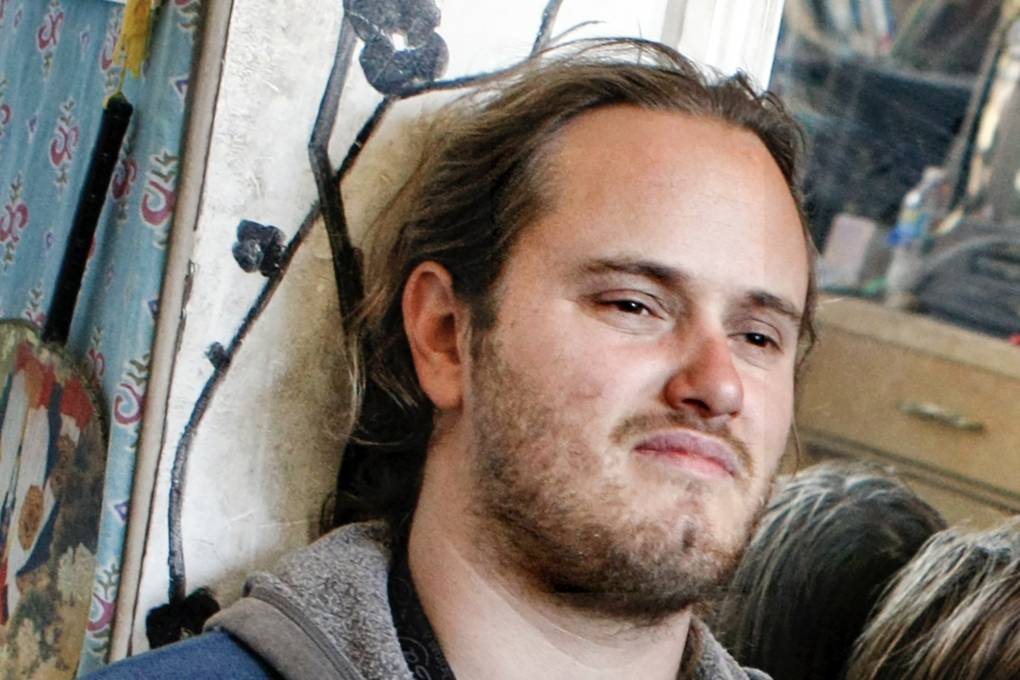
"caption": "On Thursday, San Francisco Judge Harry Dorfman set sentencing for David DePape (pictured) for late October, nearly two years after he broke into then-House Speaker Nancy Pelosi's home and attacked her husband, Paul, with a hammer. Dorfman ruled that DePape should face the strictest penalties, citing his \"callousness\" and declaring him \"a danger to society.\"",
"credit": "Michael Short/San Francisco Chronicle via Getty Images",
"altTag": "An old photo of a man with a short beard and mustache.",
"description": null,
"imgSizes": {
"medium": {
"file": "https://cdn.kqed.org/wp-content/uploads/sites/10/2023/11/231108-DAVID-DEPAPE-Getty-800x534.jpg",
"width": 800,
"height": 534,
"mimeType": "image/jpeg"
},
"large": {
"file": "https://cdn.kqed.org/wp-content/uploads/sites/10/2023/11/231108-DAVID-DEPAPE-Getty-1020x680.jpg",
"width": 1020,
"height": 680,
"mimeType": "image/jpeg"
},
"thumbnail": {
"file": "https://cdn.kqed.org/wp-content/uploads/sites/10/2023/11/231108-DAVID-DEPAPE-Getty-160x107.jpg",
"width": 160,
"height": 107,
"mimeType": "image/jpeg"
},
"1536x1536": {
"file": "https://cdn.kqed.org/wp-content/uploads/sites/10/2023/11/231108-DAVID-DEPAPE-Getty-1536x1025.jpg",
"width": 1536,
"height": 1025,
"mimeType": "image/jpeg"
},
"post-thumbnail": {
"file": "https://cdn.kqed.org/wp-content/uploads/sites/10/2023/11/231108-DAVID-DEPAPE-Getty-672x372.jpg",
"width": 672,
"height": 372,
"mimeType": "image/jpeg"
},
"twentyfourteen-full-width": {
"file": "https://cdn.kqed.org/wp-content/uploads/sites/10/2023/11/231108-DAVID-DEPAPE-Getty-1038x576.jpg",
"width": 1038,
"height": 576,
"mimeType": "image/jpeg"
},
"full-width": {
"file": "https://cdn.kqed.org/wp-content/uploads/sites/10/2023/11/231108-DAVID-DEPAPE-Getty-1920x1281.jpg",
"width": 1920,
"height": 1281,
"mimeType": "image/jpeg"
},
"kqedFullSize": {
"file": "https://cdn.kqed.org/wp-content/uploads/sites/10/2023/11/231108-DAVID-DEPAPE-Getty.jpg",
"width": 2000,
"height": 1334
}
},
"isLoading": false,
"fetchFailed": false
},
"news_12002313": {
"type": "attachments",
"id": "news_12002313",
"meta": {
"index": "attachments_1716263798",
"site": "news",
"id": "12002313",
"found": true
},
"title": "Black car on a red flat bed tow truck",
"publishDate": 1724950334,
"status": "inherit",
"parent": 12002311,
"modified": 1741972430,
"caption": "Jose Badillo, a San Francisco tow company operator, has been indicted in a second federal insurance fraud case. He faces charges for allegedly falsifying records of a vehicle tow and staging an accident.",
"credit": "Bouillante/Getty Images",
"altTag": null,
"description": null,
"imgSizes": {
"medium": {
"file": "https://cdn.kqed.org/wp-content/uploads/sites/10/2024/08/towtrucktowingcargetty1-800x518.jpg",
"width": 800,
"height": 518,
"mimeType": "image/jpeg"
},
"large": {
"file": "https://cdn.kqed.org/wp-content/uploads/sites/10/2024/08/towtrucktowingcargetty1-1020x660.jpg",
"width": 1020,
"height": 660,
"mimeType": "image/jpeg"
},
"thumbnail": {
"file": "https://cdn.kqed.org/wp-content/uploads/sites/10/2024/08/towtrucktowingcargetty1-160x104.jpg",
"width": 160,
"height": 104,
"mimeType": "image/jpeg"
},
"1536x1536": {
"file": "https://cdn.kqed.org/wp-content/uploads/sites/10/2024/08/towtrucktowingcargetty1-1536x995.jpg",
"width": 1536,
"height": 995,
"mimeType": "image/jpeg"
},
"post-thumbnail": {
"file": "https://cdn.kqed.org/wp-content/uploads/sites/10/2024/08/towtrucktowingcargetty1-672x372.jpg",
"width": 672,
"height": 372,
"mimeType": "image/jpeg"
},
"twentyfourteen-full-width": {
"file": "https://cdn.kqed.org/wp-content/uploads/sites/10/2024/08/towtrucktowingcargetty1-1038x576.jpg",
"width": 1038,
"height": 576,
"mimeType": "image/jpeg"
},
"full-width": {
"file": "https://cdn.kqed.org/wp-content/uploads/sites/10/2024/08/towtrucktowingcargetty1-1920x1243.jpg",
"width": 1920,
"height": 1243,
"mimeType": "image/jpeg"
},
"kqedFullSize": {
"file": "https://cdn.kqed.org/wp-content/uploads/sites/10/2024/08/towtrucktowingcargetty1.jpg",
"width": 2000,
"height": 1295
}
},
"isLoading": false,
"fetchFailed": false
},
"news_12001841": {
"type": "attachments",
"id": "news_12001841",
"meta": {
"index": "attachments_1716263798",
"site": "news",
"id": "12001841",
"found": true
},
"title": "081324_CHP_FM_CM_03",
"publishDate": 1724692880,
"status": "inherit",
"parent": 12001829,
"modified": 1724693308,
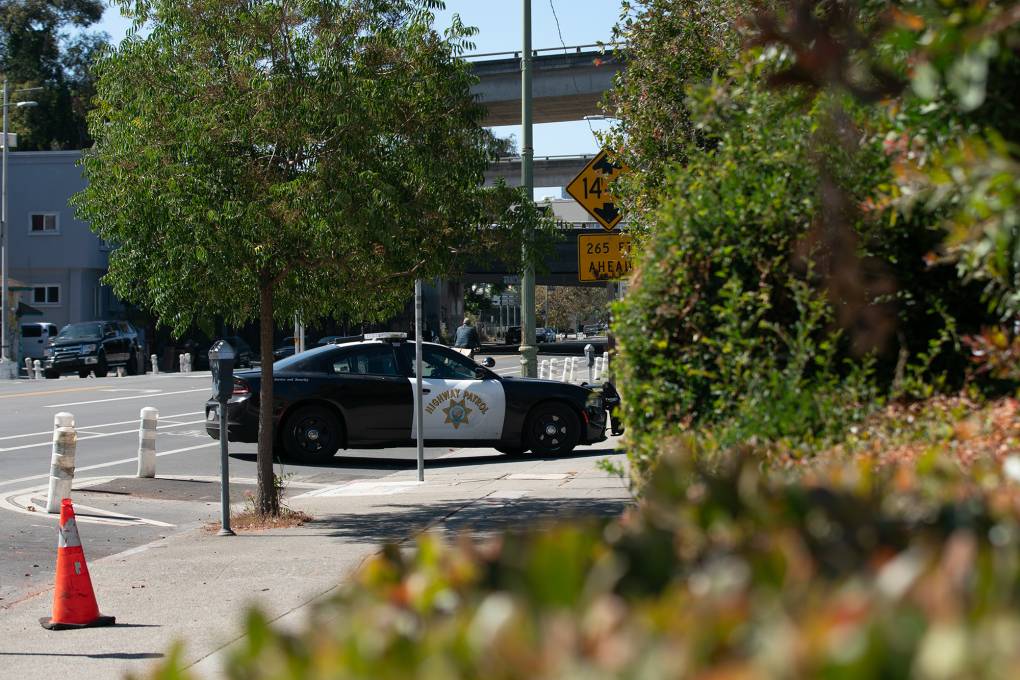
"caption": "A patrol vehicle pulls into the California Highway Patrol office in Oakland on Aug. 13, 2024. ",
"credit": "Florence Middleton/CalMatters",
"altTag": "A police vehicle parked on the street that says \"Highway Patrol\" on the side.",
"description": null,
"imgSizes": {
"medium": {
"file": "https://cdn.kqed.org/wp-content/uploads/sites/10/2024/08/081324_CHP_FM_CM_03-800x533.jpg",
"width": 800,
"height": 533,
"mimeType": "image/jpeg"
},
"large": {
"file": "https://cdn.kqed.org/wp-content/uploads/sites/10/2024/08/081324_CHP_FM_CM_03-1020x680.jpg",
"width": 1020,
"height": 680,
"mimeType": "image/jpeg"
},
"thumbnail": {
"file": "https://cdn.kqed.org/wp-content/uploads/sites/10/2024/08/081324_CHP_FM_CM_03-160x107.jpg",
"width": 160,
"height": 107,
"mimeType": "image/jpeg"
},
"1536x1536": {
"file": "https://cdn.kqed.org/wp-content/uploads/sites/10/2024/08/081324_CHP_FM_CM_03-1536x1024.jpg",
"width": 1536,
"height": 1024,
"mimeType": "image/jpeg"
},
"post-thumbnail": {
"file": "https://cdn.kqed.org/wp-content/uploads/sites/10/2024/08/081324_CHP_FM_CM_03-672x372.jpg",
"width": 672,
"height": 372,
"mimeType": "image/jpeg"
},
"twentyfourteen-full-width": {
"file": "https://cdn.kqed.org/wp-content/uploads/sites/10/2024/08/081324_CHP_FM_CM_03-1038x576.jpg",
"width": 1038,
"height": 576,
"mimeType": "image/jpeg"
},
"full-width": {
"file": "https://cdn.kqed.org/wp-content/uploads/sites/10/2024/08/081324_CHP_FM_CM_03-1920x1280.jpg",
"width": 1920,
"height": 1280,
"mimeType": "image/jpeg"
},
"kqedFullSize": {
"file": "https://cdn.kqed.org/wp-content/uploads/sites/10/2024/08/081324_CHP_FM_CM_03-e1724693289100.jpg",
"width": 1980,
"height": 1320
}
},
"isLoading": false,
"fetchFailed": false
},
"news_12001636": {
"type": "attachments",
"id": "news_12001636",
"meta": {
"index": "attachments_1716263798",
"site": "news",
"id": "12001636",
"found": true
},
"title": "IMG_0745",
"publishDate": 1724440814,
"status": "inherit",
"parent": 12001595,
"modified": 1724440838,
"caption": null,
"credit": "Illustration by Anna Vignet/KQED",
"altTag": null,
"description": null,
"imgSizes": {
"medium": {
"file": "https://cdn.kqed.org/wp-content/uploads/sites/10/2024/08/IMG_0745-800x600.jpg",
"width": 800,
"height": 600,
"mimeType": "image/jpeg"
},
"large": {
"file": "https://cdn.kqed.org/wp-content/uploads/sites/10/2024/08/IMG_0745-1020x765.jpg",
"width": 1020,
"height": 765,
"mimeType": "image/jpeg"
},
"thumbnail": {
"file": "https://cdn.kqed.org/wp-content/uploads/sites/10/2024/08/IMG_0745-160x120.jpg",
"width": 160,
"height": 120,
"mimeType": "image/jpeg"
},
"1536x1536": {
"file": "https://cdn.kqed.org/wp-content/uploads/sites/10/2024/08/IMG_0745-1536x1152.jpg",
"width": 1536,
"height": 1152,
"mimeType": "image/jpeg"
},
"2048x2048": {
"file": "https://cdn.kqed.org/wp-content/uploads/sites/10/2024/08/IMG_0745-2048x1536.jpg",
"width": 2048,
"height": 1536,
"mimeType": "image/jpeg"
},
"post-thumbnail": {
"file": "https://cdn.kqed.org/wp-content/uploads/sites/10/2024/08/IMG_0745-672x372.jpg",
"width": 672,
"height": 372,
"mimeType": "image/jpeg"
},
"twentyfourteen-full-width": {
"file": "https://cdn.kqed.org/wp-content/uploads/sites/10/2024/08/IMG_0745-1038x576.jpg",
"width": 1038,
"height": 576,
"mimeType": "image/jpeg"
},
"full-width": {
"file": "https://cdn.kqed.org/wp-content/uploads/sites/10/2024/08/IMG_0745-1920x1440.jpg",
"width": 1920,
"height": 1440,
"mimeType": "image/jpeg"
},
"kqedFullSize": {
"file": "https://cdn.kqed.org/wp-content/uploads/sites/10/2024/08/IMG_0745.jpg",
"width": 2560,
"height": 1920
}
},
"isLoading": false,
"fetchFailed": false
},
"news_12001705": {
"type": "attachments",
"id": "news_12001705",
"meta": {
"index": "attachments_1716263798",
"site": "news",
"id": "12001705",
"found": true
},
"title": "240823-AIRBNBCASEE-JG-2-KQED",
"publishDate": 1724449483,
"status": "inherit",
"parent": 0,
"modified": 1724456117,
"caption": "Elias Elhania (second from right) and his family in 2019. A San Francisco judge ruled that a civil case against Airbnb can proceed, opening the door for the company to be held liable for a 2021 shooting that killed Elhania at a house party in Sunnyvale.",
"credit": "Courtesy of Teresa Li",
"altTag": null,
"description": null,
"imgSizes": {
"medium": {
"file": "https://cdn.kqed.org/wp-content/uploads/sites/10/2024/08/240823-AIRBNBCASEE-JG-2-KQED-800x1067.jpg",
"width": 800,
"height": 1067,
"mimeType": "image/jpeg"
},
"large": {
"file": "https://cdn.kqed.org/wp-content/uploads/sites/10/2024/08/240823-AIRBNBCASEE-JG-2-KQED-1020x1360.jpg",
"width": 1020,
"height": 1360,
"mimeType": "image/jpeg"
},
"thumbnail": {
"file": "https://cdn.kqed.org/wp-content/uploads/sites/10/2024/08/240823-AIRBNBCASEE-JG-2-KQED-160x213.jpg",
"width": 160,
"height": 213,
"mimeType": "image/jpeg"
},
"1536x1536": {
"file": "https://cdn.kqed.org/wp-content/uploads/sites/10/2024/08/240823-AIRBNBCASEE-JG-2-KQED-1152x1536.jpg",
"width": 1152,
"height": 1536,
"mimeType": "image/jpeg"
},
"post-thumbnail": {
"file": "https://cdn.kqed.org/wp-content/uploads/sites/10/2024/08/240823-AIRBNBCASEE-JG-2-KQED-672x372.jpg",
"width": 672,
"height": 372,
"mimeType": "image/jpeg"
},
"twentyfourteen-full-width": {
"file": "https://cdn.kqed.org/wp-content/uploads/sites/10/2024/08/240823-AIRBNBCASEE-JG-2-KQED-1038x576.jpg",
"width": 1038,
"height": 576,
"mimeType": "image/jpeg"
},
"kqedFullSize": {
"file": "https://cdn.kqed.org/wp-content/uploads/sites/10/2024/08/240823-AIRBNBCASEE-JG-2-KQED.jpg",
"width": 1500,
"height": 2000
}
},
"isLoading": false,
"fetchFailed": false
},
"news_12001408": {
"type": "attachments",
"id": "news_12001408",
"meta": {
"index": "attachments_1716263798",
"site": "news",
"id": "12001408",
"found": true
},
"title": "240729-ArraignmentStout-012-BL_qed",
"publishDate": 1724351274,
"status": "inherit",
"parent": 12001405,
"modified": 1724351292,
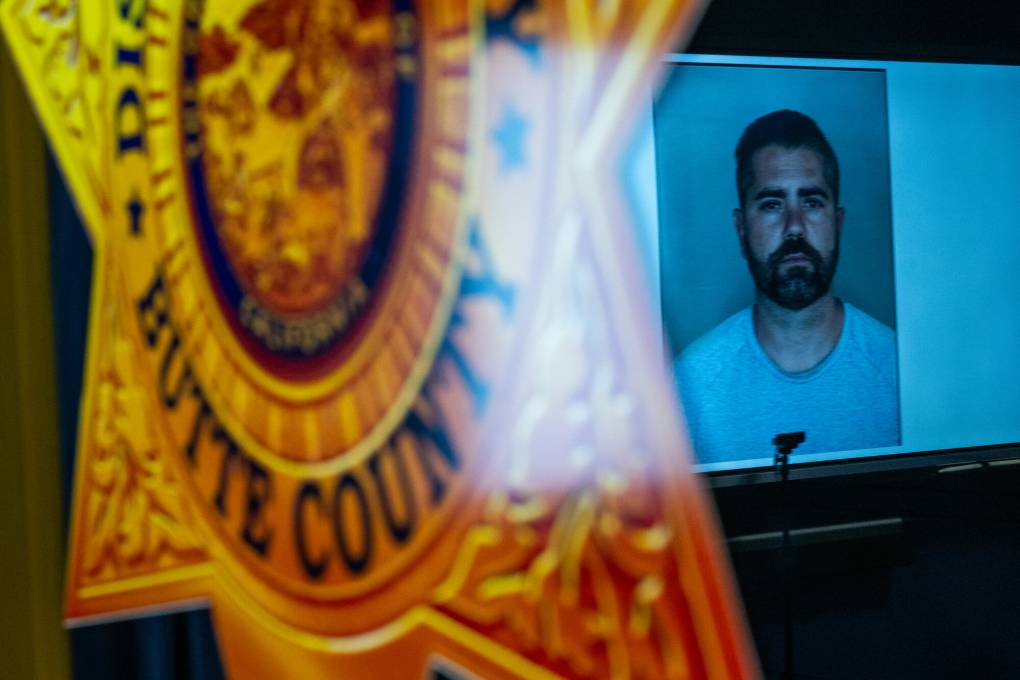
"caption": "A mug shot of Ronnie Dean Stout II is displayed while Butte County District Attorney Mike Ramsey speaks to the press in Oroville on July 29, 2024, after an arraignment hearing for Stout II, a man officials allege started the Park Fire by pushing a flaming car off a cliff. Stout appeared in a Butte County Superior Court in Oroville and was charged with arson.",
"credit": "Beth LaBerge/KQED",
"altTag": null,
"description": null,
"imgSizes": {
"medium": {
"file": "https://cdn.kqed.org/wp-content/uploads/sites/10/2024/08/240729-ArraignmentStout-012-BL_qed-800x533.jpg",
"width": 800,
"height": 533,
"mimeType": "image/jpeg"
},
"large": {
"file": "https://cdn.kqed.org/wp-content/uploads/sites/10/2024/08/240729-ArraignmentStout-012-BL_qed-1020x680.jpg",
"width": 1020,
"height": 680,
"mimeType": "image/jpeg"
},
"thumbnail": {
"file": "https://cdn.kqed.org/wp-content/uploads/sites/10/2024/08/240729-ArraignmentStout-012-BL_qed-160x107.jpg",
"width": 160,
"height": 107,
"mimeType": "image/jpeg"
},
"1536x1536": {
"file": "https://cdn.kqed.org/wp-content/uploads/sites/10/2024/08/240729-ArraignmentStout-012-BL_qed-1536x1024.jpg",
"width": 1536,
"height": 1024,
"mimeType": "image/jpeg"
},
"post-thumbnail": {
"file": "https://cdn.kqed.org/wp-content/uploads/sites/10/2024/08/240729-ArraignmentStout-012-BL_qed-672x372.jpg",
"width": 672,
"height": 372,
"mimeType": "image/jpeg"
},
"twentyfourteen-full-width": {
"file": "https://cdn.kqed.org/wp-content/uploads/sites/10/2024/08/240729-ArraignmentStout-012-BL_qed-1038x576.jpg",
"width": 1038,
"height": 576,
"mimeType": "image/jpeg"
},
"full-width": {
"file": "https://cdn.kqed.org/wp-content/uploads/sites/10/2024/08/240729-ArraignmentStout-012-BL_qed-1920x1280.jpg",
"width": 1920,
"height": 1280,
"mimeType": "image/jpeg"
},
"kqedFullSize": {
"file": "https://cdn.kqed.org/wp-content/uploads/sites/10/2024/08/240729-ArraignmentStout-012-BL_qed.jpg",
"width": 1999,
"height": 1333
}
},
"isLoading": false,
"fetchFailed": false
},
"news_12001397": {
"type": "attachments",
"id": "news_12001397",
"meta": {
"index": "attachments_1716263798",
"site": "news",
"id": "12001397",
"found": true
},
"title": "A California Highway Patrol sign in Dublin on April 8, 2024.",
"publishDate": 1724350114,
"status": "inherit",
"parent": 12001384,
"modified": 1724350152,
"caption": "A California Highway Patrol sign in Dublin on April 8, 2024.",
"credit": "Beth LaBerge/KQED",
"altTag": null,
"description": null,
"imgSizes": {
"medium": {
"file": "https://cdn.kqed.org/wp-content/uploads/sites/10/2024/08/240408-FCIDublin-026-BL_qed-800x533.jpg",
"width": 800,
"height": 533,
"mimeType": "image/jpeg"
},
"large": {
"file": "https://cdn.kqed.org/wp-content/uploads/sites/10/2024/08/240408-FCIDublin-026-BL_qed-1020x680.jpg",
"width": 1020,
"height": 680,
"mimeType": "image/jpeg"
},
"thumbnail": {
"file": "https://cdn.kqed.org/wp-content/uploads/sites/10/2024/08/240408-FCIDublin-026-BL_qed-160x107.jpg",
"width": 160,
"height": 107,
"mimeType": "image/jpeg"
},
"1536x1536": {
"file": "https://cdn.kqed.org/wp-content/uploads/sites/10/2024/08/240408-FCIDublin-026-BL_qed-1536x1024.jpg",
"width": 1536,
"height": 1024,
"mimeType": "image/jpeg"
},
"post-thumbnail": {
"file": "https://cdn.kqed.org/wp-content/uploads/sites/10/2024/08/240408-FCIDublin-026-BL_qed-672x372.jpg",
"width": 672,
"height": 372,
"mimeType": "image/jpeg"
},
"twentyfourteen-full-width": {
"file": "https://cdn.kqed.org/wp-content/uploads/sites/10/2024/08/240408-FCIDublin-026-BL_qed-1038x576.jpg",
"width": 1038,
"height": 576,
"mimeType": "image/jpeg"
},
"full-width": {
"file": "https://cdn.kqed.org/wp-content/uploads/sites/10/2024/08/240408-FCIDublin-026-BL_qed-1920x1280.jpg",
"width": 1920,
"height": 1280,
"mimeType": "image/jpeg"
},
"kqedFullSize": {
"file": "https://cdn.kqed.org/wp-content/uploads/sites/10/2024/08/240408-FCIDublin-026-BL_qed.jpg",
"width": 2000,
"height": 1333
}
},
"isLoading": false,
"fetchFailed": false
},
"news_12000887": {
"type": "attachments",
"id": "news_12000887",
"meta": {
"index": "attachments_1716263798",
"site": "news",
"id": "12000887",
"found": true
},
"title": "240415-880GazaProtest-020-BL_qed",
"publishDate": 1724174222,
"status": "inherit",
"parent": 12000881,
"modified": 1729648414,
"caption": "Demonstrators shut down the southbound lanes of I-880 on the morning of April 15, 2024, in West Oakland. The protesters, engaging in an economic blockade in solidarity with Palestine, marched from the West Oakland BART Station to the freeway.",
"credit": "Beth LaBerge/KQED",
"altTag": null,
"description": null,
"imgSizes": {
"medium": {
"file": "https://cdn.kqed.org/wp-content/uploads/sites/10/2024/08/240415-880GazaProtest-020-BL_qed-800x533.jpg",
"width": 800,
"height": 533,
"mimeType": "image/jpeg"
},
"large": {
"file": "https://cdn.kqed.org/wp-content/uploads/sites/10/2024/08/240415-880GazaProtest-020-BL_qed-1020x680.jpg",
"width": 1020,
"height": 680,
"mimeType": "image/jpeg"
},
"thumbnail": {
"file": "https://cdn.kqed.org/wp-content/uploads/sites/10/2024/08/240415-880GazaProtest-020-BL_qed-160x107.jpg",
"width": 160,
"height": 107,
"mimeType": "image/jpeg"
},
"1536x1536": {
"file": "https://cdn.kqed.org/wp-content/uploads/sites/10/2024/08/240415-880GazaProtest-020-BL_qed-1536x1024.jpg",
"width": 1536,
"height": 1024,
"mimeType": "image/jpeg"
},
"post-thumbnail": {
"file": "https://cdn.kqed.org/wp-content/uploads/sites/10/2024/08/240415-880GazaProtest-020-BL_qed-672x372.jpg",
"width": 672,
"height": 372,
"mimeType": "image/jpeg"
},
"twentyfourteen-full-width": {
"file": "https://cdn.kqed.org/wp-content/uploads/sites/10/2024/08/240415-880GazaProtest-020-BL_qed-1038x576.jpg",
"width": 1038,
"height": 576,
"mimeType": "image/jpeg"
},
"full-width": {
"file": "https://cdn.kqed.org/wp-content/uploads/sites/10/2024/08/240415-880GazaProtest-020-BL_qed-1920x1280.jpg",
"width": 1920,
"height": 1280,
"mimeType": "image/jpeg"
},
"kqedFullSize": {
"file": "https://cdn.kqed.org/wp-content/uploads/sites/10/2024/08/240415-880GazaProtest-020-BL_qed.jpg",
"width": 2000,
"height": 1333
}
},
"isLoading": false,
"fetchFailed": false
},
"news_12000600": {
"type": "attachments",
"id": "news_12000600",
"meta": {
"index": "attachments_1716263798",
"site": "news",
"id": "12000600",
"found": true
},
"title": "IMG_0478",
"publishDate": 1723847339,
"status": "inherit",
"parent": 12000598,
"modified": 1723847788,
"caption": "Oakland Police Chief Floyd Mitchell, center, speaks at a news conference on Aug. 16, 2024, about data showing declines in violent crime and arrests in some high-profile cases.",
"credit": "Brian Krans/KQED",
"altTag": null,
"description": null,
"imgSizes": {
"medium": {
"file": "https://cdn.kqed.org/wp-content/uploads/sites/10/2024/08/IMG_0478-800x600.jpeg",
"width": 800,
"height": 600,
"mimeType": "image/jpeg"
},
"large": {
"file": "https://cdn.kqed.org/wp-content/uploads/sites/10/2024/08/IMG_0478-1020x765.jpeg",
"width": 1020,
"height": 765,
"mimeType": "image/jpeg"
},
"thumbnail": {
"file": "https://cdn.kqed.org/wp-content/uploads/sites/10/2024/08/IMG_0478-160x120.jpeg",
"width": 160,
"height": 120,
"mimeType": "image/jpeg"
},
"1536x1536": {
"file": "https://cdn.kqed.org/wp-content/uploads/sites/10/2024/08/IMG_0478-1536x1152.jpeg",
"width": 1536,
"height": 1152,
"mimeType": "image/jpeg"
},
"post-thumbnail": {
"file": "https://cdn.kqed.org/wp-content/uploads/sites/10/2024/08/IMG_0478-672x372.jpeg",
"width": 672,
"height": 372,
"mimeType": "image/jpeg"
},
"twentyfourteen-full-width": {
"file": "https://cdn.kqed.org/wp-content/uploads/sites/10/2024/08/IMG_0478-1038x576.jpeg",
"width": 1038,
"height": 576,
"mimeType": "image/jpeg"
},
"full-width": {
"file": "https://cdn.kqed.org/wp-content/uploads/sites/10/2024/08/IMG_0478-1920x1440.jpeg",
"width": 1920,
"height": 1440,
"mimeType": "image/jpeg"
},
"kqedFullSize": {
"file": "https://cdn.kqed.org/wp-content/uploads/sites/10/2024/08/IMG_0478.jpeg",
"width": 2000,
"height": 1500
}
},
"isLoading": false,
"fetchFailed": false
},
"news_12000505": {
"type": "attachments",
"id": "news_12000505",
"meta": {
"index": "attachments_1716263798",
"site": "news",
"id": "12000505",
"found": true
},
"title": "240531-SEGOVIACASE-JG-1",
"publishDate": 1723767310,
"status": "inherit",
"parent": 12000464,
"modified": 1723767712,
"caption": "Joanne Segovia (left) and her attorney, Adam Gasner, walk out of the federal courthouse in San José on May 31, 2024, following her first court appearance since being charged over a year ago with attempting to illegally import opioids.",
"credit": "Joseph Geha/KQED",
"altTag": "A middle-aged white woman with blond hair walks through a courtyard, next to a middle-aged man wearing a suit and carrying a briefcase.",
"description": null,
"imgSizes": {
"medium": {
"file": "https://cdn.kqed.org/wp-content/uploads/sites/10/2024/08/240531-SEGOVIACASE-JG-1-800x533.jpg",
"width": 800,
"height": 533,
"mimeType": "image/jpeg"
},
"large": {
"file": "https://cdn.kqed.org/wp-content/uploads/sites/10/2024/08/240531-SEGOVIACASE-JG-1-1020x680.jpg",
"width": 1020,
"height": 680,
"mimeType": "image/jpeg"
},
"thumbnail": {
"file": "https://cdn.kqed.org/wp-content/uploads/sites/10/2024/08/240531-SEGOVIACASE-JG-1-160x107.jpg",
"width": 160,
"height": 107,
"mimeType": "image/jpeg"
},
"1536x1536": {
"file": "https://cdn.kqed.org/wp-content/uploads/sites/10/2024/08/240531-SEGOVIACASE-JG-1-1536x1024.jpg",
"width": 1536,
"height": 1024,
"mimeType": "image/jpeg"
},
"post-thumbnail": {
"file": "https://cdn.kqed.org/wp-content/uploads/sites/10/2024/08/240531-SEGOVIACASE-JG-1-672x372.jpg",
"width": 672,
"height": 372,
"mimeType": "image/jpeg"
},
"twentyfourteen-full-width": {
"file": "https://cdn.kqed.org/wp-content/uploads/sites/10/2024/08/240531-SEGOVIACASE-JG-1-1038x576.jpg",
"width": 1038,
"height": 576,
"mimeType": "image/jpeg"
},
"full-width": {
"file": "https://cdn.kqed.org/wp-content/uploads/sites/10/2024/08/240531-SEGOVIACASE-JG-1-1920x1280.jpg",
"width": 1920,
"height": 1280,
"mimeType": "image/jpeg"
},
"kqedFullSize": {
"file": "https://cdn.kqed.org/wp-content/uploads/sites/10/2024/08/240531-SEGOVIACASE-JG-1.jpg",
"width": 2000,
"height": 1333
}
},
"isLoading": false,
"fetchFailed": false
},
"news_12000426": {
"type": "attachments",
"id": "news_12000426",
"meta": {
"index": "attachments_1716263798",
"site": "news",
"id": "12000426",
"found": true
},
"title": "Kamala-Cases_AH_CM_01",
"publishDate": 1723751469,
"status": "inherit",
"parent": 12000397,
"modified": 1723753516,
"caption": null,
"credit": "Illustration by Adriana Heldiz / CalMatters; iStock",
"altTag": "An illustration of a woman holding a microphone with a scale, a for sale sign and buildings in the background.",
"description": null,
"imgSizes": {
"medium": {
"file": "https://cdn.kqed.org/wp-content/uploads/sites/10/2024/08/Kamala-Cases_AH_CM_01-800x533.jpg",
"width": 800,
"height": 533,
"mimeType": "image/jpeg"
},
"large": {
"file": "https://cdn.kqed.org/wp-content/uploads/sites/10/2024/08/Kamala-Cases_AH_CM_01-1020x680.jpg",
"width": 1020,
"height": 680,
"mimeType": "image/jpeg"
},
"thumbnail": {
"file": "https://cdn.kqed.org/wp-content/uploads/sites/10/2024/08/Kamala-Cases_AH_CM_01-160x107.jpg",
"width": 160,
"height": 107,
"mimeType": "image/jpeg"
},
"1536x1536": {
"file": "https://cdn.kqed.org/wp-content/uploads/sites/10/2024/08/Kamala-Cases_AH_CM_01-1536x1024.jpg",
"width": 1536,
"height": 1024,
"mimeType": "image/jpeg"
},
"post-thumbnail": {
"file": "https://cdn.kqed.org/wp-content/uploads/sites/10/2024/08/Kamala-Cases_AH_CM_01-672x372.jpg",
"width": 672,
"height": 372,
"mimeType": "image/jpeg"
},
"twentyfourteen-full-width": {
"file": "https://cdn.kqed.org/wp-content/uploads/sites/10/2024/08/Kamala-Cases_AH_CM_01-1038x576.jpg",
"width": 1038,
"height": 576,
"mimeType": "image/jpeg"
},
"full-width": {
"file": "https://cdn.kqed.org/wp-content/uploads/sites/10/2024/08/Kamala-Cases_AH_CM_01-1920x1280.jpg",
"width": 1920,
"height": 1280,
"mimeType": "image/jpeg"
},
"kqedFullSize": {
"file": "https://cdn.kqed.org/wp-content/uploads/sites/10/2024/08/Kamala-Cases_AH_CM_01.jpg",
"width": 2000,
"height": 1333
}
},
"isLoading": false,
"fetchFailed": false
},
"news_12000413": {
"type": "attachments",
"id": "news_12000413",
"meta": {
"index": "attachments_1716263798",
"site": "news",
"id": "12000413",
"found": true
},
"title": "240815-CITYATTORNEYDEEPFAKES-06-BL-KQED",
"publishDate": 1723748842,
"status": "inherit",
"parent": 12046379,
"modified": 1751062554,
"caption": "City Attorney David Chiu speaks during a press conference at City Hall in San Francisco on Aug. 15, 2024.",
"credit": "Beth LaBerge/KQED",
"altTag": null,
"description": null,
"imgSizes": {
"medium": {
"file": "https://cdn.kqed.org/wp-content/uploads/sites/10/2024/08/240815-CITYATTORNEYDEEPFAKES-06-BL-KQED-800x533.jpg",
"width": 800,
"height": 533,
"mimeType": "image/jpeg"
},
"large": {
"file": "https://cdn.kqed.org/wp-content/uploads/sites/10/2024/08/240815-CITYATTORNEYDEEPFAKES-06-BL-KQED-1020x680.jpg",
"width": 1020,
"height": 680,
"mimeType": "image/jpeg"
},
"thumbnail": {
"file": "https://cdn.kqed.org/wp-content/uploads/sites/10/2024/08/240815-CITYATTORNEYDEEPFAKES-06-BL-KQED-160x107.jpg",
"width": 160,
"height": 107,
"mimeType": "image/jpeg"
},
"1536x1536": {
"file": "https://cdn.kqed.org/wp-content/uploads/sites/10/2024/08/240815-CITYATTORNEYDEEPFAKES-06-BL-KQED-1536x1024.jpg",
"width": 1536,
"height": 1024,
"mimeType": "image/jpeg"
},
"post-thumbnail": {
"file": "https://cdn.kqed.org/wp-content/uploads/sites/10/2024/08/240815-CITYATTORNEYDEEPFAKES-06-BL-KQED-672x372.jpg",
"width": 672,
"height": 372,
"mimeType": "image/jpeg"
},
"twentyfourteen-full-width": {
"file": "https://cdn.kqed.org/wp-content/uploads/sites/10/2024/08/240815-CITYATTORNEYDEEPFAKES-06-BL-KQED-1038x576.jpg",
"width": 1038,
"height": 576,
"mimeType": "image/jpeg"
},
"full-width": {
"file": "https://cdn.kqed.org/wp-content/uploads/sites/10/2024/08/240815-CITYATTORNEYDEEPFAKES-06-BL-KQED-1920x1280.jpg",
"width": 1920,
"height": 1280,
"mimeType": "image/jpeg"
},
"kqedFullSize": {
"file": "https://cdn.kqed.org/wp-content/uploads/sites/10/2024/08/240815-CITYATTORNEYDEEPFAKES-06-BL-KQED.jpg",
"width": 2000,
"height": 1333
}
},
"isLoading": false,
"fetchFailed": false
}
},
"audioPlayerReducer": {
"postId": "stream_live",
"isPaused": true,
"isPlaying": false,
"pfsActive": false,
"pledgeModalIsOpen": true,
"playerDrawerIsOpen": false,
"liveAudioPlayStartedAt": 0,
"liveAudioPlayContext": ""
},
"authorsReducer": {
"byline_news_12001829": {
"type": "authors",
"id": "byline_news_12001829",
"meta": {
"override": true
},
"slug": "byline_news_12001829",
"name": "\u003ca href=\"https://calmatters.org/author/feliciacalmatters-org\">Felicia Mello,\u003c/a> CalMatters",
"isLoading": false
},
"byline_news_12001595": {
"type": "authors",
"id": "byline_news_12001595",
"meta": {
"override": true
},
"slug": "byline_news_12001595",
"name": "Cayla Mihalovich",
"isLoading": false
},
"byline_news_12000397": {
"type": "authors",
"id": "byline_news_12000397",
"meta": {
"override": true
},
"slug": "byline_news_12000397",
"name": "\u003ca href=\"https://calmatters.org/author/nigelduara\">Nigel Duara, CalMatters\u003c/a>",
"isLoading": false
},
"ahall": {
"type": "authors",
"id": "11490",
"meta": {
"index": "authors_1716337520",
"id": "11490",
"found": true
},
"name": "Alex Hall",
"firstName": "Alex",
"lastName": "Hall",
"slug": "ahall",
"email": "ahall@kqed.org",
"display_author_email": false,
"staff_mastheads": [
"news"
],
"title": "KQED Enterprise & Accountability Reporter",
"bio": "Alex Hall is KQED's Enterprise and Accountability Reporter. She previously covered the Central Valley for five years from KQED's bureau in Fresno. Before joining KQED, Alex was an investigative reporting fellow at Wisconsin Public Radio and the Wisconsin Center for Investigative Journalism. She has also worked as a bilingual producer for NPR's investigative unit and freelance video producer for Reuters TV on the Latin America desk. She got her start in journalism in South America, where she worked as a radio producer and Spanish-English translator for CNN Chile. Her documentary and investigation into the series of deadly COVID-19 outbreaks at Foster Farms won a national Edward R. Murrow award and was named an Investigative Reporters & Editors award finalist. Alex's reporting for Reveal on the Wisconsin dairy industry's reliance on undocumented immigrant labor was made into a film, Los Lecheros, which won a regional Edward R. Murrow award for best news documentary.",
"avatar": "https://secure.gravatar.com/avatar/04c28ad4a7caa7ac2ef39c655c4030c993a3f331481d1da4799bb76ea85b9afa?s=600&d=blank&r=g",
"twitter": "@chalexhall",
"bluesky": null,
"facebook": null,
"instagram": null,
"linkedin": null,
"sites": [
{
"site": "news",
"roles": [
"editor"
]
},
{
"site": "liveblog",
"roles": [
"author"
]
}
],
"headData": {
"title": "Alex Hall | KQED",
"description": "KQED Enterprise & Accountability Reporter",
"ogImgSrc": "https://secure.gravatar.com/avatar/04c28ad4a7caa7ac2ef39c655c4030c993a3f331481d1da4799bb76ea85b9afa?s=600&d=blank&r=g",
"twImgSrc": "https://secure.gravatar.com/avatar/04c28ad4a7caa7ac2ef39c655c4030c993a3f331481d1da4799bb76ea85b9afa?s=600&d=blank&r=g"
},
"isLoading": false,
"link": "/author/ahall"
},
"jgeha": {
"type": "authors",
"id": "11906",
"meta": {
"index": "authors_1716337520",
"id": "11906",
"found": true
},
"name": "Joseph Geha",
"firstName": "Joseph",
"lastName": "Geha",
"slug": "jgeha",
"email": "jgeha@kqed.org",
"display_author_email": false,
"staff_mastheads": [
"news",
"science"
],
"title": "KQED Contributor",
"bio": null,
"avatar": "https://secure.gravatar.com/avatar/ea84d2b6dd93d6369d453edf19dd583f117cd1759d2d9c9c92f9de77017354fe?s=600&d=blank&r=g",
"twitter": null,
"bluesky": null,
"facebook": null,
"instagram": null,
"linkedin": null,
"sites": [
{
"site": "news",
"roles": [
"editor"
]
},
{
"site": "liveblog",
"roles": [
"author"
]
}
],
"headData": {
"title": "Joseph Geha | KQED",
"description": "KQED Contributor",
"ogImgSrc": "https://secure.gravatar.com/avatar/ea84d2b6dd93d6369d453edf19dd583f117cd1759d2d9c9c92f9de77017354fe?s=600&d=blank&r=g",
"twImgSrc": "https://secure.gravatar.com/avatar/ea84d2b6dd93d6369d453edf19dd583f117cd1759d2d9c9c92f9de77017354fe?s=600&d=blank&r=g"
},
"isLoading": false,
"link": "/author/jgeha"
},
"kdebenedetti": {
"type": "authors",
"id": "11913",
"meta": {
"index": "authors_1716337520",
"id": "11913",
"found": true
},
"name": "Katie DeBenedetti",
"firstName": "Katie",
"lastName": "DeBenedetti",
"slug": "kdebenedetti",
"email": "kdebenedetti@kqed.org",
"display_author_email": false,
"staff_mastheads": [
"news",
"science"
],
"title": "KQED Contributor",
"bio": "Katie DeBenedetti is a digital reporter covering daily news for the Express Desk. Prior to joining KQED as a culture reporting intern in January 2024, she covered education and city government for the Napa Valley Register.",
"avatar": "https://secure.gravatar.com/avatar/6e31073cb8f7e4214ab03f42771d0f45?s=600&d=blank&r=g",
"twitter": null,
"facebook": null,
"instagram": null,
"linkedin": null,
"sites": [
{
"site": "news",
"roles": [
"author"
]
},
{
"site": "science",
"roles": [
"author"
]
},
{
"site": "liveblog",
"roles": [
"author"
]
}
],
"headData": {
"title": "Katie DeBenedetti | KQED",
"description": "KQED Contributor",
"ogImgSrc": "https://secure.gravatar.com/avatar/6e31073cb8f7e4214ab03f42771d0f45?s=600&d=blank&r=g",
"twImgSrc": "https://secure.gravatar.com/avatar/6e31073cb8f7e4214ab03f42771d0f45?s=600&d=blank&r=g"
},
"isLoading": false,
"link": "/author/kdebenedetti"
},
"bkrans": {
"type": "authors",
"id": "11923",
"meta": {
"index": "authors_1716337520",
"id": "11923",
"found": true
},
"name": "Brian Krans",
"firstName": "Brian",
"lastName": "Krans",
"slug": "bkrans",
"email": "bkrans@kqed.org",
"display_author_email": false,
"staff_mastheads": [
"news"
],
"title": "KQED Contributing Reporter",
"bio": "Brian Krans is an award-winning local news and investigative reporter who has been proudly working as a general assignment reporter for KQED since August 2023. He lives in Richmond, where he also reports on air pollution for Richmondside. He is also a founding member of the Vallejo Sun.",
"avatar": "https://secure.gravatar.com/avatar/71fa91f931774612559f7640390b53d9c2840ff72b20f195a25239aab2d9fbb9?s=600&d=blank&r=g",
"twitter": "citizenkrans",
"bluesky": null,
"facebook": null,
"instagram": null,
"linkedin": null,
"sites": [
{
"site": "news",
"roles": [
"editor"
]
}
],
"headData": {
"title": "Brian Krans | KQED",
"description": "KQED Contributing Reporter",
"ogImgSrc": "https://secure.gravatar.com/avatar/71fa91f931774612559f7640390b53d9c2840ff72b20f195a25239aab2d9fbb9?s=600&d=blank&r=g",
"twImgSrc": "https://secure.gravatar.com/avatar/71fa91f931774612559f7640390b53d9c2840ff72b20f195a25239aab2d9fbb9?s=600&d=blank&r=g"
},
"isLoading": false,
"link": "/author/bkrans"
}
},
"pagesReducer": {
"news_category_criminal-justice": {
"type": "terms",
"id": "news_34167",
"meta": {
"index": "terms_1716263798",
"site": "news",
"id": "34167",
"score": 11.188038
},
"name": "Criminal Justice",
"slug": "criminal-justice",
"taxonomy": "category",
"description": null,
"featImg": null,
"headData": {
"title": "Criminal Justice Archives | KQED News",
"description": null,
"ogTitle": null,
"ogDescription": null,
"ogImgId": null,
"twTitle": null,
"twDescription": null,
"twImgId": null
},
"ttid": 34184,
"isLoading": false,
"title": "Criminal Justice",
"pageMeta": {
"site": "news",
"WpPageTemplate": "page-topic-editorial",
"currentPage": 39
},
"blocks": [
{
"blockName": "kqed/post-list",
"attrs": {
"layout": "cardArticle2",
"query": "posts/news?category=criminal-justice",
"seeMore": false,
"paginated": true,
"page": 39
}
},
{
"blockName": "kqed/ad"
}
]
}
},
"pfsSessionReducer": {},
"postsReducer": {
"stream_live": {
"type": "live",
"id": "stream_live",
"audioUrl": "https://streams.kqed.org/kqedradio",
"title": "Live Stream",
"excerpt": "Live Stream information currently unavailable.",
"link": "/radio",
"featImg": "",
"label": {
"name": "KQED Live",
"link": "/"
}
},
"stream_kqedNewscast": {
"type": "posts",
"id": "stream_kqedNewscast",
"audioUrl": "https://www.kqed.org/.stream/anon/radio/RDnews/newscast.mp3?_=1",
"title": "KQED Newscast",
"featImg": "",
"label": {
"name": "88.5 FM",
"link": "/"
}
},
"news_12002363": {
"type": "posts",
"id": "news_12002363",
"meta": {
"index": "posts_1716263798",
"site": "news",
"id": "12002363",
"score": null,
"sort": [
1724962965000
]
},
"guestAuthors": [],
"slug": "callousness-of-paul-pelosi-attack-justifies-potential-life-sentence-judge-says",
"title": "‘Callousness’ of Paul Pelosi Attack Justifies Potential Life Sentence, Judge Says",
"publishDate": 1724962965,
"format": "standard",
"headTitle": "‘Callousness’ of Paul Pelosi Attack Justifies Potential Life Sentence, Judge Says | KQED",
"labelTerm": {
"site": "news"
},
"content": "\u003cp>A state judge has set the final sentencing hearing for \u003ca href=\"https://www.kqed.org/news/tag/david-depape\">David Wayne DePape\u003c/a> for Oct. 29, two years and a day after he broke into Nancy Pelosi’s San Francisco home in a plot to kidnap the then-House speaker.\u003c/p>\n\u003cp>Judge Harry Dorfman said Thursday that DePape qualifies for the strictest punishments allowed by law after finding he is “a danger to society” for the “callousness” shown during his hammer attack on Pelosi’s husband, Paul, in October 2022.\u003c/p>\n\u003cp>A jury \u003ca href=\"https://www.kqed.org/news/11991336/jury-finds-man-who-attacked-paul-pelosi-with-hammer-guilty-in-state-trial\">convicted DePape\u003c/a>, 44, of five felony counts in June. One of those was for kidnapping involving a ransom, which carries a mandatory sentence of life in prison without parole, making DePape’s sentences for the other felonies all but moot.\u003c/p>\n\u003cp>[ad fullwidth]\u003c/p>\n\u003cp>Assistant District Attorney Phoebe Maffei argued in court on Thursday morning that DePape should face the strictest penalties at his sentencing, using enhancements built into California criminal law. Those included that he acted with a “high degree of cruelty, viciousness, or callousness,” that Paul Pelosi — who was 82 and recovering from knee surgery at the time — couldn’t defend himself, and that DePape used a high level of planning to orchestrate the attack, making him a danger to society.\u003c/p>\n\u003cp>According to trial testimony, DePape took BART from the East Bay to the Pelosis’ Pacific Heights home in the early hours of Oct. 28, 2022. He planned to interrogate the House speaker regarding Russiagate, a debunked conspiracy theory regarding the investigations into Russia’s meddling in U.S. elections, but she wasn’t home at the time.\u003c/p>\n\u003cfigure id=\"attachment_11967668\" class=\"wp-caption aligncenter\" style=\"max-width: 1920px\">\u003cimg loading=\"lazy\" decoding=\"async\" class=\"size-full wp-image-11967668\" src=\"https://cdn.kqed.org/wp-content/uploads/sites/10/2023/11/DePape_verdict.jpg\" alt=\"A watercolor sketch shows a white man with a ponytail holding his hands together as he looks down sullenly in a courtroom. A female judge and court reporter sit in the background.\" width=\"1920\" height=\"1079\" srcset=\"https://cdn.kqed.org/wp-content/uploads/sites/10/2023/11/DePape_verdict.jpg 1920w, https://cdn.kqed.org/wp-content/uploads/sites/10/2023/11/DePape_verdict-800x450.jpg 800w, https://cdn.kqed.org/wp-content/uploads/sites/10/2023/11/DePape_verdict-1020x573.jpg 1020w, https://cdn.kqed.org/wp-content/uploads/sites/10/2023/11/DePape_verdict-160x90.jpg 160w, https://cdn.kqed.org/wp-content/uploads/sites/10/2023/11/DePape_verdict-1536x863.jpg 1536w\" sizes=\"(max-width: 1920px) 100vw, 1920px\">\u003cfigcaption class=\"wp-caption-text\">David DePape (left) listens solemnly while Courtroom Deputy Ada Means (center) reads his guilty verdict in a San Francisco federal courtroom on Nov. 16, 2023, as U.S. District Judge Jacqueline Scott Corley watches. \u003ccite>(Vicki Behringer for KQED)\u003c/cite>\u003c/figcaption>\u003c/figure>\n\u003cp>When Capitol Police responded to a call Paul Pelosi made from his bedroom bathroom with DePape standing in the doorway, they found the two struggling over a hammer near the home’s front door, which DePape then used to hit Pelosi over the head several times.\u003c/p>\n\u003cp>The items DePape brought with him to carry out the attack included a sledgehammer, multiple packs of differently-sized zip ties and GoPro cameras. Maffei reiterated to Dorfman on Thursday that DePape planned to break Pelosi’s kneecaps so she would have to enter Congress in a wheelchair.\u003c/p>\n\u003cp>[aside postID=news_12002254 hero='https://cdn.kqed.org/wp-content/uploads/sites/10/2024/08/ScottWienerAP1-1020x680.jpg']\u003c/p>\n\u003cp>“You went to the Pelosi home for very specific purposes,” Dorfman said to DePape, as he ruled there was evidence beyond a reasonable doubt that his actions met the criteria for the enhanced sentences. “There’s callousness here.”\u003c/p>\n\u003cp>DePape told investigators he also intended to attack other well-known people, including actor Tom Hanks and former Vice President Mike Pence.\u003c/p>\n\u003cp>Another of DePape’s intended targets was his ex-wife, Gypsy Taub, who was \u003ca href=\"https://www.kqed.org/news/11990966/state-case-against-man-who-attacked-nancy-pelosis-husband-is-in-jurys-hands\">barred from DePape’s state trial\u003c/a> when the judge accused her of attempting to intimidate the jury.\u003c/p>\n\u003cp>In a separate federal case, DePape had already been \u003ca href=\"https://www.kqed.org/news/11987892/paul-pelosis-attacker-apologizes-at-resentencing-but-prison-term-is-unchanged\">sentenced in May to 30 years in federal prison\u003c/a> for one count of attempted kidnapping of a federal officer and one count of assault on the immediate family member of a federal official.\u003c/p>\n\u003cp>Appearing at the Hall of Justice in an orange jail uniform, DePape didn’t speak at Thursday’s hearing other than saying “Yes” when waiving his right to be sentenced within the next three weeks.\u003c/p>\n\u003cp>Just before DePape’s sentencing on Oct. 29, Deputy Public Defender Adam Lipson plans to argue a motion for a new trial in state court on the grounds that DePape’s prosecution was “vindictive,” as prosecutors filed the kidnapping charge after they learned \u003ca href=\"https://www.kqed.org/news/11989279/sf-judge-tosses-3-state-charges-against-man-who-attacked-nancy-pelosis-husband\">a charge of attempted murder was going to be dismissed\u003c/a>.\u003c/p>\n\u003cp>“It’s basically all arguments we’ve already made,” Lipson told Dorfman.\u003c/p>\n\u003cp>\u003c/p>\n",
"blocks": [],
"excerpt": "A San Francisco judge set David DePape’s sentencing for Oct. 29, saying that he qualifies for the strictest punishments allowed by law, which would be life in prison without parole.",
"status": "publish",
"parent": 0,
"modified": 1724964099,
"stats": {
"hasAudio": false,
"hasVideo": false,
"hasChartOrMap": false,
"iframeSrcs": [],
"hasGoogleForm": false,
"hasGallery": false,
"hasHearkenModule": false,
"hasPolis": false,
"paragraphCount": 17,
"wordCount": 678
},
"headData": {
"title": "‘Callousness’ of Paul Pelosi Attack Justifies Potential Life Sentence, Judge Says | KQED",
"description": "A San Francisco judge set David DePape’s sentencing for Oct. 29, saying that he qualifies for the strictest punishments allowed by law, which would be life in prison without parole.",
"ogTitle": "",
"ogDescription": "",
"ogImgId": "",
"twTitle": "",
"twDescription": "",
"twImgId": "",
"schema": {
"@context": "https://schema.org",
"@type": "NewsArticle",
"headline": "‘Callousness’ of Paul Pelosi Attack Justifies Potential Life Sentence, Judge Says",
"datePublished": "2024-08-29T13:22:45-07:00",
"dateModified": "2024-08-29T13:41:39-07:00",
"image": "https://cdn.kqed.org/wp-content/uploads/2020/02/KQED-OG-Image@1x.png",
"isAccessibleForFree": "True",
"publisher": {
"@type": "NewsMediaOrganization",
"@id": "https://www.kqed.org/#organization",
"name": "KQED",
"logo": "https://cdn.kqed.org/wp-content/uploads/2020/02/KQED-OG-Image@1x.png",
"url": "https://www.kqed.org",
"sameAs": [
"https://www.facebook.com/KQED",
"https://twitter.com/KQED",
"https://www.instagram.com/kqed/",
"https://www.tiktok.com/@kqedofficial",
"https://www.linkedin.com/company/kqed",
"https://www.youtube.com/channel/UCeC0IOo7i1P_61zVUWbJ4nw"
]
}
}
},
"sticky": false,
"nprStoryId": "kqed-12002363",
"excludeFromSiteSearch": "Include",
"articleAge": "0",
"path": "/news/12002363/callousness-of-paul-pelosi-attack-justifies-potential-life-sentence-judge-says",
"audioTrackLength": null,
"parsedContent": [
{
"type": "contentString",
"content": "\u003cdiv class=\"post-body\">\u003cp>\u003cp>A state judge has set the final sentencing hearing for \u003ca href=\"https://www.kqed.org/news/tag/david-depape\">David Wayne DePape\u003c/a> for Oct. 29, two years and a day after he broke into Nancy Pelosi’s San Francisco home in a plot to kidnap the then-House speaker.\u003c/p>\n\u003cp>Judge Harry Dorfman said Thursday that DePape qualifies for the strictest punishments allowed by law after finding he is “a danger to society” for the “callousness” shown during his hammer attack on Pelosi’s husband, Paul, in October 2022.\u003c/p>\n\u003cp>A jury \u003ca href=\"https://www.kqed.org/news/11991336/jury-finds-man-who-attacked-paul-pelosi-with-hammer-guilty-in-state-trial\">convicted DePape\u003c/a>, 44, of five felony counts in June. One of those was for kidnapping involving a ransom, which carries a mandatory sentence of life in prison without parole, making DePape’s sentences for the other felonies all but moot.\u003c/p>\n\u003cp>\u003c/p>\u003c/div>",
"attributes": {
"named": {},
"numeric": []
}
},
{
"type": "component",
"content": "",
"name": "ad",
"attributes": {
"named": {
"label": "fullwidth"
},
"numeric": [
"fullwidth"
]
}
},
{
"type": "contentString",
"content": "\u003cdiv class=\"post-body\">\u003cp>\u003c/p>\n\u003cp>Assistant District Attorney Phoebe Maffei argued in court on Thursday morning that DePape should face the strictest penalties at his sentencing, using enhancements built into California criminal law. Those included that he acted with a “high degree of cruelty, viciousness, or callousness,” that Paul Pelosi — who was 82 and recovering from knee surgery at the time — couldn’t defend himself, and that DePape used a high level of planning to orchestrate the attack, making him a danger to society.\u003c/p>\n\u003cp>According to trial testimony, DePape took BART from the East Bay to the Pelosis’ Pacific Heights home in the early hours of Oct. 28, 2022. He planned to interrogate the House speaker regarding Russiagate, a debunked conspiracy theory regarding the investigations into Russia’s meddling in U.S. elections, but she wasn’t home at the time.\u003c/p>\n\u003cfigure id=\"attachment_11967668\" class=\"wp-caption aligncenter\" style=\"max-width: 1920px\">\u003cimg loading=\"lazy\" decoding=\"async\" class=\"size-full wp-image-11967668\" src=\"https://cdn.kqed.org/wp-content/uploads/sites/10/2023/11/DePape_verdict.jpg\" alt=\"A watercolor sketch shows a white man with a ponytail holding his hands together as he looks down sullenly in a courtroom. A female judge and court reporter sit in the background.\" width=\"1920\" height=\"1079\" srcset=\"https://cdn.kqed.org/wp-content/uploads/sites/10/2023/11/DePape_verdict.jpg 1920w, https://cdn.kqed.org/wp-content/uploads/sites/10/2023/11/DePape_verdict-800x450.jpg 800w, https://cdn.kqed.org/wp-content/uploads/sites/10/2023/11/DePape_verdict-1020x573.jpg 1020w, https://cdn.kqed.org/wp-content/uploads/sites/10/2023/11/DePape_verdict-160x90.jpg 160w, https://cdn.kqed.org/wp-content/uploads/sites/10/2023/11/DePape_verdict-1536x863.jpg 1536w\" sizes=\"(max-width: 1920px) 100vw, 1920px\">\u003cfigcaption class=\"wp-caption-text\">David DePape (left) listens solemnly while Courtroom Deputy Ada Means (center) reads his guilty verdict in a San Francisco federal courtroom on Nov. 16, 2023, as U.S. District Judge Jacqueline Scott Corley watches. \u003ccite>(Vicki Behringer for KQED)\u003c/cite>\u003c/figcaption>\u003c/figure>\n\u003cp>When Capitol Police responded to a call Paul Pelosi made from his bedroom bathroom with DePape standing in the doorway, they found the two struggling over a hammer near the home’s front door, which DePape then used to hit Pelosi over the head several times.\u003c/p>\n\u003cp>The items DePape brought with him to carry out the attack included a sledgehammer, multiple packs of differently-sized zip ties and GoPro cameras. Maffei reiterated to Dorfman on Thursday that DePape planned to break Pelosi’s kneecaps so she would have to enter Congress in a wheelchair.\u003c/p>\n\u003cp>\u003c/p>\u003c/div>",
"attributes": {
"named": {},
"numeric": []
}
},
{
"type": "component",
"content": "",
"name": "aside",
"attributes": {
"named": {
"postid": "news_12002254",
"hero": "https://cdn.kqed.org/wp-content/uploads/sites/10/2024/08/ScottWienerAP1-1020x680.jpg",
"label": ""
},
"numeric": []
}
},
{
"type": "contentString",
"content": "\u003cdiv class=\"post-body\">\u003cp>\u003c/p>\n\u003cp>“You went to the Pelosi home for very specific purposes,” Dorfman said to DePape, as he ruled there was evidence beyond a reasonable doubt that his actions met the criteria for the enhanced sentences. “There’s callousness here.”\u003c/p>\n\u003cp>DePape told investigators he also intended to attack other well-known people, including actor Tom Hanks and former Vice President Mike Pence.\u003c/p>\n\u003cp>Another of DePape’s intended targets was his ex-wife, Gypsy Taub, who was \u003ca href=\"https://www.kqed.org/news/11990966/state-case-against-man-who-attacked-nancy-pelosis-husband-is-in-jurys-hands\">barred from DePape’s state trial\u003c/a> when the judge accused her of attempting to intimidate the jury.\u003c/p>\n\u003cp>In a separate federal case, DePape had already been \u003ca href=\"https://www.kqed.org/news/11987892/paul-pelosis-attacker-apologizes-at-resentencing-but-prison-term-is-unchanged\">sentenced in May to 30 years in federal prison\u003c/a> for one count of attempted kidnapping of a federal officer and one count of assault on the immediate family member of a federal official.\u003c/p>\n\u003cp>Appearing at the Hall of Justice in an orange jail uniform, DePape didn’t speak at Thursday’s hearing other than saying “Yes” when waiving his right to be sentenced within the next three weeks.\u003c/p>\n\u003cp>Just before DePape’s sentencing on Oct. 29, Deputy Public Defender Adam Lipson plans to argue a motion for a new trial in state court on the grounds that DePape’s prosecution was “vindictive,” as prosecutors filed the kidnapping charge after they learned \u003ca href=\"https://www.kqed.org/news/11989279/sf-judge-tosses-3-state-charges-against-man-who-attacked-nancy-pelosis-husband\">a charge of attempted murder was going to be dismissed\u003c/a>.\u003c/p>\n\u003cp>“It’s basically all arguments we’ve already made,” Lipson told Dorfman.\u003c/p>\n\u003cp>\u003c/p>\n\u003c/div>\u003c/p>",
"attributes": {
"named": {},
"numeric": []
}
}
],
"link": "/news/12002363/callousness-of-paul-pelosi-attack-justifies-potential-life-sentence-judge-says",
"authors": [
"11923"
],
"categories": [
"news_31795",
"news_34167",
"news_8"
],
"tags": [
"news_18538",
"news_17725",
"news_31923",
"news_177",
"news_31916",
"news_38"
],
"featImg": "news_11966845",
"label": "news"
},
"news_12002311": {
"type": "posts",
"id": "news_12002311",
"meta": {
"index": "posts_1716263798",
"site": "news",
"id": "12002311",
"score": null,
"sort": [
1724954267000
]
},
"guestAuthors": [],
"slug": "charges-pile-up-for-sf-tow-operator-now-accused-of-staging-accident-faking-tow",
"title": "Charges Pile Up for SF-Based Towing Operator Now Accused of Staging Accident, Faking Tow",
"publishDate": 1724954267,
"format": "standard",
"headTitle": "Charges Pile Up for SF-Based Towing Operator Now Accused of Staging Accident, Faking Tow | KQED",
"labelTerm": {
"site": "news"
},
"content": "\u003cp>The San Francisco tow company operator charged with \u003ca href=\"https://www.kqed.org/news/11999449/sf-tow-operator-faces-insurance-fraud-more-charges-after-fbi-probe\">insurance fraud and money laundering \u003c/a>earlier this month has been named in a second federal insurance fraud case.\u003c/p>\n\u003cp>Jose Badillo, the \u003ca href=\"https://www.kqed.org/news/11996890/predatory-san-francisco-towing-company-barred-from-city-business-for-5-years\">embattled owner\u003c/a> of multiple towing companies that have made headlines in recent months, is now accused of taking part in two additional schemes to defraud auto insurance companies in 2019 by agreeing to falsely document a tow and staging an accident. The case brings new charges of mail fraud, wire fraud and conspiracy to commit wire fraud, the U.S. Department of Justice announced Wednesday.\u003c/p>\n\u003cp>The indictment, returned by a federal grand jury on Aug. 20, alleges that Kirill Afanasyev, 36, purchased a wrecked vehicle in 2019. Jaime Respicio, 38, of Pleasant Hill, obtained an insurance policy on it, and Afanasyev, pretending to be Respicio, reported that it had been in a single-car accident months later. The company sent Respicio a reimbursement check for more than $47,800.\u003c/p>\n\u003cp>[ad fullwidth]\u003c/p>\n\u003cp>Badillo is accused of agreeing to falsely document that his company towed the vehicle from the location of its purported accident.\u003c/p>\n\u003cp>In the second scheme, Badillo, Afanasyev and Jason Naraja, 37, of Hayward, are accused of submitting fraudulent insurance claims after staging a multiple-car accident in San Mateo County.\u003c/p>\n\u003cp>According to the indictment, Badillo and Afanasyev planned for Badillo to load a carrier with four vehicles, multiple of which were inoperable or previously damaged, and drive them off the road intentionally.\u003c/p>\n\u003cp>[aside postID=news_11999844 hero='https://cdn.kqed.org/wp-content/uploads/sites/10/2024/08/Courthouse1-1020x681.jpg']\u003c/p>\n\u003cp>“After Badillo reported this ‘accident’ to his insurance company, Badillo, Afanasyev, Naraja, and another individual all made false or misleading statements to an insurance company representative,” according to a press release from the Department of Justice.\u003c/p>\n\u003cp>The indictment alleges that the insurance company denied Badillo’s claim as fraudulent, but one of his companies was paid over $5,000 for recovering, towing and storing the vehicles.\u003c/p>\n\u003cp>His towing companies — Auto Towing, Jose’s Towing, and Specialty Towing and Recovery — were \u003ca href=\"https://www.kqed.org/news/11996890/predatory-san-francisco-towing-company-barred-from-city-business-for-5-years\">barred from doing business with San Francisco\u003c/a> for five years in July after City Attorney David Chiu said his office became aware that they had illegally towed at least six vehicles and engaged in predatory business practices.\u003c/p>\n\u003cp>Allegations against the company go back at least as far as 2019 when \u003ca href=\"https://www.kqed.org/news/11997360/this-sf-man-stood-up-to-the-viral-predatory-towing-company-his-fight-continues\">Sammy Hallaq alleges\u003c/a> his car was illegally towed; his quest to recover damages aided an investigation by the San Francisco district attorney’s office. In April, a video of a Specialty Towing driver attempting to tow a moving vehicle in San Francisco also went viral online.\u003c/p>\n\u003cp>Badillo was indicted Aug. 8 on charges related to \u003ca href=\"https://www.kqed.org/news/11999844/sf-tow-operator-accused-of-scamming-drivers-pleads-not-guilty-to-federal-charges\">another alleged insurance fraud scheme\u003c/a>. He is scheduled to appear in court on Friday for arraignment in both cases. If he is convicted, the two schemes in the new case both carry maximum sentences of 20 years in prison.\u003c/p>\n\u003cp>Separately, Badillo and his partner, Abigail Fuentes, were charged in October by the San Francisco district attorney’s office in relation to an alleged welfare fraud scheme.\u003c/p>\n\u003cp>The couple allegedly defrauded multiple benefits programs, including one incident while Fuentes worked as a senior eligibility worker for the city’s Human Services Agency. According to court documents, she approved Badillo’s benefits requests after he reported having a monthly income of $1,000 and no additional assets.\u003c/p>\n\u003cp>Respicio and Najara were released on bail after their initial appearances on Wednesday and will return for arraignment in the coming week. Afanasyev will be arraigned in September.\u003c/p>\n\u003cp>\u003c/p>\n",
"blocks": [],
"excerpt": "Jose Badillo, the embattled owner of multiple towing companies that have made headlines in recent months, has been indicted in another insurance fraud case.",
"status": "publish",
"parent": 0,
"modified": 1725056464,
"stats": {
"hasAudio": false,
"hasVideo": false,
"hasChartOrMap": false,
"iframeSrcs": [],
"hasGoogleForm": false,
"hasGallery": false,
"hasHearkenModule": false,
"hasPolis": false,
"paragraphCount": 17,
"wordCount": 602
},
"headData": {
"title": "Charges Pile Up for SF-Based Towing Operator Now Accused of Staging Accident, Faking Tow | KQED",
"description": "Jose Badillo, the embattled owner of multiple towing companies that have made headlines in recent months, has been indicted in another insurance fraud case.",
"ogTitle": "",
"ogDescription": "",
"ogImgId": "",
"twTitle": "",
"twDescription": "",
"twImgId": "",
"schema": {
"@context": "https://schema.org",
"@type": "NewsArticle",
"headline": "Charges Pile Up for SF-Based Towing Operator Now Accused of Staging Accident, Faking Tow",
"datePublished": "2024-08-29T10:57:47-07:00",
"dateModified": "2024-08-30T15:21:04-07:00",
"image": "https://cdn.kqed.org/wp-content/uploads/2020/02/KQED-OG-Image@1x.png",
"isAccessibleForFree": "True",
"publisher": {
"@type": "NewsMediaOrganization",
"@id": "https://www.kqed.org/#organization",
"name": "KQED",
"logo": "https://cdn.kqed.org/wp-content/uploads/2020/02/KQED-OG-Image@1x.png",
"url": "https://www.kqed.org",
"sameAs": [
"https://www.facebook.com/KQED",
"https://twitter.com/KQED",
"https://www.instagram.com/kqed/",
"https://www.tiktok.com/@kqedofficial",
"https://www.linkedin.com/company/kqed",
"https://www.youtube.com/channel/UCeC0IOo7i1P_61zVUWbJ4nw"
]
}
}
},
"sticky": false,
"nprStoryId": "kqed-12002311",
"excludeFromSiteSearch": "Include",
"articleAge": "0",
"path": "/news/12002311/charges-pile-up-for-sf-tow-operator-now-accused-of-staging-accident-faking-tow",
"audioTrackLength": null,
"parsedContent": [
{
"type": "contentString",
"content": "\u003cdiv class=\"post-body\">\u003cp>\u003cp>The San Francisco tow company operator charged with \u003ca href=\"https://www.kqed.org/news/11999449/sf-tow-operator-faces-insurance-fraud-more-charges-after-fbi-probe\">insurance fraud and money laundering \u003c/a>earlier this month has been named in a second federal insurance fraud case.\u003c/p>\n\u003cp>Jose Badillo, the \u003ca href=\"https://www.kqed.org/news/11996890/predatory-san-francisco-towing-company-barred-from-city-business-for-5-years\">embattled owner\u003c/a> of multiple towing companies that have made headlines in recent months, is now accused of taking part in two additional schemes to defraud auto insurance companies in 2019 by agreeing to falsely document a tow and staging an accident. The case brings new charges of mail fraud, wire fraud and conspiracy to commit wire fraud, the U.S. Department of Justice announced Wednesday.\u003c/p>\n\u003cp>The indictment, returned by a federal grand jury on Aug. 20, alleges that Kirill Afanasyev, 36, purchased a wrecked vehicle in 2019. Jaime Respicio, 38, of Pleasant Hill, obtained an insurance policy on it, and Afanasyev, pretending to be Respicio, reported that it had been in a single-car accident months later. The company sent Respicio a reimbursement check for more than $47,800.\u003c/p>\n\u003cp>\u003c/p>\u003c/div>",
"attributes": {
"named": {},
"numeric": []
}
},
{
"type": "component",
"content": "",
"name": "ad",
"attributes": {
"named": {
"label": "fullwidth"
},
"numeric": [
"fullwidth"
]
}
},
{
"type": "contentString",
"content": "\u003cdiv class=\"post-body\">\u003cp>\u003c/p>\n\u003cp>Badillo is accused of agreeing to falsely document that his company towed the vehicle from the location of its purported accident.\u003c/p>\n\u003cp>In the second scheme, Badillo, Afanasyev and Jason Naraja, 37, of Hayward, are accused of submitting fraudulent insurance claims after staging a multiple-car accident in San Mateo County.\u003c/p>\n\u003cp>According to the indictment, Badillo and Afanasyev planned for Badillo to load a carrier with four vehicles, multiple of which were inoperable or previously damaged, and drive them off the road intentionally.\u003c/p>\n\u003cp>\u003c/p>\u003c/div>",
"attributes": {
"named": {},
"numeric": []
}
},
{
"type": "component",
"content": "",
"name": "aside",
"attributes": {
"named": {
"postid": "news_11999844",
"hero": "https://cdn.kqed.org/wp-content/uploads/sites/10/2024/08/Courthouse1-1020x681.jpg",
"label": ""
},
"numeric": []
}
},
{
"type": "contentString",
"content": "\u003cdiv class=\"post-body\">\u003cp>\u003c/p>\n\u003cp>“After Badillo reported this ‘accident’ to his insurance company, Badillo, Afanasyev, Naraja, and another individual all made false or misleading statements to an insurance company representative,” according to a press release from the Department of Justice.\u003c/p>\n\u003cp>The indictment alleges that the insurance company denied Badillo’s claim as fraudulent, but one of his companies was paid over $5,000 for recovering, towing and storing the vehicles.\u003c/p>\n\u003cp>His towing companies — Auto Towing, Jose’s Towing, and Specialty Towing and Recovery — were \u003ca href=\"https://www.kqed.org/news/11996890/predatory-san-francisco-towing-company-barred-from-city-business-for-5-years\">barred from doing business with San Francisco\u003c/a> for five years in July after City Attorney David Chiu said his office became aware that they had illegally towed at least six vehicles and engaged in predatory business practices.\u003c/p>\n\u003cp>Allegations against the company go back at least as far as 2019 when \u003ca href=\"https://www.kqed.org/news/11997360/this-sf-man-stood-up-to-the-viral-predatory-towing-company-his-fight-continues\">Sammy Hallaq alleges\u003c/a> his car was illegally towed; his quest to recover damages aided an investigation by the San Francisco district attorney’s office. In April, a video of a Specialty Towing driver attempting to tow a moving vehicle in San Francisco also went viral online.\u003c/p>\n\u003cp>Badillo was indicted Aug. 8 on charges related to \u003ca href=\"https://www.kqed.org/news/11999844/sf-tow-operator-accused-of-scamming-drivers-pleads-not-guilty-to-federal-charges\">another alleged insurance fraud scheme\u003c/a>. He is scheduled to appear in court on Friday for arraignment in both cases. If he is convicted, the two schemes in the new case both carry maximum sentences of 20 years in prison.\u003c/p>\n\u003cp>Separately, Badillo and his partner, Abigail Fuentes, were charged in October by the San Francisco district attorney’s office in relation to an alleged welfare fraud scheme.\u003c/p>\n\u003cp>The couple allegedly defrauded multiple benefits programs, including one incident while Fuentes worked as a senior eligibility worker for the city’s Human Services Agency. According to court documents, she approved Badillo’s benefits requests after he reported having a monthly income of $1,000 and no additional assets.\u003c/p>\n\u003cp>Respicio and Najara were released on bail after their initial appearances on Wednesday and will return for arraignment in the coming week. Afanasyev will be arraigned in September.\u003c/p>\n\u003cp>\u003c/p>\n\u003c/div>\u003c/p>",
"attributes": {
"named": {},
"numeric": []
}
}
],
"link": "/news/12002311/charges-pile-up-for-sf-tow-operator-now-accused-of-staging-accident-faking-tow",
"authors": [
"11913"
],
"categories": [
"news_31795",
"news_34167",
"news_8"
],
"tags": [
"news_18538",
"news_17626",
"news_23052",
"news_18159",
"news_18173"
],
"featImg": "news_12002313",
"label": "news"
},
"news_12001829": {
"type": "posts",
"id": "news_12001829",
"meta": {
"index": "posts_1716263798",
"site": "news",
"id": "12001829",
"score": null,
"sort": [
1724698821000
]
},
"guestAuthors": [],
"slug": "oakland-residents-divided-over-gov-newsoms-involvement-in-local-crime-solutions",
"title": "Oakland Residents Divided Over Gov. Newsom's Involvement in Local Crime Solutions",
"publishDate": 1724698821,
"format": "standard",
"headTitle": "Oakland Residents Divided Over Gov. Newsom’s Involvement in Local Crime Solutions | KQED",
"labelTerm": {
"term": 18481,
"site": "news"
},
"content": "\u003cp>Gov. Gavin Newsom’s letter to Oakland city leaders last month urging them to change the city’s policy on police vehicle chases seemed out of the ordinary: a governor weighing in forcefully on a somewhat-obscure element of local policing.\u003c/p>\n\u003cp>But it’s part of a larger, slowly unfolding effort to exert state influence on law enforcement in Oakland and other California cities as crime concerns rise during an election year. In the past six months, Newsom has deployed California Highway Patrol officers to Oakland, then quadrupled their shifts, sent National Guard prosecutors to help the Alameda County District Attorney’s Office with drug cases, then chastised DA Pamela Price for not accepting the assistance quickly enough.\u003c/p>\n\u003cp>The state intervention — which includes extra deployments of CHP officers, \u003ca href=\"https://www.gov.ca.gov/wp-content/uploads/2024/07/District-Attorney-Pamela-J.-Price.7-10-2024.pdf\" target=\"_blank\" rel=\"noreferrer noopener\">National Guard lawyers\u003c/a> or both in Oakland, San Francisco, Bakersfield and Riverside — plays well with some worried residents and business owners. And it may help fend off right-wing critiques of California as a liberal dystopia. But it has drawn criticism from police accountability groups and privacy experts concerned about the effect on residents, especially communities of color.\u003c/p>\n\u003cp>“We’re a charter city. We have self rule,” said Brian Hofer, who chairs Oakland’s Privacy Advisory Commission, which recommends policy to the city on technology and privacy rights, including police surveillance. “We certainly need financial help, but we do not need this hostile takeover from Sacramento.”\u003c/p>\n\u003cp>As California’s political pendulum \u003ca href=\"https://www.latimes.com/california/story/2024-08-16/poll-california-ballot-measures-prop-32-prop-33-prop-36\">swings back toward tough-on-crime policies\u003c/a>, the governor has tasked CHP officers with cracking down on auto, retail and cargo theft in Bakersfield and fentanyl dealing in San Francisco. Oakland, however, has drawn the bulk of the state’s attention.\u003c/p>\n\u003ch2>The Highway Patrol in Oakland\u003c/h2>\n\u003cp>The city’s scandal-plagued police department has already operated under the oversight of a federal monitor for the past two decades. Violent crime \u003ca href=\"https://cityofoakland2.app.box.com/s/sjiq7usfy27gy9dfe51hp8arz5l1ixad/file/1404598604813\">rose by more than 20% in 2023\u003c/a> before \u003ca href=\"https://cityofoakland2.app.box.com/s/sjiq7usfy27gy9dfe51hp8arz5l1ixad/file/1576921650750\">dropping again in the first half of 2024\u003c/a>, according to data from the police department and the \u003ca href=\"https://majorcitieschiefs.com/wp-content/uploads/2024/08/MCCA-Violent-Crime-Report-2024-and-2023-Midyear.pdf\">Major Cities Chiefs Association\u003c/a>. Gentrification has brought new waves of residents with different expectations about safety and policing.\u003c/p>\n\u003cp>[ad fullwidth]\u003c/p>\n\u003cp>“Oakland is so fractured right now,” Hofer said. “Fifty percent (of residents) think the CHP should be here and running the show because Oakland City Hall can’t manage itself. The other 50% totally resent this.”\u003c/p>\n\u003cp>Newsom has called the CHP “the Swiss Army knife of law enforcement in the state” and said the agency’s job in Oakland is “not to substitute, but to support” the work of city officials. He’s said the surge is temporary and will last into November.\u003c/p>\n\u003cp>“We’re encouraged by local reporting that crime is going down,” Newsom spokesperson Tara Gallegos said Friday. “It’s a step in the right direction for the Oakland community, but there is more work to do.”\u003c/p>\n\u003cp>Since CHP began surge operations in Oakland in February, the agency — tasked with helping patrol the city’s crime and traffic accident hotspots — said it has made 747 arrests, recovered more than 1,500 stolen vehicles and seized 74 guns as of Friday. Some police watchdogs expressed skepticism about those numbers; CalMatters requested documentation of the arrests and seizures but did not receive it by press time. A spokesperson for Alameda County District Attorney Price said her office has received 11 cases connected to the CHP surge for prosecution. “Their numbers obviously don’t match our numbers,” Price told reporters earlier this month.\u003c/p>\n\u003cp>The inability to agree even on basic data comes at a politically fraught and contradictory moment for criminal justice policy in Oakland and California. Price and Oakland mayor Sheng Thao both face recall campaigns backed by coalitions of residents, business owners and \u003ca href=\"https://oaklandside.org/2024/08/01/oakland-philip-dreyfuss-sheng-thao-mayor-recall/\">a deep-pocketed Piedmont hedge fund manager\u003c/a>, who say they’ve failed to keep residents safe. Californians will vote in November on a ballot measure that would toughen sentences for property and drug crimes.\u003c/p>\n\u003cp>Meanwhile, the latest crime statistics from both \u003ca href=\"https://www.sfchronicle.com/eastbay/article/oakland-crime-rate-down-19429327.php\">Oakland\u003c/a> and \u003ca href=\"https://data-openjustice.doj.ca.gov/sites/default/files/2024-07/Crime%20In%20CA%202023f.pdf\">California\u003c/a> show property crime trending downward and \u003ca href=\"https://www.ppic.org/publication/crime-trends-in-california/\">well below historic highs\u003c/a>, mirroring a nationwide pattern.\u003c/p>\n\u003cp>James Burch, a spokesperson for the Anti Police-Terror Project, said community activists see a mismatch between the specific problems plaguing Oakland and CHP’s historic emphasis on traffic stops and recovering stolen vehicles.\u003c/p>\n\u003cp>“We need to figure out how to support small businesses, especially those getting broken into, and we need to stop the flow of gun violence on our streets,” he said. “We don’t see CHP having the skills, the experience, the technical know-how to address these issues.”\u003c/p>\n\u003cp>Instead, Burch argued, the city should invest more heavily in community violence-prevention programs that support those most likely to be involved in gun crimes to choose a different path.\u003c/p>\n\u003cfigure id=\"attachment_12001842\" class=\"wp-caption aligncenter\" style=\"max-width: 2000px\">\u003ca href=\"https://cdn.kqed.org/wp-content/uploads/sites/10/2024/08/081324_CHP_FM_CM_04.jpg\">\u003cimg loading=\"lazy\" decoding=\"async\" class=\"size-full wp-image-12001842\" src=\"https://cdn.kqed.org/wp-content/uploads/sites/10/2024/08/081324_CHP_FM_CM_04.jpg\" alt=\"Four police cars and a man dressed in a police uniform are seen through bars.\" width=\"2000\" height=\"1333\" srcset=\"https://cdn.kqed.org/wp-content/uploads/sites/10/2024/08/081324_CHP_FM_CM_04.jpg 2000w, https://cdn.kqed.org/wp-content/uploads/sites/10/2024/08/081324_CHP_FM_CM_04-800x533.jpg 800w, https://cdn.kqed.org/wp-content/uploads/sites/10/2024/08/081324_CHP_FM_CM_04-1020x680.jpg 1020w, https://cdn.kqed.org/wp-content/uploads/sites/10/2024/08/081324_CHP_FM_CM_04-160x107.jpg 160w, https://cdn.kqed.org/wp-content/uploads/sites/10/2024/08/081324_CHP_FM_CM_04-1536x1024.jpg 1536w, https://cdn.kqed.org/wp-content/uploads/sites/10/2024/08/081324_CHP_FM_CM_04-1920x1280.jpg 1920w\" sizes=\"(max-width: 2000px) 100vw, 2000px\">\u003c/a>\u003cfigcaption class=\"wp-caption-text\">Patrol vehicles at the California Highway Patrol office in Oakland on Aug. 13, 2024. \u003ccite>(Florence Middleton / CalMatters)\u003c/cite>\u003c/figcaption>\u003c/figure>\n\u003cp>One such program in Oakland, Operation Ceasefire, was scaled back during the pandemic, but city officials say they have revived it this year.\u003c/p>\n\u003cp>At a July press conference, Newsom said a CHP crackdown on things like sideshows and DUIs could help free up local law enforcement to focus on other crimes. And Oakland Police Chief Floyd Mitchell said research shows that traffic stops can depress crime in an area for hours after the stop occurs.\u003c/p>\n\u003cp>“Part of what they’re doing in these traffic stops is to create a high visibility presence within our community to address that perception of crime and crime itself,” Mitchell said.\u003c/p>\n\u003cp>Asked whether business owners she talks to have seen results from the CHP surge, Oakland African-American Chamber of Commerce president Cathy Adams said no.\u003c/p>\n\u003cp>“Every call I get is they’ve been broken into, and it’s taking too long for people to show up,” she said. Still, Adams said that while she’s “not in favor of mass incarceration,” she supports the additional police resources CHP is providing.\u003c/p>\n\u003cp>“Oakland was starting to get a reputation like, ‘Hey, come on over, it’s a grocery store. You can get anything you want and walk right out,’ ” she said.\u003c/p>\n\u003cp>Demario Daniels said he was happy to have support from a CHP officer after another car hit his Mustang near Fruitvale Avenue, then took off.\u003c/p>\n\u003cp>“He was awesome. He helped calm me down,” said Daniels, who said he needed his car to look for work after a recent layoff. He said he appreciated that the officer reassured him but was honest about the fact that if he filed a report, it likely wouldn’t go anywhere.\u003c/p>\n\u003ch2>When state and local policing policies don’t mix\u003c/h2>\n\u003cp>The state intervention in Oakland policing has created the most waves when it comes into conflict with local policies that were crafted with community input.\u003c/p>\n\u003cp>When Newsom said this spring that the state would pay for and install in and around Oakland, nearly 500 automated license plate readers — surveillance cameras that law enforcement can use to track vehicles they suspect of being involved in crimes — police accountability groups raised concern that the devices wouldn’t be subject to the city’s surveillance policy. The policy requires annual reporting on the impact of any surveillance technology and bars data from being retained for longer than 30 days.\u003c/p>\n\u003cp>The CHP and the Oakland Police Department have since signed an agreement to each take custody of some of the cameras and share the data between agencies. The company providing them, Flock Safety, will delete the videos after 30 days. CHP will front the money for the cameras, with Oakland to pay the state back within a year.\u003c/p>\n\u003cp>On vehicle chases, too, CHP’s policy differs from Oakland’s: Oakland officers are \u003ca href=\"https://data.oaklandca.gov/stories/s/Oakland-Police-Pursuits/j6sd-cq8q/\">only allowed to initiate pursuit\u003c/a> when they have a reasonable suspicion that the person they’re chasing has committed a violent crime or has a gun. CHP officers have wider discretion to chase “in order to apprehend a violator of the law who refuses to yield to the officer’s lawful direction.” Officers should not chase if they can identify the suspects well enough to track them down later, CHP policy also says.\u003c/p>\n\u003cp>CHP Commissioner Sean Duryee \u003ca href=\"https://www.sfchronicle.com/politics/article/newsom-oakland-police-chase-19597534.php\">told the \u003cem>San Francisco Chronicle\u003c/em>\u003c/a> that his officers recently chased people at high speeds in Oakland after seeing them commit minor traffic violations, such as passing unsafely and driving without headlights. A CHP spokesperson said those chases led to the recovery of two stolen cars and an illegal gun.\u003c/p>\n\u003cp>In his letter to Oakland officials, Newsom touted a recent CHP blitz in which officers used police cars and a helicopter to chase people suspected of participating in sideshows, making five felony arrests. He acknowledged that such pursuits “can be dangerous to police, suspects and innocent bystanders.”\u003c/p>\n\u003cp>“But there is also extreme danger to the public in allowing criminals to act with impunity,” the governor wrote, calling Oakland’s chase policy “an outlier” and asking the city council to reconsider it.\u003c/p>\n\u003cp>A \u003ca href=\"https://portal.cops.usdoj.gov/resourcecenter/content.ashx/cops-r1134-pub.pdf\">2023 report\u003c/a> by the Police Executive Research Forum, a think tank, recommended police departments only allow vehicle chases when the person fleeing has committed a violent crime and poses an imminent threat to commit another violent crime. Funded by the National Highway Traffic Safety Administration and the U.S. Justice Department, the study found that more than 90% of police chases happen because of traffic violations, that chases rarely lead to arrests for serious crimes and that about a fifth of serious injuries during chases are to innocent bystanders.\u003c/p>\n\u003cp>“The danger is so great, and the potential for innocent people getting killed or severely injured is very high,” said John Burris, the attorney who represented plaintiffs in a landmark 2003 settlement that led to two decades of federal monitoring of Oakland police’s performance on reducing civil rights violations. He said changing the city’s chase policy would likely require a signoff from the federal monitor assigned to that case.\u003c/p>\n\u003cp>Burris also represented the family of Erik Salgado, who CHP officers shot to death after Salgado fled a traffic stop in Oakland in 2020. The CHP settled that case for $7 million last year, and some police accountability activists cite the agency’s chase policy as a factor in the killing.\u003c/p>\n\u003cp>Any CHP officers investigating crimes in Oakland should receive additional training in implicit bias, the city’s communities and aspects of the settlement agreement governing use of force and police misconduct, Burris said. “We don’t want to have cops coming in and just thinking they can stop a car because there are Black and Hispanic kids in the car or demanding to search their cars just because you stopped them,” he said.\u003c/p>\n\u003cp>He said he was unaware of any complaints to his office about CHP stopping Oaklanders without probable cause during the surge but that his staff was monitoring the situation.\u003c/p>\n\u003cp>CHP officers are more likely to be white and male than both Oakland police officers and those in California law enforcement overall, \u003ca href=\"https://post.ca.gov/Law-Enforcement-Demographics\">according to the state’s Commission on Peace Officer Standards and Training\u003c/a>. Helped by the \u003ca href=\"https://calmatters.org/justice/2023/11/chp-2023-salary-increase/\">automatic pay increases\u003c/a> officers receive under California law, CHP recently embarked on a recruiting campaign that \u003ca href=\"https://www.gov.ca.gov/2024/02/26/chp-recruitment/\">boosted applications\u003c/a> to join the agency at a time when many police departments are struggling to attract candidates.[aside postID=\"news_11993611,news_11974920,news_11999063\" label=\"Related Stories\"]\u003c/p>\n\u003cp>The agency also differs from Oakland police in some measures of transparency. Oakland’s vehicle chase policy, for example, is listed on the police department’s website; CHP asked CalMatters to file a formal public records before providing its policy.\u003c/p>\n\u003cp>Neither agency made any officials available for an interview for this story.\u003c/p>\n\u003ch2>More lawyers for prosecution, but not defense\u003c/h2>\n\u003cp>Differences in law enforcement policy can lead to jurisdictional battles. Oakland’s police pulled out of the FBI’s Joint Terrorism Task Force in 2020, and San Francisco’s did in 2017 after participating for at least a decade after civil liberties advocates raised concerns about FBI surveillance and profiling of ethnic and religious groups, immigrants and political protesters.\u003c/p>\n\u003cp>“We have more restrictive policies in the Bay Area because that’s what our community is comfortable with,” Hofer said. “Bring in the state or feds and that all goes out the window.”\u003c/p>\n\u003cp>Police departments’ efforts to build trust with local communities can suffer when another law enforcement agency parachutes in for a brief period, said Jorja Leap, a professor at UCLA’s Luskin School of Public Affairs who studies gang violence and community policing. She called the state’s deployment “a temporary fix for a deeply rooted problem” and a shift away from the efforts by cities, including Oakland, over the past two decades to engage with the root causes of crime.\u003c/p>\n\u003cp>“We have a bunch of police chiefs who all stood up and said, ‘We can’t arrest our way out of the problem,’ ” she said. “And now we’ve got a governor going, ‘Yes, we can.’ ”\u003c/p>\n\u003cp>Newsom has pointed out that the state has also spent millions of dollars on community violence prevention programs, including \u003ca href=\"https://www.bscc.ca.gov/s_cpgpcalvipgrant/\">$6 million over three years for Oakland’s Operation Ceasefire\u003c/a>. However, his announcements of state public safety support to cities over the past year have focused largely on sending cops and prosecutors.\u003c/p>\n\u003cp>At the governor’s request, California National Guard lawyers and case analysts have been working fentanyl cases in San Francisco over the past year. Crime is \u003ca href=\"https://www.kqed.org/news/11996211/san-francisco-crime-is-down-significantly-but-its-not-clear-trend-will-last\">down in the city\u003c/a>, while accidental drug overdose deaths in the first six months of this year ticked down just slightly compared with the same period last year, from 405 to 373. The state help has gotten a warm reception from Mayor London Breed and a chilly one from the San Francisco Public Defender’s office.\u003c/p>\n\u003cp>“The increased arrests for suspected drug-related crimes have filled our jails, clogged our courts, and harmed a lot of people who actually need help,” the public defender’s office said in a statement to CalMatters. “As predicted, arresting people for drug use has largely failed to get people into recovery programs.”\u003c/p>\n\u003cp>When Newsom said in February that he would also send California National Guard lawyers to help prosecute Alameda County drug cases, the county’s chief public defender, Brendon Woods, noted that his office was not receiving any additional state resources. “This is only going to lead to more caging of Black and Brown people,” Woods posted on X at the time.\u003c/p>\n\u003cp>Newsom assigned the lawyers anyway, and when he deemed that District Attorney Price was not taking advantage of the support quickly enough, he inked an agreement earlier this month to have the prosecutors work out of the California Department of Justice instead.\u003c/p>\n\u003cp>[ad floatright]\u003c/p>\n\u003cp>“We just don’t have time,” he told reporters in July. “People don’t want to wait another day. They don’t want to wait another weekend.”\u003c/p>\n\n",
"blocks": [],
"excerpt": "Gov. Gavin Newsom has taken to using state resources to fight crime on a local level. Not everyone in the cities he’s taken an interest in is thrilled with the results.",
"status": "publish",
"parent": 0,
"modified": 1724702231,
"stats": {
"hasAudio": false,
"hasVideo": false,
"hasChartOrMap": false,
"iframeSrcs": [],
"hasGoogleForm": false,
"hasGallery": false,
"hasHearkenModule": false,
"hasPolis": false,
"paragraphCount": 50,
"wordCount": 2595
},
"headData": {
"title": "Oakland Residents Divided Over Gov. Newsom's Involvement in Local Crime Solutions | KQED",
"description": "Gov. Gavin Newsom has taken to using state resources to fight crime on a local level. Not everyone in the cities he’s taken an interest in is thrilled with the results.",
"ogTitle": "",
"ogDescription": "",
"ogImgId": "",
"twTitle": "",
"twDescription": "",
"twImgId": "",
"schema": {
"@context": "https://schema.org",
"@type": "NewsArticle",
"headline": "Oakland Residents Divided Over Gov. Newsom's Involvement in Local Crime Solutions",
"datePublished": "2024-08-26T12:00:21-07:00",
"dateModified": "2024-08-26T12:57:11-07:00",
"image": "https://cdn.kqed.org/wp-content/uploads/2020/02/KQED-OG-Image@1x.png",
"isAccessibleForFree": "True",
"publisher": {
"@type": "NewsMediaOrganization",
"@id": "https://www.kqed.org/#organization",
"name": "KQED",
"logo": "https://cdn.kqed.org/wp-content/uploads/2020/02/KQED-OG-Image@1x.png",
"url": "https://www.kqed.org",
"sameAs": [
"https://www.facebook.com/KQED",
"https://twitter.com/KQED",
"https://www.instagram.com/kqed/",
"https://www.tiktok.com/@kqedofficial",
"https://www.linkedin.com/company/kqed",
"https://www.youtube.com/channel/UCeC0IOo7i1P_61zVUWbJ4nw"
]
}
}
},
"sticky": false,
"nprByline": "\u003ca href=\"https://calmatters.org/author/feliciacalmatters-org\">Felicia Mello,\u003c/a> CalMatters",
"nprStoryId": "kqed-12001829",
"excludeFromSiteSearch": "Include",
"showOnAuthorArchivePages": "No",
"articleAge": "0",
"path": "/news/12001829/oakland-residents-divided-over-gov-newsoms-involvement-in-local-crime-solutions",
"audioTrackLength": null,
"parsedContent": [
{
"type": "contentString",
"content": "\u003cdiv class=\"post-body\">\u003cp>\u003cp>Gov. Gavin Newsom’s letter to Oakland city leaders last month urging them to change the city’s policy on police vehicle chases seemed out of the ordinary: a governor weighing in forcefully on a somewhat-obscure element of local policing.\u003c/p>\n\u003cp>But it’s part of a larger, slowly unfolding effort to exert state influence on law enforcement in Oakland and other California cities as crime concerns rise during an election year. In the past six months, Newsom has deployed California Highway Patrol officers to Oakland, then quadrupled their shifts, sent National Guard prosecutors to help the Alameda County District Attorney’s Office with drug cases, then chastised DA Pamela Price for not accepting the assistance quickly enough.\u003c/p>\n\u003cp>The state intervention — which includes extra deployments of CHP officers, \u003ca href=\"https://www.gov.ca.gov/wp-content/uploads/2024/07/District-Attorney-Pamela-J.-Price.7-10-2024.pdf\" target=\"_blank\" rel=\"noreferrer noopener\">National Guard lawyers\u003c/a> or both in Oakland, San Francisco, Bakersfield and Riverside — plays well with some worried residents and business owners. And it may help fend off right-wing critiques of California as a liberal dystopia. But it has drawn criticism from police accountability groups and privacy experts concerned about the effect on residents, especially communities of color.\u003c/p>\n\u003cp>“We’re a charter city. We have self rule,” said Brian Hofer, who chairs Oakland’s Privacy Advisory Commission, which recommends policy to the city on technology and privacy rights, including police surveillance. “We certainly need financial help, but we do not need this hostile takeover from Sacramento.”\u003c/p>\n\u003cp>As California’s political pendulum \u003ca href=\"https://www.latimes.com/california/story/2024-08-16/poll-california-ballot-measures-prop-32-prop-33-prop-36\">swings back toward tough-on-crime policies\u003c/a>, the governor has tasked CHP officers with cracking down on auto, retail and cargo theft in Bakersfield and fentanyl dealing in San Francisco. Oakland, however, has drawn the bulk of the state’s attention.\u003c/p>\n\u003ch2>The Highway Patrol in Oakland\u003c/h2>\n\u003cp>The city’s scandal-plagued police department has already operated under the oversight of a federal monitor for the past two decades. Violent crime \u003ca href=\"https://cityofoakland2.app.box.com/s/sjiq7usfy27gy9dfe51hp8arz5l1ixad/file/1404598604813\">rose by more than 20% in 2023\u003c/a> before \u003ca href=\"https://cityofoakland2.app.box.com/s/sjiq7usfy27gy9dfe51hp8arz5l1ixad/file/1576921650750\">dropping again in the first half of 2024\u003c/a>, according to data from the police department and the \u003ca href=\"https://majorcitieschiefs.com/wp-content/uploads/2024/08/MCCA-Violent-Crime-Report-2024-and-2023-Midyear.pdf\">Major Cities Chiefs Association\u003c/a>. Gentrification has brought new waves of residents with different expectations about safety and policing.\u003c/p>\n\u003cp>\u003c/p>\u003c/div>",
"attributes": {
"named": {},
"numeric": []
}
},
{
"type": "component",
"content": "",
"name": "ad",
"attributes": {
"named": {
"label": "fullwidth"
},
"numeric": [
"fullwidth"
]
}
},
{
"type": "contentString",
"content": "\u003cdiv class=\"post-body\">\u003cp>\u003c/p>\n\u003cp>“Oakland is so fractured right now,” Hofer said. “Fifty percent (of residents) think the CHP should be here and running the show because Oakland City Hall can’t manage itself. The other 50% totally resent this.”\u003c/p>\n\u003cp>Newsom has called the CHP “the Swiss Army knife of law enforcement in the state” and said the agency’s job in Oakland is “not to substitute, but to support” the work of city officials. He’s said the surge is temporary and will last into November.\u003c/p>\n\u003cp>“We’re encouraged by local reporting that crime is going down,” Newsom spokesperson Tara Gallegos said Friday. “It’s a step in the right direction for the Oakland community, but there is more work to do.”\u003c/p>\n\u003cp>Since CHP began surge operations in Oakland in February, the agency — tasked with helping patrol the city’s crime and traffic accident hotspots — said it has made 747 arrests, recovered more than 1,500 stolen vehicles and seized 74 guns as of Friday. Some police watchdogs expressed skepticism about those numbers; CalMatters requested documentation of the arrests and seizures but did not receive it by press time. A spokesperson for Alameda County District Attorney Price said her office has received 11 cases connected to the CHP surge for prosecution. “Their numbers obviously don’t match our numbers,” Price told reporters earlier this month.\u003c/p>\n\u003cp>The inability to agree even on basic data comes at a politically fraught and contradictory moment for criminal justice policy in Oakland and California. Price and Oakland mayor Sheng Thao both face recall campaigns backed by coalitions of residents, business owners and \u003ca href=\"https://oaklandside.org/2024/08/01/oakland-philip-dreyfuss-sheng-thao-mayor-recall/\">a deep-pocketed Piedmont hedge fund manager\u003c/a>, who say they’ve failed to keep residents safe. Californians will vote in November on a ballot measure that would toughen sentences for property and drug crimes.\u003c/p>\n\u003cp>Meanwhile, the latest crime statistics from both \u003ca href=\"https://www.sfchronicle.com/eastbay/article/oakland-crime-rate-down-19429327.php\">Oakland\u003c/a> and \u003ca href=\"https://data-openjustice.doj.ca.gov/sites/default/files/2024-07/Crime%20In%20CA%202023f.pdf\">California\u003c/a> show property crime trending downward and \u003ca href=\"https://www.ppic.org/publication/crime-trends-in-california/\">well below historic highs\u003c/a>, mirroring a nationwide pattern.\u003c/p>\n\u003cp>James Burch, a spokesperson for the Anti Police-Terror Project, said community activists see a mismatch between the specific problems plaguing Oakland and CHP’s historic emphasis on traffic stops and recovering stolen vehicles.\u003c/p>\n\u003cp>“We need to figure out how to support small businesses, especially those getting broken into, and we need to stop the flow of gun violence on our streets,” he said. “We don’t see CHP having the skills, the experience, the technical know-how to address these issues.”\u003c/p>\n\u003cp>Instead, Burch argued, the city should invest more heavily in community violence-prevention programs that support those most likely to be involved in gun crimes to choose a different path.\u003c/p>\n\u003cfigure id=\"attachment_12001842\" class=\"wp-caption aligncenter\" style=\"max-width: 2000px\">\u003ca href=\"https://cdn.kqed.org/wp-content/uploads/sites/10/2024/08/081324_CHP_FM_CM_04.jpg\">\u003cimg loading=\"lazy\" decoding=\"async\" class=\"size-full wp-image-12001842\" src=\"https://cdn.kqed.org/wp-content/uploads/sites/10/2024/08/081324_CHP_FM_CM_04.jpg\" alt=\"Four police cars and a man dressed in a police uniform are seen through bars.\" width=\"2000\" height=\"1333\" srcset=\"https://cdn.kqed.org/wp-content/uploads/sites/10/2024/08/081324_CHP_FM_CM_04.jpg 2000w, https://cdn.kqed.org/wp-content/uploads/sites/10/2024/08/081324_CHP_FM_CM_04-800x533.jpg 800w, https://cdn.kqed.org/wp-content/uploads/sites/10/2024/08/081324_CHP_FM_CM_04-1020x680.jpg 1020w, https://cdn.kqed.org/wp-content/uploads/sites/10/2024/08/081324_CHP_FM_CM_04-160x107.jpg 160w, https://cdn.kqed.org/wp-content/uploads/sites/10/2024/08/081324_CHP_FM_CM_04-1536x1024.jpg 1536w, https://cdn.kqed.org/wp-content/uploads/sites/10/2024/08/081324_CHP_FM_CM_04-1920x1280.jpg 1920w\" sizes=\"(max-width: 2000px) 100vw, 2000px\">\u003c/a>\u003cfigcaption class=\"wp-caption-text\">Patrol vehicles at the California Highway Patrol office in Oakland on Aug. 13, 2024. \u003ccite>(Florence Middleton / CalMatters)\u003c/cite>\u003c/figcaption>\u003c/figure>\n\u003cp>One such program in Oakland, Operation Ceasefire, was scaled back during the pandemic, but city officials say they have revived it this year.\u003c/p>\n\u003cp>At a July press conference, Newsom said a CHP crackdown on things like sideshows and DUIs could help free up local law enforcement to focus on other crimes. And Oakland Police Chief Floyd Mitchell said research shows that traffic stops can depress crime in an area for hours after the stop occurs.\u003c/p>\n\u003cp>“Part of what they’re doing in these traffic stops is to create a high visibility presence within our community to address that perception of crime and crime itself,” Mitchell said.\u003c/p>\n\u003cp>Asked whether business owners she talks to have seen results from the CHP surge, Oakland African-American Chamber of Commerce president Cathy Adams said no.\u003c/p>\n\u003cp>“Every call I get is they’ve been broken into, and it’s taking too long for people to show up,” she said. Still, Adams said that while she’s “not in favor of mass incarceration,” she supports the additional police resources CHP is providing.\u003c/p>\n\u003cp>“Oakland was starting to get a reputation like, ‘Hey, come on over, it’s a grocery store. You can get anything you want and walk right out,’ ” she said.\u003c/p>\n\u003cp>Demario Daniels said he was happy to have support from a CHP officer after another car hit his Mustang near Fruitvale Avenue, then took off.\u003c/p>\n\u003cp>“He was awesome. He helped calm me down,” said Daniels, who said he needed his car to look for work after a recent layoff. He said he appreciated that the officer reassured him but was honest about the fact that if he filed a report, it likely wouldn’t go anywhere.\u003c/p>\n\u003ch2>When state and local policing policies don’t mix\u003c/h2>\n\u003cp>The state intervention in Oakland policing has created the most waves when it comes into conflict with local policies that were crafted with community input.\u003c/p>\n\u003cp>When Newsom said this spring that the state would pay for and install in and around Oakland, nearly 500 automated license plate readers — surveillance cameras that law enforcement can use to track vehicles they suspect of being involved in crimes — police accountability groups raised concern that the devices wouldn’t be subject to the city’s surveillance policy. The policy requires annual reporting on the impact of any surveillance technology and bars data from being retained for longer than 30 days.\u003c/p>\n\u003cp>The CHP and the Oakland Police Department have since signed an agreement to each take custody of some of the cameras and share the data between agencies. The company providing them, Flock Safety, will delete the videos after 30 days. CHP will front the money for the cameras, with Oakland to pay the state back within a year.\u003c/p>\n\u003cp>On vehicle chases, too, CHP’s policy differs from Oakland’s: Oakland officers are \u003ca href=\"https://data.oaklandca.gov/stories/s/Oakland-Police-Pursuits/j6sd-cq8q/\">only allowed to initiate pursuit\u003c/a> when they have a reasonable suspicion that the person they’re chasing has committed a violent crime or has a gun. CHP officers have wider discretion to chase “in order to apprehend a violator of the law who refuses to yield to the officer’s lawful direction.” Officers should not chase if they can identify the suspects well enough to track them down later, CHP policy also says.\u003c/p>\n\u003cp>CHP Commissioner Sean Duryee \u003ca href=\"https://www.sfchronicle.com/politics/article/newsom-oakland-police-chase-19597534.php\">told the \u003cem>San Francisco Chronicle\u003c/em>\u003c/a> that his officers recently chased people at high speeds in Oakland after seeing them commit minor traffic violations, such as passing unsafely and driving without headlights. A CHP spokesperson said those chases led to the recovery of two stolen cars and an illegal gun.\u003c/p>\n\u003cp>In his letter to Oakland officials, Newsom touted a recent CHP blitz in which officers used police cars and a helicopter to chase people suspected of participating in sideshows, making five felony arrests. He acknowledged that such pursuits “can be dangerous to police, suspects and innocent bystanders.”\u003c/p>\n\u003cp>“But there is also extreme danger to the public in allowing criminals to act with impunity,” the governor wrote, calling Oakland’s chase policy “an outlier” and asking the city council to reconsider it.\u003c/p>\n\u003cp>A \u003ca href=\"https://portal.cops.usdoj.gov/resourcecenter/content.ashx/cops-r1134-pub.pdf\">2023 report\u003c/a> by the Police Executive Research Forum, a think tank, recommended police departments only allow vehicle chases when the person fleeing has committed a violent crime and poses an imminent threat to commit another violent crime. Funded by the National Highway Traffic Safety Administration and the U.S. Justice Department, the study found that more than 90% of police chases happen because of traffic violations, that chases rarely lead to arrests for serious crimes and that about a fifth of serious injuries during chases are to innocent bystanders.\u003c/p>\n\u003cp>“The danger is so great, and the potential for innocent people getting killed or severely injured is very high,” said John Burris, the attorney who represented plaintiffs in a landmark 2003 settlement that led to two decades of federal monitoring of Oakland police’s performance on reducing civil rights violations. He said changing the city’s chase policy would likely require a signoff from the federal monitor assigned to that case.\u003c/p>\n\u003cp>Burris also represented the family of Erik Salgado, who CHP officers shot to death after Salgado fled a traffic stop in Oakland in 2020. The CHP settled that case for $7 million last year, and some police accountability activists cite the agency’s chase policy as a factor in the killing.\u003c/p>\n\u003cp>Any CHP officers investigating crimes in Oakland should receive additional training in implicit bias, the city’s communities and aspects of the settlement agreement governing use of force and police misconduct, Burris said. “We don’t want to have cops coming in and just thinking they can stop a car because there are Black and Hispanic kids in the car or demanding to search their cars just because you stopped them,” he said.\u003c/p>\n\u003cp>He said he was unaware of any complaints to his office about CHP stopping Oaklanders without probable cause during the surge but that his staff was monitoring the situation.\u003c/p>\n\u003cp>CHP officers are more likely to be white and male than both Oakland police officers and those in California law enforcement overall, \u003ca href=\"https://post.ca.gov/Law-Enforcement-Demographics\">according to the state’s Commission on Peace Officer Standards and Training\u003c/a>. Helped by the \u003ca href=\"https://calmatters.org/justice/2023/11/chp-2023-salary-increase/\">automatic pay increases\u003c/a> officers receive under California law, CHP recently embarked on a recruiting campaign that \u003ca href=\"https://www.gov.ca.gov/2024/02/26/chp-recruitment/\">boosted applications\u003c/a> to join the agency at a time when many police departments are struggling to attract candidates.\u003c/p>\u003c/div>",
"attributes": {
"named": {},
"numeric": []
}
},
{
"type": "component",
"content": "",
"name": "aside",
"attributes": {
"named": {
"postid": "news_11993611,news_11974920,news_11999063",
"label": "Related Stories "
},
"numeric": []
}
},
{
"type": "contentString",
"content": "\u003cdiv class=\"post-body\">\u003cp>\u003c/p>\n\u003cp>The agency also differs from Oakland police in some measures of transparency. Oakland’s vehicle chase policy, for example, is listed on the police department’s website; CHP asked CalMatters to file a formal public records before providing its policy.\u003c/p>\n\u003cp>Neither agency made any officials available for an interview for this story.\u003c/p>\n\u003ch2>More lawyers for prosecution, but not defense\u003c/h2>\n\u003cp>Differences in law enforcement policy can lead to jurisdictional battles. Oakland’s police pulled out of the FBI’s Joint Terrorism Task Force in 2020, and San Francisco’s did in 2017 after participating for at least a decade after civil liberties advocates raised concerns about FBI surveillance and profiling of ethnic and religious groups, immigrants and political protesters.\u003c/p>\n\u003cp>“We have more restrictive policies in the Bay Area because that’s what our community is comfortable with,” Hofer said. “Bring in the state or feds and that all goes out the window.”\u003c/p>\n\u003cp>Police departments’ efforts to build trust with local communities can suffer when another law enforcement agency parachutes in for a brief period, said Jorja Leap, a professor at UCLA’s Luskin School of Public Affairs who studies gang violence and community policing. She called the state’s deployment “a temporary fix for a deeply rooted problem” and a shift away from the efforts by cities, including Oakland, over the past two decades to engage with the root causes of crime.\u003c/p>\n\u003cp>“We have a bunch of police chiefs who all stood up and said, ‘We can’t arrest our way out of the problem,’ ” she said. “And now we’ve got a governor going, ‘Yes, we can.’ ”\u003c/p>\n\u003cp>Newsom has pointed out that the state has also spent millions of dollars on community violence prevention programs, including \u003ca href=\"https://www.bscc.ca.gov/s_cpgpcalvipgrant/\">$6 million over three years for Oakland’s Operation Ceasefire\u003c/a>. However, his announcements of state public safety support to cities over the past year have focused largely on sending cops and prosecutors.\u003c/p>\n\u003cp>At the governor’s request, California National Guard lawyers and case analysts have been working fentanyl cases in San Francisco over the past year. Crime is \u003ca href=\"https://www.kqed.org/news/11996211/san-francisco-crime-is-down-significantly-but-its-not-clear-trend-will-last\">down in the city\u003c/a>, while accidental drug overdose deaths in the first six months of this year ticked down just slightly compared with the same period last year, from 405 to 373. The state help has gotten a warm reception from Mayor London Breed and a chilly one from the San Francisco Public Defender’s office.\u003c/p>\n\u003cp>“The increased arrests for suspected drug-related crimes have filled our jails, clogged our courts, and harmed a lot of people who actually need help,” the public defender’s office said in a statement to CalMatters. “As predicted, arresting people for drug use has largely failed to get people into recovery programs.”\u003c/p>\n\u003cp>When Newsom said in February that he would also send California National Guard lawyers to help prosecute Alameda County drug cases, the county’s chief public defender, Brendon Woods, noted that his office was not receiving any additional state resources. “This is only going to lead to more caging of Black and Brown people,” Woods posted on X at the time.\u003c/p>\n\u003cp>Newsom assigned the lawyers anyway, and when he deemed that District Attorney Price was not taking advantage of the support quickly enough, he inked an agreement earlier this month to have the prosecutors work out of the California Department of Justice instead.\u003c/p>\n\u003cp>\u003c/p>\u003c/div>",
"attributes": {
"named": {},
"numeric": []
}
},
{
"type": "component",
"content": "",
"name": "ad",
"attributes": {
"named": {
"label": "floatright"
},
"numeric": [
"floatright"
]
}
},
{
"type": "contentString",
"content": "\u003cdiv class=\"post-body\">\u003cp>\u003c/p>\n\u003cp>“We just don’t have time,” he told reporters in July. “People don’t want to wait another day. They don’t want to wait another weekend.”\u003c/p>\n\n\u003c/div>\u003c/p>",
"attributes": {
"named": {},
"numeric": []
}
}
],
"link": "/news/12001829/oakland-residents-divided-over-gov-newsoms-involvement-in-local-crime-solutions",
"authors": [
"byline_news_12001829"
],
"categories": [
"news_34167",
"news_8"
],
"tags": [
"news_21546",
"news_33706",
"news_17626",
"news_416"
],
"affiliates": [
"news_18481"
],
"featImg": "news_12001841",
"label": "news_18481"
},
"news_12001595": {
"type": "posts",
"id": "news_12001595",
"meta": {
"index": "posts_1716263798",
"site": "news",
"id": "12001595",
"score": null,
"sort": [
1724605245000
]
},
"guestAuthors": [],
"slug": "they-earned-parole-a-court-order-keeps-them-from-returning-home",
"title": "They Earned Parole. A Court Order Keeps Them From Returning Home",
"publishDate": 1724605245,
"format": "standard",
"headTitle": "They Earned Parole. A Court Order Keeps Them From Returning Home | KQED",
"labelTerm": {
"site": "news"
},
"content": "\u003cp>[dropcap]L[/dropcap]ance Gonzalez spent months planning with his wife where to go for breakfast on June 26, the day he was scheduled to be released from Ironwood State Prison after 16 years.\u003c/p>\n\u003cp>Gonzalez and his wife, Cristal, were deciding between iHop or Denny’s in Palm Springs, roughly 100 miles from the prison. It didn’t matter to Gonzalez where they ate because he’d be with his two teenage daughters and Cristal, his wife of five years.\u003c/p>\n\u003cp>After breakfast, the family was going to drive home to Los Angeles, where Gonzalez, 38, dreamed of starting a nonprofit organization to help at-risk youth. He would teach them how to build confidence and empathy, skills he developed over a decade through courses he took in prison. In L.A., he was going to take care of his aging parents. He and Cristal, who he’s known since he was 13, wanted to renew their vows, have more kids and build generational wealth, Gonzalez said.\u003c/p>\n\u003cp>His stomach dropped when he learned his dreams would have to be put on hold.\u003c/p>\n\u003cp>In an attempt to unwind \u003ca href=\"https://www.kqed.org/news/11114572/jerry-brown-pushes-earlier-release-of-felons-under-proposition-57\">Proposition 57\u003c/a>, a 2016 voter-approved ballot measure aimed to incentivize rehabilitation, promote public safety and reduce prison overcrowding, a lawsuit filed against the California Department of Corrections and Rehabilitation halted his release. Gonzalez is one of at least 100 people whose release date has been delayed as CDCR’s credit-earning regulations are disputed, according to court records. The regulations were challenged by the Criminal Justice Legal Foundation, a public interest law organization that filed the lawsuit.\u003c/p>\n\u003cp>[ad fullwidth]\u003c/p>\n\u003cp>On May 29, Sacramento County Superior Court Judge Jennifer Rockwell ordered CDCR not to release many people serving a life sentence with the possibility of parole who had earned a slim chance to go home, including Gonzalez. CDCR appealed the ruling.\u003c/p>\n\u003cp>Now Gonzalez, who was sentenced to 21 years to life, said he likely won’t have breakfast with his family until 2028.\u003c/p>\n\u003cp>Gonzalez said he learned about Rockwell’s order from a friend who was scheduled to be released days before him. The friend, who had family waiting outside the gates of the prison in Blythe, CA, had already changed into his civilian clothes. He was taken back to his cell.\u003c/p>\n\u003cp>That’s when Gonzalez understood that it would be years — not days — before he’d be reunited with his family.\u003c/p>\n\u003cp>“This is the equivalent to the loss of a loved one,” Gonzalez, a Mexican American, said.\u003c/p>\n\u003cp>The court order has a far-reaching impact on people serving life sentences with the possibility of parole. According to a \u003ca href=\"https://www.sentencingproject.org/app/uploads/2022/08/No-End-in-Sight-Americas-Enduring-Reliance-on-Life-Imprisonment.pdf\">2021 report by The Sentencing Project\u003c/a>, a research and advocacy center, roughly one-third of California’s prison population is serving life sentences with the possibility of parole. The majority of those 34,000 incarcerated are Black or Latinx.\u003c/p>\n\u003cp>“Unfortunately, the court order punishes the people who have done the most to rehabilitate,” Heather MacKay, an attorney at the Prison Law Office, a Berkeley-based nonprofit that advocates for policy and law changes, said.\u003c/p>\n\u003cp>Her concern was echoed by other legal experts who spoke with KQED.\u003c/p>\n\u003cp>“This order is affecting the people who are actually the safest to release,” said Heidi Rummel, director of the Post-Conviction Justice Project at the University of Southern California Gould School of Law.\u003c/p>\n\u003cp>According to a \u003ca href=\"https://s3.documentcloud.org/documents/25059572/2023-significant-events-for-publication-032024.pdf\">2023 report by the Board of Parole Hearings\u003c/a>, roughly 5,200 people serving a life sentence were granted parole between 2011 and 2019. Recidivism rates are less than 3% within three years of release.\u003c/p>\n\u003cp>In reporting this story, KQED spoke with five people impacted by the order. Some said they received letters from CDCR that they weren’t being released. Others, like Gonzalez, heard through word of mouth. Each person said they were devastated and confused.\u003c/p>\n\u003cfigure id=\"attachment_12001658\" class=\"wp-caption aligncenter\" style=\"max-width: 2200px\">\u003cimg loading=\"lazy\" decoding=\"async\" class=\"size-full wp-image-12001658\" src=\"https://cdn.kqed.org/wp-content/uploads/sites/10/2024/08/GettyImages-564030163.jpg\" alt=\"\" width=\"2200\" height=\"1337\" srcset=\"https://cdn.kqed.org/wp-content/uploads/sites/10/2024/08/GettyImages-564030163.jpg 2200w, https://cdn.kqed.org/wp-content/uploads/sites/10/2024/08/GettyImages-564030163-800x486.jpg 800w, https://cdn.kqed.org/wp-content/uploads/sites/10/2024/08/GettyImages-564030163-1020x620.jpg 1020w, https://cdn.kqed.org/wp-content/uploads/sites/10/2024/08/GettyImages-564030163-160x97.jpg 160w, https://cdn.kqed.org/wp-content/uploads/sites/10/2024/08/GettyImages-564030163-1536x933.jpg 1536w, https://cdn.kqed.org/wp-content/uploads/sites/10/2024/08/GettyImages-564030163-2048x1245.jpg 2048w, https://cdn.kqed.org/wp-content/uploads/sites/10/2024/08/GettyImages-564030163-1920x1167.jpg 1920w\" sizes=\"(max-width: 2200px) 100vw, 2200px\">\u003cfigcaption class=\"wp-caption-text\">Beds fill a gymnasium converted into a temporary ’emergency’ sleeping area at California State Prison, Los Angeles County, in 2007. Voters passed Proposition 57 in 2016 in part to reduce prison overcrowding like this. \u003ccite>(Spencer Weiner/Los Angeles Times via Getty Images)\u003c/cite>\u003c/figcaption>\u003c/figure>\n\u003cp>In an Aug. 9 statement to KQED, Mary Xjimenez, a CDCR’s spokesperson, said, “Prop. 57 created a durable solution to reduce the prison population.\u003c/p>\n\u003cp>“Under Prop. 57, CDCR has the constitutional authority to make credit changes to encourage incarcerated people to more actively participate in rehabilitative and educational programming as well as to sustain good behavior,” she wrote in the statement. “This is a critical incentive and a powerful tool to promote public safety by increasing the likelihood that incarcerated people will reenter successfully into our communities.”\u003c/p>\n\u003cp>According to CDCR, roughly 100 people are granted parole every month. Of those, the agency anticipates roughly 20 people per month will be impacted by the court order.\u003c/p>\n\u003ch2>‘I’ve worked tremendously hard to change the person who I am’\u003c/h2>\n\u003cp>Gonzalez grew up in a low-income neighborhood in East Los Angeles. From third grade until high school, he played sports, including basketball, football and baseball. But at 16, he said he joined a gang. After high school, he attended community college to pursue a degree in criminal justice, hoping to find work in a juvenile hall when he graduated.\u003c/p>\n\u003cp>In 2008, when Gonzalez was 22, he and a friend, Jessie Ramirez, went to a house party. According to court records, they were asked to leave but refused. Gonzalez argued with partygoers. He struck someone in the face with a bottle and a brawl ensued.\u003c/p>\n\u003cp>Gonzalez and Ramirez ran from the house. On their way out, according to court records, Ramirez shot and injured three people, one of whom was paralyzed from the waist down. Gonzalez was arrested and charged with attempted murder and assault with a deadly weapon. In 2011, he was sentenced to 96 years to life in prison. The sentence was reduced to 21 years to life on appeal, Gonzalez said.\u003c/p>\n\u003cp>After sentencing, Gonzalez’s earliest date to be considered for release by the parole board was 2028.\u003c/p>\n\u003cp>In 2016, Proposition 57 passed, and the California constitution was amended.\u003c/p>\n\u003cp>The measure was divided into three distinct components. The first component gave discretion to juvenile court judges, rather than district attorneys, regarding whether youth could be tried in an adult court. The second created a parole consideration process for people who committed a nonviolent crime, and the third gave CDCR “authority to award credits to inmates for good behavior and approved rehabilitative or educational achievements,” according to the amended state constitution.\u003c/p>\n\u003cp>After Proposition 57 passed, CDCR updated its regulations through a regulatory process that expanded credit-earning opportunities for most incarcerated people, including those serving life sentences. In December 2018, the regulations were further revised.\u003c/p>\n\u003cp>Gonzalez was eligible to earn more credits, which allowed him to have an earlier parole board hearing.\u003c/p>\n\u003cp>“When I found out that they were changing laws, it felt liberating,” he said.\u003c/p>\n\u003cp>[aside postID=news_11999300]\u003c/p>\n\u003cp>He said he poured hundreds of hours into self-help groups, including courses on victim impact and cognitive behavior. He led groups on coping mechanisms and overcoming adversity, and he earned seven associate degrees, as well as good conduct credits. On top of that, he worked as a peer literacy mentor and masonry technician.\u003c/p>\n\u003cp>“I owe it to my victims,” Gonzalez said. “That’s why I’ve worked tremendously hard to change the person who I am today. It’s been an ever-evolving, everlasting journey of self-discovery and self-growth.”\u003c/p>\n\u003cp>The credits advanced his initial parole hearing by roughly five and a half years. In November 2023, Gonzalez appeared before the board with over 160 pages of handwritten notes, the sixth draft of his parole packet. In 2023, according to a \u003ca href=\"https://drive.google.com/file/d/1QTUkpeajeUeXJLMqYSf56CRldcLTVAGj/view\">report\u003c/a> by the Board of Parole Hearings, of the 4,078 people who were scheduled for an initial parole hearing, only 10% were approved for release.\u003c/p>\n\u003cp>Gonzalez beat the odds.\u003c/p>\n\u003cp>“Many people don’t go home on their first parole suitability hearing,” Rummel said. “Some go home on their third. Some go home on their tenth. Some never go home. Some die in prison. So it’s not [that they’re] released under Prop. 57. It’s the ability to make their case to the board.”\u003c/p>\n\u003ch2>Blocking releases ‘A huge step in the wrong direction’\u003c/h2>\n\u003cp>Steve Berinti was released from Valley State Prison about 10 months ago after serving 21 years. Since then, he has secured a job, moved into a one-bedroom apartment in the Bay Area and enrolled at San Francisco State University, where he’s pursuing a psychology degree.\u003c/p>\n\u003cp>Berinti attributed much of his success to Proposition 57, which he said had a positive impact on prison culture.\u003c/p>\n\u003cp>“Prop. 57 decreased the violence and increased hope,” he said. “Once it started kicking in, the prison was almost like a college campus. Nothing else like this had ever happened before.”\u003c/p>\n\u003cp>He said he managed a packed schedule — working prison jobs, attending classes and self-help groups — all of which motivated him to invest in living a life with purpose and honor those he had harmed. Berinti, who was sentenced to 25 years to life, earned enough credits to advance his initial parole hearing by roughly four years.\u003c/p>\n\u003cp>“It made transitioning into parole life so much easier,” Berinti, 47, said. “I feel like I started to live free while I was incarcerated.”\u003c/p>\n\u003cp>When he learned about the court order blocking the release of people like Gonzalez, he said his heart sank.\u003c/p>\n\u003cp>“It’s a huge step in the wrong direction,” he said.\u003c/p>\n\u003cp>[aside postID=news_11934758]\u003c/p>\n\u003cp>The Criminal Justice Legal Foundation filed its lawsuit in January 2022. It’s had the effect of stalling part of Proposition 57’s promise to reduce overcrowding, which has been driven by decades of harsh sentencing in California.\u003c/p>\n\u003cp>CJLF’s board includes former Republican California Gov. Pete Wilson, who signed the “three strikes” law in 1994. It is one of California’s most significant sentencing laws, which disproportionately harms Black and brown families and communities. According to Stanford University’s Three Strikes Project, more than 45% of people serving life sentences under the Three Strikes law are Black.\u003c/p>\n\u003cp>Kent Scheidegger, legal director of CJLF, previously served as chairman for the Criminal Law and Procedure Practice Group of the Federalist Society, an organization that describes itself as “a group of conservatives and libertarians interested in the current state of the legal order.”\u003c/p>\n\u003cp>“Conservative groups have been trying to fight back at all of the criminal justice reform that’s happened in the last 10 years in California and this is part of that,” MacKay said.\u003c/p>\n\u003cp>In a recent interview with KQED, Scheidegger, who led the lawsuit against CDCR, said that the agency’s regulations hurt crime victims and contradict the law.\u003c/p>\n\u003cp>“The result of this is to put a lot more criminals back on the street and shorten their sentences to considerably less than what they deserve,” Scheidegger said.\u003c/p>\n\u003cp>The lawsuit alleges that CDCR was using “dictatorial power to abrogate statutes and even constitutional provisions by mere regulation,” including overriding laws that limit credit earning for people serving life sentences.\u003c/p>\n\u003cp>Attorneys representing the state of California and CDCR pushed back in court filings.\u003c/p>\n\u003cp>“The intent of the [Prop. 57] constitutional amendment is to grant CDCR broad authority to issue credit-earning regulations,” attorneys for the state Department of Justice wrote.\u003c/p>\n\u003cp>In other words, to achieve its duties set forth by Proposition 57, the agency has argued that it has the discretion to award and apply credits in a way it sees fit.\u003c/p>\n\u003cp>But Rockwell was not convinced. In December 2023, she ruled that CDCR has no authority to advance parole eligibility for lifers based on credits earned.\u003c/p>\n\u003cp>In her ruling, Rockwell said CDCR’s regulations couldn’t trump an older statute that limits the application of credits for lifers. She also wrote that neither the text of Proposition 57 nor the ballot materials discuss the application of credits for lifers, specifically. As such, she “[could not] conclude” that voters intended to give CDCR the authority it claimed.\u003c/p>\n\u003cp>MacKay and two other legal experts interviewed by KQED said the ruling was flawed. Specifically, they believe Rockwell curbed CDCR’s discretion by conflating language directed at the nonviolent parole component of Proposition 57 with the credit-earning component, which, according to the state constitution, gave CDCR “authority to award credits” despite existing laws. MacKay said those components are “completely separate clauses.”\u003c/p>\n\u003cp>“I think the judge overreached beyond either the language of Prop. 57 or whatever’s possible to discern from the voters’ intent from the ballot materials, which is always a tricky undertaking,” she said.\u003c/p>\n\u003cp>CDCR appealed the case in January. Until the current litigation is resolved, the agency said it is required to advance parole hearings for lifers who have earned Proposition 57 credits. But even if they are found suitable for release, CDCR’s hands are shackled.\u003c/p>\n\u003cp>According to Rummel, the court’s decision involves major constitutional questions that the 3rd District Court of Appeal will have to address, a process that could take up to two years.\u003c/p>\n\u003cp>“By continuing to incarcerate people who have been determined not to pose a danger and fall within the lowest risk of recidivism is to contradict what the electorate was choosing when they voted for Prop. 57,” Rummel said.\u003c/p>\n\u003cp>Keith Wattley, the founder and executive director of Uncommon Law, an Oakland-based law firm, called the ruling an insult.\u003c/p>\n\u003cp>“This is a horrible decision that is devastating to incarcerated people and their families who have worked very hard under extremely difficult circumstances to change their lives and demonstrate their readiness to return to the community,” he said. “It is an insult to the ‘California Model,’ which is supposed to recognize and reward the kinds of personal transformation being dismissed with this ruling.”\u003c/p>\n\u003cp>[aside label='Related Coverage' tag='cdcr']\u003c/p>\n\u003cp>On July 29, over 250 legal advocates and organizations called on Gov. Gavin Newsom, CDCR Secretary Jeff Macomber and Board of Parole Hearings Executive Officer Jennifer Shaffer to exercise their authority to release people like Gonzalez. The letter noted the financial implication of the court order, estimating that it would cost the state more than $13 million per year to continue incarcerating people impacted by the court order.\u003c/p>\n\u003cp>“In the face of a severe budget crisis that threatens critical resources and social services for Californians, it is unacceptable to incur such exorbitant costs to keep incarcerating people who the parole board has found no longer pose a threat to public safety and can be safely released,” advocates wrote.\u003c/p>\n\u003cp>Gonzalez said it’s difficult to keep moving forward. He packed up everything in his prison cell while preparing for his release — the photos of his wife and children, cutouts of cars and pictures of successful people, what he referred to as his “manifestation chart.”\u003c/p>\n\u003cp>The walls are empty now, save the calendar he looks at every morning when he wakes up. It’s a reminder of the days he would have been free.\u003c/p>\n\u003cp>“I want to start my new life,” he said. “I’m always going to be making amends for what I did. I know nothing is deserved, but I do feel strongly that I earned at least a chance to go back out into society.”\u003c/p>\n\u003cp>\u003cem>\u003ca href=\"https://caylamihalovich.com/\">Cayla Mihalovich\u003c/a> is a post-graduate fellow at the Investigative Reporting Program at the UC Berkeley Graduate School of Journalism. For KQED, she has \u003ca href=\"https://www.kqed.org/news/11982828/forced-sterilization-survivors-undertake-own-healing-after-feeling-silenced-again-by-state\">reported\u003c/a> on California’s implementation of a 2021 reparations law intended to make amends for a shameful chapter of the state’s history.\u003c/em>\u003c/p>\n\u003cp>[ad floatright]\u003c/p>\n",
"blocks": [],
"excerpt": "A lawsuit halted the release of at least 100 incarcerated people in California. Advocates for reducing incarceration believe the judge made a mistake.",
"status": "publish",
"parent": 0,
"modified": 1724456064,
"stats": {
"hasAudio": false,
"hasVideo": false,
"hasChartOrMap": false,
"iframeSrcs": [],
"hasGoogleForm": false,
"hasGallery": false,
"hasHearkenModule": false,
"hasPolis": false,
"paragraphCount": 70,
"wordCount": 2704
},
"headData": {
"title": "They Earned Parole. A Court Order Keeps Them From Returning Home | KQED",
"description": "A lawsuit halted the release of at least 100 incarcerated people in California. Advocates for reducing incarceration believe the judge made a mistake.",
"ogTitle": "",
"ogDescription": "",
"ogImgId": "",
"twTitle": "",
"twDescription": "",
"twImgId": "",
"schema": {
"@context": "https://schema.org",
"@type": "NewsArticle",
"headline": "They Earned Parole. A Court Order Keeps Them From Returning Home",
"datePublished": "2024-08-25T10:00:45-07:00",
"dateModified": "2024-08-23T16:34:24-07:00",
"image": "https://cdn.kqed.org/wp-content/uploads/2020/02/KQED-OG-Image@1x.png",
"isAccessibleForFree": "True",
"publisher": {
"@type": "NewsMediaOrganization",
"@id": "https://www.kqed.org/#organization",
"name": "KQED",
"logo": "https://cdn.kqed.org/wp-content/uploads/2020/02/KQED-OG-Image@1x.png",
"url": "https://www.kqed.org",
"sameAs": [
"https://www.facebook.com/KQED",
"https://twitter.com/KQED",
"https://www.instagram.com/kqed/",
"https://www.tiktok.com/@kqedofficial",
"https://www.linkedin.com/company/kqed",
"https://www.youtube.com/channel/UCeC0IOo7i1P_61zVUWbJ4nw"
]
}
}
},
"sticky": false,
"nprByline": "Cayla Mihalovich",
"excludeFromSiteSearch": "Include",
"showOnAuthorArchivePages": "No",
"articleAge": "0",
"path": "/news/12001595/they-earned-parole-a-court-order-keeps-them-from-returning-home",
"audioTrackLength": null,
"parsedContent": [
{
"type": "contentString",
"content": "\u003cdiv class=\"post-body\">\u003cp>\u003cp>\u003c/p>\u003cp>\u003cspan class=\"utils-parseShortcode-shortcodes-__dropcapShortcode__dropcap\">L\u003c/span>\u003c/p>\u003cp>ance Gonzalez spent months planning with his wife where to go for breakfast on June 26, the day he was scheduled to be released from Ironwood State Prison after 16 years.\u003c/p>\n\u003cp>Gonzalez and his wife, Cristal, were deciding between iHop or Denny’s in Palm Springs, roughly 100 miles from the prison. It didn’t matter to Gonzalez where they ate because he’d be with his two teenage daughters and Cristal, his wife of five years.\u003c/p>\n\u003cp>After breakfast, the family was going to drive home to Los Angeles, where Gonzalez, 38, dreamed of starting a nonprofit organization to help at-risk youth. He would teach them how to build confidence and empathy, skills he developed over a decade through courses he took in prison. In L.A., he was going to take care of his aging parents. He and Cristal, who he’s known since he was 13, wanted to renew their vows, have more kids and build generational wealth, Gonzalez said.\u003c/p>\n\u003cp>His stomach dropped when he learned his dreams would have to be put on hold.\u003c/p>\n\u003cp>In an attempt to unwind \u003ca href=\"https://www.kqed.org/news/11114572/jerry-brown-pushes-earlier-release-of-felons-under-proposition-57\">Proposition 57\u003c/a>, a 2016 voter-approved ballot measure aimed to incentivize rehabilitation, promote public safety and reduce prison overcrowding, a lawsuit filed against the California Department of Corrections and Rehabilitation halted his release. Gonzalez is one of at least 100 people whose release date has been delayed as CDCR’s credit-earning regulations are disputed, according to court records. The regulations were challenged by the Criminal Justice Legal Foundation, a public interest law organization that filed the lawsuit.\u003c/p>\n\u003cp>\u003c/p>\u003c/div>",
"attributes": {
"named": {},
"numeric": []
}
},
{
"type": "component",
"content": "",
"name": "ad",
"attributes": {
"named": {
"label": "fullwidth"
},
"numeric": [
"fullwidth"
]
}
},
{
"type": "contentString",
"content": "\u003cdiv class=\"post-body\">\u003cp>\u003c/p>\n\u003cp>On May 29, Sacramento County Superior Court Judge Jennifer Rockwell ordered CDCR not to release many people serving a life sentence with the possibility of parole who had earned a slim chance to go home, including Gonzalez. CDCR appealed the ruling.\u003c/p>\n\u003cp>Now Gonzalez, who was sentenced to 21 years to life, said he likely won’t have breakfast with his family until 2028.\u003c/p>\n\u003cp>Gonzalez said he learned about Rockwell’s order from a friend who was scheduled to be released days before him. The friend, who had family waiting outside the gates of the prison in Blythe, CA, had already changed into his civilian clothes. He was taken back to his cell.\u003c/p>\n\u003cp>That’s when Gonzalez understood that it would be years — not days — before he’d be reunited with his family.\u003c/p>\n\u003cp>“This is the equivalent to the loss of a loved one,” Gonzalez, a Mexican American, said.\u003c/p>\n\u003cp>The court order has a far-reaching impact on people serving life sentences with the possibility of parole. According to a \u003ca href=\"https://www.sentencingproject.org/app/uploads/2022/08/No-End-in-Sight-Americas-Enduring-Reliance-on-Life-Imprisonment.pdf\">2021 report by The Sentencing Project\u003c/a>, a research and advocacy center, roughly one-third of California’s prison population is serving life sentences with the possibility of parole. The majority of those 34,000 incarcerated are Black or Latinx.\u003c/p>\n\u003cp>“Unfortunately, the court order punishes the people who have done the most to rehabilitate,” Heather MacKay, an attorney at the Prison Law Office, a Berkeley-based nonprofit that advocates for policy and law changes, said.\u003c/p>\n\u003cp>Her concern was echoed by other legal experts who spoke with KQED.\u003c/p>\n\u003cp>“This order is affecting the people who are actually the safest to release,” said Heidi Rummel, director of the Post-Conviction Justice Project at the University of Southern California Gould School of Law.\u003c/p>\n\u003cp>According to a \u003ca href=\"https://s3.documentcloud.org/documents/25059572/2023-significant-events-for-publication-032024.pdf\">2023 report by the Board of Parole Hearings\u003c/a>, roughly 5,200 people serving a life sentence were granted parole between 2011 and 2019. Recidivism rates are less than 3% within three years of release.\u003c/p>\n\u003cp>In reporting this story, KQED spoke with five people impacted by the order. Some said they received letters from CDCR that they weren’t being released. Others, like Gonzalez, heard through word of mouth. Each person said they were devastated and confused.\u003c/p>\n\u003cfigure id=\"attachment_12001658\" class=\"wp-caption aligncenter\" style=\"max-width: 2200px\">\u003cimg loading=\"lazy\" decoding=\"async\" class=\"size-full wp-image-12001658\" src=\"https://cdn.kqed.org/wp-content/uploads/sites/10/2024/08/GettyImages-564030163.jpg\" alt=\"\" width=\"2200\" height=\"1337\" srcset=\"https://cdn.kqed.org/wp-content/uploads/sites/10/2024/08/GettyImages-564030163.jpg 2200w, https://cdn.kqed.org/wp-content/uploads/sites/10/2024/08/GettyImages-564030163-800x486.jpg 800w, https://cdn.kqed.org/wp-content/uploads/sites/10/2024/08/GettyImages-564030163-1020x620.jpg 1020w, https://cdn.kqed.org/wp-content/uploads/sites/10/2024/08/GettyImages-564030163-160x97.jpg 160w, https://cdn.kqed.org/wp-content/uploads/sites/10/2024/08/GettyImages-564030163-1536x933.jpg 1536w, https://cdn.kqed.org/wp-content/uploads/sites/10/2024/08/GettyImages-564030163-2048x1245.jpg 2048w, https://cdn.kqed.org/wp-content/uploads/sites/10/2024/08/GettyImages-564030163-1920x1167.jpg 1920w\" sizes=\"(max-width: 2200px) 100vw, 2200px\">\u003cfigcaption class=\"wp-caption-text\">Beds fill a gymnasium converted into a temporary ’emergency’ sleeping area at California State Prison, Los Angeles County, in 2007. Voters passed Proposition 57 in 2016 in part to reduce prison overcrowding like this. \u003ccite>(Spencer Weiner/Los Angeles Times via Getty Images)\u003c/cite>\u003c/figcaption>\u003c/figure>\n\u003cp>In an Aug. 9 statement to KQED, Mary Xjimenez, a CDCR’s spokesperson, said, “Prop. 57 created a durable solution to reduce the prison population.\u003c/p>\n\u003cp>“Under Prop. 57, CDCR has the constitutional authority to make credit changes to encourage incarcerated people to more actively participate in rehabilitative and educational programming as well as to sustain good behavior,” she wrote in the statement. “This is a critical incentive and a powerful tool to promote public safety by increasing the likelihood that incarcerated people will reenter successfully into our communities.”\u003c/p>\n\u003cp>According to CDCR, roughly 100 people are granted parole every month. Of those, the agency anticipates roughly 20 people per month will be impacted by the court order.\u003c/p>\n\u003ch2>‘I’ve worked tremendously hard to change the person who I am’\u003c/h2>\n\u003cp>Gonzalez grew up in a low-income neighborhood in East Los Angeles. From third grade until high school, he played sports, including basketball, football and baseball. But at 16, he said he joined a gang. After high school, he attended community college to pursue a degree in criminal justice, hoping to find work in a juvenile hall when he graduated.\u003c/p>\n\u003cp>In 2008, when Gonzalez was 22, he and a friend, Jessie Ramirez, went to a house party. According to court records, they were asked to leave but refused. Gonzalez argued with partygoers. He struck someone in the face with a bottle and a brawl ensued.\u003c/p>\n\u003cp>Gonzalez and Ramirez ran from the house. On their way out, according to court records, Ramirez shot and injured three people, one of whom was paralyzed from the waist down. Gonzalez was arrested and charged with attempted murder and assault with a deadly weapon. In 2011, he was sentenced to 96 years to life in prison. The sentence was reduced to 21 years to life on appeal, Gonzalez said.\u003c/p>\n\u003cp>After sentencing, Gonzalez’s earliest date to be considered for release by the parole board was 2028.\u003c/p>\n\u003cp>In 2016, Proposition 57 passed, and the California constitution was amended.\u003c/p>\n\u003cp>The measure was divided into three distinct components. The first component gave discretion to juvenile court judges, rather than district attorneys, regarding whether youth could be tried in an adult court. The second created a parole consideration process for people who committed a nonviolent crime, and the third gave CDCR “authority to award credits to inmates for good behavior and approved rehabilitative or educational achievements,” according to the amended state constitution.\u003c/p>\n\u003cp>After Proposition 57 passed, CDCR updated its regulations through a regulatory process that expanded credit-earning opportunities for most incarcerated people, including those serving life sentences. In December 2018, the regulations were further revised.\u003c/p>\n\u003cp>Gonzalez was eligible to earn more credits, which allowed him to have an earlier parole board hearing.\u003c/p>\n\u003cp>“When I found out that they were changing laws, it felt liberating,” he said.\u003c/p>\n\u003cp>\u003c/p>\u003c/div>",
"attributes": {
"named": {},
"numeric": []
}
},
{
"type": "component",
"content": "",
"name": "aside",
"attributes": {
"named": {
"postid": "news_11999300",
"label": ""
},
"numeric": []
}
},
{
"type": "contentString",
"content": "\u003cdiv class=\"post-body\">\u003cp>\u003c/p>\n\u003cp>He said he poured hundreds of hours into self-help groups, including courses on victim impact and cognitive behavior. He led groups on coping mechanisms and overcoming adversity, and he earned seven associate degrees, as well as good conduct credits. On top of that, he worked as a peer literacy mentor and masonry technician.\u003c/p>\n\u003cp>“I owe it to my victims,” Gonzalez said. “That’s why I’ve worked tremendously hard to change the person who I am today. It’s been an ever-evolving, everlasting journey of self-discovery and self-growth.”\u003c/p>\n\u003cp>The credits advanced his initial parole hearing by roughly five and a half years. In November 2023, Gonzalez appeared before the board with over 160 pages of handwritten notes, the sixth draft of his parole packet. In 2023, according to a \u003ca href=\"https://drive.google.com/file/d/1QTUkpeajeUeXJLMqYSf56CRldcLTVAGj/view\">report\u003c/a> by the Board of Parole Hearings, of the 4,078 people who were scheduled for an initial parole hearing, only 10% were approved for release.\u003c/p>\n\u003cp>Gonzalez beat the odds.\u003c/p>\n\u003cp>“Many people don’t go home on their first parole suitability hearing,” Rummel said. “Some go home on their third. Some go home on their tenth. Some never go home. Some die in prison. So it’s not [that they’re] released under Prop. 57. It’s the ability to make their case to the board.”\u003c/p>\n\u003ch2>Blocking releases ‘A huge step in the wrong direction’\u003c/h2>\n\u003cp>Steve Berinti was released from Valley State Prison about 10 months ago after serving 21 years. Since then, he has secured a job, moved into a one-bedroom apartment in the Bay Area and enrolled at San Francisco State University, where he’s pursuing a psychology degree.\u003c/p>\n\u003cp>Berinti attributed much of his success to Proposition 57, which he said had a positive impact on prison culture.\u003c/p>\n\u003cp>“Prop. 57 decreased the violence and increased hope,” he said. “Once it started kicking in, the prison was almost like a college campus. Nothing else like this had ever happened before.”\u003c/p>\n\u003cp>He said he managed a packed schedule — working prison jobs, attending classes and self-help groups — all of which motivated him to invest in living a life with purpose and honor those he had harmed. Berinti, who was sentenced to 25 years to life, earned enough credits to advance his initial parole hearing by roughly four years.\u003c/p>\n\u003cp>“It made transitioning into parole life so much easier,” Berinti, 47, said. “I feel like I started to live free while I was incarcerated.”\u003c/p>\n\u003cp>When he learned about the court order blocking the release of people like Gonzalez, he said his heart sank.\u003c/p>\n\u003cp>“It’s a huge step in the wrong direction,” he said.\u003c/p>\n\u003cp>\u003c/p>\u003c/div>",
"attributes": {
"named": {},
"numeric": []
}
},
{
"type": "component",
"content": "",
"name": "aside",
"attributes": {
"named": {
"postid": "news_11934758",
"label": ""
},
"numeric": []
}
},
{
"type": "contentString",
"content": "\u003cdiv class=\"post-body\">\u003cp>\u003c/p>\n\u003cp>The Criminal Justice Legal Foundation filed its lawsuit in January 2022. It’s had the effect of stalling part of Proposition 57’s promise to reduce overcrowding, which has been driven by decades of harsh sentencing in California.\u003c/p>\n\u003cp>CJLF’s board includes former Republican California Gov. Pete Wilson, who signed the “three strikes” law in 1994. It is one of California’s most significant sentencing laws, which disproportionately harms Black and brown families and communities. According to Stanford University’s Three Strikes Project, more than 45% of people serving life sentences under the Three Strikes law are Black.\u003c/p>\n\u003cp>Kent Scheidegger, legal director of CJLF, previously served as chairman for the Criminal Law and Procedure Practice Group of the Federalist Society, an organization that describes itself as “a group of conservatives and libertarians interested in the current state of the legal order.”\u003c/p>\n\u003cp>“Conservative groups have been trying to fight back at all of the criminal justice reform that’s happened in the last 10 years in California and this is part of that,” MacKay said.\u003c/p>\n\u003cp>In a recent interview with KQED, Scheidegger, who led the lawsuit against CDCR, said that the agency’s regulations hurt crime victims and contradict the law.\u003c/p>\n\u003cp>“The result of this is to put a lot more criminals back on the street and shorten their sentences to considerably less than what they deserve,” Scheidegger said.\u003c/p>\n\u003cp>The lawsuit alleges that CDCR was using “dictatorial power to abrogate statutes and even constitutional provisions by mere regulation,” including overriding laws that limit credit earning for people serving life sentences.\u003c/p>\n\u003cp>Attorneys representing the state of California and CDCR pushed back in court filings.\u003c/p>\n\u003cp>“The intent of the [Prop. 57] constitutional amendment is to grant CDCR broad authority to issue credit-earning regulations,” attorneys for the state Department of Justice wrote.\u003c/p>\n\u003cp>In other words, to achieve its duties set forth by Proposition 57, the agency has argued that it has the discretion to award and apply credits in a way it sees fit.\u003c/p>\n\u003cp>But Rockwell was not convinced. In December 2023, she ruled that CDCR has no authority to advance parole eligibility for lifers based on credits earned.\u003c/p>\n\u003cp>In her ruling, Rockwell said CDCR’s regulations couldn’t trump an older statute that limits the application of credits for lifers. She also wrote that neither the text of Proposition 57 nor the ballot materials discuss the application of credits for lifers, specifically. As such, she “[could not] conclude” that voters intended to give CDCR the authority it claimed.\u003c/p>\n\u003cp>MacKay and two other legal experts interviewed by KQED said the ruling was flawed. Specifically, they believe Rockwell curbed CDCR’s discretion by conflating language directed at the nonviolent parole component of Proposition 57 with the credit-earning component, which, according to the state constitution, gave CDCR “authority to award credits” despite existing laws. MacKay said those components are “completely separate clauses.”\u003c/p>\n\u003cp>“I think the judge overreached beyond either the language of Prop. 57 or whatever’s possible to discern from the voters’ intent from the ballot materials, which is always a tricky undertaking,” she said.\u003c/p>\n\u003cp>CDCR appealed the case in January. Until the current litigation is resolved, the agency said it is required to advance parole hearings for lifers who have earned Proposition 57 credits. But even if they are found suitable for release, CDCR’s hands are shackled.\u003c/p>\n\u003cp>According to Rummel, the court’s decision involves major constitutional questions that the 3rd District Court of Appeal will have to address, a process that could take up to two years.\u003c/p>\n\u003cp>“By continuing to incarcerate people who have been determined not to pose a danger and fall within the lowest risk of recidivism is to contradict what the electorate was choosing when they voted for Prop. 57,” Rummel said.\u003c/p>\n\u003cp>Keith Wattley, the founder and executive director of Uncommon Law, an Oakland-based law firm, called the ruling an insult.\u003c/p>\n\u003cp>“This is a horrible decision that is devastating to incarcerated people and their families who have worked very hard under extremely difficult circumstances to change their lives and demonstrate their readiness to return to the community,” he said. “It is an insult to the ‘California Model,’ which is supposed to recognize and reward the kinds of personal transformation being dismissed with this ruling.”\u003c/p>\n\u003cp>\u003c/p>\u003c/div>",
"attributes": {
"named": {},
"numeric": []
}
},
{
"type": "component",
"content": "",
"name": "aside",
"attributes": {
"named": {
"label": "Related Coverage ",
"tag": "cdcr"
},
"numeric": []
}
},
{
"type": "contentString",
"content": "\u003cdiv class=\"post-body\">\u003cp>\u003c/p>\n\u003cp>On July 29, over 250 legal advocates and organizations called on Gov. Gavin Newsom, CDCR Secretary Jeff Macomber and Board of Parole Hearings Executive Officer Jennifer Shaffer to exercise their authority to release people like Gonzalez. The letter noted the financial implication of the court order, estimating that it would cost the state more than $13 million per year to continue incarcerating people impacted by the court order.\u003c/p>\n\u003cp>“In the face of a severe budget crisis that threatens critical resources and social services for Californians, it is unacceptable to incur such exorbitant costs to keep incarcerating people who the parole board has found no longer pose a threat to public safety and can be safely released,” advocates wrote.\u003c/p>\n\u003cp>Gonzalez said it’s difficult to keep moving forward. He packed up everything in his prison cell while preparing for his release — the photos of his wife and children, cutouts of cars and pictures of successful people, what he referred to as his “manifestation chart.”\u003c/p>\n\u003cp>The walls are empty now, save the calendar he looks at every morning when he wakes up. It’s a reminder of the days he would have been free.\u003c/p>\n\u003cp>“I want to start my new life,” he said. “I’m always going to be making amends for what I did. I know nothing is deserved, but I do feel strongly that I earned at least a chance to go back out into society.”\u003c/p>\n\u003cp>\u003cem>\u003ca href=\"https://caylamihalovich.com/\">Cayla Mihalovich\u003c/a> is a post-graduate fellow at the Investigative Reporting Program at the UC Berkeley Graduate School of Journalism. For KQED, she has \u003ca href=\"https://www.kqed.org/news/11982828/forced-sterilization-survivors-undertake-own-healing-after-feeling-silenced-again-by-state\">reported\u003c/a> on California’s implementation of a 2021 reparations law intended to make amends for a shameful chapter of the state’s history.\u003c/em>\u003c/p>\n\u003cp>\u003c/p>\u003c/div>",
"attributes": {
"named": {},
"numeric": []
}
},
{
"type": "component",
"content": "",
"name": "ad",
"attributes": {
"named": {
"label": "floatright"
},
"numeric": [
"floatright"
]
}
},
{
"type": "contentString",
"content": "\u003cdiv class=\"post-body\">\u003cp>\u003c/p>\n\u003c/div>\u003c/p>",
"attributes": {
"named": {},
"numeric": []
}
}
],
"link": "/news/12001595/they-earned-parole-a-court-order-keeps-them-from-returning-home",
"authors": [
"byline_news_12001595"
],
"categories": [
"news_31795",
"news_34167",
"news_8",
"news_13"
],
"tags": [
"news_1629",
"news_27626",
"news_34449",
"news_2842",
"news_17835",
"news_17968"
],
"featImg": "news_12001636",
"label": "news"
},
"news_12001736": {
"type": "posts",
"id": "news_12001736",
"meta": {
"index": "posts_1716263798",
"site": "news",
"id": "12001736",
"score": null,
"sort": [
1724456266000
]
},
"guestAuthors": [],
"slug": "case-against-airbnb-in-fatal-house-party-shooting-can-proceed-judge-rules",
"title": "Case Against Airbnb in Fatal House Party Shooting Can Proceed, Judge Rules",
"publishDate": 1724456266,
"format": "standard",
"headTitle": "Case Against Airbnb in Fatal House Party Shooting Can Proceed, Judge Rules | KQED",
"labelTerm": {
"site": "news"
},
"content": "\u003cp>The family of an 18-year-old fatally shot during a Sunnyvale house party at a property rented through Airbnb notched a rare win against the short-term rental giant in court this week.\u003c/p>\n\u003cp>In a Thursday order from the bench, San Francisco Superior Court Judge Charles Haines rejected Airbnb’s attempt to get negligence and unfair competition allegations against the company tossed out.\u003c/p>\n\u003cp>Haines’ ruling allows the case against San Francisco-based Airbnb to proceed toward a civil trial where the question of the company’s liability could be weighed. The decision could also strengthen the family’s leverage in potential settlement negotiations.\u003c/p>\n\u003cp>Teresa Li, the attorney for the family of Elias Elhania, said this is the first case she is aware of in the country where Airbnb has failed at getting dismissals of liability in such cases.\u003c/p>\n\u003cp>“We would like to see Airbnb take responsibility for its actions,” Li told KQED.\u003c/p>\n\u003cp>[ad fullwidth]\u003c/p>\n\u003cp>Elhania, a San José resident, attended a party at a home in Sunnyvale on the night of Aug. 7, 2021.\u003c/p>\n\u003cp>In her 2023 complaint against the company and the homeowner, Li said the party “was advertised all over the internet” and had roughly 150 to 200 attendees, with some people paying a cover charge to get in. The guests included many under the age of 21, though alcohol was being served, Li said.\u003c/p>\n\u003cp>During the party, a 17-year-old guest that Elhania did not know shot him in the chest and neck, killing him. Another person was also shot but survived. A 17-year-old was arrested later that year on suspicion of the shooting and had a case pending in juvenile court, Li said.\u003c/p>\n\u003cp>Police were called by a neighbor complaining about noise from the party before the shooting occurred. Responding officers were outside in the front of the home working on contacting the property owner to get access when Elhania was shot in the back of the home, Li said.\u003c/p>\n\u003cp>The complaint alleges that both Airbnb and the homeowner, Ke Zhou, were negligent in allowing the rental because it violated multiple rules Sunnyvale has in place designed to prevent large parties and potential violence at short-term rentals.\u003c/p>\n\u003cp>One of the key provisions of Sunnyvale’s ordinance requires that anyone listing their property on platforms like Airbnb “must reside on-site throughout the lodgers’ stay” and that it be the owner’s primary residence. A maximum of four overnight guests are allowed per listing.\u003c/p>\n\u003cp>Owners must also register for a permit with the city and gain approval before listing their property for rent on platforms like Airbnb.\u003c/p>\n\u003cp>However, Li alleges Zhou never registered the home with the city and shouldn’t have been allowed to list it on Airbnb. The home was listed as an “entire home” rental, meaning there would not be a host on-site, as required by city rules.\u003c/p>\n\u003cp>[aside label='Related Coverage' postID=news_11784625,news_11785057]\u003c/p>\n\u003cp>Li said Airbnb was well aware of Sunnyvale’s rules because the company participated in the public process when the ordinance was created in 2015 and because it hosted a webpage on its site discussing the rules. The company also collects transient occupancy taxes from rentals on its platform in the city and pays that money back to Sunnyvale.\u003c/p>\n\u003cp>The complaint said the negligence of the homeowner and Airbnb was a “substantial factor” in causing Elhania’s death.\u003c/p>\n\u003cp>Airbnb and two of its attorneys did not respond to requests for comment.\u003c/p>\n\u003cp>Li said Airbnb was or should have been aware such tragedies could happen because similar incidents have occurred dozens of times.\u003c/p>\n\u003cp>In the two years leading up to the Sunnyvale shooting, Li’s complaint claims that approximately 79 people died and 183 people were injured from shootings at short-term rentals in the U.S. and Canada, most of which occurred at properties listed on Airbnb. One of those shootings was at a home rented on Airbnb in Orinda, where \u003ca href=\"https://www.kqed.org/news/11784625/airbnb-ceo-bans-party-houses-following-deadly-orinda-shooting\">five people were killed and others injured on Halloween night in 2019\u003c/a>.\u003c/p>\n\u003cp>Li said that the attorneys for Airbnb also argued in court that the company can’t be expected to follow the many different local regulations of the myriad cities around the world in which it operates.\u003c/p>\n\u003cp>“That’s essentially arguing you are too big of a company that you are above the law. Nobody is above the law,” Li said.\u003c/p>\n\u003cp>Li said her clients would like to see the company admit it has done business in a way that violated local laws on short-term rentals and to change its business practices to improve safety.\u003c/p>\n\u003cp>\u003c/p>\n\u003cp>‘“We would like to see Airbnb take that responsibility so that my client didn’t die in vain,” Li said.\u003c/p>\n\n",
"blocks": [],
"excerpt": "A San Francisco judge ruled a civil case against Airbnb can proceed, opening the door for the company to be held liable for a shooting that killed a teenager in Sunnyvale.",
"status": "publish",
"parent": 0,
"modified": 1724458572,
"stats": {
"hasAudio": false,
"hasVideo": false,
"hasChartOrMap": false,
"iframeSrcs": [],
"hasGoogleForm": false,
"hasGallery": false,
"hasHearkenModule": false,
"hasPolis": false,
"paragraphCount": 25,
"wordCount": 815
},
"headData": {
"title": "Case Against Airbnb in Fatal House Party Shooting Can Proceed, Judge Rules | KQED",
"description": "A San Francisco judge ruled a civil case against Airbnb can proceed, opening the door for the company to be held liable for a shooting that killed a teenager in Sunnyvale.",
"ogTitle": "",
"ogDescription": "",
"ogImgId": "",
"twTitle": "",
"twDescription": "",
"twImgId": "",
"schema": {
"@context": "https://schema.org",
"@type": "NewsArticle",
"headline": "Case Against Airbnb in Fatal House Party Shooting Can Proceed, Judge Rules",
"datePublished": "2024-08-23T16:37:46-07:00",
"dateModified": "2024-08-23T17:16:12-07:00",
"image": "https://cdn.kqed.org/wp-content/uploads/2020/02/KQED-OG-Image@1x.png",
"isAccessibleForFree": "True",
"publisher": {
"@type": "NewsMediaOrganization",
"@id": "https://www.kqed.org/#organization",
"name": "KQED",
"logo": "https://cdn.kqed.org/wp-content/uploads/2020/02/KQED-OG-Image@1x.png",
"url": "https://www.kqed.org",
"sameAs": [
"https://www.facebook.com/KQED",
"https://twitter.com/KQED",
"https://www.instagram.com/kqed/",
"https://www.tiktok.com/@kqedofficial",
"https://www.linkedin.com/company/kqed",
"https://www.youtube.com/channel/UCeC0IOo7i1P_61zVUWbJ4nw"
]
}
}
},
"sticky": false,
"nprStoryId": "kqed-12001736",
"excludeFromSiteSearch": "Include",
"articleAge": "0",
"path": "/news/12001736/case-against-airbnb-in-fatal-house-party-shooting-can-proceed-judge-rules",
"audioTrackLength": null,
"parsedContent": [
{
"type": "contentString",
"content": "\u003cdiv class=\"post-body\">\u003cp>\u003cp>The family of an 18-year-old fatally shot during a Sunnyvale house party at a property rented through Airbnb notched a rare win against the short-term rental giant in court this week.\u003c/p>\n\u003cp>In a Thursday order from the bench, San Francisco Superior Court Judge Charles Haines rejected Airbnb’s attempt to get negligence and unfair competition allegations against the company tossed out.\u003c/p>\n\u003cp>Haines’ ruling allows the case against San Francisco-based Airbnb to proceed toward a civil trial where the question of the company’s liability could be weighed. The decision could also strengthen the family’s leverage in potential settlement negotiations.\u003c/p>\n\u003cp>Teresa Li, the attorney for the family of Elias Elhania, said this is the first case she is aware of in the country where Airbnb has failed at getting dismissals of liability in such cases.\u003c/p>\n\u003cp>“We would like to see Airbnb take responsibility for its actions,” Li told KQED.\u003c/p>\n\u003cp>\u003c/p>\u003c/div>",
"attributes": {
"named": {},
"numeric": []
}
},
{
"type": "component",
"content": "",
"name": "ad",
"attributes": {
"named": {
"label": "fullwidth"
},
"numeric": [
"fullwidth"
]
}
},
{
"type": "contentString",
"content": "\u003cdiv class=\"post-body\">\u003cp>\u003c/p>\n\u003cp>Elhania, a San José resident, attended a party at a home in Sunnyvale on the night of Aug. 7, 2021.\u003c/p>\n\u003cp>In her 2023 complaint against the company and the homeowner, Li said the party “was advertised all over the internet” and had roughly 150 to 200 attendees, with some people paying a cover charge to get in. The guests included many under the age of 21, though alcohol was being served, Li said.\u003c/p>\n\u003cp>During the party, a 17-year-old guest that Elhania did not know shot him in the chest and neck, killing him. Another person was also shot but survived. A 17-year-old was arrested later that year on suspicion of the shooting and had a case pending in juvenile court, Li said.\u003c/p>\n\u003cp>Police were called by a neighbor complaining about noise from the party before the shooting occurred. Responding officers were outside in the front of the home working on contacting the property owner to get access when Elhania was shot in the back of the home, Li said.\u003c/p>\n\u003cp>The complaint alleges that both Airbnb and the homeowner, Ke Zhou, were negligent in allowing the rental because it violated multiple rules Sunnyvale has in place designed to prevent large parties and potential violence at short-term rentals.\u003c/p>\n\u003cp>One of the key provisions of Sunnyvale’s ordinance requires that anyone listing their property on platforms like Airbnb “must reside on-site throughout the lodgers’ stay” and that it be the owner’s primary residence. A maximum of four overnight guests are allowed per listing.\u003c/p>\n\u003cp>Owners must also register for a permit with the city and gain approval before listing their property for rent on platforms like Airbnb.\u003c/p>\n\u003cp>However, Li alleges Zhou never registered the home with the city and shouldn’t have been allowed to list it on Airbnb. The home was listed as an “entire home” rental, meaning there would not be a host on-site, as required by city rules.\u003c/p>\n\u003cp>\u003c/p>\u003c/div>",
"attributes": {
"named": {},
"numeric": []
}
},
{
"type": "component",
"content": "",
"name": "aside",
"attributes": {
"named": {
"label": "Related Coverage ",
"postid": "news_11784625,news_11785057"
},
"numeric": []
}
},
{
"type": "contentString",
"content": "\u003cdiv class=\"post-body\">\u003cp>\u003c/p>\n\u003cp>Li said Airbnb was well aware of Sunnyvale’s rules because the company participated in the public process when the ordinance was created in 2015 and because it hosted a webpage on its site discussing the rules. The company also collects transient occupancy taxes from rentals on its platform in the city and pays that money back to Sunnyvale.\u003c/p>\n\u003cp>The complaint said the negligence of the homeowner and Airbnb was a “substantial factor” in causing Elhania’s death.\u003c/p>\n\u003cp>Airbnb and two of its attorneys did not respond to requests for comment.\u003c/p>\n\u003cp>Li said Airbnb was or should have been aware such tragedies could happen because similar incidents have occurred dozens of times.\u003c/p>\n\u003cp>In the two years leading up to the Sunnyvale shooting, Li’s complaint claims that approximately 79 people died and 183 people were injured from shootings at short-term rentals in the U.S. and Canada, most of which occurred at properties listed on Airbnb. One of those shootings was at a home rented on Airbnb in Orinda, where \u003ca href=\"https://www.kqed.org/news/11784625/airbnb-ceo-bans-party-houses-following-deadly-orinda-shooting\">five people were killed and others injured on Halloween night in 2019\u003c/a>.\u003c/p>\n\u003cp>Li said that the attorneys for Airbnb also argued in court that the company can’t be expected to follow the many different local regulations of the myriad cities around the world in which it operates.\u003c/p>\n\u003cp>“That’s essentially arguing you are too big of a company that you are above the law. Nobody is above the law,” Li said.\u003c/p>\n\u003cp>Li said her clients would like to see the company admit it has done business in a way that violated local laws on short-term rentals and to change its business practices to improve safety.\u003c/p>\n\u003cp>\u003c/p>\n\u003cp>‘“We would like to see Airbnb take that responsibility so that my client didn’t die in vain,” Li said.\u003c/p>\n\n\u003c/div>\u003c/p>",
"attributes": {
"named": {},
"numeric": []
}
}
],
"link": "/news/12001736/case-against-airbnb-in-fatal-house-party-shooting-can-proceed-judge-rules",
"authors": [
"11906"
],
"categories": [
"news_34167",
"news_6266",
"news_8"
],
"tags": [
"news_1735",
"news_17725",
"news_23930"
],
"featImg": "news_12001705",
"label": "news"
},
"news_12001405": {
"type": "posts",
"id": "news_12001405",
"meta": {
"index": "posts_1716263798",
"site": "news",
"id": "12001405",
"score": null,
"sort": [
1724370270000
]
},
"guestAuthors": [],
"slug": "chico-man-pleads-not-guilty-to-starting-californias-massive-park-fire",
"title": "Chico Man Pleads Not Guilty to Starting California’s Massive Park Fire",
"publishDate": 1724370270,
"format": "standard",
"headTitle": "Chico Man Pleads Not Guilty to Starting California’s Massive Park Fire | KQED",
"labelTerm": {
"site": "news"
},
"content": "\u003cp>A Chico man pleaded not guilty to starting \u003ca href=\"https://www.kqed.org/news/11998589/park-fire-is-now-4th-largest-in-california-history-and-growing-amid-dangerous-weather\">California’s fourth largest wildfire\u003c/a>, which has burned more than 429,000 acres across four northern counties since it ignited in July.\u003c/p>\n\u003cp>Ronnie Dean Stout II, 42, was \u003ca href=\"https://www.kqed.org/news/11997808/northern-california-man-accused-of-starting-massive-park-fire-charged-with-arson\">charged with arson\u003c/a> in connection with the Park Fire. He is accused of starting the fire by pushing a flaming car off of a cliff, though he previously told investigators that the car caught fire accidentally and that he fled the area because he was frightened.\u003c/p>\n\u003cp>Stout’s defense attorney told the court that she believed the legal team had sufficient evidence to show he did not intentionally start the fire and requested more time to gather that evidence.\u003c/p>\n\u003cp>Judge Kristen Lucena granted her request, and the next hearing is set for Sept. 19.\u003c/p>\n\u003cp>[ad fullwidth]\u003c/p>\n\u003cp>Stout was arrested early July 25, hours after the fire ignited. According to Butte County District Attorney Mike Ramsey, Stout’s blood alcohol level was above the legal limit at the time, and he was seen behaving as if intoxicated and driving erratically by witnesses on the scene.\u003c/p>\n\u003cp>If found guilty, Stout could face up to 25 years to life under California’s three-strike law due to two previous felony convictions.\u003c/p>\n\u003cp>\u003cspan style=\"font-weight: 400;\">[aside postID=news_11998783 hero='https://cdn.kqed.org/wp-content/uploads/sites/10/2024/08/240726-ParkFire-137-BL_qed-1020x680.jpg']\u003c/span>\u003c/p>\n\u003cp>In 2001, he was convicted of lewd and lascivious acts with a child under the age of 14. The following year, he was sentenced to 20 years in prison for robbery with great bodily injury in Kern County and was released in October 2018.\u003c/p>\n\u003cp>When arrested, Stout was on probation for driving while under the influence of alcohol and has been charged a number of other times dating back to 1995, according to public records.\u003c/p>\n\u003cp>Almost a month after it began, the Park Fire burned 429,460 acres across Butte, Tehama, Shasta and Plumas counties and destroyed more than 630 buildings. It is 61% contained, according to Cal Fire’s most recent status report.\u003c/p>\n\u003cp>\u003cem>North State Public Radio’s Erik Adams contributed to this report.\u003c/em>\u003c/p>\n\u003cp>\u003c/p>\n",
"blocks": [],
"excerpt": "Ronnie Dean Stout II’s defense says it has evidence to show he did not intentionally start the fire, which prosecutors say he ignited by pushing a flaming car off a cliff.",
"status": "publish",
"parent": 0,
"modified": 1724424360,
"stats": {
"hasAudio": false,
"hasVideo": false,
"hasChartOrMap": false,
"iframeSrcs": [],
"hasGoogleForm": false,
"hasGallery": false,
"hasHearkenModule": false,
"hasPolis": false,
"paragraphCount": 13,
"wordCount": 356
},
"headData": {
"title": "Chico Man Pleads Not Guilty to Starting California’s Massive Park Fire | KQED",
"description": "Ronnie Dean Stout II’s defense says it has evidence to show he did not intentionally start the fire, which prosecutors say he ignited by pushing a flaming car off a cliff.",
"ogTitle": "",
"ogDescription": "",
"ogImgId": "",
"twTitle": "",
"twDescription": "",
"twImgId": "",
"schema": {
"@context": "https://schema.org",
"@type": "NewsArticle",
"headline": "Chico Man Pleads Not Guilty to Starting California’s Massive Park Fire",
"datePublished": "2024-08-22T16:44:30-07:00",
"dateModified": "2024-08-23T07:46:00-07:00",
"image": "https://cdn.kqed.org/wp-content/uploads/2020/02/KQED-OG-Image@1x.png",
"isAccessibleForFree": "True",
"publisher": {
"@type": "NewsMediaOrganization",
"@id": "https://www.kqed.org/#organization",
"name": "KQED",
"logo": "https://cdn.kqed.org/wp-content/uploads/2020/02/KQED-OG-Image@1x.png",
"url": "https://www.kqed.org",
"sameAs": [
"https://www.facebook.com/KQED",
"https://twitter.com/KQED",
"https://www.instagram.com/kqed/",
"https://www.tiktok.com/@kqedofficial",
"https://www.linkedin.com/company/kqed",
"https://www.youtube.com/channel/UCeC0IOo7i1P_61zVUWbJ4nw"
]
}
}
},
"sticky": false,
"nprStoryId": "kqed-12001405",
"excludeFromSiteSearch": "Include",
"articleAge": "0",
"path": "/news/12001405/chico-man-pleads-not-guilty-to-starting-californias-massive-park-fire",
"audioTrackLength": null,
"parsedContent": [
{
"type": "contentString",
"content": "\u003cdiv class=\"post-body\">\u003cp>\u003cp>A Chico man pleaded not guilty to starting \u003ca href=\"https://www.kqed.org/news/11998589/park-fire-is-now-4th-largest-in-california-history-and-growing-amid-dangerous-weather\">California’s fourth largest wildfire\u003c/a>, which has burned more than 429,000 acres across four northern counties since it ignited in July.\u003c/p>\n\u003cp>Ronnie Dean Stout II, 42, was \u003ca href=\"https://www.kqed.org/news/11997808/northern-california-man-accused-of-starting-massive-park-fire-charged-with-arson\">charged with arson\u003c/a> in connection with the Park Fire. He is accused of starting the fire by pushing a flaming car off of a cliff, though he previously told investigators that the car caught fire accidentally and that he fled the area because he was frightened.\u003c/p>\n\u003cp>Stout’s defense attorney told the court that she believed the legal team had sufficient evidence to show he did not intentionally start the fire and requested more time to gather that evidence.\u003c/p>\n\u003cp>Judge Kristen Lucena granted her request, and the next hearing is set for Sept. 19.\u003c/p>\n\u003cp>\u003c/p>\u003c/div>",
"attributes": {
"named": {},
"numeric": []
}
},
{
"type": "component",
"content": "",
"name": "ad",
"attributes": {
"named": {
"label": "fullwidth"
},
"numeric": [
"fullwidth"
]
}
},
{
"type": "contentString",
"content": "\u003cdiv class=\"post-body\">\u003cp>\u003c/p>\n\u003cp>Stout was arrested early July 25, hours after the fire ignited. According to Butte County District Attorney Mike Ramsey, Stout’s blood alcohol level was above the legal limit at the time, and he was seen behaving as if intoxicated and driving erratically by witnesses on the scene.\u003c/p>\n\u003cp>If found guilty, Stout could face up to 25 years to life under California’s three-strike law due to two previous felony convictions.\u003c/p>\n\u003cp>\u003cspan style=\"font-weight: 400;\">\u003c/p>\u003c/div>",
"attributes": {
"named": {},
"numeric": []
}
},
{
"type": "component",
"content": "",
"name": "aside",
"attributes": {
"named": {
"postid": "news_11998783",
"hero": "https://cdn.kqed.org/wp-content/uploads/sites/10/2024/08/240726-ParkFire-137-BL_qed-1020x680.jpg",
"label": ""
},
"numeric": []
}
},
{
"type": "contentString",
"content": "\u003cdiv class=\"post-body\">\u003cp>\u003c/span>\u003c/p>\n\u003cp>In 2001, he was convicted of lewd and lascivious acts with a child under the age of 14. The following year, he was sentenced to 20 years in prison for robbery with great bodily injury in Kern County and was released in October 2018.\u003c/p>\n\u003cp>When arrested, Stout was on probation for driving while under the influence of alcohol and has been charged a number of other times dating back to 1995, according to public records.\u003c/p>\n\u003cp>Almost a month after it began, the Park Fire burned 429,460 acres across Butte, Tehama, Shasta and Plumas counties and destroyed more than 630 buildings. It is 61% contained, according to Cal Fire’s most recent status report.\u003c/p>\n\u003cp>\u003cem>North State Public Radio’s Erik Adams contributed to this report.\u003c/em>\u003c/p>\n\u003cp>\u003c/p>\n\u003c/div>\u003c/p>",
"attributes": {
"named": {},
"numeric": []
}
}
],
"link": "/news/12001405/chico-man-pleads-not-guilty-to-starting-californias-massive-park-fire",
"authors": [
"11913"
],
"categories": [
"news_34167",
"news_8"
],
"tags": [
"news_24350",
"news_18538",
"news_17626",
"news_34332",
"news_4463"
],
"featImg": "news_12001408",
"label": "news"
},
"news_12001384": {
"type": "posts",
"id": "news_12001384",
"meta": {
"index": "posts_1716263798",
"site": "news",
"id": "12001384",
"score": null,
"sort": [
1724365221000
]
},
"guestAuthors": [],
"slug": "sikh-activists-see-signs-of-assassination-attempt-in-northern-california-freeway-shooting",
"title": "Sikh Activists See Signs of Assassination Attempt in Northern California Freeway Shooting",
"publishDate": 1724365221,
"format": "standard",
"headTitle": "Sikh Activists See Signs of Assassination Attempt in Northern California Freeway Shooting | KQED",
"labelTerm": {
"site": "news"
},
"content": "\u003cp>\u003cem>Updated 5 p.m. Thursday\u003c/em>\u003c/p>\n\u003cp>A shooting this month on a rural Yolo County highway may have been an assassination attempt on a prominent California Sikh organizer, activists say. If true, it would be the latest in a string of attacks on Sikh political leaders on North American soil.\u003c/p>\n\u003cp>Satinder Pal Singh Raju, a leader in the Khalistan movement to establish an independent homeland for Sikhs in northern India, was a passenger in a vehicle that was shot at on Interstate 505 near County Road 27, roughly 30 miles west of Sacramento, shortly before midnight on Aug. 11. The California Highway Patrol and the Yolo County Sheriff’s Office responded to reports of the shooting.\u003c/p>\n\u003cp>In a text message sent through Gurpatwant Singh Pannun, legal counsel for the pro-Khalistan group Sikhs for Justice, who translated, Raju said he believes the shooting was an assassination attempt.\u003c/p>\n\u003cp>[ad fullwidth]\u003c/p>\n\u003cp>The United States, he said, “must hold [the] Modi Indian government accountable for assassinations attempts on Khalistan activists,” referring to Prime Minister Narendra Modi, whose party is \u003ca href=\"https://apnews.com/article/india-election-narendra-modi-hindu-nationalism-rss-79c30c8ae750a9c037d86b9e2c1b640c\">backed by the country’s Hindu majority\u003c/a>.\u003c/p>\n\u003cp>According to Pannun, Raju and two other activists were riding in a truck on their way to get food when a white car sped up behind their vehicle. The car moved into the left lane, returned to its initial position and then moved back into the left lane alongside the truck when someone in the car began shooting.\u003c/p>\n\u003cfigure id=\"attachment_12001433\" class=\"wp-caption alignright\" style=\"max-width: 800px\">\u003cimg loading=\"lazy\" decoding=\"async\" class=\"wp-image-12001433 size-full\" src=\"https://cdn.kqed.org/wp-content/uploads/sites/10/2024/08/240822-Sikh-Assassination-Attempt-KQED.jpg\" alt=\"\" width=\"800\" height=\"533\" srcset=\"https://cdn.kqed.org/wp-content/uploads/sites/10/2024/08/240822-Sikh-Assassination-Attempt-KQED.jpg 800w, https://cdn.kqed.org/wp-content/uploads/sites/10/2024/08/240822-Sikh-Assassination-Attempt-KQED-160x107.jpg 160w\" sizes=\"(max-width: 800px) 100vw, 800px\">\u003cfigcaption class=\"wp-caption-text\">A photo appears to show four bullet holes in the driver’s window of a car that Satinder Pal Singh Raju, a Sikh organizer, was riding in when someone shot at it on Interstate 505 on Aug. 11, 2024. \u003ccite>(Courtesy of Satinder Pal Singh Raju)\u003c/cite>\u003c/figcaption>\u003c/figure>\n\u003cp>The driver lost control of the truck, which veered off the highway toward the exit. Raju and the other activists ran toward a field, where they hid behind a haystack.\u003c/p>\n\u003cp>Deputies responding to a report of shots being fired from one vehicle to another found several spent casings on the ground, and one person involved appeared to have a minor injury to his hand, Yolo County Sheriff’s Office Lt. Don Harmon told KQED in an email.\u003c/p>\n\u003cp>A photo provided by Pannun appears to show four bullet holes in the driver’s side window of a car. A video \u003ca href=\"https://www.instagram.com/p/C-3fj6rxcQ-/\">posted to the Sikhs for Justice Instagram account\u003c/a> shows the same image.\u003c/p>\n\u003cp>The CHP’s Valley Division Investigative Services Unit is leading the probe. A spokesperson for the FBI’s Sacramento field office said it continues to collaborate with CHP in support of the investigation. No arrests have been made.\u003c/p>\n\u003cp>“Each and every circumstantial evidence leads to [the conclusion] that this is an assassination attempt,” Pannun told KQED in an interview. “But ultimately, it is for the investigating agencies to investigate and see who is behind this attempt on the life of Raju.”\u003c/p>\n\u003cp>Pannun noted that Raju was a close associate of Hardeep Singh Nijjar, a Khalistan movement activist who was shot to death in Canada last year.\u003c/p>\n\u003cp>[aside postID=news_11981407 hero='https://cdn.kqed.org/wp-content/uploads/sites/10/2024/03/khalistan-referendum-rally-e63968edd3a1e9da64fe817f9e76d58efdbcfa14-s1600-c85-copy-1020x765.jpg']\u003c/p>\n\u003cp>Canadian police \u003ca href=\"https://apnews.com/article/sikh-leader-killed-canada-india-court-nijjar-7611e393e50324e1337637ec986fdec3\">arrested three men\u003c/a> in May on suspicion of killing Nijjar. Canadian Prime Minister Justin Trudeau said last year there were \u003ca href=\"https://apnews.com/article/canada-india-sikh-killing-allies-8db67791c0d647c6051bb65f9283e45f\">“credible allegations” of Indian involvement\u003c/a>.\u003c/p>\n\u003cp>Activists have received threats since global non-binding referendum votes on whether to create the state of Khalistan in the Sikh-majority Punjab region began in the U.K. in 2021, Pannun said. Raju was a key organizer in the Khalistan referendum votes that took place in San Francisco and Sacramento this year.\u003c/p>\n\u003cp>Last year, U.S. authorities thwarted a murder-for-hire plot to kill Pannun. The U.S. Attorney’s Office for the Southern District of New York \u003ca href=\"https://www.justice.gov/opa/pr/justice-department-announces-charges-connection-foiled-plot-assassinate-us-citizen-new-york\">indicted Nikhil Gupta\u003c/a> in November, alleging an Indian government employee recruited him to orchestrate the assassination attempt. Gupta has pleaded not guilty.\u003c/p>\n\u003cp>“If being dead is the price we have to pay to liberate Punjab from Indian occupation, we are ready,” Pannun said. “These assassination attempts and the death threats cannot and will not deter us from moving ahead with our global Khalistan referendum.”\u003c/p>\n\u003cp>\u003c/p>\n",
"blocks": [],
"excerpt": "A leader in the Khalistan movement to establish an independent homeland for Sikhs in India was shot at on Interstate 505 outside Sacramento, his group says.",
"status": "publish",
"parent": 0,
"modified": 1724371334,
"stats": {
"hasAudio": false,
"hasVideo": false,
"hasChartOrMap": false,
"iframeSrcs": [],
"hasGoogleForm": false,
"hasGallery": false,
"hasHearkenModule": false,
"hasPolis": false,
"paragraphCount": 19,
"wordCount": 717
},
"headData": {
"title": "Sikh Activists See Signs of Assassination Attempt in Northern California Freeway Shooting | KQED",
"description": "A leader in the Khalistan movement to establish an independent homeland for Sikhs in India was shot at on Interstate 505 outside Sacramento, his group says.",
"ogTitle": "",
"ogDescription": "",
"ogImgId": "",
"twTitle": "",
"twDescription": "",
"twImgId": "",
"schema": {
"@context": "https://schema.org",
"@type": "NewsArticle",
"headline": "Sikh Activists See Signs of Assassination Attempt in Northern California Freeway Shooting",
"datePublished": "2024-08-22T15:20:21-07:00",
"dateModified": "2024-08-22T17:02:14-07:00",
"image": "https://cdn.kqed.org/wp-content/uploads/2020/02/KQED-OG-Image@1x.png",
"isAccessibleForFree": "True",
"publisher": {
"@type": "NewsMediaOrganization",
"@id": "https://www.kqed.org/#organization",
"name": "KQED",
"logo": "https://cdn.kqed.org/wp-content/uploads/2020/02/KQED-OG-Image@1x.png",
"url": "https://www.kqed.org",
"sameAs": [
"https://www.facebook.com/KQED",
"https://twitter.com/KQED",
"https://www.instagram.com/kqed/",
"https://www.tiktok.com/@kqedofficial",
"https://www.linkedin.com/company/kqed",
"https://www.youtube.com/channel/UCeC0IOo7i1P_61zVUWbJ4nw"
]
}
}
},
"sticky": false,
"nprStoryId": "kqed-12001384",
"excludeFromSiteSearch": "Include",
"articleAge": "0",
"path": "/news/12001384/sikh-activists-see-signs-of-assassination-attempt-in-northern-california-freeway-shooting",
"audioTrackLength": null,
"parsedContent": [
{
"type": "contentString",
"content": "\u003cdiv class=\"post-body\">\u003cp>\u003cp>\u003cem>Updated 5 p.m. Thursday\u003c/em>\u003c/p>\n\u003cp>A shooting this month on a rural Yolo County highway may have been an assassination attempt on a prominent California Sikh organizer, activists say. If true, it would be the latest in a string of attacks on Sikh political leaders on North American soil.\u003c/p>\n\u003cp>Satinder Pal Singh Raju, a leader in the Khalistan movement to establish an independent homeland for Sikhs in northern India, was a passenger in a vehicle that was shot at on Interstate 505 near County Road 27, roughly 30 miles west of Sacramento, shortly before midnight on Aug. 11. The California Highway Patrol and the Yolo County Sheriff’s Office responded to reports of the shooting.\u003c/p>\n\u003cp>In a text message sent through Gurpatwant Singh Pannun, legal counsel for the pro-Khalistan group Sikhs for Justice, who translated, Raju said he believes the shooting was an assassination attempt.\u003c/p>\n\u003cp>\u003c/p>\u003c/div>",
"attributes": {
"named": {},
"numeric": []
}
},
{
"type": "component",
"content": "",
"name": "ad",
"attributes": {
"named": {
"label": "fullwidth"
},
"numeric": [
"fullwidth"
]
}
},
{
"type": "contentString",
"content": "\u003cdiv class=\"post-body\">\u003cp>\u003c/p>\n\u003cp>The United States, he said, “must hold [the] Modi Indian government accountable for assassinations attempts on Khalistan activists,” referring to Prime Minister Narendra Modi, whose party is \u003ca href=\"https://apnews.com/article/india-election-narendra-modi-hindu-nationalism-rss-79c30c8ae750a9c037d86b9e2c1b640c\">backed by the country’s Hindu majority\u003c/a>.\u003c/p>\n\u003cp>According to Pannun, Raju and two other activists were riding in a truck on their way to get food when a white car sped up behind their vehicle. The car moved into the left lane, returned to its initial position and then moved back into the left lane alongside the truck when someone in the car began shooting.\u003c/p>\n\u003cfigure id=\"attachment_12001433\" class=\"wp-caption alignright\" style=\"max-width: 800px\">\u003cimg loading=\"lazy\" decoding=\"async\" class=\"wp-image-12001433 size-full\" src=\"https://cdn.kqed.org/wp-content/uploads/sites/10/2024/08/240822-Sikh-Assassination-Attempt-KQED.jpg\" alt=\"\" width=\"800\" height=\"533\" srcset=\"https://cdn.kqed.org/wp-content/uploads/sites/10/2024/08/240822-Sikh-Assassination-Attempt-KQED.jpg 800w, https://cdn.kqed.org/wp-content/uploads/sites/10/2024/08/240822-Sikh-Assassination-Attempt-KQED-160x107.jpg 160w\" sizes=\"(max-width: 800px) 100vw, 800px\">\u003cfigcaption class=\"wp-caption-text\">A photo appears to show four bullet holes in the driver’s window of a car that Satinder Pal Singh Raju, a Sikh organizer, was riding in when someone shot at it on Interstate 505 on Aug. 11, 2024. \u003ccite>(Courtesy of Satinder Pal Singh Raju)\u003c/cite>\u003c/figcaption>\u003c/figure>\n\u003cp>The driver lost control of the truck, which veered off the highway toward the exit. Raju and the other activists ran toward a field, where they hid behind a haystack.\u003c/p>\n\u003cp>Deputies responding to a report of shots being fired from one vehicle to another found several spent casings on the ground, and one person involved appeared to have a minor injury to his hand, Yolo County Sheriff’s Office Lt. Don Harmon told KQED in an email.\u003c/p>\n\u003cp>A photo provided by Pannun appears to show four bullet holes in the driver’s side window of a car. A video \u003ca href=\"https://www.instagram.com/p/C-3fj6rxcQ-/\">posted to the Sikhs for Justice Instagram account\u003c/a> shows the same image.\u003c/p>\n\u003cp>The CHP’s Valley Division Investigative Services Unit is leading the probe. A spokesperson for the FBI’s Sacramento field office said it continues to collaborate with CHP in support of the investigation. No arrests have been made.\u003c/p>\n\u003cp>“Each and every circumstantial evidence leads to [the conclusion] that this is an assassination attempt,” Pannun told KQED in an interview. “But ultimately, it is for the investigating agencies to investigate and see who is behind this attempt on the life of Raju.”\u003c/p>\n\u003cp>Pannun noted that Raju was a close associate of Hardeep Singh Nijjar, a Khalistan movement activist who was shot to death in Canada last year.\u003c/p>\n\u003cp>\u003c/p>\u003c/div>",
"attributes": {
"named": {},
"numeric": []
}
},
{
"type": "component",
"content": "",
"name": "aside",
"attributes": {
"named": {
"postid": "news_11981407",
"hero": "https://cdn.kqed.org/wp-content/uploads/sites/10/2024/03/khalistan-referendum-rally-e63968edd3a1e9da64fe817f9e76d58efdbcfa14-s1600-c85-copy-1020x765.jpg",
"label": ""
},
"numeric": []
}
},
{
"type": "contentString",
"content": "\u003cdiv class=\"post-body\">\u003cp>\u003c/p>\n\u003cp>Canadian police \u003ca href=\"https://apnews.com/article/sikh-leader-killed-canada-india-court-nijjar-7611e393e50324e1337637ec986fdec3\">arrested three men\u003c/a> in May on suspicion of killing Nijjar. Canadian Prime Minister Justin Trudeau said last year there were \u003ca href=\"https://apnews.com/article/canada-india-sikh-killing-allies-8db67791c0d647c6051bb65f9283e45f\">“credible allegations” of Indian involvement\u003c/a>.\u003c/p>\n\u003cp>Activists have received threats since global non-binding referendum votes on whether to create the state of Khalistan in the Sikh-majority Punjab region began in the U.K. in 2021, Pannun said. Raju was a key organizer in the Khalistan referendum votes that took place in San Francisco and Sacramento this year.\u003c/p>\n\u003cp>Last year, U.S. authorities thwarted a murder-for-hire plot to kill Pannun. The U.S. Attorney’s Office for the Southern District of New York \u003ca href=\"https://www.justice.gov/opa/pr/justice-department-announces-charges-connection-foiled-plot-assassinate-us-citizen-new-york\">indicted Nikhil Gupta\u003c/a> in November, alleging an Indian government employee recruited him to orchestrate the assassination attempt. Gupta has pleaded not guilty.\u003c/p>\n\u003cp>“If being dead is the price we have to pay to liberate Punjab from Indian occupation, we are ready,” Pannun said. “These assassination attempts and the death threats cannot and will not deter us from moving ahead with our global Khalistan referendum.”\u003c/p>\n\u003cp>\u003c/p>\n\u003c/div>\u003c/p>",
"attributes": {
"named": {},
"numeric": []
}
}
],
"link": "/news/12001384/sikh-activists-see-signs-of-assassination-attempt-in-northern-california-freeway-shooting",
"authors": [
"11490"
],
"categories": [
"news_34167",
"news_8"
],
"tags": [
"news_1386",
"news_17626",
"news_17725",
"news_95",
"news_20242",
"news_20056",
"news_23623"
],
"featImg": "news_12001397",
"label": "news"
},
"news_12000881": {
"type": "posts",
"id": "news_12000881",
"meta": {
"index": "posts_1716263798",
"site": "news",
"id": "12000881",
"score": null,
"sort": [
1724180425000
]
},
"guestAuthors": [],
"slug": "attorneys-for-golden-gate-bridge-protesters-demand-das-recusal-alleging-pro-israel-bias",
"title": "Attorneys for Golden Gate Bridge Protesters Demand DA’s Recusal, Alleging Pro-Israel Bias",
"publishDate": 1724180425,
"format": "standard",
"headTitle": "Attorneys for Golden Gate Bridge Protesters Demand DA’s Recusal, Alleging Pro-Israel Bias | KQED",
"labelTerm": {
"site": "news"
},
"content": "\u003cp>Lawyers for the 26 people charged in connection with a pro-Palestinian protest that blocked the Golden Gate Bridge in April are calling on the district attorney to recuse herself from the case, alleging a conflict of interest and a “pattern of anti-Palestinian and anti-Arab racism” in her office.\u003c/p>\n\u003cp>The protesters, known to their supporters as the Golden Gate 26, each \u003ca href=\"https://www.kqed.org/news/11999854/golden-gate-bridge-protesters-surrender-to-face-controversial-false-imprisonment-charges\">face more than 40 counts\u003c/a>, including felonies for eight defendants. Their defense team alleges that the charges are politically motivated.\u003c/p>\n\u003cp>In a letter sent via email on Tuesday to District Attorney Brooke Jenkins, the defense team accused prosecutors of overcharging the protesters with false imprisonment and conspiracy charges, noting that \u003ca href=\"https://www.kqed.org/news/10837192/activism-inconvenience-and-a-slice-of-protest-history-on-the-bay-bridge\">past Bay Area bridge protests\u003c/a> that blocked traffic “were handled as infractions and/or ultimately dismissed.”\u003c/p>\n\u003cp>The letter cites potential conflicts of interest, saying Jenkins “had at least two unpublicized meetings with the Israeli Consulate” in February and December last year.\u003c/p>\n\u003cp>[ad fullwidth]\u003c/p>\n\u003cp>Jeff Wozniak, an attorney for the protesters, said he and the legal team looked into Jenkins’ office after feeling that the case was overcharged.\u003c/p>\n\u003cp>“Jenkins met with the Israeli Consulate in December. It was a meeting that was not on Jenkins’ public calendar. The only reason we know about it is because of wine that was gifted to her during that meeting,” he said. “We don’t know who was in the meeting. We don’t know what was discussed.”\u003c/p>\n\u003cp>The wine totaled $17.49 and was received on Dec. 12, according to a statement of economic interests filed by the district attorney’s office. Days later, \u003ca href=\"https://www.kqed.org/news/11970376/demonstrators-pack-the-court-to-support-activists-arrested-for-blocking-bay-bridge-last-month\">80 protesters were charged\u003c/a> with five misdemeanors each in connection with a protest that blocked the Bay Bridge in November.\u003c/p>\n\u003cp>\u003cspan style=\"font-weight: 400\">[aside postID=news_12000770 hero='https://cdn.kqed.org/wp-content/uploads/sites/10/2024/08/240424-BERKELEY-GAZA-ENCAMPMENT-MD-06_qed-1020x680.jpg']\u003c/span>\u003c/p>\n\u003cp>The office also reported a $60 gift of wine from the Israeli Consulate in February 2023.\u003c/p>\n\u003cp>Wozniak said he believes the charges could have something to do with bias in Jenkins’ office after she allegedly met with the Israeli Consulate in December.\u003c/p>\n\u003cp>The letter to her office also cites potential conflicts among members of her staff, including that her director of public affairs previously worked for the American Israel Public Affairs Committee, a major pro-Israel lobbying group.\u003c/p>\n\u003cp>Additionally, it points to emails from Assistant District Attorney Michael Menesini, revealed in February by the San Francisco Standard, that described Palestinians as “brutal Arab invaders,” “hate mongers,” and “Nazis” who need to be “sent back to their native homelands.” The district attorney’s office said at the time that Menesini’s communications reflected his “personal views,” and he quietly retired in April, \u003ca href=\"https://sfstandard.com/2024/04/05/san-francisco-prosecutor-michael-menesini-retires-anti-arab-emails/\">the Standard reported\u003c/a>.\u003c/p>\n\u003cp>The district attorney’s office said in a statement that a meeting with consular staff “does not create a real or apparent conflict of interest” and added that Jenkins’ office meets periodically with consulates for “discussions around [the] safety of consulates, consulate staff and their citizen populations.” The statement does not say whether Jenkins met with Israeli consular staff around the dates of the gifts or what she discussed if they did meet.\u003c/p>\n\u003cfigure id=\"attachment_12000928\" class=\"wp-caption aligncenter\" style=\"max-width: 2000px\">\u003cimg loading=\"lazy\" decoding=\"async\" class=\"size-full wp-image-12000928\" src=\"https://cdn.kqed.org/wp-content/uploads/sites/10/2024/08/020_KQED_DABrookeJenkins_07072022_qed.jpg\" alt=\"\" width=\"2000\" height=\"1333\" srcset=\"https://cdn.kqed.org/wp-content/uploads/sites/10/2024/08/020_KQED_DABrookeJenkins_07072022_qed.jpg 2000w, https://cdn.kqed.org/wp-content/uploads/sites/10/2024/08/020_KQED_DABrookeJenkins_07072022_qed-800x533.jpg 800w, https://cdn.kqed.org/wp-content/uploads/sites/10/2024/08/020_KQED_DABrookeJenkins_07072022_qed-1020x680.jpg 1020w, https://cdn.kqed.org/wp-content/uploads/sites/10/2024/08/020_KQED_DABrookeJenkins_07072022_qed-160x107.jpg 160w, https://cdn.kqed.org/wp-content/uploads/sites/10/2024/08/020_KQED_DABrookeJenkins_07072022_qed-1536x1024.jpg 1536w, https://cdn.kqed.org/wp-content/uploads/sites/10/2024/08/020_KQED_DABrookeJenkins_07072022_qed-1920x1280.jpg 1920w\" sizes=\"(max-width: 2000px) 100vw, 2000px\">\u003cfigcaption class=\"wp-caption-text\">San Francisco District Attorney Brooke Jenkins speaks during a press conference at City Hall on July 7, 2022. On Tuesday, lawyers for the “Golden Gate Bridge 26” called on Jenkins to recuse herself from the case, alleging a conflict of interest and a “pattern of anti-Palestinian and anti-Arab racism” in her office. \u003ccite>(Beth LaBerge/KQED)\u003c/cite>\u003c/figcaption>\u003c/figure>\n\u003cp>“If the defense files a recusal motion, we will litigate that in court, not in the press,” the statement continues.\u003c/p>\n\u003cp>The office’s statement also rejects the notion that the charges levied against the Golden Gate Bridge protesters are “political,” as Wozniak and the defense team have suggested.\u003c/p>\n\u003cp>“Charging decisions are made based on the facts, evidence and the law,” the office said. “We do not pursue political prosecutions under any circumstances at any time.”\u003c/p>\n\u003cp>In cases where there is a real or apparent conflict of interest, the office takes steps, including recusing specific staff, up to and including the district attorney or the office as needed, the statement said.\u003c/p>\n\u003cp>Wozniak said the defense team plans to file motions for vindictive prosecution, discriminatory prosecution and recusal.\u003c/p>\n\u003cp>“Jenkins should recuse herself. The attorney general should take over the case,” he told KQED. “And I think the attorney general, when they review this case, will see that it’s completely and utterly overcharged. This is a political prosecution.”\u003c/p>\n\u003cp>\u003c/p>\n",
"blocks": [],
"excerpt": "Defense attorneys say the case is overcharged, citing alleged anti-Palestinian racism in the San Francisco district attorney’s office and meetings with Israeli officials.",
"status": "publish",
"parent": 0,
"modified": 1724183370,
"stats": {
"hasAudio": false,
"hasVideo": false,
"hasChartOrMap": false,
"iframeSrcs": [],
"hasGoogleForm": false,
"hasGallery": false,
"hasHearkenModule": false,
"hasPolis": false,
"paragraphCount": 21,
"wordCount": 798
},
"headData": {
"title": "Attorneys for Golden Gate Bridge Protesters Demand DA’s Recusal, Alleging Pro-Israel Bias | KQED",
"description": "Defense attorneys say the case is overcharged, citing alleged anti-Palestinian racism in the San Francisco district attorney’s office and meetings with Israeli officials.",
"ogTitle": "",
"ogDescription": "",
"ogImgId": "",
"twTitle": "",
"twDescription": "",
"twImgId": "",
"schema": {
"@context": "https://schema.org",
"@type": "NewsArticle",
"headline": "Attorneys for Golden Gate Bridge Protesters Demand DA’s Recusal, Alleging Pro-Israel Bias",
"datePublished": "2024-08-20T12:00:25-07:00",
"dateModified": "2024-08-20T12:49:30-07:00",
"image": "https://cdn.kqed.org/wp-content/uploads/2020/02/KQED-OG-Image@1x.png",
"isAccessibleForFree": "True",
"publisher": {
"@type": "NewsMediaOrganization",
"@id": "https://www.kqed.org/#organization",
"name": "KQED",
"logo": "https://cdn.kqed.org/wp-content/uploads/2020/02/KQED-OG-Image@1x.png",
"url": "https://www.kqed.org",
"sameAs": [
"https://www.facebook.com/KQED",
"https://twitter.com/KQED",
"https://www.instagram.com/kqed/",
"https://www.tiktok.com/@kqedofficial",
"https://www.linkedin.com/company/kqed",
"https://www.youtube.com/channel/UCeC0IOo7i1P_61zVUWbJ4nw"
]
}
}
},
"sticky": false,
"nprStoryId": "kqed-12000881",
"excludeFromSiteSearch": "Include",
"articleAge": "0",
"path": "/news/12000881/attorneys-for-golden-gate-bridge-protesters-demand-das-recusal-alleging-pro-israel-bias",
"audioTrackLength": null,
"parsedContent": [
{
"type": "contentString",
"content": "\u003cdiv class=\"post-body\">\u003cp>\u003cp>Lawyers for the 26 people charged in connection with a pro-Palestinian protest that blocked the Golden Gate Bridge in April are calling on the district attorney to recuse herself from the case, alleging a conflict of interest and a “pattern of anti-Palestinian and anti-Arab racism” in her office.\u003c/p>\n\u003cp>The protesters, known to their supporters as the Golden Gate 26, each \u003ca href=\"https://www.kqed.org/news/11999854/golden-gate-bridge-protesters-surrender-to-face-controversial-false-imprisonment-charges\">face more than 40 counts\u003c/a>, including felonies for eight defendants. Their defense team alleges that the charges are politically motivated.\u003c/p>\n\u003cp>In a letter sent via email on Tuesday to District Attorney Brooke Jenkins, the defense team accused prosecutors of overcharging the protesters with false imprisonment and conspiracy charges, noting that \u003ca href=\"https://www.kqed.org/news/10837192/activism-inconvenience-and-a-slice-of-protest-history-on-the-bay-bridge\">past Bay Area bridge protests\u003c/a> that blocked traffic “were handled as infractions and/or ultimately dismissed.”\u003c/p>\n\u003cp>The letter cites potential conflicts of interest, saying Jenkins “had at least two unpublicized meetings with the Israeli Consulate” in February and December last year.\u003c/p>\n\u003cp>\u003c/p>\u003c/div>",
"attributes": {
"named": {},
"numeric": []
}
},
{
"type": "component",
"content": "",
"name": "ad",
"attributes": {
"named": {
"label": "fullwidth"
},
"numeric": [
"fullwidth"
]
}
},
{
"type": "contentString",
"content": "\u003cdiv class=\"post-body\">\u003cp>\u003c/p>\n\u003cp>Jeff Wozniak, an attorney for the protesters, said he and the legal team looked into Jenkins’ office after feeling that the case was overcharged.\u003c/p>\n\u003cp>“Jenkins met with the Israeli Consulate in December. It was a meeting that was not on Jenkins’ public calendar. The only reason we know about it is because of wine that was gifted to her during that meeting,” he said. “We don’t know who was in the meeting. We don’t know what was discussed.”\u003c/p>\n\u003cp>The wine totaled $17.49 and was received on Dec. 12, according to a statement of economic interests filed by the district attorney’s office. Days later, \u003ca href=\"https://www.kqed.org/news/11970376/demonstrators-pack-the-court-to-support-activists-arrested-for-blocking-bay-bridge-last-month\">80 protesters were charged\u003c/a> with five misdemeanors each in connection with a protest that blocked the Bay Bridge in November.\u003c/p>\n\u003cp>\u003cspan style=\"font-weight: 400\">\u003c/p>\u003c/div>",
"attributes": {
"named": {},
"numeric": []
}
},
{
"type": "component",
"content": "",
"name": "aside",
"attributes": {
"named": {
"postid": "news_12000770",
"hero": "https://cdn.kqed.org/wp-content/uploads/sites/10/2024/08/240424-BERKELEY-GAZA-ENCAMPMENT-MD-06_qed-1020x680.jpg",
"label": ""
},
"numeric": []
}
},
{
"type": "contentString",
"content": "\u003cdiv class=\"post-body\">\u003cp>\u003c/span>\u003c/p>\n\u003cp>The office also reported a $60 gift of wine from the Israeli Consulate in February 2023.\u003c/p>\n\u003cp>Wozniak said he believes the charges could have something to do with bias in Jenkins’ office after she allegedly met with the Israeli Consulate in December.\u003c/p>\n\u003cp>The letter to her office also cites potential conflicts among members of her staff, including that her director of public affairs previously worked for the American Israel Public Affairs Committee, a major pro-Israel lobbying group.\u003c/p>\n\u003cp>Additionally, it points to emails from Assistant District Attorney Michael Menesini, revealed in February by the San Francisco Standard, that described Palestinians as “brutal Arab invaders,” “hate mongers,” and “Nazis” who need to be “sent back to their native homelands.” The district attorney’s office said at the time that Menesini’s communications reflected his “personal views,” and he quietly retired in April, \u003ca href=\"https://sfstandard.com/2024/04/05/san-francisco-prosecutor-michael-menesini-retires-anti-arab-emails/\">the Standard reported\u003c/a>.\u003c/p>\n\u003cp>The district attorney’s office said in a statement that a meeting with consular staff “does not create a real or apparent conflict of interest” and added that Jenkins’ office meets periodically with consulates for “discussions around [the] safety of consulates, consulate staff and their citizen populations.” The statement does not say whether Jenkins met with Israeli consular staff around the dates of the gifts or what she discussed if they did meet.\u003c/p>\n\u003cfigure id=\"attachment_12000928\" class=\"wp-caption aligncenter\" style=\"max-width: 2000px\">\u003cimg loading=\"lazy\" decoding=\"async\" class=\"size-full wp-image-12000928\" src=\"https://cdn.kqed.org/wp-content/uploads/sites/10/2024/08/020_KQED_DABrookeJenkins_07072022_qed.jpg\" alt=\"\" width=\"2000\" height=\"1333\" srcset=\"https://cdn.kqed.org/wp-content/uploads/sites/10/2024/08/020_KQED_DABrookeJenkins_07072022_qed.jpg 2000w, https://cdn.kqed.org/wp-content/uploads/sites/10/2024/08/020_KQED_DABrookeJenkins_07072022_qed-800x533.jpg 800w, https://cdn.kqed.org/wp-content/uploads/sites/10/2024/08/020_KQED_DABrookeJenkins_07072022_qed-1020x680.jpg 1020w, https://cdn.kqed.org/wp-content/uploads/sites/10/2024/08/020_KQED_DABrookeJenkins_07072022_qed-160x107.jpg 160w, https://cdn.kqed.org/wp-content/uploads/sites/10/2024/08/020_KQED_DABrookeJenkins_07072022_qed-1536x1024.jpg 1536w, https://cdn.kqed.org/wp-content/uploads/sites/10/2024/08/020_KQED_DABrookeJenkins_07072022_qed-1920x1280.jpg 1920w\" sizes=\"(max-width: 2000px) 100vw, 2000px\">\u003cfigcaption class=\"wp-caption-text\">San Francisco District Attorney Brooke Jenkins speaks during a press conference at City Hall on July 7, 2022. On Tuesday, lawyers for the “Golden Gate Bridge 26” called on Jenkins to recuse herself from the case, alleging a conflict of interest and a “pattern of anti-Palestinian and anti-Arab racism” in her office. \u003ccite>(Beth LaBerge/KQED)\u003c/cite>\u003c/figcaption>\u003c/figure>\n\u003cp>“If the defense files a recusal motion, we will litigate that in court, not in the press,” the statement continues.\u003c/p>\n\u003cp>The office’s statement also rejects the notion that the charges levied against the Golden Gate Bridge protesters are “political,” as Wozniak and the defense team have suggested.\u003c/p>\n\u003cp>“Charging decisions are made based on the facts, evidence and the law,” the office said. “We do not pursue political prosecutions under any circumstances at any time.”\u003c/p>\n\u003cp>In cases where there is a real or apparent conflict of interest, the office takes steps, including recusing specific staff, up to and including the district attorney or the office as needed, the statement said.\u003c/p>\n\u003cp>Wozniak said the defense team plans to file motions for vindictive prosecution, discriminatory prosecution and recusal.\u003c/p>\n\u003cp>“Jenkins should recuse herself. The attorney general should take over the case,” he told KQED. “And I think the attorney general, when they review this case, will see that it’s completely and utterly overcharged. This is a political prosecution.”\u003c/p>\n\u003cp>\u003c/p>\n\u003c/div>\u003c/p>",
"attributes": {
"named": {},
"numeric": []
}
}
],
"link": "/news/12000881/attorneys-for-golden-gate-bridge-protesters-demand-das-recusal-alleging-pro-israel-bias",
"authors": [
"11913"
],
"categories": [
"news_34167",
"news_8"
],
"tags": [
"news_1386",
"news_33672",
"news_31298",
"news_27626",
"news_6631",
"news_1276",
"news_33333",
"news_745",
"news_38"
],
"featImg": "news_12000887",
"label": "news"
},
"news_12000598": {
"type": "posts",
"id": "news_12000598",
"meta": {
"index": "posts_1716263798",
"site": "news",
"id": "12000598",
"score": null,
"sort": [
1723847989000
]
},
"guestAuthors": [],
"slug": "oakland-police-say-violent-crime-is-down-but-guns-are-an-issue-in-west-oakland",
"title": "Oakland Police Say Violent Crime Is Down, But Guns Are an Issue in West Oakland",
"publishDate": 1723847989,
"format": "standard",
"headTitle": "Oakland Police Say Violent Crime Is Down, But Guns Are an Issue in West Oakland | KQED",
"labelTerm": {
"site": "news"
},
"content": "\u003cp>\u003ca href=\"https://www.kqed.org/news/tag/oakland-police\">Oakland’s police\u003c/a> chief touted a decrease in violent crime at a Friday news conference, where police also announced arrests in several cases that made headlines over the summer and promised their efforts will remain focused on issues and areas of most concern to residents.\u003c/p>\n\u003cp>Police Chief Floyd Mitchell’s remarks came in response to Oakland’s inclusion in \u003ca href=\"https://majorcitieschiefs.com/wp-content/uploads/2024/08/MCCA-Violent-Crime-Report-2024-and-2023-Midyear.pdf\">a recent report from the Major Cities Chiefs Association\u003c/a> that shows a decrease in all crimes across the country during the first half of this year compared to last year, including double-digit percentage decreases in robberies and homicides in Oakland.\u003c/p>\n\u003cp>“It’s important to understand that when you look at our violent crime, it is decreasing, and we know these numbers are very accurate,” he said. “We are having challenges with our property crime, but we have seen a significant decrease in our property crimes as well.”\u003c/p>\n\u003cp>So far this year, there have been 47 homicides in Oakland, compared to 52 in 2023. Rape is down 8%, robberies are down 15%, and aggravated assaults are down 4% compared to the first half of last year.\u003c/p>\n\u003cp>[ad fullwidth]\u003c/p>\n\u003cp>Oakland’s crime data has come under scrutiny before. Last month, \u003ca href=\"https://www.sfchronicle.com/crime/article/oakland-police-data-reports-19545681.php\">the \u003cem>San Francisco Chronicle\u003c/em> reported\u003c/a> that Oakland has been publishing misleading crime data for years. The review found police statistics overstated a reduction in crime, though it did find OPD’s data for homicides and violent crimes to be “mostly accurate.”\u003c/p>\n\u003cp>San Francisco also saw a decrease in its violent crimes, according to the Major Cities Chiefs Association report.\u003c/p>\n\u003cp>Meanwhile, Frederick Shavies, deputy chief of the Police Department’s Bureau of Investigations, said the U.S. Marshals Service arrested a young woman in Dallas in connection with the July 6 shooting death of another young woman at a First Friday celebration in Oakland.\u003c/p>\n\u003cp>\u003cspan style=\"font-weight: 400;\">[aside postID=news_11989730 hero='https://cdn.kqed.org/wp-content/uploads/sites/10/2024/06/20161112_214941_qut-1020x765.jpg']\u003c/span>\u003c/p>\n\u003cp>Assistant Chief James Beere said Oakland police arrested three separate groups of people linked to two dozen assaults and robberies around the Westlake Christian Terrace retirement home near Lake Merritt.\u003c/p>\n\u003cp>“We’ve taken several proactive steps to sustain our operations and maintain the public safety in that area to work with the community leaders and meet with the residents,” Beere said. “We’re not taking our foot off the gas. We’re going to keep going forward, and we’re going to listen to the voices and concerns of our residents.”\u003c/p>\n\u003cp>Beere said there has been an “uptick” in violent crime recently in West Oakland, adding that within the last three weeks, police have arrested several suspects and seized firearms equipped with things like high-capacity magazines and multi-burst triggers, “essentially making them machine guns.”\u003c/p>\n\u003cp>Along with targeting gun violence in West and East Oakland, Beere said OPD will continue to target human trafficking on International Boulevard.\u003c/p>\n\u003cp>“The people that are engaging in these activities are involved in a multitude of different crimes, and this actually reflects what we do see of those arrested,” Beere said, listing off several arrests, including a man from Arizona. “None of those arrested were actually Oakland residents. They come from all over the state, as well as one from out of state, which we see quite frequently.”\u003c/p>\n\u003ch2>Chief acknowledges failures over officer misconduct\u003c/h2>\n\u003cp>Mitchell said Friday that the department is reviewing its internal affairs policies and training after a federal monitor said its response to alleged officer misconduct remains inadequate.\u003c/p>\n\u003cp>The federal monitor said in a report last week that Oakland police mishandled cases involving perjury and bribery allegations against a homicide detective and a sergeant who fired his gun inside a city building.\u003c/p>\n\u003cp>Asked about progress on the issue, Mitchell said turnover of the entire executive command staff is partly responsible for addressing failures within the internal affairs division, but he’s addressing those issues now.\u003c/p>\n\u003cp>“Yes, there are some issues out there, but from my lens or the seat that I sit in, I want to make sure that we are continuing to educate our staff so we don’t continue to have these failures that keep us out of compliance,” Mitchell said.\u003c/p>\n\u003cp>The department has been under federal court supervision since 2003. A hearing in that case is set for next month.\u003c/p>\n\u003cp>\u003c/p>\n",
"blocks": [],
"excerpt": "Police Chief Floyd Mitchell touted a report showing Oakland had double-digit percentage decreases in robberies and homicides during the first half of this year compared to last year.",
"status": "publish",
"parent": 0,
"modified": 1730492321,
"stats": {
"hasAudio": false,
"hasVideo": false,
"hasChartOrMap": false,
"iframeSrcs": [],
"hasGoogleForm": false,
"hasGallery": false,
"hasHearkenModule": false,
"hasPolis": false,
"paragraphCount": 20,
"wordCount": 744
},
"headData": {
"title": "Oakland Police Say Violent Crime Is Down, But Guns Are an Issue in West Oakland | KQED",
"description": "Police Chief Floyd Mitchell touted a report showing Oakland had double-digit percentage decreases in robberies and homicides during the first half of this year compared to last year.",
"ogTitle": "",
"ogDescription": "",
"ogImgId": "",
"twTitle": "",
"twDescription": "",
"twImgId": "",
"schema": {
"@context": "https://schema.org",
"@type": "NewsArticle",
"headline": "Oakland Police Say Violent Crime Is Down, But Guns Are an Issue in West Oakland",
"datePublished": "2024-08-16T15:39:49-07:00",
"dateModified": "2024-11-01T13:18:41-07:00",
"image": "https://cdn.kqed.org/wp-content/uploads/2020/02/KQED-OG-Image@1x.png",
"isAccessibleForFree": "True",
"publisher": {
"@type": "NewsMediaOrganization",
"@id": "https://www.kqed.org/#organization",
"name": "KQED",
"logo": "https://cdn.kqed.org/wp-content/uploads/2020/02/KQED-OG-Image@1x.png",
"url": "https://www.kqed.org",
"sameAs": [
"https://www.facebook.com/KQED",
"https://twitter.com/KQED",
"https://www.instagram.com/kqed/",
"https://www.tiktok.com/@kqedofficial",
"https://www.linkedin.com/company/kqed",
"https://www.youtube.com/channel/UCeC0IOo7i1P_61zVUWbJ4nw"
]
}
}
},
"sticky": false,
"nprStoryId": "kqed-12000598",
"excludeFromSiteSearch": "Include",
"showOnAuthorArchivePages": "No",
"articleAge": "0",
"path": "/news/12000598/oakland-police-say-violent-crime-is-down-but-guns-are-an-issue-in-west-oakland",
"audioTrackLength": null,
"parsedContent": [
{
"type": "contentString",
"content": "\u003cdiv class=\"post-body\">\u003cp>\u003cp>\u003ca href=\"https://www.kqed.org/news/tag/oakland-police\">Oakland’s police\u003c/a> chief touted a decrease in violent crime at a Friday news conference, where police also announced arrests in several cases that made headlines over the summer and promised their efforts will remain focused on issues and areas of most concern to residents.\u003c/p>\n\u003cp>Police Chief Floyd Mitchell’s remarks came in response to Oakland’s inclusion in \u003ca href=\"https://majorcitieschiefs.com/wp-content/uploads/2024/08/MCCA-Violent-Crime-Report-2024-and-2023-Midyear.pdf\">a recent report from the Major Cities Chiefs Association\u003c/a> that shows a decrease in all crimes across the country during the first half of this year compared to last year, including double-digit percentage decreases in robberies and homicides in Oakland.\u003c/p>\n\u003cp>“It’s important to understand that when you look at our violent crime, it is decreasing, and we know these numbers are very accurate,” he said. “We are having challenges with our property crime, but we have seen a significant decrease in our property crimes as well.”\u003c/p>\n\u003cp>So far this year, there have been 47 homicides in Oakland, compared to 52 in 2023. Rape is down 8%, robberies are down 15%, and aggravated assaults are down 4% compared to the first half of last year.\u003c/p>\n\u003cp>\u003c/p>\u003c/div>",
"attributes": {
"named": {},
"numeric": []
}
},
{
"type": "component",
"content": "",
"name": "ad",
"attributes": {
"named": {
"label": "fullwidth"
},
"numeric": [
"fullwidth"
]
}
},
{
"type": "contentString",
"content": "\u003cdiv class=\"post-body\">\u003cp>\u003c/p>\n\u003cp>Oakland’s crime data has come under scrutiny before. Last month, \u003ca href=\"https://www.sfchronicle.com/crime/article/oakland-police-data-reports-19545681.php\">the \u003cem>San Francisco Chronicle\u003c/em> reported\u003c/a> that Oakland has been publishing misleading crime data for years. The review found police statistics overstated a reduction in crime, though it did find OPD’s data for homicides and violent crimes to be “mostly accurate.”\u003c/p>\n\u003cp>San Francisco also saw a decrease in its violent crimes, according to the Major Cities Chiefs Association report.\u003c/p>\n\u003cp>Meanwhile, Frederick Shavies, deputy chief of the Police Department’s Bureau of Investigations, said the U.S. Marshals Service arrested a young woman in Dallas in connection with the July 6 shooting death of another young woman at a First Friday celebration in Oakland.\u003c/p>\n\u003cp>\u003cspan style=\"font-weight: 400;\">\u003c/p>\u003c/div>",
"attributes": {
"named": {},
"numeric": []
}
},
{
"type": "component",
"content": "",
"name": "aside",
"attributes": {
"named": {
"postid": "news_11989730",
"hero": "https://cdn.kqed.org/wp-content/uploads/sites/10/2024/06/20161112_214941_qut-1020x765.jpg",
"label": ""
},
"numeric": []
}
},
{
"type": "contentString",
"content": "\u003cdiv class=\"post-body\">\u003cp>\u003c/span>\u003c/p>\n\u003cp>Assistant Chief James Beere said Oakland police arrested three separate groups of people linked to two dozen assaults and robberies around the Westlake Christian Terrace retirement home near Lake Merritt.\u003c/p>\n\u003cp>“We’ve taken several proactive steps to sustain our operations and maintain the public safety in that area to work with the community leaders and meet with the residents,” Beere said. “We’re not taking our foot off the gas. We’re going to keep going forward, and we’re going to listen to the voices and concerns of our residents.”\u003c/p>\n\u003cp>Beere said there has been an “uptick” in violent crime recently in West Oakland, adding that within the last three weeks, police have arrested several suspects and seized firearms equipped with things like high-capacity magazines and multi-burst triggers, “essentially making them machine guns.”\u003c/p>\n\u003cp>Along with targeting gun violence in West and East Oakland, Beere said OPD will continue to target human trafficking on International Boulevard.\u003c/p>\n\u003cp>“The people that are engaging in these activities are involved in a multitude of different crimes, and this actually reflects what we do see of those arrested,” Beere said, listing off several arrests, including a man from Arizona. “None of those arrested were actually Oakland residents. They come from all over the state, as well as one from out of state, which we see quite frequently.”\u003c/p>\n\u003ch2>Chief acknowledges failures over officer misconduct\u003c/h2>\n\u003cp>Mitchell said Friday that the department is reviewing its internal affairs policies and training after a federal monitor said its response to alleged officer misconduct remains inadequate.\u003c/p>\n\u003cp>The federal monitor said in a report last week that Oakland police mishandled cases involving perjury and bribery allegations against a homicide detective and a sergeant who fired his gun inside a city building.\u003c/p>\n\u003cp>Asked about progress on the issue, Mitchell said turnover of the entire executive command staff is partly responsible for addressing failures within the internal affairs division, but he’s addressing those issues now.\u003c/p>\n\u003cp>“Yes, there are some issues out there, but from my lens or the seat that I sit in, I want to make sure that we are continuing to educate our staff so we don’t continue to have these failures that keep us out of compliance,” Mitchell said.\u003c/p>\n\u003cp>The department has been under federal court supervision since 2003. A hearing in that case is set for next month.\u003c/p>\n\u003cp>\u003c/p>\n\u003c/div>\u003c/p>",
"attributes": {
"named": {},
"numeric": []
}
}
],
"link": "/news/12000598/oakland-police-say-violent-crime-is-down-but-guns-are-an-issue-in-west-oakland",
"authors": [
"11923"
],
"categories": [
"news_34167",
"news_8"
],
"tags": [
"news_17626",
"news_17725",
"news_1103",
"news_34054",
"news_412",
"news_416",
"news_18029",
"news_2318"
],
"featImg": "news_12000600",
"label": "news"
},
"news_12000464": {
"type": "posts",
"id": "news_12000464",
"meta": {
"index": "posts_1716263798",
"site": "news",
"id": "12000464",
"score": null,
"sort": [
1723765111000
]
},
"guestAuthors": [],
"slug": "former-san-jose-police-union-director-expected-to-plead-guilty-to-smuggling-opioids-in-deal-with-feds",
"title": "Former San José Police Union Director Expected to Plead Guilty to Smuggling Opioids in Deal with Feds",
"publishDate": 1723765111,
"format": "standard",
"headTitle": "Former San José Police Union Director Expected to Plead Guilty to Smuggling Opioids in Deal with Feds | KQED",
"labelTerm": {
"site": "news"
},
"content": "\u003cp>A plea deal is likely in the works for Joanne Segovia, the former longtime executive director of the San José Police Officers’ Association, who was charged last year for allegedly importing opioids in connection with an international drug ring.\u003c/p>\n\u003cp>At a hearing in U.S. District Court in San José on Thursday in front of a magistrate judge, Segovia pleaded not guilty to one felony charge of illegally importing the opioid tapentadol, a potent painkiller. However, her attorney agreed with federal prosecutors to return to court before a federal district judge on Oct. 8, where Segovia is expected to change her plea to guilty as part of the deal.\u003c/p>\n\u003cp>Segovia will be “admitting her culpability and facing the consequences,” Adam Gasner, her attorney, said after Thursday’s hearing.\u003c/p>\n\u003cp>“Ms. Segovia is going to take responsibility for her actions,” he said. “As a now recovered opioid addict, she understands the wrongfulness of her conduct.”\u003c/p>\n\u003cp>Segovia was originally charged in a 2023 criminal complaint with one count of attempting to import a form of fentanyl that was found in a package sent to her from China.\u003c/p>\n\u003cp>[ad fullwidth]\u003c/p>\n\u003cp>Prosecutors, however, have removed that charge and instead brought the current charge of illegally importing tapentadol. Assistant U.S. Attorney Joseph Tartakovsky, the lead prosecutor in the case, noted in court on Thursday that the change was due to an “error” in testing.\u003c/p>\n\u003cp>“The criminal complaint charged unlawful importation of fentanyl and a test had shown fentanyl,” he said. “The government has conducted subsequent testing to determine that there was no fentanyl present in the package that was seized, and the government has concluded that test was in error.”\u003c/p>\n\u003cp>The original and amended charge both carry a maximum sentence of up to 20 years in prison.\u003c/p>\n\u003cp>But Gasner said he and Segovia are glad the “truth has finally been revealed” about the government’s testing mistakes.\u003c/p>\n\u003cp>[aside label=\"More on this case\" postID=\"news_11988510,news_11945256\"]\u003c/p>\n\u003cp>“This case is not a fentanyl case, it’s never been a fentanyl case,” Gasner said. “In our communities, fentanyl is certainly a trigger word and a very serious situation, which caused a lot of people a lot of emotional reactions and often for very good reason. But the reality is, that’s not what this case is about, and that’s not what Ms. Segovia is culpable for.”\u003c/p>\n\u003cp>Gasner said he “admired” the U.S. attorney’s office for clarifying that point in court, which was not required but was an “honorable” thing to do.\u003c/p>\n\u003cp>Segovia, 65, first came to the attention of U.S. Department of Homeland Security investigators who were looking into an international drug network that was allegedly shipping pills into the Bay Area, officials previously said.\u003c/p>\n\u003cp>In March 2023, Segovia surrendered to federal authorities after being initially charged with attempting to smuggle a form of fentanyl.\u003c/p>\n\u003cp>Laurie Levenson, a criminal law professor at Loyola Law School in Los Angeles, said that by indicating she would plead guilty to the new charge, Segovia is signaling “that she’s gone from basically fighting the charges to getting her best deal.”\u003c/p>\n\u003cp>Legal experts interviewed for this story said the length and nature of the sentence Segovia will receive remains an open question and will become clearer when a plea deal is filed ahead of her October court date.\u003c/p>\n\u003cp>A sentencing hearing could be set for early 2025, officials said.\u003c/p>\n\u003cp>From October 2015 to January 2023, Segovia had at least 61 drug shipments mailed to her home, coming from various overseas locations, according to last year’s original criminal complaint against her. While the shipping information for the packages claimed they contained innocuous items like “Wedding Party Favors,” “Gift Makeup,” or “Chocolate and Sweets,” investigators allege they contained drugs.\u003c/p>\n\u003cp>Between July 2019 and January 2023, officials intercepted five shipments intended for Segovia and found thousands of pills, including synthetic opioids tramadol and tapentadol, the U.S. attorney’s office said.\u003c/p>\n\u003cp>Investigators said they seized drugs at her house and hundreds of tapentadol pills at her police union office.\u003c/p>\n\u003cp>Segovia used both her personal computer and a computer at her office to order the drugs to her San José home, and she “agreed to distribute the drugs elsewhere in the United States,” the U.S. attorney’s office said.\u003c/p>\n\u003cp>Gasner said Segovia was in the “throes of an addiction” and was taken advantage of by others who abused her trust.\u003c/p>\n\u003cp>“She was an abuser herself, and to the extent that any drugs were then turned around and distributed, it was the result of her being taken advantage of, not a goal of herself to enrich herself,” he said. “That wasn’t her idea or her plan in any way, shape, or form.”\u003c/p>\n\u003cp>Investigators also allege that Segovia lied to them about her actions, trying to shift blame onto her housekeeper, saying she switched suppliers and continued ordering illicit drugs even after federal authorities confronted her in February 2023.\u003c/p>\n\u003cp>Segovia, who was an administrative employee of the police union, not a sworn officer, was fired in April 2023 after an internal investigation by union officials.\u003c/p>\n\u003cp>Union officials claimed there were no other union employees or police officers involved in the alleged drug crimes and that no one knew about Segovia’s behavior.\u003c/p>\n\u003cp>\u003c/p>\n\u003cp>Since Segovia’s first court hearing last year, she has remained out of custody and has been allowed to attend family events out of state and even go on vacation, according to court documents, but has not been permitted to travel internationally.\u003c/p>\n\n",
"blocks": [],
"excerpt": "Joanne Segovia, the former longtime executive director of the San José Police Officers’ Association, is likely to admit to smuggling opioids into the U.S. as part of her expected plea deal with federal authorities.",
"status": "publish",
"parent": 0,
"modified": 1737487064,
"stats": {
"hasAudio": false,
"hasVideo": false,
"hasChartOrMap": false,
"iframeSrcs": [],
"hasGoogleForm": false,
"hasGallery": false,
"hasHearkenModule": false,
"hasPolis": false,
"paragraphCount": 29,
"wordCount": 969
},
"headData": {
"title": "Former San José Police Union Director Expected to Plead Guilty to Smuggling Opioids in Deal with Feds | KQED",
"description": "Joanne Segovia, the former longtime executive director of the San José Police Officers’ Association, is likely to admit to smuggling opioids into the U.S. as part of her expected plea deal with federal authorities.",
"ogTitle": "",
"ogDescription": "",
"ogImgId": "",
"twTitle": "",
"twDescription": "",
"twImgId": "",
"schema": {
"@context": "https://schema.org",
"@type": "NewsArticle",
"headline": "Former San José Police Union Director Expected to Plead Guilty to Smuggling Opioids in Deal with Feds",
"datePublished": "2024-08-15T16:38:31-07:00",
"dateModified": "2025-01-21T11:17:44-08:00",
"image": "https://cdn.kqed.org/wp-content/uploads/2020/02/KQED-OG-Image@1x.png",
"isAccessibleForFree": "True",
"publisher": {
"@type": "NewsMediaOrganization",
"@id": "https://www.kqed.org/#organization",
"name": "KQED",
"logo": "https://cdn.kqed.org/wp-content/uploads/2020/02/KQED-OG-Image@1x.png",
"url": "https://www.kqed.org",
"sameAs": [
"https://www.facebook.com/KQED",
"https://twitter.com/KQED",
"https://www.instagram.com/kqed/",
"https://www.tiktok.com/@kqedofficial",
"https://www.linkedin.com/company/kqed",
"https://www.youtube.com/channel/UCeC0IOo7i1P_61zVUWbJ4nw"
]
}
}
},
"sticky": false,
"nprStoryId": "kqed-12000464",
"excludeFromSiteSearch": "Include",
"articleAge": "0",
"path": "/news/12000464/former-san-jose-police-union-director-expected-to-plead-guilty-to-smuggling-opioids-in-deal-with-feds",
"audioTrackLength": null,
"parsedContent": [
{
"type": "contentString",
"content": "\u003cdiv class=\"post-body\">\u003cp>\u003cp>A plea deal is likely in the works for Joanne Segovia, the former longtime executive director of the San José Police Officers’ Association, who was charged last year for allegedly importing opioids in connection with an international drug ring.\u003c/p>\n\u003cp>At a hearing in U.S. District Court in San José on Thursday in front of a magistrate judge, Segovia pleaded not guilty to one felony charge of illegally importing the opioid tapentadol, a potent painkiller. However, her attorney agreed with federal prosecutors to return to court before a federal district judge on Oct. 8, where Segovia is expected to change her plea to guilty as part of the deal.\u003c/p>\n\u003cp>Segovia will be “admitting her culpability and facing the consequences,” Adam Gasner, her attorney, said after Thursday’s hearing.\u003c/p>\n\u003cp>“Ms. Segovia is going to take responsibility for her actions,” he said. “As a now recovered opioid addict, she understands the wrongfulness of her conduct.”\u003c/p>\n\u003cp>Segovia was originally charged in a 2023 criminal complaint with one count of attempting to import a form of fentanyl that was found in a package sent to her from China.\u003c/p>\n\u003cp>\u003c/p>\u003c/div>",
"attributes": {
"named": {},
"numeric": []
}
},
{
"type": "component",
"content": "",
"name": "ad",
"attributes": {
"named": {
"label": "fullwidth"
},
"numeric": [
"fullwidth"
]
}
},
{
"type": "contentString",
"content": "\u003cdiv class=\"post-body\">\u003cp>\u003c/p>\n\u003cp>Prosecutors, however, have removed that charge and instead brought the current charge of illegally importing tapentadol. Assistant U.S. Attorney Joseph Tartakovsky, the lead prosecutor in the case, noted in court on Thursday that the change was due to an “error” in testing.\u003c/p>\n\u003cp>“The criminal complaint charged unlawful importation of fentanyl and a test had shown fentanyl,” he said. “The government has conducted subsequent testing to determine that there was no fentanyl present in the package that was seized, and the government has concluded that test was in error.”\u003c/p>\n\u003cp>The original and amended charge both carry a maximum sentence of up to 20 years in prison.\u003c/p>\n\u003cp>But Gasner said he and Segovia are glad the “truth has finally been revealed” about the government’s testing mistakes.\u003c/p>\n\u003cp>\u003c/p>\u003c/div>",
"attributes": {
"named": {},
"numeric": []
}
},
{
"type": "component",
"content": "",
"name": "aside",
"attributes": {
"named": {
"label": "More on this case ",
"postid": "news_11988510,news_11945256"
},
"numeric": []
}
},
{
"type": "contentString",
"content": "\u003cdiv class=\"post-body\">\u003cp>\u003c/p>\n\u003cp>“This case is not a fentanyl case, it’s never been a fentanyl case,” Gasner said. “In our communities, fentanyl is certainly a trigger word and a very serious situation, which caused a lot of people a lot of emotional reactions and often for very good reason. But the reality is, that’s not what this case is about, and that’s not what Ms. Segovia is culpable for.”\u003c/p>\n\u003cp>Gasner said he “admired” the U.S. attorney’s office for clarifying that point in court, which was not required but was an “honorable” thing to do.\u003c/p>\n\u003cp>Segovia, 65, first came to the attention of U.S. Department of Homeland Security investigators who were looking into an international drug network that was allegedly shipping pills into the Bay Area, officials previously said.\u003c/p>\n\u003cp>In March 2023, Segovia surrendered to federal authorities after being initially charged with attempting to smuggle a form of fentanyl.\u003c/p>\n\u003cp>Laurie Levenson, a criminal law professor at Loyola Law School in Los Angeles, said that by indicating she would plead guilty to the new charge, Segovia is signaling “that she’s gone from basically fighting the charges to getting her best deal.”\u003c/p>\n\u003cp>Legal experts interviewed for this story said the length and nature of the sentence Segovia will receive remains an open question and will become clearer when a plea deal is filed ahead of her October court date.\u003c/p>\n\u003cp>A sentencing hearing could be set for early 2025, officials said.\u003c/p>\n\u003cp>From October 2015 to January 2023, Segovia had at least 61 drug shipments mailed to her home, coming from various overseas locations, according to last year’s original criminal complaint against her. While the shipping information for the packages claimed they contained innocuous items like “Wedding Party Favors,” “Gift Makeup,” or “Chocolate and Sweets,” investigators allege they contained drugs.\u003c/p>\n\u003cp>Between July 2019 and January 2023, officials intercepted five shipments intended for Segovia and found thousands of pills, including synthetic opioids tramadol and tapentadol, the U.S. attorney’s office said.\u003c/p>\n\u003cp>Investigators said they seized drugs at her house and hundreds of tapentadol pills at her police union office.\u003c/p>\n\u003cp>Segovia used both her personal computer and a computer at her office to order the drugs to her San José home, and she “agreed to distribute the drugs elsewhere in the United States,” the U.S. attorney’s office said.\u003c/p>\n\u003cp>Gasner said Segovia was in the “throes of an addiction” and was taken advantage of by others who abused her trust.\u003c/p>\n\u003cp>“She was an abuser herself, and to the extent that any drugs were then turned around and distributed, it was the result of her being taken advantage of, not a goal of herself to enrich herself,” he said. “That wasn’t her idea or her plan in any way, shape, or form.”\u003c/p>\n\u003cp>Investigators also allege that Segovia lied to them about her actions, trying to shift blame onto her housekeeper, saying she switched suppliers and continued ordering illicit drugs even after federal authorities confronted her in February 2023.\u003c/p>\n\u003cp>Segovia, who was an administrative employee of the police union, not a sworn officer, was fired in April 2023 after an internal investigation by union officials.\u003c/p>\n\u003cp>Union officials claimed there were no other union employees or police officers involved in the alleged drug crimes and that no one knew about Segovia’s behavior.\u003c/p>\n\u003cp>\u003c/p>\n\u003cp>Since Segovia’s first court hearing last year, she has remained out of custody and has been allowed to attend family events out of state and even go on vacation, according to court documents, but has not been permitted to travel internationally.\u003c/p>\n\n\u003c/div>\u003c/p>",
"attributes": {
"named": {},
"numeric": []
}
}
],
"link": "/news/12000464/former-san-jose-police-union-director-expected-to-plead-guilty-to-smuggling-opioids-in-deal-with-feds",
"authors": [
"11906"
],
"categories": [
"news_34167",
"news_8"
],
"tags": [
"news_17725",
"news_34898",
"news_18541",
"news_667"
],
"featImg": "news_12000505",
"label": "news"
},
"news_12000397": {
"type": "posts",
"id": "news_12000397",
"meta": {
"index": "posts_1716263798",
"site": "news",
"id": "12000397",
"score": null,
"sort": [
1723755608000
]
},
"guestAuthors": [],
"slug": "what-9-cases-from-kamala-harris-past-say-about-her-record-as-a-california-prosecutor",
"title": "What 9 Cases From Kamala Harris’ Past Say About Her Record as a California Prosecutor",
"publishDate": 1723755608,
"format": "standard",
"headTitle": "What 9 Cases From Kamala Harris’ Past Say About Her Record as a California Prosecutor | KQED",
"labelTerm": {
"term": 18481,
"site": "news"
},
"content": "\u003cp>In campaign mode, Kamala Harris doesn’t refer to herself as a politician but as a prosecutor.\u003c/p>\n\u003cp>Her rise in Democratic politics began in California’s courtrooms. Voters elected her first as San Francisco’s district attorney and then as the state’s attorney general.\u003c/p>\n\u003cp>She battled multinational corporations on behalf of Californians but also oversaw the wrongful conviction of someone who was later stabbed in prison. As the state’s lawyer, she refused to defend California’s gay marriage ban but did the opposite on the death penalty, defending the state’s policy despite her personal opposition to it.\u003c/p>\n\u003cp>When she first ran for president five years ago, in a time of rising skepticism about policing, she pitched herself to Democratic primary voters as not merely a prosecutor but a \u003cem>progressive \u003c/em>prosecutor. Today, in a general election campaign that may hinge on winning over independents concerned about crime, she’s largely dropped the modifier. Her record as a prosecutor draws criticism from both sides: The left has \u003ca href=\"https://www.nytimes.com/2019/01/17/opinion/kamala-harris-criminal-justice.html\">criticized her for having been too tough\u003c/a>, even as the Trump campaign charges that she was “\u003ca href=\"https://x.com/TheStevenCheung/status/1816148262908293360\">soft as CHARMIN\u003c/a>.”\u003c/p>\n\u003cp>These nine cases — some successes, some stumbles — helped define the complicated law enforcement legacy of the Democratic Party’s presidential nominee:\u003c/p>\n\u003ch2>1. Harris faces first test when a cop is killed\u003c/h2>\n\u003cp>The shooting of a police officer on a poorly lit street in San Francisco in 2004 would haunt Harris for decades.\u003c/p>\n\u003cp>[ad fullwidth]\u003c/p>\n\u003cp>Officer \u003ca href=\"https://www.odmp.org/officer/17277-police-officer-isaac-anthony-espinoza\">Isaac Espinoza\u003c/a> and his partner were in plainclothes when they approached a man in their unmarked vehicle on April 10. Espinoza, 29, stepped out and flashed a light at David Hill, according to \u003ca href=\"https://www.sfexaminer.com/news/gang-member-guilty-of-officer-s-murder/article_0ffd1f81-386a-5cb4-ba7f-826ebff0b185.html\">accounts of trial testimony\u003c/a>.\u003c/p>\n\u003cp>Hill fired several rounds from an AK-47. Two struck Espinoza, killing him. Espinoza’s partner was injured, and Hill was accused of first-degree murder, along with other charges.\u003c/p>\n\u003cp>The newly elected DA, Harris, declined to pursue the death penalty against Hill – consistent with her position while she campaigned for the office, but offensive to many who attended Espinoza’s funeral.\u003c/p>\n\u003cfigure id=\"attachment_12000425\" class=\"wp-caption aligncenter\" style=\"max-width: 900px\">\u003ca href=\"https://cdn.kqed.org/wp-content/uploads/sites/10/2024/08/Isaac-Espinoza_CM_01.jpg\">\u003cimg loading=\"lazy\" decoding=\"async\" class=\"size-full wp-image-12000425\" src=\"https://cdn.kqed.org/wp-content/uploads/sites/10/2024/08/Isaac-Espinoza_CM_01.jpg\" alt=\"An image of a man dressed in a police uniform.\" width=\"900\" height=\"1200\" srcset=\"https://cdn.kqed.org/wp-content/uploads/sites/10/2024/08/Isaac-Espinoza_CM_01.jpg 900w, https://cdn.kqed.org/wp-content/uploads/sites/10/2024/08/Isaac-Espinoza_CM_01-800x1067.jpg 800w, https://cdn.kqed.org/wp-content/uploads/sites/10/2024/08/Isaac-Espinoza_CM_01-160x213.jpg 160w\" sizes=\"(max-width: 900px) 100vw, 900px\">\u003c/a>\u003cfigcaption class=\"wp-caption-text\">San Francisco Police Officer Isaac Espinoza was shot and killed while working undercover in 2004. \u003ccite>(Photo via San Francisco Police Officers Association’s X account, the platform formerly known as Twitter)\u003c/cite>\u003c/figcaption>\u003c/figure>\n\u003cp>“This is not only the definition of tragedy, it’s the special circumstance called for by the death penalty law,” \u003ca href=\"https://www.sfgate.com/bayarea/article/SAN-FRANCISCO-Police-mourn-hero-who-refused-to-2766747.php\">former Sen. Dianne Feinstein told the mourners\u003c/a>, provoking a resounding standing ovation.\u003c/p>\n\u003cp>The decision immediately pitted Harris — the first woman, first Black and first Asian American district attorney in San Francisco history — against the police.\u003c/p>\n\u003cp>“Isaac paid the ultimate price,” said San Francisco Police Officers Association President Gary Delagnes \u003ca href=\"https://www.sfgate.com/bayarea/article/SAN-FRANCISCO-Police-mourn-hero-who-refused-to-2766747.php%5C\">at the funeral\u003c/a>. “And I speak for all officers in demanding that his killer also pay the ultimate price.”\u003c/p>\n\u003cp>After eight weeks of testimony, jurors convicted Hill of second-degree murder and attempted murder. They rejected the charge of first-degree murder, not finding the act premeditated, and Hill’s \u003ca href=\"https://www.sfgate.com/crime/article/Court-upholds-conviction-for-killing-S-F-cop-2462026.php\">conviction and life sentence\u003c/a> were upheld in 2011.\u003c/p>\n\u003cp>In her 2009 book “Smart on Crime,” Harris wrote: “The broadly held assumption that simply increasing the penalty for any crime will automatically deter more people from committing the crime is a myth. We have to understand why long sentences alone are not sufficient to rock the crime pyramid for many types of crimes.”\u003c/p>\n\u003ch2>2. Harris’ office convicts the wrong man — a $13 million mistake\u003c/h2>\n\u003cp>Actor Jamal Trulove was a contestant on VH1’s “I Love New York 2,” a “Bachelor”-style dating show in which 20 men competed for the affections of a failed reality show contestant.\u003c/p>\n\u003cp>A viewer who happened to have witnessed a fatal July 2007 shooting at San Francisco’s Sunnydale housing project \u003ca href=\"https://www.law.umich.edu/special/exoneration/Pages/casedetail.aspx?caseid=4658\">saw the show\u003c/a> and told police she was convinced: \u003ca href=\"https://www.law.umich.edu/special/exoneration/Pages/casedetail.aspx?caseid=4658\">Trulove\u003c/a>, she said, had been the shooter.\u003c/p>\n\u003cp>The witness, Priscilla Lualemaga, had initially identified a different man as the shooter. When police showed her a photo lineup and told her the shooter in that lineup, Lualemaga said \u003ca href=\"http://trulove/\">Trulove\u003c/a> “looks like the guy who could have shot” the victim.\u003c/p>\n\u003cp>But after the show aired, Lualemaga said she was certain.\u003c/p>\n\u003cp>When the \u003ca href=\"https://www.politifact.com/factchecks/2020/oct/09/viral-image/harris-didnt-frame-and-prosecute-man-murder/\">case went to trial\u003c/a> in 2010, the DA’s office put both Lualemaga and her sister in witness protection, citing alleged threats. The jury convicted Trulove of first-degree murder, and he was sentenced to 50 years to life.\u003c/p>\n\u003cfigure id=\"attachment_12000422\" class=\"wp-caption aligncenter\" style=\"max-width: 2000px\">\u003ca href=\"https://cdn.kqed.org/wp-content/uploads/sites/10/2024/08/081424-Jamal-Trulove-YT-CM.jpg\">\u003cimg loading=\"lazy\" decoding=\"async\" class=\"size-full wp-image-12000422\" src=\"https://cdn.kqed.org/wp-content/uploads/sites/10/2024/08/081424-Jamal-Trulove-YT-CM.jpg\" alt=\"A Black man wearing sun glasses and a black leather jacket sits down inside a building.\" width=\"2000\" height=\"1125\" srcset=\"https://cdn.kqed.org/wp-content/uploads/sites/10/2024/08/081424-Jamal-Trulove-YT-CM.jpg 2000w, https://cdn.kqed.org/wp-content/uploads/sites/10/2024/08/081424-Jamal-Trulove-YT-CM-800x450.jpg 800w, https://cdn.kqed.org/wp-content/uploads/sites/10/2024/08/081424-Jamal-Trulove-YT-CM-1020x574.jpg 1020w, https://cdn.kqed.org/wp-content/uploads/sites/10/2024/08/081424-Jamal-Trulove-YT-CM-160x90.jpg 160w, https://cdn.kqed.org/wp-content/uploads/sites/10/2024/08/081424-Jamal-Trulove-YT-CM-1536x864.jpg 1536w, https://cdn.kqed.org/wp-content/uploads/sites/10/2024/08/081424-Jamal-Trulove-YT-CM-1920x1080.jpg 1920w\" sizes=\"(max-width: 2000px) 100vw, 2000px\">\u003c/a>\u003cfigcaption class=\"wp-caption-text\">Jamal Trulove during an interview on the music podcast The Art of Dialogue. \u003ccite>(Image via screenshot of The Art of Dialogue’s YouTube Channel)\u003c/cite>\u003c/figcaption>\u003c/figure>\n\u003cp>But on appeal, a ballistics expert testified that Lualemaga — \u003ca href=\"https://casetext.com/case/people-v-trulove\">the only eyewitness\u003c/a> to testify that Trulove was at the scene — could not have observed the shooting from the direction she was facing, given the rounds’ trajectory.\u003c/p>\n\u003cp>“The prosecutor wove these points into the very fabric of her closing argument, going so far as to urge the jury to have the same ‘courage’ as Lualemaga and find defendant guilty,” \u003ca href=\"https://casetext.com/case/people-v-trulove\">wrote appellate court judges\u003c/a>. “There was no evidence of any threats or other actual danger presented by defendant, his friends, or his family to Lualemaga or her family…”\u003c/p>\n\u003cp>Trulove was acquitted in March 2015 and went on to a role in the film “The Last Black Man in San Francisco.”\u003c/p>\n\u003cp>A \u003ca href=\"https://www.scribd.com/document/415119960/Trulove-Complaint\">federal lawsuit he filed after his release\u003c/a> — noting he was stabbed in prison when he failed to give his cell’s bottom bunk to a gang leader — cost the city and county of San Francisco $13 million.\u003c/p>\n\u003cp>In a new \u003ca href=\"https://www.youtube.com/watch?v=8gGA4VGj9Qw\">podcast interview\u003c/a>, he recounted his conviction: “I’ll never forget, when I turned around, and I looked, and I seen Kamala Harris — we locked eyes this one time, and she laughed — she literally just kinda busted out laughing,” said Trulove, who’s endorsed, Donald Trump.\u003c/p>\n\u003ch2>3. Harris vs. the mentally ill woman shot by police, then prosecuted\u003c/h2>\n\u003cp>The Espinoza case left Harris on shaky ground with the San Francisco Police Department — tension she sought to soothe via a monthly spot in the \u003ca href=\"https://calmatters.org/justice/2019/09/kamala-harris-prosecuted-mentally-ill-woman-police-shot-democratic-presidential-campaign-san-francisco/\">police union newsletter.\u003c/a> In October 2008, here’s how her office \u003ca href=\"https://sfpoa.org/journal_archives/Vol_40_No_10_October_2008.pdf\">presented\u003c/a> a case in which police responded to a mentally ill woman in crisis:\u003c/p>\n\u003cp>“When police were called to the defendant’s home, she allegedly attempted to assault the responding officers with a knife. The police subdued the defendant by shooting her several times.”\u003c/p>\n\u003cp>Put another way: Police repeatedly shot a schizophrenic woman. And then Harris prosecuted her — but the jury balked.\u003c/p>\n\u003cp>In August 2008, Teresa Sheehan, then 56, was living in a group home for people with mental illness. When one of the home’s workers attempted to check on her, Sheehan replied with threats and \u003ca href=\"https://supreme.justia.com/cases/federal/us/575/600/#tab-opinion-3407052\">said she had a knife\u003c/a>.\u003c/p>\n\u003cp>A worker summoned police. Two officers knocked on Sheehan’s private room and eventually used a key to open her door. She grabbed a knife with a five-inch blade, the officers would later testify and said, “I am going to kill you. I don’t need help. Get out.”\u003c/p>\n\u003cfigure id=\"attachment_12000423\" class=\"wp-caption aligncenter\" style=\"max-width: 1934px\">\u003ca href=\"https://cdn.kqed.org/wp-content/uploads/sites/10/2024/08/081424-Teresa-A-Sheehan-Christmas-2013-Photo-Courtesy-of-Patricia-Sheehan-CM.jpg\">\u003cimg loading=\"lazy\" decoding=\"async\" class=\"size-full wp-image-12000423\" src=\"https://cdn.kqed.org/wp-content/uploads/sites/10/2024/08/081424-Teresa-A-Sheehan-Christmas-2013-Photo-Courtesy-of-Patricia-Sheehan-CM.jpg\" alt=\"A woman wearing glasses and a black shirt sits down at a kitchen table.\" width=\"1934\" height=\"1289\" srcset=\"https://cdn.kqed.org/wp-content/uploads/sites/10/2024/08/081424-Teresa-A-Sheehan-Christmas-2013-Photo-Courtesy-of-Patricia-Sheehan-CM.jpg 1934w, https://cdn.kqed.org/wp-content/uploads/sites/10/2024/08/081424-Teresa-A-Sheehan-Christmas-2013-Photo-Courtesy-of-Patricia-Sheehan-CM-800x533.jpg 800w, https://cdn.kqed.org/wp-content/uploads/sites/10/2024/08/081424-Teresa-A-Sheehan-Christmas-2013-Photo-Courtesy-of-Patricia-Sheehan-CM-1020x680.jpg 1020w, https://cdn.kqed.org/wp-content/uploads/sites/10/2024/08/081424-Teresa-A-Sheehan-Christmas-2013-Photo-Courtesy-of-Patricia-Sheehan-CM-160x107.jpg 160w, https://cdn.kqed.org/wp-content/uploads/sites/10/2024/08/081424-Teresa-A-Sheehan-Christmas-2013-Photo-Courtesy-of-Patricia-Sheehan-CM-1536x1024.jpg 1536w, https://cdn.kqed.org/wp-content/uploads/sites/10/2024/08/081424-Teresa-A-Sheehan-Christmas-2013-Photo-Courtesy-of-Patricia-Sheehan-CM-1920x1280.jpg 1920w\" sizes=\"(max-width: 1934px) 100vw, 1934px\">\u003c/a>\u003cfigcaption class=\"wp-caption-text\">Teresa Sheehan during Christmas in 2013 \u003ccite>(Photo courtesy of Patricia Sheehan)\u003c/cite>\u003c/figcaption>\u003c/figure>\n\u003cp>The officers later testified that they retreated but, worried that Sheehan might climb out of her window and to a fire escape, they opened the door again. One pepper-sprayed Sheehan, and when she didn’t drop the knife, the other shot her twice. The first officer also shot her.\u003c/p>\n\u003cp>She survived, and a jury acquitted her of making criminal threats and deadlocked on assault, though \u003ca href=\"https://calmatters.org/justice/2019/09/kamala-harris-prosecuted-mentally-ill-woman-police-shot-democratic-presidential-campaign-san-francisco/\">11 of 12 jurors\u003c/a> voted for acquittal. Sheehan sued San Francisco, settling for $1 million.\u003c/p>\n\u003cp>“If (Harris) actually looked at it and said, ‘This is a righteous case, I want to go after a mentally ill woman who was shot,’ then you question that decision,” Laurie Levenson, a criminal law professor at LA’s Loyola Law School \u003ca href=\"https://calmatters.org/justice/2019/09/kamala-harris-prosecuted-mentally-ill-woman-police-shot-democratic-presidential-campaign-san-francisco/\">told CalMatters\u003c/a>. “If she didn’t know about it, then you question her management skills.”\u003c/p>\n\u003ch2>4. Harris vs. a ‘predatory’ for-profit college\u003c/h2>\n\u003cp>When a 2013 U.S. Justice Department investigation turned up evidence that the for-profit Corinthian Colleges were \u003ca href=\"https://www.latimes.com/business/la-xpm-2013-oct-10-la-fi-mo-corinthian-colleges-kamala-harris-lawsuit-20131010-story.html\">targeting “isolated” people\u003c/a> who were “unable to see and plan well for the future” while falsely promising prospective students job placement rates as high as 100%, it caught the eye of Kamala Harris. As California’s new attorney general, she sued them, alleging false advertising and deceptive marketing.\u003c/p>\n\u003cp>The Santa Ana-based company had purchased several private for-profit colleges that were in financial trouble, including at least three in California. By 2010, it had enrolled more than 110,000 students at 105 campuses.\u003c/p>\n\u003cp>Soon, a number of Corinthian students told the U.S. Education Department that the \u003ca href=\"https://www.ed.gov/news/press-releases/department-education-and-attorney-general-kamala-harris-announce-findings-investigation-wyotech-and-everest-programs\">schools weren’t placing them in jobs\u003c/a> at the rates Corinthian had promised, leaving them saddled with student debt. The Office of Federal Student Aid forced the schools to stop any mergers, purchases of new schools or offering new programs.\u003c/p>\n\u003cp>Harris said the schools were targeting some of California’s most vulnerable prospective students.\u003c/p>\n\u003cp>“The predatory scheme devised by executives at Corinthian Colleges, Inc. is unconscionable,” Harris \u003ca href=\"https://oag.ca.gov/news/press-releases/attorney-general-kamala-d-harris-files-suit-alleged-profit-college-predatory\">said in 2013\u003c/a>. “Designed to rake in profits and mislead investors, they targeted some of our state’s most particularly vulnerable people—including low-income, single mothers and veterans returning from combat.”\u003c/p>\n\u003cp>In March 2016, Harris won a default judgment against Corinthian for $1.1 billion; the company never answered Harris’ legal complaint, and its lawyers \u003ca href=\"https://oag.ca.gov/system/files/attachments/press_releases/Corinthian%20Final%20Judgment_1.pdf\">didn’t appear in court on the day of the verdict.\u003c/a>\u003c/p>\n\u003cp>In 2022, the U.S. Department of Education discharged \u003ca href=\"https://www.ed.gov/news/press-releases/education-department-approves-58-billion-group-discharge-cancel-all-remaining-loans-560000-borrowers-who-attended-corinthian-colleges\">$5.8 billion in student loan debt\u003c/a> to 560,000 borrowers who paid to attend Corinthian Colleges.\u003c/p>\n\u003ch2>5. Harris vs. big banks in the mortgage meltdown\u003c/h2>\n\u003cp>Harris’ entry into the national spotlight came at the tail end of the Great Recession in 2011, when, as California’s attorney general, she rejected a settlement offer from five major mortgage lenders — one other states agreed to.[aside postID=\"news_11996875,news_11996883,news_11996704\" label=\"Related Stories\"]\u003c/p>\n\u003cp>It could have jeopardized the deal, \u003ca href=\"https://www.cbsnews.com/sanfrancisco/news/california-to-receive-more-than-20-billion-from-mortgage-settlement/\">but her brinkmanship\u003c/a> worked: The banks kicked in a lot more, allowing California to collect about $20 billion from \u003ca href=\"https://oag.ca.gov/news/press-releases/attorney-general-kamala-d-harris-secures-18-billion-california-commitment\">an initial settlement offer of $4 billion.\u003c/a>\u003c/p>\n\u003cp>The agreement meant Bank of America Corp., JPMorgan Chase & Co., Wells Fargo & Co., Citigroup Inc. and Ally Financial Inc. collectively reduced $12 billion in principal on loans or offered short sales to about 250,000 California homeowners who owed more on their mortgages than their houses were worth.\u003c/p>\n\u003cp>The story of that negotiation and settlement became \u003ca href=\"https://www.reuters.com/article/world/kamala-harris-stood-up-to-big-banks-with-mixed-results-for-consumers-in-crisis-idUSKCN1SF0Z4/\">a key part\u003c/a> of Harris’ political narrative, especially during her first candidacy for president in the 2020 Democratic primaries.\u003c/p>\n\u003cp>But the shine has somewhat worn off that victory in the years since.\u003c/p>\n\u003cp>A recent \u003ca href=\"https://www.wsj.com/finance/harris-says-she-rescued-california-homeowners-hurt-by-the-financial-crisis-the-reality-is-more-complex-0b38ffbc\">Wall Street Journal analysis\u003c/a> of the settlement found that, though Harris wanted to use the settlement money to reduce mortgage principals, about half the settlement went to banks that wrote off the mortgages on homes that had already been abandoned. Each Californian with a defaulted mortgage got a check for $1,400, which the state suggested it could use to help pay a month’s worth of rent.\u003c/p>\n\u003cp>Another $4.7 billion was used to reduce debt on second mortgages, often home equity credit lines. Only about $4.5 billion was used to lower debt on primary mortgages.\u003c/p>\n\u003cp>At the time, Harris \u003ca href=\"https://www.nytimes.com/2012/02/14/business/how-kamala-harris-finessed-a-foreclosure-deal-for-california.html\">told the \u003cem>New York Times\u003c/em>\u003c/a> that in a homicide case, “you’re talking about something where the body’s cold. So the conversation is about punishment, it’s about restitution. This was not that. Every day, there are homeowners in California who will either receive relief so they can stay in their home or will be in the foreclosure process and potentially lose their home. And that always weighed heavily on my mind.”\u003c/p>\n\u003ch2>6. When Harris defended the death penalty she opposes\u003c/h2>\n\u003cp>When Julia Miller’s husband found her body on Aug. 25, 1992, she had been bound with a telephone cord and stabbed to death. She had two knives still in her neck. There were pieces of three other knives near her body. There was a rag stuffed in her mouth.\u003c/p>\n\u003cp>Evidence immediately pointed to \u003ca href=\"https://scocal.stanford.edu/opinion/people-v-jones-ernest-33266\">Miller’s daughter’s boyfriend\u003c/a>, Ernest Dewayne Jones, who had already served six years in state prison for raping his previous girlfriend’s mother.\u003c/p>\n\u003cp>Pamela Miller, Juila’s daughter, told the court, “That bastard needs to be sentenced to death.” A judge agreed, and Jones was sent to California’s death row. But Pamela Miller told an\u003cem> LA Times\u003c/em> reporter that the sentencing was pointless because of how rarely executions were carried out.\u003c/p>\n\u003cp>Nearly 20 years later, while Jones awaited execution, \u003ca href=\"https://deathpenaltyinfo.org/documents/CarneyOrder.pdf\">a federal judge overturned the sentence, declaring\u003c/a> California’s death penalty was unconstitutional because of the “inordinate and unpredictable period of delay” before execution.”\u003c/p>\n\u003cp>Harris — despite her own personal opposition to the death penalty and \u003ca href=\"https://www.latimes.com/local/lanow/la-me-ln-death-penalty-appeal-20140821-story.html\">over the objections of death penalty opponents\u003c/a> — went to court to defend it. “I am appealing the court’s decision because it is not supported by the law,” \u003ca href=\"https://oag.ca.gov/news/press-releases/attorney-general-kamala-d-harris-issues-statement-appeal-court-ruling-california\">Harris said in 2014\u003c/a>, “and it undermines important protections that our courts provide to defendants.”\u003c/p>\n\u003cp>She prevailed, and the 9th U.S. Circuit Court of Appeals \u003ca href=\"https://www.reuters.com/article/world/uk/us-appeals-court-rejects-challenge-to-california-death-penalty-idUSKCN0T12B9/\">reinstated Jones’ death sentence\u003c/a>. In 2019, Gov. Gavin Newsom issued a \u003ca href=\"https://calmatters.org/justice/2019/03/gavin-newsom-halts-executions-california/\">moratorium on executions\u003c/a>, shuttering San Quentin’s death chamber.\u003c/p>\n\u003ch2>7. When Harris refused to defend a same-sex marriage ban\u003c/h2>\n\u003cp>For 29 days in early 2004, San Francisco issued more than 4,000 marriage licenses. Then-mayor Newsom had decided to allow same-sex couples to marry three weeks into his first term; the number of people \u003ca href=\"https://www.sfchronicle.com/news/article/Newsom-was-central-to-same-sex-marriage-saga-3186381.php\">calling City Hall\u003c/a> temporarily knocked out its phone lines.\u003c/p>\n\u003cp>The weddings were, technically, against the law. Newsom’s office expected an immediate injunction after the first wedding, but it didn’t come for a month. Among those who officiated weddings during that 29-day blitz was the city’s district attorney, Kamala Harris.\u003c/p>\n\u003cp>“One of the most joyful (moments of my career) was performing the marriages in 2004. Truly joyful,” \u003ca href=\"https://www.yahoo.com/news/kamala-harris-marks-20-years-122723615.html\">Harris told The Advocate\u003c/a> earlier this year.\u003c/p>\n\u003cp>The California Supreme Court \u003ca href=\"https://www.nbcnews.com/id/wbna5685429\">nullified all of the marriages\u003c/a> in April 2004, and voters then approved Proposition 8, which defined marriage as between a man and a woman.\u003c/p>\n\u003cp>When same-sex couples challenged the ballot measure all the way to the nation’s highest court, then-Attorney General Harris \u003ca href=\"https://oag.ca.gov/news/press-releases/attorney-general-kamala-d-harris-issues-statement-prop-8-arguments\">refused to defend it\u003c/a>, saying it was unconstitutional. “The Supreme Court has described marriage as a fundamental right 14 times since 1888,” Harris said in 2013. “The time has come for this right to be afforded to every citizen.”\u003c/p>\n\u003cp>Later that year, when the 9th U.S. Circuit Court of Appeals cleared the way for same-sex marriages to resume in California, \u003ca href=\"https://www.latimes.com/local/lanow/la-xpm-2013-jun-28-la-me-ln-gay-marriage-resumes-20130628-story.html\">Harris officiated the first wedding\u003c/a>.\u003c/p>\n\u003ch2>8. Cheap prison labor, defended by Harris’ office\u003c/h2>\n\u003cp>Harris read a news story one day in 2014 and discovered that attorneys at the state Justice Department she was heading had \u003ca href=\"https://www.latimes.com/local/political/la-me-ff-federal-judges-order-state-to-release-more-prisoners-20141114-story.html\">argued against the release\u003c/a> of minimum-security prisoners because of their value to the state labor pool.\u003c/p>\n\u003cp>That, at least, is how she explained it in an interview with Buzzfeed News.\u003c/p>\n\u003cp>“I will be very candid with you because I saw that article this morning, and I was shocked, and I’m looking into it to see if the way it was characterized in the paper is actually how it occurred in court,” \u003ca href=\"https://www.buzzfeednews.com/article/adamserwer/some-lawyers-just-want-to-see-the-world-burn\">Harris told BuzzFeed News in a 2014 interview\u003c/a>. “I was very troubled by what I read. I just need to find out what did we actually say in court.”\u003c/p>\n\u003cp>The inmates working in prisons as groundskeepers, janitors and cooks earned between \u003ca href=\"https://documents.latimes.com/inmate-wages/\">8 and 37 cents per hour\u003c/a>.\u003c/p>\n\u003cp>A federal judicial panel overseeing California’s overcrowded prison system had ordered the state to increase the sentence reductions minimum-security inmates earned for participating in rehabilitation and education programs.\u003c/p>\n\u003cp>However, California Justice Department attorneys had a different view, arguing that prisons needed cheap inmate labor to keep functioning.\u003c/p>\n\u003cp>“Extending 2-for-1 credits to all minimum custody inmates at this time would severely impact fire camp participation — a dangerous outcome while California is in the middle of a difficult fire season and severe drought,” \u003ca href=\"https://www.buzzfeednews.com/article/adamserwer/some-lawyers-just-want-to-see-the-world-burn\">Justice Department attorneys wrote\u003c/a> in a September 2014 filing.\u003c/p>\n\u003cp>The argument, later disavowed by Harris, was part of her office’s frequent conflicts with the three-judge panel overseeing the prison system.\u003c/p>\n\u003cp>Harris’ attorney general’s office “continually equivocated regarding the facts and the law,” the three-judge panel \u003ca href=\"https://prospect.org/justice/how-kamala-harris-fought-to-keep-nonviolent-prisoners-locked-up/\">wrote in 2013\u003c/a>. “This court would, therefore, be within its rights to issue an order to show cause and institute contempt proceedings immediately.”\u003c/p>\n\u003cp>The judges said they didn’t do so because that might further delay the state’s release of nonviolent prisoners.\u003c/p>\n\u003ch2>9. Harris, her lawyers and a fake confession\u003c/h2>\n\u003cp>A Kern County prosecutor invented two lines of incriminating testimony in a defendant’s 2013 deposition and sent the faked transcript to the defendant’s public defender.\u003c/p>\n\u003cp>The phony lines read like a confession from defendant Efrain Velasco-Palacios and would have changed the potential charges of lewd and lascivious conduct with a child to penetrative sex with a child — meaning a conviction could trigger a life sentence.\u003c/p>\n\u003cp>When the public defender discovered the fabrication, he successfully \u003ca href=\"https://caselaw.findlaw.com/court/ca-court-of-appeal/1695398.html\">argued to get the case dismissed\u003c/a>.\u003c/p>\n\u003cp>Then, Harris’ Justice Department appealed.\u003c/p>\n\u003cp>Their argument: The charges shouldn’t have been dismissed because, while the prosecutor did fake the lines, he didn’t physically assault Velasco-Palacios.\u003c/p>\n\u003cp>“Dismissal is an appropriate sanction for government misconduct that is egregious enough to prejudice a defendant’s constitutional rights,” the California Court of Appeals found in 2015. “On appeal, however, the People dispute that (the prosecutor’s) misconduct was outrageous or conscience shocking in a constitutional sense, as it was not physically brutal.”\u003c/p>\n\u003cp>The appellate court justices said it found “no support” for that argument.\u003c/p>\n\u003cfigure id=\"attachment_12000424\" class=\"wp-caption aligncenter\" style=\"max-width: 2193px\">\u003ca href=\"https://cdn.kqed.org/wp-content/uploads/sites/10/2024/08/AP24216054883839.jpg\">\u003cimg loading=\"lazy\" decoding=\"async\" class=\"size-full wp-image-12000424\" src=\"https://cdn.kqed.org/wp-content/uploads/sites/10/2024/08/AP24216054883839.jpg\" alt=\"A woman wearing a business suit outfit expresses herself with her hands behind a podium with the California flag in the background.\" width=\"2193\" height=\"1461\" srcset=\"https://cdn.kqed.org/wp-content/uploads/sites/10/2024/08/AP24216054883839.jpg 2193w, https://cdn.kqed.org/wp-content/uploads/sites/10/2024/08/AP24216054883839-800x533.jpg 800w, https://cdn.kqed.org/wp-content/uploads/sites/10/2024/08/AP24216054883839-1020x680.jpg 1020w, https://cdn.kqed.org/wp-content/uploads/sites/10/2024/08/AP24216054883839-160x107.jpg 160w, https://cdn.kqed.org/wp-content/uploads/sites/10/2024/08/AP24216054883839-1536x1023.jpg 1536w, https://cdn.kqed.org/wp-content/uploads/sites/10/2024/08/AP24216054883839-2048x1364.jpg 2048w, https://cdn.kqed.org/wp-content/uploads/sites/10/2024/08/AP24216054883839-1920x1279.jpg 1920w\" sizes=\"(max-width: 2193px) 100vw, 2193px\">\u003c/a>\u003cfigcaption class=\"wp-caption-text\">Former California Attorney General Kamala Harris gives her first news conference in Los Angeles on Nov. 30, 2010. \u003ccite>(Damian Dovarganes/The Associated Press)\u003c/cite>\u003c/figcaption>\u003c/figure>\n\u003cp>“If Harris really thinks that knowingly producing a fraudulent document to secure an illicit advantage isn’t ‘outrageous,’ then perhaps she slept through her legal ethics courses,” \u003ca href=\"https://www.usatoday.com/story/opinion/2015/03/08/justice-honesty-government-prosecutor-column/24611623/\">wrote Glenn Harlan Reynolds\u003c/a>, a University of Tennessee law professor, in 2015.\u003c/p>\n\u003cp>\u003ca href=\"https://apps.calbar.ca.gov/attorney/Licensee/Detail/228691\">Robert Murray\u003c/a>, the prosecutor who filed the false transcript, \u003ca href=\"https://www.statebarcourt.ca.gov/Portals/2/documents/opinions/Murray.doc\">would later describe\u003c/a> his actions to the State Bar Court as a joke and a prank. It recommended a two-year suspension. Murray now works at the Office of the Inspector General and has had an active law license since 2018, according to the state bar website.\u003c/p>\n\u003cp>In her 2009 autobiography, in which she recounted her years as a prosecutor, Harris wrote about the kind of crimes that motivated her.\u003c/p>\n\u003cp>[ad floatright]\u003c/p>\n\u003cp>“In nearly twenty years as a prosecutor, the last six as the elected District Attorney of the City and County of San Francisco, I have spent a lot of time moving between the bright spotlight that shines on certain aspects of our criminal justice system and the darker places that the public doesn’t see,” she wrote. “I have prosecuted the manipulative predators who commit sexual assaults on children. I have prosecuted conduct that is so destructive that my first and only priority has been to remove the perpetrator from free society for as long as humanly possible. Sometimes, forever.”\u003c/p>\n\n",
"blocks": [],
"excerpt": "Was the former California attorney general and San Francisco DA too soft on crime? Or too tough? Her critics are quick to label her, but the reality isn’t so simple.",
"status": "publish",
"parent": 0,
"modified": 1726011727,
"stats": {
"hasAudio": false,
"hasVideo": false,
"hasChartOrMap": false,
"iframeSrcs": [],
"hasGoogleForm": false,
"hasGallery": false,
"hasHearkenModule": false,
"hasPolis": false,
"paragraphCount": 82,
"wordCount": 3376
},
"headData": {
"title": "What 9 Cases From Kamala Harris’ Past Say About Her Record as a California Prosecutor | KQED",
"description": "Was the former California attorney general and San Francisco DA too soft on crime? Or too tough? Her critics are quick to label her, but the reality isn’t so simple.",
"ogTitle": "",
"ogDescription": "",
"ogImgId": "",
"twTitle": "",
"twDescription": "",
"twImgId": "",
"schema": {
"@context": "https://schema.org",
"@type": "NewsArticle",
"headline": "What 9 Cases From Kamala Harris’ Past Say About Her Record as a California Prosecutor",
"datePublished": "2024-08-15T14:00:08-07:00",
"dateModified": "2024-09-10T16:42:07-07:00",
"image": "https://cdn.kqed.org/wp-content/uploads/2020/02/KQED-OG-Image@1x.png",
"isAccessibleForFree": "True",
"publisher": {
"@type": "NewsMediaOrganization",
"@id": "https://www.kqed.org/#organization",
"name": "KQED",
"logo": "https://cdn.kqed.org/wp-content/uploads/2020/02/KQED-OG-Image@1x.png",
"url": "https://www.kqed.org",
"sameAs": [
"https://www.facebook.com/KQED",
"https://twitter.com/KQED",
"https://www.instagram.com/kqed/",
"https://www.tiktok.com/@kqedofficial",
"https://www.linkedin.com/company/kqed",
"https://www.youtube.com/channel/UCeC0IOo7i1P_61zVUWbJ4nw"
]
}
}
},
"sticky": false,
"nprByline": "\u003ca href=\"https://calmatters.org/author/nigelduara\">Nigel Duara, CalMatters\u003c/a>",
"nprStoryId": "kqed-12000397",
"excludeFromSiteSearch": "Include",
"showOnAuthorArchivePages": "No",
"articleAge": "0",
"path": "/news/12000397/what-9-cases-from-kamala-harris-past-say-about-her-record-as-a-california-prosecutor",
"audioTrackLength": null,
"parsedContent": [
{
"type": "contentString",
"content": "\u003cdiv class=\"post-body\">\u003cp>\u003cp>In campaign mode, Kamala Harris doesn’t refer to herself as a politician but as a prosecutor.\u003c/p>\n\u003cp>Her rise in Democratic politics began in California’s courtrooms. Voters elected her first as San Francisco’s district attorney and then as the state’s attorney general.\u003c/p>\n\u003cp>She battled multinational corporations on behalf of Californians but also oversaw the wrongful conviction of someone who was later stabbed in prison. As the state’s lawyer, she refused to defend California’s gay marriage ban but did the opposite on the death penalty, defending the state’s policy despite her personal opposition to it.\u003c/p>\n\u003cp>When she first ran for president five years ago, in a time of rising skepticism about policing, she pitched herself to Democratic primary voters as not merely a prosecutor but a \u003cem>progressive \u003c/em>prosecutor. Today, in a general election campaign that may hinge on winning over independents concerned about crime, she’s largely dropped the modifier. Her record as a prosecutor draws criticism from both sides: The left has \u003ca href=\"https://www.nytimes.com/2019/01/17/opinion/kamala-harris-criminal-justice.html\">criticized her for having been too tough\u003c/a>, even as the Trump campaign charges that she was “\u003ca href=\"https://x.com/TheStevenCheung/status/1816148262908293360\">soft as CHARMIN\u003c/a>.”\u003c/p>\n\u003cp>These nine cases — some successes, some stumbles — helped define the complicated law enforcement legacy of the Democratic Party’s presidential nominee:\u003c/p>\n\u003ch2>1. Harris faces first test when a cop is killed\u003c/h2>\n\u003cp>The shooting of a police officer on a poorly lit street in San Francisco in 2004 would haunt Harris for decades.\u003c/p>\n\u003cp>\u003c/p>\u003c/div>",
"attributes": {
"named": {},
"numeric": []
}
},
{
"type": "component",
"content": "",
"name": "ad",
"attributes": {
"named": {
"label": "fullwidth"
},
"numeric": [
"fullwidth"
]
}
},
{
"type": "contentString",
"content": "\u003cdiv class=\"post-body\">\u003cp>\u003c/p>\n\u003cp>Officer \u003ca href=\"https://www.odmp.org/officer/17277-police-officer-isaac-anthony-espinoza\">Isaac Espinoza\u003c/a> and his partner were in plainclothes when they approached a man in their unmarked vehicle on April 10. Espinoza, 29, stepped out and flashed a light at David Hill, according to \u003ca href=\"https://www.sfexaminer.com/news/gang-member-guilty-of-officer-s-murder/article_0ffd1f81-386a-5cb4-ba7f-826ebff0b185.html\">accounts of trial testimony\u003c/a>.\u003c/p>\n\u003cp>Hill fired several rounds from an AK-47. Two struck Espinoza, killing him. Espinoza’s partner was injured, and Hill was accused of first-degree murder, along with other charges.\u003c/p>\n\u003cp>The newly elected DA, Harris, declined to pursue the death penalty against Hill – consistent with her position while she campaigned for the office, but offensive to many who attended Espinoza’s funeral.\u003c/p>\n\u003cfigure id=\"attachment_12000425\" class=\"wp-caption aligncenter\" style=\"max-width: 900px\">\u003ca href=\"https://cdn.kqed.org/wp-content/uploads/sites/10/2024/08/Isaac-Espinoza_CM_01.jpg\">\u003cimg loading=\"lazy\" decoding=\"async\" class=\"size-full wp-image-12000425\" src=\"https://cdn.kqed.org/wp-content/uploads/sites/10/2024/08/Isaac-Espinoza_CM_01.jpg\" alt=\"An image of a man dressed in a police uniform.\" width=\"900\" height=\"1200\" srcset=\"https://cdn.kqed.org/wp-content/uploads/sites/10/2024/08/Isaac-Espinoza_CM_01.jpg 900w, https://cdn.kqed.org/wp-content/uploads/sites/10/2024/08/Isaac-Espinoza_CM_01-800x1067.jpg 800w, https://cdn.kqed.org/wp-content/uploads/sites/10/2024/08/Isaac-Espinoza_CM_01-160x213.jpg 160w\" sizes=\"(max-width: 900px) 100vw, 900px\">\u003c/a>\u003cfigcaption class=\"wp-caption-text\">San Francisco Police Officer Isaac Espinoza was shot and killed while working undercover in 2004. \u003ccite>(Photo via San Francisco Police Officers Association’s X account, the platform formerly known as Twitter)\u003c/cite>\u003c/figcaption>\u003c/figure>\n\u003cp>“This is not only the definition of tragedy, it’s the special circumstance called for by the death penalty law,” \u003ca href=\"https://www.sfgate.com/bayarea/article/SAN-FRANCISCO-Police-mourn-hero-who-refused-to-2766747.php\">former Sen. Dianne Feinstein told the mourners\u003c/a>, provoking a resounding standing ovation.\u003c/p>\n\u003cp>The decision immediately pitted Harris — the first woman, first Black and first Asian American district attorney in San Francisco history — against the police.\u003c/p>\n\u003cp>“Isaac paid the ultimate price,” said San Francisco Police Officers Association President Gary Delagnes \u003ca href=\"https://www.sfgate.com/bayarea/article/SAN-FRANCISCO-Police-mourn-hero-who-refused-to-2766747.php%5C\">at the funeral\u003c/a>. “And I speak for all officers in demanding that his killer also pay the ultimate price.”\u003c/p>\n\u003cp>After eight weeks of testimony, jurors convicted Hill of second-degree murder and attempted murder. They rejected the charge of first-degree murder, not finding the act premeditated, and Hill’s \u003ca href=\"https://www.sfgate.com/crime/article/Court-upholds-conviction-for-killing-S-F-cop-2462026.php\">conviction and life sentence\u003c/a> were upheld in 2011.\u003c/p>\n\u003cp>In her 2009 book “Smart on Crime,” Harris wrote: “The broadly held assumption that simply increasing the penalty for any crime will automatically deter more people from committing the crime is a myth. We have to understand why long sentences alone are not sufficient to rock the crime pyramid for many types of crimes.”\u003c/p>\n\u003ch2>2. Harris’ office convicts the wrong man — a $13 million mistake\u003c/h2>\n\u003cp>Actor Jamal Trulove was a contestant on VH1’s “I Love New York 2,” a “Bachelor”-style dating show in which 20 men competed for the affections of a failed reality show contestant.\u003c/p>\n\u003cp>A viewer who happened to have witnessed a fatal July 2007 shooting at San Francisco’s Sunnydale housing project \u003ca href=\"https://www.law.umich.edu/special/exoneration/Pages/casedetail.aspx?caseid=4658\">saw the show\u003c/a> and told police she was convinced: \u003ca href=\"https://www.law.umich.edu/special/exoneration/Pages/casedetail.aspx?caseid=4658\">Trulove\u003c/a>, she said, had been the shooter.\u003c/p>\n\u003cp>The witness, Priscilla Lualemaga, had initially identified a different man as the shooter. When police showed her a photo lineup and told her the shooter in that lineup, Lualemaga said \u003ca href=\"http://trulove/\">Trulove\u003c/a> “looks like the guy who could have shot” the victim.\u003c/p>\n\u003cp>But after the show aired, Lualemaga said she was certain.\u003c/p>\n\u003cp>When the \u003ca href=\"https://www.politifact.com/factchecks/2020/oct/09/viral-image/harris-didnt-frame-and-prosecute-man-murder/\">case went to trial\u003c/a> in 2010, the DA’s office put both Lualemaga and her sister in witness protection, citing alleged threats. The jury convicted Trulove of first-degree murder, and he was sentenced to 50 years to life.\u003c/p>\n\u003cfigure id=\"attachment_12000422\" class=\"wp-caption aligncenter\" style=\"max-width: 2000px\">\u003ca href=\"https://cdn.kqed.org/wp-content/uploads/sites/10/2024/08/081424-Jamal-Trulove-YT-CM.jpg\">\u003cimg loading=\"lazy\" decoding=\"async\" class=\"size-full wp-image-12000422\" src=\"https://cdn.kqed.org/wp-content/uploads/sites/10/2024/08/081424-Jamal-Trulove-YT-CM.jpg\" alt=\"A Black man wearing sun glasses and a black leather jacket sits down inside a building.\" width=\"2000\" height=\"1125\" srcset=\"https://cdn.kqed.org/wp-content/uploads/sites/10/2024/08/081424-Jamal-Trulove-YT-CM.jpg 2000w, https://cdn.kqed.org/wp-content/uploads/sites/10/2024/08/081424-Jamal-Trulove-YT-CM-800x450.jpg 800w, https://cdn.kqed.org/wp-content/uploads/sites/10/2024/08/081424-Jamal-Trulove-YT-CM-1020x574.jpg 1020w, https://cdn.kqed.org/wp-content/uploads/sites/10/2024/08/081424-Jamal-Trulove-YT-CM-160x90.jpg 160w, https://cdn.kqed.org/wp-content/uploads/sites/10/2024/08/081424-Jamal-Trulove-YT-CM-1536x864.jpg 1536w, https://cdn.kqed.org/wp-content/uploads/sites/10/2024/08/081424-Jamal-Trulove-YT-CM-1920x1080.jpg 1920w\" sizes=\"(max-width: 2000px) 100vw, 2000px\">\u003c/a>\u003cfigcaption class=\"wp-caption-text\">Jamal Trulove during an interview on the music podcast The Art of Dialogue. \u003ccite>(Image via screenshot of The Art of Dialogue’s YouTube Channel)\u003c/cite>\u003c/figcaption>\u003c/figure>\n\u003cp>But on appeal, a ballistics expert testified that Lualemaga — \u003ca href=\"https://casetext.com/case/people-v-trulove\">the only eyewitness\u003c/a> to testify that Trulove was at the scene — could not have observed the shooting from the direction she was facing, given the rounds’ trajectory.\u003c/p>\n\u003cp>“The prosecutor wove these points into the very fabric of her closing argument, going so far as to urge the jury to have the same ‘courage’ as Lualemaga and find defendant guilty,” \u003ca href=\"https://casetext.com/case/people-v-trulove\">wrote appellate court judges\u003c/a>. “There was no evidence of any threats or other actual danger presented by defendant, his friends, or his family to Lualemaga or her family…”\u003c/p>\n\u003cp>Trulove was acquitted in March 2015 and went on to a role in the film “The Last Black Man in San Francisco.”\u003c/p>\n\u003cp>A \u003ca href=\"https://www.scribd.com/document/415119960/Trulove-Complaint\">federal lawsuit he filed after his release\u003c/a> — noting he was stabbed in prison when he failed to give his cell’s bottom bunk to a gang leader — cost the city and county of San Francisco $13 million.\u003c/p>\n\u003cp>In a new \u003ca href=\"https://www.youtube.com/watch?v=8gGA4VGj9Qw\">podcast interview\u003c/a>, he recounted his conviction: “I’ll never forget, when I turned around, and I looked, and I seen Kamala Harris — we locked eyes this one time, and she laughed — she literally just kinda busted out laughing,” said Trulove, who’s endorsed, Donald Trump.\u003c/p>\n\u003ch2>3. Harris vs. the mentally ill woman shot by police, then prosecuted\u003c/h2>\n\u003cp>The Espinoza case left Harris on shaky ground with the San Francisco Police Department — tension she sought to soothe via a monthly spot in the \u003ca href=\"https://calmatters.org/justice/2019/09/kamala-harris-prosecuted-mentally-ill-woman-police-shot-democratic-presidential-campaign-san-francisco/\">police union newsletter.\u003c/a> In October 2008, here’s how her office \u003ca href=\"https://sfpoa.org/journal_archives/Vol_40_No_10_October_2008.pdf\">presented\u003c/a> a case in which police responded to a mentally ill woman in crisis:\u003c/p>\n\u003cp>“When police were called to the defendant’s home, she allegedly attempted to assault the responding officers with a knife. The police subdued the defendant by shooting her several times.”\u003c/p>\n\u003cp>Put another way: Police repeatedly shot a schizophrenic woman. And then Harris prosecuted her — but the jury balked.\u003c/p>\n\u003cp>In August 2008, Teresa Sheehan, then 56, was living in a group home for people with mental illness. When one of the home’s workers attempted to check on her, Sheehan replied with threats and \u003ca href=\"https://supreme.justia.com/cases/federal/us/575/600/#tab-opinion-3407052\">said she had a knife\u003c/a>.\u003c/p>\n\u003cp>A worker summoned police. Two officers knocked on Sheehan’s private room and eventually used a key to open her door. She grabbed a knife with a five-inch blade, the officers would later testify and said, “I am going to kill you. I don’t need help. Get out.”\u003c/p>\n\u003cfigure id=\"attachment_12000423\" class=\"wp-caption aligncenter\" style=\"max-width: 1934px\">\u003ca href=\"https://cdn.kqed.org/wp-content/uploads/sites/10/2024/08/081424-Teresa-A-Sheehan-Christmas-2013-Photo-Courtesy-of-Patricia-Sheehan-CM.jpg\">\u003cimg loading=\"lazy\" decoding=\"async\" class=\"size-full wp-image-12000423\" src=\"https://cdn.kqed.org/wp-content/uploads/sites/10/2024/08/081424-Teresa-A-Sheehan-Christmas-2013-Photo-Courtesy-of-Patricia-Sheehan-CM.jpg\" alt=\"A woman wearing glasses and a black shirt sits down at a kitchen table.\" width=\"1934\" height=\"1289\" srcset=\"https://cdn.kqed.org/wp-content/uploads/sites/10/2024/08/081424-Teresa-A-Sheehan-Christmas-2013-Photo-Courtesy-of-Patricia-Sheehan-CM.jpg 1934w, https://cdn.kqed.org/wp-content/uploads/sites/10/2024/08/081424-Teresa-A-Sheehan-Christmas-2013-Photo-Courtesy-of-Patricia-Sheehan-CM-800x533.jpg 800w, https://cdn.kqed.org/wp-content/uploads/sites/10/2024/08/081424-Teresa-A-Sheehan-Christmas-2013-Photo-Courtesy-of-Patricia-Sheehan-CM-1020x680.jpg 1020w, https://cdn.kqed.org/wp-content/uploads/sites/10/2024/08/081424-Teresa-A-Sheehan-Christmas-2013-Photo-Courtesy-of-Patricia-Sheehan-CM-160x107.jpg 160w, https://cdn.kqed.org/wp-content/uploads/sites/10/2024/08/081424-Teresa-A-Sheehan-Christmas-2013-Photo-Courtesy-of-Patricia-Sheehan-CM-1536x1024.jpg 1536w, https://cdn.kqed.org/wp-content/uploads/sites/10/2024/08/081424-Teresa-A-Sheehan-Christmas-2013-Photo-Courtesy-of-Patricia-Sheehan-CM-1920x1280.jpg 1920w\" sizes=\"(max-width: 1934px) 100vw, 1934px\">\u003c/a>\u003cfigcaption class=\"wp-caption-text\">Teresa Sheehan during Christmas in 2013 \u003ccite>(Photo courtesy of Patricia Sheehan)\u003c/cite>\u003c/figcaption>\u003c/figure>\n\u003cp>The officers later testified that they retreated but, worried that Sheehan might climb out of her window and to a fire escape, they opened the door again. One pepper-sprayed Sheehan, and when she didn’t drop the knife, the other shot her twice. The first officer also shot her.\u003c/p>\n\u003cp>She survived, and a jury acquitted her of making criminal threats and deadlocked on assault, though \u003ca href=\"https://calmatters.org/justice/2019/09/kamala-harris-prosecuted-mentally-ill-woman-police-shot-democratic-presidential-campaign-san-francisco/\">11 of 12 jurors\u003c/a> voted for acquittal. Sheehan sued San Francisco, settling for $1 million.\u003c/p>\n\u003cp>“If (Harris) actually looked at it and said, ‘This is a righteous case, I want to go after a mentally ill woman who was shot,’ then you question that decision,” Laurie Levenson, a criminal law professor at LA’s Loyola Law School \u003ca href=\"https://calmatters.org/justice/2019/09/kamala-harris-prosecuted-mentally-ill-woman-police-shot-democratic-presidential-campaign-san-francisco/\">told CalMatters\u003c/a>. “If she didn’t know about it, then you question her management skills.”\u003c/p>\n\u003ch2>4. Harris vs. a ‘predatory’ for-profit college\u003c/h2>\n\u003cp>When a 2013 U.S. Justice Department investigation turned up evidence that the for-profit Corinthian Colleges were \u003ca href=\"https://www.latimes.com/business/la-xpm-2013-oct-10-la-fi-mo-corinthian-colleges-kamala-harris-lawsuit-20131010-story.html\">targeting “isolated” people\u003c/a> who were “unable to see and plan well for the future” while falsely promising prospective students job placement rates as high as 100%, it caught the eye of Kamala Harris. As California’s new attorney general, she sued them, alleging false advertising and deceptive marketing.\u003c/p>\n\u003cp>The Santa Ana-based company had purchased several private for-profit colleges that were in financial trouble, including at least three in California. By 2010, it had enrolled more than 110,000 students at 105 campuses.\u003c/p>\n\u003cp>Soon, a number of Corinthian students told the U.S. Education Department that the \u003ca href=\"https://www.ed.gov/news/press-releases/department-education-and-attorney-general-kamala-harris-announce-findings-investigation-wyotech-and-everest-programs\">schools weren’t placing them in jobs\u003c/a> at the rates Corinthian had promised, leaving them saddled with student debt. The Office of Federal Student Aid forced the schools to stop any mergers, purchases of new schools or offering new programs.\u003c/p>\n\u003cp>Harris said the schools were targeting some of California’s most vulnerable prospective students.\u003c/p>\n\u003cp>“The predatory scheme devised by executives at Corinthian Colleges, Inc. is unconscionable,” Harris \u003ca href=\"https://oag.ca.gov/news/press-releases/attorney-general-kamala-d-harris-files-suit-alleged-profit-college-predatory\">said in 2013\u003c/a>. “Designed to rake in profits and mislead investors, they targeted some of our state’s most particularly vulnerable people—including low-income, single mothers and veterans returning from combat.”\u003c/p>\n\u003cp>In March 2016, Harris won a default judgment against Corinthian for $1.1 billion; the company never answered Harris’ legal complaint, and its lawyers \u003ca href=\"https://oag.ca.gov/system/files/attachments/press_releases/Corinthian%20Final%20Judgment_1.pdf\">didn’t appear in court on the day of the verdict.\u003c/a>\u003c/p>\n\u003cp>In 2022, the U.S. Department of Education discharged \u003ca href=\"https://www.ed.gov/news/press-releases/education-department-approves-58-billion-group-discharge-cancel-all-remaining-loans-560000-borrowers-who-attended-corinthian-colleges\">$5.8 billion in student loan debt\u003c/a> to 560,000 borrowers who paid to attend Corinthian Colleges.\u003c/p>\n\u003ch2>5. Harris vs. big banks in the mortgage meltdown\u003c/h2>\n\u003cp>Harris’ entry into the national spotlight came at the tail end of the Great Recession in 2011, when, as California’s attorney general, she rejected a settlement offer from five major mortgage lenders — one other states agreed to.\u003c/p>\u003c/div>",
"attributes": {
"named": {},
"numeric": []
}
},
{
"type": "component",
"content": "",
"name": "aside",
"attributes": {
"named": {
"postid": "news_11996875,news_11996883,news_11996704",
"label": "Related Stories "
},
"numeric": []
}
},
{
"type": "contentString",
"content": "\u003cdiv class=\"post-body\">\u003cp>\u003c/p>\n\u003cp>It could have jeopardized the deal, \u003ca href=\"https://www.cbsnews.com/sanfrancisco/news/california-to-receive-more-than-20-billion-from-mortgage-settlement/\">but her brinkmanship\u003c/a> worked: The banks kicked in a lot more, allowing California to collect about $20 billion from \u003ca href=\"https://oag.ca.gov/news/press-releases/attorney-general-kamala-d-harris-secures-18-billion-california-commitment\">an initial settlement offer of $4 billion.\u003c/a>\u003c/p>\n\u003cp>The agreement meant Bank of America Corp., JPMorgan Chase & Co., Wells Fargo & Co., Citigroup Inc. and Ally Financial Inc. collectively reduced $12 billion in principal on loans or offered short sales to about 250,000 California homeowners who owed more on their mortgages than their houses were worth.\u003c/p>\n\u003cp>The story of that negotiation and settlement became \u003ca href=\"https://www.reuters.com/article/world/kamala-harris-stood-up-to-big-banks-with-mixed-results-for-consumers-in-crisis-idUSKCN1SF0Z4/\">a key part\u003c/a> of Harris’ political narrative, especially during her first candidacy for president in the 2020 Democratic primaries.\u003c/p>\n\u003cp>But the shine has somewhat worn off that victory in the years since.\u003c/p>\n\u003cp>A recent \u003ca href=\"https://www.wsj.com/finance/harris-says-she-rescued-california-homeowners-hurt-by-the-financial-crisis-the-reality-is-more-complex-0b38ffbc\">Wall Street Journal analysis\u003c/a> of the settlement found that, though Harris wanted to use the settlement money to reduce mortgage principals, about half the settlement went to banks that wrote off the mortgages on homes that had already been abandoned. Each Californian with a defaulted mortgage got a check for $1,400, which the state suggested it could use to help pay a month’s worth of rent.\u003c/p>\n\u003cp>Another $4.7 billion was used to reduce debt on second mortgages, often home equity credit lines. Only about $4.5 billion was used to lower debt on primary mortgages.\u003c/p>\n\u003cp>At the time, Harris \u003ca href=\"https://www.nytimes.com/2012/02/14/business/how-kamala-harris-finessed-a-foreclosure-deal-for-california.html\">told the \u003cem>New York Times\u003c/em>\u003c/a> that in a homicide case, “you’re talking about something where the body’s cold. So the conversation is about punishment, it’s about restitution. This was not that. Every day, there are homeowners in California who will either receive relief so they can stay in their home or will be in the foreclosure process and potentially lose their home. And that always weighed heavily on my mind.”\u003c/p>\n\u003ch2>6. When Harris defended the death penalty she opposes\u003c/h2>\n\u003cp>When Julia Miller’s husband found her body on Aug. 25, 1992, she had been bound with a telephone cord and stabbed to death. She had two knives still in her neck. There were pieces of three other knives near her body. There was a rag stuffed in her mouth.\u003c/p>\n\u003cp>Evidence immediately pointed to \u003ca href=\"https://scocal.stanford.edu/opinion/people-v-jones-ernest-33266\">Miller’s daughter’s boyfriend\u003c/a>, Ernest Dewayne Jones, who had already served six years in state prison for raping his previous girlfriend’s mother.\u003c/p>\n\u003cp>Pamela Miller, Juila’s daughter, told the court, “That bastard needs to be sentenced to death.” A judge agreed, and Jones was sent to California’s death row. But Pamela Miller told an\u003cem> LA Times\u003c/em> reporter that the sentencing was pointless because of how rarely executions were carried out.\u003c/p>\n\u003cp>Nearly 20 years later, while Jones awaited execution, \u003ca href=\"https://deathpenaltyinfo.org/documents/CarneyOrder.pdf\">a federal judge overturned the sentence, declaring\u003c/a> California’s death penalty was unconstitutional because of the “inordinate and unpredictable period of delay” before execution.”\u003c/p>\n\u003cp>Harris — despite her own personal opposition to the death penalty and \u003ca href=\"https://www.latimes.com/local/lanow/la-me-ln-death-penalty-appeal-20140821-story.html\">over the objections of death penalty opponents\u003c/a> — went to court to defend it. “I am appealing the court’s decision because it is not supported by the law,” \u003ca href=\"https://oag.ca.gov/news/press-releases/attorney-general-kamala-d-harris-issues-statement-appeal-court-ruling-california\">Harris said in 2014\u003c/a>, “and it undermines important protections that our courts provide to defendants.”\u003c/p>\n\u003cp>She prevailed, and the 9th U.S. Circuit Court of Appeals \u003ca href=\"https://www.reuters.com/article/world/uk/us-appeals-court-rejects-challenge-to-california-death-penalty-idUSKCN0T12B9/\">reinstated Jones’ death sentence\u003c/a>. In 2019, Gov. Gavin Newsom issued a \u003ca href=\"https://calmatters.org/justice/2019/03/gavin-newsom-halts-executions-california/\">moratorium on executions\u003c/a>, shuttering San Quentin’s death chamber.\u003c/p>\n\u003ch2>7. When Harris refused to defend a same-sex marriage ban\u003c/h2>\n\u003cp>For 29 days in early 2004, San Francisco issued more than 4,000 marriage licenses. Then-mayor Newsom had decided to allow same-sex couples to marry three weeks into his first term; the number of people \u003ca href=\"https://www.sfchronicle.com/news/article/Newsom-was-central-to-same-sex-marriage-saga-3186381.php\">calling City Hall\u003c/a> temporarily knocked out its phone lines.\u003c/p>\n\u003cp>The weddings were, technically, against the law. Newsom’s office expected an immediate injunction after the first wedding, but it didn’t come for a month. Among those who officiated weddings during that 29-day blitz was the city’s district attorney, Kamala Harris.\u003c/p>\n\u003cp>“One of the most joyful (moments of my career) was performing the marriages in 2004. Truly joyful,” \u003ca href=\"https://www.yahoo.com/news/kamala-harris-marks-20-years-122723615.html\">Harris told The Advocate\u003c/a> earlier this year.\u003c/p>\n\u003cp>The California Supreme Court \u003ca href=\"https://www.nbcnews.com/id/wbna5685429\">nullified all of the marriages\u003c/a> in April 2004, and voters then approved Proposition 8, which defined marriage as between a man and a woman.\u003c/p>\n\u003cp>When same-sex couples challenged the ballot measure all the way to the nation’s highest court, then-Attorney General Harris \u003ca href=\"https://oag.ca.gov/news/press-releases/attorney-general-kamala-d-harris-issues-statement-prop-8-arguments\">refused to defend it\u003c/a>, saying it was unconstitutional. “The Supreme Court has described marriage as a fundamental right 14 times since 1888,” Harris said in 2013. “The time has come for this right to be afforded to every citizen.”\u003c/p>\n\u003cp>Later that year, when the 9th U.S. Circuit Court of Appeals cleared the way for same-sex marriages to resume in California, \u003ca href=\"https://www.latimes.com/local/lanow/la-xpm-2013-jun-28-la-me-ln-gay-marriage-resumes-20130628-story.html\">Harris officiated the first wedding\u003c/a>.\u003c/p>\n\u003ch2>8. Cheap prison labor, defended by Harris’ office\u003c/h2>\n\u003cp>Harris read a news story one day in 2014 and discovered that attorneys at the state Justice Department she was heading had \u003ca href=\"https://www.latimes.com/local/political/la-me-ff-federal-judges-order-state-to-release-more-prisoners-20141114-story.html\">argued against the release\u003c/a> of minimum-security prisoners because of their value to the state labor pool.\u003c/p>\n\u003cp>That, at least, is how she explained it in an interview with Buzzfeed News.\u003c/p>\n\u003cp>“I will be very candid with you because I saw that article this morning, and I was shocked, and I’m looking into it to see if the way it was characterized in the paper is actually how it occurred in court,” \u003ca href=\"https://www.buzzfeednews.com/article/adamserwer/some-lawyers-just-want-to-see-the-world-burn\">Harris told BuzzFeed News in a 2014 interview\u003c/a>. “I was very troubled by what I read. I just need to find out what did we actually say in court.”\u003c/p>\n\u003cp>The inmates working in prisons as groundskeepers, janitors and cooks earned between \u003ca href=\"https://documents.latimes.com/inmate-wages/\">8 and 37 cents per hour\u003c/a>.\u003c/p>\n\u003cp>A federal judicial panel overseeing California’s overcrowded prison system had ordered the state to increase the sentence reductions minimum-security inmates earned for participating in rehabilitation and education programs.\u003c/p>\n\u003cp>However, California Justice Department attorneys had a different view, arguing that prisons needed cheap inmate labor to keep functioning.\u003c/p>\n\u003cp>“Extending 2-for-1 credits to all minimum custody inmates at this time would severely impact fire camp participation — a dangerous outcome while California is in the middle of a difficult fire season and severe drought,” \u003ca href=\"https://www.buzzfeednews.com/article/adamserwer/some-lawyers-just-want-to-see-the-world-burn\">Justice Department attorneys wrote\u003c/a> in a September 2014 filing.\u003c/p>\n\u003cp>The argument, later disavowed by Harris, was part of her office’s frequent conflicts with the three-judge panel overseeing the prison system.\u003c/p>\n\u003cp>Harris’ attorney general’s office “continually equivocated regarding the facts and the law,” the three-judge panel \u003ca href=\"https://prospect.org/justice/how-kamala-harris-fought-to-keep-nonviolent-prisoners-locked-up/\">wrote in 2013\u003c/a>. “This court would, therefore, be within its rights to issue an order to show cause and institute contempt proceedings immediately.”\u003c/p>\n\u003cp>The judges said they didn’t do so because that might further delay the state’s release of nonviolent prisoners.\u003c/p>\n\u003ch2>9. Harris, her lawyers and a fake confession\u003c/h2>\n\u003cp>A Kern County prosecutor invented two lines of incriminating testimony in a defendant’s 2013 deposition and sent the faked transcript to the defendant’s public defender.\u003c/p>\n\u003cp>The phony lines read like a confession from defendant Efrain Velasco-Palacios and would have changed the potential charges of lewd and lascivious conduct with a child to penetrative sex with a child — meaning a conviction could trigger a life sentence.\u003c/p>\n\u003cp>When the public defender discovered the fabrication, he successfully \u003ca href=\"https://caselaw.findlaw.com/court/ca-court-of-appeal/1695398.html\">argued to get the case dismissed\u003c/a>.\u003c/p>\n\u003cp>Then, Harris’ Justice Department appealed.\u003c/p>\n\u003cp>Their argument: The charges shouldn’t have been dismissed because, while the prosecutor did fake the lines, he didn’t physically assault Velasco-Palacios.\u003c/p>\n\u003cp>“Dismissal is an appropriate sanction for government misconduct that is egregious enough to prejudice a defendant’s constitutional rights,” the California Court of Appeals found in 2015. “On appeal, however, the People dispute that (the prosecutor’s) misconduct was outrageous or conscience shocking in a constitutional sense, as it was not physically brutal.”\u003c/p>\n\u003cp>The appellate court justices said it found “no support” for that argument.\u003c/p>\n\u003cfigure id=\"attachment_12000424\" class=\"wp-caption aligncenter\" style=\"max-width: 2193px\">\u003ca href=\"https://cdn.kqed.org/wp-content/uploads/sites/10/2024/08/AP24216054883839.jpg\">\u003cimg loading=\"lazy\" decoding=\"async\" class=\"size-full wp-image-12000424\" src=\"https://cdn.kqed.org/wp-content/uploads/sites/10/2024/08/AP24216054883839.jpg\" alt=\"A woman wearing a business suit outfit expresses herself with her hands behind a podium with the California flag in the background.\" width=\"2193\" height=\"1461\" srcset=\"https://cdn.kqed.org/wp-content/uploads/sites/10/2024/08/AP24216054883839.jpg 2193w, https://cdn.kqed.org/wp-content/uploads/sites/10/2024/08/AP24216054883839-800x533.jpg 800w, https://cdn.kqed.org/wp-content/uploads/sites/10/2024/08/AP24216054883839-1020x680.jpg 1020w, https://cdn.kqed.org/wp-content/uploads/sites/10/2024/08/AP24216054883839-160x107.jpg 160w, https://cdn.kqed.org/wp-content/uploads/sites/10/2024/08/AP24216054883839-1536x1023.jpg 1536w, https://cdn.kqed.org/wp-content/uploads/sites/10/2024/08/AP24216054883839-2048x1364.jpg 2048w, https://cdn.kqed.org/wp-content/uploads/sites/10/2024/08/AP24216054883839-1920x1279.jpg 1920w\" sizes=\"(max-width: 2193px) 100vw, 2193px\">\u003c/a>\u003cfigcaption class=\"wp-caption-text\">Former California Attorney General Kamala Harris gives her first news conference in Los Angeles on Nov. 30, 2010. \u003ccite>(Damian Dovarganes/The Associated Press)\u003c/cite>\u003c/figcaption>\u003c/figure>\n\u003cp>“If Harris really thinks that knowingly producing a fraudulent document to secure an illicit advantage isn’t ‘outrageous,’ then perhaps she slept through her legal ethics courses,” \u003ca href=\"https://www.usatoday.com/story/opinion/2015/03/08/justice-honesty-government-prosecutor-column/24611623/\">wrote Glenn Harlan Reynolds\u003c/a>, a University of Tennessee law professor, in 2015.\u003c/p>\n\u003cp>\u003ca href=\"https://apps.calbar.ca.gov/attorney/Licensee/Detail/228691\">Robert Murray\u003c/a>, the prosecutor who filed the false transcript, \u003ca href=\"https://www.statebarcourt.ca.gov/Portals/2/documents/opinions/Murray.doc\">would later describe\u003c/a> his actions to the State Bar Court as a joke and a prank. It recommended a two-year suspension. Murray now works at the Office of the Inspector General and has had an active law license since 2018, according to the state bar website.\u003c/p>\n\u003cp>In her 2009 autobiography, in which she recounted her years as a prosecutor, Harris wrote about the kind of crimes that motivated her.\u003c/p>\n\u003cp>\u003c/p>\u003c/div>",
"attributes": {
"named": {},
"numeric": []
}
},
{
"type": "component",
"content": "",
"name": "ad",
"attributes": {
"named": {
"label": "floatright"
},
"numeric": [
"floatright"
]
}
},
{
"type": "contentString",
"content": "\u003cdiv class=\"post-body\">\u003cp>\u003c/p>\n\u003cp>“In nearly twenty years as a prosecutor, the last six as the elected District Attorney of the City and County of San Francisco, I have spent a lot of time moving between the bright spotlight that shines on certain aspects of our criminal justice system and the darker places that the public doesn’t see,” she wrote. “I have prosecuted the manipulative predators who commit sexual assaults on children. I have prosecuted conduct that is so destructive that my first and only priority has been to remove the perpetrator from free society for as long as humanly possible. Sometimes, forever.”\u003c/p>\n\n\u003c/div>\u003c/p>",
"attributes": {
"named": {},
"numeric": []
}
}
],
"link": "/news/12000397/what-9-cases-from-kamala-harris-past-say-about-her-record-as-a-california-prosecutor",
"authors": [
"byline_news_12000397"
],
"categories": [
"news_34167",
"news_34168",
"news_8"
],
"tags": [
"news_32707",
"news_3014",
"news_17825",
"news_17725",
"news_2842",
"news_61"
],
"affiliates": [
"news_18481"
],
"featImg": "news_12000426",
"label": "news_18481"
},
"news_12000310": {
"type": "posts",
"id": "news_12000310",
"meta": {
"index": "posts_1716263798",
"site": "news",
"id": "12000310",
"score": null,
"sort": [
1723736193000
]
},
"guestAuthors": [],
"slug": "san-francisco-takes-on-makers-ai-generated-deepfake-pornography-landmark-lawsuit",
"title": "San Francisco Takes on Makers of AI-Generated ‘Deepfake’ Pornography in Landmark Lawsuit",
"publishDate": 1723736193,
"format": "standard",
"headTitle": "San Francisco Takes on Makers of AI-Generated ‘Deepfake’ Pornography in Landmark Lawsuit | KQED",
"labelTerm": {
"site": "news"
},
"content": "\u003cp>\u003cem>Updated 1:55 p.m. Thursday\u003c/em>\u003c/p>\n\u003cp>As \u003ca href=\"https://www.kqed.org/news/tag/artificial-intelligence\">artificial intelligence\u003c/a> booms, the technology has also given rise to “deepfake” pictures, including manipulated images of young, nude women and children.\u003c/p>\n\u003cp>Nonconsensual pornographic photos of anyone, including celebrities like Taylor Swift and pre-teens in California, can be generated in a few clicks. In February, faked nude pictures of 16 eighth-grade girls went around a Beverly Hills middle school, prompting expulsions of five fellow students accused of making them.\u003c/p>\n\u003cp>The movement has left many people, including San Francisco City Attorney David Chiu, “horrified.” On Wednesday, he announced that his office had filed a groundbreaking lawsuit against 16 of the largest websites that create and distribute nonconsensual AI-generated pornography, setting up a major test of the laws that currently govern the burgeoning technology.\u003c/p>\n\u003cp>[ad fullwidth]\u003c/p>\n\u003cp>“We have to be very clear that this is not innovation — this is sexual abuse,” Chiu said in a statement shared with KQED. “This is a big, multi-faceted problem that we, as a society, need to solve as soon as possible. We all need to do our part to crack down on bad actors using AI to exploit and abuse real people, including children.”\u003c/p>\n\u003cp>Chief Deputy City Attorney Yvonne Meré first brought the issue to Chiu this year after seeing news coverage of young girls who were targeted by these deepfake images.\u003c/p>\n\u003cp>She was “horrified and fearful thinking of my own 15-year-old daughter and how she would feel if her autonomy was stripped from her, her image distorted, her privacy wholly disregarded,” Meré said during a press conference Wednesday. “And as a lawyer I was frustrated. How can it be that this pernicious practice can go on?”\u003c/p>\n\u003cfigure id=\"attachment_12000417\" class=\"wp-caption aligncenter\" style=\"max-width: 2000px\">\u003cimg loading=\"lazy\" decoding=\"async\" class=\"size-full wp-image-12000417\" src=\"https://cdn.kqed.org/wp-content/uploads/sites/10/2024/08/240815-CityAttorneyDeepfakes-13-BL_qed.jpg\" alt=\"\" width=\"2000\" height=\"1333\" srcset=\"https://cdn.kqed.org/wp-content/uploads/sites/10/2024/08/240815-CityAttorneyDeepfakes-13-BL_qed.jpg 2000w, https://cdn.kqed.org/wp-content/uploads/sites/10/2024/08/240815-CityAttorneyDeepfakes-13-BL_qed-800x533.jpg 800w, https://cdn.kqed.org/wp-content/uploads/sites/10/2024/08/240815-CityAttorneyDeepfakes-13-BL_qed-1020x680.jpg 1020w, https://cdn.kqed.org/wp-content/uploads/sites/10/2024/08/240815-CityAttorneyDeepfakes-13-BL_qed-160x107.jpg 160w, https://cdn.kqed.org/wp-content/uploads/sites/10/2024/08/240815-CityAttorneyDeepfakes-13-BL_qed-1536x1024.jpg 1536w, https://cdn.kqed.org/wp-content/uploads/sites/10/2024/08/240815-CityAttorneyDeepfakes-13-BL_qed-1920x1280.jpg 1920w\" sizes=\"(max-width: 2000px) 100vw, 2000px\">\u003cfigcaption class=\"wp-caption-text\">Deputy City Attorney Yvonne Meré speaks during a press conference at City Hall in San Francisco on Aug. 15, 2024, about a lawsuit against websites that create and distribute nonconsensual AI-generated pornography. \u003ccite>(Beth LaBerge/KQED)\u003c/cite>\u003c/figcaption>\u003c/figure>\n\u003cp>The suit, which Chiu’s team believes is the first government lawsuit of its kind, hopes to stamp out websites that allow users to create “nonconsensual sexually explicit images” or “undress” women — and, in some cases, children.\u003c/p>\n\u003cp>“The real novelty here is that they’re focusing on the companies that create this stuff and not individuals,” Jennifer King, the privacy and data policy fellow at the Stanford Institute for Human-Centered Artificial Intelligence, told KQED.\u003c/p>\n\u003cp>While individuals targeted by falsified nude images have pursued legal action before, the goal is generally to get the images scrubbed from the internet or hold the person who created them accountable.\u003c/p>\n\u003cp>“The real difference here is that San Francisco’s going after the actual companies that enable the creation of the material,” King said.\u003c/p>\n\u003cp>The companies being sued by San Francisco took no effort to hide the nonconsensual nature of the explicit material their users could create, according to the city attorney’s office. One of the websites says: “Imagine wasting time taking her out on dates when you can just use [website] to get her nudes.” Another asks users: “Have someone to undress?”\u003c/p>\n\u003cp>The sites make use of open-source generative AI models that are available to the public to adapt and train on specific content, according to the city attorney’s office.\u003c/p>\n\u003cp>“Even where the creators of these open-source models subsequently incorporate safeguards into new releases of the model, earlier releases — and fine-tuned versions trained to generate pornographic content — continue to circulate online,” the complaint reads.\u003c/p>\n\u003cp>Chiu’s office alleges the companies violate state and federal laws against deepfake, revenge and child pornography. While several states have proposed or enacted legislation to criminalize such nonconsensual AI-generated images, the lawsuit asks the San Francisco Superior Court to order the sites to shut down.\u003c/p>\n\u003cp>[aside postID=news_11998817 hero='https://cdn.kqed.org/wp-content/uploads/sites/10/2024/08/ChatGPTGetty-1020x680.jpg']\u003c/p>\n\u003cp>Whether this is possible remains to be seen, said professor Colleen Chien, co-director of the Berkeley Center for Law and Technology.\u003c/p>\n\u003cp>In bringing the complaint in state court, the city attorney’s office alleges that the website operators engaged in unlawful and unfair business practices in San Francisco and elsewhere in California. Chien expects the defendants to fight the notion that their violation of laws in San Francisco’s jurisdiction can force them to shutter worldwide.\u003c/p>\n\u003cp>Even if the suit is successful, King said, it likely cannot prevent the creation of this kind of material by private users, since the technology already exists. But it could set a new legal framework for fighting the issue. The design of the suit will test how effective existing laws surrounding AI are at blocking the companies that make this technology.\u003c/p>\n\u003cp>“What this highlights is that though there have been a flurry of new laws, what it might actually need is more law enforcement,” Chien said. “These laws that they’re drawing upon have been out there, but it’s not proven how much they will actually provide protection.”\u003c/p>\n\u003cp>California was one of the first states to pass anti-deepfake legislation in 2019, before the current frenzy over AI: one bill dealing with pornography and the other with political elections. Currently, state lawmakers are set to decide Thursday whether \u003ca href=\"https://leginfo.legislature.ca.gov/faces/billTextClient.xhtml?bill_id=202320240AB1831\">Assembly Bill 1831\u003c/a>, which would expand the scope of these provisions to include material altered or generated with AI, lives to face a floor vote in the Senate or dies. They’ll also decide if Senate Bill 1047, a far-reaching proposal that would require developers of the largest AI models to safety test their technology, will go to an Assembly floor vote or be killed.\u003c/p>\n\u003cp>The San Francisco complaint targets two U.S. companies, one based in England and two based in Estonia, as well as a resident of Estonia and 50 unnamed John Doe defendants whose true identities are not yet known. All operate websites that produce nonconsensual AI-generated images; the entities have been visited a combined 200 million times through the end of June, according to the city attorney’s office.\u003c/p>\n\u003cp>“While the defendants are all over the place — they’re in England, they’re in Estonia and they’re in other places — the plaintiffs are in California,” Chien said. “And you also obviously have the biggest platforms sort of releasing the open source tools that are underlying these businesses in California.”\u003c/p>\n\u003cp>In addition to shutting down the sites, the city attorney’s office is seeking a court order for the defendants to pay the cost of the lawsuit and a civil penalty of $2,500 for each violation of state law against unfair business acts and practices.\u003c/p>\n\u003cp>“It’s really tough and it’s really unfair. It just shouldn’t be possible,” King said. “This is being done to teenage girls at school. … It impacts them in real life in a very focused way. It’s not just like, ‘random people think I’m naked on the internet.’ It’s my entire peer group.”\u003c/p>\n\u003cp>\u003cem>KQED’s \u003ca href=\"https://www.kqed.org/author/rachael-myrow\">Rachael Myrow\u003c/a> contributed to this report.\u003c/em>\u003c/p>\n\u003cp>[ad floatright]\u003c/p>\n",
"blocks": [],
"excerpt": "The lawsuit, believed to be the first of its kind, targets websites that have been used to make nonconsensual images of women and young girls.",
"status": "publish",
"parent": 0,
"modified": 1726245009,
"stats": {
"hasAudio": false,
"hasVideo": false,
"hasChartOrMap": false,
"iframeSrcs": [],
"hasGoogleForm": false,
"hasGallery": false,
"hasHearkenModule": false,
"hasPolis": false,
"paragraphCount": 28,
"wordCount": 1238
},
"headData": {
"title": "San Francisco Takes on Makers of AI-Generated ‘Deepfake’ Pornography in Landmark Lawsuit | KQED",
"description": "The lawsuit, believed to be the first of its kind, targets websites that have been used to make nonconsensual images of women and young girls.",
"ogTitle": "",
"ogDescription": "",
"ogImgId": "",
"twTitle": "",
"twDescription": "",
"twImgId": "",
"schema": {
"@context": "https://schema.org",
"@type": "NewsArticle",
"headline": "San Francisco Takes on Makers of AI-Generated ‘Deepfake’ Pornography in Landmark Lawsuit",
"datePublished": "2024-08-15T08:36:33-07:00",
"dateModified": "2024-09-13T09:30:09-07:00",
"image": "https://cdn.kqed.org/wp-content/uploads/2020/02/KQED-OG-Image@1x.png",
"isAccessibleForFree": "True",
"publisher": {
"@type": "NewsMediaOrganization",
"@id": "https://www.kqed.org/#organization",
"name": "KQED",
"logo": "https://cdn.kqed.org/wp-content/uploads/2020/02/KQED-OG-Image@1x.png",
"url": "https://www.kqed.org",
"sameAs": [
"https://www.facebook.com/KQED",
"https://twitter.com/KQED",
"https://www.instagram.com/kqed/",
"https://www.tiktok.com/@kqedofficial",
"https://www.linkedin.com/company/kqed",
"https://www.youtube.com/channel/UCeC0IOo7i1P_61zVUWbJ4nw"
]
}
}
},
"sticky": false,
"WpOldSlug": "san-francisco-sues-makers-of-ai-generated-deepfake-pornography",
"nprStoryId": "kqed-12000310",
"excludeFromSiteSearch": "Include",
"articleAge": "0",
"path": "/news/12000310/san-francisco-takes-on-makers-ai-generated-deepfake-pornography-landmark-lawsuit",
"audioTrackLength": null,
"parsedContent": [
{
"type": "contentString",
"content": "\u003cdiv class=\"post-body\">\u003cp>\u003cp>\u003cem>Updated 1:55 p.m. Thursday\u003c/em>\u003c/p>\n\u003cp>As \u003ca href=\"https://www.kqed.org/news/tag/artificial-intelligence\">artificial intelligence\u003c/a> booms, the technology has also given rise to “deepfake” pictures, including manipulated images of young, nude women and children.\u003c/p>\n\u003cp>Nonconsensual pornographic photos of anyone, including celebrities like Taylor Swift and pre-teens in California, can be generated in a few clicks. In February, faked nude pictures of 16 eighth-grade girls went around a Beverly Hills middle school, prompting expulsions of five fellow students accused of making them.\u003c/p>\n\u003cp>The movement has left many people, including San Francisco City Attorney David Chiu, “horrified.” On Wednesday, he announced that his office had filed a groundbreaking lawsuit against 16 of the largest websites that create and distribute nonconsensual AI-generated pornography, setting up a major test of the laws that currently govern the burgeoning technology.\u003c/p>\n\u003cp>\u003c/p>\u003c/div>",
"attributes": {
"named": {},
"numeric": []
}
},
{
"type": "component",
"content": "",
"name": "ad",
"attributes": {
"named": {
"label": "fullwidth"
},
"numeric": [
"fullwidth"
]
}
},
{
"type": "contentString",
"content": "\u003cdiv class=\"post-body\">\u003cp>\u003c/p>\n\u003cp>“We have to be very clear that this is not innovation — this is sexual abuse,” Chiu said in a statement shared with KQED. “This is a big, multi-faceted problem that we, as a society, need to solve as soon as possible. We all need to do our part to crack down on bad actors using AI to exploit and abuse real people, including children.”\u003c/p>\n\u003cp>Chief Deputy City Attorney Yvonne Meré first brought the issue to Chiu this year after seeing news coverage of young girls who were targeted by these deepfake images.\u003c/p>\n\u003cp>She was “horrified and fearful thinking of my own 15-year-old daughter and how she would feel if her autonomy was stripped from her, her image distorted, her privacy wholly disregarded,” Meré said during a press conference Wednesday. “And as a lawyer I was frustrated. How can it be that this pernicious practice can go on?”\u003c/p>\n\u003cfigure id=\"attachment_12000417\" class=\"wp-caption aligncenter\" style=\"max-width: 2000px\">\u003cimg loading=\"lazy\" decoding=\"async\" class=\"size-full wp-image-12000417\" src=\"https://cdn.kqed.org/wp-content/uploads/sites/10/2024/08/240815-CityAttorneyDeepfakes-13-BL_qed.jpg\" alt=\"\" width=\"2000\" height=\"1333\" srcset=\"https://cdn.kqed.org/wp-content/uploads/sites/10/2024/08/240815-CityAttorneyDeepfakes-13-BL_qed.jpg 2000w, https://cdn.kqed.org/wp-content/uploads/sites/10/2024/08/240815-CityAttorneyDeepfakes-13-BL_qed-800x533.jpg 800w, https://cdn.kqed.org/wp-content/uploads/sites/10/2024/08/240815-CityAttorneyDeepfakes-13-BL_qed-1020x680.jpg 1020w, https://cdn.kqed.org/wp-content/uploads/sites/10/2024/08/240815-CityAttorneyDeepfakes-13-BL_qed-160x107.jpg 160w, https://cdn.kqed.org/wp-content/uploads/sites/10/2024/08/240815-CityAttorneyDeepfakes-13-BL_qed-1536x1024.jpg 1536w, https://cdn.kqed.org/wp-content/uploads/sites/10/2024/08/240815-CityAttorneyDeepfakes-13-BL_qed-1920x1280.jpg 1920w\" sizes=\"(max-width: 2000px) 100vw, 2000px\">\u003cfigcaption class=\"wp-caption-text\">Deputy City Attorney Yvonne Meré speaks during a press conference at City Hall in San Francisco on Aug. 15, 2024, about a lawsuit against websites that create and distribute nonconsensual AI-generated pornography. \u003ccite>(Beth LaBerge/KQED)\u003c/cite>\u003c/figcaption>\u003c/figure>\n\u003cp>The suit, which Chiu’s team believes is the first government lawsuit of its kind, hopes to stamp out websites that allow users to create “nonconsensual sexually explicit images” or “undress” women — and, in some cases, children.\u003c/p>\n\u003cp>“The real novelty here is that they’re focusing on the companies that create this stuff and not individuals,” Jennifer King, the privacy and data policy fellow at the Stanford Institute for Human-Centered Artificial Intelligence, told KQED.\u003c/p>\n\u003cp>While individuals targeted by falsified nude images have pursued legal action before, the goal is generally to get the images scrubbed from the internet or hold the person who created them accountable.\u003c/p>\n\u003cp>“The real difference here is that San Francisco’s going after the actual companies that enable the creation of the material,” King said.\u003c/p>\n\u003cp>The companies being sued by San Francisco took no effort to hide the nonconsensual nature of the explicit material their users could create, according to the city attorney’s office. One of the websites says: “Imagine wasting time taking her out on dates when you can just use [website] to get her nudes.” Another asks users: “Have someone to undress?”\u003c/p>\n\u003cp>The sites make use of open-source generative AI models that are available to the public to adapt and train on specific content, according to the city attorney’s office.\u003c/p>\n\u003cp>“Even where the creators of these open-source models subsequently incorporate safeguards into new releases of the model, earlier releases — and fine-tuned versions trained to generate pornographic content — continue to circulate online,” the complaint reads.\u003c/p>\n\u003cp>Chiu’s office alleges the companies violate state and federal laws against deepfake, revenge and child pornography. While several states have proposed or enacted legislation to criminalize such nonconsensual AI-generated images, the lawsuit asks the San Francisco Superior Court to order the sites to shut down.\u003c/p>\n\u003cp>\u003c/p>\u003c/div>",
"attributes": {
"named": {},
"numeric": []
}
},
{
"type": "component",
"content": "",
"name": "aside",
"attributes": {
"named": {
"postid": "news_11998817",
"hero": "https://cdn.kqed.org/wp-content/uploads/sites/10/2024/08/ChatGPTGetty-1020x680.jpg",
"label": ""
},
"numeric": []
}
},
{
"type": "contentString",
"content": "\u003cdiv class=\"post-body\">\u003cp>\u003c/p>\n\u003cp>Whether this is possible remains to be seen, said professor Colleen Chien, co-director of the Berkeley Center for Law and Technology.\u003c/p>\n\u003cp>In bringing the complaint in state court, the city attorney’s office alleges that the website operators engaged in unlawful and unfair business practices in San Francisco and elsewhere in California. Chien expects the defendants to fight the notion that their violation of laws in San Francisco’s jurisdiction can force them to shutter worldwide.\u003c/p>\n\u003cp>Even if the suit is successful, King said, it likely cannot prevent the creation of this kind of material by private users, since the technology already exists. But it could set a new legal framework for fighting the issue. The design of the suit will test how effective existing laws surrounding AI are at blocking the companies that make this technology.\u003c/p>\n\u003cp>“What this highlights is that though there have been a flurry of new laws, what it might actually need is more law enforcement,” Chien said. “These laws that they’re drawing upon have been out there, but it’s not proven how much they will actually provide protection.”\u003c/p>\n\u003cp>California was one of the first states to pass anti-deepfake legislation in 2019, before the current frenzy over AI: one bill dealing with pornography and the other with political elections. Currently, state lawmakers are set to decide Thursday whether \u003ca href=\"https://leginfo.legislature.ca.gov/faces/billTextClient.xhtml?bill_id=202320240AB1831\">Assembly Bill 1831\u003c/a>, which would expand the scope of these provisions to include material altered or generated with AI, lives to face a floor vote in the Senate or dies. They’ll also decide if Senate Bill 1047, a far-reaching proposal that would require developers of the largest AI models to safety test their technology, will go to an Assembly floor vote or be killed.\u003c/p>\n\u003cp>The San Francisco complaint targets two U.S. companies, one based in England and two based in Estonia, as well as a resident of Estonia and 50 unnamed John Doe defendants whose true identities are not yet known. All operate websites that produce nonconsensual AI-generated images; the entities have been visited a combined 200 million times through the end of June, according to the city attorney’s office.\u003c/p>\n\u003cp>“While the defendants are all over the place — they’re in England, they’re in Estonia and they’re in other places — the plaintiffs are in California,” Chien said. “And you also obviously have the biggest platforms sort of releasing the open source tools that are underlying these businesses in California.”\u003c/p>\n\u003cp>In addition to shutting down the sites, the city attorney’s office is seeking a court order for the defendants to pay the cost of the lawsuit and a civil penalty of $2,500 for each violation of state law against unfair business acts and practices.\u003c/p>\n\u003cp>“It’s really tough and it’s really unfair. It just shouldn’t be possible,” King said. “This is being done to teenage girls at school. … It impacts them in real life in a very focused way. It’s not just like, ‘random people think I’m naked on the internet.’ It’s my entire peer group.”\u003c/p>\n\u003cp>\u003cem>KQED’s \u003ca href=\"https://www.kqed.org/author/rachael-myrow\">Rachael Myrow\u003c/a> contributed to this report.\u003c/em>\u003c/p>\n\u003cp>\u003c/p>\u003c/div>",
"attributes": {
"named": {},
"numeric": []
}
},
{
"type": "component",
"content": "",
"name": "ad",
"attributes": {
"named": {
"label": "floatright"
},
"numeric": [
"floatright"
]
}
},
{
"type": "contentString",
"content": "\u003cdiv class=\"post-body\">\u003cp>\u003c/p>\n\u003c/div>\u003c/p>",
"attributes": {
"named": {},
"numeric": []
}
}
],
"link": "/news/12000310/san-francisco-takes-on-makers-ai-generated-deepfake-pornography-landmark-lawsuit",
"authors": [
"11913"
],
"categories": [
"news_34167",
"news_8",
"news_248"
],
"tags": [
"news_25184",
"news_17725",
"news_167",
"news_4837",
"news_38",
"news_1631"
],
"featImg": "news_12000413",
"label": "news"
}
},
"podcastsReducer": {
"isFetching": false,
"fetchFailed": false,
"hasFetched": false,
"podcasts": {}
},
"radioProgramsReducer": {
"isFetching": false,
"fetchFailed": false,
"hasFetched": false,
"radioPrograms": {}
},
"radioSearchSegmentsReducer": {},
"programsReducer": {
"all-things-considered": {
"id": "all-things-considered",
"title": "All Things Considered",
"info": "Every weekday, \u003cem>All Things Considered\u003c/em> hosts Robert Siegel, Audie Cornish, Ari Shapiro, and Kelly McEvers present the program's trademark mix of news, interviews, commentaries, reviews, and offbeat features. Michel Martin hosts on the weekends.",
"airtime": "MON-FRI 1pm-2pm, 4:30pm-6:30pm\u003cbr />SAT-SUN 5pm-6pm",
"imageSrc": "https://cdn.kqed.org/wp-content/uploads/2024/04/All-Things-Considered-Podcast-Tile-360x360-1.jpg",
"officialWebsiteLink": "https://www.npr.org/programs/all-things-considered/",
"meta": {
"site": "news",
"source": "npr"
},
"link": "/radio/program/all-things-considered"
},
"american-suburb-podcast": {
"id": "american-suburb-podcast",
"title": "American Suburb: The Podcast",
"tagline": "The flip side of gentrification, told through one town",
"info": "Gentrification is changing cities across America, forcing people from neighborhoods they have long called home. Call them the displaced. Now those priced out of the Bay Area are looking for a better life in an unlikely place. American Suburb follows this migration to one California town along the Delta, 45 miles from San Francisco. But is this once sleepy suburb ready for them?",
"imageSrc": "https://cdn.kqed.org/wp-content/uploads/2024/04/American-Suburb-Podcast-Tile-703x703-1.jpg",
"officialWebsiteLink": "/news/series/american-suburb-podcast",
"meta": {
"site": "news",
"source": "kqed",
"order": 19
},
"link": "/news/series/american-suburb-podcast/",
"subscribe": {
"npr": "https://rpb3r.app.goo.gl/RBrW",
"apple": "https://itunes.apple.com/WebObjects/MZStore.woa/wa/viewPodcast?mt=2&id=1287748328",
"tuneIn": "https://tunein.com/radio/American-Suburb-p1086805/",
"rss": "https://ww2.kqed.org/news/series/american-suburb-podcast/feed/podcast",
"google": "https://podcasts.google.com/feed/aHR0cHM6Ly9mZWVkcy5tZWdhcGhvbmUuZm0vS1FJTkMzMDExODgxNjA5"
}
},
"baycurious": {
"id": "baycurious",
"title": "Bay Curious",
"tagline": "Exploring the Bay Area, one question at a time",
"info": "KQED’s new podcast, Bay Curious, gets to the bottom of the mysteries — both profound and peculiar — that give the Bay Area its unique identity. And we’ll do it with your help! You ask the questions. You decide what Bay Curious investigates. And you join us on the journey to find the answers.",
"imageSrc": "https://cdn.kqed.org/wp-content/uploads/2024/04/Bay-Curious-Podcast-Tile-703x703-1.jpg",
"imageAlt": "KQED Bay Curious",
"officialWebsiteLink": "/news/series/baycurious",
"meta": {
"site": "news",
"source": "kqed",
"order": 3
},
"link": "/podcasts/baycurious",
"subscribe": {
"apple": "https://podcasts.apple.com/us/podcast/bay-curious/id1172473406",
"npr": "https://www.npr.org/podcasts/500557090/bay-curious",
"rss": "https://ww2.kqed.org/news/category/bay-curious-podcast/feed/podcast",
"amazon": "https://music.amazon.com/podcasts/9a90d476-aa04-455d-9a4c-0871ed6216d4/bay-curious",
"stitcher": "https://www.stitcher.com/podcast/kqed/bay-curious",
"spotify": "https://open.spotify.com/show/6O76IdmhixfijmhTZLIJ8k"
}
},
"bbc-world-service": {
"id": "bbc-world-service",
"title": "BBC World Service",
"info": "The day's top stories from BBC News compiled twice daily in the week, once at weekends.",
"airtime": "MON-FRI 9pm-10pm, TUE-FRI 1am-2am",
"imageSrc": "https://cdn.kqed.org/wp-content/uploads/2024/04/BBC-World-Service-Podcast-Tile-360x360-1.jpg",
"officialWebsiteLink": "https://www.bbc.co.uk/sounds/play/live:bbc_world_service",
"meta": {
"site": "news",
"source": "BBC World Service"
},
"link": "/radio/program/bbc-world-service",
"subscribe": {
"apple": "https://itunes.apple.com/us/podcast/global-news-podcast/id135067274?mt=2",
"tuneIn": "https://tunein.com/radio/BBC-World-Service-p455581/",
"rss": "https://podcasts.files.bbci.co.uk/p02nq0gn.rss"
}
},
"californiareport": {
"id": "californiareport",
"title": "The California Report",
"tagline": "California, day by day",
"info": "KQED’s statewide radio news program providing daily coverage of issues, trends and public policy decisions.",
"imageSrc": "https://cdn.kqed.org/wp-content/uploads/2024/04/The-California-Report-Podcast-Tile-703x703-1.jpg",
"imageAlt": "KQED The California Report",
"officialWebsiteLink": "/californiareport",
"meta": {
"site": "news",
"source": "kqed",
"order": 8
},
"link": "/californiareport",
"subscribe": {
"apple": "https://podcasts.apple.com/us/podcast/kqeds-the-california-report/id79681292",
"amazon": "https://music.amazon.com/podcasts/26099305-72af-4542-9dde-ac1807fe36d5/kqed-s-the-california-report",
"npr": "https://www.npr.org/podcasts/432285393/the-california-report",
"stitcher": "https://www.stitcher.com/podcast/kqedfm-kqeds-the-california-report-podcast-8838",
"rss": "https://ww2.kqed.org/news/tag/tcram/feed/podcast"
}
},
"californiareportmagazine": {
"id": "californiareportmagazine",
"title": "The California Report Magazine",
"tagline": "Your state, your stories",
"info": "Every week, The California Report Magazine takes you on a road trip for the ears: to visit the places and meet the people who make California unique. The in-depth storytelling podcast from the California Report.",
"airtime": "FRI 4:30pm-5pm, 6:30pm-7pm, 11pm-11:30pm",
"imageSrc": "https://cdn.kqed.org/wp-content/uploads/2024/04/The-California-Report-Magazine-Podcast-Tile-703x703-1.jpg",
"imageAlt": "KQED The California Report Magazine",
"officialWebsiteLink": "/californiareportmagazine",
"meta": {
"site": "news",
"source": "kqed",
"order": 10
},
"link": "/californiareportmagazine",
"subscribe": {
"apple": "https://podcasts.apple.com/us/podcast/the-california-report-magazine/id1314750545",
"google": "https://podcasts.google.com/feed/aHR0cHM6Ly9mZWVkcy5tZWdhcGhvbmUuZm0vS1FJTkM3NjkwNjk1OTAz",
"npr": "https://www.npr.org/podcasts/564733126/the-california-report-magazine",
"stitcher": "https://www.stitcher.com/podcast/kqed/the-california-report-magazine",
"rss": "https://ww2.kqed.org/news/tag/tcrmag/feed/podcast"
}
},
"city-arts": {
"id": "city-arts",
"title": "City Arts & Lectures",
"info": "A one-hour radio program to hear celebrated writers, artists and thinkers address contemporary ideas and values, often discussing the creative process. Please note: tapes or transcripts are not available",
"imageSrc": "https://ww2.kqed.org/radio/wp-content/uploads/sites/50/2018/05/cityartsandlecture-300x300.jpg",
"officialWebsiteLink": "https://www.cityarts.net/",
"airtime": "SUN 1pm-2pm, TUE 10pm, WED 1am",
"meta": {
"site": "news",
"source": "City Arts & Lectures"
},
"link": "https://www.cityarts.net",
"subscribe": {
"tuneIn": "https://tunein.com/radio/City-Arts-and-Lectures-p692/",
"rss": "https://www.cityarts.net/feed/"
}
},
"closealltabs": {
"id": "closealltabs",
"title": "Close All Tabs",
"tagline": "Your irreverent guide to the trends redefining our world",
"info": "Close All Tabs breaks down how digital culture shapes our world through thoughtful insights and irreverent humor.",
"imageSrc": "https://cdn.kqed.org/wp-content/uploads/2025/02/CAT_2_Tile-scaled.jpg",
"imageAlt": "KQED Close All Tabs",
"officialWebsiteLink": "/podcasts/closealltabs",
"meta": {
"site": "news",
"source": "kqed",
"order": 1
},
"link": "/podcasts/closealltabs",
"subscribe": {
"apple": "https://podcasts.apple.com/us/podcast/close-all-tabs/id214663465",
"rss": "https://feeds.megaphone.fm/KQINC6993880386",
"amazon": "https://music.amazon.com/podcasts/92d9d4ac-67a3-4eed-b10a-fb45d45b1ef2/close-all-tabs",
"spotify": "https://open.spotify.com/show/6LAJFHnGK1pYXYzv6SIol6?si=deb0cae19813417c"
}
},
"code-switch-life-kit": {
"id": "code-switch-life-kit",
"title": "Code Switch / Life Kit",
"info": "\u003cem>Code Switch\u003c/em>, which listeners will hear in the first part of the hour, has fearless and much-needed conversations about race. Hosted by journalists of color, the show tackles the subject of race head-on, exploring how it impacts every part of society — from politics and pop culture to history, sports and more.\u003cbr />\u003cbr />\u003cem>Life Kit\u003c/em>, which will be in the second part of the hour, guides you through spaces and feelings no one prepares you for — from finances to mental health, from workplace microaggressions to imposter syndrome, from relationships to parenting. The show features experts with real world experience and shares their knowledge. Because everyone needs a little help being human.\u003cbr />\u003cbr />\u003ca href=\"https://www.npr.org/podcasts/510312/codeswitch\">\u003cem>Code Switch\u003c/em> offical site and podcast\u003c/a>\u003cbr />\u003ca href=\"https://www.npr.org/lifekit\">\u003cem>Life Kit\u003c/em> offical site and podcast\u003c/a>\u003cbr />",
"airtime": "SUN 9pm-10pm",
"imageSrc": "https://cdn.kqed.org/wp-content/uploads/2024/04/Code-Switch-Life-Kit-Podcast-Tile-360x360-1.jpg",
"meta": {
"site": "radio",
"source": "npr"
},
"link": "/radio/program/code-switch-life-kit",
"subscribe": {
"apple": "https://podcasts.apple.com/podcast/1112190608?mt=2&at=11l79Y&ct=nprdirectory",
"google": "https://podcasts.google.com/feed/aHR0cHM6Ly93d3cubnByLm9yZy9yc3MvcG9kY2FzdC5waHA_aWQ9NTEwMzEy",
"spotify": "https://open.spotify.com/show/3bExJ9JQpkwNhoHvaIIuyV",
"rss": "https://feeds.npr.org/510312/podcast.xml"
}
},
"commonwealth-club": {
"id": "commonwealth-club",
"title": "Commonwealth Club of California Podcast",
"info": "The Commonwealth Club of California is the nation's oldest and largest public affairs forum. As a non-partisan forum, The Club brings to the public airwaves diverse viewpoints on important topics. The Club's weekly radio broadcast - the oldest in the U.S., dating back to 1924 - is carried across the nation on public radio stations and is now podcasting. Our website archive features audio of our recent programs, as well as selected speeches from our long and distinguished history. This podcast feed is usually updated twice a week and is always un-edited.",
"airtime": "THU 10pm, FRI 1am",
"imageSrc": "https://cdn.kqed.org/wp-content/uploads/2024/04/Commonwealth-Club-Podcast-Tile-360x360-1.jpg",
"officialWebsiteLink": "https://www.commonwealthclub.org/podcasts",
"meta": {
"site": "news",
"source": "Commonwealth Club of California"
},
"link": "/radio/program/commonwealth-club",
"subscribe": {
"apple": "https://itunes.apple.com/us/podcast/commonwealth-club-of-california-podcast/id976334034?mt=2",
"google": "https://podcasts.google.com/feed/aHR0cDovL3d3dy5jb21tb253ZWFsdGhjbHViLm9yZy9hdWRpby9wb2RjYXN0L3dlZWtseS54bWw",
"tuneIn": "https://tunein.com/radio/Commonwealth-Club-of-California-p1060/"
}
},
"forum": {
"id": "forum",
"title": "Forum",
"tagline": "The conversation starts here",
"info": "KQED’s live call-in program discussing local, state, national and international issues, as well as in-depth interviews.",
"airtime": "MON-FRI 9am-11am, 10pm-11pm",
"imageSrc": "https://cdn.kqed.org/wp-content/uploads/2024/04/Forum-Podcast-Tile-703x703-1.jpg",
"imageAlt": "KQED Forum with Mina Kim and Alexis Madrigal",
"officialWebsiteLink": "/forum",
"meta": {
"site": "news",
"source": "kqed",
"order": 9
},
"link": "/forum",
"subscribe": {
"apple": "https://podcasts.apple.com/us/podcast/kqeds-forum/id73329719",
"google": "https://podcasts.google.com/feed/aHR0cHM6Ly9mZWVkcy5tZWdhcGhvbmUuZm0vS1FJTkM5NTU3MzgxNjMz",
"npr": "https://www.npr.org/podcasts/432307980/forum",
"stitcher": "https://www.stitcher.com/podcast/kqedfm-kqeds-forum-podcast",
"rss": "https://feeds.megaphone.fm/KQINC9557381633"
}
},
"freakonomics-radio": {
"id": "freakonomics-radio",
"title": "Freakonomics Radio",
"info": "Freakonomics Radio is a one-hour award-winning podcast and public-radio project hosted by Stephen Dubner, with co-author Steve Levitt as a regular guest. It is produced in partnership with WNYC.",
"imageSrc": "https://ww2.kqed.org/news/wp-content/uploads/sites/10/2018/05/freakonomicsRadio.png",
"officialWebsiteLink": "http://freakonomics.com/",
"airtime": "SUN 1am-2am, SAT 3pm-4pm",
"meta": {
"site": "radio",
"source": "WNYC"
},
"link": "/radio/program/freakonomics-radio",
"subscribe": {
"npr": "https://rpb3r.app.goo.gl/4s8b",
"apple": "https://itunes.apple.com/us/podcast/freakonomics-radio/id354668519",
"tuneIn": "https://tunein.com/podcasts/WNYC-Podcasts/Freakonomics-Radio-p272293/",
"rss": "https://feeds.feedburner.com/freakonomicsradio"
}
},
"fresh-air": {
"id": "fresh-air",
"title": "Fresh Air",
"info": "Hosted by Terry Gross, \u003cem>Fresh Air from WHYY\u003c/em> is the Peabody Award-winning weekday magazine of contemporary arts and issues. One of public radio's most popular programs, Fresh Air features intimate conversations with today's biggest luminaries.",
"airtime": "MON-FRI 7pm-8pm",
"imageSrc": "https://cdn.kqed.org/wp-content/uploads/2024/04/Fresh-Air-Podcast-Tile-360x360-1.jpg",
"officialWebsiteLink": "https://www.npr.org/programs/fresh-air/",
"meta": {
"site": "radio",
"source": "npr"
},
"link": "/radio/program/fresh-air",
"subscribe": {
"npr": "https://rpb3r.app.goo.gl/4s8b",
"apple": "https://itunes.apple.com/WebObjects/MZStore.woa/wa/viewPodcast?s=143441&mt=2&id=214089682&at=11l79Y&ct=nprdirectory",
"tuneIn": "https://tunein.com/radio/Fresh-Air-p17/",
"rss": "https://feeds.npr.org/381444908/podcast.xml"
}
},
"here-and-now": {
"id": "here-and-now",
"title": "Here & Now",
"info": "A live production of NPR and WBUR Boston, in collaboration with stations across the country, Here & Now reflects the fluid world of news as it's happening in the middle of the day, with timely, in-depth news, interviews and conversation. Hosted by Robin Young, Jeremy Hobson and Tonya Mosley.",
"airtime": "MON-THU 11am-12pm",
"imageSrc": "https://cdn.kqed.org/wp-content/uploads/2024/04/Here-And-Now-Podcast-Tile-360x360-1.jpg",
"officialWebsiteLink": "http://www.wbur.org/hereandnow",
"meta": {
"site": "news",
"source": "npr"
},
"link": "/radio/program/here-and-now",
"subsdcribe": {
"apple": "https://itunes.apple.com/WebObjects/MZStore.woa/wa/viewPodcast?mt=2&id=426698661",
"tuneIn": "https://tunein.com/radio/Here--Now-p211/",
"rss": "https://feeds.npr.org/510051/podcast.xml"
}
},
"hidden-brain": {
"id": "hidden-brain",
"title": "Hidden Brain",
"info": "Shankar Vedantam uses science and storytelling to reveal the unconscious patterns that drive human behavior, shape our choices and direct our relationships.",
"imageSrc": "https://ww2.kqed.org/radio/wp-content/uploads/sites/50/2018/05/hiddenbrain.jpg",
"officialWebsiteLink": "https://www.npr.org/series/423302056/hidden-brain",
"airtime": "SUN 7pm-8pm",
"meta": {
"site": "news",
"source": "NPR"
},
"link": "/radio/program/hidden-brain",
"subscribe": {
"apple": "https://itunes.apple.com/us/podcast/hidden-brain/id1028908750?mt=2",
"tuneIn": "https://tunein.com/podcasts/Science-Podcasts/Hidden-Brain-p787503/",
"rss": "https://feeds.npr.org/510308/podcast.xml"
}
},
"how-i-built-this": {
"id": "how-i-built-this",
"title": "How I Built This with Guy Raz",
"info": "Guy Raz dives into the stories behind some of the world's best known companies. How I Built This weaves a narrative journey about innovators, entrepreneurs and idealists—and the movements they built.",
"imageSrc": "https://ww2.kqed.org/news/wp-content/uploads/sites/10/2018/05/howIBuiltThis.png",
"officialWebsiteLink": "https://www.npr.org/podcasts/510313/how-i-built-this",
"airtime": "SUN 7:30pm-8pm",
"meta": {
"site": "news",
"source": "npr"
},
"link": "/radio/program/how-i-built-this",
"subscribe": {
"npr": "https://rpb3r.app.goo.gl/3zxy",
"apple": "https://itunes.apple.com/us/podcast/how-i-built-this-with-guy-raz/id1150510297?mt=2",
"tuneIn": "https://tunein.com/podcasts/Arts--Culture-Podcasts/How-I-Built-This-p910896/",
"rss": "https://feeds.npr.org/510313/podcast.xml"
}
},
"hyphenacion": {
"id": "hyphenacion",
"title": "Hyphenación",
"tagline": "Where conversation and cultura meet",
"info": "What kind of no sabo word is Hyphenación? For us, it’s about living within a hyphenation. Like being a third-gen Mexican-American from the Texas border now living that Bay Area Chicano life. Like Xorje! Each week we bring together a couple of hyphenated Latinos to talk all about personal life choices: family, careers, relationships, belonging … everything is on the table. ",
"imageSrc": "https://cdn.kqed.org/wp-content/uploads/2025/03/Hyphenacion_FinalAssets_PodcastTile.png",
"imageAlt": "KQED Hyphenación",
"officialWebsiteLink": "/podcasts/hyphenacion",
"meta": {
"site": "news",
"source": "kqed",
"order": 15
},
"link": "/podcasts/hyphenacion",
"subscribe": {
"apple": "https://podcasts.apple.com/us/podcast/hyphenaci%C3%B3n/id1191591838",
"spotify": "https://open.spotify.com/show/2p3Fifq96nw9BPcmFdIq0o?si=39209f7b25774f38",
"youtube": "https://www.youtube.com/c/kqedarts",
"amazon": "https://music.amazon.com/podcasts/6c3dd23c-93fb-4aab-97ba-1725fa6315f1/hyphenaci%C3%B3n",
"rss": "https://feeds.megaphone.fm/KQINC2275451163"
}
},
"jerrybrown": {
"id": "jerrybrown",
"title": "The Political Mind of Jerry Brown",
"tagline": "Lessons from a lifetime in politics",
"info": "The Political Mind of Jerry Brown brings listeners the wisdom of the former Governor, Mayor, and presidential candidate. Scott Shafer interviewed Brown for more than 40 hours, covering the former governor's life and half-century in the political game – and Brown has some lessons he'd like to share. ",
"imageSrc": "https://cdn.kqed.org/wp-content/uploads/2024/04/The-Political-Mind-of-Jerry-Brown-Podcast-Tile-703x703-1.jpg",
"imageAlt": "KQED The Political Mind of Jerry Brown",
"officialWebsiteLink": "/podcasts/jerrybrown",
"meta": {
"site": "news",
"source": "kqed",
"order": 18
},
"link": "/podcasts/jerrybrown",
"subscribe": {
"npr": "https://www.npr.org/podcasts/790253322/the-political-mind-of-jerry-brown",
"apple": "https://itunes.apple.com/us/podcast/id1492194549",
"rss": "https://ww2.kqed.org/news/series/jerrybrown/feed/podcast/",
"tuneIn": "http://tun.in/pjGcK",
"stitcher": "https://www.stitcher.com/podcast/kqed/the-political-mind-of-jerry-brown",
"spotify": "https://open.spotify.com/show/54C1dmuyFyKMFttY6X2j6r?si=K8SgRCoISNK6ZbjpXrX5-w",
"amazon": "https://music.amazon.com/podcasts/44420f75-3b0e-4301-ab3b-16da6b09e543/the-political-mind-of-jerry-brown"
}
},
"latino-usa": {
"id": "latino-usa",
"title": "Latino USA",
"airtime": "MON 1am-2am, SUN 6pm-7pm",
"info": "Latino USA, the radio journal of news and culture, is the only national, English-language radio program produced from a Latino perspective.",
"imageSrc": "https://ww2.kqed.org/radio/wp-content/uploads/sites/50/2018/04/latinoUsa.jpg",
"officialWebsiteLink": "http://latinousa.org/",
"meta": {
"site": "news",
"source": "npr"
},
"link": "/radio/program/latino-usa",
"subscribe": {
"npr": "https://rpb3r.app.goo.gl/xtTd",
"apple": "https://itunes.apple.com/WebObjects/MZStore.woa/wa/viewPodcast?s=143441&mt=2&id=79681317&at=11l79Y&ct=nprdirectory",
"tuneIn": "https://tunein.com/radio/Latino-USA-p621/",
"rss": "https://feeds.npr.org/510016/podcast.xml"
}
},
"marketplace": {
"id": "marketplace",
"title": "Marketplace",
"info": "Our flagship program, helmed by Kai Ryssdal, examines what the day in money delivered, through stories, conversations, newsworthy numbers and more. Updated Monday through Friday at about 3:30 p.m. PT.",
"airtime": "MON-FRI 4pm-4:30pm, MON-WED 6:30pm-7pm",
"imageSrc": "https://cdn.kqed.org/wp-content/uploads/2024/04/Marketplace-Podcast-Tile-360x360-1.jpg",
"officialWebsiteLink": "https://www.marketplace.org/",
"meta": {
"site": "news",
"source": "American Public Media"
},
"link": "/radio/program/marketplace",
"subscribe": {
"apple": "https://itunes.apple.com/WebObjects/MZStore.woa/wa/viewPodcast?s=143441&mt=2&id=201853034&at=11l79Y&ct=nprdirectory",
"tuneIn": "https://tunein.com/radio/APM-Marketplace-p88/",
"rss": "https://feeds.publicradio.org/public_feeds/marketplace-pm/rss/rss"
}
},
"masters-of-scale": {
"id": "masters-of-scale",
"title": "Masters of Scale",
"info": "Masters of Scale is an original podcast in which LinkedIn co-founder and Greylock Partner Reid Hoffman sets out to describe and prove theories that explain how great entrepreneurs take their companies from zero to a gazillion in ingenious fashion.",
"airtime": "Every other Wednesday June 12 through October 16 at 8pm (repeats Thursdays at 2am)",
"imageSrc": "https://cdn.kqed.org/wp-content/uploads/2024/04/Masters-of-Scale-Podcast-Tile-360x360-1.jpg",
"officialWebsiteLink": "https://mastersofscale.com/",
"meta": {
"site": "radio",
"source": "WaitWhat"
},
"link": "/radio/program/masters-of-scale",
"subscribe": {
"apple": "http://mastersofscale.app.link/",
"rss": "https://rss.art19.com/masters-of-scale"
}
},
"mindshift": {
"id": "mindshift",
"title": "MindShift",
"tagline": "A podcast about the future of learning and how we raise our kids",
"info": "The MindShift podcast explores the innovations in education that are shaping how kids learn. Hosts Ki Sung and Katrina Schwartz introduce listeners to educators, researchers, parents and students who are developing effective ways to improve how kids learn. We cover topics like how fed-up administrators are developing surprising tactics to deal with classroom disruptions; how listening to podcasts are helping kids develop reading skills; the consequences of overparenting; and why interdisciplinary learning can engage students on all ends of the traditional achievement spectrum. This podcast is part of the MindShift education site, a division of KQED News. KQED is an NPR/PBS member station based in San Francisco. You can also visit the MindShift website for episodes and supplemental blog posts or tweet us \u003ca href=\"https://twitter.com/MindShiftKQED\">@MindShiftKQED\u003c/a> or visit us at \u003ca href=\"/mindshift\">MindShift.KQED.org\u003c/a>",
"imageSrc": "https://cdn.kqed.org/wp-content/uploads/2024/04/Mindshift-Podcast-Tile-703x703-1.jpg",
"imageAlt": "KQED MindShift: How We Will Learn",
"officialWebsiteLink": "/mindshift/",
"meta": {
"site": "news",
"source": "kqed",
"order": 12
},
"link": "/podcasts/mindshift",
"subscribe": {
"apple": "https://podcasts.apple.com/us/podcast/mindshift-podcast/id1078765985",
"google": "https://podcasts.google.com/feed/aHR0cHM6Ly9mZWVkcy5tZWdhcGhvbmUuZm0vS1FJTkM1NzY0NjAwNDI5",
"npr": "https://www.npr.org/podcasts/464615685/mind-shift-podcast",
"stitcher": "https://www.stitcher.com/podcast/kqed/stories-teachers-share",
"spotify": "https://open.spotify.com/show/0MxSpNYZKNprFLCl7eEtyx"
}
},
"morning-edition": {
"id": "morning-edition",
"title": "Morning Edition",
"info": "\u003cem>Morning Edition\u003c/em> takes listeners around the country and the world with multi-faceted stories and commentaries every weekday. Hosts Steve Inskeep, David Greene and Rachel Martin bring you the latest breaking news and features to prepare you for the day.",
"airtime": "MON-FRI 3am-9am",
"imageSrc": "https://cdn.kqed.org/wp-content/uploads/2024/04/Morning-Edition-Podcast-Tile-360x360-1.jpg",
"officialWebsiteLink": "https://www.npr.org/programs/morning-edition/",
"meta": {
"site": "news",
"source": "npr"
},
"link": "/radio/program/morning-edition"
},
"onourwatch": {
"id": "onourwatch",
"title": "On Our Watch",
"tagline": "Deeply-reported investigative journalism",
"info": "For decades, the process for how police police themselves has been inconsistent – if not opaque. In some states, like California, these proceedings were completely hidden. After a new police transparency law unsealed scores of internal affairs files, our reporters set out to examine these cases and the shadow world of police discipline. On Our Watch brings listeners into the rooms where officers are questioned and witnesses are interrogated to find out who this system is really protecting. Is it the officers, or the public they've sworn to serve?",
"imageSrc": "https://cdn.kqed.org/wp-content/uploads/2024/04/On-Our-Watch-Podcast-Tile-703x703-1.jpg",
"imageAlt": "On Our Watch from NPR and KQED",
"officialWebsiteLink": "/podcasts/onourwatch",
"meta": {
"site": "news",
"source": "kqed",
"order": 11
},
"link": "/podcasts/onourwatch",
"subscribe": {
"apple": "https://podcasts.apple.com/podcast/id1567098962",
"google": "https://podcasts.google.com/feed/aHR0cHM6Ly9mZWVkcy5ucHIub3JnLzUxMDM2MC9wb2RjYXN0LnhtbD9zYz1nb29nbGVwb2RjYXN0cw",
"npr": "https://rpb3r.app.goo.gl/onourwatch",
"spotify": "https://open.spotify.com/show/0OLWoyizopu6tY1XiuX70x",
"tuneIn": "https://tunein.com/radio/On-Our-Watch-p1436229/",
"stitcher": "https://www.stitcher.com/show/on-our-watch",
"rss": "https://feeds.npr.org/510360/podcast.xml"
}
},
"on-the-media": {
"id": "on-the-media",
"title": "On The Media",
"info": "Our weekly podcast explores how the media 'sausage' is made, casts an incisive eye on fluctuations in the marketplace of ideas, and examines threats to the freedom of information and expression in America and abroad. For one hour a week, the show tries to lift the veil from the process of \"making media,\" especially news media, because it's through that lens that we see the world and the world sees us",
"airtime": "SUN 2pm-3pm, MON 12am-1am",
"imageSrc": "https://ww2.kqed.org/radio/wp-content/uploads/sites/50/2018/04/onTheMedia.png",
"officialWebsiteLink": "https://www.wnycstudios.org/shows/otm",
"meta": {
"site": "news",
"source": "wnyc"
},
"link": "/radio/program/on-the-media",
"subscribe": {
"apple": "https://itunes.apple.com/us/podcast/on-the-media/id73330715?mt=2",
"tuneIn": "https://tunein.com/radio/On-the-Media-p69/",
"rss": "http://feeds.wnyc.org/onthemedia"
}
},
"pbs-newshour": {
"id": "pbs-newshour",
"title": "PBS NewsHour",
"info": "Analysis, background reports and updates from the PBS NewsHour putting today's news in context.",
"airtime": "MON-FRI 3pm-4pm",
"imageSrc": "https://cdn.kqed.org/wp-content/uploads/2024/04/PBS-News-Hour-Podcast-Tile-360x360-1.jpg",
"officialWebsiteLink": "https://www.pbs.org/newshour/",
"meta": {
"site": "news",
"source": "pbs"
},
"link": "/radio/program/pbs-newshour",
"subscribe": {
"apple": "https://itunes.apple.com/us/podcast/pbs-newshour-full-show/id394432287?mt=2",
"tuneIn": "https://tunein.com/radio/PBS-NewsHour---Full-Show-p425698/",
"rss": "https://www.pbs.org/newshour/feeds/rss/podcasts/show"
}
},
"perspectives": {
"id": "perspectives",
"title": "Perspectives",
"tagline": "KQED's series of daily listener commentaries since 1991",
"info": "KQED's series of daily listener commentaries since 1991.",
"imageSrc": "https://cdn.kqed.org/wp-content/uploads/2025/01/Perspectives_Tile_Final.jpg",
"imageAlt": "KQED Perspectives",
"officialWebsiteLink": "/perspectives/",
"meta": {
"site": "radio",
"source": "kqed",
"order": 14
},
"link": "/perspectives",
"subscribe": {
"apple": "https://podcasts.apple.com/us/podcast/id73801135",
"npr": "https://www.npr.org/podcasts/432309616/perspectives",
"rss": "https://ww2.kqed.org/perspectives/category/perspectives/feed/",
"google": "https://podcasts.google.com/feed/aHR0cHM6Ly93dzIua3FlZC5vcmcvcGVyc3BlY3RpdmVzL2NhdGVnb3J5L3BlcnNwZWN0aXZlcy9mZWVkLw"
}
},
"planet-money": {
"id": "planet-money",
"title": "Planet Money",
"info": "The economy explained. Imagine you could call up a friend and say, Meet me at the bar and tell me what's going on with the economy. Now imagine that's actually a fun evening.",
"airtime": "SUN 3pm-4pm",
"imageSrc": "https://ww2.kqed.org/radio/wp-content/uploads/sites/50/2018/04/planetmoney.jpg",
"officialWebsiteLink": "https://www.npr.org/sections/money/",
"meta": {
"site": "news",
"source": "npr"
},
"link": "/radio/program/planet-money",
"subscribe": {
"npr": "https://rpb3r.app.goo.gl/M4f5",
"apple": "https://itunes.apple.com/us/podcast/planet-money/id290783428?mt=2",
"tuneIn": "https://tunein.com/podcasts/Business--Economics-Podcasts/Planet-Money-p164680/",
"rss": "https://feeds.npr.org/510289/podcast.xml"
}
},
"politicalbreakdown": {
"id": "politicalbreakdown",
"title": "Political Breakdown",
"tagline": "Politics from a personal perspective",
"info": "Political Breakdown is a new series that explores the political intersection of California and the nation. Each week hosts Scott Shafer and Marisa Lagos are joined with a new special guest to unpack politics -- with personality — and offer an insider’s glimpse at how politics happens.",
"airtime": "THU 6:30pm-7pm",
"imageSrc": "https://cdn.kqed.org/wp-content/uploads/2024/04/Political-Breakdown-2024-Podcast-Tile-703x703-1.jpg",
"imageAlt": "KQED Political Breakdown",
"officialWebsiteLink": "/podcasts/politicalbreakdown",
"meta": {
"site": "radio",
"source": "kqed",
"order": 5
},
"link": "/podcasts/politicalbreakdown",
"subscribe": {
"apple": "https://podcasts.apple.com/us/podcast/political-breakdown/id1327641087",
"amazon": "https://music.amazon.com/podcasts/e0c2d153-ad36-4c8d-901d-f1da6a724824/political-breakdown",
"npr": "https://www.npr.org/podcasts/572155894/political-breakdown",
"stitcher": "https://www.stitcher.com/podcast/kqed/political-breakdown",
"spotify": "https://open.spotify.com/show/07RVyIjIdk2WDuVehvBMoN",
"rss": "https://ww2.kqed.org/news/tag/political-breakdown/feed/podcast"
}
},
"possible": {
"id": "possible",
"title": "Possible",
"info": "Possible is hosted by entrepreneur Reid Hoffman and writer Aria Finger. Together in Possible, Hoffman and Finger lead enlightening discussions about building a brighter collective future. The show features interviews with visionary guests like Trevor Noah, Sam Altman and Janette Sadik-Khan. Possible paints an optimistic portrait of the world we can create through science, policy, business, art and our shared humanity. It asks: What if everything goes right for once? How can we get there? Each episode also includes a short fiction story generated by advanced AI GPT-4, serving as a thought-provoking springboard to speculate how humanity could leverage technology for good.",
"airtime": "SUN 2pm",
"imageSrc": "https://cdn.kqed.org/wp-content/uploads/2024/04/Possible-Podcast-Tile-360x360-1.jpg",
"officialWebsiteLink": "https://www.possible.fm/",
"meta": {
"site": "news",
"source": "Possible"
},
"link": "/radio/program/possible",
"subscribe": {
"apple": "https://podcasts.apple.com/us/podcast/possible/id1677184070",
"spotify": "https://open.spotify.com/show/730YpdUSNlMyPQwNnyjp4k"
}
},
"pri-the-world": {
"id": "pri-the-world",
"title": "PRI's The World: Latest Edition",
"info": "Each weekday, host Marco Werman and his team of producers bring you the world's most interesting stories in an hour of radio that reminds us just how small our planet really is.",
"airtime": "MON-FRI 2pm-3pm",
"imageSrc": "https://cdn.kqed.org/wp-content/uploads/2024/04/The-World-Podcast-Tile-360x360-1.jpg",
"officialWebsiteLink": "https://www.pri.org/programs/the-world",
"meta": {
"site": "news",
"source": "PRI"
},
"link": "/radio/program/pri-the-world",
"subscribe": {
"apple": "https://itunes.apple.com/us/podcast/pris-the-world-latest-edition/id278196007?mt=2",
"tuneIn": "https://tunein.com/podcasts/News--Politics-Podcasts/PRIs-The-World-p24/",
"rss": "http://feeds.feedburner.com/pri/theworld"
}
},
"radiolab": {
"id": "radiolab",
"title": "Radiolab",
"info": "A two-time Peabody Award-winner, Radiolab is an investigation told through sounds and stories, and centered around one big idea. In the Radiolab world, information sounds like music and science and culture collide. Hosted by Jad Abumrad and Robert Krulwich, the show is designed for listeners who demand skepticism, but appreciate wonder. WNYC Studios is the producer of other leading podcasts including Freakonomics Radio, Death, Sex & Money, On the Media and many more.",
"airtime": "SUN 12am-1am, SAT 2pm-3pm",
"imageSrc": "https://ww2.kqed.org/radio/wp-content/uploads/sites/50/2018/04/radiolab1400.png",
"officialWebsiteLink": "https://www.wnycstudios.org/shows/radiolab/",
"meta": {
"site": "science",
"source": "WNYC"
},
"link": "/radio/program/radiolab",
"subscribe": {
"apple": "https://itunes.apple.com/us/podcast/radiolab/id152249110?mt=2",
"tuneIn": "https://tunein.com/radio/RadioLab-p68032/",
"rss": "https://feeds.wnyc.org/radiolab"
}
},
"reveal": {
"id": "reveal",
"title": "Reveal",
"info": "Created by The Center for Investigative Reporting and PRX, Reveal is public radios first one-hour weekly radio show and podcast dedicated to investigative reporting. Credible, fact based and without a partisan agenda, Reveal combines the power and artistry of driveway moment storytelling with data-rich reporting on critically important issues. The result is stories that inform and inspire, arming our listeners with information to right injustices, hold the powerful accountable and improve lives.Reveal is hosted by Al Letson and showcases the award-winning work of CIR and newsrooms large and small across the nation. In a radio and podcast market crowded with choices, Reveal focuses on important and often surprising stories that illuminate the world for our listeners.",
"airtime": "SAT 4pm-5pm",
"imageSrc": "https://ww2.kqed.org/radio/wp-content/uploads/sites/50/2018/04/reveal300px.png",
"officialWebsiteLink": "https://www.revealnews.org/episodes/",
"meta": {
"site": "news",
"source": "npr"
},
"link": "/radio/program/reveal",
"subscribe": {
"apple": "https://itunes.apple.com/us/podcast/reveal/id886009669",
"tuneIn": "https://tunein.com/radio/Reveal-p679597/",
"rss": "http://feeds.revealradio.org/revealpodcast"
}
},
"rightnowish": {
"id": "rightnowish",
"title": "Rightnowish",
"tagline": "Art is where you find it",
"info": "Rightnowish digs into life in the Bay Area right now… ish. Journalist Pendarvis Harshaw takes us to galleries painted on the sides of liquor stores in West Oakland. We'll dance in warehouses in the Bayview, make smoothies with kids in South Berkeley, and listen to classical music in a 1984 Cutlass Supreme in Richmond. Every week, Pen talks to movers and shakers about how the Bay Area shapes what they create, and how they shape the place we call home.",
"imageSrc": "https://cdn.kqed.org/wp-content/uploads/2024/04/Rightnowish-Podcast-Tile-500x500-1.jpg",
"imageAlt": "KQED Rightnowish with Pendarvis Harshaw",
"officialWebsiteLink": "/podcasts/rightnowish",
"meta": {
"site": "arts",
"source": "kqed",
"order": 16
},
"link": "/podcasts/rightnowish",
"subscribe": {
"npr": "https://www.npr.org/podcasts/721590300/rightnowish",
"rss": "https://ww2.kqed.org/arts/programs/rightnowish/feed/podcast",
"apple": "https://podcasts.apple.com/us/podcast/rightnowish/id1482187648",
"stitcher": "https://www.stitcher.com/podcast/kqed/rightnowish",
"google": "https://podcasts.google.com/feed/aHR0cHM6Ly9mZWVkcy5tZWdhcGhvbmUuZm0vS1FJTkMxMjU5MTY3NDc4",
"spotify": "https://open.spotify.com/show/7kEJuafTzTVan7B78ttz1I"
}
},
"science-friday": {
"id": "science-friday",
"title": "Science Friday",
"info": "Science Friday is a weekly science talk show, broadcast live over public radio stations nationwide. Each week, the show focuses on science topics that are in the news and tries to bring an educated, balanced discussion to bear on the scientific issues at hand. Panels of expert guests join host Ira Flatow, a veteran science journalist, to discuss science and to take questions from listeners during the call-in portion of the program.",
"airtime": "FRI 11am-1pm",
"imageSrc": "https://cdn.kqed.org/wp-content/uploads/2024/04/Science-Friday-Podcast-Tile-360x360-1.jpg",
"officialWebsiteLink": "https://www.wnycstudios.org/shows/science-friday",
"meta": {
"site": "news",
"source": "npr"
},
"link": "/radio/program/science-friday",
"subscribe": {
"apple": "https://itunes.apple.com/WebObjects/MZStore.woa/wa/viewPodcast?s=143441&mt=2&id=73329284&at=11l79Y&ct=nprdirectory",
"tuneIn": "https://tunein.com/radio/Science-Friday-p394/",
"rss": "http://feeds.wnyc.org/science-friday"
}
},
"snap-judgment": {
"id": "snap-judgment",
"title": "Snap Judgment",
"tagline": "Real stories with killer beats",
"info": "The Snap Judgment radio show and podcast mixes real stories with killer beats to produce cinematic, dramatic radio. Snap's musical brand of storytelling dares listeners to see the world through the eyes of another. This is storytelling... with a BEAT!! Snap first aired on public radio stations nationwide in July 2010. Today, Snap Judgment airs on over 450 public radio stations and is brought to the airwaves by KQED & PRX.",
"airtime": "SAT 1pm-2pm, 9pm-10pm",
"imageSrc": "https://cdn.kqed.org/wp-content/uploads/2024/05/Snap-Judgment-Podcast-Tile-703x703-1.jpg",
"imageAlt": "KQED Snap Judgment",
"officialWebsiteLink": "https://snapjudgment.org",
"meta": {
"site": "arts",
"source": "kqed",
"order": 4
},
"link": "https://snapjudgment.org",
"subscribe": {
"apple": "https://podcasts.apple.com/us/podcast/snap-judgment/id283657561",
"npr": "https://www.npr.org/podcasts/449018144/snap-judgment",
"stitcher": "https://www.pandora.com/podcast/snap-judgment/PC:241?source=stitcher-sunset",
"spotify": "https://open.spotify.com/show/3Cct7ZWmxHNAtLgBTqjC5v",
"rss": "https://snap.feed.snapjudgment.org/"
}
},
"soldout": {
"id": "soldout",
"title": "SOLD OUT: Rethinking Housing in America",
"tagline": "A new future for housing",
"info": "Sold Out: Rethinking Housing in America",
"imageSrc": "https://cdn.kqed.org/wp-content/uploads/2024/04/Sold-Out-Podcast-Tile-703x703-1.jpg",
"imageAlt": "KQED Sold Out: Rethinking Housing in America",
"officialWebsiteLink": "/podcasts/soldout",
"meta": {
"site": "news",
"source": "kqed",
"order": 13
},
"link": "/podcasts/soldout",
"subscribe": {
"npr": "https://www.npr.org/podcasts/911586047/s-o-l-d-o-u-t-a-new-future-for-housing",
"apple": "https://podcasts.apple.com/us/podcast/introducing-sold-out-rethinking-housing-in-america/id1531354937",
"rss": "https://feeds.megaphone.fm/soldout",
"spotify": "https://open.spotify.com/show/38dTBSk2ISFoPiyYNoKn1X",
"stitcher": "https://www.stitcher.com/podcast/kqed/sold-out-rethinking-housing-in-america",
"tunein": "https://tunein.com/radio/SOLD-OUT-Rethinking-Housing-in-America-p1365871/"
}
},
"spooked": {
"id": "spooked",
"title": "Spooked",
"tagline": "True-life supernatural stories",
"info": "",
"imageSrc": "https://cdn.kqed.org/wp-content/uploads/2024/10/Spooked-Podcast-Tile-703x703-1.jpg",
"imageAlt": "KQED Spooked",
"officialWebsiteLink": "https://spookedpodcast.org/",
"meta": {
"site": "news",
"source": "kqed",
"order": 7
},
"link": "https://spookedpodcast.org/",
"subscribe": {
"apple": "https://podcasts.apple.com/us/podcast/spooked/id1279361017",
"npr": "https://www.npr.org/podcasts/549547848/snap-judgment-presents-spooked",
"spotify": "https://open.spotify.com/show/76571Rfl3m7PLJQZKQIGCT",
"rss": "https://feeds.simplecast.com/TBotaapn"
}
},
"tech-nation": {
"id": "tech-nation",
"title": "Tech Nation Radio Podcast",
"info": "Tech Nation is a weekly public radio program, hosted by Dr. Moira Gunn. Founded in 1993, it has grown from a simple interview show to a multi-faceted production, featuring conversations with noted technology and science leaders, and a weekly science and technology-related commentary.",
"airtime": "FRI 10pm",
"imageSrc": "https://cdn.kqed.org/wp-content/uploads/2024/04/Tech-Nation-Radio-Podcast-Tile-360x360-1.jpg",
"officialWebsiteLink": "http://technation.podomatic.com/",
"meta": {
"site": "science",
"source": "Tech Nation Media"
},
"link": "/radio/program/tech-nation",
"subscribe": {
"rss": "https://technation.podomatic.com/rss2.xml"
}
},
"ted-radio-hour": {
"id": "ted-radio-hour",
"title": "TED Radio Hour",
"info": "The TED Radio Hour is a journey through fascinating ideas, astonishing inventions, fresh approaches to old problems, and new ways to think and create.",
"airtime": "SUN 3pm-4pm, SAT 10pm-11pm",
"imageSrc": "https://ww2.kqed.org/radio/wp-content/uploads/sites/50/2018/04/tedRadioHour.jpg",
"officialWebsiteLink": "https://www.npr.org/programs/ted-radio-hour/?showDate=2018-06-22",
"meta": {
"site": "news",
"source": "npr"
},
"link": "/radio/program/ted-radio-hour",
"subscribe": {
"npr": "https://rpb3r.app.goo.gl/8vsS",
"apple": "https://itunes.apple.com/WebObjects/MZStore.woa/wa/viewPodcast?s=143441&mt=2&id=523121474&at=11l79Y&ct=nprdirectory",
"tuneIn": "https://tunein.com/radio/TED-Radio-Hour-p418021/",
"rss": "https://feeds.npr.org/510298/podcast.xml"
}
},
"thebay": {
"id": "thebay",
"title": "The Bay",
"tagline": "Local news to keep you rooted",
"info": "Host Devin Katayama walks you through the biggest story of the day with reporters and newsmakers.",
"imageSrc": "https://cdn.kqed.org/wp-content/uploads/2024/04/The-Bay-Podcast-Tile-703x703-1.jpg",
"imageAlt": "KQED The Bay",
"officialWebsiteLink": "/podcasts/thebay",
"meta": {
"site": "radio",
"source": "kqed",
"order": 2
},
"link": "/podcasts/thebay",
"subscribe": {
"apple": "https://podcasts.apple.com/us/podcast/the-bay/id1350043452",
"amazon": "https://music.amazon.com/podcasts/d800ea4c-7a2c-42f2-b861-edaf78a5db0b/the-bay",
"npr": "https://www.npr.org/podcasts/586725995/the-bay",
"stitcher": "https://www.stitcher.com/podcast/kqed/the-bay",
"spotify": "https://open.spotify.com/show/4BIKBKIujizLHlIlBNaAqQ",
"rss": "https://feeds.megaphone.fm/KQINC8259786327"
}
},
"thelatest": {
"id": "thelatest",
"title": "The Latest",
"tagline": "Trusted local news in real time",
"info": "",
"imageSrc": "https://cdn.kqed.org/wp-content/uploads/2025/05/The-Latest-2025-Podcast-Tile-703x703-1.jpg",
"imageAlt": "KQED The Latest",
"officialWebsiteLink": "/thelatest",
"meta": {
"site": "news",
"source": "kqed",
"order": 6
},
"link": "/thelatest",
"subscribe": {
"apple": "https://podcasts.apple.com/us/podcast/the-latest-from-kqed/id1197721799",
"npr": "https://www.npr.org/podcasts/1257949365/the-latest-from-k-q-e-d",
"spotify": "https://open.spotify.com/show/5KIIXMgM9GTi5AepwOYvIZ?si=bd3053fec7244dba",
"rss": "https://feeds.megaphone.fm/KQINC9137121918"
}
},
"theleap": {
"id": "theleap",
"title": "The Leap",
"tagline": "What if you closed your eyes, and jumped?",
"info": "Stories about people making dramatic, risky changes, told by award-winning public radio reporter Judy Campbell.",
"imageSrc": "https://cdn.kqed.org/wp-content/uploads/2024/04/The-Leap-Podcast-Tile-703x703-1.jpg",
"imageAlt": "KQED The Leap",
"officialWebsiteLink": "/podcasts/theleap",
"meta": {
"site": "news",
"source": "kqed",
"order": 17
},
"link": "/podcasts/theleap",
"subscribe": {
"apple": "https://podcasts.apple.com/us/podcast/the-leap/id1046668171",
"npr": "https://www.npr.org/podcasts/447248267/the-leap",
"stitcher": "https://www.stitcher.com/podcast/kqed/the-leap",
"spotify": "https://open.spotify.com/show/3sSlVHHzU0ytLwuGs1SD1U",
"rss": "https://ww2.kqed.org/news/programs/the-leap/feed/podcast"
}
},
"the-moth-radio-hour": {
"id": "the-moth-radio-hour",
"title": "The Moth Radio Hour",
"info": "Since its launch in 1997, The Moth has presented thousands of true stories, told live and without notes, to standing-room-only crowds worldwide. Moth storytellers stand alone, under a spotlight, with only a microphone and a roomful of strangers. The storyteller and the audience embark on a high-wire act of shared experience which is both terrifying and exhilarating. Since 2008, The Moth podcast has featured many of our favorite stories told live on Moth stages around the country. For information on all of our programs and live events, visit themoth.org.",
"airtime": "SAT 8pm-9pm and SUN 11am-12pm",
"imageSrc": "https://ww2.kqed.org/radio/wp-content/uploads/sites/50/2018/04/theMoth.jpg",
"officialWebsiteLink": "https://themoth.org/",
"meta": {
"site": "arts",
"source": "prx"
},
"link": "/radio/program/the-moth-radio-hour",
"subscribe": {
"apple": "https://itunes.apple.com/us/podcast/the-moth-podcast/id275699983?mt=2",
"tuneIn": "https://tunein.com/radio/The-Moth-p273888/",
"rss": "http://feeds.themoth.org/themothpodcast"
}
},
"the-new-yorker-radio-hour": {
"id": "the-new-yorker-radio-hour",
"title": "The New Yorker Radio Hour",
"info": "The New Yorker Radio Hour is a weekly program presented by the magazine's editor, David Remnick, and produced by WNYC Studios and The New Yorker. Each episode features a diverse mix of interviews, profiles, storytelling, and an occasional burst of humor inspired by the magazine, and shaped by its writers, artists, and editors. This isn't a radio version of a magazine, but something all its own, reflecting the rich possibilities of audio storytelling and conversation. Theme music for the show was composed and performed by Merrill Garbus of tUnE-YArDs.",
"airtime": "SAT 10am-11am",
"imageSrc": "https://cdn.kqed.org/wp-content/uploads/2024/04/The-New-Yorker-Podcast-Tile-360x360-1.jpg",
"officialWebsiteLink": "https://www.wnycstudios.org/shows/tnyradiohour",
"meta": {
"site": "arts",
"source": "WNYC"
},
"link": "/radio/program/the-new-yorker-radio-hour",
"subscribe": {
"apple": "https://itunes.apple.com/us/podcast/id1050430296",
"tuneIn": "https://tunein.com/podcasts/WNYC-Podcasts/New-Yorker-Radio-Hour-p803804/",
"rss": "https://feeds.feedburner.com/newyorkerradiohour"
}
},
"the-sam-sanders-show": {
"id": "the-sam-sanders-show",
"title": "The Sam Sanders Show",
"info": "One of public radio's most dynamic voices, Sam Sanders helped launch The NPR Politics Podcast and hosted NPR's hit show It's Been A Minute. Now, the award-winning host returns with something brand new, The Sam Sanders Show. Every week, Sam Sanders and friends dig into the culture that shapes our lives: what's driving the biggest trends, how artists really think, and even the memes you can't stop scrolling past. Sam is beloved for his way of unpacking the world and bringing you up close to fresh currents and engaging conversations. The Sam Sanders Show is smart, funny and always a good time.",
"airtime": "FRI 12-1pm AND SAT 11am-12pm",
"imageSrc": "https://cdn.kqed.org/wp-content/uploads/2025/11/The-Sam-Sanders-Show-Podcast-Tile-400x400-1.jpg",
"officialWebsiteLink": "https://www.kcrw.com/shows/the-sam-sanders-show/latest",
"meta": {
"site": "arts",
"source": "KCRW"
},
"link": "https://www.kcrw.com/shows/the-sam-sanders-show/latest",
"subscribe": {
"rss": "https://feed.cdnstream1.com/zjb/feed/download/ac/28/59/ac28594c-e1d0-4231-8728-61865cdc80e8.xml"
}
},
"the-splendid-table": {
"id": "the-splendid-table",
"title": "The Splendid Table",
"info": "\u003cem>The Splendid Table\u003c/em> hosts our nation's conversations about cooking, sustainability and food culture.",
"imageSrc": "https://cdn.kqed.org/wp-content/uploads/2024/04/The-Splendid-Table-Podcast-Tile-360x360-1.jpg",
"officialWebsiteLink": "https://www.splendidtable.org/",
"airtime": "SUN 10-11 pm",
"meta": {
"site": "radio",
"source": "npr"
},
"link": "/radio/program/the-splendid-table"
},
"this-american-life": {
"id": "this-american-life",
"title": "This American Life",
"info": "This American Life is a weekly public radio show, heard by 2.2 million people on more than 500 stations. Another 2.5 million people download the weekly podcast. It is hosted by Ira Glass, produced in collaboration with Chicago Public Media, delivered to stations by PRX The Public Radio Exchange, and has won all of the major broadcasting awards.",
"airtime": "SAT 12pm-1pm, 7pm-8pm",
"imageSrc": "https://ww2.kqed.org/radio/wp-content/uploads/sites/50/2018/04/thisAmericanLife.png",
"officialWebsiteLink": "https://www.thisamericanlife.org/",
"meta": {
"site": "news",
"source": "wbez"
},
"link": "/radio/program/this-american-life",
"subscribe": {
"apple": "https://itunes.apple.com/WebObjects/MZStore.woa/wa/viewPodcast?s=143441&mt=2&id=201671138&at=11l79Y&ct=nprdirectory",
"rss": "https://www.thisamericanlife.org/podcast/rss.xml"
}
},
"tinydeskradio": {
"id": "tinydeskradio",
"title": "Tiny Desk Radio",
"info": "We're bringing the best of Tiny Desk to the airwaves, only on public radio.",
"airtime": "SUN 8pm and SAT 9pm",
"imageSrc": "https://cdn.kqed.org/wp-content/uploads/2025/04/300x300-For-Member-Station-Logo-Tiny-Desk-Radio-@2x.png",
"officialWebsiteLink": "https://www.npr.org/series/g-s1-52030/tiny-desk-radio",
"meta": {
"site": "news",
"source": "npr"
},
"link": "/radio/program/tinydeskradio",
"subscribe": {
"rss": "https://feeds.npr.org/g-s1-52030/rss.xml"
}
},
"wait-wait-dont-tell-me": {
"id": "wait-wait-dont-tell-me",
"title": "Wait Wait... Don't Tell Me!",
"info": "Peter Sagal and Bill Kurtis host the weekly NPR News quiz show alongside some of the best and brightest news and entertainment personalities.",
"airtime": "SUN 10am-11am, SAT 11am-12pm, SAT 6pm-7pm",
"imageSrc": "https://cdn.kqed.org/wp-content/uploads/2024/04/Wait-Wait-Podcast-Tile-300x300-1.jpg",
"officialWebsiteLink": "https://www.npr.org/programs/wait-wait-dont-tell-me/",
"meta": {
"site": "news",
"source": "npr"
},
"link": "/radio/program/wait-wait-dont-tell-me",
"subscribe": {
"npr": "https://rpb3r.app.goo.gl/Xogv",
"apple": "https://itunes.apple.com/WebObjects/MZStore.woa/wa/viewPodcast?s=143441&mt=2&id=121493804&at=11l79Y&ct=nprdirectory",
"tuneIn": "https://tunein.com/radio/Wait-Wait-Dont-Tell-Me-p46/",
"rss": "https://feeds.npr.org/344098539/podcast.xml"
}
},
"weekend-edition-saturday": {
"id": "weekend-edition-saturday",
"title": "Weekend Edition Saturday",
"info": "Weekend Edition Saturday wraps up the week's news and offers a mix of analysis and features on a wide range of topics, including arts, sports, entertainment, and human interest stories. The two-hour program is hosted by NPR's Peabody Award-winning Scott Simon.",
"airtime": "SAT 5am-10am",
"imageSrc": "https://cdn.kqed.org/wp-content/uploads/2024/04/Weekend-Edition-Podcast-Tile-360x360-1.jpg",
"officialWebsiteLink": "https://www.npr.org/programs/weekend-edition-saturday/",
"meta": {
"site": "news",
"source": "npr"
},
"link": "/radio/program/weekend-edition-saturday"
},
"weekend-edition-sunday": {
"id": "weekend-edition-sunday",
"title": "Weekend Edition Sunday",
"info": "Weekend Edition Sunday features interviews with newsmakers, artists, scientists, politicians, musicians, writers, theologians and historians. The program has covered news events from Nelson Mandela's 1990 release from a South African prison to the capture of Saddam Hussein.",
"airtime": "SUN 5am-10am",
"imageSrc": "https://cdn.kqed.org/wp-content/uploads/2024/04/Weekend-Edition-Podcast-Tile-360x360-1.jpg",
"officialWebsiteLink": "https://www.npr.org/programs/weekend-edition-sunday/",
"meta": {
"site": "news",
"source": "npr"
},
"link": "/radio/program/weekend-edition-sunday"
}
},
"racesReducer": {},
"racesGenElectionReducer": {},
"racesGenElection2026Reducer": {},
"racesGenElection2026PresidentialReducer": {},
"radioSchedulesReducer": {},
"listsReducer": {
"posts/news?category=criminal-justice": {
"isFetching": false,
"latestQuery": {
"from": 456,
"size": 12
},
"vitalsOnly": false,
"totalRequested": 12,
"isLoading": false,
"isLoadingMore": true,
"total": {
"value": 577,
"relation": "eq"
},
"items": [
"news_12002363",
"news_12002311",
"news_12001829",
"news_12001595",
"news_12001736",
"news_12001405",
"news_12001384",
"news_12000881",
"news_12000598",
"news_12000464",
"news_12000397",
"news_12000310"
],
"complete": true
}
},
"recallGuideReducer": {
"intros": {},
"policy": {},
"candidates": {}
},
"savedArticleReducer": {
"articles": [],
"status": {}
},
"newslettersReducer": {
"isFetching": false,
"fetchFailed": false,
"hasFetched": false,
"newsletters": {},
"isSubscribing": false,
"isUnsubscribing": false,
"subscribedNewsletters": {}
},
"termsReducer": {
"about": {
"name": "About",
"type": "terms",
"id": "about",
"slug": "about",
"link": "/about",
"taxonomy": "site"
},
"arts": {
"name": "Arts & Culture",
"grouping": [
"arts",
"pop",
"trulyca"
],
"description": "KQED Arts provides daily in-depth coverage of the Bay Area's music, art, film, performing arts, literature and arts news, as well as cultural commentary and criticism.",
"type": "terms",
"id": "arts",
"slug": "arts",
"link": "/arts",
"taxonomy": "site"
},
"artschool": {
"name": "Art School",
"parent": "arts",
"type": "terms",
"id": "artschool",
"slug": "artschool",
"link": "/artschool",
"taxonomy": "site"
},
"bayareabites": {
"name": "KQED food",
"grouping": [
"food",
"bayareabites",
"checkplease"
],
"parent": "food",
"type": "terms",
"id": "bayareabites",
"slug": "bayareabites",
"link": "/food",
"taxonomy": "site"
},
"bayareahiphop": {
"name": "Bay Area Hiphop",
"type": "terms",
"id": "bayareahiphop",
"slug": "bayareahiphop",
"link": "/bayareahiphop",
"taxonomy": "site"
},
"campaign21": {
"name": "Campaign 21",
"type": "terms",
"id": "campaign21",
"slug": "campaign21",
"link": "/campaign21",
"taxonomy": "site"
},
"careers": {
"name": "Careers",
"type": "terms",
"id": "careers",
"slug": "careers",
"link": "/careers",
"taxonomy": "site"
},
"checkplease": {
"name": "KQED food",
"grouping": [
"food",
"bayareabites",
"checkplease"
],
"parent": "food",
"type": "terms",
"id": "checkplease",
"slug": "checkplease",
"link": "/food",
"taxonomy": "site"
},
"education": {
"name": "Education",
"grouping": [
"education"
],
"type": "terms",
"id": "education",
"slug": "education",
"link": "/education",
"taxonomy": "site"
},
"elections": {
"name": "Elections",
"type": "terms",
"id": "elections",
"slug": "elections",
"link": "/elections",
"taxonomy": "site"
},
"events": {
"name": "Events",
"type": "terms",
"id": "events",
"slug": "events",
"link": "/events",
"taxonomy": "site"
},
"event": {
"name": "Event",
"alias": "events",
"type": "terms",
"id": "event",
"slug": "event",
"link": "/event",
"taxonomy": "site"
},
"filmschoolshorts": {
"name": "Film School Shorts",
"type": "terms",
"id": "filmschoolshorts",
"slug": "filmschoolshorts",
"link": "/filmschoolshorts",
"taxonomy": "site"
},
"food": {
"name": "KQED food",
"grouping": [
"food",
"bayareabites",
"checkplease"
],
"type": "terms",
"id": "food",
"slug": "food",
"link": "/food",
"taxonomy": "site"
},
"forum": {
"name": "Forum",
"relatedContentQuery": "posts/forum?",
"parent": "news",
"type": "terms",
"id": "forum",
"slug": "forum",
"link": "/forum",
"taxonomy": "site"
},
"futureofyou": {
"name": "Future of You",
"grouping": [
"science",
"futureofyou"
],
"parent": "science",
"type": "terms",
"id": "futureofyou",
"slug": "futureofyou",
"link": "/futureofyou",
"taxonomy": "site"
},
"jpepinheart": {
"name": "KQED food",
"relatedContentQuery": "posts/food,bayareabites,checkplease",
"parent": "food",
"type": "terms",
"id": "jpepinheart",
"slug": "jpepinheart",
"link": "/food",
"taxonomy": "site"
},
"liveblog": {
"name": "Live Blog",
"type": "terms",
"id": "liveblog",
"slug": "liveblog",
"link": "/liveblog",
"taxonomy": "site"
},
"livetv": {
"name": "Live TV",
"parent": "tv",
"type": "terms",
"id": "livetv",
"slug": "livetv",
"link": "/livetv",
"taxonomy": "site"
},
"lowdown": {
"name": "The Lowdown",
"relatedContentQuery": "posts/lowdown?",
"parent": "news",
"type": "terms",
"id": "lowdown",
"slug": "lowdown",
"link": "/lowdown",
"taxonomy": "site"
},
"mindshift": {
"name": "Mindshift",
"parent": "news",
"description": "MindShift explores the future of education by highlighting the innovative – and sometimes counterintuitive – ways educators and parents are helping all children succeed.",
"type": "terms",
"id": "mindshift",
"slug": "mindshift",
"link": "/mindshift",
"taxonomy": "site"
},
"news": {
"name": "News",
"grouping": [
"news",
"forum"
],
"type": "terms",
"id": "news",
"slug": "news",
"link": "/news",
"taxonomy": "site"
},
"newsletters": {
"name": "newsletters",
"type": "terms",
"id": "newsletters",
"slug": "newsletters",
"link": "/newsletters",
"taxonomy": "site"
},
"perspectives": {
"name": "Perspectives",
"parent": "radio",
"type": "terms",
"id": "perspectives",
"slug": "perspectives",
"link": "/perspectives",
"taxonomy": "site"
},
"podcasts": {
"name": "Podcasts",
"type": "terms",
"id": "podcasts",
"slug": "podcasts",
"link": "/podcasts",
"taxonomy": "site"
},
"pop": {
"name": "Pop",
"parent": "arts",
"type": "terms",
"id": "pop",
"slug": "pop",
"link": "/pop",
"taxonomy": "site"
},
"pressroom": {
"name": "Pressroom",
"type": "terms",
"id": "pressroom",
"slug": "pressroom",
"link": "/pressroom",
"taxonomy": "site"
},
"quest": {
"name": "Quest",
"parent": "science",
"type": "terms",
"id": "quest",
"slug": "quest",
"link": "/quest",
"taxonomy": "site"
},
"radio": {
"name": "Radio",
"grouping": [
"forum",
"perspectives"
],
"description": "Listen to KQED Public Radio – home of Forum and The California Report – on 88.5 FM in San Francisco, 89.3 FM in Sacramento, 88.3 FM in Santa Rosa and 88.1 FM in Martinez.",
"type": "terms",
"id": "radio",
"slug": "radio",
"link": "/radio",
"taxonomy": "site"
},
"root": {
"name": "KQED",
"image": "https://ww2.kqed.org/app/uploads/2020/02/KQED-OG-Image@1x.png",
"imageWidth": 1200,
"imageHeight": 630,
"headData": {
"title": "KQED | News, Radio, Podcasts, TV | Public Media for Northern California",
"description": "KQED provides public radio, television, and independent reporting on issues that matter to the Bay Area. We’re the NPR and PBS member station for Northern California."
},
"type": "terms",
"id": "root",
"slug": "root",
"link": "/root",
"taxonomy": "site"
},
"science": {
"name": "Science",
"grouping": [
"science",
"futureofyou"
],
"description": "KQED Science brings you award-winning science and environment coverage from the Bay Area and beyond.",
"type": "terms",
"id": "science",
"slug": "science",
"link": "/science",
"taxonomy": "site"
},
"stateofhealth": {
"name": "State of Health",
"parent": "science",
"type": "terms",
"id": "stateofhealth",
"slug": "stateofhealth",
"link": "/stateofhealth",
"taxonomy": "site"
},
"support": {
"name": "Support",
"type": "terms",
"id": "support",
"slug": "support",
"link": "/support",
"taxonomy": "site"
},
"thedolist": {
"name": "The Do List",
"parent": "arts",
"type": "terms",
"id": "thedolist",
"slug": "thedolist",
"link": "/thedolist",
"taxonomy": "site"
},
"trulyca": {
"name": "Truly CA",
"grouping": [
"arts",
"pop",
"trulyca"
],
"parent": "arts",
"type": "terms",
"id": "trulyca",
"slug": "trulyca",
"link": "/trulyca",
"taxonomy": "site"
},
"tv": {
"name": "TV",
"type": "terms",
"id": "tv",
"slug": "tv",
"link": "/tv",
"taxonomy": "site"
},
"voterguide": {
"name": "Voter Guide",
"parent": "elections",
"alias": "elections",
"type": "terms",
"id": "voterguide",
"slug": "voterguide",
"link": "/voterguide",
"taxonomy": "site"
},
"guiaelectoral": {
"name": "Guia Electoral",
"parent": "elections",
"alias": "elections",
"type": "terms",
"id": "guiaelectoral",
"slug": "guiaelectoral",
"link": "/guiaelectoral",
"taxonomy": "site"
},
"news_category_criminal-justice": {
"isLoading": true
},
"news_34167": {
"type": "terms",
"id": "news_34167",
"meta": {
"index": "terms_1716263798",
"site": "news",
"id": "34167",
"found": true
},
"relationships": {},
"name": "Criminal Justice",
"slug": "criminal-justice",
"taxonomy": "category",
"description": null,
"featImg": null,
"headData": {
"title": "Criminal Justice Archives | KQED News",
"description": null,
"ogTitle": null,
"ogDescription": null,
"ogImgId": null,
"twTitle": null,
"twDescription": null,
"twImgId": null
},
"ttid": 34184,
"isLoading": false,
"link": "/news/category/criminal-justice"
},
"news_31795": {
"type": "terms",
"id": "news_31795",
"meta": {
"index": "terms_1716263798",
"site": "news",
"id": "31795",
"found": true
},
"relationships": {},
"featImg": null,
"name": "California",
"description": null,
"taxonomy": "category",
"headData": {
"twImgId": null,
"twTitle": null,
"ogTitle": null,
"ogImgId": null,
"twDescription": null,
"description": null,
"title": "California Archives | KQED News",
"ogDescription": null
},
"ttid": 31812,
"slug": "california",
"isLoading": false,
"link": "/news/category/california"
},
"news_8": {
"type": "terms",
"id": "news_8",
"meta": {
"index": "terms_1716263798",
"site": "news",
"id": "8",
"found": true
},
"relationships": {},
"featImg": null,
"name": "News",
"description": null,
"taxonomy": "category",
"headData": {
"twImgId": null,
"twTitle": null,
"ogTitle": null,
"ogImgId": null,
"twDescription": null,
"description": null,
"title": "News Archives | KQED News",
"ogDescription": null
},
"ttid": 8,
"slug": "news",
"isLoading": false,
"link": "/news/category/news"
},
"news_18538": {
"type": "terms",
"id": "news_18538",
"meta": {
"index": "terms_1716263798",
"site": "news",
"id": "18538",
"found": true
},
"relationships": {},
"featImg": null,
"name": "California",
"description": null,
"taxonomy": "tag",
"headData": {
"twImgId": null,
"twTitle": null,
"ogTitle": null,
"ogImgId": null,
"twDescription": null,
"description": null,
"title": "California Archives | KQED News",
"ogDescription": null
},
"ttid": 31,
"slug": "california",
"isLoading": false,
"link": "/news/tag/california"
},
"news_17725": {
"type": "terms",
"id": "news_17725",
"meta": {
"index": "terms_1716263798",
"site": "news",
"id": "17725",
"found": true
},
"relationships": {},
"featImg": null,
"name": "criminal justice",
"description": null,
"taxonomy": "tag",
"headData": {
"twImgId": null,
"twTitle": null,
"ogTitle": null,
"ogImgId": null,
"twDescription": null,
"description": null,
"title": "criminal justice Archives | KQED News",
"ogDescription": null
},
"ttid": 17759,
"slug": "criminal-justice",
"isLoading": false,
"link": "/news/tag/criminal-justice"
},
"news_31923": {
"type": "terms",
"id": "news_31923",
"meta": {
"index": "terms_1716263798",
"site": "news",
"id": "31923",
"found": true
},
"relationships": {},
"featImg": null,
"name": "David DePape",
"description": null,
"taxonomy": "tag",
"headData": {
"twImgId": null,
"twTitle": null,
"ogTitle": null,
"ogImgId": null,
"twDescription": null,
"description": null,
"title": "David DePape Archives | KQED News",
"ogDescription": null
},
"ttid": 31940,
"slug": "david-depape",
"isLoading": false,
"link": "/news/tag/david-depape"
},
"news_177": {
"type": "terms",
"id": "news_177",
"meta": {
"index": "terms_1716263798",
"site": "news",
"id": "177",
"found": true
},
"relationships": {},
"featImg": null,
"name": "Nancy Pelosi",
"description": null,
"taxonomy": "tag",
"headData": {
"twImgId": null,
"twTitle": null,
"ogTitle": null,
"ogImgId": null,
"twDescription": null,
"description": null,
"title": "Nancy Pelosi Archives | KQED News",
"ogDescription": null
},
"ttid": 184,
"slug": "nancy-pelosi",
"isLoading": false,
"link": "/news/tag/nancy-pelosi"
},
"news_31916": {
"type": "terms",
"id": "news_31916",
"meta": {
"index": "terms_1716263798",
"site": "news",
"id": "31916",
"found": true
},
"relationships": {},
"featImg": null,
"name": "paul pelosi",
"description": null,
"taxonomy": "tag",
"headData": {
"twImgId": null,
"twTitle": null,
"ogTitle": null,
"ogImgId": null,
"twDescription": null,
"description": null,
"title": "paul pelosi Archives | KQED News",
"ogDescription": null
},
"ttid": 31933,
"slug": "paul-pelosi",
"isLoading": false,
"link": "/news/tag/paul-pelosi"
},
"news_38": {
"type": "terms",
"id": "news_38",
"meta": {
"index": "terms_1716263798",
"site": "news",
"id": "38",
"found": true
},
"relationships": {},
"featImg": null,
"name": "San Francisco",
"description": null,
"taxonomy": "tag",
"headData": {
"twImgId": null,
"twTitle": null,
"ogTitle": null,
"ogImgId": null,
"twDescription": null,
"description": null,
"title": "San Francisco Archives | KQED News",
"ogDescription": null
},
"ttid": 58,
"slug": "san-francisco",
"isLoading": false,
"link": "/news/tag/san-francisco"
},
"news_33738": {
"type": "terms",
"id": "news_33738",
"meta": {
"index": "terms_1716263798",
"site": "news",
"id": "33738",
"found": true
},
"relationships": {},
"featImg": null,
"name": "California",
"description": null,
"taxonomy": "interest",
"headData": {
"twImgId": null,
"twTitle": null,
"ogTitle": null,
"ogImgId": null,
"twDescription": null,
"description": null,
"title": "California Archives | KQED News",
"ogDescription": null
},
"ttid": 33755,
"slug": "california",
"isLoading": false,
"link": "/news/interest/california"
},
"news_33745": {
"type": "terms",
"id": "news_33745",
"meta": {
"index": "terms_1716263798",
"site": "news",
"id": "33745",
"found": true
},
"relationships": {},
"featImg": null,
"name": "Criminal Justice",
"description": null,
"taxonomy": "interest",
"headData": {
"twImgId": null,
"twTitle": null,
"ogTitle": null,
"ogImgId": null,
"twDescription": null,
"description": null,
"title": "Criminal Justice Archives | KQED News",
"ogDescription": null
},
"ttid": 33762,
"slug": "criminal-justice",
"isLoading": false,
"link": "/news/interest/criminal-justice"
},
"news_33733": {
"type": "terms",
"id": "news_33733",
"meta": {
"index": "terms_1716263798",
"site": "news",
"id": "33733",
"found": true
},
"relationships": {},
"featImg": null,
"name": "News",
"description": null,
"taxonomy": "interest",
"headData": {
"twImgId": null,
"twTitle": null,
"ogTitle": null,
"ogImgId": null,
"twDescription": null,
"description": null,
"title": "News Archives | KQED News",
"ogDescription": null
},
"ttid": 33750,
"slug": "news",
"isLoading": false,
"link": "/news/interest/news"
},
"news_17626": {
"type": "terms",
"id": "news_17626",
"meta": {
"index": "terms_1716263798",
"site": "news",
"id": "17626",
"found": true
},
"relationships": {},
"featImg": null,
"name": "crime",
"description": null,
"taxonomy": "tag",
"headData": {
"twImgId": null,
"twTitle": null,
"ogTitle": null,
"ogImgId": null,
"twDescription": null,
"description": null,
"title": "crime Archives | KQED News",
"ogDescription": null
},
"ttid": 17660,
"slug": "crime",
"isLoading": false,
"link": "/news/tag/crime"
},
"news_23052": {
"type": "terms",
"id": "news_23052",
"meta": {
"index": "terms_1716263798",
"site": "news",
"id": "23052",
"found": true
},
"relationships": {},
"featImg": null,
"name": "fraud",
"description": null,
"taxonomy": "tag",
"headData": {
"twImgId": null,
"twTitle": null,
"ogTitle": null,
"ogImgId": null,
"twDescription": null,
"description": null,
"title": "fraud Archives | KQED News",
"ogDescription": null
},
"ttid": 23069,
"slug": "fraud",
"isLoading": false,
"link": "/news/tag/fraud"
},
"news_18159": {
"type": "terms",
"id": "news_18159",
"meta": {
"index": "terms_1716263798",
"site": "news",
"id": "18159",
"found": true
},
"relationships": {},
"featImg": null,
"name": "insurance",
"description": null,
"taxonomy": "tag",
"headData": {
"twImgId": null,
"twTitle": null,
"ogTitle": null,
"ogImgId": null,
"twDescription": null,
"description": null,
"title": "insurance Archives | KQED News",
"ogDescription": null
},
"ttid": 18193,
"slug": "insurance",
"isLoading": false,
"link": "/news/tag/insurance"
},
"news_18173": {
"type": "terms",
"id": "news_18173",
"meta": {
"index": "terms_1716263798",
"site": "news",
"id": "18173",
"found": true
},
"relationships": {},
"featImg": null,
"name": "towing",
"description": null,
"taxonomy": "tag",
"headData": {
"twImgId": null,
"twTitle": null,
"ogTitle": null,
"ogImgId": null,
"twDescription": null,
"description": null,
"title": "towing Archives | KQED News",
"ogDescription": null
},
"ttid": 18207,
"slug": "towing",
"isLoading": false,
"link": "/news/tag/towing"
},
"news_33729": {
"type": "terms",
"id": "news_33729",
"meta": {
"index": "terms_1716263798",
"site": "news",
"id": "33729",
"found": true
},
"relationships": {},
"featImg": null,
"name": "San Francisco",
"description": null,
"taxonomy": "interest",
"headData": {
"twImgId": null,
"twTitle": null,
"ogTitle": null,
"ogImgId": null,
"twDescription": null,
"description": null,
"title": "San Francisco Archives | KQED News",
"ogDescription": null
},
"ttid": 33746,
"slug": "san-francisco",
"isLoading": false,
"link": "/news/interest/san-francisco"
},
"news_21546": {
"type": "terms",
"id": "news_21546",
"meta": {
"index": "terms_1716263798",
"site": "news",
"id": "21546",
"found": true
},
"relationships": {},
"featImg": null,
"name": "California Highway Patrol",
"description": null,
"taxonomy": "tag",
"headData": {
"twImgId": null,
"twTitle": null,
"ogTitle": null,
"ogImgId": null,
"twDescription": null,
"description": null,
"title": "California Highway Patrol Archives | KQED News",
"ogDescription": null
},
"ttid": 21563,
"slug": "california-highway-patrol",
"isLoading": false,
"link": "/news/tag/california-highway-patrol"
},
"news_33706": {
"type": "terms",
"id": "news_33706",
"meta": {
"index": "terms_1716263798",
"site": "news",
"id": "33706",
"found": true
},
"relationships": {},
"featImg": null,
"name": "ceasefire",
"description": null,
"taxonomy": "tag",
"headData": {
"twImgId": null,
"twTitle": null,
"ogTitle": null,
"ogImgId": null,
"twDescription": null,
"description": null,
"title": "ceasefire Archives | KQED News",
"ogDescription": null
},
"ttid": 33723,
"slug": "ceasefire",
"isLoading": false,
"link": "/news/tag/ceasefire"
},
"news_416": {
"type": "terms",
"id": "news_416",
"meta": {
"index": "terms_1716263798",
"site": "news",
"id": "416",
"found": true
},
"relationships": {},
"featImg": null,
"name": "Oakland Police Department",
"description": null,
"taxonomy": "tag",
"headData": {
"twImgId": null,
"twTitle": null,
"ogTitle": null,
"ogImgId": null,
"twDescription": null,
"description": null,
"title": "Oakland Police Department Archives | KQED News",
"ogDescription": null
},
"ttid": 425,
"slug": "oakland-police-department",
"isLoading": false,
"link": "/news/tag/oakland-police-department"
},
"news_18481": {
"type": "terms",
"id": "news_18481",
"meta": {
"index": "terms_1716263798",
"site": "news",
"id": "18481",
"found": true
},
"relationships": {},
"featImg": null,
"name": "CALmatters",
"description": null,
"taxonomy": "affiliate",
"headData": {
"twImgId": null,
"twTitle": null,
"ogTitle": null,
"ogImgId": null,
"twDescription": null,
"description": null,
"title": "CALmatters Archives | KQED Arts",
"ogDescription": null
},
"ttid": 18515,
"slug": "calmatters",
"isLoading": false,
"link": "/news/affiliate/calmatters"
},
"news_13": {
"type": "terms",
"id": "news_13",
"meta": {
"index": "terms_1716263798",
"site": "news",
"id": "13",
"found": true
},
"relationships": {},
"name": "Politics",
"slug": "politics",
"taxonomy": "category",
"description": null,
"featImg": null,
"headData": {
"title": "Politics | KQED News",
"description": null,
"ogTitle": null,
"ogDescription": null,
"ogImgId": null,
"twTitle": null,
"twDescription": null,
"twImgId": null
},
"ttid": 13,
"isLoading": false,
"link": "/news/category/politics"
},
"news_1629": {
"type": "terms",
"id": "news_1629",
"meta": {
"index": "terms_1716263798",
"site": "news",
"id": "1629",
"found": true
},
"relationships": {},
"featImg": null,
"name": "CDCR",
"description": null,
"taxonomy": "tag",
"headData": {
"twImgId": null,
"twTitle": null,
"ogTitle": null,
"ogImgId": null,
"twDescription": null,
"description": null,
"title": "CDCR Archives | KQED News",
"ogDescription": null
},
"ttid": 1641,
"slug": "cdcr",
"isLoading": false,
"link": "/news/tag/cdcr"
},
"news_27626": {
"type": "terms",
"id": "news_27626",
"meta": {
"index": "terms_1716263798",
"site": "news",
"id": "27626",
"found": true
},
"relationships": {},
"featImg": null,
"name": "featured-news",
"description": null,
"taxonomy": "tag",
"headData": {
"twImgId": null,
"twTitle": null,
"ogTitle": null,
"ogImgId": null,
"twDescription": null,
"description": null,
"title": "featured-news Archives | KQED News",
"ogDescription": null
},
"ttid": 27643,
"slug": "featured-news",
"isLoading": false,
"link": "/news/tag/featured-news"
},
"news_34449": {
"type": "terms",
"id": "news_34449",
"meta": {
"index": "terms_1716263798",
"site": "news",
"id": "34449",
"found": true
},
"relationships": {},
"name": "incar",
"slug": "incar",
"taxonomy": "tag",
"description": null,
"featImg": null,
"headData": {
"title": "incar | KQED News",
"description": null,
"ogTitle": null,
"ogDescription": null,
"ogImgId": null,
"twTitle": null,
"twDescription": null,
"twImgId": null,
"metaRobotsNoIndex": "noindex"
},
"ttid": 34466,
"isLoading": false,
"link": "/news/tag/incar"
},
"news_2842": {
"type": "terms",
"id": "news_2842",
"meta": {
"index": "terms_1716263798",
"site": "news",
"id": "2842",
"found": true
},
"relationships": {},
"featImg": null,
"name": "incarceration",
"description": null,
"taxonomy": "tag",
"headData": {
"twImgId": null,
"twTitle": null,
"ogTitle": null,
"ogImgId": null,
"twDescription": null,
"description": null,
"title": "incarceration Archives | KQED News",
"ogDescription": null
},
"ttid": 2860,
"slug": "incarceration",
"isLoading": false,
"link": "/news/tag/incarceration"
},
"news_17835": {
"type": "terms",
"id": "news_17835",
"meta": {
"index": "terms_1716263798",
"site": "news",
"id": "17835",
"found": true
},
"relationships": {},
"featImg": null,
"name": "parole",
"description": null,
"taxonomy": "tag",
"headData": {
"twImgId": null,
"twTitle": null,
"ogTitle": null,
"ogImgId": null,
"twDescription": null,
"description": null,
"title": "parole Archives | KQED News",
"ogDescription": null
},
"ttid": 17869,
"slug": "parole",
"isLoading": false,
"link": "/news/tag/parole"
},
"news_17968": {
"type": "terms",
"id": "news_17968",
"meta": {
"index": "terms_1716263798",
"site": "news",
"id": "17968",
"found": true
},
"relationships": {},
"name": "Politics",
"slug": "politics",
"taxonomy": "tag",
"description": null,
"featImg": null,
"headData": {
"title": "Politics | KQED News",
"description": null,
"ogTitle": null,
"ogDescription": null,
"ogImgId": null,
"twTitle": null,
"twDescription": null,
"twImgId": null
},
"ttid": 18002,
"isLoading": false,
"link": "/news/tag/politics"
},
"news_6266": {
"type": "terms",
"id": "news_6266",
"meta": {
"index": "terms_1716263798",
"site": "news",
"id": "6266",
"found": true
},
"relationships": {},
"featImg": null,
"name": "Housing",
"description": null,
"taxonomy": "category",
"headData": {
"twImgId": null,
"twTitle": null,
"ogTitle": null,
"ogImgId": null,
"twDescription": null,
"description": null,
"title": "Housing Archives | KQED News",
"ogDescription": null
},
"ttid": 6290,
"slug": "housing",
"isLoading": false,
"link": "/news/category/housing"
},
"news_1735": {
"type": "terms",
"id": "news_1735",
"meta": {
"index": "terms_1716263798",
"site": "news",
"id": "1735",
"found": true
},
"relationships": {},
"featImg": null,
"name": "Airbnb",
"description": null,
"taxonomy": "tag",
"headData": {
"twImgId": null,
"twTitle": null,
"ogTitle": null,
"ogImgId": null,
"twDescription": null,
"description": null,
"title": "Airbnb Archives | KQED News",
"ogDescription": null
},
"ttid": 1747,
"slug": "airbnb",
"isLoading": false,
"link": "/news/tag/airbnb"
},
"news_23930": {
"type": "terms",
"id": "news_23930",
"meta": {
"index": "terms_1716263798",
"site": "news",
"id": "23930",
"found": true
},
"relationships": {},
"featImg": null,
"name": "Sunnyvale",
"description": null,
"taxonomy": "tag",
"headData": {
"twImgId": null,
"twTitle": null,
"ogTitle": null,
"ogImgId": null,
"twDescription": null,
"description": null,
"title": "Sunnyvale Archives | KQED News",
"ogDescription": null
},
"ttid": 23947,
"slug": "sunnyvale",
"isLoading": false,
"link": "/news/tag/sunnyvale"
},
"news_33739": {
"type": "terms",
"id": "news_33739",
"meta": {
"index": "terms_1716263798",
"site": "news",
"id": "33739",
"found": true
},
"relationships": {},
"featImg": null,
"name": "Housing",
"description": null,
"taxonomy": "interest",
"headData": {
"twImgId": null,
"twTitle": null,
"ogTitle": null,
"ogImgId": null,
"twDescription": null,
"description": null,
"title": "Housing Archives | KQED News",
"ogDescription": null
},
"ttid": 33756,
"slug": "housing",
"isLoading": false,
"link": "/news/interest/housing"
},
"news_33731": {
"type": "terms",
"id": "news_33731",
"meta": {
"index": "terms_1716263798",
"site": "news",
"id": "33731",
"found": true
},
"relationships": {},
"featImg": null,
"name": "South Bay",
"description": null,
"taxonomy": "interest",
"headData": {
"twImgId": null,
"twTitle": null,
"ogTitle": null,
"ogImgId": null,
"twDescription": null,
"description": null,
"title": "South Bay Archives | KQED News",
"ogDescription": null
},
"ttid": 33748,
"slug": "south-bay",
"isLoading": false,
"link": "/news/interest/south-bay"
},
"news_24350": {
"type": "terms",
"id": "news_24350",
"meta": {
"index": "terms_1716263798",
"site": "news",
"id": "24350",
"found": true
},
"relationships": {},
"featImg": null,
"name": "arson",
"description": null,
"taxonomy": "tag",
"headData": {
"twImgId": null,
"twTitle": null,
"ogTitle": null,
"ogImgId": null,
"twDescription": null,
"description": null,
"title": "arson Archives | KQED News",
"ogDescription": null
},
"ttid": 24367,
"slug": "arson",
"isLoading": false,
"link": "/news/tag/arson"
},
"news_34332": {
"type": "terms",
"id": "news_34332",
"meta": {
"index": "terms_1716263798",
"site": "news",
"id": "34332",
"found": true
},
"relationships": {},
"name": "Park Fire",
"slug": "park-fire",
"taxonomy": "tag",
"description": null,
"featImg": null,
"headData": {
"title": "Park Fire Archives | KQED News",
"description": null,
"ogTitle": null,
"ogDescription": null,
"ogImgId": null,
"twTitle": null,
"twDescription": null,
"twImgId": null
},
"ttid": 34349,
"isLoading": false,
"link": "/news/tag/park-fire"
},
"news_4463": {
"type": "terms",
"id": "news_4463",
"meta": {
"index": "terms_1716263798",
"site": "news",
"id": "4463",
"found": true
},
"relationships": {},
"featImg": null,
"name": "wildfires",
"description": null,
"taxonomy": "tag",
"headData": {
"twImgId": null,
"twTitle": null,
"ogTitle": null,
"ogImgId": null,
"twDescription": null,
"description": null,
"title": "wildfires Archives | KQED News",
"ogDescription": null
},
"ttid": 4482,
"slug": "wildfires",
"isLoading": false,
"link": "/news/tag/wildfires"
},
"news_1386": {
"type": "terms",
"id": "news_1386",
"meta": {
"index": "terms_1716263798",
"site": "news",
"id": "1386",
"found": true
},
"relationships": {},
"featImg": null,
"name": "Bay Area",
"description": null,
"taxonomy": "tag",
"headData": {
"twImgId": null,
"twTitle": null,
"ogTitle": null,
"ogImgId": null,
"twDescription": null,
"description": null,
"title": "Bay Area Archives | KQED News",
"ogDescription": null
},
"ttid": 1398,
"slug": "bay-area",
"isLoading": false,
"link": "/news/tag/bay-area"
},
"news_95": {
"type": "terms",
"id": "news_95",
"meta": {
"index": "terms_1716263798",
"site": "news",
"id": "95",
"found": true
},
"relationships": {},
"featImg": null,
"name": "Sacramento",
"description": null,
"taxonomy": "tag",
"headData": {
"twImgId": null,
"twTitle": null,
"ogTitle": null,
"ogImgId": null,
"twDescription": null,
"description": null,
"title": "Sacramento Archives | KQED News",
"ogDescription": null
},
"ttid": 411,
"slug": "sacramento",
"isLoading": false,
"link": "/news/tag/sacramento"
},
"news_20242": {
"type": "terms",
"id": "news_20242",
"meta": {
"index": "terms_1716263798",
"site": "news",
"id": "20242",
"found": true
},
"relationships": {},
"featImg": null,
"name": "Sikh",
"description": null,
"taxonomy": "tag",
"headData": {
"twImgId": null,
"twTitle": null,
"ogTitle": null,
"ogImgId": null,
"twDescription": null,
"description": null,
"title": "Sikh Archives | KQED News",
"ogDescription": null
},
"ttid": 20259,
"slug": "sikh",
"isLoading": false,
"link": "/news/tag/sikh"
},
"news_20056": {
"type": "terms",
"id": "news_20056",
"meta": {
"index": "terms_1716263798",
"site": "news",
"id": "20056",
"found": true
},
"relationships": {},
"featImg": null,
"name": "Sikh Community",
"description": null,
"taxonomy": "tag",
"headData": {
"twImgId": null,
"twTitle": null,
"ogTitle": null,
"ogImgId": null,
"twDescription": null,
"description": null,
"title": "Sikh Community Archives | KQED News",
"ogDescription": null
},
"ttid": 20073,
"slug": "sikh-community",
"isLoading": false,
"link": "/news/tag/sikh-community"
},
"news_23623": {
"type": "terms",
"id": "news_23623",
"meta": {
"index": "terms_1716263798",
"site": "news",
"id": "23623",
"found": true
},
"relationships": {},
"featImg": null,
"name": "yolo county",
"description": null,
"taxonomy": "tag",
"headData": {
"twImgId": null,
"twTitle": null,
"ogTitle": null,
"ogImgId": null,
"twDescription": null,
"description": null,
"title": "yolo county Archives | KQED News",
"ogDescription": null
},
"ttid": 23640,
"slug": "yolo-county",
"isLoading": false,
"link": "/news/tag/yolo-county"
},
"news_33672": {
"type": "terms",
"id": "news_33672",
"meta": {
"index": "terms_1716263798",
"site": "news",
"id": "33672",
"found": true
},
"relationships": {},
"name": "Bay Bridge protest",
"slug": "bay-bridge-protest",
"taxonomy": "tag",
"description": null,
"featImg": null,
"headData": {
"title": "Bay Bridge protest | KQED News",
"description": null,
"ogTitle": null,
"ogDescription": null,
"ogImgId": null,
"twTitle": null,
"twDescription": null,
"twImgId": null,
"metaRobotsNoIndex": "noindex"
},
"ttid": 33689,
"isLoading": false,
"link": "/news/tag/bay-bridge-protest"
},
"news_31298": {
"type": "terms",
"id": "news_31298",
"meta": {
"index": "terms_1716263798",
"site": "news",
"id": "31298",
"found": true
},
"relationships": {},
"name": "Brooke Jenkins",
"slug": "brooke-jenkins",
"taxonomy": "tag",
"description": null,
"featImg": null,
"headData": {
"title": "Brooke Jenkins | KQED News",
"description": null,
"ogTitle": null,
"ogDescription": null,
"ogImgId": null,
"twTitle": null,
"twDescription": null,
"twImgId": null,
"metaRobotsNoIndex": "index"
},
"ttid": 31315,
"isLoading": false,
"link": "/news/tag/brooke-jenkins"
},
"news_6631": {
"type": "terms",
"id": "news_6631",
"meta": {
"index": "terms_1716263798",
"site": "news",
"id": "6631",
"found": true
},
"relationships": {},
"featImg": null,
"name": "Gaza",
"description": null,
"taxonomy": "tag",
"headData": {
"twImgId": null,
"twTitle": null,
"ogTitle": null,
"ogImgId": null,
"twDescription": null,
"description": null,
"title": "Gaza Archives | KQED News",
"ogDescription": null
},
"ttid": 6655,
"slug": "gaza",
"isLoading": false,
"link": "/news/tag/gaza"
},
"news_1276": {
"type": "terms",
"id": "news_1276",
"meta": {
"index": "terms_1716263798",
"site": "news",
"id": "1276",
"found": true
},
"relationships": {},
"featImg": null,
"name": "Golden Gate Bridge",
"description": null,
"taxonomy": "tag",
"headData": {
"twImgId": null,
"twTitle": null,
"ogTitle": null,
"ogImgId": null,
"twDescription": null,
"description": null,
"title": "Golden Gate Bridge Archives | KQED News",
"ogDescription": null
},
"ttid": 1288,
"slug": "golden-gate-bridge",
"isLoading": false,
"link": "/news/tag/golden-gate-bridge"
},
"news_33333": {
"type": "terms",
"id": "news_33333",
"meta": {
"index": "terms_1716263798",
"site": "news",
"id": "33333",
"found": true
},
"relationships": {},
"featImg": null,
"name": "Israel-Hamas War",
"description": null,
"taxonomy": "tag",
"headData": {
"twImgId": null,
"twTitle": null,
"ogTitle": null,
"ogImgId": null,
"twDescription": null,
"description": null,
"title": "Israel-Hamas War Archives | KQED News",
"ogDescription": null
},
"ttid": 33350,
"slug": "israel-hamas-war",
"isLoading": false,
"link": "/news/tag/israel-hamas-war"
},
"news_745": {
"type": "terms",
"id": "news_745",
"meta": {
"index": "terms_1716263798",
"site": "news",
"id": "745",
"found": true
},
"relationships": {},
"featImg": null,
"name": "protests",
"description": null,
"taxonomy": "tag",
"headData": {
"twImgId": null,
"twTitle": null,
"ogTitle": null,
"ogImgId": null,
"twDescription": null,
"description": null,
"title": "protests Archives | KQED News",
"ogDescription": null
},
"ttid": 754,
"slug": "protests",
"isLoading": false,
"link": "/news/tag/protests"
},
"news_33734": {
"type": "terms",
"id": "news_33734",
"meta": {
"index": "terms_1716263798",
"site": "news",
"id": "33734",
"found": true
},
"relationships": {},
"featImg": null,
"name": "Local Politics",
"description": null,
"taxonomy": "interest",
"headData": {
"twImgId": null,
"twTitle": null,
"ogTitle": null,
"ogImgId": null,
"twDescription": null,
"description": null,
"title": "Local Politics Archives | KQED News",
"ogDescription": null
},
"ttid": 33751,
"slug": "local-politics",
"isLoading": false,
"link": "/news/interest/local-politics"
},
"news_1103": {
"type": "terms",
"id": "news_1103",
"meta": {
"index": "terms_1716263798",
"site": "news",
"id": "1103",
"found": true
},
"relationships": {},
"featImg": null,
"name": "guns",
"description": null,
"taxonomy": "tag",
"headData": {
"twImgId": null,
"twTitle": null,
"ogTitle": null,
"ogImgId": null,
"twDescription": null,
"description": null,
"title": "guns Archives | KQED News",
"ogDescription": null
},
"ttid": 1114,
"slug": "guns",
"isLoading": false,
"link": "/news/tag/guns"
},
"news_34054": {
"type": "terms",
"id": "news_34054",
"meta": {
"index": "terms_1716263798",
"site": "news",
"id": "34054",
"found": true
},
"relationships": {},
"featImg": null,
"name": "oakland",
"description": null,
"taxonomy": "tag",
"headData": {
"twImgId": null,
"twTitle": null,
"ogTitle": null,
"ogImgId": null,
"twDescription": null,
"description": null,
"title": "oakland Archives | KQED News",
"ogDescription": null
},
"ttid": 34071,
"slug": "oakland",
"isLoading": false,
"link": "/news/tag/oakland"
},
"news_412": {
"type": "terms",
"id": "news_412",
"meta": {
"index": "terms_1716263798",
"site": "news",
"id": "412",
"found": true
},
"relationships": {},
"featImg": null,
"name": "Oakland police",
"description": null,
"taxonomy": "tag",
"headData": {
"twImgId": null,
"twTitle": null,
"ogTitle": null,
"ogImgId": null,
"twDescription": null,
"description": null,
"title": "Oakland police Archives | KQED News",
"ogDescription": null
},
"ttid": 421,
"slug": "oakland-police",
"isLoading": false,
"link": "/news/tag/oakland-police"
},
"news_18029": {
"type": "terms",
"id": "news_18029",
"meta": {
"index": "terms_1716263798",
"site": "news",
"id": "18029",
"found": true
},
"relationships": {},
"featImg": null,
"name": "violence",
"description": null,
"taxonomy": "tag",
"headData": {
"twImgId": null,
"twTitle": null,
"ogTitle": null,
"ogImgId": null,
"twDescription": null,
"description": null,
"title": "violence Archives | KQED News",
"ogDescription": null
},
"ttid": 18063,
"slug": "violence",
"isLoading": false,
"link": "/news/tag/violence"
},
"news_2318": {
"type": "terms",
"id": "news_2318",
"meta": {
"index": "terms_1716263798",
"site": "news",
"id": "2318",
"found": true
},
"relationships": {},
"featImg": null,
"name": "West Oakland",
"description": null,
"taxonomy": "tag",
"headData": {
"twImgId": null,
"twTitle": null,
"ogTitle": null,
"ogImgId": null,
"twDescription": null,
"description": null,
"title": "West Oakland Archives | KQED News",
"ogDescription": null
},
"ttid": 2333,
"slug": "west-oakland",
"isLoading": false,
"link": "/news/tag/west-oakland"
},
"news_33730": {
"type": "terms",
"id": "news_33730",
"meta": {
"index": "terms_1716263798",
"site": "news",
"id": "33730",
"found": true
},
"relationships": {},
"featImg": null,
"name": "Oakland",
"description": null,
"taxonomy": "interest",
"headData": {
"twImgId": null,
"twTitle": null,
"ogTitle": null,
"ogImgId": null,
"twDescription": null,
"description": null,
"title": "Oakland Archives | KQED News",
"ogDescription": null
},
"ttid": 33747,
"slug": "oakland",
"isLoading": false,
"link": "/news/interest/oakland"
},
"news_34898": {
"type": "terms",
"id": "news_34898",
"meta": {
"index": "terms_1716263798",
"site": "news",
"id": "34898",
"found": true
},
"relationships": {},
"name": "joanne segovia",
"slug": "joanne-segovia",
"taxonomy": "tag",
"description": null,
"featImg": null,
"headData": {
"title": "joanne segovia | KQED News",
"description": null,
"ogTitle": null,
"ogDescription": null,
"ogImgId": null,
"twTitle": null,
"twDescription": null,
"twImgId": null
},
"ttid": 34915,
"isLoading": false,
"link": "/news/tag/joanne-segovia"
},
"news_18541": {
"type": "terms",
"id": "news_18541",
"meta": {
"index": "terms_1716263798",
"site": "news",
"id": "18541",
"found": true
},
"relationships": {},
"featImg": null,
"name": "San Jose",
"description": null,
"taxonomy": "tag",
"headData": {
"twImgId": null,
"twTitle": null,
"ogTitle": null,
"ogImgId": null,
"twDescription": null,
"description": null,
"title": "San Jose Archives | KQED News",
"ogDescription": null
},
"ttid": 91,
"slug": "san-jose",
"isLoading": false,
"link": "/news/tag/san-jose"
},
"news_667": {
"type": "terms",
"id": "news_667",
"meta": {
"index": "terms_1716263798",
"site": "news",
"id": "667",
"found": true
},
"relationships": {},
"featImg": null,
"name": "San Jose police",
"description": null,
"taxonomy": "tag",
"headData": {
"twImgId": null,
"twTitle": null,
"ogTitle": null,
"ogImgId": null,
"twDescription": null,
"description": null,
"title": "San Jose police Archives | KQED News",
"ogDescription": null
},
"ttid": 676,
"slug": "san-jose-police",
"isLoading": false,
"link": "/news/tag/san-jose-police"
},
"news_34168": {
"type": "terms",
"id": "news_34168",
"meta": {
"index": "terms_1716263798",
"site": "news",
"id": "34168",
"found": true
},
"relationships": {},
"name": "Guides and Explainers",
"slug": "guides-and-explainers",
"taxonomy": "category",
"description": null,
"featImg": null,
"headData": {
"title": "Guides and Explainers Archives | KQED News",
"description": null,
"ogTitle": null,
"ogDescription": null,
"ogImgId": null,
"twTitle": null,
"twDescription": null,
"twImgId": null
},
"ttid": 34185,
"isLoading": false,
"link": "/news/category/guides-and-explainers"
},
"news_32707": {
"type": "terms",
"id": "news_32707",
"meta": {
"index": "terms_1716263798",
"site": "news",
"id": "32707",
"found": true
},
"relationships": {},
"featImg": null,
"name": "audience-news",
"description": null,
"taxonomy": "tag",
"headData": {
"twImgId": null,
"twTitle": null,
"ogTitle": null,
"ogImgId": null,
"twDescription": null,
"description": null,
"title": "audience-news Archives | KQED News",
"ogDescription": null
},
"ttid": 32724,
"slug": "audience-news",
"isLoading": false,
"link": "/news/tag/audience-news"
},
"news_3014": {
"type": "terms",
"id": "news_3014",
"meta": {
"index": "terms_1716263798",
"site": "news",
"id": "3014",
"found": true
},
"relationships": {},
"featImg": null,
"name": "California Department of Justice",
"description": null,
"taxonomy": "tag",
"headData": {
"twImgId": null,
"twTitle": null,
"ogTitle": null,
"ogImgId": null,
"twDescription": null,
"description": null,
"title": "California Department of Justice Archives | KQED News",
"ogDescription": null
},
"ttid": 3032,
"slug": "california-department-of-justice",
"isLoading": false,
"link": "/news/tag/california-department-of-justice"
},
"news_17825": {
"type": "terms",
"id": "news_17825",
"meta": {
"index": "terms_1716263798",
"site": "news",
"id": "17825",
"found": true
},
"relationships": {},
"featImg": null,
"name": "courts",
"description": null,
"taxonomy": "tag",
"headData": {
"twImgId": null,
"twTitle": null,
"ogTitle": null,
"ogImgId": null,
"twDescription": null,
"description": null,
"title": "courts Archives | KQED News",
"ogDescription": null
},
"ttid": 17859,
"slug": "courts",
"isLoading": false,
"link": "/news/tag/courts"
},
"news_61": {
"type": "terms",
"id": "news_61",
"meta": {
"index": "terms_1716263798",
"site": "news",
"id": "61",
"found": true
},
"relationships": {},
"name": "Kamala Harris",
"slug": "kamala-harris",
"taxonomy": "tag",
"description": "Browse all our stories on Vice President Kamala Harris, including archive coverage of her accomplishments — and controversies — during her time in Bay Area and California politics before 2020.\r\n\r\nThe Oakland-born, Berkeley-raised Harris was San Francisco district attorney from 2004–10, California attorney general from 2011–17 and United States senator for California from 2017–21. In 2020, she became the first woman, the first Black woman and the first South Asian woman to be elected to vice president.",
"featImg": null,
"headData": {
"title": "Kamala Harris Archives | KQED News",
"description": "Browse all our stories on Vice President Kamala Harris, including archive coverage of her accomplishments — and controversies — during her time in Bay Area and California politics before 2020. The Oakland-born, Berkeley-raised Harris was San Francisco district attorney from 2004–10, California attorney general from 2011–17 and United States senator for California from 2017–21. In 2020, she became the first woman, the first Black woman and the first South Asian woman to be elected to vice president.",
"ogTitle": null,
"ogDescription": null,
"ogImgId": null,
"twTitle": null,
"twDescription": null,
"twImgId": null
},
"ttid": 62,
"isLoading": false,
"link": "/news/tag/kamala-harris"
},
"news_248": {
"type": "terms",
"id": "news_248",
"meta": {
"index": "terms_1716263798",
"site": "news",
"id": "248",
"found": true
},
"relationships": {},
"featImg": null,
"name": "Technology",
"description": null,
"taxonomy": "category",
"headData": {
"twImgId": null,
"twTitle": null,
"ogTitle": null,
"ogImgId": null,
"twDescription": null,
"description": null,
"title": "Technology Archives | KQED News",
"ogDescription": null
},
"ttid": 256,
"slug": "technology",
"isLoading": false,
"link": "/news/category/technology"
},
"news_25184": {
"type": "terms",
"id": "news_25184",
"meta": {
"index": "terms_1716263798",
"site": "news",
"id": "25184",
"found": true
},
"relationships": {},
"featImg": null,
"name": "AI",
"description": null,
"taxonomy": "tag",
"headData": {
"twImgId": null,
"twTitle": null,
"ogTitle": null,
"ogImgId": null,
"twDescription": null,
"description": null,
"title": "AI Archives | KQED News",
"ogDescription": null
},
"ttid": 25201,
"slug": "ai",
"isLoading": false,
"link": "/news/tag/ai"
},
"news_167": {
"type": "terms",
"id": "news_167",
"meta": {
"index": "terms_1716263798",
"site": "news",
"id": "167",
"found": true
},
"relationships": {},
"featImg": null,
"name": "David Chiu",
"description": null,
"taxonomy": "tag",
"headData": {
"twImgId": null,
"twTitle": null,
"ogTitle": null,
"ogImgId": null,
"twDescription": null,
"description": null,
"title": "David Chiu Archives | KQED News",
"ogDescription": null
},
"ttid": 174,
"slug": "david-chiu",
"isLoading": false,
"link": "/news/tag/david-chiu"
},
"news_4837": {
"type": "terms",
"id": "news_4837",
"meta": {
"index": "terms_1716263798",
"site": "news",
"id": "4837",
"found": true
},
"relationships": {},
"featImg": null,
"name": "revenge porn",
"description": null,
"taxonomy": "tag",
"headData": {
"twImgId": null,
"twTitle": null,
"ogTitle": null,
"ogImgId": null,
"twDescription": null,
"description": null,
"title": "revenge porn Archives | KQED News",
"ogDescription": null
},
"ttid": 4856,
"slug": "revenge-porn",
"isLoading": false,
"link": "/news/tag/revenge-porn"
},
"news_1631": {
"type": "terms",
"id": "news_1631",
"meta": {
"index": "terms_1716263798",
"site": "news",
"id": "1631",
"found": true
},
"relationships": {},
"name": "Technology",
"slug": "technology",
"taxonomy": "tag",
"description": null,
"featImg": null,
"headData": {
"title": "Technology | KQED News",
"description": null,
"ogTitle": null,
"ogDescription": null,
"ogImgId": null,
"twTitle": null,
"twDescription": null,
"twImgId": null
},
"ttid": 1643,
"isLoading": false,
"link": "/news/tag/technology"
},
"news_33732": {
"type": "terms",
"id": "news_33732",
"meta": {
"index": "terms_1716263798",
"site": "news",
"id": "33732",
"found": true
},
"relationships": {},
"featImg": null,
"name": "Technology",
"description": null,
"taxonomy": "interest",
"headData": {
"twImgId": null,
"twTitle": null,
"ogTitle": null,
"ogImgId": null,
"twDescription": null,
"description": null,
"title": "Technology Archives | KQED News",
"ogDescription": null
},
"ttid": 33749,
"slug": "technology",
"isLoading": false,
"link": "/news/interest/technology"
}
},
"userPermissionsReducer": {
"wpLoggedIn": false
},
"eventsReducer": {},
"fssReducer": {},
"tvDailyScheduleReducer": {},
"tvWeeklyScheduleReducer": {},
"tvPrimetimeScheduleReducer": {},
"tvMonthlyScheduleReducer": {},
"userAccountReducer": {
"user": {
"email": null,
"emailStatus": "EMAIL_UNVALIDATED",
"loggedStatus": "LOGGED_OUT",
"loggingChecked": false,
"articles": [],
"firstName": null,
"lastName": null,
"phoneNumber": null,
"fetchingMembership": false,
"membershipError": false,
"memberships": [
{
"id": null,
"startDate": null,
"firstName": null,
"lastName": null,
"familyNumber": null,
"memberNumber": null,
"memberSince": null,
"expirationDate": null,
"pfsEligible": false,
"isSustaining": false,
"membershipLevel": "Prospect",
"membershipStatus": "Non Member",
"lastGiftDate": null,
"renewalDate": null,
"lastDonationAmount": null
}
]
},
"authModal": {
"isOpen": false,
"view": "LANDING_VIEW"
},
"error": null
},
"youthMediaReducer": {},
"checkPleaseReducer": {
"filterData": {
"region": {
"key": "Restaurant Region",
"filters": [
"Any Region"
]
},
"cuisine": {
"key": "Restaurant Cuisine",
"filters": [
"Any Cuisine"
]
}
},
"restaurantDataById": {},
"restaurantIdsSorted": [],
"error": null
},
"userAgentReducer": {
"userAgent": "Mozilla/5.0 AppleWebKit/537.36 (KHTML, like Gecko; compatible; ClaudeBot/1.0; +claudebot@anthropic.com)",
"isBot": true
},
"requestOutcomesReducer": {
"notFound": []
}
}