The Problem with Having a Superhuman Teammate (with Jon Kleinberg)
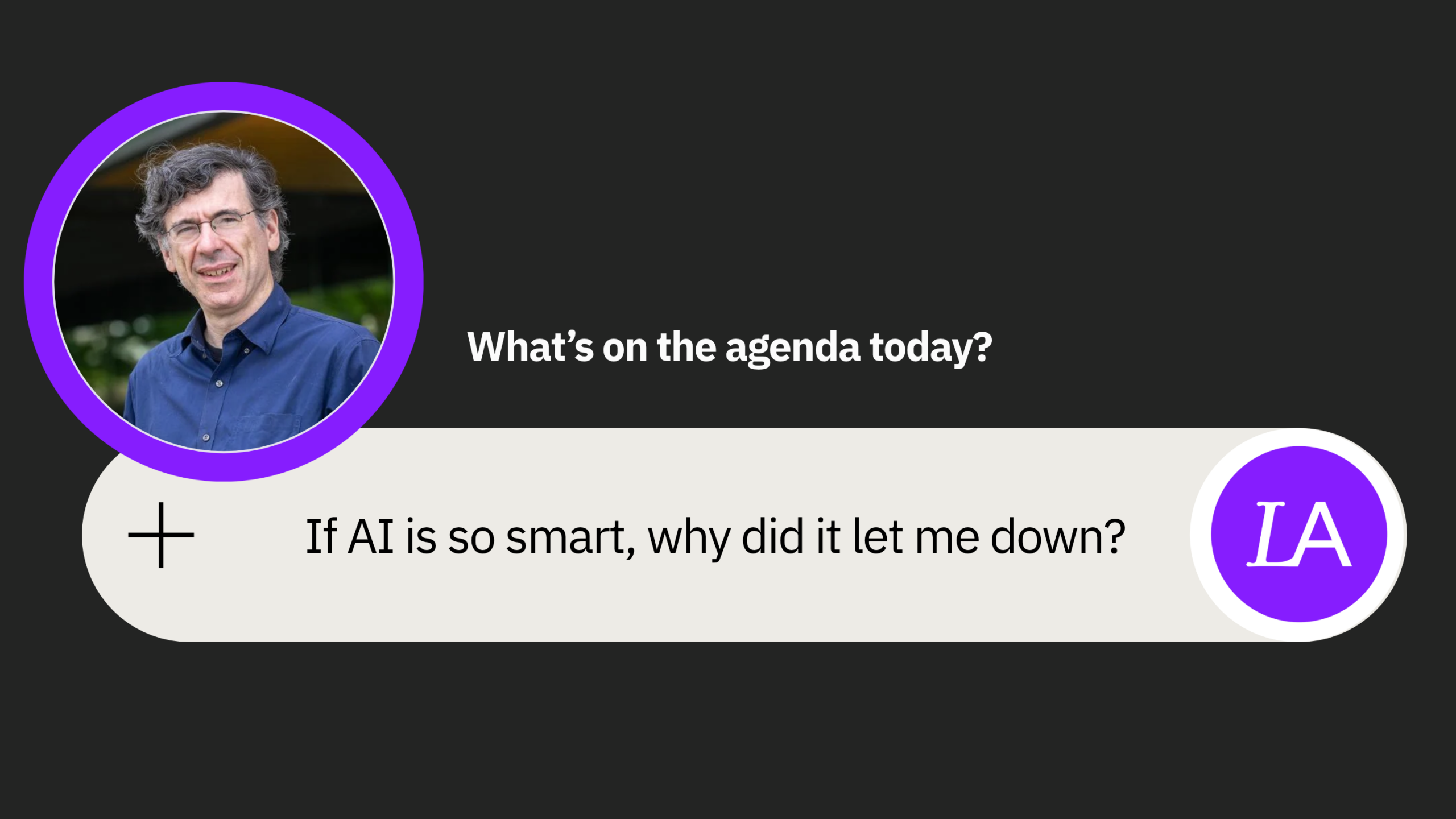
Are humans and machines always better together, or is that just wishful thinking? In this episode we explore why even brilliant AI collaborators can sometimes set us up to fail by making decisions we don’t understand or leaving us with tasks we can’t finish.
Cornell computer scientist Jon Kleinberg explains one of the trickiest problems in AI: how to build systems that are extraordinarily capable AND know how to work well with humans. Then he walks us through the 75-year history of computers and chess to show us what we might be up against–and where human-machine collaborations could go next.
Life, Automated is a production of the Ryan Institute on Complexity, at Northwestern’s Kellogg School of Management. The host is Jess Love, senior director. Distributed by KQED.
Further Reading
Learn more about Project Maia, the human-like chess engine.
Episode Transcript
This is a computer-generated transcript. While our team has reviewed it, there may be errors.
Jess Love [Voiceover]: This is Life, Automated, the show where we explore how to live, work, and make decisions in a world increasingly shaped by machines. If you’ve scrolled LinkedIn anytime in the past four years, you’ve probably heard the claim that humans and machines together can do what neither can do alone, or more pointedly, AI won’t take your job. The person using AI better than you will take your job. I think it’s supposed to make us feel like someone somewhere has a roadmap for how to navigate this strange, unsettling moment where machines can suddenly do things we never thought they’d be able to, and our own livelihoods feel precarious.
But I hear this, and I don’t really know what to make of it. It seems overly simple, and in some cases, just wrong. If a student collaborates with AI on an assignment, they might not be learning as much. If an employee collaborates with AI on a pitch deck for a potential business partner, can they still persuasively deliver that deck? It’s far from obvious, and we’ve already seen instances where human-AI collaborations perform worse than just the AI alone, like in some medical diagnoses. Even if human-machine collaboration does have potential, how do we do it? We have centuries of experience that guide how we coordinate tasks with other people, norms, hierarchies. We don’t have that for helping us figure out how to share the cognitive labor with machines.
So before I raise my fist at yet another LinkedIn post, do we actually know how to partner with AI? Well, if anybody knows, it’s our guest, Jon Kleinberg. Jon is a computer scientist at Cornell. His work on networks and algorithms has won everything from the Nevanlinna Prize in mathematics to a MacArthur Genius Grant. He’s been studying human and AI collaborations since long before ChatGPT dropped and trying to figure out how do humans collaborate successfully with powerful AI systems.
I’m Jess Love. This is Life, Automated, a project from Kellogg’s Ryan Institute on Complexity, distributed by KQED. My conversation with Jon Kleinberg began with me inquiring as to the wisdom of those annoying LinkedIn posts.
Jess Love: So let’s just start with this intuitive and frankly comforting belief that if you take the strengths of a human, maybe that’s creativity, maybe that’s something special, our human values, and you combine that with the strengths of a machine, like persistence, this unbounded memory, you will always end up with something better than you would have with either of those two alone. Is that true?
Jon Kleinberg: Yeah. I mean, I think, yeah. We can’t say that’s true in general. We’ve all had the experience of working with someone where our work styles are just not compatible, that, you know, when we try working together, it somehow doesn’t gel, and we come away realizing that if either of us had done this separately, it might have been better. And I think we see that with AI because it’s a very different kind of intelligence from ours, right? And it’s a very different way of solving problems.
Jess Love [Voiceover]: Jon says when it comes to working with AI, a big challenge is our mental model of how it works. Namely, we don’t have a good one. We just don’t have a good sense of what tasks we can trust it to do for us.
Jon Kleinberg: If we go all the way back to the 1990s, for example, you know, I write something and the AI spellchecks it. I trust the AI to spellcheck, you know.
Jess Love: Yes. Yes.
Jon Kleinberg: Not, not completely. It might misunderstand the word I was trying to say. I might have used a proper noun. It might be my friend’s name that wasn’t in its dictionary, but, you know, to a first approximation, it catches a lot of my spelling errors. And that’s the case.
Jess Love: And I can usually… And I understand what it’s doing. I understand why it’s getting it wrong.
Jon Kleinberg: Yes. And I have a model, right. It has a dictionary. It’s looking up words against a dictionary. So, you know, part of what’s going on now is, of course, we understand less and less about the AI tools that we’re working with. Right? They are incomprehensible even to their designers sometimes. Their designers don’t understand why they do the things they do. It’s hard to have a mental model of, like, what things do I hand off? You know, do I think it will do a good job on this relative to what I would do? You know, part of the challenge here is that I haven’t done the task yet, so I have an imperfect understanding of how hard it will be. And so handing off always involves a kind of prediction because if I fully knew everything this task entailed, I would have… That’s kind of usually what happens after you’ve done it, right?
Jess Love: Right. Right
Jon Kleinberg: I’m making predictions, and so I need a model of what the AI can and can’t do, usually formed through past experience, right? This is always-
Jess Love: You kind of have to experiment.
Jon Kleinberg: Yeah. Try things out, you know, try things out in safe conditions and sort of things where the risks are minimized. And all of these things are like- It really is these two alien intelligences, right, where we’re each trying to understand the other.
Jess Love [Voiceover]: Dividing up tasks and handing parts of them off. These are big parts of collaborating. But these moments when we hand off a task to AI or AI hands off a task back to us, well, that’s when things can get messy.
Jon Kleinberg: We see lots of examples where, you know, if I’m using it to write computer code, for example, you know, I have it write some code, then I want to go in and tinker with it, but I don’t really understand how its code works. If I had written it, I would have understood it, but I don’t understand how it did it. I’ve talked to people who say, for example, you know, “I like using it when I need to compose an email that’s sort of out of my comfort zone.” Like, the landlord hasn’t been fixing the dishwasher, and it’s time to send them a kind of polite but firm, slightly irritated message going like, “You really have to come in and fix the dishwasher. You said you would.” And, you know, I hate doing that stuff, but the AI’s so good at that, it writes a perfect email. But you send the email written by the AI, and what happens next? The landlord calls you on your phone and wants to talk to you. And so now that’s not the AI on the phone, that’s you trying to explain the polite but firm and slightly irritated email that you didn’t want to send in the first place.
Jess Love: That maybe had, like, a weird amount of legal jargon in it, and you’re like, “Ugh.”
Jon Kleinberg: I don’t actually know what to say about it. And so, there wasn’t an explicit plan that the AI was gonna hand the task back to me, but the landlord calling you did hand the task back to you. And so I think we often find ourselves with these fumbled handoffs between the AI and us. Sometimes when I hand things to it and it doesn’t quite understand what I want, and sometimes when it comes back to me because it sort of set me up in a situation I didn’t want to be in.
Jess Love [Voiceover]: These compatibility and handoff issues are really thorny, and we have to find a way through them if we want to be able to benefit from AI without just outsourcing everything over to it. We’ll get back to this later in the episode. But first, in addition to, “Hey, is this alien intelligence really up to the task,” Jon says there are two other things we should keep in mind as we decide whether to delegate a task. One is whether a machine should be doing the task at all.
Jon Kleinberg: Is there some social convention or social norm I should be aware of? Right? Maybe this is a setting in which people don’t want me to be using AI, right? This is like a toast that I’m giving at a wedding, or this is something where part of the whole point is that it’s me speaking as me.
Jess Love [Voiceover]: And then, what will the collaboration do to us, to our own skills?
Jon Kleinberg: A second one is this issue of becoming rusty, right? Maybe the reason to do this task is less about the outcome and more about me preserving the skills that I have. And I think it’s hard to get those skills back quickly, right? And so, there’s a kind of short-term versus long-term planning here. In the short term, it might be helping me enormously, but in the long term, there’s a cost that I should be factoring in.
Jess Love [Voiceover]: Jon thinks long-term skill retention and skill development are areas where we may need to be especially intentional because in the past, many of us learned our skills on the job by doing things. That won’t necessarily be the case going forward. He uses his own world of scientific research as an example.
Jon Kleinberg: For a long time, many areas of research had the property that the best way to learn how to do the research was just to do it, you know? The doing of it was the practice. Now that certain parts of the research process that we never expected to see automated are getting automated with AI agents, right? AI coding agents, AI agents to analyze your data, AI agents to prove theorems in your paper on the mathematical side, all these things. The doing of research no longer comes with the guarantee that it’s gonna also help you develop your skills. You might need to actually be much more deliberate about how to create a training regimen for yourself, even as a researcher, a scientist, an engineer, than you maybe had to 10 years ago.
Jess Love [Voiceover]: A deliberate training regimen, practicing different skills in different ways, including without the assistance of those powerful AI tools, not unlike the way you’d train your body for an athletic event.
Jon Kleinberg: Imagine there’s some sport, where, like bike racing, there’s some super aerodynamic bike that you’re gonna actually use for the race. It doesn’t follow that you should do all of your training on the super aerodynamic bike. You should be able to do a bunch of other things to build up your cardiovascular. And so, the point is there’s gonna be some training regimen that makes you, you know, as competitive as possible. It probably does not consist of just endlessly repeating what the competitive environment’s gonna look like.
Jess Love: So you’re thinking about this as an individual in a work context, you have to think about the entire ecosystem. You’re thinking about, okay, you know, we can get a machine that is optimized to prioritize all these different types of human development. Some of that might come at the cost of short-term performance. Also I’ve got all these humans I have to develop. And so, it becomes a very challenging problem.
Jon Kleinberg: Extremely hard problem, right? Because, right, as an organization, I need pathways for new employees to acquire the skills to become senior employees. And if all those early tasks are being given over to AI, then where does the skill acquisition come from? And this is a thing that people are very much worried about. You know, new employees who are software engineers, biotech researchers, new employees at a large law firm who acquire experience through the initial tasks they do to become more senior lawyers.
Jess Love: Do you happen to know what AI labs are doing about training their own workforce, given that AI can already perform so much of the work? I don’t know if you happen to know anything about this.
Jon Kleinberg: I mean, I will say that the whole tech industry is really wrestling with this question, that they’re simultaneously in a sprint to build the best models that they can against heavy competition from other companies that are engaged in this exact same sprint. And so everyone is racing ahead. And so, that really puts a premium on, we need velocity in our coding development. We need to-
Jess Love: Optimize for performance at all costs.
Jon Kleinberg: Right, because the time horizon is currently very short to get the next model out, right? We need to get this thing to work, and yet that means people are sort of, you know, charging ahead developing software at this enormous velocity with a lot of coding agents. And so it’s hard to sort of know where human skill is going to end up here. But it’s also the case that the nature of software creation is changing so fast that we have to ask ourselves, what skills do I want to be developing? Right? Because the question of would you still be good at- I give you a blank text editor and you start typing in code and getting it to work, is that still the skill that I’m trying to train you for? Or, because we believe in the future we will have AI coding agents, the skill I’m trying to train you for is to work with the coding agent. And so, some skills we might end up leaving behind because we say, we believe that in the future we will always be able to work this way, and so we’re going to train for this way of working.
Jess Love: Yeah, and it becomes very challenging to know how much of your effort you should put toward learning how to work with that tool versus learning the general domain knowledge that might set you up for success later, but maybe not.
Jess Love [Voiceover]: By now it’s clear to me that there are no easy answers for individuals, for organizations. Take that, LinkedIn. And that’s when it comes to collaborating with today’s technology, which is powerful but also uneven and not always up to the tasks we might want to give it. What happens to collaboration if machines get much smarter than we are?
Questions about super intelligence, whether or when it will happen for certain domains, what will happen when it does, hang over a lot of fields. It seems some days like we’re all totally clueless. But we aren’t. There are actually some concrete things we’ve learned about collaborating with superhuman intelligence, actually collaborating, not just outsourcing everything, because there are some domains where it has existed for decades. That’s after the break.
Jon Kleinberg has been working on the problem of designing AI systems that are good collaborators with humans, and that brought him and his research partner Ashton Anderson to chess.
Jon Kleinberg: Chess is something that I’ve been looking at now for the past maybe like 10, 12 years.
Jess Love [Voiceover]: To understand the technology Jon is building now, we need to dive into the history of chess and computers, and it’s a surprisingly long history.
Jon Kleinberg: First of all, everybody wanted to solve computer chess, right? Giants of the mid-20th century of computing, Alan Turing, Claude Shannon, all these people worked on chess. Because it’s such a clean set of cognitive puzzles that humans try to solve, and we could turn computers on it.
Jess Love [Voiceover]: The basic puzzle was could you get a computer to play chess as well as a human, or better?
Jon Kleinberg: And it turned out to be very hard to get computers to get good at chess, right? People started trying to do this in the ’40s and the ’50s.
Jess Love: Oh, wow. That far.
Jon Kleinberg: Way back.
Jess Love [Voiceover]: Two of those computer scientists, Herbert Simon and Allen Newell, predicted that by the 1960s, a computer would be a world champion at chess. They were off by three decades, but computers did improve, and by the late 1980s, computer chess programs started to get good enough to compete with the best humans. And then in 1997 came the big breakthrough.
Jon Kleinberg: IBM’s chess program Deep Blue plays a match against Garry Kasparov, the human world champion, and that’s sort of summiting of Mount Everest, right?
[Video Clip]: And whoa. Deep Blue- Kasparov, after the move C4, has resigned.
Jon Kleinberg: A computer beating a human at chess in a match setting, the human world champion.
Jess Love [Voiceover]: But even that contest was close, and Deep Blue was a supercomputer. So for several years, humans could at least stay competitive with computers. But the computers kept getting better.
Jon Kleinberg: Humans eventually gave up doing it because, you know, if you’re an incredibly strong human chess player, you tend not to like losing badly, and so you eventually stop doing it.
Jess Love: Thousand times out of a thousand exactly.
Jon Kleinberg: And so then there was a 10-year period where people said, “Oh, I see the answer. The answer is human AI teaming.” And this is exactly what you’re talking about.
Jess Love: Yes. That’s right.
Jon Kleinberg: Let’s have a human and AI as partners, and they’re gonna each do what they’re good at, right?
Jess Love: Surely this will be the winning combination.
Jon Kleinberg: Right. And so, the human will do the high-level strategic planning, the AI will do all the calculation, and together they’ll achieve more than they could. And they even had a name for this, right? They called it centaur chess, which was the part human, part horse, and you’re kind of going to battle together. And that worked for a while.
Jess Love [Voiceover]: This is a version of the kind of human computer collaboration people talk about today. And what the history of chess shows is that at a certain level of technology, it can totally work. In chess, there was about a 10-year period when humans and AI tended to play better than a human alone or a computer program alone. But once again, the technology kept getting more powerful.
Jon Kleinberg: Somewhere in the 2014 to 2017 era, you reach the point where if you’re the best human player in the world and you’re sitting down with a chess engine and you’re trying to make the best chess move, you should just do what it tells you. Your attempt to impart your own judgment, to kind of tweak what it is, is only gonna make things worse.
Jess Love [Voiceover]: Now, you could imagine a world in which people stopped paying attention to chess. It’s done, right? Computers have surpassed us. So why bother caring how well obviously inferior humans play chess? But that’s not what happened.
Jon Kleinberg: Chess is more popular than ever. Other things about computers have kept chess popular. Playing people on the internet, watching Twitch streamers and YouTube video of top chess tournaments commentated on by top chess players. Just there’s an explosion of chess content.
Jess Love: And the players themselves have gotten a lot better because they’ve been able to practice with machines.
Jon Kleinberg: Exactly, and that’s secondly happens. The players are training with the chess engine, and so the chess style has changed, right? Chess style has become, in a way, more brutal and tactical than it was 50 years ago, right? I think most people would say 50 years ago, the style in chess was sort of this more elegant… There were certain rules for what an elegant chess position was. And the reason was not necessarily because we valued elegance, though we may have, but because elegance was a heuristic for the safety of your position, right? Chess is too hard for us to calculate, so if my position looks good, it’s probably safe. Once you’re training with chess engines, chess engines didn’t care about these principles or this way. They just played what worked tactically on the chessboard. And so a lot of it was sort of brutal and ugly, but it worked. And the best human chess players sort of acquired some of that style just by training with the engine.
Jess Love [Voiceover]: Today, the question of who is better, the human or the computer, isn’t really even a question anymore. It’s like asking, “What’s faster, a human or a race car?”
Jon Kleinberg: Fast-forward to the year 2026, some high-profile chess tournament, and now the two players come out from some soundproofed area to prevent cheating. And, you can watch this on YouTube. They will ask the journalists, “What should I have done on move 25?”
Jess Love: Yeah. “How’d I do, guys? Ugh.”
Jon Kleinberg: Yeah, because it’s understood that the two people in the world who understand this game the least are the two at the chessboard because they’re the only two who are watching it without the engine turned on. Everyone else was watching it with superhuman assistance. And so it’s 180 degrees turned on itself in this surprising way.
Jess Love [Voiceover]: There’s a lot to take away from the chess story. The fact that AI has not killed chess as a sport, but has changed it, even elevated it, that’s interesting. Of course, chess is a game. It’s always been a game, so it’s hard to know how much of that will apply to other domains.
Will the existence of superhuman law or science make human lawyers and scientists better and more popular? But the sheer unpredictability of chess’s trajectory does strike me as something we might experience in other domains.
And given this long history of human and computer competition and collaboration, Jon sees chess as an ideal place for experimenting to see what works, for learning what to do about the problem that we, humans and AI, don’t always understand each other. He thinks we can build AI systems that are optimized, not for performance, but for human collaboration. And one way to do this is to train the AI to behave like us, mistakes and all. So Jon, along with Ashton Anderson and others, decided to do just this.
Jon Kleinberg: Can we build a version that tries to imitate our style of play, that tries to be as much as possible like a human? And so, we built this chess engine called Maia, whose goal was not to win chess games. It was to take a chess position and predict as accurately as possible what a human being of a given rating, chess rating, was going to make as their next move. And the idea is this is not purely imitative, right? Partly, you know, the specification is imitative. Can I imitate your behavior?
But the hope was that if I have an algorithm that can imitate a human’s behavior, it can now use that as a component of some bigger module to figure out how to partner with that human, right? Because it now has, when it’s trying to guess what a human is likely to do, it can pose a query to Maia and say, “What do you think a human would do in this situation?”
Jess Love: So interesting because right now, a lot of what we’re doing is training machines to be as good as possible by taking the very best humans and training the machines on their behavior. But at a certain point, what you’re suggesting is there’s going to be some sort of switch, and the machines might, in some areas, be so good that we’ll have to then create, you know, human bot versions so that they can practice and they can figure out, you know- And maybe this is already happening with things in driving, for instance, where a big challenge is not just figuring out how to self-drive around a whole bunch of other autonomous vehicles, but how to do that among other humans. And so you might see that in a wide range of domains where it’s like, “All right, robot, we need to teach you how these crazy humans are gonna behave, so that you have some ability to predict what’s gonna happen when you hand the task back off to them.”
Jon Kleinberg: Yeah. If the AI is going to be able to learn how to interact with humans, it needs to figure out what humans are going to do in different situations. And think of how hard that is under the way we train algorithms, right? What we’ve been talking about is algorithms that were trained to excel at certain activities, right? At, you know, at chess, or at driving, or at writing computer code, three hugely different activities. Because they just had billions of instances, right? They did billions of rounds of computation to get as good as they are. Now, if I want to get really good at interacting with humans, I’m not gonna get billions of rounds of interaction with the human because where are the humans who are gonna sit still and be patient enough to participate in billions of rounds.
Jess Love: Before they die.
Jon Kleinberg: Yeah, right. And so, how do I scale up the part where this thing practices? It can’t be on humans. So that’s, I think, another place where using something that’s trained to simulate human behavior could potentially be part of a training loop that now runs between the AI and the simulation of the human behavior to try to make the AI actually safer, more comprehensible to us, more compatible with us, right? All these things that we aspire to.
Jess Love [Voiceover]: Models of human behavior that let machines practice working with us. Maybe that’s what it will take to get these handoff problems under control. And once you’re dealing with superhuman AI, you really don’t want handoff problems.
Jon Kleinberg: To dive back into chess, I think one last time. Chess seemed like a sort of an amazingly clean setting to see how badly handoffs can go. Because imagine we talked about centaur chess where you and the machine consult and you work out the move together, and ultimately that you should just listen to the machine. You can picture another kind of two-player chess where two players playing white, two players playing black in chess, and your team is you and a super powerful AI. And you’re gonna alternate moves. AI makes a move, you make a move. AI makes a move, you make a move, and you can’t communicate. Okay? So you and your teammate can’t communicate. And so the AI as white puts a move on the board, and black replies. You’re like, “I wonder why my partner made that move. And how am I supposed to follow up on it?” This is exactly the handoff because the AI has done so. Now, the AI is not in on the joke, right? It doesn’t know it’s partnered with anyone. It’s just trying to make the best move it can. And so, what’ll happen is if the AI will find some brilliant move that sacrifices a piece, and now you’re temporarily down material because it sees a brilliant way to follow up. Black takes the piece. Control passes to you. You’re like, “I don’t know what they have in mind.” Like, “I don’t know why you did that.” And so you try your best, and then your AI partner is like, “What did you just do?”
Jess Love: “I set you up perfectly.”
Jon Kleinberg: “I set it up perfectly, and now you just failed, and now we’re just losing,” right? So the AI can very easily set you up to fail. It does something that it has a brilliant plan for, right? It’s really not unlike the AI that sends the perfect email to your landlord, but leaves you on the hook to follow up in the contentious negotiation with the landlord. The AI always has some plan for how it would continue. But that may not be how you’re comfortable continuing. And so this is another thing in organizations when we’re interacting with the AI, like we don’t want it constantly setting us up to fail.
Jess Love [Voiceover]: Constantly setting us up to fail. If we want to interact with superhuman AI systems in a truly meaningful way, one that preserves our own involvement and agency, we can’t design systems that assume we suddenly will become superhuman too. Maia, the chess program Jon developed with Ashton Anderson and others, can already predict the next move of a human at a given skill level with over 50% accuracy. That’s way higher than traditional chess engines, meaning it’s a lot less likely to make a move that’s completely inscrutable to the human it’s teamed up with.
So remember that bit of LinkedIn wisdom we started with? AI won’t take your job. A human using AI better than you will take your job. Yeah, maybe? Like, yes, humans will use AI to make us more productive, and yes, experimenting with how you can use AI effectively is probably advantageous. But not all tasks will benefit from collaboration.
And after my conversation with Jon, I’m thinking that for at least some of the ones that do, the onus will be on the AI systems to learn to collaborate effectively with us, predict our behavior, set us up for success.
Well, fellow human, can you predict what I’m gonna say next?
If you guessed Life, Automated is a project of the Ryan Institute on Complexity at the Kellogg School of Management at Northwestern University, distributed by KQED, then you’re right.
Our show was produced by Jesse Dukes with help from Tom Dixon. Music by Steven Jackson. Recording help from Will Feeney, George Christensen, and Jimmy Zarembski. Marketing help from Ananya Mallapragada and Lauren Ko. Thanks to Jon Kleinberg. I’m Jess Love, and I predict I’ll see you next time.