Jackie Elward Wins North Bay Assembly Race Targeted by Silicon Valley

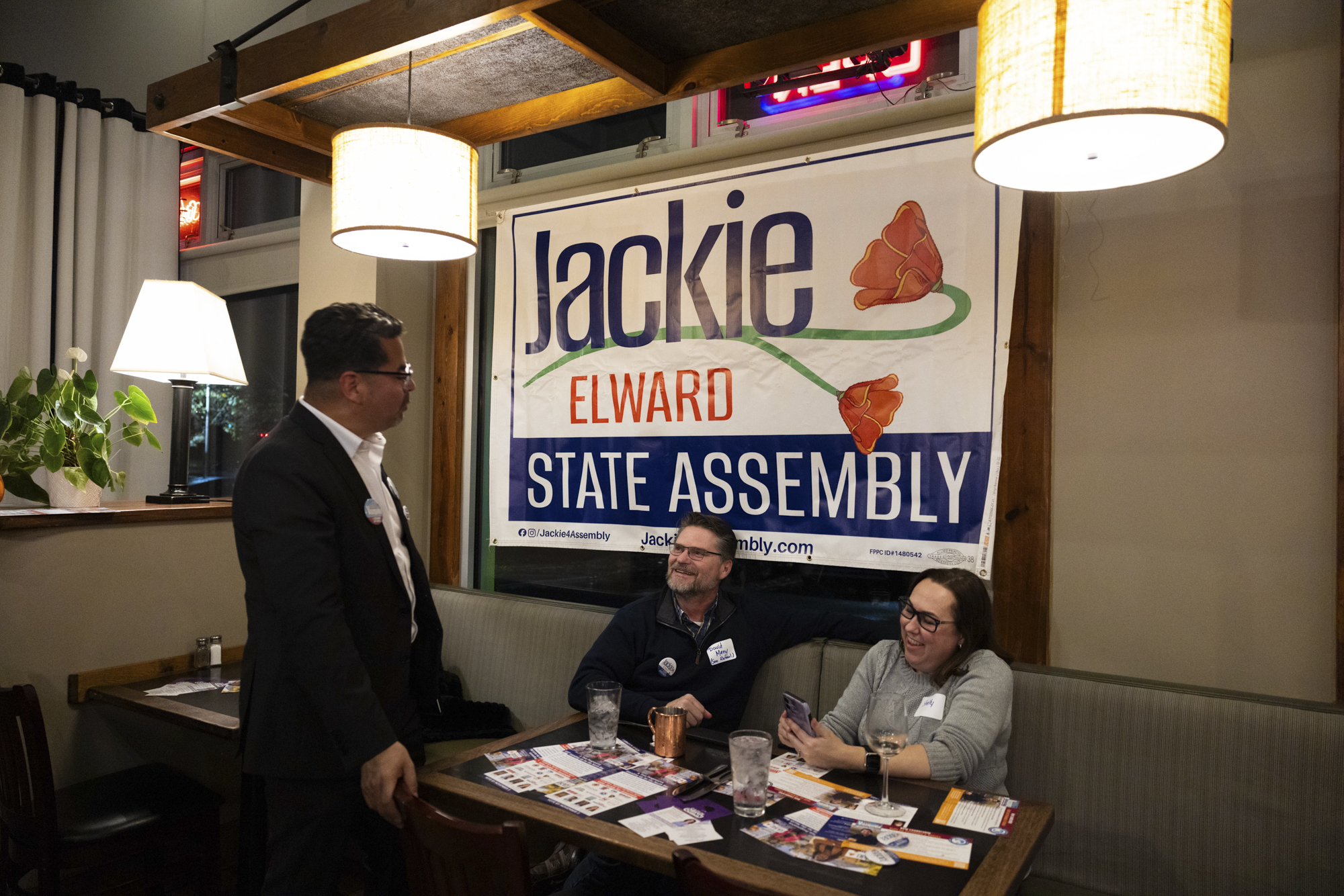
Rohnert Park City Councilmember Jackie Elward has won a closely watched Assembly race in the North Bay between two Democrats that drew millions of dollars in outside spending and became a proxy fight between labor unions and Big Tech.
The Associated Press called the race on Tuesday, but Elward declared victory the morning after Election Day after she received a phone call from her opponent, Marin County Supervisor Eric Lucan.
“He congratulated me on my victory,” Elward said. “He conceded, and he said if I needed anything, help from him, to call him. He was really sweet.”
Elward will represent District 12, which covers Marin County and nearly half of Sonoma County, as incumbent Assemblymember Damon Connolly easily won his state Senate race to represent the North Coast.
“I feel really good about the campaign that we ran,” Lucan told KQED. “I’ve never engaged in any negative campaigning as a candidate ever and certainly wasn’t about to start with this campaign, and we stuck true to that all the way through.”
During their campaigns, the two candidates shared similar messages on affordability, climate resiliency and protecting democracy from the Trump administration. The clearest difference between them was outside spending they have no control over.
The race drew significant independent expenditures from tech interests and labor unions, which are competing for influence in Sacramento as lawmakers there weigh how to regulate artificial intelligence. Both sides see the Legislature as an important arena, given the state’s potential to set national standards.
Across the state, candidates backed by Silicon Valley performed well on election night. District 12 proved one of the exceptions as the deluge of tech billionaire spending backfired against Big Tech’s favored candidate.
“This is a battle royale,” said David McCuan, political science professor at Sonoma State University. “So much money has been bombarded that there’s a huge backlash effect.”

Grow California, a super PAC financed by crypto billionaire Chris Larsen and venture capital billionaire Tim Draper, spent nearly $4 million in the District 12 race this election cycle.
“We congratulate Assemblymember-elect Elward, and we look forward to working with her,” said Shaudi Fulp, strategist for Grow California. “She put up a really formidable campaign.”
McCuan said that if not for the tech spending that inadvertently elevated Elward, he “wouldn’t have predicted by any stretch of the imagination that Jackie Elward would get this far.”
Elward moved to Sonoma County from the Democratic Republic of the Congo in 2003 and has served on the Rohnert Park City Council since 2020. She is an educator and labor organizer.
Lucan grew up in Marin and has served on the Board of Supervisors since 2022. He was head of marketing for Mike’s Bikes and runs a San Francisco fitness studio with his wife.
Despite Lucan’s name recognition advantage in Marin, Elward is outperforming him in the county, holding a lead of nearly 8 percentage points, according to data on the California Secretary of State’s website as of Tuesday afternoon. In Sonoma, she’s sweeping him by nearly 20 percentage points.
In addition to union support, Elward received endorsements from Napa Valley Rep. Mike Thompson, Attorney General Rob Bonta and the California Working Families Party.

U.S. Sen. Adam Schiff, North Coast Rep. Jared Huffman, California YIMBY and local business groups like the Marin Builders Association backed Lucan. Assembly Speaker Robert Rivas managed to disgruntle the Legislature’s Black, Progressive and Women’s caucuses by endorsing Lucan, Politico reported.
Grow California and California Leads, another super PAC that is heavily funded by Meta and Google, poured nearly $39 million into 16 other legislative races across the state, backing mostly moderate, business-friendly candidates. Political analysts say Big Tech’s spending outpaced its contributions in prior years.
Grow California told KQED it is committed to continuing its election advocacy.
“We’re trying to create a year-round dialogue of what voters are prioritizing. And we plan in 2027 to really start getting that out there and having this consistent listening and bi-directional conversation,” Fulp said on Tuesday.
The spending in District 12 this year may have pushed labor interests to increase their contributions, according to McCuan.
“You see a huge amount of labor interests that are coordinating a campaign for Elward, in other words, to push back against those entities that are on the negative [independent expenditure] side,” he said.

Californians United for Progress, a super PAC funded by labor unions — including the California Labor Federation, AFL-CIO and SEIU California State Council — spent nearly $2 million backing Elward, most of it after the primary.
Elward proudly called herself the labor candidate.
“If it wasn’t for labor, I wouldn’t be alive,” she said. “It’s all about just protecting the humans that are working in those union and non-union jobs.”
Labor wasn’t the only group responding to the influx of tech money. TechEquity Action, an Oakland nonprofit that lobbies on AI and tech policy in Sacramento, launched a $1 million ad campaign to highlight the presence of that money in four races, including District 12.
During the campaign, Lucan disavowed the outside spending on both sides and called on the political action committees to back off, noting that the independent expenditures had “completely dwarf[ed]” the candidates’ own war chests.
“There will be a lot of Monday morning quarterbacking,” he said the morning after Election Day. “I think looking back, when folks look at this race, it unfortunately is going to be defined by the significant outside spending.”

Larsen told KQED’s Political Breakdown that he sees Lucan as a “problem solver” and believes Elward is “taking orders” from unions.
Elward issued a similar criticism of Grow California, saying the group wants a candidate who will “push their agenda.”
“It’s funny he said that because I am beholden to the working people,” she said. “When he was pouring money to my opponent, what was he thinking? He wanted my opponent to be beholden to him?”
Both candidates said AI and data centers need guardrails, but they differed on how far they would go.
Lucan called for more transparency about data centers’ impact on water and energy costs. He does not support a statewide moratorium and said land-use decisions should be handled at the local level.
Elward supported a statewide data center moratorium and tighter limits on AI use in workplaces, hospitals and schools. She said her priority is protecting workers and jobs from AI.
“[The voters] do not want data centers; that is something that they have been clear about,” Elward said. “I’m going to work on a statewide moratorium on data centers in order to protect workers, to protect the working class.”