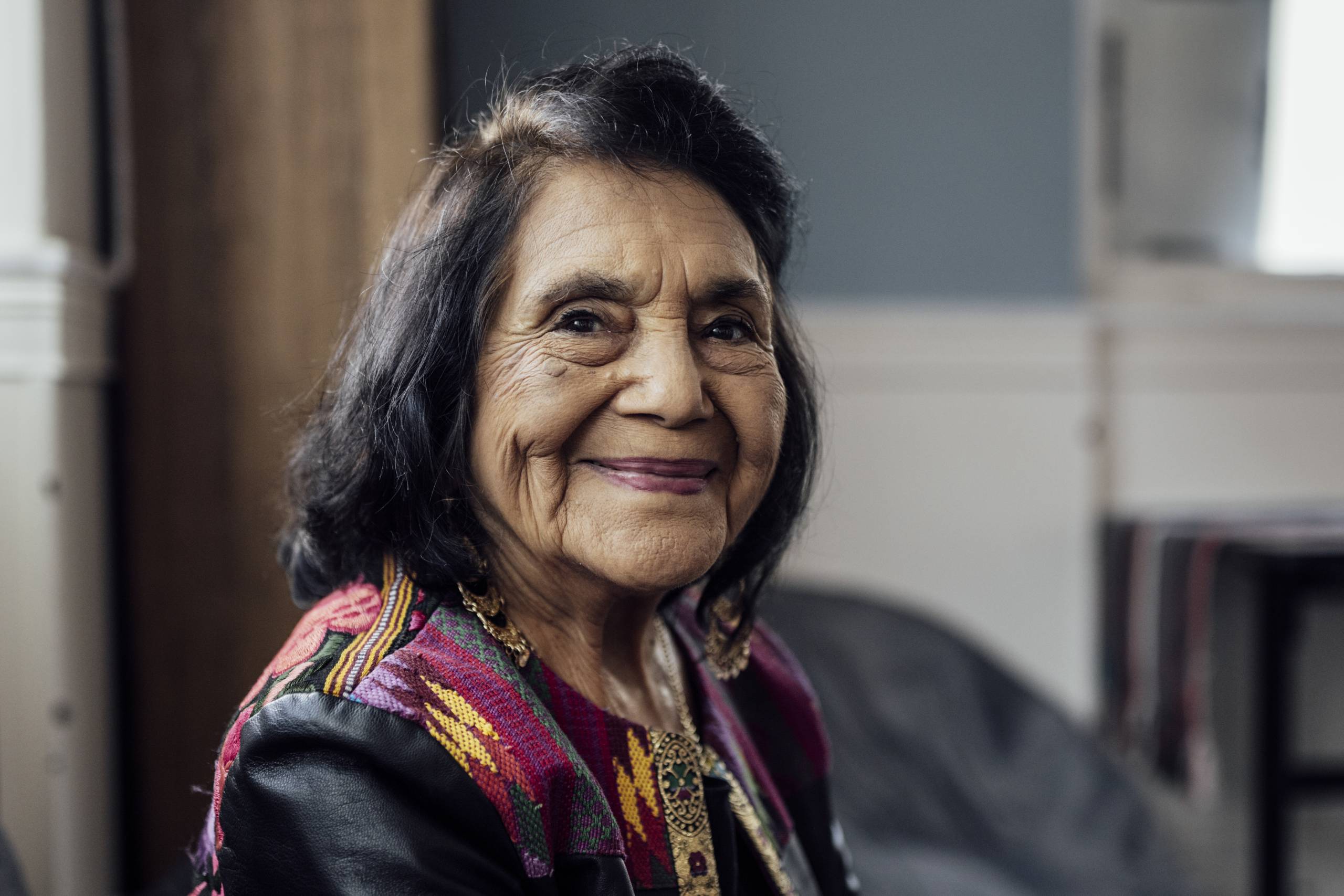
Remembering the Life of Labor and Civil Rights Leader Dolores Huerta
Here are the morning’s top stories on Thursday, October 29, 2026
- Dolores Huerta is being remembered across the country as an iconic leader of the United Farm Workers and a pioneering feminist and civil rights advocate. But she was rooted right here in California. And when she died Wednesday at the age of 96, she was at home in Bakersfield.
- The CEO of California’s High Speed Rail Authority has abruptly resigned from the job.
California leaders mourned Dolores Huerta, the indefatigable civil rights champion and farmworker advocate, praising her as a hero, giant and legend after her death on Wednesday at age 96. Her family said in a statement that she died from cancer at home in Bakersfield.
Huerta, who co-founded one of the world’s most renowned agricultural worker labor movements, spent most of her life pushing for economic justice and a voice for the dispossessed.
Even at her advanced age, she continued to participate in marches and protests, and encouraged Latino citizens to vote, including just days ago, said Angelica Salas, who directs the Los Angeles-based nonprofit Coalition for Humane Immigrant Rights, and called Huerta “a mentor to thousands.” “She felt in her core that injustice had to be fought 24/7,” said Salas, adding that Huerta was a friend who supported her personally and professionally for decades. “The United States of America has lost a hero today.”
A fierce labor negotiator in a field dominated by men, Huerta helped lead large strikes and boycotts in the 1960s and 1970s with the union that became the United Farm Workers. Her labor organizing changed state laws and produced some of the nation’s first contracts to secure drinking water, sanitary toilets and other basic rights for thousands of farmworkers. Huerta lobbied for California to become the first state to give agricultural workers the legal right to organize and join unions in 1975, decades after the passage of a federal law that protected collective bargaining for other private-sector employees.
Huerta, who had more than a dozen children, coined the social-justice rallying cry “Sí se puede,” translated as “Yes we can.” Former President Barack Obama, who coalesced millions of voters under the phrase during a historic 2008 presidential campaign, awarded Huerta the Presidential Medal of Freedom in 2012, praising her determination and courage. Julián Castro, who leads the San Francisco-based Latino Community Foundation, said Huerta was an American icon who changed the course of history for good through her contributions to the labor movement, inspiring young women and men to work for social change. “Dolores, for me and I know for a lot of people, has been a role model of how you can dedicate your life to serving others, to making other people’s lives better,” Castro, a former U.S. housing secretary and San Antonio mayor who ran for president in 2020, told KQED.
Huerta spoke out against the rampant sexual abuse of farmworker women in the fields in a 2013 film and radio series that KQED collaborated on with Frontline, CIR, IRP and Univision. “I believe that the employers are in total denial, and they will often take the word of the foreman or the manager against the woman if she does come forward,” Huerta said in the documentary. “And women know this. They know that they’re not going to be heard. They know that nobody’s going to be there to support them or protect them.”
She stunned many by revealing at age 95 that she herself was manipulated into sex and raped in the 1960s by the late union leader Cesar Chávez. Huerta came forward in a The New York Times investigation that uncovered disturbing accusations that Chávez sexually abused young girls and women for years. Huerta told the newspaper that she chose not to report the abuse partly because she feared that no one within the union would believe her.
The CEO of California’s high-speed rail authority resigned late Wednesday, saying he needs to focus on “important personal and family priorities,” according to a copy of the emailed resignation obtained by CalMatters.
“This has not been an easy decision, as leading the Authority has been one of the most meaningful and rewarding chapters of my professional life,” wrote Chief Executive Ian Choudri.
He will be replaced by Joe Stephenshaw, who has led the state Department of Finance since July 2022 after working as a policy analyst in the state Legislature for more than a decade, the board announced Thursday morning following a closed session.
The abrupt announcement comes in the midst of a two-day meeting of the board that oversees the project, which continues Thursday. It follows Choudri’s tumultuous two-year tenure, which has been troubled by budget woes, project delays, transparency concerns and various scandals including the misuse of nearly $600,000 in taxpayer money for questionable trips by rail authority consultants.
Under Choudri, the authority also lost $4 billion in federal funding under President Donald Trump’s administration, after the agency repeatedly missed deadlines required by the funding agreement to buy trains. The state initially sued Trump for the funding but abruptly dropped the lawsuit in December 2025, blaming Trump as “not a reliable partner” and turning to private investors instead.
State investigators last month found the rail agency’s consultants flew first class, hailed premium rides and traveled to a nightclub, cigar lounge and restaurants on taxpayers’ dime, sometimes at Choudri’s request. Many of the trips involved traveling to Folsom, the Sacramento suburb where Choudri has a home, sometimes after hours.
The board voted earlier this month to limit Choudri’s contracting authority following the probe, requiring the in-house legal counsel to sign off first on contracts under $25 million.
California voters in 2008 approved a $10 billion bond to build a bullet train connecting San Francisco to Los Angeles by 2020, with a projected cost of $45 billion. But progress stalled amid rising costs, legal fights and funding uncertainties. The authority’s latest business plan said the project could now cost between $126 billion and $231 billion, with the current 171-mile leg between Merced and Bakersfield under construction, and a full buildout expected by 2040.