The Political Calculus Behind Newsom’s Opposition to California’s Billionaire Tax
Here are the morning’s top stories on Tuesday, October 27, 2026
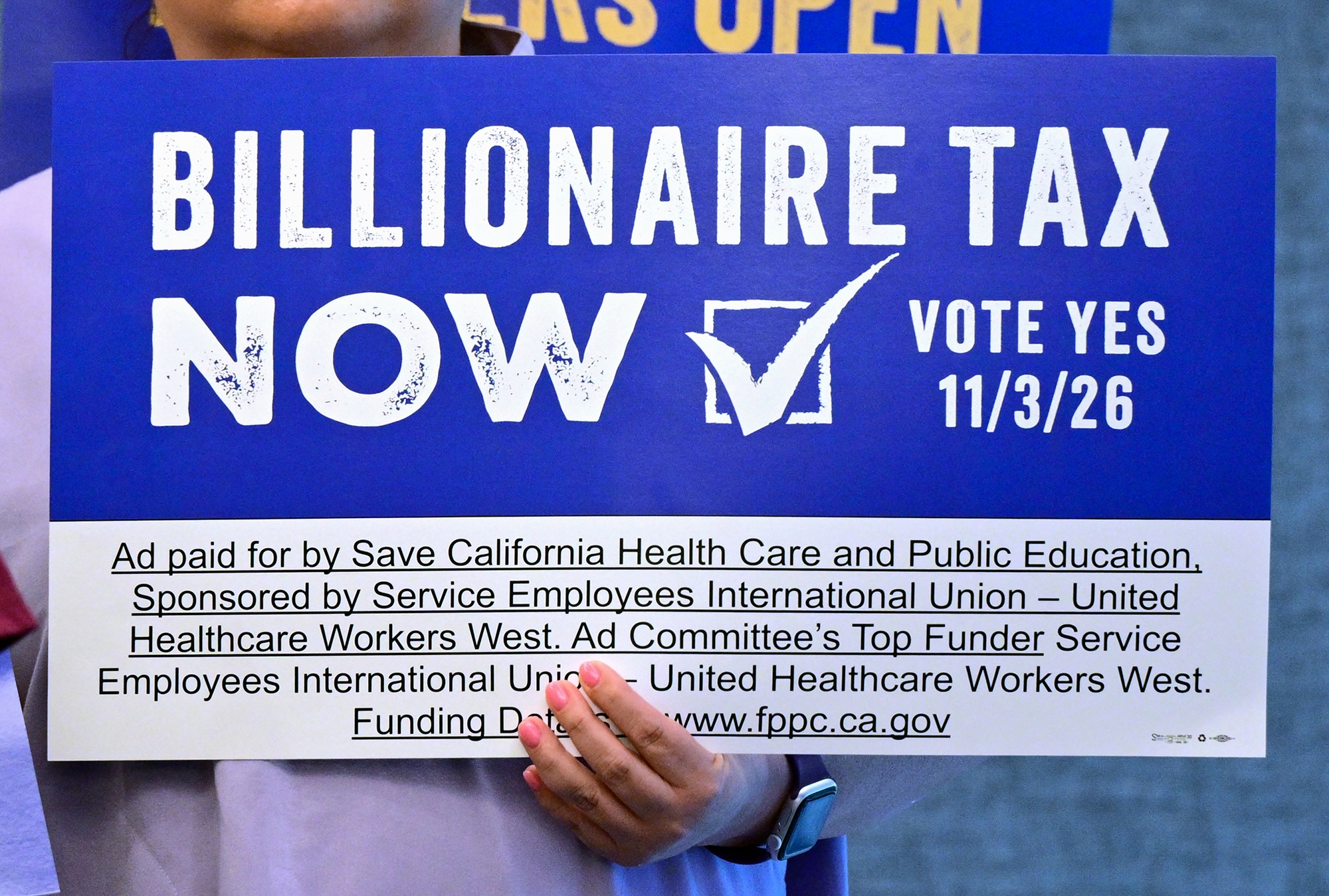
- Proposition 40 proponents say the tax would help backfill federal Medical cuts. But as Governor Newsom weighs a presidential run, is he also looking ahead to how it might play to donors and voters?
- A federal court has rejected a Trump administration demand that it force California officials to set aside the ballots of 20,000 registered voters, who the Department of Justice alleges are not citizens.
- Proposition 38 would allocate more than $8 billion for health research grants. That’s something supporters say is critical, at a time when the Trump administration has tried to claw back funding. But CalMatters has been digging into concerns about how that money would be distributed, with roughly $4 billion going to a single institution.
To hear Gov. Gavin Newsom talk about billionaires and inequality, you’d think he would be squarely behind a proposal on California’s November ballot that would levy a wealth tax on the richest Californians to help pay for healthcare. In a video posted to his Substack and YouTube channel in June, Newsom argued that the country’s tax system is “fundamentally broken.” “Think about this: Just 10% of the people, 10% of the people in the country, own two-thirds of the wealth. A 30-year-old, for the first time in American history, is not doing better than his or her parents. That’s a five-alarm fire,” he said. “It’s time for an economic reset, a true minimum tax. A true minimum tax on billionaires that ensures the people at the very top pay at least the tax rate their own workers pay.”
But like many high-profile Democrats and some of their strongest allies in this deep blue state, the governor is opposed to Proposition 40.
The ballot measure, proposed by a healthcare union, would impose a one-time, 5% tax on the overall wealth of the state’s approximately 200 billionaires. The money would be used to backfill deep federal budget cuts to Medicaid, which provides health insurance to low-income Americans — including nearly 15 million Californians. Newsom has argued Proposition 40 is bad for California. He said this kind of tax should be imposed on the national level, so billionaires won’t just pack up and leave the state. And he insisted that the tax will ultimately hurt the state’s budget more than it will help, by chasing wealthy entrepreneurs and their businesses to other states with lower tax burdens.
Some progressives think the governor — who is eyeing a possible 2028 presidential run — is just wary of angering a donor class with deep pockets. Tech industry billionaires like Chris Larsen, Elon Musk and Marc Andreessen have become increasingly involved in funding campaigns in recent years. “There are a lot of elected officials who are so afraid of this billionaire class,” said California Federation of Labor Unions President Lorena Gonzalez, who supports Proposition 40.
Saikat Chakrabarti, who unsuccessfully ran for Congress in San Francisco this year, went farther. Chakrabarti is co-founder and president of the progressive think tank New Consensus. “He’s made no secret of it — he’s going to run for president. And that’s why he’s not just opposed to Prop. 40. He’s vehemently campaigning against it because he needs those billionaires on his side,” Chakrabarti said.
But the billionaires may not be Newsom’s only audience. Fernando Guerra, a political science professor at Loyola Marymount University, said he thinks Newsom’s opposition to the billionaire tax will help him with centrist Democrats he would need to capture the Democratic nomination in 2028. “It defuses him being the total lefty from California,” said Guerra, who predicted that the tax will get defeated. If it loses, Guerra said, that only gives Newsom more fuel — especially because the coalition opposing the tax includes the California Teachers Association and some other big unions with political muscle. Guerra said that coalition allows Newsom to make a credibility argument and not just with moderate Democrats.
Jim Kessler at the center-left think tank Third Way said that while more left-leaning candidates could attack Newsom in a presidential primary for opposing Proposition 40, those critiques could backfire. “That might help him, even in a Democratic primary, because the top issue for Democratic primary voters in presidential elections is, is this person electable? And they don’t think someone overly progressive is electable,” Kessler said. “No one believes that California is an under-taxed state. So there isn’t a belief out there that, oh, there’s all sorts of tax breaks for people and wealthy people in California.”
An appeals court on Monday declined to rule on whether California elections officials can count roughly 20,000 ballots that the Justice Department alleges likely belong to noncitizen voters.
The 2-1 decision sets the Trump administration and state officials up for another legal showdown on the matter on Tuesday in front of a federal district judge, giving the federal government a very short window to compel California to sequester votes before the Nov. 3 elections. The decision marks the latest in a string of legal setbacks for President Donald Trump’s administration as it seeks to assert greater federal control over state-run elections. Noncitizen voting has been a central focus of Trump’s political messaging for years, although available data indicates it is exceedingly rare.
Although the panel primarily ruled it was premature for an appeals court to get involved, two of the three judges also wrote separate concurrences making it clear they wouldn’t support setting aside ballots at this late date. They questioned the accuracy of the federal government’s list of alleged noncitizen voters and argued that to set aside votes risks disenfranchising citizens.
The Trump administration sued election officials in the heavily Democratic state in mid-October, accusing them of failing to meet a 48-hour deadline to review a list of 20,000 people it alleged were likely noncitizens on the state’s voter rolls. The administration asked the judge to stop the state from counting those ballots until immigration status checks could be completed. The Justice Department made similar demands Monday in Washington, another state with races that will help determine control of the U.S. Senate and House. Both state and federal law prohibit noncitizens from voting. But California officials say it’s not even clear the administration’s purported 20,000 noncitizen voters are actually not U.S. citizens. In court papers, Los Angeles election officials said the majority of a random sample of voters that the Department of Justice identified as immigrants seemed to have been born in the United States. The Justice Department, for its part, has said there is as much to lose from keeping the potentially illegal ballots in the count.
The science research institute that would likely receive $4.2 billion in public taxpayer money if voters approve Proposition 38 this November had only three employees as of last month — far fewer than the 51 staffers it planned to have hired by last year.
Public statements and public records CalMatters obtained raise questions about how well prepared the institute is to shepherd so much money if the bond measure passes.
Prop. 38 would allocate up to $8.4 billion in bonds for scientific research on diseases and cures concerning the immune system, with an emphasis on finding treatments for Alzheimer’s, cancer and heart disease. The ballot language stipulates that a single, unnamed research institute would receive half the bond’s money to conduct research and partner with other researchers if it meets highly specific criteria. Bonds are a type of debt that must be repaid. Previous reporting by CalMatters found only one institute in California currently meets those criteria: the California Institute for Immunology and Immunotherapy. The institute’s principal funder is billionaire Gary K. Michelson, who wrote Prop. 38 and is by far the largest donor to its political campaign.
Backers of the proposition said state bond money is needed to stabilize research funding after President Donald Trump repeatedly attempted to cut existing and future federal science grants.
The measure’s critics say Prop. 38 is well-intentioned but poorly designed because it overlooks the many established public and nonprofit university and hospital research labs in California. They also say California should not subsidize subsets of scientific research and instead should support research more broadly.
CalMatters obtained documents that included the five-year business plan of the California Institute for Immunology and Immunotherapy. The plan was part of the formal affiliation agreement between UCLA and the institute, which the two parties signed in August 2024. Among other details, the agreement requires the institute to pay UCLA 7.5% of the net revenue of any drugs and technologies developed by the institute’s staff. The institute is one of the founding tenants at a UCLA-owned research park in West Los Angeles, where the institute is leasing 235,000 square feet of research space, the institute says.