Just Win
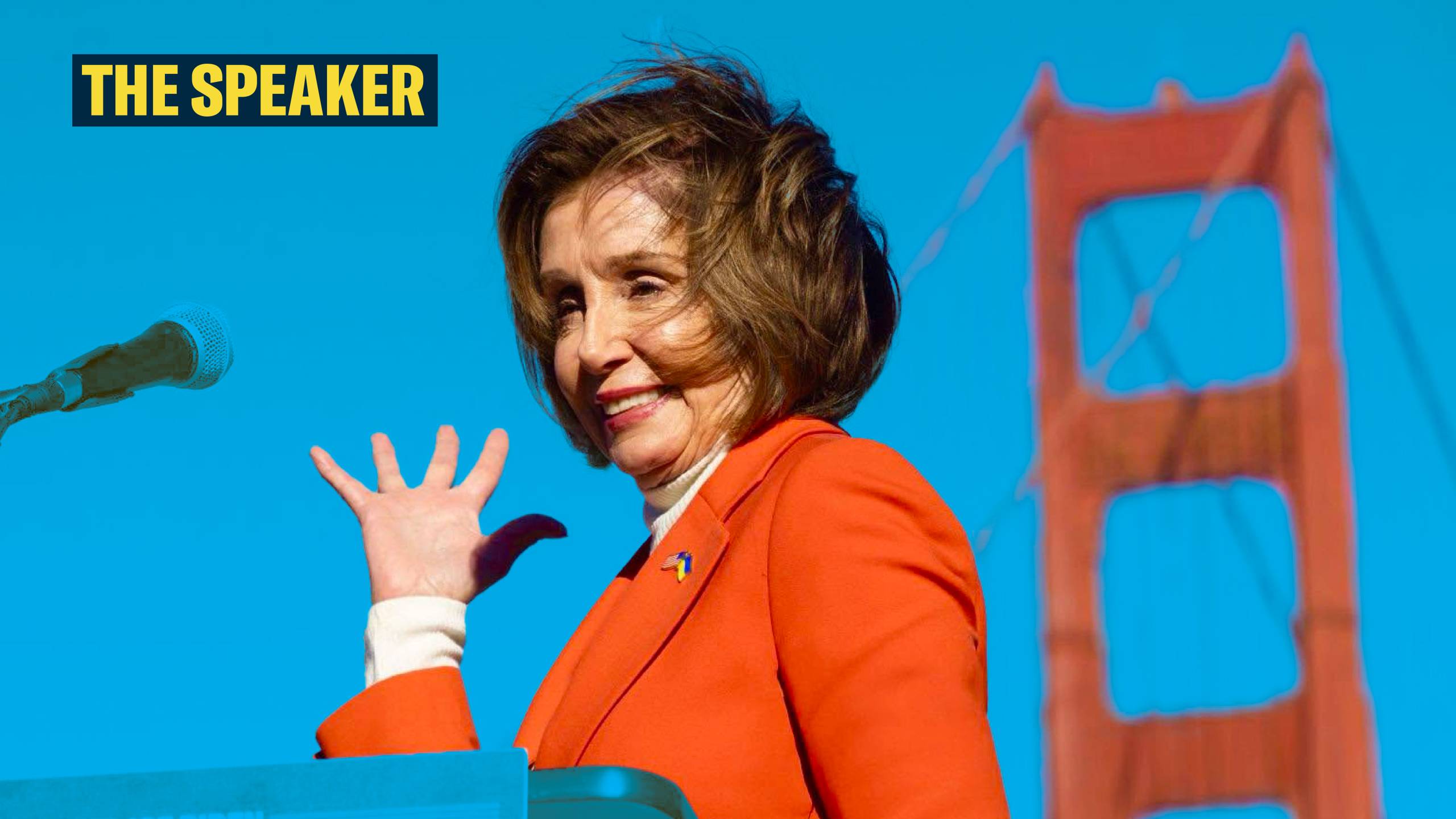
A local politician once called San Francisco politics a “knife fight in a phone booth” where centrist Democrats and progressives duke it out in close proximity. Out of that phone booth emerged Nancy Pelosi. In our series finale, we reckon with what her legacy will be – the fundraiser, the mentor, the fighter. In a moment when the Democratic Party is at a crossroads, how did Pelosi shape the destiny of the Democratic Party?
Episode Transcript
This is a computer-generated transcript. While our team has reviewed it, there may be errors.
Scott Shafer: Our team started working on this project in the lead up to the 2026 midterm election. Polls show that nationwide voters are ready to reject President Trump’s agenda and support Democrats again. But for the Democratic Party, things are shifting. Are we ready to change the party? This May, I went to a rally in San Francisco. The theme was change the Party. It was promoted by Saikat Chakrabarti, AOC’s former chief of staff. And at that time, one of the top three challengers in the race for the congressional seat, Nancy Pelosi, will be vacating. The venue was an event space in the city’s south of Market neighborhood. The room was packed, lots of energy, party atmosphere, a disco ball hung from the ceiling. The crowd skewed young and racially diverse. I wanted to hear what these attendees thought about the Democratic Party.
Change the Party Vox: And the theme has changed the party. Like, what does that mean to you?
Change the Party Vox: Change the party.
Change the Party Vox: How so?
Change the Party Vox: Because the Democratic establishment is just as corrupt as the Republican establishment. They’re donor Democrats.
Change the Party Vox: Democrats are currently very stagnant and uninspired and they’re fighting for the wrong thing.
Scott Shafer: I also wanted to hear what people thought about Pelosi’s role in everything.
Change the Party Vox: And how does Nancy Pelosi fit into that?
Change the Party Vox: She was able to whip the votes for important issues, but at the end of the day, she was part of the problem and the corporate establishment Democratic Party.
Change the Party Vox: If we look at what happened in New York with Mayor Mamdani, he spoke to actual real life issues that people are really dealing with on a daily basis. And he used that as sort of his core. And I don’t think that’s what Pelosi and the establishment Democrats have historically done. They speak more to their corporate base, their donor base.
Scott Shafer: As a politics reporter, I take in a lot of different perspectives. One day I’ll go to a rally and ask voters what they think. And then another, I’ll interview the most powerful man in California. Governor Gavin Newsom. I asked him the same question. What’s Pelosi’s legacy?
Gavin Newsom: People need to study effectiveness, and they need to celebrate it, and they to celebrate some pragmatism, not just idealism.
Scott Shafer: Newsom’s had a front row seat to Pelosi’s work over the years. What does California, what does the Democratic Party lose in her retirement? And how do you get it back?
Gavin Newsom: Well, you lose, obviously, the wisdom, the temperance, the courage. I’m sorry everybody out there hates the establishment and incumbents. It kind of worked for us. Be careful what you wish for.
Scott Shafer: Like Pelosi, I’m also retiring this year. Now, just to be clear of the similarities and the there, there won’t be any buildings named after me, but we’re both leaving at a time of change for the Democratic Party, the institution Pelosi has devoted her life to.
Scott Shafer: What do you make of the rise? We’re seeing a lot of turmoil in the Democratic party in terms of candidates.
Nancy Pelosi: I disagree with your terminology. A lot of turmoil in the Democratic Party. There isn’t a lot of tumble in the party. There’s some people who’ve won their elections.
Scott Shafer: The way she sees it, there are places where more progressive candidates can win and others where they can’t. In the period of time I sat down with her the summer of 2026, she was laser focused on the midterm elections. How do you want people to remember your legacy?
Nancy Pelosi: Not so fast on the legacy. We have to win the house, which we will do.
Scott Shafer: As someone who watched Nancy Pelosi’s rise from that raucous first election in 1987 to the power broker that she is today, I wanted to really take this moment to examine Nancy Pelosi impact on the party she’s devoted her entire life to. Has her role as a fundraiser pushed the party away from its working class ideals? Or has Pelosi kicked down the doors for a more progressive crop of voices in Congress? I’m Scott Schaefer from KQED. This is The Speaker, today the question of Nancy Pelosi’s legacy in a moment of conflict.
Scott Shafer: Over the decades, Nancy Pelosi built tremendous influence in the Democratic party, leveraging trusting relationships and her history of success, political capital, as we sometimes call it. In 2024, something happened that would require her to spend some of that capital. President Biden took the stage that June to debate Republican candidate Donald Trump.
Joe Biden: Making sure that we’re able to make every single solitary person eligible for what I’ve been able to do with the COVID, excuse me, with dealing with everything we have to do with, look, if we finally beat Medicare. Thank you.
Scott Shafer: Biden’s performance in that debate caused a lot of Democrats to hit the panic button. Concerns about Biden’s cognitive ability and age inflamed already simmering tensions within the party around what its future should look like. And big donors were threatening to withhold their support as long as he was the nominee. And then Pelosi stepped in. She went on Morning Joe, the MSNBC show.
Morning Joe: Does he have your support to be the head of the Democratic second?
Morning Joe: As long as the president has the president, it’s up to the president to decide if he is going to run. We’re all encouraging him to make that decision because time is running short.
Scott Shafer: Biden had already decided he was running. This is basically Pelosi giving Biden a vote of no confidence. As close as she’d come to saying he should drop out of the race without saying so directly. The weeks dragged on. President Biden was still in the race. So behind the scenes, Pelosi knew she had to make a critical phone call.
Nancy Pelosi: I was not there to undo his decision, I just told him what I thought.
Scott Shafer: This would not be easy for her. They had been friends for decades. They’d worked hard with a narrow majority in the House to pass legislation.
Nancy Pelosi: Infrastructure Bill, CHIPS Act, CHIPs and Science Act, more for climate than any history of any country in the world, issues that related to our veterans, the PACT Act. He was really on roll.
Scott Shafer: But she knew the time had come to say something.
Nancy Pelosi: I never asked him not to run. All I said is, two things. One, presentation that is being made is not a winning one. The polls are not good on this. And you’ve accomplished so much. This is a winning agenda that you have. I don’t know. Let me talk to my polls, because they have the polls. I said, well, that’s interesting. But I’d like to have more pollsters around the table to compare. I don’t have any recommendations of who they should be. But just have some other points of view so that we can see where we are on this. Because too much is at stake. Donald Trump. Too much is a stake.
Scott Shafer: How hard was that conversation? I mean, you say you didn’t ask him not to run, but it was interpreted that way. And ultimately, there were others calling on him not to run. How hard is that given the relationship you’ve had with him?
Nancy Pelosi: It was not a good thing. I mean, it was hard. I mean I’ve known him for decades. We’ve been friends a very long time. I love him. I think he was a great patriot. He was a Great President. All we wanted to do was to see the reality of when you take polls, it’s not about where you are. It’s about where the public is on issues and how your message is coming across.
Scott Shafer: On July 21st, 2024, President Biden dropped out of the race. Pelosi endorsed his replacement, Vice President Kamala Harris, who was the only person who could legally use Biden’s remaining campaign funds. Pelosi threw her weight into the race, raising more money for the Harris campaign.
Nancy Pelosi: I give Kamala Harris great credit for getting out the vote. She got out a big vote.
Scott Shafer: But even so.
Kamala Harris: The votes for President of the United States are as follows.
Scott Shafer: In her role as vice president, Harris oversaw the certification of the election results.
Kamala Harris: Donald J. Trump of the state of Florida has received 312 votes. Kamala D. Harris.
Hilary Braseth: Now, 2024 was a bit of an outlier in that, what we know on record, Kamala Harris far out-raised Donald Trump. She did not win.
Scott Shafer: Hilary Braseth is the executive director of Open Secrets. That’s a nonprofit dedicated to tracking money in U.S. Politics. She says 2024 was an outlier because
Hilary Braseth: If you raise more money than your opponent, the likelihood that you will win is roughly 80%. So it’s quite high.
Scott Shafer: And Nancy Pelosi, well, she’s famous for raising a lot of money for Democrats.
Hilary Braseth: She was the Speaker of the House for many years, and it’s no secret that she’s, with that title, also managed to raise a whole bunch of money.
Scott Shafer: Since 2000, she’s raised around $100 million directly and has helped the Democratic Party bring in around $1.25 billion total. To Brasif, Pelosi’s power comes in part from this fundraising ability.
Hilary Braseth: Members of Congress who are able to raise large sums of money is often seen as a proxy for how successful they may be in an election or how powerful they might be able to be once they are elected by virtue of having a war chest, we refer to it as, to transfer to other lower-ranking Democrats, which again fuels and reinforces the system of power.
Scott Shafer: Like in Nancy Pelosi’s case, she raises a ton of money, but she doesn’t need it for herself, right?
Hilary Braseth: And then she can transfer it to lower ranking members. So it’s powerful, right? She gets to decide who gets to receive this money that then produces a system of currying favor from lower ranking Democrats. And you have the party machinery here.
Scott Shafer: Pelosi’s strength as a fundraiser is more important than ever. This is an extremely consequential midterm election at a time when voters aren’t particularly excited about Democrats. As of February, Pelosi had about $9 million in a personal war chest, ready to deploy for congressional races around the country.
Hilary Braseth: She’s built strong relationships with heavy hitters when it comes to political donors. It also means that she’s had largely the backing of her party as somebody who’s been able to bring in very large sums of money.
Scott Shafer: But that’s also contributed to image problems and the rise of what progressive critics call corporate Democrats.
Barack Obama: Last week, the Supreme Court reversed a century of law that I believe will open the floodgates for special interests.
Scott Shafer: Since the Supreme Court’s Citizens United decision in 2010, money has poured into our political system. It allowed corporations, interest groups, and wealthy individuals to spend an unlimited amount of money funding political ads and other campaign activities. They often do this through political action committees, or PACs, and their supercharged cousins, super PACs. And this happens on both sides of the aisle. One of Pelosi’s political mantras is just win. She used the phrase in an interview once. She was asked about Democrats criticizing her to score political points in more conservative districts. Her answer, basically, go ahead, do whatever it takes to win the election. Times have changed in terms of political giving. Today, some of the largest contributors to PACs and campaigns have ties to Silicon Valley. Even today. As data centers and AI attract bipartisan criticism, Pelosi doesn’t discourage Democrats from taking tech contributions, insisting that support does not have to compromise their values.
Nancy Pelosi: I mean, candidates call me and say, tech is coming in for me. I don’t want it, but they’re coming in for me because they don’t like the opponent, and I’m afraid that other tech will come in for them. But tech money is different from fossil fuel money, and it’s different from gun money, because there are differences of opinion.
Scott Shafer: As California tech CEOs ingratiate themselves with Trump, Pelosi seems to draw a distinction between tech money and other corporate money.
Nancy Pelosi: Now, the tech community is a relatively new phenomenon in terms of…
Scott Shafer: But it’s corporate money.
Nancy Pelosi: Yeah, no, but the tech money is on both sides of the issues. Some of the tech-money that’s saying we should have a better, fairer immigration system and the rest of that. I’m not here to protect them, but all the businesses are the same. I mean, I don’t want to paint everybody with the same brush, but they all want lower their taxes and lower their regulation.
Scott Shafer: But when I ask Pelosi if she thinks the Democratic Party is too reliant on corporate donations, she bristles.
Nancy Pelosi: I completely, totally disagree that the Democratic Party is dominated by corporate money. It isn’t. And certainly the Democrats vote for gun violence prevention. The Republicans do not. Their Democrats vote to protect the environment. The other people are in the pocket of the fossil fuel industry as well as the gun industry. So it is a big difference. But we haven’t made that clear. And every poll shows, oh, they think we’re both sort of the same.
Scott Shafer: Right now, Pelosi’s eye is firmly on taking back the House. She’s traveling the country to raise money for Democrats, trying to flip seats from red to blue. She’s weighing in on a few non-House seats as well. For example, the Senate race in Michigan. Pelosi endorsed Haley Stevens, a fellow House member, the more centrist establishment Democrat. Stevens lost the primary to Abdul Al Sayed, the candidate who supports Medicare for All. And opposes unconditional military aid for Israel. But Pelosi sees the field like a chessboard. There are some districts and states she thinks the party will struggle to win with a progressive agenda.
Nancy Pelosi: I don’t know about Michigan. I don’t know what’s gonna happen there in the Senate. But I’ll tell you, the more left the candidate, the harder to win the general in Michigan, in Michigan.
Scott Shafer: But with the primaries over and the field of candidates set, Pelosi has hit the road to help Democrats win in November.
Nancy Pelosi: Will be a path to winning the White House. What’s happening right now is contrary to anything our founders had in mind for our country, contrary to the Constitution of the United States. And I just, well, we just win, baby. That’s just the whole thing. And win big.
Scott Shafer: On the night of October 28th, 2022, just before the midterm elections, someone broke into the Pelosi home in San Francisco. The intruder, David DePapp, found Nancy Pelosi’s husband, Paul, in bed. He demanded to know, where’s Nancy? When Paul told him she wasn’t home, he said he’d wait for her. Paul managed to call the police from the bathroom. Police body cam footage from the officers who responded. Revealed DePapp and Paul Pelosi, wearing boxer shorts, struggling for a hammer. Police told DePap to put the hammer down. He said no and swung it at Paul, hitting him in the head, fracturing his skull. Later, authorities found zip ties at the scene and rope in DePaps backpack. According to a federal charging document, DePapa was planning on holding Nancy Pelosi hostage to break her kneecaps if she didn’t answer his questions honestly. Paul was 82 years old. He needed emergency surgery to repair his fractured skull and was in the hospital for several days. Nancy remembers sitting with her family in the ICU. In episode one, we talked about how many years earlier, as a teenager, Alexandra gave her mother permission to run for Congress.
Nancy Pelosi: Then she said, get a life.
Scott Shafer: But that night in the ICU, Alexandra had a very different take.
Nancy Pelosi: After daddy got hurt, she said, if I knew this was at the end of the road, I would never have given you my permission. And that’s too big a price to pay.
Scott Shafer: Were you surprised that Alexandra said what she did?
Nancy Pelosi: No, I wasn’t surprised. No, this is our dad, our pop. Pop is what the grandchildren call him. No, that was terrible, terrible thing.
Scott Shafer: It was the cruelty after the attacks that really got to her.
Nancy Pelosi: It’s not only that, though. It’s all the things that people say along the way. I don’t even know how to refer to the person in the White House anymore. It’s just beyond. But he was making a joke of the whole thing. His kids were making a joke of the thing.
Scott Shafer: Two days after the attack on Paul, Donald Trump Jr. Retweeted a meme, a hammer and white underwear that said, got my Paul Pelosi Halloween costume ready. He wasn’t the only one.
Nancy Pelosi: That Charlie Kirk or whatever his name was wasn’t there anybody who’s patriotic enough to spend to save to bail out this guy And what was that jerk’s name, Tesla.
Scott Shafer: Oh, Elon Musk.
Scott Shafer: Pelosi probably knows Elon Musk’s name, but in my experience, when she throws shade, she pretends she doesn’t know someone.
Nancy Pelosi: Elon Musk, he made terrible statements, too. They’re just very sick people, but that is trauma. I mean, physical is life or death. Trauma is with you for a long time to come, and that is very traumatizing to a family, to have that kind of assault.
Scott Shafer: Our producer, Ariella, talked to another one of Pelosi’s daughters.
Ariella Markowitz: Were you surprised when your mother decided to run for reelection after the attack?
Christine Pelosi: No, I wasn’t surprised because we had the political work that was going to be done.
Scott Shafer: That’s Christine Pelosi.
Christine Pelosi: It was really particular that they should go out and live their lives and not live in fear. What were they supposed to do? Stay home and stay inside their house and not go out and be with people, not be in the community that they built together for 50 years in San Francisco because of something like that? I think the opposite.
Scott Shafer: But Christine thinks it’s bigger than that.
Christine Pelosi: I think a lot of women of her generation who were living the unlived lives of their mother. Her father was not supportive of her mother becoming a lawyer. There was a lot work that women tried to do but weren’t rewarded for. It was the men groomed for politics, not women. So I think for my mother, what she wanted for herself and for women of her generation, certainly of the next generation and the one after that, is for people to break through all of that and not be held back.
Scott Shafer: Less than two weeks after the attack on Paul, Republicans took back control of the House. Pelosi stepped down as leader of the house Democrats, but it wasn’t because of the attack on her husband. She was keeping a promise she made four years earlier, self-imposing a term limit response to the desire for new leadership among some in her caucus. In her speech after the election, she talked about how violence can undermine democracy.
Nancy Pelosi: Indeed, American democracy is majestic, but it is fragile. Many of us here have witnessed its fragility firsthand, tragically, in this chamber. And so democracy must be forever defended from forces that wish it harm.
Scott Shafer: The political environment had gotten increasingly dangerous. Pelosi worries that the attacks on her and the events on January 6th, 2021 will discourage other women from entering politics.
Nancy Pelosi: Over the years, the attacks that were made on me, the women were saying, I could never do that. But you don’t want other people not running for office because they saw something happen. When women succeed, America succeeds. I firmly believe that. And I speak to women, I say to them all the time, know your power in this, you are so needed.
Scott Shafer: In our last episode, we heard from Ilhan Omar, the representative from Minnesota’s Fifth District, one of the squad of four progressive lawmakers elected in 2018. She and Pelosi sometimes disagree. For example, on Medicare for All, she supports it. Pelosi does not. But when Omar first got to Congress. I talked to her quite often. She called a lot. So often, her staff would joke that Auntie Nancy’s calling.
Ilhan Omar: And I think she was mostly nervous for me and what I would be dealing with as someone who carried unique identities that were under attack in our country. I really thought that it was super kind of her to pay that much attention to me and what I might need, not just in terms of serving, but just mentally as well.
Scott Shafer: Before Omar was sworn in in 2018, she was worried about one thing in particular. This ban that existed on head coverings. Omar wears religious head covering. Head coverings of any kind weren’t allowed on the house floor at the time she was elected. So she brought it up to Pelosi.
Ilhan Omar: She did her… You know, mom assurance thing of like, no, that’s not gonna happen and we’re gonna fix it to my surprise. She worked with me to have the rule change have my name attached to it.
Scott Shafer: Ariella asked her
Ariella Markowitz: Were you surprised she took care of it, or?
Ilhan Omar: Yeah, and that she was thoughtful, that she also wanted me to be the one who proposed the change
Scott Shafer: Pelosi was right to be worried. The vitriol has only escalated since Omar was first elected. Omar was born in Somalia, but became a U.S. Citizen when she was a teenager. She’s also Muslim. Omar is often attacked by President Trump. At a rally in 2019, you can hear the crowd yelling, send her back before he speaks.
Donald Trump: So, Representative Omar blamed the United States. For the terrorist attacks on our country, saying that…
Scott Shafer: And the rhetoric has only intensified in President Trump’s second term.
Donald Trump: Ilhan Omar is garbage. She’s garbage. Her friends are garbage.
Scott Shafer: Two months after Trump made these comments, she was attacked at a town hall meeting during the ICE surge in Minneapolis. During protests against that surge, federal agents killed two U.S. Citizens, Renee Good and Alex Preti. Omar was calling for the resignation of the head of DHS at that point.
Ilhan Omar: And DHS Secretary Kristi Noem must resign or face impeachment.
Press Conference Archival: Whoa, whoa, whoa!
Scott Shafer: A man lunged and sprayed her with a liquid that turned out to be a mixture of water and vinegar. Omar finished the town hall after the man was tackled and removed by security. In that sense, her toughness, she can relate to Nancy Pelosi. She grew up with brothers.
Ilhan Omar: Her dad was very much instrumental in her life and the way that she thinks about life and the ways that she think about strength and courage. And I grew up with brothers and my dad really is the reason I am who I am today. And I think we have a similar energy that shaped us.
Scott Shafer: Even though they disagree about how to fix America’s health care system and other policies too, Pelosi’s steeliness through it all is something Omar admires. It is important.
Ilhan Omar: Make sure people who see you as an inspiration don’t see you backing down. Because it will inspire them to stand up to police as well.
Scott Shafer: While we were in D.C., Areola went to the annual California Congressional Transportation Reception. That sounds like fun, doesn’t it? I know. It was packed with politicians and workers from California public transportation projects. Pelosi was there, along with a freshman member of Congress.
Lateefah Simon: The Bay Area is very special because we throw down, we throw down hard.
Scott Shafer: Lateefah Simon represents California’s 12th District, right across the bay from Pelosi’s San Francisco seat. Like Representative Ilhan Omar, there are policies she disagrees with Pelosi on, but when Ariella asked her about Pelosi at the event, she lit up.
Lateefah Simon: And I call her Ms Pelosi. I grew up in San Francisco and in Oakland. She spent so much time with freshmen and I gotta say, a lot of time with me really training me on how this place works. Now, she’s clear that I’m kind of like an ultra progressive. Like I’m a no war, anti-war organizer who grew up doing justice reform. What did that mentorship mean to you? Just like, how did, how do you think, what did she teach you? When I was running. She was very clear to me, I don’t want to talk politics with you, Latif, I want to talk about where you’re going to send your daughter to school. How are you going to be with family? You’re going leave your elderly mother. She’s so clear that our first obligation is to community and family. You know, I sit with her almost weekly and I ask her questions about particular bills and she gives me her her direct thoughts. And sometimes I’ll say, Miss Pelosi, I’m not going to vote that way. And yet… Yeah, she always says, vote your district. What are your hopes for the future of the Democratic Party as she’s stepping down? I remember how Nancy phrases the demand of the moment, and she always equates it with the children. So as a disabled woman, I’m always remembering that, that this is not about power. It must be about service. We’re up against Armageddon in some ways, I feel like, it’s David and Goliath. But I come from, you know, the Bay Area, where we’re ruthless in our own politic about what we believe, what is morally consequential. And I’m glad that I actually came into the Coliseum, not the Dome. Some people call it the DOME. It’s a Coliseium. We’re fighting for the lifeblood of our democracy. And I am so blessed that I have that lens to be able to say, well, no one’s going to push me around. I’ve seen the Nancy Pelosi’s. Hands. I’m stronger because of it.
Scott Shafer: When Pelosi first got to Congress in 1987, there were 13 Democratic women in the House. Now, there are 95. Pelosi helped many of them win their seats. But in many ways, politics is still a man’s club. For women to survive and build a career, you have to be ready to fight. And now, many women in Congress have a template. Nancy Pelosi.
Scott Shafer: Many have pointed out that Pelosi’s political acumen came from Baltimore, her home city in Maryland. But, I really see San Francisco in her. A local politician once described San Francisco politics as a knife fight in a phone booth, a fierce battle that often becomes personal because the city is relatively small and the political spectrum runs from liberal to further left. Surviving the city’s political cauldron, often battles between progressives and centrists, forces politicians to learn how to navigate the many interests, labor, business, environmentalists, LGBTQ. Racial and ethnic groups, political clubs. California Governor Gavin Newsom sees Pelosi as a pure product of these dynamics.
Gavin Newsom: There’s that cross-pollination that was old San Francisco, the Moscone’s and the Burton’s, the Brown’s, and, you know, the machine.
Scott Shafer: Newsom grew up in a well-connected family. Nancy Pelosi was basically his aunt through marriage. His uncle was Paul Pelosi’s brother. He grew up with her coming to Thanksgiving or Christmas. Newsom said he didn’t really know she was a political player when he was growing up in San Francisco, but as he entered politics, city supervisor, mayor of San Francisco and eventually governor, he got closer to Pelosi. And as Newsom sees the party change today,
Gavin Newsom: I’m literally mesmerized by the punditry about this DSA. I’m like, have you guys ever been out west, never been in the Bay Area, never paid attention to San Francisco politics? This is like decades, this is what we do. This is the Harry Britt versus the Brown Pelosi machine.
Scott Shafer: That dynamic between centrist and progressive Democrats is still shaping the party. But to Pelosi, knowing each side of the party through and through, her body in both camps, as former San Francisco mayor Willie Brown put it, I see that as her strength.
Nancy Pelosi: Tomorrow’s another day. You know, that’s what I always say to them. When you have like a weaver at the loom and we would weave this and sometimes people couldn’t be in the design and we’d say, okay, if you’re not in the designed, don’t go criticize the design because this is the consensus of the democratic caucus. This is what everybody’s put in and this is a consensus, but don’t criticize it because tomorrow was another day
Scott Shafer: Pelosi’s time in elected office is winding down, but the monuments to her legacy are starting to be built. Across the San Francisco Bay Area, you can find markers of Pelosi’s impact and influence. The AIDS Memorial Grove in Golden Gate Park, at the University of California at Berkeley, the new Nancy Pelosi Institute for Representative Democracy. I’ve been reflecting a lot about how life will be different when I’m no longer covering politics. When people stop saying things like, oh, I heard you on the radio or on a podcast. Now that Pelosi’s time in office is almost up, I wanted to ask her, what are you gonna miss most about not being, when you leave Congress?
Nancy Pelosi: Nobody in San Francisco or California ever has Potomac fever. I don’t know. I’ll miss some of my friends, but I’ll see them. I’m excited about going to Berkeley and having the UC Berkeley Nancy Pelosi Institute for Representative Democracy.
Scott Shafer: You’re not gonna miss like just being in the mix all the time. No.
Nancy Pelosi: I didn’t go to stay that long. It’s just one thing led to another. You run for leadership, and then you’re leadership, then you become speaker, and it’s those. No, that’s being in the mix. I was in the mixed. Been that, done that. Yeah, I mean, I was first woman speaker of the House. This was a very big deal, and I won it back again. So no, I wouldn’t miss it at all.
Scott Shafer: Pelosi says she won’t miss being in the mix, but she’s still active. In our last interview, she told me she was in five states in one weekend, campaigning for the midterms, raising money, doing everything she can to win, and she is confident.
Nancy Pelosi: What gives you hope? The fact that we’re gonna win this election gives me hope because we will.
Scott Shafer: But if there’s one thing I know as a journalist, it’s this. When someone claims to be certain, it’s our job to keep asking questions.
Scott Shafer: I’ve often said the things Nancy Pelosi is best at are the things very few people see. Governor Gavin Newsom said something similar.
Gavin Newsom: It was constant blocking and tackling. Just the constant, so it was Nancy, blocking and tackle, blocking and tackling. Wasn’t just delivering more resources, was stopping those resources from being cut and building coalitions that wouldn’t have otherwise existed without her.
Scott Shafer: That reminded me of one of Pelosi’s biggest local accomplishments. The Presidio is an old army base on the northern edge of San Francisco, with towering eucalyptus groves and sweeping views of the Golden Gate Bridge. It was a U.S. Military base from the mid-1800s to 1994. After Congress voted to decommission it, there was a big debate about what to do with it. Some in Congress wanted to sell the prime real estate to private developers. In the 90s, Pelosi got Congress on board to turn it into a thriving park with restaurants, businesses, and non-profits. And thanks to that public-private partnership structure Pelosi helped create, the park is now financially self-sufficient. We talked to Pelosi about it on Memorial Day this year when she spoke at an event honoring veterans.
Nancy Pelosi: When I did my legislation to turn it from a post into a park, our motto was one that existed from the start, from 250 years ago, no shot fired in anger. So we always did it in the most nonpartisan, unifying way. And that’s what will protect the procedures we go forward.
Scott Shafer: In the early 90s, Pelosi was still relatively new to Washington, but she convinced even some Republican members of Congress to support her plan to preserve the land for the public and to have it pay for itself. Today, that legacy is under attack.
Archival: President Trump’s latest executive order is aimed directly at one of his political rivals’ favorite achievements, the Presidio Trust, established nearly three decades ago, largely because of the work of Congresswoman Nancy Pelosi.
Scott Shafer: Earlier this year, President Trump fired all six board members of the Presidio. But at the Memorial Day event, Pelosi was confident. The Trump administration can attack the Affordable Care Act. They can cut government programs. They can dismantle laws she spent months, even years, trying to pass Congress. But when it comes to her public park, The Presidio
Nancy Pelosi: When we passed this legislation, we did it in a very wise and strong way. I feel that this procedure was protected by the legislation because it anticipated any kind of assault that it might have. So I’ll just leave it at that.
Scott Shafer: After she spoke, a crowd formed around Pelosi. The fog had broken by then, and the sun was shining in the cemetery. Kids with their parents, veterans, constituents, all came up to thank her for her work and her years as their representative.
Presidio Memorial Day Ambi: Thank you, Madam. You’re an inspiration. Thank you.
Scott Shafer: At a time when people are very skeptical of political institutions or politicians, in San Francisco, Representative Nancy Pelosi is still pretty popular. I’m reflecting on my own career, decades following politics, and in many ways following the decline of our democracy. For Pelosi, the work is about building a better future, a better planet. Even though the results and legacy of her time in power will be studied and debated for years to come. This moment of gratitude, it reminded me that even now, when we’re so divided, government can still help people. The force that is Nancy Pelosi will soon be gone, and whatever comes next, well, that’s a tough act to follow.
Scott Shafer: The Speaker is a production of KQED in San Francisco and distributed by NPR. It’s hosted and reported by me, Scott Schaefer. Co-reported and produced by Ariella Markowitz. It’s edited by Padmini Raghunath. Final mix and sound designed by Christopher Beal. Additional mixing help from Brendan Willard. Fact-checking by Mark Betancourt. Additional editing from Anna Sussman and Jen Chien, KQED’s director of podcasts. Original theme music composed by Cedric Wilson. Additional music from APM. Maha Sanad is KQED’s podcast engagement producer. Ethan Toven-Lindsey is KQED’s editor-in-chief. Special thanks to Paul Burnett, Nan Alamilla Boyd, and Todd Holmes, our partners from the Oral History Center at the University of California, Berkeley. Special thanks Ana de Almeida Amaral, Armando Arteaga, Jim Bennett, Izzy Bloom, Robert Chehosky, Brian Douglas, Annie Fruit, Rebecca Hopkins, Becca Kao, Sasha Khokha, Paul Lancour, John Lawrence, Marisa Lagos, Derek Larteau, Guy Marzorati, Victoria Mauleon, Katherine Monahan, Susan Page, Suzie Racho, Nicole Rodas, Katrina Schwartz, Zaldy Serrano, Renzo Santos, Katie Sprenger, and Molly Solomon. Some members of the KQED podcast team are represented by the Screen Actors Guild American Federation of Television and Radio Artists, San Francisco, Northern California Local.