The Shadow
In 2016, Nancy Pelosi was planning on retiring from Congress. But Donald Trump’s presidential victory disrupted her plans, and her legacy. Pelosi’s public battles with the President cemented her status as a liberal warrior – spearheading two impeachments and navigating the January 6th attack. But to some in her caucus, including the young progressives of “The Squad,” Pelosi’s approach wasn’t enough to address a new wave of populism and a growing mistrust of government. And amidst this politically fraught landscape, did Pelosi’s actions around stock trading — or inaction, according to some — add fuel to the fire?
Episode Transcript
This is a computer-generated transcript. While our team has reviewed it, there may be errors.
Scott Shafer: Last episode, we focused on the Affordable Care Act, which then Speaker of the House Nancy Pelosi pushed through Congress. But when you ask people about Pelosi, like our producer Ariella Markowitz did on the streets in DC, something else tends to come up.
Ariella Markowitz: What comes to mind when you think of Nancy Pelosi?
Vox 1: Man, California, stocks, stock trades, that’s funny. Insider stock trading. He defends that, he’s gotten quite wealthy.
Vox 2: She has manipulated her position and used it to her benefit.
Scott Shafer: It’s something her opponents bring up a lot. Here’s President Trump earlier this year during his State of the Union address.
Donald Trump: Let’s also ensure that members of Congress cannot corruptly profit from using insider information. They stood up for that, I can’t believe it. Did Nancy Pelosi stand up if she’s here? Doubt it. Pass the Stop Insider Trading Act without delay.
Scott Shafer: A few months later, the House passed a stock trading ban for members of Congress, and Nancy Pelosi voted against it. Some Democrats had an issue with the bill because it included an unrelated voter ID provision, which many critics say is really a way of suppressing Democratic turnout in elections. And the stock trading bill? It wouldn’t have applied if it were the president. Profiteering by President Trump and his family, including prolific stock trading, are a trademark of his second term. But to many, the name Pelosi triggers allegations of corruption. In her second run as Speaker, Pelosi and President Trump became full-on enemies, locked in public brawls that would define both of their legacies. But Pelosi doesn’t really want to go there.
Nancy Pelosi: I don’t spend a whole lot of time talking about Trump, so…
Scott Shafer: I know he’s not your favorite.
Nancy Pelosi: No, it’s not my favorite compared to almost any creature crawling the earth.
Scott Shafer: Still, this creature has defined her final chapter in unexpected ways. From KQED, this is The Speaker. I’m Scott Shafer. Today, how Pelosi responds to what she and many see as a fundamental threat to democracy. President Trump. And with faith in the Democratic Party and public trust in U.S. Institutions at their lowest in decades, the shadow that hangs over her legacy. Accusations of insider stock trading in Congress.
Scott Shafer: Pelosi says she planned on retiring after the 2016 election. She would have been 76 years old, and she was assuming that a Democrat would win. You were really ready to say, that’s it, I’m done.
Nancy Pelosi: Well, I was ready to say it a number of times, but I only thought I would go 10 years. I never thought I’d run for Congress, much less for leadership. And then the members, you have to stay, you have stay, you to stay. And so I did.
Scott Shafer: She thought her crowning achievement, the Affordable Care Act, her baby, would be protected under a President Hillary Clinton. On November 8, 2016, Pelosi was in Washington with her colleagues, waiting for the returns to come in.
Nancy Pelosi: One of my colleagues was the chairman of the party in Philadelphia. And we were getting returns from him saying, they told us if we got over 500,000 in Philadelphia, we would carry Pennsylvania. So one night he’d say, it’s getting closer, but we’re okay, it was getting closer. Then finally he said, you know, the turnout from McCall, but you know just naming the names of some counties is just unprecedented. We’re not gonna be able to offset it. I was like getting kicked in the back by a mule.
Scott Shafer: During his first campaign for president, Trump had leaned into people’s cynicism and mistrust of politicians.
Donald Trump: If we win on November 8th, we are going to drain the swamp in Washington, D.C. We’re draining the swamp.
Scott Shafer: After he won, President Trump issued a flurry of executive orders and policies.
Archival News: President Trump’s most recent executive order effectively banned citizens of seven Muslim-majority countries from entering the U.S. For at least 90 days.
Archival News: Today President Donald Trump is continuing to defend his administration’s policy.
Donald Trump: When you prosecute the parents for coming in illegally, which should happen, you have to take the children away.
Scott Shafer: And, in 2017, when white supremacists rallied in Charlottesville, Virginia?
Archival News: There are people, bodies laying on the ground right now.
Archival News: NAZIS GO HOME!
Scott Shafer: In response to the violence, Trump said this.
Donald Trump: Very fine people on both sides
Scott Shafer: In the midst of all this, Pelosi and Democrats campaigned hard to defeat Republicans in the 2018 midterms. But economic unrest was starting to influence the Democratic Party’s politics. For years there had been discontent on the left about the 2008 bailout and economic disparity. A movement called Occupy Wall Street kicked off in 2011. The slogan was, we are the 99 percent. In 2016, Senator Bernie Sanders had been a grassroots presidential candidate, and he was popular. More than 40 percent of people who voted in the primaries wanted him to be the nominee.
Bernie Sanders: The reason that we have done so well, the reason I believe we’re going to do so well in the Hampshire and in the other states that follow, the reason is the American people are saying no to a rigged economy.
Scott Shafer: Sanders had run on a message about economic inequality.
Bernie Sanders: They no longer want to see an economy in which the average American works longer hours for low wages while almost all new income and wealth is going to the top 1%.
Scott Shafer: Some people argue that this energy helped Democrats take back the House in 2018, two years into Trump’s presidency. They’d been out of power since the Tea Party had stormed into Congress almost a decade earlier. That election night, Pelosi took the stage again to the chants of
Nancy Pelosi: Thank you all, thank you all very much, remember this feeling, know the power to win. Today is more than about Democrats and Republicans, it’s about restoring the Constitution’s checks and balances to the Trump administration.
Scott Shafer: And with that election, a wave of newcomers with bold ideas, including four progressive women who became known as the Squad. Ayanna Pressley from Massachusetts, Rashida Tlaib from Michigan, Ilhan Omar from Minnesota, and Alexandria Ocasio-Cortez, AOC, from New York.
Alexandria Ocasio-Cortez: I think what we’ve seen is that working-class Americans want a clear champion and there is nothing radical about moral clarity in 2018.
Scott Shafer: AOC is a democratic socialist, like Bernie Sanders. She defeated Joe Crowley, one of Pelosi’s top deputies in leadership. Many had actually seen Crowley as the person best positioned to become speaker after Pelosi left.
Nancy Pelosi: He didn’t pay enough attention to his district. That, you know, that’s really what it is. It was an election in the summer. So I had very low turnout. I mean, he was predicating his success on how things go in a full election. But AOC ran a great campaign and it was stunning because he’s terrific and respected and he was chair of the caucus, I think, at the time.
Scott Shafer: Needless to say, there was some friction between the new members and the old guard. Before being sworn in, AOC joined a climate protest outside Pelosi’s office. People are holding yellow signs that say Green Jobs for All.
Alexandria Ocasio-Cortez: I just want to let you all know how proud I am of each and every single one of you for putting yourselves and your bodies and everything on the line to make sure that we save our planet, our generation, and our home.
Scott Shafer: Pelosi told me she was the wrong target for their protest.
Nancy Pelosi: They should not have been in my office as a start because we had done more on climate than anybody.
Scott Shafer: Once they won back the House, some new, younger members were among those questioning whether Pelosi was the right leader for the House Democrats. But after cutting some deals, Pelosi was easily elected speaker for a second time. The squad cast their votes for her, too. Her swearing in was joyous.
Nancy Pelosi: I’d like to call my grandchildren up to be here when I take you, and any other children who want to join them. Come on, kids.
Scott Shafer: She’d have her work cut out for her. In June of 2019, the House was considering an appropriations bill that would provide funds to process and detain migrants at the border, but also for an emergency food and shelter program, money to help deal with what people were calling a humanitarian crisis. This bill was being debated a year after the Trump administration rolled out and then backed down on a policy that criminally prosecuted all adults crossing the border without papers. The Zero Tolerance Policy meant children were separated from their parents. It was something AOC spoke about at an oversight committee hearing in July 2019.
Alexandria Ocasio-Cortez: And what was worse about this, Mr. Chairman, was the fact that there were American flags hanging all over these facilities, that children being separated from their parents in front of an American flag.
Scott Shafer: Progressives didn’t want to give more money to the agencies that carried out Trump’s harsh border policies. Pelosi and other Democratic leaders negotiated with them, added additional health and safety standards for migrant children to the bill, but the squad still defected. They were the only Democrats to vote no on the House bill. You described the squad as just four votes. It was. That’s what it was. It was four votes This may sound harsh, but it’s how Pelosi sees things. They were a small obstacle that didn’t affect her vote count. But Pelosi would be challenged again by the progressive wing when she had to give up the House bill with stronger protections for a Senate version. She was disappointed that Senate Democrats hadn’t fought for a better bill, but she decided to compromise and push it through. That caused public outrage from House progressives. AOC took her issues with Pelosi public. She said in an interview with the Washington Post… That she felt the squad had been singled out by Pelosi, implied it was because they were four women of color. AOC’s chief of staff compared centrist Democrats to segregationists on Twitter. He asked why this so-called legislative mastermind, referring to Pelosi, couldn’t get more done on kitchen table issues. By some accounts, Pelosi was furious. Even today, you can hear the annoyance in her voice.
Nancy Pelosi: If you want to legislate, don’t be on airwaves criticizing the people whose votes you need. You can be here as a legislator where you need the votes of people for an issue that you may want to advance, or you can be an internet where you’re here to criticize your colleagues and expect them to vote for your bill.
Scott Shafer: In one closed-door meeting with her Democratic caucus, she told them to bring their grievances to her, not tweet about them to the public. She said at the end of the day, her goal was to help the children. She told them, some of you are here to make a beautiful pate, but we’re making sausage most of the time. Our producer Ariella asked Representative Ilhan Omar, part of the squad, about this.
Ariella Markowitz: She was giving speeches about sausages versus pates and all of this. What do you think about that got under her skin?
Ilhan Omar: I think she herself saw herself as a progressive and in some ways might’ve felt insulted that the progressive movement didn’t think of her as being one of them. And she felt like because she was the speaker and she’s the leader for the whole caucus and the whole House, that the decisions that she had to make had to be for the good of the whole.
Scott Shafer: Now as I thought about these showdowns between the squad and the speaker, I remember how Pelosi herself had sort of ignored Congressional norms when she got to Washington. So I asked her how she felt about AOC. I wonder if you saw a little bit of yourself in her.
Nancy Pelosi: No, I didn’t at all.
Scott Shafer: I don’t know. Well, wait until you hear the question. Well, you just asked it, and I said no. I mean, whatBrase I’m thinking of is when you first got there in your very first speech, you talked about AIDS. You were kind of breaking the protocol a little bit.
Nancy Pelosi: She’s operational, make no mistake, some of those squads are not.
Scott Shafer: Say what you mean by that.
Nancy Pelosi: Operational is that she knows that she wants to accomplish something.
Scott Shafer: Operational. This is one of Pelosi’s favorite words. It’s what Congresswoman Sala Burton said about Pelosi before she endorsed her back in 1987. So when Pelosi called AOC operational, this was a mark of respect. She’s learned how to get things done. Here’s the thing, Pelosi comes from progressive San Francisco. She thinks of herself as a liberal, cares about things like ending poverty, providing health care, and believes the government should be a force for good. But she values something else, too, maybe even more than anything else, being effective. It means working within a system she ultimately believes in to get things done, being willing to compromise in the process. But in this era of President Trump… Was being operational enough? Even though she loathed President Trump, Pelosi tried to enter their first meeting with an open mind. Out of respect for the institution.
Nancy Pelosi: This is historic. It’s a meeting between the new president and the leadership of the Congress, bipartisan leadership in the Congress. I’ve been in that meeting many times with President Bush, Obama. It’s historic. And so I’m sitting there thinking, why don’t we begin? Will he quote the Bible? Will he talk about America and founders and what America means to us? And we talk about his family and what this… Means to him, how will he begin this meeting? He leans over on the desk like this, the table, and says, you know, I won the popular vote. It was totally offensive. So I thought, well, that’s not true. That’s not truth. And he said, well I’m not even counting California.
Scott Shafer: The relationship went downhill from there. You may remember some of those moments, like in 2018 when Pelosi walked out of a meeting with Trump in a red coat and Armani sunglasses looking completely relaxed. She put her sunglasses on right in time for the photos. The image went viral.
Archival News: The new power suit for women, red coats, sunglasses, nerves of steel.
Nancy Pelosi: I had no idea, I just put on my coat and walked out to the press, which is outside.
Scott Shafer: Or you may remember her dressed in all white, standing behind the president.
Archival News: But Nancy Pelosi became the queen of condescending applause.
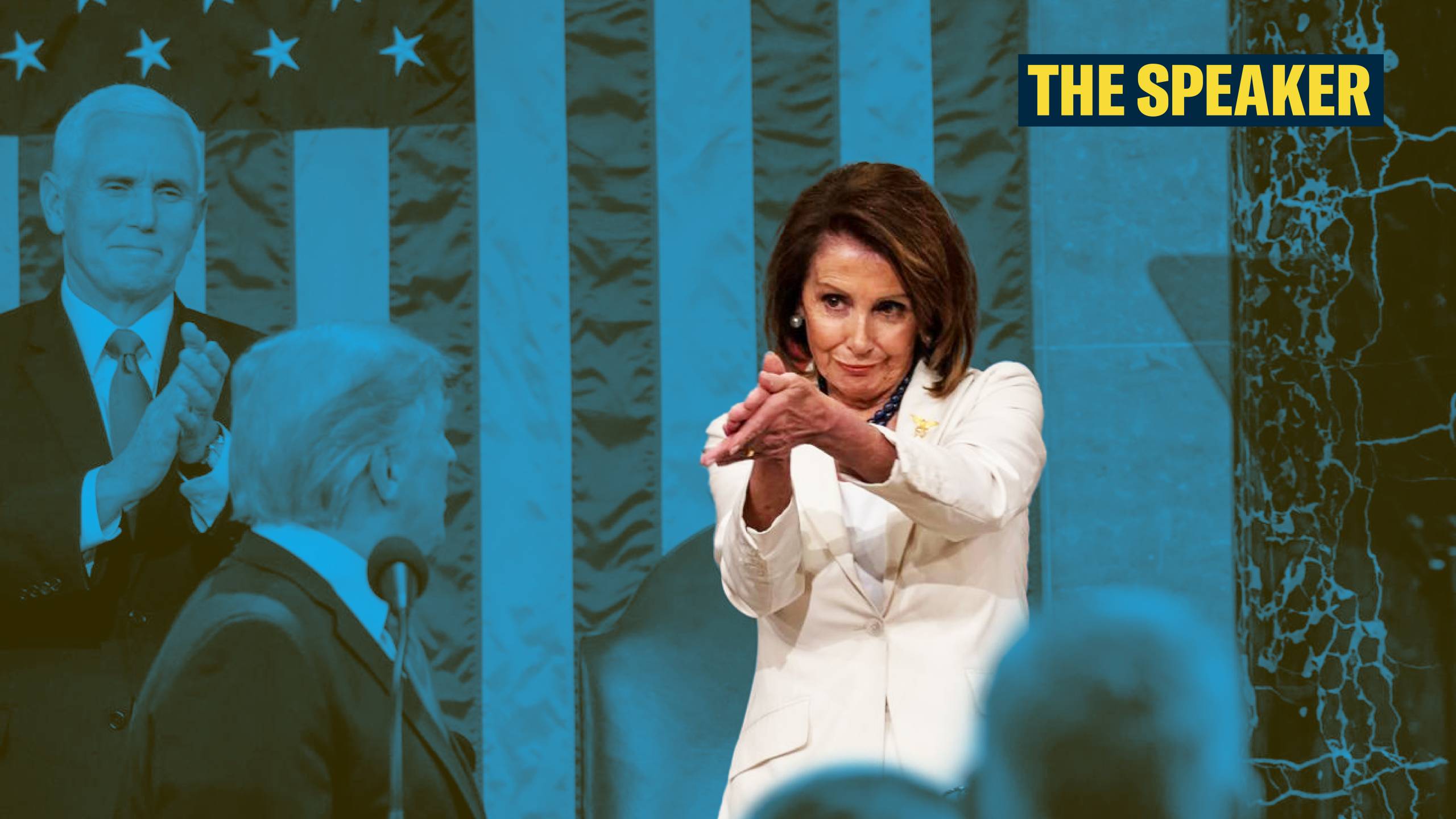
Scott Shafer: Clapping sarcastically at Trump during his 2019 State of the Union address. She clearly wasn’t intimidated by him. After all, this is the same woman who called Bush incompetent on national TV and refused to apologize for it. To me, it seems like Pelosi was adapting to the moment. She was smart enough to sense that in this era of politics, it’s those viral images that stick with people, not the closed-door legislative rooms Pelosi was used cutting deals in.
Nancy Pelosi: The fact is, people want to see moments. You know, I hear speeches, they want to see moments, what people are happy about is that I did that, that I pointed to him, that I walked out of the office, because it spoke to their, how they felt or believed at the time.
Scott Shafer: She was getting under his skin. To those in the Trump 1.0 administration, Pelosi was an obstructionist.
Mick Mulvaney: Nancy was just so difficult to work with. Again, she may take that as a badge of honor, and I get it, there’s a lot of Republicans who take their unwillingness to compromise with Democrats as a badge of honor. So she’s not unique in that, but she had zero interest in doing anything with Donald Trump.
Scott Shafer: That’s Mick Mulvaney, who was President Trump’s chief of staff when Pelosi regained the speakership. We talked to him last episode, a Tea Party guy who campaigned for his House seat against the Affordable Care Act and won. He said President Trump respected Pelosi at first.
Mick Mulvaney: He respects strength and that’s certainly what she has. When she was doing what she was doing, she had a margin roughly the same size that Mike Johnson has today in the House. And she was able to corral her party and he respected that. But at the end of the day, she had zero interest in being with the guy and I think the country is worse for it. If they had wanted to sit down and cut some deals, they could have had a tremendous bipartisan deal on infrastructure. I even think they could’ve had a tremendous bipartisan on immigration. But it was fight, fight, fighting the whole time. And it was bitter and poisonous.
Scott Shafer: While Republicans felt Pelosi was just an obstacle to getting anything done, many Democrats were calling for Trump’s impeachment. But Pelosi was wary.
Nancy Pelosi: People wanted to impeach him just because he was obnoxious and dyed his hair orange. Everybody had a thing of he’s not really presidential. That’s not a cause for impeachment. You know what I’m saying?
Scott Shafer: But then, in the summer of 2019, President Trump gave Democrats their opportunity.
Nancy Pelosi: I’ve said the only person who’s responsible for the impeachment of Donald Trump, not once but twice, is Donald Trump. He gave us no choice.
Scott Shafer: A whistleblower said that in a phone call, Trump tried to get Ukrainian President Zelensky to investigate Trump’s rival in the upcoming election, Joe Biden, and his son Hunter. The White House released a transcript of the call, and President Trump tried to deflect to the debunked claim that Joe Biden was linked to a corruption scandal. And let me tell you something, Biden’s son is corrupt, and Biden is corrupt. To Pelosi, this attempt to interfere with the 2020 election was the unconstitutional violation Democrats could not ignore. This would be the grounds for the impeachment case.
Nancy Pelosi: What he did was wrong. Now, different other things you could have included in that we said, you have to keep it simple. What is the thing that crosses the line, not just on its own might be grounds for impeachment, but not on the caliber of the Zelensky letter.
Scott Shafer: But Pelosi didn’t revel in the impeachment, she actually silenced the applause after the impeachment vote with a stern glance and a hand gesture.
Nancy Pelosi: Article 1 is adopted. The question is on adoption of Article 2.
Scott Shafer: You can count votes. You were probably, I’m guessing, pretty confident the Senate would not convict, right? They needed 67 votes. Why did you think it was important to go ahead and really start a process that you knew ultimately you would not?
Nancy Pelosi: We did succeed. We impeached him twice. But you think that we should be guided by what the Senate might do? You think that, we would say, well, the president has committed impregnable offenses of highest magnitude, and we shouldn’t do that because we don’t know what some senators are going to do? No.
Donald Trump: I am thrilled to report to you tonight that our economy is the best it has ever been. Our military is completely rebuilt, with its power being unmatched anywhere in the world, and it’s not even close. It was February
Scott Shafer: The day before the Senate voted to acquit Trump of both impeachment charges. President Trump was giving his State of the Union speech, and Pelosi went a step further than she’d ever gone before. She was sitting behind Trump, in her house. He’d chosen that night to honor right-wing radio host Rush Limbaugh, who held notoriously homophobic views.
Donald Trump: And Rush, in recognition of all that you have done for our nation, the millions of people a day that you speak to and that you inspire, I am proud to announce tonight that you will be receiving our country’s highest civilian honor, the Presidential Medal of Freedom.
Scott Shafer: Pelosi sat there, lips pursed, looking down at the printed speech, looking away from the balcony where Limbaugh was, and toward her caucus in the audience. As Trump finished his speech, saying the best was yet to come, she stood up, not clapping, but ripping up the president’s printed remarks two or three pages at a time, biting her lip.
Nancy Pelosi: I didn’t intend to do that. It just was a manifesto of lies. And I wasn’t just gonna let that stand. I just wasn’t gonna let it stand. As courteous as we are to a guest in our house, when he abuses that courtesy, when he lies there the whole time, gives a medal of freedom to an anti-gay, blah, blah, and our house. Do that at the White House. We don’t agree with your choice, but that’s your choice. You’re the president, but don’t come here and sully the House of Representatives chamber. With your obnoxious behavior.
Scott Shafer: Pelosi, at her heart, believes in institutions. She respects the separation of powers, the three branches of government, and the staying power of those institutions. But to me, it seemed like at that moment something changed for her, not even standing with polite, respectful applause for the president as she did behind President George W. Bush for both of his State of the Union addresses when she was speaker, instead A stunning act of defiance on primetime television. Nine months later, Joe Biden won the presidential election. Trump was out. On January 6, 2021, Pelosi, along with Vice President Mike Pence, were overseeing the certification of the election.
Nancy Pelosi: We didn’t anticipate violence. We didn’t expect the President of the United States to incite an insurrection.
Jan 6 Archival: We’re starting to get surrounded. They’re taking the north-west scaffolding.
Scott Shafer: Protesters attack the west side of the Capitol, where presidential inauguration ceremonies are held.
Nancy Pelosi: Security came to me and they said we’re taking you out I said I can handle this guy you know we’re ready
Jan 6 Archival: We are walking over now to the tunnel
Nancy Pelosi: We could see on TV, because when you’re in the chamber, you can’t see. You see on tv what was happening, that they were coming to the Capitol. It’s really hard to explain. This is the citadel of democracy to the world. And these people are coming in, breaking windows, and they go in, and we’re seeing them go into the Capitol with Dixie flags, you know, Confederate flags, under the dome that Lincoln built when he was president. He built it during the Civil War. People said to him, use the steel for the war and the personnel for the War. He said. No, we have to show the world that we are resilient. So they continue with the dome. Under Lincoln’s dome, Confederate flags. One guy with a shirt, six million Jews were not enough. Auschwitz. That’s. What this was, assaulting police, all the rest of that, defecating on the floor. I say this because this brute who was president now wants to give them money for killing or endangering the lives of police officers. They were gonna get a bullet in my effing brain. They use the F word a lot about me throughout the whole thing. They were going to hang the vice president. Gallows for him.
Scott Shafer: No doubt, many in the mob hated Pelosi. They came looking for her. They broke into her speaker’s office. A man put his feet up on her desk.
Jan 6 Archival: Where are you Nancy? We’re looking for you! She’s in jail!
Scott Shafer: Have you ever, you know, given yourself the permission to think about what would have happened if they had found you?
Nancy Pelosi: Well, here’s the thing that I thought. I wasn’t really thinking so much about my personal safety. I was thinking about my grandson who was with me. His mother, Alexandra, took the boys to see an historic event, the transfer of power.
Scott Shafer: But something fundamental had broken.
Nancy Pelosi: And this vile creature, the vilest creature to ever crawl the face of the earth. And they said, well, what about Hitler? I said, he wasn’t president of the United States. Insights are an insurrection, sits in his office, and then won’t let the police, the National Guard come and then lies about it the whole time. I called the governor of Virginia. They said they had their troops ready. These people are so idiotic, but let’s put that over all of them. The secretary of the army who had the jurisdiction to. So I have to talk to my boss. That’s the secretary of defense. Haven’t you done that yet? Well, this is hard. It’s complicated. It takes time. I said, they have been attacking the Capitol. Well, I have to go ask my boss and well, you have to have authority at the location. I said there, look, authority is there. You need to be able to send the national guard. But they may, they avoided everything about it because their boss. The Commander-in-Chief, who can say over any of that, was just holding them back. And even some of the Republicans were asking the President to call off those guys, and he still wouldn’t do it. This is, I want to tell you something, this is a demonic figure, this guy who is unfortunately in the White House.
Scott Shafer: I know you’re very religious. Did you pray?
Nancy Pelosi: Of course we prayed, prayed for our country. We prayed for those who were under assault.
Scott Shafer: A few hours after the attack, authorities confirmed the Capitol had been secured. Congress was going to continue certifying the election results
Nancy Pelosi: I said, you know what, we’re going to the floor. That’s where this assault occurred, that’s where we’re going back to show the world.
Scott Shafer: In the early hours of the morning on January 7th, 2021, the election was certified. In his final days in office, Nancy Pelosi would lead another impeachment against President Trump for inciting the insurrection. The FBI investigated the rioters. There were prosecutions.
Archival News: The Arkansas man who was photographed on January 6th with his feet up on Nancy Pelosi’s desk was sentenced yesterday. He got four and a half years in prison.
Scott Shafer: Biden became president. Working together in the midst of the COVID pandemic, he and Pelosi muscled some big bills through a divided Congress. The Inflation Reduction Act, the CHIPS and Science Act. But during her last years as speaker, Pelosi made headlines for another reason. In 2021, at a press conference, a reporter from Business Insider asked Pelosi a question.
Business Insider Reporter: Should members of Congress and their spouses be banned from trading individual stocks while serving in Congress?
Nancy Pelosi: No, I don’t know to this second one, we have a responsibility to report in the stock, on the stock but I’m not familiar with that five month review but if people aren’t reporting they should be. Because this is a free market and people, we have a free-market economy, they should be able to participate in that.
Scott Shafer: Pelosi was firm in her response. No ban on stock trading. At that moment, she didn’t see the backlash, but it had been coming for years. Back in 2011, Pelosi had just gotten the Affordable Care Act across the finish line. She lost the speakership, but was still leader of House Democrats. Then, the CBS News magazine 60 Minutes published a bombshell investigation.
Peter Schweizer: There are all sorts of forms of honest grafts that congressmen engage in that allow them to become very, very wealthy. So it’s not illegal, but I think it’s highly unethical. I think it’s highly offensive and wrong.
Scott Shafer: That’s Peter Schweizer, the main source in the story. At the time, Schweizer was a fellow at the Hoover Institute, a conservative think tank. He’d been criticized as early as 1993 for fabricating sources and events in his book, Friendly Spies. He’d go on to publish Clinton Cash in 2015, a book that Media Matters concluded contained over 20 errors, fabrications, and distortions. On 60 Minutes, Schweiser claimed that members of Congress… Have been trading stocks based on inside information.
Peter Schweizer: We know that during the health care debate, people were trading health care stocks. We know during the financial crisis of 2008, they were getting out of the market before the rest of America really knew what was going on.
Scott Shafer: The 60 Minutes story didn’t exclusively focus on Pelosi. They called out other lawmakers, too, including Republican Speaker John Boehner. But the report looked at an incident from 2008. Pelosi’s husband, Paul, had bought shares of stock from Visa, the credit card company. The report called into question whether the family’s investment influenced Pelosi’s decision-making around regulations to protect credit card consumers. To investigate this, the 60 Minutes correspondent, Steve Croft, went to a press conference and asked Pelosi about it.
Steve Kroft: Madam Leader, I wanted to ask you why you and your husband back in March of 2008 accepted and participated in a very large IPO deal from Visa, at a time there was major legislation affecting the credit card companies making its way through the house, and did you consider that to be a conflict of interest.
Nancy Pelosi: I don’t know what your point is of your question. Is there some point that you want to make with that?
Scott Shafer: This response is classic Pelosi, full-throated denial.
Nancy Pelosi: It’s not true, and that’s that.
Steve Kroft: I don’t understand what part’s not true.
Nancy Pelosi: Yes, sir, that I would act upon an investment
Scott Shafer: After the piece aired, Pelosi’s office put out a statement. It denied that her decisions about regulating credit card companies were swayed by her husband’s stock purchases. The statement said, quote, It is very troubling that 60 Minutes would base their reporting off of an already discredited conservative author who has made a career out of attacking Democrats. Peter Schweizer was a close ally of Steve Bannon, one of Trump’s top advisors. Schweizer would become editor of the far-right website Breitbart News. It’s true that Democrats had introduced a bill that would regulate credit card swipe fees in the House and that the bill died later that year. But Pelosi said it wasn’t because she was trying to help her husband’s portfolio. By the time the bill made it out of committee, Pelosi said, it was too late to bring the for a vote before the session ended. The Democratic congressman who introduced the bill, John Conyers from Michigan, said even if they’d somehow managed to pass it, President Bush would probably have vetoed it. So Pelosi said they waited until President Obama was in the White House to push card regulations through. In 2010, the Dodd-Frank Act included a cap on debit card swipe fees and other protections for credit card consumers. There are lots of moving parts here. It’s hard to say definitively what happened or why. But the accusations were very powerful. They touched a nerve. In 2012, public anger about the issue of stock trading in Congress was mounting.
Steve Kroft: Both the House and the Senate in a rare display of bipartisanship overwhelmingly passed the Stock Act, which prohibits its members from trading on non-public information gathered during the course of their duties.
Scott Shafer: Congress passed the Stock Act, stopped trading on congressional knowledge. It’s been said sunlight is the best disinfectant, meaning transparency. The Stock Act required members of Congress to disclose their trades within 30 to 45 days of making them. But the issue didn’t go away. Actually, with the information available to the public, people became more aware of how much money Congress members were making on stock trading. There are even apps you can use to track and literally copy the same stock trades the Pelosi’s and other members of Congress do. When Pelosi came to Congress, she and her husband were already wealthy. Her husband is a finance guy. The family had at least $610,000 worth in stocks. In today’s money, that’s something like 1.8 million. The stock research platform, Quiver Quantitative, estimates that her family currently holds around $135 million in publicly traded assets. In 2021, Pelosi ranked in the top 25 richest people in Congress. Here’s Hillary Brossith, she’s executive director at OpenSecrets, a non-profit that tracks money and politics.
Hilary Braseth: We often find that some of the highest drivers of traffic to our site are citizens who are curious about the net worth of any given member of Congress. And Nancy Pelosi, I think in many ways, is one of the main profiles that we often see folks looking up, perhaps because she has quite high of a net worth.
Scott Shafer: Now, owning stocks can benefit anyone, but the richer you are and the more stocks you own, the more you make when the market goes up. Having private briefings, like members of Congress do, can give them a leg up before the market reacts to news. Business Insider recently published an investigation that found that dozens of Congress members have violated federal conflict of interest laws. Pelosi wasn’t on that list, but many of her colleagues were accused of disclosing after the required disclosure window. And a few were accused of insider trading. It seems obvious that banning members of Congress from trading stocks wouldn’t just stop the practice from happening, but would also remove the appearance of a conflict, but Pelosi opposed it. When Pelosi first ran for her seat back in 1987, her opponents argued that Pelosi’s wealth would put her out of touch with working class people.
Carol Ruth Silver: How can she relate to people like me, a single parent, working mother, or somebody else?
Scott Shafer: Fast forward to 2020. In the midst of the COVID-19 pandemic, Pelosi went on the James Corden show.
James Corden: Welcome back, we’re here with House Speaker Nancy Pelosi and we’ve asked her to share something from her home for late, late show and tell.
Scott Shafer: In the segment she showed her freezer full of ice cream.
Nancy Pelosi: Speaker Pelosi, what have you found? I don’t know what I would have done if ice cream were not invented.
Scott Shafer: People were losing their jobs, terrified about the economy. Trump’s reelection campaign seized on an opportunity to punch back at Pelosi. They posted a video on YouTube called Let Them Eat Ice Cream, Nancy Antoinette, a reference to the infamous Queen of France. It featured the James Corden interview with some creative edits.
Archival – Nancy Antoinette Video: Speaker Pelosi, what are you gonna share with us from your home? Chocolate candy.
Archival – Nancy Antoinette Video: Thousands have been forced to wait for hours at food banks all across the country.
Archival – Nancy Antoinette Video:Oh my chocolate and then we have some other chocolate
Scott Shafer: It was a partisan attack, but like her opposition to the congressional stock trading ban, the moment highlighted one of Pelosi’s weaknesses. She can be a little tone deaf to how her own behavior strikes others and how it stokes anger. When we started making this podcast, I knew I wanted to ask Pelosi about congressional stock trading, but I have to say I wasn’t looking forward to bringing it up. I know how she can sometimes go into attack mode when she’s asked about a topic she doesn’t like. She completely rejects accusations that she used knowledge gained as a member of Congress to make favorable stock transactions. She defended her stock trades to me as something everyone does.
Nancy Pelosi: My point of view is if family has investments, stock, I’m not talking about big deal. Most people don’t even realize that their 401k is in the stock market.
Scott Shafer: But there are a lot of people who’ve come to Congress and left with a lot more money than they got there.
Nancy Pelosi: If they’re doing something illegal, then they should be charged with that. They have investigated me personally, politically, economically, all the time. They have never come up with anything. They’ve spent a lot of money and a lot time. They can say I have cloven feet and horns in my head and I’m a devil and the rest of that, but they’ve never come with anything that I did anything wrong in Congress.
Scott Shafer: Josh Hawley was on Fox News saying that, you know, insider trading corruption should be prosecuted.
Nancy Pelosi: Not me. Nobody’s ever accused me…
Scott Shafer: Well, he was referring to you.
Scott Shafer: In 2023, Republican Senator Josh Hawley of Missouri introduced the Pelosi act preventing elected leaders from owning securities and investments. I tried asking Pelosi why she didn’t try and pass a ban when she was leader. So you don’t feel that not getting that passed is a negative part of your legacy.
Nancy Pelosi: No, I don’t at all, because the people who, the members didn’t, it’s up to the members to get something passed like that.
Scott Shafer: Yeah, although as leader, you have a lot of say in what the caucus wants to do.
Nancy Pelosi: No, I didn’t. All you need is a few people to say, we’re not doing this. And some of them were in the leadership. They just thought it was insulting to the members to say you don’t have any values and you don’t have any judgment.
Scott Shafer: But now she says she does support a ban on stock trading for members of Congress. So I kept pushing her. What changed? You oppose that for many years and I’m wondering.
Nancy Pelosi: No, I didn’t pose it for many years. I posed it when they suggested it, and then Kalkus said they won it and I supported it. It didn’t come forward because there weren’t the votes to bring it forward.
Scott Shafer: At the top of the episode, I mentioned a stock trading ban passed Congress in July. But Pelosi didn’t vote for it, because she says it exempted the president.
Nancy Pelosi: It was a terrible bill. And we wanted it to be more comprehensive, including the President of the United States, because they would never get that signed by the President of the United States. But if you look at that bill, it is totally incomplete.
Scott Shafer: Now, Pelosi doesn’t like to back down, especially when she feels like these are partisan attacks. But she also knows that appearances matter, and they can undercut trust in elected officials.
Nancy Pelosi: We want to do whatever it takes, and that means even this issue, to restore the confidence people have in the system.
Scott Shafer: Hilary Braseth of Open Secrets again.
Hilary Braseth: Earlier this year, there was a survey that roughly 75% of the country thinks that there is too much money in politics and does not like it. And so this really presents a quandary that those who get elected into public office tend to benefit from the system as it’s designed and don’t have much incentive to change the system or to create tighter rules around how much money they can raise, whether or not they can trade stocks based on. Knowledge they might be privy to.
Scott Shafer: Senate Democrats ended up blocking the stock trading ban. They promised future reform, but needless to say, any ban passed now wouldn’t take effect until Pelosi leaves office. It’s been over five years since the violent riot at the Capitol. A lot has changed since then. Back in 2018, to round up votes to regain the gavel, Pelosi agreed to a four-year limit on her second speakership. And in 2023, after Democrats lost the House, she stepped down from leadership. President Trump is back in power after defeating former Vice President Kamala Harris in 2024. Republicans also maintain control of the House. And after he came back into office, President Trump pardoned those who’d been successfully prosecuted for their role in the January 6th attacks. The formal office of the Speaker of the House is historic and spacious, with vaulted ceilings and ornate wooden furniture, outer sitting areas full of comfortable couches and arm chairs. From a window you can see out across the National Mall. But that’s no longer Pelosi’s domain. Her party’s in the minority now, and her current office? It’s nice enough, but decidedly un-grand. It’s relatively cramped, packed with memorabilia. Colorful gavels, gifts from her constituents, chocolate for people who come to visit her, and sitting on a table, a pair of pink boxing gloves with her initials, NP, bedazzled in rhinestones, a gift from her friend Barbara Boxer. They were a little joke, boxing gloves from a boxer, but I think they really fit. No matter the cost, she goes down swinging. She’s not the speaker anymore, but she’s still Pelosi, calling shots behind the scenes, doing her best to shape the future of a Democratic party that’s up for grabs.
Scott Shafer: We’re seeing a lot of turmoil in the Democratic Party in terms of candidates.
Nancy Pelosi: I disagree with your terminology. A lot of turmoil in the Democratic Party. There isn’t a lot of turmoil.
Scott Shafer: That’s coming up next week on The Speaker. The Speaker is a production of KQED in San Francisco and distributed by NPR. It’s hosted and reported by me, Scott Shafer. It’s reported and produced by Ariella Markowitz. It’s edited by Padmini Raghunath. Final mix and sound designed by Christopher Beale. Fact checking by Mark Betancourt. Additional editing from Anna Sussman and Jen Chien, KQED’s director of podcasts. Original theme song composed by Cedric Wilson. Additional music from APM. Maha Sanad is KQED’s podcast engagement producer. Ethan Toven-Lindsey is KQED’s editor-in-chief. Special thanks to our partners from the Oral History Center at the University of California, Berkeley. Some members of the KQED podcast team are represented by the Screen Actors Guild, American Federation of Television, and radio artists, San Francisco, Northern California local.