Go Big
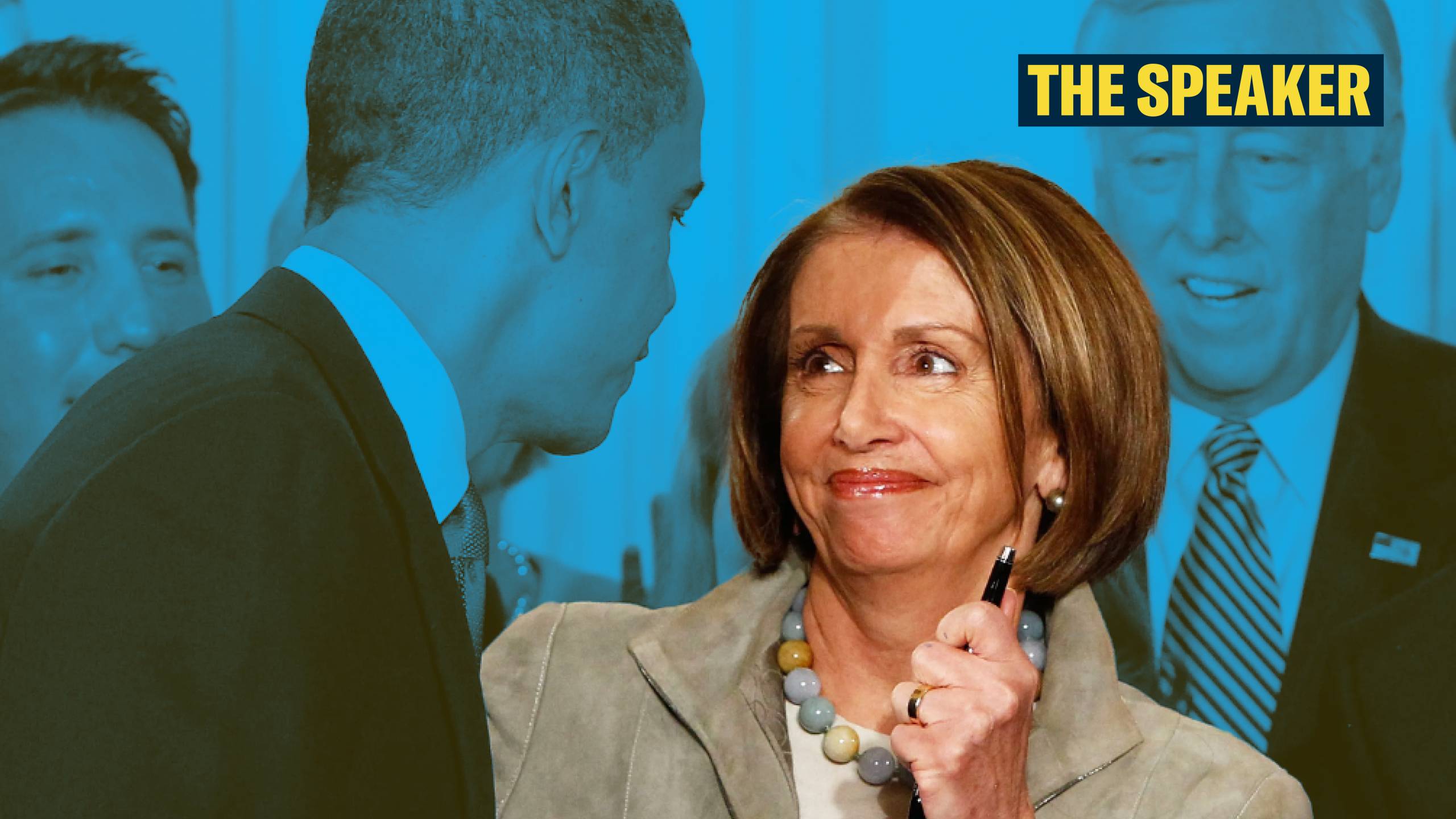
In 2008, with the historic election of President Barack Obama and Democratic majorities in both houses of Congress, Speaker Pelosi saw a huge opening for healthcare reform. She knew it would be hard-fought, but this was not Pelosi’s first battle. She had lived through other historic attempts to reform healthcare — to disastrous results. This time, she was determined to succeed. But to go big in Washington, Pelosi had to master the art of sacrifice.
Episode Transcript
This is a computer-generated transcript. While our team has reviewed it, there may be errors.
Archival – Nancy Pelosi: I accept this gavel in the spirit of partnership, not partisanship, and I look forward to working
Scott Shafer: It’s 2007. Nancy Pelosi had just become Speaker of the House, the first woman ever. Her goal? A new direction for America.
Archival – Nancy Pelosi: A new America with a vibrant and strengthened middle class for whom college is affordable, healthcare is accessible, and retirement reliable.
Scott Shafer: Meanwhile, a senator from Illinois, Barack Obama, was poised to make history at the other end of Pennsylvania Avenue.
Archival – Barack Obama: Change is what’s happening in America. Yes, we.
Scott Shafer: Obama campaigned on a promise to fix a problem that affected millions of Americans.
Archival – Barack Obama: What I see are people who would love to have health care. They desperately want it. But the problem is they can’t afford it.
Scott Shafer: But a little over a month before the 2008 presidential election, everything would be upended.
Archival – News Broadcast: At this hour, the Lehman Brothers Investment Bank appears headed toward bankruptcy.
Scott Shafer: Fueled by cheap credit and predatory lending, subprime mortgages got mixed into the economy and falsely rated by so-called experts as safe. Wall Street was making money hand over fist. But then people began defaulting on their mortgaged. The bubble burst, threatening to bring down the entire world economy with it.
Archival – News Broadcast: Worst housing crisis since the Depression.
Archival – News Broadcast: Three of the five biggest independent firms on Wall Street have now disappeared. Bear Stearns, Lehman Brothers, and Merrill Lynch.
Archival – News Broadcast: More than half a trillion dollars in mortgage investments have gone bad.
Scott Shafer: Pelosi blamed the bankers, the party is over, and President Bush.
Archival: When President Bush was president, he didn’t have any supervision, no oversight, no markets, no nothing, and this happened.
Scott Shafer: But as the top Democrat in the House, she would have to choose. Set aside politics and address the crisis, or let Bush and the Republicans deal with it
Nancy Pelosi: Our members, it’s his problem, he should be solving the problem with his members.
Scott Shafer: [00:02:08 Democrats controlled the House, and as Speaker Pelosi had lots of power, and a direct line to the White House, including President Bush’s Treasury Secretary Hank Paulson, who was also the former CEO of Goldman Sachs. Paulson was panicked. He knew the fallout could be huge.
Archival: We knew we had to change it, you know, we had to intervene.
Scott Shafer: Nancy Pelosi came to believe that a bailout of the banks would prevent a catastrophic global crash. But she wasn’t going to issue a blank check to Wall Street either, no golden parachutes or bonuses for Wall Street executives who helped create the meltdown, and an option for the president to tax Wall Street if taxpayers were still paying for the bailout after five years. As Speaker of the House, she started getting the votes together for a massive plan to bail out Wall Street, $700 billion, in hopes of preventing another Great Depression. Pelosi knew that this bill could be political kryptonite. She urged Bush to help convince Republicans in the House to support the bill so that both parties would take the hit.
Nancy Pelosi: We had the majority, so we all do 120. They’ll do 100 votes. We go to do the vote. They’re nowhere in sight, and they blamed it on me.
Scott Shafer: Paulson was scared the bailout was falling apart. After a disastrous meeting in the cabinet room, he got down on one knee, begging Pelosi to get the deal passed.
Archival – Nancy Pelosi: When was the last time anyone ever asked you for $700 billion? It’s a staggering figure.
Scott Shafer: This is a floor speech Pelosi gave leading up to the vote.
Archival – Nancy Pelosi: We have a situation where on Wall Street people are flying high, they’re making unconscionable amounts of money, they privatize the gain, the minute things go tough they nationalize the risk.
Scott Shafer: She’s ripping into Wall Street. That’s who created this mess. But what she’s actually trying to do here is convince Democrats to support bailing out the very people who caused the problem.
Archival – Nancy Pelosi: We need to stabilize the markets. In doing so, we need to protect the taxpayers. And that’s why I’m so glad that this bill… So when I describe what happened, then they said, well, you lost votes because of what she described. But I wasn’t going to get any votes unless I did that.
Scott Shafer: Her plea worked. She got the votes. On October 3, 2008, just a few weeks after Lehman Brothers collapsed, Bush signed the bailout into law.
Archival – News Broadcast: There were doubts until this morning about whether there were enough votes to pass the bill and dire Predictions about what would happen if the measure failed again
Scott Shafer: It was called TARP, the Troubled Asset Relief Program. Wall Street was relieved, but many Americans, who’d been victims of predatory lending, were losing their homes as payments came due. Only a fraction of that money was set aside for them.
Nancy Pelosi: Bailing out Wall Street, not Main Street, but we had to do that.
Archival – News Broadcast: For Barack Obama, that will change our electoral board and in our view President-elect of the United States of America.
Scott Shafer: I was working in the KQED newsroom that election night. The networks called it for Obama over Senator John McCain at around 11 p.m. Eastern Time. And nationwide, people filled the streets. Barack Obama’s resounding victory came with a mandate for change and a promise to finally try and fix the other crisis millions of Americans were facing – a broken health care system. But there’s a huge difference between winning and governing. I’m Scott Shafer. From KQED, this is The Speaker. Today, the story of this very controversial law – the Patient Protection and Affordable Care Act, what became known as Obamacare. What happens when Pelosi tries to go big, and all the consequences, intended and otherwise?
Nancy Pelosi: As Speaker, Nancy Pelosi had a meeting with the new president about health care reform.
Nancy Pelosi: I said, Mr. President, we’re so excited about doing health care, but understand this, it’s going to be carpet bombing, take no prisoners, you name total warfare. We’re going to hear from those who are anti-government, we are going to hear from the insurance industry, we going to hear from every element that is out there, it is going to be tough, it will be very, very hard.
Scott Shafer: You wanted to get it all done. We had to. Because.
Nancy Pelosi: Because it was the challenge of a generation, a hundred years people have tried. We had the opportunity. We had The House and we had The Senate. We had intellectual resources. We had determination and we the votes. But most importantly, we had the outside mobilization. We had people.
Scott Shafer: To Pelosi, now was the time. All these years later, we’re still talking about how broken our healthcare system is, but back before 2009, about 50 million Americans didn’t have health insurance, roughly double what it is today. Companies could deny coverage to people with preexisting conditions, anything from cancer to pregnancy, or offer plans that were way too expensive. Some women were charged as much as 81% more than men. For this same plan. Lives were on the line, and Pelosi was determined to change that.
Nancy Pelosi: We’re not here to do Incy Wincey Spider. We’re here to anything else. This is a challenge of a generation. We’re going to get this bill done and we’re not doing it part way.
Scott Shafer: Pelosi likes to say that she put on a suit of armor every day and ate nails for breakfast. It would take all that to go up against a mountain of resistance.
Nancy Pelosi: We were determined that ours would succeed.
Scott Shafer: The first hurdle was the White House. Rahm Emanuel had been Pelosi’s deputy back in 2006. He helped win back the House that year. But now, he was President Obama’s chief of staff, and he was urging the President not to pursue healthcare right after.
Rahm Emanuel: I wanted to do financial reform because I thought the country needed to see the president fighting against the banks, needed to the SOBs that created this problem taken to the woodshed. To pass health care, the very interest groups had to be either neutralized or on your side of the table.
Scott Shafer: Emanuel wasn’t the only one guiding Obama away from going big.
David Axelrod: I was very conflicted because I have a child who has epilepsy and very serious form. We almost went bankrupt when I was a young newspaper man trying to deal with her illness.
Scott Shafer: That’s David Axelrod, also known as Ax, less bombastic than Emanuel, but another major player in Obama’s White House.
David Axelrod: I experienced the problems with the healthcare system, but I was also there as the president’s political advisor and I had to tell him, look, seven presidents have tried this and we’re in the middle of a epic financial crisis. I said, you really need to think hard about this because there’s great risk associated with it.
Scott Shafer: The risk could be catastrophic. Emanuel and Axelrod had lived through the Clinton years.
Bill Clinton: If Americans are to have the courage to change in a difficult time, we must first be secure in our most basic needs. This health care system of ours is badly broken, and it is time.
Scott Shafer: In 1993, President Clinton unveiled his health care reform plan. The bill was more than 1,300 pages. He put the First Lady, who was already pretty controversial, in charge of selling it to the public and Congress. In 1994, Hillary Care, as it was called by critics, was declared dead. It never came up for a vote. Total collapse. And the backlash was immediate. 1994 was the year Democrats lost their majority in the House for the first time in 40 years. And Hillary Care was blamed.
Archival – News Broadcast: I am as mad as hell!
Scott Shafer: In 2009, a similar backlash was brewing. The conservative anti-tax Tea Party was forming, in part a reaction to the massive bailout of Wall Street banks.
Archival – News Broadcast: Thousands of activists held rallies in cities across the country, protesting big government and big government spin.
Scott Shafer: The Tea Party, which stands for Taxed Enough Already, was modeled after the Boston Tea Party.
Archival – News Broadcast: They’re spending our money, our children’s money, our grandchildren’s money. And they’re going to just continue to push this country into debt, and they’re gonna destroy the economy of America.
Scott Shafer: Obama’s election supercharged the Tea Party, especially the plan to reform health care. After Obama was elected, Alaska Governor Sarah Palin honed in on one aspect of the proposal, to allow Medicare to pay for end-of-life planning. Palin called them death panels, which would decide who would live and who would die. Like if this plan goes through, Democrats are going to pull the plug on grandma and grandpa.
Zeke Emanuel: Sarah Palin, you know, said that I was at factor death because I wanted to kill old people. Ha, ha, ha.
Scott Shafer: This is Zeke Emanuel, Ram’s brother, and an expert in health policy. He was tapped to help with the new bill, but Zeke ended up becoming the face of death panels, thanks to an article he had written about how to triage who gets liver transplants.
Zeke Emanuel: Those are the kinds of serious issues that serious people wrestle with and politicians like who are not serious like Sarah Palin, you know, just say stuff that is unsupported and unthought-out.
Scott Shafer: We were unable to interview President Obama for this series, but in spite of what top aides were telling him, Axelrod said the president was committed.
David Axelrod: He said, well, what are we supposed to do? Put our approval rating on the shelf and admire it for eight years? Or are we suppose to draw down on it? And he said, if we don’t do it in the first two years, we’re not gonna get it done. This problem’s just gonna fester. I always joke that I loved working for him so much because he listened to me so little.
Scott Shafer: Pelosi wasn’t worried about the advisors.
Nancy Pelosi: We were communicating with the President of the United States.
Scott Shafer: But he allowed his chief of staff to say less than positive things about the bill.
Nancy Pelosi: It didn’t matter to us, or what mattered to us is what the president said.
Scott Shafer: John Lawrence was Pelosi’s chief of staff at the time. He was in the room during a lot of the meetings between Pelosi and President Obama.
John Lawrence: She said something, Mr. President. And he said, look, when it’s just us, just call me Barack. And she said, no, you’re Mr. President. And there was one incident he said Nancy something, and she said in this instance, it’s Madam Speaker. So it was a very clear understanding that we are leaders of co-equal branches of government.
Scott Shafer: Obama came from the Senate, the Pelosi was a creature of the House, and Obama knew she was the one who could get it done. This was not Pelosi’s first rodeo. She’d also been in Congress when Clinton tried to fix health care.
What did you take from that episode?
Nancy Pelosi: With all the respect in the world for them, it wasn’t as if they were ignoring Congress. But the bill has to pass the Congress. What I knew when we went to do health care was that we were going to write the bill in the Congress of the United States. And that makes the difference.
Scott Shafer: Pelosi knew that to pass a bill, she’d need to write the bill in Congress. That was the way to get buy-in from her members. That meant getting people together to contribute. She orchestrated her connections on the powerful committees and wrote the bill in the House.
Nancy Pelosi: We had a system that everybody was part of this. We had mandated sessions where everybody had to come. The bill would be read. They have questions and all the recoups, so they didn’t read the bill. No, we read it every step of the way.
Scott Shafer: In July of 2009, you unveiled a thousand-page bill and declared that you’re going to take it up for a vote and it’s going to pass the House. That’s right. Why were you so confident?
Nancy Pelosi: Because we work very hard, it’s about prevention, it is about wellness. So members had various degrees of expertise in these.
Scott Shafer: Pelosi had her wish list at the top was a public option. It’s a government plan that people can buy rather than private insurance. It’s set up to compete with private insurance companies and can help drive down prices. She whipped aggressively to have it included, but in the end, she couldn’t pick up the votes for the version she wanted. But there was a path forward with another weaker public option, it gave doctors and hospitals more power to negotiate rates, a compromise. She also had to rally more conservative Democrats who opposed abortion.
Archival – News Broadcast: Current law and vote no on public funding for abortion.
Scott Shafer: After negotiations with Pelosi fell through, a congressman named Bart Stupak co-wrote an amendment to the health care bill. It prohibited abortion coverage under plans that were run or subsidized by the government. Remember Congressman Stupack, he’ll come back later. Pelosi heard of the votes and the House passed their version, November 7, 2009, by a thin margin. With President Obama’s support, it seemed like a public option might be within reach, part of Pelosi’s dream to go big. But soon, an unexpected loss would jeopardize everything she’d fought for.
Scott Shafer: Nothing gets to the President’s desk before it passes the House and the Senate. Pelosi doesn’t hide how she feels about the upper chamber.
Nancy Pelosi: The Senate, where good bills go to die all the time. The cemetery for legislation.
Scott Shafer: Senators have the luxury of serving 6-year terms, whereas House members face voters every two years. Here’s Axelrod.
David Axelrod: The Senate were a bunch of dilettantes who didn’t have to run every two years. She would make clear to her caucus and publicly when she was unhappy with the Senate and she would take them on and that helped rally her troops.
Scott Shafer: Pelosi had just helped pass a monumental House bill, and it included a public option, and Obama was on board. But then something fundamentally changed the equation.
Archival – News Broadcast: Doctors say Senator Ted Kennedy has a malignant brain tumor.
Scott Shafer: It was discovered after he suffered a seizure. Ted Kennedy, the senator from Massachusetts and a champion of health care reform, was dying from a brain tumor. Without Kennedy, the Democrats would only have 59 seats in the Senate. And that was a big problem. Without 60 seats, Republicans got back a tool. It’s called the filibuster. You may have heard of it. Basically, it’s a speech that goes on for hours to extend debate on a bill. It was once seen as a noble last-ditch effort to delay a vote. Like in the classic 1939 Frank Capra film, Mr. Smith Goes to Washington.
Mr. Smith Goes To Washington: In other words, I’ve got a piece to speak. And blow hot or cold, I’m gonna speak.
Scott Shafer: But in today’s political landscape, filibusters can border on the absurd, like in this 2013 clip of Senator Ted Cruz filibustering.
Ted Cruz: And I love this story, and so I’m going to read it to you.
Sam, I am.
Scott Shafer: He talked for 21 hours.
Ted Cruz: They did not like green eggs and ham and they did not like Obamacare either.
Scott Shafer: Filibusters are so feared that a senator can basically threaten one and a bill is dead. Democrats had exactly the 60 votes they needed to block a filibuster. But then, on August 25, 2009, Senator Kennedy died. Another Democrat was temporarily named to fill the seat, but now there’d be an election for a permanent new senator. And while you might think Massachusetts is reliably blue, there was a chance Democrats could lose the seat. Time was ticking. They had just a few months to negotiate a bill enough members could live with. Senators had also been working on their own version of a health care reform bill.
Nancy Pelosi: Earlier on, the Senate had a bill that was terrible. It was terrible!
Scott Shafer: How so?
Nancy Pelosi: I mean, compared to our bill, terrible. And I wasn’t even going to vote for it. A member said, you’ve asked us to do all these things, don’t ask us to vote this bill. I said, I’m not going to ask you to vote it. I wouldn’t even vote for myself.
Scott Shafer: Pelosi chose to whisper the name of the senator who helped write it.
Scott Shafer: Oh, Max Baucus, you gotta whisper it?
Scott Shafer: Max Baucus, a relatively conservative Democrat from Montana, chaired the crucial Senate Finance Committee. The Senate bill did not include a public option. Pelosi is known for her savvy. Even if she knew the House bill had no chance, she wasn’t going to admit that without a fight.
Rahm Emanuel: When we have a big meeting in the Oval, before anybody’s sitting down, Nancy is screaming. Screaming is not the right word. She is very strong about that the Senate bill, they forget about it.
Nancy Pelosi: And that’s when we had a little disagreement with the White House. The president said, this is the best we can do. I said, it is not. It takes us backwards. It’s a missed opportunity. We cannot do that.
Scott Shafer: Through it all, Pelosi was confident they would get it done. But to have any fighting chance of passing the bill, she knew she would have to make a deal with Senate Democrats. As time passed, the likelihood of Democrats losing their filibuster-proof 60 seats was becoming more real. Democratic leaders from the House and Senate would meet until the wee hours of morning.
Rahm Emanuel: We had a big meeting one night. It’s two weeks before the Massachusetts special election, but we know the clock’s ticking. That goes on until two in the morning. What was being hashed out? The whole bill. They had a lot going on. Okay, thank you. You’re giving me PTSD.
Scott Shafer: If it had been a challenge to wrangle House Democrats, the Senate was impossible.
Nancy Pelosi: The Senate just went, well, it probably was Joe Lieberman.
Scott Shafer: Joe Lieberman, from Connecticut.
Nancy Pelosi: Of insurance companies.
Scott Shafer: Joe Lieberman, the independent senator from Connecticut, had been refusing to support Pelosi’s public option for a year, even threatening to join Republicans to filibuster any bill with a public option.
Joe Lieberman: I think that a public option will actually hurt the economic recovery and our long-term fiscal situation, because it will end up causing the government to raise taxes, we’ll probably raise premiums.
Scott Shafer: Over his career, Lieberman had accepted millions of dollars from the insurance and healthcare lobby. His home state of Connecticut was known as the insurance capital of the world, home to companies like Aetna and Cigna.
Nancy Pelosi: It would have been competition for the insurance companies.
Scott Shafer: Pelosi’s powerful ally in the Senate was Majority Leader Harry Reid. But even the wily former boxer from Nevada failed to convince a single Republican to get on board for her public option. Pelosi grew up with the legacy of the New Deal. She knew it was possible to enact big programs if the timing was right. But at that moment, she had to accept that it wasn’t, a bitter pill to swallow. But it was hard for me to get Pelosi to reflect on that loss. She was pretty focused on what the bill did do.
Nancy Pelosi: This bill was not just about 20 million more people getting health care. It’s about 150 million families who have health care through their job, and they would get infinitely more benefits. No pre-existing condition. Being a woman, no longer a pre- existing medical condition. Sometimes women were charged almost twice as much. When your child is 26, it could be on your plan.
Scott Shafer: But the public option was gone. Even with the compromises, lawmakers couldn’t get the bill to a vote in the Senate fast enough. The Democrats had bungled the race for Ted Kennedy’s seat, lost it to an insurgent backed by the Tea Party named Scott Brown.
Archival – News Broadcast: Scott Brown.
Scott Brown Rally: Go, Scott!
Scott Shafer: Brown promised to block the Democrats’ health care plan.
Scott Brown Rally: I will work to reform healthcare in an open and honest way. No more closed-door meetings, back-room deals, backroom deals.
Scott Shafer: His victory speech ended with the black eyed peas, I got a feeling.
Scott Brown Rally: I got a feeling
Scott Brown Rally: That tonight’s gonna be a good night
Nancy Pelosi: The press said to me, you’re dead, it’s over for you. You don’t have 60 votes, it over for your. And I said, we’re gonna get this bill passed. Again, I say it over and over, a challenge of a generation. If there’s a fence in our way, if there’s a barrier, we’ll break open the gate, push through the gate. If that doesn’t work, we climb the fence. If that does not work, pull vault in. If that don’t work we’ll parachute in. But we’re not letting anything stand in our way.
Scott Shafer: Did you believe it?
Nancy Pelosi: Yes.
Nancy Pelosi: I was determined we were going to get this done.
Scott Shafer: Losing Kennedy’s seat was a big blow. Now they had to figure out how to get this done without 60 votes in the Senate. After the special election, Obama called Pelosi. They agreed the fight wasn’t over. They decided to get their healthcare bill passed through something called budget reconciliation. It’s a side door, a process that would allow the Democrats to pass the bill and avoid the filibuster. John Lawrence remembers in a meeting, Obama asked the speaker for her gut instinct. Should we go for the bill? Referencing the 1991 film that ends with the two heroines plummeting off a cliff, he said, I’m Thelma, you’re Louise. Pelosi said, let’s go for it. Now Pelosi would have to go back to her members in the House, convince them to accept the Senate version of the bill and amend it through reconciliation. Pelosi had a rule, never bring a bill to the House floor unless you know you have the votes. Now many House members agreed with Pelosi that the Senate bill was terrible or far from perfect to say the least. But now she would have to convince them to vote for it.
Nancy Pelosi: That was the worst.
Scott Shafer: Yeah, with the worst in what sense?
Nancy Pelosi: To get them to vote for that because it was a terrible bill.
Scott Shafer: The Senate bill didn’t have the public option, a key to giving insurance companies competition to keep premiums down. That meant they had to come up with another way to make health care coverage affordable. Remember, it’s called the Affordable Care Act. Pelosi had no choice but to use the Senate version as her starting point. And she asked every single Democratic senator to personally sign a letter, pledging to accept the House’s amendments as part of the deal. It was her way of protecting her members from taking tough votes. With nothing to show for it.
Nancy Pelosi: So I go to the members and I say, okay, we have it now. We have their bill, but this is the correction that they have agreed to. So when we came back together under reconciliation, which doesn’t need 60 votes, we had already negotiated the terms.
Scott Shafer: Zeke Emanuel remembers watching her shepherd the caucus
Zeke Emanuel: I have to say, you know, just watching her do that and everyone’s hair’s on fire and she’s not losing her cool.
Scott Shafer: The MVP. Still short of votes, she visited new members from swing districts to make a final plea. They knew that a vote for Obamacare might cost them re-election.
Nancy Pelosi: People knew that they were taking a risk, and they were very courageous.
Scott Shafer: Pelosi’s former chief of staff, John Lawrence, again.
John Lawrence: Tom Piriello, who was elected to a very, very tough seat in central Virginia, he was in for the whole ride, you know, and he was pretty certain he was going to lose his seat if he stuck with her.
Scott Shafer: And he did. Pelosi made countless personal calls to House members, listening, cajoling, pleading, to whip the votes she needed. Here’s a story she always tells. Joe Donnelly was a congressman from Indiana. He was conflicted about voting for the Senate version of the Affordable Care Act. So she called the Catholic priest and a former president of Notre Dame in his home state, but one person Donnelly would listen to.
Nancy Pelosi: So I could say to Father Hesburgh, Oberstar, well, I need you to talk to the member of Congress from your district. What’s his number? So, I give him the number, he calls, he says, Congressman, the Speaker and I need your vote on the healthcare bill.
Scott Shafer: Joe Donnelly voted for the ACA. One of many, Pelosi had to personally convince to go out on a limb.
Nancy Pelosi: I walk into the cloakroom and they’re saying, she called this one on me, she called that one on Me. And he said, you should see what she did to Me. It was like she called the Pope. She called Father Hesburgh.
Scott Shafer: Well, we’ve just taken you on a tour of the Sausage Factory, where legislation is created, sometimes changed beyond recognition, just to get it passed. Pelosi went up against some of the most powerful groups in Washington – Obama’s staffers, the Senate, her conflicted caucus. But this was the one thing she told me really got under her skin.
Nancy Pelosi: One disappointment that I had, really big disappointment, was with the Catholic bishops. They made it seem as if we had abortion in the bill, which we did not. And one day that almost brought me to tears, which is a big thing to say about me, is when they said, I’ve never seen the bishops so united as they are, united against affordable care.
Scott Shafer: Why did that almost bring you to tears?
Nancy Pelosi: Because it said two things. You haven’t even read it. You’re making up something. You’ve sold your soul to the Republicans. When I say your soul, all the things that you would want people to have, healthcare, especially poor people, and this is your compact.
Scott Shafer: In the eleventh hour, Pelosi still needed the support of a handful of anti-abortion House Democrats. And Congressman Bart Stupak, remember he authored the anti-aboration amendment in the House bill, he was still holding out. Pelosi made some calls. She promised him that Obama would sign an executive order. Federal health care funds would not be used for abortions.
Norm Ornstein: I’m not sure that there’s any other person in Congress who could have managed to do that. And it had a profound effect on the nation.
Scott Shafer: That’s congressional scholar Norm Orenstein. He hasn’t been a voice in this episode so far, but I’m bringing him in now because he had this insight.
Norm Ornstein: He understood Bart Stupak and his family, and one part of this is Bart Stupaak had lost a child. Part… Had a son who was taking this anti-acne medication, which as it turned out, had a side effect of suicidal ideation. And there’s no, I can tell you from personal experience, there’s still greater tragedy than losing a child.
Scott Shafer: Ornstein had lost a child too, and when he did, Pelosi was there for him.
Norm Ornstein: We had the funeral on January 6th, and the Shiva that evening here in this house, the house, she was the leader, the house was in session. She not only came here, she stayed for three hours. She didn’t have to do that. She could have sent flowers. She could’ve come, said hi, and then gone back. She didn’t do that, I’m not a member of the house. I wasn’t. I was a friend of hers, that’s who Nancy Pelosi is. Nancy was there for Bart and his wife and the rest of the family. So he trusted her. And he trusted when she said, we can make this.
Scott Shafer: Pelosi’s alliance with Stupak really pissed off some pro-choice House Democrats. But to John Lawrence, Pelosi’s former chief of staff…
John Lawrence: This is really critical, I think, in understanding Pelosi as speaker. She had such unimpeachable credibility with the left wing of the party that when she went to you and she said, look, I’ve done everything I can do. I can’t get complete abortion coverage, but the bill is bigger than that and we to win here. She had the credibility where people believed because she had spoken with them, because she had the ideological alignment with them.
Scott Shafer: She is willing to compromise, and she’s got the credibility to convince the members that it’s the best she can do. Finally, Pelosi had the House votes she needed. On March 21, 2010, in a lavender suit, Pelosi took the Senate bill to the floor.
Archival – Nancy Pelosi: Thank you, my colleague.
Archival: The distinguished speaker of the House is recognized, and the House will be in order.
Archival – Nancy Pelosi: Thank you, Mr. Speaker. I thank the gentleman for yielding. I thank all of you for bringing us to this moment. It’s great with great humility and with great pride that we tonight will make history for our country and progress for the American people. Just think, we will be joining those who established Social Security, Medicare, and now tonight, healthcare for all Americans. On this vote, the yeas are 220, the nays are 211, the bill is passed.
Nancy Pelosi: It was glorious. It was, it was absolutely glorious. And the president was so happy. He calls and he says, I’m happier tonight than I was the night I was elected president. I said, well, Mr. President, I’m pretty happy tonight, but if you were not elected president, we would not have this legislation. I thought that was a beautiful thing.
David Axelrod: When the final votes came in, I went into my office and closed the door. I sat in my office at the White House and I sobbed because I remembered the terrifying experience my family had with the healthcare system when my own child was ill. So after I wept alone, I wouldn’t found the president. And I said, thank you on behalf of all the families like mine who’ve gone through this awful nightmare. And put his hand on my shoulder and he said, that’s why we do the work.
Scott Shafer:John Lawrence, Pelosi’s Chief of Staff, he remembers the joy, but also some resentment.
John Lawrence: I remember when we were in the thrall of having passed the Affordable Care Act. Even at that moment, she made clear her dissatisfaction with the fact that the president had not acknowledged some of the House members who had played a key role, and that she actually said, you know, your problem. He said, why are you angry with me? And she said, because you don’t respect the house.
Scott Shafer: Pelosi more than anyone knew how heavy a lift it had been. Anger over the Affordable Care Act was a big reason Democrats lost their majority in the House and Pelosi would lose the speakership.
Mick Mulvaney: But I’d gone over to one of those town hall meetings that they had started to do to try and sell the Affordable Care Act.
Scott Shafer: That’s Mick Mulvaney. It was 2009, President Obama’s first year in office. At the time, Mulvany was a part-time Republican state senator, part- time businessman.
Mick Mulvaney: I remember walking up there, 30 or 40 people around me, all of whom knew who we were. It’s a small town. People think that South Carolina is ruby red. It’s not. It’s conservative. And for the longest time, we were represented by conservative Southern Democrats.
Scott Shafer: John Spratt was leading the meeting. He’d been the congressman from South Carolina’s fifth congressional district since the 80s, a Democrat. As chair of the budget committee, he introduced the Affordable Care Act on the House floor.
Mick Mulvaney: And John Spratt began the meeting by saying, if you think your healthcare is great now, just wait until the government runs it for you. And there was this collective sigh in the room. And that’s when I walked out that night, I actually asked my wife if I could run for Congress.
Scott Shafer: In his campaign, Mulvaney criticized Spratt’s relationship with Pelosi. He claims Spratt voted with her 98 percent of the time.
Mick Mulvaney: Reminded me of a mafia boss. That’s how she ran the place. Just tough, really, really tough. And that was her reputation, that if you crossed her, you would pay a huge price.
Scott Shafer: Mulvaney thought Pelosi and Democrats were taking the country in the wrong direction.
Mick Mulvaney: And the party at that time started going pretty hard left under, you know, Barack Obama’s leadership, but also Nancy’s stewardship in the House. And that upset a lot of people back home.
Scott Shafer: Democrat John Spratt, he was out.
Mick Mulvaney: I ended up beating him in that tea party wave in 2010.
Scott Shafer: In 2010, Republicans won 63 seats held by Democrats. Obama called it a shellacking. Pelosi lost the speakership, and Republican John Boehner took the gavel. Rahm Emanuel again.
Rahm Emanuel: People with pre-existing condition, got a peace of mind. We also got the Tea Party. Welcome to governing. There’s only two decisions that end up in the Oval Office, bad and worse. And those are the decisions you get. And more back.
Scott Shafer: Clash was coming.
Archival – Donald Trump: When we win on November 8th. And elect a Republican Congress, we will be able to immediately repeal and replace Obamacare. Have to do it.
Scott Shafer: In 2016, Donald Trump became the president, disrupting Pelosi’s plan to retire from Congress.
Nancy Pelosi:I had been thinking I would be leaving because she would be in charge.
Scott Shafer: Hillary Clinton.
Nancy Pelosi: Affordable Care Act would be protected. But after Trump won, there was no way that we could leave it be at the mercy of him.
Scott Shafer: Over the next four years, Democrats fought against repeated votes to repeal or weaken the ACA. In Pelosi’s 2024 autobiography, The Art of Power, she describes one failed attempt. The speaker of the House at that time was Wisconsin Republican Paul Ryan. Ryan had to kill his own bill and explain to Donald Trump that he didn’t have the votes.
Nancy Pelosi – Audiobook: The speaker should only bring a bill to the floor when he has the vote, not simply on the anniversary of when I had the vote.
Scott Shafer: Today, the ACA is far more popular than when it passed. And when it comes to repealing, the Republicans don’t have a Nancy Pelosi. Revisiting this story and all the compromises she made to get things done, it brought up a question for me. Is it worth it? Oh, absolutely. Pelosi’s whole brand was the politics of the possible, but at what cost? I’m wondering if you felt like you ever had to betray your values.
Nancy Pelosi: No, never, never. I mean, the city of San Francisco, I’m pretty much in sync with our community here. Stay close. If your community trusts you and you have to take a different vote, they trust you.
Scott Shafer: Like what, like, cause I have a couple, like I’m thinking, I know you were, you felt strongly about the public option, you know, and you didn’t get it. And, but you see.
Nancy Pelosi: When we got it in the House, the Senate didn’t get it for reasons which are obnoxious to me. We should have been able to get a public option. It would have saved money. But we did put in the bill the opportunity for states to develop their own public option, it’s hard. It’s hard to do. But that seems so simple to me, you know, that we could have done that.
Scott Shafer: It’s tough to get Pelosi to reflect on hard choices, like the Wall Street bailout we started the episode with. I guess I’m thinking also about TARP. Is that an example of, you know, I don’t know if I’ll say betray might be a strong word, but betray your values, like doing something.
Nancy Pelosi: We had to do that. No, we didn’t vote against our values when we voted for it. The chairman of the Fed said, if we don’t act immediately, we won’t even have an economy by Monday. So, no, that wasn’t a betrayal of values, and we made sure that we got paid back.
Scott Shafer: But when it comes to making a tough decision, even when it’s unpopular, Pelosi knows where she stands.
Nancy Pelosi: When you have to take a tough vote that is good for the country but is not fully appreciated locally, that’s not betraying your values, that is just being courageous.
Scott Shafer: During the COVID pandemic, Democrats and President Biden increased subsidies to help make health care more affordable. In 2024, the last year of the Biden administration, the ACA provided insurance for 44 million Americans. And those subsidies expired and were not renewed under President Trump. Health care costs continue rising, making insurance increasingly out of reach for millions of Americans. Health care policy expert Zeke Emanuel again.
Zeke Emanuel: The system Is falling apart, costs are going up, people are getting pissed off every time I hear someone say something also stupid like, America is the best healthcare system in the world. I said, yeah, I got two words for you. Luigi Mangione.
Scott Shafer: Luigi Mangione, the 28-year-old who admitted to killing UnitedHealthcare CEO Brian Thompson. To Zeke Emanuel, he represents the anger millions of Americans feel toward the health care system.
Zeke Emanuel: If you think we’ve got the best system, then you explain him, and more importantly, the internet support for him, you can’t. And that’s, I think, just a symbol of how dissatisfied people are. Costs are up, uninsurance is going up, the public recognizes a problem.
Scott Shafer: Pelosi and Democrats had their chance in the majority to make change for Americans. But next episode, we’re looking at the consequences of her time in power, and one big shadow on Pelosi’s legacy.
Ariella Markowitz: What comes to mind when you think of Nancy Pelosi?
Vox: Stocks, stock trades, that’s about it.
Vox: Insider stock trading he defends that got quite real thing
Scott Shafer: That’s coming up next on the Speaker.
The Speaker is a production of KQED in San Francisco and distributed by NPR. It’s hosted and reported by me, Scott Shafer. It’s reported and produced by Ariella Markowitz. It’s edited by Padmini Raghunath. Final mix and sound design by Christopher Beale. Fact checking by Mark Betancourt. Additional editing from Anna Sussman and Jen Chien, KQED’s director of podcasts. Original theme song composed by Cedric Wilson. Additional music from APM. Maha Sanad is KQED’s podcast engagement producer. Ethan Toven-Lindsey is KQED’s editor-in-chief. Special thanks to our partners from the Oral History Center at the University of California, Berkeley. Some members of the KQD podcast team are represented by the Screen Actors Guild, American Federation of Television, and radio artists, San Francisco, Northern California Locals.