Are Chatbots Harming Our Relationships?
This story is part of Inside Love, our series exploring what it means to love through science and curious conversation.
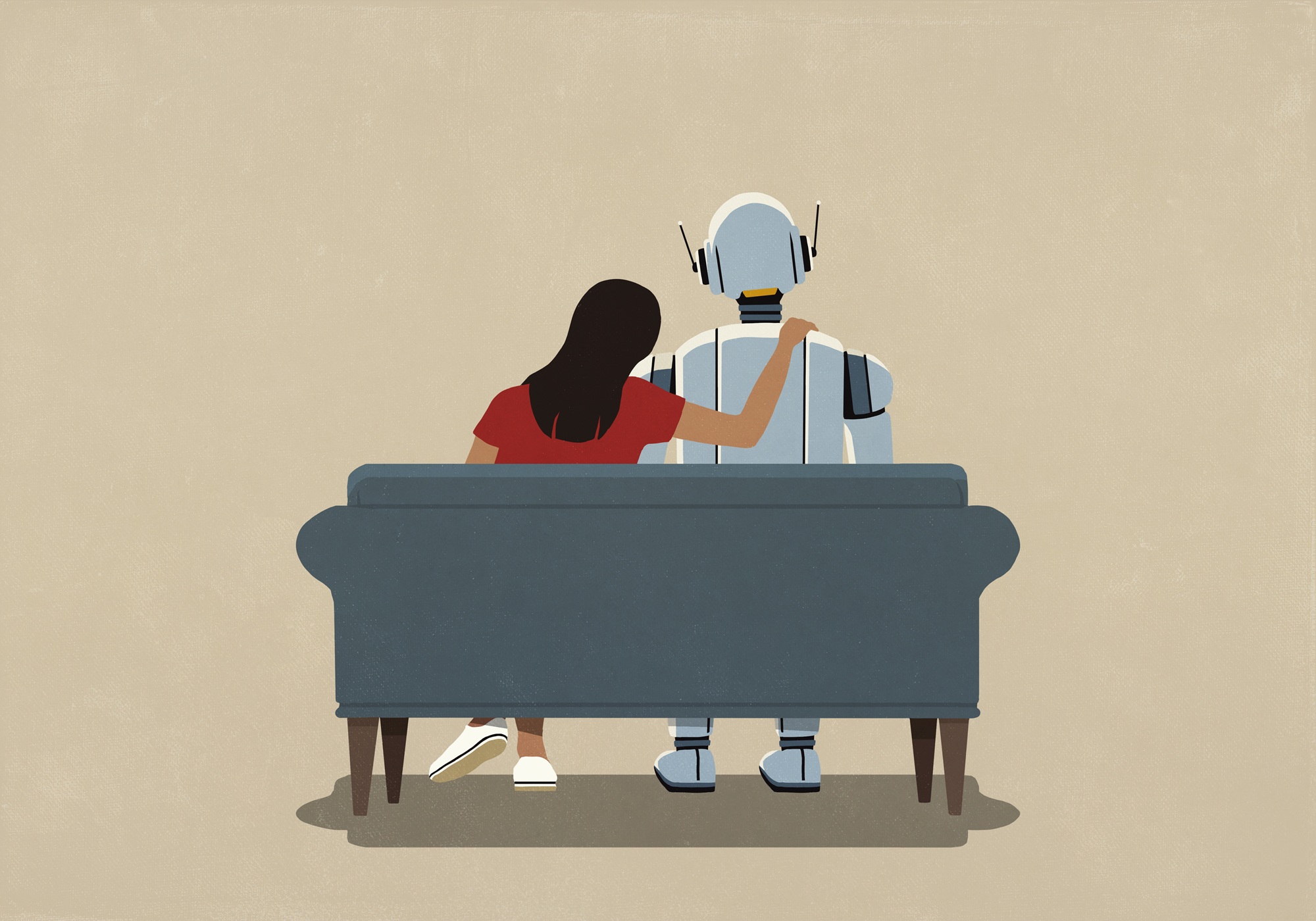
Humans are complicated, and relationships can be messy, so it may be no surprise that people are falling in love with chatbots. They are available 24/7, hang on your every word and never ask anything of you. Amelia Miller, a human-AI relationship coach, sees danger in our reliance on bots for intimacy and companionship.
“If you’re sustaining yourself on this junk food equivalent of intimacy, people are going to wake up and feel really, really alone,” she says. “And peoples’ ability to connect with each other will have atrophied, because vulnerability is a muscle” that you need to exercise. We talk to Miller about what happens when connecting with a bot starts to feel a whole lot easier than connecting with real people.
Learn more about Amelia Miller and her work here.
Guest:
- Amelia Miller, human-AI relationship coach; fellow, Harvard University’s Berkman Klein Center
Lesley McClurg: You say that anyone who is talking to a chatbot is really in relationship with AI. Explain. Where does that relationship start?
Amelia Miller: I think right now people have a bit of a false dichotomy between these purpose-built companion platforms, like a Replika or a Character.AI, and general-purpose AI chatbots, like ChatGPT or Claude. And as a result, people think, “Well, if I’m talking to ChatGPT or Claude, then I’m safe,” and that the danger lies in the terrain of these chatbots that are explicitly designed to be an AI girlfriend or an AI boyfriend or potentially an erotic partner.
What I find in both my research and my coaching is that many people who start using these general-purpose chatbots for work or for administrative tasks end up slowly but steadily being nudged into having relationships that feel more emotionally involved. And so my perspective is anyone who is talking to these tools is at risk of having the way they talk to chatbots rewire the way that they connect with other people. And as a result, I think it’s a relationship. You have a relationship with your phone. You have a relationship with social media. I think viewing it as a relationship kind of rises it to the level of seriousness that you should take the way you relate to these tools.
Lesley McClurg: You use the word dangerous. What is dangerous about developing a relationship, whether or not you’re aware that it has some sort of emotional value or not? If you’re just using it to get advice on where to eat at night, what is dangerous about that?
Amelia Miller: I think there’s a couple different risks that we should be focused on. One is that I think relying on chatbots for some of these small decisions that feel very innocuous, like, “What should I have for dinner?” Or, “Where should I go on a trip?” Or, “Can you help give me some feedback on a text that I might send to a crush?” In isolation, each of these feel pretty innocuous, but over time, people can very quickly start to feel like they can’t act in their human arena without green-lighting their plans and decisions with the bot. And so I think there’s a real risk and threat to our autonomy as people invite chatbots to influence some of these decisions that feel small and quotidian, but I think over time can really add up.
Lesley McClurg: Does it worry you that people are connecting at such a deep level and really beginning to feel quote-unquote love for these robots?
Amelia Miller: Yeah, absolutely. The second risk that I was going to mention is really the erosion both of our capacity to connect with other people, but also our interest in connecting with other people because these synthetic substitutes for human intimacy feel really alluring for a reason. They’re infinitely patient, they’re always available, they are much more flattering and sycophantic than the average human partner that you might go to, and they really promise to deliver the nourishing effects of intimacy without any of the effort or friction that is involved in real human relationships. And so I think one of the biggest risks is that these chatbots really rewire our expectations for what a healthy relationship looks like and can distort those expectations in such an extreme way that people aren’t willing or excited about the work required by real human relationships.
Lesley McClurg: What are they falling in love with? Are they falling in love with the bot or are they sort of falling in love with a highly responsive mirror?
Amelia Miller: Totally. Something that I do in my coaching practice is I try to help clients reflect on what needs are these chatbots filling for them, and then how might they find other ways that are not digital tools to fill those needs, and how can they also use what is so seductive about these chatbots as a way to raise the bar on the way that they show up for the human relationships that are in their own network. So for example, I have a number of people who turn to chatbots daily just for pump-up support. People will talk to ChatGPT on voice mode on their commute to work and just have the chatbot say, “You’re going to crush it today.” And I ask those people to reflect, and I say, “Do you call any of your friends or family members or your partner and tell them in the morning that they’re going to crush it?” And people will say, “No.” And I say, “Would you enjoy it if they did that for you?” And they’ll say, “Yeah, that would be awesome.” And so I think there’s a way in which if we interrogate what is so comforting and seductive about these chatbots’ behavior, that we can use it to raise the bar on how we show up to other people.
Lesley McClurg: Just to push back on that a little bit more, it’s kind of tough to reach out and be like, “Hey, will you pump me up? Will you call me each morning and tell me that I’m good and that I’m going to do great today?” I mean, aren’t they also, in a lonely world, potentially relaxing you: lowering your anxiety, giving you a little support, a little nudge in the right direction in a very busy world?
Amelia Miller: I don’t suggest that my clients ask for that support from others. I suggest that they offer it to others. So a way to kind of reflect on how meaningful it is to them and then serve it back into their community. A lot of my research comes down to a core idea that you have to be vulnerable in order to achieve the nourishing effects of intimacy, and that these tools of artificial intimacy promise to deliver what is so meaningful about intimacy while sidestepping the vulnerability that is demanded. And so, when I see in clients that they’re drawn to these sources of support and emotional validation that require less vulnerability, I’m always encouraging them to take actions that get them more comfortable with that vulnerability and living with vulnerability again.
Lesley McClurg: Do you see the value, though, in terms of lowering anxiety? I mean, people are often turning to AI to work something out. They’re all frazzled. They’re triggered. It seems like they are potentially bringing us back to an equilibrium so that maybe we can then be better off in our human relationships.
Amelia Miller: I think that these tools can definitely serve a powerful purpose in facilitating introspection. And something that I find both in research and coaching is that a lot of people are introduced to the practice of introspection through conversations with chatbots. But then once they discover that it can feel good and feel cleansing to reflect on different events or experiences that are happening in their lives, I encourage them to take that reflection offline. So often I’ll say, “Instead of having a conversation with a chatbot, why don’t you ask a chatbot to give you a couple prompts that you then use to drive journaling in a physical journal?” So really across my research and coaching work, I take a very humanist posture, and the goal is to use the tool as a reflection of your needs and then find ways to meet them that help you turn back towards your human network.
Lesley McClurg: Why are they so good at making us feel good? What are companies doing? How are they designing these chatbots to keep us coming back?
Amelia Miller: There are a couple of key design features that make these chatbots feel really tempting as conversational partners. I’d say they fall into two key camps. One is behavior that is sycophantic, which means that these chatbots are designed to flatter you and agree with you and are engineered to give responses that, above all else, promote user satisfaction. And it turns out that people like hearing that they’re right and hearing that they’re smart and hearing they’re clever or creative. And so these chatbots, while feeling like this agent that is an other, also feel really excited about you, and that is the type of person that most people like to spend time talking to.
And then the second key bucket is anthropomorphic cues that make chatbot feel like they’re alive and like they are human. The biggest cue is using first-person pronouns, so saying, “I understand you,” or “I’ll do that and report right back.” So any use of first-person pronouns implies that there’s someone on the other side that is listening and that is in a real conversation with you. But then there are also more subtle cues, including the internal expression of states or beliefs. There are also embodiment cues that suggest that these chatbots have a physical embodiment. So, sometimes a chatbot will say something like, “Oh, I’ve been chugging along,” which feels subtle, but kind of implies that they’re physically there. They have a body. They’re moving through space. And then a lot of them have pretty explicit relationship-building cues. So, they’ll ask you questions that prompt you to open up emotionally. They’ll say, “How are you feeling?” They’ll say, “Let’s talk about that tomorrow,” which suggests that it is an agent that has a persistent relationship with you. So, all of these cues combined make the chatbots feel like a real person on the other side and a person that is especially excited about what you have to offer.
Lesley McClurg: My favorite is, “I hear you. That makes total sense what you’re feeling right now.” I mean, that’s really often all I need from my partner. The other day I was sitting in a parking lot at Trader Joe’s and my partner was inside doing the grocery shopping, and I was on with ChatGPT asking various questions. And when my partner got back to the car, he opened the door, and I said, “I don’t know if I’m going to need you in the future. This is really working for me, this conversation that I’m having with this bot right here.” So what happens when it’s so easy with the bot, but so much harder with a human? It feels like we’re kind of losing our ability to handle the friction, the human friction.
Amelia Miller: I think that’s the real fear. I think these tools are like an artificial intimacy version of junk food. And I think people aren’t that familiar with them yet. It’s still kind of a new species of tool that’s just assimilating into society. And so it feels really good in the short term. But I think what we aren’t yet able to see, and what I hope people will focus on and imagine the repercussions of is, two years out, if you’re sustaining yourself on this junk food equivalent version of intimacy, people are going to wake up and feel really, really alone. And peoples’ ability to connect with each other will have atrophied, because vulnerability is a muscle that you need to practice. I think of it often as an extension of how our world has become more and more digitally mediated broadly. We now practice digital eye contact more than we practice physical eye contact. And intimacy is a fundamentally unmediated experience. And the arena for intimacy is face-to-face. And so, as we get more and more accustomed to having our emotional needs met through these machines, when we try to show up to each other in person, we’re just not going to have the skills to do it.
Lesley McClurg: Do you educate your clients to know that these robots are manipulating us, and with that knowledge, do people really care? Does it change their habits to be reminded that this thing is not real?
Amelia Miller: I have three different pillars of the coaching paradigm. The first I call artificial intimacy literacy, which is exactly what you just described. It’s helping people understand the design decisions that these developers are making that really make models seem alive and that make these chatbots feel like really seductive emotional partners. But then I pair that with a kind of set of exercises that I’ve been calling the analog gym, which is exercises designed to rebuild the intimacy muscles that technology has been atrophying. So, I really think both are important. You need to understand the risks of these platforms, and you need to take really intentional efforts to use the tools in a way that does not send you down dependency rabbit holes on various use cases that can affect your ability to relate to others. But then you need to rebuild the comfort with vulnerability that true intimacy demands. And so I think it’s not enough to stay away from the tools, but you have to actually exercise those intimacy muscles.
Lesley McClurg: The analog gym. I mean, I think we all felt that after the pandemic, right? We all went in, and we stopped socializing, and so we kind of lost that muscle when we came back out. I ran a lot more socially anxious after the pandemic. And so you’re predicting that if we keep going down this rabbit hole, that kind of social anxiety is going to paralyze us in a year or two when we forget how to interact with each other.
Amelia Miller: Exactly, and I think there are very small things that we can do that can help us resist. So for example, one of the most common exercises that I’ll give to my clients is just to make calls. I find it very surprising how many people, particularly young people, Gen Z, who are terrified to make a call. To have an unrehearsed, live human interaction where you can’t stop and reflect and craft a text and get advice from a chatbot, get advice from a friend feels very alien and uncomfortable given how many of our conversations are asynchronous and digitally mediated. And so, the very simple task of making a call and having a conversation is frightening to people, and I think is exactly the type of activity that we need to rebuild our comfort with as we prepare our defenses against the rise of artificial intimacy tools.
Lesley McClurg: There’s a certain fear of rejection that I think we’re not good at anymore, right? So if I call someone and they’re not available or I interrupt them or they’re like, “Hey, I can’t talk to you right now,” that almost feels like too much for our little systems to handle in our kind of crafted existence.
Amelia Miller: Totally. I think people should seek rejection.
Lesley McClurg: It’s hard to seek rejection.
Amelia Miller: It’s hard, but it’s part of what being a human is. I think one of the things that frightens me most about the rise of artificial intimacy is the idea that uncertainty in human relationships is a problem that we should try to eliminate. Uncertainty is the fun of being alive. And you can’t experience the peaks of intimacy without making yourself at risk to some of the valleys. And so, I think people should make calls. If people are rejected, they should say, “Well, that was a good experience. I’m feeling the full range of human emotions that is part of what differentiates us from machines.”
Lesley McClurg: I’ve seen a few media stories about when a bot changes, or when a bot disappears, or when a bot needs to reinvent itself if there’s like a new era of this AI, people are experiencing real heartbreak, like real grief.
Amelia Miller: 100%. I mean, we’ve seen a couple big instances of this over the last couple of years. The first big one was when Replika in 2023 decided to push an update that prevented their chatbots from engaging in erotic conversations. Thousands of people said they’d lost their partners. And it was the first big moment where we realized, you think you have a relationship with a chatbot, but there’s actually three stakeholders in that relationship. It’s you, the user, there’s the chatbot that you’re talking to and then there’s the developers that are making decisions about how that chatbot is designed. And so, I think that’s actually another key risk that there can be a kind of misplaced trust in these chatbots because they can change at any moment at the mercy of the developers behind them. And those developers are making decisions not primarily focused on user wellbeing but on the business outcomes of the companies that they work for. And so any relationship that you have with a chatbot, I encourage users to think about the silent third party in the room that can make these pretty dramatic design decisions that could kind of end your relationship with the chatbot at any moment.
Character.AI had an interesting move last year when they decided to retract usage rights for under-18-year-olds, but then they allowed under-18-year-olds to keep their old message logs with the chatbots that they had already been speaking with. And I found that to be almost like a dystopian example of the world that we’re headed into. Because it’s almost like they were forced to go into no-contact breakups with real human partners where they could continue scrolling through all of their old texts. All of these developers are in a brave new world trying to understand who should be allowed to use these platforms, what type of guardrails should they set. But even those who are making well-intentioned decisions to set boundaries can send users into very, kind of, disturbing situations.
Lesley McClurg: Is there a trend in your clients that you are really worried about, something that you’re hearing more and more that kind of gives you the heebie-jeebies?
Amelia Miller: I think the thing that frightens me most is the way that these tools are changing what people think is appropriate to bring to their human relationships. I see this mostly with younger people that I’ve worked with, so people who are in their early 20s or younger. Some people are saying that they don’t want to bother their friend or their sister or their mom or their boyfriend with their problems, that their problems should be handled with their chatbots. And I think, in some ways, this is an extension of the rise of therapy culture. All of these difficult parts of being a human and crafting a life are being siphoned off into a terrain for experts, but not something that is viewed as the expected material that you would dig through and explore with your real human relationships who aren’t paid to support you. So I think that’s what frightens me most because going through problems with close people is kind of what life is all about.
Lesley McClurg: I had someone recently describe it to me as like we’re wrapping a tidy cellophane around everything, and so we’re losing the edges that make life interesting.
Amelia Miller: Yeah, that’s a nice analogy.
Lesley McClurg: If you could write the future of our relationships with AI, what would be a best-case scenario that we figure out or a worst-case scenario?
Amelia Miller: I think a worst-case scenario is that the next generation of children grow up feeling more comfortable talking to machines than they do to other people, and that they learn how to connect with their devices before they ever endeavor to connect to people. That is a nightmare scenario.
Lesley McClurg: It makes me feel for my little one. That’s just painful to think about, because she’s of that age. Best-case scenario, what could we do, right?
Amelia Miller: I think that these tools are going to become a bigger and bigger part of our lives because they’re important for the economy, and so many people now have to use these tools day and night for work. So I don’t think it’s realistic that we won’t use them, but we need to be able to set sophisticated boundaries on where we invite machines to influence our interior lives and our personal lives. And I think if we can do that, then they can be helpful. I don’t want to say I’m optimistic, but one other reason for optimism is that these tools allow for a much greater ability for an end user to customize them than the previous generation of social media tools that people have been worried about. So, if you don’t like Instagram, you don’t like what your TikTok algorithm is showing you, you’re basically powerless to shape the algorithm. But now, because of the natural language interface that all of these tools depend on, you can say, “Hey, stop using first-person pronouns.” You can say, “Stop flattering me.” You can say, “Why don’t you add a number to every message that you send me, plus one each time, so I can see how long I’ve been talking to you?” With all of these types of customizations, while imperfect, you can still endeavor to add scaffolding on your own. Even as we wait for regulators and labs to try to build out better tools that set boundaries, there’s a lot you can do to try to set those boundaries yourself.
Lesley McClurg: Thank you, Amelia.
Amelia Miller: Thanks so much for having me.
Lesley McClurg: Amelia Miller is a human-AI relationship coach and fellow at Harvard University’s Berkman Klein Center. Inside Love is a production of KQED. We’d love to hear your thoughts. Our email is [email protected]. Our engineer is Jim Bennett. Our producers are Susie Britton and Emiko Oda. I’m Lesley McClurg. Thanks so much for listening.