We Need a Wrecking Ball
View the full episode transcript
Long before she became Madam Speaker, Nancy Pelosi was “Little Nancy” D’Alesandro. Raised in Little Italy in Baltimore, Maryland, she learned the lessons of power from her larger-than-life parents: “Tommy the Elder,” a Congressman and mayor of Baltimore, and “Big Nancy,” a master political organizer. Decades later, those lessons served her well. In 1994, when Republicans took control of Congress for the first time in 40 years, Pelosi wanted to win it back – and win big. But first: she’d have to wage a war against the men standing in her way, including within her own party.
Episode Transcript
Scott Shafer: If you had a phrase or a few words to describe Nancy Pelosi, what would they be?
Rahm Emanuel: Well, I’ll just tell you what I told President Obama when he was first kind of meeting her. He goes, just tell me a little. I mean, he knew her, but didn’t know her.
Scott Shafer: That’s Rahm Emanuel. He was President Obama’s chief of staff.
Rahm Emanuel: And I said, Nancy Pelosi is 99% D’Alesandro and 1% Pelosi. And what did that mean to you? She was her father’s daughter. And I says, if you understand that, you understand Nancy Pelosi. Do not forget that you’re dealing with a D’Alesandro.
Scott Shafer: Nancy Pelosi’s father, Thomas D’Alesandro, Jr., was mayor of Baltimore, Maryland from 1947 to 1959. Before that, he served five terms in Congress, representing Maryland’s third district. For Emanuel, that Italian-American political family is the key to understanding Pelosi. Or, as she was known in Baltimore, Little Nancy.
Scott In the Field: So we’re in Little Italy in Baltimore on Albermarle Street hoping to get some background on little Nancy.
Ariella Markowitz: I just keep thinking of hairspray. Good morning Baltimore.
Scott Shafer: That’s our producer Ariella Markowitz. To learn more about the neighborhood and Nancy’s family, we met up with one of Nancy Pelosi’s childhood playmates. Sorry to make you come out in the rain.
Mary Ann Campanella: Oh, that’s all right. I’m only a block away. I live on the corner.
Scott Shafer: Mary Ann Campanella is 84 years old. She grew up here in Baltimore, little Italy, just across the street from Nancy. She’s lived in the neighborhood all of her life. Her deep voice, strong opinions, quaffed silver hair and warm embrace, they all reminded me of my mother.
Mary Ann Campanella: Oh, come on. Whoops. Careful. I’m all right, babe. I just got needles in my knees. Old age sucks.
Scott Shafer: Our plan was to check out one of the neighborhood’s best known restaurants, Chipparelli’s. It opened in 1940, that’s the same year little Nancy was born.
Mary Ann Campanella: Hi, sweetie.
Scott Shafer: Chiaparelli’s is a classic Italian restaurant. White tablecloths, waitresses that call you babe and honey. I order a cup of Italian wedding soup and lasagna while Marianne holds court in the dining room.
Mary Ann Campanella: How you doing today, baby doll? You okay?
Scott Shafer: It’s the kind of neighborhood where everyone knows everyone else’s business.
Mary Ann Campanella: Hi Mike, what are you doing in here today? It’s his birthday. Oh it’s your birthday? Oh Mike, I didn’t know it was your birthday. Happy birthday.
Mary Ann Campanella: He’s a neighborhood guy. I knew Maryann all my life. She lives right across the street.
Scott Shafer: That’s Mike Turocchi. He and Campanella grew up with Nancy D’Alesandro.
Mary Ann Campanella: She was queen princess.
Mike Tirocchi: She was just the princess and the father. Tommy was what you call the consummate neighborhood mayor. I mean, he knew everybody. If you had a problem, you went to Tom. I mean my father was.
Mary Ann Campanella: Senior, Tommy, senior.
Mike Tirocchi: My father was an immigrant. He couldn’t hardly speak English and couldn’t read or write. If he had a problem, go see Mr. Thomas. I think Nancy learned from her father by watching and listening and seeing the way he ran the city and the way people looked up to him and the way he run his daily business.
Scott Shafer: Nancy’s dad, Mayor Tommy, was the out-front, back-slapping, charismatic politician. But his wife ran the operation behind the scenes. Her name was Annunziata, but everyone called her Big Nancy.
Mike Tirocchi: Her mother was a very, very powerful person.
Scott Shafer: Powerful how like what do you?
Mike Tirocchi: Just her demeanor and her presence, the way she carried herself, she was just, she was not a Little Italy mom. Let’s just put it that way. I mean, my mother was a mother of 12 and wore housecoats. Nancy was always dressed to the nines, looked great all the time. It was just the antithesis of what we were.
Scott Shafer: Big Nancy had dreams of going to law school, never fulfilled. But her political instincts and raw talent for organizing, campaigning, and bringing order to chaos all rubbed off on the Nancy Pelosi we know today.
Mike Tirocchi: I thought that that’s the product of her environment. Her mother had aspiration for her to be something special, and she was.
Scott Shafer: As I sat with these old timers, a picture of Nancy Pelosi came into sharper focus. A child watching her parents run the family business. Big city politics. I’m Scott Shafer from KQED Public Radio in San Francisco. This is The Speaker. Today, how Nancy Pelosi used those lessons to seize power. Baltimore style. Last episode, Nancy Pelosi beat out Harry Britt in a special election for San Francisco’s congressional seat. She told us about that day, in 1987, when she got sworn in.
Nancy Pelosi: Just the D’Alessandro family is big enough to be a crowd.
Scott Shafer: Tommy the Elder got to see his daughter take the oath of office, along with the rest of the family.
Nancy Pelosi: When I was born, my father was in Congress. When I in first grade, he became mayor of Baltimore. When I went to college, he was still mayor of Baltimore, so I did grow up in a political atmosphere.
Tommy D’Alesandro the Elder: How are you? You sound a lot better. How are YOU? That’s all the Italian I know, Mr. Mayor. That’s pretty good. You did pretty good! You get A for effort.
Scott Shafer: Tommy D’Alesandro Jr. Was a smart-talking politician with a pencil mustache. And in this PBS footage from 1980, he’s retired from politics but still formally dressed in a brown three-piece suit and what looks like a large checkered bowtie. Tommy was one of 13 kids born in Little Italy, Baltimore. In 8th grade, he was kicked out of school by a no-nonsense nun.
Tommy D’Alesandro the Elder: She was a great, she was a saint. She was the two-fisted sister. She used to slug us every time. Literally? Oh yeah. She knocked him less than two times.
Host: Did you deserve it?
Tommy D’Alesandro the Elder: Sometimes.
Scott Shafer: As a kid, Tommy was often seen around the neighborhood hustling. He peddled newspapers on the street, sold chewing gum to sex workers. He spoke some Yiddish, would run errands for Jewish neighbors. He was the neighborhood Shabbos Goy. The non-Jew who helped Jews observed the Sabbath. Later, he sold insurance. In his early 20s, he decided to run for local office, the Maryland House of Delegates. He sought the endorsement of the local political bosses. Who would hang out in the smoke-filled Rennert Hotel, playing pinocle and eating oysters. They told Tommy to come back with 500 voter signatures.
Tommy D’Alesandro the Elder: So I went around and got a petition. On this petition I had written, we, the undersigned registered Democratic voters of the 3rd Ward, 1st Legislative District recommend for your favorable consideration the candidacy of Tommy D’Alessandro, Jr. For the House of Delegates. He was born and raised in the district, knows the people and their needs, and would be a credit to both city and state if elected, signed by 500 people.
Scott Shafer: He won that election, his first of many. Two years later, Tommy D’Alessandro married Annunciata Lombardi, a local girl, six years his junior, Big Nancy. They had six boys, including one, Nicholas, who died as a young child. In 1938, Tommy was elected to Congress. Tommy and Big Nancy were dyed-in-the-wool Democrats. They even named one of their sons after the president, Franklin Delano Roosevelt D’Alessandro. After bringing six boys into the world, the D’alessandros finally had a girl. Little Nancy D’ Alessandro was born March 26th, 1940, and it made local headlines.
Nancy Pelosi: I was born, our whole thing was, we were born devoutly Catholic, proud of our Italian-American heritage, fiercely patriotic, and in our case staunchly democratic. That was our neighborhood, Little Italy in Baltimore, Maryland.
Scott Shafer: For little Nancy, the family business was politics, local politics.
Nancy Pelosi: We were taught that we had responsibility to help other people, and politics was one way to do that.
Scott Shafer: And to help other people, they had to win. Winning opened doors, and Tommy relished the victories.
Tommy D’Alesandro the Elder: I carried Little Italy by 69 votes. Palmisano again, I beat him by 2800. At Janetsky again, I beat them by 11,000.
Scott Shafer: Tommy D’Alessandro Jr. Taught his daughter her most legendary, if underappreciated, skill.
Nancy Pelosi: You have to have the votes, so you have to know how to count.
Scott Shafer: Before she even graduated from high school, little Nancy got a sound education on the nuts and bolts of running a political operation, including the importance of a good ground game.
Nancy Pelosi: I could just remember seeing these people come to the house at night and have their community meetings and you’re going to be responsible for this area, this area this area this area. This is how many votes you need to get. How many do you think you’re gonna get and that was it.
Scott Shafer: The D’Alesandros, they love to win.
Tommy D’Alesandro the Elder: And I won, I won again, again, then.
Nancy Pelosi: And he won, again and again
Scott Shafer: At a young age, Pelosi learned that power isn’t simply inherited and it certainly isn’t handed over by those who have it. Nope. If you want power, you have to go out and seize it. Once she got to Congress, Nancy Pelosi saw that her fellow Democrats had a big problem. In 1994, the Democrats lost the House for the first time in 40 years. This moment is sometimes called the Republican Revolution. Change was the message, tax cuts, term limits, and smaller government. It was led by a firebrand congressman from Georgia.
Newt Gingrich: This is a contract with Americans for America.
Scott Shafer: Having won the House for his party, Newt Gingrich became the first Republican speaker in forty years. A thorn in the side of Democrats.
Newt Gingrich: Our proposals, which will come out in May to shrink the federal government, to shrink the bureaucracy, to eliminate some departments, to save the taxpayers’ money, to move to a balanced budget, that’s what the voters want.
Anna Eshoo: They were in a deep depression.
Scott Shafer: That’s Anna Eshoo, one of Nancy Pelosi’s closest friends in Congress.
Anna Eshoo: I mean, they were so stunned. Well, they had been the majority in the house for 40 years and then to drop off into nothingness. Oh my God.
Scott Shafer: Many of the junior Democratic congress members would get together to commiserate over dinner at an Italian restaurant or someone’s house.
Anna Eshoo: That, the gang. It was a raucous, great group. Nancy always would talk about winning, though, and how to win. She made up her mind that we needed to win
Scott Shafer: She had strong opinions about how things should be run, thought that House Democratic leadership did a lousy job managing a banking scandal, and hadn’t done enough to modernize the way they ran campaigns. But to change things, Pelosi would have to overcome a huge obstacle.
Leon Panetta: Congress is still a man’s club.
Scott Shafer: That’s Leon Panetta, once a member of the gang from California, who became Obama’s head of the CIA.
Leon Panetta: You’ve got to fight your way, and Nancy was willing to fight her way.
Scott Shafer: When Pelosi got to Congress, women made up about 5% of the House. Anna Eshoo relayed this one story. She wasn’t there at the time, but she heard about it later. Nancy and some other Congresswomen were listening to the men talk about childbirth. Apparently the men were complaining about how hard childbirth was. For them
Anna Eshoo: and she tries to get into the conversation. Now she had five babies in six years, you know? She was just so shocked that what the women were trying to say, the guys were.
Anna Eshoo: Dominating.
Leon Panetta: She would do an awful lot of listening, and she would listen, but then she would have something to say that was a lot more at the point of what we were concerned about. It wasn’t just complaining, it was like, what are we going to do about it?
Scott Shafer: Pelosi was getting tired of listening. She wanted to get stuff done. And as election after election passed, she saw something that the men in charge wouldn’t acknowledge.
Nancy Pelosi: 94, 96, 98, I was like, there’s no plan to win.
Scott Shafer: Leadership thought that the Republican revolution was just a blip, that things would go back to the way they were, with Democrats in charge. It was just matter of time.
Nancy Pelosi: It was more of an attitude thing, like the pendulum will swing, but I didn’t see really a decision to have it be a wrecking ball, not a pendulum, a wreckin’ ball. You decide to win, and then you make every decision in favor of winning. Quite frankly, I’m really tired of losing.
Scott Shafer: She came into Congress wanting to make life better, for people who are often forgotten
Nancy Pelosi: This is not for the faint of heart. This is rough. But if you know why you’re doing it, that makes everything okay. My why was one in five children in America goes to sleep hungry at night. One in five Children in America, it lives in poverty. That’s my why, is to ask, go there for the children, for the Children.
Scott Shafer: We don’t know exactly when Nancy Pelosi decided to run for leadership. When I asked Pelosi why she wanted to be leader, her line is, other people wanted me to run.
Nancy Pelosi: When I got here, after a few years, members came to me and said, you should run for leadership. In fact, you should for speaker. I said, well, I absolutely positively would not do that.
Scott Shafer: Barbara Boxer, the former senator from California, remembers a different Pelosi. They would commute back and forth from D.C. Together, chatting the whole time.
Barbara Boxer: We could just yak yak about everything. One of those days on the plane, we were talking about, what is your dream in politics? What do you really want to do? And she asked me that, and I said, I want to be U.S. Senator. This is when I was in the House, which was a pipe dream, trust me. Now, I’m telling you, Nancy says, that never happened. So maybe I dreamed it. And she said, I want be Speaker of the House.
Scott Shafer: You had to have some chutzpah at that point in her career to say, I wanna be speaker.
Barbara Boxer: Chutzpah doesn’t begin to describe it. It was impossible.
Mary Ann Campanella: Walking in the street, I ain’t foam with these sidewalks. Okay. They’ll stop for us. Believe me, they will.
Scott Shafer: After eating at Chiparelli’s in Baltimore with Nancy’s childhood friend, Mary Ann, we jaywalk across the street to Nancy’s Childhood Home.
Mary Ann Campanella: The D’Alesandro Mansion. This is where young Nancy was born, right here in this home. You’ll see the plaques. Mercy Little Italy Health Center in memory of Nancy and Tommy D’Alesandro Jr.
Scott Shafer: Big house. It’s a three-story brick row house on the corner of Albert Marl and Fawn streets.
Mary Ann Campanella: Oh, and good bricklayer. The Talons are noted for that.
Scott Shafer: Back in the 40s, when Tommy D’Alesandro Jr. Was mayor, the House was essentially a political headquarters, often buzzing with activity.
Mary Ann Campanella: Her father’s office was here when he was mayor, so he was right in the neighborhood.
Scott Shafer: But everybody knew that if they couldn’t reach the mayor, next best was talk to his political partner and wife, Big Nancy.
Nancy Pelosi: My mom was spectacular. If she were living now, I don’t know if she might be president of the United States. She was so capable.
Scott Shafer: Big Nancy was glamorous and smart. She loved betting on horses at the local track. She even invented a beauty product, had a patent registered for a facial steaming device. It was called Beautifier Vaporizer for treatment of the skin.
Susan Page: And basically, it’s just boiling water, but it looks pretty dramatic.
Scott Shafer: That’s Susan Page. She wrote a biography about Pelosi.
Susan Page: Her mother kept what was called the favor file, which was basically a recording of the favors that constituents would come in and want to get from the mayor, whether it was better housing or help with a kid who had gotten in trouble with the law or whatever. And she would help figure out how they might be able to help this person and also keep a record so that they could go back to them when the next campaign came around and they needed some election help. And who was sitting on her right side during these sessions when people would file through their home looking for favors.
Scott Shafer: Little Nancy, that’s who. She would take handwritten notes, later typed onto index cards and filed away.
Susan Page: It is perfect training for being a congressional leader where your members have favors they need done and you keep track of them so that you can cash them in when you need them.
Nancy Pelosi: When I was a girl, I could hear what my mother would say when somebody would come to the door if they wanted a place to live in the projects, a bed in a city hospital, somebody going to jail or getting out of jail or whatever it happened to be.
Scott Shafer: Big Nancy would help her neighbors with all kinds of problems, but they were also her husband’s constituents. So when election time came around, she’d open up the favor file to, in a sense, balance the books. She’d send women volunteers out to collect the votes. It’s been a key part of machine politics since the beginning. The ground game.
Nancy Pelosi: Women have always been the strength of the Democratic Party because you have to own the ground.
Scott Shafer: Speakers of the House wield enormous power. If the President and Vice President die, the Speaker becomes President. They dictate the agenda, appoint members to committees. In effect, Speakers decide which legislation lives or dies, or gets amended, and how. But Speaker of the house isn’t a job that just falls into your lap. Here’s what you need to do. Build alliances. Show that you have a vision. Raise funds for the party. So they’ll elect you to party leadership. That’s your stepping stone to speakership. One of the highest positions is whip. The term whip comes from England. The whipper in was the assistant to the huntsman, the person who keeps the hounds in line. The job requires deep trust as you’re herding votes. Hounds have to know you’ll use the whip. Early on, Pelosi learned a hard lesson about counting on the support of colleagues. She remembers thinking she had convinced a senior member of Congress to support her campaign to join the powerful Appropriations Committee, a coveted position. But when the time came, he voted for her opponent, so she cornered him.
Nancy Pelosi: You said that when even knowing, no, even knowing on the race, I’m for you. He said, yeah, that’s what I said. Well, knowing who’s in the race I’m, for you, so I say to people if they say you’d be so great, that’s a no.
Scott Shafer: Pelosi started studying what motivated her members. What were the carrots? And what were the sticks? Here’s Anna Eshoo again, Pelosi’s close friend in Congress.
Anna Eshoo: She came to know members better than they knew themselves. I always thought that. I thought, oh, that poor deer over there. He doesn’t know that she knows him backward and forward. She had her own internal study of people. She understood them. She made it her business to know them, to know their families, to know their children, to their districts.
Scott Shafer: Whip is an internal party position, so there’s no regular election schedule. You have to wait for someone to retire or decide to run for Senate or go back to state politics. Pelosi announced her bid ahead of time anyway to send a signal.
Nancy Pelosi: Said, you know, you’re breaking into the line. I said, what are we talking about? Because they had it. You’re gonna be next. You’ll be with, and you’ll move up to leader, and you will be with. And they had all guys. They had all the guys. And I said no, we’ve been waiting over 200 years, and that’s it. That’s it, and I know I can win. I’m not asking anybody to take a risk. I know, I’m gonna win.
Scott Shafer: Clearly Pelosi had counted the votes, but she still had one big obstacle.
Steny Hoyer: Well, I was disappointed that she was going to run and not support me.
Scott Shafer: That’s Steny Hoyer, a longtime Democratic congressman from Maryland. A reporter describes Steny as the textbook politician, gregarious, smooth, and a moderate to the core. Hoyer knew Nancy well. He’d also grown up in Maryland. Actually, they’d worked together back in the 60s when Pelosi was a receptionist for a Maryland senator. When Pelosi joined Congress two decades later, Hoyer was…
Steny Hoyer: Tickled Pink to see her, welcomed her with open arms. She was a great addition to the Congress.
Scott Shafer: We might say today they were frenemies, friends, but also rivals, eyeing the same position and leadership. Based on those wait your turn rules, he was expected to become whip when the job opened up.
Nancy Pelosi: And then when I ran, they were like, well, who said she could run? Poor babies. When you think I’m waiting for you, lost all these elections that say I can run. And secondly, they said, because I had a lot of support from the women, they said why don’t you all write on a piece of paper the things you would like to see us do and we’ll do them for you. This is in this century. In this century! I’m not talking about 1958, I’m talking about in this century.
Scott Shafer: But Pelosi knew how to deal with tough old politicians. Her dad had been one. She knew she’d have to get some of them on her side to win.
Anna Eshoo: Jack Murtha was a member from Pennsylvania.
Scott Shafer: Anna Eshoo again.
Anna Eshoo: Jack was the first Vietnam veteran to be elected to the Congress. He really looked like he was out of central casting, beautiful gray hair, impeccably dressed, his collars, his ties, very Irish and very serious about his work. And his work was all about the military. He sat on the floor in the very last seat. If you’re looking at the front of the chamber, the far left corner, it’s dark there. It’s so far away from everything else, but that’s where Jack sat.
Scott Shafer: Pelosi kept a small statue of a coal miner on her desk. It was a gift from her father, who’d gotten it from a former West Virginia Congressman.
Nancy Pelosi: So Jack Murtha walks down the hall, comes in my office, and he sees that, and was like, oh my gosh. So then we became really good friends.
Scott Shafer: Jack Murtha was a representative from coal country, so that made an impression on him. She may have represented San Francisco, but he saw the Baltimore in her.
Anna Eshoo: We need her in the leadership. And that was, you know, I mean, the most members weren’t noticing how the relationship grew and deepened. So they were shocked. Jack, Murtha supporting Nancy.
Scott Shafer: Murtha would actually go on to lead her campaign for Whip.
Steny Hoyer: To Hoyer’s disappointment. I was surprised because Jack Murtha, I thought, had indicated to me that he would be helpful to me. That did not turn out to be the case. Pelosi was coming for Hoyer spot.
Nancy Pelosi: I maybe thought it was his turn, but I didn’t know what dues he paid. I mean, that is to say, I paid all the dues in the world.
Scott Shafer: In 2000, Democrats were still hoping they could win back the House. They needed to flip around seven seats. Pelosi said she could pick up four seats in California, the party would have to do the rest. She kept her word, four more notes for the favor file. She remembers assuming they’d won back the majority.
Nancy Pelosi: So I’m on my way to a press conference to meet the press. My staff is like holding me back like this on my coat. They said, wait a minute, we did not win the house. I said, how could they? They needed seven to win the House. They lost every other place.
Scott Shafer: She couldn’t stand it anymore. Even after delivering what she promised, they still lost. And she was still on the outside looking in.
Nancy Pelosi: I was doing all this stuff, resources and all that stuff.
Scott Shafer: Fundraising.
Nancy Pelosi: But I had never, until I became Speaker of the House, been in the Democratic Speaker’s office. Never. Until I walked into my own office. They never invited me to anything, nothing, because they had it all lined up for themselves.
Scott Shafer: In 2001, the sitting whip decided not to run for re-election. It was time for Democrats to elect a new whip. To start locking down votes, Nancy Pelosi first turned to her own California delegation. Several of them actually owed their seat to her. She had a running start.
Steny Hoyer: Maryland is a small state and California is a huge state, so it made it very difficult.
Scott Shafer: Steny Hoyer again. Pelosi also raised more than twice as much money for candidates as Hoyer. Showing that you can raise money is important. It helps solidify your role as a strong party leader and it gives you leverage. Some members who didn’t support Pelosi, well, she never forgot. Washington legend has it she punished the longtime congressman from Michigan, John Dingell, helping ensure he was deposed from his high power committee chairmanship. Because he didn’t support her for whip. And even Steny Hoyer had to appreciate how meticulous she was.
Steny Hoyer: Nancy’s a very, very hard worker. She’s very tenacious. She’s a thorough, she’s very smart. She is a wonderful counter of votes. When it was time for the vote, Pelosi was confident.
Nancy Pelosi: I tried to tell them that I’m going to win this. But they, to the end, which I was on the floor, I could hear them, you gotta be for standing tomorrow. This is a one vote race for babies. They didn’t know how to count.
Scott Shafer: Pelosi predicted she’d get 120 votes, she got 118. Steny Hoyer got 95. So, on October 10th, 2001, just a few weeks after 9-11,
Archival News Clip: And a woman has broken new ground in the nation’s capital, California Congresswoman Nancy Pelosi becomes Democratic whip, the number two House leader right behind the Democratic leader, Richard Gephardt, the highest ranking woman in Congress ever.
Scott Shafer: Given 9/11, Pelosi’s groundbreaking election was easy to miss. But it was unmistakable. Pelosi was on her way to becoming Speaker.
Susan Page: What’s remarkable about the campaign that she ran was that she didn’t run it like a girl.
Scott Shafer: Biographer Susan Page again.
Susan Page: You know, a lot of the women in Congress had accepted kind of secondary roles in leadership, like being the caucus secretary, or doing what it was the men were willing to let them to do because no woman had been in a real leadership position before, in a really leadership position that had power. And she just thought that was nonsense and plowed ahead. And I think to the dismay of these men who were in charge, she won.
Nancy Pelosi: If there were not many more women in Congress, I might not have won.
Scott Shafer: Hmm, speaker image.
Nancy Pelosi: A speaker, you know, or a whip at that time. Because whip was the first step. They knew, boom.
Scott Shafer: You just heard about Nancy Pelosi’s secret sauce, her recipe for taking over Congress. Her father taught her to bring the wrecking ball. Her mother taught her to bring a carrot with the favor file. Pelosi wasn’t whipped for long. In 2002, the party leader position opened up and she took it. Pelosi was now head of Democrats. But one thing standing in her way to being speaker, Republicans losing again wasn’t an option. It would be total war. Pelosi went on the CBS News magazine 60 Minutes, right before the 2006 election. Dressed in bright red, she sat across from correspondent Leslie Stahl.
Leslie Stahl: You have called your Republican colleagues, these are quotes, immoral, corrupt, you say they’re running a criminal enterprise.
Nancy Pelosi – 60 Minutes: Well, actually, when I called them those names, I was being gentle. There are much worse things I could have said about them.
Scott Shafer: The segment is titled, Two Heartbeats Away. Message, if the Democrats win, this woman will likely become the next Speaker of the House. It was a reference to the presidential line of succession. Speaker of House is third in line after the President and Vice President. For many Americans, this was probably the first real glimpse they got of Pelosi. She lays into the President, George W. Bush, often with a radiant smile.
Nancy Pelosi – 60 Minutes: This isn’t personal. He’s incompetent. Well, I think he is. That’s personal. Well, then I’m sorry. That’s his problem. I have very thick skin. I don’t care what they say about me. This election is about them. This is a referendum on them. Making them lame ducks is good enough for me.
Scott Shafer: Of course, Republicans fought tooth and nail to avoid becoming lame ducks. They flooded the airwaves with ads, warning that unless Republicans prevailed, the top leader in Congress would be an ultra-liberal from wacky San Francisco.
Archival – Ad: You’ll reward illegal aliens with welfare, food stamps, and free education. And I had the privilege because of a woman being very defined by the Republicans coming after me. Hundreds of thousands of ads. Imagine how much money that cost.
Scott Shafer: At this time, the US was over three years into the war in Iraq. As a member of the House Intelligence Committee, Pelosi had access to information about the 9-11 attacks. She voted for intervention in Afghanistan as retaliation for the attacks, but she never supported Bush starting the Iraq War, voting against it with 132 of her colleagues. As the war intensified, casualties mounting, the search for weapons of mass destruction coming up empty. Pelosi kept her eyes on the prize, winning back the House in the 2006 midterm elections.
Rahm Emanuel: Nancy is, and I say this as a compliment, she is comfortable with power and exercising it.
Scott Shafer: Rahm Emanuel came in to help. He’s somewhat intense, known for shouting at donors for more money, stabbing a steak knife into the table to make a point.
Rahm Emanuel: Understands winning gives you that. If you win.
Rahm Emanuel: You get to set the table.
Scott Shafer: To win back the House, Democrats had to pick up 15 seats. So Pelosi and Senate leader Harry Reid launched their answer to Newt Gingrich’s contract with America. Six for 06, a plan that promised more funding for national security, a minimum wage hike, and affordable healthcare. Meanwhile, Rahm Emanuel was busy recruiting candidates he thought could win.
Rahm Emanuel: We’re gonna find people that open the door to a group of voters because we gotta swing a district. You can’t win it on Democratic voters.
Scott Shafer: And they started bringing in money. Federal fundraising tallies show that, compared to the previous election cycle, Democrats raised about 50% more for House candidates in 2006. Republicans still outspent Democrats, but Pelosi and Emanuel put a dent in their financial advantage. Some Democrats, AOC, Elizabeth Warren, Bernie, others, criticize taking money from corporations and PACs. How do you, and how does Nancy Pelosi, how do you see that criticism?
Rahm Emanuel: You don’t tie one hand behind your back, okay? We can’t just put people on the field and then leave them out there to self-defend themselves. I hate what the court did.
Scott Shafer: He’s referring to the Supreme Court case Citizens United decided in 2010. It reversed older restrictions on campaign spending and allowed corporations and other outside groups to spend unlimited money on elections.
Rahm Emanuel: But that’s the world we live in. Again, she’s comfortable with power. Nancy exists in the arena.
Scott Shafer: Whichever party controls the White House usually loses seats in Congress in the midterms. But Pelosi was never content to just let the pendulum swing or it naturally would. Winning is never inevitable.
Nancy Pelosi: It isn’t that the tide goes in and out. That’s probably what they thought in the nineties that the Tide went out and now come back in. So I’m not really wedded to that concept.
Scott Shafer: For the first time in 12 years, Democrats seized back control of the House.
Archival News Clip: Washington turned upside down.
Archival – President Bush: It was a thumping.
Archival News Clip: Power switch in the House. Democrats now firmly in control there. The Democratic leader, Nancy Pelosi of San Francisco, set to become the first woman Speaker of the House in American history. Pelosi was finally on top.
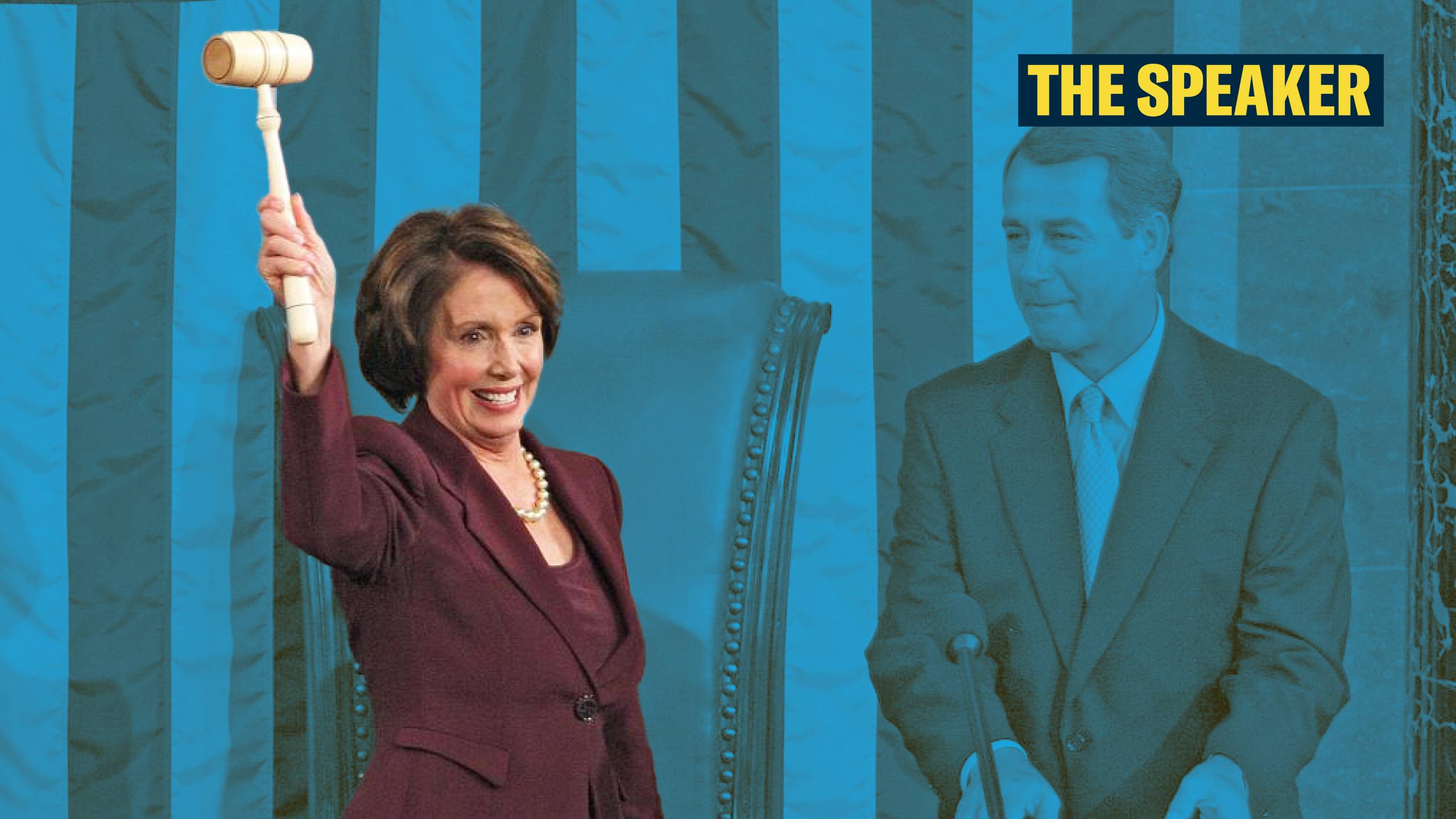
Scott Shafer: On January 4, 2007, holding one grandchild and surrounded by others, Pelosi was officially elected speaker. Republican leader John Boehner graciously handed Pelosi the gavel and history
Nancy Pelosi: Mr. Speaker, I accept this gavel in the spirit of partnership, not partisanship. Before we move forward, because there’s so many children here and so many of them asked me if they could touch the gavel, I wanted to invite as many of them who wanted to come forward to come join me up here. I know my own grandchildren will. There it is.
Nancy Pelosi: We’re here for the children, we’re here
Scott Shafer: For the children would be Nancy Pelosi’s mantra.
Nancy Pelosi: I know that sometimes I have to take a punch and sometimes I have to throw a punch for the children, for the children.
Scott Shafer: The stars had finally aligned for Baltimore’s favorite daughter. Both her parents lived long enough to see Pelosi elected to Congress. They died before she became the most powerful woman in U.S. Politics ever. But their influence was undeniable. Little Nancy D’Alessandro had become the speaker.
Nancy Pelosi: Well, the power of the speaker is awesome. There’s nothing to compare to that. It’s the second highest president, vice president. Let me feel your pulse.
Scott Shafer: Nancy Pelosi and her fellow Democrats had seized power, but she’d soon find out the difference between winning
Nancy Pelosi: We’ll climb the fence. If that doesn’t work, we’ll pole vault in. If that does not work, we’ll parachute in. But we’re not letting anything stand in our way.
Scott Shafer: Did you believe it?
Nancy Pelosi: Yes, I was determined we were going to get this done.
Scott Shafer: And govern it.
Zeke Emanuel: The system is falling apart, costs are going up, people are getting pissed off.
Mick Mulvaney: If you think your healthcare is great now, just wait until the government runs it for you.
Rahm Emanuel: A lot going on. Thank you. You’re giving me PTSD right now.
Scott Shafer: That’s coming up next on The speaker.
Scott Shafer: The Speaker is a production of KQED in San Francisco and distributed by NPR. It’s hosted and reported by me, Scott Shafer. It’s reported and produced by Ariella Markowitz. It’s edited by Padmini Raghunath. Final mix and sound design by Christopher Beale. Fat-checking by Mark Betancourt. Additional editing from Anna Susman and Jen Chien, KQED’s director of podcasts. Original theme song composed by Cedric Wilson. Additional music from APM. Maha Sanad is KQED’s podcast engagement producer. Ethan Toven-Lindsey is KQED’s editor in chief. Special thanks to our partners from the Oral History Center at the University of California, Berkeley. Some members of the KQED podcast team are represented by the Screen Actors Guild, American Federation of Television, and radio artists, San Francisco, Northern California, local.