The Ultimate Insider
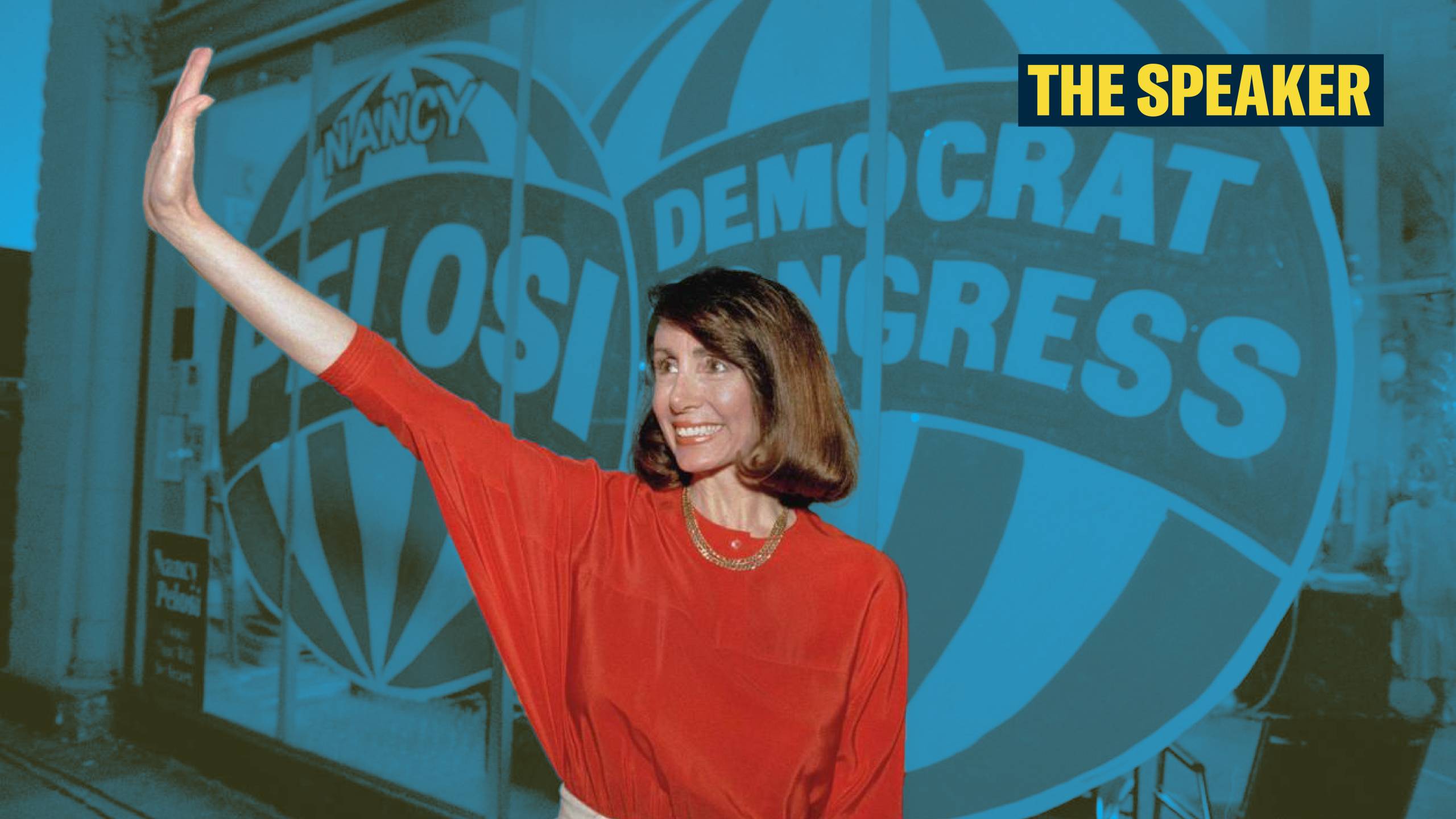
Before her historic Speakership, even before she got to the House of Representatives, Nancy Pelosi worked for years outside the spotlight as an official in the California Democratic party while she raised her family in San Francisco. That was until 1987, when tragic circumstances led her to do something she hadn’t considered before: run for Congress. Her first hurdle? A city in crisis and a motivated opponent from a community impacted by a deadly epidemic.
Episode Transcript
This is a computer-generated transcript. While our team has reviewed it, there may be errors.
Scott Shafer: Hi, I’m Scott Schafer. I’ve been covering politics for nearly 30 years, especially here in San Francisco. As a reporter, I’ve watched a lot of people rise from San Francisco into the national arena. Gavin Newsom, Kamala Harris, Dianne Feinstein. But no one has fascinated me more than Nancy Pelosi, trailblazer, power broker, lightning rod, first woman ever speaker of the house.
KQED 1987 Debate Package: Tonight on Express, the campaigning has been intense.
Scott Shafer: I remember watching her way back in 1987. That was the first time she was running for Congress here in San Francisco.
KQED 1987 Debate Package: We do have 14 candidates here, so can we keep this discussion on an even scale?
Scott Shafer: This is from a televised debate hosted here at KQED, the public media outlet where I work. All the candidates are sitting on risers, lots of poofy, teased hair, wide-framed glasses, and Pelosi is in the front row, perfect blowout, wearing a purple blazer. [00:00:57][15.8]
KQED 1987 Debate Package: I think this is the most hilarious thing that a woman can come into this district from outside of it and buy this election.
Scott Shafer: [00:01:04] Pelosi’s critics, mostly other Democrats, call her a wealthy socialite. They say she’s the establishment pick.
KQED 1987 Debate Package: And what we have is we have, in this election, somebody saying, the machine backs me, I’ve got a million bucks, I don’t live in your district, I have never met many of your slobs, but I’m going to be your new leader because I got bucks and I’m powerful.
KQED 1987 Debate Package: How can she relate to people like me a single-parent working mother?
KQED 1987 Debate Package: Let’s let Nancy talk.
KQED 1987 Debate Package: I don’t think you have to be sick to be a doctor or poor to understand the problems of the poor. I have spent my life committed to the ideals of the Democratic Party.
Scott Shafer: It’s an interesting moment, Pelosi turns their argument around, saying that she’s the right candidate precisely because she’s been working behind the scenes. She knows the game inside out.
KQED 1987 Debate Package: I believe that I will be the best and most effective representative for San Francisco because I have worked in that arena for 25 years, both at the local, state, and national level. I have work with the members of Congress long before they went to Congress and long since. I have persuaded them on votes, both by one-on-one persuasion and by mobilizing in their districts.
Scott Shafer: Last year, Pelosi announced she was retiring. As a journalist, I started thinking about how she went from being relatively unknown to one of the most formidable politicians of her generation, and about the role she’s played leading up to this political moment, a moment where faith in the Democratic Party and public trust in U.S. Institutions are at their lowest in decades. And she agreed to talk, a series of five interviews. Okay, we’re gonna put you right there I wear the red light.
Nancy Pelosi: Unfortunately, this is not visual because I got off the plane.
Scott Shafer: Our first interview, she had just gotten off a cross-country flight, she was also nursing a cold, but I knew how to get things started on the right foot.
Nancy Pelosi: I’m glad I’m seeing that. I’m going to go right into it, okay? I think I should test them.
Scott Shafer: Nancy Pelosi is kind of a tough interview. I’ve done it many times before, usually about a political issue. She’s always warm and gracious until you ask something that annoys her and then she lets you know it.
Nancy Pelosi: I don’t feel that way at all. I don’t even know why you’re asking that question.
Scott Shafer: She can be loyal to her talking points. Frustrating. How do you want people to remember your legacy?
KQED 1987 Debate Package: Not so fast on the legacy. We have to win the house, which we will do.
Scott Shafer: She’ll completely deny the premise of your question.
Nancy Pelosi: No, I didn’t oppose it for many years. I posed it when they suggested it, and then Kalka said they won it and I supported it.
Scott Shafer: But I figured this is the time, right now, before she leaves office, to really reckon with the force that is Nancy Pelosi. From KQED, this is The Speaker, how Nancy Pelosi changed the face of power. This is the inside story of her rise and what she did when she got there, as told by the people who were in the rooms where it all happened.
Anna Eshoo: Nancy always would talk about winning and how to win. I said, Mr. President, we’re so excited about doing health care, but understand this, it’s going to be carpet bombing, take no prisoners, you name it, total warfare.
Rahm Emanuel: She is comfortable with power and exercising it. Nancy exists in the arena.
Mick Mulvaney: I’ve often described it with a little bit tongue-in-cheek, because I’m not going to accuse anybody. I want to make clear here that I’m not slandering anybody, I’m not accusing anybody of any criminal activity, but she reminded me of a mafia boss. That’s how she ran the place.
Nancy Pelosi: They were going to get a bullet in my effing brain. You know, they used the F word a lot about me throughout the whole thing. They were gonna hang Vice President Gallows for him.
Scott Shafer: Today, how Nancy Pelosi got to Congress. She had been the ultimate insider, working for years as a high-up official in the Democratic Party, forged by San Francisco politics. But also an outsider, a woman, a mother of five kids, behind the scenes. Had you not ever considered running with her?
Nancy Pelosi: I had zero interest in running for office. Why? It was like, did you not want to go skydiving? I didn’t even think of it. I loved public service, and I was the ultimate volunteer, the chair of the California Democratic Party.
Scott Shafer: There she was, diligently working behind the scenes, until a twist of fate tested what she was made of. Nancy Pelosi never planned to run for public office, but in 1987, San Francisco’s congresswoman, Sala Burton, was dying. She was a big woman. She was, like, shrunk up on cancer. That’s John Burton, Sala’s brother-in-law, part of the family’s political operation. Let me set the scene here. The congresswoman is on her deathbed. She hasn’t yet endorsed a successor, but her endorsement is priceless. Her family has held this seat since the
John Burton: She calls the group of us back to her hospital bed, where she’s just like, and she tells us, I’m not going to run again. I’d like you to support Nancy Pelosi. She starts going into Nancy Pelosi, she’s operational. She’s right on the issue. She says, she said, he said, and I walk out, she says, is she bullshitting or what?
Scott Shafer: John Burton didn’t see Nancy Pelosi as a candidate. She was the Democratic fundraiser, organizer, behind the scenes. But Sawa saw it.
John Burton: Something else. She saw in Nancy Pelosi a tough, strong, determined, liberal, caring for people person. I mean, it was just, I walked out and I said, holy my God.
Nancy Pelosi: She said to me, I’m going to ask you if you will run for my seat, and I need to know your answer now.
Scott Shafer: Pelosi told Salah she had to check with her family first. She had five kids. By 1987, only one was still living at home.
Nancy Pelosi: My daughter Alexandra, she says, mother, what teenage girl does not want her mother out of the house three nights of the week? Then she said, get a life.
Scott Shafer: Maybe her youngest daughter didn’t really see it, but Pelosi definitely had a life. She moved her family to San Francisco in 1969, just a couple years after the Summer of Love, a time when the city was home to artists like Janis Joplin and the Grateful Dead, Jefferson Airplane. Pelosi was hardly a member of the counterculture, but insists she loves the Gratiful Dead. For those first few years, she had her hands full with the kids.
Nancy Pelosi: Especially, I have five and six years to have to understand. Sometimes I didn’t even wash my face. Being a mom is probably the best preparation for anything because you are multitasking all of the time.
Scott Shafer: But politics was in her DNA. She’d grown up in a political family. Her dad became the mayor of Baltimore when she was just seven. San Francisco is her husband Paul’s hometown. The year they moved back, his brother Ron was on the board of supervisors. They lived down the street from San Francisco mayor Joe Alioto.
Nancy Pelosi: When people came and saw our house, they would say, oh, this is a big house. We’ll have lots of political events here.
Scott Shafer: And you did.
Nancy Pelosi: And we did. How do you turn people down then? And my kids were so cute as they were getting a little bit bigger, they were making the hors d’oeuvres and serving the hors-d’oeuves and the rest of that.
Scott Shafer: She started taking on more political stuff, organizing volunteers, hosting candidates in her home, raising money. She became a prolific fundraiser for Democratic candidates. In 1976, California Governor Jerry Brown decided to run for president. A left coast challenge to Jimmy Carter.
Jerry Brown: Ten years of problems in Vietnam and Watergate and all the scandals you read about in the FBI and the CIA. I think people, I think the people are ready for a new generation of leadership.
Scott Shafer: Brown entered the race pretty late in the game, but Pelosi used her Baltimore political connections to help him win Maryland’s Democratic primary. Here’s another candidate, Barbara Mikulski. Pelosi helped her win a Senate seat.
Barbara Mikulski: [00:09:44] I was out there going earring to earring with Linda Chavez. She had Ronald Reagan, and I had Nancy Pelosi.
Scott Shafer: By 1981, Pelosi was chair of the California Democratic Party, in charge of getting Democrats elected all across the state. She had a reputation for being relentless, but she was also known for her personal touch. When Nancy talked to you, you felt like you were the center of the world. That’s Art Agnos, a former mayor of San Francisco and also, by the way, my ex-boss. I worked on his staff from 1986 to 1992. That was before I became a reporter for KQED in 1998. Anyway, Art remembers going over to Pelosi’s house for dinner back in the 70s. He was just a staffer himself back then. She invited us to her home for dinner with Leo, who was the main person. Art’s talking about Leo McCarthy. McCarthy was the speaker of the state assembly. That’s California’s version of the House of Representatives. She made sure that…
Art Agnos: I brought my kids? No one ever said bring your kids. Pelosi even had her kids babysitting his kids, taking them upstairs to the bedroom, playing games. Her kids are taking care of my kids. I was the staff guy. She generated a kind of loyalty and love from my family that came from her attentive, thoughtful, sweet interest in us.
Scott Shafer: This is what Sala Burton saw in Nancy Pelosi, according to Art.
Scott Shafer: Sala Burton anointed Nancy Pelosi to be her successor. After she died on February 1st, there would be a primary just two months later, in April, to pick the top candidate for each party. So now the race was on. Sala’s brother-in-law, John Burton, would run Pelosi’s campaign and they would use the Burton playbook.
Phil Burton: No person is an island under themselves. We all need each other and we’ve got each other, I promise you that.
Scott Shafer: That’s Phil Burton, John’s older brother, Sal’s husband, a chain-smoking giant in San Francisco politics. The Burton political machine specialized in something that seems pretty standard today — coalition politics. They mobilized groups other politicians overlooked.
KQED 1987 Debate Package: Their coalition was gay. It wasn’t LGBT as it is today, but you know, it was, it wasn’t called that. Gay, African-American, labor.
Scott Shafer: Phil Burton put it a little differently.
Phil Burton: I’ve got the support of the gays and the cops as well, ain’t that a bitch?
Willie Brown: We ran everything at that day’s game. We were the most diverse operation politically in this city, period. And Nancy was a part of that.
Scott Shafer: That’s another former San Francisco mayor.
Willie Brown: I’m Willie Brown, period. I was part of Phil Burton’s operation. What do you remember about her? Well, I just remember that she was a very attractive woman. Oh, very opinionated, I must say.
Scott Shafer: She sort of had an unlikely friendship with John, who once accidentally left cocaine in the pocket of a suit he sent to the dry cleaners.
Willie Brown: In the drinking world. John was all the things that you wouldn’t even think Nancy would know about. But they had a friendship.
Scott Shafer: Close with the Burtons, raised campaign funds for them, but she also helped their rivals within the party.
Willie Brown: I’m telling you.
Scott Shafer: She had her whole body in both camps.” Her campaign chose the slogan, a voice that will be heard. Her campaign promised all the other candidates could talk, but with her connections and her experience, she would be the most effective at doing things in Congress.
Willie Brown: It was not like she was going to be the next Jesse Jackson. No, Nancy was the pro who was going to help orchestrate the process.
Scott Shafer: She pulled together a team of field captains who had experience with the United Farm Workers Union to set up her ground game. An army of volunteers knocked on doors, made phone calls, staffed campaign events and signed up other volunteers to get out the vote on election day. At one point, Pelosi’s brother Tommy came to visit campaign headquarters in San Francisco. He’d been the mayor of Baltimore just like their father.
Nancy Pelosi: And he said, Daddy sent me to make sure that you had your ground game in place. So I said, well, come see what it is.
Scott Shafer: On sheets of butcher paper, Pelosi and her team had mapped out the strategy in true Burton fashion. They had divided up the city into factions and were seeing how they could make a winning coalition, gaming out worst-case scenarios.
Nancy Pelosi: Every black vote, Asian, gay vote, the lefties, if we give them every possible vote, not that they would get every possible, Nancy loses by a couple thousand votes. We have sent our troops out to get 5,000 more votes.
Scott Shafer: Their team sent targeted mailers to different communities—Italian, African American, gay—and they quietly slipped some to Republicans. John Burton again.
John Burton: I’d go to things with her, go to that, and just watch her. One time some group was kind of screwing over her and walked out and she says, don’t worry, we will show them how truly unimportant they are after the election.
Scott Shafer: But, she wasn’t going to take a single vote for granted. Before she ran for the House in 1987, Pelosi had run in one other election inside the party for chair of the Democratic National Committee. That’s the group that coordinates strategy, establishes the Democratic Party platform. She lost. And she learned a lesson she never forgot.
Nancy Pelosi: I had done everything in the party and worked with many people. People that I had worked with forever were making terrible statements about me.
Scott Shafer: Pelosi said she was the target of all sorts of attacks, including sexist ones.
Nancy Pelosi: So when I ran for Congress, and people would call me and say, did you see what someone so said? I said, yeah, don’t bother me with that. If you’re concerned about that, get on the phone and make some calls, walk some precincts, but don’t think I care about what somebody else says. And I would not have realized that had I not seen how Democrats treated Democrats when I run for the other office.
Scott Shafer: Democrats against Democrats, a knife fight in a phone booth. That’s what Pelosi was entering in the primary. Against a motivated opponent fighting for a city reeling from a deadly epidemic.
KQED 1987 Debate Package: Where did it go?
Scott Shafer: This is an old news clip from 1987. A singer charms a crowd with a famous Judy Garland cover.
KQED 1987 Debate Package: Politics in San Francisco, a fundraiser in a cabaret that caters to gays. At this event, the candidate is gay as well, Democrat Harry Britt.
Scott Shafer: The bar is packed with gay and lesbian supporters. The sign at the door reads, We’re just wild about Harry Britt.
KQED 1987 Debate Package: While he would be a political outsider elsewhere in the country with his progressive agenda, he fits in easily in San Francisco. Liberal credentials are essential.
Scott Shafer: Harry Britt was a San Francisco supervisor and Nancy Pelosi’s toughest rival. He was soft-spoken, with a serious tone, kind of an intellectual, a little socially awkward.
Harry Britt: I’m from Texas and I come from a family of Southerners. I was a Methodist minister for a major part of my life and that was
Scott Shafer: That was Britt in a TV interview. He never intended to run for office. Like Pelosi, he was more behind the scenes. In 1977, he volunteered to help elect Harvey Milk to the board of supervisors. Milk was the first openly gay person elected in California.
Harvey Milk: There are 15 million lesbian and gay men waiting to hear your voice! We are coming out of the closet! When are you going to come out of yours?
Scott Shafer: The next year, Harvey Milk was assassinated, along with the mayor at the time, George Moscone. The killer was Dan White. He had been on the board of supervisors with Milk. A year before he died, Harvey milk made a recording. A list of people he would want to replace him if he were assassinated. And who was on that list?
Harvey Milk: The third choice I would have would be Harry Britt, who most people don’t know, but I’ve watched Harry, and Harry’s been involved with three campaigns, and I’ve watched Harry grow and grow and grow, and a very, very dedicated and strong person. One who will not be pushed around. One who understands where the movement is and where it must go.
Scott Shafer: Harry Britt again.
Harry Britt: Harvey’s gone, but all of us who cared about him and the things that he stood for realize now that it’s our job.
Tom Ammiano: The murders unified, made us cohesive, and that translated into political muscle.
Scott Shafer: Tom Amiano was active in the gay rights movement, friends with Harvey Milk, and Harry.
Tom Ammiano: Harvey was very charismatic and out there, and Harry was just a steady, even presence.
Scott Shafer: In the early 80s, the community was still reeling from the assassinations, and then another deadly threat emerged.
Tom Ammiano: AIDS was rampant. Every day somebody died. Every day you saw somebody with purple splotches or you’d say, hey, what happened to Michael? He was supposed to show. You didn’t hear, he died.
Scott Shafer: I moved to San Francisco in 1981, just as some gay men started coming down with some unusual symptoms. Thrush or yeast infections in the throat that wouldn’t go away, fungal infections in the lungs, lesions on the skin, weight loss. Doctors didn’t know why, but soon they were dying. As the casualties mounted, so did the fear. There was no test for the virus yet. We didn’t even know it was a virus. Many of us were worried, afraid we had this ticking time bomb inside of us. But there was nothing to do but be careful and wait. It escalated quickly. By 1984, it became common to see people with full blown AIDS emaciated, looking old beyond their years, covered with purple splotches, Kaposi sarcoma. We’d see men who looked to be at death’s door, slowly walking or shuffling around the Castro neighborhood. There were funerals, lots of funerals, many for people in their 20s, 30s, and 40s. It was a slow motion disaster. But it seemed no one in Washington cared. Harry Britt again.
Harry Britt: So I think it’s legitimate for us to point out that the people who care the most about AIDS and certainly the gay community which cares in a passionate way about AIDS is very united behind my candidacy.
Scott Shafer: These were the stakes of the 87th Special Election. In that Congressional race, many saw Harry Britt, not Pelosi, as the champion the gay community needed in Washington. It was also a chance to make history.
Gwenn Craig: It was beyond who’s Harry Britt, it was beyond whose Nancy Pelosi. It was that we might get an openly gay member of Congress.
Scott Shafer: That’s Gwen Craig. She came to San Francisco in 1975. She worked closely with Milk and would become involved in Harry Britt’s campaign.
Gwenn Craig: The nonchalance, it seemed, of Congress and the executive administrations just was maddening.
Scott Shafer: The CDC first published an article describing five young gay patients in Los Angeles whose immune systems suddenly failed in 1981. But President Reagan didn’t publicly address the crisis for four years, only then because he was asked about it. By 1987, nearly 2,000 San Franciscans had died of AIDS. I remember a lot of people in the gay community thought that Pelosi, a wealthy, straight, white woman, wasn’t the best person to fight for them in Washington. The Brit campaign didn’t hold back. Here’s one ad they ran.
Archival Ad: Inspector Riley, Missing Person Squad. Yeah, we’ve heard that report. No, we haven’t seen Nancy Pelosi. That’s why she’s a missing person. Nobody has seen Nancy.
Scott Shafer: Britt’s campaign sent out mailers calling her a dilettante.
Nancy Pelosi: Most people didn’t know what that meant.
Scott Shafer: Pelosi again.
Nancy Pelosi: And they said, does that mean you’re a debut talent? Aren’t you old to be a debut? They did one piece.
Gwenn Craig: Call that referred to Nancy Pelosi as party girl because she came from being head of the Democratic Party.
Scott Shafer: Gwen Craig again, Lesbian Activist.
Gwenn Craig: I didn’t like that piece at all.
Scott Shafer: What was it that you didn’t like about it?
Gwenn Craig: Well, I thought it was rather misogynist. You know, I though it was sexist. I thought that it belittled her in a way because of her gender. So I became then uncomfortable with my support of Harry for a while after that.
KQED 1987 Debate Package: They warned us it would be brutal, and it would a bloodbath, and I’d be sorry I ever got in the race, but I wasn’t frightened by any of that.
Scott Shafer: Pelosi did something in 1987 that she rarely does. She agreed to a televised debate a week before the election, right here at KQED. Pelosi was the front-runner. She had a lot to lose.
KQED 1987 Debate Package: Nancy Pelosi, a Democratic Party insider, runs ahead in recent polls.
Scott Shafer: Harry Britt was close on her heels. In addition to being part of the gay movement, he was a democratic socialist. He believed in challenging corporate power structures, and once tried to rein in wealthy landlords with commercial rent control.
KQED 1987 Debate Package: A gay activist who is to the left of his chief opponents.
Scott Shafer: Just before the debate, Pelosi’s campaign threatened to pull out. Her staff was worried the other candidates would gang up on her.
KQED 1987 Debate Package: Calm down a little bit.
Scott Shafer: It was a free for all, with all 14 candidates left, right and center. It made for great live television.
KQED 1987 Debate Package: Mr. Zur, this is not a forum for you just to make a speech. At this point in this discussion, we are—you’ve got a lot of words in.
Scott Shafer: The moderators asked if her critics were right, that she was out of touch.
KQED 1987 Debate Package: But there are a lot of people who seem to be disturbed by, I guess, where you come from. The idea of your wealth and your connections among the well-to-do.
Scott Shafer: And Harry Britt questioned whether she could be trusted to fight for everyday people.
Harry Britt: How can you be an effective advocate for consumer issues like keeping interest rates low on credit cards when you’ve gotten money from banks and savings and loan associations? How can really fight to get oil companies to clean up toxic waste when you got money from Chevron and Getty and all these people? I challenge Nancy Pelosi who has never had to stand up to that kind of pressure.
Scott Shafer: Based on available campaign finance records, we couldn’t verify if Pelosi took money from Chevron for her campaign. But members of the influential Getty family, her family friends who made their fortune in oil, did donate $5,000 to her congressional campaign. But Pelosi pointed her finger and returned fire.
KQED 1987 Debate Package: Harry, have you taken any PAC money? Have you taken a PAC money. I have not taken any money. Any PAC money, have any you taken PAC money
Scott Shafer: Britt’s campaign was mostly grassroots funded, but Pelosi? Her campaign spent around a million dollars, more than the other 13 candidates combined. Pelosi also self-funded, giving more than $200,000 to her own campaign.
KQED 1987 Debate Package: How can she relate to people like me, a single parent, working mother, or somebody else?
Scott Shafer: Another candidate, San Francisco City Supervisor Carol Rue Silver, jumped in.
KQED 1987 Debate Package: Problems are different. She’s never met a payroll. She has never had to worry about child care. She has not had a kid in a public school. She never worried about the things that worry most of the people in San Francisco.
KQED 1987 Debate Package: Let’s let Nancy answer.
KQED 1987 Debate Package: First of all, my ability to fund my own campaign to the extent that I can and to raise money over 1,500 contributors to my campaign gives me an independence that none of my candidates, I believe, share, especially the four supervisors who were reported this week to have received $1,000 each from the Embarcadero Center and then voted to give them a street this week. So if you want to talk about independence, let’s talk about Independence.
Scott Shafer: Pelosi knew that she needed to do something to neutralize the idea that she was beholden to wealthy interests. So she counterpunched by saying to her opponents, well, you’re not exactly pure either. According to federal campaign fundraising data, each of the four city supervisors did receive a thousand dollar contribution from the CEO of the Embarcadero Center. That’s a set of high-rise office buildings downtown. We couldn’t verify the claim that he got a favor in return. But she’s doing something here by implying that. She’s undercutting them. It’s a classic campaign tactic, pointing out the hypocrisy in your opponent’s charge. After the primary, that same CEO gave $1,000 to Pelosi’s campaign for Congress. That’s politics. Pelosi has always argued that the PAC money she took was from Democratic allies who cared about regular people.
KQED 1987 Debate Package: Labor unions, from the Nurses Association, from organizations dedicated to the election of women to Congress.
Scott Shafer: To her, raising money was just a means to an end. This was the late 80s. Money was changing politics as we knew it, and Pelosi was going to do everything she needed to do to win. You didn’t take any of that personally.
KQED 1987 Debate Package: No, I mean it’s a campaign. What do you expect?
Archival: There was a special election here in San Francisco today to fill a congressional seat left empty by the death of congresswoman Sala Burton.
Scott Shafer: As the election got close, Pelosi had dropped in the polls, so election day was a nail-biter. Britt needed a big turnout in the predominantly gay Castro neighborhood, and he got that. But in the end, he could not overcome Pelosi’s ground game.
Archival: And here in San Francisco, the Democrat Nancy Pelosi defeated Harry Britt, a city supervisor who is gay.
Scott Shafer: Under rules for special elections like this one, the top contender from each party would move on to a runoff in June. Britt was out. Gwen Craig and Tom Amiano again.
Gwenn Craig: People took it pretty hard. They were really disappointed, because I think a lot of people thought, we’re gonna actually get an openly gay person going to Congress. That’s going to be such a huge step forward.
Tom Ammiano: We’re all in a little bit of despair. You know, who is this woman? What does she know?
Scott Shafer: After she won the primary, Pelosi called a meeting with AIDS activists.
Tom Ammiano: It wasn’t milquetoast ones, you know, it was angry ones. And they met with her. And I’m not saying that the reaction was 100% positive. I know that she shed some tears and I’m sure that they were sincere. But to the hard-bitten, we didn’t want tears.
Scott Shafer: Britt wasn’t the only person who understood the magnitude of the crisis. Pelosi also knew people who died of the disease, family friends, political staffers, people in her community.
Nancy Pelosi: People were dying and I was visiting people in the hospital that we were close to and they were robust young men out there and then they were like a bag of bones in the hospitals, a bag a bones.
Scott Shafer: During the election, Pelosi had also promised action on AIDS.
Archival: We want to stop spending money on a big defense budget and instead address it to the most important crisis of our time, the AIDS crisis.
Scott Shafer: In the runoff, Pelosi easily defeated the Republican. She was on her way to Congress.
Archival of Pelosi’s Swearing In: Without objection, the gentlewoman from California is reckoned.
Archival of Pelosi’s Swearing In: Thank you very much for your kind remarks and to all of you. It’s a very sentimental day for me as you can see.
Scott Shafer: When a new member of Congress is first sworn in, it’s kind of rare for them to say anything of note, let alone something controversial. But on that day, in June of 1987, Pelosi, sounding a little nervous, surprised everyone.
Archival of Pelosi’s Swearing In: And now we must take the leadership, of course, in the crisis of AIDS, and I look forward to working with you on that.
Scott Shafer: Now Brit’s supporters would have to put their faith in the person who defeated him.
Scott Shafer: On a foggy morning in 1989, protesters unfurled a banner across the Golden Gate Bridge reading AIDS equals genocide, silence equals death, calling out the newly elected president and former Vice President George H.W. Bush.
Scott Shafer: They blocked traffic for more than an hour.
Mike Shriver: I was one of the persons that sat on the bridge on January 31st, 1989.
Mike Shriver: It was so cold.
Scott Shafer: Since 1988 Mike Shriver had been organizing with act up a direct action group focused on AIDS.
Scott Shafer: During Pelosi’s first full term in Congress, the deaths continued unabated. There was no vaccine, no cure, limited treatment. So people took to the bridge.
Mike Shriver: It’s one of the proudest moments of my life, actually. And as we were being pulled one person at a time to being arrested, my mentor, he said to me, if I could feel the way that I feel right now, I will live forever. I will survive the epidemic.
Scott Shafer: By 1988, Shriver and his peers had started focusing on how to change policy.
Mike Shriver: This whole cadre of ACT UP individuals taught themselves how to become experts in research, experts in policy, experts in drug development. I happened to go down the track of the public health policy stuff.
Scott Shafer: He remembers a meeting with Nancy Pelosi. He was there with someone who needed access to an experimental AIDS treatment.
Mike Shriver: I got to sit there in the room and he talked to Mrs. Pelosi and he said, I didn’t vote for you, but you’re my representative and I expect that you’ll take care of me. And she looked him deadpan and said, absolutely, that is my job.
Nancy Pelosi: It was our purpose. That’s just the way it was. It wasn’t like, I really hope you will do this. This is absolutely urgent that you do this.”
Scott Shafer: When I asked Pelosi about her support for AIDS funding, she was very matter of fact about it. To her, it seemed like a no-brainer.
Nancy Pelosi: Was not prepared for discrimination. Now these people were not anti-gay, they just thought the rest of the room was.
Scott Shafer: For sure, Pelosi had solid allies, like California Congressmembers Barbara Boxer and Henry Waxman from Los Angeles. But they faced opposition because of the stigma of AIDS. And then activists had an idea.
Nancy Pelosi: Cleve Jones came to my house with Art Agnos when I’m a newly elected member of Congress and says he has this idea that people will make a quilt for their loved ones.
Scott Shafer: Cleve Jones was a young activist who had worked for Harvey Milk. He later went on to mobilize the community to respond to HIV AIDS and co-created what became known as the AIDS Memorial Quilt. Tens of thousands of panels, handcrafted with care, by mothers and fathers, brothers, co-workers, friends, lovers and spouses, sewn into three by six foot panels. Panels for everyone, from musicians like Freddie Mercury of Queen and Sylvester. To political activists and artists like Keith Haring and Robert Mapplethorpe, to others who lived quieter lives but whose death crushed those who loved them. Jones had a vision. He wanted to spread huge sections of the quilt out on the National Mall in Washington.
Nancy Pelosi: Enormous quilts, enormous, big as the mall. Pelosi was on board to help bring the quilt to DC, but there was a hitch.
KQED 1987 Debate Package: The National Park Service says, we’ll give you a corner where you can have a few patches. Can you imagine? So I said, well, they’re certainly not gonna do that.
Scott Shafer: She asked the National Park Service, why can’t we display the full quilt?
Nancy Pelosi: It’s gonna kill the grass, but why? Because if you have something on the grass for more than 20 minutes, it kills the grass.
Scott Shafer: Pelosi had an idea.
Nancy Pelosi: We have hundreds of people, we can pick it up every 20 minutes.
Scott Shafer: The National Park Service caved, and on October 11, 1987, the AIDS quilt was first displayed in Washington, D.C.
Nancy Pelosi: It was so beautiful.
Archival – AIDS memorial quilt: Bill Cathcart. Bob Greenwood.
Scott Shafer: Across the National Mall, the names of the fallen echoed as Cleve Jones read some of them. I was there then.
Archival – AIDS memorial quilt: Douglas Lowery.
Scott Shafer: Pelosi was one of the few members of Congress there. Even then, she was laser-focused. She told a reporter for GayUSA…
Nancy Pelosi: Now, the first day I…
Nancy Pelosi: Became a member, I became a co-sponsor of the Gay Civil Rights Bill, Ted Weiss’ bill, and we have a few pieces of legislation regarding AIDS, more money for AIDS, confidentiality, non-discrimination.
Scott Shafer: At a time when HIV AIDS still felt like a death sentence, Nancy Pelosi helped change the prognosis. Pelosi co-authored the Ryan White Care Act. Ryan White was a teenager from Indiana who had hemophilia. He got AIDS from a medical treatment. After his diagnosis, his school banned him from attending class. To some lawmakers, White was someone they could help without worrying about attacks by religious zealots who thought AIDS was God’s punishment of gay men and IV drug users. Pelosi understood this. Former San Francisco Mayor Art Agnos again.
Art Agnos: She looked like the all-American woman. She was, she is beautiful. She had lovely kids, she had a handsome husband. What the hell is she doing with these weird people? When she showed up, she looks like us. How come she’s talking like that? And I think that gave her a entree to discussing AIDS, gay people, all the kinds of issues that are important to us in San Francisco. They listened because she looked like them.
Scott Shafer: The Ryan White Care Act passed in 1990. It created a financial safety net for people with HIV who were underinsured. She also helped push through a bill that allocated funds that people with HIV could use for housing.
Mike Shriver: I got to go with her, and I’m sitting there watching her work.
Scott Shafer: That’s the conference between the House and Senate that divides up government funding. Mike Shriver remembers one instance.
Mike Shriver: The very first year that she got the most significant increase for HIV prevention was a year that a senator from Pennsylvania looked for some money for substance abuse treatment that he needed.
Scott Shafer: That Senator, Arlen Specter, promised Nancy Pelosi he would restore her funding for HIV programs the next year.
Mike Shriver: He made the commitment to her and he did it. For her, you know, you live up to your word. And if you don’t remember your word, I’ll tell you what you told me. And I thought, that’s magic.
Scott Shafer: Mike Shriver lives with HIV.
Mike Shriver: I relied on Ryan White funding for my care and for my dental care and had I not had that, I would not have had access to the drugs that eventually had become what continue to keep me alive and keep me in remission with my HIV disease.
Scott Shafer: So you’re saying she’s the reason you’re still here?
Mike Shriver: I absolutely believe that.
Scott Shafer: There’s this one thing Mike told me that really stuck with me. He was telling me about a text exchange he had with Nancy after a health emergency in 2022.
Mike Shriver: I had just emailed her the day before talking about finishing my IVIG infusion, which took five consecutive days, which just flattened me out. And she wrote back, Michael, loved getting your promising report. Love you, Nancy. A couple of emojis and then thank you. I’m so lucky, I am so privileged. I do not ever underestimate, like I don’t take this for granted. Nancy is not really good about receiving compliments. It’s not her favorite thing to experience and I’ve had to do it a couple of times and realize I know this is gonna piss you off or it’s gonna make you a little bit mad but I need you to hear how important it is of what you’ve done for us.
Scott Shafer: When Pelosi ran in 1987, her slogan was a voice that will be heard. And when Nancy Pelosi became the first woman Speaker of the House
Nancy Pelosi: San Francisco for giving me the privilege.
Scott Shafer: She brought it back home.
Nancy Pelosi: When I ran, my slogan was, a voice that will be heard. I think they’ve heard us.
Scott Shafer: It took nearly 20 years, but Pelosi was on a path to becoming the first woman ever elected House Speaker. Next time on the speaker.
Nancy Pelosi: I don’t see a plan here to win.
Rahm Emanuel: If you win, you get to set the table. Nancy Pelosi’s path to the top.
Barbara Boxer: One of those days on the plane, we were talking about, what is your dream in politics? And she said, I want to be Speaker of the House.
Scott Shafer: You had to have some chutzpah at that point in her career to say I want to be speaker.
Barbara Boxer: Chutzpah doesn’t begin to describe it. It was impossible.
Scott Shafer: The Speaker is a production of KQED in San Francisco and distributed by NPR. It’s hosted and reported by me, Scott Shafer. Co-reported and produced by Ariella Markowitz. It’s edited by Padmini Raghunath. Final mix and sound design by Christopher Beale. Additional mixing by Brendan Willard. Fact checking by Mark Betancourt. Additional editing from Anna Sussman and Jen Chien, KQED’s director of podcasts. Original theme song composed by Cedric Wilson. Additional music from APM. Maha Sanad is KQED’s podcast engagement producer. Ethan Toven-Lindsey is KQED’s editor-in-chief. Special thanks to our partners from the Oral History Center at the University of California, Berkeley. Some members of the KQED podcast team are represented by the Screen Actors Guild, American Federation of Television, and radio artists, San Francisco, Northern California Local.