This piece was featured first on Jul 30 for One Good Thing, a weekly newsletter brought to you by Alexis Madrigal about his take on Bay Area art, culture & nature. Subscribe today.
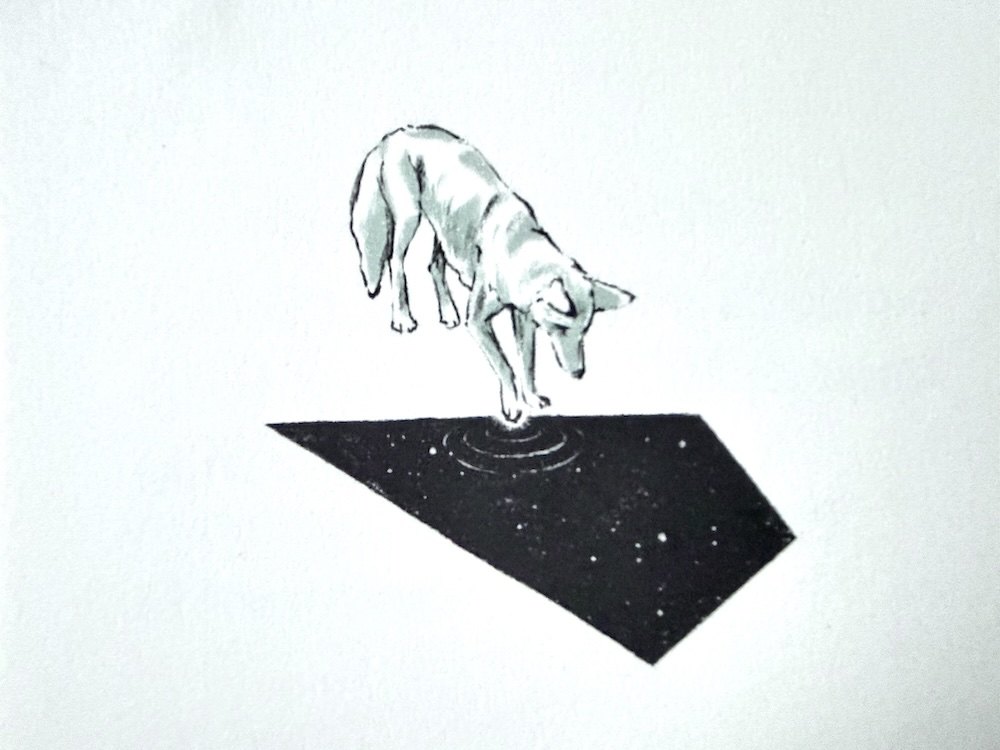
I love when someone is captured by a part of the natural world. For Helen Shewolfe Tseng, it’s been more than a decade since, in her words, she had the coyote “take hold of my thoughts, my work, my life.” Coyotes have infused her artistic practice, and one gorgeous output is her new book, Trickster at the End of a World.
It’s a small book, spiral bound on the top, containing probably fewer than 2000 words. The cover is matte black with a the shape of a coyote cut out of it, revealing something below. It turns out to be a grayscale landscape recalling simultaneously a field in the moonlight (black sky) and the moon itself.
In a sense, this book documents Tseng’s search for coyotes during a residency at the Headlands Center for the Arts in the Marin Headlands. But it is not just about that. Coyotes become, in Octavia Butler’s words, a “positive obsession.” Tseng considers them from many angles. Of course, the role of coyotes in the indigenous cultures of North America gets respectful attention, but the coyote wanders right out of that narrative and into her own. “In coyotes, I see threads of a story familiar to me,” she writes. “Our ancestors surviving the ends of their worlds, journeying long distances to strange new lands, settling in the margins and carrying on within limitations.” Mythologies merge and blur, held together by these gorgeous drawings of coyotes playing with shards of the night sky.
The physical search is important. She attempts to attune to the coyoteness of the landscape, how these animals might inhabit a place. She largely fails. “My senses are deeply lacking here, having grown accustomed to screens, high resolution images, on-demand search. I am out of my element, and I feel it in my pores and tendons,” Tseng writes. “I am overwhelmed by the land, by the vastness of space and the limitations of time.”
But coyotes lead Tseng into other, more mysterious spaces, psychedelic and ancestral. “Tricksters open portals to sacred realms and spiritual experience,” after all.
Brilliantly, she links our modern understanding of the more-than-human world as a realm for extraction with the deadening and flattening of our inner worlds. “Modern disenchantment of the natural world has been draining our land of its spirit and agency, transforming it into a resource to be depleted,” she writes. “I realized that I had been doing the same, starving my internal landscape into a colorless place of pure utility, one fearful of uncertainty and closed to magic and mystery.”
I will not complete the arc of her book here, but see if you can track down a copy from Sming Sming Books. I got my copy at the SF Art Book Fair last weekend (I told you to go!). Sming Sming might be the coolest art book publisher out there. Vivian Sming is a genius. Using the art book tools, it’s fairly easy to make something that looks cool, that you buy once for the aesthetic and never look at again. Sming has an eye for projects that do more, that are worlds unto themselves.
I’ve now read Tseng’s book twice, taken it in, and it has sent me back into my own memory of coyotes under the night sky.
There I was, running through Strawberry Canyon. A beautiful, warmish night (July 28 last summer, if you must know). I was training for a very long run in which I planned to do a chunk of it at night. I needed practice in the dark, and this was it. On the way up the canyon, I’d left my head lamp off for a long time and continued through the gloaming, marveling as my night vision fully kicked in under the slim, dim crescent moon. It was dreamy, gauzy, soft. As the difference between the objects in the world began to dissolve in the fading light, it was as if the boundaries of my own self and the world became fuzzier. Somehow: my vision became more like hearing, overlapping, indistinct. Was I underwater?
But on the way back down, it was fully night-night, and I needed some light. I had to switch on my headlamp, which comes with a tradeoff. You can see what’s in the light cone perfectly (feet, road, bark of nearby trees), but you give up your night vision. Everything becomes bright-bright or dark-dark. It made me jumpy. If all you can see is the center, suddenly the periphery feels unknown, dangerous.
And then the coyotes started to howl. As I recall it, it started with one yip, escalating into immediate pandemonium. Echoing in the canyon, the sounds surrounded me. Were they coming form behind? Uphill? Downhill? Was there a pack awaiting me around the next bend? I was alone out there. A lone. Terrifyingly alone. In that moment, I understood the phrase, “My blood ran cold.” I had thought it was some sort of poetic construction, but no, that is an accurate readout of the experience inside the body.
I absolutely bombed down the hill. My world shrunk down to two facts: the sound of coyotes and the urge to run. I was fully inside their calls, echolocated. All told, it was probably seven, eight minutes out there, but that is a long time to be in a state of pure being. When I emerged into the parking lot, humanity’s domain, I knew something different about what it has been to be a human, the kinds of things our ancestors had to learn and make peace with. I was, to use Tseng’s final words of the book, “alive / with something new.”


Alexis Madrigal, Co-Host, Forum

My Tipline
- PROGRAMMING NOTE! I’m gonna be on vacation for the next two weeks. Send me Montreal recommendations!
- Go see the new documentary about Luis Valdez and El Teatro Campesino!
- Dark Carnival is one of those bookstores that you can’t believe exists… and it is celebrating 50 years of existing this weekend!
- Current musical obsession: Reymour, this duo from the Swiss Alps playing like … dark, angular, minimal synth-pop.
- Been reading the surprisingly charming and sweet Montreal drug world novel, Lullabies for Little Criminals. Recommended!

My Picks
 FORUM
FORUM
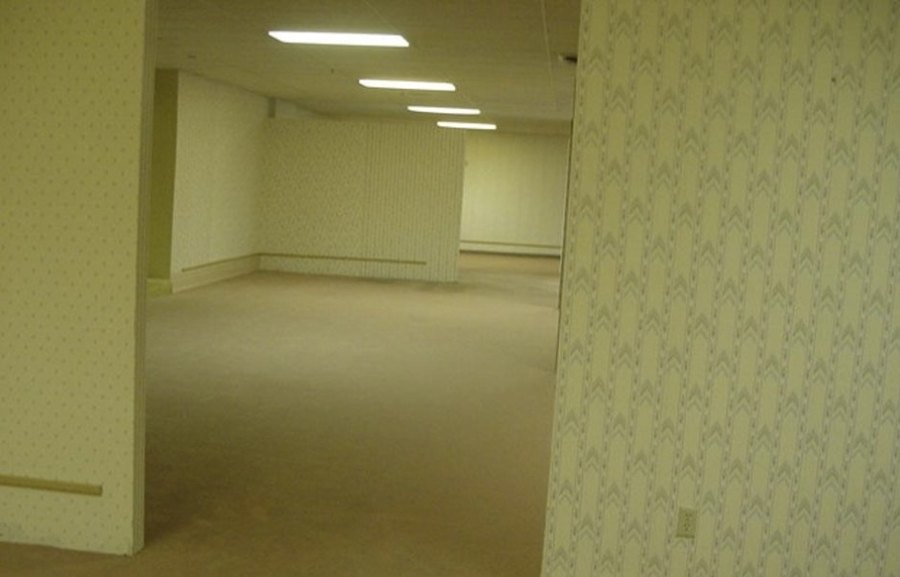
‘Backrooms’ Director Kane Parsons on Why San Jose is a Rich Setting for Horror
Backrooms is (sadly) the metaphor of our times
 LIVE
LIVE
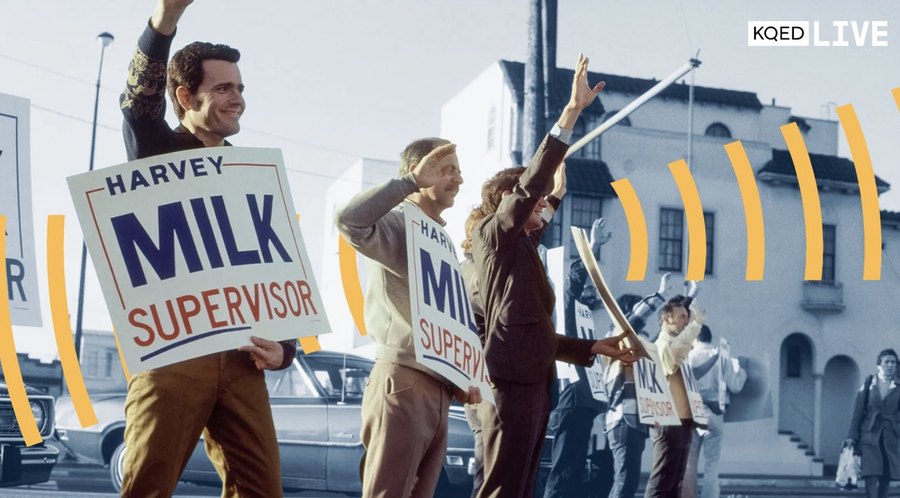
1970s: The Decade the Bay Area Changed America
Mark your calendar for this event!
 NEWS
NEWS
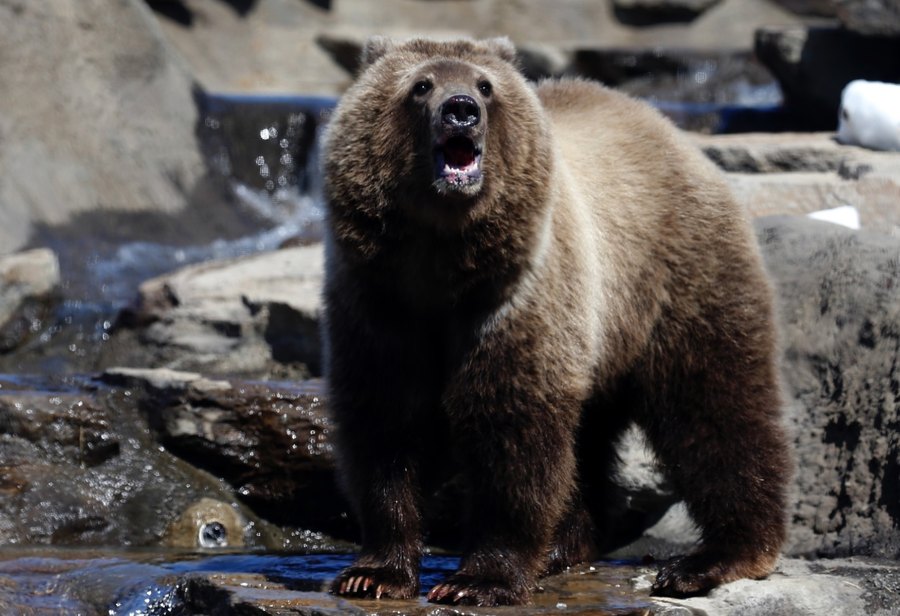
They’re on Our Flag, but Do Long-Gone Grizzly Bears Belong in Modern California?
Yes, but a complex yes?