Central Valley Farmers are Growing Agave to Save Water
Here are the morning’s top stories on Tuesday, August 25, 2026
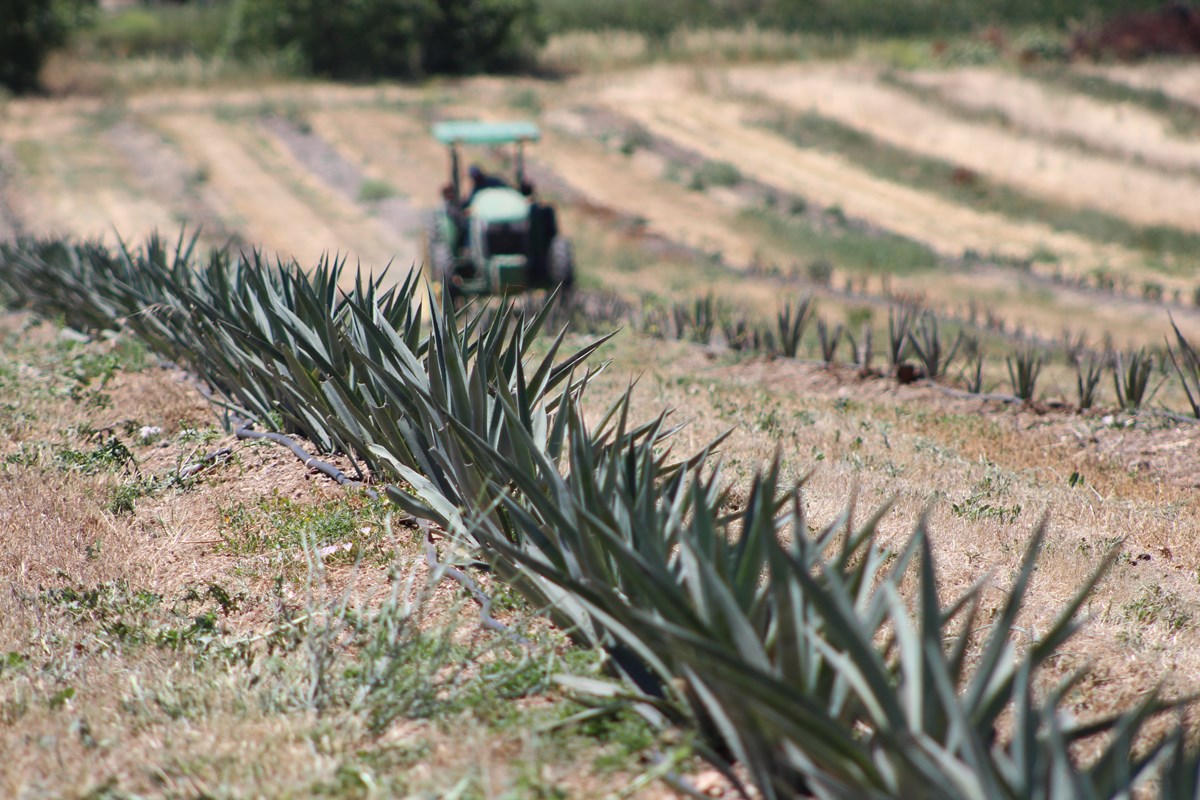
- For centuries, Mexico has capitalized on growing and harvesting a plant often distilled into Tequila or Mezcal. It’s called agave and it thrives on little water and a lot of heat. Now, with a California law restricting water use on farms, Valley farmers are looking to agave as a new revenue stream on their land, and working to localize supply.
- California’s highest court is weighing whether a sheriff broke the law when he seized hundreds of thousands of ballots earlier this year. The court heard oral arguments Monday.
- The Trump administration has ended a long standing agreement that kept ICE out of workplaces that are being investigated by the U.S. Department of Labor.
When James Hunt planted 14 acres of agave on his secluded Merced farm last year, he thought he’d harvest it for liquor. But then he did more research on the large spiky succulent, and that dream snowballed.
“You could have spirits, agave syrup, agave inulin, biofuel, sustainable aviation fuel,” says Hunt.
He knew these ideas needed an industry in the US, so he started preaching the gospel of agave he says, to anyone who would listen.
“I was a farm manager, farm operator, and now I’m an industry advocate, trying to build out something that I think can have a lot of benefit for small farms in general,” says Hunt.
Hunt knows many growers who are testing out agave right now, but it’s not just for kicks. It’s also out of necessity, and it has to do with groundwater.
Josh Viers is a professor of civil and environmental engineering at U-C Merced. “We’re taking more water out than is going back in,” he says.
Viers is describing groundwater overdraft. That happens when groundwater gets taken out, but not replenished. It dries wells and sinks land.
So in 2014, California legislators enacted a law called the Sustainable Groundwater Management Act, or SGMA to stabilize water use.
“It gave them a drawdown period over 30 years to be able to meet that sustainability target, and also to maintain some specific guardrails, you might say, about that use,” says Viers.
SGMA created local agencies to gradually limit the use of the water. That means farmers are making cuts, like watering a few inches of soil on crops like agave instead of a few feet of soil on an almond tree.
Some farmers, are more equipped than others.
Omar Ramirez is a grower in Le Grand – a community in southeast Merced County, but he also owns a Tequila line based in Mexico called Luna Yena.
“A lot of my businesses have arose from problems and there’s a common saying that if you know how to solve people’s problems, you’re always going to have work,” says Ramirez.
He lived in Mexico for a few years as a kid. In Le Grand he used to grow almonds, until profits tanked a few years ago. With SGMA in focus, he thought, ‘Why not try something familiar?’
He planted 100 acres of agave.
“As a Mexican myself, Mexican American, that light bulb lit to say, ‘Hey, you know what? I think this is a perfect way to bring both of my cultures that I really love into one location.’
He’s excited about conversations that go beyond alcohol. He might make spirits, but he’s also looking at animal feed and building materials.
He says opportunities that arise in the United States are a bit different than what are destined in Mexico.
Hunt also feels good about agave’s destiny here. Nearly all of his plants survived the winter frost, even though some have dried up tips.
It’ll be four to six years before the first batch are ready to harvest, and he’ll spend that time trying to develop the agave economy.
“Farming is a gamble,” says Hunt. “And I’m willing to go out on a limb for this because I believe in it.”
He’s lived on this land his whole life, and he’ll do whatever it takes to keep it.
During oral arguments in San Francisco, the court’s justices peppered Bianco’s attorney, Bradley Hertz, with questions as to why the sheriff was not bound by state laws that restrict access to ballots during a criminal prosecution.
Sheriff Chad Bianco of Riverside County took the ballots after last year’s statewide election on redistricting to favor Democrats.
Bianco, who’s a Republican and was then running for governor, says he was investigating voter fraud. His attorney Hertz says Bianco had a warrant and acted within the law. Specifically, that state law limits access to ballots only during prosecutions — not investigations.
But Sonni Waknin, an attorney for the plaintiffs who spoke after the hearing, says a warrant doesn’t trump California election code. Not even an elected sheriff has the power to ignore election rules and seize cast ballots outside the view of the public.
The showdown comes as California’s expansive system of vote-by-mail faces attacks not only from President Donald Trump, who has labeled mail balloting a form of cheating, but also from local election officials aligned with the president.
The court also heard a case about whether California’s Attorney General has authority to tell Bianco to stop his investigation. The court has 90 days to issue its decisions.
‘Deferred Action for Labor Enforcement’ Program Shielded Workers Reporting Abuse
Undocumented workers won’t talk to investigators about wage theft, or anything else, if they fear employers will retaliate by calling ICE.
This prompted an agreement between federal labor and immigration authorities back in 2011. But a labor spokesperson confirmed to KQED the deal is no longer in effect.
Josh Rosenthal is with the Asian Law Caucus in San Francisco.
“This agreement served as an important, if imperfect, backstop to say employers can’t use ICE as a weapon to protect their labor violations.”
Retaliation is illegal, but advocates say reports of employers threatening workers with ICE have gone up in California.