Monterey Park Becomes a Role Model for Banning Data Centers
Here are the morning’s top stories on Monday, August 24, 2026
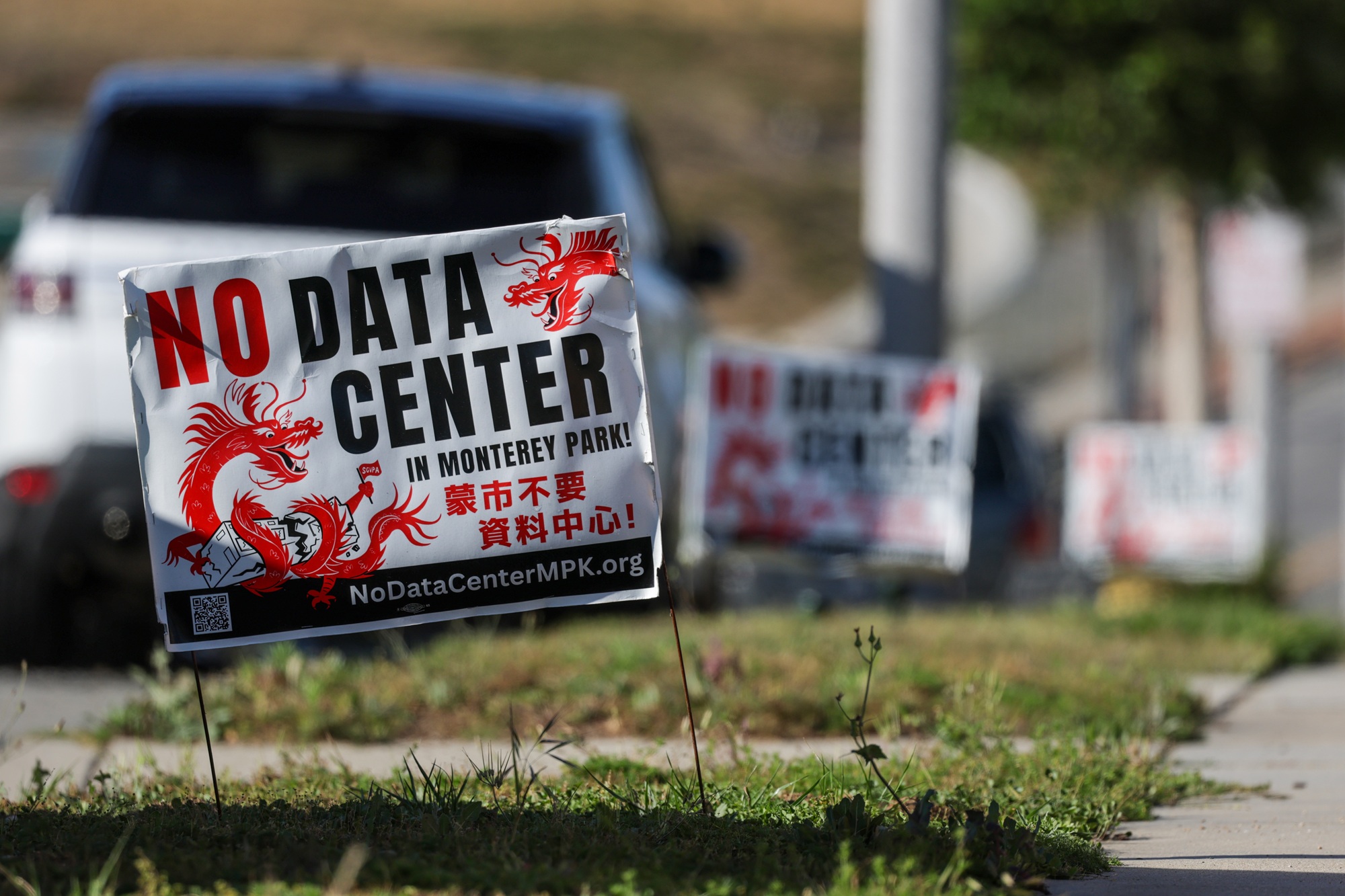
- Across the US, communities are mobilizing in the fight against data centers. And they’re turning to Monterey Park in LA County, which this year became the first city in the US to ban them. That was entirely due to the efforts of a group of residents called, appropriately, No Data Center Monterey Park. So, what advice do they have?
- The California Supreme Court will hear arguments today in two separate lawsuits over the Riverside County sheriff’s seizure of hundreds of thousands of ballots earlier this year.
- Counties up and down the state are reporting decreases in their homeless populations. It’s the second year in a row we’re seeing these figures drop.
After a group of Monterey Park residents organized under the banner No Data Center Monterey Park and made their city the first in the nation to ban the facilities in April, “it put us on the maps of other small cities looking to ban data centers,” says Steven Kung, one of the lead organizers.
They started getting messages from other communities from the San Gabriel Valley to Ohio. Nearly a dozen so far, asking the same question: How’d you do it?
As his fellow organizer Hrag Balian puts it: “We’ve kind of awakened the beast.”
The Monterey Park organizers are now putting together a playbook to share with other groups. Balian, who’s a software engineer, also created a toolkit that combines all the apps they found useful, for everything from sending newsletters to writing petitions.
Nationwide, polling shows that 70 percent of residents are against a data center in their communities. Locally, Montebello, Baldwin Park, and El Monte have passed moratoria. Alhambra made a zoning change that basically bans data centers. And in April, LA County launched a study into the impacts of data centers on health, environment, and grid.
All these groups that mobilized for their specific local concerns might have just stayed in their little bubbles. But now they’re part of a growing network — people who might not have ever found each other if not for the common cause of data centers, and what they’re powering: the looming specter of artificial intelligence.
Montana’s Alessandro Mitchell slid into the DMs of Monterey Park activists after their victory in the spring. He’s head of Missoula Neighbors United, a tenants-rights organization. When a developer proposed a data center in the next town over, Mitchell went looking for help.
“That’s when the Monterey Park people come in, because I saw their victory, and I thought, ‘Well, these people are ahead of the pack,’” says Mitchell.
He sought out their advice, which included: Skip the ballot measure.
“Having a referendum means a lot of canvassing, it means starting a ballot measure committee,” says Kung. “It means fundraising. It’s a lot of work.” Kung and Balian say an ordinance does just about everything organizers would want, and it’s a lot easier than trying to put a ban on the ballot.
But Kung says the real secret to success is “having weekly meetings really keeps everyone accountable, keeps the fight up, keeps everyone’s spirits up.”
An organization in Coachella called Viva La Causa sought out the Monterey Park activists, too. Viva La Causa was formed years ago to fight against things like police brutality and gentrification. And now, data centers.
On Aug. 10th, the Coachella council passed an ordinance banning data centers. But despite Monterey Park cautioning them about how much of a pain a ballot initiative can be, Viva La Causa still wants to push for a citywide vote. Organizer Cecilia Lemus says they just don’t trust their city council: “If the city council votes it in, they can also vote it out.”
In Missoula, the organizing paid off. The site owner for that data center project bailed out as a result of “the public’s feedback.” There’s also now a moratorium on data-center development, as the county considers energy use and impacts to health and environment.
Mitchell says the fear of artificial intelligence is highly motivating, “because it is going to do so much to change society. So I think, yes, it is creating a huge outpouring around the country, and it’s activating people in a way that I haven’t seen in my lifetime.”
The court will weigh two issues. First is whether Sheriff Chad Bianco broke California law when his deputies seized the 650,000 ballots in March.
Acting on a tip from a local watchdog, Bianco got a warrant for the seizure. It took place amid a furious national debate over states redrawing congressional districts to favor their own majority parties in advance of the 2026 midterm elections.
Bianco was running for governor at the time.
The second issue before the court is whether the attorney general has authority to tell Bianco to stop his investigation.
Bianco, who is a Republican, took the ballots after last year’s vote on Proposition 50… which asked whether to redraw California’s congressional map to favor Democrats.
Bianco said he was investigating allegations of voter fraud. However, Riverside County’s Registrar of Voters said there wasn’t any.
The court has 90 days to issue a decision.
Attorneys for Bianco and the Attorney General’s office did not respond to requests for comment.
California reduced its official homeless count in 2025 after years of increases. Now, preliminary data for 2026 shows counties up and down the state are reporting decreases in their homeless populations. It’s the second year in a row we’re seeing these figures drop.
Some of the drops were significant. San Joaquin County cut its total unhoused population by nearly a third compared to 2024 and nearly halved the number of people sleeping on the street without shelter. Others were more modest, such as San Francisco’s 4% drop.
Officials in counties where the homeless count dropped credit their progress to creating more shelter beds and low-income housing, which they say was made possible by new state funds released over the past several years.
At the same time, some activists are questioning whether the numbers really are as rosy as they seem. Cities have ramped up enforcement against unhoused people in recent years – clearing encampments and citing people for illegal camping more frequently – which causes people to scatter and become harder to count. Just because someone is missing from an official count doesn’t mean they moved off the street and into housing.
Even in counties celebrating wins this year, officials wonder whether they can maintain those gains in the face of recent federal cuts to Medi-Cal and social services.
In addition, there were several reminders this year that the point-in-time counts are not perfect. The Los Angeles Times uncovered an accounting glitch that inflated the city’s homeless count by more than 600 people.
In Central California, Fresno and Madera counties, which combined reported a 34% drop in homelessness compared to last year, appeared to have the largest reduction in the state. But the counties changed the way they counted this year, potentially skewing the numbers. Instead of tallying everyone who was visible on the street as they did in 2025, this year, volunteers counted only people who confirmed they are homeless and agreed to participate in a survey. That change makes this year’s count difficult to compare to 2025 data, officials admitted.
San Joaquin County, which boasted one of the biggest drops in overall homelessness and unsheltered homelessness in California, added more than 100 shelter beds and more than 1,000 permanent housing units between 2024 and 2026. That allowed the county to increase the number of people living in permanent housing by 86%.
“There just wasn’t money available 10 years ago like there is now,” said Dawn McLeish, deputy director of the county’s human services department. “It just took a couple years for those investments to get all the way off the ground.”