Residents Try to Shut Down South LA Oil Drill Site
Here are the morning’s top stories on Tuesday, August 11, 2026
- Los Angeles is a city. But it’s also an urban oilfield. About a third of L.A. County residents live less than a mile from an active oil drilling site. Now one of those sites in South L.A. could be shut down.
- A federal agency is conducting an unusual review of California’s Coastal Management Program. The National Oceanic and Atmospheric Administration, or NOAA, did a review of the program just two years ago. But Trump administration officials asked for a new one because they say the current version doesn’t reflect “national priorities.”
- Governor Gavin Newsom says he won’t oversee an extension for the Diablo Canyon Power Plant, California’s last functioning nuclear plant.
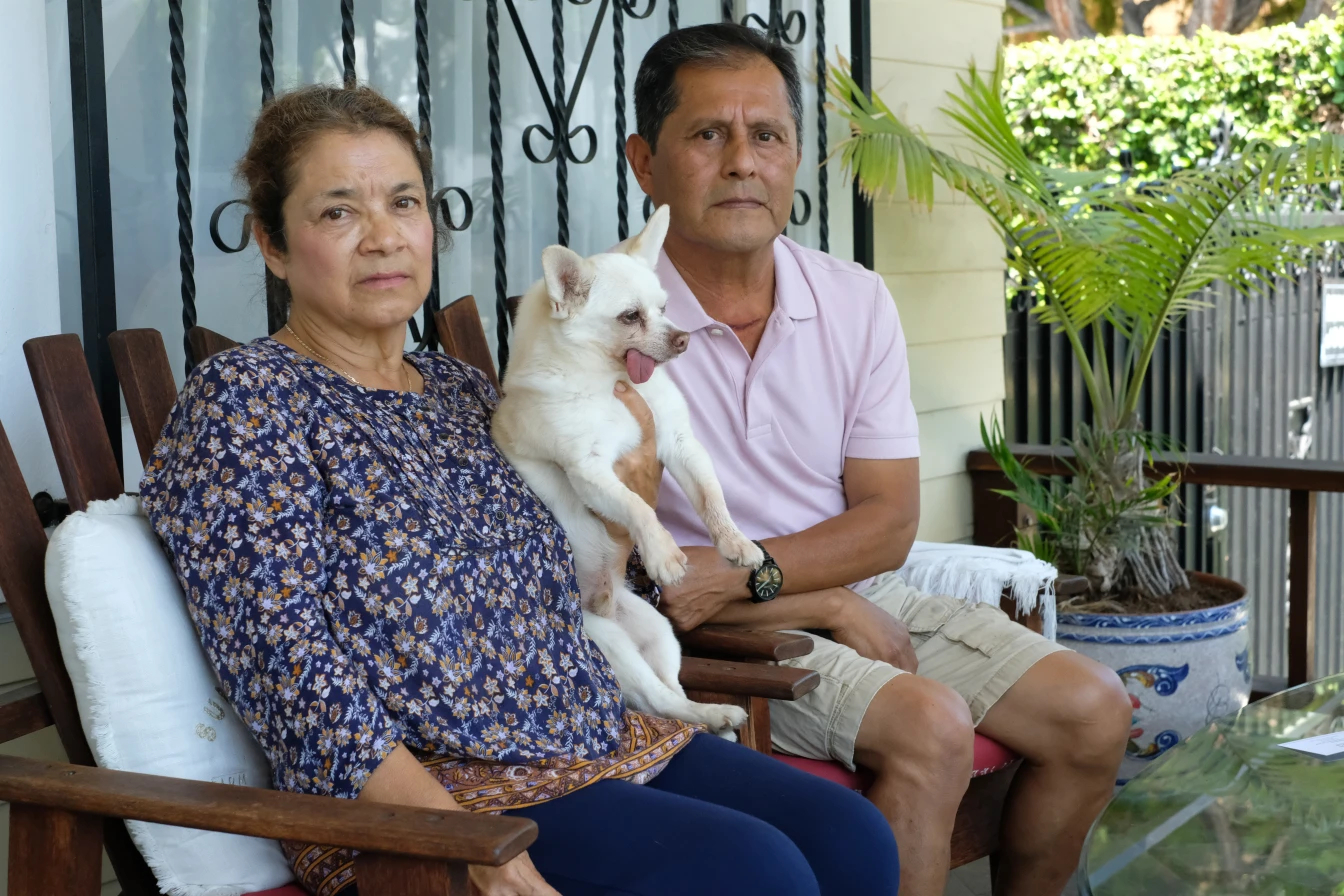
Genaro and Catalina Ventura moved to the South L.A. neighborhood of Jefferson Park more than 25 years ago. The Craftsman-style house they found was a dream — spacious, with a yard where they could garden and their children and dog could play. What they didn’t know before moving in was that just a few hundred yards behind the house is an active oil drilling site.
Genaro Ventura, a now-retired custodian for the city of L.A., worked nights. When he’d come home around 2 a.m., the smell of oil and chemicals was often strong in the air. “Since the night is quiet, there’s no traffic or smog,” Genaro Ventura told LAist in Spanish. “You can really smell the air from the drill site, and it’s a terrible odor.”
Five years after the family moved in, Genaro was diagnosed with cancer in his left kidney and had to have it removed. In 2013, a brain tumor led to another surgery, and the following year another brain tumor required radiation treatment. He has to return regularly for scans. Most recently he’s developed lung cancer and is scheduled to start chemotherapy. With no family history of cancer, the Venturas suspect the illnesses are related to air pollution from the nearby drill site. And it’s not just Genaro Ventura. The family’s last dog died of cancer. Their elderly chihuahua now has cancer, too. Two of Catalina Ventura’s friends nearby were also diagnosed with cancer and recently moved away. Their son and many children in the neighborhood grew up with asthma.
Now, after more than a decade of community organizing, the Murphy drill site could be shut down. The city is considering whether to revoke E&B Natural Resource’s license to operate the site. “It is really the best chance we have ever had to see this toxic industrial site shut down and removed from our neighborhood,” longtime South L.A. resident Richard Parks said at a recent community town hall at a church down the road from the drill site. Parks is the president of the nonprofit Redeemer Community Partnership, a group that has spearheaded the shutdown effort.
In response to questions from LAist, a spokesperson for E&B emphasized the company’s compliance with regulations and said the facility “plays an important role in supplying locally produced petroleum to the Los Angeles Basin.” The spokesperson also pointed to a July report the company commissioned from environmental consulting firm Roux Associates. The report says “the administrative record contains no scientific evidence that the Murphy site jeopardizes or adversely affects public health or safety of nearby residents or workers.”
After a hearing last month. the oil company now has until Aug. 23 to respond to a list of questions from Jonathan Hershey, Associate Zoning Administrator in Los Angeles. Then the public has until Sept. 25 to respond to the company’s answers to those questions. After that, the oil company will have the final word, with their last opportunity to respond to public comment set for Oct. 9. Hershey will then provide a written determination on whether or not to revoke the company’s permit to operate. He warned that his decision could take time, telling hearing attendees to “please be patient.” Once the determination is made, it can be appealed within 15 days.
State lawmakers, Indigenous leaders, advocates and business groups gathered in Santa Monica on Monday to challenge the Trump administration’s efforts to open the California coast for oil drilling and other industrial projects
The stakeholders rallied ahead of an in-person meeting held by the National Oceanic and Atmospheric Administration reviewing California’s Coastal Management Program, which speakers at the press conference considered to be an attack on California’s right to protect its coastline. “This federal administration is bent on industrializing our coast,” California’s Natural Resources Secretary Wade Crowfoot said, addressing a crowd of dozens, many of whom brandished protest signs or wore oceanic blue T-shirts with the slogan “No Federal Takeover.” “For the first time in over four decades, through Republican and Democratic presidential administrations, this is the first administration moving aggressively to expand new offshore oil drilling.”
The rally and meeting come just over a month after NOAA began the regulatory process with a notice in the Federal Register about its plans to study California’s Coastal Management Program. Following Monday’s in-person meeting, there will be opportunities for public comment at virtual meetings Tuesday and Wednesday afternoon.
While critics see the move as part of the Trump administration’s broader goals to increase oil and gas production, those in the president’s cabinet say there are economic costs to coastal-protection schemes. “America must continue to lead in innovation, space exploration, and economic strength,” U.S. Commerce Secretary Howard Lutnick said in May. “Obstructionist policies that delay critical national infrastructure in the name of environmental extremism are unacceptable.”
Governor Gavin Newsom says he won’t spearhead an extension for the Diablo Canyon Power Plant, California’s last functioning nuclear energy plant.
At a press conference on clean energy in Oakland late last week, Newsom said he’s passing the baton to whoever takes over his role at the beginning of next year. “That will be a determination made by policymakers that will be here a lot longer than I will,” Newsom said. “I got a sell-by date in five months.”
In November, voters will choose either Democrat Xavier Becerra or Republican Steve Hilton to serve as governor after Newsom’s term ends in January.
The California State Legislature previously extended Diablo Canyon’s operations to the year 2030 by passing SB 846 — a bill that Newsom signed into law. An advocacy group called Diablo Canyon 2045 responded to Newsom’s comments with a statement that said pushing the extension decision out to next year would cost more money in the long run. “Regardless of the Governor’s comment, there is still time for the legislature to uphold their commitment to affordability this session,” a press release from the group says.
A spokesperson for PG&E, the utility that operates Diablo Canyon, sent KCBX a statement responding to Newsom’s comments. “Extending Diablo Canyon beyond 2030 this legislative session will immediately save electric customers $1.7 billion in unnecessary costs to build new power plants by 2032 as required by the CPUC’s recent 6,000-megawatt procurement order,” the statement said.
The legislature only has three more weeks to pass a Diablo Canyon extension bill this year, before final recess begins on August 31.