Why The Ethan Klein Fair Use Lawsuits Are Way More Than Internet Beef
View the full episode transcript.
When Twitch streamer Denims made a reaction video about Ethan Klein’s nearly two-hour takedown video of Hasan Piker, she wasn’t expecting to be sued for copyright infringement. She employed a commonly-used method of streaming the original video and interjecting with reactions, commentary and analysis. But Klein, who was once seen as a champion of fair use after he won a similar lawsuit in 2017, sued Denims and other content creators anyway. Morgan talks to Denims and journalist Kat Tenbarge about what made these cases different and how reaction content across the internet could change based on how the courts ultimately rule.
Guests:
- Denims, political Twitch streamer
- Kat Tenbarge, independent journalist, Spitfire News
Further Reading/Listening:
- A Political Reckoning for Twitch? | KQED — Close All Tabs, KQED
- Ethan Klein’s War on Women — Kat Tenbarge, Spitfire News
- Ethan Klein Doesn’t Deserve My Apology — Kat Tenbarge, Spitfire News
- A YouTuber kicks up a stink over a flatulent “reaction” video — staff, The Economist
- What’s Up With Copyright Lately?: Summer Breeze Edition — Aaron Moss, Copyright Lately
- Should YouTube introduce revenue-sharing for reaction content? — James Hale, Tubefilter
- ‘Reactgate’: Twitch streamer xQc and ‘H3 Podcast’ host Ethan Klein debate whether ‘reaction videos’ are ‘stolen content’ — Katie Mather, Yahoo News
- How h3h3’s Ethan Klein Might Change YouTube Forever — Melissa Chan, Time Magazine
Want to give us feedback on the show? Shoot us an email at [email protected]
Follow us on Instagram and TikTok
Episode Transcript
This is a computer-generated transcript. While our team has reviewed it, there may be errors.
Morgan Sung: Hi, Tabbies. We need your help. If you like our deep dives and you want to hear more, then please rate and review Close All Tabs on Spotify, Apple Podcasts, or wherever you listen to the show and tell your friends. It would be a huge help to get the word out. Okay, let’s get to the show.
[Audio from h3h3Productions Youtube video]
Ethan Klein: Hi there. It’s me, your old friend, Ethan Klein. It’s been a while since we’ve last spoken. In that time I’ve had three kids, all boys, I’ve lost a hundred pounds, and I’ve pissed off 75% of the in-
Denims: And I became insane.
Morgan Sung: That second voice you just heard is Alexandra Saber, a Twitch streamer better known as…
Denims: Everyone I know calls me Denims, so…
Morgan Sung: We’re gonna keep calling her Denims for this episode. She’s been on the show before, when we talked about the growing corner of political commentary on Twitch. The situation we’re diving into today is related to that. So last year, Ethan Klein, the YouTuber behind the channel H3H3 Productions and host of the H3 Podcast, dropped a content nuke. This is a long-form video format that Ethan himself popularized. It’s basically an extensive takedown criticizing another creator for their behavior, comments, and past posts.
The content nuke is like a deep dive, building the case to cancel someone else. Ethan had been teasing this video for months, so his fan base was pretty hyped. And this one was about someone he had been publicly feuding with for years: streamer, political commentator, and his former friend, Hasan Piker. Ethan’s nearly 2-hour-long video starts with J. Robert Oppenheimer quoting Hindu scripture, which he famously referenced after he watched the detonation of the nuclear bomb he designed.
[ Audio of J. Robert Oppenheimer]
Now I am become death, the destroyer of worlds
Morgan Sung: Then the video launches into a super cut of clips from Hasan’s stream, layered with footage of a nuclear bomb after impact, mushroom cloud and all. Denims wasn’t impressed, so she streamed her reaction, which did involve playing the video on her channel.
Denims: There was a lot of wild claims that were made in that video that were just factually untrue. And so I would pause, I would make jokes or I’d pause and I would say, well, this isn’t true. Like, here’s this and this and this.
[Audio from Denims’ reaction Twitch stream]
Speaker: That lines up with leftist values.
Ethan Klein: Hasan’s third claim is—
[clicking sound]
Denims: Okay, first of all, they he’s not even providing sources for half of this stuff. I… He’s provided like bits and segments, if any. Okay?
Denims: I think people just like myself, when I’m curious about a video, but I know that it’s going to be filled with falsehoods, I want to watch an expert talk about it and break down what’s wrong with that video, sort of like watching in a weird way, I guess, like Mythbusters. And I think that’s why a lot of people tuned into my stream to watch that the two hour video turned into a four hour livestream, cause I wanted to see someone say, no, this isn’t true. Here’s this article that shows this isn’t true.
Morgan Sung: And then, months later, she found herself at the center of one of the most talked about lawsuits in the content creator world.
Denims: I do remember that I found out the exact same way that everyone else found out. So he released this video on like June, was it, I think it was 19th.
[Audio from h3h3Productions-I’m Suing These Three Creators- Youtube video]
Ethan Klein: Hi there. My name is Ethan Klein, and my favorite hobby is spending hundreds of thousands of dollars on lawyers. Today, I invite you into my home to share my favorite past time with you. Join me in creating generational wealth for my attorney.
Denims: This is a video, another video that he had been teasing for a while and I was kind of curious what it was gonna be about. I was like, is it gonna be a sequel to the original? Is it gonna be a video on some other creators? And so I’m like watching this video, I’m, like, hmm, that’s me on the screen. That is an official court document with my name on it. And then I click and it’s like, it’s almost a little bit disbelief that it’s real.
[Audio from h3h3Productions-I’m Suing These Three Creators- Youtube video]
Ethan Klein: Well, I’m happy to tell you guys now, I, Ethan Klein, have registered Hasan Piker content nuke with the United States Library of Congress. Some of you guys out there sweating?
Morgan Sung: Denims’ stream falls under this genre known as reaction content, videos and live streams in which creators react to and comment on content made by others. You’ll see this on Twitch and TikTok and YouTube and Reels. They’ll play a short clip from a movie or political speech or someone else’s video, and then give their take. Reaction content relies on this legal doctrine called fair use. Fair use is what protects the unlicensed use of copyrighted material if it’s used in news reporting, criticism, teaching, research, and commentary. And fair use is fundamental to the internet as we know it, because it protects freedom of expression. But there are, of course, limits. Which is why, at first, Denims was worried she had stepped into actual copyright infringement.
Denims: I go back, I watch my original video, I watched my original, like, reaction, and then I felt a lot better. I was like, okay, wait, wait…I took a 2 hour video, I turned it into 4 hours. I had a bunch of links where I showed people articles. I showed people a bunch context for things. I commented a bunch, and I really tried to transform the video and transform the content to the best of my ability.
Morgan Sung: Here’s the ironic twist. The doctrine of fair use that protects content creators like Denims’? Ethan himself set the precedent when it comes to internet content by winning a different lawsuit nearly 10 years ago. In fact, for a long time, he was known as the “the fair use king.” It’s a big reason why Denims was so shocked.
Denims: Like, the guy who’s known as the “the fair use king” is going to sue me and other creators for reacting to his video. Huh?
Morgan Sung: Denims is not the only streamer Ethan went after, but the three creators he sued were also among dozens of others who made similar videos, all using the original content nuke. And as critics have pointed out, there’s a pattern among the creators that Ethan did choose to single out. So how did Ethan Klein, once the “the fair use king” and champion of free speech, become the kind of litigious antagonist that he once defeated?
Today, we’re diving into why this case is more than just a feud between influencers. It has ripple effects that would impact nearly every platform and every piece of content that you engage with online. There’s so much to unpack here. Censorship, power dynamics, and years of personal beef. It is so much bigger than just internet drama. Buckle up.
This is Close All Tabs. I’m Morgan Sung, tech journalist and your chronically online friend, here to open as many browser tabs as it takes to help you understand how the digital world affects our real lives. Let’s get into it.
Let’s open our first tab. Why did Ethan Klein sue other streamers? Today we’re here to talk about a series of lawsuits that kind of rocked the content creator economy. At their very core, what are these three lawsuits about?
Kat Tenbarge: So these three lawsuits are about copyright infringement and specifically whether it is a copyright infringment violation to stream and react to another creator’s content on your own platform.
Morgan Sung: Kat Tenbarge has also been on Close All Taps before. She’s an independent journalist who runs the newsletter Spitfire News, and she covers the intersection of influencers and politics. She also covered this case, and in doing so, unwillingly became part of the story herself. We’ll get into that part later in the episode, but let’s talk about everything leading up to these lawsuits first.
Kat Tenbarge: In this case, three Twitch streamers each played a YouTuber’s video on their live stream and reacted to it. And then he sued them for copyright infringement.
Morgan Sung: I’m really curious, like, who watches this content? What is the impact culturally online?
Kat Tenbarge: So, so, so many people watch this type of content. I see it in so many different places, and I imagine that a lot of audience members don’t even register it as reaction content because it’s become so ubiquitous. But even like, the biggest news and politics creators, a lot what they do is reaction content. If you are watching somebody do like a stitch on TikTok or Instagram Reels, that’s a form of reaction content, or if you ever go on Twitch, that is reaction content for the most part, because even when someone is playing a video game, they’re still taking someone else’s intellectual property and sort of making it their own. Like, reaction content is basically one of the building blocks of most content today.
Morgan Sung: I mean, what was your first reaction, speaking of reaction content, but what was the first reaction when you saw the news of Ethan Klein’s recent lawsuits?
Kat Tenbarge: So, my first reaction, I was pretty surprised because I think a lot of people online saw this as a very hypocritical move. Back in 2017, Ethan Klein was sued himself by another content creator for the exact same reason, copyright infringement, after he reacted to and parodied and mocked a different YouTuber’s material. And that lawsuit was a really defining point in Ethan Klein’s own career. So, you know, fast forward less than a decade later, he’s basically doing the exact same thing to these three women.
Morgan Sung: Let’s go back to 2016. This YouTuber, Matt Hoss, had this comedy series called The Bold Guy. In these sketches, Matt plays this pick-up artist who also does parkour. It has not aged well.
[Audio clip from Matt Hoss’ The Bold Guy Video]
Woman: Who are you calling an attention whore?
Man: I’m asking, because you keep sticking your ass up in the air.
Woman: I have the right to exercise here if I want.
Man: Of course you do, and I have a right to approach and talk to you.
Morgan Sung: In this video, the woman slaps Matt and then tells him to catch her. A parkour chase ensues. Ethan and his wife, Hila, saw this and posted their own video where they played clips and made fun of it.
[Audio from h3h3Productions Youtube video]
Ethan Klein: Look, can you imagine the casting call for this? Looking for a cute, petite, parkour girl to star in my parkour sex video.
Morgan Sung: Ethan and Hila’s video was 14 minutes long. It used three minutes of Matt’s original video. Well, Matt didn’t like that. So he filed a copyright notice with YouTube and YouTube took down Ethan and Hila’s video. Ethan and Hila challenged the takedown and argued fair use. So in 2017, Matt sued them.
Kat Tenbarge: And when this lawsuit was launched against them, they issued a plea to the YouTube community at large basically pointing out that if they lost, it would set a really bad precedent for everybody because it would mean that everybody could potentially be sued over the type of content that had already become so popular, so mainstream, and so ubiquitous.
[Audio from h3h3Productions Youtube video]
Ethan Klein: After a year and a half of doing depositions, filing summaries, motions, hundreds of thousands of dollars later, we slammed this b*tch, dude! YES! We won the court case! YES!
Kat Tenbarge: And when they won that case, it felt like they had established this precedent that wouldn’t just protect them, but would also protect all of these other creators.
Morgan Sung: I mean, how did this pretty landmark decision that, like you said, set that precedent, open the door for the explosion of commentary content and reaction videos and media criticism video essays?
Kat Tenbarge: Yeah, so the the precedent that was set by Ethan and Hila winning this lawsuit was that it fell under the category of fair use as long as you were putting your own commentary spin on whatever you were reacting to. So for example, you can’t just stream someone else’s content on your channel and walk away and let it play for the entirety of the clip, but as long you’re engaging with it in some way, shape, or form, that is what the judge determined allowed it to fall under fair use.
Morgan Sung: Okay, so there’s that legal precedent, but it seems like Ethan’s stance on this issue is like dramatically different. Can you briefly catch us up on how Ethan, his content, and his audience have changed since winning that 2017 lawsuit?
Kat Tenbarge: Yes. So since 2017, Ethan and Hila have really leaned into podcasting as like the main content that they make and the way they engage with their audience. And this drama stems from a podcast that Ethan had done previously with Hasan Piker called Leftovers. Leftovers ran for a few years and it was both of them talking about politics from this like leftist perspective.
[Audio from H3 Podcast-Leftovers #31]
Ethan Klein: I mean, Trump took a fat f*cking L, dude. Yeah. And you’re seeing it already, we have a whole section in here of Republicans turning on Trump.
Hasan Piker: Here’s the issue. This is not a Donald Trump issue. This is a Republican party issue. Here’s why…
Morgan Sung: We’ve talked about Hasan on this show a bunch. He’s the guy who turned political commentary streams into a viable genre on Twitch. Leftovers was this collaboration between the superstar of a burgeoning corner of Twitch and the YouTube “fair use king.” They joked around, made fun of Trump supporters, interviewed economists, and reacted to what was happening in politics at the time. And they genuinely did seem like friends, but ultimately, it didn’t last.
Kat Tenbarge: In late 2023, after Hamas attacked Israel, things really shifted between the two of them because Hasan Piker is really principled in his advocacy for Palestinians and his opposition to Israel, whereas Ethan Klein actually lived in Israel for a period of time, his wife Hila served in the IDF and is Israeli, and his perspective on the matter is very different. The two of them have kind of gone in between both sides of this, but the perception, at least widely online, is that they’re much more pro-Israeli than Hasan is. And so this drove a wedge between these content creators that has just grown and grown and grown and grown. There has been a ton of back and forth drama between the two of them, allegations slung in both directions. And it all kind of led up to Ethan creating something that he described as a content nuke.
[Audio from h3h3Productions Content Nuke Youtube video]
Ethan Klein: The funny thing about me, I don’t like terrorism, and I don’t like terrorists. If they’re Jews, Christians, Muslims, they’re all bad. And over time I started to learn that my co-host, he really likes terrorists.
Kat Tenbarge: It was a nearly two hour long video criticizing and sort of condemning Hasan Piker. And when Ethan made this video, it obviously set off sort of a bomb in the discourse space where a bunch of different Twitch streamers, people who loved Hasan, people who hated Hasan people who were friends with Hasan, people who were sort of like associates or orbiters of Hasan they were all reacting to it.
Morgan Sung: In the later video where he announced the lawsuits, Ethan called the content nuke a trap.
[Audio from h3h3Productions Youtube video]
Ethan Klein: It’s not that I wanted these people to steal my video. It’s that I knew they would. The trap was set and it worked even better than I imagined it would. We captured pretty much every large streamer reacting to it in its entirety immediately after it was published.
Morgan Sung: Ethan sued three women for using his content nuke in their reaction streams.
Kat Tenbarge: Each of them played it while they were Twitch streaming and each of them offered their own commentary throughout the video. But the argument that Ethan made in his lawsuits is that they didn’t offer enough commentary for it to fall under fair use. And one of the things that he claimed they had done is that, they had basically established their intent to divert views from his channel so that he would reap fewer profits, which he viewed as a violation of his copyright.
Morgan Sung: Like Ethan himself said, many major streamers and YouTubers reacted to the content nuke. But he only went after three of them. All of them are women, and they also share a lot of political stances. Why did Ethan single them out? We’ll talk about that after the break.
But first, we wanted to remind you that Close All Tabs depends on listeners like you to keep us going. You can support us by becoming a member at donate.kqed.org/podcasts.
OK. More on the content nuke, the lawsuits, and a tricky intimidation tactic called lawfare. That’s after this break. Stick around!
Welcome back. Let’s open a new tab. Who did Ethan Klein sue? And why?
Morgan Sung: I mean, Hasan is mentioned throughout these lawsuits pretty extensively,.
Kat Tenbarge: Yeah.
Morgan Sung: But he himself is not a defendant in any of them.
Kat Tenbarge: Right.
Morgan Sung: Let’s talk about the three women who are. Who are these creators? What is their content like?
Kat Tenbarge: Yes, so the three women who Ethan Klein sued are Kaceytron, Denims, and Frogan. And obviously those aren’t their real names. Those are the names that they go by on Twitch. But Kaceytron, I would say out of the three, had the least to do with the drama between Ethan and Hasan. She’s a longtime Twitch streamer.
[Audio from Kaceytron reaction video]
Kaceytron: I know a lot of people have been wanting to watch this without necessarily supporting Ethan Klein, so we’re gonna watch it.
Kat Tenbarge: She’s known for having an audience of sort of like the girls and the gays, and she does a lot of satirical, really kind of like, purposefully like tongue-in-cheek content that sometimes touches on politics. So she was one of the defendants who Ethan sued, and she also is known for having a pretty modest background. She grew up in what she and her family describes as generational poverty. And once this lawsuit was officially filed and she got served, she talked about how depressed she was and how much this was pushing her and sort of her family members to the very edge. So that was Kaceytron’s story.
Denims and Frogan are two women of color who are also Twitch streamers. Denims has a bigger platform than Frogan. Frogan has worked very closely with Hasan Piker in the past, and both of them had sort of come under attack from Ethan and the H3 fandom previously because they had this sort of closer relationship with Hasan Piker. And I would say both of them also, as women of color, and Frogan in particular, as a Muslim woman who wears the hijab, also previously had received a ton of consistent, almost nonstop racist harassment.
[Audio from Frogan Twitch video]
Frogan: I do appreciate everyone’s support, and thank you for watching it with me. He doesn’t want people to know when it’s dropping because we’re all watching through other streamers. And I suggest you all watch it through other people as well.
Kat Tenbarge: These lawsuits became a vector for that harassment, where it was just another reason for creators to make almost daily content about these women, smearing them, attacking them, even going so far as harassing them in some cases.
Morgan Sung: And it’s also worth noting that two of these women already had histories with Ethan Klein. Can you talk about that?
Kat Tenbarge: Yes. So as sort of the Hamas-Israel war becomes this wedge issue driving Hasan Piker and Ethan Klein apart, you also saw Ethan really go on the attack against creators who were really supportive of Palestinians and Palestine. And one of the ways he did this is he would identify things that these creators had done as anti-Semitic.
Morgan Sung: A few years ago, Frogan and Denims were part of a TwitchCon panel for Arab creators, and they jokingly created a ranking of people who can say habibi. Here’s Denims.
Denims: And for some context, habibi just means my love. So like, obviously anyone can say it. It’s kind of like saying inshallah, like anyone can say that. And at the bottom of the tier list was a category called “loves sabra.”
Morgan Sung: Based on the hummus brand Sabra.
Kat Tenbarge: Which they were making fun of as like the worst hummus that you can buy at the grocery store.
Denims: A hummus that most people dislike because it tastes not good. And we put a variety of creators on the bottom tier list, myself included in that category because it was just a fun tier list but we also had put Ethan Klein in that list.
Kat Tenbarge: But Ethan had sort of characterized this as anti-Semitic because it’s an Israeli hummus brand.
Denims: Me and the other four creators, got banned from Twitch for 30 days and lost ad rev. So this has been like a long standing chain of events that’s gone on for a long period of time.
Morgan Sung: But Ethan has also had beef with other creators who reacted to his content nuke. A couple of years ago, there was “Reactgate.” It was this huge internet wide debate over the way certain reaction creators used other people’s content without adding any real commentary or original substance. Amid the discourse, Ethan accused another Twitch streamer, xQc, of being a content thief. The feud culminated in a very heated live streamed argument between the two.
[Audio from H3 Podcast-Debating xQc On Copyright-H3TV #86]
xQc: People would rather watch me full-screen cam, do the f*cking worm than watch your prime content.
Ethan Klein: Bro, do it for a week. Do a week of no reaction content and see how many f*cking views you get.
Morgan Sung: xQc was one of the many creators who reacted to Ethan’s content nuke. But despite their previous feud over this exact issue, Ethan did not sue xQc. In the video announcing the lawsuits, Ethan said,
[Audio from h3h3Productions Youtube video]
Ethan Klein: These people were not targeted based on their gender, their identity, their political beliefs.
Morgan Sung: But it is worth noting that they all orbit Hasan Piker. They’re smaller creators with similar views who make similar content.
Kat Tenbarge: So they do share a lot of the same audience. There’s a lot crossover there. And even on a personal level, a lot these creators are friends with each other. They have sort of like collaborations or partnerships in the past. And so they almost sort of orbit around the ecosystem that Hasan has created.
Morgan Sung: It almost seems like these lawsuits were part of a kind of proxy war with Hasan Piker.
Kat Tenbarge: Yes, that is definitely how a lot of people online saw the situation. You saw a lot the same critics of Hasan pivot to support and endorse these lawsuits. And you also saw people in the H3 fandom sort of use this as part of their digital online war on Hasan and his associates, like these women who were being sued were almost treated as stand-ins for Hasan Piker himself.
Morgan Sung: Besides the fact that they all kind of orbit Hasan Piker, are there any theories as to why Ethan would choose to target these specific creators?
Kat Tenbarge: I think that like among critics of Ethan Klein, a lot of the consensus around these lawsuits is that these were more vulnerable targets. Being women in the creator space and especially women of color, your earning potential and the size of your audience tends to be smaller. In Kaseytron’s case, like we previously discussed, she expressed that she could not afford a lawsuit, that hiring a legal defense would be a significant cost that she wouldn’t be able to shoulder. Each of these women launched a GoFundMe shortly after they were sued. And each of them talked about sort of the undue financial stress that this put upon them, as compared to some of these bigger content creators like Hasan Piker, who would more easily be able to afford a legal defense because he’s making exponentially more money on the platform than these women were.
Morgan Sung: So all of this is going down online. And last summer, you wrote a piece titled, “Ethan Klein’s War on Women.” What was that essay about, and how was it received?
Kat Tenbarge: So I wrote this piece as sort of an explainer because there wasn’t a ton of mainstream media coverage of these cases. There’s been mainstream coverage of Ethan Klein in the past, but despite how big these YouTubers are and how consequential their platforms can be, the mainstream media still doesn’t really understand them or I think appreciate how consequential they are. So I wrote this for my independent newsletter And the basic thrust of my piece is that these three women were each super, super vulnerable in their own way and that because of all of the harassment they were already receiving on a regular basis this was a moment where they were about to receive a lot more and how unfair i felt like that was and it fit in really well with the coverage that I already do because a lot of the topics that I cover are how these types of lawsuits can be used to smear and silence women. For example, I’ve covered Depp v. Heard and Blake Lively versus Justin Baldoni and I’ve talked a lot about how these lawsuits and lawfare in general can be used as sort of targeted harassment against women in a really harmful and oftentimes devastating way.
Morgan Sung: It’s very interesting the way that Ethan Klein himself reacted to the piece. What did he say?
Kat Tenbarge: He basically accused me of calling him misogynistic, which I never used that word in the piece, although I guess you could draw from the title that that was the implication. But specifically what he said was, ‘I’m facing all of these allegations of me being a misogymist, so to level the playing field, I’m going to sue this other creator named SeanDaBlack.’ And SeanDaBlack is yet another Twitch streamer who also reacted to Ethan’s content nuke. And Ethan was basically saying, well, if you’re accusing me of suing a bunch of women, I’ll sue this guy as well, under the condition that he would not sue Sean if I apologized to him, which was super, super bizarre. And it definitely, you know, invoked a big response from his audience.
Morgan Sung: Sean also seen perplexed. He responded to the threat in his own stream.
[Audio from SeanDaBlack-Ethan Klein is suing me???- Youtube video]
SeanDaBlack: But like, ya’ll ain’t need to bring me into this. Right? I should only be mentioned in the, in the most handsome streamer conversation. That’s it.
Kat Tenbarge: And I didn’t apologize. I, at the time, texted, like, a fellow journalist who was also involved in this and said like, you know, ‘you can post this on Twitter where I’m no longer active. And you can say that if this is truly gonna stop Ethan from suing this other creator, then I would apologize.’ But Ethan said that that didn’t count and SeanDaBlack did a stream where he was like.
[Audio from SeanDaBlack -Ethan Klein is suing me???- Youtube video]
SeanDaBlack: Ethan’s trying to, uh, swing his dick around being like, uh-huh, I have so much money to spend. I have so much money to spend, right? He wants the back and forth. He wants me to be talking about this right now. And in his mind, he wants me to be scared. He wants me to be afraid.
Kat Tenbarge: So then I wrote a follow-up piece being like, Ethan Klein doesn’t deserve my apology. And fortunately, he did not sue SeanDaBlack.
Morgan Sung: Like Sean, Kat saw Ethan’s threat of a lawsuit for what it really was. It’s a tactic called lawfare and it’s become increasingly common, especially in the influencer space. Let’s open another tab: the lawfare content economy. It’s interesting too, because there was nothing in your piece, your original piece, that he could sue you for.
Kat Tenbarge: Right.
Morgan Sung: I mean, you’re a journalist, you are protected under free speech laws. But choosing to threaten a completely different, unrelated creator, SeanDaBlack, who has a significantly smaller following than him and presumably much fewer legal resources, also didn’t sit right with a lot of people.
Kat Tenbarge: Yeah.
Morgan Sung: A lot of online compared this case to a tactic called lawfare. Can you explain what that is?
Kat Tenbarge: Yes. So, lawfare refers to a phenomenon where somebody launches a lawsuit, not because the case has an actual legal merit, but because they know it will cause so much harm to the defendant through legal costs and the pressure of being subjected to the legal system. It’s a term that has particularly grown popular due to Donald Trump’s habitual use of lawfare and other conservatives. We’ve seen this with Trump, we’ve seen this with Elon Musk. And we’re increasingly seeing it in the landscape of the internet.
Ethan Klein is not the first creator to sue his critics and I know that he will not be the last. We’re seeing it more and more and people online are even referring to it as lolfare in this context, like LOL fare, because not only are they seeing it as a way to harass a target through the legal system, but they’re also seeing it as a way for the plaintiff, the person bringing the lawsuit to be able to make content out of it. And oftentimes this content is very tongue-in-cheek because in Ethan Klein’s case, he says that these lawsuits have merit. He has held to that. He continues to say that these lawsuits have merit and that they are not law fair but at the exact same time, he’s also made them such a prominent topic on his podcast and on his live show that he’s reaping a lot of benefit from it, too. And a lot people in his audience and a lot the detractors of these women are really, really enjoying it.
Morgan Sung: And lawfare also fuels an entire genre of YouTube content called LawTube. It started with the defamation trial between Johnny Depp and Amber Heard. Lawyers built huge followings online by discussing widely publicized cases. Other content creators, who primarily covered pop culture and influencer drama, jumped in too. They weren’t legal experts, but they also built audiences and made money by covering high-profile cases. Now, whatever lawfare is used against other creators, it feeds this thriving ecosystem of reaction content, which can direct more harassment against victims of lawfare.
How does lawfare destabilize people who, you know, might be comfortable enough, but aren’t wealthy by any means?
Kat Tenbarge: One of the things that I think a lot of people don’t realize is just how expensive defending yourself legally is. Even if you ultimately win a case, it can still cost people tens of thousands of dollars just to file a motion to dismiss. So most lawyers charge, you know, hundreds or even thousands of dollars per hour. So even if you don’t get to trial, you can still be looking at these just like staggering fees that could easily bankrupt the average person. Another aspect I think is just the emotional and mental toll it takes on people. Lawsuits are inherently really, really stressful. It involves so many filings, so much back and forth. And with every filing and every decision that a judge makes, it’s like resetting the clock on whether it’s gonna go your way or whether it won’t. So there are a lot of aspects that make lawfare not only one of the most, I would say, prominent modern harassment strategies but also something that can individually devastate people.
Morgan Sung: For Denims, this legal battle consumed most of the last year. It really affected her.
Denims: It is very stressful because I know that he has more money than me. He knows that he has more money than me. Everyone involved knows that he has significantly more money than me, so it’s like a very stressful process because so much of the legal system is based on how much you can pay for the best lawyers. So I think for a great period of time, I was incredibly stressed about financials or at least decently stressed about financials. But I think I’m just very lucky that I had a lot of people who supported me and I had lot of people who wanted to see me fight and who donated to my GoFundMe. And yeah, that was, I think the thing that was worse than the financial stuff was just like the time and the headache of… like, we could be spending this time productively. We could making content that’s fun, and instead we’re just sitting here talking to lawyers and prepping lawyer content and going to hearings or whatever. Like, it’s just…it was such a time sink. It still is sort of a time-sink.
Morgan Sung: And something you did say was that you weren’t going to settle. You weren’t gonna back down. What was motivating you through that?
Denims: Well, I don’t like bullies. I think bullies suck. And it’s sad because once upon a time, Ethan was the person that went after the bullies, I think, and he like defended against the bullys. And then he like, he became that which he sought to destroy. And I’m sorry, like on principle, it seems wrong to just fold over or like roll ove and die on that, like… It’s, okay, so I immediately fold, everyone, all of us settle and we just try to get out of this case as quickly as possible. What social precedent does that set? Not even like a legal precedent, what social precedent does it set that the second someone with more money than you tries to fight, everyone just rolls over and says, okay, well, I’m not gonna fight this. Well, I am not gonna to fight this. Like, it opens the door for him or anyone else to just be able to pursue, like, bullsh*t lawsuits against lots of other people.
Morgan Sung: Okay, so to recap, Ethan Klein, once hailed as “the fair use king,” took these three women creators to court for reacting to his content. Who won? And how will all of this impact the internet going forward? Let’s go back to Kat and open one more tab: the future of fair use and reaction content.
Let’s talk about the outcome of these lawsuits. What happened in each case?
Kat Tenbarge: So, Kaseytron, her case ended up being withdrawn. We can assume that there was a settlement in play. And the other thing about settlements is that typically they’re negotiated confidentially. So there’s no way to know what actually transpired in those closed-door negotiations.
Morgan Sung: Following the end of that lawsuit, Kasey actually posted a public apology, which Ethan and Hila reacted to on the H3 Podcast stream.
[Audio from H3 Podcast -Show #215]
Ethan Klein: We’ll watch it all together, and move on all together.
Hila Klein: Mm-hmm.
Kaseytron: I want to begin by stating I take responsibility for infringing the content nuke.
Kat Tenbarge: But Kaseytron, you know, hers ended earliest and she was able to move on, go back to her normal content and her normal streaming. Frogan is still fighting this lawsuit and she recently announced via a statement that she had hired Denims’ lawyers after her lawyers tried and failed to negotiate with Ethan over more than a year’s time. Her lawsuit temporarily entered like a default stage. But she has said in her statement that she will be moving forward. And then Denims actually won her lawsuit.
Morgan Sung: The final ruling came out in July, and Denims was in the perfect place to celebrate her win.
Denims: Well, I’m not gonna lie, I happened to be in Vegas at the time and I hadn’t won any money in Vegas. I didn’t spend much, but I hadn’t t won anything. So it felt like I won. It felt like I won. There was something amazing about being in the middle of a casino and I get the news that I just won my case. And I’m like, oh my God, like I hit the jackpot, dude. I was so over the moon. I was so happy because I knew it was like a matter of time.
Morgan Sung: Okay, so let’s talk about her case. There are four factors that courts use to determine fair use. What is the purpose and character of using the copyrighted work? What is a nature of the copyrighted work? How much of it was used? Did the copyright holder lose money because their work was used?
Denims: And the only one that I didn’t win was simply the, I think it’s the second one that says that a work deserves copyright protections. So the judge said, hey, you know what? The content nuke has enough original things in it that it is considered not just a factual piece, but also a creative piece that deserves copyright protection.
Morgan Sung: The first factor is the most important in these cases, ‘the purpose and character of using copyrighted work.’ And this is the biggest question in the debate over reaction content. Was this use transformative? In other words, did it add something new? In Denims’ case, the judge found that her reaction stream met three out of four fair use standards.
Denims: And all of the other factors, the judge ruled in my favor on those. So he said, yeah, the purpose and the character of the work is very different. And he proceeded to cite Ethan Klein’s original filing and Ethan Klein’s original statement that said, the purpose of her character is the complete opposite of my character. He also said that the other factors were in my favor that it’s hard to see a market replacement or a market substitution when the work is so different, when there’s so much reaction. But most importantly, he said that the work was transformative and that I did add more than enough substantial commentary, pauses, critiques for it to be considered fair use.
Morgan Sung: And here’s where it gets really interesting. Remember back in 2017, when a judge ruled that Ethan and Hila’s reaction video was, in fact, fair use? That case, this legal precedence that the client set, came up a lot in the ruling for Denims’ case. Here’s Kat again.
Kat Tenbarge: I have the excerpt of the judge’s decision right in front of me.
Morgan Sung: Please read dramatically. [laughs]
Kat Tenbarge: So there is one line in particular that says, ‘the undisputed purpose of defendant’s live stream is to contest, criticize, and mock plaintiff’s message, which the courts have found weighs in favor of fair use due to its transformative nature see Hoss versus Klein.
Denims: And he kept citing t to say, no, you can use a lot of a work and it’s still fair use. No, you should be able to criticize the people. That’s the heart of fair use, to be able to criticize people.
Morgan Sung: That original case is actually cited a dozen times in the official judgment.
Kat Tenbarge: So as soon as this ruling and decision came out, critics of Ethan Klein were just like, ‘this is incredible. This is one of the most incredible turns that this could have taken.’ But it’s also not something people were super surprised by because from the very onset of these lawsuits, people pointed out how, again, hypocritical they found it that Ethan was suing someone over the very same cause of action that he had been sued for less than a decade prior. So them citing his own lawsuit win in his current lawsuit loss really was the cherry on top for people who had been arguing that these lawsuits were meritless the entire time.
In addition to filing the lawsuits against these three women, Ethan has also filed more lawsuits against more creators, and as the lawsuits pile up, more and more creators throughout the entire ecosystem have begun to speak out against Ethan Klein. People started to leave Ethan Klein’s fan base. There is like another subreddit that is former fans of Ethan Klein who have spoken out against these lawsuits. There’s been a ton of viral tweets, viral TikToks basically painting him as just this new villain of the YouTube landscape. And not everybody sees it that way, but enough people do that I think it really has changed his reputation for the worse. I think if you’re not an H3 fan and if you barely know who Ethan Klein is, you’re probably gonna know him because of all of these posts that have to do with him being someone who sues his critics and tries to sue them into silence.
Morgan Sung: Some people might argue that everything that went down is just mindless internet drama that, I mean, like TikTok commentators like to constantly claim, it’s not that deep. But why does this matter for everyone? How does this ripple into every part of the internet?
Kat Tenbarge: Yeah, I would say it really is that deep for a couple of reasons. One, social media and content creation is at the forefront of how we disseminate news and information today. Almost everyone is on social media, and increasingly, a majority of people get their news and information from content creators online. So having the freedom to speak your mind and analyze and, yes, react to other people’s content is really, really important in today’s modern world. And so the threat of lawsuits like this is something that I think could have a really negative effect on democracy, on free speech, and so on and so forth. So I think it really is that deep. And I think if people want to protect our access to information and our ability to have a voice and not be chilled into silence, then they should care about this because it could have major consequences beyond just this streaming community.
Morgan Sung: Denims, being an Arab-American woman who talks about progressive politics on the internet, has a lot of haters. There are so many people, many of whom are men, who’ve grown their own following by clipping her content and bashing her on their channels. The scrutiny she already faced intensified over the last year because of this very public legal battle. But as annoying as these hate watchers are, Denims pointed out that her victory is also a win for them.
Denims: The people who enjoy criticizing me, a ruling that was bad for me, would have been bad for them. I think until the filing became official, I think it was internet drama. And I think after the filing, it’s like, dog, this is like, this affects everything on the internet, everything. It impacts what kind of content is allowed on Twitter. It impacts what kind of contact is allowed on Reddit. It impacts the content on YouTube. Like, it impacts so much. And even if you don’t personally care for my content or my commentary or my political views, you should want your favorite content creator to be able to critique the people that they dislike or disagree with. It is important to have people be able speak on the issues they want to speak on.
Morgan Sung: Ethan took to Instagram stories after the ruling came out. He wrote, I’m extremely confident that this will be overturned by the appellate courts and we will be proceeding with the appeal immediately. Close All Tabs reached out to his team for comment, but we have not received a response. Denims, meanwhile, posted her own update.
[Audio from Denims Twitch video]
Denims: Before we start, let me bring in our honored guest. You might have previously known him as “the fair use king. “
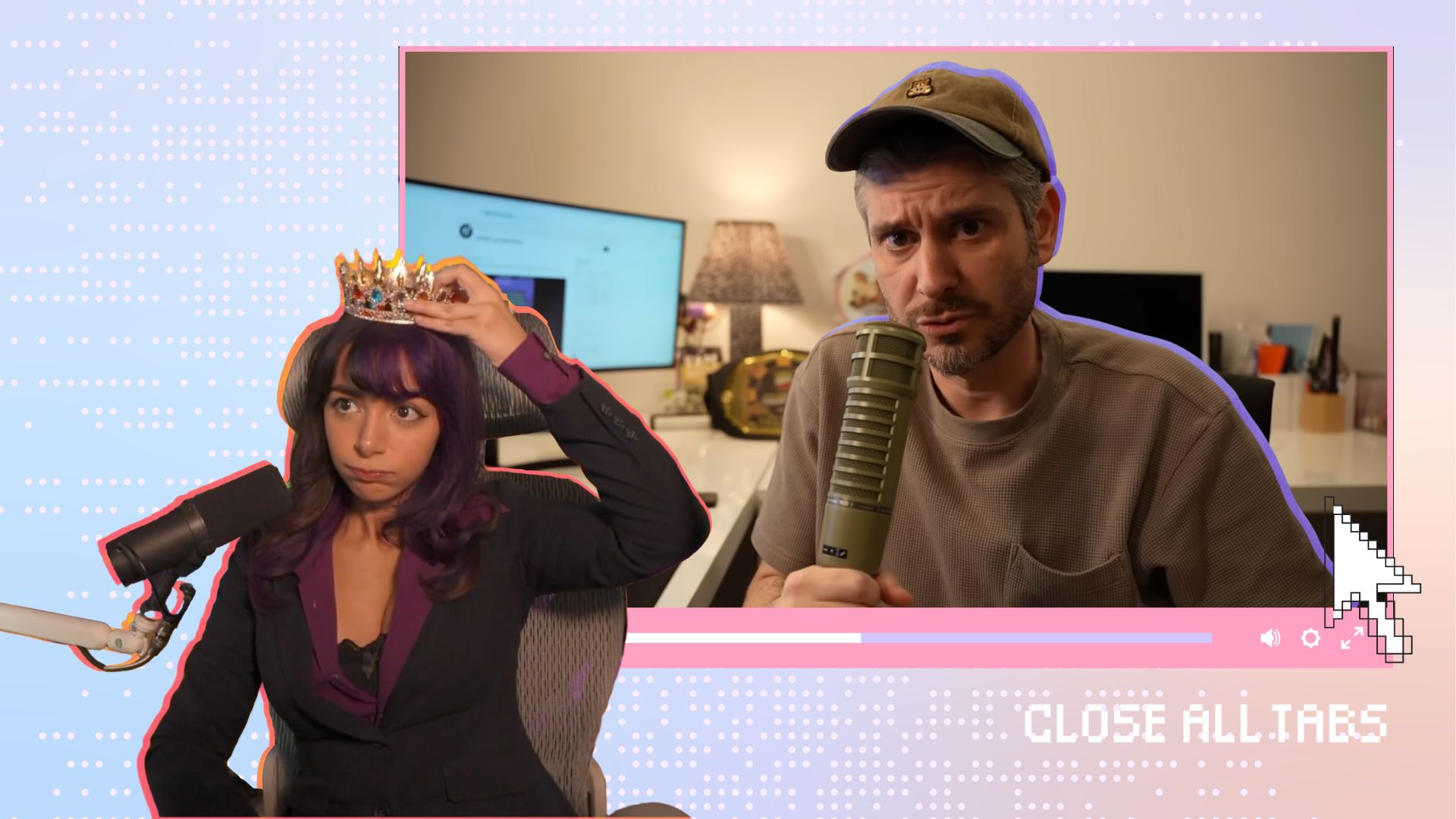
Morgan Sung: She reaches off camera and pulls a tripod into the frame. On it is a mannequin head with a printed photo of Ethan Klein taped over it. It’s wearing a gold costume crown.
[Audio from Denims Twitch video]
Denims: And let me just…
Morgan Sung: She plucks off the crown and places it on her own head.
[Audio from Denims Twitch video]
Denims: There we go. Much better.
Denims: Well, you know, I think everybody called him “the fair use king” for such a long time. And I think the second you start suing other creators for doing the same thing that you got really big and popular for, I think you should lose the rights to that crown, the social rights to that crown. And I think you should give it to the person who’s actually trying to defend fair use. Because it’s not just fair use when it’s the people that you like. It’s not freedom of speech when it’s people saying things you like. It’s—it should also apply when people aren’t saying things that you like, when people are saying things that you dislike. Heavy is the head that wears the crown and if it’s too heavy for you, I will gladly take it.
Morgan Sung: Let’s close all these tabs.
Close All Tabs is a production of KQED Studios, and is reported and hosted by me, Morgan Sung. This episode was produced by Chris Egusa, who also composed our theme song and credits music, and edited by Chris Hambrick. Additional production support from Ana de Almeida Amaral. The Close All tabs team also includes producer Maya Cueva, our intern Lauren Yoon, and audio engineer Brendan Willard. Additional music by APM. Audience engagement support from Maha Sanad. Jen Chien is our director of podcasts, and Ethan Toven-Lindsey is our editor-in-chief. Some members of the KQED podcast team are represented by the Screen Actors Guild, American Federation of Television and Radio Artists, San Francisco Northern California Local. This episode’s keyboard sounds were submitted by my dad, Casey Sung, and recorded on his white and blue Epomaker Aula F99 keyboard with Graywood v3 switches and Cherry Profile PBT keycaps. This episode features clips and archive tape from H3H3 Productions, the H3 Podcast, Leftovers, Kaseytron, Frogan, SeanDaBlack, and Denims. Thanks for listening.
Denims: I will be continuing to fight. Ethan said he will be taking this to appeals. So I guess maybe in 18 months or whatever, when I win that, then I can give more updates then.