window.__IS_SSR__=true
window.__INITIAL_STATE__={
"attachmentsReducer": {
"audio_0": {
"type": "attachments",
"id": "audio_0",
"imgSizes": {
"kqedFullSize": {
"file": "https://ww2.kqed.org/news/wp-content/themes/KQED-unified/img/audio_bgs/background0.jpg"
}
}
},
"audio_1": {
"type": "attachments",
"id": "audio_1",
"imgSizes": {
"kqedFullSize": {
"file": "https://ww2.kqed.org/news/wp-content/themes/KQED-unified/img/audio_bgs/background1.jpg"
}
}
},
"audio_2": {
"type": "attachments",
"id": "audio_2",
"imgSizes": {
"kqedFullSize": {
"file": "https://ww2.kqed.org/news/wp-content/themes/KQED-unified/img/audio_bgs/background2.jpg"
}
}
},
"audio_3": {
"type": "attachments",
"id": "audio_3",
"imgSizes": {
"kqedFullSize": {
"file": "https://ww2.kqed.org/news/wp-content/themes/KQED-unified/img/audio_bgs/background3.jpg"
}
}
},
"audio_4": {
"type": "attachments",
"id": "audio_4",
"imgSizes": {
"kqedFullSize": {
"file": "https://ww2.kqed.org/news/wp-content/themes/KQED-unified/img/audio_bgs/background4.jpg"
}
}
},
"placeholder": {
"type": "attachments",
"id": "placeholder",
"imgSizes": {
"thumbnail": {
"file": "https://cdn.kqed.org/wp-content/uploads/2024/12/KQED-Default-Image-816638274-2000x1333-1-160x107.jpg",
"width": 160,
"height": 107,
"mimeType": "image/jpeg"
},
"medium": {
"file": "https://cdn.kqed.org/wp-content/uploads/2024/12/KQED-Default-Image-816638274-2000x1333-1-800x533.jpg",
"width": 800,
"height": 533,
"mimeType": "image/jpeg"
},
"medium_large": {
"file": "https://cdn.kqed.org/wp-content/uploads/2024/12/KQED-Default-Image-816638274-2000x1333-1-768x512.jpg",
"width": 768,
"height": 512,
"mimeType": "image/jpeg"
},
"large": {
"file": "https://cdn.kqed.org/wp-content/uploads/2024/12/KQED-Default-Image-816638274-2000x1333-1-1020x680.jpg",
"width": 1020,
"height": 680,
"mimeType": "image/jpeg"
},
"1536x1536": {
"file": "https://cdn.kqed.org/wp-content/uploads/2024/12/KQED-Default-Image-816638274-2000x1333-1-1536x1024.jpg",
"width": 1536,
"height": 1024,
"mimeType": "image/jpeg"
},
"fd-lrg": {
"file": "https://cdn.kqed.org/wp-content/uploads/2024/12/KQED-Default-Image-816638274-2000x1333-1-1536x1024.jpg",
"width": 1536,
"height": 1024,
"mimeType": "image/jpeg"
},
"fd-med": {
"file": "https://cdn.kqed.org/wp-content/uploads/2024/12/KQED-Default-Image-816638274-2000x1333-1-1020x680.jpg",
"width": 1020,
"height": 680,
"mimeType": "image/jpeg"
},
"fd-sm": {
"file": "https://cdn.kqed.org/wp-content/uploads/2024/12/KQED-Default-Image-816638274-2000x1333-1-800x533.jpg",
"width": 800,
"height": 533,
"mimeType": "image/jpeg"
},
"post-thumbnail": {
"file": "https://cdn.kqed.org/wp-content/uploads/2024/12/KQED-Default-Image-816638274-2000x1333-1-672x372.jpg",
"width": 672,
"height": 372,
"mimeType": "image/jpeg"
},
"twentyfourteen-full-width": {
"file": "https://cdn.kqed.org/wp-content/uploads/2024/12/KQED-Default-Image-816638274-2000x1333-1-1038x576.jpg",
"width": 1038,
"height": 576,
"mimeType": "image/jpeg"
},
"xxsmall": {
"file": "https://cdn.kqed.org/wp-content/uploads/2024/12/KQED-Default-Image-816638274-2000x1333-1-160x107.jpg",
"width": 160,
"height": 107,
"mimeType": "image/jpeg"
},
"xsmall": {
"file": "https://cdn.kqed.org/wp-content/uploads/2024/12/KQED-Default-Image-816638274-2000x1333-1-672x372.jpg",
"width": 672,
"height": 372,
"mimeType": "image/jpeg"
},
"small": {
"file": "https://cdn.kqed.org/wp-content/uploads/2024/12/KQED-Default-Image-816638274-2000x1333-1-672x372.jpg",
"width": 672,
"height": 372,
"mimeType": "image/jpeg"
},
"xlarge": {
"file": "https://cdn.kqed.org/wp-content/uploads/2024/12/KQED-Default-Image-816638274-2000x1333-1-1020x680.jpg",
"width": 1020,
"height": 680,
"mimeType": "image/jpeg"
},
"full-width": {
"file": "https://cdn.kqed.org/wp-content/uploads/2024/12/KQED-Default-Image-816638274-2000x1333-1-1920x1280.jpg",
"width": 1920,
"height": 1280,
"mimeType": "image/jpeg"
},
"guest-author-32": {
"file": "https://cdn.kqed.org/wp-content/uploads/2025/01/KQED-Default-Image-816638274-1333x1333-1-160x160.jpg",
"width": 32,
"height": 32,
"mimeType": "image/jpeg"
},
"guest-author-50": {
"file": "https://cdn.kqed.org/wp-content/uploads/2025/01/KQED-Default-Image-816638274-1333x1333-1-160x160.jpg",
"width": 50,
"height": 50,
"mimeType": "image/jpeg"
},
"guest-author-64": {
"file": "https://cdn.kqed.org/wp-content/uploads/2025/01/KQED-Default-Image-816638274-1333x1333-1-160x160.jpg",
"width": 64,
"height": 64,
"mimeType": "image/jpeg"
},
"guest-author-96": {
"file": "https://cdn.kqed.org/wp-content/uploads/2025/01/KQED-Default-Image-816638274-1333x1333-1-160x160.jpg",
"width": 96,
"height": 96,
"mimeType": "image/jpeg"
},
"guest-author-128": {
"file": "https://cdn.kqed.org/wp-content/uploads/2025/01/KQED-Default-Image-816638274-1333x1333-1-160x160.jpg",
"width": 128,
"height": 128,
"mimeType": "image/jpeg"
},
"detail": {
"file": "https://cdn.kqed.org/wp-content/uploads/2025/01/KQED-Default-Image-816638274-1333x1333-1-160x160.jpg",
"width": 160,
"height": 160,
"mimeType": "image/jpeg"
},
"kqedFullSize": {
"file": "https://cdn.kqed.org/wp-content/uploads/2024/12/KQED-Default-Image-816638274-2000x1333-1.jpg",
"width": 2000,
"height": 1333
}
}
},
"mindshift_60781": {
"type": "attachments",
"id": "mindshift_60781",
"meta": {
"index": "attachments_1716263798",
"site": "mindshift",
"id": "60781",
"found": true
},
"parent": 60780,
"imgSizes": {
"twentyfourteen-full-width": {
"file": "https://ww2.kqed.org/app/uploads/sites/23/2023/01/gpt0_custom-872f90e839240b1211259e1ad7aef02b9f839af4-1038x576.png",
"width": 1038,
"mimeType": "image/png",
"height": 576
},
"thumbnail": {
"file": "https://ww2.kqed.org/app/uploads/sites/23/2023/01/gpt0_custom-872f90e839240b1211259e1ad7aef02b9f839af4-160x96.png",
"width": 160,
"mimeType": "image/png",
"height": 96
},
"post-thumbnail": {
"file": "https://ww2.kqed.org/app/uploads/sites/23/2023/01/gpt0_custom-872f90e839240b1211259e1ad7aef02b9f839af4-672x372.png",
"width": 672,
"mimeType": "image/png",
"height": 372
},
"kqedFullSize": {
"file": "https://ww2.kqed.org/app/uploads/sites/23/2023/01/gpt0_custom-872f90e839240b1211259e1ad7aef02b9f839af4.png",
"width": 1276,
"height": 767
},
"large": {
"file": "https://ww2.kqed.org/app/uploads/sites/23/2023/01/gpt0_custom-872f90e839240b1211259e1ad7aef02b9f839af4-1020x613.png",
"width": 1020,
"mimeType": "image/png",
"height": 613
},
"medium": {
"file": "https://ww2.kqed.org/app/uploads/sites/23/2023/01/gpt0_custom-872f90e839240b1211259e1ad7aef02b9f839af4-800x481.png",
"width": 800,
"mimeType": "image/png",
"height": 481
},
"medium_large": {
"file": "https://ww2.kqed.org/app/uploads/sites/23/2023/01/gpt0_custom-872f90e839240b1211259e1ad7aef02b9f839af4-768x462.png",
"width": 768,
"mimeType": "image/png",
"height": 462
}
},
"publishDate": 1673301947,
"modified": 1673301947,
"caption": null,
"description": null,
"title": "GPTZero in action: The bot correctly detected AI-written text. The writing sample that was submitted? ChatGPT's attempt at \"an essay on the ethics of AI plagiarism that could pass a ChatGPT detector tool.\"",
"credit": null,
"status": "inherit",
"altTag": null,
"isLoading": false,
"fetchFailed": false
},
"mindshift_60640": {
"type": "attachments",
"id": "mindshift_60640",
"meta": {
"index": "attachments_1716263798",
"site": "mindshift",
"id": "60640",
"found": true
},
"parent": 60639,
"imgSizes": {
"twentyfourteen-full-width": {
"file": "https://ww2.kqed.org/app/uploads/sites/23/2022/12/chat-gpt-art-2_custom-d6c322b9069b3953f91013331c1ba97326d112ef-1038x576.png",
"width": 1038,
"mimeType": "image/png",
"height": 576
},
"thumbnail": {
"file": "https://ww2.kqed.org/app/uploads/sites/23/2022/12/chat-gpt-art-2_custom-d6c322b9069b3953f91013331c1ba97326d112ef-160x105.png",
"width": 160,
"mimeType": "image/png",
"height": 105
},
"post-thumbnail": {
"file": "https://ww2.kqed.org/app/uploads/sites/23/2022/12/chat-gpt-art-2_custom-d6c322b9069b3953f91013331c1ba97326d112ef-672x372.png",
"width": 672,
"mimeType": "image/png",
"height": 372
},
"kqedFullSize": {
"file": "https://ww2.kqed.org/app/uploads/sites/23/2022/12/chat-gpt-art-2_custom-d6c322b9069b3953f91013331c1ba97326d112ef.png",
"width": 1233,
"height": 812
},
"large": {
"file": "https://ww2.kqed.org/app/uploads/sites/23/2022/12/chat-gpt-art-2_custom-d6c322b9069b3953f91013331c1ba97326d112ef-1020x672.png",
"width": 1020,
"mimeType": "image/png",
"height": 672
},
"medium": {
"file": "https://ww2.kqed.org/app/uploads/sites/23/2022/12/chat-gpt-art-2_custom-d6c322b9069b3953f91013331c1ba97326d112ef-800x527.png",
"width": 800,
"mimeType": "image/png",
"height": 527
},
"medium_large": {
"file": "https://ww2.kqed.org/app/uploads/sites/23/2022/12/chat-gpt-art-2_custom-d6c322b9069b3953f91013331c1ba97326d112ef-768x506.png",
"width": 768,
"mimeType": "image/png",
"height": 506
}
},
"publishDate": 1671508053,
"modified": 1671508053,
"caption": null,
"description": null,
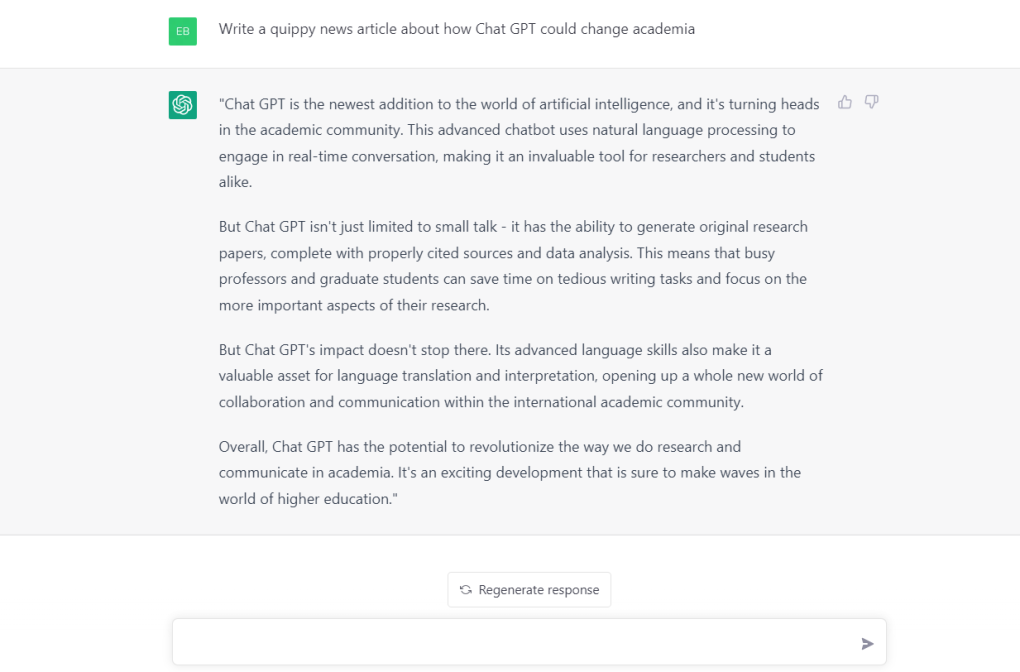
"title": "Enter a prompt into ChatGPT, and it becomes your very own virtual assistant.",
"credit": null,
"status": "inherit",
"altTag": null,
"isLoading": false,
"fetchFailed": false
},
"mindshift_60609": {
"type": "attachments",
"id": "mindshift_60609",
"meta": {
"index": "attachments_1716263798",
"site": "mindshift",
"id": "60609",
"found": true
},
"parent": 60607,
"imgSizes": {
"twentyfourteen-full-width": {
"file": "https://ww2.kqed.org/app/uploads/sites/23/2022/12/Alisa-Zahoruiko-iStock-1038x576.jpg",
"width": 1038,
"mimeType": "image/jpeg",
"height": 576
},
"thumbnail": {
"file": "https://ww2.kqed.org/app/uploads/sites/23/2022/12/Alisa-Zahoruiko-iStock-160x96.jpg",
"width": 160,
"mimeType": "image/jpeg",
"height": 96
},
"post-thumbnail": {
"file": "https://ww2.kqed.org/app/uploads/sites/23/2022/12/Alisa-Zahoruiko-iStock-672x372.jpg",
"width": 672,
"mimeType": "image/jpeg",
"height": 372
},
"kqedFullSize": {
"file": "https://ww2.kqed.org/app/uploads/sites/23/2022/12/Alisa-Zahoruiko-iStock.jpg",
"width": 2235,
"height": 1341
},
"2048x2048": {
"file": "https://ww2.kqed.org/app/uploads/sites/23/2022/12/Alisa-Zahoruiko-iStock-2048x1229.jpg",
"width": 2048,
"mimeType": "image/jpeg",
"height": 1229
},
"large": {
"file": "https://ww2.kqed.org/app/uploads/sites/23/2022/12/Alisa-Zahoruiko-iStock-1020x612.jpg",
"width": 1020,
"mimeType": "image/jpeg",
"height": 612
},
"1536x1536": {
"file": "https://ww2.kqed.org/app/uploads/sites/23/2022/12/Alisa-Zahoruiko-iStock-1536x922.jpg",
"width": 1536,
"mimeType": "image/jpeg",
"height": 922
},
"full-width": {
"file": "https://ww2.kqed.org/app/uploads/sites/23/2022/12/Alisa-Zahoruiko-iStock-1920x1152.jpg",
"width": 1920,
"mimeType": "image/jpeg",
"height": 1152
},
"medium": {
"file": "https://ww2.kqed.org/app/uploads/sites/23/2022/12/Alisa-Zahoruiko-iStock-800x480.jpg",
"width": 800,
"mimeType": "image/jpeg",
"height": 480
},
"medium_large": {
"file": "https://ww2.kqed.org/app/uploads/sites/23/2022/12/Alisa-Zahoruiko-iStock-768x461.jpg",
"width": 768,
"mimeType": "image/jpeg",
"height": 461
}
},
"publishDate": 1671393590,
"modified": 1671393769,
"caption": null,
"description": null,
"title": "Alisa Zahoruiko-iStock",
"credit": "Alisa Zahoruiko/iStock",
"status": "inherit",
"altTag": "A counselor in a computer screen talks to a young woman in mental distress",
"isLoading": false,
"fetchFailed": false
},
"mindshift_60239": {
"type": "attachments",
"id": "mindshift_60239",
"meta": {
"index": "attachments_1716263798",
"site": "mindshift",
"id": "60239",
"found": true
},
"parent": 60098,
"imgSizes": {
"twentyfourteen-full-width": {
"file": "https://ww2.kqed.org/app/uploads/sites/23/2022/11/Prostock-Sudio-iStock-932274694-1038x576.jpg",
"width": 1038,
"mimeType": "image/jpeg",
"height": 576
},
"thumbnail": {
"file": "https://ww2.kqed.org/app/uploads/sites/23/2022/11/Prostock-Sudio-iStock-932274694-160x107.jpg",
"width": 160,
"mimeType": "image/jpeg",
"height": 107
},
"post-thumbnail": {
"file": "https://ww2.kqed.org/app/uploads/sites/23/2022/11/Prostock-Sudio-iStock-932274694-672x372.jpg",
"width": 672,
"mimeType": "image/jpeg",
"height": 372
},
"kqedFullSize": {
"file": "https://ww2.kqed.org/app/uploads/sites/23/2022/11/Prostock-Sudio-iStock-932274694-e1668098740584.jpg",
"width": 1920,
"height": 1280
},
"2048x2048": {
"file": "https://ww2.kqed.org/app/uploads/sites/23/2022/11/Prostock-Sudio-iStock-932274694-2048x1365.jpg",
"width": 2048,
"mimeType": "image/jpeg",
"height": 1365
},
"large": {
"file": "https://ww2.kqed.org/app/uploads/sites/23/2022/11/Prostock-Sudio-iStock-932274694-1020x680.jpg",
"width": 1020,
"mimeType": "image/jpeg",
"height": 680
},
"1536x1536": {
"file": "https://ww2.kqed.org/app/uploads/sites/23/2022/11/Prostock-Sudio-iStock-932274694-1536x1024.jpg",
"width": 1536,
"mimeType": "image/jpeg",
"height": 1024
},
"full-width": {
"file": "https://ww2.kqed.org/app/uploads/sites/23/2022/11/Prostock-Sudio-iStock-932274694-1920x1280.jpg",
"width": 1920,
"mimeType": "image/jpeg",
"height": 1280
},
"medium": {
"file": "https://ww2.kqed.org/app/uploads/sites/23/2022/11/Prostock-Sudio-iStock-932274694-800x533.jpg",
"width": 800,
"mimeType": "image/jpeg",
"height": 533
},
"medium_large": {
"file": "https://ww2.kqed.org/app/uploads/sites/23/2022/11/Prostock-Sudio-iStock-932274694-768x512.jpg",
"width": 768,
"mimeType": "image/jpeg",
"height": 512
}
},
"publishDate": 1668098699,
"modified": 1668098774,
"caption": null,
"description": null,
"title": "Tired student girl lying on the floor with books and gadgets",
"credit": "Prostock-Studio/iStock",
"status": "inherit",
"altTag": "Tired student girl lying on the floor with books and gadgets",
"isLoading": false,
"fetchFailed": false
},
"mindshift_60394": {
"type": "attachments",
"id": "mindshift_60394",
"meta": {
"index": "attachments_1716263798",
"site": "mindshift",
"id": "60394",
"found": true
},
"parent": 60127,
"imgSizes": {
"twentyfourteen-full-width": {
"file": "https://ww2.kqed.org/app/uploads/sites/23/2022/11/iStock-1371934931-1038x576.jpg",
"width": 1038,
"mimeType": "image/jpeg",
"height": 576
},
"thumbnail": {
"file": "https://ww2.kqed.org/app/uploads/sites/23/2022/11/iStock-1371934931-160x107.jpg",
"width": 160,
"mimeType": "image/jpeg",
"height": 107
},
"post-thumbnail": {
"file": "https://ww2.kqed.org/app/uploads/sites/23/2022/11/iStock-1371934931-672x372.jpg",
"width": 672,
"mimeType": "image/jpeg",
"height": 372
},
"kqedFullSize": {
"file": "https://ww2.kqed.org/app/uploads/sites/23/2022/11/iStock-1371934931.jpg",
"width": 2114,
"height": 1418
},
"2048x2048": {
"file": "https://ww2.kqed.org/app/uploads/sites/23/2022/11/iStock-1371934931-2048x1374.jpg",
"width": 2048,
"mimeType": "image/jpeg",
"height": 1374
},
"large": {
"file": "https://ww2.kqed.org/app/uploads/sites/23/2022/11/iStock-1371934931-1020x684.jpg",
"width": 1020,
"mimeType": "image/jpeg",
"height": 684
},
"1536x1536": {
"file": "https://ww2.kqed.org/app/uploads/sites/23/2022/11/iStock-1371934931-1536x1030.jpg",
"width": 1536,
"mimeType": "image/jpeg",
"height": 1030
},
"full-width": {
"file": "https://ww2.kqed.org/app/uploads/sites/23/2022/11/iStock-1371934931-1920x1288.jpg",
"width": 1920,
"mimeType": "image/jpeg",
"height": 1288
},
"medium": {
"file": "https://ww2.kqed.org/app/uploads/sites/23/2022/11/iStock-1371934931-800x537.jpg",
"width": 800,
"mimeType": "image/jpeg",
"height": 537
},
"medium_large": {
"file": "https://ww2.kqed.org/app/uploads/sites/23/2022/11/iStock-1371934931-768x515.jpg",
"width": 768,
"mimeType": "image/jpeg",
"height": 515
}
},
"publishDate": 1669222431,
"modified": 1669222463,
"caption": null,
"description": null,
"title": "International students sitting together on green campus lawn - Group of high school teens studying outside college - Multiethnic millenial friends doing homework in university park - Academic concept",
"credit": "Kar-Tr/iStock",
"status": "inherit",
"altTag": "International students sitting together on green campus lawn - Group of high school teens studying outside college - Multiethnic millenial friends doing homework in university park",
"isLoading": false,
"fetchFailed": false
},
"mindshift_60378": {
"type": "attachments",
"id": "mindshift_60378",
"meta": {
"index": "attachments_1716263798",
"site": "mindshift",
"id": "60378",
"found": true
},
"parent": 60352,
"imgSizes": {
"twentyfourteen-full-width": {
"file": "https://ww2.kqed.org/app/uploads/sites/23/2022/11/Nuthawut-Somsuk-istock-1038x576.jpg",
"width": 1038,
"mimeType": "image/jpeg",
"height": 576
},
"thumbnail": {
"file": "https://ww2.kqed.org/app/uploads/sites/23/2022/11/Nuthawut-Somsuk-istock-160x107.jpg",
"width": 160,
"mimeType": "image/jpeg",
"height": 107
},
"post-thumbnail": {
"file": "https://ww2.kqed.org/app/uploads/sites/23/2022/11/Nuthawut-Somsuk-istock-672x372.jpg",
"width": 672,
"mimeType": "image/jpeg",
"height": 372
},
"kqedFullSize": {
"file": "https://ww2.kqed.org/app/uploads/sites/23/2022/11/Nuthawut-Somsuk-istock.jpg",
"width": 2121,
"height": 1414
},
"2048x2048": {
"file": "https://ww2.kqed.org/app/uploads/sites/23/2022/11/Nuthawut-Somsuk-istock-2048x1365.jpg",
"width": 2048,
"mimeType": "image/jpeg",
"height": 1365
},
"large": {
"file": "https://ww2.kqed.org/app/uploads/sites/23/2022/11/Nuthawut-Somsuk-istock-1020x680.jpg",
"width": 1020,
"mimeType": "image/jpeg",
"height": 680
},
"1536x1536": {
"file": "https://ww2.kqed.org/app/uploads/sites/23/2022/11/Nuthawut-Somsuk-istock-1536x1024.jpg",
"width": 1536,
"mimeType": "image/jpeg",
"height": 1024
},
"full-width": {
"file": "https://ww2.kqed.org/app/uploads/sites/23/2022/11/Nuthawut-Somsuk-istock-1920x1280.jpg",
"width": 1920,
"mimeType": "image/jpeg",
"height": 1280
},
"medium": {
"file": "https://ww2.kqed.org/app/uploads/sites/23/2022/11/Nuthawut-Somsuk-istock-800x533.jpg",
"width": 800,
"mimeType": "image/jpeg",
"height": 533
},
"medium_large": {
"file": "https://ww2.kqed.org/app/uploads/sites/23/2022/11/Nuthawut-Somsuk-istock-768x512.jpg",
"width": 768,
"mimeType": "image/jpeg",
"height": 512
}
},
"publishDate": 1668813018,
"modified": 1668813092,
"caption": null,
"description": null,
"title": "Education or knowledge to growth career path, working skill to success in work, learn or study new course for business success concept, businessman fly graduation mortar hat balloon see future vision.",
"credit": "Nuthawut Somsuk/iStock",
"status": "inherit",
"altTag": "Illustration of a hot air balloon where the balloon is in a graduation cap. A man is in the basket peering out of a telescope.",
"isLoading": false,
"fetchFailed": false
},
"mindshift_59743": {
"type": "attachments",
"id": "mindshift_59743",
"meta": {
"index": "attachments_1716263798",
"site": "mindshift",
"id": "59743",
"found": true
},
"parent": 59742,
"imgSizes": {
"twentyfourteen-full-width": {
"file": "https://ww2.kqed.org/app/uploads/sites/23/2022/08/img_7808-2-62435df008a724554de55930bffc44286d84e782-1038x576.jpg",
"width": 1038,
"mimeType": "image/jpeg",
"height": 576
},
"thumbnail": {
"file": "https://ww2.kqed.org/app/uploads/sites/23/2022/08/img_7808-2-62435df008a724554de55930bffc44286d84e782-160x120.jpg",
"width": 160,
"mimeType": "image/jpeg",
"height": 120
},
"post-thumbnail": {
"file": "https://ww2.kqed.org/app/uploads/sites/23/2022/08/img_7808-2-62435df008a724554de55930bffc44286d84e782-672x372.jpg",
"width": 672,
"mimeType": "image/jpeg",
"height": 372
},
"kqedFullSize": {
"file": "https://ww2.kqed.org/app/uploads/sites/23/2022/08/img_7808-2-62435df008a724554de55930bffc44286d84e782-scaled-e1660918021432.jpg",
"width": 1920,
"height": 1440
},
"2048x2048": {
"file": "https://ww2.kqed.org/app/uploads/sites/23/2022/08/img_7808-2-62435df008a724554de55930bffc44286d84e782-2048x1536.jpg",
"width": 2048,
"mimeType": "image/jpeg",
"height": 1536
},
"large": {
"file": "https://ww2.kqed.org/app/uploads/sites/23/2022/08/img_7808-2-62435df008a724554de55930bffc44286d84e782-1020x765.jpg",
"width": 1020,
"mimeType": "image/jpeg",
"height": 765
},
"1536x1536": {
"file": "https://ww2.kqed.org/app/uploads/sites/23/2022/08/img_7808-2-62435df008a724554de55930bffc44286d84e782-1536x1152.jpg",
"width": 1536,
"mimeType": "image/jpeg",
"height": 1152
},
"full-width": {
"file": "https://ww2.kqed.org/app/uploads/sites/23/2022/08/img_7808-2-62435df008a724554de55930bffc44286d84e782-1920x1440.jpg",
"width": 1920,
"mimeType": "image/jpeg",
"height": 1440
},
"medium": {
"file": "https://ww2.kqed.org/app/uploads/sites/23/2022/08/img_7808-2-62435df008a724554de55930bffc44286d84e782-800x600.jpg",
"width": 800,
"mimeType": "image/jpeg",
"height": 600
},
"medium_large": {
"file": "https://ww2.kqed.org/app/uploads/sites/23/2022/08/img_7808-2-62435df008a724554de55930bffc44286d84e782-768x576.jpg",
"width": 768,
"mimeType": "image/jpeg",
"height": 576
}
},
"publishDate": 1660917659,
"modified": 1660918059,
"caption": "Stanley Andrisse says his 21-year-old self, who was once facing 20 years to life in prison, could never have imagined his life today: Andrisse is now an endocrinologist, scientist and professor at Howard University's College of Medicine. He has a Ph.D., an MBA, and a lab full of students who affectionately call him Dr. Stan.\n",
"description": null,
"title": "Stanley Andrisse says his 21-year-old self, who was once facing 20 years to life in prison, could never have imagined his life today: Andrisse is now an endocrinologist, scientist and professor at Howard University's College of Medicine. He has a Ph.D., an MBA, and a lab full of students who affectionately call him Dr. Stan.",
"credit": "Jeffrey Pierre/NPR",
"status": "inherit",
"altTag": "Dr. Stanley Andrisse at Howard University",
"isLoading": false,
"fetchFailed": false
},
"mindshift_57129": {
"type": "attachments",
"id": "mindshift_57129",
"meta": {
"index": "attachments_1716263798",
"site": "mindshift",
"id": "57129",
"found": true
},
"parent": 57127,
"imgSizes": {
"twentyfourteen-full-width": {
"file": "https://ww2.kqed.org/app/uploads/sites/23/2020/12/brian-williams_stafford-tx_017a-ef5c1328c6e3bc677f2ccf8f288a26c9ca33386d-1038x576.jpg",
"width": 1038,
"mimeType": "image/jpeg",
"height": 576
},
"thumbnail": {
"file": "https://ww2.kqed.org/app/uploads/sites/23/2020/12/brian-williams_stafford-tx_017a-ef5c1328c6e3bc677f2ccf8f288a26c9ca33386d-160x120.jpg",
"width": 160,
"mimeType": "image/jpeg",
"height": 120
},
"post-thumbnail": {
"file": "https://ww2.kqed.org/app/uploads/sites/23/2020/12/brian-williams_stafford-tx_017a-ef5c1328c6e3bc677f2ccf8f288a26c9ca33386d-672x372.jpg",
"width": 672,
"mimeType": "image/jpeg",
"height": 372
},
"kqedFullSize": {
"file": "https://ww2.kqed.org/app/uploads/sites/23/2020/12/brian-williams_stafford-tx_017a-ef5c1328c6e3bc677f2ccf8f288a26c9ca33386d-scaled-e1608281953279.jpg",
"width": 1920,
"height": 1440
},
"2048x2048": {
"file": "https://ww2.kqed.org/app/uploads/sites/23/2020/12/brian-williams_stafford-tx_017a-ef5c1328c6e3bc677f2ccf8f288a26c9ca33386d-2048x1536.jpg",
"width": 2048,
"mimeType": "image/jpeg",
"height": 1536
},
"large": {
"file": "https://ww2.kqed.org/app/uploads/sites/23/2020/12/brian-williams_stafford-tx_017a-ef5c1328c6e3bc677f2ccf8f288a26c9ca33386d-1020x765.jpg",
"width": 1020,
"mimeType": "image/jpeg",
"height": 765
},
"1536x1536": {
"file": "https://ww2.kqed.org/app/uploads/sites/23/2020/12/brian-williams_stafford-tx_017a-ef5c1328c6e3bc677f2ccf8f288a26c9ca33386d-1536x1152.jpg",
"width": 1536,
"mimeType": "image/jpeg",
"height": 1152
},
"full-width": {
"file": "https://ww2.kqed.org/app/uploads/sites/23/2020/12/brian-williams_stafford-tx_017a-ef5c1328c6e3bc677f2ccf8f288a26c9ca33386d-1920x1440.jpg",
"width": 1920,
"mimeType": "image/jpeg",
"height": 1440
},
"medium": {
"file": "https://ww2.kqed.org/app/uploads/sites/23/2020/12/brian-williams_stafford-tx_017a-ef5c1328c6e3bc677f2ccf8f288a26c9ca33386d-800x600.jpg",
"width": 800,
"mimeType": "image/jpeg",
"height": 600
},
"medium_large": {
"file": "https://ww2.kqed.org/app/uploads/sites/23/2020/12/brian-williams_stafford-tx_017a-ef5c1328c6e3bc677f2ccf8f288a26c9ca33386d-768x576.jpg",
"width": 768,
"mimeType": "image/jpeg",
"height": 576
}
},
"publishDate": 1608281024,
"modified": 1608281965,
"caption": "Instead of going to college this fall, Brian Williams got a job at a Jimmy John's near his home in Stafford, Texas. He says paying for college was always going to be hard, but it was even harder to justify the expense during a pandemic.\n",
"description": "Brian Williams at the Jimmy John's franchise where he works in Stafford, TX on Monday, December 14, 2020. Brian graduated from high school last spring -- right in the middle of the pandemic. His plan was always to go to college -- he was thinking Houston Community College. But after finishing his final classes online he just couldn't stomach doing that again for college in the fall. Plus there was the financial piece \"to be honest -- the money was a big part of it. We're broke!\" Instead of enrolling in the fall, he's working as many shifts as he can at Jimmy John's, saving up for college and helping his mom pay for the household expenses. (Photo/Scott Dalton)",
"title": "Instead of going to college this fall, Brian Williams got a job at a Jimmy John's near his home in Stafford, Texas. He says paying for college was always going to be hard, but it was even harder to justify the expense during a pandemic.",
"credit": "Scott Dalton for NPR",
"status": "inherit",
"altTag": null,
"isLoading": false,
"fetchFailed": false
},
"mindshift_56955": {
"type": "attachments",
"id": "mindshift_56955",
"meta": {
"index": "attachments_1716263798",
"site": "mindshift",
"id": "56955",
"found": true
},
"parent": 56954,
"imgSizes": {
"twentyfourteen-full-width": {
"file": "https://ww2.kqed.org/app/uploads/sites/23/2020/11/ap_20313082614357_slide-8160ba0325cdd33d526c604aebd151bd27866dc2-1038x576.jpg",
"width": 1038,
"mimeType": "image/jpeg",
"height": 576
},
"thumbnail": {
"file": "https://ww2.kqed.org/app/uploads/sites/23/2020/11/ap_20313082614357_slide-8160ba0325cdd33d526c604aebd151bd27866dc2-160x107.jpg",
"width": 160,
"mimeType": "image/jpeg",
"height": 107
},
"post-thumbnail": {
"file": "https://ww2.kqed.org/app/uploads/sites/23/2020/11/ap_20313082614357_slide-8160ba0325cdd33d526c604aebd151bd27866dc2-672x372.jpg",
"width": 672,
"mimeType": "image/jpeg",
"height": 372
},
"kqedFullSize": {
"file": "https://ww2.kqed.org/app/uploads/sites/23/2020/11/ap_20313082614357_slide-8160ba0325cdd33d526c604aebd151bd27866dc2-scaled-e1605080329252.jpg",
"width": 1920,
"height": 1280
},
"2048x2048": {
"file": "https://ww2.kqed.org/app/uploads/sites/23/2020/11/ap_20313082614357_slide-8160ba0325cdd33d526c604aebd151bd27866dc2-2048x1366.jpg",
"width": 2048,
"mimeType": "image/jpeg",
"height": 1366
},
"large": {
"file": "https://ww2.kqed.org/app/uploads/sites/23/2020/11/ap_20313082614357_slide-8160ba0325cdd33d526c604aebd151bd27866dc2-1020x680.jpg",
"width": 1020,
"mimeType": "image/jpeg",
"height": 680
},
"1536x1536": {
"file": "https://ww2.kqed.org/app/uploads/sites/23/2020/11/ap_20313082614357_slide-8160ba0325cdd33d526c604aebd151bd27866dc2-1536x1024.jpg",
"width": 1536,
"mimeType": "image/jpeg",
"height": 1024
},
"full-width": {
"file": "https://ww2.kqed.org/app/uploads/sites/23/2020/11/ap_20313082614357_slide-8160ba0325cdd33d526c604aebd151bd27866dc2-1920x1280.jpg",
"width": 1920,
"mimeType": "image/jpeg",
"height": 1280
},
"medium": {
"file": "https://ww2.kqed.org/app/uploads/sites/23/2020/11/ap_20313082614357_slide-8160ba0325cdd33d526c604aebd151bd27866dc2-800x533.jpg",
"width": 800,
"mimeType": "image/jpeg",
"height": 533
},
"medium_large": {
"file": "https://ww2.kqed.org/app/uploads/sites/23/2020/11/ap_20313082614357_slide-8160ba0325cdd33d526c604aebd151bd27866dc2-768x512.jpg",
"width": 768,
"mimeType": "image/jpeg",
"height": 512
}
},
"publishDate": 1605080264,
"modified": 1605080347,
"caption": "President-elect Joe Biden stands on stage with his wife, Jill Biden, on Saturday in Wilmington, Del. The incoming first lady is an English professor at Northern Virginia Community College.\n",
"description": "President-elect Joe Biden stands on stage with his wife Jill Biden Saturday, Nov. 7, 2020, in Wilmington, Del. (AP Photo/Carolyn Kaster)",
"title": "President-elect Joe Biden stands on stage with his wife, Jill Biden, on Saturday in Wilmington, Del. The incoming first lady is an English professor at Northern Virginia Community College.",
"credit": "Carolyn Kaster/AP",
"status": "inherit",
"isLoading": false,
"fetchFailed": false
},
"mindshift_56856": {
"type": "attachments",
"id": "mindshift_56856",
"meta": {
"index": "attachments_1716263798",
"site": "mindshift",
"id": "56856",
"found": true
},
"parent": 56855,
"imgSizes": {
"twentyfourteen-full-width": {
"file": "https://ww2.kqed.org/app/uploads/sites/23/2020/10/cpornea-npr-fafsa_custom-b7814aa5465aff60ba131bf68badd4a3ded5e8f5-1038x576.jpg",
"width": 1038,
"mimeType": "image/jpeg",
"height": 576
},
"thumbnail": {
"file": "https://ww2.kqed.org/app/uploads/sites/23/2020/10/cpornea-npr-fafsa_custom-b7814aa5465aff60ba131bf68badd4a3ded5e8f5-160x100.jpg",
"width": 160,
"mimeType": "image/jpeg",
"height": 100
},
"post-thumbnail": {
"file": "https://ww2.kqed.org/app/uploads/sites/23/2020/10/cpornea-npr-fafsa_custom-b7814aa5465aff60ba131bf68badd4a3ded5e8f5-672x372.jpg",
"width": 672,
"mimeType": "image/jpeg",
"height": 372
},
"kqedFullSize": {
"file": "https://ww2.kqed.org/app/uploads/sites/23/2020/10/cpornea-npr-fafsa_custom-b7814aa5465aff60ba131bf68badd4a3ded5e8f5-scaled-e1603348281806.jpg",
"width": 1920,
"height": 1199
},
"2048x2048": {
"file": "https://ww2.kqed.org/app/uploads/sites/23/2020/10/cpornea-npr-fafsa_custom-b7814aa5465aff60ba131bf68badd4a3ded5e8f5-2048x1278.jpg",
"width": 2048,
"mimeType": "image/jpeg",
"height": 1278
},
"large": {
"file": "https://ww2.kqed.org/app/uploads/sites/23/2020/10/cpornea-npr-fafsa_custom-b7814aa5465aff60ba131bf68badd4a3ded5e8f5-1020x637.jpg",
"width": 1020,
"mimeType": "image/jpeg",
"height": 637
},
"1536x1536": {
"file": "https://ww2.kqed.org/app/uploads/sites/23/2020/10/cpornea-npr-fafsa_custom-b7814aa5465aff60ba131bf68badd4a3ded5e8f5-1536x959.jpg",
"width": 1536,
"mimeType": "image/jpeg",
"height": 959
},
"full-width": {
"file": "https://ww2.kqed.org/app/uploads/sites/23/2020/10/cpornea-npr-fafsa_custom-b7814aa5465aff60ba131bf68badd4a3ded5e8f5-1920x1198.jpg",
"width": 1920,
"mimeType": "image/jpeg",
"height": 1198
},
"medium": {
"file": "https://ww2.kqed.org/app/uploads/sites/23/2020/10/cpornea-npr-fafsa_custom-b7814aa5465aff60ba131bf68badd4a3ded5e8f5-800x499.jpg",
"width": 800,
"mimeType": "image/jpeg",
"height": 499
},
"medium_large": {
"file": "https://ww2.kqed.org/app/uploads/sites/23/2020/10/cpornea-npr-fafsa_custom-b7814aa5465aff60ba131bf68badd4a3ded5e8f5-768x479.jpg",
"width": 768,
"mimeType": "image/jpeg",
"height": 479
}
},
"publishDate": 1603348205,
"modified": 1603348292,
"caption": null,
"description": null,
"title": "It's FAFSA season!",
"credit": "Cha Pornea for NPR",
"status": "inherit",
"isLoading": false,
"fetchFailed": false
},
"mindshift_56551": {
"type": "attachments",
"id": "mindshift_56551",
"meta": {
"index": "attachments_1716263798",
"site": "mindshift",
"id": "56551",
"found": true
},
"parent": 56550,
"imgSizes": {
"thumbnail": {
"file": "https://ww2.kqed.org/app/uploads/sites/23/2020/08/la2017_wide-d2728452d8cc7adc6ce97330938b8b5f2170fe98-160x90.jpg",
"width": 160,
"mimeType": "image/jpeg",
"height": 90
},
"post-thumbnail": {
"file": "https://ww2.kqed.org/app/uploads/sites/23/2020/08/la2017_wide-d2728452d8cc7adc6ce97330938b8b5f2170fe98-672x372.jpg",
"width": 672,
"mimeType": "image/jpeg",
"height": 372
},
"kqedFullSize": {
"file": "https://ww2.kqed.org/app/uploads/sites/23/2020/08/la2017_wide-d2728452d8cc7adc6ce97330938b8b5f2170fe98.jpg",
"width": 800,
"height": 450
},
"medium_large": {
"file": "https://ww2.kqed.org/app/uploads/sites/23/2020/08/la2017_wide-d2728452d8cc7adc6ce97330938b8b5f2170fe98-768x432.jpg",
"width": 768,
"mimeType": "image/jpeg",
"height": 432
}
},
"publishDate": 1597940716,
"modified": 1597940894,
"caption": null,
"description": "If you know how to navigate the federal student loan system, you can find a payment plan you can afford.",
"title": "Graduate floating in water.",
"credit": "LA Johnson/NPR",
"status": "inherit",
"isLoading": false,
"fetchFailed": false
},
"mindshift_54802": {
"type": "attachments",
"id": "mindshift_54802",
"meta": {
"index": "attachments_1716263798",
"site": "mindshift",
"id": "54802",
"found": true
},
"parent": 54801,
"imgSizes": {
"twentyfourteen-full-width": {
"file": "https://ww2.kqed.org/app/uploads/sites/23/2019/11/ryanjohnson_first_generation_custom-3cfc02fa491dfc61d641970d597c5024682eedb3-1038x576.jpg",
"width": 1038,
"mimeType": "image/jpeg",
"height": 576
},
"thumbnail": {
"file": "https://ww2.kqed.org/app/uploads/sites/23/2019/11/ryanjohnson_first_generation_custom-3cfc02fa491dfc61d641970d597c5024682eedb3-160x97.jpg",
"width": 160,
"mimeType": "image/jpeg",
"height": 97
},
"post-thumbnail": {
"file": "https://ww2.kqed.org/app/uploads/sites/23/2019/11/ryanjohnson_first_generation_custom-3cfc02fa491dfc61d641970d597c5024682eedb3-672x372.jpg",
"width": 672,
"mimeType": "image/jpeg",
"height": 372
},
"kqedFullSize": {
"file": "https://ww2.kqed.org/app/uploads/sites/23/2019/11/ryanjohnson_first_generation_custom-3cfc02fa491dfc61d641970d597c5024682eedb3-e1573589788396.jpg",
"width": 1920,
"height": 1165
},
"large": {
"file": "https://ww2.kqed.org/app/uploads/sites/23/2019/11/ryanjohnson_first_generation_custom-3cfc02fa491dfc61d641970d597c5024682eedb3-1020x619.jpg",
"width": 1020,
"mimeType": "image/jpeg",
"height": 619
},
"complete_open_graph": {
"file": "https://ww2.kqed.org/app/uploads/sites/23/2019/11/ryanjohnson_first_generation_custom-3cfc02fa491dfc61d641970d597c5024682eedb3-1200x728.jpg",
"width": 1200,
"mimeType": "image/jpeg",
"height": 728
},
"full-width": {
"file": "https://ww2.kqed.org/app/uploads/sites/23/2019/11/ryanjohnson_first_generation_custom-3cfc02fa491dfc61d641970d597c5024682eedb3-1920x1165.jpg",
"width": 1920,
"mimeType": "image/jpeg",
"height": 1165
},
"medium": {
"file": "https://ww2.kqed.org/app/uploads/sites/23/2019/11/ryanjohnson_first_generation_custom-3cfc02fa491dfc61d641970d597c5024682eedb3-800x485.jpg",
"width": 800,
"mimeType": "image/jpeg",
"height": 485
},
"medium_large": {
"file": "https://ww2.kqed.org/app/uploads/sites/23/2019/11/ryanjohnson_first_generation_custom-3cfc02fa491dfc61d641970d597c5024682eedb3-768x466.jpg",
"width": 768,
"mimeType": "image/jpeg",
"height": 466
}
},
"publishDate": 1573589702,
"modified": 1573589802,
"caption": null,
"description": "first-generation students",
"title": "first-generation students",
"credit": "Ryan Johnson for NPR",
"status": "inherit",
"isLoading": false,
"fetchFailed": false
}
},
"audioPlayerReducer": {
"postId": "stream_live",
"isPaused": true,
"isPlaying": false,
"pfsActive": false,
"pledgeModalIsOpen": true,
"playerDrawerIsOpen": false,
"liveAudioPlayStartedAt": 0,
"liveAudioPlayContext": ""
},
"authorsReducer": {
"byline_mindshift_60780": {
"type": "authors",
"id": "byline_mindshift_60780",
"meta": {
"override": true
},
"slug": "byline_mindshift_60780",
"name": "Emma Bowman",
"isLoading": false
},
"byline_mindshift_60639": {
"type": "authors",
"id": "byline_mindshift_60639",
"meta": {
"override": true
},
"slug": "byline_mindshift_60639",
"name": "Emma Bowman",
"isLoading": false
},
"byline_mindshift_60352": {
"type": "authors",
"id": "byline_mindshift_60352",
"meta": {
"override": true
},
"slug": "byline_mindshift_60352",
"name": "Jill Barshay, \u003ca href=\"https://hechingerreport.org/\">The Hechinger Report\u003c/a>",
"isLoading": false
},
"byline_mindshift_59742": {
"type": "authors",
"id": "byline_mindshift_59742",
"meta": {
"override": true
},
"slug": "byline_mindshift_59742",
"name": "Sequoia Carrillo",
"isLoading": false
},
"byline_mindshift_57127": {
"type": "authors",
"id": "byline_mindshift_57127",
"meta": {
"override": true
},
"slug": "byline_mindshift_57127",
"name": "Elissa Nadworny ",
"isLoading": false
},
"byline_mindshift_56954": {
"type": "authors",
"id": "byline_mindshift_56954",
"meta": {
"override": true
},
"slug": "byline_mindshift_56954",
"name": "Anya Kamenetz and Elissa Nadworny ",
"isLoading": false
},
"byline_mindshift_56855": {
"type": "authors",
"id": "byline_mindshift_56855",
"meta": {
"override": true
},
"slug": "byline_mindshift_56855",
"name": "Elissa Nadworny and Lauren Migaki",
"isLoading": false
},
"byline_mindshift_56550": {
"type": "authors",
"id": "byline_mindshift_56550",
"meta": {
"override": true
},
"slug": "byline_mindshift_56550",
"name": "Chris Arnold and Sylvie Douglis",
"isLoading": false
},
"byline_mindshift_54801": {
"type": "authors",
"id": "byline_mindshift_54801",
"meta": {
"override": true
},
"slug": "byline_mindshift_54801",
"name": "Elissa Nadworny",
"isLoading": false
},
"hollykorbey": {
"type": "authors",
"id": "4445",
"meta": {
"index": "authors_1716337520",
"id": "4445",
"found": true
},
"name": "Holly Korbey",
"firstName": "Holly",
"lastName": "Korbey",
"slug": "hollykorbey",
"email": "holly@hollykorbey.com",
"display_author_email": false,
"staff_mastheads": [],
"title": null,
"bio": "Holly Korbey's work on parenting and education has appeared in The New York Times, The Atlantic, Babble, Brain, Child Magazine, and others. She lives in Nashville with her family. Follow her on Twitter: @HKorbey",
"avatar": "https://secure.gravatar.com/avatar/f385f7a3b90e52ecd5e85c24fbd0a363?s=600&d=blank&r=g",
"twitter": null,
"facebook": null,
"instagram": null,
"linkedin": null,
"sites": [
{
"site": "mindshift",
"roles": [
"contributor"
]
}
],
"headData": {
"title": "Holly Korbey | KQED",
"description": null,
"ogImgSrc": "https://secure.gravatar.com/avatar/f385f7a3b90e52ecd5e85c24fbd0a363?s=600&d=blank&r=g",
"twImgSrc": "https://secure.gravatar.com/avatar/f385f7a3b90e52ecd5e85c24fbd0a363?s=600&d=blank&r=g"
},
"isLoading": false,
"link": "/author/hollykorbey"
},
"kdnewhouse": {
"type": "authors",
"id": "11487",
"meta": {
"index": "authors_1716337520",
"id": "11487",
"found": true
},
"name": "Kara Newhouse",
"firstName": "Kara",
"lastName": "Newhouse",
"slug": "kdnewhouse",
"email": "knewhouse@kqed.org",
"display_author_email": false,
"staff_mastheads": [],
"title": "MindShift Editor",
"bio": null,
"avatar": "https://secure.gravatar.com/avatar/3dceed6fb271527113abfa9a8e9df34e?s=600&d=blank&r=g",
"twitter": null,
"facebook": null,
"instagram": null,
"linkedin": null,
"sites": [
{
"site": "",
"roles": [
"editor"
]
},
{
"site": "mindshift",
"roles": []
}
],
"headData": {
"title": "Kara Newhouse | KQED",
"description": "MindShift Editor",
"ogImgSrc": "https://secure.gravatar.com/avatar/3dceed6fb271527113abfa9a8e9df34e?s=600&d=blank&r=g",
"twImgSrc": "https://secure.gravatar.com/avatar/3dceed6fb271527113abfa9a8e9df34e?s=600&d=blank&r=g"
},
"isLoading": false,
"link": "/author/kdnewhouse"
}
},
"pagesReducer": {
"mindshift_tag_higher-education": {
"type": "terms",
"id": "mindshift_68",
"meta": {
"index": "terms_1716263798",
"site": "mindshift",
"id": "68",
"score": 9.108498
},
"featImg": null,
"name": "Higher Education",
"description": null,
"taxonomy": "tag",
"headData": {
"twImgId": null,
"twTitle": null,
"ogTitle": null,
"ogImgId": null,
"twDescription": null,
"description": null,
"title": "Higher Education Archives - KQED Mindshift",
"ogDescription": null
},
"ttid": 68,
"slug": "higher-education",
"isLoading": false,
"title": "Higher Education",
"pageMeta": {
"site": "mindshift",
"WpPageTemplate": "page-topic-editorial",
"currentPage": 3
},
"blocks": [
{
"blockName": "kqed/post-list",
"attrs": {
"layout": "cardArticle2",
"query": "posts/mindshift?tag=higher-education",
"seeMore": false,
"paginated": true,
"page": 3
}
},
{
"blockName": "kqed/ad"
}
]
}
},
"pfsSessionReducer": {},
"postsReducer": {
"stream_live": {
"type": "live",
"id": "stream_live",
"audioUrl": "https://hls.kqed.org/hls/kqed_app/playlist.m3u8",
"title": "Live Stream",
"excerpt": "Live Stream information currently unavailable.",
"link": "/radio",
"featImg": "",
"label": {
"name": "KQED Live",
"link": "/"
}
},
"stream_kqedNewscast": {
"type": "posts",
"id": "stream_kqedNewscast",
"audioUrl": "https://www.kqed.org/.stream/anon/radio/RDnews/newscast.mp3?_=1",
"title": "KQED Newscast",
"featImg": "",
"label": {
"name": "88.5 FM",
"link": "/"
}
},
"mindshift_60780": {
"type": "posts",
"id": "mindshift_60780",
"meta": {
"index": "posts_1716263798",
"site": "mindshift",
"id": "60780",
"score": null,
"sort": [
1673273156000
]
},
"parent": 0,
"labelTerm": {
"site": "mindshift"
},
"blocks": [],
"publishDate": 1673273156,
"format": "standard",
"title": "A college student created an app that can tell whether AI wrote an essay",
"headTitle": "MindShift | KQED News",
"content": "\u003cp>Teachers worried about students turning in essays written by a popular artificial intelligence chatbot now have a new tool of their own.\u003c/p>\n\u003cp>Edward Tian, a 22-year-old senior at Princeton University, has built an app to detect whether text is written by ChatGPT, the viral \u003ca href=\"https://www.npr.org/2022/12/19/1143912956/chatgpt-ai-chatbot-homework-academia\" target=\"_blank\" rel=\"noopener noreferrer\">chatbot that's sparked fears\u003c/a> over its potential for unethical uses in academia.\u003c/p>\n\u003cp>Tian, a computer science major who is minoring in journalism, spent part of his winter break creating GPTZero, which he said can \"quickly and efficiently\" decipher whether a human or ChatGPT authored an essay.\u003c/p>\n\u003cp>His motivation to create the bot was to fight what he sees as an increase in AI plagiarism. Since the release of ChatGPT in late November, there have been reports of students using the breakthrough language model to pass off AI-written assignments as their own.\u003c/p>\n\u003cp>\"there's so much chatgpt hype going around. is this and that written by AI? we as humans deserve to know!\" Tian wrote \u003ca href=\"https://twitter.com/edward_the6/status/1610067688449007618?s=20&t=KgkIlG9q3Zkw_AeyXQMRVA\" target=\"_blank\" rel=\"noopener noreferrer\">in a tweet\u003c/a> introducing GPTZero.\u003c/p>\n\u003cp>[ad fullwidth]\u003c/p>\n\u003cp>Tian said many teachers have reached out to him after he \u003ca href=\"https://gptzero.me/\" target=\"_blank\" rel=\"noopener noreferrer\">released his bot online\u003c/a> on Jan. 2, telling him about the positive results they've seen from testing it.\u003c/p>\n\u003cp>More than 30,000 people had tried out GPTZero within a week of its launch. It was so popular that the app crashed. Streamlit, the free platform that hosts GPTZero, has since stepped in to support Tian with more memory and resources to handle the web traffic.\u003c/p>\n\u003ch3>How GPTZero works\u003c/h3>\n\u003cp>To determine whether an excerpt is written by a bot, GPTZero uses two indicators: \"perplexity\" and \"burstiness.\" Perplexity measures the complexity of text; if GPTZero is perplexed by the text, then it has a high complexity and it's more likely to be human-written. However, if the text is more familiar to the bot — because it's been trained on such data — then it will have low complexity and therefore is more likely to be AI-generated.\u003c/p>\n\u003cp>Separately, burstiness compares the variations of sentences. Humans tend to write with greater burstiness, for example, with some longer or complex sentences alongside shorter ones. AI sentences tend to be more uniform.\u003c/p>\n\u003cp>In a demonstration video, Tian compared the app's analysis of a story in \u003cem>The New Yorker\u003c/em> and a LinkedIn post written by ChatGPT. It successfully distinguished writing by a human versus AI.\u003c/p>\n\u003cp>Tian acknowledged that his bot isn't foolproof, as some users have reported when putting it to the test. He said he's still working to improve the model's accuracy.\u003c/p>\n\u003cp>But by designing an app that sheds some light on what separates human from AI, the tool helps work toward a core mission for Tian: bringing transparency to AI.\u003c/p>\n\u003cp>\"For so long, AI has been a black box where we really don't know what's going on inside,\" he said. \"And with GPTZero, I wanted to start pushing back and fighting against that.\"\u003c/p>\n\u003ch3>The quest to curb AI plagiarism\u003c/h3>\n\u003cp>The college senior isn't alone in the race to rein in AI plagiarism and forgery. OpenAI, the developer of ChatGPT, has signaled a commitment to preventing AI plagiarism and other nefarious applications. Last month, Scott Aaronson, a researcher currently focusing on AI safety at OpenAI, revealed that the company has been \u003ca href=\"https://techcrunch.com/2022/12/10/openais-attempts-to-watermark-ai-text-hit-limits/\" target=\"_blank\" rel=\"noopener noreferrer\">working on a way to \"watermark\"\u003c/a> GPT-generated text with an \"unnoticeable secret signal\" to identify its source.\u003c/p>\n\u003cp>The open-source AI community \u003ca href=\"https://openai-openai-detector.hf.space/\" target=\"_blank\" rel=\"noopener noreferrer\">Hugging Face has put out a tool\u003c/a> to detect whether text was created by GPT-2, an earlier version of the AI model used to make ChatGPT. A philosophy professor in South Carolina who happened to know about the tool \u003ca href=\"https://www.facebook.com/title17/posts/pfbid0DSWaYQVwJxcgSGosS88h7kZn6dA7bmw5ziuRQ5br2JMJcAHCi5Up7EJbJKdgwEZwl\" target=\"_blank\" rel=\"noopener noreferrer\">said he used it\u003c/a> to catch a student submitting AI-written work.\u003c/p>\n\u003cp>The New York City education department said on Thursday that it's blocking access to ChatGPT on school networks and devices over concerns about its \"negative impacts on student learning, and concerns regarding the safety and accuracy of content.\"\u003c/p>\n\u003cp>Tian is not opposed to the use of AI tools like ChatGPT.\u003c/p>\n\u003cp>\u003c/p>\n\u003cp>GPTZero is \"not meant to be a tool to stop these technologies from being used,\" he said. \"But with any new technologies, we need to be able to adopt it responsibly and we need to have safeguards.\"\u003c/p>\n\u003cdiv class=\"fullattribution\">Copyright 2023 NPR. To see more, visit https://www.npr.org.\u003cimg src=\"https://www.google-analytics.com/__utm.gif?utmac=UA-5828686-4&utmdt=A+college+student+created+an+app+that+can+tell+whether+AI+wrote+an+essay&utme=8(APIKey)9(MDAxOTAwOTE4MDEyMTkxMDAzNjczZDljZA004)\">\u003c/div>\n\n",
"stats": {
"hasVideo": false,
"hasChartOrMap": false,
"hasAudio": false,
"hasPolis": false,
"wordCount": 721,
"hasGoogleForm": false,
"hasGallery": false,
"hasHearkenModule": false,
"iframeSrcs": [],
"paragraphCount": 20
},
"modified": 1673302268,
"excerpt": "Some students have been using ChatGPT, a text-based bot, to do their homework for them. Now, 22-year-old Edward Tian's new app is attracting educators working to combat AI plagiarism.",
"headData": {
"twImgId": "",
"twTitle": "",
"ogTitle": "",
"ogImgId": "",
"twDescription": "",
"description": "Some students have been using ChatGPT to do their homework for them. Now, a Princeton student's app is attracting educators working to combat AI plagiarism.",
"title": "A college student created an app that can tell whether AI wrote an essay - MindShift",
"ogDescription": "",
"schema": {
"@context": "https://schema.org",
"@type": "Article",
"headline": "A college student created an app that can tell whether AI wrote an essay",
"datePublished": "2023-01-09T06:05:56-08:00",
"dateModified": "2023-01-09T14:11:08-08:00",
"image": "https://cdn.kqed.org/wp-content/uploads/2020/02/KQED-OG-Image@1x.png"
}
},
"guestAuthors": [],
"slug": "a-college-student-created-an-app-that-can-tell-whether-ai-wrote-an-essay",
"status": "publish",
"nprApiLink": "http://api.npr.org/query?id=1147549845&apiKey=MDAxOTAwOTE4MDEyMTkxMDAzNjczZDljZA004",
"nprByline": "Emma Bowman",
"nprStoryDate": "Mon, 09 Jan 2023 05:01:07 -0500",
"excludeFromSiteSearch": "Include",
"nprLastModifiedDate": "Mon, 09 Jan 2023 05:01:07 -0500",
"nprHtmlLink": "https://www.npr.org/2023/01/09/1147549845/gptzero-ai-chatgpt-edward-tian-plagiarism?ft=nprml&f=1147549845",
"nprImageAgency": "GPTZero.me/Screenshot by NPR",
"showOnAuthorArchivePages": "No",
"articleAge": "0",
"nprStoryId": "1147549845",
"nprRetrievedStory": "1",
"nprPubDate": "Mon, 09 Jan 2023 05:01:00 -0500",
"path": "/mindshift/60780/a-college-student-created-an-app-that-can-tell-whether-ai-wrote-an-essay",
"audioTrackLength": null,
"parsedContent": [
{
"type": "contentString",
"content": "\u003cdiv class=\"post-body\">\u003cp>\u003cp>Teachers worried about students turning in essays written by a popular artificial intelligence chatbot now have a new tool of their own.\u003c/p>\n\u003cp>Edward Tian, a 22-year-old senior at Princeton University, has built an app to detect whether text is written by ChatGPT, the viral \u003ca href=\"https://www.npr.org/2022/12/19/1143912956/chatgpt-ai-chatbot-homework-academia\" target=\"_blank\" rel=\"noopener noreferrer\">chatbot that's sparked fears\u003c/a> over its potential for unethical uses in academia.\u003c/p>\n\u003cp>Tian, a computer science major who is minoring in journalism, spent part of his winter break creating GPTZero, which he said can \"quickly and efficiently\" decipher whether a human or ChatGPT authored an essay.\u003c/p>\n\u003cp>His motivation to create the bot was to fight what he sees as an increase in AI plagiarism. Since the release of ChatGPT in late November, there have been reports of students using the breakthrough language model to pass off AI-written assignments as their own.\u003c/p>\n\u003cp>\"there's so much chatgpt hype going around. is this and that written by AI? we as humans deserve to know!\" Tian wrote \u003ca href=\"https://twitter.com/edward_the6/status/1610067688449007618?s=20&t=KgkIlG9q3Zkw_AeyXQMRVA\" target=\"_blank\" rel=\"noopener noreferrer\">in a tweet\u003c/a> introducing GPTZero.\u003c/p>\n\u003cp>\u003c/p>\u003c/div>",
"attributes": {
"named": {},
"numeric": []
}
},
{
"type": "component",
"content": "",
"name": "ad",
"attributes": {
"named": {
"label": "fullwidth"
},
"numeric": [
"fullwidth"
]
}
},
{
"type": "contentString",
"content": "\u003cdiv class=\"post-body\">\u003cp>\u003c/p>\n\u003cp>Tian said many teachers have reached out to him after he \u003ca href=\"https://gptzero.me/\" target=\"_blank\" rel=\"noopener noreferrer\">released his bot online\u003c/a> on Jan. 2, telling him about the positive results they've seen from testing it.\u003c/p>\n\u003cp>More than 30,000 people had tried out GPTZero within a week of its launch. It was so popular that the app crashed. Streamlit, the free platform that hosts GPTZero, has since stepped in to support Tian with more memory and resources to handle the web traffic.\u003c/p>\n\u003ch3>How GPTZero works\u003c/h3>\n\u003cp>To determine whether an excerpt is written by a bot, GPTZero uses two indicators: \"perplexity\" and \"burstiness.\" Perplexity measures the complexity of text; if GPTZero is perplexed by the text, then it has a high complexity and it's more likely to be human-written. However, if the text is more familiar to the bot — because it's been trained on such data — then it will have low complexity and therefore is more likely to be AI-generated.\u003c/p>\n\u003cp>Separately, burstiness compares the variations of sentences. Humans tend to write with greater burstiness, for example, with some longer or complex sentences alongside shorter ones. AI sentences tend to be more uniform.\u003c/p>\n\u003cp>In a demonstration video, Tian compared the app's analysis of a story in \u003cem>The New Yorker\u003c/em> and a LinkedIn post written by ChatGPT. It successfully distinguished writing by a human versus AI.\u003c/p>\n\u003cp>Tian acknowledged that his bot isn't foolproof, as some users have reported when putting it to the test. He said he's still working to improve the model's accuracy.\u003c/p>\n\u003cp>But by designing an app that sheds some light on what separates human from AI, the tool helps work toward a core mission for Tian: bringing transparency to AI.\u003c/p>\n\u003cp>\"For so long, AI has been a black box where we really don't know what's going on inside,\" he said. \"And with GPTZero, I wanted to start pushing back and fighting against that.\"\u003c/p>\n\u003ch3>The quest to curb AI plagiarism\u003c/h3>\n\u003cp>The college senior isn't alone in the race to rein in AI plagiarism and forgery. OpenAI, the developer of ChatGPT, has signaled a commitment to preventing AI plagiarism and other nefarious applications. Last month, Scott Aaronson, a researcher currently focusing on AI safety at OpenAI, revealed that the company has been \u003ca href=\"https://techcrunch.com/2022/12/10/openais-attempts-to-watermark-ai-text-hit-limits/\" target=\"_blank\" rel=\"noopener noreferrer\">working on a way to \"watermark\"\u003c/a> GPT-generated text with an \"unnoticeable secret signal\" to identify its source.\u003c/p>\n\u003cp>The open-source AI community \u003ca href=\"https://openai-openai-detector.hf.space/\" target=\"_blank\" rel=\"noopener noreferrer\">Hugging Face has put out a tool\u003c/a> to detect whether text was created by GPT-2, an earlier version of the AI model used to make ChatGPT. A philosophy professor in South Carolina who happened to know about the tool \u003ca href=\"https://www.facebook.com/title17/posts/pfbid0DSWaYQVwJxcgSGosS88h7kZn6dA7bmw5ziuRQ5br2JMJcAHCi5Up7EJbJKdgwEZwl\" target=\"_blank\" rel=\"noopener noreferrer\">said he used it\u003c/a> to catch a student submitting AI-written work.\u003c/p>\n\u003cp>The New York City education department said on Thursday that it's blocking access to ChatGPT on school networks and devices over concerns about its \"negative impacts on student learning, and concerns regarding the safety and accuracy of content.\"\u003c/p>\n\u003cp>Tian is not opposed to the use of AI tools like ChatGPT.\u003c/p>\n\u003cp>\u003c/p>\n\u003cp>GPTZero is \"not meant to be a tool to stop these technologies from being used,\" he said. \"But with any new technologies, we need to be able to adopt it responsibly and we need to have safeguards.\"\u003c/p>\n\u003cdiv class=\"fullattribution\">Copyright 2023 NPR. To see more, visit https://www.npr.org.\u003cimg src=\"https://www.google-analytics.com/__utm.gif?utmac=UA-5828686-4&utmdt=A+college+student+created+an+app+that+can+tell+whether+AI+wrote+an+essay&utme=8(APIKey)9(MDAxOTAwOTE4MDEyMTkxMDAzNjczZDljZA004)\">\u003c/div>\n\n\u003c/div>\u003c/p>",
"attributes": {
"named": {},
"numeric": []
}
}
],
"link": "/mindshift/60780/a-college-student-created-an-app-that-can-tell-whether-ai-wrote-an-essay",
"authors": [
"byline_mindshift_60780"
],
"categories": [
"mindshift_195"
],
"tags": [
"mindshift_1023",
"mindshift_21511",
"mindshift_68",
"mindshift_563",
"mindshift_21528"
],
"featImg": "mindshift_60781",
"label": "mindshift"
},
"mindshift_60639": {
"type": "posts",
"id": "mindshift_60639",
"meta": {
"index": "posts_1716263798",
"site": "mindshift",
"id": "60639",
"score": null,
"sort": [
1671454851000
]
},
"parent": 0,
"labelTerm": {
"site": "mindshift"
},
"blocks": [],
"publishDate": 1671454851,
"format": "standard",
"title": "A new AI chatbot might do your homework for you. But it's still not an A+ student",
"headTitle": "MindShift | KQED News",
"content": "\u003cp>Why do your homework when a chatbot can do it for you? A new artificial intelligence tool called ChatGPT has thrilled the Internet with its superhuman abilities to solve math problems, churn out college essays and write research papers.\u003c/p>\n\u003cp>After the developer OpenAI released the text-based system to the public last month, some educators have been sounding the alarm about the potential that such AI systems have to transform academia, for better and worse.\u003c/p>\n\u003cp>\"AI has basically ruined homework,\" \u003ca href=\"https://twitter.com/emollick/status/1603762000815091714?s=20&t=fVkX0l5OhVN2Pfp3Wfymow\">said\u003c/a> Ethan Mollick, a professor at the University of Pennsylvania's Wharton School of Business, on Twitter.\u003c/p>\n\u003cp>The tool has been an instant hit among many of his students, he told NPR in an \u003ca href=\"https://www.npr.org/2022/12/16/1143330582/has-ai-reached-the-point-where-a-software-program-can-do-better-work-than-you\">interview on \u003cem>Morning Edition\u003c/em>\u003c/a>, with its most immediately obvious use being a way to cheat by plagiarizing the AI-written work, he said.\u003c/p>\n\u003cp>Academic fraud aside, Mollick also sees its benefits as a learning companion.\u003c/p>\n\u003cp>[ad fullwidth]\u003c/p>\n\u003cp>He's used it as his own teacher's assistant, for help with crafting a syllabus, lecture, an assignment and a grading rubric for MBA students.\u003c/p>\n\u003cp>\"You can paste in entire academic papers and ask it to summarize it. You can ask it to find an error in your code and correct it and tell you why you got it wrong,\" he said. \"It's this multiplier of ability, that I think we are not quite getting our heads around, that is absolutely stunning,\" he said.\u003c/p>\n\u003ch3>A convincing — yet untrustworthy — bot\u003c/h3>\n\u003cp>But the superhuman virtual assistant — like any emerging AI tech — has its limitations. ChatGPT was created by humans, after all. OpenAI has trained the tool using a large dataset of real human conversations.\u003c/p>\n\u003cp>\"The best way to think about this is you are chatting with an omniscient, eager-to-please intern who sometimes lies to you,\" Mollick said.\u003c/p>\n\u003cp>It lies with confidence, too. Despite its authoritative tone, there have been instances in which ChatGPT won't tell you when it doesn't have the answer.\u003c/p>\n\u003cp>That's what Teresa Kubacka, a data scientist based in Zurich, Switzerland, found when she experimented with the language model. Kubacka, who studied physics for her Ph.D., tested the tool by asking it about a made-up physical phenomenon.\u003c/p>\n\u003cp>\"I deliberately asked it about something that I thought that I know doesn't exist so that they can judge whether it actually also has the notion of what exists and what doesn't exist,\" she said.\u003c/p>\n\u003cp>ChatGPT produced an answer so specific and plausible sounding, backed with citations, she said, that she had to investigate whether the fake phenomenon, \"a cycloidal inverted electromagnon,\" was actually real.\u003c/p>\n\u003cp>When she looked closer, the alleged source material was also bogus, she said. There were names of well-known physics experts listed – the titles of the publications they supposedly authored, however, were non-existent, she said.\u003c/p>\n\u003cp>\"This is where it becomes kind of dangerous,\" Kubacka said. \"The moment that you cannot trust the references, it also kind of erodes the trust in citing science whatsoever,\" she said.\u003c/p>\n\u003cp>Scientists call these fake generations \"hallucinations.\"\u003c/p>\n\u003cp>\"There are still many cases where you ask it a question and it'll give you a very impressive-sounding answer that's just dead wrong,\" said Oren Etzioni, the founding CEO of the \u003ca href=\"https://allenai.org/\">Allen Institute for AI\u003c/a>, who ran the research nonprofit until recently. \"And, of course, that's a problem if you don't carefully verify or corroborate its facts.\"\u003c/p>\n\u003ch3>An opportunity to scrutinize AI language tools\u003c/h3>\n\u003cp>Users experimenting with the free preview of the chatbot are warned before testing the tool that ChatGPT \"may occasionally generate incorrect or misleading information,\" harmful instructions or biased content.\u003c/p>\n\u003cp>Sam Altman, OpenAI's CEO, said earlier this month it would be a mistake to rely on the tool for anything \"important\" in its current iteration. \"It's a preview of progress,\" \u003ca href=\"https://twitter.com/sama/status/1601731295792414720\">he tweeted\u003c/a>.\u003c/p>\n\u003cp>The failings of another AI language model unveiled by Meta last month led to its shutdown. The company withdrew its demo for Galactica, a tool designed to help scientists, \u003ca href=\"https://www.technologyreview.com/2022/11/18/1063487/meta-large-language-model-ai-only-survived-three-days-gpt-3-science/\">just three days\u003c/a> after it encouraged the public to test it out, following criticism that it spewed biased and nonsensical text.\u003c/p>\n\u003cp>Similarly, Etzioni says ChatGPT doesn't produce good science. For all its flaws, though, he sees ChatGPT's public debut as a positive. He sees this as a moment for peer review.\u003c/p>\n\u003cp>\"ChatGPT is just a few days old, I like to say,\" said Etzioni, who remains at the AI institute as a board member and advisor. It's \"giving us a chance to understand what he can and cannot do and to begin in earnest the conversation of 'What are we going to do about it?' \"\u003c/p>\n\u003cp>\u003c/p>\n\u003cp>The alternative, which he describes as \"security by obscurity,\" won't help improve fallible AI, he said. \"What if we hide the problems? Will that be a recipe for solving them? Typically — not in the world of software — that has not worked out.\"\u003c/p>\n\u003cdiv class=\"fullattribution\">Copyright 2022 NPR. To see more, visit https://www.npr.org.\u003cimg src=\"https://www.google-analytics.com/__utm.gif?utmac=UA-5828686-4&utmdt=A+new+AI+chatbot+might+do+your+homework+for+you.+But+it%27s+still+not+an+A%2B+student&utme=8(APIKey)9(MDAxOTAwOTE4MDEyMTkxMDAzNjczZDljZA004)\">\u003c/div>\n\n",
"stats": {
"hasVideo": false,
"hasChartOrMap": false,
"hasAudio": false,
"hasPolis": false,
"wordCount": 837,
"hasGoogleForm": false,
"hasGallery": false,
"hasHearkenModule": false,
"iframeSrcs": [],
"paragraphCount": 25
},
"modified": 1671508579,
"excerpt": "ChatGPT gives users their very own virtual assistant. It could transform academia, experts say — for better and worse.",
"headData": {
"twImgId": "",
"twTitle": "",
"ogTitle": "",
"ogImgId": "",
"twDescription": "",
"description": "ChatGPT gives users their very own virtual assistant. It could transform academia, experts say — for better and worse.",
"title": "A new AI chatbot might do your homework for you. But it's still not an A+ student - MindShift",
"ogDescription": "",
"schema": {
"@context": "https://schema.org",
"@type": "Article",
"headline": "A new AI chatbot might do your homework for you. But it's still not an A+ student",
"datePublished": "2022-12-19T05:00:51-08:00",
"dateModified": "2022-12-19T19:56:19-08:00",
"image": "https://cdn.kqed.org/wp-content/uploads/2020/02/KQED-OG-Image@1x.png"
}
},
"guestAuthors": [],
"slug": "a-new-ai-chatbot-might-do-your-homework-for-you-but-its-still-not-an-a-student",
"status": "publish",
"nprApiLink": "http://api.npr.org/query?id=1143912956&apiKey=MDAxOTAwOTE4MDEyMTkxMDAzNjczZDljZA004",
"nprByline": "Emma Bowman",
"nprStoryDate": "Mon, 19 Dec 2022 05:00:14 -0500",
"excludeFromSiteSearch": "Include",
"nprLastModifiedDate": "Mon, 19 Dec 2022 05:00:14 -0500",
"nprHtmlLink": "https://www.npr.org/2022/12/19/1143912956/chatgpt-ai-chatbot-homework-academia?ft=nprml&f=1143912956",
"nprImageAgency": "OpenAI/Screenshot by NPR",
"showOnAuthorArchivePages": "No",
"articleAge": "0",
"nprStoryId": "1143912956",
"nprRetrievedStory": "1",
"nprPubDate": "Mon, 19 Dec 2022 05:00:00 -0500",
"path": "/mindshift/60639/a-new-ai-chatbot-might-do-your-homework-for-you-but-its-still-not-an-a-student",
"audioTrackLength": null,
"parsedContent": [
{
"type": "contentString",
"content": "\u003cdiv class=\"post-body\">\u003cp>\u003cp>Why do your homework when a chatbot can do it for you? A new artificial intelligence tool called ChatGPT has thrilled the Internet with its superhuman abilities to solve math problems, churn out college essays and write research papers.\u003c/p>\n\u003cp>After the developer OpenAI released the text-based system to the public last month, some educators have been sounding the alarm about the potential that such AI systems have to transform academia, for better and worse.\u003c/p>\n\u003cp>\"AI has basically ruined homework,\" \u003ca href=\"https://twitter.com/emollick/status/1603762000815091714?s=20&t=fVkX0l5OhVN2Pfp3Wfymow\">said\u003c/a> Ethan Mollick, a professor at the University of Pennsylvania's Wharton School of Business, on Twitter.\u003c/p>\n\u003cp>The tool has been an instant hit among many of his students, he told NPR in an \u003ca href=\"https://www.npr.org/2022/12/16/1143330582/has-ai-reached-the-point-where-a-software-program-can-do-better-work-than-you\">interview on \u003cem>Morning Edition\u003c/em>\u003c/a>, with its most immediately obvious use being a way to cheat by plagiarizing the AI-written work, he said.\u003c/p>\n\u003cp>Academic fraud aside, Mollick also sees its benefits as a learning companion.\u003c/p>\n\u003cp>\u003c/p>\u003c/div>",
"attributes": {
"named": {},
"numeric": []
}
},
{
"type": "component",
"content": "",
"name": "ad",
"attributes": {
"named": {
"label": "fullwidth"
},
"numeric": [
"fullwidth"
]
}
},
{
"type": "contentString",
"content": "\u003cdiv class=\"post-body\">\u003cp>\u003c/p>\n\u003cp>He's used it as his own teacher's assistant, for help with crafting a syllabus, lecture, an assignment and a grading rubric for MBA students.\u003c/p>\n\u003cp>\"You can paste in entire academic papers and ask it to summarize it. You can ask it to find an error in your code and correct it and tell you why you got it wrong,\" he said. \"It's this multiplier of ability, that I think we are not quite getting our heads around, that is absolutely stunning,\" he said.\u003c/p>\n\u003ch3>A convincing — yet untrustworthy — bot\u003c/h3>\n\u003cp>But the superhuman virtual assistant — like any emerging AI tech — has its limitations. ChatGPT was created by humans, after all. OpenAI has trained the tool using a large dataset of real human conversations.\u003c/p>\n\u003cp>\"The best way to think about this is you are chatting with an omniscient, eager-to-please intern who sometimes lies to you,\" Mollick said.\u003c/p>\n\u003cp>It lies with confidence, too. Despite its authoritative tone, there have been instances in which ChatGPT won't tell you when it doesn't have the answer.\u003c/p>\n\u003cp>That's what Teresa Kubacka, a data scientist based in Zurich, Switzerland, found when she experimented with the language model. Kubacka, who studied physics for her Ph.D., tested the tool by asking it about a made-up physical phenomenon.\u003c/p>\n\u003cp>\"I deliberately asked it about something that I thought that I know doesn't exist so that they can judge whether it actually also has the notion of what exists and what doesn't exist,\" she said.\u003c/p>\n\u003cp>ChatGPT produced an answer so specific and plausible sounding, backed with citations, she said, that she had to investigate whether the fake phenomenon, \"a cycloidal inverted electromagnon,\" was actually real.\u003c/p>\n\u003cp>When she looked closer, the alleged source material was also bogus, she said. There were names of well-known physics experts listed – the titles of the publications they supposedly authored, however, were non-existent, she said.\u003c/p>\n\u003cp>\"This is where it becomes kind of dangerous,\" Kubacka said. \"The moment that you cannot trust the references, it also kind of erodes the trust in citing science whatsoever,\" she said.\u003c/p>\n\u003cp>Scientists call these fake generations \"hallucinations.\"\u003c/p>\n\u003cp>\"There are still many cases where you ask it a question and it'll give you a very impressive-sounding answer that's just dead wrong,\" said Oren Etzioni, the founding CEO of the \u003ca href=\"https://allenai.org/\">Allen Institute for AI\u003c/a>, who ran the research nonprofit until recently. \"And, of course, that's a problem if you don't carefully verify or corroborate its facts.\"\u003c/p>\n\u003ch3>An opportunity to scrutinize AI language tools\u003c/h3>\n\u003cp>Users experimenting with the free preview of the chatbot are warned before testing the tool that ChatGPT \"may occasionally generate incorrect or misleading information,\" harmful instructions or biased content.\u003c/p>\n\u003cp>Sam Altman, OpenAI's CEO, said earlier this month it would be a mistake to rely on the tool for anything \"important\" in its current iteration. \"It's a preview of progress,\" \u003ca href=\"https://twitter.com/sama/status/1601731295792414720\">he tweeted\u003c/a>.\u003c/p>\n\u003cp>The failings of another AI language model unveiled by Meta last month led to its shutdown. The company withdrew its demo for Galactica, a tool designed to help scientists, \u003ca href=\"https://www.technologyreview.com/2022/11/18/1063487/meta-large-language-model-ai-only-survived-three-days-gpt-3-science/\">just three days\u003c/a> after it encouraged the public to test it out, following criticism that it spewed biased and nonsensical text.\u003c/p>\n\u003cp>Similarly, Etzioni says ChatGPT doesn't produce good science. For all its flaws, though, he sees ChatGPT's public debut as a positive. He sees this as a moment for peer review.\u003c/p>\n\u003cp>\"ChatGPT is just a few days old, I like to say,\" said Etzioni, who remains at the AI institute as a board member and advisor. It's \"giving us a chance to understand what he can and cannot do and to begin in earnest the conversation of 'What are we going to do about it?' \"\u003c/p>\n\u003cp>\u003c/p>\n\u003cp>The alternative, which he describes as \"security by obscurity,\" won't help improve fallible AI, he said. \"What if we hide the problems? Will that be a recipe for solving them? Typically — not in the world of software — that has not worked out.\"\u003c/p>\n\u003cdiv class=\"fullattribution\">Copyright 2022 NPR. To see more, visit https://www.npr.org.\u003cimg src=\"https://www.google-analytics.com/__utm.gif?utmac=UA-5828686-4&utmdt=A+new+AI+chatbot+might+do+your+homework+for+you.+But+it%27s+still+not+an+A%2B+student&utme=8(APIKey)9(MDAxOTAwOTE4MDEyMTkxMDAzNjczZDljZA004)\">\u003c/div>\n\n\u003c/div>\u003c/p>",
"attributes": {
"named": {},
"numeric": []
}
}
],
"link": "/mindshift/60639/a-new-ai-chatbot-might-do-your-homework-for-you-but-its-still-not-an-a-student",
"authors": [
"byline_mindshift_60639"
],
"categories": [
"mindshift_195"
],
"tags": [
"mindshift_1023",
"mindshift_21511",
"mindshift_68",
"mindshift_563"
],
"featImg": "mindshift_60640",
"label": "mindshift"
},
"mindshift_60607": {
"type": "posts",
"id": "mindshift_60607",
"meta": {
"index": "posts_1716263798",
"site": "mindshift",
"id": "60607",
"score": null,
"sort": [
1671447647000
]
},
"parent": 0,
"labelTerm": {
"site": "mindshift"
},
"blocks": [],
"publishDate": 1671447647,
"format": "standard",
"title": "Talk now: How community colleges are using teletherapy to transform student mental health services",
"headTitle": "MindShift | KQED News",
"content": "\u003cp>\u003cspan style=\"font-weight: 400\">At 4 a.m. one day early in her freshman year, a student at Solano Community College in Fairfield, California, reached for her phone. In her mind, everything felt like it was piling up — financial worries, academic stress and a relationship that had spun out of control. That night, she was feeling so anxious, she needed to talk to somebody right away. (The student’s name is not being used to protect her privacy. Another student in this story will be identified by first name only.)\u003cbr>\n\u003c/span>\u003c/p>\n\u003cp>\u003cspan style=\"font-weight: 400\">With her bedroom door closed so her parents wouldn’t hear, \u003c/span>\u003cspan style=\"font-weight: 400\">the student \u003c/span>\u003cspan style=\"font-weight: 400\">opened an app she’d heard about on campus, one that gave students free access to a trained therapist for emergencies, anytime day or night. With her heart racing, she pressed a button in the app that said “TalkNow.” Within five minutes, she was connected to a therapist who asked if she was thinking of harming herself. \u003c/span>\u003c/p>\n\u003cp>\u003cspan style=\"font-weight: 400\">The student responded “no” but still felt like she was having “personal mental warfare” inside her own mind. She’d been struggling with her mental health for years — at one point, her depression became so debilitating she considered dropping out of high school. She never asked her parents to see a therapist; she didn’t want to burden them financially and felt they wouldn’t approve of her seeking therapy. The app made seeking help private and fast.\u003c/span>\u003c/p>\n\u003cp>\u003cspan style=\"font-weight: 400\">In their 30-minute session, the therapist gave her some coping tools. More than anything, it helped to talk to someone. “It felt better to be heard instead of silence, when I truly needed someone to talk to the most,” she said.\u003c/span>\u003c/p>\n\u003cp>\u003cspan style=\"font-weight: 400\">Colleges are making \u003c/span>\u003ca href=\"https://www.apa.org/monitor/2022/10/mental-health-campus-care\" target=\"_blank\" rel=\"noopener noreferrer\">\u003cspan style=\"font-weight: 400\">sweeping changes\u003c/span>\u003c/a>\u003cspan style=\"font-weight: 400\"> to how mental health support is delivered to students on campus, with teletherapy — in which patients receive mental health services via phone, text or video call — at the top of the list. Teletherapy \u003c/span>\u003ca href=\"https://www.chronicle.com/article/can-teletherapy-companies-ease-the-campus-mental-health-crisis?cid2=gen_login_refresh&cid=gen_sign_in\" target=\"_blank\" rel=\"noopener noreferrer\">\u003cspan style=\"font-weight: 400\">spread to prominence during the pandemic\u003c/span>\u003c/a>\u003cspan style=\"font-weight: 400\">, especially for colleges that moved online while \u003c/span>\u003ca href=\"https://fortune.com/well/2022/07/12/mental-health-crisis-college-schools-unprepared/\" target=\"_blank\" rel=\"noopener noreferrer\">\u003cspan style=\"font-weight: 400\">youth mental health problems like anxiety and depression skyrocketed\u003c/span>\u003c/a>\u003cspan style=\"font-weight: 400\">. Tech companies like Uwill, Bettermynd and TimelyCare — provider of the blue-button “TalkNow” 24/7 crisis line — partner with colleges and universities to offer students mental health services beyond the 9-to-5 schedule of the counseling center, focusing instead on students’ convenience, and often for no cost to the student. \u003c/span>\u003c/p>\n\u003cp>[ad fullwidth]\u003c/p>\n\u003cp>\u003cspan style=\"font-weight: 400\">While research on teletherapy is still in its early stages, experts agree that the service has great potential especially for community college students, who are often low-income and under- or uninsured and lack access to mental health care. While many schools are still in their first or second years of offering teletherapy, community college administrators interviewed for this story agreed that the technology has been a game-changer for students.\u003c/span>\u003c/p>\n\u003cp>\u003cspan style=\"font-weight: 400\">“For us, it’s a retention effort,” said Emily Stone, Dean of counseling and student success programs at Diablo Valley Community College in Pleasant Hill, California. Pointing to \u003c/span>\u003ca href=\"https://www.simplypsychology.org/maslow.html#:~:text=There%20are%20five%20levels%20in,esteem%2C%20and%20self%2Dactualization.\" target=\"_blank\" rel=\"noopener noreferrer\">\u003cspan style=\"font-weight: 400\">Maslow’s hierarchy of needs\u003c/span>\u003c/a>\u003cspan style=\"font-weight: 400\"> and the research-backed idea that students who are mentally unwell can’t learn, she said, “Our well-being, our mental health, are all foundational for a student being able to show up to class, be productive and be successful.” \u003c/span>\u003c/p>\n\u003ch2>For community colleges, a different mental health crisis\u003c/h2>\n\u003cp>\u003cspan style=\"font-weight: 400\">Most colleges and universities were already seeing a climb in mental health issues among students before the pandemic made them considerably worse. According to the \u003c/span>\u003ca href=\"https://www.sciencedirect.com/science/article/abs/pii/S0165032722002774\" target=\"_blank\" rel=\"noopener noreferrer\">\u003cspan style=\"font-weight: 400\">Healthy Minds survey\u003c/span>\u003c/a>\u003cspan style=\"font-weight: 400\"> of campuses across the country, by 2021 more than 60% of college students met criteria for at least one mental health problem, with the most common being anxiety, depression and suicidality. \u003c/span>\u003c/p>\n\u003cp>\u003cspan style=\"font-weight: 400\">Yet mental health challenges look slightly different for the nation’s roughly \u003c/span>\u003ca href=\"https://ccrc.tc.columbia.edu/community-college-faqs.html#:~:text=Overall%2C%2044%25%20of%20undergraduates%20were,small%20numbers%20of%20bachelor's%20degrees.\" target=\"_blank\" rel=\"noopener noreferrer\">\u003cspan style=\"font-weight: 400\">4.2 million community college students\u003c/span>\u003c/a>\u003cspan style=\"font-weight: 400\">, who constitute about a third or more of all undergraduates. According to a 2021 national analysis, community college students ages 18-22 had \u003c/span>\u003ca href=\"https://pubmed.ncbi.nlm.nih.gov/33657842/\">\u003cspan style=\"font-weight: 400\">significantly higher prevalence\u003c/span>\u003c/a>\u003cspan style=\"font-weight: 400\"> of anxiety and depression than their four-year undergraduate peers and at the same time were much less likely to seek treatment — especially those from historically marginalized backgrounds. \u003c/span>\u003c/p>\n\u003cp>\u003cspan style=\"font-weight: 400\">For community college students, \u003c/span>\u003ca href=\"https://ccrc.tc.columbia.edu/community-college-faqs.html\">\u003cspan style=\"font-weight: 400\">more than a third of whom\u003c/span>\u003c/a>\u003cspan style=\"font-weight: 400\"> are low-income and a \u003c/span>\u003ca href=\"https://firstgen.naspa.org/files/dmfile/FactSheet-01.pdf\" target=\"_blank\" rel=\"noopener noreferrer\">\u003cspan style=\"font-weight: 400\">quarter of whom\u003c/span>\u003c/a>\u003cspan style=\"font-weight: 400\"> are first in their families to attend college, finances play a big part in mental health, not only as a cause of stress but also as a reason to avoid seeking treatment. “Financial stress was a strong predictor of mental health outcomes,” researchers in the 2021 analysis wrote, “and cost was the most salient treatment barrier in the community college sample.” \u003c/span>\u003c/p>\n\u003cp>\u003ca href=\"https://www.kff.org/health-reform/issue-brief/how-does-use-of-mental-health-care-vary-by-demographics-and-health-insurance-coverage/\" target=\"_blank\" rel=\"noopener noreferrer\">\u003cspan style=\"font-weight: 400\">Related research has shown\u003c/span>\u003c/a>\u003cspan style=\"font-weight: 400\"> that uninsured patients with depression and anxiety are less likely to receive mental health care compared to their insured counterparts, suggesting that cost plays a role.\u003c/span>\u003c/p>\n\u003cp>\u003cspan style=\"font-weight: 400\">Anecdotally, community college administrators said that worry over finances is one piece of a bigger picture: Community college students are more often engaged in a balancing act that includes full-time work, child care and caring for other family members on top of their studies.\u003c/span>\u003c/p>\n\u003cp>\u003cspan style=\"font-weight: 400\">“We have students from all walks of life. Some of them are married. Some have kids. They are juggling a lot,” said Maureen Delaney at Germanna Community College in Stafford, Virginia. “For a lot of students, this is their chance to try and do better for themselves or their families, and they struggle.” \u003c/span>\u003c/p>\n\u003cp>\u003cspan style=\"font-weight: 400\">At the same time, community colleges themselves are struggling to provide students with mental health services. One out of four community colleges \u003c/span>\u003ca href=\"https://www.insidehighered.com/sites/default/server_files/files/ACCA%20CCTF%202012-2013%20Survey%20FINAL.PDF\" target=\"_blank\" rel=\"noopener noreferrer\">\u003cspan style=\"font-weight: 400\">offer no mental health services\u003c/span>\u003c/a>\u003cspan style=\"font-weight: 400\">, and \u003c/span>\u003ca href=\"https://www.mhec.org/sites/default/files/resources/20160215SS7_counseling_services.pdf\" target=\"_blank\" rel=\"noopener noreferrer\">\u003cspan style=\"font-weight: 400\">less than 10%\u003c/span>\u003c/a>\u003cspan style=\"font-weight: 400\"> offer psychiatric services to students. And \u003c/span>\u003ca href=\"https://nscresearchcenter.org/current-term-enrollment-estimates/\" target=\"_blank\" rel=\"noopener noreferrer\">\u003cspan style=\"font-weight: 400\">enrollment continues to decline nationally\u003c/span>\u003c/a>\u003cspan style=\"font-weight: 400\">, threatening to squeeze some schools’ already limited resources.\u003c/span>\u003c/p>\n\u003ch2>Teletherapy’s potential to change the game\u003c/h2>\n\u003cp>\u003cspan style=\"font-weight: 400\">Teletherapy, with its anytime-anywhere model that is often paid for by the colleges and offered to students at no cost, has the potential to revolutionize mental health support for community college students.\u003c/span>\u003c/p>\n\u003cp>\u003cspan style=\"font-weight: 400\">Teletherapy’s greatest strength, \u003c/span>\u003ca href=\"https://ajp.psychiatryonline.org/doi/pdf/10.1176/appi.ajp.2020.20050557\" target=\"_blank\" rel=\"noopener noreferrer\">\u003cspan style=\"font-weight: 400\">according to psychotherapists\u003c/span>\u003c/a>\u003cspan style=\"font-weight: 400\">, is its ability to expand access, and early research shows it has the potential to \u003c/span>\u003ca href=\"https://psycnet.apa.org/record/2022-17335-001\" target=\"_blank\" rel=\"noopener noreferrer\">\u003cspan style=\"font-weight: 400\">provide the same outcomes\u003c/span>\u003c/a>\u003cspan style=\"font-weight: 400\"> as in-person therapy, especially when performed by a well-trained, licensed therapist. \u003c/span>\u003c/p>\n\u003cp>\u003cspan style=\"font-weight: 400\">College students \u003c/span>\u003ca href=\"https://www.ncbi.nlm.nih.gov/pmc/articles/PMC7785477/\" target=\"_blank\" rel=\"noopener noreferrer\">\u003cspan style=\"font-weight: 400\">find teletherapy\u003c/span>\u003c/a>\u003cspan style=\"font-weight: 400\"> “convenient, accessible, easy to use and helpful,” mostly due to the expanded number and availability of therapists. Campus counseling centers often are open only during regular business hours and \u003c/span>\u003ca href=\"https://www.apa.org/monitor/2020/09/crunch-college-counseling\" target=\"_blank\" rel=\"noopener noreferrer\">\u003cspan style=\"font-weight: 400\">are short-staffed\u003c/span>\u003c/a>\u003cspan style=\"font-weight: 400\">. Getting an appointment can take weeks.\u003c/span>\u003c/p>\n\u003cp>\u003cspan style=\"font-weight: 400\">“We are there when the counseling office is closed, holidays, vacations and peak times when there’s not enough capacity,” said Michael London, CEO of Uwill, a web-based teletherapy platform serving more than 100 colleges and universities. “There’s video, phone, chat or messaging. The student drives the way they want to be helped.” \u003c/span>\u003c/p>\n\u003cp>\u003cspan style=\"font-weight: 400\">Most teletherapy services also offer a crisis line like the “TalkNow” button, which gives students who are having a mental health crisis or even a panic attack someone to chat with within minutes. \u003c/span>\u003c/p>\n\u003cp>\u003cspan style=\"font-weight: 400\">Teletherapy startups are also eliminating the web of medical and insurance bureaucracy that can stand in the way for students who don’t have insurance or can’t pay hourly fees to therapists who don’t take insurance. \u003c/span>\u003ca href=\"https://www.tandfonline.com/doi/abs/10.1080/07448481.2022.2062245\" target=\"_blank\" rel=\"noopener noreferrer\">\u003cspan style=\"font-weight: 400\">One recent study\u003c/span>\u003c/a>\u003cspan style=\"font-weight: 400\"> showed that a majority of college students, especially Black, Hispanic and Asian students, would consider teletherapy if no cost were involved. \u003c/span>\u003c/p>\n\u003cp>\u003cspan style=\"font-weight: 400\">Colleges that hire teletherapy services can choose from a variety of plans for students, but according to the representatives of the teletherapy services interviewed for this story, many offer a certain number of therapy appointments to students for no cost, removing a barrier that can prevent low-income students from seeking mental health care.\u003c/span>\u003c/p>\n\u003cp>\u003cspan style=\"font-weight: 400\">Beyond cost and convenience, teletherapy has the potential to break down other stubborn access barriers, especially for the most vulnerable groups of college students. Students of color and LGBTQ students, for example, are often looking for therapists with similar backgrounds, and teletherapy’s wide net of therapists can make that easier than the one or two found in the counseling center. In a \u003c/span>\u003ca href=\"https://www.nytimes.com/2021/07/16/well/mind/find-black-latinx-asian-therapist.html\" target=\"_blank\" rel=\"noopener noreferrer\">\u003cspan style=\"font-weight: 400\">recent \u003c/span>\u003ci>\u003cspan style=\"font-weight: 400\">New York Times\u003c/span>\u003c/i>\u003cspan style=\"font-weight: 400\"> story\u003c/span>\u003c/a>\u003cspan style=\"font-weight: 400\">, Virginia psychologist Alfiee M. Breland-Noble noted that having this kind of cultural competence “is not how much do you know about individual cultures, it is more how do you show up in any space in a way that allows other people to feel welcome, to feel heard and to feel understood.”\u003c/span>\u003c/p>\n\u003cp>\u003cspan style=\"font-weight: 400\">Teletherapy services also hold great potential for students in rural areas, where mental health care service \u003c/span>\u003ca href=\"https://www.ruralhealthinfo.org/toolkits/mental-health/1/barriers\">\u003cspan style=\"font-weight: 400\">shortages are the greatest\u003c/span>\u003c/a>\u003cspan style=\"font-weight: 400\"> and stigma against treatment \u003c/span>\u003ca href=\"https://psycnet.apa.org/record/2019-06780-005\">\u003cspan style=\"font-weight: 400\">is the highest\u003c/span>\u003c/a>\u003cspan style=\"font-weight: 400\">. \u003c/span>\u003c/p>\n\u003ch2>Promise and pitfalls ahead\u003c/h2>\n\u003cp>\u003cspan style=\"font-weight: 400\">Teletherapy is still so new that questions remain about its effectiveness and accessibility. Researchers interviewed for this story agreed that easier access for people like community college students is promising — but more research needs to be done. \u003c/span>\u003c/p>\n\u003cp>\u003cspan style=\"font-weight: 400\">Barriers to teletherapy remain for some groups as well, due to lack of internet access or a smartphone. The public doesn’t always realize how many college students are struggling with basic needs like food, housing and transportation, said Sara Abelson, senior director of training and education at \u003c/span>\u003ca href=\"https://hope.temple.edu/\">\u003cspan style=\"font-weight: 400\">The Hope Center for College, Community and Justice\u003c/span>\u003c/a>\u003cspan style=\"font-weight: 400\"> at Temple University. In a \u003c/span>\u003ca href=\"https://hope.temple.edu/sites/hope/files/media/document/HopeSurveyReport2021.pdf\" target=\"_blank\" rel=\"noopener noreferrer\">\u003cspan style=\"font-weight: 400\">2020 national survey\u003c/span>\u003c/a>\u003cspan style=\"font-weight: 400\"> of college students, the Hope Center found that more than one third of community college students often did not have enough food to eat, and 14% experienced homelessness at some point during the year. \u003c/span>\u003c/p>\n\u003cp>\u003cspan style=\"font-weight: 400\">Abelson said the Hope Center’s future research into basic needs will include collecting data on mental health, with attention to its relationship to lack of food and housing. “We believe and know colleges have to connect their dots,” she said. “When [students] go one place for SNAP, another for mental health support — [schools] have to think holistically about the supports that serve students.” \u003c/span>\u003c/p>\n\u003cp>\u003cspan style=\"font-weight: 400\">At the same time, the fast rise of teletherapy startups is calling quality into question. Some online therapists have complained that teletherapy appointments are too short, and some startups appear to be more focused on growth than helping patients. A \u003c/span>\u003ca href=\"https://time.com/6225361/telehealth-startups-cerebral-done-ahead/\" target=\"_blank\" rel=\"noopener noreferrer\">\u003cspan style=\"font-weight: 400\">recent \u003c/span>\u003ci>\u003cspan style=\"font-weight: 400\">Time \u003c/span>\u003c/i>\u003cspan style=\"font-weight: 400\">story\u003c/span>\u003c/a>\u003cspan style=\"font-weight: 400\"> revealed that federal investigators are currently looking into teletherapy services Done and Cerebral for possible over-prescription practices. \u003c/span>\u003c/p>\n\u003cp>\u003cspan style=\"font-weight: 400\">Yet many community college students who have used teletherapy said it has helped them. After the student at Solano Community College sought help with teletherapy, she began telling other students about it. “I remember this one student, he was really struggling,” she said. “He was considering dropping out of school. I told him to use the ‘TalkNow’ button and find someone to talk to about it.” \u003c/span>\u003c/p>\n\u003cp>\u003cspan style=\"font-weight: 400\">As teletherapy becomes more popular and maybe even the norm, colleges are looking to expand, with digital help, what they can offer students, hoping to head off mental health challenges before they become crises. Many teletherapy apps have added wellness components — online yoga classes, meditation and other preventative measures students can access on their smartphones anytime. And at least one app, TimelyCare, has added help for basic needs like food, housing and transportation, all at the touch of a button. \u003c/span>\u003c/p>\n\u003cp>\u003cspan style=\"font-weight: 400\">Alessandra, a second-year computer science major at Germanna Community College, said she thought she was having a panic attack on the night she hit the “TalkNow” button. She was feeling overwhelmed with thoughts of failure, worried about her GPA, and she couldn’t breathe.\u003c/span>\u003c/p>\n\u003cp>[ad floatright]\u003c/p>\n\u003cp>\u003cspan style=\"font-weight: 400\">When Alessandra got connected to a therapist, the professional walked her through some breathing techniques and meditation exercises to calm her down. “What I liked was, she was calm, and her calmness made me calm,”she said. “We just breathed together, and I loved that. I never paid attention to that before, but the breathing techniques helped me a lot.” \u003c/span>\u003c/p>\n\n",
"stats": {
"hasVideo": false,
"hasChartOrMap": false,
"hasAudio": false,
"hasPolis": false,
"wordCount": 2020,
"hasGoogleForm": false,
"hasGallery": false,
"hasHearkenModule": false,
"iframeSrcs": [],
"paragraphCount": 33
},
"modified": 1671398836,
"excerpt": "Colleges are making sweeping changes to how mental health support is delivered to students on campus, with teletherapy at the top of the list.",
"headData": {
"twImgId": "",
"twTitle": "",
"ogTitle": "",
"ogImgId": "",
"twDescription": "",
"description": "Colleges are making sweeping changes to how mental health support is delivered to students on campus, with teletherapy at the top of the list.",
"title": "Talk now: How community colleges are using teletherapy to transform student mental health services - MindShift",
"ogDescription": "",
"schema": {
"@context": "https://schema.org",
"@type": "Article",
"headline": "Talk now: How community colleges are using teletherapy to transform student mental health services",
"datePublished": "2022-12-19T03:00:47-08:00",
"dateModified": "2022-12-18T13:27:16-08:00",
"image": "https://cdn.kqed.org/wp-content/uploads/2020/02/KQED-OG-Image@1x.png"
}
},
"guestAuthors": [],
"slug": "talk-now-how-community-colleges-are-using-teletherapy-to-transform-student-mental-health-services",
"status": "publish",
"excludeFromSiteSearch": "Include",
"articleAge": "0",
"path": "/mindshift/60607/talk-now-how-community-colleges-are-using-teletherapy-to-transform-student-mental-health-services",
"audioTrackLength": null,
"parsedContent": [
{
"type": "contentString",
"content": "\u003cdiv class=\"post-body\">\u003cp>\u003cp>\u003cspan style=\"font-weight: 400\">At 4 a.m. one day early in her freshman year, a student at Solano Community College in Fairfield, California, reached for her phone. In her mind, everything felt like it was piling up — financial worries, academic stress and a relationship that had spun out of control. That night, she was feeling so anxious, she needed to talk to somebody right away. (The student’s name is not being used to protect her privacy. Another student in this story will be identified by first name only.)\u003cbr>\n\u003c/span>\u003c/p>\n\u003cp>\u003cspan style=\"font-weight: 400\">With her bedroom door closed so her parents wouldn’t hear, \u003c/span>\u003cspan style=\"font-weight: 400\">the student \u003c/span>\u003cspan style=\"font-weight: 400\">opened an app she’d heard about on campus, one that gave students free access to a trained therapist for emergencies, anytime day or night. With her heart racing, she pressed a button in the app that said “TalkNow.” Within five minutes, she was connected to a therapist who asked if she was thinking of harming herself. \u003c/span>\u003c/p>\n\u003cp>\u003cspan style=\"font-weight: 400\">The student responded “no” but still felt like she was having “personal mental warfare” inside her own mind. She’d been struggling with her mental health for years — at one point, her depression became so debilitating she considered dropping out of high school. She never asked her parents to see a therapist; she didn’t want to burden them financially and felt they wouldn’t approve of her seeking therapy. The app made seeking help private and fast.\u003c/span>\u003c/p>\n\u003cp>\u003cspan style=\"font-weight: 400\">In their 30-minute session, the therapist gave her some coping tools. More than anything, it helped to talk to someone. “It felt better to be heard instead of silence, when I truly needed someone to talk to the most,” she said.\u003c/span>\u003c/p>\n\u003cp>\u003cspan style=\"font-weight: 400\">Colleges are making \u003c/span>\u003ca href=\"https://www.apa.org/monitor/2022/10/mental-health-campus-care\" target=\"_blank\" rel=\"noopener noreferrer\">\u003cspan style=\"font-weight: 400\">sweeping changes\u003c/span>\u003c/a>\u003cspan style=\"font-weight: 400\"> to how mental health support is delivered to students on campus, with teletherapy — in which patients receive mental health services via phone, text or video call — at the top of the list. Teletherapy \u003c/span>\u003ca href=\"https://www.chronicle.com/article/can-teletherapy-companies-ease-the-campus-mental-health-crisis?cid2=gen_login_refresh&cid=gen_sign_in\" target=\"_blank\" rel=\"noopener noreferrer\">\u003cspan style=\"font-weight: 400\">spread to prominence during the pandemic\u003c/span>\u003c/a>\u003cspan style=\"font-weight: 400\">, especially for colleges that moved online while \u003c/span>\u003ca href=\"https://fortune.com/well/2022/07/12/mental-health-crisis-college-schools-unprepared/\" target=\"_blank\" rel=\"noopener noreferrer\">\u003cspan style=\"font-weight: 400\">youth mental health problems like anxiety and depression skyrocketed\u003c/span>\u003c/a>\u003cspan style=\"font-weight: 400\">. Tech companies like Uwill, Bettermynd and TimelyCare — provider of the blue-button “TalkNow” 24/7 crisis line — partner with colleges and universities to offer students mental health services beyond the 9-to-5 schedule of the counseling center, focusing instead on students’ convenience, and often for no cost to the student. \u003c/span>\u003c/p>\n\u003cp>\u003c/p>\u003c/div>",
"attributes": {
"named": {},
"numeric": []
}
},
{
"type": "component",
"content": "",
"name": "ad",
"attributes": {
"named": {
"label": "fullwidth"
},
"numeric": [
"fullwidth"
]
}
},
{
"type": "contentString",
"content": "\u003cdiv class=\"post-body\">\u003cp>\u003c/p>\n\u003cp>\u003cspan style=\"font-weight: 400\">While research on teletherapy is still in its early stages, experts agree that the service has great potential especially for community college students, who are often low-income and under- or uninsured and lack access to mental health care. While many schools are still in their first or second years of offering teletherapy, community college administrators interviewed for this story agreed that the technology has been a game-changer for students.\u003c/span>\u003c/p>\n\u003cp>\u003cspan style=\"font-weight: 400\">“For us, it’s a retention effort,” said Emily Stone, Dean of counseling and student success programs at Diablo Valley Community College in Pleasant Hill, California. Pointing to \u003c/span>\u003ca href=\"https://www.simplypsychology.org/maslow.html#:~:text=There%20are%20five%20levels%20in,esteem%2C%20and%20self%2Dactualization.\" target=\"_blank\" rel=\"noopener noreferrer\">\u003cspan style=\"font-weight: 400\">Maslow’s hierarchy of needs\u003c/span>\u003c/a>\u003cspan style=\"font-weight: 400\"> and the research-backed idea that students who are mentally unwell can’t learn, she said, “Our well-being, our mental health, are all foundational for a student being able to show up to class, be productive and be successful.” \u003c/span>\u003c/p>\n\u003ch2>For community colleges, a different mental health crisis\u003c/h2>\n\u003cp>\u003cspan style=\"font-weight: 400\">Most colleges and universities were already seeing a climb in mental health issues among students before the pandemic made them considerably worse. According to the \u003c/span>\u003ca href=\"https://www.sciencedirect.com/science/article/abs/pii/S0165032722002774\" target=\"_blank\" rel=\"noopener noreferrer\">\u003cspan style=\"font-weight: 400\">Healthy Minds survey\u003c/span>\u003c/a>\u003cspan style=\"font-weight: 400\"> of campuses across the country, by 2021 more than 60% of college students met criteria for at least one mental health problem, with the most common being anxiety, depression and suicidality. \u003c/span>\u003c/p>\n\u003cp>\u003cspan style=\"font-weight: 400\">Yet mental health challenges look slightly different for the nation’s roughly \u003c/span>\u003ca href=\"https://ccrc.tc.columbia.edu/community-college-faqs.html#:~:text=Overall%2C%2044%25%20of%20undergraduates%20were,small%20numbers%20of%20bachelor's%20degrees.\" target=\"_blank\" rel=\"noopener noreferrer\">\u003cspan style=\"font-weight: 400\">4.2 million community college students\u003c/span>\u003c/a>\u003cspan style=\"font-weight: 400\">, who constitute about a third or more of all undergraduates. According to a 2021 national analysis, community college students ages 18-22 had \u003c/span>\u003ca href=\"https://pubmed.ncbi.nlm.nih.gov/33657842/\">\u003cspan style=\"font-weight: 400\">significantly higher prevalence\u003c/span>\u003c/a>\u003cspan style=\"font-weight: 400\"> of anxiety and depression than their four-year undergraduate peers and at the same time were much less likely to seek treatment — especially those from historically marginalized backgrounds. \u003c/span>\u003c/p>\n\u003cp>\u003cspan style=\"font-weight: 400\">For community college students, \u003c/span>\u003ca href=\"https://ccrc.tc.columbia.edu/community-college-faqs.html\">\u003cspan style=\"font-weight: 400\">more than a third of whom\u003c/span>\u003c/a>\u003cspan style=\"font-weight: 400\"> are low-income and a \u003c/span>\u003ca href=\"https://firstgen.naspa.org/files/dmfile/FactSheet-01.pdf\" target=\"_blank\" rel=\"noopener noreferrer\">\u003cspan style=\"font-weight: 400\">quarter of whom\u003c/span>\u003c/a>\u003cspan style=\"font-weight: 400\"> are first in their families to attend college, finances play a big part in mental health, not only as a cause of stress but also as a reason to avoid seeking treatment. “Financial stress was a strong predictor of mental health outcomes,” researchers in the 2021 analysis wrote, “and cost was the most salient treatment barrier in the community college sample.” \u003c/span>\u003c/p>\n\u003cp>\u003ca href=\"https://www.kff.org/health-reform/issue-brief/how-does-use-of-mental-health-care-vary-by-demographics-and-health-insurance-coverage/\" target=\"_blank\" rel=\"noopener noreferrer\">\u003cspan style=\"font-weight: 400\">Related research has shown\u003c/span>\u003c/a>\u003cspan style=\"font-weight: 400\"> that uninsured patients with depression and anxiety are less likely to receive mental health care compared to their insured counterparts, suggesting that cost plays a role.\u003c/span>\u003c/p>\n\u003cp>\u003cspan style=\"font-weight: 400\">Anecdotally, community college administrators said that worry over finances is one piece of a bigger picture: Community college students are more often engaged in a balancing act that includes full-time work, child care and caring for other family members on top of their studies.\u003c/span>\u003c/p>\n\u003cp>\u003cspan style=\"font-weight: 400\">“We have students from all walks of life. Some of them are married. Some have kids. They are juggling a lot,” said Maureen Delaney at Germanna Community College in Stafford, Virginia. “For a lot of students, this is their chance to try and do better for themselves or their families, and they struggle.” \u003c/span>\u003c/p>\n\u003cp>\u003cspan style=\"font-weight: 400\">At the same time, community colleges themselves are struggling to provide students with mental health services. One out of four community colleges \u003c/span>\u003ca href=\"https://www.insidehighered.com/sites/default/server_files/files/ACCA%20CCTF%202012-2013%20Survey%20FINAL.PDF\" target=\"_blank\" rel=\"noopener noreferrer\">\u003cspan style=\"font-weight: 400\">offer no mental health services\u003c/span>\u003c/a>\u003cspan style=\"font-weight: 400\">, and \u003c/span>\u003ca href=\"https://www.mhec.org/sites/default/files/resources/20160215SS7_counseling_services.pdf\" target=\"_blank\" rel=\"noopener noreferrer\">\u003cspan style=\"font-weight: 400\">less than 10%\u003c/span>\u003c/a>\u003cspan style=\"font-weight: 400\"> offer psychiatric services to students. And \u003c/span>\u003ca href=\"https://nscresearchcenter.org/current-term-enrollment-estimates/\" target=\"_blank\" rel=\"noopener noreferrer\">\u003cspan style=\"font-weight: 400\">enrollment continues to decline nationally\u003c/span>\u003c/a>\u003cspan style=\"font-weight: 400\">, threatening to squeeze some schools’ already limited resources.\u003c/span>\u003c/p>\n\u003ch2>Teletherapy’s potential to change the game\u003c/h2>\n\u003cp>\u003cspan style=\"font-weight: 400\">Teletherapy, with its anytime-anywhere model that is often paid for by the colleges and offered to students at no cost, has the potential to revolutionize mental health support for community college students.\u003c/span>\u003c/p>\n\u003cp>\u003cspan style=\"font-weight: 400\">Teletherapy’s greatest strength, \u003c/span>\u003ca href=\"https://ajp.psychiatryonline.org/doi/pdf/10.1176/appi.ajp.2020.20050557\" target=\"_blank\" rel=\"noopener noreferrer\">\u003cspan style=\"font-weight: 400\">according to psychotherapists\u003c/span>\u003c/a>\u003cspan style=\"font-weight: 400\">, is its ability to expand access, and early research shows it has the potential to \u003c/span>\u003ca href=\"https://psycnet.apa.org/record/2022-17335-001\" target=\"_blank\" rel=\"noopener noreferrer\">\u003cspan style=\"font-weight: 400\">provide the same outcomes\u003c/span>\u003c/a>\u003cspan style=\"font-weight: 400\"> as in-person therapy, especially when performed by a well-trained, licensed therapist. \u003c/span>\u003c/p>\n\u003cp>\u003cspan style=\"font-weight: 400\">College students \u003c/span>\u003ca href=\"https://www.ncbi.nlm.nih.gov/pmc/articles/PMC7785477/\" target=\"_blank\" rel=\"noopener noreferrer\">\u003cspan style=\"font-weight: 400\">find teletherapy\u003c/span>\u003c/a>\u003cspan style=\"font-weight: 400\"> “convenient, accessible, easy to use and helpful,” mostly due to the expanded number and availability of therapists. Campus counseling centers often are open only during regular business hours and \u003c/span>\u003ca href=\"https://www.apa.org/monitor/2020/09/crunch-college-counseling\" target=\"_blank\" rel=\"noopener noreferrer\">\u003cspan style=\"font-weight: 400\">are short-staffed\u003c/span>\u003c/a>\u003cspan style=\"font-weight: 400\">. Getting an appointment can take weeks.\u003c/span>\u003c/p>\n\u003cp>\u003cspan style=\"font-weight: 400\">“We are there when the counseling office is closed, holidays, vacations and peak times when there’s not enough capacity,” said Michael London, CEO of Uwill, a web-based teletherapy platform serving more than 100 colleges and universities. “There’s video, phone, chat or messaging. The student drives the way they want to be helped.” \u003c/span>\u003c/p>\n\u003cp>\u003cspan style=\"font-weight: 400\">Most teletherapy services also offer a crisis line like the “TalkNow” button, which gives students who are having a mental health crisis or even a panic attack someone to chat with within minutes. \u003c/span>\u003c/p>\n\u003cp>\u003cspan style=\"font-weight: 400\">Teletherapy startups are also eliminating the web of medical and insurance bureaucracy that can stand in the way for students who don’t have insurance or can’t pay hourly fees to therapists who don’t take insurance. \u003c/span>\u003ca href=\"https://www.tandfonline.com/doi/abs/10.1080/07448481.2022.2062245\" target=\"_blank\" rel=\"noopener noreferrer\">\u003cspan style=\"font-weight: 400\">One recent study\u003c/span>\u003c/a>\u003cspan style=\"font-weight: 400\"> showed that a majority of college students, especially Black, Hispanic and Asian students, would consider teletherapy if no cost were involved. \u003c/span>\u003c/p>\n\u003cp>\u003cspan style=\"font-weight: 400\">Colleges that hire teletherapy services can choose from a variety of plans for students, but according to the representatives of the teletherapy services interviewed for this story, many offer a certain number of therapy appointments to students for no cost, removing a barrier that can prevent low-income students from seeking mental health care.\u003c/span>\u003c/p>\n\u003cp>\u003cspan style=\"font-weight: 400\">Beyond cost and convenience, teletherapy has the potential to break down other stubborn access barriers, especially for the most vulnerable groups of college students. Students of color and LGBTQ students, for example, are often looking for therapists with similar backgrounds, and teletherapy’s wide net of therapists can make that easier than the one or two found in the counseling center. In a \u003c/span>\u003ca href=\"https://www.nytimes.com/2021/07/16/well/mind/find-black-latinx-asian-therapist.html\" target=\"_blank\" rel=\"noopener noreferrer\">\u003cspan style=\"font-weight: 400\">recent \u003c/span>\u003ci>\u003cspan style=\"font-weight: 400\">New York Times\u003c/span>\u003c/i>\u003cspan style=\"font-weight: 400\"> story\u003c/span>\u003c/a>\u003cspan style=\"font-weight: 400\">, Virginia psychologist Alfiee M. Breland-Noble noted that having this kind of cultural competence “is not how much do you know about individual cultures, it is more how do you show up in any space in a way that allows other people to feel welcome, to feel heard and to feel understood.”\u003c/span>\u003c/p>\n\u003cp>\u003cspan style=\"font-weight: 400\">Teletherapy services also hold great potential for students in rural areas, where mental health care service \u003c/span>\u003ca href=\"https://www.ruralhealthinfo.org/toolkits/mental-health/1/barriers\">\u003cspan style=\"font-weight: 400\">shortages are the greatest\u003c/span>\u003c/a>\u003cspan style=\"font-weight: 400\"> and stigma against treatment \u003c/span>\u003ca href=\"https://psycnet.apa.org/record/2019-06780-005\">\u003cspan style=\"font-weight: 400\">is the highest\u003c/span>\u003c/a>\u003cspan style=\"font-weight: 400\">. \u003c/span>\u003c/p>\n\u003ch2>Promise and pitfalls ahead\u003c/h2>\n\u003cp>\u003cspan style=\"font-weight: 400\">Teletherapy is still so new that questions remain about its effectiveness and accessibility. Researchers interviewed for this story agreed that easier access for people like community college students is promising — but more research needs to be done. \u003c/span>\u003c/p>\n\u003cp>\u003cspan style=\"font-weight: 400\">Barriers to teletherapy remain for some groups as well, due to lack of internet access or a smartphone. The public doesn’t always realize how many college students are struggling with basic needs like food, housing and transportation, said Sara Abelson, senior director of training and education at \u003c/span>\u003ca href=\"https://hope.temple.edu/\">\u003cspan style=\"font-weight: 400\">The Hope Center for College, Community and Justice\u003c/span>\u003c/a>\u003cspan style=\"font-weight: 400\"> at Temple University. In a \u003c/span>\u003ca href=\"https://hope.temple.edu/sites/hope/files/media/document/HopeSurveyReport2021.pdf\" target=\"_blank\" rel=\"noopener noreferrer\">\u003cspan style=\"font-weight: 400\">2020 national survey\u003c/span>\u003c/a>\u003cspan style=\"font-weight: 400\"> of college students, the Hope Center found that more than one third of community college students often did not have enough food to eat, and 14% experienced homelessness at some point during the year. \u003c/span>\u003c/p>\n\u003cp>\u003cspan style=\"font-weight: 400\">Abelson said the Hope Center’s future research into basic needs will include collecting data on mental health, with attention to its relationship to lack of food and housing. “We believe and know colleges have to connect their dots,” she said. “When [students] go one place for SNAP, another for mental health support — [schools] have to think holistically about the supports that serve students.” \u003c/span>\u003c/p>\n\u003cp>\u003cspan style=\"font-weight: 400\">At the same time, the fast rise of teletherapy startups is calling quality into question. Some online therapists have complained that teletherapy appointments are too short, and some startups appear to be more focused on growth than helping patients. A \u003c/span>\u003ca href=\"https://time.com/6225361/telehealth-startups-cerebral-done-ahead/\" target=\"_blank\" rel=\"noopener noreferrer\">\u003cspan style=\"font-weight: 400\">recent \u003c/span>\u003ci>\u003cspan style=\"font-weight: 400\">Time \u003c/span>\u003c/i>\u003cspan style=\"font-weight: 400\">story\u003c/span>\u003c/a>\u003cspan style=\"font-weight: 400\"> revealed that federal investigators are currently looking into teletherapy services Done and Cerebral for possible over-prescription practices. \u003c/span>\u003c/p>\n\u003cp>\u003cspan style=\"font-weight: 400\">Yet many community college students who have used teletherapy said it has helped them. After the student at Solano Community College sought help with teletherapy, she began telling other students about it. “I remember this one student, he was really struggling,” she said. “He was considering dropping out of school. I told him to use the ‘TalkNow’ button and find someone to talk to about it.” \u003c/span>\u003c/p>\n\u003cp>\u003cspan style=\"font-weight: 400\">As teletherapy becomes more popular and maybe even the norm, colleges are looking to expand, with digital help, what they can offer students, hoping to head off mental health challenges before they become crises. Many teletherapy apps have added wellness components — online yoga classes, meditation and other preventative measures students can access on their smartphones anytime. And at least one app, TimelyCare, has added help for basic needs like food, housing and transportation, all at the touch of a button. \u003c/span>\u003c/p>\n\u003cp>\u003cspan style=\"font-weight: 400\">Alessandra, a second-year computer science major at Germanna Community College, said she thought she was having a panic attack on the night she hit the “TalkNow” button. She was feeling overwhelmed with thoughts of failure, worried about her GPA, and she couldn’t breathe.\u003c/span>\u003c/p>\n\u003cp>\u003c/p>\u003c/div>",
"attributes": {
"named": {},
"numeric": []
}
},
{
"type": "component",
"content": "",
"name": "ad",
"attributes": {
"named": {
"label": "floatright"
},
"numeric": [
"floatright"
]
}
},
{
"type": "contentString",
"content": "\u003cdiv class=\"post-body\">\u003cp>\u003c/p>\n\u003cp>\u003cspan style=\"font-weight: 400\">When Alessandra got connected to a therapist, the professional walked her through some breathing techniques and meditation exercises to calm her down. “What I liked was, she was calm, and her calmness made me calm,”she said. “We just breathed together, and I loved that. I never paid attention to that before, but the breathing techniques helped me a lot.” \u003c/span>\u003c/p>\n\n\u003c/div>\u003c/p>",
"attributes": {
"named": {},
"numeric": []
}
}
],
"link": "/mindshift/60607/talk-now-how-community-colleges-are-using-teletherapy-to-transform-student-mental-health-services",
"authors": [
"4445"
],
"categories": [
"mindshift_21445",
"mindshift_21280"
],
"tags": [
"mindshift_20966",
"mindshift_68",
"mindshift_20865",
"mindshift_21420"
],
"featImg": "mindshift_60609",
"label": "mindshift"
},
"mindshift_60098": {
"type": "posts",
"id": "mindshift_60098",
"meta": {
"index": "posts_1716263798",
"site": "mindshift",
"id": "60098",
"score": null,
"sort": [
1670407258000
]
},
"parent": 0,
"labelTerm": {
"site": "mindshift"
},
"blocks": [],
"publishDate": 1670407258,
"format": "standard",
"title": "College students say academic pressure is the most common cause of mental health problems — and not just at highly selective institutions",
"headTitle": "MindShift | KQED News",
"content": "\u003cp>\u003ci>\u003cspan style=\"font-weight: 400\">Excerpted from “\u003c/span>\u003c/i>\u003ca href=\"https://mitpress.mit.edu/9780262046534/the-real-world-of-college/\">\u003ci>\u003cspan style=\"font-weight: 400\">The Real World of College: What Higher Education Is and What It Can Be\u003c/span>\u003c/i>\u003c/a>\u003ci>\u003cspan style=\"font-weight: 400\">” by Howard Gardner and Wendy Fischman. Reprinted with permission from The MIT Press. Copyright 2022.\u003c/span>\u003c/i>\u003c/p>\n\u003cp>\u003cspan style=\"font-weight: 400\">Along with our research team, we spent five years visiting ten disparate campuses, carrying out over two thousand intensive, semi-structured interviews. On each campus we interviewed approximately fifty incoming students and fifty graduating students, and smaller numbers of faculty, senior administrators, trustees, young alums, parents, and job recruiters. … Across all participants, nearly half (44%) rank mental health as the most important problem on campus — one of the few agreements among all participants. Put another way, each constituency group in our study — first-year students, graduating students, faculty, administrators, parents, trustees, young alums — ranks mental health as the biggest problem on the college campus. This alignment — among students at different stages, faculty and administrators who are on campus, as well as trustees, young alums, and parents who are off campus — is notable; indeed, it does not obtain with respect to any of the more than three dozen other questions in our interview protocol.\u003c/span>\u003c/p>\n\u003ch2>Academic Rigor: The Most Commonly Cited Cause\u003c/h2>\n\u003cp>\u003cspan style=\"font-weight: 400\">\u003cimg class=\"alignright wp-image-60174\" src=\"https://ww2.kqed.org/app/uploads/sites/23/2022/11/therealworldofcollege.jpg\" alt=\"The Real World of College\" width=\"250\" height=\"378\" srcset=\"https://ww2.kqed.org/app/uploads/sites/23/2022/11/therealworldofcollege.jpg 427w, https://ww2.kqed.org/app/uploads/sites/23/2022/11/therealworldofcollege-160x242.jpg 160w\" sizes=\"(max-width: 250px) 100vw, 250px\">Across all students in our study, the most common explanation (52% of all student-reported causes) about why mental health is the most important problem on campus is academic rigor — the \"pressure\" of academics. Indeed, we also find that students describe this pressure as what \"keeps them up at night.\" But what exactly is the pressure? Is it about learning difficult content? Or preparing for exams or writing papers? Or building a favorable transcript to get a job or get into graduate school? Or (reminiscent of response options on school admissions exams) \"all of the above\"? \u003c/span>\u003c/p>\n\u003cp>\u003cspan style=\"font-weight: 400\">Perhaps not surprisingly at this moment in history, when students discuss academic pressure as a cause of mental health, the most frequent explanation focuses on achieving external measures of success-securing a high grade-point average, or \"doing well\" on an assignment or an exam (51%). For example, a first-year student majoring in communications explains: \"I know a lot of kids who ... get super stressed out over grades and they get really anxious about it ... like intense people make like, 'You have to have a good GPA, you have to have As and stuff.' And so, like people get really stressed out over that.\" A graduating student in the midst of applying to graduate programs describes needing to perform: \"I think, you just want to have a good grade in the class because it's one step forward to your degree, right? It's one step forward to being [on] the honor roll ... Am I gonna graduate? Am I gonna graduate with honors? And like, you know, like, will I get into a good graduate school?\"\u003c/span>\u003c/p>\n\u003cp>\u003cspan style=\"font-weight: 400\">Interestingly and importantly, these concerns with the external markers of success are the most common descriptors for academic rigor at every campus – from most to least selective. For example, of the three schools with the most students who comment on external measures of success, two schools are high-selectivity campuses in our sample (67% and 60%), and the other school is one of the low-selectivity campuses in our sample (63%). On the other hand, of the three schools with the fewest students who comment about external measures of success, two schools are medium-selectivity campuses (45% and 40%) and the other school is one of the high-selectivity campuses in our sample (45%). In other words, student stress with respect to academic rigor pervades every campus, regardless of its selectivity. Therefore, we can't – and shouldn't –presume that students at the most selective institutions feel more pressure than do students at other schools – nor that the faculty at these selective institutions apply more pressure than faculty at other schools. Students at all schools report stress with respect to \"doing well.\" \u003c/span>\u003c/p>\n\u003cp>[ad fullwidth]\u003c/p>\n\u003cp>\u003cspan style=\"font-weight: 400\">The same pattern holds true for most of the other major categories of academic rigor which students describe. For example, among students who talk about academic rigor, the second most frequent category is managing academic workload (21%)-both in terms of managing the work across an entire course load and just in an individual course. One student, aspiring to become an elementary school teacher, comments \"I started having a little bit of anxiety from ... the amount of workload that I had, and I felt like, everything was just, like, bundling up, so I would say that is the biggest issue.\" A second student, majoring in natural science, says: \"You know, sometimes school can be overwhelming. I feel like I am drowning. I don't know if that is in the 'anxiety department' but it's like, sometimes it becomes very stressful.\"\u003c/span>\u003c/p>\n\u003cp>\u003cspan style=\"font-weight: 400\">Again, and notably, the school with the most students who comment on workload (33%) is one of the high-selectivity schools in our sample, whereas the school with the second most students who comment (32%) is one of the low-selectivity schools in our study. Moreover, of the two schools with students who comment the least about workload, one is a medium-selectivity school (4%), and the other is one of the low-selectivity schools in our sample (15%). Clearly, we can't simply assume that the students with the most problems managing workload are the commuting students who often need to balance academic workload with off-campus responsibilities-such as taking care of families or juggling jobs while trying to find some free hours for study. Though these demands or constraints might be challenging for some students most of the time, or for many students some of the time, it is not necessarily what these students see or cite as the primary or most frequent cause of mental health issues. \u003c/span>\u003c/p>\n\u003cp>\u003cspan style=\"font-weight: 400\">In light of a third category of student comments about academic rigor, we are again motivated to check our assumptions. We refer here to compensating for, or overcoming, lack of preparation-not feeling ready for college-level work, or experiencing general difficulty with academics. A first-year student double majoring in biology and Spanish says: \"I feel like a lot of people, when they come to [school], they don't understand how demanding the academics are and get stressed out pretty easily.\" Another student specifically describes readiness issues related to the transition to college: \"Stress, because [first-year students who] are not fully transitioned, start stressing out ... they start getting anxiety because, you know, they're too scared to ask for help from anyone.\" \u003c/span>\u003c/p>\n\u003cp>\u003cimg class=\"alignleft wp-image-60186\" src=\"https://ww2.kqed.org/app/uploads/sites/23/2022/11/author-photo_Gardner-800x1200.jpg\" alt=\"Howard Gardner\" width=\"150\" height=\"225\" srcset=\"https://ww2.kqed.org/app/uploads/sites/23/2022/11/author-photo_Gardner-800x1200.jpg 800w, https://ww2.kqed.org/app/uploads/sites/23/2022/11/author-photo_Gardner-1020x1530.jpg 1020w, https://ww2.kqed.org/app/uploads/sites/23/2022/11/author-photo_Gardner-160x240.jpg 160w, https://ww2.kqed.org/app/uploads/sites/23/2022/11/author-photo_Gardner-768x1152.jpg 768w, https://ww2.kqed.org/app/uploads/sites/23/2022/11/author-photo_Gardner-1024x1536.jpg 1024w, https://ww2.kqed.org/app/uploads/sites/23/2022/11/author-photo_Gardner-1365x2048.jpg 1365w, https://ww2.kqed.org/app/uploads/sites/23/2022/11/author-photo_Gardner-1920x2880.jpg 1920w, https://ww2.kqed.org/app/uploads/sites/23/2022/11/author-photo_Gardner-scaled.jpg 1707w\" sizes=\"(max-width: 150px) 100vw, 150px\">\u003ca href=\"https://twitter.com/DrHowardGardner\" target=\"_blank\" rel=\"noopener noreferrer\">\u003cspan style=\"font-weight: 400\">Howard Gardner\u003c/span>\u003c/a>\u003cspan style=\"font-weight: 400\"> is John H. and Elisabeth A. Hobbs Research Professor of Cognition and Education at the Harvard Graduate School of Education.\u003c/span> He has studied and written extensively about intelligence, creativity, leadership, and professional ethics, and is senior director of Project Zero and co-founder of The Good Project. The author of many books and articles, Howard is best known in education for the theory of multiple intelligences. He is the author of “A Synthesizing Mind: A Memoir from the Creator of Multiple Intelligences Theory” and many other books.\u003c/p>\n\u003cp>[ad floatright]\u003c/p>\n\u003cp>\u003ca href=\"https://twitter.com/wendyfischman\" target=\"_blank\" rel=\"noopener noreferrer\">\u003cspan style=\"font-weight: 400\">\u003cimg class=\"alignleft wp-image-60185\" src=\"https://ww2.kqed.org/app/uploads/sites/23/2022/11/author-photo_Fischman-800x1200.jpg\" alt=\"Wendy Fischman\" width=\"150\" height=\"225\" srcset=\"https://ww2.kqed.org/app/uploads/sites/23/2022/11/author-photo_Fischman-800x1200.jpg 800w, https://ww2.kqed.org/app/uploads/sites/23/2022/11/author-photo_Fischman-1020x1530.jpg 1020w, https://ww2.kqed.org/app/uploads/sites/23/2022/11/author-photo_Fischman-160x240.jpg 160w, https://ww2.kqed.org/app/uploads/sites/23/2022/11/author-photo_Fischman-768x1152.jpg 768w, https://ww2.kqed.org/app/uploads/sites/23/2022/11/author-photo_Fischman-1024x1536.jpg 1024w, https://ww2.kqed.org/app/uploads/sites/23/2022/11/author-photo_Fischman-1366x2048.jpg 1366w, https://ww2.kqed.org/app/uploads/sites/23/2022/11/author-photo_Fischman-1920x2880.jpg 1920w, https://ww2.kqed.org/app/uploads/sites/23/2022/11/author-photo_Fischman-scaled.jpg 1707w\" sizes=\"(max-width: 150px) 100vw, 150px\">Wendy Fischman\u003c/span>\u003c/a> joined Project Zero at the Harvard Graduate School of Education in 1995. As a project director there, she has studied the meaning of education and work in the lives of young children, adolescents and novice professionals. Wendy has written about education and human development in several scholarly and popular articles, and co-developed The Good Work Toolkit, a curriculum for teachers and students to discuss issues of excellence, ethics, and engagement. She is the lead author of \"Making Good: How Young People Cope with Moral Dilemmas at Work.\"\u003c/p>\n\n",
"stats": {
"hasVideo": false,
"hasChartOrMap": false,
"hasAudio": false,
"hasPolis": false,
"wordCount": 1319,
"hasGoogleForm": false,
"hasGallery": false,
"hasHearkenModule": false,
"iframeSrcs": [],
"paragraphCount": 12
},
"modified": 1669831355,
"excerpt": "Student stress related to grades and GPAs was pervasive in a five-year study conducted across ten college campuses.",
"headData": {
"twImgId": "",
"twTitle": "",
"ogTitle": "",
"ogImgId": "",
"twDescription": "",
"description": "In a five-year study across ten college campuses, student stress related to grades and GPAs was pervasive.",
"title": "College students say academic pressure is the most common cause of mental health problems — and not just at highly selective institutions - MindShift",
"ogDescription": "",
"schema": {
"@context": "https://schema.org",
"@type": "Article",
"headline": "College students say academic pressure is the most common cause of mental health problems — and not just at highly selective institutions",
"datePublished": "2022-12-07T02:00:58-08:00",
"dateModified": "2022-11-30T10:02:35-08:00",
"image": "https://cdn.kqed.org/wp-content/uploads/2020/02/KQED-OG-Image@1x.png"
}
},
"guestAuthors": [],
"slug": "college-students-say-academic-pressure-is-the-most-common-cause-of-mental-health-problems-and-not-just-at-highly-selective-institutions",
"status": "publish",
"excludeFromSiteSearch": "Include",
"path": "/mindshift/60098/college-students-say-academic-pressure-is-the-most-common-cause-of-mental-health-problems-and-not-just-at-highly-selective-institutions",
"audioTrackLength": null,
"parsedContent": [
{
"type": "contentString",
"content": "\u003cdiv class=\"post-body\">\u003cp>\u003cp>\u003ci>\u003cspan style=\"font-weight: 400\">Excerpted from “\u003c/span>\u003c/i>\u003ca href=\"https://mitpress.mit.edu/9780262046534/the-real-world-of-college/\">\u003ci>\u003cspan style=\"font-weight: 400\">The Real World of College: What Higher Education Is and What It Can Be\u003c/span>\u003c/i>\u003c/a>\u003ci>\u003cspan style=\"font-weight: 400\">” by Howard Gardner and Wendy Fischman. Reprinted with permission from The MIT Press. Copyright 2022.\u003c/span>\u003c/i>\u003c/p>\n\u003cp>\u003cspan style=\"font-weight: 400\">Along with our research team, we spent five years visiting ten disparate campuses, carrying out over two thousand intensive, semi-structured interviews. On each campus we interviewed approximately fifty incoming students and fifty graduating students, and smaller numbers of faculty, senior administrators, trustees, young alums, parents, and job recruiters. … Across all participants, nearly half (44%) rank mental health as the most important problem on campus — one of the few agreements among all participants. Put another way, each constituency group in our study — first-year students, graduating students, faculty, administrators, parents, trustees, young alums — ranks mental health as the biggest problem on the college campus. This alignment — among students at different stages, faculty and administrators who are on campus, as well as trustees, young alums, and parents who are off campus — is notable; indeed, it does not obtain with respect to any of the more than three dozen other questions in our interview protocol.\u003c/span>\u003c/p>\n\u003ch2>Academic Rigor: The Most Commonly Cited Cause\u003c/h2>\n\u003cp>\u003cspan style=\"font-weight: 400\">\u003cimg class=\"alignright wp-image-60174\" src=\"https://ww2.kqed.org/app/uploads/sites/23/2022/11/therealworldofcollege.jpg\" alt=\"The Real World of College\" width=\"250\" height=\"378\" srcset=\"https://ww2.kqed.org/app/uploads/sites/23/2022/11/therealworldofcollege.jpg 427w, https://ww2.kqed.org/app/uploads/sites/23/2022/11/therealworldofcollege-160x242.jpg 160w\" sizes=\"(max-width: 250px) 100vw, 250px\">Across all students in our study, the most common explanation (52% of all student-reported causes) about why mental health is the most important problem on campus is academic rigor — the \"pressure\" of academics. Indeed, we also find that students describe this pressure as what \"keeps them up at night.\" But what exactly is the pressure? Is it about learning difficult content? Or preparing for exams or writing papers? Or building a favorable transcript to get a job or get into graduate school? Or (reminiscent of response options on school admissions exams) \"all of the above\"? \u003c/span>\u003c/p>\n\u003cp>\u003cspan style=\"font-weight: 400\">Perhaps not surprisingly at this moment in history, when students discuss academic pressure as a cause of mental health, the most frequent explanation focuses on achieving external measures of success-securing a high grade-point average, or \"doing well\" on an assignment or an exam (51%). For example, a first-year student majoring in communications explains: \"I know a lot of kids who ... get super stressed out over grades and they get really anxious about it ... like intense people make like, 'You have to have a good GPA, you have to have As and stuff.' And so, like people get really stressed out over that.\" A graduating student in the midst of applying to graduate programs describes needing to perform: \"I think, you just want to have a good grade in the class because it's one step forward to your degree, right? It's one step forward to being [on] the honor roll ... Am I gonna graduate? Am I gonna graduate with honors? And like, you know, like, will I get into a good graduate school?\"\u003c/span>\u003c/p>\n\u003cp>\u003cspan style=\"font-weight: 400\">Interestingly and importantly, these concerns with the external markers of success are the most common descriptors for academic rigor at every campus – from most to least selective. For example, of the three schools with the most students who comment on external measures of success, two schools are high-selectivity campuses in our sample (67% and 60%), and the other school is one of the low-selectivity campuses in our sample (63%). On the other hand, of the three schools with the fewest students who comment about external measures of success, two schools are medium-selectivity campuses (45% and 40%) and the other school is one of the high-selectivity campuses in our sample (45%). In other words, student stress with respect to academic rigor pervades every campus, regardless of its selectivity. Therefore, we can't – and shouldn't –presume that students at the most selective institutions feel more pressure than do students at other schools – nor that the faculty at these selective institutions apply more pressure than faculty at other schools. Students at all schools report stress with respect to \"doing well.\" \u003c/span>\u003c/p>\n\u003cp>\u003c/p>\u003c/div>",
"attributes": {
"named": {},
"numeric": []
}
},
{
"type": "component",
"content": "",
"name": "ad",
"attributes": {
"named": {
"label": "fullwidth"
},
"numeric": [
"fullwidth"
]
}
},
{
"type": "contentString",
"content": "\u003cdiv class=\"post-body\">\u003cp>\u003c/p>\n\u003cp>\u003cspan style=\"font-weight: 400\">The same pattern holds true for most of the other major categories of academic rigor which students describe. For example, among students who talk about academic rigor, the second most frequent category is managing academic workload (21%)-both in terms of managing the work across an entire course load and just in an individual course. One student, aspiring to become an elementary school teacher, comments \"I started having a little bit of anxiety from ... the amount of workload that I had, and I felt like, everything was just, like, bundling up, so I would say that is the biggest issue.\" A second student, majoring in natural science, says: \"You know, sometimes school can be overwhelming. I feel like I am drowning. I don't know if that is in the 'anxiety department' but it's like, sometimes it becomes very stressful.\"\u003c/span>\u003c/p>\n\u003cp>\u003cspan style=\"font-weight: 400\">Again, and notably, the school with the most students who comment on workload (33%) is one of the high-selectivity schools in our sample, whereas the school with the second most students who comment (32%) is one of the low-selectivity schools in our study. Moreover, of the two schools with students who comment the least about workload, one is a medium-selectivity school (4%), and the other is one of the low-selectivity schools in our sample (15%). Clearly, we can't simply assume that the students with the most problems managing workload are the commuting students who often need to balance academic workload with off-campus responsibilities-such as taking care of families or juggling jobs while trying to find some free hours for study. Though these demands or constraints might be challenging for some students most of the time, or for many students some of the time, it is not necessarily what these students see or cite as the primary or most frequent cause of mental health issues. \u003c/span>\u003c/p>\n\u003cp>\u003cspan style=\"font-weight: 400\">In light of a third category of student comments about academic rigor, we are again motivated to check our assumptions. We refer here to compensating for, or overcoming, lack of preparation-not feeling ready for college-level work, or experiencing general difficulty with academics. A first-year student double majoring in biology and Spanish says: \"I feel like a lot of people, when they come to [school], they don't understand how demanding the academics are and get stressed out pretty easily.\" Another student specifically describes readiness issues related to the transition to college: \"Stress, because [first-year students who] are not fully transitioned, start stressing out ... they start getting anxiety because, you know, they're too scared to ask for help from anyone.\" \u003c/span>\u003c/p>\n\u003cp>\u003cimg class=\"alignleft wp-image-60186\" src=\"https://ww2.kqed.org/app/uploads/sites/23/2022/11/author-photo_Gardner-800x1200.jpg\" alt=\"Howard Gardner\" width=\"150\" height=\"225\" srcset=\"https://ww2.kqed.org/app/uploads/sites/23/2022/11/author-photo_Gardner-800x1200.jpg 800w, https://ww2.kqed.org/app/uploads/sites/23/2022/11/author-photo_Gardner-1020x1530.jpg 1020w, https://ww2.kqed.org/app/uploads/sites/23/2022/11/author-photo_Gardner-160x240.jpg 160w, https://ww2.kqed.org/app/uploads/sites/23/2022/11/author-photo_Gardner-768x1152.jpg 768w, https://ww2.kqed.org/app/uploads/sites/23/2022/11/author-photo_Gardner-1024x1536.jpg 1024w, https://ww2.kqed.org/app/uploads/sites/23/2022/11/author-photo_Gardner-1365x2048.jpg 1365w, https://ww2.kqed.org/app/uploads/sites/23/2022/11/author-photo_Gardner-1920x2880.jpg 1920w, https://ww2.kqed.org/app/uploads/sites/23/2022/11/author-photo_Gardner-scaled.jpg 1707w\" sizes=\"(max-width: 150px) 100vw, 150px\">\u003ca href=\"https://twitter.com/DrHowardGardner\" target=\"_blank\" rel=\"noopener noreferrer\">\u003cspan style=\"font-weight: 400\">Howard Gardner\u003c/span>\u003c/a>\u003cspan style=\"font-weight: 400\"> is John H. and Elisabeth A. Hobbs Research Professor of Cognition and Education at the Harvard Graduate School of Education.\u003c/span> He has studied and written extensively about intelligence, creativity, leadership, and professional ethics, and is senior director of Project Zero and co-founder of The Good Project. The author of many books and articles, Howard is best known in education for the theory of multiple intelligences. He is the author of “A Synthesizing Mind: A Memoir from the Creator of Multiple Intelligences Theory” and many other books.\u003c/p>\n\u003cp>\u003c/p>\u003c/div>",
"attributes": {
"named": {},
"numeric": []
}
},
{
"type": "component",
"content": "",
"name": "ad",
"attributes": {
"named": {
"label": "floatright"
},
"numeric": [
"floatright"
]
}
},
{
"type": "contentString",
"content": "\u003cdiv class=\"post-body\">\u003cp>\u003c/p>\n\u003cp>\u003ca href=\"https://twitter.com/wendyfischman\" target=\"_blank\" rel=\"noopener noreferrer\">\u003cspan style=\"font-weight: 400\">\u003cimg class=\"alignleft wp-image-60185\" src=\"https://ww2.kqed.org/app/uploads/sites/23/2022/11/author-photo_Fischman-800x1200.jpg\" alt=\"Wendy Fischman\" width=\"150\" height=\"225\" srcset=\"https://ww2.kqed.org/app/uploads/sites/23/2022/11/author-photo_Fischman-800x1200.jpg 800w, https://ww2.kqed.org/app/uploads/sites/23/2022/11/author-photo_Fischman-1020x1530.jpg 1020w, https://ww2.kqed.org/app/uploads/sites/23/2022/11/author-photo_Fischman-160x240.jpg 160w, https://ww2.kqed.org/app/uploads/sites/23/2022/11/author-photo_Fischman-768x1152.jpg 768w, https://ww2.kqed.org/app/uploads/sites/23/2022/11/author-photo_Fischman-1024x1536.jpg 1024w, https://ww2.kqed.org/app/uploads/sites/23/2022/11/author-photo_Fischman-1366x2048.jpg 1366w, https://ww2.kqed.org/app/uploads/sites/23/2022/11/author-photo_Fischman-1920x2880.jpg 1920w, https://ww2.kqed.org/app/uploads/sites/23/2022/11/author-photo_Fischman-scaled.jpg 1707w\" sizes=\"(max-width: 150px) 100vw, 150px\">Wendy Fischman\u003c/span>\u003c/a> joined Project Zero at the Harvard Graduate School of Education in 1995. As a project director there, she has studied the meaning of education and work in the lives of young children, adolescents and novice professionals. Wendy has written about education and human development in several scholarly and popular articles, and co-developed The Good Work Toolkit, a curriculum for teachers and students to discuss issues of excellence, ethics, and engagement. She is the lead author of \"Making Good: How Young People Cope with Moral Dilemmas at Work.\"\u003c/p>\n\n\u003c/div>\u003c/p>",
"attributes": {
"named": {},
"numeric": []
}
}
],
"link": "/mindshift/60098/college-students-say-academic-pressure-is-the-most-common-cause-of-mental-health-problems-and-not-just-at-highly-selective-institutions",
"authors": [
"4354"
],
"categories": [
"mindshift_21491",
"mindshift_21280"
],
"tags": [
"mindshift_21489",
"mindshift_20589",
"mindshift_21261",
"mindshift_68",
"mindshift_20865",
"mindshift_20925"
],
"featImg": "mindshift_60239",
"label": "mindshift"
},
"mindshift_60127": {
"type": "posts",
"id": "mindshift_60127",
"meta": {
"index": "posts_1716263798",
"site": "mindshift",
"id": "60127",
"score": null,
"sort": [
1669629628000
]
},
"guestAuthors": [],
"slug": "3-ways-k-12-teachers-and-counselors-can-support-first-generation-college-students",
"title": "3 Ways K-12 Teachers and Counselors Can Support First-Generation College Students",
"publishDate": 1669629628,
"format": "standard",
"headTitle": "3 Ways K-12 Teachers and Counselors Can Support First-Generation College Students | KQED",
"labelTerm": {
"site": "mindshift"
},
"content": "\u003cp>\u003cspan style=\"font-weight: 400\">A few years ago, school counselor Kimberly Brown worked with a student who was offered a college athletic scholarship. “He had a tremendous opportunity in front of him that could change the trajectory of his life,” she said. But the student was thinking of turning it down. When Brown spoke with the student’s father, who hadn’t finished high school, he said he had friends who went to college and were doing worse than him. “He could not fathom why it was so important for [his son] to do this,” she said.\u003c/span>\u003c/p>\n\u003cp>\u003cspan style=\"font-weight: 400\">Speaking at the \u003ca href=\"https://www.schoolcounselor.org/\" target=\"_blank\" rel=\"noopener noreferrer\">American School Counselors Association\u003c/a> national conference in July, Brown said that it’s not her place to make decisions for a student, but she did try to “flood him with information.” She talked him through scenarios, such as:\u003c/span>\u003c/p>\n\u003cul>\n\u003cli style=\"font-weight: 400\">\u003cspan style=\"font-weight: 400\">If you go to this school, this might be the life you might have…\u003c/span>\u003c/li>\n\u003cli style=\"font-weight: 400\">\u003cspan style=\"font-weight: 400\">If you finish with this degree, this would be the starting salary…\u003c/span>\u003c/li>\n\u003cli style=\"font-weight: 400\">\u003cspan style=\"font-weight: 400\">If you stay here, what will you do?\u003c/span>\u003c/li>\n\u003c/ul>\n\u003cp>\u003cspan style=\"font-weight: 400\">After considering the example he wanted to set for his younger siblings, the student accepted the scholarship. But it wasn’t the first or last time Brown has helped students navigate family discouragement around college. And those aren’t the only hurdles for \u003ca href=\"https://www.kqed.org/mindshift/54801/first-gen-proud-campuses-are-celebrating-an-overlooked-group-but-is-that-enough\" target=\"_blank\" rel=\"noopener noreferrer\">first-generation college students\u003c/a>. Brown said educators can support these students by making it clear that higher education is an option, demystifying the admissions process and checking in with them between acceptance and departure.\u003c/span>\u003c/p>\n\u003ch2>\u003cb>Make college an option\u003c/b>\u003c/h2>\n\u003cp>\u003cspan style=\"font-weight: 400\">Brown, \u003c/span>a first-generation college graduate herself, works at Greenville County Schools in South Carolina. There, she organizes small groups for potential first-generation college-goers to plan their futures. In at least one meeting each year, she opens the floor for students to share the negative messages they’ve heard about college. With several manufacturing plants in the vicinity, a lot of students have been told they don’t need college. They also hear stories about relatives or friends who went for a semester or two and didn’t finish.\u003c/p>\n\u003cp>\u003cspan style=\"font-weight: 400\">“We focus a lot on grades and test scores and the concrete stuff about college admissions. But students have to have a safe space to say out loud, ‘This is what I’m hearing. This is how it’s affecting me,’” Brown said\u003c/span>\u003cspan style=\"font-weight: 400\">. \u003c/span>\u003cspan style=\"font-weight: 400\">She said that e\u003c/span>\u003cspan style=\"font-weight: 400\">ducators should have compassion and not make assumptions about families, but also recognize how easily the discouraging narratives can outweigh a “Yes, you can” message about college. After listening, her strategy of flooding them with information begins. “They have to have ammunition to fight those things that they’ve been hearing for years.”\u003c/span>\u003c/p>\n\u003cp>[ad fullwidth]\u003c/p>\n\u003cp>\u003cspan style=\"font-weight: 400\">Teachers can help by sharing their own path to higher education. Whether they were first-generation students, enrolled directly after high school, got their degree after military service or went back to school after another career, it benefits students to hear those stories. “Some teachers are really good at that. They’ll share their journey. They’ll have things up in their room, their college memorabilia or things like that,” Brown said. These efforts can help students see that they are surrounded by adults who have been to college.\u003c/span>\u003c/p>\n\u003ch2>\u003cb>The basics aren’t basic\u003c/b>\u003c/h2>\n\u003cp>\u003cspan style=\"font-weight: 400\">In her small groups for first-generation students, Brown breaks down each step of the college admissions process. That includes explaining the differences between two-year, four-year and technical schools, describing different majors and degrees, walking students through applications and FAFSA completion and explaining the different types of financial aid. Informally, teachers and other adults in schools can demystify the process by talking about their own experiences choosing and applying to colleges, she said. Educators shouldn’t assume that students understand the vocabulary and stages they’re mentioning (“FAFSA,” “common app,” “major,” etc.), but explain them as they would any unfamiliar subject.\u003c/span>\u003c/p>\n\u003cp>\u003cspan style=\"font-weight: 400\">“A lot of times these students don’t have anybody to ask,” Brown said. “Have a plan for these kids. They need more, period. A lot of times it’s us or nothing.”\u003c/span>\u003c/p>\n\u003ch2>\u003cb>What happens after the acceptance letter\u003c/b>\u003c/h2>\n\u003cp>\u003cspan style=\"font-weight: 400\">When college acceptance letters start arriving in February, “Oh it’s nothing but glitz and glam,” Brown said. “But where is it by May? Gone.” Educators need to be talking about what happens after the acceptance letter, too, she said. “OK, you got in. Now what?”\u003c/span>\u003c/p>\n\u003cp>\u003cspan style=\"font-weight: 400\">Somewhere between 10 and 40% of students who intend to enroll at college \u003c/span>\u003ca href=\"https://sdp.cepr.harvard.edu/summer-melt-tools\" target=\"_blank\" rel=\"noopener noreferrer\">\u003cspan style=\"font-weight: 400\">fail to do so\u003c/span>\u003c/a>\u003cspan style=\"font-weight: 400\">, according to the Strategic Data Project at Harvard’s Center for Education Policy Research. This phenomenon is known as “\u003c/span>\u003ca href=\"https://www.washingtonpost.com/education/2022/08/12/summer-melt-college-student-enrollment/\" target=\"_blank\" rel=\"noopener noreferrer\">\u003cspan style=\"font-weight: 400\">summer melt\u003c/span>\u003c/a>\u003cspan style=\"font-weight: 400\">,” and students from lower income levels are more susceptible to it. Much like all of the steps it takes to get into college, Brown said the unfamiliar terrain between college acceptance and campus move-in can be a barrier for first-generation students. “Sometimes they literally think they just show up,” she said. To help, educators can connect first-generation students to financial aid counselors to go over award packages, walk students through registering for classes and check in about orientation.\u003c/span>\u003c/p>\n\u003cp>Sometimes it takes even more hands-on involvement. Brown, for example, took her student who received the athletic scholarship shopping during the summer so that he would know what to buy for his dorm room. She also said she was prepared to drive him to campus if needed, but his dad did that.\u003c/p>\n\u003cp>\u003c/p>\n\u003cp>\u003cspan style=\"font-weight: 400\">While getting students to campus might be the finish line for high school counselors and teachers, Brown said the work should start long before that. She encouraged middle school staff to identify and encourage potential first-generation college students, too. She said to “just stop and drop gems,” such as telling them about majors or organizations related to their interests. “The more you can get to them before they start building a transcript, you are helping us and you’re helping them.”\u003c/span>\u003c/p>\n\n",
"blocks": [],
"excerpt": "First-generation college students can face a variety of hurdles before they get to campuses, from not knowing how to apply to family discouragement. Educators can support first-generation college students by making it clear that higher education is an option, demystifying the admissions process, and checking in with them between acceptance and departure.",
"status": "publish",
"parent": 0,
"modified": 1721406499,
"stats": {
"hasAudio": false,
"hasVideo": false,
"hasChartOrMap": false,
"iframeSrcs": [],
"hasGoogleForm": false,
"hasGallery": false,
"hasHearkenModule": false,
"hasPolis": false,
"paragraphCount": 14,
"wordCount": 1042
},
"headData": {
"title": "3 Ways K-12 Teachers and Counselors Can Support First-Generation College Students | KQED",
"description": "Before they get to university campuses, first-generation students may need encouragement and guidance from their middle and high school educators.",
"ogTitle": "",
"ogDescription": "",
"ogImgId": "",
"twTitle": "",
"twDescription": "",
"twImgId": "",
"socialDescription": "Before they get to university campuses, first-generation students may need encouragement and guidance from their middle and high school educators.",
"schema": {
"@context": "https://schema.org",
"@type": "Article",
"headline": "3 Ways K-12 Teachers and Counselors Can Support First-Generation College Students",
"datePublished": "2022-11-28T02:00:28-08:00",
"dateModified": "2024-07-19T09:28:19-07:00",
"image": "https://cdn.kqed.org/wp-content/uploads/2020/02/KQED-OG-Image@1x.png"
}
},
"sticky": false,
"excludeFromSiteSearch": "Include",
"articleAge": "0",
"path": "/mindshift/60127/3-ways-k-12-teachers-and-counselors-can-support-first-generation-college-students",
"audioTrackLength": null,
"parsedContent": [
{
"type": "contentString",
"content": "\u003cdiv class=\"post-body\">\u003cp>\u003cp>\u003cspan style=\"font-weight: 400\">A few years ago, school counselor Kimberly Brown worked with a student who was offered a college athletic scholarship. “He had a tremendous opportunity in front of him that could change the trajectory of his life,” she said. But the student was thinking of turning it down. When Brown spoke with the student’s father, who hadn’t finished high school, he said he had friends who went to college and were doing worse than him. “He could not fathom why it was so important for [his son] to do this,” she said.\u003c/span>\u003c/p>\n\u003cp>\u003cspan style=\"font-weight: 400\">Speaking at the \u003ca href=\"https://www.schoolcounselor.org/\" target=\"_blank\" rel=\"noopener noreferrer\">American School Counselors Association\u003c/a> national conference in July, Brown said that it’s not her place to make decisions for a student, but she did try to “flood him with information.” She talked him through scenarios, such as:\u003c/span>\u003c/p>\n\u003cul>\n\u003cli style=\"font-weight: 400\">\u003cspan style=\"font-weight: 400\">If you go to this school, this might be the life you might have…\u003c/span>\u003c/li>\n\u003cli style=\"font-weight: 400\">\u003cspan style=\"font-weight: 400\">If you finish with this degree, this would be the starting salary…\u003c/span>\u003c/li>\n\u003cli style=\"font-weight: 400\">\u003cspan style=\"font-weight: 400\">If you stay here, what will you do?\u003c/span>\u003c/li>\n\u003c/ul>\n\u003cp>\u003cspan style=\"font-weight: 400\">After considering the example he wanted to set for his younger siblings, the student accepted the scholarship. But it wasn’t the first or last time Brown has helped students navigate family discouragement around college. And those aren’t the only hurdles for \u003ca href=\"https://www.kqed.org/mindshift/54801/first-gen-proud-campuses-are-celebrating-an-overlooked-group-but-is-that-enough\" target=\"_blank\" rel=\"noopener noreferrer\">first-generation college students\u003c/a>. Brown said educators can support these students by making it clear that higher education is an option, demystifying the admissions process and checking in with them between acceptance and departure.\u003c/span>\u003c/p>\n\u003ch2>\u003cb>Make college an option\u003c/b>\u003c/h2>\n\u003cp>\u003cspan style=\"font-weight: 400\">Brown, \u003c/span>a first-generation college graduate herself, works at Greenville County Schools in South Carolina. There, she organizes small groups for potential first-generation college-goers to plan their futures. In at least one meeting each year, she opens the floor for students to share the negative messages they’ve heard about college. With several manufacturing plants in the vicinity, a lot of students have been told they don’t need college. They also hear stories about relatives or friends who went for a semester or two and didn’t finish.\u003c/p>\n\u003cp>\u003cspan style=\"font-weight: 400\">“We focus a lot on grades and test scores and the concrete stuff about college admissions. But students have to have a safe space to say out loud, ‘This is what I’m hearing. This is how it’s affecting me,’” Brown said\u003c/span>\u003cspan style=\"font-weight: 400\">. \u003c/span>\u003cspan style=\"font-weight: 400\">She said that e\u003c/span>\u003cspan style=\"font-weight: 400\">ducators should have compassion and not make assumptions about families, but also recognize how easily the discouraging narratives can outweigh a “Yes, you can” message about college. After listening, her strategy of flooding them with information begins. “They have to have ammunition to fight those things that they’ve been hearing for years.”\u003c/span>\u003c/p>\n\u003cp>\u003c/p>\u003c/div>",
"attributes": {
"named": {},
"numeric": []
}
},
{
"type": "component",
"content": "",
"name": "ad",
"attributes": {
"named": {
"label": "fullwidth"
},
"numeric": [
"fullwidth"
]
}
},
{
"type": "contentString",
"content": "\u003cdiv class=\"post-body\">\u003cp>\u003c/p>\n\u003cp>\u003cspan style=\"font-weight: 400\">Teachers can help by sharing their own path to higher education. Whether they were first-generation students, enrolled directly after high school, got their degree after military service or went back to school after another career, it benefits students to hear those stories. “Some teachers are really good at that. They’ll share their journey. They’ll have things up in their room, their college memorabilia or things like that,” Brown said. These efforts can help students see that they are surrounded by adults who have been to college.\u003c/span>\u003c/p>\n\u003ch2>\u003cb>The basics aren’t basic\u003c/b>\u003c/h2>\n\u003cp>\u003cspan style=\"font-weight: 400\">In her small groups for first-generation students, Brown breaks down each step of the college admissions process. That includes explaining the differences between two-year, four-year and technical schools, describing different majors and degrees, walking students through applications and FAFSA completion and explaining the different types of financial aid. Informally, teachers and other adults in schools can demystify the process by talking about their own experiences choosing and applying to colleges, she said. Educators shouldn’t assume that students understand the vocabulary and stages they’re mentioning (“FAFSA,” “common app,” “major,” etc.), but explain them as they would any unfamiliar subject.\u003c/span>\u003c/p>\n\u003cp>\u003cspan style=\"font-weight: 400\">“A lot of times these students don’t have anybody to ask,” Brown said. “Have a plan for these kids. They need more, period. A lot of times it’s us or nothing.”\u003c/span>\u003c/p>\n\u003ch2>\u003cb>What happens after the acceptance letter\u003c/b>\u003c/h2>\n\u003cp>\u003cspan style=\"font-weight: 400\">When college acceptance letters start arriving in February, “Oh it’s nothing but glitz and glam,” Brown said. “But where is it by May? Gone.” Educators need to be talking about what happens after the acceptance letter, too, she said. “OK, you got in. Now what?”\u003c/span>\u003c/p>\n\u003cp>\u003cspan style=\"font-weight: 400\">Somewhere between 10 and 40% of students who intend to enroll at college \u003c/span>\u003ca href=\"https://sdp.cepr.harvard.edu/summer-melt-tools\" target=\"_blank\" rel=\"noopener noreferrer\">\u003cspan style=\"font-weight: 400\">fail to do so\u003c/span>\u003c/a>\u003cspan style=\"font-weight: 400\">, according to the Strategic Data Project at Harvard’s Center for Education Policy Research. This phenomenon is known as “\u003c/span>\u003ca href=\"https://www.washingtonpost.com/education/2022/08/12/summer-melt-college-student-enrollment/\" target=\"_blank\" rel=\"noopener noreferrer\">\u003cspan style=\"font-weight: 400\">summer melt\u003c/span>\u003c/a>\u003cspan style=\"font-weight: 400\">,” and students from lower income levels are more susceptible to it. Much like all of the steps it takes to get into college, Brown said the unfamiliar terrain between college acceptance and campus move-in can be a barrier for first-generation students. “Sometimes they literally think they just show up,” she said. To help, educators can connect first-generation students to financial aid counselors to go over award packages, walk students through registering for classes and check in about orientation.\u003c/span>\u003c/p>\n\u003cp>Sometimes it takes even more hands-on involvement. Brown, for example, took her student who received the athletic scholarship shopping during the summer so that he would know what to buy for his dorm room. She also said she was prepared to drive him to campus if needed, but his dad did that.\u003c/p>\n\u003cp>\u003c/p>\n\u003cp>\u003cspan style=\"font-weight: 400\">While getting students to campus might be the finish line for high school counselors and teachers, Brown said the work should start long before that. She encouraged middle school staff to identify and encourage potential first-generation college students, too. She said to “just stop and drop gems,” such as telling them about majors or organizations related to their interests. “The more you can get to them before they start building a transcript, you are helping us and you’re helping them.”\u003c/span>\u003c/p>\n\n\u003c/div>\u003c/p>",
"attributes": {
"named": {},
"numeric": []
}
}
],
"link": "/mindshift/60127/3-ways-k-12-teachers-and-counselors-can-support-first-generation-college-students",
"authors": [
"11487"
],
"categories": [
"mindshift_21445"
],
"tags": [
"mindshift_21493",
"mindshift_21261",
"mindshift_21189",
"mindshift_21109",
"mindshift_21310",
"mindshift_146",
"mindshift_68",
"mindshift_21337"
],
"featImg": "mindshift_60394",
"label": "mindshift"
},
"mindshift_60352": {
"type": "posts",
"id": "mindshift_60352",
"meta": {
"index": "posts_1716263798",
"site": "mindshift",
"id": "60352",
"score": null,
"sort": [
1669028427000
]
},
"parent": 0,
"labelTerm": {
"site": "mindshift"
},
"blocks": [],
"publishDate": 1669028427,
"format": "standard",
"disqusTitle": "When colleges and campuses close down, students often drop out",
"title": "When colleges and campuses close down, students often drop out",
"headTitle": "MindShift | KQED News",
"content": "\u003cp>\u003cspan style=\"font-weight: 400\">Despite high profile stories about the closing of small liberal arts colleges, such as California’s Mills College and Vermont’s Green Mountain College, college closures have actually declined in the past five years. But the numbers may spike again as declining \u003c/span>\u003ca href=\"https://fred.stlouisfed.org/series/SPDYNCBRTINUSA\">\u003cspan style=\"font-weight: 400\">U.S. birth rates\u003c/span>\u003c/a>\u003cspan style=\"font-weight: 400\"> soon translate into \u003c/span>\u003ca href=\"https://hechingerreport.org/college-students-predicted-to-fall-by-more-than-15-after-the-year-2025/\">\u003cspan style=\"font-weight: 400\">fewer graduating high schoolers after 2025\u003c/span>\u003c/a>\u003cspan style=\"font-weight: 400\">.\u003c/span>\u003c/p>\n\u003cp>\u003cspan style=\"font-weight: 400\">First, the numbers. Thirty-five colleges and universities shut down in 2021, a 70 percent decrease from 2016, when a peak of 120 colleges shuttered, according to an analysis of \u003c/span>\u003ca href=\"https://www2.ed.gov/offices/OSFAP/PEPS/index.html\">\u003cspan style=\"font-weight: 400\">federal data\u003c/span>\u003c/a>\u003cspan style=\"font-weight: 400\"> by the State Higher Education Executive Officers Association (SHEEO). For-profit operators ran more than 80 percent of the 861 institutions that ceased operations between 2004 and 2021. For perspective, the number of closures over the past 18 years represents almost 15 percent of the 5,860 of the colleges and universities that remain in operation.\u003c/span>\u003c/p>\n\u003cp>\u003cspan style=\"font-weight: 400\">\u003cimg class=\"size-full wp-image-60359 aligncenter\" src=\"https://ww2.kqed.org/app/uploads/sites/23/2022/11/barshay-graph.png\" alt=\"\" width=\"624\" height=\"385\" srcset=\"https://ww2.kqed.org/app/uploads/sites/23/2022/11/barshay-graph.png 624w, https://ww2.kqed.org/app/uploads/sites/23/2022/11/barshay-graph-160x99.png 160w\" sizes=\"(max-width: 624px) 100vw, 624px\">“Many have closed their doors in recent years and many more may do so in the years to come,” said Doug Shapiro, executive director of the National Student Clearinghouse Research Center, which collaborated with SHEEO to track what happens to \u003c/span>\u003ca href=\"https://nscresearchcenter.org/wp-content/uploads/SHEEO-NSCRCCollegeClosuresReport.pdf\">\u003cspan style=\"font-weight: 400\">students when their colleges shut down\u003c/span>\u003c/a>\u003cspan style=\"font-weight: 400\">. \u003c/span>\u003c/p>\n\u003cp>\u003cspan style=\"font-weight: 400\">Higher education administrators point out that it’s equally important to monitor individual campus closures. The closure of a branch campus can also leave students without good, nearby options for completing their degrees even when the parent institution is still operating branches elsewhere.\u003c/span>\u003c/p>\n\u003cp>\u003cspan style=\"font-weight: 400\">The number of these campus closures is 11 times larger. Almost 9,500 campuses closed between 2004 and 2021. Roughly 500 were closed because of a merger or a consolidation with another college. These campuses don’t always shut down physically but students aren’t necessarily able to continue their previous studies there. The remaining 8,986 branch campus closures occurred at 2,011 different institutions. Most of them continued to operate campuses at other locations. \u003c/span>\u003c/p>\n\u003cp>[ad fullwidth]\u003c/p>\n\u003cp>\u003cspan style=\"font-weight: 400\">Very few of any of these closures took place at public colleges or universities. One big exception was Purdue University. It shut down four campuses after it \u003c/span>\u003ca href=\"https://www.purdue.edu/newsroom/releases/2018/Q1/transaction-complete-for-purdue-global.html#:~:text=%E2%80%94%20Purdue%20Global%2C%20Indiana's%20newest%20public,transaction%20with%20Kaplan%20Higher%20Education.\">\u003cspan style=\"font-weight: 400\">purchased for-profit Kaplan University in 2018 \u003c/span>\u003c/a>\u003cspan style=\"font-weight: 400\">and converted it to a public four-year university called Purdue Global. Most other public closures were small ones, such as the closure of a teacher training site at a local elementary school.\u003c/span>\u003c/p>\n\u003cp>\u003cspan style=\"font-weight: 400\">Closures happen for many reasons but generally involve declining student enrollment, which leads to diminishing tuition dollars, a main source of revenue for many colleges. Weak finances have cut off for-profit institutions from the federal student loan program. That suddenly prevents students from obtaining subsidized loans to pay their private tuition bills. Many small liberal arts colleges have struggled to attract students altogether.\u003c/span>\u003c/p>\n\u003cp>\u003cspan style=\"font-weight: 400\">The consequences for students at these shuttered campuses are enormous. Fewer than half of them ever re-enrolled in college, according to a \u003c/span>\u003ca href=\"https://sheeo.org/wp-content/uploads/2022/11/SHEEO_NSCRC_CollegeClosures_Report1.pdf\">\u003cspan style=\"font-weight: 400\">November 2022 report\u003c/span>\u003c/a>\u003cspan style=\"font-weight: 400\"> by SHEEO and the National Student Clearinghouse Research Center. \u003c/span>\u003c/p>\n\u003cp>\u003cspan style=\"font-weight: 400\">The two organizations collaborated on a research project tracking 143,000 students at 467 campuses that closed between 2004 and 2020. As of February 2022, only about a third of the 47 percent of students who succeeded in transferring to another campus completed a degree or a credential. More than 60 percent of the students at a shuttered campus became college dropouts, adding to the large pool of U.S. adults who have student loans and no degree.\u003c/span>\u003c/p>\n\u003cp>\u003cspan style=\"font-weight: 400\">“Their schools’ closing effectively closes doors on the students’ educational dreams,” said Shapiro. “It is a serious hardship for the students.”\u003c/span>\u003c/p>\n\u003cp>\u003cspan style=\"font-weight: 400\">After a campus closure, students often have to apply as a transfer student to a new institution. Shapiro explained that it’s difficult for students to find a college that will accept all the credits that they’ve already earned. It’s even more challenging to find a college with a similar degree program or major without having to start over again with new prerequisites. \u003c/span>\u003c/p>\n\u003cp>\u003cspan style=\"font-weight: 400\">Rachel Burns, senior policy analyst at SHEEO, is urging state regulators to make sure all colleges have contingency plans, known as “\u003c/span>\u003ca href=\"https://www.nwccu.org/wp-content/uploads/2017/05/Teach-Out-Plans-and-Teach-Out-Agreements-Policy.pdf\">\u003cspan style=\"font-weight: 400\">teach-out plans\u003c/span>\u003c/a>\u003cspan style=\"font-weight: 400\">,” in place so that students are automatically transferred with all of their accumulated credits to another institution. That will be even more important as SHEEO predicts sharp declines in student enrollment and tuition revenue in the years ahead. \u003c/span>\u003c/p>\n\u003cp>\u003c/p>\n\u003cp>\u003ci>\u003cspan style=\"font-weight: 400\">This story about\u003c/span>\u003c/i> \u003ca href=\"https://hechingerreport.org/proof-points-861-colleges-and-9499-campuses-have-closed-down-since-2004/\">\u003ci>\u003cspan style=\"font-weight: 400\">colleges closing\u003c/span>\u003c/i>\u003c/a> \u003ci>\u003cspan style=\"font-weight: 400\">was written by Jill Barshay and produced by The Hechinger Report, a nonprofit, independent news organization focused on inequality and innovation in education. Sign up for the \u003c/span>\u003c/i>\u003ca href=\"http://hechingerreport.us2.list-manage1.com/subscribe?u=66c306eebb323868c3ce353c1&id=d3ee4c3e04\">\u003ci>\u003cspan style=\"font-weight: 400\">Hechinger newsletter.\u003c/span>\u003c/i>\u003c/a>\u003c/p>\n\n",
"disqusIdentifier": "60352 https://ww2.kqed.org/mindshift/?p=60352",
"disqusUrl": "https://ww2.kqed.org/mindshift/2022/11/21/when-colleges-and-campuses-close-down-students-often-drop-out/",
"stats": {
"hasVideo": false,
"hasChartOrMap": false,
"hasAudio": false,
"hasPolis": false,
"wordCount": 759,
"hasGoogleForm": false,
"hasGallery": false,
"hasHearkenModule": false,
"iframeSrcs": [],
"paragraphCount": 15
},
"modified": 1668813260,
"excerpt": null,
"headData": {
"twImgId": "",
"twTitle": "",
"ogTitle": "",
"ogImgId": "",
"twDescription": "",
"description": "Hundreds of colleges and thousands of campuses have closed down since 2004. In one study, over 60 percent of students at shuttered schools never graduated.",
"title": "When colleges and campuses close down, students often drop out - MindShift",
"ogDescription": "",
"schema": {
"@context": "https://schema.org",
"@type": "Article",
"headline": "When colleges and campuses close down, students often drop out",
"datePublished": "2022-11-21T03:00:27-08:00",
"dateModified": "2022-11-18T15:14:20-08:00",
"image": "https://cdn.kqed.org/wp-content/uploads/2020/02/KQED-OG-Image@1x.png"
}
},
"guestAuthors": [],
"slug": "when-colleges-and-campuses-close-down-students-often-drop-out",
"status": "publish",
"nprByline": "Jill Barshay, \u003ca href=\"https://hechingerreport.org/\">The Hechinger Report\u003c/a>",
"excludeFromSiteSearch": "Include",
"showOnAuthorArchivePages": "No",
"path": "/mindshift/60352/when-colleges-and-campuses-close-down-students-often-drop-out",
"audioTrackLength": null,
"parsedContent": [
{
"type": "contentString",
"content": "\u003cdiv class=\"post-body\">\u003cp>\u003cp>\u003cspan style=\"font-weight: 400\">Despite high profile stories about the closing of small liberal arts colleges, such as California’s Mills College and Vermont’s Green Mountain College, college closures have actually declined in the past five years. But the numbers may spike again as declining \u003c/span>\u003ca href=\"https://fred.stlouisfed.org/series/SPDYNCBRTINUSA\">\u003cspan style=\"font-weight: 400\">U.S. birth rates\u003c/span>\u003c/a>\u003cspan style=\"font-weight: 400\"> soon translate into \u003c/span>\u003ca href=\"https://hechingerreport.org/college-students-predicted-to-fall-by-more-than-15-after-the-year-2025/\">\u003cspan style=\"font-weight: 400\">fewer graduating high schoolers after 2025\u003c/span>\u003c/a>\u003cspan style=\"font-weight: 400\">.\u003c/span>\u003c/p>\n\u003cp>\u003cspan style=\"font-weight: 400\">First, the numbers. Thirty-five colleges and universities shut down in 2021, a 70 percent decrease from 2016, when a peak of 120 colleges shuttered, according to an analysis of \u003c/span>\u003ca href=\"https://www2.ed.gov/offices/OSFAP/PEPS/index.html\">\u003cspan style=\"font-weight: 400\">federal data\u003c/span>\u003c/a>\u003cspan style=\"font-weight: 400\"> by the State Higher Education Executive Officers Association (SHEEO). For-profit operators ran more than 80 percent of the 861 institutions that ceased operations between 2004 and 2021. For perspective, the number of closures over the past 18 years represents almost 15 percent of the 5,860 of the colleges and universities that remain in operation.\u003c/span>\u003c/p>\n\u003cp>\u003cspan style=\"font-weight: 400\">\u003cimg class=\"size-full wp-image-60359 aligncenter\" src=\"https://ww2.kqed.org/app/uploads/sites/23/2022/11/barshay-graph.png\" alt=\"\" width=\"624\" height=\"385\" srcset=\"https://ww2.kqed.org/app/uploads/sites/23/2022/11/barshay-graph.png 624w, https://ww2.kqed.org/app/uploads/sites/23/2022/11/barshay-graph-160x99.png 160w\" sizes=\"(max-width: 624px) 100vw, 624px\">“Many have closed their doors in recent years and many more may do so in the years to come,” said Doug Shapiro, executive director of the National Student Clearinghouse Research Center, which collaborated with SHEEO to track what happens to \u003c/span>\u003ca href=\"https://nscresearchcenter.org/wp-content/uploads/SHEEO-NSCRCCollegeClosuresReport.pdf\">\u003cspan style=\"font-weight: 400\">students when their colleges shut down\u003c/span>\u003c/a>\u003cspan style=\"font-weight: 400\">. \u003c/span>\u003c/p>\n\u003cp>\u003cspan style=\"font-weight: 400\">Higher education administrators point out that it’s equally important to monitor individual campus closures. The closure of a branch campus can also leave students without good, nearby options for completing their degrees even when the parent institution is still operating branches elsewhere.\u003c/span>\u003c/p>\n\u003cp>\u003cspan style=\"font-weight: 400\">The number of these campus closures is 11 times larger. Almost 9,500 campuses closed between 2004 and 2021. Roughly 500 were closed because of a merger or a consolidation with another college. These campuses don’t always shut down physically but students aren’t necessarily able to continue their previous studies there. The remaining 8,986 branch campus closures occurred at 2,011 different institutions. Most of them continued to operate campuses at other locations. \u003c/span>\u003c/p>\n\u003cp>\u003c/p>\u003c/div>",
"attributes": {
"named": {},
"numeric": []
}
},
{
"type": "component",
"content": "",
"name": "ad",
"attributes": {
"named": {
"label": "fullwidth"
},
"numeric": [
"fullwidth"
]
}
},
{
"type": "contentString",
"content": "\u003cdiv class=\"post-body\">\u003cp>\u003c/p>\n\u003cp>\u003cspan style=\"font-weight: 400\">Very few of any of these closures took place at public colleges or universities. One big exception was Purdue University. It shut down four campuses after it \u003c/span>\u003ca href=\"https://www.purdue.edu/newsroom/releases/2018/Q1/transaction-complete-for-purdue-global.html#:~:text=%E2%80%94%20Purdue%20Global%2C%20Indiana's%20newest%20public,transaction%20with%20Kaplan%20Higher%20Education.\">\u003cspan style=\"font-weight: 400\">purchased for-profit Kaplan University in 2018 \u003c/span>\u003c/a>\u003cspan style=\"font-weight: 400\">and converted it to a public four-year university called Purdue Global. Most other public closures were small ones, such as the closure of a teacher training site at a local elementary school.\u003c/span>\u003c/p>\n\u003cp>\u003cspan style=\"font-weight: 400\">Closures happen for many reasons but generally involve declining student enrollment, which leads to diminishing tuition dollars, a main source of revenue for many colleges. Weak finances have cut off for-profit institutions from the federal student loan program. That suddenly prevents students from obtaining subsidized loans to pay their private tuition bills. Many small liberal arts colleges have struggled to attract students altogether.\u003c/span>\u003c/p>\n\u003cp>\u003cspan style=\"font-weight: 400\">The consequences for students at these shuttered campuses are enormous. Fewer than half of them ever re-enrolled in college, according to a \u003c/span>\u003ca href=\"https://sheeo.org/wp-content/uploads/2022/11/SHEEO_NSCRC_CollegeClosures_Report1.pdf\">\u003cspan style=\"font-weight: 400\">November 2022 report\u003c/span>\u003c/a>\u003cspan style=\"font-weight: 400\"> by SHEEO and the National Student Clearinghouse Research Center. \u003c/span>\u003c/p>\n\u003cp>\u003cspan style=\"font-weight: 400\">The two organizations collaborated on a research project tracking 143,000 students at 467 campuses that closed between 2004 and 2020. As of February 2022, only about a third of the 47 percent of students who succeeded in transferring to another campus completed a degree or a credential. More than 60 percent of the students at a shuttered campus became college dropouts, adding to the large pool of U.S. adults who have student loans and no degree.\u003c/span>\u003c/p>\n\u003cp>\u003cspan style=\"font-weight: 400\">“Their schools’ closing effectively closes doors on the students’ educational dreams,” said Shapiro. “It is a serious hardship for the students.”\u003c/span>\u003c/p>\n\u003cp>\u003cspan style=\"font-weight: 400\">After a campus closure, students often have to apply as a transfer student to a new institution. Shapiro explained that it’s difficult for students to find a college that will accept all the credits that they’ve already earned. It’s even more challenging to find a college with a similar degree program or major without having to start over again with new prerequisites. \u003c/span>\u003c/p>\n\u003cp>\u003cspan style=\"font-weight: 400\">Rachel Burns, senior policy analyst at SHEEO, is urging state regulators to make sure all colleges have contingency plans, known as “\u003c/span>\u003ca href=\"https://www.nwccu.org/wp-content/uploads/2017/05/Teach-Out-Plans-and-Teach-Out-Agreements-Policy.pdf\">\u003cspan style=\"font-weight: 400\">teach-out plans\u003c/span>\u003c/a>\u003cspan style=\"font-weight: 400\">,” in place so that students are automatically transferred with all of their accumulated credits to another institution. That will be even more important as SHEEO predicts sharp declines in student enrollment and tuition revenue in the years ahead. \u003c/span>\u003c/p>\n\u003cp>\u003c/p>\n\u003cp>\u003ci>\u003cspan style=\"font-weight: 400\">This story about\u003c/span>\u003c/i> \u003ca href=\"https://hechingerreport.org/proof-points-861-colleges-and-9499-campuses-have-closed-down-since-2004/\">\u003ci>\u003cspan style=\"font-weight: 400\">colleges closing\u003c/span>\u003c/i>\u003c/a> \u003ci>\u003cspan style=\"font-weight: 400\">was written by Jill Barshay and produced by The Hechinger Report, a nonprofit, independent news organization focused on inequality and innovation in education. Sign up for the \u003c/span>\u003c/i>\u003ca href=\"http://hechingerreport.us2.list-manage1.com/subscribe?u=66c306eebb323868c3ce353c1&id=d3ee4c3e04\">\u003ci>\u003cspan style=\"font-weight: 400\">Hechinger newsletter.\u003c/span>\u003c/i>\u003c/a>\u003c/p>\n\n\u003c/div>\u003c/p>",
"attributes": {
"named": {},
"numeric": []
}
}
],
"link": "/mindshift/60352/when-colleges-and-campuses-close-down-students-often-drop-out",
"authors": [
"byline_mindshift_60352"
],
"categories": [
"mindshift_21478"
],
"tags": [
"mindshift_21261",
"mindshift_21109",
"mindshift_21452",
"mindshift_206",
"mindshift_68",
"mindshift_21370"
],
"featImg": "mindshift_60378",
"label": "mindshift"
},
"mindshift_59742": {
"type": "posts",
"id": "mindshift_59742",
"meta": {
"index": "posts_1716263798",
"site": "mindshift",
"id": "59742",
"score": null,
"sort": [
1660831832000
]
},
"parent": 0,
"labelTerm": {
"site": "mindshift"
},
"blocks": [],
"publishDate": 1660831832,
"format": "standard",
"disqusTitle": "HBCUs are building a new prison-to-college pipeline",
"title": "HBCUs are building a new prison-to-college pipeline",
"headTitle": "MindShift | KQED News",
"content": "\u003cp>When he was 21, Stanley Andrisse hit rock bottom.\u003c/p>\n\u003cp>\"I was sitting in a courtroom facing 20 years to life and had this prosecutor telling me that I had no hope for changing,\" Andrisse says. He was convicted on three felony counts and spent the next few years in a Missouri prison.\u003c/p>\n\u003cp>He says his 21-year-old self could never have imagined his life today: Andrisse is now an endocrinologist, scientist and professor at Howard University's College of Medicine. He has a Ph.D., an MBA, and a lab full of students who affectionately call him Dr. Stan.\u003c/p>\n\u003cp>\"So I didn't quite live up to the expectations of the prosecutor those many, many years ago,\" he says with a laugh.\u003c/p>\n\u003cp>Andrisse credits his success to a mentor he had while he was incarcerated. They encouraged him to continue his education and helped him apply to higher education programs while he was still behind bars.\u003c/p>\n\u003cp>[ad fullwidth]\u003c/p>\n\u003cp>His story is remarkable, but historically Black colleges and universities are trying to make it more common. Around the country, HBCUs are investing in education for incarcerated or formerly incarcerated people, with the goal of reducing recidivism and building a prison-to-college pipeline.\u003c/p>\n\u003cp>\"Our brothers and sisters behind the wall are coming home.\" says Laura Ferguson Mimms, executive director of the Tennessee Higher Education In Prison Initiative (THEI). \"And over the course of three years, 47% will return to incarceration if we continue to do exactly what we've done.\"\u003c/p>\n\u003cfigure id=\"attachment_59744\" class=\"wp-caption alignnone\" style=\"max-width: 1920px\">\u003cimg class=\"size-full wp-image-59744\" src=\"https://ww2.kqed.org/app/uploads/sites/23/2022/08/img_7799_custom-9f55d76fb2aa3f4f45e8fac0e80f76bcee050d27-scaled-e1660918087408.jpg\" alt=\"Student Rabia Qutab\" width=\"1920\" height=\"1279\">\u003cfigcaption class=\"wp-caption-text\">Some of Dr. Stan's students were also formally incarcerated like Rabia Qutab, seen above, who transitioned out of incarceration about a year ago. \u003ccite>(Jeffrey Pierre/NPR)\u003c/cite>\u003c/figcaption>\u003c/figure>\n\u003cp>Since 2011, her organization has worked with Tennessee community colleges to provide degree programs behind bars.\u003c/p>\n\u003cp>\"When we introduce post-secondary educational options while the individual is incarcerated, we reduce the risk of recidivism by nearly half,\" she says.\u003c/p>\n\u003cp>\u003cstrong>HBCUs are well-positioned to help incarcerated students\u003c/strong>\u003c/p>\n\u003cp>In 2021, THEI launched its first four-year degree program with Lane College, an HBCU in Jackson, Tenn. Like many of the oldest HBCUs, Lane was founded to help educate formerly enslaved people. Mimms says the school's history makes it well-positioned to help incarcerated students.\u003c/p>\n\u003cp>She recalls the first day of Lane College classes at Northwest Correctional Complex in Tiptonville. The lecture was supposed to be online, but the president of Lane College came to speak to the students in person. He talked about the history of the school and the legacy of HBCUs as a tool for Black liberation. \"The students were absolutely mesmerized,\" Mimms says.\u003c/p>\n\u003cp>Claflin University, an HBCU in Orangeburg, S.C., has seen similar enthusiasm from students.\u003c/p>\n\u003cp>\"They have truly embraced the program and they are probably some of the best recruiters for the program,\" says Vanessa Harris, director of Claflin's prison-to-college initiative.\u003c/p>\n\u003cp>The program's enrollment numbers keep climbing. \"We started last summer with 10 students, I am projecting we will probably be well over 140 students by the fall semester,\" she says.\u003c/p>\n\u003cp>\u003cstrong>Getting help from someone who has been in your shoes\u003c/strong>\u003c/p>\n\u003cp>Even though the interest is there, college programs in prison are hard to come by.\u003c/p>\n\u003cp>\"My personal experience with higher education pretty much stopped at the door when I was incarcerated at the facility,\" says Rabia Qutab, who transitioned out of incarceration about a year ago.\u003c/p>\n\u003cfigure class=\"wp-caption alignnone\" style=\"max-width: 1100px\">\u003cimg src=\"https://media.npr.org/assets/img/2022/08/17/img_7749-3_custom-53bfbb541c7fb6daa7979a87316e1677a0e268b3-s1100-c50.jpg\" alt=\"Student Rabia Qutab\" width=\"1100\" height=\"1662\">\u003cfigcaption class=\"wp-caption-text\">Before serving about five years at a women's prison in Texas, Rabia Qutab had finished a pre-med degree and was getting ready to apply to medical school. She says transitioning back to life on the outside wasn't easy. (Jeffrey Pierre/NPR)\u003c/figcaption>\u003c/figure>\n\u003cp>Before serving about five years at a women's prison in Texas, Qutab had finished a pre-med degree and was getting ready to apply to medical school. She says transitioning back to life on the outside wasn't easy.\u003c/p>\n\u003cp>\"I was like, 'I know, I want to go back to school, but how do we do this?' Right? Like, I want to pursue medicine, but then I have to worry about my record.\"\u003c/p>\n\u003cp>She started looking around, and found a program at Howard University that allows formerly incarcerated students to gain research experience in a top medical school lab, along with mentorship.\u003c/p>\n\u003cp>The program's founder and director is Stanley Andrisse.\u003c/p>\n\u003cp>For Qutab, the program offered a way to build her resume before applying to schools, and get guidance directly from Andrisse, someone who has been in her shoes.\u003c/p>\n\u003cp>\"You don't have a lot of formerly incarcerated people pursuing medicine,\" she says. But if she can do it, she knows it'll make a difference. The same way Andrisse has made a difference for her.\u003c/p>\n\u003cp>\u003c/p>\n\u003cp>She says, \"I'm opening doors for people following me, you know? So why not? Because if I don't do it, then how do I expect others to follow that pathway?\"\u003c/p>\n\u003cdiv class=\"fullattribution\">Copyright 2022 NPR. To see more, visit https://www.npr.org.\u003cimg src=\"https://www.google-analytics.com/__utm.gif?utmac=UA-5828686-4&utmdt=HBCUs+are+building+a+new+prison-to-college+pipeline+&utme=8(APIKey)9(MDAxOTAwOTE4MDEyMTkxMDAzNjczZDljZA004)\">\u003c/div>\n\n",
"disqusIdentifier": "59742 https://ww2.kqed.org/mindshift/?p=59742",
"disqusUrl": "https://ww2.kqed.org/mindshift/2022/08/18/hbcus-are-building-a-new-prison-to-college-pipeline/",
"stats": {
"hasVideo": false,
"hasChartOrMap": false,
"hasAudio": false,
"hasPolis": false,
"wordCount": 827,
"hasGoogleForm": false,
"hasGallery": false,
"hasHearkenModule": false,
"iframeSrcs": [],
"paragraphCount": 27
},
"modified": 1660918265,
"excerpt": "Historically black colleges and universities are developing new pathways for formerly incarcerated people to earn a degree and transition ",
"headData": {
"twImgId": "",
"twTitle": "",
"ogTitle": "",
"ogImgId": "",
"twDescription": "",
"description": "Historically black colleges and universities are developing new pathways for formerly incarcerated people to earn a degree and transition ",
"title": "HBCUs are building a new prison-to-college pipeline - MindShift",
"ogDescription": "",
"schema": {
"@context": "https://schema.org",
"@type": "Article",
"headline": "HBCUs are building a new prison-to-college pipeline",
"datePublished": "2022-08-18T07:10:32-07:00",
"dateModified": "2022-08-19T07:11:05-07:00",
"image": "https://cdn.kqed.org/wp-content/uploads/2020/02/KQED-OG-Image@1x.png"
}
},
"guestAuthors": [],
"slug": "hbcus-are-building-a-new-prison-to-college-pipeline",
"status": "publish",
"nprApiLink": "http://api.npr.org/query?id=1117523697&apiKey=MDAxOTAwOTE4MDEyMTkxMDAzNjczZDljZA004",
"nprByline": "Sequoia Carrillo",
"nprStoryDate": "Wed, 17 Aug 2022 13:08:30 -0400",
"excludeFromSiteSearch": "Include",
"nprLastModifiedDate": "Thu, 18 Aug 2022 11:55:18 -0400",
"nprHtmlLink": "https://www.npr.org/2022/08/17/1117523697/hbcus-are-building-a-new-prison-to-college-pipeline?ft=nprml&f=1117523697",
"nprImageAgency": "NPR",
"nprImageCredit": "Jeffrey Pierre",
"showOnAuthorArchivePages": "No",
"nprStoryId": "1117523697",
"nprRetrievedStory": "1",
"nprPubDate": "Thu, 18 Aug 2022 11:55:00 -0400",
"path": "/mindshift/59742/hbcus-are-building-a-new-prison-to-college-pipeline",
"audioTrackLength": null,
"parsedContent": [
{
"type": "contentString",
"content": "\u003cdiv class=\"post-body\">\u003cp>\u003cp>When he was 21, Stanley Andrisse hit rock bottom.\u003c/p>\n\u003cp>\"I was sitting in a courtroom facing 20 years to life and had this prosecutor telling me that I had no hope for changing,\" Andrisse says. He was convicted on three felony counts and spent the next few years in a Missouri prison.\u003c/p>\n\u003cp>He says his 21-year-old self could never have imagined his life today: Andrisse is now an endocrinologist, scientist and professor at Howard University's College of Medicine. He has a Ph.D., an MBA, and a lab full of students who affectionately call him Dr. Stan.\u003c/p>\n\u003cp>\"So I didn't quite live up to the expectations of the prosecutor those many, many years ago,\" he says with a laugh.\u003c/p>\n\u003cp>Andrisse credits his success to a mentor he had while he was incarcerated. They encouraged him to continue his education and helped him apply to higher education programs while he was still behind bars.\u003c/p>\n\u003cp>\u003c/p>\u003c/div>",
"attributes": {
"named": {},
"numeric": []
}
},
{
"type": "component",
"content": "",
"name": "ad",
"attributes": {
"named": {
"label": "fullwidth"
},
"numeric": [
"fullwidth"
]
}
},
{
"type": "contentString",
"content": "\u003cdiv class=\"post-body\">\u003cp>\u003c/p>\n\u003cp>His story is remarkable, but historically Black colleges and universities are trying to make it more common. Around the country, HBCUs are investing in education for incarcerated or formerly incarcerated people, with the goal of reducing recidivism and building a prison-to-college pipeline.\u003c/p>\n\u003cp>\"Our brothers and sisters behind the wall are coming home.\" says Laura Ferguson Mimms, executive director of the Tennessee Higher Education In Prison Initiative (THEI). \"And over the course of three years, 47% will return to incarceration if we continue to do exactly what we've done.\"\u003c/p>\n\u003cfigure id=\"attachment_59744\" class=\"wp-caption alignnone\" style=\"max-width: 1920px\">\u003cimg class=\"size-full wp-image-59744\" src=\"https://ww2.kqed.org/app/uploads/sites/23/2022/08/img_7799_custom-9f55d76fb2aa3f4f45e8fac0e80f76bcee050d27-scaled-e1660918087408.jpg\" alt=\"Student Rabia Qutab\" width=\"1920\" height=\"1279\">\u003cfigcaption class=\"wp-caption-text\">Some of Dr. Stan's students were also formally incarcerated like Rabia Qutab, seen above, who transitioned out of incarceration about a year ago. \u003ccite>(Jeffrey Pierre/NPR)\u003c/cite>\u003c/figcaption>\u003c/figure>\n\u003cp>Since 2011, her organization has worked with Tennessee community colleges to provide degree programs behind bars.\u003c/p>\n\u003cp>\"When we introduce post-secondary educational options while the individual is incarcerated, we reduce the risk of recidivism by nearly half,\" she says.\u003c/p>\n\u003cp>\u003cstrong>HBCUs are well-positioned to help incarcerated students\u003c/strong>\u003c/p>\n\u003cp>In 2021, THEI launched its first four-year degree program with Lane College, an HBCU in Jackson, Tenn. Like many of the oldest HBCUs, Lane was founded to help educate formerly enslaved people. Mimms says the school's history makes it well-positioned to help incarcerated students.\u003c/p>\n\u003cp>She recalls the first day of Lane College classes at Northwest Correctional Complex in Tiptonville. The lecture was supposed to be online, but the president of Lane College came to speak to the students in person. He talked about the history of the school and the legacy of HBCUs as a tool for Black liberation. \"The students were absolutely mesmerized,\" Mimms says.\u003c/p>\n\u003cp>Claflin University, an HBCU in Orangeburg, S.C., has seen similar enthusiasm from students.\u003c/p>\n\u003cp>\"They have truly embraced the program and they are probably some of the best recruiters for the program,\" says Vanessa Harris, director of Claflin's prison-to-college initiative.\u003c/p>\n\u003cp>The program's enrollment numbers keep climbing. \"We started last summer with 10 students, I am projecting we will probably be well over 140 students by the fall semester,\" she says.\u003c/p>\n\u003cp>\u003cstrong>Getting help from someone who has been in your shoes\u003c/strong>\u003c/p>\n\u003cp>Even though the interest is there, college programs in prison are hard to come by.\u003c/p>\n\u003cp>\"My personal experience with higher education pretty much stopped at the door when I was incarcerated at the facility,\" says Rabia Qutab, who transitioned out of incarceration about a year ago.\u003c/p>\n\u003cfigure class=\"wp-caption alignnone\" style=\"max-width: 1100px\">\u003cimg src=\"https://media.npr.org/assets/img/2022/08/17/img_7749-3_custom-53bfbb541c7fb6daa7979a87316e1677a0e268b3-s1100-c50.jpg\" alt=\"Student Rabia Qutab\" width=\"1100\" height=\"1662\">\u003cfigcaption class=\"wp-caption-text\">Before serving about five years at a women's prison in Texas, Rabia Qutab had finished a pre-med degree and was getting ready to apply to medical school. She says transitioning back to life on the outside wasn't easy. (Jeffrey Pierre/NPR)\u003c/figcaption>\u003c/figure>\n\u003cp>Before serving about five years at a women's prison in Texas, Qutab had finished a pre-med degree and was getting ready to apply to medical school. She says transitioning back to life on the outside wasn't easy.\u003c/p>\n\u003cp>\"I was like, 'I know, I want to go back to school, but how do we do this?' Right? Like, I want to pursue medicine, but then I have to worry about my record.\"\u003c/p>\n\u003cp>She started looking around, and found a program at Howard University that allows formerly incarcerated students to gain research experience in a top medical school lab, along with mentorship.\u003c/p>\n\u003cp>The program's founder and director is Stanley Andrisse.\u003c/p>\n\u003cp>For Qutab, the program offered a way to build her resume before applying to schools, and get guidance directly from Andrisse, someone who has been in her shoes.\u003c/p>\n\u003cp>\"You don't have a lot of formerly incarcerated people pursuing medicine,\" she says. But if she can do it, she knows it'll make a difference. The same way Andrisse has made a difference for her.\u003c/p>\n\u003cp>\u003c/p>\n\u003cp>She says, \"I'm opening doors for people following me, you know? So why not? Because if I don't do it, then how do I expect others to follow that pathway?\"\u003c/p>\n\u003cdiv class=\"fullattribution\">Copyright 2022 NPR. To see more, visit https://www.npr.org.\u003cimg src=\"https://www.google-analytics.com/__utm.gif?utmac=UA-5828686-4&utmdt=HBCUs+are+building+a+new+prison-to-college+pipeline+&utme=8(APIKey)9(MDAxOTAwOTE4MDEyMTkxMDAzNjczZDljZA004)\">\u003c/div>\n\n\u003c/div>\u003c/p>",
"attributes": {
"named": {},
"numeric": []
}
}
],
"link": "/mindshift/59742/hbcus-are-building-a-new-prison-to-college-pipeline",
"authors": [
"byline_mindshift_59742"
],
"categories": [
"mindshift_194"
],
"tags": [
"mindshift_21109",
"mindshift_68"
],
"featImg": "mindshift_59743",
"label": "mindshift"
},
"mindshift_57127": {
"type": "posts",
"id": "mindshift_57127",
"meta": {
"index": "posts_1716263798",
"site": "mindshift",
"id": "57127",
"score": null,
"sort": [
1608277465000
]
},
"parent": 0,
"labelTerm": {
"site": "mindshift"
},
"blocks": [],
"publishDate": 1608277465,
"format": "standard",
"disqusTitle": "Fall College Enrollment Plummets For 1st-Year Students",
"title": "Fall College Enrollment Plummets For 1st-Year Students",
"headTitle": "MindShift | KQED News",
"content": "\u003cp>All throughout high school, Brian Williams planned to go to college. But as the pandemic eroded the final moments of his senior year, the Stafford, Texas, student began to second-guess that plan.\u003c/p>\n\u003cp>\"I'm terrible at online school,\" Williams says. He was barely interested in logging on for his final weeks of high school; being online for his first semester at Houston Community College felt unbearable.\u003c/p>\n\u003cp>\"I know what works best for me, and doing stuff on the computer doesn't really stimulate me in the same way an actual class would.\"\u003c/p>\n\u003cp>Paying for college was always going to be hard, but it was even harder to justify the expense during a pandemic. \"We had no money for it,\" he says, \"and I'm not trying to go into debt and pay that for the rest of my life.\"\u003c/p>\n\u003cp>He wondered if college in 2020 was \"really worth it.\" So he postponed and instead got a job at Jimmy John's so he could start saving up.\u003c/p>\n\u003cp>[ad fullwidth]\u003c/p>\n\u003cp>Williams is one of hundreds of thousands of students who decided to put off higher education this year. According to new data from the National Student Clearinghouse, \u003ca href=\"https://nscresearchcenter.org/current-term-enrollment-estimates/\">undergraduate enrollment this fall declined by 3.6% from the fall of 2019\u003c/a>. That's more than 560,000 students and twice the rate of enrollment decline seen last year. Most of that decline occurred at community colleges, where enrollment fell by more than 10%, or more than 544,000 students.\u003c/p>\n\u003cfigure id=\"attachment_57128\" class=\"wp-caption alignnone\" style=\"max-width: 1920px\">\u003cimg class=\"size-full wp-image-57128\" src=\"https://ww2.kqed.org/app/uploads/sites/23/2020/12/brian-williams_stafford-tx_005-27055c1661bf5c65708619eaf6e33521932af644-scaled-e1608281205646.jpg\" alt=\"\" width=\"1920\" height=\"1440\">\u003cfigcaption class=\"wp-caption-text\">Williams graduated from high school last spring. He thought he would go straight to college but second-guessed his plan after getting a taste of distance learning. \"I'm terrible at online school,\" he says. \u003ccite>(Scott Dalton for NPR)\u003c/cite>\u003c/figcaption>\u003c/figure>\n\u003cp>\"To see this level of decline all at once is so sudden and so dramatic,\" says Doug Shapiro, who leads the research center at the National Student Clearinghouse. \"It's completely unprecedented.\"\u003c/p>\n\u003cp>Students attending college for the first time represent one of the largest groups missing from college classes this fall, Shapiro says. For students who graduated from high school in the class of 2020, the number of graduates enrolling in college is \u003ca href=\"https://www.studentclearinghouse.org/nscblog/high-school-class-of-2020-college-enrollments-decline-22-compared-to-2019-class/\">down by 21.7% compared with last year\u003c/a>, based on preliminary data. For graduates at high-poverty high schools there was a 32.6% decline in attending college, compared with a 16.4% decline for graduates of low-poverty schools.\u003c/p>\n\u003cp>\"That's a lot of individuals whose lives are on hold, whose career and educational aspirations are suspended,\" says Shapiro. \"You can almost think of this as an entire generation that will enter adulthood with lower education, lower skills, less employability, ultimately lower productivity.\"\u003c/p>\n\u003cp>Shapiro says the pandemic is largely to blame for this year's drastic declines, but it's also true that attending college has been on a decade-long downward trend. College enrollment nationwide \u003ca href=\"https://www.npr.org/2019/12/16/787909495/fewer-students-are-going-to-college-heres-why-that-matters\">fell 11% between 2011 and 2019\u003c/a>, the Clearinghouse found.\u003c/p>\n\u003ch1>Undergraduate And Graduate Student Enrollment Fell 2.5% From Fall\u003cspan class=\"widont\"> \u003c/span>2019\u003c/h1>\n\u003cfigure id=\"attachment_57135\" class=\"wp-caption alignnone\" style=\"max-width: 600px\">\u003cimg class=\"wp-image-57135 size-full\" src=\"https://ww2.kqed.org/app/uploads/sites/23/2020/12/Undergraduate-and-Graduate-Enrollment.png\" alt=\"\" width=\"600\" height=\"343\" srcset=\"https://ww2.kqed.org/app/uploads/sites/23/2020/12/Undergraduate-and-Graduate-Enrollment.png 600w, https://ww2.kqed.org/app/uploads/sites/23/2020/12/Undergraduate-and-Graduate-Enrollment-160x91.png 160w\" sizes=\"(max-width: 600px) 100vw, 600px\">\u003cfigcaption class=\"wp-caption-text\">About 460,000 fewer students enrolled in U.S. colleges this fall than in fall 2019. Source: \u003ca href=\"https://nscresearchcenter.org/current-term-enrollment-estimates/\">National Student Clearinghouse Research Center\u003c/a> Credit: Daniel Wood and Connie Hanzhang Jin/NPR\u003c/figcaption>\u003c/figure>\n\u003cp>Fewer people going to college and getting a degree spells trouble for individual families, for communities and for the U.S. economy as a whole.\u003c/p>\n\u003cp>\"There is a much larger implication here for the country,\" says Angel Pérez, who oversees the National Association for College Admission Counseling. \"The fact is if we lose an entire generation of young people in the pipeline to college, that will have an impact on our tax base. It will have an impact on an educated citizenry.\"\u003c/p>\n\u003cp>\u003cstrong>\"A very bad financial time\"\u003c/strong>\u003c/p>\n\u003cp>For colleges, lower enrollment means fewer tuition dollars, which translates to a drop in revenue at a time when college budgets were already strained because of the pandemic.\u003c/p>\n\u003cp>Now, colleges have begun to tighten their belts. In October, Ithaca College, a private college in upstate New York, announced \u003ca href=\"https://theithacan.org/news/ic-to-cut-130-faculty-positions-due-to-low-enrollment/\">plans to cut about 130 faculty positions\u003c/a> to deal with falling enrollment. That's in addition to pandemic-related cuts the college made in April. Across the country institutions have announced \u003ca href=\"https://www.chronicle.com/article/were-tracking-employees-laid-off-or-furloughed-by-colleges/?cid2=gen_login_refresh&cid=gen_sign_in\">furloughs and layoffs\u003c/a>; they've \u003ca href=\"https://www.cbsnews.com/news/college-sports-cuts-gymnastics-swimming-pandemic-60-minutes-2020-12-06/\">canceled sports,\u003c/a> \u003ca href=\"https://kansaspublicradio.org/kpr-news/coronavirus-could-end-history-math-and-chemistry-majors-universities-kansas\">majors \u003c/a>and \u003ca href=\"https://www.burlingtonfreepress.com/story/news/2020/12/03/uvm-proposals-cut-12-majors-other-programs-respond-deficit/3806864001/\">even entire departments\u003c/a>. More than 50 universities have suspended admissions to their Ph.D. programs, \u003ca href=\"https://www.chronicle.com/article/more-doctoral-programs-suspend-admissions-that-could-have-lasting-effects-on-graduate-education?cid2=gen_login_refresh&cid=gen_sign_in\">\u003cem>The Chronicle of Higher Education\u003c/em> found\u003c/a>.\u003c/p>\n\u003cp>\"To be blunt, we are in a very bad financial time for higher education, and the most unfortunate part is I don't see that we have sort of reached the bottom yet,\" says Dominique Baker, a professor of education policy at Southern Methodist University in Dallas.\u003c/p>\n\u003cp>\"What determines how bad this eventually gets are things like what is the federal government doing? How much funding does the federal government give out to states? How much funding does the federal government give out to individual higher education institutions to help them?\" she says. \"If we're not seeing a significant investment in higher education, this is going to become much more widespread.\"\u003c/p>\n\u003cp>Without federal or state money, colleges may look to increase tuition to offset budget shortfalls. In Florida, there's talk of \u003ca href=\"https://www.sun-sentinel.com/news/education/os-ne-florida-university-tuition-20201127-hqivzdfmd5eatk2atdyinnx4uy-story.html\">raising tuition\u003c/a> at public institutions for the first time in several years.\u003c/p>\n\u003cp>Even after the pandemic is over, colleges won't be out of the woods. They're still facing a demographic cliff. The number of U.S. high school graduates is expected to peak by 2025, buoyed by nonwhite students, then decline through the end of 2037, \u003ca href=\"https://knocking.wiche.edu/executive-summary/\">according to projections by the Western Interstate Commission for Higher Education\u003c/a>. In other words, the pool of eligible college students is shrinking.\u003c/p>\n\u003cp>\"Historically, when colleges and universities had financial challenges, the answer was always to go to the chief enrollment officer and say, 'Bring us more students,\" Pérez explains. \"That option no longer exists.\"\u003c/p>\n\u003cp>There are two bright spots in the new fall enrollment numbers: There were increases in enrollment at graduate schools — mainly in short-term certificate and master's programs, Shapiro says — and enrollment went up at for-profit colleges, many of which had previous experience with online learning, so were well-positioned to take on students during the pandemic.\u003c/p>\n\u003cp>For-profit colleges have lower graduation rates compared to public colleges, \u003ca href=\"https://nces.ed.gov/programs/digest/d19/tables/dt19_326.10.asp\">federal data shows\u003c/a>. They tend to enroll the same types of students that go to community colleges, though tuition is often much higher. For-profits also \u003ca href=\"https://www.brookings.edu/research/commercials-for-college-advertising-in-higher-education/\">spend more on advertising\u003c/a>, a factor that may have enticed students uncertain about what college would look like at brick-and-mortar institutions. Baker worries that for-profits may have scooped up students who would otherwise have enrolled in community colleges.\u003c/p>\n\u003cp>\"Community colleges do not have the money to market themselves in the way that a for-profit institution does,\" she says. \"They're just less nimble.\"\u003c/p>\n\u003cp>\u003cstrong>A shock for community colleges\u003c/strong>\u003c/p>\n\u003cp>At community colleges, the financial situation is also less fixable. Budgets are already tight, and raising tuition goes against the core of their mission: to be an affordable, open-access institution.\u003c/p>\n\u003cp>\"Community colleges are an area of higher education that our country, and often states, have systematically underfunded,\" Baker says. At the same time, she explains, \"they do the lion's share of educating students in the United States.\"\u003c/p>\n\u003cp>Low-income students are \u003ca href=\"https://ccrc.tc.columbia.edu/Community-College-FAQs.html#:~:text=How%20does%20the%20population%20of,Latino%2C%20and%2046%25%20White.\">more likely to attend community colleges\u003c/a>, as are nonwhite students. Baker says that when community colleges are hurting, it also hurts the students they serve.\u003c/p>\n\u003cp>\"The financial situation, the enrollment situation, this is not an issue that is hitting all students in the same way,\" Baker says.\u003c/p>\n\u003cp>Historically, students flock to community colleges when unemployment is high. Bill Pink, the president of Grand Rapids Community College in Michigan, says that's what everyone expected to happen this year: \" 'Community colleges, you guys are going to clean up. You guys are not going to have room for all these people!' That is so wrong.\"\u003c/p>\n\u003cfigure id=\"attachment_57130\" class=\"wp-caption alignnone\" style=\"max-width: 1920px\">\u003cimg class=\"size-full wp-image-57130\" src=\"https://ww2.kqed.org/app/uploads/sites/23/2020/12/121320_npr_rileyborup_jt_010_slide-becc25d17ca349a131843754b6c455be49090855-scaled-e1608281757140.jpg\" alt=\"\" width=\"1920\" height=\"1280\">\u003cfigcaption class=\"wp-caption-text\">Riley Borup collects garbage bags at an apartment complex in Lynnwood, Wash. Frustrated by distance learning, Borup dropped out of his engineering program at Everett Community College to take a job as a trash collector. \u003ccite>(Jovelle Tamayo for NPR)\u003c/cite>\u003c/figcaption>\u003c/figure>\n\u003cp>In late September, Pink says, fall enrollment at GRCC was down about 9% from the year before. Pink sees a few factors influencing this drop. The biggest is finances — he says students and their families are squeezed right now, despite the low cost of tuition at most community colleges.\u003c/p>\n\u003cp>The other thing holding people back is the idea of learning online.\u003c/p>\n\u003cp>\"Students say: 'You know what? Instead of trying to navigate online learning that I'm not really accustomed to, I'm just going to sit it out. I'm just going to work. I'm going to take a year or a semester off,'\" Pink explains.\u003c/p>\n\u003cp>That's what Riley Borup decided this spring. He's in his late 20s, and after working as a plumber for his father for several years, he decided to enroll at Everett Community College, 40 minutes north of Seattle, to study engineering. In March, he was learning about circuit boards and enjoying it, but when classes shifted to virtual, it didn't take long for Borup to decide online learning wasn't for him.\u003c/p>\n\u003cp>\"The circuit board, it would have been so much easier to do in person,\" he says. \"You do the Zoom thing and it's like, man, I want the professor to just point this out to me in person.\"\u003c/p>\n\u003cp>With campus closed, his college routine was thrown into chaos.\u003c/p>\n\u003cp>\"I looked at college like a full-time job,\" Borup says. \"I'd try to stay on campus for at least 40 hours a week.\" At home, he had trouble focusing. There were dogs and roommates to distract him. So Borup decided to withdraw from school and pick up a job as a part-time garbage collector to pass the time and pay the rent.\u003c/p>\n\u003cfigure id=\"attachment_57131\" class=\"wp-caption alignnone\" style=\"max-width: 1920px\">\u003cimg class=\"size-full wp-image-57131\" src=\"https://ww2.kqed.org/app/uploads/sites/23/2020/12/121320_npr_rileyborup_jt_016_slide-b17c2403c87f40454fe8727f830b90dd9acbb82e-scaled-e1608281797573.jpg\" alt=\"\" width=\"1920\" height=\"1280\">\u003cfigcaption class=\"wp-caption-text\">Borup plans to return to school this spring, but he says some days he loses faith that he'll ever get his degree. \"It's definitely like an internal battle.\" \u003ccite>(Jovelle Tamayo for NPR)\u003c/cite>\u003c/figcaption>\u003c/figure>\n\u003cp>He says there are some days when he loses faith that he'll ever go back to school. \"It's definitely like an internal battle where sometimes I'm like, 'I might just join the military,' \" he says. \"But then I'm like, 'This is my goal. I'm going to stick with it.' And I've told a lot of people, family, friends, so it's kind of for them.\"\u003c/p>\n\u003cp>Plus, he adds, \"I wouldn't respect myself if I just dropped off. I've already put over a year into it, so it's like I'm not going to waste the last year.\"\u003c/p>\n\u003cp>Borup says he is \"very aware\" of the delay this break is causing — instead of getting a degree in 2023, graduation in 2024 is more likely. The plan for now is to take one online class in the spring to see if he can ease back in.\u003c/p>\n\u003cp>\u003cstrong>Losing a generation\u003c/strong>\u003c/p>\n\u003cp>For Catalina Cifuentes, who works to promote college access in Riverside County, east of Los Angeles, the number of students who decided not to go to college worries her. \"It really does feel like we're losing a generation,\" she says.\u003c/p>\n\u003cp>The students in her county are mostly from low-income families, and many would be the first in their family to go to college. \"They don't know what they don't know,\" she says. \"They don't know that research shows the longer you're out of school, the less likely you are to return.\"\u003c/p>\n\u003cp>Some of her students are calling their break a \"gap year,\" but Cifuentes says it's not the kind of gap year wealthier students might experience. \"They're working, and their families are getting used to that extra paycheck. That's going to be really hard to give up for school.\"\u003c/p>\n\u003cp>When she thinks back to the spring, Cifuentes isn't surprised so many 2020 high school graduates didn't enroll in college this fall.\u003c/p>\n\u003cp>\"We were in survival mode. We went into making sure students had food, housing, basic needs,\" she says. \"Things like college and college applications, they take a backseat.\"\u003c/p>\n\u003cp>And she's seeing the same pattern play out for this year's high school seniors, the class of 2021. \"We're trying to get them to come to class, to log on. If it was bad in the spring and summer for college conversations, this is worse. We were in the back seat before. Now we're outside of the car.\"\u003c/p>\n\u003cp>There is data to support Cifuentes' concerns about this year's seniors. As of Dec. 4, the number of students who had filled out the Free Application for Federal Student Aid, or FAFSA, \u003ca href=\"https://public.tableau.com/profile/bill.debaun.national.college.access.network#!/vizhome/FormYourFutureFAFSATracker/HomePage\">was down 14%\u003c/a> compared with the same time last year. The drop is even more dramatic among low-income and nonwhite students. Colleges, \u003ca href=\"https://www2.calstate.edu/apply\">including the 23 campuses in the California State system\u003c/a>, pushed back their application deadlines to allow more students to apply.\u003c/p>\n\u003cp>For her part, Cifuentes and her staff have been taking to the phones, calling students to help them with their college applications. And she's not giving up on the class of 2020 either. \"I'm really hopeful that students will go back,\" she says. \"It's not too late.\"\u003c/p>\n\u003cp>Brian Williams, who decided to forgo college in Houston and is now working at Jimmy John's, says he's \"working long hours and saving a lot of money.\" He's recently been promoted to manager, and though he's enjoying the bigger paycheck and more responsibility, he hasn't given up on the idea of getting his degree.\u003c/p>\n\u003cp>\"So far this year I've really grown mentally and financially,\" he says, \"and when the time comes for college, I'll be ready.\"\u003c/p>\n\u003cp>He says he plans to enroll at his local community college next fall.\u003c/p>\n\u003cp>[ad floatright]\u003c/p>\n\u003cp>\u003cem>Education Desk intern Marco Treviño contributed to this report.\u003c/em>\u003c/p>\n\u003cdiv class=\"fullattribution\">Copyright 2020 NPR. To see more, visit https://www.npr.org.\u003cimg src=\"https://www.google-analytics.com/__utm.gif?utmac=UA-5828686-4&utmdt=%27Losing+A+Generation%27%3A+Fall+College+Enrollment+Plummets+For+1st-Year+Students&utme=8(APIKey)9(MDAxOTAwOTE4MDEyMTkxMDAzNjczZDljZA004)\">\u003c/div>\n\n",
"disqusIdentifier": "57127 https://ww2.kqed.org/mindshift/?p=57127",
"disqusUrl": "https://ww2.kqed.org/mindshift/2020/12/17/fall-college-enrollment-plummets-for-1st-year-students/",
"stats": {
"hasVideo": false,
"hasChartOrMap": false,
"hasAudio": false,
"hasPolis": false,
"wordCount": 2352,
"hasGoogleForm": false,
"hasGallery": false,
"hasHearkenModule": false,
"iframeSrcs": [],
"paragraphCount": 54
},
"modified": 1608281969,
"excerpt": "Researchers say the pandemic is largely to blame for this year's drastic enrollment declines, but college-going has also been on a decade-long downward trend.",
"headData": {
"twImgId": "",
"twTitle": "",
"ogTitle": "",
"ogImgId": "",
"twDescription": "",
"description": "Researchers say the pandemic is largely to blame for this year's drastic enrollment declines, but college-going has also been on a decade-long downward trend.",
"title": "Fall College Enrollment Plummets For 1st-Year Students - MindShift",
"ogDescription": "",
"schema": {
"@context": "https://schema.org",
"@type": "Article",
"headline": "Fall College Enrollment Plummets For 1st-Year Students",
"datePublished": "2020-12-17T23:44:25-08:00",
"dateModified": "2020-12-18T00:59:29-08:00",
"image": "https://cdn.kqed.org/wp-content/uploads/2020/02/KQED-OG-Image@1x.png"
}
},
"guestAuthors": [],
"slug": "fall-college-enrollment-plummets-for-1st-year-students",
"status": "publish",
"nprApiLink": "http://api.npr.org/query?id=925831720&apiKey=MDAxOTAwOTE4MDEyMTkxMDAzNjczZDljZA004",
"nprByline": "Elissa Nadworny ",
"nprStoryDate": "Thu, 17 Dec 2020 05:00:00 -0500",
"nprLastModifiedDate": "Thu, 17 Dec 2020 14:49:47 -0500",
"nprHtmlLink": "https://www.npr.org/2020/12/17/925831720/losing-a-generation-fall-college-enrollment-plummets-for-first-year-students?ft=nprml&f=925831720",
"nprAudio": "https://ondemand.npr.org/anon.npr-mp3/npr/me/2020/12/20201217_me_losing_a_generation_fall_college_enrollment_plummets_for_first-year_students.mp3?orgId=1&topicId=1013&aggIds=812054919&d=466&p=3&story=925831720&ft=nprml&f=925831720",
"nprImageAgency": "Scott Dalton for NPR",
"nprAudioM3u": "http://api.npr.org/m3u/1947440127-633adf.m3u?orgId=1&topicId=1013&aggIds=812054919&d=466&p=3&story=925831720&ft=nprml&f=925831720",
"nprStoryId": "925831720",
"nprRetrievedStory": "1",
"nprPubDate": "Thu, 17 Dec 2020 14:49:00 -0500",
"path": "/mindshift/57127/fall-college-enrollment-plummets-for-1st-year-students",
"audioUrl": "https://ondemand.npr.org/anon.npr-mp3/npr/me/2020/12/20201217_me_losing_a_generation_fall_college_enrollment_plummets_for_first-year_students.mp3?orgId=1&topicId=1013&aggIds=812054919&d=466&p=3&story=925831720&ft=nprml&f=925831720",
"audioTrackLength": null,
"parsedContent": [
{
"type": "contentString",
"content": "\u003cdiv class=\"post-body\">\u003cp>\u003cp>All throughout high school, Brian Williams planned to go to college. But as the pandemic eroded the final moments of his senior year, the Stafford, Texas, student began to second-guess that plan.\u003c/p>\n\u003cp>\"I'm terrible at online school,\" Williams says. He was barely interested in logging on for his final weeks of high school; being online for his first semester at Houston Community College felt unbearable.\u003c/p>\n\u003cp>\"I know what works best for me, and doing stuff on the computer doesn't really stimulate me in the same way an actual class would.\"\u003c/p>\n\u003cp>Paying for college was always going to be hard, but it was even harder to justify the expense during a pandemic. \"We had no money for it,\" he says, \"and I'm not trying to go into debt and pay that for the rest of my life.\"\u003c/p>\n\u003cp>He wondered if college in 2020 was \"really worth it.\" So he postponed and instead got a job at Jimmy John's so he could start saving up.\u003c/p>\n\u003cp>\u003c/p>\u003c/div>",
"attributes": {
"named": {},
"numeric": []
}
},
{
"type": "component",
"content": "",
"name": "ad",
"attributes": {
"named": {
"label": "fullwidth"
},
"numeric": [
"fullwidth"
]
}
},
{
"type": "contentString",
"content": "\u003cdiv class=\"post-body\">\u003cp>\u003c/p>\n\u003cp>Williams is one of hundreds of thousands of students who decided to put off higher education this year. According to new data from the National Student Clearinghouse, \u003ca href=\"https://nscresearchcenter.org/current-term-enrollment-estimates/\">undergraduate enrollment this fall declined by 3.6% from the fall of 2019\u003c/a>. That's more than 560,000 students and twice the rate of enrollment decline seen last year. Most of that decline occurred at community colleges, where enrollment fell by more than 10%, or more than 544,000 students.\u003c/p>\n\u003cfigure id=\"attachment_57128\" class=\"wp-caption alignnone\" style=\"max-width: 1920px\">\u003cimg class=\"size-full wp-image-57128\" src=\"https://ww2.kqed.org/app/uploads/sites/23/2020/12/brian-williams_stafford-tx_005-27055c1661bf5c65708619eaf6e33521932af644-scaled-e1608281205646.jpg\" alt=\"\" width=\"1920\" height=\"1440\">\u003cfigcaption class=\"wp-caption-text\">Williams graduated from high school last spring. He thought he would go straight to college but second-guessed his plan after getting a taste of distance learning. \"I'm terrible at online school,\" he says. \u003ccite>(Scott Dalton for NPR)\u003c/cite>\u003c/figcaption>\u003c/figure>\n\u003cp>\"To see this level of decline all at once is so sudden and so dramatic,\" says Doug Shapiro, who leads the research center at the National Student Clearinghouse. \"It's completely unprecedented.\"\u003c/p>\n\u003cp>Students attending college for the first time represent one of the largest groups missing from college classes this fall, Shapiro says. For students who graduated from high school in the class of 2020, the number of graduates enrolling in college is \u003ca href=\"https://www.studentclearinghouse.org/nscblog/high-school-class-of-2020-college-enrollments-decline-22-compared-to-2019-class/\">down by 21.7% compared with last year\u003c/a>, based on preliminary data. For graduates at high-poverty high schools there was a 32.6% decline in attending college, compared with a 16.4% decline for graduates of low-poverty schools.\u003c/p>\n\u003cp>\"That's a lot of individuals whose lives are on hold, whose career and educational aspirations are suspended,\" says Shapiro. \"You can almost think of this as an entire generation that will enter adulthood with lower education, lower skills, less employability, ultimately lower productivity.\"\u003c/p>\n\u003cp>Shapiro says the pandemic is largely to blame for this year's drastic declines, but it's also true that attending college has been on a decade-long downward trend. College enrollment nationwide \u003ca href=\"https://www.npr.org/2019/12/16/787909495/fewer-students-are-going-to-college-heres-why-that-matters\">fell 11% between 2011 and 2019\u003c/a>, the Clearinghouse found.\u003c/p>\n\u003ch1>Undergraduate And Graduate Student Enrollment Fell 2.5% From Fall\u003cspan class=\"widont\"> \u003c/span>2019\u003c/h1>\n\u003cfigure id=\"attachment_57135\" class=\"wp-caption alignnone\" style=\"max-width: 600px\">\u003cimg class=\"wp-image-57135 size-full\" src=\"https://ww2.kqed.org/app/uploads/sites/23/2020/12/Undergraduate-and-Graduate-Enrollment.png\" alt=\"\" width=\"600\" height=\"343\" srcset=\"https://ww2.kqed.org/app/uploads/sites/23/2020/12/Undergraduate-and-Graduate-Enrollment.png 600w, https://ww2.kqed.org/app/uploads/sites/23/2020/12/Undergraduate-and-Graduate-Enrollment-160x91.png 160w\" sizes=\"(max-width: 600px) 100vw, 600px\">\u003cfigcaption class=\"wp-caption-text\">About 460,000 fewer students enrolled in U.S. colleges this fall than in fall 2019. Source: \u003ca href=\"https://nscresearchcenter.org/current-term-enrollment-estimates/\">National Student Clearinghouse Research Center\u003c/a> Credit: Daniel Wood and Connie Hanzhang Jin/NPR\u003c/figcaption>\u003c/figure>\n\u003cp>Fewer people going to college and getting a degree spells trouble for individual families, for communities and for the U.S. economy as a whole.\u003c/p>\n\u003cp>\"There is a much larger implication here for the country,\" says Angel Pérez, who oversees the National Association for College Admission Counseling. \"The fact is if we lose an entire generation of young people in the pipeline to college, that will have an impact on our tax base. It will have an impact on an educated citizenry.\"\u003c/p>\n\u003cp>\u003cstrong>\"A very bad financial time\"\u003c/strong>\u003c/p>\n\u003cp>For colleges, lower enrollment means fewer tuition dollars, which translates to a drop in revenue at a time when college budgets were already strained because of the pandemic.\u003c/p>\n\u003cp>Now, colleges have begun to tighten their belts. In October, Ithaca College, a private college in upstate New York, announced \u003ca href=\"https://theithacan.org/news/ic-to-cut-130-faculty-positions-due-to-low-enrollment/\">plans to cut about 130 faculty positions\u003c/a> to deal with falling enrollment. That's in addition to pandemic-related cuts the college made in April. Across the country institutions have announced \u003ca href=\"https://www.chronicle.com/article/were-tracking-employees-laid-off-or-furloughed-by-colleges/?cid2=gen_login_refresh&cid=gen_sign_in\">furloughs and layoffs\u003c/a>; they've \u003ca href=\"https://www.cbsnews.com/news/college-sports-cuts-gymnastics-swimming-pandemic-60-minutes-2020-12-06/\">canceled sports,\u003c/a> \u003ca href=\"https://kansaspublicradio.org/kpr-news/coronavirus-could-end-history-math-and-chemistry-majors-universities-kansas\">majors \u003c/a>and \u003ca href=\"https://www.burlingtonfreepress.com/story/news/2020/12/03/uvm-proposals-cut-12-majors-other-programs-respond-deficit/3806864001/\">even entire departments\u003c/a>. More than 50 universities have suspended admissions to their Ph.D. programs, \u003ca href=\"https://www.chronicle.com/article/more-doctoral-programs-suspend-admissions-that-could-have-lasting-effects-on-graduate-education?cid2=gen_login_refresh&cid=gen_sign_in\">\u003cem>The Chronicle of Higher Education\u003c/em> found\u003c/a>.\u003c/p>\n\u003cp>\"To be blunt, we are in a very bad financial time for higher education, and the most unfortunate part is I don't see that we have sort of reached the bottom yet,\" says Dominique Baker, a professor of education policy at Southern Methodist University in Dallas.\u003c/p>\n\u003cp>\"What determines how bad this eventually gets are things like what is the federal government doing? How much funding does the federal government give out to states? How much funding does the federal government give out to individual higher education institutions to help them?\" she says. \"If we're not seeing a significant investment in higher education, this is going to become much more widespread.\"\u003c/p>\n\u003cp>Without federal or state money, colleges may look to increase tuition to offset budget shortfalls. In Florida, there's talk of \u003ca href=\"https://www.sun-sentinel.com/news/education/os-ne-florida-university-tuition-20201127-hqivzdfmd5eatk2atdyinnx4uy-story.html\">raising tuition\u003c/a> at public institutions for the first time in several years.\u003c/p>\n\u003cp>Even after the pandemic is over, colleges won't be out of the woods. They're still facing a demographic cliff. The number of U.S. high school graduates is expected to peak by 2025, buoyed by nonwhite students, then decline through the end of 2037, \u003ca href=\"https://knocking.wiche.edu/executive-summary/\">according to projections by the Western Interstate Commission for Higher Education\u003c/a>. In other words, the pool of eligible college students is shrinking.\u003c/p>\n\u003cp>\"Historically, when colleges and universities had financial challenges, the answer was always to go to the chief enrollment officer and say, 'Bring us more students,\" Pérez explains. \"That option no longer exists.\"\u003c/p>\n\u003cp>There are two bright spots in the new fall enrollment numbers: There were increases in enrollment at graduate schools — mainly in short-term certificate and master's programs, Shapiro says — and enrollment went up at for-profit colleges, many of which had previous experience with online learning, so were well-positioned to take on students during the pandemic.\u003c/p>\n\u003cp>For-profit colleges have lower graduation rates compared to public colleges, \u003ca href=\"https://nces.ed.gov/programs/digest/d19/tables/dt19_326.10.asp\">federal data shows\u003c/a>. They tend to enroll the same types of students that go to community colleges, though tuition is often much higher. For-profits also \u003ca href=\"https://www.brookings.edu/research/commercials-for-college-advertising-in-higher-education/\">spend more on advertising\u003c/a>, a factor that may have enticed students uncertain about what college would look like at brick-and-mortar institutions. Baker worries that for-profits may have scooped up students who would otherwise have enrolled in community colleges.\u003c/p>\n\u003cp>\"Community colleges do not have the money to market themselves in the way that a for-profit institution does,\" she says. \"They're just less nimble.\"\u003c/p>\n\u003cp>\u003cstrong>A shock for community colleges\u003c/strong>\u003c/p>\n\u003cp>At community colleges, the financial situation is also less fixable. Budgets are already tight, and raising tuition goes against the core of their mission: to be an affordable, open-access institution.\u003c/p>\n\u003cp>\"Community colleges are an area of higher education that our country, and often states, have systematically underfunded,\" Baker says. At the same time, she explains, \"they do the lion's share of educating students in the United States.\"\u003c/p>\n\u003cp>Low-income students are \u003ca href=\"https://ccrc.tc.columbia.edu/Community-College-FAQs.html#:~:text=How%20does%20the%20population%20of,Latino%2C%20and%2046%25%20White.\">more likely to attend community colleges\u003c/a>, as are nonwhite students. Baker says that when community colleges are hurting, it also hurts the students they serve.\u003c/p>\n\u003cp>\"The financial situation, the enrollment situation, this is not an issue that is hitting all students in the same way,\" Baker says.\u003c/p>\n\u003cp>Historically, students flock to community colleges when unemployment is high. Bill Pink, the president of Grand Rapids Community College in Michigan, says that's what everyone expected to happen this year: \" 'Community colleges, you guys are going to clean up. You guys are not going to have room for all these people!' That is so wrong.\"\u003c/p>\n\u003cfigure id=\"attachment_57130\" class=\"wp-caption alignnone\" style=\"max-width: 1920px\">\u003cimg class=\"size-full wp-image-57130\" src=\"https://ww2.kqed.org/app/uploads/sites/23/2020/12/121320_npr_rileyborup_jt_010_slide-becc25d17ca349a131843754b6c455be49090855-scaled-e1608281757140.jpg\" alt=\"\" width=\"1920\" height=\"1280\">\u003cfigcaption class=\"wp-caption-text\">Riley Borup collects garbage bags at an apartment complex in Lynnwood, Wash. Frustrated by distance learning, Borup dropped out of his engineering program at Everett Community College to take a job as a trash collector. \u003ccite>(Jovelle Tamayo for NPR)\u003c/cite>\u003c/figcaption>\u003c/figure>\n\u003cp>In late September, Pink says, fall enrollment at GRCC was down about 9% from the year before. Pink sees a few factors influencing this drop. The biggest is finances — he says students and their families are squeezed right now, despite the low cost of tuition at most community colleges.\u003c/p>\n\u003cp>The other thing holding people back is the idea of learning online.\u003c/p>\n\u003cp>\"Students say: 'You know what? Instead of trying to navigate online learning that I'm not really accustomed to, I'm just going to sit it out. I'm just going to work. I'm going to take a year or a semester off,'\" Pink explains.\u003c/p>\n\u003cp>That's what Riley Borup decided this spring. He's in his late 20s, and after working as a plumber for his father for several years, he decided to enroll at Everett Community College, 40 minutes north of Seattle, to study engineering. In March, he was learning about circuit boards and enjoying it, but when classes shifted to virtual, it didn't take long for Borup to decide online learning wasn't for him.\u003c/p>\n\u003cp>\"The circuit board, it would have been so much easier to do in person,\" he says. \"You do the Zoom thing and it's like, man, I want the professor to just point this out to me in person.\"\u003c/p>\n\u003cp>With campus closed, his college routine was thrown into chaos.\u003c/p>\n\u003cp>\"I looked at college like a full-time job,\" Borup says. \"I'd try to stay on campus for at least 40 hours a week.\" At home, he had trouble focusing. There were dogs and roommates to distract him. So Borup decided to withdraw from school and pick up a job as a part-time garbage collector to pass the time and pay the rent.\u003c/p>\n\u003cfigure id=\"attachment_57131\" class=\"wp-caption alignnone\" style=\"max-width: 1920px\">\u003cimg class=\"size-full wp-image-57131\" src=\"https://ww2.kqed.org/app/uploads/sites/23/2020/12/121320_npr_rileyborup_jt_016_slide-b17c2403c87f40454fe8727f830b90dd9acbb82e-scaled-e1608281797573.jpg\" alt=\"\" width=\"1920\" height=\"1280\">\u003cfigcaption class=\"wp-caption-text\">Borup plans to return to school this spring, but he says some days he loses faith that he'll ever get his degree. \"It's definitely like an internal battle.\" \u003ccite>(Jovelle Tamayo for NPR)\u003c/cite>\u003c/figcaption>\u003c/figure>\n\u003cp>He says there are some days when he loses faith that he'll ever go back to school. \"It's definitely like an internal battle where sometimes I'm like, 'I might just join the military,' \" he says. \"But then I'm like, 'This is my goal. I'm going to stick with it.' And I've told a lot of people, family, friends, so it's kind of for them.\"\u003c/p>\n\u003cp>Plus, he adds, \"I wouldn't respect myself if I just dropped off. I've already put over a year into it, so it's like I'm not going to waste the last year.\"\u003c/p>\n\u003cp>Borup says he is \"very aware\" of the delay this break is causing — instead of getting a degree in 2023, graduation in 2024 is more likely. The plan for now is to take one online class in the spring to see if he can ease back in.\u003c/p>\n\u003cp>\u003cstrong>Losing a generation\u003c/strong>\u003c/p>\n\u003cp>For Catalina Cifuentes, who works to promote college access in Riverside County, east of Los Angeles, the number of students who decided not to go to college worries her. \"It really does feel like we're losing a generation,\" she says.\u003c/p>\n\u003cp>The students in her county are mostly from low-income families, and many would be the first in their family to go to college. \"They don't know what they don't know,\" she says. \"They don't know that research shows the longer you're out of school, the less likely you are to return.\"\u003c/p>\n\u003cp>Some of her students are calling their break a \"gap year,\" but Cifuentes says it's not the kind of gap year wealthier students might experience. \"They're working, and their families are getting used to that extra paycheck. That's going to be really hard to give up for school.\"\u003c/p>\n\u003cp>When she thinks back to the spring, Cifuentes isn't surprised so many 2020 high school graduates didn't enroll in college this fall.\u003c/p>\n\u003cp>\"We were in survival mode. We went into making sure students had food, housing, basic needs,\" she says. \"Things like college and college applications, they take a backseat.\"\u003c/p>\n\u003cp>And she's seeing the same pattern play out for this year's high school seniors, the class of 2021. \"We're trying to get them to come to class, to log on. If it was bad in the spring and summer for college conversations, this is worse. We were in the back seat before. Now we're outside of the car.\"\u003c/p>\n\u003cp>There is data to support Cifuentes' concerns about this year's seniors. As of Dec. 4, the number of students who had filled out the Free Application for Federal Student Aid, or FAFSA, \u003ca href=\"https://public.tableau.com/profile/bill.debaun.national.college.access.network#!/vizhome/FormYourFutureFAFSATracker/HomePage\">was down 14%\u003c/a> compared with the same time last year. The drop is even more dramatic among low-income and nonwhite students. Colleges, \u003ca href=\"https://www2.calstate.edu/apply\">including the 23 campuses in the California State system\u003c/a>, pushed back their application deadlines to allow more students to apply.\u003c/p>\n\u003cp>For her part, Cifuentes and her staff have been taking to the phones, calling students to help them with their college applications. And she's not giving up on the class of 2020 either. \"I'm really hopeful that students will go back,\" she says. \"It's not too late.\"\u003c/p>\n\u003cp>Brian Williams, who decided to forgo college in Houston and is now working at Jimmy John's, says he's \"working long hours and saving a lot of money.\" He's recently been promoted to manager, and though he's enjoying the bigger paycheck and more responsibility, he hasn't given up on the idea of getting his degree.\u003c/p>\n\u003cp>\"So far this year I've really grown mentally and financially,\" he says, \"and when the time comes for college, I'll be ready.\"\u003c/p>\n\u003cp>He says he plans to enroll at his local community college next fall.\u003c/p>\n\u003cp>\u003c/p>\u003c/div>",
"attributes": {
"named": {},
"numeric": []
}
},
{
"type": "component",
"content": "",
"name": "ad",
"attributes": {
"named": {
"label": "floatright"
},
"numeric": [
"floatright"
]
}
},
{
"type": "contentString",
"content": "\u003cdiv class=\"post-body\">\u003cp>\u003c/p>\n\u003cp>\u003cem>Education Desk intern Marco Treviño contributed to this report.\u003c/em>\u003c/p>\n\u003cdiv class=\"fullattribution\">Copyright 2020 NPR. To see more, visit https://www.npr.org.\u003cimg src=\"https://www.google-analytics.com/__utm.gif?utmac=UA-5828686-4&utmdt=%27Losing+A+Generation%27%3A+Fall+College+Enrollment+Plummets+For+1st-Year+Students&utme=8(APIKey)9(MDAxOTAwOTE4MDEyMTkxMDAzNjczZDljZA004)\">\u003c/div>\n\n\u003c/div>\u003c/p>",
"attributes": {
"named": {},
"numeric": []
}
}
],
"link": "/mindshift/57127/fall-college-enrollment-plummets-for-1st-year-students",
"authors": [
"byline_mindshift_57127"
],
"categories": [
"mindshift_21345"
],
"tags": [
"mindshift_20966",
"mindshift_21344",
"mindshift_21343",
"mindshift_358",
"mindshift_68",
"mindshift_21347"
],
"featImg": "mindshift_57129",
"label": "mindshift"
},
"mindshift_56954": {
"type": "posts",
"id": "mindshift_56954",
"meta": {
"index": "posts_1716263798",
"site": "mindshift",
"id": "56954",
"score": null,
"sort": [
1605080767000
]
},
"parent": 0,
"labelTerm": {
"site": "mindshift"
},
"blocks": [],
"publishDate": 1605080767,
"format": "standard",
"disqusTitle": "What A Biden Presidency Could Mean For Education",
"title": "What A Biden Presidency Could Mean For Education",
"headTitle": "MindShift | KQED News",
"content": "\u003cp>With the eyes of the country upon him, Joe Biden shouted out education during his speech Saturday in Wilmington, Del: \"For American educators, this is a great day for you all. You're going to have one of your own in the White House.\"\u003c/p>\n\u003cp>Of course, the president-elect was talking about his wife, Jill Biden, an English professor at Northern Virginia Community College. She continued her teaching career during Biden's two terms as vice president, and in a break with precedent, intends to continue doing so as first lady.\u003c/p>\n\u003cp>Which raises the question as the transition planning moves forward: How has this perspective shaped the president-elect's education agenda? And how much of that agenda can Joe Biden hope to achieve, with the massive challenges of the coronavirus and the economic recession, and with Democratic control of the Senate in doubt?\u003c/p>\n\u003cp>Here's our overview of his policy priorities for K-12 and higher education:\u003c/p>\n\u003ch2>\u003cstrong>Reopening schools safely \u003c/strong>\u003c/h2>\n\u003cp>Like so much in the country, experts say, the president's education agenda must start by confronting the threat of the coronavirus. As of Nov. 9, according to one \u003ca href=\"https://cai.burbio.com/school-opening-tracker/\">national\u003c/a> estimate, 63% of U.S. students were enrolled in districts that offered some in-person learning at least a few days a week.\u003c/p>\n\u003cp>[ad fullwidth]\u003c/p>\n\u003cp>But even within those districts, many or most students are staying home to avoid the virus. And education experts still forecast huge amounts of \u003ca href=\"https://www.chalkbeat.org/2020/10/6/21504195/covid-schools-learning-loss-projections-nwea-credo\">learning loss\u003c/a> and \u003ca href=\"https://www.npr.org/2020/05/14/855641420/with-school-buildings-closed-children-s-mental-health-is-suffering\">negative social and emotional impacts\u003c/a>, especially for younger students, those with special needs and lower-income students.\u003c/p>\n\u003cp>The question of whether, and when, to reopen schools became a political debate over the summer when President Trump called \u003ca href=\"https://www.npr.org/2020/07/07/888161294/the-trump-administration-pushes-to-reopen-schools-in-the-fall\">forcefully for reopening\u003c/a> without providing additional funding through Congress. Biden, by contrast, has publicly noted the estimate by the School Superintendents Association and the Association of Educational Service Agencies that K-12 education needs at least $200 billion in emergency funding.\u003c/p>\n\u003cp>This week the president-elect named a COVID-19 task force, composed of doctors and public health experts. Some members have spoken cautiously in favor of reopening schools, but only with proper safety measures in place — and the resources to do it right.\u003c/p>\n\u003cp>For example, Dr. Vivek Murthy, the co-chair of the new task force, wrote on \u003ca href=\"https://twitter.com/vivek_murthy/status/1304432709029240833\">Twitter in September: \u003c/a> \"3 keys to open schools: low community prevalence of virus (critical), safety precautions (eg reduced class sizes, universal masking), and resources for implementation.\"\u003c/p>\n\u003cp>Dr. Ezekiel Emanuel, another task force member, co-authored an op-ed in \u003cem>The New York Times\u003c/em> in July that outlined \u003ca href=\"https://www.nytimes.com/2020/07/29/opinion/coronavirus-schools-reopen.html\">safe school reopening guidelines\u003c/a>. \"We all want schools to open, even as we recognize the risks attached,\" the piece noted. But it also reinforced the idea, \"Being safe is not free.\" In other words, following measures such as social distancing and smaller class sizes takes additional funding.\u003c/p>\n\u003cp>That includes hiring teachers and substitutes to keep schools staffed. Becky Pringle, president of the National Education Association, told NPR that by the union's estimates almost 1 million educators have been laid off since the passage of the initial coronavirus relief package in the spring.\u003c/p>\n\u003cp>Aside from funding, experts told NPR they expect a Biden Department of Education to do more to help schools operate through the pandemic. Scott Sargrad at the left-leaning Center for American Progress said, \"I think you'll certainly hear from the Education Department more of an effort to actually provide guidance to school districts on ... how to ensure that, if you're considering reopening, that they can do that safely, how to improve their remote learning strategies.\"\u003c/p>\n\u003cp>The urgency of the pandemic — and a closely divided Senate, with control awaiting the outcome of two Georgia runoffs in January — also means that a coronavirus relief package could end up being this administration's most significant intervention in public schools.\u003c/p>\n\u003cp>Michael J. Petrilli of the conservative-leaning Thomas B. Fordham Institute pointed to the Obama-era Race to the Top initiative as a potential model. In 2009, tasked with crafting a giant economic rescue package amid the financial crisis, the Obama administration created a funding competition for states. Race to the Top influenced the adoption of the Common Core State Standards, high-stakes evaluations for teachers, data systems for schools and other innovations.\u003c/p>\n\u003cp>This time, Petrilli said, \"I think the Biden folks are likely to be looking very carefully at what goes into this relief bill and try to get [Senate Majority Leader Mitch] McConnell and other Republicans to go along with as much as they can, to get some of their larger agenda.\"\u003c/p>\n\u003ch2>\u003cstrong>Teacher pay and respect\u003c/strong>\u003c/h2>\n\u003cp>The U.S. Education Department controls only around 10% of the dollars spent on K-12 public education in this country. A lot of that comes through the $16 billion Title I program, which goes to schools serving the most high-poverty students. The \u003ca href=\"https://joebiden.com/education/#\">Biden campaign pledged\u003c/a> to triple that funding and, first off, direct states to use it preferentially to bump up teacher pay. \u003ca href=\"https://www.epi.org/publication/teacher-pay-penalty-dips-but-persists-in-2019-public-school-teachers-earn-about-20-less-in-weekly-wages-than-nonteacher-college-graduates/\">Teachers consistently make\u003c/a> about 20% less than other professionals with the same amount of education — a number that has risen slightly in the wake of teacher walkouts\u003ca href=\"https://www.npr.org/sections/ed/2018/04/25/602859780/teacher-walkouts-a-state-by-state-guide\"> in many states\u003c/a> in 2018.\u003c/p>\n\u003cp>That's a lot of money, and the fate of Biden's Title I proposal is unknown, as is whether the federal government will be successful in telling cash-strapped states how to allocate that money if they do pass it.\u003c/p>\n\u003cp>Of course, one of the biggest ways in which the incoming administration will signal its support for educators is through the naming of an education secretary. \"It is a teacher. A teacher. Promise,\" Biden told the NEA, the nation's largest teachers union,\u003ca href=\"https://www.cnn.com/2019/07/05/politics/joe-biden-appoint-teacher-education-secretary/index.html\"> back in July 2019. \u003c/a>\u003c/p>\n\u003cp>\"It seems like something we would take for granted, that the secretary of education would be an educator,\" the NEA's Pringle said. \"But no, it is something we have to say out loud.\" And she added, \"It brings a smile to my face to say it.\"\u003c/p>\n\u003cp>However, that doesn't necessarily mean a K-12 teacher. \"The most politically savvy thing for them to do,\" the Fordham Institute's Petrilli said, \"is to pick somebody from the world of higher education who can get around some of the complications with their reform wing versus the union wing within the [Democratic Party].\"\u003c/p>\n\u003cp>The Education Department wields a much bigger budgetary impact on higher education, through student aid, than it does with K-12. So, having someone in charge who's an expert in higher ed — for example the president of a historically black college or a community college — makes a lot of sense, Petrilli said.\u003c/p>\n\u003ch2>\u003cstrong>Rights and equity\u003c/strong>\u003c/h2>\n\u003cp>The education secretary commands a bully pulpit, particularly on issues of discrimination, segregation and bias through the Office for Civil Rights. During her controversial tenure, the current secretary, Betsy DeVos, made headlines for \u003ca href=\"https://www.npr.org/sections/ed/2018/02/12/585181704/the-education-department-says-it-wont-act-on-transgender-student-bathroom-access\">rolling back\u003c/a> rights for students who are transgender, and for \u003ca href=\"https://www.npr.org/2018/12/18/675556455/devos-to-rescind-obama-era-guidance-on-school-discipline?fbclid=IwAR1Vp_5qDgG09fzy9MYr5EHhRYGifSHZqJSJM9_U5QV3no2G4BBen-2KTzE\">guidance on\u003c/a> racially discriminatory discipline.\u003c/p>\n\u003cp>Pringle said her union will be looking to Biden's Education Department to be a partner: \"On racial justice. Social justice. The work we still have to do for women and girls ... the rights of our LGBTQ students.\"\u003c/p>\n\u003cp>Sargrad of the Center for American Progress agreed: \"I think we'll see a real effort to actually enforce our nation's civil rights laws, and rebuild the Office for Civil Rights and make sure that they are investigating complaints, that they're pursuing cases, that they're taking their role as enforcing civil rights laws seriously.\"\u003c/p>\n\u003ch2>\u003cstrong>Early childhood education\u003c/strong>\u003c/h2>\n\u003cp>The president-elect has promised a broad expansion of K-12 to include 3- and 4-year-olds in the form of \"high-quality, universal\" prekindergarten.\u003c/p>\n\u003cp>Publicly funded preschool has been gaining momentum in the states over the past two decades. Tulsa, Okla., adopted an influential and high-quality program in 2001, with \u003ca href=\"https://www.npr.org/sections/ed/2017/12/12/568378251/does-preschool-pay-off-tulsa-says-yes\">promising long-term results\u003c/a>. Washington, D.C., and New York City have programs, too, and Multnomah County, Ore., where Portland is located, just \u003ca href=\"https://www.opb.org/article/2020/11/04/preschool-for-all-multnomah-county-pass-fail-result/\">passed a preschool initiative\u003c/a> of its own.\u003c/p>\n\u003cp>The pandemic has driven\u003ca href=\"https://www.npr.org/2020/10/28/928253674/stuck-at-home-moms-the-pandemics-devastating-toll-on-women\"> hundreds of thousands of mothers\u003c/a> out of the workforce, highlighting the conflict between the needs of small children and the demands of the economy. At the Democratic National Convention this summer, Sen. Elizabeth Warren of Massachusetts delivered a remote address from an early childhood classroom, stressing the message that child care is \"\u003ca href=\"https://www.vox.com/2020/8/20/21376792/elizabeth-warren-dnc-convention-child-care-biden\">infrastructure for families\u003c/a>.\"\u003c/p>\n\u003cp>But, like tripling Title I and increasing teachers' pay, any major expansion of pre-K is going to be expensive, likely requiring both states and the federal government to chip in. Pringle said she'll be looking for action from agencies such as the Department of Health and Human Services, which oversees Head Start, and the Department of Labor as well as the Education Department.\u003c/p>\n\u003ch2>\u003cstrong>Higher ed \u003c/strong>\u003c/h2>\n\u003cp>For higher education, Biden released an expensive and ambitious \u003ca href=\"https://joebiden.com/beyondhs/#\">plan during the campaign\u003c/a> that included free public colleges, loan forgiveness and more money for low-income students to pay for college.\u003c/p>\n\u003cp>Broadly, the federal government's approach to higher education seems almost certain to be less confrontational. In both rhetoric and policy, the Trump administration was openly hostile to colleges, viewing them as liberal, elite institutions that were out of touch with the rest of the country.\u003c/p>\n\u003cp>\"Across most of public and private nonprofit higher ed, there is a sigh of relief,\" said Robert Kelchen, \u003ca href=\"https://www.shu.edu/profiles/robertkelchen.cfm\">a professor of higher education at Seton Hall University.\u003c/a>\u003c/p>\n\u003cp>\"This will be an administration that cares about the challenges that students are facing, that knows that the cost of college is a significant problem and needs to be addressed both on the front end and the back end,\" said Antoinette Flores, \u003ca href=\"https://www.americanprogress.org/person/flores-antoinette/\">director of postsecondary education at the Center for American Progress\u003c/a>.\u003c/p>\n\u003cp>Other experts, though, are less certain how far the Biden administration might go to fight for progressive policy proposals, some of which were borrowed from Warren and Sen. Bernie Sanders for the campaign.\u003c/p>\n\u003cp>\"These plans, they look nothing like what [Biden] advocated in 2008, or really nothing like what he's advocated for most of his career,\" said Jason Delisle of the \u003ca href=\"https://www.aei.org/profile/jason-delisle/\">American Enterprise Institute,\u003c/a> a right-leaning think tank. \"We should take him at his word. But you look at what he's proposed on higher ed in the past, and you just sort of have to say, 'Do you really believe your own stuff here? How hard is he going to fight for this?' \"\u003c/p>\n\u003cp>Plus, there is the potential of a Republican-controlled Senate, which will pose a challenge for progressive legislation and funding increases. The administration will most likely rely on other ways to make policy changes: through executive orders and regulations from the Department of Education.\u003c/p>\n\u003ch2>\u003cstrong>More money \u003c/strong>\u003c/h2>\n\u003cp>As with K-12 schools, the biggest priority for higher ed is getting through the pandemic. Just 40% of colleges are operating fully or primarily in person this fall.\u003c/p>\n\u003cp>\"The finances are very bad across the board right now,\" Kelchen said. \"[Colleges] have laid off staff members, they've laid off faculty, they've cut majors in programs. They're doing everything they can to preserve their money so they can get through the length of the pandemic, and quite a few colleges are starting to run out of money because this has gone on so long.\"\u003c/p>\n\u003cp>The American Council on Education, a group representing college presidents, is \u003ca href=\"https://www.acenet.edu/News-Room/Pages/Statement-by-ACE-President-Ted-Mitchell-on-the-Election-of-Joe-Biden-and-Kamala-Harris.aspx\">asking for $120 billion to support higher ed\u003c/a>. A relief package will be a major priority for the Biden administration if the Trump administration and Congress can't do something in the meantime.\u003c/p>\n\u003ch2>\u003cstrong>Student loans\u003c/strong>\u003c/h2>\n\u003cp>There was a lot of talk during the campaign, especially from Democratic candidates Warren and Sanders, about forgiving some — or all — of the nation's $1.5 trillion in student debt.\u003c/p>\n\u003cp>Congress and the Trump administration opened the door in March when they issued a moratorium on student loan payments because of the pandemic, \u003ca href=\"https://www.whitehouse.gov/presidential-actions/executive-order-fighting-spread-covid-19-providing-assistance-renters-homeowners/\">which Trump later extended through Dec. 31\u003c/a>. Higher education groups have \u003ca href=\"https://www.acenet.edu/Documents/Letter-NASFAA-TICAS-ACE-Borrower-Relief-110220.pdf\">asked DeVos to extend that suspension of payments until September 2021\u003c/a>. \"I expect the Biden administration to support that plan,\" Kelchen wrote in an op-ed in \u003cem>The Chronicle of Higher Education\u003c/em>.\u003c/p>\n\u003cp>The pandemic may be good cover for loan forgiveness — Biden has proposed a number of changes to paying back loans, including canceling $10,000 in debt for students who work in national or community service.\u003c/p>\n\u003cp>But it's unclear exactly how the administration would go about doing that in a more permanent way. Warren has noted that the education secretary \u003ca href=\"https://www.npr.org/2020/01/14/796329598/cancelling-student-debt-is-easier-than-it-sounds\">does have the power to cancel loans\u003c/a> via an obscure and rarely used provision \u003ca href=\"https://greatdemocracyinitiative.org/wp-content/uploads/2019/12/HerrineStudentDebtJubilee_FINAL.pdf\">in a 1958 law\u003c/a>.\u003c/p>\n\u003cp>\"Would Biden's secretary of education use that authority to enact his loan-forgiveness plans? I don't know,\" Delisle said. \"Politically speaking, the question is, how far can you take it? Trump has pushed the envelope, in terms of power, and so for Democrats, it's really, how much can you get away with?\"\u003c/p>\n\u003ch2>\u003cstrong>Immigration\u003c/strong>\u003c/h2>\n\u003cp>The Trump administration has tightened restrictions on immigration, which often directly affect higher education, notably in a roller coaster two weeks this summer when the administration tried \u003ca href=\"https://www.politico.com/news/2020/07/06/trump-international-students-ice-online-classes-349937\">to ban international students\u003c/a> from coming to the U.S. if their classes were held online due to the pandemic. It's possible the Biden administration will focus on immigration ahead of any policies specific to higher education.\u003c/p>\n\u003cp>\"Higher education is, in general, very supportive of making it easier for international students to come to, and stay in, the U.S.,\" Kelchen said. \"International enrollment went down substantially this fall, part of it due to the pandemic and part of it due to changes in immigration policy. And that's a big revenue loss.\"\u003c/p>\n\u003cp>A Biden administration could also push to make protections for DREAMers, young undocumented immigrants brought to the U.S. as children, permanent, and to create a path to American citizenship. \u003ca href=\"https://www.insidehighered.com/news/2020/06/19/compilation-statements-presidents-and-higher-ed-associations-supreme-courts-daca\">That policy has been encouraged \u003c/a>by high education leaders and groups.\u003c/p>\n\u003ch2>\u003cstrong>Walking back DeVos' policies\u003c/strong>\u003c/h2>\n\u003cp>Additional policies the Biden administration may strengthen or revive that were dismantled or weakened under Trump include \"borrower defense to repayment,\" a policy that allows for the cancellation of debt when students have been misled or defrauded by their colleges and the \"gainful-employment\" rule, a policy that targets programs where debt is high in relation to income.\u003c/p>\n\u003cp>Another focus point: Title IX , which governs how colleges handle sexual assault and sexual harassment. As vice president, Biden helped craft federal guidelines around students' reports of assault — he personally unveiled \u003ca href=\"https://www.chronicle.com/article/how-a-20-page-letter-changed-the-way-higher-education-handles-sexual-assault/?cid2=gen_login_refresh&cid=gen_sign_in\">the now famous \"Dear Colleague\" letter\u003c/a> that outlined how colleges should handle reports.\u003c/p>\n\u003cp>Under DeVos, the rule was changed — strengthening protections for accused students and employees. Advocates for victims' rights said that made it harder for people to report offenses.\u003c/p>\n\u003cp>\"I think [Biden] will continue prioritizing addressing sexual harassment and safe school climates for students,\" said Shiwali Patel of the National Women's Law Center, an organization challenging DeVos' Title IX changes in court.\u003c/p>\n\u003ch2>\u003cstrong>For-profit colleges\u003c/strong>\u003c/h2>\n\u003cp>The Trump administration has been friendly with the for-profit sector, but that is set to change under a Biden administration. As the attorney general of California, \u003ca href=\"https://www.latimes.com/local/lanow/la-me-ln-corinthian-colleges-judgment-false-advertising-20160323-story.html\">Vice President-elect Kamala Harris prosecuted Corinthian Colleges\u003c/a>, a large chain of for-profit colleges that defrauded students.\u003c/p>\n\u003cp>\"Harris' track record prosecuting for-profits and her awareness of the depths of the abuses is really important,\" said Flores of the Center for American Progress. \"I think that will inform the response in the regulations that come out of this administration.\"\u003c/p>\n\u003cp>[ad floatright]\u003c/p>\n\u003cp>While several large for-profit companies were shut down under the Obama administration, the pandemic may usher in new growth to the sector, she noted. \u003ca href=\"https://www.brookings.edu/blog/brown-center-chalkboard/2020/11/02/the-alarming-rise-in-for-profit-college-enrollment/#:~:text=A%20recent%20report%20by%20the,in%20public%20community%20college%20enrollment.\">Already this fall, enrollment is up at for-profit colleges\u003c/a>, while all other types of colleges have seen declines.\u003c/p>\n\u003cdiv class=\"fullattribution\">Copyright 2020 NPR. To see more, visit https://www.npr.org.\u003cimg src=\"https://www.google-analytics.com/__utm.gif?utmac=UA-5828686-4&utmdt=What+A+Biden+Presidency+Could+Mean+For+Education&utme=8(APIKey)9(MDAxOTAwOTE4MDEyMTkxMDAzNjczZDljZA004)\">\u003c/div>\n\n",
"disqusIdentifier": "56954 https://ww2.kqed.org/mindshift/?p=56954",
"disqusUrl": "https://ww2.kqed.org/mindshift/2020/11/10/what-a-biden-presidency-could-mean-for-education/",
"stats": {
"hasVideo": false,
"hasChartOrMap": false,
"hasAudio": false,
"hasPolis": false,
"wordCount": 2643,
"hasGoogleForm": false,
"hasGallery": false,
"hasHearkenModule": false,
"iframeSrcs": [],
"paragraphCount": 55
},
"modified": 1605080767,
"excerpt": "As the new president sets his priorities, will having an educator as first lady help schools and colleges get what they hope for? ",
"headData": {
"twImgId": "",
"twTitle": "",
"ogTitle": "",
"ogImgId": "",
"twDescription": "",
"description": "As the new president sets his priorities, will having an educator as first lady help schools and colleges get what they hope for? ",
"title": "What A Biden Presidency Could Mean For Education - MindShift",
"ogDescription": "",
"schema": {
"@context": "https://schema.org",
"@type": "Article",
"headline": "What A Biden Presidency Could Mean For Education",
"datePublished": "2020-11-10T23:46:07-08:00",
"dateModified": "2020-11-10T23:46:07-08:00",
"image": "https://cdn.kqed.org/wp-content/uploads/2020/02/KQED-OG-Image@1x.png"
}
},
"guestAuthors": [],
"slug": "what-a-biden-presidency-could-mean-for-education",
"status": "publish",
"nprApiLink": "http://api.npr.org/query?id=933423976&apiKey=MDAxOTAwOTE4MDEyMTkxMDAzNjczZDljZA004",
"nprByline": "Anya Kamenetz and Elissa Nadworny ",
"nprStoryDate": "Tue, 10 Nov 2020 14:48:59 -0500",
"nprLastModifiedDate": "Tue, 10 Nov 2020 16:44:25 -0500",
"nprHtmlLink": "https://www.npr.org/2020/11/10/933423976/what-a-biden-presidency-could-mean-for-education?ft=nprml&f=933423976",
"nprImageAgency": "AP",
"nprImageCredit": "Carolyn Kaster",
"nprStoryId": "933423976",
"nprRetrievedStory": "1",
"nprPubDate": "Tue, 10 Nov 2020 16:44:00 -0500",
"path": "/mindshift/56954/what-a-biden-presidency-could-mean-for-education",
"audioTrackLength": null,
"parsedContent": [
{
"type": "contentString",
"content": "\u003cdiv class=\"post-body\">\u003cp>\u003cp>With the eyes of the country upon him, Joe Biden shouted out education during his speech Saturday in Wilmington, Del: \"For American educators, this is a great day for you all. You're going to have one of your own in the White House.\"\u003c/p>\n\u003cp>Of course, the president-elect was talking about his wife, Jill Biden, an English professor at Northern Virginia Community College. She continued her teaching career during Biden's two terms as vice president, and in a break with precedent, intends to continue doing so as first lady.\u003c/p>\n\u003cp>Which raises the question as the transition planning moves forward: How has this perspective shaped the president-elect's education agenda? And how much of that agenda can Joe Biden hope to achieve, with the massive challenges of the coronavirus and the economic recession, and with Democratic control of the Senate in doubt?\u003c/p>\n\u003cp>Here's our overview of his policy priorities for K-12 and higher education:\u003c/p>\n\u003ch2>\u003cstrong>Reopening schools safely \u003c/strong>\u003c/h2>\n\u003cp>Like so much in the country, experts say, the president's education agenda must start by confronting the threat of the coronavirus. As of Nov. 9, according to one \u003ca href=\"https://cai.burbio.com/school-opening-tracker/\">national\u003c/a> estimate, 63% of U.S. students were enrolled in districts that offered some in-person learning at least a few days a week.\u003c/p>\n\u003cp>\u003c/p>\u003c/div>",
"attributes": {
"named": {},
"numeric": []
}
},
{
"type": "component",
"content": "",
"name": "ad",
"attributes": {
"named": {
"label": "fullwidth"
},
"numeric": [
"fullwidth"
]
}
},
{
"type": "contentString",
"content": "\u003cdiv class=\"post-body\">\u003cp>\u003c/p>\n\u003cp>But even within those districts, many or most students are staying home to avoid the virus. And education experts still forecast huge amounts of \u003ca href=\"https://www.chalkbeat.org/2020/10/6/21504195/covid-schools-learning-loss-projections-nwea-credo\">learning loss\u003c/a> and \u003ca href=\"https://www.npr.org/2020/05/14/855641420/with-school-buildings-closed-children-s-mental-health-is-suffering\">negative social and emotional impacts\u003c/a>, especially for younger students, those with special needs and lower-income students.\u003c/p>\n\u003cp>The question of whether, and when, to reopen schools became a political debate over the summer when President Trump called \u003ca href=\"https://www.npr.org/2020/07/07/888161294/the-trump-administration-pushes-to-reopen-schools-in-the-fall\">forcefully for reopening\u003c/a> without providing additional funding through Congress. Biden, by contrast, has publicly noted the estimate by the School Superintendents Association and the Association of Educational Service Agencies that K-12 education needs at least $200 billion in emergency funding.\u003c/p>\n\u003cp>This week the president-elect named a COVID-19 task force, composed of doctors and public health experts. Some members have spoken cautiously in favor of reopening schools, but only with proper safety measures in place — and the resources to do it right.\u003c/p>\n\u003cp>For example, Dr. Vivek Murthy, the co-chair of the new task force, wrote on \u003ca href=\"https://twitter.com/vivek_murthy/status/1304432709029240833\">Twitter in September: \u003c/a> \"3 keys to open schools: low community prevalence of virus (critical), safety precautions (eg reduced class sizes, universal masking), and resources for implementation.\"\u003c/p>\n\u003cp>Dr. Ezekiel Emanuel, another task force member, co-authored an op-ed in \u003cem>The New York Times\u003c/em> in July that outlined \u003ca href=\"https://www.nytimes.com/2020/07/29/opinion/coronavirus-schools-reopen.html\">safe school reopening guidelines\u003c/a>. \"We all want schools to open, even as we recognize the risks attached,\" the piece noted. But it also reinforced the idea, \"Being safe is not free.\" In other words, following measures such as social distancing and smaller class sizes takes additional funding.\u003c/p>\n\u003cp>That includes hiring teachers and substitutes to keep schools staffed. Becky Pringle, president of the National Education Association, told NPR that by the union's estimates almost 1 million educators have been laid off since the passage of the initial coronavirus relief package in the spring.\u003c/p>\n\u003cp>Aside from funding, experts told NPR they expect a Biden Department of Education to do more to help schools operate through the pandemic. Scott Sargrad at the left-leaning Center for American Progress said, \"I think you'll certainly hear from the Education Department more of an effort to actually provide guidance to school districts on ... how to ensure that, if you're considering reopening, that they can do that safely, how to improve their remote learning strategies.\"\u003c/p>\n\u003cp>The urgency of the pandemic — and a closely divided Senate, with control awaiting the outcome of two Georgia runoffs in January — also means that a coronavirus relief package could end up being this administration's most significant intervention in public schools.\u003c/p>\n\u003cp>Michael J. Petrilli of the conservative-leaning Thomas B. Fordham Institute pointed to the Obama-era Race to the Top initiative as a potential model. In 2009, tasked with crafting a giant economic rescue package amid the financial crisis, the Obama administration created a funding competition for states. Race to the Top influenced the adoption of the Common Core State Standards, high-stakes evaluations for teachers, data systems for schools and other innovations.\u003c/p>\n\u003cp>This time, Petrilli said, \"I think the Biden folks are likely to be looking very carefully at what goes into this relief bill and try to get [Senate Majority Leader Mitch] McConnell and other Republicans to go along with as much as they can, to get some of their larger agenda.\"\u003c/p>\n\u003ch2>\u003cstrong>Teacher pay and respect\u003c/strong>\u003c/h2>\n\u003cp>The U.S. Education Department controls only around 10% of the dollars spent on K-12 public education in this country. A lot of that comes through the $16 billion Title I program, which goes to schools serving the most high-poverty students. The \u003ca href=\"https://joebiden.com/education/#\">Biden campaign pledged\u003c/a> to triple that funding and, first off, direct states to use it preferentially to bump up teacher pay. \u003ca href=\"https://www.epi.org/publication/teacher-pay-penalty-dips-but-persists-in-2019-public-school-teachers-earn-about-20-less-in-weekly-wages-than-nonteacher-college-graduates/\">Teachers consistently make\u003c/a> about 20% less than other professionals with the same amount of education — a number that has risen slightly in the wake of teacher walkouts\u003ca href=\"https://www.npr.org/sections/ed/2018/04/25/602859780/teacher-walkouts-a-state-by-state-guide\"> in many states\u003c/a> in 2018.\u003c/p>\n\u003cp>That's a lot of money, and the fate of Biden's Title I proposal is unknown, as is whether the federal government will be successful in telling cash-strapped states how to allocate that money if they do pass it.\u003c/p>\n\u003cp>Of course, one of the biggest ways in which the incoming administration will signal its support for educators is through the naming of an education secretary. \"It is a teacher. A teacher. Promise,\" Biden told the NEA, the nation's largest teachers union,\u003ca href=\"https://www.cnn.com/2019/07/05/politics/joe-biden-appoint-teacher-education-secretary/index.html\"> back in July 2019. \u003c/a>\u003c/p>\n\u003cp>\"It seems like something we would take for granted, that the secretary of education would be an educator,\" the NEA's Pringle said. \"But no, it is something we have to say out loud.\" And she added, \"It brings a smile to my face to say it.\"\u003c/p>\n\u003cp>However, that doesn't necessarily mean a K-12 teacher. \"The most politically savvy thing for them to do,\" the Fordham Institute's Petrilli said, \"is to pick somebody from the world of higher education who can get around some of the complications with their reform wing versus the union wing within the [Democratic Party].\"\u003c/p>\n\u003cp>The Education Department wields a much bigger budgetary impact on higher education, through student aid, than it does with K-12. So, having someone in charge who's an expert in higher ed — for example the president of a historically black college or a community college — makes a lot of sense, Petrilli said.\u003c/p>\n\u003ch2>\u003cstrong>Rights and equity\u003c/strong>\u003c/h2>\n\u003cp>The education secretary commands a bully pulpit, particularly on issues of discrimination, segregation and bias through the Office for Civil Rights. During her controversial tenure, the current secretary, Betsy DeVos, made headlines for \u003ca href=\"https://www.npr.org/sections/ed/2018/02/12/585181704/the-education-department-says-it-wont-act-on-transgender-student-bathroom-access\">rolling back\u003c/a> rights for students who are transgender, and for \u003ca href=\"https://www.npr.org/2018/12/18/675556455/devos-to-rescind-obama-era-guidance-on-school-discipline?fbclid=IwAR1Vp_5qDgG09fzy9MYr5EHhRYGifSHZqJSJM9_U5QV3no2G4BBen-2KTzE\">guidance on\u003c/a> racially discriminatory discipline.\u003c/p>\n\u003cp>Pringle said her union will be looking to Biden's Education Department to be a partner: \"On racial justice. Social justice. The work we still have to do for women and girls ... the rights of our LGBTQ students.\"\u003c/p>\n\u003cp>Sargrad of the Center for American Progress agreed: \"I think we'll see a real effort to actually enforce our nation's civil rights laws, and rebuild the Office for Civil Rights and make sure that they are investigating complaints, that they're pursuing cases, that they're taking their role as enforcing civil rights laws seriously.\"\u003c/p>\n\u003ch2>\u003cstrong>Early childhood education\u003c/strong>\u003c/h2>\n\u003cp>The president-elect has promised a broad expansion of K-12 to include 3- and 4-year-olds in the form of \"high-quality, universal\" prekindergarten.\u003c/p>\n\u003cp>Publicly funded preschool has been gaining momentum in the states over the past two decades. Tulsa, Okla., adopted an influential and high-quality program in 2001, with \u003ca href=\"https://www.npr.org/sections/ed/2017/12/12/568378251/does-preschool-pay-off-tulsa-says-yes\">promising long-term results\u003c/a>. Washington, D.C., and New York City have programs, too, and Multnomah County, Ore., where Portland is located, just \u003ca href=\"https://www.opb.org/article/2020/11/04/preschool-for-all-multnomah-county-pass-fail-result/\">passed a preschool initiative\u003c/a> of its own.\u003c/p>\n\u003cp>The pandemic has driven\u003ca href=\"https://www.npr.org/2020/10/28/928253674/stuck-at-home-moms-the-pandemics-devastating-toll-on-women\"> hundreds of thousands of mothers\u003c/a> out of the workforce, highlighting the conflict between the needs of small children and the demands of the economy. At the Democratic National Convention this summer, Sen. Elizabeth Warren of Massachusetts delivered a remote address from an early childhood classroom, stressing the message that child care is \"\u003ca href=\"https://www.vox.com/2020/8/20/21376792/elizabeth-warren-dnc-convention-child-care-biden\">infrastructure for families\u003c/a>.\"\u003c/p>\n\u003cp>But, like tripling Title I and increasing teachers' pay, any major expansion of pre-K is going to be expensive, likely requiring both states and the federal government to chip in. Pringle said she'll be looking for action from agencies such as the Department of Health and Human Services, which oversees Head Start, and the Department of Labor as well as the Education Department.\u003c/p>\n\u003ch2>\u003cstrong>Higher ed \u003c/strong>\u003c/h2>\n\u003cp>For higher education, Biden released an expensive and ambitious \u003ca href=\"https://joebiden.com/beyondhs/#\">plan during the campaign\u003c/a> that included free public colleges, loan forgiveness and more money for low-income students to pay for college.\u003c/p>\n\u003cp>Broadly, the federal government's approach to higher education seems almost certain to be less confrontational. In both rhetoric and policy, the Trump administration was openly hostile to colleges, viewing them as liberal, elite institutions that were out of touch with the rest of the country.\u003c/p>\n\u003cp>\"Across most of public and private nonprofit higher ed, there is a sigh of relief,\" said Robert Kelchen, \u003ca href=\"https://www.shu.edu/profiles/robertkelchen.cfm\">a professor of higher education at Seton Hall University.\u003c/a>\u003c/p>\n\u003cp>\"This will be an administration that cares about the challenges that students are facing, that knows that the cost of college is a significant problem and needs to be addressed both on the front end and the back end,\" said Antoinette Flores, \u003ca href=\"https://www.americanprogress.org/person/flores-antoinette/\">director of postsecondary education at the Center for American Progress\u003c/a>.\u003c/p>\n\u003cp>Other experts, though, are less certain how far the Biden administration might go to fight for progressive policy proposals, some of which were borrowed from Warren and Sen. Bernie Sanders for the campaign.\u003c/p>\n\u003cp>\"These plans, they look nothing like what [Biden] advocated in 2008, or really nothing like what he's advocated for most of his career,\" said Jason Delisle of the \u003ca href=\"https://www.aei.org/profile/jason-delisle/\">American Enterprise Institute,\u003c/a> a right-leaning think tank. \"We should take him at his word. But you look at what he's proposed on higher ed in the past, and you just sort of have to say, 'Do you really believe your own stuff here? How hard is he going to fight for this?' \"\u003c/p>\n\u003cp>Plus, there is the potential of a Republican-controlled Senate, which will pose a challenge for progressive legislation and funding increases. The administration will most likely rely on other ways to make policy changes: through executive orders and regulations from the Department of Education.\u003c/p>\n\u003ch2>\u003cstrong>More money \u003c/strong>\u003c/h2>\n\u003cp>As with K-12 schools, the biggest priority for higher ed is getting through the pandemic. Just 40% of colleges are operating fully or primarily in person this fall.\u003c/p>\n\u003cp>\"The finances are very bad across the board right now,\" Kelchen said. \"[Colleges] have laid off staff members, they've laid off faculty, they've cut majors in programs. They're doing everything they can to preserve their money so they can get through the length of the pandemic, and quite a few colleges are starting to run out of money because this has gone on so long.\"\u003c/p>\n\u003cp>The American Council on Education, a group representing college presidents, is \u003ca href=\"https://www.acenet.edu/News-Room/Pages/Statement-by-ACE-President-Ted-Mitchell-on-the-Election-of-Joe-Biden-and-Kamala-Harris.aspx\">asking for $120 billion to support higher ed\u003c/a>. A relief package will be a major priority for the Biden administration if the Trump administration and Congress can't do something in the meantime.\u003c/p>\n\u003ch2>\u003cstrong>Student loans\u003c/strong>\u003c/h2>\n\u003cp>There was a lot of talk during the campaign, especially from Democratic candidates Warren and Sanders, about forgiving some — or all — of the nation's $1.5 trillion in student debt.\u003c/p>\n\u003cp>Congress and the Trump administration opened the door in March when they issued a moratorium on student loan payments because of the pandemic, \u003ca href=\"https://www.whitehouse.gov/presidential-actions/executive-order-fighting-spread-covid-19-providing-assistance-renters-homeowners/\">which Trump later extended through Dec. 31\u003c/a>. Higher education groups have \u003ca href=\"https://www.acenet.edu/Documents/Letter-NASFAA-TICAS-ACE-Borrower-Relief-110220.pdf\">asked DeVos to extend that suspension of payments until September 2021\u003c/a>. \"I expect the Biden administration to support that plan,\" Kelchen wrote in an op-ed in \u003cem>The Chronicle of Higher Education\u003c/em>.\u003c/p>\n\u003cp>The pandemic may be good cover for loan forgiveness — Biden has proposed a number of changes to paying back loans, including canceling $10,000 in debt for students who work in national or community service.\u003c/p>\n\u003cp>But it's unclear exactly how the administration would go about doing that in a more permanent way. Warren has noted that the education secretary \u003ca href=\"https://www.npr.org/2020/01/14/796329598/cancelling-student-debt-is-easier-than-it-sounds\">does have the power to cancel loans\u003c/a> via an obscure and rarely used provision \u003ca href=\"https://greatdemocracyinitiative.org/wp-content/uploads/2019/12/HerrineStudentDebtJubilee_FINAL.pdf\">in a 1958 law\u003c/a>.\u003c/p>\n\u003cp>\"Would Biden's secretary of education use that authority to enact his loan-forgiveness plans? I don't know,\" Delisle said. \"Politically speaking, the question is, how far can you take it? Trump has pushed the envelope, in terms of power, and so for Democrats, it's really, how much can you get away with?\"\u003c/p>\n\u003ch2>\u003cstrong>Immigration\u003c/strong>\u003c/h2>\n\u003cp>The Trump administration has tightened restrictions on immigration, which often directly affect higher education, notably in a roller coaster two weeks this summer when the administration tried \u003ca href=\"https://www.politico.com/news/2020/07/06/trump-international-students-ice-online-classes-349937\">to ban international students\u003c/a> from coming to the U.S. if their classes were held online due to the pandemic. It's possible the Biden administration will focus on immigration ahead of any policies specific to higher education.\u003c/p>\n\u003cp>\"Higher education is, in general, very supportive of making it easier for international students to come to, and stay in, the U.S.,\" Kelchen said. \"International enrollment went down substantially this fall, part of it due to the pandemic and part of it due to changes in immigration policy. And that's a big revenue loss.\"\u003c/p>\n\u003cp>A Biden administration could also push to make protections for DREAMers, young undocumented immigrants brought to the U.S. as children, permanent, and to create a path to American citizenship. \u003ca href=\"https://www.insidehighered.com/news/2020/06/19/compilation-statements-presidents-and-higher-ed-associations-supreme-courts-daca\">That policy has been encouraged \u003c/a>by high education leaders and groups.\u003c/p>\n\u003ch2>\u003cstrong>Walking back DeVos' policies\u003c/strong>\u003c/h2>\n\u003cp>Additional policies the Biden administration may strengthen or revive that were dismantled or weakened under Trump include \"borrower defense to repayment,\" a policy that allows for the cancellation of debt when students have been misled or defrauded by their colleges and the \"gainful-employment\" rule, a policy that targets programs where debt is high in relation to income.\u003c/p>\n\u003cp>Another focus point: Title IX , which governs how colleges handle sexual assault and sexual harassment. As vice president, Biden helped craft federal guidelines around students' reports of assault — he personally unveiled \u003ca href=\"https://www.chronicle.com/article/how-a-20-page-letter-changed-the-way-higher-education-handles-sexual-assault/?cid2=gen_login_refresh&cid=gen_sign_in\">the now famous \"Dear Colleague\" letter\u003c/a> that outlined how colleges should handle reports.\u003c/p>\n\u003cp>Under DeVos, the rule was changed — strengthening protections for accused students and employees. Advocates for victims' rights said that made it harder for people to report offenses.\u003c/p>\n\u003cp>\"I think [Biden] will continue prioritizing addressing sexual harassment and safe school climates for students,\" said Shiwali Patel of the National Women's Law Center, an organization challenging DeVos' Title IX changes in court.\u003c/p>\n\u003ch2>\u003cstrong>For-profit colleges\u003c/strong>\u003c/h2>\n\u003cp>The Trump administration has been friendly with the for-profit sector, but that is set to change under a Biden administration. As the attorney general of California, \u003ca href=\"https://www.latimes.com/local/lanow/la-me-ln-corinthian-colleges-judgment-false-advertising-20160323-story.html\">Vice President-elect Kamala Harris prosecuted Corinthian Colleges\u003c/a>, a large chain of for-profit colleges that defrauded students.\u003c/p>\n\u003cp>\"Harris' track record prosecuting for-profits and her awareness of the depths of the abuses is really important,\" said Flores of the Center for American Progress. \"I think that will inform the response in the regulations that come out of this administration.\"\u003c/p>\n\u003cp>\u003c/p>\u003c/div>",
"attributes": {
"named": {},
"numeric": []
}
},
{
"type": "component",
"content": "",
"name": "ad",
"attributes": {
"named": {
"label": "floatright"
},
"numeric": [
"floatright"
]
}
},
{
"type": "contentString",
"content": "\u003cdiv class=\"post-body\">\u003cp>\u003c/p>\n\u003cp>While several large for-profit companies were shut down under the Obama administration, the pandemic may usher in new growth to the sector, she noted. \u003ca href=\"https://www.brookings.edu/blog/brown-center-chalkboard/2020/11/02/the-alarming-rise-in-for-profit-college-enrollment/#:~:text=A%20recent%20report%20by%20the,in%20public%20community%20college%20enrollment.\">Already this fall, enrollment is up at for-profit colleges\u003c/a>, while all other types of colleges have seen declines.\u003c/p>\n\u003cdiv class=\"fullattribution\">Copyright 2020 NPR. To see more, visit https://www.npr.org.\u003cimg src=\"https://www.google-analytics.com/__utm.gif?utmac=UA-5828686-4&utmdt=What+A+Biden+Presidency+Could+Mean+For+Education&utme=8(APIKey)9(MDAxOTAwOTE4MDEyMTkxMDAzNjczZDljZA004)\">\u003c/div>\n\n\u003c/div>\u003c/p>",
"attributes": {
"named": {},
"numeric": []
}
}
],
"link": "/mindshift/56954/what-a-biden-presidency-could-mean-for-education",
"authors": [
"byline_mindshift_56954"
],
"categories": [
"mindshift_21345"
],
"tags": [
"mindshift_21344",
"mindshift_21343",
"mindshift_358",
"mindshift_20720",
"mindshift_20701",
"mindshift_68",
"mindshift_21347"
],
"featImg": "mindshift_56955",
"label": "mindshift"
},
"mindshift_56855": {
"type": "posts",
"id": "mindshift_56855",
"meta": {
"index": "posts_1716263798",
"site": "mindshift",
"id": "56855",
"score": null,
"sort": [
1603348358000
]
},
"parent": 0,
"labelTerm": {
"site": "mindshift"
},
"blocks": [],
"publishDate": 1603348358,
"format": "standard",
"disqusTitle": "FAFSA Applications Are Open. Here's How To Fill It Out This Year",
"title": "FAFSA Applications Are Open. Here's How To Fill It Out This Year",
"headTitle": "MindShift | KQED News",
"content": "\u003cp>\u003cb data-stringify-type=\"bold\">\u003ci data-stringify-type=\"italic\">\u003ca class=\"c-link\" href=\"https://bit.ly/ComoLlenarLaFAFSA\" target=\"_blank\" rel=\"noopener noreferrer\" data-stringify-link=\"https://bit.ly/ComoLlenarLaFAFSA\" data-sk=\"tooltip_parent\">Leer en español\u003c/a>\u003c/i>\u003c/b>\u003cb data-stringify-type=\"bold\"> \u003c/b>\u003c/p>\n\u003cp>Welcome to FAFSA season.\u003c/p>\n\u003cp>The Free Application For Federal Student Aid opened on Oct. 1 — and if you're planning on going to college next year, or even just toying with the idea of taking classes, you should fill it out.\u003c/p>\n\u003cp>Yes, it's a government form, but it's free, and it's the first step in getting financial aid that \u003cem>could\u003c/em> be the key to going to college. COVID-19 makes everything more tricky, and filling out the FAFSA is no exception — but even if your family has lost a lot of income during the pandemic, there's still hope. Colleges \u003cem>want\u003c/em> you to come to their schools, and this form could be the first step in getting there.\u003c/p>\n\u003cp>Here's how to fill out the FAFSA and why you shouldn't wait to do it.\u003c/p>\n\u003ch3>How It Works\u003c/h3>\n\u003cp>The FAFSA will prompt you to list up to 10 schools that you're interested in attending, and the federal government will send your information to these schools. You'll hear back directly from them — not from the government — about how much financial aid you'll get. This will include grants, scholarships (which you don't have to pay back!) and loans.\u003c/p>\n\u003cp>[ad fullwidth]\u003c/p>\n\u003cp>Lots of schools determine financial aid on a rolling basis, so you could hear back in a few weeks — and some more selective schools won't let students know their financial aid package until their admission results come back in the spring.\u003c/p>\n\u003ch3>Where To Start\u003c/h3>\n\u003cp>Before you start the FAFSA, you'll need to make a Federal Student Aid ID — a username and password that serve as your online signature when you're filling out aid forms through the federal government. \u003ca href=\"https://fsaid.ed.gov/npas/index.htm\">Create an FSA ID here. \u003c/a>\u003c/p>\n\u003cp>You'll need to be prepared with a few things as you sit down to start the application. Have your social security number (or permanent resident card) handy.\u003c/p>\n\u003cp>It's also helpful to have the 2019 federal tax returns for you and your parents. The FAFSA starts by asking demographic questions about you, your family and your high school — and then moves on to financial questions to get a sense of how much money you might need to pay for college. It relies on \u003cem>last year's\u003c/em> tax data for much of this information. The form automatically pulls that information from the IRS, but it's helpful if you can have the taxes accessible while you're filling it out just in case.\u003c/p>\n\u003cp>\"It seems intimidating, but it's really not that bad,\" says Dominique Gunn,\u003ca href=\"https://iknowican.org/\"> a college advisor\u003c/a> in Columbus, Ohio. \"All we're doing is plugging and chugging. Just plugging in information and moving on to the next page.\"\u003c/p>\n\u003cp>Got it all? Now \u003ca href=\"https://studentaid.gov/h/apply-for-aid/fafsa\">go to this website to fill out the FAFSA. \u003c/a>\u003c/p>\n\u003ch3>Deadlines To Remember\u003c/h3>\n\u003cp>The FAFSA opened up on Oct. 1, and it will close on June 30, 2021. That's a big window to apply for financial aid — but if you already know you're thinking about college next fall, you should go ahead and fill out the application now. \"Many states and a lot of institutional funds are first come, first serve,\" says \u003ca href=\"https://www.aspdallas.org/our-staff/\">Sara Urquidez\u003c/a>, who runs a non-profit that guides students in Dallas and Houston through the college process. \"[The] earlier you get in line, the more money you could potentially receive from a particular institution.\"\u003c/p>\n\u003cp>Applying earlier could make a big difference in the funds that you get — and you'll want to know how much financial aid you'll receive before you make a decision about where to go.\u003c/p>\n\u003ch3>What If My Financial Situation Has Changed Since My 2019 Taxes?\u003c/h3>\n\u003cp>The FAFSA always relies on the taxes from the previous year — that's just how the federal form works. This year, that gives an unrealistic picture of lots of families' finances, because so many people have lost jobs and income due to COVID-19. If you're in this situation, you're not alone and colleges know that.\u003c/p>\n\u003cp>Fill out the FAFSA — but then reach out to the colleges you're considering. \"Let them know, '\u003cem>Hey, something's happened. Our finances are just a little bit different now. What can we do to let you know so you can take a second look?\u003c/em>'\" recommends Karla Weber, who works in the financial aid office at the University of Wisconsin, Madison.\u003c/p>\n\u003cp>Colleges know these calls are coming and are ready to adjust financial aid offers.\u003c/p>\n\u003ch3>Where To Go For Help\u003c/h3>\n\u003cp>If you've got questions while you're filling out the form, you can save it and come back to it later. Reach out to your guidance counselor or even your teachers for help. They're the people who know you best.\u003c/p>\n\u003cp>Financial aid offices at the colleges you're interested in attending can also help you. \"The financial aid office is your friend in this process. I think sometimes we get made out to be the ones that are hiding or hoarding this money from students, where it's really just the opposite,\" says Karla Weber at the University of Wisconsin, Madison. It's their \u003cem>job\u003c/em> to get you the money you need.\u003c/p>\n\u003ch3>Once Those Results Come In\u003c/h3>\n\u003cp>Your offer letters from individual schools will spell out the financial aid you receive — but you don't \u003cem>have\u003c/em> to take it. You can always turn the funds down if you choose a different school, or if one school simply isn't offering you enough money to attend.\u003c/p>\n\u003cp>If you need more aid to attend the school you're most interested in, you should reach out to the financial aid office and let them know. Nothing is final in this process, and they may be able to provide more money for you — or even suggest scholarships you can apply for to make it work. You'll never get that extra cash unless you ask.\u003c/p>\n\u003chr>\n\u003cp>\u003cem>The podcast and digital versions of this story were produced by Clare Lombardo.\u003c/em>\u003c/p>\n\u003cp>\u003cem>We'd love to hear from you. Leave us a voicemail at 202-216-9823 with a greeting, your name, your phone number and a random life tip. Or send us an email at \u003c/em>\u003ca href=\"mailto:LifeKit@npr.org\">\u003cem>LifeKit@npr.org\u003c/em>\u003c/a>\u003cem>. It might appear in an upcoming episode.\u003c/em>\u003c/p>\n\u003cp>[ad floatright]\u003c/p>\n\u003cp>\u003cem>For more Life Kit, \u003c/em>\u003ca href=\"https://www.npr.org/newsletter/life-kit\">\u003cem>subscribe to our newsletter\u003c/em>\u003c/a>\u003cem>.\u003c/em>\u003c/p>\n\u003cdiv class=\"fullattribution\">Copyright 2020 NPR. To see more, visit https://www.npr.org.\u003cimg src=\"https://www.google-analytics.com/__utm.gif?utmac=UA-5828686-4&utmdt=FAFSA+Applications+Are+Open.+Here%27s+How+To+Fill+It+Out+This+Year+&utme=8(APIKey)9(MDAxOTAwOTE4MDEyMTkxMDAzNjczZDljZA004)\">\u003c/div>\n\n",
"disqusIdentifier": "56855 https://ww2.kqed.org/mindshift/?p=56855",
"disqusUrl": "https://ww2.kqed.org/mindshift/2020/10/21/fafsa-applications-are-open-heres-how-to-fill-it-out-this-year/",
"stats": {
"hasVideo": false,
"hasChartOrMap": false,
"hasAudio": false,
"hasPolis": false,
"wordCount": 1078,
"hasGoogleForm": false,
"hasGallery": false,
"hasHearkenModule": false,
"iframeSrcs": [],
"paragraphCount": 26
},
"modified": 1614625159,
"excerpt": "The Free Application for Federal Student Aid is now open to potential college students to fill out. Here's how to fill out the form to get money for college — and why you should apply now instead of waiting. ",
"headData": {
"twImgId": "",
"twTitle": "",
"ogTitle": "",
"ogImgId": "",
"twDescription": "",
"description": "The Free Application for Federal Student Aid is now open to potential college students to fill out. Here's how to fill out the form to get money for college — and why you should apply now instead of waiting. ",
"title": "FAFSA Applications Are Open. Here's How To Fill It Out This Year - MindShift",
"ogDescription": "",
"schema": {
"@context": "https://schema.org",
"@type": "Article",
"headline": "FAFSA Applications Are Open. Here's How To Fill It Out This Year",
"datePublished": "2020-10-21T23:32:38-07:00",
"dateModified": "2021-03-01T10:59:19-08:00",
"image": "https://cdn.kqed.org/wp-content/uploads/2020/02/KQED-OG-Image@1x.png"
}
},
"guestAuthors": [],
"slug": "fafsa-applications-are-open-heres-how-to-fill-it-out-this-year",
"status": "publish",
"nprApiLink": "http://api.npr.org/query?id=925739424&profileTypeId=15&apiKey=MDAxOTAwOTE4MDEyMTkxMDAzNjczZDljZA004",
"nprByline": "Elissa Nadworny and Lauren Migaki",
"nprStoryDate": "Thu, 22 Oct 2020 00:03:49 -0400",
"nprLastModifiedDate": "Wed, 21 Oct 2020 22:27:09 -0400",
"nprHtmlLink": "https://www.npr.org/2020/10/20/925739424/fafsa-applications-are-open-heres-how-to-fill-it-out-this-year?ft=nprml&f=925739424",
"nprAudio": "https://ondemand.npr.org/anon.npr-podcasts/podcast/npr/lifekit/2020/10/20201022_lifekit_life_kit_-_fafsa_-_final-d10d951b-01c1-4a88-8dab-3f957de7142b.mp3?orgId=1&topicId=1013&aggIds=676529561&d=904&p=510338&story=925739424&t=podcast&e=925739424&ft=nprml&f=925739424",
"nprImageAgency": "Cha Pornea for NPR",
"nprAudioM3u": "http://api.npr.org/m3u/1926306632-fdc44a.m3u?orgId=1&topicId=1013&aggIds=676529561&d=904&p=510338&story=925739424&t=podcast&e=925739424&ft=nprml&f=925739424",
"nprStoryId": "925739424",
"nprRetrievedStory": "1",
"nprPubDate": "Thu, 22 Oct 2020 00:03:00 -0400",
"path": "/mindshift/56855/fafsa-applications-are-open-heres-how-to-fill-it-out-this-year",
"audioUrl": "https://ondemand.npr.org/anon.npr-podcasts/podcast/npr/lifekit/2020/10/20201022_lifekit_life_kit_-_fafsa_-_final-d10d951b-01c1-4a88-8dab-3f957de7142b.mp3?orgId=1&topicId=1013&aggIds=676529561&d=904&p=510338&story=925739424&t=podcast&e=925739424&ft=nprml&f=925739424",
"audioTrackLength": null,
"parsedContent": [
{
"type": "contentString",
"content": "\u003cdiv class=\"post-body\">\u003cp>\u003cp>\u003cb data-stringify-type=\"bold\">\u003ci data-stringify-type=\"italic\">\u003ca class=\"c-link\" href=\"https://bit.ly/ComoLlenarLaFAFSA\" target=\"_blank\" rel=\"noopener noreferrer\" data-stringify-link=\"https://bit.ly/ComoLlenarLaFAFSA\" data-sk=\"tooltip_parent\">Leer en español\u003c/a>\u003c/i>\u003c/b>\u003cb data-stringify-type=\"bold\"> \u003c/b>\u003c/p>\n\u003cp>Welcome to FAFSA season.\u003c/p>\n\u003cp>The Free Application For Federal Student Aid opened on Oct. 1 — and if you're planning on going to college next year, or even just toying with the idea of taking classes, you should fill it out.\u003c/p>\n\u003cp>Yes, it's a government form, but it's free, and it's the first step in getting financial aid that \u003cem>could\u003c/em> be the key to going to college. COVID-19 makes everything more tricky, and filling out the FAFSA is no exception — but even if your family has lost a lot of income during the pandemic, there's still hope. Colleges \u003cem>want\u003c/em> you to come to their schools, and this form could be the first step in getting there.\u003c/p>\n\u003cp>Here's how to fill out the FAFSA and why you shouldn't wait to do it.\u003c/p>\n\u003ch3>How It Works\u003c/h3>\n\u003cp>The FAFSA will prompt you to list up to 10 schools that you're interested in attending, and the federal government will send your information to these schools. You'll hear back directly from them — not from the government — about how much financial aid you'll get. This will include grants, scholarships (which you don't have to pay back!) and loans.\u003c/p>\n\u003cp>\u003c/p>\u003c/div>",
"attributes": {
"named": {},
"numeric": []
}
},
{
"type": "component",
"content": "",
"name": "ad",
"attributes": {
"named": {
"label": "fullwidth"
},
"numeric": [
"fullwidth"
]
}
},
{
"type": "contentString",
"content": "\u003cdiv class=\"post-body\">\u003cp>\u003c/p>\n\u003cp>Lots of schools determine financial aid on a rolling basis, so you could hear back in a few weeks — and some more selective schools won't let students know their financial aid package until their admission results come back in the spring.\u003c/p>\n\u003ch3>Where To Start\u003c/h3>\n\u003cp>Before you start the FAFSA, you'll need to make a Federal Student Aid ID — a username and password that serve as your online signature when you're filling out aid forms through the federal government. \u003ca href=\"https://fsaid.ed.gov/npas/index.htm\">Create an FSA ID here. \u003c/a>\u003c/p>\n\u003cp>You'll need to be prepared with a few things as you sit down to start the application. Have your social security number (or permanent resident card) handy.\u003c/p>\n\u003cp>It's also helpful to have the 2019 federal tax returns for you and your parents. The FAFSA starts by asking demographic questions about you, your family and your high school — and then moves on to financial questions to get a sense of how much money you might need to pay for college. It relies on \u003cem>last year's\u003c/em> tax data for much of this information. The form automatically pulls that information from the IRS, but it's helpful if you can have the taxes accessible while you're filling it out just in case.\u003c/p>\n\u003cp>\"It seems intimidating, but it's really not that bad,\" says Dominique Gunn,\u003ca href=\"https://iknowican.org/\"> a college advisor\u003c/a> in Columbus, Ohio. \"All we're doing is plugging and chugging. Just plugging in information and moving on to the next page.\"\u003c/p>\n\u003cp>Got it all? Now \u003ca href=\"https://studentaid.gov/h/apply-for-aid/fafsa\">go to this website to fill out the FAFSA. \u003c/a>\u003c/p>\n\u003ch3>Deadlines To Remember\u003c/h3>\n\u003cp>The FAFSA opened up on Oct. 1, and it will close on June 30, 2021. That's a big window to apply for financial aid — but if you already know you're thinking about college next fall, you should go ahead and fill out the application now. \"Many states and a lot of institutional funds are first come, first serve,\" says \u003ca href=\"https://www.aspdallas.org/our-staff/\">Sara Urquidez\u003c/a>, who runs a non-profit that guides students in Dallas and Houston through the college process. \"[The] earlier you get in line, the more money you could potentially receive from a particular institution.\"\u003c/p>\n\u003cp>Applying earlier could make a big difference in the funds that you get — and you'll want to know how much financial aid you'll receive before you make a decision about where to go.\u003c/p>\n\u003ch3>What If My Financial Situation Has Changed Since My 2019 Taxes?\u003c/h3>\n\u003cp>The FAFSA always relies on the taxes from the previous year — that's just how the federal form works. This year, that gives an unrealistic picture of lots of families' finances, because so many people have lost jobs and income due to COVID-19. If you're in this situation, you're not alone and colleges know that.\u003c/p>\n\u003cp>Fill out the FAFSA — but then reach out to the colleges you're considering. \"Let them know, '\u003cem>Hey, something's happened. Our finances are just a little bit different now. What can we do to let you know so you can take a second look?\u003c/em>'\" recommends Karla Weber, who works in the financial aid office at the University of Wisconsin, Madison.\u003c/p>\n\u003cp>Colleges know these calls are coming and are ready to adjust financial aid offers.\u003c/p>\n\u003ch3>Where To Go For Help\u003c/h3>\n\u003cp>If you've got questions while you're filling out the form, you can save it and come back to it later. Reach out to your guidance counselor or even your teachers for help. They're the people who know you best.\u003c/p>\n\u003cp>Financial aid offices at the colleges you're interested in attending can also help you. \"The financial aid office is your friend in this process. I think sometimes we get made out to be the ones that are hiding or hoarding this money from students, where it's really just the opposite,\" says Karla Weber at the University of Wisconsin, Madison. It's their \u003cem>job\u003c/em> to get you the money you need.\u003c/p>\n\u003ch3>Once Those Results Come In\u003c/h3>\n\u003cp>Your offer letters from individual schools will spell out the financial aid you receive — but you don't \u003cem>have\u003c/em> to take it. You can always turn the funds down if you choose a different school, or if one school simply isn't offering you enough money to attend.\u003c/p>\n\u003cp>If you need more aid to attend the school you're most interested in, you should reach out to the financial aid office and let them know. Nothing is final in this process, and they may be able to provide more money for you — or even suggest scholarships you can apply for to make it work. You'll never get that extra cash unless you ask.\u003c/p>\n\u003chr>\n\u003cp>\u003cem>The podcast and digital versions of this story were produced by Clare Lombardo.\u003c/em>\u003c/p>\n\u003cp>\u003cem>We'd love to hear from you. Leave us a voicemail at 202-216-9823 with a greeting, your name, your phone number and a random life tip. Or send us an email at \u003c/em>\u003ca href=\"mailto:LifeKit@npr.org\">\u003cem>LifeKit@npr.org\u003c/em>\u003c/a>\u003cem>. It might appear in an upcoming episode.\u003c/em>\u003c/p>\n\u003cp>\u003c/p>\u003c/div>",
"attributes": {
"named": {},
"numeric": []
}
},
{
"type": "component",
"content": "",
"name": "ad",
"attributes": {
"named": {
"label": "floatright"
},
"numeric": [
"floatright"
]
}
},
{
"type": "contentString",
"content": "\u003cdiv class=\"post-body\">\u003cp>\u003c/p>\n\u003cp>\u003cem>For more Life Kit, \u003c/em>\u003ca href=\"https://www.npr.org/newsletter/life-kit\">\u003cem>subscribe to our newsletter\u003c/em>\u003c/a>\u003cem>.\u003c/em>\u003c/p>\n\u003cdiv class=\"fullattribution\">Copyright 2020 NPR. To see more, visit https://www.npr.org.\u003cimg src=\"https://www.google-analytics.com/__utm.gif?utmac=UA-5828686-4&utmdt=FAFSA+Applications+Are+Open.+Here%27s+How+To+Fill+It+Out+This+Year+&utme=8(APIKey)9(MDAxOTAwOTE4MDEyMTkxMDAzNjczZDljZA004)\">\u003c/div>\n\n\u003c/div>\u003c/p>",
"attributes": {
"named": {},
"numeric": []
}
}
],
"link": "/mindshift/56855/fafsa-applications-are-open-heres-how-to-fill-it-out-this-year",
"authors": [
"byline_mindshift_56855"
],
"categories": [
"mindshift_21345"
],
"tags": [
"mindshift_21343",
"mindshift_21306",
"mindshift_68"
],
"featImg": "mindshift_56856",
"label": "mindshift"
},
"mindshift_56550": {
"type": "posts",
"id": "mindshift_56550",
"meta": {
"index": "posts_1716263798",
"site": "mindshift",
"id": "56550",
"score": null,
"sort": [
1597997540000
]
},
"parent": 0,
"labelTerm": {
"site": "mindshift"
},
"blocks": [],
"publishDate": 1597997540,
"format": "standard",
"disqusTitle": "Six Tips for Paying Off Student Loans (And Pitfalls to Avoid)",
"title": "Six Tips for Paying Off Student Loans (And Pitfalls to Avoid)",
"headTitle": "MindShift | KQED News",
"content": "\u003cp>Paying off student loans can be a financial nightmare. The system is loaded with confusing payment plan options, bad information and pitfalls to avoid — and one wrong move can cost you thousands of dollars.\u003c/p>\n\u003cp>COVID-19 has added even more confusion. Federal student loan payments have been \u003ca href=\"https://studentaid.gov/announcements-events/coronavirus\">suspended temporarily.\u003c/a> (At the moment they're on hold until the end of 2020.) There's a chance that another big stimulus bill could affect student loans in the coming months.\u003c/p>\n\u003cp>But even if your loans are on hold now, you'll likely need to start making payments eventually. And Life Kit is here to help.\u003c/p>\n\u003cp>If you know how to navigate the student loan system, you can find a payment plan that you can actually afford — and even save money. Here are a few steps to get on the right track.\u003c/p>\n\u003ch3>1. Figure out what kind of student loans you have, and set up a repayment plan that works for you\u003c/h3>\n\u003cp>If you've got federal student loans, which most people do, go to the \u003ca href=\"https://nsldsfap.ed.gov/nslds_FAP/\">National Student Loan Data System.\u003c/a> You can look up your loans there. Then think about what sort of repayment plan works best for you. There are four broad categories: standard, graduated, extended or income-driven repayment.\u003c/p>\n\u003cp>[ad fullwidth]\u003c/p>\n\u003cp>\u003cstrong>Standard:\u003c/strong> Your loan-servicing company will divide up the total amount of money you owe over a 10-year period. If you pay that same amount for 10 years, you're done.\u003c/p>\n\u003cp>\u003cstrong>Graduated:\u003c/strong> Like the standard plan, this also lasts for 10 years — but you start out paying less, and payments get larger every two years. This option can be good for borrowers who know they'll make more the longer they work.\u003c/p>\n\u003cp>\u003cstrong>Extended:\u003c/strong> Pay a lower amount over a longer period of time.\u003c/p>\n\u003cp>\u003cstrong>Income-driven repayment (IDR):\u003c/strong> Pay what you can afford. In IDR plans, you might be paying your loans off for 20-25 years — but the payments will always be what you can afford. Some people won't owe anything. Then, after 20-25 years (depending on your loan type and your plan) anything you haven't paid is forgiven. If you're in this plan, you'll need to certify your income every year.\u003c/p>\n\u003cp>If you've got a private loan from a bank, you might have fewer options than those federal student loans. You'll need to call your bank and see what options they offer.\u003c/p>\n\u003ch3>2. Beware of forbearance\u003c/h3>\n\u003cp>If you're having trouble making payments or tight on cash, your loan servicer might suggest that you opt for forbearance, which puts your student loan payments temporarily on hold. But that doesn't necessarily mean that forbearance is the best option for you.\u003c/p>\n\u003cp>\"Nine times out of 10, income-driven repayment is going to be a way better option,\" says Bonnie Latreille, a director at the nonprofit Student Borrower Protection Center. Latrielle says that forbearance might sound like a good idea — but it can leave you with higher payments and higher interest in the long run.\u003c/p>\n\u003ch3>3. Do your own research\u003c/h3>\n\u003cp>Your student loan servicer is your main point of contact about your student loans. But don't treat them as a guide. \"Make sure you're going to them informed. Make sure you know what you want to do and what your options are,\" Latreille says.\u003c/p>\n\u003cp>Your loan servicer won't always suggest what's best for you — so you need to be your own advocate. If they push back? Ask for written confirmation that they've put you in a plan you want to be on.\u003c/p>\n\u003ch3>4. Give yourself space and time to get organized\u003c/h3>\n\u003cp>\"Any kind of sustained project, like dealing with loans, takes real time and deserves our full attention when we're doing it,\" says Elizabeth Emens, a Columbia Law School professor and author of \u003cem>Life Admin: How I Learned to Do Less, Do Better, and Live More\u003c/em>, a book about the invisible labor in all of our lives.\u003c/p>\n\u003cp>You'll need to make sure that your student loan servicer always has your most up-to-date address on file and research the right payment plan for you. Giving yourself the time to get these things done will pay off in the long run.\u003c/p>\n\u003ch3>5. Tackle your loans head-on\u003c/h3>\n\u003cp>There's only so much that you can work and only so cheaply that you can live. But if you've got time to work more, or cut costs in other areas of your life, it may be worth doing. If you can get those payments done now, you'll have more time later to spend how you want to.\u003c/p>\n\u003ch3>6. Be VERY careful when it comes to loan financing or consolidation\u003c/h3>\n\u003cp>Consolidation is a process that rolls all your federal loans into one single federal loan. Refinancing is a similar process that rolls your loans into one \u003cem>private \u003c/em>loan. For some, these might be good options — but they can be risky. For example, if you refinance your loans, you lose out on all the federal repayment plans, like IDR. Consolidation might affect your status in an existing forgiveness plan.\u003c/p>\n\u003cp>So before you go either of those routes — do your research.\u003c/p>\n\u003chr>\n\u003cp>\u003cem>We'd love to hear from you. Leave us a voicemail at 202-216-9823, or email us at \u003c/em>\u003ca href=\"mailto:lifekit@npr.org\">\u003cem>LifeKit@npr.org.\u003c/em>\u003c/a>\u003c/p>\n\u003cp>\u003cem>For more Life Kit, \u003c/em>\u003ca href=\"https://www.npr.org/newsletter/life-kit\">\u003cem>subscribe to our newsletter\u003c/em>\u003c/a>.\u003c/p>\n\u003cp>\u003c/p>\n\u003cp>\u003cem>The audio for this episode was produced by Sylvie Douglis, and originally aired on June 10, 2019. That \u003c/em>\u003ca href=\"https://podcasts.apple.com/ca/podcast/pay-off-student-loans-the-smart-way/id1461493560?i=1000441024321\">\u003cem>original audio can be found here. \u003c/em>\u003c/a>\u003c/p>\n\u003cdiv class=\"fullattribution\">Copyright 2020 NPR. To see more, visit https://www.npr.org.\u003cimg src=\"https://www.google-analytics.com/__utm.gif?utmac=UA-5828686-4&utmdt=Braving+Your+Student+Loan+Payments%3A+Tips+to+Pay+Off+Student+Debt+&utme=8(APIKey)9(MDAxOTAwOTE4MDEyMTkxMDAzNjczZDljZA004)\">\u003c/div>\n\n",
"disqusIdentifier": "56550 https://ww2.kqed.org/mindshift/?p=56550",
"disqusUrl": "https://ww2.kqed.org/mindshift/2020/08/21/six-tips-for-paying-off-student-loans-and-pitfalls-to-avoid/",
"stats": {
"hasVideo": false,
"hasChartOrMap": false,
"hasAudio": false,
"hasPolis": false,
"wordCount": 936,
"hasGoogleForm": false,
"hasGallery": false,
"hasHearkenModule": false,
"iframeSrcs": [],
"paragraphCount": 24
},
"modified": 1597997540,
"excerpt": "The student loan system is confusing. Sometimes it can seem designed to make borrowers fail. But if you know how to navigate it, you're more likely to save money in the long run. ",
"headData": {
"twImgId": "",
"twTitle": "",
"ogTitle": "",
"ogImgId": "",
"twDescription": "",
"description": "The student loan system is confusing. Sometimes it can seem designed to make borrowers fail. But if you know how to navigate it, you're more likely to save money in the long run. ",
"title": "Six Tips for Paying Off Student Loans (And Pitfalls to Avoid) - MindShift",
"ogDescription": "",
"schema": {
"@context": "https://schema.org",
"@type": "Article",
"headline": "Six Tips for Paying Off Student Loans (And Pitfalls to Avoid)",
"datePublished": "2020-08-21T01:12:20-07:00",
"dateModified": "2020-08-21T01:12:20-07:00",
"image": "https://cdn.kqed.org/wp-content/uploads/2020/02/KQED-OG-Image@1x.png"
}
},
"guestAuthors": [],
"slug": "six-tips-for-paying-off-student-loans-and-pitfalls-to-avoid",
"status": "publish",
"nprApiLink": "http://api.npr.org/query?id=729904698&profileTypeId=15&apiKey=MDAxOTAwOTE4MDEyMTkxMDAzNjczZDljZA004",
"nprByline": "Chris Arnold and Sylvie Douglis",
"nprStoryDate": "Thu, 20 Aug 2020 09:00:08 -0400",
"nprLastModifiedDate": "Thu, 20 Aug 2020 09:14:01 -0400",
"nprHtmlLink": "https://www.npr.org/2019/06/05/729904698/pay-off-student-loans-the-smart-way?ft=nprml&f=729904698",
"nprAudio": "https://ondemand.npr.org/anon.npr-podcasts/podcast/npr/lifekit/2020/08/20200820_lifekit_life_kit_-__tudent_loan__-_after_the_fact__-_tuneup_-_final-9e995553-832d-44d4-a062-735765fbd7bb.mp3?orgId=1&topicId=1013&aggIds=676529561&d=1695&story=729904698&t=podcast&e=729904698&ft=nprml&f=729904698",
"nprImageAgency": "NPR",
"nprImageCredit": "LA Johnson",
"nprAudioM3u": "http://api.npr.org/m3u/1730673149-977732.m3u?orgId=1&topicId=1013&aggIds=676529561&d=1695&story=729904698&t=podcast&e=729904698&ft=nprml&f=729904698",
"nprStoryId": "729904698",
"nprRetrievedStory": "1",
"nprPubDate": "Thu, 20 Aug 2020 09:14:00 -0400",
"path": "/mindshift/56550/six-tips-for-paying-off-student-loans-and-pitfalls-to-avoid",
"audioUrl": "https://ondemand.npr.org/anon.npr-podcasts/podcast/npr/lifekit/2020/08/20200820_lifekit_life_kit_-__tudent_loan__-_after_the_fact__-_tuneup_-_final-9e995553-832d-44d4-a062-735765fbd7bb.mp3?orgId=1&topicId=1013&aggIds=676529561&d=1695&story=729904698&t=podcast&e=729904698&ft=nprml&f=729904698",
"audioTrackLength": null,
"parsedContent": [
{
"type": "contentString",
"content": "\u003cdiv class=\"post-body\">\u003cp>\u003cp>Paying off student loans can be a financial nightmare. The system is loaded with confusing payment plan options, bad information and pitfalls to avoid — and one wrong move can cost you thousands of dollars.\u003c/p>\n\u003cp>COVID-19 has added even more confusion. Federal student loan payments have been \u003ca href=\"https://studentaid.gov/announcements-events/coronavirus\">suspended temporarily.\u003c/a> (At the moment they're on hold until the end of 2020.) There's a chance that another big stimulus bill could affect student loans in the coming months.\u003c/p>\n\u003cp>But even if your loans are on hold now, you'll likely need to start making payments eventually. And Life Kit is here to help.\u003c/p>\n\u003cp>If you know how to navigate the student loan system, you can find a payment plan that you can actually afford — and even save money. Here are a few steps to get on the right track.\u003c/p>\n\u003ch3>1. Figure out what kind of student loans you have, and set up a repayment plan that works for you\u003c/h3>\n\u003cp>If you've got federal student loans, which most people do, go to the \u003ca href=\"https://nsldsfap.ed.gov/nslds_FAP/\">National Student Loan Data System.\u003c/a> You can look up your loans there. Then think about what sort of repayment plan works best for you. There are four broad categories: standard, graduated, extended or income-driven repayment.\u003c/p>\n\u003cp>\u003c/p>\u003c/div>",
"attributes": {
"named": {},
"numeric": []
}
},
{
"type": "component",
"content": "",
"name": "ad",
"attributes": {
"named": {
"label": "fullwidth"
},
"numeric": [
"fullwidth"
]
}
},
{
"type": "contentString",
"content": "\u003cdiv class=\"post-body\">\u003cp>\u003c/p>\n\u003cp>\u003cstrong>Standard:\u003c/strong> Your loan-servicing company will divide up the total amount of money you owe over a 10-year period. If you pay that same amount for 10 years, you're done.\u003c/p>\n\u003cp>\u003cstrong>Graduated:\u003c/strong> Like the standard plan, this also lasts for 10 years — but you start out paying less, and payments get larger every two years. This option can be good for borrowers who know they'll make more the longer they work.\u003c/p>\n\u003cp>\u003cstrong>Extended:\u003c/strong> Pay a lower amount over a longer period of time.\u003c/p>\n\u003cp>\u003cstrong>Income-driven repayment (IDR):\u003c/strong> Pay what you can afford. In IDR plans, you might be paying your loans off for 20-25 years — but the payments will always be what you can afford. Some people won't owe anything. Then, after 20-25 years (depending on your loan type and your plan) anything you haven't paid is forgiven. If you're in this plan, you'll need to certify your income every year.\u003c/p>\n\u003cp>If you've got a private loan from a bank, you might have fewer options than those federal student loans. You'll need to call your bank and see what options they offer.\u003c/p>\n\u003ch3>2. Beware of forbearance\u003c/h3>\n\u003cp>If you're having trouble making payments or tight on cash, your loan servicer might suggest that you opt for forbearance, which puts your student loan payments temporarily on hold. But that doesn't necessarily mean that forbearance is the best option for you.\u003c/p>\n\u003cp>\"Nine times out of 10, income-driven repayment is going to be a way better option,\" says Bonnie Latreille, a director at the nonprofit Student Borrower Protection Center. Latrielle says that forbearance might sound like a good idea — but it can leave you with higher payments and higher interest in the long run.\u003c/p>\n\u003ch3>3. Do your own research\u003c/h3>\n\u003cp>Your student loan servicer is your main point of contact about your student loans. But don't treat them as a guide. \"Make sure you're going to them informed. Make sure you know what you want to do and what your options are,\" Latreille says.\u003c/p>\n\u003cp>Your loan servicer won't always suggest what's best for you — so you need to be your own advocate. If they push back? Ask for written confirmation that they've put you in a plan you want to be on.\u003c/p>\n\u003ch3>4. Give yourself space and time to get organized\u003c/h3>\n\u003cp>\"Any kind of sustained project, like dealing with loans, takes real time and deserves our full attention when we're doing it,\" says Elizabeth Emens, a Columbia Law School professor and author of \u003cem>Life Admin: How I Learned to Do Less, Do Better, and Live More\u003c/em>, a book about the invisible labor in all of our lives.\u003c/p>\n\u003cp>You'll need to make sure that your student loan servicer always has your most up-to-date address on file and research the right payment plan for you. Giving yourself the time to get these things done will pay off in the long run.\u003c/p>\n\u003ch3>5. Tackle your loans head-on\u003c/h3>\n\u003cp>There's only so much that you can work and only so cheaply that you can live. But if you've got time to work more, or cut costs in other areas of your life, it may be worth doing. If you can get those payments done now, you'll have more time later to spend how you want to.\u003c/p>\n\u003ch3>6. Be VERY careful when it comes to loan financing or consolidation\u003c/h3>\n\u003cp>Consolidation is a process that rolls all your federal loans into one single federal loan. Refinancing is a similar process that rolls your loans into one \u003cem>private \u003c/em>loan. For some, these might be good options — but they can be risky. For example, if you refinance your loans, you lose out on all the federal repayment plans, like IDR. Consolidation might affect your status in an existing forgiveness plan.\u003c/p>\n\u003cp>So before you go either of those routes — do your research.\u003c/p>\n\u003chr>\n\u003cp>\u003cem>We'd love to hear from you. Leave us a voicemail at 202-216-9823, or email us at \u003c/em>\u003ca href=\"mailto:lifekit@npr.org\">\u003cem>LifeKit@npr.org.\u003c/em>\u003c/a>\u003c/p>\n\u003cp>\u003cem>For more Life Kit, \u003c/em>\u003ca href=\"https://www.npr.org/newsletter/life-kit\">\u003cem>subscribe to our newsletter\u003c/em>\u003c/a>.\u003c/p>\n\u003cp>\u003c/p>\n\u003cp>\u003cem>The audio for this episode was produced by Sylvie Douglis, and originally aired on June 10, 2019. That \u003c/em>\u003ca href=\"https://podcasts.apple.com/ca/podcast/pay-off-student-loans-the-smart-way/id1461493560?i=1000441024321\">\u003cem>original audio can be found here. \u003c/em>\u003c/a>\u003c/p>\n\u003cdiv class=\"fullattribution\">Copyright 2020 NPR. To see more, visit https://www.npr.org.\u003cimg src=\"https://www.google-analytics.com/__utm.gif?utmac=UA-5828686-4&utmdt=Braving+Your+Student+Loan+Payments%3A+Tips+to+Pay+Off+Student+Debt+&utme=8(APIKey)9(MDAxOTAwOTE4MDEyMTkxMDAzNjczZDljZA004)\">\u003c/div>\n\n\u003c/div>\u003c/p>",
"attributes": {
"named": {},
"numeric": []
}
}
],
"link": "/mindshift/56550/six-tips-for-paying-off-student-loans-and-pitfalls-to-avoid",
"authors": [
"byline_mindshift_56550"
],
"categories": [
"mindshift_194"
],
"tags": [
"mindshift_21344",
"mindshift_358",
"mindshift_68",
"mindshift_21376"
],
"featImg": "mindshift_56551",
"label": "mindshift"
},
"mindshift_54801": {
"type": "posts",
"id": "mindshift_54801",
"meta": {
"index": "posts_1716263798",
"site": "mindshift",
"id": "54801",
"score": null,
"sort": [
1573330655000
]
},
"parent": 0,
"labelTerm": {
"site": "mindshift"
},
"blocks": [],
"publishDate": 1573330655,
"format": "standard",
"disqusTitle": "'First-Gen' Proud: Campuses Are Celebrating An Overlooked Group. But Is That Enough?",
"title": "'First-Gen' Proud: Campuses Are Celebrating An Overlooked Group. But Is That Enough?",
"headTitle": "MindShift | KQED News",
"content": "\u003cp>When Rhonda Gonzales was in college in the early '90s, the term \"first-generation\" wasn't part of her vocabulary. Sure, she was the first in her family to go to college and she did have a sense of discomfort on campus — not quite fitting in. But it wasn't something she advertised, or even identified with, and no one else on campus seemed to care much, either.\u003c/p>\n\u003cp>Today, it's a very different story. Gonzales is now a dean and a professor at the University of Texas at San Antonio, where she started a program for first-generation students. One important component: match students with faculty members who were also first-generation students — professors like her, who have worn those uncomfortable shoes, and still found success. They call these groups familias.\u003c/p>\n\u003cp>And a sense of family, of belonging, is something first-generation students often feel is missing from their college experience — with serious consequences. Many say they feel isolated and out of place; that there are unwritten rules on campus that everyone else knows but them.\u003c/p>\n\u003cp>But now, the push to identify and support first-generation students, often defined as those whose parents never earned a bachelor's degree, has spread to campuses across the country. In fact, there's even a national day that celebrates these \"first-gen\" students — Nov. 8.\u003c/p>\n\u003cp>At small, liberal arts schools, big state schools and regional community colleges there are posters on campus with phrases like \"First-Gen Proud,\" there are orientation programs. On several campuses, you can live with other first-gen students if you want. There are first-gen clubs, T-shirts, pins, even graduation caps, cords and stoles.\u003c/p>\n\u003cp>[ad fullwidth]\u003c/p>\n\u003cp>\"The swag is out of control!\" says Sarah Whitley, the director of the \u003ca href=\"https://firstgen.naspa.org/\">Center for First-generation Student Success\u003c/a>. And that's a good thing, she says, because awareness is key. But this often-overlooked group of students needs a lot more in the way of actual support.\u003c/p>\n\u003cp>\u003cstrong>Why all the attention? \u003c/strong>\u003c/p>\n\u003cp>First-generation students make up about half of all college students, but only \u003ca href=\"https://urldefense.proofpoint.com/v2/url?u=https-3A__heri.ucla.edu_DARCU_CompletingCollege2011.pdf&d=DwMGaQ&c=E2nBno7hEddFhl23N5nD1Q&r=KQ682DOnbwsjwYjaSFMM2dsT8MBHRouB96XET_h-ZJI&m=gr6X4FiShcyy_jnJGW0PF9U0f0Q3f-C8qhSfZw0Loeg&s=EKlX2ZWAEDCbuHZvXPZGd4zCID9fd8_isJhdOVwPxsw&e=\">27% complete a bachelor's degree in 4 years\u003c/a> — about half the national average for all students.\u003c/p>\n\u003cp>When schools focus on these first-gen students, they can at the same time target support to other groups that face extra challenges in higher education: low-income students, non-white students, rural students and veterans. First-gen students are \"from every race, ethnicity and background,\" says Whitley. \"They are from every economic status; they are from high schools that have 10 students and high schools with 3,000 students.\"\u003c/p>\n\u003cp>Most colleges \u003ca href=\"https://firstgen.naspa.org/2018-landscape-analysis\">now collect data on how many many first-generatio\u003c/a>n students enroll, according to research from NASPA, a national organization of student-affairs administrators. Nevertheless, only 61 percent of those schools track graduation outcomes of first-gen students; about half use that data to inform support programs; and only 28 percent give that data to faculty.\u003c/p>\n\u003cp>\"We want those celebrations to begin a conversation,\" says Whitley. \"You get this door open and then, let's actually resource these programs. Let's actually talk about it in a systemic way and remove the barriers to success for students, so it can turn into real value for students.\"\u003c/p>\n\u003cp>\u003cstrong>Inside a successful program\u003c/strong>\u003c/p>\n\u003cp>North Central College, a small private school outside Chicago, prints up a list each year that gets handed out at freshmen orientation: It includes every person on campus who was the first in their family to go to college. There are professors of mathematics, chemistry, economics and art; the dean of admissions is on there; the track and field coach and the baseball coach, plus folks who work in residential life, counseling, career services and facilities.\u003c/p>\n\u003cp>\"Whenever a new employee starts, I run up and say, 'Are you first-gen?' \" says Julie Carballo, the director of first-generation programs at the college. \"The list is very powerful. The relief and inspiration and motivation that brings to the students and their parents when they see that. It's just so reassuring.\"\u003c/p>\n\u003cp>About 43% of students at North Central are first-generation, so Carballo, with financial backing from the school's administration, runs an extensive program to serve them. It's called Cardinal First, named after the school's mascot, and there's on-going programming for each year of study.\u003c/p>\n\u003cp>\"I think it's really beneficial for the first-gen students to have somewhere to go when they have a question,\" says Carballo. \"I tell them it's the insider knowledge about what you need to do to be successful.\"\u003c/p>\n\u003cp>Samantha Sowa is a junior now, but she remembers arriving on campus and feeling really overwhelmed. \"I think that first impression is that it is a secret language. I don't know how I'm going to tackle it. How am I going to be able to navigate through this college? How is it going to work?\"\u003c/p>\n\u003cp>She was the first in her family to pursue a bachelor's, and in talking with other students whose parents had 4-year degrees, she confirmed she was missing out. \"We don't have anyone in our families to rely on to give us that advice,\" she says, \"so we need some help from the broader community to help us to get on board.\"\u003c/p>\n\u003cp>That's where Cardinal First comes in. Carballo has designed workshops and lectures to help break down that secret language. The add/drop policy? That's the deadline you need to know if you want to change around your class schedule. Office hours? That's a set time to go meet your professor — and you don't have to talk about class: you can just say hello and introduce yourself!\u003c/p>\n\u003cp>\"It's stuff that we're hearing for the first time or maybe have heard about a little bit, but don't necessarily understand,\" explains Sowa, who now works as an ambassador for the program, to help mentor first-gen freshmen.\u003c/p>\n\u003cp>One of the staples of the program is the free meals — for freshmen, there are lunches every other Friday, for sophomores, it's dinner once a month. At each meal, the students are joined by faculty who were first-gen students, too. And there's a scholarship component: If you come to a majority of the events, you'll get a $1,000, recurring scholarship.\u003c/p>\n\u003cp>\"We don't think that's the value of the program,\" says Carballo, \"but if that's what gets you here, that's fine with us.\" And the results are pretty dramatic: Students persist, meaning they come back the following semester, at a rate of 93% — that's higher than the rates for the overall student population at North Central. For students who started in the program in 2015, 81% graduated in May of 2019 — earning their degree in four years.\u003c/p>\n\u003cp>\u003cstrong>Making a community\u003c/strong>\u003c/p>\n\u003cp>Donnavieve Smith, a professor of marketing at North Central, is a frequent guest at the Cardinal First meals. On the day I visit, she's having lunch with about 10 freshmen, sharing her story:\u003c/p>\n\u003cp>She grew up on the south side of Chicago. Her father worked two full time jobs, her mother was clerk at a bank. She talks about her struggles in college, and how she mastered time management and found a support system and a mentor.\u003c/p>\n\u003cp>The students pepper her with questions: How did you find a mentor? How did you pick your major? Why did you become a professor?\u003c/p>\n\u003cp>\"I think it's very important, as first-gen students and professors, for us not to be afraid of sharing our background with others,\" she tells the group. \"Share your background, share about your family. Talk about what they've done, be proud of your heritage. The more we as a community of first-geners share our story, I think the more empowered other individuals around us will become. There's a lot of power in that.\"\u003c/p>\n\u003cp>Building a network and connecting with faculty is a huge component of the program here, and\u003ca href=\"https://journals.sagepub.com/doi/abs/10.1177/1521025119854688\"> that's based on research that shows it helps students graduate.\u003c/a> But even simply talking with professors can be really scary, explains Carballo, so she's constantly role-playing with students, to help them prep for these interaction. Sometimes they even script out what to say, and \u003cem>how\u003c/em> to say it.\u003c/p>\n\u003cp>There's a first-gen center on campus, a room for students to study (it has a few computers), and it's right next to Carballo's office. Some professors have started to hold office hours in that room, to make it more comfortable and accessible for students — who can slip into Carballo's office right before if they need a quick pep talk.\u003c/p>\n\u003cp>The community is the most important part, explains Samantha Sowa. \"We do feel exclusive. We feel like it's our own little bond, our own little club. And it's something that we can all relate to.\"\u003c/p>\n\u003cp>She says the things she's learned have not only made her feel like she belongs, they've helped her get the most out of her time at college. Her younger brother just started his freshman year a few states away and he's constantly texting her questions about classes, professors and navigating campus. So far, she's been able to answer all his questions — and pass on a bunch more \"insider\" tips. She says she learned it all from Cardinal First.\u003c/p>\n\u003cp>Many educators and first-gen students say a lot of their success starts with that feeling of turning what was once a disadvantage into a source of identity.\u003c/p>\n\u003cp>[ad floatright]\u003c/p>\n\u003cp>Adrian Cruz is a first-gen senior at the University of Florida. In high school he didn't even know there was such a term — or that it applied to him. Four years later, he fully embraces it. \"When I introduce myself at career fairs I'm like, 'Hello, I'm a first-gen student, studying engineering,' \" he says. \"I feel like that first-gen designation can be beneficial. It's something to be proud of.\"\u003c/p>\n\u003cdiv class=\"fullattribution\">Copyright 2019 NPR. To see more, visit https://www.npr.org.\u003cimg src=\"https://www.google-analytics.com/__utm.gif?utmac=UA-5828686-4&utmdt=%27First-Gen%27+Proud%3A+Campuses+Are+Celebrating+An+Overlooked+Group.+But+Is+That+Enough%3F&utme=8(APIKey)9(MDAxOTAwOTE4MDEyMTkxMDAzNjczZDljZA004)\">\u003c/div>\n\n",
"disqusIdentifier": "54801 https://ww2.kqed.org/mindshift/?p=54801",
"disqusUrl": "https://ww2.kqed.org/mindshift/2019/11/09/first-gen-proud-campuses-are-celebrating-an-overlooked-group-but-is-that-enough/",
"stats": {
"hasVideo": false,
"hasChartOrMap": false,
"hasAudio": false,
"hasPolis": false,
"wordCount": 1701,
"hasGoogleForm": false,
"hasGallery": false,
"hasHearkenModule": false,
"iframeSrcs": [],
"paragraphCount": 35
},
"modified": 1573667840,
"excerpt": "With T-shirts, pins and posters, campuses are drawing attention to first-generation students. The next step, experts say, is to actually give those students the knowledge and support they need.",
"headData": {
"twImgId": "",
"twTitle": "",
"ogTitle": "",
"ogImgId": "",
"twDescription": "",
"description": "With T-shirts, pins and posters, campuses are drawing attention to first-generation students. The next step, experts say, is to actually give those students the knowledge and support they need.",
"title": "'First-Gen' Proud: Campuses Are Celebrating An Overlooked Group. But Is That Enough? | KQED",
"ogDescription": "",
"schema": {
"@context": "https://schema.org",
"@type": "Article",
"headline": "'First-Gen' Proud: Campuses Are Celebrating An Overlooked Group. But Is That Enough?",
"datePublished": "2019-11-09T12:17:35-08:00",
"dateModified": "2019-11-13T09:57:20-08:00",
"image": "https://cdn.kqed.org/wp-content/uploads/2020/02/KQED-OG-Image@1x.png"
}
},
"guestAuthors": [],
"slug": "first-gen-proud-campuses-are-celebrating-an-overlooked-group-but-is-that-enough",
"status": "publish",
"nprApiLink": "http://api.npr.org/query?id=776896753&apiKey=MDAxOTAwOTE4MDEyMTkxMDAzNjczZDljZA004",
"nprByline": "Elissa Nadworny",
"nprStoryDate": "Fri, 08 Nov 2019 14:02:00 -0500",
"nprLastModifiedDate": "Sun, 10 Nov 2019 09:53:34 -0500",
"nprHtmlLink": "https://www.npr.org/2019/11/08/776896753/first-gen-proud-campuses-are-celebrating-an-overlooked-group-but-is-that-enough?ft=nprml&f=776896753",
"nprAudio": "https://ondemand.npr.org/anon.npr-mp3/npr/wesun/2019/11/20191110_wesun_first_gen_students.mp3?orgId=1&topicId=1013&aggIds=644376494&d=226&p=10&story=776896753&ft=nprml&f=776896753",
"nprImageAgency": "Ryan Johnson for NPR",
"nprAudioM3u": "http://api.npr.org/m3u/1778036314-313711.m3u?orgId=1&topicId=1013&aggIds=644376494&d=226&p=10&story=776896753&ft=nprml&f=776896753",
"nprStoryId": "776896753",
"nprRetrievedStory": "1",
"nprPubDate": "Sun, 10 Nov 2019 09:53:00 -0500",
"path": "/mindshift/54801/first-gen-proud-campuses-are-celebrating-an-overlooked-group-but-is-that-enough",
"audioUrl": "https://ondemand.npr.org/anon.npr-mp3/npr/wesun/2019/11/20191110_wesun_first_gen_students.mp3?orgId=1&topicId=1013&aggIds=644376494&d=226&p=10&story=776896753&ft=nprml&f=776896753",
"audioTrackLength": null,
"parsedContent": [
{
"type": "contentString",
"content": "\u003cdiv class=\"post-body\">\u003cp>\u003cp>When Rhonda Gonzales was in college in the early '90s, the term \"first-generation\" wasn't part of her vocabulary. Sure, she was the first in her family to go to college and she did have a sense of discomfort on campus — not quite fitting in. But it wasn't something she advertised, or even identified with, and no one else on campus seemed to care much, either.\u003c/p>\n\u003cp>Today, it's a very different story. Gonzales is now a dean and a professor at the University of Texas at San Antonio, where she started a program for first-generation students. One important component: match students with faculty members who were also first-generation students — professors like her, who have worn those uncomfortable shoes, and still found success. They call these groups familias.\u003c/p>\n\u003cp>And a sense of family, of belonging, is something first-generation students often feel is missing from their college experience — with serious consequences. Many say they feel isolated and out of place; that there are unwritten rules on campus that everyone else knows but them.\u003c/p>\n\u003cp>But now, the push to identify and support first-generation students, often defined as those whose parents never earned a bachelor's degree, has spread to campuses across the country. In fact, there's even a national day that celebrates these \"first-gen\" students — Nov. 8.\u003c/p>\n\u003cp>At small, liberal arts schools, big state schools and regional community colleges there are posters on campus with phrases like \"First-Gen Proud,\" there are orientation programs. On several campuses, you can live with other first-gen students if you want. There are first-gen clubs, T-shirts, pins, even graduation caps, cords and stoles.\u003c/p>\n\u003cp>\u003c/p>\u003c/div>",
"attributes": {
"named": {},
"numeric": []
}
},
{
"type": "component",
"content": "",
"name": "ad",
"attributes": {
"named": {
"label": "fullwidth"
},
"numeric": [
"fullwidth"
]
}
},
{
"type": "contentString",
"content": "\u003cdiv class=\"post-body\">\u003cp>\u003c/p>\n\u003cp>\"The swag is out of control!\" says Sarah Whitley, the director of the \u003ca href=\"https://firstgen.naspa.org/\">Center for First-generation Student Success\u003c/a>. And that's a good thing, she says, because awareness is key. But this often-overlooked group of students needs a lot more in the way of actual support.\u003c/p>\n\u003cp>\u003cstrong>Why all the attention? \u003c/strong>\u003c/p>\n\u003cp>First-generation students make up about half of all college students, but only \u003ca href=\"https://urldefense.proofpoint.com/v2/url?u=https-3A__heri.ucla.edu_DARCU_CompletingCollege2011.pdf&d=DwMGaQ&c=E2nBno7hEddFhl23N5nD1Q&r=KQ682DOnbwsjwYjaSFMM2dsT8MBHRouB96XET_h-ZJI&m=gr6X4FiShcyy_jnJGW0PF9U0f0Q3f-C8qhSfZw0Loeg&s=EKlX2ZWAEDCbuHZvXPZGd4zCID9fd8_isJhdOVwPxsw&e=\">27% complete a bachelor's degree in 4 years\u003c/a> — about half the national average for all students.\u003c/p>\n\u003cp>When schools focus on these first-gen students, they can at the same time target support to other groups that face extra challenges in higher education: low-income students, non-white students, rural students and veterans. First-gen students are \"from every race, ethnicity and background,\" says Whitley. \"They are from every economic status; they are from high schools that have 10 students and high schools with 3,000 students.\"\u003c/p>\n\u003cp>Most colleges \u003ca href=\"https://firstgen.naspa.org/2018-landscape-analysis\">now collect data on how many many first-generatio\u003c/a>n students enroll, according to research from NASPA, a national organization of student-affairs administrators. Nevertheless, only 61 percent of those schools track graduation outcomes of first-gen students; about half use that data to inform support programs; and only 28 percent give that data to faculty.\u003c/p>\n\u003cp>\"We want those celebrations to begin a conversation,\" says Whitley. \"You get this door open and then, let's actually resource these programs. Let's actually talk about it in a systemic way and remove the barriers to success for students, so it can turn into real value for students.\"\u003c/p>\n\u003cp>\u003cstrong>Inside a successful program\u003c/strong>\u003c/p>\n\u003cp>North Central College, a small private school outside Chicago, prints up a list each year that gets handed out at freshmen orientation: It includes every person on campus who was the first in their family to go to college. There are professors of mathematics, chemistry, economics and art; the dean of admissions is on there; the track and field coach and the baseball coach, plus folks who work in residential life, counseling, career services and facilities.\u003c/p>\n\u003cp>\"Whenever a new employee starts, I run up and say, 'Are you first-gen?' \" says Julie Carballo, the director of first-generation programs at the college. \"The list is very powerful. The relief and inspiration and motivation that brings to the students and their parents when they see that. It's just so reassuring.\"\u003c/p>\n\u003cp>About 43% of students at North Central are first-generation, so Carballo, with financial backing from the school's administration, runs an extensive program to serve them. It's called Cardinal First, named after the school's mascot, and there's on-going programming for each year of study.\u003c/p>\n\u003cp>\"I think it's really beneficial for the first-gen students to have somewhere to go when they have a question,\" says Carballo. \"I tell them it's the insider knowledge about what you need to do to be successful.\"\u003c/p>\n\u003cp>Samantha Sowa is a junior now, but she remembers arriving on campus and feeling really overwhelmed. \"I think that first impression is that it is a secret language. I don't know how I'm going to tackle it. How am I going to be able to navigate through this college? How is it going to work?\"\u003c/p>\n\u003cp>She was the first in her family to pursue a bachelor's, and in talking with other students whose parents had 4-year degrees, she confirmed she was missing out. \"We don't have anyone in our families to rely on to give us that advice,\" she says, \"so we need some help from the broader community to help us to get on board.\"\u003c/p>\n\u003cp>That's where Cardinal First comes in. Carballo has designed workshops and lectures to help break down that secret language. The add/drop policy? That's the deadline you need to know if you want to change around your class schedule. Office hours? That's a set time to go meet your professor — and you don't have to talk about class: you can just say hello and introduce yourself!\u003c/p>\n\u003cp>\"It's stuff that we're hearing for the first time or maybe have heard about a little bit, but don't necessarily understand,\" explains Sowa, who now works as an ambassador for the program, to help mentor first-gen freshmen.\u003c/p>\n\u003cp>One of the staples of the program is the free meals — for freshmen, there are lunches every other Friday, for sophomores, it's dinner once a month. At each meal, the students are joined by faculty who were first-gen students, too. And there's a scholarship component: If you come to a majority of the events, you'll get a $1,000, recurring scholarship.\u003c/p>\n\u003cp>\"We don't think that's the value of the program,\" says Carballo, \"but if that's what gets you here, that's fine with us.\" And the results are pretty dramatic: Students persist, meaning they come back the following semester, at a rate of 93% — that's higher than the rates for the overall student population at North Central. For students who started in the program in 2015, 81% graduated in May of 2019 — earning their degree in four years.\u003c/p>\n\u003cp>\u003cstrong>Making a community\u003c/strong>\u003c/p>\n\u003cp>Donnavieve Smith, a professor of marketing at North Central, is a frequent guest at the Cardinal First meals. On the day I visit, she's having lunch with about 10 freshmen, sharing her story:\u003c/p>\n\u003cp>She grew up on the south side of Chicago. Her father worked two full time jobs, her mother was clerk at a bank. She talks about her struggles in college, and how she mastered time management and found a support system and a mentor.\u003c/p>\n\u003cp>The students pepper her with questions: How did you find a mentor? How did you pick your major? Why did you become a professor?\u003c/p>\n\u003cp>\"I think it's very important, as first-gen students and professors, for us not to be afraid of sharing our background with others,\" she tells the group. \"Share your background, share about your family. Talk about what they've done, be proud of your heritage. The more we as a community of first-geners share our story, I think the more empowered other individuals around us will become. There's a lot of power in that.\"\u003c/p>\n\u003cp>Building a network and connecting with faculty is a huge component of the program here, and\u003ca href=\"https://journals.sagepub.com/doi/abs/10.1177/1521025119854688\"> that's based on research that shows it helps students graduate.\u003c/a> But even simply talking with professors can be really scary, explains Carballo, so she's constantly role-playing with students, to help them prep for these interaction. Sometimes they even script out what to say, and \u003cem>how\u003c/em> to say it.\u003c/p>\n\u003cp>There's a first-gen center on campus, a room for students to study (it has a few computers), and it's right next to Carballo's office. Some professors have started to hold office hours in that room, to make it more comfortable and accessible for students — who can slip into Carballo's office right before if they need a quick pep talk.\u003c/p>\n\u003cp>The community is the most important part, explains Samantha Sowa. \"We do feel exclusive. We feel like it's our own little bond, our own little club. And it's something that we can all relate to.\"\u003c/p>\n\u003cp>She says the things she's learned have not only made her feel like she belongs, they've helped her get the most out of her time at college. Her younger brother just started his freshman year a few states away and he's constantly texting her questions about classes, professors and navigating campus. So far, she's been able to answer all his questions — and pass on a bunch more \"insider\" tips. She says she learned it all from Cardinal First.\u003c/p>\n\u003cp>Many educators and first-gen students say a lot of their success starts with that feeling of turning what was once a disadvantage into a source of identity.\u003c/p>\n\u003cp>\u003c/p>\u003c/div>",
"attributes": {
"named": {},
"numeric": []
}
},
{
"type": "component",
"content": "",
"name": "ad",
"attributes": {
"named": {
"label": "floatright"
},
"numeric": [
"floatright"
]
}
},
{
"type": "contentString",
"content": "\u003cdiv class=\"post-body\">\u003cp>\u003c/p>\n\u003cp>Adrian Cruz is a first-gen senior at the University of Florida. In high school he didn't even know there was such a term — or that it applied to him. Four years later, he fully embraces it. \"When I introduce myself at career fairs I'm like, 'Hello, I'm a first-gen student, studying engineering,' \" he says. \"I feel like that first-gen designation can be beneficial. It's something to be proud of.\"\u003c/p>\n\u003cdiv class=\"fullattribution\">Copyright 2019 NPR. To see more, visit https://www.npr.org.\u003cimg src=\"https://www.google-analytics.com/__utm.gif?utmac=UA-5828686-4&utmdt=%27First-Gen%27+Proud%3A+Campuses+Are+Celebrating+An+Overlooked+Group.+But+Is+That+Enough%3F&utme=8(APIKey)9(MDAxOTAwOTE4MDEyMTkxMDAzNjczZDljZA004)\">\u003c/div>\n\n\u003c/div>\u003c/p>",
"attributes": {
"named": {},
"numeric": []
}
}
],
"link": "/mindshift/54801/first-gen-proud-campuses-are-celebrating-an-overlooked-group-but-is-that-enough",
"authors": [
"byline_mindshift_54801"
],
"categories": [
"mindshift_20729"
],
"tags": [
"mindshift_21261",
"mindshift_21310",
"mindshift_68"
],
"featImg": "mindshift_54802",
"label": "mindshift"
}
},
"podcastsReducer": {
"isFetching": false,
"fetchFailed": false,
"hasFetched": false,
"podcasts": {}
},
"radioProgramsReducer": {
"isFetching": false,
"fetchFailed": false,
"hasFetched": false,
"radioPrograms": {}
},
"radioSearchSegmentsReducer": {},
"programsReducer": {
"all-things-considered": {
"id": "all-things-considered",
"title": "All Things Considered",
"info": "Every weekday, \u003cem>All Things Considered\u003c/em> hosts Robert Siegel, Audie Cornish, Ari Shapiro, and Kelly McEvers present the program's trademark mix of news, interviews, commentaries, reviews, and offbeat features. Michel Martin hosts on the weekends.",
"airtime": "MON-FRI 1pm-2pm, 4:30pm-6:30pm\u003cbr />SAT-SUN 5pm-6pm",
"imageSrc": "https://cdn.kqed.org/wp-content/uploads/2024/04/All-Things-Considered-Podcast-Tile-360x360-1.jpg",
"officialWebsiteLink": "https://www.npr.org/programs/all-things-considered/",
"meta": {
"site": "news",
"source": "npr"
},
"link": "/radio/program/all-things-considered"
},
"american-suburb-podcast": {
"id": "american-suburb-podcast",
"title": "American Suburb: The Podcast",
"tagline": "The flip side of gentrification, told through one town",
"info": "Gentrification is changing cities across America, forcing people from neighborhoods they have long called home. Call them the displaced. Now those priced out of the Bay Area are looking for a better life in an unlikely place. American Suburb follows this migration to one California town along the Delta, 45 miles from San Francisco. But is this once sleepy suburb ready for them?",
"imageSrc": "https://cdn.kqed.org/wp-content/uploads/2024/04/American-Suburb-Podcast-Tile-703x703-1.jpg",
"officialWebsiteLink": "/news/series/american-suburb-podcast",
"meta": {
"site": "news",
"source": "kqed",
"order": 19
},
"link": "/news/series/american-suburb-podcast/",
"subscribe": {
"npr": "https://rpb3r.app.goo.gl/RBrW",
"apple": "https://itunes.apple.com/WebObjects/MZStore.woa/wa/viewPodcast?mt=2&id=1287748328",
"tuneIn": "https://tunein.com/radio/American-Suburb-p1086805/",
"rss": "https://ww2.kqed.org/news/series/american-suburb-podcast/feed/podcast",
"google": "https://podcasts.google.com/feed/aHR0cHM6Ly9mZWVkcy5tZWdhcGhvbmUuZm0vS1FJTkMzMDExODgxNjA5"
}
},
"baycurious": {
"id": "baycurious",
"title": "Bay Curious",
"tagline": "Exploring the Bay Area, one question at a time",
"info": "KQED’s new podcast, Bay Curious, gets to the bottom of the mysteries — both profound and peculiar — that give the Bay Area its unique identity. And we’ll do it with your help! You ask the questions. You decide what Bay Curious investigates. And you join us on the journey to find the answers.",
"imageSrc": "https://cdn.kqed.org/wp-content/uploads/2024/04/Bay-Curious-Podcast-Tile-703x703-1.jpg",
"imageAlt": "KQED Bay Curious",
"officialWebsiteLink": "/news/series/baycurious",
"meta": {
"site": "news",
"source": "kqed",
"order": 3
},
"link": "/podcasts/baycurious",
"subscribe": {
"apple": "https://podcasts.apple.com/us/podcast/bay-curious/id1172473406",
"npr": "https://www.npr.org/podcasts/500557090/bay-curious",
"rss": "https://ww2.kqed.org/news/category/bay-curious-podcast/feed/podcast",
"amazon": "https://music.amazon.com/podcasts/9a90d476-aa04-455d-9a4c-0871ed6216d4/bay-curious",
"stitcher": "https://www.stitcher.com/podcast/kqed/bay-curious",
"spotify": "https://open.spotify.com/show/6O76IdmhixfijmhTZLIJ8k"
}
},
"bbc-world-service": {
"id": "bbc-world-service",
"title": "BBC World Service",
"info": "The day's top stories from BBC News compiled twice daily in the week, once at weekends.",
"airtime": "MON-FRI 9pm-10pm, TUE-FRI 1am-2am",
"imageSrc": "https://cdn.kqed.org/wp-content/uploads/2024/04/BBC-World-Service-Podcast-Tile-360x360-1.jpg",
"officialWebsiteLink": "https://www.bbc.co.uk/sounds/play/live:bbc_world_service",
"meta": {
"site": "news",
"source": "BBC World Service"
},
"link": "/radio/program/bbc-world-service",
"subscribe": {
"apple": "https://itunes.apple.com/us/podcast/global-news-podcast/id135067274?mt=2",
"tuneIn": "https://tunein.com/radio/BBC-World-Service-p455581/",
"rss": "https://podcasts.files.bbci.co.uk/p02nq0gn.rss"
}
},
"californiareport": {
"id": "californiareport",
"title": "The California Report",
"tagline": "California, day by day",
"info": "KQED’s statewide radio news program providing daily coverage of issues, trends and public policy decisions.",
"imageSrc": "https://cdn.kqed.org/wp-content/uploads/2024/04/The-California-Report-Podcast-Tile-703x703-1.jpg",
"imageAlt": "KQED The California Report",
"officialWebsiteLink": "/californiareport",
"meta": {
"site": "news",
"source": "kqed",
"order": 8
},
"link": "/californiareport",
"subscribe": {
"apple": "https://podcasts.apple.com/us/podcast/kqeds-the-california-report/id79681292",
"amazon": "https://music.amazon.com/podcasts/26099305-72af-4542-9dde-ac1807fe36d5/kqed-s-the-california-report",
"npr": "https://www.npr.org/podcasts/432285393/the-california-report",
"stitcher": "https://www.stitcher.com/podcast/kqedfm-kqeds-the-california-report-podcast-8838",
"rss": "https://ww2.kqed.org/news/tag/tcram/feed/podcast"
}
},
"californiareportmagazine": {
"id": "californiareportmagazine",
"title": "The California Report Magazine",
"tagline": "Your state, your stories",
"info": "Every week, The California Report Magazine takes you on a road trip for the ears: to visit the places and meet the people who make California unique. The in-depth storytelling podcast from the California Report.",
"airtime": "FRI 4:30pm-5pm, 6:30pm-7pm, 11pm-11:30pm",
"imageSrc": "https://cdn.kqed.org/wp-content/uploads/2024/04/The-California-Report-Magazine-Podcast-Tile-703x703-1.jpg",
"imageAlt": "KQED The California Report Magazine",
"officialWebsiteLink": "/californiareportmagazine",
"meta": {
"site": "news",
"source": "kqed",
"order": 10
},
"link": "/californiareportmagazine",
"subscribe": {
"apple": "https://podcasts.apple.com/us/podcast/the-california-report-magazine/id1314750545",
"google": "https://podcasts.google.com/feed/aHR0cHM6Ly9mZWVkcy5tZWdhcGhvbmUuZm0vS1FJTkM3NjkwNjk1OTAz",
"npr": "https://www.npr.org/podcasts/564733126/the-california-report-magazine",
"stitcher": "https://www.stitcher.com/podcast/kqed/the-california-report-magazine",
"rss": "https://ww2.kqed.org/news/tag/tcrmag/feed/podcast"
}
},
"city-arts": {
"id": "city-arts",
"title": "City Arts & Lectures",
"info": "A one-hour radio program to hear celebrated writers, artists and thinkers address contemporary ideas and values, often discussing the creative process. Please note: tapes or transcripts are not available",
"imageSrc": "https://ww2.kqed.org/radio/wp-content/uploads/sites/50/2018/05/cityartsandlecture-300x300.jpg",
"officialWebsiteLink": "https://www.cityarts.net/",
"airtime": "SUN 1pm-2pm, TUE 10pm, WED 1am",
"meta": {
"site": "news",
"source": "City Arts & Lectures"
},
"link": "https://www.cityarts.net",
"subscribe": {
"tuneIn": "https://tunein.com/radio/City-Arts-and-Lectures-p692/",
"rss": "https://www.cityarts.net/feed/"
}
},
"closealltabs": {
"id": "closealltabs",
"title": "Close All Tabs",
"tagline": "Your irreverent guide to the trends redefining our world",
"info": "Close All Tabs breaks down how digital culture shapes our world through thoughtful insights and irreverent humor.",
"imageSrc": "https://cdn.kqed.org/wp-content/uploads/2025/02/CAT_2_Tile-scaled.jpg",
"imageAlt": "KQED Close All Tabs",
"officialWebsiteLink": "/podcasts/closealltabs",
"meta": {
"site": "news",
"source": "kqed",
"order": 1
},
"link": "/podcasts/closealltabs",
"subscribe": {
"apple": "https://podcasts.apple.com/us/podcast/close-all-tabs/id214663465",
"rss": "https://feeds.megaphone.fm/KQINC6993880386",
"amazon": "https://music.amazon.com/podcasts/92d9d4ac-67a3-4eed-b10a-fb45d45b1ef2/close-all-tabs",
"spotify": "https://open.spotify.com/show/6LAJFHnGK1pYXYzv6SIol6?si=deb0cae19813417c"
}
},
"code-switch-life-kit": {
"id": "code-switch-life-kit",
"title": "Code Switch / Life Kit",
"info": "\u003cem>Code Switch\u003c/em>, which listeners will hear in the first part of the hour, has fearless and much-needed conversations about race. Hosted by journalists of color, the show tackles the subject of race head-on, exploring how it impacts every part of society — from politics and pop culture to history, sports and more.\u003cbr />\u003cbr />\u003cem>Life Kit\u003c/em>, which will be in the second part of the hour, guides you through spaces and feelings no one prepares you for — from finances to mental health, from workplace microaggressions to imposter syndrome, from relationships to parenting. The show features experts with real world experience and shares their knowledge. Because everyone needs a little help being human.\u003cbr />\u003cbr />\u003ca href=\"https://www.npr.org/podcasts/510312/codeswitch\">\u003cem>Code Switch\u003c/em> offical site and podcast\u003c/a>\u003cbr />\u003ca href=\"https://www.npr.org/lifekit\">\u003cem>Life Kit\u003c/em> offical site and podcast\u003c/a>\u003cbr />",
"airtime": "SUN 9pm-10pm",
"imageSrc": "https://cdn.kqed.org/wp-content/uploads/2024/04/Code-Switch-Life-Kit-Podcast-Tile-360x360-1.jpg",
"meta": {
"site": "radio",
"source": "npr"
},
"link": "/radio/program/code-switch-life-kit",
"subscribe": {
"apple": "https://podcasts.apple.com/podcast/1112190608?mt=2&at=11l79Y&ct=nprdirectory",
"google": "https://podcasts.google.com/feed/aHR0cHM6Ly93d3cubnByLm9yZy9yc3MvcG9kY2FzdC5waHA_aWQ9NTEwMzEy",
"spotify": "https://open.spotify.com/show/3bExJ9JQpkwNhoHvaIIuyV",
"rss": "https://feeds.npr.org/510312/podcast.xml"
}
},
"commonwealth-club": {
"id": "commonwealth-club",
"title": "Commonwealth Club of California Podcast",
"info": "The Commonwealth Club of California is the nation's oldest and largest public affairs forum. As a non-partisan forum, The Club brings to the public airwaves diverse viewpoints on important topics. The Club's weekly radio broadcast - the oldest in the U.S., dating back to 1924 - is carried across the nation on public radio stations and is now podcasting. Our website archive features audio of our recent programs, as well as selected speeches from our long and distinguished history. This podcast feed is usually updated twice a week and is always un-edited.",
"airtime": "THU 10pm, FRI 1am",
"imageSrc": "https://cdn.kqed.org/wp-content/uploads/2024/04/Commonwealth-Club-Podcast-Tile-360x360-1.jpg",
"officialWebsiteLink": "https://www.commonwealthclub.org/podcasts",
"meta": {
"site": "news",
"source": "Commonwealth Club of California"
},
"link": "/radio/program/commonwealth-club",
"subscribe": {
"apple": "https://itunes.apple.com/us/podcast/commonwealth-club-of-california-podcast/id976334034?mt=2",
"google": "https://podcasts.google.com/feed/aHR0cDovL3d3dy5jb21tb253ZWFsdGhjbHViLm9yZy9hdWRpby9wb2RjYXN0L3dlZWtseS54bWw",
"tuneIn": "https://tunein.com/radio/Commonwealth-Club-of-California-p1060/"
}
},
"forum": {
"id": "forum",
"title": "Forum",
"tagline": "The conversation starts here",
"info": "KQED’s live call-in program discussing local, state, national and international issues, as well as in-depth interviews.",
"airtime": "MON-FRI 9am-11am, 10pm-11pm",
"imageSrc": "https://cdn.kqed.org/wp-content/uploads/2024/04/Forum-Podcast-Tile-703x703-1.jpg",
"imageAlt": "KQED Forum with Mina Kim and Alexis Madrigal",
"officialWebsiteLink": "/forum",
"meta": {
"site": "news",
"source": "kqed",
"order": 9
},
"link": "/forum",
"subscribe": {
"apple": "https://podcasts.apple.com/us/podcast/kqeds-forum/id73329719",
"google": "https://podcasts.google.com/feed/aHR0cHM6Ly9mZWVkcy5tZWdhcGhvbmUuZm0vS1FJTkM5NTU3MzgxNjMz",
"npr": "https://www.npr.org/podcasts/432307980/forum",
"stitcher": "https://www.stitcher.com/podcast/kqedfm-kqeds-forum-podcast",
"rss": "https://feeds.megaphone.fm/KQINC9557381633"
}
},
"freakonomics-radio": {
"id": "freakonomics-radio",
"title": "Freakonomics Radio",
"info": "Freakonomics Radio is a one-hour award-winning podcast and public-radio project hosted by Stephen Dubner, with co-author Steve Levitt as a regular guest. It is produced in partnership with WNYC.",
"imageSrc": "https://ww2.kqed.org/news/wp-content/uploads/sites/10/2018/05/freakonomicsRadio.png",
"officialWebsiteLink": "http://freakonomics.com/",
"airtime": "SUN 1am-2am, SAT 3pm-4pm",
"meta": {
"site": "radio",
"source": "WNYC"
},
"link": "/radio/program/freakonomics-radio",
"subscribe": {
"npr": "https://rpb3r.app.goo.gl/4s8b",
"apple": "https://itunes.apple.com/us/podcast/freakonomics-radio/id354668519",
"tuneIn": "https://tunein.com/podcasts/WNYC-Podcasts/Freakonomics-Radio-p272293/",
"rss": "https://feeds.feedburner.com/freakonomicsradio"
}
},
"fresh-air": {
"id": "fresh-air",
"title": "Fresh Air",
"info": "Hosted by Terry Gross, \u003cem>Fresh Air from WHYY\u003c/em> is the Peabody Award-winning weekday magazine of contemporary arts and issues. One of public radio's most popular programs, Fresh Air features intimate conversations with today's biggest luminaries.",
"airtime": "MON-FRI 7pm-8pm",
"imageSrc": "https://cdn.kqed.org/wp-content/uploads/2024/04/Fresh-Air-Podcast-Tile-360x360-1.jpg",
"officialWebsiteLink": "https://www.npr.org/programs/fresh-air/",
"meta": {
"site": "radio",
"source": "npr"
},
"link": "/radio/program/fresh-air",
"subscribe": {
"npr": "https://rpb3r.app.goo.gl/4s8b",
"apple": "https://itunes.apple.com/WebObjects/MZStore.woa/wa/viewPodcast?s=143441&mt=2&id=214089682&at=11l79Y&ct=nprdirectory",
"tuneIn": "https://tunein.com/radio/Fresh-Air-p17/",
"rss": "https://feeds.npr.org/381444908/podcast.xml"
}
},
"here-and-now": {
"id": "here-and-now",
"title": "Here & Now",
"info": "A live production of NPR and WBUR Boston, in collaboration with stations across the country, Here & Now reflects the fluid world of news as it's happening in the middle of the day, with timely, in-depth news, interviews and conversation. Hosted by Robin Young, Jeremy Hobson and Tonya Mosley.",
"airtime": "MON-THU 11am-12pm",
"imageSrc": "https://cdn.kqed.org/wp-content/uploads/2024/04/Here-And-Now-Podcast-Tile-360x360-1.jpg",
"officialWebsiteLink": "http://www.wbur.org/hereandnow",
"meta": {
"site": "news",
"source": "npr"
},
"link": "/radio/program/here-and-now",
"subsdcribe": {
"apple": "https://itunes.apple.com/WebObjects/MZStore.woa/wa/viewPodcast?mt=2&id=426698661",
"tuneIn": "https://tunein.com/radio/Here--Now-p211/",
"rss": "https://feeds.npr.org/510051/podcast.xml"
}
},
"hidden-brain": {
"id": "hidden-brain",
"title": "Hidden Brain",
"info": "Shankar Vedantam uses science and storytelling to reveal the unconscious patterns that drive human behavior, shape our choices and direct our relationships.",
"imageSrc": "https://ww2.kqed.org/radio/wp-content/uploads/sites/50/2018/05/hiddenbrain.jpg",
"officialWebsiteLink": "https://www.npr.org/series/423302056/hidden-brain",
"airtime": "SUN 7pm-8pm",
"meta": {
"site": "news",
"source": "NPR"
},
"link": "/radio/program/hidden-brain",
"subscribe": {
"apple": "https://itunes.apple.com/us/podcast/hidden-brain/id1028908750?mt=2",
"tuneIn": "https://tunein.com/podcasts/Science-Podcasts/Hidden-Brain-p787503/",
"rss": "https://feeds.npr.org/510308/podcast.xml"
}
},
"how-i-built-this": {
"id": "how-i-built-this",
"title": "How I Built This with Guy Raz",
"info": "Guy Raz dives into the stories behind some of the world's best known companies. How I Built This weaves a narrative journey about innovators, entrepreneurs and idealists—and the movements they built.",
"imageSrc": "https://ww2.kqed.org/news/wp-content/uploads/sites/10/2018/05/howIBuiltThis.png",
"officialWebsiteLink": "https://www.npr.org/podcasts/510313/how-i-built-this",
"airtime": "SUN 7:30pm-8pm",
"meta": {
"site": "news",
"source": "npr"
},
"link": "/radio/program/how-i-built-this",
"subscribe": {
"npr": "https://rpb3r.app.goo.gl/3zxy",
"apple": "https://itunes.apple.com/us/podcast/how-i-built-this-with-guy-raz/id1150510297?mt=2",
"tuneIn": "https://tunein.com/podcasts/Arts--Culture-Podcasts/How-I-Built-This-p910896/",
"rss": "https://feeds.npr.org/510313/podcast.xml"
}
},
"hyphenacion": {
"id": "hyphenacion",
"title": "Hyphenación",
"tagline": "Where conversation and cultura meet",
"info": "What kind of no sabo word is Hyphenación? For us, it’s about living within a hyphenation. Like being a third-gen Mexican-American from the Texas border now living that Bay Area Chicano life. Like Xorje! Each week we bring together a couple of hyphenated Latinos to talk all about personal life choices: family, careers, relationships, belonging … everything is on the table. ",
"imageSrc": "https://cdn.kqed.org/wp-content/uploads/2025/03/Hyphenacion_FinalAssets_PodcastTile.png",
"imageAlt": "KQED Hyphenación",
"officialWebsiteLink": "/podcasts/hyphenacion",
"meta": {
"site": "news",
"source": "kqed",
"order": 15
},
"link": "/podcasts/hyphenacion",
"subscribe": {
"apple": "https://podcasts.apple.com/us/podcast/hyphenaci%C3%B3n/id1191591838",
"spotify": "https://open.spotify.com/show/2p3Fifq96nw9BPcmFdIq0o?si=39209f7b25774f38",
"youtube": "https://www.youtube.com/c/kqedarts",
"amazon": "https://music.amazon.com/podcasts/6c3dd23c-93fb-4aab-97ba-1725fa6315f1/hyphenaci%C3%B3n",
"rss": "https://feeds.megaphone.fm/KQINC2275451163"
}
},
"jerrybrown": {
"id": "jerrybrown",
"title": "The Political Mind of Jerry Brown",
"tagline": "Lessons from a lifetime in politics",
"info": "The Political Mind of Jerry Brown brings listeners the wisdom of the former Governor, Mayor, and presidential candidate. Scott Shafer interviewed Brown for more than 40 hours, covering the former governor's life and half-century in the political game – and Brown has some lessons he'd like to share. ",
"imageSrc": "https://cdn.kqed.org/wp-content/uploads/2024/04/The-Political-Mind-of-Jerry-Brown-Podcast-Tile-703x703-1.jpg",
"imageAlt": "KQED The Political Mind of Jerry Brown",
"officialWebsiteLink": "/podcasts/jerrybrown",
"meta": {
"site": "news",
"source": "kqed",
"order": 18
},
"link": "/podcasts/jerrybrown",
"subscribe": {
"npr": "https://www.npr.org/podcasts/790253322/the-political-mind-of-jerry-brown",
"apple": "https://itunes.apple.com/us/podcast/id1492194549",
"rss": "https://ww2.kqed.org/news/series/jerrybrown/feed/podcast/",
"tuneIn": "http://tun.in/pjGcK",
"stitcher": "https://www.stitcher.com/podcast/kqed/the-political-mind-of-jerry-brown",
"spotify": "https://open.spotify.com/show/54C1dmuyFyKMFttY6X2j6r?si=K8SgRCoISNK6ZbjpXrX5-w",
"amazon": "https://music.amazon.com/podcasts/44420f75-3b0e-4301-ab3b-16da6b09e543/the-political-mind-of-jerry-brown"
}
},
"latino-usa": {
"id": "latino-usa",
"title": "Latino USA",
"airtime": "MON 1am-2am, SUN 6pm-7pm",
"info": "Latino USA, the radio journal of news and culture, is the only national, English-language radio program produced from a Latino perspective.",
"imageSrc": "https://ww2.kqed.org/radio/wp-content/uploads/sites/50/2018/04/latinoUsa.jpg",
"officialWebsiteLink": "http://latinousa.org/",
"meta": {
"site": "news",
"source": "npr"
},
"link": "/radio/program/latino-usa",
"subscribe": {
"npr": "https://rpb3r.app.goo.gl/xtTd",
"apple": "https://itunes.apple.com/WebObjects/MZStore.woa/wa/viewPodcast?s=143441&mt=2&id=79681317&at=11l79Y&ct=nprdirectory",
"tuneIn": "https://tunein.com/radio/Latino-USA-p621/",
"rss": "https://feeds.npr.org/510016/podcast.xml"
}
},
"marketplace": {
"id": "marketplace",
"title": "Marketplace",
"info": "Our flagship program, helmed by Kai Ryssdal, examines what the day in money delivered, through stories, conversations, newsworthy numbers and more. Updated Monday through Friday at about 3:30 p.m. PT.",
"airtime": "MON-FRI 4pm-4:30pm, MON-WED 6:30pm-7pm",
"imageSrc": "https://cdn.kqed.org/wp-content/uploads/2024/04/Marketplace-Podcast-Tile-360x360-1.jpg",
"officialWebsiteLink": "https://www.marketplace.org/",
"meta": {
"site": "news",
"source": "American Public Media"
},
"link": "/radio/program/marketplace",
"subscribe": {
"apple": "https://itunes.apple.com/WebObjects/MZStore.woa/wa/viewPodcast?s=143441&mt=2&id=201853034&at=11l79Y&ct=nprdirectory",
"tuneIn": "https://tunein.com/radio/APM-Marketplace-p88/",
"rss": "https://feeds.publicradio.org/public_feeds/marketplace-pm/rss/rss"
}
},
"masters-of-scale": {
"id": "masters-of-scale",
"title": "Masters of Scale",
"info": "Masters of Scale is an original podcast in which LinkedIn co-founder and Greylock Partner Reid Hoffman sets out to describe and prove theories that explain how great entrepreneurs take their companies from zero to a gazillion in ingenious fashion.",
"airtime": "Every other Wednesday June 12 through October 16 at 8pm (repeats Thursdays at 2am)",
"imageSrc": "https://cdn.kqed.org/wp-content/uploads/2024/04/Masters-of-Scale-Podcast-Tile-360x360-1.jpg",
"officialWebsiteLink": "https://mastersofscale.com/",
"meta": {
"site": "radio",
"source": "WaitWhat"
},
"link": "/radio/program/masters-of-scale",
"subscribe": {
"apple": "http://mastersofscale.app.link/",
"rss": "https://rss.art19.com/masters-of-scale"
}
},
"mindshift": {
"id": "mindshift",
"title": "MindShift",
"tagline": "A podcast about the future of learning and how we raise our kids",
"info": "The MindShift podcast explores the innovations in education that are shaping how kids learn. Hosts Ki Sung and Katrina Schwartz introduce listeners to educators, researchers, parents and students who are developing effective ways to improve how kids learn. We cover topics like how fed-up administrators are developing surprising tactics to deal with classroom disruptions; how listening to podcasts are helping kids develop reading skills; the consequences of overparenting; and why interdisciplinary learning can engage students on all ends of the traditional achievement spectrum. This podcast is part of the MindShift education site, a division of KQED News. KQED is an NPR/PBS member station based in San Francisco. You can also visit the MindShift website for episodes and supplemental blog posts or tweet us \u003ca href=\"https://twitter.com/MindShiftKQED\">@MindShiftKQED\u003c/a> or visit us at \u003ca href=\"/mindshift\">MindShift.KQED.org\u003c/a>",
"imageSrc": "https://cdn.kqed.org/wp-content/uploads/2024/04/Mindshift-Podcast-Tile-703x703-1.jpg",
"imageAlt": "KQED MindShift: How We Will Learn",
"officialWebsiteLink": "/mindshift/",
"meta": {
"site": "news",
"source": "kqed",
"order": 12
},
"link": "/podcasts/mindshift",
"subscribe": {
"apple": "https://podcasts.apple.com/us/podcast/mindshift-podcast/id1078765985",
"google": "https://podcasts.google.com/feed/aHR0cHM6Ly9mZWVkcy5tZWdhcGhvbmUuZm0vS1FJTkM1NzY0NjAwNDI5",
"npr": "https://www.npr.org/podcasts/464615685/mind-shift-podcast",
"stitcher": "https://www.stitcher.com/podcast/kqed/stories-teachers-share",
"spotify": "https://open.spotify.com/show/0MxSpNYZKNprFLCl7eEtyx"
}
},
"morning-edition": {
"id": "morning-edition",
"title": "Morning Edition",
"info": "\u003cem>Morning Edition\u003c/em> takes listeners around the country and the world with multi-faceted stories and commentaries every weekday. Hosts Steve Inskeep, David Greene and Rachel Martin bring you the latest breaking news and features to prepare you for the day.",
"airtime": "MON-FRI 3am-9am",
"imageSrc": "https://cdn.kqed.org/wp-content/uploads/2024/04/Morning-Edition-Podcast-Tile-360x360-1.jpg",
"officialWebsiteLink": "https://www.npr.org/programs/morning-edition/",
"meta": {
"site": "news",
"source": "npr"
},
"link": "/radio/program/morning-edition"
},
"onourwatch": {
"id": "onourwatch",
"title": "On Our Watch",
"tagline": "Deeply-reported investigative journalism",
"info": "For decades, the process for how police police themselves has been inconsistent – if not opaque. In some states, like California, these proceedings were completely hidden. After a new police transparency law unsealed scores of internal affairs files, our reporters set out to examine these cases and the shadow world of police discipline. On Our Watch brings listeners into the rooms where officers are questioned and witnesses are interrogated to find out who this system is really protecting. Is it the officers, or the public they've sworn to serve?",
"imageSrc": "https://cdn.kqed.org/wp-content/uploads/2024/04/On-Our-Watch-Podcast-Tile-703x703-1.jpg",
"imageAlt": "On Our Watch from NPR and KQED",
"officialWebsiteLink": "/podcasts/onourwatch",
"meta": {
"site": "news",
"source": "kqed",
"order": 11
},
"link": "/podcasts/onourwatch",
"subscribe": {
"apple": "https://podcasts.apple.com/podcast/id1567098962",
"google": "https://podcasts.google.com/feed/aHR0cHM6Ly9mZWVkcy5ucHIub3JnLzUxMDM2MC9wb2RjYXN0LnhtbD9zYz1nb29nbGVwb2RjYXN0cw",
"npr": "https://rpb3r.app.goo.gl/onourwatch",
"spotify": "https://open.spotify.com/show/0OLWoyizopu6tY1XiuX70x",
"tuneIn": "https://tunein.com/radio/On-Our-Watch-p1436229/",
"stitcher": "https://www.stitcher.com/show/on-our-watch",
"rss": "https://feeds.npr.org/510360/podcast.xml"
}
},
"on-the-media": {
"id": "on-the-media",
"title": "On The Media",
"info": "Our weekly podcast explores how the media 'sausage' is made, casts an incisive eye on fluctuations in the marketplace of ideas, and examines threats to the freedom of information and expression in America and abroad. For one hour a week, the show tries to lift the veil from the process of \"making media,\" especially news media, because it's through that lens that we see the world and the world sees us",
"airtime": "SUN 2pm-3pm, MON 12am-1am",
"imageSrc": "https://ww2.kqed.org/radio/wp-content/uploads/sites/50/2018/04/onTheMedia.png",
"officialWebsiteLink": "https://www.wnycstudios.org/shows/otm",
"meta": {
"site": "news",
"source": "wnyc"
},
"link": "/radio/program/on-the-media",
"subscribe": {
"apple": "https://itunes.apple.com/us/podcast/on-the-media/id73330715?mt=2",
"tuneIn": "https://tunein.com/radio/On-the-Media-p69/",
"rss": "http://feeds.wnyc.org/onthemedia"
}
},
"pbs-newshour": {
"id": "pbs-newshour",
"title": "PBS NewsHour",
"info": "Analysis, background reports and updates from the PBS NewsHour putting today's news in context.",
"airtime": "MON-FRI 3pm-4pm",
"imageSrc": "https://cdn.kqed.org/wp-content/uploads/2024/04/PBS-News-Hour-Podcast-Tile-360x360-1.jpg",
"officialWebsiteLink": "https://www.pbs.org/newshour/",
"meta": {
"site": "news",
"source": "pbs"
},
"link": "/radio/program/pbs-newshour",
"subscribe": {
"apple": "https://itunes.apple.com/us/podcast/pbs-newshour-full-show/id394432287?mt=2",
"tuneIn": "https://tunein.com/radio/PBS-NewsHour---Full-Show-p425698/",
"rss": "https://www.pbs.org/newshour/feeds/rss/podcasts/show"
}
},
"perspectives": {
"id": "perspectives",
"title": "Perspectives",
"tagline": "KQED's series of daily listener commentaries since 1991",
"info": "KQED's series of daily listener commentaries since 1991.",
"imageSrc": "https://cdn.kqed.org/wp-content/uploads/2025/01/Perspectives_Tile_Final.jpg",
"imageAlt": "KQED Perspectives",
"officialWebsiteLink": "/perspectives/",
"meta": {
"site": "radio",
"source": "kqed",
"order": 14
},
"link": "/perspectives",
"subscribe": {
"apple": "https://podcasts.apple.com/us/podcast/id73801135",
"npr": "https://www.npr.org/podcasts/432309616/perspectives",
"rss": "https://ww2.kqed.org/perspectives/category/perspectives/feed/",
"google": "https://podcasts.google.com/feed/aHR0cHM6Ly93dzIua3FlZC5vcmcvcGVyc3BlY3RpdmVzL2NhdGVnb3J5L3BlcnNwZWN0aXZlcy9mZWVkLw"
}
},
"planet-money": {
"id": "planet-money",
"title": "Planet Money",
"info": "The economy explained. Imagine you could call up a friend and say, Meet me at the bar and tell me what's going on with the economy. Now imagine that's actually a fun evening.",
"airtime": "SUN 3pm-4pm",
"imageSrc": "https://ww2.kqed.org/radio/wp-content/uploads/sites/50/2018/04/planetmoney.jpg",
"officialWebsiteLink": "https://www.npr.org/sections/money/",
"meta": {
"site": "news",
"source": "npr"
},
"link": "/radio/program/planet-money",
"subscribe": {
"npr": "https://rpb3r.app.goo.gl/M4f5",
"apple": "https://itunes.apple.com/us/podcast/planet-money/id290783428?mt=2",
"tuneIn": "https://tunein.com/podcasts/Business--Economics-Podcasts/Planet-Money-p164680/",
"rss": "https://feeds.npr.org/510289/podcast.xml"
}
},
"politicalbreakdown": {
"id": "politicalbreakdown",
"title": "Political Breakdown",
"tagline": "Politics from a personal perspective",
"info": "Political Breakdown is a new series that explores the political intersection of California and the nation. Each week hosts Scott Shafer and Marisa Lagos are joined with a new special guest to unpack politics -- with personality — and offer an insider’s glimpse at how politics happens.",
"airtime": "THU 6:30pm-7pm",
"imageSrc": "https://cdn.kqed.org/wp-content/uploads/2024/04/Political-Breakdown-2024-Podcast-Tile-703x703-1.jpg",
"imageAlt": "KQED Political Breakdown",
"officialWebsiteLink": "/podcasts/politicalbreakdown",
"meta": {
"site": "radio",
"source": "kqed",
"order": 5
},
"link": "/podcasts/politicalbreakdown",
"subscribe": {
"apple": "https://podcasts.apple.com/us/podcast/political-breakdown/id1327641087",
"amazon": "https://music.amazon.com/podcasts/e0c2d153-ad36-4c8d-901d-f1da6a724824/political-breakdown",
"npr": "https://www.npr.org/podcasts/572155894/political-breakdown",
"stitcher": "https://www.stitcher.com/podcast/kqed/political-breakdown",
"spotify": "https://open.spotify.com/show/07RVyIjIdk2WDuVehvBMoN",
"rss": "https://ww2.kqed.org/news/tag/political-breakdown/feed/podcast"
}
},
"possible": {
"id": "possible",
"title": "Possible",
"info": "Possible is hosted by entrepreneur Reid Hoffman and writer Aria Finger. Together in Possible, Hoffman and Finger lead enlightening discussions about building a brighter collective future. The show features interviews with visionary guests like Trevor Noah, Sam Altman and Janette Sadik-Khan. Possible paints an optimistic portrait of the world we can create through science, policy, business, art and our shared humanity. It asks: What if everything goes right for once? How can we get there? Each episode also includes a short fiction story generated by advanced AI GPT-4, serving as a thought-provoking springboard to speculate how humanity could leverage technology for good.",
"airtime": "SUN 2pm",
"imageSrc": "https://cdn.kqed.org/wp-content/uploads/2024/04/Possible-Podcast-Tile-360x360-1.jpg",
"officialWebsiteLink": "https://www.possible.fm/",
"meta": {
"site": "news",
"source": "Possible"
},
"link": "/radio/program/possible",
"subscribe": {
"apple": "https://podcasts.apple.com/us/podcast/possible/id1677184070",
"spotify": "https://open.spotify.com/show/730YpdUSNlMyPQwNnyjp4k"
}
},
"pri-the-world": {
"id": "pri-the-world",
"title": "PRI's The World: Latest Edition",
"info": "Each weekday, host Marco Werman and his team of producers bring you the world's most interesting stories in an hour of radio that reminds us just how small our planet really is.",
"airtime": "MON-FRI 2pm-3pm",
"imageSrc": "https://cdn.kqed.org/wp-content/uploads/2024/04/The-World-Podcast-Tile-360x360-1.jpg",
"officialWebsiteLink": "https://www.pri.org/programs/the-world",
"meta": {
"site": "news",
"source": "PRI"
},
"link": "/radio/program/pri-the-world",
"subscribe": {
"apple": "https://itunes.apple.com/us/podcast/pris-the-world-latest-edition/id278196007?mt=2",
"tuneIn": "https://tunein.com/podcasts/News--Politics-Podcasts/PRIs-The-World-p24/",
"rss": "http://feeds.feedburner.com/pri/theworld"
}
},
"radiolab": {
"id": "radiolab",
"title": "Radiolab",
"info": "A two-time Peabody Award-winner, Radiolab is an investigation told through sounds and stories, and centered around one big idea. In the Radiolab world, information sounds like music and science and culture collide. Hosted by Jad Abumrad and Robert Krulwich, the show is designed for listeners who demand skepticism, but appreciate wonder. WNYC Studios is the producer of other leading podcasts including Freakonomics Radio, Death, Sex & Money, On the Media and many more.",
"airtime": "SUN 12am-1am, SAT 2pm-3pm",
"imageSrc": "https://ww2.kqed.org/radio/wp-content/uploads/sites/50/2018/04/radiolab1400.png",
"officialWebsiteLink": "https://www.wnycstudios.org/shows/radiolab/",
"meta": {
"site": "science",
"source": "WNYC"
},
"link": "/radio/program/radiolab",
"subscribe": {
"apple": "https://itunes.apple.com/us/podcast/radiolab/id152249110?mt=2",
"tuneIn": "https://tunein.com/radio/RadioLab-p68032/",
"rss": "https://feeds.wnyc.org/radiolab"
}
},
"reveal": {
"id": "reveal",
"title": "Reveal",
"info": "Created by The Center for Investigative Reporting and PRX, Reveal is public radios first one-hour weekly radio show and podcast dedicated to investigative reporting. Credible, fact based and without a partisan agenda, Reveal combines the power and artistry of driveway moment storytelling with data-rich reporting on critically important issues. The result is stories that inform and inspire, arming our listeners with information to right injustices, hold the powerful accountable and improve lives.Reveal is hosted by Al Letson and showcases the award-winning work of CIR and newsrooms large and small across the nation. In a radio and podcast market crowded with choices, Reveal focuses on important and often surprising stories that illuminate the world for our listeners.",
"airtime": "SAT 4pm-5pm",
"imageSrc": "https://ww2.kqed.org/radio/wp-content/uploads/sites/50/2018/04/reveal300px.png",
"officialWebsiteLink": "https://www.revealnews.org/episodes/",
"meta": {
"site": "news",
"source": "npr"
},
"link": "/radio/program/reveal",
"subscribe": {
"apple": "https://itunes.apple.com/us/podcast/reveal/id886009669",
"tuneIn": "https://tunein.com/radio/Reveal-p679597/",
"rss": "http://feeds.revealradio.org/revealpodcast"
}
},
"rightnowish": {
"id": "rightnowish",
"title": "Rightnowish",
"tagline": "Art is where you find it",
"info": "Rightnowish digs into life in the Bay Area right now… ish. Journalist Pendarvis Harshaw takes us to galleries painted on the sides of liquor stores in West Oakland. We'll dance in warehouses in the Bayview, make smoothies with kids in South Berkeley, and listen to classical music in a 1984 Cutlass Supreme in Richmond. Every week, Pen talks to movers and shakers about how the Bay Area shapes what they create, and how they shape the place we call home.",
"imageSrc": "https://cdn.kqed.org/wp-content/uploads/2024/04/Rightnowish-Podcast-Tile-500x500-1.jpg",
"imageAlt": "KQED Rightnowish with Pendarvis Harshaw",
"officialWebsiteLink": "/podcasts/rightnowish",
"meta": {
"site": "arts",
"source": "kqed",
"order": 16
},
"link": "/podcasts/rightnowish",
"subscribe": {
"npr": "https://www.npr.org/podcasts/721590300/rightnowish",
"rss": "https://ww2.kqed.org/arts/programs/rightnowish/feed/podcast",
"apple": "https://podcasts.apple.com/us/podcast/rightnowish/id1482187648",
"stitcher": "https://www.stitcher.com/podcast/kqed/rightnowish",
"google": "https://podcasts.google.com/feed/aHR0cHM6Ly9mZWVkcy5tZWdhcGhvbmUuZm0vS1FJTkMxMjU5MTY3NDc4",
"spotify": "https://open.spotify.com/show/7kEJuafTzTVan7B78ttz1I"
}
},
"science-friday": {
"id": "science-friday",
"title": "Science Friday",
"info": "Science Friday is a weekly science talk show, broadcast live over public radio stations nationwide. Each week, the show focuses on science topics that are in the news and tries to bring an educated, balanced discussion to bear on the scientific issues at hand. Panels of expert guests join host Ira Flatow, a veteran science journalist, to discuss science and to take questions from listeners during the call-in portion of the program.",
"airtime": "FRI 11am-1pm",
"imageSrc": "https://cdn.kqed.org/wp-content/uploads/2024/04/Science-Friday-Podcast-Tile-360x360-1.jpg",
"officialWebsiteLink": "https://www.wnycstudios.org/shows/science-friday",
"meta": {
"site": "news",
"source": "npr"
},
"link": "/radio/program/science-friday",
"subscribe": {
"apple": "https://itunes.apple.com/WebObjects/MZStore.woa/wa/viewPodcast?s=143441&mt=2&id=73329284&at=11l79Y&ct=nprdirectory",
"tuneIn": "https://tunein.com/radio/Science-Friday-p394/",
"rss": "http://feeds.wnyc.org/science-friday"
}
},
"snap-judgment": {
"id": "snap-judgment",
"title": "Snap Judgment",
"tagline": "Real stories with killer beats",
"info": "The Snap Judgment radio show and podcast mixes real stories with killer beats to produce cinematic, dramatic radio. Snap's musical brand of storytelling dares listeners to see the world through the eyes of another. This is storytelling... with a BEAT!! Snap first aired on public radio stations nationwide in July 2010. Today, Snap Judgment airs on over 450 public radio stations and is brought to the airwaves by KQED & PRX.",
"airtime": "SAT 1pm-2pm, 9pm-10pm",
"imageSrc": "https://cdn.kqed.org/wp-content/uploads/2024/05/Snap-Judgment-Podcast-Tile-703x703-1.jpg",
"imageAlt": "KQED Snap Judgment",
"officialWebsiteLink": "https://snapjudgment.org",
"meta": {
"site": "arts",
"source": "kqed",
"order": 4
},
"link": "https://snapjudgment.org",
"subscribe": {
"apple": "https://podcasts.apple.com/us/podcast/snap-judgment/id283657561",
"npr": "https://www.npr.org/podcasts/449018144/snap-judgment",
"stitcher": "https://www.pandora.com/podcast/snap-judgment/PC:241?source=stitcher-sunset",
"spotify": "https://open.spotify.com/show/3Cct7ZWmxHNAtLgBTqjC5v",
"rss": "https://snap.feed.snapjudgment.org/"
}
},
"soldout": {
"id": "soldout",
"title": "SOLD OUT: Rethinking Housing in America",
"tagline": "A new future for housing",
"info": "Sold Out: Rethinking Housing in America",
"imageSrc": "https://cdn.kqed.org/wp-content/uploads/2024/04/Sold-Out-Podcast-Tile-703x703-1.jpg",
"imageAlt": "KQED Sold Out: Rethinking Housing in America",
"officialWebsiteLink": "/podcasts/soldout",
"meta": {
"site": "news",
"source": "kqed",
"order": 13
},
"link": "/podcasts/soldout",
"subscribe": {
"npr": "https://www.npr.org/podcasts/911586047/s-o-l-d-o-u-t-a-new-future-for-housing",
"apple": "https://podcasts.apple.com/us/podcast/introducing-sold-out-rethinking-housing-in-america/id1531354937",
"rss": "https://feeds.megaphone.fm/soldout",
"spotify": "https://open.spotify.com/show/38dTBSk2ISFoPiyYNoKn1X",
"stitcher": "https://www.stitcher.com/podcast/kqed/sold-out-rethinking-housing-in-america",
"tunein": "https://tunein.com/radio/SOLD-OUT-Rethinking-Housing-in-America-p1365871/"
}
},
"spooked": {
"id": "spooked",
"title": "Spooked",
"tagline": "True-life supernatural stories",
"info": "",
"imageSrc": "https://cdn.kqed.org/wp-content/uploads/2024/10/Spooked-Podcast-Tile-703x703-1.jpg",
"imageAlt": "KQED Spooked",
"officialWebsiteLink": "https://spookedpodcast.org/",
"meta": {
"site": "news",
"source": "kqed",
"order": 7
},
"link": "https://spookedpodcast.org/",
"subscribe": {
"apple": "https://podcasts.apple.com/us/podcast/spooked/id1279361017",
"npr": "https://www.npr.org/podcasts/549547848/snap-judgment-presents-spooked",
"spotify": "https://open.spotify.com/show/76571Rfl3m7PLJQZKQIGCT",
"rss": "https://feeds.simplecast.com/TBotaapn"
}
},
"tech-nation": {
"id": "tech-nation",
"title": "Tech Nation Radio Podcast",
"info": "Tech Nation is a weekly public radio program, hosted by Dr. Moira Gunn. Founded in 1993, it has grown from a simple interview show to a multi-faceted production, featuring conversations with noted technology and science leaders, and a weekly science and technology-related commentary.",
"airtime": "FRI 10pm",
"imageSrc": "https://cdn.kqed.org/wp-content/uploads/2024/04/Tech-Nation-Radio-Podcast-Tile-360x360-1.jpg",
"officialWebsiteLink": "http://technation.podomatic.com/",
"meta": {
"site": "science",
"source": "Tech Nation Media"
},
"link": "/radio/program/tech-nation",
"subscribe": {
"rss": "https://technation.podomatic.com/rss2.xml"
}
},
"ted-radio-hour": {
"id": "ted-radio-hour",
"title": "TED Radio Hour",
"info": "The TED Radio Hour is a journey through fascinating ideas, astonishing inventions, fresh approaches to old problems, and new ways to think and create.",
"airtime": "SUN 3pm-4pm, SAT 10pm-11pm",
"imageSrc": "https://ww2.kqed.org/radio/wp-content/uploads/sites/50/2018/04/tedRadioHour.jpg",
"officialWebsiteLink": "https://www.npr.org/programs/ted-radio-hour/?showDate=2018-06-22",
"meta": {
"site": "news",
"source": "npr"
},
"link": "/radio/program/ted-radio-hour",
"subscribe": {
"npr": "https://rpb3r.app.goo.gl/8vsS",
"apple": "https://itunes.apple.com/WebObjects/MZStore.woa/wa/viewPodcast?s=143441&mt=2&id=523121474&at=11l79Y&ct=nprdirectory",
"tuneIn": "https://tunein.com/radio/TED-Radio-Hour-p418021/",
"rss": "https://feeds.npr.org/510298/podcast.xml"
}
},
"thebay": {
"id": "thebay",
"title": "The Bay",
"tagline": "Local news to keep you rooted",
"info": "Host Devin Katayama walks you through the biggest story of the day with reporters and newsmakers.",
"imageSrc": "https://cdn.kqed.org/wp-content/uploads/2024/04/The-Bay-Podcast-Tile-703x703-1.jpg",
"imageAlt": "KQED The Bay",
"officialWebsiteLink": "/podcasts/thebay",
"meta": {
"site": "radio",
"source": "kqed",
"order": 2
},
"link": "/podcasts/thebay",
"subscribe": {
"apple": "https://podcasts.apple.com/us/podcast/the-bay/id1350043452",
"amazon": "https://music.amazon.com/podcasts/d800ea4c-7a2c-42f2-b861-edaf78a5db0b/the-bay",
"npr": "https://www.npr.org/podcasts/586725995/the-bay",
"stitcher": "https://www.stitcher.com/podcast/kqed/the-bay",
"spotify": "https://open.spotify.com/show/4BIKBKIujizLHlIlBNaAqQ",
"rss": "https://feeds.megaphone.fm/KQINC8259786327"
}
},
"thelatest": {
"id": "thelatest",
"title": "The Latest",
"tagline": "Trusted local news in real time",
"info": "",
"imageSrc": "https://cdn.kqed.org/wp-content/uploads/2025/05/The-Latest-2025-Podcast-Tile-703x703-1.jpg",
"imageAlt": "KQED The Latest",
"officialWebsiteLink": "/thelatest",
"meta": {
"site": "news",
"source": "kqed",
"order": 6
},
"link": "/thelatest",
"subscribe": {
"apple": "https://podcasts.apple.com/us/podcast/the-latest-from-kqed/id1197721799",
"npr": "https://www.npr.org/podcasts/1257949365/the-latest-from-k-q-e-d",
"spotify": "https://open.spotify.com/show/5KIIXMgM9GTi5AepwOYvIZ?si=bd3053fec7244dba",
"rss": "https://feeds.megaphone.fm/KQINC9137121918"
}
},
"theleap": {
"id": "theleap",
"title": "The Leap",
"tagline": "What if you closed your eyes, and jumped?",
"info": "Stories about people making dramatic, risky changes, told by award-winning public radio reporter Judy Campbell.",
"imageSrc": "https://cdn.kqed.org/wp-content/uploads/2024/04/The-Leap-Podcast-Tile-703x703-1.jpg",
"imageAlt": "KQED The Leap",
"officialWebsiteLink": "/podcasts/theleap",
"meta": {
"site": "news",
"source": "kqed",
"order": 17
},
"link": "/podcasts/theleap",
"subscribe": {
"apple": "https://podcasts.apple.com/us/podcast/the-leap/id1046668171",
"npr": "https://www.npr.org/podcasts/447248267/the-leap",
"stitcher": "https://www.stitcher.com/podcast/kqed/the-leap",
"spotify": "https://open.spotify.com/show/3sSlVHHzU0ytLwuGs1SD1U",
"rss": "https://ww2.kqed.org/news/programs/the-leap/feed/podcast"
}
},
"the-moth-radio-hour": {
"id": "the-moth-radio-hour",
"title": "The Moth Radio Hour",
"info": "Since its launch in 1997, The Moth has presented thousands of true stories, told live and without notes, to standing-room-only crowds worldwide. Moth storytellers stand alone, under a spotlight, with only a microphone and a roomful of strangers. The storyteller and the audience embark on a high-wire act of shared experience which is both terrifying and exhilarating. Since 2008, The Moth podcast has featured many of our favorite stories told live on Moth stages around the country. For information on all of our programs and live events, visit themoth.org.",
"airtime": "SAT 8pm-9pm and SUN 11am-12pm",
"imageSrc": "https://ww2.kqed.org/radio/wp-content/uploads/sites/50/2018/04/theMoth.jpg",
"officialWebsiteLink": "https://themoth.org/",
"meta": {
"site": "arts",
"source": "prx"
},
"link": "/radio/program/the-moth-radio-hour",
"subscribe": {
"apple": "https://itunes.apple.com/us/podcast/the-moth-podcast/id275699983?mt=2",
"tuneIn": "https://tunein.com/radio/The-Moth-p273888/",
"rss": "http://feeds.themoth.org/themothpodcast"
}
},
"the-new-yorker-radio-hour": {
"id": "the-new-yorker-radio-hour",
"title": "The New Yorker Radio Hour",
"info": "The New Yorker Radio Hour is a weekly program presented by the magazine's editor, David Remnick, and produced by WNYC Studios and The New Yorker. Each episode features a diverse mix of interviews, profiles, storytelling, and an occasional burst of humor inspired by the magazine, and shaped by its writers, artists, and editors. This isn't a radio version of a magazine, but something all its own, reflecting the rich possibilities of audio storytelling and conversation. Theme music for the show was composed and performed by Merrill Garbus of tUnE-YArDs.",
"airtime": "SAT 10am-11am",
"imageSrc": "https://cdn.kqed.org/wp-content/uploads/2024/04/The-New-Yorker-Podcast-Tile-360x360-1.jpg",
"officialWebsiteLink": "https://www.wnycstudios.org/shows/tnyradiohour",
"meta": {
"site": "arts",
"source": "WNYC"
},
"link": "/radio/program/the-new-yorker-radio-hour",
"subscribe": {
"apple": "https://itunes.apple.com/us/podcast/id1050430296",
"tuneIn": "https://tunein.com/podcasts/WNYC-Podcasts/New-Yorker-Radio-Hour-p803804/",
"rss": "https://feeds.feedburner.com/newyorkerradiohour"
}
},
"the-sam-sanders-show": {
"id": "the-sam-sanders-show",
"title": "The Sam Sanders Show",
"info": "One of public radio's most dynamic voices, Sam Sanders helped launch The NPR Politics Podcast and hosted NPR's hit show It's Been A Minute. Now, the award-winning host returns with something brand new, The Sam Sanders Show. Every week, Sam Sanders and friends dig into the culture that shapes our lives: what's driving the biggest trends, how artists really think, and even the memes you can't stop scrolling past. Sam is beloved for his way of unpacking the world and bringing you up close to fresh currents and engaging conversations. The Sam Sanders Show is smart, funny and always a good time.",
"airtime": "FRI 12-1pm AND SAT 11am-12pm",
"imageSrc": "https://cdn.kqed.org/wp-content/uploads/2025/11/The-Sam-Sanders-Show-Podcast-Tile-400x400-1.jpg",
"officialWebsiteLink": "https://www.kcrw.com/shows/the-sam-sanders-show/latest",
"meta": {
"site": "arts",
"source": "KCRW"
},
"link": "https://www.kcrw.com/shows/the-sam-sanders-show/latest",
"subscribe": {
"rss": "https://feed.cdnstream1.com/zjb/feed/download/ac/28/59/ac28594c-e1d0-4231-8728-61865cdc80e8.xml"
}
},
"the-splendid-table": {
"id": "the-splendid-table",
"title": "The Splendid Table",
"info": "\u003cem>The Splendid Table\u003c/em> hosts our nation's conversations about cooking, sustainability and food culture.",
"imageSrc": "https://cdn.kqed.org/wp-content/uploads/2024/04/The-Splendid-Table-Podcast-Tile-360x360-1.jpg",
"officialWebsiteLink": "https://www.splendidtable.org/",
"airtime": "SUN 10-11 pm",
"meta": {
"site": "radio",
"source": "npr"
},
"link": "/radio/program/the-splendid-table"
},
"this-american-life": {
"id": "this-american-life",
"title": "This American Life",
"info": "This American Life is a weekly public radio show, heard by 2.2 million people on more than 500 stations. Another 2.5 million people download the weekly podcast. It is hosted by Ira Glass, produced in collaboration with Chicago Public Media, delivered to stations by PRX The Public Radio Exchange, and has won all of the major broadcasting awards.",
"airtime": "SAT 12pm-1pm, 7pm-8pm",
"imageSrc": "https://ww2.kqed.org/radio/wp-content/uploads/sites/50/2018/04/thisAmericanLife.png",
"officialWebsiteLink": "https://www.thisamericanlife.org/",
"meta": {
"site": "news",
"source": "wbez"
},
"link": "/radio/program/this-american-life",
"subscribe": {
"apple": "https://itunes.apple.com/WebObjects/MZStore.woa/wa/viewPodcast?s=143441&mt=2&id=201671138&at=11l79Y&ct=nprdirectory",
"rss": "https://www.thisamericanlife.org/podcast/rss.xml"
}
},
"tinydeskradio": {
"id": "tinydeskradio",
"title": "Tiny Desk Radio",
"info": "We're bringing the best of Tiny Desk to the airwaves, only on public radio.",
"airtime": "SUN 8pm and SAT 9pm",
"imageSrc": "https://cdn.kqed.org/wp-content/uploads/2025/04/300x300-For-Member-Station-Logo-Tiny-Desk-Radio-@2x.png",
"officialWebsiteLink": "https://www.npr.org/series/g-s1-52030/tiny-desk-radio",
"meta": {
"site": "news",
"source": "npr"
},
"link": "/radio/program/tinydeskradio",
"subscribe": {
"rss": "https://feeds.npr.org/g-s1-52030/rss.xml"
}
},
"wait-wait-dont-tell-me": {
"id": "wait-wait-dont-tell-me",
"title": "Wait Wait... Don't Tell Me!",
"info": "Peter Sagal and Bill Kurtis host the weekly NPR News quiz show alongside some of the best and brightest news and entertainment personalities.",
"airtime": "SUN 10am-11am, SAT 11am-12pm, SAT 6pm-7pm",
"imageSrc": "https://cdn.kqed.org/wp-content/uploads/2024/04/Wait-Wait-Podcast-Tile-300x300-1.jpg",
"officialWebsiteLink": "https://www.npr.org/programs/wait-wait-dont-tell-me/",
"meta": {
"site": "news",
"source": "npr"
},
"link": "/radio/program/wait-wait-dont-tell-me",
"subscribe": {
"npr": "https://rpb3r.app.goo.gl/Xogv",
"apple": "https://itunes.apple.com/WebObjects/MZStore.woa/wa/viewPodcast?s=143441&mt=2&id=121493804&at=11l79Y&ct=nprdirectory",
"tuneIn": "https://tunein.com/radio/Wait-Wait-Dont-Tell-Me-p46/",
"rss": "https://feeds.npr.org/344098539/podcast.xml"
}
},
"weekend-edition-saturday": {
"id": "weekend-edition-saturday",
"title": "Weekend Edition Saturday",
"info": "Weekend Edition Saturday wraps up the week's news and offers a mix of analysis and features on a wide range of topics, including arts, sports, entertainment, and human interest stories. The two-hour program is hosted by NPR's Peabody Award-winning Scott Simon.",
"airtime": "SAT 5am-10am",
"imageSrc": "https://cdn.kqed.org/wp-content/uploads/2024/04/Weekend-Edition-Podcast-Tile-360x360-1.jpg",
"officialWebsiteLink": "https://www.npr.org/programs/weekend-edition-saturday/",
"meta": {
"site": "news",
"source": "npr"
},
"link": "/radio/program/weekend-edition-saturday"
},
"weekend-edition-sunday": {
"id": "weekend-edition-sunday",
"title": "Weekend Edition Sunday",
"info": "Weekend Edition Sunday features interviews with newsmakers, artists, scientists, politicians, musicians, writers, theologians and historians. The program has covered news events from Nelson Mandela's 1990 release from a South African prison to the capture of Saddam Hussein.",
"airtime": "SUN 5am-10am",
"imageSrc": "https://cdn.kqed.org/wp-content/uploads/2024/04/Weekend-Edition-Podcast-Tile-360x360-1.jpg",
"officialWebsiteLink": "https://www.npr.org/programs/weekend-edition-sunday/",
"meta": {
"site": "news",
"source": "npr"
},
"link": "/radio/program/weekend-edition-sunday"
}
},
"racesReducer": {},
"racesGenElectionReducer": {},
"racesGenElection2026Reducer": {},
"racesGeneralEl2026Reducer": {},
"radioSchedulesReducer": {},
"listsReducer": {
"posts/mindshift?tag=higher-education": {
"isFetching": false,
"latestQuery": {
"from": 24,
"size": 12
},
"vitalsOnly": false,
"totalRequested": 12,
"isLoading": false,
"isLoadingMore": true,
"total": {
"value": 143,
"relation": "eq"
},
"items": [
"mindshift_60780",
"mindshift_60639",
"mindshift_60607",
"mindshift_60098",
"mindshift_60127",
"mindshift_60352",
"mindshift_59742",
"mindshift_57127",
"mindshift_56954",
"mindshift_56855",
"mindshift_56550",
"mindshift_54801"
],
"complete": true
}
},
"recallGuideReducer": {
"intros": {},
"policy": {},
"candidates": {}
},
"savedArticleReducer": {
"articles": [],
"status": {}
},
"newslettersReducer": {
"isFetching": false,
"fetchFailed": false,
"hasFetched": false,
"newsletters": {},
"isSubscribing": false,
"isUnsubscribing": false,
"subscribedNewsletters": {}
},
"termsReducer": {
"about": {
"name": "About",
"type": "terms",
"id": "about",
"slug": "about",
"link": "/about",
"taxonomy": "site"
},
"arts": {
"name": "Arts & Culture",
"grouping": [
"arts",
"pop",
"trulyca"
],
"description": "KQED Arts provides daily in-depth coverage of the Bay Area's music, art, film, performing arts, literature and arts news, as well as cultural commentary and criticism.",
"type": "terms",
"id": "arts",
"slug": "arts",
"link": "/arts",
"taxonomy": "site"
},
"artschool": {
"name": "Art School",
"parent": "arts",
"type": "terms",
"id": "artschool",
"slug": "artschool",
"link": "/artschool",
"taxonomy": "site"
},
"bayareabites": {
"name": "KQED food",
"grouping": [
"food",
"bayareabites",
"checkplease"
],
"parent": "food",
"type": "terms",
"id": "bayareabites",
"slug": "bayareabites",
"link": "/food",
"taxonomy": "site"
},
"bayareahiphop": {
"name": "Bay Area Hiphop",
"type": "terms",
"id": "bayareahiphop",
"slug": "bayareahiphop",
"link": "/bayareahiphop",
"taxonomy": "site"
},
"campaign21": {
"name": "Campaign 21",
"type": "terms",
"id": "campaign21",
"slug": "campaign21",
"link": "/campaign21",
"taxonomy": "site"
},
"careers": {
"name": "Careers",
"type": "terms",
"id": "careers",
"slug": "careers",
"link": "/careers",
"taxonomy": "site"
},
"checkplease": {
"name": "KQED food",
"grouping": [
"food",
"bayareabites",
"checkplease"
],
"parent": "food",
"type": "terms",
"id": "checkplease",
"slug": "checkplease",
"link": "/food",
"taxonomy": "site"
},
"education": {
"name": "Education",
"grouping": [
"education"
],
"type": "terms",
"id": "education",
"slug": "education",
"link": "/education",
"taxonomy": "site"
},
"elections": {
"name": "Elections",
"type": "terms",
"id": "elections",
"slug": "elections",
"link": "/elections",
"taxonomy": "site"
},
"events": {
"name": "Events",
"type": "terms",
"id": "events",
"slug": "events",
"link": "/events",
"taxonomy": "site"
},
"event": {
"name": "Event",
"alias": "events",
"type": "terms",
"id": "event",
"slug": "event",
"link": "/event",
"taxonomy": "site"
},
"filmschoolshorts": {
"name": "Film School Shorts",
"type": "terms",
"id": "filmschoolshorts",
"slug": "filmschoolshorts",
"link": "/filmschoolshorts",
"taxonomy": "site"
},
"food": {
"name": "KQED food",
"grouping": [
"food",
"bayareabites",
"checkplease"
],
"type": "terms",
"id": "food",
"slug": "food",
"link": "/food",
"taxonomy": "site"
},
"forum": {
"name": "Forum",
"relatedContentQuery": "posts/forum?",
"parent": "news",
"type": "terms",
"id": "forum",
"slug": "forum",
"link": "/forum",
"taxonomy": "site"
},
"futureofyou": {
"name": "Future of You",
"grouping": [
"science",
"futureofyou"
],
"parent": "science",
"type": "terms",
"id": "futureofyou",
"slug": "futureofyou",
"link": "/futureofyou",
"taxonomy": "site"
},
"jpepinheart": {
"name": "KQED food",
"relatedContentQuery": "posts/food,bayareabites,checkplease",
"parent": "food",
"type": "terms",
"id": "jpepinheart",
"slug": "jpepinheart",
"link": "/food",
"taxonomy": "site"
},
"liveblog": {
"name": "Live Blog",
"type": "terms",
"id": "liveblog",
"slug": "liveblog",
"link": "/liveblog",
"taxonomy": "site"
},
"livetv": {
"name": "Live TV",
"parent": "tv",
"type": "terms",
"id": "livetv",
"slug": "livetv",
"link": "/livetv",
"taxonomy": "site"
},
"lowdown": {
"name": "The Lowdown",
"relatedContentQuery": "posts/lowdown?",
"parent": "news",
"type": "terms",
"id": "lowdown",
"slug": "lowdown",
"link": "/lowdown",
"taxonomy": "site"
},
"mindshift": {
"name": "Mindshift",
"parent": "news",
"description": "MindShift explores the future of education by highlighting the innovative – and sometimes counterintuitive – ways educators and parents are helping all children succeed.",
"type": "terms",
"id": "mindshift",
"slug": "mindshift",
"link": "/mindshift",
"taxonomy": "site"
},
"news": {
"name": "News",
"grouping": [
"news",
"forum"
],
"type": "terms",
"id": "news",
"slug": "news",
"link": "/news",
"taxonomy": "site"
},
"newsletters": {
"name": "newsletters",
"type": "terms",
"id": "newsletters",
"slug": "newsletters",
"link": "/newsletters",
"taxonomy": "site"
},
"perspectives": {
"name": "Perspectives",
"parent": "radio",
"type": "terms",
"id": "perspectives",
"slug": "perspectives",
"link": "/perspectives",
"taxonomy": "site"
},
"podcasts": {
"name": "Podcasts",
"type": "terms",
"id": "podcasts",
"slug": "podcasts",
"link": "/podcasts",
"taxonomy": "site"
},
"pop": {
"name": "Pop",
"parent": "arts",
"type": "terms",
"id": "pop",
"slug": "pop",
"link": "/pop",
"taxonomy": "site"
},
"pressroom": {
"name": "Pressroom",
"type": "terms",
"id": "pressroom",
"slug": "pressroom",
"link": "/pressroom",
"taxonomy": "site"
},
"quest": {
"name": "Quest",
"parent": "science",
"type": "terms",
"id": "quest",
"slug": "quest",
"link": "/quest",
"taxonomy": "site"
},
"radio": {
"name": "Radio",
"grouping": [
"forum",
"perspectives"
],
"description": "Listen to KQED Public Radio – home of Forum and The California Report – on 88.5 FM in San Francisco, 89.3 FM in Sacramento, 88.3 FM in Santa Rosa and 88.1 FM in Martinez.",
"type": "terms",
"id": "radio",
"slug": "radio",
"link": "/radio",
"taxonomy": "site"
},
"root": {
"name": "KQED",
"image": "https://ww2.kqed.org/app/uploads/2020/02/KQED-OG-Image@1x.png",
"imageWidth": 1200,
"imageHeight": 630,
"headData": {
"title": "KQED | News, Radio, Podcasts, TV | Public Media for Northern California",
"description": "KQED provides public radio, television, and independent reporting on issues that matter to the Bay Area. We’re the NPR and PBS member station for Northern California."
},
"type": "terms",
"id": "root",
"slug": "root",
"link": "/root",
"taxonomy": "site"
},
"science": {
"name": "Science",
"grouping": [
"science",
"futureofyou"
],
"description": "KQED Science brings you award-winning science and environment coverage from the Bay Area and beyond.",
"type": "terms",
"id": "science",
"slug": "science",
"link": "/science",
"taxonomy": "site"
},
"stateofhealth": {
"name": "State of Health",
"parent": "science",
"type": "terms",
"id": "stateofhealth",
"slug": "stateofhealth",
"link": "/stateofhealth",
"taxonomy": "site"
},
"support": {
"name": "Support",
"type": "terms",
"id": "support",
"slug": "support",
"link": "/support",
"taxonomy": "site"
},
"thedolist": {
"name": "The Do List",
"parent": "arts",
"type": "terms",
"id": "thedolist",
"slug": "thedolist",
"link": "/thedolist",
"taxonomy": "site"
},
"trulyca": {
"name": "Truly CA",
"grouping": [
"arts",
"pop",
"trulyca"
],
"parent": "arts",
"type": "terms",
"id": "trulyca",
"slug": "trulyca",
"link": "/trulyca",
"taxonomy": "site"
},
"tv": {
"name": "TV",
"type": "terms",
"id": "tv",
"slug": "tv",
"link": "/tv",
"taxonomy": "site"
},
"voterguide": {
"name": "Voter Guide",
"parent": "elections",
"alias": "elections",
"type": "terms",
"id": "voterguide",
"slug": "voterguide",
"link": "/voterguide",
"taxonomy": "site"
},
"guiaelectoral": {
"name": "Guia Electoral",
"parent": "elections",
"alias": "elections",
"type": "terms",
"id": "guiaelectoral",
"slug": "guiaelectoral",
"link": "/guiaelectoral",
"taxonomy": "site"
},
"mindshift_tag_higher-education": {
"isLoading": true
},
"mindshift_68": {
"type": "terms",
"id": "mindshift_68",
"meta": {
"index": "terms_1716263798",
"site": "mindshift",
"id": "68",
"found": true
},
"relationships": {},
"featImg": null,
"name": "Higher Education",
"description": null,
"taxonomy": "tag",
"headData": {
"twImgId": null,
"twTitle": null,
"ogTitle": null,
"ogImgId": null,
"twDescription": null,
"description": null,
"title": "Higher Education Archives - KQED Mindshift",
"ogDescription": null
},
"ttid": 68,
"slug": "higher-education",
"isLoading": false,
"link": "/mindshift/tag/higher-education"
},
"mindshift_195": {
"type": "terms",
"id": "mindshift_195",
"meta": {
"index": "terms_1716263798",
"site": "mindshift",
"id": "195",
"found": true
},
"relationships": {},
"featImg": null,
"name": "Digital Tools",
"description": "How devices, software, and the Internet are changing the classroom dynamic.",
"taxonomy": "category",
"headData": {
"twImgId": null,
"twTitle": null,
"ogTitle": null,
"ogImgId": null,
"twDescription": null,
"description": "How devices, software, and the Internet are changing the classroom dynamic.",
"title": "Digital Tools Archives | KQED Mindshift",
"ogDescription": null
},
"ttid": 195,
"slug": "digital-tools",
"isLoading": false,
"link": "/mindshift/category/digital-tools"
},
"mindshift_1023": {
"type": "terms",
"id": "mindshift_1023",
"meta": {
"index": "terms_1716263798",
"site": "mindshift",
"id": "1023",
"found": true
},
"relationships": {},
"featImg": null,
"name": "artificial intelligence",
"description": null,
"taxonomy": "tag",
"headData": {
"twImgId": null,
"twTitle": null,
"ogTitle": null,
"ogImgId": null,
"twDescription": null,
"description": null,
"title": "artificial intelligence Archives | KQED Mindshift",
"ogDescription": null
},
"ttid": 1028,
"slug": "artificial-intelligence",
"isLoading": false,
"link": "/mindshift/tag/artificial-intelligence"
},
"mindshift_21511": {
"type": "terms",
"id": "mindshift_21511",
"meta": {
"index": "terms_1716263798",
"site": "mindshift",
"id": "21511",
"found": true
},
"relationships": {},
"featImg": null,
"name": "ChatGPT",
"description": null,
"taxonomy": "tag",
"headData": {
"twImgId": null,
"twTitle": null,
"ogTitle": null,
"ogImgId": null,
"twDescription": null,
"description": null,
"title": "ChatGPT Archives | KQED Mindshift",
"ogDescription": null
},
"ttid": 20783,
"slug": "chatgpt",
"isLoading": false,
"link": "/mindshift/tag/chatgpt"
},
"mindshift_563": {
"type": "terms",
"id": "mindshift_563",
"meta": {
"index": "terms_1716263798",
"site": "mindshift",
"id": "563",
"found": true
},
"relationships": {},
"featImg": null,
"name": "homework",
"description": null,
"taxonomy": "tag",
"headData": {
"twImgId": null,
"twTitle": null,
"ogTitle": null,
"ogImgId": null,
"twDescription": null,
"description": null,
"title": "homework Archives | KQED Mindshift",
"ogDescription": null
},
"ttid": 566,
"slug": "homework",
"isLoading": false,
"link": "/mindshift/tag/homework"
},
"mindshift_21528": {
"type": "terms",
"id": "mindshift_21528",
"meta": {
"index": "terms_1716263798",
"site": "mindshift",
"id": "21528",
"found": true
},
"relationships": {},
"featImg": null,
"name": "natural language processing",
"description": null,
"taxonomy": "tag",
"headData": {
"twImgId": null,
"twTitle": null,
"ogTitle": null,
"ogImgId": null,
"twDescription": null,
"description": null,
"title": "natural language processing Archives | KQED Mindshift",
"ogDescription": null
},
"ttid": 20800,
"slug": "natural-language-processing",
"isLoading": false,
"link": "/mindshift/tag/natural-language-processing"
},
"mindshift_21445": {
"type": "terms",
"id": "mindshift_21445",
"meta": {
"index": "terms_1716263798",
"site": "mindshift",
"id": "21445",
"found": true
},
"relationships": {},
"featImg": null,
"name": "Adolescence",
"description": null,
"taxonomy": "category",
"headData": {
"twImgId": null,
"twTitle": null,
"ogTitle": null,
"ogImgId": null,
"twDescription": null,
"description": null,
"title": "Adolescence Archives | KQED Mindshift",
"ogDescription": null
},
"ttid": 20717,
"slug": "adolescence",
"isLoading": false,
"link": "/mindshift/category/adolescence"
},
"mindshift_21280": {
"type": "terms",
"id": "mindshift_21280",
"meta": {
"index": "terms_1716263798",
"site": "mindshift",
"id": "21280",
"found": true
},
"relationships": {},
"featImg": null,
"name": "Mental Health",
"description": null,
"taxonomy": "category",
"headData": {
"twImgId": null,
"twTitle": null,
"ogTitle": null,
"ogImgId": null,
"twDescription": null,
"description": null,
"title": "Mental Health Archives | KQED Mindshift",
"ogDescription": null
},
"ttid": 20552,
"slug": "mental-health",
"isLoading": false,
"link": "/mindshift/category/mental-health"
},
"mindshift_20966": {
"type": "terms",
"id": "mindshift_20966",
"meta": {
"index": "terms_1716263798",
"site": "mindshift",
"id": "20966",
"found": true
},
"relationships": {},
"featImg": null,
"name": "community college",
"description": null,
"taxonomy": "tag",
"headData": {
"twImgId": null,
"twTitle": null,
"ogTitle": null,
"ogImgId": null,
"twDescription": null,
"description": null,
"title": "community college Archives | KQED Mindshift",
"ogDescription": null
},
"ttid": 20238,
"slug": "community-college",
"isLoading": false,
"link": "/mindshift/tag/community-college"
},
"mindshift_20865": {
"type": "terms",
"id": "mindshift_20865",
"meta": {
"index": "terms_1716263798",
"site": "mindshift",
"id": "20865",
"found": true
},
"relationships": {},
"featImg": null,
"name": "mental health",
"description": null,
"taxonomy": "tag",
"headData": {
"twImgId": null,
"twTitle": null,
"ogTitle": null,
"ogImgId": null,
"twDescription": null,
"description": null,
"title": "mental health Archives - KQED Mindshift",
"ogDescription": null
},
"ttid": 20143,
"slug": "mental-health",
"isLoading": false,
"link": "/mindshift/tag/mental-health"
},
"mindshift_21420": {
"type": "terms",
"id": "mindshift_21420",
"meta": {
"index": "terms_1716263798",
"site": "mindshift",
"id": "21420",
"found": true
},
"relationships": {},
"featImg": null,
"name": "teletherapy",
"description": null,
"taxonomy": "tag",
"headData": {
"twImgId": null,
"twTitle": null,
"ogTitle": null,
"ogImgId": null,
"twDescription": null,
"description": null,
"title": "teletherapy Archives | KQED Mindshift",
"ogDescription": null
},
"ttid": 20692,
"slug": "teletherapy",
"isLoading": false,
"link": "/mindshift/tag/teletherapy"
},
"mindshift_21491": {
"type": "terms",
"id": "mindshift_21491",
"meta": {
"index": "terms_1716263798",
"site": "mindshift",
"id": "21491",
"found": true
},
"relationships": {},
"featImg": null,
"name": "Book excerpt",
"description": null,
"taxonomy": "category",
"headData": {
"twImgId": null,
"twTitle": null,
"ogTitle": null,
"ogImgId": null,
"twDescription": null,
"description": null,
"title": "Book excerpt Archives | KQED Mindshift",
"ogDescription": null
},
"ttid": 20763,
"slug": "book-excerpt",
"isLoading": false,
"link": "/mindshift/category/book-excerpt"
},
"mindshift_21489": {
"type": "terms",
"id": "mindshift_21489",
"meta": {
"index": "terms_1716263798",
"site": "mindshift",
"id": "21489",
"found": true
},
"relationships": {},
"featImg": null,
"name": "academic rigor",
"description": null,
"taxonomy": "tag",
"headData": {
"twImgId": null,
"twTitle": null,
"ogTitle": null,
"ogImgId": null,
"twDescription": null,
"description": null,
"title": "academic rigor Archives | KQED Mindshift",
"ogDescription": null
},
"ttid": 20761,
"slug": "academic-rigor",
"isLoading": false,
"link": "/mindshift/tag/academic-rigor"
},
"mindshift_20589": {
"type": "terms",
"id": "mindshift_20589",
"meta": {
"index": "terms_1716263798",
"site": "mindshift",
"id": "20589",
"found": true
},
"relationships": {},
"featImg": null,
"name": "anxiety",
"description": null,
"taxonomy": "tag",
"headData": {
"twImgId": null,
"twTitle": null,
"ogTitle": null,
"ogImgId": null,
"twDescription": null,
"description": null,
"title": "anxiety Archives | KQED Mindshift",
"ogDescription": null
},
"ttid": 19866,
"slug": "anxiety",
"isLoading": false,
"link": "/mindshift/tag/anxiety"
},
"mindshift_21261": {
"type": "terms",
"id": "mindshift_21261",
"meta": {
"index": "terms_1716263798",
"site": "mindshift",
"id": "21261",
"found": true
},
"relationships": {},
"featImg": null,
"name": "college",
"description": null,
"taxonomy": "tag",
"headData": {
"twImgId": null,
"twTitle": null,
"ogTitle": null,
"ogImgId": null,
"twDescription": null,
"description": null,
"title": "college Archives | KQED Mindshift",
"ogDescription": null
},
"ttid": 20533,
"slug": "college",
"isLoading": false,
"link": "/mindshift/tag/college"
},
"mindshift_20925": {
"type": "terms",
"id": "mindshift_20925",
"meta": {
"index": "terms_1716263798",
"site": "mindshift",
"id": "20925",
"found": true
},
"relationships": {},
"featImg": null,
"name": "stress",
"description": null,
"taxonomy": "tag",
"headData": {
"twImgId": null,
"twTitle": null,
"ogTitle": null,
"ogImgId": null,
"twDescription": null,
"description": null,
"title": "stress Archives | KQED Mindshift",
"ogDescription": null
},
"ttid": 20197,
"slug": "stress",
"isLoading": false,
"link": "/mindshift/tag/stress"
},
"mindshift_21493": {
"type": "terms",
"id": "mindshift_21493",
"meta": {
"index": "terms_1716263798",
"site": "mindshift",
"id": "21493",
"found": true
},
"relationships": {},
"featImg": null,
"name": "ASCA",
"description": null,
"taxonomy": "tag",
"headData": {
"twImgId": null,
"twTitle": null,
"ogTitle": null,
"ogImgId": null,
"twDescription": null,
"description": null,
"title": "ASCA Archives | KQED Mindshift",
"ogDescription": null
},
"ttid": 20765,
"slug": "asca",
"isLoading": false,
"link": "/mindshift/tag/asca"
},
"mindshift_21189": {
"type": "terms",
"id": "mindshift_21189",
"meta": {
"index": "terms_1716263798",
"site": "mindshift",
"id": "21189",
"found": true
},
"relationships": {},
"featImg": null,
"name": "college admissions",
"description": null,
"taxonomy": "tag",
"headData": {
"twImgId": null,
"twTitle": null,
"ogTitle": null,
"ogImgId": null,
"twDescription": null,
"description": null,
"title": "college admissions Archives | KQED Mindshift",
"ogDescription": null
},
"ttid": 20461,
"slug": "college-admissions",
"isLoading": false,
"link": "/mindshift/tag/college-admissions"
},
"mindshift_21109": {
"type": "terms",
"id": "mindshift_21109",
"meta": {
"index": "terms_1716263798",
"site": "mindshift",
"id": "21109",
"found": true
},
"relationships": {},
"featImg": null,
"name": "college persistence",
"description": null,
"taxonomy": "tag",
"headData": {
"twImgId": null,
"twTitle": null,
"ogTitle": null,
"ogImgId": null,
"twDescription": null,
"description": null,
"title": "college persistence Archives | KQED Mindshift",
"ogDescription": null
},
"ttid": 20381,
"slug": "college-persistence",
"isLoading": false,
"link": "/mindshift/tag/college-persistence"
},
"mindshift_21310": {
"type": "terms",
"id": "mindshift_21310",
"meta": {
"index": "terms_1716263798",
"site": "mindshift",
"id": "21310",
"found": true
},
"relationships": {},
"featImg": null,
"name": "First Generation College Students",
"description": null,
"taxonomy": "tag",
"headData": {
"twImgId": null,
"twTitle": null,
"ogTitle": null,
"ogImgId": null,
"twDescription": null,
"description": null,
"title": "First Generation College Students Archives | KQED Mindshift",
"ogDescription": null
},
"ttid": 20582,
"slug": "first-generation-college-students",
"isLoading": false,
"link": "/mindshift/tag/first-generation-college-students"
},
"mindshift_146": {
"type": "terms",
"id": "mindshift_146",
"meta": {
"index": "terms_1716263798",
"site": "mindshift",
"id": "146",
"found": true
},
"relationships": {},
"featImg": null,
"name": "High School",
"description": null,
"taxonomy": "tag",
"headData": {
"twImgId": null,
"twTitle": null,
"ogTitle": null,
"ogImgId": null,
"twDescription": null,
"description": null,
"title": "High School Archives | KQED Mindshift",
"ogDescription": null
},
"ttid": 146,
"slug": "high-school",
"isLoading": false,
"link": "/mindshift/tag/high-school"
},
"mindshift_21337": {
"type": "terms",
"id": "mindshift_21337",
"meta": {
"index": "terms_1716263798",
"site": "mindshift",
"id": "21337",
"found": true
},
"relationships": {},
"featImg": null,
"name": "school counselors",
"description": null,
"taxonomy": "tag",
"headData": {
"twImgId": null,
"twTitle": null,
"ogTitle": null,
"ogImgId": null,
"twDescription": null,
"description": null,
"title": "school counselors Archives | KQED Mindshift",
"ogDescription": null
},
"ttid": 20609,
"slug": "school-counselors",
"isLoading": false,
"link": "/mindshift/tag/school-counselors"
},
"mindshift_21478": {
"type": "terms",
"id": "mindshift_21478",
"meta": {
"index": "terms_1716263798",
"site": "mindshift",
"id": "21478",
"found": true
},
"relationships": {},
"featImg": null,
"name": "Career and Technical Education",
"description": null,
"taxonomy": "category",
"headData": {
"twImgId": null,
"twTitle": null,
"ogTitle": null,
"ogImgId": null,
"twDescription": null,
"description": null,
"title": "Career and Technical Education Archives | KQED Mindshift",
"ogDescription": null
},
"ttid": 20750,
"slug": "career-and-technical-education",
"isLoading": false,
"link": "/mindshift/category/career-and-technical-education"
},
"mindshift_21452": {
"type": "terms",
"id": "mindshift_21452",
"meta": {
"index": "terms_1716263798",
"site": "mindshift",
"id": "21452",
"found": true
},
"relationships": {},
"featImg": null,
"name": "college transfer",
"description": null,
"taxonomy": "tag",
"headData": {
"twImgId": null,
"twTitle": null,
"ogTitle": null,
"ogImgId": null,
"twDescription": null,
"description": null,
"title": "college transfer Archives | KQED Mindshift",
"ogDescription": null
},
"ttid": 20724,
"slug": "college-transfer",
"isLoading": false,
"link": "/mindshift/tag/college-transfer"
},
"mindshift_206": {
"type": "terms",
"id": "mindshift_206",
"meta": {
"index": "terms_1716263798",
"site": "mindshift",
"id": "206",
"found": true
},
"relationships": {},
"featImg": null,
"name": "dropout",
"description": null,
"taxonomy": "tag",
"headData": {
"twImgId": null,
"twTitle": null,
"ogTitle": null,
"ogImgId": null,
"twDescription": null,
"description": null,
"title": "dropout Archives | KQED Mindshift",
"ogDescription": null
},
"ttid": 206,
"slug": "dropout",
"isLoading": false,
"link": "/mindshift/tag/dropout"
},
"mindshift_21370": {
"type": "terms",
"id": "mindshift_21370",
"meta": {
"index": "terms_1716263798",
"site": "mindshift",
"id": "21370",
"found": true
},
"relationships": {},
"featImg": null,
"name": "school closures",
"description": null,
"taxonomy": "tag",
"headData": {
"twImgId": null,
"twTitle": null,
"ogTitle": null,
"ogImgId": null,
"twDescription": null,
"description": null,
"title": "school closures Archives | KQED Mindshift",
"ogDescription": null
},
"ttid": 20642,
"slug": "school-closures",
"isLoading": false,
"link": "/mindshift/tag/school-closures"
},
"mindshift_194": {
"type": "terms",
"id": "mindshift_194",
"meta": {
"index": "terms_1716263798",
"site": "mindshift",
"id": "194",
"found": true
},
"relationships": {},
"featImg": null,
"name": "Culture",
"description": "How trends in technology – social networks, Internet privacy, cyberbullying – influence education.",
"taxonomy": "category",
"headData": {
"twImgId": null,
"twTitle": null,
"ogTitle": null,
"ogImgId": null,
"twDescription": null,
"description": "How trends in technology – social networks, Internet privacy, cyberbullying – influence education.",
"title": "Culture Archives | KQED Mindshift",
"ogDescription": null
},
"ttid": 194,
"slug": "culture",
"isLoading": false,
"link": "/mindshift/category/culture"
},
"mindshift_21345": {
"type": "terms",
"id": "mindshift_21345",
"meta": {
"index": "terms_1716263798",
"site": "mindshift",
"id": "21345",
"found": true
},
"relationships": {},
"featImg": null,
"name": "COVID-19",
"description": null,
"taxonomy": "category",
"headData": {
"twImgId": null,
"twTitle": null,
"ogTitle": null,
"ogImgId": null,
"twDescription": null,
"description": null,
"title": "COVID-19 Archives | KQED Mindshift",
"ogDescription": null
},
"ttid": 20617,
"slug": "covid-19",
"isLoading": false,
"link": "/mindshift/category/covid-19"
},
"mindshift_21344": {
"type": "terms",
"id": "mindshift_21344",
"meta": {
"index": "terms_1716263798",
"site": "mindshift",
"id": "21344",
"found": true
},
"relationships": {},
"featImg": null,
"name": "coronavirus",
"description": null,
"taxonomy": "tag",
"headData": {
"twImgId": null,
"twTitle": null,
"ogTitle": null,
"ogImgId": null,
"twDescription": null,
"description": null,
"title": "coronavirus Archives | KQED Mindshift",
"ogDescription": null
},
"ttid": 20616,
"slug": "coronavirus",
"isLoading": false,
"link": "/mindshift/tag/coronavirus"
},
"mindshift_21343": {
"type": "terms",
"id": "mindshift_21343",
"meta": {
"index": "terms_1716263798",
"site": "mindshift",
"id": "21343",
"found": true
},
"relationships": {},
"featImg": null,
"name": "COVID-19",
"description": null,
"taxonomy": "tag",
"headData": {
"twImgId": null,
"twTitle": null,
"ogTitle": null,
"ogImgId": null,
"twDescription": null,
"description": null,
"title": "COVID-19 Archives - KQED Mindshift",
"ogDescription": null
},
"ttid": 20615,
"slug": "covid-19",
"isLoading": false,
"link": "/mindshift/tag/covid-19"
},
"mindshift_358": {
"type": "terms",
"id": "mindshift_358",
"meta": {
"index": "terms_1716263798",
"site": "mindshift",
"id": "358",
"found": true
},
"relationships": {},
"featImg": null,
"name": "distance learning",
"description": null,
"taxonomy": "tag",
"headData": {
"twImgId": null,
"twTitle": null,
"ogTitle": null,
"ogImgId": null,
"twDescription": null,
"description": null,
"title": "distance learning Archives - KQED Mindshift",
"ogDescription": null
},
"ttid": 359,
"slug": "distance-learning",
"isLoading": false,
"link": "/mindshift/tag/distance-learning"
},
"mindshift_21347": {
"type": "terms",
"id": "mindshift_21347",
"meta": {
"index": "terms_1716263798",
"site": "mindshift",
"id": "21347",
"found": true
},
"relationships": {},
"featImg": null,
"name": "remote learning",
"description": null,
"taxonomy": "tag",
"headData": {
"twImgId": null,
"twTitle": null,
"ogTitle": null,
"ogImgId": null,
"twDescription": null,
"description": null,
"title": "remote learning Archives | KQED Mindshift",
"ogDescription": null
},
"ttid": 20619,
"slug": "remote-learning",
"isLoading": false,
"link": "/mindshift/tag/remote-learning"
},
"mindshift_20720": {
"type": "terms",
"id": "mindshift_20720",
"meta": {
"index": "terms_1716263798",
"site": "mindshift",
"id": "20720",
"found": true
},
"relationships": {},
"featImg": null,
"name": "early childhood education",
"description": null,
"taxonomy": "tag",
"headData": {
"twImgId": null,
"twTitle": null,
"ogTitle": null,
"ogImgId": null,
"twDescription": null,
"description": null,
"title": "early childhood education Archives | KQED Mindshift",
"ogDescription": null
},
"ttid": 19997,
"slug": "early-childhood-education",
"isLoading": false,
"link": "/mindshift/tag/early-childhood-education"
},
"mindshift_20701": {
"type": "terms",
"id": "mindshift_20701",
"meta": {
"index": "terms_1716263798",
"site": "mindshift",
"id": "20701",
"found": true
},
"relationships": {},
"featImg": null,
"name": "equity",
"description": null,
"taxonomy": "tag",
"headData": {
"twImgId": null,
"twTitle": null,
"ogTitle": null,
"ogImgId": null,
"twDescription": null,
"description": null,
"title": "equity Archives - KQED Mindshift",
"ogDescription": null
},
"ttid": 19978,
"slug": "equity",
"isLoading": false,
"link": "/mindshift/tag/equity"
},
"mindshift_21306": {
"type": "terms",
"id": "mindshift_21306",
"meta": {
"index": "terms_1716263798",
"site": "mindshift",
"id": "21306",
"found": true
},
"relationships": {},
"featImg": null,
"name": "financial aid",
"description": null,
"taxonomy": "tag",
"headData": {
"twImgId": null,
"twTitle": null,
"ogTitle": null,
"ogImgId": null,
"twDescription": null,
"description": null,
"title": "financial aid Archives | KQED Mindshift",
"ogDescription": null
},
"ttid": 20578,
"slug": "financial-aid",
"isLoading": false,
"link": "/mindshift/tag/financial-aid"
},
"mindshift_21376": {
"type": "terms",
"id": "mindshift_21376",
"meta": {
"index": "terms_1716263798",
"site": "mindshift",
"id": "21376",
"found": true
},
"relationships": {},
"featImg": null,
"name": "student debt",
"description": null,
"taxonomy": "tag",
"headData": {
"twImgId": null,
"twTitle": null,
"ogTitle": null,
"ogImgId": null,
"twDescription": null,
"description": null,
"title": "student debt Archives | KQED Mindshift",
"ogDescription": null
},
"ttid": 20648,
"slug": "student-debt",
"isLoading": false,
"link": "/mindshift/tag/student-debt"
},
"mindshift_20729": {
"type": "terms",
"id": "mindshift_20729",
"meta": {
"index": "terms_1716263798",
"site": "mindshift",
"id": "20729",
"found": true
},
"relationships": {},
"featImg": null,
"name": "BACK TO SCHOOL",
"description": null,
"taxonomy": "category",
"headData": {
"twImgId": null,
"twTitle": null,
"ogTitle": null,
"ogImgId": null,
"twDescription": null,
"description": null,
"title": "BACK TO SCHOOL Archives | KQED Mindshift",
"ogDescription": null
},
"ttid": 20006,
"slug": "back-to-school",
"isLoading": false,
"link": "/mindshift/category/back-to-school"
}
},
"userPermissionsReducer": {
"wpLoggedIn": false
},
"eventsReducer": {},
"fssReducer": {},
"tvDailyScheduleReducer": {},
"tvWeeklyScheduleReducer": {},
"tvPrimetimeScheduleReducer": {},
"tvMonthlyScheduleReducer": {},
"userAccountReducer": {
"user": {
"email": null,
"emailStatus": "EMAIL_UNVALIDATED",
"loggedStatus": "LOGGED_OUT",
"loggingChecked": false,
"articles": [],
"firstName": null,
"lastName": null,
"phoneNumber": null,
"fetchingMembership": false,
"membershipError": false,
"memberships": [
{
"id": null,
"startDate": null,
"firstName": null,
"lastName": null,
"familyNumber": null,
"memberNumber": null,
"memberSince": null,
"expirationDate": null,
"pfsEligible": false,
"isSustaining": false,
"membershipLevel": "Prospect",
"membershipStatus": "Non Member",
"lastGiftDate": null,
"renewalDate": null,
"lastDonationAmount": null
}
]
},
"authModal": {
"isOpen": false,
"view": "LANDING_VIEW"
},
"error": null
},
"youthMediaReducer": {},
"checkPleaseReducer": {
"filterData": {
"region": {
"key": "Restaurant Region",
"filters": [
"Any Region"
]
},
"cuisine": {
"key": "Restaurant Cuisine",
"filters": [
"Any Cuisine"
]
}
},
"restaurantDataById": {},
"restaurantIdsSorted": [],
"error": null
},
"userAgentReducer": {
"userAgent": "Mozilla/5.0 AppleWebKit/537.36 (KHTML, like Gecko; compatible; ClaudeBot/1.0; +claudebot@anthropic.com)",
"isBot": true
},
"requestOutcomesReducer": {
"notFound": []
},
"navPromosReducer": {
"isFetching": false,
"fetchFailed": false,
"hasFetched": true,
"promos": {
"news": {},
"podcasts-radio": {},
"video-tv": {},
"events": {},
"support": {
"name": "Shop exclusive Bay Area offers",
"link": "https://shop.kqed.org/",
"imageURL": "https://cdn.kqed.org/wp-content/uploads/2026/11/Nav-Support-KQED-Marketplace@2x-e29b8111.png",
"description": "100% of net proceeds go to support KQED’s mission."
}
}
}
}