window.__IS_SSR__=true
window.__INITIAL_STATE__={
"attachmentsReducer": {
"audio_0": {
"type": "attachments",
"id": "audio_0",
"imgSizes": {
"kqedFullSize": {
"file": "https://ww2.kqed.org/news/wp-content/themes/KQED-unified/img/audio_bgs/background0.jpg"
}
}
},
"audio_1": {
"type": "attachments",
"id": "audio_1",
"imgSizes": {
"kqedFullSize": {
"file": "https://ww2.kqed.org/news/wp-content/themes/KQED-unified/img/audio_bgs/background1.jpg"
}
}
},
"audio_2": {
"type": "attachments",
"id": "audio_2",
"imgSizes": {
"kqedFullSize": {
"file": "https://ww2.kqed.org/news/wp-content/themes/KQED-unified/img/audio_bgs/background2.jpg"
}
}
},
"audio_3": {
"type": "attachments",
"id": "audio_3",
"imgSizes": {
"kqedFullSize": {
"file": "https://ww2.kqed.org/news/wp-content/themes/KQED-unified/img/audio_bgs/background3.jpg"
}
}
},
"audio_4": {
"type": "attachments",
"id": "audio_4",
"imgSizes": {
"kqedFullSize": {
"file": "https://ww2.kqed.org/news/wp-content/themes/KQED-unified/img/audio_bgs/background4.jpg"
}
}
},
"placeholder": {
"type": "attachments",
"id": "placeholder",
"imgSizes": {
"thumbnail": {
"file": "https://cdn.kqed.org/wp-content/uploads/2024/12/KQED-Default-Image-816638274-2000x1333-1-160x107.jpg",
"width": 160,
"height": 107,
"mimeType": "image/jpeg"
},
"medium": {
"file": "https://cdn.kqed.org/wp-content/uploads/2024/12/KQED-Default-Image-816638274-2000x1333-1-800x533.jpg",
"width": 800,
"height": 533,
"mimeType": "image/jpeg"
},
"medium_large": {
"file": "https://cdn.kqed.org/wp-content/uploads/2024/12/KQED-Default-Image-816638274-2000x1333-1-768x512.jpg",
"width": 768,
"height": 512,
"mimeType": "image/jpeg"
},
"large": {
"file": "https://cdn.kqed.org/wp-content/uploads/2024/12/KQED-Default-Image-816638274-2000x1333-1-1020x680.jpg",
"width": 1020,
"height": 680,
"mimeType": "image/jpeg"
},
"1536x1536": {
"file": "https://cdn.kqed.org/wp-content/uploads/2024/12/KQED-Default-Image-816638274-2000x1333-1-1536x1024.jpg",
"width": 1536,
"height": 1024,
"mimeType": "image/jpeg"
},
"fd-lrg": {
"file": "https://cdn.kqed.org/wp-content/uploads/2024/12/KQED-Default-Image-816638274-2000x1333-1-1536x1024.jpg",
"width": 1536,
"height": 1024,
"mimeType": "image/jpeg"
},
"fd-med": {
"file": "https://cdn.kqed.org/wp-content/uploads/2024/12/KQED-Default-Image-816638274-2000x1333-1-1020x680.jpg",
"width": 1020,
"height": 680,
"mimeType": "image/jpeg"
},
"fd-sm": {
"file": "https://cdn.kqed.org/wp-content/uploads/2024/12/KQED-Default-Image-816638274-2000x1333-1-800x533.jpg",
"width": 800,
"height": 533,
"mimeType": "image/jpeg"
},
"post-thumbnail": {
"file": "https://cdn.kqed.org/wp-content/uploads/2024/12/KQED-Default-Image-816638274-2000x1333-1-672x372.jpg",
"width": 672,
"height": 372,
"mimeType": "image/jpeg"
},
"twentyfourteen-full-width": {
"file": "https://cdn.kqed.org/wp-content/uploads/2024/12/KQED-Default-Image-816638274-2000x1333-1-1038x576.jpg",
"width": 1038,
"height": 576,
"mimeType": "image/jpeg"
},
"xxsmall": {
"file": "https://cdn.kqed.org/wp-content/uploads/2024/12/KQED-Default-Image-816638274-2000x1333-1-160x107.jpg",
"width": 160,
"height": 107,
"mimeType": "image/jpeg"
},
"xsmall": {
"file": "https://cdn.kqed.org/wp-content/uploads/2024/12/KQED-Default-Image-816638274-2000x1333-1-672x372.jpg",
"width": 672,
"height": 372,
"mimeType": "image/jpeg"
},
"small": {
"file": "https://cdn.kqed.org/wp-content/uploads/2024/12/KQED-Default-Image-816638274-2000x1333-1-672x372.jpg",
"width": 672,
"height": 372,
"mimeType": "image/jpeg"
},
"xlarge": {
"file": "https://cdn.kqed.org/wp-content/uploads/2024/12/KQED-Default-Image-816638274-2000x1333-1-1020x680.jpg",
"width": 1020,
"height": 680,
"mimeType": "image/jpeg"
},
"full-width": {
"file": "https://cdn.kqed.org/wp-content/uploads/2024/12/KQED-Default-Image-816638274-2000x1333-1-1920x1280.jpg",
"width": 1920,
"height": 1280,
"mimeType": "image/jpeg"
},
"guest-author-32": {
"file": "https://cdn.kqed.org/wp-content/uploads/2025/01/KQED-Default-Image-816638274-1333x1333-1-160x160.jpg",
"width": 32,
"height": 32,
"mimeType": "image/jpeg"
},
"guest-author-50": {
"file": "https://cdn.kqed.org/wp-content/uploads/2025/01/KQED-Default-Image-816638274-1333x1333-1-160x160.jpg",
"width": 50,
"height": 50,
"mimeType": "image/jpeg"
},
"guest-author-64": {
"file": "https://cdn.kqed.org/wp-content/uploads/2025/01/KQED-Default-Image-816638274-1333x1333-1-160x160.jpg",
"width": 64,
"height": 64,
"mimeType": "image/jpeg"
},
"guest-author-96": {
"file": "https://cdn.kqed.org/wp-content/uploads/2025/01/KQED-Default-Image-816638274-1333x1333-1-160x160.jpg",
"width": 96,
"height": 96,
"mimeType": "image/jpeg"
},
"guest-author-128": {
"file": "https://cdn.kqed.org/wp-content/uploads/2025/01/KQED-Default-Image-816638274-1333x1333-1-160x160.jpg",
"width": 128,
"height": 128,
"mimeType": "image/jpeg"
},
"detail": {
"file": "https://cdn.kqed.org/wp-content/uploads/2025/01/KQED-Default-Image-816638274-1333x1333-1-160x160.jpg",
"width": 160,
"height": 160,
"mimeType": "image/jpeg"
},
"kqedFullSize": {
"file": "https://cdn.kqed.org/wp-content/uploads/2024/12/KQED-Default-Image-816638274-2000x1333-1.jpg",
"width": 2000,
"height": 1333
}
}
},
"mindshift_60640": {
"type": "attachments",
"id": "mindshift_60640",
"meta": {
"index": "attachments_1716263798",
"site": "mindshift",
"id": "60640",
"found": true
},
"parent": 60639,
"imgSizes": {
"twentyfourteen-full-width": {
"file": "https://ww2.kqed.org/app/uploads/sites/23/2022/12/chat-gpt-art-2_custom-d6c322b9069b3953f91013331c1ba97326d112ef-1038x576.png",
"width": 1038,
"mimeType": "image/png",
"height": 576
},
"thumbnail": {
"file": "https://ww2.kqed.org/app/uploads/sites/23/2022/12/chat-gpt-art-2_custom-d6c322b9069b3953f91013331c1ba97326d112ef-160x105.png",
"width": 160,
"mimeType": "image/png",
"height": 105
},
"post-thumbnail": {
"file": "https://ww2.kqed.org/app/uploads/sites/23/2022/12/chat-gpt-art-2_custom-d6c322b9069b3953f91013331c1ba97326d112ef-672x372.png",
"width": 672,
"mimeType": "image/png",
"height": 372
},
"kqedFullSize": {
"file": "https://ww2.kqed.org/app/uploads/sites/23/2022/12/chat-gpt-art-2_custom-d6c322b9069b3953f91013331c1ba97326d112ef.png",
"width": 1233,
"height": 812
},
"large": {
"file": "https://ww2.kqed.org/app/uploads/sites/23/2022/12/chat-gpt-art-2_custom-d6c322b9069b3953f91013331c1ba97326d112ef-1020x672.png",
"width": 1020,
"mimeType": "image/png",
"height": 672
},
"medium": {
"file": "https://ww2.kqed.org/app/uploads/sites/23/2022/12/chat-gpt-art-2_custom-d6c322b9069b3953f91013331c1ba97326d112ef-800x527.png",
"width": 800,
"mimeType": "image/png",
"height": 527
},
"medium_large": {
"file": "https://ww2.kqed.org/app/uploads/sites/23/2022/12/chat-gpt-art-2_custom-d6c322b9069b3953f91013331c1ba97326d112ef-768x506.png",
"width": 768,
"mimeType": "image/png",
"height": 506
}
},
"publishDate": 1671508053,
"modified": 1671508053,
"caption": null,
"description": null,
"title": "Enter a prompt into ChatGPT, and it becomes your very own virtual assistant.",
"credit": null,
"status": "inherit",
"altTag": null,
"isLoading": false,
"fetchFailed": false
},
"mindshift_59568": {
"type": "attachments",
"id": "mindshift_59568",
"meta": {
"index": "attachments_1716263798",
"site": "mindshift",
"id": "59568",
"found": true
},
"parent": 59560,
"imgSizes": {
"twentyfourteen-full-width": {
"file": "https://ww2.kqed.org/app/uploads/sites/23/2022/07/AMERICANED_MIDDLETOWN_217-1000x576.jpg",
"width": 1000,
"mimeType": "image/jpeg",
"height": 576
},
"thumbnail": {
"file": "https://ww2.kqed.org/app/uploads/sites/23/2022/07/AMERICANED_MIDDLETOWN_217-160x107.jpg",
"width": 160,
"mimeType": "image/jpeg",
"height": 107
},
"post-thumbnail": {
"file": "https://ww2.kqed.org/app/uploads/sites/23/2022/07/AMERICANED_MIDDLETOWN_217-672x372.jpg",
"width": 672,
"mimeType": "image/jpeg",
"height": 372
},
"kqedFullSize": {
"file": "https://ww2.kqed.org/app/uploads/sites/23/2022/07/AMERICANED_MIDDLETOWN_217.jpg",
"width": 1000,
"height": 667
},
"medium": {
"file": "https://ww2.kqed.org/app/uploads/sites/23/2022/07/AMERICANED_MIDDLETOWN_217-800x534.jpg",
"width": 800,
"mimeType": "image/jpeg",
"height": 534
},
"medium_large": {
"file": "https://ww2.kqed.org/app/uploads/sites/23/2022/07/AMERICANED_MIDDLETOWN_217-768x512.jpg",
"width": 768,
"mimeType": "image/jpeg",
"height": 512
}
},
"publishDate": 1657908541,
"modified": 1657908601,
"caption": null,
"description": null,
"title": "AMERICANED_MIDDLETOWN_217",
"credit": "Allison Shelley/ EDUimages",
"status": "inherit",
"altTag": "Male student learning in dining room",
"isLoading": false,
"fetchFailed": false
},
"mindshift_52196": {
"type": "attachments",
"id": "mindshift_52196",
"meta": {
"index": "attachments_1716263798",
"site": "mindshift",
"id": "52196",
"found": true
},
"parent": 52193,
"imgSizes": {
"small": {
"file": "https://ww2.kqed.org/app/uploads/sites/23/2018/09/GonserRobotProof1-520x347.jpg",
"width": 520,
"mimeType": "image/jpeg",
"height": 347
},
"twentyfourteen-full-width": {
"file": "https://ww2.kqed.org/app/uploads/sites/23/2018/09/GonserRobotProof1-1038x576.jpg",
"width": 1038,
"mimeType": "image/jpeg",
"height": 576
},
"thumbnail": {
"file": "https://ww2.kqed.org/app/uploads/sites/23/2018/09/GonserRobotProof1-160x107.jpg",
"width": 160,
"mimeType": "image/jpeg",
"height": 107
},
"fd-sm": {
"file": "https://ww2.kqed.org/app/uploads/sites/23/2018/09/GonserRobotProof1-960x640.jpg",
"width": 960,
"mimeType": "image/jpeg",
"height": 640
},
"post-thumbnail": {
"file": "https://ww2.kqed.org/app/uploads/sites/23/2018/09/GonserRobotProof1-672x372.jpg",
"width": 672,
"mimeType": "image/jpeg",
"height": 372
},
"xsmall": {
"file": "https://ww2.kqed.org/app/uploads/sites/23/2018/09/GonserRobotProof1-375x250.jpg",
"width": 375,
"mimeType": "image/jpeg",
"height": 250
},
"kqedFullSize": {
"file": "https://ww2.kqed.org/app/uploads/sites/23/2018/09/GonserRobotProof1-e1537248892227.jpg",
"width": 1920,
"height": 1280
},
"large": {
"file": "https://ww2.kqed.org/app/uploads/sites/23/2018/09/GonserRobotProof1-1020x680.jpg",
"width": 1020,
"mimeType": "image/jpeg",
"height": 680
},
"xlarge": {
"file": "https://ww2.kqed.org/app/uploads/sites/23/2018/09/GonserRobotProof1-1180x787.jpg",
"width": 1180,
"mimeType": "image/jpeg",
"height": 787
},
"complete_open_graph": {
"file": "https://ww2.kqed.org/app/uploads/sites/23/2018/09/GonserRobotProof1-1200x800.jpg",
"width": 1200,
"mimeType": "image/jpeg",
"height": 800
},
"guest-author-50": {
"file": "https://ww2.kqed.org/app/uploads/sites/23/2018/09/GonserRobotProof1-50x50.jpg",
"width": 50,
"mimeType": "image/jpeg",
"height": 50
},
"guest-author-96": {
"file": "https://ww2.kqed.org/app/uploads/sites/23/2018/09/GonserRobotProof1-96x96.jpg",
"width": 96,
"mimeType": "image/jpeg",
"height": 96
},
"medium": {
"file": "https://ww2.kqed.org/app/uploads/sites/23/2018/09/GonserRobotProof1-800x533.jpg",
"width": 800,
"mimeType": "image/jpeg",
"height": 533
},
"guest-author-64": {
"file": "https://ww2.kqed.org/app/uploads/sites/23/2018/09/GonserRobotProof1-64x64.jpg",
"width": 64,
"mimeType": "image/jpeg",
"height": 64
},
"guest-author-32": {
"file": "https://ww2.kqed.org/app/uploads/sites/23/2018/09/GonserRobotProof1-32x32.jpg",
"width": 32,
"mimeType": "image/jpeg",
"height": 32
},
"fd-lrg": {
"file": "https://ww2.kqed.org/app/uploads/sites/23/2018/09/GonserRobotProof1-1920x1280.jpg",
"width": 1920,
"mimeType": "image/jpeg",
"height": 1280
},
"fd-med": {
"file": "https://ww2.kqed.org/app/uploads/sites/23/2018/09/GonserRobotProof1-1180x787.jpg",
"width": 1180,
"mimeType": "image/jpeg",
"height": 787
},
"full-width": {
"file": "https://ww2.kqed.org/app/uploads/sites/23/2018/09/GonserRobotProof1-1920x1280.jpg",
"width": 1920,
"mimeType": "image/jpeg",
"height": 1280
},
"detail": {
"file": "https://ww2.kqed.org/app/uploads/sites/23/2018/09/GonserRobotProof1-150x150.jpg",
"width": 150,
"mimeType": "image/jpeg",
"height": 150
},
"medium_large": {
"file": "https://ww2.kqed.org/app/uploads/sites/23/2018/09/GonserRobotProof1-768x512.jpg",
"width": 768,
"mimeType": "image/jpeg",
"height": 512
},
"guest-author-128": {
"file": "https://ww2.kqed.org/app/uploads/sites/23/2018/09/GonserRobotProof1-128x128.jpg",
"width": 128,
"mimeType": "image/jpeg",
"height": 128
},
"xxsmall": {
"file": "https://ww2.kqed.org/app/uploads/sites/23/2018/09/GonserRobotProof1-240x160.jpg",
"width": 240,
"mimeType": "image/jpeg",
"height": 160
}
},
"publishDate": 1537248845,
"modified": 1537248885,
"caption": "A high school student repairs a car in an automotive shop class. Jobs in automotive body repair are relatively safe from automation, and they don't require a college degree. ",
"description": null,
"title": "GonserRobotProof1",
"credit": "The Hechinger Report/Jackie Mader",
"status": "inherit",
"isLoading": false,
"fetchFailed": false
},
"mindshift_51595": {
"type": "attachments",
"id": "mindshift_51595",
"meta": {
"index": "attachments_1716263798",
"site": "mindshift",
"id": "51595",
"found": true
},
"parent": 51594,
"imgSizes": {
"small": {
"file": "https://ww2.kqed.org/app/uploads/sites/23/2018/06/ap_17321752938048_wide-62e219b6bcd4057f185c700a1f1b425a2c7df458-520x292.jpg",
"width": 520,
"mimeType": "image/jpeg",
"height": 292
},
"twentyfourteen-full-width": {
"file": "https://ww2.kqed.org/app/uploads/sites/23/2018/06/ap_17321752938048_wide-62e219b6bcd4057f185c700a1f1b425a2c7df458-1038x576.jpg",
"width": 1038,
"mimeType": "image/jpeg",
"height": 576
},
"thumbnail": {
"file": "https://ww2.kqed.org/app/uploads/sites/23/2018/06/ap_17321752938048_wide-62e219b6bcd4057f185c700a1f1b425a2c7df458-160x90.jpg",
"width": 160,
"mimeType": "image/jpeg",
"height": 90
},
"fd-sm": {
"file": "https://ww2.kqed.org/app/uploads/sites/23/2018/06/ap_17321752938048_wide-62e219b6bcd4057f185c700a1f1b425a2c7df458-960x540.jpg",
"width": 960,
"mimeType": "image/jpeg",
"height": 540
},
"post-thumbnail": {
"file": "https://ww2.kqed.org/app/uploads/sites/23/2018/06/ap_17321752938048_wide-62e219b6bcd4057f185c700a1f1b425a2c7df458-672x372.jpg",
"width": 672,
"mimeType": "image/jpeg",
"height": 372
},
"xsmall": {
"file": "https://ww2.kqed.org/app/uploads/sites/23/2018/06/ap_17321752938048_wide-62e219b6bcd4057f185c700a1f1b425a2c7df458-375x211.jpg",
"width": 375,
"mimeType": "image/jpeg",
"height": 211
},
"kqedFullSize": {
"file": "https://ww2.kqed.org/app/uploads/sites/23/2018/06/ap_17321752938048_wide-62e219b6bcd4057f185c700a1f1b425a2c7df458-e1530773151348.jpg",
"width": 1920,
"height": 1080
},
"large": {
"file": "https://ww2.kqed.org/app/uploads/sites/23/2018/06/ap_17321752938048_wide-62e219b6bcd4057f185c700a1f1b425a2c7df458-1020x574.jpg",
"width": 1020,
"mimeType": "image/jpeg",
"height": 574
},
"xlarge": {
"file": "https://ww2.kqed.org/app/uploads/sites/23/2018/06/ap_17321752938048_wide-62e219b6bcd4057f185c700a1f1b425a2c7df458-1180x664.jpg",
"width": 1180,
"mimeType": "image/jpeg",
"height": 664
},
"complete_open_graph": {
"file": "https://ww2.kqed.org/app/uploads/sites/23/2018/06/ap_17321752938048_wide-62e219b6bcd4057f185c700a1f1b425a2c7df458-1200x675.jpg",
"width": 1200,
"mimeType": "image/jpeg",
"height": 675
},
"guest-author-50": {
"file": "https://ww2.kqed.org/app/uploads/sites/23/2018/06/ap_17321752938048_wide-62e219b6bcd4057f185c700a1f1b425a2c7df458-50x50.jpg",
"width": 50,
"mimeType": "image/jpeg",
"height": 50
},
"guest-author-96": {
"file": "https://ww2.kqed.org/app/uploads/sites/23/2018/06/ap_17321752938048_wide-62e219b6bcd4057f185c700a1f1b425a2c7df458-96x96.jpg",
"width": 96,
"mimeType": "image/jpeg",
"height": 96
},
"medium": {
"file": "https://ww2.kqed.org/app/uploads/sites/23/2018/06/ap_17321752938048_wide-62e219b6bcd4057f185c700a1f1b425a2c7df458-800x450.jpg",
"width": 800,
"mimeType": "image/jpeg",
"height": 450
},
"guest-author-64": {
"file": "https://ww2.kqed.org/app/uploads/sites/23/2018/06/ap_17321752938048_wide-62e219b6bcd4057f185c700a1f1b425a2c7df458-64x64.jpg",
"width": 64,
"mimeType": "image/jpeg",
"height": 64
},
"guest-author-32": {
"file": "https://ww2.kqed.org/app/uploads/sites/23/2018/06/ap_17321752938048_wide-62e219b6bcd4057f185c700a1f1b425a2c7df458-32x32.jpg",
"width": 32,
"mimeType": "image/jpeg",
"height": 32
},
"fd-lrg": {
"file": "https://ww2.kqed.org/app/uploads/sites/23/2018/06/ap_17321752938048_wide-62e219b6bcd4057f185c700a1f1b425a2c7df458-1920x1080.jpg",
"width": 1920,
"mimeType": "image/jpeg",
"height": 1080
},
"fd-med": {
"file": "https://ww2.kqed.org/app/uploads/sites/23/2018/06/ap_17321752938048_wide-62e219b6bcd4057f185c700a1f1b425a2c7df458-1180x664.jpg",
"width": 1180,
"mimeType": "image/jpeg",
"height": 664
},
"full-width": {
"file": "https://ww2.kqed.org/app/uploads/sites/23/2018/06/ap_17321752938048_wide-62e219b6bcd4057f185c700a1f1b425a2c7df458-1920x1080.jpg",
"width": 1920,
"mimeType": "image/jpeg",
"height": 1080
},
"detail": {
"file": "https://ww2.kqed.org/app/uploads/sites/23/2018/06/ap_17321752938048_wide-62e219b6bcd4057f185c700a1f1b425a2c7df458-150x150.jpg",
"width": 150,
"mimeType": "image/jpeg",
"height": 150
},
"medium_large": {
"file": "https://ww2.kqed.org/app/uploads/sites/23/2018/06/ap_17321752938048_wide-62e219b6bcd4057f185c700a1f1b425a2c7df458-768x432.jpg",
"width": 768,
"mimeType": "image/jpeg",
"height": 432
},
"guest-author-128": {
"file": "https://ww2.kqed.org/app/uploads/sites/23/2018/06/ap_17321752938048_wide-62e219b6bcd4057f185c700a1f1b425a2c7df458-128x128.jpg",
"width": 128,
"mimeType": "image/jpeg",
"height": 128
},
"xxsmall": {
"file": "https://ww2.kqed.org/app/uploads/sites/23/2018/06/ap_17321752938048_wide-62e219b6bcd4057f185c700a1f1b425a2c7df458-240x135.jpg",
"width": 240,
"mimeType": "image/jpeg",
"height": 135
}
},
"publishDate": 1530773115,
"modified": 1530773173,
"caption": "Students work on computers in Henderson, Nev. Several states including Utah and Ohio use automated grading on student essays written as part of standardized tests.",
"description": "Students work on computers in Henderson, Nev. Several states including Utah and Ohio use automated grading on student essays written as part of standardized tests.",
"title": "Students work on computers in Henderson, Nev. Several states including Utah and Ohio use automated grading on student essays written as part of standardized tests.",
"credit": "John Locher/AP",
"status": "inherit",
"isLoading": false,
"fetchFailed": false
},
"mindshift_50760": {
"type": "attachments",
"id": "mindshift_50760",
"meta": {
"index": "attachments_1716263798",
"site": "mindshift",
"id": "50760",
"found": true
},
"parent": 50759,
"imgSizes": {
"small": {
"file": "https://ww2.kqed.org/app/uploads/sites/23/2017/10/alexa-kids_wide-6b2c7b4ebdc4bc1d3f36b054bd9746bc244ee125-520x293.jpe",
"width": 520,
"mimeType": "image/jpeg",
"height": 293
},
"twentyfourteen-full-width": {
"file": "https://ww2.kqed.org/app/uploads/sites/23/2017/10/alexa-kids_wide-6b2c7b4ebdc4bc1d3f36b054bd9746bc244ee125-1038x576.jpe",
"width": 1038,
"mimeType": "image/jpeg",
"height": 576
},
"thumbnail": {
"file": "https://ww2.kqed.org/app/uploads/sites/23/2017/10/alexa-kids_wide-6b2c7b4ebdc4bc1d3f36b054bd9746bc244ee125-160x90.jpe",
"width": 160,
"mimeType": "image/jpeg",
"height": 90
},
"fd-sm": {
"file": "https://ww2.kqed.org/app/uploads/sites/23/2017/10/alexa-kids_wide-6b2c7b4ebdc4bc1d3f36b054bd9746bc244ee125-960x540.jpe",
"width": 960,
"mimeType": "image/jpeg",
"height": 540
},
"post-thumbnail": {
"file": "https://ww2.kqed.org/app/uploads/sites/23/2017/10/alexa-kids_wide-6b2c7b4ebdc4bc1d3f36b054bd9746bc244ee125-672x372.jpe",
"width": 672,
"mimeType": "image/jpeg",
"height": 372
},
"xsmall": {
"file": "https://ww2.kqed.org/app/uploads/sites/23/2017/10/alexa-kids_wide-6b2c7b4ebdc4bc1d3f36b054bd9746bc244ee125-375x211.jpe",
"width": 375,
"mimeType": "image/jpeg",
"height": 211
},
"kqedFullSize": {
"file": "https://ww2.kqed.org/app/uploads/sites/23/2017/10/alexa-kids_wide-6b2c7b4ebdc4bc1d3f36b054bd9746bc244ee125.jpe",
"width": 1600,
"height": 900
},
"large": {
"file": "https://ww2.kqed.org/app/uploads/sites/23/2017/10/alexa-kids_wide-6b2c7b4ebdc4bc1d3f36b054bd9746bc244ee125-1020x574.jpe",
"width": 1020,
"mimeType": "image/jpeg",
"height": 574
},
"xlarge": {
"file": "https://ww2.kqed.org/app/uploads/sites/23/2017/10/alexa-kids_wide-6b2c7b4ebdc4bc1d3f36b054bd9746bc244ee125-1180x664.jpe",
"width": 1180,
"mimeType": "image/jpeg",
"height": 664
},
"guest-author-50": {
"file": "https://ww2.kqed.org/app/uploads/sites/23/2017/10/alexa-kids_wide-6b2c7b4ebdc4bc1d3f36b054bd9746bc244ee125-50x50.jpe",
"width": 50,
"mimeType": "image/jpeg",
"height": 50
},
"guest-author-96": {
"file": "https://ww2.kqed.org/app/uploads/sites/23/2017/10/alexa-kids_wide-6b2c7b4ebdc4bc1d3f36b054bd9746bc244ee125-96x96.jpe",
"width": 96,
"mimeType": "image/jpeg",
"height": 96
},
"medium": {
"file": "https://ww2.kqed.org/app/uploads/sites/23/2017/10/alexa-kids_wide-6b2c7b4ebdc4bc1d3f36b054bd9746bc244ee125-800x450.jpe",
"width": 800,
"mimeType": "image/jpeg",
"height": 450
},
"guest-author-64": {
"file": "https://ww2.kqed.org/app/uploads/sites/23/2017/10/alexa-kids_wide-6b2c7b4ebdc4bc1d3f36b054bd9746bc244ee125-64x64.jpe",
"width": 64,
"mimeType": "image/jpeg",
"height": 64
},
"guest-author-32": {
"file": "https://ww2.kqed.org/app/uploads/sites/23/2017/10/alexa-kids_wide-6b2c7b4ebdc4bc1d3f36b054bd9746bc244ee125-32x32.jpe",
"width": 32,
"mimeType": "image/jpeg",
"height": 32
},
"fd-med": {
"file": "https://ww2.kqed.org/app/uploads/sites/23/2017/10/alexa-kids_wide-6b2c7b4ebdc4bc1d3f36b054bd9746bc244ee125-1180x664.jpe",
"width": 1180,
"mimeType": "image/jpeg",
"height": 664
},
"detail": {
"file": "https://ww2.kqed.org/app/uploads/sites/23/2017/10/alexa-kids_wide-6b2c7b4ebdc4bc1d3f36b054bd9746bc244ee125-150x150.jpe",
"width": 150,
"mimeType": "image/jpeg",
"height": 150
},
"medium_large": {
"file": "https://ww2.kqed.org/app/uploads/sites/23/2017/10/alexa-kids_wide-6b2c7b4ebdc4bc1d3f36b054bd9746bc244ee125-768x432.jpe",
"width": 768,
"mimeType": "image/jpeg",
"height": 432
},
"guest-author-128": {
"file": "https://ww2.kqed.org/app/uploads/sites/23/2017/10/alexa-kids_wide-6b2c7b4ebdc4bc1d3f36b054bd9746bc244ee125-128x128.jpe",
"width": 128,
"mimeType": "image/jpeg",
"height": 128
},
"xxsmall": {
"file": "https://ww2.kqed.org/app/uploads/sites/23/2017/10/alexa-kids_wide-6b2c7b4ebdc4bc1d3f36b054bd9746bc244ee125-240x135.jpe",
"width": 240,
"mimeType": "image/jpeg",
"height": 135
}
},
"publishDate": 1520876781,
"modified": 1520876919,
"caption": "Interactive devices like Alexa and Google Home are becoming more common fixtures in homes these days. What kind of impact does that have on kids?",
"description": null,
"title": "Interactive devices like Alexa and Google Home are becoming more common fixtures in homes these days. What kind of impact does that have on kids?",
"credit": "Michelle Kondrich for NPR",
"status": "inherit",
"isLoading": false,
"fetchFailed": false
},
"mindshift_48210": {
"type": "attachments",
"id": "mindshift_48210",
"meta": {
"index": "attachments_1716263798",
"site": "mindshift",
"id": "48210",
"found": true
},
"parent": 48209,
"imgSizes": {
"small": {
"file": "https://ww2.kqed.org/app/uploads/sites/23/2017/05/npr-ai-teaching-artwork-100-v2_wide-ebf59ae9500957c2a490e99348f2760c826c1f6e-520x292.jpg",
"width": 520,
"mimeType": "image/jpeg",
"height": 292
},
"twentyfourteen-full-width": {
"file": "https://ww2.kqed.org/app/uploads/sites/23/2017/05/npr-ai-teaching-artwork-100-v2_wide-ebf59ae9500957c2a490e99348f2760c826c1f6e-1038x576.jpg",
"width": 1038,
"mimeType": "image/jpeg",
"height": 576
},
"thumbnail": {
"file": "https://ww2.kqed.org/app/uploads/sites/23/2017/05/npr-ai-teaching-artwork-100-v2_wide-ebf59ae9500957c2a490e99348f2760c826c1f6e-160x90.jpg",
"width": 160,
"mimeType": "image/jpeg",
"height": 90
},
"fd-sm": {
"file": "https://ww2.kqed.org/app/uploads/sites/23/2017/05/npr-ai-teaching-artwork-100-v2_wide-ebf59ae9500957c2a490e99348f2760c826c1f6e-960x540.jpg",
"width": 960,
"mimeType": "image/jpeg",
"height": 540
},
"post-thumbnail": {
"file": "https://ww2.kqed.org/app/uploads/sites/23/2017/05/npr-ai-teaching-artwork-100-v2_wide-ebf59ae9500957c2a490e99348f2760c826c1f6e-672x372.jpg",
"width": 672,
"mimeType": "image/jpeg",
"height": 372
},
"xsmall": {
"file": "https://ww2.kqed.org/app/uploads/sites/23/2017/05/npr-ai-teaching-artwork-100-v2_wide-ebf59ae9500957c2a490e99348f2760c826c1f6e-375x211.jpg",
"width": 375,
"mimeType": "image/jpeg",
"height": 211
},
"kqedFullSize": {
"file": "https://ww2.kqed.org/app/uploads/sites/23/2017/05/npr-ai-teaching-artwork-100-v2_wide-ebf59ae9500957c2a490e99348f2760c826c1f6e-e1494249762681.jpg",
"width": 1920,
"height": 1080
},
"large": {
"file": "https://ww2.kqed.org/app/uploads/sites/23/2017/05/npr-ai-teaching-artwork-100-v2_wide-ebf59ae9500957c2a490e99348f2760c826c1f6e-1020x574.jpg",
"width": 1020,
"mimeType": "image/jpeg",
"height": 574
},
"xlarge": {
"file": "https://ww2.kqed.org/app/uploads/sites/23/2017/05/npr-ai-teaching-artwork-100-v2_wide-ebf59ae9500957c2a490e99348f2760c826c1f6e-1180x664.jpg",
"width": 1180,
"mimeType": "image/jpeg",
"height": 664
},
"guest-author-50": {
"file": "https://ww2.kqed.org/app/uploads/sites/23/2017/05/npr-ai-teaching-artwork-100-v2_wide-ebf59ae9500957c2a490e99348f2760c826c1f6e-50x50.jpg",
"width": 50,
"mimeType": "image/jpeg",
"height": 50
},
"guest-author-96": {
"file": "https://ww2.kqed.org/app/uploads/sites/23/2017/05/npr-ai-teaching-artwork-100-v2_wide-ebf59ae9500957c2a490e99348f2760c826c1f6e-96x96.jpg",
"width": 96,
"mimeType": "image/jpeg",
"height": 96
},
"medium": {
"file": "https://ww2.kqed.org/app/uploads/sites/23/2017/05/npr-ai-teaching-artwork-100-v2_wide-ebf59ae9500957c2a490e99348f2760c826c1f6e-800x450.jpg",
"width": 800,
"mimeType": "image/jpeg",
"height": 450
},
"guest-author-64": {
"file": "https://ww2.kqed.org/app/uploads/sites/23/2017/05/npr-ai-teaching-artwork-100-v2_wide-ebf59ae9500957c2a490e99348f2760c826c1f6e-64x64.jpg",
"width": 64,
"mimeType": "image/jpeg",
"height": 64
},
"guest-author-32": {
"file": "https://ww2.kqed.org/app/uploads/sites/23/2017/05/npr-ai-teaching-artwork-100-v2_wide-ebf59ae9500957c2a490e99348f2760c826c1f6e-32x32.jpg",
"width": 32,
"mimeType": "image/jpeg",
"height": 32
},
"fd-lrg": {
"file": "https://ww2.kqed.org/app/uploads/sites/23/2017/05/npr-ai-teaching-artwork-100-v2_wide-ebf59ae9500957c2a490e99348f2760c826c1f6e-1920x1080.jpg",
"width": 1920,
"mimeType": "image/jpeg",
"height": 1080
},
"fd-med": {
"file": "https://ww2.kqed.org/app/uploads/sites/23/2017/05/npr-ai-teaching-artwork-100-v2_wide-ebf59ae9500957c2a490e99348f2760c826c1f6e-1180x664.jpg",
"width": 1180,
"mimeType": "image/jpeg",
"height": 664
},
"full-width": {
"file": "https://ww2.kqed.org/app/uploads/sites/23/2017/05/npr-ai-teaching-artwork-100-v2_wide-ebf59ae9500957c2a490e99348f2760c826c1f6e-1920x1080.jpg",
"width": 1920,
"mimeType": "image/jpeg",
"height": 1080
},
"detail": {
"file": "https://ww2.kqed.org/app/uploads/sites/23/2017/05/npr-ai-teaching-artwork-100-v2_wide-ebf59ae9500957c2a490e99348f2760c826c1f6e-150x150.jpg",
"width": 150,
"mimeType": "image/jpeg",
"height": 150
},
"medium_large": {
"file": "https://ww2.kqed.org/app/uploads/sites/23/2017/05/npr-ai-teaching-artwork-100-v2_wide-ebf59ae9500957c2a490e99348f2760c826c1f6e-768x432.jpg",
"width": 768,
"mimeType": "image/jpeg",
"height": 432
},
"guest-author-128": {
"file": "https://ww2.kqed.org/app/uploads/sites/23/2017/05/npr-ai-teaching-artwork-100-v2_wide-ebf59ae9500957c2a490e99348f2760c826c1f6e-128x128.jpg",
"width": 128,
"mimeType": "image/jpeg",
"height": 128
},
"xxsmall": {
"file": "https://ww2.kqed.org/app/uploads/sites/23/2017/05/npr-ai-teaching-artwork-100-v2_wide-ebf59ae9500957c2a490e99348f2760c826c1f6e-240x135.jpg",
"width": 240,
"mimeType": "image/jpeg",
"height": 135
}
},
"publishDate": 1494249696,
"modified": 1494249779,
"caption": "AI teacher teaching AI",
"description": "AI teacher teaching AI",
"title": "AI teacher teaching AI",
"credit": "NPR/Sam Rowe",
"status": "inherit",
"isLoading": false,
"fetchFailed": false
},
"mindshift_28146": {
"type": "attachments",
"id": "mindshift_28146",
"meta": {
"index": "attachments_1716263798",
"site": "mindshift",
"id": "28146",
"found": true
},
"parent": 28026,
"imgSizes": {
"thumbnail": {
"file": "https://ww2.kqed.org/app/uploads/sites/23/2013/04/155282685-400x284.jpg",
"width": 400,
"mimeType": "image/jpeg",
"height": 284
},
"fd-sm": {
"file": "https://ww2.kqed.org/app/uploads/sites/23/2013/04/155282685-320x227.jpg",
"width": 320,
"mimeType": "image/jpeg",
"height": 227
},
"post-thumbnail": {
"file": "https://ww2.kqed.org/app/uploads/sites/23/2013/04/155282685-656x372.jpg",
"width": 656,
"mimeType": "image/jpeg",
"height": 372
},
"kqedFullSize": {
"file": "https://ww2.kqed.org/app/uploads/sites/23/2013/04/155282685.jpg",
"width": 656,
"height": 466
},
"guest-author-96": {
"file": "https://ww2.kqed.org/app/uploads/sites/23/2013/04/155282685-96x96.jpg",
"width": 96,
"mimeType": "image/jpeg",
"height": 96
},
"guest-author-64": {
"file": "https://ww2.kqed.org/app/uploads/sites/23/2013/04/155282685-64x64.jpg",
"width": 64,
"mimeType": "image/jpeg",
"height": 64
},
"detail": {
"file": "https://ww2.kqed.org/app/uploads/sites/23/2013/04/155282685-75x75.jpg",
"width": 75,
"mimeType": "image/jpeg",
"height": 75
},
"guest-author-32": {
"file": "https://ww2.kqed.org/app/uploads/sites/23/2013/04/155282685-32x32.jpg",
"width": 32,
"mimeType": "image/jpeg",
"height": 32
},
"guest-author-128": {
"file": "https://ww2.kqed.org/app/uploads/sites/23/2013/04/155282685-128x128.jpg",
"width": 128,
"mimeType": "image/jpeg",
"height": 128
}
},
"publishDate": 1365787964,
"modified": 1365787964,
"caption": null,
"description": "Human VS Machine",
"title": "155282685",
"credit": null,
"status": "inherit",
"isLoading": false,
"fetchFailed": false
}
},
"audioPlayerReducer": {
"postId": "stream_live",
"isPaused": true,
"isPlaying": false,
"pfsActive": false,
"pledgeModalIsOpen": true,
"playerDrawerIsOpen": false,
"liveAudioPlayStartedAt": 0,
"liveAudioPlayContext": ""
},
"authorsReducer": {
"byline_mindshift_60639": {
"type": "authors",
"id": "byline_mindshift_60639",
"meta": {
"override": true
},
"slug": "byline_mindshift_60639",
"name": "Emma Bowman",
"isLoading": false
},
"byline_mindshift_52193": {
"type": "authors",
"id": "byline_mindshift_52193",
"meta": {
"override": true
},
"slug": "byline_mindshift_52193",
"name": "\u003ca href=\"http://hechingerreport.org/\">Sarah Gonser, The Hechinger Report\u003c/a>",
"isLoading": false
},
"byline_mindshift_51594": {
"type": "authors",
"id": "byline_mindshift_51594",
"meta": {
"override": true
},
"slug": "byline_mindshift_51594",
"name": "Tovia Smith",
"isLoading": false
},
"byline_mindshift_50759": {
"type": "authors",
"id": "byline_mindshift_50759",
"meta": {
"override": true
},
"slug": "byline_mindshift_50759",
"name": "Michaeleen Doucleff and Allison Aubrey",
"isLoading": false
},
"byline_mindshift_48209": {
"type": "authors",
"id": "byline_mindshift_48209",
"meta": {
"override": true
},
"slug": "byline_mindshift_48209",
"name": "Tasnim Shamma",
"isLoading": false
},
"katrinaschwartz": {
"type": "authors",
"id": "234",
"meta": {
"index": "authors_1716337520",
"id": "234",
"found": true
},
"name": "Katrina Schwartz",
"firstName": "Katrina",
"lastName": "Schwartz",
"slug": "katrinaschwartz",
"email": "kschwartz@kqed.org",
"display_author_email": false,
"staff_mastheads": [
"news"
],
"title": "Producer",
"bio": "Katrina Schwartz is a journalist based in San Francisco. She's worked at KPCC public radio in LA and has reported on air and online for KQED since 2010. She covered how teaching and learning is changing for MindShift between 2012 and 2020. She is the co-host of the MindShift podcast and now produces KQED's Bay Curious podcast.",
"avatar": "https://secure.gravatar.com/avatar/edb4ee79070447a018538c9aae6eeecf28786515b8a0c30e43b6b7dce5aa44c8?s=600&d=blank&r=g",
"twitter": "kschwart",
"bluesky": null,
"facebook": null,
"instagram": null,
"linkedin": null,
"sites": [
{
"site": "",
"roles": [
"editor"
]
},
{
"site": "news",
"roles": [
"editor"
]
},
{
"site": "mindshift",
"roles": [
"administrator"
]
},
{
"site": "stateofhealth",
"roles": [
"author"
]
},
{
"site": "science",
"roles": [
"editor"
]
}
],
"headData": {
"title": "Katrina Schwartz | KQED",
"description": "Producer",
"ogImgSrc": "https://secure.gravatar.com/avatar/edb4ee79070447a018538c9aae6eeecf28786515b8a0c30e43b6b7dce5aa44c8?s=600&d=blank&r=g",
"twImgSrc": "https://secure.gravatar.com/avatar/edb4ee79070447a018538c9aae6eeecf28786515b8a0c30e43b6b7dce5aa44c8?s=600&d=blank&r=g"
},
"isLoading": false,
"link": "/author/katrinaschwartz"
},
"ngobir": {
"type": "authors",
"id": "11721",
"meta": {
"index": "authors_1716337520",
"id": "11721",
"found": true
},
"name": "Nimah Gobir",
"firstName": "Nimah",
"lastName": "Gobir",
"slug": "ngobir",
"email": "ngobir@kqed.org",
"display_author_email": false,
"staff_mastheads": [],
"title": "KQED Contributor",
"bio": null,
"avatar": "https://secure.gravatar.com/avatar/837f5df7045c59f3ec097cdf7ac391373ab75d5ec936dd7099b8cb6f0af1b0e9?s=600&d=blank&r=g",
"twitter": null,
"bluesky": null,
"facebook": null,
"instagram": null,
"linkedin": null,
"sites": [
{
"site": "mindshift",
"roles": [
"editor"
]
}
],
"headData": {
"title": "Nimah Gobir | KQED",
"description": "KQED Contributor",
"ogImgSrc": "https://secure.gravatar.com/avatar/837f5df7045c59f3ec097cdf7ac391373ab75d5ec936dd7099b8cb6f0af1b0e9?s=600&d=blank&r=g",
"twImgSrc": "https://secure.gravatar.com/avatar/837f5df7045c59f3ec097cdf7ac391373ab75d5ec936dd7099b8cb6f0af1b0e9?s=600&d=blank&r=g"
},
"isLoading": false,
"link": "/author/ngobir"
}
},
"pagesReducer": {
"mindshift_tag_artificial-intelligence": {
"type": "terms",
"id": "mindshift_1023",
"meta": {
"index": "terms_1716263798",
"site": "mindshift",
"id": "1023",
"score": 8.557506
},
"featImg": null,
"name": "artificial intelligence",
"description": null,
"taxonomy": "tag",
"headData": {
"twImgId": null,
"twTitle": null,
"ogTitle": null,
"ogImgId": null,
"twDescription": null,
"description": null,
"title": "artificial intelligence Archives | KQED Mindshift",
"ogDescription": null
},
"ttid": 1028,
"slug": "artificial-intelligence",
"isLoading": false,
"title": "artificial intelligence",
"pageMeta": {
"site": "mindshift",
"WpPageTemplate": "page-topic-editorial",
"currentPage": 5
},
"blocks": [
{
"blockName": "kqed/post-list",
"attrs": {
"layout": "cardArticle2",
"query": "posts/mindshift?tag=artificial-intelligence",
"seeMore": false,
"paginated": true,
"page": 5
}
},
{
"blockName": "kqed/ad"
}
]
}
},
"pfsSessionReducer": {},
"postsReducer": {
"stream_live": {
"type": "live",
"id": "stream_live",
"audioUrl": "https://streams.kqed.org/kqedradio",
"title": "Live Stream",
"excerpt": "Live Stream information currently unavailable.",
"link": "/radio",
"featImg": "",
"label": {
"name": "KQED Live",
"link": "/"
}
},
"stream_kqedNewscast": {
"type": "posts",
"id": "stream_kqedNewscast",
"audioUrl": "https://www.kqed.org/.stream/anon/radio/RDnews/newscast.mp3?_=1",
"title": "KQED Newscast",
"featImg": "",
"label": {
"name": "88.5 FM",
"link": "/"
}
},
"mindshift_60639": {
"type": "posts",
"id": "mindshift_60639",
"meta": {
"index": "posts_1716263798",
"site": "mindshift",
"id": "60639",
"score": null,
"sort": [
1671454851000
]
},
"parent": 0,
"labelTerm": {
"site": "mindshift"
},
"blocks": [],
"publishDate": 1671454851,
"format": "standard",
"title": "A new AI chatbot might do your homework for you. But it's still not an A+ student",
"headTitle": "MindShift | KQED News",
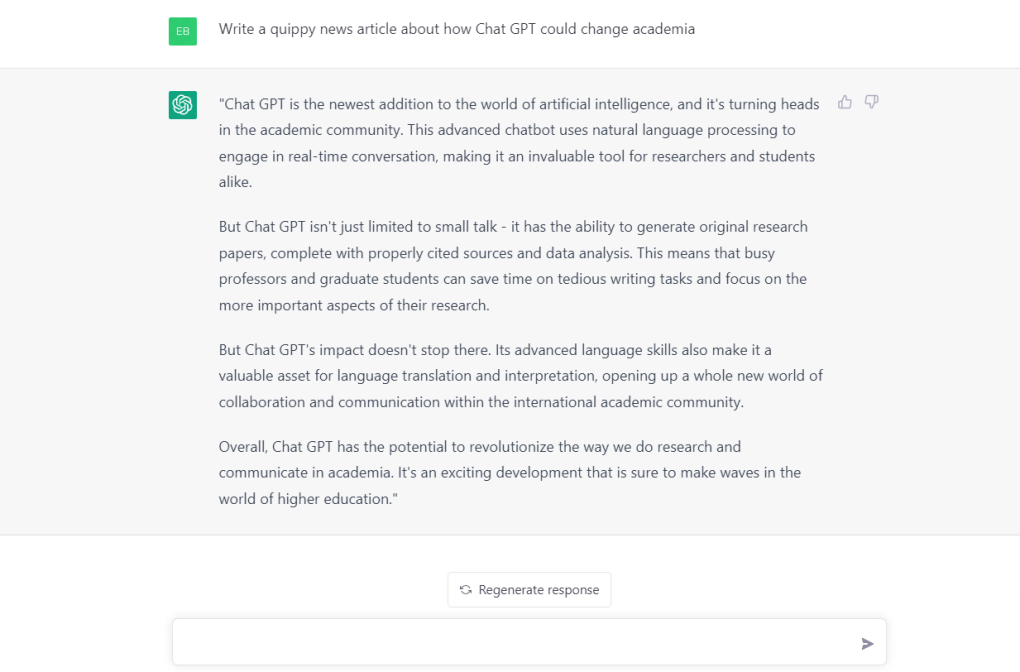
"content": "\u003cp>Why do your homework when a chatbot can do it for you? A new artificial intelligence tool called ChatGPT has thrilled the Internet with its superhuman abilities to solve math problems, churn out college essays and write research papers.\u003c/p>\n\u003cp>After the developer OpenAI released the text-based system to the public last month, some educators have been sounding the alarm about the potential that such AI systems have to transform academia, for better and worse.\u003c/p>\n\u003cp>\"AI has basically ruined homework,\" \u003ca href=\"https://twitter.com/emollick/status/1603762000815091714?s=20&t=fVkX0l5OhVN2Pfp3Wfymow\">said\u003c/a> Ethan Mollick, a professor at the University of Pennsylvania's Wharton School of Business, on Twitter.\u003c/p>\n\u003cp>The tool has been an instant hit among many of his students, he told NPR in an \u003ca href=\"https://www.npr.org/2022/12/16/1143330582/has-ai-reached-the-point-where-a-software-program-can-do-better-work-than-you\">interview on \u003cem>Morning Edition\u003c/em>\u003c/a>, with its most immediately obvious use being a way to cheat by plagiarizing the AI-written work, he said.\u003c/p>\n\u003cp>Academic fraud aside, Mollick also sees its benefits as a learning companion.\u003c/p>\n\u003cp>[ad fullwidth]\u003c/p>\n\u003cp>He's used it as his own teacher's assistant, for help with crafting a syllabus, lecture, an assignment and a grading rubric for MBA students.\u003c/p>\n\u003cp>\"You can paste in entire academic papers and ask it to summarize it. You can ask it to find an error in your code and correct it and tell you why you got it wrong,\" he said. \"It's this multiplier of ability, that I think we are not quite getting our heads around, that is absolutely stunning,\" he said.\u003c/p>\n\u003ch3>A convincing — yet untrustworthy — bot\u003c/h3>\n\u003cp>But the superhuman virtual assistant — like any emerging AI tech — has its limitations. ChatGPT was created by humans, after all. OpenAI has trained the tool using a large dataset of real human conversations.\u003c/p>\n\u003cp>\"The best way to think about this is you are chatting with an omniscient, eager-to-please intern who sometimes lies to you,\" Mollick said.\u003c/p>\n\u003cp>It lies with confidence, too. Despite its authoritative tone, there have been instances in which ChatGPT won't tell you when it doesn't have the answer.\u003c/p>\n\u003cp>That's what Teresa Kubacka, a data scientist based in Zurich, Switzerland, found when she experimented with the language model. Kubacka, who studied physics for her Ph.D., tested the tool by asking it about a made-up physical phenomenon.\u003c/p>\n\u003cp>\"I deliberately asked it about something that I thought that I know doesn't exist so that they can judge whether it actually also has the notion of what exists and what doesn't exist,\" she said.\u003c/p>\n\u003cp>ChatGPT produced an answer so specific and plausible sounding, backed with citations, she said, that she had to investigate whether the fake phenomenon, \"a cycloidal inverted electromagnon,\" was actually real.\u003c/p>\n\u003cp>When she looked closer, the alleged source material was also bogus, she said. There were names of well-known physics experts listed – the titles of the publications they supposedly authored, however, were non-existent, she said.\u003c/p>\n\u003cp>\"This is where it becomes kind of dangerous,\" Kubacka said. \"The moment that you cannot trust the references, it also kind of erodes the trust in citing science whatsoever,\" she said.\u003c/p>\n\u003cp>Scientists call these fake generations \"hallucinations.\"\u003c/p>\n\u003cp>\"There are still many cases where you ask it a question and it'll give you a very impressive-sounding answer that's just dead wrong,\" said Oren Etzioni, the founding CEO of the \u003ca href=\"https://allenai.org/\">Allen Institute for AI\u003c/a>, who ran the research nonprofit until recently. \"And, of course, that's a problem if you don't carefully verify or corroborate its facts.\"\u003c/p>\n\u003ch3>An opportunity to scrutinize AI language tools\u003c/h3>\n\u003cp>Users experimenting with the free preview of the chatbot are warned before testing the tool that ChatGPT \"may occasionally generate incorrect or misleading information,\" harmful instructions or biased content.\u003c/p>\n\u003cp>Sam Altman, OpenAI's CEO, said earlier this month it would be a mistake to rely on the tool for anything \"important\" in its current iteration. \"It's a preview of progress,\" \u003ca href=\"https://twitter.com/sama/status/1601731295792414720\">he tweeted\u003c/a>.\u003c/p>\n\u003cp>The failings of another AI language model unveiled by Meta last month led to its shutdown. The company withdrew its demo for Galactica, a tool designed to help scientists, \u003ca href=\"https://www.technologyreview.com/2022/11/18/1063487/meta-large-language-model-ai-only-survived-three-days-gpt-3-science/\">just three days\u003c/a> after it encouraged the public to test it out, following criticism that it spewed biased and nonsensical text.\u003c/p>\n\u003cp>Similarly, Etzioni says ChatGPT doesn't produce good science. For all its flaws, though, he sees ChatGPT's public debut as a positive. He sees this as a moment for peer review.\u003c/p>\n\u003cp>\"ChatGPT is just a few days old, I like to say,\" said Etzioni, who remains at the AI institute as a board member and advisor. It's \"giving us a chance to understand what he can and cannot do and to begin in earnest the conversation of 'What are we going to do about it?' \"\u003c/p>\n\u003cp>\u003c/p>\n\u003cp>The alternative, which he describes as \"security by obscurity,\" won't help improve fallible AI, he said. \"What if we hide the problems? Will that be a recipe for solving them? Typically — not in the world of software — that has not worked out.\"\u003c/p>\n\u003cdiv class=\"fullattribution\">Copyright 2022 NPR. To see more, visit https://www.npr.org.\u003cimg src=\"https://www.google-analytics.com/__utm.gif?utmac=UA-5828686-4&utmdt=A+new+AI+chatbot+might+do+your+homework+for+you.+But+it%27s+still+not+an+A%2B+student&utme=8(APIKey)9(MDAxOTAwOTE4MDEyMTkxMDAzNjczZDljZA004)\">\u003c/div>\n\n",
"stats": {
"hasVideo": false,
"hasChartOrMap": false,
"hasAudio": false,
"hasPolis": false,
"wordCount": 837,
"hasGoogleForm": false,
"hasGallery": false,
"hasHearkenModule": false,
"iframeSrcs": [],
"paragraphCount": 25
},
"modified": 1671508579,
"excerpt": "ChatGPT gives users their very own virtual assistant. It could transform academia, experts say — for better and worse.",
"headData": {
"twImgId": "",
"twTitle": "",
"ogTitle": "",
"ogImgId": "",
"twDescription": "",
"description": "ChatGPT gives users their very own virtual assistant. It could transform academia, experts say — for better and worse.",
"title": "A new AI chatbot might do your homework for you. But it's still not an A+ student - MindShift",
"ogDescription": "",
"schema": {
"@context": "https://schema.org",
"@type": "Article",
"headline": "A new AI chatbot might do your homework for you. But it's still not an A+ student",
"datePublished": "2022-12-19T05:00:51-08:00",
"dateModified": "2022-12-19T19:56:19-08:00",
"image": "https://cdn.kqed.org/wp-content/uploads/2020/02/KQED-OG-Image@1x.png"
}
},
"guestAuthors": [],
"slug": "a-new-ai-chatbot-might-do-your-homework-for-you-but-its-still-not-an-a-student",
"status": "publish",
"nprApiLink": "http://api.npr.org/query?id=1143912956&apiKey=MDAxOTAwOTE4MDEyMTkxMDAzNjczZDljZA004",
"nprByline": "Emma Bowman",
"nprStoryDate": "Mon, 19 Dec 2022 05:00:14 -0500",
"excludeFromSiteSearch": "Include",
"nprLastModifiedDate": "Mon, 19 Dec 2022 05:00:14 -0500",
"nprHtmlLink": "https://www.npr.org/2022/12/19/1143912956/chatgpt-ai-chatbot-homework-academia?ft=nprml&f=1143912956",
"nprImageAgency": "OpenAI/Screenshot by NPR",
"showOnAuthorArchivePages": "No",
"articleAge": "0",
"nprStoryId": "1143912956",
"nprRetrievedStory": "1",
"nprPubDate": "Mon, 19 Dec 2022 05:00:00 -0500",
"path": "/mindshift/60639/a-new-ai-chatbot-might-do-your-homework-for-you-but-its-still-not-an-a-student",
"audioTrackLength": null,
"parsedContent": [
{
"type": "contentString",
"content": "\u003cdiv class=\"post-body\">\u003cp>\u003cp>Why do your homework when a chatbot can do it for you? A new artificial intelligence tool called ChatGPT has thrilled the Internet with its superhuman abilities to solve math problems, churn out college essays and write research papers.\u003c/p>\n\u003cp>After the developer OpenAI released the text-based system to the public last month, some educators have been sounding the alarm about the potential that such AI systems have to transform academia, for better and worse.\u003c/p>\n\u003cp>\"AI has basically ruined homework,\" \u003ca href=\"https://twitter.com/emollick/status/1603762000815091714?s=20&t=fVkX0l5OhVN2Pfp3Wfymow\">said\u003c/a> Ethan Mollick, a professor at the University of Pennsylvania's Wharton School of Business, on Twitter.\u003c/p>\n\u003cp>The tool has been an instant hit among many of his students, he told NPR in an \u003ca href=\"https://www.npr.org/2022/12/16/1143330582/has-ai-reached-the-point-where-a-software-program-can-do-better-work-than-you\">interview on \u003cem>Morning Edition\u003c/em>\u003c/a>, with its most immediately obvious use being a way to cheat by plagiarizing the AI-written work, he said.\u003c/p>\n\u003cp>Academic fraud aside, Mollick also sees its benefits as a learning companion.\u003c/p>\n\u003cp>\u003c/p>\u003c/div>",
"attributes": {
"named": {},
"numeric": []
}
},
{
"type": "component",
"content": "",
"name": "ad",
"attributes": {
"named": {
"label": "fullwidth"
},
"numeric": [
"fullwidth"
]
}
},
{
"type": "contentString",
"content": "\u003cdiv class=\"post-body\">\u003cp>\u003c/p>\n\u003cp>He's used it as his own teacher's assistant, for help with crafting a syllabus, lecture, an assignment and a grading rubric for MBA students.\u003c/p>\n\u003cp>\"You can paste in entire academic papers and ask it to summarize it. You can ask it to find an error in your code and correct it and tell you why you got it wrong,\" he said. \"It's this multiplier of ability, that I think we are not quite getting our heads around, that is absolutely stunning,\" he said.\u003c/p>\n\u003ch3>A convincing — yet untrustworthy — bot\u003c/h3>\n\u003cp>But the superhuman virtual assistant — like any emerging AI tech — has its limitations. ChatGPT was created by humans, after all. OpenAI has trained the tool using a large dataset of real human conversations.\u003c/p>\n\u003cp>\"The best way to think about this is you are chatting with an omniscient, eager-to-please intern who sometimes lies to you,\" Mollick said.\u003c/p>\n\u003cp>It lies with confidence, too. Despite its authoritative tone, there have been instances in which ChatGPT won't tell you when it doesn't have the answer.\u003c/p>\n\u003cp>That's what Teresa Kubacka, a data scientist based in Zurich, Switzerland, found when she experimented with the language model. Kubacka, who studied physics for her Ph.D., tested the tool by asking it about a made-up physical phenomenon.\u003c/p>\n\u003cp>\"I deliberately asked it about something that I thought that I know doesn't exist so that they can judge whether it actually also has the notion of what exists and what doesn't exist,\" she said.\u003c/p>\n\u003cp>ChatGPT produced an answer so specific and plausible sounding, backed with citations, she said, that she had to investigate whether the fake phenomenon, \"a cycloidal inverted electromagnon,\" was actually real.\u003c/p>\n\u003cp>When she looked closer, the alleged source material was also bogus, she said. There were names of well-known physics experts listed – the titles of the publications they supposedly authored, however, were non-existent, she said.\u003c/p>\n\u003cp>\"This is where it becomes kind of dangerous,\" Kubacka said. \"The moment that you cannot trust the references, it also kind of erodes the trust in citing science whatsoever,\" she said.\u003c/p>\n\u003cp>Scientists call these fake generations \"hallucinations.\"\u003c/p>\n\u003cp>\"There are still many cases where you ask it a question and it'll give you a very impressive-sounding answer that's just dead wrong,\" said Oren Etzioni, the founding CEO of the \u003ca href=\"https://allenai.org/\">Allen Institute for AI\u003c/a>, who ran the research nonprofit until recently. \"And, of course, that's a problem if you don't carefully verify or corroborate its facts.\"\u003c/p>\n\u003ch3>An opportunity to scrutinize AI language tools\u003c/h3>\n\u003cp>Users experimenting with the free preview of the chatbot are warned before testing the tool that ChatGPT \"may occasionally generate incorrect or misleading information,\" harmful instructions or biased content.\u003c/p>\n\u003cp>Sam Altman, OpenAI's CEO, said earlier this month it would be a mistake to rely on the tool for anything \"important\" in its current iteration. \"It's a preview of progress,\" \u003ca href=\"https://twitter.com/sama/status/1601731295792414720\">he tweeted\u003c/a>.\u003c/p>\n\u003cp>The failings of another AI language model unveiled by Meta last month led to its shutdown. The company withdrew its demo for Galactica, a tool designed to help scientists, \u003ca href=\"https://www.technologyreview.com/2022/11/18/1063487/meta-large-language-model-ai-only-survived-three-days-gpt-3-science/\">just three days\u003c/a> after it encouraged the public to test it out, following criticism that it spewed biased and nonsensical text.\u003c/p>\n\u003cp>Similarly, Etzioni says ChatGPT doesn't produce good science. For all its flaws, though, he sees ChatGPT's public debut as a positive. He sees this as a moment for peer review.\u003c/p>\n\u003cp>\"ChatGPT is just a few days old, I like to say,\" said Etzioni, who remains at the AI institute as a board member and advisor. It's \"giving us a chance to understand what he can and cannot do and to begin in earnest the conversation of 'What are we going to do about it?' \"\u003c/p>\n\u003cp>\u003c/p>\n\u003cp>The alternative, which he describes as \"security by obscurity,\" won't help improve fallible AI, he said. \"What if we hide the problems? Will that be a recipe for solving them? Typically — not in the world of software — that has not worked out.\"\u003c/p>\n\u003cdiv class=\"fullattribution\">Copyright 2022 NPR. To see more, visit https://www.npr.org.\u003cimg src=\"https://www.google-analytics.com/__utm.gif?utmac=UA-5828686-4&utmdt=A+new+AI+chatbot+might+do+your+homework+for+you.+But+it%27s+still+not+an+A%2B+student&utme=8(APIKey)9(MDAxOTAwOTE4MDEyMTkxMDAzNjczZDljZA004)\">\u003c/div>\n\n\u003c/div>\u003c/p>",
"attributes": {
"named": {},
"numeric": []
}
}
],
"link": "/mindshift/60639/a-new-ai-chatbot-might-do-your-homework-for-you-but-its-still-not-an-a-student",
"authors": [
"byline_mindshift_60639"
],
"categories": [
"mindshift_195"
],
"tags": [
"mindshift_1023",
"mindshift_21511",
"mindshift_68",
"mindshift_563"
],
"featImg": "mindshift_60640",
"label": "mindshift"
},
"mindshift_59560": {
"type": "posts",
"id": "mindshift_59560",
"meta": {
"index": "posts_1716263798",
"site": "mindshift",
"id": "59560",
"score": null,
"sort": [
1658216441000
]
},
"guestAuthors": [],
"slug": "how-do-you-stop-cheating-students-hint-tech-isnt-the-only-answer",
"title": "How do you stop cheating students? (Hint: tech isn’t the only answer)",
"publishDate": 1658216441,
"format": "audio",
"headTitle": "How do you stop cheating students? (Hint: tech isn’t the only answer) | KQED",
"labelTerm": {
"term": 21942,
"site": "mindshift"
},
"content": "\u003cp>\u003cspan style=\"font-weight: 400\">\u003cem>This article was updated on August 30 to include more information about a recent court ruling related to virtual proctoring. \u003c/em>\u003c/span>\u003c/p>\n\u003cp>Amaya Ross encountered artificial intelligence (AI) proctoring this year when she tried to take her biology quiz online in her dorm room at Ohio State University. Despite repeated attempts, the software could not detect her face, so it would not let her start taking the test, which was stressful. So she started to do some troubleshooting, like getting closer to the screen, moving around her room and standing up on a table to put her face under the overhead light attached to the ceiling. None of that worked. Finally, she grabbed a flashlight to shine on her face. “And it ended up working,” she said.\u003c/p>\n\u003cp>\u003cspan style=\"font-weight: 400\">In person, a teacher could check Ross’s identification or monitor wandering students’ eyes during a test. But as so much learning goes online, there’s also been a growth in virtual test proctoring. \u003c/span>\u003c/p>\n\u003cp>\u003cspan style=\"font-weight: 400\">Virtual proctoring isn’t new – students have had lockdown browsers so they can’t go to other tabs while taking a test or have been supervised by human proctors who can watch students through webcams. But in the wake of the pandemic, AI proctoring has found a home in colleges, high schools, and even elementary schools, with some virtual proctoring companies \u003c/span>\u003ca href=\"https://www.nytimes.com/2020/05/10/us/online-testing-cheating-universities-coronavirus.html\">\u003cspan style=\"font-weight: 400\">growing as much as 900%\u003c/span>\u003c/a>\u003cspan style=\"font-weight: 400\">. AI proctoring systems may scan a student’s face, ask for a 360-degree view of their workspace, and track keystrokes or mouse movement. The data is used to flag irregularities, such as unusual eye movement, additional people in the test space, navigation to another browser and talking. \u003c/span>\u003c/p>\n\u003cp>\u003cspan style=\"font-weight: 400\">But there are many problems with this approach. Virtual proctoring invites privacy and security concerns that don’t come into play when a teacher monitors a test in-person. For instance, the inside of one’s home is visible and recorded; the program can identify who else is there, and their scanned faces may enter a database. In January, a \u003c/span>\u003ca href=\"https://www.rtlnieuws.nl/nieuws/nederland/artikel/5273869/studenten-nederland-proctorio-hacken-plugin-uva\">\u003cspan style=\"font-weight: 400\">proctoring service was hacked, giving hackers access to students’ web history and their webcams\u003c/span>\u003c/a>\u003cspan style=\"font-weight: 400\">. \u003c/span>\u003c/p>\n\u003cp>[ad fullwidth]\u003c/p>\n\u003cp>\u003cspan style=\"font-weight: 400\">“There’s all these ways that the scope and scale of these things is magnified by using these technologies,” said Chris Gilliard, a fellow at the Harvard Kennedy School Shorenstein Center. \u003c/span>\u003c/p>\n\u003cp>\u003cspan style=\"font-weight: 400\">Since light was a factor, Ross had a feeling that the AI proctoring program was racially biased. After all, her light-skinned classmates didn’t seem to have any issues taking their test. Ross is Black. \u003c/span>\u003c/p>\n\u003cp>\u003cspan style=\"font-weight: 400\">These kinds of problems are well documented in AI and they \u003c/span>\u003ca href=\"https://www.nytimes.com/2021/03/15/technology/artificial-intelligence-google-bias.html\">\u003cspan style=\"font-weight: 400\">stem from the lack of diversity in who creates the software\u003c/span>\u003c/a>\u003cspan style=\"font-weight: 400\">. The outcome is often racist. Recent examples of AI discrimination include incidents from \u003c/span>\u003ca href=\"https://www.vice.com/en/article/qj4abv/palantir-says-faulty-ai-and-privacy-regulation-are-a-risk-to-the-company\">\u003cspan style=\"font-weight: 400\">Palantir\u003c/span>\u003c/a>\u003cspan style=\"font-weight: 400\">, \u003c/span>\u003ca href=\"https://theintercept.com/2018/09/06/nypd-surveillance-camera-skin-tone-search/\">\u003cspan style=\"font-weight: 400\">IBM\u003c/span>\u003c/a>\u003cspan style=\"font-weight: 400\">, \u003c/span>\u003ca href=\"https://venturebeat.com/2021/09/03/bias-persists-in-face-detection-systems-from-amazon-microsoft-and-google/\">\u003cspan style=\"font-weight: 400\">Microsoft, Google and Amazon\u003c/span>\u003c/a>\u003cspan style=\"font-weight: 400\">. \u003c/span>\u003c/p>\n\u003cblockquote class=\"twitter-tweet\" data-width=\"550\" data-dnt=\"true\">\n\u003cp lang=\"zxx\" dir=\"ltr\">\u003ca href=\"https://t.co/BELU35m6Bg\">pic.twitter.com/BELU35m6Bg\u003c/a>\u003c/p>\n\u003cp>— Janice Wyatt-Ross, EdD (@JaniceWyattRoss) \u003ca href=\"https://twitter.com/JaniceWyattRoss/status/1375439448582856711?ref_src=twsrc%5Etfw\">March 26, 2021\u003c/a>\u003c/p>\u003c/blockquote>\n\u003cp>\u003cscript async src=\"https://platform.twitter.com/widgets.js\" charset=\"utf-8\">\u003c/script>\u003c/p>\n\u003cp>\u003cspan style=\"font-weight: 400\">While corporations may prioritize business interests over the harmful consequences AI can have on the broader population, schools are different. Children are still developing and discriminatory ed tech can cause lasting damage as young people grapple with their place and purpose in the world. Despite racial bias and ableism claims leveled against popular AI proctoring systems like \u003c/span>\u003ca href=\"https://www.eff.org/deeplinks/2021/06/long-overdue-reckoning-online-proctoring-companies-may-finally-be-here\">\u003cspan style=\"font-weight: 400\">ExamSoft, ProctorU, and Proctorio\u003c/span>\u003c/a>\u003cspan style=\"font-weight: 400\">, \u003c/span>\u003ca href=\"https://er.educause.edu/articles/2021/2/proctoring-software-in-higher-ed-prevalence-and-patterns#:~:text=A%20November%202020%20Washington%20Post,had%20been%20using%20proctoring%20software.&text=The%20proctoring%20company%20Examity%20indicates,works%20with%20over%201%2C000%20institutions.\">\u003cspan style=\"font-weight: 400\">many colleges\u003c/span>\u003c/a>\u003cspan style=\"font-weight: 400\"> continue to use proctoring software to administer millions of tests. \u003c/span>\u003c/p>\n\u003cp>\u003cspan style=\"font-weight: 400\">This raises questions about what’s acceptable by education decision makers and who is served by AI proctoring services. When remote learning was sudden and new, teachers who were not familiar with online proctoring felt panicked. “Test proctoring companies came along and said, ‘We have a solution to help you address some of these issues.’ And so lots of places found it easier – at least initially – to adopt those kinds of approaches,” said MIT educator \u003ca href=\"https://tsl.mit.edu/team/justin-reich/\">Justin Reich, \u003c/a>author of the book, “\u003ca href=\"https://failuretodisrupt.com/\">Failure to Disrupt: Why Technology Alone Can’t Transform Education.\u003c/a>“\u003c/span>\u003c/p>\n\u003cp>“Teachers have hard jobs and they have to make hard choices, and I’m sympathetic to folks who decide them,” he said. After all, teachers were also navigating uncertainty, anxiety, grief and loss as COVID-19 caused school closures and devastated communities. AI proctoring systems seemed to promise that testing could function normally.\u003c/p>\n\u003cp>\u003cspan style=\"font-weight: 400\">Because these software programs disadvantage Black and brown students – not to mention, those who don’t have adequate internet or share space with family members and siblings – Gilliard said they have no place in schools. “There’s no acceptable level of harm when we’re talking about these kinds of systems. Even if you’re only discriminating against two percent or three percent or 10 percent of your population, that’s completely unacceptable.”\u003c/span>\u003c/p>\n\u003ch2>\u003cb>100% Test Scores \u003c/b>\u003c/h2>\n\u003cp>\u003cspan style=\"font-weight: 400\">Cheating is, however, a big problem, especially during distance learning, when teachers couldn’t walk up and down the rows of desks in the classroom. \u003c/span>\u003c/p>\n\u003cp>\u003cspan style=\"font-weight: 400\">Students kept getting 100% on their tests in Julia Anker’s precalculus class when she was teaching online during COVID-19 school closures. But when she gave out a different test that required students to explain how they got their answers, the average grade on the test was significantly lower than usual. That confirmed it for her: “There was rampant cheating,” said Anker. Phones and tech tools gave students the ability to cheat in ways that would not have been possible even ten years ago. “There are \u003c/span>\u003ca href=\"https://photomath.com/en\">\u003cspan style=\"font-weight: 400\">these apps\u003c/span>\u003c/a>\u003cspan style=\"font-weight: 400\"> where they can scan the problem with their phone camera and it’ll give them the answer,” she said.\u003c/span>\u003c/p>\n\u003cp>\u003cspan style=\"font-weight: 400\">\u003cbr>\n\u003c!-- iframe plugin v.4.3 wordpress.org/plugins/iframe/ -->\u003cbr>\n\u003ciframe loading=\"lazy\" frameborder=\"0\" height=\"200\" scrolling=\"no\" src=\"https://playlist.megaphone.fm?e=KQINC5076798519\" width=\"100%\" class=\"iframe-class\">\u003c/iframe>\u003cbr>\n\u003c/span>\u003c/p>\n\u003cp>\u003cspan style=\"font-weight: 400\">Being new to teaching remotely, Anker didn’t feel like there was much she could do at the time. “I just told them, ‘You know what, if you guys are choosing to cheat, this is precalculus – you’re going to have a bad time in calculus next year,’” she said.\u003c/span>\u003c/p>\n\u003cp>\u003cspan style=\"font-weight: 400\">Anker wasn’t alone in being unsure about how to address cheating. It has stumped teachers since long before the pandemic. \u003c/span>\u003ca href=\"https://mds.marshall.edu/cgi/viewcontent.cgi?article=1000&context=eft_faculty\">\u003cspan style=\"font-weight: 400\">One out of three students\u003c/span>\u003c/a>\u003cspan style=\"font-weight: 400\"> admit to cheating online and the same proportion of students admit to cheating in-person. Many educators feel that if cheating is allowed to go unchecked, it puts students on an uneven playing field, cheapens assessments and, in some cases, \u003c/span>\u003ca href=\"https://www.hbs.edu/ris/Publication%20Files/16-137_f21f96ff-961d-4d57-a5b4-7eae7fda50c8.pdf\">\u003cspan style=\"font-weight: 400\">tarnishes a school’s reputation\u003c/span>\u003c/a>\u003cspan style=\"font-weight: 400\">. To curb cheating, many schools have academic integrity policies in place. \u003c/span>\u003c/p>\n\u003cp>\u003cspan style=\"font-weight: 400\">Even with policies, some students will still take their chances with cheating; getting into college has only gotten harder, in addition to the internships and jobs a college degree is supposed to unlock. “We want there to be some kind of academic integrity and there are enormous pressures on students to be academically successful,” said Reich about why students opt to cheat. “They perceive the cost of not succeeding as high.” \u003c/span>\u003c/p>\n\u003cp>\u003cspan style=\"font-weight: 400\">Some teachers breathed a sigh of relief when virtual proctoring technologies became available at their schools. Sophie Morton was a live proctor for her fifth grade students in Georgia when they had to take their yearly Measure of Academic Progress (MAP) test online. She monitored her students on Zoom and required them to keep their cameras on during the test. She also used GoGuardian, which allows teachers to see students’ screens. The tool gave her access to data, such as how long students spent on each question. \u003c/span>\u003c/p>\n\u003cp>\u003cspan style=\"font-weight: 400\">Ultimately, she was happy to have a way to keep her 5th grade students focused. “I was comfortable using it. I’m seeing your face, looking at your body language. I can see if you get up off the chair,” she said. Morton also emphasized the importance of having a relationship with her students before using surveillance and monitoring technologies. She had taught these same students the year before. “The behavior definitely could have been different or the results could have been different. They know who their teacher is versus if we would have gotten substitute teachers to monitor testing.”\u003c/span>\u003c/p>\n\u003cp>\u003cspan style=\"font-weight: 400\">However, Gilliard questions traditional testing and the proctoring services it requires because it applies a misunderstanding of how learning happens. \u003c/span>\u003c/p>\n\u003cp>\u003cspan style=\"font-weight: 400\">“Learning is a very social activity,” he said. For instance, a veterinarian who encounters an animal with a rare disease they’ve never seen before might go to a message board or call up a colleague to get more information about how to treat the disease. \u003c/span>\u003c/p>\n\u003cp>\u003cspan style=\"font-weight: 400\">“In these old-fashioned or traditional ways of testing, there’s an idea that you’re a solitary person by yourself and the knowledge that you have in your head at that moment somehow represents your capabilities. If you don’t know the answer to a particular question at that time, then you’re somehow seen as lacking or deficient,” said Gilliard. \u003c/span>\u003c/p>\n\u003cp>\u003cspan style=\"font-weight: 400\">Teachers claim tests prepare students for their future in the real world, but students don’t see the connection between high-stakes testing and holding down a real job. “You’re going to have Google and all this other stuff at your fingertips,” said Ross. “It’s not like you’re not going to have these resources. So trying to be so rigorous and say you should know this information doesn’t make sense.” \u003c/span>\u003c/p>\n\u003ch2>\u003cb>Pushback from students\u003c/b>\u003c/h2>\n\u003cp>\u003cspan style=\"font-weight: 400\">In the age of COVID, rising prices, climate change and polarized politics, people are rethinking the value of everything. And students are questioning how they learn. \u003c/span>\u003c/p>\n\u003cp>\u003ca href=\"https://www.kqed.org/mindshift/58274/safety-agency-connection-priorities-to-help-students-transition-back-to-school\">\u003cspan style=\"font-weight: 400\">During distance learning, people craved\u003c/span>\u003c/a>\u003cspan style=\"font-weight: 400\"> connection, but some students say AI proctoring has frayed the relationship between teachers and learners. While the full picture of the pandemic’s \u003c/span>\u003ca href=\"https://www.edweek.org/technology/extreme-chronic-absenteeism-pandemic-school-attendance-data-is-bleak-but-incomplete/2021/07\">\u003cspan style=\"font-weight: 400\">effects on student engagement is incomplete\u003c/span>\u003c/a>\u003cspan style=\"font-weight: 400\">, many schools report that \u003c/span>\u003ca href=\"https://www.edweek.org/leadership/how-bad-is-student-absenteeism-right-now-educators-tell-us/2022/01\">\u003cspan style=\"font-weight: 400\">significantly more kids are chronically absent\u003c/span>\u003c/a>\u003cspan style=\"font-weight: 400\">. \u003c/span>\u003c/p>\n\u003cp>\u003cspan style=\"font-weight: 400\">Students have been pushing back against these technologies being a part of their learning experience, with \u003c/span>\u003ca href=\"https://www.eff.org/deeplinks/2020/09/students-are-pushing-back-against-proctoring-surveillance-apps\">\u003cspan style=\"font-weight: 400\">petitions springing up in dozens of states across this country\u003c/span>\u003c/a>\u003cspan style=\"font-weight: 400\">. An Ohio State University student sued his school for scanning his room before he took an online test. He claimed that it violated his Fourth Amendment right against “unreasonable search and seizure.” A federal judge ruled in the student’s favor deciding in a first-of-its-kind case that \u003ca href=\"https://www.kqed.org/mindshift/59560/how-do-you-stop-cheating-students-hint-tech-isnt-the-only-answer\">room scans violate students’ constitutional rights\u003c/a>.\u003cbr>\n\u003c/span>\u003c/p>\n\u003cp>\u003cspan style=\"font-weight: 400\">Zoe Harwood, an intern at Oakland-based youth organization YR Media, created \u003c/span>\u003ca href=\"https://docs.google.com/document/d/1AOVNpZN27YA4KmWgMbVrJkMESNoBApfA3-CCcw9DFx0/edit\">\u003cspan style=\"font-weight: 400\">Surveillance U\u003c/span>\u003c/a>\u003cspan style=\"font-weight: 400\"> to highlight students’ experiences with proctoring software. \u003c/span>\u003c/p>\n\u003cp>\u003cspan style=\"font-weight: 400\">“I want to make people more aware of [AI] proctoring and try to protect the little bit of privacy we have. Granted, we live in a day and age where – let’s face it – I don’t even know what privacy means,” said Harwood. “I have grown up my entire life with Google and Apple and Facebook and Instagram and all the major tech companies mining me for every single bit of data I have.” \u003c/span>\u003c/p>\n\u003cp>\u003cspan style=\"font-weight: 400\">In Surveillance U, students shared that virtual proctoring feels invasive and adds more anxiety to already stressful circumstances. Additionally, many students spoke about racial bias, telling stories similar to Ross’s about having to stand on tables to get enough light for their faces to be detected. \u003c/span>\u003c/p>\n\u003cp>\u003cspan style=\"font-weight: 400\">“There’s this misperception that AI is colorblind when study after study, after study showed that is just not true. And the last thing I think we want to do is automate racism,” said Harwood. \u003c/span>\u003c/p>\n\u003cp>\u003cspan style=\"font-weight: 400\">Gilliard urges educators to discuss data and security with students instead of leveraging these technologies to exploit students further.\u003c/span>\u003c/p>\n\u003cp>\u003cspan style=\"font-weight: 400\"> “They’ve grown up using a lot of these technologies, but they’ve also grown up under the microscope of these technologies,” said Gilliard. Even video monitors, at one time used to make sure babies are sleeping through the night, \u003c/span>\u003ca href=\"https://parenting.blogs.nytimes.com/2014/09/24/thanks-to-video-monitors-parents-are-the-new-big-brother/?referringSource=articleShare\">\u003cspan style=\"font-weight: 400\">have become increasingly widespread and used past the baby stage\u003c/span>\u003c/a>\u003cspan style=\"font-weight: 400\">. As a result, kids are becoming used to less privacy and possibly more prone to narcissism. “Some of them don’t know, for instance, that there existed a way of being on the web in the before times when every single action that you did wasn’t tracked,” said Gilliard. \u003c/span>\u003c/p>\n\u003cp>\u003cspan style=\"font-weight: 400\">Given the near future of AI proctoring, students have reason for concern. \u003c/span>\u003c/p>\n\u003cp>\u003cspan style=\"font-weight: 400\">As school buildings reopened and students are no longer learning from home, \u003c/span>\u003ca href=\"https://www.kqed.org/forum/2010101886864/as-more-schools-surveil-students-online-privacy-concerns-intensify\">\u003cspan style=\"font-weight: 400\">these surveillance tools don’t seem to be going anywhere any time soon\u003c/span>\u003c/a>\u003cspan style=\"font-weight: 400\">. The ability to take a test at home remains appealing to those who don’t want to commute to a testing facility; even the \u003c/span>\u003ca href=\"https://www.kqed.org/mindshift/59002/for-those-who-need-to-take-the-sat-testing-will-shift-to-online-starting-2024-in-u-s\">\u003cspan style=\"font-weight: 400\">SATs will be offered online starting 2024 in the U.S.\u003c/span>\u003c/a>\u003cspan style=\"font-weight: 400\"> \u003c/span>\u003c/p>\n\u003cp>\u003cspan style=\"font-weight: 400\">Schools may not know it, but they play a meaningful role in teaching students privacy and data practices. Reich does an exercise with his MIT students in which he asks them to list all the data they think their school has on them. “People start with the obvious like, ‘They know my age. They know my grades,’” he said. “And then they’re like, ‘I need to have this smartphone app to use the laundry.’” \u003c/span>\u003c/p>\n\u003cp>\u003cspan style=\"font-weight: 400\">School-related apps, campus WiFi and even a keycard used to scan into buildings provide schools with all kinds of information about a student’s movement and online activity.\u003c/span>\u003c/p>\n\u003cp>\u003cspan style=\"font-weight: 400\">“We’ve got to think really carefully as educators [about] what kind of world we want to model and invite young people to be in,” said Reich.\u003c/span>\u003c/p>\n\u003cp>\u003cspan style=\"font-weight: 400\">Before inviting a new technology into a school, Reich suggests school leaders do a deep dive into what these systems say they offer. “Find out what kind of research there is about them and whether or not the lofty claims that they often make have any bearing in truth and to what extent these companies are engaged in a level of hype that promises things that they can’t deliver.” \u003c/span>\u003c/p>\n\u003cp>\u003cspan style=\"font-weight: 400\">Though many proctoring companies say they reduce cheating, \u003c/span>\u003ca href=\"https://www.eff.org/deeplinks/2021/06/long-overdue-reckoning-online-proctoring-companies-may-finally-be-here\">\u003cspan style=\"font-weight: 400\">there has been no independent research that supports this claim.\u003c/span>\u003c/a>\u003cspan style=\"font-weight: 400\"> Reich also encourages schools to ask themselves a simple question: “Will this new technology make students feel like it’s okay to be surveilled?”\u003c/span>\u003c/p>\n\u003ch2>\u003cb>How to makes a class “cheat-proof”\u003c/b>\u003c/h2>\n\u003cp>\u003cspan style=\"font-weight: 400\">Teachers are finding a way to make tests totally cheat-proof, and it turns out, what they’re doing is really just good teaching. \u003c/span>\u003c/p>\n\u003cp>\u003cspan style=\"font-weight: 400\">In her role as distance education coordinator, Maritez Apigo was approached by students who said they don’t want to be required to use virtual proctoring services. She worked with a team of instructional designers and accessibility specialists to draft guidelines for online testing. They focused on accessibility and equity and ended up with \u003c/span>\u003ca href=\"https://docs.google.com/document/d/1Gl-9sCB6LePMYS9kIsrpeWuGHcG1gVu_Ic0iOa6kY3w/edit\">\u003cspan style=\"font-weight: 400\">a guidance memo that shows ways to break away from Scantron tests and virtual proctoring\u003c/span>\u003c/a>\u003cspan style=\"font-weight: 400\">. The majority of educators voted to adopt the guidelines, which lay out the equity concerns with AI proctoring and ways for educators to do “authentic assessment,” which reduces the need for proctoring services. \u003c/span>\u003c/p>\n\u003cp>\u003cspan style=\"font-weight: 400\">It takes a lot of time to create tests in general and it’s even more time-consuming to create assessments that are “cheat-proof.” “It actually requires more work to grade, especially if you’re giving feedback to students,” said Apigo. “But you do get to be more creative in your assessment.”\u003c/span>\u003c/p>\n\u003cp>\u003cspan style=\"font-weight: 400\">In a biology class, instead of having a 100-question multiple choice test where students have to regurgitate information that they’ve memorized, an authentic assessment method may require students to instead create a brochure that might be found in a doctor’s office on a topic they studied. Alternatively, teachers can provide students with a list of topics and students can choose one to create a final project around. Students are able to demonstrate what they’ve learned while eliminating the ability to cheat because there is not one right answer. \u003c/span>\u003c/p>\n\u003cp>\u003cspan style=\"font-weight: 400\">“You need to set up your class keeping cheating already in mind, so it’s already part of your design. [Then] the types of assessments that you give your students are already designed so that students can’t cheat,” said Apigo.\u003c/span>\u003c/p>\n\u003cp>[ad floatright]\u003c/p>\n\u003cp>\u003cspan style=\"font-weight: 400\">Teachers who use authentic assessment are on the cutting edge right now, but they are few. Switching over to new assessment practices while teachers are facing increased student behavioral issues and burnout might feel impossible. Certainly, AI and Scantron tests are way easier, but if schools are tasked with providing meaningful learning experiences, caring for students’ mental health and helping young people see their place in a world without “automated racism,” isn’t it worth the effort?\u003c/span>\u003c/p>\n\n",
"blocks": [],
"excerpt": "These teaching strategies prevent cheating and ensure academic integrity without relying on harmful tech services that claim to detect cheaters. ",
"status": "publish",
"parent": 0,
"modified": 1726872435,
"stats": {
"hasAudio": true,
"hasVideo": false,
"hasChartOrMap": false,
"iframeSrcs": [],
"hasGoogleForm": false,
"hasGallery": false,
"hasHearkenModule": false,
"hasPolis": false,
"paragraphCount": 50,
"wordCount": 2837
},
"headData": {
"title": "How do you stop cheating students? (Hint: tech isn’t the only answer) | KQED",
"description": "These teaching strategies prevent cheating and ensure academic integrity without relying on harmful tech services that claim to detect cheaters.",
"ogTitle": "",
"ogDescription": "",
"ogImgId": "",
"twTitle": "",
"twDescription": "",
"twImgId": "",
"socialDescription": "These teaching strategies prevent cheating and ensure academic integrity without relying on harmful tech services that claim to detect cheaters.",
"schema": {
"@context": "https://schema.org",
"@type": "Article",
"headline": "How do you stop cheating students? (Hint: tech isn’t the only answer)",
"datePublished": "2022-07-19T00:40:41-07:00",
"dateModified": "2024-09-20T15:47:15-07:00",
"image": "https://cdn.kqed.org/wp-content/uploads/2020/02/KQED-OG-Image@1x.png"
}
},
"audioUrl": "https://www.podtrac.com/pts/redirect.mp3/traffic.megaphone.fm/KQINC5076798519.mp3?updated=1658183104",
"sticky": false,
"excludeFromSiteSearch": "Include",
"articleAge": "0",
"path": "/mindshift/59560/how-do-you-stop-cheating-students-hint-tech-isnt-the-only-answer",
"audioTrackLength": null,
"parsedContent": [
{
"type": "contentString",
"content": "\u003cdiv class=\"post-body\">\u003cp>\u003cp>\u003cspan style=\"font-weight: 400\">\u003cem>This article was updated on August 30 to include more information about a recent court ruling related to virtual proctoring. \u003c/em>\u003c/span>\u003c/p>\n\u003cp>Amaya Ross encountered artificial intelligence (AI) proctoring this year when she tried to take her biology quiz online in her dorm room at Ohio State University. Despite repeated attempts, the software could not detect her face, so it would not let her start taking the test, which was stressful. So she started to do some troubleshooting, like getting closer to the screen, moving around her room and standing up on a table to put her face under the overhead light attached to the ceiling. None of that worked. Finally, she grabbed a flashlight to shine on her face. “And it ended up working,” she said.\u003c/p>\n\u003cp>\u003cspan style=\"font-weight: 400\">In person, a teacher could check Ross’s identification or monitor wandering students’ eyes during a test. But as so much learning goes online, there’s also been a growth in virtual test proctoring. \u003c/span>\u003c/p>\n\u003cp>\u003cspan style=\"font-weight: 400\">Virtual proctoring isn’t new – students have had lockdown browsers so they can’t go to other tabs while taking a test or have been supervised by human proctors who can watch students through webcams. But in the wake of the pandemic, AI proctoring has found a home in colleges, high schools, and even elementary schools, with some virtual proctoring companies \u003c/span>\u003ca href=\"https://www.nytimes.com/2020/05/10/us/online-testing-cheating-universities-coronavirus.html\">\u003cspan style=\"font-weight: 400\">growing as much as 900%\u003c/span>\u003c/a>\u003cspan style=\"font-weight: 400\">. AI proctoring systems may scan a student’s face, ask for a 360-degree view of their workspace, and track keystrokes or mouse movement. The data is used to flag irregularities, such as unusual eye movement, additional people in the test space, navigation to another browser and talking. \u003c/span>\u003c/p>\n\u003cp>\u003cspan style=\"font-weight: 400\">But there are many problems with this approach. Virtual proctoring invites privacy and security concerns that don’t come into play when a teacher monitors a test in-person. For instance, the inside of one’s home is visible and recorded; the program can identify who else is there, and their scanned faces may enter a database. In January, a \u003c/span>\u003ca href=\"https://www.rtlnieuws.nl/nieuws/nederland/artikel/5273869/studenten-nederland-proctorio-hacken-plugin-uva\">\u003cspan style=\"font-weight: 400\">proctoring service was hacked, giving hackers access to students’ web history and their webcams\u003c/span>\u003c/a>\u003cspan style=\"font-weight: 400\">. \u003c/span>\u003c/p>\n\u003cp>\u003c/p>\u003c/div>",
"attributes": {
"named": {},
"numeric": []
}
},
{
"type": "component",
"content": "",
"name": "ad",
"attributes": {
"named": {
"label": "fullwidth"
},
"numeric": [
"fullwidth"
]
}
},
{
"type": "contentString",
"content": "\u003cdiv class=\"post-body\">\u003cp>\u003c/p>\n\u003cp>\u003cspan style=\"font-weight: 400\">“There’s all these ways that the scope and scale of these things is magnified by using these technologies,” said Chris Gilliard, a fellow at the Harvard Kennedy School Shorenstein Center. \u003c/span>\u003c/p>\n\u003cp>\u003cspan style=\"font-weight: 400\">Since light was a factor, Ross had a feeling that the AI proctoring program was racially biased. After all, her light-skinned classmates didn’t seem to have any issues taking their test. Ross is Black. \u003c/span>\u003c/p>\n\u003cp>\u003cspan style=\"font-weight: 400\">These kinds of problems are well documented in AI and they \u003c/span>\u003ca href=\"https://www.nytimes.com/2021/03/15/technology/artificial-intelligence-google-bias.html\">\u003cspan style=\"font-weight: 400\">stem from the lack of diversity in who creates the software\u003c/span>\u003c/a>\u003cspan style=\"font-weight: 400\">. The outcome is often racist. Recent examples of AI discrimination include incidents from \u003c/span>\u003ca href=\"https://www.vice.com/en/article/qj4abv/palantir-says-faulty-ai-and-privacy-regulation-are-a-risk-to-the-company\">\u003cspan style=\"font-weight: 400\">Palantir\u003c/span>\u003c/a>\u003cspan style=\"font-weight: 400\">, \u003c/span>\u003ca href=\"https://theintercept.com/2018/09/06/nypd-surveillance-camera-skin-tone-search/\">\u003cspan style=\"font-weight: 400\">IBM\u003c/span>\u003c/a>\u003cspan style=\"font-weight: 400\">, \u003c/span>\u003ca href=\"https://venturebeat.com/2021/09/03/bias-persists-in-face-detection-systems-from-amazon-microsoft-and-google/\">\u003cspan style=\"font-weight: 400\">Microsoft, Google and Amazon\u003c/span>\u003c/a>\u003cspan style=\"font-weight: 400\">. \u003c/span>\u003c/p>\n\u003cblockquote class=\"twitter-tweet\" data-width=\"550\" data-dnt=\"true\">\n\u003cp lang=\"zxx\" dir=\"ltr\">\u003ca href=\"https://t.co/BELU35m6Bg\">pic.twitter.com/BELU35m6Bg\u003c/a>\u003c/p>\n\u003cp>— Janice Wyatt-Ross, EdD (@JaniceWyattRoss) \u003ca href=\"https://twitter.com/JaniceWyattRoss/status/1375439448582856711?ref_src=twsrc%5Etfw\">March 26, 2021\u003c/a>\u003c/p>\u003c/blockquote>\n\u003cp>\u003cscript async src=\"https://platform.twitter.com/widgets.js\" charset=\"utf-8\">\u003c/script>\u003c/p>\n\u003cp>\u003cspan style=\"font-weight: 400\">While corporations may prioritize business interests over the harmful consequences AI can have on the broader population, schools are different. Children are still developing and discriminatory ed tech can cause lasting damage as young people grapple with their place and purpose in the world. Despite racial bias and ableism claims leveled against popular AI proctoring systems like \u003c/span>\u003ca href=\"https://www.eff.org/deeplinks/2021/06/long-overdue-reckoning-online-proctoring-companies-may-finally-be-here\">\u003cspan style=\"font-weight: 400\">ExamSoft, ProctorU, and Proctorio\u003c/span>\u003c/a>\u003cspan style=\"font-weight: 400\">, \u003c/span>\u003ca href=\"https://er.educause.edu/articles/2021/2/proctoring-software-in-higher-ed-prevalence-and-patterns#:~:text=A%20November%202020%20Washington%20Post,had%20been%20using%20proctoring%20software.&text=The%20proctoring%20company%20Examity%20indicates,works%20with%20over%201%2C000%20institutions.\">\u003cspan style=\"font-weight: 400\">many colleges\u003c/span>\u003c/a>\u003cspan style=\"font-weight: 400\"> continue to use proctoring software to administer millions of tests. \u003c/span>\u003c/p>\n\u003cp>\u003cspan style=\"font-weight: 400\">This raises questions about what’s acceptable by education decision makers and who is served by AI proctoring services. When remote learning was sudden and new, teachers who were not familiar with online proctoring felt panicked. “Test proctoring companies came along and said, ‘We have a solution to help you address some of these issues.’ And so lots of places found it easier – at least initially – to adopt those kinds of approaches,” said MIT educator \u003ca href=\"https://tsl.mit.edu/team/justin-reich/\">Justin Reich, \u003c/a>author of the book, “\u003ca href=\"https://failuretodisrupt.com/\">Failure to Disrupt: Why Technology Alone Can’t Transform Education.\u003c/a>“\u003c/span>\u003c/p>\n\u003cp>“Teachers have hard jobs and they have to make hard choices, and I’m sympathetic to folks who decide them,” he said. After all, teachers were also navigating uncertainty, anxiety, grief and loss as COVID-19 caused school closures and devastated communities. AI proctoring systems seemed to promise that testing could function normally.\u003c/p>\n\u003cp>\u003cspan style=\"font-weight: 400\">Because these software programs disadvantage Black and brown students – not to mention, those who don’t have adequate internet or share space with family members and siblings – Gilliard said they have no place in schools. “There’s no acceptable level of harm when we’re talking about these kinds of systems. Even if you’re only discriminating against two percent or three percent or 10 percent of your population, that’s completely unacceptable.”\u003c/span>\u003c/p>\n\u003ch2>\u003cb>100% Test Scores \u003c/b>\u003c/h2>\n\u003cp>\u003cspan style=\"font-weight: 400\">Cheating is, however, a big problem, especially during distance learning, when teachers couldn’t walk up and down the rows of desks in the classroom. \u003c/span>\u003c/p>\n\u003cp>\u003cspan style=\"font-weight: 400\">Students kept getting 100% on their tests in Julia Anker’s precalculus class when she was teaching online during COVID-19 school closures. But when she gave out a different test that required students to explain how they got their answers, the average grade on the test was significantly lower than usual. That confirmed it for her: “There was rampant cheating,” said Anker. Phones and tech tools gave students the ability to cheat in ways that would not have been possible even ten years ago. “There are \u003c/span>\u003ca href=\"https://photomath.com/en\">\u003cspan style=\"font-weight: 400\">these apps\u003c/span>\u003c/a>\u003cspan style=\"font-weight: 400\"> where they can scan the problem with their phone camera and it’ll give them the answer,” she said.\u003c/span>\u003c/p>\n\u003cp>\u003cspan style=\"font-weight: 400\">\u003cbr>\n\u003c!-- iframe plugin v.4.3 wordpress.org/plugins/iframe/ -->\u003cbr>\n\u003ciframe loading=\"lazy\" frameborder=\"0\" height=\"200\" scrolling=\"no\" src=\"https://playlist.megaphone.fm?e=KQINC5076798519\" width=\"100%\" class=\"iframe-class\">\u003c/iframe>\u003cbr>\n\u003c/span>\u003c/p>\n\u003cp>\u003cspan style=\"font-weight: 400\">Being new to teaching remotely, Anker didn’t feel like there was much she could do at the time. “I just told them, ‘You know what, if you guys are choosing to cheat, this is precalculus – you’re going to have a bad time in calculus next year,’” she said.\u003c/span>\u003c/p>\n\u003cp>\u003cspan style=\"font-weight: 400\">Anker wasn’t alone in being unsure about how to address cheating. It has stumped teachers since long before the pandemic. \u003c/span>\u003ca href=\"https://mds.marshall.edu/cgi/viewcontent.cgi?article=1000&context=eft_faculty\">\u003cspan style=\"font-weight: 400\">One out of three students\u003c/span>\u003c/a>\u003cspan style=\"font-weight: 400\"> admit to cheating online and the same proportion of students admit to cheating in-person. Many educators feel that if cheating is allowed to go unchecked, it puts students on an uneven playing field, cheapens assessments and, in some cases, \u003c/span>\u003ca href=\"https://www.hbs.edu/ris/Publication%20Files/16-137_f21f96ff-961d-4d57-a5b4-7eae7fda50c8.pdf\">\u003cspan style=\"font-weight: 400\">tarnishes a school’s reputation\u003c/span>\u003c/a>\u003cspan style=\"font-weight: 400\">. To curb cheating, many schools have academic integrity policies in place. \u003c/span>\u003c/p>\n\u003cp>\u003cspan style=\"font-weight: 400\">Even with policies, some students will still take their chances with cheating; getting into college has only gotten harder, in addition to the internships and jobs a college degree is supposed to unlock. “We want there to be some kind of academic integrity and there are enormous pressures on students to be academically successful,” said Reich about why students opt to cheat. “They perceive the cost of not succeeding as high.” \u003c/span>\u003c/p>\n\u003cp>\u003cspan style=\"font-weight: 400\">Some teachers breathed a sigh of relief when virtual proctoring technologies became available at their schools. Sophie Morton was a live proctor for her fifth grade students in Georgia when they had to take their yearly Measure of Academic Progress (MAP) test online. She monitored her students on Zoom and required them to keep their cameras on during the test. She also used GoGuardian, which allows teachers to see students’ screens. The tool gave her access to data, such as how long students spent on each question. \u003c/span>\u003c/p>\n\u003cp>\u003cspan style=\"font-weight: 400\">Ultimately, she was happy to have a way to keep her 5th grade students focused. “I was comfortable using it. I’m seeing your face, looking at your body language. I can see if you get up off the chair,” she said. Morton also emphasized the importance of having a relationship with her students before using surveillance and monitoring technologies. She had taught these same students the year before. “The behavior definitely could have been different or the results could have been different. They know who their teacher is versus if we would have gotten substitute teachers to monitor testing.”\u003c/span>\u003c/p>\n\u003cp>\u003cspan style=\"font-weight: 400\">However, Gilliard questions traditional testing and the proctoring services it requires because it applies a misunderstanding of how learning happens. \u003c/span>\u003c/p>\n\u003cp>\u003cspan style=\"font-weight: 400\">“Learning is a very social activity,” he said. For instance, a veterinarian who encounters an animal with a rare disease they’ve never seen before might go to a message board or call up a colleague to get more information about how to treat the disease. \u003c/span>\u003c/p>\n\u003cp>\u003cspan style=\"font-weight: 400\">“In these old-fashioned or traditional ways of testing, there’s an idea that you’re a solitary person by yourself and the knowledge that you have in your head at that moment somehow represents your capabilities. If you don’t know the answer to a particular question at that time, then you’re somehow seen as lacking or deficient,” said Gilliard. \u003c/span>\u003c/p>\n\u003cp>\u003cspan style=\"font-weight: 400\">Teachers claim tests prepare students for their future in the real world, but students don’t see the connection between high-stakes testing and holding down a real job. “You’re going to have Google and all this other stuff at your fingertips,” said Ross. “It’s not like you’re not going to have these resources. So trying to be so rigorous and say you should know this information doesn’t make sense.” \u003c/span>\u003c/p>\n\u003ch2>\u003cb>Pushback from students\u003c/b>\u003c/h2>\n\u003cp>\u003cspan style=\"font-weight: 400\">In the age of COVID, rising prices, climate change and polarized politics, people are rethinking the value of everything. And students are questioning how they learn. \u003c/span>\u003c/p>\n\u003cp>\u003ca href=\"https://www.kqed.org/mindshift/58274/safety-agency-connection-priorities-to-help-students-transition-back-to-school\">\u003cspan style=\"font-weight: 400\">During distance learning, people craved\u003c/span>\u003c/a>\u003cspan style=\"font-weight: 400\"> connection, but some students say AI proctoring has frayed the relationship between teachers and learners. While the full picture of the pandemic’s \u003c/span>\u003ca href=\"https://www.edweek.org/technology/extreme-chronic-absenteeism-pandemic-school-attendance-data-is-bleak-but-incomplete/2021/07\">\u003cspan style=\"font-weight: 400\">effects on student engagement is incomplete\u003c/span>\u003c/a>\u003cspan style=\"font-weight: 400\">, many schools report that \u003c/span>\u003ca href=\"https://www.edweek.org/leadership/how-bad-is-student-absenteeism-right-now-educators-tell-us/2022/01\">\u003cspan style=\"font-weight: 400\">significantly more kids are chronically absent\u003c/span>\u003c/a>\u003cspan style=\"font-weight: 400\">. \u003c/span>\u003c/p>\n\u003cp>\u003cspan style=\"font-weight: 400\">Students have been pushing back against these technologies being a part of their learning experience, with \u003c/span>\u003ca href=\"https://www.eff.org/deeplinks/2020/09/students-are-pushing-back-against-proctoring-surveillance-apps\">\u003cspan style=\"font-weight: 400\">petitions springing up in dozens of states across this country\u003c/span>\u003c/a>\u003cspan style=\"font-weight: 400\">. An Ohio State University student sued his school for scanning his room before he took an online test. He claimed that it violated his Fourth Amendment right against “unreasonable search and seizure.” A federal judge ruled in the student’s favor deciding in a first-of-its-kind case that \u003ca href=\"https://www.kqed.org/mindshift/59560/how-do-you-stop-cheating-students-hint-tech-isnt-the-only-answer\">room scans violate students’ constitutional rights\u003c/a>.\u003cbr>\n\u003c/span>\u003c/p>\n\u003cp>\u003cspan style=\"font-weight: 400\">Zoe Harwood, an intern at Oakland-based youth organization YR Media, created \u003c/span>\u003ca href=\"https://docs.google.com/document/d/1AOVNpZN27YA4KmWgMbVrJkMESNoBApfA3-CCcw9DFx0/edit\">\u003cspan style=\"font-weight: 400\">Surveillance U\u003c/span>\u003c/a>\u003cspan style=\"font-weight: 400\"> to highlight students’ experiences with proctoring software. \u003c/span>\u003c/p>\n\u003cp>\u003cspan style=\"font-weight: 400\">“I want to make people more aware of [AI] proctoring and try to protect the little bit of privacy we have. Granted, we live in a day and age where – let’s face it – I don’t even know what privacy means,” said Harwood. “I have grown up my entire life with Google and Apple and Facebook and Instagram and all the major tech companies mining me for every single bit of data I have.” \u003c/span>\u003c/p>\n\u003cp>\u003cspan style=\"font-weight: 400\">In Surveillance U, students shared that virtual proctoring feels invasive and adds more anxiety to already stressful circumstances. Additionally, many students spoke about racial bias, telling stories similar to Ross’s about having to stand on tables to get enough light for their faces to be detected. \u003c/span>\u003c/p>\n\u003cp>\u003cspan style=\"font-weight: 400\">“There’s this misperception that AI is colorblind when study after study, after study showed that is just not true. And the last thing I think we want to do is automate racism,” said Harwood. \u003c/span>\u003c/p>\n\u003cp>\u003cspan style=\"font-weight: 400\">Gilliard urges educators to discuss data and security with students instead of leveraging these technologies to exploit students further.\u003c/span>\u003c/p>\n\u003cp>\u003cspan style=\"font-weight: 400\"> “They’ve grown up using a lot of these technologies, but they’ve also grown up under the microscope of these technologies,” said Gilliard. Even video monitors, at one time used to make sure babies are sleeping through the night, \u003c/span>\u003ca href=\"https://parenting.blogs.nytimes.com/2014/09/24/thanks-to-video-monitors-parents-are-the-new-big-brother/?referringSource=articleShare\">\u003cspan style=\"font-weight: 400\">have become increasingly widespread and used past the baby stage\u003c/span>\u003c/a>\u003cspan style=\"font-weight: 400\">. As a result, kids are becoming used to less privacy and possibly more prone to narcissism. “Some of them don’t know, for instance, that there existed a way of being on the web in the before times when every single action that you did wasn’t tracked,” said Gilliard. \u003c/span>\u003c/p>\n\u003cp>\u003cspan style=\"font-weight: 400\">Given the near future of AI proctoring, students have reason for concern. \u003c/span>\u003c/p>\n\u003cp>\u003cspan style=\"font-weight: 400\">As school buildings reopened and students are no longer learning from home, \u003c/span>\u003ca href=\"https://www.kqed.org/forum/2010101886864/as-more-schools-surveil-students-online-privacy-concerns-intensify\">\u003cspan style=\"font-weight: 400\">these surveillance tools don’t seem to be going anywhere any time soon\u003c/span>\u003c/a>\u003cspan style=\"font-weight: 400\">. The ability to take a test at home remains appealing to those who don’t want to commute to a testing facility; even the \u003c/span>\u003ca href=\"https://www.kqed.org/mindshift/59002/for-those-who-need-to-take-the-sat-testing-will-shift-to-online-starting-2024-in-u-s\">\u003cspan style=\"font-weight: 400\">SATs will be offered online starting 2024 in the U.S.\u003c/span>\u003c/a>\u003cspan style=\"font-weight: 400\"> \u003c/span>\u003c/p>\n\u003cp>\u003cspan style=\"font-weight: 400\">Schools may not know it, but they play a meaningful role in teaching students privacy and data practices. Reich does an exercise with his MIT students in which he asks them to list all the data they think their school has on them. “People start with the obvious like, ‘They know my age. They know my grades,’” he said. “And then they’re like, ‘I need to have this smartphone app to use the laundry.’” \u003c/span>\u003c/p>\n\u003cp>\u003cspan style=\"font-weight: 400\">School-related apps, campus WiFi and even a keycard used to scan into buildings provide schools with all kinds of information about a student’s movement and online activity.\u003c/span>\u003c/p>\n\u003cp>\u003cspan style=\"font-weight: 400\">“We’ve got to think really carefully as educators [about] what kind of world we want to model and invite young people to be in,” said Reich.\u003c/span>\u003c/p>\n\u003cp>\u003cspan style=\"font-weight: 400\">Before inviting a new technology into a school, Reich suggests school leaders do a deep dive into what these systems say they offer. “Find out what kind of research there is about them and whether or not the lofty claims that they often make have any bearing in truth and to what extent these companies are engaged in a level of hype that promises things that they can’t deliver.” \u003c/span>\u003c/p>\n\u003cp>\u003cspan style=\"font-weight: 400\">Though many proctoring companies say they reduce cheating, \u003c/span>\u003ca href=\"https://www.eff.org/deeplinks/2021/06/long-overdue-reckoning-online-proctoring-companies-may-finally-be-here\">\u003cspan style=\"font-weight: 400\">there has been no independent research that supports this claim.\u003c/span>\u003c/a>\u003cspan style=\"font-weight: 400\"> Reich also encourages schools to ask themselves a simple question: “Will this new technology make students feel like it’s okay to be surveilled?”\u003c/span>\u003c/p>\n\u003ch2>\u003cb>How to makes a class “cheat-proof”\u003c/b>\u003c/h2>\n\u003cp>\u003cspan style=\"font-weight: 400\">Teachers are finding a way to make tests totally cheat-proof, and it turns out, what they’re doing is really just good teaching. \u003c/span>\u003c/p>\n\u003cp>\u003cspan style=\"font-weight: 400\">In her role as distance education coordinator, Maritez Apigo was approached by students who said they don’t want to be required to use virtual proctoring services. She worked with a team of instructional designers and accessibility specialists to draft guidelines for online testing. They focused on accessibility and equity and ended up with \u003c/span>\u003ca href=\"https://docs.google.com/document/d/1Gl-9sCB6LePMYS9kIsrpeWuGHcG1gVu_Ic0iOa6kY3w/edit\">\u003cspan style=\"font-weight: 400\">a guidance memo that shows ways to break away from Scantron tests and virtual proctoring\u003c/span>\u003c/a>\u003cspan style=\"font-weight: 400\">. The majority of educators voted to adopt the guidelines, which lay out the equity concerns with AI proctoring and ways for educators to do “authentic assessment,” which reduces the need for proctoring services. \u003c/span>\u003c/p>\n\u003cp>\u003cspan style=\"font-weight: 400\">It takes a lot of time to create tests in general and it’s even more time-consuming to create assessments that are “cheat-proof.” “It actually requires more work to grade, especially if you’re giving feedback to students,” said Apigo. “But you do get to be more creative in your assessment.”\u003c/span>\u003c/p>\n\u003cp>\u003cspan style=\"font-weight: 400\">In a biology class, instead of having a 100-question multiple choice test where students have to regurgitate information that they’ve memorized, an authentic assessment method may require students to instead create a brochure that might be found in a doctor’s office on a topic they studied. Alternatively, teachers can provide students with a list of topics and students can choose one to create a final project around. Students are able to demonstrate what they’ve learned while eliminating the ability to cheat because there is not one right answer. \u003c/span>\u003c/p>\n\u003cp>\u003cspan style=\"font-weight: 400\">“You need to set up your class keeping cheating already in mind, so it’s already part of your design. [Then] the types of assessments that you give your students are already designed so that students can’t cheat,” said Apigo.\u003c/span>\u003c/p>\n\u003cp>\u003c/p>\u003c/div>",
"attributes": {
"named": {},
"numeric": []
}
},
{
"type": "component",
"content": "",
"name": "ad",
"attributes": {
"named": {
"label": "floatright"
},
"numeric": [
"floatright"
]
}
},
{
"type": "contentString",
"content": "\u003cdiv class=\"post-body\">\u003cp>\u003c/p>\n\u003cp>\u003cspan style=\"font-weight: 400\">Teachers who use authentic assessment are on the cutting edge right now, but they are few. Switching over to new assessment practices while teachers are facing increased student behavioral issues and burnout might feel impossible. Certainly, AI and Scantron tests are way easier, but if schools are tasked with providing meaningful learning experiences, caring for students’ mental health and helping young people see their place in a world without “automated racism,” isn’t it worth the effort?\u003c/span>\u003c/p>\n\n\u003c/div>\u003c/p>",
"attributes": {
"named": {},
"numeric": []
}
}
],
"link": "/mindshift/59560/how-do-you-stop-cheating-students-hint-tech-isnt-the-only-answer",
"authors": [
"11721"
],
"programs": [
"mindshift_21847",
"mindshift_21942"
],
"categories": [
"mindshift_21130",
"mindshift_21848",
"mindshift_193"
],
"tags": [
"mindshift_1023",
"mindshift_108",
"mindshift_20818",
"mindshift_739",
"mindshift_21294",
"mindshift_21132",
"mindshift_21317",
"mindshift_21355",
"mindshift_21094"
],
"featImg": "mindshift_59568",
"label": "mindshift_21942"
},
"mindshift_52193": {
"type": "posts",
"id": "mindshift_52193",
"meta": {
"index": "posts_1716263798",
"site": "mindshift",
"id": "52193",
"score": null,
"sort": [
1537288541000
]
},
"parent": 0,
"labelTerm": {
"site": "mindshift"
},
"blocks": [],
"publishDate": 1537288541,
"format": "standard",
"disqusTitle": "Ten Jobs That Should Be Safe From Automation",
"title": "Ten Jobs That Should Be Safe From Automation",
"headTitle": "MindShift | KQED News",
"content": "\u003cp>\u003cem>This story about \u003c/em>\u003ca href=\"https://hechingerreport.org/ten-jobs-that-are-safe-from-robots/\">\u003cem>robots and jobs\u003c/em>\u003c/a>\u003cem> was produced by \u003c/em>\u003ca href=\"http://hechingerreport.org/\">The Hechinger Report\u003c/a>\u003cem>, a nonprofit, independent news organization focused on inequality and innovation in education. Sign up for \u003c/em>\u003ca href=\"http://eepurl.com/c36ixT\">our newsletter\u003c/a>\u003cem>.\u003c/em>\u003c/p>\n\u003cp>\u003cem> \u003c/em>Yes, the robots are definitely coming for the jobs of America’s \u003ca href=\"https://www.bls.gov/ooh/sales/cashiers.htm\">3.5 million cashiers\u003c/a>. Just ask the retail workers who’ve already been \u003ca href=\"https://www.cnbc.com/2018/01/09/between-walmart-and-kroger-500-stores-are-about-to-ditch-cashiers.html\">displaced \u003c/a>\u003ca href=\"https://www.cnbc.com/2018/01/09/between-walmart-and-kroger-500-stores-are-about-to-ditch-cashiers.html\">by\u003c/a>\u003ca href=\"https://www.cnbc.com/2018/01/09/between-walmart-and-kroger-500-stores-are-about-to-ditch-cashiers.html\"> automated checkout machines\u003c/a>. Robots may also be coming for radiologists, whose expertise diagnosing diseases through X-rays and MRIs is facing stiff \u003ca href=\"https://www.newyorker.com/magazine/2017/04/03/ai-versus-md\">competition from artificial intelligence\u003c/a>. And robots are starting to do some of the work in professions as diverse as \u003ca href=\"https://www.washingtonpost.com/news/innovations/wp/2018/05/17/will-robots-replace-chefs-at-this-new-boston-restaurant-they-already-have/?utm_term=.de9a87225e7b\">chef\u003c/a>, \u003ca href=\"http://www.chicagotribune.com/business/ct-white-collar-job-automation-0910-biz-20170907-story.html\">office clerk\u003c/a> and \u003ca href=\"https://www.wired.com/2016/10/ubers-self-driving-truck-makes-first-delivery-50000-beers/\">tractor-trailer operator\u003c/a>.\u003c/p>\n\u003cp>For most of us, though, the robot invasion will simply change the tasks we do, not destroy our jobs altogether. That’s according to researchers who study the impact of automation on jobs. They also note that, as the spread of artificial intelligence automates the rote parts of our jobs, it will not only force us to upgrade our skills but also free us up to take on more sophisticated tasks. Meanwhile, the education system will have to adapt by focusing on giving people the high-level problem-solving and interpersonal skills that robots may never be able to master.\u003c/p>\n\u003cp>Over the next decade, at least one-third of the tasks in about \u003ca href=\"https://www.mckinsey.com/featured-insights/future-of-organizations-and-work/jobs-lost-jobs-gained-what-the-future-of-work-will-mean-for-jobs-skills-and-wages\">60 percent\u003c/a> of jobs could be automated, according to research by consulting firm McKinsey & Company. Globally, the firm estimates that up to \u003ca href=\"https://www.mckinsey.com/featured-insights/future-of-organizations-and-work/jobs-lost-jobs-gained-what-the-future-of-work-will-mean-for-jobs-skills-and-wages\">30 percent\u003c/a> of current work hours will be automated. Less than \u003ca href=\"https://www.mckinsey.com/featured-insights/digital-disruption/harnessing-automation-for-a-future-that-works\">5 percent\u003c/a> of jobs, McKinsey says, will disappear completely in that period. Here, we take a look at jobs that, to the extent that workforce and automation research can predict the future, will continue to depend largely on uniquely human skills, thus remaining relatively robot-proof.\u003c/p>\n\u003cp>The most vulnerable jobs are low-skill positions in very structured and predictable settings, such as heavy-machinery operations and fast-food work. Significant parts of white-collar jobs that involve collecting and processing information — paralegal work, accounting and mortgage origination, for example — are also likely to be automated. “The jobs that will go away are the jobs that are routine in nature,” said Joseph B. Fuller, professor of management practice at Harvard Business School. Jobs that don't require much deviation from a central task, he noted, are the easiest to describe in an algorithm and thus prime candidates for automation.\u003c/p>\n\u003cp>[ad fullwidth]\u003c/p>\n\u003cp>In contrast, robot-proof jobs tend to involve tasks like decision-making and problem-solving, and require a flexible mindset and a willingness to multitask. They’re also likely to require higher education, according to a Georgetown University Center on Education and the Workforce analysis conducted for The Hechinger Report. “For the most part, a bachelor’s degree has a higher probability of giving you automation protection,” said Megan Fasules, an assistant professor and research economist at the center who compiled the data. “So even if my job has a degree of automation, a bachelor’s degree might allow me to have the skills to adapt to changes more easily.”\u003c/p>\n\u003cp>As artificial intelligence enters workplaces, many jobs will become hybrid versions of earlier jobs. Job roles and skills will mix together in new ways — forcing education programs to adapt as well. For example, Harvard’s Fuller cites the growing demand for registered nurses with specialized computer science skills. “I’ve looked all across the U.S., there is no such education program available.”\u003c/p>\n\u003cp>Workers in all job levels will need to keep sharpening their skills and continuing to learn, according to Benjamin Pring, co-founder and managing director of The Center for the Future of Work, a research unit funded by Cognizant, a tech services company. “If you’re a doctor, you should aim to be an even smarter doctor. If you’re a garbage collector, you should aim to be a smarter garbage collector.”\u003c/p>\n\u003cfigure id=\"attachment_52195\" class=\"wp-caption alignnone\" style=\"max-width: 800px\">\u003cimg class=\"size-medium wp-image-52195\" src=\"https://ww2.kqed.org/mindshift/wp-content/uploads/sites/23/2018/09/GonserRobotProofJobs2-800x533.jpg\" alt=\"\" width=\"800\" height=\"533\" srcset=\"https://ww2.kqed.org/app/uploads/sites/23/2018/09/GonserRobotProofJobs2-800x533.jpg 800w, https://ww2.kqed.org/app/uploads/sites/23/2018/09/GonserRobotProofJobs2-160x107.jpg 160w, https://ww2.kqed.org/app/uploads/sites/23/2018/09/GonserRobotProofJobs2-768x512.jpg 768w, https://ww2.kqed.org/app/uploads/sites/23/2018/09/GonserRobotProofJobs2-1020x679.jpg 1020w, https://ww2.kqed.org/app/uploads/sites/23/2018/09/GonserRobotProofJobs2-1200x799.jpg 1200w, https://ww2.kqed.org/app/uploads/sites/23/2018/09/GonserRobotProofJobs2-1180x786.jpg 1180w, https://ww2.kqed.org/app/uploads/sites/23/2018/09/GonserRobotProofJobs2-960x639.jpg 960w, https://ww2.kqed.org/app/uploads/sites/23/2018/09/GonserRobotProofJobs2-240x160.jpg 240w, https://ww2.kqed.org/app/uploads/sites/23/2018/09/GonserRobotProofJobs2-375x250.jpg 375w, https://ww2.kqed.org/app/uploads/sites/23/2018/09/GonserRobotProofJobs2-520x346.jpg 520w\" sizes=\"(max-width: 800px) 100vw, 800px\">\u003cfigcaption class=\"wp-caption-text\">A high school teacher in New York helps a student during class. Due to its highly interpersonal nature, high school teaching ranks very low on the automation-risk scale. \u003ccite>(The Hechinger Report/Jackie Mader)\u003c/cite>\u003c/figcaption>\u003c/figure>\n\u003cp>He says that a more \u003ca href=\"https://hechingerreport.org/is-the-new-education-reform-hiding-in-plain-sight/\">personalized method\u003c/a> of education, rather than a one-size-fits-all approach, may do the best job of preparing young people for the future work environment. Whereas traditional, standardized teaching models work for motivated students, they often leave less motivated or struggling students behind, he says. “A more personalized approach, where the performance of each child is improved, will create, in aggregate, smarter people who can thrive in this era in which tools and machines are smarter than ourselves,” said Pring.\u003c/p>\n\u003cp>But there’s only so much educators, and workers, can do now to prepare. “The notion that we can train someone in 2018 for job requirements in 2028 isn’t realistic,” Fuller said. Given the fast pace of change, job training will have to be fluid rather than static, helping people gather the skills to survive as workplaces and needs continuously evolve.\u003c/p>\n\u003cp>[youtube https://www.youtube.com/watch?v=OjJvDiZJeGE]\u003c/p>\n\u003cp>In its analysis for The Hechinger Report, the Georgetown University Center on Education and the Workforce identified 10 robot-proof jobs, in sizable fields that pay a solid middle-class wage. The analysis was based on information from the \u003ca href=\"https://www.onetcenter.org/whatsnew.html\">O*NET Resource Center\u003c/a> and the U.S. Census Bureau, American Community Survey, 2016. Job wages and details are from the Bureau of Labor Statistics.\u003c/p>\n\u003cp>\u003cstrong>Best robot-proof jobs requiring a high-school degree but no college:\u003c/strong>\u003c/p>\n\u003cp>\u003cstrong>Automotive body and glass repairs\u003c/strong>\u003c/p>\n\u003cp>With a median wage of \u003ca href=\"https://www.bls.gov/ooh/installation-maintenance-and-repair/automotive-service-technicians-and-mechanics.htm\">$40,580\u003c/a>, this is among the better jobs that don’t call for education beyond high school — especially now that auto shops are well-ventilated, so that fumes and dust are dispersed. And because this job requires technical knowledge plus problem-solving and customer service skills, it has a low risk of automation.\u003c/p>\n\u003cp>\u003cstrong>Heavy vehicle and mobile equipment service technicians\u003c/strong>\u003c/p>\n\u003cp>These mechanics inspect and repair the vehicles and machinery used in such growing fields as construction, farming and rail transportation. Employers will hire workers right out of high school, though postsecondary training is an asset. With a median wage of \u003ca href=\"https://www.bls.gov/ooh/installation-maintenance-and-repair/heavy-vehicle-and-mobile-equipment-service-technicians.htm\">$49,440\u003c/a> and required (and robot-proof) customer service and problem-solving skills and technical know-how, the real downside to this job is that it’s tough, physical and often dirty work.\u003c/p>\n\u003cp>\u003cstrong>Best robot-proof jobs requiring a certification or 2-year degree:\u003c/strong>\u003c/p>\n\u003cp>\u003cstrong>Bus and truck mechanics and diesel engine specialists\u003c/strong>\u003c/p>\n\u003cp>Industry certification in diesel engine repair, or other postsecondary preparation, is strongly preferred for this job. This is physically demanding work, often in noisy repair shops, and it pays a middle-class wage of \u003ca href=\"https://www.bls.gov/ooh/installation-maintenance-and-repair/diesel-service-technicians-and-mechanics.htm\">$46,360\u003c/a>. Because this job requires the ability to troubleshoot, deal with customers and handle sophisticated technology such as engine diagnostic software, it rates low for automation risk.\u003c/p>\n\u003cp>\u003cstrong>Line installers and workers\u003c/strong>\u003c/p>\n\u003cp>Line workers install and repair electrical power systems and telecommunications cables. The job requires a high school diploma, technical certification and on-the-job training, and it can be physically demanding and hazardous. Still, because of the degree of customer interaction, complex problem-solving and critical thinking involved in the job, it is relatively automation-proof and pays \u003ca href=\"https://www.bls.gov/ooh/Installation-Maintenance-and-Repair/Line-installers-and-repairers.htm\">$64,190\u003c/a> per year.\u003c/p>\n\u003cp>\u003cstrong>Best robot-proof jobs requiring a bachelor’s degree or more:\u003c/strong>\u003c/p>\n\u003cp>\u003cstrong>High school teachers\u003c/strong>\u003c/p>\n\u003cp>High school teachers need at least a bachelor’s degree and, to work in public schools, a teaching license or certification. The median wage is \u003ca href=\"https://www.bls.gov/ooh/education-training-and-library/high-school-teachers.htm\">$59,170\u003c/a> and, with some variation by region, employment in the profession is expected to grow. While there is the big upside of summer and holiday vacations, this advantage is offset by the reality that teachers tend to work evenings and weekends grading papers and preparing lessons. Due to its highly interpersonal nature, high school teaching ranks very low on the automation-risk scale.\u003c/p>\n\u003cp>\u003cstrong>Occupational therapists\u003c/strong>\u003c/p>\n\u003cp>Occupational therapists work in settings such as hospitals and schools to help ill, injured or disabled people build the skills needed for everyday life. Demand for the jobs, which pay an average of \u003ca href=\"https://www.bls.gov/ooh/healthcare/occupational-therapists.htm\">$83,200\u003c/a>, is increasing rapidly: Employment is projected to grow 24 percent in the next decade. This job requires sophisticated reasoning, strong communication skills and high-level problem-solving and decision-making abilities — making it an unpredictable, challenging and thus robot-proof job.\u003c/p>\n\u003cp>\u003cstrong>Special education teachers\u003c/strong>\u003c/p>\n\u003cp>Special education teachers work with students with disabilities, from preschool through high school, and earn a median annual wage of \u003ca href=\"https://www.bls.gov/ooh/education-training-and-library/special-education-teachers.htm\">$58,980\u003c/a>. This job requires a bachelor’s degree and a state certification or license. While some special education teachers receive summers and holidays off, many work year-round. The job’s automation-proof skills include the ability to build strong relationships with students and co-workers, modify curriculum based on students’ needs and assess students’ abilities.\u003c/p>\n\u003cp>\u003cstrong>Aerospace engineers\u003c/strong>\u003c/p>\n\u003cp>Investment in redesigning aircraft to be quieter and more fuel efficient is driving job creation for aerospace engineers. With a median annual wage of \u003ca href=\"https://www.bls.gov/ooh/architecture-and-engineering/aerospace-engineers.htm\">$113,030\u003c/a>, positions require a bachelor’s degree in aerospace engineering or a related science or engineering field. Workers must possess deep technical knowledge, critical-thinking skills and complex problem-solving abilities, among many other automation-proof skills.\u003c/p>\n\u003cp>\u003cstrong>Nurse practitioners and nurse midwives\u003c/strong>\u003c/p>\n\u003cp>Nurse practitioners and nurse midwives need a master’s degree and a state license, at minimum; they must also pass a national certification exam. The average annual wage is \u003ca href=\"https://www.bls.gov/ooh/healthcare/nurse-anesthetists-nurse-midwives-and-nurse-practitioners.htm\">$110,930\u003c/a>. As Americans age, this job sector is projected to grow a whopping 31 percent in the next decade. Because this job requires a unique and demanding combination of critical-thinking and social skills and adaptability, it ranks low for risk of automation.\u003c/p>\n\u003cp>\u003cstrong>Writers and authors\u003c/strong>\u003c/p>\n\u003cp>These jobs — \u003ca href=\"https://www.bls.gov/ooh/media-and-communication/writers-and-authors.htm#tab-1\">in copy and technical writing, book authorship and other fields\u003c/a> — pay a median annual wage of $61,820 and generally require at least a bachelor’s degree. While computer programs are starting to \u003ca href=\"https://www.poynter.org/news/will-robots-automate-our-journalism-jobs-many-ways-they-already-have\">produce simple news articles\u003c/a>, the overall threat of a robot penning the next novel you read, or the next advertising jingle you hear, is very low.\u003c/p>\n\u003cp>[ad floatright]\u003c/p>\n\u003cp>\u003cem>This story about \u003c/em>\u003ca href=\"https://hechingerreport.org/ten-jobs-that-are-safe-from-robots/\">\u003cem>robots and jobs\u003c/em>\u003c/a>\u003cem> was produced by \u003c/em>\u003ca href=\"http://hechingerreport.org/\">The Hechinger Report\u003c/a>\u003cem>, a nonprofit, independent news organization focused on inequality and innovation in education. Sign up for \u003c/em>\u003ca href=\"http://eepurl.com/c36ixT\">our newsletter\u003c/a>\u003cem>. Do you have questions about the future of work? Submit them \u003ca href=\"https://hechingerreport.org/special-reports/map-to-the-middle-class/\">here\u003c/a>.\u003c/em>\u003c/p>\n\n",
"disqusIdentifier": "52193 https://ww2.kqed.org/mindshift/?p=52193",
"disqusUrl": "https://ww2.kqed.org/mindshift/2018/09/18/ten-jobs-that-should-be-safe-from-automation/",
"stats": {
"hasVideo": true,
"hasChartOrMap": false,
"hasAudio": false,
"hasPolis": false,
"wordCount": 1757,
"hasGoogleForm": false,
"hasGallery": false,
"hasHearkenModule": false,
"iframeSrcs": [],
"paragraphCount": 37
},
"modified": 1549926781,
"excerpt": "By 2028, likely one-third of the current tasks in most jobs will be automated. Competing with robots will require adaptability and, for the best jobs, a college education. The Center on Education and the Workforce says that the middle-class jobs at lowest risk of automation include aerospace engineers and nurse practitioners.\r\n",
"headData": {
"twImgId": "",
"twTitle": "",
"ogTitle": "",
"ogImgId": "",
"twDescription": "",
"description": "By 2028, likely one-third of the current tasks in most jobs will be automated. Competing with robots will require adaptability and, for the best jobs, a college education. The Center on Education and the Workforce says that the middle-class jobs at lowest risk of automation include aerospace engineers and nurse practitioners.\r\n",
"title": "Ten Jobs That Should Be Safe From Automation | KQED",
"ogDescription": "",
"schema": {
"@context": "https://schema.org",
"@type": "Article",
"headline": "Ten Jobs That Should Be Safe From Automation",
"datePublished": "2018-09-18T09:35:41-07:00",
"dateModified": "2019-02-11T15:13:01-08:00",
"image": "https://cdn.kqed.org/wp-content/uploads/2020/02/KQED-OG-Image@1x.png"
}
},
"guestAuthors": [],
"slug": "ten-jobs-that-should-be-safe-from-automation",
"status": "publish",
"nprByline": "\u003ca href=\"http://hechingerreport.org/\">Sarah Gonser, The Hechinger Report\u003c/a>",
"path": "/mindshift/52193/ten-jobs-that-should-be-safe-from-automation",
"audioTrackLength": null,
"parsedContent": [
{
"type": "contentString",
"content": "\u003cdiv class=\"post-body\">\u003cp>\u003cp>\u003cem>This story about \u003c/em>\u003ca href=\"https://hechingerreport.org/ten-jobs-that-are-safe-from-robots/\">\u003cem>robots and jobs\u003c/em>\u003c/a>\u003cem> was produced by \u003c/em>\u003ca href=\"http://hechingerreport.org/\">The Hechinger Report\u003c/a>\u003cem>, a nonprofit, independent news organization focused on inequality and innovation in education. Sign up for \u003c/em>\u003ca href=\"http://eepurl.com/c36ixT\">our newsletter\u003c/a>\u003cem>.\u003c/em>\u003c/p>\n\u003cp>\u003cem> \u003c/em>Yes, the robots are definitely coming for the jobs of America’s \u003ca href=\"https://www.bls.gov/ooh/sales/cashiers.htm\">3.5 million cashiers\u003c/a>. Just ask the retail workers who’ve already been \u003ca href=\"https://www.cnbc.com/2018/01/09/between-walmart-and-kroger-500-stores-are-about-to-ditch-cashiers.html\">displaced \u003c/a>\u003ca href=\"https://www.cnbc.com/2018/01/09/between-walmart-and-kroger-500-stores-are-about-to-ditch-cashiers.html\">by\u003c/a>\u003ca href=\"https://www.cnbc.com/2018/01/09/between-walmart-and-kroger-500-stores-are-about-to-ditch-cashiers.html\"> automated checkout machines\u003c/a>. Robots may also be coming for radiologists, whose expertise diagnosing diseases through X-rays and MRIs is facing stiff \u003ca href=\"https://www.newyorker.com/magazine/2017/04/03/ai-versus-md\">competition from artificial intelligence\u003c/a>. And robots are starting to do some of the work in professions as diverse as \u003ca href=\"https://www.washingtonpost.com/news/innovations/wp/2018/05/17/will-robots-replace-chefs-at-this-new-boston-restaurant-they-already-have/?utm_term=.de9a87225e7b\">chef\u003c/a>, \u003ca href=\"http://www.chicagotribune.com/business/ct-white-collar-job-automation-0910-biz-20170907-story.html\">office clerk\u003c/a> and \u003ca href=\"https://www.wired.com/2016/10/ubers-self-driving-truck-makes-first-delivery-50000-beers/\">tractor-trailer operator\u003c/a>.\u003c/p>\n\u003cp>For most of us, though, the robot invasion will simply change the tasks we do, not destroy our jobs altogether. That’s according to researchers who study the impact of automation on jobs. They also note that, as the spread of artificial intelligence automates the rote parts of our jobs, it will not only force us to upgrade our skills but also free us up to take on more sophisticated tasks. Meanwhile, the education system will have to adapt by focusing on giving people the high-level problem-solving and interpersonal skills that robots may never be able to master.\u003c/p>\n\u003cp>Over the next decade, at least one-third of the tasks in about \u003ca href=\"https://www.mckinsey.com/featured-insights/future-of-organizations-and-work/jobs-lost-jobs-gained-what-the-future-of-work-will-mean-for-jobs-skills-and-wages\">60 percent\u003c/a> of jobs could be automated, according to research by consulting firm McKinsey & Company. Globally, the firm estimates that up to \u003ca href=\"https://www.mckinsey.com/featured-insights/future-of-organizations-and-work/jobs-lost-jobs-gained-what-the-future-of-work-will-mean-for-jobs-skills-and-wages\">30 percent\u003c/a> of current work hours will be automated. Less than \u003ca href=\"https://www.mckinsey.com/featured-insights/digital-disruption/harnessing-automation-for-a-future-that-works\">5 percent\u003c/a> of jobs, McKinsey says, will disappear completely in that period. Here, we take a look at jobs that, to the extent that workforce and automation research can predict the future, will continue to depend largely on uniquely human skills, thus remaining relatively robot-proof.\u003c/p>\n\u003cp>The most vulnerable jobs are low-skill positions in very structured and predictable settings, such as heavy-machinery operations and fast-food work. Significant parts of white-collar jobs that involve collecting and processing information — paralegal work, accounting and mortgage origination, for example — are also likely to be automated. “The jobs that will go away are the jobs that are routine in nature,” said Joseph B. Fuller, professor of management practice at Harvard Business School. Jobs that don't require much deviation from a central task, he noted, are the easiest to describe in an algorithm and thus prime candidates for automation.\u003c/p>\n\u003cp>\u003c/p>\u003c/div>",
"attributes": {
"named": {},
"numeric": []
}
},
{
"type": "component",
"content": "",
"name": "ad",
"attributes": {
"named": {
"label": "fullwidth"
},
"numeric": [
"fullwidth"
]
}
},
{
"type": "contentString",
"content": "\u003cdiv class=\"post-body\">\u003cp>\u003c/p>\n\u003cp>In contrast, robot-proof jobs tend to involve tasks like decision-making and problem-solving, and require a flexible mindset and a willingness to multitask. They’re also likely to require higher education, according to a Georgetown University Center on Education and the Workforce analysis conducted for The Hechinger Report. “For the most part, a bachelor’s degree has a higher probability of giving you automation protection,” said Megan Fasules, an assistant professor and research economist at the center who compiled the data. “So even if my job has a degree of automation, a bachelor’s degree might allow me to have the skills to adapt to changes more easily.”\u003c/p>\n\u003cp>As artificial intelligence enters workplaces, many jobs will become hybrid versions of earlier jobs. Job roles and skills will mix together in new ways — forcing education programs to adapt as well. For example, Harvard’s Fuller cites the growing demand for registered nurses with specialized computer science skills. “I’ve looked all across the U.S., there is no such education program available.”\u003c/p>\n\u003cp>Workers in all job levels will need to keep sharpening their skills and continuing to learn, according to Benjamin Pring, co-founder and managing director of The Center for the Future of Work, a research unit funded by Cognizant, a tech services company. “If you’re a doctor, you should aim to be an even smarter doctor. If you’re a garbage collector, you should aim to be a smarter garbage collector.”\u003c/p>\n\u003cfigure id=\"attachment_52195\" class=\"wp-caption alignnone\" style=\"max-width: 800px\">\u003cimg class=\"size-medium wp-image-52195\" src=\"https://ww2.kqed.org/mindshift/wp-content/uploads/sites/23/2018/09/GonserRobotProofJobs2-800x533.jpg\" alt=\"\" width=\"800\" height=\"533\" srcset=\"https://ww2.kqed.org/app/uploads/sites/23/2018/09/GonserRobotProofJobs2-800x533.jpg 800w, https://ww2.kqed.org/app/uploads/sites/23/2018/09/GonserRobotProofJobs2-160x107.jpg 160w, https://ww2.kqed.org/app/uploads/sites/23/2018/09/GonserRobotProofJobs2-768x512.jpg 768w, https://ww2.kqed.org/app/uploads/sites/23/2018/09/GonserRobotProofJobs2-1020x679.jpg 1020w, https://ww2.kqed.org/app/uploads/sites/23/2018/09/GonserRobotProofJobs2-1200x799.jpg 1200w, https://ww2.kqed.org/app/uploads/sites/23/2018/09/GonserRobotProofJobs2-1180x786.jpg 1180w, https://ww2.kqed.org/app/uploads/sites/23/2018/09/GonserRobotProofJobs2-960x639.jpg 960w, https://ww2.kqed.org/app/uploads/sites/23/2018/09/GonserRobotProofJobs2-240x160.jpg 240w, https://ww2.kqed.org/app/uploads/sites/23/2018/09/GonserRobotProofJobs2-375x250.jpg 375w, https://ww2.kqed.org/app/uploads/sites/23/2018/09/GonserRobotProofJobs2-520x346.jpg 520w\" sizes=\"(max-width: 800px) 100vw, 800px\">\u003cfigcaption class=\"wp-caption-text\">A high school teacher in New York helps a student during class. Due to its highly interpersonal nature, high school teaching ranks very low on the automation-risk scale. \u003ccite>(The Hechinger Report/Jackie Mader)\u003c/cite>\u003c/figcaption>\u003c/figure>\n\u003cp>He says that a more \u003ca href=\"https://hechingerreport.org/is-the-new-education-reform-hiding-in-plain-sight/\">personalized method\u003c/a> of education, rather than a one-size-fits-all approach, may do the best job of preparing young people for the future work environment. Whereas traditional, standardized teaching models work for motivated students, they often leave less motivated or struggling students behind, he says. “A more personalized approach, where the performance of each child is improved, will create, in aggregate, smarter people who can thrive in this era in which tools and machines are smarter than ourselves,” said Pring.\u003c/p>\n\u003cp>But there’s only so much educators, and workers, can do now to prepare. “The notion that we can train someone in 2018 for job requirements in 2028 isn’t realistic,” Fuller said. Given the fast pace of change, job training will have to be fluid rather than static, helping people gather the skills to survive as workplaces and needs continuously evolve.\u003c/p>\n\u003cp>\u003c/p>\u003cp>\u003cspan class='utils-parseShortcode-shortcodes-__youtubeShortcode__embedYoutube'>\n \u003cspan class='utils-parseShortcode-shortcodes-__youtubeShortcode__embedYoutubeInside'>\n \u003ciframe\n loading='lazy'\n class='utils-parseShortcode-shortcodes-__youtubeShortcode__youtubePlayer'\n type='text/html'\n src='//www.youtube.com/embed/OjJvDiZJeGE'\n title='//www.youtube.com/embed/OjJvDiZJeGE'\n allowfullscreen='true'\n style='border:0;'>\u003c/iframe>\n \u003c/span>\n \u003c/span>\u003c/p>\u003cp>\u003c/p>\n\u003cp>In its analysis for The Hechinger Report, the Georgetown University Center on Education and the Workforce identified 10 robot-proof jobs, in sizable fields that pay a solid middle-class wage. The analysis was based on information from the \u003ca href=\"https://www.onetcenter.org/whatsnew.html\">O*NET Resource Center\u003c/a> and the U.S. Census Bureau, American Community Survey, 2016. Job wages and details are from the Bureau of Labor Statistics.\u003c/p>\n\u003cp>\u003cstrong>Best robot-proof jobs requiring a high-school degree but no college:\u003c/strong>\u003c/p>\n\u003cp>\u003cstrong>Automotive body and glass repairs\u003c/strong>\u003c/p>\n\u003cp>With a median wage of \u003ca href=\"https://www.bls.gov/ooh/installation-maintenance-and-repair/automotive-service-technicians-and-mechanics.htm\">$40,580\u003c/a>, this is among the better jobs that don’t call for education beyond high school — especially now that auto shops are well-ventilated, so that fumes and dust are dispersed. And because this job requires technical knowledge plus problem-solving and customer service skills, it has a low risk of automation.\u003c/p>\n\u003cp>\u003cstrong>Heavy vehicle and mobile equipment service technicians\u003c/strong>\u003c/p>\n\u003cp>These mechanics inspect and repair the vehicles and machinery used in such growing fields as construction, farming and rail transportation. Employers will hire workers right out of high school, though postsecondary training is an asset. With a median wage of \u003ca href=\"https://www.bls.gov/ooh/installation-maintenance-and-repair/heavy-vehicle-and-mobile-equipment-service-technicians.htm\">$49,440\u003c/a> and required (and robot-proof) customer service and problem-solving skills and technical know-how, the real downside to this job is that it’s tough, physical and often dirty work.\u003c/p>\n\u003cp>\u003cstrong>Best robot-proof jobs requiring a certification or 2-year degree:\u003c/strong>\u003c/p>\n\u003cp>\u003cstrong>Bus and truck mechanics and diesel engine specialists\u003c/strong>\u003c/p>\n\u003cp>Industry certification in diesel engine repair, or other postsecondary preparation, is strongly preferred for this job. This is physically demanding work, often in noisy repair shops, and it pays a middle-class wage of \u003ca href=\"https://www.bls.gov/ooh/installation-maintenance-and-repair/diesel-service-technicians-and-mechanics.htm\">$46,360\u003c/a>. Because this job requires the ability to troubleshoot, deal with customers and handle sophisticated technology such as engine diagnostic software, it rates low for automation risk.\u003c/p>\n\u003cp>\u003cstrong>Line installers and workers\u003c/strong>\u003c/p>\n\u003cp>Line workers install and repair electrical power systems and telecommunications cables. The job requires a high school diploma, technical certification and on-the-job training, and it can be physically demanding and hazardous. Still, because of the degree of customer interaction, complex problem-solving and critical thinking involved in the job, it is relatively automation-proof and pays \u003ca href=\"https://www.bls.gov/ooh/Installation-Maintenance-and-Repair/Line-installers-and-repairers.htm\">$64,190\u003c/a> per year.\u003c/p>\n\u003cp>\u003cstrong>Best robot-proof jobs requiring a bachelor’s degree or more:\u003c/strong>\u003c/p>\n\u003cp>\u003cstrong>High school teachers\u003c/strong>\u003c/p>\n\u003cp>High school teachers need at least a bachelor’s degree and, to work in public schools, a teaching license or certification. The median wage is \u003ca href=\"https://www.bls.gov/ooh/education-training-and-library/high-school-teachers.htm\">$59,170\u003c/a> and, with some variation by region, employment in the profession is expected to grow. While there is the big upside of summer and holiday vacations, this advantage is offset by the reality that teachers tend to work evenings and weekends grading papers and preparing lessons. Due to its highly interpersonal nature, high school teaching ranks very low on the automation-risk scale.\u003c/p>\n\u003cp>\u003cstrong>Occupational therapists\u003c/strong>\u003c/p>\n\u003cp>Occupational therapists work in settings such as hospitals and schools to help ill, injured or disabled people build the skills needed for everyday life. Demand for the jobs, which pay an average of \u003ca href=\"https://www.bls.gov/ooh/healthcare/occupational-therapists.htm\">$83,200\u003c/a>, is increasing rapidly: Employment is projected to grow 24 percent in the next decade. This job requires sophisticated reasoning, strong communication skills and high-level problem-solving and decision-making abilities — making it an unpredictable, challenging and thus robot-proof job.\u003c/p>\n\u003cp>\u003cstrong>Special education teachers\u003c/strong>\u003c/p>\n\u003cp>Special education teachers work with students with disabilities, from preschool through high school, and earn a median annual wage of \u003ca href=\"https://www.bls.gov/ooh/education-training-and-library/special-education-teachers.htm\">$58,980\u003c/a>. This job requires a bachelor’s degree and a state certification or license. While some special education teachers receive summers and holidays off, many work year-round. The job’s automation-proof skills include the ability to build strong relationships with students and co-workers, modify curriculum based on students’ needs and assess students’ abilities.\u003c/p>\n\u003cp>\u003cstrong>Aerospace engineers\u003c/strong>\u003c/p>\n\u003cp>Investment in redesigning aircraft to be quieter and more fuel efficient is driving job creation for aerospace engineers. With a median annual wage of \u003ca href=\"https://www.bls.gov/ooh/architecture-and-engineering/aerospace-engineers.htm\">$113,030\u003c/a>, positions require a bachelor’s degree in aerospace engineering or a related science or engineering field. Workers must possess deep technical knowledge, critical-thinking skills and complex problem-solving abilities, among many other automation-proof skills.\u003c/p>\n\u003cp>\u003cstrong>Nurse practitioners and nurse midwives\u003c/strong>\u003c/p>\n\u003cp>Nurse practitioners and nurse midwives need a master’s degree and a state license, at minimum; they must also pass a national certification exam. The average annual wage is \u003ca href=\"https://www.bls.gov/ooh/healthcare/nurse-anesthetists-nurse-midwives-and-nurse-practitioners.htm\">$110,930\u003c/a>. As Americans age, this job sector is projected to grow a whopping 31 percent in the next decade. Because this job requires a unique and demanding combination of critical-thinking and social skills and adaptability, it ranks low for risk of automation.\u003c/p>\n\u003cp>\u003cstrong>Writers and authors\u003c/strong>\u003c/p>\n\u003cp>These jobs — \u003ca href=\"https://www.bls.gov/ooh/media-and-communication/writers-and-authors.htm#tab-1\">in copy and technical writing, book authorship and other fields\u003c/a> — pay a median annual wage of $61,820 and generally require at least a bachelor’s degree. While computer programs are starting to \u003ca href=\"https://www.poynter.org/news/will-robots-automate-our-journalism-jobs-many-ways-they-already-have\">produce simple news articles\u003c/a>, the overall threat of a robot penning the next novel you read, or the next advertising jingle you hear, is very low.\u003c/p>\n\u003cp>\u003c/p>\u003c/div>",
"attributes": {
"named": {},
"numeric": []
}
},
{
"type": "component",
"content": "",
"name": "ad",
"attributes": {
"named": {
"label": "floatright"
},
"numeric": [
"floatright"
]
}
},
{
"type": "contentString",
"content": "\u003cdiv class=\"post-body\">\u003cp>\u003c/p>\n\u003cp>\u003cem>This story about \u003c/em>\u003ca href=\"https://hechingerreport.org/ten-jobs-that-are-safe-from-robots/\">\u003cem>robots and jobs\u003c/em>\u003c/a>\u003cem> was produced by \u003c/em>\u003ca href=\"http://hechingerreport.org/\">The Hechinger Report\u003c/a>\u003cem>, a nonprofit, independent news organization focused on inequality and innovation in education. Sign up for \u003c/em>\u003ca href=\"http://eepurl.com/c36ixT\">our newsletter\u003c/a>\u003cem>. Do you have questions about the future of work? Submit them \u003ca href=\"https://hechingerreport.org/special-reports/map-to-the-middle-class/\">here\u003c/a>.\u003c/em>\u003c/p>\n\n\u003c/div>\u003c/p>",
"attributes": {
"named": {},
"numeric": []
}
}
],
"link": "/mindshift/52193/ten-jobs-that-should-be-safe-from-automation",
"authors": [
"byline_mindshift_52193"
],
"categories": [
"mindshift_192"
],
"tags": [
"mindshift_1023",
"mindshift_21220",
"mindshift_21188",
"mindshift_20784",
"mindshift_1040",
"mindshift_110"
],
"featImg": "mindshift_52196",
"label": "mindshift"
},
"mindshift_51594": {
"type": "posts",
"id": "mindshift_51594",
"meta": {
"index": "posts_1716263798",
"site": "mindshift",
"id": "51594",
"score": null,
"sort": [
1530427525000
]
},
"parent": 0,
"labelTerm": {
"site": "mindshift"
},
"blocks": [],
"publishDate": 1530427525,
"format": "standard",
"disqusTitle": "More States Opting To 'Robo-Grade' Student Essays By Computer",
"title": "More States Opting To 'Robo-Grade' Student Essays By Computer",
"headTitle": "MindShift | KQED News",
"content": "\u003cp>Here's a little pop quiz.\u003c/p>\n\u003cp>Multiple-choice tests are useful because:\u003c/p>\n\u003cp>A: They're cheap to score.\u003c/p>\n\u003cp>B: They can be scored quickly.\u003c/p>\n\u003cp>C: They score without human bias.\u003c/p>\n\u003cp>[ad fullwidth]\u003c/p>\n\u003cp>D: All of the above.\u003c/p>\n\u003cp>It would take a computer about a nano-second to mark \"D\" as the correct answer. That's easy.\u003c/p>\n\u003cp>But now, machines are also grading students' essays. Computers are scoring long form answers on anything from the fall of the Roman Empire, to the pros and cons of government regulations.\u003c/p>\n\u003cp>Developers of so-called \"robo-graders\" say they understand why many students and teachers would be skeptical of the idea. But they insist, with computers already doing jobs as complicated and as fraught as driving cars, detecting cancer, and carrying on conversations, they can certainly handle grading students' essays.\u003c/p>\n\u003cp>\"I've been working on this now for about 25 years, and I feel that ... the time is right and it's really starting to be used now,\" says Peter Foltz, a research professor at the University of Colorado, Boulder. He's also vice president for research for Pearson, the company whose automated scoring program graded some 34 million student essays on state and national high-stakes tests last year. \"There will always be people who don't trust it ... but we're seeing a lot more breakthroughs in areas like content understanding, and AI is now able to do things which they couldn't do really well before.\"\u003c/p>\n\u003cp>Foltz says computers \"learn\" what's considered good writing by analyzing essays graded by humans. Then, the automated programs score essays themselves by scanning for those same features.\u003c/p>\n\u003cp>\"We have artificial intelligence techniques which can judge anywhere from 50 to 100 features,\" Foltz says. That includes not only basics like spelling and grammar, but also whether a student is on topic, the coherence or the flow of an argument, and the complexity of word choice and sentence structure. \"We've done a number of studies to show that the scoring can be highly accurate,\" he says.\u003c/p>\n\u003cp>To demonstrate, he takes a not-so-stellar sample essay, rife with spelling mistakes and sentence fragments, and runs it by the robo-grader, which instantly spits back a not-so-stellar score.\u003c/p>\n\u003cp>\"It gives an overall score of two out of four,\" Foltz explains. The computer also breaks it down in several categories of sub-scores showing, for example, a one on spelling and grammar, and a two on task and focus.\u003c/p>\n\u003cp>Several states including Utah and Ohio already use automated grading on their standardized tests. Cyndee Carter, assessment development coordinator for the Utah State Board of Education, says the state began very cautiously, at first making sure every machine-graded essay was \u003cem>also\u003c/em> read by a real person. But she says the computer scoring has proven \"spot-on\" and Utah now lets machines be the sole judge of the vast majority of essays. In about 20 percent of cases, she says, when the computer detects something unusual, or is on the fence between two scores, it flags an essay for human review. But all in all, she says the automated scoring system has been a boon for the state, not only for the cost savings, but also because it enables teachers to get test results back in minutes rather than months.\u003c/p>\n\u003cp>Massachusetts is among those now intrigued by the possibilities, and considering jumping on the bandwagon to have computers score essays on its state-wide Massachusetts Comprehensive Assessment System (MCAS) tests.\u003c/p>\n\u003cp>Commissioner of Elementary and Secondary Education Jeffrey C. Riley called the prospect \"exciting\" at a recent Board of Elementary and Secondary Education meeting outlining plans to look into the idea. \"I'm suspending belief that this is possible,\" he said.\u003c/p>\n\u003cp>Department Of Education Deputy Commissioner Jeff Wulfson cited \"huge advances in artificial intelligence in the last few years\" and cracked, \"I asked Alexa whether she thought we'd ever be able to use computers to reliably score tests, and she said absolutely.\"\u003c/p>\n\u003cp>But many teachers are unconvinced.\u003c/p>\n\u003cp>\"The idea is bananas, as far as I'm concerned,\" says Kelly Henderson, an English teacher at Newton South High School just outside Boston. \"An art form, a form of expression being evaluated by an algorithm is patently ridiculous.\"\u003c/p>\n\u003cp>Another English teacher, Robyn Marder, nods her head in agreement. \"What about original ideas? Where is room for creativity of expression? A computer is going to miss all of that,\" she says.\u003c/p>\n\u003cp>Marder and Henderson worry robo-graders will just encourage the worst kind of formulaic writing.\u003c/p>\n\u003cp>\"What is the computer program going to reward?\" Henderson challenges. \"Is it going to reward some vapid drivel that happens to be structurally sound?\"\u003c/p>\n\u003cp>\u003cstrong>Robo-graders' kryptonite\u003c/strong>\u003c/p>\n\u003cp>Turns out that's an easy question to answer, thanks to MIT research affiliate, and longtime-critic of automated scoring, Les Perelman. He's designed what you might think of as robo-graders' kryptonite, to expose what he sees as the weakness and absurdity of automated scoring. Called the Babel (\"Basic Automatic B.S. Essay Language\") Generator, it works like a computerized Mad Libs, creating essays that make zero sense, but earn top scores from robo-graders.\u003c/p>\n\u003cp>To demonstrate, he calls up a practice question for the GRE exam that's graded with the same algorithms that actual tests are. He then enters three words related to the essay prompt into his Babel Generator, which instantly spits back a 500-word wonder, replete with a plethora of obscure multisyllabic synonyms:\u003c/p>\n\u003cp>\u003cem>\"History by mimic has not, and presumably never will be precipitously but blithely ensconced. Society will always encompass imaginativeness; many of scrutinizations but a few for an amanuensis. The perjured imaginativeness lies in the area of theory of knowledge but also the field of literature. Instead of enthralling the analysis, grounds constitutes both a disparaging quip and a diligent explanation.\"\u003c/em>\u003c/p>\n\u003cp>\"It makes absolutely no sense,\" he says, shaking his head. \"There is no meaning. It's not real writing.\"\u003c/p>\n\u003cp>But Perelman promises that won't matter to the robo-grader. And sure enough, when he submits it to the GRE automated scoring system, it gets a perfect score: 6 out of 6, which according to the GRE, means it \"presents a cogent, well-articulated analysis of the issue and conveys meaning skillfully.\"\u003c/p>\n\u003cp>\"It's so scary that it works,\" Perelman sighs. \"Machines are very brilliant for certain things and very stupid on other things. This is a case where the machines are very, very stupid.\"\u003c/p>\n\u003cp>Because computers can only count, and cannot actually understand meaning, he says, facts are irrelevant to the algorithm. \"So you can write that the War of 1812 began in 1945, and that wouldn't count against you at all,\" he says. \"In fact it would count for you because [the computer would consider it to be] good detail.\"\u003c/p>\n\u003cp>Perelman says his Babel Generator also proves how easy it is to game the system. While students are not going to walk into a standardized test with a Babel Generator in their back pocket, he says, they \u003cem>will\u003c/em> quickly learn they can fool the algorithm by using lots of big words, complex sentences, and some key phrases - that make some English teachers cringe.\u003c/p>\n\u003cp>\"For example, you will get a higher score just by [writing] \"in conclusion,'\" he says.\u003c/p>\n\u003cp>\u003cstrong>Gaming the system?\u003c/strong>\u003c/p>\n\u003cp>But Nitin Madnani, senior research scientist at Educational Testing Service (ETS), the company that makes the GRE's automated scoring program, says that's not exactly a hack.\u003c/p>\n\u003cp>\"If someone is smart enough to pay attention to all the things that an automated system pays attention to, and to incorporate them in their writing, that's no longer gaming, that's good writing,\" he says. \"So you kind of do want to give them a good grade.\"\u003c/p>\n\u003cp>GRE essays are still always scored by a human reader as well as a computer, Madnani says. So pure babble would never pass a real test.\u003c/p>\n\u003cp>But in places like Utah, where tests are graded by machines \u003cem>only\u003c/em>, scampish students are giving the algorithm a run for its money.\u003c/p>\n\u003cp>\"Students are genius, and they're able to game the system,\" notes Carter, the assessment official from Utah.\u003c/p>\n\u003cp>One year, she says, a student who wrote a whole page of the letter \"b\" ended up with a good score. Other students have figured out that they could do well writing one really good paragraph and just copying that four times to make a five-paragraph essay that scores well. Others have pulled one over on the computer by padding their essays with long quotes from the text they're supposed to analyze, or from the question they're supposed to answer.\u003c/p>\n\u003cp>But each time, Carter says, the computer code is tweaked to spot those tricks.\u003c/p>\n\u003cp>\"We think we're catching most things now,\" Carter says, but students are \"very creative\" and the computer programs are continually being updated to flag different kinds of ruses.\u003c/p>\n\u003cp>\"In this game of cat and mouse, the vendors have already identified [these] strategy[ies],\" says Mark Shermis, dean and professor at the College of Education at the University of Houston, Clear Lake, who's an expert in automated scoring. As a safeguard, all essays get not only a score, but also a \"confidence\" rating. \"So those essays will be scored with 'low confidence,' and [the computer] will say 'please have a human have a look at this,'\" he says.\u003c/p>\n\u003cp>Critics of robo-grading also worry it will change the way teachers teach. \"If teachers are being evaluated on how well their students perform on [standardized tests that are machine-graded] and schools are being evaluated on how well they test, then teachers are going to be teaching to the test,\" says Perelman. And teachers will be teaching students to produce the wrong thing.\"\u003c/p>\n\u003cp>\u003cstrong>\"The facts are secondary\" \u003c/strong>\u003c/p>\n\u003cp>Indeed, being a good writer is not the same thing as being a \"higher-scoring GRE essay writer,\" says Orion Taraban, executive director of Stellar GRE, a tutoring company in San Francisco.\u003c/p>\n\u003cp>\"Students really need to appreciate that they're writing for a machine ... [and when students] agonize over crafting beautiful, wonderfully logically coherent and empirically validated paragraphs, it's like pearls before swine. The computer can't appreciate what this person has done and they don't get the score that they deserve.\"\u003c/p>\n\u003cp>Instead, Taraban tutors students to give the computer what it wants. \"I train them in fabricating evidence and fabricating fake studies, which is a lot of fun,\" he says, quickly adding, \"but I also tell them not to do this in real life.\"\u003c/p>\n\u003cp>For example, when writing a persuasive essay\u003cem>, \u003c/em>Taraban advises students to use a basic formula and get creative. It goes something like this:\u003c/p>\n\u003cp>\u003cem>\"\u003c/em>A [pick any year] study by Professor [fill in any old name] at the [insert your favorite university] in which the authors analyze [summarize the crux of the debate here], researchers discovered that [insert compelling data here] ... and that [offer more invented, persuasive evidence here.] This demonstrates that [go to town boosting your thesis here!]\"\u003c/p>\n\u003cp>His students do this all the time, using the name of say, their roommate, and citing that fake expert's fake research to bolster their argument. More often than not, they've been rewarded with great scores.\u003c/p>\n\u003cp>\"Yeah, we see a lot of that,\" concedes Madnani, who works for ETS on the GRE automated scoring program. \"But it's not the end of the world.\" Even human readers, who may have two minutes to read each essay, would not take the time to fact check those kind of details, he says. \"But if the goal of the assessment is to test whether you are a good English writer, then the facts are secondary.\"\u003c/p>\n\u003cp>It's a different story on achievement tests that are meant to test a student's mastery of history, for example. In those cases it \u003cem>would\u003c/em> matter if a student writes that the War of 1812 began in 1945. AI systems can check facts against a database, he says, but that only works on very narrow questions. \"If you might have millions of facts that could come in, there's no possible way any automated system could verify all of them,\" he says. \"So that's why we have humans in the loop.\"\u003c/p>\n\u003cp>Ultimately, he says, computer programs are doing what they were designed to do: to assess whether a student knows how to construct an essay, with a thesis, evidence, and a conclusion, all in good English. It's true that a transitional phrase like \"in conclusion\" signals to the algorithm that you've got one, just as \"firstly,\" \"secondly,\" and \"thirdly,\" broadcasts that a student is moving through a multifaceted argument. Purists may turn their nose up at that kind of formulaic writing, but as developers note, the computers learn what good writing is from teachers, and just mirror that. \"Only if teachers think that writing 'in conclusion' is a good structure to use, then students will tend to be rewarded for it,\" says Foltz, from Pearson.\u003c/p>\n\u003cp>[ad floatright]\u003c/p>\n\u003cp>So, in conclusion, robo-grading technology may indeed be \"demonstrating proficiency\" and \"learning new skills.\" But experts say, it's also still got plenty of \"room for improvement.\"\u003c/p>\n\u003cdiv class=\"fullattribution\">Copyright 2018 NPR. To see more, visit http://www.npr.org/.\u003cimg src=\"https://www.google-analytics.com/__utm.gif?utmac=UA-5828686-4&utmdt=More+States+Opting+To+%27Robo-Grade%27+Student+Essays+By+Computer&utme=8(APIKey)9(MDAxOTAwOTE4MDEyMTkxMDAzNjczZDljZA004)\">\u003c/div>\n\n",
"disqusIdentifier": "51594 https://ww2.kqed.org/mindshift/?p=51594",
"disqusUrl": "https://ww2.kqed.org/mindshift/2018/06/30/more-states-opting-to-robo-grade-student-essays-by-computer/",
"stats": {
"hasVideo": false,
"hasChartOrMap": false,
"hasAudio": false,
"hasPolis": false,
"wordCount": 2215,
"hasGoogleForm": false,
"hasGallery": false,
"hasHearkenModule": false,
"iframeSrcs": [],
"paragraphCount": 57
},
"modified": 1530773462,
"excerpt": "Developers say they understand why teachers would be skeptical. But, they insist, computers already drive cars and detect cancer, so they can certainly handle grading students' essays. ",
"headData": {
"twImgId": "",
"twTitle": "",
"ogTitle": "",
"ogImgId": "",
"twDescription": "",
"description": "Developers say they understand why teachers would be skeptical. But, they insist, computers already drive cars and detect cancer, so they can certainly handle grading students' essays. ",
"title": "More States Opting To 'Robo-Grade' Student Essays By Computer | KQED",
"ogDescription": "",
"schema": {
"@context": "https://schema.org",
"@type": "Article",
"headline": "More States Opting To 'Robo-Grade' Student Essays By Computer",
"datePublished": "2018-06-30T23:45:25-07:00",
"dateModified": "2018-07-04T23:51:02-07:00",
"image": "https://cdn.kqed.org/wp-content/uploads/2020/02/KQED-OG-Image@1x.png"
}
},
"guestAuthors": [],
"slug": "more-states-opting-to-robo-grade-student-essays-by-computer",
"status": "publish",
"nprApiLink": "http://api.npr.org/query?id=624373367&apiKey=MDAxOTAwOTE4MDEyMTkxMDAzNjczZDljZA004",
"nprByline": "Tovia Smith",
"nprStoryDate": "Sat, 30 Jun 2018 08:13:19 -0400",
"nprLastModifiedDate": "Mon, 02 Jul 2018 10:55:28 -0400",
"nprHtmlLink": "https://www.npr.org/2018/06/30/624373367/more-states-opting-to-robo-grade-student-essays-by-computer?ft=nprml&f=624373367",
"nprAudio": "https://ondemand.npr.org/anon.npr-mp3/npr/wesat/2018/06/20180630_wesat_more_states_opting_to_robo-grade_student_essays_by_computer.mp3?orgId=1&topicId=1003&d=354&p=7&story=624373367&ft=nprml&f=624373367",
"nprImageAgency": "AP",
"nprImageCredit": "John Locher",
"nprAudioM3u": "http://api.npr.org/m3u/1624911907-a07076.m3u?orgId=1&topicId=1003&d=354&p=7&story=624373367&ft=nprml&f=624373367",
"nprStoryId": "624373367",
"nprRetrievedStory": "1",
"nprPubDate": "Mon, 02 Jul 2018 10:55:00 -0400",
"path": "/mindshift/51594/more-states-opting-to-robo-grade-student-essays-by-computer",
"audioUrl": "https://ondemand.npr.org/anon.npr-mp3/npr/wesat/2018/06/20180630_wesat_more_states_opting_to_robo-grade_student_essays_by_computer.mp3?orgId=1&topicId=1003&d=354&p=7&story=624373367&ft=nprml&f=624373367",
"audioTrackLength": null,
"parsedContent": [
{
"type": "contentString",
"content": "\u003cdiv class=\"post-body\">\u003cp>\u003cp>Here's a little pop quiz.\u003c/p>\n\u003cp>Multiple-choice tests are useful because:\u003c/p>\n\u003cp>A: They're cheap to score.\u003c/p>\n\u003cp>B: They can be scored quickly.\u003c/p>\n\u003cp>C: They score without human bias.\u003c/p>\n\u003cp>\u003c/p>\u003c/div>",
"attributes": {
"named": {},
"numeric": []
}
},
{
"type": "component",
"content": "",
"name": "ad",
"attributes": {
"named": {
"label": "fullwidth"
},
"numeric": [
"fullwidth"
]
}
},
{
"type": "contentString",
"content": "\u003cdiv class=\"post-body\">\u003cp>\u003c/p>\n\u003cp>D: All of the above.\u003c/p>\n\u003cp>It would take a computer about a nano-second to mark \"D\" as the correct answer. That's easy.\u003c/p>\n\u003cp>But now, machines are also grading students' essays. Computers are scoring long form answers on anything from the fall of the Roman Empire, to the pros and cons of government regulations.\u003c/p>\n\u003cp>Developers of so-called \"robo-graders\" say they understand why many students and teachers would be skeptical of the idea. But they insist, with computers already doing jobs as complicated and as fraught as driving cars, detecting cancer, and carrying on conversations, they can certainly handle grading students' essays.\u003c/p>\n\u003cp>\"I've been working on this now for about 25 years, and I feel that ... the time is right and it's really starting to be used now,\" says Peter Foltz, a research professor at the University of Colorado, Boulder. He's also vice president for research for Pearson, the company whose automated scoring program graded some 34 million student essays on state and national high-stakes tests last year. \"There will always be people who don't trust it ... but we're seeing a lot more breakthroughs in areas like content understanding, and AI is now able to do things which they couldn't do really well before.\"\u003c/p>\n\u003cp>Foltz says computers \"learn\" what's considered good writing by analyzing essays graded by humans. Then, the automated programs score essays themselves by scanning for those same features.\u003c/p>\n\u003cp>\"We have artificial intelligence techniques which can judge anywhere from 50 to 100 features,\" Foltz says. That includes not only basics like spelling and grammar, but also whether a student is on topic, the coherence or the flow of an argument, and the complexity of word choice and sentence structure. \"We've done a number of studies to show that the scoring can be highly accurate,\" he says.\u003c/p>\n\u003cp>To demonstrate, he takes a not-so-stellar sample essay, rife with spelling mistakes and sentence fragments, and runs it by the robo-grader, which instantly spits back a not-so-stellar score.\u003c/p>\n\u003cp>\"It gives an overall score of two out of four,\" Foltz explains. The computer also breaks it down in several categories of sub-scores showing, for example, a one on spelling and grammar, and a two on task and focus.\u003c/p>\n\u003cp>Several states including Utah and Ohio already use automated grading on their standardized tests. Cyndee Carter, assessment development coordinator for the Utah State Board of Education, says the state began very cautiously, at first making sure every machine-graded essay was \u003cem>also\u003c/em> read by a real person. But she says the computer scoring has proven \"spot-on\" and Utah now lets machines be the sole judge of the vast majority of essays. In about 20 percent of cases, she says, when the computer detects something unusual, or is on the fence between two scores, it flags an essay for human review. But all in all, she says the automated scoring system has been a boon for the state, not only for the cost savings, but also because it enables teachers to get test results back in minutes rather than months.\u003c/p>\n\u003cp>Massachusetts is among those now intrigued by the possibilities, and considering jumping on the bandwagon to have computers score essays on its state-wide Massachusetts Comprehensive Assessment System (MCAS) tests.\u003c/p>\n\u003cp>Commissioner of Elementary and Secondary Education Jeffrey C. Riley called the prospect \"exciting\" at a recent Board of Elementary and Secondary Education meeting outlining plans to look into the idea. \"I'm suspending belief that this is possible,\" he said.\u003c/p>\n\u003cp>Department Of Education Deputy Commissioner Jeff Wulfson cited \"huge advances in artificial intelligence in the last few years\" and cracked, \"I asked Alexa whether she thought we'd ever be able to use computers to reliably score tests, and she said absolutely.\"\u003c/p>\n\u003cp>But many teachers are unconvinced.\u003c/p>\n\u003cp>\"The idea is bananas, as far as I'm concerned,\" says Kelly Henderson, an English teacher at Newton South High School just outside Boston. \"An art form, a form of expression being evaluated by an algorithm is patently ridiculous.\"\u003c/p>\n\u003cp>Another English teacher, Robyn Marder, nods her head in agreement. \"What about original ideas? Where is room for creativity of expression? A computer is going to miss all of that,\" she says.\u003c/p>\n\u003cp>Marder and Henderson worry robo-graders will just encourage the worst kind of formulaic writing.\u003c/p>\n\u003cp>\"What is the computer program going to reward?\" Henderson challenges. \"Is it going to reward some vapid drivel that happens to be structurally sound?\"\u003c/p>\n\u003cp>\u003cstrong>Robo-graders' kryptonite\u003c/strong>\u003c/p>\n\u003cp>Turns out that's an easy question to answer, thanks to MIT research affiliate, and longtime-critic of automated scoring, Les Perelman. He's designed what you might think of as robo-graders' kryptonite, to expose what he sees as the weakness and absurdity of automated scoring. Called the Babel (\"Basic Automatic B.S. Essay Language\") Generator, it works like a computerized Mad Libs, creating essays that make zero sense, but earn top scores from robo-graders.\u003c/p>\n\u003cp>To demonstrate, he calls up a practice question for the GRE exam that's graded with the same algorithms that actual tests are. He then enters three words related to the essay prompt into his Babel Generator, which instantly spits back a 500-word wonder, replete with a plethora of obscure multisyllabic synonyms:\u003c/p>\n\u003cp>\u003cem>\"History by mimic has not, and presumably never will be precipitously but blithely ensconced. Society will always encompass imaginativeness; many of scrutinizations but a few for an amanuensis. The perjured imaginativeness lies in the area of theory of knowledge but also the field of literature. Instead of enthralling the analysis, grounds constitutes both a disparaging quip and a diligent explanation.\"\u003c/em>\u003c/p>\n\u003cp>\"It makes absolutely no sense,\" he says, shaking his head. \"There is no meaning. It's not real writing.\"\u003c/p>\n\u003cp>But Perelman promises that won't matter to the robo-grader. And sure enough, when he submits it to the GRE automated scoring system, it gets a perfect score: 6 out of 6, which according to the GRE, means it \"presents a cogent, well-articulated analysis of the issue and conveys meaning skillfully.\"\u003c/p>\n\u003cp>\"It's so scary that it works,\" Perelman sighs. \"Machines are very brilliant for certain things and very stupid on other things. This is a case where the machines are very, very stupid.\"\u003c/p>\n\u003cp>Because computers can only count, and cannot actually understand meaning, he says, facts are irrelevant to the algorithm. \"So you can write that the War of 1812 began in 1945, and that wouldn't count against you at all,\" he says. \"In fact it would count for you because [the computer would consider it to be] good detail.\"\u003c/p>\n\u003cp>Perelman says his Babel Generator also proves how easy it is to game the system. While students are not going to walk into a standardized test with a Babel Generator in their back pocket, he says, they \u003cem>will\u003c/em> quickly learn they can fool the algorithm by using lots of big words, complex sentences, and some key phrases - that make some English teachers cringe.\u003c/p>\n\u003cp>\"For example, you will get a higher score just by [writing] \"in conclusion,'\" he says.\u003c/p>\n\u003cp>\u003cstrong>Gaming the system?\u003c/strong>\u003c/p>\n\u003cp>But Nitin Madnani, senior research scientist at Educational Testing Service (ETS), the company that makes the GRE's automated scoring program, says that's not exactly a hack.\u003c/p>\n\u003cp>\"If someone is smart enough to pay attention to all the things that an automated system pays attention to, and to incorporate them in their writing, that's no longer gaming, that's good writing,\" he says. \"So you kind of do want to give them a good grade.\"\u003c/p>\n\u003cp>GRE essays are still always scored by a human reader as well as a computer, Madnani says. So pure babble would never pass a real test.\u003c/p>\n\u003cp>But in places like Utah, where tests are graded by machines \u003cem>only\u003c/em>, scampish students are giving the algorithm a run for its money.\u003c/p>\n\u003cp>\"Students are genius, and they're able to game the system,\" notes Carter, the assessment official from Utah.\u003c/p>\n\u003cp>One year, she says, a student who wrote a whole page of the letter \"b\" ended up with a good score. Other students have figured out that they could do well writing one really good paragraph and just copying that four times to make a five-paragraph essay that scores well. Others have pulled one over on the computer by padding their essays with long quotes from the text they're supposed to analyze, or from the question they're supposed to answer.\u003c/p>\n\u003cp>But each time, Carter says, the computer code is tweaked to spot those tricks.\u003c/p>\n\u003cp>\"We think we're catching most things now,\" Carter says, but students are \"very creative\" and the computer programs are continually being updated to flag different kinds of ruses.\u003c/p>\n\u003cp>\"In this game of cat and mouse, the vendors have already identified [these] strategy[ies],\" says Mark Shermis, dean and professor at the College of Education at the University of Houston, Clear Lake, who's an expert in automated scoring. As a safeguard, all essays get not only a score, but also a \"confidence\" rating. \"So those essays will be scored with 'low confidence,' and [the computer] will say 'please have a human have a look at this,'\" he says.\u003c/p>\n\u003cp>Critics of robo-grading also worry it will change the way teachers teach. \"If teachers are being evaluated on how well their students perform on [standardized tests that are machine-graded] and schools are being evaluated on how well they test, then teachers are going to be teaching to the test,\" says Perelman. And teachers will be teaching students to produce the wrong thing.\"\u003c/p>\n\u003cp>\u003cstrong>\"The facts are secondary\" \u003c/strong>\u003c/p>\n\u003cp>Indeed, being a good writer is not the same thing as being a \"higher-scoring GRE essay writer,\" says Orion Taraban, executive director of Stellar GRE, a tutoring company in San Francisco.\u003c/p>\n\u003cp>\"Students really need to appreciate that they're writing for a machine ... [and when students] agonize over crafting beautiful, wonderfully logically coherent and empirically validated paragraphs, it's like pearls before swine. The computer can't appreciate what this person has done and they don't get the score that they deserve.\"\u003c/p>\n\u003cp>Instead, Taraban tutors students to give the computer what it wants. \"I train them in fabricating evidence and fabricating fake studies, which is a lot of fun,\" he says, quickly adding, \"but I also tell them not to do this in real life.\"\u003c/p>\n\u003cp>For example, when writing a persuasive essay\u003cem>, \u003c/em>Taraban advises students to use a basic formula and get creative. It goes something like this:\u003c/p>\n\u003cp>\u003cem>\"\u003c/em>A [pick any year] study by Professor [fill in any old name] at the [insert your favorite university] in which the authors analyze [summarize the crux of the debate here], researchers discovered that [insert compelling data here] ... and that [offer more invented, persuasive evidence here.] This demonstrates that [go to town boosting your thesis here!]\"\u003c/p>\n\u003cp>His students do this all the time, using the name of say, their roommate, and citing that fake expert's fake research to bolster their argument. More often than not, they've been rewarded with great scores.\u003c/p>\n\u003cp>\"Yeah, we see a lot of that,\" concedes Madnani, who works for ETS on the GRE automated scoring program. \"But it's not the end of the world.\" Even human readers, who may have two minutes to read each essay, would not take the time to fact check those kind of details, he says. \"But if the goal of the assessment is to test whether you are a good English writer, then the facts are secondary.\"\u003c/p>\n\u003cp>It's a different story on achievement tests that are meant to test a student's mastery of history, for example. In those cases it \u003cem>would\u003c/em> matter if a student writes that the War of 1812 began in 1945. AI systems can check facts against a database, he says, but that only works on very narrow questions. \"If you might have millions of facts that could come in, there's no possible way any automated system could verify all of them,\" he says. \"So that's why we have humans in the loop.\"\u003c/p>\n\u003cp>Ultimately, he says, computer programs are doing what they were designed to do: to assess whether a student knows how to construct an essay, with a thesis, evidence, and a conclusion, all in good English. It's true that a transitional phrase like \"in conclusion\" signals to the algorithm that you've got one, just as \"firstly,\" \"secondly,\" and \"thirdly,\" broadcasts that a student is moving through a multifaceted argument. Purists may turn their nose up at that kind of formulaic writing, but as developers note, the computers learn what good writing is from teachers, and just mirror that. \"Only if teachers think that writing 'in conclusion' is a good structure to use, then students will tend to be rewarded for it,\" says Foltz, from Pearson.\u003c/p>\n\u003cp>\u003c/p>\u003c/div>",
"attributes": {
"named": {},
"numeric": []
}
},
{
"type": "component",
"content": "",
"name": "ad",
"attributes": {
"named": {
"label": "floatright"
},
"numeric": [
"floatright"
]
}
},
{
"type": "contentString",
"content": "\u003cdiv class=\"post-body\">\u003cp>\u003c/p>\n\u003cp>So, in conclusion, robo-grading technology may indeed be \"demonstrating proficiency\" and \"learning new skills.\" But experts say, it's also still got plenty of \"room for improvement.\"\u003c/p>\n\u003cdiv class=\"fullattribution\">Copyright 2018 NPR. To see more, visit http://www.npr.org/.\u003cimg src=\"https://www.google-analytics.com/__utm.gif?utmac=UA-5828686-4&utmdt=More+States+Opting+To+%27Robo-Grade%27+Student+Essays+By+Computer&utme=8(APIKey)9(MDAxOTAwOTE4MDEyMTkxMDAzNjczZDljZA004)\">\u003c/div>\n\n\u003c/div>\u003c/p>",
"attributes": {
"named": {},
"numeric": []
}
}
],
"link": "/mindshift/51594/more-states-opting-to-robo-grade-student-essays-by-computer",
"authors": [
"byline_mindshift_51594"
],
"categories": [
"mindshift_192"
],
"tags": [
"mindshift_1023",
"mindshift_814",
"mindshift_851"
],
"featImg": "mindshift_51595",
"label": "mindshift"
},
"mindshift_50759": {
"type": "posts",
"id": "mindshift_50759",
"meta": {
"index": "posts_1716263798",
"site": "mindshift",
"id": "50759",
"score": null,
"sort": [
1509385586000
]
},
"parent": 0,
"labelTerm": {
"site": "mindshift"
},
"blocks": [],
"publishDate": 1509385586,
"format": "standard",
"disqusTitle": "Parenting in the Age of Alexa, Are Artificial Intelligence Devices Safe for Kids?",
"title": "Parenting in the Age of Alexa, Are Artificial Intelligence Devices Safe for Kids?",
"headTitle": "MindShift | KQED News",
"content": "\u003cp>Earlier this month, the toy-giant Mattel announced it had pulled the plug on plans to sell an interactive gadget for children.\u003c/p>\n\u003cp>The device, called Aristotle, looked similar to a baby monitor with a camera. Critics called it creepy.\u003c/p>\n\u003cp>Powered by artificial intelligence, Aristotle could get to know your child — at least that was how the device was being pitched.\u003c/p>\n\u003cp>\"Aristotle is designed to comfort, entertain, teach and assist,\" according to a company\u003ca href=\"https://news.mattel.com/news/mattel-s-nabiR-brand-introduces-first-ever-connected-kids-room-platform-in-tandem-with-microsoft-and-qualcomm-aristotleTM\"> release \u003c/a> issued in January.\u003c/p>\n\u003cp>It was designed to \"displace essential parenting functions, like soothing a crying baby or reading a bedtime story,\" says \u003ca href=\"http://www.commercialfreechildhood.org/staff\">Josh Golin\u003c/a>, executive director of the advocacy group Campaign for a Commercial-Free Childhood. \"So that the children would form an attachment to it.\"\u003c/p>\n\u003cp>[ad fullwidth]\u003c/p>\n\u003cp>But Aristotle went further than that. It wasn't going to just give the child information. It would have been able to \u003cem>collect\u003c/em> information from the child in the bedroom — and then upload it to the cloud.\u003c/p>\n\u003cp>Parents, pediatricians and politicians \u003ca href=\"http://www.commercialfreechildhood.org/sites/default/files/MarkeyBarton.pdf\">raised concerns\u003c/a>, including those about privacy. What would Mattel do with the information they could collect from children?\u003c/p>\n\u003cp>About 15,000 people \u003ca href=\"http://www.commercialfreechildhood.org/heels-congressional-inquiry-advocates-ask-mattel-scrap-%E2%80%9Caristotle%E2%80%9D-ai-device-which-spies-babies-kids\">signed\u003c/a> petitions \u003ca href=\"http://www.commercialfreechildhood.org/sites/default/files/Letter%20to%20Mattel.pdf\">asking Mattel to scrap its plans\u003c/a> to sell Aristotle. A Mattel spokesperson told NPR in an email that after a review, the company's chief technology officer \"decided that it did not fully align with Mattel's new technology strategy.\"\u003c/p>\n\u003cp>But the idea of Aristotle is not gone. In fact, AI-powered devices are already in the home, and more are on the way.\u003c/p>\n\u003cp>When you stop and think about it, the idea behind Aristotle isn't too far from what many families already have: intelligent personal assistants such as Google's Home, Microsoft's Cortana and Amazon's Echo — which is run by its AI system, Alexa. Like Aristotle, these devices use artificial intelligence to try to engage family members in conversations. Their abilities are currently quite limited. For example, Alexa has a hard time understanding young children's questions.\u003c/p>\n\u003cp>But the devices are designed to improve their skills over time. They can already provide entertainment for children: tell jokes, play 20 questions, keep track of time, play music and answer question after endless question. One family we talked to used Alexa to track the Mars Rover.\u003c/p>\n\u003cp>\"In this way, these devices are great for kids,\" says \u003ca href=\"http://infosci.cornell.edu/forward-thinking-people/research-staff/solace-shen\">Solace Shen\u003c/a>, a psychologist at Cornell University who studies how children interact with robots. \"Kids are so curious, and they can learn a lot of facts and information from the devices, without parents having to bring out their phones or computers.\"\u003c/p>\n\u003cp>But some of the concerns with Aristotle apply to Alexa and Google Home.\u003c/p>\n\u003cp>In terms of privacy, both Alexa and Google Home are always \"listening\" to conversations. Once they hear a trigger word — such as \"Ok Google\" or \"Alexa\" — the device starts recording the conversation you're having with it. Then it uploads the conversation to the cloud so it can learn better how to understand you and help you. Both Alexa and Google Home allow you to listen to the conversations, and the companies say you can delete them. (You can read more about \u003ca href=\"https://www.amazon.com/gp/help/customer/display.html?nodeId=468496\">Amazon\u003c/a> and \u003ca href=\"https://www.google.com/policies/privacy/\">Google's\u003c/a> privacy guidelines here.)\u003c/p>\n\u003cp>But what about these devices interacting with our kids?\u003c/p>\n\u003cp>Both Shen and \u003ca href=\"http://www.umt.edu/people/Severson4587\">Rachel Severson\u003c/a>, a child psychologist at the University of Montana, have published \u003ca href=\"http://content.apa.org/journals/dev/48/2/303\">studies\u003c/a> about children's relationships with intelligent technology. They offer these tips to help ensure the little cylinders are a positive addition to your home.\u003c/p>\n\u003cp>\u003cstrong>1. Don't be a bossy pants.\u003c/strong>\u003c/p>\n\u003cp>One of the big concerns is that people tend to be impolite with the devices, Severson says.\u003c/p>\n\u003cp>\"You can yell at them and scream, 'I don't like that song, skip ahead!' And the devices just respond in the same way as if you're polite,\" she says.\u003c/p>\n\u003cp>At first that doesn't seem like a big deal. The devices are just computers, right? Maybe not to your children, Severson says.\u003c/p>\n\u003cp>\"Young kids likely view these devices very differently than adults do,\" Severson says.\u003c/p>\n\u003cp>They may attribute human characteristics to the device, thinking that Alexa has feelings and emotions. Some kids may even think there's an actual woman inside the device.\u003c/p>\n\u003cp>That's exactly what one little boy, age 4, told us about his Alexa — that she was a person who lived in an apartment outside his window. And he loved her.\u003c/p>\n\u003cp>Given this intimate relationship with the device, Severson says, parents need to be careful how \u003cem>they\u003c/em> interact with Alexa and Google Home.\u003c/p>\n\u003cp>\"Children are developing their conceptions of what is appropriate social interaction,\" Severson says. \"So parents need to recognize that your kids — particularly young children — are really paying attention to you as the parent for cues on how to interact with the device and how to interact with others.\"\u003c/p>\n\u003cp>So if you want kids to say, \"Please and thank you,\" you probably want to say \"Please and thank you\" to your virtual assistant as well.\u003c/p>\n\u003cp>\u003cstrong>2.\u003c/strong> \u003cstrong>Join the conversation.\u003c/strong>\u003c/p>\n\u003cp>Don't just watch your child converse with Alexa or Google Home, but also participate, Shen says.\u003c/p>\n\u003cp>\"Parents need to be aware that Alexa is a passive system,\" she says. \"So kids can potentially jump from topic to topic, and the system will just continue to respond in the same way. It will never push back.\"\u003c/p>\n\u003cp>In this way, the interaction between a kid and Alexa is lacking in complexity compared to how a kid would talk to a person in real life, she says.\u003c/p>\n\u003cp>So parents can help enrich the interaction by getting involved. You can ask the child questions about what they just learned, comment on how they're talking to the device or make connections to things in real life that relate to the topic.\u003c/p>\n\u003cp>And if you're not around when the kid is talking to Alexa, check in afterwards to see how they're using the device. \"Ask them what they learned and what kinds of questions they asked,\" Shen says.\u003c/p>\n\u003cp>\u003cstrong>3.\u003c/strong> \u003cstrong>Limit the time on the device.\u003c/strong>\u003c/p>\n\u003cp>Alexa and Google Home should never take the place of a caregiver, Shen says.\u003c/p>\n\u003cp>\"In reality, we are all busy parents,\" she says. \"And there are times that I even give my child a tablet just so I can get my work done.\"\u003c/p>\n\u003cp>But in general, parents should think of these devices in a similar way as tablets: Time on them should be limited.\u003c/p>\n\u003cp>\"These devices offer more engagement and interaction than just passively watching TV,\" Shen says. \"But that interaction is still impoverished compared to talking to a parent or teacher.\u003c/p>\n\u003cp>\"Make sure there is a balance between the time kids are interacting with the systems versus interacting with humans, doing physical activities and getting enough rest,\" she says.\u003c/p>\n\u003cp>[ad floatright]\u003c/p>\n\u003cp>Because children learn best when they interact with real people, face to face, Shen says. And to learn social skills they \u003cem>need\u003c/em> to interact with someone who has a whole array of emotions — whose feelings will get hurt if you're impolite or call them stupid.\u003c/p>\n\u003chr>\n\u003cdiv class=\"fullattribution\">Copyright 2018 NPR. To see more, visit http://www.npr.org/.\u003cimg src=\"https://www.google-analytics.com/__utm.gif?utmac=UA-5828686-4&utmdt=Alexa%2C+Are+You+Safe+For+My+Kids%3F&utme=8(APIKey)9(MDAxOTAwOTE4MDEyMTkxMDAzNjczZDljZA004)\">\u003c/div>\n\n",
"disqusIdentifier": "50759 https://ww2.kqed.org/mindshift/?p=50759",
"disqusUrl": "https://ww2.kqed.org/mindshift/2017/10/30/parenting-in-the-age-of-alexa-are-artificial-intelligence-devices-safe-for-kids/",
"stats": {
"hasVideo": false,
"hasChartOrMap": false,
"hasAudio": false,
"hasPolis": false,
"wordCount": 1188,
"hasGoogleForm": false,
"hasGallery": false,
"hasHearkenModule": false,
"iframeSrcs": [],
"paragraphCount": 41
},
"modified": 1520877010,
"excerpt": "Talking to a device that talks back can be entertaining and educational for children. But psychologists say children can develop relationships with these devices that can be different than adults.",
"headData": {
"twImgId": "",
"twTitle": "",
"ogTitle": "",
"ogImgId": "",
"twDescription": "",
"description": "Talking to a device that talks back can be entertaining and educational for children. But psychologists say children can develop relationships with these devices that can be different than adults.",
"title": "Parenting in the Age of Alexa, Are Artificial Intelligence Devices Safe for Kids? | KQED",
"ogDescription": "",
"schema": {
"@context": "https://schema.org",
"@type": "Article",
"headline": "Parenting in the Age of Alexa, Are Artificial Intelligence Devices Safe for Kids?",
"datePublished": "2017-10-30T10:46:26-07:00",
"dateModified": "2018-03-12T10:50:10-07:00",
"image": "https://cdn.kqed.org/wp-content/uploads/2020/02/KQED-OG-Image@1x.png"
}
},
"guestAuthors": [],
"slug": "parenting-in-the-age-of-alexa-are-artificial-intelligence-devices-safe-for-kids",
"status": "publish",
"nprApiLink": "http://api.npr.org/query?id=559863326&apiKey=MDAxOTAwOTE4MDEyMTkxMDAzNjczZDljZA004",
"nprByline": "Michaeleen Doucleff and Allison Aubrey",
"nprStoryDate": "Mon, 30 Oct 2017 04:51:00 -0400",
"nprLastModifiedDate": "Mon, 20 Nov 2017 14:38:31 -0500",
"nprHtmlLink": "https://www.npr.org/sections/health-shots/2017/10/30/559863326/alexa-are-you-safe-for-my-kids?ft=nprml&f=559863326",
"nprAudio": "https://ondemand.npr.org/anon.npr-mp3/npr/me/2017/10/20171030_me_alexa_are_you_safe_for_my_kids.mp3?orgId=1&topicId=1066&d=222&p=3&story=559863326&ft=nprml&f=559863326",
"nprImageAgency": "Michelle Kondrich for NPR",
"nprAudioM3u": "http://api.npr.org/m3u/1560767543-5288b9.m3u?orgId=1&topicId=1066&d=222&p=3&story=559863326&ft=nprml&f=559863326",
"nprStoryId": "559863326",
"nprRetrievedStory": "1",
"nprPubDate": "Mon, 30 Oct 2017 07:42:00 -0400",
"path": "/mindshift/50759/parenting-in-the-age-of-alexa-are-artificial-intelligence-devices-safe-for-kids",
"audioUrl": "https://ondemand.npr.org/anon.npr-mp3/npr/me/2017/10/20171030_me_alexa_are_you_safe_for_my_kids.mp3?orgId=1&topicId=1066&d=222&p=3&story=559863326&ft=nprml&f=559863326",
"audioTrackLength": null,
"parsedContent": [
{
"type": "contentString",
"content": "\u003cdiv class=\"post-body\">\u003cp>\u003cp>Earlier this month, the toy-giant Mattel announced it had pulled the plug on plans to sell an interactive gadget for children.\u003c/p>\n\u003cp>The device, called Aristotle, looked similar to a baby monitor with a camera. Critics called it creepy.\u003c/p>\n\u003cp>Powered by artificial intelligence, Aristotle could get to know your child — at least that was how the device was being pitched.\u003c/p>\n\u003cp>\"Aristotle is designed to comfort, entertain, teach and assist,\" according to a company\u003ca href=\"https://news.mattel.com/news/mattel-s-nabiR-brand-introduces-first-ever-connected-kids-room-platform-in-tandem-with-microsoft-and-qualcomm-aristotleTM\"> release \u003c/a> issued in January.\u003c/p>\n\u003cp>It was designed to \"displace essential parenting functions, like soothing a crying baby or reading a bedtime story,\" says \u003ca href=\"http://www.commercialfreechildhood.org/staff\">Josh Golin\u003c/a>, executive director of the advocacy group Campaign for a Commercial-Free Childhood. \"So that the children would form an attachment to it.\"\u003c/p>\n\u003cp>\u003c/p>\u003c/div>",
"attributes": {
"named": {},
"numeric": []
}
},
{
"type": "component",
"content": "",
"name": "ad",
"attributes": {
"named": {
"label": "fullwidth"
},
"numeric": [
"fullwidth"
]
}
},
{
"type": "contentString",
"content": "\u003cdiv class=\"post-body\">\u003cp>\u003c/p>\n\u003cp>But Aristotle went further than that. It wasn't going to just give the child information. It would have been able to \u003cem>collect\u003c/em> information from the child in the bedroom — and then upload it to the cloud.\u003c/p>\n\u003cp>Parents, pediatricians and politicians \u003ca href=\"http://www.commercialfreechildhood.org/sites/default/files/MarkeyBarton.pdf\">raised concerns\u003c/a>, including those about privacy. What would Mattel do with the information they could collect from children?\u003c/p>\n\u003cp>About 15,000 people \u003ca href=\"http://www.commercialfreechildhood.org/heels-congressional-inquiry-advocates-ask-mattel-scrap-%E2%80%9Caristotle%E2%80%9D-ai-device-which-spies-babies-kids\">signed\u003c/a> petitions \u003ca href=\"http://www.commercialfreechildhood.org/sites/default/files/Letter%20to%20Mattel.pdf\">asking Mattel to scrap its plans\u003c/a> to sell Aristotle. A Mattel spokesperson told NPR in an email that after a review, the company's chief technology officer \"decided that it did not fully align with Mattel's new technology strategy.\"\u003c/p>\n\u003cp>But the idea of Aristotle is not gone. In fact, AI-powered devices are already in the home, and more are on the way.\u003c/p>\n\u003cp>When you stop and think about it, the idea behind Aristotle isn't too far from what many families already have: intelligent personal assistants such as Google's Home, Microsoft's Cortana and Amazon's Echo — which is run by its AI system, Alexa. Like Aristotle, these devices use artificial intelligence to try to engage family members in conversations. Their abilities are currently quite limited. For example, Alexa has a hard time understanding young children's questions.\u003c/p>\n\u003cp>But the devices are designed to improve their skills over time. They can already provide entertainment for children: tell jokes, play 20 questions, keep track of time, play music and answer question after endless question. One family we talked to used Alexa to track the Mars Rover.\u003c/p>\n\u003cp>\"In this way, these devices are great for kids,\" says \u003ca href=\"http://infosci.cornell.edu/forward-thinking-people/research-staff/solace-shen\">Solace Shen\u003c/a>, a psychologist at Cornell University who studies how children interact with robots. \"Kids are so curious, and they can learn a lot of facts and information from the devices, without parents having to bring out their phones or computers.\"\u003c/p>\n\u003cp>But some of the concerns with Aristotle apply to Alexa and Google Home.\u003c/p>\n\u003cp>In terms of privacy, both Alexa and Google Home are always \"listening\" to conversations. Once they hear a trigger word — such as \"Ok Google\" or \"Alexa\" — the device starts recording the conversation you're having with it. Then it uploads the conversation to the cloud so it can learn better how to understand you and help you. Both Alexa and Google Home allow you to listen to the conversations, and the companies say you can delete them. (You can read more about \u003ca href=\"https://www.amazon.com/gp/help/customer/display.html?nodeId=468496\">Amazon\u003c/a> and \u003ca href=\"https://www.google.com/policies/privacy/\">Google's\u003c/a> privacy guidelines here.)\u003c/p>\n\u003cp>But what about these devices interacting with our kids?\u003c/p>\n\u003cp>Both Shen and \u003ca href=\"http://www.umt.edu/people/Severson4587\">Rachel Severson\u003c/a>, a child psychologist at the University of Montana, have published \u003ca href=\"http://content.apa.org/journals/dev/48/2/303\">studies\u003c/a> about children's relationships with intelligent technology. They offer these tips to help ensure the little cylinders are a positive addition to your home.\u003c/p>\n\u003cp>\u003cstrong>1. Don't be a bossy pants.\u003c/strong>\u003c/p>\n\u003cp>One of the big concerns is that people tend to be impolite with the devices, Severson says.\u003c/p>\n\u003cp>\"You can yell at them and scream, 'I don't like that song, skip ahead!' And the devices just respond in the same way as if you're polite,\" she says.\u003c/p>\n\u003cp>At first that doesn't seem like a big deal. The devices are just computers, right? Maybe not to your children, Severson says.\u003c/p>\n\u003cp>\"Young kids likely view these devices very differently than adults do,\" Severson says.\u003c/p>\n\u003cp>They may attribute human characteristics to the device, thinking that Alexa has feelings and emotions. Some kids may even think there's an actual woman inside the device.\u003c/p>\n\u003cp>That's exactly what one little boy, age 4, told us about his Alexa — that she was a person who lived in an apartment outside his window. And he loved her.\u003c/p>\n\u003cp>Given this intimate relationship with the device, Severson says, parents need to be careful how \u003cem>they\u003c/em> interact with Alexa and Google Home.\u003c/p>\n\u003cp>\"Children are developing their conceptions of what is appropriate social interaction,\" Severson says. \"So parents need to recognize that your kids — particularly young children — are really paying attention to you as the parent for cues on how to interact with the device and how to interact with others.\"\u003c/p>\n\u003cp>So if you want kids to say, \"Please and thank you,\" you probably want to say \"Please and thank you\" to your virtual assistant as well.\u003c/p>\n\u003cp>\u003cstrong>2.\u003c/strong> \u003cstrong>Join the conversation.\u003c/strong>\u003c/p>\n\u003cp>Don't just watch your child converse with Alexa or Google Home, but also participate, Shen says.\u003c/p>\n\u003cp>\"Parents need to be aware that Alexa is a passive system,\" she says. \"So kids can potentially jump from topic to topic, and the system will just continue to respond in the same way. It will never push back.\"\u003c/p>\n\u003cp>In this way, the interaction between a kid and Alexa is lacking in complexity compared to how a kid would talk to a person in real life, she says.\u003c/p>\n\u003cp>So parents can help enrich the interaction by getting involved. You can ask the child questions about what they just learned, comment on how they're talking to the device or make connections to things in real life that relate to the topic.\u003c/p>\n\u003cp>And if you're not around when the kid is talking to Alexa, check in afterwards to see how they're using the device. \"Ask them what they learned and what kinds of questions they asked,\" Shen says.\u003c/p>\n\u003cp>\u003cstrong>3.\u003c/strong> \u003cstrong>Limit the time on the device.\u003c/strong>\u003c/p>\n\u003cp>Alexa and Google Home should never take the place of a caregiver, Shen says.\u003c/p>\n\u003cp>\"In reality, we are all busy parents,\" she says. \"And there are times that I even give my child a tablet just so I can get my work done.\"\u003c/p>\n\u003cp>But in general, parents should think of these devices in a similar way as tablets: Time on them should be limited.\u003c/p>\n\u003cp>\"These devices offer more engagement and interaction than just passively watching TV,\" Shen says. \"But that interaction is still impoverished compared to talking to a parent or teacher.\u003c/p>\n\u003cp>\"Make sure there is a balance between the time kids are interacting with the systems versus interacting with humans, doing physical activities and getting enough rest,\" she says.\u003c/p>\n\u003cp>\u003c/p>\u003c/div>",
"attributes": {
"named": {},
"numeric": []
}
},
{
"type": "component",
"content": "",
"name": "ad",
"attributes": {
"named": {
"label": "floatright"
},
"numeric": [
"floatright"
]
}
},
{
"type": "contentString",
"content": "\u003cdiv class=\"post-body\">\u003cp>\u003c/p>\n\u003cp>Because children learn best when they interact with real people, face to face, Shen says. And to learn social skills they \u003cem>need\u003c/em> to interact with someone who has a whole array of emotions — whose feelings will get hurt if you're impolite or call them stupid.\u003c/p>\n\u003chr>\n\u003cdiv class=\"fullattribution\">Copyright 2018 NPR. To see more, visit http://www.npr.org/.\u003cimg src=\"https://www.google-analytics.com/__utm.gif?utmac=UA-5828686-4&utmdt=Alexa%2C+Are+You+Safe+For+My+Kids%3F&utme=8(APIKey)9(MDAxOTAwOTE4MDEyMTkxMDAzNjczZDljZA004)\">\u003c/div>\n\n\u003c/div>\u003c/p>",
"attributes": {
"named": {},
"numeric": []
}
}
],
"link": "/mindshift/50759/parenting-in-the-age-of-alexa-are-artificial-intelligence-devices-safe-for-kids",
"authors": [
"byline_mindshift_50759"
],
"categories": [
"mindshift_192"
],
"tags": [
"mindshift_1023",
"mindshift_20678",
"mindshift_20568",
"mindshift_74"
],
"featImg": "mindshift_50760",
"label": "mindshift"
},
"mindshift_48209": {
"type": "posts",
"id": "mindshift_48209",
"meta": {
"index": "posts_1716263798",
"site": "mindshift",
"id": "48209",
"score": null,
"sort": [
1494249942000
]
},
"parent": 0,
"labelTerm": {
"site": "mindshift"
},
"blocks": [],
"publishDate": 1494249942,
"format": "standard",
"disqusTitle": "Using Artificial Intelligence As a Teaching Assistant To Help With Questions Online",
"title": "Using Artificial Intelligence As a Teaching Assistant To Help With Questions Online",
"headTitle": "MindShift | KQED News",
"content": "\u003cp>A couple of years ago, Ashok Goel was overwhelmed by the number of questions his students were asking in his course on artificial intelligence.\u003c/p>\n\u003cp>Goel teaches computer science at Georgia Tech, sometimes to large classes, where students can ask thousands of questions online in a discussion forum.\u003c/p>\n\u003cp>With a limited number of teaching assistants, or TAs, many of those questions weren't getting answered in time. So, Goel came up with a plan: make an artificial intelligence \"teaching assistant\" that could answer some of students' frequently asked questions.\u003c/p>\n\u003cp>In 2015 he built Jill Watson, his AI TA — named after one of the IBM founders, Thomas J. Watson.\u003c/p>\n\u003cp>Jill performed well that first year, alleviating the amount of work on Goel and his teaching assistants.\u003c/p>\n\u003cp>[ad fullwidth]\u003c/p>\n\u003cp>And, something else happened. Goel says using AI, in a course about AI, caught students by surprise. \"They had been interacting with the TA all of this time, and you sort of assume that it's a human.\"\u003c/p>\n\u003cp>His human TAs, usually graduate students, used fake names in the online discussion forum and didn't attend class. So, just like Jill, they were totally anonymous.\u003c/p>\n\u003cp>Last semester, Goel says only a handful of students could tell when they were interacting with a human TA or an artificial TA.\u003c/p>\n\u003cp>\"It's kind of fun trying to guess who's who.\" The whole thing became a game for Christopher Cassion after he saw a teaching assistant correctly answer a student's question, but quoting material from a previous semester.\u003c/p>\n\u003cp>\"His reply was correct, but he quoted something that was nowhere to be found,\" Cassion says. \"I don't know if the quote came up by mistake or if he generated the answer.\"\u003c/p>\n\u003cp>Same thing this semester — students have even started a poll to vote on who they think is real and who they think is AI. \"Some of their guesses are right, some are not,\" says Goel. \"I'm not going to tell them until the end of the semester.\"\u003c/p>\n\u003cp>He says his artificial intelligence teaching assistants are getting smarter by the day, engaging with students in longer discussions online.\u003c/p>\n\u003cp>\"Raising Jill is like raising a young child,\" Goel says. \"Initially when your child is very, very young, she just remembers all kinds of things she has heard from you, but she doesn't understand it.\"\u003c/p>\n\u003cp>He says the newest version of Jill now understands concepts. Eventually he wants to export these artificial teachers to countries like India to try to boost literacy rates.\u003c/p>\n\u003cp>\u003c/p>\n\u003cp>But he wants to make this clear: The goal is definitely not to put teachers, like himself, out of work.\u003c/p>\n\u003cdiv class=\"fullattribution\">Copyright 2017 WABE-FM. To see more, visit \u003ca href=\"http://www.wabe.org/\">WABE-FM\u003c/a>.\u003cimg src=\"https://www.google-analytics.com/__utm.gif?utmac=UA-5828686-4&utmdt=When+You%27re+Not+Quite+Sure+If+Your+Teacher+Is+Human&utme=8(APIKey)9(MDAxOTAwOTE4MDEyMTkxMDAzNjczZDljZA004)\">\u003c/div>\n\n",
"disqusIdentifier": "48209 https://ww2.kqed.org/mindshift/?p=48209",
"disqusUrl": "https://ww2.kqed.org/mindshift/2017/05/08/using-artificial-intelligence-as-a-teaching-assistant-to-help-with-questions-online/",
"stats": {
"hasVideo": false,
"hasChartOrMap": false,
"hasAudio": false,
"hasPolis": false,
"wordCount": 450,
"hasGoogleForm": false,
"hasGallery": false,
"hasHearkenModule": false,
"iframeSrcs": [],
"paragraphCount": 17
},
"modified": 1494279087,
"excerpt": "When this computer science professor became overwhelmed by the thousands of questions students were asking in an online course, he recruited artificial intelligence to help serve up some answers.",
"headData": {
"twImgId": "",
"twTitle": "",
"ogTitle": "",
"ogImgId": "",
"twDescription": "",
"description": "When this computer science professor became overwhelmed by the thousands of questions students were asking in an online course, he recruited artificial intelligence to help serve up some answers.",
"title": "Using Artificial Intelligence As a Teaching Assistant To Help With Questions Online | KQED",
"ogDescription": "",
"schema": {
"@context": "https://schema.org",
"@type": "Article",
"headline": "Using Artificial Intelligence As a Teaching Assistant To Help With Questions Online",
"datePublished": "2017-05-08T06:25:42-07:00",
"dateModified": "2017-05-08T14:31:27-07:00",
"image": "https://cdn.kqed.org/wp-content/uploads/2020/02/KQED-OG-Image@1x.png"
}
},
"guestAuthors": [],
"slug": "using-artificial-intelligence-as-a-teaching-assistant-to-help-with-questions-online",
"status": "publish",
"nprApiLink": "http://api.npr.org/query?id=524550295&apiKey=MDAxOTAwOTE4MDEyMTkxMDAzNjczZDljZA004",
"nprByline": "Tasnim Shamma",
"nprStoryDate": "Mon, 08 May 2017 06:00:00 -0400",
"nprLastModifiedDate": "Mon, 08 May 2017 09:12:00 -0400",
"nprHtmlLink": "http://www.npr.org/sections/ed/2017/05/08/524550295/when-youre-not-quite-sure-if-your-teacher-is-human?ft=nprml&f=524550295",
"nprImageAgency": "Sam Rowe for NPR",
"nprStoryId": "524550295",
"nprRetrievedStory": "1",
"nprPubDate": "Mon, 08 May 2017 09:12:00 -0400",
"path": "/mindshift/48209/using-artificial-intelligence-as-a-teaching-assistant-to-help-with-questions-online",
"audioTrackLength": null,
"parsedContent": [
{
"type": "contentString",
"content": "\u003cdiv class=\"post-body\">\u003cp>\u003cp>A couple of years ago, Ashok Goel was overwhelmed by the number of questions his students were asking in his course on artificial intelligence.\u003c/p>\n\u003cp>Goel teaches computer science at Georgia Tech, sometimes to large classes, where students can ask thousands of questions online in a discussion forum.\u003c/p>\n\u003cp>With a limited number of teaching assistants, or TAs, many of those questions weren't getting answered in time. So, Goel came up with a plan: make an artificial intelligence \"teaching assistant\" that could answer some of students' frequently asked questions.\u003c/p>\n\u003cp>In 2015 he built Jill Watson, his AI TA — named after one of the IBM founders, Thomas J. Watson.\u003c/p>\n\u003cp>Jill performed well that first year, alleviating the amount of work on Goel and his teaching assistants.\u003c/p>\n\u003cp>\u003c/p>\u003c/div>",
"attributes": {
"named": {},
"numeric": []
}
},
{
"type": "component",
"content": "",
"name": "ad",
"attributes": {
"named": {
"label": "fullwidth"
},
"numeric": [
"fullwidth"
]
}
},
{
"type": "contentString",
"content": "\u003cdiv class=\"post-body\">\u003cp>\u003c/p>\n\u003cp>And, something else happened. Goel says using AI, in a course about AI, caught students by surprise. \"They had been interacting with the TA all of this time, and you sort of assume that it's a human.\"\u003c/p>\n\u003cp>His human TAs, usually graduate students, used fake names in the online discussion forum and didn't attend class. So, just like Jill, they were totally anonymous.\u003c/p>\n\u003cp>Last semester, Goel says only a handful of students could tell when they were interacting with a human TA or an artificial TA.\u003c/p>\n\u003cp>\"It's kind of fun trying to guess who's who.\" The whole thing became a game for Christopher Cassion after he saw a teaching assistant correctly answer a student's question, but quoting material from a previous semester.\u003c/p>\n\u003cp>\"His reply was correct, but he quoted something that was nowhere to be found,\" Cassion says. \"I don't know if the quote came up by mistake or if he generated the answer.\"\u003c/p>\n\u003cp>Same thing this semester — students have even started a poll to vote on who they think is real and who they think is AI. \"Some of their guesses are right, some are not,\" says Goel. \"I'm not going to tell them until the end of the semester.\"\u003c/p>\n\u003cp>He says his artificial intelligence teaching assistants are getting smarter by the day, engaging with students in longer discussions online.\u003c/p>\n\u003cp>\"Raising Jill is like raising a young child,\" Goel says. \"Initially when your child is very, very young, she just remembers all kinds of things she has heard from you, but she doesn't understand it.\"\u003c/p>\n\u003cp>He says the newest version of Jill now understands concepts. Eventually he wants to export these artificial teachers to countries like India to try to boost literacy rates.\u003c/p>\n\u003cp>\u003c/p>\n\u003cp>But he wants to make this clear: The goal is definitely not to put teachers, like himself, out of work.\u003c/p>\n\u003cdiv class=\"fullattribution\">Copyright 2017 WABE-FM. To see more, visit \u003ca href=\"http://www.wabe.org/\">WABE-FM\u003c/a>.\u003cimg src=\"https://www.google-analytics.com/__utm.gif?utmac=UA-5828686-4&utmdt=When+You%27re+Not+Quite+Sure+If+Your+Teacher+Is+Human&utme=8(APIKey)9(MDAxOTAwOTE4MDEyMTkxMDAzNjczZDljZA004)\">\u003c/div>\n\n\u003c/div>\u003c/p>",
"attributes": {
"named": {},
"numeric": []
}
}
],
"link": "/mindshift/48209/using-artificial-intelligence-as-a-teaching-assistant-to-help-with-questions-online",
"authors": [
"byline_mindshift_48209"
],
"categories": [
"mindshift_192"
],
"tags": [
"mindshift_1023",
"mindshift_20784",
"mindshift_1040",
"mindshift_654"
],
"featImg": "mindshift_48210",
"label": "mindshift"
},
"mindshift_28026": {
"type": "posts",
"id": "mindshift_28026",
"meta": {
"index": "posts_1716263798",
"site": "mindshift",
"id": "28026",
"score": null,
"sort": [
1365788382000
]
},
"parent": 0,
"labelTerm": {
"site": "mindshift"
},
"blocks": [],
"publishDate": 1365788382,
"format": "aside",
"disqusTitle": "If Robots Will Run the World, What Should Students Learn?",
"title": "If Robots Will Run the World, What Should Students Learn?",
"headTitle": "MindShift | KQED News",
"content": "\u003cfigure id=\"attachment_28146\" class=\"wp-caption center\" style=\"max-width: 620px\">\u003cimg class=\"size-large wp-image-28146\" title=\"\" src=\"http://ww2.kqed.org/mindshift/wp-content/uploads/sites/23/2013/04/155282685-620x440.jpg\" alt=\"155282685\" width=\"620\" height=\"440\">\u003cfigcaption class=\"wp-caption-text\"> \u003c/figcaption>\u003c/figure>\n\u003cp class=\"dropcap-serif\">Education reformers have been \u003ca href=\"http://ww2.kqed.org/mindshift/2013/01/sir-ken-robinson-fostering-creativity-in-education-is-not-an-option/\">calling for a different type of education\u003c/a>, one that nurtures creative and innovative thinkers. But for many, that future is hard to see and even harder to influence.\u003c/p>\n\u003cp>Science fiction writers and blockbuster movies have been predicting a world run by robots for decades, and for most of us, the fantasy has stayed in the realm of fiction. But artificial intelligence has \u003ca href=\"http://www.gizmag.com/activision-real-time-character-rendering/26862/\">made rapid progress\u003c/a> and robots are becoming more a part of everyday life than many people realize. Those who study robots and their impact on life foresee a day not too far off when many jobs now held by people will be automated.\u003c/p>\n\u003cp>“If you can detect a pattern, you can automate it,” said \u003ca href=\"http://www.thefivethings.org/charles-fadel/#\">Charles Fadel\u003c/a>, founder of the Center for Curriculum Redesign and a visiting practitioner at Harvard’s Graduate School of Education, who spoke at the recent \u003ca href=\"http://www.learningandthebrain.com/Event-130/Educating-for-Creative-Minds/Program\">Learning and the Brain Conference\u003c/a>. Fadel sees signs that robots are already becoming a part of everyday life. Google has a self-driving car. Japan recently put on \u003ca href=\"http://www.youtube.com/watch?v=DTXO7KGHtjI\">a concert\u003c/a>, attended by thousands of people, featuring a hologram popstar with a synthesized voice. \u003ca href=\"http://online.wsj.com/article/SB10001424127887323468604578249752619254898.html\">Virtual models\u003c/a> are gradually being put to work displaying the newest styles, and \u003ca href=\"http://www.nytimes.com/2011/02/17/science/17jeopardy-watson.html?pagewanted=all&_r=0\">Watson the supercomputer whooped-on the best Jeopardy players\u003c/a>. Signs of robotic intelligence are everywhere and educators need to be preparing students to enter a dramatically different world, Fadel said.\u003c/p>\n\u003cp>\u003cstrong>\u003c/strong>\u003c/p>\n\u003caside class=\"pullquote alignleft\">“The role of the educator is to channel and guide what is fundamentally an improvisational process.”\u003c/aside>\n\u003cp>\u003c/p>\n\u003cp>[ad fullwidth]\u003c/p>\n\u003cp>As artificial intelligence improves and slowly takes over aspects of daily life, the only way for people to continue to be useful is to “up-skill” -- and that takes creativity. “Incremental creativity is just improving on something, but radical creativity is thinking something up,” Fadel said. He believes that, in time, computers will be capable of incremental creativity, slowly improving a process and building on its success. What they will never be able to do is generate a radically new idea.\u003c/p>\n\u003cp>“We’re being pushed upwards in abstraction, in some senses,” Fadel said. Recognizing how sophisticated computers already are, and how much better the algorithms are getting will be important as the education system evolves. Implicit in Fadel’s stark view of how artificial \u003c!--more-->intelligence fits into human kind’s future is a question about the value of education. Why teach content when everything is searchable? Why teach specific skills when computers will one day be able to do that work, he asks.\u003c/p>\n\u003cp style=\"text-align: center\">\u003cstrong>[RELATED READING: \u003ca href=\"http://ww2.kqed.org/mindshift/2013/01/how-can-teachers-prepare-kids-for-a-connected-world/\">How Can Teachers Prepare Kids for a Connected World?\u003c/a>]\u003c/strong>\u003c/p>\n\u003cp>Education has to focus on learning \u003cem>how\u003c/em> to learn – metacognition. School will still be important, but not to impart what happened during the Revolutionary War or to teach the quadratic formula. School, he said, should focus on teaching young people the intangibles, the things that make humans unique: relationships, flexibility, humanity, how to make discriminating decisions, resilience, innovation, adaptability, wisdom, ethics, curiosity, how to ask good questions, synthesizing and integrating information, and of course, creating.\u003c/p>\n\u003cp>In the future, computers and humans will be working together to create the next big invention and when that happens, people can distinguish themselves by controlling the process and the strategy. Humans will define the goals and will think creatively about solutions.\u003c/p>\n\u003cp>But to get to that place, the education system needs to nurture creative young people. That isn’t happening right now, he says.\u003c/p>\n\u003cp>\u003cstrong>EDUCATORS CAN HELP\u003c/strong>\u003c/p>\n\u003cp>Most political leaders and education experts agree that the education system needs to adapt to the technological realities of the age and work to produce more creative thinkers. “The whole culture is coming out with support for more and greater creativity in students,” said\u003ca href=\"http://education.wustl.edu/people/sawyer_r-keith\"> R. Keith Sawyer\u003c/a>, professor of education and psychology studying creativity and learning at Washington University in St. Louis, at the same conference.\u003c/p>\n\u003cp>Sawyer says fostering creativity starts by recognizing that it’s a collaborative process, not one big idea from a genius. Rather, it’s more like improvisational theater. “Each person contributes a small idea or contribution and the next person picks it up and takes it somewhere,” Sawyer said. “It’s unpredictable and unplanned but something wonderful emerges.”\u003c/p>\n\u003cp>\u003cstrong>\u003c/strong>\u003c/p>\n\u003caside class=\"pullquote alignright\">“In the ideal world, every teacher is contributing these small ideas, engaging in mutual tinkering. But we have to share with others, we can’t keep it in the classroom.”\u003c/aside>\n\u003cp>\u003c/p>\n\u003cp>Recognizing that much of the creative work generated comes out of collaborative group work, teachers can think about their classrooms as places for improvisational flow, where teachers and students are building knowledge together. Structure is needed, but some flexibility as well.\u003c/p>\n\u003cp>“The role of the educator is to channel and guide what is fundamentally an improvisational process,” Sawyer said. “Students learn what they need to learn but in a way that allows them to be creative.”\u003c/p>\n\u003cp>To arrive at an improvisational classroom, educators can \u003ca href=\"http://ww2.kqed.org/mindshift/2012/07/does-our-current-education-system-support-innovation/\">move away from an instructional model \u003c/a>for the classroom. The traditional model clings to the notion that children need to learn particular facts and it’s the teacher’s job to impart that information to students. Facts and information build incrementally and turn into more complex ideas, and learning is measured by testing knowledge of facts.\u003c/p>\n\u003cp>But many argue that this model results in superficial knowledge and low retention, weak transfer to new situations, inability to integrate facts and apply to other situations, Sawyer said.\u003c/p>\n\u003cp>Sawyer proposes that schooling should be constructionist, focusing on a deeper, conceptual understanding of topics with the \u003ca href=\"http://ww2.kqed.org/mindshift/2013/02/7-essential-principles-of-innovative-learning/\">ability to build new knowledge in new situations\u003c/a>. To do this, students need to take facts, skills, and concepts and apply them to real-word problems. Learning should start with a driving question. This way, students can explore the topic through inquiry and discussion, working in teams, just as they would in the workplace or other life situations. Students create a tangible product that addresses the issue at hand, and along the way an instructor guides the process.\u003c/p>\n\u003cp>Sawyer is not naïve about the challenges to this model. It’s hard to develop a good design question. “The really good problems are not too hard, not too easy and they result in the acquisition of required content,” Sawyer said. But even after coming up with a perfect problem, it’s difficult to get students to actively engage and to collaborate effectively. It’s hard to assess learning this way and to effectively critique in a way that doesn’t stunt ideas, but helps guide the process.\u003c/p>\n\u003cp>It may seem daunting to change the current system into something that resembles the constructionist model Sawyer and others champion. But Sawyer said it's happening in schools across the country, and educators are passing along these ideas to each other.\u003c/p>\n\u003cp style=\"text-align: center\">\u003cstrong>[RELATED READING: \u003ca href=\"http://ww2.kqed.org/mindshift/2013/01/sir-ken-robinson-fostering-creativity-in-education-is-not-an-option/\">Fostering Creativity Is Not An Option\u003c/a>]\u003c/strong>\u003c/p>\n\u003cp>“Every teacher is a creative professional,” Sawyer said. “And in the ideal world, every teacher is contributing these small ideas, engaging in mutual tinkering. But we have to share with others, we can’t keep it in the classroom.” The creative act of teaching needs to be a collaborative one, like a startup team working on the next innovative product. If each teacher continues to tinker and offer ideas to the larger group, a creative breakthrough will emerge.\u003c/p>\n\u003cp>[ad floatright]\u003c/p>\n\u003cp>“It's going to be every one of us that contributes ideas along the way,” Sawyer said. And in doing so, teachers everywhere can create the institutional change that stands between them and implementing the ideas that to many are obvious and instinctual.\u003c/p>\n\n",
"disqusIdentifier": "28026 http://blogs.kqed.org/mindshift/?p=28026",
"disqusUrl": "https://ww2.kqed.org/mindshift/2013/04/12/if-robots-will-run-the-world-what-should-students-learn/",
"stats": {
"hasVideo": false,
"hasChartOrMap": false,
"hasAudio": false,
"hasPolis": false,
"wordCount": 1293,
"hasGoogleForm": false,
"hasGallery": false,
"hasHearkenModule": false,
"iframeSrcs": [],
"paragraphCount": 25
},
"modified": 1392399566,
"excerpt": "Those who study robots and their impact on life foresee a day not too far off when many jobs now held by people will be automated. So, what should students be learning now to stay relevant?",
"headData": {
"twImgId": "",
"twTitle": "",
"ogTitle": "",
"ogImgId": "",
"twDescription": "",
"description": "Those who study robots and their impact on life foresee a day not too far off when many jobs now held by people will be automated. So, what should students be learning now to stay relevant?",
"title": "If Robots Will Run the World, What Should Students Learn? | KQED",
"ogDescription": "",
"schema": {
"@context": "https://schema.org",
"@type": "Article",
"headline": "If Robots Will Run the World, What Should Students Learn?",
"datePublished": "2013-04-12T10:39:42-07:00",
"dateModified": "2014-02-14T09:39:26-08:00",
"image": "https://cdn.kqed.org/wp-content/uploads/2020/02/KQED-OG-Image@1x.png"
}
},
"guestAuthors": [],
"slug": "if-robots-will-run-the-world-what-should-students-learn",
"status": "publish",
"path": "/mindshift/28026/if-robots-will-run-the-world-what-should-students-learn",
"audioTrackLength": null,
"parsedContent": [
{
"type": "contentString",
"content": "\u003cdiv class=\"post-body\">\u003cp>\u003cfigure id=\"attachment_28146\" class=\"wp-caption center\" style=\"max-width: 620px\">\u003cimg class=\"size-large wp-image-28146\" title=\"\" src=\"http://ww2.kqed.org/mindshift/wp-content/uploads/sites/23/2013/04/155282685-620x440.jpg\" alt=\"155282685\" width=\"620\" height=\"440\">\u003cfigcaption class=\"wp-caption-text\"> \u003c/figcaption>\u003c/figure>\n\u003cp class=\"dropcap-serif\">Education reformers have been \u003ca href=\"http://ww2.kqed.org/mindshift/2013/01/sir-ken-robinson-fostering-creativity-in-education-is-not-an-option/\">calling for a different type of education\u003c/a>, one that nurtures creative and innovative thinkers. But for many, that future is hard to see and even harder to influence.\u003c/p>\n\u003cp>Science fiction writers and blockbuster movies have been predicting a world run by robots for decades, and for most of us, the fantasy has stayed in the realm of fiction. But artificial intelligence has \u003ca href=\"http://www.gizmag.com/activision-real-time-character-rendering/26862/\">made rapid progress\u003c/a> and robots are becoming more a part of everyday life than many people realize. Those who study robots and their impact on life foresee a day not too far off when many jobs now held by people will be automated.\u003c/p>\n\u003cp>“If you can detect a pattern, you can automate it,” said \u003ca href=\"http://www.thefivethings.org/charles-fadel/#\">Charles Fadel\u003c/a>, founder of the Center for Curriculum Redesign and a visiting practitioner at Harvard’s Graduate School of Education, who spoke at the recent \u003ca href=\"http://www.learningandthebrain.com/Event-130/Educating-for-Creative-Minds/Program\">Learning and the Brain Conference\u003c/a>. Fadel sees signs that robots are already becoming a part of everyday life. Google has a self-driving car. Japan recently put on \u003ca href=\"http://www.youtube.com/watch?v=DTXO7KGHtjI\">a concert\u003c/a>, attended by thousands of people, featuring a hologram popstar with a synthesized voice. \u003ca href=\"http://online.wsj.com/article/SB10001424127887323468604578249752619254898.html\">Virtual models\u003c/a> are gradually being put to work displaying the newest styles, and \u003ca href=\"http://www.nytimes.com/2011/02/17/science/17jeopardy-watson.html?pagewanted=all&_r=0\">Watson the supercomputer whooped-on the best Jeopardy players\u003c/a>. Signs of robotic intelligence are everywhere and educators need to be preparing students to enter a dramatically different world, Fadel said.\u003c/p>\n\u003cp>\u003cstrong>\u003c/strong>\u003c/p>\n\u003caside class=\"pullquote alignleft\">“The role of the educator is to channel and guide what is fundamentally an improvisational process.”\u003c/aside>\n\u003cp>\u003c/p>\n\u003cp>\u003c/p>\u003c/div>",
"attributes": {
"named": {},
"numeric": []
}
},
{
"type": "component",
"content": "",
"name": "ad",
"attributes": {
"named": {
"label": "fullwidth"
},
"numeric": [
"fullwidth"
]
}
},
{
"type": "contentString",
"content": "\u003cdiv class=\"post-body\">\u003cp>\u003c/p>\n\u003cp>As artificial intelligence improves and slowly takes over aspects of daily life, the only way for people to continue to be useful is to “up-skill” -- and that takes creativity. “Incremental creativity is just improving on something, but radical creativity is thinking something up,” Fadel said. He believes that, in time, computers will be capable of incremental creativity, slowly improving a process and building on its success. What they will never be able to do is generate a radically new idea.\u003c/p>\n\u003cp>“We’re being pushed upwards in abstraction, in some senses,” Fadel said. Recognizing how sophisticated computers already are, and how much better the algorithms are getting will be important as the education system evolves. Implicit in Fadel’s stark view of how artificial \u003c!--more-->intelligence fits into human kind’s future is a question about the value of education. Why teach content when everything is searchable? Why teach specific skills when computers will one day be able to do that work, he asks.\u003c/p>\n\u003cp style=\"text-align: center\">\u003cstrong>[RELATED READING: \u003ca href=\"http://ww2.kqed.org/mindshift/2013/01/how-can-teachers-prepare-kids-for-a-connected-world/\">How Can Teachers Prepare Kids for a Connected World?\u003c/a>]\u003c/strong>\u003c/p>\n\u003cp>Education has to focus on learning \u003cem>how\u003c/em> to learn – metacognition. School will still be important, but not to impart what happened during the Revolutionary War or to teach the quadratic formula. School, he said, should focus on teaching young people the intangibles, the things that make humans unique: relationships, flexibility, humanity, how to make discriminating decisions, resilience, innovation, adaptability, wisdom, ethics, curiosity, how to ask good questions, synthesizing and integrating information, and of course, creating.\u003c/p>\n\u003cp>In the future, computers and humans will be working together to create the next big invention and when that happens, people can distinguish themselves by controlling the process and the strategy. Humans will define the goals and will think creatively about solutions.\u003c/p>\n\u003cp>But to get to that place, the education system needs to nurture creative young people. That isn’t happening right now, he says.\u003c/p>\n\u003cp>\u003cstrong>EDUCATORS CAN HELP\u003c/strong>\u003c/p>\n\u003cp>Most political leaders and education experts agree that the education system needs to adapt to the technological realities of the age and work to produce more creative thinkers. “The whole culture is coming out with support for more and greater creativity in students,” said\u003ca href=\"http://education.wustl.edu/people/sawyer_r-keith\"> R. Keith Sawyer\u003c/a>, professor of education and psychology studying creativity and learning at Washington University in St. Louis, at the same conference.\u003c/p>\n\u003cp>Sawyer says fostering creativity starts by recognizing that it’s a collaborative process, not one big idea from a genius. Rather, it’s more like improvisational theater. “Each person contributes a small idea or contribution and the next person picks it up and takes it somewhere,” Sawyer said. “It’s unpredictable and unplanned but something wonderful emerges.”\u003c/p>\n\u003cp>\u003cstrong>\u003c/strong>\u003c/p>\n\u003caside class=\"pullquote alignright\">“In the ideal world, every teacher is contributing these small ideas, engaging in mutual tinkering. But we have to share with others, we can’t keep it in the classroom.”\u003c/aside>\n\u003cp>\u003c/p>\n\u003cp>Recognizing that much of the creative work generated comes out of collaborative group work, teachers can think about their classrooms as places for improvisational flow, where teachers and students are building knowledge together. Structure is needed, but some flexibility as well.\u003c/p>\n\u003cp>“The role of the educator is to channel and guide what is fundamentally an improvisational process,” Sawyer said. “Students learn what they need to learn but in a way that allows them to be creative.”\u003c/p>\n\u003cp>To arrive at an improvisational classroom, educators can \u003ca href=\"http://ww2.kqed.org/mindshift/2012/07/does-our-current-education-system-support-innovation/\">move away from an instructional model \u003c/a>for the classroom. The traditional model clings to the notion that children need to learn particular facts and it’s the teacher’s job to impart that information to students. Facts and information build incrementally and turn into more complex ideas, and learning is measured by testing knowledge of facts.\u003c/p>\n\u003cp>But many argue that this model results in superficial knowledge and low retention, weak transfer to new situations, inability to integrate facts and apply to other situations, Sawyer said.\u003c/p>\n\u003cp>Sawyer proposes that schooling should be constructionist, focusing on a deeper, conceptual understanding of topics with the \u003ca href=\"http://ww2.kqed.org/mindshift/2013/02/7-essential-principles-of-innovative-learning/\">ability to build new knowledge in new situations\u003c/a>. To do this, students need to take facts, skills, and concepts and apply them to real-word problems. Learning should start with a driving question. This way, students can explore the topic through inquiry and discussion, working in teams, just as they would in the workplace or other life situations. Students create a tangible product that addresses the issue at hand, and along the way an instructor guides the process.\u003c/p>\n\u003cp>Sawyer is not naïve about the challenges to this model. It’s hard to develop a good design question. “The really good problems are not too hard, not too easy and they result in the acquisition of required content,” Sawyer said. But even after coming up with a perfect problem, it’s difficult to get students to actively engage and to collaborate effectively. It’s hard to assess learning this way and to effectively critique in a way that doesn’t stunt ideas, but helps guide the process.\u003c/p>\n\u003cp>It may seem daunting to change the current system into something that resembles the constructionist model Sawyer and others champion. But Sawyer said it's happening in schools across the country, and educators are passing along these ideas to each other.\u003c/p>\n\u003cp style=\"text-align: center\">\u003cstrong>[RELATED READING: \u003ca href=\"http://ww2.kqed.org/mindshift/2013/01/sir-ken-robinson-fostering-creativity-in-education-is-not-an-option/\">Fostering Creativity Is Not An Option\u003c/a>]\u003c/strong>\u003c/p>\n\u003cp>“Every teacher is a creative professional,” Sawyer said. “And in the ideal world, every teacher is contributing these small ideas, engaging in mutual tinkering. But we have to share with others, we can’t keep it in the classroom.” The creative act of teaching needs to be a collaborative one, like a startup team working on the next innovative product. If each teacher continues to tinker and offer ideas to the larger group, a creative breakthrough will emerge.\u003c/p>\n\u003cp>\u003c/p>\u003c/div>",
"attributes": {
"named": {},
"numeric": []
}
},
{
"type": "component",
"content": "",
"name": "ad",
"attributes": {
"named": {
"label": "floatright"
},
"numeric": [
"floatright"
]
}
},
{
"type": "contentString",
"content": "\u003cdiv class=\"post-body\">\u003cp>\u003c/p>\n\u003cp>“It's going to be every one of us that contributes ideas along the way,” Sawyer said. And in doing so, teachers everywhere can create the institutional change that stands between them and implementing the ideas that to many are obvious and instinctual.\u003c/p>\n\n\u003c/div>\u003c/p>",
"attributes": {
"named": {},
"numeric": []
}
}
],
"link": "/mindshift/28026/if-robots-will-run-the-world-what-should-students-learn",
"authors": [
"234"
],
"categories": [
"mindshift_192",
"mindshift_194",
"mindshift_193"
],
"tags": [
"mindshift_1023",
"mindshift_121",
"mindshift_862",
"mindshift_1040",
"mindshift_256"
],
"featImg": "mindshift_28146",
"label": "mindshift"
}
},
"podcastsReducer": {
"isFetching": false,
"fetchFailed": false,
"hasFetched": false,
"podcasts": {}
},
"radioProgramsReducer": {
"isFetching": false,
"fetchFailed": false,
"hasFetched": false,
"radioPrograms": {}
},
"radioSearchSegmentsReducer": {},
"programsReducer": {
"all-things-considered": {
"id": "all-things-considered",
"title": "All Things Considered",
"info": "Every weekday, \u003cem>All Things Considered\u003c/em> hosts Robert Siegel, Audie Cornish, Ari Shapiro, and Kelly McEvers present the program's trademark mix of news, interviews, commentaries, reviews, and offbeat features. Michel Martin hosts on the weekends.",
"airtime": "MON-FRI 1pm-2pm, 4:30pm-6:30pm\u003cbr />SAT-SUN 5pm-6pm",
"imageSrc": "https://cdn.kqed.org/wp-content/uploads/2024/04/All-Things-Considered-Podcast-Tile-360x360-1.jpg",
"officialWebsiteLink": "https://www.npr.org/programs/all-things-considered/",
"meta": {
"site": "news",
"source": "npr"
},
"link": "/radio/program/all-things-considered"
},
"american-suburb-podcast": {
"id": "american-suburb-podcast",
"title": "American Suburb: The Podcast",
"tagline": "The flip side of gentrification, told through one town",
"info": "Gentrification is changing cities across America, forcing people from neighborhoods they have long called home. Call them the displaced. Now those priced out of the Bay Area are looking for a better life in an unlikely place. American Suburb follows this migration to one California town along the Delta, 45 miles from San Francisco. But is this once sleepy suburb ready for them?",
"imageSrc": "https://cdn.kqed.org/wp-content/uploads/2024/04/American-Suburb-Podcast-Tile-703x703-1.jpg",
"officialWebsiteLink": "/news/series/american-suburb-podcast",
"meta": {
"site": "news",
"source": "kqed",
"order": 19
},
"link": "/news/series/american-suburb-podcast/",
"subscribe": {
"npr": "https://rpb3r.app.goo.gl/RBrW",
"apple": "https://itunes.apple.com/WebObjects/MZStore.woa/wa/viewPodcast?mt=2&id=1287748328",
"tuneIn": "https://tunein.com/radio/American-Suburb-p1086805/",
"rss": "https://ww2.kqed.org/news/series/american-suburb-podcast/feed/podcast",
"google": "https://podcasts.google.com/feed/aHR0cHM6Ly9mZWVkcy5tZWdhcGhvbmUuZm0vS1FJTkMzMDExODgxNjA5"
}
},
"baycurious": {
"id": "baycurious",
"title": "Bay Curious",
"tagline": "Exploring the Bay Area, one question at a time",
"info": "KQED’s new podcast, Bay Curious, gets to the bottom of the mysteries — both profound and peculiar — that give the Bay Area its unique identity. And we’ll do it with your help! You ask the questions. You decide what Bay Curious investigates. And you join us on the journey to find the answers.",
"imageSrc": "https://cdn.kqed.org/wp-content/uploads/2024/04/Bay-Curious-Podcast-Tile-703x703-1.jpg",
"imageAlt": "KQED Bay Curious",
"officialWebsiteLink": "/news/series/baycurious",
"meta": {
"site": "news",
"source": "kqed",
"order": 3
},
"link": "/podcasts/baycurious",
"subscribe": {
"apple": "https://podcasts.apple.com/us/podcast/bay-curious/id1172473406",
"npr": "https://www.npr.org/podcasts/500557090/bay-curious",
"rss": "https://ww2.kqed.org/news/category/bay-curious-podcast/feed/podcast",
"amazon": "https://music.amazon.com/podcasts/9a90d476-aa04-455d-9a4c-0871ed6216d4/bay-curious",
"stitcher": "https://www.stitcher.com/podcast/kqed/bay-curious",
"spotify": "https://open.spotify.com/show/6O76IdmhixfijmhTZLIJ8k"
}
},
"bbc-world-service": {
"id": "bbc-world-service",
"title": "BBC World Service",
"info": "The day's top stories from BBC News compiled twice daily in the week, once at weekends.",
"airtime": "MON-FRI 9pm-10pm, TUE-FRI 1am-2am",
"imageSrc": "https://cdn.kqed.org/wp-content/uploads/2024/04/BBC-World-Service-Podcast-Tile-360x360-1.jpg",
"officialWebsiteLink": "https://www.bbc.co.uk/sounds/play/live:bbc_world_service",
"meta": {
"site": "news",
"source": "BBC World Service"
},
"link": "/radio/program/bbc-world-service",
"subscribe": {
"apple": "https://itunes.apple.com/us/podcast/global-news-podcast/id135067274?mt=2",
"tuneIn": "https://tunein.com/radio/BBC-World-Service-p455581/",
"rss": "https://podcasts.files.bbci.co.uk/p02nq0gn.rss"
}
},
"californiareport": {
"id": "californiareport",
"title": "The California Report",
"tagline": "California, day by day",
"info": "KQED’s statewide radio news program providing daily coverage of issues, trends and public policy decisions.",
"imageSrc": "https://cdn.kqed.org/wp-content/uploads/2024/04/The-California-Report-Podcast-Tile-703x703-1.jpg",
"imageAlt": "KQED The California Report",
"officialWebsiteLink": "/californiareport",
"meta": {
"site": "news",
"source": "kqed",
"order": 8
},
"link": "/californiareport",
"subscribe": {
"apple": "https://podcasts.apple.com/us/podcast/kqeds-the-california-report/id79681292",
"amazon": "https://music.amazon.com/podcasts/26099305-72af-4542-9dde-ac1807fe36d5/kqed-s-the-california-report",
"npr": "https://www.npr.org/podcasts/432285393/the-california-report",
"stitcher": "https://www.stitcher.com/podcast/kqedfm-kqeds-the-california-report-podcast-8838",
"rss": "https://ww2.kqed.org/news/tag/tcram/feed/podcast"
}
},
"californiareportmagazine": {
"id": "californiareportmagazine",
"title": "The California Report Magazine",
"tagline": "Your state, your stories",
"info": "Every week, The California Report Magazine takes you on a road trip for the ears: to visit the places and meet the people who make California unique. The in-depth storytelling podcast from the California Report.",
"airtime": "FRI 4:30pm-5pm, 6:30pm-7pm, 11pm-11:30pm",
"imageSrc": "https://cdn.kqed.org/wp-content/uploads/2024/04/The-California-Report-Magazine-Podcast-Tile-703x703-1.jpg",
"imageAlt": "KQED The California Report Magazine",
"officialWebsiteLink": "/californiareportmagazine",
"meta": {
"site": "news",
"source": "kqed",
"order": 10
},
"link": "/californiareportmagazine",
"subscribe": {
"apple": "https://podcasts.apple.com/us/podcast/the-california-report-magazine/id1314750545",
"google": "https://podcasts.google.com/feed/aHR0cHM6Ly9mZWVkcy5tZWdhcGhvbmUuZm0vS1FJTkM3NjkwNjk1OTAz",
"npr": "https://www.npr.org/podcasts/564733126/the-california-report-magazine",
"stitcher": "https://www.stitcher.com/podcast/kqed/the-california-report-magazine",
"rss": "https://ww2.kqed.org/news/tag/tcrmag/feed/podcast"
}
},
"city-arts": {
"id": "city-arts",
"title": "City Arts & Lectures",
"info": "A one-hour radio program to hear celebrated writers, artists and thinkers address contemporary ideas and values, often discussing the creative process. Please note: tapes or transcripts are not available",
"imageSrc": "https://ww2.kqed.org/radio/wp-content/uploads/sites/50/2018/05/cityartsandlecture-300x300.jpg",
"officialWebsiteLink": "https://www.cityarts.net/",
"airtime": "SUN 1pm-2pm, TUE 10pm, WED 1am",
"meta": {
"site": "news",
"source": "City Arts & Lectures"
},
"link": "https://www.cityarts.net",
"subscribe": {
"tuneIn": "https://tunein.com/radio/City-Arts-and-Lectures-p692/",
"rss": "https://www.cityarts.net/feed/"
}
},
"closealltabs": {
"id": "closealltabs",
"title": "Close All Tabs",
"tagline": "Your irreverent guide to the trends redefining our world",
"info": "Close All Tabs breaks down how digital culture shapes our world through thoughtful insights and irreverent humor.",
"imageSrc": "https://cdn.kqed.org/wp-content/uploads/2025/02/CAT_2_Tile-scaled.jpg",
"imageAlt": "KQED Close All Tabs",
"officialWebsiteLink": "/podcasts/closealltabs",
"meta": {
"site": "news",
"source": "kqed",
"order": 1
},
"link": "/podcasts/closealltabs",
"subscribe": {
"apple": "https://podcasts.apple.com/us/podcast/close-all-tabs/id214663465",
"rss": "https://feeds.megaphone.fm/KQINC6993880386",
"amazon": "https://music.amazon.com/podcasts/92d9d4ac-67a3-4eed-b10a-fb45d45b1ef2/close-all-tabs",
"spotify": "https://open.spotify.com/show/6LAJFHnGK1pYXYzv6SIol6?si=deb0cae19813417c"
}
},
"code-switch-life-kit": {
"id": "code-switch-life-kit",
"title": "Code Switch / Life Kit",
"info": "\u003cem>Code Switch\u003c/em>, which listeners will hear in the first part of the hour, has fearless and much-needed conversations about race. Hosted by journalists of color, the show tackles the subject of race head-on, exploring how it impacts every part of society — from politics and pop culture to history, sports and more.\u003cbr />\u003cbr />\u003cem>Life Kit\u003c/em>, which will be in the second part of the hour, guides you through spaces and feelings no one prepares you for — from finances to mental health, from workplace microaggressions to imposter syndrome, from relationships to parenting. The show features experts with real world experience and shares their knowledge. Because everyone needs a little help being human.\u003cbr />\u003cbr />\u003ca href=\"https://www.npr.org/podcasts/510312/codeswitch\">\u003cem>Code Switch\u003c/em> offical site and podcast\u003c/a>\u003cbr />\u003ca href=\"https://www.npr.org/lifekit\">\u003cem>Life Kit\u003c/em> offical site and podcast\u003c/a>\u003cbr />",
"airtime": "SUN 9pm-10pm",
"imageSrc": "https://cdn.kqed.org/wp-content/uploads/2024/04/Code-Switch-Life-Kit-Podcast-Tile-360x360-1.jpg",
"meta": {
"site": "radio",
"source": "npr"
},
"link": "/radio/program/code-switch-life-kit",
"subscribe": {
"apple": "https://podcasts.apple.com/podcast/1112190608?mt=2&at=11l79Y&ct=nprdirectory",
"google": "https://podcasts.google.com/feed/aHR0cHM6Ly93d3cubnByLm9yZy9yc3MvcG9kY2FzdC5waHA_aWQ9NTEwMzEy",
"spotify": "https://open.spotify.com/show/3bExJ9JQpkwNhoHvaIIuyV",
"rss": "https://feeds.npr.org/510312/podcast.xml"
}
},
"commonwealth-club": {
"id": "commonwealth-club",
"title": "Commonwealth Club of California Podcast",
"info": "The Commonwealth Club of California is the nation's oldest and largest public affairs forum. As a non-partisan forum, The Club brings to the public airwaves diverse viewpoints on important topics. The Club's weekly radio broadcast - the oldest in the U.S., dating back to 1924 - is carried across the nation on public radio stations and is now podcasting. Our website archive features audio of our recent programs, as well as selected speeches from our long and distinguished history. This podcast feed is usually updated twice a week and is always un-edited.",
"airtime": "THU 10pm, FRI 1am",
"imageSrc": "https://cdn.kqed.org/wp-content/uploads/2024/04/Commonwealth-Club-Podcast-Tile-360x360-1.jpg",
"officialWebsiteLink": "https://www.commonwealthclub.org/podcasts",
"meta": {
"site": "news",
"source": "Commonwealth Club of California"
},
"link": "/radio/program/commonwealth-club",
"subscribe": {
"apple": "https://itunes.apple.com/us/podcast/commonwealth-club-of-california-podcast/id976334034?mt=2",
"google": "https://podcasts.google.com/feed/aHR0cDovL3d3dy5jb21tb253ZWFsdGhjbHViLm9yZy9hdWRpby9wb2RjYXN0L3dlZWtseS54bWw",
"tuneIn": "https://tunein.com/radio/Commonwealth-Club-of-California-p1060/"
}
},
"forum": {
"id": "forum",
"title": "Forum",
"tagline": "The conversation starts here",
"info": "KQED’s live call-in program discussing local, state, national and international issues, as well as in-depth interviews.",
"airtime": "MON-FRI 9am-11am, 10pm-11pm",
"imageSrc": "https://cdn.kqed.org/wp-content/uploads/2024/04/Forum-Podcast-Tile-703x703-1.jpg",
"imageAlt": "KQED Forum with Mina Kim and Alexis Madrigal",
"officialWebsiteLink": "/forum",
"meta": {
"site": "news",
"source": "kqed",
"order": 9
},
"link": "/forum",
"subscribe": {
"apple": "https://podcasts.apple.com/us/podcast/kqeds-forum/id73329719",
"google": "https://podcasts.google.com/feed/aHR0cHM6Ly9mZWVkcy5tZWdhcGhvbmUuZm0vS1FJTkM5NTU3MzgxNjMz",
"npr": "https://www.npr.org/podcasts/432307980/forum",
"stitcher": "https://www.stitcher.com/podcast/kqedfm-kqeds-forum-podcast",
"rss": "https://feeds.megaphone.fm/KQINC9557381633"
}
},
"freakonomics-radio": {
"id": "freakonomics-radio",
"title": "Freakonomics Radio",
"info": "Freakonomics Radio is a one-hour award-winning podcast and public-radio project hosted by Stephen Dubner, with co-author Steve Levitt as a regular guest. It is produced in partnership with WNYC.",
"imageSrc": "https://ww2.kqed.org/news/wp-content/uploads/sites/10/2018/05/freakonomicsRadio.png",
"officialWebsiteLink": "http://freakonomics.com/",
"airtime": "SUN 1am-2am, SAT 3pm-4pm",
"meta": {
"site": "radio",
"source": "WNYC"
},
"link": "/radio/program/freakonomics-radio",
"subscribe": {
"npr": "https://rpb3r.app.goo.gl/4s8b",
"apple": "https://itunes.apple.com/us/podcast/freakonomics-radio/id354668519",
"tuneIn": "https://tunein.com/podcasts/WNYC-Podcasts/Freakonomics-Radio-p272293/",
"rss": "https://feeds.feedburner.com/freakonomicsradio"
}
},
"fresh-air": {
"id": "fresh-air",
"title": "Fresh Air",
"info": "Hosted by Terry Gross, \u003cem>Fresh Air from WHYY\u003c/em> is the Peabody Award-winning weekday magazine of contemporary arts and issues. One of public radio's most popular programs, Fresh Air features intimate conversations with today's biggest luminaries.",
"airtime": "MON-FRI 7pm-8pm",
"imageSrc": "https://cdn.kqed.org/wp-content/uploads/2024/04/Fresh-Air-Podcast-Tile-360x360-1.jpg",
"officialWebsiteLink": "https://www.npr.org/programs/fresh-air/",
"meta": {
"site": "radio",
"source": "npr"
},
"link": "/radio/program/fresh-air",
"subscribe": {
"npr": "https://rpb3r.app.goo.gl/4s8b",
"apple": "https://itunes.apple.com/WebObjects/MZStore.woa/wa/viewPodcast?s=143441&mt=2&id=214089682&at=11l79Y&ct=nprdirectory",
"tuneIn": "https://tunein.com/radio/Fresh-Air-p17/",
"rss": "https://feeds.npr.org/381444908/podcast.xml"
}
},
"here-and-now": {
"id": "here-and-now",
"title": "Here & Now",
"info": "A live production of NPR and WBUR Boston, in collaboration with stations across the country, Here & Now reflects the fluid world of news as it's happening in the middle of the day, with timely, in-depth news, interviews and conversation. Hosted by Robin Young, Jeremy Hobson and Tonya Mosley.",
"airtime": "MON-THU 11am-12pm",
"imageSrc": "https://cdn.kqed.org/wp-content/uploads/2024/04/Here-And-Now-Podcast-Tile-360x360-1.jpg",
"officialWebsiteLink": "http://www.wbur.org/hereandnow",
"meta": {
"site": "news",
"source": "npr"
},
"link": "/radio/program/here-and-now",
"subsdcribe": {
"apple": "https://itunes.apple.com/WebObjects/MZStore.woa/wa/viewPodcast?mt=2&id=426698661",
"tuneIn": "https://tunein.com/radio/Here--Now-p211/",
"rss": "https://feeds.npr.org/510051/podcast.xml"
}
},
"hidden-brain": {
"id": "hidden-brain",
"title": "Hidden Brain",
"info": "Shankar Vedantam uses science and storytelling to reveal the unconscious patterns that drive human behavior, shape our choices and direct our relationships.",
"imageSrc": "https://ww2.kqed.org/radio/wp-content/uploads/sites/50/2018/05/hiddenbrain.jpg",
"officialWebsiteLink": "https://www.npr.org/series/423302056/hidden-brain",
"airtime": "SUN 7pm-8pm",
"meta": {
"site": "news",
"source": "NPR"
},
"link": "/radio/program/hidden-brain",
"subscribe": {
"apple": "https://itunes.apple.com/us/podcast/hidden-brain/id1028908750?mt=2",
"tuneIn": "https://tunein.com/podcasts/Science-Podcasts/Hidden-Brain-p787503/",
"rss": "https://feeds.npr.org/510308/podcast.xml"
}
},
"how-i-built-this": {
"id": "how-i-built-this",
"title": "How I Built This with Guy Raz",
"info": "Guy Raz dives into the stories behind some of the world's best known companies. How I Built This weaves a narrative journey about innovators, entrepreneurs and idealists—and the movements they built.",
"imageSrc": "https://ww2.kqed.org/news/wp-content/uploads/sites/10/2018/05/howIBuiltThis.png",
"officialWebsiteLink": "https://www.npr.org/podcasts/510313/how-i-built-this",
"airtime": "SUN 7:30pm-8pm",
"meta": {
"site": "news",
"source": "npr"
},
"link": "/radio/program/how-i-built-this",
"subscribe": {
"npr": "https://rpb3r.app.goo.gl/3zxy",
"apple": "https://itunes.apple.com/us/podcast/how-i-built-this-with-guy-raz/id1150510297?mt=2",
"tuneIn": "https://tunein.com/podcasts/Arts--Culture-Podcasts/How-I-Built-This-p910896/",
"rss": "https://feeds.npr.org/510313/podcast.xml"
}
},
"hyphenacion": {
"id": "hyphenacion",
"title": "Hyphenación",
"tagline": "Where conversation and cultura meet",
"info": "What kind of no sabo word is Hyphenación? For us, it’s about living within a hyphenation. Like being a third-gen Mexican-American from the Texas border now living that Bay Area Chicano life. Like Xorje! Each week we bring together a couple of hyphenated Latinos to talk all about personal life choices: family, careers, relationships, belonging … everything is on the table. ",
"imageSrc": "https://cdn.kqed.org/wp-content/uploads/2025/03/Hyphenacion_FinalAssets_PodcastTile.png",
"imageAlt": "KQED Hyphenación",
"officialWebsiteLink": "/podcasts/hyphenacion",
"meta": {
"site": "news",
"source": "kqed",
"order": 15
},
"link": "/podcasts/hyphenacion",
"subscribe": {
"apple": "https://podcasts.apple.com/us/podcast/hyphenaci%C3%B3n/id1191591838",
"spotify": "https://open.spotify.com/show/2p3Fifq96nw9BPcmFdIq0o?si=39209f7b25774f38",
"youtube": "https://www.youtube.com/c/kqedarts",
"amazon": "https://music.amazon.com/podcasts/6c3dd23c-93fb-4aab-97ba-1725fa6315f1/hyphenaci%C3%B3n",
"rss": "https://feeds.megaphone.fm/KQINC2275451163"
}
},
"jerrybrown": {
"id": "jerrybrown",
"title": "The Political Mind of Jerry Brown",
"tagline": "Lessons from a lifetime in politics",
"info": "The Political Mind of Jerry Brown brings listeners the wisdom of the former Governor, Mayor, and presidential candidate. Scott Shafer interviewed Brown for more than 40 hours, covering the former governor's life and half-century in the political game – and Brown has some lessons he'd like to share. ",
"imageSrc": "https://cdn.kqed.org/wp-content/uploads/2024/04/The-Political-Mind-of-Jerry-Brown-Podcast-Tile-703x703-1.jpg",
"imageAlt": "KQED The Political Mind of Jerry Brown",
"officialWebsiteLink": "/podcasts/jerrybrown",
"meta": {
"site": "news",
"source": "kqed",
"order": 18
},
"link": "/podcasts/jerrybrown",
"subscribe": {
"npr": "https://www.npr.org/podcasts/790253322/the-political-mind-of-jerry-brown",
"apple": "https://itunes.apple.com/us/podcast/id1492194549",
"rss": "https://ww2.kqed.org/news/series/jerrybrown/feed/podcast/",
"tuneIn": "http://tun.in/pjGcK",
"stitcher": "https://www.stitcher.com/podcast/kqed/the-political-mind-of-jerry-brown",
"spotify": "https://open.spotify.com/show/54C1dmuyFyKMFttY6X2j6r?si=K8SgRCoISNK6ZbjpXrX5-w",
"amazon": "https://music.amazon.com/podcasts/44420f75-3b0e-4301-ab3b-16da6b09e543/the-political-mind-of-jerry-brown"
}
},
"latino-usa": {
"id": "latino-usa",
"title": "Latino USA",
"airtime": "MON 1am-2am, SUN 6pm-7pm",
"info": "Latino USA, the radio journal of news and culture, is the only national, English-language radio program produced from a Latino perspective.",
"imageSrc": "https://ww2.kqed.org/radio/wp-content/uploads/sites/50/2018/04/latinoUsa.jpg",
"officialWebsiteLink": "http://latinousa.org/",
"meta": {
"site": "news",
"source": "npr"
},
"link": "/radio/program/latino-usa",
"subscribe": {
"npr": "https://rpb3r.app.goo.gl/xtTd",
"apple": "https://itunes.apple.com/WebObjects/MZStore.woa/wa/viewPodcast?s=143441&mt=2&id=79681317&at=11l79Y&ct=nprdirectory",
"tuneIn": "https://tunein.com/radio/Latino-USA-p621/",
"rss": "https://feeds.npr.org/510016/podcast.xml"
}
},
"marketplace": {
"id": "marketplace",
"title": "Marketplace",
"info": "Our flagship program, helmed by Kai Ryssdal, examines what the day in money delivered, through stories, conversations, newsworthy numbers and more. Updated Monday through Friday at about 3:30 p.m. PT.",
"airtime": "MON-FRI 4pm-4:30pm, MON-WED 6:30pm-7pm",
"imageSrc": "https://cdn.kqed.org/wp-content/uploads/2024/04/Marketplace-Podcast-Tile-360x360-1.jpg",
"officialWebsiteLink": "https://www.marketplace.org/",
"meta": {
"site": "news",
"source": "American Public Media"
},
"link": "/radio/program/marketplace",
"subscribe": {
"apple": "https://itunes.apple.com/WebObjects/MZStore.woa/wa/viewPodcast?s=143441&mt=2&id=201853034&at=11l79Y&ct=nprdirectory",
"tuneIn": "https://tunein.com/radio/APM-Marketplace-p88/",
"rss": "https://feeds.publicradio.org/public_feeds/marketplace-pm/rss/rss"
}
},
"masters-of-scale": {
"id": "masters-of-scale",
"title": "Masters of Scale",
"info": "Masters of Scale is an original podcast in which LinkedIn co-founder and Greylock Partner Reid Hoffman sets out to describe and prove theories that explain how great entrepreneurs take their companies from zero to a gazillion in ingenious fashion.",
"airtime": "Every other Wednesday June 12 through October 16 at 8pm (repeats Thursdays at 2am)",
"imageSrc": "https://cdn.kqed.org/wp-content/uploads/2024/04/Masters-of-Scale-Podcast-Tile-360x360-1.jpg",
"officialWebsiteLink": "https://mastersofscale.com/",
"meta": {
"site": "radio",
"source": "WaitWhat"
},
"link": "/radio/program/masters-of-scale",
"subscribe": {
"apple": "http://mastersofscale.app.link/",
"rss": "https://rss.art19.com/masters-of-scale"
}
},
"mindshift": {
"id": "mindshift",
"title": "MindShift",
"tagline": "A podcast about the future of learning and how we raise our kids",
"info": "The MindShift podcast explores the innovations in education that are shaping how kids learn. Hosts Ki Sung and Katrina Schwartz introduce listeners to educators, researchers, parents and students who are developing effective ways to improve how kids learn. We cover topics like how fed-up administrators are developing surprising tactics to deal with classroom disruptions; how listening to podcasts are helping kids develop reading skills; the consequences of overparenting; and why interdisciplinary learning can engage students on all ends of the traditional achievement spectrum. This podcast is part of the MindShift education site, a division of KQED News. KQED is an NPR/PBS member station based in San Francisco. You can also visit the MindShift website for episodes and supplemental blog posts or tweet us \u003ca href=\"https://twitter.com/MindShiftKQED\">@MindShiftKQED\u003c/a> or visit us at \u003ca href=\"/mindshift\">MindShift.KQED.org\u003c/a>",
"imageSrc": "https://cdn.kqed.org/wp-content/uploads/2024/04/Mindshift-Podcast-Tile-703x703-1.jpg",
"imageAlt": "KQED MindShift: How We Will Learn",
"officialWebsiteLink": "/mindshift/",
"meta": {
"site": "news",
"source": "kqed",
"order": 12
},
"link": "/podcasts/mindshift",
"subscribe": {
"apple": "https://podcasts.apple.com/us/podcast/mindshift-podcast/id1078765985",
"google": "https://podcasts.google.com/feed/aHR0cHM6Ly9mZWVkcy5tZWdhcGhvbmUuZm0vS1FJTkM1NzY0NjAwNDI5",
"npr": "https://www.npr.org/podcasts/464615685/mind-shift-podcast",
"stitcher": "https://www.stitcher.com/podcast/kqed/stories-teachers-share",
"spotify": "https://open.spotify.com/show/0MxSpNYZKNprFLCl7eEtyx"
}
},
"morning-edition": {
"id": "morning-edition",
"title": "Morning Edition",
"info": "\u003cem>Morning Edition\u003c/em> takes listeners around the country and the world with multi-faceted stories and commentaries every weekday. Hosts Steve Inskeep, David Greene and Rachel Martin bring you the latest breaking news and features to prepare you for the day.",
"airtime": "MON-FRI 3am-9am",
"imageSrc": "https://cdn.kqed.org/wp-content/uploads/2024/04/Morning-Edition-Podcast-Tile-360x360-1.jpg",
"officialWebsiteLink": "https://www.npr.org/programs/morning-edition/",
"meta": {
"site": "news",
"source": "npr"
},
"link": "/radio/program/morning-edition"
},
"onourwatch": {
"id": "onourwatch",
"title": "On Our Watch",
"tagline": "Deeply-reported investigative journalism",
"info": "For decades, the process for how police police themselves has been inconsistent – if not opaque. In some states, like California, these proceedings were completely hidden. After a new police transparency law unsealed scores of internal affairs files, our reporters set out to examine these cases and the shadow world of police discipline. On Our Watch brings listeners into the rooms where officers are questioned and witnesses are interrogated to find out who this system is really protecting. Is it the officers, or the public they've sworn to serve?",
"imageSrc": "https://cdn.kqed.org/wp-content/uploads/2024/04/On-Our-Watch-Podcast-Tile-703x703-1.jpg",
"imageAlt": "On Our Watch from NPR and KQED",
"officialWebsiteLink": "/podcasts/onourwatch",
"meta": {
"site": "news",
"source": "kqed",
"order": 11
},
"link": "/podcasts/onourwatch",
"subscribe": {
"apple": "https://podcasts.apple.com/podcast/id1567098962",
"google": "https://podcasts.google.com/feed/aHR0cHM6Ly9mZWVkcy5ucHIub3JnLzUxMDM2MC9wb2RjYXN0LnhtbD9zYz1nb29nbGVwb2RjYXN0cw",
"npr": "https://rpb3r.app.goo.gl/onourwatch",
"spotify": "https://open.spotify.com/show/0OLWoyizopu6tY1XiuX70x",
"tuneIn": "https://tunein.com/radio/On-Our-Watch-p1436229/",
"stitcher": "https://www.stitcher.com/show/on-our-watch",
"rss": "https://feeds.npr.org/510360/podcast.xml"
}
},
"on-the-media": {
"id": "on-the-media",
"title": "On The Media",
"info": "Our weekly podcast explores how the media 'sausage' is made, casts an incisive eye on fluctuations in the marketplace of ideas, and examines threats to the freedom of information and expression in America and abroad. For one hour a week, the show tries to lift the veil from the process of \"making media,\" especially news media, because it's through that lens that we see the world and the world sees us",
"airtime": "SUN 2pm-3pm, MON 12am-1am",
"imageSrc": "https://ww2.kqed.org/radio/wp-content/uploads/sites/50/2018/04/onTheMedia.png",
"officialWebsiteLink": "https://www.wnycstudios.org/shows/otm",
"meta": {
"site": "news",
"source": "wnyc"
},
"link": "/radio/program/on-the-media",
"subscribe": {
"apple": "https://itunes.apple.com/us/podcast/on-the-media/id73330715?mt=2",
"tuneIn": "https://tunein.com/radio/On-the-Media-p69/",
"rss": "http://feeds.wnyc.org/onthemedia"
}
},
"pbs-newshour": {
"id": "pbs-newshour",
"title": "PBS NewsHour",
"info": "Analysis, background reports and updates from the PBS NewsHour putting today's news in context.",
"airtime": "MON-FRI 3pm-4pm",
"imageSrc": "https://cdn.kqed.org/wp-content/uploads/2024/04/PBS-News-Hour-Podcast-Tile-360x360-1.jpg",
"officialWebsiteLink": "https://www.pbs.org/newshour/",
"meta": {
"site": "news",
"source": "pbs"
},
"link": "/radio/program/pbs-newshour",
"subscribe": {
"apple": "https://itunes.apple.com/us/podcast/pbs-newshour-full-show/id394432287?mt=2",
"tuneIn": "https://tunein.com/radio/PBS-NewsHour---Full-Show-p425698/",
"rss": "https://www.pbs.org/newshour/feeds/rss/podcasts/show"
}
},
"perspectives": {
"id": "perspectives",
"title": "Perspectives",
"tagline": "KQED's series of daily listener commentaries since 1991",
"info": "KQED's series of daily listener commentaries since 1991.",
"imageSrc": "https://cdn.kqed.org/wp-content/uploads/2025/01/Perspectives_Tile_Final.jpg",
"imageAlt": "KQED Perspectives",
"officialWebsiteLink": "/perspectives/",
"meta": {
"site": "radio",
"source": "kqed",
"order": 14
},
"link": "/perspectives",
"subscribe": {
"apple": "https://podcasts.apple.com/us/podcast/id73801135",
"npr": "https://www.npr.org/podcasts/432309616/perspectives",
"rss": "https://ww2.kqed.org/perspectives/category/perspectives/feed/",
"google": "https://podcasts.google.com/feed/aHR0cHM6Ly93dzIua3FlZC5vcmcvcGVyc3BlY3RpdmVzL2NhdGVnb3J5L3BlcnNwZWN0aXZlcy9mZWVkLw"
}
},
"planet-money": {
"id": "planet-money",
"title": "Planet Money",
"info": "The economy explained. Imagine you could call up a friend and say, Meet me at the bar and tell me what's going on with the economy. Now imagine that's actually a fun evening.",
"airtime": "SUN 3pm-4pm",
"imageSrc": "https://ww2.kqed.org/radio/wp-content/uploads/sites/50/2018/04/planetmoney.jpg",
"officialWebsiteLink": "https://www.npr.org/sections/money/",
"meta": {
"site": "news",
"source": "npr"
},
"link": "/radio/program/planet-money",
"subscribe": {
"npr": "https://rpb3r.app.goo.gl/M4f5",
"apple": "https://itunes.apple.com/us/podcast/planet-money/id290783428?mt=2",
"tuneIn": "https://tunein.com/podcasts/Business--Economics-Podcasts/Planet-Money-p164680/",
"rss": "https://feeds.npr.org/510289/podcast.xml"
}
},
"politicalbreakdown": {
"id": "politicalbreakdown",
"title": "Political Breakdown",
"tagline": "Politics from a personal perspective",
"info": "Political Breakdown is a new series that explores the political intersection of California and the nation. Each week hosts Scott Shafer and Marisa Lagos are joined with a new special guest to unpack politics -- with personality — and offer an insider’s glimpse at how politics happens.",
"airtime": "THU 6:30pm-7pm",
"imageSrc": "https://cdn.kqed.org/wp-content/uploads/2024/04/Political-Breakdown-2024-Podcast-Tile-703x703-1.jpg",
"imageAlt": "KQED Political Breakdown",
"officialWebsiteLink": "/podcasts/politicalbreakdown",
"meta": {
"site": "radio",
"source": "kqed",
"order": 5
},
"link": "/podcasts/politicalbreakdown",
"subscribe": {
"apple": "https://podcasts.apple.com/us/podcast/political-breakdown/id1327641087",
"amazon": "https://music.amazon.com/podcasts/e0c2d153-ad36-4c8d-901d-f1da6a724824/political-breakdown",
"npr": "https://www.npr.org/podcasts/572155894/political-breakdown",
"stitcher": "https://www.stitcher.com/podcast/kqed/political-breakdown",
"spotify": "https://open.spotify.com/show/07RVyIjIdk2WDuVehvBMoN",
"rss": "https://ww2.kqed.org/news/tag/political-breakdown/feed/podcast"
}
},
"possible": {
"id": "possible",
"title": "Possible",
"info": "Possible is hosted by entrepreneur Reid Hoffman and writer Aria Finger. Together in Possible, Hoffman and Finger lead enlightening discussions about building a brighter collective future. The show features interviews with visionary guests like Trevor Noah, Sam Altman and Janette Sadik-Khan. Possible paints an optimistic portrait of the world we can create through science, policy, business, art and our shared humanity. It asks: What if everything goes right for once? How can we get there? Each episode also includes a short fiction story generated by advanced AI GPT-4, serving as a thought-provoking springboard to speculate how humanity could leverage technology for good.",
"airtime": "SUN 2pm",
"imageSrc": "https://cdn.kqed.org/wp-content/uploads/2024/04/Possible-Podcast-Tile-360x360-1.jpg",
"officialWebsiteLink": "https://www.possible.fm/",
"meta": {
"site": "news",
"source": "Possible"
},
"link": "/radio/program/possible",
"subscribe": {
"apple": "https://podcasts.apple.com/us/podcast/possible/id1677184070",
"spotify": "https://open.spotify.com/show/730YpdUSNlMyPQwNnyjp4k"
}
},
"pri-the-world": {
"id": "pri-the-world",
"title": "PRI's The World: Latest Edition",
"info": "Each weekday, host Marco Werman and his team of producers bring you the world's most interesting stories in an hour of radio that reminds us just how small our planet really is.",
"airtime": "MON-FRI 2pm-3pm",
"imageSrc": "https://cdn.kqed.org/wp-content/uploads/2024/04/The-World-Podcast-Tile-360x360-1.jpg",
"officialWebsiteLink": "https://www.pri.org/programs/the-world",
"meta": {
"site": "news",
"source": "PRI"
},
"link": "/radio/program/pri-the-world",
"subscribe": {
"apple": "https://itunes.apple.com/us/podcast/pris-the-world-latest-edition/id278196007?mt=2",
"tuneIn": "https://tunein.com/podcasts/News--Politics-Podcasts/PRIs-The-World-p24/",
"rss": "http://feeds.feedburner.com/pri/theworld"
}
},
"radiolab": {
"id": "radiolab",
"title": "Radiolab",
"info": "A two-time Peabody Award-winner, Radiolab is an investigation told through sounds and stories, and centered around one big idea. In the Radiolab world, information sounds like music and science and culture collide. Hosted by Jad Abumrad and Robert Krulwich, the show is designed for listeners who demand skepticism, but appreciate wonder. WNYC Studios is the producer of other leading podcasts including Freakonomics Radio, Death, Sex & Money, On the Media and many more.",
"airtime": "SUN 12am-1am, SAT 2pm-3pm",
"imageSrc": "https://ww2.kqed.org/radio/wp-content/uploads/sites/50/2018/04/radiolab1400.png",
"officialWebsiteLink": "https://www.wnycstudios.org/shows/radiolab/",
"meta": {
"site": "science",
"source": "WNYC"
},
"link": "/radio/program/radiolab",
"subscribe": {
"apple": "https://itunes.apple.com/us/podcast/radiolab/id152249110?mt=2",
"tuneIn": "https://tunein.com/radio/RadioLab-p68032/",
"rss": "https://feeds.wnyc.org/radiolab"
}
},
"reveal": {
"id": "reveal",
"title": "Reveal",
"info": "Created by The Center for Investigative Reporting and PRX, Reveal is public radios first one-hour weekly radio show and podcast dedicated to investigative reporting. Credible, fact based and without a partisan agenda, Reveal combines the power and artistry of driveway moment storytelling with data-rich reporting on critically important issues. The result is stories that inform and inspire, arming our listeners with information to right injustices, hold the powerful accountable and improve lives.Reveal is hosted by Al Letson and showcases the award-winning work of CIR and newsrooms large and small across the nation. In a radio and podcast market crowded with choices, Reveal focuses on important and often surprising stories that illuminate the world for our listeners.",
"airtime": "SAT 4pm-5pm",
"imageSrc": "https://ww2.kqed.org/radio/wp-content/uploads/sites/50/2018/04/reveal300px.png",
"officialWebsiteLink": "https://www.revealnews.org/episodes/",
"meta": {
"site": "news",
"source": "npr"
},
"link": "/radio/program/reveal",
"subscribe": {
"apple": "https://itunes.apple.com/us/podcast/reveal/id886009669",
"tuneIn": "https://tunein.com/radio/Reveal-p679597/",
"rss": "http://feeds.revealradio.org/revealpodcast"
}
},
"rightnowish": {
"id": "rightnowish",
"title": "Rightnowish",
"tagline": "Art is where you find it",
"info": "Rightnowish digs into life in the Bay Area right now… ish. Journalist Pendarvis Harshaw takes us to galleries painted on the sides of liquor stores in West Oakland. We'll dance in warehouses in the Bayview, make smoothies with kids in South Berkeley, and listen to classical music in a 1984 Cutlass Supreme in Richmond. Every week, Pen talks to movers and shakers about how the Bay Area shapes what they create, and how they shape the place we call home.",
"imageSrc": "https://cdn.kqed.org/wp-content/uploads/2024/04/Rightnowish-Podcast-Tile-500x500-1.jpg",
"imageAlt": "KQED Rightnowish with Pendarvis Harshaw",
"officialWebsiteLink": "/podcasts/rightnowish",
"meta": {
"site": "arts",
"source": "kqed",
"order": 16
},
"link": "/podcasts/rightnowish",
"subscribe": {
"npr": "https://www.npr.org/podcasts/721590300/rightnowish",
"rss": "https://ww2.kqed.org/arts/programs/rightnowish/feed/podcast",
"apple": "https://podcasts.apple.com/us/podcast/rightnowish/id1482187648",
"stitcher": "https://www.stitcher.com/podcast/kqed/rightnowish",
"google": "https://podcasts.google.com/feed/aHR0cHM6Ly9mZWVkcy5tZWdhcGhvbmUuZm0vS1FJTkMxMjU5MTY3NDc4",
"spotify": "https://open.spotify.com/show/7kEJuafTzTVan7B78ttz1I"
}
},
"science-friday": {
"id": "science-friday",
"title": "Science Friday",
"info": "Science Friday is a weekly science talk show, broadcast live over public radio stations nationwide. Each week, the show focuses on science topics that are in the news and tries to bring an educated, balanced discussion to bear on the scientific issues at hand. Panels of expert guests join host Ira Flatow, a veteran science journalist, to discuss science and to take questions from listeners during the call-in portion of the program.",
"airtime": "FRI 11am-1pm",
"imageSrc": "https://cdn.kqed.org/wp-content/uploads/2024/04/Science-Friday-Podcast-Tile-360x360-1.jpg",
"officialWebsiteLink": "https://www.wnycstudios.org/shows/science-friday",
"meta": {
"site": "news",
"source": "npr"
},
"link": "/radio/program/science-friday",
"subscribe": {
"apple": "https://itunes.apple.com/WebObjects/MZStore.woa/wa/viewPodcast?s=143441&mt=2&id=73329284&at=11l79Y&ct=nprdirectory",
"tuneIn": "https://tunein.com/radio/Science-Friday-p394/",
"rss": "http://feeds.wnyc.org/science-friday"
}
},
"snap-judgment": {
"id": "snap-judgment",
"title": "Snap Judgment",
"tagline": "Real stories with killer beats",
"info": "The Snap Judgment radio show and podcast mixes real stories with killer beats to produce cinematic, dramatic radio. Snap's musical brand of storytelling dares listeners to see the world through the eyes of another. This is storytelling... with a BEAT!! Snap first aired on public radio stations nationwide in July 2010. Today, Snap Judgment airs on over 450 public radio stations and is brought to the airwaves by KQED & PRX.",
"airtime": "SAT 1pm-2pm, 9pm-10pm",
"imageSrc": "https://cdn.kqed.org/wp-content/uploads/2024/05/Snap-Judgment-Podcast-Tile-703x703-1.jpg",
"imageAlt": "KQED Snap Judgment",
"officialWebsiteLink": "https://snapjudgment.org",
"meta": {
"site": "arts",
"source": "kqed",
"order": 4
},
"link": "https://snapjudgment.org",
"subscribe": {
"apple": "https://podcasts.apple.com/us/podcast/snap-judgment/id283657561",
"npr": "https://www.npr.org/podcasts/449018144/snap-judgment",
"stitcher": "https://www.pandora.com/podcast/snap-judgment/PC:241?source=stitcher-sunset",
"spotify": "https://open.spotify.com/show/3Cct7ZWmxHNAtLgBTqjC5v",
"rss": "https://snap.feed.snapjudgment.org/"
}
},
"soldout": {
"id": "soldout",
"title": "SOLD OUT: Rethinking Housing in America",
"tagline": "A new future for housing",
"info": "Sold Out: Rethinking Housing in America",
"imageSrc": "https://cdn.kqed.org/wp-content/uploads/2024/04/Sold-Out-Podcast-Tile-703x703-1.jpg",
"imageAlt": "KQED Sold Out: Rethinking Housing in America",
"officialWebsiteLink": "/podcasts/soldout",
"meta": {
"site": "news",
"source": "kqed",
"order": 13
},
"link": "/podcasts/soldout",
"subscribe": {
"npr": "https://www.npr.org/podcasts/911586047/s-o-l-d-o-u-t-a-new-future-for-housing",
"apple": "https://podcasts.apple.com/us/podcast/introducing-sold-out-rethinking-housing-in-america/id1531354937",
"rss": "https://feeds.megaphone.fm/soldout",
"spotify": "https://open.spotify.com/show/38dTBSk2ISFoPiyYNoKn1X",
"stitcher": "https://www.stitcher.com/podcast/kqed/sold-out-rethinking-housing-in-america",
"tunein": "https://tunein.com/radio/SOLD-OUT-Rethinking-Housing-in-America-p1365871/"
}
},
"spooked": {
"id": "spooked",
"title": "Spooked",
"tagline": "True-life supernatural stories",
"info": "",
"imageSrc": "https://cdn.kqed.org/wp-content/uploads/2024/10/Spooked-Podcast-Tile-703x703-1.jpg",
"imageAlt": "KQED Spooked",
"officialWebsiteLink": "https://spookedpodcast.org/",
"meta": {
"site": "news",
"source": "kqed",
"order": 7
},
"link": "https://spookedpodcast.org/",
"subscribe": {
"apple": "https://podcasts.apple.com/us/podcast/spooked/id1279361017",
"npr": "https://www.npr.org/podcasts/549547848/snap-judgment-presents-spooked",
"spotify": "https://open.spotify.com/show/76571Rfl3m7PLJQZKQIGCT",
"rss": "https://feeds.simplecast.com/TBotaapn"
}
},
"tech-nation": {
"id": "tech-nation",
"title": "Tech Nation Radio Podcast",
"info": "Tech Nation is a weekly public radio program, hosted by Dr. Moira Gunn. Founded in 1993, it has grown from a simple interview show to a multi-faceted production, featuring conversations with noted technology and science leaders, and a weekly science and technology-related commentary.",
"airtime": "FRI 10pm",
"imageSrc": "https://cdn.kqed.org/wp-content/uploads/2024/04/Tech-Nation-Radio-Podcast-Tile-360x360-1.jpg",
"officialWebsiteLink": "http://technation.podomatic.com/",
"meta": {
"site": "science",
"source": "Tech Nation Media"
},
"link": "/radio/program/tech-nation",
"subscribe": {
"rss": "https://technation.podomatic.com/rss2.xml"
}
},
"ted-radio-hour": {
"id": "ted-radio-hour",
"title": "TED Radio Hour",
"info": "The TED Radio Hour is a journey through fascinating ideas, astonishing inventions, fresh approaches to old problems, and new ways to think and create.",
"airtime": "SUN 3pm-4pm, SAT 10pm-11pm",
"imageSrc": "https://ww2.kqed.org/radio/wp-content/uploads/sites/50/2018/04/tedRadioHour.jpg",
"officialWebsiteLink": "https://www.npr.org/programs/ted-radio-hour/?showDate=2018-06-22",
"meta": {
"site": "news",
"source": "npr"
},
"link": "/radio/program/ted-radio-hour",
"subscribe": {
"npr": "https://rpb3r.app.goo.gl/8vsS",
"apple": "https://itunes.apple.com/WebObjects/MZStore.woa/wa/viewPodcast?s=143441&mt=2&id=523121474&at=11l79Y&ct=nprdirectory",
"tuneIn": "https://tunein.com/radio/TED-Radio-Hour-p418021/",
"rss": "https://feeds.npr.org/510298/podcast.xml"
}
},
"thebay": {
"id": "thebay",
"title": "The Bay",
"tagline": "Local news to keep you rooted",
"info": "Host Devin Katayama walks you through the biggest story of the day with reporters and newsmakers.",
"imageSrc": "https://cdn.kqed.org/wp-content/uploads/2024/04/The-Bay-Podcast-Tile-703x703-1.jpg",
"imageAlt": "KQED The Bay",
"officialWebsiteLink": "/podcasts/thebay",
"meta": {
"site": "radio",
"source": "kqed",
"order": 2
},
"link": "/podcasts/thebay",
"subscribe": {
"apple": "https://podcasts.apple.com/us/podcast/the-bay/id1350043452",
"amazon": "https://music.amazon.com/podcasts/d800ea4c-7a2c-42f2-b861-edaf78a5db0b/the-bay",
"npr": "https://www.npr.org/podcasts/586725995/the-bay",
"stitcher": "https://www.stitcher.com/podcast/kqed/the-bay",
"spotify": "https://open.spotify.com/show/4BIKBKIujizLHlIlBNaAqQ",
"rss": "https://feeds.megaphone.fm/KQINC8259786327"
}
},
"thelatest": {
"id": "thelatest",
"title": "The Latest",
"tagline": "Trusted local news in real time",
"info": "",
"imageSrc": "https://cdn.kqed.org/wp-content/uploads/2025/05/The-Latest-2025-Podcast-Tile-703x703-1.jpg",
"imageAlt": "KQED The Latest",
"officialWebsiteLink": "/thelatest",
"meta": {
"site": "news",
"source": "kqed",
"order": 6
},
"link": "/thelatest",
"subscribe": {
"apple": "https://podcasts.apple.com/us/podcast/the-latest-from-kqed/id1197721799",
"npr": "https://www.npr.org/podcasts/1257949365/the-latest-from-k-q-e-d",
"spotify": "https://open.spotify.com/show/5KIIXMgM9GTi5AepwOYvIZ?si=bd3053fec7244dba",
"rss": "https://feeds.megaphone.fm/KQINC9137121918"
}
},
"theleap": {
"id": "theleap",
"title": "The Leap",
"tagline": "What if you closed your eyes, and jumped?",
"info": "Stories about people making dramatic, risky changes, told by award-winning public radio reporter Judy Campbell.",
"imageSrc": "https://cdn.kqed.org/wp-content/uploads/2024/04/The-Leap-Podcast-Tile-703x703-1.jpg",
"imageAlt": "KQED The Leap",
"officialWebsiteLink": "/podcasts/theleap",
"meta": {
"site": "news",
"source": "kqed",
"order": 17
},
"link": "/podcasts/theleap",
"subscribe": {
"apple": "https://podcasts.apple.com/us/podcast/the-leap/id1046668171",
"npr": "https://www.npr.org/podcasts/447248267/the-leap",
"stitcher": "https://www.stitcher.com/podcast/kqed/the-leap",
"spotify": "https://open.spotify.com/show/3sSlVHHzU0ytLwuGs1SD1U",
"rss": "https://ww2.kqed.org/news/programs/the-leap/feed/podcast"
}
},
"the-moth-radio-hour": {
"id": "the-moth-radio-hour",
"title": "The Moth Radio Hour",
"info": "Since its launch in 1997, The Moth has presented thousands of true stories, told live and without notes, to standing-room-only crowds worldwide. Moth storytellers stand alone, under a spotlight, with only a microphone and a roomful of strangers. The storyteller and the audience embark on a high-wire act of shared experience which is both terrifying and exhilarating. Since 2008, The Moth podcast has featured many of our favorite stories told live on Moth stages around the country. For information on all of our programs and live events, visit themoth.org.",
"airtime": "SAT 8pm-9pm and SUN 11am-12pm",
"imageSrc": "https://ww2.kqed.org/radio/wp-content/uploads/sites/50/2018/04/theMoth.jpg",
"officialWebsiteLink": "https://themoth.org/",
"meta": {
"site": "arts",
"source": "prx"
},
"link": "/radio/program/the-moth-radio-hour",
"subscribe": {
"apple": "https://itunes.apple.com/us/podcast/the-moth-podcast/id275699983?mt=2",
"tuneIn": "https://tunein.com/radio/The-Moth-p273888/",
"rss": "http://feeds.themoth.org/themothpodcast"
}
},
"the-new-yorker-radio-hour": {
"id": "the-new-yorker-radio-hour",
"title": "The New Yorker Radio Hour",
"info": "The New Yorker Radio Hour is a weekly program presented by the magazine's editor, David Remnick, and produced by WNYC Studios and The New Yorker. Each episode features a diverse mix of interviews, profiles, storytelling, and an occasional burst of humor inspired by the magazine, and shaped by its writers, artists, and editors. This isn't a radio version of a magazine, but something all its own, reflecting the rich possibilities of audio storytelling and conversation. Theme music for the show was composed and performed by Merrill Garbus of tUnE-YArDs.",
"airtime": "SAT 10am-11am",
"imageSrc": "https://cdn.kqed.org/wp-content/uploads/2024/04/The-New-Yorker-Podcast-Tile-360x360-1.jpg",
"officialWebsiteLink": "https://www.wnycstudios.org/shows/tnyradiohour",
"meta": {
"site": "arts",
"source": "WNYC"
},
"link": "/radio/program/the-new-yorker-radio-hour",
"subscribe": {
"apple": "https://itunes.apple.com/us/podcast/id1050430296",
"tuneIn": "https://tunein.com/podcasts/WNYC-Podcasts/New-Yorker-Radio-Hour-p803804/",
"rss": "https://feeds.feedburner.com/newyorkerradiohour"
}
},
"the-sam-sanders-show": {
"id": "the-sam-sanders-show",
"title": "The Sam Sanders Show",
"info": "One of public radio's most dynamic voices, Sam Sanders helped launch The NPR Politics Podcast and hosted NPR's hit show It's Been A Minute. Now, the award-winning host returns with something brand new, The Sam Sanders Show. Every week, Sam Sanders and friends dig into the culture that shapes our lives: what's driving the biggest trends, how artists really think, and even the memes you can't stop scrolling past. Sam is beloved for his way of unpacking the world and bringing you up close to fresh currents and engaging conversations. The Sam Sanders Show is smart, funny and always a good time.",
"airtime": "FRI 12-1pm AND SAT 11am-12pm",
"imageSrc": "https://cdn.kqed.org/wp-content/uploads/2025/11/The-Sam-Sanders-Show-Podcast-Tile-400x400-1.jpg",
"officialWebsiteLink": "https://www.kcrw.com/shows/the-sam-sanders-show/latest",
"meta": {
"site": "arts",
"source": "KCRW"
},
"link": "https://www.kcrw.com/shows/the-sam-sanders-show/latest",
"subscribe": {
"rss": "https://feed.cdnstream1.com/zjb/feed/download/ac/28/59/ac28594c-e1d0-4231-8728-61865cdc80e8.xml"
}
},
"the-splendid-table": {
"id": "the-splendid-table",
"title": "The Splendid Table",
"info": "\u003cem>The Splendid Table\u003c/em> hosts our nation's conversations about cooking, sustainability and food culture.",
"imageSrc": "https://cdn.kqed.org/wp-content/uploads/2024/04/The-Splendid-Table-Podcast-Tile-360x360-1.jpg",
"officialWebsiteLink": "https://www.splendidtable.org/",
"airtime": "SUN 10-11 pm",
"meta": {
"site": "radio",
"source": "npr"
},
"link": "/radio/program/the-splendid-table"
},
"this-american-life": {
"id": "this-american-life",
"title": "This American Life",
"info": "This American Life is a weekly public radio show, heard by 2.2 million people on more than 500 stations. Another 2.5 million people download the weekly podcast. It is hosted by Ira Glass, produced in collaboration with Chicago Public Media, delivered to stations by PRX The Public Radio Exchange, and has won all of the major broadcasting awards.",
"airtime": "SAT 12pm-1pm, 7pm-8pm",
"imageSrc": "https://ww2.kqed.org/radio/wp-content/uploads/sites/50/2018/04/thisAmericanLife.png",
"officialWebsiteLink": "https://www.thisamericanlife.org/",
"meta": {
"site": "news",
"source": "wbez"
},
"link": "/radio/program/this-american-life",
"subscribe": {
"apple": "https://itunes.apple.com/WebObjects/MZStore.woa/wa/viewPodcast?s=143441&mt=2&id=201671138&at=11l79Y&ct=nprdirectory",
"rss": "https://www.thisamericanlife.org/podcast/rss.xml"
}
},
"tinydeskradio": {
"id": "tinydeskradio",
"title": "Tiny Desk Radio",
"info": "We're bringing the best of Tiny Desk to the airwaves, only on public radio.",
"airtime": "SUN 8pm and SAT 9pm",
"imageSrc": "https://cdn.kqed.org/wp-content/uploads/2025/04/300x300-For-Member-Station-Logo-Tiny-Desk-Radio-@2x.png",
"officialWebsiteLink": "https://www.npr.org/series/g-s1-52030/tiny-desk-radio",
"meta": {
"site": "news",
"source": "npr"
},
"link": "/radio/program/tinydeskradio",
"subscribe": {
"rss": "https://feeds.npr.org/g-s1-52030/rss.xml"
}
},
"wait-wait-dont-tell-me": {
"id": "wait-wait-dont-tell-me",
"title": "Wait Wait... Don't Tell Me!",
"info": "Peter Sagal and Bill Kurtis host the weekly NPR News quiz show alongside some of the best and brightest news and entertainment personalities.",
"airtime": "SUN 10am-11am, SAT 11am-12pm, SAT 6pm-7pm",
"imageSrc": "https://cdn.kqed.org/wp-content/uploads/2024/04/Wait-Wait-Podcast-Tile-300x300-1.jpg",
"officialWebsiteLink": "https://www.npr.org/programs/wait-wait-dont-tell-me/",
"meta": {
"site": "news",
"source": "npr"
},
"link": "/radio/program/wait-wait-dont-tell-me",
"subscribe": {
"npr": "https://rpb3r.app.goo.gl/Xogv",
"apple": "https://itunes.apple.com/WebObjects/MZStore.woa/wa/viewPodcast?s=143441&mt=2&id=121493804&at=11l79Y&ct=nprdirectory",
"tuneIn": "https://tunein.com/radio/Wait-Wait-Dont-Tell-Me-p46/",
"rss": "https://feeds.npr.org/344098539/podcast.xml"
}
},
"weekend-edition-saturday": {
"id": "weekend-edition-saturday",
"title": "Weekend Edition Saturday",
"info": "Weekend Edition Saturday wraps up the week's news and offers a mix of analysis and features on a wide range of topics, including arts, sports, entertainment, and human interest stories. The two-hour program is hosted by NPR's Peabody Award-winning Scott Simon.",
"airtime": "SAT 5am-10am",
"imageSrc": "https://cdn.kqed.org/wp-content/uploads/2024/04/Weekend-Edition-Podcast-Tile-360x360-1.jpg",
"officialWebsiteLink": "https://www.npr.org/programs/weekend-edition-saturday/",
"meta": {
"site": "news",
"source": "npr"
},
"link": "/radio/program/weekend-edition-saturday"
},
"weekend-edition-sunday": {
"id": "weekend-edition-sunday",
"title": "Weekend Edition Sunday",
"info": "Weekend Edition Sunday features interviews with newsmakers, artists, scientists, politicians, musicians, writers, theologians and historians. The program has covered news events from Nelson Mandela's 1990 release from a South African prison to the capture of Saddam Hussein.",
"airtime": "SUN 5am-10am",
"imageSrc": "https://cdn.kqed.org/wp-content/uploads/2024/04/Weekend-Edition-Podcast-Tile-360x360-1.jpg",
"officialWebsiteLink": "https://www.npr.org/programs/weekend-edition-sunday/",
"meta": {
"site": "news",
"source": "npr"
},
"link": "/radio/program/weekend-edition-sunday"
}
},
"racesReducer": {},
"racesGenElectionReducer": {},
"racesGenElection2026Reducer": {},
"radioSchedulesReducer": {},
"listsReducer": {
"posts/mindshift?tag=artificial-intelligence": {
"isFetching": false,
"latestQuery": {
"from": 48,
"size": 12
},
"vitalsOnly": false,
"totalRequested": 7,
"isLoading": false,
"isLoadingMore": true,
"total": {
"value": 55,
"relation": "eq"
},
"items": [
"mindshift_60639",
"mindshift_59560",
"mindshift_52193",
"mindshift_51594",
"mindshift_50759",
"mindshift_48209",
"mindshift_28026"
],
"complete": true
}
},
"recallGuideReducer": {
"intros": {},
"policy": {},
"candidates": {}
},
"savedArticleReducer": {
"articles": [],
"status": {}
},
"newslettersReducer": {
"isFetching": false,
"fetchFailed": false,
"hasFetched": false,
"newsletters": {},
"isSubscribing": false,
"isUnsubscribing": false,
"subscribedNewsletters": {}
},
"termsReducer": {
"about": {
"name": "About",
"type": "terms",
"id": "about",
"slug": "about",
"link": "/about",
"taxonomy": "site"
},
"arts": {
"name": "Arts & Culture",
"grouping": [
"arts",
"pop",
"trulyca"
],
"description": "KQED Arts provides daily in-depth coverage of the Bay Area's music, art, film, performing arts, literature and arts news, as well as cultural commentary and criticism.",
"type": "terms",
"id": "arts",
"slug": "arts",
"link": "/arts",
"taxonomy": "site"
},
"artschool": {
"name": "Art School",
"parent": "arts",
"type": "terms",
"id": "artschool",
"slug": "artschool",
"link": "/artschool",
"taxonomy": "site"
},
"bayareabites": {
"name": "KQED food",
"grouping": [
"food",
"bayareabites",
"checkplease"
],
"parent": "food",
"type": "terms",
"id": "bayareabites",
"slug": "bayareabites",
"link": "/food",
"taxonomy": "site"
},
"bayareahiphop": {
"name": "Bay Area Hiphop",
"type": "terms",
"id": "bayareahiphop",
"slug": "bayareahiphop",
"link": "/bayareahiphop",
"taxonomy": "site"
},
"campaign21": {
"name": "Campaign 21",
"type": "terms",
"id": "campaign21",
"slug": "campaign21",
"link": "/campaign21",
"taxonomy": "site"
},
"careers": {
"name": "Careers",
"type": "terms",
"id": "careers",
"slug": "careers",
"link": "/careers",
"taxonomy": "site"
},
"checkplease": {
"name": "KQED food",
"grouping": [
"food",
"bayareabites",
"checkplease"
],
"parent": "food",
"type": "terms",
"id": "checkplease",
"slug": "checkplease",
"link": "/food",
"taxonomy": "site"
},
"education": {
"name": "Education",
"grouping": [
"education"
],
"type": "terms",
"id": "education",
"slug": "education",
"link": "/education",
"taxonomy": "site"
},
"elections": {
"name": "Elections",
"type": "terms",
"id": "elections",
"slug": "elections",
"link": "/elections",
"taxonomy": "site"
},
"events": {
"name": "Events",
"type": "terms",
"id": "events",
"slug": "events",
"link": "/events",
"taxonomy": "site"
},
"event": {
"name": "Event",
"alias": "events",
"type": "terms",
"id": "event",
"slug": "event",
"link": "/event",
"taxonomy": "site"
},
"filmschoolshorts": {
"name": "Film School Shorts",
"type": "terms",
"id": "filmschoolshorts",
"slug": "filmschoolshorts",
"link": "/filmschoolshorts",
"taxonomy": "site"
},
"food": {
"name": "KQED food",
"grouping": [
"food",
"bayareabites",
"checkplease"
],
"type": "terms",
"id": "food",
"slug": "food",
"link": "/food",
"taxonomy": "site"
},
"forum": {
"name": "Forum",
"relatedContentQuery": "posts/forum?",
"parent": "news",
"type": "terms",
"id": "forum",
"slug": "forum",
"link": "/forum",
"taxonomy": "site"
},
"futureofyou": {
"name": "Future of You",
"grouping": [
"science",
"futureofyou"
],
"parent": "science",
"type": "terms",
"id": "futureofyou",
"slug": "futureofyou",
"link": "/futureofyou",
"taxonomy": "site"
},
"jpepinheart": {
"name": "KQED food",
"relatedContentQuery": "posts/food,bayareabites,checkplease",
"parent": "food",
"type": "terms",
"id": "jpepinheart",
"slug": "jpepinheart",
"link": "/food",
"taxonomy": "site"
},
"liveblog": {
"name": "Live Blog",
"type": "terms",
"id": "liveblog",
"slug": "liveblog",
"link": "/liveblog",
"taxonomy": "site"
},
"livetv": {
"name": "Live TV",
"parent": "tv",
"type": "terms",
"id": "livetv",
"slug": "livetv",
"link": "/livetv",
"taxonomy": "site"
},
"lowdown": {
"name": "The Lowdown",
"relatedContentQuery": "posts/lowdown?",
"parent": "news",
"type": "terms",
"id": "lowdown",
"slug": "lowdown",
"link": "/lowdown",
"taxonomy": "site"
},
"mindshift": {
"name": "Mindshift",
"parent": "news",
"description": "MindShift explores the future of education by highlighting the innovative – and sometimes counterintuitive – ways educators and parents are helping all children succeed.",
"type": "terms",
"id": "mindshift",
"slug": "mindshift",
"link": "/mindshift",
"taxonomy": "site"
},
"news": {
"name": "News",
"grouping": [
"news",
"forum"
],
"type": "terms",
"id": "news",
"slug": "news",
"link": "/news",
"taxonomy": "site"
},
"newsletters": {
"name": "newsletters",
"type": "terms",
"id": "newsletters",
"slug": "newsletters",
"link": "/newsletters",
"taxonomy": "site"
},
"perspectives": {
"name": "Perspectives",
"parent": "radio",
"type": "terms",
"id": "perspectives",
"slug": "perspectives",
"link": "/perspectives",
"taxonomy": "site"
},
"podcasts": {
"name": "Podcasts",
"type": "terms",
"id": "podcasts",
"slug": "podcasts",
"link": "/podcasts",
"taxonomy": "site"
},
"pop": {
"name": "Pop",
"parent": "arts",
"type": "terms",
"id": "pop",
"slug": "pop",
"link": "/pop",
"taxonomy": "site"
},
"pressroom": {
"name": "Pressroom",
"type": "terms",
"id": "pressroom",
"slug": "pressroom",
"link": "/pressroom",
"taxonomy": "site"
},
"quest": {
"name": "Quest",
"parent": "science",
"type": "terms",
"id": "quest",
"slug": "quest",
"link": "/quest",
"taxonomy": "site"
},
"radio": {
"name": "Radio",
"grouping": [
"forum",
"perspectives"
],
"description": "Listen to KQED Public Radio – home of Forum and The California Report – on 88.5 FM in San Francisco, 89.3 FM in Sacramento, 88.3 FM in Santa Rosa and 88.1 FM in Martinez.",
"type": "terms",
"id": "radio",
"slug": "radio",
"link": "/radio",
"taxonomy": "site"
},
"root": {
"name": "KQED",
"image": "https://ww2.kqed.org/app/uploads/2020/02/KQED-OG-Image@1x.png",
"imageWidth": 1200,
"imageHeight": 630,
"headData": {
"title": "KQED | News, Radio, Podcasts, TV | Public Media for Northern California",
"description": "KQED provides public radio, television, and independent reporting on issues that matter to the Bay Area. We’re the NPR and PBS member station for Northern California."
},
"type": "terms",
"id": "root",
"slug": "root",
"link": "/root",
"taxonomy": "site"
},
"science": {
"name": "Science",
"grouping": [
"science",
"futureofyou"
],
"description": "KQED Science brings you award-winning science and environment coverage from the Bay Area and beyond.",
"type": "terms",
"id": "science",
"slug": "science",
"link": "/science",
"taxonomy": "site"
},
"stateofhealth": {
"name": "State of Health",
"parent": "science",
"type": "terms",
"id": "stateofhealth",
"slug": "stateofhealth",
"link": "/stateofhealth",
"taxonomy": "site"
},
"support": {
"name": "Support",
"type": "terms",
"id": "support",
"slug": "support",
"link": "/support",
"taxonomy": "site"
},
"thedolist": {
"name": "The Do List",
"parent": "arts",
"type": "terms",
"id": "thedolist",
"slug": "thedolist",
"link": "/thedolist",
"taxonomy": "site"
},
"trulyca": {
"name": "Truly CA",
"grouping": [
"arts",
"pop",
"trulyca"
],
"parent": "arts",
"type": "terms",
"id": "trulyca",
"slug": "trulyca",
"link": "/trulyca",
"taxonomy": "site"
},
"tv": {
"name": "TV",
"type": "terms",
"id": "tv",
"slug": "tv",
"link": "/tv",
"taxonomy": "site"
},
"voterguide": {
"name": "Voter Guide",
"parent": "elections",
"alias": "elections",
"type": "terms",
"id": "voterguide",
"slug": "voterguide",
"link": "/voterguide",
"taxonomy": "site"
},
"guiaelectoral": {
"name": "Guia Electoral",
"parent": "elections",
"alias": "elections",
"type": "terms",
"id": "guiaelectoral",
"slug": "guiaelectoral",
"link": "/guiaelectoral",
"taxonomy": "site"
},
"mindshift_tag_artificial-intelligence": {
"isLoading": true
},
"mindshift_1023": {
"type": "terms",
"id": "mindshift_1023",
"meta": {
"index": "terms_1716263798",
"site": "mindshift",
"id": "1023",
"found": true
},
"relationships": {},
"featImg": null,
"name": "artificial intelligence",
"description": null,
"taxonomy": "tag",
"headData": {
"twImgId": null,
"twTitle": null,
"ogTitle": null,
"ogImgId": null,
"twDescription": null,
"description": null,
"title": "artificial intelligence Archives | KQED Mindshift",
"ogDescription": null
},
"ttid": 1028,
"slug": "artificial-intelligence",
"isLoading": false,
"link": "/mindshift/tag/artificial-intelligence"
},
"mindshift_195": {
"type": "terms",
"id": "mindshift_195",
"meta": {
"index": "terms_1716263798",
"site": "mindshift",
"id": "195",
"found": true
},
"relationships": {},
"featImg": null,
"name": "Digital Tools",
"description": "How devices, software, and the Internet are changing the classroom dynamic.",
"taxonomy": "category",
"headData": {
"twImgId": null,
"twTitle": null,
"ogTitle": null,
"ogImgId": null,
"twDescription": null,
"description": "How devices, software, and the Internet are changing the classroom dynamic.",
"title": "Digital Tools Archives | KQED Mindshift",
"ogDescription": null
},
"ttid": 195,
"slug": "digital-tools",
"isLoading": false,
"link": "/mindshift/category/digital-tools"
},
"mindshift_21511": {
"type": "terms",
"id": "mindshift_21511",
"meta": {
"index": "terms_1716263798",
"site": "mindshift",
"id": "21511",
"found": true
},
"relationships": {},
"featImg": null,
"name": "ChatGPT",
"description": null,
"taxonomy": "tag",
"headData": {
"twImgId": null,
"twTitle": null,
"ogTitle": null,
"ogImgId": null,
"twDescription": null,
"description": null,
"title": "ChatGPT Archives | KQED Mindshift",
"ogDescription": null
},
"ttid": 20783,
"slug": "chatgpt",
"isLoading": false,
"link": "/mindshift/tag/chatgpt"
},
"mindshift_68": {
"type": "terms",
"id": "mindshift_68",
"meta": {
"index": "terms_1716263798",
"site": "mindshift",
"id": "68",
"found": true
},
"relationships": {},
"featImg": null,
"name": "Higher Education",
"description": null,
"taxonomy": "tag",
"headData": {
"twImgId": null,
"twTitle": null,
"ogTitle": null,
"ogImgId": null,
"twDescription": null,
"description": null,
"title": "Higher Education Archives - KQED Mindshift",
"ogDescription": null
},
"ttid": 68,
"slug": "higher-education",
"isLoading": false,
"link": "/mindshift/tag/higher-education"
},
"mindshift_563": {
"type": "terms",
"id": "mindshift_563",
"meta": {
"index": "terms_1716263798",
"site": "mindshift",
"id": "563",
"found": true
},
"relationships": {},
"featImg": null,
"name": "homework",
"description": null,
"taxonomy": "tag",
"headData": {
"twImgId": null,
"twTitle": null,
"ogTitle": null,
"ogImgId": null,
"twDescription": null,
"description": null,
"title": "homework Archives | KQED Mindshift",
"ogDescription": null
},
"ttid": 566,
"slug": "homework",
"isLoading": false,
"link": "/mindshift/tag/homework"
},
"mindshift_21847": {
"type": "terms",
"id": "mindshift_21847",
"meta": {
"index": "terms_1716263798",
"site": "mindshift",
"id": "21847",
"found": true
},
"relationships": {},
"featImg": null,
"name": "MindShift",
"description": null,
"taxonomy": "program",
"headData": {
"twImgId": null,
"twTitle": null,
"ogTitle": null,
"ogImgId": null,
"twDescription": null,
"description": null,
"title": "MindShift Archives - KQED Mindshift",
"ogDescription": null
},
"ttid": 21119,
"slug": "mindshift",
"isLoading": false,
"link": "/mindshift/program/mindshift"
},
"mindshift_21942": {
"type": "terms",
"id": "mindshift_21942",
"meta": {
"index": "terms_1716263798",
"site": "mindshift",
"id": "21942",
"found": true
},
"relationships": {},
"name": "Mindshift Podcast",
"slug": "mindshiftpodcast",
"taxonomy": "program",
"description": null,
"featImg": null,
"headData": {
"title": "Mindshift Podcast - KQED Mindshift",
"description": null,
"ogTitle": null,
"ogDescription": null,
"ogImgId": null,
"twTitle": null,
"twDescription": null,
"twImgId": null
},
"ttid": 21214,
"isLoading": false,
"link": "/mindshift/program/mindshiftpodcast"
},
"mindshift_21130": {
"type": "terms",
"id": "mindshift_21130",
"meta": {
"index": "terms_1716263798",
"site": "mindshift",
"id": "21130",
"found": true
},
"relationships": {},
"featImg": "https://ww2.kqed.org/app/uploads/sites/23/2017/08/Mindshift_KQEDorg_1440x1103_02-1.jpg",
"name": "MindShift Podcast",
"description": "It’s easy to see a child’s education as a path determined by grades, test scores and extra curricular activities. But genuine learning is about so much more than the points schools tally. MindShift explores the future of education by investigating innovations and issues that are shaping how kids learn.\r\nEmotional safety, trust, and relationships: this season, we investigate the intangible, and often overlooked, elements of academic success. You’ll hear how teacher home visits can help parents see themselves as a valued a partner in their child’s education; how far a public high school goes to develop an inclusive experience for the crucial transition to ninth grade; how parents and schools can address childhood trauma so it doesn’t become an obstacle to learning, and what parents and communities can do to help kids grow.\r\nThis podcast is part of the MindShift education site, a division of KQED News. KQED is an NPR/PBS member station based in San Francisco. You can also visit the MindShift website for episodes and supplemental blog posts or tweet us @MindShiftKQED or visit us at MindShift.KQED.org.",
"taxonomy": "category",
"headData": {
"twImgId": null,
"twTitle": null,
"ogTitle": null,
"ogImgId": null,
"twDescription": null,
"description": "It’s easy to see a child’s education as a path determined by grades, test scores and extra curricular activities. But genuine learning is about so much more than the points schools tally. MindShift explores the future of education by investigating innovations and issues that are shaping how kids learn. Emotional safety, trust, and relationships: this season, we investigate the intangible, and often overlooked, elements of academic success. You’ll hear how teacher home visits can help parents see themselves as a valued a partner in their child’s education; how far a public high school goes to develop an inclusive experience for the crucial transition to ninth grade; how parents and schools can address childhood trauma so it doesn’t become an obstacle to learning, and what parents and communities can do to help kids grow. This podcast is part of the MindShift education site, a division of KQED News. KQED is an NPR/PBS member station based in San Francisco. You can also visit the MindShift website for episodes and supplemental blog posts or tweet us @MindShiftKQED or visit us at MindShift.KQED.org.",
"title": "MindShift Podcast Archives | KQED Mindshift",
"ogDescription": null
},
"ttid": 20402,
"slug": "mindshiftpodcast",
"isLoading": false,
"link": "/mindshift/category/mindshiftpodcast"
},
"mindshift_21848": {
"type": "terms",
"id": "mindshift_21848",
"meta": {
"index": "terms_1716263798",
"site": "mindshift",
"id": "21848",
"found": true
},
"relationships": {},
"featImg": null,
"name": "Podcast",
"description": null,
"taxonomy": "category",
"headData": {
"twImgId": null,
"twTitle": null,
"ogTitle": null,
"ogImgId": null,
"twDescription": null,
"description": null,
"title": "Podcast Archives - KQED Mindshift",
"ogDescription": null
},
"ttid": 21120,
"slug": "podcast",
"isLoading": false,
"link": "/mindshift/category/podcast"
},
"mindshift_193": {
"type": "terms",
"id": "mindshift_193",
"meta": {
"index": "terms_1716263798",
"site": "mindshift",
"id": "193",
"found": true
},
"relationships": {},
"featImg": null,
"name": "Teaching Strategies",
"description": "Innovative ideas - projects, processes, curricula, and more - that are transforming how we teach and learn.",
"taxonomy": "category",
"headData": {
"twImgId": null,
"twTitle": null,
"ogTitle": null,
"ogImgId": null,
"twDescription": null,
"description": "Innovative ideas - projects, processes, curricula, and more - that are transforming how we teach and learn.",
"title": "Teaching Strategies Archives | KQED Mindshift",
"ogDescription": null
},
"ttid": 193,
"slug": "teaching-strategies",
"isLoading": false,
"link": "/mindshift/category/teaching-strategies"
},
"mindshift_108": {
"type": "terms",
"id": "mindshift_108",
"meta": {
"index": "terms_1716263798",
"site": "mindshift",
"id": "108",
"found": true
},
"relationships": {},
"featImg": null,
"name": "assessment",
"description": null,
"taxonomy": "tag",
"headData": {
"twImgId": null,
"twTitle": null,
"ogTitle": null,
"ogImgId": null,
"twDescription": null,
"description": null,
"title": "assessment Archives | KQED Mindshift",
"ogDescription": null
},
"ttid": 108,
"slug": "assessments",
"isLoading": false,
"link": "/mindshift/tag/assessments"
},
"mindshift_20818": {
"type": "terms",
"id": "mindshift_20818",
"meta": {
"index": "terms_1716263798",
"site": "mindshift",
"id": "20818",
"found": true
},
"relationships": {},
"featImg": null,
"name": "bias",
"description": null,
"taxonomy": "tag",
"headData": {
"twImgId": null,
"twTitle": null,
"ogTitle": null,
"ogImgId": null,
"twDescription": null,
"description": null,
"title": "bias Archives | KQED Mindshift",
"ogDescription": null
},
"ttid": 20095,
"slug": "bias",
"isLoading": false,
"link": "/mindshift/tag/bias"
},
"mindshift_739": {
"type": "terms",
"id": "mindshift_739",
"meta": {
"index": "terms_1716263798",
"site": "mindshift",
"id": "739",
"found": true
},
"relationships": {},
"featImg": null,
"name": "cheating",
"description": null,
"taxonomy": "tag",
"headData": {
"twImgId": null,
"twTitle": null,
"ogTitle": null,
"ogImgId": null,
"twDescription": null,
"description": null,
"title": "cheating Archives | KQED Mindshift",
"ogDescription": null
},
"ttid": 742,
"slug": "cheating",
"isLoading": false,
"link": "/mindshift/tag/cheating"
},
"mindshift_21294": {
"type": "terms",
"id": "mindshift_21294",
"meta": {
"index": "terms_1716263798",
"site": "mindshift",
"id": "21294",
"found": true
},
"relationships": {},
"featImg": null,
"name": "edtech",
"description": null,
"taxonomy": "tag",
"headData": {
"twImgId": null,
"twTitle": null,
"ogTitle": null,
"ogImgId": null,
"twDescription": null,
"description": null,
"title": "edtech Archives | KQED Mindshift",
"ogDescription": null
},
"ttid": 20566,
"slug": "edtech",
"isLoading": false,
"link": "/mindshift/tag/edtech"
},
"mindshift_21132": {
"type": "terms",
"id": "mindshift_21132",
"meta": {
"index": "terms_1716263798",
"site": "mindshift",
"id": "21132",
"found": true
},
"relationships": {},
"featImg": null,
"name": "MindShift Podcast",
"description": null,
"taxonomy": "tag",
"headData": {
"twImgId": null,
"twTitle": null,
"ogTitle": null,
"ogImgId": null,
"twDescription": null,
"description": null,
"title": "MindShift Podcast Archives | KQED Mindshift",
"ogDescription": null
},
"ttid": 20404,
"slug": "mindshift-podcast",
"isLoading": false,
"link": "/mindshift/tag/mindshift-podcast"
},
"mindshift_21317": {
"type": "terms",
"id": "mindshift_21317",
"meta": {
"index": "terms_1716263798",
"site": "mindshift",
"id": "21317",
"found": true
},
"relationships": {},
"featImg": null,
"name": "racism",
"description": null,
"taxonomy": "tag",
"headData": {
"twImgId": null,
"twTitle": null,
"ogTitle": null,
"ogImgId": null,
"twDescription": null,
"description": null,
"title": "racism Archives | KQED Mindshift",
"ogDescription": null
},
"ttid": 20589,
"slug": "racism",
"isLoading": false,
"link": "/mindshift/tag/racism"
},
"mindshift_21355": {
"type": "terms",
"id": "mindshift_21355",
"meta": {
"index": "terms_1716263798",
"site": "mindshift",
"id": "21355",
"found": true
},
"relationships": {},
"featImg": null,
"name": "student protest",
"description": null,
"taxonomy": "tag",
"headData": {
"twImgId": null,
"twTitle": null,
"ogTitle": null,
"ogImgId": null,
"twDescription": null,
"description": null,
"title": "student protest Archives | KQED Mindshift",
"ogDescription": null
},
"ttid": 20627,
"slug": "student-protest",
"isLoading": false,
"link": "/mindshift/tag/student-protest"
},
"mindshift_21094": {
"type": "terms",
"id": "mindshift_21094",
"meta": {
"index": "terms_1716263798",
"site": "mindshift",
"id": "21094",
"found": true
},
"relationships": {},
"featImg": null,
"name": "testing",
"description": null,
"taxonomy": "tag",
"headData": {
"twImgId": null,
"twTitle": null,
"ogTitle": null,
"ogImgId": null,
"twDescription": null,
"description": null,
"title": "testing Archives | KQED Mindshift",
"ogDescription": null
},
"ttid": 20366,
"slug": "testing",
"isLoading": false,
"link": "/mindshift/tag/testing"
},
"mindshift_192": {
"type": "terms",
"id": "mindshift_192",
"meta": {
"index": "terms_1716263798",
"site": "mindshift",
"id": "192",
"found": true
},
"relationships": {},
"featImg": null,
"name": "Big Ideas",
"description": "The latest findings from experts in the field related to the future of learning.",
"taxonomy": "category",
"headData": {
"twImgId": null,
"twTitle": null,
"ogTitle": null,
"ogImgId": null,
"twDescription": null,
"description": "The latest findings from experts in the field related to the future of learning.",
"title": "Big Ideas Archives | KQED Mindshift",
"ogDescription": null
},
"ttid": 192,
"slug": "big-ideas",
"isLoading": false,
"link": "/mindshift/category/big-ideas"
},
"mindshift_21220": {
"type": "terms",
"id": "mindshift_21220",
"meta": {
"index": "terms_1716263798",
"site": "mindshift",
"id": "21220",
"found": true
},
"relationships": {},
"featImg": null,
"name": "automation",
"description": null,
"taxonomy": "tag",
"headData": {
"twImgId": null,
"twTitle": null,
"ogTitle": null,
"ogImgId": null,
"twDescription": null,
"description": null,
"title": "automation Archives | KQED Mindshift",
"ogDescription": null
},
"ttid": 20492,
"slug": "automation",
"isLoading": false,
"link": "/mindshift/tag/automation"
},
"mindshift_21188": {
"type": "terms",
"id": "mindshift_21188",
"meta": {
"index": "terms_1716263798",
"site": "mindshift",
"id": "21188",
"found": true
},
"relationships": {},
"featImg": null,
"name": "Career and Technical Education",
"description": null,
"taxonomy": "tag",
"headData": {
"twImgId": null,
"twTitle": null,
"ogTitle": null,
"ogImgId": null,
"twDescription": null,
"description": null,
"title": "Career and Technical Education Archives | KQED Mindshift",
"ogDescription": null
},
"ttid": 20460,
"slug": "career-and-technical-education",
"isLoading": false,
"link": "/mindshift/tag/career-and-technical-education"
},
"mindshift_20784": {
"type": "terms",
"id": "mindshift_20784",
"meta": {
"index": "terms_1716263798",
"site": "mindshift",
"id": "20784",
"found": true
},
"relationships": {},
"featImg": null,
"name": "featured",
"description": null,
"taxonomy": "tag",
"headData": {
"twImgId": null,
"twTitle": null,
"ogTitle": null,
"ogImgId": null,
"twDescription": null,
"description": null,
"title": "featured Archives | KQED Mindshift",
"ogDescription": null
},
"ttid": 20061,
"slug": "featured",
"isLoading": false,
"link": "/mindshift/tag/featured"
},
"mindshift_1040": {
"type": "terms",
"id": "mindshift_1040",
"meta": {
"index": "terms_1716263798",
"site": "mindshift",
"id": "1040",
"found": true
},
"relationships": {},
"featImg": null,
"name": "full-image",
"description": null,
"taxonomy": "tag",
"headData": {
"twImgId": null,
"twTitle": null,
"ogTitle": null,
"ogImgId": null,
"twDescription": null,
"description": null,
"title": "full-image Archives | KQED Mindshift",
"ogDescription": null
},
"ttid": 1045,
"slug": "full-image",
"isLoading": false,
"link": "/mindshift/tag/full-image"
},
"mindshift_110": {
"type": "terms",
"id": "mindshift_110",
"meta": {
"index": "terms_1716263798",
"site": "mindshift",
"id": "110",
"found": true
},
"relationships": {},
"featImg": null,
"name": "future of education",
"description": null,
"taxonomy": "tag",
"headData": {
"twImgId": null,
"twTitle": null,
"ogTitle": null,
"ogImgId": null,
"twDescription": null,
"description": null,
"title": "future of education Archives | KQED Mindshift",
"ogDescription": null
},
"ttid": 110,
"slug": "future-of-education",
"isLoading": false,
"link": "/mindshift/tag/future-of-education"
},
"mindshift_814": {
"type": "terms",
"id": "mindshift_814",
"meta": {
"index": "terms_1716263798",
"site": "mindshift",
"id": "814",
"found": true
},
"relationships": {},
"featImg": null,
"name": "robo-graders",
"description": null,
"taxonomy": "tag",
"headData": {
"twImgId": null,
"twTitle": null,
"ogTitle": null,
"ogImgId": null,
"twDescription": null,
"description": null,
"title": "robo-graders Archives | KQED Mindshift",
"ogDescription": null
},
"ttid": 817,
"slug": "robo-graders",
"isLoading": false,
"link": "/mindshift/tag/robo-graders"
},
"mindshift_851": {
"type": "terms",
"id": "mindshift_851",
"meta": {
"index": "terms_1716263798",
"site": "mindshift",
"id": "851",
"found": true
},
"relationships": {},
"featImg": null,
"name": "writing",
"description": null,
"taxonomy": "tag",
"headData": {
"twImgId": null,
"twTitle": null,
"ogTitle": null,
"ogImgId": null,
"twDescription": null,
"description": null,
"title": "writing Archives | KQED Mindshift",
"ogDescription": null
},
"ttid": 854,
"slug": "writing",
"isLoading": false,
"link": "/mindshift/tag/writing"
},
"mindshift_20678": {
"type": "terms",
"id": "mindshift_20678",
"meta": {
"index": "terms_1716263798",
"site": "mindshift",
"id": "20678",
"found": true
},
"relationships": {},
"featImg": null,
"name": "education technology",
"description": null,
"taxonomy": "tag",
"headData": {
"twImgId": null,
"twTitle": null,
"ogTitle": null,
"ogImgId": null,
"twDescription": null,
"description": null,
"title": "education technology Archives | KQED Mindshift",
"ogDescription": null
},
"ttid": 19955,
"slug": "education-technology",
"isLoading": false,
"link": "/mindshift/tag/education-technology"
},
"mindshift_20568": {
"type": "terms",
"id": "mindshift_20568",
"meta": {
"index": "terms_1716263798",
"site": "mindshift",
"id": "20568",
"found": true
},
"relationships": {},
"featImg": null,
"name": "parenting",
"description": null,
"taxonomy": "tag",
"headData": {
"twImgId": null,
"twTitle": null,
"ogTitle": null,
"ogImgId": null,
"twDescription": null,
"description": null,
"title": "parenting Archives - KQED Mindshift",
"ogDescription": null
},
"ttid": 19845,
"slug": "parenting",
"isLoading": false,
"link": "/mindshift/tag/parenting"
},
"mindshift_74": {
"type": "terms",
"id": "mindshift_74",
"meta": {
"index": "terms_1716263798",
"site": "mindshift",
"id": "74",
"found": true
},
"relationships": {},
"featImg": null,
"name": "Podcasts",
"description": null,
"taxonomy": "tag",
"headData": {
"twImgId": null,
"twTitle": null,
"ogTitle": null,
"ogImgId": null,
"twDescription": null,
"description": null,
"title": "Podcasts Archives | KQED Mindshift",
"ogDescription": null
},
"ttid": 74,
"slug": "podcasts",
"isLoading": false,
"link": "/mindshift/tag/podcasts"
},
"mindshift_654": {
"type": "terms",
"id": "mindshift_654",
"meta": {
"index": "terms_1716263798",
"site": "mindshift",
"id": "654",
"found": true
},
"relationships": {},
"featImg": null,
"name": "MOOC",
"description": null,
"taxonomy": "tag",
"headData": {
"twImgId": null,
"twTitle": null,
"ogTitle": null,
"ogImgId": null,
"twDescription": null,
"description": null,
"title": "MOOC Archives | KQED Mindshift",
"ogDescription": null
},
"ttid": 657,
"slug": "mooc",
"isLoading": false,
"link": "/mindshift/tag/mooc"
},
"mindshift_194": {
"type": "terms",
"id": "mindshift_194",
"meta": {
"index": "terms_1716263798",
"site": "mindshift",
"id": "194",
"found": true
},
"relationships": {},
"featImg": null,
"name": "Culture",
"description": "How trends in technology – social networks, Internet privacy, cyberbullying – influence education.",
"taxonomy": "category",
"headData": {
"twImgId": null,
"twTitle": null,
"ogTitle": null,
"ogImgId": null,
"twDescription": null,
"description": "How trends in technology – social networks, Internet privacy, cyberbullying – influence education.",
"title": "Culture Archives | KQED Mindshift",
"ogDescription": null
},
"ttid": 194,
"slug": "culture",
"isLoading": false,
"link": "/mindshift/category/culture"
},
"mindshift_121": {
"type": "terms",
"id": "mindshift_121",
"meta": {
"index": "terms_1716263798",
"site": "mindshift",
"id": "121",
"found": true
},
"relationships": {},
"featImg": null,
"name": "collaborative learning",
"description": null,
"taxonomy": "tag",
"headData": {
"twImgId": null,
"twTitle": null,
"ogTitle": null,
"ogImgId": null,
"twDescription": null,
"description": null,
"title": "collaborative learning Archives | KQED Mindshift",
"ogDescription": null
},
"ttid": 121,
"slug": "collaborative-learning",
"isLoading": false,
"link": "/mindshift/tag/collaborative-learning"
},
"mindshift_862": {
"type": "terms",
"id": "mindshift_862",
"meta": {
"index": "terms_1716263798",
"site": "mindshift",
"id": "862",
"found": true
},
"relationships": {},
"featImg": null,
"name": "creativity",
"description": null,
"taxonomy": "tag",
"headData": {
"twImgId": null,
"twTitle": null,
"ogTitle": null,
"ogImgId": null,
"twDescription": null,
"description": null,
"title": "creativity Archives | KQED Mindshift",
"ogDescription": null
},
"ttid": 865,
"slug": "creativity",
"isLoading": false,
"link": "/mindshift/tag/creativity"
},
"mindshift_256": {
"type": "terms",
"id": "mindshift_256",
"meta": {
"index": "terms_1716263798",
"site": "mindshift",
"id": "256",
"found": true
},
"relationships": {},
"featImg": null,
"name": "Project Based Learning",
"description": "Educators use Project Based Learning to allow students to make projects as they learn certain subjects.",
"taxonomy": "tag",
"headData": {
"twImgId": null,
"twTitle": null,
"ogTitle": null,
"ogImgId": null,
"twDescription": null,
"description": "Educators use Project Based Learning to allow students to make projects as they learn certain subjects.",
"title": "Project Based Learning Archives - KQED Mindshift",
"ogDescription": null
},
"ttid": 256,
"slug": "project-based-learning",
"isLoading": false,
"link": "/mindshift/tag/project-based-learning"
}
},
"userPermissionsReducer": {
"wpLoggedIn": false
},
"eventsReducer": {},
"fssReducer": {},
"tvDailyScheduleReducer": {},
"tvWeeklyScheduleReducer": {},
"tvPrimetimeScheduleReducer": {},
"tvMonthlyScheduleReducer": {},
"userAccountReducer": {
"user": {
"email": null,
"emailStatus": "EMAIL_UNVALIDATED",
"loggedStatus": "LOGGED_OUT",
"loggingChecked": false,
"articles": [],
"firstName": null,
"lastName": null,
"phoneNumber": null,
"fetchingMembership": false,
"membershipError": false,
"memberships": [
{
"id": null,
"startDate": null,
"firstName": null,
"lastName": null,
"familyNumber": null,
"memberNumber": null,
"memberSince": null,
"expirationDate": null,
"pfsEligible": false,
"isSustaining": false,
"membershipLevel": "Prospect",
"membershipStatus": "Non Member",
"lastGiftDate": null,
"renewalDate": null,
"lastDonationAmount": null
}
]
},
"authModal": {
"isOpen": false,
"view": "LANDING_VIEW"
},
"error": null
},
"youthMediaReducer": {},
"checkPleaseReducer": {
"filterData": {
"region": {
"key": "Restaurant Region",
"filters": [
"Any Region"
]
},
"cuisine": {
"key": "Restaurant Cuisine",
"filters": [
"Any Cuisine"
]
}
},
"restaurantDataById": {},
"restaurantIdsSorted": [],
"error": null
},
"userAgentReducer": {
"userAgent": "Mozilla/5.0 AppleWebKit/537.36 (KHTML, like Gecko; compatible; ClaudeBot/1.0; +claudebot@anthropic.com)",
"isBot": true
},
"requestOutcomesReducer": {
"notFound": []
}
}