window.__IS_SSR__=true
window.__INITIAL_STATE__={
"attachmentsReducer": {
"audio_0": {
"type": "attachments",
"id": "audio_0",
"imgSizes": {
"kqedFullSize": {
"file": "https://ww2.kqed.org/news/wp-content/themes/KQED-unified/img/audio_bgs/background0.jpg"
}
}
},
"audio_1": {
"type": "attachments",
"id": "audio_1",
"imgSizes": {
"kqedFullSize": {
"file": "https://ww2.kqed.org/news/wp-content/themes/KQED-unified/img/audio_bgs/background1.jpg"
}
}
},
"audio_2": {
"type": "attachments",
"id": "audio_2",
"imgSizes": {
"kqedFullSize": {
"file": "https://ww2.kqed.org/news/wp-content/themes/KQED-unified/img/audio_bgs/background2.jpg"
}
}
},
"audio_3": {
"type": "attachments",
"id": "audio_3",
"imgSizes": {
"kqedFullSize": {
"file": "https://ww2.kqed.org/news/wp-content/themes/KQED-unified/img/audio_bgs/background3.jpg"
}
}
},
"audio_4": {
"type": "attachments",
"id": "audio_4",
"imgSizes": {
"kqedFullSize": {
"file": "https://ww2.kqed.org/news/wp-content/themes/KQED-unified/img/audio_bgs/background4.jpg"
}
}
},
"placeholder": {
"type": "attachments",
"id": "placeholder",
"imgSizes": {
"thumbnail": {
"file": "https://cdn.kqed.org/wp-content/uploads/2024/12/KQED-Default-Image-816638274-2000x1333-1-160x107.jpg",
"width": 160,
"height": 107,
"mimeType": "image/jpeg"
},
"medium": {
"file": "https://cdn.kqed.org/wp-content/uploads/2024/12/KQED-Default-Image-816638274-2000x1333-1-800x533.jpg",
"width": 800,
"height": 533,
"mimeType": "image/jpeg"
},
"medium_large": {
"file": "https://cdn.kqed.org/wp-content/uploads/2024/12/KQED-Default-Image-816638274-2000x1333-1-768x512.jpg",
"width": 768,
"height": 512,
"mimeType": "image/jpeg"
},
"large": {
"file": "https://cdn.kqed.org/wp-content/uploads/2024/12/KQED-Default-Image-816638274-2000x1333-1-1020x680.jpg",
"width": 1020,
"height": 680,
"mimeType": "image/jpeg"
},
"1536x1536": {
"file": "https://cdn.kqed.org/wp-content/uploads/2024/12/KQED-Default-Image-816638274-2000x1333-1-1536x1024.jpg",
"width": 1536,
"height": 1024,
"mimeType": "image/jpeg"
},
"fd-lrg": {
"file": "https://cdn.kqed.org/wp-content/uploads/2024/12/KQED-Default-Image-816638274-2000x1333-1-1536x1024.jpg",
"width": 1536,
"height": 1024,
"mimeType": "image/jpeg"
},
"fd-med": {
"file": "https://cdn.kqed.org/wp-content/uploads/2024/12/KQED-Default-Image-816638274-2000x1333-1-1020x680.jpg",
"width": 1020,
"height": 680,
"mimeType": "image/jpeg"
},
"fd-sm": {
"file": "https://cdn.kqed.org/wp-content/uploads/2024/12/KQED-Default-Image-816638274-2000x1333-1-800x533.jpg",
"width": 800,
"height": 533,
"mimeType": "image/jpeg"
},
"post-thumbnail": {
"file": "https://cdn.kqed.org/wp-content/uploads/2024/12/KQED-Default-Image-816638274-2000x1333-1-672x372.jpg",
"width": 672,
"height": 372,
"mimeType": "image/jpeg"
},
"twentyfourteen-full-width": {
"file": "https://cdn.kqed.org/wp-content/uploads/2024/12/KQED-Default-Image-816638274-2000x1333-1-1038x576.jpg",
"width": 1038,
"height": 576,
"mimeType": "image/jpeg"
},
"xxsmall": {
"file": "https://cdn.kqed.org/wp-content/uploads/2024/12/KQED-Default-Image-816638274-2000x1333-1-160x107.jpg",
"width": 160,
"height": 107,
"mimeType": "image/jpeg"
},
"xsmall": {
"file": "https://cdn.kqed.org/wp-content/uploads/2024/12/KQED-Default-Image-816638274-2000x1333-1-672x372.jpg",
"width": 672,
"height": 372,
"mimeType": "image/jpeg"
},
"small": {
"file": "https://cdn.kqed.org/wp-content/uploads/2024/12/KQED-Default-Image-816638274-2000x1333-1-672x372.jpg",
"width": 672,
"height": 372,
"mimeType": "image/jpeg"
},
"xlarge": {
"file": "https://cdn.kqed.org/wp-content/uploads/2024/12/KQED-Default-Image-816638274-2000x1333-1-1020x680.jpg",
"width": 1020,
"height": 680,
"mimeType": "image/jpeg"
},
"full-width": {
"file": "https://cdn.kqed.org/wp-content/uploads/2024/12/KQED-Default-Image-816638274-2000x1333-1-1920x1280.jpg",
"width": 1920,
"height": 1280,
"mimeType": "image/jpeg"
},
"guest-author-32": {
"file": "https://cdn.kqed.org/wp-content/uploads/2025/01/KQED-Default-Image-816638274-1333x1333-1-160x160.jpg",
"width": 32,
"height": 32,
"mimeType": "image/jpeg"
},
"guest-author-50": {
"file": "https://cdn.kqed.org/wp-content/uploads/2025/01/KQED-Default-Image-816638274-1333x1333-1-160x160.jpg",
"width": 50,
"height": 50,
"mimeType": "image/jpeg"
},
"guest-author-64": {
"file": "https://cdn.kqed.org/wp-content/uploads/2025/01/KQED-Default-Image-816638274-1333x1333-1-160x160.jpg",
"width": 64,
"height": 64,
"mimeType": "image/jpeg"
},
"guest-author-96": {
"file": "https://cdn.kqed.org/wp-content/uploads/2025/01/KQED-Default-Image-816638274-1333x1333-1-160x160.jpg",
"width": 96,
"height": 96,
"mimeType": "image/jpeg"
},
"guest-author-128": {
"file": "https://cdn.kqed.org/wp-content/uploads/2025/01/KQED-Default-Image-816638274-1333x1333-1-160x160.jpg",
"width": 128,
"height": 128,
"mimeType": "image/jpeg"
},
"detail": {
"file": "https://cdn.kqed.org/wp-content/uploads/2025/01/KQED-Default-Image-816638274-1333x1333-1-160x160.jpg",
"width": 160,
"height": 160,
"mimeType": "image/jpeg"
},
"kqedFullSize": {
"file": "https://cdn.kqed.org/wp-content/uploads/2024/12/KQED-Default-Image-816638274-2000x1333-1.jpg",
"width": 2000,
"height": 1333
}
}
},
"mindshift_65299": {
"type": "attachments",
"id": "mindshift_65299",
"meta": {
"index": "attachments_1716263798",
"site": "mindshift",
"id": "65299",
"found": true
},
"title": null,
"publishDate": 1741885395,
"status": "inherit",
"parent": 65296,
"modified": 1741895897,
"caption": null,
"credit": "StudioM1/iStock",
"altTag": "Illustration of a man's profile with a halo of letters",
"description": null,
"imgSizes": {
"medium": {
"file": "https://cdn.kqed.org/wp-content/uploads/sites/23/2025/03/iStock-1313637285-e1741895922280-800x625.jpg",
"width": 800,
"height": 625,
"mimeType": "image/jpeg"
},
"large": {
"file": "https://cdn.kqed.org/wp-content/uploads/sites/23/2025/03/iStock-1313637285-e1741895922280-1020x797.jpg",
"width": 1020,
"height": 797,
"mimeType": "image/jpeg"
},
"thumbnail": {
"file": "https://cdn.kqed.org/wp-content/uploads/sites/23/2025/03/iStock-1313637285-e1741895922280-160x125.jpg",
"width": 160,
"height": 125,
"mimeType": "image/jpeg"
},
"medium_large": {
"file": "https://cdn.kqed.org/wp-content/uploads/sites/23/2025/03/iStock-1313637285-e1741895922280-768x600.jpg",
"width": 768,
"height": 600,
"mimeType": "image/jpeg"
},
"1536x1536": {
"file": "https://cdn.kqed.org/wp-content/uploads/sites/23/2025/03/iStock-1313637285-e1741895922280-1536x1200.jpg",
"width": 1536,
"height": 1200,
"mimeType": "image/jpeg"
},
"2048x2048": {
"file": "https://cdn.kqed.org/wp-content/uploads/sites/23/2025/03/iStock-1313637285-2048x1441.jpg",
"width": 2048,
"height": 1441,
"mimeType": "image/jpeg"
},
"post-thumbnail": {
"file": "https://cdn.kqed.org/wp-content/uploads/sites/23/2025/03/iStock-1313637285-e1741895922280-672x372.jpg",
"width": 672,
"height": 372,
"mimeType": "image/jpeg"
},
"twentyfourteen-full-width": {
"file": "https://cdn.kqed.org/wp-content/uploads/sites/23/2025/03/iStock-1313637285-e1741895922280-1038x576.jpg",
"width": 1038,
"height": 576,
"mimeType": "image/jpeg"
},
"full-width": {
"file": "https://cdn.kqed.org/wp-content/uploads/sites/23/2025/03/iStock-1313637285-1920x1351.jpg",
"width": 1920,
"height": 1351,
"mimeType": "image/jpeg"
},
"kqedFullSize": {
"file": "https://cdn.kqed.org/wp-content/uploads/sites/23/2025/03/iStock-1313637285-e1741895922280.jpg",
"width": 1850,
"height": 1445
}
},
"isLoading": false,
"fetchFailed": false
},
"mindshift_64993": {
"type": "attachments",
"id": "mindshift_64993",
"meta": {
"index": "attachments_1716263798",
"site": "mindshift",
"id": "64993",
"found": true
},
"title": "IMG_6057",
"publishDate": 1732172764,
"status": "inherit",
"parent": 64992,
"modified": 1732172826,
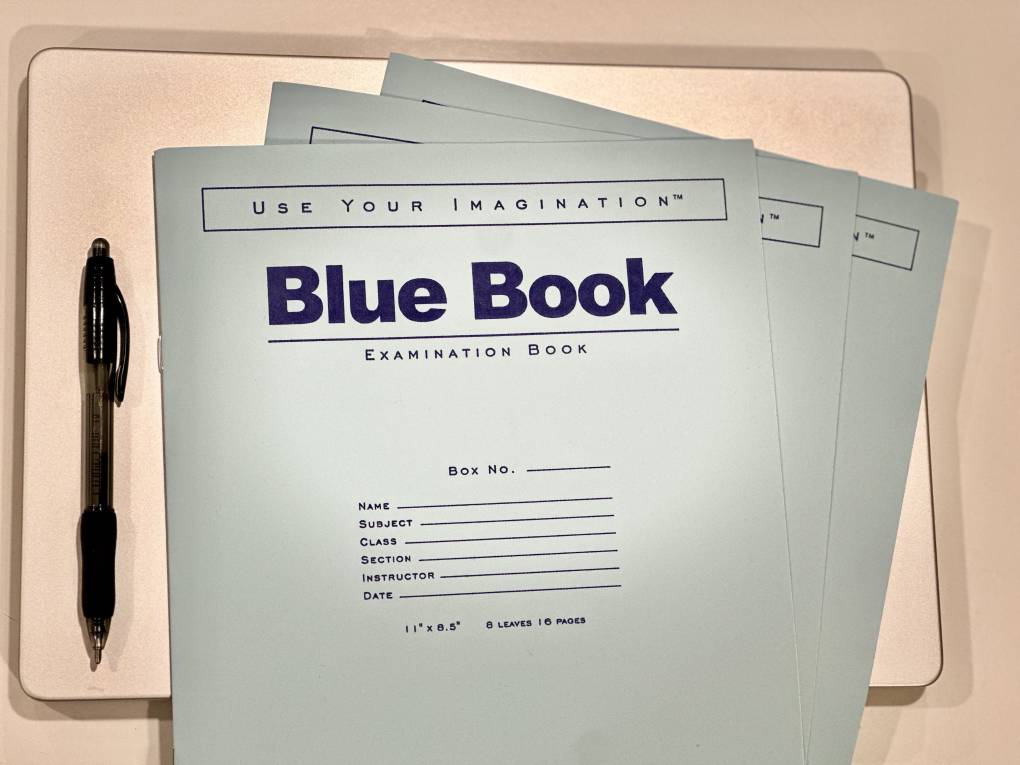
"caption": "Blue books are back, thanks to some of the pitfalls of digital testing.",
"credit": "Ki Sung/KQED",
"altTag": "A stack of paper exam booklets and a pen resting on a laptop.",
"description": null,
"imgSizes": {
"medium": {
"file": "https://cdn.kqed.org/wp-content/uploads/sites/23/2024/11/IMG_6057-800x600.jpg",
"width": 800,
"height": 600,
"mimeType": "image/jpeg"
},
"large": {
"file": "https://cdn.kqed.org/wp-content/uploads/sites/23/2024/11/IMG_6057-1020x765.jpg",
"width": 1020,
"height": 765,
"mimeType": "image/jpeg"
},
"thumbnail": {
"file": "https://cdn.kqed.org/wp-content/uploads/sites/23/2024/11/IMG_6057-160x120.jpg",
"width": 160,
"height": 120,
"mimeType": "image/jpeg"
},
"medium_large": {
"file": "https://cdn.kqed.org/wp-content/uploads/sites/23/2024/11/IMG_6057-768x576.jpg",
"width": 768,
"height": 576,
"mimeType": "image/jpeg"
},
"1536x1536": {
"file": "https://cdn.kqed.org/wp-content/uploads/sites/23/2024/11/IMG_6057-1536x1152.jpg",
"width": 1536,
"height": 1152,
"mimeType": "image/jpeg"
},
"2048x2048": {
"file": "https://cdn.kqed.org/wp-content/uploads/sites/23/2024/11/IMG_6057-2048x1536.jpg",
"width": 2048,
"height": 1536,
"mimeType": "image/jpeg"
},
"post-thumbnail": {
"file": "https://cdn.kqed.org/wp-content/uploads/sites/23/2024/11/IMG_6057-672x372.jpg",
"width": 672,
"height": 372,
"mimeType": "image/jpeg"
},
"twentyfourteen-full-width": {
"file": "https://cdn.kqed.org/wp-content/uploads/sites/23/2024/11/IMG_6057-1038x576.jpg",
"width": 1038,
"height": 576,
"mimeType": "image/jpeg"
},
"full-width": {
"file": "https://cdn.kqed.org/wp-content/uploads/sites/23/2024/11/IMG_6057-1920x1440.jpg",
"width": 1920,
"height": 1440,
"mimeType": "image/jpeg"
},
"kqedFullSize": {
"file": "https://cdn.kqed.org/wp-content/uploads/sites/23/2024/11/IMG_6057-scaled.jpg",
"width": 2560,
"height": 1920
}
},
"isLoading": false,
"fetchFailed": false
},
"mindshift_64929": {
"type": "attachments",
"id": "mindshift_64929",
"meta": {
"index": "attachments_1716263798",
"site": "mindshift",
"id": "64929",
"found": true
},
"title": "Tenth-grade boy and girl work on computer in workshop",
"publishDate": 1730317246,
"status": "inherit",
"parent": 64928,
"modified": 1730317276,
"caption": null,
"credit": "Allison Shelley/The Verbatim Agency for EDUimages",
"altTag": "Tenth graders work together on research for a project.",
"description": null,
"imgSizes": {
"medium": {
"file": "https://cdn.kqed.org/wp-content/uploads/sites/23/2024/10/AMERICANED_MC2_031-800x533.jpg",
"width": 800,
"height": 533,
"mimeType": "image/jpeg"
},
"large": {
"file": "https://cdn.kqed.org/wp-content/uploads/sites/23/2024/10/AMERICANED_MC2_031-1020x680.jpg",
"width": 1020,
"height": 680,
"mimeType": "image/jpeg"
},
"thumbnail": {
"file": "https://cdn.kqed.org/wp-content/uploads/sites/23/2024/10/AMERICANED_MC2_031-160x107.jpg",
"width": 160,
"height": 107,
"mimeType": "image/jpeg"
},
"medium_large": {
"file": "https://cdn.kqed.org/wp-content/uploads/sites/23/2024/10/AMERICANED_MC2_031-768x512.jpg",
"width": 768,
"height": 512,
"mimeType": "image/jpeg"
},
"1536x1536": {
"file": "https://cdn.kqed.org/wp-content/uploads/sites/23/2024/10/AMERICANED_MC2_031-1536x1024.jpg",
"width": 1536,
"height": 1024,
"mimeType": "image/jpeg"
},
"2048x2048": {
"file": "https://cdn.kqed.org/wp-content/uploads/sites/23/2024/10/AMERICANED_MC2_031-2048x1365.jpg",
"width": 2048,
"height": 1365,
"mimeType": "image/jpeg"
},
"post-thumbnail": {
"file": "https://cdn.kqed.org/wp-content/uploads/sites/23/2024/10/AMERICANED_MC2_031-672x372.jpg",
"width": 672,
"height": 372,
"mimeType": "image/jpeg"
},
"twentyfourteen-full-width": {
"file": "https://cdn.kqed.org/wp-content/uploads/sites/23/2024/10/AMERICANED_MC2_031-1038x576.jpg",
"width": 1038,
"height": 576,
"mimeType": "image/jpeg"
},
"full-width": {
"file": "https://cdn.kqed.org/wp-content/uploads/sites/23/2024/10/AMERICANED_MC2_031-1920x1280.jpg",
"width": 1920,
"height": 1280,
"mimeType": "image/jpeg"
},
"kqedFullSize": {
"file": "https://cdn.kqed.org/wp-content/uploads/sites/23/2024/10/AMERICANED_MC2_031-scaled-e1730317285760.jpg",
"width": 1920,
"height": 1280
}
},
"isLoading": false,
"fetchFailed": false
},
"mindshift_64972": {
"type": "attachments",
"id": "mindshift_64972",
"meta": {
"index": "attachments_1716263798",
"site": "mindshift",
"id": "64972",
"found": true
},
"title": "Man's hand showing a blackboard with Artificial Intelligence written on it.",
"publishDate": 1731603160,
"status": "inherit",
"parent": 64965,
"modified": 1731603195,
"caption": null,
"credit": "Antonio Hugo Photo/Getty Images",
"altTag": "Man's hand showing a blackboard with Artificial Intelligence written on it.",
"description": null,
"imgSizes": {
"medium": {
"file": "https://cdn.kqed.org/wp-content/uploads/sites/23/2024/11/GettyImages-2136016332-800x534.jpg",
"width": 800,
"height": 534,
"mimeType": "image/jpeg"
},
"large": {
"file": "https://cdn.kqed.org/wp-content/uploads/sites/23/2024/11/GettyImages-2136016332-1020x681.jpg",
"width": 1020,
"height": 681,
"mimeType": "image/jpeg"
},
"thumbnail": {
"file": "https://cdn.kqed.org/wp-content/uploads/sites/23/2024/11/GettyImages-2136016332-160x107.jpg",
"width": 160,
"height": 107,
"mimeType": "image/jpeg"
},
"medium_large": {
"file": "https://cdn.kqed.org/wp-content/uploads/sites/23/2024/11/GettyImages-2136016332-768x513.jpg",
"width": 768,
"height": 513,
"mimeType": "image/jpeg"
},
"1536x1536": {
"file": "https://cdn.kqed.org/wp-content/uploads/sites/23/2024/11/GettyImages-2136016332-1536x1026.jpg",
"width": 1536,
"height": 1026,
"mimeType": "image/jpeg"
},
"2048x2048": {
"file": "https://cdn.kqed.org/wp-content/uploads/sites/23/2024/11/GettyImages-2136016332-2048x1368.jpg",
"width": 2048,
"height": 1368,
"mimeType": "image/jpeg"
},
"post-thumbnail": {
"file": "https://cdn.kqed.org/wp-content/uploads/sites/23/2024/11/GettyImages-2136016332-672x372.jpg",
"width": 672,
"height": 372,
"mimeType": "image/jpeg"
},
"twentyfourteen-full-width": {
"file": "https://cdn.kqed.org/wp-content/uploads/sites/23/2024/11/GettyImages-2136016332-1038x576.jpg",
"width": 1038,
"height": 576,
"mimeType": "image/jpeg"
},
"full-width": {
"file": "https://cdn.kqed.org/wp-content/uploads/sites/23/2024/11/GettyImages-2136016332-1920x1282.jpg",
"width": 1920,
"height": 1282,
"mimeType": "image/jpeg"
},
"kqedFullSize": {
"file": "https://cdn.kqed.org/wp-content/uploads/sites/23/2024/11/GettyImages-2136016332.jpg",
"width": 2119,
"height": 1415
}
},
"isLoading": false,
"fetchFailed": false
},
"mindshift_64701": {
"type": "attachments",
"id": "mindshift_64701",
"meta": {
"index": "attachments_1716263798",
"site": "mindshift",
"id": "64701",
"found": true
},
"title": "White cyborg robotic hand pointing his finger to a book. Train artificial intelligence. Knowledge for cyber cyborg bot.",
"publishDate": 1726403793,
"status": "inherit",
"parent": 64694,
"modified": 1726403841,
"caption": null,
"credit": "FotografieLink/iStock",
"altTag": "White robotic hand pointing his finger to a book held by a black and white human hand. Light blue background.",
"description": null,
"imgSizes": {
"medium": {
"file": "https://cdn.kqed.org/wp-content/uploads/sites/23/2024/09/iStock-1846655977-800x640.jpg",
"width": 800,
"height": 640,
"mimeType": "image/jpeg"
},
"large": {
"file": "https://cdn.kqed.org/wp-content/uploads/sites/23/2024/09/iStock-1846655977-1020x816.jpg",
"width": 1020,
"height": 816,
"mimeType": "image/jpeg"
},
"thumbnail": {
"file": "https://cdn.kqed.org/wp-content/uploads/sites/23/2024/09/iStock-1846655977-160x128.jpg",
"width": 160,
"height": 128,
"mimeType": "image/jpeg"
},
"medium_large": {
"file": "https://cdn.kqed.org/wp-content/uploads/sites/23/2024/09/iStock-1846655977-768x614.jpg",
"width": 768,
"height": 614,
"mimeType": "image/jpeg"
},
"1536x1536": {
"file": "https://cdn.kqed.org/wp-content/uploads/sites/23/2024/09/iStock-1846655977-1536x1229.jpg",
"width": 1536,
"height": 1229,
"mimeType": "image/jpeg"
},
"post-thumbnail": {
"file": "https://cdn.kqed.org/wp-content/uploads/sites/23/2024/09/iStock-1846655977-672x372.jpg",
"width": 672,
"height": 372,
"mimeType": "image/jpeg"
},
"twentyfourteen-full-width": {
"file": "https://cdn.kqed.org/wp-content/uploads/sites/23/2024/09/iStock-1846655977-1038x576.jpg",
"width": 1038,
"height": 576,
"mimeType": "image/jpeg"
},
"full-width": {
"file": "https://cdn.kqed.org/wp-content/uploads/sites/23/2024/09/iStock-1846655977-1920x1536.jpg",
"width": 1920,
"height": 1536,
"mimeType": "image/jpeg"
},
"kqedFullSize": {
"file": "https://cdn.kqed.org/wp-content/uploads/sites/23/2024/09/iStock-1846655977.jpg",
"width": 1936,
"height": 1549
}
},
"isLoading": false,
"fetchFailed": false
},
"mindshift_64578": {
"type": "attachments",
"id": "mindshift_64578",
"meta": {
"index": "attachments_1716263798",
"site": "mindshift",
"id": "64578",
"found": true
},
"title": "Math Education",
"publishDate": 1724950133,
"status": "inherit",
"parent": 64575,
"modified": 1724950183,
"caption": null,
"credit": "wildpixel/iStock",
"altTag": "Colorful number form the shape of a head in profile. Numbers also float above the head.",
"description": null,
"imgSizes": {
"medium": {
"file": "https://cdn.kqed.org/wp-content/uploads/sites/23/2024/09/iStock-1896656976-800x449.jpg",
"width": 800,
"height": 449,
"mimeType": "image/jpeg"
},
"large": {
"file": "https://cdn.kqed.org/wp-content/uploads/sites/23/2024/09/iStock-1896656976-1020x573.jpg",
"width": 1020,
"height": 573,
"mimeType": "image/jpeg"
},
"thumbnail": {
"file": "https://cdn.kqed.org/wp-content/uploads/sites/23/2024/09/iStock-1896656976-160x90.jpg",
"width": 160,
"height": 90,
"mimeType": "image/jpeg"
},
"medium_large": {
"file": "https://cdn.kqed.org/wp-content/uploads/sites/23/2024/09/iStock-1896656976-768x431.jpg",
"width": 768,
"height": 431,
"mimeType": "image/jpeg"
},
"1536x1536": {
"file": "https://cdn.kqed.org/wp-content/uploads/sites/23/2024/09/iStock-1896656976-1536x862.jpg",
"width": 1536,
"height": 862,
"mimeType": "image/jpeg"
},
"2048x2048": {
"file": "https://cdn.kqed.org/wp-content/uploads/sites/23/2024/09/iStock-1896656976-2048x1150.jpg",
"width": 2048,
"height": 1150,
"mimeType": "image/jpeg"
},
"post-thumbnail": {
"file": "https://cdn.kqed.org/wp-content/uploads/sites/23/2024/09/iStock-1896656976-672x372.jpg",
"width": 672,
"height": 372,
"mimeType": "image/jpeg"
},
"twentyfourteen-full-width": {
"file": "https://cdn.kqed.org/wp-content/uploads/sites/23/2024/09/iStock-1896656976-1038x576.jpg",
"width": 1038,
"height": 576,
"mimeType": "image/jpeg"
},
"full-width": {
"file": "https://cdn.kqed.org/wp-content/uploads/sites/23/2024/09/iStock-1896656976-1920x1078.jpg",
"width": 1920,
"height": 1078,
"mimeType": "image/jpeg"
},
"kqedFullSize": {
"file": "https://cdn.kqed.org/wp-content/uploads/sites/23/2024/09/iStock-1896656976.jpg",
"width": 2310,
"height": 1297
}
},
"isLoading": false,
"fetchFailed": false
},
"mindshift_64535": {
"type": "attachments",
"id": "mindshift_64535",
"meta": {
"index": "attachments_1716263798",
"site": "mindshift",
"id": "64535",
"found": true
},
"title": null,
"publishDate": 1724639444,
"status": "inherit",
"parent": 64532,
"modified": 1724641074,
"caption": null,
"credit": "BestForBest/iStock",
"altTag": "Purple chat bot on a black background surrounded by 0s and 1s",
"description": null,
"imgSizes": {
"medium": {
"file": "https://cdn.kqed.org/wp-content/uploads/sites/23/2024/08/iStock-1818132180-800x608.jpg",
"width": 800,
"height": 608,
"mimeType": "image/jpeg"
},
"large": {
"file": "https://cdn.kqed.org/wp-content/uploads/sites/23/2024/08/iStock-1818132180-1020x775.jpg",
"width": 1020,
"height": 775,
"mimeType": "image/jpeg"
},
"thumbnail": {
"file": "https://cdn.kqed.org/wp-content/uploads/sites/23/2024/08/iStock-1818132180-160x122.jpg",
"width": 160,
"height": 122,
"mimeType": "image/jpeg"
},
"medium_large": {
"file": "https://cdn.kqed.org/wp-content/uploads/sites/23/2024/08/iStock-1818132180-768x584.jpg",
"width": 768,
"height": 584,
"mimeType": "image/jpeg"
},
"1536x1536": {
"file": "https://cdn.kqed.org/wp-content/uploads/sites/23/2024/08/iStock-1818132180-1536x1167.jpg",
"width": 1536,
"height": 1167,
"mimeType": "image/jpeg"
},
"2048x2048": {
"file": "https://cdn.kqed.org/wp-content/uploads/sites/23/2024/08/iStock-1818132180-2048x1556.jpg",
"width": 2048,
"height": 1556,
"mimeType": "image/jpeg"
},
"post-thumbnail": {
"file": "https://cdn.kqed.org/wp-content/uploads/sites/23/2024/08/iStock-1818132180-672x372.jpg",
"width": 672,
"height": 372,
"mimeType": "image/jpeg"
},
"twentyfourteen-full-width": {
"file": "https://cdn.kqed.org/wp-content/uploads/sites/23/2024/08/iStock-1818132180-1038x576.jpg",
"width": 1038,
"height": 576,
"mimeType": "image/jpeg"
},
"full-width": {
"file": "https://cdn.kqed.org/wp-content/uploads/sites/23/2024/08/iStock-1818132180-1920x1459.jpg",
"width": 1920,
"height": 1459,
"mimeType": "image/jpeg"
},
"kqedFullSize": {
"file": "https://cdn.kqed.org/wp-content/uploads/sites/23/2024/08/iStock-1818132180-scaled.jpg",
"width": 2560,
"height": 1945
}
},
"isLoading": false,
"fetchFailed": false
},
"mindshift_64149": {
"type": "attachments",
"id": "mindshift_64149",
"meta": {
"index": "attachments_1716263798",
"site": "mindshift",
"id": "64149",
"found": true
},
"title": "Tiny Characters around Huge Mobile with Robot Assistant. Artificial Intelligence in Human Life. Chatbot Help Clients Online Answer Questions, Ai Cyborgs Faq Service. Cartoon People Vector Illustration",
"publishDate": 1720030539,
"status": "inherit",
"parent": 64139,
"modified": 1720030611,
"caption": null,
"credit": "lemono/iStock",
"altTag": "illustration of a smartphone with a robot on the screen. Small humans sit and stand near the phone sending text bubbles to the robot.",
"description": null,
"imgSizes": {
"medium": {
"file": "https://cdn.kqed.org/wp-content/uploads/sites/23/2024/07/iStock-1248160387-800x533.jpg",
"width": 800,
"height": 533,
"mimeType": "image/jpeg"
},
"large": {
"file": "https://cdn.kqed.org/wp-content/uploads/sites/23/2024/07/iStock-1248160387-1020x680.jpg",
"width": 1020,
"height": 680,
"mimeType": "image/jpeg"
},
"thumbnail": {
"file": "https://cdn.kqed.org/wp-content/uploads/sites/23/2024/07/iStock-1248160387-160x107.jpg",
"width": 160,
"height": 107,
"mimeType": "image/jpeg"
},
"medium_large": {
"file": "https://cdn.kqed.org/wp-content/uploads/sites/23/2024/07/iStock-1248160387-768x512.jpg",
"width": 768,
"height": 512,
"mimeType": "image/jpeg"
},
"1536x1536": {
"file": "https://cdn.kqed.org/wp-content/uploads/sites/23/2024/07/iStock-1248160387-1536x1024.jpg",
"width": 1536,
"height": 1024,
"mimeType": "image/jpeg"
},
"2048x2048": {
"file": "https://cdn.kqed.org/wp-content/uploads/sites/23/2024/07/iStock-1248160387-2048x1365.jpg",
"width": 2048,
"height": 1365,
"mimeType": "image/jpeg"
},
"post-thumbnail": {
"file": "https://cdn.kqed.org/wp-content/uploads/sites/23/2024/07/iStock-1248160387-672x372.jpg",
"width": 672,
"height": 372,
"mimeType": "image/jpeg"
},
"twentyfourteen-full-width": {
"file": "https://cdn.kqed.org/wp-content/uploads/sites/23/2024/07/iStock-1248160387-1038x576.jpg",
"width": 1038,
"height": 576,
"mimeType": "image/jpeg"
},
"full-width": {
"file": "https://cdn.kqed.org/wp-content/uploads/sites/23/2024/07/iStock-1248160387-1920x1280.jpg",
"width": 1920,
"height": 1280,
"mimeType": "image/jpeg"
},
"kqedFullSize": {
"file": "https://cdn.kqed.org/wp-content/uploads/sites/23/2024/07/iStock-1248160387.jpg",
"width": 2121,
"height": 1414
}
},
"isLoading": false,
"fetchFailed": false
},
"mindshift_64015": {
"type": "attachments",
"id": "mindshift_64015",
"meta": {
"index": "attachments_1716263798",
"site": "mindshift",
"id": "64015",
"found": true
},
"title": "A young male Black character talking to a cute round robot, an artificial intelligence concept",
"publishDate": 1718418733,
"status": "inherit",
"parent": 64014,
"modified": 1718418790,
"caption": null,
"credit": "nadia_bormotova/iStock",
"altTag": null,
"description": null,
"imgSizes": {
"medium": {
"file": "https://cdn.kqed.org/wp-content/uploads/sites/23/2024/06/iStock-1307746875-800x567.jpg",
"width": 800,
"height": 567,
"mimeType": "image/jpeg"
},
"large": {
"file": "https://cdn.kqed.org/wp-content/uploads/sites/23/2024/06/iStock-1307746875-1020x722.jpg",
"width": 1020,
"height": 722,
"mimeType": "image/jpeg"
},
"thumbnail": {
"file": "https://cdn.kqed.org/wp-content/uploads/sites/23/2024/06/iStock-1307746875-160x113.jpg",
"width": 160,
"height": 113,
"mimeType": "image/jpeg"
},
"medium_large": {
"file": "https://cdn.kqed.org/wp-content/uploads/sites/23/2024/06/iStock-1307746875-768x544.jpg",
"width": 768,
"height": 544,
"mimeType": "image/jpeg"
},
"1536x1536": {
"file": "https://cdn.kqed.org/wp-content/uploads/sites/23/2024/06/iStock-1307746875-1536x1088.jpg",
"width": 1536,
"height": 1088,
"mimeType": "image/jpeg"
},
"2048x2048": {
"file": "https://cdn.kqed.org/wp-content/uploads/sites/23/2024/06/iStock-1307746875-2048x1451.jpg",
"width": 2048,
"height": 1451,
"mimeType": "image/jpeg"
},
"post-thumbnail": {
"file": "https://cdn.kqed.org/wp-content/uploads/sites/23/2024/06/iStock-1307746875-672x372.jpg",
"width": 672,
"height": 372,
"mimeType": "image/jpeg"
},
"twentyfourteen-full-width": {
"file": "https://cdn.kqed.org/wp-content/uploads/sites/23/2024/06/iStock-1307746875-1038x576.jpg",
"width": 1038,
"height": 576,
"mimeType": "image/jpeg"
},
"full-width": {
"file": "https://cdn.kqed.org/wp-content/uploads/sites/23/2024/06/iStock-1307746875-1920x1360.jpg",
"width": 1920,
"height": 1360,
"mimeType": "image/jpeg"
},
"kqedFullSize": {
"file": "https://cdn.kqed.org/wp-content/uploads/sites/23/2024/06/iStock-1307746875.jpg",
"width": 2057,
"height": 1457
}
},
"isLoading": false,
"fetchFailed": false
},
"mindshift_63912": {
"type": "attachments",
"id": "mindshift_63912",
"meta": {
"index": "attachments_1716263798",
"site": "mindshift",
"id": "63912",
"found": true
},
"title": null,
"publishDate": 1717266676,
"status": "inherit",
"parent": 63901,
"modified": 1717266699,
"caption": null,
"credit": "Malorny/Getty Images",
"altTag": null,
"description": null,
"imgSizes": {
"medium": {
"file": "https://cdn.kqed.org/wp-content/uploads/sites/23/2024/06/Barshay-AI-800x480.jpg",
"width": 800,
"height": 480,
"mimeType": "image/jpeg"
},
"large": {
"file": "https://cdn.kqed.org/wp-content/uploads/sites/23/2024/06/Barshay-AI-1020x612.jpg",
"width": 1020,
"height": 612,
"mimeType": "image/jpeg"
},
"thumbnail": {
"file": "https://cdn.kqed.org/wp-content/uploads/sites/23/2024/06/Barshay-AI-160x96.jpg",
"width": 160,
"height": 96,
"mimeType": "image/jpeg"
},
"medium_large": {
"file": "https://cdn.kqed.org/wp-content/uploads/sites/23/2024/06/Barshay-AI-768x461.jpg",
"width": 768,
"height": 461,
"mimeType": "image/jpeg"
},
"1536x1536": {
"file": "https://cdn.kqed.org/wp-content/uploads/sites/23/2024/06/Barshay-AI-1536x922.jpg",
"width": 1536,
"height": 922,
"mimeType": "image/jpeg"
},
"2048x2048": {
"file": "https://cdn.kqed.org/wp-content/uploads/sites/23/2024/06/Barshay-AI-2048x1229.jpg",
"width": 2048,
"height": 1229,
"mimeType": "image/jpeg"
},
"post-thumbnail": {
"file": "https://cdn.kqed.org/wp-content/uploads/sites/23/2024/06/Barshay-AI-672x372.jpg",
"width": 672,
"height": 372,
"mimeType": "image/jpeg"
},
"twentyfourteen-full-width": {
"file": "https://cdn.kqed.org/wp-content/uploads/sites/23/2024/06/Barshay-AI-1038x576.jpg",
"width": 1038,
"height": 576,
"mimeType": "image/jpeg"
},
"full-width": {
"file": "https://cdn.kqed.org/wp-content/uploads/sites/23/2024/06/Barshay-AI-1920x1152.jpg",
"width": 1920,
"height": 1152,
"mimeType": "image/jpeg"
},
"kqedFullSize": {
"file": "https://cdn.kqed.org/wp-content/uploads/sites/23/2024/06/Barshay-AI.jpg",
"width": 2235,
"height": 1341
}
},
"isLoading": false,
"fetchFailed": false
},
"mindshift_63811": {
"type": "attachments",
"id": "mindshift_63811",
"meta": {
"index": "attachments_1716263798",
"site": "mindshift",
"id": "63811",
"found": true
},
"parent": 63809,
"imgSizes": {
"twentyfourteen-full-width": {
"file": "https://cdn.kqed.org/wp-content/uploads/sites/23/2024/05/iStock-949211888-1038x576.jpg",
"width": 1038,
"mimeType": "image/jpeg",
"height": 576
},
"thumbnail": {
"file": "https://cdn.kqed.org/wp-content/uploads/sites/23/2024/05/iStock-949211888-160x107.jpg",
"width": 160,
"mimeType": "image/jpeg",
"height": 107
},
"post-thumbnail": {
"file": "https://cdn.kqed.org/wp-content/uploads/sites/23/2024/05/iStock-949211888-672x372.jpg",
"width": 672,
"mimeType": "image/jpeg",
"height": 372
},
"kqedFullSize": {
"file": "https://cdn.kqed.org/wp-content/uploads/sites/23/2024/05/iStock-949211888-scaled.jpg",
"width": 2560,
"height": 1707
},
"2048x2048": {
"file": "https://cdn.kqed.org/wp-content/uploads/sites/23/2024/05/iStock-949211888-2048x1365.jpg",
"width": 2048,
"mimeType": "image/jpeg",
"height": 1365
},
"large": {
"file": "https://cdn.kqed.org/wp-content/uploads/sites/23/2024/05/iStock-949211888-1020x680.jpg",
"width": 1020,
"mimeType": "image/jpeg",
"height": 680
},
"1536x1536": {
"file": "https://cdn.kqed.org/wp-content/uploads/sites/23/2024/05/iStock-949211888-1536x1024.jpg",
"width": 1536,
"mimeType": "image/jpeg",
"height": 1024
},
"full-width": {
"file": "https://cdn.kqed.org/wp-content/uploads/sites/23/2024/05/iStock-949211888-1920x1280.jpg",
"width": 1920,
"mimeType": "image/jpeg",
"height": 1280
},
"medium": {
"file": "https://cdn.kqed.org/wp-content/uploads/sites/23/2024/05/iStock-949211888-800x533.jpg",
"width": 800,
"mimeType": "image/jpeg",
"height": 533
},
"medium_large": {
"file": "https://cdn.kqed.org/wp-content/uploads/sites/23/2024/05/iStock-949211888-768x512.jpg",
"width": 768,
"mimeType": "image/jpeg",
"height": 512
}
},
"publishDate": 1715953236,
"modified": 1715953259,
"caption": null,
"description": null,
"title": "Robot Ticking Off Checkboxes On Document",
"credit": "AndreyPopov/iStock",
"status": "inherit",
"altTag": "Close-up Of A Robot Hand Ticking Off Checkboxes On Document With Pen",
"isLoading": false,
"fetchFailed": false
},
"mindshift_63528": {
"type": "attachments",
"id": "mindshift_63528",
"meta": {
"index": "attachments_1716263798",
"site": "mindshift",
"id": "63528",
"found": true
},
"parent": 63526,
"imgSizes": {
"twentyfourteen-full-width": {
"file": "https://cdn.kqed.org/wp-content/uploads/sites/23/2024/04/iStock-1485949072-1038x576.jpg",
"width": 1038,
"mimeType": "image/jpeg",
"height": 576
},
"thumbnail": {
"file": "https://cdn.kqed.org/wp-content/uploads/sites/23/2024/04/iStock-1485949072-160x107.jpg",
"width": 160,
"mimeType": "image/jpeg",
"height": 107
},
"post-thumbnail": {
"file": "https://cdn.kqed.org/wp-content/uploads/sites/23/2024/04/iStock-1485949072-672x372.jpg",
"width": 672,
"mimeType": "image/jpeg",
"height": 372
},
"kqedFullSize": {
"file": "https://cdn.kqed.org/wp-content/uploads/sites/23/2024/04/iStock-1485949072.jpg",
"width": 2121,
"height": 1414
},
"2048x2048": {
"file": "https://cdn.kqed.org/wp-content/uploads/sites/23/2024/04/iStock-1485949072-2048x1365.jpg",
"width": 2048,
"mimeType": "image/jpeg",
"height": 1365
},
"large": {
"file": "https://cdn.kqed.org/wp-content/uploads/sites/23/2024/04/iStock-1485949072-1020x680.jpg",
"width": 1020,
"mimeType": "image/jpeg",
"height": 680
},
"1536x1536": {
"file": "https://cdn.kqed.org/wp-content/uploads/sites/23/2024/04/iStock-1485949072-1536x1024.jpg",
"width": 1536,
"mimeType": "image/jpeg",
"height": 1024
},
"full-width": {
"file": "https://cdn.kqed.org/wp-content/uploads/sites/23/2024/04/iStock-1485949072-1920x1280.jpg",
"width": 1920,
"mimeType": "image/jpeg",
"height": 1280
},
"medium": {
"file": "https://cdn.kqed.org/wp-content/uploads/sites/23/2024/04/iStock-1485949072-800x533.jpg",
"width": 800,
"mimeType": "image/jpeg",
"height": 533
},
"medium_large": {
"file": "https://cdn.kqed.org/wp-content/uploads/sites/23/2024/04/iStock-1485949072-768x512.jpg",
"width": 768,
"mimeType": "image/jpeg",
"height": 512
}
},
"publishDate": 1712781471,
"modified": 1712781589,
"caption": null,
"description": null,
"title": "Girl holding light bulb with virtual Artificial Intelligence and virtual digital brain. AI Technology. Searching information data on internet networking, intelligence technology concept.",
"credit": "Sasiistock/iStock",
"status": "inherit",
"altTag": "Girl holding light bulb with the letters \"AI\" and a brain illustrated on it.",
"isLoading": false,
"fetchFailed": false
}
},
"audioPlayerReducer": {
"postId": "stream_live",
"isPaused": true,
"isPlaying": false,
"pfsActive": false,
"pledgeModalIsOpen": true,
"playerDrawerIsOpen": false,
"liveAudioPlayStartedAt": 0,
"liveAudioPlayContext": ""
},
"authorsReducer": {
"byline_mindshift_64694": {
"type": "authors",
"id": "byline_mindshift_64694",
"meta": {
"override": true
},
"slug": "byline_mindshift_64694",
"name": "Jill Barshay, \u003ca href=\"https://hechingerreport.org/\" target=\"_blank\">The Hechinger Report\u003c/a>",
"isLoading": false
},
"byline_mindshift_64575": {
"type": "authors",
"id": "byline_mindshift_64575",
"meta": {
"override": true
},
"slug": "byline_mindshift_64575",
"name": "Jill Barshay, \u003ca href=\"https://hechingerreport.org/\" target=\"_blank\">The Hechinger Report\u003c/a>",
"isLoading": false
},
"byline_mindshift_64532": {
"type": "authors",
"id": "byline_mindshift_64532",
"meta": {
"override": true
},
"slug": "byline_mindshift_64532",
"name": "Jill Barshay, \u003ca href=\"https://hechingerreport.org/\" target=\"_blank\">The Hechinger Report\u003c/a>",
"isLoading": false
},
"byline_mindshift_64139": {
"type": "authors",
"id": "byline_mindshift_64139",
"meta": {
"override": true
},
"slug": "byline_mindshift_64139",
"name": "Jill Barshay, \u003ca href=\"https://hechingerreport.org/\" target=\"_blank\">The Hechinger Report\u003c/a>",
"isLoading": false
},
"byline_mindshift_64014": {
"type": "authors",
"id": "byline_mindshift_64014",
"meta": {
"override": true
},
"slug": "byline_mindshift_64014",
"name": "Jill Barshay, \u003ca href=\"https://hechingerreport.org/\" target=\"_blank\">The Hechinger Report\u003c/a>",
"isLoading": false
},
"byline_mindshift_63901": {
"type": "authors",
"id": "byline_mindshift_63901",
"meta": {
"override": true
},
"slug": "byline_mindshift_63901",
"name": "Jill Barshay, \u003ca href=\"https://hechingerreport.org/\" target=\"_blank\">The Hechinger Report\u003c/a>",
"isLoading": false
},
"byline_mindshift_63809": {
"type": "authors",
"id": "byline_mindshift_63809",
"meta": {
"override": true
},
"slug": "byline_mindshift_63809",
"name": "Jill Barshay, \u003ca href=\"https://hechingerreport.org/\" target=\"_blank\">The Hechinger Report\u003c/a>",
"isLoading": false
},
"byline_mindshift_63526": {
"type": "authors",
"id": "byline_mindshift_63526",
"meta": {
"override": true
},
"slug": "byline_mindshift_63526",
"name": "Caroline Preston and Javeria Salman, \u003ca href=\"https://hechingerreport.org/\" target=\"_blank\">The Hechinger Report\u003c/a>",
"isLoading": false
},
"ngobir": {
"type": "authors",
"id": "11721",
"meta": {
"index": "authors_1716337520",
"id": "11721",
"found": true
},
"name": "Nimah Gobir",
"firstName": "Nimah",
"lastName": "Gobir",
"slug": "ngobir",
"email": "ngobir@kqed.org",
"display_author_email": false,
"staff_mastheads": [],
"title": "KQED Contributor",
"bio": null,
"avatar": "https://secure.gravatar.com/avatar/837f5df7045c59f3ec097cdf7ac391373ab75d5ec936dd7099b8cb6f0af1b0e9?s=600&d=blank&r=g",
"twitter": null,
"bluesky": null,
"facebook": null,
"instagram": null,
"linkedin": null,
"sites": [
{
"site": "mindshift",
"roles": [
"editor"
]
}
],
"headData": {
"title": "Nimah Gobir | KQED",
"description": "KQED Contributor",
"ogImgSrc": "https://secure.gravatar.com/avatar/837f5df7045c59f3ec097cdf7ac391373ab75d5ec936dd7099b8cb6f0af1b0e9?s=600&d=blank&r=g",
"twImgSrc": "https://secure.gravatar.com/avatar/837f5df7045c59f3ec097cdf7ac391373ab75d5ec936dd7099b8cb6f0af1b0e9?s=600&d=blank&r=g"
},
"isLoading": false,
"link": "/author/ngobir"
},
"mjacksonretondo": {
"type": "authors",
"id": "11759",
"meta": {
"index": "authors_1716337520",
"id": "11759",
"found": true
},
"name": "Marlena Jackson-Retondo",
"firstName": "Marlena",
"lastName": "Jackson-Retondo",
"slug": "mjacksonretondo",
"email": "mjacksonretondo@kqed.org",
"display_author_email": false,
"staff_mastheads": [],
"title": "Engagement Producer",
"bio": "Marlena Jackson-Retondo is the engagement producer for KQED's \u003cem>Forum \u003c/em>and \u003cem>Mindshift\u003c/em>. Prior to joining the team in 2022, Marlena was an intern with the KQED Digital News Engagement team. She grew up in the Bay Area.\u003cem> \u003c/em>",
"avatar": "https://secure.gravatar.com/avatar/94ab429312e9a676559e31d1894130df?s=600&d=blank&r=g",
"twitter": null,
"facebook": null,
"instagram": null,
"linkedin": null,
"sites": [
{
"site": "arts",
"roles": [
"editor"
]
},
{
"site": "news",
"roles": [
"contributor"
]
},
{
"site": "mindshift",
"roles": [
"editor"
]
},
{
"site": "forum",
"roles": [
"editor"
]
}
],
"headData": {
"title": "Marlena Jackson-Retondo | KQED",
"description": "Engagement Producer",
"ogImgSrc": "https://secure.gravatar.com/avatar/94ab429312e9a676559e31d1894130df?s=600&d=blank&r=g",
"twImgSrc": "https://secure.gravatar.com/avatar/94ab429312e9a676559e31d1894130df?s=600&d=blank&r=g"
},
"isLoading": false,
"link": "/author/mjacksonretondo"
}
},
"pagesReducer": {
"mindshift_tag_artificial-intelligence": {
"type": "terms",
"id": "mindshift_1023",
"meta": {
"index": "terms_1716263798",
"site": "mindshift",
"id": "1023",
"score": 8.557506
},
"featImg": null,
"name": "artificial intelligence",
"description": null,
"taxonomy": "tag",
"headData": {
"twImgId": null,
"twTitle": null,
"ogTitle": null,
"ogImgId": null,
"twDescription": null,
"description": null,
"title": "artificial intelligence Archives | KQED Mindshift",
"ogDescription": null
},
"ttid": 1028,
"slug": "artificial-intelligence",
"isLoading": false,
"title": "artificial intelligence",
"pageMeta": {
"site": "mindshift",
"WpPageTemplate": "page-topic-editorial",
"currentPage": 3
},
"blocks": [
{
"blockName": "kqed/post-list",
"attrs": {
"layout": "cardArticle2",
"query": "posts/mindshift?tag=artificial-intelligence",
"seeMore": false,
"paginated": true,
"page": 3
}
},
{
"blockName": "kqed/ad"
}
]
}
},
"pfsSessionReducer": {},
"postsReducer": {
"stream_live": {
"type": "live",
"id": "stream_live",
"audioUrl": "https://streams.kqed.org/kqedradio",
"title": "Live Stream",
"excerpt": "Live Stream information currently unavailable.",
"link": "/radio",
"featImg": "",
"label": {
"name": "KQED Live",
"link": "/"
}
},
"stream_kqedNewscast": {
"type": "posts",
"id": "stream_kqedNewscast",
"audioUrl": "https://www.kqed.org/.stream/anon/radio/RDnews/newscast.mp3?_=1",
"title": "KQED Newscast",
"featImg": "",
"label": {
"name": "88.5 FM",
"link": "/"
}
},
"mindshift_65296": {
"type": "posts",
"id": "mindshift_65296",
"meta": {
"index": "posts_1716263798",
"site": "mindshift",
"id": "65296",
"score": null,
"sort": [
1741886203000
]
},
"guestAuthors": [],
"slug": "with-ai-changing-everything-heres-how-teachers-can-shape-the-new-culture-of-learning",
"title": "With AI Changing Everything, Here's How Teachers Can Shape the New Culture of Learning",
"publishDate": 1741886203,
"format": "standard",
"headTitle": "With AI Changing Everything, Here’s How Teachers Can Shape the New Culture of Learning | KQED",
"labelTerm": {
"term": 21847,
"site": "mindshift"
},
"content": "\u003cp>When Chris Knight started teaching in 2011, overhead projectors were being replaced by smartboards and teachers could finally project slides directly to the whiteboard from their laptops. Technology was emphasized as a utility in the classroom, said Knight. But a decade later in 2021, when in-person classes resumed after a year online, Knight noticed a big cultural shift in his classroom, one that he attributes in part to his students’ relationship to technology.\u003c/p>\n\u003cp>\u003ca href=\"https://www.kqed.org/mindshift/tag/artificial-intelligence\">Artificial intelligence\u003c/a> certainly wasn’t a novelty in 2021, but in the years leading up to the pandemic, AI — touted as a \u003ca href=\"https://www.kqed.org/mindshift/62462/8-free-ai-powered-tools-that-can-save-teachers-time-and-enhance-instruction\">tool of efficiency\u003c/a> — quickly progressed beyond spellcheck. Public access to long awaited generative AI tools like Dall-E, and the release of large language models like ChatGPT in 2022, took the world by storm and \u003ca href=\"https://www.kqed.org/mindshift/64965/ai-is-moving-fast-here-are-some-helpful-ways-to-support-teachers\">schools were not immune to these advances\u003c/a>.\u003c/p>\n\u003cp>For Knight, who teaches at a high school in Albany, California, education technology used to feel thoughtful and make his life as a teacher easier. But these days, “we have this ecosystem of stuff that makes our lives as teachers actually harder,” he said, since students, with the help of AI, can forgo doing much of their own work and miss out on their own learning as a result.\u003c/p>\n\u003cp>However, the presence of AI might also provide something beyond efficiency: a welcome opportunity to deepen knowledge, and encourage critical thinking, according to \u003ca href=\"https://search.asu.edu/profile/1980815\">Steve Graham\u003c/a>, a professor of teaching and learning innovation at Arizona State University. Yet in order to reap these benefits with AI, one must apply the skills traditionally acquired from doing the hard work of learning how to read and write well. But this process is what AI can so easily bypass.\u003c/p>\n\u003cp>“If you’re going to be skilled at using AI for writing, you actually need to know more” than if you didn’t use AI, said Graham.\u003c/p>\n\u003ch2>\u003cstrong>What happens when AI writes for us? \u003c/strong>\u003c/h2>\n\u003cp>ChatGPT has raised alarms in schools since it was first released in 2022. Concerns of cheating and \u003ca href=\"https://www.kqed.org/mindshift/64965/ai-is-moving-fast-here-are-some-helpful-ways-to-support-teachers\">diminished learning\u003c/a> were shared amongst teachers. But what happens to learning and literacy when AI writes for us?\u003c/p>\n\u003cp>[ad fullwidth]\u003c/p>\n\u003cp>According to Graham, reading and writing are deeply intertwined; you can’t have one without the other. Reading and writing make and communicate meaning, and they both draw upon some of the same processes in the brain, said Graham. He studies the development of writing and the effectiveness of digital tools that support writing for K-12 students.\u003c/p>\n\u003cp>“Reading and writing are great tools for learning,” Graham said. But when an AI tool does the “thinking” for students, such as generating large and complex portions of text, some of that learning goes away. Take an essay outline for example. Outlining a paper requires thinking about information, making decisions about what information to include and exclude, and organizing that information to make an argument, said Graham.\u003c/p>\n\u003cp>“If we disengage our thinking, then we’re less likely to learn as much and examine the material we’re writing about in as much depth,” he said.\u003c/p>\n\u003cp>According to Graham, revision is an important process of writing development and learning. “When we write, new ideas come to us…and when we revise, the same kind of thing happens,” he said. When AI tools are used to bypass some of these important steps in writing development like an essay outline or revisions, the “\u003ca href=\"https://www.kqed.org/mindshift/34196/bigger-gains-for-students-who-dont-have-help-solving-problems-struggle-to-learn\">struggle\u003c/a>” of learning is also taken away.\u003c/p>\n\u003cp>But, according to Graham, there is a right way to use AI as a “writing partner.” When you write, you make small adjustments as you go, he said. For example, you might write a sentence and wonder if you need to make a different word choice, or change the punctuation. When you use ChatGPT to suggest alternative sentences to one that you’ve already written, you are required to do “wholesale evaluations” of the material, Graham continued.\u003c/p>\n\u003cp>Using AI to assist with writing can become a metacognitive practice rather than a time-saving strategy. Rather than adjusting your own writing, consider using AI to generate alternative sentences. But you still need to be able to determine the “best” sentence.\u003c/p>\n\u003cp>“I think one of the biggest challenges for writing at high school level or any level right now is basically time. Very little time is devoted to writing,” said Graham.\u003c/p>\n\u003cp>Unfortunately, on a good learning day, time is tight. When time has to be used in order to address other issues in the classroom, like student apathy and learning loss, having enough time can seem like an impossibility.\u003c/p>\n\u003ch2>\u003cstrong>The pandemic changed everything \u003c/strong>\u003c/h2>\n\u003cp>It wasn’t until in-person classes resumed in the 2021-22 school year that Knight noticed a change in his students and the technology. “Something really didn’t work” during virtual school, he said. It wasn’t necessarily a shift in the types of technology available to students, but a shift in students’ relationship to that technology, Knight continued.\u003c/p>\n\u003cp>For the past four school years, Knight has witnessed his students’ social regulation skills decline. He and his colleagues now give students a five-minute break during 90-minute block periods, a practice that didn’t exist before the pandemic. And although he works hard to creatively engage his students in classroom activities, Knight often finds that they quickly blow past what he calls the “sweet spot of social engagement.” A socially engaging learning activity now quickly morphs into excess energy not conducive to learning, said Knight.\u003c/p>\n\u003cp>His first interaction with newer AI tech in the classroom was negative. Some of Knight’s students used ChatGPT to cheat on an essay. So Knight decided to begin using AI detection software, but the pendulum swung too far, and he falsely accused a student of cheating. The result was a \u003ca href=\"https://www.kqed.org/mindshift/65255/relationship-repairing-skills-every-adult-should-learn-to-help-the-kids-in-their-lives\">damaged relationship\u003c/a> with his student.\u003c/p>\n\u003cp>For the 2024-25 school year, Knight prefers \u003ca href=\"https://www.kqed.org/mindshift/64992/taking-exams-in-blue-books-its-back-to-help-curb-ai-use-and-rampant-cheating\">paper and pencil\u003c/a>, and doesn’t assign open-ended written response work on laptops or computers. He no longer uses AI detection software either.\u003c/p>\n\u003ch2>\u003cstrong>Schools’ ongoing response to AI technology \u003c/strong>\u003c/h2>\n\u003cp>Investments in technology like generative AI aren’t necessarily the only way or even the best way to improve student learning, according to Justin Reich of MIT’s Teaching System Labs. “Sometimes schools chose technology, and sometimes they chose other things,” he said.\u003c/p>\n\u003cp>The pandemic forced all K-12 schools, regardless of their prior technology philosophy, to aggressively adopt and adapt to extensive technological changes at lightning speed, said Reich. This accelerated the move and exposure to certain technologies before a lot of teachers and students were ready to, he continued.\u003c/p>\n\u003cp>And less preparation can sometimes spell a harder road to success, especially during a time of less connectivity and more social isolation.\u003c/p>\n\u003cp>It’s easy to spiral when thinking about the possibilities and disruptions that the advancement of AI might be capable of in the classroom. But remember, “it is quite common over the last century for people to invent technologies that bypass student thinking,” said Reich. At one point in time, encyclopedias provided a shortcut to students assigned “to summarize a topic based on multiple sources,” he said, and “calculators did the same kind of thing in math class; a more recent example might be Google Translate.”\u003c/p>\n\u003cp>Reich uses these earlier technological advancements that changed the culture of learning at the time they were introduced to students and teachers – but are now used quite commonly – as a reminder that “as a field, we know something about dealing with and managing technologies,” he said.\u003c/p>\n\u003cp>In the past couple of years, some schools have experienced high levels of students using large language models or generative AI to feed them answers to homework or essay questions. When these numbers reach a “crisis” level, and a lot of students are asking a machine to do a lot of their work without their teachers knowing, the pace of classes becomes accelerated “because the teacher thinks [students] understand stuff, but they’re just feeding him answers out of ChatGPT,” said Reich.\u003c/p>\n\u003ch2>\u003cstrong>Where are we now?\u003c/strong>\u003c/h2>\n\u003cp>The good news is that the AI’s predicted exponentially sophisticated growth when ChatGPT 3.5 was released has fallen flat, according to Reich. “That’s a good thing for schools,” he continued. In his conversations and surveys of students, Reich said that, in general, young people understand that they – not AI – should be doing the work. But most students agree that they use AI when they’re pressed for time, are stuck on a problem or have determined that the work that they’ve been given isn’t of value, Reich added.\u003c/p>\n\u003cp>Reich and his colleagues recommend that teachers encourage students to think of AI tools as helping with small portions of their work rather than assisting with the whole of their work. “So if you get stuck, don’t ask machines to do your assignment. Ask the machine to give you some help with what the next step is,” he said.\u003c/p>\n\u003cp>Ultimately, one solution does not fit all. Some schools and teachers, like Knight, might decide that it’s best for their learning environment and students if they return to pencil and paper, while other educational spaces adopt AI tools and discussions with students surrounding them, said Reich.\u003c/p>\n\u003cp>Instead of thinking about AI as an efficiency tool, Graham likes to think about AI as a means for \u003ca href=\"https://www.kqed.org/mindshift/23799/how-do-we-define-and-measure-deeper-learning\">deeper learning\u003c/a>. “How can it help us do the things that we want to do in a way that doesn’t impede learning and is also beneficial to a broad range of kids?” said Graham. This sounds like a daunting task, but there are some reasonable ways to implement AI as a tool that both benefits the teacher and the student in the classroom and promotes learning.\u003c/p>\n\u003cp>For example, Graham spoke with a teacher who used ChatGPT to produce a writing sample with some of the most common miscues used by students in that class. The class looked at the AI generated “student” example and deepened their understanding of their own writing without the embarrassment of singling out an individual students’ writing.\u003c/p>\n\u003cp>Although it is widely understood that AI detection software isn’t reliable, \u003ca href=\"https://www.kqed.org/mindshift/63901/writing-researcher-finds-ai-feedback-better-than-i-thought\">AI has been shown to be\u003c/a> \u003ca href=\"https://www.kqed.org/mindshift/63901/writing-researcher-finds-ai-feedback-better-than-i-thought\">pretty good at giving feedback\u003c/a>, said Graham. This doesn’t mean that AI is better at giving feedback than humans are, but AI is able to replicate feedback that is similarly good and similarly bad to human generated feedback, Graham continued. But AI feedback gives us tools that aren’t often used when teacher feedback is given, and that is skepticism.\u003c/p>\n\u003cp>[ad floatright]\u003c/p>\n\u003cp>While some teachers give open-ended feedback to student work, other teachers give \u003ca href=\"https://www.kqed.org/mindshift/63901/writing-researcher-finds-ai-feedback-better-than-i-thought\">feedback\u003c/a> that assumes the student takes that feedback directly. “I think with AI, it opens the possibility— because we’re suspicious of what it is going to say to us —to be more critical about the feedback,” said Graham, and therefore promoting an important skill for all students to have: critical thinking.\u003c/p>\n\n",
"blocks": [],
"excerpt": "The impact of artificial intelligence is growing, and that means educators and parents must keep a closer eye on how learning is evolving as well. ",
"status": "publish",
"parent": 0,
"modified": 1741895932,
"stats": {
"hasAudio": false,
"hasVideo": false,
"hasChartOrMap": false,
"iframeSrcs": [],
"hasGoogleForm": false,
"hasGallery": false,
"hasHearkenModule": false,
"hasPolis": false,
"paragraphCount": 33,
"wordCount": 1918
},
"headData": {
"title": "With AI Changing Everything, Here's How Teachers Can Shape the New Culture of Learning | KQED",
"description": "The impact of artificial intelligence is growing, and that means educators and parents must keep a closer eye on how learning is evolving as well. ",
"ogTitle": "",
"ogDescription": "",
"ogImgId": "",
"twTitle": "",
"twDescription": "",
"twImgId": "",
"schema": {
"@context": "https://schema.org",
"@type": "Article",
"headline": "With AI Changing Everything, Here's How Teachers Can Shape the New Culture of Learning",
"datePublished": "2025-03-13T10:16:43-07:00",
"dateModified": "2025-03-13T12:58:52-07:00",
"image": "https://cdn.kqed.org/wp-content/uploads/2020/02/KQED-OG-Image@1x.png"
}
},
"sticky": false,
"nprStoryId": "kqed-65296",
"templateType": "standard",
"featuredImageType": "standard",
"excludeFromSiteSearch": "Include",
"articleAge": "0",
"path": "/mindshift/65296/with-ai-changing-everything-heres-how-teachers-can-shape-the-new-culture-of-learning",
"audioTrackLength": null,
"parsedContent": [
{
"type": "contentString",
"content": "\u003cdiv class=\"post-body\">\u003cp>\u003cp>When Chris Knight started teaching in 2011, overhead projectors were being replaced by smartboards and teachers could finally project slides directly to the whiteboard from their laptops. Technology was emphasized as a utility in the classroom, said Knight. But a decade later in 2021, when in-person classes resumed after a year online, Knight noticed a big cultural shift in his classroom, one that he attributes in part to his students’ relationship to technology.\u003c/p>\n\u003cp>\u003ca href=\"https://www.kqed.org/mindshift/tag/artificial-intelligence\">Artificial intelligence\u003c/a> certainly wasn’t a novelty in 2021, but in the years leading up to the pandemic, AI — touted as a \u003ca href=\"https://www.kqed.org/mindshift/62462/8-free-ai-powered-tools-that-can-save-teachers-time-and-enhance-instruction\">tool of efficiency\u003c/a> — quickly progressed beyond spellcheck. Public access to long awaited generative AI tools like Dall-E, and the release of large language models like ChatGPT in 2022, took the world by storm and \u003ca href=\"https://www.kqed.org/mindshift/64965/ai-is-moving-fast-here-are-some-helpful-ways-to-support-teachers\">schools were not immune to these advances\u003c/a>.\u003c/p>\n\u003cp>For Knight, who teaches at a high school in Albany, California, education technology used to feel thoughtful and make his life as a teacher easier. But these days, “we have this ecosystem of stuff that makes our lives as teachers actually harder,” he said, since students, with the help of AI, can forgo doing much of their own work and miss out on their own learning as a result.\u003c/p>\n\u003cp>However, the presence of AI might also provide something beyond efficiency: a welcome opportunity to deepen knowledge, and encourage critical thinking, according to \u003ca href=\"https://search.asu.edu/profile/1980815\">Steve Graham\u003c/a>, a professor of teaching and learning innovation at Arizona State University. Yet in order to reap these benefits with AI, one must apply the skills traditionally acquired from doing the hard work of learning how to read and write well. But this process is what AI can so easily bypass.\u003c/p>\n\u003cp>“If you’re going to be skilled at using AI for writing, you actually need to know more” than if you didn’t use AI, said Graham.\u003c/p>\n\u003ch2>\u003cstrong>What happens when AI writes for us? \u003c/strong>\u003c/h2>\n\u003cp>ChatGPT has raised alarms in schools since it was first released in 2022. Concerns of cheating and \u003ca href=\"https://www.kqed.org/mindshift/64965/ai-is-moving-fast-here-are-some-helpful-ways-to-support-teachers\">diminished learning\u003c/a> were shared amongst teachers. But what happens to learning and literacy when AI writes for us?\u003c/p>\n\u003cp>\u003c/p>\u003c/div>",
"attributes": {
"named": {},
"numeric": []
}
},
{
"type": "component",
"content": "",
"name": "ad",
"attributes": {
"named": {
"label": "fullwidth"
},
"numeric": [
"fullwidth"
]
}
},
{
"type": "contentString",
"content": "\u003cdiv class=\"post-body\">\u003cp>\u003c/p>\n\u003cp>According to Graham, reading and writing are deeply intertwined; you can’t have one without the other. Reading and writing make and communicate meaning, and they both draw upon some of the same processes in the brain, said Graham. He studies the development of writing and the effectiveness of digital tools that support writing for K-12 students.\u003c/p>\n\u003cp>“Reading and writing are great tools for learning,” Graham said. But when an AI tool does the “thinking” for students, such as generating large and complex portions of text, some of that learning goes away. Take an essay outline for example. Outlining a paper requires thinking about information, making decisions about what information to include and exclude, and organizing that information to make an argument, said Graham.\u003c/p>\n\u003cp>“If we disengage our thinking, then we’re less likely to learn as much and examine the material we’re writing about in as much depth,” he said.\u003c/p>\n\u003cp>According to Graham, revision is an important process of writing development and learning. “When we write, new ideas come to us…and when we revise, the same kind of thing happens,” he said. When AI tools are used to bypass some of these important steps in writing development like an essay outline or revisions, the “\u003ca href=\"https://www.kqed.org/mindshift/34196/bigger-gains-for-students-who-dont-have-help-solving-problems-struggle-to-learn\">struggle\u003c/a>” of learning is also taken away.\u003c/p>\n\u003cp>But, according to Graham, there is a right way to use AI as a “writing partner.” When you write, you make small adjustments as you go, he said. For example, you might write a sentence and wonder if you need to make a different word choice, or change the punctuation. When you use ChatGPT to suggest alternative sentences to one that you’ve already written, you are required to do “wholesale evaluations” of the material, Graham continued.\u003c/p>\n\u003cp>Using AI to assist with writing can become a metacognitive practice rather than a time-saving strategy. Rather than adjusting your own writing, consider using AI to generate alternative sentences. But you still need to be able to determine the “best” sentence.\u003c/p>\n\u003cp>“I think one of the biggest challenges for writing at high school level or any level right now is basically time. Very little time is devoted to writing,” said Graham.\u003c/p>\n\u003cp>Unfortunately, on a good learning day, time is tight. When time has to be used in order to address other issues in the classroom, like student apathy and learning loss, having enough time can seem like an impossibility.\u003c/p>\n\u003ch2>\u003cstrong>The pandemic changed everything \u003c/strong>\u003c/h2>\n\u003cp>It wasn’t until in-person classes resumed in the 2021-22 school year that Knight noticed a change in his students and the technology. “Something really didn’t work” during virtual school, he said. It wasn’t necessarily a shift in the types of technology available to students, but a shift in students’ relationship to that technology, Knight continued.\u003c/p>\n\u003cp>For the past four school years, Knight has witnessed his students’ social regulation skills decline. He and his colleagues now give students a five-minute break during 90-minute block periods, a practice that didn’t exist before the pandemic. And although he works hard to creatively engage his students in classroom activities, Knight often finds that they quickly blow past what he calls the “sweet spot of social engagement.” A socially engaging learning activity now quickly morphs into excess energy not conducive to learning, said Knight.\u003c/p>\n\u003cp>His first interaction with newer AI tech in the classroom was negative. Some of Knight’s students used ChatGPT to cheat on an essay. So Knight decided to begin using AI detection software, but the pendulum swung too far, and he falsely accused a student of cheating. The result was a \u003ca href=\"https://www.kqed.org/mindshift/65255/relationship-repairing-skills-every-adult-should-learn-to-help-the-kids-in-their-lives\">damaged relationship\u003c/a> with his student.\u003c/p>\n\u003cp>For the 2024-25 school year, Knight prefers \u003ca href=\"https://www.kqed.org/mindshift/64992/taking-exams-in-blue-books-its-back-to-help-curb-ai-use-and-rampant-cheating\">paper and pencil\u003c/a>, and doesn’t assign open-ended written response work on laptops or computers. He no longer uses AI detection software either.\u003c/p>\n\u003ch2>\u003cstrong>Schools’ ongoing response to AI technology \u003c/strong>\u003c/h2>\n\u003cp>Investments in technology like generative AI aren’t necessarily the only way or even the best way to improve student learning, according to Justin Reich of MIT’s Teaching System Labs. “Sometimes schools chose technology, and sometimes they chose other things,” he said.\u003c/p>\n\u003cp>The pandemic forced all K-12 schools, regardless of their prior technology philosophy, to aggressively adopt and adapt to extensive technological changes at lightning speed, said Reich. This accelerated the move and exposure to certain technologies before a lot of teachers and students were ready to, he continued.\u003c/p>\n\u003cp>And less preparation can sometimes spell a harder road to success, especially during a time of less connectivity and more social isolation.\u003c/p>\n\u003cp>It’s easy to spiral when thinking about the possibilities and disruptions that the advancement of AI might be capable of in the classroom. But remember, “it is quite common over the last century for people to invent technologies that bypass student thinking,” said Reich. At one point in time, encyclopedias provided a shortcut to students assigned “to summarize a topic based on multiple sources,” he said, and “calculators did the same kind of thing in math class; a more recent example might be Google Translate.”\u003c/p>\n\u003cp>Reich uses these earlier technological advancements that changed the culture of learning at the time they were introduced to students and teachers – but are now used quite commonly – as a reminder that “as a field, we know something about dealing with and managing technologies,” he said.\u003c/p>\n\u003cp>In the past couple of years, some schools have experienced high levels of students using large language models or generative AI to feed them answers to homework or essay questions. When these numbers reach a “crisis” level, and a lot of students are asking a machine to do a lot of their work without their teachers knowing, the pace of classes becomes accelerated “because the teacher thinks [students] understand stuff, but they’re just feeding him answers out of ChatGPT,” said Reich.\u003c/p>\n\u003ch2>\u003cstrong>Where are we now?\u003c/strong>\u003c/h2>\n\u003cp>The good news is that the AI’s predicted exponentially sophisticated growth when ChatGPT 3.5 was released has fallen flat, according to Reich. “That’s a good thing for schools,” he continued. In his conversations and surveys of students, Reich said that, in general, young people understand that they – not AI – should be doing the work. But most students agree that they use AI when they’re pressed for time, are stuck on a problem or have determined that the work that they’ve been given isn’t of value, Reich added.\u003c/p>\n\u003cp>Reich and his colleagues recommend that teachers encourage students to think of AI tools as helping with small portions of their work rather than assisting with the whole of their work. “So if you get stuck, don’t ask machines to do your assignment. Ask the machine to give you some help with what the next step is,” he said.\u003c/p>\n\u003cp>Ultimately, one solution does not fit all. Some schools and teachers, like Knight, might decide that it’s best for their learning environment and students if they return to pencil and paper, while other educational spaces adopt AI tools and discussions with students surrounding them, said Reich.\u003c/p>\n\u003cp>Instead of thinking about AI as an efficiency tool, Graham likes to think about AI as a means for \u003ca href=\"https://www.kqed.org/mindshift/23799/how-do-we-define-and-measure-deeper-learning\">deeper learning\u003c/a>. “How can it help us do the things that we want to do in a way that doesn’t impede learning and is also beneficial to a broad range of kids?” said Graham. This sounds like a daunting task, but there are some reasonable ways to implement AI as a tool that both benefits the teacher and the student in the classroom and promotes learning.\u003c/p>\n\u003cp>For example, Graham spoke with a teacher who used ChatGPT to produce a writing sample with some of the most common miscues used by students in that class. The class looked at the AI generated “student” example and deepened their understanding of their own writing without the embarrassment of singling out an individual students’ writing.\u003c/p>\n\u003cp>Although it is widely understood that AI detection software isn’t reliable, \u003ca href=\"https://www.kqed.org/mindshift/63901/writing-researcher-finds-ai-feedback-better-than-i-thought\">AI has been shown to be\u003c/a> \u003ca href=\"https://www.kqed.org/mindshift/63901/writing-researcher-finds-ai-feedback-better-than-i-thought\">pretty good at giving feedback\u003c/a>, said Graham. This doesn’t mean that AI is better at giving feedback than humans are, but AI is able to replicate feedback that is similarly good and similarly bad to human generated feedback, Graham continued. But AI feedback gives us tools that aren’t often used when teacher feedback is given, and that is skepticism.\u003c/p>\n\u003cp>\u003c/p>\u003c/div>",
"attributes": {
"named": {},
"numeric": []
}
},
{
"type": "component",
"content": "",
"name": "ad",
"attributes": {
"named": {
"label": "floatright"
},
"numeric": [
"floatright"
]
}
},
{
"type": "contentString",
"content": "\u003cdiv class=\"post-body\">\u003cp>\u003c/p>\n\u003cp>While some teachers give open-ended feedback to student work, other teachers give \u003ca href=\"https://www.kqed.org/mindshift/63901/writing-researcher-finds-ai-feedback-better-than-i-thought\">feedback\u003c/a> that assumes the student takes that feedback directly. “I think with AI, it opens the possibility— because we’re suspicious of what it is going to say to us —to be more critical about the feedback,” said Graham, and therefore promoting an important skill for all students to have: critical thinking.\u003c/p>\n\n\u003c/div>\u003c/p>",
"attributes": {
"named": {},
"numeric": []
}
}
],
"link": "/mindshift/65296/with-ai-changing-everything-heres-how-teachers-can-shape-the-new-culture-of-learning",
"authors": [
"11759"
],
"programs": [
"mindshift_21847"
],
"categories": [
"mindshift_193"
],
"tags": [
"mindshift_1023",
"mindshift_739",
"mindshift_21128",
"mindshift_21465",
"mindshift_851"
],
"featImg": "mindshift_65299",
"label": "mindshift_21847"
},
"mindshift_64992": {
"type": "posts",
"id": "mindshift_64992",
"meta": {
"index": "posts_1716263798",
"site": "mindshift",
"id": "64992",
"score": null,
"sort": [
1732187000000
]
},
"guestAuthors": [],
"slug": "taking-exams-in-blue-books-its-back-to-help-curb-ai-use-and-rampant-cheating",
"title": "Taking Exams in Blue Books? They're Back to Help Curb AI Use and Rampant Cheating",
"publishDate": 1732187000,
"format": "standard",
"headTitle": "Taking Exams in Blue Books? They’re Back to Help Curb AI Use and Rampant Cheating | KQED",
"labelTerm": {
"term": 21847,
"site": "mindshift"
},
"content": "\u003cp>\u003ca href=\"https://aysps.gsu.edu/profile/jason-coupet/\">Jason Coupet\u003c/a> used to administer blue book exams before the COVID-19 pandemic, but when distance learning went into effect, the associate professor of public management policy at Georgia State University said that all exams went digital. However, after in-person classes resumed, exams remained online.\u003c/p>\n\u003cp>Last year, Coupet started to feel the pressure of \u003ca href=\"https://www.kqed.org/mindshift/64014/teens-are-looking-to-ai-for-answers-about-their-personal-lives-not-just-homework-help\">generative AI\u003c/a> permeating his students’ work, so as a faculty, Coupet and his colleagues started to think about ways to adjust to these changes. That’s when Coupet decided to go \u003ca href=\"https://x.com/ProfessaJay/status/1848796049982296559\">back to the paper blue book exams\u003c/a> – which can only be completed by hand-writing your answers in pen or pencil – for the 2024-25 school year.\u003c/p>\n\u003cp>The use of generative AI and other types of cheating during remotely administered exams wasn’t the only reason for Coupet to change his exam format. When students took his exams at home on a computer or laptop, Coupet was required to put parameters on the exam that he normally wouldn’t have to for an in-class test that everyone took during the same class period.\u003c/p>\n\u003cp>As recently as a \u003ca href=\"https://www.nytimes.com/2013/04/05/science/new-test-for-computers-grading-essays-at-college-level.html\">decade\u003c/a> ago, using tech to administer and grade exams seemed like the dream come true as a responsive, time-saving tool. But now, with AI tools and rampant \u003ca href=\"https://www.theatlantic.com/technology/archive/2024/08/another-year-ai-college-cheating/679502/\">cheating\u003c/a>, the protection of academic and intellectual integrity are being propped up by pen and paper.\u003c/p>\n\u003cp>Coupet teaches public policy, so he likes for his exam questions to reflect real world dilemmas. Answers are hard to assess when students take tests at home with access to the internet. When students typed their answers, Coupet was concerned that they spent more time worrying about spell-checking and looking up correct answers. Switching to hand written exams ensures that students are focused solely on the content of the questions and applying their own knowledge and reason to the answers.\u003c/p>\n\u003ch2>\u003cstrong>The Pen is Mightier Than the Keyboard\u003c/strong>\u003c/h2>\n\u003cp>Research suggests that writing by hand can be more beneficial for learning compared to typing.\u003c/p>\n\u003cp>[ad fullwidth]\u003c/p>\n\u003cp>When \u003ca href=\"https://www.kqed.org/mindshift/63759/why-writing-by-hand-beats-typing-for-thinking-and-learning\">writing by hand\u003c/a>, visual motor systems in the brain that support reading are more active, said Sophia Vinci-Booher, an assistant professor of educational neuroscience at Vanderbilt University. Vinci-Booher has also found that handwriting increases letter recognition more than typing does.\u003c/p>\n\u003cp>Generally, when note-taking and testing modes align, a student is more likely to perform better than when the modes don’t align, said Vinci-Booher. For example, if exam answers are required to be handwritten, a student who also writes their notes by hand will be more likely to do better on the exam than if that same student were to type their answers.\u003c/p>\n\u003cp>This school year, Coupet learned that the overwhelming majority of his students had never taken a hand written exam in college. When he brought out the blue books for the first exam of the 2024-25 school year, he had to give detailed instructions about blue book standards, like where to write your name.\u003c/p>\n\u003cp>Coupet noticed an immediate difference in test results.\u003c/p>\n\u003cp>The students who didn’t come to class often showed their lack of preparation in their exam answers, and Coupet noticed more variation in these students’ answers. Students who weren’t prepared for the exam also struggled to apply reason to their answers—an important skill to master for future policy makers, he said. Previously, these struggles were masked by use of tech and what students actually didn’t know was obscured.\u003c/p>\n\u003cp>For now, Coupet will stick with blue book exams because it fits within his pedagogical style.\u003c/p>\n\u003ch2>Grading in Blue Book\u003c/h2>\n\u003cp>\u003ca href=\"https://www.smcvt.edu/directories/employee-directory/alexandra-garrett/\">Alexandra Garrett\u003c/a>, an assistant professor of history at St Michael’s College, has never known anything different. She joined the faculty at St. Michael’s College during the 2022-2023 school year, and has only taught in-person classes. All three exams in her course on early American history are done in a blue book.\u003c/p>\n\u003cp>Although Garrett sees a lot of spelling errors in written exams, she doesn’t factor grammatical inconsistencies into a student’s final score. She does expect students to give thorough and content driven exam answers.\u003c/p>\n\u003cp>While some educators might wonder about reading handwriting, Garrett said that she’s only had to ask students to read their answers out loud, due to illegible handwriting, twice in her career.\u003c/p>\n\u003cp>Administering blue book exams doesn’t seem to be as popular of a choice these days though. According to Garrett, some more experienced professors at her university have expressed surprise when she says that she’s ditched digital exams. But persistent plagiarism and unauthorized use of ChatGPT in student essays, have deterred Garrett from digital exams, and she doesn’t see herself moving away from blue books any time soon.\u003c/p>\n\u003cp>\u003c/p>\n\u003cp>“I’ve never not done blue books for exams and I have no incentive to change it,” said Garrett.\u003c/p>\n\n",
"blocks": [],
"excerpt": "As so much test-taking has migrated online, some professors are rediscovering blue book exams as a way to truly test a student's knowledge. ",
"status": "publish",
"parent": 0,
"modified": 1732201522,
"stats": {
"hasAudio": false,
"hasVideo": false,
"hasChartOrMap": false,
"iframeSrcs": [],
"hasGoogleForm": false,
"hasGallery": false,
"hasHearkenModule": false,
"hasPolis": false,
"paragraphCount": 19,
"wordCount": 829
},
"headData": {
"title": "Taking Exams in Blue Books? They're Back to Help Curb AI Use and Rampant Cheating | KQED",
"description": "As so much test-taking has migrated online, some professors are rediscovering blue book exams as a way to truly test a student's knowledge. ",
"ogTitle": "",
"ogDescription": "",
"ogImgId": "",
"twTitle": "",
"twDescription": "",
"twImgId": "",
"schema": {
"@context": "https://schema.org",
"@type": "Article",
"headline": "Taking Exams in Blue Books? They're Back to Help Curb AI Use and Rampant Cheating",
"datePublished": "2024-11-21T03:03:20-08:00",
"dateModified": "2024-11-21T07:05:22-08:00",
"image": "https://cdn.kqed.org/wp-content/uploads/2020/02/KQED-OG-Image@1x.png"
}
},
"sticky": false,
"nprStoryId": "kqed-64992",
"excludeFromSiteSearch": "Include",
"articleAge": "0",
"path": "/mindshift/64992/taking-exams-in-blue-books-its-back-to-help-curb-ai-use-and-rampant-cheating",
"audioTrackLength": null,
"parsedContent": [
{
"type": "contentString",
"content": "\u003cdiv class=\"post-body\">\u003cp>\u003cp>\u003ca href=\"https://aysps.gsu.edu/profile/jason-coupet/\">Jason Coupet\u003c/a> used to administer blue book exams before the COVID-19 pandemic, but when distance learning went into effect, the associate professor of public management policy at Georgia State University said that all exams went digital. However, after in-person classes resumed, exams remained online.\u003c/p>\n\u003cp>Last year, Coupet started to feel the pressure of \u003ca href=\"https://www.kqed.org/mindshift/64014/teens-are-looking-to-ai-for-answers-about-their-personal-lives-not-just-homework-help\">generative AI\u003c/a> permeating his students’ work, so as a faculty, Coupet and his colleagues started to think about ways to adjust to these changes. That’s when Coupet decided to go \u003ca href=\"https://x.com/ProfessaJay/status/1848796049982296559\">back to the paper blue book exams\u003c/a> – which can only be completed by hand-writing your answers in pen or pencil – for the 2024-25 school year.\u003c/p>\n\u003cp>The use of generative AI and other types of cheating during remotely administered exams wasn’t the only reason for Coupet to change his exam format. When students took his exams at home on a computer or laptop, Coupet was required to put parameters on the exam that he normally wouldn’t have to for an in-class test that everyone took during the same class period.\u003c/p>\n\u003cp>As recently as a \u003ca href=\"https://www.nytimes.com/2013/04/05/science/new-test-for-computers-grading-essays-at-college-level.html\">decade\u003c/a> ago, using tech to administer and grade exams seemed like the dream come true as a responsive, time-saving tool. But now, with AI tools and rampant \u003ca href=\"https://www.theatlantic.com/technology/archive/2024/08/another-year-ai-college-cheating/679502/\">cheating\u003c/a>, the protection of academic and intellectual integrity are being propped up by pen and paper.\u003c/p>\n\u003cp>Coupet teaches public policy, so he likes for his exam questions to reflect real world dilemmas. Answers are hard to assess when students take tests at home with access to the internet. When students typed their answers, Coupet was concerned that they spent more time worrying about spell-checking and looking up correct answers. Switching to hand written exams ensures that students are focused solely on the content of the questions and applying their own knowledge and reason to the answers.\u003c/p>\n\u003ch2>\u003cstrong>The Pen is Mightier Than the Keyboard\u003c/strong>\u003c/h2>\n\u003cp>Research suggests that writing by hand can be more beneficial for learning compared to typing.\u003c/p>\n\u003cp>\u003c/p>\u003c/div>",
"attributes": {
"named": {},
"numeric": []
}
},
{
"type": "component",
"content": "",
"name": "ad",
"attributes": {
"named": {
"label": "fullwidth"
},
"numeric": [
"fullwidth"
]
}
},
{
"type": "contentString",
"content": "\u003cdiv class=\"post-body\">\u003cp>\u003c/p>\n\u003cp>When \u003ca href=\"https://www.kqed.org/mindshift/63759/why-writing-by-hand-beats-typing-for-thinking-and-learning\">writing by hand\u003c/a>, visual motor systems in the brain that support reading are more active, said Sophia Vinci-Booher, an assistant professor of educational neuroscience at Vanderbilt University. Vinci-Booher has also found that handwriting increases letter recognition more than typing does.\u003c/p>\n\u003cp>Generally, when note-taking and testing modes align, a student is more likely to perform better than when the modes don’t align, said Vinci-Booher. For example, if exam answers are required to be handwritten, a student who also writes their notes by hand will be more likely to do better on the exam than if that same student were to type their answers.\u003c/p>\n\u003cp>This school year, Coupet learned that the overwhelming majority of his students had never taken a hand written exam in college. When he brought out the blue books for the first exam of the 2024-25 school year, he had to give detailed instructions about blue book standards, like where to write your name.\u003c/p>\n\u003cp>Coupet noticed an immediate difference in test results.\u003c/p>\n\u003cp>The students who didn’t come to class often showed their lack of preparation in their exam answers, and Coupet noticed more variation in these students’ answers. Students who weren’t prepared for the exam also struggled to apply reason to their answers—an important skill to master for future policy makers, he said. Previously, these struggles were masked by use of tech and what students actually didn’t know was obscured.\u003c/p>\n\u003cp>For now, Coupet will stick with blue book exams because it fits within his pedagogical style.\u003c/p>\n\u003ch2>Grading in Blue Book\u003c/h2>\n\u003cp>\u003ca href=\"https://www.smcvt.edu/directories/employee-directory/alexandra-garrett/\">Alexandra Garrett\u003c/a>, an assistant professor of history at St Michael’s College, has never known anything different. She joined the faculty at St. Michael’s College during the 2022-2023 school year, and has only taught in-person classes. All three exams in her course on early American history are done in a blue book.\u003c/p>\n\u003cp>Although Garrett sees a lot of spelling errors in written exams, she doesn’t factor grammatical inconsistencies into a student’s final score. She does expect students to give thorough and content driven exam answers.\u003c/p>\n\u003cp>While some educators might wonder about reading handwriting, Garrett said that she’s only had to ask students to read their answers out loud, due to illegible handwriting, twice in her career.\u003c/p>\n\u003cp>Administering blue book exams doesn’t seem to be as popular of a choice these days though. According to Garrett, some more experienced professors at her university have expressed surprise when she says that she’s ditched digital exams. But persistent plagiarism and unauthorized use of ChatGPT in student essays, have deterred Garrett from digital exams, and she doesn’t see herself moving away from blue books any time soon.\u003c/p>\n\u003cp>\u003c/p>\n\u003cp>“I’ve never not done blue books for exams and I have no incentive to change it,” said Garrett.\u003c/p>\n\n\u003c/div>\u003c/p>",
"attributes": {
"named": {},
"numeric": []
}
}
],
"link": "/mindshift/64992/taking-exams-in-blue-books-its-back-to-help-curb-ai-use-and-rampant-cheating",
"authors": [
"11759"
],
"programs": [
"mindshift_21847"
],
"categories": [
"mindshift_21504"
],
"tags": [
"mindshift_1023",
"mindshift_739",
"mindshift_20637"
],
"featImg": "mindshift_64993",
"label": "mindshift_21847"
},
"mindshift_64928": {
"type": "posts",
"id": "mindshift_64928",
"meta": {
"index": "posts_1716263798",
"site": "mindshift",
"id": "64928",
"score": null,
"sort": [
1732100508000
]
},
"guestAuthors": [],
"slug": "when-students-repair-school-chromebooks-meaningful-skills-are-developed",
"title": "When Students Repair School Chromebooks, Meaningful Skills Are Developed",
"publishDate": 1732100508,
"format": "standard",
"headTitle": "When Students Repair School Chromebooks, Meaningful Skills Are Developed | KQED",
"labelTerm": {
"site": "mindshift"
},
"content": "\u003cp>\u003cspan style=\"font-weight: 400;\">“Here’s how I describe what a Chromebook is to a group of people who don’t know what a Chromebook is,” said middle school teacher and comedian Jonathan Williams in \u003c/span>\u003ca href=\"https://www.tiktok.com/@bored_teachers/video/7289166867279744298\">\u003cspan style=\"font-weight: 400;\">a comedy set\u003c/span>\u003c/a>\u003cspan style=\"font-weight: 400;\">. “It’s like a laptop, but broken.” \u003c/span>\u003c/p>\n\u003cp>\u003cspan style=\"font-weight: 400;\">His joke and others about broken Chromebooks are \u003c/span>\u003ca href=\"https://www.tiktok.com/@ballardco/video/7265437431233514794\">\u003cspan style=\"font-weight: 400;\">echoed by\u003c/span>\u003c/a> \u003ca href=\"https://www.tiktok.com/@thesidesofteaching/video/7228382553135369518\">\u003cspan style=\"font-weight: 400;\">educators\u003c/span>\u003c/a> \u003ca href=\"https://www.tiktok.com/@treybrosemer/video/7179318729329610030\">\u003cspan style=\"font-weight: 400;\">and students\u003c/span>\u003c/a>\u003cspan style=\"font-weight: 400;\"> likely because Chromebooks are omnipresent at schools. In the wake of the COVID-19 pandemic, \u003c/span>\u003ca href=\"https://www.edweek.org/technology/what-the-massive-shift-to-1-to-1-computing-means-for-schools-in-charts/2022/05\">\u003cspan style=\"font-weight: 400;\">many schools adopted a “one-to-one” model\u003c/span>\u003c/a>\u003cspan style=\"font-weight: 400;\">, providing each student with a Chromebook. However, maintaining these devices has proven challenging.\u003c/span>\u003c/p>\n\u003cp>\u003cspan style=\"font-weight: 400;\">“The kids are breaking them because, well, kids are kids,” said Allison Bacon, a tech coordinator at Ossining School District in New York. Chromebook repairs can take time due to limited staff. Sometimes, the devices must be sent out for repairs, further delaying their return.\u003c/span>\u003c/p>\n\u003cp>\u003cspan style=\"font-weight: 400;\">“We asked our tech guys, the network specialists, if they could come in and just teach the kids some of the basic things [about Chromebooks],” said Bacon when she presented at the \u003ca href=\"https://conference.iste.org/2024/registration/closed.php\">International Society for Technology in Education Conference\u003c/a>. For example, students may think their Chromebook is broken when really the battery is dead and it won’t hold a charge, according to Bacon. The network specialists showed students that there was a simple way to go into the settings and check if that was the issue. \u003c/span>\u003c/p>\n\u003cp>\u003cspan style=\"font-weight: 400;\">The students felt empowered, Bacon said. “They were like, ‘What else can you show us?’” This \u003c/span>\u003ca href=\"https://www.kqed.org/mindshift/55327/how-hands-on-projects-can-deepen-math-learning-for-teens\">\u003cspan style=\"font-weight: 400;\">hands-on learning approach\u003c/span>\u003c/a>\u003cspan style=\"font-weight: 400;\"> led to the creation of Ossining Middle School’s “Genius Bar,” inspired by Apple’s tech support model. Students met in the library during lunch to fix computers. \u003c/span>\u003c/p>\n\u003cp>[ad fullwidth]\u003c/p>\n\u003cp>\u003ca href=\"https://pblworks.org/sites/default/files/2019-01/FreeBIE_Research_Summary.pdf\">\u003cspan style=\"font-weight: 400;\">According to research\u003c/span>\u003c/a>\u003cspan style=\"font-weight: 400;\">, \u003c/span>\u003ca href=\"https://www.kqed.org/mindshift/62349/why-schoolyards-are-a-critical-space-for-teaching-about-and-fighting-extreme-heat-and-climate-change\">\u003cspan style=\"font-weight: 400;\">project-based learning\u003c/span>\u003c/a>\u003cspan style=\"font-weight: 400;\"> can improve students’ retention and engagement. Additionally, project-based learning is well-suited to support \u003c/span>\u003ca href=\"https://www.battelleforkids.org/wp-content/uploads/2023/11/P21_Framework_Brief.pdf\">\u003cspan style=\"font-weight: 400;\">21st century skills, including critical thinking and self direction\u003c/span>\u003c/a>\u003cspan style=\"font-weight: 400;\">. “One of the most important 21st-century skills is learning to \u003c/span>\u003ca href=\"https://www.kqed.org/mindshift/52070/to-raise-confident-independent-kids-some-parents-are-trying-to-let-grow\">\u003cspan style=\"font-weight: 400;\">figure things out independently\u003c/span>\u003c/a>\u003cspan style=\"font-weight: 400;\">,” Bacon emphasized. The Genius Bar at Ossining Middle School aligned with students’ interests while equipping them with \u003c/span>\u003ca href=\"https://www.kqed.org/mindshift/62734/when-parents-only-focus-on-college-admissions-essential-skills-can-slip-through-the-cracks\">\u003cspan style=\"font-weight: 400;\">relevant skills\u003c/span>\u003c/a>\u003cspan style=\"font-weight: 400;\"> to navigate and adapt to the \u003c/span>\u003ca href=\"https://www.kqed.org/mindshift/61098/worried-about-chatgpt-and-cheating-here-are-4-things-teachers-should-know\">\u003cspan style=\"font-weight: 400;\">ever-changing technological landscape\u003c/span>\u003c/a>\u003cspan style=\"font-weight: 400;\">.\u003c/span>\u003c/p>\n\u003ch2>\u003cb>Encouraging agency and independent learning\u003c/b>\u003c/h2>\n\u003cp>\u003cspan style=\"font-weight: 400;\">The learning didn’t stop at computer batteries, according to Bacon. Learning how to repair something they use every day with their own hands piqued students’ interest. Bacon and network specialists brought a few broken Chromebooks to one of the lunchtime training sessions and took them apart. “[The network specialist] actually showed every piece, every wire, what it is, what it does and how to unclip it,” Bacon said. The kids were able to take all of these broken devices and harvest the different parts and use them to repair other devices.\u003c/span>\u003c/p>\n\u003cp>\u003cspan style=\"font-weight: 400;\">The Genius Bar’s success evolved from an informal lunchtime group to an after-school club where students could learn more about and fix Chromebooks. Students recognized how to make hardware repairs for their peers. Students were learning to be independent, Bacon said. “Rather than it going upstairs to have somebody do it, they can do it right there in the library,” Bacon added. \u003c/span>\u003c/p>\n\u003cp>\u003cspan style=\"font-weight: 400;\">Last year, Bacon got a grant to get a 3D printer and Genius Bar students said that they’d meet after school to put it together. “I was like ‘They’re 11 and 12 [years old] and this is like $2000 worth of stuff,”’ said Bacon. “But the reality is that people will rise to the bar that is given to them.” With help from one of the technology instructors, the students put together their 3D printer. Since then, they have also assembled microphones for podcasting and a mixing board. \u003c/span>\u003c/p>\n\u003ch2>\u003cb>Engaging all students, not just the high achieving ones\u003c/b>\u003c/h2>\n\u003cp>\u003cspan style=\"font-weight: 400;\">Students, regardless of academic standing, found value in the Genius Bar program, including those needing additional learning support and \u003c/span>\u003ca href=\"https://www.kqed.org/mindshift/57787/tools-that-help-english-language-learners-online-and-in-person\">\u003cspan style=\"font-weight: 400;\">English language learners\u003c/span>\u003c/a>\u003cspan style=\"font-weight: 400;\">. Bacon attributes this to the fact that technology doesn’t only impact high achieving students. “We’ve all been using technology,” she said.\u003c/span>\u003cspan style=\"font-weight: 400;\">Some students learned to log into Chromebooks for the first time, while others eagerly disassembled computers.\u003c/span>\u003cspan style=\"font-weight: 400;\"> “[Hardware repair] is not a skill that we necessarily teach in school every day,” Bacon pointed out. “Unfortunately, kids have these wonderful skills that \u003c/span>\u003ca href=\"https://www.kqed.org/mindshift/60978/new-climate-legislation-could-create-9-million-jobs-will-students-be-ready-to-fill-them\">\u003cspan style=\"font-weight: 400;\">don’t always align academically\u003c/span>\u003c/a>\u003cspan style=\"font-weight: 400;\"> with the things we’re doing. So this space really lets kids shine in fixing and understanding and just seeing how things are put together.” As a result, some \u003c/span>\u003ca href=\"https://www.kqed.org/mindshift/62913/the-job-market-is-changing-heres-how-educators-can-help-students-keep-up\">\u003cspan style=\"font-weight: 400;\">students now aspire to tech-related careers\u003c/span>\u003c/a>\u003cspan style=\"font-weight: 400;\">, while others simply appreciate the practical knowledge.\u003c/span>\u003c/p>\n\u003ch2>\u003cb>21st century skills and high school\u003c/b>\u003c/h2>\n\u003cp>\u003cspan style=\"font-weight: 400;\">The Genius Bar’s impact was so significant that students advocated for a similar program at the high school level. They proposed an elective to the high school principal, who agreed to offer an accredited course. Bacon helped the students present their proposal to the Board of Education, leading to the launch of the Ossining High School Genius Bar class for the 2023-24 school year.\u003c/span>\u003c/p>\n\u003cp>\u003cspan style=\"font-weight: 400;\">“We want them to be able to run the help desk — a student help desk,” said Oumar Sarr, who teaches the high school Genius Bar class. “We are also working in partnership with the tech department to get the students to learn the basics of troubleshooting computers, fixing some little problems that students and some teachers even have with their technology devices.” The class also includes a Google Level 1 certification that teaches students proficiency in Google Classroom tools like Gmail, Drive, and Calendar.\u003c/span>\u003c/p>\n\u003cp>\u003cspan style=\"font-weight: 400;\">Sarr’s goal is to encourage students to \u003c/span>\u003ca href=\"https://www.kqed.org/mindshift/58624/how-parents-and-educators-can-support-healthy-teen-use-of-social-media\">\u003cspan style=\"font-weight: 400;\">think creatively about technology\u003c/span>\u003c/a>\u003cspan style=\"font-weight: 400;\">, not just as consumers but as critical thinkers who can shape it. “We started talking about \u003c/span>\u003ca href=\"https://www.kqed.org/mindshift/64014/teens-are-looking-to-ai-for-answers-about-their-personal-lives-not-just-homework-help\">\u003cspan style=\"font-weight: 400;\">AI technology and the impact it can have on students\u003c/span>\u003c/a>\u003cspan style=\"font-weight: 400;\"> and our communities,” Sarr explained. “They are discovering that technology, like everything else, needs to be channeled. It needs to be put into a route that will help, because if not, technology can be destructive.”\u003c/span>\u003c/p>\n\u003cp>[ad floatright]\u003c/p>\n\u003cp>\u003cspan style=\"font-weight: 400;\">In the Genius Bar class, students guide discussions and work on projects that interest them. The class “puts the learning into the hands of the students,” said Sarr. “I want it to be a place where students are independent and they can drive the class where they need to take it. And I will be there to assist them and to facilitate their learning.”\u003c/span>\u003c/p>\n\n",
"blocks": [],
"excerpt": "A Genius Bar started in a New York middle school blends hands-on learning with the problem solving needed to thrive in today’s fast-paced tech landscape.",
"status": "publish",
"parent": 0,
"modified": 1732082068,
"stats": {
"hasAudio": false,
"hasVideo": false,
"hasChartOrMap": false,
"iframeSrcs": [],
"hasGoogleForm": false,
"hasGallery": false,
"hasHearkenModule": false,
"hasPolis": false,
"paragraphCount": 16,
"wordCount": 1103
},
"headData": {
"title": "When Students Repair School Chromebooks, Meaningful Skills Are Developed | KQED",
"description": "Ossining’s Genius Bar is revolutionizing tech education by empowering students to lead, learn, and innovate in the digital age.",
"ogTitle": "",
"ogDescription": "",
"ogImgId": "",
"twTitle": "",
"twDescription": "",
"twImgId": "",
"socialDescription": "Ossining’s Genius Bar is revolutionizing tech education by empowering students to lead, learn, and innovate in the digital age.",
"schema": {
"@context": "https://schema.org",
"@type": "Article",
"headline": "When Students Repair School Chromebooks, Meaningful Skills Are Developed",
"datePublished": "2024-11-20T03:01:48-08:00",
"dateModified": "2024-11-19T21:54:28-08:00",
"image": "https://cdn.kqed.org/wp-content/uploads/2020/02/KQED-OG-Image@1x.png"
}
},
"sticky": false,
"excludeFromSiteSearch": "Include",
"articleAge": "0",
"path": "/mindshift/64928/when-students-repair-school-chromebooks-meaningful-skills-are-developed",
"audioTrackLength": null,
"parsedContent": [
{
"type": "contentString",
"content": "\u003cdiv class=\"post-body\">\u003cp>\u003cp>\u003cspan style=\"font-weight: 400;\">“Here’s how I describe what a Chromebook is to a group of people who don’t know what a Chromebook is,” said middle school teacher and comedian Jonathan Williams in \u003c/span>\u003ca href=\"https://www.tiktok.com/@bored_teachers/video/7289166867279744298\">\u003cspan style=\"font-weight: 400;\">a comedy set\u003c/span>\u003c/a>\u003cspan style=\"font-weight: 400;\">. “It’s like a laptop, but broken.” \u003c/span>\u003c/p>\n\u003cp>\u003cspan style=\"font-weight: 400;\">His joke and others about broken Chromebooks are \u003c/span>\u003ca href=\"https://www.tiktok.com/@ballardco/video/7265437431233514794\">\u003cspan style=\"font-weight: 400;\">echoed by\u003c/span>\u003c/a> \u003ca href=\"https://www.tiktok.com/@thesidesofteaching/video/7228382553135369518\">\u003cspan style=\"font-weight: 400;\">educators\u003c/span>\u003c/a> \u003ca href=\"https://www.tiktok.com/@treybrosemer/video/7179318729329610030\">\u003cspan style=\"font-weight: 400;\">and students\u003c/span>\u003c/a>\u003cspan style=\"font-weight: 400;\"> likely because Chromebooks are omnipresent at schools. In the wake of the COVID-19 pandemic, \u003c/span>\u003ca href=\"https://www.edweek.org/technology/what-the-massive-shift-to-1-to-1-computing-means-for-schools-in-charts/2022/05\">\u003cspan style=\"font-weight: 400;\">many schools adopted a “one-to-one” model\u003c/span>\u003c/a>\u003cspan style=\"font-weight: 400;\">, providing each student with a Chromebook. However, maintaining these devices has proven challenging.\u003c/span>\u003c/p>\n\u003cp>\u003cspan style=\"font-weight: 400;\">“The kids are breaking them because, well, kids are kids,” said Allison Bacon, a tech coordinator at Ossining School District in New York. Chromebook repairs can take time due to limited staff. Sometimes, the devices must be sent out for repairs, further delaying their return.\u003c/span>\u003c/p>\n\u003cp>\u003cspan style=\"font-weight: 400;\">“We asked our tech guys, the network specialists, if they could come in and just teach the kids some of the basic things [about Chromebooks],” said Bacon when she presented at the \u003ca href=\"https://conference.iste.org/2024/registration/closed.php\">International Society for Technology in Education Conference\u003c/a>. For example, students may think their Chromebook is broken when really the battery is dead and it won’t hold a charge, according to Bacon. The network specialists showed students that there was a simple way to go into the settings and check if that was the issue. \u003c/span>\u003c/p>\n\u003cp>\u003cspan style=\"font-weight: 400;\">The students felt empowered, Bacon said. “They were like, ‘What else can you show us?’” This \u003c/span>\u003ca href=\"https://www.kqed.org/mindshift/55327/how-hands-on-projects-can-deepen-math-learning-for-teens\">\u003cspan style=\"font-weight: 400;\">hands-on learning approach\u003c/span>\u003c/a>\u003cspan style=\"font-weight: 400;\"> led to the creation of Ossining Middle School’s “Genius Bar,” inspired by Apple’s tech support model. Students met in the library during lunch to fix computers. \u003c/span>\u003c/p>\n\u003cp>\u003c/p>\u003c/div>",
"attributes": {
"named": {},
"numeric": []
}
},
{
"type": "component",
"content": "",
"name": "ad",
"attributes": {
"named": {
"label": "fullwidth"
},
"numeric": [
"fullwidth"
]
}
},
{
"type": "contentString",
"content": "\u003cdiv class=\"post-body\">\u003cp>\u003c/p>\n\u003cp>\u003ca href=\"https://pblworks.org/sites/default/files/2019-01/FreeBIE_Research_Summary.pdf\">\u003cspan style=\"font-weight: 400;\">According to research\u003c/span>\u003c/a>\u003cspan style=\"font-weight: 400;\">, \u003c/span>\u003ca href=\"https://www.kqed.org/mindshift/62349/why-schoolyards-are-a-critical-space-for-teaching-about-and-fighting-extreme-heat-and-climate-change\">\u003cspan style=\"font-weight: 400;\">project-based learning\u003c/span>\u003c/a>\u003cspan style=\"font-weight: 400;\"> can improve students’ retention and engagement. Additionally, project-based learning is well-suited to support \u003c/span>\u003ca href=\"https://www.battelleforkids.org/wp-content/uploads/2023/11/P21_Framework_Brief.pdf\">\u003cspan style=\"font-weight: 400;\">21st century skills, including critical thinking and self direction\u003c/span>\u003c/a>\u003cspan style=\"font-weight: 400;\">. “One of the most important 21st-century skills is learning to \u003c/span>\u003ca href=\"https://www.kqed.org/mindshift/52070/to-raise-confident-independent-kids-some-parents-are-trying-to-let-grow\">\u003cspan style=\"font-weight: 400;\">figure things out independently\u003c/span>\u003c/a>\u003cspan style=\"font-weight: 400;\">,” Bacon emphasized. The Genius Bar at Ossining Middle School aligned with students’ interests while equipping them with \u003c/span>\u003ca href=\"https://www.kqed.org/mindshift/62734/when-parents-only-focus-on-college-admissions-essential-skills-can-slip-through-the-cracks\">\u003cspan style=\"font-weight: 400;\">relevant skills\u003c/span>\u003c/a>\u003cspan style=\"font-weight: 400;\"> to navigate and adapt to the \u003c/span>\u003ca href=\"https://www.kqed.org/mindshift/61098/worried-about-chatgpt-and-cheating-here-are-4-things-teachers-should-know\">\u003cspan style=\"font-weight: 400;\">ever-changing technological landscape\u003c/span>\u003c/a>\u003cspan style=\"font-weight: 400;\">.\u003c/span>\u003c/p>\n\u003ch2>\u003cb>Encouraging agency and independent learning\u003c/b>\u003c/h2>\n\u003cp>\u003cspan style=\"font-weight: 400;\">The learning didn’t stop at computer batteries, according to Bacon. Learning how to repair something they use every day with their own hands piqued students’ interest. Bacon and network specialists brought a few broken Chromebooks to one of the lunchtime training sessions and took them apart. “[The network specialist] actually showed every piece, every wire, what it is, what it does and how to unclip it,” Bacon said. The kids were able to take all of these broken devices and harvest the different parts and use them to repair other devices.\u003c/span>\u003c/p>\n\u003cp>\u003cspan style=\"font-weight: 400;\">The Genius Bar’s success evolved from an informal lunchtime group to an after-school club where students could learn more about and fix Chromebooks. Students recognized how to make hardware repairs for their peers. Students were learning to be independent, Bacon said. “Rather than it going upstairs to have somebody do it, they can do it right there in the library,” Bacon added. \u003c/span>\u003c/p>\n\u003cp>\u003cspan style=\"font-weight: 400;\">Last year, Bacon got a grant to get a 3D printer and Genius Bar students said that they’d meet after school to put it together. “I was like ‘They’re 11 and 12 [years old] and this is like $2000 worth of stuff,”’ said Bacon. “But the reality is that people will rise to the bar that is given to them.” With help from one of the technology instructors, the students put together their 3D printer. Since then, they have also assembled microphones for podcasting and a mixing board. \u003c/span>\u003c/p>\n\u003ch2>\u003cb>Engaging all students, not just the high achieving ones\u003c/b>\u003c/h2>\n\u003cp>\u003cspan style=\"font-weight: 400;\">Students, regardless of academic standing, found value in the Genius Bar program, including those needing additional learning support and \u003c/span>\u003ca href=\"https://www.kqed.org/mindshift/57787/tools-that-help-english-language-learners-online-and-in-person\">\u003cspan style=\"font-weight: 400;\">English language learners\u003c/span>\u003c/a>\u003cspan style=\"font-weight: 400;\">. Bacon attributes this to the fact that technology doesn’t only impact high achieving students. “We’ve all been using technology,” she said.\u003c/span>\u003cspan style=\"font-weight: 400;\">Some students learned to log into Chromebooks for the first time, while others eagerly disassembled computers.\u003c/span>\u003cspan style=\"font-weight: 400;\"> “[Hardware repair] is not a skill that we necessarily teach in school every day,” Bacon pointed out. “Unfortunately, kids have these wonderful skills that \u003c/span>\u003ca href=\"https://www.kqed.org/mindshift/60978/new-climate-legislation-could-create-9-million-jobs-will-students-be-ready-to-fill-them\">\u003cspan style=\"font-weight: 400;\">don’t always align academically\u003c/span>\u003c/a>\u003cspan style=\"font-weight: 400;\"> with the things we’re doing. So this space really lets kids shine in fixing and understanding and just seeing how things are put together.” As a result, some \u003c/span>\u003ca href=\"https://www.kqed.org/mindshift/62913/the-job-market-is-changing-heres-how-educators-can-help-students-keep-up\">\u003cspan style=\"font-weight: 400;\">students now aspire to tech-related careers\u003c/span>\u003c/a>\u003cspan style=\"font-weight: 400;\">, while others simply appreciate the practical knowledge.\u003c/span>\u003c/p>\n\u003ch2>\u003cb>21st century skills and high school\u003c/b>\u003c/h2>\n\u003cp>\u003cspan style=\"font-weight: 400;\">The Genius Bar’s impact was so significant that students advocated for a similar program at the high school level. They proposed an elective to the high school principal, who agreed to offer an accredited course. Bacon helped the students present their proposal to the Board of Education, leading to the launch of the Ossining High School Genius Bar class for the 2023-24 school year.\u003c/span>\u003c/p>\n\u003cp>\u003cspan style=\"font-weight: 400;\">“We want them to be able to run the help desk — a student help desk,” said Oumar Sarr, who teaches the high school Genius Bar class. “We are also working in partnership with the tech department to get the students to learn the basics of troubleshooting computers, fixing some little problems that students and some teachers even have with their technology devices.” The class also includes a Google Level 1 certification that teaches students proficiency in Google Classroom tools like Gmail, Drive, and Calendar.\u003c/span>\u003c/p>\n\u003cp>\u003cspan style=\"font-weight: 400;\">Sarr’s goal is to encourage students to \u003c/span>\u003ca href=\"https://www.kqed.org/mindshift/58624/how-parents-and-educators-can-support-healthy-teen-use-of-social-media\">\u003cspan style=\"font-weight: 400;\">think creatively about technology\u003c/span>\u003c/a>\u003cspan style=\"font-weight: 400;\">, not just as consumers but as critical thinkers who can shape it. “We started talking about \u003c/span>\u003ca href=\"https://www.kqed.org/mindshift/64014/teens-are-looking-to-ai-for-answers-about-their-personal-lives-not-just-homework-help\">\u003cspan style=\"font-weight: 400;\">AI technology and the impact it can have on students\u003c/span>\u003c/a>\u003cspan style=\"font-weight: 400;\"> and our communities,” Sarr explained. “They are discovering that technology, like everything else, needs to be channeled. It needs to be put into a route that will help, because if not, technology can be destructive.”\u003c/span>\u003c/p>\n\u003cp>\u003c/p>\u003c/div>",
"attributes": {
"named": {},
"numeric": []
}
},
{
"type": "component",
"content": "",
"name": "ad",
"attributes": {
"named": {
"label": "floatright"
},
"numeric": [
"floatright"
]
}
},
{
"type": "contentString",
"content": "\u003cdiv class=\"post-body\">\u003cp>\u003c/p>\n\u003cp>\u003cspan style=\"font-weight: 400;\">In the Genius Bar class, students guide discussions and work on projects that interest them. The class “puts the learning into the hands of the students,” said Sarr. “I want it to be a place where students are independent and they can drive the class where they need to take it. And I will be there to assist them and to facilitate their learning.”\u003c/span>\u003c/p>\n\n\u003c/div>\u003c/p>",
"attributes": {
"named": {},
"numeric": []
}
}
],
"link": "/mindshift/64928/when-students-repair-school-chromebooks-meaningful-skills-are-developed",
"authors": [
"11721"
],
"categories": [
"mindshift_195",
"mindshift_20639",
"mindshift_21579"
],
"tags": [
"mindshift_1023",
"mindshift_20678",
"mindshift_750",
"mindshift_256",
"mindshift_20616"
],
"featImg": "mindshift_64929",
"label": "mindshift"
},
"mindshift_64965": {
"type": "posts",
"id": "mindshift_64965",
"meta": {
"index": "posts_1716263798",
"site": "mindshift",
"id": "64965",
"score": null,
"sort": [
1731603321000
]
},
"guestAuthors": [],
"slug": "ai-is-moving-fast-here-are-some-helpful-ways-to-support-teachers",
"title": "AI is Moving Fast. Here Are Some Helpful Ways to Support Teachers",
"publishDate": 1731603321,
"format": "standard",
"headTitle": "AI is Moving Fast. Here Are Some Helpful Ways to Support Teachers | KQED",
"labelTerm": {
"term": 21847,
"site": "mindshift"
},
"content": "\u003cp>When \u003ca href=\"https://www.kqed.org/mindshift/60639/a-new-ai-chatbot-might-do-your-homework-for-you-but-its-still-not-an-a-student\">ChatGPT\u003c/a> was released to the public in November of 2022, it didn’t take long for the technology to make its way into K-12 classrooms across the country. Now, two years later, schools are starting to develop guidance for teachers and students addressing the use of \u003ca href=\"https://www.kqed.org/mindshift/64575/kids-who-use-chatgpt-as-a-study-assistant-do-worse-on-tests\">generative AI in the classroom\u003c/a>.\u003c/p>\n\u003cp>Like all new tools, understanding and adopting AI comes with a learning curve. That means teaching the teachers to think about AI innovation in meaningful ways, according to Raphael Adamek, the director of technology and innovation for a school district in rural Vermont.\u003c/p>\n\u003cp>For the 2024-25 school year, Adamek’s school district developed clearly laid out guidelines for generative AI use both by students and teachers. Teacher professional development is also specifically designed to give educators a foundational understanding of how AI works. For now, Adamek and his district discourages teachers from using \u003ca href=\"https://www.kqed.org/mindshift/63809/ai-essay-grading-could-help-overburdened-teachers-but-researchers-say-it-needs-more-work\">generative AI for grading\u003c/a> purposes; if a teacher is interested in using those tools, they must get guidance from a school leader first. Teachers are also barred from using \u003ca href=\"https://www.kqed.org/mindshift/62317/how-easy-is-it-to-fool-chatgpt-detectors\">AI detection tools\u003c/a> on student work to detect authenticity or cheating, as well.\u003c/p>\n\u003cp>AI detection software is still in development and at best “all it can give you is a probability” of \u003ca href=\"https://open.spotify.com/episode/1NpZmVN1aeE7htILkbBOqk\">AI generated content use\u003c/a>, said Jesse Dukes, of MIT’s Teaching Systems Lab.\u003c/p>\n\u003cp>Adamek’s district has specified which generative AI platforms are approved for use by teachers – \u003ca href=\"https://www.kqed.org/mindshift/62462/8-free-ai-powered-tools-that-can-save-teachers-time-and-enhance-instruction\">Google Gemini, ChatGPT, Perplexity, and MagicSchool AI\u003c/a> made the list – but use is up to the teacher’s discretion. The educators are aware that their tools and policies may change due to the quick pace of evolving AI technologies, but it’s important to try. “We’re not going to get it right the first try,” said Adamek, but “we’re going to get feedback from experts,” and “we’re going to learn.”\u003c/p>\n\u003ch2>\u003cstrong>Deciding When to use AI in the Classroom and When to Leave it Behind\u003c/strong>\u003c/h2>\n\u003cp>\u003ca href=\"https://www.linkedin.com/in/kevin-guidotti-162b0072/\">Kevin Guidotti\u003c/a> encourages teachers in his district to experiment with AI, but to do so “with a healthy dose of skepticism.” Guidotti is the director of technology and professional learning for a school district in New York.\u003c/p>\n\u003cp>[ad fullwidth]\u003c/p>\n\u003cp>His district offers Cyber Week, an optional week during the summer for teachers to explore innovative teaching practices. This past summer, Cyber Week’s topic was AI.\u003c/p>\n\u003cp>Additionally, the district has low stakes, monthly, hour-long meetings where teachers can explore generative AI without the expectation that they incorporate it immediately into their classroom or teaching. “I believe that the lack of that expectation of an outcome…breeds more innovation in our schools,” said Guidotti.\u003c/p>\n\u003ch2>\u003cstrong>AI’s Broader Implications\u003c/strong>\u003c/h2>\n\u003cp>Part of experimenting with AI is about helping teachers enhance instruction.\u003c/p>\n\u003cp>Although AI tools might seem helpful in day-to-day tasks, generative AI tools for instructional design must have a critical lens, according to \u003ca href=\"https://marcwatkins.org/home-3/about-me/\">Marc Watkins\u003c/a>, director of the Mississippi Institute for Teachers.\u003c/p>\n\u003cp>Watkins pointed to \u003ca href=\"https://aipedagogy.org/\">Harvard’s AI Pedagogy Project\u003c/a> as a resource for teachers looking to learn more about the ethical use of AI and practical tools. The Modern Language Association has also collaborated with Conference on College Composition and Communication to form a \u003ca href=\"https://aiandwriting.hcommons.org/\">task force on writing and AI\u003c/a> dedicated to developing guidelines and resources.\u003c/p>\n\u003cp>“When it comes down to creating content that’s for distribution for students, we ask the teachers to be transparent” about the use of AI generated activities or lesson plans, said Guidotti. When a teacher discloses their own use of AI to students, it creates an opportunity for a broader conversation about when it may or may not be appropriate to use AI in an education setting, he added.\u003c/p>\n\u003cp>According to Dukes, AI isn’t particularly good at creating curricula. Instead, he suggested using AI to generate creative word problems and activities that fit into an existing curriculum.\u003c/p>\n\u003cp>“Experimentation [with AI] can be useful and fun, particularly if the teacher is intellectually engaged in that process and is paying close attention because AI makes a lot of mistakes,” said Dukes.\u003c/p>\n\u003cp>Dukes also warned about \u003ca href=\"https://www.kqed.org/mindshift/64139/researchers-warn-of-potential-for-racial-bias-in-ai-apps-in-the-classroom\">explicit and implicit biases\u003c/a> when it comes to using tools like AI detection software and AI grading especially if the output will be assessed for punishment or disciplinary actions. “[Teacher] biases are going to shape the decisions they make about who to investigate, and that has implications,” said Dukes.\u003c/p>\n\u003cp>Protecting student privacy and data, \u003ca href=\"https://www.kqed.org/mindshift/62986/demystifying-copyright-for-teachers-and-students\">copyright infringement\u003c/a>, and disclosure of use are also big ethical implications to consider when using AI as a teacher. For example, “you definitely don’t want to give ChatGPT your students’ names,” said Dukes.\u003c/p>\n\u003cp>According to Watkins, AI that provides feedback to students like OpenAI can prioritize white standardized vernacular in English, leaving out students who may speak and write from a different cultural framework. Students might also “have neurodiversity that requires a different level of nuance to be brought to the assessment process,” Watkins continued.\u003c/p>\n\u003cp>Even with an agreed upon set of policies and tools, change is inevitable. According to Dukes, the real challenge is that in a few years, once understanding of AI technologies is better, “then we might have a whole new generation of AI capabilities, and AI powered tools.”\u003c/p>\n\u003ch2>\u003cstrong>Teachers are Still Hesitant About Using AI\u003c/strong>\u003c/h2>\n\u003cp>For \u003ca href=\"https://x.com/MarcusLuther6\">Marcus Luther\u003c/a>, a high school English teacher in Oregon, AI’s implementation in the classroom and in K-12 teaching has moved too quickly. He doesn’t use AI in his lesson planning or classroom, and his current curriculum standards don’t require him to teach his students about AI use. He doesn’t feel confident enough with the ever-growing technology of generative AI to use it outside of curriculum standards in a thoughtful, ethical, and academically minded way.\u003c/p>\n\u003cp>He said he has had one professional development session to address AI tools for educators, but the approaches he’s seen haven’t made him feel supported in implementing AI in the classroom because of broader implications.\u003c/p>\n\u003cp>What he’s looking for is to deepen the process of learning and isn’t sure the tools he’s seen accomplish that, but may favor a “shortcut towards efficiency.”\u003c/p>\n\u003cp>[ad floatright]\u003c/p>\n\u003cp>“I feel like we’re skipping past the conversations about what’s ethical,” he said. “I think we’re skipping right to the tools.”\u003c/p>\n\n",
"blocks": [],
"excerpt": "Creating guidelines, room for experimentation and low stakes meetings can help teachers keep up with fast-moving artificial intelligence tools. ",
"status": "publish",
"parent": 0,
"modified": 1733339883,
"stats": {
"hasAudio": false,
"hasVideo": false,
"hasChartOrMap": false,
"iframeSrcs": [],
"hasGoogleForm": false,
"hasGallery": false,
"hasHearkenModule": false,
"hasPolis": false,
"paragraphCount": 24,
"wordCount": 1103
},
"headData": {
"title": "AI is Moving Fast. Here Are Some Helpful Ways to Support Teachers | KQED",
"description": "Creating guidelines, room for experimentation and low stakes meetings can help teachers keep up with fast-moving artificial intelligence tools. ",
"ogTitle": "",
"ogDescription": "",
"ogImgId": "",
"twTitle": "",
"twDescription": "",
"twImgId": "",
"schema": {
"@context": "https://schema.org",
"@type": "Article",
"headline": "AI is Moving Fast. Here Are Some Helpful Ways to Support Teachers",
"datePublished": "2024-11-14T08:55:21-08:00",
"dateModified": "2024-12-04T11:18:03-08:00",
"image": "https://cdn.kqed.org/wp-content/uploads/2020/02/KQED-OG-Image@1x.png"
}
},
"sticky": false,
"nprStoryId": "kqed-64965",
"excludeFromSiteSearch": "Include",
"articleAge": "0",
"path": "/mindshift/64965/ai-is-moving-fast-here-are-some-helpful-ways-to-support-teachers",
"audioTrackLength": null,
"parsedContent": [
{
"type": "contentString",
"content": "\u003cdiv class=\"post-body\">\u003cp>\u003cp>When \u003ca href=\"https://www.kqed.org/mindshift/60639/a-new-ai-chatbot-might-do-your-homework-for-you-but-its-still-not-an-a-student\">ChatGPT\u003c/a> was released to the public in November of 2022, it didn’t take long for the technology to make its way into K-12 classrooms across the country. Now, two years later, schools are starting to develop guidance for teachers and students addressing the use of \u003ca href=\"https://www.kqed.org/mindshift/64575/kids-who-use-chatgpt-as-a-study-assistant-do-worse-on-tests\">generative AI in the classroom\u003c/a>.\u003c/p>\n\u003cp>Like all new tools, understanding and adopting AI comes with a learning curve. That means teaching the teachers to think about AI innovation in meaningful ways, according to Raphael Adamek, the director of technology and innovation for a school district in rural Vermont.\u003c/p>\n\u003cp>For the 2024-25 school year, Adamek’s school district developed clearly laid out guidelines for generative AI use both by students and teachers. Teacher professional development is also specifically designed to give educators a foundational understanding of how AI works. For now, Adamek and his district discourages teachers from using \u003ca href=\"https://www.kqed.org/mindshift/63809/ai-essay-grading-could-help-overburdened-teachers-but-researchers-say-it-needs-more-work\">generative AI for grading\u003c/a> purposes; if a teacher is interested in using those tools, they must get guidance from a school leader first. Teachers are also barred from using \u003ca href=\"https://www.kqed.org/mindshift/62317/how-easy-is-it-to-fool-chatgpt-detectors\">AI detection tools\u003c/a> on student work to detect authenticity or cheating, as well.\u003c/p>\n\u003cp>AI detection software is still in development and at best “all it can give you is a probability” of \u003ca href=\"https://open.spotify.com/episode/1NpZmVN1aeE7htILkbBOqk\">AI generated content use\u003c/a>, said Jesse Dukes, of MIT’s Teaching Systems Lab.\u003c/p>\n\u003cp>Adamek’s district has specified which generative AI platforms are approved for use by teachers – \u003ca href=\"https://www.kqed.org/mindshift/62462/8-free-ai-powered-tools-that-can-save-teachers-time-and-enhance-instruction\">Google Gemini, ChatGPT, Perplexity, and MagicSchool AI\u003c/a> made the list – but use is up to the teacher’s discretion. The educators are aware that their tools and policies may change due to the quick pace of evolving AI technologies, but it’s important to try. “We’re not going to get it right the first try,” said Adamek, but “we’re going to get feedback from experts,” and “we’re going to learn.”\u003c/p>\n\u003ch2>\u003cstrong>Deciding When to use AI in the Classroom and When to Leave it Behind\u003c/strong>\u003c/h2>\n\u003cp>\u003ca href=\"https://www.linkedin.com/in/kevin-guidotti-162b0072/\">Kevin Guidotti\u003c/a> encourages teachers in his district to experiment with AI, but to do so “with a healthy dose of skepticism.” Guidotti is the director of technology and professional learning for a school district in New York.\u003c/p>\n\u003cp>\u003c/p>\u003c/div>",
"attributes": {
"named": {},
"numeric": []
}
},
{
"type": "component",
"content": "",
"name": "ad",
"attributes": {
"named": {
"label": "fullwidth"
},
"numeric": [
"fullwidth"
]
}
},
{
"type": "contentString",
"content": "\u003cdiv class=\"post-body\">\u003cp>\u003c/p>\n\u003cp>His district offers Cyber Week, an optional week during the summer for teachers to explore innovative teaching practices. This past summer, Cyber Week’s topic was AI.\u003c/p>\n\u003cp>Additionally, the district has low stakes, monthly, hour-long meetings where teachers can explore generative AI without the expectation that they incorporate it immediately into their classroom or teaching. “I believe that the lack of that expectation of an outcome…breeds more innovation in our schools,” said Guidotti.\u003c/p>\n\u003ch2>\u003cstrong>AI’s Broader Implications\u003c/strong>\u003c/h2>\n\u003cp>Part of experimenting with AI is about helping teachers enhance instruction.\u003c/p>\n\u003cp>Although AI tools might seem helpful in day-to-day tasks, generative AI tools for instructional design must have a critical lens, according to \u003ca href=\"https://marcwatkins.org/home-3/about-me/\">Marc Watkins\u003c/a>, director of the Mississippi Institute for Teachers.\u003c/p>\n\u003cp>Watkins pointed to \u003ca href=\"https://aipedagogy.org/\">Harvard’s AI Pedagogy Project\u003c/a> as a resource for teachers looking to learn more about the ethical use of AI and practical tools. The Modern Language Association has also collaborated with Conference on College Composition and Communication to form a \u003ca href=\"https://aiandwriting.hcommons.org/\">task force on writing and AI\u003c/a> dedicated to developing guidelines and resources.\u003c/p>\n\u003cp>“When it comes down to creating content that’s for distribution for students, we ask the teachers to be transparent” about the use of AI generated activities or lesson plans, said Guidotti. When a teacher discloses their own use of AI to students, it creates an opportunity for a broader conversation about when it may or may not be appropriate to use AI in an education setting, he added.\u003c/p>\n\u003cp>According to Dukes, AI isn’t particularly good at creating curricula. Instead, he suggested using AI to generate creative word problems and activities that fit into an existing curriculum.\u003c/p>\n\u003cp>“Experimentation [with AI] can be useful and fun, particularly if the teacher is intellectually engaged in that process and is paying close attention because AI makes a lot of mistakes,” said Dukes.\u003c/p>\n\u003cp>Dukes also warned about \u003ca href=\"https://www.kqed.org/mindshift/64139/researchers-warn-of-potential-for-racial-bias-in-ai-apps-in-the-classroom\">explicit and implicit biases\u003c/a> when it comes to using tools like AI detection software and AI grading especially if the output will be assessed for punishment or disciplinary actions. “[Teacher] biases are going to shape the decisions they make about who to investigate, and that has implications,” said Dukes.\u003c/p>\n\u003cp>Protecting student privacy and data, \u003ca href=\"https://www.kqed.org/mindshift/62986/demystifying-copyright-for-teachers-and-students\">copyright infringement\u003c/a>, and disclosure of use are also big ethical implications to consider when using AI as a teacher. For example, “you definitely don’t want to give ChatGPT your students’ names,” said Dukes.\u003c/p>\n\u003cp>According to Watkins, AI that provides feedback to students like OpenAI can prioritize white standardized vernacular in English, leaving out students who may speak and write from a different cultural framework. Students might also “have neurodiversity that requires a different level of nuance to be brought to the assessment process,” Watkins continued.\u003c/p>\n\u003cp>Even with an agreed upon set of policies and tools, change is inevitable. According to Dukes, the real challenge is that in a few years, once understanding of AI technologies is better, “then we might have a whole new generation of AI capabilities, and AI powered tools.”\u003c/p>\n\u003ch2>\u003cstrong>Teachers are Still Hesitant About Using AI\u003c/strong>\u003c/h2>\n\u003cp>For \u003ca href=\"https://x.com/MarcusLuther6\">Marcus Luther\u003c/a>, a high school English teacher in Oregon, AI’s implementation in the classroom and in K-12 teaching has moved too quickly. He doesn’t use AI in his lesson planning or classroom, and his current curriculum standards don’t require him to teach his students about AI use. He doesn’t feel confident enough with the ever-growing technology of generative AI to use it outside of curriculum standards in a thoughtful, ethical, and academically minded way.\u003c/p>\n\u003cp>He said he has had one professional development session to address AI tools for educators, but the approaches he’s seen haven’t made him feel supported in implementing AI in the classroom because of broader implications.\u003c/p>\n\u003cp>What he’s looking for is to deepen the process of learning and isn’t sure the tools he’s seen accomplish that, but may favor a “shortcut towards efficiency.”\u003c/p>\n\u003cp>\u003c/p>\u003c/div>",
"attributes": {
"named": {},
"numeric": []
}
},
{
"type": "component",
"content": "",
"name": "ad",
"attributes": {
"named": {
"label": "floatright"
},
"numeric": [
"floatright"
]
}
},
{
"type": "contentString",
"content": "\u003cdiv class=\"post-body\">\u003cp>\u003c/p>\n\u003cp>“I feel like we’re skipping past the conversations about what’s ethical,” he said. “I think we’re skipping right to the tools.”\u003c/p>\n\n\u003c/div>\u003c/p>",
"attributes": {
"named": {},
"numeric": []
}
}
],
"link": "/mindshift/64965/ai-is-moving-fast-here-are-some-helpful-ways-to-support-teachers",
"authors": [
"11759"
],
"programs": [
"mindshift_21847"
],
"categories": [
"mindshift_21504"
],
"tags": [
"mindshift_1023",
"mindshift_739",
"mindshift_21294",
"mindshift_96"
],
"featImg": "mindshift_64972",
"label": "mindshift_21847"
},
"mindshift_64694": {
"type": "posts",
"id": "mindshift_64694",
"meta": {
"index": "posts_1716263798",
"site": "mindshift",
"id": "64694",
"score": null,
"sort": [
1726480811000
]
},
"guestAuthors": [],
"slug": "an-ai-tutor-helped-harvard-students-learn-more-physics-in-less-time",
"title": "An AI Tutor Helped Harvard Students Learn More Physics in Less Time",
"publishDate": 1726480811,
"format": "standard",
"headTitle": "An AI Tutor Helped Harvard Students Learn More Physics in Less Time | KQED",
"labelTerm": {
"site": "mindshift"
},
"content": "\u003cp>\u003cspan style=\"font-weight: 400\">We are still in the early days of understanding the promise and peril of using generative AI in education. Very few researchers have evaluated whether students are benefiting, and one well-designed study showed that using ChatGPT for math actually \u003c/span>\u003ca href=\"https://www.kqed.org/mindshift/64575/kids-who-use-chatgpt-as-a-study-assistant-do-worse-on-tests\">\u003cspan style=\"font-weight: 400\">harmed student achievement\u003c/span>\u003c/a>\u003cspan style=\"font-weight: 400\">. \u003c/span>\u003c/p>\n\u003cp>\u003cspan style=\"font-weight: 400\">The first scientific proof I’ve seen that ChatGPT can actually help students learn more was posted online earlier this year. It’s a small experiment, involving fewer than 200 undergraduates. All were Harvard students taking an introductory physics class in the fall of 2023, so the findings may not be widely applicable. But students learned more than twice as much in less time when they used an AI tutor in their dorm compared with attending their usual physics class in person. Students also reported that they felt more engaged and motivated. They learned more and they liked it. \u003c/span>\u003c/p>\n\u003cp>\u003cspan style=\"font-weight: 400\">A \u003c/span>\u003ca href=\"https://www.researchsquare.com/article/rs-4243877/v1\">\u003cspan style=\"font-weight: 400\">paper about the experiment\u003c/span>\u003c/a>\u003cspan style=\"font-weight: 400\"> has not yet been published in a peer-reviewed journal, but other physicists at Harvard University praised it as a well-designed experiment. Students were randomly assigned to learn a topic as usual in class, or stay “home” in their dorm and learn it through an AI tutor powered by ChatGPT. Students took brief tests at the beginning and the end of class, or their AI sessions, to measure how much they learned. The following week, the in-class students learned the next topic through the AI tutor in their dorms, and the AI-tutored students went back to class. Each student learned both ways, and for both lessons – one on surface tension and one on fluid flow – the AI-tutored students learned a lot more. \u003c/span>\u003c/p>\n\u003cp>\u003cspan style=\"font-weight: 400\">To avoid AI “hallucinations,” the tendency of chatbots to \u003ca href=\"https://www.kqed.org/mindshift/64532/researchers-combat-ai-hallucinations-in-math\">make up stuff that isn’t true\u003c/a>, the AI tutor was given all the correct solutions. But other developers of AI tutors have also supplied their bots with answer keys. Gregory Kestin, a physics lecturer at Harvard and developer of the AI tutor used in this study, argues that his effort succeeded while others have failed because he and his colleagues fine-tuned it with pedagogical best practices. For example, the Harvard scientists instructed this AI tutor to be brief, using no more than a few sentences, to avoid cognitive overload. Otherwise, he explained, ChatGPT has a tendency to be “long-winded.”\u003c/span>\u003c/p>\n\u003cp>\u003cspan style=\"font-weight: 400\">The tutor, which Kestin calls “PS2 Pal,” after the Physical Sciences 2 class he teaches, was told to only give away one step at a time and not to divulge the full solution in a single message. PS2 Pal was also instructed to encourage students to think and give it a try themselves before revealing the answer. \u003c/span>\u003c/p>\n\u003cp>[ad fullwidth]\u003c/p>\n\u003cp> \u003c/p>\n\u003cp>\u003cspan style=\"font-weight: 400\">Unguided use of ChatGPT, the Harvard scientists argue, lets students complete assignments without engaging in critical thinking. \u003c/span>\u003c/p>\n\u003cp>\u003cspan style=\"font-weight: 400\">Kestin doesn’t deliver traditional lectures. Like many physicists at Harvard, he teaches through a method called “\u003c/span>\u003ca href=\"https://hechingerreport.org/proof-points-college-students-often-dont-know-when-theyre-learning/\">\u003cspan style=\"font-weight: 400\">active learning\u003c/span>\u003c/a>\u003cspan style=\"font-weight: 400\">,” where students first work with peers on in-class problem sets as the lecturer gives feedback. Direct explanations or mini-lectures come after a bit of trial, error and struggle. Kestin sought to reproduce aspects of this teaching style with the AI tutor. Students toiled on the same set of activities and Kestin fed the AI tutor the same feedback notes that he planned to deliver in class.\u003c/span>\u003c/p>\n\u003cp>\u003cimg loading=\"lazy\" decoding=\"async\" class=\"aligncenter size-full wp-image-64698\" src=\"https://cdn.kqed.org/wp-content/uploads/sites/23/2024/09/image1-1.png\" alt=\"\" width=\"780\" height=\"638\" srcset=\"https://cdn.kqed.org/wp-content/uploads/sites/23/2024/09/image1-1.png 780w, https://cdn.kqed.org/wp-content/uploads/sites/23/2024/09/image1-1-160x131.png 160w, https://cdn.kqed.org/wp-content/uploads/sites/23/2024/09/image1-1-768x628.png 768w\" sizes=\"(max-width: 780px) 100vw, 780px\">\u003c/p>\n\u003cp>\u003cspan style=\"font-weight: 400\">Kestin provocatively titled his paper about the experiment, “\u003c/span>\u003cspan style=\"font-weight: 400\">AI Tutoring Outperforms Active Learning\u003c/span>\u003cspan style=\"font-weight: 400\">,” but in an interview he told me that he doesn’t mean to suggest that AI should replace professors or traditional in-person classes. \u003c/span>\u003c/p>\n\u003cp>\u003cspan style=\"font-weight: 400\">“I don’t think that this is an argument for replacing any human interaction,” said Kestin. “This allows for the human interaction to be much richer.”\u003c/span>\u003c/p>\n\u003cp>\u003cspan style=\"font-weight: 400\">Kestin says he intends to continue teaching through in-person classes, and he remains convinced that students learn a lot from each other by discussing how to solve problems in groups. He believes the best use of this AI tutor would be to introduce a new topic ahead of class – much like professors assign reading in advance. That way students with less background knowledge won’t be as behind and can participate more fully in class activities. Kestin hopes his AI tutor will allow him to spend less time on vocabulary and basics and devote more time to creative activities and advanced problems during class.\u003c/span>\u003c/p>\n\u003cp>\u003cspan style=\"font-weight: 400\">Of course, the benefits of an AI tutor depend on students actually using it. In other efforts, students often didn’t want to use earlier versions of education technology and computerized tutors. In this experiment, the “at-home” sessions with PS2 Pal were scheduled and proctored over Zoom. It’s not clear that even highly motivated Harvard students will find it engaging enough to use regularly on their own initiative. Cute emojis – another element that the Harvard scientists prompted their AI tutor to use – may not be enough to sustain long-term interest. \u003c/span>\u003c/p>\n\u003cp>\u003cspan style=\"font-weight: 400\">Kestin’s next step is to test the tutor bot for an entire semester. He’s also been testing PS2 Pal as a study assistant with homework. Kestin said he’s seeing promising signs that it’s helpful for basic but not advanced problems. \u003c/span>\u003c/p>\n\u003cp>\u003cspan style=\"font-weight: 400\">The irony is that AI tutors may not be that effective at what we generally think of as tutoring. Kestin doesn’t think that current AI technology is good at anything that requires knowing a lot about a person, such as what the student already learned in class or what kind of explanatory metaphor might work.\u003c/span>\u003c/p>\n\u003cp>\u003cspan style=\"font-weight: 400\">“Humans have a lot of context that you can use along with your judgment in order to guide a student better than an AI can,” he said. In contrast, AI is good at introducing students to new material because you only need “limited context” about someone and “minimal judgment” for how best to teach it.\u003c/span>\u003c/p>\n\u003cp>\u003c/p>\n\u003cp>\u003ci>\u003cspan style=\"font-weight: 400\">This story about an \u003c/span>\u003c/i>\u003ca href=\"https://hechingerreport.org/proof-points-ai-tutor-harvard-physics/\">\u003ci>\u003cspan style=\"font-weight: 400\">AI tutor\u003c/span>\u003c/i>\u003c/a>\u003ci>\u003cspan style=\"font-weight: 400\"> was written by Jill Barshay and produced by \u003c/span>\u003c/i>\u003ca href=\"https://hechingerreport.org/special-reports/higher-education/\">\u003ci>\u003cspan style=\"font-weight: 400\">The Hechinger Report\u003c/span>\u003c/i>\u003c/a>\u003ci>\u003cspan style=\"font-weight: 400\">, a nonprofit, independent news organization focused on inequality and innovation in education. Sign up for \u003c/span>\u003c/i>\u003ca href=\"https://hechingerreport.org/proofpoints/\">\u003ci>\u003cspan style=\"font-weight: 400\">Proof Points\u003c/span>\u003c/i>\u003c/a>\u003ci>\u003cspan style=\"font-weight: 400\"> and other \u003c/span>\u003c/i>\u003ca href=\"https://hechingerreport.org/newsletters/\">\u003ci>\u003cspan style=\"font-weight: 400\">Hechinger newsletters\u003c/span>\u003c/i>\u003c/a>\u003ci>\u003cspan style=\"font-weight: 400\">.\u003c/span>\u003c/i>\u003c/p>\n\n",
"blocks": [],
"excerpt": "In a small experiment, students learned more than twice as much in less time when they used an AI tutor in their dorm instead of attending physics class.",
"status": "publish",
"parent": 0,
"modified": 1726404073,
"stats": {
"hasAudio": false,
"hasVideo": false,
"hasChartOrMap": false,
"iframeSrcs": [],
"hasGoogleForm": false,
"hasGallery": false,
"hasHearkenModule": false,
"hasPolis": false,
"paragraphCount": 18,
"wordCount": 1054
},
"headData": {
"title": "An AI Tutor Helped Harvard Students Learn More Physics in Less Time | KQED",
"description": "In a small experiment, students learned more than twice as much in less time when they used an AI tutor in their dorm instead of attending physics class.",
"ogTitle": "",
"ogDescription": "",
"ogImgId": "",
"twTitle": "",
"twDescription": "",
"twImgId": "",
"socialDescription": "In a small experiment, students learned more than twice as much in less time when they used an AI tutor in their dorm instead of attending physics class.",
"schema": {
"@context": "https://schema.org",
"@type": "Article",
"headline": "An AI Tutor Helped Harvard Students Learn More Physics in Less Time",
"datePublished": "2024-09-16T03:00:11-07:00",
"dateModified": "2024-09-15T05:41:13-07:00",
"image": "https://cdn.kqed.org/wp-content/uploads/2020/02/KQED-OG-Image@1x.png"
}
},
"sticky": false,
"nprByline": "Jill Barshay, \u003ca href=\"https://hechingerreport.org/\" target=\"_blank\">The Hechinger Report\u003c/a>",
"excludeFromSiteSearch": "Include",
"showOnAuthorArchivePages": "No",
"articleAge": "0",
"path": "/mindshift/64694/an-ai-tutor-helped-harvard-students-learn-more-physics-in-less-time",
"audioTrackLength": null,
"parsedContent": [
{
"type": "contentString",
"content": "\u003cdiv class=\"post-body\">\u003cp>\u003cp>\u003cspan style=\"font-weight: 400\">We are still in the early days of understanding the promise and peril of using generative AI in education. Very few researchers have evaluated whether students are benefiting, and one well-designed study showed that using ChatGPT for math actually \u003c/span>\u003ca href=\"https://www.kqed.org/mindshift/64575/kids-who-use-chatgpt-as-a-study-assistant-do-worse-on-tests\">\u003cspan style=\"font-weight: 400\">harmed student achievement\u003c/span>\u003c/a>\u003cspan style=\"font-weight: 400\">. \u003c/span>\u003c/p>\n\u003cp>\u003cspan style=\"font-weight: 400\">The first scientific proof I’ve seen that ChatGPT can actually help students learn more was posted online earlier this year. It’s a small experiment, involving fewer than 200 undergraduates. All were Harvard students taking an introductory physics class in the fall of 2023, so the findings may not be widely applicable. But students learned more than twice as much in less time when they used an AI tutor in their dorm compared with attending their usual physics class in person. Students also reported that they felt more engaged and motivated. They learned more and they liked it. \u003c/span>\u003c/p>\n\u003cp>\u003cspan style=\"font-weight: 400\">A \u003c/span>\u003ca href=\"https://www.researchsquare.com/article/rs-4243877/v1\">\u003cspan style=\"font-weight: 400\">paper about the experiment\u003c/span>\u003c/a>\u003cspan style=\"font-weight: 400\"> has not yet been published in a peer-reviewed journal, but other physicists at Harvard University praised it as a well-designed experiment. Students were randomly assigned to learn a topic as usual in class, or stay “home” in their dorm and learn it through an AI tutor powered by ChatGPT. Students took brief tests at the beginning and the end of class, or their AI sessions, to measure how much they learned. The following week, the in-class students learned the next topic through the AI tutor in their dorms, and the AI-tutored students went back to class. Each student learned both ways, and for both lessons – one on surface tension and one on fluid flow – the AI-tutored students learned a lot more. \u003c/span>\u003c/p>\n\u003cp>\u003cspan style=\"font-weight: 400\">To avoid AI “hallucinations,” the tendency of chatbots to \u003ca href=\"https://www.kqed.org/mindshift/64532/researchers-combat-ai-hallucinations-in-math\">make up stuff that isn’t true\u003c/a>, the AI tutor was given all the correct solutions. But other developers of AI tutors have also supplied their bots with answer keys. Gregory Kestin, a physics lecturer at Harvard and developer of the AI tutor used in this study, argues that his effort succeeded while others have failed because he and his colleagues fine-tuned it with pedagogical best practices. For example, the Harvard scientists instructed this AI tutor to be brief, using no more than a few sentences, to avoid cognitive overload. Otherwise, he explained, ChatGPT has a tendency to be “long-winded.”\u003c/span>\u003c/p>\n\u003cp>\u003cspan style=\"font-weight: 400\">The tutor, which Kestin calls “PS2 Pal,” after the Physical Sciences 2 class he teaches, was told to only give away one step at a time and not to divulge the full solution in a single message. PS2 Pal was also instructed to encourage students to think and give it a try themselves before revealing the answer. \u003c/span>\u003c/p>\n\u003cp>\u003c/p>\u003c/div>",
"attributes": {
"named": {},
"numeric": []
}
},
{
"type": "component",
"content": "",
"name": "ad",
"attributes": {
"named": {
"label": "fullwidth"
},
"numeric": [
"fullwidth"
]
}
},
{
"type": "contentString",
"content": "\u003cdiv class=\"post-body\">\u003cp>\u003c/p>\n\u003cp> \u003c/p>\n\u003cp>\u003cspan style=\"font-weight: 400\">Unguided use of ChatGPT, the Harvard scientists argue, lets students complete assignments without engaging in critical thinking. \u003c/span>\u003c/p>\n\u003cp>\u003cspan style=\"font-weight: 400\">Kestin doesn’t deliver traditional lectures. Like many physicists at Harvard, he teaches through a method called “\u003c/span>\u003ca href=\"https://hechingerreport.org/proof-points-college-students-often-dont-know-when-theyre-learning/\">\u003cspan style=\"font-weight: 400\">active learning\u003c/span>\u003c/a>\u003cspan style=\"font-weight: 400\">,” where students first work with peers on in-class problem sets as the lecturer gives feedback. Direct explanations or mini-lectures come after a bit of trial, error and struggle. Kestin sought to reproduce aspects of this teaching style with the AI tutor. Students toiled on the same set of activities and Kestin fed the AI tutor the same feedback notes that he planned to deliver in class.\u003c/span>\u003c/p>\n\u003cp>\u003cimg loading=\"lazy\" decoding=\"async\" class=\"aligncenter size-full wp-image-64698\" src=\"https://cdn.kqed.org/wp-content/uploads/sites/23/2024/09/image1-1.png\" alt=\"\" width=\"780\" height=\"638\" srcset=\"https://cdn.kqed.org/wp-content/uploads/sites/23/2024/09/image1-1.png 780w, https://cdn.kqed.org/wp-content/uploads/sites/23/2024/09/image1-1-160x131.png 160w, https://cdn.kqed.org/wp-content/uploads/sites/23/2024/09/image1-1-768x628.png 768w\" sizes=\"(max-width: 780px) 100vw, 780px\">\u003c/p>\n\u003cp>\u003cspan style=\"font-weight: 400\">Kestin provocatively titled his paper about the experiment, “\u003c/span>\u003cspan style=\"font-weight: 400\">AI Tutoring Outperforms Active Learning\u003c/span>\u003cspan style=\"font-weight: 400\">,” but in an interview he told me that he doesn’t mean to suggest that AI should replace professors or traditional in-person classes. \u003c/span>\u003c/p>\n\u003cp>\u003cspan style=\"font-weight: 400\">“I don’t think that this is an argument for replacing any human interaction,” said Kestin. “This allows for the human interaction to be much richer.”\u003c/span>\u003c/p>\n\u003cp>\u003cspan style=\"font-weight: 400\">Kestin says he intends to continue teaching through in-person classes, and he remains convinced that students learn a lot from each other by discussing how to solve problems in groups. He believes the best use of this AI tutor would be to introduce a new topic ahead of class – much like professors assign reading in advance. That way students with less background knowledge won’t be as behind and can participate more fully in class activities. Kestin hopes his AI tutor will allow him to spend less time on vocabulary and basics and devote more time to creative activities and advanced problems during class.\u003c/span>\u003c/p>\n\u003cp>\u003cspan style=\"font-weight: 400\">Of course, the benefits of an AI tutor depend on students actually using it. In other efforts, students often didn’t want to use earlier versions of education technology and computerized tutors. In this experiment, the “at-home” sessions with PS2 Pal were scheduled and proctored over Zoom. It’s not clear that even highly motivated Harvard students will find it engaging enough to use regularly on their own initiative. Cute emojis – another element that the Harvard scientists prompted their AI tutor to use – may not be enough to sustain long-term interest. \u003c/span>\u003c/p>\n\u003cp>\u003cspan style=\"font-weight: 400\">Kestin’s next step is to test the tutor bot for an entire semester. He’s also been testing PS2 Pal as a study assistant with homework. Kestin said he’s seeing promising signs that it’s helpful for basic but not advanced problems. \u003c/span>\u003c/p>\n\u003cp>\u003cspan style=\"font-weight: 400\">The irony is that AI tutors may not be that effective at what we generally think of as tutoring. Kestin doesn’t think that current AI technology is good at anything that requires knowing a lot about a person, such as what the student already learned in class or what kind of explanatory metaphor might work.\u003c/span>\u003c/p>\n\u003cp>\u003cspan style=\"font-weight: 400\">“Humans have a lot of context that you can use along with your judgment in order to guide a student better than an AI can,” he said. In contrast, AI is good at introducing students to new material because you only need “limited context” about someone and “minimal judgment” for how best to teach it.\u003c/span>\u003c/p>\n\u003cp>\u003c/p>\n\u003cp>\u003ci>\u003cspan style=\"font-weight: 400\">This story about an \u003c/span>\u003c/i>\u003ca href=\"https://hechingerreport.org/proof-points-ai-tutor-harvard-physics/\">\u003ci>\u003cspan style=\"font-weight: 400\">AI tutor\u003c/span>\u003c/i>\u003c/a>\u003ci>\u003cspan style=\"font-weight: 400\"> was written by Jill Barshay and produced by \u003c/span>\u003c/i>\u003ca href=\"https://hechingerreport.org/special-reports/higher-education/\">\u003ci>\u003cspan style=\"font-weight: 400\">The Hechinger Report\u003c/span>\u003c/i>\u003c/a>\u003ci>\u003cspan style=\"font-weight: 400\">, a nonprofit, independent news organization focused on inequality and innovation in education. Sign up for \u003c/span>\u003c/i>\u003ca href=\"https://hechingerreport.org/proofpoints/\">\u003ci>\u003cspan style=\"font-weight: 400\">Proof Points\u003c/span>\u003c/i>\u003c/a>\u003ci>\u003cspan style=\"font-weight: 400\"> and other \u003c/span>\u003c/i>\u003ca href=\"https://hechingerreport.org/newsletters/\">\u003ci>\u003cspan style=\"font-weight: 400\">Hechinger newsletters\u003c/span>\u003c/i>\u003c/a>\u003ci>\u003cspan style=\"font-weight: 400\">.\u003c/span>\u003c/i>\u003c/p>\n\n\u003c/div>\u003c/p>",
"attributes": {
"named": {},
"numeric": []
}
}
],
"link": "/mindshift/64694/an-ai-tutor-helped-harvard-students-learn-more-physics-in-less-time",
"authors": [
"byline_mindshift_64694"
],
"categories": [
"mindshift_21504"
],
"tags": [
"mindshift_1023",
"mindshift_21413"
],
"featImg": "mindshift_64701",
"label": "mindshift"
},
"mindshift_64575": {
"type": "posts",
"id": "mindshift_64575",
"meta": {
"index": "posts_1716263798",
"site": "mindshift",
"id": "64575",
"score": null,
"sort": [
1725271231000
]
},
"guestAuthors": [],
"slug": "kids-who-use-chatgpt-as-a-study-assistant-do-worse-on-tests",
"title": "Kids Who Use ChatGPT as a Study Assistant Do Worse on Tests",
"publishDate": 1725271231,
"format": "standard",
"headTitle": "Kids Who Use ChatGPT as a Study Assistant Do Worse on Tests | KQED",
"labelTerm": {
"site": "mindshift"
},
"content": "\u003cp>Does AI actually help students learn? A recent experiment in a high school provides a cautionary tale.\u003c/p>\n\u003cp>Researchers at the University of Pennsylvania found that Turkish high school students who had access to ChatGPT while doing practice math problems did worse on a math test compared with students who didn’t have access to ChatGPT. Those with ChatGPT solved 48% more of the practice problems correctly, but they ultimately scored 17% worse on a test of the topic that the students were learning.\u003c/p>\n\u003cp>A third group of students had access to a revised version of ChatGPT that functioned more like a tutor. This chatbot was programmed to provide hints without directly divulging the answer. The students who used it did spectacularly better on the practice problems, solving 127% more of them correctly compared with students who did their practice work without any high-tech aids. But on a test afterwards, these AI-tutored students did no better. Students who just did their practice problems the old fashioned way — on their own — matched their test scores.\u003c/p>\n\u003cp>The researchers titled their paper, “Generative AI Can Harm Learning,” to make clear to parents and educators that the current crop of freely available AI chatbots can “substantially inhibit learning.” Even a fine-tuned version of ChatGPT designed to mimic a tutor doesn’t necessarily help.\u003c/p>\n\u003cp>The researchers believe the problem is that students are using the chatbot as a “crutch.” When they analyzed the questions that students typed into ChatGPT, students often simply asked for the answer. Students were not building the skills that come from solving the problems themselves.\u003c/p>\n\u003cp>[ad fullwidth]\u003c/p>\n\u003cp>ChatGPT’s errors also may have been a contributing factor. The chatbot only answered the math problems correctly half of the time. Its arithmetic computations were wrong 8% of the time, but the bigger problem was that its step-by-step approach for how to solve a problem was wrong 42% of the time. The tutoring version of ChatGPT was directly fed the correct solutions and these errors were minimized.\u003c/p>\n\u003cp>A \u003ca href=\"https://papers.ssrn.com/sol3/papers.cfm?abstract_id=4895486\">draft paper about the experiment\u003c/a> was posted on the website of SSRN, formerly known as the Social Science Research Network, in July 2024. The paper has not yet been published in a peer-reviewed journal and could still be revised.\u003c/p>\n\u003cp>This is just one experiment in another country, and more studies will be needed to confirm its findings. But this experiment was a large one, involving nearly a thousand students in grades nine through 11 during the fall of 2023. Teachers first reviewed a previously taught lesson with the whole classroom, and then their classrooms were randomly assigned to practice the math in one of three ways: with access to ChatGPT, with access to an AI tutor powered by ChatGPT or with no high-tech aids at all. Students in each grade were assigned the same practice problems with or without AI. Afterwards, they took a test to see how well they learned the concept. Researchers conducted four cycles of this, giving students four 90-minute sessions of practice time in four different math topics to understand whether AI tends to help, harm or do nothing.\u003c/p>\n\u003cp>ChatGPT also seems to produce overconfidence. In surveys that accompanied the experiment, students said they did not think that ChatGPT caused them to learn less even though they had. Students with the AI tutor thought they had done significantly better on the test even though they did not. (It’s also another good reminder to all of us that our \u003ca href=\"https://hechingerreport.org/proof-points-college-students-often-dont-know-when-theyre-learning/\">perceptions of how much we’ve learned are often wrong\u003c/a>.)\u003c/p>\n\u003cp>The authors likened the problem of learning with ChatGPT to autopilot. They recounted how an overreliance on autopilot led the Federal Aviation Administration to recommend that pilots minimize their use of this technology. Regulators wanted to make sure that pilots still know how to fly when autopilot fails to function correctly.\u003c/p>\n\u003cp>ChatGPT is not the first technology to present a tradeoff in education. Typewriters and computers reduce the need for handwriting. Calculators reduce the need for arithmetic. When students have access to ChatGPT, they might answer more problems correctly, but learn less. Getting the right result to one problem won’t help them with the next one.\u003c/p>\n\u003cp>\u003c/p>\n\u003cp>\u003cem>This story about using \u003c/em>\u003ca href=\"https://hechingerreport.org/kids-chatgpt-worse-on-tests/\">\u003cem>ChatGPT to practice math\u003c/em>\u003c/a>\u003cem> was written by Jill Barshay and produced by \u003c/em>\u003ca href=\"https://hechingerreport.org/special-reports/higher-education/\">\u003cem>The Hechinger Report\u003c/em>\u003c/a>\u003cem>, a nonprofit, independent news organization focused on inequality and innovation in education. Sign up for \u003c/em>\u003ca href=\"https://hechingerreport.org/proofpoints/\">\u003cem>Proof Points\u003c/em>\u003c/a>\u003cem> and other \u003c/em>\u003ca href=\"https://hechingerreport.org/newsletters/\">\u003cem>Hechinger newsletters\u003c/em>\u003c/a>\u003cem>.\u003c/em>\u003c/p>\n\n",
"blocks": [],
"excerpt": "Researchers compared math progress of almost 1,000 high school students. Those with ChatGPT access while studying scored worse on a test.",
"status": "publish",
"parent": 0,
"modified": 1728584080,
"stats": {
"hasAudio": false,
"hasVideo": false,
"hasChartOrMap": false,
"iframeSrcs": [],
"hasGoogleForm": false,
"hasGallery": false,
"hasHearkenModule": false,
"hasPolis": false,
"paragraphCount": 14,
"wordCount": 756
},
"headData": {
"title": "Kids Who Use ChatGPT as a Study Assistant Do Worse on Tests | KQED",
"description": "Researchers compared math progress of almost 1,000 high school students. Those with ChatGPT access while studying scored worse on a test.",
"ogTitle": "",
"ogDescription": "",
"ogImgId": "",
"twTitle": "",
"twDescription": "",
"twImgId": "",
"socialDescription": "Researchers compared math progress of almost 1,000 high school students. Those with ChatGPT access while studying scored worse on a test.",
"schema": {
"@context": "https://schema.org",
"@type": "Article",
"headline": "Kids Who Use ChatGPT as a Study Assistant Do Worse on Tests",
"datePublished": "2024-09-02T03:00:31-07:00",
"dateModified": "2024-10-10T11:14:40-07:00",
"image": "https://cdn.kqed.org/wp-content/uploads/2020/02/KQED-OG-Image@1x.png"
}
},
"sticky": false,
"nprByline": "Jill Barshay, \u003ca href=\"https://hechingerreport.org/\" target=\"_blank\">The Hechinger Report\u003c/a>",
"nprStoryId": "kqed-64575",
"excludeFromSiteSearch": "Include",
"showOnAuthorArchivePages": "No",
"articleAge": "0",
"path": "/mindshift/64575/kids-who-use-chatgpt-as-a-study-assistant-do-worse-on-tests",
"audioTrackLength": null,
"parsedContent": [
{
"type": "contentString",
"content": "\u003cdiv class=\"post-body\">\u003cp>\u003cp>Does AI actually help students learn? A recent experiment in a high school provides a cautionary tale.\u003c/p>\n\u003cp>Researchers at the University of Pennsylvania found that Turkish high school students who had access to ChatGPT while doing practice math problems did worse on a math test compared with students who didn’t have access to ChatGPT. Those with ChatGPT solved 48% more of the practice problems correctly, but they ultimately scored 17% worse on a test of the topic that the students were learning.\u003c/p>\n\u003cp>A third group of students had access to a revised version of ChatGPT that functioned more like a tutor. This chatbot was programmed to provide hints without directly divulging the answer. The students who used it did spectacularly better on the practice problems, solving 127% more of them correctly compared with students who did their practice work without any high-tech aids. But on a test afterwards, these AI-tutored students did no better. Students who just did their practice problems the old fashioned way — on their own — matched their test scores.\u003c/p>\n\u003cp>The researchers titled their paper, “Generative AI Can Harm Learning,” to make clear to parents and educators that the current crop of freely available AI chatbots can “substantially inhibit learning.” Even a fine-tuned version of ChatGPT designed to mimic a tutor doesn’t necessarily help.\u003c/p>\n\u003cp>The researchers believe the problem is that students are using the chatbot as a “crutch.” When they analyzed the questions that students typed into ChatGPT, students often simply asked for the answer. Students were not building the skills that come from solving the problems themselves.\u003c/p>\n\u003cp>\u003c/p>\u003c/div>",
"attributes": {
"named": {},
"numeric": []
}
},
{
"type": "component",
"content": "",
"name": "ad",
"attributes": {
"named": {
"label": "fullwidth"
},
"numeric": [
"fullwidth"
]
}
},
{
"type": "contentString",
"content": "\u003cdiv class=\"post-body\">\u003cp>\u003c/p>\n\u003cp>ChatGPT’s errors also may have been a contributing factor. The chatbot only answered the math problems correctly half of the time. Its arithmetic computations were wrong 8% of the time, but the bigger problem was that its step-by-step approach for how to solve a problem was wrong 42% of the time. The tutoring version of ChatGPT was directly fed the correct solutions and these errors were minimized.\u003c/p>\n\u003cp>A \u003ca href=\"https://papers.ssrn.com/sol3/papers.cfm?abstract_id=4895486\">draft paper about the experiment\u003c/a> was posted on the website of SSRN, formerly known as the Social Science Research Network, in July 2024. The paper has not yet been published in a peer-reviewed journal and could still be revised.\u003c/p>\n\u003cp>This is just one experiment in another country, and more studies will be needed to confirm its findings. But this experiment was a large one, involving nearly a thousand students in grades nine through 11 during the fall of 2023. Teachers first reviewed a previously taught lesson with the whole classroom, and then their classrooms were randomly assigned to practice the math in one of three ways: with access to ChatGPT, with access to an AI tutor powered by ChatGPT or with no high-tech aids at all. Students in each grade were assigned the same practice problems with or without AI. Afterwards, they took a test to see how well they learned the concept. Researchers conducted four cycles of this, giving students four 90-minute sessions of practice time in four different math topics to understand whether AI tends to help, harm or do nothing.\u003c/p>\n\u003cp>ChatGPT also seems to produce overconfidence. In surveys that accompanied the experiment, students said they did not think that ChatGPT caused them to learn less even though they had. Students with the AI tutor thought they had done significantly better on the test even though they did not. (It’s also another good reminder to all of us that our \u003ca href=\"https://hechingerreport.org/proof-points-college-students-often-dont-know-when-theyre-learning/\">perceptions of how much we’ve learned are often wrong\u003c/a>.)\u003c/p>\n\u003cp>The authors likened the problem of learning with ChatGPT to autopilot. They recounted how an overreliance on autopilot led the Federal Aviation Administration to recommend that pilots minimize their use of this technology. Regulators wanted to make sure that pilots still know how to fly when autopilot fails to function correctly.\u003c/p>\n\u003cp>ChatGPT is not the first technology to present a tradeoff in education. Typewriters and computers reduce the need for handwriting. Calculators reduce the need for arithmetic. When students have access to ChatGPT, they might answer more problems correctly, but learn less. Getting the right result to one problem won’t help them with the next one.\u003c/p>\n\u003cp>\u003c/p>\n\u003cp>\u003cem>This story about using \u003c/em>\u003ca href=\"https://hechingerreport.org/kids-chatgpt-worse-on-tests/\">\u003cem>ChatGPT to practice math\u003c/em>\u003c/a>\u003cem> was written by Jill Barshay and produced by \u003c/em>\u003ca href=\"https://hechingerreport.org/special-reports/higher-education/\">\u003cem>The Hechinger Report\u003c/em>\u003c/a>\u003cem>, a nonprofit, independent news organization focused on inequality and innovation in education. Sign up for \u003c/em>\u003ca href=\"https://hechingerreport.org/proofpoints/\">\u003cem>Proof Points\u003c/em>\u003c/a>\u003cem> and other \u003c/em>\u003ca href=\"https://hechingerreport.org/newsletters/\">\u003cem>Hechinger newsletters\u003c/em>\u003c/a>\u003cem>.\u003c/em>\u003c/p>\n\n\u003c/div>\u003c/p>",
"attributes": {
"named": {},
"numeric": []
}
}
],
"link": "/mindshift/64575/kids-who-use-chatgpt-as-a-study-assistant-do-worse-on-tests",
"authors": [
"byline_mindshift_64575"
],
"categories": [
"mindshift_21504",
"mindshift_21848"
],
"tags": [
"mindshift_1023",
"mindshift_21511",
"mindshift_20736"
],
"featImg": "mindshift_64578",
"label": "mindshift"
},
"mindshift_64532": {
"type": "posts",
"id": "mindshift_64532",
"meta": {
"index": "posts_1716263798",
"site": "mindshift",
"id": "64532",
"score": null,
"sort": [
1724666400000
]
},
"guestAuthors": [],
"slug": "researchers-combat-ai-hallucinations-in-math",
"title": "Researchers Combat AI Hallucinations in Math",
"publishDate": 1724666400,
"format": "standard",
"headTitle": "Researchers Combat AI Hallucinations in Math | KQED",
"labelTerm": {
"site": "mindshift"
},
"content": "\u003cp>\u003cspan style=\"font-weight: 400\">One of the biggest problems with using AI in education is that the technology hallucinates. That’s the word the artificial intelligence community uses to describe how its newest large language models make up stuff that doesn’t exist or isn’t true. Math is a particular land of make-believe for AI chatbots. Several months ago, I tested Khan Academy’s chatbot, which is powered by ChatGPT. The bot, called Khanmigo, told me I had answered a basic high school Algebra 2 problem involving negative exponents wrong. I knew my answer was right. After typing in the same correct answer three times, Khanmigo finally agreed with me. It was frustrating.\u003c/span>\u003c/p>\n\u003cp>\u003cspan style=\"font-weight: 400\">Errors matter. Kids could memorize incorrect solutions that are hard to unlearn, or become more confused about a topic. I also worry about teachers using ChatGPT and other generative AI models to write quizzes or lesson plans. At least a teacher has the opportunity to vet what AI spits out before giving or teaching it to students. It’s riskier when you’re asking students to learn directly from AI. \u003c/span>\u003c/p>\n\u003cp>\u003cspan style=\"font-weight: 400\">Computer scientists are attempting to combat these errors in a process they call “mitigating AI hallucinations.” Two researchers from University of California, Berkeley, recently documented how they successfully reduced ChatGPT’s instructional errors to near zero in algebra. They were not as successful with statistics, where their techniques still left errors 13% of the time. Their \u003c/span>\u003ca href=\"https://journals.plos.org/plosone/article?id=10.1371/journal.pone.0304013#pone-0304013-t001\">\u003cspan style=\"font-weight: 400\">paper\u003c/span>\u003c/a>\u003cspan style=\"font-weight: 400\"> was published in May 2024 in the peer-reviewed journal PLOS One.\u003c/span>\u003c/p>\n\u003cp>\u003cspan style=\"font-weight: 400\">In the experiment, \u003c/span>\u003ca href=\"https://bse.berkeley.edu/zachary-pardos\">\u003cspan style=\"font-weight: 400\">Zachary Pardos\u003c/span>\u003c/a>\u003cspan style=\"font-weight: 400\">, a computer scientist at the Berkeley School of Education, and one of his students, Shreya Bhandari, first asked ChatGPT to show how it would solve an algebra or statistics problem. They discovered that ChatGPT was “naturally verbose” and they did not have to prompt the large language model to explain its steps. But all those words didn’t help with accuracy. On average, ChatGPT’s methods and answers were wrong a third of the time. In other words, ChatGPT would earn a grade of a D if it were a student. \u003c/span>\u003c/p>\n\u003cp>\u003cspan style=\"font-weight: 400\">Current AI models are bad at math because they’re programmed to figure out probabilities, not follow rules. Math calculations are all about rules. It’s ironic because earlier versions of AI were able to follow rules, but unable to write or summarize. Now we have the opposite.\u003c/span>\u003c/p>\n\u003cp>[ad fullwidth]\u003c/p>\n\u003cp>\u003cspan style=\"font-weight: 400\">The Berkeley researchers took advantage of the fact that ChatGPT, like humans, is erratic. They asked ChatGPT to answer the same math problem 10 times in a row. I was surprised that a machine might answer the same question differently, but that is what these large language models do. Often the step-by-step process and the answer were the same, but the exact wording differed. Sometimes the methods were bizarre and the results were dead wrong. (See an example in the illustration below.)\u003c/span>\u003c/p>\n\u003cp>\u003cspan style=\"font-weight: 400\">Researchers grouped similar answers together. When they assessed the accuracy of the most common answer among the 10 solutions, ChatGPT was astonishingly good. For basic high-school algebra, AI’s error rate fell from 25% to zero. For intermediate algebra, the error rate fell from 47% to 2%. For college algebra, it fell from 27% to 2%. \u003c/span>\u003c/p>\n\u003cp>\u003cb>ChatGPT answered the same algebra question three different ways, but it landed on the right response seven out of 10 times in this example\u003c/b>\u003c/p>\n\u003cfigure id=\"attachment_64533\" class=\"wp-caption aligncenter\" style=\"max-width: 1050px\">\u003cimg loading=\"lazy\" decoding=\"async\" class=\"size-full wp-image-64533\" src=\"https://cdn.kqed.org/wp-content/uploads/sites/23/2024/08/pardosbhandari.png\" alt=\"\" width=\"1050\" height=\"1067\" srcset=\"https://cdn.kqed.org/wp-content/uploads/sites/23/2024/08/pardosbhandari.png 1050w, https://cdn.kqed.org/wp-content/uploads/sites/23/2024/08/pardosbhandari-800x813.png 800w, https://cdn.kqed.org/wp-content/uploads/sites/23/2024/08/pardosbhandari-1020x1037.png 1020w, https://cdn.kqed.org/wp-content/uploads/sites/23/2024/08/pardosbhandari-160x163.png 160w, https://cdn.kqed.org/wp-content/uploads/sites/23/2024/08/pardosbhandari-768x780.png 768w\" sizes=\"(max-width: 1050px) 100vw, 1050px\">\u003cfigcaption class=\"wp-caption-text\">Source: Pardos and Bhandari, \u003ca href=\"https://journals.plos.org/plosone/article?id=10.1371/journal.pone.0304013\">“ChatGPT-generated help produces learning gains equivalent to human tutor-authored help on mathematics skills,”\u003c/a> PLOS ONE, May 2024\u003c/figcaption>\u003c/figure>\n\u003cp>\u003cspan style=\"font-weight: 400\">However, when the scientists applied this method, which they call “self-consistency,” to statistics, it did not work as well. ChatGPT’s error rate fell from 29% to 13%, but still more than one out of 10 answers was wrong. I think that’s too many errors for students who are learning math.\u003c/span>\u003c/p>\n\u003cp>\u003cspan style=\"font-weight: 400\">The big question, of course, is whether these ChatGPT’s solutions help students learn math better than traditional teaching. In a second part of this study, researchers recruited 274 adults online to solve math problems and randomly assigned a third of them to see these ChatGPT’s solutions as a “hint” if they needed one. (ChatGPT’s wrong answers were removed first.) On a short test afterwards, these adults improved 17% compared to less than 12% learning gains for the adults who could see a different group of hints written by undergraduate math tutors. Those who weren’t offered any hints scored about the same on a post-test as they did on a pre-test.\u003c/span>\u003c/p>\n\u003cp>\u003cspan style=\"font-weight: 400\">Those impressive learning results for ChatGPT prompted the study authors to boldly predict that “completely autonomous generation” of an effective computerized tutoring system is “around the corner.” In theory, ChatGPT could instantly digest a book chapter or a video lecture and then immediately turn around and tutor a student on it.\u003c/span>\u003c/p>\n\u003cp>\u003cspan style=\"font-weight: 400\">Before I embrace that optimism, I’d like to see how much real students – not just adults recruited online – use these automated tutoring systems. Even in this study, where adults were paid to do math problems, 120 of the roughly 400 participants didn’t complete the work and so their results had to be thrown out. For many kids, and especially students who are struggling in a subject, \u003c/span>\u003ca href=\"https://hechingerreport.org/what-aspects-of-teaching-should-remain-human/\">\u003cspan style=\"font-weight: 400\">learning from a computer just isn’t engaging\u003c/span>\u003c/a>\u003cspan style=\"font-weight: 400\">. \u003c/span>\u003c/p>\n\u003cp>\u003c/p>\n\u003cp>\u003ci>\u003cspan style=\"font-weight: 400\">This story about \u003c/span>\u003c/i>\u003ca href=\"https://hechingerreport.org/proof-points-combat-ai-hallucinations-math/\">\u003ci>\u003cspan style=\"font-weight: 400\">AI hallucinations\u003c/span>\u003c/i>\u003c/a>\u003ci>\u003cspan style=\"font-weight: 400\"> was written by Jill Barshay and produced by \u003c/span>\u003c/i>\u003ca href=\"https://hechingerreport.org/special-reports/higher-education/\">\u003ci>\u003cspan style=\"font-weight: 400\">The Hechinger Report\u003c/span>\u003c/i>\u003c/a>\u003ci>\u003cspan style=\"font-weight: 400\">, a nonprofit, independent news organization focused on inequality and innovation in education. Sign up for \u003c/span>\u003c/i>\u003ca href=\"https://hechingerreport.org/proofpoints/\">\u003ci>\u003cspan style=\"font-weight: 400\">Proof Points\u003c/span>\u003c/i>\u003c/a>\u003ci>\u003cspan style=\"font-weight: 400\"> and other \u003c/span>\u003c/i>\u003ca href=\"https://hechingerreport.org/newsletters/\">\u003ci>\u003cspan style=\"font-weight: 400\">Hechinger newsletters\u003c/span>\u003c/i>\u003c/a>\u003ci>\u003cspan style=\"font-weight: 400\">.\u003c/span>\u003c/i>\u003c/p>\n\n",
"blocks": [],
"excerpt": "Researchers reduced ChatGPT’s instructional errors in algebra but were not as successful with statistics.",
"status": "publish",
"parent": 0,
"modified": 1724681217,
"stats": {
"hasAudio": false,
"hasVideo": false,
"hasChartOrMap": false,
"iframeSrcs": [],
"hasGoogleForm": false,
"hasGallery": false,
"hasHearkenModule": false,
"hasPolis": false,
"paragraphCount": 15,
"wordCount": 958
},
"headData": {
"title": "Researchers Combat AI Hallucinations in Math | KQED",
"description": "Researchers reduced ChatGPT’s instructional errors in algebra but were not as successful with statistics.",
"ogTitle": "",
"ogDescription": "",
"ogImgId": "mindshift_64535",
"twTitle": "",
"twDescription": "",
"twImgId": "mindshift_64535",
"socialDescription": "Researchers reduced ChatGPT’s instructional errors in algebra but were not as successful with statistics.",
"schema": {
"@context": "https://schema.org",
"@type": "Article",
"headline": "Researchers Combat AI Hallucinations in Math",
"datePublished": "2024-08-26T03:00:00-07:00",
"dateModified": "2024-08-26T07:06:57-07:00",
"image": "https://cdn.kqed.org/wp-content/uploads/2020/02/KQED-OG-Image@1x.png"
}
},
"sticky": false,
"nprByline": "Jill Barshay, \u003ca href=\"https://hechingerreport.org/\" target=\"_blank\">The Hechinger Report\u003c/a>",
"nprStoryId": "kqed-64532",
"excludeFromSiteSearch": "Include",
"showOnAuthorArchivePages": "No",
"articleAge": "0",
"path": "/mindshift/64532/researchers-combat-ai-hallucinations-in-math",
"audioTrackLength": null,
"parsedContent": [
{
"type": "contentString",
"content": "\u003cdiv class=\"post-body\">\u003cp>\u003cp>\u003cspan style=\"font-weight: 400\">One of the biggest problems with using AI in education is that the technology hallucinates. That’s the word the artificial intelligence community uses to describe how its newest large language models make up stuff that doesn’t exist or isn’t true. Math is a particular land of make-believe for AI chatbots. Several months ago, I tested Khan Academy’s chatbot, which is powered by ChatGPT. The bot, called Khanmigo, told me I had answered a basic high school Algebra 2 problem involving negative exponents wrong. I knew my answer was right. After typing in the same correct answer three times, Khanmigo finally agreed with me. It was frustrating.\u003c/span>\u003c/p>\n\u003cp>\u003cspan style=\"font-weight: 400\">Errors matter. Kids could memorize incorrect solutions that are hard to unlearn, or become more confused about a topic. I also worry about teachers using ChatGPT and other generative AI models to write quizzes or lesson plans. At least a teacher has the opportunity to vet what AI spits out before giving or teaching it to students. It’s riskier when you’re asking students to learn directly from AI. \u003c/span>\u003c/p>\n\u003cp>\u003cspan style=\"font-weight: 400\">Computer scientists are attempting to combat these errors in a process they call “mitigating AI hallucinations.” Two researchers from University of California, Berkeley, recently documented how they successfully reduced ChatGPT’s instructional errors to near zero in algebra. They were not as successful with statistics, where their techniques still left errors 13% of the time. Their \u003c/span>\u003ca href=\"https://journals.plos.org/plosone/article?id=10.1371/journal.pone.0304013#pone-0304013-t001\">\u003cspan style=\"font-weight: 400\">paper\u003c/span>\u003c/a>\u003cspan style=\"font-weight: 400\"> was published in May 2024 in the peer-reviewed journal PLOS One.\u003c/span>\u003c/p>\n\u003cp>\u003cspan style=\"font-weight: 400\">In the experiment, \u003c/span>\u003ca href=\"https://bse.berkeley.edu/zachary-pardos\">\u003cspan style=\"font-weight: 400\">Zachary Pardos\u003c/span>\u003c/a>\u003cspan style=\"font-weight: 400\">, a computer scientist at the Berkeley School of Education, and one of his students, Shreya Bhandari, first asked ChatGPT to show how it would solve an algebra or statistics problem. They discovered that ChatGPT was “naturally verbose” and they did not have to prompt the large language model to explain its steps. But all those words didn’t help with accuracy. On average, ChatGPT’s methods and answers were wrong a third of the time. In other words, ChatGPT would earn a grade of a D if it were a student. \u003c/span>\u003c/p>\n\u003cp>\u003cspan style=\"font-weight: 400\">Current AI models are bad at math because they’re programmed to figure out probabilities, not follow rules. Math calculations are all about rules. It’s ironic because earlier versions of AI were able to follow rules, but unable to write or summarize. Now we have the opposite.\u003c/span>\u003c/p>\n\u003cp>\u003c/p>\u003c/div>",
"attributes": {
"named": {},
"numeric": []
}
},
{
"type": "component",
"content": "",
"name": "ad",
"attributes": {
"named": {
"label": "fullwidth"
},
"numeric": [
"fullwidth"
]
}
},
{
"type": "contentString",
"content": "\u003cdiv class=\"post-body\">\u003cp>\u003c/p>\n\u003cp>\u003cspan style=\"font-weight: 400\">The Berkeley researchers took advantage of the fact that ChatGPT, like humans, is erratic. They asked ChatGPT to answer the same math problem 10 times in a row. I was surprised that a machine might answer the same question differently, but that is what these large language models do. Often the step-by-step process and the answer were the same, but the exact wording differed. Sometimes the methods were bizarre and the results were dead wrong. (See an example in the illustration below.)\u003c/span>\u003c/p>\n\u003cp>\u003cspan style=\"font-weight: 400\">Researchers grouped similar answers together. When they assessed the accuracy of the most common answer among the 10 solutions, ChatGPT was astonishingly good. For basic high-school algebra, AI’s error rate fell from 25% to zero. For intermediate algebra, the error rate fell from 47% to 2%. For college algebra, it fell from 27% to 2%. \u003c/span>\u003c/p>\n\u003cp>\u003cb>ChatGPT answered the same algebra question three different ways, but it landed on the right response seven out of 10 times in this example\u003c/b>\u003c/p>\n\u003cfigure id=\"attachment_64533\" class=\"wp-caption aligncenter\" style=\"max-width: 1050px\">\u003cimg loading=\"lazy\" decoding=\"async\" class=\"size-full wp-image-64533\" src=\"https://cdn.kqed.org/wp-content/uploads/sites/23/2024/08/pardosbhandari.png\" alt=\"\" width=\"1050\" height=\"1067\" srcset=\"https://cdn.kqed.org/wp-content/uploads/sites/23/2024/08/pardosbhandari.png 1050w, https://cdn.kqed.org/wp-content/uploads/sites/23/2024/08/pardosbhandari-800x813.png 800w, https://cdn.kqed.org/wp-content/uploads/sites/23/2024/08/pardosbhandari-1020x1037.png 1020w, https://cdn.kqed.org/wp-content/uploads/sites/23/2024/08/pardosbhandari-160x163.png 160w, https://cdn.kqed.org/wp-content/uploads/sites/23/2024/08/pardosbhandari-768x780.png 768w\" sizes=\"(max-width: 1050px) 100vw, 1050px\">\u003cfigcaption class=\"wp-caption-text\">Source: Pardos and Bhandari, \u003ca href=\"https://journals.plos.org/plosone/article?id=10.1371/journal.pone.0304013\">“ChatGPT-generated help produces learning gains equivalent to human tutor-authored help on mathematics skills,”\u003c/a> PLOS ONE, May 2024\u003c/figcaption>\u003c/figure>\n\u003cp>\u003cspan style=\"font-weight: 400\">However, when the scientists applied this method, which they call “self-consistency,” to statistics, it did not work as well. ChatGPT’s error rate fell from 29% to 13%, but still more than one out of 10 answers was wrong. I think that’s too many errors for students who are learning math.\u003c/span>\u003c/p>\n\u003cp>\u003cspan style=\"font-weight: 400\">The big question, of course, is whether these ChatGPT’s solutions help students learn math better than traditional teaching. In a second part of this study, researchers recruited 274 adults online to solve math problems and randomly assigned a third of them to see these ChatGPT’s solutions as a “hint” if they needed one. (ChatGPT’s wrong answers were removed first.) On a short test afterwards, these adults improved 17% compared to less than 12% learning gains for the adults who could see a different group of hints written by undergraduate math tutors. Those who weren’t offered any hints scored about the same on a post-test as they did on a pre-test.\u003c/span>\u003c/p>\n\u003cp>\u003cspan style=\"font-weight: 400\">Those impressive learning results for ChatGPT prompted the study authors to boldly predict that “completely autonomous generation” of an effective computerized tutoring system is “around the corner.” In theory, ChatGPT could instantly digest a book chapter or a video lecture and then immediately turn around and tutor a student on it.\u003c/span>\u003c/p>\n\u003cp>\u003cspan style=\"font-weight: 400\">Before I embrace that optimism, I’d like to see how much real students – not just adults recruited online – use these automated tutoring systems. Even in this study, where adults were paid to do math problems, 120 of the roughly 400 participants didn’t complete the work and so their results had to be thrown out. For many kids, and especially students who are struggling in a subject, \u003c/span>\u003ca href=\"https://hechingerreport.org/what-aspects-of-teaching-should-remain-human/\">\u003cspan style=\"font-weight: 400\">learning from a computer just isn’t engaging\u003c/span>\u003c/a>\u003cspan style=\"font-weight: 400\">. \u003c/span>\u003c/p>\n\u003cp>\u003c/p>\n\u003cp>\u003ci>\u003cspan style=\"font-weight: 400\">This story about \u003c/span>\u003c/i>\u003ca href=\"https://hechingerreport.org/proof-points-combat-ai-hallucinations-math/\">\u003ci>\u003cspan style=\"font-weight: 400\">AI hallucinations\u003c/span>\u003c/i>\u003c/a>\u003ci>\u003cspan style=\"font-weight: 400\"> was written by Jill Barshay and produced by \u003c/span>\u003c/i>\u003ca href=\"https://hechingerreport.org/special-reports/higher-education/\">\u003ci>\u003cspan style=\"font-weight: 400\">The Hechinger Report\u003c/span>\u003c/i>\u003c/a>\u003ci>\u003cspan style=\"font-weight: 400\">, a nonprofit, independent news organization focused on inequality and innovation in education. Sign up for \u003c/span>\u003c/i>\u003ca href=\"https://hechingerreport.org/proofpoints/\">\u003ci>\u003cspan style=\"font-weight: 400\">Proof Points\u003c/span>\u003c/i>\u003c/a>\u003ci>\u003cspan style=\"font-weight: 400\"> and other \u003c/span>\u003c/i>\u003ca href=\"https://hechingerreport.org/newsletters/\">\u003ci>\u003cspan style=\"font-weight: 400\">Hechinger newsletters\u003c/span>\u003c/i>\u003c/a>\u003ci>\u003cspan style=\"font-weight: 400\">.\u003c/span>\u003c/i>\u003c/p>\n\n\u003c/div>\u003c/p>",
"attributes": {
"named": {},
"numeric": []
}
}
],
"link": "/mindshift/64532/researchers-combat-ai-hallucinations-in-math",
"authors": [
"byline_mindshift_64532"
],
"categories": [
"mindshift_21504"
],
"tags": [
"mindshift_1023",
"mindshift_21511",
"mindshift_392"
],
"featImg": "mindshift_64535",
"label": "mindshift"
},
"mindshift_64139": {
"type": "posts",
"id": "mindshift_64139",
"meta": {
"index": "posts_1716263798",
"site": "mindshift",
"id": "64139",
"score": null,
"sort": [
1720432832000
]
},
"guestAuthors": [],
"slug": "researchers-warn-of-potential-for-racial-bias-in-ai-apps-in-the-classroom",
"title": "Researchers Warn of Potential for Racial Bias in AI Apps in the Classroom",
"publishDate": 1720432832,
"format": "standard",
"headTitle": "Researchers Warn of Potential for Racial Bias in AI Apps in the Classroom | KQED",
"labelTerm": {
"site": "mindshift"
},
"content": "\u003cp>\u003cspan style=\"font-weight: 400\">When ChatGPT was released to the public in November 2022, advocates and watchdogs warned about the potential for racial bias. The new large language model was created by harvesting \u003c/span>\u003ca href=\"https://www.sciencefocus.com/future-technology/gpt-3\">\u003cspan style=\"font-weight: 400\">300 billion words\u003c/span>\u003c/a>\u003cspan style=\"font-weight: 400\"> from books, articles and online writing, which include racist falsehoods and reflect writers’ implicit biases. Biased training data is likely to generate biased advice, answers and essays. Garbage in, garbage out. \u003c/span>\u003c/p>\n\u003cp>\u003cspan style=\"font-weight: 400\">Researchers are starting to document how AI bias manifests in unexpected ways. Inside the research and development arm of the giant testing organization ETS, which administers the SAT, a pair of investigators pitted man against machine in evaluating more than 13,000 essays written by students in grades 8 to 12. They discovered that the AI model that powers ChatGPT penalized Asian American students more than other races and ethnicities in grading the essays. This was purely a research exercise and these essays and machine scores weren’t used in any of ETS’s assessments. But the organization shared its analysis with me to warn schools and teachers about the potential for racial bias when using ChatGPT or other AI apps in the classroom.\u003c/span>\u003c/p>\n\u003ch2>\u003cb>AI and humans scored essays differently by race and ethnicity\u003c/b>\u003c/h2>\n\u003cfigure id=\"attachment_64143\" class=\"wp-caption aligncenter\" style=\"max-width: 1226px\">\u003cimg loading=\"lazy\" decoding=\"async\" class=\"size-full wp-image-64143\" src=\"https://cdn.kqed.org/wp-content/uploads/sites/23/2024/07/image1.png\" alt=\"\" width=\"1226\" height=\"664\" srcset=\"https://cdn.kqed.org/wp-content/uploads/sites/23/2024/07/image1.png 1226w, https://cdn.kqed.org/wp-content/uploads/sites/23/2024/07/image1-800x433.png 800w, https://cdn.kqed.org/wp-content/uploads/sites/23/2024/07/image1-1020x552.png 1020w, https://cdn.kqed.org/wp-content/uploads/sites/23/2024/07/image1-160x87.png 160w, https://cdn.kqed.org/wp-content/uploads/sites/23/2024/07/image1-768x416.png 768w\" sizes=\"(max-width: 1226px) 100vw, 1226px\">\u003cfigcaption class=\"wp-caption-text\">“Diff” is the difference between the average score given by humans and GPT-4o in this experiment. “Adj. Diff” adjusts this raw number for the randomness of human ratings. \u003ccite>(Source: Table from Matt Johnson & Mo Zhang “Using GPT-4o to Score Persuade 2.0 Independent Items” ETS, June 2024 draft)\u003c/cite>\u003c/figcaption>\u003c/figure>\n\u003cp>\u003cspan style=\"font-weight: 400\">“Take a little bit of caution and do some evaluation of the scores before presenting them to students,” said Mo Zhang, one of the ETS researchers who conducted the analysis. “There are methods for doing this and you don’t want to take people who specialize in educational measurement out of the equation.”\u003c/span>\u003c/p>\n\u003cp>\u003cspan style=\"font-weight: 400\">That might sound self-serving for an employee of a company that specializes in educational measurement. But Zhang’s advice is worth heeding in the \u003ca href=\"https://www.kqed.org/mindshift/62462/8-free-ai-powered-tools-that-can-save-teachers-time-and-enhance-instruction\">excitement to try new AI technology\u003c/a>. There are potential dangers as teachers save time by offloading \u003ca href=\"https://www.kqed.org/mindshift/63901/writing-researcher-finds-ai-feedback-better-than-i-thought\">grading work to a robot\u003c/a>.\u003c/span>\u003c/p>\n\u003cp>\u003cspan style=\"font-weight: 400\">In ETS’s analysis, Zhang and her colleague Matt Johnson fed 13,121 essays into one of the latest versions of the AI model that powers ChatGPT, called GPT 4 Omni or simply \u003c/span>\u003ca href=\"https://openai.com/index/hello-gpt-4o/\">\u003cspan style=\"font-weight: 400\">GPT-4o\u003c/span>\u003c/a>\u003cspan style=\"font-weight: 400\">. (This version was added to ChatGPT in May 2024, but when the researchers conducted this experiment they used the latest AI model through a different portal.) \u003c/span>\u003c/p>\n\u003cp>[ad fullwidth]\u003c/p>\n\u003cp>\u003cspan style=\"font-weight: 400\">A little background about this \u003c/span>\u003ca href=\"https://zenodo.org/records/8221504\">\u003cspan style=\"font-weight: 400\">large bundle of essays\u003c/span>\u003c/a>\u003cspan style=\"font-weight: 400\">: Students across the nation had originally written these essays between 2015 and 2019 as part of state standardized exams or classroom assessments. Their assignment had been to write an argumentative essay, such as “Should students be allowed to use cell phones in school?” The essays were collected to help scientists develop and test automated writing evaluation.\u003c/span>\u003c/p>\n\u003cp>\u003cspan style=\"font-weight: 400\">Each of the essays had been graded by expert raters of writing on a 1-to-6 point scale with 6 being the highest score. ETS asked GPT-4o to score them on the same six-point scale using the same scoring guide that the humans used. Neither man nor machine was told the race or ethnicity of the student, but researchers could see students’ demographic information in the datasets that accompany these essays.\u003c/span>\u003c/p>\n\u003cp>\u003cspan style=\"font-weight: 400\">GPT-4o marked the essays almost a point lower than the humans did. The average score across the 13,121 essays was 2.8 for GPT-4o and 3.7 for the humans. But Asian Americans were docked by an additional quarter point. Human evaluators gave Asian Americans a 4.3, on average, while GPT-4o gave them only a 3.2 – roughly a 1.1 point deduction. By contrast, the score difference between humans and GPT-4o was only about 0.9 points for white, Black and Hispanic students. Imagine an ice cream truck that kept shaving off an extra quarter scoop only from the cones of Asian American kids. \u003c/span>\u003c/p>\n\u003cp>\u003cspan style=\"font-weight: 400\">“Clearly, this doesn’t seem fair,” wrote Johnson and Zhang in an unpublished report they shared with me. Though the extra penalty for Asian Americans wasn’t terribly large, they said, it’s substantial enough that it shouldn’t be ignored. \u003c/span>\u003c/p>\n\u003cp>\u003cspan style=\"font-weight: 400\">The researchers don’t know why GPT-4o issued lower grades than humans, and why it gave an extra penalty to Asian Americans. Zhang and Johnson described the AI system as a “huge black box” of algorithms that operate in ways “not fully understood by their own developers.” That inability to explain a student’s grade on a writing assignment makes the systems especially frustrating to use in schools.\u003c/span>\u003c/p>\n\u003cfigure id=\"attachment_64142\" class=\"wp-caption aligncenter\" style=\"max-width: 780px\">\u003cimg loading=\"lazy\" decoding=\"async\" class=\"size-full wp-image-64142\" src=\"https://cdn.kqed.org/wp-content/uploads/sites/23/2024/07/image2.png\" alt=\"\" width=\"780\" height=\"552\" srcset=\"https://cdn.kqed.org/wp-content/uploads/sites/23/2024/07/image2.png 780w, https://cdn.kqed.org/wp-content/uploads/sites/23/2024/07/image2-160x113.png 160w, https://cdn.kqed.org/wp-content/uploads/sites/23/2024/07/image2-768x544.png 768w\" sizes=\"(max-width: 780px) 100vw, 780px\">\u003cfigcaption class=\"wp-caption-text\">This table compares GPT-4o scores with human scores on the same batch of 13,121 student essays, which were scored on a 1-to-6 scale. Numbers highlighted in green show exact score matches between GPT-4o and humans. Unhighlighted numbers show discrepancies. For example, there were 1,221 essays where humans awarded a 5 and GPT awarded 3. \u003ccite>(Source: Matt Johnson & Mo Zhang “Using GPT-4o to Score Persuade 2.0 Independent Items” ETS, June 2024 draft)\u003c/cite>\u003c/figcaption>\u003c/figure>\n\u003cp>\u003cspan style=\"font-weight: 400\">This one study isn’t proof that AI is consistently underrating essays or biased against Asian Americans. Other versions of AI sometimes produce different results. A separate analysis of essay scoring by researchers from University of California, Irvine and Arizona State University found that \u003c/span>\u003ca href=\"https://www.kqed.org/mindshift/63809/ai-essay-grading-could-help-overburdened-teachers-but-researchers-say-it-needs-more-work\">\u003cspan style=\"font-weight: 400\">AI essay grades were just as frequently too high as they were too low\u003c/span>\u003c/a>\u003cspan style=\"font-weight: 400\">. That study, which used the 3.5 version of ChatGPT, did not scrutinize results by race and ethnicity.\u003c/span>\u003c/p>\n\u003cp>\u003cspan style=\"font-weight: 400\">I wondered if AI bias against Asian Americans was somehow connected to high achievement. Just as Asian Americans tend to score high on math and reading tests, Asian Americans, on average, were the strongest writers in this bundle of 13,000 essays. Even with the penalty, Asian Americans still had the highest essay scores, well above those of white, Black, Hispanic, Native American or multi-racial students. \u003c/span>\u003c/p>\n\u003cp>\u003cspan style=\"font-weight: 400\">In both the ETS and UC-ASU essay studies, AI awarded far fewer perfect scores than humans did. For example, in this ETS study, humans awarded 732 perfect 6s, while GPT-4o gave out a grand total of only three. GPT’s stinginess with perfect scores might have affected a lot of Asian Americans who had received 6s from human raters.\u003c/span>\u003c/p>\n\u003cp>\u003cspan style=\"font-weight: 400\">ETS’s researchers had asked GPT-4o to score the essays cold, without showing the chatbot any graded examples to calibrate its scores. It’s possible that a few sample essays or small tweaks to the grading instructions, or prompts, given to ChatGPT could reduce or eliminate the bias against Asian Americans. Perhaps the robot would be fairer to Asian Americans if it were explicitly prompted to “give out more perfect 6s.” \u003c/span>\u003c/p>\n\u003cp>\u003cspan style=\"font-weight: 400\">The ETS researchers told me this wasn’t the first time that they’ve noticed Asian students treated differently by a robo-grader. Older automated essay graders, which used different algorithms, have sometimes done the opposite, giving Asians higher marks than human raters did. For example, an ETS automated scoring system developed more than a decade ago, called e-rater, tended to inflate scores for students from Korea, China, Taiwan and Hong Kong on their essays for the Test of English as a Foreign Language (TOEFL), according to a \u003c/span>\u003ca href=\"https://doi.org/10.1080/08957347.2012.635502\">\u003cspan style=\"font-weight: 400\">study published in 2012\u003c/span>\u003c/a>\u003cspan style=\"font-weight: 400\">. That may have been because some Asian students had memorized well-structured paragraphs, while humans easily noticed that the essays were off-topic. (The \u003c/span>\u003ca href=\"https://www.ets.org/erater/about.html\">\u003cspan style=\"font-weight: 400\">ETS website\u003c/span>\u003c/a>\u003cspan style=\"font-weight: 400\"> says it only relies on the e-rater score alone for practice tests, and uses it in conjunction with human scores for actual exams.) \u003c/span>\u003c/p>\n\u003cp>\u003cspan style=\"font-weight: 400\">Asian Americans also garnered higher marks from an automated scoring system \u003c/span>\u003ca href=\"https://github.com/NAEP-AS-Challenge/reading-prediction\">\u003cspan style=\"font-weight: 400\">created during a coding competition in 2021\u003c/span>\u003c/a>\u003cspan style=\"font-weight: 400\"> and powered by BERT, which had been the most advanced algorithm before the current generation of large language models, such as GPT. Computer scientists put their experimental robo-grader through a series of tests and discovered that it \u003c/span>\u003ca href=\"https://link.springer.com/chapter/10.1007/978-3-031-11644-5_69\">\u003cspan style=\"font-weight: 400\">gave higher scores than humans did to Asian Americans’ open-response answers\u003c/span>\u003c/a>\u003cspan style=\"font-weight: 400\"> on a reading comprehension test. \u003c/span>\u003c/p>\n\u003cp>\u003cspan style=\"font-weight: 400\">It was also unclear why BERT sometimes treated Asian Americans differently. But it illustrates how important it is to test these systems before we unleash them in schools. Based on educator enthusiasm, however, I fear this train has already left the station. In recent webinars, I’ve seen many teachers post in the chat window that they’re already using ChatGPT, Claude and other AI-powered apps to grade writing. That might be a time saver for teachers, but it could also be harming students. \u003c/span>\u003c/p>\n\u003cp>[ad floatright]\u003c/p>\n\u003cp>\u003ci>\u003cspan style=\"font-weight: 400\">This story about \u003c/span>\u003c/i>\u003ca href=\"https://hechingerreport.org/proof-points-asian-american-ai-bias/\">\u003ci>\u003cspan style=\"font-weight: 400\">AI bias\u003c/span>\u003c/i>\u003c/a>\u003ci>\u003cspan style=\"font-weight: 400\"> was written by Jill Barshay and produced by \u003c/span>\u003c/i>\u003ca href=\"https://hechingerreport.org/special-reports/higher-education/\">\u003ci>\u003cspan style=\"font-weight: 400\">The Hechinger Report\u003c/span>\u003c/i>\u003c/a>\u003ci>\u003cspan style=\"font-weight: 400\">, a nonprofit, independent news organization focused on inequality and innovation in education. Sign up for \u003c/span>\u003c/i>\u003ca href=\"https://hechingerreport.org/proofpoints/\">\u003ci>\u003cspan style=\"font-weight: 400\">Proof Points\u003c/span>\u003c/i>\u003c/a>\u003ci>\u003cspan style=\"font-weight: 400\"> and other \u003c/span>\u003c/i>\u003ca href=\"https://hechingerreport.org/newsletters/\">\u003ci>\u003cspan style=\"font-weight: 400\">Hechinger newsletters\u003c/span>\u003c/i>\u003c/a>\u003ci>\u003cspan style=\"font-weight: 400\">.\u003c/span>\u003c/i>\u003c/p>\n\n",
"blocks": [],
"excerpt": "The testing organization that administers the SAT analyzed more than 13,000 essays and found that the AI model that powers ChatGPT penalized Asian American students more than other races and ethnicities in grading.",
"status": "publish",
"parent": 0,
"modified": 1720030680,
"stats": {
"hasAudio": false,
"hasVideo": false,
"hasChartOrMap": false,
"iframeSrcs": [],
"hasGoogleForm": false,
"hasGallery": false,
"hasHearkenModule": false,
"hasPolis": false,
"paragraphCount": 20,
"wordCount": 1518
},
"headData": {
"title": "Researchers Warn of Potential for Racial Bias in AI Apps in the Classroom | KQED",
"description": "In an essay grading study, AI penalized Asian American students more than other students — but researchers don’t know why.",
"ogTitle": "",
"ogDescription": "",
"ogImgId": "",
"twTitle": "",
"twDescription": "",
"twImgId": "",
"socialDescription": "In an essay grading study, AI penalized Asian American students more than other students — but researchers don’t know why.",
"schema": {
"@context": "https://schema.org",
"@type": "Article",
"headline": "Researchers Warn of Potential for Racial Bias in AI Apps in the Classroom",
"datePublished": "2024-07-08T03:00:32-07:00",
"dateModified": "2024-07-03T11:18:00-07:00",
"image": "https://cdn.kqed.org/wp-content/uploads/2020/02/KQED-OG-Image@1x.png"
}
},
"sticky": false,
"nprByline": "Jill Barshay, \u003ca href=\"https://hechingerreport.org/\" target=\"_blank\">The Hechinger Report\u003c/a>",
"excludeFromSiteSearch": "Include",
"showOnAuthorArchivePages": "No",
"articleAge": "0",
"path": "/mindshift/64139/researchers-warn-of-potential-for-racial-bias-in-ai-apps-in-the-classroom",
"audioTrackLength": null,
"parsedContent": [
{
"type": "contentString",
"content": "\u003cdiv class=\"post-body\">\u003cp>\u003cp>\u003cspan style=\"font-weight: 400\">When ChatGPT was released to the public in November 2022, advocates and watchdogs warned about the potential for racial bias. The new large language model was created by harvesting \u003c/span>\u003ca href=\"https://www.sciencefocus.com/future-technology/gpt-3\">\u003cspan style=\"font-weight: 400\">300 billion words\u003c/span>\u003c/a>\u003cspan style=\"font-weight: 400\"> from books, articles and online writing, which include racist falsehoods and reflect writers’ implicit biases. Biased training data is likely to generate biased advice, answers and essays. Garbage in, garbage out. \u003c/span>\u003c/p>\n\u003cp>\u003cspan style=\"font-weight: 400\">Researchers are starting to document how AI bias manifests in unexpected ways. Inside the research and development arm of the giant testing organization ETS, which administers the SAT, a pair of investigators pitted man against machine in evaluating more than 13,000 essays written by students in grades 8 to 12. They discovered that the AI model that powers ChatGPT penalized Asian American students more than other races and ethnicities in grading the essays. This was purely a research exercise and these essays and machine scores weren’t used in any of ETS’s assessments. But the organization shared its analysis with me to warn schools and teachers about the potential for racial bias when using ChatGPT or other AI apps in the classroom.\u003c/span>\u003c/p>\n\u003ch2>\u003cb>AI and humans scored essays differently by race and ethnicity\u003c/b>\u003c/h2>\n\u003cfigure id=\"attachment_64143\" class=\"wp-caption aligncenter\" style=\"max-width: 1226px\">\u003cimg loading=\"lazy\" decoding=\"async\" class=\"size-full wp-image-64143\" src=\"https://cdn.kqed.org/wp-content/uploads/sites/23/2024/07/image1.png\" alt=\"\" width=\"1226\" height=\"664\" srcset=\"https://cdn.kqed.org/wp-content/uploads/sites/23/2024/07/image1.png 1226w, https://cdn.kqed.org/wp-content/uploads/sites/23/2024/07/image1-800x433.png 800w, https://cdn.kqed.org/wp-content/uploads/sites/23/2024/07/image1-1020x552.png 1020w, https://cdn.kqed.org/wp-content/uploads/sites/23/2024/07/image1-160x87.png 160w, https://cdn.kqed.org/wp-content/uploads/sites/23/2024/07/image1-768x416.png 768w\" sizes=\"(max-width: 1226px) 100vw, 1226px\">\u003cfigcaption class=\"wp-caption-text\">“Diff” is the difference between the average score given by humans and GPT-4o in this experiment. “Adj. Diff” adjusts this raw number for the randomness of human ratings. \u003ccite>(Source: Table from Matt Johnson & Mo Zhang “Using GPT-4o to Score Persuade 2.0 Independent Items” ETS, June 2024 draft)\u003c/cite>\u003c/figcaption>\u003c/figure>\n\u003cp>\u003cspan style=\"font-weight: 400\">“Take a little bit of caution and do some evaluation of the scores before presenting them to students,” said Mo Zhang, one of the ETS researchers who conducted the analysis. “There are methods for doing this and you don’t want to take people who specialize in educational measurement out of the equation.”\u003c/span>\u003c/p>\n\u003cp>\u003cspan style=\"font-weight: 400\">That might sound self-serving for an employee of a company that specializes in educational measurement. But Zhang’s advice is worth heeding in the \u003ca href=\"https://www.kqed.org/mindshift/62462/8-free-ai-powered-tools-that-can-save-teachers-time-and-enhance-instruction\">excitement to try new AI technology\u003c/a>. There are potential dangers as teachers save time by offloading \u003ca href=\"https://www.kqed.org/mindshift/63901/writing-researcher-finds-ai-feedback-better-than-i-thought\">grading work to a robot\u003c/a>.\u003c/span>\u003c/p>\n\u003cp>\u003cspan style=\"font-weight: 400\">In ETS’s analysis, Zhang and her colleague Matt Johnson fed 13,121 essays into one of the latest versions of the AI model that powers ChatGPT, called GPT 4 Omni or simply \u003c/span>\u003ca href=\"https://openai.com/index/hello-gpt-4o/\">\u003cspan style=\"font-weight: 400\">GPT-4o\u003c/span>\u003c/a>\u003cspan style=\"font-weight: 400\">. (This version was added to ChatGPT in May 2024, but when the researchers conducted this experiment they used the latest AI model through a different portal.) \u003c/span>\u003c/p>\n\u003cp>\u003c/p>\u003c/div>",
"attributes": {
"named": {},
"numeric": []
}
},
{
"type": "component",
"content": "",
"name": "ad",
"attributes": {
"named": {
"label": "fullwidth"
},
"numeric": [
"fullwidth"
]
}
},
{
"type": "contentString",
"content": "\u003cdiv class=\"post-body\">\u003cp>\u003c/p>\n\u003cp>\u003cspan style=\"font-weight: 400\">A little background about this \u003c/span>\u003ca href=\"https://zenodo.org/records/8221504\">\u003cspan style=\"font-weight: 400\">large bundle of essays\u003c/span>\u003c/a>\u003cspan style=\"font-weight: 400\">: Students across the nation had originally written these essays between 2015 and 2019 as part of state standardized exams or classroom assessments. Their assignment had been to write an argumentative essay, such as “Should students be allowed to use cell phones in school?” The essays were collected to help scientists develop and test automated writing evaluation.\u003c/span>\u003c/p>\n\u003cp>\u003cspan style=\"font-weight: 400\">Each of the essays had been graded by expert raters of writing on a 1-to-6 point scale with 6 being the highest score. ETS asked GPT-4o to score them on the same six-point scale using the same scoring guide that the humans used. Neither man nor machine was told the race or ethnicity of the student, but researchers could see students’ demographic information in the datasets that accompany these essays.\u003c/span>\u003c/p>\n\u003cp>\u003cspan style=\"font-weight: 400\">GPT-4o marked the essays almost a point lower than the humans did. The average score across the 13,121 essays was 2.8 for GPT-4o and 3.7 for the humans. But Asian Americans were docked by an additional quarter point. Human evaluators gave Asian Americans a 4.3, on average, while GPT-4o gave them only a 3.2 – roughly a 1.1 point deduction. By contrast, the score difference between humans and GPT-4o was only about 0.9 points for white, Black and Hispanic students. Imagine an ice cream truck that kept shaving off an extra quarter scoop only from the cones of Asian American kids. \u003c/span>\u003c/p>\n\u003cp>\u003cspan style=\"font-weight: 400\">“Clearly, this doesn’t seem fair,” wrote Johnson and Zhang in an unpublished report they shared with me. Though the extra penalty for Asian Americans wasn’t terribly large, they said, it’s substantial enough that it shouldn’t be ignored. \u003c/span>\u003c/p>\n\u003cp>\u003cspan style=\"font-weight: 400\">The researchers don’t know why GPT-4o issued lower grades than humans, and why it gave an extra penalty to Asian Americans. Zhang and Johnson described the AI system as a “huge black box” of algorithms that operate in ways “not fully understood by their own developers.” That inability to explain a student’s grade on a writing assignment makes the systems especially frustrating to use in schools.\u003c/span>\u003c/p>\n\u003cfigure id=\"attachment_64142\" class=\"wp-caption aligncenter\" style=\"max-width: 780px\">\u003cimg loading=\"lazy\" decoding=\"async\" class=\"size-full wp-image-64142\" src=\"https://cdn.kqed.org/wp-content/uploads/sites/23/2024/07/image2.png\" alt=\"\" width=\"780\" height=\"552\" srcset=\"https://cdn.kqed.org/wp-content/uploads/sites/23/2024/07/image2.png 780w, https://cdn.kqed.org/wp-content/uploads/sites/23/2024/07/image2-160x113.png 160w, https://cdn.kqed.org/wp-content/uploads/sites/23/2024/07/image2-768x544.png 768w\" sizes=\"(max-width: 780px) 100vw, 780px\">\u003cfigcaption class=\"wp-caption-text\">This table compares GPT-4o scores with human scores on the same batch of 13,121 student essays, which were scored on a 1-to-6 scale. Numbers highlighted in green show exact score matches between GPT-4o and humans. Unhighlighted numbers show discrepancies. For example, there were 1,221 essays where humans awarded a 5 and GPT awarded 3. \u003ccite>(Source: Matt Johnson & Mo Zhang “Using GPT-4o to Score Persuade 2.0 Independent Items” ETS, June 2024 draft)\u003c/cite>\u003c/figcaption>\u003c/figure>\n\u003cp>\u003cspan style=\"font-weight: 400\">This one study isn’t proof that AI is consistently underrating essays or biased against Asian Americans. Other versions of AI sometimes produce different results. A separate analysis of essay scoring by researchers from University of California, Irvine and Arizona State University found that \u003c/span>\u003ca href=\"https://www.kqed.org/mindshift/63809/ai-essay-grading-could-help-overburdened-teachers-but-researchers-say-it-needs-more-work\">\u003cspan style=\"font-weight: 400\">AI essay grades were just as frequently too high as they were too low\u003c/span>\u003c/a>\u003cspan style=\"font-weight: 400\">. That study, which used the 3.5 version of ChatGPT, did not scrutinize results by race and ethnicity.\u003c/span>\u003c/p>\n\u003cp>\u003cspan style=\"font-weight: 400\">I wondered if AI bias against Asian Americans was somehow connected to high achievement. Just as Asian Americans tend to score high on math and reading tests, Asian Americans, on average, were the strongest writers in this bundle of 13,000 essays. Even with the penalty, Asian Americans still had the highest essay scores, well above those of white, Black, Hispanic, Native American or multi-racial students. \u003c/span>\u003c/p>\n\u003cp>\u003cspan style=\"font-weight: 400\">In both the ETS and UC-ASU essay studies, AI awarded far fewer perfect scores than humans did. For example, in this ETS study, humans awarded 732 perfect 6s, while GPT-4o gave out a grand total of only three. GPT’s stinginess with perfect scores might have affected a lot of Asian Americans who had received 6s from human raters.\u003c/span>\u003c/p>\n\u003cp>\u003cspan style=\"font-weight: 400\">ETS’s researchers had asked GPT-4o to score the essays cold, without showing the chatbot any graded examples to calibrate its scores. It’s possible that a few sample essays or small tweaks to the grading instructions, or prompts, given to ChatGPT could reduce or eliminate the bias against Asian Americans. Perhaps the robot would be fairer to Asian Americans if it were explicitly prompted to “give out more perfect 6s.” \u003c/span>\u003c/p>\n\u003cp>\u003cspan style=\"font-weight: 400\">The ETS researchers told me this wasn’t the first time that they’ve noticed Asian students treated differently by a robo-grader. Older automated essay graders, which used different algorithms, have sometimes done the opposite, giving Asians higher marks than human raters did. For example, an ETS automated scoring system developed more than a decade ago, called e-rater, tended to inflate scores for students from Korea, China, Taiwan and Hong Kong on their essays for the Test of English as a Foreign Language (TOEFL), according to a \u003c/span>\u003ca href=\"https://doi.org/10.1080/08957347.2012.635502\">\u003cspan style=\"font-weight: 400\">study published in 2012\u003c/span>\u003c/a>\u003cspan style=\"font-weight: 400\">. That may have been because some Asian students had memorized well-structured paragraphs, while humans easily noticed that the essays were off-topic. (The \u003c/span>\u003ca href=\"https://www.ets.org/erater/about.html\">\u003cspan style=\"font-weight: 400\">ETS website\u003c/span>\u003c/a>\u003cspan style=\"font-weight: 400\"> says it only relies on the e-rater score alone for practice tests, and uses it in conjunction with human scores for actual exams.) \u003c/span>\u003c/p>\n\u003cp>\u003cspan style=\"font-weight: 400\">Asian Americans also garnered higher marks from an automated scoring system \u003c/span>\u003ca href=\"https://github.com/NAEP-AS-Challenge/reading-prediction\">\u003cspan style=\"font-weight: 400\">created during a coding competition in 2021\u003c/span>\u003c/a>\u003cspan style=\"font-weight: 400\"> and powered by BERT, which had been the most advanced algorithm before the current generation of large language models, such as GPT. Computer scientists put their experimental robo-grader through a series of tests and discovered that it \u003c/span>\u003ca href=\"https://link.springer.com/chapter/10.1007/978-3-031-11644-5_69\">\u003cspan style=\"font-weight: 400\">gave higher scores than humans did to Asian Americans’ open-response answers\u003c/span>\u003c/a>\u003cspan style=\"font-weight: 400\"> on a reading comprehension test. \u003c/span>\u003c/p>\n\u003cp>\u003cspan style=\"font-weight: 400\">It was also unclear why BERT sometimes treated Asian Americans differently. But it illustrates how important it is to test these systems before we unleash them in schools. Based on educator enthusiasm, however, I fear this train has already left the station. In recent webinars, I’ve seen many teachers post in the chat window that they’re already using ChatGPT, Claude and other AI-powered apps to grade writing. That might be a time saver for teachers, but it could also be harming students. \u003c/span>\u003c/p>\n\u003cp>\u003c/p>\u003c/div>",
"attributes": {
"named": {},
"numeric": []
}
},
{
"type": "component",
"content": "",
"name": "ad",
"attributes": {
"named": {
"label": "floatright"
},
"numeric": [
"floatright"
]
}
},
{
"type": "contentString",
"content": "\u003cdiv class=\"post-body\">\u003cp>\u003c/p>\n\u003cp>\u003ci>\u003cspan style=\"font-weight: 400\">This story about \u003c/span>\u003c/i>\u003ca href=\"https://hechingerreport.org/proof-points-asian-american-ai-bias/\">\u003ci>\u003cspan style=\"font-weight: 400\">AI bias\u003c/span>\u003c/i>\u003c/a>\u003ci>\u003cspan style=\"font-weight: 400\"> was written by Jill Barshay and produced by \u003c/span>\u003c/i>\u003ca href=\"https://hechingerreport.org/special-reports/higher-education/\">\u003ci>\u003cspan style=\"font-weight: 400\">The Hechinger Report\u003c/span>\u003c/i>\u003c/a>\u003ci>\u003cspan style=\"font-weight: 400\">, a nonprofit, independent news organization focused on inequality and innovation in education. Sign up for \u003c/span>\u003c/i>\u003ca href=\"https://hechingerreport.org/proofpoints/\">\u003ci>\u003cspan style=\"font-weight: 400\">Proof Points\u003c/span>\u003c/i>\u003c/a>\u003ci>\u003cspan style=\"font-weight: 400\"> and other \u003c/span>\u003c/i>\u003ca href=\"https://hechingerreport.org/newsletters/\">\u003ci>\u003cspan style=\"font-weight: 400\">Hechinger newsletters\u003c/span>\u003c/i>\u003c/a>\u003ci>\u003cspan style=\"font-weight: 400\">.\u003c/span>\u003c/i>\u003c/p>\n\n\u003c/div>\u003c/p>",
"attributes": {
"named": {},
"numeric": []
}
}
],
"link": "/mindshift/64139/researchers-warn-of-potential-for-racial-bias-in-ai-apps-in-the-classroom",
"authors": [
"byline_mindshift_64139"
],
"categories": [
"mindshift_195",
"mindshift_21504"
],
"tags": [
"mindshift_1023",
"mindshift_20818",
"mindshift_21511"
],
"featImg": "mindshift_64149",
"label": "mindshift"
},
"mindshift_64014": {
"type": "posts",
"id": "mindshift_64014",
"meta": {
"index": "posts_1716263798",
"site": "mindshift",
"id": "64014",
"score": null,
"sort": [
1718618429000
]
},
"guestAuthors": [],
"slug": "teens-are-looking-to-ai-for-answers-about-their-personal-lives-not-just-homework-help",
"title": "Teens Are Looking to AI for Answers About Their Personal Lives, Not Just Homework Help",
"publishDate": 1718618429,
"format": "standard",
"headTitle": "Teens Are Looking to AI for Answers About Their Personal Lives, Not Just Homework Help | KQED",
"labelTerm": {
"site": "mindshift"
},
"content": "\u003cp>\u003cspan style=\"font-weight: 400\">Two new surveys, both released this month, show how high school and college-age students are embracing artificial intelligence. There are some inconsistencies and many unanswered questions, but what stands out is how much teens are turning to AI for information and to ask questions, not just to do their homework for them. And they’re using it for personal reasons as well as for school. Another big takeaway is that there are different patterns by race and ethnicity with Black, Hispanic and Asian American students often adopting AI faster than white students.\u003c/span>\u003c/p>\n\u003cp>\u003cspan style=\"font-weight: 400\">The \u003c/span>\u003ca href=\"https://www.commonsensemedia.org/sites/default/files/research/report/teen-and-young-adult-perspectives-on-generative-ai.pdf\">\u003cspan style=\"font-weight: 400\">first report\u003c/span>\u003c/a>\u003cspan style=\"font-weight: 400\">, released on June 3, was conducted by three nonprofit organizations, \u003c/span>\u003ca href=\"http://www.hopelab.org/\">\u003cspan style=\"font-weight: 400\">Hopelab\u003c/span>\u003c/a>\u003cspan style=\"font-weight: 400\">, \u003c/span>\u003ca href=\"https://www.commonsense.org/\">\u003cspan style=\"font-weight: 400\">Common Sense Media,\u003c/span>\u003c/a>\u003cspan style=\"font-weight: 400\"> and \u003c/span>\u003ca href=\"https://digitalthriving.gse.harvard.edu/\">\u003cspan style=\"font-weight: 400\">the Center for Digital Thriving at the Harvard Graduate School of Education\u003c/span>\u003c/a>\u003cspan style=\"font-weight: 400\">. These organizations surveyed 1,274 teens and young adults aged 14-22 across the U.S. from October to November 2023. At that time, only half the teens and young adults said they had ever used AI, with just 4% using it daily or almost every day. \u003c/span>\u003c/p>\n\u003cp>\u003cspan style=\"font-weight: 400\">Emily Weinstein, executive director for the Center for Digital Thriving, a research center that investigates how youth are interacting with technology, said that more teens are “certainly” using AI now that these tools are embedded in more apps and websites, such as Google Search. Last October and November, when this survey was conducted, teens typically had to take the initiative to navigate to an AI site and create an account. An exception was Snapchat, a social media app that had already added an AI chatbot for its users.\u003c/span>\u003c/p>\n\u003cp>\u003cimg loading=\"lazy\" decoding=\"async\" class=\"aligncenter size-full wp-image-64016\" src=\"https://cdn.kqed.org/wp-content/uploads/sites/23/2024/06/image1-1.png\" alt=\"\" width=\"632\" height=\"1024\" srcset=\"https://cdn.kqed.org/wp-content/uploads/sites/23/2024/06/image1-1.png 632w, https://cdn.kqed.org/wp-content/uploads/sites/23/2024/06/image1-1-160x259.png 160w\" sizes=\"(max-width: 632px) 100vw, 632px\">\u003c/p>\n\u003cp>\u003cspan style=\"font-weight: 400\">More than half of the early adopters said they had used AI for getting information and for brainstorming, the first and second most popular uses. This survey didn’t ask teens if they were using AI for cheating, such as prompting ChatGPT to write their papers for them. However, among the half of respondents who were already using AI, fewer than half – 46% – said they were using it for help with school work. The fourth most common use was for generating pictures.\u003c/span>\u003c/p>\n\u003cp>[ad fullwidth]\u003c/p>\n\u003cp>\u003cspan style=\"font-weight: 400\">The survey also asked teens a couple of open-response questions. Some teens told researchers that they are asking AI private questions that they were too embarrassed to ask their parents or their friends. “Teens are telling us I have questions that are easier to ask robots than people,” said Weinstein.\u003c/span>\u003c/p>\n\u003cp>\u003cspan style=\"font-weight: 400\">Weinstein wants to know more about the quality and the accuracy of the answers that AI is giving teens, especially those with mental health struggles, and how privacy is being protected when students share personal information with chatbots.\u003c/span>\u003c/p>\n\u003cp>\u003cspan style=\"font-weight: 400\">The \u003c/span>\u003ca href=\"https://8ce82b94a8c4fdc3ea6d-b1d233e3bc3cb10858bea65ff05e18f2.ssl.cf2.rackcdn.com/bf/24/cd3646584af89e7c668c7705a006/deck-impact-analysis-national-schools-tech-tracker-may-2024-1.pdf\">\u003cspan style=\"font-weight: 400\">second report\u003c/span>\u003c/a>\u003cspan style=\"font-weight: 400\">, released on June 11, was conducted by Impact Research and commissioned by the \u003c/span>\u003ca href=\"https://www.waltonfamilyfoundation.org/learning/the-value-of-ai-in-todays-classrooms\">\u003cspan style=\"font-weight: 400\">Walton Family Foundation\u003c/span>\u003c/a>\u003cspan style=\"font-weight: 400\">. In May 2024, Impact Research surveyed 1,003 teachers, 1,001 students aged 12-18, 1,003 college students, and 1,000 parents about their use and views of AI.\u003c/span>\u003c/p>\n\u003cp>\u003cspan style=\"font-weight: 400\">This survey, which took place six months after the Hopelab-Common Sense survey, demonstrated how quickly usage is growing. It found that 49% of students, aged 12-18, said they used ChatGPT at least once a week for school, up 26 percentage points since 2023. Forty-nine percent of college undergraduates also said they were using ChatGPT every week for school but there was no comparison data from 2023.\u003c/span>\u003c/p>\n\u003cp>\u003cspan style=\"font-weight: 400\">Among 12- to 18-year-olds and college students who had used AI chatbots for school, 56% said they had used it for help in writing essays and other writing assignments. Undergraduate students were more than twice as likely as 12- to 18-year-olds to say using AI felt like cheating, 22% versus 8%. Earlier \u003c/span>\u003ca href=\"https://ed.stanford.edu/news/what-do-ai-chatbots-really-mean-students-and-cheating\">\u003cspan style=\"font-weight: 400\">2023 surveys of student cheating by scholars at Stanford\u003c/span>\u003c/a>\u003cspan style=\"font-weight: 400\"> University did not detect an increase in cheating with ChatGPT and other generative AI tools. But as students use AI more, students’ understanding of what constitutes cheating may also be evolving. \u003c/span>\u003c/p>\n\u003cp>\u003cspan style=\"font-weight: 400\">\u003cimg loading=\"lazy\" decoding=\"async\" class=\"aligncenter size-full wp-image-64017\" src=\"https://cdn.kqed.org/wp-content/uploads/sites/23/2024/06/image2-1.png\" alt=\"\" width=\"1552\" height=\"1196\" srcset=\"https://cdn.kqed.org/wp-content/uploads/sites/23/2024/06/image2-1.png 1552w, https://cdn.kqed.org/wp-content/uploads/sites/23/2024/06/image2-1-800x616.png 800w, https://cdn.kqed.org/wp-content/uploads/sites/23/2024/06/image2-1-1020x786.png 1020w, https://cdn.kqed.org/wp-content/uploads/sites/23/2024/06/image2-1-160x123.png 160w, https://cdn.kqed.org/wp-content/uploads/sites/23/2024/06/image2-1-768x592.png 768w, https://cdn.kqed.org/wp-content/uploads/sites/23/2024/06/image2-1-1536x1184.png 1536w\" sizes=\"(max-width: 1552px) 100vw, 1552px\">\u003c/span>\u003c/p>\n\u003cp>\u003cspan style=\"font-weight: 400\">More than 60% of college students who used AI said they were using it to study for tests and quizzes. Half of the college students who used AI said they were using it to deepen their subject knowledge, perhaps, as if it were an online encyclopedia. There was no indication from this survey if students were checking the accuracy of the information.\u003c/span>\u003c/p>\n\u003cp>\u003cspan style=\"font-weight: 400\">Both surveys noticed differences by race and ethnicity. The first Hopelab-Common Sense survey found that 7% of Black students, aged 14-22, were using AI every day, compared with 5% of Hispanic students and 3% of white students. In the open-ended questions, one Black teen girl wrote that, with AI, “we can change who we are and become someone else that we want to become.” \u003c/span>\u003c/p>\n\u003cp>\u003cspan style=\"font-weight: 400\">The Walton Foundation survey found that Hispanic and Asian American students were sometimes more likely to use AI than white and Black students, especially for personal purposes. \u003c/span>\u003c/p>\n\u003cp>\u003cspan style=\"font-weight: 400\">These are all early snapshots that are likely to keep shifting. \u003c/span>\u003ca href=\"https://www.cnet.com/tech/mobile/apple-partners-with-openai-for-chatgpt-on-iphones-ipads-and-macs/\">\u003cspan style=\"font-weight: 400\">OpenAI is expected to become part of the Apple \u003c/span>\u003c/a>\u003cspan style=\"font-weight: 400\">universe in the fall, including its iPhones, computers and iPads. “These numbers are going to go up and they’re going to go up really fast,” said Weinstein. “Imagine that we could go back 15 years in time when social media use was just starting with teens. This feels like an opportunity for adults to pay attention.”\u003c/span>\u003c/p>\n\u003cp>\u003c/p>\n\u003cp>\u003ci>\u003cspan style=\"font-weight: 400\">This story about \u003c/span>\u003c/i>\u003ca href=\"https://hechingerreport.org/proof-points-teens-ai-surveys/\">\u003ci>\u003cspan style=\"font-weight: 400\">ChatGPT in education\u003c/span>\u003c/i>\u003c/a>\u003ci>\u003cspan style=\"font-weight: 400\"> was written by Jill Barshay and produced by \u003c/span>\u003c/i>\u003ca href=\"https://hechingerreport.org/special-reports/higher-education/\">\u003ci>\u003cspan style=\"font-weight: 400\">The Hechinger Report\u003c/span>\u003c/i>\u003c/a>\u003ci>\u003cspan style=\"font-weight: 400\">, a nonprofit, independent news organization focused on inequality and innovation in education. Sign up for \u003c/span>\u003c/i>\u003ca href=\"https://hechingerreport.org/proofpoints/\">\u003ci>\u003cspan style=\"font-weight: 400\">Proof Points\u003c/span>\u003c/i>\u003c/a>\u003ci>\u003cspan style=\"font-weight: 400\"> and other \u003c/span>\u003c/i>\u003ca href=\"https://hechingerreport.org/newsletters/\">\u003ci>\u003cspan style=\"font-weight: 400\">Hechinger newsletters\u003c/span>\u003c/i>\u003c/a>\u003ci>\u003cspan style=\"font-weight: 400\">.\u003c/span>\u003c/i>\u003c/p>\n\n",
"blocks": [],
"excerpt": "Rapidly evolving usage patterns for show Black, Hispanic and Asian American youth are often quick to adopt artificial intelligence tools.",
"status": "publish",
"parent": 0,
"modified": 1718543129,
"stats": {
"hasAudio": false,
"hasVideo": false,
"hasChartOrMap": false,
"iframeSrcs": [],
"hasGoogleForm": false,
"hasGallery": false,
"hasHearkenModule": false,
"hasPolis": false,
"paragraphCount": 18,
"wordCount": 937
},
"headData": {
"title": "Teens Are Looking to AI for Answers About Their Personal Lives, Not Just Homework Help | KQED",
"description": "Rapidly evolving usage patterns for show Black, Hispanic and Asian American youth are often quick to adopt artificial intelligence tools.",
"ogTitle": "",
"ogDescription": "",
"ogImgId": "",
"twTitle": "",
"twDescription": "",
"twImgId": "",
"socialDescription": "Rapidly evolving usage patterns for show Black, Hispanic and Asian American youth are often quick to adopt artificial intelligence tools.",
"schema": {
"@context": "https://schema.org",
"@type": "Article",
"headline": "Teens Are Looking to AI for Answers About Their Personal Lives, Not Just Homework Help",
"datePublished": "2024-06-17T03:00:29-07:00",
"dateModified": "2024-06-16T06:05:29-07:00",
"image": "https://cdn.kqed.org/wp-content/uploads/2020/02/KQED-OG-Image@1x.png"
}
},
"sticky": false,
"nprByline": "Jill Barshay, \u003ca href=\"https://hechingerreport.org/\" target=\"_blank\">The Hechinger Report\u003c/a>",
"excludeFromSiteSearch": "Include",
"showOnAuthorArchivePages": "No",
"articleAge": "0",
"path": "/mindshift/64014/teens-are-looking-to-ai-for-answers-about-their-personal-lives-not-just-homework-help",
"audioTrackLength": null,
"parsedContent": [
{
"type": "contentString",
"content": "\u003cdiv class=\"post-body\">\u003cp>\u003cp>\u003cspan style=\"font-weight: 400\">Two new surveys, both released this month, show how high school and college-age students are embracing artificial intelligence. There are some inconsistencies and many unanswered questions, but what stands out is how much teens are turning to AI for information and to ask questions, not just to do their homework for them. And they’re using it for personal reasons as well as for school. Another big takeaway is that there are different patterns by race and ethnicity with Black, Hispanic and Asian American students often adopting AI faster than white students.\u003c/span>\u003c/p>\n\u003cp>\u003cspan style=\"font-weight: 400\">The \u003c/span>\u003ca href=\"https://www.commonsensemedia.org/sites/default/files/research/report/teen-and-young-adult-perspectives-on-generative-ai.pdf\">\u003cspan style=\"font-weight: 400\">first report\u003c/span>\u003c/a>\u003cspan style=\"font-weight: 400\">, released on June 3, was conducted by three nonprofit organizations, \u003c/span>\u003ca href=\"http://www.hopelab.org/\">\u003cspan style=\"font-weight: 400\">Hopelab\u003c/span>\u003c/a>\u003cspan style=\"font-weight: 400\">, \u003c/span>\u003ca href=\"https://www.commonsense.org/\">\u003cspan style=\"font-weight: 400\">Common Sense Media,\u003c/span>\u003c/a>\u003cspan style=\"font-weight: 400\"> and \u003c/span>\u003ca href=\"https://digitalthriving.gse.harvard.edu/\">\u003cspan style=\"font-weight: 400\">the Center for Digital Thriving at the Harvard Graduate School of Education\u003c/span>\u003c/a>\u003cspan style=\"font-weight: 400\">. These organizations surveyed 1,274 teens and young adults aged 14-22 across the U.S. from October to November 2023. At that time, only half the teens and young adults said they had ever used AI, with just 4% using it daily or almost every day. \u003c/span>\u003c/p>\n\u003cp>\u003cspan style=\"font-weight: 400\">Emily Weinstein, executive director for the Center for Digital Thriving, a research center that investigates how youth are interacting with technology, said that more teens are “certainly” using AI now that these tools are embedded in more apps and websites, such as Google Search. Last October and November, when this survey was conducted, teens typically had to take the initiative to navigate to an AI site and create an account. An exception was Snapchat, a social media app that had already added an AI chatbot for its users.\u003c/span>\u003c/p>\n\u003cp>\u003cimg loading=\"lazy\" decoding=\"async\" class=\"aligncenter size-full wp-image-64016\" src=\"https://cdn.kqed.org/wp-content/uploads/sites/23/2024/06/image1-1.png\" alt=\"\" width=\"632\" height=\"1024\" srcset=\"https://cdn.kqed.org/wp-content/uploads/sites/23/2024/06/image1-1.png 632w, https://cdn.kqed.org/wp-content/uploads/sites/23/2024/06/image1-1-160x259.png 160w\" sizes=\"(max-width: 632px) 100vw, 632px\">\u003c/p>\n\u003cp>\u003cspan style=\"font-weight: 400\">More than half of the early adopters said they had used AI for getting information and for brainstorming, the first and second most popular uses. This survey didn’t ask teens if they were using AI for cheating, such as prompting ChatGPT to write their papers for them. However, among the half of respondents who were already using AI, fewer than half – 46% – said they were using it for help with school work. The fourth most common use was for generating pictures.\u003c/span>\u003c/p>\n\u003cp>\u003c/p>\u003c/div>",
"attributes": {
"named": {},
"numeric": []
}
},
{
"type": "component",
"content": "",
"name": "ad",
"attributes": {
"named": {
"label": "fullwidth"
},
"numeric": [
"fullwidth"
]
}
},
{
"type": "contentString",
"content": "\u003cdiv class=\"post-body\">\u003cp>\u003c/p>\n\u003cp>\u003cspan style=\"font-weight: 400\">The survey also asked teens a couple of open-response questions. Some teens told researchers that they are asking AI private questions that they were too embarrassed to ask their parents or their friends. “Teens are telling us I have questions that are easier to ask robots than people,” said Weinstein.\u003c/span>\u003c/p>\n\u003cp>\u003cspan style=\"font-weight: 400\">Weinstein wants to know more about the quality and the accuracy of the answers that AI is giving teens, especially those with mental health struggles, and how privacy is being protected when students share personal information with chatbots.\u003c/span>\u003c/p>\n\u003cp>\u003cspan style=\"font-weight: 400\">The \u003c/span>\u003ca href=\"https://8ce82b94a8c4fdc3ea6d-b1d233e3bc3cb10858bea65ff05e18f2.ssl.cf2.rackcdn.com/bf/24/cd3646584af89e7c668c7705a006/deck-impact-analysis-national-schools-tech-tracker-may-2024-1.pdf\">\u003cspan style=\"font-weight: 400\">second report\u003c/span>\u003c/a>\u003cspan style=\"font-weight: 400\">, released on June 11, was conducted by Impact Research and commissioned by the \u003c/span>\u003ca href=\"https://www.waltonfamilyfoundation.org/learning/the-value-of-ai-in-todays-classrooms\">\u003cspan style=\"font-weight: 400\">Walton Family Foundation\u003c/span>\u003c/a>\u003cspan style=\"font-weight: 400\">. In May 2024, Impact Research surveyed 1,003 teachers, 1,001 students aged 12-18, 1,003 college students, and 1,000 parents about their use and views of AI.\u003c/span>\u003c/p>\n\u003cp>\u003cspan style=\"font-weight: 400\">This survey, which took place six months after the Hopelab-Common Sense survey, demonstrated how quickly usage is growing. It found that 49% of students, aged 12-18, said they used ChatGPT at least once a week for school, up 26 percentage points since 2023. Forty-nine percent of college undergraduates also said they were using ChatGPT every week for school but there was no comparison data from 2023.\u003c/span>\u003c/p>\n\u003cp>\u003cspan style=\"font-weight: 400\">Among 12- to 18-year-olds and college students who had used AI chatbots for school, 56% said they had used it for help in writing essays and other writing assignments. Undergraduate students were more than twice as likely as 12- to 18-year-olds to say using AI felt like cheating, 22% versus 8%. Earlier \u003c/span>\u003ca href=\"https://ed.stanford.edu/news/what-do-ai-chatbots-really-mean-students-and-cheating\">\u003cspan style=\"font-weight: 400\">2023 surveys of student cheating by scholars at Stanford\u003c/span>\u003c/a>\u003cspan style=\"font-weight: 400\"> University did not detect an increase in cheating with ChatGPT and other generative AI tools. But as students use AI more, students’ understanding of what constitutes cheating may also be evolving. \u003c/span>\u003c/p>\n\u003cp>\u003cspan style=\"font-weight: 400\">\u003cimg loading=\"lazy\" decoding=\"async\" class=\"aligncenter size-full wp-image-64017\" src=\"https://cdn.kqed.org/wp-content/uploads/sites/23/2024/06/image2-1.png\" alt=\"\" width=\"1552\" height=\"1196\" srcset=\"https://cdn.kqed.org/wp-content/uploads/sites/23/2024/06/image2-1.png 1552w, https://cdn.kqed.org/wp-content/uploads/sites/23/2024/06/image2-1-800x616.png 800w, https://cdn.kqed.org/wp-content/uploads/sites/23/2024/06/image2-1-1020x786.png 1020w, https://cdn.kqed.org/wp-content/uploads/sites/23/2024/06/image2-1-160x123.png 160w, https://cdn.kqed.org/wp-content/uploads/sites/23/2024/06/image2-1-768x592.png 768w, https://cdn.kqed.org/wp-content/uploads/sites/23/2024/06/image2-1-1536x1184.png 1536w\" sizes=\"(max-width: 1552px) 100vw, 1552px\">\u003c/span>\u003c/p>\n\u003cp>\u003cspan style=\"font-weight: 400\">More than 60% of college students who used AI said they were using it to study for tests and quizzes. Half of the college students who used AI said they were using it to deepen their subject knowledge, perhaps, as if it were an online encyclopedia. There was no indication from this survey if students were checking the accuracy of the information.\u003c/span>\u003c/p>\n\u003cp>\u003cspan style=\"font-weight: 400\">Both surveys noticed differences by race and ethnicity. The first Hopelab-Common Sense survey found that 7% of Black students, aged 14-22, were using AI every day, compared with 5% of Hispanic students and 3% of white students. In the open-ended questions, one Black teen girl wrote that, with AI, “we can change who we are and become someone else that we want to become.” \u003c/span>\u003c/p>\n\u003cp>\u003cspan style=\"font-weight: 400\">The Walton Foundation survey found that Hispanic and Asian American students were sometimes more likely to use AI than white and Black students, especially for personal purposes. \u003c/span>\u003c/p>\n\u003cp>\u003cspan style=\"font-weight: 400\">These are all early snapshots that are likely to keep shifting. \u003c/span>\u003ca href=\"https://www.cnet.com/tech/mobile/apple-partners-with-openai-for-chatgpt-on-iphones-ipads-and-macs/\">\u003cspan style=\"font-weight: 400\">OpenAI is expected to become part of the Apple \u003c/span>\u003c/a>\u003cspan style=\"font-weight: 400\">universe in the fall, including its iPhones, computers and iPads. “These numbers are going to go up and they’re going to go up really fast,” said Weinstein. “Imagine that we could go back 15 years in time when social media use was just starting with teens. This feels like an opportunity for adults to pay attention.”\u003c/span>\u003c/p>\n\u003cp>\u003c/p>\n\u003cp>\u003ci>\u003cspan style=\"font-weight: 400\">This story about \u003c/span>\u003c/i>\u003ca href=\"https://hechingerreport.org/proof-points-teens-ai-surveys/\">\u003ci>\u003cspan style=\"font-weight: 400\">ChatGPT in education\u003c/span>\u003c/i>\u003c/a>\u003ci>\u003cspan style=\"font-weight: 400\"> was written by Jill Barshay and produced by \u003c/span>\u003c/i>\u003ca href=\"https://hechingerreport.org/special-reports/higher-education/\">\u003ci>\u003cspan style=\"font-weight: 400\">The Hechinger Report\u003c/span>\u003c/i>\u003c/a>\u003ci>\u003cspan style=\"font-weight: 400\">, a nonprofit, independent news organization focused on inequality and innovation in education. Sign up for \u003c/span>\u003c/i>\u003ca href=\"https://hechingerreport.org/proofpoints/\">\u003ci>\u003cspan style=\"font-weight: 400\">Proof Points\u003c/span>\u003c/i>\u003c/a>\u003ci>\u003cspan style=\"font-weight: 400\"> and other \u003c/span>\u003c/i>\u003ca href=\"https://hechingerreport.org/newsletters/\">\u003ci>\u003cspan style=\"font-weight: 400\">Hechinger newsletters\u003c/span>\u003c/i>\u003c/a>\u003ci>\u003cspan style=\"font-weight: 400\">.\u003c/span>\u003c/i>\u003c/p>\n\n\u003c/div>\u003c/p>",
"attributes": {
"named": {},
"numeric": []
}
}
],
"link": "/mindshift/64014/teens-are-looking-to-ai-for-answers-about-their-personal-lives-not-just-homework-help",
"authors": [
"byline_mindshift_64014"
],
"categories": [
"mindshift_195",
"mindshift_21504",
"mindshift_20874"
],
"tags": [
"mindshift_1023",
"mindshift_1038"
],
"featImg": "mindshift_64015",
"label": "mindshift"
},
"mindshift_63901": {
"type": "posts",
"id": "mindshift_63901",
"meta": {
"index": "posts_1716263798",
"site": "mindshift",
"id": "63901",
"score": null,
"sort": [
1717408850000
]
},
"guestAuthors": [],
"slug": "writing-researcher-finds-ai-feedback-better-than-i-thought",
"title": "Writing Researcher Finds AI Feedback ‘Better Than I Thought’",
"publishDate": 1717408850,
"format": "standard",
"headTitle": "Writing Researcher Finds AI Feedback ‘Better Than I Thought’ | KQED",
"labelTerm": {
"site": "mindshift"
},
"content": "\u003cp>\u003cspan style=\"font-weight: 400\">This week I challenged my editor to face off against a machine. Barbara Kantrowitz gamely accepted, under one condition: “You have to file early.” Ever since ChatGPT arrived in 2022, many journalists have made a public stunt out of asking the new generation of artificial intelligence to write their stories. Those AI stories were often bland and sprinkled with errors. I wanted to understand how well ChatGPT handled a different aspect of writing: giving feedback.\u003c/span>\u003c/p>\n\u003cp>\u003cspan style=\"font-weight: 400\">My curiosity was piqued by a new \u003c/span>\u003ca href=\"https://www.sciencedirect.com/science/article/pii/S0959475224000215\">\u003cspan style=\"font-weight: 400\">study\u003c/span>\u003c/a>\u003cspan style=\"font-weight: 400\">, published in the June 2024 issue of the peer-reviewed journal Learning and Instruction, that evaluated the quality of ChatGPT’s feedback on students’ writing. A team of researchers compared AI with human feedback on 200 history essays written by students in grades 6 through 12 and they determined that human feedback was generally a bit better. Humans had a particular advantage in advising students on something to work on that would be appropriate for where they are in their development as a writer. \u003c/span>\u003c/p>\n\u003cp>\u003cspan style=\"font-weight: 400\">But ChatGPT came close. On a five-point scale that the researchers used to rate feedback quality, with a 5 being the highest quality feedback, ChatGPT averaged a 3.6 compared with a 4.0 average from a team of 16 expert human evaluators. It was a tough challenge. Most of these humans had taught writing for more than 15 years or they had considerable experience in writing instruction. All received three hours of training for this exercise plus extra pay for providing the feedback.\u003c/span>\u003c/p>\n\u003cp>\u003cspan style=\"font-weight: 400\">ChatGPT even beat these experts in one aspect; it was slightly better at giving feedback on students’ reasoning, argumentation and use of evidence from source materials – the features that the researchers had wanted the writing evaluators to focus on.\u003c/span>\u003c/p>\n\u003cp>\u003cspan style=\"font-weight: 400\">“It was better than I thought it was going to be because I didn’t have a lot of hope that it was going to be that good,” said Steve Graham, a well-regarded expert on writing instruction at Arizona State University, and a member of the study’s research team. “It wasn’t always accurate. But sometimes it was right on the money. And I think we’ll learn how to make it better.”\u003c/span>\u003c/p>\n\u003ch2>Average ratings for the quality of ChatGPT and human feedback on 200 student essays\u003c/h2>\n\u003cfigure id=\"attachment_63905\" class=\"wp-caption aligncenter\" style=\"max-width: 780px\">\u003cimg loading=\"lazy\" decoding=\"async\" class=\"wp-image-63905 size-full\" src=\"https://cdn.kqed.org/wp-content/uploads/sites/23/2024/06/image3.png\" alt=\"\" width=\"780\" height=\"472\" srcset=\"https://cdn.kqed.org/wp-content/uploads/sites/23/2024/06/image3.png 780w, https://cdn.kqed.org/wp-content/uploads/sites/23/2024/06/image3-160x97.png 160w, https://cdn.kqed.org/wp-content/uploads/sites/23/2024/06/image3-768x465.png 768w\" sizes=\"(max-width: 780px) 100vw, 780px\">\u003cfigcaption class=\"wp-caption-text\">Researchers rated the quality of the feedback on a five-point scale across five different categories. Criteria-based refers to whether the feedback addressed the main goals of the writing assignment, in this case, to produce a well-reasoned argument about history using evidence from the reading source materials that the students were given. Clear directions mean whether the feedback included specific examples of something the student did well and clear directions for improvement. Accuracy means whether the feedback advice was correct without errors. Essential Features refer to whether the suggestion on what the student should work on next is appropriate for where the student is in his writing development and is an important element of this genre of writing. Supportive Tone refers to whether the feedback is delivered with language that is affirming, respectful and supportive, as opposed to condescending, impolite or authoritarian. \u003ccite>(Source: Fig. 1 of Steiss et al, “Comparing the quality of human and ChatGPT feedback of students’ writing,” Learning and Instruction, June 2024.)\u003c/cite>\u003c/figcaption>\u003c/figure>\n\u003cp>\u003cspan style=\"font-weight: 400\">Exactly how ChatGPT is able to give good feedback is something of a black box even to the writing researchers who conducted this study. Artificial intelligence doesn’t comprehend things in the same way that humans do. But somehow, through the \u003c/span>\u003ca href=\"https://medium.com/data-science-at-microsoft/how-large-language-models-work-91c362f5b78f#:~:text=ChatGPT%2C%20for%20example%2C%20is%20based,to%20process%20images%20and%20text.\">\u003cspan style=\"font-weight: 400\">neural networks\u003c/span>\u003c/a>\u003cspan style=\"font-weight: 400\"> that ChatGPT’s programmers built, it is picking up on patterns from all the writing it has previously digested, and it is able to apply those patterns to a new text. \u003c/span>\u003c/p>\n\u003cp>[ad fullwidth]\u003c/p>\n\u003cp>\u003cspan style=\"font-weight: 400\">The surprising “relatively high quality” of ChatGPT’s feedback is important because it means that the new artificial intelligence of large language models, also known as generative AI, could potentially help students improve their writing. One of the biggest problems in writing instruction in U.S. schools is that teachers assign too little writing, Graham said, often because teachers feel that they don’t have the time to give personalized feedback to each student. That leaves students without sufficient practice to become good writers. In theory, teachers might be willing to assign more writing or insist on revisions for each paper if students (or teachers) could use ChatGPT to provide feedback between drafts. \u003c/span>\u003c/p>\n\u003cp>\u003cspan style=\"font-weight: 400\">Despite the potential, Graham isn’t an enthusiastic cheerleader for AI. “My biggest fear is that it becomes the writer,” he said. He worries that students will not limit their use of ChatGPT to helpful feedback, but ask it to do their thinking, analyzing and writing for them. That’s not good for learning. The research team also worries that writing instruction will suffer if teachers delegate too much feedback to ChatGPT. Seeing students’ incremental progress and common mistakes remain important for deciding what to teach next, the researchers said. For example, seeing loads of run-on sentences in your students’ papers might prompt a lesson on how to break them up. But if you don’t see them, you might not think to teach it. Another common concern among writing instructors is that AI feedback will steer everyone to write in the same homogenized way. A young writer’s unique voice could be flattened out before it even has the chance to develop.\u003c/span>\u003c/p>\n\u003cp>\u003cspan style=\"font-weight: 400\">There’s also the risk that students may not be interested in heeding AI feedback. Students often ignore the painstaking feedback that their teachers already give on their essays. Why should we think students will pay attention to feedback if they start getting more of it from a machine? \u003c/span>\u003c/p>\n\u003cp>\u003cspan style=\"font-weight: 400\">Still, Graham and his research colleagues at the University of California, Irvine, are continuing to study how AI could be used effectively and whether it ultimately improves students’ writing. “You can’t ignore it,” said Graham. “We either learn to live with it in useful ways, or we’re going to be very unhappy with it.”\u003c/span>\u003c/p>\n\u003cp>\u003cspan style=\"font-weight: 400\">Right now, the researchers are studying how students might \u003c/span>\u003ca href=\"https://docs.google.com/document/d/1YzgckyaLgFwlj3jDILohq9xZ8Ec5msmS/edit\">\u003cspan style=\"font-weight: 400\">converse back-and-forth with ChatGPT like a writing coach\u003c/span>\u003c/a>\u003cspan style=\"font-weight: 400\"> in order to understand the feedback and decide which suggestions to use.\u003c/span>\u003c/p>\n\u003ch2>Example of feedback from a human and ChatGPT on the same essay\u003c/h2>\n\u003cfigure id=\"attachment_63906\" class=\"wp-caption aligncenter\" style=\"max-width: 780px\">\u003cimg loading=\"lazy\" decoding=\"async\" class=\"size-full wp-image-63906\" src=\"https://cdn.kqed.org/wp-content/uploads/sites/23/2024/06/image2.jpg\" alt=\"\" width=\"780\" height=\"976\" srcset=\"https://cdn.kqed.org/wp-content/uploads/sites/23/2024/06/image2.jpg 780w, https://cdn.kqed.org/wp-content/uploads/sites/23/2024/06/image2-160x200.jpg 160w, https://cdn.kqed.org/wp-content/uploads/sites/23/2024/06/image2-768x961.jpg 768w\" sizes=\"(max-width: 780px) 100vw, 780px\">\u003cfigcaption class=\"wp-caption-text\">Source: Steiss et al, “Comparing the quality of human and ChatGPT feedback of students’ writing,” Learning and Instruction, June 2024.\u003c/figcaption>\u003c/figure>\n\u003cp>\u003cspan style=\"font-weight: 400\">In the current study, the researchers didn’t track whether students understood or employed the feedback, but only sought to measure its quality. Judging the quality of feedback is a rather subjective exercise, just as feedback itself is a bundle of subjective judgment calls. Smart people can disagree on what good writing looks like and how to revise bad writing. \u003c/span>\u003c/p>\n\u003cp>\u003cspan style=\"font-weight: 400\">In this case, the research team came up with its own criteria for what constitutes good feedback on a history essay. They instructed the humans to focus on the student’s reasoning and argumentation, rather than, say, grammar and punctuation. They also told the human raters to adopt a “glow and grow strategy” for delivering the feedback by first finding something to praise, then identifying a particular area for improvement. \u003c/span>\u003c/p>\n\u003cp>\u003cspan style=\"font-weight: 400\">The human raters provided this kind of feedback on hundreds of history essays from 2021 to 2023, as part of an unrelated study of an \u003c/span>\u003ca href=\"http://www.writecenter.org/uclaims-curriculum.html\">\u003cspan style=\"font-weight: 400\">initiative to boost writing at school\u003c/span>\u003c/a>\u003cspan style=\"font-weight: 400\">. The researchers randomly grabbed 200 of these essays and fed the raw student writing – without the human feedback – to version 3.5 of ChatGPT and asked it to give feedback, too.\u003c/span>\u003c/p>\n\u003cp>\u003cspan style=\"font-weight: 400\">At first, the AI feedback was terrible, but as the researchers tinkered with the instructions, or the “prompt,” they typed into ChatGPT, the feedback improved. The researchers eventually settled upon this wording: “Pretend you are a secondary school teacher. Provide 2-3 pieces of specific, actionable feedback on each of the following essays. … Use a friendly and encouraging tone.” The researchers also fed the assignment that the students were given, for example, “Why did the Montgomery Bus Boycott succeed?” along with the reading source material that the students were provided. (More details about how the researchers prompted ChatGPT are explained in \u003c/span>\u003ca href=\"https://hechingerreport.org/wp-content/uploads/2024/05/1-s2.0-S0959475224000215-mmc1-1.docx\">\u003cspan style=\"font-weight: 400\">Appendix C of the study\u003c/span>\u003c/a>\u003cspan style=\"font-weight: 400\">.)\u003c/span>\u003c/p>\n\u003cp>\u003cspan style=\"font-weight: 400\">The humans took about 20 to 25 minutes per essay. ChatGPT’s feedback came back instantly. The humans sometimes marked up sentences by, for example, showing a place where the student could have cited a source to buttress an argument. ChatGPT didn’t write any in-line comments and only wrote a note to the student. \u003c/span>\u003c/p>\n\u003cp>\u003cspan style=\"font-weight: 400\">Researchers then read through both sets of feedback – human and machine – for each essay, comparing and rating them. (It was supposed to be a blind comparison test and the feedback raters were not told who authored each one. However, the language and tone of ChatGPT were distinct giveaways, and the in-line comments were a tell of human feedback.)\u003c/span>\u003c/p>\n\u003cp>\u003cspan style=\"font-weight: 400\">Humans appeared to have a clear edge with the very strongest and the very weakest writers, the researchers found. They were better at pushing a strong writer a little bit further, for example, by suggesting that the student consider and address a counterargument. ChatGPT struggled to come up with ideas for a student who was already meeting the objectives of a well-argued essay with evidence from the reading source materials. ChatGPT also struggled with the weakest writers. The researchers had to drop two of the essays from the study because they were so short that ChatGPT didn’t have any feedback for the student. The human rater was able to parse out some meaning from a brief, incomplete sentence and offer a suggestion. \u003c/span>\u003c/p>\n\u003cp>\u003cspan style=\"font-weight: 400\">In one student essay about the Montgomery Bus Boycott, reprinted above, the human feedback seemed too generic to me: “Next time, I would love to see some evidence from the sources to help back up your claim.” ChatGPT, by contrast, specifically suggested that the student could have mentioned how much revenue the bus company lost during the boycott – an idea that was mentioned in the student’s essay. ChatGPT also suggested that the student could have mentioned specific actions that the NAACP and other organizations took. But the student had actually mentioned a few of these specific actions in his essay. That part of ChatGPT’s feedback was plainly inaccurate. \u003c/span>\u003c/p>\n\u003cp>\u003cspan style=\"font-weight: 400\">In another student writing example, also reprinted below, the human straightforwardly pointed out that the student had gotten an historical fact wrong. ChatGPT appeared to affirm that the student’s mistaken version of events was correct.\u003c/span>\u003c/p>\n\u003ch2>Another example of feedback from a human and ChatGPT on the same essay\u003c/h2>\n\u003cfigure id=\"attachment_63904\" class=\"wp-caption aligncenter\" style=\"max-width: 780px\">\u003cimg loading=\"lazy\" decoding=\"async\" class=\"size-full wp-image-63904\" src=\"https://cdn.kqed.org/wp-content/uploads/sites/23/2024/06/image4.jpg\" alt=\"\" width=\"780\" height=\"603\" srcset=\"https://cdn.kqed.org/wp-content/uploads/sites/23/2024/06/image4.jpg 780w, https://cdn.kqed.org/wp-content/uploads/sites/23/2024/06/image4-160x124.jpg 160w, https://cdn.kqed.org/wp-content/uploads/sites/23/2024/06/image4-768x594.jpg 768w\" sizes=\"(max-width: 780px) 100vw, 780px\">\u003cfigcaption class=\"wp-caption-text\">Source: Steiss et al, “Comparing the quality of human and ChatGPT feedback of students’ writing,” Learning and Instruction, June 2024.\u003c/figcaption>\u003c/figure>\n\u003cp>\u003cspan style=\"font-weight: 400\">So how did ChatGPT’s review of my first draft stack up against my editor’s? One of the researchers on the study team suggested a prompt that I could paste into ChatGPT. \u003c/span>\u003cspan style=\"font-weight: 400\">After a few back and forth questions with the chatbot about my grade level and intended audience, it initially spit out some generic advice that had little connection to the ideas and words of my story. It seemed more interested in format and presentation, suggesting a summary at the top and subheads to organize the body. One suggestion would have made my piece too long-winded. Its advice to add examples of how AI feedback might be beneficial was something that I had already done. I then asked for specific things to change in my draft, and ChatGPT came back with some great subhead ideas. I plan to use them in my newsletter, which you can see if you \u003c/span>\u003ca href=\"https://hechingerreport.org/proofpoints/\">\u003cspan style=\"font-weight: 400\">sign up for it here\u003c/span>\u003c/a>\u003cspan style=\"font-weight: 400\">. (And if you want to see my prompt and dialogue with ChatGPT, here is the \u003c/span>\u003ca href=\"https://chatgpt.com/share/97261c91-5ef7-461a-b612-47749f915c5e\">\u003cspan style=\"font-weight: 400\">link\u003c/span>\u003c/a>\u003cspan style=\"font-weight: 400\">.) \u003c/span>\u003c/p>\n\u003cp>\u003cspan style=\"font-weight: 400\">My human editor, Barbara, was the clear winner in this round. She tightened up my writing, fixed style errors and helped me brainstorm this ending. Barbara’s job is safe – for now. \u003c/span>\u003c/p>\n\u003cp>[ad floatright]\u003c/p>\n\u003cp>\u003ci>\u003cspan style=\"font-weight: 400\">This story about \u003c/span>\u003c/i>\u003ca href=\"https://hechingerreport.org/proof-points-writing-ai-feedback/\">\u003ci>\u003cspan style=\"font-weight: 400\">AI feedback\u003c/span>\u003c/i>\u003c/a>\u003ci>\u003cspan style=\"font-weight: 400\"> was written by Jill Barshay and produced by \u003c/span>\u003c/i>\u003ca href=\"https://hechingerreport.org/special-reports/higher-education/\">\u003ci>\u003cspan style=\"font-weight: 400\">The Hechinger Report\u003c/span>\u003c/i>\u003c/a>\u003ci>\u003cspan style=\"font-weight: 400\">, a nonprofit, independent news organization focused on inequality and innovation in education. Sign up for \u003c/span>\u003c/i>\u003ca href=\"https://hechingerreport.org/proofpoints/\">\u003ci>\u003cspan style=\"font-weight: 400\">Proof Points\u003c/span>\u003c/i>\u003c/a>\u003ci>\u003cspan style=\"font-weight: 400\"> and other \u003c/span>\u003c/i>\u003ca href=\"https://hechingerreport.org/newsletters/\">\u003ci>\u003cspan style=\"font-weight: 400\">Hechinger newsletters\u003c/span>\u003c/i>\u003c/a>\u003ci>\u003cspan style=\"font-weight: 400\">.\u003c/span>\u003c/i>\u003c/p>\n\n",
"blocks": [],
"excerpt": "Will AI feedback help improve writing, or will students will on it too much?",
"status": "publish",
"parent": 0,
"modified": 1717416967,
"stats": {
"hasAudio": false,
"hasVideo": false,
"hasChartOrMap": false,
"iframeSrcs": [],
"hasGoogleForm": false,
"hasGallery": false,
"hasHearkenModule": false,
"hasPolis": false,
"paragraphCount": 25,
"wordCount": 2111
},
"headData": {
"title": "Writing Researcher Finds AI Feedback ‘Better Than I Thought’ | KQED",
"description": "Will AI feedback help improve writing, or will students lean on it too much?",
"ogTitle": "",
"ogDescription": "",
"ogImgId": "mindshift_63912",
"twTitle": "",
"twDescription": "",
"twImgId": "mindshift_63912",
"socialDescription": "Will AI feedback help improve writing, or will students lean on it too much?",
"schema": {
"@context": "https://schema.org",
"@type": "Article",
"headline": "Writing Researcher Finds AI Feedback ‘Better Than I Thought’",
"datePublished": "2024-06-03T03:00:50-07:00",
"dateModified": "2024-06-03T05:16:07-07:00",
"image": "https://cdn.kqed.org/wp-content/uploads/2020/02/KQED-OG-Image@1x.png"
}
},
"sticky": false,
"nprByline": "Jill Barshay, \u003ca href=\"https://hechingerreport.org/\" target=\"_blank\">The Hechinger Report\u003c/a>",
"nprStoryId": "kqed-63901",
"excludeFromSiteSearch": "Include",
"showOnAuthorArchivePages": "No",
"articleAge": "0",
"path": "/mindshift/63901/writing-researcher-finds-ai-feedback-better-than-i-thought",
"audioTrackLength": null,
"parsedContent": [
{
"type": "contentString",
"content": "\u003cdiv class=\"post-body\">\u003cp>\u003cp>\u003cspan style=\"font-weight: 400\">This week I challenged my editor to face off against a machine. Barbara Kantrowitz gamely accepted, under one condition: “You have to file early.” Ever since ChatGPT arrived in 2022, many journalists have made a public stunt out of asking the new generation of artificial intelligence to write their stories. Those AI stories were often bland and sprinkled with errors. I wanted to understand how well ChatGPT handled a different aspect of writing: giving feedback.\u003c/span>\u003c/p>\n\u003cp>\u003cspan style=\"font-weight: 400\">My curiosity was piqued by a new \u003c/span>\u003ca href=\"https://www.sciencedirect.com/science/article/pii/S0959475224000215\">\u003cspan style=\"font-weight: 400\">study\u003c/span>\u003c/a>\u003cspan style=\"font-weight: 400\">, published in the June 2024 issue of the peer-reviewed journal Learning and Instruction, that evaluated the quality of ChatGPT’s feedback on students’ writing. A team of researchers compared AI with human feedback on 200 history essays written by students in grades 6 through 12 and they determined that human feedback was generally a bit better. Humans had a particular advantage in advising students on something to work on that would be appropriate for where they are in their development as a writer. \u003c/span>\u003c/p>\n\u003cp>\u003cspan style=\"font-weight: 400\">But ChatGPT came close. On a five-point scale that the researchers used to rate feedback quality, with a 5 being the highest quality feedback, ChatGPT averaged a 3.6 compared with a 4.0 average from a team of 16 expert human evaluators. It was a tough challenge. Most of these humans had taught writing for more than 15 years or they had considerable experience in writing instruction. All received three hours of training for this exercise plus extra pay for providing the feedback.\u003c/span>\u003c/p>\n\u003cp>\u003cspan style=\"font-weight: 400\">ChatGPT even beat these experts in one aspect; it was slightly better at giving feedback on students’ reasoning, argumentation and use of evidence from source materials – the features that the researchers had wanted the writing evaluators to focus on.\u003c/span>\u003c/p>\n\u003cp>\u003cspan style=\"font-weight: 400\">“It was better than I thought it was going to be because I didn’t have a lot of hope that it was going to be that good,” said Steve Graham, a well-regarded expert on writing instruction at Arizona State University, and a member of the study’s research team. “It wasn’t always accurate. But sometimes it was right on the money. And I think we’ll learn how to make it better.”\u003c/span>\u003c/p>\n\u003ch2>Average ratings for the quality of ChatGPT and human feedback on 200 student essays\u003c/h2>\n\u003cfigure id=\"attachment_63905\" class=\"wp-caption aligncenter\" style=\"max-width: 780px\">\u003cimg loading=\"lazy\" decoding=\"async\" class=\"wp-image-63905 size-full\" src=\"https://cdn.kqed.org/wp-content/uploads/sites/23/2024/06/image3.png\" alt=\"\" width=\"780\" height=\"472\" srcset=\"https://cdn.kqed.org/wp-content/uploads/sites/23/2024/06/image3.png 780w, https://cdn.kqed.org/wp-content/uploads/sites/23/2024/06/image3-160x97.png 160w, https://cdn.kqed.org/wp-content/uploads/sites/23/2024/06/image3-768x465.png 768w\" sizes=\"(max-width: 780px) 100vw, 780px\">\u003cfigcaption class=\"wp-caption-text\">Researchers rated the quality of the feedback on a five-point scale across five different categories. Criteria-based refers to whether the feedback addressed the main goals of the writing assignment, in this case, to produce a well-reasoned argument about history using evidence from the reading source materials that the students were given. Clear directions mean whether the feedback included specific examples of something the student did well and clear directions for improvement. Accuracy means whether the feedback advice was correct without errors. Essential Features refer to whether the suggestion on what the student should work on next is appropriate for where the student is in his writing development and is an important element of this genre of writing. Supportive Tone refers to whether the feedback is delivered with language that is affirming, respectful and supportive, as opposed to condescending, impolite or authoritarian. \u003ccite>(Source: Fig. 1 of Steiss et al, “Comparing the quality of human and ChatGPT feedback of students’ writing,” Learning and Instruction, June 2024.)\u003c/cite>\u003c/figcaption>\u003c/figure>\n\u003cp>\u003cspan style=\"font-weight: 400\">Exactly how ChatGPT is able to give good feedback is something of a black box even to the writing researchers who conducted this study. Artificial intelligence doesn’t comprehend things in the same way that humans do. But somehow, through the \u003c/span>\u003ca href=\"https://medium.com/data-science-at-microsoft/how-large-language-models-work-91c362f5b78f#:~:text=ChatGPT%2C%20for%20example%2C%20is%20based,to%20process%20images%20and%20text.\">\u003cspan style=\"font-weight: 400\">neural networks\u003c/span>\u003c/a>\u003cspan style=\"font-weight: 400\"> that ChatGPT’s programmers built, it is picking up on patterns from all the writing it has previously digested, and it is able to apply those patterns to a new text. \u003c/span>\u003c/p>\n\u003cp>\u003c/p>\u003c/div>",
"attributes": {
"named": {},
"numeric": []
}
},
{
"type": "component",
"content": "",
"name": "ad",
"attributes": {
"named": {
"label": "fullwidth"
},
"numeric": [
"fullwidth"
]
}
},
{
"type": "contentString",
"content": "\u003cdiv class=\"post-body\">\u003cp>\u003c/p>\n\u003cp>\u003cspan style=\"font-weight: 400\">The surprising “relatively high quality” of ChatGPT’s feedback is important because it means that the new artificial intelligence of large language models, also known as generative AI, could potentially help students improve their writing. One of the biggest problems in writing instruction in U.S. schools is that teachers assign too little writing, Graham said, often because teachers feel that they don’t have the time to give personalized feedback to each student. That leaves students without sufficient practice to become good writers. In theory, teachers might be willing to assign more writing or insist on revisions for each paper if students (or teachers) could use ChatGPT to provide feedback between drafts. \u003c/span>\u003c/p>\n\u003cp>\u003cspan style=\"font-weight: 400\">Despite the potential, Graham isn’t an enthusiastic cheerleader for AI. “My biggest fear is that it becomes the writer,” he said. He worries that students will not limit their use of ChatGPT to helpful feedback, but ask it to do their thinking, analyzing and writing for them. That’s not good for learning. The research team also worries that writing instruction will suffer if teachers delegate too much feedback to ChatGPT. Seeing students’ incremental progress and common mistakes remain important for deciding what to teach next, the researchers said. For example, seeing loads of run-on sentences in your students’ papers might prompt a lesson on how to break them up. But if you don’t see them, you might not think to teach it. Another common concern among writing instructors is that AI feedback will steer everyone to write in the same homogenized way. A young writer’s unique voice could be flattened out before it even has the chance to develop.\u003c/span>\u003c/p>\n\u003cp>\u003cspan style=\"font-weight: 400\">There’s also the risk that students may not be interested in heeding AI feedback. Students often ignore the painstaking feedback that their teachers already give on their essays. Why should we think students will pay attention to feedback if they start getting more of it from a machine? \u003c/span>\u003c/p>\n\u003cp>\u003cspan style=\"font-weight: 400\">Still, Graham and his research colleagues at the University of California, Irvine, are continuing to study how AI could be used effectively and whether it ultimately improves students’ writing. “You can’t ignore it,” said Graham. “We either learn to live with it in useful ways, or we’re going to be very unhappy with it.”\u003c/span>\u003c/p>\n\u003cp>\u003cspan style=\"font-weight: 400\">Right now, the researchers are studying how students might \u003c/span>\u003ca href=\"https://docs.google.com/document/d/1YzgckyaLgFwlj3jDILohq9xZ8Ec5msmS/edit\">\u003cspan style=\"font-weight: 400\">converse back-and-forth with ChatGPT like a writing coach\u003c/span>\u003c/a>\u003cspan style=\"font-weight: 400\"> in order to understand the feedback and decide which suggestions to use.\u003c/span>\u003c/p>\n\u003ch2>Example of feedback from a human and ChatGPT on the same essay\u003c/h2>\n\u003cfigure id=\"attachment_63906\" class=\"wp-caption aligncenter\" style=\"max-width: 780px\">\u003cimg loading=\"lazy\" decoding=\"async\" class=\"size-full wp-image-63906\" src=\"https://cdn.kqed.org/wp-content/uploads/sites/23/2024/06/image2.jpg\" alt=\"\" width=\"780\" height=\"976\" srcset=\"https://cdn.kqed.org/wp-content/uploads/sites/23/2024/06/image2.jpg 780w, https://cdn.kqed.org/wp-content/uploads/sites/23/2024/06/image2-160x200.jpg 160w, https://cdn.kqed.org/wp-content/uploads/sites/23/2024/06/image2-768x961.jpg 768w\" sizes=\"(max-width: 780px) 100vw, 780px\">\u003cfigcaption class=\"wp-caption-text\">Source: Steiss et al, “Comparing the quality of human and ChatGPT feedback of students’ writing,” Learning and Instruction, June 2024.\u003c/figcaption>\u003c/figure>\n\u003cp>\u003cspan style=\"font-weight: 400\">In the current study, the researchers didn’t track whether students understood or employed the feedback, but only sought to measure its quality. Judging the quality of feedback is a rather subjective exercise, just as feedback itself is a bundle of subjective judgment calls. Smart people can disagree on what good writing looks like and how to revise bad writing. \u003c/span>\u003c/p>\n\u003cp>\u003cspan style=\"font-weight: 400\">In this case, the research team came up with its own criteria for what constitutes good feedback on a history essay. They instructed the humans to focus on the student’s reasoning and argumentation, rather than, say, grammar and punctuation. They also told the human raters to adopt a “glow and grow strategy” for delivering the feedback by first finding something to praise, then identifying a particular area for improvement. \u003c/span>\u003c/p>\n\u003cp>\u003cspan style=\"font-weight: 400\">The human raters provided this kind of feedback on hundreds of history essays from 2021 to 2023, as part of an unrelated study of an \u003c/span>\u003ca href=\"http://www.writecenter.org/uclaims-curriculum.html\">\u003cspan style=\"font-weight: 400\">initiative to boost writing at school\u003c/span>\u003c/a>\u003cspan style=\"font-weight: 400\">. The researchers randomly grabbed 200 of these essays and fed the raw student writing – without the human feedback – to version 3.5 of ChatGPT and asked it to give feedback, too.\u003c/span>\u003c/p>\n\u003cp>\u003cspan style=\"font-weight: 400\">At first, the AI feedback was terrible, but as the researchers tinkered with the instructions, or the “prompt,” they typed into ChatGPT, the feedback improved. The researchers eventually settled upon this wording: “Pretend you are a secondary school teacher. Provide 2-3 pieces of specific, actionable feedback on each of the following essays. … Use a friendly and encouraging tone.” The researchers also fed the assignment that the students were given, for example, “Why did the Montgomery Bus Boycott succeed?” along with the reading source material that the students were provided. (More details about how the researchers prompted ChatGPT are explained in \u003c/span>\u003ca href=\"https://hechingerreport.org/wp-content/uploads/2024/05/1-s2.0-S0959475224000215-mmc1-1.docx\">\u003cspan style=\"font-weight: 400\">Appendix C of the study\u003c/span>\u003c/a>\u003cspan style=\"font-weight: 400\">.)\u003c/span>\u003c/p>\n\u003cp>\u003cspan style=\"font-weight: 400\">The humans took about 20 to 25 minutes per essay. ChatGPT’s feedback came back instantly. The humans sometimes marked up sentences by, for example, showing a place where the student could have cited a source to buttress an argument. ChatGPT didn’t write any in-line comments and only wrote a note to the student. \u003c/span>\u003c/p>\n\u003cp>\u003cspan style=\"font-weight: 400\">Researchers then read through both sets of feedback – human and machine – for each essay, comparing and rating them. (It was supposed to be a blind comparison test and the feedback raters were not told who authored each one. However, the language and tone of ChatGPT were distinct giveaways, and the in-line comments were a tell of human feedback.)\u003c/span>\u003c/p>\n\u003cp>\u003cspan style=\"font-weight: 400\">Humans appeared to have a clear edge with the very strongest and the very weakest writers, the researchers found. They were better at pushing a strong writer a little bit further, for example, by suggesting that the student consider and address a counterargument. ChatGPT struggled to come up with ideas for a student who was already meeting the objectives of a well-argued essay with evidence from the reading source materials. ChatGPT also struggled with the weakest writers. The researchers had to drop two of the essays from the study because they were so short that ChatGPT didn’t have any feedback for the student. The human rater was able to parse out some meaning from a brief, incomplete sentence and offer a suggestion. \u003c/span>\u003c/p>\n\u003cp>\u003cspan style=\"font-weight: 400\">In one student essay about the Montgomery Bus Boycott, reprinted above, the human feedback seemed too generic to me: “Next time, I would love to see some evidence from the sources to help back up your claim.” ChatGPT, by contrast, specifically suggested that the student could have mentioned how much revenue the bus company lost during the boycott – an idea that was mentioned in the student’s essay. ChatGPT also suggested that the student could have mentioned specific actions that the NAACP and other organizations took. But the student had actually mentioned a few of these specific actions in his essay. That part of ChatGPT’s feedback was plainly inaccurate. \u003c/span>\u003c/p>\n\u003cp>\u003cspan style=\"font-weight: 400\">In another student writing example, also reprinted below, the human straightforwardly pointed out that the student had gotten an historical fact wrong. ChatGPT appeared to affirm that the student’s mistaken version of events was correct.\u003c/span>\u003c/p>\n\u003ch2>Another example of feedback from a human and ChatGPT on the same essay\u003c/h2>\n\u003cfigure id=\"attachment_63904\" class=\"wp-caption aligncenter\" style=\"max-width: 780px\">\u003cimg loading=\"lazy\" decoding=\"async\" class=\"size-full wp-image-63904\" src=\"https://cdn.kqed.org/wp-content/uploads/sites/23/2024/06/image4.jpg\" alt=\"\" width=\"780\" height=\"603\" srcset=\"https://cdn.kqed.org/wp-content/uploads/sites/23/2024/06/image4.jpg 780w, https://cdn.kqed.org/wp-content/uploads/sites/23/2024/06/image4-160x124.jpg 160w, https://cdn.kqed.org/wp-content/uploads/sites/23/2024/06/image4-768x594.jpg 768w\" sizes=\"(max-width: 780px) 100vw, 780px\">\u003cfigcaption class=\"wp-caption-text\">Source: Steiss et al, “Comparing the quality of human and ChatGPT feedback of students’ writing,” Learning and Instruction, June 2024.\u003c/figcaption>\u003c/figure>\n\u003cp>\u003cspan style=\"font-weight: 400\">So how did ChatGPT’s review of my first draft stack up against my editor’s? One of the researchers on the study team suggested a prompt that I could paste into ChatGPT. \u003c/span>\u003cspan style=\"font-weight: 400\">After a few back and forth questions with the chatbot about my grade level and intended audience, it initially spit out some generic advice that had little connection to the ideas and words of my story. It seemed more interested in format and presentation, suggesting a summary at the top and subheads to organize the body. One suggestion would have made my piece too long-winded. Its advice to add examples of how AI feedback might be beneficial was something that I had already done. I then asked for specific things to change in my draft, and ChatGPT came back with some great subhead ideas. I plan to use them in my newsletter, which you can see if you \u003c/span>\u003ca href=\"https://hechingerreport.org/proofpoints/\">\u003cspan style=\"font-weight: 400\">sign up for it here\u003c/span>\u003c/a>\u003cspan style=\"font-weight: 400\">. (And if you want to see my prompt and dialogue with ChatGPT, here is the \u003c/span>\u003ca href=\"https://chatgpt.com/share/97261c91-5ef7-461a-b612-47749f915c5e\">\u003cspan style=\"font-weight: 400\">link\u003c/span>\u003c/a>\u003cspan style=\"font-weight: 400\">.) \u003c/span>\u003c/p>\n\u003cp>\u003cspan style=\"font-weight: 400\">My human editor, Barbara, was the clear winner in this round. She tightened up my writing, fixed style errors and helped me brainstorm this ending. Barbara’s job is safe – for now. \u003c/span>\u003c/p>\n\u003cp>\u003c/p>\u003c/div>",
"attributes": {
"named": {},
"numeric": []
}
},
{
"type": "component",
"content": "",
"name": "ad",
"attributes": {
"named": {
"label": "floatright"
},
"numeric": [
"floatright"
]
}
},
{
"type": "contentString",
"content": "\u003cdiv class=\"post-body\">\u003cp>\u003c/p>\n\u003cp>\u003ci>\u003cspan style=\"font-weight: 400\">This story about \u003c/span>\u003c/i>\u003ca href=\"https://hechingerreport.org/proof-points-writing-ai-feedback/\">\u003ci>\u003cspan style=\"font-weight: 400\">AI feedback\u003c/span>\u003c/i>\u003c/a>\u003ci>\u003cspan style=\"font-weight: 400\"> was written by Jill Barshay and produced by \u003c/span>\u003c/i>\u003ca href=\"https://hechingerreport.org/special-reports/higher-education/\">\u003ci>\u003cspan style=\"font-weight: 400\">The Hechinger Report\u003c/span>\u003c/i>\u003c/a>\u003ci>\u003cspan style=\"font-weight: 400\">, a nonprofit, independent news organization focused on inequality and innovation in education. Sign up for \u003c/span>\u003c/i>\u003ca href=\"https://hechingerreport.org/proofpoints/\">\u003ci>\u003cspan style=\"font-weight: 400\">Proof Points\u003c/span>\u003c/i>\u003c/a>\u003ci>\u003cspan style=\"font-weight: 400\"> and other \u003c/span>\u003c/i>\u003ca href=\"https://hechingerreport.org/newsletters/\">\u003ci>\u003cspan style=\"font-weight: 400\">Hechinger newsletters\u003c/span>\u003c/i>\u003c/a>\u003ci>\u003cspan style=\"font-weight: 400\">.\u003c/span>\u003c/i>\u003c/p>\n\n\u003c/div>\u003c/p>",
"attributes": {
"named": {},
"numeric": []
}
}
],
"link": "/mindshift/63901/writing-researcher-finds-ai-feedback-better-than-i-thought",
"authors": [
"byline_mindshift_63901"
],
"categories": [
"mindshift_195",
"mindshift_21504"
],
"tags": [
"mindshift_1023",
"mindshift_21511"
],
"featImg": "mindshift_63912",
"label": "mindshift"
},
"mindshift_63809": {
"type": "posts",
"id": "mindshift_63809",
"meta": {
"index": "posts_1716263798",
"site": "mindshift",
"id": "63809",
"score": null,
"sort": [
1716199258000
]
},
"parent": 0,
"labelTerm": {
"site": "mindshift"
},
"blocks": [],
"publishDate": 1716199258,
"format": "standard",
"title": "AI Essay Grading Could Help Overburdened Teachers, But Researchers Say It Needs More Work",
"headTitle": "AI Essay Grading Could Help Overburdened Teachers, But Researchers Say It Needs More Work | KQED",
"content": "\u003cp>\u003cspan style=\"font-weight: 400\">Grading papers is hard work. “I hate it,” a teacher friend confessed to me. And that’s a major reason why middle and high school teachers don’t assign more writing to their students. Even an efficient high school English teacher who can read and evaluate an essay in 20 minutes would spend 3,000 minutes, or 50 hours, grading if she’s teaching six classes of 25 students each. There aren’t enough hours in the day. \u003c/span>\u003c/p>\n\u003cp>\u003cspan style=\"font-weight: 400\">Could ChatGPT relieve teachers of some of the burden of grading papers? Early research is finding that the new \u003ca href=\"https://kqed.org/mindshift/tag/artificial-intelligence\">artificial intelligence\u003c/a> of large language models, also known as generative AI, is approaching the accuracy of a human in scoring essays and is likely to become even better soon. But we still don’t know whether offloading essay grading to ChatGPT will ultimately improve or harm student writing.\u003c/span>\u003c/p>\n\u003cp>\u003cspan style=\"font-weight: 400\">Tamara Tate, a researcher at University California, Irvine, and an associate director of her university’s Digital Learning Lab, is studying how teachers might use ChatGPT to improve writing instruction. Most recently, Tate and her seven-member research team, which includes writing expert Steve Graham at Arizona State University, compared how ChatGPT stacked up against humans in scoring 1,800 history and English essays written by middle and high school students. \u003c/span>\u003c/p>\n\u003cp>\u003cspan style=\"font-weight: 400\">Tate said ChatGPT was “roughly speaking, probably as good as an average busy teacher” and “certainly as good as an overburdened below-average teacher.” But, she said, ChatGPT isn’t yet accurate enough to be used on a high-stakes test or on an essay that would affect a final grade in a class.\u003c/span>\u003c/p>\n\u003cp>\u003cspan style=\"font-weight: 400\">Tate presented her \u003c/span>\u003ca href=\"https://osf.io/preprints/osf/7xpre\">\u003cspan style=\"font-weight: 400\">study on ChatGPT essay scoring\u003c/span>\u003c/a>\u003cspan style=\"font-weight: 400\"> at the 2024 annual meeting of the American Educational Research Association in Philadelphia in April. (The paper is under peer review for publication and is still undergoing revision.) \u003c/span>\u003c/p>\n\u003cp>[ad fullwidth]\u003c/p>\n\u003cp>\u003cspan style=\"font-weight: 400\">Most remarkably, the researchers obtained these fairly decent essay scores from ChatGPT without training it first with sample essays. That means it is possible for any teacher to use it to grade any essay instantly with minimal expense and effort. “Teachers might have more bandwidth to assign more writing,” said Tate. “You have to be careful how you say that because you never want to take teachers out of the loop.” \u003c/span>\u003c/p>\n\u003cp>\u003cspan style=\"font-weight: 400\">Writing instruction could ultimately suffer, Tate warned, if teachers delegate too much grading to ChatGPT. Seeing students’ incremental progress and common mistakes remain important for deciding what to teach next, she said. For example, seeing loads of run-on sentences in your students’ papers might prompt a lesson on how to break them up. But if you don’t see them, you might not think to teach it. \u003c/span>\u003c/p>\n\u003cp>\u003cspan style=\"font-weight: 400\">In the study, Tate and her research team calculated that ChatGPT’s essay scores were in “fair” to “moderate” agreement with those of well-trained human evaluators. In one batch of 943 essays, ChatGPT was within a point of the human grader 89% of the time. On a six-point grading scale that researchers used in the study, ChatGPT often gave an essay a 2 when an expert human evaluator thought it was really a 1. But this level of agreement – within one point – dropped to 83% of the time in another batch of 344 English papers and slid even farther to 76% of the time in a third batch of 493 history essays. That means there were more instances where ChatGPT gave an essay a 4, for example, when a teacher marked it a 6. And that’s why Tate says these ChatGPT grades should only be used for low-stakes purposes in a classroom, such as a preliminary grade on a first draft.\u003c/span>\u003c/p>\n\u003cp>\u003cb>ChatGPT scored an essay within one point of a human grader 89% of the time in one batch of essays\u003c/b>\u003c/p>\n\u003cfigure id=\"attachment_63815\" class=\"wp-caption aligncenter\" style=\"max-width: 780px\">\u003cimg loading=\"lazy\" decoding=\"async\" class=\"size-full wp-image-63815\" src=\"https://cdn.kqed.org/wp-content/uploads/sites/23/2024/05/image1-1.png\" alt=\"\" width=\"780\" height=\"269\" srcset=\"https://cdn.kqed.org/wp-content/uploads/sites/23/2024/05/image1-1.png 780w, https://cdn.kqed.org/wp-content/uploads/sites/23/2024/05/image1-1-160x55.png 160w, https://cdn.kqed.org/wp-content/uploads/sites/23/2024/05/image1-1-768x265.png 768w\" sizes=\"(max-width: 780px) 100vw, 780px\">\u003cfigcaption class=\"wp-caption-text\">Corpus 3 refers to one batch of 943 essays, which represents more than half of the 1,800 essays that were scored in this study. Numbers highlighted in green show exact score matches between ChatGPT and a human. Yellow highlights scores in which ChatGPT was within one point of the human score. \u003ccite>(Source: Tamara Tate, University of California, Irvine (2024))\u003c/cite>\u003c/figcaption>\u003c/figure>\n\u003cp>\u003cspan style=\"font-weight: 400\">Still, this level of accuracy was impressive because even teachers disagree on how to score an essay and one-point discrepancies are common. Exact agreement, which only happens half the time between human raters, was worse for AI, which matched the human score exactly only about 40% of the time. Humans were far more likely to give a top grade of a 6 or a bottom grade of a 1. ChatGPT tended to cluster grades more in the middle, between 2 and 5. \u003c/span>\u003c/p>\n\u003cp>\u003cspan style=\"font-weight: 400\">Tate set up ChatGPT for a tough challenge, competing against teachers and experts with PhDs who had received three hours of training in how to properly evaluate essays. “Teachers generally receive very little training in secondary school writing and they’re not going to be this accurate,” said Tate. “This is a gold-standard human evaluator we have here.”\u003c/span>\u003c/p>\n\u003cp>\u003cspan style=\"font-weight: 400\">The raters had been paid to score these 1,800 essays as part of three earlier studies on student writing. Researchers fed these same student essays – ungraded – into ChatGPT and asked ChatGPT to score them cold. ChatGPT hadn’t been given any graded examples to calibrate its scores. All the researchers did was copy and paste an excerpt of the same scoring guidelines that the humans used, called a grading rubric, into ChatGPT and told it to “pretend” it was a teacher and score the essays on a scale of 1 to 6. \u003c/span>\u003c/p>\n\u003ch2>\u003cb>Older robo graders\u003c/b>\u003c/h2>\n\u003cp>\u003cspan style=\"font-weight: 400\">Earlier versions of automated essay graders have had \u003c/span>\u003ca href=\"https://www.ets.org/content/dam/ets-org/pdfs/e-rater/e-rater-research-publications.pdf\">\u003cspan style=\"font-weight: 400\">higher rates of accuracy\u003c/span>\u003c/a>\u003cspan style=\"font-weight: 400\">. But they were expensive and time-consuming to create because scientists had to train the computer with hundreds of human-graded essays for each essay question. That’s economically feasible only in limited situations, such as for a standardized test, where thousands of students answer the same essay question. \u003c/span>\u003c/p>\n\u003cp>\u003cspan style=\"font-weight: 400\">Earlier robo graders could also be gamed, once a student understood the features that the computer system was grading for. In some cases, nonsense essays received high marks if fancy \u003c/span>\u003ca href=\"https://www.lornacollier.com/robogradingCC912.pdf\">\u003cspan style=\"font-weight: 400\">vocabulary words\u003c/span>\u003c/a>\u003cspan style=\"font-weight: 400\"> were sprinkled in them. ChatGPT isn’t grading for particular hallmarks, but is analyzing patterns in massive datasets of language. Tate says she hasn’t yet seen ChatGPT give a high score to a nonsense essay. \u003c/span>\u003c/p>\n\u003cp>\u003cspan style=\"font-weight: 400\">Tate expects ChatGPT’s grading accuracy to improve rapidly as new versions are released. Already, the research team has detected that the newer 4.0 version, which requires a paid subscription, is scoring more accurately than the free 3.5 version. Tate suspects that small tweaks to the grading instructions, or prompts, given to ChatGPT could improve existing versions. She is interested in testing whether ChatGPT’s scoring could become more reliable if a teacher trained it with just a few, perhaps five, sample essays that she has already graded. “Your average teacher might be willing to do that,” said Tate.\u003c/span>\u003c/p>\n\u003cp>\u003cspan style=\"font-weight: 400\">Many ed tech startups, and even well-known vendors of educational materials, are now marketing \u003c/span>\u003ca href=\"https://www.essaygrader.ai/\">\u003cspan style=\"font-weight: 400\">new AI essay robo graders\u003c/span>\u003c/a>\u003cspan style=\"font-weight: 400\"> to schools. Many of them are powered under the hood by ChatGPT or another large language model and I learned from this study that accuracy rates can be reported in ways that can make the new AI graders seem more accurate than they are. Tate’s team calculated that, on a population level, there was no difference between human and AI scores. ChatGPT can already reliably tell you the average essay score in a school or, say, in the state of California. \u003c/span>\u003c/p>\n\u003ch2>\u003cb>Questions for AI vendors\u003c/b>\u003c/h2>\n\u003cp>\u003cspan style=\"font-weight: 400\">At this point, it is not as accurate in scoring an individual student. And a teacher wants to know exactly how each student is doing. Tate advises teachers and school leaders who are considering using an AI essay grader to ask specific questions about accuracy rates on the student level:\u003c/span>\u003ci>\u003cspan style=\"font-weight: 400\"> \u003c/span>\u003c/i>\u003cspan style=\"font-weight: 400\">What is the rate of exact agreement between the AI grader and a human rater on each essay? How often are they within one-point of each other?\u003c/span>\u003c/p>\n\u003cp>\u003cspan style=\"font-weight: 400\">The next step in Tate’s research is to study whether student writing improves after having an essay graded by ChatGPT. She’d like teachers to try using ChatGPT to score a first draft and then see if it encourages revisions, which are critical for improving writing. Tate thinks teachers could make it “almost like a game: how do I get my score up?” \u003c/span>\u003c/p>\n\u003cp>\u003cspan style=\"font-weight: 400\">Of course, it’s unclear if grades alone, without concrete feedback or suggestions for improvement, will motivate students to make revisions. Students may be discouraged by a low score from ChatGPT and give up. Many students might ignore a machine grade and only want to deal with a human they know. Still, Tate says some students are too scared to show their writing to a teacher until it’s in decent shape, and seeing their score improve on ChatGPT might be just the kind of positive feedback they need. \u003c/span>\u003c/p>\n\u003cp>\u003cspan style=\"font-weight: 400\">“We know that a lot of students aren’t doing any revision,” said Tate. “If we can get them to look at their paper again, that is already a win.”\u003c/span>\u003c/p>\n\u003cp>\u003cspan style=\"font-weight: 400\">That does give me hope, but I’m also worried that kids will just ask ChatGPT to write the whole essay for them in the first place.\u003c/span>\u003c/p>\n\u003cp>[ad floatright]\u003c/p>\n\u003cp>\u003ci>\u003cspan style=\"font-weight: 400\">This story about \u003c/span>\u003c/i>\u003ca href=\"https://hechingerreport.org/proof-points-ai-essay-grading/\">\u003ci>\u003cspan style=\"font-weight: 400\">AI essay scoring\u003c/span>\u003c/i>\u003c/a> \u003ci>\u003cspan style=\"font-weight: 400\">was written by Jill Barshay and produced by \u003c/span>\u003c/i>\u003ca href=\"https://hechingerreport.org/special-reports/higher-education/\">\u003cspan style=\"font-weight: 400\">The Hechinger Report\u003c/span>\u003c/a>\u003ci>\u003cspan style=\"font-weight: 400\">, a nonprofit, independent news organization focused on inequality and innovation in education. Sign up for \u003c/span>\u003c/i>\u003ca href=\"https://hechingerreport.org/proofpoints/\">\u003ci>\u003cspan style=\"font-weight: 400\">Proof Points\u003c/span>\u003c/i>\u003c/a> \u003ci>\u003cspan style=\"font-weight: 400\">and other \u003c/span>\u003c/i>\u003ca href=\"https://hechingerreport.org/newsletters/\">\u003ci>\u003cspan style=\"font-weight: 400\">Hechinger newsletters\u003c/span>\u003c/i>\u003c/a>\u003ci>\u003cspan style=\"font-weight: 400\">.\u003c/span>\u003c/i>\u003c/p>\n\n",
"stats": {
"hasVideo": false,
"hasChartOrMap": false,
"hasAudio": false,
"hasPolis": false,
"wordCount": 1665,
"hasGoogleForm": false,
"hasGallery": false,
"hasHearkenModule": false,
"iframeSrcs": [],
"paragraphCount": 24
},
"modified": 1715954563,
"excerpt": "Early research suggests that generative AI is approaching the accuracy of a human in scoring essays and is likely to become even better soon.",
"headData": {
"twImgId": "",
"twTitle": "",
"ogTitle": "",
"ogImgId": "",
"twDescription": "",
"description": "Early research suggests that generative AI is approaching human accuracy in scoring essays and is likely to become even better soon.",
"socialDescription": "Early research suggests that generative AI is approaching human accuracy in scoring essays and is likely to become even better soon.",
"title": "AI Essay Grading Could Help Overburdened Teachers, But Researchers Say It Needs More Work | KQED",
"ogDescription": "",
"schema": {
"@context": "https://schema.org",
"@type": "Article",
"headline": "AI Essay Grading Could Help Overburdened Teachers, But Researchers Say It Needs More Work",
"datePublished": "2024-05-20T03:00:58-07:00",
"dateModified": "2024-05-17T07:02:43-07:00",
"image": "https://cdn.kqed.org/wp-content/uploads/2020/02/KQED-OG-Image@1x.png"
}
},
"guestAuthors": [],
"slug": "ai-essay-grading-could-help-overburdened-teachers-but-researchers-say-it-needs-more-work",
"status": "publish",
"nprByline": "Jill Barshay, \u003ca href=\"https://hechingerreport.org/\" target=\"_blank\">The Hechinger Report\u003c/a>",
"excludeFromSiteSearch": "Include",
"sticky": false,
"showOnAuthorArchivePages": "No",
"articleAge": "0",
"path": "/mindshift/63809/ai-essay-grading-could-help-overburdened-teachers-but-researchers-say-it-needs-more-work",
"audioTrackLength": null,
"parsedContent": [
{
"type": "contentString",
"content": "\u003cdiv class=\"post-body\">\u003cp>\u003cp>\u003cspan style=\"font-weight: 400\">Grading papers is hard work. “I hate it,” a teacher friend confessed to me. And that’s a major reason why middle and high school teachers don’t assign more writing to their students. Even an efficient high school English teacher who can read and evaluate an essay in 20 minutes would spend 3,000 minutes, or 50 hours, grading if she’s teaching six classes of 25 students each. There aren’t enough hours in the day. \u003c/span>\u003c/p>\n\u003cp>\u003cspan style=\"font-weight: 400\">Could ChatGPT relieve teachers of some of the burden of grading papers? Early research is finding that the new \u003ca href=\"https://kqed.org/mindshift/tag/artificial-intelligence\">artificial intelligence\u003c/a> of large language models, also known as generative AI, is approaching the accuracy of a human in scoring essays and is likely to become even better soon. But we still don’t know whether offloading essay grading to ChatGPT will ultimately improve or harm student writing.\u003c/span>\u003c/p>\n\u003cp>\u003cspan style=\"font-weight: 400\">Tamara Tate, a researcher at University California, Irvine, and an associate director of her university’s Digital Learning Lab, is studying how teachers might use ChatGPT to improve writing instruction. Most recently, Tate and her seven-member research team, which includes writing expert Steve Graham at Arizona State University, compared how ChatGPT stacked up against humans in scoring 1,800 history and English essays written by middle and high school students. \u003c/span>\u003c/p>\n\u003cp>\u003cspan style=\"font-weight: 400\">Tate said ChatGPT was “roughly speaking, probably as good as an average busy teacher” and “certainly as good as an overburdened below-average teacher.” But, she said, ChatGPT isn’t yet accurate enough to be used on a high-stakes test or on an essay that would affect a final grade in a class.\u003c/span>\u003c/p>\n\u003cp>\u003cspan style=\"font-weight: 400\">Tate presented her \u003c/span>\u003ca href=\"https://osf.io/preprints/osf/7xpre\">\u003cspan style=\"font-weight: 400\">study on ChatGPT essay scoring\u003c/span>\u003c/a>\u003cspan style=\"font-weight: 400\"> at the 2024 annual meeting of the American Educational Research Association in Philadelphia in April. (The paper is under peer review for publication and is still undergoing revision.) \u003c/span>\u003c/p>\n\u003cp>\u003c/p>\u003c/div>",
"attributes": {
"named": {},
"numeric": []
}
},
{
"type": "component",
"content": "",
"name": "ad",
"attributes": {
"named": {
"label": "fullwidth"
},
"numeric": [
"fullwidth"
]
}
},
{
"type": "contentString",
"content": "\u003cdiv class=\"post-body\">\u003cp>\u003c/p>\n\u003cp>\u003cspan style=\"font-weight: 400\">Most remarkably, the researchers obtained these fairly decent essay scores from ChatGPT without training it first with sample essays. That means it is possible for any teacher to use it to grade any essay instantly with minimal expense and effort. “Teachers might have more bandwidth to assign more writing,” said Tate. “You have to be careful how you say that because you never want to take teachers out of the loop.” \u003c/span>\u003c/p>\n\u003cp>\u003cspan style=\"font-weight: 400\">Writing instruction could ultimately suffer, Tate warned, if teachers delegate too much grading to ChatGPT. Seeing students’ incremental progress and common mistakes remain important for deciding what to teach next, she said. For example, seeing loads of run-on sentences in your students’ papers might prompt a lesson on how to break them up. But if you don’t see them, you might not think to teach it. \u003c/span>\u003c/p>\n\u003cp>\u003cspan style=\"font-weight: 400\">In the study, Tate and her research team calculated that ChatGPT’s essay scores were in “fair” to “moderate” agreement with those of well-trained human evaluators. In one batch of 943 essays, ChatGPT was within a point of the human grader 89% of the time. On a six-point grading scale that researchers used in the study, ChatGPT often gave an essay a 2 when an expert human evaluator thought it was really a 1. But this level of agreement – within one point – dropped to 83% of the time in another batch of 344 English papers and slid even farther to 76% of the time in a third batch of 493 history essays. That means there were more instances where ChatGPT gave an essay a 4, for example, when a teacher marked it a 6. And that’s why Tate says these ChatGPT grades should only be used for low-stakes purposes in a classroom, such as a preliminary grade on a first draft.\u003c/span>\u003c/p>\n\u003cp>\u003cb>ChatGPT scored an essay within one point of a human grader 89% of the time in one batch of essays\u003c/b>\u003c/p>\n\u003cfigure id=\"attachment_63815\" class=\"wp-caption aligncenter\" style=\"max-width: 780px\">\u003cimg loading=\"lazy\" decoding=\"async\" class=\"size-full wp-image-63815\" src=\"https://cdn.kqed.org/wp-content/uploads/sites/23/2024/05/image1-1.png\" alt=\"\" width=\"780\" height=\"269\" srcset=\"https://cdn.kqed.org/wp-content/uploads/sites/23/2024/05/image1-1.png 780w, https://cdn.kqed.org/wp-content/uploads/sites/23/2024/05/image1-1-160x55.png 160w, https://cdn.kqed.org/wp-content/uploads/sites/23/2024/05/image1-1-768x265.png 768w\" sizes=\"(max-width: 780px) 100vw, 780px\">\u003cfigcaption class=\"wp-caption-text\">Corpus 3 refers to one batch of 943 essays, which represents more than half of the 1,800 essays that were scored in this study. Numbers highlighted in green show exact score matches between ChatGPT and a human. Yellow highlights scores in which ChatGPT was within one point of the human score. \u003ccite>(Source: Tamara Tate, University of California, Irvine (2024))\u003c/cite>\u003c/figcaption>\u003c/figure>\n\u003cp>\u003cspan style=\"font-weight: 400\">Still, this level of accuracy was impressive because even teachers disagree on how to score an essay and one-point discrepancies are common. Exact agreement, which only happens half the time between human raters, was worse for AI, which matched the human score exactly only about 40% of the time. Humans were far more likely to give a top grade of a 6 or a bottom grade of a 1. ChatGPT tended to cluster grades more in the middle, between 2 and 5. \u003c/span>\u003c/p>\n\u003cp>\u003cspan style=\"font-weight: 400\">Tate set up ChatGPT for a tough challenge, competing against teachers and experts with PhDs who had received three hours of training in how to properly evaluate essays. “Teachers generally receive very little training in secondary school writing and they’re not going to be this accurate,” said Tate. “This is a gold-standard human evaluator we have here.”\u003c/span>\u003c/p>\n\u003cp>\u003cspan style=\"font-weight: 400\">The raters had been paid to score these 1,800 essays as part of three earlier studies on student writing. Researchers fed these same student essays – ungraded – into ChatGPT and asked ChatGPT to score them cold. ChatGPT hadn’t been given any graded examples to calibrate its scores. All the researchers did was copy and paste an excerpt of the same scoring guidelines that the humans used, called a grading rubric, into ChatGPT and told it to “pretend” it was a teacher and score the essays on a scale of 1 to 6. \u003c/span>\u003c/p>\n\u003ch2>\u003cb>Older robo graders\u003c/b>\u003c/h2>\n\u003cp>\u003cspan style=\"font-weight: 400\">Earlier versions of automated essay graders have had \u003c/span>\u003ca href=\"https://www.ets.org/content/dam/ets-org/pdfs/e-rater/e-rater-research-publications.pdf\">\u003cspan style=\"font-weight: 400\">higher rates of accuracy\u003c/span>\u003c/a>\u003cspan style=\"font-weight: 400\">. But they were expensive and time-consuming to create because scientists had to train the computer with hundreds of human-graded essays for each essay question. That’s economically feasible only in limited situations, such as for a standardized test, where thousands of students answer the same essay question. \u003c/span>\u003c/p>\n\u003cp>\u003cspan style=\"font-weight: 400\">Earlier robo graders could also be gamed, once a student understood the features that the computer system was grading for. In some cases, nonsense essays received high marks if fancy \u003c/span>\u003ca href=\"https://www.lornacollier.com/robogradingCC912.pdf\">\u003cspan style=\"font-weight: 400\">vocabulary words\u003c/span>\u003c/a>\u003cspan style=\"font-weight: 400\"> were sprinkled in them. ChatGPT isn’t grading for particular hallmarks, but is analyzing patterns in massive datasets of language. Tate says she hasn’t yet seen ChatGPT give a high score to a nonsense essay. \u003c/span>\u003c/p>\n\u003cp>\u003cspan style=\"font-weight: 400\">Tate expects ChatGPT’s grading accuracy to improve rapidly as new versions are released. Already, the research team has detected that the newer 4.0 version, which requires a paid subscription, is scoring more accurately than the free 3.5 version. Tate suspects that small tweaks to the grading instructions, or prompts, given to ChatGPT could improve existing versions. She is interested in testing whether ChatGPT’s scoring could become more reliable if a teacher trained it with just a few, perhaps five, sample essays that she has already graded. “Your average teacher might be willing to do that,” said Tate.\u003c/span>\u003c/p>\n\u003cp>\u003cspan style=\"font-weight: 400\">Many ed tech startups, and even well-known vendors of educational materials, are now marketing \u003c/span>\u003ca href=\"https://www.essaygrader.ai/\">\u003cspan style=\"font-weight: 400\">new AI essay robo graders\u003c/span>\u003c/a>\u003cspan style=\"font-weight: 400\"> to schools. Many of them are powered under the hood by ChatGPT or another large language model and I learned from this study that accuracy rates can be reported in ways that can make the new AI graders seem more accurate than they are. Tate’s team calculated that, on a population level, there was no difference between human and AI scores. ChatGPT can already reliably tell you the average essay score in a school or, say, in the state of California. \u003c/span>\u003c/p>\n\u003ch2>\u003cb>Questions for AI vendors\u003c/b>\u003c/h2>\n\u003cp>\u003cspan style=\"font-weight: 400\">At this point, it is not as accurate in scoring an individual student. And a teacher wants to know exactly how each student is doing. Tate advises teachers and school leaders who are considering using an AI essay grader to ask specific questions about accuracy rates on the student level:\u003c/span>\u003ci>\u003cspan style=\"font-weight: 400\"> \u003c/span>\u003c/i>\u003cspan style=\"font-weight: 400\">What is the rate of exact agreement between the AI grader and a human rater on each essay? How often are they within one-point of each other?\u003c/span>\u003c/p>\n\u003cp>\u003cspan style=\"font-weight: 400\">The next step in Tate’s research is to study whether student writing improves after having an essay graded by ChatGPT. She’d like teachers to try using ChatGPT to score a first draft and then see if it encourages revisions, which are critical for improving writing. Tate thinks teachers could make it “almost like a game: how do I get my score up?” \u003c/span>\u003c/p>\n\u003cp>\u003cspan style=\"font-weight: 400\">Of course, it’s unclear if grades alone, without concrete feedback or suggestions for improvement, will motivate students to make revisions. Students may be discouraged by a low score from ChatGPT and give up. Many students might ignore a machine grade and only want to deal with a human they know. Still, Tate says some students are too scared to show their writing to a teacher until it’s in decent shape, and seeing their score improve on ChatGPT might be just the kind of positive feedback they need. \u003c/span>\u003c/p>\n\u003cp>\u003cspan style=\"font-weight: 400\">“We know that a lot of students aren’t doing any revision,” said Tate. “If we can get them to look at their paper again, that is already a win.”\u003c/span>\u003c/p>\n\u003cp>\u003cspan style=\"font-weight: 400\">That does give me hope, but I’m also worried that kids will just ask ChatGPT to write the whole essay for them in the first place.\u003c/span>\u003c/p>\n\u003cp>\u003c/p>\u003c/div>",
"attributes": {
"named": {},
"numeric": []
}
},
{
"type": "component",
"content": "",
"name": "ad",
"attributes": {
"named": {
"label": "floatright"
},
"numeric": [
"floatright"
]
}
},
{
"type": "contentString",
"content": "\u003cdiv class=\"post-body\">\u003cp>\u003c/p>\n\u003cp>\u003ci>\u003cspan style=\"font-weight: 400\">This story about \u003c/span>\u003c/i>\u003ca href=\"https://hechingerreport.org/proof-points-ai-essay-grading/\">\u003ci>\u003cspan style=\"font-weight: 400\">AI essay scoring\u003c/span>\u003c/i>\u003c/a> \u003ci>\u003cspan style=\"font-weight: 400\">was written by Jill Barshay and produced by \u003c/span>\u003c/i>\u003ca href=\"https://hechingerreport.org/special-reports/higher-education/\">\u003cspan style=\"font-weight: 400\">The Hechinger Report\u003c/span>\u003c/a>\u003ci>\u003cspan style=\"font-weight: 400\">, a nonprofit, independent news organization focused on inequality and innovation in education. Sign up for \u003c/span>\u003c/i>\u003ca href=\"https://hechingerreport.org/proofpoints/\">\u003ci>\u003cspan style=\"font-weight: 400\">Proof Points\u003c/span>\u003c/i>\u003c/a> \u003ci>\u003cspan style=\"font-weight: 400\">and other \u003c/span>\u003c/i>\u003ca href=\"https://hechingerreport.org/newsletters/\">\u003ci>\u003cspan style=\"font-weight: 400\">Hechinger newsletters\u003c/span>\u003c/i>\u003c/a>\u003ci>\u003cspan style=\"font-weight: 400\">.\u003c/span>\u003c/i>\u003c/p>\n\n\u003c/div>\u003c/p>",
"attributes": {
"named": {},
"numeric": []
}
}
],
"link": "/mindshift/63809/ai-essay-grading-could-help-overburdened-teachers-but-researchers-say-it-needs-more-work",
"authors": [
"byline_mindshift_63809"
],
"categories": [
"mindshift_195",
"mindshift_21504"
],
"tags": [
"mindshift_1023",
"mindshift_21511",
"mindshift_21107"
],
"featImg": "mindshift_63811",
"label": "mindshift"
},
"mindshift_63526": {
"type": "posts",
"id": "mindshift_63526",
"meta": {
"index": "posts_1716263798",
"site": "mindshift",
"id": "63526",
"score": null,
"sort": [
1712829600000
]
},
"parent": 0,
"labelTerm": {
"site": "mindshift"
},
"blocks": [],
"publishDate": 1712829600,
"format": "standard",
"title": "How AI Could Transform the Way Schools Test Kids",
"headTitle": "How AI Could Transform the Way Schools Test Kids | KQED",
"content": "\u003cp class=\"p1\">Imagine interacting with an avatar that dissolves into tears – and being assessed on how intelligently and empathetically you respond to its emotional display.\u003c/p>\n\u003cp class=\"p1\">Or taking a math test that is created for you on the spot, the questions written to be responsive to the strengths and weaknesses you’ve displayed in prior answers. Picture being evaluated on your scientific knowledge and getting instantaneous feedback on your answers, in ways that help you better understand and respond to other questions.\u003c/p>\n\u003cp class=\"p3\">\u003cspan class=\"s1\">These are just a few of the types of scenarios that could become reality as generative artificial intelligence advances, according to \u003c/span>Mario Piacentini, a senior analyst of innovative assessments with the Programme for International Student Assessment, known as PISA.\u003c/p>\n\u003cp class=\"p3\">He and others argue that AI has the potential to shake up the student testing industry, which has evolved little for decades and which critics say too often falls short of \u003ca href=\"https://www.kqed.org/mindshift/53241/how-mastery-based-learning-can-help-students-of-every-background-succeed\">evaluating students’ true knowledge\u003c/a>. But they also warn that the \u003ca href=\"https://www.kqed.org/mindshift/59560/how-do-you-stop-cheating-students-hint-tech-isnt-the-only-answer\">use of AI in assessments carries risks\u003c/a>.\u003c/p>\n\u003cp class=\"p1\">“AI is going to eat assessments for lunch,” said Ulrich Boser, a senior fellow at the Center for American Progress, where he co-authored a research \u003ca href=\"https://www.americanprogress.org/article/future-testing-education-artificial-intelligence/\">\u003cspan class=\"s2\">series\u003c/span>\u003c/a> on the future of assessments. He said that standardized testing may one day become a thing of the past, because AI has the potential to personalize testing to individual students.\u003c/p>\n\u003cp>[ad fullwidth]\u003c/p>\n\u003cp class=\"p3\">PISA, the influential international test, expects to integrate AI into the design of its 2029 test. Piacentini said the Organization for Economic Cooperation and Development, which runs PISA, is exploring the possible use of AI in several realms.\u003c/p>\n\u003cul class=\"ul1\">\n\u003cli class=\"li3\">It plans to evaluate students on their ability to \u003ca href=\"https://www.kqed.org/mindshift/62462/8-free-ai-powered-tools-that-can-save-teachers-time-and-enhance-instruction\">use AI tools\u003c/a> and \u003ca href=\"https://www.kqed.org/mindshift/63390/ai-images-and-conspiracy-theories-are-driving-a-push-for-media-literacy-education\">to recognize AI-generated information\u003c/a>.\u003c/li>\n\u003cli class=\"li3\">It’s evaluating whether AI could help write test questions, which could potentially be a major money and time saver for test creators. (Big test makers like Pearson are already doing this, he said.)\u003c/li>\n\u003cli class=\"li3\">It’s considering whether AI could score tests. According to Piacentini, there’s promising evidence that AI can accurately and effectively score even relatively complex student work.\u003c/li>\n\u003cli class=\"li3\">Perhaps most significantly,\u003cb> \u003c/b>the organization is exploring how AI could help create tests that are “much more interesting and much more authentic,” as Piacentini puts it.\u003c/li>\n\u003c/ul>\n\u003cp class=\"p3\">When it comes to using AI to design tests, there are all sorts of opportunities. Career and tech students could be assessed on their practical skills via AI-driven simulations: For example, automotive students could participate in a simulation testing their ability to fix a car, Piacentini said.\u003c/p>\n\u003cp class=\"p3\">Right now those hands-on tests are incredibly intensive and costly – “it’s almost like shooting a movie,” Piacentini said. But AI could help put such tests within reach for students and schools around the world.\u003c/p>\n\u003cp class=\"p3\">AI-driven tests could also do a better job of assessing \u003ca href=\"https://www.kqed.org/mindshift/46781/three-tools-for-teaching-critical-thinking-and-problem-solving-skills\">students’ problem-solving abilities\u003c/a> and other skills, he said. It might prompt students when they’d made a mistake and nudge them toward a better way of approaching a problem. AI-powered tests could evaluate students on their \u003ca href=\"https://www.kqed.org/mindshift/61361/using-poetry-to-sharpen-students-claims-for-argument-writing\">ability to craft an argument\u003c/a> and persuade a chatbot. And they could help tailor tests to a student’s specific cultural and educational context.\u003c/p>\n\u003cp class=\"p3\">“One of the biggest problems that PISA has is when we’re testing students in Singapore, in sub-Saharan Africa, it’s a completely different universe. It’s very hard to build a single test that actually works for those two very different populations,” said Piacentini. But AI opens the door to “construct tests that are really made specifically for every single student.”\u003c/p>\n\u003cp class=\"p3\">That said, the technology isn’t there yet, and educators and test designers need to tread carefully, experts warn. During a recent \u003ca href=\"https://schedule.sxswedu.com/2024/events/PP139207\">\u003cspan class=\"s2\">SXSW EDU panel\u003c/span>\u003c/a>, Nicol Turner Lee, director of the Center for Technology Innovation at the Brookings Institution, said any conversation about AI’s role in assessments must first acknowledge disparities in access to these new tools. (\u003cem>Editor’s note: The panel was moderated by Javeria Salman, one of the writers of this article\u003c/em>.)\u003c/p>\n\u003cp class=\"p3\">Many schools still use paper products and struggle with spotty broadband and limited digital tools, Turner Lee said: The digital divide is “very much part of this conversation.” Before schools begin to use AI for assessments, teachers will need professional development on how to use AI effectively and wisely, she said.\u003c/p>\n\u003cp class=\"p5\">\u003cspan class=\"s4\">There’s also the issue of \u003ca href=\"https://hbr.org/2019/10/what-do-we-do-about-the-biases-in-ai\">bias embedded in many AI tools\u003c/a>. \u003c/span>\u003cspan class=\"s5\">AI is often sold as if it’s “magic,”\u003c/span>\u003cspan class=\"s4\"> Amelia Kelly\u003c/span>\u003cspan class=\"s6\">,\u003c/span>\u003cspan class=\"s5\"> chief technology officer at SoapBox Labs, a software company that develops AI voice technology, said during the panel. But it’s really “a set of decisions made by human beings, and unfortunately human beings have their own biases and they have their own cultural norms that are inbuilt.” \u003c/span>\u003c/p>\n\u003cp class=\"p5\">\u003cspan class=\"s5\">With AI at the moment, she added, you’ll get “a different answer depending on the color of your skin, or depending on the wealth of your neighbors, or depending on the native language of your parents.” \u003c/span>\u003cspan class=\"s4\"> \u003c/span>\u003c/p>\n\u003cp class=\"p3\">But the potential benefits for students and learning excite experts such as Kristen Huff, vice president of assessment and research at Curriculum Associates, where she helps develop online assessments. Huff, who also spoke on the panel, said AI tools could eventually not only improve testing but also “accelerate learning” in areas like early literacy, phonemic awareness and early numeracy skills. Huff said that teachers could integrate AI-driven assessments, especially AI voice tools, into their instruction in ways that are seamless and even “invisible,” allowing educators to continually update their understanding of where students are struggling and how to provide accurate feedback.\u003c/p>\n\u003cp class=\"p3\">PISA’s Piacentini said that while we’re just beginning to see the impact of AI on testing, the potential is great and the risks can be managed.\u003c/p>\n\u003cp class=\"p3\">“I am very optimistic that it is more an opportunity than a risk,” said Piacentini. “There’s always this risk of bias, but I think we can quantify it, we can analyze it, in a better way than we can analyze bias in humans.”\u003c/p>\n\u003cp>[ad floatright]\u003c/p>\n\u003cp class=\"p6\">\u003ci>This story about \u003c/i>\u003ca href=\"https://hechingerreport.org/how-ai-could-transform-the-way-schools-test-kids\">\u003cspan class=\"s7\">\u003ci>AI testing\u003c/i>\u003c/span>\u003c/a>\u003ci> was produced by \u003c/i>\u003ca href=\"http://hechingerreport.org/\">\u003cspan class=\"s2\">\u003ci>The Hechinger Report\u003c/i>\u003c/span>\u003c/a>\u003ci>, a nonprofit, independent news organization focused on inequality and innovation in education. Sign up for \u003c/i>\u003ca href=\"http://eepurl.com/c36ixT\">\u003cspan class=\"s2\">\u003ci>Hechinger’s newsletter\u003c/i>\u003c/span>\u003c/a>\u003cspan class=\"s8\">.\u003c/span>\u003c/p>\n\n",
"stats": {
"hasVideo": false,
"hasChartOrMap": false,
"hasAudio": false,
"hasPolis": false,
"wordCount": 1082,
"hasGoogleForm": false,
"hasGallery": false,
"hasHearkenModule": false,
"iframeSrcs": [],
"paragraphCount": 2
},
"modified": 1712798213,
"excerpt": "Generative artificial intelligence carries the potential for more creative, authentic tests – but also carries significant risks.",
"headData": {
"twImgId": "",
"twTitle": "",
"ogTitle": "",
"ogImgId": "",
"twDescription": "",
"description": "Generative artificial intelligence carries the potential for more creative, authentic tests – but also carries significant risks.",
"socialDescription": "Generative artificial intelligence carries the potential for more creative, authentic tests – but also carries significant risks.",
"title": "How AI Could Transform the Way Schools Test Kids | KQED",
"ogDescription": "",
"schema": {
"@context": "https://schema.org",
"@type": "Article",
"headline": "How AI Could Transform the Way Schools Test Kids",
"datePublished": "2024-04-11T03:00:00-07:00",
"dateModified": "2024-04-10T18:16:53-07:00",
"image": "https://cdn.kqed.org/wp-content/uploads/2020/02/KQED-OG-Image@1x.png"
}
},
"guestAuthors": [],
"slug": "how-ai-could-transform-the-way-schools-test-kids",
"status": "publish",
"nprByline": "Caroline Preston and Javeria Salman, \u003ca href=\"https://hechingerreport.org/\" target=\"_blank\">The Hechinger Report\u003c/a>",
"excludeFromSiteSearch": "Include",
"sticky": false,
"showOnAuthorArchivePages": "No",
"articleAge": "0",
"path": "/mindshift/63526/how-ai-could-transform-the-way-schools-test-kids",
"audioTrackLength": null,
"parsedContent": [
{
"type": "contentString",
"content": "\u003cdiv class=\"post-body\">\u003cp>\u003cp class=\"p1\">Imagine interacting with an avatar that dissolves into tears – and being assessed on how intelligently and empathetically you respond to its emotional display.\u003c/p>\n\u003cp class=\"p1\">Or taking a math test that is created for you on the spot, the questions written to be responsive to the strengths and weaknesses you’ve displayed in prior answers. Picture being evaluated on your scientific knowledge and getting instantaneous feedback on your answers, in ways that help you better understand and respond to other questions.\u003c/p>\n\u003cp class=\"p3\">\u003cspan class=\"s1\">These are just a few of the types of scenarios that could become reality as generative artificial intelligence advances, according to \u003c/span>Mario Piacentini, a senior analyst of innovative assessments with the Programme for International Student Assessment, known as PISA.\u003c/p>\n\u003cp class=\"p3\">He and others argue that AI has the potential to shake up the student testing industry, which has evolved little for decades and which critics say too often falls short of \u003ca href=\"https://www.kqed.org/mindshift/53241/how-mastery-based-learning-can-help-students-of-every-background-succeed\">evaluating students’ true knowledge\u003c/a>. But they also warn that the \u003ca href=\"https://www.kqed.org/mindshift/59560/how-do-you-stop-cheating-students-hint-tech-isnt-the-only-answer\">use of AI in assessments carries risks\u003c/a>.\u003c/p>\n\u003cp class=\"p1\">“AI is going to eat assessments for lunch,” said Ulrich Boser, a senior fellow at the Center for American Progress, where he co-authored a research \u003ca href=\"https://www.americanprogress.org/article/future-testing-education-artificial-intelligence/\">\u003cspan class=\"s2\">series\u003c/span>\u003c/a> on the future of assessments. He said that standardized testing may one day become a thing of the past, because AI has the potential to personalize testing to individual students.\u003c/p>\n\u003cp>\u003c/p>\u003c/div>",
"attributes": {
"named": {},
"numeric": []
}
},
{
"type": "component",
"content": "",
"name": "ad",
"attributes": {
"named": {
"label": "fullwidth"
},
"numeric": [
"fullwidth"
]
}
},
{
"type": "contentString",
"content": "\u003cdiv class=\"post-body\">\u003cp>\u003c/p>\n\u003cp class=\"p3\">PISA, the influential international test, expects to integrate AI into the design of its 2029 test. Piacentini said the Organization for Economic Cooperation and Development, which runs PISA, is exploring the possible use of AI in several realms.\u003c/p>\n\u003cul class=\"ul1\">\n\u003cli class=\"li3\">It plans to evaluate students on their ability to \u003ca href=\"https://www.kqed.org/mindshift/62462/8-free-ai-powered-tools-that-can-save-teachers-time-and-enhance-instruction\">use AI tools\u003c/a> and \u003ca href=\"https://www.kqed.org/mindshift/63390/ai-images-and-conspiracy-theories-are-driving-a-push-for-media-literacy-education\">to recognize AI-generated information\u003c/a>.\u003c/li>\n\u003cli class=\"li3\">It’s evaluating whether AI could help write test questions, which could potentially be a major money and time saver for test creators. (Big test makers like Pearson are already doing this, he said.)\u003c/li>\n\u003cli class=\"li3\">It’s considering whether AI could score tests. According to Piacentini, there’s promising evidence that AI can accurately and effectively score even relatively complex student work.\u003c/li>\n\u003cli class=\"li3\">Perhaps most significantly,\u003cb> \u003c/b>the organization is exploring how AI could help create tests that are “much more interesting and much more authentic,” as Piacentini puts it.\u003c/li>\n\u003c/ul>\n\u003cp class=\"p3\">When it comes to using AI to design tests, there are all sorts of opportunities. Career and tech students could be assessed on their practical skills via AI-driven simulations: For example, automotive students could participate in a simulation testing their ability to fix a car, Piacentini said.\u003c/p>\n\u003cp class=\"p3\">Right now those hands-on tests are incredibly intensive and costly – “it’s almost like shooting a movie,” Piacentini said. But AI could help put such tests within reach for students and schools around the world.\u003c/p>\n\u003cp class=\"p3\">AI-driven tests could also do a better job of assessing \u003ca href=\"https://www.kqed.org/mindshift/46781/three-tools-for-teaching-critical-thinking-and-problem-solving-skills\">students’ problem-solving abilities\u003c/a> and other skills, he said. It might prompt students when they’d made a mistake and nudge them toward a better way of approaching a problem. AI-powered tests could evaluate students on their \u003ca href=\"https://www.kqed.org/mindshift/61361/using-poetry-to-sharpen-students-claims-for-argument-writing\">ability to craft an argument\u003c/a> and persuade a chatbot. And they could help tailor tests to a student’s specific cultural and educational context.\u003c/p>\n\u003cp class=\"p3\">“One of the biggest problems that PISA has is when we’re testing students in Singapore, in sub-Saharan Africa, it’s a completely different universe. It’s very hard to build a single test that actually works for those two very different populations,” said Piacentini. But AI opens the door to “construct tests that are really made specifically for every single student.”\u003c/p>\n\u003cp class=\"p3\">That said, the technology isn’t there yet, and educators and test designers need to tread carefully, experts warn. During a recent \u003ca href=\"https://schedule.sxswedu.com/2024/events/PP139207\">\u003cspan class=\"s2\">SXSW EDU panel\u003c/span>\u003c/a>, Nicol Turner Lee, director of the Center for Technology Innovation at the Brookings Institution, said any conversation about AI’s role in assessments must first acknowledge disparities in access to these new tools. (\u003cem>Editor’s note: The panel was moderated by Javeria Salman, one of the writers of this article\u003c/em>.)\u003c/p>\n\u003cp class=\"p3\">Many schools still use paper products and struggle with spotty broadband and limited digital tools, Turner Lee said: The digital divide is “very much part of this conversation.” Before schools begin to use AI for assessments, teachers will need professional development on how to use AI effectively and wisely, she said.\u003c/p>\n\u003cp class=\"p5\">\u003cspan class=\"s4\">There’s also the issue of \u003ca href=\"https://hbr.org/2019/10/what-do-we-do-about-the-biases-in-ai\">bias embedded in many AI tools\u003c/a>. \u003c/span>\u003cspan class=\"s5\">AI is often sold as if it’s “magic,”\u003c/span>\u003cspan class=\"s4\"> Amelia Kelly\u003c/span>\u003cspan class=\"s6\">,\u003c/span>\u003cspan class=\"s5\"> chief technology officer at SoapBox Labs, a software company that develops AI voice technology, said during the panel. But it’s really “a set of decisions made by human beings, and unfortunately human beings have their own biases and they have their own cultural norms that are inbuilt.” \u003c/span>\u003c/p>\n\u003cp class=\"p5\">\u003cspan class=\"s5\">With AI at the moment, she added, you’ll get “a different answer depending on the color of your skin, or depending on the wealth of your neighbors, or depending on the native language of your parents.” \u003c/span>\u003cspan class=\"s4\"> \u003c/span>\u003c/p>\n\u003cp class=\"p3\">But the potential benefits for students and learning excite experts such as Kristen Huff, vice president of assessment and research at Curriculum Associates, where she helps develop online assessments. Huff, who also spoke on the panel, said AI tools could eventually not only improve testing but also “accelerate learning” in areas like early literacy, phonemic awareness and early numeracy skills. Huff said that teachers could integrate AI-driven assessments, especially AI voice tools, into their instruction in ways that are seamless and even “invisible,” allowing educators to continually update their understanding of where students are struggling and how to provide accurate feedback.\u003c/p>\n\u003cp class=\"p3\">PISA’s Piacentini said that while we’re just beginning to see the impact of AI on testing, the potential is great and the risks can be managed.\u003c/p>\n\u003cp class=\"p3\">“I am very optimistic that it is more an opportunity than a risk,” said Piacentini. “There’s always this risk of bias, but I think we can quantify it, we can analyze it, in a better way than we can analyze bias in humans.”\u003c/p>\n\u003cp>\u003c/p>\u003c/div>",
"attributes": {
"named": {},
"numeric": []
}
},
{
"type": "component",
"content": "",
"name": "ad",
"attributes": {
"named": {
"label": "floatright"
},
"numeric": [
"floatright"
]
}
},
{
"type": "contentString",
"content": "\u003cdiv class=\"post-body\">\u003cp>\u003c/p>\n\u003cp class=\"p6\">\u003ci>This story about \u003c/i>\u003ca href=\"https://hechingerreport.org/how-ai-could-transform-the-way-schools-test-kids\">\u003cspan class=\"s7\">\u003ci>AI testing\u003c/i>\u003c/span>\u003c/a>\u003ci> was produced by \u003c/i>\u003ca href=\"http://hechingerreport.org/\">\u003cspan class=\"s2\">\u003ci>The Hechinger Report\u003c/i>\u003c/span>\u003c/a>\u003ci>, a nonprofit, independent news organization focused on inequality and innovation in education. Sign up for \u003c/i>\u003ca href=\"http://eepurl.com/c36ixT\">\u003cspan class=\"s2\">\u003ci>Hechinger’s newsletter\u003c/i>\u003c/span>\u003c/a>\u003cspan class=\"s8\">.\u003c/span>\u003c/p>\n\n\u003c/div>\u003c/p>",
"attributes": {
"named": {},
"numeric": []
}
}
],
"link": "/mindshift/63526/how-ai-could-transform-the-way-schools-test-kids",
"authors": [
"byline_mindshift_63526"
],
"categories": [
"mindshift_21504"
],
"tags": [
"mindshift_1023",
"mindshift_205",
"mindshift_21094"
],
"featImg": "mindshift_63528",
"label": "mindshift"
}
},
"podcastsReducer": {
"isFetching": false,
"fetchFailed": false,
"hasFetched": false,
"podcasts": {}
},
"radioProgramsReducer": {
"isFetching": false,
"fetchFailed": false,
"hasFetched": false,
"radioPrograms": {}
},
"radioSearchSegmentsReducer": {},
"programsReducer": {
"all-things-considered": {
"id": "all-things-considered",
"title": "All Things Considered",
"info": "Every weekday, \u003cem>All Things Considered\u003c/em> hosts Robert Siegel, Audie Cornish, Ari Shapiro, and Kelly McEvers present the program's trademark mix of news, interviews, commentaries, reviews, and offbeat features. Michel Martin hosts on the weekends.",
"airtime": "MON-FRI 1pm-2pm, 4:30pm-6:30pm\u003cbr />SAT-SUN 5pm-6pm",
"imageSrc": "https://cdn.kqed.org/wp-content/uploads/2024/04/All-Things-Considered-Podcast-Tile-360x360-1.jpg",
"officialWebsiteLink": "https://www.npr.org/programs/all-things-considered/",
"meta": {
"site": "news",
"source": "npr"
},
"link": "/radio/program/all-things-considered"
},
"american-suburb-podcast": {
"id": "american-suburb-podcast",
"title": "American Suburb: The Podcast",
"tagline": "The flip side of gentrification, told through one town",
"info": "Gentrification is changing cities across America, forcing people from neighborhoods they have long called home. Call them the displaced. Now those priced out of the Bay Area are looking for a better life in an unlikely place. American Suburb follows this migration to one California town along the Delta, 45 miles from San Francisco. But is this once sleepy suburb ready for them?",
"imageSrc": "https://cdn.kqed.org/wp-content/uploads/2024/04/American-Suburb-Podcast-Tile-703x703-1.jpg",
"officialWebsiteLink": "/news/series/american-suburb-podcast",
"meta": {
"site": "news",
"source": "kqed",
"order": 19
},
"link": "/news/series/american-suburb-podcast/",
"subscribe": {
"npr": "https://rpb3r.app.goo.gl/RBrW",
"apple": "https://itunes.apple.com/WebObjects/MZStore.woa/wa/viewPodcast?mt=2&id=1287748328",
"tuneIn": "https://tunein.com/radio/American-Suburb-p1086805/",
"rss": "https://ww2.kqed.org/news/series/american-suburb-podcast/feed/podcast",
"google": "https://podcasts.google.com/feed/aHR0cHM6Ly9mZWVkcy5tZWdhcGhvbmUuZm0vS1FJTkMzMDExODgxNjA5"
}
},
"baycurious": {
"id": "baycurious",
"title": "Bay Curious",
"tagline": "Exploring the Bay Area, one question at a time",
"info": "KQED’s new podcast, Bay Curious, gets to the bottom of the mysteries — both profound and peculiar — that give the Bay Area its unique identity. And we’ll do it with your help! You ask the questions. You decide what Bay Curious investigates. And you join us on the journey to find the answers.",
"imageSrc": "https://cdn.kqed.org/wp-content/uploads/2024/04/Bay-Curious-Podcast-Tile-703x703-1.jpg",
"imageAlt": "KQED Bay Curious",
"officialWebsiteLink": "/news/series/baycurious",
"meta": {
"site": "news",
"source": "kqed",
"order": 3
},
"link": "/podcasts/baycurious",
"subscribe": {
"apple": "https://podcasts.apple.com/us/podcast/bay-curious/id1172473406",
"npr": "https://www.npr.org/podcasts/500557090/bay-curious",
"rss": "https://ww2.kqed.org/news/category/bay-curious-podcast/feed/podcast",
"amazon": "https://music.amazon.com/podcasts/9a90d476-aa04-455d-9a4c-0871ed6216d4/bay-curious",
"stitcher": "https://www.stitcher.com/podcast/kqed/bay-curious",
"spotify": "https://open.spotify.com/show/6O76IdmhixfijmhTZLIJ8k"
}
},
"bbc-world-service": {
"id": "bbc-world-service",
"title": "BBC World Service",
"info": "The day's top stories from BBC News compiled twice daily in the week, once at weekends.",
"airtime": "MON-FRI 9pm-10pm, TUE-FRI 1am-2am",
"imageSrc": "https://cdn.kqed.org/wp-content/uploads/2024/04/BBC-World-Service-Podcast-Tile-360x360-1.jpg",
"officialWebsiteLink": "https://www.bbc.co.uk/sounds/play/live:bbc_world_service",
"meta": {
"site": "news",
"source": "BBC World Service"
},
"link": "/radio/program/bbc-world-service",
"subscribe": {
"apple": "https://itunes.apple.com/us/podcast/global-news-podcast/id135067274?mt=2",
"tuneIn": "https://tunein.com/radio/BBC-World-Service-p455581/",
"rss": "https://podcasts.files.bbci.co.uk/p02nq0gn.rss"
}
},
"californiareport": {
"id": "californiareport",
"title": "The California Report",
"tagline": "California, day by day",
"info": "KQED’s statewide radio news program providing daily coverage of issues, trends and public policy decisions.",
"imageSrc": "https://cdn.kqed.org/wp-content/uploads/2024/04/The-California-Report-Podcast-Tile-703x703-1.jpg",
"imageAlt": "KQED The California Report",
"officialWebsiteLink": "/californiareport",
"meta": {
"site": "news",
"source": "kqed",
"order": 8
},
"link": "/californiareport",
"subscribe": {
"apple": "https://podcasts.apple.com/us/podcast/kqeds-the-california-report/id79681292",
"amazon": "https://music.amazon.com/podcasts/26099305-72af-4542-9dde-ac1807fe36d5/kqed-s-the-california-report",
"npr": "https://www.npr.org/podcasts/432285393/the-california-report",
"stitcher": "https://www.stitcher.com/podcast/kqedfm-kqeds-the-california-report-podcast-8838",
"rss": "https://ww2.kqed.org/news/tag/tcram/feed/podcast"
}
},
"californiareportmagazine": {
"id": "californiareportmagazine",
"title": "The California Report Magazine",
"tagline": "Your state, your stories",
"info": "Every week, The California Report Magazine takes you on a road trip for the ears: to visit the places and meet the people who make California unique. The in-depth storytelling podcast from the California Report.",
"airtime": "FRI 4:30pm-5pm, 6:30pm-7pm, 11pm-11:30pm",
"imageSrc": "https://cdn.kqed.org/wp-content/uploads/2024/04/The-California-Report-Magazine-Podcast-Tile-703x703-1.jpg",
"imageAlt": "KQED The California Report Magazine",
"officialWebsiteLink": "/californiareportmagazine",
"meta": {
"site": "news",
"source": "kqed",
"order": 10
},
"link": "/californiareportmagazine",
"subscribe": {
"apple": "https://podcasts.apple.com/us/podcast/the-california-report-magazine/id1314750545",
"google": "https://podcasts.google.com/feed/aHR0cHM6Ly9mZWVkcy5tZWdhcGhvbmUuZm0vS1FJTkM3NjkwNjk1OTAz",
"npr": "https://www.npr.org/podcasts/564733126/the-california-report-magazine",
"stitcher": "https://www.stitcher.com/podcast/kqed/the-california-report-magazine",
"rss": "https://ww2.kqed.org/news/tag/tcrmag/feed/podcast"
}
},
"city-arts": {
"id": "city-arts",
"title": "City Arts & Lectures",
"info": "A one-hour radio program to hear celebrated writers, artists and thinkers address contemporary ideas and values, often discussing the creative process. Please note: tapes or transcripts are not available",
"imageSrc": "https://ww2.kqed.org/radio/wp-content/uploads/sites/50/2018/05/cityartsandlecture-300x300.jpg",
"officialWebsiteLink": "https://www.cityarts.net/",
"airtime": "SUN 1pm-2pm, TUE 10pm, WED 1am",
"meta": {
"site": "news",
"source": "City Arts & Lectures"
},
"link": "https://www.cityarts.net",
"subscribe": {
"tuneIn": "https://tunein.com/radio/City-Arts-and-Lectures-p692/",
"rss": "https://www.cityarts.net/feed/"
}
},
"closealltabs": {
"id": "closealltabs",
"title": "Close All Tabs",
"tagline": "Your irreverent guide to the trends redefining our world",
"info": "Close All Tabs breaks down how digital culture shapes our world through thoughtful insights and irreverent humor.",
"imageSrc": "https://cdn.kqed.org/wp-content/uploads/2025/02/CAT_2_Tile-scaled.jpg",
"imageAlt": "KQED Close All Tabs",
"officialWebsiteLink": "/podcasts/closealltabs",
"meta": {
"site": "news",
"source": "kqed",
"order": 1
},
"link": "/podcasts/closealltabs",
"subscribe": {
"apple": "https://podcasts.apple.com/us/podcast/close-all-tabs/id214663465",
"rss": "https://feeds.megaphone.fm/KQINC6993880386",
"amazon": "https://music.amazon.com/podcasts/92d9d4ac-67a3-4eed-b10a-fb45d45b1ef2/close-all-tabs",
"spotify": "https://open.spotify.com/show/6LAJFHnGK1pYXYzv6SIol6?si=deb0cae19813417c"
}
},
"code-switch-life-kit": {
"id": "code-switch-life-kit",
"title": "Code Switch / Life Kit",
"info": "\u003cem>Code Switch\u003c/em>, which listeners will hear in the first part of the hour, has fearless and much-needed conversations about race. Hosted by journalists of color, the show tackles the subject of race head-on, exploring how it impacts every part of society — from politics and pop culture to history, sports and more.\u003cbr />\u003cbr />\u003cem>Life Kit\u003c/em>, which will be in the second part of the hour, guides you through spaces and feelings no one prepares you for — from finances to mental health, from workplace microaggressions to imposter syndrome, from relationships to parenting. The show features experts with real world experience and shares their knowledge. Because everyone needs a little help being human.\u003cbr />\u003cbr />\u003ca href=\"https://www.npr.org/podcasts/510312/codeswitch\">\u003cem>Code Switch\u003c/em> offical site and podcast\u003c/a>\u003cbr />\u003ca href=\"https://www.npr.org/lifekit\">\u003cem>Life Kit\u003c/em> offical site and podcast\u003c/a>\u003cbr />",
"airtime": "SUN 9pm-10pm",
"imageSrc": "https://cdn.kqed.org/wp-content/uploads/2024/04/Code-Switch-Life-Kit-Podcast-Tile-360x360-1.jpg",
"meta": {
"site": "radio",
"source": "npr"
},
"link": "/radio/program/code-switch-life-kit",
"subscribe": {
"apple": "https://podcasts.apple.com/podcast/1112190608?mt=2&at=11l79Y&ct=nprdirectory",
"google": "https://podcasts.google.com/feed/aHR0cHM6Ly93d3cubnByLm9yZy9yc3MvcG9kY2FzdC5waHA_aWQ9NTEwMzEy",
"spotify": "https://open.spotify.com/show/3bExJ9JQpkwNhoHvaIIuyV",
"rss": "https://feeds.npr.org/510312/podcast.xml"
}
},
"commonwealth-club": {
"id": "commonwealth-club",
"title": "Commonwealth Club of California Podcast",
"info": "The Commonwealth Club of California is the nation's oldest and largest public affairs forum. As a non-partisan forum, The Club brings to the public airwaves diverse viewpoints on important topics. The Club's weekly radio broadcast - the oldest in the U.S., dating back to 1924 - is carried across the nation on public radio stations and is now podcasting. Our website archive features audio of our recent programs, as well as selected speeches from our long and distinguished history. This podcast feed is usually updated twice a week and is always un-edited.",
"airtime": "THU 10pm, FRI 1am",
"imageSrc": "https://cdn.kqed.org/wp-content/uploads/2024/04/Commonwealth-Club-Podcast-Tile-360x360-1.jpg",
"officialWebsiteLink": "https://www.commonwealthclub.org/podcasts",
"meta": {
"site": "news",
"source": "Commonwealth Club of California"
},
"link": "/radio/program/commonwealth-club",
"subscribe": {
"apple": "https://itunes.apple.com/us/podcast/commonwealth-club-of-california-podcast/id976334034?mt=2",
"google": "https://podcasts.google.com/feed/aHR0cDovL3d3dy5jb21tb253ZWFsdGhjbHViLm9yZy9hdWRpby9wb2RjYXN0L3dlZWtseS54bWw",
"tuneIn": "https://tunein.com/radio/Commonwealth-Club-of-California-p1060/"
}
},
"forum": {
"id": "forum",
"title": "Forum",
"tagline": "The conversation starts here",
"info": "KQED’s live call-in program discussing local, state, national and international issues, as well as in-depth interviews.",
"airtime": "MON-FRI 9am-11am, 10pm-11pm",
"imageSrc": "https://cdn.kqed.org/wp-content/uploads/2024/04/Forum-Podcast-Tile-703x703-1.jpg",
"imageAlt": "KQED Forum with Mina Kim and Alexis Madrigal",
"officialWebsiteLink": "/forum",
"meta": {
"site": "news",
"source": "kqed",
"order": 9
},
"link": "/forum",
"subscribe": {
"apple": "https://podcasts.apple.com/us/podcast/kqeds-forum/id73329719",
"google": "https://podcasts.google.com/feed/aHR0cHM6Ly9mZWVkcy5tZWdhcGhvbmUuZm0vS1FJTkM5NTU3MzgxNjMz",
"npr": "https://www.npr.org/podcasts/432307980/forum",
"stitcher": "https://www.stitcher.com/podcast/kqedfm-kqeds-forum-podcast",
"rss": "https://feeds.megaphone.fm/KQINC9557381633"
}
},
"freakonomics-radio": {
"id": "freakonomics-radio",
"title": "Freakonomics Radio",
"info": "Freakonomics Radio is a one-hour award-winning podcast and public-radio project hosted by Stephen Dubner, with co-author Steve Levitt as a regular guest. It is produced in partnership with WNYC.",
"imageSrc": "https://ww2.kqed.org/news/wp-content/uploads/sites/10/2018/05/freakonomicsRadio.png",
"officialWebsiteLink": "http://freakonomics.com/",
"airtime": "SUN 1am-2am, SAT 3pm-4pm",
"meta": {
"site": "radio",
"source": "WNYC"
},
"link": "/radio/program/freakonomics-radio",
"subscribe": {
"npr": "https://rpb3r.app.goo.gl/4s8b",
"apple": "https://itunes.apple.com/us/podcast/freakonomics-radio/id354668519",
"tuneIn": "https://tunein.com/podcasts/WNYC-Podcasts/Freakonomics-Radio-p272293/",
"rss": "https://feeds.feedburner.com/freakonomicsradio"
}
},
"fresh-air": {
"id": "fresh-air",
"title": "Fresh Air",
"info": "Hosted by Terry Gross, \u003cem>Fresh Air from WHYY\u003c/em> is the Peabody Award-winning weekday magazine of contemporary arts and issues. One of public radio's most popular programs, Fresh Air features intimate conversations with today's biggest luminaries.",
"airtime": "MON-FRI 7pm-8pm",
"imageSrc": "https://cdn.kqed.org/wp-content/uploads/2024/04/Fresh-Air-Podcast-Tile-360x360-1.jpg",
"officialWebsiteLink": "https://www.npr.org/programs/fresh-air/",
"meta": {
"site": "radio",
"source": "npr"
},
"link": "/radio/program/fresh-air",
"subscribe": {
"npr": "https://rpb3r.app.goo.gl/4s8b",
"apple": "https://itunes.apple.com/WebObjects/MZStore.woa/wa/viewPodcast?s=143441&mt=2&id=214089682&at=11l79Y&ct=nprdirectory",
"tuneIn": "https://tunein.com/radio/Fresh-Air-p17/",
"rss": "https://feeds.npr.org/381444908/podcast.xml"
}
},
"here-and-now": {
"id": "here-and-now",
"title": "Here & Now",
"info": "A live production of NPR and WBUR Boston, in collaboration with stations across the country, Here & Now reflects the fluid world of news as it's happening in the middle of the day, with timely, in-depth news, interviews and conversation. Hosted by Robin Young, Jeremy Hobson and Tonya Mosley.",
"airtime": "MON-THU 11am-12pm",
"imageSrc": "https://cdn.kqed.org/wp-content/uploads/2024/04/Here-And-Now-Podcast-Tile-360x360-1.jpg",
"officialWebsiteLink": "http://www.wbur.org/hereandnow",
"meta": {
"site": "news",
"source": "npr"
},
"link": "/radio/program/here-and-now",
"subsdcribe": {
"apple": "https://itunes.apple.com/WebObjects/MZStore.woa/wa/viewPodcast?mt=2&id=426698661",
"tuneIn": "https://tunein.com/radio/Here--Now-p211/",
"rss": "https://feeds.npr.org/510051/podcast.xml"
}
},
"hidden-brain": {
"id": "hidden-brain",
"title": "Hidden Brain",
"info": "Shankar Vedantam uses science and storytelling to reveal the unconscious patterns that drive human behavior, shape our choices and direct our relationships.",
"imageSrc": "https://ww2.kqed.org/radio/wp-content/uploads/sites/50/2018/05/hiddenbrain.jpg",
"officialWebsiteLink": "https://www.npr.org/series/423302056/hidden-brain",
"airtime": "SUN 7pm-8pm",
"meta": {
"site": "news",
"source": "NPR"
},
"link": "/radio/program/hidden-brain",
"subscribe": {
"apple": "https://itunes.apple.com/us/podcast/hidden-brain/id1028908750?mt=2",
"tuneIn": "https://tunein.com/podcasts/Science-Podcasts/Hidden-Brain-p787503/",
"rss": "https://feeds.npr.org/510308/podcast.xml"
}
},
"how-i-built-this": {
"id": "how-i-built-this",
"title": "How I Built This with Guy Raz",
"info": "Guy Raz dives into the stories behind some of the world's best known companies. How I Built This weaves a narrative journey about innovators, entrepreneurs and idealists—and the movements they built.",
"imageSrc": "https://ww2.kqed.org/news/wp-content/uploads/sites/10/2018/05/howIBuiltThis.png",
"officialWebsiteLink": "https://www.npr.org/podcasts/510313/how-i-built-this",
"airtime": "SUN 7:30pm-8pm",
"meta": {
"site": "news",
"source": "npr"
},
"link": "/radio/program/how-i-built-this",
"subscribe": {
"npr": "https://rpb3r.app.goo.gl/3zxy",
"apple": "https://itunes.apple.com/us/podcast/how-i-built-this-with-guy-raz/id1150510297?mt=2",
"tuneIn": "https://tunein.com/podcasts/Arts--Culture-Podcasts/How-I-Built-This-p910896/",
"rss": "https://feeds.npr.org/510313/podcast.xml"
}
},
"hyphenacion": {
"id": "hyphenacion",
"title": "Hyphenación",
"tagline": "Where conversation and cultura meet",
"info": "What kind of no sabo word is Hyphenación? For us, it’s about living within a hyphenation. Like being a third-gen Mexican-American from the Texas border now living that Bay Area Chicano life. Like Xorje! Each week we bring together a couple of hyphenated Latinos to talk all about personal life choices: family, careers, relationships, belonging … everything is on the table. ",
"imageSrc": "https://cdn.kqed.org/wp-content/uploads/2025/03/Hyphenacion_FinalAssets_PodcastTile.png",
"imageAlt": "KQED Hyphenación",
"officialWebsiteLink": "/podcasts/hyphenacion",
"meta": {
"site": "news",
"source": "kqed",
"order": 15
},
"link": "/podcasts/hyphenacion",
"subscribe": {
"apple": "https://podcasts.apple.com/us/podcast/hyphenaci%C3%B3n/id1191591838",
"spotify": "https://open.spotify.com/show/2p3Fifq96nw9BPcmFdIq0o?si=39209f7b25774f38",
"youtube": "https://www.youtube.com/c/kqedarts",
"amazon": "https://music.amazon.com/podcasts/6c3dd23c-93fb-4aab-97ba-1725fa6315f1/hyphenaci%C3%B3n",
"rss": "https://feeds.megaphone.fm/KQINC2275451163"
}
},
"jerrybrown": {
"id": "jerrybrown",
"title": "The Political Mind of Jerry Brown",
"tagline": "Lessons from a lifetime in politics",
"info": "The Political Mind of Jerry Brown brings listeners the wisdom of the former Governor, Mayor, and presidential candidate. Scott Shafer interviewed Brown for more than 40 hours, covering the former governor's life and half-century in the political game – and Brown has some lessons he'd like to share. ",
"imageSrc": "https://cdn.kqed.org/wp-content/uploads/2024/04/The-Political-Mind-of-Jerry-Brown-Podcast-Tile-703x703-1.jpg",
"imageAlt": "KQED The Political Mind of Jerry Brown",
"officialWebsiteLink": "/podcasts/jerrybrown",
"meta": {
"site": "news",
"source": "kqed",
"order": 18
},
"link": "/podcasts/jerrybrown",
"subscribe": {
"npr": "https://www.npr.org/podcasts/790253322/the-political-mind-of-jerry-brown",
"apple": "https://itunes.apple.com/us/podcast/id1492194549",
"rss": "https://ww2.kqed.org/news/series/jerrybrown/feed/podcast/",
"tuneIn": "http://tun.in/pjGcK",
"stitcher": "https://www.stitcher.com/podcast/kqed/the-political-mind-of-jerry-brown",
"spotify": "https://open.spotify.com/show/54C1dmuyFyKMFttY6X2j6r?si=K8SgRCoISNK6ZbjpXrX5-w",
"amazon": "https://music.amazon.com/podcasts/44420f75-3b0e-4301-ab3b-16da6b09e543/the-political-mind-of-jerry-brown"
}
},
"latino-usa": {
"id": "latino-usa",
"title": "Latino USA",
"airtime": "MON 1am-2am, SUN 6pm-7pm",
"info": "Latino USA, the radio journal of news and culture, is the only national, English-language radio program produced from a Latino perspective.",
"imageSrc": "https://ww2.kqed.org/radio/wp-content/uploads/sites/50/2018/04/latinoUsa.jpg",
"officialWebsiteLink": "http://latinousa.org/",
"meta": {
"site": "news",
"source": "npr"
},
"link": "/radio/program/latino-usa",
"subscribe": {
"npr": "https://rpb3r.app.goo.gl/xtTd",
"apple": "https://itunes.apple.com/WebObjects/MZStore.woa/wa/viewPodcast?s=143441&mt=2&id=79681317&at=11l79Y&ct=nprdirectory",
"tuneIn": "https://tunein.com/radio/Latino-USA-p621/",
"rss": "https://feeds.npr.org/510016/podcast.xml"
}
},
"marketplace": {
"id": "marketplace",
"title": "Marketplace",
"info": "Our flagship program, helmed by Kai Ryssdal, examines what the day in money delivered, through stories, conversations, newsworthy numbers and more. Updated Monday through Friday at about 3:30 p.m. PT.",
"airtime": "MON-FRI 4pm-4:30pm, MON-WED 6:30pm-7pm",
"imageSrc": "https://cdn.kqed.org/wp-content/uploads/2024/04/Marketplace-Podcast-Tile-360x360-1.jpg",
"officialWebsiteLink": "https://www.marketplace.org/",
"meta": {
"site": "news",
"source": "American Public Media"
},
"link": "/radio/program/marketplace",
"subscribe": {
"apple": "https://itunes.apple.com/WebObjects/MZStore.woa/wa/viewPodcast?s=143441&mt=2&id=201853034&at=11l79Y&ct=nprdirectory",
"tuneIn": "https://tunein.com/radio/APM-Marketplace-p88/",
"rss": "https://feeds.publicradio.org/public_feeds/marketplace-pm/rss/rss"
}
},
"masters-of-scale": {
"id": "masters-of-scale",
"title": "Masters of Scale",
"info": "Masters of Scale is an original podcast in which LinkedIn co-founder and Greylock Partner Reid Hoffman sets out to describe and prove theories that explain how great entrepreneurs take their companies from zero to a gazillion in ingenious fashion.",
"airtime": "Every other Wednesday June 12 through October 16 at 8pm (repeats Thursdays at 2am)",
"imageSrc": "https://cdn.kqed.org/wp-content/uploads/2024/04/Masters-of-Scale-Podcast-Tile-360x360-1.jpg",
"officialWebsiteLink": "https://mastersofscale.com/",
"meta": {
"site": "radio",
"source": "WaitWhat"
},
"link": "/radio/program/masters-of-scale",
"subscribe": {
"apple": "http://mastersofscale.app.link/",
"rss": "https://rss.art19.com/masters-of-scale"
}
},
"mindshift": {
"id": "mindshift",
"title": "MindShift",
"tagline": "A podcast about the future of learning and how we raise our kids",
"info": "The MindShift podcast explores the innovations in education that are shaping how kids learn. Hosts Ki Sung and Katrina Schwartz introduce listeners to educators, researchers, parents and students who are developing effective ways to improve how kids learn. We cover topics like how fed-up administrators are developing surprising tactics to deal with classroom disruptions; how listening to podcasts are helping kids develop reading skills; the consequences of overparenting; and why interdisciplinary learning can engage students on all ends of the traditional achievement spectrum. This podcast is part of the MindShift education site, a division of KQED News. KQED is an NPR/PBS member station based in San Francisco. You can also visit the MindShift website for episodes and supplemental blog posts or tweet us \u003ca href=\"https://twitter.com/MindShiftKQED\">@MindShiftKQED\u003c/a> or visit us at \u003ca href=\"/mindshift\">MindShift.KQED.org\u003c/a>",
"imageSrc": "https://cdn.kqed.org/wp-content/uploads/2024/04/Mindshift-Podcast-Tile-703x703-1.jpg",
"imageAlt": "KQED MindShift: How We Will Learn",
"officialWebsiteLink": "/mindshift/",
"meta": {
"site": "news",
"source": "kqed",
"order": 12
},
"link": "/podcasts/mindshift",
"subscribe": {
"apple": "https://podcasts.apple.com/us/podcast/mindshift-podcast/id1078765985",
"google": "https://podcasts.google.com/feed/aHR0cHM6Ly9mZWVkcy5tZWdhcGhvbmUuZm0vS1FJTkM1NzY0NjAwNDI5",
"npr": "https://www.npr.org/podcasts/464615685/mind-shift-podcast",
"stitcher": "https://www.stitcher.com/podcast/kqed/stories-teachers-share",
"spotify": "https://open.spotify.com/show/0MxSpNYZKNprFLCl7eEtyx"
}
},
"morning-edition": {
"id": "morning-edition",
"title": "Morning Edition",
"info": "\u003cem>Morning Edition\u003c/em> takes listeners around the country and the world with multi-faceted stories and commentaries every weekday. Hosts Steve Inskeep, David Greene and Rachel Martin bring you the latest breaking news and features to prepare you for the day.",
"airtime": "MON-FRI 3am-9am",
"imageSrc": "https://cdn.kqed.org/wp-content/uploads/2024/04/Morning-Edition-Podcast-Tile-360x360-1.jpg",
"officialWebsiteLink": "https://www.npr.org/programs/morning-edition/",
"meta": {
"site": "news",
"source": "npr"
},
"link": "/radio/program/morning-edition"
},
"onourwatch": {
"id": "onourwatch",
"title": "On Our Watch",
"tagline": "Deeply-reported investigative journalism",
"info": "For decades, the process for how police police themselves has been inconsistent – if not opaque. In some states, like California, these proceedings were completely hidden. After a new police transparency law unsealed scores of internal affairs files, our reporters set out to examine these cases and the shadow world of police discipline. On Our Watch brings listeners into the rooms where officers are questioned and witnesses are interrogated to find out who this system is really protecting. Is it the officers, or the public they've sworn to serve?",
"imageSrc": "https://cdn.kqed.org/wp-content/uploads/2024/04/On-Our-Watch-Podcast-Tile-703x703-1.jpg",
"imageAlt": "On Our Watch from NPR and KQED",
"officialWebsiteLink": "/podcasts/onourwatch",
"meta": {
"site": "news",
"source": "kqed",
"order": 11
},
"link": "/podcasts/onourwatch",
"subscribe": {
"apple": "https://podcasts.apple.com/podcast/id1567098962",
"google": "https://podcasts.google.com/feed/aHR0cHM6Ly9mZWVkcy5ucHIub3JnLzUxMDM2MC9wb2RjYXN0LnhtbD9zYz1nb29nbGVwb2RjYXN0cw",
"npr": "https://rpb3r.app.goo.gl/onourwatch",
"spotify": "https://open.spotify.com/show/0OLWoyizopu6tY1XiuX70x",
"tuneIn": "https://tunein.com/radio/On-Our-Watch-p1436229/",
"stitcher": "https://www.stitcher.com/show/on-our-watch",
"rss": "https://feeds.npr.org/510360/podcast.xml"
}
},
"on-the-media": {
"id": "on-the-media",
"title": "On The Media",
"info": "Our weekly podcast explores how the media 'sausage' is made, casts an incisive eye on fluctuations in the marketplace of ideas, and examines threats to the freedom of information and expression in America and abroad. For one hour a week, the show tries to lift the veil from the process of \"making media,\" especially news media, because it's through that lens that we see the world and the world sees us",
"airtime": "SUN 2pm-3pm, MON 12am-1am",
"imageSrc": "https://ww2.kqed.org/radio/wp-content/uploads/sites/50/2018/04/onTheMedia.png",
"officialWebsiteLink": "https://www.wnycstudios.org/shows/otm",
"meta": {
"site": "news",
"source": "wnyc"
},
"link": "/radio/program/on-the-media",
"subscribe": {
"apple": "https://itunes.apple.com/us/podcast/on-the-media/id73330715?mt=2",
"tuneIn": "https://tunein.com/radio/On-the-Media-p69/",
"rss": "http://feeds.wnyc.org/onthemedia"
}
},
"pbs-newshour": {
"id": "pbs-newshour",
"title": "PBS NewsHour",
"info": "Analysis, background reports and updates from the PBS NewsHour putting today's news in context.",
"airtime": "MON-FRI 3pm-4pm",
"imageSrc": "https://cdn.kqed.org/wp-content/uploads/2024/04/PBS-News-Hour-Podcast-Tile-360x360-1.jpg",
"officialWebsiteLink": "https://www.pbs.org/newshour/",
"meta": {
"site": "news",
"source": "pbs"
},
"link": "/radio/program/pbs-newshour",
"subscribe": {
"apple": "https://itunes.apple.com/us/podcast/pbs-newshour-full-show/id394432287?mt=2",
"tuneIn": "https://tunein.com/radio/PBS-NewsHour---Full-Show-p425698/",
"rss": "https://www.pbs.org/newshour/feeds/rss/podcasts/show"
}
},
"perspectives": {
"id": "perspectives",
"title": "Perspectives",
"tagline": "KQED's series of daily listener commentaries since 1991",
"info": "KQED's series of daily listener commentaries since 1991.",
"imageSrc": "https://cdn.kqed.org/wp-content/uploads/2025/01/Perspectives_Tile_Final.jpg",
"imageAlt": "KQED Perspectives",
"officialWebsiteLink": "/perspectives/",
"meta": {
"site": "radio",
"source": "kqed",
"order": 14
},
"link": "/perspectives",
"subscribe": {
"apple": "https://podcasts.apple.com/us/podcast/id73801135",
"npr": "https://www.npr.org/podcasts/432309616/perspectives",
"rss": "https://ww2.kqed.org/perspectives/category/perspectives/feed/",
"google": "https://podcasts.google.com/feed/aHR0cHM6Ly93dzIua3FlZC5vcmcvcGVyc3BlY3RpdmVzL2NhdGVnb3J5L3BlcnNwZWN0aXZlcy9mZWVkLw"
}
},
"planet-money": {
"id": "planet-money",
"title": "Planet Money",
"info": "The economy explained. Imagine you could call up a friend and say, Meet me at the bar and tell me what's going on with the economy. Now imagine that's actually a fun evening.",
"airtime": "SUN 3pm-4pm",
"imageSrc": "https://ww2.kqed.org/radio/wp-content/uploads/sites/50/2018/04/planetmoney.jpg",
"officialWebsiteLink": "https://www.npr.org/sections/money/",
"meta": {
"site": "news",
"source": "npr"
},
"link": "/radio/program/planet-money",
"subscribe": {
"npr": "https://rpb3r.app.goo.gl/M4f5",
"apple": "https://itunes.apple.com/us/podcast/planet-money/id290783428?mt=2",
"tuneIn": "https://tunein.com/podcasts/Business--Economics-Podcasts/Planet-Money-p164680/",
"rss": "https://feeds.npr.org/510289/podcast.xml"
}
},
"politicalbreakdown": {
"id": "politicalbreakdown",
"title": "Political Breakdown",
"tagline": "Politics from a personal perspective",
"info": "Political Breakdown is a new series that explores the political intersection of California and the nation. Each week hosts Scott Shafer and Marisa Lagos are joined with a new special guest to unpack politics -- with personality — and offer an insider’s glimpse at how politics happens.",
"airtime": "THU 6:30pm-7pm",
"imageSrc": "https://cdn.kqed.org/wp-content/uploads/2024/04/Political-Breakdown-2024-Podcast-Tile-703x703-1.jpg",
"imageAlt": "KQED Political Breakdown",
"officialWebsiteLink": "/podcasts/politicalbreakdown",
"meta": {
"site": "radio",
"source": "kqed",
"order": 5
},
"link": "/podcasts/politicalbreakdown",
"subscribe": {
"apple": "https://podcasts.apple.com/us/podcast/political-breakdown/id1327641087",
"amazon": "https://music.amazon.com/podcasts/e0c2d153-ad36-4c8d-901d-f1da6a724824/political-breakdown",
"npr": "https://www.npr.org/podcasts/572155894/political-breakdown",
"stitcher": "https://www.stitcher.com/podcast/kqed/political-breakdown",
"spotify": "https://open.spotify.com/show/07RVyIjIdk2WDuVehvBMoN",
"rss": "https://ww2.kqed.org/news/tag/political-breakdown/feed/podcast"
}
},
"possible": {
"id": "possible",
"title": "Possible",
"info": "Possible is hosted by entrepreneur Reid Hoffman and writer Aria Finger. Together in Possible, Hoffman and Finger lead enlightening discussions about building a brighter collective future. The show features interviews with visionary guests like Trevor Noah, Sam Altman and Janette Sadik-Khan. Possible paints an optimistic portrait of the world we can create through science, policy, business, art and our shared humanity. It asks: What if everything goes right for once? How can we get there? Each episode also includes a short fiction story generated by advanced AI GPT-4, serving as a thought-provoking springboard to speculate how humanity could leverage technology for good.",
"airtime": "SUN 2pm",
"imageSrc": "https://cdn.kqed.org/wp-content/uploads/2024/04/Possible-Podcast-Tile-360x360-1.jpg",
"officialWebsiteLink": "https://www.possible.fm/",
"meta": {
"site": "news",
"source": "Possible"
},
"link": "/radio/program/possible",
"subscribe": {
"apple": "https://podcasts.apple.com/us/podcast/possible/id1677184070",
"spotify": "https://open.spotify.com/show/730YpdUSNlMyPQwNnyjp4k"
}
},
"pri-the-world": {
"id": "pri-the-world",
"title": "PRI's The World: Latest Edition",
"info": "Each weekday, host Marco Werman and his team of producers bring you the world's most interesting stories in an hour of radio that reminds us just how small our planet really is.",
"airtime": "MON-FRI 2pm-3pm",
"imageSrc": "https://cdn.kqed.org/wp-content/uploads/2024/04/The-World-Podcast-Tile-360x360-1.jpg",
"officialWebsiteLink": "https://www.pri.org/programs/the-world",
"meta": {
"site": "news",
"source": "PRI"
},
"link": "/radio/program/pri-the-world",
"subscribe": {
"apple": "https://itunes.apple.com/us/podcast/pris-the-world-latest-edition/id278196007?mt=2",
"tuneIn": "https://tunein.com/podcasts/News--Politics-Podcasts/PRIs-The-World-p24/",
"rss": "http://feeds.feedburner.com/pri/theworld"
}
},
"radiolab": {
"id": "radiolab",
"title": "Radiolab",
"info": "A two-time Peabody Award-winner, Radiolab is an investigation told through sounds and stories, and centered around one big idea. In the Radiolab world, information sounds like music and science and culture collide. Hosted by Jad Abumrad and Robert Krulwich, the show is designed for listeners who demand skepticism, but appreciate wonder. WNYC Studios is the producer of other leading podcasts including Freakonomics Radio, Death, Sex & Money, On the Media and many more.",
"airtime": "SUN 12am-1am, SAT 2pm-3pm",
"imageSrc": "https://ww2.kqed.org/radio/wp-content/uploads/sites/50/2018/04/radiolab1400.png",
"officialWebsiteLink": "https://www.wnycstudios.org/shows/radiolab/",
"meta": {
"site": "science",
"source": "WNYC"
},
"link": "/radio/program/radiolab",
"subscribe": {
"apple": "https://itunes.apple.com/us/podcast/radiolab/id152249110?mt=2",
"tuneIn": "https://tunein.com/radio/RadioLab-p68032/",
"rss": "https://feeds.wnyc.org/radiolab"
}
},
"reveal": {
"id": "reveal",
"title": "Reveal",
"info": "Created by The Center for Investigative Reporting and PRX, Reveal is public radios first one-hour weekly radio show and podcast dedicated to investigative reporting. Credible, fact based and without a partisan agenda, Reveal combines the power and artistry of driveway moment storytelling with data-rich reporting on critically important issues. The result is stories that inform and inspire, arming our listeners with information to right injustices, hold the powerful accountable and improve lives.Reveal is hosted by Al Letson and showcases the award-winning work of CIR and newsrooms large and small across the nation. In a radio and podcast market crowded with choices, Reveal focuses on important and often surprising stories that illuminate the world for our listeners.",
"airtime": "SAT 4pm-5pm",
"imageSrc": "https://ww2.kqed.org/radio/wp-content/uploads/sites/50/2018/04/reveal300px.png",
"officialWebsiteLink": "https://www.revealnews.org/episodes/",
"meta": {
"site": "news",
"source": "npr"
},
"link": "/radio/program/reveal",
"subscribe": {
"apple": "https://itunes.apple.com/us/podcast/reveal/id886009669",
"tuneIn": "https://tunein.com/radio/Reveal-p679597/",
"rss": "http://feeds.revealradio.org/revealpodcast"
}
},
"rightnowish": {
"id": "rightnowish",
"title": "Rightnowish",
"tagline": "Art is where you find it",
"info": "Rightnowish digs into life in the Bay Area right now… ish. Journalist Pendarvis Harshaw takes us to galleries painted on the sides of liquor stores in West Oakland. We'll dance in warehouses in the Bayview, make smoothies with kids in South Berkeley, and listen to classical music in a 1984 Cutlass Supreme in Richmond. Every week, Pen talks to movers and shakers about how the Bay Area shapes what they create, and how they shape the place we call home.",
"imageSrc": "https://cdn.kqed.org/wp-content/uploads/2024/04/Rightnowish-Podcast-Tile-500x500-1.jpg",
"imageAlt": "KQED Rightnowish with Pendarvis Harshaw",
"officialWebsiteLink": "/podcasts/rightnowish",
"meta": {
"site": "arts",
"source": "kqed",
"order": 16
},
"link": "/podcasts/rightnowish",
"subscribe": {
"npr": "https://www.npr.org/podcasts/721590300/rightnowish",
"rss": "https://ww2.kqed.org/arts/programs/rightnowish/feed/podcast",
"apple": "https://podcasts.apple.com/us/podcast/rightnowish/id1482187648",
"stitcher": "https://www.stitcher.com/podcast/kqed/rightnowish",
"google": "https://podcasts.google.com/feed/aHR0cHM6Ly9mZWVkcy5tZWdhcGhvbmUuZm0vS1FJTkMxMjU5MTY3NDc4",
"spotify": "https://open.spotify.com/show/7kEJuafTzTVan7B78ttz1I"
}
},
"science-friday": {
"id": "science-friday",
"title": "Science Friday",
"info": "Science Friday is a weekly science talk show, broadcast live over public radio stations nationwide. Each week, the show focuses on science topics that are in the news and tries to bring an educated, balanced discussion to bear on the scientific issues at hand. Panels of expert guests join host Ira Flatow, a veteran science journalist, to discuss science and to take questions from listeners during the call-in portion of the program.",
"airtime": "FRI 11am-1pm",
"imageSrc": "https://cdn.kqed.org/wp-content/uploads/2024/04/Science-Friday-Podcast-Tile-360x360-1.jpg",
"officialWebsiteLink": "https://www.wnycstudios.org/shows/science-friday",
"meta": {
"site": "news",
"source": "npr"
},
"link": "/radio/program/science-friday",
"subscribe": {
"apple": "https://itunes.apple.com/WebObjects/MZStore.woa/wa/viewPodcast?s=143441&mt=2&id=73329284&at=11l79Y&ct=nprdirectory",
"tuneIn": "https://tunein.com/radio/Science-Friday-p394/",
"rss": "http://feeds.wnyc.org/science-friday"
}
},
"snap-judgment": {
"id": "snap-judgment",
"title": "Snap Judgment",
"tagline": "Real stories with killer beats",
"info": "The Snap Judgment radio show and podcast mixes real stories with killer beats to produce cinematic, dramatic radio. Snap's musical brand of storytelling dares listeners to see the world through the eyes of another. This is storytelling... with a BEAT!! Snap first aired on public radio stations nationwide in July 2010. Today, Snap Judgment airs on over 450 public radio stations and is brought to the airwaves by KQED & PRX.",
"airtime": "SAT 1pm-2pm, 9pm-10pm",
"imageSrc": "https://cdn.kqed.org/wp-content/uploads/2024/05/Snap-Judgment-Podcast-Tile-703x703-1.jpg",
"imageAlt": "KQED Snap Judgment",
"officialWebsiteLink": "https://snapjudgment.org",
"meta": {
"site": "arts",
"source": "kqed",
"order": 4
},
"link": "https://snapjudgment.org",
"subscribe": {
"apple": "https://podcasts.apple.com/us/podcast/snap-judgment/id283657561",
"npr": "https://www.npr.org/podcasts/449018144/snap-judgment",
"stitcher": "https://www.pandora.com/podcast/snap-judgment/PC:241?source=stitcher-sunset",
"spotify": "https://open.spotify.com/show/3Cct7ZWmxHNAtLgBTqjC5v",
"rss": "https://snap.feed.snapjudgment.org/"
}
},
"soldout": {
"id": "soldout",
"title": "SOLD OUT: Rethinking Housing in America",
"tagline": "A new future for housing",
"info": "Sold Out: Rethinking Housing in America",
"imageSrc": "https://cdn.kqed.org/wp-content/uploads/2024/04/Sold-Out-Podcast-Tile-703x703-1.jpg",
"imageAlt": "KQED Sold Out: Rethinking Housing in America",
"officialWebsiteLink": "/podcasts/soldout",
"meta": {
"site": "news",
"source": "kqed",
"order": 13
},
"link": "/podcasts/soldout",
"subscribe": {
"npr": "https://www.npr.org/podcasts/911586047/s-o-l-d-o-u-t-a-new-future-for-housing",
"apple": "https://podcasts.apple.com/us/podcast/introducing-sold-out-rethinking-housing-in-america/id1531354937",
"rss": "https://feeds.megaphone.fm/soldout",
"spotify": "https://open.spotify.com/show/38dTBSk2ISFoPiyYNoKn1X",
"stitcher": "https://www.stitcher.com/podcast/kqed/sold-out-rethinking-housing-in-america",
"tunein": "https://tunein.com/radio/SOLD-OUT-Rethinking-Housing-in-America-p1365871/"
}
},
"spooked": {
"id": "spooked",
"title": "Spooked",
"tagline": "True-life supernatural stories",
"info": "",
"imageSrc": "https://cdn.kqed.org/wp-content/uploads/2024/10/Spooked-Podcast-Tile-703x703-1.jpg",
"imageAlt": "KQED Spooked",
"officialWebsiteLink": "https://spookedpodcast.org/",
"meta": {
"site": "news",
"source": "kqed",
"order": 7
},
"link": "https://spookedpodcast.org/",
"subscribe": {
"apple": "https://podcasts.apple.com/us/podcast/spooked/id1279361017",
"npr": "https://www.npr.org/podcasts/549547848/snap-judgment-presents-spooked",
"spotify": "https://open.spotify.com/show/76571Rfl3m7PLJQZKQIGCT",
"rss": "https://feeds.simplecast.com/TBotaapn"
}
},
"tech-nation": {
"id": "tech-nation",
"title": "Tech Nation Radio Podcast",
"info": "Tech Nation is a weekly public radio program, hosted by Dr. Moira Gunn. Founded in 1993, it has grown from a simple interview show to a multi-faceted production, featuring conversations with noted technology and science leaders, and a weekly science and technology-related commentary.",
"airtime": "FRI 10pm",
"imageSrc": "https://cdn.kqed.org/wp-content/uploads/2024/04/Tech-Nation-Radio-Podcast-Tile-360x360-1.jpg",
"officialWebsiteLink": "http://technation.podomatic.com/",
"meta": {
"site": "science",
"source": "Tech Nation Media"
},
"link": "/radio/program/tech-nation",
"subscribe": {
"rss": "https://technation.podomatic.com/rss2.xml"
}
},
"ted-radio-hour": {
"id": "ted-radio-hour",
"title": "TED Radio Hour",
"info": "The TED Radio Hour is a journey through fascinating ideas, astonishing inventions, fresh approaches to old problems, and new ways to think and create.",
"airtime": "SUN 3pm-4pm, SAT 10pm-11pm",
"imageSrc": "https://ww2.kqed.org/radio/wp-content/uploads/sites/50/2018/04/tedRadioHour.jpg",
"officialWebsiteLink": "https://www.npr.org/programs/ted-radio-hour/?showDate=2018-06-22",
"meta": {
"site": "news",
"source": "npr"
},
"link": "/radio/program/ted-radio-hour",
"subscribe": {
"npr": "https://rpb3r.app.goo.gl/8vsS",
"apple": "https://itunes.apple.com/WebObjects/MZStore.woa/wa/viewPodcast?s=143441&mt=2&id=523121474&at=11l79Y&ct=nprdirectory",
"tuneIn": "https://tunein.com/radio/TED-Radio-Hour-p418021/",
"rss": "https://feeds.npr.org/510298/podcast.xml"
}
},
"thebay": {
"id": "thebay",
"title": "The Bay",
"tagline": "Local news to keep you rooted",
"info": "Host Devin Katayama walks you through the biggest story of the day with reporters and newsmakers.",
"imageSrc": "https://cdn.kqed.org/wp-content/uploads/2024/04/The-Bay-Podcast-Tile-703x703-1.jpg",
"imageAlt": "KQED The Bay",
"officialWebsiteLink": "/podcasts/thebay",
"meta": {
"site": "radio",
"source": "kqed",
"order": 2
},
"link": "/podcasts/thebay",
"subscribe": {
"apple": "https://podcasts.apple.com/us/podcast/the-bay/id1350043452",
"amazon": "https://music.amazon.com/podcasts/d800ea4c-7a2c-42f2-b861-edaf78a5db0b/the-bay",
"npr": "https://www.npr.org/podcasts/586725995/the-bay",
"stitcher": "https://www.stitcher.com/podcast/kqed/the-bay",
"spotify": "https://open.spotify.com/show/4BIKBKIujizLHlIlBNaAqQ",
"rss": "https://feeds.megaphone.fm/KQINC8259786327"
}
},
"thelatest": {
"id": "thelatest",
"title": "The Latest",
"tagline": "Trusted local news in real time",
"info": "",
"imageSrc": "https://cdn.kqed.org/wp-content/uploads/2025/05/The-Latest-2025-Podcast-Tile-703x703-1.jpg",
"imageAlt": "KQED The Latest",
"officialWebsiteLink": "/thelatest",
"meta": {
"site": "news",
"source": "kqed",
"order": 6
},
"link": "/thelatest",
"subscribe": {
"apple": "https://podcasts.apple.com/us/podcast/the-latest-from-kqed/id1197721799",
"npr": "https://www.npr.org/podcasts/1257949365/the-latest-from-k-q-e-d",
"spotify": "https://open.spotify.com/show/5KIIXMgM9GTi5AepwOYvIZ?si=bd3053fec7244dba",
"rss": "https://feeds.megaphone.fm/KQINC9137121918"
}
},
"theleap": {
"id": "theleap",
"title": "The Leap",
"tagline": "What if you closed your eyes, and jumped?",
"info": "Stories about people making dramatic, risky changes, told by award-winning public radio reporter Judy Campbell.",
"imageSrc": "https://cdn.kqed.org/wp-content/uploads/2024/04/The-Leap-Podcast-Tile-703x703-1.jpg",
"imageAlt": "KQED The Leap",
"officialWebsiteLink": "/podcasts/theleap",
"meta": {
"site": "news",
"source": "kqed",
"order": 17
},
"link": "/podcasts/theleap",
"subscribe": {
"apple": "https://podcasts.apple.com/us/podcast/the-leap/id1046668171",
"npr": "https://www.npr.org/podcasts/447248267/the-leap",
"stitcher": "https://www.stitcher.com/podcast/kqed/the-leap",
"spotify": "https://open.spotify.com/show/3sSlVHHzU0ytLwuGs1SD1U",
"rss": "https://ww2.kqed.org/news/programs/the-leap/feed/podcast"
}
},
"the-moth-radio-hour": {
"id": "the-moth-radio-hour",
"title": "The Moth Radio Hour",
"info": "Since its launch in 1997, The Moth has presented thousands of true stories, told live and without notes, to standing-room-only crowds worldwide. Moth storytellers stand alone, under a spotlight, with only a microphone and a roomful of strangers. The storyteller and the audience embark on a high-wire act of shared experience which is both terrifying and exhilarating. Since 2008, The Moth podcast has featured many of our favorite stories told live on Moth stages around the country. For information on all of our programs and live events, visit themoth.org.",
"airtime": "SAT 8pm-9pm and SUN 11am-12pm",
"imageSrc": "https://ww2.kqed.org/radio/wp-content/uploads/sites/50/2018/04/theMoth.jpg",
"officialWebsiteLink": "https://themoth.org/",
"meta": {
"site": "arts",
"source": "prx"
},
"link": "/radio/program/the-moth-radio-hour",
"subscribe": {
"apple": "https://itunes.apple.com/us/podcast/the-moth-podcast/id275699983?mt=2",
"tuneIn": "https://tunein.com/radio/The-Moth-p273888/",
"rss": "http://feeds.themoth.org/themothpodcast"
}
},
"the-new-yorker-radio-hour": {
"id": "the-new-yorker-radio-hour",
"title": "The New Yorker Radio Hour",
"info": "The New Yorker Radio Hour is a weekly program presented by the magazine's editor, David Remnick, and produced by WNYC Studios and The New Yorker. Each episode features a diverse mix of interviews, profiles, storytelling, and an occasional burst of humor inspired by the magazine, and shaped by its writers, artists, and editors. This isn't a radio version of a magazine, but something all its own, reflecting the rich possibilities of audio storytelling and conversation. Theme music for the show was composed and performed by Merrill Garbus of tUnE-YArDs.",
"airtime": "SAT 10am-11am",
"imageSrc": "https://cdn.kqed.org/wp-content/uploads/2024/04/The-New-Yorker-Podcast-Tile-360x360-1.jpg",
"officialWebsiteLink": "https://www.wnycstudios.org/shows/tnyradiohour",
"meta": {
"site": "arts",
"source": "WNYC"
},
"link": "/radio/program/the-new-yorker-radio-hour",
"subscribe": {
"apple": "https://itunes.apple.com/us/podcast/id1050430296",
"tuneIn": "https://tunein.com/podcasts/WNYC-Podcasts/New-Yorker-Radio-Hour-p803804/",
"rss": "https://feeds.feedburner.com/newyorkerradiohour"
}
},
"the-sam-sanders-show": {
"id": "the-sam-sanders-show",
"title": "The Sam Sanders Show",
"info": "One of public radio's most dynamic voices, Sam Sanders helped launch The NPR Politics Podcast and hosted NPR's hit show It's Been A Minute. Now, the award-winning host returns with something brand new, The Sam Sanders Show. Every week, Sam Sanders and friends dig into the culture that shapes our lives: what's driving the biggest trends, how artists really think, and even the memes you can't stop scrolling past. Sam is beloved for his way of unpacking the world and bringing you up close to fresh currents and engaging conversations. The Sam Sanders Show is smart, funny and always a good time.",
"airtime": "FRI 12-1pm AND SAT 11am-12pm",
"imageSrc": "https://cdn.kqed.org/wp-content/uploads/2025/11/The-Sam-Sanders-Show-Podcast-Tile-400x400-1.jpg",
"officialWebsiteLink": "https://www.kcrw.com/shows/the-sam-sanders-show/latest",
"meta": {
"site": "arts",
"source": "KCRW"
},
"link": "https://www.kcrw.com/shows/the-sam-sanders-show/latest",
"subscribe": {
"rss": "https://feed.cdnstream1.com/zjb/feed/download/ac/28/59/ac28594c-e1d0-4231-8728-61865cdc80e8.xml"
}
},
"the-splendid-table": {
"id": "the-splendid-table",
"title": "The Splendid Table",
"info": "\u003cem>The Splendid Table\u003c/em> hosts our nation's conversations about cooking, sustainability and food culture.",
"imageSrc": "https://cdn.kqed.org/wp-content/uploads/2024/04/The-Splendid-Table-Podcast-Tile-360x360-1.jpg",
"officialWebsiteLink": "https://www.splendidtable.org/",
"airtime": "SUN 10-11 pm",
"meta": {
"site": "radio",
"source": "npr"
},
"link": "/radio/program/the-splendid-table"
},
"this-american-life": {
"id": "this-american-life",
"title": "This American Life",
"info": "This American Life is a weekly public radio show, heard by 2.2 million people on more than 500 stations. Another 2.5 million people download the weekly podcast. It is hosted by Ira Glass, produced in collaboration with Chicago Public Media, delivered to stations by PRX The Public Radio Exchange, and has won all of the major broadcasting awards.",
"airtime": "SAT 12pm-1pm, 7pm-8pm",
"imageSrc": "https://ww2.kqed.org/radio/wp-content/uploads/sites/50/2018/04/thisAmericanLife.png",
"officialWebsiteLink": "https://www.thisamericanlife.org/",
"meta": {
"site": "news",
"source": "wbez"
},
"link": "/radio/program/this-american-life",
"subscribe": {
"apple": "https://itunes.apple.com/WebObjects/MZStore.woa/wa/viewPodcast?s=143441&mt=2&id=201671138&at=11l79Y&ct=nprdirectory",
"rss": "https://www.thisamericanlife.org/podcast/rss.xml"
}
},
"tinydeskradio": {
"id": "tinydeskradio",
"title": "Tiny Desk Radio",
"info": "We're bringing the best of Tiny Desk to the airwaves, only on public radio.",
"airtime": "SUN 8pm and SAT 9pm",
"imageSrc": "https://cdn.kqed.org/wp-content/uploads/2025/04/300x300-For-Member-Station-Logo-Tiny-Desk-Radio-@2x.png",
"officialWebsiteLink": "https://www.npr.org/series/g-s1-52030/tiny-desk-radio",
"meta": {
"site": "news",
"source": "npr"
},
"link": "/radio/program/tinydeskradio",
"subscribe": {
"rss": "https://feeds.npr.org/g-s1-52030/rss.xml"
}
},
"wait-wait-dont-tell-me": {
"id": "wait-wait-dont-tell-me",
"title": "Wait Wait... Don't Tell Me!",
"info": "Peter Sagal and Bill Kurtis host the weekly NPR News quiz show alongside some of the best and brightest news and entertainment personalities.",
"airtime": "SUN 10am-11am, SAT 11am-12pm, SAT 6pm-7pm",
"imageSrc": "https://cdn.kqed.org/wp-content/uploads/2024/04/Wait-Wait-Podcast-Tile-300x300-1.jpg",
"officialWebsiteLink": "https://www.npr.org/programs/wait-wait-dont-tell-me/",
"meta": {
"site": "news",
"source": "npr"
},
"link": "/radio/program/wait-wait-dont-tell-me",
"subscribe": {
"npr": "https://rpb3r.app.goo.gl/Xogv",
"apple": "https://itunes.apple.com/WebObjects/MZStore.woa/wa/viewPodcast?s=143441&mt=2&id=121493804&at=11l79Y&ct=nprdirectory",
"tuneIn": "https://tunein.com/radio/Wait-Wait-Dont-Tell-Me-p46/",
"rss": "https://feeds.npr.org/344098539/podcast.xml"
}
},
"weekend-edition-saturday": {
"id": "weekend-edition-saturday",
"title": "Weekend Edition Saturday",
"info": "Weekend Edition Saturday wraps up the week's news and offers a mix of analysis and features on a wide range of topics, including arts, sports, entertainment, and human interest stories. The two-hour program is hosted by NPR's Peabody Award-winning Scott Simon.",
"airtime": "SAT 5am-10am",
"imageSrc": "https://cdn.kqed.org/wp-content/uploads/2024/04/Weekend-Edition-Podcast-Tile-360x360-1.jpg",
"officialWebsiteLink": "https://www.npr.org/programs/weekend-edition-saturday/",
"meta": {
"site": "news",
"source": "npr"
},
"link": "/radio/program/weekend-edition-saturday"
},
"weekend-edition-sunday": {
"id": "weekend-edition-sunday",
"title": "Weekend Edition Sunday",
"info": "Weekend Edition Sunday features interviews with newsmakers, artists, scientists, politicians, musicians, writers, theologians and historians. The program has covered news events from Nelson Mandela's 1990 release from a South African prison to the capture of Saddam Hussein.",
"airtime": "SUN 5am-10am",
"imageSrc": "https://cdn.kqed.org/wp-content/uploads/2024/04/Weekend-Edition-Podcast-Tile-360x360-1.jpg",
"officialWebsiteLink": "https://www.npr.org/programs/weekend-edition-sunday/",
"meta": {
"site": "news",
"source": "npr"
},
"link": "/radio/program/weekend-edition-sunday"
}
},
"racesReducer": {},
"racesGenElectionReducer": {},
"racesGenElection2026Reducer": {},
"radioSchedulesReducer": {},
"listsReducer": {
"posts/mindshift?tag=artificial-intelligence": {
"isFetching": false,
"latestQuery": {
"from": 24,
"size": 12
},
"vitalsOnly": false,
"totalRequested": 12,
"isLoading": false,
"isLoadingMore": true,
"total": {
"value": 55,
"relation": "eq"
},
"items": [
"mindshift_65296",
"mindshift_64992",
"mindshift_64928",
"mindshift_64965",
"mindshift_64694",
"mindshift_64575",
"mindshift_64532",
"mindshift_64139",
"mindshift_64014",
"mindshift_63901",
"mindshift_63809",
"mindshift_63526"
],
"complete": true
}
},
"recallGuideReducer": {
"intros": {},
"policy": {},
"candidates": {}
},
"savedArticleReducer": {
"articles": [],
"status": {}
},
"newslettersReducer": {
"isFetching": false,
"fetchFailed": false,
"hasFetched": false,
"newsletters": {},
"isSubscribing": false,
"isUnsubscribing": false,
"subscribedNewsletters": {}
},
"termsReducer": {
"about": {
"name": "About",
"type": "terms",
"id": "about",
"slug": "about",
"link": "/about",
"taxonomy": "site"
},
"arts": {
"name": "Arts & Culture",
"grouping": [
"arts",
"pop",
"trulyca"
],
"description": "KQED Arts provides daily in-depth coverage of the Bay Area's music, art, film, performing arts, literature and arts news, as well as cultural commentary and criticism.",
"type": "terms",
"id": "arts",
"slug": "arts",
"link": "/arts",
"taxonomy": "site"
},
"artschool": {
"name": "Art School",
"parent": "arts",
"type": "terms",
"id": "artschool",
"slug": "artschool",
"link": "/artschool",
"taxonomy": "site"
},
"bayareabites": {
"name": "KQED food",
"grouping": [
"food",
"bayareabites",
"checkplease"
],
"parent": "food",
"type": "terms",
"id": "bayareabites",
"slug": "bayareabites",
"link": "/food",
"taxonomy": "site"
},
"bayareahiphop": {
"name": "Bay Area Hiphop",
"type": "terms",
"id": "bayareahiphop",
"slug": "bayareahiphop",
"link": "/bayareahiphop",
"taxonomy": "site"
},
"campaign21": {
"name": "Campaign 21",
"type": "terms",
"id": "campaign21",
"slug": "campaign21",
"link": "/campaign21",
"taxonomy": "site"
},
"careers": {
"name": "Careers",
"type": "terms",
"id": "careers",
"slug": "careers",
"link": "/careers",
"taxonomy": "site"
},
"checkplease": {
"name": "KQED food",
"grouping": [
"food",
"bayareabites",
"checkplease"
],
"parent": "food",
"type": "terms",
"id": "checkplease",
"slug": "checkplease",
"link": "/food",
"taxonomy": "site"
},
"education": {
"name": "Education",
"grouping": [
"education"
],
"type": "terms",
"id": "education",
"slug": "education",
"link": "/education",
"taxonomy": "site"
},
"elections": {
"name": "Elections",
"type": "terms",
"id": "elections",
"slug": "elections",
"link": "/elections",
"taxonomy": "site"
},
"events": {
"name": "Events",
"type": "terms",
"id": "events",
"slug": "events",
"link": "/events",
"taxonomy": "site"
},
"event": {
"name": "Event",
"alias": "events",
"type": "terms",
"id": "event",
"slug": "event",
"link": "/event",
"taxonomy": "site"
},
"filmschoolshorts": {
"name": "Film School Shorts",
"type": "terms",
"id": "filmschoolshorts",
"slug": "filmschoolshorts",
"link": "/filmschoolshorts",
"taxonomy": "site"
},
"food": {
"name": "KQED food",
"grouping": [
"food",
"bayareabites",
"checkplease"
],
"type": "terms",
"id": "food",
"slug": "food",
"link": "/food",
"taxonomy": "site"
},
"forum": {
"name": "Forum",
"relatedContentQuery": "posts/forum?",
"parent": "news",
"type": "terms",
"id": "forum",
"slug": "forum",
"link": "/forum",
"taxonomy": "site"
},
"futureofyou": {
"name": "Future of You",
"grouping": [
"science",
"futureofyou"
],
"parent": "science",
"type": "terms",
"id": "futureofyou",
"slug": "futureofyou",
"link": "/futureofyou",
"taxonomy": "site"
},
"jpepinheart": {
"name": "KQED food",
"relatedContentQuery": "posts/food,bayareabites,checkplease",
"parent": "food",
"type": "terms",
"id": "jpepinheart",
"slug": "jpepinheart",
"link": "/food",
"taxonomy": "site"
},
"liveblog": {
"name": "Live Blog",
"type": "terms",
"id": "liveblog",
"slug": "liveblog",
"link": "/liveblog",
"taxonomy": "site"
},
"livetv": {
"name": "Live TV",
"parent": "tv",
"type": "terms",
"id": "livetv",
"slug": "livetv",
"link": "/livetv",
"taxonomy": "site"
},
"lowdown": {
"name": "The Lowdown",
"relatedContentQuery": "posts/lowdown?",
"parent": "news",
"type": "terms",
"id": "lowdown",
"slug": "lowdown",
"link": "/lowdown",
"taxonomy": "site"
},
"mindshift": {
"name": "Mindshift",
"parent": "news",
"description": "MindShift explores the future of education by highlighting the innovative – and sometimes counterintuitive – ways educators and parents are helping all children succeed.",
"type": "terms",
"id": "mindshift",
"slug": "mindshift",
"link": "/mindshift",
"taxonomy": "site"
},
"news": {
"name": "News",
"grouping": [
"news",
"forum"
],
"type": "terms",
"id": "news",
"slug": "news",
"link": "/news",
"taxonomy": "site"
},
"newsletters": {
"name": "newsletters",
"type": "terms",
"id": "newsletters",
"slug": "newsletters",
"link": "/newsletters",
"taxonomy": "site"
},
"perspectives": {
"name": "Perspectives",
"parent": "radio",
"type": "terms",
"id": "perspectives",
"slug": "perspectives",
"link": "/perspectives",
"taxonomy": "site"
},
"podcasts": {
"name": "Podcasts",
"type": "terms",
"id": "podcasts",
"slug": "podcasts",
"link": "/podcasts",
"taxonomy": "site"
},
"pop": {
"name": "Pop",
"parent": "arts",
"type": "terms",
"id": "pop",
"slug": "pop",
"link": "/pop",
"taxonomy": "site"
},
"pressroom": {
"name": "Pressroom",
"type": "terms",
"id": "pressroom",
"slug": "pressroom",
"link": "/pressroom",
"taxonomy": "site"
},
"quest": {
"name": "Quest",
"parent": "science",
"type": "terms",
"id": "quest",
"slug": "quest",
"link": "/quest",
"taxonomy": "site"
},
"radio": {
"name": "Radio",
"grouping": [
"forum",
"perspectives"
],
"description": "Listen to KQED Public Radio – home of Forum and The California Report – on 88.5 FM in San Francisco, 89.3 FM in Sacramento, 88.3 FM in Santa Rosa and 88.1 FM in Martinez.",
"type": "terms",
"id": "radio",
"slug": "radio",
"link": "/radio",
"taxonomy": "site"
},
"root": {
"name": "KQED",
"image": "https://ww2.kqed.org/app/uploads/2020/02/KQED-OG-Image@1x.png",
"imageWidth": 1200,
"imageHeight": 630,
"headData": {
"title": "KQED | News, Radio, Podcasts, TV | Public Media for Northern California",
"description": "KQED provides public radio, television, and independent reporting on issues that matter to the Bay Area. We’re the NPR and PBS member station for Northern California."
},
"type": "terms",
"id": "root",
"slug": "root",
"link": "/root",
"taxonomy": "site"
},
"science": {
"name": "Science",
"grouping": [
"science",
"futureofyou"
],
"description": "KQED Science brings you award-winning science and environment coverage from the Bay Area and beyond.",
"type": "terms",
"id": "science",
"slug": "science",
"link": "/science",
"taxonomy": "site"
},
"stateofhealth": {
"name": "State of Health",
"parent": "science",
"type": "terms",
"id": "stateofhealth",
"slug": "stateofhealth",
"link": "/stateofhealth",
"taxonomy": "site"
},
"support": {
"name": "Support",
"type": "terms",
"id": "support",
"slug": "support",
"link": "/support",
"taxonomy": "site"
},
"thedolist": {
"name": "The Do List",
"parent": "arts",
"type": "terms",
"id": "thedolist",
"slug": "thedolist",
"link": "/thedolist",
"taxonomy": "site"
},
"trulyca": {
"name": "Truly CA",
"grouping": [
"arts",
"pop",
"trulyca"
],
"parent": "arts",
"type": "terms",
"id": "trulyca",
"slug": "trulyca",
"link": "/trulyca",
"taxonomy": "site"
},
"tv": {
"name": "TV",
"type": "terms",
"id": "tv",
"slug": "tv",
"link": "/tv",
"taxonomy": "site"
},
"voterguide": {
"name": "Voter Guide",
"parent": "elections",
"alias": "elections",
"type": "terms",
"id": "voterguide",
"slug": "voterguide",
"link": "/voterguide",
"taxonomy": "site"
},
"guiaelectoral": {
"name": "Guia Electoral",
"parent": "elections",
"alias": "elections",
"type": "terms",
"id": "guiaelectoral",
"slug": "guiaelectoral",
"link": "/guiaelectoral",
"taxonomy": "site"
},
"mindshift_tag_artificial-intelligence": {
"isLoading": true
},
"mindshift_1023": {
"type": "terms",
"id": "mindshift_1023",
"meta": {
"index": "terms_1716263798",
"site": "mindshift",
"id": "1023",
"found": true
},
"relationships": {},
"featImg": null,
"name": "artificial intelligence",
"description": null,
"taxonomy": "tag",
"headData": {
"twImgId": null,
"twTitle": null,
"ogTitle": null,
"ogImgId": null,
"twDescription": null,
"description": null,
"title": "artificial intelligence Archives | KQED Mindshift",
"ogDescription": null
},
"ttid": 1028,
"slug": "artificial-intelligence",
"isLoading": false,
"link": "/mindshift/tag/artificial-intelligence"
},
"mindshift_21847": {
"type": "terms",
"id": "mindshift_21847",
"meta": {
"index": "terms_1716263798",
"site": "mindshift",
"id": "21847",
"found": true
},
"relationships": {},
"featImg": null,
"name": "MindShift",
"description": null,
"taxonomy": "program",
"headData": {
"twImgId": null,
"twTitle": null,
"ogTitle": null,
"ogImgId": null,
"twDescription": null,
"description": null,
"title": "MindShift Archives - KQED Mindshift",
"ogDescription": null
},
"ttid": 21119,
"slug": "mindshift",
"isLoading": false,
"link": "/mindshift/program/mindshift"
},
"mindshift_193": {
"type": "terms",
"id": "mindshift_193",
"meta": {
"index": "terms_1716263798",
"site": "mindshift",
"id": "193",
"found": true
},
"relationships": {},
"featImg": null,
"name": "Teaching Strategies",
"description": "Innovative ideas - projects, processes, curricula, and more - that are transforming how we teach and learn.",
"taxonomy": "category",
"headData": {
"twImgId": null,
"twTitle": null,
"ogTitle": null,
"ogImgId": null,
"twDescription": null,
"description": "Innovative ideas - projects, processes, curricula, and more - that are transforming how we teach and learn.",
"title": "Teaching Strategies Archives | KQED Mindshift",
"ogDescription": null
},
"ttid": 193,
"slug": "teaching-strategies",
"isLoading": false,
"link": "/mindshift/category/teaching-strategies"
},
"mindshift_739": {
"type": "terms",
"id": "mindshift_739",
"meta": {
"index": "terms_1716263798",
"site": "mindshift",
"id": "739",
"found": true
},
"relationships": {},
"featImg": null,
"name": "cheating",
"description": null,
"taxonomy": "tag",
"headData": {
"twImgId": null,
"twTitle": null,
"ogTitle": null,
"ogImgId": null,
"twDescription": null,
"description": null,
"title": "cheating Archives | KQED Mindshift",
"ogDescription": null
},
"ttid": 742,
"slug": "cheating",
"isLoading": false,
"link": "/mindshift/tag/cheating"
},
"mindshift_21128": {
"type": "terms",
"id": "mindshift_21128",
"meta": {
"index": "terms_1716263798",
"site": "mindshift",
"id": "21128",
"found": true
},
"relationships": {},
"featImg": null,
"name": "reading comprehension",
"description": null,
"taxonomy": "tag",
"headData": {
"twImgId": null,
"twTitle": null,
"ogTitle": null,
"ogImgId": null,
"twDescription": null,
"description": null,
"title": "reading comprehension Archives | KQED Mindshift",
"ogDescription": null
},
"ttid": 20400,
"slug": "reading-comprehension",
"isLoading": false,
"link": "/mindshift/tag/reading-comprehension"
},
"mindshift_21465": {
"type": "terms",
"id": "mindshift_21465",
"meta": {
"index": "terms_1716263798",
"site": "mindshift",
"id": "21465",
"found": true
},
"relationships": {},
"featImg": null,
"name": "reading instruction",
"description": null,
"taxonomy": "tag",
"headData": {
"twImgId": null,
"twTitle": null,
"ogTitle": null,
"ogImgId": null,
"twDescription": null,
"description": null,
"title": "reading instruction Archives | KQED Mindshift",
"ogDescription": null
},
"ttid": 20737,
"slug": "reading-instruction",
"isLoading": false,
"link": "/mindshift/tag/reading-instruction"
},
"mindshift_851": {
"type": "terms",
"id": "mindshift_851",
"meta": {
"index": "terms_1716263798",
"site": "mindshift",
"id": "851",
"found": true
},
"relationships": {},
"featImg": null,
"name": "writing",
"description": null,
"taxonomy": "tag",
"headData": {
"twImgId": null,
"twTitle": null,
"ogTitle": null,
"ogImgId": null,
"twDescription": null,
"description": null,
"title": "writing Archives | KQED Mindshift",
"ogDescription": null
},
"ttid": 854,
"slug": "writing",
"isLoading": false,
"link": "/mindshift/tag/writing"
},
"mindshift_21892": {
"type": "terms",
"id": "mindshift_21892",
"meta": {
"index": "terms_1716263798",
"site": "mindshift",
"id": "21892",
"found": true
},
"relationships": {},
"featImg": null,
"name": "Education",
"description": null,
"taxonomy": "interest",
"headData": {
"twImgId": null,
"twTitle": null,
"ogTitle": null,
"ogImgId": null,
"twDescription": null,
"description": null,
"title": "Education Archives - MindShift",
"ogDescription": null
},
"ttid": 21164,
"slug": "education",
"isLoading": false,
"link": "/mindshift/interest/education"
},
"mindshift_21504": {
"type": "terms",
"id": "mindshift_21504",
"meta": {
"index": "terms_1716263798",
"site": "mindshift",
"id": "21504",
"found": true
},
"relationships": {},
"featImg": null,
"name": "Education research",
"description": null,
"taxonomy": "category",
"headData": {
"twImgId": null,
"twTitle": null,
"ogTitle": null,
"ogImgId": null,
"twDescription": null,
"description": null,
"title": "Education research Archives | KQED Mindshift",
"ogDescription": null
},
"ttid": 20776,
"slug": "education-research",
"isLoading": false,
"link": "/mindshift/category/education-research"
},
"mindshift_20637": {
"type": "terms",
"id": "mindshift_20637",
"meta": {
"index": "terms_1716263798",
"site": "mindshift",
"id": "20637",
"found": true
},
"relationships": {},
"featImg": null,
"name": "handwriting",
"description": null,
"taxonomy": "tag",
"headData": {
"twImgId": null,
"twTitle": null,
"ogTitle": null,
"ogImgId": null,
"twDescription": null,
"description": null,
"title": "handwriting Archives | KQED Mindshift",
"ogDescription": null
},
"ttid": 19914,
"slug": "handwriting",
"isLoading": false,
"link": "/mindshift/tag/handwriting"
},
"mindshift_195": {
"type": "terms",
"id": "mindshift_195",
"meta": {
"index": "terms_1716263798",
"site": "mindshift",
"id": "195",
"found": true
},
"relationships": {},
"featImg": null,
"name": "Digital Tools",
"description": "How devices, software, and the Internet are changing the classroom dynamic.",
"taxonomy": "category",
"headData": {
"twImgId": null,
"twTitle": null,
"ogTitle": null,
"ogImgId": null,
"twDescription": null,
"description": "How devices, software, and the Internet are changing the classroom dynamic.",
"title": "Digital Tools Archives | KQED Mindshift",
"ogDescription": null
},
"ttid": 195,
"slug": "digital-tools",
"isLoading": false,
"link": "/mindshift/category/digital-tools"
},
"mindshift_20639": {
"type": "terms",
"id": "mindshift_20639",
"meta": {
"index": "terms_1716263798",
"site": "mindshift",
"id": "20639",
"found": true
},
"relationships": {},
"featImg": null,
"name": "Kids and Coding",
"description": null,
"taxonomy": "category",
"headData": {
"twImgId": null,
"twTitle": null,
"ogTitle": null,
"ogImgId": null,
"twDescription": null,
"description": null,
"title": "Kids and Coding Archives | KQED Mindshift",
"ogDescription": null
},
"ttid": 19916,
"slug": "kids-and-coding",
"isLoading": false,
"link": "/mindshift/category/kids-and-coding"
},
"mindshift_21579": {
"type": "terms",
"id": "mindshift_21579",
"meta": {
"index": "terms_1716263798",
"site": "mindshift",
"id": "21579",
"found": true
},
"relationships": {},
"featImg": null,
"name": "Schoolwide Solutions",
"description": null,
"taxonomy": "category",
"headData": {
"twImgId": null,
"twTitle": null,
"ogTitle": null,
"ogImgId": null,
"twDescription": null,
"description": null,
"title": "Schoolwide Solutions Archives - KQED Mindshift",
"ogDescription": null
},
"ttid": 20851,
"slug": "schoolwide-solutions",
"isLoading": false,
"link": "/mindshift/category/schoolwide-solutions"
},
"mindshift_20678": {
"type": "terms",
"id": "mindshift_20678",
"meta": {
"index": "terms_1716263798",
"site": "mindshift",
"id": "20678",
"found": true
},
"relationships": {},
"featImg": null,
"name": "education technology",
"description": null,
"taxonomy": "tag",
"headData": {
"twImgId": null,
"twTitle": null,
"ogTitle": null,
"ogImgId": null,
"twDescription": null,
"description": null,
"title": "education technology Archives | KQED Mindshift",
"ogDescription": null
},
"ttid": 19955,
"slug": "education-technology",
"isLoading": false,
"link": "/mindshift/tag/education-technology"
},
"mindshift_750": {
"type": "terms",
"id": "mindshift_750",
"meta": {
"index": "terms_1716263798",
"site": "mindshift",
"id": "750",
"found": true
},
"relationships": {},
"featImg": null,
"name": "one-to-one",
"description": null,
"taxonomy": "tag",
"headData": {
"twImgId": null,
"twTitle": null,
"ogTitle": null,
"ogImgId": null,
"twDescription": null,
"description": null,
"title": "one-to-one Archives | KQED Mindshift",
"ogDescription": null
},
"ttid": 753,
"slug": "one-to-one",
"isLoading": false,
"link": "/mindshift/tag/one-to-one"
},
"mindshift_256": {
"type": "terms",
"id": "mindshift_256",
"meta": {
"index": "terms_1716263798",
"site": "mindshift",
"id": "256",
"found": true
},
"relationships": {},
"featImg": null,
"name": "Project Based Learning",
"description": "Educators use Project Based Learning to allow students to make projects as they learn certain subjects.",
"taxonomy": "tag",
"headData": {
"twImgId": null,
"twTitle": null,
"ogTitle": null,
"ogImgId": null,
"twDescription": null,
"description": "Educators use Project Based Learning to allow students to make projects as they learn certain subjects.",
"title": "Project Based Learning Archives - KQED Mindshift",
"ogDescription": null
},
"ttid": 256,
"slug": "project-based-learning",
"isLoading": false,
"link": "/mindshift/tag/project-based-learning"
},
"mindshift_20616": {
"type": "terms",
"id": "mindshift_20616",
"meta": {
"index": "terms_1716263798",
"site": "mindshift",
"id": "20616",
"found": true
},
"relationships": {},
"featImg": null,
"name": "student engagement",
"description": null,
"taxonomy": "tag",
"headData": {
"twImgId": null,
"twTitle": null,
"ogTitle": null,
"ogImgId": null,
"twDescription": null,
"description": null,
"title": "student engagement Archives | KQED Mindshift",
"ogDescription": null
},
"ttid": 19893,
"slug": "student-engagement",
"isLoading": false,
"link": "/mindshift/tag/student-engagement"
},
"mindshift_21294": {
"type": "terms",
"id": "mindshift_21294",
"meta": {
"index": "terms_1716263798",
"site": "mindshift",
"id": "21294",
"found": true
},
"relationships": {},
"featImg": null,
"name": "edtech",
"description": null,
"taxonomy": "tag",
"headData": {
"twImgId": null,
"twTitle": null,
"ogTitle": null,
"ogImgId": null,
"twDescription": null,
"description": null,
"title": "edtech Archives | KQED Mindshift",
"ogDescription": null
},
"ttid": 20566,
"slug": "edtech",
"isLoading": false,
"link": "/mindshift/tag/edtech"
},
"mindshift_96": {
"type": "terms",
"id": "mindshift_96",
"meta": {
"index": "terms_1716263798",
"site": "mindshift",
"id": "96",
"found": true
},
"relationships": {},
"featImg": null,
"name": "professional development",
"description": null,
"taxonomy": "tag",
"headData": {
"twImgId": null,
"twTitle": null,
"ogTitle": null,
"ogImgId": null,
"twDescription": null,
"description": null,
"title": "professional development Archives | KQED Mindshift",
"ogDescription": null
},
"ttid": 96,
"slug": "professional-development",
"isLoading": false,
"link": "/mindshift/tag/professional-development"
},
"mindshift_21413": {
"type": "terms",
"id": "mindshift_21413",
"meta": {
"index": "terms_1716263798",
"site": "mindshift",
"id": "21413",
"found": true
},
"relationships": {},
"featImg": null,
"name": "tutoring",
"description": null,
"taxonomy": "tag",
"headData": {
"twImgId": null,
"twTitle": null,
"ogTitle": null,
"ogImgId": null,
"twDescription": null,
"description": null,
"title": "tutoring Archives | KQED Mindshift",
"ogDescription": null
},
"ttid": 20685,
"slug": "tutoring",
"isLoading": false,
"link": "/mindshift/tag/tutoring"
},
"mindshift_21848": {
"type": "terms",
"id": "mindshift_21848",
"meta": {
"index": "terms_1716263798",
"site": "mindshift",
"id": "21848",
"found": true
},
"relationships": {},
"featImg": null,
"name": "Podcast",
"description": null,
"taxonomy": "category",
"headData": {
"twImgId": null,
"twTitle": null,
"ogTitle": null,
"ogImgId": null,
"twDescription": null,
"description": null,
"title": "Podcast Archives - KQED Mindshift",
"ogDescription": null
},
"ttid": 21120,
"slug": "podcast",
"isLoading": false,
"link": "/mindshift/category/podcast"
},
"mindshift_21511": {
"type": "terms",
"id": "mindshift_21511",
"meta": {
"index": "terms_1716263798",
"site": "mindshift",
"id": "21511",
"found": true
},
"relationships": {},
"featImg": null,
"name": "ChatGPT",
"description": null,
"taxonomy": "tag",
"headData": {
"twImgId": null,
"twTitle": null,
"ogTitle": null,
"ogImgId": null,
"twDescription": null,
"description": null,
"title": "ChatGPT Archives | KQED Mindshift",
"ogDescription": null
},
"ttid": 20783,
"slug": "chatgpt",
"isLoading": false,
"link": "/mindshift/tag/chatgpt"
},
"mindshift_20736": {
"type": "terms",
"id": "mindshift_20736",
"meta": {
"index": "terms_1716263798",
"site": "mindshift",
"id": "20736",
"found": true
},
"relationships": {},
"featImg": null,
"name": "studying",
"description": null,
"taxonomy": "tag",
"headData": {
"twImgId": null,
"twTitle": null,
"ogTitle": null,
"ogImgId": null,
"twDescription": null,
"description": null,
"title": "studying Archives | KQED Mindshift",
"ogDescription": null
},
"ttid": 20013,
"slug": "studying",
"isLoading": false,
"link": "/mindshift/tag/studying"
},
"mindshift_392": {
"type": "terms",
"id": "mindshift_392",
"meta": {
"index": "terms_1716263798",
"site": "mindshift",
"id": "392",
"found": true
},
"relationships": {},
"featImg": null,
"name": "math",
"description": null,
"taxonomy": "tag",
"headData": {
"twImgId": null,
"twTitle": null,
"ogTitle": null,
"ogImgId": null,
"twDescription": null,
"description": null,
"title": "math Archives - KQED Mindshift",
"ogDescription": null
},
"ttid": 393,
"slug": "math",
"isLoading": false,
"link": "/mindshift/tag/math"
},
"mindshift_20818": {
"type": "terms",
"id": "mindshift_20818",
"meta": {
"index": "terms_1716263798",
"site": "mindshift",
"id": "20818",
"found": true
},
"relationships": {},
"featImg": null,
"name": "bias",
"description": null,
"taxonomy": "tag",
"headData": {
"twImgId": null,
"twTitle": null,
"ogTitle": null,
"ogImgId": null,
"twDescription": null,
"description": null,
"title": "bias Archives | KQED Mindshift",
"ogDescription": null
},
"ttid": 20095,
"slug": "bias",
"isLoading": false,
"link": "/mindshift/tag/bias"
},
"mindshift_20874": {
"type": "terms",
"id": "mindshift_20874",
"meta": {
"index": "terms_1716263798",
"site": "mindshift",
"id": "20874",
"found": true
},
"relationships": {},
"featImg": null,
"name": "Teenage Years",
"description": null,
"taxonomy": "category",
"headData": {
"twImgId": null,
"twTitle": null,
"ogTitle": null,
"ogImgId": null,
"twDescription": null,
"description": null,
"title": "Teenage Years Archives | KQED Mindshift",
"ogDescription": null
},
"ttid": 20152,
"slug": "teenage-years",
"isLoading": false,
"link": "/mindshift/category/teenage-years"
},
"mindshift_1038": {
"type": "terms",
"id": "mindshift_1038",
"meta": {
"index": "terms_1716263798",
"site": "mindshift",
"id": "1038",
"found": true
},
"relationships": {},
"featImg": null,
"name": "teens",
"description": null,
"taxonomy": "tag",
"headData": {
"twImgId": null,
"twTitle": null,
"ogTitle": null,
"ogImgId": null,
"twDescription": null,
"description": null,
"title": "teens Archives | KQED Mindshift",
"ogDescription": null
},
"ttid": 1043,
"slug": "teens",
"isLoading": false,
"link": "/mindshift/tag/teens"
},
"mindshift_21107": {
"type": "terms",
"id": "mindshift_21107",
"meta": {
"index": "terms_1716263798",
"site": "mindshift",
"id": "21107",
"found": true
},
"relationships": {},
"featImg": null,
"name": "grading",
"description": null,
"taxonomy": "tag",
"headData": {
"twImgId": null,
"twTitle": null,
"ogTitle": null,
"ogImgId": null,
"twDescription": null,
"description": null,
"title": "grading Archives | KQED Mindshift",
"ogDescription": null
},
"ttid": 20379,
"slug": "grading",
"isLoading": false,
"link": "/mindshift/tag/grading"
},
"mindshift_21878": {
"type": "terms",
"id": "mindshift_21878",
"meta": {
"index": "terms_1716263798",
"site": "mindshift",
"id": "21878",
"found": true
},
"relationships": {},
"featImg": null,
"name": "Technology",
"description": null,
"taxonomy": "interest",
"headData": {
"twImgId": null,
"twTitle": null,
"ogTitle": null,
"ogImgId": null,
"twDescription": null,
"description": null,
"title": "Technology Archives - MindShift",
"ogDescription": null
},
"ttid": 21150,
"slug": "technology",
"isLoading": false,
"link": "/mindshift/interest/technology"
},
"mindshift_205": {
"type": "terms",
"id": "mindshift_205",
"meta": {
"index": "terms_1716263798",
"site": "mindshift",
"id": "205",
"found": true
},
"relationships": {},
"featImg": null,
"name": "PISA",
"description": null,
"taxonomy": "tag",
"headData": {
"twImgId": null,
"twTitle": null,
"ogTitle": null,
"ogImgId": null,
"twDescription": null,
"description": null,
"title": "PISA Archives | KQED Mindshift",
"ogDescription": null
},
"ttid": 205,
"slug": "pisa",
"isLoading": false,
"link": "/mindshift/tag/pisa"
},
"mindshift_21094": {
"type": "terms",
"id": "mindshift_21094",
"meta": {
"index": "terms_1716263798",
"site": "mindshift",
"id": "21094",
"found": true
},
"relationships": {},
"featImg": null,
"name": "testing",
"description": null,
"taxonomy": "tag",
"headData": {
"twImgId": null,
"twTitle": null,
"ogTitle": null,
"ogImgId": null,
"twDescription": null,
"description": null,
"title": "testing Archives | KQED Mindshift",
"ogDescription": null
},
"ttid": 20366,
"slug": "testing",
"isLoading": false,
"link": "/mindshift/tag/testing"
}
},
"userPermissionsReducer": {
"wpLoggedIn": false
},
"eventsReducer": {},
"fssReducer": {},
"tvDailyScheduleReducer": {},
"tvWeeklyScheduleReducer": {},
"tvPrimetimeScheduleReducer": {},
"tvMonthlyScheduleReducer": {},
"userAccountReducer": {
"user": {
"email": null,
"emailStatus": "EMAIL_UNVALIDATED",
"loggedStatus": "LOGGED_OUT",
"loggingChecked": false,
"articles": [],
"firstName": null,
"lastName": null,
"phoneNumber": null,
"fetchingMembership": false,
"membershipError": false,
"memberships": [
{
"id": null,
"startDate": null,
"firstName": null,
"lastName": null,
"familyNumber": null,
"memberNumber": null,
"memberSince": null,
"expirationDate": null,
"pfsEligible": false,
"isSustaining": false,
"membershipLevel": "Prospect",
"membershipStatus": "Non Member",
"lastGiftDate": null,
"renewalDate": null,
"lastDonationAmount": null
}
]
},
"authModal": {
"isOpen": false,
"view": "LANDING_VIEW"
},
"error": null
},
"youthMediaReducer": {},
"checkPleaseReducer": {
"filterData": {
"region": {
"key": "Restaurant Region",
"filters": [
"Any Region"
]
},
"cuisine": {
"key": "Restaurant Cuisine",
"filters": [
"Any Cuisine"
]
}
},
"restaurantDataById": {},
"restaurantIdsSorted": [],
"error": null
},
"userAgentReducer": {
"userAgent": "Mozilla/5.0 AppleWebKit/537.36 (KHTML, like Gecko; compatible; ClaudeBot/1.0; +claudebot@anthropic.com)",
"isBot": true
},
"requestOutcomesReducer": {
"notFound": []
}
}