window.__IS_SSR__=true
window.__INITIAL_STATE__={
"attachmentsReducer": {
"audio_0": {
"type": "attachments",
"id": "audio_0",
"imgSizes": {
"kqedFullSize": {
"file": "https://ww2.kqed.org/news/wp-content/themes/KQED-unified/img/audio_bgs/background0.jpg"
}
}
},
"audio_1": {
"type": "attachments",
"id": "audio_1",
"imgSizes": {
"kqedFullSize": {
"file": "https://ww2.kqed.org/news/wp-content/themes/KQED-unified/img/audio_bgs/background1.jpg"
}
}
},
"audio_2": {
"type": "attachments",
"id": "audio_2",
"imgSizes": {
"kqedFullSize": {
"file": "https://ww2.kqed.org/news/wp-content/themes/KQED-unified/img/audio_bgs/background2.jpg"
}
}
},
"audio_3": {
"type": "attachments",
"id": "audio_3",
"imgSizes": {
"kqedFullSize": {
"file": "https://ww2.kqed.org/news/wp-content/themes/KQED-unified/img/audio_bgs/background3.jpg"
}
}
},
"audio_4": {
"type": "attachments",
"id": "audio_4",
"imgSizes": {
"kqedFullSize": {
"file": "https://ww2.kqed.org/news/wp-content/themes/KQED-unified/img/audio_bgs/background4.jpg"
}
}
},
"placeholder": {
"type": "attachments",
"id": "placeholder",
"imgSizes": {
"thumbnail": {
"file": "https://cdn.kqed.org/wp-content/uploads/2024/12/KQED-Default-Image-816638274-2000x1333-1-160x107.jpg",
"width": 160,
"height": 107,
"mimeType": "image/jpeg"
},
"medium": {
"file": "https://cdn.kqed.org/wp-content/uploads/2024/12/KQED-Default-Image-816638274-2000x1333-1-800x533.jpg",
"width": 800,
"height": 533,
"mimeType": "image/jpeg"
},
"medium_large": {
"file": "https://cdn.kqed.org/wp-content/uploads/2024/12/KQED-Default-Image-816638274-2000x1333-1-768x512.jpg",
"width": 768,
"height": 512,
"mimeType": "image/jpeg"
},
"large": {
"file": "https://cdn.kqed.org/wp-content/uploads/2024/12/KQED-Default-Image-816638274-2000x1333-1-1020x680.jpg",
"width": 1020,
"height": 680,
"mimeType": "image/jpeg"
},
"1536x1536": {
"file": "https://cdn.kqed.org/wp-content/uploads/2024/12/KQED-Default-Image-816638274-2000x1333-1-1536x1024.jpg",
"width": 1536,
"height": 1024,
"mimeType": "image/jpeg"
},
"fd-lrg": {
"file": "https://cdn.kqed.org/wp-content/uploads/2024/12/KQED-Default-Image-816638274-2000x1333-1-1536x1024.jpg",
"width": 1536,
"height": 1024,
"mimeType": "image/jpeg"
},
"fd-med": {
"file": "https://cdn.kqed.org/wp-content/uploads/2024/12/KQED-Default-Image-816638274-2000x1333-1-1020x680.jpg",
"width": 1020,
"height": 680,
"mimeType": "image/jpeg"
},
"fd-sm": {
"file": "https://cdn.kqed.org/wp-content/uploads/2024/12/KQED-Default-Image-816638274-2000x1333-1-800x533.jpg",
"width": 800,
"height": 533,
"mimeType": "image/jpeg"
},
"post-thumbnail": {
"file": "https://cdn.kqed.org/wp-content/uploads/2024/12/KQED-Default-Image-816638274-2000x1333-1-672x372.jpg",
"width": 672,
"height": 372,
"mimeType": "image/jpeg"
},
"twentyfourteen-full-width": {
"file": "https://cdn.kqed.org/wp-content/uploads/2024/12/KQED-Default-Image-816638274-2000x1333-1-1038x576.jpg",
"width": 1038,
"height": 576,
"mimeType": "image/jpeg"
},
"xxsmall": {
"file": "https://cdn.kqed.org/wp-content/uploads/2024/12/KQED-Default-Image-816638274-2000x1333-1-160x107.jpg",
"width": 160,
"height": 107,
"mimeType": "image/jpeg"
},
"xsmall": {
"file": "https://cdn.kqed.org/wp-content/uploads/2024/12/KQED-Default-Image-816638274-2000x1333-1-672x372.jpg",
"width": 672,
"height": 372,
"mimeType": "image/jpeg"
},
"small": {
"file": "https://cdn.kqed.org/wp-content/uploads/2024/12/KQED-Default-Image-816638274-2000x1333-1-672x372.jpg",
"width": 672,
"height": 372,
"mimeType": "image/jpeg"
},
"xlarge": {
"file": "https://cdn.kqed.org/wp-content/uploads/2024/12/KQED-Default-Image-816638274-2000x1333-1-1020x680.jpg",
"width": 1020,
"height": 680,
"mimeType": "image/jpeg"
},
"full-width": {
"file": "https://cdn.kqed.org/wp-content/uploads/2024/12/KQED-Default-Image-816638274-2000x1333-1-1920x1280.jpg",
"width": 1920,
"height": 1280,
"mimeType": "image/jpeg"
},
"guest-author-32": {
"file": "https://cdn.kqed.org/wp-content/uploads/2025/01/KQED-Default-Image-816638274-1333x1333-1-160x160.jpg",
"width": 32,
"height": 32,
"mimeType": "image/jpeg"
},
"guest-author-50": {
"file": "https://cdn.kqed.org/wp-content/uploads/2025/01/KQED-Default-Image-816638274-1333x1333-1-160x160.jpg",
"width": 50,
"height": 50,
"mimeType": "image/jpeg"
},
"guest-author-64": {
"file": "https://cdn.kqed.org/wp-content/uploads/2025/01/KQED-Default-Image-816638274-1333x1333-1-160x160.jpg",
"width": 64,
"height": 64,
"mimeType": "image/jpeg"
},
"guest-author-96": {
"file": "https://cdn.kqed.org/wp-content/uploads/2025/01/KQED-Default-Image-816638274-1333x1333-1-160x160.jpg",
"width": 96,
"height": 96,
"mimeType": "image/jpeg"
},
"guest-author-128": {
"file": "https://cdn.kqed.org/wp-content/uploads/2025/01/KQED-Default-Image-816638274-1333x1333-1-160x160.jpg",
"width": 128,
"height": 128,
"mimeType": "image/jpeg"
},
"detail": {
"file": "https://cdn.kqed.org/wp-content/uploads/2025/01/KQED-Default-Image-816638274-1333x1333-1-160x160.jpg",
"width": 160,
"height": 160,
"mimeType": "image/jpeg"
},
"kqedFullSize": {
"file": "https://cdn.kqed.org/wp-content/uploads/2024/12/KQED-Default-Image-816638274-2000x1333-1.jpg",
"width": 2000,
"height": 1333
}
}
},
"mindshift_26982": {
"type": "attachments",
"id": "mindshift_26982",
"meta": {
"index": "attachments_1716263798",
"site": "mindshift",
"id": "26982",
"found": true
},
"parent": 26974,
"imgSizes": {
"twentyfourteen-full-width": {
"file": "https://ww2.kqed.org/app/uploads/sites/23/2013/02/PBS-infographic-cropped-1038x576.gif",
"width": 1038,
"mimeType": "image/gif",
"height": 576
},
"thumbnail": {
"file": "https://ww2.kqed.org/app/uploads/sites/23/2013/02/PBS-infographic-cropped-400x254.gif",
"width": 400,
"mimeType": "image/gif",
"height": 254
},
"fd-sm": {
"file": "https://ww2.kqed.org/app/uploads/sites/23/2013/02/PBS-infographic-cropped-320x203.gif",
"width": 320,
"mimeType": "image/gif",
"height": 203
},
"post-thumbnail": {
"file": "https://ww2.kqed.org/app/uploads/sites/23/2013/02/PBS-infographic-cropped-672x372.gif",
"width": 672,
"mimeType": "image/gif",
"height": 372
},
"kqedFullSize": {
"file": "https://ww2.kqed.org/app/uploads/sites/23/2013/02/PBS-infographic-cropped.gif",
"width": 2400,
"height": 1523
},
"large": {
"file": "https://ww2.kqed.org/app/uploads/sites/23/2013/02/PBS-infographic-cropped-1440x914.gif",
"width": 1440,
"mimeType": "image/gif",
"height": 914
},
"guest-author-96": {
"file": "https://ww2.kqed.org/app/uploads/sites/23/2013/02/PBS-infographic-cropped-96x96.gif",
"width": 96,
"mimeType": "image/gif",
"height": 96
},
"medium": {
"file": "https://ww2.kqed.org/app/uploads/sites/23/2013/02/PBS-infographic-cropped-800x508.gif",
"width": 800,
"mimeType": "image/gif",
"height": 508
},
"guest-author-64": {
"file": "https://ww2.kqed.org/app/uploads/sites/23/2013/02/PBS-infographic-cropped-64x64.gif",
"width": 64,
"mimeType": "image/gif",
"height": 64
},
"guest-author-32": {
"file": "https://ww2.kqed.org/app/uploads/sites/23/2013/02/PBS-infographic-cropped-32x32.gif",
"width": 32,
"mimeType": "image/gif",
"height": 32
},
"fd-lrg": {
"file": "https://ww2.kqed.org/app/uploads/sites/23/2013/02/PBS-infographic-cropped-1180x749.gif",
"width": 1180,
"mimeType": "image/gif",
"height": 749
},
"fd-med": {
"file": "https://ww2.kqed.org/app/uploads/sites/23/2013/02/PBS-infographic-cropped-768x487.gif",
"width": 768,
"mimeType": "image/gif",
"height": 487
},
"detail": {
"file": "https://ww2.kqed.org/app/uploads/sites/23/2013/02/PBS-infographic-cropped-75x75.gif",
"width": 75,
"mimeType": "image/gif",
"height": 75
},
"guest-author-128": {
"file": "https://ww2.kqed.org/app/uploads/sites/23/2013/02/PBS-infographic-cropped-128x128.gif",
"width": 128,
"mimeType": "image/gif",
"height": 128
}
},
"publishDate": 1360175376,
"modified": 1360175376,
"caption": null,
"description": null,
"title": "PBS-infographic-cropped",
"credit": null,
"status": "inherit",
"isLoading": false,
"fetchFailed": false
},
"mindshift_26959": {
"type": "attachments",
"id": "mindshift_26959",
"meta": {
"index": "attachments_1716263798",
"site": "mindshift",
"id": "26959",
"found": true
},
"parent": 26914,
"imgSizes": {
"thumbnail": {
"file": "https://ww2.kqed.org/app/uploads/sites/23/2013/02/242231027_6761ad3da3-400x400.jpg",
"width": 400,
"mimeType": "image/jpeg",
"height": 400
},
"fd-sm": {
"file": "https://ww2.kqed.org/app/uploads/sites/23/2013/02/242231027_6761ad3da3-320x320.jpg",
"width": 320,
"mimeType": "image/jpeg",
"height": 320
},
"post-thumbnail": {
"file": "https://ww2.kqed.org/app/uploads/sites/23/2013/02/242231027_6761ad3da3-500x372.jpg",
"width": 500,
"mimeType": "image/jpeg",
"height": 372
},
"kqedFullSize": {
"file": "https://ww2.kqed.org/app/uploads/sites/23/2013/02/242231027_6761ad3da3.jpg",
"width": 500,
"height": 500
},
"guest-author-96": {
"file": "https://ww2.kqed.org/app/uploads/sites/23/2013/02/242231027_6761ad3da3-96x96.jpg",
"width": 96,
"mimeType": "image/jpeg",
"height": 96
},
"guest-author-64": {
"file": "https://ww2.kqed.org/app/uploads/sites/23/2013/02/242231027_6761ad3da3-64x64.jpg",
"width": 64,
"mimeType": "image/jpeg",
"height": 64
},
"detail": {
"file": "https://ww2.kqed.org/app/uploads/sites/23/2013/02/242231027_6761ad3da3-75x75.jpg",
"width": 75,
"mimeType": "image/jpeg",
"height": 75
},
"guest-author-32": {
"file": "https://ww2.kqed.org/app/uploads/sites/23/2013/02/242231027_6761ad3da3-32x32.jpg",
"width": 32,
"mimeType": "image/jpeg",
"height": 32
},
"guest-author-128": {
"file": "https://ww2.kqed.org/app/uploads/sites/23/2013/02/242231027_6761ad3da3-128x128.jpg",
"width": 128,
"mimeType": "image/jpeg",
"height": 128
}
},
"publishDate": 1360094575,
"modified": 1360094575,
"caption": null,
"description": null,
"title": "242231027_6761ad3da3",
"credit": null,
"status": "inherit",
"isLoading": false,
"fetchFailed": false
},
"mindshift_26950": {
"type": "attachments",
"id": "mindshift_26950",
"meta": {
"index": "attachments_1716263798",
"site": "mindshift",
"id": "26950",
"found": true
},
"parent": 26840,
"imgSizes": {
"kqedFullSize": {
"file": "https://ww2.kqed.org/app/uploads/sites/23/2013/02/clock-parts.gif",
"width": 250,
"height": 250
},
"guest-author-96": {
"file": "https://ww2.kqed.org/app/uploads/sites/23/2013/02/clock-parts-96x96.gif",
"width": 96,
"mimeType": "image/gif",
"height": 96
},
"guest-author-64": {
"file": "https://ww2.kqed.org/app/uploads/sites/23/2013/02/clock-parts-64x64.gif",
"width": 64,
"mimeType": "image/gif",
"height": 64
},
"detail": {
"file": "https://ww2.kqed.org/app/uploads/sites/23/2013/02/clock-parts-75x75.gif",
"width": 75,
"mimeType": "image/gif",
"height": 75
},
"guest-author-32": {
"file": "https://ww2.kqed.org/app/uploads/sites/23/2013/02/clock-parts-32x32.gif",
"width": 32,
"mimeType": "image/gif",
"height": 32
},
"guest-author-128": {
"file": "https://ww2.kqed.org/app/uploads/sites/23/2013/02/clock-parts-128x128.gif",
"width": 128,
"mimeType": "image/gif",
"height": 128
}
},
"publishDate": 1360000607,
"modified": 1360000607,
"caption": null,
"description": null,
"title": "clock-parts",
"credit": null,
"status": "inherit",
"isLoading": false,
"fetchFailed": false
},
"mindshift_26936": {
"type": "attachments",
"id": "mindshift_26936",
"meta": {
"index": "attachments_1716263798",
"site": "mindshift",
"id": "26936",
"found": true
},
"parent": 26755,
"imgSizes": {
"thumbnail": {
"file": "https://ww2.kqed.org/app/uploads/sites/23/2013/02/kids-in-class-400x267.jpg",
"width": 400,
"mimeType": "image/jpeg",
"height": 267
},
"fd-sm": {
"file": "https://ww2.kqed.org/app/uploads/sites/23/2013/02/kids-in-class-320x214.jpg",
"width": 320,
"mimeType": "image/jpeg",
"height": 214
},
"post-thumbnail": {
"file": "https://ww2.kqed.org/app/uploads/sites/23/2013/02/kids-in-class-640x372.jpg",
"width": 640,
"mimeType": "image/jpeg",
"height": 372
},
"kqedFullSize": {
"file": "https://ww2.kqed.org/app/uploads/sites/23/2013/02/kids-in-class.jpg",
"width": 640,
"height": 427
},
"guest-author-96": {
"file": "https://ww2.kqed.org/app/uploads/sites/23/2013/02/kids-in-class-96x96.jpg",
"width": 96,
"mimeType": "image/jpeg",
"height": 96
},
"guest-author-64": {
"file": "https://ww2.kqed.org/app/uploads/sites/23/2013/02/kids-in-class-64x64.jpg",
"width": 64,
"mimeType": "image/jpeg",
"height": 64
},
"detail": {
"file": "https://ww2.kqed.org/app/uploads/sites/23/2013/02/kids-in-class-75x75.jpg",
"width": 75,
"mimeType": "image/jpeg",
"height": 75
},
"guest-author-32": {
"file": "https://ww2.kqed.org/app/uploads/sites/23/2013/02/kids-in-class-32x32.jpg",
"width": 32,
"mimeType": "image/jpeg",
"height": 32
},
"guest-author-128": {
"file": "https://ww2.kqed.org/app/uploads/sites/23/2013/02/kids-in-class-128x128.jpg",
"width": 128,
"mimeType": "image/jpeg",
"height": 128
}
},
"publishDate": 1359744844,
"modified": 1359744844,
"caption": null,
"description": null,
"title": "kids in class",
"credit": null,
"status": "inherit",
"isLoading": false,
"fetchFailed": false
},
"mindshift_26895": {
"type": "attachments",
"id": "mindshift_26895",
"meta": {
"index": "attachments_1716263798",
"site": "mindshift",
"id": "26895",
"found": true
},
"parent": 26865,
"imgSizes": {
"thumbnail": {
"file": "https://ww2.kqed.org/app/uploads/sites/23/2013/01/139698456-400x266.jpg",
"width": 400,
"mimeType": "image/jpeg",
"height": 266
},
"fd-sm": {
"file": "https://ww2.kqed.org/app/uploads/sites/23/2013/01/139698456-320x213.jpg",
"width": 320,
"mimeType": "image/jpeg",
"height": 213
},
"post-thumbnail": {
"file": "https://ww2.kqed.org/app/uploads/sites/23/2013/01/139698456-672x372.jpg",
"width": 672,
"mimeType": "image/jpeg",
"height": 372
},
"kqedFullSize": {
"file": "https://ww2.kqed.org/app/uploads/sites/23/2013/01/139698456.jpg",
"width": 725,
"height": 483
},
"guest-author-96": {
"file": "https://ww2.kqed.org/app/uploads/sites/23/2013/01/139698456-96x96.jpg",
"width": 96,
"mimeType": "image/jpeg",
"height": 96
},
"guest-author-64": {
"file": "https://ww2.kqed.org/app/uploads/sites/23/2013/01/139698456-64x64.jpg",
"width": 64,
"mimeType": "image/jpeg",
"height": 64
},
"detail": {
"file": "https://ww2.kqed.org/app/uploads/sites/23/2013/01/139698456-75x75.jpg",
"width": 75,
"mimeType": "image/jpeg",
"height": 75
},
"guest-author-32": {
"file": "https://ww2.kqed.org/app/uploads/sites/23/2013/01/139698456-32x32.jpg",
"width": 32,
"mimeType": "image/jpeg",
"height": 32
},
"guest-author-128": {
"file": "https://ww2.kqed.org/app/uploads/sites/23/2013/01/139698456-128x128.jpg",
"width": 128,
"mimeType": "image/jpeg",
"height": 128
}
},
"publishDate": 1359661575,
"modified": 1359661575,
"caption": null,
"description": "Fast Track",
"title": "139698456",
"credit": null,
"status": "inherit",
"isLoading": false,
"fetchFailed": false
},
"mindshift_26820": {
"type": "attachments",
"id": "mindshift_26820",
"meta": {
"index": "attachments_1716263798",
"site": "mindshift",
"id": "26820",
"found": true
},
"parent": 26794,
"imgSizes": {
"thumbnail": {
"file": "https://ww2.kqed.org/app/uploads/sites/23/2013/01/5615147628_9f6d390e99_z-400x198.jpg",
"width": 400,
"mimeType": "image/jpeg",
"height": 198
},
"fd-sm": {
"file": "https://ww2.kqed.org/app/uploads/sites/23/2013/01/5615147628_9f6d390e99_z-320x159.jpg",
"width": 320,
"mimeType": "image/jpeg",
"height": 159
},
"kqedFullSize": {
"file": "https://ww2.kqed.org/app/uploads/sites/23/2013/01/5615147628_9f6d390e99_z.jpg",
"width": 640,
"height": 317
},
"guest-author-96": {
"file": "https://ww2.kqed.org/app/uploads/sites/23/2013/01/5615147628_9f6d390e99_z-96x96.jpg",
"width": 96,
"mimeType": "image/jpeg",
"height": 96
},
"guest-author-64": {
"file": "https://ww2.kqed.org/app/uploads/sites/23/2013/01/5615147628_9f6d390e99_z-64x64.jpg",
"width": 64,
"mimeType": "image/jpeg",
"height": 64
},
"detail": {
"file": "https://ww2.kqed.org/app/uploads/sites/23/2013/01/5615147628_9f6d390e99_z-75x75.jpg",
"width": 75,
"mimeType": "image/jpeg",
"height": 75
},
"guest-author-32": {
"file": "https://ww2.kqed.org/app/uploads/sites/23/2013/01/5615147628_9f6d390e99_z-32x32.jpg",
"width": 32,
"mimeType": "image/jpeg",
"height": 32
},
"guest-author-128": {
"file": "https://ww2.kqed.org/app/uploads/sites/23/2013/01/5615147628_9f6d390e99_z-128x128.jpg",
"width": 128,
"mimeType": "image/jpeg",
"height": 128
}
},
"publishDate": 1359420601,
"modified": 1359420601,
"caption": "Visualization of SLA principal Chris Lehmann's talk about guiding kids toward thinking about how they think.",
"description": null,
"title": "5615147628_9f6d390e99_z",
"credit": null,
"status": "inherit",
"isLoading": false,
"fetchFailed": false
},
"mindshift_26795": {
"type": "attachments",
"id": "mindshift_26795",
"meta": {
"index": "attachments_1716263798",
"site": "mindshift",
"id": "26795",
"found": true
},
"parent": 26776,
"imgSizes": {
"thumbnail": {
"file": "https://ww2.kqed.org/app/uploads/sites/23/2013/01/6660073135_a315ee4b17-400x242.jpg",
"width": 400,
"mimeType": "image/jpeg",
"height": 242
},
"fd-sm": {
"file": "https://ww2.kqed.org/app/uploads/sites/23/2013/01/6660073135_a315ee4b17-320x193.jpg",
"width": 320,
"mimeType": "image/jpeg",
"height": 193
},
"kqedFullSize": {
"file": "https://ww2.kqed.org/app/uploads/sites/23/2013/01/6660073135_a315ee4b17.jpg",
"width": 500,
"height": 302
},
"guest-author-96": {
"file": "https://ww2.kqed.org/app/uploads/sites/23/2013/01/6660073135_a315ee4b17-96x96.jpg",
"width": 96,
"mimeType": "image/jpeg",
"height": 96
},
"guest-author-64": {
"file": "https://ww2.kqed.org/app/uploads/sites/23/2013/01/6660073135_a315ee4b17-64x64.jpg",
"width": 64,
"mimeType": "image/jpeg",
"height": 64
},
"detail": {
"file": "https://ww2.kqed.org/app/uploads/sites/23/2013/01/6660073135_a315ee4b17-75x75.jpg",
"width": 75,
"mimeType": "image/jpeg",
"height": 75
},
"guest-author-32": {
"file": "https://ww2.kqed.org/app/uploads/sites/23/2013/01/6660073135_a315ee4b17-32x32.jpg",
"width": 32,
"mimeType": "image/jpeg",
"height": 32
},
"guest-author-128": {
"file": "https://ww2.kqed.org/app/uploads/sites/23/2013/01/6660073135_a315ee4b17-128x128.jpg",
"width": 128,
"mimeType": "image/jpeg",
"height": 128
}
},
"publishDate": 1359405253,
"modified": 1359405253,
"caption": null,
"description": null,
"title": "6660073135_a315ee4b17",
"credit": null,
"status": "inherit",
"isLoading": false,
"fetchFailed": false
},
"mindshift_26721": {
"type": "attachments",
"id": "mindshift_26721",
"meta": {
"index": "attachments_1716263798",
"site": "mindshift",
"id": "26721",
"found": true
},
"parent": 26716,
"imgSizes": {
"thumbnail": {
"file": "https://ww2.kqed.org/app/uploads/sites/23/2013/01/Screen-Shot-2013-01-24-at-9.38.46-AM1-400x266.png",
"width": 400,
"mimeType": "image/png",
"height": 266
},
"fd-sm": {
"file": "https://ww2.kqed.org/app/uploads/sites/23/2013/01/Screen-Shot-2013-01-24-at-9.38.46-AM1-320x212.png",
"width": 320,
"mimeType": "image/png",
"height": 212
},
"post-thumbnail": {
"file": "https://ww2.kqed.org/app/uploads/sites/23/2013/01/Screen-Shot-2013-01-24-at-9.38.46-AM1-672x372.png",
"width": 672,
"mimeType": "image/png",
"height": 372
},
"kqedFullSize": {
"file": "https://ww2.kqed.org/app/uploads/sites/23/2013/01/Screen-Shot-2013-01-24-at-9.38.46-AM1.png",
"width": 729,
"height": 484
},
"guest-author-96": {
"file": "https://ww2.kqed.org/app/uploads/sites/23/2013/01/Screen-Shot-2013-01-24-at-9.38.46-AM1-96x96.png",
"width": 96,
"mimeType": "image/png",
"height": 96
},
"guest-author-64": {
"file": "https://ww2.kqed.org/app/uploads/sites/23/2013/01/Screen-Shot-2013-01-24-at-9.38.46-AM1-64x64.png",
"width": 64,
"mimeType": "image/png",
"height": 64
},
"detail": {
"file": "https://ww2.kqed.org/app/uploads/sites/23/2013/01/Screen-Shot-2013-01-24-at-9.38.46-AM1-75x75.png",
"width": 75,
"mimeType": "image/png",
"height": 75
},
"guest-author-32": {
"file": "https://ww2.kqed.org/app/uploads/sites/23/2013/01/Screen-Shot-2013-01-24-at-9.38.46-AM1-32x32.png",
"width": 32,
"mimeType": "image/png",
"height": 32
},
"guest-author-128": {
"file": "https://ww2.kqed.org/app/uploads/sites/23/2013/01/Screen-Shot-2013-01-24-at-9.38.46-AM1-128x128.png",
"width": 128,
"mimeType": "image/png",
"height": 128
}
},
"publishDate": 1359049469,
"modified": 1359049469,
"caption": null,
"description": null,
"title": "Screen-Shot-2013-01-24-at-9.38.46-AM1",
"credit": null,
"status": "inherit",
"isLoading": false,
"fetchFailed": false
},
"mindshift_26345": {
"type": "attachments",
"id": "mindshift_26345",
"meta": {
"index": "attachments_1716263798",
"site": "mindshift",
"id": "26345",
"found": true
},
"parent": 26340,
"imgSizes": {
"thumbnail": {
"file": "https://ww2.kqed.org/app/uploads/sites/23/2013/01/izone-400x149.gif",
"width": 400,
"mimeType": "image/gif",
"height": 149
},
"fd-sm": {
"file": "https://ww2.kqed.org/app/uploads/sites/23/2013/01/izone-320x119.gif",
"width": 320,
"mimeType": "image/gif",
"height": 119
},
"post-thumbnail": {
"file": "https://ww2.kqed.org/app/uploads/sites/23/2013/01/izone-672x329.gif",
"width": 672,
"mimeType": "image/gif",
"height": 329
},
"kqedFullSize": {
"file": "https://ww2.kqed.org/app/uploads/sites/23/2013/01/izone.gif",
"width": 884,
"height": 329
},
"fd-med": {
"file": "https://ww2.kqed.org/app/uploads/sites/23/2013/01/izone-768x286.gif",
"width": 768,
"mimeType": "image/gif",
"height": 286
},
"guest-author-96": {
"file": "https://ww2.kqed.org/app/uploads/sites/23/2013/01/izone-96x96.gif",
"width": 96,
"mimeType": "image/gif",
"height": 96
},
"medium": {
"file": "https://ww2.kqed.org/app/uploads/sites/23/2013/01/izone-800x298.gif",
"width": 800,
"mimeType": "image/gif",
"height": 298
},
"guest-author-64": {
"file": "https://ww2.kqed.org/app/uploads/sites/23/2013/01/izone-64x64.gif",
"width": 64,
"mimeType": "image/gif",
"height": 64
},
"detail": {
"file": "https://ww2.kqed.org/app/uploads/sites/23/2013/01/izone-75x75.gif",
"width": 75,
"mimeType": "image/gif",
"height": 75
},
"guest-author-32": {
"file": "https://ww2.kqed.org/app/uploads/sites/23/2013/01/izone-32x32.gif",
"width": 32,
"mimeType": "image/gif",
"height": 32
},
"guest-author-128": {
"file": "https://ww2.kqed.org/app/uploads/sites/23/2013/01/izone-128x128.gif",
"width": 128,
"mimeType": "image/gif",
"height": 128
}
},
"publishDate": 1357886515,
"modified": 1357886515,
"caption": null,
"description": null,
"title": "izone",
"credit": null,
"status": "inherit",
"isLoading": false,
"fetchFailed": false
},
"mindshift_26628": {
"type": "attachments",
"id": "mindshift_26628",
"meta": {
"index": "attachments_1716263798",
"site": "mindshift",
"id": "26628",
"found": true
},
"parent": 26619,
"imgSizes": {
"thumbnail": {
"file": "https://ww2.kqed.org/app/uploads/sites/23/2013/01/Rocketship2-400x258.jpg",
"width": 400,
"mimeType": "image/jpeg",
"height": 258
},
"fd-sm": {
"file": "https://ww2.kqed.org/app/uploads/sites/23/2013/01/Rocketship2-320x206.jpg",
"width": 320,
"mimeType": "image/jpeg",
"height": 206
},
"post-thumbnail": {
"file": "https://ww2.kqed.org/app/uploads/sites/23/2013/01/Rocketship2-620x372.jpg",
"width": 620,
"mimeType": "image/jpeg",
"height": 372
},
"kqedFullSize": {
"file": "https://ww2.kqed.org/app/uploads/sites/23/2013/01/Rocketship2.jpg",
"width": 620,
"height": 400
},
"guest-author-96": {
"file": "https://ww2.kqed.org/app/uploads/sites/23/2013/01/Rocketship2-96x96.jpg",
"width": 96,
"mimeType": "image/jpeg",
"height": 96
},
"guest-author-64": {
"file": "https://ww2.kqed.org/app/uploads/sites/23/2013/01/Rocketship2-64x64.jpg",
"width": 64,
"mimeType": "image/jpeg",
"height": 64
},
"detail": {
"file": "https://ww2.kqed.org/app/uploads/sites/23/2013/01/Rocketship2-75x75.jpg",
"width": 75,
"mimeType": "image/jpeg",
"height": 75
},
"guest-author-32": {
"file": "https://ww2.kqed.org/app/uploads/sites/23/2013/01/Rocketship2-32x32.jpg",
"width": 32,
"mimeType": "image/jpeg",
"height": 32
},
"guest-author-128": {
"file": "https://ww2.kqed.org/app/uploads/sites/23/2013/01/Rocketship2-128x128.jpg",
"width": 128,
"mimeType": "image/jpeg",
"height": 128
}
},
"publishDate": 1358470824,
"modified": 1358470824,
"caption": null,
"description": null,
"title": "Rocketship2",
"credit": null,
"status": "inherit",
"isLoading": false,
"fetchFailed": false
},
"mindshift_32789": {
"type": "attachments",
"id": "mindshift_32789",
"meta": {
"index": "attachments_1716263798",
"site": "mindshift",
"id": "32789",
"found": true
},
"parent": 26600,
"imgSizes": {
"thumbnail": {
"file": "https://ww2.kqed.org/app/uploads/sites/23/2013/01/love-learning-400x225.jpg",
"width": 400,
"mimeType": "image/jpeg",
"height": 225
},
"fd-sm": {
"file": "https://ww2.kqed.org/app/uploads/sites/23/2013/01/love-learning-320x180.jpg",
"width": 320,
"mimeType": "image/jpeg",
"height": 180
},
"kqedFullSize": {
"file": "https://ww2.kqed.org/app/uploads/sites/23/2013/01/love-learning.jpg",
"width": 640,
"height": 360
},
"guest-author-96": {
"file": "https://ww2.kqed.org/app/uploads/sites/23/2013/01/love-learning-96x96.jpg",
"width": 96,
"mimeType": "image/jpeg",
"height": 96
},
"guest-author-64": {
"file": "https://ww2.kqed.org/app/uploads/sites/23/2013/01/love-learning-64x64.jpg",
"width": 64,
"mimeType": "image/jpeg",
"height": 64
},
"detail": {
"file": "https://ww2.kqed.org/app/uploads/sites/23/2013/01/love-learning-75x75.jpg",
"width": 75,
"mimeType": "image/jpeg",
"height": 75
},
"guest-author-32": {
"file": "https://ww2.kqed.org/app/uploads/sites/23/2013/01/love-learning-32x32.jpg",
"width": 32,
"mimeType": "image/jpeg",
"height": 32
},
"guest-author-128": {
"file": "https://ww2.kqed.org/app/uploads/sites/23/2013/01/love-learning-128x128.jpg",
"width": 128,
"mimeType": "image/jpeg",
"height": 128
}
},
"publishDate": 1385140225,
"modified": 1385140225,
"caption": null,
"description": null,
"title": "love learning",
"credit": null,
"status": "inherit",
"isLoading": false,
"fetchFailed": false
},
"mindshift_26550": {
"type": "attachments",
"id": "mindshift_26550",
"meta": {
"index": "attachments_1716263798",
"site": "mindshift",
"id": "26550",
"found": true
},
"parent": 26507,
"imgSizes": {
"thumbnail": {
"file": "https://ww2.kqed.org/app/uploads/sites/23/2013/01/Enstitute-Fellows-2-400x199.jpg",
"width": 400,
"mimeType": "image/jpeg",
"height": 199
},
"fd-sm": {
"file": "https://ww2.kqed.org/app/uploads/sites/23/2013/01/Enstitute-Fellows-2-320x159.jpg",
"width": 320,
"mimeType": "image/jpeg",
"height": 159
},
"post-thumbnail": {
"file": "https://ww2.kqed.org/app/uploads/sites/23/2013/01/Enstitute-Fellows-2-672x372.jpg",
"width": 672,
"mimeType": "image/jpeg",
"height": 372
},
"kqedFullSize": {
"file": "https://ww2.kqed.org/app/uploads/sites/23/2013/01/Enstitute-Fellows-2.jpg",
"width": 996,
"height": 495
},
"fd-med": {
"file": "https://ww2.kqed.org/app/uploads/sites/23/2013/01/Enstitute-Fellows-2-768x382.jpg",
"width": 768,
"mimeType": "image/jpeg",
"height": 382
},
"guest-author-96": {
"file": "https://ww2.kqed.org/app/uploads/sites/23/2013/01/Enstitute-Fellows-2-96x96.jpg",
"width": 96,
"mimeType": "image/jpeg",
"height": 96
},
"medium": {
"file": "https://ww2.kqed.org/app/uploads/sites/23/2013/01/Enstitute-Fellows-2-800x398.jpg",
"width": 800,
"mimeType": "image/jpeg",
"height": 398
},
"guest-author-64": {
"file": "https://ww2.kqed.org/app/uploads/sites/23/2013/01/Enstitute-Fellows-2-64x64.jpg",
"width": 64,
"mimeType": "image/jpeg",
"height": 64
},
"detail": {
"file": "https://ww2.kqed.org/app/uploads/sites/23/2013/01/Enstitute-Fellows-2-75x75.jpg",
"width": 75,
"mimeType": "image/jpeg",
"height": 75
},
"guest-author-32": {
"file": "https://ww2.kqed.org/app/uploads/sites/23/2013/01/Enstitute-Fellows-2-32x32.jpg",
"width": 32,
"mimeType": "image/jpeg",
"height": 32
},
"guest-author-128": {
"file": "https://ww2.kqed.org/app/uploads/sites/23/2013/01/Enstitute-Fellows-2-128x128.jpg",
"width": 128,
"mimeType": "image/jpeg",
"height": 128
}
},
"publishDate": 1358366272,
"modified": 1358366272,
"caption": null,
"description": null,
"title": "Enstitute-Fellows 2",
"credit": null,
"status": "inherit",
"isLoading": false,
"fetchFailed": false
}
},
"audioPlayerReducer": {
"postId": "stream_live",
"isPaused": true,
"isPlaying": false,
"pfsActive": false,
"pledgeModalIsOpen": true,
"playerDrawerIsOpen": false,
"liveAudioPlayStartedAt": 0,
"liveAudioPlayContext": ""
},
"authorsReducer": {
"tbarseghian": {
"type": "authors",
"id": "180",
"meta": {
"index": "authors_1716337520",
"id": "180",
"found": true
},
"name": "Tina Barseghian",
"firstName": "Tina",
"lastName": "Barseghian",
"slug": "tbarseghian",
"email": "tbarseghian@kqed.org",
"display_author_email": false,
"staff_mastheads": [],
"title": null,
"bio": null,
"avatar": "https://secure.gravatar.com/avatar/de7e6ced1239b7018fe4d2b61f723c90?s=600&d=blank&r=g",
"twitter": null,
"facebook": null,
"instagram": null,
"linkedin": null,
"sites": [
{
"site": "styleguide",
"roles": [
"contributor"
]
},
{
"site": "news",
"roles": [
"subscriber"
]
},
{
"site": "mindshift",
"roles": [
"subscriber"
]
},
{
"site": "bayareabites",
"roles": [
"subscriber"
]
}
],
"headData": {
"title": "Tina Barseghian | KQED",
"description": null,
"ogImgSrc": "https://secure.gravatar.com/avatar/de7e6ced1239b7018fe4d2b61f723c90?s=600&d=blank&r=g",
"twImgSrc": "https://secure.gravatar.com/avatar/de7e6ced1239b7018fe4d2b61f723c90?s=600&d=blank&r=g"
},
"isLoading": false,
"link": "/author/tbarseghian"
},
"katrinaschwartz": {
"type": "authors",
"id": "234",
"meta": {
"index": "authors_1716337520",
"id": "234",
"found": true
},
"name": "Katrina Schwartz",
"firstName": "Katrina",
"lastName": "Schwartz",
"slug": "katrinaschwartz",
"email": "kschwartz@kqed.org",
"display_author_email": false,
"staff_mastheads": [
"news"
],
"title": "Producer",
"bio": "Katrina Schwartz is a journalist based in San Francisco. She's worked at KPCC public radio in LA and has reported on air and online for KQED since 2010. She covered how teaching and learning is changing for MindShift between 2012 and 2020. She is the co-host of the MindShift podcast and now produces KQED's Bay Curious podcast.",
"avatar": "https://secure.gravatar.com/avatar/edb4ee79070447a018538c9aae6eeecf28786515b8a0c30e43b6b7dce5aa44c8?s=600&d=blank&r=g",
"twitter": "kschwart",
"bluesky": null,
"facebook": null,
"instagram": null,
"linkedin": null,
"sites": [
{
"site": "",
"roles": [
"editor"
]
},
{
"site": "news",
"roles": [
"editor"
]
},
{
"site": "mindshift",
"roles": [
"administrator"
]
},
{
"site": "stateofhealth",
"roles": [
"author"
]
},
{
"site": "science",
"roles": [
"editor"
]
}
],
"headData": {
"title": "Katrina Schwartz | KQED",
"description": "Producer",
"ogImgSrc": "https://secure.gravatar.com/avatar/edb4ee79070447a018538c9aae6eeecf28786515b8a0c30e43b6b7dce5aa44c8?s=600&d=blank&r=g",
"twImgSrc": "https://secure.gravatar.com/avatar/edb4ee79070447a018538c9aae6eeecf28786515b8a0c30e43b6b7dce5aa44c8?s=600&d=blank&r=g"
},
"isLoading": false,
"link": "/author/katrinaschwartz"
},
"ianquillen": {
"type": "authors",
"id": "4411",
"meta": {
"index": "authors_1716337520",
"id": "4411",
"found": true
},
"name": "Ian Quillen",
"firstName": "Ian",
"lastName": "Quillen",
"slug": "ianquillen",
"email": "ian.nicholas.quillen@gmail.com",
"display_author_email": false,
"staff_mastheads": [],
"title": null,
"bio": null,
"avatar": "https://secure.gravatar.com/avatar/587c40a44a1c17d9578290184bcc41cf?s=600&d=blank&r=g",
"twitter": null,
"facebook": null,
"instagram": null,
"linkedin": null,
"sites": [
{
"site": "mindshift",
"roles": [
"subscriber"
]
}
],
"headData": {
"title": "Ian Quillen | KQED",
"description": null,
"ogImgSrc": "https://secure.gravatar.com/avatar/587c40a44a1c17d9578290184bcc41cf?s=600&d=blank&r=g",
"twImgSrc": "https://secure.gravatar.com/avatar/587c40a44a1c17d9578290184bcc41cf?s=600&d=blank&r=g"
},
"isLoading": false,
"link": "/author/ianquillen"
}
},
"pagesReducer": {
"mindshift_category_teaching-strategies": {
"type": "terms",
"id": "mindshift_193",
"meta": {
"index": "terms_1716263798",
"site": "mindshift",
"id": "193",
"score": 14.406956
},
"featImg": null,
"name": "Teaching Strategies",
"description": "Innovative ideas - projects, processes, curricula, and more - that are transforming how we teach and learn.",
"taxonomy": "category",
"headData": {
"twImgId": null,
"twTitle": null,
"ogTitle": null,
"ogImgId": null,
"twDescription": null,
"description": "Innovative ideas - projects, processes, curricula, and more - that are transforming how we teach and learn.",
"title": "Teaching Strategies Archives | KQED Mindshift",
"ogDescription": null
},
"ttid": 193,
"slug": "teaching-strategies",
"isLoading": false,
"title": "Teaching Strategies",
"pageMeta": {
"site": "mindshift",
"WpPageTemplate": "page-topic-editorial",
"currentPage": 61
},
"blocks": [
{
"blockName": "kqed/company-paragraph",
"content": "Innovative ideas - projects, processes, curricula, and more - that are transforming how we teach and learn."
},
{
"blockName": "kqed/post-list",
"attrs": {
"layout": "cardArticle2",
"query": "posts/mindshift?category=teaching-strategies",
"seeMore": false,
"paginated": true,
"page": 61
}
},
{
"blockName": "kqed/ad"
}
]
}
},
"pfsSessionReducer": {},
"postsReducer": {
"stream_live": {
"type": "live",
"id": "stream_live",
"audioUrl": "https://streams.kqed.org/kqedradio",
"title": "Live Stream",
"excerpt": "Live Stream information currently unavailable.",
"link": "/radio",
"featImg": "",
"label": {
"name": "KQED Live",
"link": "/"
}
},
"stream_kqedNewscast": {
"type": "posts",
"id": "stream_kqedNewscast",
"audioUrl": "https://www.kqed.org/.stream/anon/radio/RDnews/newscast.mp3?_=1",
"title": "KQED Newscast",
"featImg": "",
"label": {
"name": "88.5 FM",
"link": "/"
}
},
"mindshift_26974": {
"type": "posts",
"id": "mindshift_26974",
"meta": {
"index": "posts_1716263798",
"site": "mindshift",
"id": "26974",
"score": null,
"sort": [
1360178083000
]
},
"parent": 0,
"labelTerm": {
"site": "mindshift"
},
"blocks": [],
"publishDate": 1360178083,
"format": "aside",
"disqusTitle": "Teachers Embrace Digital Learning Strategies",
"title": "Teachers Embrace Digital Learning Strategies",
"headTitle": "MindShift | KQED News",
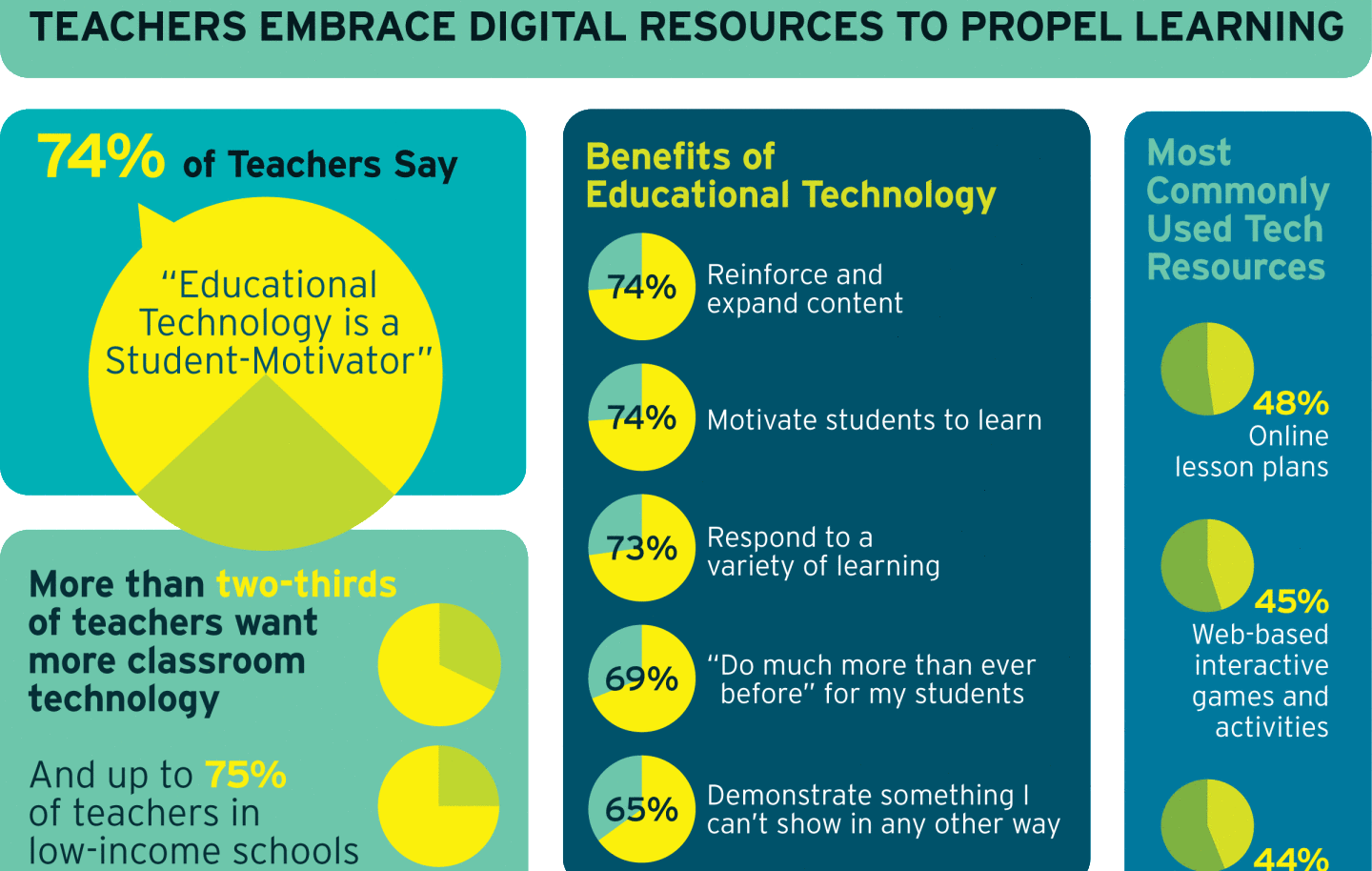
"content": "\u003cfigure id=\"attachment_26992\" class=\"wp-caption alignright\" style=\"max-width: 620px\">\u003cimg class=\"size-large wp-image-26992\" title=\"\" src=\"http://ww2.kqed.org/mindshift/wp-content/uploads/sites/23/2013/02/IMG_8535-620x413.jpg\" alt=\"IMG_8535\" width=\"620\" height=\"413\">\u003cfigcaption class=\"wp-caption-text\"> \u003c/figcaption>\u003c/figure>\n\u003cp class=\"dropcap-serif\">Today is the second annual \u003ca href=\"www.digitallearningday.org\">Digital Learning Day,\u003c/a> designated to bring attention to the benefits of technology for learning. As part of the effort, \u003ca href=\"http://www.pbs.org/about/news/archive/2013/teacher-tech-survey/\">PBS LearningMedia\u003c/a> has released a survey showing that 74 percent of teachers say educational technology benefits their classroom in many ways, including the ability to reinforce and expand content, motivate students, and respond to a variety of learning styles. Given these numbers, and despite increasing access, it’s not surprising that 68 percent of teachers still want more access to technology in the classroom. That number goes up to 75 percent of teachers in low-income schools.\u003c/p>\n\u003cp>To understand more about the influence of technology and learning, the following articles help shed light on subjects of discussion among educators and parents.\u003c/p>\n\u003cul>\n\u003cli>\u003ca href=\"http://ww2.kqed.org/mindshift/2011/07/the-seven-golden-rules-of-using-technology-in-schools/\">7 GOLDEN RULES OF USING TECHNOLOGY IN SCHOOLS. \u003c/a>\u003cstrong>1) DON’T TRAP TECHNOLOGY IN A ROOM.\u003c/strong> “When I went to school, computers were put in a room called The Lab,” Bellow said. “‘What are they experimenting with in there, I thought.’ Technology wasn’t built into what we were doing. It was farmed off in a room, like it was special. Like we were learning how to code, and in case the Russians came, we’d know what to do.” Technology should be like oxygen, Bellow said, quoting \u003ca href=\"http://www.scienceleadership.org/pages/Faculty_and_Staff\">Chris Lehmann\u003c/a>, the founding principal of Science Leadership Academy: Ubiquitous, necessary, and invisible.\u003c/li>\n\u003c/ul>\n\u003cul>\n\u003cli>\u003ca href=\"http://ww2.kqed.org/mindshift/2013/01/case-studies-how-teachers-use-tech-to-support-learning/\">CASE STUDIES: HOW TEACHERS USE TECHNOLOGY TO SUPPORT LEARNING\u003c/a>. Larry Ferlazzo collected an invaluable \u003ca href=\"http://blogs.edweek.org/teachers/classroom_qa_with_larry_ferlazzo/2011/09/response_the_best_ways_to_use_tech_in_the_classroom.html\">list of criteria last year\u003c/a> from educators, to which he added more resources in his \u003ca href=\"http://blogs.edweek.org/teachers/classroom_qa_with_larry_ferlazzo/2012/12/response_using_ed_tech_to_support_the_learning_process.html\">recent blog post for EdWeek\u003c/a>.Other posts in the series include \u003ca href=\"http://blogs.edweek.org/teachers/classroom_qa_with_larry_ferlazzo/2012/12/response_using_ed_tech_to_create_deep_meaningful_experiences.html\">Using Ed \u003c!--more-->Tech to Create Deep and Meaningful Experiences\u003c/a> and \u003ca href=\"http://blogs.edweek.org/teachers/classroom_qa_with_larry_ferlazzo/2012/12/response_effective_ways_to_use_tech_in_the_classroom_--_part_three.html\">Effective Ways of Using Tech in the Classroom\u003c/a>. Here is MindShift’s contribution to the collection of ideas.\u003c/li>\n\u003cli>\u003ca href=\"http://ww2.kqed.org/mindshift/2012/11/whats-the-best-way-of-using-computers-in-schools/\">TO MAKE BLENDED LEARNING WORK, TEACHERS TRY DIFFERENT TACTICS\u003c/a>. For many schools, finding a way to integrate the use of tech in a traditional setting — teacher-centered classrooms — is proving to be a challenge. What educational software should be used? \u003ca href=\"http://ww2.kqed.org/mindshift/2012/10/whats-worth-investing-in-criteria-for-choosing-technology-for-learning/\">What criteria \u003c/a>should the software be judged against? And what happens to the role of the teacher and classroom activities when students are using software for practice exercises?\u003c/li>\n\u003cli>\u003ca href=\"http://ww2.kqed.org/mindshift/2012/10/whats-worth-investing-in-criteria-for-choosing-technology-for-learning/\">WHAT'S WORTH INVESTING IN? HOW TO DECIDE WHAT TECHNOLOGY YOU NEED. \u003c/a> How will technology allow students and teachers to network their learning, to collaborate with each other, to extend the reach of what kids can learn beyond the walls of the school? How can technology be used to unlock what hasn’t even been thought of yet? These questions are more difficult to answer, and less tangible to measure, than improving test scores, which is what typically draws the attention of educators.\u003c/li>\n\u003c/ul>\n\u003cfigure id=\"attachment_26989\" class=\"wp-caption center\" style=\"max-width: 620px\">\u003cimg class=\"size-large wp-image-26989\" title=\"\" src=\"http://ww2.kqed.org/mindshift/wp-content/uploads/sites/23/2013/02/Screen-Shot-2013-02-06-at-10.48.26-AM-620x735.png\" alt=\"Screen Shot 2013-02-06 at 10.48.26 AM\" width=\"620\" height=\"735\">\u003cfigcaption class=\"wp-caption-text\"> \u003c/figcaption>\u003c/figure>\n\u003cp>[ad fullwidth]\u003c/p>\u003cp>\u003c/p>\n",
"disqusIdentifier": "26974 http://blogs.kqed.org/mindshift/?p=26974",
"disqusUrl": "https://ww2.kqed.org/mindshift/2013/02/06/teachers-embrace-digital-learning-strategies/",
"stats": {
"hasVideo": false,
"hasChartOrMap": false,
"hasAudio": false,
"hasPolis": false,
"wordCount": 463,
"hasGoogleForm": false,
"hasGallery": false,
"hasHearkenModule": false,
"iframeSrcs": [],
"paragraphCount": 3
},
"modified": 1360178083,
"excerpt": null,
"headData": {
"twImgId": "",
"twTitle": "",
"ogTitle": "",
"ogImgId": "",
"twDescription": "",
"description": "Today is the second annual Digital Learning Day, designated to bring attention to the benefits of technology for learning. As part of the effort, PBS LearningMedia has released a survey showing that 74 percent of teachers say educational technology benefits their classroom in many ways, including the ability to reinforce and expand content, motivate students, and",
"title": "Teachers Embrace Digital Learning Strategies | KQED",
"ogDescription": "",
"schema": {
"@context": "https://schema.org",
"@type": "Article",
"headline": "Teachers Embrace Digital Learning Strategies",
"datePublished": "2013-02-06T11:14:43-08:00",
"dateModified": "2013-02-06T11:14:43-08:00",
"image": "https://cdn.kqed.org/wp-content/uploads/2020/02/KQED-OG-Image@1x.png"
}
},
"guestAuthors": [],
"slug": "teachers-embrace-digital-learning-strategies",
"status": "publish",
"path": "/mindshift/26974/teachers-embrace-digital-learning-strategies",
"audioTrackLength": null,
"parsedContent": [
{
"type": "contentString",
"content": "\u003cdiv class=\"post-body\">\u003cp>\u003cfigure id=\"attachment_26992\" class=\"wp-caption alignright\" style=\"max-width: 620px\">\u003cimg class=\"size-large wp-image-26992\" title=\"\" src=\"http://ww2.kqed.org/mindshift/wp-content/uploads/sites/23/2013/02/IMG_8535-620x413.jpg\" alt=\"IMG_8535\" width=\"620\" height=\"413\">\u003cfigcaption class=\"wp-caption-text\"> \u003c/figcaption>\u003c/figure>\n\u003cp class=\"dropcap-serif\">Today is the second annual \u003ca href=\"www.digitallearningday.org\">Digital Learning Day,\u003c/a> designated to bring attention to the benefits of technology for learning. As part of the effort, \u003ca href=\"http://www.pbs.org/about/news/archive/2013/teacher-tech-survey/\">PBS LearningMedia\u003c/a> has released a survey showing that 74 percent of teachers say educational technology benefits their classroom in many ways, including the ability to reinforce and expand content, motivate students, and respond to a variety of learning styles. Given these numbers, and despite increasing access, it’s not surprising that 68 percent of teachers still want more access to technology in the classroom. That number goes up to 75 percent of teachers in low-income schools.\u003c/p>\n\u003cp>To understand more about the influence of technology and learning, the following articles help shed light on subjects of discussion among educators and parents.\u003c/p>\n\u003cul>\n\u003cli>\u003ca href=\"http://ww2.kqed.org/mindshift/2011/07/the-seven-golden-rules-of-using-technology-in-schools/\">7 GOLDEN RULES OF USING TECHNOLOGY IN SCHOOLS. \u003c/a>\u003cstrong>1) DON’T TRAP TECHNOLOGY IN A ROOM.\u003c/strong> “When I went to school, computers were put in a room called The Lab,” Bellow said. “‘What are they experimenting with in there, I thought.’ Technology wasn’t built into what we were doing. It was farmed off in a room, like it was special. Like we were learning how to code, and in case the Russians came, we’d know what to do.” Technology should be like oxygen, Bellow said, quoting \u003ca href=\"http://www.scienceleadership.org/pages/Faculty_and_Staff\">Chris Lehmann\u003c/a>, the founding principal of Science Leadership Academy: Ubiquitous, necessary, and invisible.\u003c/li>\n\u003c/ul>\n\u003cul>\n\u003cli>\u003ca href=\"http://ww2.kqed.org/mindshift/2013/01/case-studies-how-teachers-use-tech-to-support-learning/\">CASE STUDIES: HOW TEACHERS USE TECHNOLOGY TO SUPPORT LEARNING\u003c/a>. Larry Ferlazzo collected an invaluable \u003ca href=\"http://blogs.edweek.org/teachers/classroom_qa_with_larry_ferlazzo/2011/09/response_the_best_ways_to_use_tech_in_the_classroom.html\">list of criteria last year\u003c/a> from educators, to which he added more resources in his \u003ca href=\"http://blogs.edweek.org/teachers/classroom_qa_with_larry_ferlazzo/2012/12/response_using_ed_tech_to_support_the_learning_process.html\">recent blog post for EdWeek\u003c/a>.Other posts in the series include \u003ca href=\"http://blogs.edweek.org/teachers/classroom_qa_with_larry_ferlazzo/2012/12/response_using_ed_tech_to_create_deep_meaningful_experiences.html\">Using Ed \u003c!--more-->Tech to Create Deep and Meaningful Experiences\u003c/a> and \u003ca href=\"http://blogs.edweek.org/teachers/classroom_qa_with_larry_ferlazzo/2012/12/response_effective_ways_to_use_tech_in_the_classroom_--_part_three.html\">Effective Ways of Using Tech in the Classroom\u003c/a>. Here is MindShift’s contribution to the collection of ideas.\u003c/li>\n\u003cli>\u003ca href=\"http://ww2.kqed.org/mindshift/2012/11/whats-the-best-way-of-using-computers-in-schools/\">TO MAKE BLENDED LEARNING WORK, TEACHERS TRY DIFFERENT TACTICS\u003c/a>. For many schools, finding a way to integrate the use of tech in a traditional setting — teacher-centered classrooms — is proving to be a challenge. What educational software should be used? \u003ca href=\"http://ww2.kqed.org/mindshift/2012/10/whats-worth-investing-in-criteria-for-choosing-technology-for-learning/\">What criteria \u003c/a>should the software be judged against? And what happens to the role of the teacher and classroom activities when students are using software for practice exercises?\u003c/li>\n\u003cli>\u003ca href=\"http://ww2.kqed.org/mindshift/2012/10/whats-worth-investing-in-criteria-for-choosing-technology-for-learning/\">WHAT'S WORTH INVESTING IN? HOW TO DECIDE WHAT TECHNOLOGY YOU NEED. \u003c/a> How will technology allow students and teachers to network their learning, to collaborate with each other, to extend the reach of what kids can learn beyond the walls of the school? How can technology be used to unlock what hasn’t even been thought of yet? These questions are more difficult to answer, and less tangible to measure, than improving test scores, which is what typically draws the attention of educators.\u003c/li>\n\u003c/ul>\n\u003cfigure id=\"attachment_26989\" class=\"wp-caption center\" style=\"max-width: 620px\">\u003cimg class=\"size-large wp-image-26989\" title=\"\" src=\"http://ww2.kqed.org/mindshift/wp-content/uploads/sites/23/2013/02/Screen-Shot-2013-02-06-at-10.48.26-AM-620x735.png\" alt=\"Screen Shot 2013-02-06 at 10.48.26 AM\" width=\"620\" height=\"735\">\u003cfigcaption class=\"wp-caption-text\"> \u003c/figcaption>\u003c/figure>\n\u003cp>\u003c/p>\u003c/div>",
"attributes": {
"named": {},
"numeric": []
}
},
{
"type": "component",
"content": "",
"name": "ad",
"attributes": {
"named": {
"label": "fullwidth"
},
"numeric": [
"fullwidth"
]
}
},
{
"type": "contentString",
"content": "\u003cdiv class=\"post-body\">\u003cp>\u003c/p>\u003cp>\u003c/p>\n\u003c/div>\u003c/p>",
"attributes": {
"named": {},
"numeric": []
}
}
],
"link": "/mindshift/26974/teachers-embrace-digital-learning-strategies",
"authors": [
"234"
],
"categories": [
"mindshift_192",
"mindshift_193"
],
"tags": [
"mindshift_808",
"mindshift_962",
"mindshift_602"
],
"featImg": "mindshift_26982",
"label": "mindshift"
},
"mindshift_26914": {
"type": "posts",
"id": "mindshift_26914",
"meta": {
"index": "posts_1716263798",
"site": "mindshift",
"id": "26914",
"score": null,
"sort": [
1360094832000
]
},
"parent": 0,
"labelTerm": {
"site": "mindshift"
},
"blocks": [],
"publishDate": 1360094832,
"format": "aside",
"disqusTitle": "Tips for Sharing Great Open Educational Content",
"title": "Tips for Sharing Great Open Educational Content",
"headTitle": "MindShift | KQED News",
"content": "\u003cp>\u003ca href=\"http://www.flickr.com/photos/pkdouyk/242231027/sizes/m/in/photostream/\">\u003cimg src=\"http://ww2.kqed.org/mindshift/wp-content/uploads/sites/23/2013/02/242231027_6761ad3da3-300x300.jpg\" alt=\"242231027_6761ad3da3\" title=\"\" width=\"300\" height=\"300\" class=\"size-medium wp-image-26959\">\u003c/a>\u003c/p>\n\u003cp class=\"dropcap-serif\">While the \u003ca href=\"http://en.wikipedia.org/wiki/Open_content\">open content\u003c/a> movement in education continues to gain steam, more teachers are starting to learn about free content they can use and adapt to their own needs for their classrooms.\u003c/p>\n\u003cp>But educators are focusing too heavily on acquiring content, rather than contributing and improving to it, according to a company that helps teachers and students access open education resources.\u003c/p>\n\u003cp>“People often hear the content piece rather than the open piece,” said Bill Fitzgerald, the founder of \u003ca href=\"http://funnymonkey.com/\">FunnyMonkey\u003c/a>, a Portland, Ore.-based open educational resources company, during a presentation at \u003ca href=\"http://educonphilly.org/\">Educon 2.5\u003c/a>. “And it shifts [an understanding] about what open content is.”\u003c/p>\n\u003cp>That shift is understandable. In education, open content refers to any textbooks, lesson plans, supplemental educational resources, or other educational artifacts that can be freely modified to suit educators’ individual needs. Access to open content is often free or more affordable than proprietary alternatives, so for cash-strapped schools and resourceful teachers who want to go beyond what traditional textbooks offer, this movement, which is \u003ca href=\"http://www.openeducationweek.org/\">being celebrated next month\u003c/a>, can be a game-changer.\u003c/p>\n\u003cp>[ad fullwidth]\u003c/p>\n\u003cp>To keep the focus on the two-way direction of open content -- both contribution and use -- Fitzgerald and his team offered a framework of nine tips, based on \u003ca href=\"http://www.catb.org/esr/writings/homesteading/\">“The Cathedral and the Bazaar,”\u003c/a> an essay about open source software engineering.\u003c/p>\n\u003cp>\u003cstrong>GOOD CONTENT COMES FROM PERSONAL PASSION.\u003c/strong>\u003c/p>\n\u003cp>Maybe a particular unit gets you enthused. Or maybe a lesson plan irks you because it falls short of your expectations. Either way, that enthusiasm should be the catalyst for creating, editing, or \u003c!--more-->expanding upon the material, and then republishing it. Good teachers are already doing this, Fitzgerald says -- except for the final step.\u003c/p>\n\u003cp>“The change is what actually happens when it’s done,” he says. “Instead of hitting 'save' and putting it on your hard drive, you’re hitting 'publish' and putting it on the Web.”\u003c/p>\n\u003cp>\u003cstrong>GREAT TEACHERS SHARE THEIR GEMS.\u003c/strong>\u003c/p>\n\u003cp>You probably have a lesson or two in your holster that you know is always a hit with your students. Don't hoard them. Share them with colleagues, and acquire their go-tos as well. Be willing to alter them into a format that jives better with a different teaching style.\u003c/p>\n\u003cp>\u003cstrong>LICENSING IS IMPORTANT.\u003c/strong>\u003c/p>\n\u003cp>Open content published through open licenses like those offered by Creative Commons allow for varying degrees of modification. If you’re going to edit or combine useful items, be sure you understand their respective licenses, so you don't find yourself in a spot where others can't add on to your work.\u003c/p>\n\u003cp>\u003cstrong>HAND OFF THE LESSONS YOU’VE TIRED OF.\u003c/strong>\u003c/p>\n\u003cp>Just like you should seize upon enthusiasm, so you should acknowledge fatigue. And in the open content world, there's usually a competent successor willing to put a fresh spin on your material. Also, when the time comes for you and your content to part ways, be sure to publish it in text form to make it more visible in Web searches, rather than as a PDF or Word document.\u003c/p>\n\u003cp>“This is kind of how it works in the software world too,” said Jeff Graham, FunnyMonkey’s lead developer. “The successful projects are the ones where people are using them, but also where people are talking about them.”\u003c/p>\n\u003cp>\u003cstrong>SHARE YOUR PROBLEMS; SOMEONE WILL SEE AN ANSWER.\u003c/strong>\u003c/p>\n\u003cp>Every teacher, administrator, parent, and student has a different skill set. Confessing your biggest challenges to the open world—and just as importantly, making sure people know it’s out there—is a strength that shows willingness to improve and may result in advice from those who can help.\u003c/p>\n\u003cp>\u003cstrong>COLLABORATE WITH STUDENTS AS WELL AS COLLEAGUES.\u003c/strong>\u003c/p>\n\u003cp>Open content isn't only about peer-to-peer teacher-to-teacher collaboration. It should also allow you a new way to build students' conceptual understanding by revising old items or creating new ones.\u003c/p>\n\u003cp>“If you have a set of resources that needs to be cleaned up, that’s a good opportunity for students,” Fitzgerald said. “And by giving your students the autonomy with the support to do this and do this right, you can create an environment where students are sharing this work. People are talking about digital literacy; that’s it.”\u003c/p>\n\u003cp>\u003cstrong>VALUE YOUR STUDENTS AS AN EDUCATIONAL RESOURCE.\u003c/strong>\u003c/p>\n\u003cp>Not only can open content allow your students to tackle concepts from a new perspective, it can also pave a way for them to impart their own knowledge. Who else is closer to the challenges of learning new material for the first time than students who tackle that challenge on a daily basis? Hearing that voice can help you rethink the content you give them, and in an open content world, allow you to edit it to make it better.\u003c/p>\n\u003cp>\u003cstrong>DON’T BE AFRAID OF FAILURE\u003c/strong>\u003c/p>\n\u003cp>\u003c/p>\n\u003cp>Remember telling your students that you learn the most when you fall short? Time to practice what you preach. And sharing when, why and how you fall short in an open content community can often lead to input that results in the most innovative solutions.\u003c/p>\n\n",
"disqusIdentifier": "26914 http://blogs.kqed.org/mindshift/?p=26914",
"disqusUrl": "https://ww2.kqed.org/mindshift/2013/02/05/tips-for-sharing-great-open-educational-content/",
"stats": {
"hasVideo": false,
"hasChartOrMap": false,
"hasAudio": false,
"hasPolis": false,
"wordCount": 871,
"hasGoogleForm": false,
"hasGallery": false,
"hasHearkenModule": false,
"iframeSrcs": [],
"paragraphCount": 26
},
"modified": 1360260096,
"excerpt": null,
"headData": {
"twImgId": "",
"twTitle": "",
"ogTitle": "",
"ogImgId": "",
"twDescription": "",
"description": "While the open content movement in education continues to gain steam, more teachers are starting to learn about free content they can use and adapt to their own needs for their classrooms. But educators are focusing too heavily on acquiring content, rather than contributing and improving to it, according to a company that helps teachers",
"title": "Tips for Sharing Great Open Educational Content | KQED",
"ogDescription": "",
"schema": {
"@context": "https://schema.org",
"@type": "Article",
"headline": "Tips for Sharing Great Open Educational Content",
"datePublished": "2013-02-05T12:07:12-08:00",
"dateModified": "2013-02-07T10:01:36-08:00",
"image": "https://cdn.kqed.org/wp-content/uploads/2020/02/KQED-OG-Image@1x.png"
}
},
"guestAuthors": [],
"slug": "tips-for-sharing-great-open-educational-content",
"status": "publish",
"path": "/mindshift/26914/tips-for-sharing-great-open-educational-content",
"audioTrackLength": null,
"parsedContent": [
{
"type": "contentString",
"content": "\u003cdiv class=\"post-body\">\u003cp>\u003cp>\u003ca href=\"http://www.flickr.com/photos/pkdouyk/242231027/sizes/m/in/photostream/\">\u003cimg src=\"http://ww2.kqed.org/mindshift/wp-content/uploads/sites/23/2013/02/242231027_6761ad3da3-300x300.jpg\" alt=\"242231027_6761ad3da3\" title=\"\" width=\"300\" height=\"300\" class=\"size-medium wp-image-26959\">\u003c/a>\u003c/p>\n\u003cp class=\"dropcap-serif\">While the \u003ca href=\"http://en.wikipedia.org/wiki/Open_content\">open content\u003c/a> movement in education continues to gain steam, more teachers are starting to learn about free content they can use and adapt to their own needs for their classrooms.\u003c/p>\n\u003cp>But educators are focusing too heavily on acquiring content, rather than contributing and improving to it, according to a company that helps teachers and students access open education resources.\u003c/p>\n\u003cp>“People often hear the content piece rather than the open piece,” said Bill Fitzgerald, the founder of \u003ca href=\"http://funnymonkey.com/\">FunnyMonkey\u003c/a>, a Portland, Ore.-based open educational resources company, during a presentation at \u003ca href=\"http://educonphilly.org/\">Educon 2.5\u003c/a>. “And it shifts [an understanding] about what open content is.”\u003c/p>\n\u003cp>That shift is understandable. In education, open content refers to any textbooks, lesson plans, supplemental educational resources, or other educational artifacts that can be freely modified to suit educators’ individual needs. Access to open content is often free or more affordable than proprietary alternatives, so for cash-strapped schools and resourceful teachers who want to go beyond what traditional textbooks offer, this movement, which is \u003ca href=\"http://www.openeducationweek.org/\">being celebrated next month\u003c/a>, can be a game-changer.\u003c/p>\n\u003cp>\u003c/p>\u003c/div>",
"attributes": {
"named": {},
"numeric": []
}
},
{
"type": "component",
"content": "",
"name": "ad",
"attributes": {
"named": {
"label": "fullwidth"
},
"numeric": [
"fullwidth"
]
}
},
{
"type": "contentString",
"content": "\u003cdiv class=\"post-body\">\u003cp>\u003c/p>\n\u003cp>To keep the focus on the two-way direction of open content -- both contribution and use -- Fitzgerald and his team offered a framework of nine tips, based on \u003ca href=\"http://www.catb.org/esr/writings/homesteading/\">“The Cathedral and the Bazaar,”\u003c/a> an essay about open source software engineering.\u003c/p>\n\u003cp>\u003cstrong>GOOD CONTENT COMES FROM PERSONAL PASSION.\u003c/strong>\u003c/p>\n\u003cp>Maybe a particular unit gets you enthused. Or maybe a lesson plan irks you because it falls short of your expectations. Either way, that enthusiasm should be the catalyst for creating, editing, or \u003c!--more-->expanding upon the material, and then republishing it. Good teachers are already doing this, Fitzgerald says -- except for the final step.\u003c/p>\n\u003cp>“The change is what actually happens when it’s done,” he says. “Instead of hitting 'save' and putting it on your hard drive, you’re hitting 'publish' and putting it on the Web.”\u003c/p>\n\u003cp>\u003cstrong>GREAT TEACHERS SHARE THEIR GEMS.\u003c/strong>\u003c/p>\n\u003cp>You probably have a lesson or two in your holster that you know is always a hit with your students. Don't hoard them. Share them with colleagues, and acquire their go-tos as well. Be willing to alter them into a format that jives better with a different teaching style.\u003c/p>\n\u003cp>\u003cstrong>LICENSING IS IMPORTANT.\u003c/strong>\u003c/p>\n\u003cp>Open content published through open licenses like those offered by Creative Commons allow for varying degrees of modification. If you’re going to edit or combine useful items, be sure you understand their respective licenses, so you don't find yourself in a spot where others can't add on to your work.\u003c/p>\n\u003cp>\u003cstrong>HAND OFF THE LESSONS YOU’VE TIRED OF.\u003c/strong>\u003c/p>\n\u003cp>Just like you should seize upon enthusiasm, so you should acknowledge fatigue. And in the open content world, there's usually a competent successor willing to put a fresh spin on your material. Also, when the time comes for you and your content to part ways, be sure to publish it in text form to make it more visible in Web searches, rather than as a PDF or Word document.\u003c/p>\n\u003cp>“This is kind of how it works in the software world too,” said Jeff Graham, FunnyMonkey’s lead developer. “The successful projects are the ones where people are using them, but also where people are talking about them.”\u003c/p>\n\u003cp>\u003cstrong>SHARE YOUR PROBLEMS; SOMEONE WILL SEE AN ANSWER.\u003c/strong>\u003c/p>\n\u003cp>Every teacher, administrator, parent, and student has a different skill set. Confessing your biggest challenges to the open world—and just as importantly, making sure people know it’s out there—is a strength that shows willingness to improve and may result in advice from those who can help.\u003c/p>\n\u003cp>\u003cstrong>COLLABORATE WITH STUDENTS AS WELL AS COLLEAGUES.\u003c/strong>\u003c/p>\n\u003cp>Open content isn't only about peer-to-peer teacher-to-teacher collaboration. It should also allow you a new way to build students' conceptual understanding by revising old items or creating new ones.\u003c/p>\n\u003cp>“If you have a set of resources that needs to be cleaned up, that’s a good opportunity for students,” Fitzgerald said. “And by giving your students the autonomy with the support to do this and do this right, you can create an environment where students are sharing this work. People are talking about digital literacy; that’s it.”\u003c/p>\n\u003cp>\u003cstrong>VALUE YOUR STUDENTS AS AN EDUCATIONAL RESOURCE.\u003c/strong>\u003c/p>\n\u003cp>Not only can open content allow your students to tackle concepts from a new perspective, it can also pave a way for them to impart their own knowledge. Who else is closer to the challenges of learning new material for the first time than students who tackle that challenge on a daily basis? Hearing that voice can help you rethink the content you give them, and in an open content world, allow you to edit it to make it better.\u003c/p>\n\u003cp>\u003cstrong>DON’T BE AFRAID OF FAILURE\u003c/strong>\u003c/p>\n\u003cp>\u003c/p>\n\u003cp>Remember telling your students that you learn the most when you fall short? Time to practice what you preach. And sharing when, why and how you fall short in an open content community can often lead to input that results in the most innovative solutions.\u003c/p>\n\n\u003c/div>\u003c/p>",
"attributes": {
"named": {},
"numeric": []
}
}
],
"link": "/mindshift/26914/tips-for-sharing-great-open-educational-content",
"authors": [
"4411"
],
"categories": [
"mindshift_195",
"mindshift_193"
],
"tags": [
"mindshift_997",
"mindshift_159"
],
"featImg": "mindshift_26959",
"label": "mindshift"
},
"mindshift_26840": {
"type": "posts",
"id": "mindshift_26840",
"meta": {
"index": "posts_1716263798",
"site": "mindshift",
"id": "26840",
"score": null,
"sort": [
1360000754000
]
},
"parent": 0,
"labelTerm": {
"site": "mindshift"
},
"blocks": [],
"publishDate": 1360000754,
"format": "aside",
"disqusTitle": "Video: \"The Future Will Not be Multiple Choice\"",
"title": "Video: \"The Future Will Not be Multiple Choice\"",
"headTitle": "MindShift | KQED News",
"content": "\u003cp>\u003ciframe width=\"560\" height=\"315\" src=\"http://www.youtube.com/embed/wLiEiLuq75A\" frameborder=\"0\" allowfullscreen>\u003c/iframe>\u003c/p>\n\u003cp class=\"dropcap-serif\">Educator Jaime McGrath and designer Drew Davies explain how to create a \"classroom of imagination\" by turning lessons into design problems and giving students space to be creative in this \u003ca href=\"https://www.youtube.com/watch?feature=player_embedded&v=wLiEiLuq75A\">Tedx video\u003c/a>. In a \u003cem>New York Times\u003c/em> op-ed The MacArthur Foundation's Digital Media and Learning Competition's co-director \u003ca href=\"http://opinionator.blogs.nytimes.com/2011/08/07/education-needs-a-digital-age-upgrade/\">Cathy Davidson said she thinks it's possible that 65 percent of students\u003c/a> today will end up doing jobs that haven't been created yet.\u003c/p>\n\u003cp>McGrath and Davies argue that school needs to keep up with the times by promoting creativity, entrepreneurship, design thinking and hands on skills. McGrath's experience teaching design problems has convinced him that the approach includes all learning styles, brings the best of project-based learning, encourages cooperation and integrates subject matter horizontally. But mostly, McGrath and Davies are impressed at the cool stuff kids design.\u003c/p>\n\u003cp>[ad fullwidth]\u003c/p>\u003cp>\u003c/p>\n",
"disqusIdentifier": "26840 http://blogs.kqed.org/mindshift/?p=26840",
"disqusUrl": "https://ww2.kqed.org/mindshift/2013/02/04/video-the-future-will-not-be-multiple-choice/",
"stats": {
"hasVideo": true,
"hasChartOrMap": true,
"hasAudio": false,
"hasPolis": false,
"wordCount": 144,
"hasGoogleForm": false,
"hasGallery": false,
"hasHearkenModule": false,
"iframeSrcs": [
"http://www.youtube.com/embed/wLiEiLuq75A"
],
"paragraphCount": 4
},
"modified": 1360000819,
"excerpt": null,
"headData": {
"twImgId": "",
"twTitle": "",
"ogTitle": "",
"ogImgId": "",
"twDescription": "",
"description": "Educator Jaime McGrath and designer Drew Davies explain how to create a "classroom of imagination" by turning lessons into design problems and giving students space to be creative in this Tedx video. In a New York Times op-ed The MacArthur Foundation's Digital Media and Learning Competition's co-director Cathy Davidson said she thinks it's possible that",
"title": "Video: \"The Future Will Not be Multiple Choice\" | KQED",
"ogDescription": "",
"schema": {
"@context": "https://schema.org",
"@type": "Article",
"headline": "Video: \"The Future Will Not be Multiple Choice\"",
"datePublished": "2013-02-04T09:59:14-08:00",
"dateModified": "2013-02-04T10:00:19-08:00",
"image": "https://cdn.kqed.org/wp-content/uploads/2020/02/KQED-OG-Image@1x.png"
}
},
"guestAuthors": [],
"slug": "video-the-future-will-not-be-multiple-choice",
"status": "publish",
"path": "/mindshift/26840/video-the-future-will-not-be-multiple-choice",
"audioTrackLength": null,
"parsedContent": [
{
"type": "contentString",
"content": "\u003cdiv class=\"post-body\">\u003cp>\u003cp>\u003ciframe width=\"560\" height=\"315\" src=\"http://www.youtube.com/embed/wLiEiLuq75A\" frameborder=\"0\" allowfullscreen>\u003c/iframe>\u003c/p>\n\u003cp class=\"dropcap-serif\">Educator Jaime McGrath and designer Drew Davies explain how to create a \"classroom of imagination\" by turning lessons into design problems and giving students space to be creative in this \u003ca href=\"https://www.youtube.com/watch?feature=player_embedded&v=wLiEiLuq75A\">Tedx video\u003c/a>. In a \u003cem>New York Times\u003c/em> op-ed The MacArthur Foundation's Digital Media and Learning Competition's co-director \u003ca href=\"http://opinionator.blogs.nytimes.com/2011/08/07/education-needs-a-digital-age-upgrade/\">Cathy Davidson said she thinks it's possible that 65 percent of students\u003c/a> today will end up doing jobs that haven't been created yet.\u003c/p>\n\u003cp>McGrath and Davies argue that school needs to keep up with the times by promoting creativity, entrepreneurship, design thinking and hands on skills. McGrath's experience teaching design problems has convinced him that the approach includes all learning styles, brings the best of project-based learning, encourages cooperation and integrates subject matter horizontally. But mostly, McGrath and Davies are impressed at the cool stuff kids design.\u003c/p>\n\u003cp>\u003c/p>\u003c/div>",
"attributes": {
"named": {},
"numeric": []
}
},
{
"type": "component",
"content": "",
"name": "ad",
"attributes": {
"named": {
"label": "fullwidth"
},
"numeric": [
"fullwidth"
]
}
},
{
"type": "contentString",
"content": "\u003cdiv class=\"post-body\">\u003cp>\u003c/p>\u003cp>\u003c/p>\n\u003c/div>\u003c/p>",
"attributes": {
"named": {},
"numeric": []
}
}
],
"link": "/mindshift/26840/video-the-future-will-not-be-multiple-choice",
"authors": [
"234"
],
"categories": [
"mindshift_193"
],
"tags": [
"mindshift_167",
"mindshift_256",
"mindshift_135"
],
"featImg": "mindshift_26950",
"label": "mindshift"
},
"mindshift_26755": {
"type": "posts",
"id": "mindshift_26755",
"meta": {
"index": "posts_1716263798",
"site": "mindshift",
"id": "26755",
"score": null,
"sort": [
1359744931000
]
},
"parent": 0,
"labelTerm": {
"site": "mindshift"
},
"blocks": [],
"publishDate": 1359744931,
"format": "aside",
"disqusTitle": "7 Essential Principles of Innovative Learning",
"title": "7 Essential Principles of Innovative Learning",
"headTitle": "MindShift | KQED News",
"content": "\u003cdiv id=\"attachment_26936\" class=\"module image aligncenter mceTemp mceIEcenter\" style=\"width: 620px\">\u003ca href=\"http://www.flickr.com/photos/wwworks/5074150006/sizes/m/in/set-72157627432819304/\">\u003cimg class=\"size-large wp-image-26936\" title=\"\" src=\"http://ww2.kqed.org/mindshift/wp-content/uploads/sites/23/2013/02/kids-in-class-620x413.jpg\" alt=\"kids in class\" width=\"620\" height=\"413\">\u003c/a>\n\u003cp class=\"wp-media-credit\">Flirck:WoodleyWonderworks\u003c/p>\n\u003c/div>\n\u003cp class=\"dropcap-serif\">Every educator wants to create an environment that will foster students' love of learning. Because the criteria are intangible, it's difficult to define or pinpoint exactly what they are. But one group is giving it a try.\u003c/p>\n\u003cp>Researchers at the Organization for Economic Cooperation and Development (OECD) launched the\u003ca href=\"http://www.oecd.org/edu/ceri/innovativelearningenvironments.htm\"> Innovative Learning Environments\u003c/a> project to turn an academic lens on the project of identifying concrete traits that mark innovative learning environments. They sifted through and categorized the research on learning science, documented case studies, and compiled policy recommendations they hope will transform the current system.\u003c/p>\n\u003cp>Their book, \u003ca href=\"http://www.oecd.org/edu/ceri/thenatureoflearningusingresearchtoinspirepractice.htm\">\u003cem>The Nature of Learning: Using Research to Inspire Practice\u003c/em>\u003c/a> and the accompanying \u003ca href=\"http://redesigningeducation.org/NoL_files/NatureOfLearning_PractitionerGuide_US.pdf\">practitioner’s guide,\u003c/a> lay out the key principles for designing learning environments that will help students build skills useful in a world where jobs are increasingly information and knowledge-based. The principles are not job-specific – no one knows what the future economy will demand. Instead, the main goal is to develop self-directed learners, students with “adaptive expertise.”\u003c/p>\n\u003cp>“Adaptive expertise tries to push beyond the idea of mastery,” said Jennifer Groff, an educational engineer and co-founder of the \u003ca href=\"http://curriculumredesign.org/\">Center for Curriculum Redesign\u003c/a>. “You may be proficient, but without adaptive expertise you can get stuck very quickly as the world shifts.”\u003c/p>\n\u003cp style=\"text-align: center\">\u003cspan style=\"color: #808080\">\u003cstrong>[RELATED READING: \u003ca href=\"http://ww2.kqed.org/mindshift/2013/01/how-can-teachers-prepare-kids-for-a-connected-world/\">How Can Teachers Prepare Kids for a Connected World\u003c/a>]\u003c/strong>\u003c/span>\u003c/p>\n\u003cp>Groff doesn’t dispute that mastery is important and that students need to learn age-appropriate content, but she also argues it’s equally important to develop students’ ability to go beyond that, to question and apply learning in new situations.\u003c/p>\n\u003cp>[ad fullwidth]\u003c/p>\n\u003cp>To that end, these are their identified principles for innovative learning.\u003c/p>\n\u003col>\n\u003cli>\u003cstrong>\u003cem>\u003c/em>\u003c/strong>\u003cstrong>\u003cem>Learners have to be at the center of what happens in the classroom\u003c/em>\u003c/strong>\u003cspan> with activities focused on their cognition and growth. They have to actively engage in learning in order to become self-regulated learners who are able to control their emotions and motivations during the study process, set goals, and monitor their own learning process.\u003c/span>\u003c/li>\n\u003cli>\u003cstrong>\u003cem>Learning is a social practice and can’t happen alone\u003c/em>\u003c/strong>\u003cspan>. “By our nature we are social beings and we learn by interacting,” Groff said. “We learn by pushing and pulling on concepts with \u003c!--more-->one another.” Structured, collaborative group work can be good for all learners; it pushes people in different ways.\u003c/span>\u003c/li>\n\u003cli>\u003cstrong>\u003cem>\u003c/em>\u003c/strong>\u003cstrong>\u003cem>Emotions are an integral part of learning\u003c/em>\u003c/strong>\u003cspan>. Students understand ideas better when there’s interplay between emotions, motivation and cognition, so positive beliefs about oneself are a core part of reaching a more profound understanding. The \u003ca href=\"http://ww2.kqed.org/mindshift/2012/09/teaching-social-and-emotional-skills-in-schools/\">power of emotions\u003c/a> and motivation in the classroom are well documented, but often overlooked because they are “soft.” Still most teachers know that if a student is upset about something that happened at home or in school, he won’t learn well. Similarly, keeping students motivated should be the starting point of learning. If students understand why it matters, learning becomes more important to them.\u003c/span>\u003c/li>\n\u003cli>\u003cstrong>\u003cem>Learners are different\u003c/em>\u003c/strong>\u003cspan> and innovative learning environments reflect the various experiences and prior knowledge that each student brings to class. “You really want practices and processes that help teachers engage each student where they are,” said Groff. This principle is understood by every frustrated educator teaching to a “middle” that doesn’t exist.\u003c/span>\u003c/li>\n\u003cli>\u003cem>\u003cstrong>Students need to be stretched, but not too much.\u003c/strong>\u003c/em>\u003cspan> “It’s really critical to find that student’s sweet spot,” Groff Said. Educators should try to prevent both coasting and overloading. Students need to experience both academic success and the challenge of discovery. In a diverse classroom group work can help achieve this as students at different levels help one another.\u003c/span>\u003c/li>\n\u003cli>\u003cstrong>\u003cem>Assessment should be for learning, not of learning\u003c/em>\u003c/strong>\u003cspan>. Assessments are important, but only to gauge how to structure the next lesson for maximum effectiveness. It should be meaningful, substantial, and shape the learning environment itself. “Good teachers do this informally most of the time,” Groff said. “But when it’s done well and more formally it’s a whole structure and methodology where you collect feedback on the learning pathway and it drives the next step that you take.”\u003c/span>\u003c/li>\n\u003cli>\u003cstrong>\u003cem>Learning needs to be connected across disciplines\u003c/em>\u003c/strong>\u003cspan> and reach out into the real world. Learning can’t be meaningful if students don’t understand why the knowledge will be useful to them, how it can be applied in life. Understanding the connections between subjects and ideas is essential for the ability to transfer skills and adapt. “We can’t just have things remain in silos that never interact,” Groff said.\u003c/span>\u003c/li>\n\u003c/ol>\n\u003cp>\u003cstrong>IMPLEMENTING THE PRINCIPLES\u003c/strong>\u003c/p>\n\u003cp>Many of the seven principles Groff outlines are second nature to good teachers, but they can feel hard to achieve within education systems that are slow-moving, bureaucratic and resistant to change. Still Groff says there are ways for teachers who want to create an innovative learning environment to begin down the path, even without the full support of their colleagues and administration. Groff also hopes shifting to the Common Core could offer openings for building in these practices. “It’s designed in a way that condones a lot of the principles that we’ve been talking about,” she said.\u003c/p>\n\u003cp>Everyone knows the common barriers educators face: the school culture, the students and themselves. Groff says with some reflection and problem solving, teachers can often begin to work around these barriers. An educator might think she’s open to innovation without realizing that there are preconceived notions about how one should teach that are deeply ingrained.\u003c/p>\n\u003caside class=\"pullquote alignright\">\u003cstrong>“You may be proficient, but without adaptive expertise you can get stuck very quickly as the world shifts.”\u003c/strong>\u003c/aside>\n\u003cp>What's more, if the school culture does not encourage experimentation, educators can mitigate negative reaction by framing the ideas in a way that will be accepted, or by bringing in outside resources to try and convince naysayers. Even finding one colleague in or outside of the school to bounce ideas with can make the process much smoother.\u003c/p>\n\u003cp>Educators can also test ideas with students before implementing them. Students have been indoctrinated into the same educational mindset about what makes a “useful” education as everyone else, and some might be resistant to new teaching methodologies. Without their enthusiasm it can be hard to persevere through other obstacles.\u003c/p>\n\u003cp>\u003cstrong>CASE STUDY\u003c/strong>\u003c/p>\n\u003cp>The darling of the Innovative Learning Environment case studies is the \u003ca href=\"http://www.oecd.org/edu/ceri/DEU.THU.003.%20Finalwihcover.pdf\">Jenaplan School \u003c/a>in Germany. It’s one of the few schools embodying all the principles fluidly. The school has about 450 students that range three to 20 years old. Students aren’t broken up into grade levels, instead they learn in mixed-age groups as well as in groups of roughly the same age. Learning is directed by students, often project-based, evaluated primarily through writing and projects, self-assessments and peer-assessment. The schedule is periodic, focusing on a topic like geography or history for three to four weeks and crossing into multiple disciplines. The teacher is seen as an active mentor and coordinator and the school has active parental involvement.\u003c/p>\n\u003cp>[ad floatright]\u003c/p>\n\u003cp>The Jenaplan School has won awards for its model and in the eyes of the Innovative Learning Environment researchers is doing an excellent job at preparing students to be adaptive and nimble thinkers in a knowledge-based world.\u003c/p>\n\n",
"disqusIdentifier": "26755 http://blogs.kqed.org/mindshift/?p=26755",
"disqusUrl": "https://ww2.kqed.org/mindshift/2013/02/01/7-essential-principles-of-innovative-learning/",
"stats": {
"hasVideo": false,
"hasChartOrMap": false,
"hasAudio": false,
"hasPolis": false,
"wordCount": 1249,
"hasGoogleForm": false,
"hasGallery": false,
"hasHearkenModule": false,
"iframeSrcs": [],
"paragraphCount": 15
},
"modified": 1370539396,
"excerpt": null,
"headData": {
"twImgId": "",
"twTitle": "",
"ogTitle": "",
"ogImgId": "",
"twDescription": "",
"description": "Flirck:WoodleyWonderworks Every educator wants to create an environment that will foster students' love of learning. Because the criteria are intangible, it's difficult to define or pinpoint exactly what they are. But one group is giving it a try. Researchers at the Organization for Economic Cooperation and Development (OECD) launched the Innovative Learning Environments project to",
"title": "7 Essential Principles of Innovative Learning | KQED",
"ogDescription": "",
"schema": {
"@context": "https://schema.org",
"@type": "Article",
"headline": "7 Essential Principles of Innovative Learning",
"datePublished": "2013-02-01T10:55:31-08:00",
"dateModified": "2013-06-06T10:23:16-07:00",
"image": "https://cdn.kqed.org/wp-content/uploads/2020/02/KQED-OG-Image@1x.png"
}
},
"guestAuthors": [],
"slug": "7-essential-principles-of-innovative-learning",
"status": "publish",
"path": "/mindshift/26755/7-essential-principles-of-innovative-learning",
"audioTrackLength": null,
"parsedContent": [
{
"type": "contentString",
"content": "\u003cdiv class=\"post-body\">\u003cp>\u003cdiv id=\"attachment_26936\" class=\"module image aligncenter mceTemp mceIEcenter\" style=\"width: 620px\">\u003ca href=\"http://www.flickr.com/photos/wwworks/5074150006/sizes/m/in/set-72157627432819304/\">\u003cimg class=\"size-large wp-image-26936\" title=\"\" src=\"http://ww2.kqed.org/mindshift/wp-content/uploads/sites/23/2013/02/kids-in-class-620x413.jpg\" alt=\"kids in class\" width=\"620\" height=\"413\">\u003c/a>\n\u003cp class=\"wp-media-credit\">Flirck:WoodleyWonderworks\u003c/p>\n\u003c/div>\n\u003cp class=\"dropcap-serif\">Every educator wants to create an environment that will foster students' love of learning. Because the criteria are intangible, it's difficult to define or pinpoint exactly what they are. But one group is giving it a try.\u003c/p>\n\u003cp>Researchers at the Organization for Economic Cooperation and Development (OECD) launched the\u003ca href=\"http://www.oecd.org/edu/ceri/innovativelearningenvironments.htm\"> Innovative Learning Environments\u003c/a> project to turn an academic lens on the project of identifying concrete traits that mark innovative learning environments. They sifted through and categorized the research on learning science, documented case studies, and compiled policy recommendations they hope will transform the current system.\u003c/p>\n\u003cp>Their book, \u003ca href=\"http://www.oecd.org/edu/ceri/thenatureoflearningusingresearchtoinspirepractice.htm\">\u003cem>The Nature of Learning: Using Research to Inspire Practice\u003c/em>\u003c/a> and the accompanying \u003ca href=\"http://redesigningeducation.org/NoL_files/NatureOfLearning_PractitionerGuide_US.pdf\">practitioner’s guide,\u003c/a> lay out the key principles for designing learning environments that will help students build skills useful in a world where jobs are increasingly information and knowledge-based. The principles are not job-specific – no one knows what the future economy will demand. Instead, the main goal is to develop self-directed learners, students with “adaptive expertise.”\u003c/p>\n\u003cp>“Adaptive expertise tries to push beyond the idea of mastery,” said Jennifer Groff, an educational engineer and co-founder of the \u003ca href=\"http://curriculumredesign.org/\">Center for Curriculum Redesign\u003c/a>. “You may be proficient, but without adaptive expertise you can get stuck very quickly as the world shifts.”\u003c/p>\n\u003cp style=\"text-align: center\">\u003cspan style=\"color: #808080\">\u003cstrong>[RELATED READING: \u003ca href=\"http://ww2.kqed.org/mindshift/2013/01/how-can-teachers-prepare-kids-for-a-connected-world/\">How Can Teachers Prepare Kids for a Connected World\u003c/a>]\u003c/strong>\u003c/span>\u003c/p>\n\u003cp>Groff doesn’t dispute that mastery is important and that students need to learn age-appropriate content, but she also argues it’s equally important to develop students’ ability to go beyond that, to question and apply learning in new situations.\u003c/p>\n\u003cp>\u003c/p>\u003c/div>",
"attributes": {
"named": {},
"numeric": []
}
},
{
"type": "component",
"content": "",
"name": "ad",
"attributes": {
"named": {
"label": "fullwidth"
},
"numeric": [
"fullwidth"
]
}
},
{
"type": "contentString",
"content": "\u003cdiv class=\"post-body\">\u003cp>\u003c/p>\n\u003cp>To that end, these are their identified principles for innovative learning.\u003c/p>\n\u003col>\n\u003cli>\u003cstrong>\u003cem>\u003c/em>\u003c/strong>\u003cstrong>\u003cem>Learners have to be at the center of what happens in the classroom\u003c/em>\u003c/strong>\u003cspan> with activities focused on their cognition and growth. They have to actively engage in learning in order to become self-regulated learners who are able to control their emotions and motivations during the study process, set goals, and monitor their own learning process.\u003c/span>\u003c/li>\n\u003cli>\u003cstrong>\u003cem>Learning is a social practice and can’t happen alone\u003c/em>\u003c/strong>\u003cspan>. “By our nature we are social beings and we learn by interacting,” Groff said. “We learn by pushing and pulling on concepts with \u003c!--more-->one another.” Structured, collaborative group work can be good for all learners; it pushes people in different ways.\u003c/span>\u003c/li>\n\u003cli>\u003cstrong>\u003cem>\u003c/em>\u003c/strong>\u003cstrong>\u003cem>Emotions are an integral part of learning\u003c/em>\u003c/strong>\u003cspan>. Students understand ideas better when there’s interplay between emotions, motivation and cognition, so positive beliefs about oneself are a core part of reaching a more profound understanding. The \u003ca href=\"http://ww2.kqed.org/mindshift/2012/09/teaching-social-and-emotional-skills-in-schools/\">power of emotions\u003c/a> and motivation in the classroom are well documented, but often overlooked because they are “soft.” Still most teachers know that if a student is upset about something that happened at home or in school, he won’t learn well. Similarly, keeping students motivated should be the starting point of learning. If students understand why it matters, learning becomes more important to them.\u003c/span>\u003c/li>\n\u003cli>\u003cstrong>\u003cem>Learners are different\u003c/em>\u003c/strong>\u003cspan> and innovative learning environments reflect the various experiences and prior knowledge that each student brings to class. “You really want practices and processes that help teachers engage each student where they are,” said Groff. This principle is understood by every frustrated educator teaching to a “middle” that doesn’t exist.\u003c/span>\u003c/li>\n\u003cli>\u003cem>\u003cstrong>Students need to be stretched, but not too much.\u003c/strong>\u003c/em>\u003cspan> “It’s really critical to find that student’s sweet spot,” Groff Said. Educators should try to prevent both coasting and overloading. Students need to experience both academic success and the challenge of discovery. In a diverse classroom group work can help achieve this as students at different levels help one another.\u003c/span>\u003c/li>\n\u003cli>\u003cstrong>\u003cem>Assessment should be for learning, not of learning\u003c/em>\u003c/strong>\u003cspan>. Assessments are important, but only to gauge how to structure the next lesson for maximum effectiveness. It should be meaningful, substantial, and shape the learning environment itself. “Good teachers do this informally most of the time,” Groff said. “But when it’s done well and more formally it’s a whole structure and methodology where you collect feedback on the learning pathway and it drives the next step that you take.”\u003c/span>\u003c/li>\n\u003cli>\u003cstrong>\u003cem>Learning needs to be connected across disciplines\u003c/em>\u003c/strong>\u003cspan> and reach out into the real world. Learning can’t be meaningful if students don’t understand why the knowledge will be useful to them, how it can be applied in life. Understanding the connections between subjects and ideas is essential for the ability to transfer skills and adapt. “We can’t just have things remain in silos that never interact,” Groff said.\u003c/span>\u003c/li>\n\u003c/ol>\n\u003cp>\u003cstrong>IMPLEMENTING THE PRINCIPLES\u003c/strong>\u003c/p>\n\u003cp>Many of the seven principles Groff outlines are second nature to good teachers, but they can feel hard to achieve within education systems that are slow-moving, bureaucratic and resistant to change. Still Groff says there are ways for teachers who want to create an innovative learning environment to begin down the path, even without the full support of their colleagues and administration. Groff also hopes shifting to the Common Core could offer openings for building in these practices. “It’s designed in a way that condones a lot of the principles that we’ve been talking about,” she said.\u003c/p>\n\u003cp>Everyone knows the common barriers educators face: the school culture, the students and themselves. Groff says with some reflection and problem solving, teachers can often begin to work around these barriers. An educator might think she’s open to innovation without realizing that there are preconceived notions about how one should teach that are deeply ingrained.\u003c/p>\n\u003caside class=\"pullquote alignright\">\u003cstrong>“You may be proficient, but without adaptive expertise you can get stuck very quickly as the world shifts.”\u003c/strong>\u003c/aside>\n\u003cp>What's more, if the school culture does not encourage experimentation, educators can mitigate negative reaction by framing the ideas in a way that will be accepted, or by bringing in outside resources to try and convince naysayers. Even finding one colleague in or outside of the school to bounce ideas with can make the process much smoother.\u003c/p>\n\u003cp>Educators can also test ideas with students before implementing them. Students have been indoctrinated into the same educational mindset about what makes a “useful” education as everyone else, and some might be resistant to new teaching methodologies. Without their enthusiasm it can be hard to persevere through other obstacles.\u003c/p>\n\u003cp>\u003cstrong>CASE STUDY\u003c/strong>\u003c/p>\n\u003cp>The darling of the Innovative Learning Environment case studies is the \u003ca href=\"http://www.oecd.org/edu/ceri/DEU.THU.003.%20Finalwihcover.pdf\">Jenaplan School \u003c/a>in Germany. It’s one of the few schools embodying all the principles fluidly. The school has about 450 students that range three to 20 years old. Students aren’t broken up into grade levels, instead they learn in mixed-age groups as well as in groups of roughly the same age. Learning is directed by students, often project-based, evaluated primarily through writing and projects, self-assessments and peer-assessment. The schedule is periodic, focusing on a topic like geography or history for three to four weeks and crossing into multiple disciplines. The teacher is seen as an active mentor and coordinator and the school has active parental involvement.\u003c/p>\n\u003cp>\u003c/p>\u003c/div>",
"attributes": {
"named": {},
"numeric": []
}
},
{
"type": "component",
"content": "",
"name": "ad",
"attributes": {
"named": {
"label": "floatright"
},
"numeric": [
"floatright"
]
}
},
{
"type": "contentString",
"content": "\u003cdiv class=\"post-body\">\u003cp>\u003c/p>\n\u003cp>The Jenaplan School has won awards for its model and in the eyes of the Innovative Learning Environment researchers is doing an excellent job at preparing students to be adaptive and nimble thinkers in a knowledge-based world.\u003c/p>\n\n\u003c/div>\u003c/p>",
"attributes": {
"named": {},
"numeric": []
}
}
],
"link": "/mindshift/26755/7-essential-principles-of-innovative-learning",
"authors": [
"234"
],
"categories": [
"mindshift_192",
"mindshift_194",
"mindshift_193"
],
"tags": [
"mindshift_996",
"mindshift_108",
"mindshift_121",
"mindshift_421",
"mindshift_943"
],
"featImg": "mindshift_26936",
"label": "mindshift"
},
"mindshift_26865": {
"type": "posts",
"id": "mindshift_26865",
"meta": {
"index": "posts_1716263798",
"site": "mindshift",
"id": "26865",
"score": null,
"sort": [
1359661678000
]
},
"parent": 0,
"labelTerm": {
"site": "mindshift"
},
"blocks": [],
"publishDate": 1359661678,
"format": "aside",
"disqusTitle": "In Teaching Math, What's the Right Mix of Content and Context?",
"title": "In Teaching Math, What's the Right Mix of Content and Context?",
"headTitle": "MindShift | KQED News",
"content": "\u003cdiv id=\"attachment_26895\" class=\"module image aligncenter mceTemp mceIEcenter\" style=\"width: 620px\">\u003cimg class=\"size-large wp-image-26895\" title=\"\" src=\"http://ww2.kqed.org/mindshift/wp-content/uploads/sites/23/2013/01/139698456-620x413.jpg\" alt=\"139698456\" width=\"620\" height=\"413\">\n\u003cp class=\"wp-media-credit\">Getty\u003c/p>\n\u003c/div>\n\u003cp class=\"dropcap-serif\">“Polynomial functions!”\u003c/p>\n\u003cp>“Trig identities!”\u003c/p>\n\u003cp>“How about the properties? Commutative, associative, distributive.”\u003c/p>\n\u003cp>So unfolded a laundry list of what a group of math teachers considered the more painful and less necessary concepts covered in the average high school math curriculum.\u003c/p>\n\u003cp>The laments, aired at \u003ca href=\"http://educonphilly.org/\">EduCon 2.5\u003c/a> in Philadelphia at Science Leadership Academy last weekend, were part of a discussion around how to rebuild math instruction under the radically different—and admittedly unlikely—parameters posed by moderator \u003ca href=\"http://www.linkedin.com/pub/mike-thayer/43/254/289\">Mike Thayer\u003c/a>, a math teacher at Summit Public Schools in New Jersey.\u003c/p>\n\u003cp>[ad fullwidth]\u003c/p>\n\u003cp>Thayer, who also has a background teaching high school physics, proposed a scenario in which high school freshmen would take a one-year course (or a one-semester course in a block scheduling system) that covered the essentials of Algebra 1 and 2, Geometry, and possibly parts of Trigonometry. Any additional math concepts might be learned in a cross-disciplinary fashion through other courses. For example, chemistry teachers would be responsible for teaching\u003c/p>\n\u003caside class=\"pullquote alignleft\">\u003cstrong>“I'd like to delete polynomial functions, but I’d like my students to see a roller coaster and think, ‘There must be math involved in that,’ and to go online and try and figure that out.”\u003c/strong>\u003c/aside>\n\u003cp>students the basics of logarithms while covering the pH scale. Biology teachers would explain concepts of exponential growth to their students when discussing species population and reproduction.\u003c/p>\n\u003cp>The rationale of such a course, Thayer said, would be to create a version of math instruction that more fully lives with the \u003ca href=\"http://en.wikipedia.org/wiki/Inquiry-based_learning\">inquiry-based learning\u003c/a> approach embraced by the \u003ca href=\"http://www.scienceleadership.org/\">Science Leadership Academy\u003c/a>, the public magnet high school where the conference took place. His vision—which hinges on what he concedes is a large assumption that students would enter high school \u003c!--more-->competent in basic computational thinking—is for a course that would both streamline a high school student’s general math experience, and empower and encourage them to learn additional math skills to solve real-world problems of their own interest.\u003c/p>\n\u003cp>As one teacher at the discussion put it: “I'd like to delete polynomial functions, but I’d like my students to see a roller coaster and think, ‘There must be math involved in that,’ and to go online and try and figure that out.”\u003c/p>\n\u003cp>Thayer asked the teachers to consider four questions as they imagined the hypothetical course:\u003c/p>\n\u003col>\n\u003cli>\u003cstrong>WHAT STAYS AND WHAT GOES?\u003c/strong> Consider both what concepts would get more or less emphasis, as well as what method of learning (lectures, work sheets, group work, collaborative projects, etc.) would work best.\u003c/li>\n\u003cli>\u003cstrong>NEXT STEP FOR STUDENTS?\u003c/strong> Options could include more advanced mathematics courses, independent mathematics projects, courses in other subjects that included applicable advanced math concepts, or some combination.\u003c/li>\n\u003cli>\u003cstrong>HOW WOULD TEACHING CHANGE?\u003c/strong> Choose which lessons you'd save and which lessons you'd skip. Envision whether you'd use the same kinds of exercises to develop students skills, and whether you'd structure class time in the same manner, or perhaps utilize it differently.\u003c/li>\n\u003cli>\u003cstrong>WHAT WOULD YOU ASSESS?\u003c/strong> Tests should reflect the purpose of the course, to develop students' understanding of the theoretical and practical purposes of math.\u003c/li>\n\u003c/ol>\n\u003cp>Most of the discussion during the 90-minute talk focused on the first two points, and the group generally agreed the course would need to focus on changing student thought processes.\u003c/p>\n\u003cp>“What I am hearing is that if we would like to really make math meaningful for our students, we need to do things to create the ability for them to be truly mathematical thinkers,” Thayer said at one point after hearing a few responses.\u003c/p>\n\u003cp>There were, however, disagreements over the relative importance of concepts. And a couple of teachers even asked whether geometry would fit within the parameters of such a course.\u003c/p>\n\u003cp>The group also questioned whether a focus on real-world math applications would be the most likely way to spur students into independent investigation, and whether that focus could create an unintended bias in the kind of material covered. As an example, teachers noted that using tools like \u003ca href=\"http://www.101qs.com/\">101 Questions\u003c/a>, a website that asks users to think of a question related to a displayed image, could result in an excessive focus on proportionality.\u003c/p>\n\u003cp>Thayer encouraged such discourse, suggesting it would be essential in his new model.\u003c/p>\n\u003cp>“I think the first thing for us, in order to be masters in context as well as content, is to recognize our strengths and weaknesses,” he said. “I would love for somebody else to be able to come into my classroom and explain why [a concept] is important.”\u003c/p>\n\u003cp>In a speech at EduCon earlier that morning, Philadelphia public schools \u003ca href=\"http://www.phila.k12.pa.us/leadership/#ceo\">Superintendent William Hite\u003c/a> stressed the need for teachers to move from content to context expertise. And \u003ca href=\"http://ww2.kqed.org/mindshift/2013/01/what-does-it-take-to-fully-embrace-inquiry-learning/\">in a later discussion\u003c/a>, Science Leadership Academy founding Principal Chris Lehmann conceded such an approach could be more difficult in a math classroom, but not impossible.\u003c/p>\n\u003cp>Thayer, meanwhile, warned that if math teachers didn’t find a way to make that difficult shift, they could be marginalized.\u003c/p>\n\u003cp>\u003c/p>\n\u003cp>“Most of the stuff we teach” in traditional courses, he said, “the \u003ca href=\"http://www.khanacademy.org/\">Khan Academy\u003c/a> does it for free.”\u003c/p>\n\n",
"disqusIdentifier": "26865 http://blogs.kqed.org/mindshift/?p=26865",
"disqusUrl": "https://ww2.kqed.org/mindshift/2013/01/31/in-teaching-math-whats-the-right-mix-of-content-and-context/",
"stats": {
"hasVideo": false,
"hasChartOrMap": false,
"hasAudio": false,
"hasPolis": false,
"wordCount": 879,
"hasGoogleForm": false,
"hasGallery": false,
"hasHearkenModule": false,
"iframeSrcs": [],
"paragraphCount": 20
},
"modified": 1359662014,
"excerpt": null,
"headData": {
"twImgId": "",
"twTitle": "",
"ogTitle": "",
"ogImgId": "",
"twDescription": "",
"description": "Getty “Polynomial functions!” “Trig identities!” “How about the properties? Commutative, associative, distributive.” So unfolded a laundry list of what a group of math teachers considered the more painful and less necessary concepts covered in the average high school math curriculum. The laments, aired at EduCon 2.5 in Philadelphia at Science Leadership Academy last weekend, were",
"title": "In Teaching Math, What's the Right Mix of Content and Context? | KQED",
"ogDescription": "",
"schema": {
"@context": "https://schema.org",
"@type": "Article",
"headline": "In Teaching Math, What's the Right Mix of Content and Context?",
"datePublished": "2013-01-31T11:47:58-08:00",
"dateModified": "2013-01-31T11:53:34-08:00",
"image": "https://cdn.kqed.org/wp-content/uploads/2020/02/KQED-OG-Image@1x.png"
}
},
"guestAuthors": [],
"slug": "in-teaching-math-whats-the-right-mix-of-content-and-context",
"status": "publish",
"path": "/mindshift/26865/in-teaching-math-whats-the-right-mix-of-content-and-context",
"audioTrackLength": null,
"parsedContent": [
{
"type": "contentString",
"content": "\u003cdiv class=\"post-body\">\u003cp>\u003cdiv id=\"attachment_26895\" class=\"module image aligncenter mceTemp mceIEcenter\" style=\"width: 620px\">\u003cimg class=\"size-large wp-image-26895\" title=\"\" src=\"http://ww2.kqed.org/mindshift/wp-content/uploads/sites/23/2013/01/139698456-620x413.jpg\" alt=\"139698456\" width=\"620\" height=\"413\">\n\u003cp class=\"wp-media-credit\">Getty\u003c/p>\n\u003c/div>\n\u003cp class=\"dropcap-serif\">“Polynomial functions!”\u003c/p>\n\u003cp>“Trig identities!”\u003c/p>\n\u003cp>“How about the properties? Commutative, associative, distributive.”\u003c/p>\n\u003cp>So unfolded a laundry list of what a group of math teachers considered the more painful and less necessary concepts covered in the average high school math curriculum.\u003c/p>\n\u003cp>The laments, aired at \u003ca href=\"http://educonphilly.org/\">EduCon 2.5\u003c/a> in Philadelphia at Science Leadership Academy last weekend, were part of a discussion around how to rebuild math instruction under the radically different—and admittedly unlikely—parameters posed by moderator \u003ca href=\"http://www.linkedin.com/pub/mike-thayer/43/254/289\">Mike Thayer\u003c/a>, a math teacher at Summit Public Schools in New Jersey.\u003c/p>\n\u003cp>\u003c/p>\u003c/div>",
"attributes": {
"named": {},
"numeric": []
}
},
{
"type": "component",
"content": "",
"name": "ad",
"attributes": {
"named": {
"label": "fullwidth"
},
"numeric": [
"fullwidth"
]
}
},
{
"type": "contentString",
"content": "\u003cdiv class=\"post-body\">\u003cp>\u003c/p>\n\u003cp>Thayer, who also has a background teaching high school physics, proposed a scenario in which high school freshmen would take a one-year course (or a one-semester course in a block scheduling system) that covered the essentials of Algebra 1 and 2, Geometry, and possibly parts of Trigonometry. Any additional math concepts might be learned in a cross-disciplinary fashion through other courses. For example, chemistry teachers would be responsible for teaching\u003c/p>\n\u003caside class=\"pullquote alignleft\">\u003cstrong>“I'd like to delete polynomial functions, but I’d like my students to see a roller coaster and think, ‘There must be math involved in that,’ and to go online and try and figure that out.”\u003c/strong>\u003c/aside>\n\u003cp>students the basics of logarithms while covering the pH scale. Biology teachers would explain concepts of exponential growth to their students when discussing species population and reproduction.\u003c/p>\n\u003cp>The rationale of such a course, Thayer said, would be to create a version of math instruction that more fully lives with the \u003ca href=\"http://en.wikipedia.org/wiki/Inquiry-based_learning\">inquiry-based learning\u003c/a> approach embraced by the \u003ca href=\"http://www.scienceleadership.org/\">Science Leadership Academy\u003c/a>, the public magnet high school where the conference took place. His vision—which hinges on what he concedes is a large assumption that students would enter high school \u003c!--more-->competent in basic computational thinking—is for a course that would both streamline a high school student’s general math experience, and empower and encourage them to learn additional math skills to solve real-world problems of their own interest.\u003c/p>\n\u003cp>As one teacher at the discussion put it: “I'd like to delete polynomial functions, but I’d like my students to see a roller coaster and think, ‘There must be math involved in that,’ and to go online and try and figure that out.”\u003c/p>\n\u003cp>Thayer asked the teachers to consider four questions as they imagined the hypothetical course:\u003c/p>\n\u003col>\n\u003cli>\u003cstrong>WHAT STAYS AND WHAT GOES?\u003c/strong> Consider both what concepts would get more or less emphasis, as well as what method of learning (lectures, work sheets, group work, collaborative projects, etc.) would work best.\u003c/li>\n\u003cli>\u003cstrong>NEXT STEP FOR STUDENTS?\u003c/strong> Options could include more advanced mathematics courses, independent mathematics projects, courses in other subjects that included applicable advanced math concepts, or some combination.\u003c/li>\n\u003cli>\u003cstrong>HOW WOULD TEACHING CHANGE?\u003c/strong> Choose which lessons you'd save and which lessons you'd skip. Envision whether you'd use the same kinds of exercises to develop students skills, and whether you'd structure class time in the same manner, or perhaps utilize it differently.\u003c/li>\n\u003cli>\u003cstrong>WHAT WOULD YOU ASSESS?\u003c/strong> Tests should reflect the purpose of the course, to develop students' understanding of the theoretical and practical purposes of math.\u003c/li>\n\u003c/ol>\n\u003cp>Most of the discussion during the 90-minute talk focused on the first two points, and the group generally agreed the course would need to focus on changing student thought processes.\u003c/p>\n\u003cp>“What I am hearing is that if we would like to really make math meaningful for our students, we need to do things to create the ability for them to be truly mathematical thinkers,” Thayer said at one point after hearing a few responses.\u003c/p>\n\u003cp>There were, however, disagreements over the relative importance of concepts. And a couple of teachers even asked whether geometry would fit within the parameters of such a course.\u003c/p>\n\u003cp>The group also questioned whether a focus on real-world math applications would be the most likely way to spur students into independent investigation, and whether that focus could create an unintended bias in the kind of material covered. As an example, teachers noted that using tools like \u003ca href=\"http://www.101qs.com/\">101 Questions\u003c/a>, a website that asks users to think of a question related to a displayed image, could result in an excessive focus on proportionality.\u003c/p>\n\u003cp>Thayer encouraged such discourse, suggesting it would be essential in his new model.\u003c/p>\n\u003cp>“I think the first thing for us, in order to be masters in context as well as content, is to recognize our strengths and weaknesses,” he said. “I would love for somebody else to be able to come into my classroom and explain why [a concept] is important.”\u003c/p>\n\u003cp>In a speech at EduCon earlier that morning, Philadelphia public schools \u003ca href=\"http://www.phila.k12.pa.us/leadership/#ceo\">Superintendent William Hite\u003c/a> stressed the need for teachers to move from content to context expertise. And \u003ca href=\"http://ww2.kqed.org/mindshift/2013/01/what-does-it-take-to-fully-embrace-inquiry-learning/\">in a later discussion\u003c/a>, Science Leadership Academy founding Principal Chris Lehmann conceded such an approach could be more difficult in a math classroom, but not impossible.\u003c/p>\n\u003cp>Thayer, meanwhile, warned that if math teachers didn’t find a way to make that difficult shift, they could be marginalized.\u003c/p>\n\u003cp>\u003c/p>\n\u003cp>“Most of the stuff we teach” in traditional courses, he said, “the \u003ca href=\"http://www.khanacademy.org/\">Khan Academy\u003c/a> does it for free.”\u003c/p>\n\n\u003c/div>\u003c/p>",
"attributes": {
"named": {},
"numeric": []
}
}
],
"link": "/mindshift/26865/in-teaching-math-whats-the-right-mix-of-content-and-context",
"authors": [
"4411"
],
"categories": [
"mindshift_193"
],
"tags": [
"mindshift_997",
"mindshift_392",
"mindshift_956"
],
"featImg": "mindshift_26895",
"label": "mindshift"
},
"mindshift_26794": {
"type": "posts",
"id": "mindshift_26794",
"meta": {
"index": "posts_1716263798",
"site": "mindshift",
"id": "26794",
"score": null,
"sort": [
1359475236000
]
},
"parent": 0,
"labelTerm": {
"site": "mindshift"
},
"blocks": [],
"publishDate": 1359475236,
"format": "aside",
"disqusTitle": "Why Inquiry Learning is Worth the Trouble",
"title": "Why Inquiry Learning is Worth the Trouble",
"headTitle": "MindShift | KQED News",
"content": "\u003cfigure id=\"attachment_26820\" class=\"wp-caption center\" style=\"max-width: 620px\">\u003ca href=\"http://www.flickr.com/photos/jonnygoldstein/5615147628/in/photostream/\">\u003cimg class=\"size-large wp-image-26820\" title=\"\" src=\"http://ww2.kqed.org/mindshift/wp-content/uploads/sites/23/2013/01/5615147628_9f6d390e99_z-620x307.jpg\" alt=\"Visualization of SLA principal Chris Lehmann's talk about guiding kids toward thinking about how they think.\" width=\"620\" height=\"307\">\u003c/a>\u003cfigcaption class=\"wp-caption-text\">Visualization of SLA principal Chris Lehmann's 2011 talk: guiding kids' to thinking about how they think.\u003c/figcaption>\u003c/figure>\n\u003cp class=\"dropcap-serif\">Nearly seven years after first opening its doors, the \u003ca href=\"http://www.scienceleadership.org/\">Science Leadership Academy\u003c/a> public magnet high school* in Philadelphia and its inquiry-based approach to learning have become a national model for the kinds of reforms educators strive towards.\u003c/p>\n\u003cp>But in a talk this past weekend at \u003ca href=\"http://educonphilly.org/\">EduCon 2.5\u003c/a>, the school’s sixth-annual conference devoted to sharing its story and spreading its techniques, Founding Principal Chris Lehmann insisted that replicating his schools approach required difficult tradeoffs.\u003c/p>\n\u003cp>“This is not easy. This is not perfect,” Lehmann told a crowd of devotees stuffed inside one of the Center City school’s second-floor science classrooms on Sunday. “There are really challenging pieces of this, and we should be OK with this.”\u003c/p>\n\u003cp>Lehmann’s \u003ca href=\"http://www.youtube.com/watch?v=_U5ycR5yPSQ&feature=plcp\">90-minute question-and-answer session\u003c/a> tackled coming to terms with the impact of a shift to inquiry-driven learning by defining three steps: the enigmatic meaning of inquiry-based learning; the visible changes that signal a shift to that approach; and the potential drawbacks that shift may surface.\u003c/p>\n\u003cp>\u003cstrong>INQUIRING ABOUT INQUIRY\u003c/strong>\u003c/p>\n\u003cp>[ad fullwidth]\u003c/p>\n\u003cp>Lehmann said it’s important to question whether alleged “personalized,” “project-based,” or “collaborative” learning efforts are actually helping students and teachers to “hold ourselves in a state of questioning.\"\u003c/p>\n\u003caside class=\"pullquote alignleft\">\u003cstrong>“Inquiry means living in the soup. Inquiry means living in that uncomfortable space where we don’t know the answer.”\u003c/strong>\u003c/aside>\n\u003cp>For example, adaptive software that leads students through English/language arts or mathematics on a pace set by their own abilities fails to force students to ask questions about that material, contextualize it in real life, or communicate about the concepts with others, Lehmann said. The same is true of collaborative projects where restrictive guidelines result in several, nearly-identical finished products across student groups.\u003c/p>\n\u003cp>In a true inquiry-based model, how learning happens isn’t as important as whether that learning encourages students to try to learn even more. Lehmann compared the scenario to the plight of a \u003c!--more-->two-year-old child who has graduated from “yes” and “no” and proceeded onto an endless string of “why's.”\u003c/p>\n\u003cp>“To me it comes down to process,” Lehmann said. “Inquiry means living in the soup. Inquiry means living in that uncomfortable space where we don’t know the answer.”\u003c/p>\n\u003cp>\u003cstrong>SIGNS YOU’RE ON THE RIGHT TRACK\u003c/strong>\u003c/p>\n\u003cp>Although nailing down inquiry-based learning is a bit like trying to define the human soul, there are some indicators Lehmann and his audience both agreed signaled progress down the right path.\u003c/p>\n\u003cp>To paraphrase one teacher, a classroom where students are empowered to direct and control their own learning is one sign. Feeling tension between the direction of a course and the material covered on a standardized final examination may be another, said a second teacher.\u003c/p>\n\u003cp>“Oh God, yeah,” Lehmann said in response to the latter teacher. “There’s a reason we don’t offer [\u003ca href=\"http://apcentral.collegeboard.com/apc/Controller.jpf\">Advanced Placement\u003c/a>] Classes here. If we are a truly inquiry-based school, why would our highest-level classes end in a test?”\u003c/p>\n\u003cp>Increased collaboration between students and increasing student scrutiny of educational content were two other signs Lehmann and the group said signaled the right approach, even if they clashed with classroom norms. For example, collaboration can often lead to tricky discussions about what part of a students’ work are his or her own and what part is recycled.\u003c/p>\n\u003cp>Lastly, good inquiry-based learning should include a means for publication and communication, whether through blogs, printed reports, multimedia packages, etc. But Lehmann also said, in some cases, students should have the right to decide whether to publish their work.\u003c/p>\n\u003cp>“One of the scariest things about inquiry-based learning is the blank page,” Lehmann said. “When you’re toying with the ideas at first, sometimes your ideas don’t have to be social to the world.”\u003c/p>\n\u003cp>\u003cstrong>ACCEPTING THE DRAWBACKS\u003c/strong>\u003c/p>\n\u003cp>Inquiry-based education should improve student engagement, critical thinking skills, and cross-disciplinary opportunities, Lehmann said. But it may also hinder lesson planning, covering content benchmarks, and assessing student progress.\u003c/p>\n\u003cp>In a school that asks students to seize some autonomy over the course of their studies, the teachers most comfortable at the Science Leadership Academy are often the teachers most capable of improvising and deviating from a lesson plan, or even entering a class period without a lesson plan at all.\u003c/p>\n\u003cp>Further, while Lehmann believes the approach leaves students with the analytical tools they need to succeed on English/language arts standardized tests, he acknowledges that both teaching mathematics in general, and teaching it so students succeed on state and national benchmarks, is harder to do in an inquiry-driven fashion.\u003c/p>\n\u003cp>“Math is a little harder, and I own that,” said Lehmann.\u003c/p>\n\u003cp>Creating teacher-administered assessments that accurately measure progress, in an environment where the path is often long and winding, is also difficult.\u003c/p>\n\u003cp>“That could probably be 10 sessions of EduCon,” Lehmann quipped. “’What are we authentically assessing when we assess?’”\u003c/p>\n\u003cp>\u003c/p>\n\u003cp>\u003cem>*[CLARIFICATION: Science Leadership Academy is a public magnet school, not a charter, as previously written.]\u003c/em>\u003c/p>\n\n",
"disqusIdentifier": "26794 http://blogs.kqed.org/mindshift/?p=26794",
"disqusUrl": "https://ww2.kqed.org/mindshift/2013/01/29/what-does-it-take-to-fully-embrace-inquiry-learning/",
"stats": {
"hasVideo": false,
"hasChartOrMap": false,
"hasAudio": false,
"hasPolis": false,
"wordCount": 900,
"hasGoogleForm": false,
"hasGallery": false,
"hasHearkenModule": false,
"iframeSrcs": [],
"paragraphCount": 25
},
"modified": 1372302745,
"excerpt": null,
"headData": {
"twImgId": "",
"twTitle": "",
"ogTitle": "",
"ogImgId": "",
"twDescription": "",
"description": "Nearly seven years after first opening its doors, the Science Leadership Academy public magnet high school* in Philadelphia and its inquiry-based approach to learning have become a national model for the kinds of reforms educators strive towards. But in a talk this past weekend at EduCon 2.5, the school’s sixth-annual conference devoted to sharing its",
"title": "Why Inquiry Learning is Worth the Trouble | KQED",
"ogDescription": "",
"schema": {
"@context": "https://schema.org",
"@type": "Article",
"headline": "Why Inquiry Learning is Worth the Trouble",
"datePublished": "2013-01-29T08:00:36-08:00",
"dateModified": "2013-06-26T20:12:25-07:00",
"image": "https://cdn.kqed.org/wp-content/uploads/2020/02/KQED-OG-Image@1x.png"
}
},
"guestAuthors": [],
"slug": "what-does-it-take-to-fully-embrace-inquiry-learning",
"status": "publish",
"path": "/mindshift/26794/what-does-it-take-to-fully-embrace-inquiry-learning",
"audioTrackLength": null,
"parsedContent": [
{
"type": "contentString",
"content": "\u003cdiv class=\"post-body\">\u003cp>\u003cfigure id=\"attachment_26820\" class=\"wp-caption center\" style=\"max-width: 620px\">\u003ca href=\"http://www.flickr.com/photos/jonnygoldstein/5615147628/in/photostream/\">\u003cimg class=\"size-large wp-image-26820\" title=\"\" src=\"http://ww2.kqed.org/mindshift/wp-content/uploads/sites/23/2013/01/5615147628_9f6d390e99_z-620x307.jpg\" alt=\"Visualization of SLA principal Chris Lehmann's talk about guiding kids toward thinking about how they think.\" width=\"620\" height=\"307\">\u003c/a>\u003cfigcaption class=\"wp-caption-text\">Visualization of SLA principal Chris Lehmann's 2011 talk: guiding kids' to thinking about how they think.\u003c/figcaption>\u003c/figure>\n\u003cp class=\"dropcap-serif\">Nearly seven years after first opening its doors, the \u003ca href=\"http://www.scienceleadership.org/\">Science Leadership Academy\u003c/a> public magnet high school* in Philadelphia and its inquiry-based approach to learning have become a national model for the kinds of reforms educators strive towards.\u003c/p>\n\u003cp>But in a talk this past weekend at \u003ca href=\"http://educonphilly.org/\">EduCon 2.5\u003c/a>, the school’s sixth-annual conference devoted to sharing its story and spreading its techniques, Founding Principal Chris Lehmann insisted that replicating his schools approach required difficult tradeoffs.\u003c/p>\n\u003cp>“This is not easy. This is not perfect,” Lehmann told a crowd of devotees stuffed inside one of the Center City school’s second-floor science classrooms on Sunday. “There are really challenging pieces of this, and we should be OK with this.”\u003c/p>\n\u003cp>Lehmann’s \u003ca href=\"http://www.youtube.com/watch?v=_U5ycR5yPSQ&feature=plcp\">90-minute question-and-answer session\u003c/a> tackled coming to terms with the impact of a shift to inquiry-driven learning by defining three steps: the enigmatic meaning of inquiry-based learning; the visible changes that signal a shift to that approach; and the potential drawbacks that shift may surface.\u003c/p>\n\u003cp>\u003cstrong>INQUIRING ABOUT INQUIRY\u003c/strong>\u003c/p>\n\u003cp>\u003c/p>\u003c/div>",
"attributes": {
"named": {},
"numeric": []
}
},
{
"type": "component",
"content": "",
"name": "ad",
"attributes": {
"named": {
"label": "fullwidth"
},
"numeric": [
"fullwidth"
]
}
},
{
"type": "contentString",
"content": "\u003cdiv class=\"post-body\">\u003cp>\u003c/p>\n\u003cp>Lehmann said it’s important to question whether alleged “personalized,” “project-based,” or “collaborative” learning efforts are actually helping students and teachers to “hold ourselves in a state of questioning.\"\u003c/p>\n\u003caside class=\"pullquote alignleft\">\u003cstrong>“Inquiry means living in the soup. Inquiry means living in that uncomfortable space where we don’t know the answer.”\u003c/strong>\u003c/aside>\n\u003cp>For example, adaptive software that leads students through English/language arts or mathematics on a pace set by their own abilities fails to force students to ask questions about that material, contextualize it in real life, or communicate about the concepts with others, Lehmann said. The same is true of collaborative projects where restrictive guidelines result in several, nearly-identical finished products across student groups.\u003c/p>\n\u003cp>In a true inquiry-based model, how learning happens isn’t as important as whether that learning encourages students to try to learn even more. Lehmann compared the scenario to the plight of a \u003c!--more-->two-year-old child who has graduated from “yes” and “no” and proceeded onto an endless string of “why's.”\u003c/p>\n\u003cp>“To me it comes down to process,” Lehmann said. “Inquiry means living in the soup. Inquiry means living in that uncomfortable space where we don’t know the answer.”\u003c/p>\n\u003cp>\u003cstrong>SIGNS YOU’RE ON THE RIGHT TRACK\u003c/strong>\u003c/p>\n\u003cp>Although nailing down inquiry-based learning is a bit like trying to define the human soul, there are some indicators Lehmann and his audience both agreed signaled progress down the right path.\u003c/p>\n\u003cp>To paraphrase one teacher, a classroom where students are empowered to direct and control their own learning is one sign. Feeling tension between the direction of a course and the material covered on a standardized final examination may be another, said a second teacher.\u003c/p>\n\u003cp>“Oh God, yeah,” Lehmann said in response to the latter teacher. “There’s a reason we don’t offer [\u003ca href=\"http://apcentral.collegeboard.com/apc/Controller.jpf\">Advanced Placement\u003c/a>] Classes here. If we are a truly inquiry-based school, why would our highest-level classes end in a test?”\u003c/p>\n\u003cp>Increased collaboration between students and increasing student scrutiny of educational content were two other signs Lehmann and the group said signaled the right approach, even if they clashed with classroom norms. For example, collaboration can often lead to tricky discussions about what part of a students’ work are his or her own and what part is recycled.\u003c/p>\n\u003cp>Lastly, good inquiry-based learning should include a means for publication and communication, whether through blogs, printed reports, multimedia packages, etc. But Lehmann also said, in some cases, students should have the right to decide whether to publish their work.\u003c/p>\n\u003cp>“One of the scariest things about inquiry-based learning is the blank page,” Lehmann said. “When you’re toying with the ideas at first, sometimes your ideas don’t have to be social to the world.”\u003c/p>\n\u003cp>\u003cstrong>ACCEPTING THE DRAWBACKS\u003c/strong>\u003c/p>\n\u003cp>Inquiry-based education should improve student engagement, critical thinking skills, and cross-disciplinary opportunities, Lehmann said. But it may also hinder lesson planning, covering content benchmarks, and assessing student progress.\u003c/p>\n\u003cp>In a school that asks students to seize some autonomy over the course of their studies, the teachers most comfortable at the Science Leadership Academy are often the teachers most capable of improvising and deviating from a lesson plan, or even entering a class period without a lesson plan at all.\u003c/p>\n\u003cp>Further, while Lehmann believes the approach leaves students with the analytical tools they need to succeed on English/language arts standardized tests, he acknowledges that both teaching mathematics in general, and teaching it so students succeed on state and national benchmarks, is harder to do in an inquiry-driven fashion.\u003c/p>\n\u003cp>“Math is a little harder, and I own that,” said Lehmann.\u003c/p>\n\u003cp>Creating teacher-administered assessments that accurately measure progress, in an environment where the path is often long and winding, is also difficult.\u003c/p>\n\u003cp>“That could probably be 10 sessions of EduCon,” Lehmann quipped. “’What are we authentically assessing when we assess?’”\u003c/p>\n\u003cp>\u003c/p>\n\u003cp>\u003cem>*[CLARIFICATION: Science Leadership Academy is a public magnet school, not a charter, as previously written.]\u003c/em>\u003c/p>\n\n\u003c/div>\u003c/p>",
"attributes": {
"named": {},
"numeric": []
}
}
],
"link": "/mindshift/26794/what-does-it-take-to-fully-embrace-inquiry-learning",
"authors": [
"4411"
],
"categories": [
"mindshift_20524",
"mindshift_193"
],
"tags": [
"mindshift_307",
"mindshift_997",
"mindshift_797",
"mindshift_992"
],
"featImg": "mindshift_26820",
"label": "mindshift"
},
"mindshift_26776": {
"type": "posts",
"id": "mindshift_26776",
"meta": {
"index": "posts_1716263798",
"site": "mindshift",
"id": "26776",
"score": null,
"sort": [
1359405646000
]
},
"parent": 0,
"labelTerm": {
"site": "mindshift"
},
"blocks": [],
"publishDate": 1359405646,
"format": "aside",
"disqusTitle": "Money, Time, and Tactics: Can Games Be Effective in Schools?",
"title": "Money, Time, and Tactics: Can Games Be Effective in Schools?",
"headTitle": "MindShift | KQED News",
"content": "\u003cfigure id=\"attachment_26795\" class=\"wp-caption center\" style=\"max-width: 500px\">\u003ca href=\"http://www.flickr.com/photos/56155476@N08/6660073135/sizes/m/in/photostream/\">\u003cimg class=\"size-full wp-image-26795\" title=\"\" src=\"http://ww2.kqed.org/mindshift/wp-content/uploads/sites/23/2013/01/6660073135_a315ee4b17.jpg\" alt=\"6660073135_a315ee4b17\" width=\"500\" height=\"302\" srcset=\"https://ww2.kqed.org/app/uploads/sites/23/2013/01/6660073135_a315ee4b17.jpg 500w, https://ww2.kqed.org/app/uploads/sites/23/2013/01/6660073135_a315ee4b17-400x242.jpg 400w, https://ww2.kqed.org/app/uploads/sites/23/2013/01/6660073135_a315ee4b17-320x193.jpg 320w\" sizes=\"(max-width: 500px) 100vw, 500px\">\u003c/a>\u003cfigcaption class=\"wp-caption-text\"> \u003c/figcaption>\u003c/figure>\n\u003cp class=\"dropcap-serif\">If it's true that \u003ca href=\"http://www.csmonitor.com/Innovation/Horizons/2008/0916/by-the-numbers-teens-and-video-games\">97 percent of teens in the U.S. are playing digital games\u003c/a>, then the focus on how games can fit into the shifting education system becomes that much more important. Schools, districts, and individual educators are trying to figure out how games and learning can fit into the current complicated landscape.\u003c/p>\n\u003cp>The newly released report\u003cem>\u003c/em>\u003ca href=\"http://www.joanganzcooneycenter.org/publication/games-for-a-digital-age/\">\u003cem> Games for a Digital Age: K-12 Market Map and Investment Analysis,\u003c/em>\u003c/a> released by the \u003ca href=\"http://www.joanganzcooneycenter.org\">Joan Ganz Cooney Center\u003c/a> and the \u003ca href=\"http://www.joanganzcooneycenter.org/initiative/games-and-learning-publishing-council-analyzing-a-rising-sector/\">Games and Learning Publishing Council, \u003c/a>describes the many different criteria in play in detail, including obstacles from the policy standpoint, lack of teacher development, as well as how the \u003ca href=\"http://ww2.kqed.org/mindshift/feature/byod/\">Bring Your Own Device\u003c/a> movement is influencing the push towards games and learning.\u003c/p>\n\u003cp>“Games are more popular than ever with youth today with many students spending hours a day playing them,\" said Michael H. Levine, executive director of the Joan Ganz Cooney Center. \"What we don’t know yet is whether and how they can be a key ally in driving pathways to academic success.”\u003c/p>\n\u003cp>Though it's well worth reading the report in its entirety, below are excerpts pulled from the report, conducted and written by Dr. John Richards, Leslie Stebbins and Dr. Kurt Moellering.\u003c/p>\n\u003ch4>\u003cstrong>ON FINDING WAYS TO USE GAMES WITHIN CLASS TIMES\u003cbr>\n\u003c/strong>\u003c/h4>\n\u003cdiv>\n\u003cp>The school day is divided into class periods, and this division limits lesson length. Furthermore, the combination of standards and the scope and sequence tied to core curriculum create “coverage” requirements that place practical limits on the number of \u003cstrong>\u003c/strong>lessons that can be devoted to a single topic.\u003c/p>\n\u003cdiv>\n\u003cp>Nearly all games fall clearly along a continuum ranging from short-form to long-form with a critical distinction and a bi-modal distribution pattern based on fitting in a class period. As noted by Rob Lippincott, Sr. Vice President of Education, PBS, “Games don’t fit the time box of a class period; a game succeeds when it is sticky and gobbles up more time. You want games in school to finish quickly and speed up learning.” (CS4Ed interview, April 2012).\u003c/p>\n\u003caside class=\"pullquote alignleft\">\u003cstrong>“Games don’t fit the time box of a class period; a game succeeds when it is sticky and gobbles up more time. You want games in school to finish quickly and speed up learning.”\u003c/strong>\u003c/aside>\n\u003cp>We placed games into these two time-based categories, short-form and long-form. Within these broad areas fall dozens of different kinds of games, ranging from three-minute apps to open, immersive Multi-User Virtual Environments (MUVEs) that involve lengthy game playing. In addition to the length of play, the mechanics of a gaming experience varies broadly, with simple “add-on” gamification-type reward systems falling typically at the short end of the time continuum, and more complex, multiple-path, role playing games falling at the long end. In longer-form games, the game mechanics are typically intrinsic to the learning experience rather than placed at the end of or external to the game play itself.\u003c/p>\n\u003c/div>\n\u003cdiv>\n\u003cp>\u003cstrong>1. Short-Form Learning Games\u003c/strong>\u003c/p>\n\u003cp>In most K-12 schools the day is organized in blocks of time that average 40 minutes or less. Transition time and time for instruction or discussion connected to curricular material frequently leaves only 20 to 30 minutes for actually using a learning game. Short-form games are interactive \u003c!--more-->digital activities that fit within a single class period and have some components common to all learning games. They focus on a particular concept or on skill refinement, skills practice, memorization, or performing specific drills.\u003c/p>\n\u003cdiv>\n\u003cdiv>\n\u003cdiv>\n\u003cp>Successful short-form games meet an important and defined market need, whether it is by demonstrating a concept to the whole class on an interactive white board, or by providing individual students with practice on a specific concept or skill. Short-form games include drill and practice, brief simulations, visualizations, or simulated training tools, and different types of “game-like” interactive learning objects. These types of games have the potential to be embedded in personalized learning environments or adaptive engines that combine data and feedback loops that are becoming increasingly popular in schools.\u003c/p>\n\u003cp style=\"text-align: center\">[\u003cstrong>RELATED:\u003c/strong> \u003ca href=\"http://ww2.kqed.org/mindshift/2012/09/where-do-educational-games-come-from/\">Where Do Educational Games Come From?]\u003c/a>\u003c/p>\n\u003cp>This type of game product is starting to gain traction in the K-12 market, due in part to its alignment to standards and to extensive product lines that cover many topics within the curriculum or meet an important, albeit narrow, market need. Teachers find such games easy to access and understand, and the games fit neatly into the short blocks of time available in the structured school day.\u003c/p>\n\u003c/div>\n\u003cdiv>\n\u003cp>\u003cstrong>2. Long-Form Learning Games\u003c/strong>\u003c/p>\n\u003cp>Long-form learning games extend beyond a single class period. Typically game-playing is spread over multiple sessions or even several weeks. Long-form games lend themselves to the development of 21st century skills such as critical thinking, problem solving, collaboration, creativity, and communication. \u003ca href=\"http://website.education.wisc.edu/kdsquire/\">Kurt Squire,\u003c/a> [co-founder and current director of the \u003ca href=\"http://www.gameslearningsociety.org/\">Games, Learning, & Society Initiative\u003c/a>] underlines the distinction between the sophisticated learning skills developed through immersive experiences versus games where students are rewarded for memorizing vocabulary words or performing math drills. Squire views games such as Civilization III as having the potential to push students to engage actively in problem solving, reflection, and decision making related to historical and political situations (Squire as quoted in Klopfer, Osterweil, Groff, & Haas, 2009). Other researchers concur, and view long-form, immersive game play as a critical factor supporting a broad arena of social and cognitive learning (Shaffer, 2006; Bogost, 2007).\u003c/p>\n\u003c/div>\n\u003c/div>\n\u003cdiv>\n\u003cdiv>\n\u003cdiv>\n\u003cp>A number of individual studies have demonstrated that specific long-form games perform better when compared to typical lectures. Examples from research studies include Supercharged!, an electrostatics game that showed a 28% increase in learning (Squire, Barnett, Grant, & Higginbotham, 2004); Geography Explorer, a geology game that showed a 15 to 40% increase in learning (McClean, Saini-Eidukat, Schwert, Slator, & White, 2001); Virtual Cell, a cell biology game that showed a 30–63% increase in learning (McClean et al., 2001); and River City, a game that showed a 370% increase in learning for D students and 14% increase for B students (Ketelhut, 2007).\u003c/p>\n\u003cp>Recent research also points to the significance of the engagement factor produced by long-form learning games. Engagement fosters motivation and keeps students involved in the learning experience. While many educational software products have focused on extrinsic rewards for skills practice, longer form games where game play and learning are closely connected have been proven to be even more engaging than following a learning task with an external reward (Habgood & Ainsworth, 2011).\u003c/p>\n\u003cdiv>\n\u003cdiv>\n\u003caside class=\"pullquote alignleft\">\u003cstrong>\"When researchers argue that learning games are efficacious, promote critical thinking, and engage 21st century skills, it is not necessarily clear that these conclusions apply to many shorter forms of learning games.\"\u003c/strong>\u003c/aside>\n\u003cp>The authors of a report issued by the Committee on Science Learning at the National Research Council concluded that simulations and games have great potential to improve science learning in the classroom because they can “individualize learning to match the pace, interests, and capabilities of each particular student and contextualize learning in engaging virtual environments” (Honey & Hilton, 2011). The authors also echoed previous research demonstrating the appeal and engagement of learning games, and indicate that games can help support new inquiry-based approaches to science instruction by providing virtual laboratories or field learning experiences that overcome practical constraints.\u003c/p>\n\u003cp style=\"text-align: center\">[\u003cstrong>RELATED:\u003c/strong> \u003ca href=\"http://ww2.kqed.org/mindshift/2012/04/whats-the-secret-sauce-to-a-great-educational-game/\">What's the Secret Sauce to a Great Educational Game]\u003c/a>\u003c/p>\n\u003c/div>\n\u003cdiv>\n\u003cp>The time required for playing long-form games has proven to be a significant barrier\u003cbr>\nto their widespread adoption. As Dave McCool, co-founder, President and CEO of Muzzy\u003cbr>\nLane Software explains, “For us, with Making History3, it was a matter of having a product that was deep and narrow and was only needed for content that was covered for one week of the curriculum” (CS4Ed interview, February 2012).\u003c/p>\n\u003cp>In our interview, Scott Traylor, CEO and founder of 360KID, argued that long-form games can more easily fit into the homework side of the equation and that class time can be reserved for discussing results of the homework activities, strategies, and content learned (CS4Ed interview, March 2012). This “flipped classroom” model addresses the classroom time factor in that teachers can control how much time is spent on discussion sessions. However, there remain challenges with connectivity for students from lower-income households. As more schools experiment with various forms of online and blended learning, a better fit between available class time and long-form games may emerge.\u003c/p>\n\u003c/div>\n\u003c/div>\n\u003c/div>\n\u003c/div>\n\u003c/div>\n\u003c/div>\n\u003c/div>\n\u003c/div>\n\u003cdiv>\n\u003cdiv>\n\u003ch4>\u003cstrong>ON DEFINING GAMES: WHAT QUALIFIES AS EDUCATIONAL?\u003cbr>\n\u003c/strong>\u003c/h4>\n\u003cdiv>\n\u003cdiv>\n\u003cdiv>\n\u003cp>The language of gaming and learning games is still in flux, and there has been little agreement between experts in the field about what falls under the category of “learning game” and what is not a game, but has “game-like” elements. Not surprisingly, the literature of games contains no agreed upon definition of a learning game. When we asked our interviewees what they considered a game, we found no consensus. One extreme cited any “formative assessment based on an adaptive engine,” while the other cited products with aspects of game mechanics such as badges, rewards, and points. Although the Software and Information Industry Association (SIIA) Codie awards category is for “Games and Simulations” (and researchers are sometimes careful to distinguish between simulations and games), for the purposes of this report we have included simulations in our broad definition of learning games.\u003c/p>\n\u003c/div>\n\u003cdiv>\n\u003cfigure id=\"attachment_26789\" class=\"wp-caption alignright\" style=\"max-width: 292px\">\u003cimg class=\"size-full wp-image-26789\" title=\"\" src=\"http://ww2.kqed.org/mindshift/wp-content/uploads/sites/23/2013/01/Screen-Shot-2013-01-28-at-12.01.14-PM.png\" alt=\"Games\" width=\"292\" height=\"400\">\u003cfigcaption class=\"wp-caption-text\"> \u003c/figcaption>\u003c/figure>\n\u003cp>Such a wide range of products is confusing to the K-12 audience, because “games” can vary from products that are prototypical to ones that only leverage somewhat extraneous game mechanics to engage and to motivate. Confusion among types of games is of particular concern when examining the research evidence of the effectiveness of games in learning. Most university-based research evaluates learning games in environments that engage students for several weeks with immersive, challenging experiences. Thus, when researchers argue that learning games are efficacious, promote critical thinking, and engage 21st century skills, it is not necessarily clear that these conclusions apply to many shorter forms of learning games.\u003c/p>\n\u003c/div>\n\u003cdiv>\n\u003cp>All games have game mechanics that are the central element of the game and, to some degree, are integrated with the learning content. As James Gee argues in his keynote at the 2012 Games for Change conference, the extent to which the mechanics of creating motivation and directing attention is intrinsic to the content of the game can greatly influence learning outcomes.\u003c/p>\n\u003cp>Gamification is the use of game-based elements or game mechanics to drive user engagement and actions in non-game contexts. In gamification, the game mechanics are divorced from the content being taught and are instead added in the form of some sort of reward element after completion of an activity. For example, a short-form math game that involves answering math questions where correct answers are followed by a badge or the reward of playing a “dunk the clown” game would be called gamification. David Dockterman, Ed.D., Chief Architect, Learning Sciences with Tom Snyder Productions/Scholastic is concerned about this use of game mechanics, stating “Gamification can begin to undermine a kid’s desire to learn” (CS4Ed interview, March, 2012).\u003c/p>\n\u003ch4>\u003cstrong>ON SELLING GAMES TO SCHOOLS\u003c/strong>\u003c/h4>\n\u003cp>\u003cstrong>\u003c/strong>The systemic barriers to entry include:\u003c/p>\n\u003cul>\n\u003cli>the dominance of a few multi-billion dollar players;\u003c/li>\n\u003cli>a long buying cycle, byzantine decision-making process, and narrow sales window;\u003c/li>\n\u003cli>locally controlled decision making that creates a fragmented marketplace of individual districts, schools, and teachers;\u003c/li>\n\u003cli>frequently changing federal and state government policies and cyclical district resource constraints that impact the availability of funding;\u003c/li>\n\u003cli>the demand for curriculum and standards alignment and research-based proof of effectiveness; and\u003c/li>\n\u003cli>the requirement for locally delivered professional development.\u003c/li>\n\u003c/ul>\n\u003cp>However, recent trends provide an increasingly positive arena for learning games and other digital products, including:\u003c/p>\n\u003c/div>\n\u003cdiv>\n\u003cul>\n\u003cli>the move to one-to-one computing in schools and the rise of a “Bring Your Own Device” (BYOD) infrastructure for learning;\u003c/li>\n\u003cli>the widespread acceptance and purchase of interactive white boards;\u003c/li>\n\u003cli>the improvement of school IT infrastructure and access to the Internet;\u003c/li>\n\u003cli>the 2010 National Education Technology Plan;\u003c/li>\n\u003cli> a strong focus on Science, Technology, Engineering, and Math (STEM) skills, and more broadly, on higher-order thinking skills;\u003c/li>\n\u003cli>an increasing move in schools from print to digital materials and from a highly structured to a somewhat flexible textbook adoption process;\u003c/li>\n\u003cli>the increasing interest in Personalized Learning Environments (PLEs) and adaptive engines; and\u003c/li>\n\u003cli>an expanding base of research that shows the effectiveness of long-form games in learning.\u003c/li>\n\u003c/ul>\n\u003cp> \u003c/p>\n\u003c/div>\n\u003c/div>\n\u003c/div>\n\u003c/div>\n\u003c/div>\n\u003cp>[ad fullwidth]\u003c/p>\u003cp>[ad floatright]\u003c/p>\n",
"disqusIdentifier": "26776 http://blogs.kqed.org/mindshift/?p=26776",
"disqusUrl": "https://ww2.kqed.org/mindshift/2013/01/28/money-time-and-tactics-can-games-be-effective-in-schools/",
"stats": {
"hasVideo": false,
"hasChartOrMap": false,
"hasAudio": false,
"hasPolis": false,
"wordCount": 2112,
"hasGoogleForm": false,
"hasGallery": false,
"hasHearkenModule": false,
"iframeSrcs": [],
"paragraphCount": 25
},
"modified": 1359411091,
"excerpt": null,
"headData": {
"twImgId": "",
"twTitle": "",
"ogTitle": "",
"ogImgId": "",
"twDescription": "",
"description": "If it's true that 97 percent of teens in the U.S. are playing digital games, then the focus on how games can fit into the shifting education system becomes that much more important. Schools, districts, and individual educators are trying to figure out how games and learning can fit into the current complicated landscape. The",
"title": "Money, Time, and Tactics: Can Games Be Effective in Schools? | KQED",
"ogDescription": "",
"schema": {
"@context": "https://schema.org",
"@type": "Article",
"headline": "Money, Time, and Tactics: Can Games Be Effective in Schools?",
"datePublished": "2013-01-28T12:40:46-08:00",
"dateModified": "2013-01-28T14:11:31-08:00",
"image": "https://cdn.kqed.org/wp-content/uploads/2020/02/KQED-OG-Image@1x.png"
}
},
"guestAuthors": [],
"slug": "money-time-and-tactics-can-games-be-effective-in-schools",
"status": "publish",
"path": "/mindshift/26776/money-time-and-tactics-can-games-be-effective-in-schools",
"audioTrackLength": null,
"parsedContent": [
{
"type": "contentString",
"content": "\u003cdiv class=\"post-body\">\u003cp>\u003cfigure id=\"attachment_26795\" class=\"wp-caption center\" style=\"max-width: 500px\">\u003ca href=\"http://www.flickr.com/photos/56155476@N08/6660073135/sizes/m/in/photostream/\">\u003cimg class=\"size-full wp-image-26795\" title=\"\" src=\"http://ww2.kqed.org/mindshift/wp-content/uploads/sites/23/2013/01/6660073135_a315ee4b17.jpg\" alt=\"6660073135_a315ee4b17\" width=\"500\" height=\"302\" srcset=\"https://ww2.kqed.org/app/uploads/sites/23/2013/01/6660073135_a315ee4b17.jpg 500w, https://ww2.kqed.org/app/uploads/sites/23/2013/01/6660073135_a315ee4b17-400x242.jpg 400w, https://ww2.kqed.org/app/uploads/sites/23/2013/01/6660073135_a315ee4b17-320x193.jpg 320w\" sizes=\"(max-width: 500px) 100vw, 500px\">\u003c/a>\u003cfigcaption class=\"wp-caption-text\"> \u003c/figcaption>\u003c/figure>\n\u003cp class=\"dropcap-serif\">If it's true that \u003ca href=\"http://www.csmonitor.com/Innovation/Horizons/2008/0916/by-the-numbers-teens-and-video-games\">97 percent of teens in the U.S. are playing digital games\u003c/a>, then the focus on how games can fit into the shifting education system becomes that much more important. Schools, districts, and individual educators are trying to figure out how games and learning can fit into the current complicated landscape.\u003c/p>\n\u003cp>The newly released report\u003cem>\u003c/em>\u003ca href=\"http://www.joanganzcooneycenter.org/publication/games-for-a-digital-age/\">\u003cem> Games for a Digital Age: K-12 Market Map and Investment Analysis,\u003c/em>\u003c/a> released by the \u003ca href=\"http://www.joanganzcooneycenter.org\">Joan Ganz Cooney Center\u003c/a> and the \u003ca href=\"http://www.joanganzcooneycenter.org/initiative/games-and-learning-publishing-council-analyzing-a-rising-sector/\">Games and Learning Publishing Council, \u003c/a>describes the many different criteria in play in detail, including obstacles from the policy standpoint, lack of teacher development, as well as how the \u003ca href=\"http://ww2.kqed.org/mindshift/feature/byod/\">Bring Your Own Device\u003c/a> movement is influencing the push towards games and learning.\u003c/p>\n\u003cp>“Games are more popular than ever with youth today with many students spending hours a day playing them,\" said Michael H. Levine, executive director of the Joan Ganz Cooney Center. \"What we don’t know yet is whether and how they can be a key ally in driving pathways to academic success.”\u003c/p>\n\u003cp>Though it's well worth reading the report in its entirety, below are excerpts pulled from the report, conducted and written by Dr. John Richards, Leslie Stebbins and Dr. Kurt Moellering.\u003c/p>\n\u003ch4>\u003cstrong>ON FINDING WAYS TO USE GAMES WITHIN CLASS TIMES\u003cbr>\n\u003c/strong>\u003c/h4>\n\u003cdiv>\n\u003cp>The school day is divided into class periods, and this division limits lesson length. Furthermore, the combination of standards and the scope and sequence tied to core curriculum create “coverage” requirements that place practical limits on the number of \u003cstrong>\u003c/strong>lessons that can be devoted to a single topic.\u003c/p>\n\u003cdiv>\n\u003cp>Nearly all games fall clearly along a continuum ranging from short-form to long-form with a critical distinction and a bi-modal distribution pattern based on fitting in a class period. As noted by Rob Lippincott, Sr. Vice President of Education, PBS, “Games don’t fit the time box of a class period; a game succeeds when it is sticky and gobbles up more time. You want games in school to finish quickly and speed up learning.” (CS4Ed interview, April 2012).\u003c/p>\n\u003caside class=\"pullquote alignleft\">\u003cstrong>“Games don’t fit the time box of a class period; a game succeeds when it is sticky and gobbles up more time. You want games in school to finish quickly and speed up learning.”\u003c/strong>\u003c/aside>\n\u003cp>We placed games into these two time-based categories, short-form and long-form. Within these broad areas fall dozens of different kinds of games, ranging from three-minute apps to open, immersive Multi-User Virtual Environments (MUVEs) that involve lengthy game playing. In addition to the length of play, the mechanics of a gaming experience varies broadly, with simple “add-on” gamification-type reward systems falling typically at the short end of the time continuum, and more complex, multiple-path, role playing games falling at the long end. In longer-form games, the game mechanics are typically intrinsic to the learning experience rather than placed at the end of or external to the game play itself.\u003c/p>\n\u003c/div>\n\u003cdiv>\n\u003cp>\u003cstrong>1. Short-Form Learning Games\u003c/strong>\u003c/p>\n\u003cp>In most K-12 schools the day is organized in blocks of time that average 40 minutes or less. Transition time and time for instruction or discussion connected to curricular material frequently leaves only 20 to 30 minutes for actually using a learning game. Short-form games are interactive \u003c!--more-->digital activities that fit within a single class period and have some components common to all learning games. They focus on a particular concept or on skill refinement, skills practice, memorization, or performing specific drills.\u003c/p>\n\u003cdiv>\n\u003cdiv>\n\u003cdiv>\n\u003cp>Successful short-form games meet an important and defined market need, whether it is by demonstrating a concept to the whole class on an interactive white board, or by providing individual students with practice on a specific concept or skill. Short-form games include drill and practice, brief simulations, visualizations, or simulated training tools, and different types of “game-like” interactive learning objects. These types of games have the potential to be embedded in personalized learning environments or adaptive engines that combine data and feedback loops that are becoming increasingly popular in schools.\u003c/p>\n\u003cp style=\"text-align: center\">[\u003cstrong>RELATED:\u003c/strong> \u003ca href=\"http://ww2.kqed.org/mindshift/2012/09/where-do-educational-games-come-from/\">Where Do Educational Games Come From?]\u003c/a>\u003c/p>\n\u003cp>This type of game product is starting to gain traction in the K-12 market, due in part to its alignment to standards and to extensive product lines that cover many topics within the curriculum or meet an important, albeit narrow, market need. Teachers find such games easy to access and understand, and the games fit neatly into the short blocks of time available in the structured school day.\u003c/p>\n\u003c/div>\n\u003cdiv>\n\u003cp>\u003cstrong>2. Long-Form Learning Games\u003c/strong>\u003c/p>\n\u003cp>Long-form learning games extend beyond a single class period. Typically game-playing is spread over multiple sessions or even several weeks. Long-form games lend themselves to the development of 21st century skills such as critical thinking, problem solving, collaboration, creativity, and communication. \u003ca href=\"http://website.education.wisc.edu/kdsquire/\">Kurt Squire,\u003c/a> [co-founder and current director of the \u003ca href=\"http://www.gameslearningsociety.org/\">Games, Learning, & Society Initiative\u003c/a>] underlines the distinction between the sophisticated learning skills developed through immersive experiences versus games where students are rewarded for memorizing vocabulary words or performing math drills. Squire views games such as Civilization III as having the potential to push students to engage actively in problem solving, reflection, and decision making related to historical and political situations (Squire as quoted in Klopfer, Osterweil, Groff, & Haas, 2009). Other researchers concur, and view long-form, immersive game play as a critical factor supporting a broad arena of social and cognitive learning (Shaffer, 2006; Bogost, 2007).\u003c/p>\n\u003c/div>\n\u003c/div>\n\u003cdiv>\n\u003cdiv>\n\u003cdiv>\n\u003cp>A number of individual studies have demonstrated that specific long-form games perform better when compared to typical lectures. Examples from research studies include Supercharged!, an electrostatics game that showed a 28% increase in learning (Squire, Barnett, Grant, & Higginbotham, 2004); Geography Explorer, a geology game that showed a 15 to 40% increase in learning (McClean, Saini-Eidukat, Schwert, Slator, & White, 2001); Virtual Cell, a cell biology game that showed a 30–63% increase in learning (McClean et al., 2001); and River City, a game that showed a 370% increase in learning for D students and 14% increase for B students (Ketelhut, 2007).\u003c/p>\n\u003cp>Recent research also points to the significance of the engagement factor produced by long-form learning games. Engagement fosters motivation and keeps students involved in the learning experience. While many educational software products have focused on extrinsic rewards for skills practice, longer form games where game play and learning are closely connected have been proven to be even more engaging than following a learning task with an external reward (Habgood & Ainsworth, 2011).\u003c/p>\n\u003cdiv>\n\u003cdiv>\n\u003caside class=\"pullquote alignleft\">\u003cstrong>\"When researchers argue that learning games are efficacious, promote critical thinking, and engage 21st century skills, it is not necessarily clear that these conclusions apply to many shorter forms of learning games.\"\u003c/strong>\u003c/aside>\n\u003cp>The authors of a report issued by the Committee on Science Learning at the National Research Council concluded that simulations and games have great potential to improve science learning in the classroom because they can “individualize learning to match the pace, interests, and capabilities of each particular student and contextualize learning in engaging virtual environments” (Honey & Hilton, 2011). The authors also echoed previous research demonstrating the appeal and engagement of learning games, and indicate that games can help support new inquiry-based approaches to science instruction by providing virtual laboratories or field learning experiences that overcome practical constraints.\u003c/p>\n\u003cp style=\"text-align: center\">[\u003cstrong>RELATED:\u003c/strong> \u003ca href=\"http://ww2.kqed.org/mindshift/2012/04/whats-the-secret-sauce-to-a-great-educational-game/\">What's the Secret Sauce to a Great Educational Game]\u003c/a>\u003c/p>\n\u003c/div>\n\u003cdiv>\n\u003cp>The time required for playing long-form games has proven to be a significant barrier\u003cbr>\nto their widespread adoption. As Dave McCool, co-founder, President and CEO of Muzzy\u003cbr>\nLane Software explains, “For us, with Making History3, it was a matter of having a product that was deep and narrow and was only needed for content that was covered for one week of the curriculum” (CS4Ed interview, February 2012).\u003c/p>\n\u003cp>In our interview, Scott Traylor, CEO and founder of 360KID, argued that long-form games can more easily fit into the homework side of the equation and that class time can be reserved for discussing results of the homework activities, strategies, and content learned (CS4Ed interview, March 2012). This “flipped classroom” model addresses the classroom time factor in that teachers can control how much time is spent on discussion sessions. However, there remain challenges with connectivity for students from lower-income households. As more schools experiment with various forms of online and blended learning, a better fit between available class time and long-form games may emerge.\u003c/p>\n\u003c/div>\n\u003c/div>\n\u003c/div>\n\u003c/div>\n\u003c/div>\n\u003c/div>\n\u003c/div>\n\u003c/div>\n\u003cdiv>\n\u003cdiv>\n\u003ch4>\u003cstrong>ON DEFINING GAMES: WHAT QUALIFIES AS EDUCATIONAL?\u003cbr>\n\u003c/strong>\u003c/h4>\n\u003cdiv>\n\u003cdiv>\n\u003cdiv>\n\u003cp>The language of gaming and learning games is still in flux, and there has been little agreement between experts in the field about what falls under the category of “learning game” and what is not a game, but has “game-like” elements. Not surprisingly, the literature of games contains no agreed upon definition of a learning game. When we asked our interviewees what they considered a game, we found no consensus. One extreme cited any “formative assessment based on an adaptive engine,” while the other cited products with aspects of game mechanics such as badges, rewards, and points. Although the Software and Information Industry Association (SIIA) Codie awards category is for “Games and Simulations” (and researchers are sometimes careful to distinguish between simulations and games), for the purposes of this report we have included simulations in our broad definition of learning games.\u003c/p>\n\u003c/div>\n\u003cdiv>\n\u003cfigure id=\"attachment_26789\" class=\"wp-caption alignright\" style=\"max-width: 292px\">\u003cimg class=\"size-full wp-image-26789\" title=\"\" src=\"http://ww2.kqed.org/mindshift/wp-content/uploads/sites/23/2013/01/Screen-Shot-2013-01-28-at-12.01.14-PM.png\" alt=\"Games\" width=\"292\" height=\"400\">\u003cfigcaption class=\"wp-caption-text\"> \u003c/figcaption>\u003c/figure>\n\u003cp>Such a wide range of products is confusing to the K-12 audience, because “games” can vary from products that are prototypical to ones that only leverage somewhat extraneous game mechanics to engage and to motivate. Confusion among types of games is of particular concern when examining the research evidence of the effectiveness of games in learning. Most university-based research evaluates learning games in environments that engage students for several weeks with immersive, challenging experiences. Thus, when researchers argue that learning games are efficacious, promote critical thinking, and engage 21st century skills, it is not necessarily clear that these conclusions apply to many shorter forms of learning games.\u003c/p>\n\u003c/div>\n\u003cdiv>\n\u003cp>All games have game mechanics that are the central element of the game and, to some degree, are integrated with the learning content. As James Gee argues in his keynote at the 2012 Games for Change conference, the extent to which the mechanics of creating motivation and directing attention is intrinsic to the content of the game can greatly influence learning outcomes.\u003c/p>\n\u003cp>Gamification is the use of game-based elements or game mechanics to drive user engagement and actions in non-game contexts. In gamification, the game mechanics are divorced from the content being taught and are instead added in the form of some sort of reward element after completion of an activity. For example, a short-form math game that involves answering math questions where correct answers are followed by a badge or the reward of playing a “dunk the clown” game would be called gamification. David Dockterman, Ed.D., Chief Architect, Learning Sciences with Tom Snyder Productions/Scholastic is concerned about this use of game mechanics, stating “Gamification can begin to undermine a kid’s desire to learn” (CS4Ed interview, March, 2012).\u003c/p>\n\u003ch4>\u003cstrong>ON SELLING GAMES TO SCHOOLS\u003c/strong>\u003c/h4>\n\u003cp>\u003cstrong>\u003c/strong>The systemic barriers to entry include:\u003c/p>\n\u003cul>\n\u003cli>the dominance of a few multi-billion dollar players;\u003c/li>\n\u003cli>a long buying cycle, byzantine decision-making process, and narrow sales window;\u003c/li>\n\u003cli>locally controlled decision making that creates a fragmented marketplace of individual districts, schools, and teachers;\u003c/li>\n\u003cli>frequently changing federal and state government policies and cyclical district resource constraints that impact the availability of funding;\u003c/li>\n\u003cli>the demand for curriculum and standards alignment and research-based proof of effectiveness; and\u003c/li>\n\u003cli>the requirement for locally delivered professional development.\u003c/li>\n\u003c/ul>\n\u003cp>However, recent trends provide an increasingly positive arena for learning games and other digital products, including:\u003c/p>\n\u003c/div>\n\u003cdiv>\n\u003cul>\n\u003cli>the move to one-to-one computing in schools and the rise of a “Bring Your Own Device” (BYOD) infrastructure for learning;\u003c/li>\n\u003cli>the widespread acceptance and purchase of interactive white boards;\u003c/li>\n\u003cli>the improvement of school IT infrastructure and access to the Internet;\u003c/li>\n\u003cli>the 2010 National Education Technology Plan;\u003c/li>\n\u003cli> a strong focus on Science, Technology, Engineering, and Math (STEM) skills, and more broadly, on higher-order thinking skills;\u003c/li>\n\u003cli>an increasing move in schools from print to digital materials and from a highly structured to a somewhat flexible textbook adoption process;\u003c/li>\n\u003cli>the increasing interest in Personalized Learning Environments (PLEs) and adaptive engines; and\u003c/li>\n\u003cli>an expanding base of research that shows the effectiveness of long-form games in learning.\u003c/li>\n\u003c/ul>\n\u003cp> \u003c/p>\n\u003c/div>\n\u003c/div>\n\u003c/div>\n\u003c/div>\n\u003c/div>\n\u003cp>\u003c/p>\u003c/div>",
"attributes": {
"named": {},
"numeric": []
}
},
{
"type": "component",
"content": "",
"name": "ad",
"attributes": {
"named": {
"label": "fullwidth"
},
"numeric": [
"fullwidth"
]
}
},
{
"type": "contentString",
"content": "\u003cdiv class=\"post-body\">\u003cp>\u003c/p>\u003cp>\u003c/p>\u003c/div>",
"attributes": {
"named": {},
"numeric": []
}
},
{
"type": "component",
"content": "",
"name": "ad",
"attributes": {
"named": {
"label": "floatright"
},
"numeric": [
"floatright"
]
}
},
{
"type": "contentString",
"content": "\u003cdiv class=\"post-body\">\u003cp>\u003c/p>\n\u003c/div>\u003c/p>",
"attributes": {
"named": {},
"numeric": []
}
}
],
"link": "/mindshift/26776/money-time-and-tactics-can-games-be-effective-in-schools",
"authors": [
"180"
],
"categories": [
"mindshift_195",
"mindshift_193"
],
"tags": [
"mindshift_20902",
"mindshift_200"
],
"featImg": "mindshift_26795",
"label": "mindshift"
},
"mindshift_26716": {
"type": "posts",
"id": "mindshift_26716",
"meta": {
"index": "posts_1716263798",
"site": "mindshift",
"id": "26716",
"score": null,
"sort": [
1359049618000
]
},
"parent": 0,
"labelTerm": {
"site": "mindshift"
},
"blocks": [],
"publishDate": 1359049618,
"format": "aside",
"disqusTitle": "How Math is Getting Its Groove Back",
"title": "How Math is Getting Its Groove Back",
"headTitle": "MindShift | KQED News",
"content": "\u003cfigure id=\"attachment_26721\" class=\"wp-caption alignright\" style=\"max-width: 620px\">\u003ca href=\"http://ww2.kqed.org/mindshift/2013/01/how-math-is-getting-its-groove-back/screen-shot-2013-01-24-at-9-38-46-am-2/\" rel=\"attachment wp-att-26721\">\u003cimg class=\"size-large wp-image-26721\" title=\"\" src=\"http://ww2.kqed.org/mindshift/wp-content/uploads/sites/23/2013/01/Screen-Shot-2013-01-24-at-9.38.46-AM1-620x411.png\" alt=\"\" width=\"620\" height=\"411\">\u003c/a>\u003cfigcaption class=\"wp-caption-text\"> \u003c/figcaption>\u003c/figure>\n\u003ch5>By Rebecca Jacobson\u003c/h5>\n\u003cp class=\"dropcap-serif\">Carrie Lewis and Kelly Steele's fifth grade students slide and spin across the classroom floor, doing the hustle, the robot, and the running man. While it may look at first glance like goofing off, these students are actually dancing for a higher cause...math.\u003c/p>\n\u003cp>Lewis, a STEM specialist for Virginia's Lynchburg city schools, and Steele, who teaches gifted education in Bedford county, Virginia, are both math enthusiasts eager to instill in their students a love of the subject. And dancing, they hoped, might be just the thing to help tackle a common fifth-grade learning deficit -- number patterns.\u003c/p>\n\u003cp>\"Dances are patterns,\" Lewis said. \"We had identified that our students had trouble with patterns and this was a way to get them involved in it.\"\u003c/p>\n\u003cp>Both teachers are part of \u003ca href=\"http://sbc.edu/news/uncategorized/college-recognized-impact-stem-education/\">Sweet Briar College's STEM teacher education program\u003c/a>, where they worked together to design \u003ca href=\"http://www.stem4teachers.org/2012/05/24/dance-by-number/\">\"dance by numbers,\"\u003c/a> a lesson plan that relies on dance to teach pattern recognition. In the video above, Lewis explains how the lesson works.\u003c/p>\n\u003cp>\u003cstrong>IDENTIFYING A PATTERN\u003cbr>\n\u003c/strong>\u003c/p>\n\u003cp>[ad fullwidth]\u003c/p>\n\u003cp>The first step was to turn a dance routine into a number pattern. Students logged onto the \u003ca href=\"http://www.pillsbury.com/doughboy/dancing\">Pillsbury Dough Boy website\u003c/a> and watched, studied and deconstructed the cartoon mascot's six dance moves. They assigned each step a number, and charted the patterns in his dance.\u003c!--more-->\u003c/p>\n\u003cp>\"Once they translated the number to a movement, they began to see how it would be really easy to get a pattern,\" Lewis said. \"I had them watch \u003ca href=\"http://www.mtv.com/shows/dance_crew/season_7/series.jhtml\">'America's Best Dance Crew' \u003c/a>so they could see that they're just doing the same thing over and over again.\"\u003c/p>\n\u003cp>\u003cstrong>MAKING THEIR OWN MOVES \u003c/strong>\u003c/p>\n\u003cp>The students then choreographed their own dance routines. The teachers required that each routine contain at least five moves that repeated at least once. Songs were to be set to instrumental music of the students' choice -- some opted for hip-hop; others for the Mario Bros theme.\u003c/p>\n\u003cp>Using stopwatches to clock the average time of their routine, students were asked to then calculate how many times their pattern would repeat throughout the course of the song, and then \u003c!--more-->turn the resulting data into a graph.\u003c/p>\n\u003cp>\"If your song is 100 seconds, how many repetitions will you do of your dance?,\" Steele said. \"If you use the extended version of your dance, 200 seconds, how many repetitions do you need to do? They are using their graph to figure that information out.\"\u003c/p>\n\u003cp>\u003cstrong>ANALYZING THE DANCE \u003c/strong>\u003c/p>\n\u003cp>Finally, each group performed their original routine for their classmates. And midway through the dance, they'd freeze, and the class would be asked to predict the next move in the pattern. (Lewis called these \"jump-ins.\")\u003c/p>\n\u003cp>In addition to patterns and graphing, the dance lesson helps students with averaging and calculating elapsed time, along with multiplication and division.\u003c/p>\n\u003cp>\"If their pattern was seven [steps] long and they were asked what jump-in 23 was, rather than sit there and count, count, count, they realized they could do multiples,\" Lewis said. \"You could almost see that light bulb go on.\"\u003c/p>\n\u003cp>\"Dance by numbers\" received enthusiastic feedback from a regional conference for STEM teachers, said Arlene Vinion-Dubiel at Sweet Briar College, who helped the teachers implement their lesson plan.\u003c/p>\n\u003cp>And inside the classroom, results were tangible. Math test scores went up. Shy students happily break-danced at the front of the class. One group performed their routine for the school talent show last year.\u003c/p>\n\u003cp>\"They were 100% into it,\" Steele said, who expected the boys in her rural classes wouldn't dance in front of their peers.\u003c/p>\n\u003cp>\"Math is such a challenge,\" Lewis added. \"What you're trying to teach them is that what they're learning isn't isolated to a work sheet. That's what STEM is all about -- letting the measurements or the math speak to you and letting it teach you something.\"\u003c/p>\n\u003cp>Watch the students in action \u003ca href=\"http://www.youtube.com/watch?feature=player_embedded&v=ssmB_MtgJ_k#!\">here\u003c/a>:\u003cbr>\nhttp://youtu.be/ssmB_MtgJ_k\u003c/p>\n\u003cp>\u003c/p>\n\u003cp>\u003cem>Via \u003ca href=\"http://www.pbs.org/newshour/rundown/2013/01/how-math-got-its-groove-back.html\">PBS NewsHour.\u003c/a>\u003c/em>\u003c/p>\n\n",
"disqusIdentifier": "26716 http://blogs.kqed.org/mindshift/?p=26716",
"disqusUrl": "https://ww2.kqed.org/mindshift/2013/01/24/how-math-is-getting-its-groove-back/",
"stats": {
"hasVideo": false,
"hasChartOrMap": false,
"hasAudio": false,
"hasPolis": false,
"wordCount": 661,
"hasGoogleForm": false,
"hasGallery": false,
"hasHearkenModule": false,
"iframeSrcs": [],
"paragraphCount": 22
},
"modified": 1359142812,
"excerpt": null,
"headData": {
"twImgId": "",
"twTitle": "",
"ogTitle": "",
"ogImgId": "",
"twDescription": "",
"description": "By Rebecca Jacobson Carrie Lewis and Kelly Steele's fifth grade students slide and spin across the classroom floor, doing the hustle, the robot, and the running man. While it may look at first glance like goofing off, these students are actually dancing for a higher cause...math. Lewis, a STEM specialist for Virginia's Lynchburg city schools,",
"title": "How Math is Getting Its Groove Back | KQED",
"ogDescription": "",
"schema": {
"@context": "https://schema.org",
"@type": "Article",
"headline": "How Math is Getting Its Groove Back",
"datePublished": "2013-01-24T09:46:58-08:00",
"dateModified": "2013-01-25T11:40:12-08:00",
"image": "https://cdn.kqed.org/wp-content/uploads/2020/02/KQED-OG-Image@1x.png"
}
},
"guestAuthors": [],
"slug": "how-math-is-getting-its-groove-back",
"status": "publish",
"path": "/mindshift/26716/how-math-is-getting-its-groove-back",
"audioTrackLength": null,
"parsedContent": [
{
"type": "contentString",
"content": "\u003cdiv class=\"post-body\">\u003cp>\u003cfigure id=\"attachment_26721\" class=\"wp-caption alignright\" style=\"max-width: 620px\">\u003ca href=\"http://ww2.kqed.org/mindshift/2013/01/how-math-is-getting-its-groove-back/screen-shot-2013-01-24-at-9-38-46-am-2/\" rel=\"attachment wp-att-26721\">\u003cimg class=\"size-large wp-image-26721\" title=\"\" src=\"http://ww2.kqed.org/mindshift/wp-content/uploads/sites/23/2013/01/Screen-Shot-2013-01-24-at-9.38.46-AM1-620x411.png\" alt=\"\" width=\"620\" height=\"411\">\u003c/a>\u003cfigcaption class=\"wp-caption-text\"> \u003c/figcaption>\u003c/figure>\n\u003ch5>By Rebecca Jacobson\u003c/h5>\n\u003cp class=\"dropcap-serif\">Carrie Lewis and Kelly Steele's fifth grade students slide and spin across the classroom floor, doing the hustle, the robot, and the running man. While it may look at first glance like goofing off, these students are actually dancing for a higher cause...math.\u003c/p>\n\u003cp>Lewis, a STEM specialist for Virginia's Lynchburg city schools, and Steele, who teaches gifted education in Bedford county, Virginia, are both math enthusiasts eager to instill in their students a love of the subject. And dancing, they hoped, might be just the thing to help tackle a common fifth-grade learning deficit -- number patterns.\u003c/p>\n\u003cp>\"Dances are patterns,\" Lewis said. \"We had identified that our students had trouble with patterns and this was a way to get them involved in it.\"\u003c/p>\n\u003cp>Both teachers are part of \u003ca href=\"http://sbc.edu/news/uncategorized/college-recognized-impact-stem-education/\">Sweet Briar College's STEM teacher education program\u003c/a>, where they worked together to design \u003ca href=\"http://www.stem4teachers.org/2012/05/24/dance-by-number/\">\"dance by numbers,\"\u003c/a> a lesson plan that relies on dance to teach pattern recognition. In the video above, Lewis explains how the lesson works.\u003c/p>\n\u003cp>\u003cstrong>IDENTIFYING A PATTERN\u003cbr>\n\u003c/strong>\u003c/p>\n\u003cp>\u003c/p>\u003c/div>",
"attributes": {
"named": {},
"numeric": []
}
},
{
"type": "component",
"content": "",
"name": "ad",
"attributes": {
"named": {
"label": "fullwidth"
},
"numeric": [
"fullwidth"
]
}
},
{
"type": "contentString",
"content": "\u003cdiv class=\"post-body\">\u003cp>\u003c/p>\n\u003cp>The first step was to turn a dance routine into a number pattern. Students logged onto the \u003ca href=\"http://www.pillsbury.com/doughboy/dancing\">Pillsbury Dough Boy website\u003c/a> and watched, studied and deconstructed the cartoon mascot's six dance moves. They assigned each step a number, and charted the patterns in his dance.\u003c!--more-->\u003c/p>\n\u003cp>\"Once they translated the number to a movement, they began to see how it would be really easy to get a pattern,\" Lewis said. \"I had them watch \u003ca href=\"http://www.mtv.com/shows/dance_crew/season_7/series.jhtml\">'America's Best Dance Crew' \u003c/a>so they could see that they're just doing the same thing over and over again.\"\u003c/p>\n\u003cp>\u003cstrong>MAKING THEIR OWN MOVES \u003c/strong>\u003c/p>\n\u003cp>The students then choreographed their own dance routines. The teachers required that each routine contain at least five moves that repeated at least once. Songs were to be set to instrumental music of the students' choice -- some opted for hip-hop; others for the Mario Bros theme.\u003c/p>\n\u003cp>Using stopwatches to clock the average time of their routine, students were asked to then calculate how many times their pattern would repeat throughout the course of the song, and then \u003c!--more-->turn the resulting data into a graph.\u003c/p>\n\u003cp>\"If your song is 100 seconds, how many repetitions will you do of your dance?,\" Steele said. \"If you use the extended version of your dance, 200 seconds, how many repetitions do you need to do? They are using their graph to figure that information out.\"\u003c/p>\n\u003cp>\u003cstrong>ANALYZING THE DANCE \u003c/strong>\u003c/p>\n\u003cp>Finally, each group performed their original routine for their classmates. And midway through the dance, they'd freeze, and the class would be asked to predict the next move in the pattern. (Lewis called these \"jump-ins.\")\u003c/p>\n\u003cp>In addition to patterns and graphing, the dance lesson helps students with averaging and calculating elapsed time, along with multiplication and division.\u003c/p>\n\u003cp>\"If their pattern was seven [steps] long and they were asked what jump-in 23 was, rather than sit there and count, count, count, they realized they could do multiples,\" Lewis said. \"You could almost see that light bulb go on.\"\u003c/p>\n\u003cp>\"Dance by numbers\" received enthusiastic feedback from a regional conference for STEM teachers, said Arlene Vinion-Dubiel at Sweet Briar College, who helped the teachers implement their lesson plan.\u003c/p>\n\u003cp>And inside the classroom, results were tangible. Math test scores went up. Shy students happily break-danced at the front of the class. One group performed their routine for the school talent show last year.\u003c/p>\n\u003cp>\"They were 100% into it,\" Steele said, who expected the boys in her rural classes wouldn't dance in front of their peers.\u003c/p>\n\u003cp>\"Math is such a challenge,\" Lewis added. \"What you're trying to teach them is that what they're learning isn't isolated to a work sheet. That's what STEM is all about -- letting the measurements or the math speak to you and letting it teach you something.\"\u003c/p>\n\u003cp>Watch the students in action \u003ca href=\"http://www.youtube.com/watch?feature=player_embedded&v=ssmB_MtgJ_k#!\">here\u003c/a>:\u003cbr>\u003c/p>\u003cp>\u003cspan class='utils-parseShortcode-shortcodes-__youtubeShortcode__embedYoutube'>\n \u003cspan class='utils-parseShortcode-shortcodes-__youtubeShortcode__embedYoutubeInside'>\n \u003ciframe\n loading='lazy'\n class='utils-parseShortcode-shortcodes-__youtubeShortcode__youtubePlayer'\n type='text/html'\n src='//www.youtube.com/embed/ssmB_MtgJ_k'\n title='//www.youtube.com/embed/ssmB_MtgJ_k'\n allowfullscreen='true'\n style='border:0;'>\u003c/iframe>\n \u003c/span>\n \u003c/span>\u003c/p>\u003cp>\u003cp>\u003c/p>\n\u003cp>\u003cem>Via \u003ca href=\"http://www.pbs.org/newshour/rundown/2013/01/how-math-got-its-groove-back.html\">PBS NewsHour.\u003c/a>\u003c/em>\u003c/p>\n\n\u003c/div>\u003c/p>",
"attributes": {
"named": {},
"numeric": []
}
}
],
"link": "/mindshift/26716/how-math-is-getting-its-groove-back",
"authors": [
"4354"
],
"categories": [
"mindshift_193"
],
"tags": [
"mindshift_392"
],
"featImg": "mindshift_26721",
"label": "mindshift"
},
"mindshift_26340": {
"type": "posts",
"id": "mindshift_26340",
"meta": {
"index": "posts_1716263798",
"site": "mindshift",
"id": "26340",
"score": null,
"sort": [
1358970333000
]
},
"parent": 0,
"labelTerm": {
"site": "mindshift"
},
"blocks": [],
"publishDate": 1358970333,
"format": "aside",
"disqusTitle": "Experimenting and Innovating: How to Find the Best Tools and Tactics",
"title": "Experimenting and Innovating: How to Find the Best Tools and Tactics",
"headTitle": "MindShift | KQED News",
"content": "\u003cfigure id=\"attachment_26703\" class=\"wp-caption center\" style=\"max-width: 620px\">\u003ca href=\"http://ww2.kqed.org/mindshift/2013/01/experimenting-and-innovating-finding-the-best-tools-and-tactics/screen-shot-2013-01-23-at-11-33-33-am/\" rel=\"attachment wp-att-26703\">\u003cimg class=\"size-large wp-image-26703\" title=\"\" src=\"http://ww2.kqed.org/mindshift/wp-content/uploads/sites/23/2013/01/Screen-Shot-2013-01-23-at-11.33.33-AM-620x322.png\" alt=\"Screen Shot 2013-01-23 at 11.33.33 AM\" width=\"620\" height=\"322\">\u003c/a>\u003cfigcaption class=\"wp-caption-text\"> \u003c/figcaption>\u003c/figure>\n\u003cp class=\"dropcap-serif\">New York City is experimenting with new tools and tactics with its \u003ca href=\"http://schools.nyc.gov/community/innovation/izone/default.htm\">Innovation Zone\u003c/a>, a devoted unit for trying out new approaches to learning and sharing best practices with like-minded educators. The iZone, as it's commonly called, started in the 2010-11 school year with 81 schools, and since then, they’ve more than doubled that number and hope to reach 400 participating schools by 2014.\u003c/p>\n\u003cp>Schools across the system are trying out different learning approaches, including blended learning, online courses and project-based teaching. As with the most lofty aspirations of educators, the iZone's \u003ca href=\"http://schools.nyc.gov/community/innovation/izone/Innovations/framework/default.htm\">goals\u003c/a> are to personalize learning, provide real-world experience, change the ways staff and students view their roles and take advantage of the vast number of tools available to students and teachers.\u003c/p>\n\u003cp>The iZone serves as a hub for innovation taking place at school sites. Staff support schools with funding for equipment, connecting teachers to resources and one another, as well as serving as the repository for the growing body of knowledge about progressive approaches. Though the project is still young, this program has made a dent in differentiating learning, according to Deputy Chancellor for Talent, Labor and Innovation, David Weiner.\u003c/p>\n\u003caside class=\"pullquote alignright\">\n\u003cp>“It can be really hard for the leader to shield teachers from traditional measures so that they can feel free to innovate.”\u003c/p>\n\u003c/aside>\n\u003cp>For example, in participating high schools, the 35-40 percent of students who are taking an online English Language Arts class are passing the state’s Regents test at the same rate as students in traditional classrooms. \u003c!--more-->\u003c/p>\n\u003cp>Another example is\u003ca href=\"http://www.globaltechprep.com/\"> the Global Technology Preparatory,\u003c/a> which has been part of the iZone from the beginning. Founded in 2009, the middle school is universal title one, meaning that most kids get free or reduced lunch. About 40 percent of their students are special-ed and many are behind grade level. In this school, every child has a laptop and students have access to many outside resources to help supplement their school day.\u003c/p>\n\u003cp>[ad fullwidth]\u003c/p>\n\u003cp style=\"text-align: center\">\u003cspan style=\"color: #808080\">\u003cstrong>[\u003c/strong>\u003cspan style=\"color: #000000\">RELATED READING:\u003c/span>\u003c/span> \u003ca href=\"http://ww2.kqed.org/mindshift/2011/03/new-york-city-schools-blended-learning-experiment/\">New York City Schools’ Blended Learning Experiment\u003c/a>]\u003c/p>\n\u003cp>All this tech equipment and professional development takes money, of course, and most of the funding has come from \u003ca href=\"http://www.globaltechprep.com/partners\">networking and fundraising\u003c/a> by the school’s principal Chrystina Russell, who has courted high-tech companies for funds and computers, has partnered with community-based organizations, and supported her teachers through the sometimes rough process of experimenting with new teaching techniques.\u003c/p>\n\u003cp>“Our students have a ton of potential and also a lot of need,” Russell said. “So in my mind it’s the only way to go.” Global Tech Prep’s school day runs until 6:30 p.m. because of a partnership with \u003ca href=\"http://ww2.kqed.org/mindshift/2011/04/can-a-9-hour-school-day-prevent-students-from-dropping-out/\">Citizen Schools, \u003c/a>an after school enrichment program in which eighth-grade students learn about networking and visit workplaces through a partnership with the \u003ca href=\"http://www.nycup.org/\">Council of Urban Professionals\u003c/a>; and all students take college trips to help build a college-going culture with support from \u003ca href=\"http://www.collegefes.org/\">College For Every Student\u003c/a>.\u003c/p>\n\u003cp>Still, in the classroom teachers face the same challenges of bringing under-prepared kids up to grade level.\u003c/p>\n\u003cp>Jhonary Bridgemohan, who teaches sixth-grade Language Arts at Global Tech Prep, has been experimenting with various software programs and web tools. She uses Achieve3000, partly because she finds it helps create a culture of reading to assign an article everyday, and it gets kids accustomed to non-fiction, a big part of the common core standards.\u003c/p>\n\u003cfigure id=\"attachment_26345\" class=\"wp-caption center\" style=\"max-width: 620px\">\u003ca href=\"http://ww2.kqed.org/mindshift/2013/01/experimenting-and-innovating-finding-the-best-tools-and-tactics/izone/\" rel=\"attachment wp-att-26345\">\u003cimg class=\"size-large wp-image-26345\" title=\"\" src=\"http://ww2.kqed.org/mindshift/wp-content/uploads/sites/23/2013/01/izone-620x230.gif\" alt=\"izone\" width=\"620\" height=\"230\">\u003c/a>\u003cfigcaption class=\"wp-caption-text\"> \u003c/figcaption>\u003c/figure>\n\u003cp>“You do have these moments when they’re checked out, but then you have these articles that spur that ‘Wow, I want to know more’ moments,” Bridgemohan said. She thinks Achieve3000 is benefiting her students, though it is far from perfect.\u003c/p>\n\u003cp>Bridgemohan also uses simpler tools that she finds very effective – like Google docs. Most of the students write in Google docs, so she can easily keep track of assignments and give real-time feedback on their writing.\u003c/p>\n\u003cp>“Once they write something out it’s really hard to get them to go back and edit, but if they can see their work as a work-in-progress they see it more as a process,” Bridgemohan said. “And I’m part of that process with them.” The online tool also gives students a chance to innovate in their own right, something their teacher loves to watch. “Seeing them interact and be creative with the tools they have access to is really cool,” she said.\u003c/p>\n\u003cp style=\"text-align: center\">\u003cspan style=\"color: #808080\">\u003cstrong>[\u003cspan style=\"color: #000000\">RELATED: \u003c/span>\u003c/strong>\u003ca href=\"http://ww2.kqed.org/mindshift/2013/01/what-online-tools-work-for-language-arts/\">What Online Tools Work for Teaching Language Arts?\u003c/a>\u003cstrong>]\u003c/strong>\u003c/span>\u003c/p>\n\u003cp>Like many teachers experimenting with blended learning methods, Bridgemohan doesn’t have it all figured out yet. She’s still refining her approach, trying new software, and ditching the things that don’t work. She’s found some success with \u003ca href=\"http://www.studyisland.com\">Study Island\u003c/a> for skill review because she can give them a lesson that they go back and review as they do the work. She finds it especially useful for grammar skills like comma usage and for sentence structure and organization tips.\u003c/p>\n\u003cp>Global Tech Prep also has new grading software called \u003ca href=\"http://www.jupitergrades.com/\">Jupiter Grades\u003c/a>, which has been branching into online testing. Bridgemohan has experimented with the software to give online tests, hoping to save herself some grading time. Still, her advice to any teacher dabbling in classroom technology is to take it slow.\u003c/p>\n\u003cp>“I think it’s important to not do it all together,” she said. “There are a lot of options and it can get overwhelming.” Various platforms have their own logins and passwords, which can be a headache. It’s a lot to get used to and Bridgemohan still uses traditional classroom techniques, like journal writing, reading out loud, and in-class discussion. She tries to use the technology when it saves time or helps a student focus, but doesn’t stress over incorporating it into everything.\u003c/p>\n\u003cp>\u003cstrong>SUPPORT FROM THE TOP\u003c/strong>\u003c/p>\n\u003cp>Russell is supportive of teachers like Bridgemohan who are trying new things, even within a cutthroat evaluation system that judges the school and its educators by limited metrics. “It can be really hard for the leader to shield the teacher from those traditional measures so that they can feel free to innovate,” Russell said. The spirit of innovation is not system-wide and thus teachers and principals still fear for their jobs if they can’t show improvement on tests.\u003c/p>\n\u003cp>[ad floatright]\u003c/p>\n\u003cp>Luckily, Russell and Bridgemohan have the support and guidance of other educators in New York. Many teachers across the country feel alone as they try to take advantage of new tools to improve their teaching, and their learning never gets shared with local peers. Perhaps one of the iZone’s biggest strengths is providing that type of community to its most forward-thinking educators.\u003c/p>\n\n",
"disqusIdentifier": "26340 http://blogs.kqed.org/mindshift/?p=26340",
"disqusUrl": "https://ww2.kqed.org/mindshift/2013/01/23/experimenting-and-innovating-finding-the-best-tools-and-tactics/",
"stats": {
"hasVideo": false,
"hasChartOrMap": false,
"hasAudio": false,
"hasPolis": false,
"wordCount": 1147,
"hasGoogleForm": false,
"hasGallery": false,
"hasHearkenModule": false,
"iframeSrcs": [],
"paragraphCount": 20
},
"modified": 1358970947,
"excerpt": null,
"headData": {
"twImgId": "",
"twTitle": "",
"ogTitle": "",
"ogImgId": "",
"twDescription": "",
"description": "New York City is experimenting with new tools and tactics with its Innovation Zone, a devoted unit for trying out new approaches to learning and sharing best practices with like-minded educators. The iZone, as it's commonly called, started in the 2010-11 school year with 81 schools, and since then, they’ve more than doubled that number",
"title": "Experimenting and Innovating: How to Find the Best Tools and Tactics | KQED",
"ogDescription": "",
"schema": {
"@context": "https://schema.org",
"@type": "Article",
"headline": "Experimenting and Innovating: How to Find the Best Tools and Tactics",
"datePublished": "2013-01-23T11:45:33-08:00",
"dateModified": "2013-01-23T11:55:47-08:00",
"image": "https://cdn.kqed.org/wp-content/uploads/2020/02/KQED-OG-Image@1x.png"
}
},
"guestAuthors": [],
"slug": "experimenting-and-innovating-finding-the-best-tools-and-tactics",
"status": "publish",
"path": "/mindshift/26340/experimenting-and-innovating-finding-the-best-tools-and-tactics",
"audioTrackLength": null,
"parsedContent": [
{
"type": "contentString",
"content": "\u003cdiv class=\"post-body\">\u003cp>\u003cfigure id=\"attachment_26703\" class=\"wp-caption center\" style=\"max-width: 620px\">\u003ca href=\"http://ww2.kqed.org/mindshift/2013/01/experimenting-and-innovating-finding-the-best-tools-and-tactics/screen-shot-2013-01-23-at-11-33-33-am/\" rel=\"attachment wp-att-26703\">\u003cimg class=\"size-large wp-image-26703\" title=\"\" src=\"http://ww2.kqed.org/mindshift/wp-content/uploads/sites/23/2013/01/Screen-Shot-2013-01-23-at-11.33.33-AM-620x322.png\" alt=\"Screen Shot 2013-01-23 at 11.33.33 AM\" width=\"620\" height=\"322\">\u003c/a>\u003cfigcaption class=\"wp-caption-text\"> \u003c/figcaption>\u003c/figure>\n\u003cp class=\"dropcap-serif\">New York City is experimenting with new tools and tactics with its \u003ca href=\"http://schools.nyc.gov/community/innovation/izone/default.htm\">Innovation Zone\u003c/a>, a devoted unit for trying out new approaches to learning and sharing best practices with like-minded educators. The iZone, as it's commonly called, started in the 2010-11 school year with 81 schools, and since then, they’ve more than doubled that number and hope to reach 400 participating schools by 2014.\u003c/p>\n\u003cp>Schools across the system are trying out different learning approaches, including blended learning, online courses and project-based teaching. As with the most lofty aspirations of educators, the iZone's \u003ca href=\"http://schools.nyc.gov/community/innovation/izone/Innovations/framework/default.htm\">goals\u003c/a> are to personalize learning, provide real-world experience, change the ways staff and students view their roles and take advantage of the vast number of tools available to students and teachers.\u003c/p>\n\u003cp>The iZone serves as a hub for innovation taking place at school sites. Staff support schools with funding for equipment, connecting teachers to resources and one another, as well as serving as the repository for the growing body of knowledge about progressive approaches. Though the project is still young, this program has made a dent in differentiating learning, according to Deputy Chancellor for Talent, Labor and Innovation, David Weiner.\u003c/p>\n\u003caside class=\"pullquote alignright\">\n\u003cp>“It can be really hard for the leader to shield teachers from traditional measures so that they can feel free to innovate.”\u003c/p>\n\u003c/aside>\n\u003cp>For example, in participating high schools, the 35-40 percent of students who are taking an online English Language Arts class are passing the state’s Regents test at the same rate as students in traditional classrooms. \u003c!--more-->\u003c/p>\n\u003cp>Another example is\u003ca href=\"http://www.globaltechprep.com/\"> the Global Technology Preparatory,\u003c/a> which has been part of the iZone from the beginning. Founded in 2009, the middle school is universal title one, meaning that most kids get free or reduced lunch. About 40 percent of their students are special-ed and many are behind grade level. In this school, every child has a laptop and students have access to many outside resources to help supplement their school day.\u003c/p>\n\u003cp>\u003c/p>\u003c/div>",
"attributes": {
"named": {},
"numeric": []
}
},
{
"type": "component",
"content": "",
"name": "ad",
"attributes": {
"named": {
"label": "fullwidth"
},
"numeric": [
"fullwidth"
]
}
},
{
"type": "contentString",
"content": "\u003cdiv class=\"post-body\">\u003cp>\u003c/p>\n\u003cp style=\"text-align: center\">\u003cspan style=\"color: #808080\">\u003cstrong>[\u003c/strong>\u003cspan style=\"color: #000000\">RELATED READING:\u003c/span>\u003c/span> \u003ca href=\"http://ww2.kqed.org/mindshift/2011/03/new-york-city-schools-blended-learning-experiment/\">New York City Schools’ Blended Learning Experiment\u003c/a>]\u003c/p>\n\u003cp>All this tech equipment and professional development takes money, of course, and most of the funding has come from \u003ca href=\"http://www.globaltechprep.com/partners\">networking and fundraising\u003c/a> by the school’s principal Chrystina Russell, who has courted high-tech companies for funds and computers, has partnered with community-based organizations, and supported her teachers through the sometimes rough process of experimenting with new teaching techniques.\u003c/p>\n\u003cp>“Our students have a ton of potential and also a lot of need,” Russell said. “So in my mind it’s the only way to go.” Global Tech Prep’s school day runs until 6:30 p.m. because of a partnership with \u003ca href=\"http://ww2.kqed.org/mindshift/2011/04/can-a-9-hour-school-day-prevent-students-from-dropping-out/\">Citizen Schools, \u003c/a>an after school enrichment program in which eighth-grade students learn about networking and visit workplaces through a partnership with the \u003ca href=\"http://www.nycup.org/\">Council of Urban Professionals\u003c/a>; and all students take college trips to help build a college-going culture with support from \u003ca href=\"http://www.collegefes.org/\">College For Every Student\u003c/a>.\u003c/p>\n\u003cp>Still, in the classroom teachers face the same challenges of bringing under-prepared kids up to grade level.\u003c/p>\n\u003cp>Jhonary Bridgemohan, who teaches sixth-grade Language Arts at Global Tech Prep, has been experimenting with various software programs and web tools. She uses Achieve3000, partly because she finds it helps create a culture of reading to assign an article everyday, and it gets kids accustomed to non-fiction, a big part of the common core standards.\u003c/p>\n\u003cfigure id=\"attachment_26345\" class=\"wp-caption center\" style=\"max-width: 620px\">\u003ca href=\"http://ww2.kqed.org/mindshift/2013/01/experimenting-and-innovating-finding-the-best-tools-and-tactics/izone/\" rel=\"attachment wp-att-26345\">\u003cimg class=\"size-large wp-image-26345\" title=\"\" src=\"http://ww2.kqed.org/mindshift/wp-content/uploads/sites/23/2013/01/izone-620x230.gif\" alt=\"izone\" width=\"620\" height=\"230\">\u003c/a>\u003cfigcaption class=\"wp-caption-text\"> \u003c/figcaption>\u003c/figure>\n\u003cp>“You do have these moments when they’re checked out, but then you have these articles that spur that ‘Wow, I want to know more’ moments,” Bridgemohan said. She thinks Achieve3000 is benefiting her students, though it is far from perfect.\u003c/p>\n\u003cp>Bridgemohan also uses simpler tools that she finds very effective – like Google docs. Most of the students write in Google docs, so she can easily keep track of assignments and give real-time feedback on their writing.\u003c/p>\n\u003cp>“Once they write something out it’s really hard to get them to go back and edit, but if they can see their work as a work-in-progress they see it more as a process,” Bridgemohan said. “And I’m part of that process with them.” The online tool also gives students a chance to innovate in their own right, something their teacher loves to watch. “Seeing them interact and be creative with the tools they have access to is really cool,” she said.\u003c/p>\n\u003cp style=\"text-align: center\">\u003cspan style=\"color: #808080\">\u003cstrong>[\u003cspan style=\"color: #000000\">RELATED: \u003c/span>\u003c/strong>\u003ca href=\"http://ww2.kqed.org/mindshift/2013/01/what-online-tools-work-for-language-arts/\">What Online Tools Work for Teaching Language Arts?\u003c/a>\u003cstrong>]\u003c/strong>\u003c/span>\u003c/p>\n\u003cp>Like many teachers experimenting with blended learning methods, Bridgemohan doesn’t have it all figured out yet. She’s still refining her approach, trying new software, and ditching the things that don’t work. She’s found some success with \u003ca href=\"http://www.studyisland.com\">Study Island\u003c/a> for skill review because she can give them a lesson that they go back and review as they do the work. She finds it especially useful for grammar skills like comma usage and for sentence structure and organization tips.\u003c/p>\n\u003cp>Global Tech Prep also has new grading software called \u003ca href=\"http://www.jupitergrades.com/\">Jupiter Grades\u003c/a>, which has been branching into online testing. Bridgemohan has experimented with the software to give online tests, hoping to save herself some grading time. Still, her advice to any teacher dabbling in classroom technology is to take it slow.\u003c/p>\n\u003cp>“I think it’s important to not do it all together,” she said. “There are a lot of options and it can get overwhelming.” Various platforms have their own logins and passwords, which can be a headache. It’s a lot to get used to and Bridgemohan still uses traditional classroom techniques, like journal writing, reading out loud, and in-class discussion. She tries to use the technology when it saves time or helps a student focus, but doesn’t stress over incorporating it into everything.\u003c/p>\n\u003cp>\u003cstrong>SUPPORT FROM THE TOP\u003c/strong>\u003c/p>\n\u003cp>Russell is supportive of teachers like Bridgemohan who are trying new things, even within a cutthroat evaluation system that judges the school and its educators by limited metrics. “It can be really hard for the leader to shield the teacher from those traditional measures so that they can feel free to innovate,” Russell said. The spirit of innovation is not system-wide and thus teachers and principals still fear for their jobs if they can’t show improvement on tests.\u003c/p>\n\u003cp>\u003c/p>\u003c/div>",
"attributes": {
"named": {},
"numeric": []
}
},
{
"type": "component",
"content": "",
"name": "ad",
"attributes": {
"named": {
"label": "floatright"
},
"numeric": [
"floatright"
]
}
},
{
"type": "contentString",
"content": "\u003cdiv class=\"post-body\">\u003cp>\u003c/p>\n\u003cp>Luckily, Russell and Bridgemohan have the support and guidance of other educators in New York. Many teachers across the country feel alone as they try to take advantage of new tools to improve their teaching, and their learning never gets shared with local peers. Perhaps one of the iZone’s biggest strengths is providing that type of community to its most forward-thinking educators.\u003c/p>\n\n\u003c/div>\u003c/p>",
"attributes": {
"named": {},
"numeric": []
}
}
],
"link": "/mindshift/26340/experimenting-and-innovating-finding-the-best-tools-and-tactics",
"authors": [
"234"
],
"categories": [
"mindshift_194",
"mindshift_195",
"mindshift_193"
],
"tags": [
"mindshift_399",
"mindshift_320",
"mindshift_326",
"mindshift_122"
],
"featImg": "mindshift_26345",
"label": "mindshift"
},
"mindshift_26619": {
"type": "posts",
"id": "mindshift_26619",
"meta": {
"index": "posts_1716263798",
"site": "mindshift",
"id": "26619",
"score": null,
"sort": [
1358881107000
]
},
"parent": 0,
"labelTerm": {
"site": "mindshift"
},
"blocks": [],
"publishDate": 1358881107,
"format": "aside",
"disqusTitle": "Shifting Tactics: Rocketship Will Change its Computer Lab Model",
"title": "Shifting Tactics: Rocketship Will Change its Computer Lab Model",
"headTitle": "MindShift | KQED News",
"content": "\u003cfigure id=\"attachment_26678\" class=\"wp-caption center\" style=\"max-width: 620px\">\u003ca href=\"http://ww2.kqed.org/mindshift/2013/01/shifting-tactics-rocketship-changes-computer-lab-model/img_7362-copy-2/\" rel=\"attachment wp-att-26678\">\u003cimg class=\"size-large wp-image-26678\" title=\"\" src=\"http://ww2.kqed.org/mindshift/wp-content/uploads/sites/23/2013/01/IMG_7362-copy-2-620x374.jpg\" alt=\"Rocketship's Learning Lab.\" width=\"620\" height=\"374\">\u003c/a>\u003cfigcaption class=\"wp-caption-text\">Rocketship's Learning Lab.\u003c/figcaption>\u003c/figure>\n\u003cp class=\"dropcap-serif\">\u003ca href=\"http://www.rsed.org/\">Rocketship Education\u003c/a>, a network of charter schools based in California, is changing the way students will use computers in its \u003ca href=\"http://ww2.kqed.org/mindshift/2012/01/combining-computer-games-with-classroom-teaching/\">Learning Labs.\u003c/a> Rather than spending chunks of time in computer labs with divided computer stations, students will be using computers in their classrooms, with the help of teachers and aids.\u003c/p>\n\u003cp>“The integration between the classroom and the Learning Lab was an area that could improve. That’s part of the reason that we made this shift,” said Charlie Bufalino, National Development Associate and former Online Learning Specialist at Rocketship. By moving computers back into the classroom, Rocketship is hoping to form a better connection to what students are doing on computers to what they're learning in class.\u003c/p>\n\u003cp>\u003cspan>In a \u003ca href=\"http://www.pbs.org/newshour/bb/education/july-dec12/rocket_12-28.html\">PBS Newshour special\u003c/a> last month, several teachers said that Learning Lab practice isn’t linked closely enough to what happens in class. Bufalino says that teachers have always been encouraged to use data from online learning to inform their teaching; that said, at its most basic level, the function of the Learning Lab was for skills practice, while teachers focused teaching on what they call higher order thinking skills in class. Now, Rocketship is hoping teachers will have more control over both.\u003cbr>\n\u003c/span>\u003c/p>\n\u003caside class=\"pullquote alignleft\">\n\u003cp>\"The integration between the classroom and the Learning Lab needed improvement.\"\u003c/p>\n\u003c/aside>\n\u003cp>\u003cspan>\"The idea is that in this more flexible model, there will be more time for teachers to diagnose and look at the data,” Bufalino said. \u003c/span>\u003c/p>\n\u003cp>\u003cspan>The data, however, can be overwhelming for teachers to analyze. Rocketship uses six different online programs, all with separate mechanisms and criteria for feedback. Rocketship’s national office has been working on building proprietary systems that unify all the data, so teachers look at one screen that compares apples to apples at a glance. Their integration system is aligned to the \u003c!--more-->Common Core and teachers can see if students have mastered a skill, what method they used, whether they tried and failed, even how hard they’ve been working on it. Rocketship also invests money into academic deans who visit classrooms, help teachers analyze data and use it to shape their lessons, and generally coach teachers on how they can improve.\u003c/span>\u003c/p>\n\u003cp>[ad fullwidth]\u003c/p>\n\u003cp>\u003cspan>“The data drives how we want to group students,” Bufalino said. “It shouldn’t be acceptable that we have these different learning modalities and then still have them moving together in class.” And that’s what was happening to some extent when the Learning Lab was separate from classroom instruction. Teachers taught essentially the same lesson to all students. With the new approach, Rocketship is hoping they can effectively group kids according to their skill sets.\u003cbr>\n\u003c/span>\u003c/p>\n\u003cp>\u003cspan>Bufalino was quick to point out that the move away from Learning Labs doesn’t mean the model wasn’t working – Rocketship has consistently posted good math and literacy test scores. They even boast that their students, 90% of whom are low-income and 70% of whom are English Language Learners, have math scores that rival the wealthiest school districts in California.\u003c/span>\u003c/p>\n\u003cp>But Rocketship’s model \u003ca href=\"http://toped.svefoundation.org/2012/01/16/state-board-cde-staff-at-odds-on-charter/\">has been criticized as using “drill and kill”\u003c/a> computer games to keep students busy and to save money. But Bufalino says the computer software has helped learners who have fallen behind to catch up and high achievers to steam ahead. “The key is to see the program as a component to a larger academic plan,” he said. “It doesn't work if it’s the only thing, but when a teacher scaffolds learning on top of that practice and uses it to influence content, it can be very effective.”\u003c/p>\n\u003cp>Rocketship doesn’t have all the logistics worked out yet, but they are imagining that the change will mean combining classrooms so that teachers are working in teams with the Learning Lab mentors, directing some kids to work on computers, some to do small group work and others to receive tutoring or direct instruction.\u003c/p>\n\u003cp>\u003c/p>\n\u003cp>Rocketship also hopes that by having their mentors in the same classroom with teachers they can begin to build a teacher pipeline.\u003c/p>\n\n",
"disqusIdentifier": "26619 http://blogs.kqed.org/mindshift/?p=26619",
"disqusUrl": "https://ww2.kqed.org/mindshift/2013/01/22/shifting-tactics-rocketship-changes-computer-lab-model/",
"stats": {
"hasVideo": false,
"hasChartOrMap": false,
"hasAudio": false,
"hasPolis": false,
"wordCount": 697,
"hasGoogleForm": false,
"hasGallery": false,
"hasHearkenModule": false,
"iframeSrcs": [],
"paragraphCount": 12
},
"modified": 1358881359,
"excerpt": null,
"headData": {
"twImgId": "",
"twTitle": "",
"ogTitle": "",
"ogImgId": "",
"twDescription": "",
"description": "Rocketship Education, a network of charter schools based in California, is changing the way students will use computers in its Learning Labs. Rather than spending chunks of time in computer labs with divided computer stations, students will be using computers in their classrooms, with the help of teachers and aids. “The integration between the classroom",
"title": "Shifting Tactics: Rocketship Will Change its Computer Lab Model | KQED",
"ogDescription": "",
"schema": {
"@context": "https://schema.org",
"@type": "Article",
"headline": "Shifting Tactics: Rocketship Will Change its Computer Lab Model",
"datePublished": "2013-01-22T10:58:27-08:00",
"dateModified": "2013-01-22T11:02:39-08:00",
"image": "https://cdn.kqed.org/wp-content/uploads/2020/02/KQED-OG-Image@1x.png"
}
},
"guestAuthors": [],
"slug": "shifting-tactics-rocketship-changes-computer-lab-model",
"status": "publish",
"path": "/mindshift/26619/shifting-tactics-rocketship-changes-computer-lab-model",
"audioTrackLength": null,
"parsedContent": [
{
"type": "contentString",
"content": "\u003cdiv class=\"post-body\">\u003cp>\u003cfigure id=\"attachment_26678\" class=\"wp-caption center\" style=\"max-width: 620px\">\u003ca href=\"http://ww2.kqed.org/mindshift/2013/01/shifting-tactics-rocketship-changes-computer-lab-model/img_7362-copy-2/\" rel=\"attachment wp-att-26678\">\u003cimg class=\"size-large wp-image-26678\" title=\"\" src=\"http://ww2.kqed.org/mindshift/wp-content/uploads/sites/23/2013/01/IMG_7362-copy-2-620x374.jpg\" alt=\"Rocketship's Learning Lab.\" width=\"620\" height=\"374\">\u003c/a>\u003cfigcaption class=\"wp-caption-text\">Rocketship's Learning Lab.\u003c/figcaption>\u003c/figure>\n\u003cp class=\"dropcap-serif\">\u003ca href=\"http://www.rsed.org/\">Rocketship Education\u003c/a>, a network of charter schools based in California, is changing the way students will use computers in its \u003ca href=\"http://ww2.kqed.org/mindshift/2012/01/combining-computer-games-with-classroom-teaching/\">Learning Labs.\u003c/a> Rather than spending chunks of time in computer labs with divided computer stations, students will be using computers in their classrooms, with the help of teachers and aids.\u003c/p>\n\u003cp>“The integration between the classroom and the Learning Lab was an area that could improve. That’s part of the reason that we made this shift,” said Charlie Bufalino, National Development Associate and former Online Learning Specialist at Rocketship. By moving computers back into the classroom, Rocketship is hoping to form a better connection to what students are doing on computers to what they're learning in class.\u003c/p>\n\u003cp>\u003cspan>In a \u003ca href=\"http://www.pbs.org/newshour/bb/education/july-dec12/rocket_12-28.html\">PBS Newshour special\u003c/a> last month, several teachers said that Learning Lab practice isn’t linked closely enough to what happens in class. Bufalino says that teachers have always been encouraged to use data from online learning to inform their teaching; that said, at its most basic level, the function of the Learning Lab was for skills practice, while teachers focused teaching on what they call higher order thinking skills in class. Now, Rocketship is hoping teachers will have more control over both.\u003cbr>\n\u003c/span>\u003c/p>\n\u003caside class=\"pullquote alignleft\">\n\u003cp>\"The integration between the classroom and the Learning Lab needed improvement.\"\u003c/p>\n\u003c/aside>\n\u003cp>\u003cspan>\"The idea is that in this more flexible model, there will be more time for teachers to diagnose and look at the data,” Bufalino said. \u003c/span>\u003c/p>\n\u003cp>\u003cspan>The data, however, can be overwhelming for teachers to analyze. Rocketship uses six different online programs, all with separate mechanisms and criteria for feedback. Rocketship’s national office has been working on building proprietary systems that unify all the data, so teachers look at one screen that compares apples to apples at a glance. Their integration system is aligned to the \u003c!--more-->Common Core and teachers can see if students have mastered a skill, what method they used, whether they tried and failed, even how hard they’ve been working on it. Rocketship also invests money into academic deans who visit classrooms, help teachers analyze data and use it to shape their lessons, and generally coach teachers on how they can improve.\u003c/span>\u003c/p>\n\u003cp>\u003c/p>\u003c/div>",
"attributes": {
"named": {},
"numeric": []
}
},
{
"type": "component",
"content": "",
"name": "ad",
"attributes": {
"named": {
"label": "fullwidth"
},
"numeric": [
"fullwidth"
]
}
},
{
"type": "contentString",
"content": "\u003cdiv class=\"post-body\">\u003cp>\u003c/p>\n\u003cp>\u003cspan>“The data drives how we want to group students,” Bufalino said. “It shouldn’t be acceptable that we have these different learning modalities and then still have them moving together in class.” And that’s what was happening to some extent when the Learning Lab was separate from classroom instruction. Teachers taught essentially the same lesson to all students. With the new approach, Rocketship is hoping they can effectively group kids according to their skill sets.\u003cbr>\n\u003c/span>\u003c/p>\n\u003cp>\u003cspan>Bufalino was quick to point out that the move away from Learning Labs doesn’t mean the model wasn’t working – Rocketship has consistently posted good math and literacy test scores. They even boast that their students, 90% of whom are low-income and 70% of whom are English Language Learners, have math scores that rival the wealthiest school districts in California.\u003c/span>\u003c/p>\n\u003cp>But Rocketship’s model \u003ca href=\"http://toped.svefoundation.org/2012/01/16/state-board-cde-staff-at-odds-on-charter/\">has been criticized as using “drill and kill”\u003c/a> computer games to keep students busy and to save money. But Bufalino says the computer software has helped learners who have fallen behind to catch up and high achievers to steam ahead. “The key is to see the program as a component to a larger academic plan,” he said. “It doesn't work if it’s the only thing, but when a teacher scaffolds learning on top of that practice and uses it to influence content, it can be very effective.”\u003c/p>\n\u003cp>Rocketship doesn’t have all the logistics worked out yet, but they are imagining that the change will mean combining classrooms so that teachers are working in teams with the Learning Lab mentors, directing some kids to work on computers, some to do small group work and others to receive tutoring or direct instruction.\u003c/p>\n\u003cp>\u003c/p>\n\u003cp>Rocketship also hopes that by having their mentors in the same classroom with teachers they can begin to build a teacher pipeline.\u003c/p>\n\n\u003c/div>\u003c/p>",
"attributes": {
"named": {},
"numeric": []
}
}
],
"link": "/mindshift/26619/shifting-tactics-rocketship-changes-computer-lab-model",
"authors": [
"234"
],
"categories": [
"mindshift_195",
"mindshift_193"
],
"tags": [
"mindshift_399",
"mindshift_124",
"mindshift_481"
],
"featImg": "mindshift_26628",
"label": "mindshift"
},
"mindshift_26600": {
"type": "posts",
"id": "mindshift_26600",
"meta": {
"index": "posts_1716263798",
"site": "mindshift",
"id": "26600",
"score": null,
"sort": [
1358529327000
]
},
"parent": 0,
"labelTerm": {
"site": "mindshift"
},
"blocks": [],
"publishDate": 1358529327,
"format": "aside",
"disqusTitle": "Dan Pink: How Teachers Can Sell Love of Learning to Students",
"title": "Dan Pink: How Teachers Can Sell Love of Learning to Students",
"headTitle": "MindShift | KQED News",
"content": "\u003cfigure id=\"attachment_32789\" class=\"wp-caption center\" style=\"max-width: 640px\">\u003cimg class=\"size-full wp-image-32789\" src=\"http://ww2.kqed.org/mindshift/wp-content/uploads/sites/23/2013/01/love-learning.jpg\" alt=\"love learning\" width=\"640\" height=\"360\" srcset=\"https://ww2.kqed.org/app/uploads/sites/23/2013/01/love-learning.jpg 640w, https://ww2.kqed.org/app/uploads/sites/23/2013/01/love-learning-400x225.jpg 400w, https://ww2.kqed.org/app/uploads/sites/23/2013/01/love-learning-320x180.jpg 320w\" sizes=\"(max-width: 640px) 100vw, 640px\">\u003cfigcaption class=\"wp-caption-text\"> \u003c/figcaption>\u003c/figure>\n\u003ch5>By Jennie Rose\u003c/h5>\n\u003cp class=\"dropcap-serif\">In his new book \u003cem>\u003ca href=\"http://www.danpink.com/books/to-sell-is-human\">To Sell is Human\u003c/a>\u003c/em>, author Daniel Pink reports that education is one of the fastest growing job categories in the country. And with this growth comes the opportunity to change the way educators envision their roles and their classrooms. Guided by findings in educational research and neuroscience, the emphasis on cognitive skills like computation and memorization is evolving to include less tangible, non-cognitive skills, like collaboration and improvisation.\u003c/p>\n\u003cp>Jobs in education, Pink said in a recent interview, are all about moving other people, changing their behavior, like getting kids to pay attention in class; getting teens to understand they need to look at their future and to therefore study harder. At the center of all this persuasion is selling: educators are sellers of ideas.\u003c/p>\n\u003caside class=\"pullquote alignleft\">\n\u003cp>\"We have a lot of learned behavior of compliance, and hunger for external rewards and no real engagement.\"\u003c/p>\n\u003c/aside>\n\u003cp>Whether a teacher is presenting to her board or pitching a crowd of 12-year-olds on why Shakespeare was a genius, it’s all the art of persuasion. Though his new book has only been out a couple of weeks, Pink said he's already received many messages from teachers who agree that, “Yes, I sell. I sell students on poetry, on calculus, on biology.”\u003c/p>\n\u003cp>In fact, the business world has a lot to learn from educators: what motivates people, how to inspire people to perform well. But educators can also take a lesson from the commercial world: namely, teaching the complicated skill of \u003cem>finding\u003c/em> problems. In a recent study, Pink said school superintendents rated problem\u003cem>-\u003c/em>\u003cem>solving\u003c/em> as the top capability they wanted to instill. Corporate executives, however, rated problem-solving as seventh on their list of attributes in employees, but rated problem identification as the single most important skill. That is, the ability to suss out issues and challenges that aren't necessarily obvious. And this is where students could benefit from educators -- learning the process of identifying a problem.\u003c/p>\n\u003cp>“The premium has moved from problem solving to problem finding as a skill,” Pink said. “Right now, especially in the commercial world, if I know exactly what my problem is, I can find the solution to my own problem. I don't need someone to help me. Where I need help is when I don't \u003c!--more-->know what my problem is or when I'm wrong about what my problem is. Problem solving is an analytical, deductive kind of skill. The phrase ‘problem finding’ comes out of research on artists. It’s more of a conceptual kind of skill.”\u003c/p>\n\u003cp>[ad fullwidth]\u003c/p>\n\u003cp>So how do educators help kids become problem-finders when they don’t know what the problem is or where the next one might be coming from? “A lot of people hate this word but I think we have to take it seriously, which is relevance,” Pink said. “There’s something to be said for connecting particular lessons to something in the real world.”\u003c/p>\n\u003cp>For instance, application of math principles, which has real relevance in the real world. “Even with my own kids, to some extent I see math has become an abstract code designed to get a right answer rather than seeing that math explains why this building is standing up, or why the traffic is going slow right now, or why the 49ers are kicking a field goal rather than going for first down.\"\u003c/p>\n\u003cp>\u003cstrong>DANGERS OF STANDARDIZATION\u003c/strong>\u003c/p>\n\u003cp>One of the big topics Pink tackles in his current book is the idea of moving from transactions to transcendence -- to making something personal. That's the best way to \"sell\" students on what they're learning, Pink maintains. This has been a recurring theme in education: connecting what's taught in classrooms to students' personal lives. But, as evidenced by current school dynamics, that's not the way the tide is moving.\u003c/p>\n\u003cp>\u003ca href=\"http://ww2.kqed.org/mindshift/2013/01/dan-pink-how-teachers-can-sell-love-of-learning-to-students/bookcoverjpeg-e1354078407704/\" rel=\"attachment wp-att-26622\">\u003cimg class=\"alignright size-full wp-image-26622\" title=\"bookcoverjpeg-e1354078407704\" src=\"http://ww2.kqed.org/mindshift/wp-content/uploads/sites/23/2013/01/bookcoverjpeg-e1354078407704.jpg\" alt=\"\" width=\"275\" height=\"416\">\u003c/a>\"Most of our education is heavily, heavily, heavily standardized,\" Pink said. \"So, 11-year-olds are all together in one room. No 10-year-olds, and certainly no 13-year-olds. And [assuming that] all of those 11-year-olds are the same, we're going to put them all together in a 35-kid classroom. Every educator knows that doesn't work well. Every educator knows about differentiated instruction. The idea that you treat everybody the same way is foolish, and yet the headwinds in education are very much toward routines, right answer, standardization.\"\u003c/p>\n\u003cp>Why is it moving this way? One of the reasons, Pink said, is the “appalling” absence of leadership on this issue. “One of the things that I see as an outsider is that so much of education policy seems designed for the convenience of adults rather than the education of children,\" he said. \"Start time is a perfect example. Why do we do that? It’s more convenient for the teachers. Why do we have standardized testing? Because it’s unbelievably cheap. If you want to give real evaluations to kids, they have to be personalized, tailored to the kids, at the unit of one. Standardized testing: totally easy, totally cheap, and scales. Convenient for politicians and taxpayers.\"\u003c/p>\n\u003cp>With big changes coming in the form of Common Core State Standards, some fear the idea of standardized “one-size-fits-all” will become even more deeply embedded in education policy. While mastering a core set of literacies makes sense if it can turn students into effective citizens by becoming numerate and literate, Pink said the manner in which Common Core is implemented will determine its value. If Common Core is the only curriculum presented to students, then it runs into\u003c/p>\n\u003cp style=\"text-align: center\">[\u003cem>\u003cstrong>RELATED\u003c/strong>: \u003ca href=\"http://ww2.kqed.org/mindshift/2012/10/should-kids-schoolwork-impact-the-real-world/\">How to Connect School World to the Real World\u003c/a>\u003c/em>]\u003c/p>\n\u003cp>the danger of becoming \"all about cramming facts.\" Knowing for a test that the 5th Amendment is about self-incrimination does not necessarily result in good citizenship.\u003c/p>\n\u003cp>The same principle applies to the big trend in games and learning, which sometimes results simply in rewards for rote knowledge and memorization. Games \u003ca href=\"http://ww2.kqed.org/mindshift/2012/04/whats-the-secret-sauce-to-a-great-educational-game/\">have the potential \u003c/a>to make math more relevant or engaging, Pink said, but if they lead to standardized thinking about getting to the one right answer, that can be problematic. It’s the carrot and stick thinking vestigial of a bygone era. If the only aim of a game is for points and badges, the game has little benefit for the player. For a game to be compelling and a good source of learning, it should be capable of providing rapid, robust, regular, and meaningful feedback. Social gaming, such as Minecraft, is one instantiation of this kind of salient feedback, Pink said.\u003c/p>\n\u003caside class=\"pullquote alignleft\">\n\u003cp>\"Standardized testing: totally easy, totally cheap, and scales. Convenient for politicians and taxpayers.\"\u003c/p>\n\u003c/aside>\n\u003cp>The standardized model of education is in dire need of an upgrade, producing students with skills that won’t serve them well outside the boundaries of school. Students who are \u003ca href=\"http://ww2.kqed.org/mindshift/2012/08/beyond-grades-and-trophies-teaching-kids-the-definition-of-success/\">driven by external rewards (grades, trophies)\u003c/a>, will be fare worse than those who are self-directed, motivated by freedom, challenge, and purpose, Pink wrote in his earlier book \u003cem>Drive.\u003c/em>\u003c/p>\n\u003cp>“Here’s the thing,” he said. “We have a lot of learned behavior of compliance, and hunger for external rewards and no real engagement. We have this belief that people perform better if we hit them with this endless arsenal of carrots and sticks: If-then motivators. To get to that engagement, people have to unlearn these deeply rooted habits. I defy you to find a two year old who is not engaged. That’s how we are out of the box.”\u003c/p>\n\u003cp>\u003cstrong>WHAT DRIVES US\u003c/strong>\u003c/p>\n\u003cp>As a student, Pink said he did what everyone else did -- he wrote a paper for a class, wrote it neatly, on time, and for a grade. But when he started writing for the school newspaper, things shifted in his mind. He realized it would reach his peers, and suddenly he was motivated to improve his writing. The same goes for any student, he said. “Those clues are right in front of us,” says Pink.\u003c/p>\n\u003cp>That's what \u003ca href=\"http://www.bigpicture.org/board-of-directors/dan-pink/.\">Big Pictures Schools\u003c/a>, a network of schools across the country, on which Pink serves as board member, are attempting to do. New students at these schools are asked questions about their interests. They could be interested in martial arts, ballet, baseball. Then teachers take the information, and build a curriculum around those particular interests.\u003c/p>\n\u003cp style=\"text-align: center\">[\u003cem>\u003cstrong>RELATED:\u003c/strong> \u003ca href=\"http://ww2.kqed.org/mindshift/2013/01/how-can-teachers-prepare-kids-for-a-connected-world/\">How Teachers Can Prepare Students for a Connected World\u003c/a>\u003c/em>]\u003c/p>\n\u003cp>Another way of personalizing learning, among many others, are DIY report cards. Even a fifth-grader has the wherewithal to say, “This is what I want to learn; this is what I want to accomplish; this is what I want to get better at.” Then he can look for ways to get feedback on his performance, so he can see that he’s making progress and see that he’s getting better at something.\u003c/p>\n\u003cp>“An educator in upstate New York did these DIY report cards, and they changed the way he taught,” Pink said. “When students assessed themselves, they held themselves to a higher standard. This changed the way he looked at the kids.”\u003c/p>\n\u003cp>[ad floatright]\u003c/p>\n\u003cp> \u003c/p>\n\n",
"disqusIdentifier": "26600 http://blogs.kqed.org/mindshift/?p=26600",
"disqusUrl": "https://ww2.kqed.org/mindshift/2013/01/18/dan-pink-how-teachers-can-sell-love-of-learning-to-students/",
"stats": {
"hasVideo": false,
"hasChartOrMap": false,
"hasAudio": false,
"hasPolis": false,
"wordCount": 1561,
"hasGoogleForm": false,
"hasGallery": false,
"hasHearkenModule": false,
"iframeSrcs": [],
"paragraphCount": 24
},
"modified": 1385140661,
"excerpt": "As education grows and changes educators have the opportunity to change the way they envision their roles and their classrooms.",
"headData": {
"twImgId": "",
"twTitle": "",
"ogTitle": "",
"ogImgId": "",
"twDescription": "",
"description": "As education grows and changes educators have the opportunity to change the way they envision their roles and their classrooms.",
"title": "Dan Pink: How Teachers Can Sell Love of Learning to Students | KQED",
"ogDescription": "",
"schema": {
"@context": "https://schema.org",
"@type": "Article",
"headline": "Dan Pink: How Teachers Can Sell Love of Learning to Students",
"datePublished": "2013-01-18T09:15:27-08:00",
"dateModified": "2013-11-22T09:17:41-08:00",
"image": "https://cdn.kqed.org/wp-content/uploads/2020/02/KQED-OG-Image@1x.png"
}
},
"guestAuthors": [],
"slug": "dan-pink-how-teachers-can-sell-love-of-learning-to-students",
"status": "publish",
"path": "/mindshift/26600/dan-pink-how-teachers-can-sell-love-of-learning-to-students",
"audioTrackLength": null,
"parsedContent": [
{
"type": "contentString",
"content": "\u003cdiv class=\"post-body\">\u003cp>\u003cfigure id=\"attachment_32789\" class=\"wp-caption center\" style=\"max-width: 640px\">\u003cimg class=\"size-full wp-image-32789\" src=\"http://ww2.kqed.org/mindshift/wp-content/uploads/sites/23/2013/01/love-learning.jpg\" alt=\"love learning\" width=\"640\" height=\"360\" srcset=\"https://ww2.kqed.org/app/uploads/sites/23/2013/01/love-learning.jpg 640w, https://ww2.kqed.org/app/uploads/sites/23/2013/01/love-learning-400x225.jpg 400w, https://ww2.kqed.org/app/uploads/sites/23/2013/01/love-learning-320x180.jpg 320w\" sizes=\"(max-width: 640px) 100vw, 640px\">\u003cfigcaption class=\"wp-caption-text\"> \u003c/figcaption>\u003c/figure>\n\u003ch5>By Jennie Rose\u003c/h5>\n\u003cp class=\"dropcap-serif\">In his new book \u003cem>\u003ca href=\"http://www.danpink.com/books/to-sell-is-human\">To Sell is Human\u003c/a>\u003c/em>, author Daniel Pink reports that education is one of the fastest growing job categories in the country. And with this growth comes the opportunity to change the way educators envision their roles and their classrooms. Guided by findings in educational research and neuroscience, the emphasis on cognitive skills like computation and memorization is evolving to include less tangible, non-cognitive skills, like collaboration and improvisation.\u003c/p>\n\u003cp>Jobs in education, Pink said in a recent interview, are all about moving other people, changing their behavior, like getting kids to pay attention in class; getting teens to understand they need to look at their future and to therefore study harder. At the center of all this persuasion is selling: educators are sellers of ideas.\u003c/p>\n\u003caside class=\"pullquote alignleft\">\n\u003cp>\"We have a lot of learned behavior of compliance, and hunger for external rewards and no real engagement.\"\u003c/p>\n\u003c/aside>\n\u003cp>Whether a teacher is presenting to her board or pitching a crowd of 12-year-olds on why Shakespeare was a genius, it’s all the art of persuasion. Though his new book has only been out a couple of weeks, Pink said he's already received many messages from teachers who agree that, “Yes, I sell. I sell students on poetry, on calculus, on biology.”\u003c/p>\n\u003cp>In fact, the business world has a lot to learn from educators: what motivates people, how to inspire people to perform well. But educators can also take a lesson from the commercial world: namely, teaching the complicated skill of \u003cem>finding\u003c/em> problems. In a recent study, Pink said school superintendents rated problem\u003cem>-\u003c/em>\u003cem>solving\u003c/em> as the top capability they wanted to instill. Corporate executives, however, rated problem-solving as seventh on their list of attributes in employees, but rated problem identification as the single most important skill. That is, the ability to suss out issues and challenges that aren't necessarily obvious. And this is where students could benefit from educators -- learning the process of identifying a problem.\u003c/p>\n\u003cp>“The premium has moved from problem solving to problem finding as a skill,” Pink said. “Right now, especially in the commercial world, if I know exactly what my problem is, I can find the solution to my own problem. I don't need someone to help me. Where I need help is when I don't \u003c!--more-->know what my problem is or when I'm wrong about what my problem is. Problem solving is an analytical, deductive kind of skill. The phrase ‘problem finding’ comes out of research on artists. It’s more of a conceptual kind of skill.”\u003c/p>\n\u003cp>\u003c/p>\u003c/div>",
"attributes": {
"named": {},
"numeric": []
}
},
{
"type": "component",
"content": "",
"name": "ad",
"attributes": {
"named": {
"label": "fullwidth"
},
"numeric": [
"fullwidth"
]
}
},
{
"type": "contentString",
"content": "\u003cdiv class=\"post-body\">\u003cp>\u003c/p>\n\u003cp>So how do educators help kids become problem-finders when they don’t know what the problem is or where the next one might be coming from? “A lot of people hate this word but I think we have to take it seriously, which is relevance,” Pink said. “There’s something to be said for connecting particular lessons to something in the real world.”\u003c/p>\n\u003cp>For instance, application of math principles, which has real relevance in the real world. “Even with my own kids, to some extent I see math has become an abstract code designed to get a right answer rather than seeing that math explains why this building is standing up, or why the traffic is going slow right now, or why the 49ers are kicking a field goal rather than going for first down.\"\u003c/p>\n\u003cp>\u003cstrong>DANGERS OF STANDARDIZATION\u003c/strong>\u003c/p>\n\u003cp>One of the big topics Pink tackles in his current book is the idea of moving from transactions to transcendence -- to making something personal. That's the best way to \"sell\" students on what they're learning, Pink maintains. This has been a recurring theme in education: connecting what's taught in classrooms to students' personal lives. But, as evidenced by current school dynamics, that's not the way the tide is moving.\u003c/p>\n\u003cp>\u003ca href=\"http://ww2.kqed.org/mindshift/2013/01/dan-pink-how-teachers-can-sell-love-of-learning-to-students/bookcoverjpeg-e1354078407704/\" rel=\"attachment wp-att-26622\">\u003cimg class=\"alignright size-full wp-image-26622\" title=\"bookcoverjpeg-e1354078407704\" src=\"http://ww2.kqed.org/mindshift/wp-content/uploads/sites/23/2013/01/bookcoverjpeg-e1354078407704.jpg\" alt=\"\" width=\"275\" height=\"416\">\u003c/a>\"Most of our education is heavily, heavily, heavily standardized,\" Pink said. \"So, 11-year-olds are all together in one room. No 10-year-olds, and certainly no 13-year-olds. And [assuming that] all of those 11-year-olds are the same, we're going to put them all together in a 35-kid classroom. Every educator knows that doesn't work well. Every educator knows about differentiated instruction. The idea that you treat everybody the same way is foolish, and yet the headwinds in education are very much toward routines, right answer, standardization.\"\u003c/p>\n\u003cp>Why is it moving this way? One of the reasons, Pink said, is the “appalling” absence of leadership on this issue. “One of the things that I see as an outsider is that so much of education policy seems designed for the convenience of adults rather than the education of children,\" he said. \"Start time is a perfect example. Why do we do that? It’s more convenient for the teachers. Why do we have standardized testing? Because it’s unbelievably cheap. If you want to give real evaluations to kids, they have to be personalized, tailored to the kids, at the unit of one. Standardized testing: totally easy, totally cheap, and scales. Convenient for politicians and taxpayers.\"\u003c/p>\n\u003cp>With big changes coming in the form of Common Core State Standards, some fear the idea of standardized “one-size-fits-all” will become even more deeply embedded in education policy. While mastering a core set of literacies makes sense if it can turn students into effective citizens by becoming numerate and literate, Pink said the manner in which Common Core is implemented will determine its value. If Common Core is the only curriculum presented to students, then it runs into\u003c/p>\n\u003cp style=\"text-align: center\">[\u003cem>\u003cstrong>RELATED\u003c/strong>: \u003ca href=\"http://ww2.kqed.org/mindshift/2012/10/should-kids-schoolwork-impact-the-real-world/\">How to Connect School World to the Real World\u003c/a>\u003c/em>]\u003c/p>\n\u003cp>the danger of becoming \"all about cramming facts.\" Knowing for a test that the 5th Amendment is about self-incrimination does not necessarily result in good citizenship.\u003c/p>\n\u003cp>The same principle applies to the big trend in games and learning, which sometimes results simply in rewards for rote knowledge and memorization. Games \u003ca href=\"http://ww2.kqed.org/mindshift/2012/04/whats-the-secret-sauce-to-a-great-educational-game/\">have the potential \u003c/a>to make math more relevant or engaging, Pink said, but if they lead to standardized thinking about getting to the one right answer, that can be problematic. It’s the carrot and stick thinking vestigial of a bygone era. If the only aim of a game is for points and badges, the game has little benefit for the player. For a game to be compelling and a good source of learning, it should be capable of providing rapid, robust, regular, and meaningful feedback. Social gaming, such as Minecraft, is one instantiation of this kind of salient feedback, Pink said.\u003c/p>\n\u003caside class=\"pullquote alignleft\">\n\u003cp>\"Standardized testing: totally easy, totally cheap, and scales. Convenient for politicians and taxpayers.\"\u003c/p>\n\u003c/aside>\n\u003cp>The standardized model of education is in dire need of an upgrade, producing students with skills that won’t serve them well outside the boundaries of school. Students who are \u003ca href=\"http://ww2.kqed.org/mindshift/2012/08/beyond-grades-and-trophies-teaching-kids-the-definition-of-success/\">driven by external rewards (grades, trophies)\u003c/a>, will be fare worse than those who are self-directed, motivated by freedom, challenge, and purpose, Pink wrote in his earlier book \u003cem>Drive.\u003c/em>\u003c/p>\n\u003cp>“Here’s the thing,” he said. “We have a lot of learned behavior of compliance, and hunger for external rewards and no real engagement. We have this belief that people perform better if we hit them with this endless arsenal of carrots and sticks: If-then motivators. To get to that engagement, people have to unlearn these deeply rooted habits. I defy you to find a two year old who is not engaged. That’s how we are out of the box.”\u003c/p>\n\u003cp>\u003cstrong>WHAT DRIVES US\u003c/strong>\u003c/p>\n\u003cp>As a student, Pink said he did what everyone else did -- he wrote a paper for a class, wrote it neatly, on time, and for a grade. But when he started writing for the school newspaper, things shifted in his mind. He realized it would reach his peers, and suddenly he was motivated to improve his writing. The same goes for any student, he said. “Those clues are right in front of us,” says Pink.\u003c/p>\n\u003cp>That's what \u003ca href=\"http://www.bigpicture.org/board-of-directors/dan-pink/.\">Big Pictures Schools\u003c/a>, a network of schools across the country, on which Pink serves as board member, are attempting to do. New students at these schools are asked questions about their interests. They could be interested in martial arts, ballet, baseball. Then teachers take the information, and build a curriculum around those particular interests.\u003c/p>\n\u003cp style=\"text-align: center\">[\u003cem>\u003cstrong>RELATED:\u003c/strong> \u003ca href=\"http://ww2.kqed.org/mindshift/2013/01/how-can-teachers-prepare-kids-for-a-connected-world/\">How Teachers Can Prepare Students for a Connected World\u003c/a>\u003c/em>]\u003c/p>\n\u003cp>Another way of personalizing learning, among many others, are DIY report cards. Even a fifth-grader has the wherewithal to say, “This is what I want to learn; this is what I want to accomplish; this is what I want to get better at.” Then he can look for ways to get feedback on his performance, so he can see that he’s making progress and see that he’s getting better at something.\u003c/p>\n\u003cp>“An educator in upstate New York did these DIY report cards, and they changed the way he taught,” Pink said. “When students assessed themselves, they held themselves to a higher standard. This changed the way he looked at the kids.”\u003c/p>\n\u003cp>\u003c/p>\u003c/div>",
"attributes": {
"named": {},
"numeric": []
}
},
{
"type": "component",
"content": "",
"name": "ad",
"attributes": {
"named": {
"label": "floatright"
},
"numeric": [
"floatright"
]
}
},
{
"type": "contentString",
"content": "\u003cdiv class=\"post-body\">\u003cp>\u003c/p>\n\u003cp> \u003c/p>\n\n\u003c/div>\u003c/p>",
"attributes": {
"named": {},
"numeric": []
}
}
],
"link": "/mindshift/26600/dan-pink-how-teachers-can-sell-love-of-learning-to-students",
"authors": [
"4354"
],
"categories": [
"mindshift_194",
"mindshift_193"
],
"tags": [
"mindshift_20587",
"mindshift_1040"
],
"featImg": "mindshift_32789",
"label": "mindshift"
},
"mindshift_26507": {
"type": "posts",
"id": "mindshift_26507",
"meta": {
"index": "posts_1716263798",
"site": "mindshift",
"id": "26507",
"score": null,
"sort": [
1358366639000
]
},
"parent": 0,
"labelTerm": {
"site": "mindshift"
},
"blocks": [],
"publishDate": 1358366639,
"format": "aside",
"disqusTitle": "Faces of the New Higher Ed: Learning By Working ",
"title": "Faces of the New Higher Ed: Learning By Working ",
"headTitle": "MindShift | KQED News",
"content": "\u003cdiv id=\"attachment_26550\" class=\"module image aligncenter mceTemp mceIEcenter\" style=\"width: 620px\">\n\u003cp class=\"wp-media-credit\">\u003ca href=\"http://ww2.kqed.org/mindshift/2013/01/faces-of-the-new-higher-ed-learning-by-working/enstitute-fellows-2/\" rel=\"attachment wp-att-26550\">\u003cimg class=\"size-large wp-image-26550\" title=\"Enstitute-Fellows 2\" src=\"http://ww2.kqed.org/mindshift/wp-content/uploads/sites/23/2013/01/Enstitute-Fellows-2-620x308.jpg\" alt=\"\" width=\"620\" height=\"308\">\u003c/a>Enstitute\u003c/p>\n\u003c/div>\n\u003cp class=\"dropcap-serif\">Going to college used to be the prescribed path to success, but today, students are \u003ca href=\"http://ww2.kqed.org/mindshift/2013/01/five-secrets-to-succeeding-without-a-college-degree/\">considering different options\u003c/a>. The cost of a college education is soaring and many students are graduating with tens of thousands of dollars in debt. One response to the high cost of secondary education are \u003ca href=\"http://ww2.kqed.org/mindshift/2013/01/what-you-need-to-know-about-moocs/\">Massive Open Online Courses (MOOCs)\u003c/a> offered by companies like \u003ca href=\"https://www.coursera.org/\">Coursera\u003c/a> or \u003ca href=\"https://www.edx.org/\">edX \u003c/a>that offer free online courses taught by well-known professors, but the jury is still out on how \u003ca href=\"http://ww2.kqed.org/mindshift/2012/06/can-free-high-quality-education-get-you-a-job/\">employers will view qualifications \u003c/a>from MOOCs.\u003c/p>\n\u003cp>Students are now considering whether \u003ca href=\"http://ww2.kqed.org/mindshift/2012/12/should-college-education-follow-work-experience/\">work experience should come\u003c/a> even before college education. What if applicants already had a solid footing in the industries they hope to enter? That’s the mission of \u003ca href=\"http://enstituteu.com/about/\">Enstitute\u003c/a>, a New York City-based non-profit that's promoting the idea of learning by doing.\u003c/p>\n\u003cp>Co-founder Kane Sarhan developed Enstitute based on his personal experiences in college and in apprenticeships. He was a high achiever in university, but never felt very connected to what he studied until he started getting real-world experience through internships. Suddenly, the marketing terms used in class became relevant and there was a reason to understand them. His apprenticeships helped him get real-world job experience that he parlayed into a first job with more responsibility and higher pay than some of his peers who had graduated from top universities.\u003c/p>\n\u003caside class=\"pullquote alignleft\">\n\u003cp>“We sat down with about a dozen HR departments before we started the program and they said the traditional indicators that they use for recruiting are starting to fail.”\u003c/p>\n\u003c/aside>\n\u003cp>His friends started coming to him asking for advice and he tried to help them out by connecting them to entrepreneurs in his circle. The hunger for those connections, for real skills and practical experience, was so strong that Sarhan decided to institutionalize the apprenticeship experience.\u003c/p>\n\u003cp>“We sat down with about a dozen HR departments before we started the program and they said the traditional indicators that they use for recruiting are starting to fail,” Sarhan said. Hiring \u003c!--more-->managers saw promise in Enstitute because new employees would come to them with practical skills – they wouldn’t have to spend valuable time retraining even the smartest entry-level applicant.\u003c/p>\n\u003cp>[ad fullwidth]\u003c/p>\n\u003cp>\u003cstrong>HOW DOES IT WORK?\u003c/strong>\u003c/p>\n\u003cp>Enstitute, which raised funds to support their students from private investors, Microsoft Bing, and the Kauffman Foundation, welcomed its \u003ca href=\"http://enstituteu.com/4-columns/\">first class of 11 fellows\u003c/a> in September of 2012. They've each been placed in a tech start-up where they'll work and learn for two years. They rotate between different divisions of the company, learning each aspect of the business before being given one area of focus. Enstitute does weekly check-ins with fellows to follow their learning progress and monthly check-ins with the host-companies to make sure the experience remains substantive.\u003c/p>\n\u003cp>Fellows also have six to eight hours of coursework per week, a mixture of online and offline work. Enstitute partners with \u003ca href=\"http://www.skillshare.com/\">SkillShare\u003c/a>, \u003ca href=\"http://teamtreehouse.com/\">Treehouse\u003c/a>, \u003ca href=\"http://generalassemb.ly/\">GeneralAssembly\u003c/a>, as well as private corporations like the Economist and MOOCs, which provide the courses meant to solidify the foundations of what they're doing on the job. The courses also focus on things like critical thinking and problem solving, written communication, verbal communication and presentation, as well as elective subjects in liberal arts, competency in basic business technology, and front- and back-end development.\u003c/p>\n\u003cp style=\"text-align: center\">\u003cspan style=\"color: #808080\">\u003cstrong>[\u003cem>RELATED: \u003ca href=\"http://ww2.kqed.org/mindshift/2012/12/for-the-future-student-higher-education-will-be-redefined/\">For the Future Student, Higher Education Will Be Redefined\u003c/a>\u003c/em>]\u003c/strong>\u003c/span>\u003c/p>\n\u003cp>In its pilot year, fellows get paid $200 per week and are given free room and board at a loft Enstitute rents in New York. The first year's fellows have not had to pay for the education, but in the future, Sarhan predicts there will be a nominal fee of $1,500 per year to cover the cost of online courses. He also expects the weekly stipend paid by companies to increase. The first eleven fellows are an exceptionally driven bunch, he said, and most already have experience with tech start-ups.\u003c/p>\n\u003cp>\u003cstrong>WILL THEY GET JOBS?\u003c/strong>\u003c/p>\n\u003cp>Sarhan is intently focused on trying to make sure Enstitute fellows emerge from the program as competitive candidates for good jobs at companies of all sizes. He’s confident that the on-the-job skills they're learning from their internships already put them a step above peers emerging from elite institutions with little experience.\u003c/p>\n\u003cp>But he’s also making connections with as many companies as he can, selling the Enstitute model. He’s creating a recruiting pipeline with employers on the other end who know exactly the kind of experience they're cultivating. Additionally, the “credential” that fellows receive from Enstitute is what amounts to a real-world portfolio of their work. They can demonstrate the projects they\u003c/p>\n\u003cp style=\"text-align: center\">[\u003cem>\u003cstrong>\u003cem>RELATED\u003c/em>:\u003c/strong> \u003ca href=\"http://ww2.kqed.org/mindshift/2012/12/should-college-education-follow-work-experience/\">Should Work Experience Come Before College Education?\u003c/a>\u003c/em>]\u003c/p>\n\u003cp>worked on during their apprenticeships, recommendations from their \u003ca href=\"http://enstituteu.com/entrepenuers/\">entrepreneur-mentors\u003c/a>, peers and Enstitute staff, as well as the results of their online coursework. Taken together, Sarhan hopes it will paint a compelling picture of competence.\u003c/p>\n\u003cp>\u003cstrong>THE FUTURE FOR ENSTITUTE\u003c/strong>\u003c/p>\n\u003cp>The company is currently accepting applications for their next set of fellows and have added digital media/advertising and non-profit/social good apprenticeships to the industry list they offer.\u003c/p>\n\u003cp>“At scale we see Enstitute working with any small to medium sized company in this country to place an apprentice, so anyone can learn on the job,” Sarhan said. That means flower shops or restaurants or auto body shops could all teach their trade through an apprenticeship. The founders want to take the program global, connecting international fellows to companies in their own communities. Sarhan said he's committed to keeping the program affordable and getting apprentices paid through the company. He doesn’t think anyone should have to go into debt to find their career path.\u003c/p>\n\u003cp>Stanford professor Sebastian Thrun, who launched \u003ca href=\"http://www.udacity.com\">Udacity\u003c/a>, free online higher-ed classes, sees this kind of new model emerging for what comes after high school.\u003c/p>\n\u003cp>Rather than having higher education be tangentially related to some future idea of a job, Thrun believes that equation will change.“I’d love to see a time when job choices we make reinforce education,” \u003ca href=\"http://ww2.kqed.org/mindshift/2012/12/for-the-future-student-higher-education-will-be-redefined/\">Thrun said\u003c/a>. “We don’t put education first and job second, but the job begins much much earlier in a way to motivate the education.”\u003c/p>\n\u003cp>[ad floatright]\u003c/p>\n\u003cp> \u003c/p>\n\n",
"disqusIdentifier": "26507 http://blogs.kqed.org/mindshift/?p=26507",
"disqusUrl": "https://ww2.kqed.org/mindshift/2013/01/16/faces-of-the-new-higher-ed-learning-by-working/",
"stats": {
"hasVideo": false,
"hasChartOrMap": false,
"hasAudio": false,
"hasPolis": false,
"wordCount": 1062,
"hasGoogleForm": false,
"hasGallery": false,
"hasHearkenModule": false,
"iframeSrcs": [],
"paragraphCount": 20
},
"modified": 1366049894,
"excerpt": null,
"headData": {
"twImgId": "",
"twTitle": "",
"ogTitle": "",
"ogImgId": "",
"twDescription": "",
"description": "Enstitute Going to college used to be the prescribed path to success, but today, students are considering different options. The cost of a college education is soaring and many students are graduating with tens of thousands of dollars in debt. One response to the high cost of secondary education are Massive Open Online Courses (MOOCs)",
"title": "Faces of the New Higher Ed: Learning By Working | KQED",
"ogDescription": "",
"schema": {
"@context": "https://schema.org",
"@type": "Article",
"headline": "Faces of the New Higher Ed: Learning By Working ",
"datePublished": "2013-01-16T12:03:59-08:00",
"dateModified": "2013-04-15T11:18:14-07:00",
"image": "https://cdn.kqed.org/wp-content/uploads/2020/02/KQED-OG-Image@1x.png"
}
},
"guestAuthors": [],
"slug": "faces-of-the-new-higher-ed-learning-by-working",
"status": "publish",
"path": "/mindshift/26507/faces-of-the-new-higher-ed-learning-by-working",
"audioTrackLength": null,
"parsedContent": [
{
"type": "contentString",
"content": "\u003cdiv class=\"post-body\">\u003cp>\u003cdiv id=\"attachment_26550\" class=\"module image aligncenter mceTemp mceIEcenter\" style=\"width: 620px\">\n\u003cp class=\"wp-media-credit\">\u003ca href=\"http://ww2.kqed.org/mindshift/2013/01/faces-of-the-new-higher-ed-learning-by-working/enstitute-fellows-2/\" rel=\"attachment wp-att-26550\">\u003cimg class=\"size-large wp-image-26550\" title=\"Enstitute-Fellows 2\" src=\"http://ww2.kqed.org/mindshift/wp-content/uploads/sites/23/2013/01/Enstitute-Fellows-2-620x308.jpg\" alt=\"\" width=\"620\" height=\"308\">\u003c/a>Enstitute\u003c/p>\n\u003c/div>\n\u003cp class=\"dropcap-serif\">Going to college used to be the prescribed path to success, but today, students are \u003ca href=\"http://ww2.kqed.org/mindshift/2013/01/five-secrets-to-succeeding-without-a-college-degree/\">considering different options\u003c/a>. The cost of a college education is soaring and many students are graduating with tens of thousands of dollars in debt. One response to the high cost of secondary education are \u003ca href=\"http://ww2.kqed.org/mindshift/2013/01/what-you-need-to-know-about-moocs/\">Massive Open Online Courses (MOOCs)\u003c/a> offered by companies like \u003ca href=\"https://www.coursera.org/\">Coursera\u003c/a> or \u003ca href=\"https://www.edx.org/\">edX \u003c/a>that offer free online courses taught by well-known professors, but the jury is still out on how \u003ca href=\"http://ww2.kqed.org/mindshift/2012/06/can-free-high-quality-education-get-you-a-job/\">employers will view qualifications \u003c/a>from MOOCs.\u003c/p>\n\u003cp>Students are now considering whether \u003ca href=\"http://ww2.kqed.org/mindshift/2012/12/should-college-education-follow-work-experience/\">work experience should come\u003c/a> even before college education. What if applicants already had a solid footing in the industries they hope to enter? That’s the mission of \u003ca href=\"http://enstituteu.com/about/\">Enstitute\u003c/a>, a New York City-based non-profit that's promoting the idea of learning by doing.\u003c/p>\n\u003cp>Co-founder Kane Sarhan developed Enstitute based on his personal experiences in college and in apprenticeships. He was a high achiever in university, but never felt very connected to what he studied until he started getting real-world experience through internships. Suddenly, the marketing terms used in class became relevant and there was a reason to understand them. His apprenticeships helped him get real-world job experience that he parlayed into a first job with more responsibility and higher pay than some of his peers who had graduated from top universities.\u003c/p>\n\u003caside class=\"pullquote alignleft\">\n\u003cp>“We sat down with about a dozen HR departments before we started the program and they said the traditional indicators that they use for recruiting are starting to fail.”\u003c/p>\n\u003c/aside>\n\u003cp>His friends started coming to him asking for advice and he tried to help them out by connecting them to entrepreneurs in his circle. The hunger for those connections, for real skills and practical experience, was so strong that Sarhan decided to institutionalize the apprenticeship experience.\u003c/p>\n\u003cp>“We sat down with about a dozen HR departments before we started the program and they said the traditional indicators that they use for recruiting are starting to fail,” Sarhan said. Hiring \u003c!--more-->managers saw promise in Enstitute because new employees would come to them with practical skills – they wouldn’t have to spend valuable time retraining even the smartest entry-level applicant.\u003c/p>\n\u003cp>\u003c/p>\u003c/div>",
"attributes": {
"named": {},
"numeric": []
}
},
{
"type": "component",
"content": "",
"name": "ad",
"attributes": {
"named": {
"label": "fullwidth"
},
"numeric": [
"fullwidth"
]
}
},
{
"type": "contentString",
"content": "\u003cdiv class=\"post-body\">\u003cp>\u003c/p>\n\u003cp>\u003cstrong>HOW DOES IT WORK?\u003c/strong>\u003c/p>\n\u003cp>Enstitute, which raised funds to support their students from private investors, Microsoft Bing, and the Kauffman Foundation, welcomed its \u003ca href=\"http://enstituteu.com/4-columns/\">first class of 11 fellows\u003c/a> in September of 2012. They've each been placed in a tech start-up where they'll work and learn for two years. They rotate between different divisions of the company, learning each aspect of the business before being given one area of focus. Enstitute does weekly check-ins with fellows to follow their learning progress and monthly check-ins with the host-companies to make sure the experience remains substantive.\u003c/p>\n\u003cp>Fellows also have six to eight hours of coursework per week, a mixture of online and offline work. Enstitute partners with \u003ca href=\"http://www.skillshare.com/\">SkillShare\u003c/a>, \u003ca href=\"http://teamtreehouse.com/\">Treehouse\u003c/a>, \u003ca href=\"http://generalassemb.ly/\">GeneralAssembly\u003c/a>, as well as private corporations like the Economist and MOOCs, which provide the courses meant to solidify the foundations of what they're doing on the job. The courses also focus on things like critical thinking and problem solving, written communication, verbal communication and presentation, as well as elective subjects in liberal arts, competency in basic business technology, and front- and back-end development.\u003c/p>\n\u003cp style=\"text-align: center\">\u003cspan style=\"color: #808080\">\u003cstrong>[\u003cem>RELATED: \u003ca href=\"http://ww2.kqed.org/mindshift/2012/12/for-the-future-student-higher-education-will-be-redefined/\">For the Future Student, Higher Education Will Be Redefined\u003c/a>\u003c/em>]\u003c/strong>\u003c/span>\u003c/p>\n\u003cp>In its pilot year, fellows get paid $200 per week and are given free room and board at a loft Enstitute rents in New York. The first year's fellows have not had to pay for the education, but in the future, Sarhan predicts there will be a nominal fee of $1,500 per year to cover the cost of online courses. He also expects the weekly stipend paid by companies to increase. The first eleven fellows are an exceptionally driven bunch, he said, and most already have experience with tech start-ups.\u003c/p>\n\u003cp>\u003cstrong>WILL THEY GET JOBS?\u003c/strong>\u003c/p>\n\u003cp>Sarhan is intently focused on trying to make sure Enstitute fellows emerge from the program as competitive candidates for good jobs at companies of all sizes. He’s confident that the on-the-job skills they're learning from their internships already put them a step above peers emerging from elite institutions with little experience.\u003c/p>\n\u003cp>But he’s also making connections with as many companies as he can, selling the Enstitute model. He’s creating a recruiting pipeline with employers on the other end who know exactly the kind of experience they're cultivating. Additionally, the “credential” that fellows receive from Enstitute is what amounts to a real-world portfolio of their work. They can demonstrate the projects they\u003c/p>\n\u003cp style=\"text-align: center\">[\u003cem>\u003cstrong>\u003cem>RELATED\u003c/em>:\u003c/strong> \u003ca href=\"http://ww2.kqed.org/mindshift/2012/12/should-college-education-follow-work-experience/\">Should Work Experience Come Before College Education?\u003c/a>\u003c/em>]\u003c/p>\n\u003cp>worked on during their apprenticeships, recommendations from their \u003ca href=\"http://enstituteu.com/entrepenuers/\">entrepreneur-mentors\u003c/a>, peers and Enstitute staff, as well as the results of their online coursework. Taken together, Sarhan hopes it will paint a compelling picture of competence.\u003c/p>\n\u003cp>\u003cstrong>THE FUTURE FOR ENSTITUTE\u003c/strong>\u003c/p>\n\u003cp>The company is currently accepting applications for their next set of fellows and have added digital media/advertising and non-profit/social good apprenticeships to the industry list they offer.\u003c/p>\n\u003cp>“At scale we see Enstitute working with any small to medium sized company in this country to place an apprentice, so anyone can learn on the job,” Sarhan said. That means flower shops or restaurants or auto body shops could all teach their trade through an apprenticeship. The founders want to take the program global, connecting international fellows to companies in their own communities. Sarhan said he's committed to keeping the program affordable and getting apprentices paid through the company. He doesn’t think anyone should have to go into debt to find their career path.\u003c/p>\n\u003cp>Stanford professor Sebastian Thrun, who launched \u003ca href=\"http://www.udacity.com\">Udacity\u003c/a>, free online higher-ed classes, sees this kind of new model emerging for what comes after high school.\u003c/p>\n\u003cp>Rather than having higher education be tangentially related to some future idea of a job, Thrun believes that equation will change.“I’d love to see a time when job choices we make reinforce education,” \u003ca href=\"http://ww2.kqed.org/mindshift/2012/12/for-the-future-student-higher-education-will-be-redefined/\">Thrun said\u003c/a>. “We don’t put education first and job second, but the job begins much much earlier in a way to motivate the education.”\u003c/p>\n\u003cp>\u003c/p>\u003c/div>",
"attributes": {
"named": {},
"numeric": []
}
},
{
"type": "component",
"content": "",
"name": "ad",
"attributes": {
"named": {
"label": "floatright"
},
"numeric": [
"floatright"
]
}
},
{
"type": "contentString",
"content": "\u003cdiv class=\"post-body\">\u003cp>\u003c/p>\n\u003cp> \u003c/p>\n\n\u003c/div>\u003c/p>",
"attributes": {
"named": {},
"numeric": []
}
}
],
"link": "/mindshift/26507/faces-of-the-new-higher-ed-learning-by-working",
"authors": [
"234"
],
"categories": [
"mindshift_194",
"mindshift_193"
],
"tags": [
"mindshift_994",
"mindshift_68",
"mindshift_654",
"mindshift_984",
"mindshift_868"
],
"featImg": "mindshift_26550",
"label": "mindshift"
}
},
"podcastsReducer": {
"isFetching": false,
"fetchFailed": false,
"hasFetched": false,
"podcasts": {}
},
"radioProgramsReducer": {
"isFetching": false,
"fetchFailed": false,
"hasFetched": false,
"radioPrograms": {}
},
"radioSearchSegmentsReducer": {},
"programsReducer": {
"all-things-considered": {
"id": "all-things-considered",
"title": "All Things Considered",
"info": "Every weekday, \u003cem>All Things Considered\u003c/em> hosts Robert Siegel, Audie Cornish, Ari Shapiro, and Kelly McEvers present the program's trademark mix of news, interviews, commentaries, reviews, and offbeat features. Michel Martin hosts on the weekends.",
"airtime": "MON-FRI 1pm-2pm, 4:30pm-6:30pm\u003cbr />SAT-SUN 5pm-6pm",
"imageSrc": "https://cdn.kqed.org/wp-content/uploads/2024/04/All-Things-Considered-Podcast-Tile-360x360-1.jpg",
"officialWebsiteLink": "https://www.npr.org/programs/all-things-considered/",
"meta": {
"site": "news",
"source": "npr"
},
"link": "/radio/program/all-things-considered"
},
"american-suburb-podcast": {
"id": "american-suburb-podcast",
"title": "American Suburb: The Podcast",
"tagline": "The flip side of gentrification, told through one town",
"info": "Gentrification is changing cities across America, forcing people from neighborhoods they have long called home. Call them the displaced. Now those priced out of the Bay Area are looking for a better life in an unlikely place. American Suburb follows this migration to one California town along the Delta, 45 miles from San Francisco. But is this once sleepy suburb ready for them?",
"imageSrc": "https://cdn.kqed.org/wp-content/uploads/2024/04/American-Suburb-Podcast-Tile-703x703-1.jpg",
"officialWebsiteLink": "/news/series/american-suburb-podcast",
"meta": {
"site": "news",
"source": "kqed",
"order": 19
},
"link": "/news/series/american-suburb-podcast/",
"subscribe": {
"npr": "https://rpb3r.app.goo.gl/RBrW",
"apple": "https://itunes.apple.com/WebObjects/MZStore.woa/wa/viewPodcast?mt=2&id=1287748328",
"tuneIn": "https://tunein.com/radio/American-Suburb-p1086805/",
"rss": "https://ww2.kqed.org/news/series/american-suburb-podcast/feed/podcast",
"google": "https://podcasts.google.com/feed/aHR0cHM6Ly9mZWVkcy5tZWdhcGhvbmUuZm0vS1FJTkMzMDExODgxNjA5"
}
},
"baycurious": {
"id": "baycurious",
"title": "Bay Curious",
"tagline": "Exploring the Bay Area, one question at a time",
"info": "KQED’s new podcast, Bay Curious, gets to the bottom of the mysteries — both profound and peculiar — that give the Bay Area its unique identity. And we’ll do it with your help! You ask the questions. You decide what Bay Curious investigates. And you join us on the journey to find the answers.",
"imageSrc": "https://cdn.kqed.org/wp-content/uploads/2024/04/Bay-Curious-Podcast-Tile-703x703-1.jpg",
"imageAlt": "KQED Bay Curious",
"officialWebsiteLink": "/news/series/baycurious",
"meta": {
"site": "news",
"source": "kqed",
"order": 3
},
"link": "/podcasts/baycurious",
"subscribe": {
"apple": "https://podcasts.apple.com/us/podcast/bay-curious/id1172473406",
"npr": "https://www.npr.org/podcasts/500557090/bay-curious",
"rss": "https://ww2.kqed.org/news/category/bay-curious-podcast/feed/podcast",
"amazon": "https://music.amazon.com/podcasts/9a90d476-aa04-455d-9a4c-0871ed6216d4/bay-curious",
"stitcher": "https://www.stitcher.com/podcast/kqed/bay-curious",
"spotify": "https://open.spotify.com/show/6O76IdmhixfijmhTZLIJ8k"
}
},
"bbc-world-service": {
"id": "bbc-world-service",
"title": "BBC World Service",
"info": "The day's top stories from BBC News compiled twice daily in the week, once at weekends.",
"airtime": "MON-FRI 9pm-10pm, TUE-FRI 1am-2am",
"imageSrc": "https://cdn.kqed.org/wp-content/uploads/2024/04/BBC-World-Service-Podcast-Tile-360x360-1.jpg",
"officialWebsiteLink": "https://www.bbc.co.uk/sounds/play/live:bbc_world_service",
"meta": {
"site": "news",
"source": "BBC World Service"
},
"link": "/radio/program/bbc-world-service",
"subscribe": {
"apple": "https://itunes.apple.com/us/podcast/global-news-podcast/id135067274?mt=2",
"tuneIn": "https://tunein.com/radio/BBC-World-Service-p455581/",
"rss": "https://podcasts.files.bbci.co.uk/p02nq0gn.rss"
}
},
"californiareport": {
"id": "californiareport",
"title": "The California Report",
"tagline": "California, day by day",
"info": "KQED’s statewide radio news program providing daily coverage of issues, trends and public policy decisions.",
"imageSrc": "https://cdn.kqed.org/wp-content/uploads/2024/04/The-California-Report-Podcast-Tile-703x703-1.jpg",
"imageAlt": "KQED The California Report",
"officialWebsiteLink": "/californiareport",
"meta": {
"site": "news",
"source": "kqed",
"order": 8
},
"link": "/californiareport",
"subscribe": {
"apple": "https://podcasts.apple.com/us/podcast/kqeds-the-california-report/id79681292",
"amazon": "https://music.amazon.com/podcasts/26099305-72af-4542-9dde-ac1807fe36d5/kqed-s-the-california-report",
"npr": "https://www.npr.org/podcasts/432285393/the-california-report",
"stitcher": "https://www.stitcher.com/podcast/kqedfm-kqeds-the-california-report-podcast-8838",
"rss": "https://ww2.kqed.org/news/tag/tcram/feed/podcast"
}
},
"californiareportmagazine": {
"id": "californiareportmagazine",
"title": "The California Report Magazine",
"tagline": "Your state, your stories",
"info": "Every week, The California Report Magazine takes you on a road trip for the ears: to visit the places and meet the people who make California unique. The in-depth storytelling podcast from the California Report.",
"airtime": "FRI 4:30pm-5pm, 6:30pm-7pm, 11pm-11:30pm",
"imageSrc": "https://cdn.kqed.org/wp-content/uploads/2024/04/The-California-Report-Magazine-Podcast-Tile-703x703-1.jpg",
"imageAlt": "KQED The California Report Magazine",
"officialWebsiteLink": "/californiareportmagazine",
"meta": {
"site": "news",
"source": "kqed",
"order": 10
},
"link": "/californiareportmagazine",
"subscribe": {
"apple": "https://podcasts.apple.com/us/podcast/the-california-report-magazine/id1314750545",
"google": "https://podcasts.google.com/feed/aHR0cHM6Ly9mZWVkcy5tZWdhcGhvbmUuZm0vS1FJTkM3NjkwNjk1OTAz",
"npr": "https://www.npr.org/podcasts/564733126/the-california-report-magazine",
"stitcher": "https://www.stitcher.com/podcast/kqed/the-california-report-magazine",
"rss": "https://ww2.kqed.org/news/tag/tcrmag/feed/podcast"
}
},
"city-arts": {
"id": "city-arts",
"title": "City Arts & Lectures",
"info": "A one-hour radio program to hear celebrated writers, artists and thinkers address contemporary ideas and values, often discussing the creative process. Please note: tapes or transcripts are not available",
"imageSrc": "https://ww2.kqed.org/radio/wp-content/uploads/sites/50/2018/05/cityartsandlecture-300x300.jpg",
"officialWebsiteLink": "https://www.cityarts.net/",
"airtime": "SUN 1pm-2pm, TUE 10pm, WED 1am",
"meta": {
"site": "news",
"source": "City Arts & Lectures"
},
"link": "https://www.cityarts.net",
"subscribe": {
"tuneIn": "https://tunein.com/radio/City-Arts-and-Lectures-p692/",
"rss": "https://www.cityarts.net/feed/"
}
},
"closealltabs": {
"id": "closealltabs",
"title": "Close All Tabs",
"tagline": "Your irreverent guide to the trends redefining our world",
"info": "Close All Tabs breaks down how digital culture shapes our world through thoughtful insights and irreverent humor.",
"imageSrc": "https://cdn.kqed.org/wp-content/uploads/2025/02/CAT_2_Tile-scaled.jpg",
"imageAlt": "KQED Close All Tabs",
"officialWebsiteLink": "/podcasts/closealltabs",
"meta": {
"site": "news",
"source": "kqed",
"order": 1
},
"link": "/podcasts/closealltabs",
"subscribe": {
"apple": "https://podcasts.apple.com/us/podcast/close-all-tabs/id214663465",
"rss": "https://feeds.megaphone.fm/KQINC6993880386",
"amazon": "https://music.amazon.com/podcasts/92d9d4ac-67a3-4eed-b10a-fb45d45b1ef2/close-all-tabs",
"spotify": "https://open.spotify.com/show/6LAJFHnGK1pYXYzv6SIol6?si=deb0cae19813417c"
}
},
"code-switch-life-kit": {
"id": "code-switch-life-kit",
"title": "Code Switch / Life Kit",
"info": "\u003cem>Code Switch\u003c/em>, which listeners will hear in the first part of the hour, has fearless and much-needed conversations about race. Hosted by journalists of color, the show tackles the subject of race head-on, exploring how it impacts every part of society — from politics and pop culture to history, sports and more.\u003cbr />\u003cbr />\u003cem>Life Kit\u003c/em>, which will be in the second part of the hour, guides you through spaces and feelings no one prepares you for — from finances to mental health, from workplace microaggressions to imposter syndrome, from relationships to parenting. The show features experts with real world experience and shares their knowledge. Because everyone needs a little help being human.\u003cbr />\u003cbr />\u003ca href=\"https://www.npr.org/podcasts/510312/codeswitch\">\u003cem>Code Switch\u003c/em> offical site and podcast\u003c/a>\u003cbr />\u003ca href=\"https://www.npr.org/lifekit\">\u003cem>Life Kit\u003c/em> offical site and podcast\u003c/a>\u003cbr />",
"airtime": "SUN 9pm-10pm",
"imageSrc": "https://cdn.kqed.org/wp-content/uploads/2024/04/Code-Switch-Life-Kit-Podcast-Tile-360x360-1.jpg",
"meta": {
"site": "radio",
"source": "npr"
},
"link": "/radio/program/code-switch-life-kit",
"subscribe": {
"apple": "https://podcasts.apple.com/podcast/1112190608?mt=2&at=11l79Y&ct=nprdirectory",
"google": "https://podcasts.google.com/feed/aHR0cHM6Ly93d3cubnByLm9yZy9yc3MvcG9kY2FzdC5waHA_aWQ9NTEwMzEy",
"spotify": "https://open.spotify.com/show/3bExJ9JQpkwNhoHvaIIuyV",
"rss": "https://feeds.npr.org/510312/podcast.xml"
}
},
"commonwealth-club": {
"id": "commonwealth-club",
"title": "Commonwealth Club of California Podcast",
"info": "The Commonwealth Club of California is the nation's oldest and largest public affairs forum. As a non-partisan forum, The Club brings to the public airwaves diverse viewpoints on important topics. The Club's weekly radio broadcast - the oldest in the U.S., dating back to 1924 - is carried across the nation on public radio stations and is now podcasting. Our website archive features audio of our recent programs, as well as selected speeches from our long and distinguished history. This podcast feed is usually updated twice a week and is always un-edited.",
"airtime": "THU 10pm, FRI 1am",
"imageSrc": "https://cdn.kqed.org/wp-content/uploads/2024/04/Commonwealth-Club-Podcast-Tile-360x360-1.jpg",
"officialWebsiteLink": "https://www.commonwealthclub.org/podcasts",
"meta": {
"site": "news",
"source": "Commonwealth Club of California"
},
"link": "/radio/program/commonwealth-club",
"subscribe": {
"apple": "https://itunes.apple.com/us/podcast/commonwealth-club-of-california-podcast/id976334034?mt=2",
"google": "https://podcasts.google.com/feed/aHR0cDovL3d3dy5jb21tb253ZWFsdGhjbHViLm9yZy9hdWRpby9wb2RjYXN0L3dlZWtseS54bWw",
"tuneIn": "https://tunein.com/radio/Commonwealth-Club-of-California-p1060/"
}
},
"forum": {
"id": "forum",
"title": "Forum",
"tagline": "The conversation starts here",
"info": "KQED’s live call-in program discussing local, state, national and international issues, as well as in-depth interviews.",
"airtime": "MON-FRI 9am-11am, 10pm-11pm",
"imageSrc": "https://cdn.kqed.org/wp-content/uploads/2024/04/Forum-Podcast-Tile-703x703-1.jpg",
"imageAlt": "KQED Forum with Mina Kim and Alexis Madrigal",
"officialWebsiteLink": "/forum",
"meta": {
"site": "news",
"source": "kqed",
"order": 9
},
"link": "/forum",
"subscribe": {
"apple": "https://podcasts.apple.com/us/podcast/kqeds-forum/id73329719",
"google": "https://podcasts.google.com/feed/aHR0cHM6Ly9mZWVkcy5tZWdhcGhvbmUuZm0vS1FJTkM5NTU3MzgxNjMz",
"npr": "https://www.npr.org/podcasts/432307980/forum",
"stitcher": "https://www.stitcher.com/podcast/kqedfm-kqeds-forum-podcast",
"rss": "https://feeds.megaphone.fm/KQINC9557381633"
}
},
"freakonomics-radio": {
"id": "freakonomics-radio",
"title": "Freakonomics Radio",
"info": "Freakonomics Radio is a one-hour award-winning podcast and public-radio project hosted by Stephen Dubner, with co-author Steve Levitt as a regular guest. It is produced in partnership with WNYC.",
"imageSrc": "https://ww2.kqed.org/news/wp-content/uploads/sites/10/2018/05/freakonomicsRadio.png",
"officialWebsiteLink": "http://freakonomics.com/",
"airtime": "SUN 1am-2am, SAT 3pm-4pm",
"meta": {
"site": "radio",
"source": "WNYC"
},
"link": "/radio/program/freakonomics-radio",
"subscribe": {
"npr": "https://rpb3r.app.goo.gl/4s8b",
"apple": "https://itunes.apple.com/us/podcast/freakonomics-radio/id354668519",
"tuneIn": "https://tunein.com/podcasts/WNYC-Podcasts/Freakonomics-Radio-p272293/",
"rss": "https://feeds.feedburner.com/freakonomicsradio"
}
},
"fresh-air": {
"id": "fresh-air",
"title": "Fresh Air",
"info": "Hosted by Terry Gross, \u003cem>Fresh Air from WHYY\u003c/em> is the Peabody Award-winning weekday magazine of contemporary arts and issues. One of public radio's most popular programs, Fresh Air features intimate conversations with today's biggest luminaries.",
"airtime": "MON-FRI 7pm-8pm",
"imageSrc": "https://cdn.kqed.org/wp-content/uploads/2024/04/Fresh-Air-Podcast-Tile-360x360-1.jpg",
"officialWebsiteLink": "https://www.npr.org/programs/fresh-air/",
"meta": {
"site": "radio",
"source": "npr"
},
"link": "/radio/program/fresh-air",
"subscribe": {
"npr": "https://rpb3r.app.goo.gl/4s8b",
"apple": "https://itunes.apple.com/WebObjects/MZStore.woa/wa/viewPodcast?s=143441&mt=2&id=214089682&at=11l79Y&ct=nprdirectory",
"tuneIn": "https://tunein.com/radio/Fresh-Air-p17/",
"rss": "https://feeds.npr.org/381444908/podcast.xml"
}
},
"here-and-now": {
"id": "here-and-now",
"title": "Here & Now",
"info": "A live production of NPR and WBUR Boston, in collaboration with stations across the country, Here & Now reflects the fluid world of news as it's happening in the middle of the day, with timely, in-depth news, interviews and conversation. Hosted by Robin Young, Jeremy Hobson and Tonya Mosley.",
"airtime": "MON-THU 11am-12pm",
"imageSrc": "https://cdn.kqed.org/wp-content/uploads/2024/04/Here-And-Now-Podcast-Tile-360x360-1.jpg",
"officialWebsiteLink": "http://www.wbur.org/hereandnow",
"meta": {
"site": "news",
"source": "npr"
},
"link": "/radio/program/here-and-now",
"subsdcribe": {
"apple": "https://itunes.apple.com/WebObjects/MZStore.woa/wa/viewPodcast?mt=2&id=426698661",
"tuneIn": "https://tunein.com/radio/Here--Now-p211/",
"rss": "https://feeds.npr.org/510051/podcast.xml"
}
},
"hidden-brain": {
"id": "hidden-brain",
"title": "Hidden Brain",
"info": "Shankar Vedantam uses science and storytelling to reveal the unconscious patterns that drive human behavior, shape our choices and direct our relationships.",
"imageSrc": "https://ww2.kqed.org/radio/wp-content/uploads/sites/50/2018/05/hiddenbrain.jpg",
"officialWebsiteLink": "https://www.npr.org/series/423302056/hidden-brain",
"airtime": "SUN 7pm-8pm",
"meta": {
"site": "news",
"source": "NPR"
},
"link": "/radio/program/hidden-brain",
"subscribe": {
"apple": "https://itunes.apple.com/us/podcast/hidden-brain/id1028908750?mt=2",
"tuneIn": "https://tunein.com/podcasts/Science-Podcasts/Hidden-Brain-p787503/",
"rss": "https://feeds.npr.org/510308/podcast.xml"
}
},
"how-i-built-this": {
"id": "how-i-built-this",
"title": "How I Built This with Guy Raz",
"info": "Guy Raz dives into the stories behind some of the world's best known companies. How I Built This weaves a narrative journey about innovators, entrepreneurs and idealists—and the movements they built.",
"imageSrc": "https://ww2.kqed.org/news/wp-content/uploads/sites/10/2018/05/howIBuiltThis.png",
"officialWebsiteLink": "https://www.npr.org/podcasts/510313/how-i-built-this",
"airtime": "SUN 7:30pm-8pm",
"meta": {
"site": "news",
"source": "npr"
},
"link": "/radio/program/how-i-built-this",
"subscribe": {
"npr": "https://rpb3r.app.goo.gl/3zxy",
"apple": "https://itunes.apple.com/us/podcast/how-i-built-this-with-guy-raz/id1150510297?mt=2",
"tuneIn": "https://tunein.com/podcasts/Arts--Culture-Podcasts/How-I-Built-This-p910896/",
"rss": "https://feeds.npr.org/510313/podcast.xml"
}
},
"hyphenacion": {
"id": "hyphenacion",
"title": "Hyphenación",
"tagline": "Where conversation and cultura meet",
"info": "What kind of no sabo word is Hyphenación? For us, it’s about living within a hyphenation. Like being a third-gen Mexican-American from the Texas border now living that Bay Area Chicano life. Like Xorje! Each week we bring together a couple of hyphenated Latinos to talk all about personal life choices: family, careers, relationships, belonging … everything is on the table. ",
"imageSrc": "https://cdn.kqed.org/wp-content/uploads/2025/03/Hyphenacion_FinalAssets_PodcastTile.png",
"imageAlt": "KQED Hyphenación",
"officialWebsiteLink": "/podcasts/hyphenacion",
"meta": {
"site": "news",
"source": "kqed",
"order": 15
},
"link": "/podcasts/hyphenacion",
"subscribe": {
"apple": "https://podcasts.apple.com/us/podcast/hyphenaci%C3%B3n/id1191591838",
"spotify": "https://open.spotify.com/show/2p3Fifq96nw9BPcmFdIq0o?si=39209f7b25774f38",
"youtube": "https://www.youtube.com/c/kqedarts",
"amazon": "https://music.amazon.com/podcasts/6c3dd23c-93fb-4aab-97ba-1725fa6315f1/hyphenaci%C3%B3n",
"rss": "https://feeds.megaphone.fm/KQINC2275451163"
}
},
"jerrybrown": {
"id": "jerrybrown",
"title": "The Political Mind of Jerry Brown",
"tagline": "Lessons from a lifetime in politics",
"info": "The Political Mind of Jerry Brown brings listeners the wisdom of the former Governor, Mayor, and presidential candidate. Scott Shafer interviewed Brown for more than 40 hours, covering the former governor's life and half-century in the political game – and Brown has some lessons he'd like to share. ",
"imageSrc": "https://cdn.kqed.org/wp-content/uploads/2024/04/The-Political-Mind-of-Jerry-Brown-Podcast-Tile-703x703-1.jpg",
"imageAlt": "KQED The Political Mind of Jerry Brown",
"officialWebsiteLink": "/podcasts/jerrybrown",
"meta": {
"site": "news",
"source": "kqed",
"order": 18
},
"link": "/podcasts/jerrybrown",
"subscribe": {
"npr": "https://www.npr.org/podcasts/790253322/the-political-mind-of-jerry-brown",
"apple": "https://itunes.apple.com/us/podcast/id1492194549",
"rss": "https://ww2.kqed.org/news/series/jerrybrown/feed/podcast/",
"tuneIn": "http://tun.in/pjGcK",
"stitcher": "https://www.stitcher.com/podcast/kqed/the-political-mind-of-jerry-brown",
"spotify": "https://open.spotify.com/show/54C1dmuyFyKMFttY6X2j6r?si=K8SgRCoISNK6ZbjpXrX5-w",
"amazon": "https://music.amazon.com/podcasts/44420f75-3b0e-4301-ab3b-16da6b09e543/the-political-mind-of-jerry-brown"
}
},
"latino-usa": {
"id": "latino-usa",
"title": "Latino USA",
"airtime": "MON 1am-2am, SUN 6pm-7pm",
"info": "Latino USA, the radio journal of news and culture, is the only national, English-language radio program produced from a Latino perspective.",
"imageSrc": "https://ww2.kqed.org/radio/wp-content/uploads/sites/50/2018/04/latinoUsa.jpg",
"officialWebsiteLink": "http://latinousa.org/",
"meta": {
"site": "news",
"source": "npr"
},
"link": "/radio/program/latino-usa",
"subscribe": {
"npr": "https://rpb3r.app.goo.gl/xtTd",
"apple": "https://itunes.apple.com/WebObjects/MZStore.woa/wa/viewPodcast?s=143441&mt=2&id=79681317&at=11l79Y&ct=nprdirectory",
"tuneIn": "https://tunein.com/radio/Latino-USA-p621/",
"rss": "https://feeds.npr.org/510016/podcast.xml"
}
},
"marketplace": {
"id": "marketplace",
"title": "Marketplace",
"info": "Our flagship program, helmed by Kai Ryssdal, examines what the day in money delivered, through stories, conversations, newsworthy numbers and more. Updated Monday through Friday at about 3:30 p.m. PT.",
"airtime": "MON-FRI 4pm-4:30pm, MON-WED 6:30pm-7pm",
"imageSrc": "https://cdn.kqed.org/wp-content/uploads/2024/04/Marketplace-Podcast-Tile-360x360-1.jpg",
"officialWebsiteLink": "https://www.marketplace.org/",
"meta": {
"site": "news",
"source": "American Public Media"
},
"link": "/radio/program/marketplace",
"subscribe": {
"apple": "https://itunes.apple.com/WebObjects/MZStore.woa/wa/viewPodcast?s=143441&mt=2&id=201853034&at=11l79Y&ct=nprdirectory",
"tuneIn": "https://tunein.com/radio/APM-Marketplace-p88/",
"rss": "https://feeds.publicradio.org/public_feeds/marketplace-pm/rss/rss"
}
},
"masters-of-scale": {
"id": "masters-of-scale",
"title": "Masters of Scale",
"info": "Masters of Scale is an original podcast in which LinkedIn co-founder and Greylock Partner Reid Hoffman sets out to describe and prove theories that explain how great entrepreneurs take their companies from zero to a gazillion in ingenious fashion.",
"airtime": "Every other Wednesday June 12 through October 16 at 8pm (repeats Thursdays at 2am)",
"imageSrc": "https://cdn.kqed.org/wp-content/uploads/2024/04/Masters-of-Scale-Podcast-Tile-360x360-1.jpg",
"officialWebsiteLink": "https://mastersofscale.com/",
"meta": {
"site": "radio",
"source": "WaitWhat"
},
"link": "/radio/program/masters-of-scale",
"subscribe": {
"apple": "http://mastersofscale.app.link/",
"rss": "https://rss.art19.com/masters-of-scale"
}
},
"mindshift": {
"id": "mindshift",
"title": "MindShift",
"tagline": "A podcast about the future of learning and how we raise our kids",
"info": "The MindShift podcast explores the innovations in education that are shaping how kids learn. Hosts Ki Sung and Katrina Schwartz introduce listeners to educators, researchers, parents and students who are developing effective ways to improve how kids learn. We cover topics like how fed-up administrators are developing surprising tactics to deal with classroom disruptions; how listening to podcasts are helping kids develop reading skills; the consequences of overparenting; and why interdisciplinary learning can engage students on all ends of the traditional achievement spectrum. This podcast is part of the MindShift education site, a division of KQED News. KQED is an NPR/PBS member station based in San Francisco. You can also visit the MindShift website for episodes and supplemental blog posts or tweet us \u003ca href=\"https://twitter.com/MindShiftKQED\">@MindShiftKQED\u003c/a> or visit us at \u003ca href=\"/mindshift\">MindShift.KQED.org\u003c/a>",
"imageSrc": "https://cdn.kqed.org/wp-content/uploads/2024/04/Mindshift-Podcast-Tile-703x703-1.jpg",
"imageAlt": "KQED MindShift: How We Will Learn",
"officialWebsiteLink": "/mindshift/",
"meta": {
"site": "news",
"source": "kqed",
"order": 12
},
"link": "/podcasts/mindshift",
"subscribe": {
"apple": "https://podcasts.apple.com/us/podcast/mindshift-podcast/id1078765985",
"google": "https://podcasts.google.com/feed/aHR0cHM6Ly9mZWVkcy5tZWdhcGhvbmUuZm0vS1FJTkM1NzY0NjAwNDI5",
"npr": "https://www.npr.org/podcasts/464615685/mind-shift-podcast",
"stitcher": "https://www.stitcher.com/podcast/kqed/stories-teachers-share",
"spotify": "https://open.spotify.com/show/0MxSpNYZKNprFLCl7eEtyx"
}
},
"morning-edition": {
"id": "morning-edition",
"title": "Morning Edition",
"info": "\u003cem>Morning Edition\u003c/em> takes listeners around the country and the world with multi-faceted stories and commentaries every weekday. Hosts Steve Inskeep, David Greene and Rachel Martin bring you the latest breaking news and features to prepare you for the day.",
"airtime": "MON-FRI 3am-9am",
"imageSrc": "https://cdn.kqed.org/wp-content/uploads/2024/04/Morning-Edition-Podcast-Tile-360x360-1.jpg",
"officialWebsiteLink": "https://www.npr.org/programs/morning-edition/",
"meta": {
"site": "news",
"source": "npr"
},
"link": "/radio/program/morning-edition"
},
"onourwatch": {
"id": "onourwatch",
"title": "On Our Watch",
"tagline": "Deeply-reported investigative journalism",
"info": "For decades, the process for how police police themselves has been inconsistent – if not opaque. In some states, like California, these proceedings were completely hidden. After a new police transparency law unsealed scores of internal affairs files, our reporters set out to examine these cases and the shadow world of police discipline. On Our Watch brings listeners into the rooms where officers are questioned and witnesses are interrogated to find out who this system is really protecting. Is it the officers, or the public they've sworn to serve?",
"imageSrc": "https://cdn.kqed.org/wp-content/uploads/2024/04/On-Our-Watch-Podcast-Tile-703x703-1.jpg",
"imageAlt": "On Our Watch from NPR and KQED",
"officialWebsiteLink": "/podcasts/onourwatch",
"meta": {
"site": "news",
"source": "kqed",
"order": 11
},
"link": "/podcasts/onourwatch",
"subscribe": {
"apple": "https://podcasts.apple.com/podcast/id1567098962",
"google": "https://podcasts.google.com/feed/aHR0cHM6Ly9mZWVkcy5ucHIub3JnLzUxMDM2MC9wb2RjYXN0LnhtbD9zYz1nb29nbGVwb2RjYXN0cw",
"npr": "https://rpb3r.app.goo.gl/onourwatch",
"spotify": "https://open.spotify.com/show/0OLWoyizopu6tY1XiuX70x",
"tuneIn": "https://tunein.com/radio/On-Our-Watch-p1436229/",
"stitcher": "https://www.stitcher.com/show/on-our-watch",
"rss": "https://feeds.npr.org/510360/podcast.xml"
}
},
"on-the-media": {
"id": "on-the-media",
"title": "On The Media",
"info": "Our weekly podcast explores how the media 'sausage' is made, casts an incisive eye on fluctuations in the marketplace of ideas, and examines threats to the freedom of information and expression in America and abroad. For one hour a week, the show tries to lift the veil from the process of \"making media,\" especially news media, because it's through that lens that we see the world and the world sees us",
"airtime": "SUN 2pm-3pm, MON 12am-1am",
"imageSrc": "https://ww2.kqed.org/radio/wp-content/uploads/sites/50/2018/04/onTheMedia.png",
"officialWebsiteLink": "https://www.wnycstudios.org/shows/otm",
"meta": {
"site": "news",
"source": "wnyc"
},
"link": "/radio/program/on-the-media",
"subscribe": {
"apple": "https://itunes.apple.com/us/podcast/on-the-media/id73330715?mt=2",
"tuneIn": "https://tunein.com/radio/On-the-Media-p69/",
"rss": "http://feeds.wnyc.org/onthemedia"
}
},
"pbs-newshour": {
"id": "pbs-newshour",
"title": "PBS NewsHour",
"info": "Analysis, background reports and updates from the PBS NewsHour putting today's news in context.",
"airtime": "MON-FRI 3pm-4pm",
"imageSrc": "https://cdn.kqed.org/wp-content/uploads/2024/04/PBS-News-Hour-Podcast-Tile-360x360-1.jpg",
"officialWebsiteLink": "https://www.pbs.org/newshour/",
"meta": {
"site": "news",
"source": "pbs"
},
"link": "/radio/program/pbs-newshour",
"subscribe": {
"apple": "https://itunes.apple.com/us/podcast/pbs-newshour-full-show/id394432287?mt=2",
"tuneIn": "https://tunein.com/radio/PBS-NewsHour---Full-Show-p425698/",
"rss": "https://www.pbs.org/newshour/feeds/rss/podcasts/show"
}
},
"perspectives": {
"id": "perspectives",
"title": "Perspectives",
"tagline": "KQED's series of daily listener commentaries since 1991",
"info": "KQED's series of daily listener commentaries since 1991.",
"imageSrc": "https://cdn.kqed.org/wp-content/uploads/2025/01/Perspectives_Tile_Final.jpg",
"imageAlt": "KQED Perspectives",
"officialWebsiteLink": "/perspectives/",
"meta": {
"site": "radio",
"source": "kqed",
"order": 14
},
"link": "/perspectives",
"subscribe": {
"apple": "https://podcasts.apple.com/us/podcast/id73801135",
"npr": "https://www.npr.org/podcasts/432309616/perspectives",
"rss": "https://ww2.kqed.org/perspectives/category/perspectives/feed/",
"google": "https://podcasts.google.com/feed/aHR0cHM6Ly93dzIua3FlZC5vcmcvcGVyc3BlY3RpdmVzL2NhdGVnb3J5L3BlcnNwZWN0aXZlcy9mZWVkLw"
}
},
"planet-money": {
"id": "planet-money",
"title": "Planet Money",
"info": "The economy explained. Imagine you could call up a friend and say, Meet me at the bar and tell me what's going on with the economy. Now imagine that's actually a fun evening.",
"airtime": "SUN 3pm-4pm",
"imageSrc": "https://ww2.kqed.org/radio/wp-content/uploads/sites/50/2018/04/planetmoney.jpg",
"officialWebsiteLink": "https://www.npr.org/sections/money/",
"meta": {
"site": "news",
"source": "npr"
},
"link": "/radio/program/planet-money",
"subscribe": {
"npr": "https://rpb3r.app.goo.gl/M4f5",
"apple": "https://itunes.apple.com/us/podcast/planet-money/id290783428?mt=2",
"tuneIn": "https://tunein.com/podcasts/Business--Economics-Podcasts/Planet-Money-p164680/",
"rss": "https://feeds.npr.org/510289/podcast.xml"
}
},
"politicalbreakdown": {
"id": "politicalbreakdown",
"title": "Political Breakdown",
"tagline": "Politics from a personal perspective",
"info": "Political Breakdown is a new series that explores the political intersection of California and the nation. Each week hosts Scott Shafer and Marisa Lagos are joined with a new special guest to unpack politics -- with personality — and offer an insider’s glimpse at how politics happens.",
"airtime": "THU 6:30pm-7pm",
"imageSrc": "https://cdn.kqed.org/wp-content/uploads/2024/04/Political-Breakdown-2024-Podcast-Tile-703x703-1.jpg",
"imageAlt": "KQED Political Breakdown",
"officialWebsiteLink": "/podcasts/politicalbreakdown",
"meta": {
"site": "radio",
"source": "kqed",
"order": 5
},
"link": "/podcasts/politicalbreakdown",
"subscribe": {
"apple": "https://podcasts.apple.com/us/podcast/political-breakdown/id1327641087",
"amazon": "https://music.amazon.com/podcasts/e0c2d153-ad36-4c8d-901d-f1da6a724824/political-breakdown",
"npr": "https://www.npr.org/podcasts/572155894/political-breakdown",
"stitcher": "https://www.stitcher.com/podcast/kqed/political-breakdown",
"spotify": "https://open.spotify.com/show/07RVyIjIdk2WDuVehvBMoN",
"rss": "https://ww2.kqed.org/news/tag/political-breakdown/feed/podcast"
}
},
"possible": {
"id": "possible",
"title": "Possible",
"info": "Possible is hosted by entrepreneur Reid Hoffman and writer Aria Finger. Together in Possible, Hoffman and Finger lead enlightening discussions about building a brighter collective future. The show features interviews with visionary guests like Trevor Noah, Sam Altman and Janette Sadik-Khan. Possible paints an optimistic portrait of the world we can create through science, policy, business, art and our shared humanity. It asks: What if everything goes right for once? How can we get there? Each episode also includes a short fiction story generated by advanced AI GPT-4, serving as a thought-provoking springboard to speculate how humanity could leverage technology for good.",
"airtime": "SUN 2pm",
"imageSrc": "https://cdn.kqed.org/wp-content/uploads/2024/04/Possible-Podcast-Tile-360x360-1.jpg",
"officialWebsiteLink": "https://www.possible.fm/",
"meta": {
"site": "news",
"source": "Possible"
},
"link": "/radio/program/possible",
"subscribe": {
"apple": "https://podcasts.apple.com/us/podcast/possible/id1677184070",
"spotify": "https://open.spotify.com/show/730YpdUSNlMyPQwNnyjp4k"
}
},
"pri-the-world": {
"id": "pri-the-world",
"title": "PRI's The World: Latest Edition",
"info": "Each weekday, host Marco Werman and his team of producers bring you the world's most interesting stories in an hour of radio that reminds us just how small our planet really is.",
"airtime": "MON-FRI 2pm-3pm",
"imageSrc": "https://cdn.kqed.org/wp-content/uploads/2024/04/The-World-Podcast-Tile-360x360-1.jpg",
"officialWebsiteLink": "https://www.pri.org/programs/the-world",
"meta": {
"site": "news",
"source": "PRI"
},
"link": "/radio/program/pri-the-world",
"subscribe": {
"apple": "https://itunes.apple.com/us/podcast/pris-the-world-latest-edition/id278196007?mt=2",
"tuneIn": "https://tunein.com/podcasts/News--Politics-Podcasts/PRIs-The-World-p24/",
"rss": "http://feeds.feedburner.com/pri/theworld"
}
},
"radiolab": {
"id": "radiolab",
"title": "Radiolab",
"info": "A two-time Peabody Award-winner, Radiolab is an investigation told through sounds and stories, and centered around one big idea. In the Radiolab world, information sounds like music and science and culture collide. Hosted by Jad Abumrad and Robert Krulwich, the show is designed for listeners who demand skepticism, but appreciate wonder. WNYC Studios is the producer of other leading podcasts including Freakonomics Radio, Death, Sex & Money, On the Media and many more.",
"airtime": "SUN 12am-1am, SAT 2pm-3pm",
"imageSrc": "https://ww2.kqed.org/radio/wp-content/uploads/sites/50/2018/04/radiolab1400.png",
"officialWebsiteLink": "https://www.wnycstudios.org/shows/radiolab/",
"meta": {
"site": "science",
"source": "WNYC"
},
"link": "/radio/program/radiolab",
"subscribe": {
"apple": "https://itunes.apple.com/us/podcast/radiolab/id152249110?mt=2",
"tuneIn": "https://tunein.com/radio/RadioLab-p68032/",
"rss": "https://feeds.wnyc.org/radiolab"
}
},
"reveal": {
"id": "reveal",
"title": "Reveal",
"info": "Created by The Center for Investigative Reporting and PRX, Reveal is public radios first one-hour weekly radio show and podcast dedicated to investigative reporting. Credible, fact based and without a partisan agenda, Reveal combines the power and artistry of driveway moment storytelling with data-rich reporting on critically important issues. The result is stories that inform and inspire, arming our listeners with information to right injustices, hold the powerful accountable and improve lives.Reveal is hosted by Al Letson and showcases the award-winning work of CIR and newsrooms large and small across the nation. In a radio and podcast market crowded with choices, Reveal focuses on important and often surprising stories that illuminate the world for our listeners.",
"airtime": "SAT 4pm-5pm",
"imageSrc": "https://ww2.kqed.org/radio/wp-content/uploads/sites/50/2018/04/reveal300px.png",
"officialWebsiteLink": "https://www.revealnews.org/episodes/",
"meta": {
"site": "news",
"source": "npr"
},
"link": "/radio/program/reveal",
"subscribe": {
"apple": "https://itunes.apple.com/us/podcast/reveal/id886009669",
"tuneIn": "https://tunein.com/radio/Reveal-p679597/",
"rss": "http://feeds.revealradio.org/revealpodcast"
}
},
"rightnowish": {
"id": "rightnowish",
"title": "Rightnowish",
"tagline": "Art is where you find it",
"info": "Rightnowish digs into life in the Bay Area right now… ish. Journalist Pendarvis Harshaw takes us to galleries painted on the sides of liquor stores in West Oakland. We'll dance in warehouses in the Bayview, make smoothies with kids in South Berkeley, and listen to classical music in a 1984 Cutlass Supreme in Richmond. Every week, Pen talks to movers and shakers about how the Bay Area shapes what they create, and how they shape the place we call home.",
"imageSrc": "https://cdn.kqed.org/wp-content/uploads/2024/04/Rightnowish-Podcast-Tile-500x500-1.jpg",
"imageAlt": "KQED Rightnowish with Pendarvis Harshaw",
"officialWebsiteLink": "/podcasts/rightnowish",
"meta": {
"site": "arts",
"source": "kqed",
"order": 16
},
"link": "/podcasts/rightnowish",
"subscribe": {
"npr": "https://www.npr.org/podcasts/721590300/rightnowish",
"rss": "https://ww2.kqed.org/arts/programs/rightnowish/feed/podcast",
"apple": "https://podcasts.apple.com/us/podcast/rightnowish/id1482187648",
"stitcher": "https://www.stitcher.com/podcast/kqed/rightnowish",
"google": "https://podcasts.google.com/feed/aHR0cHM6Ly9mZWVkcy5tZWdhcGhvbmUuZm0vS1FJTkMxMjU5MTY3NDc4",
"spotify": "https://open.spotify.com/show/7kEJuafTzTVan7B78ttz1I"
}
},
"science-friday": {
"id": "science-friday",
"title": "Science Friday",
"info": "Science Friday is a weekly science talk show, broadcast live over public radio stations nationwide. Each week, the show focuses on science topics that are in the news and tries to bring an educated, balanced discussion to bear on the scientific issues at hand. Panels of expert guests join host Ira Flatow, a veteran science journalist, to discuss science and to take questions from listeners during the call-in portion of the program.",
"airtime": "FRI 11am-1pm",
"imageSrc": "https://cdn.kqed.org/wp-content/uploads/2024/04/Science-Friday-Podcast-Tile-360x360-1.jpg",
"officialWebsiteLink": "https://www.wnycstudios.org/shows/science-friday",
"meta": {
"site": "news",
"source": "npr"
},
"link": "/radio/program/science-friday",
"subscribe": {
"apple": "https://itunes.apple.com/WebObjects/MZStore.woa/wa/viewPodcast?s=143441&mt=2&id=73329284&at=11l79Y&ct=nprdirectory",
"tuneIn": "https://tunein.com/radio/Science-Friday-p394/",
"rss": "http://feeds.wnyc.org/science-friday"
}
},
"snap-judgment": {
"id": "snap-judgment",
"title": "Snap Judgment",
"tagline": "Real stories with killer beats",
"info": "The Snap Judgment radio show and podcast mixes real stories with killer beats to produce cinematic, dramatic radio. Snap's musical brand of storytelling dares listeners to see the world through the eyes of another. This is storytelling... with a BEAT!! Snap first aired on public radio stations nationwide in July 2010. Today, Snap Judgment airs on over 450 public radio stations and is brought to the airwaves by KQED & PRX.",
"airtime": "SAT 1pm-2pm, 9pm-10pm",
"imageSrc": "https://cdn.kqed.org/wp-content/uploads/2024/05/Snap-Judgment-Podcast-Tile-703x703-1.jpg",
"imageAlt": "KQED Snap Judgment",
"officialWebsiteLink": "https://snapjudgment.org",
"meta": {
"site": "arts",
"source": "kqed",
"order": 4
},
"link": "https://snapjudgment.org",
"subscribe": {
"apple": "https://podcasts.apple.com/us/podcast/snap-judgment/id283657561",
"npr": "https://www.npr.org/podcasts/449018144/snap-judgment",
"stitcher": "https://www.pandora.com/podcast/snap-judgment/PC:241?source=stitcher-sunset",
"spotify": "https://open.spotify.com/show/3Cct7ZWmxHNAtLgBTqjC5v",
"rss": "https://snap.feed.snapjudgment.org/"
}
},
"soldout": {
"id": "soldout",
"title": "SOLD OUT: Rethinking Housing in America",
"tagline": "A new future for housing",
"info": "Sold Out: Rethinking Housing in America",
"imageSrc": "https://cdn.kqed.org/wp-content/uploads/2024/04/Sold-Out-Podcast-Tile-703x703-1.jpg",
"imageAlt": "KQED Sold Out: Rethinking Housing in America",
"officialWebsiteLink": "/podcasts/soldout",
"meta": {
"site": "news",
"source": "kqed",
"order": 13
},
"link": "/podcasts/soldout",
"subscribe": {
"npr": "https://www.npr.org/podcasts/911586047/s-o-l-d-o-u-t-a-new-future-for-housing",
"apple": "https://podcasts.apple.com/us/podcast/introducing-sold-out-rethinking-housing-in-america/id1531354937",
"rss": "https://feeds.megaphone.fm/soldout",
"spotify": "https://open.spotify.com/show/38dTBSk2ISFoPiyYNoKn1X",
"stitcher": "https://www.stitcher.com/podcast/kqed/sold-out-rethinking-housing-in-america",
"tunein": "https://tunein.com/radio/SOLD-OUT-Rethinking-Housing-in-America-p1365871/"
}
},
"spooked": {
"id": "spooked",
"title": "Spooked",
"tagline": "True-life supernatural stories",
"info": "",
"imageSrc": "https://cdn.kqed.org/wp-content/uploads/2024/10/Spooked-Podcast-Tile-703x703-1.jpg",
"imageAlt": "KQED Spooked",
"officialWebsiteLink": "https://spookedpodcast.org/",
"meta": {
"site": "news",
"source": "kqed",
"order": 7
},
"link": "https://spookedpodcast.org/",
"subscribe": {
"apple": "https://podcasts.apple.com/us/podcast/spooked/id1279361017",
"npr": "https://www.npr.org/podcasts/549547848/snap-judgment-presents-spooked",
"spotify": "https://open.spotify.com/show/76571Rfl3m7PLJQZKQIGCT",
"rss": "https://feeds.simplecast.com/TBotaapn"
}
},
"tech-nation": {
"id": "tech-nation",
"title": "Tech Nation Radio Podcast",
"info": "Tech Nation is a weekly public radio program, hosted by Dr. Moira Gunn. Founded in 1993, it has grown from a simple interview show to a multi-faceted production, featuring conversations with noted technology and science leaders, and a weekly science and technology-related commentary.",
"airtime": "FRI 10pm",
"imageSrc": "https://cdn.kqed.org/wp-content/uploads/2024/04/Tech-Nation-Radio-Podcast-Tile-360x360-1.jpg",
"officialWebsiteLink": "http://technation.podomatic.com/",
"meta": {
"site": "science",
"source": "Tech Nation Media"
},
"link": "/radio/program/tech-nation",
"subscribe": {
"rss": "https://technation.podomatic.com/rss2.xml"
}
},
"ted-radio-hour": {
"id": "ted-radio-hour",
"title": "TED Radio Hour",
"info": "The TED Radio Hour is a journey through fascinating ideas, astonishing inventions, fresh approaches to old problems, and new ways to think and create.",
"airtime": "SUN 3pm-4pm, SAT 10pm-11pm",
"imageSrc": "https://ww2.kqed.org/radio/wp-content/uploads/sites/50/2018/04/tedRadioHour.jpg",
"officialWebsiteLink": "https://www.npr.org/programs/ted-radio-hour/?showDate=2018-06-22",
"meta": {
"site": "news",
"source": "npr"
},
"link": "/radio/program/ted-radio-hour",
"subscribe": {
"npr": "https://rpb3r.app.goo.gl/8vsS",
"apple": "https://itunes.apple.com/WebObjects/MZStore.woa/wa/viewPodcast?s=143441&mt=2&id=523121474&at=11l79Y&ct=nprdirectory",
"tuneIn": "https://tunein.com/radio/TED-Radio-Hour-p418021/",
"rss": "https://feeds.npr.org/510298/podcast.xml"
}
},
"thebay": {
"id": "thebay",
"title": "The Bay",
"tagline": "Local news to keep you rooted",
"info": "Host Devin Katayama walks you through the biggest story of the day with reporters and newsmakers.",
"imageSrc": "https://cdn.kqed.org/wp-content/uploads/2024/04/The-Bay-Podcast-Tile-703x703-1.jpg",
"imageAlt": "KQED The Bay",
"officialWebsiteLink": "/podcasts/thebay",
"meta": {
"site": "radio",
"source": "kqed",
"order": 2
},
"link": "/podcasts/thebay",
"subscribe": {
"apple": "https://podcasts.apple.com/us/podcast/the-bay/id1350043452",
"amazon": "https://music.amazon.com/podcasts/d800ea4c-7a2c-42f2-b861-edaf78a5db0b/the-bay",
"npr": "https://www.npr.org/podcasts/586725995/the-bay",
"stitcher": "https://www.stitcher.com/podcast/kqed/the-bay",
"spotify": "https://open.spotify.com/show/4BIKBKIujizLHlIlBNaAqQ",
"rss": "https://feeds.megaphone.fm/KQINC8259786327"
}
},
"thelatest": {
"id": "thelatest",
"title": "The Latest",
"tagline": "Trusted local news in real time",
"info": "",
"imageSrc": "https://cdn.kqed.org/wp-content/uploads/2025/05/The-Latest-2025-Podcast-Tile-703x703-1.jpg",
"imageAlt": "KQED The Latest",
"officialWebsiteLink": "/thelatest",
"meta": {
"site": "news",
"source": "kqed",
"order": 6
},
"link": "/thelatest",
"subscribe": {
"apple": "https://podcasts.apple.com/us/podcast/the-latest-from-kqed/id1197721799",
"npr": "https://www.npr.org/podcasts/1257949365/the-latest-from-k-q-e-d",
"spotify": "https://open.spotify.com/show/5KIIXMgM9GTi5AepwOYvIZ?si=bd3053fec7244dba",
"rss": "https://feeds.megaphone.fm/KQINC9137121918"
}
},
"theleap": {
"id": "theleap",
"title": "The Leap",
"tagline": "What if you closed your eyes, and jumped?",
"info": "Stories about people making dramatic, risky changes, told by award-winning public radio reporter Judy Campbell.",
"imageSrc": "https://cdn.kqed.org/wp-content/uploads/2024/04/The-Leap-Podcast-Tile-703x703-1.jpg",
"imageAlt": "KQED The Leap",
"officialWebsiteLink": "/podcasts/theleap",
"meta": {
"site": "news",
"source": "kqed",
"order": 17
},
"link": "/podcasts/theleap",
"subscribe": {
"apple": "https://podcasts.apple.com/us/podcast/the-leap/id1046668171",
"npr": "https://www.npr.org/podcasts/447248267/the-leap",
"stitcher": "https://www.stitcher.com/podcast/kqed/the-leap",
"spotify": "https://open.spotify.com/show/3sSlVHHzU0ytLwuGs1SD1U",
"rss": "https://ww2.kqed.org/news/programs/the-leap/feed/podcast"
}
},
"the-moth-radio-hour": {
"id": "the-moth-radio-hour",
"title": "The Moth Radio Hour",
"info": "Since its launch in 1997, The Moth has presented thousands of true stories, told live and without notes, to standing-room-only crowds worldwide. Moth storytellers stand alone, under a spotlight, with only a microphone and a roomful of strangers. The storyteller and the audience embark on a high-wire act of shared experience which is both terrifying and exhilarating. Since 2008, The Moth podcast has featured many of our favorite stories told live on Moth stages around the country. For information on all of our programs and live events, visit themoth.org.",
"airtime": "SAT 8pm-9pm and SUN 11am-12pm",
"imageSrc": "https://ww2.kqed.org/radio/wp-content/uploads/sites/50/2018/04/theMoth.jpg",
"officialWebsiteLink": "https://themoth.org/",
"meta": {
"site": "arts",
"source": "prx"
},
"link": "/radio/program/the-moth-radio-hour",
"subscribe": {
"apple": "https://itunes.apple.com/us/podcast/the-moth-podcast/id275699983?mt=2",
"tuneIn": "https://tunein.com/radio/The-Moth-p273888/",
"rss": "http://feeds.themoth.org/themothpodcast"
}
},
"the-new-yorker-radio-hour": {
"id": "the-new-yorker-radio-hour",
"title": "The New Yorker Radio Hour",
"info": "The New Yorker Radio Hour is a weekly program presented by the magazine's editor, David Remnick, and produced by WNYC Studios and The New Yorker. Each episode features a diverse mix of interviews, profiles, storytelling, and an occasional burst of humor inspired by the magazine, and shaped by its writers, artists, and editors. This isn't a radio version of a magazine, but something all its own, reflecting the rich possibilities of audio storytelling and conversation. Theme music for the show was composed and performed by Merrill Garbus of tUnE-YArDs.",
"airtime": "SAT 10am-11am",
"imageSrc": "https://cdn.kqed.org/wp-content/uploads/2024/04/The-New-Yorker-Podcast-Tile-360x360-1.jpg",
"officialWebsiteLink": "https://www.wnycstudios.org/shows/tnyradiohour",
"meta": {
"site": "arts",
"source": "WNYC"
},
"link": "/radio/program/the-new-yorker-radio-hour",
"subscribe": {
"apple": "https://itunes.apple.com/us/podcast/id1050430296",
"tuneIn": "https://tunein.com/podcasts/WNYC-Podcasts/New-Yorker-Radio-Hour-p803804/",
"rss": "https://feeds.feedburner.com/newyorkerradiohour"
}
},
"the-sam-sanders-show": {
"id": "the-sam-sanders-show",
"title": "The Sam Sanders Show",
"info": "One of public radio's most dynamic voices, Sam Sanders helped launch The NPR Politics Podcast and hosted NPR's hit show It's Been A Minute. Now, the award-winning host returns with something brand new, The Sam Sanders Show. Every week, Sam Sanders and friends dig into the culture that shapes our lives: what's driving the biggest trends, how artists really think, and even the memes you can't stop scrolling past. Sam is beloved for his way of unpacking the world and bringing you up close to fresh currents and engaging conversations. The Sam Sanders Show is smart, funny and always a good time.",
"airtime": "FRI 12-1pm AND SAT 11am-12pm",
"imageSrc": "https://cdn.kqed.org/wp-content/uploads/2025/11/The-Sam-Sanders-Show-Podcast-Tile-400x400-1.jpg",
"officialWebsiteLink": "https://www.kcrw.com/shows/the-sam-sanders-show/latest",
"meta": {
"site": "arts",
"source": "KCRW"
},
"link": "https://www.kcrw.com/shows/the-sam-sanders-show/latest",
"subscribe": {
"rss": "https://feed.cdnstream1.com/zjb/feed/download/ac/28/59/ac28594c-e1d0-4231-8728-61865cdc80e8.xml"
}
},
"the-splendid-table": {
"id": "the-splendid-table",
"title": "The Splendid Table",
"info": "\u003cem>The Splendid Table\u003c/em> hosts our nation's conversations about cooking, sustainability and food culture.",
"imageSrc": "https://cdn.kqed.org/wp-content/uploads/2024/04/The-Splendid-Table-Podcast-Tile-360x360-1.jpg",
"officialWebsiteLink": "https://www.splendidtable.org/",
"airtime": "SUN 10-11 pm",
"meta": {
"site": "radio",
"source": "npr"
},
"link": "/radio/program/the-splendid-table"
},
"this-american-life": {
"id": "this-american-life",
"title": "This American Life",
"info": "This American Life is a weekly public radio show, heard by 2.2 million people on more than 500 stations. Another 2.5 million people download the weekly podcast. It is hosted by Ira Glass, produced in collaboration with Chicago Public Media, delivered to stations by PRX The Public Radio Exchange, and has won all of the major broadcasting awards.",
"airtime": "SAT 12pm-1pm, 7pm-8pm",
"imageSrc": "https://ww2.kqed.org/radio/wp-content/uploads/sites/50/2018/04/thisAmericanLife.png",
"officialWebsiteLink": "https://www.thisamericanlife.org/",
"meta": {
"site": "news",
"source": "wbez"
},
"link": "/radio/program/this-american-life",
"subscribe": {
"apple": "https://itunes.apple.com/WebObjects/MZStore.woa/wa/viewPodcast?s=143441&mt=2&id=201671138&at=11l79Y&ct=nprdirectory",
"rss": "https://www.thisamericanlife.org/podcast/rss.xml"
}
},
"tinydeskradio": {
"id": "tinydeskradio",
"title": "Tiny Desk Radio",
"info": "We're bringing the best of Tiny Desk to the airwaves, only on public radio.",
"airtime": "SUN 8pm and SAT 9pm",
"imageSrc": "https://cdn.kqed.org/wp-content/uploads/2025/04/300x300-For-Member-Station-Logo-Tiny-Desk-Radio-@2x.png",
"officialWebsiteLink": "https://www.npr.org/series/g-s1-52030/tiny-desk-radio",
"meta": {
"site": "news",
"source": "npr"
},
"link": "/radio/program/tinydeskradio",
"subscribe": {
"rss": "https://feeds.npr.org/g-s1-52030/rss.xml"
}
},
"wait-wait-dont-tell-me": {
"id": "wait-wait-dont-tell-me",
"title": "Wait Wait... Don't Tell Me!",
"info": "Peter Sagal and Bill Kurtis host the weekly NPR News quiz show alongside some of the best and brightest news and entertainment personalities.",
"airtime": "SUN 10am-11am, SAT 11am-12pm, SAT 6pm-7pm",
"imageSrc": "https://cdn.kqed.org/wp-content/uploads/2024/04/Wait-Wait-Podcast-Tile-300x300-1.jpg",
"officialWebsiteLink": "https://www.npr.org/programs/wait-wait-dont-tell-me/",
"meta": {
"site": "news",
"source": "npr"
},
"link": "/radio/program/wait-wait-dont-tell-me",
"subscribe": {
"npr": "https://rpb3r.app.goo.gl/Xogv",
"apple": "https://itunes.apple.com/WebObjects/MZStore.woa/wa/viewPodcast?s=143441&mt=2&id=121493804&at=11l79Y&ct=nprdirectory",
"tuneIn": "https://tunein.com/radio/Wait-Wait-Dont-Tell-Me-p46/",
"rss": "https://feeds.npr.org/344098539/podcast.xml"
}
},
"weekend-edition-saturday": {
"id": "weekend-edition-saturday",
"title": "Weekend Edition Saturday",
"info": "Weekend Edition Saturday wraps up the week's news and offers a mix of analysis and features on a wide range of topics, including arts, sports, entertainment, and human interest stories. The two-hour program is hosted by NPR's Peabody Award-winning Scott Simon.",
"airtime": "SAT 5am-10am",
"imageSrc": "https://cdn.kqed.org/wp-content/uploads/2024/04/Weekend-Edition-Podcast-Tile-360x360-1.jpg",
"officialWebsiteLink": "https://www.npr.org/programs/weekend-edition-saturday/",
"meta": {
"site": "news",
"source": "npr"
},
"link": "/radio/program/weekend-edition-saturday"
},
"weekend-edition-sunday": {
"id": "weekend-edition-sunday",
"title": "Weekend Edition Sunday",
"info": "Weekend Edition Sunday features interviews with newsmakers, artists, scientists, politicians, musicians, writers, theologians and historians. The program has covered news events from Nelson Mandela's 1990 release from a South African prison to the capture of Saddam Hussein.",
"airtime": "SUN 5am-10am",
"imageSrc": "https://cdn.kqed.org/wp-content/uploads/2024/04/Weekend-Edition-Podcast-Tile-360x360-1.jpg",
"officialWebsiteLink": "https://www.npr.org/programs/weekend-edition-sunday/",
"meta": {
"site": "news",
"source": "npr"
},
"link": "/radio/program/weekend-edition-sunday"
}
},
"racesReducer": {},
"racesGenElectionReducer": {},
"racesGenElection2026Reducer": {},
"racesGenElection2026PresidentialReducer": {},
"radioSchedulesReducer": {},
"listsReducer": {
"posts/mindshift?category=teaching-strategies": {
"isFetching": false,
"latestQuery": {
"from": 720,
"size": 12
},
"vitalsOnly": false,
"totalRequested": 12,
"isLoading": false,
"isLoadingMore": true,
"total": {
"value": 1188,
"relation": "eq"
},
"items": [
"mindshift_26974",
"mindshift_26914",
"mindshift_26840",
"mindshift_26755",
"mindshift_26865",
"mindshift_26794",
"mindshift_26776",
"mindshift_26716",
"mindshift_26340",
"mindshift_26619",
"mindshift_26600",
"mindshift_26507"
],
"complete": true
}
},
"recallGuideReducer": {
"intros": {},
"policy": {},
"candidates": {}
},
"savedArticleReducer": {
"articles": [],
"status": {}
},
"newslettersReducer": {
"isFetching": false,
"fetchFailed": false,
"hasFetched": false,
"newsletters": {},
"isSubscribing": false,
"isUnsubscribing": false,
"subscribedNewsletters": {}
},
"termsReducer": {
"about": {
"name": "About",
"type": "terms",
"id": "about",
"slug": "about",
"link": "/about",
"taxonomy": "site"
},
"arts": {
"name": "Arts & Culture",
"grouping": [
"arts",
"pop",
"trulyca"
],
"description": "KQED Arts provides daily in-depth coverage of the Bay Area's music, art, film, performing arts, literature and arts news, as well as cultural commentary and criticism.",
"type": "terms",
"id": "arts",
"slug": "arts",
"link": "/arts",
"taxonomy": "site"
},
"artschool": {
"name": "Art School",
"parent": "arts",
"type": "terms",
"id": "artschool",
"slug": "artschool",
"link": "/artschool",
"taxonomy": "site"
},
"bayareabites": {
"name": "KQED food",
"grouping": [
"food",
"bayareabites",
"checkplease"
],
"parent": "food",
"type": "terms",
"id": "bayareabites",
"slug": "bayareabites",
"link": "/food",
"taxonomy": "site"
},
"bayareahiphop": {
"name": "Bay Area Hiphop",
"type": "terms",
"id": "bayareahiphop",
"slug": "bayareahiphop",
"link": "/bayareahiphop",
"taxonomy": "site"
},
"campaign21": {
"name": "Campaign 21",
"type": "terms",
"id": "campaign21",
"slug": "campaign21",
"link": "/campaign21",
"taxonomy": "site"
},
"careers": {
"name": "Careers",
"type": "terms",
"id": "careers",
"slug": "careers",
"link": "/careers",
"taxonomy": "site"
},
"checkplease": {
"name": "KQED food",
"grouping": [
"food",
"bayareabites",
"checkplease"
],
"parent": "food",
"type": "terms",
"id": "checkplease",
"slug": "checkplease",
"link": "/food",
"taxonomy": "site"
},
"education": {
"name": "Education",
"grouping": [
"education"
],
"type": "terms",
"id": "education",
"slug": "education",
"link": "/education",
"taxonomy": "site"
},
"elections": {
"name": "Elections",
"type": "terms",
"id": "elections",
"slug": "elections",
"link": "/elections",
"taxonomy": "site"
},
"events": {
"name": "Events",
"type": "terms",
"id": "events",
"slug": "events",
"link": "/events",
"taxonomy": "site"
},
"event": {
"name": "Event",
"alias": "events",
"type": "terms",
"id": "event",
"slug": "event",
"link": "/event",
"taxonomy": "site"
},
"filmschoolshorts": {
"name": "Film School Shorts",
"type": "terms",
"id": "filmschoolshorts",
"slug": "filmschoolshorts",
"link": "/filmschoolshorts",
"taxonomy": "site"
},
"food": {
"name": "KQED food",
"grouping": [
"food",
"bayareabites",
"checkplease"
],
"type": "terms",
"id": "food",
"slug": "food",
"link": "/food",
"taxonomy": "site"
},
"forum": {
"name": "Forum",
"relatedContentQuery": "posts/forum?",
"parent": "news",
"type": "terms",
"id": "forum",
"slug": "forum",
"link": "/forum",
"taxonomy": "site"
},
"futureofyou": {
"name": "Future of You",
"grouping": [
"science",
"futureofyou"
],
"parent": "science",
"type": "terms",
"id": "futureofyou",
"slug": "futureofyou",
"link": "/futureofyou",
"taxonomy": "site"
},
"jpepinheart": {
"name": "KQED food",
"relatedContentQuery": "posts/food,bayareabites,checkplease",
"parent": "food",
"type": "terms",
"id": "jpepinheart",
"slug": "jpepinheart",
"link": "/food",
"taxonomy": "site"
},
"liveblog": {
"name": "Live Blog",
"type": "terms",
"id": "liveblog",
"slug": "liveblog",
"link": "/liveblog",
"taxonomy": "site"
},
"livetv": {
"name": "Live TV",
"parent": "tv",
"type": "terms",
"id": "livetv",
"slug": "livetv",
"link": "/livetv",
"taxonomy": "site"
},
"lowdown": {
"name": "The Lowdown",
"relatedContentQuery": "posts/lowdown?",
"parent": "news",
"type": "terms",
"id": "lowdown",
"slug": "lowdown",
"link": "/lowdown",
"taxonomy": "site"
},
"mindshift": {
"name": "Mindshift",
"parent": "news",
"description": "MindShift explores the future of education by highlighting the innovative – and sometimes counterintuitive – ways educators and parents are helping all children succeed.",
"type": "terms",
"id": "mindshift",
"slug": "mindshift",
"link": "/mindshift",
"taxonomy": "site"
},
"news": {
"name": "News",
"grouping": [
"news",
"forum"
],
"type": "terms",
"id": "news",
"slug": "news",
"link": "/news",
"taxonomy": "site"
},
"newsletters": {
"name": "newsletters",
"type": "terms",
"id": "newsletters",
"slug": "newsletters",
"link": "/newsletters",
"taxonomy": "site"
},
"perspectives": {
"name": "Perspectives",
"parent": "radio",
"type": "terms",
"id": "perspectives",
"slug": "perspectives",
"link": "/perspectives",
"taxonomy": "site"
},
"podcasts": {
"name": "Podcasts",
"type": "terms",
"id": "podcasts",
"slug": "podcasts",
"link": "/podcasts",
"taxonomy": "site"
},
"pop": {
"name": "Pop",
"parent": "arts",
"type": "terms",
"id": "pop",
"slug": "pop",
"link": "/pop",
"taxonomy": "site"
},
"pressroom": {
"name": "Pressroom",
"type": "terms",
"id": "pressroom",
"slug": "pressroom",
"link": "/pressroom",
"taxonomy": "site"
},
"quest": {
"name": "Quest",
"parent": "science",
"type": "terms",
"id": "quest",
"slug": "quest",
"link": "/quest",
"taxonomy": "site"
},
"radio": {
"name": "Radio",
"grouping": [
"forum",
"perspectives"
],
"description": "Listen to KQED Public Radio – home of Forum and The California Report – on 88.5 FM in San Francisco, 89.3 FM in Sacramento, 88.3 FM in Santa Rosa and 88.1 FM in Martinez.",
"type": "terms",
"id": "radio",
"slug": "radio",
"link": "/radio",
"taxonomy": "site"
},
"root": {
"name": "KQED",
"image": "https://ww2.kqed.org/app/uploads/2020/02/KQED-OG-Image@1x.png",
"imageWidth": 1200,
"imageHeight": 630,
"headData": {
"title": "KQED | News, Radio, Podcasts, TV | Public Media for Northern California",
"description": "KQED provides public radio, television, and independent reporting on issues that matter to the Bay Area. We’re the NPR and PBS member station for Northern California."
},
"type": "terms",
"id": "root",
"slug": "root",
"link": "/root",
"taxonomy": "site"
},
"science": {
"name": "Science",
"grouping": [
"science",
"futureofyou"
],
"description": "KQED Science brings you award-winning science and environment coverage from the Bay Area and beyond.",
"type": "terms",
"id": "science",
"slug": "science",
"link": "/science",
"taxonomy": "site"
},
"stateofhealth": {
"name": "State of Health",
"parent": "science",
"type": "terms",
"id": "stateofhealth",
"slug": "stateofhealth",
"link": "/stateofhealth",
"taxonomy": "site"
},
"support": {
"name": "Support",
"type": "terms",
"id": "support",
"slug": "support",
"link": "/support",
"taxonomy": "site"
},
"thedolist": {
"name": "The Do List",
"parent": "arts",
"type": "terms",
"id": "thedolist",
"slug": "thedolist",
"link": "/thedolist",
"taxonomy": "site"
},
"trulyca": {
"name": "Truly CA",
"grouping": [
"arts",
"pop",
"trulyca"
],
"parent": "arts",
"type": "terms",
"id": "trulyca",
"slug": "trulyca",
"link": "/trulyca",
"taxonomy": "site"
},
"tv": {
"name": "TV",
"type": "terms",
"id": "tv",
"slug": "tv",
"link": "/tv",
"taxonomy": "site"
},
"voterguide": {
"name": "Voter Guide",
"parent": "elections",
"alias": "elections",
"type": "terms",
"id": "voterguide",
"slug": "voterguide",
"link": "/voterguide",
"taxonomy": "site"
},
"guiaelectoral": {
"name": "Guia Electoral",
"parent": "elections",
"alias": "elections",
"type": "terms",
"id": "guiaelectoral",
"slug": "guiaelectoral",
"link": "/guiaelectoral",
"taxonomy": "site"
},
"mindshift_category_teaching-strategies": {
"isLoading": true
},
"mindshift_193": {
"type": "terms",
"id": "mindshift_193",
"meta": {
"index": "terms_1716263798",
"site": "mindshift",
"id": "193",
"found": true
},
"relationships": {},
"featImg": null,
"name": "Teaching Strategies",
"description": "Innovative ideas - projects, processes, curricula, and more - that are transforming how we teach and learn.",
"taxonomy": "category",
"headData": {
"twImgId": null,
"twTitle": null,
"ogTitle": null,
"ogImgId": null,
"twDescription": null,
"description": "Innovative ideas - projects, processes, curricula, and more - that are transforming how we teach and learn.",
"title": "Teaching Strategies Archives | KQED Mindshift",
"ogDescription": null
},
"ttid": 193,
"slug": "teaching-strategies",
"isLoading": false,
"link": "/mindshift/category/teaching-strategies"
},
"mindshift_192": {
"type": "terms",
"id": "mindshift_192",
"meta": {
"index": "terms_1716263798",
"site": "mindshift",
"id": "192",
"found": true
},
"relationships": {},
"featImg": null,
"name": "Big Ideas",
"description": "The latest findings from experts in the field related to the future of learning.",
"taxonomy": "category",
"headData": {
"twImgId": null,
"twTitle": null,
"ogTitle": null,
"ogImgId": null,
"twDescription": null,
"description": "The latest findings from experts in the field related to the future of learning.",
"title": "Big Ideas Archives | KQED Mindshift",
"ogDescription": null
},
"ttid": 192,
"slug": "big-ideas",
"isLoading": false,
"link": "/mindshift/category/big-ideas"
},
"mindshift_808": {
"type": "terms",
"id": "mindshift_808",
"meta": {
"index": "terms_1716263798",
"site": "mindshift",
"id": "808",
"found": true
},
"relationships": {},
"featImg": null,
"name": "Digital Learning Day",
"description": null,
"taxonomy": "tag",
"headData": {
"twImgId": null,
"twTitle": null,
"ogTitle": null,
"ogImgId": null,
"twDescription": null,
"description": null,
"title": "Digital Learning Day Archives | KQED Mindshift",
"ogDescription": null
},
"ttid": 811,
"slug": "digital-learning-day",
"isLoading": false,
"link": "/mindshift/tag/digital-learning-day"
},
"mindshift_962": {
"type": "terms",
"id": "mindshift_962",
"meta": {
"index": "terms_1716263798",
"site": "mindshift",
"id": "962",
"found": true
},
"relationships": {},
"featImg": null,
"name": "ed tech",
"description": null,
"taxonomy": "tag",
"headData": {
"twImgId": null,
"twTitle": null,
"ogTitle": null,
"ogImgId": null,
"twDescription": null,
"description": null,
"title": "ed tech Archives | KQED Mindshift",
"ogDescription": null
},
"ttid": 967,
"slug": "ed-tech",
"isLoading": false,
"link": "/mindshift/tag/ed-tech"
},
"mindshift_602": {
"type": "terms",
"id": "mindshift_602",
"meta": {
"index": "terms_1716263798",
"site": "mindshift",
"id": "602",
"found": true
},
"relationships": {},
"featImg": null,
"name": "PBS LearningMedia",
"description": null,
"taxonomy": "tag",
"headData": {
"twImgId": null,
"twTitle": null,
"ogTitle": null,
"ogImgId": null,
"twDescription": null,
"description": null,
"title": "PBS LearningMedia Archives | KQED Mindshift",
"ogDescription": null
},
"ttid": 605,
"slug": "pbs-learningmedia",
"isLoading": false,
"link": "/mindshift/tag/pbs-learningmedia"
},
"mindshift_195": {
"type": "terms",
"id": "mindshift_195",
"meta": {
"index": "terms_1716263798",
"site": "mindshift",
"id": "195",
"found": true
},
"relationships": {},
"featImg": null,
"name": "Digital Tools",
"description": "How devices, software, and the Internet are changing the classroom dynamic.",
"taxonomy": "category",
"headData": {
"twImgId": null,
"twTitle": null,
"ogTitle": null,
"ogImgId": null,
"twDescription": null,
"description": "How devices, software, and the Internet are changing the classroom dynamic.",
"title": "Digital Tools Archives | KQED Mindshift",
"ogDescription": null
},
"ttid": 195,
"slug": "digital-tools",
"isLoading": false,
"link": "/mindshift/category/digital-tools"
},
"mindshift_997": {
"type": "terms",
"id": "mindshift_997",
"meta": {
"index": "terms_1716263798",
"site": "mindshift",
"id": "997",
"found": true
},
"relationships": {},
"featImg": null,
"name": "Educon",
"description": null,
"taxonomy": "tag",
"headData": {
"twImgId": null,
"twTitle": null,
"ogTitle": null,
"ogImgId": null,
"twDescription": null,
"description": null,
"title": "Educon Archives | KQED Mindshift",
"ogDescription": null
},
"ttid": 1002,
"slug": "educon",
"isLoading": false,
"link": "/mindshift/tag/educon"
},
"mindshift_159": {
"type": "terms",
"id": "mindshift_159",
"meta": {
"index": "terms_1716263798",
"site": "mindshift",
"id": "159",
"found": true
},
"relationships": {},
"featImg": null,
"name": "open education resources",
"description": null,
"taxonomy": "tag",
"headData": {
"twImgId": null,
"twTitle": null,
"ogTitle": null,
"ogImgId": null,
"twDescription": null,
"description": null,
"title": "open education resources Archives | KQED Mindshift",
"ogDescription": null
},
"ttid": 159,
"slug": "open-education-resources",
"isLoading": false,
"link": "/mindshift/tag/open-education-resources"
},
"mindshift_167": {
"type": "terms",
"id": "mindshift_167",
"meta": {
"index": "terms_1716263798",
"site": "mindshift",
"id": "167",
"found": true
},
"relationships": {},
"featImg": null,
"name": "design thinking",
"description": null,
"taxonomy": "tag",
"headData": {
"twImgId": null,
"twTitle": null,
"ogTitle": null,
"ogImgId": null,
"twDescription": null,
"description": null,
"title": "design thinking Archives | KQED Mindshift",
"ogDescription": null
},
"ttid": 167,
"slug": "design-thinking",
"isLoading": false,
"link": "/mindshift/tag/design-thinking"
},
"mindshift_256": {
"type": "terms",
"id": "mindshift_256",
"meta": {
"index": "terms_1716263798",
"site": "mindshift",
"id": "256",
"found": true
},
"relationships": {},
"featImg": null,
"name": "Project Based Learning",
"description": "Educators use Project Based Learning to allow students to make projects as they learn certain subjects.",
"taxonomy": "tag",
"headData": {
"twImgId": null,
"twTitle": null,
"ogTitle": null,
"ogImgId": null,
"twDescription": null,
"description": "Educators use Project Based Learning to allow students to make projects as they learn certain subjects.",
"title": "Project Based Learning Archives - KQED Mindshift",
"ogDescription": null
},
"ttid": 256,
"slug": "project-based-learning",
"isLoading": false,
"link": "/mindshift/tag/project-based-learning"
},
"mindshift_135": {
"type": "terms",
"id": "mindshift_135",
"meta": {
"index": "terms_1716263798",
"site": "mindshift",
"id": "135",
"found": true
},
"relationships": {},
"featImg": null,
"name": "TED talk",
"description": null,
"taxonomy": "tag",
"headData": {
"twImgId": null,
"twTitle": null,
"ogTitle": null,
"ogImgId": null,
"twDescription": null,
"description": null,
"title": "TED talk Archives | KQED Mindshift",
"ogDescription": null
},
"ttid": 135,
"slug": "ted-talk",
"isLoading": false,
"link": "/mindshift/tag/ted-talk"
},
"mindshift_194": {
"type": "terms",
"id": "mindshift_194",
"meta": {
"index": "terms_1716263798",
"site": "mindshift",
"id": "194",
"found": true
},
"relationships": {},
"featImg": null,
"name": "Culture",
"description": "How trends in technology – social networks, Internet privacy, cyberbullying – influence education.",
"taxonomy": "category",
"headData": {
"twImgId": null,
"twTitle": null,
"ogTitle": null,
"ogImgId": null,
"twDescription": null,
"description": "How trends in technology – social networks, Internet privacy, cyberbullying – influence education.",
"title": "Culture Archives | KQED Mindshift",
"ogDescription": null
},
"ttid": 194,
"slug": "culture",
"isLoading": false,
"link": "/mindshift/category/culture"
},
"mindshift_996": {
"type": "terms",
"id": "mindshift_996",
"meta": {
"index": "terms_1716263798",
"site": "mindshift",
"id": "996",
"found": true
},
"relationships": {},
"featImg": null,
"name": "adaptive expertise",
"description": null,
"taxonomy": "tag",
"headData": {
"twImgId": null,
"twTitle": null,
"ogTitle": null,
"ogImgId": null,
"twDescription": null,
"description": null,
"title": "adaptive expertise Archives | KQED Mindshift",
"ogDescription": null
},
"ttid": 1001,
"slug": "adaptive-expertise",
"isLoading": false,
"link": "/mindshift/tag/adaptive-expertise"
},
"mindshift_108": {
"type": "terms",
"id": "mindshift_108",
"meta": {
"index": "terms_1716263798",
"site": "mindshift",
"id": "108",
"found": true
},
"relationships": {},
"featImg": null,
"name": "assessment",
"description": null,
"taxonomy": "tag",
"headData": {
"twImgId": null,
"twTitle": null,
"ogTitle": null,
"ogImgId": null,
"twDescription": null,
"description": null,
"title": "assessment Archives | KQED Mindshift",
"ogDescription": null
},
"ttid": 108,
"slug": "assessments",
"isLoading": false,
"link": "/mindshift/tag/assessments"
},
"mindshift_121": {
"type": "terms",
"id": "mindshift_121",
"meta": {
"index": "terms_1716263798",
"site": "mindshift",
"id": "121",
"found": true
},
"relationships": {},
"featImg": null,
"name": "collaborative learning",
"description": null,
"taxonomy": "tag",
"headData": {
"twImgId": null,
"twTitle": null,
"ogTitle": null,
"ogImgId": null,
"twDescription": null,
"description": null,
"title": "collaborative learning Archives | KQED Mindshift",
"ogDescription": null
},
"ttid": 121,
"slug": "collaborative-learning",
"isLoading": false,
"link": "/mindshift/tag/collaborative-learning"
},
"mindshift_421": {
"type": "terms",
"id": "mindshift_421",
"meta": {
"index": "terms_1716263798",
"site": "mindshift",
"id": "421",
"found": true
},
"relationships": {},
"featImg": null,
"name": "personalized learning",
"description": null,
"taxonomy": "tag",
"headData": {
"twImgId": null,
"twTitle": null,
"ogTitle": null,
"ogImgId": null,
"twDescription": null,
"description": null,
"title": "personalized learning Archives | KQED Mindshift",
"ogDescription": null
},
"ttid": 422,
"slug": "personalized-learning",
"isLoading": false,
"link": "/mindshift/tag/personalized-learning"
},
"mindshift_943": {
"type": "terms",
"id": "mindshift_943",
"meta": {
"index": "terms_1716263798",
"site": "mindshift",
"id": "943",
"found": true
},
"relationships": {},
"featImg": null,
"name": "social emotional learning",
"description": null,
"taxonomy": "tag",
"headData": {
"twImgId": null,
"twTitle": null,
"ogTitle": null,
"ogImgId": null,
"twDescription": null,
"description": null,
"title": "social emotional learning Archives - KQED Mindshift",
"ogDescription": null
},
"ttid": 948,
"slug": "social-emotional-learning",
"isLoading": false,
"link": "/mindshift/tag/social-emotional-learning"
},
"mindshift_392": {
"type": "terms",
"id": "mindshift_392",
"meta": {
"index": "terms_1716263798",
"site": "mindshift",
"id": "392",
"found": true
},
"relationships": {},
"featImg": null,
"name": "math",
"description": null,
"taxonomy": "tag",
"headData": {
"twImgId": null,
"twTitle": null,
"ogTitle": null,
"ogImgId": null,
"twDescription": null,
"description": null,
"title": "math Archives - KQED Mindshift",
"ogDescription": null
},
"ttid": 393,
"slug": "math",
"isLoading": false,
"link": "/mindshift/tag/math"
},
"mindshift_956": {
"type": "terms",
"id": "mindshift_956",
"meta": {
"index": "terms_1716263798",
"site": "mindshift",
"id": "956",
"found": true
},
"relationships": {},
"featImg": null,
"name": "Science Leadership Academy",
"description": null,
"taxonomy": "tag",
"headData": {
"twImgId": null,
"twTitle": null,
"ogTitle": null,
"ogImgId": null,
"twDescription": null,
"description": null,
"title": "Science Leadership Academy Archives | KQED Mindshift",
"ogDescription": null
},
"ttid": 961,
"slug": "science-leadership-academy",
"isLoading": false,
"link": "/mindshift/tag/science-leadership-academy"
},
"mindshift_20524": {
"type": "terms",
"id": "mindshift_20524",
"meta": {
"index": "terms_1716263798",
"site": "mindshift",
"id": "20524",
"found": true
},
"relationships": {},
"featImg": null,
"name": "Inquiry Learning",
"description": null,
"taxonomy": "category",
"headData": {
"twImgId": null,
"twTitle": null,
"ogTitle": null,
"ogImgId": null,
"twDescription": null,
"description": null,
"title": "Inquiry Learning Archives | KQED Mindshift",
"ogDescription": null
},
"ttid": 19801,
"slug": "inquiry-learning-2",
"isLoading": false,
"link": "/mindshift/category/inquiry-learning-2"
},
"mindshift_307": {
"type": "terms",
"id": "mindshift_307",
"meta": {
"index": "terms_1716263798",
"site": "mindshift",
"id": "307",
"found": true
},
"relationships": {},
"featImg": null,
"name": "Chris Lehmann",
"description": null,
"taxonomy": "tag",
"headData": {
"twImgId": null,
"twTitle": null,
"ogTitle": null,
"ogImgId": null,
"twDescription": null,
"description": null,
"title": "Chris Lehmann Archives | KQED Mindshift",
"ogDescription": null
},
"ttid": 308,
"slug": "chris-lehmann",
"isLoading": false,
"link": "/mindshift/tag/chris-lehmann"
},
"mindshift_797": {
"type": "terms",
"id": "mindshift_797",
"meta": {
"index": "terms_1716263798",
"site": "mindshift",
"id": "797",
"found": true
},
"relationships": {},
"featImg": null,
"name": "inquiry learning",
"description": null,
"taxonomy": "tag",
"headData": {
"twImgId": null,
"twTitle": null,
"ogTitle": null,
"ogImgId": null,
"twDescription": null,
"description": null,
"title": "inquiry learning Archives - KQED Mindshift",
"ogDescription": null
},
"ttid": 800,
"slug": "inquiry-learning",
"isLoading": false,
"link": "/mindshift/tag/inquiry-learning"
},
"mindshift_992": {
"type": "terms",
"id": "mindshift_992",
"meta": {
"index": "terms_1716263798",
"site": "mindshift",
"id": "992",
"found": true
},
"relationships": {},
"featImg": null,
"name": "progressive education",
"description": null,
"taxonomy": "tag",
"headData": {
"twImgId": null,
"twTitle": null,
"ogTitle": null,
"ogImgId": null,
"twDescription": null,
"description": null,
"title": "progressive education Archives | KQED Mindshift",
"ogDescription": null
},
"ttid": 997,
"slug": "progressive-education",
"isLoading": false,
"link": "/mindshift/tag/progressive-education"
},
"mindshift_20902": {
"type": "terms",
"id": "mindshift_20902",
"meta": {
"index": "terms_1716263798",
"site": "mindshift",
"id": "20902",
"found": true
},
"relationships": {},
"featImg": null,
"name": "Games",
"description": null,
"taxonomy": "tag",
"headData": {
"twImgId": null,
"twTitle": null,
"ogTitle": null,
"ogImgId": null,
"twDescription": null,
"description": null,
"title": "Games Archives - KQED Mindshift",
"ogDescription": null
},
"ttid": 67,
"slug": "games",
"isLoading": false,
"link": "/mindshift/tag/games"
},
"mindshift_200": {
"type": "terms",
"id": "mindshift_200",
"meta": {
"index": "terms_1716263798",
"site": "mindshift",
"id": "200",
"found": true
},
"relationships": {},
"featImg": null,
"name": "Joan Ganz Cooney Center",
"description": null,
"taxonomy": "tag",
"headData": {
"twImgId": null,
"twTitle": null,
"ogTitle": null,
"ogImgId": null,
"twDescription": null,
"description": null,
"title": "Joan Ganz Cooney Center Archives | KQED Mindshift",
"ogDescription": null
},
"ttid": 200,
"slug": "joan-ganz-cooney-center",
"isLoading": false,
"link": "/mindshift/tag/joan-ganz-cooney-center"
},
"mindshift_399": {
"type": "terms",
"id": "mindshift_399",
"meta": {
"index": "terms_1716263798",
"site": "mindshift",
"id": "399",
"found": true
},
"relationships": {},
"featImg": null,
"name": "blended learning",
"description": null,
"taxonomy": "tag",
"headData": {
"twImgId": null,
"twTitle": null,
"ogTitle": null,
"ogImgId": null,
"twDescription": null,
"description": null,
"title": "blended learning Archives | KQED Mindshift",
"ogDescription": null
},
"ttid": 400,
"slug": "blended-learning",
"isLoading": false,
"link": "/mindshift/tag/blended-learning"
},
"mindshift_320": {
"type": "terms",
"id": "mindshift_320",
"meta": {
"index": "terms_1716263798",
"site": "mindshift",
"id": "320",
"found": true
},
"relationships": {},
"featImg": null,
"name": "Citizen Schools",
"description": null,
"taxonomy": "tag",
"headData": {
"twImgId": null,
"twTitle": null,
"ogTitle": null,
"ogImgId": null,
"twDescription": null,
"description": null,
"title": "Citizen Schools Archives | KQED Mindshift",
"ogDescription": null
},
"ttid": 321,
"slug": "citizen-schools",
"isLoading": false,
"link": "/mindshift/tag/citizen-schools"
},
"mindshift_326": {
"type": "terms",
"id": "mindshift_326",
"meta": {
"index": "terms_1716263798",
"site": "mindshift",
"id": "326",
"found": true
},
"relationships": {},
"featImg": null,
"name": "iZone",
"description": null,
"taxonomy": "tag",
"headData": {
"twImgId": null,
"twTitle": null,
"ogTitle": null,
"ogImgId": null,
"twDescription": null,
"description": null,
"title": "iZone Archives | KQED Mindshift",
"ogDescription": null
},
"ttid": 327,
"slug": "izone",
"isLoading": false,
"link": "/mindshift/tag/izone"
},
"mindshift_122": {
"type": "terms",
"id": "mindshift_122",
"meta": {
"index": "terms_1716263798",
"site": "mindshift",
"id": "122",
"found": true
},
"relationships": {},
"featImg": null,
"name": "online learning",
"description": null,
"taxonomy": "tag",
"headData": {
"twImgId": null,
"twTitle": null,
"ogTitle": null,
"ogImgId": null,
"twDescription": null,
"description": null,
"title": "online learning Archives | KQED Mindshift",
"ogDescription": null
},
"ttid": 122,
"slug": "online-learning",
"isLoading": false,
"link": "/mindshift/tag/online-learning"
},
"mindshift_124": {
"type": "terms",
"id": "mindshift_124",
"meta": {
"index": "terms_1716263798",
"site": "mindshift",
"id": "124",
"found": true
},
"relationships": {},
"featImg": null,
"name": "individualized learning",
"description": null,
"taxonomy": "tag",
"headData": {
"twImgId": null,
"twTitle": null,
"ogTitle": null,
"ogImgId": null,
"twDescription": null,
"description": null,
"title": "individualized learning Archives | KQED Mindshift",
"ogDescription": null
},
"ttid": 124,
"slug": "individualized-learning",
"isLoading": false,
"link": "/mindshift/tag/individualized-learning"
},
"mindshift_481": {
"type": "terms",
"id": "mindshift_481",
"meta": {
"index": "terms_1716263798",
"site": "mindshift",
"id": "481",
"found": true
},
"relationships": {},
"featImg": null,
"name": "Rocketship",
"description": null,
"taxonomy": "tag",
"headData": {
"twImgId": null,
"twTitle": null,
"ogTitle": null,
"ogImgId": null,
"twDescription": null,
"description": null,
"title": "Rocketship Archives | KQED Mindshift",
"ogDescription": null
},
"ttid": 483,
"slug": "rocketship",
"isLoading": false,
"link": "/mindshift/tag/rocketship"
},
"mindshift_20587": {
"type": "terms",
"id": "mindshift_20587",
"meta": {
"index": "terms_1716263798",
"site": "mindshift",
"id": "20587",
"found": true
},
"relationships": {},
"featImg": null,
"name": "Dan Pink",
"description": null,
"taxonomy": "tag",
"headData": {
"twImgId": null,
"twTitle": null,
"ogTitle": null,
"ogImgId": null,
"twDescription": null,
"description": null,
"title": "Dan Pink Archives | KQED Mindshift",
"ogDescription": null
},
"ttid": 19864,
"slug": "dan-pink",
"isLoading": false,
"link": "/mindshift/tag/dan-pink"
},
"mindshift_1040": {
"type": "terms",
"id": "mindshift_1040",
"meta": {
"index": "terms_1716263798",
"site": "mindshift",
"id": "1040",
"found": true
},
"relationships": {},
"featImg": null,
"name": "full-image",
"description": null,
"taxonomy": "tag",
"headData": {
"twImgId": null,
"twTitle": null,
"ogTitle": null,
"ogImgId": null,
"twDescription": null,
"description": null,
"title": "full-image Archives | KQED Mindshift",
"ogDescription": null
},
"ttid": 1045,
"slug": "full-image",
"isLoading": false,
"link": "/mindshift/tag/full-image"
},
"mindshift_994": {
"type": "terms",
"id": "mindshift_994",
"meta": {
"index": "terms_1716263798",
"site": "mindshift",
"id": "994",
"found": true
},
"relationships": {},
"featImg": null,
"name": "Enstitute",
"description": null,
"taxonomy": "tag",
"headData": {
"twImgId": null,
"twTitle": null,
"ogTitle": null,
"ogImgId": null,
"twDescription": null,
"description": null,
"title": "Enstitute Archives | KQED Mindshift",
"ogDescription": null
},
"ttid": 999,
"slug": "enstitute",
"isLoading": false,
"link": "/mindshift/tag/enstitute"
},
"mindshift_68": {
"type": "terms",
"id": "mindshift_68",
"meta": {
"index": "terms_1716263798",
"site": "mindshift",
"id": "68",
"found": true
},
"relationships": {},
"featImg": null,
"name": "Higher Education",
"description": null,
"taxonomy": "tag",
"headData": {
"twImgId": null,
"twTitle": null,
"ogTitle": null,
"ogImgId": null,
"twDescription": null,
"description": null,
"title": "Higher Education Archives - KQED Mindshift",
"ogDescription": null
},
"ttid": 68,
"slug": "higher-education",
"isLoading": false,
"link": "/mindshift/tag/higher-education"
},
"mindshift_654": {
"type": "terms",
"id": "mindshift_654",
"meta": {
"index": "terms_1716263798",
"site": "mindshift",
"id": "654",
"found": true
},
"relationships": {},
"featImg": null,
"name": "MOOC",
"description": null,
"taxonomy": "tag",
"headData": {
"twImgId": null,
"twTitle": null,
"ogTitle": null,
"ogImgId": null,
"twDescription": null,
"description": null,
"title": "MOOC Archives | KQED Mindshift",
"ogDescription": null
},
"ttid": 657,
"slug": "mooc",
"isLoading": false,
"link": "/mindshift/tag/mooc"
},
"mindshift_984": {
"type": "terms",
"id": "mindshift_984",
"meta": {
"index": "terms_1716263798",
"site": "mindshift",
"id": "984",
"found": true
},
"relationships": {},
"featImg": null,
"name": "Sebastian Thrun",
"description": null,
"taxonomy": "tag",
"headData": {
"twImgId": null,
"twTitle": null,
"ogTitle": null,
"ogImgId": null,
"twDescription": null,
"description": null,
"title": "Sebastian Thrun Archives | KQED Mindshift",
"ogDescription": null
},
"ttid": 989,
"slug": "sebastian-thrun",
"isLoading": false,
"link": "/mindshift/tag/sebastian-thrun"
},
"mindshift_868": {
"type": "terms",
"id": "mindshift_868",
"meta": {
"index": "terms_1716263798",
"site": "mindshift",
"id": "868",
"found": true
},
"relationships": {},
"featImg": null,
"name": "Udacity",
"description": null,
"taxonomy": "tag",
"headData": {
"twImgId": null,
"twTitle": null,
"ogTitle": null,
"ogImgId": null,
"twDescription": null,
"description": null,
"title": "Udacity Archives | KQED Mindshift",
"ogDescription": null
},
"ttid": 871,
"slug": "udacity",
"isLoading": false,
"link": "/mindshift/tag/udacity"
}
},
"userPermissionsReducer": {
"wpLoggedIn": false
},
"eventsReducer": {},
"fssReducer": {},
"tvDailyScheduleReducer": {},
"tvWeeklyScheduleReducer": {},
"tvPrimetimeScheduleReducer": {},
"tvMonthlyScheduleReducer": {},
"userAccountReducer": {
"user": {
"email": null,
"emailStatus": "EMAIL_UNVALIDATED",
"loggedStatus": "LOGGED_OUT",
"loggingChecked": false,
"articles": [],
"firstName": null,
"lastName": null,
"phoneNumber": null,
"fetchingMembership": false,
"membershipError": false,
"memberships": [
{
"id": null,
"startDate": null,
"firstName": null,
"lastName": null,
"familyNumber": null,
"memberNumber": null,
"memberSince": null,
"expirationDate": null,
"pfsEligible": false,
"isSustaining": false,
"membershipLevel": "Prospect",
"membershipStatus": "Non Member",
"lastGiftDate": null,
"renewalDate": null,
"lastDonationAmount": null
}
]
},
"authModal": {
"isOpen": false,
"view": "LANDING_VIEW"
},
"error": null
},
"youthMediaReducer": {},
"checkPleaseReducer": {
"filterData": {
"region": {
"key": "Restaurant Region",
"filters": [
"Any Region"
]
},
"cuisine": {
"key": "Restaurant Cuisine",
"filters": [
"Any Cuisine"
]
}
},
"restaurantDataById": {},
"restaurantIdsSorted": [],
"error": null
},
"userAgentReducer": {
"userAgent": "Mozilla/5.0 AppleWebKit/537.36 (KHTML, like Gecko; compatible; ClaudeBot/1.0; +claudebot@anthropic.com)",
"isBot": true
},
"requestOutcomesReducer": {
"notFound": []
}
}