window.__IS_SSR__=true
window.__INITIAL_STATE__={
"attachmentsReducer": {
"audio_0": {
"type": "attachments",
"id": "audio_0",
"imgSizes": {
"kqedFullSize": {
"file": "https://ww2.kqed.org/news/wp-content/themes/KQED-unified/img/audio_bgs/background0.jpg"
}
}
},
"audio_1": {
"type": "attachments",
"id": "audio_1",
"imgSizes": {
"kqedFullSize": {
"file": "https://ww2.kqed.org/news/wp-content/themes/KQED-unified/img/audio_bgs/background1.jpg"
}
}
},
"audio_2": {
"type": "attachments",
"id": "audio_2",
"imgSizes": {
"kqedFullSize": {
"file": "https://ww2.kqed.org/news/wp-content/themes/KQED-unified/img/audio_bgs/background2.jpg"
}
}
},
"audio_3": {
"type": "attachments",
"id": "audio_3",
"imgSizes": {
"kqedFullSize": {
"file": "https://ww2.kqed.org/news/wp-content/themes/KQED-unified/img/audio_bgs/background3.jpg"
}
}
},
"audio_4": {
"type": "attachments",
"id": "audio_4",
"imgSizes": {
"kqedFullSize": {
"file": "https://ww2.kqed.org/news/wp-content/themes/KQED-unified/img/audio_bgs/background4.jpg"
}
}
},
"placeholder": {
"type": "attachments",
"id": "placeholder",
"imgSizes": {
"thumbnail": {
"file": "https://cdn.kqed.org/wp-content/uploads/2024/12/KQED-Default-Image-816638274-2000x1333-1-160x107.jpg",
"width": 160,
"height": 107,
"mimeType": "image/jpeg"
},
"medium": {
"file": "https://cdn.kqed.org/wp-content/uploads/2024/12/KQED-Default-Image-816638274-2000x1333-1-800x533.jpg",
"width": 800,
"height": 533,
"mimeType": "image/jpeg"
},
"medium_large": {
"file": "https://cdn.kqed.org/wp-content/uploads/2024/12/KQED-Default-Image-816638274-2000x1333-1-768x512.jpg",
"width": 768,
"height": 512,
"mimeType": "image/jpeg"
},
"large": {
"file": "https://cdn.kqed.org/wp-content/uploads/2024/12/KQED-Default-Image-816638274-2000x1333-1-1020x680.jpg",
"width": 1020,
"height": 680,
"mimeType": "image/jpeg"
},
"1536x1536": {
"file": "https://cdn.kqed.org/wp-content/uploads/2024/12/KQED-Default-Image-816638274-2000x1333-1-1536x1024.jpg",
"width": 1536,
"height": 1024,
"mimeType": "image/jpeg"
},
"fd-lrg": {
"file": "https://cdn.kqed.org/wp-content/uploads/2024/12/KQED-Default-Image-816638274-2000x1333-1-1536x1024.jpg",
"width": 1536,
"height": 1024,
"mimeType": "image/jpeg"
},
"fd-med": {
"file": "https://cdn.kqed.org/wp-content/uploads/2024/12/KQED-Default-Image-816638274-2000x1333-1-1020x680.jpg",
"width": 1020,
"height": 680,
"mimeType": "image/jpeg"
},
"fd-sm": {
"file": "https://cdn.kqed.org/wp-content/uploads/2024/12/KQED-Default-Image-816638274-2000x1333-1-800x533.jpg",
"width": 800,
"height": 533,
"mimeType": "image/jpeg"
},
"post-thumbnail": {
"file": "https://cdn.kqed.org/wp-content/uploads/2024/12/KQED-Default-Image-816638274-2000x1333-1-672x372.jpg",
"width": 672,
"height": 372,
"mimeType": "image/jpeg"
},
"twentyfourteen-full-width": {
"file": "https://cdn.kqed.org/wp-content/uploads/2024/12/KQED-Default-Image-816638274-2000x1333-1-1038x576.jpg",
"width": 1038,
"height": 576,
"mimeType": "image/jpeg"
},
"xxsmall": {
"file": "https://cdn.kqed.org/wp-content/uploads/2024/12/KQED-Default-Image-816638274-2000x1333-1-160x107.jpg",
"width": 160,
"height": 107,
"mimeType": "image/jpeg"
},
"xsmall": {
"file": "https://cdn.kqed.org/wp-content/uploads/2024/12/KQED-Default-Image-816638274-2000x1333-1-672x372.jpg",
"width": 672,
"height": 372,
"mimeType": "image/jpeg"
},
"small": {
"file": "https://cdn.kqed.org/wp-content/uploads/2024/12/KQED-Default-Image-816638274-2000x1333-1-672x372.jpg",
"width": 672,
"height": 372,
"mimeType": "image/jpeg"
},
"xlarge": {
"file": "https://cdn.kqed.org/wp-content/uploads/2024/12/KQED-Default-Image-816638274-2000x1333-1-1020x680.jpg",
"width": 1020,
"height": 680,
"mimeType": "image/jpeg"
},
"full-width": {
"file": "https://cdn.kqed.org/wp-content/uploads/2024/12/KQED-Default-Image-816638274-2000x1333-1-1920x1280.jpg",
"width": 1920,
"height": 1280,
"mimeType": "image/jpeg"
},
"guest-author-32": {
"file": "https://cdn.kqed.org/wp-content/uploads/2025/01/KQED-Default-Image-816638274-1333x1333-1-160x160.jpg",
"width": 32,
"height": 32,
"mimeType": "image/jpeg"
},
"guest-author-50": {
"file": "https://cdn.kqed.org/wp-content/uploads/2025/01/KQED-Default-Image-816638274-1333x1333-1-160x160.jpg",
"width": 50,
"height": 50,
"mimeType": "image/jpeg"
},
"guest-author-64": {
"file": "https://cdn.kqed.org/wp-content/uploads/2025/01/KQED-Default-Image-816638274-1333x1333-1-160x160.jpg",
"width": 64,
"height": 64,
"mimeType": "image/jpeg"
},
"guest-author-96": {
"file": "https://cdn.kqed.org/wp-content/uploads/2025/01/KQED-Default-Image-816638274-1333x1333-1-160x160.jpg",
"width": 96,
"height": 96,
"mimeType": "image/jpeg"
},
"guest-author-128": {
"file": "https://cdn.kqed.org/wp-content/uploads/2025/01/KQED-Default-Image-816638274-1333x1333-1-160x160.jpg",
"width": 128,
"height": 128,
"mimeType": "image/jpeg"
},
"detail": {
"file": "https://cdn.kqed.org/wp-content/uploads/2025/01/KQED-Default-Image-816638274-1333x1333-1-160x160.jpg",
"width": 160,
"height": 160,
"mimeType": "image/jpeg"
},
"kqedFullSize": {
"file": "https://cdn.kqed.org/wp-content/uploads/2024/12/KQED-Default-Image-816638274-2000x1333-1.jpg",
"width": 2000,
"height": 1333
}
}
},
"mindshift_14422": {
"type": "attachments",
"id": "mindshift_14422",
"meta": {
"index": "attachments_1716263798",
"site": "mindshift",
"id": "14422",
"found": true
},
"parent": 14421,
"imgSizes": {
"fd-sm": {
"file": "https://ww2.kqed.org/app/uploads/sites/23/2011/08/badges350-320x320.jpg",
"width": 320,
"mimeType": "image/jpeg",
"height": 320
},
"kqedFullSize": {
"file": "https://ww2.kqed.org/app/uploads/sites/23/2011/08/badges350.jpg",
"width": 350,
"height": 350
},
"guest-author-96": {
"file": "https://ww2.kqed.org/app/uploads/sites/23/2011/08/badges350-96x96.jpg",
"width": 96,
"mimeType": "image/jpeg",
"height": 96
},
"guest-author-64": {
"file": "https://ww2.kqed.org/app/uploads/sites/23/2011/08/badges350-64x64.jpg",
"width": 64,
"mimeType": "image/jpeg",
"height": 64
},
"detail": {
"file": "https://ww2.kqed.org/app/uploads/sites/23/2011/08/badges350-75x75.jpg",
"width": 75,
"mimeType": "image/jpeg",
"height": 75
},
"guest-author-32": {
"file": "https://ww2.kqed.org/app/uploads/sites/23/2011/08/badges350-32x32.jpg",
"width": 32,
"mimeType": "image/jpeg",
"height": 32
},
"guest-author-128": {
"file": "https://ww2.kqed.org/app/uploads/sites/23/2011/08/badges350-128x128.jpg",
"width": 128,
"mimeType": "image/jpeg",
"height": 128
}
},
"publishDate": 1312919831,
"modified": 1312919831,
"caption": null,
"description": null,
"title": "badges350",
"credit": null,
"status": "inherit",
"isLoading": false,
"fetchFailed": false
},
"mindshift_14441": {
"type": "attachments",
"id": "mindshift_14441",
"meta": {
"index": "attachments_1716263798",
"site": "mindshift",
"id": "14441",
"found": true
},
"parent": 14417,
"imgSizes": {
"twentyfourteen-full-width": {
"file": "https://ww2.kqed.org/app/uploads/sites/23/2011/08/facebook-1038x576.jpg",
"width": 1038,
"mimeType": "image/jpeg",
"height": 576
},
"thumbnail": {
"file": "https://ww2.kqed.org/app/uploads/sites/23/2011/08/facebook-400x270.jpg",
"width": 400,
"mimeType": "image/jpeg",
"height": 270
},
"fd-sm": {
"file": "https://ww2.kqed.org/app/uploads/sites/23/2011/08/facebook-320x216.jpg",
"width": 320,
"mimeType": "image/jpeg",
"height": 216
},
"post-thumbnail": {
"file": "https://ww2.kqed.org/app/uploads/sites/23/2011/08/facebook-672x372.jpg",
"width": 672,
"mimeType": "image/jpeg",
"height": 372
},
"kqedFullSize": {
"file": "https://ww2.kqed.org/app/uploads/sites/23/2011/08/facebook.jpg",
"width": 1166,
"height": 787
},
"fd-med": {
"file": "https://ww2.kqed.org/app/uploads/sites/23/2011/08/facebook-768x518.jpg",
"width": 768,
"mimeType": "image/jpeg",
"height": 518
},
"guest-author-96": {
"file": "https://ww2.kqed.org/app/uploads/sites/23/2011/08/facebook-96x96.jpg",
"width": 96,
"mimeType": "image/jpeg",
"height": 96
},
"medium": {
"file": "https://ww2.kqed.org/app/uploads/sites/23/2011/08/facebook-800x540.jpg",
"width": 800,
"mimeType": "image/jpeg",
"height": 540
},
"guest-author-64": {
"file": "https://ww2.kqed.org/app/uploads/sites/23/2011/08/facebook-64x64.jpg",
"width": 64,
"mimeType": "image/jpeg",
"height": 64
},
"detail": {
"file": "https://ww2.kqed.org/app/uploads/sites/23/2011/08/facebook-75x75.jpg",
"width": 75,
"mimeType": "image/jpeg",
"height": 75
},
"guest-author-32": {
"file": "https://ww2.kqed.org/app/uploads/sites/23/2011/08/facebook-32x32.jpg",
"width": 32,
"mimeType": "image/jpeg",
"height": 32
},
"guest-author-128": {
"file": "https://ww2.kqed.org/app/uploads/sites/23/2011/08/facebook-128x128.jpg",
"width": 128,
"mimeType": "image/jpeg",
"height": 128
}
},
"publishDate": 1312924940,
"modified": 1312924940,
"caption": null,
"description": null,
"title": "facebook",
"credit": null,
"status": "inherit",
"isLoading": false,
"fetchFailed": false
},
"mindshift_14266": {
"type": "attachments",
"id": "mindshift_14266",
"meta": {
"index": "attachments_1716263798",
"site": "mindshift",
"id": "14266",
"found": true
},
"parent": 14227,
"imgSizes": {
"thumbnail": {
"file": "https://ww2.kqed.org/app/uploads/sites/23/2011/07/Screen-shot-2011-07-27-at-3.52.42-PM-400x235.png",
"width": 400,
"mimeType": "image/png",
"height": 235
},
"fd-sm": {
"file": "https://ww2.kqed.org/app/uploads/sites/23/2011/07/Screen-shot-2011-07-27-at-3.52.42-PM-320x188.png",
"width": 320,
"mimeType": "image/png",
"height": 188
},
"post-thumbnail": {
"file": "https://ww2.kqed.org/app/uploads/sites/23/2011/07/Screen-shot-2011-07-27-at-3.52.42-PM-672x372.png",
"width": 672,
"mimeType": "image/png",
"height": 372
},
"kqedFullSize": {
"file": "https://ww2.kqed.org/app/uploads/sites/23/2011/07/Screen-shot-2011-07-27-at-3.52.42-PM.png",
"width": 878,
"height": 515
},
"fd-med": {
"file": "https://ww2.kqed.org/app/uploads/sites/23/2011/07/Screen-shot-2011-07-27-at-3.52.42-PM-768x450.png",
"width": 768,
"mimeType": "image/png",
"height": 450
},
"guest-author-96": {
"file": "https://ww2.kqed.org/app/uploads/sites/23/2011/07/Screen-shot-2011-07-27-at-3.52.42-PM-96x96.png",
"width": 96,
"mimeType": "image/png",
"height": 96
},
"medium": {
"file": "https://ww2.kqed.org/app/uploads/sites/23/2011/07/Screen-shot-2011-07-27-at-3.52.42-PM-800x469.png",
"width": 800,
"mimeType": "image/png",
"height": 469
},
"guest-author-64": {
"file": "https://ww2.kqed.org/app/uploads/sites/23/2011/07/Screen-shot-2011-07-27-at-3.52.42-PM-64x64.png",
"width": 64,
"mimeType": "image/png",
"height": 64
},
"detail": {
"file": "https://ww2.kqed.org/app/uploads/sites/23/2011/07/Screen-shot-2011-07-27-at-3.52.42-PM-75x75.png",
"width": 75,
"mimeType": "image/png",
"height": 75
},
"guest-author-32": {
"file": "https://ww2.kqed.org/app/uploads/sites/23/2011/07/Screen-shot-2011-07-27-at-3.52.42-PM-32x32.png",
"width": 32,
"mimeType": "image/png",
"height": 32
},
"guest-author-128": {
"file": "https://ww2.kqed.org/app/uploads/sites/23/2011/07/Screen-shot-2011-07-27-at-3.52.42-PM-128x128.png",
"width": 128,
"mimeType": "image/png",
"height": 128
}
},
"publishDate": 1311807197,
"modified": 1311807197,
"caption": "Highlighter Application",
"description": null,
"title": "Screen-shot-2011-07-27-at-3.52.42-PM",
"credit": null,
"status": "inherit",
"isLoading": false,
"fetchFailed": false
},
"mindshift_14281": {
"type": "attachments",
"id": "mindshift_14281",
"meta": {
"index": "attachments_1716263798",
"site": "mindshift",
"id": "14281",
"found": true
},
"parent": 14280,
"imgSizes": {
"twentyfourteen-full-width": {
"file": "https://ww2.kqed.org/app/uploads/sites/23/2011/07/ScoopIt1-600x576.jpg",
"width": 600,
"mimeType": "image/jpeg",
"height": 576
},
"thumbnail": {
"file": "https://ww2.kqed.org/app/uploads/sites/23/2011/07/ScoopIt1-400x431.jpg",
"width": 400,
"mimeType": "image/jpeg",
"height": 431
},
"fd-sm": {
"file": "https://ww2.kqed.org/app/uploads/sites/23/2011/07/ScoopIt1-320x345.jpg",
"width": 320,
"mimeType": "image/jpeg",
"height": 345
},
"post-thumbnail": {
"file": "https://ww2.kqed.org/app/uploads/sites/23/2011/07/ScoopIt1-600x372.jpg",
"width": 600,
"mimeType": "image/jpeg",
"height": 372
},
"kqedFullSize": {
"file": "https://ww2.kqed.org/app/uploads/sites/23/2011/07/ScoopIt1.jpg",
"width": 600,
"height": 647
},
"guest-author-96": {
"file": "https://ww2.kqed.org/app/uploads/sites/23/2011/07/ScoopIt1-96x96.jpg",
"width": 96,
"mimeType": "image/jpeg",
"height": 96
},
"guest-author-64": {
"file": "https://ww2.kqed.org/app/uploads/sites/23/2011/07/ScoopIt1-64x64.jpg",
"width": 64,
"mimeType": "image/jpeg",
"height": 64
},
"detail": {
"file": "https://ww2.kqed.org/app/uploads/sites/23/2011/07/ScoopIt1-75x75.jpg",
"width": 75,
"mimeType": "image/jpeg",
"height": 75
},
"guest-author-32": {
"file": "https://ww2.kqed.org/app/uploads/sites/23/2011/07/ScoopIt1-32x32.jpg",
"width": 32,
"mimeType": "image/jpeg",
"height": 32
},
"guest-author-128": {
"file": "https://ww2.kqed.org/app/uploads/sites/23/2011/07/ScoopIt1-128x128.jpg",
"width": 128,
"mimeType": "image/jpeg",
"height": 128
}
},
"publishDate": 1311810505,
"modified": 1311810505,
"caption": null,
"description": null,
"title": "ScoopIt1",
"credit": null,
"status": "inherit",
"isLoading": false,
"fetchFailed": false
},
"mindshift_14254": {
"type": "attachments",
"id": "mindshift_14254",
"meta": {
"index": "attachments_1716263798",
"site": "mindshift",
"id": "14254",
"found": true
},
"parent": 13990,
"imgSizes": {
"thumbnail": {
"file": "https://ww2.kqed.org/app/uploads/sites/23/2011/07/Screen-shot-2011-07-27-at-3.08.53-PM-400x219.png",
"width": 400,
"mimeType": "image/png",
"height": 219
},
"fd-sm": {
"file": "https://ww2.kqed.org/app/uploads/sites/23/2011/07/Screen-shot-2011-07-27-at-3.08.53-PM-320x175.png",
"width": 320,
"mimeType": "image/png",
"height": 175
},
"post-thumbnail": {
"file": "https://ww2.kqed.org/app/uploads/sites/23/2011/07/Screen-shot-2011-07-27-at-3.08.53-PM-672x372.png",
"width": 672,
"mimeType": "image/png",
"height": 372
},
"kqedFullSize": {
"file": "https://ww2.kqed.org/app/uploads/sites/23/2011/07/Screen-shot-2011-07-27-at-3.08.53-PM.png",
"width": 701,
"height": 383
},
"guest-author-96": {
"file": "https://ww2.kqed.org/app/uploads/sites/23/2011/07/Screen-shot-2011-07-27-at-3.08.53-PM-96x96.png",
"width": 96,
"mimeType": "image/png",
"height": 96
},
"guest-author-64": {
"file": "https://ww2.kqed.org/app/uploads/sites/23/2011/07/Screen-shot-2011-07-27-at-3.08.53-PM-64x64.png",
"width": 64,
"mimeType": "image/png",
"height": 64
},
"detail": {
"file": "https://ww2.kqed.org/app/uploads/sites/23/2011/07/Screen-shot-2011-07-27-at-3.08.53-PM-75x75.png",
"width": 75,
"mimeType": "image/png",
"height": 75
},
"guest-author-32": {
"file": "https://ww2.kqed.org/app/uploads/sites/23/2011/07/Screen-shot-2011-07-27-at-3.08.53-PM-32x32.png",
"width": 32,
"mimeType": "image/png",
"height": 32
},
"guest-author-128": {
"file": "https://ww2.kqed.org/app/uploads/sites/23/2011/07/Screen-shot-2011-07-27-at-3.08.53-PM-128x128.png",
"width": 128,
"mimeType": "image/png",
"height": 128
}
},
"publishDate": 1311804920,
"modified": 1311804920,
"caption": null,
"description": null,
"title": "Screen shot 2011-07-27 at 3.08.53 PM",
"credit": null,
"status": "inherit",
"isLoading": false,
"fetchFailed": false
},
"mindshift_14242": {
"type": "attachments",
"id": "mindshift_14242",
"meta": {
"index": "attachments_1716263798",
"site": "mindshift",
"id": "14242",
"found": true
},
"parent": 13862,
"imgSizes": {
"thumbnail": {
"file": "https://ww2.kqed.org/app/uploads/sites/23/2011/07/Screen-shot-2011-07-27-at-3.02.31-PM-400x211.png",
"width": 400,
"mimeType": "image/png",
"height": 211
},
"fd-sm": {
"file": "https://ww2.kqed.org/app/uploads/sites/23/2011/07/Screen-shot-2011-07-27-at-3.02.31-PM-320x169.png",
"width": 320,
"mimeType": "image/png",
"height": 169
},
"post-thumbnail": {
"file": "https://ww2.kqed.org/app/uploads/sites/23/2011/07/Screen-shot-2011-07-27-at-3.02.31-PM-672x360.png",
"width": 672,
"mimeType": "image/png",
"height": 360
},
"kqedFullSize": {
"file": "https://ww2.kqed.org/app/uploads/sites/23/2011/07/Screen-shot-2011-07-27-at-3.02.31-PM.png",
"width": 683,
"height": 360
},
"guest-author-96": {
"file": "https://ww2.kqed.org/app/uploads/sites/23/2011/07/Screen-shot-2011-07-27-at-3.02.31-PM-96x96.png",
"width": 96,
"mimeType": "image/png",
"height": 96
},
"guest-author-64": {
"file": "https://ww2.kqed.org/app/uploads/sites/23/2011/07/Screen-shot-2011-07-27-at-3.02.31-PM-64x64.png",
"width": 64,
"mimeType": "image/png",
"height": 64
},
"detail": {
"file": "https://ww2.kqed.org/app/uploads/sites/23/2011/07/Screen-shot-2011-07-27-at-3.02.31-PM-75x75.png",
"width": 75,
"mimeType": "image/png",
"height": 75
},
"guest-author-32": {
"file": "https://ww2.kqed.org/app/uploads/sites/23/2011/07/Screen-shot-2011-07-27-at-3.02.31-PM-32x32.png",
"width": 32,
"mimeType": "image/png",
"height": 32
},
"guest-author-128": {
"file": "https://ww2.kqed.org/app/uploads/sites/23/2011/07/Screen-shot-2011-07-27-at-3.02.31-PM-128x128.png",
"width": 128,
"mimeType": "image/png",
"height": 128
}
},
"publishDate": 1311804176,
"modified": 1311804176,
"caption": "TwHistory",
"description": null,
"title": "Screen-shot-2011-07-27-at-3.02.31-PM",
"credit": null,
"status": "inherit",
"isLoading": false,
"fetchFailed": false
},
"mindshift_14127": {
"type": "attachments",
"id": "mindshift_14127",
"meta": {
"index": "attachments_1716263798",
"site": "mindshift",
"id": "14127",
"found": true
},
"parent": 12835,
"imgSizes": {
"thumbnail": {
"file": "https://ww2.kqed.org/app/uploads/sites/23/2011/06/photo_editor-400x320.jpg",
"width": 400,
"mimeType": "image/jpeg",
"height": 320
},
"fd-sm": {
"file": "https://ww2.kqed.org/app/uploads/sites/23/2011/06/photo_editor-320x256.jpg",
"width": 320,
"mimeType": "image/jpeg",
"height": 256
},
"kqedFullSize": {
"file": "https://ww2.kqed.org/app/uploads/sites/23/2011/06/photo_editor.jpg",
"width": 416,
"height": 333
},
"guest-author-96": {
"file": "https://ww2.kqed.org/app/uploads/sites/23/2011/06/photo_editor-96x96.jpg",
"width": 96,
"mimeType": "image/jpeg",
"height": 96
},
"guest-author-64": {
"file": "https://ww2.kqed.org/app/uploads/sites/23/2011/06/photo_editor-64x64.jpg",
"width": 64,
"mimeType": "image/jpeg",
"height": 64
},
"detail": {
"file": "https://ww2.kqed.org/app/uploads/sites/23/2011/06/photo_editor-75x75.jpg",
"width": 75,
"mimeType": "image/jpeg",
"height": 75
},
"guest-author-32": {
"file": "https://ww2.kqed.org/app/uploads/sites/23/2011/06/photo_editor-32x32.jpg",
"width": 32,
"mimeType": "image/jpeg",
"height": 32
},
"guest-author-128": {
"file": "https://ww2.kqed.org/app/uploads/sites/23/2011/06/photo_editor-128x128.jpg",
"width": 128,
"mimeType": "image/jpeg",
"height": 128
}
},
"publishDate": 1311727257,
"modified": 1311727257,
"caption": null,
"description": null,
"title": "photo_editor",
"credit": null,
"status": "inherit",
"isLoading": false,
"fetchFailed": false
},
"mindshift_14120": {
"type": "attachments",
"id": "mindshift_14120",
"meta": {
"index": "attachments_1716263798",
"site": "mindshift",
"id": "14120",
"found": true
},
"parent": 14118,
"imgSizes": {
"twentyfourteen-full-width": {
"file": "https://ww2.kqed.org/app/uploads/sites/23/2011/07/photo2-1038x576.jpg",
"width": 1038,
"mimeType": "image/jpeg",
"height": 576
},
"thumbnail": {
"file": "https://ww2.kqed.org/app/uploads/sites/23/2011/07/photo2-400x299.jpg",
"width": 400,
"mimeType": "image/jpeg",
"height": 299
},
"fd-sm": {
"file": "https://ww2.kqed.org/app/uploads/sites/23/2011/07/photo2-320x239.jpg",
"width": 320,
"mimeType": "image/jpeg",
"height": 239
},
"post-thumbnail": {
"file": "https://ww2.kqed.org/app/uploads/sites/23/2011/07/photo2-672x372.jpg",
"width": 672,
"mimeType": "image/jpeg",
"height": 372
},
"kqedFullSize": {
"file": "https://ww2.kqed.org/app/uploads/sites/23/2011/07/photo2.jpg",
"width": 1296,
"height": 968
},
"guest-author-96": {
"file": "https://ww2.kqed.org/app/uploads/sites/23/2011/07/photo2-96x96.jpg",
"width": 96,
"mimeType": "image/jpeg",
"height": 96
},
"medium": {
"file": "https://ww2.kqed.org/app/uploads/sites/23/2011/07/photo2-800x598.jpg",
"width": 800,
"mimeType": "image/jpeg",
"height": 598
},
"guest-author-64": {
"file": "https://ww2.kqed.org/app/uploads/sites/23/2011/07/photo2-64x64.jpg",
"width": 64,
"mimeType": "image/jpeg",
"height": 64
},
"guest-author-32": {
"file": "https://ww2.kqed.org/app/uploads/sites/23/2011/07/photo2-32x32.jpg",
"width": 32,
"mimeType": "image/jpeg",
"height": 32
},
"fd-lrg": {
"file": "https://ww2.kqed.org/app/uploads/sites/23/2011/07/photo2-1180x881.jpg",
"width": 1180,
"mimeType": "image/jpeg",
"height": 881
},
"fd-med": {
"file": "https://ww2.kqed.org/app/uploads/sites/23/2011/07/photo2-768x574.jpg",
"width": 768,
"mimeType": "image/jpeg",
"height": 574
},
"detail": {
"file": "https://ww2.kqed.org/app/uploads/sites/23/2011/07/photo2-75x75.jpg",
"width": 75,
"mimeType": "image/jpeg",
"height": 75
},
"guest-author-128": {
"file": "https://ww2.kqed.org/app/uploads/sites/23/2011/07/photo2-128x128.jpg",
"width": 128,
"mimeType": "image/jpeg",
"height": 128
}
},
"publishDate": 1311717021,
"modified": 1311717021,
"caption": "Mobile uses in education are becoming more ubiquitous.",
"description": null,
"title": "photo2",
"credit": null,
"status": "inherit",
"isLoading": false,
"fetchFailed": false
},
"mindshift_11594": {
"type": "attachments",
"id": "mindshift_11594",
"meta": {
"index": "attachments_1716263798",
"site": "mindshift",
"id": "11594",
"found": true
},
"parent": 11588,
"imgSizes": {
"kqedFullSize": {
"file": "https://ww2.kqed.org/app/uploads/sites/23/2011/05/weekly_roundup1-300x199.jpg",
"width": 300,
"height": 199
},
"guest-author-96": {
"file": "https://ww2.kqed.org/app/uploads/sites/23/2011/05/weekly_roundup1-300x199-96x96.jpg",
"width": 96,
"mimeType": "image/jpeg",
"height": 96
},
"guest-author-64": {
"file": "https://ww2.kqed.org/app/uploads/sites/23/2011/05/weekly_roundup1-300x199-64x64.jpg",
"width": 64,
"mimeType": "image/jpeg",
"height": 64
},
"detail": {
"file": "https://ww2.kqed.org/app/uploads/sites/23/2011/05/weekly_roundup1-300x199-75x75.jpg",
"width": 75,
"mimeType": "image/jpeg",
"height": 75
},
"guest-author-32": {
"file": "https://ww2.kqed.org/app/uploads/sites/23/2011/05/weekly_roundup1-300x199-32x32.jpg",
"width": 32,
"mimeType": "image/jpeg",
"height": 32
},
"guest-author-128": {
"file": "https://ww2.kqed.org/app/uploads/sites/23/2011/05/weekly_roundup1-300x199-128x128.jpg",
"width": 128,
"mimeType": "image/jpeg",
"height": 128
}
},
"publishDate": 1305304865,
"modified": 1305304865,
"caption": null,
"description": null,
"title": "weekly_roundup1-300x199",
"credit": null,
"status": "inherit",
"isLoading": false,
"fetchFailed": false
},
"mindshift_14008": {
"type": "attachments",
"id": "mindshift_14008",
"meta": {
"index": "attachments_1716263798",
"site": "mindshift",
"id": "14008",
"found": true
},
"parent": 14007,
"imgSizes": {
"twentyfourteen-full-width": {
"file": "https://ww2.kqed.org/app/uploads/sites/23/2011/07/PT_101314-2-599x576.jpg",
"width": 599,
"mimeType": "image/jpeg",
"height": 576
},
"thumbnail": {
"file": "https://ww2.kqed.org/app/uploads/sites/23/2011/07/PT_101314-2-400x399.jpg",
"width": 400,
"mimeType": "image/jpeg",
"height": 399
},
"fd-sm": {
"file": "https://ww2.kqed.org/app/uploads/sites/23/2011/07/PT_101314-2-320x319.jpg",
"width": 320,
"mimeType": "image/jpeg",
"height": 319
},
"post-thumbnail": {
"file": "https://ww2.kqed.org/app/uploads/sites/23/2011/07/PT_101314-2-599x372.jpg",
"width": 599,
"mimeType": "image/jpeg",
"height": 372
},
"kqedFullSize": {
"file": "https://ww2.kqed.org/app/uploads/sites/23/2011/07/PT_101314-2.jpg",
"width": 599,
"height": 598
},
"guest-author-96": {
"file": "https://ww2.kqed.org/app/uploads/sites/23/2011/07/PT_101314-2-96x96.jpg",
"width": 96,
"mimeType": "image/jpeg",
"height": 96
},
"guest-author-64": {
"file": "https://ww2.kqed.org/app/uploads/sites/23/2011/07/PT_101314-2-64x64.jpg",
"width": 64,
"mimeType": "image/jpeg",
"height": 64
},
"detail": {
"file": "https://ww2.kqed.org/app/uploads/sites/23/2011/07/PT_101314-2-75x75.jpg",
"width": 75,
"mimeType": "image/jpeg",
"height": 75
},
"guest-author-32": {
"file": "https://ww2.kqed.org/app/uploads/sites/23/2011/07/PT_101314-2-32x32.jpg",
"width": 32,
"mimeType": "image/jpeg",
"height": 32
},
"guest-author-128": {
"file": "https://ww2.kqed.org/app/uploads/sites/23/2011/07/PT_101314-2-128x128.jpg",
"width": 128,
"mimeType": "image/jpeg",
"height": 128
}
},
"publishDate": 1311628317,
"modified": 1311628317,
"caption": null,
"description": null,
"title": "PT_101314-2",
"credit": null,
"status": "inherit",
"isLoading": false,
"fetchFailed": false
},
"mindshift_14002": {
"type": "attachments",
"id": "mindshift_14002",
"meta": {
"index": "attachments_1716263798",
"site": "mindshift",
"id": "14002",
"found": true
},
"parent": 13915,
"imgSizes": {
"kqedFullSize": {
"file": "https://ww2.kqed.org/app/uploads/sites/23/2011/07/Screen-shot-2011-07-25-at-2.02.29-PM1.png",
"width": 286,
"height": 286
},
"guest-author-96": {
"file": "https://ww2.kqed.org/app/uploads/sites/23/2011/07/Screen-shot-2011-07-25-at-2.02.29-PM1-96x96.png",
"width": 96,
"mimeType": "image/png",
"height": 96
},
"guest-author-64": {
"file": "https://ww2.kqed.org/app/uploads/sites/23/2011/07/Screen-shot-2011-07-25-at-2.02.29-PM1-64x64.png",
"width": 64,
"mimeType": "image/png",
"height": 64
},
"detail": {
"file": "https://ww2.kqed.org/app/uploads/sites/23/2011/07/Screen-shot-2011-07-25-at-2.02.29-PM1-75x75.png",
"width": 75,
"mimeType": "image/png",
"height": 75
},
"guest-author-32": {
"file": "https://ww2.kqed.org/app/uploads/sites/23/2011/07/Screen-shot-2011-07-25-at-2.02.29-PM1-32x32.png",
"width": 32,
"mimeType": "image/png",
"height": 32
},
"guest-author-128": {
"file": "https://ww2.kqed.org/app/uploads/sites/23/2011/07/Screen-shot-2011-07-25-at-2.02.29-PM1-128x128.png",
"width": 128,
"mimeType": "image/png",
"height": 128
}
},
"publishDate": 1311627864,
"modified": 1311627864,
"caption": null,
"description": null,
"title": "Blind Ambition",
"credit": null,
"status": "inherit",
"isLoading": false,
"fetchFailed": false
},
"mindshift_13977": {
"type": "attachments",
"id": "mindshift_13977",
"meta": {
"index": "attachments_1716263798",
"site": "mindshift",
"id": "13977",
"found": true
},
"parent": 13953,
"imgSizes": {
"twentyfourteen-full-width": {
"file": "https://ww2.kqed.org/app/uploads/sites/23/2011/07/Screen-shot-2011-07-22-at-3.36.11-PM-1015x576.png",
"width": 1015,
"mimeType": "image/png",
"height": 576
},
"thumbnail": {
"file": "https://ww2.kqed.org/app/uploads/sites/23/2011/07/Screen-shot-2011-07-22-at-3.36.11-PM-400x269.png",
"width": 400,
"mimeType": "image/png",
"height": 269
},
"fd-sm": {
"file": "https://ww2.kqed.org/app/uploads/sites/23/2011/07/Screen-shot-2011-07-22-at-3.36.11-PM-320x215.png",
"width": 320,
"mimeType": "image/png",
"height": 215
},
"post-thumbnail": {
"file": "https://ww2.kqed.org/app/uploads/sites/23/2011/07/Screen-shot-2011-07-22-at-3.36.11-PM-672x372.png",
"width": 672,
"mimeType": "image/png",
"height": 372
},
"kqedFullSize": {
"file": "https://ww2.kqed.org/app/uploads/sites/23/2011/07/Screen-shot-2011-07-22-at-3.36.11-PM.png",
"width": 1015,
"height": 683
},
"fd-med": {
"file": "https://ww2.kqed.org/app/uploads/sites/23/2011/07/Screen-shot-2011-07-22-at-3.36.11-PM-768x517.png",
"width": 768,
"mimeType": "image/png",
"height": 517
},
"guest-author-96": {
"file": "https://ww2.kqed.org/app/uploads/sites/23/2011/07/Screen-shot-2011-07-22-at-3.36.11-PM-96x96.png",
"width": 96,
"mimeType": "image/png",
"height": 96
},
"medium": {
"file": "https://ww2.kqed.org/app/uploads/sites/23/2011/07/Screen-shot-2011-07-22-at-3.36.11-PM-800x538.png",
"width": 800,
"mimeType": "image/png",
"height": 538
},
"guest-author-64": {
"file": "https://ww2.kqed.org/app/uploads/sites/23/2011/07/Screen-shot-2011-07-22-at-3.36.11-PM-64x64.png",
"width": 64,
"mimeType": "image/png",
"height": 64
},
"detail": {
"file": "https://ww2.kqed.org/app/uploads/sites/23/2011/07/Screen-shot-2011-07-22-at-3.36.11-PM-75x75.png",
"width": 75,
"mimeType": "image/png",
"height": 75
},
"guest-author-32": {
"file": "https://ww2.kqed.org/app/uploads/sites/23/2011/07/Screen-shot-2011-07-22-at-3.36.11-PM-32x32.png",
"width": 32,
"mimeType": "image/png",
"height": 32
},
"guest-author-128": {
"file": "https://ww2.kqed.org/app/uploads/sites/23/2011/07/Screen-shot-2011-07-22-at-3.36.11-PM-128x128.png",
"width": 128,
"mimeType": "image/png",
"height": 128
}
},
"publishDate": 1311374191,
"modified": 1311374191,
"caption": "S. Craig Watkins maintains that teaching students to use digital media is not a luxury, but a necessity.",
"description": null,
"title": "Screen-shot-2011-07-22-at-3.36.11-PM",
"credit": null,
"status": "inherit",
"isLoading": false,
"fetchFailed": false
}
},
"audioPlayerReducer": {
"postId": "stream_live",
"isPaused": true,
"isPlaying": false,
"pfsActive": false,
"pledgeModalIsOpen": true,
"playerDrawerIsOpen": false,
"liveAudioPlayStartedAt": 0,
"liveAudioPlayContext": ""
},
"authorsReducer": {
"tbarseghian": {
"type": "authors",
"id": "180",
"meta": {
"index": "authors_1716337520",
"id": "180",
"found": true
},
"name": "Tina Barseghian",
"firstName": "Tina",
"lastName": "Barseghian",
"slug": "tbarseghian",
"email": "tbarseghian@kqed.org",
"display_author_email": false,
"staff_mastheads": [],
"title": null,
"bio": null,
"avatar": "https://secure.gravatar.com/avatar/de7e6ced1239b7018fe4d2b61f723c90?s=600&d=blank&r=g",
"twitter": null,
"facebook": null,
"instagram": null,
"linkedin": null,
"sites": [
{
"site": "styleguide",
"roles": [
"contributor"
]
},
{
"site": "news",
"roles": [
"subscriber"
]
},
{
"site": "mindshift",
"roles": [
"subscriber"
]
},
{
"site": "bayareabites",
"roles": [
"subscriber"
]
}
],
"headData": {
"title": "Tina Barseghian | KQED",
"description": null,
"ogImgSrc": "https://secure.gravatar.com/avatar/de7e6ced1239b7018fe4d2b61f723c90?s=600&d=blank&r=g",
"twImgSrc": "https://secure.gravatar.com/avatar/de7e6ced1239b7018fe4d2b61f723c90?s=600&d=blank&r=g"
},
"isLoading": false,
"link": "/author/tbarseghian"
},
"sbernard": {
"type": "authors",
"id": "4351",
"meta": {
"index": "authors_1716337520",
"id": "4351",
"found": true
},
"name": "Sara Bernard",
"firstName": "Sara",
"lastName": "Bernard",
"slug": "sbernard",
"email": "saralacy@gmail.com",
"display_author_email": false,
"staff_mastheads": [],
"title": null,
"bio": null,
"avatar": "https://secure.gravatar.com/avatar/69bae8afcc64ab67f6e3709cfb4bef26?s=600&d=blank&r=g",
"twitter": null,
"facebook": null,
"instagram": null,
"linkedin": null,
"sites": [
{
"site": "mindshift",
"roles": [
"subscriber"
]
}
],
"headData": {
"title": "Sara Bernard | KQED",
"description": null,
"ogImgSrc": "https://secure.gravatar.com/avatar/69bae8afcc64ab67f6e3709cfb4bef26?s=600&d=blank&r=g",
"twImgSrc": "https://secure.gravatar.com/avatar/69bae8afcc64ab67f6e3709cfb4bef26?s=600&d=blank&r=g"
},
"isLoading": false,
"link": "/author/sbernard"
},
"awatters": {
"type": "authors",
"id": "4352",
"meta": {
"index": "authors_1716337520",
"id": "4352",
"found": true
},
"name": "Audrey Watters",
"firstName": "Audrey",
"lastName": "Watters",
"slug": "awatters",
"email": "awatters@kqed.org",
"display_author_email": false,
"staff_mastheads": [],
"title": null,
"bio": null,
"avatar": "https://secure.gravatar.com/avatar/fb6ac91bb93632725bfa683c1de71bee?s=600&d=blank&r=g",
"twitter": null,
"facebook": null,
"instagram": null,
"linkedin": null,
"sites": [
{
"site": "mindshift",
"roles": [
"subscriber"
]
}
],
"headData": {
"title": "Audrey Watters | KQED",
"description": null,
"ogImgSrc": "https://secure.gravatar.com/avatar/fb6ac91bb93632725bfa683c1de71bee?s=600&d=blank&r=g",
"twImgSrc": "https://secure.gravatar.com/avatar/fb6ac91bb93632725bfa683c1de71bee?s=600&d=blank&r=g"
},
"isLoading": false,
"link": "/author/awatters"
}
},
"pagesReducer": {
"mindshift_category_digital-tools": {
"type": "terms",
"id": "mindshift_195",
"meta": {
"index": "terms_1716263798",
"site": "mindshift",
"id": "195",
"score": 14.406237
},
"featImg": null,
"name": "Digital Tools",
"description": "How devices, software, and the Internet are changing the classroom dynamic.",
"taxonomy": "category",
"headData": {
"twImgId": null,
"twTitle": null,
"ogTitle": null,
"ogImgId": null,
"twDescription": null,
"description": "How devices, software, and the Internet are changing the classroom dynamic.",
"title": "Digital Tools Archives | KQED Mindshift",
"ogDescription": null
},
"ttid": 195,
"slug": "digital-tools",
"isLoading": false,
"title": "Digital Tools",
"pageMeta": {
"site": "mindshift",
"WpPageTemplate": "page-topic-editorial",
"currentPage": 50
},
"blocks": [
{
"blockName": "kqed/company-paragraph",
"content": "How devices, software, and the Internet are changing the classroom dynamic."
},
{
"blockName": "kqed/post-list",
"attrs": {
"layout": "cardArticle2",
"query": "posts/mindshift?category=digital-tools",
"seeMore": false,
"paginated": true,
"page": 50
}
},
{
"blockName": "kqed/ad"
}
]
}
},
"pfsSessionReducer": {},
"postsReducer": {
"stream_live": {
"type": "live",
"id": "stream_live",
"audioUrl": "https://streams.kqed.org/kqedradio",
"title": "Live Stream",
"excerpt": "Live Stream information currently unavailable.",
"link": "/radio",
"featImg": "",
"label": {
"name": "KQED Live",
"link": "/"
}
},
"stream_kqedNewscast": {
"type": "posts",
"id": "stream_kqedNewscast",
"audioUrl": "https://www.kqed.org/.stream/anon/radio/RDnews/newscast.mp3?_=1",
"title": "KQED Newscast",
"featImg": "",
"label": {
"name": "88.5 FM",
"link": "/"
}
},
"mindshift_14421": {
"type": "posts",
"id": "mindshift_14421",
"meta": {
"index": "posts_1716263798",
"site": "mindshift",
"id": "14421",
"score": null,
"sort": [
1312988458000
]
},
"parent": 0,
"labelTerm": {
"site": "mindshift"
},
"blocks": [],
"publishDate": 1312988458,
"format": "aside",
"disqusTitle": "Mozilla's Open Badges Project: A New Way to Recognize Learning",
"title": "Mozilla's Open Badges Project: A New Way to Recognize Learning",
"headTitle": "MindShift | KQED News",
"content": "\u003cp>\u003ca rel=\"attachment wp-att-14422\" href=\"http://ww2.kqed.org/mindshift/2011/08/mozillas-open-badges-project-a-new-way-to-recognize-learning/badges350/\">\u003cimg class=\"alignleft size-full wp-image-14422\" src=\"http://ww2.kqed.org/mindshift/wp-content/uploads/sites/23/2011/08/badges350.jpg\" alt=\"\" width=\"350\" height=\"350\" srcset=\"https://ww2.kqed.org/app/uploads/sites/23/2011/08/badges350.jpg 350w, https://ww2.kqed.org/app/uploads/sites/23/2011/08/badges350-320x320.jpg 320w, https://ww2.kqed.org/app/uploads/sites/23/2011/08/badges350-32x32.jpg 32w, https://ww2.kqed.org/app/uploads/sites/23/2011/08/badges350-64x64.jpg 64w, https://ww2.kqed.org/app/uploads/sites/23/2011/08/badges350-96x96.jpg 96w, https://ww2.kqed.org/app/uploads/sites/23/2011/08/badges350-128x128.jpg 128w, https://ww2.kqed.org/app/uploads/sites/23/2011/08/badges350-75x75.jpg 75w\" sizes=\"(max-width: 350px) 100vw, 350px\">\u003c/a>The Boy Scout's badges are something we're all familiar with: accomplish a task, learn a craft, demonstrate a skill, and you're awarded a badge. It's a symbol of your achievement, and one that's recognized and recognizable by others.\u003c/p>\n\u003cp>\u003ca href=\"http://www.mozilla.org/\">The Mozilla Foundation\u003c/a> and \u003ca href=\"http://p2pu.org\">Peer-to-Peer University\u003c/a> (P2PU), among others, are working to take the idea of merit-earned badges and build a framework around which they can be used as alternative but accepted forms of certification.\u003c/p>\n\u003cp>The main premise behind this idea, the \u003ca href=\"http://erinknight.com/post/2488034871/certification-revisited-1\">argument goes, \u003c/a>is that the institutions and organizations traditionally responsible for accreditation no longer match the realities of what learning looks like today. For example, holding a bachelor's degree in computer science is not necessarily an indication that you're skilled in JavaScript, that you are an experienced project manager, that you've contributed to an open source project, or that you work well with virtual teams.\u003c/p>\n\u003caside class=\"pullquote alignleft\">Holding a bachelor's degree in computer science is not necessarily an indication that you're skilled in JavaScript.\u003c/aside>\n\u003cp>To that end, the \u003ca href=\"https://wiki.mozilla.org/Badges\">Open Badges Project\u003c/a> is working to build a system by which all sorts of skills and competencies can be tracked, assessed, and through badges, showcased and recognized. Currently the project is under development with the open-education organization P2PU.\u003c/p>\n\u003cp>Opening up certification and accreditation this way is a massive undertaking, and as the project's lead Erin Knight notes \u003ca href=\"http://erinknight.com/post/2488034871/certification-revisited-1\">on her blog\u003c/a>, doing so raises a lot of questions: \u003c!--more-->\u003cem> \u003c/em>\u003c/p>\n\u003cblockquote>\u003cp>\u003cem>What skills should we assess? Are there skills that are better left unassessed? What do we want to encourage? How do we avoid encouraging the “wrong” behavior? Who gets to decide which skills to assess? How much influence should outside stakeholders, such as employers, have on badges? Should they be able to design assessments and badges that are relevant to them? How can we let them have a say without creating an imbalance in the system or constraining the learning? How granular should badges be? … Should badges expire? How do we deal with skills that need to be refreshed or renewed? … Will these badges translate to formal learning environments? And if so, how? What would be required to make schools or institutions value or accept badges? Can we meet those requirements without changing the nature of the learning environments?\u003c/em>\u003c/p>\u003c/blockquote>\n\u003cp>None of these are easy questions to answer. But moving forward, the Open Badges Project is focusing on making the framework as open as possible. Last week, the project announced the alpha version of its \u003ca href=\"http://erinknight.com/post/8650391369/obi-alpha\">Open Badges Infrastructure\u003c/a>. It's important that the project support badges offered by any organization across the Web, but it's also important that recipients be able to collect all their badges in one central place -- one that they control, in a format that they can take to job interviews or post online (to their blog, for example, or to their \u003ca href=\"http://linkedin.com\">LinkedIn profile).\u003c/a>\u003c/p>\n\u003cp>[ad fullwidth]\u003c/p>\n\u003cp>\u003ca href=\"http://linkedin.com\"> \u003c/a>\u003c/p>\n\u003cp>\u003ca href=\"http://linkedin.com\">\u003c/a>\u003ca rel=\"attachment wp-att-14426\" href=\"http://ww2.kqed.org/mindshift/2011/08/mozillas-open-badges-project-a-new-way-to-recognize-learning/open_badges_-_tech-diagram-_2-2-2/\">\u003cimg class=\"aligncenter size-full wp-image-14426\" src=\"http://ww2.kqed.org/mindshift/wp-content/uploads/sites/23/2011/08/Open_Badges_-_tech-diagram-_2.21.jpg\" alt=\"\" width=\"500\" height=\"385\" srcset=\"https://ww2.kqed.org/app/uploads/sites/23/2011/08/Open_Badges_-_tech-diagram-_2.21.jpg 500w, https://ww2.kqed.org/app/uploads/sites/23/2011/08/Open_Badges_-_tech-diagram-_2.21-400x308.jpg 400w, https://ww2.kqed.org/app/uploads/sites/23/2011/08/Open_Badges_-_tech-diagram-_2.21-320x246.jpg 320w\" sizes=\"(max-width: 500px) 100vw, 500px\">\u003c/a>\u003c/p>\n\u003cp>As the image above demonstrates, these badges aren't simply a graphic that you can download and past into a document. The badges contain metadata from the issuing organization (whatever that organization may be -- it needn't be a \"formal\" school) so that, while open, this badging system is verifiable and is linked to some type of assessment.\u003c/p>\n\u003cp>What this assessment will look like will surely be quite different from a \"traditional\" grading system. After all, the Open Badges Project is looking for a way to track all the various skills we gain outside the classroom, skills that don't come with an A or a B letter grade.\u003c/p>\n\u003cp>\u003c/p>\n\u003cp>The Open Badges Infrastructure will be moving to beta next month and will include a \"Badge Backpack\" for badge management as well as a widget to display badges. A full public launch is expected early next year. It's a solid first step towards the goals of the larger Open Badges Project -- the creation of an ecosystem whereby assessment and accreditation can recognize the new ways in which we learn.\u003c/p>\n\n",
"disqusIdentifier": "14421 http://blogs.kqed.org/mindshift/?p=14421",
"disqusUrl": "https://ww2.kqed.org/mindshift/2011/08/10/mozillas-open-badges-project-a-new-way-to-recognize-learning/",
"stats": {
"hasVideo": false,
"hasChartOrMap": false,
"hasAudio": false,
"hasPolis": false,
"wordCount": 670,
"hasGoogleForm": false,
"hasGallery": false,
"hasHearkenModule": false,
"iframeSrcs": [],
"paragraphCount": 14
},
"modified": 1312934630,
"excerpt": null,
"headData": {
"twImgId": "",
"twTitle": "",
"ogTitle": "",
"ogImgId": "",
"twDescription": "",
"description": "The Boy Scout's badges are something we're all familiar with: accomplish a task, learn a craft, demonstrate a skill, and you're awarded a badge. It's a symbol of your achievement, and one that's recognized and recognizable by others. The Mozilla Foundation and Peer-to-Peer University (P2PU), among others, are working to take the idea of merit-earned",
"title": "Mozilla's Open Badges Project: A New Way to Recognize Learning | KQED",
"ogDescription": "",
"schema": {
"@context": "https://schema.org",
"@type": "Article",
"headline": "Mozilla's Open Badges Project: A New Way to Recognize Learning",
"datePublished": "2011-08-10T08:00:58-07:00",
"dateModified": "2011-08-09T17:03:50-07:00",
"image": "https://cdn.kqed.org/wp-content/uploads/2020/02/KQED-OG-Image@1x.png"
}
},
"guestAuthors": [],
"slug": "mozillas-open-badges-project-a-new-way-to-recognize-learning",
"status": "publish",
"path": "/mindshift/14421/mozillas-open-badges-project-a-new-way-to-recognize-learning",
"audioTrackLength": null,
"parsedContent": [
{
"type": "contentString",
"content": "\u003cdiv class=\"post-body\">\u003cp>\u003cp>\u003ca rel=\"attachment wp-att-14422\" href=\"http://ww2.kqed.org/mindshift/2011/08/mozillas-open-badges-project-a-new-way-to-recognize-learning/badges350/\">\u003cimg class=\"alignleft size-full wp-image-14422\" src=\"http://ww2.kqed.org/mindshift/wp-content/uploads/sites/23/2011/08/badges350.jpg\" alt=\"\" width=\"350\" height=\"350\" srcset=\"https://ww2.kqed.org/app/uploads/sites/23/2011/08/badges350.jpg 350w, https://ww2.kqed.org/app/uploads/sites/23/2011/08/badges350-320x320.jpg 320w, https://ww2.kqed.org/app/uploads/sites/23/2011/08/badges350-32x32.jpg 32w, https://ww2.kqed.org/app/uploads/sites/23/2011/08/badges350-64x64.jpg 64w, https://ww2.kqed.org/app/uploads/sites/23/2011/08/badges350-96x96.jpg 96w, https://ww2.kqed.org/app/uploads/sites/23/2011/08/badges350-128x128.jpg 128w, https://ww2.kqed.org/app/uploads/sites/23/2011/08/badges350-75x75.jpg 75w\" sizes=\"(max-width: 350px) 100vw, 350px\">\u003c/a>The Boy Scout's badges are something we're all familiar with: accomplish a task, learn a craft, demonstrate a skill, and you're awarded a badge. It's a symbol of your achievement, and one that's recognized and recognizable by others.\u003c/p>\n\u003cp>\u003ca href=\"http://www.mozilla.org/\">The Mozilla Foundation\u003c/a> and \u003ca href=\"http://p2pu.org\">Peer-to-Peer University\u003c/a> (P2PU), among others, are working to take the idea of merit-earned badges and build a framework around which they can be used as alternative but accepted forms of certification.\u003c/p>\n\u003cp>The main premise behind this idea, the \u003ca href=\"http://erinknight.com/post/2488034871/certification-revisited-1\">argument goes, \u003c/a>is that the institutions and organizations traditionally responsible for accreditation no longer match the realities of what learning looks like today. For example, holding a bachelor's degree in computer science is not necessarily an indication that you're skilled in JavaScript, that you are an experienced project manager, that you've contributed to an open source project, or that you work well with virtual teams.\u003c/p>\n\u003caside class=\"pullquote alignleft\">Holding a bachelor's degree in computer science is not necessarily an indication that you're skilled in JavaScript.\u003c/aside>\n\u003cp>To that end, the \u003ca href=\"https://wiki.mozilla.org/Badges\">Open Badges Project\u003c/a> is working to build a system by which all sorts of skills and competencies can be tracked, assessed, and through badges, showcased and recognized. Currently the project is under development with the open-education organization P2PU.\u003c/p>\n\u003cp>Opening up certification and accreditation this way is a massive undertaking, and as the project's lead Erin Knight notes \u003ca href=\"http://erinknight.com/post/2488034871/certification-revisited-1\">on her blog\u003c/a>, doing so raises a lot of questions: \u003c!--more-->\u003cem> \u003c/em>\u003c/p>\n\u003cblockquote>\u003cp>\u003cem>What skills should we assess? Are there skills that are better left unassessed? What do we want to encourage? How do we avoid encouraging the “wrong” behavior? Who gets to decide which skills to assess? How much influence should outside stakeholders, such as employers, have on badges? Should they be able to design assessments and badges that are relevant to them? How can we let them have a say without creating an imbalance in the system or constraining the learning? How granular should badges be? … Should badges expire? How do we deal with skills that need to be refreshed or renewed? … Will these badges translate to formal learning environments? And if so, how? What would be required to make schools or institutions value or accept badges? Can we meet those requirements without changing the nature of the learning environments?\u003c/em>\u003c/p>\u003c/blockquote>\n\u003cp>None of these are easy questions to answer. But moving forward, the Open Badges Project is focusing on making the framework as open as possible. Last week, the project announced the alpha version of its \u003ca href=\"http://erinknight.com/post/8650391369/obi-alpha\">Open Badges Infrastructure\u003c/a>. It's important that the project support badges offered by any organization across the Web, but it's also important that recipients be able to collect all their badges in one central place -- one that they control, in a format that they can take to job interviews or post online (to their blog, for example, or to their \u003ca href=\"http://linkedin.com\">LinkedIn profile).\u003c/a>\u003c/p>\n\u003cp>\u003c/p>\u003c/div>",
"attributes": {
"named": {},
"numeric": []
}
},
{
"type": "component",
"content": "",
"name": "ad",
"attributes": {
"named": {
"label": "fullwidth"
},
"numeric": [
"fullwidth"
]
}
},
{
"type": "contentString",
"content": "\u003cdiv class=\"post-body\">\u003cp>\u003c/p>\n\u003cp>\u003ca href=\"http://linkedin.com\"> \u003c/a>\u003c/p>\n\u003cp>\u003ca href=\"http://linkedin.com\">\u003c/a>\u003ca rel=\"attachment wp-att-14426\" href=\"http://ww2.kqed.org/mindshift/2011/08/mozillas-open-badges-project-a-new-way-to-recognize-learning/open_badges_-_tech-diagram-_2-2-2/\">\u003cimg class=\"aligncenter size-full wp-image-14426\" src=\"http://ww2.kqed.org/mindshift/wp-content/uploads/sites/23/2011/08/Open_Badges_-_tech-diagram-_2.21.jpg\" alt=\"\" width=\"500\" height=\"385\" srcset=\"https://ww2.kqed.org/app/uploads/sites/23/2011/08/Open_Badges_-_tech-diagram-_2.21.jpg 500w, https://ww2.kqed.org/app/uploads/sites/23/2011/08/Open_Badges_-_tech-diagram-_2.21-400x308.jpg 400w, https://ww2.kqed.org/app/uploads/sites/23/2011/08/Open_Badges_-_tech-diagram-_2.21-320x246.jpg 320w\" sizes=\"(max-width: 500px) 100vw, 500px\">\u003c/a>\u003c/p>\n\u003cp>As the image above demonstrates, these badges aren't simply a graphic that you can download and past into a document. The badges contain metadata from the issuing organization (whatever that organization may be -- it needn't be a \"formal\" school) so that, while open, this badging system is verifiable and is linked to some type of assessment.\u003c/p>\n\u003cp>What this assessment will look like will surely be quite different from a \"traditional\" grading system. After all, the Open Badges Project is looking for a way to track all the various skills we gain outside the classroom, skills that don't come with an A or a B letter grade.\u003c/p>\n\u003cp>\u003c/p>\n\u003cp>The Open Badges Infrastructure will be moving to beta next month and will include a \"Badge Backpack\" for badge management as well as a widget to display badges. A full public launch is expected early next year. It's a solid first step towards the goals of the larger Open Badges Project -- the creation of an ecosystem whereby assessment and accreditation can recognize the new ways in which we learn.\u003c/p>\n\n\u003c/div>\u003c/p>",
"attributes": {
"named": {},
"numeric": []
}
}
],
"link": "/mindshift/14421/mozillas-open-badges-project-a-new-way-to-recognize-learning",
"authors": [
"4352"
],
"categories": [
"mindshift_195"
],
"tags": [
"mindshift_674",
"mindshift_675"
],
"featImg": "mindshift_14422",
"label": "mindshift"
},
"mindshift_14417": {
"type": "posts",
"id": "mindshift_14417",
"meta": {
"index": "posts_1716263798",
"site": "mindshift",
"id": "14417",
"score": null,
"sort": [
1312925172000
]
},
"parent": 0,
"labelTerm": {
"site": "mindshift"
},
"blocks": [],
"publishDate": 1312925172,
"format": "aside",
"disqusTitle": "Questioning Facebook in School ",
"title": "Questioning Facebook in School ",
"headTitle": "MindShift | KQED News",
"content": "\u003cp>\u003ca rel=\"attachment wp-att-14441\" href=\"http://ww2.kqed.org/mindshift/2011/08/questioning-facebook-in-school/facebook-3/\">\u003cimg class=\"alignleft size-thumbnail wp-image-14441\" title=\"facebook\" src=\"http://ww2.kqed.org/mindshift/wp-content/uploads/sites/23/2011/08/facebook-140x140.jpg\" alt=\"\" width=\"140\" height=\"140\">\u003c/a>Last week, I posted an article by OnlineCollege's Carol Brown \u003ca href=\"http://ww2.kqed.org/mindshift/2011/08/50-reasons-to-invite-facebook-into-your-classroom/\">listing reasons to bring Facebook into the classroom\u003c/a>. But as the comments reflect, educators are wary of opening what could be a Pandora's box -- and whether it's worth the tradeoff.\u003c/p>\n\u003cp>With last week's news about Missouri\u003ca href=\"http://www.senate.mo.gov/09info/BTS_Web/Bill.aspx?SessionType=R&BillID=512767\"> banning teachers from private communication \u003c/a>with students on social media sites, the issue becomes even more complicated.\u003c/p>\n\u003cp>Reader Mdcromp points out one prevailing reason why Facebook will always be a contender in this space: Because that's where most kids already live online, thus that's the best way to get their attention and become more seamlessly part of their lives. And though there may be more protected spaces for social networking, as he puts it: \"Everyone already has a Facebook account.\"\u003c/p>\n\u003caside class=\"pullquote alignleft\">\"Many parents don't know how to teach them in this instance because they didn't grow up in the digital age.\"\u003c/aside>\n\u003cp>Except, of course, students under the age of 13, who are legally barred from signing up for an account, as reader Andrew Bills points out. (But do keep in mind that \u003ca href=\"http://www.consumerreports.org/cro/magazine-archive/2011/june/electronics-computers/state-of-the-net/facebook-concerns/index.htm\">7.5 million kids under 13\u003c/a> are already on Facebook -- for better or for worse -- according to a Consumer Reports survey.) \"While Facebook does have potential for good in the schools there is just too much about it that doesn't work,\" Bills writes.\u003c/p>\n\u003cp>But if educators don't teach students how to negotiate social networking sites, who will? Reader Eug_carizma writes: \"Unfortunately many parents don't know how to teach them in this instance because they didn't grow up in the digital age. It is our job as educators to teach children the things they won't or can't learn at home.\"\u003c/p>\n\u003cp>[ad fullwidth]\u003c/p>\n\u003cp>A recent \u003ca href=\"http://www.csmonitor.com/USA/2011/0803/Will-Missouri-Facebook-Law-spook-teachers-away-from-social-media\">Christian Science Monitor article \u003c/a>makes a similar claim, quoting \u003ca href=\"http://www.csmonitor.com/tags/topic/Michelle+Manafy\" target=\"_self\">Michelle Manafy\u003c/a>, author of \u003cem>Dancing With Digital Natives\u003c/em>. \"It's missing an opportunity, an obligation, for us to guide young people in the appropriate use of technology. I think we abandon that role as teachers, mentors and parents at our own peril and at the peril of our young people,\" Manafy said.\u003c/p>\n\u003cp>\u003c!--more-->\u003c/p>\n\u003cp>Another reader takes issue with the commercial nature of Facebook, claiming that Facebook is actually not free, because it's dependent on market profiling and advertisements. Agreed -- Facebook is lousy with ads, but doesn't part of teaching online literacy include lessons about marketing and ads?\u003c/p>\n\u003cp>As for concerns over privacy and relationships between teachers and students, perhaps reader Robin Sellers' suggestion could provide a solution:\u003c/p>\n\u003cp>\"I suggest using Facebook Pages or Groups, not private profile accounts with students. This way, you don't see your students personal posts and they don't see yours.\"\u003c/p>\n\u003cp>Have any teachers tried this approach?\u003c/p>\n\u003cp>\u003c/p>\n\u003cp> \u003c/p>\n\n",
"disqusIdentifier": "14417 http://blogs.kqed.org/mindshift/?p=14417",
"disqusUrl": "https://ww2.kqed.org/mindshift/2011/08/09/questioning-facebook-in-school/",
"stats": {
"hasVideo": false,
"hasChartOrMap": false,
"hasAudio": false,
"hasPolis": false,
"wordCount": 458,
"hasGoogleForm": false,
"hasGallery": false,
"hasHearkenModule": false,
"iframeSrcs": [],
"paragraphCount": 13
},
"modified": 1312925183,
"excerpt": null,
"headData": {
"twImgId": "",
"twTitle": "",
"ogTitle": "",
"ogImgId": "",
"twDescription": "",
"description": "Last week, I posted an article by OnlineCollege's Carol Brown listing reasons to bring Facebook into the classroom. But as the comments reflect, educators are wary of opening what could be a Pandora's box -- and whether it's worth the tradeoff. With last week's news about Missouri banning teachers from private communication with students on",
"title": "Questioning Facebook in School | KQED",
"ogDescription": "",
"schema": {
"@context": "https://schema.org",
"@type": "Article",
"headline": "Questioning Facebook in School ",
"datePublished": "2011-08-09T14:26:12-07:00",
"dateModified": "2011-08-09T14:26:23-07:00",
"image": "https://cdn.kqed.org/wp-content/uploads/2020/02/KQED-OG-Image@1x.png"
}
},
"guestAuthors": [],
"slug": "questioning-facebook-in-school",
"status": "publish",
"path": "/mindshift/14417/questioning-facebook-in-school",
"audioTrackLength": null,
"parsedContent": [
{
"type": "contentString",
"content": "\u003cdiv class=\"post-body\">\u003cp>\u003cp>\u003ca rel=\"attachment wp-att-14441\" href=\"http://ww2.kqed.org/mindshift/2011/08/questioning-facebook-in-school/facebook-3/\">\u003cimg class=\"alignleft size-thumbnail wp-image-14441\" title=\"facebook\" src=\"http://ww2.kqed.org/mindshift/wp-content/uploads/sites/23/2011/08/facebook-140x140.jpg\" alt=\"\" width=\"140\" height=\"140\">\u003c/a>Last week, I posted an article by OnlineCollege's Carol Brown \u003ca href=\"http://ww2.kqed.org/mindshift/2011/08/50-reasons-to-invite-facebook-into-your-classroom/\">listing reasons to bring Facebook into the classroom\u003c/a>. But as the comments reflect, educators are wary of opening what could be a Pandora's box -- and whether it's worth the tradeoff.\u003c/p>\n\u003cp>With last week's news about Missouri\u003ca href=\"http://www.senate.mo.gov/09info/BTS_Web/Bill.aspx?SessionType=R&BillID=512767\"> banning teachers from private communication \u003c/a>with students on social media sites, the issue becomes even more complicated.\u003c/p>\n\u003cp>Reader Mdcromp points out one prevailing reason why Facebook will always be a contender in this space: Because that's where most kids already live online, thus that's the best way to get their attention and become more seamlessly part of their lives. And though there may be more protected spaces for social networking, as he puts it: \"Everyone already has a Facebook account.\"\u003c/p>\n\u003caside class=\"pullquote alignleft\">\"Many parents don't know how to teach them in this instance because they didn't grow up in the digital age.\"\u003c/aside>\n\u003cp>Except, of course, students under the age of 13, who are legally barred from signing up for an account, as reader Andrew Bills points out. (But do keep in mind that \u003ca href=\"http://www.consumerreports.org/cro/magazine-archive/2011/june/electronics-computers/state-of-the-net/facebook-concerns/index.htm\">7.5 million kids under 13\u003c/a> are already on Facebook -- for better or for worse -- according to a Consumer Reports survey.) \"While Facebook does have potential for good in the schools there is just too much about it that doesn't work,\" Bills writes.\u003c/p>\n\u003cp>But if educators don't teach students how to negotiate social networking sites, who will? Reader Eug_carizma writes: \"Unfortunately many parents don't know how to teach them in this instance because they didn't grow up in the digital age. It is our job as educators to teach children the things they won't or can't learn at home.\"\u003c/p>\n\u003cp>\u003c/p>\u003c/div>",
"attributes": {
"named": {},
"numeric": []
}
},
{
"type": "component",
"content": "",
"name": "ad",
"attributes": {
"named": {
"label": "fullwidth"
},
"numeric": [
"fullwidth"
]
}
},
{
"type": "contentString",
"content": "\u003cdiv class=\"post-body\">\u003cp>\u003c/p>\n\u003cp>A recent \u003ca href=\"http://www.csmonitor.com/USA/2011/0803/Will-Missouri-Facebook-Law-spook-teachers-away-from-social-media\">Christian Science Monitor article \u003c/a>makes a similar claim, quoting \u003ca href=\"http://www.csmonitor.com/tags/topic/Michelle+Manafy\" target=\"_self\">Michelle Manafy\u003c/a>, author of \u003cem>Dancing With Digital Natives\u003c/em>. \"It's missing an opportunity, an obligation, for us to guide young people in the appropriate use of technology. I think we abandon that role as teachers, mentors and parents at our own peril and at the peril of our young people,\" Manafy said.\u003c/p>\n\u003cp>\u003c!--more-->\u003c/p>\n\u003cp>Another reader takes issue with the commercial nature of Facebook, claiming that Facebook is actually not free, because it's dependent on market profiling and advertisements. Agreed -- Facebook is lousy with ads, but doesn't part of teaching online literacy include lessons about marketing and ads?\u003c/p>\n\u003cp>As for concerns over privacy and relationships between teachers and students, perhaps reader Robin Sellers' suggestion could provide a solution:\u003c/p>\n\u003cp>\"I suggest using Facebook Pages or Groups, not private profile accounts with students. This way, you don't see your students personal posts and they don't see yours.\"\u003c/p>\n\u003cp>Have any teachers tried this approach?\u003c/p>\n\u003cp>\u003c/p>\n\u003cp> \u003c/p>\n\n\u003c/div>\u003c/p>",
"attributes": {
"named": {},
"numeric": []
}
}
],
"link": "/mindshift/14417/questioning-facebook-in-school",
"authors": [
"180"
],
"categories": [
"mindshift_195",
"mindshift_193"
],
"featImg": "mindshift_14441",
"label": "mindshift"
},
"mindshift_14227": {
"type": "posts",
"id": "mindshift_14227",
"meta": {
"index": "posts_1716263798",
"site": "mindshift",
"id": "14227",
"score": null,
"sort": [
1312488054000
]
},
"parent": 0,
"labelTerm": {
"site": "mindshift"
},
"blocks": [],
"publishDate": 1312488054,
"format": "aside",
"disqusTitle": "Turning Static Text Into Interactive Discussions",
"title": "Turning Static Text Into Interactive Discussions",
"headTitle": "MindShift | KQED News",
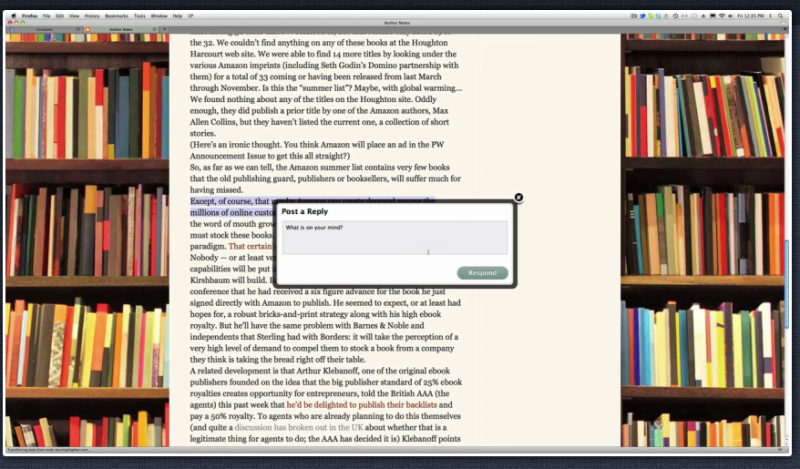
"content": "\u003cfigure id=\"attachment_14266\" class=\"wp-caption left\" style=\"max-width: 300px\">\u003ca rel=\"attachment wp-att-14266\" href=\"http://ww2.kqed.org/mindshift/2011/08/turning-static-text-into-interactive-discussions/screen-shot-2011-07-27-at-3-52-42-pm/\">\u003cimg class=\"size-medium wp-image-14266\" src=\"http://ww2.kqed.org/mindshift/wp-content/uploads/sites/23/2011/07/Screen-shot-2011-07-27-at-3.52.42-PM-300x175.png\" alt=\"\" width=\"300\" height=\"175\">\u003c/a>\u003cfigcaption class=\"wp-caption-text\">Highlighter Application\u003c/figcaption>\u003c/figure>\n\u003cp>Earlier this year, Amazon announced that e-books were \u003ca href=\"http://www.nytimes.com/2011/05/20/technology/20amazon.html\">outselling\u003c/a> print books. The statistics echo those from other sources, such as the \u003ca href=\"http://www.publishers.org/press/30/\">Association of American Publishers\u003c/a>, which indicate consumers have a strong interest in digital formats.\u003c/p>\n\u003cp>But when it comes to textbooks, many students say they still \u003ca href=\"http://www.mediabistro.com/ebooknewser/75-of-college-students-prefer-print-textbooks_b4838\">prefer traditional, print copies\u003c/a>. Sure, textbooks are notoriously heavy and expensive. But print still offers one thing that digital books hasn't been able to do quite right yet: Allow the reader to take detailed notes in the margins.\u003c/p>\n\u003cp>But a new company called \u003ca href=\"http://highlighter.com\">Highlighter\u003c/a> hopes to address that problem by offering a way to help publishers enable marginalia, of sorts, on their websites. Highlighter allows readers to leave comments not just at the end of blog posts but throughout. Visitors to websites can also highlight, annotate, save and share passages and comments.\u003c/p>\n\u003cp>While the new tool can be used by any publisher (or more broadly, by anyone with a blog or a website), the startup is focusing a lot of their efforts on encouraging adoption among academics -- both publishers and professors.\u003c/p>\n\u003cp>University of Colorado biology professor Michael Klymkowsky has installed Highlighter on his \u003ca href=\"http://virtuallaboratory.colorado.edu/Biofundamentals/\">Biofundamentals\u003c/a> course website, for example. By doing so, students are able to engage fully with all the materials -- the syllabus as well as the readings. They can leave comments, ask questions, and save and share key passages.\u003c!--more-->\u003c/p>\n\u003cp>[ad fullwidth]\u003c/p>\n\u003cp>Highlighter also offers analytics for publishers, so in this case, Klymkowsky can see what students are reading, what they're highlighting and sharing -- all metrics to help him gauge their engagement and understanding.\u003c/p>\n\u003cp>\"When we are looking for real subject mastery, it is critical that students have the opportunity to engage the hard and often counterintuitive ideas presented and to articulate and refine their understanding,\" says Klymkowsky. \"The ability to actively comment on the text, respond to questions, and each other's answers, helps them prepare for classroom discussions with their instructors -- helps them get ready for the Socratic process of learning. Unfortunately, this type of engagement is all too rare with 'static' texts and large classes.\"\u003c/p>\n\u003cp>\u003c/p>\n\u003cp>Installing Highlighterit requires adding a simple line of JavaScript into the website's HTML. The tool, including the analytics package, is free.\u003c/p>\n\n",
"disqusIdentifier": "14227 http://blogs.kqed.org/mindshift/?p=14227",
"disqusUrl": "https://ww2.kqed.org/mindshift/2011/08/04/turning-static-text-into-interactive-discussions/",
"stats": {
"hasVideo": false,
"hasChartOrMap": false,
"hasAudio": false,
"hasPolis": false,
"wordCount": 371,
"hasGoogleForm": false,
"hasGallery": false,
"hasHearkenModule": false,
"iframeSrcs": [],
"paragraphCount": 10
},
"modified": 1311807366,
"excerpt": null,
"headData": {
"twImgId": "",
"twTitle": "",
"ogTitle": "",
"ogImgId": "",
"twDescription": "",
"description": "Earlier this year, Amazon announced that e-books were outselling print books. The statistics echo those from other sources, such as the Association of American Publishers, which indicate consumers have a strong interest in digital formats. But when it comes to textbooks, many students say they still prefer traditional, print copies. Sure, textbooks are notoriously heavy",
"title": "Turning Static Text Into Interactive Discussions | KQED",
"ogDescription": "",
"schema": {
"@context": "https://schema.org",
"@type": "Article",
"headline": "Turning Static Text Into Interactive Discussions",
"datePublished": "2011-08-04T13:00:54-07:00",
"dateModified": "2011-07-27T15:56:06-07:00",
"image": "https://cdn.kqed.org/wp-content/uploads/2020/02/KQED-OG-Image@1x.png"
}
},
"guestAuthors": [],
"slug": "turning-static-text-into-interactive-discussions",
"status": "publish",
"path": "/mindshift/14227/turning-static-text-into-interactive-discussions",
"audioTrackLength": null,
"parsedContent": [
{
"type": "contentString",
"content": "\u003cdiv class=\"post-body\">\u003cp>\u003cfigure id=\"attachment_14266\" class=\"wp-caption left\" style=\"max-width: 300px\">\u003ca rel=\"attachment wp-att-14266\" href=\"http://ww2.kqed.org/mindshift/2011/08/turning-static-text-into-interactive-discussions/screen-shot-2011-07-27-at-3-52-42-pm/\">\u003cimg class=\"size-medium wp-image-14266\" src=\"http://ww2.kqed.org/mindshift/wp-content/uploads/sites/23/2011/07/Screen-shot-2011-07-27-at-3.52.42-PM-300x175.png\" alt=\"\" width=\"300\" height=\"175\">\u003c/a>\u003cfigcaption class=\"wp-caption-text\">Highlighter Application\u003c/figcaption>\u003c/figure>\n\u003cp>Earlier this year, Amazon announced that e-books were \u003ca href=\"http://www.nytimes.com/2011/05/20/technology/20amazon.html\">outselling\u003c/a> print books. The statistics echo those from other sources, such as the \u003ca href=\"http://www.publishers.org/press/30/\">Association of American Publishers\u003c/a>, which indicate consumers have a strong interest in digital formats.\u003c/p>\n\u003cp>But when it comes to textbooks, many students say they still \u003ca href=\"http://www.mediabistro.com/ebooknewser/75-of-college-students-prefer-print-textbooks_b4838\">prefer traditional, print copies\u003c/a>. Sure, textbooks are notoriously heavy and expensive. But print still offers one thing that digital books hasn't been able to do quite right yet: Allow the reader to take detailed notes in the margins.\u003c/p>\n\u003cp>But a new company called \u003ca href=\"http://highlighter.com\">Highlighter\u003c/a> hopes to address that problem by offering a way to help publishers enable marginalia, of sorts, on their websites. Highlighter allows readers to leave comments not just at the end of blog posts but throughout. Visitors to websites can also highlight, annotate, save and share passages and comments.\u003c/p>\n\u003cp>While the new tool can be used by any publisher (or more broadly, by anyone with a blog or a website), the startup is focusing a lot of their efforts on encouraging adoption among academics -- both publishers and professors.\u003c/p>\n\u003cp>University of Colorado biology professor Michael Klymkowsky has installed Highlighter on his \u003ca href=\"http://virtuallaboratory.colorado.edu/Biofundamentals/\">Biofundamentals\u003c/a> course website, for example. By doing so, students are able to engage fully with all the materials -- the syllabus as well as the readings. They can leave comments, ask questions, and save and share key passages.\u003c!--more-->\u003c/p>\n\u003cp>\u003c/p>\u003c/div>",
"attributes": {
"named": {},
"numeric": []
}
},
{
"type": "component",
"content": "",
"name": "ad",
"attributes": {
"named": {
"label": "fullwidth"
},
"numeric": [
"fullwidth"
]
}
},
{
"type": "contentString",
"content": "\u003cdiv class=\"post-body\">\u003cp>\u003c/p>\n\u003cp>Highlighter also offers analytics for publishers, so in this case, Klymkowsky can see what students are reading, what they're highlighting and sharing -- all metrics to help him gauge their engagement and understanding.\u003c/p>\n\u003cp>\"When we are looking for real subject mastery, it is critical that students have the opportunity to engage the hard and often counterintuitive ideas presented and to articulate and refine their understanding,\" says Klymkowsky. \"The ability to actively comment on the text, respond to questions, and each other's answers, helps them prepare for classroom discussions with their instructors -- helps them get ready for the Socratic process of learning. Unfortunately, this type of engagement is all too rare with 'static' texts and large classes.\"\u003c/p>\n\u003cp>\u003c/p>\n\u003cp>Installing Highlighterit requires adding a simple line of JavaScript into the website's HTML. The tool, including the analytics package, is free.\u003c/p>\n\n\u003c/div>\u003c/p>",
"attributes": {
"named": {},
"numeric": []
}
}
],
"link": "/mindshift/14227/turning-static-text-into-interactive-discussions",
"authors": [
"4352"
],
"categories": [
"mindshift_195",
"mindshift_193"
],
"tags": [
"mindshift_656"
],
"featImg": "mindshift_14266",
"label": "mindshift"
},
"mindshift_14280": {
"type": "posts",
"id": "mindshift_14280",
"meta": {
"index": "posts_1716263798",
"site": "mindshift",
"id": "14280",
"score": null,
"sort": [
1312408806000
]
},
"parent": 0,
"labelTerm": {
"site": "mindshift"
},
"blocks": [],
"publishDate": 1312408806,
"format": "aside",
"disqusTitle": "How Can Web 2.0 Curation Tools Be Used in the Classroom?",
"title": "How Can Web 2.0 Curation Tools Be Used in the Classroom?",
"headTitle": "MindShift | KQED News",
"content": "\u003cfigure id=\"attachment_14281\" class=\"wp-caption left\" style=\"max-width: 300px\">\u003ca rel=\"attachment wp-att-14281\" href=\"http://ww2.kqed.org/mindshift/2011/08/how-can-web-2-0-curation-tools-be-used-in-the-classroom/scoopit1/\">\u003cimg class=\"size-medium wp-image-14281\" src=\"http://ww2.kqed.org/mindshift/wp-content/uploads/sites/23/2011/07/ScoopIt1-300x323.jpg\" alt=\"\" width=\"300\" height=\"323\">\u003c/a>\u003cfigcaption class=\"wp-caption-text\"> \u003c/figcaption>\u003c/figure>\n\u003cp>\"Curation\" may be one of the big buzzwords of 2011. As the amount of information accumulates thanks to the Web, it becomes increasingly important that we use tools to help us find information that's relevant and useful.\u003c/p>\n\u003cp>The role of the curator has always been to help pull together and oversee collections of materials. But just as Web 2.0 has expanded the traditional role of publisher to almost anyone, the role of curator now too is changing. Anyone can \"curate\" online material, pulling together their own collections.\u003c/p>\n\u003cp>There are a number of tools that enable this. Social bookmarking may be the most well-known, with services like \u003ca href=\"http://delicious.com\">Delicious\u003c/a> and \u003ca href=\"http://diigo.com\">Diigo\u003c/a>, for example, enabling people to tag and save interesting blog posts and websites. By following others who use these sites, you can not only handle your own curation efforts, but subscribe to the things that other people have deemed important.\u003c/p>\n\u003caside class=\"pullquote alignleft\">\"Curation offers a context on the biggest learning playground the world has ever known.\"\u003c/aside>\n\u003cp>That's another vital part of the act of curation: what other people have deemed important. Curation isn't a matter of algorithms or recommendation engines telling you what you might like to read based on your past viewing or buying habits. Curation involves people -- those who have both the skills and the knowledge to piece together their various collections.\u003c/p>\n\u003cp>While the Web has perhaps democratized who can be an expert, we do still prefer to turn to those with specific backgrounds and from specific professions, especially when it comes to education.\u003c!--more-->One interesting new curation tool is \u003ca href=\"http://scoop.it\">Scoop.it\u003c/a>. With Scoop.it, you can set up particular topics that you're interested in. The service crawls the web, looking for content based on your keywords. It suggests materials to you, which you can choose to \"scoop\" if you like. You can also mark materials you find on your own (made easy with the use of a \"bookmarklet\" that lets you tag material as you browse), as well as include suggestions from others. Scoop.it then presents this material in a Flipboard-like interface, a more visual way of presenting the content, perhaps, than just a list of bookmarks and the like.\u003c/p>\n\u003cp>[ad fullwidth]\u003c/p>\n\u003cp>Despite being in beta, Scoop.it has seen some uptake from educators, and there are a number of curated resources there already: \u003ca href=\"http://www.scoop.it/t/leadership-for-mobile-learning\">Learning Process and Mobility\u003c/a>, \u003ca href=\"http://www.scoop.it/t/alternative-education\">Alternative Education\u003c/a>, \u003ca href=\"http://www.scoop.it/t/ipads-in-education\">iPads and Education\u003c/a>, for example.\u003c/p>\n\u003cp>Scoop.it is interested in developing this tool for use \u003ca href=\"http://blog.scoop.it/en/2011/03/30/curation-and-education/\">in the classroom\u003c/a>: \"Curation also brings the possibility to build around a specific topic or subject of research an interactive discussion between the teacher and his or her students. Suddenly the room is open, without being an organic process without any structure. Curation offers a context on the biggest learning playground the world has ever known.\"\u003c/p>\n\u003cp>\u003c/p>\n\u003cp>Curation was once the purview of experts and professionals who collected and preserved resources. But Web 2.0 curation opens the door for others, including for students.\u003c/p>\n\n",
"disqusIdentifier": "14280 http://blogs.kqed.org/mindshift/?p=14280",
"disqusUrl": "https://ww2.kqed.org/mindshift/2011/08/03/how-can-web-2-0-curation-tools-be-used-in-the-classroom/",
"stats": {
"hasVideo": false,
"hasChartOrMap": false,
"hasAudio": false,
"hasPolis": false,
"wordCount": 494,
"hasGoogleForm": false,
"hasGallery": false,
"hasHearkenModule": false,
"iframeSrcs": [],
"paragraphCount": 10
},
"modified": 1312243297,
"excerpt": null,
"headData": {
"twImgId": "",
"twTitle": "",
"ogTitle": "",
"ogImgId": "",
"twDescription": "",
"description": ""Curation" may be one of the big buzzwords of 2011. As the amount of information accumulates thanks to the Web, it becomes increasingly important that we use tools to help us find information that's relevant and useful. The role of the curator has always been to help pull together and oversee collections of materials. But",
"title": "How Can Web 2.0 Curation Tools Be Used in the Classroom? | KQED",
"ogDescription": "",
"schema": {
"@context": "https://schema.org",
"@type": "Article",
"headline": "How Can Web 2.0 Curation Tools Be Used in the Classroom?",
"datePublished": "2011-08-03T15:00:06-07:00",
"dateModified": "2011-08-01T17:01:37-07:00",
"image": "https://cdn.kqed.org/wp-content/uploads/2020/02/KQED-OG-Image@1x.png"
}
},
"guestAuthors": [],
"slug": "how-can-web-2-0-curation-tools-be-used-in-the-classroom",
"status": "publish",
"path": "/mindshift/14280/how-can-web-2-0-curation-tools-be-used-in-the-classroom",
"audioTrackLength": null,
"parsedContent": [
{
"type": "contentString",
"content": "\u003cdiv class=\"post-body\">\u003cp>\u003cfigure id=\"attachment_14281\" class=\"wp-caption left\" style=\"max-width: 300px\">\u003ca rel=\"attachment wp-att-14281\" href=\"http://ww2.kqed.org/mindshift/2011/08/how-can-web-2-0-curation-tools-be-used-in-the-classroom/scoopit1/\">\u003cimg class=\"size-medium wp-image-14281\" src=\"http://ww2.kqed.org/mindshift/wp-content/uploads/sites/23/2011/07/ScoopIt1-300x323.jpg\" alt=\"\" width=\"300\" height=\"323\">\u003c/a>\u003cfigcaption class=\"wp-caption-text\"> \u003c/figcaption>\u003c/figure>\n\u003cp>\"Curation\" may be one of the big buzzwords of 2011. As the amount of information accumulates thanks to the Web, it becomes increasingly important that we use tools to help us find information that's relevant and useful.\u003c/p>\n\u003cp>The role of the curator has always been to help pull together and oversee collections of materials. But just as Web 2.0 has expanded the traditional role of publisher to almost anyone, the role of curator now too is changing. Anyone can \"curate\" online material, pulling together their own collections.\u003c/p>\n\u003cp>There are a number of tools that enable this. Social bookmarking may be the most well-known, with services like \u003ca href=\"http://delicious.com\">Delicious\u003c/a> and \u003ca href=\"http://diigo.com\">Diigo\u003c/a>, for example, enabling people to tag and save interesting blog posts and websites. By following others who use these sites, you can not only handle your own curation efforts, but subscribe to the things that other people have deemed important.\u003c/p>\n\u003caside class=\"pullquote alignleft\">\"Curation offers a context on the biggest learning playground the world has ever known.\"\u003c/aside>\n\u003cp>That's another vital part of the act of curation: what other people have deemed important. Curation isn't a matter of algorithms or recommendation engines telling you what you might like to read based on your past viewing or buying habits. Curation involves people -- those who have both the skills and the knowledge to piece together their various collections.\u003c/p>\n\u003cp>While the Web has perhaps democratized who can be an expert, we do still prefer to turn to those with specific backgrounds and from specific professions, especially when it comes to education.\u003c!--more-->One interesting new curation tool is \u003ca href=\"http://scoop.it\">Scoop.it\u003c/a>. With Scoop.it, you can set up particular topics that you're interested in. The service crawls the web, looking for content based on your keywords. It suggests materials to you, which you can choose to \"scoop\" if you like. You can also mark materials you find on your own (made easy with the use of a \"bookmarklet\" that lets you tag material as you browse), as well as include suggestions from others. Scoop.it then presents this material in a Flipboard-like interface, a more visual way of presenting the content, perhaps, than just a list of bookmarks and the like.\u003c/p>\n\u003cp>\u003c/p>\u003c/div>",
"attributes": {
"named": {},
"numeric": []
}
},
{
"type": "component",
"content": "",
"name": "ad",
"attributes": {
"named": {
"label": "fullwidth"
},
"numeric": [
"fullwidth"
]
}
},
{
"type": "contentString",
"content": "\u003cdiv class=\"post-body\">\u003cp>\u003c/p>\n\u003cp>Despite being in beta, Scoop.it has seen some uptake from educators, and there are a number of curated resources there already: \u003ca href=\"http://www.scoop.it/t/leadership-for-mobile-learning\">Learning Process and Mobility\u003c/a>, \u003ca href=\"http://www.scoop.it/t/alternative-education\">Alternative Education\u003c/a>, \u003ca href=\"http://www.scoop.it/t/ipads-in-education\">iPads and Education\u003c/a>, for example.\u003c/p>\n\u003cp>Scoop.it is interested in developing this tool for use \u003ca href=\"http://blog.scoop.it/en/2011/03/30/curation-and-education/\">in the classroom\u003c/a>: \"Curation also brings the possibility to build around a specific topic or subject of research an interactive discussion between the teacher and his or her students. Suddenly the room is open, without being an organic process without any structure. Curation offers a context on the biggest learning playground the world has ever known.\"\u003c/p>\n\u003cp>\u003c/p>\n\u003cp>Curation was once the purview of experts and professionals who collected and preserved resources. But Web 2.0 curation opens the door for others, including for students.\u003c/p>\n\n\u003c/div>\u003c/p>",
"attributes": {
"named": {},
"numeric": []
}
}
],
"link": "/mindshift/14280/how-can-web-2-0-curation-tools-be-used-in-the-classroom",
"authors": [
"4352"
],
"categories": [
"mindshift_195"
],
"tags": [
"mindshift_657"
],
"featImg": "mindshift_14281",
"label": "mindshift"
},
"mindshift_13990": {
"type": "posts",
"id": "mindshift_13990",
"meta": {
"index": "posts_1716263798",
"site": "mindshift",
"id": "13990",
"score": null,
"sort": [
1312315202000
]
},
"parent": 0,
"labelTerm": {
"site": "mindshift"
},
"blocks": [],
"publishDate": 1312315202,
"format": "aside",
"disqusTitle": "What Would the Freedom Riders Have Tweeted?",
"title": "What Would the Freedom Riders Have Tweeted?",
"headTitle": "MindShift | KQED News",
"content": "\u003cp>\u003cimg class=\"size-medium wp-image-14254\" title=\"Screen shot 2011-07-27 at 3.08.53 PM\" src=\"http://ww2.kqed.org/mindshift/wp-content/uploads/sites/23/2011/07/Screen-shot-2011-07-27-at-3.08.53-PM-300x163.png\" alt=\"\" width=\"300\" height=\"163\">\u003c/p>\n\u003cp>\"It was like watching a movie, but it was going on for a month,\" says Jennifer Klein, World Civilizations teacher at the \u003ca href=\"http://www.openhighschool.org/\" target=\"_blank\">Open High School of Utah\u003c/a>, an online charter school.\u003c/p>\n\u003cp>Welcome to the latest iteration of Twitter in education. Using \u003ca href=\"http://twhistory.org/\" target=\"_blank\">TwHistory\u003c/a>, a group of 12 of Klein's students researched historical documents, took on a historical character, and Tweeted their actions to create a month-long \u003ca href=\"http://twhistory.org/projects/freedom-riders\" target=\"_blank\">reenactment of the 1961 Freedom Rides\u003c/a> this May.\u003c/p>\n\u003cp>TwHistory co-founder \u003ca href=\"http://twhistory.org/people\" target=\"_blank\">Marion Jensen\u003c/a> told her school about the project when it was in its earliest stages, Klein says. And since the \u003ca href=\"http://www.uen.org/\" target=\"_blank\">Utah Education Network\u003c/a>, which had given a grant to TwHistory, was pushing for coverage of the Freedom Riders in celebration of the movement's 50th anniversary and a \u003ca href=\"http://www.pbs.org/wgbh/americanexperience/freedomriders/\" target=\"_blank\">new PBS documentary\u003c/a>, Klein and her students opted to have a Freedom Ride going at the same time that the Freedom Rides took place. They started on May 4th and went continually until June 2nd.\u003c/p>\n\u003caside class=\"pullquote alignleft\">\"They understood that this was a real event. They were intrigued and excited to learn more.\"\u003c/aside>\n\u003cp>Her students used Google docs to create the Tweets about their character – the group ended up with 10 total – and then merged them in a single document at the end of a month of research. Since it was an early TwHistory experiment, the twelve students involved had to apply to be a part of the project and take care of all of their work as an extracurricular activity. But that was hardly a deterrent.\u003c!--more-->\u003c/p>\n\u003cp>[ad fullwidth]\u003c/p>\n\u003cp>\"They researched so much!\" says Klein. \"And I wasn't able to hand-feed them; they had to do the research for themselves. Some went to the Salt Lake City library to look at microfilm from the time period. It was phenomenal because it forced them to really dive into primary source documents.\"\u003c/p>\n\u003cp>Plus, this kind of in-depth, personal research brought history to life for students. If they were to Tweet from a character's perspective, they had to really understand and embody that character. One student represented \"the only white woman on the first bus ride. And she wrote 300 Tweets – she couldn't stop, she had to tell this person's story.\" And one student \"called me in tears,\" Klein says, \"asking, 'Did you know that they beat up these people?' Lots of students said, 'It seems like a whole new world! It doesn't seem like it would happen in America.' But they saw the dates, they saw where this was happening. They understood that this was a real event. They were intrigued and excited to learn more.\"\u003c/p>\n\u003cp>There were \"a lot of intense things going on\" during that period which made for a dramatic reenactment. For instance, a bunch of Tweets would come in at once, saying, \"Uh-oh, there's a mob coming,\" but after that \"no Tweets would come in because they were getting beaten. It was so heartfelt. This in-depth personal experience really made it come alive.\"\u003c/p>\n\u003cp>Once they'd finished their research and used TwHistory to \u003ca href=\"http://twhistory.org/about\" target=\"_blank\">set the reenactment rolling in real time\u003c/a>, \"other students and teachers started to follow it in our school,\" says Klein. \"They were also blown away.\"\u003c/p>\n\u003cp>\u003ca rel=\"attachment wp-att-14256\" href=\"http://ww2.kqed.org/mindshift/2011/08/what-would-the-freedom-riders-have-tweeted/screen-shot-2011-07-27-at-3-19-56-pm/\">\u003cimg class=\"alignright size-medium wp-image-14256\" title=\"Screen shot 2011-07-27 at 3.19.56 PM\" src=\"http://ww2.kqed.org/mindshift/wp-content/uploads/sites/23/2011/07/Screen-shot-2011-07-27-at-3.19.56-PM-300x710.png\" alt=\"\" width=\"211\" height=\"500\">\u003c/a>Overall, it was an incredible project and Klein found great success with it, though she did learn a few lessons along the way. One thing she'd recommend to teachers and students interested in creating their own reenactments: Don't make it a month long. After a good three weeks of continually Tweeting, \"It was hard to keep them going,\" she says. \"They were so excited during those first two weeks – I saw so many Tweets! The third week was okay, but by the fourth, I had to be like, 'Come on guys, just a few more!'\" Likewise, the students and teachers at her school who were following the reenactment started to lose a little interest by that time, too.\u003c/p>\n\u003cp>Still, even without using the TwHistory platform, asking students to develop Tweets about historical events as a single assignment got them interested. After the Freedom Riders project, she asked nearly 100 of her regular students to create 30 Tweets from Christopher Columbus' perspective, using his journals that are simple to find online, and that was a great success, too.\u003c/p>\n\u003cp>\"It all comes down to what you can get the most primary source documents from,\" says Klein, \"but someday I would love to do a big one, like the Continental Congress as they're writing the Constitution. I think that would be really fun to do. Or World War II, with each student Tweeting from the perspective of a different country... well, the time zones could get a little crazy for that one.\"\u003c/p>\n\u003cp> \u003c/p>\n\u003ch5>\u003ca href=\"http://ww2.kqed.org/mindshift/?p=13862\">Read more about Twhistory here.\u003c/a>\u003c/h5>\n\u003cp>\u003c/p>\n\u003cp> \u003c/p>\n\n",
"disqusIdentifier": "13990 http://blogs.kqed.org/mindshift/?p=13990",
"disqusUrl": "https://ww2.kqed.org/mindshift/2011/08/02/what-would-the-freedom-riders-have-tweeted/",
"stats": {
"hasVideo": false,
"hasChartOrMap": false,
"hasAudio": false,
"hasPolis": false,
"wordCount": 798,
"hasGoogleForm": false,
"hasGallery": false,
"hasHearkenModule": false,
"iframeSrcs": [],
"paragraphCount": 14
},
"modified": 1311805376,
"excerpt": null,
"headData": {
"twImgId": "",
"twTitle": "",
"ogTitle": "",
"ogImgId": "",
"twDescription": "",
"description": ""It was like watching a movie, but it was going on for a month," says Jennifer Klein, World Civilizations teacher at the Open High School of Utah, an online charter school. Welcome to the latest iteration of Twitter in education. Using TwHistory, a group of 12 of Klein's students researched historical documents, took on a",
"title": "What Would the Freedom Riders Have Tweeted? | KQED",
"ogDescription": "",
"schema": {
"@context": "https://schema.org",
"@type": "Article",
"headline": "What Would the Freedom Riders Have Tweeted?",
"datePublished": "2011-08-02T13:00:02-07:00",
"dateModified": "2011-07-27T15:22:56-07:00",
"image": "https://cdn.kqed.org/wp-content/uploads/2020/02/KQED-OG-Image@1x.png"
}
},
"guestAuthors": [],
"slug": "what-would-the-freedom-riders-have-tweeted",
"status": "publish",
"path": "/mindshift/13990/what-would-the-freedom-riders-have-tweeted",
"audioTrackLength": null,
"parsedContent": [
{
"type": "contentString",
"content": "\u003cdiv class=\"post-body\">\u003cp>\u003cp>\u003cimg class=\"size-medium wp-image-14254\" title=\"Screen shot 2011-07-27 at 3.08.53 PM\" src=\"http://ww2.kqed.org/mindshift/wp-content/uploads/sites/23/2011/07/Screen-shot-2011-07-27-at-3.08.53-PM-300x163.png\" alt=\"\" width=\"300\" height=\"163\">\u003c/p>\n\u003cp>\"It was like watching a movie, but it was going on for a month,\" says Jennifer Klein, World Civilizations teacher at the \u003ca href=\"http://www.openhighschool.org/\" target=\"_blank\">Open High School of Utah\u003c/a>, an online charter school.\u003c/p>\n\u003cp>Welcome to the latest iteration of Twitter in education. Using \u003ca href=\"http://twhistory.org/\" target=\"_blank\">TwHistory\u003c/a>, a group of 12 of Klein's students researched historical documents, took on a historical character, and Tweeted their actions to create a month-long \u003ca href=\"http://twhistory.org/projects/freedom-riders\" target=\"_blank\">reenactment of the 1961 Freedom Rides\u003c/a> this May.\u003c/p>\n\u003cp>TwHistory co-founder \u003ca href=\"http://twhistory.org/people\" target=\"_blank\">Marion Jensen\u003c/a> told her school about the project when it was in its earliest stages, Klein says. And since the \u003ca href=\"http://www.uen.org/\" target=\"_blank\">Utah Education Network\u003c/a>, which had given a grant to TwHistory, was pushing for coverage of the Freedom Riders in celebration of the movement's 50th anniversary and a \u003ca href=\"http://www.pbs.org/wgbh/americanexperience/freedomriders/\" target=\"_blank\">new PBS documentary\u003c/a>, Klein and her students opted to have a Freedom Ride going at the same time that the Freedom Rides took place. They started on May 4th and went continually until June 2nd.\u003c/p>\n\u003caside class=\"pullquote alignleft\">\"They understood that this was a real event. They were intrigued and excited to learn more.\"\u003c/aside>\n\u003cp>Her students used Google docs to create the Tweets about their character – the group ended up with 10 total – and then merged them in a single document at the end of a month of research. Since it was an early TwHistory experiment, the twelve students involved had to apply to be a part of the project and take care of all of their work as an extracurricular activity. But that was hardly a deterrent.\u003c!--more-->\u003c/p>\n\u003cp>\u003c/p>\u003c/div>",
"attributes": {
"named": {},
"numeric": []
}
},
{
"type": "component",
"content": "",
"name": "ad",
"attributes": {
"named": {
"label": "fullwidth"
},
"numeric": [
"fullwidth"
]
}
},
{
"type": "contentString",
"content": "\u003cdiv class=\"post-body\">\u003cp>\u003c/p>\n\u003cp>\"They researched so much!\" says Klein. \"And I wasn't able to hand-feed them; they had to do the research for themselves. Some went to the Salt Lake City library to look at microfilm from the time period. It was phenomenal because it forced them to really dive into primary source documents.\"\u003c/p>\n\u003cp>Plus, this kind of in-depth, personal research brought history to life for students. If they were to Tweet from a character's perspective, they had to really understand and embody that character. One student represented \"the only white woman on the first bus ride. And she wrote 300 Tweets – she couldn't stop, she had to tell this person's story.\" And one student \"called me in tears,\" Klein says, \"asking, 'Did you know that they beat up these people?' Lots of students said, 'It seems like a whole new world! It doesn't seem like it would happen in America.' But they saw the dates, they saw where this was happening. They understood that this was a real event. They were intrigued and excited to learn more.\"\u003c/p>\n\u003cp>There were \"a lot of intense things going on\" during that period which made for a dramatic reenactment. For instance, a bunch of Tweets would come in at once, saying, \"Uh-oh, there's a mob coming,\" but after that \"no Tweets would come in because they were getting beaten. It was so heartfelt. This in-depth personal experience really made it come alive.\"\u003c/p>\n\u003cp>Once they'd finished their research and used TwHistory to \u003ca href=\"http://twhistory.org/about\" target=\"_blank\">set the reenactment rolling in real time\u003c/a>, \"other students and teachers started to follow it in our school,\" says Klein. \"They were also blown away.\"\u003c/p>\n\u003cp>\u003ca rel=\"attachment wp-att-14256\" href=\"http://ww2.kqed.org/mindshift/2011/08/what-would-the-freedom-riders-have-tweeted/screen-shot-2011-07-27-at-3-19-56-pm/\">\u003cimg class=\"alignright size-medium wp-image-14256\" title=\"Screen shot 2011-07-27 at 3.19.56 PM\" src=\"http://ww2.kqed.org/mindshift/wp-content/uploads/sites/23/2011/07/Screen-shot-2011-07-27-at-3.19.56-PM-300x710.png\" alt=\"\" width=\"211\" height=\"500\">\u003c/a>Overall, it was an incredible project and Klein found great success with it, though she did learn a few lessons along the way. One thing she'd recommend to teachers and students interested in creating their own reenactments: Don't make it a month long. After a good three weeks of continually Tweeting, \"It was hard to keep them going,\" she says. \"They were so excited during those first two weeks – I saw so many Tweets! The third week was okay, but by the fourth, I had to be like, 'Come on guys, just a few more!'\" Likewise, the students and teachers at her school who were following the reenactment started to lose a little interest by that time, too.\u003c/p>\n\u003cp>Still, even without using the TwHistory platform, asking students to develop Tweets about historical events as a single assignment got them interested. After the Freedom Riders project, she asked nearly 100 of her regular students to create 30 Tweets from Christopher Columbus' perspective, using his journals that are simple to find online, and that was a great success, too.\u003c/p>\n\u003cp>\"It all comes down to what you can get the most primary source documents from,\" says Klein, \"but someday I would love to do a big one, like the Continental Congress as they're writing the Constitution. I think that would be really fun to do. Or World War II, with each student Tweeting from the perspective of a different country... well, the time zones could get a little crazy for that one.\"\u003c/p>\n\u003cp> \u003c/p>\n\u003ch5>\u003ca href=\"http://ww2.kqed.org/mindshift/?p=13862\">Read more about Twhistory here.\u003c/a>\u003c/h5>\n\u003cp>\u003c/p>\n\u003cp> \u003c/p>\n\n\u003c/div>\u003c/p>",
"attributes": {
"named": {},
"numeric": []
}
}
],
"link": "/mindshift/13990/what-would-the-freedom-riders-have-tweeted",
"authors": [
"4351"
],
"categories": [
"mindshift_195",
"mindshift_193"
],
"tags": [
"mindshift_647",
"mindshift_644",
"mindshift_32"
],
"featImg": "mindshift_14254",
"label": "mindshift"
},
"mindshift_13862": {
"type": "posts",
"id": "mindshift_13862",
"meta": {
"index": "posts_1716263798",
"site": "mindshift",
"id": "13862",
"score": null,
"sort": [
1312297258000
]
},
"parent": 0,
"labelTerm": {
"site": "mindshift"
},
"blocks": [],
"publishDate": 1312297258,
"format": "aside",
"disqusTitle": "Retweeting History Brings Those Stories to Life",
"title": "Retweeting History Brings Those Stories to Life",
"headTitle": "MindShift | KQED News",
"content": "\u003cfigure id=\"attachment_14242\" class=\"wp-caption alignright\" style=\"max-width: 300px\">\u003ca rel=\"attachment wp-att-14242\" href=\"http://ww2.kqed.org/mindshift/2011/08/retweeting-history-to-bring-life-to-historical-events/screen-shot-2011-07-27-at-3-02-31-pm/\">\u003cimg class=\"size-medium wp-image-14242\" src=\"http://ww2.kqed.org/mindshift/wp-content/uploads/sites/23/2011/07/Screen-shot-2011-07-27-at-3.02.31-PM-300x158.png\" alt=\"\" width=\"300\" height=\"158\">\u003c/a>\u003cfigcaption class=\"wp-caption-text\">TwHistory\u003c/figcaption>\u003c/figure>\n\u003cp>From following conferences to collaborative story-writing, there are plenty of exciting ways to use Twitter in school (see \u003ca href=\"http://ww2.kqed.org/mindshift/2011/07/28-creative-ideas-for-teaching-with-twitter/\" target=\"_blank\">this lengthy list\u003c/a>, for example).\u003c/p>\n\u003cp>But here's one more: \u003ca href=\"http://twhistory.org/\" target=\"_blank\">TwHistory\u003c/a>, a new, free tool that encourages teachers and students to dig deep into history, get inside the heads of historical figures, and reenact historical events in real time.\u003c/p>\n\u003cp>What was the experience of those who fought the \u003ca href=\"http://twhistory.org/projects/battle-of-waterloo\" target=\"_blank\">Battle of Waterloo\u003c/a>? What would they have felt? What would they have feared? What if we could re-experience history as it unfolded?\u003c/p>\n\u003caside class=\"pullquote alignleft\">\"This can make you think about history differently.\"\u003c/aside>\n\u003cp>That's what TwHistory attempts to do. Anyone can follow various historical \"\u003ca href=\"http://twhistory.org/projects\" target=\"_blank\">reenactments\u003c/a>\" – from the sinking of the Titanic to the assassination of John F. Kennedy – or sign up for free and create their own. Participants choose a historical event, create Twitter accounts for individual characters, pore over primary source documents and think critically about the times, dates, and durations of events to create hundreds of Tweets as they might have been broadcast had Twitter existed before the 21st century. They then submit all those Tweets to the engineers at TwHistory, specifying a start date for their event, and then watch it unfold – over a day, a week, a month or more – reflecting the event's actual duration.\u003c!--more-->\u003c/p>\n\u003cp>\"When I first got on Twitter, I thought – like a lot of folks did – that this was the biggest waste of time ever,\" says TwHistory co-founder \u003ca href=\"http://twhistory.org/people\" target=\"_blank\">Marion Jensen\u003c/a>. \"I didn't see any value to it. Then I found out about hash tags and followed a conference. I almost felt like I was there.\" He thought, \"You could almost tell a story using this... and then I got to thinking: History is full of stories.\"\u003c/p>\n\u003cp>[ad fullwidth]\u003c/p>\n\u003cp>Shortly afterward, Jensen joined a group of researchers to develop the software for TwHistory, and as proof of concept they reenacted the Battle of Gettysburg. Grants from the \u003ca href=\"http://www.talis.com/\" target=\"_blank\">Talis Incubator for Open Education\u003c/a> and the\u003ca href=\"http://www.uen.org/\" target=\"_blank\"> Utah Education Network\u003c/a> helped them continue their work, and now there are about twenty reenactments on the site, with several more in development. Although TwHistory is a recent creation (its current iteration is only about 6 months old), it has a lot of potential for education.\u003c/p>\n\u003cp>Usually when you learn something about history, Jensen says, \"It's outside of real time.\" But when a group of high school students created a reenactment of the \u003ca href=\"http://www.jfklibrary.org/JFK/JFK-in-History/Cuban-Missile-Crisis.aspx\" target=\"_blank\">Cuban missile crisis\u003c/a>, for instance, \"I was following the tweets of John F. Kennedy.\" The student portraying JFK was tweeting things like, \"'We saw missiles in Cuba, we talked with the Russians.'\" Another student was playing the part of the \u003cem>New York Times\u003c/em> and at one point he was Tweeting baseball scores. Jensen was confused for a moment, until he realized, given the time and date of the Tweet, \"Oh, this hasn't hit the press yet! Within four hours the \u003cem>New York Times \u003c/em>was Tweeting about the Cuban missile crisis.\" This can make you think about history differently: \"All this was going on at the time and people were oblivious to it. It was one of those educational moments for the students. This is how it all unfolded.\"\u003c/p>\n\u003cp>\u003cimg class=\"size-medium wp-image-14245\" title=\"Screen shot 2011-07-27 at 3.09.01 PM\" src=\"http://ww2.kqed.org/mindshift/wp-content/uploads/sites/23/2011/07/Screen-shot-2011-07-27-at-3.09.01-PM-300x157.png\" alt=\"\" width=\"300\" height=\"157\">\u003c/p>\n\u003cp>Another example Jensen offers was from a reenactment of a \u003ca href=\"http://twhistory.org/projects/1847-pioneer-trek\" target=\"_blank\">group of pioneers heading west\u003c/a> in the mid-nineteenth century. \"At one point, some Native Americans came into their camp early in the morning. Six Tweets came at the same time, 'The alarm has sounded!'\" But as a viewer of the reenactment, \"You don't know what happens after that; you have to sit there and wait. About twenty minutes later, Tweets came in like, 'We shot off the cannon and they left.' It's a new way to represent history. You want to know what the resolution is, but you might not find out for three days.\"\u003c/p>\n\u003cp>Following historical figures' lives intimately helps bring it home for participants. One Civil War soldier that Jensen Tweeted for as part of the Battle of Gettysburg \"was a guy who wrote letters home every day to his wife. In all of his letters, he was writing, 'Kiss the baby for me, I can't wait till I get home.' But he was killed the very first day. I got to know this guy through his letters and it was hard to know that he died. To really come to know one person brought the point home.\"\u003c/p>\n\u003cp>Although TwHistory's amusing tagline is, \"Those who forget history are doomed to re-Tweet it,\" users are, in fact, encouraged to repeat reenactments indefinitely (\"We've sunk the Titanic about twelve times,\" says Jensen). All material is available through a Creative Commons license, so all of it is wide open for collective editing.\u003c/p>\n\u003cp>\"Our goal someday is to have two or three thousand reenactments up there,\" Jensen says, so that teachers, students, and history buff everywhere can either make them their own or \"press play, sit back, and watch history.\"\u003c/p>\n\u003cp>\u003c/p>\n\u003cp> \u003c/p>\n\n",
"disqusIdentifier": "13862 http://blogs.kqed.org/mindshift/?p=13862",
"disqusUrl": "https://ww2.kqed.org/mindshift/2011/08/02/retweeting-history-to-bring-life-to-historical-events/",
"stats": {
"hasVideo": false,
"hasChartOrMap": false,
"hasAudio": false,
"hasPolis": false,
"wordCount": 835,
"hasGoogleForm": false,
"hasGallery": false,
"hasHearkenModule": false,
"iframeSrcs": [],
"paragraphCount": 14
},
"modified": 1311804819,
"excerpt": null,
"headData": {
"twImgId": "",
"twTitle": "",
"ogTitle": "",
"ogImgId": "",
"twDescription": "",
"description": "From following conferences to collaborative story-writing, there are plenty of exciting ways to use Twitter in school (see this lengthy list, for example). But here's one more: TwHistory, a new, free tool that encourages teachers and students to dig deep into history, get inside the heads of historical figures, and reenact historical events in real",
"title": "Retweeting History Brings Those Stories to Life | KQED",
"ogDescription": "",
"schema": {
"@context": "https://schema.org",
"@type": "Article",
"headline": "Retweeting History Brings Those Stories to Life",
"datePublished": "2011-08-02T08:00:58-07:00",
"dateModified": "2011-07-27T15:13:39-07:00",
"image": "https://cdn.kqed.org/wp-content/uploads/2020/02/KQED-OG-Image@1x.png"
}
},
"guestAuthors": [],
"slug": "retweeting-history-to-bring-life-to-historical-events",
"status": "publish",
"path": "/mindshift/13862/retweeting-history-to-bring-life-to-historical-events",
"audioTrackLength": null,
"parsedContent": [
{
"type": "contentString",
"content": "\u003cdiv class=\"post-body\">\u003cp>\u003cfigure id=\"attachment_14242\" class=\"wp-caption alignright\" style=\"max-width: 300px\">\u003ca rel=\"attachment wp-att-14242\" href=\"http://ww2.kqed.org/mindshift/2011/08/retweeting-history-to-bring-life-to-historical-events/screen-shot-2011-07-27-at-3-02-31-pm/\">\u003cimg class=\"size-medium wp-image-14242\" src=\"http://ww2.kqed.org/mindshift/wp-content/uploads/sites/23/2011/07/Screen-shot-2011-07-27-at-3.02.31-PM-300x158.png\" alt=\"\" width=\"300\" height=\"158\">\u003c/a>\u003cfigcaption class=\"wp-caption-text\">TwHistory\u003c/figcaption>\u003c/figure>\n\u003cp>From following conferences to collaborative story-writing, there are plenty of exciting ways to use Twitter in school (see \u003ca href=\"http://ww2.kqed.org/mindshift/2011/07/28-creative-ideas-for-teaching-with-twitter/\" target=\"_blank\">this lengthy list\u003c/a>, for example).\u003c/p>\n\u003cp>But here's one more: \u003ca href=\"http://twhistory.org/\" target=\"_blank\">TwHistory\u003c/a>, a new, free tool that encourages teachers and students to dig deep into history, get inside the heads of historical figures, and reenact historical events in real time.\u003c/p>\n\u003cp>What was the experience of those who fought the \u003ca href=\"http://twhistory.org/projects/battle-of-waterloo\" target=\"_blank\">Battle of Waterloo\u003c/a>? What would they have felt? What would they have feared? What if we could re-experience history as it unfolded?\u003c/p>\n\u003caside class=\"pullquote alignleft\">\"This can make you think about history differently.\"\u003c/aside>\n\u003cp>That's what TwHistory attempts to do. Anyone can follow various historical \"\u003ca href=\"http://twhistory.org/projects\" target=\"_blank\">reenactments\u003c/a>\" – from the sinking of the Titanic to the assassination of John F. Kennedy – or sign up for free and create their own. Participants choose a historical event, create Twitter accounts for individual characters, pore over primary source documents and think critically about the times, dates, and durations of events to create hundreds of Tweets as they might have been broadcast had Twitter existed before the 21st century. They then submit all those Tweets to the engineers at TwHistory, specifying a start date for their event, and then watch it unfold – over a day, a week, a month or more – reflecting the event's actual duration.\u003c!--more-->\u003c/p>\n\u003cp>\"When I first got on Twitter, I thought – like a lot of folks did – that this was the biggest waste of time ever,\" says TwHistory co-founder \u003ca href=\"http://twhistory.org/people\" target=\"_blank\">Marion Jensen\u003c/a>. \"I didn't see any value to it. Then I found out about hash tags and followed a conference. I almost felt like I was there.\" He thought, \"You could almost tell a story using this... and then I got to thinking: History is full of stories.\"\u003c/p>\n\u003cp>\u003c/p>\u003c/div>",
"attributes": {
"named": {},
"numeric": []
}
},
{
"type": "component",
"content": "",
"name": "ad",
"attributes": {
"named": {
"label": "fullwidth"
},
"numeric": [
"fullwidth"
]
}
},
{
"type": "contentString",
"content": "\u003cdiv class=\"post-body\">\u003cp>\u003c/p>\n\u003cp>Shortly afterward, Jensen joined a group of researchers to develop the software for TwHistory, and as proof of concept they reenacted the Battle of Gettysburg. Grants from the \u003ca href=\"http://www.talis.com/\" target=\"_blank\">Talis Incubator for Open Education\u003c/a> and the\u003ca href=\"http://www.uen.org/\" target=\"_blank\"> Utah Education Network\u003c/a> helped them continue their work, and now there are about twenty reenactments on the site, with several more in development. Although TwHistory is a recent creation (its current iteration is only about 6 months old), it has a lot of potential for education.\u003c/p>\n\u003cp>Usually when you learn something about history, Jensen says, \"It's outside of real time.\" But when a group of high school students created a reenactment of the \u003ca href=\"http://www.jfklibrary.org/JFK/JFK-in-History/Cuban-Missile-Crisis.aspx\" target=\"_blank\">Cuban missile crisis\u003c/a>, for instance, \"I was following the tweets of John F. Kennedy.\" The student portraying JFK was tweeting things like, \"'We saw missiles in Cuba, we talked with the Russians.'\" Another student was playing the part of the \u003cem>New York Times\u003c/em> and at one point he was Tweeting baseball scores. Jensen was confused for a moment, until he realized, given the time and date of the Tweet, \"Oh, this hasn't hit the press yet! Within four hours the \u003cem>New York Times \u003c/em>was Tweeting about the Cuban missile crisis.\" This can make you think about history differently: \"All this was going on at the time and people were oblivious to it. It was one of those educational moments for the students. This is how it all unfolded.\"\u003c/p>\n\u003cp>\u003cimg class=\"size-medium wp-image-14245\" title=\"Screen shot 2011-07-27 at 3.09.01 PM\" src=\"http://ww2.kqed.org/mindshift/wp-content/uploads/sites/23/2011/07/Screen-shot-2011-07-27-at-3.09.01-PM-300x157.png\" alt=\"\" width=\"300\" height=\"157\">\u003c/p>\n\u003cp>Another example Jensen offers was from a reenactment of a \u003ca href=\"http://twhistory.org/projects/1847-pioneer-trek\" target=\"_blank\">group of pioneers heading west\u003c/a> in the mid-nineteenth century. \"At one point, some Native Americans came into their camp early in the morning. Six Tweets came at the same time, 'The alarm has sounded!'\" But as a viewer of the reenactment, \"You don't know what happens after that; you have to sit there and wait. About twenty minutes later, Tweets came in like, 'We shot off the cannon and they left.' It's a new way to represent history. You want to know what the resolution is, but you might not find out for three days.\"\u003c/p>\n\u003cp>Following historical figures' lives intimately helps bring it home for participants. One Civil War soldier that Jensen Tweeted for as part of the Battle of Gettysburg \"was a guy who wrote letters home every day to his wife. In all of his letters, he was writing, 'Kiss the baby for me, I can't wait till I get home.' But he was killed the very first day. I got to know this guy through his letters and it was hard to know that he died. To really come to know one person brought the point home.\"\u003c/p>\n\u003cp>Although TwHistory's amusing tagline is, \"Those who forget history are doomed to re-Tweet it,\" users are, in fact, encouraged to repeat reenactments indefinitely (\"We've sunk the Titanic about twelve times,\" says Jensen). All material is available through a Creative Commons license, so all of it is wide open for collective editing.\u003c/p>\n\u003cp>\"Our goal someday is to have two or three thousand reenactments up there,\" Jensen says, so that teachers, students, and history buff everywhere can either make them their own or \"press play, sit back, and watch history.\"\u003c/p>\n\u003cp>\u003c/p>\n\u003cp> \u003c/p>\n\n\u003c/div>\u003c/p>",
"attributes": {
"named": {},
"numeric": []
}
}
],
"link": "/mindshift/13862/retweeting-history-to-bring-life-to-historical-events",
"authors": [
"4351"
],
"categories": [
"mindshift_195",
"mindshift_193"
],
"tags": [
"mindshift_645",
"mindshift_646",
"mindshift_644",
"mindshift_32"
],
"featImg": "mindshift_14242",
"label": "mindshift"
},
"mindshift_12835": {
"type": "posts",
"id": "mindshift_12835",
"meta": {
"index": "posts_1716263798",
"site": "mindshift",
"id": "12835",
"score": null,
"sort": [
1312210833000
]
},
"parent": 0,
"labelTerm": {
"site": "mindshift"
},
"blocks": [],
"publishDate": 1312210833,
"format": "aside",
"disqusTitle": "14 Free and Simple Digital Media Tools",
"title": "14 Free and Simple Digital Media Tools",
"headTitle": "MindShift | KQED News",
"content": "\u003cfigure id=\"attachment_14126\" class=\"wp-caption alignright\" style=\"max-width: 300px\">\u003ca href=\"http://ww2.kqed.org/mindshift/2011/08/14-free-and-simple-digital-media-tools/screen-shot-2011-07-26-at-5-37-07-pm/\" rel=\"attachment wp-att-14126\">\u003cimg class=\"size-medium wp-image-14126\" src=\"http://ww2.kqed.org/mindshift/wp-content/uploads/sites/23/2011/06/Screen-shot-2011-07-26-at-5.37.07-PM-300x242.png\" alt=\"\" width=\"300\" height=\"242\">\u003c/a>\u003cfigcaption class=\"wp-caption-text\">Wavosaur audio editor.\u003c/figcaption>\u003c/figure>\n\u003cp>With so many free (or inexpensive) useful tech tools out there, editing video, audio, or photos doesn't have to cost a fortune – or leave you with a headache. If your digital media needs are simple, your tools can be simple, too.\u003c/p>\n\u003cp>We rounded up the best ones for your consideration.\u003c/p>\n\u003cp>\u003cstrong>AUDIO EDITING\u003c/strong>\u003c/p>\n\u003cp>\u003ca href=\"http://audacity.sourceforge.net\" target=\"_blank\">Audacity\u003c/a>: A simple, yet very effective, open-source multi-track audio editing software. You can import audio files, chop them up, fade them in and out, or use more advanced editing features, then export the entire project as an MP3 or WAV file. Audacity can be used with Windows, Mac, and Linux, is compatible with a variety of audio file formats, and can even convert analog audio to digital.\u003c/p>\n\u003cp>\u003ca href=\"http://www.wavosaur.com/\" target=\"_blank\">Wavosaur\u003c/a>: Although it only works on Windows operating systems and is barely half a megabyte in size, Wavosaur still has some pretty advanced features, like cross-fade loops, vocal removal, batch processing, and more.\u003c/p>\n\u003cp>[ad fullwidth]\u003c/p>\n\u003cp>\u003ca href=\"http://ardour.org/\" target=\"_blank\">Ardour\u003c/a>: Only designed for Mac and Linux, but crammed full of advanced features, this one might be a bit more complex to navigate. Called a \"digital audio workstation\" suitable for professionals, users can record, mix, and edit their audio cost-free – and consult the \u003ca href=\"http://ardour.org/support\" target=\"_blank\">support feature\u003c/a> if they get stuck.\u003c/p>\n\u003cp>\u003ca href=\"http://www.nch.com.au/wavepad/\" target=\"_blank\">WavePad\u003c/a>: Another full-featured audio editor full of effects like echo, amplify, or text-to-speech and voice-changer functions. It's also compatible with the full range of audio and music file formats. The free version is only available for Macs, however.\u003c/p>\n\u003cp>\u003cstrong>PHOTO EDITING\u003c/strong>\u003c/p>\n\u003cfigure id=\"attachment_14127\" class=\"wp-caption alignright\" style=\"max-width: 300px\">\u003ca href=\"http://pixlr.com/\">\u003cimg class=\"size-medium wp-image-14127\" src=\"http://ww2.kqed.org/mindshift/wp-content/uploads/sites/23/2011/06/photo_editor-300x240.jpg\" alt=\"\" width=\"300\" height=\"240\">\u003c/a>\u003cfigcaption class=\"wp-caption-text\"> \u003c/figcaption>\u003c/figure>\n\u003cp>Pixlr: Very popular and user-friendly, Pixlr lets you upload photos from your computer and edit them right in your browser. There are no downloads necessary, unless you want to grab and edit screenshots using \u003ca href=\"http://pixlr.com/grabber\" target=\"_blank\">Pixlr Grabber\u003c/a>. For simple, one-click edits, try \u003ca href=\"http://pixlr.com/express/\" target=\"_blank\">Pixlr Express\u003c/a>; for \"retro vintage\" effects, visit \u003ca href=\"http://pixlr.com/o-matic/\" target=\"_blank\">Pixlr-o-matic\u003c/a>.\u003c/p>\n\u003cp>\u003ca href=\"http://picasa.google.com\" target=\"_blank\">Picasa\u003c/a>: Google's photo editing tool, Picasa is a free download, runs on every operating system, and allows any number of simple editing and organizing features. Reduce redeye, crop, retouch, make a slideshow, and batch upload, or share photos using \u003ca href=\"http://picasa.google.com/features.html#utm_medium=embed&utm_source=pwalogin\" target=\"_blank\">Picasa Web Albums\u003c/a>.\u003c/p>\n\u003cp>\u003ca href=\"http://www.picnik.com/\" target=\"_blank\">Picnik\u003c/a>: Edit photos online with this browser-based software; no downloads required here, either. Picnik, like Pixlr, has a lively, upbeat interface and offers access to special effects as well as simple edits like cropping and color retouching. For more advanced features, users can upgrade to the Premium version for a small fee per month.\u003c/p>\n\u003cp>\u003cstrong>VIDEO EDITING\u003c/strong>\u003cstrong> \u003c/strong>\u003c/p>\n\u003cp>\u003ca href=\"http://explore.live.com/windows-live-movie-maker?os=other\" target=\"_blank\">MovieMaker\u003c/a>: The Microsoft version of Apple's \u003ca href=\"http://www.apple.com/ilife/imovie/\" target=\"_blank\">iMovie\u003c/a>, MovieMaker is a simple video editing software for Windows that turns photos and video clips into polished digital movies, using special effects, transitions, captions, sharing features, and more.\u003c!--more-->\u003c/p>\n\u003cp>\u003ca href=\"http://www.cinefx.org/cinefx/\" target=\"_blank\">Cinefx\u003c/a>: An open-source digital media player and editor, Cinefx is compatible on both Windows and Mac operating systems and lets users navigate simple, yet professional, video editing features and add a bunch of special effects.\u003c/p>\n\u003cp>\u003ca href=\"http://www.moviestorm.co.uk\" target=\"_blank\">MovieStorm\u003c/a>: If you want to create 3D animated movies, this is the free download for you. MovieStorm's goal is to make 3D animation accessible to teachers and students, businesses, and amateur filmmakers, so it's easy to use, but full of high-quality, industry-standard features.\u003c/p>\n\u003cp>\u003ca href=\"http://www.atomiclearning.com/k12/en/storyboardpro\" target=\"_blank\">StoryBoard Pro\u003c/a>: Designed specifically for students and teachers by Bill Bierden, an Apple Distinguished Educator, StoryBoard Pro allows users to plan ahead for their video projects. Although it's not exactly about importing video footage and editing (it's more of a precursor to that), students can enter shot descriptions, planned lengths, and editing order, create and print storyboards, and upload a variety of media to illustrate each shot.\u003c/p>\n\u003cp>\u003cstrong>AUDIO SLIDE SHOWS\u003c/strong>\u003c/p>\n\u003cp>\u003ca href=\"http://www.microsoft.com/download/en/details.aspx?id=11132\" target=\"_blank\">PhotoStory\u003c/a>: A free, Windows-only audio slide show software that allows users to upload photos and audio and add captions, narration, and transitions to make a smooth multimedia piece. When it's done, it's exportable as a Windows Media Video (WMV) file.\u003c/p>\n\u003cp>\u003ca href=\"http://animoto.com/\" target=\"_blank\">Animoto\u003c/a>: A very simple video or photo slide show software that's excellent for beginners. It can automatically sync up with Facebook, Flickr, Photobucket, SmugMug, and Picasa albums and allows users to upload music or select from Animoto's audio archive. Only the \u003ca href=\"http://animoto.com/plans/lite\" target=\"_blank\">Lite\u003c/a> version is free, however, which means that users can only create 30-second slide shows. Still, upgrading to \u003ca href=\"http://animoto.com/plans/plus\" target=\"_blank\">Plus\u003c/a> is only $5 a month or $30 a year.\u003c/p>\n\u003cp>\u003c/p>\n\u003cp>\u003ca href=\"http://photopeach.com/\" target=\"_blank\">PhotoPeach\u003c/a>: Also very simple – perhaps even simpler – PhotoPeach offers users the ability to upload and arrange photos, add music and captions, and share on Facebook, Twitter, or a blog.\u003c/p>\n\n",
"disqusIdentifier": "12835 http://blogs.kqed.org/mindshift/?p=12835",
"disqusUrl": "https://ww2.kqed.org/mindshift/2011/08/01/14-free-and-simple-digital-media-tools/",
"stats": {
"hasVideo": false,
"hasChartOrMap": false,
"hasAudio": false,
"hasPolis": false,
"wordCount": 749,
"hasGoogleForm": false,
"hasGallery": false,
"hasHearkenModule": false,
"iframeSrcs": [],
"paragraphCount": 22
},
"modified": 1314032968,
"excerpt": "Easy ways to create videos, edit photos and design audio slide shows -- without your own personal I.T. guy.",
"headData": {
"twImgId": "",
"twTitle": "",
"ogTitle": "",
"ogImgId": "",
"twDescription": "",
"description": "Easy ways to create videos, edit photos and design audio slide shows -- without your own personal I.T. guy.",
"title": "14 Free and Simple Digital Media Tools | KQED",
"ogDescription": "",
"schema": {
"@context": "https://schema.org",
"@type": "Article",
"headline": "14 Free and Simple Digital Media Tools",
"datePublished": "2011-08-01T08:00:33-07:00",
"dateModified": "2011-08-22T10:09:28-07:00",
"image": "https://cdn.kqed.org/wp-content/uploads/2020/02/KQED-OG-Image@1x.png"
}
},
"guestAuthors": [],
"slug": "14-free-and-simple-digital-media-tools",
"status": "publish",
"path": "/mindshift/12835/14-free-and-simple-digital-media-tools",
"audioTrackLength": null,
"parsedContent": [
{
"type": "contentString",
"content": "\u003cdiv class=\"post-body\">\u003cp>\u003cfigure id=\"attachment_14126\" class=\"wp-caption alignright\" style=\"max-width: 300px\">\u003ca href=\"http://ww2.kqed.org/mindshift/2011/08/14-free-and-simple-digital-media-tools/screen-shot-2011-07-26-at-5-37-07-pm/\" rel=\"attachment wp-att-14126\">\u003cimg class=\"size-medium wp-image-14126\" src=\"http://ww2.kqed.org/mindshift/wp-content/uploads/sites/23/2011/06/Screen-shot-2011-07-26-at-5.37.07-PM-300x242.png\" alt=\"\" width=\"300\" height=\"242\">\u003c/a>\u003cfigcaption class=\"wp-caption-text\">Wavosaur audio editor.\u003c/figcaption>\u003c/figure>\n\u003cp>With so many free (or inexpensive) useful tech tools out there, editing video, audio, or photos doesn't have to cost a fortune – or leave you with a headache. If your digital media needs are simple, your tools can be simple, too.\u003c/p>\n\u003cp>We rounded up the best ones for your consideration.\u003c/p>\n\u003cp>\u003cstrong>AUDIO EDITING\u003c/strong>\u003c/p>\n\u003cp>\u003ca href=\"http://audacity.sourceforge.net\" target=\"_blank\">Audacity\u003c/a>: A simple, yet very effective, open-source multi-track audio editing software. You can import audio files, chop them up, fade them in and out, or use more advanced editing features, then export the entire project as an MP3 or WAV file. Audacity can be used with Windows, Mac, and Linux, is compatible with a variety of audio file formats, and can even convert analog audio to digital.\u003c/p>\n\u003cp>\u003ca href=\"http://www.wavosaur.com/\" target=\"_blank\">Wavosaur\u003c/a>: Although it only works on Windows operating systems and is barely half a megabyte in size, Wavosaur still has some pretty advanced features, like cross-fade loops, vocal removal, batch processing, and more.\u003c/p>\n\u003cp>\u003c/p>\u003c/div>",
"attributes": {
"named": {},
"numeric": []
}
},
{
"type": "component",
"content": "",
"name": "ad",
"attributes": {
"named": {
"label": "fullwidth"
},
"numeric": [
"fullwidth"
]
}
},
{
"type": "contentString",
"content": "\u003cdiv class=\"post-body\">\u003cp>\u003c/p>\n\u003cp>\u003ca href=\"http://ardour.org/\" target=\"_blank\">Ardour\u003c/a>: Only designed for Mac and Linux, but crammed full of advanced features, this one might be a bit more complex to navigate. Called a \"digital audio workstation\" suitable for professionals, users can record, mix, and edit their audio cost-free – and consult the \u003ca href=\"http://ardour.org/support\" target=\"_blank\">support feature\u003c/a> if they get stuck.\u003c/p>\n\u003cp>\u003ca href=\"http://www.nch.com.au/wavepad/\" target=\"_blank\">WavePad\u003c/a>: Another full-featured audio editor full of effects like echo, amplify, or text-to-speech and voice-changer functions. It's also compatible with the full range of audio and music file formats. The free version is only available for Macs, however.\u003c/p>\n\u003cp>\u003cstrong>PHOTO EDITING\u003c/strong>\u003c/p>\n\u003cfigure id=\"attachment_14127\" class=\"wp-caption alignright\" style=\"max-width: 300px\">\u003ca href=\"http://pixlr.com/\">\u003cimg class=\"size-medium wp-image-14127\" src=\"http://ww2.kqed.org/mindshift/wp-content/uploads/sites/23/2011/06/photo_editor-300x240.jpg\" alt=\"\" width=\"300\" height=\"240\">\u003c/a>\u003cfigcaption class=\"wp-caption-text\"> \u003c/figcaption>\u003c/figure>\n\u003cp>Pixlr: Very popular and user-friendly, Pixlr lets you upload photos from your computer and edit them right in your browser. There are no downloads necessary, unless you want to grab and edit screenshots using \u003ca href=\"http://pixlr.com/grabber\" target=\"_blank\">Pixlr Grabber\u003c/a>. For simple, one-click edits, try \u003ca href=\"http://pixlr.com/express/\" target=\"_blank\">Pixlr Express\u003c/a>; for \"retro vintage\" effects, visit \u003ca href=\"http://pixlr.com/o-matic/\" target=\"_blank\">Pixlr-o-matic\u003c/a>.\u003c/p>\n\u003cp>\u003ca href=\"http://picasa.google.com\" target=\"_blank\">Picasa\u003c/a>: Google's photo editing tool, Picasa is a free download, runs on every operating system, and allows any number of simple editing and organizing features. Reduce redeye, crop, retouch, make a slideshow, and batch upload, or share photos using \u003ca href=\"http://picasa.google.com/features.html#utm_medium=embed&utm_source=pwalogin\" target=\"_blank\">Picasa Web Albums\u003c/a>.\u003c/p>\n\u003cp>\u003ca href=\"http://www.picnik.com/\" target=\"_blank\">Picnik\u003c/a>: Edit photos online with this browser-based software; no downloads required here, either. Picnik, like Pixlr, has a lively, upbeat interface and offers access to special effects as well as simple edits like cropping and color retouching. For more advanced features, users can upgrade to the Premium version for a small fee per month.\u003c/p>\n\u003cp>\u003cstrong>VIDEO EDITING\u003c/strong>\u003cstrong> \u003c/strong>\u003c/p>\n\u003cp>\u003ca href=\"http://explore.live.com/windows-live-movie-maker?os=other\" target=\"_blank\">MovieMaker\u003c/a>: The Microsoft version of Apple's \u003ca href=\"http://www.apple.com/ilife/imovie/\" target=\"_blank\">iMovie\u003c/a>, MovieMaker is a simple video editing software for Windows that turns photos and video clips into polished digital movies, using special effects, transitions, captions, sharing features, and more.\u003c!--more-->\u003c/p>\n\u003cp>\u003ca href=\"http://www.cinefx.org/cinefx/\" target=\"_blank\">Cinefx\u003c/a>: An open-source digital media player and editor, Cinefx is compatible on both Windows and Mac operating systems and lets users navigate simple, yet professional, video editing features and add a bunch of special effects.\u003c/p>\n\u003cp>\u003ca href=\"http://www.moviestorm.co.uk\" target=\"_blank\">MovieStorm\u003c/a>: If you want to create 3D animated movies, this is the free download for you. MovieStorm's goal is to make 3D animation accessible to teachers and students, businesses, and amateur filmmakers, so it's easy to use, but full of high-quality, industry-standard features.\u003c/p>\n\u003cp>\u003ca href=\"http://www.atomiclearning.com/k12/en/storyboardpro\" target=\"_blank\">StoryBoard Pro\u003c/a>: Designed specifically for students and teachers by Bill Bierden, an Apple Distinguished Educator, StoryBoard Pro allows users to plan ahead for their video projects. Although it's not exactly about importing video footage and editing (it's more of a precursor to that), students can enter shot descriptions, planned lengths, and editing order, create and print storyboards, and upload a variety of media to illustrate each shot.\u003c/p>\n\u003cp>\u003cstrong>AUDIO SLIDE SHOWS\u003c/strong>\u003c/p>\n\u003cp>\u003ca href=\"http://www.microsoft.com/download/en/details.aspx?id=11132\" target=\"_blank\">PhotoStory\u003c/a>: A free, Windows-only audio slide show software that allows users to upload photos and audio and add captions, narration, and transitions to make a smooth multimedia piece. When it's done, it's exportable as a Windows Media Video (WMV) file.\u003c/p>\n\u003cp>\u003ca href=\"http://animoto.com/\" target=\"_blank\">Animoto\u003c/a>: A very simple video or photo slide show software that's excellent for beginners. It can automatically sync up with Facebook, Flickr, Photobucket, SmugMug, and Picasa albums and allows users to upload music or select from Animoto's audio archive. Only the \u003ca href=\"http://animoto.com/plans/lite\" target=\"_blank\">Lite\u003c/a> version is free, however, which means that users can only create 30-second slide shows. Still, upgrading to \u003ca href=\"http://animoto.com/plans/plus\" target=\"_blank\">Plus\u003c/a> is only $5 a month or $30 a year.\u003c/p>\n\u003cp>\u003c/p>\n\u003cp>\u003ca href=\"http://photopeach.com/\" target=\"_blank\">PhotoPeach\u003c/a>: Also very simple – perhaps even simpler – PhotoPeach offers users the ability to upload and arrange photos, add music and captions, and share on Facebook, Twitter, or a blog.\u003c/p>\n\n\u003c/div>\u003c/p>",
"attributes": {
"named": {},
"numeric": []
}
}
],
"link": "/mindshift/12835/14-free-and-simple-digital-media-tools",
"authors": [
"4351"
],
"categories": [
"mindshift_195"
],
"tags": [
"mindshift_579",
"mindshift_583",
"mindshift_573",
"mindshift_584",
"mindshift_575",
"mindshift_585",
"mindshift_580",
"mindshift_586",
"mindshift_581",
"mindshift_582",
"mindshift_574",
"mindshift_587",
"mindshift_577",
"mindshift_578"
],
"featImg": "mindshift_14127",
"label": "mindshift"
},
"mindshift_14118": {
"type": "posts",
"id": "mindshift_14118",
"meta": {
"index": "posts_1716263798",
"site": "mindshift",
"id": "14118",
"score": null,
"sort": [
1311966035000
]
},
"parent": 0,
"labelTerm": {
"site": "mindshift"
},
"blocks": [],
"publishDate": 1311966035,
"format": "aside",
"disqusTitle": "10 Major Mobile Learning Trends to Watch For",
"title": "10 Major Mobile Learning Trends to Watch For",
"headTitle": "MindShift | KQED News",
"content": "\u003cfigure id=\"attachment_14120\" class=\"wp-caption alignright\" style=\"max-width: 300px\">\u003cimg class=\"size-medium wp-image-14120\" title=\"photo2\" src=\"http://ww2.kqed.org/mindshift/wp-content/uploads/sites/23/2011/07/photo2-300x224.jpg\" alt=\"\" width=\"300\" height=\"224\">\u003cfigcaption class=\"wp-caption-text\">Mobile devices in education are becoming more ubiquitous.\u003c/figcaption>\u003c/figure>\n\u003cp>Technology has been used in the classroom for decades now. But with the advent of cloud computing and the proliferation of smaller, more portable computers and Internet-capable devices, it's now possible to bring the classroom into the technology instead. \u003ca href=\"http://ww2.kqed.org/mindshift/tag/mobile-learning/\">Mobile learning\u003c/a>, focuses on learning through mobile devices, allowing learners to move about in a classroom or remotely learn from the location of their choice. The movement has gained a lot of steam in recent years, and despite some criticisms, isn't likely to fade fast – especially as new technologies that make mobile learning more practical continue to emerge and the popularity of remote learning opportunities like \u003ca href=\"http://www.onlinecollege.org/\">online colleges\u003c/a> continue to grow.\u003c/p>\n\u003cp>While the applications of mobile learning are growing all the time, \u003ca href=\"http://www.onlinecollege.org/2011/07/05/10-major-mobile-learning-trends-to-watch-for/\">Online College\u003c/a> has highlighted some of the major trends here, showing the changes in how we teach, learn and interact in educational environments.\u003c/p>\n\u003col>\n\u003cli>\u003cstrong>\u003ca href=\"http://identiture.com/2011/01/how-museums-are-enhancing-the-visitor-experience-using-digital-integration\">Location-based integration\u003c/a>.\u003c/strong> Mobile learning has taken to the streets, with technologies that allow for seamless integration with a wide range of locations. One of the best uses of this technology has been within museums, where visitors can use a mobile device to listen to information about items in the museum's collection. \u003ca href=\"http://philanthropy.com/blogs/social-philanthropy/using-mobile-phones-to-guide-museum-visitors/25880\">The American Museum of Natural History\u003c/a> in New York is one museum with an especially rich mobile tool, guiding users turn-by-turn to the best pieces in the museum's collection and enhancing the experience of visiting. Of course, mobile integration isn't just for museums. Some colleges are using it to create \u003ca href=\"http://admissions.calpoly.edu/_admiss/visit/selfguided.html\">high-tech tours\u003c/a> for visiting students and their families. With millions of smartphone users and the number growing larger each year, this trend is likely to grow as more businesses and organizations work to enrich the patron experience.\u003c/li>\n\u003cli>\u003cstrong>\u003ca href=\"http://www.mnn.com/green-tech/gadgets-electronics/stories/amazon-kindle-ebooks-outselling-print-books\">The domination of ebooks\u003c/a>\u003c/strong>. Amazon is one of the biggest retailers of books, but in the past year, their sales of ebooks has outstripped that of traditional books. The same holds true for bookselling giant \u003ca href=\"http://techland.time.com/2011/06/22/barnes-noble-ebooks-outsell-print-books-three-to-one\">Barnes and Noble\u003c/a>. The ebook is steadily becoming a popular part of everyday life for many Americans, and the digital book is slowly making its way into the classroom as well. Some states, like \u003ca href=\"http://www.guardian.co.uk/world/2009/jun/09/arnold-schwarzenegger-school-textbooks-ebooks\">California\u003c/a>, have proposed replacing student textbooks with ebooks. Not only could it be a big money saver, it may help eliminate the problem of student textbooks becoming quickly outdated as new discoveries are made, something every teacher and child can appreciate.\u003c/li>\n\u003cli>\u003cstrong>\u003ca href=\"http://www.cloudave.com/1790/how-cloud-computing-can-help-school-education\">Cloud computing in schools\u003c/a>. \u003c/strong>Cloud computing is a big buzzword these days, with tech companies like Microsoft and Apple pushing their devices and applications — and schools haven't ignored the hype. Schools are increasingly looking to cloud computing as a way to provide access to information and to close budget gaps. An inexpensive solution, cloud computing is becoming the norm everywhere from grade schools to grad schools, perhaps because it is not only simple to use, but mobile as well. Information on the cloud, whether for lesson plans or class projects, can be accessed from anywhere, anytime and on any mobile device. In an increasingly mobile world and classroom, cloud computing is more than just a trend, and is likely to become the standard in information management over the next decade.\u003c/li>\n\u003cli>\u003cstrong>\u003ca href=\"http://www.infosavvygroup.com/blogpost.cfm?blogID=1925\">Bring-your-own-device classrooms\u003c/a>\u003c/strong>. Since most kids these days already have access to a mobile device, schools are seizing the opportunity to turn these gadgets from distractions into learning tools by incorporating these devices into classroom lessons and projects. From mobile phones to laptop computers, teachers and students are increasingly bringing technology to the classroom, and in many school districts, it's being put to good use. \u003ca href=\"http://www.eschoolnews.com/2010/06/28/survey-reveals-factors-in-ed-tech-success\">Numerous studies\u003c/a> have highlighted the benefits of one-to-one computing programs in raising test scores and increasing college attendance, but with many districts strapped for cash and unable to provide devices for each student, this isn't always a possibility. The solution may be found in asking students to bring their own devices to class, cutting back on the number of mobile devices the school needs to provide while still enhancing the learning experience.\u003c/li>\n\u003cli>\u003cstrong>\u003ca href=\"http://www.tltgroup.org/resources/collab_distance.html\">Online collaborative learning\u003c/a>. \u003c/strong>There aren't a lot of places these days that are devoid of an Internet connection, and many people can now access the web from, well, anywhere they can get a cell phone signal. Schools are embracing the web as a learning tool in a variety of ways, but one particularly exciting one has been the growth of online collaborative learning. This can mean a variety of things, but in many cases it involves students each participating in a project on the web. Numerous classrooms have taken to collaboratively \u003ca href=\"http://web20intheclassroom.blogspot.com/2008/10/ways-to-use-blogs-in-your-classroom-and.html\">blogging\u003c/a> about projects and ideas in the classroom. Others have produced their own podcasts. Still others ask students to work together to create a multimedia website. These kinds of projects not only help students learn to work together, but educate them on technological tools they'll need to use in their academic and professional lives. The popularity of these kinds of lessons isn't likely to fade anytime soon.\u003c!--more-->\u003c/li>\n\u003cli>\u003cstrong>\u003ca href=\"http://blog.nj.com/north_american_precis_syndicate/2010/05/tablet_computers_find_a_home_in_the_classroom.html\">The rise of the tablet\u003c/a>.\u003c/strong> Tablet computers come in many shapes and sizes, but as they grow smaller and more portable, they are becoming a fairly common addition to the American classroom. The iPad has been one such tablet device that has shown a lot of popularity and promise in recent years in the classroom. Great for doing everything from studying the periodic table to playing educational games, the app-based device has been a \u003ca href=\"http://www.nytimes.com/2011/01/05/education/05tablets.html?_r=2\">big trend\u003c/a> in schools across the nation, with many shelling out millions to provide students with access to the devices. While some debate the effectiveness of tablet computers as a learning tool, experimentation with them in the classroom has had largely positive results from both teachers and students.\u003c/li>\n\u003cli>\u003cstrong>\u003ca href=\"http://teachwithyouripad.wikispaces.com/Classroom+Management\">Online class management\u003c/a>. \u003c/strong>Online class management systems like Moodle and Blackboard have grown exponentially in their number of users in recent years. Part of the popularity stems from the ability to not only access and update student records from a computer, but from mobile devices like a phone or an iPad as well. Students, teachers and parents alike can easily check grades, upload assignments and check on homework through the assessment tools, making them not only more accessible, but more practical for anyone involved in the educational process.\u003c/li>\n\u003cli>\u003cstrong>\u003ca href=\"http://www.smartsims.com/news/Mobile-Learning-in-Education\">Social media for education\u003c/a>.\u003c/strong> When it was first created, Facebook was solely a place for students to connect with one another. Today, just about everyone has a profile on the site, and it's being used for a lot more than just rehashing weekend parties. In fact, many educators have begun using it as a way to connect with students, spark discussion and relay important assignment information. With the majority of college students able to access the site from their phones or other mobile devices, students have no excuse not to get involved in class, no matter where they are or how busy they may be. While social media in education is still tricky territory, as sites like \u003ca href=\"http://mashable.com/2010/03/01/twitter-classroom\">Twitter\u003c/a> and Facebook evolve, the ways they're used in the classroom will likely become more refined and potentially more powerful in creating a better educational experience.\u003c/li>\n\u003cli>\u003cstrong>\u003ca href=\"http://abelardopardo.blogspot.com/2007/10/size-does-matter-snack-learning.html\">Snack learning\u003c/a>.\u003c/strong> One of the criticisms of the digital generation is that they have short attention spans. However true or untrue this may be, educators are taking note and developing learning tools that offer up snack sized bits of learning for students on the go. These single-serve educational bites may make it easier for students to tackle the ever-increasing amount of information they need to know, from mastering a programming language to learning the basics of American history and just about everything in between. Mobile devices are a perfect extension of this concept, allowing learners to engage in short bursts of learning while waiting in line, on the bus or sitting on the couch.\u003c/li>\n\u003cli>\u003cstrong>\u003ca href=\"http://www.tlnt.com/2011/03/24/new-study-shows-how-mobile-learning-has-goes-mainstream\">Mobile learning in workplace training\u003c/a>.\u003c/strong> Mobile learning isn't just catching on in schools and colleges, it's also becoming a part of the workplace training experience as well, providing information and a new format for testing understanding. With many businesses already supplying workers with smartphones for work, it makes sense to get the most out of these devices as possible. One way companies are doing this is by having experts share their expertise, either through blogs or a series of podcasts. Additionally, mobile devices are an excellent source of \u003ca href=\"http://www.upsidelearning.com/blog/index.php/2010/12/09/three-ways-to-use-mobile-devices-in-workplace-learning\">reference information\u003c/a> should an employee ever encounter a situation with which he or she isn't familiar. Performance support for employees can help reinforce their training and make for a stronger more confident workforce– something every business is undoubtedly looking to establish.\u003c/li>\n\u003c/ol>\n\u003cp>[ad fullwidth]\u003c/p>\u003cp>[ad floatright]\u003c/p>\n",
"disqusIdentifier": "14118 http://blogs.kqed.org/mindshift/?p=14118",
"disqusUrl": "https://ww2.kqed.org/mindshift/2011/07/29/10-major-mobile-learning-trends-to-watch-for/",
"stats": {
"hasVideo": false,
"hasChartOrMap": false,
"hasAudio": false,
"hasPolis": false,
"wordCount": 1456,
"hasGoogleForm": false,
"hasGallery": false,
"hasHearkenModule": false,
"iframeSrcs": [],
"paragraphCount": 4
},
"modified": 1312826089,
"excerpt": null,
"headData": {
"twImgId": "",
"twTitle": "",
"ogTitle": "",
"ogImgId": "",
"twDescription": "",
"description": "Technology has been used in the classroom for decades now. But with the advent of cloud computing and the proliferation of smaller, more portable computers and Internet-capable devices, it's now possible to bring the classroom into the technology instead. Mobile learning, focuses on learning through mobile devices, allowing learners to move about in a classroom",
"title": "10 Major Mobile Learning Trends to Watch For | KQED",
"ogDescription": "",
"schema": {
"@context": "https://schema.org",
"@type": "Article",
"headline": "10 Major Mobile Learning Trends to Watch For",
"datePublished": "2011-07-29T12:00:35-07:00",
"dateModified": "2011-08-08T10:54:49-07:00",
"image": "https://cdn.kqed.org/wp-content/uploads/2020/02/KQED-OG-Image@1x.png"
}
},
"guestAuthors": [],
"slug": "10-major-mobile-learning-trends-to-watch-for",
"status": "publish",
"path": "/mindshift/14118/10-major-mobile-learning-trends-to-watch-for",
"audioTrackLength": null,
"parsedContent": [
{
"type": "contentString",
"content": "\u003cdiv class=\"post-body\">\u003cp>\u003cfigure id=\"attachment_14120\" class=\"wp-caption alignright\" style=\"max-width: 300px\">\u003cimg class=\"size-medium wp-image-14120\" title=\"photo2\" src=\"http://ww2.kqed.org/mindshift/wp-content/uploads/sites/23/2011/07/photo2-300x224.jpg\" alt=\"\" width=\"300\" height=\"224\">\u003cfigcaption class=\"wp-caption-text\">Mobile devices in education are becoming more ubiquitous.\u003c/figcaption>\u003c/figure>\n\u003cp>Technology has been used in the classroom for decades now. But with the advent of cloud computing and the proliferation of smaller, more portable computers and Internet-capable devices, it's now possible to bring the classroom into the technology instead. \u003ca href=\"http://ww2.kqed.org/mindshift/tag/mobile-learning/\">Mobile learning\u003c/a>, focuses on learning through mobile devices, allowing learners to move about in a classroom or remotely learn from the location of their choice. The movement has gained a lot of steam in recent years, and despite some criticisms, isn't likely to fade fast – especially as new technologies that make mobile learning more practical continue to emerge and the popularity of remote learning opportunities like \u003ca href=\"http://www.onlinecollege.org/\">online colleges\u003c/a> continue to grow.\u003c/p>\n\u003cp>While the applications of mobile learning are growing all the time, \u003ca href=\"http://www.onlinecollege.org/2011/07/05/10-major-mobile-learning-trends-to-watch-for/\">Online College\u003c/a> has highlighted some of the major trends here, showing the changes in how we teach, learn and interact in educational environments.\u003c/p>\n\u003col>\n\u003cli>\u003cstrong>\u003ca href=\"http://identiture.com/2011/01/how-museums-are-enhancing-the-visitor-experience-using-digital-integration\">Location-based integration\u003c/a>.\u003c/strong> Mobile learning has taken to the streets, with technologies that allow for seamless integration with a wide range of locations. One of the best uses of this technology has been within museums, where visitors can use a mobile device to listen to information about items in the museum's collection. \u003ca href=\"http://philanthropy.com/blogs/social-philanthropy/using-mobile-phones-to-guide-museum-visitors/25880\">The American Museum of Natural History\u003c/a> in New York is one museum with an especially rich mobile tool, guiding users turn-by-turn to the best pieces in the museum's collection and enhancing the experience of visiting. Of course, mobile integration isn't just for museums. Some colleges are using it to create \u003ca href=\"http://admissions.calpoly.edu/_admiss/visit/selfguided.html\">high-tech tours\u003c/a> for visiting students and their families. With millions of smartphone users and the number growing larger each year, this trend is likely to grow as more businesses and organizations work to enrich the patron experience.\u003c/li>\n\u003cli>\u003cstrong>\u003ca href=\"http://www.mnn.com/green-tech/gadgets-electronics/stories/amazon-kindle-ebooks-outselling-print-books\">The domination of ebooks\u003c/a>\u003c/strong>. Amazon is one of the biggest retailers of books, but in the past year, their sales of ebooks has outstripped that of traditional books. The same holds true for bookselling giant \u003ca href=\"http://techland.time.com/2011/06/22/barnes-noble-ebooks-outsell-print-books-three-to-one\">Barnes and Noble\u003c/a>. The ebook is steadily becoming a popular part of everyday life for many Americans, and the digital book is slowly making its way into the classroom as well. Some states, like \u003ca href=\"http://www.guardian.co.uk/world/2009/jun/09/arnold-schwarzenegger-school-textbooks-ebooks\">California\u003c/a>, have proposed replacing student textbooks with ebooks. Not only could it be a big money saver, it may help eliminate the problem of student textbooks becoming quickly outdated as new discoveries are made, something every teacher and child can appreciate.\u003c/li>\n\u003cli>\u003cstrong>\u003ca href=\"http://www.cloudave.com/1790/how-cloud-computing-can-help-school-education\">Cloud computing in schools\u003c/a>. \u003c/strong>Cloud computing is a big buzzword these days, with tech companies like Microsoft and Apple pushing their devices and applications — and schools haven't ignored the hype. Schools are increasingly looking to cloud computing as a way to provide access to information and to close budget gaps. An inexpensive solution, cloud computing is becoming the norm everywhere from grade schools to grad schools, perhaps because it is not only simple to use, but mobile as well. Information on the cloud, whether for lesson plans or class projects, can be accessed from anywhere, anytime and on any mobile device. In an increasingly mobile world and classroom, cloud computing is more than just a trend, and is likely to become the standard in information management over the next decade.\u003c/li>\n\u003cli>\u003cstrong>\u003ca href=\"http://www.infosavvygroup.com/blogpost.cfm?blogID=1925\">Bring-your-own-device classrooms\u003c/a>\u003c/strong>. Since most kids these days already have access to a mobile device, schools are seizing the opportunity to turn these gadgets from distractions into learning tools by incorporating these devices into classroom lessons and projects. From mobile phones to laptop computers, teachers and students are increasingly bringing technology to the classroom, and in many school districts, it's being put to good use. \u003ca href=\"http://www.eschoolnews.com/2010/06/28/survey-reveals-factors-in-ed-tech-success\">Numerous studies\u003c/a> have highlighted the benefits of one-to-one computing programs in raising test scores and increasing college attendance, but with many districts strapped for cash and unable to provide devices for each student, this isn't always a possibility. The solution may be found in asking students to bring their own devices to class, cutting back on the number of mobile devices the school needs to provide while still enhancing the learning experience.\u003c/li>\n\u003cli>\u003cstrong>\u003ca href=\"http://www.tltgroup.org/resources/collab_distance.html\">Online collaborative learning\u003c/a>. \u003c/strong>There aren't a lot of places these days that are devoid of an Internet connection, and many people can now access the web from, well, anywhere they can get a cell phone signal. Schools are embracing the web as a learning tool in a variety of ways, but one particularly exciting one has been the growth of online collaborative learning. This can mean a variety of things, but in many cases it involves students each participating in a project on the web. Numerous classrooms have taken to collaboratively \u003ca href=\"http://web20intheclassroom.blogspot.com/2008/10/ways-to-use-blogs-in-your-classroom-and.html\">blogging\u003c/a> about projects and ideas in the classroom. Others have produced their own podcasts. Still others ask students to work together to create a multimedia website. These kinds of projects not only help students learn to work together, but educate them on technological tools they'll need to use in their academic and professional lives. The popularity of these kinds of lessons isn't likely to fade anytime soon.\u003c!--more-->\u003c/li>\n\u003cli>\u003cstrong>\u003ca href=\"http://blog.nj.com/north_american_precis_syndicate/2010/05/tablet_computers_find_a_home_in_the_classroom.html\">The rise of the tablet\u003c/a>.\u003c/strong> Tablet computers come in many shapes and sizes, but as they grow smaller and more portable, they are becoming a fairly common addition to the American classroom. The iPad has been one such tablet device that has shown a lot of popularity and promise in recent years in the classroom. Great for doing everything from studying the periodic table to playing educational games, the app-based device has been a \u003ca href=\"http://www.nytimes.com/2011/01/05/education/05tablets.html?_r=2\">big trend\u003c/a> in schools across the nation, with many shelling out millions to provide students with access to the devices. While some debate the effectiveness of tablet computers as a learning tool, experimentation with them in the classroom has had largely positive results from both teachers and students.\u003c/li>\n\u003cli>\u003cstrong>\u003ca href=\"http://teachwithyouripad.wikispaces.com/Classroom+Management\">Online class management\u003c/a>. \u003c/strong>Online class management systems like Moodle and Blackboard have grown exponentially in their number of users in recent years. Part of the popularity stems from the ability to not only access and update student records from a computer, but from mobile devices like a phone or an iPad as well. Students, teachers and parents alike can easily check grades, upload assignments and check on homework through the assessment tools, making them not only more accessible, but more practical for anyone involved in the educational process.\u003c/li>\n\u003cli>\u003cstrong>\u003ca href=\"http://www.smartsims.com/news/Mobile-Learning-in-Education\">Social media for education\u003c/a>.\u003c/strong> When it was first created, Facebook was solely a place for students to connect with one another. Today, just about everyone has a profile on the site, and it's being used for a lot more than just rehashing weekend parties. In fact, many educators have begun using it as a way to connect with students, spark discussion and relay important assignment information. With the majority of college students able to access the site from their phones or other mobile devices, students have no excuse not to get involved in class, no matter where they are or how busy they may be. While social media in education is still tricky territory, as sites like \u003ca href=\"http://mashable.com/2010/03/01/twitter-classroom\">Twitter\u003c/a> and Facebook evolve, the ways they're used in the classroom will likely become more refined and potentially more powerful in creating a better educational experience.\u003c/li>\n\u003cli>\u003cstrong>\u003ca href=\"http://abelardopardo.blogspot.com/2007/10/size-does-matter-snack-learning.html\">Snack learning\u003c/a>.\u003c/strong> One of the criticisms of the digital generation is that they have short attention spans. However true or untrue this may be, educators are taking note and developing learning tools that offer up snack sized bits of learning for students on the go. These single-serve educational bites may make it easier for students to tackle the ever-increasing amount of information they need to know, from mastering a programming language to learning the basics of American history and just about everything in between. Mobile devices are a perfect extension of this concept, allowing learners to engage in short bursts of learning while waiting in line, on the bus or sitting on the couch.\u003c/li>\n\u003cli>\u003cstrong>\u003ca href=\"http://www.tlnt.com/2011/03/24/new-study-shows-how-mobile-learning-has-goes-mainstream\">Mobile learning in workplace training\u003c/a>.\u003c/strong> Mobile learning isn't just catching on in schools and colleges, it's also becoming a part of the workplace training experience as well, providing information and a new format for testing understanding. With many businesses already supplying workers with smartphones for work, it makes sense to get the most out of these devices as possible. One way companies are doing this is by having experts share their expertise, either through blogs or a series of podcasts. Additionally, mobile devices are an excellent source of \u003ca href=\"http://www.upsidelearning.com/blog/index.php/2010/12/09/three-ways-to-use-mobile-devices-in-workplace-learning\">reference information\u003c/a> should an employee ever encounter a situation with which he or she isn't familiar. Performance support for employees can help reinforce their training and make for a stronger more confident workforce– something every business is undoubtedly looking to establish.\u003c/li>\n\u003c/ol>\n\u003cp>\u003c/p>\u003c/div>",
"attributes": {
"named": {},
"numeric": []
}
},
{
"type": "component",
"content": "",
"name": "ad",
"attributes": {
"named": {
"label": "fullwidth"
},
"numeric": [
"fullwidth"
]
}
},
{
"type": "contentString",
"content": "\u003cdiv class=\"post-body\">\u003cp>\u003c/p>\u003cp>\u003c/p>\u003c/div>",
"attributes": {
"named": {},
"numeric": []
}
},
{
"type": "component",
"content": "",
"name": "ad",
"attributes": {
"named": {
"label": "floatright"
},
"numeric": [
"floatright"
]
}
},
{
"type": "contentString",
"content": "\u003cdiv class=\"post-body\">\u003cp>\u003c/p>\n\u003c/div>\u003c/p>",
"attributes": {
"named": {},
"numeric": []
}
}
],
"link": "/mindshift/14118/10-major-mobile-learning-trends-to-watch-for",
"authors": [
"180"
],
"categories": [
"mindshift_195"
],
"tags": [
"mindshift_251",
"mindshift_187"
],
"featImg": "mindshift_14120",
"label": "mindshift"
},
"mindshift_14347": {
"type": "posts",
"id": "mindshift_14347",
"meta": {
"index": "posts_1716263798",
"site": "mindshift",
"id": "14347",
"score": null,
"sort": [
1311963204000
]
},
"parent": 0,
"labelTerm": {
"site": "mindshift"
},
"blocks": [],
"publishDate": 1311963204,
"format": "aside",
"disqusTitle": "Weekly News Roundup",
"title": "Weekly News Roundup",
"headTitle": "MindShift | KQED News",
"content": "\u003cp>\u003ca rel=\"attachment wp-att-11594\" href=\"http://ww2.kqed.org/mindshift/2011/05/weekly-news-roundup-9/weekly_roundup1-300x199/\">\u003cimg class=\"size-full wp-image-11594\" src=\"http://ww2.kqed.org/mindshift/wp-content/uploads/sites/23/2011/05/weekly_roundup1-300x199.jpg\" alt=\"\" width=\"300\" height=\"199\">\u003c/a>\u003c/p>\n\u003cul>\n\u003cli>The \u003ca href=\"http://nsf.gov\">National Science Foundation\u003c/a> announced this week that it was kicking off a new program called \u003ca href=\"http://www.innovationcorps.org/\">Innovation Corps\u003c/a> to help transform promising academic research projects into viable startups. Starting this fall, the NSF will provide 100 science and engineering projects with $50,000 in funding and will enroll them in a crash course on entrepreneurship, taught by Stanford's \u003ca href=\"http://steveblank.com/2011/07/28/eureka-a-new-era-for-scientists-and-engineers/\">Steve Blank\u003c/a>.\u003c/li>\n\u003cli>Digital textbook (and former academic tablet) maker \u003ca href=\"http://kno.com\">Kno\u003c/a> released the results of a study this week in which it found -- no surprise -- that college students are unhappy with high cost and cumbersome weight of textbooks. The attention-grabbing stat may be that 25% of college students surveyed said that they'd be willing to give up sex or dating to never have to carry textbooks again. More troubling, 45% said they've had to cut back on buying food in order to afford their textbooks. According to the survey, 71% of students said they're interested in digital alternatives to print.\u003c/li>\n\u003cli>\u003ca href=\"http://akademos.com\">Akademos\u003c/a> announced that it will launch a new educational textbook app, and its first partner will be the OER textbook provider \u003ca href=\"http://www.flatworldknowledge.com/\">Flat World Knowledge\u003c/a>.\u003c/li>\n\u003cli>The research collaboration platform \u003ca href=\"http://mendeley.com\">Mendeley\u003c/a> left beta this week with the official release of Mendeley v1.0. Mendeley allows you to gather and organize your research notes and build bibliographies, as well as interact with other researchers and academics.\u003c/li>\n\u003cli>Evernote Peek, a nifty app that turns your iPad cover into a flashcard study system, had its first \u003ca href=\"http://blog.evernote.com/2011/07/26/evernote-peek-gets-audio-clues-linked-notebooks-and-more/\">update\u003c/a> this week. It now supports audio clues (and to help showcase the new functionality, Evernote has created a couple of new notebook with French and Spanish phrases and bird calls). The app now also lets you share your notebooks, great for group study sessions.\u003c/li>\n\u003cli>\u003ca href=\"http://khanacademy.org\">Khan Academy\u003c/a> has launched a new exercise system, offering more exercises for students to practice the concepts they're learning via the site. Khan Academy's John Resig outlines some of the development on the back-end that went into re-engineering the \u003ca href=\"http://ejohn.org/blog/khan-exercise-rewrite/\">exercise framework\u003c/a>.\u003c/li>\n\u003cli>\u003ca href=\"http://donorschoose.org\">DonorsChoose.org\u003c/a> has announced the grand prize winner of its recent \u003ca href=\"http://www.donorschoose.org/hacking-education-winners\">Hacking Education\u003c/a> contest: Michael Nutt, who developed a dynamic email signature that updated with DonorsChoose classroom projects, was handed his trophy by Stephen Colbert.\u003c/li>\n\u003cli>Group-buying site \u003ca href=\"http://groupon.com\">Groupon\u003c/a> offered a special deal this week to the residents of its hometown Chicago where a $12 deal went towards buying low-income students in the city back-to-school supplies, including glue, erasers, markers, pencils, notebooks and the like. According to the \u003ca href=\"http://articles.chicagotribune.com/2011-07-25/business/ct-met-cps-groupon-20110722_1_cps-students-school-supply-donations-groupon\">Chicago Tribune\u003c/a>, about 85% of the district's 409,000 students come from low-income families. \u003c!--more-->\u003c/li>\n\u003cli>The online flashcard service \u003ca href=\"http://quizlet.com/\">Quizlet\u003c/a> has added a few new features and now offers its text-to-speech capabilities in eighteen languages. It's also created a new study mode named \"Speller\" that plays an audio clip of a word that you then have to type correctly.\u003c/li>\n\u003cli>29 universities across the country have joined forces with a project to help extend their own high-speed networks to their surrounding communities. Universities, particularly major research universities, often have Internet connections that are several hundred times faster than the typical residential connections, and \u003ca href=\"http://www.gig-u.org/\">Gig.U\u003c/a> hopes to help spread high-speed networks beyond campuses.\u003c/li>\n\u003c/ul>\n\u003cp>[ad fullwidth]\u003c/p>\u003cp>\u003c/p>\n",
"disqusIdentifier": "14347 http://blogs.kqed.org/mindshift/?p=14347",
"disqusUrl": "https://ww2.kqed.org/mindshift/2011/07/29/weekly-news-roundup-18/",
"stats": {
"hasVideo": false,
"hasChartOrMap": false,
"hasAudio": false,
"hasPolis": false,
"wordCount": 533,
"hasGoogleForm": false,
"hasGallery": false,
"hasHearkenModule": false,
"iframeSrcs": [],
"paragraphCount": 3
},
"modified": 1312826151,
"excerpt": null,
"headData": {
"twImgId": "",
"twTitle": "",
"ogTitle": "",
"ogImgId": "",
"twDescription": "",
"description": "The National Science Foundation announced this week that it was kicking off a new program called Innovation Corps to help transform promising academic research projects into viable startups. Starting this fall, the NSF will provide 100 science and engineering projects with $50,000 in funding and will enroll them in a crash course on entrepreneurship, taught",
"title": "Weekly News Roundup | KQED",
"ogDescription": "",
"schema": {
"@context": "https://schema.org",
"@type": "Article",
"headline": "Weekly News Roundup",
"datePublished": "2011-07-29T11:13:24-07:00",
"dateModified": "2011-08-08T10:55:51-07:00",
"image": "https://cdn.kqed.org/wp-content/uploads/2020/02/KQED-OG-Image@1x.png"
}
},
"guestAuthors": [],
"slug": "weekly-news-roundup-18",
"status": "publish",
"path": "/mindshift/14347/weekly-news-roundup-18",
"audioTrackLength": null,
"parsedContent": [
{
"type": "contentString",
"content": "\u003cdiv class=\"post-body\">\u003cp>\u003cp>\u003ca rel=\"attachment wp-att-11594\" href=\"http://ww2.kqed.org/mindshift/2011/05/weekly-news-roundup-9/weekly_roundup1-300x199/\">\u003cimg class=\"size-full wp-image-11594\" src=\"http://ww2.kqed.org/mindshift/wp-content/uploads/sites/23/2011/05/weekly_roundup1-300x199.jpg\" alt=\"\" width=\"300\" height=\"199\">\u003c/a>\u003c/p>\n\u003cul>\n\u003cli>The \u003ca href=\"http://nsf.gov\">National Science Foundation\u003c/a> announced this week that it was kicking off a new program called \u003ca href=\"http://www.innovationcorps.org/\">Innovation Corps\u003c/a> to help transform promising academic research projects into viable startups. Starting this fall, the NSF will provide 100 science and engineering projects with $50,000 in funding and will enroll them in a crash course on entrepreneurship, taught by Stanford's \u003ca href=\"http://steveblank.com/2011/07/28/eureka-a-new-era-for-scientists-and-engineers/\">Steve Blank\u003c/a>.\u003c/li>\n\u003cli>Digital textbook (and former academic tablet) maker \u003ca href=\"http://kno.com\">Kno\u003c/a> released the results of a study this week in which it found -- no surprise -- that college students are unhappy with high cost and cumbersome weight of textbooks. The attention-grabbing stat may be that 25% of college students surveyed said that they'd be willing to give up sex or dating to never have to carry textbooks again. More troubling, 45% said they've had to cut back on buying food in order to afford their textbooks. According to the survey, 71% of students said they're interested in digital alternatives to print.\u003c/li>\n\u003cli>\u003ca href=\"http://akademos.com\">Akademos\u003c/a> announced that it will launch a new educational textbook app, and its first partner will be the OER textbook provider \u003ca href=\"http://www.flatworldknowledge.com/\">Flat World Knowledge\u003c/a>.\u003c/li>\n\u003cli>The research collaboration platform \u003ca href=\"http://mendeley.com\">Mendeley\u003c/a> left beta this week with the official release of Mendeley v1.0. Mendeley allows you to gather and organize your research notes and build bibliographies, as well as interact with other researchers and academics.\u003c/li>\n\u003cli>Evernote Peek, a nifty app that turns your iPad cover into a flashcard study system, had its first \u003ca href=\"http://blog.evernote.com/2011/07/26/evernote-peek-gets-audio-clues-linked-notebooks-and-more/\">update\u003c/a> this week. It now supports audio clues (and to help showcase the new functionality, Evernote has created a couple of new notebook with French and Spanish phrases and bird calls). The app now also lets you share your notebooks, great for group study sessions.\u003c/li>\n\u003cli>\u003ca href=\"http://khanacademy.org\">Khan Academy\u003c/a> has launched a new exercise system, offering more exercises for students to practice the concepts they're learning via the site. Khan Academy's John Resig outlines some of the development on the back-end that went into re-engineering the \u003ca href=\"http://ejohn.org/blog/khan-exercise-rewrite/\">exercise framework\u003c/a>.\u003c/li>\n\u003cli>\u003ca href=\"http://donorschoose.org\">DonorsChoose.org\u003c/a> has announced the grand prize winner of its recent \u003ca href=\"http://www.donorschoose.org/hacking-education-winners\">Hacking Education\u003c/a> contest: Michael Nutt, who developed a dynamic email signature that updated with DonorsChoose classroom projects, was handed his trophy by Stephen Colbert.\u003c/li>\n\u003cli>Group-buying site \u003ca href=\"http://groupon.com\">Groupon\u003c/a> offered a special deal this week to the residents of its hometown Chicago where a $12 deal went towards buying low-income students in the city back-to-school supplies, including glue, erasers, markers, pencils, notebooks and the like. According to the \u003ca href=\"http://articles.chicagotribune.com/2011-07-25/business/ct-met-cps-groupon-20110722_1_cps-students-school-supply-donations-groupon\">Chicago Tribune\u003c/a>, about 85% of the district's 409,000 students come from low-income families. \u003c!--more-->\u003c/li>\n\u003cli>The online flashcard service \u003ca href=\"http://quizlet.com/\">Quizlet\u003c/a> has added a few new features and now offers its text-to-speech capabilities in eighteen languages. It's also created a new study mode named \"Speller\" that plays an audio clip of a word that you then have to type correctly.\u003c/li>\n\u003cli>29 universities across the country have joined forces with a project to help extend their own high-speed networks to their surrounding communities. Universities, particularly major research universities, often have Internet connections that are several hundred times faster than the typical residential connections, and \u003ca href=\"http://www.gig-u.org/\">Gig.U\u003c/a> hopes to help spread high-speed networks beyond campuses.\u003c/li>\n\u003c/ul>\n\u003cp>\u003c/p>\u003c/div>",
"attributes": {
"named": {},
"numeric": []
}
},
{
"type": "component",
"content": "",
"name": "ad",
"attributes": {
"named": {
"label": "fullwidth"
},
"numeric": [
"fullwidth"
]
}
},
{
"type": "contentString",
"content": "\u003cdiv class=\"post-body\">\u003cp>\u003c/p>\u003cp>\u003c/p>\n\u003c/div>\u003c/p>",
"attributes": {
"named": {},
"numeric": []
}
}
],
"link": "/mindshift/14347/weekly-news-roundup-18",
"authors": [
"4352"
],
"categories": [
"mindshift_195"
],
"featImg": "mindshift_11594",
"label": "mindshift"
},
"mindshift_14007": {
"type": "posts",
"id": "mindshift_14007",
"meta": {
"index": "posts_1716263798",
"site": "mindshift",
"id": "14007",
"score": null,
"sort": [
1311706278000
]
},
"parent": 0,
"labelTerm": {
"site": "mindshift"
},
"blocks": [],
"publishDate": 1311706278,
"format": "aside",
"disqusTitle": "How are Educators Using Google Plus Hangouts?",
"title": "How are Educators Using Google Plus Hangouts?",
"headTitle": "MindShift | KQED News",
"content": "\u003cfigure id=\"attachment_14008\" class=\"wp-caption left\" style=\"max-width: 300px\">\u003ca rel=\"attachment wp-att-14008\" href=\"http://ww2.kqed.org/mindshift/2011/07/how-are-educators-using-google-plus-hangouts/pt_101314-2/\">\u003cimg class=\"size-medium wp-image-14008\" title=\"PT_101314-2\" src=\"http://ww2.kqed.org/mindshift/wp-content/uploads/sites/23/2011/07/PT_101314-2-300x299.jpg\" alt=\"\" width=\"300\" height=\"299\">\u003c/a>\u003cfigcaption class=\"wp-caption-text\"> \u003c/figcaption>\u003c/figure>\n\u003cp>As more people join Google's new social network, \u003ca href=\"http://plus.google.com\">Google+\u003c/a>, they're figuring out how to take advantage of some of the innovative uses for the site.\u003c/p>\n\u003cp>One obvious use for educators is to \u003ca href=\"http://ww2.kqed.org/mindshift/2011/07/will-google-replace-twitter-or-facebook-for-teachers/\">boost their personal and professional network\u003c/a>, particularly as the service offers more granular controls for privacy and sharing. Within these Circles, as each designated group is called, educators and students can create discussion groups without having to worry about the awkward or troubling \"friend\" or \"follower\" relationships that come with Facebook and Twitter.\u003c/p>\n\u003cp>But beyond that, Google Hangouts opens up another realm of possibilities for educators.\u003c/p>\n\u003cp>Google Hangouts allows up to 10 people to video chat with one another. Hangouts are free and easy to use (once you download and install a browser plug-in, you're all set). You can invite specific people to join a Hangout with you, although it's worth noting that anyone who joins can in turn share the Hangout's URL and invite others. As being in a Hangout appears in all the participants' Streams, it does mean that these are public gatherings.\u003c/p>\n\u003cp>Google's Hangout technology recognizes who is speaking during a session and that person's image takes the \"big screen\" while other participants appear in small tiles below. In other words, there's no squinting or tracking to try to figure out where the voice in the video conference is coming from.\u003c/p>\n\u003cp>[ad fullwidth]\u003c/p>\n\u003cp>Video conferencing is nothing new, of course, but the simplicity and the inherent social nature of Hangouts are pretty interesting. Many classrooms have already started experimenting with video chat by using a tool like \u003ca href=\"http://skype.com\">Skype\u003c/a> to bring online guest speakers into the classroom. But with a browser-based solution and with the ability to connect more than just two sites by using Google Hangouts, real-time video-conferencing might become more ubiquitous.\u003c!--more-->\u003c/p>\n\u003cp>Take \"\u003ca href=\"http://www.adafruit.com/ask\">Ask an Engineer\u003c/a>,\" for example. The folks at \u003ca href=\"http://www.adafruit.com/\">Adafruit Industries\u003c/a> have held video-based meetings for several years now, trying a number of services in order to create a chatroom around electronics and engineering. But with Google Hangouts, \"Ask an Engineer\" is now more than just one person on camera, presenting to an Internet audience and answering questions. It's become more of an engineering \"show and tell.\"\u003c/p>\n\u003cp>Drawing on the success of the first few \"Ask an Engineer\" gatherings held in Hangouts, Phillip Torrone asks in an article in \u003ca href=\"http://blog.makezine.com/archive/2011/07/are-google-hangouts-the-next-hackerspaces.html\">Make Magazine\u003c/a>: \"Are Google+ Hangouts the Next Hackerspaces?\" That is, will Hangouts become a place where people can come together regularly to share knowledge and collaborate?\u003c/p>\n\u003cp>As the name suggests, a \"hangout\" is an informal place, but that doesn't mean that teaching and learning won't happen there, of course. And as the show-and-tell on \"Ask an Engineer\" demonstrates, we're just beginning to see the innovative ways in which Google+ will be used in educational settings. I asked those who \u003ca href=\"https://plus.google.com/108741250435676131889/\">follow me on Google Plus\u003c/a> if they're planning on using Hangouts with their students in the Fall, and it's clear that we'll see office hours, collaborative grading sessions, and the like occur via the new video conferencing tool.\u003c/p>\n\u003cp>Teachers: tell us how or if you're using Google+ Hangouts. We'd love to hear your ideas in the comments.\u003c/p>\n\u003cp> \u003c/p>\n\u003cp>\u003c/p>\n\u003cp> \u003c/p>\n\n",
"disqusIdentifier": "14007 http://blogs.kqed.org/mindshift/?p=14007",
"disqusUrl": "https://ww2.kqed.org/mindshift/2011/07/26/how-are-educators-using-google-plus-hangouts/",
"stats": {
"hasVideo": false,
"hasChartOrMap": false,
"hasAudio": false,
"hasPolis": false,
"wordCount": 548,
"hasGoogleForm": false,
"hasGallery": false,
"hasHearkenModule": false,
"iframeSrcs": [],
"paragraphCount": 12
},
"modified": 1311706285,
"excerpt": null,
"headData": {
"twImgId": "",
"twTitle": "",
"ogTitle": "",
"ogImgId": "",
"twDescription": "",
"description": "As more people join Google's new social network, Google+, they're figuring out how to take advantage of some of the innovative uses for the site. One obvious use for educators is to boost their personal and professional network, particularly as the service offers more granular controls for privacy and sharing. Within these Circles, as each",
"title": "How are Educators Using Google Plus Hangouts? | KQED",
"ogDescription": "",
"schema": {
"@context": "https://schema.org",
"@type": "Article",
"headline": "How are Educators Using Google Plus Hangouts?",
"datePublished": "2011-07-26T11:51:18-07:00",
"dateModified": "2011-07-26T11:51:25-07:00",
"image": "https://cdn.kqed.org/wp-content/uploads/2020/02/KQED-OG-Image@1x.png"
}
},
"guestAuthors": [],
"slug": "how-are-educators-using-google-plus-hangouts",
"status": "publish",
"path": "/mindshift/14007/how-are-educators-using-google-plus-hangouts",
"audioTrackLength": null,
"parsedContent": [
{
"type": "contentString",
"content": "\u003cdiv class=\"post-body\">\u003cp>\u003cfigure id=\"attachment_14008\" class=\"wp-caption left\" style=\"max-width: 300px\">\u003ca rel=\"attachment wp-att-14008\" href=\"http://ww2.kqed.org/mindshift/2011/07/how-are-educators-using-google-plus-hangouts/pt_101314-2/\">\u003cimg class=\"size-medium wp-image-14008\" title=\"PT_101314-2\" src=\"http://ww2.kqed.org/mindshift/wp-content/uploads/sites/23/2011/07/PT_101314-2-300x299.jpg\" alt=\"\" width=\"300\" height=\"299\">\u003c/a>\u003cfigcaption class=\"wp-caption-text\"> \u003c/figcaption>\u003c/figure>\n\u003cp>As more people join Google's new social network, \u003ca href=\"http://plus.google.com\">Google+\u003c/a>, they're figuring out how to take advantage of some of the innovative uses for the site.\u003c/p>\n\u003cp>One obvious use for educators is to \u003ca href=\"http://ww2.kqed.org/mindshift/2011/07/will-google-replace-twitter-or-facebook-for-teachers/\">boost their personal and professional network\u003c/a>, particularly as the service offers more granular controls for privacy and sharing. Within these Circles, as each designated group is called, educators and students can create discussion groups without having to worry about the awkward or troubling \"friend\" or \"follower\" relationships that come with Facebook and Twitter.\u003c/p>\n\u003cp>But beyond that, Google Hangouts opens up another realm of possibilities for educators.\u003c/p>\n\u003cp>Google Hangouts allows up to 10 people to video chat with one another. Hangouts are free and easy to use (once you download and install a browser plug-in, you're all set). You can invite specific people to join a Hangout with you, although it's worth noting that anyone who joins can in turn share the Hangout's URL and invite others. As being in a Hangout appears in all the participants' Streams, it does mean that these are public gatherings.\u003c/p>\n\u003cp>Google's Hangout technology recognizes who is speaking during a session and that person's image takes the \"big screen\" while other participants appear in small tiles below. In other words, there's no squinting or tracking to try to figure out where the voice in the video conference is coming from.\u003c/p>\n\u003cp>\u003c/p>\u003c/div>",
"attributes": {
"named": {},
"numeric": []
}
},
{
"type": "component",
"content": "",
"name": "ad",
"attributes": {
"named": {
"label": "fullwidth"
},
"numeric": [
"fullwidth"
]
}
},
{
"type": "contentString",
"content": "\u003cdiv class=\"post-body\">\u003cp>\u003c/p>\n\u003cp>Video conferencing is nothing new, of course, but the simplicity and the inherent social nature of Hangouts are pretty interesting. Many classrooms have already started experimenting with video chat by using a tool like \u003ca href=\"http://skype.com\">Skype\u003c/a> to bring online guest speakers into the classroom. But with a browser-based solution and with the ability to connect more than just two sites by using Google Hangouts, real-time video-conferencing might become more ubiquitous.\u003c!--more-->\u003c/p>\n\u003cp>Take \"\u003ca href=\"http://www.adafruit.com/ask\">Ask an Engineer\u003c/a>,\" for example. The folks at \u003ca href=\"http://www.adafruit.com/\">Adafruit Industries\u003c/a> have held video-based meetings for several years now, trying a number of services in order to create a chatroom around electronics and engineering. But with Google Hangouts, \"Ask an Engineer\" is now more than just one person on camera, presenting to an Internet audience and answering questions. It's become more of an engineering \"show and tell.\"\u003c/p>\n\u003cp>Drawing on the success of the first few \"Ask an Engineer\" gatherings held in Hangouts, Phillip Torrone asks in an article in \u003ca href=\"http://blog.makezine.com/archive/2011/07/are-google-hangouts-the-next-hackerspaces.html\">Make Magazine\u003c/a>: \"Are Google+ Hangouts the Next Hackerspaces?\" That is, will Hangouts become a place where people can come together regularly to share knowledge and collaborate?\u003c/p>\n\u003cp>As the name suggests, a \"hangout\" is an informal place, but that doesn't mean that teaching and learning won't happen there, of course. And as the show-and-tell on \"Ask an Engineer\" demonstrates, we're just beginning to see the innovative ways in which Google+ will be used in educational settings. I asked those who \u003ca href=\"https://plus.google.com/108741250435676131889/\">follow me on Google Plus\u003c/a> if they're planning on using Hangouts with their students in the Fall, and it's clear that we'll see office hours, collaborative grading sessions, and the like occur via the new video conferencing tool.\u003c/p>\n\u003cp>Teachers: tell us how or if you're using Google+ Hangouts. We'd love to hear your ideas in the comments.\u003c/p>\n\u003cp> \u003c/p>\n\u003cp>\u003c/p>\n\u003cp> \u003c/p>\n\n\u003c/div>\u003c/p>",
"attributes": {
"named": {},
"numeric": []
}
}
],
"link": "/mindshift/14007/how-are-educators-using-google-plus-hangouts",
"authors": [
"4352"
],
"categories": [
"mindshift_195"
],
"tags": [
"mindshift_105",
"mindshift_621"
],
"featImg": "mindshift_14008",
"label": "mindshift"
},
"mindshift_13915": {
"type": "posts",
"id": "mindshift_13915",
"meta": {
"index": "posts_1716263798",
"site": "mindshift",
"id": "13915",
"score": null,
"sort": [
1311627987000
]
},
"parent": 0,
"labelTerm": {
"site": "mindshift"
},
"blocks": [],
"publishDate": 1311627987,
"format": "aside",
"disqusTitle": "Student-Built Technology Helping Low-Vision Students",
"title": "Student-Built Technology Helping Low-Vision Students",
"headTitle": "MindShift | KQED News",
"content": "\u003cp>\u003ca href=\"http://www.hackcollege.com/blog/2011/7/21/blind-ambition-tells-the-amazing-story-of-team-note-taker.html\">\u003cimg class=\"size-full wp-image-14002\" src=\"http://ww2.kqed.org/mindshift/wp-content/uploads/sites/23/2011/07/Screen-shot-2011-07-25-at-2.02.29-PM1.png\" alt=\"\" width=\"286\" height=\"286\" srcset=\"https://ww2.kqed.org/app/uploads/sites/23/2011/07/Screen-shot-2011-07-25-at-2.02.29-PM1.png 286w, https://ww2.kqed.org/app/uploads/sites/23/2011/07/Screen-shot-2011-07-25-at-2.02.29-PM1-32x32.png 32w, https://ww2.kqed.org/app/uploads/sites/23/2011/07/Screen-shot-2011-07-25-at-2.02.29-PM1-64x64.png 64w, https://ww2.kqed.org/app/uploads/sites/23/2011/07/Screen-shot-2011-07-25-at-2.02.29-PM1-96x96.png 96w, https://ww2.kqed.org/app/uploads/sites/23/2011/07/Screen-shot-2011-07-25-at-2.02.29-PM1-128x128.png 128w, https://ww2.kqed.org/app/uploads/sites/23/2011/07/Screen-shot-2011-07-25-at-2.02.29-PM1-75x75.png 75w\" sizes=\"(max-width: 286px) 100vw, 286px\">\u003c/a>\u003c/p>\n\u003cp>One of my favorite teams participating in the recent \u003ca href=\"http://imaginecup.com\">Imagine Cup\u003c/a> 2011 Finals was Note-Taker, a team out of Arizona State University. Like all the teams in Microsoft's student technology competition, Team Note-Taker has developed a tool that tackles a real-world problem. And as with several of the teams, that problem was understood intimately by one of the team members.\u003c/p>\n\u003cp>Note-Taker is a tool designed to help visually-impaired students with, as the name suggests, taking notes in class. None of the products or services currently on the market, including the legally mandated support personnel that schools must offer, really suffice.\u003c/p>\n\u003cp>Team Note-Taker's David Hayden would know. He is legally blind. When he enrolled in math classes, he found it impossible to keep up with the note-taking in class. Hayden had two choices: drop the math major (unacceptable) or solve the problem. He chose the latter.\u003c/p>\n\u003cp>Although there is equipment that can magnify the blackboard -- including a rather cumbersome headpiece that low-vision students can wear in class -- those who use it can't switch to the up-close reading and writing necessary for taking notes. So what Note-Taker's alternative does is make it possible for students to do both: see the notes written on the board at the front of the class while simultaneously providing a tool for students to take their own notes.\u003c/p>\n\u003cp>[ad fullwidth]\u003c/p>\n\u003cp>\u003c!--more-->Hayden, along with the rest of his team -- Qian Yan, Shashank Srinivas, Michael Astrauskas and faculty mentor John Black -- built a custom-designed pan/zoom camera and tablet PC that supports both pen and multi-touch input. This allows for the capture of video and audio, all connected to a student's handwritten notes. The tool has a number of great features, including the ability to enhance the image (useful for when an instructor's dry-erase marker is about to run out, for example), to swipe the video back a few frames (so a student can see the board and continue taking notes, even if the instructor has stepped in front and blocked the view), to take screenshots of the whiteboard, and to search all of this material offline. All the notes can be archived by class.\u003c/p>\n\u003cp>Studies have shown that students learn best when they take their own notes, so Note-Taker could be immensely helpful to visually impaired students, as well as for the estimated 20 million low-vision adults in the U.S.\u003c/p>\n\u003cp>The team were the winners of the US Imagine Cup and placed second in the worldwide finals. While Hayden is off to MIT in the fall to pursue a PhD in computer science, the rest of the team may pursue how to bring the device to market. They hope to make it available for around $1000.\u003c/p>\n\u003cp>\u003c/p>\n\u003cp>\u003cem>Check out this \u003ca href=\"http://www.youtube.com/watch?v=EvhYZKnEk5Y\">video\u003c/a> about the impact that Note-Taker has already had on low-vision students\u003c/em>.\u003cbr>\n\u003c/p>\n\n",
"disqusIdentifier": "13915 http://blogs.kqed.org/mindshift/?p=13915",
"disqusUrl": "https://ww2.kqed.org/mindshift/2011/07/25/student-built-technology-helping-low-vision-students/",
"stats": {
"hasVideo": false,
"hasChartOrMap": false,
"hasAudio": false,
"hasPolis": false,
"wordCount": 487,
"hasGoogleForm": false,
"hasGallery": false,
"hasHearkenModule": false,
"iframeSrcs": [],
"paragraphCount": 11
},
"modified": 1311634676,
"excerpt": null,
"headData": {
"twImgId": "",
"twTitle": "",
"ogTitle": "",
"ogImgId": "",
"twDescription": "",
"description": "One of my favorite teams participating in the recent Imagine Cup 2011 Finals was Note-Taker, a team out of Arizona State University. Like all the teams in Microsoft's student technology competition, Team Note-Taker has developed a tool that tackles a real-world problem. And as with several of the teams, that problem was understood intimately by",
"title": "Student-Built Technology Helping Low-Vision Students | KQED",
"ogDescription": "",
"schema": {
"@context": "https://schema.org",
"@type": "Article",
"headline": "Student-Built Technology Helping Low-Vision Students",
"datePublished": "2011-07-25T14:06:27-07:00",
"dateModified": "2011-07-25T15:57:56-07:00",
"image": "https://cdn.kqed.org/wp-content/uploads/2020/02/KQED-OG-Image@1x.png"
}
},
"guestAuthors": [],
"slug": "student-built-technology-helping-low-vision-students",
"status": "publish",
"path": "/mindshift/13915/student-built-technology-helping-low-vision-students",
"audioTrackLength": null,
"parsedContent": [
{
"type": "contentString",
"content": "\u003cdiv class=\"post-body\">\u003cp>\u003cp>\u003ca href=\"http://www.hackcollege.com/blog/2011/7/21/blind-ambition-tells-the-amazing-story-of-team-note-taker.html\">\u003cimg class=\"size-full wp-image-14002\" src=\"http://ww2.kqed.org/mindshift/wp-content/uploads/sites/23/2011/07/Screen-shot-2011-07-25-at-2.02.29-PM1.png\" alt=\"\" width=\"286\" height=\"286\" srcset=\"https://ww2.kqed.org/app/uploads/sites/23/2011/07/Screen-shot-2011-07-25-at-2.02.29-PM1.png 286w, https://ww2.kqed.org/app/uploads/sites/23/2011/07/Screen-shot-2011-07-25-at-2.02.29-PM1-32x32.png 32w, https://ww2.kqed.org/app/uploads/sites/23/2011/07/Screen-shot-2011-07-25-at-2.02.29-PM1-64x64.png 64w, https://ww2.kqed.org/app/uploads/sites/23/2011/07/Screen-shot-2011-07-25-at-2.02.29-PM1-96x96.png 96w, https://ww2.kqed.org/app/uploads/sites/23/2011/07/Screen-shot-2011-07-25-at-2.02.29-PM1-128x128.png 128w, https://ww2.kqed.org/app/uploads/sites/23/2011/07/Screen-shot-2011-07-25-at-2.02.29-PM1-75x75.png 75w\" sizes=\"(max-width: 286px) 100vw, 286px\">\u003c/a>\u003c/p>\n\u003cp>One of my favorite teams participating in the recent \u003ca href=\"http://imaginecup.com\">Imagine Cup\u003c/a> 2011 Finals was Note-Taker, a team out of Arizona State University. Like all the teams in Microsoft's student technology competition, Team Note-Taker has developed a tool that tackles a real-world problem. And as with several of the teams, that problem was understood intimately by one of the team members.\u003c/p>\n\u003cp>Note-Taker is a tool designed to help visually-impaired students with, as the name suggests, taking notes in class. None of the products or services currently on the market, including the legally mandated support personnel that schools must offer, really suffice.\u003c/p>\n\u003cp>Team Note-Taker's David Hayden would know. He is legally blind. When he enrolled in math classes, he found it impossible to keep up with the note-taking in class. Hayden had two choices: drop the math major (unacceptable) or solve the problem. He chose the latter.\u003c/p>\n\u003cp>Although there is equipment that can magnify the blackboard -- including a rather cumbersome headpiece that low-vision students can wear in class -- those who use it can't switch to the up-close reading and writing necessary for taking notes. So what Note-Taker's alternative does is make it possible for students to do both: see the notes written on the board at the front of the class while simultaneously providing a tool for students to take their own notes.\u003c/p>\n\u003cp>\u003c/p>\u003c/div>",
"attributes": {
"named": {},
"numeric": []
}
},
{
"type": "component",
"content": "",
"name": "ad",
"attributes": {
"named": {
"label": "fullwidth"
},
"numeric": [
"fullwidth"
]
}
},
{
"type": "contentString",
"content": "\u003cdiv class=\"post-body\">\u003cp>\u003c/p>\n\u003cp>\u003c!--more-->Hayden, along with the rest of his team -- Qian Yan, Shashank Srinivas, Michael Astrauskas and faculty mentor John Black -- built a custom-designed pan/zoom camera and tablet PC that supports both pen and multi-touch input. This allows for the capture of video and audio, all connected to a student's handwritten notes. The tool has a number of great features, including the ability to enhance the image (useful for when an instructor's dry-erase marker is about to run out, for example), to swipe the video back a few frames (so a student can see the board and continue taking notes, even if the instructor has stepped in front and blocked the view), to take screenshots of the whiteboard, and to search all of this material offline. All the notes can be archived by class.\u003c/p>\n\u003cp>Studies have shown that students learn best when they take their own notes, so Note-Taker could be immensely helpful to visually impaired students, as well as for the estimated 20 million low-vision adults in the U.S.\u003c/p>\n\u003cp>The team were the winners of the US Imagine Cup and placed second in the worldwide finals. While Hayden is off to MIT in the fall to pursue a PhD in computer science, the rest of the team may pursue how to bring the device to market. They hope to make it available for around $1000.\u003c/p>\n\u003cp>\u003c/p>\n\u003cp>\u003cem>Check out this \u003ca href=\"http://www.youtube.com/watch?v=EvhYZKnEk5Y\">video\u003c/a> about the impact that Note-Taker has already had on low-vision students\u003c/em>.\u003cbr>\n\u003c/p>\n\n\u003c/div>\u003c/p>",
"attributes": {
"named": {},
"numeric": []
}
}
],
"link": "/mindshift/13915/student-built-technology-helping-low-vision-students",
"authors": [
"4352"
],
"categories": [
"mindshift_195"
],
"tags": [
"mindshift_633"
],
"featImg": "mindshift_14002",
"label": "mindshift"
},
"mindshift_13953": {
"type": "posts",
"id": "mindshift_13953",
"meta": {
"index": "posts_1716263798",
"site": "mindshift",
"id": "13953",
"score": null,
"sort": [
1311369625000
]
},
"parent": 0,
"labelTerm": {
"site": "mindshift"
},
"blocks": [],
"publishDate": 1311369625,
"format": "aside",
"disqusTitle": "For At-Risk Youth, is Learning Digital Media a Luxury? ",
"title": "For At-Risk Youth, is Learning Digital Media a Luxury? ",
"headTitle": "MindShift | KQED News",
"content": "\u003cfigure id=\"attachment_13977\" class=\"wp-caption left\" style=\"max-width: 300px\">\u003cimg class=\"size-medium wp-image-13977\" src=\"http://ww2.kqed.org/mindshift/wp-content/uploads/sites/23/2011/07/Screen-shot-2011-07-22-at-3.36.11-PM-300x201.png\" alt=\"\" width=\"300\" height=\"201\">\u003cfigcaption class=\"wp-caption-text\">S. Craig Watkins maintains that teaching students to use digital media is not a luxury, but a necessity.\u003c/figcaption>\u003c/figure>\n\u003cp>For schools in low-income communities, the idea of investing money, time, and energy into a digital media program or mobile-learning program might seem superfluous. Administrators and teachers already have so much to contend with -- safety issues in high-crime communities, chronic student truancies, debilitating health issues due to poverty, families in constant state of flux, not to mention blocked access to wide swaths of the Internet.\u003c/p>\n\u003cp>In those cases, the idea of investing precious dollars or the attention of already overtaxed administrators seems unlikely.\u003c/p>\n\u003cp>But what if some of these very issues could be solved by creative ways of using digital technology in schools? That's the argument coming from S. Craig Watkins, author of \u003cem>\u003ca href=\"http://www.amazon.com/Young-Digital-Migration-Network-Anywhere/dp/080706193X/ref=ntt_at_ep_dpt_3\">The Young and the Digital: What the Migration to Social Network Sites, Games, and Anytime, Anywhere Media Means for Our Future\u003c/a>\u003c/em>, and a professor of sociology, African American studies and radio-television-film at The University of Texas at Austin.\u003c/p>\n\u003caside class=\"pullquote alignleft\">\"We need to build a more compelling narrative that digital literacy is no longer a luxury but a necessity.\"\u003c/aside>\n\u003cp>\"My concern is that as schools are now struggling with budget cuts, digital media and digital literacy is looked as a luxury as opposed to a necessity,\" Watkins says. \"I understand the enormous pressure that teachers and administrators are under, especially in the public school system. But we need to build a more compelling narrative that digital literacy is no longer a luxury but a necessity.\"\u003c/p>\n\u003cp>Watkins points to research from the recent \u003ca href=\"http://www.nmc.org/pdf/2011-Horizon-Report-K12.pdf\">Horizon Report\u003c/a>, as well as the pilot study with \u003ca href=\"http://ww2.kqed.org/mindshift/2011/07/mobile-learning-proves-to-benefit-at-risk-students/\">Project K-Nect, \u003c/a>which clearly show the benefits of engaging students (even those considered \"at-risk\") through mobile phone programs and curriculum.\u003c/p>\n\u003cp>[ad fullwidth]\u003c/p>\n\u003cp>\"They’re already seeing the potential of mobile devices in science, art, and math classes,\" Watkins says. \"So it's no longer a theoretical conversation -- it’s already happening, but only in 'islands of innovation.' The real challenge is, are those opportunities to encounter those types of learning being evenly distributed?\"\u003c/p>\n\u003cp>Probably not, he says. So even though studies have shown that kids in communities that are considered marginalized are actively online with their mobile phones, and we're seeing plenty of evidence showing the benefits of mobile technologies in learning, the discussion around the achievement gap gets pulled back into the \"no money\" conversation.\u003c/p>\n\u003cp>\u003cstrong>BEYOND TEXTING AND FACEBOOK\u003c/strong>\u003c/p>\n\u003cp>Beyond just allowing kids to use their mobile phones in schools rather than telling them to shut it off -- which is already a blasphemous idea in most schools -- Watkins argues in \u003ca href=\"http://ww2.kqed.org/mindshift/2011/07/ignore-the-potential-of-mobile-learning-risk-widening-the-digital-divide/\">a recent article \u003c/a>on his blog that at-risk students need to be taught how to use these important tech tools beyond just texting and posting updates on Facebook.\u003c!--more-->\u003c/p>\n\u003cp>\"The educational environments that will thrive, the ones that will be the most innovative, and the ones that have most impact will be the ones that create opportunities for kids to create digital media literacies that we all recognize as important and that have social implications, educational implications and civic implications, as well,\" he says. \"So we have to equip kids with skills that help them not just to consume, but to become architects of their information environment and that requires different skills in using mobile devices and using the Internet.\"\u003c/p>\n\u003cp>Watkins witnessed the powerful impact of helping low-income kids use technology to create digital tools that are directly relevant to them: A group of high school students who were charged with designing a playable game about green technology and green architecture.\u003c/p>\n\u003cp>\"Every single day during one of the hottest summers on record, they showed up enthusiastic, and with very little involvement from teachers, created this game,\" he said. \"The whole project was student-centered, totally collaborative, and it was pretty incredible to see.\"\u003c/p>\n\u003cp>But could a short-term, summertime project result in any kind of lasting impact on these kids' lives after the project is over?\u003c/p>\n\u003cfigure id=\"attachment_13966\" class=\"wp-caption alignright\" style=\"max-width: 140px\">\u003ca href=\"http://rtf.utexas.edu/faculty/media-studies/s-craig-watkins\">\u003cimg class=\"size-thumbnail wp-image-13966\" title=\"s-craig-watkins\" src=\"http://ww2.kqed.org/mindshift/wp-content/uploads/sites/23/2011/07/s-craig-watkins-140x140.jpg\" alt=\"\" width=\"140\" height=\"140\">\u003c/a>\u003cfigcaption class=\"wp-caption-text\">S. Craig Watkins\u003c/figcaption>\u003c/figure>\n\u003cp>\"For some, it will ignite passion for learning that will translate to the formal learning space,\" he says. \"They felt like it was a powerful experience and one they could take with them into other endeavors. It gave them confidence, self-efficacy as learner. They felt like they’d developed a new skill, but more broadly, it influenced their disposition towards learning and as learners.\"\u003c/p>\n\u003cp>All of which points to the importance of teaching students how to create content -- not just consume, play with, or pass along to friends.\u003c/p>\n\u003cp>In continuing his work in this realm, Watkins is working on a number of initiatives.\u003c/p>\n\u003cul>\n\u003cli>Knowing the depth of impact of digital literacy on low-income kids, Watkins is now focusing his efforts on figuring out how to connect these skills to what he calls \"civic outcomes\" -- issues that have a direct bearing on disenfranchised communities. \"To teach them how to become community activists, and showing them how technology can be a powerful tool in problem-solving,\" he says, such as conducting original research about health challenges in their communities, such as H.I.V., diabetes, asthma -- \"problems they face in real and tangible ways.\"\u003c/li>\n\u003c/ul>\n\u003cul>\n\u003cli>With support from the MacArthur Foundation, Watkins and \u003ca href=\"http://ww2.kqed.org/mindshift/2011/06/what-exactly-can-you-learn-on-a-mobile-phone/\">Mimi Ito\u003c/a>, among others will be embarking on a three-year study that examines how kids from low-income communities are \"craftily navigating the digital world.\" \"What are the learning outcomes, what are the learning potentials, what are the obstacles?\" he asks. In addition to a national survey of up to 1,000 people, there will be three case studies involving 100 to 150 students in four areas: Austin, Boulder, Southern California, and London.\u003c/li>\n\u003c/ul>\n\u003cp>\u003c/p>\n\u003cp> \u003c/p>\n\n",
"disqusIdentifier": "13953 http://blogs.kqed.org/mindshift/?p=13953",
"disqusUrl": "https://ww2.kqed.org/mindshift/2011/07/22/beyond-facebook-teaching-at-risk-youth-to-create-digital-media/",
"stats": {
"hasVideo": false,
"hasChartOrMap": false,
"hasAudio": false,
"hasPolis": false,
"wordCount": 950,
"hasGoogleForm": false,
"hasGallery": false,
"hasHearkenModule": false,
"iframeSrcs": [],
"paragraphCount": 18
},
"modified": 1311792017,
"excerpt": null,
"headData": {
"twImgId": "",
"twTitle": "",
"ogTitle": "",
"ogImgId": "",
"twDescription": "",
"description": "For schools in low-income communities, the idea of investing money, time, and energy into a digital media program or mobile-learning program might seem superfluous. Administrators and teachers already have so much to contend with -- safety issues in high-crime communities, chronic student truancies, debilitating health issues due to poverty, families in constant state of flux,",
"title": "For At-Risk Youth, is Learning Digital Media a Luxury? | KQED",
"ogDescription": "",
"schema": {
"@context": "https://schema.org",
"@type": "Article",
"headline": "For At-Risk Youth, is Learning Digital Media a Luxury? ",
"datePublished": "2011-07-22T14:20:25-07:00",
"dateModified": "2011-07-27T11:40:17-07:00",
"image": "https://cdn.kqed.org/wp-content/uploads/2020/02/KQED-OG-Image@1x.png"
}
},
"guestAuthors": [],
"slug": "beyond-facebook-teaching-at-risk-youth-to-create-digital-media",
"status": "publish",
"path": "/mindshift/13953/beyond-facebook-teaching-at-risk-youth-to-create-digital-media",
"audioTrackLength": null,
"parsedContent": [
{
"type": "contentString",
"content": "\u003cdiv class=\"post-body\">\u003cp>\u003cfigure id=\"attachment_13977\" class=\"wp-caption left\" style=\"max-width: 300px\">\u003cimg class=\"size-medium wp-image-13977\" src=\"http://ww2.kqed.org/mindshift/wp-content/uploads/sites/23/2011/07/Screen-shot-2011-07-22-at-3.36.11-PM-300x201.png\" alt=\"\" width=\"300\" height=\"201\">\u003cfigcaption class=\"wp-caption-text\">S. Craig Watkins maintains that teaching students to use digital media is not a luxury, but a necessity.\u003c/figcaption>\u003c/figure>\n\u003cp>For schools in low-income communities, the idea of investing money, time, and energy into a digital media program or mobile-learning program might seem superfluous. Administrators and teachers already have so much to contend with -- safety issues in high-crime communities, chronic student truancies, debilitating health issues due to poverty, families in constant state of flux, not to mention blocked access to wide swaths of the Internet.\u003c/p>\n\u003cp>In those cases, the idea of investing precious dollars or the attention of already overtaxed administrators seems unlikely.\u003c/p>\n\u003cp>But what if some of these very issues could be solved by creative ways of using digital technology in schools? That's the argument coming from S. Craig Watkins, author of \u003cem>\u003ca href=\"http://www.amazon.com/Young-Digital-Migration-Network-Anywhere/dp/080706193X/ref=ntt_at_ep_dpt_3\">The Young and the Digital: What the Migration to Social Network Sites, Games, and Anytime, Anywhere Media Means for Our Future\u003c/a>\u003c/em>, and a professor of sociology, African American studies and radio-television-film at The University of Texas at Austin.\u003c/p>\n\u003caside class=\"pullquote alignleft\">\"We need to build a more compelling narrative that digital literacy is no longer a luxury but a necessity.\"\u003c/aside>\n\u003cp>\"My concern is that as schools are now struggling with budget cuts, digital media and digital literacy is looked as a luxury as opposed to a necessity,\" Watkins says. \"I understand the enormous pressure that teachers and administrators are under, especially in the public school system. But we need to build a more compelling narrative that digital literacy is no longer a luxury but a necessity.\"\u003c/p>\n\u003cp>Watkins points to research from the recent \u003ca href=\"http://www.nmc.org/pdf/2011-Horizon-Report-K12.pdf\">Horizon Report\u003c/a>, as well as the pilot study with \u003ca href=\"http://ww2.kqed.org/mindshift/2011/07/mobile-learning-proves-to-benefit-at-risk-students/\">Project K-Nect, \u003c/a>which clearly show the benefits of engaging students (even those considered \"at-risk\") through mobile phone programs and curriculum.\u003c/p>\n\u003cp>\u003c/p>\u003c/div>",
"attributes": {
"named": {},
"numeric": []
}
},
{
"type": "component",
"content": "",
"name": "ad",
"attributes": {
"named": {
"label": "fullwidth"
},
"numeric": [
"fullwidth"
]
}
},
{
"type": "contentString",
"content": "\u003cdiv class=\"post-body\">\u003cp>\u003c/p>\n\u003cp>\"They’re already seeing the potential of mobile devices in science, art, and math classes,\" Watkins says. \"So it's no longer a theoretical conversation -- it’s already happening, but only in 'islands of innovation.' The real challenge is, are those opportunities to encounter those types of learning being evenly distributed?\"\u003c/p>\n\u003cp>Probably not, he says. So even though studies have shown that kids in communities that are considered marginalized are actively online with their mobile phones, and we're seeing plenty of evidence showing the benefits of mobile technologies in learning, the discussion around the achievement gap gets pulled back into the \"no money\" conversation.\u003c/p>\n\u003cp>\u003cstrong>BEYOND TEXTING AND FACEBOOK\u003c/strong>\u003c/p>\n\u003cp>Beyond just allowing kids to use their mobile phones in schools rather than telling them to shut it off -- which is already a blasphemous idea in most schools -- Watkins argues in \u003ca href=\"http://ww2.kqed.org/mindshift/2011/07/ignore-the-potential-of-mobile-learning-risk-widening-the-digital-divide/\">a recent article \u003c/a>on his blog that at-risk students need to be taught how to use these important tech tools beyond just texting and posting updates on Facebook.\u003c!--more-->\u003c/p>\n\u003cp>\"The educational environments that will thrive, the ones that will be the most innovative, and the ones that have most impact will be the ones that create opportunities for kids to create digital media literacies that we all recognize as important and that have social implications, educational implications and civic implications, as well,\" he says. \"So we have to equip kids with skills that help them not just to consume, but to become architects of their information environment and that requires different skills in using mobile devices and using the Internet.\"\u003c/p>\n\u003cp>Watkins witnessed the powerful impact of helping low-income kids use technology to create digital tools that are directly relevant to them: A group of high school students who were charged with designing a playable game about green technology and green architecture.\u003c/p>\n\u003cp>\"Every single day during one of the hottest summers on record, they showed up enthusiastic, and with very little involvement from teachers, created this game,\" he said. \"The whole project was student-centered, totally collaborative, and it was pretty incredible to see.\"\u003c/p>\n\u003cp>But could a short-term, summertime project result in any kind of lasting impact on these kids' lives after the project is over?\u003c/p>\n\u003cfigure id=\"attachment_13966\" class=\"wp-caption alignright\" style=\"max-width: 140px\">\u003ca href=\"http://rtf.utexas.edu/faculty/media-studies/s-craig-watkins\">\u003cimg class=\"size-thumbnail wp-image-13966\" title=\"s-craig-watkins\" src=\"http://ww2.kqed.org/mindshift/wp-content/uploads/sites/23/2011/07/s-craig-watkins-140x140.jpg\" alt=\"\" width=\"140\" height=\"140\">\u003c/a>\u003cfigcaption class=\"wp-caption-text\">S. Craig Watkins\u003c/figcaption>\u003c/figure>\n\u003cp>\"For some, it will ignite passion for learning that will translate to the formal learning space,\" he says. \"They felt like it was a powerful experience and one they could take with them into other endeavors. It gave them confidence, self-efficacy as learner. They felt like they’d developed a new skill, but more broadly, it influenced their disposition towards learning and as learners.\"\u003c/p>\n\u003cp>All of which points to the importance of teaching students how to create content -- not just consume, play with, or pass along to friends.\u003c/p>\n\u003cp>In continuing his work in this realm, Watkins is working on a number of initiatives.\u003c/p>\n\u003cul>\n\u003cli>Knowing the depth of impact of digital literacy on low-income kids, Watkins is now focusing his efforts on figuring out how to connect these skills to what he calls \"civic outcomes\" -- issues that have a direct bearing on disenfranchised communities. \"To teach them how to become community activists, and showing them how technology can be a powerful tool in problem-solving,\" he says, such as conducting original research about health challenges in their communities, such as H.I.V., diabetes, asthma -- \"problems they face in real and tangible ways.\"\u003c/li>\n\u003c/ul>\n\u003cul>\n\u003cli>With support from the MacArthur Foundation, Watkins and \u003ca href=\"http://ww2.kqed.org/mindshift/2011/06/what-exactly-can-you-learn-on-a-mobile-phone/\">Mimi Ito\u003c/a>, among others will be embarking on a three-year study that examines how kids from low-income communities are \"craftily navigating the digital world.\" \"What are the learning outcomes, what are the learning potentials, what are the obstacles?\" he asks. In addition to a national survey of up to 1,000 people, there will be three case studies involving 100 to 150 students in four areas: Austin, Boulder, Southern California, and London.\u003c/li>\n\u003c/ul>\n\u003cp>\u003c/p>\n\u003cp> \u003c/p>\n\n\u003c/div>\u003c/p>",
"attributes": {
"named": {},
"numeric": []
}
}
],
"link": "/mindshift/13953/beyond-facebook-teaching-at-risk-youth-to-create-digital-media",
"authors": [
"180"
],
"categories": [
"mindshift_192",
"mindshift_194",
"mindshift_195",
"mindshift_193"
],
"tags": [
"mindshift_273",
"mindshift_187"
],
"featImg": "mindshift_13977",
"label": "mindshift"
}
},
"podcastsReducer": {
"isFetching": false,
"fetchFailed": false,
"hasFetched": false,
"podcasts": {}
},
"radioProgramsReducer": {
"isFetching": false,
"fetchFailed": false,
"hasFetched": false,
"radioPrograms": {}
},
"radioSearchSegmentsReducer": {},
"programsReducer": {
"all-things-considered": {
"id": "all-things-considered",
"title": "All Things Considered",
"info": "Every weekday, \u003cem>All Things Considered\u003c/em> hosts Robert Siegel, Audie Cornish, Ari Shapiro, and Kelly McEvers present the program's trademark mix of news, interviews, commentaries, reviews, and offbeat features. Michel Martin hosts on the weekends.",
"airtime": "MON-FRI 1pm-2pm, 4:30pm-6:30pm\u003cbr />SAT-SUN 5pm-6pm",
"imageSrc": "https://cdn.kqed.org/wp-content/uploads/2024/04/All-Things-Considered-Podcast-Tile-360x360-1.jpg",
"officialWebsiteLink": "https://www.npr.org/programs/all-things-considered/",
"meta": {
"site": "news",
"source": "npr"
},
"link": "/radio/program/all-things-considered"
},
"american-suburb-podcast": {
"id": "american-suburb-podcast",
"title": "American Suburb: The Podcast",
"tagline": "The flip side of gentrification, told through one town",
"info": "Gentrification is changing cities across America, forcing people from neighborhoods they have long called home. Call them the displaced. Now those priced out of the Bay Area are looking for a better life in an unlikely place. American Suburb follows this migration to one California town along the Delta, 45 miles from San Francisco. But is this once sleepy suburb ready for them?",
"imageSrc": "https://cdn.kqed.org/wp-content/uploads/2024/04/American-Suburb-Podcast-Tile-703x703-1.jpg",
"officialWebsiteLink": "/news/series/american-suburb-podcast",
"meta": {
"site": "news",
"source": "kqed",
"order": 19
},
"link": "/news/series/american-suburb-podcast/",
"subscribe": {
"npr": "https://rpb3r.app.goo.gl/RBrW",
"apple": "https://itunes.apple.com/WebObjects/MZStore.woa/wa/viewPodcast?mt=2&id=1287748328",
"tuneIn": "https://tunein.com/radio/American-Suburb-p1086805/",
"rss": "https://ww2.kqed.org/news/series/american-suburb-podcast/feed/podcast",
"google": "https://podcasts.google.com/feed/aHR0cHM6Ly9mZWVkcy5tZWdhcGhvbmUuZm0vS1FJTkMzMDExODgxNjA5"
}
},
"baycurious": {
"id": "baycurious",
"title": "Bay Curious",
"tagline": "Exploring the Bay Area, one question at a time",
"info": "KQED’s new podcast, Bay Curious, gets to the bottom of the mysteries — both profound and peculiar — that give the Bay Area its unique identity. And we’ll do it with your help! You ask the questions. You decide what Bay Curious investigates. And you join us on the journey to find the answers.",
"imageSrc": "https://cdn.kqed.org/wp-content/uploads/2024/04/Bay-Curious-Podcast-Tile-703x703-1.jpg",
"imageAlt": "KQED Bay Curious",
"officialWebsiteLink": "/news/series/baycurious",
"meta": {
"site": "news",
"source": "kqed",
"order": 3
},
"link": "/podcasts/baycurious",
"subscribe": {
"apple": "https://podcasts.apple.com/us/podcast/bay-curious/id1172473406",
"npr": "https://www.npr.org/podcasts/500557090/bay-curious",
"rss": "https://ww2.kqed.org/news/category/bay-curious-podcast/feed/podcast",
"amazon": "https://music.amazon.com/podcasts/9a90d476-aa04-455d-9a4c-0871ed6216d4/bay-curious",
"stitcher": "https://www.stitcher.com/podcast/kqed/bay-curious",
"spotify": "https://open.spotify.com/show/6O76IdmhixfijmhTZLIJ8k"
}
},
"bbc-world-service": {
"id": "bbc-world-service",
"title": "BBC World Service",
"info": "The day's top stories from BBC News compiled twice daily in the week, once at weekends.",
"airtime": "MON-FRI 9pm-10pm, TUE-FRI 1am-2am",
"imageSrc": "https://cdn.kqed.org/wp-content/uploads/2024/04/BBC-World-Service-Podcast-Tile-360x360-1.jpg",
"officialWebsiteLink": "https://www.bbc.co.uk/sounds/play/live:bbc_world_service",
"meta": {
"site": "news",
"source": "BBC World Service"
},
"link": "/radio/program/bbc-world-service",
"subscribe": {
"apple": "https://itunes.apple.com/us/podcast/global-news-podcast/id135067274?mt=2",
"tuneIn": "https://tunein.com/radio/BBC-World-Service-p455581/",
"rss": "https://podcasts.files.bbci.co.uk/p02nq0gn.rss"
}
},
"californiareport": {
"id": "californiareport",
"title": "The California Report",
"tagline": "California, day by day",
"info": "KQED’s statewide radio news program providing daily coverage of issues, trends and public policy decisions.",
"imageSrc": "https://cdn.kqed.org/wp-content/uploads/2024/04/The-California-Report-Podcast-Tile-703x703-1.jpg",
"imageAlt": "KQED The California Report",
"officialWebsiteLink": "/californiareport",
"meta": {
"site": "news",
"source": "kqed",
"order": 8
},
"link": "/californiareport",
"subscribe": {
"apple": "https://podcasts.apple.com/us/podcast/kqeds-the-california-report/id79681292",
"amazon": "https://music.amazon.com/podcasts/26099305-72af-4542-9dde-ac1807fe36d5/kqed-s-the-california-report",
"npr": "https://www.npr.org/podcasts/432285393/the-california-report",
"stitcher": "https://www.stitcher.com/podcast/kqedfm-kqeds-the-california-report-podcast-8838",
"rss": "https://ww2.kqed.org/news/tag/tcram/feed/podcast"
}
},
"californiareportmagazine": {
"id": "californiareportmagazine",
"title": "The California Report Magazine",
"tagline": "Your state, your stories",
"info": "Every week, The California Report Magazine takes you on a road trip for the ears: to visit the places and meet the people who make California unique. The in-depth storytelling podcast from the California Report.",
"airtime": "FRI 4:30pm-5pm, 6:30pm-7pm, 11pm-11:30pm",
"imageSrc": "https://cdn.kqed.org/wp-content/uploads/2024/04/The-California-Report-Magazine-Podcast-Tile-703x703-1.jpg",
"imageAlt": "KQED The California Report Magazine",
"officialWebsiteLink": "/californiareportmagazine",
"meta": {
"site": "news",
"source": "kqed",
"order": 10
},
"link": "/californiareportmagazine",
"subscribe": {
"apple": "https://podcasts.apple.com/us/podcast/the-california-report-magazine/id1314750545",
"google": "https://podcasts.google.com/feed/aHR0cHM6Ly9mZWVkcy5tZWdhcGhvbmUuZm0vS1FJTkM3NjkwNjk1OTAz",
"npr": "https://www.npr.org/podcasts/564733126/the-california-report-magazine",
"stitcher": "https://www.stitcher.com/podcast/kqed/the-california-report-magazine",
"rss": "https://ww2.kqed.org/news/tag/tcrmag/feed/podcast"
}
},
"city-arts": {
"id": "city-arts",
"title": "City Arts & Lectures",
"info": "A one-hour radio program to hear celebrated writers, artists and thinkers address contemporary ideas and values, often discussing the creative process. Please note: tapes or transcripts are not available",
"imageSrc": "https://ww2.kqed.org/radio/wp-content/uploads/sites/50/2018/05/cityartsandlecture-300x300.jpg",
"officialWebsiteLink": "https://www.cityarts.net/",
"airtime": "SUN 1pm-2pm, TUE 10pm, WED 1am",
"meta": {
"site": "news",
"source": "City Arts & Lectures"
},
"link": "https://www.cityarts.net",
"subscribe": {
"tuneIn": "https://tunein.com/radio/City-Arts-and-Lectures-p692/",
"rss": "https://www.cityarts.net/feed/"
}
},
"closealltabs": {
"id": "closealltabs",
"title": "Close All Tabs",
"tagline": "Your irreverent guide to the trends redefining our world",
"info": "Close All Tabs breaks down how digital culture shapes our world through thoughtful insights and irreverent humor.",
"imageSrc": "https://cdn.kqed.org/wp-content/uploads/2025/02/CAT_2_Tile-scaled.jpg",
"imageAlt": "KQED Close All Tabs",
"officialWebsiteLink": "/podcasts/closealltabs",
"meta": {
"site": "news",
"source": "kqed",
"order": 1
},
"link": "/podcasts/closealltabs",
"subscribe": {
"apple": "https://podcasts.apple.com/us/podcast/close-all-tabs/id214663465",
"rss": "https://feeds.megaphone.fm/KQINC6993880386",
"amazon": "https://music.amazon.com/podcasts/92d9d4ac-67a3-4eed-b10a-fb45d45b1ef2/close-all-tabs",
"spotify": "https://open.spotify.com/show/6LAJFHnGK1pYXYzv6SIol6?si=deb0cae19813417c"
}
},
"code-switch-life-kit": {
"id": "code-switch-life-kit",
"title": "Code Switch / Life Kit",
"info": "\u003cem>Code Switch\u003c/em>, which listeners will hear in the first part of the hour, has fearless and much-needed conversations about race. Hosted by journalists of color, the show tackles the subject of race head-on, exploring how it impacts every part of society — from politics and pop culture to history, sports and more.\u003cbr />\u003cbr />\u003cem>Life Kit\u003c/em>, which will be in the second part of the hour, guides you through spaces and feelings no one prepares you for — from finances to mental health, from workplace microaggressions to imposter syndrome, from relationships to parenting. The show features experts with real world experience and shares their knowledge. Because everyone needs a little help being human.\u003cbr />\u003cbr />\u003ca href=\"https://www.npr.org/podcasts/510312/codeswitch\">\u003cem>Code Switch\u003c/em> offical site and podcast\u003c/a>\u003cbr />\u003ca href=\"https://www.npr.org/lifekit\">\u003cem>Life Kit\u003c/em> offical site and podcast\u003c/a>\u003cbr />",
"airtime": "SUN 9pm-10pm",
"imageSrc": "https://cdn.kqed.org/wp-content/uploads/2024/04/Code-Switch-Life-Kit-Podcast-Tile-360x360-1.jpg",
"meta": {
"site": "radio",
"source": "npr"
},
"link": "/radio/program/code-switch-life-kit",
"subscribe": {
"apple": "https://podcasts.apple.com/podcast/1112190608?mt=2&at=11l79Y&ct=nprdirectory",
"google": "https://podcasts.google.com/feed/aHR0cHM6Ly93d3cubnByLm9yZy9yc3MvcG9kY2FzdC5waHA_aWQ9NTEwMzEy",
"spotify": "https://open.spotify.com/show/3bExJ9JQpkwNhoHvaIIuyV",
"rss": "https://feeds.npr.org/510312/podcast.xml"
}
},
"commonwealth-club": {
"id": "commonwealth-club",
"title": "Commonwealth Club of California Podcast",
"info": "The Commonwealth Club of California is the nation's oldest and largest public affairs forum. As a non-partisan forum, The Club brings to the public airwaves diverse viewpoints on important topics. The Club's weekly radio broadcast - the oldest in the U.S., dating back to 1924 - is carried across the nation on public radio stations and is now podcasting. Our website archive features audio of our recent programs, as well as selected speeches from our long and distinguished history. This podcast feed is usually updated twice a week and is always un-edited.",
"airtime": "THU 10pm, FRI 1am",
"imageSrc": "https://cdn.kqed.org/wp-content/uploads/2024/04/Commonwealth-Club-Podcast-Tile-360x360-1.jpg",
"officialWebsiteLink": "https://www.commonwealthclub.org/podcasts",
"meta": {
"site": "news",
"source": "Commonwealth Club of California"
},
"link": "/radio/program/commonwealth-club",
"subscribe": {
"apple": "https://itunes.apple.com/us/podcast/commonwealth-club-of-california-podcast/id976334034?mt=2",
"google": "https://podcasts.google.com/feed/aHR0cDovL3d3dy5jb21tb253ZWFsdGhjbHViLm9yZy9hdWRpby9wb2RjYXN0L3dlZWtseS54bWw",
"tuneIn": "https://tunein.com/radio/Commonwealth-Club-of-California-p1060/"
}
},
"forum": {
"id": "forum",
"title": "Forum",
"tagline": "The conversation starts here",
"info": "KQED’s live call-in program discussing local, state, national and international issues, as well as in-depth interviews.",
"airtime": "MON-FRI 9am-11am, 10pm-11pm",
"imageSrc": "https://cdn.kqed.org/wp-content/uploads/2024/04/Forum-Podcast-Tile-703x703-1.jpg",
"imageAlt": "KQED Forum with Mina Kim and Alexis Madrigal",
"officialWebsiteLink": "/forum",
"meta": {
"site": "news",
"source": "kqed",
"order": 9
},
"link": "/forum",
"subscribe": {
"apple": "https://podcasts.apple.com/us/podcast/kqeds-forum/id73329719",
"google": "https://podcasts.google.com/feed/aHR0cHM6Ly9mZWVkcy5tZWdhcGhvbmUuZm0vS1FJTkM5NTU3MzgxNjMz",
"npr": "https://www.npr.org/podcasts/432307980/forum",
"stitcher": "https://www.stitcher.com/podcast/kqedfm-kqeds-forum-podcast",
"rss": "https://feeds.megaphone.fm/KQINC9557381633"
}
},
"freakonomics-radio": {
"id": "freakonomics-radio",
"title": "Freakonomics Radio",
"info": "Freakonomics Radio is a one-hour award-winning podcast and public-radio project hosted by Stephen Dubner, with co-author Steve Levitt as a regular guest. It is produced in partnership with WNYC.",
"imageSrc": "https://ww2.kqed.org/news/wp-content/uploads/sites/10/2018/05/freakonomicsRadio.png",
"officialWebsiteLink": "http://freakonomics.com/",
"airtime": "SUN 1am-2am, SAT 3pm-4pm",
"meta": {
"site": "radio",
"source": "WNYC"
},
"link": "/radio/program/freakonomics-radio",
"subscribe": {
"npr": "https://rpb3r.app.goo.gl/4s8b",
"apple": "https://itunes.apple.com/us/podcast/freakonomics-radio/id354668519",
"tuneIn": "https://tunein.com/podcasts/WNYC-Podcasts/Freakonomics-Radio-p272293/",
"rss": "https://feeds.feedburner.com/freakonomicsradio"
}
},
"fresh-air": {
"id": "fresh-air",
"title": "Fresh Air",
"info": "Hosted by Terry Gross, \u003cem>Fresh Air from WHYY\u003c/em> is the Peabody Award-winning weekday magazine of contemporary arts and issues. One of public radio's most popular programs, Fresh Air features intimate conversations with today's biggest luminaries.",
"airtime": "MON-FRI 7pm-8pm",
"imageSrc": "https://cdn.kqed.org/wp-content/uploads/2024/04/Fresh-Air-Podcast-Tile-360x360-1.jpg",
"officialWebsiteLink": "https://www.npr.org/programs/fresh-air/",
"meta": {
"site": "radio",
"source": "npr"
},
"link": "/radio/program/fresh-air",
"subscribe": {
"npr": "https://rpb3r.app.goo.gl/4s8b",
"apple": "https://itunes.apple.com/WebObjects/MZStore.woa/wa/viewPodcast?s=143441&mt=2&id=214089682&at=11l79Y&ct=nprdirectory",
"tuneIn": "https://tunein.com/radio/Fresh-Air-p17/",
"rss": "https://feeds.npr.org/381444908/podcast.xml"
}
},
"here-and-now": {
"id": "here-and-now",
"title": "Here & Now",
"info": "A live production of NPR and WBUR Boston, in collaboration with stations across the country, Here & Now reflects the fluid world of news as it's happening in the middle of the day, with timely, in-depth news, interviews and conversation. Hosted by Robin Young, Jeremy Hobson and Tonya Mosley.",
"airtime": "MON-THU 11am-12pm",
"imageSrc": "https://cdn.kqed.org/wp-content/uploads/2024/04/Here-And-Now-Podcast-Tile-360x360-1.jpg",
"officialWebsiteLink": "http://www.wbur.org/hereandnow",
"meta": {
"site": "news",
"source": "npr"
},
"link": "/radio/program/here-and-now",
"subsdcribe": {
"apple": "https://itunes.apple.com/WebObjects/MZStore.woa/wa/viewPodcast?mt=2&id=426698661",
"tuneIn": "https://tunein.com/radio/Here--Now-p211/",
"rss": "https://feeds.npr.org/510051/podcast.xml"
}
},
"hidden-brain": {
"id": "hidden-brain",
"title": "Hidden Brain",
"info": "Shankar Vedantam uses science and storytelling to reveal the unconscious patterns that drive human behavior, shape our choices and direct our relationships.",
"imageSrc": "https://ww2.kqed.org/radio/wp-content/uploads/sites/50/2018/05/hiddenbrain.jpg",
"officialWebsiteLink": "https://www.npr.org/series/423302056/hidden-brain",
"airtime": "SUN 7pm-8pm",
"meta": {
"site": "news",
"source": "NPR"
},
"link": "/radio/program/hidden-brain",
"subscribe": {
"apple": "https://itunes.apple.com/us/podcast/hidden-brain/id1028908750?mt=2",
"tuneIn": "https://tunein.com/podcasts/Science-Podcasts/Hidden-Brain-p787503/",
"rss": "https://feeds.npr.org/510308/podcast.xml"
}
},
"how-i-built-this": {
"id": "how-i-built-this",
"title": "How I Built This with Guy Raz",
"info": "Guy Raz dives into the stories behind some of the world's best known companies. How I Built This weaves a narrative journey about innovators, entrepreneurs and idealists—and the movements they built.",
"imageSrc": "https://ww2.kqed.org/news/wp-content/uploads/sites/10/2018/05/howIBuiltThis.png",
"officialWebsiteLink": "https://www.npr.org/podcasts/510313/how-i-built-this",
"airtime": "SUN 7:30pm-8pm",
"meta": {
"site": "news",
"source": "npr"
},
"link": "/radio/program/how-i-built-this",
"subscribe": {
"npr": "https://rpb3r.app.goo.gl/3zxy",
"apple": "https://itunes.apple.com/us/podcast/how-i-built-this-with-guy-raz/id1150510297?mt=2",
"tuneIn": "https://tunein.com/podcasts/Arts--Culture-Podcasts/How-I-Built-This-p910896/",
"rss": "https://feeds.npr.org/510313/podcast.xml"
}
},
"hyphenacion": {
"id": "hyphenacion",
"title": "Hyphenación",
"tagline": "Where conversation and cultura meet",
"info": "What kind of no sabo word is Hyphenación? For us, it’s about living within a hyphenation. Like being a third-gen Mexican-American from the Texas border now living that Bay Area Chicano life. Like Xorje! Each week we bring together a couple of hyphenated Latinos to talk all about personal life choices: family, careers, relationships, belonging … everything is on the table. ",
"imageSrc": "https://cdn.kqed.org/wp-content/uploads/2025/03/Hyphenacion_FinalAssets_PodcastTile.png",
"imageAlt": "KQED Hyphenación",
"officialWebsiteLink": "/podcasts/hyphenacion",
"meta": {
"site": "news",
"source": "kqed",
"order": 15
},
"link": "/podcasts/hyphenacion",
"subscribe": {
"apple": "https://podcasts.apple.com/us/podcast/hyphenaci%C3%B3n/id1191591838",
"spotify": "https://open.spotify.com/show/2p3Fifq96nw9BPcmFdIq0o?si=39209f7b25774f38",
"youtube": "https://www.youtube.com/c/kqedarts",
"amazon": "https://music.amazon.com/podcasts/6c3dd23c-93fb-4aab-97ba-1725fa6315f1/hyphenaci%C3%B3n",
"rss": "https://feeds.megaphone.fm/KQINC2275451163"
}
},
"jerrybrown": {
"id": "jerrybrown",
"title": "The Political Mind of Jerry Brown",
"tagline": "Lessons from a lifetime in politics",
"info": "The Political Mind of Jerry Brown brings listeners the wisdom of the former Governor, Mayor, and presidential candidate. Scott Shafer interviewed Brown for more than 40 hours, covering the former governor's life and half-century in the political game – and Brown has some lessons he'd like to share. ",
"imageSrc": "https://cdn.kqed.org/wp-content/uploads/2024/04/The-Political-Mind-of-Jerry-Brown-Podcast-Tile-703x703-1.jpg",
"imageAlt": "KQED The Political Mind of Jerry Brown",
"officialWebsiteLink": "/podcasts/jerrybrown",
"meta": {
"site": "news",
"source": "kqed",
"order": 18
},
"link": "/podcasts/jerrybrown",
"subscribe": {
"npr": "https://www.npr.org/podcasts/790253322/the-political-mind-of-jerry-brown",
"apple": "https://itunes.apple.com/us/podcast/id1492194549",
"rss": "https://ww2.kqed.org/news/series/jerrybrown/feed/podcast/",
"tuneIn": "http://tun.in/pjGcK",
"stitcher": "https://www.stitcher.com/podcast/kqed/the-political-mind-of-jerry-brown",
"spotify": "https://open.spotify.com/show/54C1dmuyFyKMFttY6X2j6r?si=K8SgRCoISNK6ZbjpXrX5-w",
"amazon": "https://music.amazon.com/podcasts/44420f75-3b0e-4301-ab3b-16da6b09e543/the-political-mind-of-jerry-brown"
}
},
"latino-usa": {
"id": "latino-usa",
"title": "Latino USA",
"airtime": "MON 1am-2am, SUN 6pm-7pm",
"info": "Latino USA, the radio journal of news and culture, is the only national, English-language radio program produced from a Latino perspective.",
"imageSrc": "https://ww2.kqed.org/radio/wp-content/uploads/sites/50/2018/04/latinoUsa.jpg",
"officialWebsiteLink": "http://latinousa.org/",
"meta": {
"site": "news",
"source": "npr"
},
"link": "/radio/program/latino-usa",
"subscribe": {
"npr": "https://rpb3r.app.goo.gl/xtTd",
"apple": "https://itunes.apple.com/WebObjects/MZStore.woa/wa/viewPodcast?s=143441&mt=2&id=79681317&at=11l79Y&ct=nprdirectory",
"tuneIn": "https://tunein.com/radio/Latino-USA-p621/",
"rss": "https://feeds.npr.org/510016/podcast.xml"
}
},
"marketplace": {
"id": "marketplace",
"title": "Marketplace",
"info": "Our flagship program, helmed by Kai Ryssdal, examines what the day in money delivered, through stories, conversations, newsworthy numbers and more. Updated Monday through Friday at about 3:30 p.m. PT.",
"airtime": "MON-FRI 4pm-4:30pm, MON-WED 6:30pm-7pm",
"imageSrc": "https://cdn.kqed.org/wp-content/uploads/2024/04/Marketplace-Podcast-Tile-360x360-1.jpg",
"officialWebsiteLink": "https://www.marketplace.org/",
"meta": {
"site": "news",
"source": "American Public Media"
},
"link": "/radio/program/marketplace",
"subscribe": {
"apple": "https://itunes.apple.com/WebObjects/MZStore.woa/wa/viewPodcast?s=143441&mt=2&id=201853034&at=11l79Y&ct=nprdirectory",
"tuneIn": "https://tunein.com/radio/APM-Marketplace-p88/",
"rss": "https://feeds.publicradio.org/public_feeds/marketplace-pm/rss/rss"
}
},
"masters-of-scale": {
"id": "masters-of-scale",
"title": "Masters of Scale",
"info": "Masters of Scale is an original podcast in which LinkedIn co-founder and Greylock Partner Reid Hoffman sets out to describe and prove theories that explain how great entrepreneurs take their companies from zero to a gazillion in ingenious fashion.",
"airtime": "Every other Wednesday June 12 through October 16 at 8pm (repeats Thursdays at 2am)",
"imageSrc": "https://cdn.kqed.org/wp-content/uploads/2024/04/Masters-of-Scale-Podcast-Tile-360x360-1.jpg",
"officialWebsiteLink": "https://mastersofscale.com/",
"meta": {
"site": "radio",
"source": "WaitWhat"
},
"link": "/radio/program/masters-of-scale",
"subscribe": {
"apple": "http://mastersofscale.app.link/",
"rss": "https://rss.art19.com/masters-of-scale"
}
},
"mindshift": {
"id": "mindshift",
"title": "MindShift",
"tagline": "A podcast about the future of learning and how we raise our kids",
"info": "The MindShift podcast explores the innovations in education that are shaping how kids learn. Hosts Ki Sung and Katrina Schwartz introduce listeners to educators, researchers, parents and students who are developing effective ways to improve how kids learn. We cover topics like how fed-up administrators are developing surprising tactics to deal with classroom disruptions; how listening to podcasts are helping kids develop reading skills; the consequences of overparenting; and why interdisciplinary learning can engage students on all ends of the traditional achievement spectrum. This podcast is part of the MindShift education site, a division of KQED News. KQED is an NPR/PBS member station based in San Francisco. You can also visit the MindShift website for episodes and supplemental blog posts or tweet us \u003ca href=\"https://twitter.com/MindShiftKQED\">@MindShiftKQED\u003c/a> or visit us at \u003ca href=\"/mindshift\">MindShift.KQED.org\u003c/a>",
"imageSrc": "https://cdn.kqed.org/wp-content/uploads/2024/04/Mindshift-Podcast-Tile-703x703-1.jpg",
"imageAlt": "KQED MindShift: How We Will Learn",
"officialWebsiteLink": "/mindshift/",
"meta": {
"site": "news",
"source": "kqed",
"order": 12
},
"link": "/podcasts/mindshift",
"subscribe": {
"apple": "https://podcasts.apple.com/us/podcast/mindshift-podcast/id1078765985",
"google": "https://podcasts.google.com/feed/aHR0cHM6Ly9mZWVkcy5tZWdhcGhvbmUuZm0vS1FJTkM1NzY0NjAwNDI5",
"npr": "https://www.npr.org/podcasts/464615685/mind-shift-podcast",
"stitcher": "https://www.stitcher.com/podcast/kqed/stories-teachers-share",
"spotify": "https://open.spotify.com/show/0MxSpNYZKNprFLCl7eEtyx"
}
},
"morning-edition": {
"id": "morning-edition",
"title": "Morning Edition",
"info": "\u003cem>Morning Edition\u003c/em> takes listeners around the country and the world with multi-faceted stories and commentaries every weekday. Hosts Steve Inskeep, David Greene and Rachel Martin bring you the latest breaking news and features to prepare you for the day.",
"airtime": "MON-FRI 3am-9am",
"imageSrc": "https://cdn.kqed.org/wp-content/uploads/2024/04/Morning-Edition-Podcast-Tile-360x360-1.jpg",
"officialWebsiteLink": "https://www.npr.org/programs/morning-edition/",
"meta": {
"site": "news",
"source": "npr"
},
"link": "/radio/program/morning-edition"
},
"onourwatch": {
"id": "onourwatch",
"title": "On Our Watch",
"tagline": "Deeply-reported investigative journalism",
"info": "For decades, the process for how police police themselves has been inconsistent – if not opaque. In some states, like California, these proceedings were completely hidden. After a new police transparency law unsealed scores of internal affairs files, our reporters set out to examine these cases and the shadow world of police discipline. On Our Watch brings listeners into the rooms where officers are questioned and witnesses are interrogated to find out who this system is really protecting. Is it the officers, or the public they've sworn to serve?",
"imageSrc": "https://cdn.kqed.org/wp-content/uploads/2024/04/On-Our-Watch-Podcast-Tile-703x703-1.jpg",
"imageAlt": "On Our Watch from NPR and KQED",
"officialWebsiteLink": "/podcasts/onourwatch",
"meta": {
"site": "news",
"source": "kqed",
"order": 11
},
"link": "/podcasts/onourwatch",
"subscribe": {
"apple": "https://podcasts.apple.com/podcast/id1567098962",
"google": "https://podcasts.google.com/feed/aHR0cHM6Ly9mZWVkcy5ucHIub3JnLzUxMDM2MC9wb2RjYXN0LnhtbD9zYz1nb29nbGVwb2RjYXN0cw",
"npr": "https://rpb3r.app.goo.gl/onourwatch",
"spotify": "https://open.spotify.com/show/0OLWoyizopu6tY1XiuX70x",
"tuneIn": "https://tunein.com/radio/On-Our-Watch-p1436229/",
"stitcher": "https://www.stitcher.com/show/on-our-watch",
"rss": "https://feeds.npr.org/510360/podcast.xml"
}
},
"on-the-media": {
"id": "on-the-media",
"title": "On The Media",
"info": "Our weekly podcast explores how the media 'sausage' is made, casts an incisive eye on fluctuations in the marketplace of ideas, and examines threats to the freedom of information and expression in America and abroad. For one hour a week, the show tries to lift the veil from the process of \"making media,\" especially news media, because it's through that lens that we see the world and the world sees us",
"airtime": "SUN 2pm-3pm, MON 12am-1am",
"imageSrc": "https://ww2.kqed.org/radio/wp-content/uploads/sites/50/2018/04/onTheMedia.png",
"officialWebsiteLink": "https://www.wnycstudios.org/shows/otm",
"meta": {
"site": "news",
"source": "wnyc"
},
"link": "/radio/program/on-the-media",
"subscribe": {
"apple": "https://itunes.apple.com/us/podcast/on-the-media/id73330715?mt=2",
"tuneIn": "https://tunein.com/radio/On-the-Media-p69/",
"rss": "http://feeds.wnyc.org/onthemedia"
}
},
"pbs-newshour": {
"id": "pbs-newshour",
"title": "PBS NewsHour",
"info": "Analysis, background reports and updates from the PBS NewsHour putting today's news in context.",
"airtime": "MON-FRI 3pm-4pm",
"imageSrc": "https://cdn.kqed.org/wp-content/uploads/2024/04/PBS-News-Hour-Podcast-Tile-360x360-1.jpg",
"officialWebsiteLink": "https://www.pbs.org/newshour/",
"meta": {
"site": "news",
"source": "pbs"
},
"link": "/radio/program/pbs-newshour",
"subscribe": {
"apple": "https://itunes.apple.com/us/podcast/pbs-newshour-full-show/id394432287?mt=2",
"tuneIn": "https://tunein.com/radio/PBS-NewsHour---Full-Show-p425698/",
"rss": "https://www.pbs.org/newshour/feeds/rss/podcasts/show"
}
},
"perspectives": {
"id": "perspectives",
"title": "Perspectives",
"tagline": "KQED's series of daily listener commentaries since 1991",
"info": "KQED's series of daily listener commentaries since 1991.",
"imageSrc": "https://cdn.kqed.org/wp-content/uploads/2025/01/Perspectives_Tile_Final.jpg",
"imageAlt": "KQED Perspectives",
"officialWebsiteLink": "/perspectives/",
"meta": {
"site": "radio",
"source": "kqed",
"order": 14
},
"link": "/perspectives",
"subscribe": {
"apple": "https://podcasts.apple.com/us/podcast/id73801135",
"npr": "https://www.npr.org/podcasts/432309616/perspectives",
"rss": "https://ww2.kqed.org/perspectives/category/perspectives/feed/",
"google": "https://podcasts.google.com/feed/aHR0cHM6Ly93dzIua3FlZC5vcmcvcGVyc3BlY3RpdmVzL2NhdGVnb3J5L3BlcnNwZWN0aXZlcy9mZWVkLw"
}
},
"planet-money": {
"id": "planet-money",
"title": "Planet Money",
"info": "The economy explained. Imagine you could call up a friend and say, Meet me at the bar and tell me what's going on with the economy. Now imagine that's actually a fun evening.",
"airtime": "SUN 3pm-4pm",
"imageSrc": "https://ww2.kqed.org/radio/wp-content/uploads/sites/50/2018/04/planetmoney.jpg",
"officialWebsiteLink": "https://www.npr.org/sections/money/",
"meta": {
"site": "news",
"source": "npr"
},
"link": "/radio/program/planet-money",
"subscribe": {
"npr": "https://rpb3r.app.goo.gl/M4f5",
"apple": "https://itunes.apple.com/us/podcast/planet-money/id290783428?mt=2",
"tuneIn": "https://tunein.com/podcasts/Business--Economics-Podcasts/Planet-Money-p164680/",
"rss": "https://feeds.npr.org/510289/podcast.xml"
}
},
"politicalbreakdown": {
"id": "politicalbreakdown",
"title": "Political Breakdown",
"tagline": "Politics from a personal perspective",
"info": "Political Breakdown is a new series that explores the political intersection of California and the nation. Each week hosts Scott Shafer and Marisa Lagos are joined with a new special guest to unpack politics -- with personality — and offer an insider’s glimpse at how politics happens.",
"airtime": "THU 6:30pm-7pm",
"imageSrc": "https://cdn.kqed.org/wp-content/uploads/2024/04/Political-Breakdown-2024-Podcast-Tile-703x703-1.jpg",
"imageAlt": "KQED Political Breakdown",
"officialWebsiteLink": "/podcasts/politicalbreakdown",
"meta": {
"site": "radio",
"source": "kqed",
"order": 5
},
"link": "/podcasts/politicalbreakdown",
"subscribe": {
"apple": "https://podcasts.apple.com/us/podcast/political-breakdown/id1327641087",
"amazon": "https://music.amazon.com/podcasts/e0c2d153-ad36-4c8d-901d-f1da6a724824/political-breakdown",
"npr": "https://www.npr.org/podcasts/572155894/political-breakdown",
"stitcher": "https://www.stitcher.com/podcast/kqed/political-breakdown",
"spotify": "https://open.spotify.com/show/07RVyIjIdk2WDuVehvBMoN",
"rss": "https://ww2.kqed.org/news/tag/political-breakdown/feed/podcast"
}
},
"possible": {
"id": "possible",
"title": "Possible",
"info": "Possible is hosted by entrepreneur Reid Hoffman and writer Aria Finger. Together in Possible, Hoffman and Finger lead enlightening discussions about building a brighter collective future. The show features interviews with visionary guests like Trevor Noah, Sam Altman and Janette Sadik-Khan. Possible paints an optimistic portrait of the world we can create through science, policy, business, art and our shared humanity. It asks: What if everything goes right for once? How can we get there? Each episode also includes a short fiction story generated by advanced AI GPT-4, serving as a thought-provoking springboard to speculate how humanity could leverage technology for good.",
"airtime": "SUN 2pm",
"imageSrc": "https://cdn.kqed.org/wp-content/uploads/2024/04/Possible-Podcast-Tile-360x360-1.jpg",
"officialWebsiteLink": "https://www.possible.fm/",
"meta": {
"site": "news",
"source": "Possible"
},
"link": "/radio/program/possible",
"subscribe": {
"apple": "https://podcasts.apple.com/us/podcast/possible/id1677184070",
"spotify": "https://open.spotify.com/show/730YpdUSNlMyPQwNnyjp4k"
}
},
"pri-the-world": {
"id": "pri-the-world",
"title": "PRI's The World: Latest Edition",
"info": "Each weekday, host Marco Werman and his team of producers bring you the world's most interesting stories in an hour of radio that reminds us just how small our planet really is.",
"airtime": "MON-FRI 2pm-3pm",
"imageSrc": "https://cdn.kqed.org/wp-content/uploads/2024/04/The-World-Podcast-Tile-360x360-1.jpg",
"officialWebsiteLink": "https://www.pri.org/programs/the-world",
"meta": {
"site": "news",
"source": "PRI"
},
"link": "/radio/program/pri-the-world",
"subscribe": {
"apple": "https://itunes.apple.com/us/podcast/pris-the-world-latest-edition/id278196007?mt=2",
"tuneIn": "https://tunein.com/podcasts/News--Politics-Podcasts/PRIs-The-World-p24/",
"rss": "http://feeds.feedburner.com/pri/theworld"
}
},
"radiolab": {
"id": "radiolab",
"title": "Radiolab",
"info": "A two-time Peabody Award-winner, Radiolab is an investigation told through sounds and stories, and centered around one big idea. In the Radiolab world, information sounds like music and science and culture collide. Hosted by Jad Abumrad and Robert Krulwich, the show is designed for listeners who demand skepticism, but appreciate wonder. WNYC Studios is the producer of other leading podcasts including Freakonomics Radio, Death, Sex & Money, On the Media and many more.",
"airtime": "SUN 12am-1am, SAT 2pm-3pm",
"imageSrc": "https://ww2.kqed.org/radio/wp-content/uploads/sites/50/2018/04/radiolab1400.png",
"officialWebsiteLink": "https://www.wnycstudios.org/shows/radiolab/",
"meta": {
"site": "science",
"source": "WNYC"
},
"link": "/radio/program/radiolab",
"subscribe": {
"apple": "https://itunes.apple.com/us/podcast/radiolab/id152249110?mt=2",
"tuneIn": "https://tunein.com/radio/RadioLab-p68032/",
"rss": "https://feeds.wnyc.org/radiolab"
}
},
"reveal": {
"id": "reveal",
"title": "Reveal",
"info": "Created by The Center for Investigative Reporting and PRX, Reveal is public radios first one-hour weekly radio show and podcast dedicated to investigative reporting. Credible, fact based and without a partisan agenda, Reveal combines the power and artistry of driveway moment storytelling with data-rich reporting on critically important issues. The result is stories that inform and inspire, arming our listeners with information to right injustices, hold the powerful accountable and improve lives.Reveal is hosted by Al Letson and showcases the award-winning work of CIR and newsrooms large and small across the nation. In a radio and podcast market crowded with choices, Reveal focuses on important and often surprising stories that illuminate the world for our listeners.",
"airtime": "SAT 4pm-5pm",
"imageSrc": "https://ww2.kqed.org/radio/wp-content/uploads/sites/50/2018/04/reveal300px.png",
"officialWebsiteLink": "https://www.revealnews.org/episodes/",
"meta": {
"site": "news",
"source": "npr"
},
"link": "/radio/program/reveal",
"subscribe": {
"apple": "https://itunes.apple.com/us/podcast/reveal/id886009669",
"tuneIn": "https://tunein.com/radio/Reveal-p679597/",
"rss": "http://feeds.revealradio.org/revealpodcast"
}
},
"rightnowish": {
"id": "rightnowish",
"title": "Rightnowish",
"tagline": "Art is where you find it",
"info": "Rightnowish digs into life in the Bay Area right now… ish. Journalist Pendarvis Harshaw takes us to galleries painted on the sides of liquor stores in West Oakland. We'll dance in warehouses in the Bayview, make smoothies with kids in South Berkeley, and listen to classical music in a 1984 Cutlass Supreme in Richmond. Every week, Pen talks to movers and shakers about how the Bay Area shapes what they create, and how they shape the place we call home.",
"imageSrc": "https://cdn.kqed.org/wp-content/uploads/2024/04/Rightnowish-Podcast-Tile-500x500-1.jpg",
"imageAlt": "KQED Rightnowish with Pendarvis Harshaw",
"officialWebsiteLink": "/podcasts/rightnowish",
"meta": {
"site": "arts",
"source": "kqed",
"order": 16
},
"link": "/podcasts/rightnowish",
"subscribe": {
"npr": "https://www.npr.org/podcasts/721590300/rightnowish",
"rss": "https://ww2.kqed.org/arts/programs/rightnowish/feed/podcast",
"apple": "https://podcasts.apple.com/us/podcast/rightnowish/id1482187648",
"stitcher": "https://www.stitcher.com/podcast/kqed/rightnowish",
"google": "https://podcasts.google.com/feed/aHR0cHM6Ly9mZWVkcy5tZWdhcGhvbmUuZm0vS1FJTkMxMjU5MTY3NDc4",
"spotify": "https://open.spotify.com/show/7kEJuafTzTVan7B78ttz1I"
}
},
"science-friday": {
"id": "science-friday",
"title": "Science Friday",
"info": "Science Friday is a weekly science talk show, broadcast live over public radio stations nationwide. Each week, the show focuses on science topics that are in the news and tries to bring an educated, balanced discussion to bear on the scientific issues at hand. Panels of expert guests join host Ira Flatow, a veteran science journalist, to discuss science and to take questions from listeners during the call-in portion of the program.",
"airtime": "FRI 11am-1pm",
"imageSrc": "https://cdn.kqed.org/wp-content/uploads/2024/04/Science-Friday-Podcast-Tile-360x360-1.jpg",
"officialWebsiteLink": "https://www.wnycstudios.org/shows/science-friday",
"meta": {
"site": "news",
"source": "npr"
},
"link": "/radio/program/science-friday",
"subscribe": {
"apple": "https://itunes.apple.com/WebObjects/MZStore.woa/wa/viewPodcast?s=143441&mt=2&id=73329284&at=11l79Y&ct=nprdirectory",
"tuneIn": "https://tunein.com/radio/Science-Friday-p394/",
"rss": "http://feeds.wnyc.org/science-friday"
}
},
"snap-judgment": {
"id": "snap-judgment",
"title": "Snap Judgment",
"tagline": "Real stories with killer beats",
"info": "The Snap Judgment radio show and podcast mixes real stories with killer beats to produce cinematic, dramatic radio. Snap's musical brand of storytelling dares listeners to see the world through the eyes of another. This is storytelling... with a BEAT!! Snap first aired on public radio stations nationwide in July 2010. Today, Snap Judgment airs on over 450 public radio stations and is brought to the airwaves by KQED & PRX.",
"airtime": "SAT 1pm-2pm, 9pm-10pm",
"imageSrc": "https://cdn.kqed.org/wp-content/uploads/2024/05/Snap-Judgment-Podcast-Tile-703x703-1.jpg",
"imageAlt": "KQED Snap Judgment",
"officialWebsiteLink": "https://snapjudgment.org",
"meta": {
"site": "arts",
"source": "kqed",
"order": 4
},
"link": "https://snapjudgment.org",
"subscribe": {
"apple": "https://podcasts.apple.com/us/podcast/snap-judgment/id283657561",
"npr": "https://www.npr.org/podcasts/449018144/snap-judgment",
"stitcher": "https://www.pandora.com/podcast/snap-judgment/PC:241?source=stitcher-sunset",
"spotify": "https://open.spotify.com/show/3Cct7ZWmxHNAtLgBTqjC5v",
"rss": "https://snap.feed.snapjudgment.org/"
}
},
"soldout": {
"id": "soldout",
"title": "SOLD OUT: Rethinking Housing in America",
"tagline": "A new future for housing",
"info": "Sold Out: Rethinking Housing in America",
"imageSrc": "https://cdn.kqed.org/wp-content/uploads/2024/04/Sold-Out-Podcast-Tile-703x703-1.jpg",
"imageAlt": "KQED Sold Out: Rethinking Housing in America",
"officialWebsiteLink": "/podcasts/soldout",
"meta": {
"site": "news",
"source": "kqed",
"order": 13
},
"link": "/podcasts/soldout",
"subscribe": {
"npr": "https://www.npr.org/podcasts/911586047/s-o-l-d-o-u-t-a-new-future-for-housing",
"apple": "https://podcasts.apple.com/us/podcast/introducing-sold-out-rethinking-housing-in-america/id1531354937",
"rss": "https://feeds.megaphone.fm/soldout",
"spotify": "https://open.spotify.com/show/38dTBSk2ISFoPiyYNoKn1X",
"stitcher": "https://www.stitcher.com/podcast/kqed/sold-out-rethinking-housing-in-america",
"tunein": "https://tunein.com/radio/SOLD-OUT-Rethinking-Housing-in-America-p1365871/"
}
},
"spooked": {
"id": "spooked",
"title": "Spooked",
"tagline": "True-life supernatural stories",
"info": "",
"imageSrc": "https://cdn.kqed.org/wp-content/uploads/2024/10/Spooked-Podcast-Tile-703x703-1.jpg",
"imageAlt": "KQED Spooked",
"officialWebsiteLink": "https://spookedpodcast.org/",
"meta": {
"site": "news",
"source": "kqed",
"order": 7
},
"link": "https://spookedpodcast.org/",
"subscribe": {
"apple": "https://podcasts.apple.com/us/podcast/spooked/id1279361017",
"npr": "https://www.npr.org/podcasts/549547848/snap-judgment-presents-spooked",
"spotify": "https://open.spotify.com/show/76571Rfl3m7PLJQZKQIGCT",
"rss": "https://feeds.simplecast.com/TBotaapn"
}
},
"tech-nation": {
"id": "tech-nation",
"title": "Tech Nation Radio Podcast",
"info": "Tech Nation is a weekly public radio program, hosted by Dr. Moira Gunn. Founded in 1993, it has grown from a simple interview show to a multi-faceted production, featuring conversations with noted technology and science leaders, and a weekly science and technology-related commentary.",
"airtime": "FRI 10pm",
"imageSrc": "https://cdn.kqed.org/wp-content/uploads/2024/04/Tech-Nation-Radio-Podcast-Tile-360x360-1.jpg",
"officialWebsiteLink": "http://technation.podomatic.com/",
"meta": {
"site": "science",
"source": "Tech Nation Media"
},
"link": "/radio/program/tech-nation",
"subscribe": {
"rss": "https://technation.podomatic.com/rss2.xml"
}
},
"ted-radio-hour": {
"id": "ted-radio-hour",
"title": "TED Radio Hour",
"info": "The TED Radio Hour is a journey through fascinating ideas, astonishing inventions, fresh approaches to old problems, and new ways to think and create.",
"airtime": "SUN 3pm-4pm, SAT 10pm-11pm",
"imageSrc": "https://ww2.kqed.org/radio/wp-content/uploads/sites/50/2018/04/tedRadioHour.jpg",
"officialWebsiteLink": "https://www.npr.org/programs/ted-radio-hour/?showDate=2018-06-22",
"meta": {
"site": "news",
"source": "npr"
},
"link": "/radio/program/ted-radio-hour",
"subscribe": {
"npr": "https://rpb3r.app.goo.gl/8vsS",
"apple": "https://itunes.apple.com/WebObjects/MZStore.woa/wa/viewPodcast?s=143441&mt=2&id=523121474&at=11l79Y&ct=nprdirectory",
"tuneIn": "https://tunein.com/radio/TED-Radio-Hour-p418021/",
"rss": "https://feeds.npr.org/510298/podcast.xml"
}
},
"thebay": {
"id": "thebay",
"title": "The Bay",
"tagline": "Local news to keep you rooted",
"info": "Host Devin Katayama walks you through the biggest story of the day with reporters and newsmakers.",
"imageSrc": "https://cdn.kqed.org/wp-content/uploads/2024/04/The-Bay-Podcast-Tile-703x703-1.jpg",
"imageAlt": "KQED The Bay",
"officialWebsiteLink": "/podcasts/thebay",
"meta": {
"site": "radio",
"source": "kqed",
"order": 2
},
"link": "/podcasts/thebay",
"subscribe": {
"apple": "https://podcasts.apple.com/us/podcast/the-bay/id1350043452",
"amazon": "https://music.amazon.com/podcasts/d800ea4c-7a2c-42f2-b861-edaf78a5db0b/the-bay",
"npr": "https://www.npr.org/podcasts/586725995/the-bay",
"stitcher": "https://www.stitcher.com/podcast/kqed/the-bay",
"spotify": "https://open.spotify.com/show/4BIKBKIujizLHlIlBNaAqQ",
"rss": "https://feeds.megaphone.fm/KQINC8259786327"
}
},
"thelatest": {
"id": "thelatest",
"title": "The Latest",
"tagline": "Trusted local news in real time",
"info": "",
"imageSrc": "https://cdn.kqed.org/wp-content/uploads/2025/05/The-Latest-2025-Podcast-Tile-703x703-1.jpg",
"imageAlt": "KQED The Latest",
"officialWebsiteLink": "/thelatest",
"meta": {
"site": "news",
"source": "kqed",
"order": 6
},
"link": "/thelatest",
"subscribe": {
"apple": "https://podcasts.apple.com/us/podcast/the-latest-from-kqed/id1197721799",
"npr": "https://www.npr.org/podcasts/1257949365/the-latest-from-k-q-e-d",
"spotify": "https://open.spotify.com/show/5KIIXMgM9GTi5AepwOYvIZ?si=bd3053fec7244dba",
"rss": "https://feeds.megaphone.fm/KQINC9137121918"
}
},
"theleap": {
"id": "theleap",
"title": "The Leap",
"tagline": "What if you closed your eyes, and jumped?",
"info": "Stories about people making dramatic, risky changes, told by award-winning public radio reporter Judy Campbell.",
"imageSrc": "https://cdn.kqed.org/wp-content/uploads/2024/04/The-Leap-Podcast-Tile-703x703-1.jpg",
"imageAlt": "KQED The Leap",
"officialWebsiteLink": "/podcasts/theleap",
"meta": {
"site": "news",
"source": "kqed",
"order": 17
},
"link": "/podcasts/theleap",
"subscribe": {
"apple": "https://podcasts.apple.com/us/podcast/the-leap/id1046668171",
"npr": "https://www.npr.org/podcasts/447248267/the-leap",
"stitcher": "https://www.stitcher.com/podcast/kqed/the-leap",
"spotify": "https://open.spotify.com/show/3sSlVHHzU0ytLwuGs1SD1U",
"rss": "https://ww2.kqed.org/news/programs/the-leap/feed/podcast"
}
},
"the-moth-radio-hour": {
"id": "the-moth-radio-hour",
"title": "The Moth Radio Hour",
"info": "Since its launch in 1997, The Moth has presented thousands of true stories, told live and without notes, to standing-room-only crowds worldwide. Moth storytellers stand alone, under a spotlight, with only a microphone and a roomful of strangers. The storyteller and the audience embark on a high-wire act of shared experience which is both terrifying and exhilarating. Since 2008, The Moth podcast has featured many of our favorite stories told live on Moth stages around the country. For information on all of our programs and live events, visit themoth.org.",
"airtime": "SAT 8pm-9pm and SUN 11am-12pm",
"imageSrc": "https://ww2.kqed.org/radio/wp-content/uploads/sites/50/2018/04/theMoth.jpg",
"officialWebsiteLink": "https://themoth.org/",
"meta": {
"site": "arts",
"source": "prx"
},
"link": "/radio/program/the-moth-radio-hour",
"subscribe": {
"apple": "https://itunes.apple.com/us/podcast/the-moth-podcast/id275699983?mt=2",
"tuneIn": "https://tunein.com/radio/The-Moth-p273888/",
"rss": "http://feeds.themoth.org/themothpodcast"
}
},
"the-new-yorker-radio-hour": {
"id": "the-new-yorker-radio-hour",
"title": "The New Yorker Radio Hour",
"info": "The New Yorker Radio Hour is a weekly program presented by the magazine's editor, David Remnick, and produced by WNYC Studios and The New Yorker. Each episode features a diverse mix of interviews, profiles, storytelling, and an occasional burst of humor inspired by the magazine, and shaped by its writers, artists, and editors. This isn't a radio version of a magazine, but something all its own, reflecting the rich possibilities of audio storytelling and conversation. Theme music for the show was composed and performed by Merrill Garbus of tUnE-YArDs.",
"airtime": "SAT 10am-11am",
"imageSrc": "https://cdn.kqed.org/wp-content/uploads/2024/04/The-New-Yorker-Podcast-Tile-360x360-1.jpg",
"officialWebsiteLink": "https://www.wnycstudios.org/shows/tnyradiohour",
"meta": {
"site": "arts",
"source": "WNYC"
},
"link": "/radio/program/the-new-yorker-radio-hour",
"subscribe": {
"apple": "https://itunes.apple.com/us/podcast/id1050430296",
"tuneIn": "https://tunein.com/podcasts/WNYC-Podcasts/New-Yorker-Radio-Hour-p803804/",
"rss": "https://feeds.feedburner.com/newyorkerradiohour"
}
},
"the-sam-sanders-show": {
"id": "the-sam-sanders-show",
"title": "The Sam Sanders Show",
"info": "One of public radio's most dynamic voices, Sam Sanders helped launch The NPR Politics Podcast and hosted NPR's hit show It's Been A Minute. Now, the award-winning host returns with something brand new, The Sam Sanders Show. Every week, Sam Sanders and friends dig into the culture that shapes our lives: what's driving the biggest trends, how artists really think, and even the memes you can't stop scrolling past. Sam is beloved for his way of unpacking the world and bringing you up close to fresh currents and engaging conversations. The Sam Sanders Show is smart, funny and always a good time.",
"airtime": "FRI 12-1pm AND SAT 11am-12pm",
"imageSrc": "https://cdn.kqed.org/wp-content/uploads/2025/11/The-Sam-Sanders-Show-Podcast-Tile-400x400-1.jpg",
"officialWebsiteLink": "https://www.kcrw.com/shows/the-sam-sanders-show/latest",
"meta": {
"site": "arts",
"source": "KCRW"
},
"link": "https://www.kcrw.com/shows/the-sam-sanders-show/latest",
"subscribe": {
"rss": "https://feed.cdnstream1.com/zjb/feed/download/ac/28/59/ac28594c-e1d0-4231-8728-61865cdc80e8.xml"
}
},
"the-splendid-table": {
"id": "the-splendid-table",
"title": "The Splendid Table",
"info": "\u003cem>The Splendid Table\u003c/em> hosts our nation's conversations about cooking, sustainability and food culture.",
"imageSrc": "https://cdn.kqed.org/wp-content/uploads/2024/04/The-Splendid-Table-Podcast-Tile-360x360-1.jpg",
"officialWebsiteLink": "https://www.splendidtable.org/",
"airtime": "SUN 10-11 pm",
"meta": {
"site": "radio",
"source": "npr"
},
"link": "/radio/program/the-splendid-table"
},
"this-american-life": {
"id": "this-american-life",
"title": "This American Life",
"info": "This American Life is a weekly public radio show, heard by 2.2 million people on more than 500 stations. Another 2.5 million people download the weekly podcast. It is hosted by Ira Glass, produced in collaboration with Chicago Public Media, delivered to stations by PRX The Public Radio Exchange, and has won all of the major broadcasting awards.",
"airtime": "SAT 12pm-1pm, 7pm-8pm",
"imageSrc": "https://ww2.kqed.org/radio/wp-content/uploads/sites/50/2018/04/thisAmericanLife.png",
"officialWebsiteLink": "https://www.thisamericanlife.org/",
"meta": {
"site": "news",
"source": "wbez"
},
"link": "/radio/program/this-american-life",
"subscribe": {
"apple": "https://itunes.apple.com/WebObjects/MZStore.woa/wa/viewPodcast?s=143441&mt=2&id=201671138&at=11l79Y&ct=nprdirectory",
"rss": "https://www.thisamericanlife.org/podcast/rss.xml"
}
},
"tinydeskradio": {
"id": "tinydeskradio",
"title": "Tiny Desk Radio",
"info": "We're bringing the best of Tiny Desk to the airwaves, only on public radio.",
"airtime": "SUN 8pm and SAT 9pm",
"imageSrc": "https://cdn.kqed.org/wp-content/uploads/2025/04/300x300-For-Member-Station-Logo-Tiny-Desk-Radio-@2x.png",
"officialWebsiteLink": "https://www.npr.org/series/g-s1-52030/tiny-desk-radio",
"meta": {
"site": "news",
"source": "npr"
},
"link": "/radio/program/tinydeskradio",
"subscribe": {
"rss": "https://feeds.npr.org/g-s1-52030/rss.xml"
}
},
"wait-wait-dont-tell-me": {
"id": "wait-wait-dont-tell-me",
"title": "Wait Wait... Don't Tell Me!",
"info": "Peter Sagal and Bill Kurtis host the weekly NPR News quiz show alongside some of the best and brightest news and entertainment personalities.",
"airtime": "SUN 10am-11am, SAT 11am-12pm, SAT 6pm-7pm",
"imageSrc": "https://cdn.kqed.org/wp-content/uploads/2024/04/Wait-Wait-Podcast-Tile-300x300-1.jpg",
"officialWebsiteLink": "https://www.npr.org/programs/wait-wait-dont-tell-me/",
"meta": {
"site": "news",
"source": "npr"
},
"link": "/radio/program/wait-wait-dont-tell-me",
"subscribe": {
"npr": "https://rpb3r.app.goo.gl/Xogv",
"apple": "https://itunes.apple.com/WebObjects/MZStore.woa/wa/viewPodcast?s=143441&mt=2&id=121493804&at=11l79Y&ct=nprdirectory",
"tuneIn": "https://tunein.com/radio/Wait-Wait-Dont-Tell-Me-p46/",
"rss": "https://feeds.npr.org/344098539/podcast.xml"
}
},
"weekend-edition-saturday": {
"id": "weekend-edition-saturday",
"title": "Weekend Edition Saturday",
"info": "Weekend Edition Saturday wraps up the week's news and offers a mix of analysis and features on a wide range of topics, including arts, sports, entertainment, and human interest stories. The two-hour program is hosted by NPR's Peabody Award-winning Scott Simon.",
"airtime": "SAT 5am-10am",
"imageSrc": "https://cdn.kqed.org/wp-content/uploads/2024/04/Weekend-Edition-Podcast-Tile-360x360-1.jpg",
"officialWebsiteLink": "https://www.npr.org/programs/weekend-edition-saturday/",
"meta": {
"site": "news",
"source": "npr"
},
"link": "/radio/program/weekend-edition-saturday"
},
"weekend-edition-sunday": {
"id": "weekend-edition-sunday",
"title": "Weekend Edition Sunday",
"info": "Weekend Edition Sunday features interviews with newsmakers, artists, scientists, politicians, musicians, writers, theologians and historians. The program has covered news events from Nelson Mandela's 1990 release from a South African prison to the capture of Saddam Hussein.",
"airtime": "SUN 5am-10am",
"imageSrc": "https://cdn.kqed.org/wp-content/uploads/2024/04/Weekend-Edition-Podcast-Tile-360x360-1.jpg",
"officialWebsiteLink": "https://www.npr.org/programs/weekend-edition-sunday/",
"meta": {
"site": "news",
"source": "npr"
},
"link": "/radio/program/weekend-edition-sunday"
}
},
"racesReducer": {},
"racesGenElectionReducer": {},
"racesGenElection2026Reducer": {},
"racesGenElection2026PresidentialReducer": {},
"radioSchedulesReducer": {},
"listsReducer": {
"posts/mindshift?category=digital-tools": {
"isFetching": false,
"latestQuery": {
"from": 588,
"size": 12
},
"vitalsOnly": false,
"totalRequested": 12,
"isLoading": false,
"isLoadingMore": true,
"total": {
"value": 747,
"relation": "eq"
},
"items": [
"mindshift_14421",
"mindshift_14417",
"mindshift_14227",
"mindshift_14280",
"mindshift_13990",
"mindshift_13862",
"mindshift_12835",
"mindshift_14118",
"mindshift_14347",
"mindshift_14007",
"mindshift_13915",
"mindshift_13953"
],
"complete": true
}
},
"recallGuideReducer": {
"intros": {},
"policy": {},
"candidates": {}
},
"savedArticleReducer": {
"articles": [],
"status": {}
},
"newslettersReducer": {
"isFetching": false,
"fetchFailed": false,
"hasFetched": false,
"newsletters": {},
"isSubscribing": false,
"isUnsubscribing": false,
"subscribedNewsletters": {}
},
"termsReducer": {
"about": {
"name": "About",
"type": "terms",
"id": "about",
"slug": "about",
"link": "/about",
"taxonomy": "site"
},
"arts": {
"name": "Arts & Culture",
"grouping": [
"arts",
"pop",
"trulyca"
],
"description": "KQED Arts provides daily in-depth coverage of the Bay Area's music, art, film, performing arts, literature and arts news, as well as cultural commentary and criticism.",
"type": "terms",
"id": "arts",
"slug": "arts",
"link": "/arts",
"taxonomy": "site"
},
"artschool": {
"name": "Art School",
"parent": "arts",
"type": "terms",
"id": "artschool",
"slug": "artschool",
"link": "/artschool",
"taxonomy": "site"
},
"bayareabites": {
"name": "KQED food",
"grouping": [
"food",
"bayareabites",
"checkplease"
],
"parent": "food",
"type": "terms",
"id": "bayareabites",
"slug": "bayareabites",
"link": "/food",
"taxonomy": "site"
},
"bayareahiphop": {
"name": "Bay Area Hiphop",
"type": "terms",
"id": "bayareahiphop",
"slug": "bayareahiphop",
"link": "/bayareahiphop",
"taxonomy": "site"
},
"campaign21": {
"name": "Campaign 21",
"type": "terms",
"id": "campaign21",
"slug": "campaign21",
"link": "/campaign21",
"taxonomy": "site"
},
"careers": {
"name": "Careers",
"type": "terms",
"id": "careers",
"slug": "careers",
"link": "/careers",
"taxonomy": "site"
},
"checkplease": {
"name": "KQED food",
"grouping": [
"food",
"bayareabites",
"checkplease"
],
"parent": "food",
"type": "terms",
"id": "checkplease",
"slug": "checkplease",
"link": "/food",
"taxonomy": "site"
},
"education": {
"name": "Education",
"grouping": [
"education"
],
"type": "terms",
"id": "education",
"slug": "education",
"link": "/education",
"taxonomy": "site"
},
"elections": {
"name": "Elections",
"type": "terms",
"id": "elections",
"slug": "elections",
"link": "/elections",
"taxonomy": "site"
},
"events": {
"name": "Events",
"type": "terms",
"id": "events",
"slug": "events",
"link": "/events",
"taxonomy": "site"
},
"event": {
"name": "Event",
"alias": "events",
"type": "terms",
"id": "event",
"slug": "event",
"link": "/event",
"taxonomy": "site"
},
"filmschoolshorts": {
"name": "Film School Shorts",
"type": "terms",
"id": "filmschoolshorts",
"slug": "filmschoolshorts",
"link": "/filmschoolshorts",
"taxonomy": "site"
},
"food": {
"name": "KQED food",
"grouping": [
"food",
"bayareabites",
"checkplease"
],
"type": "terms",
"id": "food",
"slug": "food",
"link": "/food",
"taxonomy": "site"
},
"forum": {
"name": "Forum",
"relatedContentQuery": "posts/forum?",
"parent": "news",
"type": "terms",
"id": "forum",
"slug": "forum",
"link": "/forum",
"taxonomy": "site"
},
"futureofyou": {
"name": "Future of You",
"grouping": [
"science",
"futureofyou"
],
"parent": "science",
"type": "terms",
"id": "futureofyou",
"slug": "futureofyou",
"link": "/futureofyou",
"taxonomy": "site"
},
"jpepinheart": {
"name": "KQED food",
"relatedContentQuery": "posts/food,bayareabites,checkplease",
"parent": "food",
"type": "terms",
"id": "jpepinheart",
"slug": "jpepinheart",
"link": "/food",
"taxonomy": "site"
},
"liveblog": {
"name": "Live Blog",
"type": "terms",
"id": "liveblog",
"slug": "liveblog",
"link": "/liveblog",
"taxonomy": "site"
},
"livetv": {
"name": "Live TV",
"parent": "tv",
"type": "terms",
"id": "livetv",
"slug": "livetv",
"link": "/livetv",
"taxonomy": "site"
},
"lowdown": {
"name": "The Lowdown",
"relatedContentQuery": "posts/lowdown?",
"parent": "news",
"type": "terms",
"id": "lowdown",
"slug": "lowdown",
"link": "/lowdown",
"taxonomy": "site"
},
"mindshift": {
"name": "Mindshift",
"parent": "news",
"description": "MindShift explores the future of education by highlighting the innovative – and sometimes counterintuitive – ways educators and parents are helping all children succeed.",
"type": "terms",
"id": "mindshift",
"slug": "mindshift",
"link": "/mindshift",
"taxonomy": "site"
},
"news": {
"name": "News",
"grouping": [
"news",
"forum"
],
"type": "terms",
"id": "news",
"slug": "news",
"link": "/news",
"taxonomy": "site"
},
"newsletters": {
"name": "newsletters",
"type": "terms",
"id": "newsletters",
"slug": "newsletters",
"link": "/newsletters",
"taxonomy": "site"
},
"perspectives": {
"name": "Perspectives",
"parent": "radio",
"type": "terms",
"id": "perspectives",
"slug": "perspectives",
"link": "/perspectives",
"taxonomy": "site"
},
"podcasts": {
"name": "Podcasts",
"type": "terms",
"id": "podcasts",
"slug": "podcasts",
"link": "/podcasts",
"taxonomy": "site"
},
"pop": {
"name": "Pop",
"parent": "arts",
"type": "terms",
"id": "pop",
"slug": "pop",
"link": "/pop",
"taxonomy": "site"
},
"pressroom": {
"name": "Pressroom",
"type": "terms",
"id": "pressroom",
"slug": "pressroom",
"link": "/pressroom",
"taxonomy": "site"
},
"quest": {
"name": "Quest",
"parent": "science",
"type": "terms",
"id": "quest",
"slug": "quest",
"link": "/quest",
"taxonomy": "site"
},
"radio": {
"name": "Radio",
"grouping": [
"forum",
"perspectives"
],
"description": "Listen to KQED Public Radio – home of Forum and The California Report – on 88.5 FM in San Francisco, 89.3 FM in Sacramento, 88.3 FM in Santa Rosa and 88.1 FM in Martinez.",
"type": "terms",
"id": "radio",
"slug": "radio",
"link": "/radio",
"taxonomy": "site"
},
"root": {
"name": "KQED",
"image": "https://ww2.kqed.org/app/uploads/2020/02/KQED-OG-Image@1x.png",
"imageWidth": 1200,
"imageHeight": 630,
"headData": {
"title": "KQED | News, Radio, Podcasts, TV | Public Media for Northern California",
"description": "KQED provides public radio, television, and independent reporting on issues that matter to the Bay Area. We’re the NPR and PBS member station for Northern California."
},
"type": "terms",
"id": "root",
"slug": "root",
"link": "/root",
"taxonomy": "site"
},
"science": {
"name": "Science",
"grouping": [
"science",
"futureofyou"
],
"description": "KQED Science brings you award-winning science and environment coverage from the Bay Area and beyond.",
"type": "terms",
"id": "science",
"slug": "science",
"link": "/science",
"taxonomy": "site"
},
"stateofhealth": {
"name": "State of Health",
"parent": "science",
"type": "terms",
"id": "stateofhealth",
"slug": "stateofhealth",
"link": "/stateofhealth",
"taxonomy": "site"
},
"support": {
"name": "Support",
"type": "terms",
"id": "support",
"slug": "support",
"link": "/support",
"taxonomy": "site"
},
"thedolist": {
"name": "The Do List",
"parent": "arts",
"type": "terms",
"id": "thedolist",
"slug": "thedolist",
"link": "/thedolist",
"taxonomy": "site"
},
"trulyca": {
"name": "Truly CA",
"grouping": [
"arts",
"pop",
"trulyca"
],
"parent": "arts",
"type": "terms",
"id": "trulyca",
"slug": "trulyca",
"link": "/trulyca",
"taxonomy": "site"
},
"tv": {
"name": "TV",
"type": "terms",
"id": "tv",
"slug": "tv",
"link": "/tv",
"taxonomy": "site"
},
"voterguide": {
"name": "Voter Guide",
"parent": "elections",
"alias": "elections",
"type": "terms",
"id": "voterguide",
"slug": "voterguide",
"link": "/voterguide",
"taxonomy": "site"
},
"guiaelectoral": {
"name": "Guia Electoral",
"parent": "elections",
"alias": "elections",
"type": "terms",
"id": "guiaelectoral",
"slug": "guiaelectoral",
"link": "/guiaelectoral",
"taxonomy": "site"
},
"mindshift_category_digital-tools": {
"isLoading": true
},
"mindshift_195": {
"type": "terms",
"id": "mindshift_195",
"meta": {
"index": "terms_1716263798",
"site": "mindshift",
"id": "195",
"found": true
},
"relationships": {},
"featImg": null,
"name": "Digital Tools",
"description": "How devices, software, and the Internet are changing the classroom dynamic.",
"taxonomy": "category",
"headData": {
"twImgId": null,
"twTitle": null,
"ogTitle": null,
"ogImgId": null,
"twDescription": null,
"description": "How devices, software, and the Internet are changing the classroom dynamic.",
"title": "Digital Tools Archives | KQED Mindshift",
"ogDescription": null
},
"ttid": 195,
"slug": "digital-tools",
"isLoading": false,
"link": "/mindshift/category/digital-tools"
},
"mindshift_674": {
"type": "terms",
"id": "mindshift_674",
"meta": {
"index": "terms_1716263798",
"site": "mindshift",
"id": "674",
"found": true
},
"relationships": {},
"featImg": null,
"name": "Mozilla",
"description": null,
"taxonomy": "tag",
"headData": {
"twImgId": null,
"twTitle": null,
"ogTitle": null,
"ogImgId": null,
"twDescription": null,
"description": null,
"title": "Mozilla Archives | KQED Mindshift",
"ogDescription": null
},
"ttid": 677,
"slug": "mozilla",
"isLoading": false,
"link": "/mindshift/tag/mozilla"
},
"mindshift_675": {
"type": "terms",
"id": "mindshift_675",
"meta": {
"index": "terms_1716263798",
"site": "mindshift",
"id": "675",
"found": true
},
"relationships": {},
"featImg": null,
"name": "Mozilla Open Badges",
"description": null,
"taxonomy": "tag",
"headData": {
"twImgId": null,
"twTitle": null,
"ogTitle": null,
"ogImgId": null,
"twDescription": null,
"description": null,
"title": "Mozilla Open Badges Archives | KQED Mindshift",
"ogDescription": null
},
"ttid": 678,
"slug": "mozilla-open-badges",
"isLoading": false,
"link": "/mindshift/tag/mozilla-open-badges"
},
"mindshift_193": {
"type": "terms",
"id": "mindshift_193",
"meta": {
"index": "terms_1716263798",
"site": "mindshift",
"id": "193",
"found": true
},
"relationships": {},
"featImg": null,
"name": "Teaching Strategies",
"description": "Innovative ideas - projects, processes, curricula, and more - that are transforming how we teach and learn.",
"taxonomy": "category",
"headData": {
"twImgId": null,
"twTitle": null,
"ogTitle": null,
"ogImgId": null,
"twDescription": null,
"description": "Innovative ideas - projects, processes, curricula, and more - that are transforming how we teach and learn.",
"title": "Teaching Strategies Archives | KQED Mindshift",
"ogDescription": null
},
"ttid": 193,
"slug": "teaching-strategies",
"isLoading": false,
"link": "/mindshift/category/teaching-strategies"
},
"mindshift_656": {
"type": "terms",
"id": "mindshift_656",
"meta": {
"index": "terms_1716263798",
"site": "mindshift",
"id": "656",
"found": true
},
"relationships": {},
"featImg": null,
"name": "Highlighter",
"description": null,
"taxonomy": "tag",
"headData": {
"twImgId": null,
"twTitle": null,
"ogTitle": null,
"ogImgId": null,
"twDescription": null,
"description": null,
"title": "Highlighter Archives | KQED Mindshift",
"ogDescription": null
},
"ttid": 659,
"slug": "highlighter",
"isLoading": false,
"link": "/mindshift/tag/highlighter"
},
"mindshift_657": {
"type": "terms",
"id": "mindshift_657",
"meta": {
"index": "terms_1716263798",
"site": "mindshift",
"id": "657",
"found": true
},
"relationships": {},
"featImg": null,
"name": "Scoop.it",
"description": null,
"taxonomy": "tag",
"headData": {
"twImgId": null,
"twTitle": null,
"ogTitle": null,
"ogImgId": null,
"twDescription": null,
"description": null,
"title": "Scoop.it Archives | KQED Mindshift",
"ogDescription": null
},
"ttid": 660,
"slug": "scoop-it",
"isLoading": false,
"link": "/mindshift/tag/scoop-it"
},
"mindshift_647": {
"type": "terms",
"id": "mindshift_647",
"meta": {
"index": "terms_1716263798",
"site": "mindshift",
"id": "647",
"found": true
},
"relationships": {},
"featImg": null,
"name": "the Freedom Riders",
"description": null,
"taxonomy": "tag",
"headData": {
"twImgId": null,
"twTitle": null,
"ogTitle": null,
"ogImgId": null,
"twDescription": null,
"description": null,
"title": "the Freedom Riders Archives | KQED Mindshift",
"ogDescription": null
},
"ttid": 650,
"slug": "the-freedom-riders",
"isLoading": false,
"link": "/mindshift/tag/the-freedom-riders"
},
"mindshift_644": {
"type": "terms",
"id": "mindshift_644",
"meta": {
"index": "terms_1716263798",
"site": "mindshift",
"id": "644",
"found": true
},
"relationships": {},
"featImg": null,
"name": "TwHistory",
"description": null,
"taxonomy": "tag",
"headData": {
"twImgId": null,
"twTitle": null,
"ogTitle": null,
"ogImgId": null,
"twDescription": null,
"description": null,
"title": "TwHistory Archives | KQED Mindshift",
"ogDescription": null
},
"ttid": 647,
"slug": "twhistory",
"isLoading": false,
"link": "/mindshift/tag/twhistory"
},
"mindshift_32": {
"type": "terms",
"id": "mindshift_32",
"meta": {
"index": "terms_1716263798",
"site": "mindshift",
"id": "32",
"found": true
},
"relationships": {},
"featImg": null,
"name": "Twitter",
"description": null,
"taxonomy": "tag",
"headData": {
"twImgId": null,
"twTitle": null,
"ogTitle": null,
"ogImgId": null,
"twDescription": null,
"description": null,
"title": "Twitter Archives | KQED Mindshift",
"ogDescription": null
},
"ttid": 32,
"slug": "twitter",
"isLoading": false,
"link": "/mindshift/tag/twitter"
},
"mindshift_645": {
"type": "terms",
"id": "mindshift_645",
"meta": {
"index": "terms_1716263798",
"site": "mindshift",
"id": "645",
"found": true
},
"relationships": {},
"featImg": null,
"name": "Marion Jenson",
"description": null,
"taxonomy": "tag",
"headData": {
"twImgId": null,
"twTitle": null,
"ogTitle": null,
"ogImgId": null,
"twDescription": null,
"description": null,
"title": "Marion Jenson Archives | KQED Mindshift",
"ogDescription": null
},
"ttid": 648,
"slug": "marion-jenson",
"isLoading": false,
"link": "/mindshift/tag/marion-jenson"
},
"mindshift_646": {
"type": "terms",
"id": "mindshift_646",
"meta": {
"index": "terms_1716263798",
"site": "mindshift",
"id": "646",
"found": true
},
"relationships": {},
"featImg": null,
"name": "social media in education",
"description": null,
"taxonomy": "tag",
"headData": {
"twImgId": null,
"twTitle": null,
"ogTitle": null,
"ogImgId": null,
"twDescription": null,
"description": null,
"title": "social media in education Archives | KQED Mindshift",
"ogDescription": null
},
"ttid": 649,
"slug": "social-media-in-education",
"isLoading": false,
"link": "/mindshift/tag/social-media-in-education"
},
"mindshift_579": {
"type": "terms",
"id": "mindshift_579",
"meta": {
"index": "terms_1716263798",
"site": "mindshift",
"id": "579",
"found": true
},
"relationships": {},
"featImg": null,
"name": "Animoto",
"description": null,
"taxonomy": "tag",
"headData": {
"twImgId": null,
"twTitle": null,
"ogTitle": null,
"ogImgId": null,
"twDescription": null,
"description": null,
"title": "Animoto Archives | KQED Mindshift",
"ogDescription": null
},
"ttid": 582,
"slug": "animoto",
"isLoading": false,
"link": "/mindshift/tag/animoto"
},
"mindshift_583": {
"type": "terms",
"id": "mindshift_583",
"meta": {
"index": "terms_1716263798",
"site": "mindshift",
"id": "583",
"found": true
},
"relationships": {},
"featImg": null,
"name": "Ardour",
"description": null,
"taxonomy": "tag",
"headData": {
"twImgId": null,
"twTitle": null,
"ogTitle": null,
"ogImgId": null,
"twDescription": null,
"description": null,
"title": "Ardour Archives | KQED Mindshift",
"ogDescription": null
},
"ttid": 586,
"slug": "ardour",
"isLoading": false,
"link": "/mindshift/tag/ardour"
},
"mindshift_573": {
"type": "terms",
"id": "mindshift_573",
"meta": {
"index": "terms_1716263798",
"site": "mindshift",
"id": "573",
"found": true
},
"relationships": {},
"featImg": null,
"name": "Audacity",
"description": null,
"taxonomy": "tag",
"headData": {
"twImgId": null,
"twTitle": null,
"ogTitle": null,
"ogImgId": null,
"twDescription": null,
"description": null,
"title": "Audacity Archives | KQED Mindshift",
"ogDescription": null
},
"ttid": 576,
"slug": "audacity",
"isLoading": false,
"link": "/mindshift/tag/audacity"
},
"mindshift_584": {
"type": "terms",
"id": "mindshift_584",
"meta": {
"index": "terms_1716263798",
"site": "mindshift",
"id": "584",
"found": true
},
"relationships": {},
"featImg": null,
"name": "Cinefix",
"description": null,
"taxonomy": "tag",
"headData": {
"twImgId": null,
"twTitle": null,
"ogTitle": null,
"ogImgId": null,
"twDescription": null,
"description": null,
"title": "Cinefix Archives | KQED Mindshift",
"ogDescription": null
},
"ttid": 587,
"slug": "cinefix",
"isLoading": false,
"link": "/mindshift/tag/cinefix"
},
"mindshift_575": {
"type": "terms",
"id": "mindshift_575",
"meta": {
"index": "terms_1716263798",
"site": "mindshift",
"id": "575",
"found": true
},
"relationships": {},
"featImg": null,
"name": "MovieMaker",
"description": null,
"taxonomy": "tag",
"headData": {
"twImgId": null,
"twTitle": null,
"ogTitle": null,
"ogImgId": null,
"twDescription": null,
"description": null,
"title": "MovieMaker Archives | KQED Mindshift",
"ogDescription": null
},
"ttid": 578,
"slug": "moviemaker",
"isLoading": false,
"link": "/mindshift/tag/moviemaker"
},
"mindshift_585": {
"type": "terms",
"id": "mindshift_585",
"meta": {
"index": "terms_1716263798",
"site": "mindshift",
"id": "585",
"found": true
},
"relationships": {},
"featImg": null,
"name": "MovieStorm",
"description": null,
"taxonomy": "tag",
"headData": {
"twImgId": null,
"twTitle": null,
"ogTitle": null,
"ogImgId": null,
"twDescription": null,
"description": null,
"title": "MovieStorm Archives | KQED Mindshift",
"ogDescription": null
},
"ttid": 588,
"slug": "moviestorm",
"isLoading": false,
"link": "/mindshift/tag/moviestorm"
},
"mindshift_580": {
"type": "terms",
"id": "mindshift_580",
"meta": {
"index": "terms_1716263798",
"site": "mindshift",
"id": "580",
"found": true
},
"relationships": {},
"featImg": null,
"name": "PhotoPeach",
"description": null,
"taxonomy": "tag",
"headData": {
"twImgId": null,
"twTitle": null,
"ogTitle": null,
"ogImgId": null,
"twDescription": null,
"description": null,
"title": "PhotoPeach Archives | KQED Mindshift",
"ogDescription": null
},
"ttid": 583,
"slug": "photopeach",
"isLoading": false,
"link": "/mindshift/tag/photopeach"
},
"mindshift_586": {
"type": "terms",
"id": "mindshift_586",
"meta": {
"index": "terms_1716263798",
"site": "mindshift",
"id": "586",
"found": true
},
"relationships": {},
"featImg": null,
"name": "PhotoStory",
"description": null,
"taxonomy": "tag",
"headData": {
"twImgId": null,
"twTitle": null,
"ogTitle": null,
"ogImgId": null,
"twDescription": null,
"description": null,
"title": "PhotoStory Archives | KQED Mindshift",
"ogDescription": null
},
"ttid": 589,
"slug": "photostory",
"isLoading": false,
"link": "/mindshift/tag/photostory"
},
"mindshift_581": {
"type": "terms",
"id": "mindshift_581",
"meta": {
"index": "terms_1716263798",
"site": "mindshift",
"id": "581",
"found": true
},
"relationships": {},
"featImg": null,
"name": "Picasa",
"description": null,
"taxonomy": "tag",
"headData": {
"twImgId": null,
"twTitle": null,
"ogTitle": null,
"ogImgId": null,
"twDescription": null,
"description": null,
"title": "Picasa Archives | KQED Mindshift",
"ogDescription": null
},
"ttid": 584,
"slug": "picasa",
"isLoading": false,
"link": "/mindshift/tag/picasa"
},
"mindshift_582": {
"type": "terms",
"id": "mindshift_582",
"meta": {
"index": "terms_1716263798",
"site": "mindshift",
"id": "582",
"found": true
},
"relationships": {},
"featImg": null,
"name": "Picnik",
"description": null,
"taxonomy": "tag",
"headData": {
"twImgId": null,
"twTitle": null,
"ogTitle": null,
"ogImgId": null,
"twDescription": null,
"description": null,
"title": "Picnik Archives | KQED Mindshift",
"ogDescription": null
},
"ttid": 585,
"slug": "picnik",
"isLoading": false,
"link": "/mindshift/tag/picnik"
},
"mindshift_574": {
"type": "terms",
"id": "mindshift_574",
"meta": {
"index": "terms_1716263798",
"site": "mindshift",
"id": "574",
"found": true
},
"relationships": {},
"featImg": null,
"name": "Pixlr",
"description": null,
"taxonomy": "tag",
"headData": {
"twImgId": null,
"twTitle": null,
"ogTitle": null,
"ogImgId": null,
"twDescription": null,
"description": null,
"title": "Pixlr Archives | KQED Mindshift",
"ogDescription": null
},
"ttid": 577,
"slug": "pixlr",
"isLoading": false,
"link": "/mindshift/tag/pixlr"
},
"mindshift_587": {
"type": "terms",
"id": "mindshift_587",
"meta": {
"index": "terms_1716263798",
"site": "mindshift",
"id": "587",
"found": true
},
"relationships": {},
"featImg": null,
"name": "StoryBoard Pro",
"description": null,
"taxonomy": "tag",
"headData": {
"twImgId": null,
"twTitle": null,
"ogTitle": null,
"ogImgId": null,
"twDescription": null,
"description": null,
"title": "StoryBoard Pro Archives | KQED Mindshift",
"ogDescription": null
},
"ttid": 590,
"slug": "storyboard-pro",
"isLoading": false,
"link": "/mindshift/tag/storyboard-pro"
},
"mindshift_577": {
"type": "terms",
"id": "mindshift_577",
"meta": {
"index": "terms_1716263798",
"site": "mindshift",
"id": "577",
"found": true
},
"relationships": {},
"featImg": null,
"name": "WavePad",
"description": null,
"taxonomy": "tag",
"headData": {
"twImgId": null,
"twTitle": null,
"ogTitle": null,
"ogImgId": null,
"twDescription": null,
"description": null,
"title": "WavePad Archives | KQED Mindshift",
"ogDescription": null
},
"ttid": 580,
"slug": "wavepad",
"isLoading": false,
"link": "/mindshift/tag/wavepad"
},
"mindshift_578": {
"type": "terms",
"id": "mindshift_578",
"meta": {
"index": "terms_1716263798",
"site": "mindshift",
"id": "578",
"found": true
},
"relationships": {},
"featImg": null,
"name": "Wavosaur",
"description": null,
"taxonomy": "tag",
"headData": {
"twImgId": null,
"twTitle": null,
"ogTitle": null,
"ogImgId": null,
"twDescription": null,
"description": null,
"title": "Wavosaur Archives | KQED Mindshift",
"ogDescription": null
},
"ttid": 581,
"slug": "wavosaur",
"isLoading": false,
"link": "/mindshift/tag/wavosaur"
},
"mindshift_251": {
"type": "terms",
"id": "mindshift_251",
"meta": {
"index": "terms_1716263798",
"site": "mindshift",
"id": "251",
"found": true
},
"relationships": {},
"featImg": null,
"name": "mobile",
"description": null,
"taxonomy": "tag",
"headData": {
"twImgId": null,
"twTitle": null,
"ogTitle": null,
"ogImgId": null,
"twDescription": null,
"description": null,
"title": "mobile Archives | KQED Mindshift",
"ogDescription": null
},
"ttid": 251,
"slug": "mobile",
"isLoading": false,
"link": "/mindshift/tag/mobile"
},
"mindshift_187": {
"type": "terms",
"id": "mindshift_187",
"meta": {
"index": "terms_1716263798",
"site": "mindshift",
"id": "187",
"found": true
},
"relationships": {},
"featImg": null,
"name": "Mobile Learning",
"description": null,
"taxonomy": "tag",
"headData": {
"twImgId": null,
"twTitle": null,
"ogTitle": null,
"ogImgId": null,
"twDescription": null,
"description": null,
"title": "Mobile Learning Archives | KQED Mindshift",
"ogDescription": null
},
"ttid": 187,
"slug": "mobile-learning",
"isLoading": false,
"link": "/mindshift/tag/mobile-learning"
},
"mindshift_105": {
"type": "terms",
"id": "mindshift_105",
"meta": {
"index": "terms_1716263798",
"site": "mindshift",
"id": "105",
"found": true
},
"relationships": {},
"featImg": null,
"name": "Google",
"description": null,
"taxonomy": "tag",
"headData": {
"twImgId": null,
"twTitle": null,
"ogTitle": null,
"ogImgId": null,
"twDescription": null,
"description": null,
"title": "Google Archives | KQED Mindshift",
"ogDescription": null
},
"ttid": 105,
"slug": "google",
"isLoading": false,
"link": "/mindshift/tag/google"
},
"mindshift_621": {
"type": "terms",
"id": "mindshift_621",
"meta": {
"index": "terms_1716263798",
"site": "mindshift",
"id": "621",
"found": true
},
"relationships": {},
"featImg": null,
"name": "Google Plus",
"description": null,
"taxonomy": "tag",
"headData": {
"twImgId": null,
"twTitle": null,
"ogTitle": null,
"ogImgId": null,
"twDescription": null,
"description": null,
"title": "Google Plus Archives | KQED Mindshift",
"ogDescription": null
},
"ttid": 624,
"slug": "google-plus",
"isLoading": false,
"link": "/mindshift/tag/google-plus"
},
"mindshift_633": {
"type": "terms",
"id": "mindshift_633",
"meta": {
"index": "terms_1716263798",
"site": "mindshift",
"id": "633",
"found": true
},
"relationships": {},
"featImg": null,
"name": "Note-Taker",
"description": null,
"taxonomy": "tag",
"headData": {
"twImgId": null,
"twTitle": null,
"ogTitle": null,
"ogImgId": null,
"twDescription": null,
"description": null,
"title": "Note-Taker Archives | KQED Mindshift",
"ogDescription": null
},
"ttid": 636,
"slug": "note-taker",
"isLoading": false,
"link": "/mindshift/tag/note-taker"
},
"mindshift_192": {
"type": "terms",
"id": "mindshift_192",
"meta": {
"index": "terms_1716263798",
"site": "mindshift",
"id": "192",
"found": true
},
"relationships": {},
"featImg": null,
"name": "Big Ideas",
"description": "The latest findings from experts in the field related to the future of learning.",
"taxonomy": "category",
"headData": {
"twImgId": null,
"twTitle": null,
"ogTitle": null,
"ogImgId": null,
"twDescription": null,
"description": "The latest findings from experts in the field related to the future of learning.",
"title": "Big Ideas Archives | KQED Mindshift",
"ogDescription": null
},
"ttid": 192,
"slug": "big-ideas",
"isLoading": false,
"link": "/mindshift/category/big-ideas"
},
"mindshift_194": {
"type": "terms",
"id": "mindshift_194",
"meta": {
"index": "terms_1716263798",
"site": "mindshift",
"id": "194",
"found": true
},
"relationships": {},
"featImg": null,
"name": "Culture",
"description": "How trends in technology – social networks, Internet privacy, cyberbullying – influence education.",
"taxonomy": "category",
"headData": {
"twImgId": null,
"twTitle": null,
"ogTitle": null,
"ogImgId": null,
"twDescription": null,
"description": "How trends in technology – social networks, Internet privacy, cyberbullying – influence education.",
"title": "Culture Archives | KQED Mindshift",
"ogDescription": null
},
"ttid": 194,
"slug": "culture",
"isLoading": false,
"link": "/mindshift/category/culture"
},
"mindshift_273": {
"type": "terms",
"id": "mindshift_273",
"meta": {
"index": "terms_1716263798",
"site": "mindshift",
"id": "273",
"found": true
},
"relationships": {},
"featImg": null,
"name": "digital media",
"description": null,
"taxonomy": "tag",
"headData": {
"twImgId": null,
"twTitle": null,
"ogTitle": null,
"ogImgId": null,
"twDescription": null,
"description": null,
"title": "digital media Archives | KQED Mindshift",
"ogDescription": null
},
"ttid": 274,
"slug": "digital-media",
"isLoading": false,
"link": "/mindshift/tag/digital-media"
}
},
"userPermissionsReducer": {
"wpLoggedIn": false
},
"eventsReducer": {},
"fssReducer": {},
"tvDailyScheduleReducer": {},
"tvWeeklyScheduleReducer": {},
"tvPrimetimeScheduleReducer": {},
"tvMonthlyScheduleReducer": {},
"userAccountReducer": {
"user": {
"email": null,
"emailStatus": "EMAIL_UNVALIDATED",
"loggedStatus": "LOGGED_OUT",
"loggingChecked": false,
"articles": [],
"firstName": null,
"lastName": null,
"phoneNumber": null,
"fetchingMembership": false,
"membershipError": false,
"memberships": [
{
"id": null,
"startDate": null,
"firstName": null,
"lastName": null,
"familyNumber": null,
"memberNumber": null,
"memberSince": null,
"expirationDate": null,
"pfsEligible": false,
"isSustaining": false,
"membershipLevel": "Prospect",
"membershipStatus": "Non Member",
"lastGiftDate": null,
"renewalDate": null,
"lastDonationAmount": null
}
]
},
"authModal": {
"isOpen": false,
"view": "LANDING_VIEW"
},
"error": null
},
"youthMediaReducer": {},
"checkPleaseReducer": {
"filterData": {
"region": {
"key": "Restaurant Region",
"filters": [
"Any Region"
]
},
"cuisine": {
"key": "Restaurant Cuisine",
"filters": [
"Any Cuisine"
]
}
},
"restaurantDataById": {},
"restaurantIdsSorted": [],
"error": null
},
"userAgentReducer": {
"userAgent": "Mozilla/5.0 AppleWebKit/537.36 (KHTML, like Gecko; compatible; ClaudeBot/1.0; +claudebot@anthropic.com)",
"isBot": true
},
"requestOutcomesReducer": {
"notFound": []
}
}