window.__IS_SSR__=true
window.__INITIAL_STATE__={
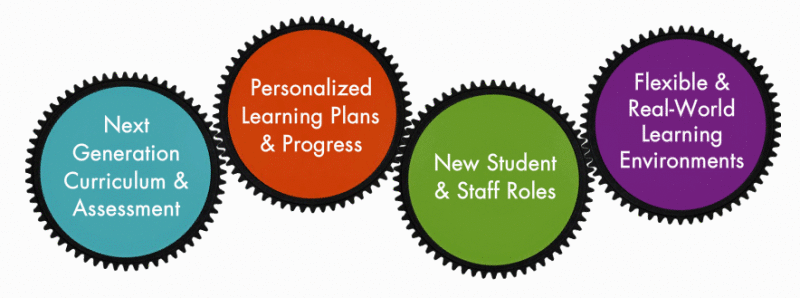
"attachmentsReducer": {
"audio_0": {
"type": "attachments",
"id": "audio_0",
"imgSizes": {
"kqedFullSize": {
"file": "https://ww2.kqed.org/news/wp-content/themes/KQED-unified/img/audio_bgs/background0.jpg"
}
}
},
"audio_1": {
"type": "attachments",
"id": "audio_1",
"imgSizes": {
"kqedFullSize": {
"file": "https://ww2.kqed.org/news/wp-content/themes/KQED-unified/img/audio_bgs/background1.jpg"
}
}
},
"audio_2": {
"type": "attachments",
"id": "audio_2",
"imgSizes": {
"kqedFullSize": {
"file": "https://ww2.kqed.org/news/wp-content/themes/KQED-unified/img/audio_bgs/background2.jpg"
}
}
},
"audio_3": {
"type": "attachments",
"id": "audio_3",
"imgSizes": {
"kqedFullSize": {
"file": "https://ww2.kqed.org/news/wp-content/themes/KQED-unified/img/audio_bgs/background3.jpg"
}
}
},
"audio_4": {
"type": "attachments",
"id": "audio_4",
"imgSizes": {
"kqedFullSize": {
"file": "https://ww2.kqed.org/news/wp-content/themes/KQED-unified/img/audio_bgs/background4.jpg"
}
}
},
"placeholder": {
"type": "attachments",
"id": "placeholder",
"imgSizes": {
"thumbnail": {
"file": "https://cdn.kqed.org/wp-content/uploads/2024/12/KQED-Default-Image-816638274-2000x1333-1-160x107.jpg",
"width": 160,
"height": 107,
"mimeType": "image/jpeg"
},
"medium": {
"file": "https://cdn.kqed.org/wp-content/uploads/2024/12/KQED-Default-Image-816638274-2000x1333-1-800x533.jpg",
"width": 800,
"height": 533,
"mimeType": "image/jpeg"
},
"medium_large": {
"file": "https://cdn.kqed.org/wp-content/uploads/2024/12/KQED-Default-Image-816638274-2000x1333-1-768x512.jpg",
"width": 768,
"height": 512,
"mimeType": "image/jpeg"
},
"large": {
"file": "https://cdn.kqed.org/wp-content/uploads/2024/12/KQED-Default-Image-816638274-2000x1333-1-1020x680.jpg",
"width": 1020,
"height": 680,
"mimeType": "image/jpeg"
},
"1536x1536": {
"file": "https://cdn.kqed.org/wp-content/uploads/2024/12/KQED-Default-Image-816638274-2000x1333-1-1536x1024.jpg",
"width": 1536,
"height": 1024,
"mimeType": "image/jpeg"
},
"fd-lrg": {
"file": "https://cdn.kqed.org/wp-content/uploads/2024/12/KQED-Default-Image-816638274-2000x1333-1-1536x1024.jpg",
"width": 1536,
"height": 1024,
"mimeType": "image/jpeg"
},
"fd-med": {
"file": "https://cdn.kqed.org/wp-content/uploads/2024/12/KQED-Default-Image-816638274-2000x1333-1-1020x680.jpg",
"width": 1020,
"height": 680,
"mimeType": "image/jpeg"
},
"fd-sm": {
"file": "https://cdn.kqed.org/wp-content/uploads/2024/12/KQED-Default-Image-816638274-2000x1333-1-800x533.jpg",
"width": 800,
"height": 533,
"mimeType": "image/jpeg"
},
"post-thumbnail": {
"file": "https://cdn.kqed.org/wp-content/uploads/2024/12/KQED-Default-Image-816638274-2000x1333-1-672x372.jpg",
"width": 672,
"height": 372,
"mimeType": "image/jpeg"
},
"twentyfourteen-full-width": {
"file": "https://cdn.kqed.org/wp-content/uploads/2024/12/KQED-Default-Image-816638274-2000x1333-1-1038x576.jpg",
"width": 1038,
"height": 576,
"mimeType": "image/jpeg"
},
"xxsmall": {
"file": "https://cdn.kqed.org/wp-content/uploads/2024/12/KQED-Default-Image-816638274-2000x1333-1-160x107.jpg",
"width": 160,
"height": 107,
"mimeType": "image/jpeg"
},
"xsmall": {
"file": "https://cdn.kqed.org/wp-content/uploads/2024/12/KQED-Default-Image-816638274-2000x1333-1-672x372.jpg",
"width": 672,
"height": 372,
"mimeType": "image/jpeg"
},
"small": {
"file": "https://cdn.kqed.org/wp-content/uploads/2024/12/KQED-Default-Image-816638274-2000x1333-1-672x372.jpg",
"width": 672,
"height": 372,
"mimeType": "image/jpeg"
},
"xlarge": {
"file": "https://cdn.kqed.org/wp-content/uploads/2024/12/KQED-Default-Image-816638274-2000x1333-1-1020x680.jpg",
"width": 1020,
"height": 680,
"mimeType": "image/jpeg"
},
"full-width": {
"file": "https://cdn.kqed.org/wp-content/uploads/2024/12/KQED-Default-Image-816638274-2000x1333-1-1920x1280.jpg",
"width": 1920,
"height": 1280,
"mimeType": "image/jpeg"
},
"guest-author-32": {
"file": "https://cdn.kqed.org/wp-content/uploads/2025/01/KQED-Default-Image-816638274-1333x1333-1-160x160.jpg",
"width": 32,
"height": 32,
"mimeType": "image/jpeg"
},
"guest-author-50": {
"file": "https://cdn.kqed.org/wp-content/uploads/2025/01/KQED-Default-Image-816638274-1333x1333-1-160x160.jpg",
"width": 50,
"height": 50,
"mimeType": "image/jpeg"
},
"guest-author-64": {
"file": "https://cdn.kqed.org/wp-content/uploads/2025/01/KQED-Default-Image-816638274-1333x1333-1-160x160.jpg",
"width": 64,
"height": 64,
"mimeType": "image/jpeg"
},
"guest-author-96": {
"file": "https://cdn.kqed.org/wp-content/uploads/2025/01/KQED-Default-Image-816638274-1333x1333-1-160x160.jpg",
"width": 96,
"height": 96,
"mimeType": "image/jpeg"
},
"guest-author-128": {
"file": "https://cdn.kqed.org/wp-content/uploads/2025/01/KQED-Default-Image-816638274-1333x1333-1-160x160.jpg",
"width": 128,
"height": 128,
"mimeType": "image/jpeg"
},
"detail": {
"file": "https://cdn.kqed.org/wp-content/uploads/2025/01/KQED-Default-Image-816638274-1333x1333-1-160x160.jpg",
"width": 160,
"height": 160,
"mimeType": "image/jpeg"
},
"kqedFullSize": {
"file": "https://cdn.kqed.org/wp-content/uploads/2024/12/KQED-Default-Image-816638274-2000x1333-1.jpg",
"width": 2000,
"height": 1333
}
}
},
"mindshift_26345": {
"type": "attachments",
"id": "mindshift_26345",
"meta": {
"index": "attachments_1716263798",
"site": "mindshift",
"id": "26345",
"found": true
},
"parent": 26340,
"imgSizes": {
"thumbnail": {
"file": "https://ww2.kqed.org/app/uploads/sites/23/2013/01/izone-400x149.gif",
"width": 400,
"mimeType": "image/gif",
"height": 149
},
"fd-sm": {
"file": "https://ww2.kqed.org/app/uploads/sites/23/2013/01/izone-320x119.gif",
"width": 320,
"mimeType": "image/gif",
"height": 119
},
"post-thumbnail": {
"file": "https://ww2.kqed.org/app/uploads/sites/23/2013/01/izone-672x329.gif",
"width": 672,
"mimeType": "image/gif",
"height": 329
},
"kqedFullSize": {
"file": "https://ww2.kqed.org/app/uploads/sites/23/2013/01/izone.gif",
"width": 884,
"height": 329
},
"fd-med": {
"file": "https://ww2.kqed.org/app/uploads/sites/23/2013/01/izone-768x286.gif",
"width": 768,
"mimeType": "image/gif",
"height": 286
},
"guest-author-96": {
"file": "https://ww2.kqed.org/app/uploads/sites/23/2013/01/izone-96x96.gif",
"width": 96,
"mimeType": "image/gif",
"height": 96
},
"medium": {
"file": "https://ww2.kqed.org/app/uploads/sites/23/2013/01/izone-800x298.gif",
"width": 800,
"mimeType": "image/gif",
"height": 298
},
"guest-author-64": {
"file": "https://ww2.kqed.org/app/uploads/sites/23/2013/01/izone-64x64.gif",
"width": 64,
"mimeType": "image/gif",
"height": 64
},
"detail": {
"file": "https://ww2.kqed.org/app/uploads/sites/23/2013/01/izone-75x75.gif",
"width": 75,
"mimeType": "image/gif",
"height": 75
},
"guest-author-32": {
"file": "https://ww2.kqed.org/app/uploads/sites/23/2013/01/izone-32x32.gif",
"width": 32,
"mimeType": "image/gif",
"height": 32
},
"guest-author-128": {
"file": "https://ww2.kqed.org/app/uploads/sites/23/2013/01/izone-128x128.gif",
"width": 128,
"mimeType": "image/gif",
"height": 128
}
},
"publishDate": 1357886515,
"modified": 1357886515,
"caption": null,
"description": null,
"title": "izone",
"credit": null,
"status": "inherit",
"isLoading": false,
"fetchFailed": false
},
"mindshift_26628": {
"type": "attachments",
"id": "mindshift_26628",
"meta": {
"index": "attachments_1716263798",
"site": "mindshift",
"id": "26628",
"found": true
},
"parent": 26619,
"imgSizes": {
"thumbnail": {
"file": "https://ww2.kqed.org/app/uploads/sites/23/2013/01/Rocketship2-400x258.jpg",
"width": 400,
"mimeType": "image/jpeg",
"height": 258
},
"fd-sm": {
"file": "https://ww2.kqed.org/app/uploads/sites/23/2013/01/Rocketship2-320x206.jpg",
"width": 320,
"mimeType": "image/jpeg",
"height": 206
},
"post-thumbnail": {
"file": "https://ww2.kqed.org/app/uploads/sites/23/2013/01/Rocketship2-620x372.jpg",
"width": 620,
"mimeType": "image/jpeg",
"height": 372
},
"kqedFullSize": {
"file": "https://ww2.kqed.org/app/uploads/sites/23/2013/01/Rocketship2.jpg",
"width": 620,
"height": 400
},
"guest-author-96": {
"file": "https://ww2.kqed.org/app/uploads/sites/23/2013/01/Rocketship2-96x96.jpg",
"width": 96,
"mimeType": "image/jpeg",
"height": 96
},
"guest-author-64": {
"file": "https://ww2.kqed.org/app/uploads/sites/23/2013/01/Rocketship2-64x64.jpg",
"width": 64,
"mimeType": "image/jpeg",
"height": 64
},
"detail": {
"file": "https://ww2.kqed.org/app/uploads/sites/23/2013/01/Rocketship2-75x75.jpg",
"width": 75,
"mimeType": "image/jpeg",
"height": 75
},
"guest-author-32": {
"file": "https://ww2.kqed.org/app/uploads/sites/23/2013/01/Rocketship2-32x32.jpg",
"width": 32,
"mimeType": "image/jpeg",
"height": 32
},
"guest-author-128": {
"file": "https://ww2.kqed.org/app/uploads/sites/23/2013/01/Rocketship2-128x128.jpg",
"width": 128,
"mimeType": "image/jpeg",
"height": 128
}
},
"publishDate": 1358470824,
"modified": 1358470824,
"caption": null,
"description": null,
"title": "Rocketship2",
"credit": null,
"status": "inherit",
"isLoading": false,
"fetchFailed": false
},
"mindshift_26515": {
"type": "attachments",
"id": "mindshift_26515",
"meta": {
"index": "attachments_1716263798",
"site": "mindshift",
"id": "26515",
"found": true
},
"parent": 26416,
"imgSizes": {
"thumbnail": {
"file": "https://ww2.kqed.org/app/uploads/sites/23/2013/01/87180202-400x212.jpg",
"width": 400,
"mimeType": "image/jpeg",
"height": 212
},
"fd-sm": {
"file": "https://ww2.kqed.org/app/uploads/sites/23/2013/01/87180202-320x169.jpg",
"width": 320,
"mimeType": "image/jpeg",
"height": 169
},
"kqedFullSize": {
"file": "https://ww2.kqed.org/app/uploads/sites/23/2013/01/87180202.jpg",
"width": 590,
"height": 312
},
"guest-author-96": {
"file": "https://ww2.kqed.org/app/uploads/sites/23/2013/01/87180202-96x96.jpg",
"width": 96,
"mimeType": "image/jpeg",
"height": 96
},
"guest-author-64": {
"file": "https://ww2.kqed.org/app/uploads/sites/23/2013/01/87180202-64x64.jpg",
"width": 64,
"mimeType": "image/jpeg",
"height": 64
},
"detail": {
"file": "https://ww2.kqed.org/app/uploads/sites/23/2013/01/87180202-75x75.jpg",
"width": 75,
"mimeType": "image/jpeg",
"height": 75
},
"guest-author-32": {
"file": "https://ww2.kqed.org/app/uploads/sites/23/2013/01/87180202-32x32.jpg",
"width": 32,
"mimeType": "image/jpeg",
"height": 32
},
"guest-author-128": {
"file": "https://ww2.kqed.org/app/uploads/sites/23/2013/01/87180202-128x128.jpg",
"width": 128,
"mimeType": "image/jpeg",
"height": 128
}
},
"publishDate": 1358294237,
"modified": 1358294237,
"caption": null,
"description": "business concept/handshaking hands",
"title": "87180202",
"credit": null,
"status": "inherit",
"isLoading": false,
"fetchFailed": false
},
"mindshift_26495": {
"type": "attachments",
"id": "mindshift_26495",
"meta": {
"index": "attachments_1716263798",
"site": "mindshift",
"id": "26495",
"found": true
},
"parent": 26482,
"imgSizes": {
"thumbnail": {
"file": "https://ww2.kqed.org/app/uploads/sites/23/2013/01/Screen-Shot-2013-01-15-at-2.23.17-PM-400x196.png",
"width": 400,
"mimeType": "image/png",
"height": 196
},
"fd-sm": {
"file": "https://ww2.kqed.org/app/uploads/sites/23/2013/01/Screen-Shot-2013-01-15-at-2.23.17-PM-320x157.png",
"width": 320,
"mimeType": "image/png",
"height": 157
},
"post-thumbnail": {
"file": "https://ww2.kqed.org/app/uploads/sites/23/2013/01/Screen-Shot-2013-01-15-at-2.23.17-PM-672x335.png",
"width": 672,
"mimeType": "image/png",
"height": 335
},
"kqedFullSize": {
"file": "https://ww2.kqed.org/app/uploads/sites/23/2013/01/Screen-Shot-2013-01-15-at-2.23.17-PM.png",
"width": 684,
"height": 335
},
"guest-author-96": {
"file": "https://ww2.kqed.org/app/uploads/sites/23/2013/01/Screen-Shot-2013-01-15-at-2.23.17-PM-96x96.png",
"width": 96,
"mimeType": "image/png",
"height": 96
},
"guest-author-64": {
"file": "https://ww2.kqed.org/app/uploads/sites/23/2013/01/Screen-Shot-2013-01-15-at-2.23.17-PM-64x64.png",
"width": 64,
"mimeType": "image/png",
"height": 64
},
"detail": {
"file": "https://ww2.kqed.org/app/uploads/sites/23/2013/01/Screen-Shot-2013-01-15-at-2.23.17-PM-75x75.png",
"width": 75,
"mimeType": "image/png",
"height": 75
},
"guest-author-32": {
"file": "https://ww2.kqed.org/app/uploads/sites/23/2013/01/Screen-Shot-2013-01-15-at-2.23.17-PM-32x32.png",
"width": 32,
"mimeType": "image/png",
"height": 32
},
"guest-author-128": {
"file": "https://ww2.kqed.org/app/uploads/sites/23/2013/01/Screen-Shot-2013-01-15-at-2.23.17-PM-128x128.png",
"width": 128,
"mimeType": "image/png",
"height": 128
}
},
"publishDate": 1358288770,
"modified": 1358288770,
"caption": "Re-Roofing Your Uncle's House",
"description": null,
"title": "Re-Roofing",
"credit": null,
"status": "inherit",
"isLoading": false,
"fetchFailed": false
},
"mindshift_26452": {
"type": "attachments",
"id": "mindshift_26452",
"meta": {
"index": "attachments_1716263798",
"site": "mindshift",
"id": "26452",
"found": true
},
"parent": 26396,
"imgSizes": {
"thumbnail": {
"file": "https://ww2.kqed.org/app/uploads/sites/23/2013/01/728680151-400x266.jpg",
"width": 400,
"mimeType": "image/jpeg",
"height": 266
},
"fd-sm": {
"file": "https://ww2.kqed.org/app/uploads/sites/23/2013/01/728680151-320x213.jpg",
"width": 320,
"mimeType": "image/jpeg",
"height": 213
},
"post-thumbnail": {
"file": "https://ww2.kqed.org/app/uploads/sites/23/2013/01/728680151-672x372.jpg",
"width": 672,
"mimeType": "image/jpeg",
"height": 372
},
"kqedFullSize": {
"file": "https://ww2.kqed.org/app/uploads/sites/23/2013/01/728680151.jpg",
"width": 725,
"height": 483
},
"guest-author-96": {
"file": "https://ww2.kqed.org/app/uploads/sites/23/2013/01/728680151-96x96.jpg",
"width": 96,
"mimeType": "image/jpeg",
"height": 96
},
"guest-author-64": {
"file": "https://ww2.kqed.org/app/uploads/sites/23/2013/01/728680151-64x64.jpg",
"width": 64,
"mimeType": "image/jpeg",
"height": 64
},
"detail": {
"file": "https://ww2.kqed.org/app/uploads/sites/23/2013/01/728680151-75x75.jpg",
"width": 75,
"mimeType": "image/jpeg",
"height": 75
},
"guest-author-32": {
"file": "https://ww2.kqed.org/app/uploads/sites/23/2013/01/728680151-32x32.jpg",
"width": 32,
"mimeType": "image/jpeg",
"height": 32
},
"guest-author-128": {
"file": "https://ww2.kqed.org/app/uploads/sites/23/2013/01/728680151-128x128.jpg",
"width": 128,
"mimeType": "image/jpeg",
"height": 128
}
},
"publishDate": 1358188710,
"modified": 1358188710,
"caption": null,
"description": null,
"title": "72868015",
"credit": null,
"status": "inherit",
"isLoading": false,
"fetchFailed": false
},
"mindshift_26335": {
"type": "attachments",
"id": "mindshift_26335",
"meta": {
"index": "attachments_1716263798",
"site": "mindshift",
"id": "26335",
"found": true
},
"parent": 26312,
"imgSizes": {
"twentyfourteen-full-width": {
"file": "https://ww2.kqed.org/app/uploads/sites/23/2013/01/MOOC-1038x576.png",
"width": 1038,
"mimeType": "image/png",
"height": 576
},
"thumbnail": {
"file": "https://ww2.kqed.org/app/uploads/sites/23/2013/01/MOOC-400x232.png",
"width": 400,
"mimeType": "image/png",
"height": 232
},
"fd-sm": {
"file": "https://ww2.kqed.org/app/uploads/sites/23/2013/01/MOOC-320x186.png",
"width": 320,
"mimeType": "image/png",
"height": 186
},
"post-thumbnail": {
"file": "https://ww2.kqed.org/app/uploads/sites/23/2013/01/MOOC-672x372.png",
"width": 672,
"mimeType": "image/png",
"height": 372
},
"kqedFullSize": {
"file": "https://ww2.kqed.org/app/uploads/sites/23/2013/01/MOOC.png",
"width": 1231,
"height": 714
},
"guest-author-96": {
"file": "https://ww2.kqed.org/app/uploads/sites/23/2013/01/MOOC-96x96.png",
"width": 96,
"mimeType": "image/png",
"height": 96
},
"medium": {
"file": "https://ww2.kqed.org/app/uploads/sites/23/2013/01/MOOC-800x464.png",
"width": 800,
"mimeType": "image/png",
"height": 464
},
"guest-author-64": {
"file": "https://ww2.kqed.org/app/uploads/sites/23/2013/01/MOOC-64x64.png",
"width": 64,
"mimeType": "image/png",
"height": 64
},
"guest-author-32": {
"file": "https://ww2.kqed.org/app/uploads/sites/23/2013/01/MOOC-32x32.png",
"width": 32,
"mimeType": "image/png",
"height": 32
},
"fd-lrg": {
"file": "https://ww2.kqed.org/app/uploads/sites/23/2013/01/MOOC-1180x684.png",
"width": 1180,
"mimeType": "image/png",
"height": 684
},
"fd-med": {
"file": "https://ww2.kqed.org/app/uploads/sites/23/2013/01/MOOC-768x445.png",
"width": 768,
"mimeType": "image/png",
"height": 445
},
"detail": {
"file": "https://ww2.kqed.org/app/uploads/sites/23/2013/01/MOOC-75x75.png",
"width": 75,
"mimeType": "image/png",
"height": 75
},
"guest-author-128": {
"file": "https://ww2.kqed.org/app/uploads/sites/23/2013/01/MOOC-128x128.png",
"width": 128,
"mimeType": "image/png",
"height": 128
}
},
"publishDate": 1357843340,
"modified": 1357843340,
"caption": null,
"description": null,
"title": "MOOC",
"credit": null,
"status": "inherit",
"isLoading": false,
"fetchFailed": false
},
"mindshift_26248": {
"type": "attachments",
"id": "mindshift_26248",
"meta": {
"index": "attachments_1716263798",
"site": "mindshift",
"id": "26248",
"found": true
},
"parent": 26245,
"imgSizes": {
"thumbnail": {
"file": "https://ww2.kqed.org/app/uploads/sites/23/2013/01/IMG_8535-400x266.jpg",
"width": 400,
"mimeType": "image/jpeg",
"height": 266
},
"fd-sm": {
"file": "https://ww2.kqed.org/app/uploads/sites/23/2013/01/IMG_8535-320x213.jpg",
"width": 320,
"mimeType": "image/jpeg",
"height": 213
},
"post-thumbnail": {
"file": "https://ww2.kqed.org/app/uploads/sites/23/2013/01/IMG_8535-650x372.jpg",
"width": 650,
"mimeType": "image/jpeg",
"height": 372
},
"kqedFullSize": {
"file": "https://ww2.kqed.org/app/uploads/sites/23/2013/01/IMG_8535.jpg",
"width": 650,
"height": 433
},
"guest-author-96": {
"file": "https://ww2.kqed.org/app/uploads/sites/23/2013/01/IMG_8535-96x96.jpg",
"width": 96,
"mimeType": "image/jpeg",
"height": 96
},
"guest-author-64": {
"file": "https://ww2.kqed.org/app/uploads/sites/23/2013/01/IMG_8535-64x64.jpg",
"width": 64,
"mimeType": "image/jpeg",
"height": 64
},
"detail": {
"file": "https://ww2.kqed.org/app/uploads/sites/23/2013/01/IMG_8535-75x75.jpg",
"width": 75,
"mimeType": "image/jpeg",
"height": 75
},
"guest-author-32": {
"file": "https://ww2.kqed.org/app/uploads/sites/23/2013/01/IMG_8535-32x32.jpg",
"width": 32,
"mimeType": "image/jpeg",
"height": 32
},
"guest-author-128": {
"file": "https://ww2.kqed.org/app/uploads/sites/23/2013/01/IMG_8535-128x128.jpg",
"width": 128,
"mimeType": "image/jpeg",
"height": 128
}
},
"publishDate": 1357588586,
"modified": 1357588586,
"caption": null,
"description": null,
"title": "IMG_8535",
"credit": null,
"status": "inherit",
"isLoading": false,
"fetchFailed": false
},
"mindshift_26181": {
"type": "attachments",
"id": "mindshift_26181",
"meta": {
"index": "attachments_1716263798",
"site": "mindshift",
"id": "26181",
"found": true
},
"parent": 26166,
"imgSizes": {
"thumbnail": {
"file": "https://ww2.kqed.org/app/uploads/sites/23/2013/01/Screen-Shot-2013-01-02-at-12.33.12-PM1-400x221.png",
"width": 400,
"mimeType": "image/png",
"height": 221
},
"fd-sm": {
"file": "https://ww2.kqed.org/app/uploads/sites/23/2013/01/Screen-Shot-2013-01-02-at-12.33.12-PM1-320x177.png",
"width": 320,
"mimeType": "image/png",
"height": 177
},
"kqedFullSize": {
"file": "https://ww2.kqed.org/app/uploads/sites/23/2013/01/Screen-Shot-2013-01-02-at-12.33.12-PM1.png",
"width": 635,
"height": 351
},
"guest-author-96": {
"file": "https://ww2.kqed.org/app/uploads/sites/23/2013/01/Screen-Shot-2013-01-02-at-12.33.12-PM1-96x96.png",
"width": 96,
"mimeType": "image/png",
"height": 96
},
"guest-author-64": {
"file": "https://ww2.kqed.org/app/uploads/sites/23/2013/01/Screen-Shot-2013-01-02-at-12.33.12-PM1-64x64.png",
"width": 64,
"mimeType": "image/png",
"height": 64
},
"detail": {
"file": "https://ww2.kqed.org/app/uploads/sites/23/2013/01/Screen-Shot-2013-01-02-at-12.33.12-PM1-75x75.png",
"width": 75,
"mimeType": "image/png",
"height": 75
},
"guest-author-32": {
"file": "https://ww2.kqed.org/app/uploads/sites/23/2013/01/Screen-Shot-2013-01-02-at-12.33.12-PM1-32x32.png",
"width": 32,
"mimeType": "image/png",
"height": 32
},
"guest-author-128": {
"file": "https://ww2.kqed.org/app/uploads/sites/23/2013/01/Screen-Shot-2013-01-02-at-12.33.12-PM1-128x128.png",
"width": 128,
"mimeType": "image/png",
"height": 128
}
},
"publishDate": 1357171537,
"modified": 1357171537,
"caption": null,
"description": null,
"title": "Screen-Shot-2013-01-02-at-12.33.12-PM1",
"credit": null,
"status": "inherit",
"isLoading": false,
"fetchFailed": false
},
"mindshift_26004": {
"type": "attachments",
"id": "mindshift_26004",
"meta": {
"index": "attachments_1716263798",
"site": "mindshift",
"id": "26004",
"found": true
},
"parent": 26001,
"imgSizes": {
"thumbnail": {
"file": "https://ww2.kqed.org/app/uploads/sites/23/2012/12/demoshelsinki-1-400x266.jpg",
"width": 400,
"mimeType": "image/jpeg",
"height": 266
},
"fd-sm": {
"file": "https://ww2.kqed.org/app/uploads/sites/23/2012/12/demoshelsinki-1-320x213.jpg",
"width": 320,
"mimeType": "image/jpeg",
"height": 213
},
"kqedFullSize": {
"file": "https://ww2.kqed.org/app/uploads/sites/23/2012/12/demoshelsinki-1.jpg",
"width": 500,
"height": 333
},
"guest-author-96": {
"file": "https://ww2.kqed.org/app/uploads/sites/23/2012/12/demoshelsinki-1-96x96.jpg",
"width": 96,
"mimeType": "image/jpeg",
"height": 96
},
"guest-author-64": {
"file": "https://ww2.kqed.org/app/uploads/sites/23/2012/12/demoshelsinki-1-64x64.jpg",
"width": 64,
"mimeType": "image/jpeg",
"height": 64
},
"detail": {
"file": "https://ww2.kqed.org/app/uploads/sites/23/2012/12/demoshelsinki-1-75x75.jpg",
"width": 75,
"mimeType": "image/jpeg",
"height": 75
},
"guest-author-32": {
"file": "https://ww2.kqed.org/app/uploads/sites/23/2012/12/demoshelsinki-1-32x32.jpg",
"width": 32,
"mimeType": "image/jpeg",
"height": 32
},
"guest-author-128": {
"file": "https://ww2.kqed.org/app/uploads/sites/23/2012/12/demoshelsinki-1-128x128.jpg",
"width": 128,
"mimeType": "image/jpeg",
"height": 128
}
},
"publishDate": 1356135427,
"modified": 1356135427,
"caption": null,
"description": null,
"title": "demoshelsinki-1",
"credit": null,
"status": "inherit",
"isLoading": false,
"fetchFailed": false
},
"mindshift_25985": {
"type": "attachments",
"id": "mindshift_25985",
"meta": {
"index": "attachments_1716263798",
"site": "mindshift",
"id": "25985",
"found": true
},
"parent": 25899,
"imgSizes": {
"thumbnail": {
"file": "https://ww2.kqed.org/app/uploads/sites/23/2012/12/kid-400x218.png",
"width": 400,
"mimeType": "image/png",
"height": 218
},
"fd-sm": {
"file": "https://ww2.kqed.org/app/uploads/sites/23/2012/12/kid-320x174.png",
"width": 320,
"mimeType": "image/png",
"height": 174
},
"kqedFullSize": {
"file": "https://ww2.kqed.org/app/uploads/sites/23/2012/12/kid.png",
"width": 620,
"height": 338
},
"guest-author-96": {
"file": "https://ww2.kqed.org/app/uploads/sites/23/2012/12/kid-96x96.png",
"width": 96,
"mimeType": "image/png",
"height": 96
},
"guest-author-64": {
"file": "https://ww2.kqed.org/app/uploads/sites/23/2012/12/kid-64x64.png",
"width": 64,
"mimeType": "image/png",
"height": 64
},
"detail": {
"file": "https://ww2.kqed.org/app/uploads/sites/23/2012/12/kid-75x75.png",
"width": 75,
"mimeType": "image/png",
"height": 75
},
"guest-author-32": {
"file": "https://ww2.kqed.org/app/uploads/sites/23/2012/12/kid-32x32.png",
"width": 32,
"mimeType": "image/png",
"height": 32
},
"guest-author-128": {
"file": "https://ww2.kqed.org/app/uploads/sites/23/2012/12/kid-128x128.png",
"width": 128,
"mimeType": "image/png",
"height": 128
}
},
"publishDate": 1356132286,
"modified": 1356132286,
"caption": null,
"description": null,
"title": "kid",
"credit": null,
"status": "inherit",
"isLoading": false,
"fetchFailed": false
},
"mindshift_25845": {
"type": "attachments",
"id": "mindshift_25845",
"meta": {
"index": "attachments_1716263798",
"site": "mindshift",
"id": "25845",
"found": true
},
"parent": 25674,
"imgSizes": {
"thumbnail": {
"file": "https://ww2.kqed.org/app/uploads/sites/23/2012/12/cellphone-400x279.jpg",
"width": 400,
"mimeType": "image/jpeg",
"height": 279
},
"fd-sm": {
"file": "https://ww2.kqed.org/app/uploads/sites/23/2012/12/cellphone-320x224.jpg",
"width": 320,
"mimeType": "image/jpeg",
"height": 224
},
"post-thumbnail": {
"file": "https://ww2.kqed.org/app/uploads/sites/23/2012/12/cellphone-650x372.jpg",
"width": 650,
"mimeType": "image/jpeg",
"height": 372
},
"kqedFullSize": {
"file": "https://ww2.kqed.org/app/uploads/sites/23/2012/12/cellphone.jpg",
"width": 650,
"height": 454
},
"guest-author-96": {
"file": "https://ww2.kqed.org/app/uploads/sites/23/2012/12/cellphone-96x96.jpg",
"width": 96,
"mimeType": "image/jpeg",
"height": 96
},
"guest-author-64": {
"file": "https://ww2.kqed.org/app/uploads/sites/23/2012/12/cellphone-64x64.jpg",
"width": 64,
"mimeType": "image/jpeg",
"height": 64
},
"detail": {
"file": "https://ww2.kqed.org/app/uploads/sites/23/2012/12/cellphone-75x75.jpg",
"width": 75,
"mimeType": "image/jpeg",
"height": 75
},
"guest-author-32": {
"file": "https://ww2.kqed.org/app/uploads/sites/23/2012/12/cellphone-32x32.jpg",
"width": 32,
"mimeType": "image/jpeg",
"height": 32
},
"guest-author-128": {
"file": "https://ww2.kqed.org/app/uploads/sites/23/2012/12/cellphone-128x128.jpg",
"width": 128,
"mimeType": "image/jpeg",
"height": 128
}
},
"publishDate": 1355944895,
"modified": 1355944895,
"caption": null,
"description": null,
"title": "cellphone",
"credit": null,
"status": "inherit",
"isLoading": false,
"fetchFailed": false
},
"mindshift_25751": {
"type": "attachments",
"id": "mindshift_25751",
"meta": {
"index": "attachments_1716263798",
"site": "mindshift",
"id": "25751",
"found": true
},
"parent": 25750,
"imgSizes": {
"twentyfourteen-full-width": {
"file": "https://ww2.kqed.org/app/uploads/sites/23/2012/12/We-are-Teachers-700x576.jpeg",
"width": 700,
"mimeType": "image/jpeg",
"height": 576
},
"thumbnail": {
"file": "https://ww2.kqed.org/app/uploads/sites/23/2012/12/We-are-Teachers-400x659.jpeg",
"width": 400,
"mimeType": "image/jpeg",
"height": 659
},
"fd-sm": {
"file": "https://ww2.kqed.org/app/uploads/sites/23/2012/12/We-are-Teachers-320x527.jpeg",
"width": 320,
"mimeType": "image/jpeg",
"height": 527
},
"post-thumbnail": {
"file": "https://ww2.kqed.org/app/uploads/sites/23/2012/12/We-are-Teachers-672x372.jpeg",
"width": 672,
"mimeType": "image/jpeg",
"height": 372
},
"kqedFullSize": {
"file": "https://ww2.kqed.org/app/uploads/sites/23/2012/12/We-are-Teachers.jpeg",
"width": 700,
"height": 1153
},
"guest-author-96": {
"file": "https://ww2.kqed.org/app/uploads/sites/23/2012/12/We-are-Teachers-96x96.jpeg",
"width": 96,
"mimeType": "image/jpeg",
"height": 96
},
"guest-author-64": {
"file": "https://ww2.kqed.org/app/uploads/sites/23/2012/12/We-are-Teachers-64x64.jpeg",
"width": 64,
"mimeType": "image/jpeg",
"height": 64
},
"detail": {
"file": "https://ww2.kqed.org/app/uploads/sites/23/2012/12/We-are-Teachers-75x75.jpeg",
"width": 75,
"mimeType": "image/jpeg",
"height": 75
},
"guest-author-32": {
"file": "https://ww2.kqed.org/app/uploads/sites/23/2012/12/We-are-Teachers-32x32.jpeg",
"width": 32,
"mimeType": "image/jpeg",
"height": 32
},
"guest-author-128": {
"file": "https://ww2.kqed.org/app/uploads/sites/23/2012/12/We-are-Teachers-128x128.jpeg",
"width": 128,
"mimeType": "image/jpeg",
"height": 128
}
},
"publishDate": 1355792631,
"modified": 1355792631,
"caption": null,
"description": null,
"title": "We are Teachers",
"credit": null,
"status": "inherit",
"isLoading": false,
"fetchFailed": false
}
},
"audioPlayerReducer": {
"postId": "stream_live",
"isPaused": true,
"isPlaying": false,
"pfsActive": false,
"pledgeModalIsOpen": true,
"playerDrawerIsOpen": false,
"liveAudioPlayStartedAt": 0,
"liveAudioPlayContext": ""
},
"authorsReducer": {
"tbarseghian": {
"type": "authors",
"id": "180",
"meta": {
"index": "authors_1716337520",
"id": "180",
"found": true
},
"name": "Tina Barseghian",
"firstName": "Tina",
"lastName": "Barseghian",
"slug": "tbarseghian",
"email": "tbarseghian@kqed.org",
"display_author_email": false,
"staff_mastheads": [],
"title": null,
"bio": null,
"avatar": "https://secure.gravatar.com/avatar/de7e6ced1239b7018fe4d2b61f723c90?s=600&d=blank&r=g",
"twitter": null,
"facebook": null,
"instagram": null,
"linkedin": null,
"sites": [
{
"site": "styleguide",
"roles": [
"contributor"
]
},
{
"site": "news",
"roles": [
"subscriber"
]
},
{
"site": "mindshift",
"roles": [
"subscriber"
]
},
{
"site": "bayareabites",
"roles": [
"subscriber"
]
}
],
"headData": {
"title": "Tina Barseghian | KQED",
"description": null,
"ogImgSrc": "https://secure.gravatar.com/avatar/de7e6ced1239b7018fe4d2b61f723c90?s=600&d=blank&r=g",
"twImgSrc": "https://secure.gravatar.com/avatar/de7e6ced1239b7018fe4d2b61f723c90?s=600&d=blank&r=g"
},
"isLoading": false,
"link": "/author/tbarseghian"
},
"katrinaschwartz": {
"type": "authors",
"id": "234",
"meta": {
"index": "authors_1716337520",
"id": "234",
"found": true
},
"name": "Katrina Schwartz",
"firstName": "Katrina",
"lastName": "Schwartz",
"slug": "katrinaschwartz",
"email": "kschwartz@kqed.org",
"display_author_email": false,
"staff_mastheads": [
"news"
],
"title": "Producer",
"bio": "Katrina Schwartz is a journalist based in San Francisco. She's worked at KPCC public radio in LA and has reported on air and online for KQED since 2010. She covered how teaching and learning is changing for MindShift between 2012 and 2020. She is the co-host of the MindShift podcast and now produces KQED's Bay Curious podcast.",
"avatar": "https://secure.gravatar.com/avatar/edb4ee79070447a018538c9aae6eeecf28786515b8a0c30e43b6b7dce5aa44c8?s=600&d=blank&r=g",
"twitter": "kschwart",
"bluesky": null,
"facebook": null,
"instagram": null,
"linkedin": null,
"sites": [
{
"site": "",
"roles": [
"editor"
]
},
{
"site": "news",
"roles": [
"editor"
]
},
{
"site": "mindshift",
"roles": [
"administrator"
]
},
{
"site": "stateofhealth",
"roles": [
"author"
]
},
{
"site": "science",
"roles": [
"editor"
]
}
],
"headData": {
"title": "Katrina Schwartz | KQED",
"description": "Producer",
"ogImgSrc": "https://secure.gravatar.com/avatar/edb4ee79070447a018538c9aae6eeecf28786515b8a0c30e43b6b7dce5aa44c8?s=600&d=blank&r=g",
"twImgSrc": "https://secure.gravatar.com/avatar/edb4ee79070447a018538c9aae6eeecf28786515b8a0c30e43b6b7dce5aa44c8?s=600&d=blank&r=g"
},
"isLoading": false,
"link": "/author/katrinaschwartz"
},
"frankcatalano": {
"type": "authors",
"id": "4375",
"meta": {
"index": "authors_1716337520",
"id": "4375",
"found": true
},
"name": "Frank Catalano",
"firstName": "Frank",
"lastName": "Catalano",
"slug": "frankcatalano",
"email": "frank@intrinsicstrategy.com",
"display_author_email": false,
"staff_mastheads": [],
"title": null,
"bio": null,
"avatar": "https://secure.gravatar.com/avatar/cdaee2f69a326e0989fd01d137b85954?s=600&d=blank&r=g",
"twitter": null,
"facebook": null,
"instagram": null,
"linkedin": null,
"sites": [
{
"site": "mindshift",
"roles": [
"subscriber"
]
}
],
"headData": {
"title": "Frank Catalano | KQED",
"description": null,
"ogImgSrc": "https://secure.gravatar.com/avatar/cdaee2f69a326e0989fd01d137b85954?s=600&d=blank&r=g",
"twImgSrc": "https://secure.gravatar.com/avatar/cdaee2f69a326e0989fd01d137b85954?s=600&d=blank&r=g"
},
"isLoading": false,
"link": "/author/frankcatalano"
}
},
"pagesReducer": {
"mindshift_category_digital-tools": {
"type": "terms",
"id": "mindshift_195",
"meta": {
"index": "terms_1716263798",
"site": "mindshift",
"id": "195",
"score": 14.406237
},
"featImg": null,
"name": "Digital Tools",
"description": "How devices, software, and the Internet are changing the classroom dynamic.",
"taxonomy": "category",
"headData": {
"twImgId": null,
"twTitle": null,
"ogTitle": null,
"ogImgId": null,
"twDescription": null,
"description": "How devices, software, and the Internet are changing the classroom dynamic.",
"title": "Digital Tools Archives | KQED Mindshift",
"ogDescription": null
},
"ttid": 195,
"slug": "digital-tools",
"isLoading": false,
"title": "Digital Tools",
"pageMeta": {
"site": "mindshift",
"WpPageTemplate": "page-topic-editorial",
"currentPage": 32
},
"blocks": [
{
"blockName": "kqed/company-paragraph",
"content": "How devices, software, and the Internet are changing the classroom dynamic."
},
{
"blockName": "kqed/post-list",
"attrs": {
"layout": "cardArticle2",
"query": "posts/mindshift?category=digital-tools",
"seeMore": false,
"paginated": true,
"page": 32
}
},
{
"blockName": "kqed/ad"
}
]
}
},
"pfsSessionReducer": {},
"postsReducer": {
"stream_live": {
"type": "live",
"id": "stream_live",
"audioUrl": "https://streams.kqed.org/kqedradio",
"title": "Live Stream",
"excerpt": "Live Stream information currently unavailable.",
"link": "/radio",
"featImg": "",
"label": {
"name": "KQED Live",
"link": "/"
}
},
"stream_kqedNewscast": {
"type": "posts",
"id": "stream_kqedNewscast",
"audioUrl": "https://www.kqed.org/.stream/anon/radio/RDnews/newscast.mp3?_=1",
"title": "KQED Newscast",
"featImg": "",
"label": {
"name": "88.5 FM",
"link": "/"
}
},
"mindshift_26340": {
"type": "posts",
"id": "mindshift_26340",
"meta": {
"index": "posts_1716263798",
"site": "mindshift",
"id": "26340",
"score": null,
"sort": [
1358970333000
]
},
"parent": 0,
"labelTerm": {
"site": "mindshift"
},
"blocks": [],
"publishDate": 1358970333,
"format": "aside",
"disqusTitle": "Experimenting and Innovating: How to Find the Best Tools and Tactics",
"title": "Experimenting and Innovating: How to Find the Best Tools and Tactics",
"headTitle": "MindShift | KQED News",
"content": "\u003cfigure id=\"attachment_26703\" class=\"wp-caption center\" style=\"max-width: 620px\">\u003ca href=\"http://ww2.kqed.org/mindshift/2013/01/experimenting-and-innovating-finding-the-best-tools-and-tactics/screen-shot-2013-01-23-at-11-33-33-am/\" rel=\"attachment wp-att-26703\">\u003cimg class=\"size-large wp-image-26703\" title=\"\" src=\"http://ww2.kqed.org/mindshift/wp-content/uploads/sites/23/2013/01/Screen-Shot-2013-01-23-at-11.33.33-AM-620x322.png\" alt=\"Screen Shot 2013-01-23 at 11.33.33 AM\" width=\"620\" height=\"322\">\u003c/a>\u003cfigcaption class=\"wp-caption-text\"> \u003c/figcaption>\u003c/figure>\n\u003cp class=\"dropcap-serif\">New York City is experimenting with new tools and tactics with its \u003ca href=\"http://schools.nyc.gov/community/innovation/izone/default.htm\">Innovation Zone\u003c/a>, a devoted unit for trying out new approaches to learning and sharing best practices with like-minded educators. The iZone, as it's commonly called, started in the 2010-11 school year with 81 schools, and since then, they’ve more than doubled that number and hope to reach 400 participating schools by 2014.\u003c/p>\n\u003cp>Schools across the system are trying out different learning approaches, including blended learning, online courses and project-based teaching. As with the most lofty aspirations of educators, the iZone's \u003ca href=\"http://schools.nyc.gov/community/innovation/izone/Innovations/framework/default.htm\">goals\u003c/a> are to personalize learning, provide real-world experience, change the ways staff and students view their roles and take advantage of the vast number of tools available to students and teachers.\u003c/p>\n\u003cp>The iZone serves as a hub for innovation taking place at school sites. Staff support schools with funding for equipment, connecting teachers to resources and one another, as well as serving as the repository for the growing body of knowledge about progressive approaches. Though the project is still young, this program has made a dent in differentiating learning, according to Deputy Chancellor for Talent, Labor and Innovation, David Weiner.\u003c/p>\n\u003caside class=\"pullquote alignright\">\n\u003cp>“It can be really hard for the leader to shield teachers from traditional measures so that they can feel free to innovate.”\u003c/p>\n\u003c/aside>\n\u003cp>For example, in participating high schools, the 35-40 percent of students who are taking an online English Language Arts class are passing the state’s Regents test at the same rate as students in traditional classrooms. \u003c!--more-->\u003c/p>\n\u003cp>Another example is\u003ca href=\"http://www.globaltechprep.com/\"> the Global Technology Preparatory,\u003c/a> which has been part of the iZone from the beginning. Founded in 2009, the middle school is universal title one, meaning that most kids get free or reduced lunch. About 40 percent of their students are special-ed and many are behind grade level. In this school, every child has a laptop and students have access to many outside resources to help supplement their school day.\u003c/p>\n\u003cp>[ad fullwidth]\u003c/p>\n\u003cp style=\"text-align: center\">\u003cspan style=\"color: #808080\">\u003cstrong>[\u003c/strong>\u003cspan style=\"color: #000000\">RELATED READING:\u003c/span>\u003c/span> \u003ca href=\"http://ww2.kqed.org/mindshift/2011/03/new-york-city-schools-blended-learning-experiment/\">New York City Schools’ Blended Learning Experiment\u003c/a>]\u003c/p>\n\u003cp>All this tech equipment and professional development takes money, of course, and most of the funding has come from \u003ca href=\"http://www.globaltechprep.com/partners\">networking and fundraising\u003c/a> by the school’s principal Chrystina Russell, who has courted high-tech companies for funds and computers, has partnered with community-based organizations, and supported her teachers through the sometimes rough process of experimenting with new teaching techniques.\u003c/p>\n\u003cp>“Our students have a ton of potential and also a lot of need,” Russell said. “So in my mind it’s the only way to go.” Global Tech Prep’s school day runs until 6:30 p.m. because of a partnership with \u003ca href=\"http://ww2.kqed.org/mindshift/2011/04/can-a-9-hour-school-day-prevent-students-from-dropping-out/\">Citizen Schools, \u003c/a>an after school enrichment program in which eighth-grade students learn about networking and visit workplaces through a partnership with the \u003ca href=\"http://www.nycup.org/\">Council of Urban Professionals\u003c/a>; and all students take college trips to help build a college-going culture with support from \u003ca href=\"http://www.collegefes.org/\">College For Every Student\u003c/a>.\u003c/p>\n\u003cp>Still, in the classroom teachers face the same challenges of bringing under-prepared kids up to grade level.\u003c/p>\n\u003cp>Jhonary Bridgemohan, who teaches sixth-grade Language Arts at Global Tech Prep, has been experimenting with various software programs and web tools. She uses Achieve3000, partly because she finds it helps create a culture of reading to assign an article everyday, and it gets kids accustomed to non-fiction, a big part of the common core standards.\u003c/p>\n\u003cfigure id=\"attachment_26345\" class=\"wp-caption center\" style=\"max-width: 620px\">\u003ca href=\"http://ww2.kqed.org/mindshift/2013/01/experimenting-and-innovating-finding-the-best-tools-and-tactics/izone/\" rel=\"attachment wp-att-26345\">\u003cimg class=\"size-large wp-image-26345\" title=\"\" src=\"http://ww2.kqed.org/mindshift/wp-content/uploads/sites/23/2013/01/izone-620x230.gif\" alt=\"izone\" width=\"620\" height=\"230\">\u003c/a>\u003cfigcaption class=\"wp-caption-text\"> \u003c/figcaption>\u003c/figure>\n\u003cp>“You do have these moments when they’re checked out, but then you have these articles that spur that ‘Wow, I want to know more’ moments,” Bridgemohan said. She thinks Achieve3000 is benefiting her students, though it is far from perfect.\u003c/p>\n\u003cp>Bridgemohan also uses simpler tools that she finds very effective – like Google docs. Most of the students write in Google docs, so she can easily keep track of assignments and give real-time feedback on their writing.\u003c/p>\n\u003cp>“Once they write something out it’s really hard to get them to go back and edit, but if they can see their work as a work-in-progress they see it more as a process,” Bridgemohan said. “And I’m part of that process with them.” The online tool also gives students a chance to innovate in their own right, something their teacher loves to watch. “Seeing them interact and be creative with the tools they have access to is really cool,” she said.\u003c/p>\n\u003cp style=\"text-align: center\">\u003cspan style=\"color: #808080\">\u003cstrong>[\u003cspan style=\"color: #000000\">RELATED: \u003c/span>\u003c/strong>\u003ca href=\"http://ww2.kqed.org/mindshift/2013/01/what-online-tools-work-for-language-arts/\">What Online Tools Work for Teaching Language Arts?\u003c/a>\u003cstrong>]\u003c/strong>\u003c/span>\u003c/p>\n\u003cp>Like many teachers experimenting with blended learning methods, Bridgemohan doesn’t have it all figured out yet. She’s still refining her approach, trying new software, and ditching the things that don’t work. She’s found some success with \u003ca href=\"http://www.studyisland.com\">Study Island\u003c/a> for skill review because she can give them a lesson that they go back and review as they do the work. She finds it especially useful for grammar skills like comma usage and for sentence structure and organization tips.\u003c/p>\n\u003cp>Global Tech Prep also has new grading software called \u003ca href=\"http://www.jupitergrades.com/\">Jupiter Grades\u003c/a>, which has been branching into online testing. Bridgemohan has experimented with the software to give online tests, hoping to save herself some grading time. Still, her advice to any teacher dabbling in classroom technology is to take it slow.\u003c/p>\n\u003cp>“I think it’s important to not do it all together,” she said. “There are a lot of options and it can get overwhelming.” Various platforms have their own logins and passwords, which can be a headache. It’s a lot to get used to and Bridgemohan still uses traditional classroom techniques, like journal writing, reading out loud, and in-class discussion. She tries to use the technology when it saves time or helps a student focus, but doesn’t stress over incorporating it into everything.\u003c/p>\n\u003cp>\u003cstrong>SUPPORT FROM THE TOP\u003c/strong>\u003c/p>\n\u003cp>Russell is supportive of teachers like Bridgemohan who are trying new things, even within a cutthroat evaluation system that judges the school and its educators by limited metrics. “It can be really hard for the leader to shield the teacher from those traditional measures so that they can feel free to innovate,” Russell said. The spirit of innovation is not system-wide and thus teachers and principals still fear for their jobs if they can’t show improvement on tests.\u003c/p>\n\u003cp>[ad floatright]\u003c/p>\n\u003cp>Luckily, Russell and Bridgemohan have the support and guidance of other educators in New York. Many teachers across the country feel alone as they try to take advantage of new tools to improve their teaching, and their learning never gets shared with local peers. Perhaps one of the iZone’s biggest strengths is providing that type of community to its most forward-thinking educators.\u003c/p>\n\n",
"disqusIdentifier": "26340 http://blogs.kqed.org/mindshift/?p=26340",
"disqusUrl": "https://ww2.kqed.org/mindshift/2013/01/23/experimenting-and-innovating-finding-the-best-tools-and-tactics/",
"stats": {
"hasVideo": false,
"hasChartOrMap": false,
"hasAudio": false,
"hasPolis": false,
"wordCount": 1147,
"hasGoogleForm": false,
"hasGallery": false,
"hasHearkenModule": false,
"iframeSrcs": [],
"paragraphCount": 20
},
"modified": 1358970947,
"excerpt": null,
"headData": {
"twImgId": "",
"twTitle": "",
"ogTitle": "",
"ogImgId": "",
"twDescription": "",
"description": "New York City is experimenting with new tools and tactics with its Innovation Zone, a devoted unit for trying out new approaches to learning and sharing best practices with like-minded educators. The iZone, as it's commonly called, started in the 2010-11 school year with 81 schools, and since then, they’ve more than doubled that number",
"title": "Experimenting and Innovating: How to Find the Best Tools and Tactics | KQED",
"ogDescription": "",
"schema": {
"@context": "https://schema.org",
"@type": "Article",
"headline": "Experimenting and Innovating: How to Find the Best Tools and Tactics",
"datePublished": "2013-01-23T11:45:33-08:00",
"dateModified": "2013-01-23T11:55:47-08:00",
"image": "https://cdn.kqed.org/wp-content/uploads/2020/02/KQED-OG-Image@1x.png"
}
},
"guestAuthors": [],
"slug": "experimenting-and-innovating-finding-the-best-tools-and-tactics",
"status": "publish",
"path": "/mindshift/26340/experimenting-and-innovating-finding-the-best-tools-and-tactics",
"audioTrackLength": null,
"parsedContent": [
{
"type": "contentString",
"content": "\u003cdiv class=\"post-body\">\u003cp>\u003cfigure id=\"attachment_26703\" class=\"wp-caption center\" style=\"max-width: 620px\">\u003ca href=\"http://ww2.kqed.org/mindshift/2013/01/experimenting-and-innovating-finding-the-best-tools-and-tactics/screen-shot-2013-01-23-at-11-33-33-am/\" rel=\"attachment wp-att-26703\">\u003cimg class=\"size-large wp-image-26703\" title=\"\" src=\"http://ww2.kqed.org/mindshift/wp-content/uploads/sites/23/2013/01/Screen-Shot-2013-01-23-at-11.33.33-AM-620x322.png\" alt=\"Screen Shot 2013-01-23 at 11.33.33 AM\" width=\"620\" height=\"322\">\u003c/a>\u003cfigcaption class=\"wp-caption-text\"> \u003c/figcaption>\u003c/figure>\n\u003cp class=\"dropcap-serif\">New York City is experimenting with new tools and tactics with its \u003ca href=\"http://schools.nyc.gov/community/innovation/izone/default.htm\">Innovation Zone\u003c/a>, a devoted unit for trying out new approaches to learning and sharing best practices with like-minded educators. The iZone, as it's commonly called, started in the 2010-11 school year with 81 schools, and since then, they’ve more than doubled that number and hope to reach 400 participating schools by 2014.\u003c/p>\n\u003cp>Schools across the system are trying out different learning approaches, including blended learning, online courses and project-based teaching. As with the most lofty aspirations of educators, the iZone's \u003ca href=\"http://schools.nyc.gov/community/innovation/izone/Innovations/framework/default.htm\">goals\u003c/a> are to personalize learning, provide real-world experience, change the ways staff and students view their roles and take advantage of the vast number of tools available to students and teachers.\u003c/p>\n\u003cp>The iZone serves as a hub for innovation taking place at school sites. Staff support schools with funding for equipment, connecting teachers to resources and one another, as well as serving as the repository for the growing body of knowledge about progressive approaches. Though the project is still young, this program has made a dent in differentiating learning, according to Deputy Chancellor for Talent, Labor and Innovation, David Weiner.\u003c/p>\n\u003caside class=\"pullquote alignright\">\n\u003cp>“It can be really hard for the leader to shield teachers from traditional measures so that they can feel free to innovate.”\u003c/p>\n\u003c/aside>\n\u003cp>For example, in participating high schools, the 35-40 percent of students who are taking an online English Language Arts class are passing the state’s Regents test at the same rate as students in traditional classrooms. \u003c!--more-->\u003c/p>\n\u003cp>Another example is\u003ca href=\"http://www.globaltechprep.com/\"> the Global Technology Preparatory,\u003c/a> which has been part of the iZone from the beginning. Founded in 2009, the middle school is universal title one, meaning that most kids get free or reduced lunch. About 40 percent of their students are special-ed and many are behind grade level. In this school, every child has a laptop and students have access to many outside resources to help supplement their school day.\u003c/p>\n\u003cp>\u003c/p>\u003c/div>",
"attributes": {
"named": {},
"numeric": []
}
},
{
"type": "component",
"content": "",
"name": "ad",
"attributes": {
"named": {
"label": "fullwidth"
},
"numeric": [
"fullwidth"
]
}
},
{
"type": "contentString",
"content": "\u003cdiv class=\"post-body\">\u003cp>\u003c/p>\n\u003cp style=\"text-align: center\">\u003cspan style=\"color: #808080\">\u003cstrong>[\u003c/strong>\u003cspan style=\"color: #000000\">RELATED READING:\u003c/span>\u003c/span> \u003ca href=\"http://ww2.kqed.org/mindshift/2011/03/new-york-city-schools-blended-learning-experiment/\">New York City Schools’ Blended Learning Experiment\u003c/a>]\u003c/p>\n\u003cp>All this tech equipment and professional development takes money, of course, and most of the funding has come from \u003ca href=\"http://www.globaltechprep.com/partners\">networking and fundraising\u003c/a> by the school’s principal Chrystina Russell, who has courted high-tech companies for funds and computers, has partnered with community-based organizations, and supported her teachers through the sometimes rough process of experimenting with new teaching techniques.\u003c/p>\n\u003cp>“Our students have a ton of potential and also a lot of need,” Russell said. “So in my mind it’s the only way to go.” Global Tech Prep’s school day runs until 6:30 p.m. because of a partnership with \u003ca href=\"http://ww2.kqed.org/mindshift/2011/04/can-a-9-hour-school-day-prevent-students-from-dropping-out/\">Citizen Schools, \u003c/a>an after school enrichment program in which eighth-grade students learn about networking and visit workplaces through a partnership with the \u003ca href=\"http://www.nycup.org/\">Council of Urban Professionals\u003c/a>; and all students take college trips to help build a college-going culture with support from \u003ca href=\"http://www.collegefes.org/\">College For Every Student\u003c/a>.\u003c/p>\n\u003cp>Still, in the classroom teachers face the same challenges of bringing under-prepared kids up to grade level.\u003c/p>\n\u003cp>Jhonary Bridgemohan, who teaches sixth-grade Language Arts at Global Tech Prep, has been experimenting with various software programs and web tools. She uses Achieve3000, partly because she finds it helps create a culture of reading to assign an article everyday, and it gets kids accustomed to non-fiction, a big part of the common core standards.\u003c/p>\n\u003cfigure id=\"attachment_26345\" class=\"wp-caption center\" style=\"max-width: 620px\">\u003ca href=\"http://ww2.kqed.org/mindshift/2013/01/experimenting-and-innovating-finding-the-best-tools-and-tactics/izone/\" rel=\"attachment wp-att-26345\">\u003cimg class=\"size-large wp-image-26345\" title=\"\" src=\"http://ww2.kqed.org/mindshift/wp-content/uploads/sites/23/2013/01/izone-620x230.gif\" alt=\"izone\" width=\"620\" height=\"230\">\u003c/a>\u003cfigcaption class=\"wp-caption-text\"> \u003c/figcaption>\u003c/figure>\n\u003cp>“You do have these moments when they’re checked out, but then you have these articles that spur that ‘Wow, I want to know more’ moments,” Bridgemohan said. She thinks Achieve3000 is benefiting her students, though it is far from perfect.\u003c/p>\n\u003cp>Bridgemohan also uses simpler tools that she finds very effective – like Google docs. Most of the students write in Google docs, so she can easily keep track of assignments and give real-time feedback on their writing.\u003c/p>\n\u003cp>“Once they write something out it’s really hard to get them to go back and edit, but if they can see their work as a work-in-progress they see it more as a process,” Bridgemohan said. “And I’m part of that process with them.” The online tool also gives students a chance to innovate in their own right, something their teacher loves to watch. “Seeing them interact and be creative with the tools they have access to is really cool,” she said.\u003c/p>\n\u003cp style=\"text-align: center\">\u003cspan style=\"color: #808080\">\u003cstrong>[\u003cspan style=\"color: #000000\">RELATED: \u003c/span>\u003c/strong>\u003ca href=\"http://ww2.kqed.org/mindshift/2013/01/what-online-tools-work-for-language-arts/\">What Online Tools Work for Teaching Language Arts?\u003c/a>\u003cstrong>]\u003c/strong>\u003c/span>\u003c/p>\n\u003cp>Like many teachers experimenting with blended learning methods, Bridgemohan doesn’t have it all figured out yet. She’s still refining her approach, trying new software, and ditching the things that don’t work. She’s found some success with \u003ca href=\"http://www.studyisland.com\">Study Island\u003c/a> for skill review because she can give them a lesson that they go back and review as they do the work. She finds it especially useful for grammar skills like comma usage and for sentence structure and organization tips.\u003c/p>\n\u003cp>Global Tech Prep also has new grading software called \u003ca href=\"http://www.jupitergrades.com/\">Jupiter Grades\u003c/a>, which has been branching into online testing. Bridgemohan has experimented with the software to give online tests, hoping to save herself some grading time. Still, her advice to any teacher dabbling in classroom technology is to take it slow.\u003c/p>\n\u003cp>“I think it’s important to not do it all together,” she said. “There are a lot of options and it can get overwhelming.” Various platforms have their own logins and passwords, which can be a headache. It’s a lot to get used to and Bridgemohan still uses traditional classroom techniques, like journal writing, reading out loud, and in-class discussion. She tries to use the technology when it saves time or helps a student focus, but doesn’t stress over incorporating it into everything.\u003c/p>\n\u003cp>\u003cstrong>SUPPORT FROM THE TOP\u003c/strong>\u003c/p>\n\u003cp>Russell is supportive of teachers like Bridgemohan who are trying new things, even within a cutthroat evaluation system that judges the school and its educators by limited metrics. “It can be really hard for the leader to shield the teacher from those traditional measures so that they can feel free to innovate,” Russell said. The spirit of innovation is not system-wide and thus teachers and principals still fear for their jobs if they can’t show improvement on tests.\u003c/p>\n\u003cp>\u003c/p>\u003c/div>",
"attributes": {
"named": {},
"numeric": []
}
},
{
"type": "component",
"content": "",
"name": "ad",
"attributes": {
"named": {
"label": "floatright"
},
"numeric": [
"floatright"
]
}
},
{
"type": "contentString",
"content": "\u003cdiv class=\"post-body\">\u003cp>\u003c/p>\n\u003cp>Luckily, Russell and Bridgemohan have the support and guidance of other educators in New York. Many teachers across the country feel alone as they try to take advantage of new tools to improve their teaching, and their learning never gets shared with local peers. Perhaps one of the iZone’s biggest strengths is providing that type of community to its most forward-thinking educators.\u003c/p>\n\n\u003c/div>\u003c/p>",
"attributes": {
"named": {},
"numeric": []
}
}
],
"link": "/mindshift/26340/experimenting-and-innovating-finding-the-best-tools-and-tactics",
"authors": [
"234"
],
"categories": [
"mindshift_194",
"mindshift_195",
"mindshift_193"
],
"tags": [
"mindshift_399",
"mindshift_320",
"mindshift_326",
"mindshift_122"
],
"featImg": "mindshift_26345",
"label": "mindshift"
},
"mindshift_26619": {
"type": "posts",
"id": "mindshift_26619",
"meta": {
"index": "posts_1716263798",
"site": "mindshift",
"id": "26619",
"score": null,
"sort": [
1358881107000
]
},
"parent": 0,
"labelTerm": {
"site": "mindshift"
},
"blocks": [],
"publishDate": 1358881107,
"format": "aside",
"disqusTitle": "Shifting Tactics: Rocketship Will Change its Computer Lab Model",
"title": "Shifting Tactics: Rocketship Will Change its Computer Lab Model",
"headTitle": "MindShift | KQED News",
"content": "\u003cfigure id=\"attachment_26678\" class=\"wp-caption center\" style=\"max-width: 620px\">\u003ca href=\"http://ww2.kqed.org/mindshift/2013/01/shifting-tactics-rocketship-changes-computer-lab-model/img_7362-copy-2/\" rel=\"attachment wp-att-26678\">\u003cimg class=\"size-large wp-image-26678\" title=\"\" src=\"http://ww2.kqed.org/mindshift/wp-content/uploads/sites/23/2013/01/IMG_7362-copy-2-620x374.jpg\" alt=\"Rocketship's Learning Lab.\" width=\"620\" height=\"374\">\u003c/a>\u003cfigcaption class=\"wp-caption-text\">Rocketship's Learning Lab.\u003c/figcaption>\u003c/figure>\n\u003cp class=\"dropcap-serif\">\u003ca href=\"http://www.rsed.org/\">Rocketship Education\u003c/a>, a network of charter schools based in California, is changing the way students will use computers in its \u003ca href=\"http://ww2.kqed.org/mindshift/2012/01/combining-computer-games-with-classroom-teaching/\">Learning Labs.\u003c/a> Rather than spending chunks of time in computer labs with divided computer stations, students will be using computers in their classrooms, with the help of teachers and aids.\u003c/p>\n\u003cp>“The integration between the classroom and the Learning Lab was an area that could improve. That’s part of the reason that we made this shift,” said Charlie Bufalino, National Development Associate and former Online Learning Specialist at Rocketship. By moving computers back into the classroom, Rocketship is hoping to form a better connection to what students are doing on computers to what they're learning in class.\u003c/p>\n\u003cp>\u003cspan>In a \u003ca href=\"http://www.pbs.org/newshour/bb/education/july-dec12/rocket_12-28.html\">PBS Newshour special\u003c/a> last month, several teachers said that Learning Lab practice isn’t linked closely enough to what happens in class. Bufalino says that teachers have always been encouraged to use data from online learning to inform their teaching; that said, at its most basic level, the function of the Learning Lab was for skills practice, while teachers focused teaching on what they call higher order thinking skills in class. Now, Rocketship is hoping teachers will have more control over both.\u003cbr>\n\u003c/span>\u003c/p>\n\u003caside class=\"pullquote alignleft\">\n\u003cp>\"The integration between the classroom and the Learning Lab needed improvement.\"\u003c/p>\n\u003c/aside>\n\u003cp>\u003cspan>\"The idea is that in this more flexible model, there will be more time for teachers to diagnose and look at the data,” Bufalino said. \u003c/span>\u003c/p>\n\u003cp>\u003cspan>The data, however, can be overwhelming for teachers to analyze. Rocketship uses six different online programs, all with separate mechanisms and criteria for feedback. Rocketship’s national office has been working on building proprietary systems that unify all the data, so teachers look at one screen that compares apples to apples at a glance. Their integration system is aligned to the \u003c!--more-->Common Core and teachers can see if students have mastered a skill, what method they used, whether they tried and failed, even how hard they’ve been working on it. Rocketship also invests money into academic deans who visit classrooms, help teachers analyze data and use it to shape their lessons, and generally coach teachers on how they can improve.\u003c/span>\u003c/p>\n\u003cp>[ad fullwidth]\u003c/p>\n\u003cp>\u003cspan>“The data drives how we want to group students,” Bufalino said. “It shouldn’t be acceptable that we have these different learning modalities and then still have them moving together in class.” And that’s what was happening to some extent when the Learning Lab was separate from classroom instruction. Teachers taught essentially the same lesson to all students. With the new approach, Rocketship is hoping they can effectively group kids according to their skill sets.\u003cbr>\n\u003c/span>\u003c/p>\n\u003cp>\u003cspan>Bufalino was quick to point out that the move away from Learning Labs doesn’t mean the model wasn’t working – Rocketship has consistently posted good math and literacy test scores. They even boast that their students, 90% of whom are low-income and 70% of whom are English Language Learners, have math scores that rival the wealthiest school districts in California.\u003c/span>\u003c/p>\n\u003cp>But Rocketship’s model \u003ca href=\"http://toped.svefoundation.org/2012/01/16/state-board-cde-staff-at-odds-on-charter/\">has been criticized as using “drill and kill”\u003c/a> computer games to keep students busy and to save money. But Bufalino says the computer software has helped learners who have fallen behind to catch up and high achievers to steam ahead. “The key is to see the program as a component to a larger academic plan,” he said. “It doesn't work if it’s the only thing, but when a teacher scaffolds learning on top of that practice and uses it to influence content, it can be very effective.”\u003c/p>\n\u003cp>Rocketship doesn’t have all the logistics worked out yet, but they are imagining that the change will mean combining classrooms so that teachers are working in teams with the Learning Lab mentors, directing some kids to work on computers, some to do small group work and others to receive tutoring or direct instruction.\u003c/p>\n\u003cp>\u003c/p>\n\u003cp>Rocketship also hopes that by having their mentors in the same classroom with teachers they can begin to build a teacher pipeline.\u003c/p>\n\n",
"disqusIdentifier": "26619 http://blogs.kqed.org/mindshift/?p=26619",
"disqusUrl": "https://ww2.kqed.org/mindshift/2013/01/22/shifting-tactics-rocketship-changes-computer-lab-model/",
"stats": {
"hasVideo": false,
"hasChartOrMap": false,
"hasAudio": false,
"hasPolis": false,
"wordCount": 697,
"hasGoogleForm": false,
"hasGallery": false,
"hasHearkenModule": false,
"iframeSrcs": [],
"paragraphCount": 12
},
"modified": 1358881359,
"excerpt": null,
"headData": {
"twImgId": "",
"twTitle": "",
"ogTitle": "",
"ogImgId": "",
"twDescription": "",
"description": "Rocketship Education, a network of charter schools based in California, is changing the way students will use computers in its Learning Labs. Rather than spending chunks of time in computer labs with divided computer stations, students will be using computers in their classrooms, with the help of teachers and aids. “The integration between the classroom",
"title": "Shifting Tactics: Rocketship Will Change its Computer Lab Model | KQED",
"ogDescription": "",
"schema": {
"@context": "https://schema.org",
"@type": "Article",
"headline": "Shifting Tactics: Rocketship Will Change its Computer Lab Model",
"datePublished": "2013-01-22T10:58:27-08:00",
"dateModified": "2013-01-22T11:02:39-08:00",
"image": "https://cdn.kqed.org/wp-content/uploads/2020/02/KQED-OG-Image@1x.png"
}
},
"guestAuthors": [],
"slug": "shifting-tactics-rocketship-changes-computer-lab-model",
"status": "publish",
"path": "/mindshift/26619/shifting-tactics-rocketship-changes-computer-lab-model",
"audioTrackLength": null,
"parsedContent": [
{
"type": "contentString",
"content": "\u003cdiv class=\"post-body\">\u003cp>\u003cfigure id=\"attachment_26678\" class=\"wp-caption center\" style=\"max-width: 620px\">\u003ca href=\"http://ww2.kqed.org/mindshift/2013/01/shifting-tactics-rocketship-changes-computer-lab-model/img_7362-copy-2/\" rel=\"attachment wp-att-26678\">\u003cimg class=\"size-large wp-image-26678\" title=\"\" src=\"http://ww2.kqed.org/mindshift/wp-content/uploads/sites/23/2013/01/IMG_7362-copy-2-620x374.jpg\" alt=\"Rocketship's Learning Lab.\" width=\"620\" height=\"374\">\u003c/a>\u003cfigcaption class=\"wp-caption-text\">Rocketship's Learning Lab.\u003c/figcaption>\u003c/figure>\n\u003cp class=\"dropcap-serif\">\u003ca href=\"http://www.rsed.org/\">Rocketship Education\u003c/a>, a network of charter schools based in California, is changing the way students will use computers in its \u003ca href=\"http://ww2.kqed.org/mindshift/2012/01/combining-computer-games-with-classroom-teaching/\">Learning Labs.\u003c/a> Rather than spending chunks of time in computer labs with divided computer stations, students will be using computers in their classrooms, with the help of teachers and aids.\u003c/p>\n\u003cp>“The integration between the classroom and the Learning Lab was an area that could improve. That’s part of the reason that we made this shift,” said Charlie Bufalino, National Development Associate and former Online Learning Specialist at Rocketship. By moving computers back into the classroom, Rocketship is hoping to form a better connection to what students are doing on computers to what they're learning in class.\u003c/p>\n\u003cp>\u003cspan>In a \u003ca href=\"http://www.pbs.org/newshour/bb/education/july-dec12/rocket_12-28.html\">PBS Newshour special\u003c/a> last month, several teachers said that Learning Lab practice isn’t linked closely enough to what happens in class. Bufalino says that teachers have always been encouraged to use data from online learning to inform their teaching; that said, at its most basic level, the function of the Learning Lab was for skills practice, while teachers focused teaching on what they call higher order thinking skills in class. Now, Rocketship is hoping teachers will have more control over both.\u003cbr>\n\u003c/span>\u003c/p>\n\u003caside class=\"pullquote alignleft\">\n\u003cp>\"The integration between the classroom and the Learning Lab needed improvement.\"\u003c/p>\n\u003c/aside>\n\u003cp>\u003cspan>\"The idea is that in this more flexible model, there will be more time for teachers to diagnose and look at the data,” Bufalino said. \u003c/span>\u003c/p>\n\u003cp>\u003cspan>The data, however, can be overwhelming for teachers to analyze. Rocketship uses six different online programs, all with separate mechanisms and criteria for feedback. Rocketship’s national office has been working on building proprietary systems that unify all the data, so teachers look at one screen that compares apples to apples at a glance. Their integration system is aligned to the \u003c!--more-->Common Core and teachers can see if students have mastered a skill, what method they used, whether they tried and failed, even how hard they’ve been working on it. Rocketship also invests money into academic deans who visit classrooms, help teachers analyze data and use it to shape their lessons, and generally coach teachers on how they can improve.\u003c/span>\u003c/p>\n\u003cp>\u003c/p>\u003c/div>",
"attributes": {
"named": {},
"numeric": []
}
},
{
"type": "component",
"content": "",
"name": "ad",
"attributes": {
"named": {
"label": "fullwidth"
},
"numeric": [
"fullwidth"
]
}
},
{
"type": "contentString",
"content": "\u003cdiv class=\"post-body\">\u003cp>\u003c/p>\n\u003cp>\u003cspan>“The data drives how we want to group students,” Bufalino said. “It shouldn’t be acceptable that we have these different learning modalities and then still have them moving together in class.” And that’s what was happening to some extent when the Learning Lab was separate from classroom instruction. Teachers taught essentially the same lesson to all students. With the new approach, Rocketship is hoping they can effectively group kids according to their skill sets.\u003cbr>\n\u003c/span>\u003c/p>\n\u003cp>\u003cspan>Bufalino was quick to point out that the move away from Learning Labs doesn’t mean the model wasn’t working – Rocketship has consistently posted good math and literacy test scores. They even boast that their students, 90% of whom are low-income and 70% of whom are English Language Learners, have math scores that rival the wealthiest school districts in California.\u003c/span>\u003c/p>\n\u003cp>But Rocketship’s model \u003ca href=\"http://toped.svefoundation.org/2012/01/16/state-board-cde-staff-at-odds-on-charter/\">has been criticized as using “drill and kill”\u003c/a> computer games to keep students busy and to save money. But Bufalino says the computer software has helped learners who have fallen behind to catch up and high achievers to steam ahead. “The key is to see the program as a component to a larger academic plan,” he said. “It doesn't work if it’s the only thing, but when a teacher scaffolds learning on top of that practice and uses it to influence content, it can be very effective.”\u003c/p>\n\u003cp>Rocketship doesn’t have all the logistics worked out yet, but they are imagining that the change will mean combining classrooms so that teachers are working in teams with the Learning Lab mentors, directing some kids to work on computers, some to do small group work and others to receive tutoring or direct instruction.\u003c/p>\n\u003cp>\u003c/p>\n\u003cp>Rocketship also hopes that by having their mentors in the same classroom with teachers they can begin to build a teacher pipeline.\u003c/p>\n\n\u003c/div>\u003c/p>",
"attributes": {
"named": {},
"numeric": []
}
}
],
"link": "/mindshift/26619/shifting-tactics-rocketship-changes-computer-lab-model",
"authors": [
"234"
],
"categories": [
"mindshift_195",
"mindshift_193"
],
"tags": [
"mindshift_399",
"mindshift_124",
"mindshift_481"
],
"featImg": "mindshift_26628",
"label": "mindshift"
},
"mindshift_26416": {
"type": "posts",
"id": "mindshift_26416",
"meta": {
"index": "posts_1716263798",
"site": "mindshift",
"id": "26416",
"score": null,
"sort": [
1358444129000
]
},
"parent": 0,
"labelTerm": {
"site": "mindshift"
},
"blocks": [],
"publishDate": 1358444129,
"format": "aside",
"disqusTitle": "Closing the Gap Between Educators and Entrepreneurs",
"title": "Closing the Gap Between Educators and Entrepreneurs",
"headTitle": "MindShift | KQED News",
"content": "\u003cdiv id=\"attachment_26515\" class=\"module image aligncenter mceTemp mceIEcenter\" style=\"width: 590px\">\u003ca href=\"http://ww2.kqed.org/mindshift/2013/01/closing-the-gap-between-educators-and-entrepreneurs/attachment/87180202/\" rel=\"attachment wp-att-26515\">\u003cimg class=\"size-full wp-image-26515\" title=\"87180202\" src=\"http://ww2.kqed.org/mindshift/wp-content/uploads/sites/23/2013/01/87180202.jpg\" alt=\"\" width=\"590\" height=\"312\" srcset=\"https://ww2.kqed.org/app/uploads/sites/23/2013/01/87180202.jpg 590w, https://ww2.kqed.org/app/uploads/sites/23/2013/01/87180202-400x212.jpg 400w, https://ww2.kqed.org/app/uploads/sites/23/2013/01/87180202-320x169.jpg 320w\" sizes=\"(max-width: 590px) 100vw, 590px\">\u003c/a>\n\u003cp class=\"wp-media-credit\">Getty\u003c/p>\n\u003c/div>\n\u003cp class=\"dropcap-serif\">There appears to be no shortage of new businesses looking to apply technology to education. An entire ecosystem has emerged in recent years to develop and promote the latest product or service for the classroom or district. But a major hurdle remains: the divide between what entrepreneurs build and educators need.\u003c/p>\n\u003cp>The ecosystem stimulating the “edupreneurial” activity ranges from startup instigators (\u003ca href=\"http://edu.startupweekend.org/\">Startup Weekend EDU\u003c/a>) and startup showcases (\u003ca href=\"http://sxswedu.com/launch-edu\">LAUNCHedu\u003c/a>, \u003ca href=\"http://www.siia.net/etis/2012/incubator.asp\">SIIA Innovation Incubator\u003c/a>), to startup incubators (\u003ca href=\"http://ycombinator.com/\">Y Combinator\u003c/a>, \u003ca href=\"http://www.imaginek12.com/\">Imagine K12\u003c/a>) and startup investors.\u003c/p>\n\u003cp>But in many cases, enthusiastic edupreneurs are propelled from this starting ramp to run full speed, like Wile E. Coyote, into an oversized anvil -- actual teachers. It doesn’t matter how good the concept, how cool the technology, or how pressing the need. There can be a fundamental disconnect between passion and reality.\u003c/p>\n\u003caside class=\"pullquote alignleft\">\n\u003cp>\"Solutions have to be easy to implement. They have to make the teacher feel inspired, rather than stupid.”\u003c/p>\n\u003c/aside>\n\u003cp>And that can keep good ideas out of the classroom.\u003c/p>\n\u003cp>To dissect the disconnect, the MIT Enterprise Forum of the Northwest \u003ca href=\"http://www.mitwa.org/events/enterprise-forum-program/obstacles-and-opportunities-entrepreneurs-education\">recently \u003c/a>brought together a group of insiders: traditional education company executive Randy Reina, senior vice president of digital product development at McGraw-Hill Education’s Center for Digital Innovation; a not-so-recently-startup edtech company CEO Jessie Woolley-Wilson, who's chair and president of DreamBox Learning; and teacher/entrepreneur Lindsey Own, a Seattle-area middle school science and health teacher and co-organizer of Startup Weekend Seattle EDU.\u003c/p>\n\u003cp>[ad fullwidth]\u003c/p>\n\u003cp>A handful of key themes emerged, casting light not just on what entrepreneurs need to know, but on issues parents and educators should expect as ed-tech startups get more attention.\u003c!--more-->\u003c/p>\n\u003cp>\u003cstrong>TECH ALONE WON'T IMPROVE EDUCATION.\u003cbr>\n\u003c/strong>\u003c/p>\n\u003cp>The biggest misconception that entrepreneurs (and even parents) have about the role of technology in education today, said DreamBox Learning CEO Jessie Woolley-Wilson, is that, “you can overlay technology on whatever is happening in education and you will see improvement.” The reality, Woolley-Wilson noted, is much more complicated. “Technology can help scale greatness” like a good teacher or teaching practices, but “the underbelly is that it can help scale bad things, too.”\u003c/p>\n\u003cp>But technology isn't necessarily needed to \"improve\" education, said Own, a middle-school teacher, regarding her earlier experience in Chicago with project-based learning. “We didn’t need a computer (for every student) to do that,” though it would have made it easier. “We’ve had education reform for a very long time without technology.”\u003c/p>\n\u003cp>That’s something entrepreneurs -- and parents -- should consider when blindly pushing for technology in the classroom. Avoiding, as Woolley-Wilson calls it, too much “exuberance for technology for technology’s sake.”\u003c/p>\n\u003cp>\u003cstrong>TIME -- NOT COMPETING PRODUCTS -- ARE ENTREPRENEURS' BIGGEST CHALLENGE.\u003cbr>\n\u003c/strong>\u003c/p>\n\u003cp>Teachers are busy. But startups tend to forget that.\u003c/p>\n\u003cp>From implementing Common Core State Standards to preparing for high-stakes tests, educators have their hands full. Entrepreneurs, Woolley-Wilson said, might look at competition as products and funding, “but they often underestimate the competition for time. Teachers just don’t have that much time. So the solutions have to be easy to implement. They have to make the teacher feel inspired, rather than stupid.”\u003c/p>\n\u003cp>McGraw-Hill’s Reina agreed, pointing out that “when entrepreneurs come in with a great new idea they don’t necessarily think about the ripple effect the idea may or may not have with the rest of\u003c/p>\n\u003cp style=\"text-align: center\">[\u003cstrong>\u003c/strong>\u003cem>\u003cstrong>RELATED:\u003c/strong> \u003ca href=\"http://ww2.kqed.org/mindshift/2012/10/the-rise-of-educator-entrepreneurs-bringing-classroom-experience-to-ed-tech/\">The Rise of Educator-Entrepreneurs, Classroom Experience to EdTech\u003c/a>\u003c/em>]\u003c/p>\n\u003cp>the organization. Education is a complicated system and, in many ways, it’s a political system.” With a nod to author Malcolm Gladwell, Reina said, “We are at a tipping point -- but that tipping point is going to tip slowly.”\u003c/p>\n\u003cp>Even with that caution, Woolley-Wilson noted there are a lot of innovative teachers willing to look at new things. But choose the moment carefully. “They’re focused on shelter and food, and you want them to talk about self-actualization.”\u003c/p>\n\u003cp>\u003cstrong>THE BEST PRODUCTS INVOLVE TEACHERS AND FIT WITHIN THEIR PRACTICE.\u003cbr>\n\u003c/strong>\u003c/p>\n\u003cp>Another area of disconnect: A clear understanding of how a product will actually be used. “You can come up with a sweet widget. It might be great,” Own said, “but it really has to be rooted in what is going to be happening in the classroom. In the pedagogy. In the learning objectives.”\u003c/p>\n\u003cp>That problem tends to surface when entrepreneurs wait too long to get teacher input and feedback. And beta, Own said, is too late: “There need to be teachers involved from day one.”\u003c/p>\n\u003cp>Finding those teachers, though, is another matter. Reina, Woolley-Wilson and Own suggested contacting foundations that work with teachers, attending small, local education conferences, and soliciting help on Twitter and from LinkedIn’s ed-tech groups. Once startups make a connection, Own predicted, “Teachers will tell you all day long what they need.”\u003c/p>\n\u003cp>\u003cstrong>RISK IS A BIG OBSTACLE.\u003cbr>\n\u003c/strong>\u003c/p>\n\u003cp>Startups fail. Startups “\u003ca href=\"https://www.edsurge.com/n/is-your-school-ready-to-date-a-startup-again\">pivot\u003c/a>” (the current euphemism for abandoning a product or a business model that isn’t working). Both are anathema to education institutions which may trust student data -- and a student’s education -- to consistent, reliable use of a product or service.\u003c/p>\n\u003cp>Then there’s the core matter of trusting that an entrepreneur’s educational solution will work.\u003c/p>\n\u003cp>Some support for entrepreneurs facing a skeptical school on the last point may come from a surprising source: foundations. Woolley-Wilson says she’s very hopeful about their role with educators: “What I think foundations can do is generate data that will help ‘de-risk’ a decision to try something new.”\u003c/p>\n\u003cp>Reina agreed, pointing out foundations have done a lot of good work on, for example, using games in learning. Having that kind of support, “changes the conversation with both educators and parents.” It’s a kind of research-based heavy lifting that foundations can do -- which others can later review -- that most startups cannot do for themselves.\u003c/p>\n\u003cp style=\"text-align: center\">[\u003cem>\u003cstrong>RELATED:\u003c/strong> \u003ca href=\"http://ww2.kqed.org/mindshift/2011/04/what-the-heck-is-a-teacherpreneur/\">What the Heck is a Teacherpreneur?\u003c/a>\u003c/em>]\u003c/p>\n\u003cp>Another way to reduce the risk of seeing if a product actually works is to adopt a “freemium” pricing model, in which some or all of the product can be used without charge. “The teachers need the opportunity to see it, to try it out and see if it’s worthwhile,” Own said.\u003c/p>\n\u003cp>There are other areas of disconnect, from entrepreneur assumptions that all districts -- or schools in a district -- have the same access to computers and Internet bandwidth (Own: “There’s no safe assumption (of what) even 50% of schools have”) to teacher expectations that good tech products will be completely free, forever (Reina: “You need to be able to get funding coming back to the people who are building the products so they can reinvest in the product”).\u003c/p>\n\u003cp>But overall, there’s hope the gap can be closed if K-12 educators and technology entrepreneurs listen to each other, often and early, and realize theirs is a symbiotic relationship. “The teacher is there to inspire kids and to help kids work together,” Reina said. “And do a lot of the things technology can’t do.”\u003c/p>\n\u003cp>[ad floatright]\u003c/p>\n\u003cp>\u003cem>Frank Catalano is a consultant, author and veteran analyst of digital education and consumer technologies. He tweets \u003ca href=\"http://twitter.com/frankcatalano\">\u003cstrong>@FrankCatalano\u003c/strong>\u003c/a>, consults as \u003ca href=\"http://intrinsicstrategy.com/\">\u003cstrong>Intrinsic Strategy\u003c/strong>\u003c/a>, and writes a column for \u003ca href=\"http://practicalnerd.com/\">\u003cstrong>GeekWire\u003c/strong>\u003c/a>. He moderated this MIT Enterprise Forum session, co-authored a \u003ca href=\"http://www.mitwa.org/sites/default/files/files/MITEF%20NW%20Education%20IT%20Companion%20Paper%20Dec2012_1.pdf\">companion paper\u003c/a>, and really likes it when edtech proponents and teachers just get along.\u003c/em> \u003cem>\u003c/em>\u003c/p>\n\n",
"disqusIdentifier": "26416 http://blogs.kqed.org/mindshift/?p=26416",
"disqusUrl": "https://ww2.kqed.org/mindshift/2013/01/17/closing-the-gap-between-educators-and-entrepreneurs/",
"stats": {
"hasVideo": false,
"hasChartOrMap": false,
"hasAudio": false,
"hasPolis": false,
"wordCount": 1300,
"hasGoogleForm": false,
"hasGallery": false,
"hasHearkenModule": false,
"iframeSrcs": [],
"paragraphCount": 31
},
"modified": 1358445678,
"excerpt": null,
"headData": {
"twImgId": "",
"twTitle": "",
"ogTitle": "",
"ogImgId": "",
"twDescription": "",
"description": "Getty There appears to be no shortage of new businesses looking to apply technology to education. An entire ecosystem has emerged in recent years to develop and promote the latest product or service for the classroom or district. But a major hurdle remains: the divide between what entrepreneurs build and educators need. The ecosystem stimulating",
"title": "Closing the Gap Between Educators and Entrepreneurs | KQED",
"ogDescription": "",
"schema": {
"@context": "https://schema.org",
"@type": "Article",
"headline": "Closing the Gap Between Educators and Entrepreneurs",
"datePublished": "2013-01-17T09:35:29-08:00",
"dateModified": "2013-01-17T10:01:18-08:00",
"image": "https://cdn.kqed.org/wp-content/uploads/2020/02/KQED-OG-Image@1x.png"
}
},
"guestAuthors": [],
"slug": "closing-the-gap-between-educators-and-entrepreneurs",
"status": "publish",
"path": "/mindshift/26416/closing-the-gap-between-educators-and-entrepreneurs",
"audioTrackLength": null,
"parsedContent": [
{
"type": "contentString",
"content": "\u003cdiv class=\"post-body\">\u003cp>\u003cdiv id=\"attachment_26515\" class=\"module image aligncenter mceTemp mceIEcenter\" style=\"width: 590px\">\u003ca href=\"http://ww2.kqed.org/mindshift/2013/01/closing-the-gap-between-educators-and-entrepreneurs/attachment/87180202/\" rel=\"attachment wp-att-26515\">\u003cimg class=\"size-full wp-image-26515\" title=\"87180202\" src=\"http://ww2.kqed.org/mindshift/wp-content/uploads/sites/23/2013/01/87180202.jpg\" alt=\"\" width=\"590\" height=\"312\" srcset=\"https://ww2.kqed.org/app/uploads/sites/23/2013/01/87180202.jpg 590w, https://ww2.kqed.org/app/uploads/sites/23/2013/01/87180202-400x212.jpg 400w, https://ww2.kqed.org/app/uploads/sites/23/2013/01/87180202-320x169.jpg 320w\" sizes=\"(max-width: 590px) 100vw, 590px\">\u003c/a>\n\u003cp class=\"wp-media-credit\">Getty\u003c/p>\n\u003c/div>\n\u003cp class=\"dropcap-serif\">There appears to be no shortage of new businesses looking to apply technology to education. An entire ecosystem has emerged in recent years to develop and promote the latest product or service for the classroom or district. But a major hurdle remains: the divide between what entrepreneurs build and educators need.\u003c/p>\n\u003cp>The ecosystem stimulating the “edupreneurial” activity ranges from startup instigators (\u003ca href=\"http://edu.startupweekend.org/\">Startup Weekend EDU\u003c/a>) and startup showcases (\u003ca href=\"http://sxswedu.com/launch-edu\">LAUNCHedu\u003c/a>, \u003ca href=\"http://www.siia.net/etis/2012/incubator.asp\">SIIA Innovation Incubator\u003c/a>), to startup incubators (\u003ca href=\"http://ycombinator.com/\">Y Combinator\u003c/a>, \u003ca href=\"http://www.imaginek12.com/\">Imagine K12\u003c/a>) and startup investors.\u003c/p>\n\u003cp>But in many cases, enthusiastic edupreneurs are propelled from this starting ramp to run full speed, like Wile E. Coyote, into an oversized anvil -- actual teachers. It doesn’t matter how good the concept, how cool the technology, or how pressing the need. There can be a fundamental disconnect between passion and reality.\u003c/p>\n\u003caside class=\"pullquote alignleft\">\n\u003cp>\"Solutions have to be easy to implement. They have to make the teacher feel inspired, rather than stupid.”\u003c/p>\n\u003c/aside>\n\u003cp>And that can keep good ideas out of the classroom.\u003c/p>\n\u003cp>To dissect the disconnect, the MIT Enterprise Forum of the Northwest \u003ca href=\"http://www.mitwa.org/events/enterprise-forum-program/obstacles-and-opportunities-entrepreneurs-education\">recently \u003c/a>brought together a group of insiders: traditional education company executive Randy Reina, senior vice president of digital product development at McGraw-Hill Education’s Center for Digital Innovation; a not-so-recently-startup edtech company CEO Jessie Woolley-Wilson, who's chair and president of DreamBox Learning; and teacher/entrepreneur Lindsey Own, a Seattle-area middle school science and health teacher and co-organizer of Startup Weekend Seattle EDU.\u003c/p>\n\u003cp>\u003c/p>\u003c/div>",
"attributes": {
"named": {},
"numeric": []
}
},
{
"type": "component",
"content": "",
"name": "ad",
"attributes": {
"named": {
"label": "fullwidth"
},
"numeric": [
"fullwidth"
]
}
},
{
"type": "contentString",
"content": "\u003cdiv class=\"post-body\">\u003cp>\u003c/p>\n\u003cp>A handful of key themes emerged, casting light not just on what entrepreneurs need to know, but on issues parents and educators should expect as ed-tech startups get more attention.\u003c!--more-->\u003c/p>\n\u003cp>\u003cstrong>TECH ALONE WON'T IMPROVE EDUCATION.\u003cbr>\n\u003c/strong>\u003c/p>\n\u003cp>The biggest misconception that entrepreneurs (and even parents) have about the role of technology in education today, said DreamBox Learning CEO Jessie Woolley-Wilson, is that, “you can overlay technology on whatever is happening in education and you will see improvement.” The reality, Woolley-Wilson noted, is much more complicated. “Technology can help scale greatness” like a good teacher or teaching practices, but “the underbelly is that it can help scale bad things, too.”\u003c/p>\n\u003cp>But technology isn't necessarily needed to \"improve\" education, said Own, a middle-school teacher, regarding her earlier experience in Chicago with project-based learning. “We didn’t need a computer (for every student) to do that,” though it would have made it easier. “We’ve had education reform for a very long time without technology.”\u003c/p>\n\u003cp>That’s something entrepreneurs -- and parents -- should consider when blindly pushing for technology in the classroom. Avoiding, as Woolley-Wilson calls it, too much “exuberance for technology for technology’s sake.”\u003c/p>\n\u003cp>\u003cstrong>TIME -- NOT COMPETING PRODUCTS -- ARE ENTREPRENEURS' BIGGEST CHALLENGE.\u003cbr>\n\u003c/strong>\u003c/p>\n\u003cp>Teachers are busy. But startups tend to forget that.\u003c/p>\n\u003cp>From implementing Common Core State Standards to preparing for high-stakes tests, educators have their hands full. Entrepreneurs, Woolley-Wilson said, might look at competition as products and funding, “but they often underestimate the competition for time. Teachers just don’t have that much time. So the solutions have to be easy to implement. They have to make the teacher feel inspired, rather than stupid.”\u003c/p>\n\u003cp>McGraw-Hill’s Reina agreed, pointing out that “when entrepreneurs come in with a great new idea they don’t necessarily think about the ripple effect the idea may or may not have with the rest of\u003c/p>\n\u003cp style=\"text-align: center\">[\u003cstrong>\u003c/strong>\u003cem>\u003cstrong>RELATED:\u003c/strong> \u003ca href=\"http://ww2.kqed.org/mindshift/2012/10/the-rise-of-educator-entrepreneurs-bringing-classroom-experience-to-ed-tech/\">The Rise of Educator-Entrepreneurs, Classroom Experience to EdTech\u003c/a>\u003c/em>]\u003c/p>\n\u003cp>the organization. Education is a complicated system and, in many ways, it’s a political system.” With a nod to author Malcolm Gladwell, Reina said, “We are at a tipping point -- but that tipping point is going to tip slowly.”\u003c/p>\n\u003cp>Even with that caution, Woolley-Wilson noted there are a lot of innovative teachers willing to look at new things. But choose the moment carefully. “They’re focused on shelter and food, and you want them to talk about self-actualization.”\u003c/p>\n\u003cp>\u003cstrong>THE BEST PRODUCTS INVOLVE TEACHERS AND FIT WITHIN THEIR PRACTICE.\u003cbr>\n\u003c/strong>\u003c/p>\n\u003cp>Another area of disconnect: A clear understanding of how a product will actually be used. “You can come up with a sweet widget. It might be great,” Own said, “but it really has to be rooted in what is going to be happening in the classroom. In the pedagogy. In the learning objectives.”\u003c/p>\n\u003cp>That problem tends to surface when entrepreneurs wait too long to get teacher input and feedback. And beta, Own said, is too late: “There need to be teachers involved from day one.”\u003c/p>\n\u003cp>Finding those teachers, though, is another matter. Reina, Woolley-Wilson and Own suggested contacting foundations that work with teachers, attending small, local education conferences, and soliciting help on Twitter and from LinkedIn’s ed-tech groups. Once startups make a connection, Own predicted, “Teachers will tell you all day long what they need.”\u003c/p>\n\u003cp>\u003cstrong>RISK IS A BIG OBSTACLE.\u003cbr>\n\u003c/strong>\u003c/p>\n\u003cp>Startups fail. Startups “\u003ca href=\"https://www.edsurge.com/n/is-your-school-ready-to-date-a-startup-again\">pivot\u003c/a>” (the current euphemism for abandoning a product or a business model that isn’t working). Both are anathema to education institutions which may trust student data -- and a student’s education -- to consistent, reliable use of a product or service.\u003c/p>\n\u003cp>Then there’s the core matter of trusting that an entrepreneur’s educational solution will work.\u003c/p>\n\u003cp>Some support for entrepreneurs facing a skeptical school on the last point may come from a surprising source: foundations. Woolley-Wilson says she’s very hopeful about their role with educators: “What I think foundations can do is generate data that will help ‘de-risk’ a decision to try something new.”\u003c/p>\n\u003cp>Reina agreed, pointing out foundations have done a lot of good work on, for example, using games in learning. Having that kind of support, “changes the conversation with both educators and parents.” It’s a kind of research-based heavy lifting that foundations can do -- which others can later review -- that most startups cannot do for themselves.\u003c/p>\n\u003cp style=\"text-align: center\">[\u003cem>\u003cstrong>RELATED:\u003c/strong> \u003ca href=\"http://ww2.kqed.org/mindshift/2011/04/what-the-heck-is-a-teacherpreneur/\">What the Heck is a Teacherpreneur?\u003c/a>\u003c/em>]\u003c/p>\n\u003cp>Another way to reduce the risk of seeing if a product actually works is to adopt a “freemium” pricing model, in which some or all of the product can be used without charge. “The teachers need the opportunity to see it, to try it out and see if it’s worthwhile,” Own said.\u003c/p>\n\u003cp>There are other areas of disconnect, from entrepreneur assumptions that all districts -- or schools in a district -- have the same access to computers and Internet bandwidth (Own: “There’s no safe assumption (of what) even 50% of schools have”) to teacher expectations that good tech products will be completely free, forever (Reina: “You need to be able to get funding coming back to the people who are building the products so they can reinvest in the product”).\u003c/p>\n\u003cp>But overall, there’s hope the gap can be closed if K-12 educators and technology entrepreneurs listen to each other, often and early, and realize theirs is a symbiotic relationship. “The teacher is there to inspire kids and to help kids work together,” Reina said. “And do a lot of the things technology can’t do.”\u003c/p>\n\u003cp>\u003c/p>\u003c/div>",
"attributes": {
"named": {},
"numeric": []
}
},
{
"type": "component",
"content": "",
"name": "ad",
"attributes": {
"named": {
"label": "floatright"
},
"numeric": [
"floatright"
]
}
},
{
"type": "contentString",
"content": "\u003cdiv class=\"post-body\">\u003cp>\u003c/p>\n\u003cp>\u003cem>Frank Catalano is a consultant, author and veteran analyst of digital education and consumer technologies. He tweets \u003ca href=\"http://twitter.com/frankcatalano\">\u003cstrong>@FrankCatalano\u003c/strong>\u003c/a>, consults as \u003ca href=\"http://intrinsicstrategy.com/\">\u003cstrong>Intrinsic Strategy\u003c/strong>\u003c/a>, and writes a column for \u003ca href=\"http://practicalnerd.com/\">\u003cstrong>GeekWire\u003c/strong>\u003c/a>. He moderated this MIT Enterprise Forum session, co-authored a \u003ca href=\"http://www.mitwa.org/sites/default/files/files/MITEF%20NW%20Education%20IT%20Companion%20Paper%20Dec2012_1.pdf\">companion paper\u003c/a>, and really likes it when edtech proponents and teachers just get along.\u003c/em> \u003cem>\u003c/em>\u003c/p>\n\n\u003c/div>\u003c/p>",
"attributes": {
"named": {},
"numeric": []
}
}
],
"link": "/mindshift/26416/closing-the-gap-between-educators-and-entrepreneurs",
"authors": [
"4375"
],
"categories": [
"mindshift_195"
],
"tags": [
"mindshift_369",
"mindshift_556",
"mindshift_749"
],
"featImg": "mindshift_26515",
"label": "mindshift"
},
"mindshift_26482": {
"type": "posts",
"id": "mindshift_26482",
"meta": {
"index": "posts_1716263798",
"site": "mindshift",
"id": "26482",
"score": null,
"sort": [
1358289432000
]
},
"parent": 0,
"labelTerm": {
"site": "mindshift"
},
"blocks": [],
"publishDate": 1358289432,
"format": "aside",
"disqusTitle": "Making Math Meaningful with Online Games and Videos",
"title": "Making Math Meaningful with Online Games and Videos",
"headTitle": "MindShift | KQED News",
"content": "\u003cfigure id=\"attachment_26495\" class=\"wp-caption left\" style=\"max-width: 300px\">\u003ca href=\"http://ww2.kqed.org/mindshift/2013/01/making-math-meaningful-with-online-games-and-videos/screen-shot-2013-01-15-at-2-23-17-pm/\" rel=\"attachment wp-att-26495\">\u003cimg class=\"size-medium wp-image-26495\" title=\"Re-Roofing\" src=\"http://ww2.kqed.org/mindshift/wp-content/uploads/sites/23/2013/01/Screen-Shot-2013-01-15-at-2.23.17-PM-300x146.png\" alt=\"\" width=\"300\" height=\"146\">\u003c/a>\u003cfigcaption class=\"wp-caption-text\">Re-Roofing Your Uncle's House\u003c/figcaption>\u003c/figure>\n\u003ch5>By Almetria Vaba\u003c/h5>\n\u003cp>Math can be made meaningful when connected to students’ experiences. With video clips and interactive games from public media students practice math concepts while exploring real world concepts. Learn how to decorate an intricate cake, play the role of the pharmacist, roof a house and more using \u003ca href=\"http://www.pbslearningmedia.org\">PBS LearningMedia \u003c/a>resources to measure with math.\u003cbr>\n\u003ca href=\"http://ca.pbslearningmedia.org/content/vtl07.math.number.fra.lpmixednum/\">\u003cbr>\n\u003c/a>\u003ca href=\"http://preview.pbslearningmedia.org/resource/vtl07.math.number.fra.lpconvert/improper-to-proper-fraction-conversions/\">Using Recipes for Fractions Lesson Plan and Video\u003c/a>\u003cbr>\nWhile doubling a cupcake recipe, students practice three ways of doubling fractions using representations, addition, and multiplication. Students also convert between improper fractions and mixed numbers. Grades 4-8.\u003c/p>\n\u003cp>\u003ca href=\"http://www.pbslearningmedia.org/resource/ate10.sci.engin.systems.reroof/reroofing-your-uncles-house/\">Re-Roofing Your Uncle's House Interactive Game\u003c/a>\u003cbr>\nIn this interactive activity adapted from the Wisconsin Online Resource Center, students use mathematics and measuring skills to solve a construction problem by playing a game using tools (including a tape measure, notepad, and calculator) to determine how many shingles are needed to reroof a house. Students also learn the importance of proper planning and how miscalculating the amount of materials necessary can add to the cost and time spent on a project. Grades 3-9.\u003c/p>\n\u003cp>\u003ca href=\"http://ca.pbslearningmedia.org/resource/78cdb718-501a-43ac-917e-f590481cb1ae/78cdb718-501a-43ac-917e-f590481cb1ae/\">Cake Designer Video\u003c/a>\u003cbr>\nMath made delicious! In this video, a cake designer describes how she uses math with her recipes and designs. Students can relate the importance of mathematics to the field of cake designing. Grades 3–9.\u003c/p>\n\u003cp>\u003ca href=\"http://www.asset.asu.edu/new/mathactive/lessons/147/look.swf\">Area of Circles with Dive Dog Interactive Game\u003c/a>\u003cbr>\nIn this animated activity students learn the formula for the area of a circle and then apply it to multiple scenarios involving Spot the Dog. Activities include solving problems involving the area of a circle and for the areas of parallelograms, triangles, and circles. Students also calculate the area \u003c!--more-->of a circle using the formula and recognize the relationship between a circle's diameter and its circumference. Grades 7-8\u003c/p>\n\u003cp>\u003ca href=\"http://files.pbslearningmedia.org/dlos/wnet/dlo3.html\">Dunk Tank: Area of Squares & Rectangles Video and Interactive Games \u003c/a>\u003cbr>\nUsing a combination of video and interactive gaming, each game addresses a single topic in the 6th grade math curriculum and students compete with themselves for high scores. Other Dunk Tank episodes include: Venn Diagrams; Mean, Median, Mode & Range; Ratio & Proportion; Fractions, Decimals & Percents; Liquid Volume; and Circles. Grade 6\u003c/p>\n\u003cp>[ad fullwidth]\u003c/p>\u003cp>\u003c/p>\n",
"disqusIdentifier": "26482 http://blogs.kqed.org/mindshift/?p=26482",
"disqusUrl": "https://ww2.kqed.org/mindshift/2013/01/15/making-math-meaningful-with-online-games-and-videos/",
"stats": {
"hasVideo": false,
"hasChartOrMap": false,
"hasAudio": false,
"hasPolis": false,
"wordCount": 368,
"hasGoogleForm": false,
"hasGallery": false,
"hasHearkenModule": false,
"iframeSrcs": [],
"paragraphCount": 7
},
"modified": 1358289522,
"excerpt": null,
"headData": {
"twImgId": "",
"twTitle": "",
"ogTitle": "",
"ogImgId": "",
"twDescription": "",
"description": "By Almetria Vaba Math can be made meaningful when connected to students’ experiences. With video clips and interactive games from public media students practice math concepts while exploring real world concepts. Learn how to decorate an intricate cake, play the role of the pharmacist, roof a house and more using PBS LearningMedia resources to measure",
"title": "Making Math Meaningful with Online Games and Videos | KQED",
"ogDescription": "",
"schema": {
"@context": "https://schema.org",
"@type": "Article",
"headline": "Making Math Meaningful with Online Games and Videos",
"datePublished": "2013-01-15T14:37:12-08:00",
"dateModified": "2013-01-15T14:38:42-08:00",
"image": "https://cdn.kqed.org/wp-content/uploads/2020/02/KQED-OG-Image@1x.png"
}
},
"guestAuthors": [],
"slug": "making-math-meaningful-with-online-games-and-videos",
"status": "publish",
"path": "/mindshift/26482/making-math-meaningful-with-online-games-and-videos",
"audioTrackLength": null,
"parsedContent": [
{
"type": "contentString",
"content": "\u003cdiv class=\"post-body\">\u003cp>\u003cfigure id=\"attachment_26495\" class=\"wp-caption left\" style=\"max-width: 300px\">\u003ca href=\"http://ww2.kqed.org/mindshift/2013/01/making-math-meaningful-with-online-games-and-videos/screen-shot-2013-01-15-at-2-23-17-pm/\" rel=\"attachment wp-att-26495\">\u003cimg class=\"size-medium wp-image-26495\" title=\"Re-Roofing\" src=\"http://ww2.kqed.org/mindshift/wp-content/uploads/sites/23/2013/01/Screen-Shot-2013-01-15-at-2.23.17-PM-300x146.png\" alt=\"\" width=\"300\" height=\"146\">\u003c/a>\u003cfigcaption class=\"wp-caption-text\">Re-Roofing Your Uncle's House\u003c/figcaption>\u003c/figure>\n\u003ch5>By Almetria Vaba\u003c/h5>\n\u003cp>Math can be made meaningful when connected to students’ experiences. With video clips and interactive games from public media students practice math concepts while exploring real world concepts. Learn how to decorate an intricate cake, play the role of the pharmacist, roof a house and more using \u003ca href=\"http://www.pbslearningmedia.org\">PBS LearningMedia \u003c/a>resources to measure with math.\u003cbr>\n\u003ca href=\"http://ca.pbslearningmedia.org/content/vtl07.math.number.fra.lpmixednum/\">\u003cbr>\n\u003c/a>\u003ca href=\"http://preview.pbslearningmedia.org/resource/vtl07.math.number.fra.lpconvert/improper-to-proper-fraction-conversions/\">Using Recipes for Fractions Lesson Plan and Video\u003c/a>\u003cbr>\nWhile doubling a cupcake recipe, students practice three ways of doubling fractions using representations, addition, and multiplication. Students also convert between improper fractions and mixed numbers. Grades 4-8.\u003c/p>\n\u003cp>\u003ca href=\"http://www.pbslearningmedia.org/resource/ate10.sci.engin.systems.reroof/reroofing-your-uncles-house/\">Re-Roofing Your Uncle's House Interactive Game\u003c/a>\u003cbr>\nIn this interactive activity adapted from the Wisconsin Online Resource Center, students use mathematics and measuring skills to solve a construction problem by playing a game using tools (including a tape measure, notepad, and calculator) to determine how many shingles are needed to reroof a house. Students also learn the importance of proper planning and how miscalculating the amount of materials necessary can add to the cost and time spent on a project. Grades 3-9.\u003c/p>\n\u003cp>\u003ca href=\"http://ca.pbslearningmedia.org/resource/78cdb718-501a-43ac-917e-f590481cb1ae/78cdb718-501a-43ac-917e-f590481cb1ae/\">Cake Designer Video\u003c/a>\u003cbr>\nMath made delicious! In this video, a cake designer describes how she uses math with her recipes and designs. Students can relate the importance of mathematics to the field of cake designing. Grades 3–9.\u003c/p>\n\u003cp>\u003ca href=\"http://www.asset.asu.edu/new/mathactive/lessons/147/look.swf\">Area of Circles with Dive Dog Interactive Game\u003c/a>\u003cbr>\nIn this animated activity students learn the formula for the area of a circle and then apply it to multiple scenarios involving Spot the Dog. Activities include solving problems involving the area of a circle and for the areas of parallelograms, triangles, and circles. Students also calculate the area \u003c!--more-->of a circle using the formula and recognize the relationship between a circle's diameter and its circumference. Grades 7-8\u003c/p>\n\u003cp>\u003ca href=\"http://files.pbslearningmedia.org/dlos/wnet/dlo3.html\">Dunk Tank: Area of Squares & Rectangles Video and Interactive Games \u003c/a>\u003cbr>\nUsing a combination of video and interactive gaming, each game addresses a single topic in the 6th grade math curriculum and students compete with themselves for high scores. Other Dunk Tank episodes include: Venn Diagrams; Mean, Median, Mode & Range; Ratio & Proportion; Fractions, Decimals & Percents; Liquid Volume; and Circles. Grade 6\u003c/p>\n\u003cp>\u003c/p>\u003c/div>",
"attributes": {
"named": {},
"numeric": []
}
},
{
"type": "component",
"content": "",
"name": "ad",
"attributes": {
"named": {
"label": "fullwidth"
},
"numeric": [
"fullwidth"
]
}
},
{
"type": "contentString",
"content": "\u003cdiv class=\"post-body\">\u003cp>\u003c/p>\u003cp>\u003c/p>\n\u003c/div>\u003c/p>",
"attributes": {
"named": {},
"numeric": []
}
}
],
"link": "/mindshift/26482/making-math-meaningful-with-online-games-and-videos",
"authors": [
"4354"
],
"categories": [
"mindshift_195"
],
"tags": [
"mindshift_392",
"mindshift_602"
],
"featImg": "mindshift_26495",
"label": "mindshift"
},
"mindshift_26396": {
"type": "posts",
"id": "mindshift_26396",
"meta": {
"index": "posts_1716263798",
"site": "mindshift",
"id": "26396",
"score": null,
"sort": [
1358188743000
]
},
"parent": 0,
"labelTerm": {
"site": "mindshift"
},
"blocks": [],
"publishDate": 1358188743,
"format": "aside",
"disqusTitle": "Girls and Games: What's the Attraction?",
"title": "Girls and Games: What's the Attraction?",
"headTitle": "MindShift | KQED News",
"content": "\u003cfigure id=\"attachment_26452\" class=\"wp-caption center\" style=\"max-width: 620px\">\u003ca href=\"http://ww2.kqed.org/mindshift/2013/01/girls-and-games-whats-the-attraction/72868015-2/\" rel=\"attachment wp-att-26452\">\u003cimg class=\"size-large wp-image-26452\" title=\"72868015\" src=\"http://ww2.kqed.org/mindshift/wp-content/uploads/sites/23/2013/01/728680151-620x413.jpg\" alt=\"\" width=\"620\" height=\"413\">\u003c/a>\u003cfigcaption class=\"wp-caption-text\"> \u003c/figcaption>\u003c/figure>\n\u003cp class=\"dropcap-serif\">Games are increasingly recognized by educators as a way to get kids excited about learning. While the stereotype of a “gamer” may evoke the image of a high school boy holed up in a dark room playing on a console, in reality 62 percent of gamers play with other people either in person or online, and 47 percent of all gamers are girls.\u003c/p>\n\u003cp>Game developers and academics who have been studying the elements that go into making games more attractive to girls found that those very same qualities are also important components of learning. For instance, girls are more drawn to games that require problem solving in context, that are collaborative (played through social media) and that produce what's perceived to be a social good. They also like games that simulate the real word and are particularly drawn to “transmedia” content that draws on characters from books, movies, or toys.\u003c/p>\n\u003caside class=\"pullquote alignleft\">\n\u003cp>“A tremendous motivator for girls to learn about math and science is that they need to see the connection from the classroom out into the real world.”\u003c/p>\n\u003c/aside>\n\u003cp style=\"text-align: left\">“Something we’ve seen as a tremendous motivator for girls to learn about math and science is that they need to see the connection from the classroom out into the real world,” said Victoria Van Voorhis, the founder of \u003ca href=\"http://www.secondavenuelearning.com/frontPage.aspx\">Second Avenue Learning\u003c/a> in a recent \u003ca href=\"http://www.instantpresenter.com/WebConference/RecordingDefault.aspx?c_psrid=EA52DA89834A\">webinar\u003c/a>. Her company has received funding from the National Science Foundation to study how to reach girls through gaming with the help of the \u003ca href=\"http://www.rit.edu/\">Rochester Institute of Technology\u003c/a>. They tested a physical science game called “Martha Madison’s Marvelous Machines” with middle school girls in urban, suburban, and rural \u003c!--more-->environments to gauge whether playing the game would increase their interest in science, technology, engineering and math (STEM), whether it appealed to them and if it could improve their understanding of fundamental mechanical devices.\u003c/p>\n\u003cp style=\"text-align: center\">\u003cstrong>[RELATED READING:\u003c/strong> \u003cstrong>\u003ca href=\"http://ww2.kqed.org/mindshift/2012/04/whats-the-secret-sauce-to-a-great-educational-game/\">What's the Secret Sauce to a Great Educational Game?\u003c/a>]\u003c/strong>\u003c/p>\n\u003cp style=\"text-align: left\">“When we asked them about springs and levers, they had no understanding of why they were important in the real world,” Van Voorhis said. “But when we were able to situate those kinds of tools in a real-world context, where they were solving a problem that was directed towards social good, we saw the engagement numbers pop.” girls were talking about physics or game play 76 percent of the time and were only off topic 5 percent of the time.\u003c/p>\n\u003cp>[ad fullwidth]\u003c/p>\n\u003cp>One of the biggest draws for girls to gaming are the passionate communities that spring up around the games. Affinity groups, or what's sometimes referred to as the meta-game, often involve users creating their own story lines, interacting with each other and sharing. \u003ca href=\"http://www.warner.rochester.edu/facultystaff/lammers/\">Jayne Lammers\u003c/a>, a professor at the University of Rochester, spent extensive time studying affinity groups of girls that play \u003ca href=\"http://www.thesims3.com/\">SIMs\u003c/a>, the game that allows users to simulate real life through the game, and watched girls go from consumers to creators in the space. They wrote stories, solicited feedback from peers, demonstrated self-awareness, and even learned elements of programming and design through their creations.\u003c/p>\n\u003cp>“As we think about how girls are developing these skills outside of the classroom such as affinity spaces, I think it’s important that we think about how to bring it back into the classroom,” Lammers said. But it can be hard to convince parents and administrators that a video game is helping students learn, especially when game-producers have upended some foundational thinking about how to educate – like allowing a student to interpret and analyze a subject on their own before giving them explicit content instruction.\u003c/p>\n\u003cp>“Invoking their interest in the topic through play is a great way to get them to come to their reading or lectures or small group work with an explicit agenda,” Van Voorhis said. She advocates for thinking of learning as a non-linear path, where steps are taken forward, but also backwards and sideways.\u003c/p>\n\u003cp>“The critical thinking and the problem solving that students experience in games create spontaneous innovation,” Van Voorhis said. “It can be the catalyst and the spark to get a kid to that ‘ah ha moment’ that inspire a kid to get deeper into that content area.” And games allow kids to experiment, try new methods and fail without consequences.\u003c/p>\n\u003cp>Van Voorhis constructed a different version of \u003ca href=\"http://en.wikipedia.org/wiki/Bloom%27s_Taxonomy\">Bloom's Taxonomy\u003c/a> based on game play, in which students first explore a theme informally, and that process helps them understand written text afterwards.\u003c/p>\n\u003cp>\u003c/p>\n\u003cp>\"Invoking their interest in the topic through play is a great way to get them to come to their reading or lectures or small group work with an explicit agenda,\" she said.\u003c/p>\n\u003cfigure id=\"attachment_26437\" class=\"wp-caption center\" style=\"max-width: 620px\">\u003ca href=\"http://ww2.kqed.org/mindshift/2013/01/girls-and-games-whats-the-attraction/screen-shot-2013-01-14-at-10-21-43-am/\" rel=\"attachment wp-att-26437\">\u003cimg class=\"size-large wp-image-26437\" title=\"Bloom's Taxonomy\" src=\"http://ww2.kqed.org/mindshift/wp-content/uploads/sites/23/2013/01/Screen-Shot-2013-01-14-at-10.21.43-AM-620x466.png\" alt=\"\" width=\"620\" height=\"466\">\u003c/a>\u003cfigcaption class=\"wp-caption-text\">A flipped version of Bloom's Taxonomy, informed by game-play.\u003c/figcaption>\u003c/figure>\n\n",
"disqusIdentifier": "26396 http://blogs.kqed.org/mindshift/?p=26396",
"disqusUrl": "https://ww2.kqed.org/mindshift/2013/01/14/girls-and-games-whats-the-attraction/",
"stats": {
"hasVideo": false,
"hasChartOrMap": false,
"hasAudio": false,
"hasPolis": false,
"wordCount": 813,
"hasGoogleForm": false,
"hasGallery": false,
"hasHearkenModule": false,
"iframeSrcs": [],
"paragraphCount": 10
},
"modified": 1358274091,
"excerpt": null,
"headData": {
"twImgId": "",
"twTitle": "",
"ogTitle": "",
"ogImgId": "",
"twDescription": "",
"description": "Games are increasingly recognized by educators as a way to get kids excited about learning. While the stereotype of a “gamer” may evoke the image of a high school boy holed up in a dark room playing on a console, in reality 62 percent of gamers play with other people either in person or online,",
"title": "Girls and Games: What's the Attraction? | KQED",
"ogDescription": "",
"schema": {
"@context": "https://schema.org",
"@type": "Article",
"headline": "Girls and Games: What's the Attraction?",
"datePublished": "2013-01-14T10:39:03-08:00",
"dateModified": "2013-01-15T10:21:31-08:00",
"image": "https://cdn.kqed.org/wp-content/uploads/2020/02/KQED-OG-Image@1x.png"
}
},
"guestAuthors": [],
"slug": "girls-and-games-whats-the-attraction",
"status": "publish",
"path": "/mindshift/26396/girls-and-games-whats-the-attraction",
"audioTrackLength": null,
"parsedContent": [
{
"type": "contentString",
"content": "\u003cdiv class=\"post-body\">\u003cp>\u003cfigure id=\"attachment_26452\" class=\"wp-caption center\" style=\"max-width: 620px\">\u003ca href=\"http://ww2.kqed.org/mindshift/2013/01/girls-and-games-whats-the-attraction/72868015-2/\" rel=\"attachment wp-att-26452\">\u003cimg class=\"size-large wp-image-26452\" title=\"72868015\" src=\"http://ww2.kqed.org/mindshift/wp-content/uploads/sites/23/2013/01/728680151-620x413.jpg\" alt=\"\" width=\"620\" height=\"413\">\u003c/a>\u003cfigcaption class=\"wp-caption-text\"> \u003c/figcaption>\u003c/figure>\n\u003cp class=\"dropcap-serif\">Games are increasingly recognized by educators as a way to get kids excited about learning. While the stereotype of a “gamer” may evoke the image of a high school boy holed up in a dark room playing on a console, in reality 62 percent of gamers play with other people either in person or online, and 47 percent of all gamers are girls.\u003c/p>\n\u003cp>Game developers and academics who have been studying the elements that go into making games more attractive to girls found that those very same qualities are also important components of learning. For instance, girls are more drawn to games that require problem solving in context, that are collaborative (played through social media) and that produce what's perceived to be a social good. They also like games that simulate the real word and are particularly drawn to “transmedia” content that draws on characters from books, movies, or toys.\u003c/p>\n\u003caside class=\"pullquote alignleft\">\n\u003cp>“A tremendous motivator for girls to learn about math and science is that they need to see the connection from the classroom out into the real world.”\u003c/p>\n\u003c/aside>\n\u003cp style=\"text-align: left\">“Something we’ve seen as a tremendous motivator for girls to learn about math and science is that they need to see the connection from the classroom out into the real world,” said Victoria Van Voorhis, the founder of \u003ca href=\"http://www.secondavenuelearning.com/frontPage.aspx\">Second Avenue Learning\u003c/a> in a recent \u003ca href=\"http://www.instantpresenter.com/WebConference/RecordingDefault.aspx?c_psrid=EA52DA89834A\">webinar\u003c/a>. Her company has received funding from the National Science Foundation to study how to reach girls through gaming with the help of the \u003ca href=\"http://www.rit.edu/\">Rochester Institute of Technology\u003c/a>. They tested a physical science game called “Martha Madison’s Marvelous Machines” with middle school girls in urban, suburban, and rural \u003c!--more-->environments to gauge whether playing the game would increase their interest in science, technology, engineering and math (STEM), whether it appealed to them and if it could improve their understanding of fundamental mechanical devices.\u003c/p>\n\u003cp style=\"text-align: center\">\u003cstrong>[RELATED READING:\u003c/strong> \u003cstrong>\u003ca href=\"http://ww2.kqed.org/mindshift/2012/04/whats-the-secret-sauce-to-a-great-educational-game/\">What's the Secret Sauce to a Great Educational Game?\u003c/a>]\u003c/strong>\u003c/p>\n\u003cp style=\"text-align: left\">“When we asked them about springs and levers, they had no understanding of why they were important in the real world,” Van Voorhis said. “But when we were able to situate those kinds of tools in a real-world context, where they were solving a problem that was directed towards social good, we saw the engagement numbers pop.” girls were talking about physics or game play 76 percent of the time and were only off topic 5 percent of the time.\u003c/p>\n\u003cp>\u003c/p>\u003c/div>",
"attributes": {
"named": {},
"numeric": []
}
},
{
"type": "component",
"content": "",
"name": "ad",
"attributes": {
"named": {
"label": "fullwidth"
},
"numeric": [
"fullwidth"
]
}
},
{
"type": "contentString",
"content": "\u003cdiv class=\"post-body\">\u003cp>\u003c/p>\n\u003cp>One of the biggest draws for girls to gaming are the passionate communities that spring up around the games. Affinity groups, or what's sometimes referred to as the meta-game, often involve users creating their own story lines, interacting with each other and sharing. \u003ca href=\"http://www.warner.rochester.edu/facultystaff/lammers/\">Jayne Lammers\u003c/a>, a professor at the University of Rochester, spent extensive time studying affinity groups of girls that play \u003ca href=\"http://www.thesims3.com/\">SIMs\u003c/a>, the game that allows users to simulate real life through the game, and watched girls go from consumers to creators in the space. They wrote stories, solicited feedback from peers, demonstrated self-awareness, and even learned elements of programming and design through their creations.\u003c/p>\n\u003cp>“As we think about how girls are developing these skills outside of the classroom such as affinity spaces, I think it’s important that we think about how to bring it back into the classroom,” Lammers said. But it can be hard to convince parents and administrators that a video game is helping students learn, especially when game-producers have upended some foundational thinking about how to educate – like allowing a student to interpret and analyze a subject on their own before giving them explicit content instruction.\u003c/p>\n\u003cp>“Invoking their interest in the topic through play is a great way to get them to come to their reading or lectures or small group work with an explicit agenda,” Van Voorhis said. She advocates for thinking of learning as a non-linear path, where steps are taken forward, but also backwards and sideways.\u003c/p>\n\u003cp>“The critical thinking and the problem solving that students experience in games create spontaneous innovation,” Van Voorhis said. “It can be the catalyst and the spark to get a kid to that ‘ah ha moment’ that inspire a kid to get deeper into that content area.” And games allow kids to experiment, try new methods and fail without consequences.\u003c/p>\n\u003cp>Van Voorhis constructed a different version of \u003ca href=\"http://en.wikipedia.org/wiki/Bloom%27s_Taxonomy\">Bloom's Taxonomy\u003c/a> based on game play, in which students first explore a theme informally, and that process helps them understand written text afterwards.\u003c/p>\n\u003cp>\u003c/p>\n\u003cp>\"Invoking their interest in the topic through play is a great way to get them to come to their reading or lectures or small group work with an explicit agenda,\" she said.\u003c/p>\n\u003cfigure id=\"attachment_26437\" class=\"wp-caption center\" style=\"max-width: 620px\">\u003ca href=\"http://ww2.kqed.org/mindshift/2013/01/girls-and-games-whats-the-attraction/screen-shot-2013-01-14-at-10-21-43-am/\" rel=\"attachment wp-att-26437\">\u003cimg class=\"size-large wp-image-26437\" title=\"Bloom's Taxonomy\" src=\"http://ww2.kqed.org/mindshift/wp-content/uploads/sites/23/2013/01/Screen-Shot-2013-01-14-at-10.21.43-AM-620x466.png\" alt=\"\" width=\"620\" height=\"466\">\u003c/a>\u003cfigcaption class=\"wp-caption-text\">A flipped version of Bloom's Taxonomy, informed by game-play.\u003c/figcaption>\u003c/figure>\n\n\u003c/div>\u003c/p>",
"attributes": {
"named": {},
"numeric": []
}
}
],
"link": "/mindshift/26396/girls-and-games-whats-the-attraction",
"authors": [
"234"
],
"categories": [
"mindshift_192",
"mindshift_195",
"mindshift_193"
],
"tags": [
"mindshift_548",
"mindshift_47",
"mindshift_825"
],
"featImg": "mindshift_26452",
"label": "mindshift"
},
"mindshift_26312": {
"type": "posts",
"id": "mindshift_26312",
"meta": {
"index": "posts_1716263798",
"site": "mindshift",
"id": "26312",
"score": null,
"sort": [
1357842277000
]
},
"parent": 0,
"labelTerm": {
"site": "mindshift"
},
"blocks": [],
"publishDate": 1357842277,
"format": "aside",
"disqusTitle": "What You Need to Know About MOOCs",
"title": "What You Need to Know About MOOCs",
"headTitle": "MindShift | KQED News",
"content": "\u003cp>\u003cobject width=\"514\" height=\"290\" classid=\"d27cdb6e-ae6d-11cf-96b8-444553540000\" codebase=\"http://download.macromedia.com/pub/shockwave/cabs/flash/swflash.cab#version=6,0,40,0\">\u003cparam name=\"flashvars\" value=\"width=514&height=290&video=http://video.pbs.org/videoPlayerInfo/2324067804/?player=PBS_Partner_Player_v1&start=0&end=0&balance=true&player=viral&end=0&lr_admap=in:warnings:0;in:pbs:0\">\u003cparam name=\"allowFullScreen\" value=\"true\">\u003cparam name=\"allowscriptaccess\" value=\"always\">\u003cparam name=\"wmode\" value=\"transparent\">\u003cparam name=\"src\" value=\"http://dgjigvacl6ipj.cloudfront.net/media/swf/PBSPlayer.swf\">\u003cparam name=\"allowfullscreen\" value=\"true\">\u003cembed width=\"514\" height=\"290\" type=\"application/x-shockwave-flash\" src=\"http://dgjigvacl6ipj.cloudfront.net/media/swf/PBSPlayer.swf\" flashvars=\"width=514&height=290&video=http://video.pbs.org/videoPlayerInfo/2324067804/?player=PBS_Partner_Player_v1&start=0&end=0&balance=true&player=viral&end=0&lr_admap=in:warnings:0;in:pbs:0\" allowfullscreen=\"true\" allowscriptaccess=\"always\" wmode=\"transparent\">\u003c/embed>\u003c/object>\u003c/p>\n\u003cp style=\"font-size: 11px;font-family: Arial, Helvetica, sans-serif;color: #808080;margin-top: 5px;background: transparent;text-align: center;width: 512px\">Watch \u003ca href=\"http://video.pbs.org/video/2324067804\" target=\"_blank\">How Free Online Courses Are Changing Traditional Education\u003c/a> on PBS. See more from \u003ca href=\"http://www.pbs.org/newshour/\" target=\"_blank\">PBS NewsHour.\u003c/a>\u003c/p>\n\u003cp>For those still trying to piece together all the different definitions and scenarios of a \u003ca href=\"blogs.kqed.org/mindshift/tag/mooc/\">MOOC\u003c/a> (massive open online courses), this PBS Newshour segment presents a comprehensive overview of the evolution of this phenomenon.\u003c/p>\n\u003cp>From the financial angle, MOOC startups are still trying to figure out how to make money. Udacity is getting revenue from several companies like Google to provide specialized courses. Coursera is charging potential employers for providing names of high-scoring students.\u003c/p>\n\u003cp>Sebastian Thrun of Udacity, Daphne Koller and Andrew Ng of Coursera, students, and other professors who question the wisdom of these classes weigh in.\u003c/p>\n\u003cp>[ad fullwidth]\u003c/p>\n\u003cp>\u003cstrong>Student Tracy Lippincott's perspective on teacher-student connection:\u003c/strong>\u003cbr>\n\"The thing that I really miss is actually personal contact with the professor. I like to be able to get personalized advice from the person who's in charge, and maybe just a little of like a thumbs-up, you know, just a little bit of positive reinforcement.\"\u003c/p>\n\u003cp>\u003cstrong>Sebastian Thrun on his view of lecturing:\u003c/strong>\u003cbr>\n\"It's not my lecturing that changes the student, but it's the student exercise. So our courses feel very much like video games, where you're being bombarded with exercise after exercise after \u003c!--more-->exercise. That's very different from the way I teach at Stanford, where I'm much more in a lecturing mode.\"\u003c/p>\n\u003cp>\u003cstrong>Stanford professor Susan Holmes\u003c/strong>:\u003cbr>\n\"I don't think that you can give a Stanford education online, in the same way as I don't think that Facebook gives you a social life.\"\u003c/p>\n\u003cp>\u003c/p>\n\u003cp>Coursera, which is seeking authority to give college credit for their courses (as opposed to just certification), is working with a company called \u003ca href=\"http://www.proctoru.com/\">ProctorU\u003c/a> to verify student identity and participation. Correspondent Spencer Michels demonstrates \u003ca href=\"http://www.pbs.org/newshour/rundown/2013/01/how-to-make-sure-online-students-dont-cheat.html\">in this video\u003c/a> how online testing would work, and how the system they've devised is meant to prevent -- or at least curtails -- cheating.\u003c/p>\n\n",
"disqusIdentifier": "26312 http://blogs.kqed.org/mindshift/?p=26312",
"disqusUrl": "https://ww2.kqed.org/mindshift/2013/01/10/what-you-need-to-know-about-moocs/",
"stats": {
"hasVideo": false,
"hasChartOrMap": false,
"hasAudio": false,
"hasPolis": false,
"wordCount": 326,
"hasGoogleForm": false,
"hasGallery": false,
"hasHearkenModule": false,
"iframeSrcs": [],
"paragraphCount": 10
},
"modified": 1357842277,
"excerpt": null,
"headData": {
"twImgId": "",
"twTitle": "",
"ogTitle": "",
"ogImgId": "",
"twDescription": "",
"description": "Watch How Free Online Courses Are Changing Traditional Education on PBS. See more from PBS NewsHour. For those still trying to piece together all the different definitions and scenarios of a MOOC (massive open online courses), this PBS Newshour segment presents a comprehensive overview of the evolution of this phenomenon. From the financial angle, MOOC",
"title": "What You Need to Know About MOOCs | KQED",
"ogDescription": "",
"schema": {
"@context": "https://schema.org",
"@type": "Article",
"headline": "What You Need to Know About MOOCs",
"datePublished": "2013-01-10T10:24:37-08:00",
"dateModified": "2013-01-10T10:24:37-08:00",
"image": "https://cdn.kqed.org/wp-content/uploads/2020/02/KQED-OG-Image@1x.png"
}
},
"guestAuthors": [],
"slug": "what-you-need-to-know-about-moocs",
"status": "publish",
"path": "/mindshift/26312/what-you-need-to-know-about-moocs",
"audioTrackLength": null,
"parsedContent": [
{
"type": "contentString",
"content": "\u003cdiv class=\"post-body\">\u003cp>\u003cp>\u003cobject width=\"514\" height=\"290\" classid=\"d27cdb6e-ae6d-11cf-96b8-444553540000\" codebase=\"http://download.macromedia.com/pub/shockwave/cabs/flash/swflash.cab#version=6,0,40,0\">\u003cparam name=\"flashvars\" value=\"width=514&height=290&video=http://video.pbs.org/videoPlayerInfo/2324067804/?player=PBS_Partner_Player_v1&start=0&end=0&balance=true&player=viral&end=0&lr_admap=in:warnings:0;in:pbs:0\">\u003cparam name=\"allowFullScreen\" value=\"true\">\u003cparam name=\"allowscriptaccess\" value=\"always\">\u003cparam name=\"wmode\" value=\"transparent\">\u003cparam name=\"src\" value=\"http://dgjigvacl6ipj.cloudfront.net/media/swf/PBSPlayer.swf\">\u003cparam name=\"allowfullscreen\" value=\"true\">\u003cembed width=\"514\" height=\"290\" type=\"application/x-shockwave-flash\" src=\"http://dgjigvacl6ipj.cloudfront.net/media/swf/PBSPlayer.swf\" flashvars=\"width=514&height=290&video=http://video.pbs.org/videoPlayerInfo/2324067804/?player=PBS_Partner_Player_v1&start=0&end=0&balance=true&player=viral&end=0&lr_admap=in:warnings:0;in:pbs:0\" allowfullscreen=\"true\" allowscriptaccess=\"always\" wmode=\"transparent\">\u003c/embed>\u003c/object>\u003c/p>\n\u003cp style=\"font-size: 11px;font-family: Arial, Helvetica, sans-serif;color: #808080;margin-top: 5px;background: transparent;text-align: center;width: 512px\">Watch \u003ca href=\"http://video.pbs.org/video/2324067804\" target=\"_blank\">How Free Online Courses Are Changing Traditional Education\u003c/a> on PBS. See more from \u003ca href=\"http://www.pbs.org/newshour/\" target=\"_blank\">PBS NewsHour.\u003c/a>\u003c/p>\n\u003cp>For those still trying to piece together all the different definitions and scenarios of a \u003ca href=\"blogs.kqed.org/mindshift/tag/mooc/\">MOOC\u003c/a> (massive open online courses), this PBS Newshour segment presents a comprehensive overview of the evolution of this phenomenon.\u003c/p>\n\u003cp>From the financial angle, MOOC startups are still trying to figure out how to make money. Udacity is getting revenue from several companies like Google to provide specialized courses. Coursera is charging potential employers for providing names of high-scoring students.\u003c/p>\n\u003cp>Sebastian Thrun of Udacity, Daphne Koller and Andrew Ng of Coursera, students, and other professors who question the wisdom of these classes weigh in.\u003c/p>\n\u003cp>\u003c/p>\u003c/div>",
"attributes": {
"named": {},
"numeric": []
}
},
{
"type": "component",
"content": "",
"name": "ad",
"attributes": {
"named": {
"label": "fullwidth"
},
"numeric": [
"fullwidth"
]
}
},
{
"type": "contentString",
"content": "\u003cdiv class=\"post-body\">\u003cp>\u003c/p>\n\u003cp>\u003cstrong>Student Tracy Lippincott's perspective on teacher-student connection:\u003c/strong>\u003cbr>\n\"The thing that I really miss is actually personal contact with the professor. I like to be able to get personalized advice from the person who's in charge, and maybe just a little of like a thumbs-up, you know, just a little bit of positive reinforcement.\"\u003c/p>\n\u003cp>\u003cstrong>Sebastian Thrun on his view of lecturing:\u003c/strong>\u003cbr>\n\"It's not my lecturing that changes the student, but it's the student exercise. So our courses feel very much like video games, where you're being bombarded with exercise after exercise after \u003c!--more-->exercise. That's very different from the way I teach at Stanford, where I'm much more in a lecturing mode.\"\u003c/p>\n\u003cp>\u003cstrong>Stanford professor Susan Holmes\u003c/strong>:\u003cbr>\n\"I don't think that you can give a Stanford education online, in the same way as I don't think that Facebook gives you a social life.\"\u003c/p>\n\u003cp>\u003c/p>\n\u003cp>Coursera, which is seeking authority to give college credit for their courses (as opposed to just certification), is working with a company called \u003ca href=\"http://www.proctoru.com/\">ProctorU\u003c/a> to verify student identity and participation. Correspondent Spencer Michels demonstrates \u003ca href=\"http://www.pbs.org/newshour/rundown/2013/01/how-to-make-sure-online-students-dont-cheat.html\">in this video\u003c/a> how online testing would work, and how the system they've devised is meant to prevent -- or at least curtails -- cheating.\u003c/p>\n\n\u003c/div>\u003c/p>",
"attributes": {
"named": {},
"numeric": []
}
}
],
"link": "/mindshift/26312/what-you-need-to-know-about-moocs",
"authors": [
"180"
],
"categories": [
"mindshift_195",
"mindshift_193"
],
"tags": [
"mindshift_852",
"mindshift_986",
"mindshift_654",
"mindshift_984",
"mindshift_79",
"mindshift_868"
],
"featImg": "mindshift_26335",
"label": "mindshift"
},
"mindshift_26245": {
"type": "posts",
"id": "mindshift_26245",
"meta": {
"index": "posts_1716263798",
"site": "mindshift",
"id": "26245",
"score": null,
"sort": [
1357588733000
]
},
"parent": 0,
"labelTerm": {
"site": "mindshift"
},
"blocks": [],
"publishDate": 1357588733,
"format": "aside",
"disqusTitle": "Case Studies: How Teachers Use Tech to Support Learning",
"title": "Case Studies: How Teachers Use Tech to Support Learning",
"headTitle": "MindShift | KQED News",
"content": "\u003cdiv id=\"attachment_26248\" class=\"module image aligncenter mceTemp mceIEcenter\" style=\"width: 620px\">\n\u003cp>\u003ca href=\"http://ww2.kqed.org/mindshift/2013/01/case-studies-how-teachers-use-tech-to-support-learning/img_8535-2/\" rel=\"attachment wp-att-26248\">\u003cimg class=\"size-large wp-image-26248\" title=\"IMG_8535\" src=\"http://ww2.kqed.org/mindshift/wp-content/uploads/sites/23/2013/01/IMG_8535-620x413.jpg\" alt=\"\" width=\"620\" height=\"413\">\u003c/a>\u003c/p>\n\u003cp class=\"wp-media-credit\">Erin Scott\u003c/p>\n\u003c/div>\n\u003cp class=\"dropcap-serif\">Starting the year off with ideas on the best ways to use technology to support learning, Larry Ferlazzo collected an invaluable \u003ca href=\"http://blogs.edweek.org/teachers/classroom_qa_with_larry_ferlazzo/2011/09/response_the_best_ways_to_use_tech_in_the_classroom.html\">list of criteria last year\u003c/a> from educators, to which he added more resources in his \u003ca href=\"http://blogs.edweek.org/teachers/classroom_qa_with_larry_ferlazzo/2012/12/response_using_ed_tech_to_support_the_learning_process.html\">recent blog post for EdWeek\u003c/a>.Other posts in the series include \u003ca href=\"http://blogs.edweek.org/teachers/classroom_qa_with_larry_ferlazzo/2012/12/response_using_ed_tech_to_create_deep_meaningful_experiences.html\">Using Ed Tech to Create Deep and Meaningful Experiences\u003c/a> and \u003ca href=\"http://blogs.edweek.org/teachers/classroom_qa_with_larry_ferlazzo/2012/12/response_effective_ways_to_use_tech_in_the_classroom_--_part_three.html\">Effective Ways of Using Tech in the Classroom\u003c/a>. Here is MindShift's contribution to the collection of ideas.\u003c/p>\n\u003ch4>\u003cstrong>1. GAMES AND GROUP WORK. \u003c/strong>\u003c/h4>\n\u003cp>\u003cstrong>\u003c/strong>For those wondering what a game-based classroom looks like in a traditional school, take a peek into \u003ca href=\"http://ww2.kqed.org/mindshift/2011/05/can-learning-really-be-fun-and-games/\">Ananth Pai's third-grade class\u003c/a> in Parkview/Center Point Elementary school in Maplewood, Minnesota. Using his own money and grants that he applied for, Pai has managed to round up seven laptops, two desktops 11 Nintendo DS's, 18 games for math, reading, vocabulary, geography, and 21 digital voice recorders. Students' reading and math scores went from below average for third grade to mid-fourth-grade level. Students compete in games with other kids across the world, learn about fractions and decimals by \u003ca href=\"http://ma-gb-en-pr.whizz.com.s3.amazonaws.com/flash/ex/MA_GBR_0925CAx0100.swf\">riding a virtual ghost train\u003c/a>, for instance, work on their reading skills on sites like \u003ca href=\"http://www.raz-kids.com/main/Login\">Razkids\u003c/a>, figure out whether they can \u003ca href=\"http://www.mangahigh.com/en_us/games/flowerpowerlite\">make a living by growing flowers\u003c/a>, learn about their constitutional rights with the \u003ca href=\"http://www.icivics.org/\">Go to Court Game\u003c/a>, and so on.\u003c/p>\n\u003ch4>\u003cstrong>2. LEARNING LATIN\u003c/strong>.\u003c/h4>\n\u003cp>Teacher Kevin Ballestrini turned his introductory Latin class at Connecticut's Norwich Free Academy into an alternate reality with an \u003ca href=\"http://ww2.kqed.org/mindshift/2011/11/can-an-online-game-crack-the-code-to-language-learning/\">online video game\u003c/a>. The students' job: to save the world by joining a shadowy organization on a quest to find the Lapis Saeculōrum that was part of an Ancient Roman society. \"It's a mix of a role-playing game and an alternate reality game,\" Ballestrini says. Students play the role of Romans in a reconstruction of ancient Pompeii (or ancient Rome) and have to learn to think, act, create and write like a Roman in order to win the game. And those are the same goals of any introductory Latin course.\u003c/p>\n\u003ch4>\u003cstrong>3. REACHING STUDENTS. \u003c/strong>\u003c/h4>\n\u003cp>\u003cstrong>\u003c/strong>In Ramsey Musallam's A.P. Chemistry class at Sacred Heart Cathedral Preparatory in San Francisco, \u003ca href=\"http://ww2.kqed.org/mindshift/2012/05/how-teachers-make-cell-phones-work-in-the-classroom/#more-21290\">cell phones are a natural extension\u003c/a> of the way he communicates with his students. As soon as kids walk in, Musallam sends out a text blast through \u003ca href=\"https://www.remind101.com/\">Remind101\u003c/a>, asking them a challenge question that's related to the day's lesson. \"First person to tell me the units on K for a second order reaction gets chocolate,\" he types and sends off. His students know he does this regularly, \u003c!--more-->so they're constantly anticipating the question during the day, in and out of class.\u003c/p>\n\u003cp>\"Sure, that's kind of cute,\" he says, admitting that it can be seen as gimmicky. \"But more importantly, in my mind that's saying, 'You're carrying around something that I can contact you with.' It's a fun ways to stay motivated in our day, which can be pretty dry sometimes. It's a chance to think about what we're learning outside the context of state testing.\"\u003c/p>\n\u003ch4>\u003cstrong>4. CREATIVE PLAY.\u003c/strong>\u003c/h4>\n\u003cp>The online game Minecraft allows players to build their own digital world, brick by digital brick. Players must scavenge for resources to build things -- mining for stone to build buildings, mining for coal to build fire. Teachers like to use Minecraft because it's a \"sandbox\" game -- it provides players nearly limitless freedom to build within it. As a player's skill develops, the game's complexity increases. Players can collaborate on building complex structures, use programming features to build contraptions, games, or compose music. \u003ca href=\"http://Minecraftteacher.net/\">Earlier this year\u003c/a>, two teachers, \u003ca href=\"http://ww2.kqed.org/mindshift/2011/03/legos-for-the-digital-age-students-build-imaginary-worlds/\">Santeri Koivisto and Joel Levin\u003c/a>, decided to make the online game Minecraft more accessible and to teachers and their classrooms. They joined forces to found \u003ca href=\"http://Minecraftedu.com/index.php\">MinecraftEdu\u003c/a>, which now offers a plug-in that enables teachers to tailor the software to individual curriculum.\u003c/p>\n\u003cp>[ad fullwidth]\u003c/p>\u003cp>\u003c/p>\n",
"disqusIdentifier": "26245 http://blogs.kqed.org/mindshift/?p=26245",
"disqusUrl": "https://ww2.kqed.org/mindshift/2013/01/07/case-studies-how-teachers-use-tech-to-support-learning/",
"stats": {
"hasVideo": false,
"hasChartOrMap": false,
"hasAudio": false,
"hasPolis": false,
"wordCount": 656,
"hasGoogleForm": false,
"hasGallery": false,
"hasHearkenModule": false,
"iframeSrcs": [],
"paragraphCount": 8
},
"modified": 1357588736,
"excerpt": null,
"headData": {
"twImgId": "",
"twTitle": "",
"ogTitle": "",
"ogImgId": "",
"twDescription": "",
"description": "Erin Scott Starting the year off with ideas on the best ways to use technology to support learning, Larry Ferlazzo collected an invaluable list of criteria last year from educators, to which he added more resources in his recent blog post for EdWeek.Other posts in the series include Using Ed Tech to Create Deep and",
"title": "Case Studies: How Teachers Use Tech to Support Learning | KQED",
"ogDescription": "",
"schema": {
"@context": "https://schema.org",
"@type": "Article",
"headline": "Case Studies: How Teachers Use Tech to Support Learning",
"datePublished": "2013-01-07T11:58:53-08:00",
"dateModified": "2013-01-07T11:58:56-08:00",
"image": "https://cdn.kqed.org/wp-content/uploads/2020/02/KQED-OG-Image@1x.png"
}
},
"guestAuthors": [],
"slug": "case-studies-how-teachers-use-tech-to-support-learning",
"status": "publish",
"path": "/mindshift/26245/case-studies-how-teachers-use-tech-to-support-learning",
"audioTrackLength": null,
"parsedContent": [
{
"type": "contentString",
"content": "\u003cdiv class=\"post-body\">\u003cp>\u003cdiv id=\"attachment_26248\" class=\"module image aligncenter mceTemp mceIEcenter\" style=\"width: 620px\">\n\u003cp>\u003ca href=\"http://ww2.kqed.org/mindshift/2013/01/case-studies-how-teachers-use-tech-to-support-learning/img_8535-2/\" rel=\"attachment wp-att-26248\">\u003cimg class=\"size-large wp-image-26248\" title=\"IMG_8535\" src=\"http://ww2.kqed.org/mindshift/wp-content/uploads/sites/23/2013/01/IMG_8535-620x413.jpg\" alt=\"\" width=\"620\" height=\"413\">\u003c/a>\u003c/p>\n\u003cp class=\"wp-media-credit\">Erin Scott\u003c/p>\n\u003c/div>\n\u003cp class=\"dropcap-serif\">Starting the year off with ideas on the best ways to use technology to support learning, Larry Ferlazzo collected an invaluable \u003ca href=\"http://blogs.edweek.org/teachers/classroom_qa_with_larry_ferlazzo/2011/09/response_the_best_ways_to_use_tech_in_the_classroom.html\">list of criteria last year\u003c/a> from educators, to which he added more resources in his \u003ca href=\"http://blogs.edweek.org/teachers/classroom_qa_with_larry_ferlazzo/2012/12/response_using_ed_tech_to_support_the_learning_process.html\">recent blog post for EdWeek\u003c/a>.Other posts in the series include \u003ca href=\"http://blogs.edweek.org/teachers/classroom_qa_with_larry_ferlazzo/2012/12/response_using_ed_tech_to_create_deep_meaningful_experiences.html\">Using Ed Tech to Create Deep and Meaningful Experiences\u003c/a> and \u003ca href=\"http://blogs.edweek.org/teachers/classroom_qa_with_larry_ferlazzo/2012/12/response_effective_ways_to_use_tech_in_the_classroom_--_part_three.html\">Effective Ways of Using Tech in the Classroom\u003c/a>. Here is MindShift's contribution to the collection of ideas.\u003c/p>\n\u003ch4>\u003cstrong>1. GAMES AND GROUP WORK. \u003c/strong>\u003c/h4>\n\u003cp>\u003cstrong>\u003c/strong>For those wondering what a game-based classroom looks like in a traditional school, take a peek into \u003ca href=\"http://ww2.kqed.org/mindshift/2011/05/can-learning-really-be-fun-and-games/\">Ananth Pai's third-grade class\u003c/a> in Parkview/Center Point Elementary school in Maplewood, Minnesota. Using his own money and grants that he applied for, Pai has managed to round up seven laptops, two desktops 11 Nintendo DS's, 18 games for math, reading, vocabulary, geography, and 21 digital voice recorders. Students' reading and math scores went from below average for third grade to mid-fourth-grade level. Students compete in games with other kids across the world, learn about fractions and decimals by \u003ca href=\"http://ma-gb-en-pr.whizz.com.s3.amazonaws.com/flash/ex/MA_GBR_0925CAx0100.swf\">riding a virtual ghost train\u003c/a>, for instance, work on their reading skills on sites like \u003ca href=\"http://www.raz-kids.com/main/Login\">Razkids\u003c/a>, figure out whether they can \u003ca href=\"http://www.mangahigh.com/en_us/games/flowerpowerlite\">make a living by growing flowers\u003c/a>, learn about their constitutional rights with the \u003ca href=\"http://www.icivics.org/\">Go to Court Game\u003c/a>, and so on.\u003c/p>\n\u003ch4>\u003cstrong>2. LEARNING LATIN\u003c/strong>.\u003c/h4>\n\u003cp>Teacher Kevin Ballestrini turned his introductory Latin class at Connecticut's Norwich Free Academy into an alternate reality with an \u003ca href=\"http://ww2.kqed.org/mindshift/2011/11/can-an-online-game-crack-the-code-to-language-learning/\">online video game\u003c/a>. The students' job: to save the world by joining a shadowy organization on a quest to find the Lapis Saeculōrum that was part of an Ancient Roman society. \"It's a mix of a role-playing game and an alternate reality game,\" Ballestrini says. Students play the role of Romans in a reconstruction of ancient Pompeii (or ancient Rome) and have to learn to think, act, create and write like a Roman in order to win the game. And those are the same goals of any introductory Latin course.\u003c/p>\n\u003ch4>\u003cstrong>3. REACHING STUDENTS. \u003c/strong>\u003c/h4>\n\u003cp>\u003cstrong>\u003c/strong>In Ramsey Musallam's A.P. Chemistry class at Sacred Heart Cathedral Preparatory in San Francisco, \u003ca href=\"http://ww2.kqed.org/mindshift/2012/05/how-teachers-make-cell-phones-work-in-the-classroom/#more-21290\">cell phones are a natural extension\u003c/a> of the way he communicates with his students. As soon as kids walk in, Musallam sends out a text blast through \u003ca href=\"https://www.remind101.com/\">Remind101\u003c/a>, asking them a challenge question that's related to the day's lesson. \"First person to tell me the units on K for a second order reaction gets chocolate,\" he types and sends off. His students know he does this regularly, \u003c!--more-->so they're constantly anticipating the question during the day, in and out of class.\u003c/p>\n\u003cp>\"Sure, that's kind of cute,\" he says, admitting that it can be seen as gimmicky. \"But more importantly, in my mind that's saying, 'You're carrying around something that I can contact you with.' It's a fun ways to stay motivated in our day, which can be pretty dry sometimes. It's a chance to think about what we're learning outside the context of state testing.\"\u003c/p>\n\u003ch4>\u003cstrong>4. CREATIVE PLAY.\u003c/strong>\u003c/h4>\n\u003cp>The online game Minecraft allows players to build their own digital world, brick by digital brick. Players must scavenge for resources to build things -- mining for stone to build buildings, mining for coal to build fire. Teachers like to use Minecraft because it's a \"sandbox\" game -- it provides players nearly limitless freedom to build within it. As a player's skill develops, the game's complexity increases. Players can collaborate on building complex structures, use programming features to build contraptions, games, or compose music. \u003ca href=\"http://Minecraftteacher.net/\">Earlier this year\u003c/a>, two teachers, \u003ca href=\"http://ww2.kqed.org/mindshift/2011/03/legos-for-the-digital-age-students-build-imaginary-worlds/\">Santeri Koivisto and Joel Levin\u003c/a>, decided to make the online game Minecraft more accessible and to teachers and their classrooms. They joined forces to found \u003ca href=\"http://Minecraftedu.com/index.php\">MinecraftEdu\u003c/a>, which now offers a plug-in that enables teachers to tailor the software to individual curriculum.\u003c/p>\n\u003cp>\u003c/p>\u003c/div>",
"attributes": {
"named": {},
"numeric": []
}
},
{
"type": "component",
"content": "",
"name": "ad",
"attributes": {
"named": {
"label": "fullwidth"
},
"numeric": [
"fullwidth"
]
}
},
{
"type": "contentString",
"content": "\u003cdiv class=\"post-body\">\u003cp>\u003c/p>\u003cp>\u003c/p>\n\u003c/div>\u003c/p>",
"attributes": {
"named": {},
"numeric": []
}
}
],
"link": "/mindshift/26245/case-studies-how-teachers-use-tech-to-support-learning",
"authors": [
"180"
],
"categories": [
"mindshift_195"
],
"tags": [
"mindshift_399",
"mindshift_861",
"mindshift_187"
],
"featImg": "mindshift_26248",
"label": "mindshift"
},
"mindshift_26166": {
"type": "posts",
"id": "mindshift_26166",
"meta": {
"index": "posts_1716263798",
"site": "mindshift",
"id": "26166",
"score": null,
"sort": [
1357167617000
]
},
"parent": 0,
"labelTerm": {
"site": "mindshift"
},
"blocks": [],
"publishDate": 1357167617,
"format": "aside",
"disqusTitle": "Will Rocketship Change Its Learning Labs?",
"title": "Will Rocketship Change Its Learning Labs?",
"headTitle": "MindShift | KQED News",
"content": "\u003cp>http://youtu.be/hOsRkCFfsjo\u003c/p>\n\u003cp class=\"dropcap-serif\">\u003ca href=\"http://www.rsed.org\">Rocketship Schools\u003c/a> in the Bay Area have been one of the trailblazers in the ever-changing landscape of blended learning. Located in low-income neighborhoods, the schools' Learning Labs -- where students spend up to 90 minutes a day on computers working on math and literacy software -- has been one of its defining characteristics.\u003c/p>\n\u003cp>But this model isn't working, some Rocketship teachers say, and because it's a charter school network with evolving systems, it may soon be changing, \u003ca href=\"http://www.pbs.org/newshour/bb/education/july-dec12/rocket_12-28.html\">according to this PBS Newshour story\u003c/a>.\u003c/p>\n\u003cp>\"There's definitely an aspect of us kind of not knowing enough about what's going on in learning lab to be able to use that in our classrooms,\" said teacher Judy Lavi.\u003cstrong>\u003c/strong>\u003c/p>\n\u003cp>\u003cstrong>\"\u003c/strong>We don't yet get data that says, OK, teach this differently tomorrow because of what happened here. And that is -- that is a frustration point,\" said teacher Andrew Elliott-Chandler.\u003c/p>\n\u003cp>[ad fullwidth]\u003c/p>\n\u003cp>Adam Nadeau, principal of Rocketship Mosaic Elementary, says he doesn't think the Learning Lab model will continue next year. And Elliott-Chandler sees a different function for the computers.\u003c/p>\n\u003cp>\"Next year, we're thinking of bringing the computers back to the classrooms and the kids back to \u003c!--more-->the classrooms,\" he said.\u003c/p>\n\u003cp>But what will that mean for the cost-savings the Learning Labs have so far brought the charter school network?\u003c/p>\n\u003cp>Rocketship is being closely watched by those both inside and outside education circles. The network's laser focus and \u003ca href=\"http://ww2.kqed.org/mindshift/2011/05/focus-on-assessments-fuels-rocketships-goals/\">success in achieving high scores\u003c/a> by its low-income students, and its resistance to teacher unions, has caught the attention of states across the country.\u003c/p>\n\u003cp>\u003c/p>\n\u003cp>So far, New Orleans, Nashville, Indianapolis, and Memphis have all approved charters for Rocketship schools to be built and CEO John Danner hopes to open 46 schools in the next five years, and eventually having a million students.\u003c/p>\n\n",
"disqusIdentifier": "26166 http://blogs.kqed.org/mindshift/?p=26166",
"disqusUrl": "https://ww2.kqed.org/mindshift/2013/01/02/will-rocketship-change-its-learning-labs/",
"stats": {
"hasVideo": false,
"hasChartOrMap": false,
"hasAudio": false,
"hasPolis": false,
"wordCount": 309,
"hasGoogleForm": false,
"hasGallery": false,
"hasHearkenModule": false,
"iframeSrcs": [],
"paragraphCount": 10
},
"modified": 1357171550,
"excerpt": null,
"headData": {
"twImgId": "",
"twTitle": "",
"ogTitle": "",
"ogImgId": "",
"twDescription": "",
"description": "http://youtu.be/hOsRkCFfsjo Rocketship Schools in the Bay Area have been one of the trailblazers in the ever-changing landscape of blended learning. Located in low-income neighborhoods, the schools' Learning Labs -- where students spend up to 90 minutes a day on computers working on math and literacy software -- has been one of its defining characteristics. But",
"title": "Will Rocketship Change Its Learning Labs? | KQED",
"ogDescription": "",
"schema": {
"@context": "https://schema.org",
"@type": "Article",
"headline": "Will Rocketship Change Its Learning Labs?",
"datePublished": "2013-01-02T15:00:17-08:00",
"dateModified": "2013-01-02T16:05:50-08:00",
"image": "https://cdn.kqed.org/wp-content/uploads/2020/02/KQED-OG-Image@1x.png"
}
},
"guestAuthors": [],
"slug": "will-rocketship-change-its-learning-labs",
"status": "publish",
"path": "/mindshift/26166/will-rocketship-change-its-learning-labs",
"audioTrackLength": null,
"parsedContent": [
{
"type": "contentString",
"content": "\u003cdiv class=\"post-body\">\u003cp>\u003c/p>\u003cp>\u003cspan class='utils-parseShortcode-shortcodes-__youtubeShortcode__embedYoutube'>\n \u003cspan class='utils-parseShortcode-shortcodes-__youtubeShortcode__embedYoutubeInside'>\n \u003ciframe\n loading='lazy'\n class='utils-parseShortcode-shortcodes-__youtubeShortcode__youtubePlayer'\n type='text/html'\n src='//www.youtube.com/embed/hOsRkCFfsjo'\n title='//www.youtube.com/embed/hOsRkCFfsjo'\n allowfullscreen='true'\n style='border:0;'>\u003c/iframe>\n \u003c/span>\n \u003c/span>\u003c/p>\u003cp>\u003cp class=\"dropcap-serif\">\u003ca href=\"http://www.rsed.org\">Rocketship Schools\u003c/a> in the Bay Area have been one of the trailblazers in the ever-changing landscape of blended learning. Located in low-income neighborhoods, the schools' Learning Labs -- where students spend up to 90 minutes a day on computers working on math and literacy software -- has been one of its defining characteristics.\u003c/p>\n\u003cp>But this model isn't working, some Rocketship teachers say, and because it's a charter school network with evolving systems, it may soon be changing, \u003ca href=\"http://www.pbs.org/newshour/bb/education/july-dec12/rocket_12-28.html\">according to this PBS Newshour story\u003c/a>.\u003c/p>\n\u003cp>\"There's definitely an aspect of us kind of not knowing enough about what's going on in learning lab to be able to use that in our classrooms,\" said teacher Judy Lavi.\u003cstrong>\u003c/strong>\u003c/p>\n\u003cp>\u003cstrong>\"\u003c/strong>We don't yet get data that says, OK, teach this differently tomorrow because of what happened here. And that is -- that is a frustration point,\" said teacher Andrew Elliott-Chandler.\u003c/p>\n\u003cp>\u003c/p>\u003c/div>",
"attributes": {
"named": {},
"numeric": []
}
},
{
"type": "component",
"content": "",
"name": "ad",
"attributes": {
"named": {
"label": "fullwidth"
},
"numeric": [
"fullwidth"
]
}
},
{
"type": "contentString",
"content": "\u003cdiv class=\"post-body\">\u003cp>\u003c/p>\n\u003cp>Adam Nadeau, principal of Rocketship Mosaic Elementary, says he doesn't think the Learning Lab model will continue next year. And Elliott-Chandler sees a different function for the computers.\u003c/p>\n\u003cp>\"Next year, we're thinking of bringing the computers back to the classrooms and the kids back to \u003c!--more-->the classrooms,\" he said.\u003c/p>\n\u003cp>But what will that mean for the cost-savings the Learning Labs have so far brought the charter school network?\u003c/p>\n\u003cp>Rocketship is being closely watched by those both inside and outside education circles. The network's laser focus and \u003ca href=\"http://ww2.kqed.org/mindshift/2011/05/focus-on-assessments-fuels-rocketships-goals/\">success in achieving high scores\u003c/a> by its low-income students, and its resistance to teacher unions, has caught the attention of states across the country.\u003c/p>\n\u003cp>\u003c/p>\n\u003cp>So far, New Orleans, Nashville, Indianapolis, and Memphis have all approved charters for Rocketship schools to be built and CEO John Danner hopes to open 46 schools in the next five years, and eventually having a million students.\u003c/p>\n\n\u003c/div>\u003c/p>",
"attributes": {
"named": {},
"numeric": []
}
}
],
"link": "/mindshift/26166/will-rocketship-change-its-learning-labs",
"authors": [
"180"
],
"categories": [
"mindshift_195",
"mindshift_193"
],
"tags": [
"mindshift_399",
"mindshift_481"
],
"featImg": "mindshift_26181",
"label": "mindshift"
},
"mindshift_26001": {
"type": "posts",
"id": "mindshift_26001",
"meta": {
"index": "posts_1716263798",
"site": "mindshift",
"id": "26001",
"score": null,
"sort": [
1356969647000
]
},
"parent": 0,
"labelTerm": {
"site": "mindshift"
},
"blocks": [],
"publishDate": 1356969647,
"format": "aside",
"disqusTitle": "How to Get Parent Support for Tech Use in Class",
"title": "How to Get Parent Support for Tech Use in Class",
"headTitle": "MindShift | KQED News",
"content": "\u003cfigure id=\"attachment_26004\" class=\"wp-caption center\" style=\"max-width: 500px\">\u003cimg class=\"size-full wp-image-26004\" title=\"demoshelsinki-1\" src=\"http://ww2.kqed.org/mindshift/wp-content/uploads/sites/23/2012/12/demoshelsinki-1.jpg\" alt=\"\" width=\"500\" height=\"333\" srcset=\"https://ww2.kqed.org/app/uploads/sites/23/2012/12/demoshelsinki-1.jpg 500w, https://ww2.kqed.org/app/uploads/sites/23/2012/12/demoshelsinki-1-400x266.jpg 400w, https://ww2.kqed.org/app/uploads/sites/23/2012/12/demoshelsinki-1-320x213.jpg 320w\" sizes=\"(max-width: 500px) 100vw, 500px\">\u003cfigcaption class=\"wp-caption-text\"> \u003c/figcaption>\u003c/figure>\n\u003ch5>\u003ca href=\"http://plpnetwork.com/2012/12/14/gain-parent-buy-in-tech-integration/\">By Jennifer Carey\u003c/a>\u003c/h5>\n\u003cp class=\"dropcap-serif\">Every teacher who has attempted to integrate technology into the classroom knows that getting parents on board can sometimes be a challenge. It’s not uncommon for the parent of a struggling child to be on the phone with you asking questions like: “Why do you need to use technology to teach math/social studies/English/biology?” or “This is an AP history class — not computer science!”\u003c/p>\n\u003cp>Your efforts to engage students and develop important 21st century skills can become the scapegoat explanation for problems that have nothing to do with tech. So, how do we as educators get these parents into our corner? Here are some strategies I’ve used successfully to gain parent buy-in.\u003c/p>\n\u003ch4>\u003cstrong>Start Early\u003c/strong>\u003c/h4>\n\u003cp>The first time that parents hear about technology use in the classroom should not be when that child goes home with a tech-related assignment in hand. Instead, start early. “Back to School Night” is a great time to introduce the concept of technology integration to parents. You don’t need to go into detail: a few words about the importance of technology in the “real world” and the opportunity it allows for collaboration and communication can be enough to get parents excited. This can also be a great time to introduce them to \u003ca href=\"http://en.wikipedia.org/wiki/Digital_citizen\">digital citizenship\u003c/a> and \u003ca href=\"http://en.wikipedia.org/wiki/Electronic_portfolio\">digital portfolios\u003c/a>.\u003c/p>\n\u003ch4>\u003cstrong>Emphasize Skills\u003c/strong>\u003c/h4>\n\u003cp>Instead of emphasizing the content side of technology and the Internet, focus on skill sets and career readiness!\u003c/p>\n\u003cp>Using creative hardware and software, students learn to adapt to different tools, harness social \u003c!--more-->media, solve challenging problems, overcome obstacles, and showcase their knowledge and cutting edge skills.\u003c/p>\n\u003cp>[ad fullwidth]\u003c/p>\n\u003cp>While a parent might balk at their child learning to “make a movie,” they all want their child to develop core skill-sets that will help them both in school and “the real world” of college and careers.\u003c/p>\n\u003ch4>\u003cstrong>Keep Up the Communication\u003c/strong>\u003c/h4>\n\u003cp>At the start of every new project, send a note out to parents about what you will be doing in your classroom, including your technology plans. Outline the \u003cem>skills\u003c/em> that their student will be developing and be sure to invite questions and promise follow-up. Most parents like to stay in the loop and know what’s happening in the classroom. Trust me, they will appreciate the effort. Most important: keep it brief! A short email of just a few lines is more likely to be read than a two-page treatise on pedagogical theory. Just keep it simple and to the point.\u003c/p>\n\u003ch4>\u003cstrong>Be Transparent\u003c/strong>\u003c/h4>\n\u003cp>Be open to sending parents your project instructions and any rubric you will use to assess their child’s work. Like it or not, parents care about \u003cem>grades\u003c/em>. If you can show them what you will be looking for and exactly how their student will be graded, they’ll feel more comfortable with the project as a whole.\u003c/p>\n\u003ch4>\u003cstrong>Enlist the Aid of Your Administrators\u003c/strong>\u003c/h4>\n\u003cp>Bring administration into the loop. As much as it may bother teachers, parents will often go to administrators first with any concerns about your classroom. If your principal knows about the assignment, the learning objectives, the grading rubric, and the pedagogical theory behind your approach, they will have your back with the parents. This can only work to your advantage as you push beyond traditional models of teaching.\u003c/p>\n\u003ch4>\u003cstrong>Provide a Lot of Time in Class\u003c/strong>\u003c/h4>\n\u003cp>Not all students have access to a computer or the Internet at home. Provide as much time in class to work on the assignment as possible. Not only will this limit their out-of-class work, it will make you readily available to students who are struggling with the nuts and bolts of their assignments. Parents are more likely to feel okay with a project if they know their child has a lot of face time with their teacher.\u003c/p>\n\u003ch4>\u003cstrong>Don’t Grade “the Tech”\u003c/strong>\u003c/h4>\n\u003cp>\u003cstrong>\u003cem>\u003c/em>\u003c/strong>Whatever rubric you develop, make sure that you aren’t grading “the tech.” Focus on the skills they develop, the effort they make, the research they do, etc. A student with a lot of fancy equipment and know-how will produce a more polished product than a student with virtually no resources who is developing new skills.\u003c/p>\n\u003cp>And focus on “traditional” skills as well as new and innovative ones. Grade appropriately, but grade the skills and development, not the bells and whistles.\u003c/p>\n\u003ch4>\u003cstrong>Follow Up with Parents\u003cem>\u003cbr>\n\u003c/em>\u003c/strong>\u003c/h4>\n\u003cp>Keep parents in the loop throughout the year. If their child has just finished an impressive project, drop them a note and suggest that they sit down to see the finished product with their child. Even the most reluctant parents tend to be excited when they see the work their student has produced.\u003c/p>\n\u003cp>Even if you follow all of these steps to the T, you likely won’t get 100% of parents to buy into your digitally infused pedagogy. This is where the teamwork mindset you develop with your administration can become a true asset, as you present a united front to parents about the valuable education their child is receiving in your technology-savvy classroom. Often, even the most reluctant parent can be brought around if they can be convinced that educators in their school are making well-thought-out decisions with the best interests of their child in mind.\u003c/p>\n\u003cp>\u003c/p>\n\u003cp>\u003cem>This post originally appeared on \u003ca href=\"http://plpnetwork.com/2012/12/14/gain-parent-buy-in-tech-integration/\">Voices From the Learning Revolution\u003c/a>.\u003c/em>\u003c/p>\n\n",
"disqusIdentifier": "26001 http://blogs.kqed.org/mindshift/?p=26001",
"disqusUrl": "https://ww2.kqed.org/mindshift/2012/12/31/how-to-get-parent-support-for-tech-use-in-class/",
"stats": {
"hasVideo": false,
"hasChartOrMap": false,
"hasAudio": false,
"hasPolis": false,
"wordCount": 917,
"hasGoogleForm": false,
"hasGallery": false,
"hasHearkenModule": false,
"iframeSrcs": [],
"paragraphCount": 16
},
"modified": 1356971570,
"excerpt": null,
"headData": {
"twImgId": "",
"twTitle": "",
"ogTitle": "",
"ogImgId": "",
"twDescription": "",
"description": "By Jennifer Carey Every teacher who has attempted to integrate technology into the classroom knows that getting parents on board can sometimes be a challenge. It’s not uncommon for the parent of a struggling child to be on the phone with you asking questions like: “Why do you need to use technology to teach math/social",
"title": "How to Get Parent Support for Tech Use in Class | KQED",
"ogDescription": "",
"schema": {
"@context": "https://schema.org",
"@type": "Article",
"headline": "How to Get Parent Support for Tech Use in Class",
"datePublished": "2012-12-31T08:00:47-08:00",
"dateModified": "2012-12-31T08:32:50-08:00",
"image": "https://cdn.kqed.org/wp-content/uploads/2020/02/KQED-OG-Image@1x.png"
}
},
"guestAuthors": [],
"slug": "how-to-get-parent-support-for-tech-use-in-class",
"status": "publish",
"path": "/mindshift/26001/how-to-get-parent-support-for-tech-use-in-class",
"audioTrackLength": null,
"parsedContent": [
{
"type": "contentString",
"content": "\u003cdiv class=\"post-body\">\u003cp>\u003cfigure id=\"attachment_26004\" class=\"wp-caption center\" style=\"max-width: 500px\">\u003cimg class=\"size-full wp-image-26004\" title=\"demoshelsinki-1\" src=\"http://ww2.kqed.org/mindshift/wp-content/uploads/sites/23/2012/12/demoshelsinki-1.jpg\" alt=\"\" width=\"500\" height=\"333\" srcset=\"https://ww2.kqed.org/app/uploads/sites/23/2012/12/demoshelsinki-1.jpg 500w, https://ww2.kqed.org/app/uploads/sites/23/2012/12/demoshelsinki-1-400x266.jpg 400w, https://ww2.kqed.org/app/uploads/sites/23/2012/12/demoshelsinki-1-320x213.jpg 320w\" sizes=\"(max-width: 500px) 100vw, 500px\">\u003cfigcaption class=\"wp-caption-text\"> \u003c/figcaption>\u003c/figure>\n\u003ch5>\u003ca href=\"http://plpnetwork.com/2012/12/14/gain-parent-buy-in-tech-integration/\">By Jennifer Carey\u003c/a>\u003c/h5>\n\u003cp class=\"dropcap-serif\">Every teacher who has attempted to integrate technology into the classroom knows that getting parents on board can sometimes be a challenge. It’s not uncommon for the parent of a struggling child to be on the phone with you asking questions like: “Why do you need to use technology to teach math/social studies/English/biology?” or “This is an AP history class — not computer science!”\u003c/p>\n\u003cp>Your efforts to engage students and develop important 21st century skills can become the scapegoat explanation for problems that have nothing to do with tech. So, how do we as educators get these parents into our corner? Here are some strategies I’ve used successfully to gain parent buy-in.\u003c/p>\n\u003ch4>\u003cstrong>Start Early\u003c/strong>\u003c/h4>\n\u003cp>The first time that parents hear about technology use in the classroom should not be when that child goes home with a tech-related assignment in hand. Instead, start early. “Back to School Night” is a great time to introduce the concept of technology integration to parents. You don’t need to go into detail: a few words about the importance of technology in the “real world” and the opportunity it allows for collaboration and communication can be enough to get parents excited. This can also be a great time to introduce them to \u003ca href=\"http://en.wikipedia.org/wiki/Digital_citizen\">digital citizenship\u003c/a> and \u003ca href=\"http://en.wikipedia.org/wiki/Electronic_portfolio\">digital portfolios\u003c/a>.\u003c/p>\n\u003ch4>\u003cstrong>Emphasize Skills\u003c/strong>\u003c/h4>\n\u003cp>Instead of emphasizing the content side of technology and the Internet, focus on skill sets and career readiness!\u003c/p>\n\u003cp>Using creative hardware and software, students learn to adapt to different tools, harness social \u003c!--more-->media, solve challenging problems, overcome obstacles, and showcase their knowledge and cutting edge skills.\u003c/p>\n\u003cp>\u003c/p>\u003c/div>",
"attributes": {
"named": {},
"numeric": []
}
},
{
"type": "component",
"content": "",
"name": "ad",
"attributes": {
"named": {
"label": "fullwidth"
},
"numeric": [
"fullwidth"
]
}
},
{
"type": "contentString",
"content": "\u003cdiv class=\"post-body\">\u003cp>\u003c/p>\n\u003cp>While a parent might balk at their child learning to “make a movie,” they all want their child to develop core skill-sets that will help them both in school and “the real world” of college and careers.\u003c/p>\n\u003ch4>\u003cstrong>Keep Up the Communication\u003c/strong>\u003c/h4>\n\u003cp>At the start of every new project, send a note out to parents about what you will be doing in your classroom, including your technology plans. Outline the \u003cem>skills\u003c/em> that their student will be developing and be sure to invite questions and promise follow-up. Most parents like to stay in the loop and know what’s happening in the classroom. Trust me, they will appreciate the effort. Most important: keep it brief! A short email of just a few lines is more likely to be read than a two-page treatise on pedagogical theory. Just keep it simple and to the point.\u003c/p>\n\u003ch4>\u003cstrong>Be Transparent\u003c/strong>\u003c/h4>\n\u003cp>Be open to sending parents your project instructions and any rubric you will use to assess their child’s work. Like it or not, parents care about \u003cem>grades\u003c/em>. If you can show them what you will be looking for and exactly how their student will be graded, they’ll feel more comfortable with the project as a whole.\u003c/p>\n\u003ch4>\u003cstrong>Enlist the Aid of Your Administrators\u003c/strong>\u003c/h4>\n\u003cp>Bring administration into the loop. As much as it may bother teachers, parents will often go to administrators first with any concerns about your classroom. If your principal knows about the assignment, the learning objectives, the grading rubric, and the pedagogical theory behind your approach, they will have your back with the parents. This can only work to your advantage as you push beyond traditional models of teaching.\u003c/p>\n\u003ch4>\u003cstrong>Provide a Lot of Time in Class\u003c/strong>\u003c/h4>\n\u003cp>Not all students have access to a computer or the Internet at home. Provide as much time in class to work on the assignment as possible. Not only will this limit their out-of-class work, it will make you readily available to students who are struggling with the nuts and bolts of their assignments. Parents are more likely to feel okay with a project if they know their child has a lot of face time with their teacher.\u003c/p>\n\u003ch4>\u003cstrong>Don’t Grade “the Tech”\u003c/strong>\u003c/h4>\n\u003cp>\u003cstrong>\u003cem>\u003c/em>\u003c/strong>Whatever rubric you develop, make sure that you aren’t grading “the tech.” Focus on the skills they develop, the effort they make, the research they do, etc. A student with a lot of fancy equipment and know-how will produce a more polished product than a student with virtually no resources who is developing new skills.\u003c/p>\n\u003cp>And focus on “traditional” skills as well as new and innovative ones. Grade appropriately, but grade the skills and development, not the bells and whistles.\u003c/p>\n\u003ch4>\u003cstrong>Follow Up with Parents\u003cem>\u003cbr>\n\u003c/em>\u003c/strong>\u003c/h4>\n\u003cp>Keep parents in the loop throughout the year. If their child has just finished an impressive project, drop them a note and suggest that they sit down to see the finished product with their child. Even the most reluctant parents tend to be excited when they see the work their student has produced.\u003c/p>\n\u003cp>Even if you follow all of these steps to the T, you likely won’t get 100% of parents to buy into your digitally infused pedagogy. This is where the teamwork mindset you develop with your administration can become a true asset, as you present a united front to parents about the valuable education their child is receiving in your technology-savvy classroom. Often, even the most reluctant parent can be brought around if they can be convinced that educators in their school are making well-thought-out decisions with the best interests of their child in mind.\u003c/p>\n\u003cp>\u003c/p>\n\u003cp>\u003cem>This post originally appeared on \u003ca href=\"http://plpnetwork.com/2012/12/14/gain-parent-buy-in-tech-integration/\">Voices From the Learning Revolution\u003c/a>.\u003c/em>\u003c/p>\n\n\u003c/div>\u003c/p>",
"attributes": {
"named": {},
"numeric": []
}
}
],
"link": "/mindshift/26001/how-to-get-parent-support-for-tech-use-in-class",
"authors": [
"4354"
],
"categories": [
"mindshift_195",
"mindshift_193"
],
"featImg": "mindshift_26004",
"label": "mindshift"
},
"mindshift_25899": {
"type": "posts",
"id": "mindshift_25899",
"meta": {
"index": "posts_1716263798",
"site": "mindshift",
"id": "25899",
"score": null,
"sort": [
1356537618000
]
},
"parent": 0,
"labelTerm": {
"site": "mindshift"
},
"blocks": [],
"publishDate": 1356537618,
"format": "aside",
"disqusTitle": "Top 10 Posts of 2012: Deep, Meaningful and Creative Learning ",
"title": "Top 10 Posts of 2012: Deep, Meaningful and Creative Learning ",
"headTitle": "MindShift | KQED News",
"content": "\u003cdiv id=\"attachment_25985\" class=\"module image aligncenter mceTemp mceIEcenter\" style=\"width: 620px\">\n\u003cp>\u003ca href=\"http://www.flickr.com/photos/cricristina/5542560570/sizes/m/in/photostream/\">\u003cimg class=\"size-full wp-image-25985\" title=\"kid\" src=\"http://ww2.kqed.org/mindshift/wp-content/uploads/sites/23/2012/12/kid.png\" alt=\"\" width=\"620\" height=\"338\" srcset=\"https://ww2.kqed.org/app/uploads/sites/23/2012/12/kid.png 620w, https://ww2.kqed.org/app/uploads/sites/23/2012/12/kid-400x218.png 400w, https://ww2.kqed.org/app/uploads/sites/23/2012/12/kid-320x174.png 320w\" sizes=\"(max-width: 620px) 100vw, 620px\">\u003c/a>\u003c/p>\n\u003cp class=\"wp-media-credit\">Flickr: CriCristina\u003c/p>\n\u003c/div>\n\u003cp class=\"dropcap-serif\">It may come as no surprise that the ideas that are top-of-mind for educators, parents, and policymakers are the very topics conveyed in the most popular MindShift posts this year. Giving kids the tools to create, teachers the freedom to innovate, making students' work relevant in the real world, giving them access to valuable technology. These are the aspirations that have resonated most with MindShift readers this year. Here are the top 10 posts from 2012.\u003c/p>\n\u003cp> \u003c/p>\n\u003ch4>\u003cstrong>1. \u003ca href=\"http://ww2.kqed.org/mindshift/2011/05/5-tools-to-introduce-programming-to-kids/\">EASY WAYS TO INTRODUCE PROGRAMMING TO KIDS\u003c/a>.\u003cbr>\n\u003c/strong>\u003c/h4>\n\u003cp>Being able to use the Internet and operate computers is one thing, but it may be just as valuable to teach students how to code. Giving students an introduction to programming helps peel back the layers of what happens inside computers and how computers communicate with one another online. Programming knowledge, even at a very basic level, makes technology seem less magical and more manageable. Programming also teaches other important skills, including math and logic.\u003c/p>\n\u003ch4>\u003cstrong>2. \u003ca href=\"http://ww2.kqed.org/mindshift/2012/07/10-things-in-school-that-should-be-obsolete/\">10 THINGS IN SCHOOL THAT SHOULD BE OBSOLETE\u003c/a>.\u003c/strong>\u003c/h4>\n\u003cp>So much about how and where kids learn has changed over the years, but the physical structure of schools has not. Looking around most school facilities — even those that aren't old and crumbling – it’s obvious that so much of it is obsolete today, and yet still in wide use.\u003c!--more-->\u003c/p>\n\u003ch4>\u003cstrong>3. \u003ca href=\"http://ww2.kqed.org/mindshift/2012/09/why-kids-need-schools-to-change/\">WHY KIDS NEED SCHOOLS TO CHANGE\u003c/a>.\u003c/strong>\u003c/h4>\n\u003cp>The conversation in education has shifted towards outcomes and training kids for jobs of the future, and in many ways the traditional classroom has become obsolete. And yet many people fear change, preferring to hunker down and take the conservative route. Yet, it’s exactly during these uncertain times when people \u003cem>must\u003c/em> be willing to try new things, to be more open, curious and experimental, said educator Madeline Levine.\u003c/p>\n\u003ch4>\u003cstrong>4. \u003ca href=\"http://ww2.kqed.org/mindshift/2012/10/why-learning-should-be-messy/\">LEARNING SHOULD BE MESSY\u003c/a>.\u003c/strong>\u003c/h4>\n\u003cp>Can creativity be taught? Absolutely. The real question is: “How do we teach it?” In school, instead of crossing subjects and classes, we teach them in a very rigid manner. Very rarely do you witness math and science teachers or English and history teachers collaborating with each other. Sticking in your silo, shell, and expertise is comfortable. Well, it’s time to crack that shell. It’s time to abolish silos and subjects.\u003c/p>\n\u003ch4>\u003cstrong>5. \u003ca href=\"http://ww2.kqed.org/mindshift/2012/05/how-teachers-make-cell-phones-work-in-the-classroom/\">MAKING CELL PHONES WORK IN THE CLASSROOM\u003c/a>.\u003c/strong>\u003c/h4>\n\u003cp>At its core, the issues associated with mobile learning get to the very fundamentals of what happens in class everyday. At their best, cell phones and mobile devices seamlessly facilitate what students and teachers already do in thriving, inspiring classrooms. Students communicate and collaborate with each other and the teacher. They apply facts and information they've found to formulate or back up their ideas. They create projects to deepen their understanding, association with, and presentation of ideas.\u003c/p>\n\u003ch4>\u003cstrong>6. \u003ca href=\"http://ww2.kqed.org/mindshift/2012/08/how-to-turn-your-classroom-into-an-idea-factory/\">TURN YOUR CLASSROOM INTO AN IDEA FACTORY\u003c/a>.\u003c/strong>\u003c/h4>\n\u003cp>If we’re serious about preparing students to become innovators, educators have some hard work ahead. Getting students ready to tackle tomorrow’s challenges means helping them develop a new set of skills and fresh ways of thinking that they won’t acquire through textbook-driven instruction. Students need opportunities to practice these skills on right-sized projects, with supports in place to scaffold learning. They need to persist and learn from setbacks. That’s how they’ll develop the confidence to tackle difficult problems.\u003c/p>\n\u003ch4>\u003cstrong>7. \u003ca href=\"http://ww2.kqed.org/mindshift/2011/05/10-open-education-resources-you-may-not-know-about-but-should/\">OPEN EDUCATION RESOURCES FOR ALL\u003c/a>.\u003c/strong>\u003c/h4>\n\u003cp>As open educational resources and OpenCourseWare (OCW) increase in popularity and usage, there are a number of new resources out there that do offer opportunity for interaction and engagement with the material.\u003c/p>\n\u003ch4>\u003cstrong>8. \u003ca href=\"http://ww2.kqed.org/mindshift/2012/10/for-students-why-the-question-is-more-important-than-the-answer/\">FOR STUDENTS, WHY THE QUESTION IS MORE IMPORTANT THAN THE ANSWER\u003c/a>.\u003c/strong>\u003c/h4>\n\u003cp>In a traditional classroom, the teacher is the center of attention, the owner of knowledge and information. Teachers often ask questions of their students to gauge comprehension, but it’s a passive model that relies on students to absorb information they need to reproduce on tests. What would happen if the roles were flipped and students asked the questions?\u003c/p>\n\u003ch4>\u003cstrong>9. \u003ca href=\"http://ww2.kqed.org/mindshift/2012/09/how-do-we-define-and-measure-deeper-learning/\">DEFINING DEEPER LEARNING\u003c/a>.\u003c/strong>\u003c/h4>\n\u003cp>In preparing students for the world outside school, what skills are important to learn? This goes to the heart of the research addressed in the \u003ca href=\"http://www7.nationalacademies.org/bota/Deeper_Learning_Report_Homepage2.html\">Deeper Learning Report \u003c/a>released by the National Research Council of the National Academies of Science in Washington. Simply defined, “deeper learning” is the “process of learning for transfer,” meaning it allows a student to take what’s learned in one situation and apply it to another, explained James Pellegrino, one of the authors of the report. “You can use knowledge in ways that make it useful in new situations,” he said.\u003c/p>\n\u003ch4>\u003cstrong>10. \u003ca href=\"http://ww2.kqed.org/mindshift/2012/10/should-kids-schoolwork-impact-the-real-world/\">HOW CAN WE CONNECT SCHOOL LIFE TO REAL LIFE\u003c/a>.\u003c/strong>\u003c/h4>\n\u003cp>So what if we were to say that, starting this year, even with our children in K– 5, at least half of the time they spend on schoolwork must be on stuff that can’t end up in a folder we put away? That the reason they’re doing their schoolwork isn't just for a grade or for it to be pinned up in the hallway? It should be because their work is something they create on their own, or with others, that has real value in the real world.\u003c/p>\n\u003cp>[ad fullwidth]\u003c/p>\u003cp>\u003c/p>\n",
"disqusIdentifier": "25899 http://blogs.kqed.org/mindshift/?p=25899",
"disqusUrl": "https://ww2.kqed.org/mindshift/2012/12/26/top-10-posts-of-2012-deeper-more-meaningful-and-creative-learning/",
"stats": {
"hasVideo": false,
"hasChartOrMap": false,
"hasAudio": false,
"hasPolis": false,
"wordCount": 899,
"hasGoogleForm": false,
"hasGallery": false,
"hasHearkenModule": false,
"iframeSrcs": [],
"paragraphCount": 13
},
"modified": 1387487831,
"excerpt": null,
"headData": {
"twImgId": "",
"twTitle": "",
"ogTitle": "",
"ogImgId": "",
"twDescription": "",
"description": "Flickr: CriCristina It may come as no surprise that the ideas that are top-of-mind for educators, parents, and policymakers are the very topics conveyed in the most popular MindShift posts this year. Giving kids the tools to create, teachers the freedom to innovate, making students' work relevant in the real world, giving them access to",
"title": "Top 10 Posts of 2012: Deep, Meaningful and Creative Learning | KQED",
"ogDescription": "",
"schema": {
"@context": "https://schema.org",
"@type": "Article",
"headline": "Top 10 Posts of 2012: Deep, Meaningful and Creative Learning ",
"datePublished": "2012-12-26T08:00:18-08:00",
"dateModified": "2013-12-19T13:17:11-08:00",
"image": "https://cdn.kqed.org/wp-content/uploads/2020/02/KQED-OG-Image@1x.png"
}
},
"guestAuthors": [],
"slug": "top-10-posts-of-2012-deeper-more-meaningful-and-creative-learning",
"status": "publish",
"path": "/mindshift/25899/top-10-posts-of-2012-deeper-more-meaningful-and-creative-learning",
"audioTrackLength": null,
"parsedContent": [
{
"type": "contentString",
"content": "\u003cdiv class=\"post-body\">\u003cp>\u003cdiv id=\"attachment_25985\" class=\"module image aligncenter mceTemp mceIEcenter\" style=\"width: 620px\">\n\u003cp>\u003ca href=\"http://www.flickr.com/photos/cricristina/5542560570/sizes/m/in/photostream/\">\u003cimg class=\"size-full wp-image-25985\" title=\"kid\" src=\"http://ww2.kqed.org/mindshift/wp-content/uploads/sites/23/2012/12/kid.png\" alt=\"\" width=\"620\" height=\"338\" srcset=\"https://ww2.kqed.org/app/uploads/sites/23/2012/12/kid.png 620w, https://ww2.kqed.org/app/uploads/sites/23/2012/12/kid-400x218.png 400w, https://ww2.kqed.org/app/uploads/sites/23/2012/12/kid-320x174.png 320w\" sizes=\"(max-width: 620px) 100vw, 620px\">\u003c/a>\u003c/p>\n\u003cp class=\"wp-media-credit\">Flickr: CriCristina\u003c/p>\n\u003c/div>\n\u003cp class=\"dropcap-serif\">It may come as no surprise that the ideas that are top-of-mind for educators, parents, and policymakers are the very topics conveyed in the most popular MindShift posts this year. Giving kids the tools to create, teachers the freedom to innovate, making students' work relevant in the real world, giving them access to valuable technology. These are the aspirations that have resonated most with MindShift readers this year. Here are the top 10 posts from 2012.\u003c/p>\n\u003cp> \u003c/p>\n\u003ch4>\u003cstrong>1. \u003ca href=\"http://ww2.kqed.org/mindshift/2011/05/5-tools-to-introduce-programming-to-kids/\">EASY WAYS TO INTRODUCE PROGRAMMING TO KIDS\u003c/a>.\u003cbr>\n\u003c/strong>\u003c/h4>\n\u003cp>Being able to use the Internet and operate computers is one thing, but it may be just as valuable to teach students how to code. Giving students an introduction to programming helps peel back the layers of what happens inside computers and how computers communicate with one another online. Programming knowledge, even at a very basic level, makes technology seem less magical and more manageable. Programming also teaches other important skills, including math and logic.\u003c/p>\n\u003ch4>\u003cstrong>2. \u003ca href=\"http://ww2.kqed.org/mindshift/2012/07/10-things-in-school-that-should-be-obsolete/\">10 THINGS IN SCHOOL THAT SHOULD BE OBSOLETE\u003c/a>.\u003c/strong>\u003c/h4>\n\u003cp>So much about how and where kids learn has changed over the years, but the physical structure of schools has not. Looking around most school facilities — even those that aren't old and crumbling – it’s obvious that so much of it is obsolete today, and yet still in wide use.\u003c!--more-->\u003c/p>\n\u003ch4>\u003cstrong>3. \u003ca href=\"http://ww2.kqed.org/mindshift/2012/09/why-kids-need-schools-to-change/\">WHY KIDS NEED SCHOOLS TO CHANGE\u003c/a>.\u003c/strong>\u003c/h4>\n\u003cp>The conversation in education has shifted towards outcomes and training kids for jobs of the future, and in many ways the traditional classroom has become obsolete. And yet many people fear change, preferring to hunker down and take the conservative route. Yet, it’s exactly during these uncertain times when people \u003cem>must\u003c/em> be willing to try new things, to be more open, curious and experimental, said educator Madeline Levine.\u003c/p>\n\u003ch4>\u003cstrong>4. \u003ca href=\"http://ww2.kqed.org/mindshift/2012/10/why-learning-should-be-messy/\">LEARNING SHOULD BE MESSY\u003c/a>.\u003c/strong>\u003c/h4>\n\u003cp>Can creativity be taught? Absolutely. The real question is: “How do we teach it?” In school, instead of crossing subjects and classes, we teach them in a very rigid manner. Very rarely do you witness math and science teachers or English and history teachers collaborating with each other. Sticking in your silo, shell, and expertise is comfortable. Well, it’s time to crack that shell. It’s time to abolish silos and subjects.\u003c/p>\n\u003ch4>\u003cstrong>5. \u003ca href=\"http://ww2.kqed.org/mindshift/2012/05/how-teachers-make-cell-phones-work-in-the-classroom/\">MAKING CELL PHONES WORK IN THE CLASSROOM\u003c/a>.\u003c/strong>\u003c/h4>\n\u003cp>At its core, the issues associated with mobile learning get to the very fundamentals of what happens in class everyday. At their best, cell phones and mobile devices seamlessly facilitate what students and teachers already do in thriving, inspiring classrooms. Students communicate and collaborate with each other and the teacher. They apply facts and information they've found to formulate or back up their ideas. They create projects to deepen their understanding, association with, and presentation of ideas.\u003c/p>\n\u003ch4>\u003cstrong>6. \u003ca href=\"http://ww2.kqed.org/mindshift/2012/08/how-to-turn-your-classroom-into-an-idea-factory/\">TURN YOUR CLASSROOM INTO AN IDEA FACTORY\u003c/a>.\u003c/strong>\u003c/h4>\n\u003cp>If we’re serious about preparing students to become innovators, educators have some hard work ahead. Getting students ready to tackle tomorrow’s challenges means helping them develop a new set of skills and fresh ways of thinking that they won’t acquire through textbook-driven instruction. Students need opportunities to practice these skills on right-sized projects, with supports in place to scaffold learning. They need to persist and learn from setbacks. That’s how they’ll develop the confidence to tackle difficult problems.\u003c/p>\n\u003ch4>\u003cstrong>7. \u003ca href=\"http://ww2.kqed.org/mindshift/2011/05/10-open-education-resources-you-may-not-know-about-but-should/\">OPEN EDUCATION RESOURCES FOR ALL\u003c/a>.\u003c/strong>\u003c/h4>\n\u003cp>As open educational resources and OpenCourseWare (OCW) increase in popularity and usage, there are a number of new resources out there that do offer opportunity for interaction and engagement with the material.\u003c/p>\n\u003ch4>\u003cstrong>8. \u003ca href=\"http://ww2.kqed.org/mindshift/2012/10/for-students-why-the-question-is-more-important-than-the-answer/\">FOR STUDENTS, WHY THE QUESTION IS MORE IMPORTANT THAN THE ANSWER\u003c/a>.\u003c/strong>\u003c/h4>\n\u003cp>In a traditional classroom, the teacher is the center of attention, the owner of knowledge and information. Teachers often ask questions of their students to gauge comprehension, but it’s a passive model that relies on students to absorb information they need to reproduce on tests. What would happen if the roles were flipped and students asked the questions?\u003c/p>\n\u003ch4>\u003cstrong>9. \u003ca href=\"http://ww2.kqed.org/mindshift/2012/09/how-do-we-define-and-measure-deeper-learning/\">DEFINING DEEPER LEARNING\u003c/a>.\u003c/strong>\u003c/h4>\n\u003cp>In preparing students for the world outside school, what skills are important to learn? This goes to the heart of the research addressed in the \u003ca href=\"http://www7.nationalacademies.org/bota/Deeper_Learning_Report_Homepage2.html\">Deeper Learning Report \u003c/a>released by the National Research Council of the National Academies of Science in Washington. Simply defined, “deeper learning” is the “process of learning for transfer,” meaning it allows a student to take what’s learned in one situation and apply it to another, explained James Pellegrino, one of the authors of the report. “You can use knowledge in ways that make it useful in new situations,” he said.\u003c/p>\n\u003ch4>\u003cstrong>10. \u003ca href=\"http://ww2.kqed.org/mindshift/2012/10/should-kids-schoolwork-impact-the-real-world/\">HOW CAN WE CONNECT SCHOOL LIFE TO REAL LIFE\u003c/a>.\u003c/strong>\u003c/h4>\n\u003cp>So what if we were to say that, starting this year, even with our children in K– 5, at least half of the time they spend on schoolwork must be on stuff that can’t end up in a folder we put away? That the reason they’re doing their schoolwork isn't just for a grade or for it to be pinned up in the hallway? It should be because their work is something they create on their own, or with others, that has real value in the real world.\u003c/p>\n\u003cp>\u003c/p>\u003c/div>",
"attributes": {
"named": {},
"numeric": []
}
},
{
"type": "component",
"content": "",
"name": "ad",
"attributes": {
"named": {
"label": "fullwidth"
},
"numeric": [
"fullwidth"
]
}
},
{
"type": "contentString",
"content": "\u003cdiv class=\"post-body\">\u003cp>\u003c/p>\u003cp>\u003c/p>\n\u003c/div>\u003c/p>",
"attributes": {
"named": {},
"numeric": []
}
}
],
"link": "/mindshift/25899/top-10-posts-of-2012-deeper-more-meaningful-and-creative-learning",
"authors": [
"234"
],
"categories": [
"mindshift_192",
"mindshift_194",
"mindshift_195",
"mindshift_193"
],
"tags": [
"mindshift_484",
"mindshift_20906",
"mindshift_121",
"mindshift_862",
"mindshift_939",
"mindshift_187",
"mindshift_499"
],
"featImg": "mindshift_25985",
"label": "mindshift"
},
"mindshift_25674": {
"type": "posts",
"id": "mindshift_25674",
"meta": {
"index": "posts_1716263798",
"site": "mindshift",
"id": "25674",
"score": null,
"sort": [
1355947936000
]
},
"parent": 0,
"labelTerm": {
"site": "mindshift"
},
"blocks": [],
"publishDate": 1355947936,
"format": "aside",
"disqusTitle": "2012 Ed Tech Trends: Insights From Insiders",
"title": "2012 Ed Tech Trends: Insights From Insiders",
"headTitle": "MindShift | KQED News",
"content": "\u003cp class=\"dropcap-serif\">At the end of the year, pundits love to share their versions of summarized lists of what was hot in ed tech in 2012. In addition to the obvious -- Common Core curriculum and assessments, games in learning, consumer tech in education -- there are others that may be more subtle or even counter-intuitive.\u003c/p>\n\u003cp>Here are five, drawn from first-hand observation at major 2012 industry conferences ranging from the more traditional Association of Educational Publishers’ and Association of American Publishers’\u003ca href=\"http://www.contentincontext.org/\"> Content in Context \u003c/a>to the edgy \u003ca href=\"http://sxswedu.com/\">SXSWedu\u003c/a> event in Austin. These represent one perspective of what the education industry itself is seeing, cutting across individual conferences and events.\u003c/p>\n\u003cp> \u003c/p>\n\u003cdiv id=\"attachment_25839\" class=\"module image alignright mceTemp\" style=\"width: 300px\">\n\u003cp>\u003ca href=\"http://www.flickr.com/photos/remiforall/4869519971/sizes/m/in/photostream//?attachment_id=25839\">\u003cimg class=\"size-medium wp-image-25839\" title=\"OLYMPUS DIGITAL CAMERA\" src=\"http://ww2.kqed.org/mindshift/wp-content/uploads/sites/23/2012/12/4869519971_4104e85f65-300x225.jpg\" alt=\"\" width=\"300\" height=\"225\">\u003c/a>\u003c/p>\n\u003cp class=\"wp-media-credit\">Flickr:remiforall\u003c/p>\n\u003c/div>\n\u003ch4>\u003cstrong>1. PAPER IS NOT DEAD\u003c/strong>\u003c/h4>\n\u003cp style=\"padding-left: 30px\">\u003cstrong>\u003c/strong>While digital is firing up imaginations and well-equipped classrooms, paper is still the pervasive medium of choice. Digital instruction is simply finally achieving equal billing for serious consideration and state and federal funding. Despite this year’s \u003ca href=\"http://www.fcc.gov/document/fcc-chairman-and-ed-sec-discuss-digital-textbooks-edtech-leaders\">declaration \u003c/a>from the FCC and U.S. Department of Education that the industry should replace paper with digital textbooks by 2017, financial and technical hurdles remain.\u003c/p>\n\u003cp style=\"padding-left: 30px\">For example, one high-profile Open Educational Resources \u003ca href=\"http://www.slideshare.net/opencontent/the-5-texbook\">pilot \u003c/a>in Utah uses digital resources to create paper high school science textbooks -- at an attractive per-copy price of about five dollars, versus $80 for commercial texts. Why paper? David Wiley of Brigham Young University explained at SXSWedu that the digital device cost per student was high and much of the benefit could be derived in how the material was customized, taking advantage of paper’s “unlimited battery life.”\u003c/p>\n\u003cp>[ad fullwidth]\u003c/p>\n\u003cp style=\"padding-left: 30px\">Technical concerns were front-and-center at a Consortium for School Networking/SIIA \u003ca href=\"http://www.cosn.org/Events/FeedbackFocusGroups/tabid/4638/Default.aspx\">Feedback Forum\u003c/a> held with district and state officials during the \u003ca href=\"http://www.isteconference.org/2012/\">ISTE 2012\u003c/a> conference. While WiFi and devices may exist in a school district, distribution can be lumpy, creating hurdles to smooth implementation. “We have schools that are one hundred percent textbook, and schools that are fully digital -- a broad spectrum,” said a Louisiana-based tech coordinator.\u003c/p>\n\u003cp style=\"padding-left: 30px\">It is, one administrator from a California district noted, the last mile Internet connection into schools and even individual classrooms “where things get interesting.” Which renders paper \u003c!--more-->as a cheap, convenient delivery mechanism, a good option -- for now.\u003c/p>\n\u003cp style=\"padding-left: 30px\">\n\u003c/p>\u003cp style=\"padding-left: 30px\">\n\u003c/p>\u003ch4>\u003ca href=\"http://ww2.kqed.org/mindshift/2012/12/2012-ed-tech-trends-insights-from-insiders/colleges2-4/\" rel=\"attachment wp-att-25841\">\u003cimg class=\"alignright size-medium wp-image-25841\" title=\"colleges2\" src=\"http://ww2.kqed.org/mindshift/wp-content/uploads/sites/23/2012/12/colleges2-300x166.jpg\" alt=\"\" width=\"300\" height=\"166\">\u003c/a>2. MOOCs AND BLENDED LEARNING FLOURISH\u003c/h4>\n\u003cp style=\"padding-left: 30px\">Perhaps the\u003ca href=\"http://hackeducation.com/2012/12/03/top-ed-tech-trends-of-2012-moocs/\"> most-covered trend \u003c/a>in 2012 is the MOOC movement -- \u003ca href=\"http://ww2.kqed.org/mindshift/tag/mooc/\">Massively Open Online Courses \u003c/a>in higher education -- so pervasive it is now also getting noticed at K-12-focused events. Investors and media are paying close attention to Coursera, edX, Udacity, and other major players. But the attention paid to the newest MOOCs seemed to overshadow awareness of the progress being made in another online instructional area: K-12 web-only and blended learning.\u003c/p>\n\u003cp style=\"padding-left: 30px\">When it comes to blended learning, one of the biggest challenges this year echoed at ed-tech conferences was agreeing on a clear definition. The Innosight Institute in 2012 simplified its original 40 blended learning profiles to a more manageable number -- four models. Perhaps symptomatic of the need for clarity, at one event a representative of a well-known education company\u003ca href=\"https://www.edsurge.com/n/who-invented-blended-learning\"> claimed \u003c/a> it had “invented” blended learning because its reading intervention software existed on computers years ago.\u003c/p>\n\u003cp style=\"padding-left: 30px\">\n\u003c/p>\u003cp style=\"padding-left: 30px\">\n\u003c/p>\u003cdiv id=\"attachment_25842\" class=\"module image alignright mceTemp\" style=\"width: 300px\">\u003ca href=\"http://www.flickr.com/photos/opethpainter/3419418246/sizes/m/in/photostream/\">\u003cimg class=\"size-medium wp-image-25842\" title=\"3419418246_7671451850\" src=\"http://ww2.kqed.org/mindshift/wp-content/uploads/sites/23/2012/12/3419418246_7671451850-300x190.jpg\" alt=\"\" width=\"300\" height=\"190\">\u003c/a>\u003c/div>\n\u003ch4>\u003cstrong>3. MALLS, CHURCHES, BUSES: SCHOOL IS EVERYWHERE \u003c/strong>\u003c/h4>\n\u003cp style=\"padding-left: 30px\">Online learning aside, the physical definition of “school” and its borders are noticeably expanding, and not just to the home.\u003c/p>\n\u003cp style=\"padding-left: 30px\">At the \u003ca href=\"http://www.schooldata.com/ednetagenda.asp\">EdNET 2012\u003c/a> conference, online program manager Gloria L. Keaton of Annapolis Road Academy in Prince George’s County Public Schools, MD, noted that online learning labs don’t have to be in school buildings. “Let’s have a lab in a shopping mall. Kids go there. Teachers go there.”\u003c/p>\n\u003cp style=\"padding-left: 30px\">An administrator from Arizona, speaking at the CoSN/SIIA Feedback Forum, said his district started putting WiFi on buses because kids have an hour-and-a-half ride each way. At that same session, a Chicago-area district official said his schools were working with malls and other public areas to install WiFi for students to use while studying. And a Louisiana tech coordinator said churches, as gathering places, are putting in WiFi to become community centers for studying.\u003c/p>\n\u003cp style=\"padding-left: 30px\">Summed up the CoSN/SIIA facilitator: “The last mile (for school Internet access) is changing. But you’re not responsible for that last mile.”\u003c/p>\n\u003cp style=\"padding-left: 30px\">\n\u003c/p>\u003ch4>\u003cstrong>4.\u003c/strong>\u003cstrong> MOBILE AND BYOD: THE CLASH OF REALITY AND POTENTIAL\u003cbr>\n\u003c/strong>\u003c/h4>\n\u003cp style=\"padding-left: 30px\">\u003cstrong>\u003c/strong>Discussion of \u003ca href=\"http://ww2.kqed.org/mindshift/2012/03/amidst-a-mobile-revolution-in-schools-will-old-teaching-tactics-prevail/\">mobile devices\u003c/a> -- school or student-owned -- was a huge topic of conversation in 2012. (Check out \u003ca href=\"http://www.zdnet.com/blog/sap/chart-top-100-ipad-rollouts-by-enterprises-and-schools-updated-oct-16-2012/1274\">ZDNet's post tracking iPad adoption.\u003c/a>)\u003c/p>\n\u003cp style=\"padding-left: 30px\">But as with infrastructure, reality lagged behind enthusiasm. Flybridge Capital’s Matt Witheiler opined at SIIA’s \u003ca href=\"http://www.siia.net/etbf/2012/schedule.asp\">Ed Tech Business Forum\u003c/a> that mobile education was “under-invested.” At the CoSN/SIIA Feedback Forum, one Oklahoma district tech said he passed out iPads to all teachers on the first day of school, but “a month later all the teachers were complaining they couldn’t get online when they wanted.”\u003c/p>\n\u003cp style=\"padding-left: 30px\">As to students bringing their own devices? It’s a misconception that BYOD is a common policy, said Peter DeWitt, principal of Poestenkill Elementary School in upstate New York and a popular \u003ca href=\"http://blogs.edweek.org/edweek/finding_common_ground/\">ed-tech blogger\u003c/a>, at EdNET 2012. With pressures of Common Core curriculum, teacher evaluations, new tests and other higher priorities sucking all the time out of the school day, “I don’t think schools are prepared for BYOD. I want them to be,” he said. Issues include teacher control, teaching kids to use their devices on school properly, infrastructure and number of tech support staff.\u003c/p>\n\u003cp style=\"padding-left: 30px\">On the plus side, “The iPad has been one of the elements of seismic change, because of how it opened people’s minds,” said David Straus, vice president of product at Kno at the \u003ca href=\"http://siia.net/etis/2012/\">SIIA Ed Tech Industry Summit\u003c/a>.\u003c/p>\n\u003cp style=\"padding-left: 30px\">\n\u003c/p>\u003ch4>\u003cstrong>5. FLOOD OF MONEY CHASING ED TECH\u003cbr>\n\u003c/strong>\u003c/h4>\n\u003cp style=\"padding-left: 30px\">This year saw so much investor, startup and news media attention paid to ed tech, that by this fall whispers began about the \u003ca href=\"http://www.geekwire.com/2012/coming-tech-bubble-education/\">potential of a bubble\u003c/a>, one that might drag teachers and students who depend on the latest products down with the overheated companies should it pop.\u003c/p>\n\u003cp style=\"padding-left: 30px\">At year’s end the whispers had become chatter as investors met with the industry at the SIIA Ed Tech Business Forum in New York City. “There’s more money than talent,” said City Light Capital’s\u003c/p>\n\u003caside class=\"pullquote alignleft\">\n\u003cp>“The startup end of the space is extremely over-inflated.”\u003c/p>\n\u003cp style=\"padding-left: 30px\">\u003c/p>\u003c/aside>\n\n\u003cp style=\"padding-left: 30px\">Josh Cohen, bluntly stating a common attitude. He added that while his firm has invested in higher education, it has “been looking to do a K-12 deal since 2004 and still haven’t found the right one.” Overall, Chief Strategy Officer Diana Rhoten of Amplify observed, “The startup end of the space is extremely over-inflated.”\u003c/p>\n\u003cp style=\"padding-left: 30px\">As for the traditional educational publishers, only Pearson is an active strategic investor among the major players, according to Baran Rosen of Whitestone Communications. Others, such as Houghton Mifflin Harcourt and McGraw-Hill, “have fallen behind” due to internal issues, flagging sales and other distractions. But Rosen noted investors view the appeal of education as huge, “second only to health care” in size.\u003c/p>\n\u003cp style=\"padding-left: 30px\">\n\u003c/p>\u003ch4>\u003cstrong>MISCELLANY\u003c/strong>\u003c/h4>\n\u003cp>Finally, there’s the trend category of \"lots of talk,\" nascent widespread adoption. Big or portable education data is not quite there yet, but there’s been lots of promising activity with the \u003ca href=\"http://ww2.kqed.org/mindshift/2012/07/how-will-student-data-be-used/\">Shared Learning Collaborative\u003c/a> and the U.S. Department of Education’s \u003ca href=\"http://www.ed.gov/edblogs/technology/mydata/\">MyData\u003c/a> initiative. The maker movement is cool, but hardly ubiquitous in most traditional K-12 schools. Digital badges for informal (and some formal) learning trumpeted by \u003ca href=\"http://openbadges.org/en-US/\">Mozilla Open Badges\u003c/a> and the MacArthur Foundation are still in early development stages.\u003c/p>\n\u003cp>There’s just one caveat about trying to divine trends from these half-dozen events. As Justin Serrano, President of Kaplan K12 Learning Services, quipped at the Software and Information Industry Association’s Ed Tech Industry Summit last spring, “Sometimes these conferences are a little bit like a Dead show. You see the same people moving from one to another.”\u003c/p>\n\u003cp>[ad floatright]\u003c/p>\n\u003cp>\u003cem>Frank Catalano is a consultant, author and veteran analyst of digital education and consumer technologies. He tweets \u003ca href=\"http://twitter.com/frankcatalano\">\u003cstrong>@FrankCatalano\u003c/strong>\u003c/a>, consults as \u003ca href=\"http://intrinsicstrategy.com/\">\u003cstrong>Intrinsic Strategy\u003c/strong>\u003c/a>, and writes a column for \u003ca href=\"http://practicalnerd.com/\">\u003cstrong>GeekWire\u003c/strong>\u003c/a>. He attended every event listed here, and even spoke at a few of them.\u003c/em>\u003cem>\u003c/em>\u003c/p>\n\n",
"disqusIdentifier": "25674 http://blogs.kqed.org/mindshift/?p=25674",
"disqusUrl": "https://ww2.kqed.org/mindshift/2012/12/19/2012-ed-tech-trends-insights-from-insiders/",
"stats": {
"hasVideo": false,
"hasChartOrMap": false,
"hasAudio": false,
"hasPolis": false,
"wordCount": 1419,
"hasGoogleForm": false,
"hasGallery": false,
"hasHearkenModule": false,
"iframeSrcs": [],
"paragraphCount": 8
},
"modified": 1355947940,
"excerpt": null,
"headData": {
"twImgId": "",
"twTitle": "",
"ogTitle": "",
"ogImgId": "",
"twDescription": "",
"description": "At the end of the year, pundits love to share their versions of summarized lists of what was hot in ed tech in 2012. In addition to the obvious -- Common Core curriculum and assessments, games in learning, consumer tech in education -- there are others that may be more subtle or even counter-intuitive. Here",
"title": "2012 Ed Tech Trends: Insights From Insiders | KQED",
"ogDescription": "",
"schema": {
"@context": "https://schema.org",
"@type": "Article",
"headline": "2012 Ed Tech Trends: Insights From Insiders",
"datePublished": "2012-12-19T12:12:16-08:00",
"dateModified": "2012-12-19T12:12:20-08:00",
"image": "https://cdn.kqed.org/wp-content/uploads/2020/02/KQED-OG-Image@1x.png"
}
},
"guestAuthors": [],
"slug": "2012-ed-tech-trends-insights-from-insiders",
"status": "publish",
"path": "/mindshift/25674/2012-ed-tech-trends-insights-from-insiders",
"audioTrackLength": null,
"parsedContent": [
{
"type": "contentString",
"content": "\u003cdiv class=\"post-body\">\u003cp>\u003cp class=\"dropcap-serif\">At the end of the year, pundits love to share their versions of summarized lists of what was hot in ed tech in 2012. In addition to the obvious -- Common Core curriculum and assessments, games in learning, consumer tech in education -- there are others that may be more subtle or even counter-intuitive.\u003c/p>\n\u003cp>Here are five, drawn from first-hand observation at major 2012 industry conferences ranging from the more traditional Association of Educational Publishers’ and Association of American Publishers’\u003ca href=\"http://www.contentincontext.org/\"> Content in Context \u003c/a>to the edgy \u003ca href=\"http://sxswedu.com/\">SXSWedu\u003c/a> event in Austin. These represent one perspective of what the education industry itself is seeing, cutting across individual conferences and events.\u003c/p>\n\u003cp> \u003c/p>\n\u003cdiv id=\"attachment_25839\" class=\"module image alignright mceTemp\" style=\"width: 300px\">\n\u003cp>\u003ca href=\"http://www.flickr.com/photos/remiforall/4869519971/sizes/m/in/photostream//?attachment_id=25839\">\u003cimg class=\"size-medium wp-image-25839\" title=\"OLYMPUS DIGITAL CAMERA\" src=\"http://ww2.kqed.org/mindshift/wp-content/uploads/sites/23/2012/12/4869519971_4104e85f65-300x225.jpg\" alt=\"\" width=\"300\" height=\"225\">\u003c/a>\u003c/p>\n\u003cp class=\"wp-media-credit\">Flickr:remiforall\u003c/p>\n\u003c/div>\n\u003ch4>\u003cstrong>1. PAPER IS NOT DEAD\u003c/strong>\u003c/h4>\n\u003cp style=\"padding-left: 30px\">\u003cstrong>\u003c/strong>While digital is firing up imaginations and well-equipped classrooms, paper is still the pervasive medium of choice. Digital instruction is simply finally achieving equal billing for serious consideration and state and federal funding. Despite this year’s \u003ca href=\"http://www.fcc.gov/document/fcc-chairman-and-ed-sec-discuss-digital-textbooks-edtech-leaders\">declaration \u003c/a>from the FCC and U.S. Department of Education that the industry should replace paper with digital textbooks by 2017, financial and technical hurdles remain.\u003c/p>\n\u003cp style=\"padding-left: 30px\">For example, one high-profile Open Educational Resources \u003ca href=\"http://www.slideshare.net/opencontent/the-5-texbook\">pilot \u003c/a>in Utah uses digital resources to create paper high school science textbooks -- at an attractive per-copy price of about five dollars, versus $80 for commercial texts. Why paper? David Wiley of Brigham Young University explained at SXSWedu that the digital device cost per student was high and much of the benefit could be derived in how the material was customized, taking advantage of paper’s “unlimited battery life.”\u003c/p>\n\u003cp>\u003c/p>\u003c/div>",
"attributes": {
"named": {},
"numeric": []
}
},
{
"type": "component",
"content": "",
"name": "ad",
"attributes": {
"named": {
"label": "fullwidth"
},
"numeric": [
"fullwidth"
]
}
},
{
"type": "contentString",
"content": "\u003cdiv class=\"post-body\">\u003cp>\u003c/p>\n\u003cp style=\"padding-left: 30px\">Technical concerns were front-and-center at a Consortium for School Networking/SIIA \u003ca href=\"http://www.cosn.org/Events/FeedbackFocusGroups/tabid/4638/Default.aspx\">Feedback Forum\u003c/a> held with district and state officials during the \u003ca href=\"http://www.isteconference.org/2012/\">ISTE 2012\u003c/a> conference. While WiFi and devices may exist in a school district, distribution can be lumpy, creating hurdles to smooth implementation. “We have schools that are one hundred percent textbook, and schools that are fully digital -- a broad spectrum,” said a Louisiana-based tech coordinator.\u003c/p>\n\u003cp style=\"padding-left: 30px\">It is, one administrator from a California district noted, the last mile Internet connection into schools and even individual classrooms “where things get interesting.” Which renders paper \u003c!--more-->as a cheap, convenient delivery mechanism, a good option -- for now.\u003c/p>\n\u003cp style=\"padding-left: 30px\">\n\u003c/p>\u003cp style=\"padding-left: 30px\">\n\u003c/p>\u003ch4>\u003ca href=\"http://ww2.kqed.org/mindshift/2012/12/2012-ed-tech-trends-insights-from-insiders/colleges2-4/\" rel=\"attachment wp-att-25841\">\u003cimg class=\"alignright size-medium wp-image-25841\" title=\"colleges2\" src=\"http://ww2.kqed.org/mindshift/wp-content/uploads/sites/23/2012/12/colleges2-300x166.jpg\" alt=\"\" width=\"300\" height=\"166\">\u003c/a>2. MOOCs AND BLENDED LEARNING FLOURISH\u003c/h4>\n\u003cp style=\"padding-left: 30px\">Perhaps the\u003ca href=\"http://hackeducation.com/2012/12/03/top-ed-tech-trends-of-2012-moocs/\"> most-covered trend \u003c/a>in 2012 is the MOOC movement -- \u003ca href=\"http://ww2.kqed.org/mindshift/tag/mooc/\">Massively Open Online Courses \u003c/a>in higher education -- so pervasive it is now also getting noticed at K-12-focused events. Investors and media are paying close attention to Coursera, edX, Udacity, and other major players. But the attention paid to the newest MOOCs seemed to overshadow awareness of the progress being made in another online instructional area: K-12 web-only and blended learning.\u003c/p>\n\u003cp style=\"padding-left: 30px\">When it comes to blended learning, one of the biggest challenges this year echoed at ed-tech conferences was agreeing on a clear definition. The Innosight Institute in 2012 simplified its original 40 blended learning profiles to a more manageable number -- four models. Perhaps symptomatic of the need for clarity, at one event a representative of a well-known education company\u003ca href=\"https://www.edsurge.com/n/who-invented-blended-learning\"> claimed \u003c/a> it had “invented” blended learning because its reading intervention software existed on computers years ago.\u003c/p>\n\u003cp style=\"padding-left: 30px\">\n\u003c/p>\u003cp style=\"padding-left: 30px\">\n\u003c/p>\u003cdiv id=\"attachment_25842\" class=\"module image alignright mceTemp\" style=\"width: 300px\">\u003ca href=\"http://www.flickr.com/photos/opethpainter/3419418246/sizes/m/in/photostream/\">\u003cimg class=\"size-medium wp-image-25842\" title=\"3419418246_7671451850\" src=\"http://ww2.kqed.org/mindshift/wp-content/uploads/sites/23/2012/12/3419418246_7671451850-300x190.jpg\" alt=\"\" width=\"300\" height=\"190\">\u003c/a>\u003c/div>\n\u003ch4>\u003cstrong>3. MALLS, CHURCHES, BUSES: SCHOOL IS EVERYWHERE \u003c/strong>\u003c/h4>\n\u003cp style=\"padding-left: 30px\">Online learning aside, the physical definition of “school” and its borders are noticeably expanding, and not just to the home.\u003c/p>\n\u003cp style=\"padding-left: 30px\">At the \u003ca href=\"http://www.schooldata.com/ednetagenda.asp\">EdNET 2012\u003c/a> conference, online program manager Gloria L. Keaton of Annapolis Road Academy in Prince George’s County Public Schools, MD, noted that online learning labs don’t have to be in school buildings. “Let’s have a lab in a shopping mall. Kids go there. Teachers go there.”\u003c/p>\n\u003cp style=\"padding-left: 30px\">An administrator from Arizona, speaking at the CoSN/SIIA Feedback Forum, said his district started putting WiFi on buses because kids have an hour-and-a-half ride each way. At that same session, a Chicago-area district official said his schools were working with malls and other public areas to install WiFi for students to use while studying. And a Louisiana tech coordinator said churches, as gathering places, are putting in WiFi to become community centers for studying.\u003c/p>\n\u003cp style=\"padding-left: 30px\">Summed up the CoSN/SIIA facilitator: “The last mile (for school Internet access) is changing. But you’re not responsible for that last mile.”\u003c/p>\n\u003cp style=\"padding-left: 30px\">\n\u003c/p>\u003ch4>\u003cstrong>4.\u003c/strong>\u003cstrong> MOBILE AND BYOD: THE CLASH OF REALITY AND POTENTIAL\u003cbr>\n\u003c/strong>\u003c/h4>\n\u003cp style=\"padding-left: 30px\">\u003cstrong>\u003c/strong>Discussion of \u003ca href=\"http://ww2.kqed.org/mindshift/2012/03/amidst-a-mobile-revolution-in-schools-will-old-teaching-tactics-prevail/\">mobile devices\u003c/a> -- school or student-owned -- was a huge topic of conversation in 2012. (Check out \u003ca href=\"http://www.zdnet.com/blog/sap/chart-top-100-ipad-rollouts-by-enterprises-and-schools-updated-oct-16-2012/1274\">ZDNet's post tracking iPad adoption.\u003c/a>)\u003c/p>\n\u003cp style=\"padding-left: 30px\">But as with infrastructure, reality lagged behind enthusiasm. Flybridge Capital’s Matt Witheiler opined at SIIA’s \u003ca href=\"http://www.siia.net/etbf/2012/schedule.asp\">Ed Tech Business Forum\u003c/a> that mobile education was “under-invested.” At the CoSN/SIIA Feedback Forum, one Oklahoma district tech said he passed out iPads to all teachers on the first day of school, but “a month later all the teachers were complaining they couldn’t get online when they wanted.”\u003c/p>\n\u003cp style=\"padding-left: 30px\">As to students bringing their own devices? It’s a misconception that BYOD is a common policy, said Peter DeWitt, principal of Poestenkill Elementary School in upstate New York and a popular \u003ca href=\"http://blogs.edweek.org/edweek/finding_common_ground/\">ed-tech blogger\u003c/a>, at EdNET 2012. With pressures of Common Core curriculum, teacher evaluations, new tests and other higher priorities sucking all the time out of the school day, “I don’t think schools are prepared for BYOD. I want them to be,” he said. Issues include teacher control, teaching kids to use their devices on school properly, infrastructure and number of tech support staff.\u003c/p>\n\u003cp style=\"padding-left: 30px\">On the plus side, “The iPad has been one of the elements of seismic change, because of how it opened people’s minds,” said David Straus, vice president of product at Kno at the \u003ca href=\"http://siia.net/etis/2012/\">SIIA Ed Tech Industry Summit\u003c/a>.\u003c/p>\n\u003cp style=\"padding-left: 30px\">\n\u003c/p>\u003ch4>\u003cstrong>5. FLOOD OF MONEY CHASING ED TECH\u003cbr>\n\u003c/strong>\u003c/h4>\n\u003cp style=\"padding-left: 30px\">This year saw so much investor, startup and news media attention paid to ed tech, that by this fall whispers began about the \u003ca href=\"http://www.geekwire.com/2012/coming-tech-bubble-education/\">potential of a bubble\u003c/a>, one that might drag teachers and students who depend on the latest products down with the overheated companies should it pop.\u003c/p>\n\u003cp style=\"padding-left: 30px\">At year’s end the whispers had become chatter as investors met with the industry at the SIIA Ed Tech Business Forum in New York City. “There’s more money than talent,” said City Light Capital’s\u003c/p>\n\u003caside class=\"pullquote alignleft\">\n\u003cp>“The startup end of the space is extremely over-inflated.”\u003c/p>\n\u003cp style=\"padding-left: 30px\">\u003c/p>\u003c/aside>\n\n\u003cp style=\"padding-left: 30px\">Josh Cohen, bluntly stating a common attitude. He added that while his firm has invested in higher education, it has “been looking to do a K-12 deal since 2004 and still haven’t found the right one.” Overall, Chief Strategy Officer Diana Rhoten of Amplify observed, “The startup end of the space is extremely over-inflated.”\u003c/p>\n\u003cp style=\"padding-left: 30px\">As for the traditional educational publishers, only Pearson is an active strategic investor among the major players, according to Baran Rosen of Whitestone Communications. Others, such as Houghton Mifflin Harcourt and McGraw-Hill, “have fallen behind” due to internal issues, flagging sales and other distractions. But Rosen noted investors view the appeal of education as huge, “second only to health care” in size.\u003c/p>\n\u003cp style=\"padding-left: 30px\">\n\u003c/p>\u003ch4>\u003cstrong>MISCELLANY\u003c/strong>\u003c/h4>\n\u003cp>Finally, there’s the trend category of \"lots of talk,\" nascent widespread adoption. Big or portable education data is not quite there yet, but there’s been lots of promising activity with the \u003ca href=\"http://ww2.kqed.org/mindshift/2012/07/how-will-student-data-be-used/\">Shared Learning Collaborative\u003c/a> and the U.S. Department of Education’s \u003ca href=\"http://www.ed.gov/edblogs/technology/mydata/\">MyData\u003c/a> initiative. The maker movement is cool, but hardly ubiquitous in most traditional K-12 schools. Digital badges for informal (and some formal) learning trumpeted by \u003ca href=\"http://openbadges.org/en-US/\">Mozilla Open Badges\u003c/a> and the MacArthur Foundation are still in early development stages.\u003c/p>\n\u003cp>There’s just one caveat about trying to divine trends from these half-dozen events. As Justin Serrano, President of Kaplan K12 Learning Services, quipped at the Software and Information Industry Association’s Ed Tech Industry Summit last spring, “Sometimes these conferences are a little bit like a Dead show. You see the same people moving from one to another.”\u003c/p>\n\u003cp>\u003c/p>\u003c/div>",
"attributes": {
"named": {},
"numeric": []
}
},
{
"type": "component",
"content": "",
"name": "ad",
"attributes": {
"named": {
"label": "floatright"
},
"numeric": [
"floatright"
]
}
},
{
"type": "contentString",
"content": "\u003cdiv class=\"post-body\">\u003cp>\u003c/p>\n\u003cp>\u003cem>Frank Catalano is a consultant, author and veteran analyst of digital education and consumer technologies. He tweets \u003ca href=\"http://twitter.com/frankcatalano\">\u003cstrong>@FrankCatalano\u003c/strong>\u003c/a>, consults as \u003ca href=\"http://intrinsicstrategy.com/\">\u003cstrong>Intrinsic Strategy\u003c/strong>\u003c/a>, and writes a column for \u003ca href=\"http://practicalnerd.com/\">\u003cstrong>GeekWire\u003c/strong>\u003c/a>. He attended every event listed here, and even spoke at a few of them.\u003c/em>\u003cem>\u003c/em>\u003c/p>\n\n\u003c/div>\u003c/p>",
"attributes": {
"named": {},
"numeric": []
}
}
],
"link": "/mindshift/25674/2012-ed-tech-trends-insights-from-insiders",
"authors": [
"4375"
],
"categories": [
"mindshift_195"
],
"tags": [
"mindshift_399",
"mindshift_81",
"mindshift_159",
"mindshift_65"
],
"featImg": "mindshift_25845",
"label": "mindshift"
},
"mindshift_25750": {
"type": "posts",
"id": "mindshift_25750",
"meta": {
"index": "posts_1716263798",
"site": "mindshift",
"id": "25750",
"score": null,
"sort": [
1355793477000
]
},
"parent": 0,
"labelTerm": {
"site": "mindshift"
},
"blocks": [],
"publishDate": 1355793477,
"format": "aside",
"disqusTitle": "What Teachers Really Think About Game Based Learning",
"title": "What Teachers Really Think About Game Based Learning",
"headTitle": "MindShift | KQED News",
"content": "\u003cp class=\"dropcap-serif\">Whether teachers are using jeopardy style questions to do test prep or bringing in online games like \u003ca href=\"http://ww2.kqed.org/mindshift/2012/05/teachers-transform-commercial-video-game-for-class-use/\">Minecraft to teach spatial reasoning\u003c/a>, games have long been an effective way to engage kids. \u003ca href=\"http://www.weareteachers.com/community/weareteachers-blog/blog-wat/2012/11/27/what-do-teachers-think-of-game-based-learning-\">We Are Teachers\u003c/a>, an online resource for educators, surveyed teachers about how they use games and found that 67% use traditional and digital games in the classroom. Just 22% said they didn't have time to integrate digital games and 56% say they don’t have adequate access to computers for digital game time.\u003c/p>\n\u003cfigure id=\"attachment_25751\" class=\"wp-caption center\" style=\"max-width: 620px\">\u003ca href=\"http://ww2.kqed.org/mindshift/2012/12/what-teachers-really-think-about-game-based-learning/we-are-teachers/\" rel=\"attachment wp-att-25751\">\u003cimg class=\"size-large wp-image-25751\" title=\"We are Teachers\" src=\"http://ww2.kqed.org/mindshift/wp-content/uploads/sites/23/2012/12/We-are-Teachers-620x1021.jpg\" alt=\"\" width=\"620\" height=\"1021\">\u003c/a>\u003cfigcaption class=\"wp-caption-text\"> \u003c/figcaption>\u003c/figure>\n\u003cp>[ad fullwidth]\u003c/p>\u003cp>\u003c/p>\n",
"disqusIdentifier": "25750 http://blogs.kqed.org/mindshift/?p=25750",
"disqusUrl": "https://ww2.kqed.org/mindshift/2012/12/17/what-teachers-really-think-about-game-based-learning/",
"stats": {
"hasVideo": false,
"hasChartOrMap": false,
"hasAudio": false,
"hasPolis": false,
"wordCount": 89,
"hasGoogleForm": false,
"hasGallery": false,
"hasHearkenModule": false,
"iframeSrcs": [],
"paragraphCount": 2
},
"modified": 1355863307,
"excerpt": null,
"headData": {
"twImgId": "",
"twTitle": "",
"ogTitle": "",
"ogImgId": "",
"twDescription": "",
"description": "Whether teachers are using jeopardy style questions to do test prep or bringing in online games like Minecraft to teach spatial reasoning, games have long been an effective way to engage kids. We Are Teachers, an online resource for educators, surveyed teachers about how they use games and found that 67% use traditional and digital",
"title": "What Teachers Really Think About Game Based Learning | KQED",
"ogDescription": "",
"schema": {
"@context": "https://schema.org",
"@type": "Article",
"headline": "What Teachers Really Think About Game Based Learning",
"datePublished": "2012-12-17T17:17:57-08:00",
"dateModified": "2012-12-18T12:41:47-08:00",
"image": "https://cdn.kqed.org/wp-content/uploads/2020/02/KQED-OG-Image@1x.png"
}
},
"guestAuthors": [],
"slug": "what-teachers-really-think-about-game-based-learning",
"status": "publish",
"path": "/mindshift/25750/what-teachers-really-think-about-game-based-learning",
"audioTrackLength": null,
"parsedContent": [
{
"type": "contentString",
"content": "\u003cdiv class=\"post-body\">\u003cp>\u003cp class=\"dropcap-serif\">Whether teachers are using jeopardy style questions to do test prep or bringing in online games like \u003ca href=\"http://ww2.kqed.org/mindshift/2012/05/teachers-transform-commercial-video-game-for-class-use/\">Minecraft to teach spatial reasoning\u003c/a>, games have long been an effective way to engage kids. \u003ca href=\"http://www.weareteachers.com/community/weareteachers-blog/blog-wat/2012/11/27/what-do-teachers-think-of-game-based-learning-\">We Are Teachers\u003c/a>, an online resource for educators, surveyed teachers about how they use games and found that 67% use traditional and digital games in the classroom. Just 22% said they didn't have time to integrate digital games and 56% say they don’t have adequate access to computers for digital game time.\u003c/p>\n\u003cfigure id=\"attachment_25751\" class=\"wp-caption center\" style=\"max-width: 620px\">\u003ca href=\"http://ww2.kqed.org/mindshift/2012/12/what-teachers-really-think-about-game-based-learning/we-are-teachers/\" rel=\"attachment wp-att-25751\">\u003cimg class=\"size-large wp-image-25751\" title=\"We are Teachers\" src=\"http://ww2.kqed.org/mindshift/wp-content/uploads/sites/23/2012/12/We-are-Teachers-620x1021.jpg\" alt=\"\" width=\"620\" height=\"1021\">\u003c/a>\u003cfigcaption class=\"wp-caption-text\"> \u003c/figcaption>\u003c/figure>\n\u003cp>\u003c/p>\u003c/div>",
"attributes": {
"named": {},
"numeric": []
}
},
{
"type": "component",
"content": "",
"name": "ad",
"attributes": {
"named": {
"label": "fullwidth"
},
"numeric": [
"fullwidth"
]
}
},
{
"type": "contentString",
"content": "\u003cdiv class=\"post-body\">\u003cp>\u003c/p>\u003cp>\u003c/p>\n\u003c/div>\u003c/p>",
"attributes": {
"named": {},
"numeric": []
}
}
],
"link": "/mindshift/25750/what-teachers-really-think-about-game-based-learning",
"authors": [
"234"
],
"categories": [
"mindshift_195",
"mindshift_193"
],
"tags": [
"mindshift_548"
],
"featImg": "mindshift_25751",
"label": "mindshift"
}
},
"podcastsReducer": {
"isFetching": false,
"fetchFailed": false,
"hasFetched": false,
"podcasts": {}
},
"radioProgramsReducer": {
"isFetching": false,
"fetchFailed": false,
"hasFetched": false,
"radioPrograms": {}
},
"radioSearchSegmentsReducer": {},
"programsReducer": {
"all-things-considered": {
"id": "all-things-considered",
"title": "All Things Considered",
"info": "Every weekday, \u003cem>All Things Considered\u003c/em> hosts Robert Siegel, Audie Cornish, Ari Shapiro, and Kelly McEvers present the program's trademark mix of news, interviews, commentaries, reviews, and offbeat features. Michel Martin hosts on the weekends.",
"airtime": "MON-FRI 1pm-2pm, 4:30pm-6:30pm\u003cbr />SAT-SUN 5pm-6pm",
"imageSrc": "https://cdn.kqed.org/wp-content/uploads/2024/04/All-Things-Considered-Podcast-Tile-360x360-1.jpg",
"officialWebsiteLink": "https://www.npr.org/programs/all-things-considered/",
"meta": {
"site": "news",
"source": "npr"
},
"link": "/radio/program/all-things-considered"
},
"american-suburb-podcast": {
"id": "american-suburb-podcast",
"title": "American Suburb: The Podcast",
"tagline": "The flip side of gentrification, told through one town",
"info": "Gentrification is changing cities across America, forcing people from neighborhoods they have long called home. Call them the displaced. Now those priced out of the Bay Area are looking for a better life in an unlikely place. American Suburb follows this migration to one California town along the Delta, 45 miles from San Francisco. But is this once sleepy suburb ready for them?",
"imageSrc": "https://cdn.kqed.org/wp-content/uploads/2024/04/American-Suburb-Podcast-Tile-703x703-1.jpg",
"officialWebsiteLink": "/news/series/american-suburb-podcast",
"meta": {
"site": "news",
"source": "kqed",
"order": 19
},
"link": "/news/series/american-suburb-podcast/",
"subscribe": {
"npr": "https://rpb3r.app.goo.gl/RBrW",
"apple": "https://itunes.apple.com/WebObjects/MZStore.woa/wa/viewPodcast?mt=2&id=1287748328",
"tuneIn": "https://tunein.com/radio/American-Suburb-p1086805/",
"rss": "https://ww2.kqed.org/news/series/american-suburb-podcast/feed/podcast",
"google": "https://podcasts.google.com/feed/aHR0cHM6Ly9mZWVkcy5tZWdhcGhvbmUuZm0vS1FJTkMzMDExODgxNjA5"
}
},
"baycurious": {
"id": "baycurious",
"title": "Bay Curious",
"tagline": "Exploring the Bay Area, one question at a time",
"info": "KQED’s new podcast, Bay Curious, gets to the bottom of the mysteries — both profound and peculiar — that give the Bay Area its unique identity. And we’ll do it with your help! You ask the questions. You decide what Bay Curious investigates. And you join us on the journey to find the answers.",
"imageSrc": "https://cdn.kqed.org/wp-content/uploads/2024/04/Bay-Curious-Podcast-Tile-703x703-1.jpg",
"imageAlt": "KQED Bay Curious",
"officialWebsiteLink": "/news/series/baycurious",
"meta": {
"site": "news",
"source": "kqed",
"order": 3
},
"link": "/podcasts/baycurious",
"subscribe": {
"apple": "https://podcasts.apple.com/us/podcast/bay-curious/id1172473406",
"npr": "https://www.npr.org/podcasts/500557090/bay-curious",
"rss": "https://ww2.kqed.org/news/category/bay-curious-podcast/feed/podcast",
"amazon": "https://music.amazon.com/podcasts/9a90d476-aa04-455d-9a4c-0871ed6216d4/bay-curious",
"stitcher": "https://www.stitcher.com/podcast/kqed/bay-curious",
"spotify": "https://open.spotify.com/show/6O76IdmhixfijmhTZLIJ8k"
}
},
"bbc-world-service": {
"id": "bbc-world-service",
"title": "BBC World Service",
"info": "The day's top stories from BBC News compiled twice daily in the week, once at weekends.",
"airtime": "MON-FRI 9pm-10pm, TUE-FRI 1am-2am",
"imageSrc": "https://cdn.kqed.org/wp-content/uploads/2024/04/BBC-World-Service-Podcast-Tile-360x360-1.jpg",
"officialWebsiteLink": "https://www.bbc.co.uk/sounds/play/live:bbc_world_service",
"meta": {
"site": "news",
"source": "BBC World Service"
},
"link": "/radio/program/bbc-world-service",
"subscribe": {
"apple": "https://itunes.apple.com/us/podcast/global-news-podcast/id135067274?mt=2",
"tuneIn": "https://tunein.com/radio/BBC-World-Service-p455581/",
"rss": "https://podcasts.files.bbci.co.uk/p02nq0gn.rss"
}
},
"californiareport": {
"id": "californiareport",
"title": "The California Report",
"tagline": "California, day by day",
"info": "KQED’s statewide radio news program providing daily coverage of issues, trends and public policy decisions.",
"imageSrc": "https://cdn.kqed.org/wp-content/uploads/2024/04/The-California-Report-Podcast-Tile-703x703-1.jpg",
"imageAlt": "KQED The California Report",
"officialWebsiteLink": "/californiareport",
"meta": {
"site": "news",
"source": "kqed",
"order": 8
},
"link": "/californiareport",
"subscribe": {
"apple": "https://podcasts.apple.com/us/podcast/kqeds-the-california-report/id79681292",
"amazon": "https://music.amazon.com/podcasts/26099305-72af-4542-9dde-ac1807fe36d5/kqed-s-the-california-report",
"npr": "https://www.npr.org/podcasts/432285393/the-california-report",
"stitcher": "https://www.stitcher.com/podcast/kqedfm-kqeds-the-california-report-podcast-8838",
"rss": "https://ww2.kqed.org/news/tag/tcram/feed/podcast"
}
},
"californiareportmagazine": {
"id": "californiareportmagazine",
"title": "The California Report Magazine",
"tagline": "Your state, your stories",
"info": "Every week, The California Report Magazine takes you on a road trip for the ears: to visit the places and meet the people who make California unique. The in-depth storytelling podcast from the California Report.",
"airtime": "FRI 4:30pm-5pm, 6:30pm-7pm, 11pm-11:30pm",
"imageSrc": "https://cdn.kqed.org/wp-content/uploads/2024/04/The-California-Report-Magazine-Podcast-Tile-703x703-1.jpg",
"imageAlt": "KQED The California Report Magazine",
"officialWebsiteLink": "/californiareportmagazine",
"meta": {
"site": "news",
"source": "kqed",
"order": 10
},
"link": "/californiareportmagazine",
"subscribe": {
"apple": "https://podcasts.apple.com/us/podcast/the-california-report-magazine/id1314750545",
"google": "https://podcasts.google.com/feed/aHR0cHM6Ly9mZWVkcy5tZWdhcGhvbmUuZm0vS1FJTkM3NjkwNjk1OTAz",
"npr": "https://www.npr.org/podcasts/564733126/the-california-report-magazine",
"stitcher": "https://www.stitcher.com/podcast/kqed/the-california-report-magazine",
"rss": "https://ww2.kqed.org/news/tag/tcrmag/feed/podcast"
}
},
"city-arts": {
"id": "city-arts",
"title": "City Arts & Lectures",
"info": "A one-hour radio program to hear celebrated writers, artists and thinkers address contemporary ideas and values, often discussing the creative process. Please note: tapes or transcripts are not available",
"imageSrc": "https://ww2.kqed.org/radio/wp-content/uploads/sites/50/2018/05/cityartsandlecture-300x300.jpg",
"officialWebsiteLink": "https://www.cityarts.net/",
"airtime": "SUN 1pm-2pm, TUE 10pm, WED 1am",
"meta": {
"site": "news",
"source": "City Arts & Lectures"
},
"link": "https://www.cityarts.net",
"subscribe": {
"tuneIn": "https://tunein.com/radio/City-Arts-and-Lectures-p692/",
"rss": "https://www.cityarts.net/feed/"
}
},
"closealltabs": {
"id": "closealltabs",
"title": "Close All Tabs",
"tagline": "Your irreverent guide to the trends redefining our world",
"info": "Close All Tabs breaks down how digital culture shapes our world through thoughtful insights and irreverent humor.",
"imageSrc": "https://cdn.kqed.org/wp-content/uploads/2025/02/CAT_2_Tile-scaled.jpg",
"imageAlt": "KQED Close All Tabs",
"officialWebsiteLink": "/podcasts/closealltabs",
"meta": {
"site": "news",
"source": "kqed",
"order": 1
},
"link": "/podcasts/closealltabs",
"subscribe": {
"apple": "https://podcasts.apple.com/us/podcast/close-all-tabs/id214663465",
"rss": "https://feeds.megaphone.fm/KQINC6993880386",
"amazon": "https://music.amazon.com/podcasts/92d9d4ac-67a3-4eed-b10a-fb45d45b1ef2/close-all-tabs",
"spotify": "https://open.spotify.com/show/6LAJFHnGK1pYXYzv6SIol6?si=deb0cae19813417c"
}
},
"code-switch-life-kit": {
"id": "code-switch-life-kit",
"title": "Code Switch / Life Kit",
"info": "\u003cem>Code Switch\u003c/em>, which listeners will hear in the first part of the hour, has fearless and much-needed conversations about race. Hosted by journalists of color, the show tackles the subject of race head-on, exploring how it impacts every part of society — from politics and pop culture to history, sports and more.\u003cbr />\u003cbr />\u003cem>Life Kit\u003c/em>, which will be in the second part of the hour, guides you through spaces and feelings no one prepares you for — from finances to mental health, from workplace microaggressions to imposter syndrome, from relationships to parenting. The show features experts with real world experience and shares their knowledge. Because everyone needs a little help being human.\u003cbr />\u003cbr />\u003ca href=\"https://www.npr.org/podcasts/510312/codeswitch\">\u003cem>Code Switch\u003c/em> offical site and podcast\u003c/a>\u003cbr />\u003ca href=\"https://www.npr.org/lifekit\">\u003cem>Life Kit\u003c/em> offical site and podcast\u003c/a>\u003cbr />",
"airtime": "SUN 9pm-10pm",
"imageSrc": "https://cdn.kqed.org/wp-content/uploads/2024/04/Code-Switch-Life-Kit-Podcast-Tile-360x360-1.jpg",
"meta": {
"site": "radio",
"source": "npr"
},
"link": "/radio/program/code-switch-life-kit",
"subscribe": {
"apple": "https://podcasts.apple.com/podcast/1112190608?mt=2&at=11l79Y&ct=nprdirectory",
"google": "https://podcasts.google.com/feed/aHR0cHM6Ly93d3cubnByLm9yZy9yc3MvcG9kY2FzdC5waHA_aWQ9NTEwMzEy",
"spotify": "https://open.spotify.com/show/3bExJ9JQpkwNhoHvaIIuyV",
"rss": "https://feeds.npr.org/510312/podcast.xml"
}
},
"commonwealth-club": {
"id": "commonwealth-club",
"title": "Commonwealth Club of California Podcast",
"info": "The Commonwealth Club of California is the nation's oldest and largest public affairs forum. As a non-partisan forum, The Club brings to the public airwaves diverse viewpoints on important topics. The Club's weekly radio broadcast - the oldest in the U.S., dating back to 1924 - is carried across the nation on public radio stations and is now podcasting. Our website archive features audio of our recent programs, as well as selected speeches from our long and distinguished history. This podcast feed is usually updated twice a week and is always un-edited.",
"airtime": "THU 10pm, FRI 1am",
"imageSrc": "https://cdn.kqed.org/wp-content/uploads/2024/04/Commonwealth-Club-Podcast-Tile-360x360-1.jpg",
"officialWebsiteLink": "https://www.commonwealthclub.org/podcasts",
"meta": {
"site": "news",
"source": "Commonwealth Club of California"
},
"link": "/radio/program/commonwealth-club",
"subscribe": {
"apple": "https://itunes.apple.com/us/podcast/commonwealth-club-of-california-podcast/id976334034?mt=2",
"google": "https://podcasts.google.com/feed/aHR0cDovL3d3dy5jb21tb253ZWFsdGhjbHViLm9yZy9hdWRpby9wb2RjYXN0L3dlZWtseS54bWw",
"tuneIn": "https://tunein.com/radio/Commonwealth-Club-of-California-p1060/"
}
},
"forum": {
"id": "forum",
"title": "Forum",
"tagline": "The conversation starts here",
"info": "KQED’s live call-in program discussing local, state, national and international issues, as well as in-depth interviews.",
"airtime": "MON-FRI 9am-11am, 10pm-11pm",
"imageSrc": "https://cdn.kqed.org/wp-content/uploads/2024/04/Forum-Podcast-Tile-703x703-1.jpg",
"imageAlt": "KQED Forum with Mina Kim and Alexis Madrigal",
"officialWebsiteLink": "/forum",
"meta": {
"site": "news",
"source": "kqed",
"order": 9
},
"link": "/forum",
"subscribe": {
"apple": "https://podcasts.apple.com/us/podcast/kqeds-forum/id73329719",
"google": "https://podcasts.google.com/feed/aHR0cHM6Ly9mZWVkcy5tZWdhcGhvbmUuZm0vS1FJTkM5NTU3MzgxNjMz",
"npr": "https://www.npr.org/podcasts/432307980/forum",
"stitcher": "https://www.stitcher.com/podcast/kqedfm-kqeds-forum-podcast",
"rss": "https://feeds.megaphone.fm/KQINC9557381633"
}
},
"freakonomics-radio": {
"id": "freakonomics-radio",
"title": "Freakonomics Radio",
"info": "Freakonomics Radio is a one-hour award-winning podcast and public-radio project hosted by Stephen Dubner, with co-author Steve Levitt as a regular guest. It is produced in partnership with WNYC.",
"imageSrc": "https://ww2.kqed.org/news/wp-content/uploads/sites/10/2018/05/freakonomicsRadio.png",
"officialWebsiteLink": "http://freakonomics.com/",
"airtime": "SUN 1am-2am, SAT 3pm-4pm",
"meta": {
"site": "radio",
"source": "WNYC"
},
"link": "/radio/program/freakonomics-radio",
"subscribe": {
"npr": "https://rpb3r.app.goo.gl/4s8b",
"apple": "https://itunes.apple.com/us/podcast/freakonomics-radio/id354668519",
"tuneIn": "https://tunein.com/podcasts/WNYC-Podcasts/Freakonomics-Radio-p272293/",
"rss": "https://feeds.feedburner.com/freakonomicsradio"
}
},
"fresh-air": {
"id": "fresh-air",
"title": "Fresh Air",
"info": "Hosted by Terry Gross, \u003cem>Fresh Air from WHYY\u003c/em> is the Peabody Award-winning weekday magazine of contemporary arts and issues. One of public radio's most popular programs, Fresh Air features intimate conversations with today's biggest luminaries.",
"airtime": "MON-FRI 7pm-8pm",
"imageSrc": "https://cdn.kqed.org/wp-content/uploads/2024/04/Fresh-Air-Podcast-Tile-360x360-1.jpg",
"officialWebsiteLink": "https://www.npr.org/programs/fresh-air/",
"meta": {
"site": "radio",
"source": "npr"
},
"link": "/radio/program/fresh-air",
"subscribe": {
"npr": "https://rpb3r.app.goo.gl/4s8b",
"apple": "https://itunes.apple.com/WebObjects/MZStore.woa/wa/viewPodcast?s=143441&mt=2&id=214089682&at=11l79Y&ct=nprdirectory",
"tuneIn": "https://tunein.com/radio/Fresh-Air-p17/",
"rss": "https://feeds.npr.org/381444908/podcast.xml"
}
},
"here-and-now": {
"id": "here-and-now",
"title": "Here & Now",
"info": "A live production of NPR and WBUR Boston, in collaboration with stations across the country, Here & Now reflects the fluid world of news as it's happening in the middle of the day, with timely, in-depth news, interviews and conversation. Hosted by Robin Young, Jeremy Hobson and Tonya Mosley.",
"airtime": "MON-THU 11am-12pm",
"imageSrc": "https://cdn.kqed.org/wp-content/uploads/2024/04/Here-And-Now-Podcast-Tile-360x360-1.jpg",
"officialWebsiteLink": "http://www.wbur.org/hereandnow",
"meta": {
"site": "news",
"source": "npr"
},
"link": "/radio/program/here-and-now",
"subsdcribe": {
"apple": "https://itunes.apple.com/WebObjects/MZStore.woa/wa/viewPodcast?mt=2&id=426698661",
"tuneIn": "https://tunein.com/radio/Here--Now-p211/",
"rss": "https://feeds.npr.org/510051/podcast.xml"
}
},
"hidden-brain": {
"id": "hidden-brain",
"title": "Hidden Brain",
"info": "Shankar Vedantam uses science and storytelling to reveal the unconscious patterns that drive human behavior, shape our choices and direct our relationships.",
"imageSrc": "https://ww2.kqed.org/radio/wp-content/uploads/sites/50/2018/05/hiddenbrain.jpg",
"officialWebsiteLink": "https://www.npr.org/series/423302056/hidden-brain",
"airtime": "SUN 7pm-8pm",
"meta": {
"site": "news",
"source": "NPR"
},
"link": "/radio/program/hidden-brain",
"subscribe": {
"apple": "https://itunes.apple.com/us/podcast/hidden-brain/id1028908750?mt=2",
"tuneIn": "https://tunein.com/podcasts/Science-Podcasts/Hidden-Brain-p787503/",
"rss": "https://feeds.npr.org/510308/podcast.xml"
}
},
"how-i-built-this": {
"id": "how-i-built-this",
"title": "How I Built This with Guy Raz",
"info": "Guy Raz dives into the stories behind some of the world's best known companies. How I Built This weaves a narrative journey about innovators, entrepreneurs and idealists—and the movements they built.",
"imageSrc": "https://ww2.kqed.org/news/wp-content/uploads/sites/10/2018/05/howIBuiltThis.png",
"officialWebsiteLink": "https://www.npr.org/podcasts/510313/how-i-built-this",
"airtime": "SUN 7:30pm-8pm",
"meta": {
"site": "news",
"source": "npr"
},
"link": "/radio/program/how-i-built-this",
"subscribe": {
"npr": "https://rpb3r.app.goo.gl/3zxy",
"apple": "https://itunes.apple.com/us/podcast/how-i-built-this-with-guy-raz/id1150510297?mt=2",
"tuneIn": "https://tunein.com/podcasts/Arts--Culture-Podcasts/How-I-Built-This-p910896/",
"rss": "https://feeds.npr.org/510313/podcast.xml"
}
},
"hyphenacion": {
"id": "hyphenacion",
"title": "Hyphenación",
"tagline": "Where conversation and cultura meet",
"info": "What kind of no sabo word is Hyphenación? For us, it’s about living within a hyphenation. Like being a third-gen Mexican-American from the Texas border now living that Bay Area Chicano life. Like Xorje! Each week we bring together a couple of hyphenated Latinos to talk all about personal life choices: family, careers, relationships, belonging … everything is on the table. ",
"imageSrc": "https://cdn.kqed.org/wp-content/uploads/2025/03/Hyphenacion_FinalAssets_PodcastTile.png",
"imageAlt": "KQED Hyphenación",
"officialWebsiteLink": "/podcasts/hyphenacion",
"meta": {
"site": "news",
"source": "kqed",
"order": 15
},
"link": "/podcasts/hyphenacion",
"subscribe": {
"apple": "https://podcasts.apple.com/us/podcast/hyphenaci%C3%B3n/id1191591838",
"spotify": "https://open.spotify.com/show/2p3Fifq96nw9BPcmFdIq0o?si=39209f7b25774f38",
"youtube": "https://www.youtube.com/c/kqedarts",
"amazon": "https://music.amazon.com/podcasts/6c3dd23c-93fb-4aab-97ba-1725fa6315f1/hyphenaci%C3%B3n",
"rss": "https://feeds.megaphone.fm/KQINC2275451163"
}
},
"jerrybrown": {
"id": "jerrybrown",
"title": "The Political Mind of Jerry Brown",
"tagline": "Lessons from a lifetime in politics",
"info": "The Political Mind of Jerry Brown brings listeners the wisdom of the former Governor, Mayor, and presidential candidate. Scott Shafer interviewed Brown for more than 40 hours, covering the former governor's life and half-century in the political game – and Brown has some lessons he'd like to share. ",
"imageSrc": "https://cdn.kqed.org/wp-content/uploads/2024/04/The-Political-Mind-of-Jerry-Brown-Podcast-Tile-703x703-1.jpg",
"imageAlt": "KQED The Political Mind of Jerry Brown",
"officialWebsiteLink": "/podcasts/jerrybrown",
"meta": {
"site": "news",
"source": "kqed",
"order": 18
},
"link": "/podcasts/jerrybrown",
"subscribe": {
"npr": "https://www.npr.org/podcasts/790253322/the-political-mind-of-jerry-brown",
"apple": "https://itunes.apple.com/us/podcast/id1492194549",
"rss": "https://ww2.kqed.org/news/series/jerrybrown/feed/podcast/",
"tuneIn": "http://tun.in/pjGcK",
"stitcher": "https://www.stitcher.com/podcast/kqed/the-political-mind-of-jerry-brown",
"spotify": "https://open.spotify.com/show/54C1dmuyFyKMFttY6X2j6r?si=K8SgRCoISNK6ZbjpXrX5-w",
"amazon": "https://music.amazon.com/podcasts/44420f75-3b0e-4301-ab3b-16da6b09e543/the-political-mind-of-jerry-brown"
}
},
"latino-usa": {
"id": "latino-usa",
"title": "Latino USA",
"airtime": "MON 1am-2am, SUN 6pm-7pm",
"info": "Latino USA, the radio journal of news and culture, is the only national, English-language radio program produced from a Latino perspective.",
"imageSrc": "https://ww2.kqed.org/radio/wp-content/uploads/sites/50/2018/04/latinoUsa.jpg",
"officialWebsiteLink": "http://latinousa.org/",
"meta": {
"site": "news",
"source": "npr"
},
"link": "/radio/program/latino-usa",
"subscribe": {
"npr": "https://rpb3r.app.goo.gl/xtTd",
"apple": "https://itunes.apple.com/WebObjects/MZStore.woa/wa/viewPodcast?s=143441&mt=2&id=79681317&at=11l79Y&ct=nprdirectory",
"tuneIn": "https://tunein.com/radio/Latino-USA-p621/",
"rss": "https://feeds.npr.org/510016/podcast.xml"
}
},
"marketplace": {
"id": "marketplace",
"title": "Marketplace",
"info": "Our flagship program, helmed by Kai Ryssdal, examines what the day in money delivered, through stories, conversations, newsworthy numbers and more. Updated Monday through Friday at about 3:30 p.m. PT.",
"airtime": "MON-FRI 4pm-4:30pm, MON-WED 6:30pm-7pm",
"imageSrc": "https://cdn.kqed.org/wp-content/uploads/2024/04/Marketplace-Podcast-Tile-360x360-1.jpg",
"officialWebsiteLink": "https://www.marketplace.org/",
"meta": {
"site": "news",
"source": "American Public Media"
},
"link": "/radio/program/marketplace",
"subscribe": {
"apple": "https://itunes.apple.com/WebObjects/MZStore.woa/wa/viewPodcast?s=143441&mt=2&id=201853034&at=11l79Y&ct=nprdirectory",
"tuneIn": "https://tunein.com/radio/APM-Marketplace-p88/",
"rss": "https://feeds.publicradio.org/public_feeds/marketplace-pm/rss/rss"
}
},
"masters-of-scale": {
"id": "masters-of-scale",
"title": "Masters of Scale",
"info": "Masters of Scale is an original podcast in which LinkedIn co-founder and Greylock Partner Reid Hoffman sets out to describe and prove theories that explain how great entrepreneurs take their companies from zero to a gazillion in ingenious fashion.",
"airtime": "Every other Wednesday June 12 through October 16 at 8pm (repeats Thursdays at 2am)",
"imageSrc": "https://cdn.kqed.org/wp-content/uploads/2024/04/Masters-of-Scale-Podcast-Tile-360x360-1.jpg",
"officialWebsiteLink": "https://mastersofscale.com/",
"meta": {
"site": "radio",
"source": "WaitWhat"
},
"link": "/radio/program/masters-of-scale",
"subscribe": {
"apple": "http://mastersofscale.app.link/",
"rss": "https://rss.art19.com/masters-of-scale"
}
},
"mindshift": {
"id": "mindshift",
"title": "MindShift",
"tagline": "A podcast about the future of learning and how we raise our kids",
"info": "The MindShift podcast explores the innovations in education that are shaping how kids learn. Hosts Ki Sung and Katrina Schwartz introduce listeners to educators, researchers, parents and students who are developing effective ways to improve how kids learn. We cover topics like how fed-up administrators are developing surprising tactics to deal with classroom disruptions; how listening to podcasts are helping kids develop reading skills; the consequences of overparenting; and why interdisciplinary learning can engage students on all ends of the traditional achievement spectrum. This podcast is part of the MindShift education site, a division of KQED News. KQED is an NPR/PBS member station based in San Francisco. You can also visit the MindShift website for episodes and supplemental blog posts or tweet us \u003ca href=\"https://twitter.com/MindShiftKQED\">@MindShiftKQED\u003c/a> or visit us at \u003ca href=\"/mindshift\">MindShift.KQED.org\u003c/a>",
"imageSrc": "https://cdn.kqed.org/wp-content/uploads/2024/04/Mindshift-Podcast-Tile-703x703-1.jpg",
"imageAlt": "KQED MindShift: How We Will Learn",
"officialWebsiteLink": "/mindshift/",
"meta": {
"site": "news",
"source": "kqed",
"order": 12
},
"link": "/podcasts/mindshift",
"subscribe": {
"apple": "https://podcasts.apple.com/us/podcast/mindshift-podcast/id1078765985",
"google": "https://podcasts.google.com/feed/aHR0cHM6Ly9mZWVkcy5tZWdhcGhvbmUuZm0vS1FJTkM1NzY0NjAwNDI5",
"npr": "https://www.npr.org/podcasts/464615685/mind-shift-podcast",
"stitcher": "https://www.stitcher.com/podcast/kqed/stories-teachers-share",
"spotify": "https://open.spotify.com/show/0MxSpNYZKNprFLCl7eEtyx"
}
},
"morning-edition": {
"id": "morning-edition",
"title": "Morning Edition",
"info": "\u003cem>Morning Edition\u003c/em> takes listeners around the country and the world with multi-faceted stories and commentaries every weekday. Hosts Steve Inskeep, David Greene and Rachel Martin bring you the latest breaking news and features to prepare you for the day.",
"airtime": "MON-FRI 3am-9am",
"imageSrc": "https://cdn.kqed.org/wp-content/uploads/2024/04/Morning-Edition-Podcast-Tile-360x360-1.jpg",
"officialWebsiteLink": "https://www.npr.org/programs/morning-edition/",
"meta": {
"site": "news",
"source": "npr"
},
"link": "/radio/program/morning-edition"
},
"onourwatch": {
"id": "onourwatch",
"title": "On Our Watch",
"tagline": "Deeply-reported investigative journalism",
"info": "For decades, the process for how police police themselves has been inconsistent – if not opaque. In some states, like California, these proceedings were completely hidden. After a new police transparency law unsealed scores of internal affairs files, our reporters set out to examine these cases and the shadow world of police discipline. On Our Watch brings listeners into the rooms where officers are questioned and witnesses are interrogated to find out who this system is really protecting. Is it the officers, or the public they've sworn to serve?",
"imageSrc": "https://cdn.kqed.org/wp-content/uploads/2024/04/On-Our-Watch-Podcast-Tile-703x703-1.jpg",
"imageAlt": "On Our Watch from NPR and KQED",
"officialWebsiteLink": "/podcasts/onourwatch",
"meta": {
"site": "news",
"source": "kqed",
"order": 11
},
"link": "/podcasts/onourwatch",
"subscribe": {
"apple": "https://podcasts.apple.com/podcast/id1567098962",
"google": "https://podcasts.google.com/feed/aHR0cHM6Ly9mZWVkcy5ucHIub3JnLzUxMDM2MC9wb2RjYXN0LnhtbD9zYz1nb29nbGVwb2RjYXN0cw",
"npr": "https://rpb3r.app.goo.gl/onourwatch",
"spotify": "https://open.spotify.com/show/0OLWoyizopu6tY1XiuX70x",
"tuneIn": "https://tunein.com/radio/On-Our-Watch-p1436229/",
"stitcher": "https://www.stitcher.com/show/on-our-watch",
"rss": "https://feeds.npr.org/510360/podcast.xml"
}
},
"on-the-media": {
"id": "on-the-media",
"title": "On The Media",
"info": "Our weekly podcast explores how the media 'sausage' is made, casts an incisive eye on fluctuations in the marketplace of ideas, and examines threats to the freedom of information and expression in America and abroad. For one hour a week, the show tries to lift the veil from the process of \"making media,\" especially news media, because it's through that lens that we see the world and the world sees us",
"airtime": "SUN 2pm-3pm, MON 12am-1am",
"imageSrc": "https://ww2.kqed.org/radio/wp-content/uploads/sites/50/2018/04/onTheMedia.png",
"officialWebsiteLink": "https://www.wnycstudios.org/shows/otm",
"meta": {
"site": "news",
"source": "wnyc"
},
"link": "/radio/program/on-the-media",
"subscribe": {
"apple": "https://itunes.apple.com/us/podcast/on-the-media/id73330715?mt=2",
"tuneIn": "https://tunein.com/radio/On-the-Media-p69/",
"rss": "http://feeds.wnyc.org/onthemedia"
}
},
"pbs-newshour": {
"id": "pbs-newshour",
"title": "PBS NewsHour",
"info": "Analysis, background reports and updates from the PBS NewsHour putting today's news in context.",
"airtime": "MON-FRI 3pm-4pm",
"imageSrc": "https://cdn.kqed.org/wp-content/uploads/2024/04/PBS-News-Hour-Podcast-Tile-360x360-1.jpg",
"officialWebsiteLink": "https://www.pbs.org/newshour/",
"meta": {
"site": "news",
"source": "pbs"
},
"link": "/radio/program/pbs-newshour",
"subscribe": {
"apple": "https://itunes.apple.com/us/podcast/pbs-newshour-full-show/id394432287?mt=2",
"tuneIn": "https://tunein.com/radio/PBS-NewsHour---Full-Show-p425698/",
"rss": "https://www.pbs.org/newshour/feeds/rss/podcasts/show"
}
},
"perspectives": {
"id": "perspectives",
"title": "Perspectives",
"tagline": "KQED's series of daily listener commentaries since 1991",
"info": "KQED's series of daily listener commentaries since 1991.",
"imageSrc": "https://cdn.kqed.org/wp-content/uploads/2025/01/Perspectives_Tile_Final.jpg",
"imageAlt": "KQED Perspectives",
"officialWebsiteLink": "/perspectives/",
"meta": {
"site": "radio",
"source": "kqed",
"order": 14
},
"link": "/perspectives",
"subscribe": {
"apple": "https://podcasts.apple.com/us/podcast/id73801135",
"npr": "https://www.npr.org/podcasts/432309616/perspectives",
"rss": "https://ww2.kqed.org/perspectives/category/perspectives/feed/",
"google": "https://podcasts.google.com/feed/aHR0cHM6Ly93dzIua3FlZC5vcmcvcGVyc3BlY3RpdmVzL2NhdGVnb3J5L3BlcnNwZWN0aXZlcy9mZWVkLw"
}
},
"planet-money": {
"id": "planet-money",
"title": "Planet Money",
"info": "The economy explained. Imagine you could call up a friend and say, Meet me at the bar and tell me what's going on with the economy. Now imagine that's actually a fun evening.",
"airtime": "SUN 3pm-4pm",
"imageSrc": "https://ww2.kqed.org/radio/wp-content/uploads/sites/50/2018/04/planetmoney.jpg",
"officialWebsiteLink": "https://www.npr.org/sections/money/",
"meta": {
"site": "news",
"source": "npr"
},
"link": "/radio/program/planet-money",
"subscribe": {
"npr": "https://rpb3r.app.goo.gl/M4f5",
"apple": "https://itunes.apple.com/us/podcast/planet-money/id290783428?mt=2",
"tuneIn": "https://tunein.com/podcasts/Business--Economics-Podcasts/Planet-Money-p164680/",
"rss": "https://feeds.npr.org/510289/podcast.xml"
}
},
"politicalbreakdown": {
"id": "politicalbreakdown",
"title": "Political Breakdown",
"tagline": "Politics from a personal perspective",
"info": "Political Breakdown is a new series that explores the political intersection of California and the nation. Each week hosts Scott Shafer and Marisa Lagos are joined with a new special guest to unpack politics -- with personality — and offer an insider’s glimpse at how politics happens.",
"airtime": "THU 6:30pm-7pm",
"imageSrc": "https://cdn.kqed.org/wp-content/uploads/2024/04/Political-Breakdown-2024-Podcast-Tile-703x703-1.jpg",
"imageAlt": "KQED Political Breakdown",
"officialWebsiteLink": "/podcasts/politicalbreakdown",
"meta": {
"site": "radio",
"source": "kqed",
"order": 5
},
"link": "/podcasts/politicalbreakdown",
"subscribe": {
"apple": "https://podcasts.apple.com/us/podcast/political-breakdown/id1327641087",
"amazon": "https://music.amazon.com/podcasts/e0c2d153-ad36-4c8d-901d-f1da6a724824/political-breakdown",
"npr": "https://www.npr.org/podcasts/572155894/political-breakdown",
"stitcher": "https://www.stitcher.com/podcast/kqed/political-breakdown",
"spotify": "https://open.spotify.com/show/07RVyIjIdk2WDuVehvBMoN",
"rss": "https://ww2.kqed.org/news/tag/political-breakdown/feed/podcast"
}
},
"possible": {
"id": "possible",
"title": "Possible",
"info": "Possible is hosted by entrepreneur Reid Hoffman and writer Aria Finger. Together in Possible, Hoffman and Finger lead enlightening discussions about building a brighter collective future. The show features interviews with visionary guests like Trevor Noah, Sam Altman and Janette Sadik-Khan. Possible paints an optimistic portrait of the world we can create through science, policy, business, art and our shared humanity. It asks: What if everything goes right for once? How can we get there? Each episode also includes a short fiction story generated by advanced AI GPT-4, serving as a thought-provoking springboard to speculate how humanity could leverage technology for good.",
"airtime": "SUN 2pm",
"imageSrc": "https://cdn.kqed.org/wp-content/uploads/2024/04/Possible-Podcast-Tile-360x360-1.jpg",
"officialWebsiteLink": "https://www.possible.fm/",
"meta": {
"site": "news",
"source": "Possible"
},
"link": "/radio/program/possible",
"subscribe": {
"apple": "https://podcasts.apple.com/us/podcast/possible/id1677184070",
"spotify": "https://open.spotify.com/show/730YpdUSNlMyPQwNnyjp4k"
}
},
"pri-the-world": {
"id": "pri-the-world",
"title": "PRI's The World: Latest Edition",
"info": "Each weekday, host Marco Werman and his team of producers bring you the world's most interesting stories in an hour of radio that reminds us just how small our planet really is.",
"airtime": "MON-FRI 2pm-3pm",
"imageSrc": "https://cdn.kqed.org/wp-content/uploads/2024/04/The-World-Podcast-Tile-360x360-1.jpg",
"officialWebsiteLink": "https://www.pri.org/programs/the-world",
"meta": {
"site": "news",
"source": "PRI"
},
"link": "/radio/program/pri-the-world",
"subscribe": {
"apple": "https://itunes.apple.com/us/podcast/pris-the-world-latest-edition/id278196007?mt=2",
"tuneIn": "https://tunein.com/podcasts/News--Politics-Podcasts/PRIs-The-World-p24/",
"rss": "http://feeds.feedburner.com/pri/theworld"
}
},
"radiolab": {
"id": "radiolab",
"title": "Radiolab",
"info": "A two-time Peabody Award-winner, Radiolab is an investigation told through sounds and stories, and centered around one big idea. In the Radiolab world, information sounds like music and science and culture collide. Hosted by Jad Abumrad and Robert Krulwich, the show is designed for listeners who demand skepticism, but appreciate wonder. WNYC Studios is the producer of other leading podcasts including Freakonomics Radio, Death, Sex & Money, On the Media and many more.",
"airtime": "SUN 12am-1am, SAT 2pm-3pm",
"imageSrc": "https://ww2.kqed.org/radio/wp-content/uploads/sites/50/2018/04/radiolab1400.png",
"officialWebsiteLink": "https://www.wnycstudios.org/shows/radiolab/",
"meta": {
"site": "science",
"source": "WNYC"
},
"link": "/radio/program/radiolab",
"subscribe": {
"apple": "https://itunes.apple.com/us/podcast/radiolab/id152249110?mt=2",
"tuneIn": "https://tunein.com/radio/RadioLab-p68032/",
"rss": "https://feeds.wnyc.org/radiolab"
}
},
"reveal": {
"id": "reveal",
"title": "Reveal",
"info": "Created by The Center for Investigative Reporting and PRX, Reveal is public radios first one-hour weekly radio show and podcast dedicated to investigative reporting. Credible, fact based and without a partisan agenda, Reveal combines the power and artistry of driveway moment storytelling with data-rich reporting on critically important issues. The result is stories that inform and inspire, arming our listeners with information to right injustices, hold the powerful accountable and improve lives.Reveal is hosted by Al Letson and showcases the award-winning work of CIR and newsrooms large and small across the nation. In a radio and podcast market crowded with choices, Reveal focuses on important and often surprising stories that illuminate the world for our listeners.",
"airtime": "SAT 4pm-5pm",
"imageSrc": "https://ww2.kqed.org/radio/wp-content/uploads/sites/50/2018/04/reveal300px.png",
"officialWebsiteLink": "https://www.revealnews.org/episodes/",
"meta": {
"site": "news",
"source": "npr"
},
"link": "/radio/program/reveal",
"subscribe": {
"apple": "https://itunes.apple.com/us/podcast/reveal/id886009669",
"tuneIn": "https://tunein.com/radio/Reveal-p679597/",
"rss": "http://feeds.revealradio.org/revealpodcast"
}
},
"rightnowish": {
"id": "rightnowish",
"title": "Rightnowish",
"tagline": "Art is where you find it",
"info": "Rightnowish digs into life in the Bay Area right now… ish. Journalist Pendarvis Harshaw takes us to galleries painted on the sides of liquor stores in West Oakland. We'll dance in warehouses in the Bayview, make smoothies with kids in South Berkeley, and listen to classical music in a 1984 Cutlass Supreme in Richmond. Every week, Pen talks to movers and shakers about how the Bay Area shapes what they create, and how they shape the place we call home.",
"imageSrc": "https://cdn.kqed.org/wp-content/uploads/2024/04/Rightnowish-Podcast-Tile-500x500-1.jpg",
"imageAlt": "KQED Rightnowish with Pendarvis Harshaw",
"officialWebsiteLink": "/podcasts/rightnowish",
"meta": {
"site": "arts",
"source": "kqed",
"order": 16
},
"link": "/podcasts/rightnowish",
"subscribe": {
"npr": "https://www.npr.org/podcasts/721590300/rightnowish",
"rss": "https://ww2.kqed.org/arts/programs/rightnowish/feed/podcast",
"apple": "https://podcasts.apple.com/us/podcast/rightnowish/id1482187648",
"stitcher": "https://www.stitcher.com/podcast/kqed/rightnowish",
"google": "https://podcasts.google.com/feed/aHR0cHM6Ly9mZWVkcy5tZWdhcGhvbmUuZm0vS1FJTkMxMjU5MTY3NDc4",
"spotify": "https://open.spotify.com/show/7kEJuafTzTVan7B78ttz1I"
}
},
"science-friday": {
"id": "science-friday",
"title": "Science Friday",
"info": "Science Friday is a weekly science talk show, broadcast live over public radio stations nationwide. Each week, the show focuses on science topics that are in the news and tries to bring an educated, balanced discussion to bear on the scientific issues at hand. Panels of expert guests join host Ira Flatow, a veteran science journalist, to discuss science and to take questions from listeners during the call-in portion of the program.",
"airtime": "FRI 11am-1pm",
"imageSrc": "https://cdn.kqed.org/wp-content/uploads/2024/04/Science-Friday-Podcast-Tile-360x360-1.jpg",
"officialWebsiteLink": "https://www.wnycstudios.org/shows/science-friday",
"meta": {
"site": "news",
"source": "npr"
},
"link": "/radio/program/science-friday",
"subscribe": {
"apple": "https://itunes.apple.com/WebObjects/MZStore.woa/wa/viewPodcast?s=143441&mt=2&id=73329284&at=11l79Y&ct=nprdirectory",
"tuneIn": "https://tunein.com/radio/Science-Friday-p394/",
"rss": "http://feeds.wnyc.org/science-friday"
}
},
"snap-judgment": {
"id": "snap-judgment",
"title": "Snap Judgment",
"tagline": "Real stories with killer beats",
"info": "The Snap Judgment radio show and podcast mixes real stories with killer beats to produce cinematic, dramatic radio. Snap's musical brand of storytelling dares listeners to see the world through the eyes of another. This is storytelling... with a BEAT!! Snap first aired on public radio stations nationwide in July 2010. Today, Snap Judgment airs on over 450 public radio stations and is brought to the airwaves by KQED & PRX.",
"airtime": "SAT 1pm-2pm, 9pm-10pm",
"imageSrc": "https://cdn.kqed.org/wp-content/uploads/2024/05/Snap-Judgment-Podcast-Tile-703x703-1.jpg",
"imageAlt": "KQED Snap Judgment",
"officialWebsiteLink": "https://snapjudgment.org",
"meta": {
"site": "arts",
"source": "kqed",
"order": 4
},
"link": "https://snapjudgment.org",
"subscribe": {
"apple": "https://podcasts.apple.com/us/podcast/snap-judgment/id283657561",
"npr": "https://www.npr.org/podcasts/449018144/snap-judgment",
"stitcher": "https://www.pandora.com/podcast/snap-judgment/PC:241?source=stitcher-sunset",
"spotify": "https://open.spotify.com/show/3Cct7ZWmxHNAtLgBTqjC5v",
"rss": "https://snap.feed.snapjudgment.org/"
}
},
"soldout": {
"id": "soldout",
"title": "SOLD OUT: Rethinking Housing in America",
"tagline": "A new future for housing",
"info": "Sold Out: Rethinking Housing in America",
"imageSrc": "https://cdn.kqed.org/wp-content/uploads/2024/04/Sold-Out-Podcast-Tile-703x703-1.jpg",
"imageAlt": "KQED Sold Out: Rethinking Housing in America",
"officialWebsiteLink": "/podcasts/soldout",
"meta": {
"site": "news",
"source": "kqed",
"order": 13
},
"link": "/podcasts/soldout",
"subscribe": {
"npr": "https://www.npr.org/podcasts/911586047/s-o-l-d-o-u-t-a-new-future-for-housing",
"apple": "https://podcasts.apple.com/us/podcast/introducing-sold-out-rethinking-housing-in-america/id1531354937",
"rss": "https://feeds.megaphone.fm/soldout",
"spotify": "https://open.spotify.com/show/38dTBSk2ISFoPiyYNoKn1X",
"stitcher": "https://www.stitcher.com/podcast/kqed/sold-out-rethinking-housing-in-america",
"tunein": "https://tunein.com/radio/SOLD-OUT-Rethinking-Housing-in-America-p1365871/"
}
},
"spooked": {
"id": "spooked",
"title": "Spooked",
"tagline": "True-life supernatural stories",
"info": "",
"imageSrc": "https://cdn.kqed.org/wp-content/uploads/2024/10/Spooked-Podcast-Tile-703x703-1.jpg",
"imageAlt": "KQED Spooked",
"officialWebsiteLink": "https://spookedpodcast.org/",
"meta": {
"site": "news",
"source": "kqed",
"order": 7
},
"link": "https://spookedpodcast.org/",
"subscribe": {
"apple": "https://podcasts.apple.com/us/podcast/spooked/id1279361017",
"npr": "https://www.npr.org/podcasts/549547848/snap-judgment-presents-spooked",
"spotify": "https://open.spotify.com/show/76571Rfl3m7PLJQZKQIGCT",
"rss": "https://feeds.simplecast.com/TBotaapn"
}
},
"tech-nation": {
"id": "tech-nation",
"title": "Tech Nation Radio Podcast",
"info": "Tech Nation is a weekly public radio program, hosted by Dr. Moira Gunn. Founded in 1993, it has grown from a simple interview show to a multi-faceted production, featuring conversations with noted technology and science leaders, and a weekly science and technology-related commentary.",
"airtime": "FRI 10pm",
"imageSrc": "https://cdn.kqed.org/wp-content/uploads/2024/04/Tech-Nation-Radio-Podcast-Tile-360x360-1.jpg",
"officialWebsiteLink": "http://technation.podomatic.com/",
"meta": {
"site": "science",
"source": "Tech Nation Media"
},
"link": "/radio/program/tech-nation",
"subscribe": {
"rss": "https://technation.podomatic.com/rss2.xml"
}
},
"ted-radio-hour": {
"id": "ted-radio-hour",
"title": "TED Radio Hour",
"info": "The TED Radio Hour is a journey through fascinating ideas, astonishing inventions, fresh approaches to old problems, and new ways to think and create.",
"airtime": "SUN 3pm-4pm, SAT 10pm-11pm",
"imageSrc": "https://ww2.kqed.org/radio/wp-content/uploads/sites/50/2018/04/tedRadioHour.jpg",
"officialWebsiteLink": "https://www.npr.org/programs/ted-radio-hour/?showDate=2018-06-22",
"meta": {
"site": "news",
"source": "npr"
},
"link": "/radio/program/ted-radio-hour",
"subscribe": {
"npr": "https://rpb3r.app.goo.gl/8vsS",
"apple": "https://itunes.apple.com/WebObjects/MZStore.woa/wa/viewPodcast?s=143441&mt=2&id=523121474&at=11l79Y&ct=nprdirectory",
"tuneIn": "https://tunein.com/radio/TED-Radio-Hour-p418021/",
"rss": "https://feeds.npr.org/510298/podcast.xml"
}
},
"thebay": {
"id": "thebay",
"title": "The Bay",
"tagline": "Local news to keep you rooted",
"info": "Host Devin Katayama walks you through the biggest story of the day with reporters and newsmakers.",
"imageSrc": "https://cdn.kqed.org/wp-content/uploads/2024/04/The-Bay-Podcast-Tile-703x703-1.jpg",
"imageAlt": "KQED The Bay",
"officialWebsiteLink": "/podcasts/thebay",
"meta": {
"site": "radio",
"source": "kqed",
"order": 2
},
"link": "/podcasts/thebay",
"subscribe": {
"apple": "https://podcasts.apple.com/us/podcast/the-bay/id1350043452",
"amazon": "https://music.amazon.com/podcasts/d800ea4c-7a2c-42f2-b861-edaf78a5db0b/the-bay",
"npr": "https://www.npr.org/podcasts/586725995/the-bay",
"stitcher": "https://www.stitcher.com/podcast/kqed/the-bay",
"spotify": "https://open.spotify.com/show/4BIKBKIujizLHlIlBNaAqQ",
"rss": "https://feeds.megaphone.fm/KQINC8259786327"
}
},
"thelatest": {
"id": "thelatest",
"title": "The Latest",
"tagline": "Trusted local news in real time",
"info": "",
"imageSrc": "https://cdn.kqed.org/wp-content/uploads/2025/05/The-Latest-2025-Podcast-Tile-703x703-1.jpg",
"imageAlt": "KQED The Latest",
"officialWebsiteLink": "/thelatest",
"meta": {
"site": "news",
"source": "kqed",
"order": 6
},
"link": "/thelatest",
"subscribe": {
"apple": "https://podcasts.apple.com/us/podcast/the-latest-from-kqed/id1197721799",
"npr": "https://www.npr.org/podcasts/1257949365/the-latest-from-k-q-e-d",
"spotify": "https://open.spotify.com/show/5KIIXMgM9GTi5AepwOYvIZ?si=bd3053fec7244dba",
"rss": "https://feeds.megaphone.fm/KQINC9137121918"
}
},
"theleap": {
"id": "theleap",
"title": "The Leap",
"tagline": "What if you closed your eyes, and jumped?",
"info": "Stories about people making dramatic, risky changes, told by award-winning public radio reporter Judy Campbell.",
"imageSrc": "https://cdn.kqed.org/wp-content/uploads/2024/04/The-Leap-Podcast-Tile-703x703-1.jpg",
"imageAlt": "KQED The Leap",
"officialWebsiteLink": "/podcasts/theleap",
"meta": {
"site": "news",
"source": "kqed",
"order": 17
},
"link": "/podcasts/theleap",
"subscribe": {
"apple": "https://podcasts.apple.com/us/podcast/the-leap/id1046668171",
"npr": "https://www.npr.org/podcasts/447248267/the-leap",
"stitcher": "https://www.stitcher.com/podcast/kqed/the-leap",
"spotify": "https://open.spotify.com/show/3sSlVHHzU0ytLwuGs1SD1U",
"rss": "https://ww2.kqed.org/news/programs/the-leap/feed/podcast"
}
},
"the-moth-radio-hour": {
"id": "the-moth-radio-hour",
"title": "The Moth Radio Hour",
"info": "Since its launch in 1997, The Moth has presented thousands of true stories, told live and without notes, to standing-room-only crowds worldwide. Moth storytellers stand alone, under a spotlight, with only a microphone and a roomful of strangers. The storyteller and the audience embark on a high-wire act of shared experience which is both terrifying and exhilarating. Since 2008, The Moth podcast has featured many of our favorite stories told live on Moth stages around the country. For information on all of our programs and live events, visit themoth.org.",
"airtime": "SAT 8pm-9pm and SUN 11am-12pm",
"imageSrc": "https://ww2.kqed.org/radio/wp-content/uploads/sites/50/2018/04/theMoth.jpg",
"officialWebsiteLink": "https://themoth.org/",
"meta": {
"site": "arts",
"source": "prx"
},
"link": "/radio/program/the-moth-radio-hour",
"subscribe": {
"apple": "https://itunes.apple.com/us/podcast/the-moth-podcast/id275699983?mt=2",
"tuneIn": "https://tunein.com/radio/The-Moth-p273888/",
"rss": "http://feeds.themoth.org/themothpodcast"
}
},
"the-new-yorker-radio-hour": {
"id": "the-new-yorker-radio-hour",
"title": "The New Yorker Radio Hour",
"info": "The New Yorker Radio Hour is a weekly program presented by the magazine's editor, David Remnick, and produced by WNYC Studios and The New Yorker. Each episode features a diverse mix of interviews, profiles, storytelling, and an occasional burst of humor inspired by the magazine, and shaped by its writers, artists, and editors. This isn't a radio version of a magazine, but something all its own, reflecting the rich possibilities of audio storytelling and conversation. Theme music for the show was composed and performed by Merrill Garbus of tUnE-YArDs.",
"airtime": "SAT 10am-11am",
"imageSrc": "https://cdn.kqed.org/wp-content/uploads/2024/04/The-New-Yorker-Podcast-Tile-360x360-1.jpg",
"officialWebsiteLink": "https://www.wnycstudios.org/shows/tnyradiohour",
"meta": {
"site": "arts",
"source": "WNYC"
},
"link": "/radio/program/the-new-yorker-radio-hour",
"subscribe": {
"apple": "https://itunes.apple.com/us/podcast/id1050430296",
"tuneIn": "https://tunein.com/podcasts/WNYC-Podcasts/New-Yorker-Radio-Hour-p803804/",
"rss": "https://feeds.feedburner.com/newyorkerradiohour"
}
},
"the-sam-sanders-show": {
"id": "the-sam-sanders-show",
"title": "The Sam Sanders Show",
"info": "One of public radio's most dynamic voices, Sam Sanders helped launch The NPR Politics Podcast and hosted NPR's hit show It's Been A Minute. Now, the award-winning host returns with something brand new, The Sam Sanders Show. Every week, Sam Sanders and friends dig into the culture that shapes our lives: what's driving the biggest trends, how artists really think, and even the memes you can't stop scrolling past. Sam is beloved for his way of unpacking the world and bringing you up close to fresh currents and engaging conversations. The Sam Sanders Show is smart, funny and always a good time.",
"airtime": "FRI 12-1pm AND SAT 11am-12pm",
"imageSrc": "https://cdn.kqed.org/wp-content/uploads/2025/11/The-Sam-Sanders-Show-Podcast-Tile-400x400-1.jpg",
"officialWebsiteLink": "https://www.kcrw.com/shows/the-sam-sanders-show/latest",
"meta": {
"site": "arts",
"source": "KCRW"
},
"link": "https://www.kcrw.com/shows/the-sam-sanders-show/latest",
"subscribe": {
"rss": "https://feed.cdnstream1.com/zjb/feed/download/ac/28/59/ac28594c-e1d0-4231-8728-61865cdc80e8.xml"
}
},
"the-splendid-table": {
"id": "the-splendid-table",
"title": "The Splendid Table",
"info": "\u003cem>The Splendid Table\u003c/em> hosts our nation's conversations about cooking, sustainability and food culture.",
"imageSrc": "https://cdn.kqed.org/wp-content/uploads/2024/04/The-Splendid-Table-Podcast-Tile-360x360-1.jpg",
"officialWebsiteLink": "https://www.splendidtable.org/",
"airtime": "SUN 10-11 pm",
"meta": {
"site": "radio",
"source": "npr"
},
"link": "/radio/program/the-splendid-table"
},
"this-american-life": {
"id": "this-american-life",
"title": "This American Life",
"info": "This American Life is a weekly public radio show, heard by 2.2 million people on more than 500 stations. Another 2.5 million people download the weekly podcast. It is hosted by Ira Glass, produced in collaboration with Chicago Public Media, delivered to stations by PRX The Public Radio Exchange, and has won all of the major broadcasting awards.",
"airtime": "SAT 12pm-1pm, 7pm-8pm",
"imageSrc": "https://ww2.kqed.org/radio/wp-content/uploads/sites/50/2018/04/thisAmericanLife.png",
"officialWebsiteLink": "https://www.thisamericanlife.org/",
"meta": {
"site": "news",
"source": "wbez"
},
"link": "/radio/program/this-american-life",
"subscribe": {
"apple": "https://itunes.apple.com/WebObjects/MZStore.woa/wa/viewPodcast?s=143441&mt=2&id=201671138&at=11l79Y&ct=nprdirectory",
"rss": "https://www.thisamericanlife.org/podcast/rss.xml"
}
},
"tinydeskradio": {
"id": "tinydeskradio",
"title": "Tiny Desk Radio",
"info": "We're bringing the best of Tiny Desk to the airwaves, only on public radio.",
"airtime": "SUN 8pm and SAT 9pm",
"imageSrc": "https://cdn.kqed.org/wp-content/uploads/2025/04/300x300-For-Member-Station-Logo-Tiny-Desk-Radio-@2x.png",
"officialWebsiteLink": "https://www.npr.org/series/g-s1-52030/tiny-desk-radio",
"meta": {
"site": "news",
"source": "npr"
},
"link": "/radio/program/tinydeskradio",
"subscribe": {
"rss": "https://feeds.npr.org/g-s1-52030/rss.xml"
}
},
"wait-wait-dont-tell-me": {
"id": "wait-wait-dont-tell-me",
"title": "Wait Wait... Don't Tell Me!",
"info": "Peter Sagal and Bill Kurtis host the weekly NPR News quiz show alongside some of the best and brightest news and entertainment personalities.",
"airtime": "SUN 10am-11am, SAT 11am-12pm, SAT 6pm-7pm",
"imageSrc": "https://cdn.kqed.org/wp-content/uploads/2024/04/Wait-Wait-Podcast-Tile-300x300-1.jpg",
"officialWebsiteLink": "https://www.npr.org/programs/wait-wait-dont-tell-me/",
"meta": {
"site": "news",
"source": "npr"
},
"link": "/radio/program/wait-wait-dont-tell-me",
"subscribe": {
"npr": "https://rpb3r.app.goo.gl/Xogv",
"apple": "https://itunes.apple.com/WebObjects/MZStore.woa/wa/viewPodcast?s=143441&mt=2&id=121493804&at=11l79Y&ct=nprdirectory",
"tuneIn": "https://tunein.com/radio/Wait-Wait-Dont-Tell-Me-p46/",
"rss": "https://feeds.npr.org/344098539/podcast.xml"
}
},
"weekend-edition-saturday": {
"id": "weekend-edition-saturday",
"title": "Weekend Edition Saturday",
"info": "Weekend Edition Saturday wraps up the week's news and offers a mix of analysis and features on a wide range of topics, including arts, sports, entertainment, and human interest stories. The two-hour program is hosted by NPR's Peabody Award-winning Scott Simon.",
"airtime": "SAT 5am-10am",
"imageSrc": "https://cdn.kqed.org/wp-content/uploads/2024/04/Weekend-Edition-Podcast-Tile-360x360-1.jpg",
"officialWebsiteLink": "https://www.npr.org/programs/weekend-edition-saturday/",
"meta": {
"site": "news",
"source": "npr"
},
"link": "/radio/program/weekend-edition-saturday"
},
"weekend-edition-sunday": {
"id": "weekend-edition-sunday",
"title": "Weekend Edition Sunday",
"info": "Weekend Edition Sunday features interviews with newsmakers, artists, scientists, politicians, musicians, writers, theologians and historians. The program has covered news events from Nelson Mandela's 1990 release from a South African prison to the capture of Saddam Hussein.",
"airtime": "SUN 5am-10am",
"imageSrc": "https://cdn.kqed.org/wp-content/uploads/2024/04/Weekend-Edition-Podcast-Tile-360x360-1.jpg",
"officialWebsiteLink": "https://www.npr.org/programs/weekend-edition-sunday/",
"meta": {
"site": "news",
"source": "npr"
},
"link": "/radio/program/weekend-edition-sunday"
}
},
"racesReducer": {},
"racesGenElectionReducer": {},
"racesGenElection2026Reducer": {},
"racesGenElection2026PresidentialReducer": {},
"radioSchedulesReducer": {},
"listsReducer": {
"posts/mindshift?category=digital-tools": {
"isFetching": false,
"latestQuery": {
"from": 372,
"size": 12
},
"vitalsOnly": false,
"totalRequested": 12,
"isLoading": false,
"isLoadingMore": true,
"total": {
"value": 747,
"relation": "eq"
},
"items": [
"mindshift_26340",
"mindshift_26619",
"mindshift_26416",
"mindshift_26482",
"mindshift_26396",
"mindshift_26312",
"mindshift_26245",
"mindshift_26166",
"mindshift_26001",
"mindshift_25899",
"mindshift_25674",
"mindshift_25750"
],
"complete": true
}
},
"recallGuideReducer": {
"intros": {},
"policy": {},
"candidates": {}
},
"savedArticleReducer": {
"articles": [],
"status": {}
},
"newslettersReducer": {
"isFetching": false,
"fetchFailed": false,
"hasFetched": false,
"newsletters": {},
"isSubscribing": false,
"isUnsubscribing": false,
"subscribedNewsletters": {}
},
"termsReducer": {
"about": {
"name": "About",
"type": "terms",
"id": "about",
"slug": "about",
"link": "/about",
"taxonomy": "site"
},
"arts": {
"name": "Arts & Culture",
"grouping": [
"arts",
"pop",
"trulyca"
],
"description": "KQED Arts provides daily in-depth coverage of the Bay Area's music, art, film, performing arts, literature and arts news, as well as cultural commentary and criticism.",
"type": "terms",
"id": "arts",
"slug": "arts",
"link": "/arts",
"taxonomy": "site"
},
"artschool": {
"name": "Art School",
"parent": "arts",
"type": "terms",
"id": "artschool",
"slug": "artschool",
"link": "/artschool",
"taxonomy": "site"
},
"bayareabites": {
"name": "KQED food",
"grouping": [
"food",
"bayareabites",
"checkplease"
],
"parent": "food",
"type": "terms",
"id": "bayareabites",
"slug": "bayareabites",
"link": "/food",
"taxonomy": "site"
},
"bayareahiphop": {
"name": "Bay Area Hiphop",
"type": "terms",
"id": "bayareahiphop",
"slug": "bayareahiphop",
"link": "/bayareahiphop",
"taxonomy": "site"
},
"campaign21": {
"name": "Campaign 21",
"type": "terms",
"id": "campaign21",
"slug": "campaign21",
"link": "/campaign21",
"taxonomy": "site"
},
"careers": {
"name": "Careers",
"type": "terms",
"id": "careers",
"slug": "careers",
"link": "/careers",
"taxonomy": "site"
},
"checkplease": {
"name": "KQED food",
"grouping": [
"food",
"bayareabites",
"checkplease"
],
"parent": "food",
"type": "terms",
"id": "checkplease",
"slug": "checkplease",
"link": "/food",
"taxonomy": "site"
},
"education": {
"name": "Education",
"grouping": [
"education"
],
"type": "terms",
"id": "education",
"slug": "education",
"link": "/education",
"taxonomy": "site"
},
"elections": {
"name": "Elections",
"type": "terms",
"id": "elections",
"slug": "elections",
"link": "/elections",
"taxonomy": "site"
},
"events": {
"name": "Events",
"type": "terms",
"id": "events",
"slug": "events",
"link": "/events",
"taxonomy": "site"
},
"event": {
"name": "Event",
"alias": "events",
"type": "terms",
"id": "event",
"slug": "event",
"link": "/event",
"taxonomy": "site"
},
"filmschoolshorts": {
"name": "Film School Shorts",
"type": "terms",
"id": "filmschoolshorts",
"slug": "filmschoolshorts",
"link": "/filmschoolshorts",
"taxonomy": "site"
},
"food": {
"name": "KQED food",
"grouping": [
"food",
"bayareabites",
"checkplease"
],
"type": "terms",
"id": "food",
"slug": "food",
"link": "/food",
"taxonomy": "site"
},
"forum": {
"name": "Forum",
"relatedContentQuery": "posts/forum?",
"parent": "news",
"type": "terms",
"id": "forum",
"slug": "forum",
"link": "/forum",
"taxonomy": "site"
},
"futureofyou": {
"name": "Future of You",
"grouping": [
"science",
"futureofyou"
],
"parent": "science",
"type": "terms",
"id": "futureofyou",
"slug": "futureofyou",
"link": "/futureofyou",
"taxonomy": "site"
},
"jpepinheart": {
"name": "KQED food",
"relatedContentQuery": "posts/food,bayareabites,checkplease",
"parent": "food",
"type": "terms",
"id": "jpepinheart",
"slug": "jpepinheart",
"link": "/food",
"taxonomy": "site"
},
"liveblog": {
"name": "Live Blog",
"type": "terms",
"id": "liveblog",
"slug": "liveblog",
"link": "/liveblog",
"taxonomy": "site"
},
"livetv": {
"name": "Live TV",
"parent": "tv",
"type": "terms",
"id": "livetv",
"slug": "livetv",
"link": "/livetv",
"taxonomy": "site"
},
"lowdown": {
"name": "The Lowdown",
"relatedContentQuery": "posts/lowdown?",
"parent": "news",
"type": "terms",
"id": "lowdown",
"slug": "lowdown",
"link": "/lowdown",
"taxonomy": "site"
},
"mindshift": {
"name": "Mindshift",
"parent": "news",
"description": "MindShift explores the future of education by highlighting the innovative – and sometimes counterintuitive – ways educators and parents are helping all children succeed.",
"type": "terms",
"id": "mindshift",
"slug": "mindshift",
"link": "/mindshift",
"taxonomy": "site"
},
"news": {
"name": "News",
"grouping": [
"news",
"forum"
],
"type": "terms",
"id": "news",
"slug": "news",
"link": "/news",
"taxonomy": "site"
},
"newsletters": {
"name": "newsletters",
"type": "terms",
"id": "newsletters",
"slug": "newsletters",
"link": "/newsletters",
"taxonomy": "site"
},
"perspectives": {
"name": "Perspectives",
"parent": "radio",
"type": "terms",
"id": "perspectives",
"slug": "perspectives",
"link": "/perspectives",
"taxonomy": "site"
},
"podcasts": {
"name": "Podcasts",
"type": "terms",
"id": "podcasts",
"slug": "podcasts",
"link": "/podcasts",
"taxonomy": "site"
},
"pop": {
"name": "Pop",
"parent": "arts",
"type": "terms",
"id": "pop",
"slug": "pop",
"link": "/pop",
"taxonomy": "site"
},
"pressroom": {
"name": "Pressroom",
"type": "terms",
"id": "pressroom",
"slug": "pressroom",
"link": "/pressroom",
"taxonomy": "site"
},
"quest": {
"name": "Quest",
"parent": "science",
"type": "terms",
"id": "quest",
"slug": "quest",
"link": "/quest",
"taxonomy": "site"
},
"radio": {
"name": "Radio",
"grouping": [
"forum",
"perspectives"
],
"description": "Listen to KQED Public Radio – home of Forum and The California Report – on 88.5 FM in San Francisco, 89.3 FM in Sacramento, 88.3 FM in Santa Rosa and 88.1 FM in Martinez.",
"type": "terms",
"id": "radio",
"slug": "radio",
"link": "/radio",
"taxonomy": "site"
},
"root": {
"name": "KQED",
"image": "https://ww2.kqed.org/app/uploads/2020/02/KQED-OG-Image@1x.png",
"imageWidth": 1200,
"imageHeight": 630,
"headData": {
"title": "KQED | News, Radio, Podcasts, TV | Public Media for Northern California",
"description": "KQED provides public radio, television, and independent reporting on issues that matter to the Bay Area. We’re the NPR and PBS member station for Northern California."
},
"type": "terms",
"id": "root",
"slug": "root",
"link": "/root",
"taxonomy": "site"
},
"science": {
"name": "Science",
"grouping": [
"science",
"futureofyou"
],
"description": "KQED Science brings you award-winning science and environment coverage from the Bay Area and beyond.",
"type": "terms",
"id": "science",
"slug": "science",
"link": "/science",
"taxonomy": "site"
},
"stateofhealth": {
"name": "State of Health",
"parent": "science",
"type": "terms",
"id": "stateofhealth",
"slug": "stateofhealth",
"link": "/stateofhealth",
"taxonomy": "site"
},
"support": {
"name": "Support",
"type": "terms",
"id": "support",
"slug": "support",
"link": "/support",
"taxonomy": "site"
},
"thedolist": {
"name": "The Do List",
"parent": "arts",
"type": "terms",
"id": "thedolist",
"slug": "thedolist",
"link": "/thedolist",
"taxonomy": "site"
},
"trulyca": {
"name": "Truly CA",
"grouping": [
"arts",
"pop",
"trulyca"
],
"parent": "arts",
"type": "terms",
"id": "trulyca",
"slug": "trulyca",
"link": "/trulyca",
"taxonomy": "site"
},
"tv": {
"name": "TV",
"type": "terms",
"id": "tv",
"slug": "tv",
"link": "/tv",
"taxonomy": "site"
},
"voterguide": {
"name": "Voter Guide",
"parent": "elections",
"alias": "elections",
"type": "terms",
"id": "voterguide",
"slug": "voterguide",
"link": "/voterguide",
"taxonomy": "site"
},
"guiaelectoral": {
"name": "Guia Electoral",
"parent": "elections",
"alias": "elections",
"type": "terms",
"id": "guiaelectoral",
"slug": "guiaelectoral",
"link": "/guiaelectoral",
"taxonomy": "site"
},
"mindshift_category_digital-tools": {
"isLoading": true
},
"mindshift_195": {
"type": "terms",
"id": "mindshift_195",
"meta": {
"index": "terms_1716263798",
"site": "mindshift",
"id": "195",
"found": true
},
"relationships": {},
"featImg": null,
"name": "Digital Tools",
"description": "How devices, software, and the Internet are changing the classroom dynamic.",
"taxonomy": "category",
"headData": {
"twImgId": null,
"twTitle": null,
"ogTitle": null,
"ogImgId": null,
"twDescription": null,
"description": "How devices, software, and the Internet are changing the classroom dynamic.",
"title": "Digital Tools Archives | KQED Mindshift",
"ogDescription": null
},
"ttid": 195,
"slug": "digital-tools",
"isLoading": false,
"link": "/mindshift/category/digital-tools"
},
"mindshift_194": {
"type": "terms",
"id": "mindshift_194",
"meta": {
"index": "terms_1716263798",
"site": "mindshift",
"id": "194",
"found": true
},
"relationships": {},
"featImg": null,
"name": "Culture",
"description": "How trends in technology – social networks, Internet privacy, cyberbullying – influence education.",
"taxonomy": "category",
"headData": {
"twImgId": null,
"twTitle": null,
"ogTitle": null,
"ogImgId": null,
"twDescription": null,
"description": "How trends in technology – social networks, Internet privacy, cyberbullying – influence education.",
"title": "Culture Archives | KQED Mindshift",
"ogDescription": null
},
"ttid": 194,
"slug": "culture",
"isLoading": false,
"link": "/mindshift/category/culture"
},
"mindshift_193": {
"type": "terms",
"id": "mindshift_193",
"meta": {
"index": "terms_1716263798",
"site": "mindshift",
"id": "193",
"found": true
},
"relationships": {},
"featImg": null,
"name": "Teaching Strategies",
"description": "Innovative ideas - projects, processes, curricula, and more - that are transforming how we teach and learn.",
"taxonomy": "category",
"headData": {
"twImgId": null,
"twTitle": null,
"ogTitle": null,
"ogImgId": null,
"twDescription": null,
"description": "Innovative ideas - projects, processes, curricula, and more - that are transforming how we teach and learn.",
"title": "Teaching Strategies Archives | KQED Mindshift",
"ogDescription": null
},
"ttid": 193,
"slug": "teaching-strategies",
"isLoading": false,
"link": "/mindshift/category/teaching-strategies"
},
"mindshift_399": {
"type": "terms",
"id": "mindshift_399",
"meta": {
"index": "terms_1716263798",
"site": "mindshift",
"id": "399",
"found": true
},
"relationships": {},
"featImg": null,
"name": "blended learning",
"description": null,
"taxonomy": "tag",
"headData": {
"twImgId": null,
"twTitle": null,
"ogTitle": null,
"ogImgId": null,
"twDescription": null,
"description": null,
"title": "blended learning Archives | KQED Mindshift",
"ogDescription": null
},
"ttid": 400,
"slug": "blended-learning",
"isLoading": false,
"link": "/mindshift/tag/blended-learning"
},
"mindshift_320": {
"type": "terms",
"id": "mindshift_320",
"meta": {
"index": "terms_1716263798",
"site": "mindshift",
"id": "320",
"found": true
},
"relationships": {},
"featImg": null,
"name": "Citizen Schools",
"description": null,
"taxonomy": "tag",
"headData": {
"twImgId": null,
"twTitle": null,
"ogTitle": null,
"ogImgId": null,
"twDescription": null,
"description": null,
"title": "Citizen Schools Archives | KQED Mindshift",
"ogDescription": null
},
"ttid": 321,
"slug": "citizen-schools",
"isLoading": false,
"link": "/mindshift/tag/citizen-schools"
},
"mindshift_326": {
"type": "terms",
"id": "mindshift_326",
"meta": {
"index": "terms_1716263798",
"site": "mindshift",
"id": "326",
"found": true
},
"relationships": {},
"featImg": null,
"name": "iZone",
"description": null,
"taxonomy": "tag",
"headData": {
"twImgId": null,
"twTitle": null,
"ogTitle": null,
"ogImgId": null,
"twDescription": null,
"description": null,
"title": "iZone Archives | KQED Mindshift",
"ogDescription": null
},
"ttid": 327,
"slug": "izone",
"isLoading": false,
"link": "/mindshift/tag/izone"
},
"mindshift_122": {
"type": "terms",
"id": "mindshift_122",
"meta": {
"index": "terms_1716263798",
"site": "mindshift",
"id": "122",
"found": true
},
"relationships": {},
"featImg": null,
"name": "online learning",
"description": null,
"taxonomy": "tag",
"headData": {
"twImgId": null,
"twTitle": null,
"ogTitle": null,
"ogImgId": null,
"twDescription": null,
"description": null,
"title": "online learning Archives | KQED Mindshift",
"ogDescription": null
},
"ttid": 122,
"slug": "online-learning",
"isLoading": false,
"link": "/mindshift/tag/online-learning"
},
"mindshift_124": {
"type": "terms",
"id": "mindshift_124",
"meta": {
"index": "terms_1716263798",
"site": "mindshift",
"id": "124",
"found": true
},
"relationships": {},
"featImg": null,
"name": "individualized learning",
"description": null,
"taxonomy": "tag",
"headData": {
"twImgId": null,
"twTitle": null,
"ogTitle": null,
"ogImgId": null,
"twDescription": null,
"description": null,
"title": "individualized learning Archives | KQED Mindshift",
"ogDescription": null
},
"ttid": 124,
"slug": "individualized-learning",
"isLoading": false,
"link": "/mindshift/tag/individualized-learning"
},
"mindshift_481": {
"type": "terms",
"id": "mindshift_481",
"meta": {
"index": "terms_1716263798",
"site": "mindshift",
"id": "481",
"found": true
},
"relationships": {},
"featImg": null,
"name": "Rocketship",
"description": null,
"taxonomy": "tag",
"headData": {
"twImgId": null,
"twTitle": null,
"ogTitle": null,
"ogImgId": null,
"twDescription": null,
"description": null,
"title": "Rocketship Archives | KQED Mindshift",
"ogDescription": null
},
"ttid": 483,
"slug": "rocketship",
"isLoading": false,
"link": "/mindshift/tag/rocketship"
},
"mindshift_369": {
"type": "terms",
"id": "mindshift_369",
"meta": {
"index": "terms_1716263798",
"site": "mindshift",
"id": "369",
"found": true
},
"relationships": {},
"featImg": null,
"name": "entrepreneurship",
"description": null,
"taxonomy": "tag",
"headData": {
"twImgId": null,
"twTitle": null,
"ogTitle": null,
"ogImgId": null,
"twDescription": null,
"description": null,
"title": "entrepreneurship Archives | KQED Mindshift",
"ogDescription": null
},
"ttid": 370,
"slug": "entrepreneurship",
"isLoading": false,
"link": "/mindshift/tag/entrepreneurship"
},
"mindshift_556": {
"type": "terms",
"id": "mindshift_556",
"meta": {
"index": "terms_1716263798",
"site": "mindshift",
"id": "556",
"found": true
},
"relationships": {},
"featImg": null,
"name": "MIT",
"description": null,
"taxonomy": "tag",
"headData": {
"twImgId": null,
"twTitle": null,
"ogTitle": null,
"ogImgId": null,
"twDescription": null,
"description": null,
"title": "MIT Archives | KQED Mindshift",
"ogDescription": null
},
"ttid": 559,
"slug": "mit",
"isLoading": false,
"link": "/mindshift/tag/mit"
},
"mindshift_749": {
"type": "terms",
"id": "mindshift_749",
"meta": {
"index": "terms_1716263798",
"site": "mindshift",
"id": "749",
"found": true
},
"relationships": {},
"featImg": null,
"name": "Startup Weekend EDU",
"description": null,
"taxonomy": "tag",
"headData": {
"twImgId": null,
"twTitle": null,
"ogTitle": null,
"ogImgId": null,
"twDescription": null,
"description": null,
"title": "Startup Weekend EDU Archives | KQED Mindshift",
"ogDescription": null
},
"ttid": 752,
"slug": "startup-weekend-edu",
"isLoading": false,
"link": "/mindshift/tag/startup-weekend-edu"
},
"mindshift_392": {
"type": "terms",
"id": "mindshift_392",
"meta": {
"index": "terms_1716263798",
"site": "mindshift",
"id": "392",
"found": true
},
"relationships": {},
"featImg": null,
"name": "math",
"description": null,
"taxonomy": "tag",
"headData": {
"twImgId": null,
"twTitle": null,
"ogTitle": null,
"ogImgId": null,
"twDescription": null,
"description": null,
"title": "math Archives - KQED Mindshift",
"ogDescription": null
},
"ttid": 393,
"slug": "math",
"isLoading": false,
"link": "/mindshift/tag/math"
},
"mindshift_602": {
"type": "terms",
"id": "mindshift_602",
"meta": {
"index": "terms_1716263798",
"site": "mindshift",
"id": "602",
"found": true
},
"relationships": {},
"featImg": null,
"name": "PBS LearningMedia",
"description": null,
"taxonomy": "tag",
"headData": {
"twImgId": null,
"twTitle": null,
"ogTitle": null,
"ogImgId": null,
"twDescription": null,
"description": null,
"title": "PBS LearningMedia Archives | KQED Mindshift",
"ogDescription": null
},
"ttid": 605,
"slug": "pbs-learningmedia",
"isLoading": false,
"link": "/mindshift/tag/pbs-learningmedia"
},
"mindshift_192": {
"type": "terms",
"id": "mindshift_192",
"meta": {
"index": "terms_1716263798",
"site": "mindshift",
"id": "192",
"found": true
},
"relationships": {},
"featImg": null,
"name": "Big Ideas",
"description": "The latest findings from experts in the field related to the future of learning.",
"taxonomy": "category",
"headData": {
"twImgId": null,
"twTitle": null,
"ogTitle": null,
"ogImgId": null,
"twDescription": null,
"description": "The latest findings from experts in the field related to the future of learning.",
"title": "Big Ideas Archives | KQED Mindshift",
"ogDescription": null
},
"ttid": 192,
"slug": "big-ideas",
"isLoading": false,
"link": "/mindshift/category/big-ideas"
},
"mindshift_548": {
"type": "terms",
"id": "mindshift_548",
"meta": {
"index": "terms_1716263798",
"site": "mindshift",
"id": "548",
"found": true
},
"relationships": {},
"featImg": null,
"name": "game-based learning",
"description": null,
"taxonomy": "tag",
"headData": {
"twImgId": null,
"twTitle": null,
"ogTitle": null,
"ogImgId": null,
"twDescription": null,
"description": null,
"title": "game-based learning Archives | KQED Mindshift",
"ogDescription": null
},
"ttid": 551,
"slug": "game-based-learning",
"isLoading": false,
"link": "/mindshift/tag/game-based-learning"
},
"mindshift_47": {
"type": "terms",
"id": "mindshift_47",
"meta": {
"index": "terms_1716263798",
"site": "mindshift",
"id": "47",
"found": true
},
"relationships": {},
"featImg": null,
"name": "STEM",
"description": null,
"taxonomy": "tag",
"headData": {
"twImgId": null,
"twTitle": null,
"ogTitle": null,
"ogImgId": null,
"twDescription": null,
"description": null,
"title": "STEM Archives - KQED Mindshift",
"ogDescription": null
},
"ttid": 47,
"slug": "stem",
"isLoading": false,
"link": "/mindshift/tag/stem"
},
"mindshift_825": {
"type": "terms",
"id": "mindshift_825",
"meta": {
"index": "terms_1716263798",
"site": "mindshift",
"id": "825",
"found": true
},
"relationships": {},
"featImg": null,
"name": "stereotypes",
"description": null,
"taxonomy": "tag",
"headData": {
"twImgId": null,
"twTitle": null,
"ogTitle": null,
"ogImgId": null,
"twDescription": null,
"description": null,
"title": "stereotypes Archives | KQED Mindshift",
"ogDescription": null
},
"ttid": 828,
"slug": "stereotypes",
"isLoading": false,
"link": "/mindshift/tag/stereotypes"
},
"mindshift_852": {
"type": "terms",
"id": "mindshift_852",
"meta": {
"index": "terms_1716263798",
"site": "mindshift",
"id": "852",
"found": true
},
"relationships": {},
"featImg": null,
"name": "Coursera",
"description": null,
"taxonomy": "tag",
"headData": {
"twImgId": null,
"twTitle": null,
"ogTitle": null,
"ogImgId": null,
"twDescription": null,
"description": null,
"title": "Coursera Archives | KQED Mindshift",
"ogDescription": null
},
"ttid": 855,
"slug": "coursera",
"isLoading": false,
"link": "/mindshift/tag/coursera"
},
"mindshift_986": {
"type": "terms",
"id": "mindshift_986",
"meta": {
"index": "terms_1716263798",
"site": "mindshift",
"id": "986",
"found": true
},
"relationships": {},
"featImg": null,
"name": "Daphne Koller",
"description": null,
"taxonomy": "tag",
"headData": {
"twImgId": null,
"twTitle": null,
"ogTitle": null,
"ogImgId": null,
"twDescription": null,
"description": null,
"title": "Daphne Koller Archives | KQED Mindshift",
"ogDescription": null
},
"ttid": 991,
"slug": "daphne-koller",
"isLoading": false,
"link": "/mindshift/tag/daphne-koller"
},
"mindshift_654": {
"type": "terms",
"id": "mindshift_654",
"meta": {
"index": "terms_1716263798",
"site": "mindshift",
"id": "654",
"found": true
},
"relationships": {},
"featImg": null,
"name": "MOOC",
"description": null,
"taxonomy": "tag",
"headData": {
"twImgId": null,
"twTitle": null,
"ogTitle": null,
"ogImgId": null,
"twDescription": null,
"description": null,
"title": "MOOC Archives | KQED Mindshift",
"ogDescription": null
},
"ttid": 657,
"slug": "mooc",
"isLoading": false,
"link": "/mindshift/tag/mooc"
},
"mindshift_984": {
"type": "terms",
"id": "mindshift_984",
"meta": {
"index": "terms_1716263798",
"site": "mindshift",
"id": "984",
"found": true
},
"relationships": {},
"featImg": null,
"name": "Sebastian Thrun",
"description": null,
"taxonomy": "tag",
"headData": {
"twImgId": null,
"twTitle": null,
"ogTitle": null,
"ogImgId": null,
"twDescription": null,
"description": null,
"title": "Sebastian Thrun Archives | KQED Mindshift",
"ogDescription": null
},
"ttid": 989,
"slug": "sebastian-thrun",
"isLoading": false,
"link": "/mindshift/tag/sebastian-thrun"
},
"mindshift_79": {
"type": "terms",
"id": "mindshift_79",
"meta": {
"index": "terms_1716263798",
"site": "mindshift",
"id": "79",
"found": true
},
"relationships": {},
"featImg": null,
"name": "Stanford",
"description": null,
"taxonomy": "tag",
"headData": {
"twImgId": null,
"twTitle": null,
"ogTitle": null,
"ogImgId": null,
"twDescription": null,
"description": null,
"title": "Stanford Archives | KQED Mindshift",
"ogDescription": null
},
"ttid": 79,
"slug": "stanford",
"isLoading": false,
"link": "/mindshift/tag/stanford"
},
"mindshift_868": {
"type": "terms",
"id": "mindshift_868",
"meta": {
"index": "terms_1716263798",
"site": "mindshift",
"id": "868",
"found": true
},
"relationships": {},
"featImg": null,
"name": "Udacity",
"description": null,
"taxonomy": "tag",
"headData": {
"twImgId": null,
"twTitle": null,
"ogTitle": null,
"ogImgId": null,
"twDescription": null,
"description": null,
"title": "Udacity Archives | KQED Mindshift",
"ogDescription": null
},
"ttid": 871,
"slug": "udacity",
"isLoading": false,
"link": "/mindshift/tag/udacity"
},
"mindshift_861": {
"type": "terms",
"id": "mindshift_861",
"meta": {
"index": "terms_1716263798",
"site": "mindshift",
"id": "861",
"found": true
},
"relationships": {},
"featImg": null,
"name": "Minecraft",
"description": null,
"taxonomy": "tag",
"headData": {
"twImgId": null,
"twTitle": null,
"ogTitle": null,
"ogImgId": null,
"twDescription": null,
"description": null,
"title": "Minecraft Archives | KQED Mindshift",
"ogDescription": null
},
"ttid": 864,
"slug": "minecraft",
"isLoading": false,
"link": "/mindshift/tag/minecraft"
},
"mindshift_187": {
"type": "terms",
"id": "mindshift_187",
"meta": {
"index": "terms_1716263798",
"site": "mindshift",
"id": "187",
"found": true
},
"relationships": {},
"featImg": null,
"name": "Mobile Learning",
"description": null,
"taxonomy": "tag",
"headData": {
"twImgId": null,
"twTitle": null,
"ogTitle": null,
"ogImgId": null,
"twDescription": null,
"description": null,
"title": "Mobile Learning Archives | KQED Mindshift",
"ogDescription": null
},
"ttid": 187,
"slug": "mobile-learning",
"isLoading": false,
"link": "/mindshift/tag/mobile-learning"
},
"mindshift_484": {
"type": "terms",
"id": "mindshift_484",
"meta": {
"index": "terms_1716263798",
"site": "mindshift",
"id": "484",
"found": true
},
"relationships": {},
"featImg": null,
"name": "bring your own device",
"description": null,
"taxonomy": "tag",
"headData": {
"twImgId": null,
"twTitle": null,
"ogTitle": null,
"ogImgId": null,
"twDescription": null,
"description": null,
"title": "bring your own device Archives | KQED Mindshift",
"ogDescription": null
},
"ttid": 486,
"slug": "bring-your-own-device",
"isLoading": false,
"link": "/mindshift/tag/bring-your-own-device"
},
"mindshift_20906": {
"type": "terms",
"id": "mindshift_20906",
"meta": {
"index": "terms_1716263798",
"site": "mindshift",
"id": "20906",
"found": true
},
"relationships": {},
"featImg": null,
"name": "BYOD",
"description": null,
"taxonomy": "tag",
"headData": {
"twImgId": null,
"twTitle": null,
"ogTitle": null,
"ogImgId": null,
"twDescription": null,
"description": null,
"title": "BYOD Archives | KQED Mindshift",
"ogDescription": null
},
"ttid": 935,
"slug": "byod",
"isLoading": false,
"link": "/mindshift/tag/byod"
},
"mindshift_121": {
"type": "terms",
"id": "mindshift_121",
"meta": {
"index": "terms_1716263798",
"site": "mindshift",
"id": "121",
"found": true
},
"relationships": {},
"featImg": null,
"name": "collaborative learning",
"description": null,
"taxonomy": "tag",
"headData": {
"twImgId": null,
"twTitle": null,
"ogTitle": null,
"ogImgId": null,
"twDescription": null,
"description": null,
"title": "collaborative learning Archives | KQED Mindshift",
"ogDescription": null
},
"ttid": 121,
"slug": "collaborative-learning",
"isLoading": false,
"link": "/mindshift/tag/collaborative-learning"
},
"mindshift_862": {
"type": "terms",
"id": "mindshift_862",
"meta": {
"index": "terms_1716263798",
"site": "mindshift",
"id": "862",
"found": true
},
"relationships": {},
"featImg": null,
"name": "creativity",
"description": null,
"taxonomy": "tag",
"headData": {
"twImgId": null,
"twTitle": null,
"ogTitle": null,
"ogImgId": null,
"twDescription": null,
"description": null,
"title": "creativity Archives | KQED Mindshift",
"ogDescription": null
},
"ttid": 865,
"slug": "creativity",
"isLoading": false,
"link": "/mindshift/tag/creativity"
},
"mindshift_939": {
"type": "terms",
"id": "mindshift_939",
"meta": {
"index": "terms_1716263798",
"site": "mindshift",
"id": "939",
"found": true
},
"relationships": {},
"featImg": null,
"name": "deeper learning",
"description": null,
"taxonomy": "tag",
"headData": {
"twImgId": null,
"twTitle": null,
"ogTitle": null,
"ogImgId": null,
"twDescription": null,
"description": null,
"title": "deeper learning Archives | KQED Mindshift",
"ogDescription": null
},
"ttid": 944,
"slug": "deeper-learning",
"isLoading": false,
"link": "/mindshift/tag/deeper-learning"
},
"mindshift_499": {
"type": "terms",
"id": "mindshift_499",
"meta": {
"index": "terms_1716263798",
"site": "mindshift",
"id": "499",
"found": true
},
"relationships": {},
"featImg": null,
"name": "programming",
"description": null,
"taxonomy": "tag",
"headData": {
"twImgId": null,
"twTitle": null,
"ogTitle": null,
"ogImgId": null,
"twDescription": null,
"description": null,
"title": "programming Archives | KQED Mindshift",
"ogDescription": null
},
"ttid": 502,
"slug": "programming",
"isLoading": false,
"link": "/mindshift/tag/programming"
},
"mindshift_81": {
"type": "terms",
"id": "mindshift_81",
"meta": {
"index": "terms_1716263798",
"site": "mindshift",
"id": "81",
"found": true
},
"relationships": {},
"featImg": null,
"name": "iPad",
"description": null,
"taxonomy": "tag",
"headData": {
"twImgId": null,
"twTitle": null,
"ogTitle": null,
"ogImgId": null,
"twDescription": null,
"description": null,
"title": "iPad Archives | KQED Mindshift",
"ogDescription": null
},
"ttid": 81,
"slug": "ipad",
"isLoading": false,
"link": "/mindshift/tag/ipad"
},
"mindshift_159": {
"type": "terms",
"id": "mindshift_159",
"meta": {
"index": "terms_1716263798",
"site": "mindshift",
"id": "159",
"found": true
},
"relationships": {},
"featImg": null,
"name": "open education resources",
"description": null,
"taxonomy": "tag",
"headData": {
"twImgId": null,
"twTitle": null,
"ogTitle": null,
"ogImgId": null,
"twDescription": null,
"description": null,
"title": "open education resources Archives | KQED Mindshift",
"ogDescription": null
},
"ttid": 159,
"slug": "open-education-resources",
"isLoading": false,
"link": "/mindshift/tag/open-education-resources"
},
"mindshift_65": {
"type": "terms",
"id": "mindshift_65",
"meta": {
"index": "terms_1716263798",
"site": "mindshift",
"id": "65",
"found": true
},
"relationships": {},
"featImg": null,
"name": "Technology in Schools",
"description": null,
"taxonomy": "tag",
"headData": {
"twImgId": null,
"twTitle": null,
"ogTitle": null,
"ogImgId": null,
"twDescription": null,
"description": null,
"title": "Technology in Schools Archives - KQED Mindshift",
"ogDescription": null
},
"ttid": 65,
"slug": "technology-in-schools",
"isLoading": false,
"link": "/mindshift/tag/technology-in-schools"
}
},
"userPermissionsReducer": {
"wpLoggedIn": false
},
"eventsReducer": {},
"fssReducer": {},
"tvDailyScheduleReducer": {},
"tvWeeklyScheduleReducer": {},
"tvPrimetimeScheduleReducer": {},
"tvMonthlyScheduleReducer": {},
"userAccountReducer": {
"user": {
"email": null,
"emailStatus": "EMAIL_UNVALIDATED",
"loggedStatus": "LOGGED_OUT",
"loggingChecked": false,
"articles": [],
"firstName": null,
"lastName": null,
"phoneNumber": null,
"fetchingMembership": false,
"membershipError": false,
"memberships": [
{
"id": null,
"startDate": null,
"firstName": null,
"lastName": null,
"familyNumber": null,
"memberNumber": null,
"memberSince": null,
"expirationDate": null,
"pfsEligible": false,
"isSustaining": false,
"membershipLevel": "Prospect",
"membershipStatus": "Non Member",
"lastGiftDate": null,
"renewalDate": null,
"lastDonationAmount": null
}
]
},
"authModal": {
"isOpen": false,
"view": "LANDING_VIEW"
},
"error": null
},
"youthMediaReducer": {},
"checkPleaseReducer": {
"filterData": {
"region": {
"key": "Restaurant Region",
"filters": [
"Any Region"
]
},
"cuisine": {
"key": "Restaurant Cuisine",
"filters": [
"Any Cuisine"
]
}
},
"restaurantDataById": {},
"restaurantIdsSorted": [],
"error": null
},
"userAgentReducer": {
"userAgent": "Mozilla/5.0 AppleWebKit/537.36 (KHTML, like Gecko; compatible; ClaudeBot/1.0; +claudebot@anthropic.com)",
"isBot": true
},
"requestOutcomesReducer": {
"notFound": []
}
}