window.__IS_SSR__=true
window.__INITIAL_STATE__={
"attachmentsReducer": {
"audio_0": {
"type": "attachments",
"id": "audio_0",
"imgSizes": {
"kqedFullSize": {
"file": "https://ww2.kqed.org/news/wp-content/themes/KQED-unified/img/audio_bgs/background0.jpg"
}
}
},
"audio_1": {
"type": "attachments",
"id": "audio_1",
"imgSizes": {
"kqedFullSize": {
"file": "https://ww2.kqed.org/news/wp-content/themes/KQED-unified/img/audio_bgs/background1.jpg"
}
}
},
"audio_2": {
"type": "attachments",
"id": "audio_2",
"imgSizes": {
"kqedFullSize": {
"file": "https://ww2.kqed.org/news/wp-content/themes/KQED-unified/img/audio_bgs/background2.jpg"
}
}
},
"audio_3": {
"type": "attachments",
"id": "audio_3",
"imgSizes": {
"kqedFullSize": {
"file": "https://ww2.kqed.org/news/wp-content/themes/KQED-unified/img/audio_bgs/background3.jpg"
}
}
},
"audio_4": {
"type": "attachments",
"id": "audio_4",
"imgSizes": {
"kqedFullSize": {
"file": "https://ww2.kqed.org/news/wp-content/themes/KQED-unified/img/audio_bgs/background4.jpg"
}
}
},
"placeholder": {
"type": "attachments",
"id": "placeholder",
"imgSizes": {
"thumbnail": {
"file": "https://cdn.kqed.org/wp-content/uploads/2024/12/KQED-Default-Image-816638274-2000x1333-1-160x107.jpg",
"width": 160,
"height": 107,
"mimeType": "image/jpeg"
},
"medium": {
"file": "https://cdn.kqed.org/wp-content/uploads/2024/12/KQED-Default-Image-816638274-2000x1333-1-800x533.jpg",
"width": 800,
"height": 533,
"mimeType": "image/jpeg"
},
"medium_large": {
"file": "https://cdn.kqed.org/wp-content/uploads/2024/12/KQED-Default-Image-816638274-2000x1333-1-768x512.jpg",
"width": 768,
"height": 512,
"mimeType": "image/jpeg"
},
"large": {
"file": "https://cdn.kqed.org/wp-content/uploads/2024/12/KQED-Default-Image-816638274-2000x1333-1-1020x680.jpg",
"width": 1020,
"height": 680,
"mimeType": "image/jpeg"
},
"1536x1536": {
"file": "https://cdn.kqed.org/wp-content/uploads/2024/12/KQED-Default-Image-816638274-2000x1333-1-1536x1024.jpg",
"width": 1536,
"height": 1024,
"mimeType": "image/jpeg"
},
"fd-lrg": {
"file": "https://cdn.kqed.org/wp-content/uploads/2024/12/KQED-Default-Image-816638274-2000x1333-1-1536x1024.jpg",
"width": 1536,
"height": 1024,
"mimeType": "image/jpeg"
},
"fd-med": {
"file": "https://cdn.kqed.org/wp-content/uploads/2024/12/KQED-Default-Image-816638274-2000x1333-1-1020x680.jpg",
"width": 1020,
"height": 680,
"mimeType": "image/jpeg"
},
"fd-sm": {
"file": "https://cdn.kqed.org/wp-content/uploads/2024/12/KQED-Default-Image-816638274-2000x1333-1-800x533.jpg",
"width": 800,
"height": 533,
"mimeType": "image/jpeg"
},
"post-thumbnail": {
"file": "https://cdn.kqed.org/wp-content/uploads/2024/12/KQED-Default-Image-816638274-2000x1333-1-672x372.jpg",
"width": 672,
"height": 372,
"mimeType": "image/jpeg"
},
"twentyfourteen-full-width": {
"file": "https://cdn.kqed.org/wp-content/uploads/2024/12/KQED-Default-Image-816638274-2000x1333-1-1038x576.jpg",
"width": 1038,
"height": 576,
"mimeType": "image/jpeg"
},
"xxsmall": {
"file": "https://cdn.kqed.org/wp-content/uploads/2024/12/KQED-Default-Image-816638274-2000x1333-1-160x107.jpg",
"width": 160,
"height": 107,
"mimeType": "image/jpeg"
},
"xsmall": {
"file": "https://cdn.kqed.org/wp-content/uploads/2024/12/KQED-Default-Image-816638274-2000x1333-1-672x372.jpg",
"width": 672,
"height": 372,
"mimeType": "image/jpeg"
},
"small": {
"file": "https://cdn.kqed.org/wp-content/uploads/2024/12/KQED-Default-Image-816638274-2000x1333-1-672x372.jpg",
"width": 672,
"height": 372,
"mimeType": "image/jpeg"
},
"xlarge": {
"file": "https://cdn.kqed.org/wp-content/uploads/2024/12/KQED-Default-Image-816638274-2000x1333-1-1020x680.jpg",
"width": 1020,
"height": 680,
"mimeType": "image/jpeg"
},
"full-width": {
"file": "https://cdn.kqed.org/wp-content/uploads/2024/12/KQED-Default-Image-816638274-2000x1333-1-1920x1280.jpg",
"width": 1920,
"height": 1280,
"mimeType": "image/jpeg"
},
"guest-author-32": {
"file": "https://cdn.kqed.org/wp-content/uploads/2025/01/KQED-Default-Image-816638274-1333x1333-1-160x160.jpg",
"width": 32,
"height": 32,
"mimeType": "image/jpeg"
},
"guest-author-50": {
"file": "https://cdn.kqed.org/wp-content/uploads/2025/01/KQED-Default-Image-816638274-1333x1333-1-160x160.jpg",
"width": 50,
"height": 50,
"mimeType": "image/jpeg"
},
"guest-author-64": {
"file": "https://cdn.kqed.org/wp-content/uploads/2025/01/KQED-Default-Image-816638274-1333x1333-1-160x160.jpg",
"width": 64,
"height": 64,
"mimeType": "image/jpeg"
},
"guest-author-96": {
"file": "https://cdn.kqed.org/wp-content/uploads/2025/01/KQED-Default-Image-816638274-1333x1333-1-160x160.jpg",
"width": 96,
"height": 96,
"mimeType": "image/jpeg"
},
"guest-author-128": {
"file": "https://cdn.kqed.org/wp-content/uploads/2025/01/KQED-Default-Image-816638274-1333x1333-1-160x160.jpg",
"width": 128,
"height": 128,
"mimeType": "image/jpeg"
},
"detail": {
"file": "https://cdn.kqed.org/wp-content/uploads/2025/01/KQED-Default-Image-816638274-1333x1333-1-160x160.jpg",
"width": 160,
"height": 160,
"mimeType": "image/jpeg"
},
"kqedFullSize": {
"file": "https://cdn.kqed.org/wp-content/uploads/2024/12/KQED-Default-Image-816638274-2000x1333-1.jpg",
"width": 2000,
"height": 1333
}
}
},
"mindshift_58783": {
"type": "attachments",
"id": "mindshift_58783",
"meta": {
"index": "attachments_1716263798",
"site": "mindshift",
"id": "58783",
"found": true
},
"parent": 58782,
"imgSizes": {
"twentyfourteen-full-width": {
"file": "https://ww2.kqed.org/app/uploads/sites/23/2021/11/2021-11-17-548355447ff57c6440c90e5006bb568baf7130f0-1038x576.jpg",
"width": 1038,
"mimeType": "image/jpeg",
"height": 576
},
"thumbnail": {
"file": "https://ww2.kqed.org/app/uploads/sites/23/2021/11/2021-11-17-548355447ff57c6440c90e5006bb568baf7130f0-160x120.jpg",
"width": 160,
"mimeType": "image/jpeg",
"height": 120
},
"post-thumbnail": {
"file": "https://ww2.kqed.org/app/uploads/sites/23/2021/11/2021-11-17-548355447ff57c6440c90e5006bb568baf7130f0-672x372.jpg",
"width": 672,
"mimeType": "image/jpeg",
"height": 372
},
"kqedFullSize": {
"file": "https://ww2.kqed.org/app/uploads/sites/23/2021/11/2021-11-17-548355447ff57c6440c90e5006bb568baf7130f0-scaled-e1637355937169.jpg",
"width": 1920,
"height": 1440
},
"2048x2048": {
"file": "https://ww2.kqed.org/app/uploads/sites/23/2021/11/2021-11-17-548355447ff57c6440c90e5006bb568baf7130f0-2048x1536.jpg",
"width": 2048,
"mimeType": "image/jpeg",
"height": 1536
},
"large": {
"file": "https://ww2.kqed.org/app/uploads/sites/23/2021/11/2021-11-17-548355447ff57c6440c90e5006bb568baf7130f0-1020x765.jpg",
"width": 1020,
"mimeType": "image/jpeg",
"height": 765
},
"1536x1536": {
"file": "https://ww2.kqed.org/app/uploads/sites/23/2021/11/2021-11-17-548355447ff57c6440c90e5006bb568baf7130f0-1536x1152.jpg",
"width": 1536,
"mimeType": "image/jpeg",
"height": 1152
},
"full-width": {
"file": "https://ww2.kqed.org/app/uploads/sites/23/2021/11/2021-11-17-548355447ff57c6440c90e5006bb568baf7130f0-1920x1440.jpg",
"width": 1920,
"mimeType": "image/jpeg",
"height": 1440
},
"medium": {
"file": "https://ww2.kqed.org/app/uploads/sites/23/2021/11/2021-11-17-548355447ff57c6440c90e5006bb568baf7130f0-800x600.jpg",
"width": 800,
"mimeType": "image/jpeg",
"height": 600
},
"medium_large": {
"file": "https://ww2.kqed.org/app/uploads/sites/23/2021/11/2021-11-17-548355447ff57c6440c90e5006bb568baf7130f0-768x576.jpg",
"width": 768,
"mimeType": "image/jpeg",
"height": 576
}
},
"publishDate": 1637355910,
"modified": 1637355954,
"caption": "Nikole Hannah-Jones won a MacArthur \"Genius\" Grant in 2017. She is a tenured faculty member at Howard University.\n",
"description": null,
"title": "Nikole Hannah-Jones won a MacArthur \"Genius\" Grant in 2017. She is a tenured faculty member at Howard University.",
"credit": "The New York Times",
"status": "inherit",
"altTag": null,
"isLoading": false,
"fetchFailed": false
},
"mindshift_58567": {
"type": "attachments",
"id": "mindshift_58567",
"meta": {
"index": "attachments_1716263798",
"site": "mindshift",
"id": "58567",
"found": true
},
"parent": 58551,
"imgSizes": {
"twentyfourteen-full-width": {
"file": "https://ww2.kqed.org/app/uploads/sites/23/2021/09/iStock-1312245282-e1632811588635-1038x576.jpg",
"width": 1038,
"mimeType": "image/jpeg",
"height": 576
},
"thumbnail": {
"file": "https://ww2.kqed.org/app/uploads/sites/23/2021/09/iStock-1312245282-e1632811588635-160x113.jpg",
"width": 160,
"mimeType": "image/jpeg",
"height": 113
},
"post-thumbnail": {
"file": "https://ww2.kqed.org/app/uploads/sites/23/2021/09/iStock-1312245282-e1632811588635-672x372.jpg",
"width": 672,
"mimeType": "image/jpeg",
"height": 372
},
"kqedFullSize": {
"file": "https://ww2.kqed.org/app/uploads/sites/23/2021/09/iStock-1312245282-e1632811605369.jpg",
"width": 1920,
"height": 1352
},
"2048x2048": {
"file": "https://ww2.kqed.org/app/uploads/sites/23/2021/09/iStock-1312245282-e1632811588635-2048x1442.jpg",
"width": 2048,
"mimeType": "image/jpeg",
"height": 1442
},
"large": {
"file": "https://ww2.kqed.org/app/uploads/sites/23/2021/09/iStock-1312245282-e1632811588635-1020x718.jpg",
"width": 1020,
"mimeType": "image/jpeg",
"height": 718
},
"1536x1536": {
"file": "https://ww2.kqed.org/app/uploads/sites/23/2021/09/iStock-1312245282-e1632811588635-1536x1082.jpg",
"width": 1536,
"mimeType": "image/jpeg",
"height": 1082
},
"full-width": {
"file": "https://ww2.kqed.org/app/uploads/sites/23/2021/09/iStock-1312245282-e1632811588635-1920x1352.jpg",
"width": 1920,
"mimeType": "image/jpeg",
"height": 1352
},
"medium": {
"file": "https://ww2.kqed.org/app/uploads/sites/23/2021/09/iStock-1312245282-e1632811588635-800x563.jpg",
"width": 800,
"mimeType": "image/jpeg",
"height": 563
},
"medium_large": {
"file": "https://ww2.kqed.org/app/uploads/sites/23/2021/09/iStock-1312245282-e1632811588635-768x541.jpg",
"width": 768,
"mimeType": "image/jpeg",
"height": 541
}
},
"publishDate": 1632811564,
"modified": 1632811626,
"caption": null,
"description": null,
"title": null,
"credit": "melitas/iStock",
"status": "inherit",
"altTag": null,
"isLoading": false,
"fetchFailed": false
},
"mindshift_58456": {
"type": "attachments",
"id": "mindshift_58456",
"meta": {
"index": "attachments_1716263798",
"site": "mindshift",
"id": "58456",
"found": true
},
"parent": 58323,
"imgSizes": {
"twentyfourteen-full-width": {
"file": "https://ww2.kqed.org/app/uploads/sites/23/2021/09/Educators-doing-prep-for-ABAR-lessons-1038x576.jpg",
"width": 1038,
"mimeType": "image/jpeg",
"height": 576
},
"thumbnail": {
"file": "https://ww2.kqed.org/app/uploads/sites/23/2021/09/Educators-doing-prep-for-ABAR-lessons-160x112.jpg",
"width": 160,
"mimeType": "image/jpeg",
"height": 112
},
"post-thumbnail": {
"file": "https://ww2.kqed.org/app/uploads/sites/23/2021/09/Educators-doing-prep-for-ABAR-lessons-672x372.jpg",
"width": 672,
"mimeType": "image/jpeg",
"height": 372
},
"kqedFullSize": {
"file": "https://ww2.kqed.org/app/uploads/sites/23/2021/09/Educators-doing-prep-for-ABAR-lessons-e1632208086186.jpg",
"width": 1920,
"height": 1344
},
"2048x2048": {
"file": "https://ww2.kqed.org/app/uploads/sites/23/2021/09/Educators-doing-prep-for-ABAR-lessons-2048x1434.jpg",
"width": 2048,
"mimeType": "image/jpeg",
"height": 1434
},
"large": {
"file": "https://ww2.kqed.org/app/uploads/sites/23/2021/09/Educators-doing-prep-for-ABAR-lessons-1020x714.jpg",
"width": 1020,
"mimeType": "image/jpeg",
"height": 714
},
"1536x1536": {
"file": "https://ww2.kqed.org/app/uploads/sites/23/2021/09/Educators-doing-prep-for-ABAR-lessons-1536x1075.jpg",
"width": 1536,
"mimeType": "image/jpeg",
"height": 1075
},
"full-width": {
"file": "https://ww2.kqed.org/app/uploads/sites/23/2021/09/Educators-doing-prep-for-ABAR-lessons-1920x1344.jpg",
"width": 1920,
"mimeType": "image/jpeg",
"height": 1344
},
"medium": {
"file": "https://ww2.kqed.org/app/uploads/sites/23/2021/09/Educators-doing-prep-for-ABAR-lessons-800x560.jpg",
"width": 800,
"mimeType": "image/jpeg",
"height": 560
},
"medium_large": {
"file": "https://ww2.kqed.org/app/uploads/sites/23/2021/09/Educators-doing-prep-for-ABAR-lessons-768x538.jpg",
"width": 768,
"mimeType": "image/jpeg",
"height": 538
}
},
"publishDate": 1630696854,
"modified": 1632208100,
"caption": null,
"description": null,
"title": null,
"credit": "Rudzhan Nagiev/iStock",
"status": "inherit",
"altTag": null,
"isLoading": false,
"fetchFailed": false
},
"mindshift_58041": {
"type": "attachments",
"id": "mindshift_58041",
"meta": {
"index": "attachments_1716263798",
"site": "mindshift",
"id": "58041",
"found": true
},
"parent": 58033,
"imgSizes": {
"twentyfourteen-full-width": {
"file": "https://ww2.kqed.org/app/uploads/sites/23/2021/06/iStock-1245226116-1038x576.jpg",
"width": 1038,
"mimeType": "image/jpeg",
"height": 576
},
"thumbnail": {
"file": "https://ww2.kqed.org/app/uploads/sites/23/2021/06/iStock-1245226116-160x160.jpg",
"width": 160,
"mimeType": "image/jpeg",
"height": 160
},
"post-thumbnail": {
"file": "https://ww2.kqed.org/app/uploads/sites/23/2021/06/iStock-1245226116-672x372.jpg",
"width": 672,
"mimeType": "image/jpeg",
"height": 372
},
"kqedFullSize": {
"file": "https://ww2.kqed.org/app/uploads/sites/23/2021/06/iStock-1245226116.jpg",
"width": 1732,
"height": 1732
},
"large": {
"file": "https://ww2.kqed.org/app/uploads/sites/23/2021/06/iStock-1245226116-1020x1020.jpg",
"width": 1020,
"mimeType": "image/jpeg",
"height": 1020
},
"1536x1536": {
"file": "https://ww2.kqed.org/app/uploads/sites/23/2021/06/iStock-1245226116-1536x1536.jpg",
"width": 1536,
"mimeType": "image/jpeg",
"height": 1536
},
"medium": {
"file": "https://ww2.kqed.org/app/uploads/sites/23/2021/06/iStock-1245226116-800x800.jpg",
"width": 800,
"mimeType": "image/jpeg",
"height": 800
},
"medium_large": {
"file": "https://ww2.kqed.org/app/uploads/sites/23/2021/06/iStock-1245226116-768x768.jpg",
"width": 768,
"mimeType": "image/jpeg",
"height": 768
}
},
"publishDate": 1624441211,
"modified": 1624441238,
"caption": null,
"description": null,
"title": "Concept on the theme of racism. Stop racism. The image of protesting people, equality. protest. Vector stock illustration. Flat style. Seamless pattern.",
"credit": "Angelina Bambina/iStock",
"status": "inherit",
"altTag": null,
"isLoading": false,
"fetchFailed": false
},
"mindshift_57932": {
"type": "attachments",
"id": "mindshift_57932",
"meta": {
"index": "attachments_1716263798",
"site": "mindshift",
"id": "57932",
"found": true
},
"parent": 57931,
"imgSizes": {
"twentyfourteen-full-width": {
"file": "https://ww2.kqed.org/app/uploads/sites/23/2021/05/ap21144816417450-edit_custom-253105b0bf3d4b173bae034d9e4c46fa83caf853-1038x576.jpg",
"width": 1038,
"mimeType": "image/jpeg",
"height": 576
},
"thumbnail": {
"file": "https://ww2.kqed.org/app/uploads/sites/23/2021/05/ap21144816417450-edit_custom-253105b0bf3d4b173bae034d9e4c46fa83caf853-160x118.jpg",
"width": 160,
"mimeType": "image/jpeg",
"height": 118
},
"post-thumbnail": {
"file": "https://ww2.kqed.org/app/uploads/sites/23/2021/05/ap21144816417450-edit_custom-253105b0bf3d4b173bae034d9e4c46fa83caf853-672x372.jpg",
"width": 672,
"mimeType": "image/jpeg",
"height": 372
},
"kqedFullSize": {
"file": "https://ww2.kqed.org/app/uploads/sites/23/2021/05/ap21144816417450-edit_custom-253105b0bf3d4b173bae034d9e4c46fa83caf853.jpg",
"width": 1749,
"height": 1286
},
"large": {
"file": "https://ww2.kqed.org/app/uploads/sites/23/2021/05/ap21144816417450-edit_custom-253105b0bf3d4b173bae034d9e4c46fa83caf853-1020x750.jpg",
"width": 1020,
"mimeType": "image/jpeg",
"height": 750
},
"1536x1536": {
"file": "https://ww2.kqed.org/app/uploads/sites/23/2021/05/ap21144816417450-edit_custom-253105b0bf3d4b173bae034d9e4c46fa83caf853-1536x1129.jpg",
"width": 1536,
"mimeType": "image/jpeg",
"height": 1129
},
"medium": {
"file": "https://ww2.kqed.org/app/uploads/sites/23/2021/05/ap21144816417450-edit_custom-253105b0bf3d4b173bae034d9e4c46fa83caf853-800x588.jpg",
"width": 800,
"mimeType": "image/jpeg",
"height": 588
},
"medium_large": {
"file": "https://ww2.kqed.org/app/uploads/sites/23/2021/05/ap21144816417450-edit_custom-253105b0bf3d4b173bae034d9e4c46fa83caf853-768x565.jpg",
"width": 768,
"mimeType": "image/jpeg",
"height": 565
}
},
"publishDate": 1622220066,
"modified": 1622220066,
"caption": null,
"description": "FILE - Oklahoma Gov. Kevin Stitt speaks during a news conference, Monday, May 17, 2021, in Oklahoma City. Gov. Stitt has signed key pieces of legislation to implement a $9 billion spending plan for the fiscal year that begins July 1. Stitt on Monday, May 24, 2021 signed the general appropriations bill that outlines appropriations for various state agencies. (AP Photo/Sue Ogrocki, file)",
"title": "Oklahoma Governor Kevin Stitt has signed a bill into law that bans the teaching of critical race theory in Oklahoma schools.",
"credit": null,
"status": "inherit",
"altTag": null,
"isLoading": false,
"fetchFailed": false
},
"mindshift_57767": {
"type": "attachments",
"id": "mindshift_57767",
"meta": {
"index": "attachments_1716263798",
"site": "mindshift",
"id": "57767",
"found": true
},
"parent": 57766,
"imgSizes": {
"twentyfourteen-full-width": {
"file": "https://ww2.kqed.org/app/uploads/sites/23/2021/04/dsc00540_slide-2d8455bd3d321500dc123523c61e32d63422a958-1038x576.jpg",
"width": 1038,
"mimeType": "image/jpeg",
"height": 576
},
"thumbnail": {
"file": "https://ww2.kqed.org/app/uploads/sites/23/2021/04/dsc00540_slide-2d8455bd3d321500dc123523c61e32d63422a958-160x107.jpg",
"width": 160,
"mimeType": "image/jpeg",
"height": 107
},
"post-thumbnail": {
"file": "https://ww2.kqed.org/app/uploads/sites/23/2021/04/dsc00540_slide-2d8455bd3d321500dc123523c61e32d63422a958-672x372.jpg",
"width": 672,
"mimeType": "image/jpeg",
"height": 372
},
"kqedFullSize": {
"file": "https://ww2.kqed.org/app/uploads/sites/23/2021/04/dsc00540_slide-2d8455bd3d321500dc123523c61e32d63422a958.jpg",
"width": 1685,
"height": 1123
},
"large": {
"file": "https://ww2.kqed.org/app/uploads/sites/23/2021/04/dsc00540_slide-2d8455bd3d321500dc123523c61e32d63422a958-1020x680.jpg",
"width": 1020,
"mimeType": "image/jpeg",
"height": 680
},
"1536x1536": {
"file": "https://ww2.kqed.org/app/uploads/sites/23/2021/04/dsc00540_slide-2d8455bd3d321500dc123523c61e32d63422a958-1536x1024.jpg",
"width": 1536,
"mimeType": "image/jpeg",
"height": 1024
},
"medium": {
"file": "https://ww2.kqed.org/app/uploads/sites/23/2021/04/dsc00540_slide-2d8455bd3d321500dc123523c61e32d63422a958-800x533.jpg",
"width": 800,
"mimeType": "image/jpeg",
"height": 533
},
"medium_large": {
"file": "https://ww2.kqed.org/app/uploads/sites/23/2021/04/dsc00540_slide-2d8455bd3d321500dc123523c61e32d63422a958-768x512.jpg",
"width": 768,
"mimeType": "image/jpeg",
"height": 512
}
},
"publishDate": 1619887763,
"modified": 1619887986,
"caption": "Emily Knowles sits outside her apartment in Watertown, Mass. Knowles has some college credits but no degree and works as a quality assurance analyst at Ovia Health, a Boston-based digital company that serves people who are starting families. \"This is something that I never thought would be possible,\" Knowles said.\n",
"description": null,
"title": "Emily Knowles sits outside her apartment in Watertown, Mass. Knowles has some college credits but no degree and works as a quality assurance analyst at Ovia Health, a Boston-based digital company that serves people who are starting families. \"This is something that I never thought would be possible,\" Knowles said.",
"credit": "Meredith Nierman/GBH News",
"status": "inherit",
"altTag": null,
"isLoading": false,
"fetchFailed": false
},
"mindshift_57522": {
"type": "attachments",
"id": "mindshift_57522",
"meta": {
"index": "attachments_1716263798",
"site": "mindshift",
"id": "57522",
"found": true
},
"parent": 57519,
"imgSizes": {
"twentyfourteen-full-width": {
"file": "https://ww2.kqed.org/app/uploads/sites/23/2021/03/dreilinger-gifted-3-1038x576.jpg",
"width": 1038,
"mimeType": "image/jpeg",
"height": 576
},
"thumbnail": {
"file": "https://ww2.kqed.org/app/uploads/sites/23/2021/03/dreilinger-gifted-3-160x120.jpg",
"width": 160,
"mimeType": "image/jpeg",
"height": 120
},
"post-thumbnail": {
"file": "https://ww2.kqed.org/app/uploads/sites/23/2021/03/dreilinger-gifted-3-672x372.jpg",
"width": 672,
"mimeType": "image/jpeg",
"height": 372
},
"kqedFullSize": {
"file": "https://ww2.kqed.org/app/uploads/sites/23/2021/03/dreilinger-gifted-3-scaled.jpg",
"width": 2560,
"height": 1920
},
"2048x2048": {
"file": "https://ww2.kqed.org/app/uploads/sites/23/2021/03/dreilinger-gifted-3-2048x1536.jpg",
"width": 2048,
"mimeType": "image/jpeg",
"height": 1536
},
"large": {
"file": "https://ww2.kqed.org/app/uploads/sites/23/2021/03/dreilinger-gifted-3-1020x765.jpg",
"width": 1020,
"mimeType": "image/jpeg",
"height": 765
},
"1536x1536": {
"file": "https://ww2.kqed.org/app/uploads/sites/23/2021/03/dreilinger-gifted-3-1536x1152.jpg",
"width": 1536,
"mimeType": "image/jpeg",
"height": 1152
},
"full-width": {
"file": "https://ww2.kqed.org/app/uploads/sites/23/2021/03/dreilinger-gifted-3-1920x1440.jpg",
"width": 1920,
"mimeType": "image/jpeg",
"height": 1440
},
"medium": {
"file": "https://ww2.kqed.org/app/uploads/sites/23/2021/03/dreilinger-gifted-3-800x600.jpg",
"width": 800,
"mimeType": "image/jpeg",
"height": 600
},
"medium_large": {
"file": "https://ww2.kqed.org/app/uploads/sites/23/2021/03/dreilinger-gifted-3-768x576.jpg",
"width": 768,
"mimeType": "image/jpeg",
"height": 576
}
},
"publishDate": 1615877898,
"modified": 1615878034,
"caption": " Albuquerque students’ artwork and a poem about volcanoes, displayed at the 2019 National Association for Gifted Children conference. ",
"description": null,
"title": "dreilinger gifted 3",
"credit": "Danielle Dreilinger for The Hechinger Report",
"status": "inherit",
"altTag": null,
"isLoading": false,
"fetchFailed": false
},
"mindshift_57282": {
"type": "attachments",
"id": "mindshift_57282",
"meta": {
"index": "attachments_1716263798",
"site": "mindshift",
"id": "57282",
"found": true
},
"parent": 57280,
"imgSizes": {
"twentyfourteen-full-width": {
"file": "https://ww2.kqed.org/app/uploads/sites/23/2021/01/iStock-1207872886-1038x576.jpg",
"width": 1038,
"mimeType": "image/jpeg",
"height": 576
},
"thumbnail": {
"file": "https://ww2.kqed.org/app/uploads/sites/23/2021/01/iStock-1207872886-160x125.jpg",
"width": 160,
"mimeType": "image/jpeg",
"height": 125
},
"post-thumbnail": {
"file": "https://ww2.kqed.org/app/uploads/sites/23/2021/01/iStock-1207872886-672x372.jpg",
"width": 672,
"mimeType": "image/jpeg",
"height": 372
},
"kqedFullSize": {
"file": "https://ww2.kqed.org/app/uploads/sites/23/2021/01/iStock-1207872886.jpg",
"width": 1920,
"height": 1496
},
"large": {
"file": "https://ww2.kqed.org/app/uploads/sites/23/2021/01/iStock-1207872886-1020x795.jpg",
"width": 1020,
"mimeType": "image/jpeg",
"height": 795
},
"1536x1536": {
"file": "https://ww2.kqed.org/app/uploads/sites/23/2021/01/iStock-1207872886-1536x1197.jpg",
"width": 1536,
"mimeType": "image/jpeg",
"height": 1197
},
"medium": {
"file": "https://ww2.kqed.org/app/uploads/sites/23/2021/01/iStock-1207872886-800x623.jpg",
"width": 800,
"mimeType": "image/jpeg",
"height": 623
},
"medium_large": {
"file": "https://ww2.kqed.org/app/uploads/sites/23/2021/01/iStock-1207872886-768x598.jpg",
"width": 768,
"mimeType": "image/jpeg",
"height": 598
}
},
"publishDate": 1611355667,
"modified": 1612772969,
"caption": null,
"description": null,
"title": null,
"credit": "Qvasimodo/iStock",
"status": "inherit",
"altTag": null,
"isLoading": false,
"fetchFailed": false
},
"mindshift_57333": {
"type": "attachments",
"id": "mindshift_57333",
"meta": {
"index": "attachments_1716263798",
"site": "mindshift",
"id": "57333",
"found": true
},
"parent": 57325,
"imgSizes": {
"twentyfourteen-full-width": {
"file": "https://ww2.kqed.org/app/uploads/sites/23/2021/02/GettyImages-1296690507-1038x576.png",
"width": 1038,
"mimeType": "image/png",
"height": 576
},
"thumbnail": {
"file": "https://ww2.kqed.org/app/uploads/sites/23/2021/02/GettyImages-1296690507-160x107.png",
"width": 160,
"mimeType": "image/png",
"height": 107
},
"post-thumbnail": {
"file": "https://ww2.kqed.org/app/uploads/sites/23/2021/02/GettyImages-1296690507-672x372.png",
"width": 672,
"mimeType": "image/png",
"height": 372
},
"kqedFullSize": {
"file": "https://ww2.kqed.org/app/uploads/sites/23/2021/02/GettyImages-1296690507.png",
"width": 1920,
"height": 1280
},
"large": {
"file": "https://ww2.kqed.org/app/uploads/sites/23/2021/02/GettyImages-1296690507-1020x680.png",
"width": 1020,
"mimeType": "image/png",
"height": 680
},
"1536x1536": {
"file": "https://ww2.kqed.org/app/uploads/sites/23/2021/02/GettyImages-1296690507-1536x1024.png",
"width": 1536,
"mimeType": "image/png",
"height": 1024
},
"medium": {
"file": "https://ww2.kqed.org/app/uploads/sites/23/2021/02/GettyImages-1296690507-800x533.png",
"width": 800,
"mimeType": "image/png",
"height": 533
},
"medium_large": {
"file": "https://ww2.kqed.org/app/uploads/sites/23/2021/02/GettyImages-1296690507-768x512.png",
"width": 768,
"mimeType": "image/png",
"height": 512
}
},
"publishDate": 1612253444,
"modified": 1612254941,
"caption": "WASHINGTON, DC - JANUARY 16: The U.S. Capitol is seen behind a fence with razor wire during sunrise on January 16, 2021 in Washington, DC. ",
"description": null,
"title": "GettyImages-1296690507",
"credit": "Samuel Corum/Getty Images",
"status": "inherit",
"altTag": null,
"isLoading": false,
"fetchFailed": false
},
"mindshift_57236": {
"type": "attachments",
"id": "mindshift_57236",
"meta": {
"index": "attachments_1716263798",
"site": "mindshift",
"id": "57236",
"found": true
},
"parent": 57227,
"imgSizes": {
"twentyfourteen-full-width": {
"file": "https://ww2.kqed.org/app/uploads/sites/23/2021/01/RS46559_GettyImages-1294935650-1038x576.png",
"width": 1038,
"mimeType": "image/png",
"height": 576
},
"thumbnail": {
"file": "https://ww2.kqed.org/app/uploads/sites/23/2021/01/RS46559_GettyImages-1294935650-160x107.png",
"width": 160,
"mimeType": "image/png",
"height": 107
},
"post-thumbnail": {
"file": "https://ww2.kqed.org/app/uploads/sites/23/2021/01/RS46559_GettyImages-1294935650-672x372.png",
"width": 672,
"mimeType": "image/png",
"height": 372
},
"kqedFullSize": {
"file": "https://ww2.kqed.org/app/uploads/sites/23/2021/01/RS46559_GettyImages-1294935650.png",
"width": 1920,
"height": 1281
},
"large": {
"file": "https://ww2.kqed.org/app/uploads/sites/23/2021/01/RS46559_GettyImages-1294935650-1020x681.png",
"width": 1020,
"mimeType": "image/png",
"height": 681
},
"1536x1536": {
"file": "https://ww2.kqed.org/app/uploads/sites/23/2021/01/RS46559_GettyImages-1294935650-1536x1025.png",
"width": 1536,
"mimeType": "image/png",
"height": 1025
},
"medium": {
"file": "https://ww2.kqed.org/app/uploads/sites/23/2021/01/RS46559_GettyImages-1294935650-800x534.png",
"width": 800,
"mimeType": "image/png",
"height": 534
},
"medium_large": {
"file": "https://ww2.kqed.org/app/uploads/sites/23/2021/01/RS46559_GettyImages-1294935650-768x512.png",
"width": 768,
"mimeType": "image/png",
"height": 512
}
},
"publishDate": 1610737597,
"modified": 1610737654,
"caption": "\nWASHINGTON, DC - JANUARY 06: Protesters supporting U.S. President Donald Trump break into the U.S. Capitol on January 06, 2021 in Washington, DC. Congress held a joint session today to ratify President-elect Joe Biden's 306-232 Electoral College win over President Donald Trump. Pro-Trump protesters entered the U.S. Capitol building during demonstrations in the nation's capital. ",
"description": null,
"title": "RS46559_GettyImages-1294935650",
"credit": "Win McNamee/Getty Images",
"status": "inherit",
"altTag": null,
"isLoading": false,
"fetchFailed": false
},
"mindshift_57143": {
"type": "attachments",
"id": "mindshift_57143",
"meta": {
"index": "attachments_1716263798",
"site": "mindshift",
"id": "57143",
"found": true
},
"parent": 57137,
"imgSizes": {
"twentyfourteen-full-width": {
"file": "https://ww2.kqed.org/app/uploads/sites/23/2020/12/iStock-592385908-e1608542288903-1038x576.jpg",
"width": 1038,
"mimeType": "image/jpeg",
"height": 576
},
"thumbnail": {
"file": "https://ww2.kqed.org/app/uploads/sites/23/2020/12/iStock-592385908-e1608542288903-160x79.jpg",
"width": 160,
"mimeType": "image/jpeg",
"height": 79
},
"post-thumbnail": {
"file": "https://ww2.kqed.org/app/uploads/sites/23/2020/12/iStock-592385908-e1608542288903-672x372.jpg",
"width": 672,
"mimeType": "image/jpeg",
"height": 372
},
"kqedFullSize": {
"file": "https://ww2.kqed.org/app/uploads/sites/23/2020/12/iStock-592385908-e1608542288903.jpg",
"width": 1541,
"height": 757
},
"large": {
"file": "https://ww2.kqed.org/app/uploads/sites/23/2020/12/iStock-592385908-e1608542288903-1020x501.jpg",
"width": 1020,
"mimeType": "image/jpeg",
"height": 501
},
"1536x1536": {
"file": "https://ww2.kqed.org/app/uploads/sites/23/2020/12/iStock-592385908-e1608542288903-1536x755.jpg",
"width": 1536,
"mimeType": "image/jpeg",
"height": 755
},
"medium": {
"file": "https://ww2.kqed.org/app/uploads/sites/23/2020/12/iStock-592385908-e1608542288903-800x393.jpg",
"width": 800,
"mimeType": "image/jpeg",
"height": 393
},
"medium_large": {
"file": "https://ww2.kqed.org/app/uploads/sites/23/2020/12/iStock-592385908-e1608542288903-768x377.jpg",
"width": 768,
"mimeType": "image/jpeg",
"height": 377
}
},
"publishDate": 1608542226,
"modified": 1608542315,
"caption": null,
"description": null,
"title": "Tree sprouting from book",
"credit": "venimo/iStock",
"status": "inherit",
"altTag": null,
"isLoading": false,
"fetchFailed": false
},
"mindshift_56964": {
"type": "attachments",
"id": "mindshift_56964",
"meta": {
"index": "attachments_1716263798",
"site": "mindshift",
"id": "56964",
"found": true
},
"parent": 56963,
"imgSizes": {
"twentyfourteen-full-width": {
"file": "https://ww2.kqed.org/app/uploads/sites/23/2020/11/ap_483119845190-0a0a886028d2340193b912fa2953309b7ba4a7af-1038x576.jpg",
"width": 1038,
"mimeType": "image/jpeg",
"height": 576
},
"thumbnail": {
"file": "https://ww2.kqed.org/app/uploads/sites/23/2020/11/ap_483119845190-0a0a886028d2340193b912fa2953309b7ba4a7af-160x120.jpg",
"width": 160,
"mimeType": "image/jpeg",
"height": 120
},
"post-thumbnail": {
"file": "https://ww2.kqed.org/app/uploads/sites/23/2020/11/ap_483119845190-0a0a886028d2340193b912fa2953309b7ba4a7af-672x372.jpg",
"width": 672,
"mimeType": "image/jpeg",
"height": 372
},
"kqedFullSize": {
"file": "https://ww2.kqed.org/app/uploads/sites/23/2020/11/ap_483119845190-0a0a886028d2340193b912fa2953309b7ba4a7af-scaled-e1605253250169.jpg",
"width": 1920,
"height": 1440
},
"2048x2048": {
"file": "https://ww2.kqed.org/app/uploads/sites/23/2020/11/ap_483119845190-0a0a886028d2340193b912fa2953309b7ba4a7af-2048x1536.jpg",
"width": 2048,
"mimeType": "image/jpeg",
"height": 1536
},
"large": {
"file": "https://ww2.kqed.org/app/uploads/sites/23/2020/11/ap_483119845190-0a0a886028d2340193b912fa2953309b7ba4a7af-1020x765.jpg",
"width": 1020,
"mimeType": "image/jpeg",
"height": 765
},
"1536x1536": {
"file": "https://ww2.kqed.org/app/uploads/sites/23/2020/11/ap_483119845190-0a0a886028d2340193b912fa2953309b7ba4a7af-1536x1152.jpg",
"width": 1536,
"mimeType": "image/jpeg",
"height": 1152
},
"full-width": {
"file": "https://ww2.kqed.org/app/uploads/sites/23/2020/11/ap_483119845190-0a0a886028d2340193b912fa2953309b7ba4a7af-1920x1440.jpg",
"width": 1920,
"mimeType": "image/jpeg",
"height": 1440
},
"medium": {
"file": "https://ww2.kqed.org/app/uploads/sites/23/2020/11/ap_483119845190-0a0a886028d2340193b912fa2953309b7ba4a7af-800x600.jpg",
"width": 800,
"mimeType": "image/jpeg",
"height": 600
},
"medium_large": {
"file": "https://ww2.kqed.org/app/uploads/sites/23/2020/11/ap_483119845190-0a0a886028d2340193b912fa2953309b7ba4a7af-768x576.jpg",
"width": 768,
"mimeType": "image/jpeg",
"height": 576
}
},
"publishDate": 1605253213,
"modified": 1605253270,
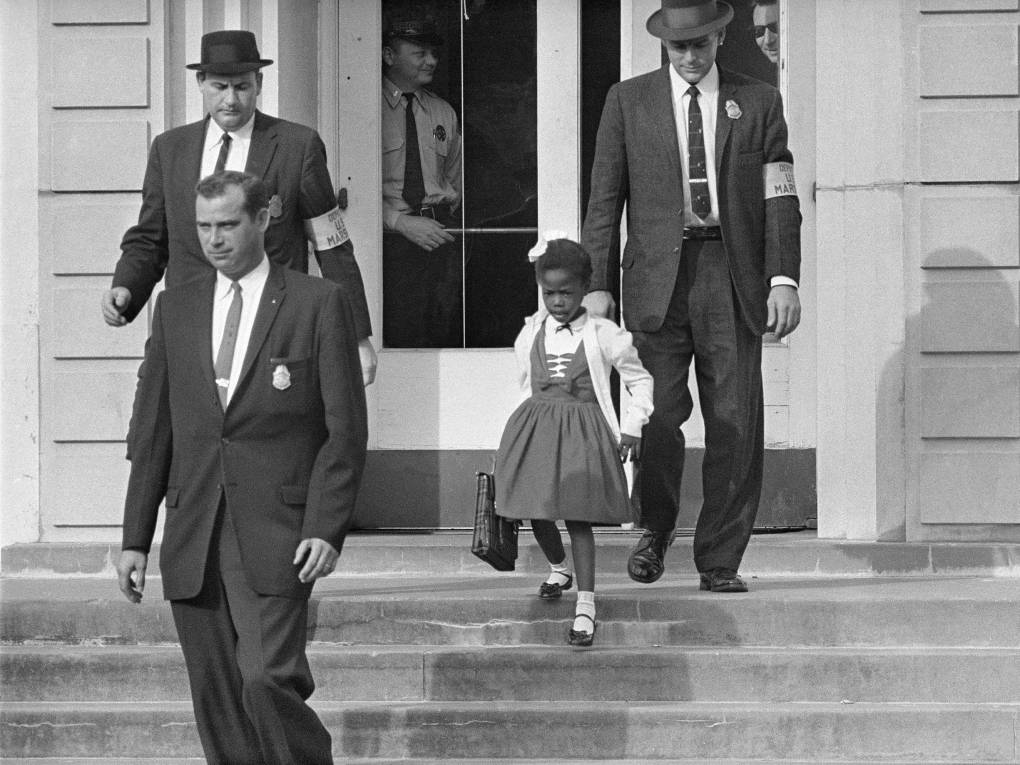
"caption": "U.S. Deputy Marshals escort 6-year-old Ruby Bridges from William Frantz Elementary School in New Orleans, in this November 1960, file photo. Lucille Bridges, Ruby's mother, died Tuesday at the age of 86.\n",
"description": "FILE - U.S. Deputy Marshals escort 6-year-old Ruby Bridges from William Frantz Elementary School in New Orleans, in this November 1960, file photo. On Friday, Nov. 14, 2014, 54 years later to the day when she first walked up the steps to the school, Bridges is scheduled to commemorate the event with the unveiling of a statue in her likeness on the campus. (AP Photo/File)",
"title": "U.S. Deputy Marshals escort 6-year-old Ruby Bridges from William Frantz Elementary School in New Orleans, in this November 1960, file photo. Lucille Bridges, Ruby's mother, died Tuesday at the age of 86.",
"credit": "Uncredited/AP",
"status": "inherit",
"isLoading": false,
"fetchFailed": false
}
},
"audioPlayerReducer": {
"postId": "stream_live",
"isPaused": true,
"isPlaying": false,
"pfsActive": false,
"pledgeModalIsOpen": true,
"playerDrawerIsOpen": false,
"liveAudioPlayStartedAt": 0,
"liveAudioPlayContext": ""
},
"authorsReducer": {
"byline_mindshift_58782": {
"type": "authors",
"id": "byline_mindshift_58782",
"meta": {
"override": true
},
"slug": "byline_mindshift_58782",
"name": "Arun Venugopal",
"isLoading": false
},
"byline_mindshift_57931": {
"type": "authors",
"id": "byline_mindshift_57931",
"meta": {
"override": true
},
"slug": "byline_mindshift_57931",
"name": "Adrian Florido",
"isLoading": false
},
"byline_mindshift_57766": {
"type": "authors",
"id": "byline_mindshift_57766",
"meta": {
"override": true
},
"slug": "byline_mindshift_57766",
"name": "Kirk Carapezza",
"isLoading": false
},
"byline_mindshift_57519": {
"type": "authors",
"id": "byline_mindshift_57519",
"meta": {
"override": true
},
"slug": "byline_mindshift_57519",
"name": "\u003ca href=\"https://hechingerreport.org/\">Danielle Dreilinger, The Hechinger Report\u003c/a>",
"isLoading": false
},
"byline_mindshift_57325": {
"type": "authors",
"id": "byline_mindshift_57325",
"meta": {
"override": true
},
"slug": "byline_mindshift_57325",
"name": "\u003ca href=\"https://hechingerreport.org/\">Charlotte West, The Hechinger Report\u003c/a>",
"isLoading": false
},
"byline_mindshift_57227": {
"type": "authors",
"id": "byline_mindshift_57227",
"meta": {
"override": true
},
"slug": "byline_mindshift_57227",
"name": "\u003ca href=\"https://hechingerreport.org/\">Emma Kate Fittes, The Hechinger Report\u003c/a>",
"isLoading": false
},
"byline_mindshift_56963": {
"type": "authors",
"id": "byline_mindshift_56963",
"meta": {
"override": true
},
"slug": "byline_mindshift_56963",
"name": "Scott Neuman",
"isLoading": false
},
"ksung": {
"type": "authors",
"id": "4596",
"meta": {
"index": "authors_1716337520",
"id": "4596",
"found": true
},
"name": "Ki Sung",
"firstName": "Ki",
"lastName": "Sung",
"slug": "ksung",
"email": "ksung@kqed.org",
"display_author_email": false,
"staff_mastheads": [
"news"
],
"title": "KQED Contributor",
"bio": "Ki Sung is Managing Editor of Digital News at KQED. She is former Senior Editor of MindShift and worked at NPR before joining KQED in 2014.",
"avatar": "https://secure.gravatar.com/avatar/64271e01dc95486c133be56937739045b7c00c990525bf9add12d3dd4f0433c9?s=600&d=blank&r=g",
"twitter": null,
"bluesky": null,
"facebook": null,
"instagram": null,
"linkedin": null,
"sites": [
{
"site": "news",
"roles": [
"editor"
]
},
{
"site": "mindshift",
"roles": [
"administrator"
]
},
{
"site": "elections",
"roles": [
"administrator"
]
}
],
"headData": {
"title": "Ki Sung | KQED",
"description": "KQED Contributor",
"ogImgSrc": "https://secure.gravatar.com/avatar/64271e01dc95486c133be56937739045b7c00c990525bf9add12d3dd4f0433c9?s=600&d=blank&r=g",
"twImgSrc": "https://secure.gravatar.com/avatar/64271e01dc95486c133be56937739045b7c00c990525bf9add12d3dd4f0433c9?s=600&d=blank&r=g"
},
"isLoading": false,
"link": "/author/ksung"
},
"ngobir": {
"type": "authors",
"id": "11721",
"meta": {
"index": "authors_1716337520",
"id": "11721",
"found": true
},
"name": "Nimah Gobir",
"firstName": "Nimah",
"lastName": "Gobir",
"slug": "ngobir",
"email": "ngobir@kqed.org",
"display_author_email": false,
"staff_mastheads": [],
"title": "KQED Contributor",
"bio": null,
"avatar": "https://secure.gravatar.com/avatar/837f5df7045c59f3ec097cdf7ac391373ab75d5ec936dd7099b8cb6f0af1b0e9?s=600&d=blank&r=g",
"twitter": null,
"bluesky": null,
"facebook": null,
"instagram": null,
"linkedin": null,
"sites": [
{
"site": "mindshift",
"roles": [
"editor"
]
}
],
"headData": {
"title": "Nimah Gobir | KQED",
"description": "KQED Contributor",
"ogImgSrc": "https://secure.gravatar.com/avatar/837f5df7045c59f3ec097cdf7ac391373ab75d5ec936dd7099b8cb6f0af1b0e9?s=600&d=blank&r=g",
"twImgSrc": "https://secure.gravatar.com/avatar/837f5df7045c59f3ec097cdf7ac391373ab75d5ec936dd7099b8cb6f0af1b0e9?s=600&d=blank&r=g"
},
"isLoading": false,
"link": "/author/ngobir"
}
},
"pagesReducer": {
"mindshift_category_antiracism": {
"type": "terms",
"id": "mindshift_21357",
"meta": {
"index": "terms_1716263798",
"site": "mindshift",
"id": "21357",
"score": 14.405544
},
"featImg": null,
"name": "Antiracism",
"description": null,
"taxonomy": "category",
"headData": {
"twImgId": null,
"twTitle": null,
"ogTitle": null,
"ogImgId": null,
"twDescription": null,
"description": null,
"title": "Antiracism Archives | KQED Mindshift",
"ogDescription": null
},
"ttid": 20629,
"slug": "antiracism",
"isLoading": false,
"title": "Antiracism",
"pageMeta": {
"site": "mindshift",
"WpPageTemplate": "page-topic-editorial",
"currentPage": 3
},
"blocks": [
{
"blockName": "kqed/post-list",
"attrs": {
"layout": "cardArticle2",
"query": "posts/mindshift?category=antiracism",
"seeMore": false,
"paginated": true,
"page": 3
}
},
{
"blockName": "kqed/ad"
}
]
}
},
"pfsSessionReducer": {},
"postsReducer": {
"stream_live": {
"type": "live",
"id": "stream_live",
"audioUrl": "https://streams.kqed.org/kqedradio",
"title": "Live Stream",
"excerpt": "Live Stream information currently unavailable.",
"link": "/radio",
"featImg": "",
"label": {
"name": "KQED Live",
"link": "/"
}
},
"stream_kqedNewscast": {
"type": "posts",
"id": "stream_kqedNewscast",
"audioUrl": "https://www.kqed.org/.stream/anon/radio/RDnews/newscast.mp3?_=1",
"title": "KQED Newscast",
"featImg": "",
"label": {
"name": "88.5 FM",
"link": "/"
}
},
"mindshift_58782": {
"type": "posts",
"id": "mindshift_58782",
"meta": {
"index": "posts_1716263798",
"site": "mindshift",
"id": "58782",
"score": null,
"sort": [
1637183128000
]
},
"parent": 0,
"labelTerm": {
"site": "mindshift"
},
"blocks": [],
"publishDate": 1637183128,
"format": "standard",
"disqusTitle": "'1619 Project' journalist says Black people shouldn't be an asterisk in U.S. history",
"title": "'1619 Project' journalist says Black people shouldn't be an asterisk in U.S. history",
"headTitle": "MindShift | KQED News",
"content": "\u003cp>As a child, journalist \u003ca href=\"https://www.npr.org/2021/07/06/1013315775/after-tenure-controversy-nikole-hannah-jones-will-join-howard-faculty-instead-of\">Nikole Hannah-Jones\u003c/a> didn't hear much in school about the role of Black people in U.S. history. \"Black people are largely treated as an asterisk in the American story,\" she says.\u003c/p>\n\u003cp>But Hannah-Jones' awareness changed in high school when she signed up for a Black studies elective. Among the things she learned was the date 1619, significant because it's the year that the \u003ca href=\"https://www.npr.org/2019/08/28/754348666/20-and-odd-negroes\">\u003cem>White Lion\u003c/em>,\u003c/a> the first ship carrying enslaved Africans, arrived in the British colony of Virginia — one year before the \u003cem>Mayflower \u003c/em>landed at Plymouth Rock.\u003c/p>\n\u003cp>\"Every American child learns about the \u003cem>Mayflower\u003c/em>, but virtually no American child learned about the \u003cem>White Lion,\" \u003c/em>Hannah-Jones says. The omission, she says, is \"symbolic of how history is shaped by people who decide what's important and what's not. And that erasure is also a powerful statement.\"\u003c/p>\n\u003cp>As editor of the \u003cem>New York Times\u003c/em>' \u003ca href=\"https://www.nytimes.com/interactive/2019/08/14/magazine/1619-america-slavery.html\">1619 Project\u003c/a>, Hannah-Jones fought against that erasure. Originally published in 2019 as a special issue of \u003cem>The New York Times Magazine,\u003c/em> the project reframed the American story through the lens of slavery. Hannah-Jones was awarded a Pulitzer Prize for her \u003ca href=\"https://www.nytimes.com/interactive/2019/08/14/magazine/black-history-american-democracy.html\">introductory essay\u003c/a>\u003cem>.\u003c/em> Now, the new book, \u003cem>The 1619 Project: A New Origin Story, \u003c/em>expands upon that initial initiative.\u003c/p>\n\u003cp>\"The project argues that slavery is a foundational American institution,\" she says. \"It is one of the oldest American institutions, and that the legacy of the first 250 years of slavery still, of course, permeates throughout society in a variety of ways.\"\u003c/p>\n\u003cp>[ad fullwidth]\u003c/p>\n\u003cp>Students across the country have embraced the ideas contained in the work. But there's also been \u003ca href=\"https://www.npr.org/2020/09/17/914127266/trump-announces-patriotic-education-commission-a-largely-political-move\">a backlash\u003c/a> by conservatives who have vowed to keep the \u003cem>1619 Project \u003c/em>out of classrooms — including threats that have been made against her personally.\u003c/p>\n\u003cp>\"People who send threats, people who make threats, what they're really trying to do is silence you,\" she says. But, she adds, \"This is my mission. And so nothing will distract me from that, and I just can't go around worried about what might happen. I just have to do my job.\"\u003c/p>\n\u003chr>\n\u003ch3>Interview highlights\u003c/h3>\n\u003cp>\u003cstrong>On having a realistic view of U.S. history \u003c/strong>\u003c/p>\n\u003cp>\u003cimg class=\"alignright size-thumbnail wp-image-58784\" src=\"https://ww2.kqed.org/app/uploads/sites/23/2021/11/9780593230572_custom-abf53bf26bf9189d44ec6f6ba551611b91978322-160x242.jpg\" alt=\"\" width=\"160\" height=\"242\" srcset=\"https://ww2.kqed.org/app/uploads/sites/23/2021/11/9780593230572_custom-abf53bf26bf9189d44ec6f6ba551611b91978322-160x242.jpg 160w, https://ww2.kqed.org/app/uploads/sites/23/2021/11/9780593230572_custom-abf53bf26bf9189d44ec6f6ba551611b91978322-800x1210.jpg 800w, https://ww2.kqed.org/app/uploads/sites/23/2021/11/9780593230572_custom-abf53bf26bf9189d44ec6f6ba551611b91978322-768x1161.jpg 768w, https://ww2.kqed.org/app/uploads/sites/23/2021/11/9780593230572_custom-abf53bf26bf9189d44ec6f6ba551611b91978322.jpg 918w\" sizes=\"(max-width: 160px) 100vw, 160px\">The benefit of not having very high expectations in the first place is that you are seldom surprised, though you can be disappointed. When you have the luxury to spend your life studying history, then you understand that the moment that we're in is wholly predictable, and that every time there is a sense of racial progress in this country, it is met by an intensive backlash. And I guess what is difficult is that you would hope we would eventually learn the lessons. But we don't. So I'm motivated by a sense of obligation to all of the ancestors who never could have lived the life that I live, and I have been very blessed to be in the position that I am, and so I feel like I have to try to force us to acknowledge the truth about who we are so that we can try to build the country that we believe that we are. But that requires, for me at least, taking a very unsparing understanding of our country, and some might consider that cynical. But I just think it is a realistic view of where we are and what to expect in these times.\u003c/p>\n\u003cp>\u003cstrong>On the connection between the protests in the wake of the murder of George Floyd and the backlash against teaching history of structural racism \u003c/strong>\u003c/p>\n\u003cp>\u003cem>The 1619 Project\u003c/em> is specifically banned from being taught in \u003ca href=\"https://www.yahoo.com/now/florida-board-education-approves-rule-165718175.html\">Florida\u003c/a>, in \u003ca href=\"https://www.texastribune.org/2021/06/15/abbott-critical-race-theory-law/\">Texas\u003c/a> and in other states by name. And then, of course, there are many more states that have now passed or are considering these larger, much more vague anti-Critical Race Theory laws, which I would argue are anti-history and memory laws. This all begins to happen around the time of the [George Floyd] protests. And I think that what you saw during the protests were millions of Americans ... and those protests were multiracial, multigenerational. And people were really connecting what they were marching in the streets about to this 400-year struggle against the legacy of slavery. And they were arguing that the reason people were protesting, that the inequality that Black Americans were facing, was not about individual actors, Black people making individual choices and a few \"bad apple\" racists, but that these were structural and that they were going to require a structural solution. ...\u003c/p>\n\u003cp>So it's not incidental that that's when you start to see this really stoking of white resentment through the \u003ca href=\"https://www.congress.gov/bill/116th-congress/senate-bill/4292\">Saving American History Act\u003c/a>. Donald Trump begins to talk about \u003cem>The 1619 Project\u003c/em>, and you see this effort to say, \"Look, they want to take your history from you. They want to tell you that you're bad. They want to tell you that all of your heroes are not heroes anymore.\" And that backlash — I mean this is the argument of \u003cem>The 1619 Project\u003c/em> — there's a reason that racializing our politics is so effective to drive white voters.\u003c/p>\n\u003cp>\u003cstrong>On the news media's responsibly to speak out against threats to democracy and voting rights\u003c/strong>\u003c/p>\n\u003cp>I think that this is a time where [journalists] really have to question the stated mainstream mores of our field. And if those actually allow us to rise to the urgency of the moment, this kind of dispassionate view of the world, of our country, of our politics and this both side-ism that we treat both sides as equal, even if one is clearly doing things that are beyond the pale, that are beyond norms, that are actually harmful to our democracy, our sense that to be fair or to be objective, we have to treat them both as equally legitimate is actually one of the things that is weakening our democracy.\u003c/p>\n\u003cp>Our job as journalists is to tell the truth. And sometimes the truth is, one political party doesn't believe in democracy. One political party is actually doing things that are hurtful to democracy. And I really fear that we are not rising to the moment, not enough of us anyway. There certainly is excellent reporting being done. But there's also something about a political press that largely comes from people who have not had to fight for their rights in this society, who have never had their ability to vote and exercise their franchise questioned that they sometimes, I think, report with too much faith in our institutions, or too much faith that things will work out OK. That's not a luxury that Black journalists or journalists of color or journalists from other marginalized groups could ever have. We understand what the worst can be because we have, as a people, experienced that. And so we have it, I think, an innate skepticism that things will work out, that we need to pretend to have objectivity in a country where we're seeing legislatures actively trying to take away our fundamental right as citizens, which is the franchise, which is the key to all other rights.\u003c/p>\n\u003cp>\u003cstrong>On the term \"woke,\" and if it can be used as a slur \u003c/strong>\u003c/p>\n\u003cp>I have often and regularly really tried to discourage journalists from using the term \"woke\" because I think it is lazy and I think it is useless, and I do think it has become a dog whistle. What does it mean? What are we saying when we say that? Are we saying that being anti-racist is bad? Are we ... talking about Black people asking and fighting for justice as a bad thing, but we can't say that, so we use woke as this kind of catchall phrase? To me it's to really try to silence or diminish racial justice claims, people who are asking for racial justice. So I think many, many Black people hear it as a slur. One, we know that this is a term that was co-opted from Black people, that this is something that Black people were using. It became co-opted by conservatives in a way that is disparaging. ...\u003c/p>\n\u003cp>I don't think that journalists should be using it. And I think when politicians and others use it, we should ask them to define what they mean, because when we're using terms like that, we are expecting people to fill in the blanks, and we're using terms like that because we don't want to be explicit about what it is that we're saying. And journalists should not be letting people get away with that. So I think it can be taken as a racist slur, yes.\u003c/p>\n\u003cp>\u003cstrong>On reparations not being a serious conversation in the mainstream\u003c/strong>\u003c/p>\n\u003cp>For my entire lifetime, reparations has not been a political topic that you could have in serious company. It has been treated as a fringe topic. You didn't see mainstream political candidates talking about it. You certainly didn't see cities, municipalities, states and other governments seriously talking about reparations, and there's been a really seismic shift in that conversation. And that is because I think there is a scholarship and a reckoning that is occurring where we are being forced to actually acknowledge the truth about our past. ...\u003c/p>\n\u003cp>There's certainly a cohort of Americans whom you will never convince that anything is owed to Black Americans or anyone else. But I think there's a large segment of Americans, because they have not learned this history well, because they do not understand ... that Black people were trying to get reparations during slavery, immediately after slavery, and have never stopped trying to get that. And so it's not just a matter of \"no one alive today was enslaved.\" It's an ongoing debt. But also that people don't understand that after the end of slavery, we didn't become an equal society, and that the government continued to engage in practices that were harmful to Black Americans and that kept Black Americans from obtaining the same type of wealth and resources and opportunities that other Americans have, and that we still live with that legacy. That is why the study of history is important because we don't learn this history, and so it becomes very hard to understand: Why are these people owed anything?\u003c/p>\n\u003cp>\u003cstrong>On why\u003c/strong>\u003ca href=\"https://www.npr.org/2021/07/01/1012203967/ida-b-wells-new-monument-unveiled-in-chicago\">\u003cstrong> Ida B. Wells \u003c/strong>\u003c/a>\u003cstrong>is her \"spiritual godmother\" \u003c/strong>\u003c/p>\n\u003cp>I was just astounded that a Black woman, who was born around the time of the emancipation, existed in the form of Ida B. Wells. She was a suffragist, a feminist, a newspaper publisher, an investigative reporter, a co-founder of the NAACP. And she was a woman who stood up to white people, to Black men, to anyone who she thought morally was incorrect and also who was trying to deny rights to anyone. I just never heard of a historical figure like her. As someone who was thinking about journalism as a career myself, one who always understood that as a Black American, if I wanted to be a journalist, there was always going to be a degree of activism to that journalism in this society, that she provided a template for the type of person and journalist and woman I hope to be. And ever since then, I've considered her in some ways kind of my North Star and my spiritual godmother.\u003c/p>\n\u003cp>[ad floatright]\u003c/p>\n\u003cp>\u003cem>Sam Briger and Seth Kelley produced and edited this interview for broadcast. Bridget Bentz and Molly Seavy-Nesper adapted it for the Web.\u003c/em>\u003c/p>\n\u003cdiv class=\"fullattribution\">Copyright 2021 Fresh Air. To see more, visit \u003ca href=\"http://www.npr.org/programs/fresh-air/\">Fresh Air\u003c/a>.\u003cimg src=\"https://www.google-analytics.com/__utm.gif?utmac=UA-5828686-4&utmdt=%271619+Project%27+journalist+says+Black+people+shouldn%27t+be+an+asterisk+in+U.S.+history&utme=8(APIKey)9(MDAxOTAwOTE4MDEyMTkxMDAzNjczZDljZA004)\">\u003c/div>\n\n",
"disqusIdentifier": "58782 https://ww2.kqed.org/mindshift/?p=58782",
"disqusUrl": "https://ww2.kqed.org/mindshift/2021/11/17/1619-project-journalist-says-black-people-shouldnt-be-an-asterisk-in-u-s-history/",
"stats": {
"hasVideo": false,
"hasChartOrMap": false,
"hasAudio": false,
"hasPolis": false,
"wordCount": 1944,
"hasGoogleForm": false,
"hasGallery": false,
"hasHearkenModule": false,
"iframeSrcs": [],
"paragraphCount": 26
},
"modified": 1637356066,
"excerpt": "Nikole Hannah-Jones says the contributions of Black people are often left out of the American story. Her mission is to reframe U.S. history through the lens of slavery.",
"headData": {
"twImgId": "",
"twTitle": "",
"ogTitle": "",
"ogImgId": "",
"twDescription": "",
"description": "Nikole Hannah-Jones says the contributions of Black people are often left out of the American story. Her mission is to reframe U.S. history through the lens of slavery.",
"title": "'1619 Project' journalist says Black people shouldn't be an asterisk in U.S. history - MindShift",
"ogDescription": "",
"schema": {
"@context": "https://schema.org",
"@type": "Article",
"headline": "'1619 Project' journalist says Black people shouldn't be an asterisk in U.S. history",
"datePublished": "2021-11-17T13:05:28-08:00",
"dateModified": "2021-11-19T13:07:46-08:00",
"image": "https://cdn.kqed.org/wp-content/uploads/2020/02/KQED-OG-Image@1x.png"
}
},
"guestAuthors": [],
"slug": "1619-project-journalist-says-black-people-shouldnt-be-an-asterisk-in-u-s-history",
"status": "publish",
"nprApiLink": "http://api.npr.org/query?id=1056404654&apiKey=MDAxOTAwOTE4MDEyMTkxMDAzNjczZDljZA004",
"nprByline": "Arun Venugopal",
"nprStoryDate": "Wed, 17 Nov 2021 12:12:03 -0500",
"excludeFromSiteSearch": "Include",
"nprLastModifiedDate": "Wed, 17 Nov 2021 12:16:05 -0500",
"nprHtmlLink": "https://www.npr.org/2021/11/17/1056404654/nikole-hannah-jones-1619-project?ft=nprml&f=1056404654",
"nprAudio": "https://ondemand.npr.org/anon.npr-mp3/npr/fa/2021/11/20211117_fa_01.mp3?orgId=427869011&topicId=1015&d=2203&p=13&story=1056404654&ft=nprml&f=1056404654",
"nprImageAgency": "The New York Times",
"nprAudioM3u": "http://api.npr.org/m3u/11056580993-8fea59.m3u?orgId=427869011&topicId=1015&d=2203&p=13&story=1056404654&ft=nprml&f=1056404654",
"nprStoryId": "1056404654",
"nprRetrievedStory": "1",
"nprPubDate": "Wed, 17 Nov 2021 13:25:00 -0500",
"path": "/mindshift/58782/1619-project-journalist-says-black-people-shouldnt-be-an-asterisk-in-u-s-history",
"audioUrl": "https://ondemand.npr.org/anon.npr-mp3/npr/fa/2021/11/20211117_fa_01.mp3?orgId=427869011&topicId=1015&d=2203&p=13&story=1056404654&ft=nprml&f=1056404654",
"audioTrackLength": null,
"parsedContent": [
{
"type": "contentString",
"content": "\u003cdiv class=\"post-body\">\u003cp>\u003cp>As a child, journalist \u003ca href=\"https://www.npr.org/2021/07/06/1013315775/after-tenure-controversy-nikole-hannah-jones-will-join-howard-faculty-instead-of\">Nikole Hannah-Jones\u003c/a> didn't hear much in school about the role of Black people in U.S. history. \"Black people are largely treated as an asterisk in the American story,\" she says.\u003c/p>\n\u003cp>But Hannah-Jones' awareness changed in high school when she signed up for a Black studies elective. Among the things she learned was the date 1619, significant because it's the year that the \u003ca href=\"https://www.npr.org/2019/08/28/754348666/20-and-odd-negroes\">\u003cem>White Lion\u003c/em>,\u003c/a> the first ship carrying enslaved Africans, arrived in the British colony of Virginia — one year before the \u003cem>Mayflower \u003c/em>landed at Plymouth Rock.\u003c/p>\n\u003cp>\"Every American child learns about the \u003cem>Mayflower\u003c/em>, but virtually no American child learned about the \u003cem>White Lion,\" \u003c/em>Hannah-Jones says. The omission, she says, is \"symbolic of how history is shaped by people who decide what's important and what's not. And that erasure is also a powerful statement.\"\u003c/p>\n\u003cp>As editor of the \u003cem>New York Times\u003c/em>' \u003ca href=\"https://www.nytimes.com/interactive/2019/08/14/magazine/1619-america-slavery.html\">1619 Project\u003c/a>, Hannah-Jones fought against that erasure. Originally published in 2019 as a special issue of \u003cem>The New York Times Magazine,\u003c/em> the project reframed the American story through the lens of slavery. Hannah-Jones was awarded a Pulitzer Prize for her \u003ca href=\"https://www.nytimes.com/interactive/2019/08/14/magazine/black-history-american-democracy.html\">introductory essay\u003c/a>\u003cem>.\u003c/em> Now, the new book, \u003cem>The 1619 Project: A New Origin Story, \u003c/em>expands upon that initial initiative.\u003c/p>\n\u003cp>\"The project argues that slavery is a foundational American institution,\" she says. \"It is one of the oldest American institutions, and that the legacy of the first 250 years of slavery still, of course, permeates throughout society in a variety of ways.\"\u003c/p>\n\u003cp>\u003c/p>\u003c/div>",
"attributes": {
"named": {},
"numeric": []
}
},
{
"type": "component",
"content": "",
"name": "ad",
"attributes": {
"named": {
"label": "fullwidth"
},
"numeric": [
"fullwidth"
]
}
},
{
"type": "contentString",
"content": "\u003cdiv class=\"post-body\">\u003cp>\u003c/p>\n\u003cp>Students across the country have embraced the ideas contained in the work. But there's also been \u003ca href=\"https://www.npr.org/2020/09/17/914127266/trump-announces-patriotic-education-commission-a-largely-political-move\">a backlash\u003c/a> by conservatives who have vowed to keep the \u003cem>1619 Project \u003c/em>out of classrooms — including threats that have been made against her personally.\u003c/p>\n\u003cp>\"People who send threats, people who make threats, what they're really trying to do is silence you,\" she says. But, she adds, \"This is my mission. And so nothing will distract me from that, and I just can't go around worried about what might happen. I just have to do my job.\"\u003c/p>\n\u003chr>\n\u003ch3>Interview highlights\u003c/h3>\n\u003cp>\u003cstrong>On having a realistic view of U.S. history \u003c/strong>\u003c/p>\n\u003cp>\u003cimg class=\"alignright size-thumbnail wp-image-58784\" src=\"https://ww2.kqed.org/app/uploads/sites/23/2021/11/9780593230572_custom-abf53bf26bf9189d44ec6f6ba551611b91978322-160x242.jpg\" alt=\"\" width=\"160\" height=\"242\" srcset=\"https://ww2.kqed.org/app/uploads/sites/23/2021/11/9780593230572_custom-abf53bf26bf9189d44ec6f6ba551611b91978322-160x242.jpg 160w, https://ww2.kqed.org/app/uploads/sites/23/2021/11/9780593230572_custom-abf53bf26bf9189d44ec6f6ba551611b91978322-800x1210.jpg 800w, https://ww2.kqed.org/app/uploads/sites/23/2021/11/9780593230572_custom-abf53bf26bf9189d44ec6f6ba551611b91978322-768x1161.jpg 768w, https://ww2.kqed.org/app/uploads/sites/23/2021/11/9780593230572_custom-abf53bf26bf9189d44ec6f6ba551611b91978322.jpg 918w\" sizes=\"(max-width: 160px) 100vw, 160px\">The benefit of not having very high expectations in the first place is that you are seldom surprised, though you can be disappointed. When you have the luxury to spend your life studying history, then you understand that the moment that we're in is wholly predictable, and that every time there is a sense of racial progress in this country, it is met by an intensive backlash. And I guess what is difficult is that you would hope we would eventually learn the lessons. But we don't. So I'm motivated by a sense of obligation to all of the ancestors who never could have lived the life that I live, and I have been very blessed to be in the position that I am, and so I feel like I have to try to force us to acknowledge the truth about who we are so that we can try to build the country that we believe that we are. But that requires, for me at least, taking a very unsparing understanding of our country, and some might consider that cynical. But I just think it is a realistic view of where we are and what to expect in these times.\u003c/p>\n\u003cp>\u003cstrong>On the connection between the protests in the wake of the murder of George Floyd and the backlash against teaching history of structural racism \u003c/strong>\u003c/p>\n\u003cp>\u003cem>The 1619 Project\u003c/em> is specifically banned from being taught in \u003ca href=\"https://www.yahoo.com/now/florida-board-education-approves-rule-165718175.html\">Florida\u003c/a>, in \u003ca href=\"https://www.texastribune.org/2021/06/15/abbott-critical-race-theory-law/\">Texas\u003c/a> and in other states by name. And then, of course, there are many more states that have now passed or are considering these larger, much more vague anti-Critical Race Theory laws, which I would argue are anti-history and memory laws. This all begins to happen around the time of the [George Floyd] protests. And I think that what you saw during the protests were millions of Americans ... and those protests were multiracial, multigenerational. And people were really connecting what they were marching in the streets about to this 400-year struggle against the legacy of slavery. And they were arguing that the reason people were protesting, that the inequality that Black Americans were facing, was not about individual actors, Black people making individual choices and a few \"bad apple\" racists, but that these were structural and that they were going to require a structural solution. ...\u003c/p>\n\u003cp>So it's not incidental that that's when you start to see this really stoking of white resentment through the \u003ca href=\"https://www.congress.gov/bill/116th-congress/senate-bill/4292\">Saving American History Act\u003c/a>. Donald Trump begins to talk about \u003cem>The 1619 Project\u003c/em>, and you see this effort to say, \"Look, they want to take your history from you. They want to tell you that you're bad. They want to tell you that all of your heroes are not heroes anymore.\" And that backlash — I mean this is the argument of \u003cem>The 1619 Project\u003c/em> — there's a reason that racializing our politics is so effective to drive white voters.\u003c/p>\n\u003cp>\u003cstrong>On the news media's responsibly to speak out against threats to democracy and voting rights\u003c/strong>\u003c/p>\n\u003cp>I think that this is a time where [journalists] really have to question the stated mainstream mores of our field. And if those actually allow us to rise to the urgency of the moment, this kind of dispassionate view of the world, of our country, of our politics and this both side-ism that we treat both sides as equal, even if one is clearly doing things that are beyond the pale, that are beyond norms, that are actually harmful to our democracy, our sense that to be fair or to be objective, we have to treat them both as equally legitimate is actually one of the things that is weakening our democracy.\u003c/p>\n\u003cp>Our job as journalists is to tell the truth. And sometimes the truth is, one political party doesn't believe in democracy. One political party is actually doing things that are hurtful to democracy. And I really fear that we are not rising to the moment, not enough of us anyway. There certainly is excellent reporting being done. But there's also something about a political press that largely comes from people who have not had to fight for their rights in this society, who have never had their ability to vote and exercise their franchise questioned that they sometimes, I think, report with too much faith in our institutions, or too much faith that things will work out OK. That's not a luxury that Black journalists or journalists of color or journalists from other marginalized groups could ever have. We understand what the worst can be because we have, as a people, experienced that. And so we have it, I think, an innate skepticism that things will work out, that we need to pretend to have objectivity in a country where we're seeing legislatures actively trying to take away our fundamental right as citizens, which is the franchise, which is the key to all other rights.\u003c/p>\n\u003cp>\u003cstrong>On the term \"woke,\" and if it can be used as a slur \u003c/strong>\u003c/p>\n\u003cp>I have often and regularly really tried to discourage journalists from using the term \"woke\" because I think it is lazy and I think it is useless, and I do think it has become a dog whistle. What does it mean? What are we saying when we say that? Are we saying that being anti-racist is bad? Are we ... talking about Black people asking and fighting for justice as a bad thing, but we can't say that, so we use woke as this kind of catchall phrase? To me it's to really try to silence or diminish racial justice claims, people who are asking for racial justice. So I think many, many Black people hear it as a slur. One, we know that this is a term that was co-opted from Black people, that this is something that Black people were using. It became co-opted by conservatives in a way that is disparaging. ...\u003c/p>\n\u003cp>I don't think that journalists should be using it. And I think when politicians and others use it, we should ask them to define what they mean, because when we're using terms like that, we are expecting people to fill in the blanks, and we're using terms like that because we don't want to be explicit about what it is that we're saying. And journalists should not be letting people get away with that. So I think it can be taken as a racist slur, yes.\u003c/p>\n\u003cp>\u003cstrong>On reparations not being a serious conversation in the mainstream\u003c/strong>\u003c/p>\n\u003cp>For my entire lifetime, reparations has not been a political topic that you could have in serious company. It has been treated as a fringe topic. You didn't see mainstream political candidates talking about it. You certainly didn't see cities, municipalities, states and other governments seriously talking about reparations, and there's been a really seismic shift in that conversation. And that is because I think there is a scholarship and a reckoning that is occurring where we are being forced to actually acknowledge the truth about our past. ...\u003c/p>\n\u003cp>There's certainly a cohort of Americans whom you will never convince that anything is owed to Black Americans or anyone else. But I think there's a large segment of Americans, because they have not learned this history well, because they do not understand ... that Black people were trying to get reparations during slavery, immediately after slavery, and have never stopped trying to get that. And so it's not just a matter of \"no one alive today was enslaved.\" It's an ongoing debt. But also that people don't understand that after the end of slavery, we didn't become an equal society, and that the government continued to engage in practices that were harmful to Black Americans and that kept Black Americans from obtaining the same type of wealth and resources and opportunities that other Americans have, and that we still live with that legacy. That is why the study of history is important because we don't learn this history, and so it becomes very hard to understand: Why are these people owed anything?\u003c/p>\n\u003cp>\u003cstrong>On why\u003c/strong>\u003ca href=\"https://www.npr.org/2021/07/01/1012203967/ida-b-wells-new-monument-unveiled-in-chicago\">\u003cstrong> Ida B. Wells \u003c/strong>\u003c/a>\u003cstrong>is her \"spiritual godmother\" \u003c/strong>\u003c/p>\n\u003cp>I was just astounded that a Black woman, who was born around the time of the emancipation, existed in the form of Ida B. Wells. She was a suffragist, a feminist, a newspaper publisher, an investigative reporter, a co-founder of the NAACP. And she was a woman who stood up to white people, to Black men, to anyone who she thought morally was incorrect and also who was trying to deny rights to anyone. I just never heard of a historical figure like her. As someone who was thinking about journalism as a career myself, one who always understood that as a Black American, if I wanted to be a journalist, there was always going to be a degree of activism to that journalism in this society, that she provided a template for the type of person and journalist and woman I hope to be. And ever since then, I've considered her in some ways kind of my North Star and my spiritual godmother.\u003c/p>\n\u003cp>\u003c/p>\u003c/div>",
"attributes": {
"named": {},
"numeric": []
}
},
{
"type": "component",
"content": "",
"name": "ad",
"attributes": {
"named": {
"label": "floatright"
},
"numeric": [
"floatright"
]
}
},
{
"type": "contentString",
"content": "\u003cdiv class=\"post-body\">\u003cp>\u003c/p>\n\u003cp>\u003cem>Sam Briger and Seth Kelley produced and edited this interview for broadcast. Bridget Bentz and Molly Seavy-Nesper adapted it for the Web.\u003c/em>\u003c/p>\n\u003cdiv class=\"fullattribution\">Copyright 2021 Fresh Air. To see more, visit \u003ca href=\"http://www.npr.org/programs/fresh-air/\">Fresh Air\u003c/a>.\u003cimg src=\"https://www.google-analytics.com/__utm.gif?utmac=UA-5828686-4&utmdt=%271619+Project%27+journalist+says+Black+people+shouldn%27t+be+an+asterisk+in+U.S.+history&utme=8(APIKey)9(MDAxOTAwOTE4MDEyMTkxMDAzNjczZDljZA004)\">\u003c/div>\n\n\u003c/div>\u003c/p>",
"attributes": {
"named": {},
"numeric": []
}
}
],
"link": "/mindshift/58782/1619-project-journalist-says-black-people-shouldnt-be-an-asterisk-in-u-s-history",
"authors": [
"byline_mindshift_58782"
],
"categories": [
"mindshift_21357"
],
"tags": [
"mindshift_21322"
],
"featImg": "mindshift_58783",
"label": "mindshift"
},
"mindshift_58551": {
"type": "posts",
"id": "mindshift_58551",
"meta": {
"index": "posts_1716263798",
"site": "mindshift",
"id": "58551",
"score": null,
"sort": [
1632813765000
]
},
"guestAuthors": [],
"slug": "a-framework-for-conversations-about-race-in-schools",
"title": "A Framework for Conversations About Race in Schools",
"publishDate": 1632813765,
"format": "audio",
"headTitle": "A Framework for Conversations About Race in Schools | KQED",
"labelTerm": {
"term": 21942,
"site": "mindshift"
},
"content": "\u003cp>\u003cem>You can listen to this episode of the MindShift Podcast on \u003cstrong>\u003ca href=\"https://podcasts.apple.com/us/podcast/mindshift-podcast/id1078765985\">Apple Podcasts\u003c/a>, \u003ca href=\"https://podcasts.google.com/feed/aHR0cHM6Ly9mZWVkcy5tZWdhcGhvbmUuZm0vS1FJTkM1NzY0NjAwNDI5\">Google Podcasts\u003c/a>, \u003ca href=\"https://www.npr.org/podcasts/464615685/mind-shift-podcast\">NPR One\u003c/a>, \u003ca href=\"https://open.spotify.com/show/0MxSpNYZKNprFLCl7eEtyx\">Spotify\u003c/a>, \u003c/strong>\u003ca href=\"https://www.stitcher.com/podcast/kqed/stories-teachers-share\">\u003cstrong>Stitcher\u003c/strong>\u003c/a> or wherever you get your podcasts.\u003c/em>\u003c/p>\n\u003cp>\u003cspan style=\"font-weight: 400;\">Talking about race makes a lot of people feel like squirming away. And even as there has been more widespread acknowledgement that race should be at the center of conversations about inequity, people still get scared or freeze up when it’s mentioned. This can leave a person wondering, “Is there anyone who is good at navigating these types of conversations?”\u003c/span>\u003c/p>\n\u003cp>\u003cspan style=\"font-weight: 400;\">Not necessarily. However, there are ways to have those conversations in a way that is engaged and productive in one of the institutions that needs it most: schools. There’s been no shortage of schools recently blundering issues of race, such as \u003c/span>\u003ca href=\"https://www.washingtonpost.com/education/2020/06/12/scores-public-schools-still-have-names-glorifying-confederate-icons-changing-it-isnt-easy/\">\u003cspan style=\"font-weight: 400;\">racist namesakes\u003c/span>\u003c/a>\u003cspan style=\"font-weight: 400;\">, unfairly \u003c/span>\u003ca href=\"https://hechingerreport.org/dress-codes-are-the-new-whites-only-signs/\">\u003cspan style=\"font-weight: 400;\">enforced dress codes\u003c/span>\u003c/a>\u003cspan style=\"font-weight: 400;\"> and \u003c/span>\u003ca href=\"https://www.usatoday.com/story/news/education/2019/09/10/western-middle-school-indiana-cancels-slave-ship-role-play-lesson/2276633001/\">\u003cspan style=\"font-weight: 400;\">reenactments of historical oppression\u003c/span>\u003c/a>\u003cspan style=\"font-weight: 400;\">. And these are experiences that ultimately affect how students learn.\u003c/span>\u003c/p>\n\u003cp>\u003ca href=\"https://www.browardschools.com/\">\u003cspan style=\"font-weight: 400;\">Broward County Public Schools District\u003c/span>\u003c/a>\u003cspan style=\"font-weight: 400;\"> had its own \u003c/span>\u003ca href=\"https://www.browardschools.com/cms/lib/FL01803656/Centricity/Domain/2412/Strat_Plan_Flyer.pdf\">\u003cspan style=\"font-weight: 400;\">issues with racial disparities\u003c/span>\u003c/a>\u003cspan style=\"font-weight: 400;\"> in academic achievement, placement in advanced classes and discipline. In order to get to the root of the troubling data, former Broward County Superintendent Robert Runcie brought \u003c/span>\u003ca href=\"https://courageousconversation.com/about/\">\u003cspan style=\"font-weight: 400;\">Glenn Singleton’s Courageous Conversations\u003c/span>\u003c/a>\u003cspan style=\"font-weight: 400;\"> course to the district in 2015 as a \u003ca href=\"https://www.educatored.com/courses/courageous_conversations.html\">months-long professional development training\u003c/a> to help teachers understand how race can be central to outcomes for children. Gary Blandina was one of the first teachers to sign up.\u003c/span>\u003c/p>\n\u003cp>\u003c!-- iframe plugin v.4.3 wordpress.org/plugins/iframe/ -->\u003cbr>\n\u003ciframe loading=\"lazy\" frameborder=\"0\" height=\"200\" scrolling=\"no\" src=\"https://playlist.megaphone.fm?e=KQINC4990773915\" width=\"100%\" class=\"iframe-class\">\u003c/iframe>\u003c/p>\n\u003ch2>\u003cspan style=\"font-weight: 400;\">Reexamining Student Behavior and Discipline \u003c/span>\u003c/h2>\n\u003cp>\u003cspan style=\"font-weight: 400;\">Blandina saw the outcomes of implicit bias firsthand. As an autism coach and behavioral specialist in Broward County, he has insight into student discipline because teachers call him when they \u003c/span>\u003cspan style=\"font-weight: 400;\">say\u003c/span>\u003cspan style=\"font-weight: 400;\"> students aren’t acting appropriately. \u003c/span>\u003c/p>\n\u003cp>[ad fullwidth]\u003c/p>\n\u003cp>\u003cspan style=\"font-weight: 400;\">“Frequently when you go into the situation, the teachers are pretty stressed. There’s a heightened energy,” says Blandina.\u003c/span>\u003c/p>\n\u003cp>\u003cspan style=\"font-weight: 400;\">In his role, Blandina noticed how race and bias affected student outcomes. As the sixth largest school district in the nation, Broward County contains 31 cities in Florida with students representing 170 different countries and speaking over one hundred languages. \u003c/span>\u003c/p>\n\u003cp>\u003cspan style=\"font-weight: 400;\">“I’m an older white guy doing this work,” says Blandina. “There’s been a history of over-identifying Black students, Hispanic students – especially Black and Hispanic males – as having some sort of a learning or behavioral problem.” He’s referring to national data that shows \u003c/span>\u003cspan style=\"font-weight: 400;\">Black, Latino and Native American students are disciplined \u003ca href=\"https://www.washingtonpost.com/local/education/racial-disparities-in-school-discipline-are-growing-federal-data-shows/2018/04/24/67b5d2b8-47e4-11e8-827e-190efaf1f1ee_story.html\">more harshly\u003c/a> than their white counterparts with higher rates of suspension, expulsion and referral to law enforcement.\u003c/span>\u003cspan style=\"font-weight: 400;\"> \u003c/span>\u003c/p>\n\u003cp>\u003cspan style=\"font-weight: 400;\">This is in part because\u003c/span>\u003cspan style=\"font-weight: 400;\">\u003ca href=\"https://nces.ed.gov/programs/coe/indicator/clr\"> teachers in Broward County\u003c/a> – and schools across the nation\u003c/span>\u003cspan style=\"font-weight: 400;\"> – \u003c/span>\u003cspan style=\"font-weight: 400;\">\u003ca href=\"https://nces.ed.gov/programs/coe/indicator/cge\">don’t reflect\u003c/a> the identities of the students they teach\u003c/span>\u003cspan style=\"font-weight: 400;\">, according to Dan Gohl, Broward County’s Chief Academic Officer. There’s already a\u003c/span>\u003ca href=\"https://www.learningforjustice.org/professional-development/culture-in-the-classroom\">\u003cspan style=\"font-weight: 400;\"> cultural difference \u003c/span>\u003c/a>\u003cspan style=\"font-weight: 400;\">between teachers – who are enforcing what they think is appropriate classroom behavior – and students, he says.\u003c/span>\u003c/p>\n\u003cp>\u003cspan style=\"font-weight: 400;\">Singleton’s Courageous Conversation training aims to help educators have the tools they need to participate in generative conversations about race. \u003c/span>\u003cspan style=\"font-weight: 400;\">Developing \u003ca href=\"https://www.edsurge.com/news/2020-07-22-how-to-start-meaningful-conversations-about-race-in-the-classroom\">racial understanding\u003c/a> and having interracial dialogue\u003c/span>\u003cspan style=\"font-weight: 400;\"> about race is the foundation of creating equitable changes in schools and can improve student achievement. \u003c/span>\u003cspan style=\"font-weight: 400;\">He says normalizing generative conversations about race allows other important priorities to happen. “[It] allows us to enter into the space to develop the skills, knowledge and capacities that we need to be able to take on the challenges presented to us by race,” says Singleton.\u003c/span>\u003c/p>\n\u003cfigure id=\"attachment_58556\" class=\"wp-caption alignright\" style=\"max-width: 328px\">\u003ca href=\"https://ww2.kqed.org/app/uploads/sites/23/2021/09/Glenn-Singleton.jpeg\">\u003cimg loading=\"lazy\" decoding=\"async\" class=\" wp-image-58556\" src=\"https://ww2.kqed.org/app/uploads/sites/23/2021/09/Glenn-Singleton-800x533.jpeg\" alt=\"\" width=\"328\" height=\"218\" srcset=\"https://cdn.kqed.org/wp-content/uploads/sites/23/2021/09/Glenn-Singleton-800x533.jpeg 800w, https://cdn.kqed.org/wp-content/uploads/sites/23/2021/09/Glenn-Singleton-160x107.jpeg 160w, https://cdn.kqed.org/wp-content/uploads/sites/23/2021/09/Glenn-Singleton-768x512.jpeg 768w, https://cdn.kqed.org/wp-content/uploads/sites/23/2021/09/Glenn-Singleton.jpeg 900w\" sizes=\"(max-width: 328px) 100vw, 328px\">\u003c/a>\u003cfigcaption class=\"wp-caption-text\">Glenn Singleton (Courtesy of Glenn Singleton)\u003c/figcaption>\u003c/figure>\n\u003cp>\u003cspan style=\"font-weight: 400;\">The Courageous Conversation framework for talking about race can be boiled down to what he calls \u003ca href=\"https://ww2.kqed.org/app/uploads/sites/23/2021/09/CCAR-Protocol-Overview.pdf\">the protocol\u003c/a>. It’s made up of three parts: the agreements, compass and conditions. \u003c/span>\u003c/p>\n\u003ch2>\u003cb>PART 1: AGREEMENTS\u003c/b>\u003c/h2>\n\u003cp>\u003cspan style=\"font-weight: 400;\">Before engaging in a courageous conversation about race, participants need to acknowledge and commit to practicing the four agreements. \u003c/span>\u003c/p>\n\u003cul>\n\u003cli style=\"font-weight: 400;\">\u003cb>Stay engaged\u003c/b>\u003cspan style=\"font-weight: 400;\"> means participants will be “morally, emotionally, intellectually and socially involved in the dialogue” and will not check out of the conversation. It’s not unheard of for people to shut down when the topic of race comes up. \u003c/span>\u003c/li>\n\u003cli style=\"font-weight: 400;\">\u003cb>Speak your truth \u003c/b>\u003cspan style=\"font-weight: 400;\">is being completely honest about one’s thoughts, feelings and opinions. Participants will say what’s on their mind, not just what they think others want to hear.\u003c/span>\u003c/li>\n\u003cli style=\"font-weight: 400;\">\u003cb>Experience discomfort \u003c/b>\u003cspan style=\"font-weight: 400;\">ensures that participants might feel some distressing emotions. That’s normal. “Race was put into the human experience for less than noble purpose,” says Singleton about how race was created to assign value to certain people over others. And because of that, conversations about race are inherently uncomfortable. \u003c/span>\u003c/li>\n\u003cli style=\"font-weight: 400;\">\u003cb>Expect and accept nonclosure \u003c/b>means\u003cspan style=\"font-weight: 400;\"> there are no quick fixes and these conversations will be ongoing. Singleton likens this last agreement to continuously \u003c/span>\u003ca href=\"https://www.goldengate.org/bridge/bridge-maintenance/painting-the-bridge/\">\u003cspan style=\"font-weight: 400;\">painting the Golden Gate Bridge\u003c/span>\u003c/a>\u003cspan style=\"font-weight: 400;\"> in order to keep it from getting rusty.\u003c/span>\u003c/li>\n\u003c/ul>\n\u003ch2>\u003cb>PART 2: THE COMPASS \u003c/b>\u003c/h2>\n\u003cp>\u003cspan style=\"font-weight: 400;\">The next part of the protocol is the compass, which helps people recognize the source and influences of their and others’ responses to conversations about race. The compass highlights four broad categories that people draw from to deal with racial information.\u003c/span>\u003c/p>\n\u003cul>\n\u003cli>\u003cb>Thinking\u003c/b>\u003cspan style=\"font-weight: 400;\"> is usually a tendency to look for more information or data. People who default to thinking tend to personally disconnect from the subject of race or constantly require more evidence to justify its importance.\u003c/span>\u003c/li>\n\u003cli>\u003cb>Believing\u003c/b>\u003cspan style=\"font-weight: 400;\"> is where one tries to figure out the rightness or wrongness of a racial issue based on the values or systems in which they were raised. \u003c/span>\u003c/li>\n\u003cli>\u003cb>Doing\u003c/b>\u003cspan style=\"font-weight: 400;\"> is a desire to respond with behaviors or action, which may include \u003c/span>\u003ca href=\"https://voxatl.org/the-dangers-of-performative-activism/\">\u003cspan style=\"font-weight: 400;\">performative gestures of solidarity\u003c/span>\u003c/a>\u003cspan style=\"font-weight: 400;\">. People in the doing quadrant want to have next steps or get something done when they are faced with a racial issue, which can sidestep deeper structural issues.\u003c/span>\u003c/li>\n\u003cli>\u003cb>Feeling\u003c/b>\u003cspan style=\"font-weight: 400;\"> is an impulse to respond through emotions like anger, defensiveness or sadness. When racial information comes up, it triggers people in the feelings category to have an internal reaction.\u003c/span>\u003c/li>\n\u003c/ul>\n\u003ch2>\u003cb>PART 3: CONDITIONS \u003c/b>\u003c/h2>\n\u003cp>\u003cspan style=\"font-weight: 400;\">The final part of the protocol are the conditions, which are six conditions organized into three sequential tiers. The conditions ”guide participants through what they are supposed to talk about and what they need to be mindful of during the interracial dialogue.” \u003c/span>\u003c/p>\n\u003cp>\u003cb>Engage:\u003c/b>\u003cspan style=\"font-weight: 400;\"> The first tier is focused on personalizing race as it pertains to the individual’s experience and not getting sidetracked by anyone else’s experience. “I’m not talking about Prince Harry and Meghan Markle right now, but talking about my experiences,” Singleton says. \u003c/span>\u003c/p>\n\u003cp>\u003cspan style=\"font-weight: 400;\">One of the activities educators can do to practice personalizing race is a racial autobiography. “It makes you think about when you really become first aware that you are the race you are. How does that impact you? And how has that shaped your life going forward?” says Colton Griffith, a fourth grade teacher at a Broward County school. “I came out of it knowing myself better.”\u003c/span>\u003c/p>\n\u003cp>\u003cb>Sustain: \u003c/b>\u003cspan style=\"font-weight: 400;\">The next tier is about surfacing as many perspectives as possible to fuel the conversation. “You want to organize and get into conversation with people who don’t necessarily share your beliefs or your feelings or your thinking,” says Singleton. The challenge in this tier is to prevent living in an echo chamber and hear multiple perspectives without a need to judge or place agreement or disagreement. \u003c/span>\u003c/p>\n\u003cp>\u003cb>Deepen: \u003c/b>\u003cspan style=\"font-weight: 400;\">After completing the engage and sustain tiers, the last step focuses on expanding one’s understanding about race and identifying meaningful next steps. “Then we get to the deep end and we’re really talking about race as a system of power and we’re talking about how that power plays out and what is my relationship – and all of us have a relationship – to race as a system of power,” says Singleton. \u003c/span>\u003c/p>\n\u003ch2>\u003cb>Deepening Racial Understanding to Transform Teaching \u003c/b>\u003c/h2>\n\u003cp>\u003cspan style=\"font-weight: 400;\">For behavior specialist and autism coach Gary Blandina, the Courageous Conversations course transformed the way he talked about race with other teachers and administrators. For example, he’s changed the way he writes behavioral assessments after he’s called in by teachers to observe students. He uses what he calls “non-judgemental language” that excludes the use of adjectives.\u003c/span>\u003c/p>\n\u003cp>\u003cspan style=\"font-weight: 400;\">“Because adjectives, while they add color to a great piece of literature, when you are describing a human being and what they’re doing or saying, adjectives betray your attitude towards that person,” according to Blandina. \u003c/span>\u003c/p>\n\u003cp>\u003cspan style=\"font-weight: 400;\">For example, when he was called in to observe a young Black girl whose teacher said had “behavioral issues,” Blandina drew on what he learned from Courageous Conversations and brought an awareness that he didn’t have before.\u003c/span>\u003c/p>\n\u003cp>\u003cspan style=\"font-weight: 400;\">“She looked fine; she was on point; she was answering. She was squirming in her chair, but that’s not a crime,” says Blandina. “Behavior is communication. There’s a reason the student is behaving that way and we might not have uncovered that reason. And so even in a situation like that, I’ve developed a mindset that I’m going to go in to understand.”\u003c/span>\u003c/p>\n\u003cp>\u003cspan style=\"font-weight: 400;\">For fourth grade teacher Colton Griffith, the training emboldened him to reexamine his class curriculum when learning about Florida Native Americans. “We got to compare the resources that our district uses to talk about what happened to them and then go directly to \u003c/span>\u003ca href=\"https://www.semtribe.com/stof\">\u003cspan style=\"font-weight: 400;\">a similar website \u003c/span>\u003c/a>\u003cspan style=\"font-weight: 400;\">where we can see their version of the history,” he said. While the textbook treated Native American history as the past, learning directly from the source helped them have a better understanding of race at this moment. “And that it’s not that something happened, it’s that they’re still here.” \u003c/span>\u003c/p>\n\u003cp>\u003cspan style=\"font-weight: 400;\">Participating in the course enabled these teachers to connect their personal racial experiences to how race shows up in school settings. Now instead of cringing when race comes up, they feel prepared to be a part of the discussion. Since starting Courageous Conversations, Broward County has seen\u003c/span>\u003ca href=\"https://www.fldoe.org/accountability/assessments/k-12-student-assessment/results/2021.stml\">\u003cspan style=\"font-weight: 400;\"> increased literacy\u003c/span>\u003c/a>\u003cspan style=\"font-weight: 400;\"> for third grade students, which is a key academic benchmark, and \u003c/span>\u003ca href=\"https://www.browardschools.com/cms/lib/FL01803656/Centricity/domain/13537/releases/briefs/2020_Incident_Suspension_Report.pdf\">\u003cspan style=\"font-weight: 400;\">decreased discipline disparities\u003c/span>\u003c/a>\u003cspan style=\"font-weight: 400;\">. While Dan Gohl says they do not credit these changes to any one program, they acknowledge that participating in the course sparked needed discussion in the district.\u003c/span>\u003c/p>\n\u003cp>\u003cspan style=\"font-weight: 400;\">“I think it responded to a hunger that was in our community,” says Gohl. “What Courageous Conversations was able to do was to give us a structured process and common language.”\u003c/span>\u003c/p>\n\u003cp>\u003cspan style=\"font-weight: 400;\">Despite this training, no one is perfect. This past Juneteenth, the count\u003c/span>\u003cspan style=\"font-weight: 400;\">y had to correct a \u003c/span>\u003ca href=\"https://twitter.com/smtravis/status/1408220226618068995?s=21\">\u003cspan style=\"font-weight: 400;\">mistake they made\u003c/span>\u003c/a> \u003cspan style=\"font-weight: 400;\">in connection to the holiday, which, as Singleton would say, is part of the ongoing work\u003c/span>\u003cspan style=\"font-weight: 400;\">.\u003c/span>\u003c/p>\n\u003cblockquote class=\"twitter-tweet\">\n\u003cp dir=\"ltr\" lang=\"en\">.\u003ca href=\"https://twitter.com/browardschools?ref_src=twsrc%5Etfw\">@browardschools\u003c/a> understandably wants to educate the community about Juneteenth, our new federal holiday. Unfortunately it did so with info they now admit was factually inaccurate. Parent \u003ca href=\"https://twitter.com/adamrherman?ref_src=twsrc%5Etfw\">@adamrherman\u003c/a> identified the errors. \u003ca href=\"https://twitter.com/KatherineKoch?ref_src=twsrc%5Etfw\">@KatherineKoch\u003c/a> told him info has been changed. \u003ca href=\"https://t.co/ktByjAfm4l\">pic.twitter.com/ktByjAfm4l\u003c/a>\u003c/p>\n\u003cp>— Scott Travis (@smtravis) \u003ca href=\"https://twitter.com/smtravis/status/1408220226618068995?ref_src=twsrc%5Etfw\">June 25, 2021\u003c/a>\u003cspan style=\"color: #2b2b2b; font-size: 16px;\"> \u003c/span>\u003c/p>\u003c/blockquote>\n\u003cp>Listen to this episode of the MindShift Podcast for more information on how an entire district got on board with using Courageous Conversations about Race. And download \u003ca href=\"https://cdn.kqed.org/wp-content/uploads/sites/23/2021/09/CCAR-Protocol-Overview.pdf\">the PDF here\u003c/a> to follow along with each part of the protocol.\u003c/p>\n\u003cp>\u003c!-- iframe plugin v.4.3 wordpress.org/plugins/iframe/ -->\u003cbr>\n\u003ciframe loading=\"lazy\" frameborder=\"0\" height=\"200\" scrolling=\"no\" src=\"https://playlist.megaphone.fm?e=KQINC4990773915\" width=\"100%\" class=\"iframe-class\">\u003c/iframe>\u003c/p>\n\u003cp>\u003cem>You can listen to this episode of the MindShift Podcast on \u003cstrong>\u003ca href=\"https://podcasts.apple.com/us/podcast/mindshift-podcast/id1078765985\">Apple Podcasts\u003c/a>, \u003ca href=\"https://podcasts.google.com/feed/aHR0cHM6Ly9mZWVkcy5tZWdhcGhvbmUuZm0vS1FJTkM1NzY0NjAwNDI5\">Google Podcasts\u003c/a>, \u003ca href=\"https://www.npr.org/podcasts/464615685/mind-shift-podcast\">NPR One\u003c/a>, \u003ca href=\"https://open.spotify.com/show/0MxSpNYZKNprFLCl7eEtyx\">Spotify\u003c/a>, \u003c/strong>\u003ca href=\"https://www.stitcher.com/podcast/kqed/stories-teachers-share\">\u003cstrong>Stitcher\u003c/strong>\u003c/a> or wherever you get your podcasts.\u003c/em>\u003c/p>\n\u003cp>[ad floatright]\u003c/p>\n\u003cp>\u003cem>MindShift is part of KQED, a non-profit NPR and PBS member station in San Francisco, CA. The text of this specific article is available to republish for noncommercial purposes under a Creative Commons \u003ca href=\"https://creativecommons.org/licenses/by-nc-nd/4.0/\">CC BY-NC-ND 4.0\u003c/a> license, thanks to support from the William and Flora Hewlett Foundation.\u003c/em>\u003c/p>\n\n",
"blocks": [],
"excerpt": "For teachers and school leaders looking to promote more equity in their schools, Glenn Singleton’s Courageous Conversations framework guides educators through tough discussions about race.",
"status": "publish",
"parent": 0,
"modified": 1726872476,
"stats": {
"hasAudio": true,
"hasVideo": false,
"hasChartOrMap": false,
"iframeSrcs": [],
"hasGoogleForm": false,
"hasGallery": false,
"hasHearkenModule": false,
"hasPolis": false,
"paragraphCount": 34,
"wordCount": 1992
},
"headData": {
"title": "A Framework for Conversations About Race in Schools | KQED",
"description": "For teachers and school leaders looking to promote more equity in their schools, Glenn Singleton’s Courageous Conversations framework guides educators through tough discussions about race.",
"ogTitle": "",
"ogDescription": "",
"ogImgId": "",
"twTitle": "",
"twDescription": "",
"twImgId": "",
"socialDescription": "For teachers and school leaders looking to promote more equity in their schools, Glenn Singleton’s Courageous Conversations framework guides educators through tough discussions about race.",
"schema": {
"@context": "https://schema.org",
"@type": "Article",
"headline": "A Framework for Conversations About Race in Schools",
"datePublished": "2021-09-28T00:22:45-07:00",
"dateModified": "2024-09-20T15:47:56-07:00",
"image": "https://cdn.kqed.org/wp-content/uploads/2020/02/KQED-OG-Image@1x.png"
}
},
"audioUrl": "https://www.podtrac.com/pts/redirect.mp3/traffic.megaphone.fm/KQINC4990773915.mp3?updated=1632776384",
"sticky": false,
"excludeFromSiteSearch": "Include",
"articleAge": "0",
"path": "/mindshift/58551/a-framework-for-conversations-about-race-in-schools",
"audioTrackLength": null,
"parsedContent": [
{
"type": "contentString",
"content": "\u003cdiv class=\"post-body\">\u003cp>\u003cp>\u003cem>You can listen to this episode of the MindShift Podcast on \u003cstrong>\u003ca href=\"https://podcasts.apple.com/us/podcast/mindshift-podcast/id1078765985\">Apple Podcasts\u003c/a>, \u003ca href=\"https://podcasts.google.com/feed/aHR0cHM6Ly9mZWVkcy5tZWdhcGhvbmUuZm0vS1FJTkM1NzY0NjAwNDI5\">Google Podcasts\u003c/a>, \u003ca href=\"https://www.npr.org/podcasts/464615685/mind-shift-podcast\">NPR One\u003c/a>, \u003ca href=\"https://open.spotify.com/show/0MxSpNYZKNprFLCl7eEtyx\">Spotify\u003c/a>, \u003c/strong>\u003ca href=\"https://www.stitcher.com/podcast/kqed/stories-teachers-share\">\u003cstrong>Stitcher\u003c/strong>\u003c/a> or wherever you get your podcasts.\u003c/em>\u003c/p>\n\u003cp>\u003cspan style=\"font-weight: 400;\">Talking about race makes a lot of people feel like squirming away. And even as there has been more widespread acknowledgement that race should be at the center of conversations about inequity, people still get scared or freeze up when it’s mentioned. This can leave a person wondering, “Is there anyone who is good at navigating these types of conversations?”\u003c/span>\u003c/p>\n\u003cp>\u003cspan style=\"font-weight: 400;\">Not necessarily. However, there are ways to have those conversations in a way that is engaged and productive in one of the institutions that needs it most: schools. There’s been no shortage of schools recently blundering issues of race, such as \u003c/span>\u003ca href=\"https://www.washingtonpost.com/education/2020/06/12/scores-public-schools-still-have-names-glorifying-confederate-icons-changing-it-isnt-easy/\">\u003cspan style=\"font-weight: 400;\">racist namesakes\u003c/span>\u003c/a>\u003cspan style=\"font-weight: 400;\">, unfairly \u003c/span>\u003ca href=\"https://hechingerreport.org/dress-codes-are-the-new-whites-only-signs/\">\u003cspan style=\"font-weight: 400;\">enforced dress codes\u003c/span>\u003c/a>\u003cspan style=\"font-weight: 400;\"> and \u003c/span>\u003ca href=\"https://www.usatoday.com/story/news/education/2019/09/10/western-middle-school-indiana-cancels-slave-ship-role-play-lesson/2276633001/\">\u003cspan style=\"font-weight: 400;\">reenactments of historical oppression\u003c/span>\u003c/a>\u003cspan style=\"font-weight: 400;\">. And these are experiences that ultimately affect how students learn.\u003c/span>\u003c/p>\n\u003cp>\u003ca href=\"https://www.browardschools.com/\">\u003cspan style=\"font-weight: 400;\">Broward County Public Schools District\u003c/span>\u003c/a>\u003cspan style=\"font-weight: 400;\"> had its own \u003c/span>\u003ca href=\"https://www.browardschools.com/cms/lib/FL01803656/Centricity/Domain/2412/Strat_Plan_Flyer.pdf\">\u003cspan style=\"font-weight: 400;\">issues with racial disparities\u003c/span>\u003c/a>\u003cspan style=\"font-weight: 400;\"> in academic achievement, placement in advanced classes and discipline. In order to get to the root of the troubling data, former Broward County Superintendent Robert Runcie brought \u003c/span>\u003ca href=\"https://courageousconversation.com/about/\">\u003cspan style=\"font-weight: 400;\">Glenn Singleton’s Courageous Conversations\u003c/span>\u003c/a>\u003cspan style=\"font-weight: 400;\"> course to the district in 2015 as a \u003ca href=\"https://www.educatored.com/courses/courageous_conversations.html\">months-long professional development training\u003c/a> to help teachers understand how race can be central to outcomes for children. Gary Blandina was one of the first teachers to sign up.\u003c/span>\u003c/p>\n\u003cp>\u003c!-- iframe plugin v.4.3 wordpress.org/plugins/iframe/ -->\u003cbr>\n\u003ciframe loading=\"lazy\" frameborder=\"0\" height=\"200\" scrolling=\"no\" src=\"https://playlist.megaphone.fm?e=KQINC4990773915\" width=\"100%\" class=\"iframe-class\">\u003c/iframe>\u003c/p>\n\u003ch2>\u003cspan style=\"font-weight: 400;\">Reexamining Student Behavior and Discipline \u003c/span>\u003c/h2>\n\u003cp>\u003cspan style=\"font-weight: 400;\">Blandina saw the outcomes of implicit bias firsthand. As an autism coach and behavioral specialist in Broward County, he has insight into student discipline because teachers call him when they \u003c/span>\u003cspan style=\"font-weight: 400;\">say\u003c/span>\u003cspan style=\"font-weight: 400;\"> students aren’t acting appropriately. \u003c/span>\u003c/p>\n\u003cp>\u003c/p>\u003c/div>",
"attributes": {
"named": {},
"numeric": []
}
},
{
"type": "component",
"content": "",
"name": "ad",
"attributes": {
"named": {
"label": "fullwidth"
},
"numeric": [
"fullwidth"
]
}
},
{
"type": "contentString",
"content": "\u003cdiv class=\"post-body\">\u003cp>\u003c/p>\n\u003cp>\u003cspan style=\"font-weight: 400;\">“Frequently when you go into the situation, the teachers are pretty stressed. There’s a heightened energy,” says Blandina.\u003c/span>\u003c/p>\n\u003cp>\u003cspan style=\"font-weight: 400;\">In his role, Blandina noticed how race and bias affected student outcomes. As the sixth largest school district in the nation, Broward County contains 31 cities in Florida with students representing 170 different countries and speaking over one hundred languages. \u003c/span>\u003c/p>\n\u003cp>\u003cspan style=\"font-weight: 400;\">“I’m an older white guy doing this work,” says Blandina. “There’s been a history of over-identifying Black students, Hispanic students – especially Black and Hispanic males – as having some sort of a learning or behavioral problem.” He’s referring to national data that shows \u003c/span>\u003cspan style=\"font-weight: 400;\">Black, Latino and Native American students are disciplined \u003ca href=\"https://www.washingtonpost.com/local/education/racial-disparities-in-school-discipline-are-growing-federal-data-shows/2018/04/24/67b5d2b8-47e4-11e8-827e-190efaf1f1ee_story.html\">more harshly\u003c/a> than their white counterparts with higher rates of suspension, expulsion and referral to law enforcement.\u003c/span>\u003cspan style=\"font-weight: 400;\"> \u003c/span>\u003c/p>\n\u003cp>\u003cspan style=\"font-weight: 400;\">This is in part because\u003c/span>\u003cspan style=\"font-weight: 400;\">\u003ca href=\"https://nces.ed.gov/programs/coe/indicator/clr\"> teachers in Broward County\u003c/a> – and schools across the nation\u003c/span>\u003cspan style=\"font-weight: 400;\"> – \u003c/span>\u003cspan style=\"font-weight: 400;\">\u003ca href=\"https://nces.ed.gov/programs/coe/indicator/cge\">don’t reflect\u003c/a> the identities of the students they teach\u003c/span>\u003cspan style=\"font-weight: 400;\">, according to Dan Gohl, Broward County’s Chief Academic Officer. There’s already a\u003c/span>\u003ca href=\"https://www.learningforjustice.org/professional-development/culture-in-the-classroom\">\u003cspan style=\"font-weight: 400;\"> cultural difference \u003c/span>\u003c/a>\u003cspan style=\"font-weight: 400;\">between teachers – who are enforcing what they think is appropriate classroom behavior – and students, he says.\u003c/span>\u003c/p>\n\u003cp>\u003cspan style=\"font-weight: 400;\">Singleton’s Courageous Conversation training aims to help educators have the tools they need to participate in generative conversations about race. \u003c/span>\u003cspan style=\"font-weight: 400;\">Developing \u003ca href=\"https://www.edsurge.com/news/2020-07-22-how-to-start-meaningful-conversations-about-race-in-the-classroom\">racial understanding\u003c/a> and having interracial dialogue\u003c/span>\u003cspan style=\"font-weight: 400;\"> about race is the foundation of creating equitable changes in schools and can improve student achievement. \u003c/span>\u003cspan style=\"font-weight: 400;\">He says normalizing generative conversations about race allows other important priorities to happen. “[It] allows us to enter into the space to develop the skills, knowledge and capacities that we need to be able to take on the challenges presented to us by race,” says Singleton.\u003c/span>\u003c/p>\n\u003cfigure id=\"attachment_58556\" class=\"wp-caption alignright\" style=\"max-width: 328px\">\u003ca href=\"https://ww2.kqed.org/app/uploads/sites/23/2021/09/Glenn-Singleton.jpeg\">\u003cimg loading=\"lazy\" decoding=\"async\" class=\" wp-image-58556\" src=\"https://ww2.kqed.org/app/uploads/sites/23/2021/09/Glenn-Singleton-800x533.jpeg\" alt=\"\" width=\"328\" height=\"218\" srcset=\"https://cdn.kqed.org/wp-content/uploads/sites/23/2021/09/Glenn-Singleton-800x533.jpeg 800w, https://cdn.kqed.org/wp-content/uploads/sites/23/2021/09/Glenn-Singleton-160x107.jpeg 160w, https://cdn.kqed.org/wp-content/uploads/sites/23/2021/09/Glenn-Singleton-768x512.jpeg 768w, https://cdn.kqed.org/wp-content/uploads/sites/23/2021/09/Glenn-Singleton.jpeg 900w\" sizes=\"(max-width: 328px) 100vw, 328px\">\u003c/a>\u003cfigcaption class=\"wp-caption-text\">Glenn Singleton (Courtesy of Glenn Singleton)\u003c/figcaption>\u003c/figure>\n\u003cp>\u003cspan style=\"font-weight: 400;\">The Courageous Conversation framework for talking about race can be boiled down to what he calls \u003ca href=\"https://ww2.kqed.org/app/uploads/sites/23/2021/09/CCAR-Protocol-Overview.pdf\">the protocol\u003c/a>. It’s made up of three parts: the agreements, compass and conditions. \u003c/span>\u003c/p>\n\u003ch2>\u003cb>PART 1: AGREEMENTS\u003c/b>\u003c/h2>\n\u003cp>\u003cspan style=\"font-weight: 400;\">Before engaging in a courageous conversation about race, participants need to acknowledge and commit to practicing the four agreements. \u003c/span>\u003c/p>\n\u003cul>\n\u003cli style=\"font-weight: 400;\">\u003cb>Stay engaged\u003c/b>\u003cspan style=\"font-weight: 400;\"> means participants will be “morally, emotionally, intellectually and socially involved in the dialogue” and will not check out of the conversation. It’s not unheard of for people to shut down when the topic of race comes up. \u003c/span>\u003c/li>\n\u003cli style=\"font-weight: 400;\">\u003cb>Speak your truth \u003c/b>\u003cspan style=\"font-weight: 400;\">is being completely honest about one’s thoughts, feelings and opinions. Participants will say what’s on their mind, not just what they think others want to hear.\u003c/span>\u003c/li>\n\u003cli style=\"font-weight: 400;\">\u003cb>Experience discomfort \u003c/b>\u003cspan style=\"font-weight: 400;\">ensures that participants might feel some distressing emotions. That’s normal. “Race was put into the human experience for less than noble purpose,” says Singleton about how race was created to assign value to certain people over others. And because of that, conversations about race are inherently uncomfortable. \u003c/span>\u003c/li>\n\u003cli style=\"font-weight: 400;\">\u003cb>Expect and accept nonclosure \u003c/b>means\u003cspan style=\"font-weight: 400;\"> there are no quick fixes and these conversations will be ongoing. Singleton likens this last agreement to continuously \u003c/span>\u003ca href=\"https://www.goldengate.org/bridge/bridge-maintenance/painting-the-bridge/\">\u003cspan style=\"font-weight: 400;\">painting the Golden Gate Bridge\u003c/span>\u003c/a>\u003cspan style=\"font-weight: 400;\"> in order to keep it from getting rusty.\u003c/span>\u003c/li>\n\u003c/ul>\n\u003ch2>\u003cb>PART 2: THE COMPASS \u003c/b>\u003c/h2>\n\u003cp>\u003cspan style=\"font-weight: 400;\">The next part of the protocol is the compass, which helps people recognize the source and influences of their and others’ responses to conversations about race. The compass highlights four broad categories that people draw from to deal with racial information.\u003c/span>\u003c/p>\n\u003cul>\n\u003cli>\u003cb>Thinking\u003c/b>\u003cspan style=\"font-weight: 400;\"> is usually a tendency to look for more information or data. People who default to thinking tend to personally disconnect from the subject of race or constantly require more evidence to justify its importance.\u003c/span>\u003c/li>\n\u003cli>\u003cb>Believing\u003c/b>\u003cspan style=\"font-weight: 400;\"> is where one tries to figure out the rightness or wrongness of a racial issue based on the values or systems in which they were raised. \u003c/span>\u003c/li>\n\u003cli>\u003cb>Doing\u003c/b>\u003cspan style=\"font-weight: 400;\"> is a desire to respond with behaviors or action, which may include \u003c/span>\u003ca href=\"https://voxatl.org/the-dangers-of-performative-activism/\">\u003cspan style=\"font-weight: 400;\">performative gestures of solidarity\u003c/span>\u003c/a>\u003cspan style=\"font-weight: 400;\">. People in the doing quadrant want to have next steps or get something done when they are faced with a racial issue, which can sidestep deeper structural issues.\u003c/span>\u003c/li>\n\u003cli>\u003cb>Feeling\u003c/b>\u003cspan style=\"font-weight: 400;\"> is an impulse to respond through emotions like anger, defensiveness or sadness. When racial information comes up, it triggers people in the feelings category to have an internal reaction.\u003c/span>\u003c/li>\n\u003c/ul>\n\u003ch2>\u003cb>PART 3: CONDITIONS \u003c/b>\u003c/h2>\n\u003cp>\u003cspan style=\"font-weight: 400;\">The final part of the protocol are the conditions, which are six conditions organized into three sequential tiers. The conditions ”guide participants through what they are supposed to talk about and what they need to be mindful of during the interracial dialogue.” \u003c/span>\u003c/p>\n\u003cp>\u003cb>Engage:\u003c/b>\u003cspan style=\"font-weight: 400;\"> The first tier is focused on personalizing race as it pertains to the individual’s experience and not getting sidetracked by anyone else’s experience. “I’m not talking about Prince Harry and Meghan Markle right now, but talking about my experiences,” Singleton says. \u003c/span>\u003c/p>\n\u003cp>\u003cspan style=\"font-weight: 400;\">One of the activities educators can do to practice personalizing race is a racial autobiography. “It makes you think about when you really become first aware that you are the race you are. How does that impact you? And how has that shaped your life going forward?” says Colton Griffith, a fourth grade teacher at a Broward County school. “I came out of it knowing myself better.”\u003c/span>\u003c/p>\n\u003cp>\u003cb>Sustain: \u003c/b>\u003cspan style=\"font-weight: 400;\">The next tier is about surfacing as many perspectives as possible to fuel the conversation. “You want to organize and get into conversation with people who don’t necessarily share your beliefs or your feelings or your thinking,” says Singleton. The challenge in this tier is to prevent living in an echo chamber and hear multiple perspectives without a need to judge or place agreement or disagreement. \u003c/span>\u003c/p>\n\u003cp>\u003cb>Deepen: \u003c/b>\u003cspan style=\"font-weight: 400;\">After completing the engage and sustain tiers, the last step focuses on expanding one’s understanding about race and identifying meaningful next steps. “Then we get to the deep end and we’re really talking about race as a system of power and we’re talking about how that power plays out and what is my relationship – and all of us have a relationship – to race as a system of power,” says Singleton. \u003c/span>\u003c/p>\n\u003ch2>\u003cb>Deepening Racial Understanding to Transform Teaching \u003c/b>\u003c/h2>\n\u003cp>\u003cspan style=\"font-weight: 400;\">For behavior specialist and autism coach Gary Blandina, the Courageous Conversations course transformed the way he talked about race with other teachers and administrators. For example, he’s changed the way he writes behavioral assessments after he’s called in by teachers to observe students. He uses what he calls “non-judgemental language” that excludes the use of adjectives.\u003c/span>\u003c/p>\n\u003cp>\u003cspan style=\"font-weight: 400;\">“Because adjectives, while they add color to a great piece of literature, when you are describing a human being and what they’re doing or saying, adjectives betray your attitude towards that person,” according to Blandina. \u003c/span>\u003c/p>\n\u003cp>\u003cspan style=\"font-weight: 400;\">For example, when he was called in to observe a young Black girl whose teacher said had “behavioral issues,” Blandina drew on what he learned from Courageous Conversations and brought an awareness that he didn’t have before.\u003c/span>\u003c/p>\n\u003cp>\u003cspan style=\"font-weight: 400;\">“She looked fine; she was on point; she was answering. She was squirming in her chair, but that’s not a crime,” says Blandina. “Behavior is communication. There’s a reason the student is behaving that way and we might not have uncovered that reason. And so even in a situation like that, I’ve developed a mindset that I’m going to go in to understand.”\u003c/span>\u003c/p>\n\u003cp>\u003cspan style=\"font-weight: 400;\">For fourth grade teacher Colton Griffith, the training emboldened him to reexamine his class curriculum when learning about Florida Native Americans. “We got to compare the resources that our district uses to talk about what happened to them and then go directly to \u003c/span>\u003ca href=\"https://www.semtribe.com/stof\">\u003cspan style=\"font-weight: 400;\">a similar website \u003c/span>\u003c/a>\u003cspan style=\"font-weight: 400;\">where we can see their version of the history,” he said. While the textbook treated Native American history as the past, learning directly from the source helped them have a better understanding of race at this moment. “And that it’s not that something happened, it’s that they’re still here.” \u003c/span>\u003c/p>\n\u003cp>\u003cspan style=\"font-weight: 400;\">Participating in the course enabled these teachers to connect their personal racial experiences to how race shows up in school settings. Now instead of cringing when race comes up, they feel prepared to be a part of the discussion. Since starting Courageous Conversations, Broward County has seen\u003c/span>\u003ca href=\"https://www.fldoe.org/accountability/assessments/k-12-student-assessment/results/2021.stml\">\u003cspan style=\"font-weight: 400;\"> increased literacy\u003c/span>\u003c/a>\u003cspan style=\"font-weight: 400;\"> for third grade students, which is a key academic benchmark, and \u003c/span>\u003ca href=\"https://www.browardschools.com/cms/lib/FL01803656/Centricity/domain/13537/releases/briefs/2020_Incident_Suspension_Report.pdf\">\u003cspan style=\"font-weight: 400;\">decreased discipline disparities\u003c/span>\u003c/a>\u003cspan style=\"font-weight: 400;\">. While Dan Gohl says they do not credit these changes to any one program, they acknowledge that participating in the course sparked needed discussion in the district.\u003c/span>\u003c/p>\n\u003cp>\u003cspan style=\"font-weight: 400;\">“I think it responded to a hunger that was in our community,” says Gohl. “What Courageous Conversations was able to do was to give us a structured process and common language.”\u003c/span>\u003c/p>\n\u003cp>\u003cspan style=\"font-weight: 400;\">Despite this training, no one is perfect. This past Juneteenth, the count\u003c/span>\u003cspan style=\"font-weight: 400;\">y had to correct a \u003c/span>\u003ca href=\"https://twitter.com/smtravis/status/1408220226618068995?s=21\">\u003cspan style=\"font-weight: 400;\">mistake they made\u003c/span>\u003c/a> \u003cspan style=\"font-weight: 400;\">in connection to the holiday, which, as Singleton would say, is part of the ongoing work\u003c/span>\u003cspan style=\"font-weight: 400;\">.\u003c/span>\u003c/p>\n\u003cblockquote class=\"twitter-tweet\">\n\u003cp dir=\"ltr\" lang=\"en\">.\u003ca href=\"https://twitter.com/browardschools?ref_src=twsrc%5Etfw\">@browardschools\u003c/a> understandably wants to educate the community about Juneteenth, our new federal holiday. Unfortunately it did so with info they now admit was factually inaccurate. Parent \u003ca href=\"https://twitter.com/adamrherman?ref_src=twsrc%5Etfw\">@adamrherman\u003c/a> identified the errors. \u003ca href=\"https://twitter.com/KatherineKoch?ref_src=twsrc%5Etfw\">@KatherineKoch\u003c/a> told him info has been changed. \u003ca href=\"https://t.co/ktByjAfm4l\">pic.twitter.com/ktByjAfm4l\u003c/a>\u003c/p>\n\u003cp>— Scott Travis (@smtravis) \u003ca href=\"https://twitter.com/smtravis/status/1408220226618068995?ref_src=twsrc%5Etfw\">June 25, 2021\u003c/a>\u003cspan style=\"color: #2b2b2b; font-size: 16px;\"> \u003c/span>\u003c/p>\u003c/blockquote>\n\u003cp>Listen to this episode of the MindShift Podcast for more information on how an entire district got on board with using Courageous Conversations about Race. And download \u003ca href=\"https://cdn.kqed.org/wp-content/uploads/sites/23/2021/09/CCAR-Protocol-Overview.pdf\">the PDF here\u003c/a> to follow along with each part of the protocol.\u003c/p>\n\u003cp>\u003c!-- iframe plugin v.4.3 wordpress.org/plugins/iframe/ -->\u003cbr>\n\u003ciframe loading=\"lazy\" frameborder=\"0\" height=\"200\" scrolling=\"no\" src=\"https://playlist.megaphone.fm?e=KQINC4990773915\" width=\"100%\" class=\"iframe-class\">\u003c/iframe>\u003c/p>\n\u003cp>\u003cem>You can listen to this episode of the MindShift Podcast on \u003cstrong>\u003ca href=\"https://podcasts.apple.com/us/podcast/mindshift-podcast/id1078765985\">Apple Podcasts\u003c/a>, \u003ca href=\"https://podcasts.google.com/feed/aHR0cHM6Ly9mZWVkcy5tZWdhcGhvbmUuZm0vS1FJTkM1NzY0NjAwNDI5\">Google Podcasts\u003c/a>, \u003ca href=\"https://www.npr.org/podcasts/464615685/mind-shift-podcast\">NPR One\u003c/a>, \u003ca href=\"https://open.spotify.com/show/0MxSpNYZKNprFLCl7eEtyx\">Spotify\u003c/a>, \u003c/strong>\u003ca href=\"https://www.stitcher.com/podcast/kqed/stories-teachers-share\">\u003cstrong>Stitcher\u003c/strong>\u003c/a> or wherever you get your podcasts.\u003c/em>\u003c/p>\n\u003cp>\u003c/p>\u003c/div>",
"attributes": {
"named": {},
"numeric": []
}
},
{
"type": "component",
"content": "",
"name": "ad",
"attributes": {
"named": {
"label": "floatright"
},
"numeric": [
"floatright"
]
}
},
{
"type": "contentString",
"content": "\u003cdiv class=\"post-body\">\u003cp>\u003c/p>\n\u003cp>\u003cem>MindShift is part of KQED, a non-profit NPR and PBS member station in San Francisco, CA. The text of this specific article is available to republish for noncommercial purposes under a Creative Commons \u003ca href=\"https://creativecommons.org/licenses/by-nc-nd/4.0/\">CC BY-NC-ND 4.0\u003c/a> license, thanks to support from the William and Flora Hewlett Foundation.\u003c/em>\u003c/p>\n\n\u003c/div>\u003c/p>",
"attributes": {
"named": {},
"numeric": []
}
}
],
"link": "/mindshift/58551/a-framework-for-conversations-about-race-in-schools",
"authors": [
"11721"
],
"programs": [
"mindshift_21847",
"mindshift_21942"
],
"categories": [
"mindshift_21357",
"mindshift_21130",
"mindshift_21848"
],
"tags": [
"mindshift_21322",
"mindshift_21198",
"mindshift_20818",
"mindshift_21036",
"mindshift_20794",
"mindshift_96",
"mindshift_21284",
"mindshift_21906"
],
"featImg": "mindshift_58567",
"label": "mindshift_21942"
},
"mindshift_58323": {
"type": "posts",
"id": "mindshift_58323",
"meta": {
"index": "posts_1716263798",
"site": "mindshift",
"id": "58323",
"score": null,
"sort": [
1632208106000
]
},
"guestAuthors": [],
"slug": "how-to-lay-the-groundwork-for-antibias-and-antiracist-teaching",
"title": "How to Lay the Groundwork for Antibias and Antiracist Teaching",
"publishDate": 1632208106,
"format": "standard",
"headTitle": "How to Lay the Groundwork for Antibias and Antiracist Teaching | KQED",
"labelTerm": {
"site": "mindshift"
},
"content": "\u003cp>\u003cspan style=\"font-weight: 400\">When Washington, D.C.-based educator Liz Kleinrock shared the anti-bias/anti-racist(ABAR) work, lessons and books she used in class, she got positive feedback and curious questions from other teachers:\u003c/span>\u003c/p>\n\u003cp>\u003cspan style=\"font-weight: 400\">“Can you tell me more about how you did this?”\u003cbr>\n\u003c/span>“What did this lesson look like?”\u003c/p>\n\u003cp>\u003cspan style=\"font-weight: 400\">She sensed that educators had a lot of interest in ABAR work, but felt they lacked the resources to use it in their own classrooms. So, she posted on Instagram asking teachers who wanted to start incorporating ABAR work into their curriculum what was holding them back. She received over 200 responses.\u003c/span>\u003c/p>\n\u003cp>\u003cspan style=\"font-weight: 400\">These responses, organized into ten categories, formed the chapters of her new book, “\u003ca href=\"https://www.heinemann.com/products/e11864.aspx\">Start Here, Start Now: A Guide to Antibias and Antiracist Work in Your School Community\u003c/a>.” She said, “I wanted this book to be really practical, especially thinking about so many teachers out there who keep facing these perceived roadblocks or barriers that are preventing them from engaging and just getting started in this work.” \u003c/span>\u003c/p>\n\u003cfigure id=\"attachment_58435\" class=\"wp-caption alignnone\" style=\"max-width: 800px\">\u003cimg loading=\"lazy\" decoding=\"async\" class=\"size-medium wp-image-58435\" src=\"https://ww2.kqed.org/app/uploads/sites/23/2021/08/Screen-Shot-2018-01-20-at-12.24.53-PM-800x528.png\" alt=\"Teacher kneels next to desk to talk to a student\" width=\"800\" height=\"528\" srcset=\"https://cdn.kqed.org/wp-content/uploads/sites/23/2021/08/Screen-Shot-2018-01-20-at-12.24.53-PM-800x528.png 800w, https://cdn.kqed.org/wp-content/uploads/sites/23/2021/08/Screen-Shot-2018-01-20-at-12.24.53-PM-1020x673.png 1020w, https://cdn.kqed.org/wp-content/uploads/sites/23/2021/08/Screen-Shot-2018-01-20-at-12.24.53-PM-160x106.png 160w, https://cdn.kqed.org/wp-content/uploads/sites/23/2021/08/Screen-Shot-2018-01-20-at-12.24.53-PM-768x507.png 768w, https://cdn.kqed.org/wp-content/uploads/sites/23/2021/08/Screen-Shot-2018-01-20-at-12.24.53-PM-1536x1014.png 1536w, https://cdn.kqed.org/wp-content/uploads/sites/23/2021/08/Screen-Shot-2018-01-20-at-12.24.53-PM-2048x1351.png 2048w, https://cdn.kqed.org/wp-content/uploads/sites/23/2021/08/Screen-Shot-2018-01-20-at-12.24.53-PM-1920x1267.png 1920w\" sizes=\"(max-width: 800px) 100vw, 800px\">\u003cfigcaption class=\"wp-caption-text\">Kleinrock working with her students (Courtesy of Liz Kleinrock) \u003ccite>(Courtesy of Liz Kleinrock)\u003c/cite>\u003c/figcaption>\u003c/figure>\n\u003cp>\u003cspan style=\"font-weight: 400\">In her book, she documents what’s been effective in her classrooms with her students so teachers who are standing on the sidelines feel more comfortable and supported when jumping into this work.\u003c/span>\u003c/p>\n\u003ch2>\u003cspan style=\"font-weight: 400\">Building Classroom Culture\u003c/span>\u003c/h2>\n\u003cp>\u003cspan style=\"font-weight: 400\">For Kleinrock, successful ABAR work starts with getting to know students early in the year. Building relationships with students from the beginning helps both students and teachers understand more about their identities and backgrounds while diving into topics that often feel personal. \u003c/span>\u003c/p>\n\u003cp>[ad fullwidth]\u003c/p>\n\u003cp>\u003cspan style=\"font-weight: 400\">“When I think about the demographics of the United States and then the demographics of most public school teachers, there are some discrepancies there,” says Kleinrock, referring to reports that show almost \u003c/span>\u003ca href=\"https://nces.ed.gov/programs/coe/indicator/clr\">\u003cspan style=\"font-weight: 400\">80% of teachers are white even as the majority of students in public schools are students of color.\u003c/span>\u003c/a>\u003cspan style=\"font-weight: 400\"> “What does it mean, then, for an educator to have a very different identity and perhaps come from a different community compared to the one that they’re teaching?” \u003c/span>\u003c/p>\n\u003cp>\u003cspan style=\"font-weight: 400\">One of her favorite activities to do at the beginning of the year is creating biography bags with students. Each student receives a paper bag and writes the visible parts of their identity on the outside. Then, students will write things that are only visible when people get to know them on bits of paper and place those inside the bag. “This helps remind students and teachers that we should be careful when making assumptions about others,” writes Kleinrock.\u003c/span>\u003c/p>\n\u003cp>\u003cspan style=\"font-weight: 400\">Get-to-know-you activities are great ways for students to build trust with their teacher. “As a teacher, you’re also participating in them as well. It’s an opportunity for your students to get to know who you are,” Kleinrock advises, noting that teacher participation is also a great way to model language around gender or race identity. \u003c/span>\u003c/p>\n\u003cp>\u003cspan style=\"font-weight: 400\">These activities aren’t just for the first two weeks of school, advises Kleinrock. Community building can continue as the year goes on. Another technique she uses to get to know her students comes from her graduate school advisors. “You need to pick a student or two and then spend two uninterrupted minutes with that kid per day for five days in a row and just see how that builds your relationship.” Throughout the year she’ll invite small groups of students to eat snack or lunch with her to continue to build relationships with students.\u003c/span>\u003c/p>\n\u003cp>\u003cspan style=\"font-weight: 400\">Kids also need to understand that teachers are accountable to their students and that teachers are there to make sure that they have a positive learning experience. Kleinrock uses the children’s book “\u003ca href=\"https://shop.scholastic.com/teachers-ecommerce/teacher/books/thank-you-mr-falker-9780439098366.html\">Thank You, Mr. Faulkner\u003c/a>” for the basis of her conversation with her class about what kind of teacher her students want her to be. She’ll ask them questions like, “What does a good teacher do?” and “ How does a good teacher talk to their students?” Based on student responses to her prompts, they’ll draft a teacher contract. “I’m in service to them, and that is my purpose in the classroom for the year that we’re together,” says Kleinrock. After the class has reached a consensus about the contract, they’ll have a ceremony where she signs and hangs it on the wall next to their classroom community agreements.\u003c/span>\u003c/p>\n\u003cfigure id=\"attachment_58436\" class=\"wp-caption aligncenter\" style=\"max-width: 307px\">\u003cimg loading=\"lazy\" decoding=\"async\" class=\" wp-image-58436\" src=\"https://ww2.kqed.org/app/uploads/sites/23/2021/09/IMG_2303-800x989.jpg\" alt='Handwriting in a bubble that reads \"Good Teachers\" with hand writing that says \"try to find solutions\", \"stand up for students\", \"make people feel comfortable\", \"help when something is hard\" ' width=\"307\" height=\"380\" srcset=\"https://cdn.kqed.org/wp-content/uploads/sites/23/2021/09/IMG_2303-800x989.jpg 800w, https://cdn.kqed.org/wp-content/uploads/sites/23/2021/09/IMG_2303-1020x1261.jpg 1020w, https://cdn.kqed.org/wp-content/uploads/sites/23/2021/09/IMG_2303-160x198.jpg 160w, https://cdn.kqed.org/wp-content/uploads/sites/23/2021/09/IMG_2303-768x950.jpg 768w, https://cdn.kqed.org/wp-content/uploads/sites/23/2021/09/IMG_2303-1242x1536.jpg 1242w, https://cdn.kqed.org/wp-content/uploads/sites/23/2021/09/IMG_2303-1656x2048.jpg 1656w, https://cdn.kqed.org/wp-content/uploads/sites/23/2021/09/IMG_2303-1920x2374.jpg 1920w\" sizes=\"(max-width: 307px) 100vw, 307px\">\u003cfigcaption class=\"wp-caption-text\">Capturing ideas with students for a teacher contract (Courtesy of Liz Kleinrock) \u003ccite>(Courtesy of Liz Kleinrock)\u003c/cite>\u003c/figcaption>\u003c/figure>\n\u003cp>\u003cspan style=\"font-weight: 400\">She makes it clear that they can always go back and revisit the contract throughout the year to make sure that she is holding up her end of the bargain. The contract is a powerful centering and reflecting tool that strengthens her classroom’s culture and sense of connection to one another. \u003c/span>\u003c/p>\n\u003ch2>\u003cspan style=\"font-weight: 400\">Documenting Success\u003c/span>\u003c/h2>\n\u003cp>\u003cspan style=\"font-weight: 400\">Kleinrock \u003c/span>\u003ca href=\"http://d17j94wz7065tl.cloudfront.net/E11864/Kleinrock_OR_1-5.pdf\">\u003cspan style=\"font-weight: 400\">starts off ABAR units with a short questionnaire\u003c/span>\u003c/a>\u003cspan style=\"font-weight: 400\"> to discover what students already know. She’ll ask questions like, “What is a stereotype?” and “What does it mean for a community to be diverse?” Students’ answers to these questions are sometimes silly as they try to make sense of what is being asked. Kleinrock recalls one of her student’s answers to the question, “What is race?” was “When two people run and you figure out who is the fastest.” \u003c/span>\u003c/p>\n\u003cp>\u003cspan style=\"font-weight: 400\">Yet, at the end of the school year, students find looking back at their early answers to be a powerful experience. She gives them the exact same survey so students can see how much their understanding has changed.\u003c/span>\u003c/p>\n\u003cp>\u003cspan style=\"font-weight: 400\">“I think the challenge when it comes to anti bias or anti racist or any work around diversity, culture, social emotional learning is that folks often have a desire to make it quantitative. And this work doesn’t really translate in that way,” says Kleinrock, referring to how tests for ABAR don’t have enough nuance. “A lot of the data that I take tends to be either observational or anecdotal.”\u003c/span>\u003c/p>\n\u003cp>\u003cspan style=\"font-weight: 400\">Kleinrock also finds “I used to think…and now I know” formats helpful in showing students how much they have learned after each unit. She’ll also use short surveys to hone in on where she needs to focus her lesson plans. Last year, in her sixth grade class, she asked students to rate how knowledgeable they are about Asian American history on a scale of one to five and if they could \u003c/span>\u003ca href=\"https://www.npr.org/2021/05/16/997346466/80-of-asian-americans-say-they-are-discriminated-against\">\u003cspan style=\"font-weight: 400\">name three Asian Americans. \u003c/span>\u003c/a>\u003cspan style=\"font-weight: 400\">When she found that the majority of her students could not, she used their responses to direct her lessons towards addressing the gaps in their knowledge. \u003c/span>\u003c/p>\n\u003ch2>\u003cspan style=\"font-weight: 400\">Transparency, Not Permission\u003c/span>\u003c/h2>\n\u003cp>\u003cspan style=\"font-weight: 400\">Every caregiver deserves to know what is happening in their child’s classroom, says Kleinrock. And some may have mixed feelings about ABAR work in the classroom. For that reason, Kleinrock doesn’t just work to build relationships with students, she puts time and energy into her relationships with their parents and caregivers. \u003c/span>\u003c/p>\n\u003cp>\u003cspan style=\"font-weight: 400\">“For the most part, I found that a lot of parents don’t necessarily object to the topics themselves, but they’re concerned about how the topics are going to be taught,” says Kleinrock. “And a lot of the work that I like to do in schools is figuring out the alignment between what’s happening within the school community and what’s happening in classrooms and also how parents and caregivers are being included in that conversation.” She borrows from Dr. Sara Kersey’s advice that teachers see themselves as community educators who actively participate as community members.\u003c/span>\u003c/p>\n\u003cp>\u003cspan style=\"font-weight: 400\">When caregivers do bring concerns to her about what their students are learning in class, Kleinrock will schedule a meeting to talk with them face-to-face if possible. “One mother who had a white son was concerned that the work that I was doing was going to result in her white son being ashamed of who he was or that he would hate himself,” she said. During their meeting, the main focus was finding common ground, even though they didn’t see eye to eye on many things. “Even asking, ‘I understand that you have some concerns. I’d just want to hear where these concerns are coming from. What is the root of the concern?’” says Kleinrock. Then, she tries to offer practical, concrete and actionable steps to show what she’ll be doing to support students and keep parents in the loop about what kids are learning in class. \u003c/span>\u003c/p>\n\u003cp>\u003cspan style=\"font-weight: 400\">Building relationships with caregivers at the beginning of the year is critical. \u003c/span>\u003cspan style=\"font-weight: 400\">In the first two days of class, she’ll send a positive email home to each student’s parents. “That one can take a while, but I think the payout is enormous,” she says. “You have so much power over how you craft relationships with parents and caregivers and making sure that they know, right off the bat. I’m here to celebrate everything wonderful about your child.”\u003c/span>\u003c/p>\n\u003cp>\u003cspan style=\"font-weight: 400\">Additionally, she tries to be as transparent as possible about what she is teaching. She started a closed Facebook group for parents where she could post pictures of student work and keep parents in the loop about what was happening in class. “That way, there can be this really beautiful cross communication between what’s happening in the classroom and what’s happening at home,” she says. An unexpected perk is that Facebook automatically translates posts into different languages for caregivers that are not English-speakers.\u003c/span>\u003c/p>\n\u003cp>\u003cspan style=\"font-weight: 400\">She joked that when parents ask their kids how school went at the dinner table, the Facebook group equips them with a few follow up questions when they get a nondescript “fine” in response. \u003c/span>\u003c/p>\n\u003cp>\u003cspan style=\"font-weight: 400\">“Having systems like that also helps build a lot of trust and mutual respect,” says Kleinrock. “I wasn’t trying to sneak around and teach about different subjects because I knew parents wouldn’t like it, but rather I want them to understand what their kids are talking about.”\u003c/span>\u003c/p>\n\u003cp>\u003cspan style=\"font-weight: 400\">It’s also helpful for parents to feel involved in the classroom. For example, Kleinrock is intentional about creating ways for parents and caregivers to visit her classes. “One of the surveys I send home is asking parents, ‘Hey, what is your schedule like? Do you want to be super involved?’” She’ll invite weekly guests called mystery readers. The mystery reader would show up on Friday morning with a book from home, and read it aloud. This small opportunity to get involved gives caregivers a chance to check out the classroom culture.\u003c/span>\u003c/p>\n\u003cp>\u003cspan style=\"font-weight: 400\">“I think there are far too many teachers who view families as their enemies – like a group who’s working against them – when hopefully we can all remember that if students are our focus, that we’re all coming together from different perspectives for the children who are in these classrooms in the first place.”\u003c/span>\u003c/p>\n\u003cp>[ad floatright]\u003c/p>\n\u003cp>\u003cem>MindShift is part of KQED, a non-profit NPR and PBS member station in San Francisco, CA. The text of this specific article is available to republish for noncommercial purposes under a Creative Commons \u003ca href=\"https://creativecommons.org/licenses/by-nc-nd/4.0/\">CC BY-NC-ND 4.0\u003c/a> license, thanks to support from the William and Flora Hewlett Foundation.\u003c/em>\u003c/p>\n\n",
"blocks": [],
"excerpt": "From relationship-building to interacting with caregivers, Liz Kleinrock’s book “Start Here, Start Now” provides practical activities and practices to help teachers incorporate ABAR work into their classrooms. ",
"status": "publish",
"parent": 0,
"modified": 1721338292,
"stats": {
"hasAudio": false,
"hasVideo": false,
"hasChartOrMap": false,
"iframeSrcs": [],
"hasGoogleForm": false,
"hasGallery": false,
"hasHearkenModule": false,
"hasPolis": false,
"paragraphCount": 28,
"wordCount": 1962
},
"headData": {
"title": "How to Lay the Groundwork for Antibias and Antiracist Teaching | KQED",
"description": "From relationship-building to interacting with caregivers, Liz Kleinrock’s book “Start Here, Start Now” provides practical activities and practices to help teachers incorporate ABAR work into their classrooms.",
"ogTitle": "",
"ogDescription": "",
"ogImgId": "",
"twTitle": "",
"twDescription": "",
"twImgId": "",
"socialDescription": "From relationship-building to interacting with caregivers, Liz Kleinrock’s book “Start Here, Start Now” provides practical activities and practices to help teachers incorporate ABAR work into their classrooms.",
"schema": {
"@context": "https://schema.org",
"@type": "Article",
"headline": "How to Lay the Groundwork for Antibias and Antiracist Teaching",
"datePublished": "2021-09-21T00:08:26-07:00",
"dateModified": "2024-07-18T14:31:32-07:00",
"image": "https://cdn.kqed.org/wp-content/uploads/2020/02/KQED-OG-Image@1x.png"
}
},
"sticky": false,
"excludeFromSiteSearch": "Include",
"articleAge": "0",
"path": "/mindshift/58323/how-to-lay-the-groundwork-for-antibias-and-antiracist-teaching",
"audioTrackLength": null,
"parsedContent": [
{
"type": "contentString",
"content": "\u003cdiv class=\"post-body\">\u003cp>\u003cp>\u003cspan style=\"font-weight: 400\">When Washington, D.C.-based educator Liz Kleinrock shared the anti-bias/anti-racist(ABAR) work, lessons and books she used in class, she got positive feedback and curious questions from other teachers:\u003c/span>\u003c/p>\n\u003cp>\u003cspan style=\"font-weight: 400\">“Can you tell me more about how you did this?”\u003cbr>\n\u003c/span>“What did this lesson look like?”\u003c/p>\n\u003cp>\u003cspan style=\"font-weight: 400\">She sensed that educators had a lot of interest in ABAR work, but felt they lacked the resources to use it in their own classrooms. So, she posted on Instagram asking teachers who wanted to start incorporating ABAR work into their curriculum what was holding them back. She received over 200 responses.\u003c/span>\u003c/p>\n\u003cp>\u003cspan style=\"font-weight: 400\">These responses, organized into ten categories, formed the chapters of her new book, “\u003ca href=\"https://www.heinemann.com/products/e11864.aspx\">Start Here, Start Now: A Guide to Antibias and Antiracist Work in Your School Community\u003c/a>.” She said, “I wanted this book to be really practical, especially thinking about so many teachers out there who keep facing these perceived roadblocks or barriers that are preventing them from engaging and just getting started in this work.” \u003c/span>\u003c/p>\n\u003cfigure id=\"attachment_58435\" class=\"wp-caption alignnone\" style=\"max-width: 800px\">\u003cimg loading=\"lazy\" decoding=\"async\" class=\"size-medium wp-image-58435\" src=\"https://ww2.kqed.org/app/uploads/sites/23/2021/08/Screen-Shot-2018-01-20-at-12.24.53-PM-800x528.png\" alt=\"Teacher kneels next to desk to talk to a student\" width=\"800\" height=\"528\" srcset=\"https://cdn.kqed.org/wp-content/uploads/sites/23/2021/08/Screen-Shot-2018-01-20-at-12.24.53-PM-800x528.png 800w, https://cdn.kqed.org/wp-content/uploads/sites/23/2021/08/Screen-Shot-2018-01-20-at-12.24.53-PM-1020x673.png 1020w, https://cdn.kqed.org/wp-content/uploads/sites/23/2021/08/Screen-Shot-2018-01-20-at-12.24.53-PM-160x106.png 160w, https://cdn.kqed.org/wp-content/uploads/sites/23/2021/08/Screen-Shot-2018-01-20-at-12.24.53-PM-768x507.png 768w, https://cdn.kqed.org/wp-content/uploads/sites/23/2021/08/Screen-Shot-2018-01-20-at-12.24.53-PM-1536x1014.png 1536w, https://cdn.kqed.org/wp-content/uploads/sites/23/2021/08/Screen-Shot-2018-01-20-at-12.24.53-PM-2048x1351.png 2048w, https://cdn.kqed.org/wp-content/uploads/sites/23/2021/08/Screen-Shot-2018-01-20-at-12.24.53-PM-1920x1267.png 1920w\" sizes=\"(max-width: 800px) 100vw, 800px\">\u003cfigcaption class=\"wp-caption-text\">Kleinrock working with her students (Courtesy of Liz Kleinrock) \u003ccite>(Courtesy of Liz Kleinrock)\u003c/cite>\u003c/figcaption>\u003c/figure>\n\u003cp>\u003cspan style=\"font-weight: 400\">In her book, she documents what’s been effective in her classrooms with her students so teachers who are standing on the sidelines feel more comfortable and supported when jumping into this work.\u003c/span>\u003c/p>\n\u003ch2>\u003cspan style=\"font-weight: 400\">Building Classroom Culture\u003c/span>\u003c/h2>\n\u003cp>\u003cspan style=\"font-weight: 400\">For Kleinrock, successful ABAR work starts with getting to know students early in the year. Building relationships with students from the beginning helps both students and teachers understand more about their identities and backgrounds while diving into topics that often feel personal. \u003c/span>\u003c/p>\n\u003cp>\u003c/p>\u003c/div>",
"attributes": {
"named": {},
"numeric": []
}
},
{
"type": "component",
"content": "",
"name": "ad",
"attributes": {
"named": {
"label": "fullwidth"
},
"numeric": [
"fullwidth"
]
}
},
{
"type": "contentString",
"content": "\u003cdiv class=\"post-body\">\u003cp>\u003c/p>\n\u003cp>\u003cspan style=\"font-weight: 400\">“When I think about the demographics of the United States and then the demographics of most public school teachers, there are some discrepancies there,” says Kleinrock, referring to reports that show almost \u003c/span>\u003ca href=\"https://nces.ed.gov/programs/coe/indicator/clr\">\u003cspan style=\"font-weight: 400\">80% of teachers are white even as the majority of students in public schools are students of color.\u003c/span>\u003c/a>\u003cspan style=\"font-weight: 400\"> “What does it mean, then, for an educator to have a very different identity and perhaps come from a different community compared to the one that they’re teaching?” \u003c/span>\u003c/p>\n\u003cp>\u003cspan style=\"font-weight: 400\">One of her favorite activities to do at the beginning of the year is creating biography bags with students. Each student receives a paper bag and writes the visible parts of their identity on the outside. Then, students will write things that are only visible when people get to know them on bits of paper and place those inside the bag. “This helps remind students and teachers that we should be careful when making assumptions about others,” writes Kleinrock.\u003c/span>\u003c/p>\n\u003cp>\u003cspan style=\"font-weight: 400\">Get-to-know-you activities are great ways for students to build trust with their teacher. “As a teacher, you’re also participating in them as well. It’s an opportunity for your students to get to know who you are,” Kleinrock advises, noting that teacher participation is also a great way to model language around gender or race identity. \u003c/span>\u003c/p>\n\u003cp>\u003cspan style=\"font-weight: 400\">These activities aren’t just for the first two weeks of school, advises Kleinrock. Community building can continue as the year goes on. Another technique she uses to get to know her students comes from her graduate school advisors. “You need to pick a student or two and then spend two uninterrupted minutes with that kid per day for five days in a row and just see how that builds your relationship.” Throughout the year she’ll invite small groups of students to eat snack or lunch with her to continue to build relationships with students.\u003c/span>\u003c/p>\n\u003cp>\u003cspan style=\"font-weight: 400\">Kids also need to understand that teachers are accountable to their students and that teachers are there to make sure that they have a positive learning experience. Kleinrock uses the children’s book “\u003ca href=\"https://shop.scholastic.com/teachers-ecommerce/teacher/books/thank-you-mr-falker-9780439098366.html\">Thank You, Mr. Faulkner\u003c/a>” for the basis of her conversation with her class about what kind of teacher her students want her to be. She’ll ask them questions like, “What does a good teacher do?” and “ How does a good teacher talk to their students?” Based on student responses to her prompts, they’ll draft a teacher contract. “I’m in service to them, and that is my purpose in the classroom for the year that we’re together,” says Kleinrock. After the class has reached a consensus about the contract, they’ll have a ceremony where she signs and hangs it on the wall next to their classroom community agreements.\u003c/span>\u003c/p>\n\u003cfigure id=\"attachment_58436\" class=\"wp-caption aligncenter\" style=\"max-width: 307px\">\u003cimg loading=\"lazy\" decoding=\"async\" class=\" wp-image-58436\" src=\"https://ww2.kqed.org/app/uploads/sites/23/2021/09/IMG_2303-800x989.jpg\" alt='Handwriting in a bubble that reads \"Good Teachers\" with hand writing that says \"try to find solutions\", \"stand up for students\", \"make people feel comfortable\", \"help when something is hard\" ' width=\"307\" height=\"380\" srcset=\"https://cdn.kqed.org/wp-content/uploads/sites/23/2021/09/IMG_2303-800x989.jpg 800w, https://cdn.kqed.org/wp-content/uploads/sites/23/2021/09/IMG_2303-1020x1261.jpg 1020w, https://cdn.kqed.org/wp-content/uploads/sites/23/2021/09/IMG_2303-160x198.jpg 160w, https://cdn.kqed.org/wp-content/uploads/sites/23/2021/09/IMG_2303-768x950.jpg 768w, https://cdn.kqed.org/wp-content/uploads/sites/23/2021/09/IMG_2303-1242x1536.jpg 1242w, https://cdn.kqed.org/wp-content/uploads/sites/23/2021/09/IMG_2303-1656x2048.jpg 1656w, https://cdn.kqed.org/wp-content/uploads/sites/23/2021/09/IMG_2303-1920x2374.jpg 1920w\" sizes=\"(max-width: 307px) 100vw, 307px\">\u003cfigcaption class=\"wp-caption-text\">Capturing ideas with students for a teacher contract (Courtesy of Liz Kleinrock) \u003ccite>(Courtesy of Liz Kleinrock)\u003c/cite>\u003c/figcaption>\u003c/figure>\n\u003cp>\u003cspan style=\"font-weight: 400\">She makes it clear that they can always go back and revisit the contract throughout the year to make sure that she is holding up her end of the bargain. The contract is a powerful centering and reflecting tool that strengthens her classroom’s culture and sense of connection to one another. \u003c/span>\u003c/p>\n\u003ch2>\u003cspan style=\"font-weight: 400\">Documenting Success\u003c/span>\u003c/h2>\n\u003cp>\u003cspan style=\"font-weight: 400\">Kleinrock \u003c/span>\u003ca href=\"http://d17j94wz7065tl.cloudfront.net/E11864/Kleinrock_OR_1-5.pdf\">\u003cspan style=\"font-weight: 400\">starts off ABAR units with a short questionnaire\u003c/span>\u003c/a>\u003cspan style=\"font-weight: 400\"> to discover what students already know. She’ll ask questions like, “What is a stereotype?” and “What does it mean for a community to be diverse?” Students’ answers to these questions are sometimes silly as they try to make sense of what is being asked. Kleinrock recalls one of her student’s answers to the question, “What is race?” was “When two people run and you figure out who is the fastest.” \u003c/span>\u003c/p>\n\u003cp>\u003cspan style=\"font-weight: 400\">Yet, at the end of the school year, students find looking back at their early answers to be a powerful experience. She gives them the exact same survey so students can see how much their understanding has changed.\u003c/span>\u003c/p>\n\u003cp>\u003cspan style=\"font-weight: 400\">“I think the challenge when it comes to anti bias or anti racist or any work around diversity, culture, social emotional learning is that folks often have a desire to make it quantitative. And this work doesn’t really translate in that way,” says Kleinrock, referring to how tests for ABAR don’t have enough nuance. “A lot of the data that I take tends to be either observational or anecdotal.”\u003c/span>\u003c/p>\n\u003cp>\u003cspan style=\"font-weight: 400\">Kleinrock also finds “I used to think…and now I know” formats helpful in showing students how much they have learned after each unit. She’ll also use short surveys to hone in on where she needs to focus her lesson plans. Last year, in her sixth grade class, she asked students to rate how knowledgeable they are about Asian American history on a scale of one to five and if they could \u003c/span>\u003ca href=\"https://www.npr.org/2021/05/16/997346466/80-of-asian-americans-say-they-are-discriminated-against\">\u003cspan style=\"font-weight: 400\">name three Asian Americans. \u003c/span>\u003c/a>\u003cspan style=\"font-weight: 400\">When she found that the majority of her students could not, she used their responses to direct her lessons towards addressing the gaps in their knowledge. \u003c/span>\u003c/p>\n\u003ch2>\u003cspan style=\"font-weight: 400\">Transparency, Not Permission\u003c/span>\u003c/h2>\n\u003cp>\u003cspan style=\"font-weight: 400\">Every caregiver deserves to know what is happening in their child’s classroom, says Kleinrock. And some may have mixed feelings about ABAR work in the classroom. For that reason, Kleinrock doesn’t just work to build relationships with students, she puts time and energy into her relationships with their parents and caregivers. \u003c/span>\u003c/p>\n\u003cp>\u003cspan style=\"font-weight: 400\">“For the most part, I found that a lot of parents don’t necessarily object to the topics themselves, but they’re concerned about how the topics are going to be taught,” says Kleinrock. “And a lot of the work that I like to do in schools is figuring out the alignment between what’s happening within the school community and what’s happening in classrooms and also how parents and caregivers are being included in that conversation.” She borrows from Dr. Sara Kersey’s advice that teachers see themselves as community educators who actively participate as community members.\u003c/span>\u003c/p>\n\u003cp>\u003cspan style=\"font-weight: 400\">When caregivers do bring concerns to her about what their students are learning in class, Kleinrock will schedule a meeting to talk with them face-to-face if possible. “One mother who had a white son was concerned that the work that I was doing was going to result in her white son being ashamed of who he was or that he would hate himself,” she said. During their meeting, the main focus was finding common ground, even though they didn’t see eye to eye on many things. “Even asking, ‘I understand that you have some concerns. I’d just want to hear where these concerns are coming from. What is the root of the concern?’” says Kleinrock. Then, she tries to offer practical, concrete and actionable steps to show what she’ll be doing to support students and keep parents in the loop about what kids are learning in class. \u003c/span>\u003c/p>\n\u003cp>\u003cspan style=\"font-weight: 400\">Building relationships with caregivers at the beginning of the year is critical. \u003c/span>\u003cspan style=\"font-weight: 400\">In the first two days of class, she’ll send a positive email home to each student’s parents. “That one can take a while, but I think the payout is enormous,” she says. “You have so much power over how you craft relationships with parents and caregivers and making sure that they know, right off the bat. I’m here to celebrate everything wonderful about your child.”\u003c/span>\u003c/p>\n\u003cp>\u003cspan style=\"font-weight: 400\">Additionally, she tries to be as transparent as possible about what she is teaching. She started a closed Facebook group for parents where she could post pictures of student work and keep parents in the loop about what was happening in class. “That way, there can be this really beautiful cross communication between what’s happening in the classroom and what’s happening at home,” she says. An unexpected perk is that Facebook automatically translates posts into different languages for caregivers that are not English-speakers.\u003c/span>\u003c/p>\n\u003cp>\u003cspan style=\"font-weight: 400\">She joked that when parents ask their kids how school went at the dinner table, the Facebook group equips them with a few follow up questions when they get a nondescript “fine” in response. \u003c/span>\u003c/p>\n\u003cp>\u003cspan style=\"font-weight: 400\">“Having systems like that also helps build a lot of trust and mutual respect,” says Kleinrock. “I wasn’t trying to sneak around and teach about different subjects because I knew parents wouldn’t like it, but rather I want them to understand what their kids are talking about.”\u003c/span>\u003c/p>\n\u003cp>\u003cspan style=\"font-weight: 400\">It’s also helpful for parents to feel involved in the classroom. For example, Kleinrock is intentional about creating ways for parents and caregivers to visit her classes. “One of the surveys I send home is asking parents, ‘Hey, what is your schedule like? Do you want to be super involved?’” She’ll invite weekly guests called mystery readers. The mystery reader would show up on Friday morning with a book from home, and read it aloud. This small opportunity to get involved gives caregivers a chance to check out the classroom culture.\u003c/span>\u003c/p>\n\u003cp>\u003cspan style=\"font-weight: 400\">“I think there are far too many teachers who view families as their enemies – like a group who’s working against them – when hopefully we can all remember that if students are our focus, that we’re all coming together from different perspectives for the children who are in these classrooms in the first place.”\u003c/span>\u003c/p>\n\u003cp>\u003c/p>\u003c/div>",
"attributes": {
"named": {},
"numeric": []
}
},
{
"type": "component",
"content": "",
"name": "ad",
"attributes": {
"named": {
"label": "floatright"
},
"numeric": [
"floatright"
]
}
},
{
"type": "contentString",
"content": "\u003cdiv class=\"post-body\">\u003cp>\u003c/p>\n\u003cp>\u003cem>MindShift is part of KQED, a non-profit NPR and PBS member station in San Francisco, CA. The text of this specific article is available to republish for noncommercial purposes under a Creative Commons \u003ca href=\"https://creativecommons.org/licenses/by-nc-nd/4.0/\">CC BY-NC-ND 4.0\u003c/a> license, thanks to support from the William and Flora Hewlett Foundation.\u003c/em>\u003c/p>\n\n\u003c/div>\u003c/p>",
"attributes": {
"named": {},
"numeric": []
}
}
],
"link": "/mindshift/58323/how-to-lay-the-groundwork-for-antibias-and-antiracist-teaching",
"authors": [
"11721"
],
"categories": [
"mindshift_21357"
],
"tags": [
"mindshift_21322",
"mindshift_21015",
"mindshift_231",
"mindshift_21213",
"mindshift_21906"
],
"featImg": "mindshift_58456",
"label": "mindshift"
},
"mindshift_58033": {
"type": "posts",
"id": "mindshift_58033",
"meta": {
"index": "posts_1716263798",
"site": "mindshift",
"id": "58033",
"score": null,
"sort": [
1624441586000
]
},
"guestAuthors": [],
"slug": "three-strategies-for-advancing-antiracist-practices",
"title": "3 Strategies for Advancing Antiracist Practices",
"publishDate": 1624441586,
"format": "standard",
"headTitle": "3 Strategies for Advancing Antiracist Practices | KQED",
"labelTerm": {
"site": "mindshift"
},
"content": "\u003cp>\u003cspan style=\"font-weight: 400\">“The water we’re swimming in” or “The smoggy air we’re breathing” are two well-known metaphors for talking about racism. They describe how racism is both everywhere and constant, which means it’s also present in classrooms, even when teachers have the best of intentions. \u003c/span>\u003c/p>\n\u003cp>\u003cspan style=\"font-weight: 400\">This year’s Dismantling White Supremacy Culture in Schools (DWSC) \u003ca href=\"https://culturallyresponsiveleadership.com/\">Conference\u003c/a> focused on \u003c/span>\u003ca href=\"https://www.kqed.org/mindshift/56241/effective-anti-racist-education-requires-more-diverse-teachers-more-training\">\u003cspan style=\"font-weight: 400\">how teachers can work towards antiracist practices\u003c/span>\u003c/a>\u003cspan style=\"font-weight: 400\"> to bring about policy changes and create positive outcomes for students. \u003c/span>\u003c/p>\n\u003cp>\u003cspan style=\"font-weight: 400\">“How do we create more anti-racist schools? That’s the question we’ve been looking at,” said \u003c/span>\u003ca href=\"https://culturallyresponsiveleadership.com/about/\">\u003cspan style=\"font-weight: 400\">educator and conference founder Joe Truss\u003c/span>\u003c/a>\u003cspan style=\"font-weight: 400\">. “The conference spotlights a whole lot of people’s work that have been iterating and innovating in their own sphere.”\u003c/span>\u003c/p>\n\u003cp>\u003cspan style=\"font-weight: 400\">Truss has a legacy of supporting teachers and school leaders in challenging white supremacy culture in their schools through workshops, monthly check-ins and large gatherings. This year marks the first formal DWSC Conference with keynote speakers Dr. Bettina Love, Dr. Ibram X. Kendi and Dr. Ghol\u003c/span>\u003cspan style=\"font-weight: 400\">dy Muhammad.\u003c/span>\u003c/p>\n\u003cfigure id=\"attachment_58035\" class=\"wp-caption alignleft\" style=\"max-width: 184px\">\u003cimg loading=\"lazy\" decoding=\"async\" class=\" wp-image-58035\" src=\"https://ww2.kqed.org/app/uploads/sites/23/2021/06/Joe-Truss-800x936.jpg\" alt=\"\" width=\"184\" height=\"215\" srcset=\"https://cdn.kqed.org/wp-content/uploads/sites/23/2021/06/Joe-Truss-800x936.jpg 800w, https://cdn.kqed.org/wp-content/uploads/sites/23/2021/06/Joe-Truss-1020x1193.jpg 1020w, https://cdn.kqed.org/wp-content/uploads/sites/23/2021/06/Joe-Truss-160x187.jpg 160w, https://cdn.kqed.org/wp-content/uploads/sites/23/2021/06/Joe-Truss-768x898.jpg 768w, https://cdn.kqed.org/wp-content/uploads/sites/23/2021/06/Joe-Truss-1313x1536.jpg 1313w, https://cdn.kqed.org/wp-content/uploads/sites/23/2021/06/Joe-Truss.jpg 1690w\" sizes=\"(max-width: 184px) 100vw, 184px\">\u003cfigcaption class=\"wp-caption-text\">Joe Truss\u003c/figcaption>\u003c/figure>\n\u003cp>\u003cspan style=\"font-weight: 400\">“Joe’s conference really helped us center that schools can be \u003c/span>\u003cspan style=\"font-weight: 400\">liberatory spaces, but it definitely has been historically a space that has been violent towards kids,” said Nguyen Huynh, a teacher at \u003c/span>\u003cspan style=\"font-weight: 400\">DeJean Middle School in California. At the conference, educators are able to reflect, connect with one another and develop plans for better serving the needs of their students. \u003c/span>\u003c/p>\n\u003ch2>\u003cspan style=\"font-weight: 400\">Grading Quality Over Quantity\u003c/span>\u003c/h2>\n\u003cp>\u003cspan style=\"font-weight: 400\">After reading \u003c/span>\u003ca href=\"https://www.dismantlingracism.org/uploads/4/3/5/7/43579015/okun_-_white_sup_culture.pdf\">\u003cspan style=\"font-weight: 400\">Tema Okun’s characteristics of white supremacy\u003c/span>\u003c/a>\u003cspan style=\"font-weight: 400\">, one of the recommended pre-readings for the conference, Huynh re-examined his grading. This past year, he stopped grading regular assignments because he felt students were doing the assignments in order to get a good grade, not deepen their understanding. He gave them the space to practice self-reviewing skills and gave them all the answers with the assignments. “It helps them build their own skills of checking themselves and also self-reviewing,” he said. \u003c/span>\u003c/p>\n\u003cp>[ad fullwidth]\u003c/p>\n\u003cp>\u003cspan style=\"font-weight: 400\">He also prioritized \u003c/span>\u003ca href=\"https://www.kqed.org/mindshift/53241/how-mastery-based-learning-can-help-students-of-every-background-succeed\">\u003cspan style=\"font-weight: 400\">developing students’ mastery of content and skills\u003c/span>\u003c/a>\u003cspan style=\"font-weight: 400\">. He took the pressure off students of having just one shot at demonstrating what they learned in tests and used a variety of assessments instead. For example, if he assigned a quiz, students were able to have unlimited retakes. For one assessment, he had students draw from their personal experience and use their advocacy skills to write a letter to the district superintendent about whether they wanted the school building to open or stay closed. \u003c/span>\u003c/p>\n\u003cp>\u003cspan style=\"font-weight: 400\">Many students preferred having the opportunity to demonstrate their mastery with the letter and show authentic learning. Huynh has received positive feedback about scaling back on grading assignments on the quarterly surveys he gives students. “My kids are saying, ‘I enjoy learning in this class’ or saying that it’s much less stressful now that I don’t grade everything.”\u003c/span>\u003c/p>\n\u003cp>\u003cspan style=\"font-weight: 400\">Huynh has faced a few issues getting parents on board with nontraditional assessment. While \u003c/span>\u003ca href=\"https://www.kqed.org/mindshift/51223/can-schools-change-measures-of-success-by-focusing-on-meaningful-work-instead-of-test-scores\">\u003cspan style=\"font-weight: 400\">alternative ways to measure student learning \u003c/span>\u003c/a>\u003cspan style=\"font-weight: 400\">are increasing in popularity, they are not widespread, so it’s hard to get buy-in. There was pushback about the emphasis on reflection and whether students were continuing to build important skills. “I think it definitely highlighted what we need to do next year about how to communicate these new things with grading, especially because it’s normally not what people are used to.”\u003c/span>\u003c/p>\n\u003cfigure id=\"attachment_58037\" class=\"wp-caption alignnone\" style=\"max-width: 737px\">\u003cimg loading=\"lazy\" decoding=\"async\" class=\"size-full wp-image-58037\" src=\"https://ww2.kqed.org/app/uploads/sites/23/2021/06/Screen-Shot-2021-06-22-at-9.21.52-PM.png\" alt=\"\" width=\"737\" height=\"345\" srcset=\"https://cdn.kqed.org/wp-content/uploads/sites/23/2021/06/Screen-Shot-2021-06-22-at-9.21.52-PM.png 737w, https://cdn.kqed.org/wp-content/uploads/sites/23/2021/06/Screen-Shot-2021-06-22-at-9.21.52-PM-160x75.png 160w\" sizes=\"(max-width: 737px) 100vw, 737px\">\u003cfigcaption class=\"wp-caption-text\">Part of a letter written by one of Huynh’s students (Nguyen Huynh)\u003c/figcaption>\u003c/figure>\n\u003ch2>\u003cspan style=\"font-weight: 400\">Students Seeing Themselves in STEM\u003c/span>\u003c/h2>\n\u003cp>\u003cspan style=\"font-weight: 400\">Calvin Nellum is a physics and math teacher at Jalen Rose Leadership Academy in Detroit. His work with Joe Truss focused his attention on how STEM education can be more antiracist by bringing in math tools from Black, Indigenous and POC cultures. “\u003c/span>\u003ca href=\"https://www.nsf.gov/news/special_reports/announcements/081920.jsp\">\u003cspan style=\"font-weight: 400\">Allowing scholars to see themselves in science\u003c/span>\u003c/a>\u003cspan style=\"font-weight: 400\">, that was my task,” said Nellum of bringing culturally responsive lesson plans into his predominantly Black classroom. “Just teaching scholars that science is them. It’s more than just using it to make things. It’s in you. It’s in your culture.”\u003c/span>\u003c/p>\n\u003cp>\u003cspan style=\"font-weight: 400\">Using a site called \u003c/span>\u003ca href=\"https://csdt.org/about/\">\u003cspan style=\"font-weight: 400\">Culturally Situated Design Tools, \u003c/span>\u003c/a>\u003cspan style=\"font-weight: 400\">Nellum shifted his curriculum to include coding the curves of Adinkra symbols created by the Ashanti people of Ghana using Scratch programs and calculating the arcs found in Anishinaabe Native American architecture. Students were able to examine visuals from these cultures and use math as a way to explore intricate designs. “These patterns and symbols and circles – all of these things that they use to represent nature, represent honor – represent where they come from. They have embedded mathematics in them.” \u003c/span>\u003c/p>\n\u003cp>\u003cspan style=\"font-weight: 400\">He’s seen growth in his students’ confidence in STEM subjects and he presented the success of his lessons at the DWSC conference during the Anti-Racist Teachers and Leaders Symposium. “We got a lot of growth and I wanted to share the results,” said Nellum. “There are culturally responsive lesson plans for science and math teachers.”\u003c/span>\u003c/p>\n\u003cp>https://www.youtube.com/watch?v=Oz2DuI39qxQ\u003c/p>\n\u003ch2>\u003cspan style=\"font-weight: 400\">Community-centered Classwork for Deeper Learning\u003c/span>\u003c/h2>\n\u003cp>\u003cspan style=\"font-weight: 400\">Beth Vallarino, a humanities teacher at Tahoe Expedition Academy in Truckee, California, has been involved in Truss’s monthly check-ins for educators trying to become more justice-oriented in their teaching practice. She gravitated towards his educator-centered rubrics on anti-racist teachings. “Rubrics allow us to have a shared understanding and shared language about what quality or proficiency or success looks like,” said Truss. \u003c/span>\u003c/p>\n\u003cp>\u003cspan style=\"font-weight: 400\">Using the rubric to reflect on her teaching practice has helped her identify priorities and gaps in the assignments and projects that she assigns students. Additionally, the rubrics provide questions that guide teachers to develop classwork that explores historical and current events in their community. She said rubric questions like “Was there a recent event that was either controversial or celebratory?” and “What’s the official history of your area?” are instrumental in helping students learn more about significant local history. \u003c/span>\u003c/p>\n\u003cp>\u003cspan style=\"font-weight: 400\">“Kids were able to find out a lot about Truckee that’s not necessarily on a plaque,” she said. Using the rubrics as a guide, Vallarino’s class examined \u003c/span>\u003ca href=\"https://www.squawalpine.com/name-change#tab=history-&-etymology\">\u003cspan style=\"font-weight: 400\">Squaw Valley Ski Resort’s decision to change their name\u003c/span>\u003c/a>\u003cspan style=\"font-weight: 400\"> because it contains an offensive slur against Native Americans. Students discussed the historical context that might have contributed to the naming and why the name should or shouldn’t be changed. “It’s interesting to present information in varied ways about what’s going on in our community and have them come up with their own ideas and opinions about what’s going on.”\u003c/span>\u003c/p>\n\u003cp>\u003cspan style=\"font-weight: 400\">In a conference presentation, Vallarino shared how her students have been identifying and speaking with experts, college students and organizations implementing justice, equity, diversity and inclusion work – also known as “JEDI” work. Students presented what they learned to their school administration alongside recommendations for how their school can be improved. \u003c/span>\u003c/p>\n\u003cp>\u003cspan style=\"font-weight: 400\">Vallarino plans to identify ways that antiracist teaching can extend even further beyond classroom walls. “I want to be more involved in developing opportunities for parents and families because it can be really challenging if your kids are learning something that you personally don’t know about or aren’t aware of,” she said. “One thing I’ve learned is that it’s really critical for schools to provide opportunities to educate communities.” She’s exploring ways to develop a shared vocabulary about antiracism and its role in improving humanity with students, caregivers and communities to build deeper understanding and energy around social justice work. \u003c/span>\u003c/p>\n\u003ch2>\u003cspan style=\"font-weight: 400\">Building Capacity and Sharing the Work\u003c/span>\u003c/h2>\n\u003cp>\u003cspan style=\"font-weight: 400\">While Vallarino is hoping to build more collective capacity in her community, Huynh is hoping to \u003c/span>\u003cspan style=\"font-weight: 400\">build capacity to take on more antiracism work within his school’s staff. After attending Truss’s workshops last year, he brought five colleagues to the conference\u003c/span>\u003cb>.\u003c/b>\u003cspan style=\"font-weight: 400\"> “A lot of the work has to involve getting enough people on your side and moving forward together. And so for me, I made the decision to try to get many staff members to go just so there’s more sustainability,” he said. “We just need to keep building capacity because I think it’s really hard on our staff of color and myself.” Sharing the work helps \u003c/span>\u003ca href=\"https://www.kqed.org/mindshift/57280/strategies-for-retaining-teachers-of-color-and-making-schools-more-equitable\">\u003cspan style=\"font-weight: 400\">reduce burnout among POC educators\u003c/span>\u003c/a>\u003cspan style=\"font-weight: 400\"> and gives co-conspirators an opportunity to help.\u003c/span>\u003cspan style=\"font-weight: 400\">\u003cbr>\n\u003c/span>\u003cspan style=\"font-weight: 400\">\u003cbr>\n\u003c/span>\u003cspan style=\"font-weight: 400\">Truss agrees that one of the merits of the conference is getting everyone together to immerse themselves in a topic. He’s hoping that people not only learn from the sessions, but also are able to learn from the model of how the conference handles conversations about challenging and disrupting the status quo. \u003c/span>\u003c/p>\n\u003cp>\u003cspan style=\"font-weight: 400\">“Seeing what quality professional learning looks like allows them to go back and lead it,” said Truss.\u003c/span>\u003c/p>\n\u003cp>[ad floatright]\u003c/p>\n\u003cp>\u003cem>MindShift is part of KQED, a non-profit NPR and PBS member station in San Francisco, CA. The text of this specific article is available to republish for noncommercial purposes under a Creative Commons \u003ca href=\"https://creativecommons.org/licenses/by-nc-nd/4.0/\">CC BY-NC-ND 4.0\u003c/a> license, thanks to support from the William and Flora Hewlett Foundation.\u003c/em>\u003c/p>\n\n",
"blocks": [],
"excerpt": "For educators looking to root their curricula in antiracism, these three teachers from Joe Truss's Dismantling White Supremacy in Schools Conference share their journeys, reflections and lesson plans.",
"status": "publish",
"parent": 0,
"modified": 1721338695,
"stats": {
"hasAudio": false,
"hasVideo": true,
"hasChartOrMap": false,
"iframeSrcs": [],
"hasGoogleForm": false,
"hasGallery": false,
"hasHearkenModule": false,
"hasPolis": false,
"paragraphCount": 22,
"wordCount": 1584
},
"headData": {
"title": "3 Strategies for Advancing Antiracist Practices | KQED",
"description": "For educators looking to root their curricula in antiracism, these three teachers from Joe Truss' Dismantling White Supremacy in Schools Conference share learning journeys, reflections, and lesson plans from their classrooms.",
"ogTitle": "",
"ogDescription": "",
"ogImgId": "",
"twTitle": "",
"twDescription": "",
"twImgId": "",
"socialDescription": "For educators looking to root their curricula in antiracism, these three teachers from Joe Truss' Dismantling White Supremacy in Schools Conference share learning journeys, reflections, and lesson plans from their classrooms.",
"schema": {
"@context": "https://schema.org",
"@type": "Article",
"headline": "3 Strategies for Advancing Antiracist Practices",
"datePublished": "2021-06-23T02:46:26-07:00",
"dateModified": "2024-07-18T14:38:15-07:00",
"image": "https://cdn.kqed.org/wp-content/uploads/2020/02/KQED-OG-Image@1x.png"
}
},
"sticky": false,
"excludeFromSiteSearch": "Include",
"articleAge": "0",
"path": "/mindshift/58033/three-strategies-for-advancing-antiracist-practices",
"audioTrackLength": null,
"parsedContent": [
{
"type": "contentString",
"content": "\u003cdiv class=\"post-body\">\u003cp>\u003cp>\u003cspan style=\"font-weight: 400\">“The water we’re swimming in” or “The smoggy air we’re breathing” are two well-known metaphors for talking about racism. They describe how racism is both everywhere and constant, which means it’s also present in classrooms, even when teachers have the best of intentions. \u003c/span>\u003c/p>\n\u003cp>\u003cspan style=\"font-weight: 400\">This year’s Dismantling White Supremacy Culture in Schools (DWSC) \u003ca href=\"https://culturallyresponsiveleadership.com/\">Conference\u003c/a> focused on \u003c/span>\u003ca href=\"https://www.kqed.org/mindshift/56241/effective-anti-racist-education-requires-more-diverse-teachers-more-training\">\u003cspan style=\"font-weight: 400\">how teachers can work towards antiracist practices\u003c/span>\u003c/a>\u003cspan style=\"font-weight: 400\"> to bring about policy changes and create positive outcomes for students. \u003c/span>\u003c/p>\n\u003cp>\u003cspan style=\"font-weight: 400\">“How do we create more anti-racist schools? That’s the question we’ve been looking at,” said \u003c/span>\u003ca href=\"https://culturallyresponsiveleadership.com/about/\">\u003cspan style=\"font-weight: 400\">educator and conference founder Joe Truss\u003c/span>\u003c/a>\u003cspan style=\"font-weight: 400\">. “The conference spotlights a whole lot of people’s work that have been iterating and innovating in their own sphere.”\u003c/span>\u003c/p>\n\u003cp>\u003cspan style=\"font-weight: 400\">Truss has a legacy of supporting teachers and school leaders in challenging white supremacy culture in their schools through workshops, monthly check-ins and large gatherings. This year marks the first formal DWSC Conference with keynote speakers Dr. Bettina Love, Dr. Ibram X. Kendi and Dr. Ghol\u003c/span>\u003cspan style=\"font-weight: 400\">dy Muhammad.\u003c/span>\u003c/p>\n\u003cfigure id=\"attachment_58035\" class=\"wp-caption alignleft\" style=\"max-width: 184px\">\u003cimg loading=\"lazy\" decoding=\"async\" class=\" wp-image-58035\" src=\"https://ww2.kqed.org/app/uploads/sites/23/2021/06/Joe-Truss-800x936.jpg\" alt=\"\" width=\"184\" height=\"215\" srcset=\"https://cdn.kqed.org/wp-content/uploads/sites/23/2021/06/Joe-Truss-800x936.jpg 800w, https://cdn.kqed.org/wp-content/uploads/sites/23/2021/06/Joe-Truss-1020x1193.jpg 1020w, https://cdn.kqed.org/wp-content/uploads/sites/23/2021/06/Joe-Truss-160x187.jpg 160w, https://cdn.kqed.org/wp-content/uploads/sites/23/2021/06/Joe-Truss-768x898.jpg 768w, https://cdn.kqed.org/wp-content/uploads/sites/23/2021/06/Joe-Truss-1313x1536.jpg 1313w, https://cdn.kqed.org/wp-content/uploads/sites/23/2021/06/Joe-Truss.jpg 1690w\" sizes=\"(max-width: 184px) 100vw, 184px\">\u003cfigcaption class=\"wp-caption-text\">Joe Truss\u003c/figcaption>\u003c/figure>\n\u003cp>\u003cspan style=\"font-weight: 400\">“Joe’s conference really helped us center that schools can be \u003c/span>\u003cspan style=\"font-weight: 400\">liberatory spaces, but it definitely has been historically a space that has been violent towards kids,” said Nguyen Huynh, a teacher at \u003c/span>\u003cspan style=\"font-weight: 400\">DeJean Middle School in California. At the conference, educators are able to reflect, connect with one another and develop plans for better serving the needs of their students. \u003c/span>\u003c/p>\n\u003ch2>\u003cspan style=\"font-weight: 400\">Grading Quality Over Quantity\u003c/span>\u003c/h2>\n\u003cp>\u003cspan style=\"font-weight: 400\">After reading \u003c/span>\u003ca href=\"https://www.dismantlingracism.org/uploads/4/3/5/7/43579015/okun_-_white_sup_culture.pdf\">\u003cspan style=\"font-weight: 400\">Tema Okun’s characteristics of white supremacy\u003c/span>\u003c/a>\u003cspan style=\"font-weight: 400\">, one of the recommended pre-readings for the conference, Huynh re-examined his grading. This past year, he stopped grading regular assignments because he felt students were doing the assignments in order to get a good grade, not deepen their understanding. He gave them the space to practice self-reviewing skills and gave them all the answers with the assignments. “It helps them build their own skills of checking themselves and also self-reviewing,” he said. \u003c/span>\u003c/p>\n\u003cp>\u003c/p>\u003c/div>",
"attributes": {
"named": {},
"numeric": []
}
},
{
"type": "component",
"content": "",
"name": "ad",
"attributes": {
"named": {
"label": "fullwidth"
},
"numeric": [
"fullwidth"
]
}
},
{
"type": "contentString",
"content": "\u003cdiv class=\"post-body\">\u003cp>\u003c/p>\n\u003cp>\u003cspan style=\"font-weight: 400\">He also prioritized \u003c/span>\u003ca href=\"https://www.kqed.org/mindshift/53241/how-mastery-based-learning-can-help-students-of-every-background-succeed\">\u003cspan style=\"font-weight: 400\">developing students’ mastery of content and skills\u003c/span>\u003c/a>\u003cspan style=\"font-weight: 400\">. He took the pressure off students of having just one shot at demonstrating what they learned in tests and used a variety of assessments instead. For example, if he assigned a quiz, students were able to have unlimited retakes. For one assessment, he had students draw from their personal experience and use their advocacy skills to write a letter to the district superintendent about whether they wanted the school building to open or stay closed. \u003c/span>\u003c/p>\n\u003cp>\u003cspan style=\"font-weight: 400\">Many students preferred having the opportunity to demonstrate their mastery with the letter and show authentic learning. Huynh has received positive feedback about scaling back on grading assignments on the quarterly surveys he gives students. “My kids are saying, ‘I enjoy learning in this class’ or saying that it’s much less stressful now that I don’t grade everything.”\u003c/span>\u003c/p>\n\u003cp>\u003cspan style=\"font-weight: 400\">Huynh has faced a few issues getting parents on board with nontraditional assessment. While \u003c/span>\u003ca href=\"https://www.kqed.org/mindshift/51223/can-schools-change-measures-of-success-by-focusing-on-meaningful-work-instead-of-test-scores\">\u003cspan style=\"font-weight: 400\">alternative ways to measure student learning \u003c/span>\u003c/a>\u003cspan style=\"font-weight: 400\">are increasing in popularity, they are not widespread, so it’s hard to get buy-in. There was pushback about the emphasis on reflection and whether students were continuing to build important skills. “I think it definitely highlighted what we need to do next year about how to communicate these new things with grading, especially because it’s normally not what people are used to.”\u003c/span>\u003c/p>\n\u003cfigure id=\"attachment_58037\" class=\"wp-caption alignnone\" style=\"max-width: 737px\">\u003cimg loading=\"lazy\" decoding=\"async\" class=\"size-full wp-image-58037\" src=\"https://ww2.kqed.org/app/uploads/sites/23/2021/06/Screen-Shot-2021-06-22-at-9.21.52-PM.png\" alt=\"\" width=\"737\" height=\"345\" srcset=\"https://cdn.kqed.org/wp-content/uploads/sites/23/2021/06/Screen-Shot-2021-06-22-at-9.21.52-PM.png 737w, https://cdn.kqed.org/wp-content/uploads/sites/23/2021/06/Screen-Shot-2021-06-22-at-9.21.52-PM-160x75.png 160w\" sizes=\"(max-width: 737px) 100vw, 737px\">\u003cfigcaption class=\"wp-caption-text\">Part of a letter written by one of Huynh’s students (Nguyen Huynh)\u003c/figcaption>\u003c/figure>\n\u003ch2>\u003cspan style=\"font-weight: 400\">Students Seeing Themselves in STEM\u003c/span>\u003c/h2>\n\u003cp>\u003cspan style=\"font-weight: 400\">Calvin Nellum is a physics and math teacher at Jalen Rose Leadership Academy in Detroit. His work with Joe Truss focused his attention on how STEM education can be more antiracist by bringing in math tools from Black, Indigenous and POC cultures. “\u003c/span>\u003ca href=\"https://www.nsf.gov/news/special_reports/announcements/081920.jsp\">\u003cspan style=\"font-weight: 400\">Allowing scholars to see themselves in science\u003c/span>\u003c/a>\u003cspan style=\"font-weight: 400\">, that was my task,” said Nellum of bringing culturally responsive lesson plans into his predominantly Black classroom. “Just teaching scholars that science is them. It’s more than just using it to make things. It’s in you. It’s in your culture.”\u003c/span>\u003c/p>\n\u003cp>\u003cspan style=\"font-weight: 400\">Using a site called \u003c/span>\u003ca href=\"https://csdt.org/about/\">\u003cspan style=\"font-weight: 400\">Culturally Situated Design Tools, \u003c/span>\u003c/a>\u003cspan style=\"font-weight: 400\">Nellum shifted his curriculum to include coding the curves of Adinkra symbols created by the Ashanti people of Ghana using Scratch programs and calculating the arcs found in Anishinaabe Native American architecture. Students were able to examine visuals from these cultures and use math as a way to explore intricate designs. “These patterns and symbols and circles – all of these things that they use to represent nature, represent honor – represent where they come from. They have embedded mathematics in them.” \u003c/span>\u003c/p>\n\u003cp>\u003cspan style=\"font-weight: 400\">He’s seen growth in his students’ confidence in STEM subjects and he presented the success of his lessons at the DWSC conference during the Anti-Racist Teachers and Leaders Symposium. “We got a lot of growth and I wanted to share the results,” said Nellum. “There are culturally responsive lesson plans for science and math teachers.”\u003c/span>\u003c/p>\u003c/p>\u003cp>\u003cspan class='utils-parseShortcode-shortcodes-__youtubeShortcode__embedYoutube'>\n \u003cspan class='utils-parseShortcode-shortcodes-__youtubeShortcode__embedYoutubeInside'>\n \u003ciframe\n loading='lazy'\n class='utils-parseShortcode-shortcodes-__youtubeShortcode__youtubePlayer'\n type='text/html'\n src='//www.youtube.com/embed/Oz2DuI39qxQ'\n title='//www.youtube.com/embed/Oz2DuI39qxQ'\n allowfullscreen='true'\n style='border:0;'>\u003c/iframe>\n \u003c/span>\n \u003c/span>\u003c/p>\u003cp>\u003ch2>\u003cspan style=\"font-weight: 400\">Community-centered Classwork for Deeper Learning\u003c/span>\u003c/h2>\n\u003cp>\u003cspan style=\"font-weight: 400\">Beth Vallarino, a humanities teacher at Tahoe Expedition Academy in Truckee, California, has been involved in Truss’s monthly check-ins for educators trying to become more justice-oriented in their teaching practice. She gravitated towards his educator-centered rubrics on anti-racist teachings. “Rubrics allow us to have a shared understanding and shared language about what quality or proficiency or success looks like,” said Truss. \u003c/span>\u003c/p>\n\u003cp>\u003cspan style=\"font-weight: 400\">Using the rubric to reflect on her teaching practice has helped her identify priorities and gaps in the assignments and projects that she assigns students. Additionally, the rubrics provide questions that guide teachers to develop classwork that explores historical and current events in their community. She said rubric questions like “Was there a recent event that was either controversial or celebratory?” and “What’s the official history of your area?” are instrumental in helping students learn more about significant local history. \u003c/span>\u003c/p>\n\u003cp>\u003cspan style=\"font-weight: 400\">“Kids were able to find out a lot about Truckee that’s not necessarily on a plaque,” she said. Using the rubrics as a guide, Vallarino’s class examined \u003c/span>\u003ca href=\"https://www.squawalpine.com/name-change#tab=history-&-etymology\">\u003cspan style=\"font-weight: 400\">Squaw Valley Ski Resort’s decision to change their name\u003c/span>\u003c/a>\u003cspan style=\"font-weight: 400\"> because it contains an offensive slur against Native Americans. Students discussed the historical context that might have contributed to the naming and why the name should or shouldn’t be changed. “It’s interesting to present information in varied ways about what’s going on in our community and have them come up with their own ideas and opinions about what’s going on.”\u003c/span>\u003c/p>\n\u003cp>\u003cspan style=\"font-weight: 400\">In a conference presentation, Vallarino shared how her students have been identifying and speaking with experts, college students and organizations implementing justice, equity, diversity and inclusion work – also known as “JEDI” work. Students presented what they learned to their school administration alongside recommendations for how their school can be improved. \u003c/span>\u003c/p>\n\u003cp>\u003cspan style=\"font-weight: 400\">Vallarino plans to identify ways that antiracist teaching can extend even further beyond classroom walls. “I want to be more involved in developing opportunities for parents and families because it can be really challenging if your kids are learning something that you personally don’t know about or aren’t aware of,” she said. “One thing I’ve learned is that it’s really critical for schools to provide opportunities to educate communities.” She’s exploring ways to develop a shared vocabulary about antiracism and its role in improving humanity with students, caregivers and communities to build deeper understanding and energy around social justice work. \u003c/span>\u003c/p>\n\u003ch2>\u003cspan style=\"font-weight: 400\">Building Capacity and Sharing the Work\u003c/span>\u003c/h2>\n\u003cp>\u003cspan style=\"font-weight: 400\">While Vallarino is hoping to build more collective capacity in her community, Huynh is hoping to \u003c/span>\u003cspan style=\"font-weight: 400\">build capacity to take on more antiracism work within his school’s staff. After attending Truss’s workshops last year, he brought five colleagues to the conference\u003c/span>\u003cb>.\u003c/b>\u003cspan style=\"font-weight: 400\"> “A lot of the work has to involve getting enough people on your side and moving forward together. And so for me, I made the decision to try to get many staff members to go just so there’s more sustainability,” he said. “We just need to keep building capacity because I think it’s really hard on our staff of color and myself.” Sharing the work helps \u003c/span>\u003ca href=\"https://www.kqed.org/mindshift/57280/strategies-for-retaining-teachers-of-color-and-making-schools-more-equitable\">\u003cspan style=\"font-weight: 400\">reduce burnout among POC educators\u003c/span>\u003c/a>\u003cspan style=\"font-weight: 400\"> and gives co-conspirators an opportunity to help.\u003c/span>\u003cspan style=\"font-weight: 400\">\u003cbr>\n\u003c/span>\u003cspan style=\"font-weight: 400\">\u003cbr>\n\u003c/span>\u003cspan style=\"font-weight: 400\">Truss agrees that one of the merits of the conference is getting everyone together to immerse themselves in a topic. He’s hoping that people not only learn from the sessions, but also are able to learn from the model of how the conference handles conversations about challenging and disrupting the status quo. \u003c/span>\u003c/p>\n\u003cp>\u003cspan style=\"font-weight: 400\">“Seeing what quality professional learning looks like allows them to go back and lead it,” said Truss.\u003c/span>\u003c/p>\n\u003cp>\u003c/p>\u003c/div>",
"attributes": {
"named": {},
"numeric": []
}
},
{
"type": "component",
"content": "",
"name": "ad",
"attributes": {
"named": {
"label": "floatright"
},
"numeric": [
"floatright"
]
}
},
{
"type": "contentString",
"content": "\u003cdiv class=\"post-body\">\u003cp>\u003c/p>\n\u003cp>\u003cem>MindShift is part of KQED, a non-profit NPR and PBS member station in San Francisco, CA. The text of this specific article is available to republish for noncommercial purposes under a Creative Commons \u003ca href=\"https://creativecommons.org/licenses/by-nc-nd/4.0/\">CC BY-NC-ND 4.0\u003c/a> license, thanks to support from the William and Flora Hewlett Foundation.\u003c/em>\u003c/p>\n\n\u003c/div>\u003c/p>",
"attributes": {
"named": {},
"numeric": []
}
}
],
"link": "/mindshift/58033/three-strategies-for-advancing-antiracist-practices",
"authors": [
"11721"
],
"categories": [
"mindshift_21357"
],
"tags": [
"mindshift_21322",
"mindshift_21126",
"mindshift_21107",
"mindshift_231",
"mindshift_96",
"mindshift_21906",
"mindshift_391"
],
"featImg": "mindshift_58041",
"label": "mindshift"
},
"mindshift_57931": {
"type": "posts",
"id": "mindshift_57931",
"meta": {
"index": "posts_1716263798",
"site": "mindshift",
"id": "57931",
"score": null,
"sort": [
1622220172000
]
},
"parent": 0,
"labelTerm": {
"site": "mindshift"
},
"blocks": [],
"publishDate": 1622220172,
"format": "standard",
"disqusTitle": "Teachers Say Laws Banning Critical Race Theory Are Putting A Chill On Their Lessons",
"title": "Teachers Say Laws Banning Critical Race Theory Are Putting A Chill On Their Lessons",
"headTitle": "MindShift | KQED News",
"content": "\u003cp>As Republican lawmakers across the country advance state bills that would limit how public school teachers can discuss race in their classrooms, educators say the efforts are already having a chilling effect on their lessons.\u003c/p>\n\u003cp>In recent weeks, Republican legislatures in roughly half a dozen states have either adopted or advanced bills purporting to take aim at the teaching of critical race theory, an academic approach that examines how race and racism function in law and society. Conservatives have made the teaching of critical race theory a rallying cry in the culture wars, calling it divisive and unpatriotic for forcing students to consider the influence of racism in situations where they might not see it otherwise.\u003c/p>\n\u003cp>In reality, the bills many Republicans have proposed do not directly address critical race theory. Instead, many ban the teaching of concepts that educators say they don't teach anyway.\u003c/p>\n\u003cp>A bill signed into law by Oklahoma governor Kevin Stitt bans lessons that include the concept that \"one race or sex is inherently superior to another race or sex,\" that a person's \"moral character is inherently determined by his or her race or sex,\" or that someone should feel discomfort, guilt or distress on account of their race or sex.\u003c/p>\n\u003cp>Nonetheless, educators say the newly adopted and proposed laws are already forcing teachers to second guess whether they can lead students in conversations about race and structural racism that many feel are critical at a time the nation is navigating an important reckoning on those issues.\u003c/p>\n\u003cp>[ad fullwidth]\u003c/p>\n\u003cp>In Oklahoma City, teacher Telannia Norfar said she and her colleagues at Northwest Classen High School had planned to discuss a schoolwide approach to help students understand current events – including the murder of George Floyd, family separation at the Mexico border, and the use of racist terms such as the \"China virus.\"\u003c/p>\n\u003cp>\"We need to do it, because our students desire it,\" she said. \"But how do we do that without opening Oklahoma City public schools up to a lawsuit?\"\u003c/p>\n\u003cp>She said how and whether they'll do that is now unclear. Paula Lewis, chair of the Oklahoma City School Board, said though the state's new law bans teachers from discussing concepts they weren't discussing anyway, and though its penalties are not yet clear, the danger is the fear it instills.\u003c/p>\n\u003cp>\"What if they say the wrong thing?\" Lewis said. \"What if somebody in their class during the critical thinking brings up the word oppression or systemic racism? Are they in danger? Is their job in danger?\"\u003c/p>\n\u003cfigure id=\"attachment_57933\" class=\"wp-caption alignnone\" style=\"max-width: 1920px\">\u003cimg class=\"size-full wp-image-57933\" src=\"https://ww2.kqed.org/app/uploads/sites/23/2021/05/gettyimages-1250571532-edit1_custom-76d2139f1e0ef0879435136a6edae8c22a6aafca-e1622220133828.jpg\" alt=\"\" width=\"1920\" height=\"1281\">\u003cfigcaption class=\"wp-caption-text\">The Black Wall Street Memorial in Tulsa. The Oklahoma Commission to Study the Tulsa Race Riot of 1921 published its final report in 2001. It found that the city of Tulsa had conspired to destroy Greenwood. \u003ccite>(Win McNamee/Getty Images)\u003c/cite>\u003c/figcaption>\u003c/figure>\n\u003cp>\u003cstrong>Confronting the bloody past\u003c/strong>\u003c/p>\n\u003cp>This year, many teachers in Oklahoma are planning lessons on the hundredth anniversary of the Tulsa Race Massacre, when hundreds of the city's Black residents were murdered by white mobs. It's taken years for education officials to integrate the episode into state teaching standards. While the new law does not ban its teaching, Lewis said it is likely to limit how much teachers feel they can dive into conversations about topics such as structural racism and white supremacy before and since the massacre.\u003c/p>\n\u003cp>Lewis acknowledged that in a conservative state such as Oklahoma, there are many parents – especially white ones – who support the idea of shielding their children from uncomfortable conversations about race. But she said that's why they're so important.\u003c/p>\n\u003cp>Similar bills have been adopted or advanced in states including Idaho, North Carolina, and Tennessee.\u003c/p>\n\u003cp>In Texas, a bill that has passed both chambers of the Republican-controlled legislature would impose restrictions similar to Oklahoma's, including banning public universities from requiring students to take diversity trainings. It would also require teachers who discuss ugly episodes in history, or controversial current events, to explore \"contending perspectives without giving deference to any one perspective.\"\u003c/p>\n\u003cp>That bill, H.B. 3979, was written by Republican Steve Toth, who often rails against critical race theory as anti-white, anti-Christian, and anti-American. His office did not respond to an interview request.\u003c/p>\n\u003cp>Vida Robertson directs the Center for Critical Race Studies at the University of Houston-Downtown. He called Toth's bill \"a concerted attempt by Republicans to stifle a widespread and overwhelming demand for racial equality and social justice in the United States by mischaracterizing critical race theory as some abhorrent plot to undermine America.\"\u003c/p>\n\u003cp>He said it will give parents who are uncomfortable with the nation's ongoing racial reckoning a tool to go after teachers.\u003c/p>\n\u003cp>\u003cstrong>Feels like the thought police\u003c/strong>\u003c/p>\n\u003cp>Meghan Dougherty, who helps public school teachers in Round Rock, Texas, develop social studies lessons plans, said Texas teachers already feel that pressure, including one of her colleagues who during the pandemic gave students a virtual lesson on race and prejudice in U.S. society. She said a father at home overheard a portion of it.\u003c/p>\n\u003cp>\"Then he wrote an email to the administration complaining that the teacher was accusing his child of being a racist when they were having a conversation about implicit bias and what implicit bias is and how it affects us,\" Dougherty said.\u003c/p>\n\u003cp>She said the proposed bill makes it feel like the thought police are descending on Texas. She said she knows teachers who are already self-censoring. They're \"afraid to speak out on issues because they feel there are going to be repercussions from their districts,\" she said.\u003c/p>\n\u003cp>Paul Kleiman, a high school history teacher in Round Rock, said he's concerned about the provision in Texas' bill that would require him to teach all sides of current events and ugly chapters in history without giving any side deference. How does he do that when teaching subjects like the holocaust, or the civil rights movement, he asked.\u003c/p>\n\u003cp>[ad floatright]\u003c/p>\n\u003cp>\"Does the state of Texas want me to stand up and spend class time saying, well, let's look at all sides of this topic?\" Kleiman said. \"I don't think that's what the state of Texas wants. But that's what this bill does.\"\u003c/p>\n\u003cdiv class=\"fullattribution\">Copyright 2021 NPR. To see more, visit https://www.npr.org.\u003cimg src=\"https://www.google-analytics.com/__utm.gif?utmac=UA-5828686-4&utmdt=Teachers+Say+Laws+Banning+Critical+Race+Theory+Are+Putting+A+Chill+On+Their+Lessons&utme=8(APIKey)9(MDAxOTAwOTE4MDEyMTkxMDAzNjczZDljZA004)\">\u003c/div>\n\n",
"disqusIdentifier": "57931 https://ww2.kqed.org/mindshift/?p=57931",
"disqusUrl": "https://ww2.kqed.org/mindshift/2021/05/28/teachers-say-laws-banning-critical-race-theory-are-putting-a-chill-on-their-lessons/",
"stats": {
"hasVideo": false,
"hasChartOrMap": false,
"hasAudio": false,
"hasPolis": false,
"wordCount": 1048,
"hasGoogleForm": false,
"hasGallery": false,
"hasHearkenModule": false,
"iframeSrcs": [],
"paragraphCount": 25
},
"modified": 1622220172,
"excerpt": "Educators say Republican bills to restrict teaching on race are forcing teachers to second guess whether they can lead students in important conversations at a critical time.",
"headData": {
"twImgId": "",
"twTitle": "",
"ogTitle": "",
"ogImgId": "",
"twDescription": "",
"description": "Educators say Republican bills to restrict teaching on race are forcing teachers to second guess whether they can lead students in important conversations at a critical time.",
"title": "Teachers Say Laws Banning Critical Race Theory Are Putting A Chill On Their Lessons - MindShift",
"ogDescription": "",
"schema": {
"@context": "https://schema.org",
"@type": "Article",
"headline": "Teachers Say Laws Banning Critical Race Theory Are Putting A Chill On Their Lessons",
"datePublished": "2021-05-28T09:42:52-07:00",
"dateModified": "2021-05-28T09:42:52-07:00",
"image": "https://cdn.kqed.org/wp-content/uploads/2020/02/KQED-OG-Image@1x.png"
}
},
"guestAuthors": [],
"slug": "teachers-say-laws-banning-critical-race-theory-are-putting-a-chill-on-their-lessons",
"status": "publish",
"nprApiLink": "http://api.npr.org/query?id=1000537206&apiKey=MDAxOTAwOTE4MDEyMTkxMDAzNjczZDljZA004",
"nprByline": "Adrian Florido",
"nprStoryDate": "Fri, 28 May 2021 09:04:15 -0400",
"nprLastModifiedDate": "Fri, 28 May 2021 12:36:14 -0400",
"nprHtmlLink": "https://www.npr.org/2021/05/28/1000537206/teachers-laws-banning-critical-race-theory-are-leading-to-self-censorship?ft=nprml&f=1000537206",
"nprImageAgency": "AP",
"nprImageCredit": "Sue Ogrocki",
"nprStoryId": "1000537206",
"nprRetrievedStory": "1",
"nprPubDate": "Fri, 28 May 2021 12:36:00 -0400",
"path": "/mindshift/57931/teachers-say-laws-banning-critical-race-theory-are-putting-a-chill-on-their-lessons",
"audioTrackLength": null,
"parsedContent": [
{
"type": "contentString",
"content": "\u003cdiv class=\"post-body\">\u003cp>\u003cp>As Republican lawmakers across the country advance state bills that would limit how public school teachers can discuss race in their classrooms, educators say the efforts are already having a chilling effect on their lessons.\u003c/p>\n\u003cp>In recent weeks, Republican legislatures in roughly half a dozen states have either adopted or advanced bills purporting to take aim at the teaching of critical race theory, an academic approach that examines how race and racism function in law and society. Conservatives have made the teaching of critical race theory a rallying cry in the culture wars, calling it divisive and unpatriotic for forcing students to consider the influence of racism in situations where they might not see it otherwise.\u003c/p>\n\u003cp>In reality, the bills many Republicans have proposed do not directly address critical race theory. Instead, many ban the teaching of concepts that educators say they don't teach anyway.\u003c/p>\n\u003cp>A bill signed into law by Oklahoma governor Kevin Stitt bans lessons that include the concept that \"one race or sex is inherently superior to another race or sex,\" that a person's \"moral character is inherently determined by his or her race or sex,\" or that someone should feel discomfort, guilt or distress on account of their race or sex.\u003c/p>\n\u003cp>Nonetheless, educators say the newly adopted and proposed laws are already forcing teachers to second guess whether they can lead students in conversations about race and structural racism that many feel are critical at a time the nation is navigating an important reckoning on those issues.\u003c/p>\n\u003cp>\u003c/p>\u003c/div>",
"attributes": {
"named": {},
"numeric": []
}
},
{
"type": "component",
"content": "",
"name": "ad",
"attributes": {
"named": {
"label": "fullwidth"
},
"numeric": [
"fullwidth"
]
}
},
{
"type": "contentString",
"content": "\u003cdiv class=\"post-body\">\u003cp>\u003c/p>\n\u003cp>In Oklahoma City, teacher Telannia Norfar said she and her colleagues at Northwest Classen High School had planned to discuss a schoolwide approach to help students understand current events – including the murder of George Floyd, family separation at the Mexico border, and the use of racist terms such as the \"China virus.\"\u003c/p>\n\u003cp>\"We need to do it, because our students desire it,\" she said. \"But how do we do that without opening Oklahoma City public schools up to a lawsuit?\"\u003c/p>\n\u003cp>She said how and whether they'll do that is now unclear. Paula Lewis, chair of the Oklahoma City School Board, said though the state's new law bans teachers from discussing concepts they weren't discussing anyway, and though its penalties are not yet clear, the danger is the fear it instills.\u003c/p>\n\u003cp>\"What if they say the wrong thing?\" Lewis said. \"What if somebody in their class during the critical thinking brings up the word oppression or systemic racism? Are they in danger? Is their job in danger?\"\u003c/p>\n\u003cfigure id=\"attachment_57933\" class=\"wp-caption alignnone\" style=\"max-width: 1920px\">\u003cimg class=\"size-full wp-image-57933\" src=\"https://ww2.kqed.org/app/uploads/sites/23/2021/05/gettyimages-1250571532-edit1_custom-76d2139f1e0ef0879435136a6edae8c22a6aafca-e1622220133828.jpg\" alt=\"\" width=\"1920\" height=\"1281\">\u003cfigcaption class=\"wp-caption-text\">The Black Wall Street Memorial in Tulsa. The Oklahoma Commission to Study the Tulsa Race Riot of 1921 published its final report in 2001. It found that the city of Tulsa had conspired to destroy Greenwood. \u003ccite>(Win McNamee/Getty Images)\u003c/cite>\u003c/figcaption>\u003c/figure>\n\u003cp>\u003cstrong>Confronting the bloody past\u003c/strong>\u003c/p>\n\u003cp>This year, many teachers in Oklahoma are planning lessons on the hundredth anniversary of the Tulsa Race Massacre, when hundreds of the city's Black residents were murdered by white mobs. It's taken years for education officials to integrate the episode into state teaching standards. While the new law does not ban its teaching, Lewis said it is likely to limit how much teachers feel they can dive into conversations about topics such as structural racism and white supremacy before and since the massacre.\u003c/p>\n\u003cp>Lewis acknowledged that in a conservative state such as Oklahoma, there are many parents – especially white ones – who support the idea of shielding their children from uncomfortable conversations about race. But she said that's why they're so important.\u003c/p>\n\u003cp>Similar bills have been adopted or advanced in states including Idaho, North Carolina, and Tennessee.\u003c/p>\n\u003cp>In Texas, a bill that has passed both chambers of the Republican-controlled legislature would impose restrictions similar to Oklahoma's, including banning public universities from requiring students to take diversity trainings. It would also require teachers who discuss ugly episodes in history, or controversial current events, to explore \"contending perspectives without giving deference to any one perspective.\"\u003c/p>\n\u003cp>That bill, H.B. 3979, was written by Republican Steve Toth, who often rails against critical race theory as anti-white, anti-Christian, and anti-American. His office did not respond to an interview request.\u003c/p>\n\u003cp>Vida Robertson directs the Center for Critical Race Studies at the University of Houston-Downtown. He called Toth's bill \"a concerted attempt by Republicans to stifle a widespread and overwhelming demand for racial equality and social justice in the United States by mischaracterizing critical race theory as some abhorrent plot to undermine America.\"\u003c/p>\n\u003cp>He said it will give parents who are uncomfortable with the nation's ongoing racial reckoning a tool to go after teachers.\u003c/p>\n\u003cp>\u003cstrong>Feels like the thought police\u003c/strong>\u003c/p>\n\u003cp>Meghan Dougherty, who helps public school teachers in Round Rock, Texas, develop social studies lessons plans, said Texas teachers already feel that pressure, including one of her colleagues who during the pandemic gave students a virtual lesson on race and prejudice in U.S. society. She said a father at home overheard a portion of it.\u003c/p>\n\u003cp>\"Then he wrote an email to the administration complaining that the teacher was accusing his child of being a racist when they were having a conversation about implicit bias and what implicit bias is and how it affects us,\" Dougherty said.\u003c/p>\n\u003cp>She said the proposed bill makes it feel like the thought police are descending on Texas. She said she knows teachers who are already self-censoring. They're \"afraid to speak out on issues because they feel there are going to be repercussions from their districts,\" she said.\u003c/p>\n\u003cp>Paul Kleiman, a high school history teacher in Round Rock, said he's concerned about the provision in Texas' bill that would require him to teach all sides of current events and ugly chapters in history without giving any side deference. How does he do that when teaching subjects like the holocaust, or the civil rights movement, he asked.\u003c/p>\n\u003cp>\u003c/p>\u003c/div>",
"attributes": {
"named": {},
"numeric": []
}
},
{
"type": "component",
"content": "",
"name": "ad",
"attributes": {
"named": {
"label": "floatright"
},
"numeric": [
"floatright"
]
}
},
{
"type": "contentString",
"content": "\u003cdiv class=\"post-body\">\u003cp>\u003c/p>\n\u003cp>\"Does the state of Texas want me to stand up and spend class time saying, well, let's look at all sides of this topic?\" Kleiman said. \"I don't think that's what the state of Texas wants. But that's what this bill does.\"\u003c/p>\n\u003cdiv class=\"fullattribution\">Copyright 2021 NPR. To see more, visit https://www.npr.org.\u003cimg src=\"https://www.google-analytics.com/__utm.gif?utmac=UA-5828686-4&utmdt=Teachers+Say+Laws+Banning+Critical+Race+Theory+Are+Putting+A+Chill+On+Their+Lessons&utme=8(APIKey)9(MDAxOTAwOTE4MDEyMTkxMDAzNjczZDljZA004)\">\u003c/div>\n\n\u003c/div>\u003c/p>",
"attributes": {
"named": {},
"numeric": []
}
}
],
"link": "/mindshift/57931/teachers-say-laws-banning-critical-race-theory-are-putting-a-chill-on-their-lessons",
"authors": [
"byline_mindshift_57931"
],
"categories": [
"mindshift_21357"
],
"featImg": "mindshift_57932",
"label": "mindshift"
},
"mindshift_57766": {
"type": "posts",
"id": "mindshift_57766",
"meta": {
"index": "posts_1716263798",
"site": "mindshift",
"id": "57766",
"score": null,
"sort": [
1619801370000
]
},
"parent": 0,
"labelTerm": {
"site": "mindshift"
},
"blocks": [],
"publishDate": 1619801370,
"format": "standard",
"disqusTitle": "Why Dropping College Degree Requirements Can Make the Workplace More Equitable",
"title": "Why Dropping College Degree Requirements Can Make the Workplace More Equitable",
"headTitle": "MindShift | KQED News",
"content": "\u003cp>On a recent afternoon, Emily Knowles was testing out apps with her software development team, making sure they work properly.\u003c/p>\n\u003cp>\"This is something that I never thought would be possible,\" she said. That's in part, because the 23-year-old from Watertown, Mass., has some credits but she doesn't have a college degree.\u003c/p>\n\u003cp>Knowles, a quality assurance analyst, is bi-racial. Both her parents are immigrants and they never went to college. And now Knowles is working in tech — a field dominated by highly-educated white and Asian men.\u003c/p>\n\u003cp>Before she landed her job with Ovia Health, a Boston-based digital company that serves people who are starting families, Knowles was working as an aide at an elementary school. After attending a software boot camp, though, she said her dream was to work in tech.\u003c/p>\n\u003cp>\"I was always just like, 'I would never be able to do that. I do not have the mental capacity to think in that way,'\" she said. \"But as I kept being offered opportunities to advance in a tech world without a degree, I just kind of kept taking them.\"\u003c/p>\n\u003cp>[ad fullwidth]\u003c/p>\n\u003cp>The tech industry is filled with people who have the same type of education and advantages. As the sector expands, economists say this reinforces inequality. Ovia Health is among a number of companies identifying entry-level jobs like the one Knowles has and dropping the degree requirement. The objective is to diversify their staffs and gain a market advantage.\u003c/p>\n\u003cp>\"We were missing out on a lot of talent by having what we saw as an arbitrary requirement for a lot of positions,\" said Paris Wallace, CEO and co-founder of Ovia Health. \"It's not about doing the right thing for us. It's about being a great company.\"\u003c/p>\n\u003cp>Wallace is African-American and a graduate of Amherst College and Harvard Business School. Two years ago, he says, his leadership team decided to remove the degree requirements for all jobs.\u003c/p>\n\u003cp>\"It's a huge competitive advantage versus those companies that only are hiring those Ivy League folks and have no idea the experience of the people that they serve every day,\" he said.\u003c/p>\n\u003cp>Other companies like the financial firm State Street, the hotel chain Hilton and the publisher Penguin Random House are doing the same for some jobs.\u003c/p>\n\u003cp>\"It might not be all job descriptions, but [there's] definitely a trend to really evaluate the true necessity of a four-year degree,\" said Tracy Burns, CEO of the Northeast Human Resources Association, adding that she's been encouraging other employers to drop the requirement.\u003c/p>\n\u003cp>As the cost of college has spiked, Burns said, it's increasingly hard for companies to justify requiring a four-year degree. For a long time, she says, it's been a way for companies to say, \"we're hiring the best and the brightest. But it's not really much of an indication of that.\"\u003c/p>\n\u003cp>Some economists agree and they say employers requiring a four-year degree increases social and racial inequality.\u003c/p>\n\u003cp>\"They've turned college from a bridge to opportunity to a drawbridge that gets pulled up if someone hasn't gotten through,\" said economist \u003ca href=\"https://opportunityatwork.org/expert/byron-auguste/\">\u003cstrong>Byron Auguste\u003c/strong>\u003c/a>, who served as deputy director of the National Economic Council in the Obama administration and now is the CEO of Opportunity@Work.\u003c/p>\n\u003cp>Auguste said in 2021 college degrees have become a proxy for race and class in America.\u003c/p>\n\u003cp>\"If you arbitrarily say that a job needs to have a bachelor's degree, you are screening out over 70% of African-Americans. You're screening out about 80% of Latino-Latina workers, and you're screening out over 80% of rural Americans of all races,\" he explained. \"And you're doing that before any skills are assessed. It's not fair.\"\u003c/p>\n\u003cp>\"We've become a credentialed society,\" said economist Anthony Carnevale, director of Georgetown University's Center on Education and the Workforce.\u003c/p>\n\u003cp>While Carnevale believes college credentials are still the most efficient way to hire he thinks America is suffering from what he calls 'credentialism.'\u003c/p>\n\u003cp>\"You can't get a job or move in the labor market without a piece of paper that says you can do something, and that is a very un-American idea,\" Carnevale said. \"It's why Lincoln read for the law and didn't have to go to law school.\"\u003c/p>\n\u003cp>Recently though, Carnevale said, we're seeing something of a shift: more employers testing candidates for what they know and know how to do.\u003c/p>\n\u003cp>Employers like Ovia Health in Boston are taking note and asking candidates to prove their skills through what they call competency- or project-based hiring.\u003c/p>\n\u003cp>\"It definitely creates a little bit more work,\" said Lexi Kantor, head of human resources at Ovia.\u003c/p>\n\u003cp>Kantor said she tells hiring managers not to ask candidates about college or fraternities and sororities. Instead, the company puts more value on life experience.\u003c/p>\n\u003cp>That helps job candidates like Emily Knowles, who says she's grown more confident in her new job.\u003c/p>\n\u003cp>\"At the beginning, I was like afraid to say things because I'm just this kid who hasn't been to college but they really do care and they really want to hear [what you think] and they take that to heart,\" she said.\u003c/p>\n\u003cp>\u003c/p>\n\u003cp>Despite getting ahead without a degree, Knowles is enrolling in a computer science program. But she doesn't plan to leave the workforce and lose her paycheck. She'll take courses online and at night.\u003c/p>\n\u003cdiv class=\"fullattribution\">Copyright 2021 NPR. To see more, visit https://www.npr.org.\u003cimg src=\"https://www.google-analytics.com/__utm.gif?utmac=UA-5828686-4&utmdt=No+College%2C+No+Problem.+Some+Employers+Drop+Degree+Requirements+To+Diversify+Staffs&utme=8(APIKey)9(MDAxOTAwOTE4MDEyMTkxMDAzNjczZDljZA004)\">\u003c/div>\n\n",
"disqusIdentifier": "57766 https://ww2.kqed.org/mindshift/?p=57766",
"disqusUrl": "https://ww2.kqed.org/mindshift/2021/04/30/why-dropping-college-degree-requirements-makes-the-workplace-more-equitable/",
"stats": {
"hasVideo": false,
"hasChartOrMap": false,
"hasAudio": false,
"hasPolis": false,
"wordCount": 926,
"hasGoogleForm": false,
"hasGallery": false,
"hasHearkenModule": false,
"iframeSrcs": [],
"paragraphCount": 28
},
"modified": 1619888130,
"excerpt": "More employers are focusing on skills rather than credentials, creating an opportunity for job candidates without college degrees to land positions.",
"headData": {
"twImgId": "",
"twTitle": "",
"ogTitle": "",
"ogImgId": "",
"twDescription": "",
"description": "College degrees have become a proxy for race and class in America, according to economists who are prioritizing skills over credentials in how companies should hire.",
"title": "Why Dropping College Degree Requirements Can Make the Workplace More Equitable - MindShift",
"ogDescription": "",
"schema": {
"@context": "https://schema.org",
"@type": "Article",
"headline": "Why Dropping College Degree Requirements Can Make the Workplace More Equitable",
"datePublished": "2021-04-30T09:49:30-07:00",
"dateModified": "2021-05-01T09:55:30-07:00",
"image": "https://cdn.kqed.org/wp-content/uploads/2020/02/KQED-OG-Image@1x.png"
}
},
"guestAuthors": [],
"slug": "why-dropping-college-degree-requirements-makes-the-workplace-more-equitable",
"status": "publish",
"nprApiLink": "http://api.npr.org/query?id=990274681&apiKey=MDAxOTAwOTE4MDEyMTkxMDAzNjczZDljZA004",
"nprByline": "Kirk Carapezza",
"nprStoryDate": "Thu, 29 Apr 2021 16:10:00 -0400",
"nprLastModifiedDate": "Thu, 29 Apr 2021 16:34:01 -0400",
"nprHtmlLink": "https://www.npr.org/2021/04/29/990274681/no-college-no-problem-some-employers-drop-degree-requirements-to-diversify-staff?ft=nprml&f=990274681",
"nprAudio": "https://ondemand.npr.org/anon.npr-mp3/npr/atc/2021/04/20210429_atc_no_college_no_problem_some_employers_drop_degree_requirements_to_diversify_staffs.mp3?orgId=1&topicId=1017&d=254&p=2&story=990274681&ft=nprml&f=990274681",
"nprImageAgency": "GBH News",
"nprImageCredit": "Meredith Nierman",
"nprAudioM3u": "http://api.npr.org/m3u/1992122589-159ea7.m3u?orgId=1&topicId=1017&d=254&p=2&story=990274681&ft=nprml&f=990274681",
"nprStoryId": "990274681",
"nprRetrievedStory": "1",
"nprPubDate": "Fri, 30 Apr 2021 02:32:00 -0400",
"path": "/mindshift/57766/why-dropping-college-degree-requirements-makes-the-workplace-more-equitable",
"audioUrl": "https://ondemand.npr.org/anon.npr-mp3/npr/atc/2021/04/20210429_atc_no_college_no_problem_some_employers_drop_degree_requirements_to_diversify_staffs.mp3?orgId=1&topicId=1017&d=254&p=2&story=990274681&ft=nprml&f=990274681",
"audioTrackLength": null,
"parsedContent": [
{
"type": "contentString",
"content": "\u003cdiv class=\"post-body\">\u003cp>\u003cp>On a recent afternoon, Emily Knowles was testing out apps with her software development team, making sure they work properly.\u003c/p>\n\u003cp>\"This is something that I never thought would be possible,\" she said. That's in part, because the 23-year-old from Watertown, Mass., has some credits but she doesn't have a college degree.\u003c/p>\n\u003cp>Knowles, a quality assurance analyst, is bi-racial. Both her parents are immigrants and they never went to college. And now Knowles is working in tech — a field dominated by highly-educated white and Asian men.\u003c/p>\n\u003cp>Before she landed her job with Ovia Health, a Boston-based digital company that serves people who are starting families, Knowles was working as an aide at an elementary school. After attending a software boot camp, though, she said her dream was to work in tech.\u003c/p>\n\u003cp>\"I was always just like, 'I would never be able to do that. I do not have the mental capacity to think in that way,'\" she said. \"But as I kept being offered opportunities to advance in a tech world without a degree, I just kind of kept taking them.\"\u003c/p>\n\u003cp>\u003c/p>\u003c/div>",
"attributes": {
"named": {},
"numeric": []
}
},
{
"type": "component",
"content": "",
"name": "ad",
"attributes": {
"named": {
"label": "fullwidth"
},
"numeric": [
"fullwidth"
]
}
},
{
"type": "contentString",
"content": "\u003cdiv class=\"post-body\">\u003cp>\u003c/p>\n\u003cp>The tech industry is filled with people who have the same type of education and advantages. As the sector expands, economists say this reinforces inequality. Ovia Health is among a number of companies identifying entry-level jobs like the one Knowles has and dropping the degree requirement. The objective is to diversify their staffs and gain a market advantage.\u003c/p>\n\u003cp>\"We were missing out on a lot of talent by having what we saw as an arbitrary requirement for a lot of positions,\" said Paris Wallace, CEO and co-founder of Ovia Health. \"It's not about doing the right thing for us. It's about being a great company.\"\u003c/p>\n\u003cp>Wallace is African-American and a graduate of Amherst College and Harvard Business School. Two years ago, he says, his leadership team decided to remove the degree requirements for all jobs.\u003c/p>\n\u003cp>\"It's a huge competitive advantage versus those companies that only are hiring those Ivy League folks and have no idea the experience of the people that they serve every day,\" he said.\u003c/p>\n\u003cp>Other companies like the financial firm State Street, the hotel chain Hilton and the publisher Penguin Random House are doing the same for some jobs.\u003c/p>\n\u003cp>\"It might not be all job descriptions, but [there's] definitely a trend to really evaluate the true necessity of a four-year degree,\" said Tracy Burns, CEO of the Northeast Human Resources Association, adding that she's been encouraging other employers to drop the requirement.\u003c/p>\n\u003cp>As the cost of college has spiked, Burns said, it's increasingly hard for companies to justify requiring a four-year degree. For a long time, she says, it's been a way for companies to say, \"we're hiring the best and the brightest. But it's not really much of an indication of that.\"\u003c/p>\n\u003cp>Some economists agree and they say employers requiring a four-year degree increases social and racial inequality.\u003c/p>\n\u003cp>\"They've turned college from a bridge to opportunity to a drawbridge that gets pulled up if someone hasn't gotten through,\" said economist \u003ca href=\"https://opportunityatwork.org/expert/byron-auguste/\">\u003cstrong>Byron Auguste\u003c/strong>\u003c/a>, who served as deputy director of the National Economic Council in the Obama administration and now is the CEO of Opportunity@Work.\u003c/p>\n\u003cp>Auguste said in 2021 college degrees have become a proxy for race and class in America.\u003c/p>\n\u003cp>\"If you arbitrarily say that a job needs to have a bachelor's degree, you are screening out over 70% of African-Americans. You're screening out about 80% of Latino-Latina workers, and you're screening out over 80% of rural Americans of all races,\" he explained. \"And you're doing that before any skills are assessed. It's not fair.\"\u003c/p>\n\u003cp>\"We've become a credentialed society,\" said economist Anthony Carnevale, director of Georgetown University's Center on Education and the Workforce.\u003c/p>\n\u003cp>While Carnevale believes college credentials are still the most efficient way to hire he thinks America is suffering from what he calls 'credentialism.'\u003c/p>\n\u003cp>\"You can't get a job or move in the labor market without a piece of paper that says you can do something, and that is a very un-American idea,\" Carnevale said. \"It's why Lincoln read for the law and didn't have to go to law school.\"\u003c/p>\n\u003cp>Recently though, Carnevale said, we're seeing something of a shift: more employers testing candidates for what they know and know how to do.\u003c/p>\n\u003cp>Employers like Ovia Health in Boston are taking note and asking candidates to prove their skills through what they call competency- or project-based hiring.\u003c/p>\n\u003cp>\"It definitely creates a little bit more work,\" said Lexi Kantor, head of human resources at Ovia.\u003c/p>\n\u003cp>Kantor said she tells hiring managers not to ask candidates about college or fraternities and sororities. Instead, the company puts more value on life experience.\u003c/p>\n\u003cp>That helps job candidates like Emily Knowles, who says she's grown more confident in her new job.\u003c/p>\n\u003cp>\"At the beginning, I was like afraid to say things because I'm just this kid who hasn't been to college but they really do care and they really want to hear [what you think] and they take that to heart,\" she said.\u003c/p>\n\u003cp>\u003c/p>\n\u003cp>Despite getting ahead without a degree, Knowles is enrolling in a computer science program. But she doesn't plan to leave the workforce and lose her paycheck. She'll take courses online and at night.\u003c/p>\n\u003cdiv class=\"fullattribution\">Copyright 2021 NPR. To see more, visit https://www.npr.org.\u003cimg src=\"https://www.google-analytics.com/__utm.gif?utmac=UA-5828686-4&utmdt=No+College%2C+No+Problem.+Some+Employers+Drop+Degree+Requirements+To+Diversify+Staffs&utme=8(APIKey)9(MDAxOTAwOTE4MDEyMTkxMDAzNjczZDljZA004)\">\u003c/div>\n\n\u003c/div>\u003c/p>",
"attributes": {
"named": {},
"numeric": []
}
}
],
"link": "/mindshift/57766/why-dropping-college-degree-requirements-makes-the-workplace-more-equitable",
"authors": [
"byline_mindshift_57766"
],
"categories": [
"mindshift_21357"
],
"tags": [
"mindshift_21322",
"mindshift_21261",
"mindshift_20701"
],
"featImg": "mindshift_57767",
"label": "mindshift"
},
"mindshift_57519": {
"type": "posts",
"id": "mindshift_57519",
"meta": {
"index": "posts_1716263798",
"site": "mindshift",
"id": "57519",
"score": null,
"sort": [
1615882781000
]
},
"parent": 0,
"labelTerm": {
"site": "mindshift"
},
"blocks": [],
"publishDate": 1615882781,
"format": "standard",
"disqusTitle": "How a School District Proved Gifted Programs Can Be Racially Diverse",
"title": "How a School District Proved Gifted Programs Can Be Racially Diverse",
"headTitle": "MindShift | KQED News",
"content": "\u003cp>April Wells grew up west of Chicago, a bright and avid bookworm in a low-income family. Her district, U-46, had gifted classes, but most of the students in them were white, and no one suggested that Wells, who is Black, might benefit from them.\u003c/p>\n\u003cp>Until middle school, when a U-46 administrator — Wells’ friend’s mother, also Black — noticed that April’s grasp exceeded her classes’ reach. She coached Wells on how to talk with her middle school counselor. Wells spoke up for herself and got into honors classes, where she remained through high school.\u003c/p>\n\u003cp>“I didn’t magically become gifted,” Wells said. “There was simply someone who had an ability to see my talents and provided a platform.”\u003c/p>\n\u003cp>Wells went on to college, became a teacher specializing in gifted education and eventually took on the gifted coordinator role for her hometown school district, aiming to give more students the opportunities she almost missed. “It would be the equivalent of education malpractice to have a gifted program that does not look like the students we serve\u003cem>,\u003c/em>” she wrote in a book last year about how to make gifted education racially fair.\u003c/p>\n\u003cp>Defined that way, “education malpractice” describes almost every gifted classroom across the United States. Including, until recently, those in U-46.\u003c/p>\n\u003cp>[ad fullwidth]\u003c/p>\n\u003cp>Gifted education has been trying to solve its racism problem for years. The National Association for Gifted Children, or NAGC, \u003ca href=\"https://www.nagc.org/blog/next-steps-nagc%E2%80%99s-equity-and-social-justice-initiative\">reaffirmed its commitment\u003c/a> to the issue after the Black Lives Matter protests. The group pledged to review all its policies to prioritize equity.\u003c/p>\n\u003cp>Yet diversification efforts have borne little fruit. After analyzing the newest U.S. Education Department civil rights data, University of Wisconsin-Whitewater professor Scott Peters found that on a state level “equity got worse” in gifted education from 2016 to 2018, with underrepresentation of Hispanic children in a majority of states and of Black students in three-quarters of states, he wrote in an email.\u003c/p>\n\u003cp>U-46 is a bright point, a sign that change can happen. West of Chicago, it is Illinois’ second-largest district, with about 40,000 students. In 2009, Hispanic students made up 46 percent of the student body but just 26 percent of gifted students, \u003ca href=\"https://ocrdata.ed.gov/profile/5/district/32942/summary\">according to federal data\u003c/a>, whereas white students were about 20 points in the opposite direction, comprising 38 percent of the district but 57 percent of gifted students. By 2017-18, \u003ca href=\"https://ocrdata.ed.gov/profile/9/district/32942/giftedtalentedenrollment\">the most recent data available\u003c/a>, the district was 54 percent Hispanic — and its gifted classes were 48 percent Hispanic. The percentage of white gifted students, 25, was actually a hair lower than their representation in the district.\u003c/p>\n\u003cp>What happened between 2009 and 2018? Hispanic parents sued, and a federal court decree gave Wells a cudgel.\u003c/p>\n\u003cfigure id=\"attachment_57521\" class=\"wp-caption alignnone\" style=\"max-width: 1920px\">\u003cimg class=\"size-full wp-image-57521\" src=\"https://ww2.kqed.org/app/uploads/sites/23/2021/03/dreilinger-gifted-2-scaled-e1615878124759.jpg\" alt=\"\" width=\"1920\" height=\"2560\" srcset=\"https://ww2.kqed.org/app/uploads/sites/23/2021/03/dreilinger-gifted-2-scaled-e1615878124759.jpg 1920w, https://ww2.kqed.org/app/uploads/sites/23/2021/03/dreilinger-gifted-2-scaled-e1615878124759-800x1067.jpg 800w, https://ww2.kqed.org/app/uploads/sites/23/2021/03/dreilinger-gifted-2-scaled-e1615878124759-1020x1360.jpg 1020w, https://ww2.kqed.org/app/uploads/sites/23/2021/03/dreilinger-gifted-2-scaled-e1615878124759-160x213.jpg 160w, https://ww2.kqed.org/app/uploads/sites/23/2021/03/dreilinger-gifted-2-scaled-e1615878124759-768x1024.jpg 768w, https://ww2.kqed.org/app/uploads/sites/23/2021/03/dreilinger-gifted-2-scaled-e1615878124759-1152x1536.jpg 1152w, https://ww2.kqed.org/app/uploads/sites/23/2021/03/dreilinger-gifted-2-scaled-e1615878124759-1536x2048.jpg 1536w\" sizes=\"(max-width: 1920px) 100vw, 1920px\">\u003cfigcaption class=\"wp-caption-text\">The National Association for Gifted Children has made a point of working on racial diversity. In this poster, the association highlights the fact that traditional methods of finding gifted children often miss children who are low-income, nonwhite or do not speak English at home. \u003ccite>(Danielle Dreilinger for The Hechinger Report)\u003c/cite>\u003c/figcaption>\u003c/figure>\n\u003cp>Several Hispanic and Black families, represented by the Mexican American Legal Defense and Educational Fund, filed a federal class-action suit in 2005 that accused the district of discriminating against Hispanic students in school assignments, school closures and ELL services. They later added gifted education to the list of alleged discriminatory practices.\u003c/p>\n\u003cp>At that time, teachers recommended students for gifted classes. Invited students had to come to school on a Saturday morning to take an achievement test that favored children with strong verbal skills and score in the top 8 percent of that test to gain entry, according to legal filings. In the 2006-07 school year, only five of the 231 students who entered the program were Hispanic, and only two were Black.\u003c/p>\n\u003cfigure id=\"attachment_57523\" class=\"wp-caption alignnone\" style=\"max-width: 761px\">\u003cimg class=\"wp-image-57523 size-full\" src=\"https://ww2.kqed.org/app/uploads/sites/23/2021/03/Dreilinger-chart-1.png\" alt=\"\" width=\"761\" height=\"513\" srcset=\"https://ww2.kqed.org/app/uploads/sites/23/2021/03/Dreilinger-chart-1.png 761w, https://ww2.kqed.org/app/uploads/sites/23/2021/03/Dreilinger-chart-1-160x108.png 160w\" sizes=\"(max-width: 761px) 100vw, 761px\">\u003cfigcaption class=\"wp-caption-text\">Data source: U.S. Department of Education Civil Rights Data Collection\u003c/figcaption>\u003c/figure>\n\u003cfigure id=\"attachment_57524\" class=\"wp-caption alignnone\" style=\"max-width: 869px\">\u003cimg class=\"size-full wp-image-57524\" src=\"https://ww2.kqed.org/app/uploads/sites/23/2021/03/Dreilinger-Chart-2.png\" alt=\"\" width=\"869\" height=\"590\" srcset=\"https://ww2.kqed.org/app/uploads/sites/23/2021/03/Dreilinger-Chart-2.png 869w, https://ww2.kqed.org/app/uploads/sites/23/2021/03/Dreilinger-Chart-2-800x543.png 800w, https://ww2.kqed.org/app/uploads/sites/23/2021/03/Dreilinger-Chart-2-160x109.png 160w, https://ww2.kqed.org/app/uploads/sites/23/2021/03/Dreilinger-Chart-2-768x521.png 768w\" sizes=\"(max-width: 869px) 100vw, 869px\">\u003cfigcaption class=\"wp-caption-text\">Data source: U.S. Department of Education Civil Rights Data Collection\u003c/figcaption>\u003c/figure>\n\u003cp>However, U-46 created a separate, 100 percent Hispanic, elementary program that allowed those students to study the gifted curriculum. That program was bilingual, with different entrance requirements, including an achievement test given in Spanish. The district said that these students weren’t fluent enough in English to succeed in ordinary gifted ed — even though none qualified as an English language learner.\u003c/p>\n\u003cp>Then-superintendent José Torres had not designed the bilingual gifted program, but he thought it was a great strategy to give Latino students access to advanced work. He grew up in a Spanish-speaking home, and “was in a special-ed classroom because I didn’t speak English,” he said.\u003c/p>\n\u003cp>The lawsuit dragged on for eight years and included a 27-day trial. Judge Robert Gettleman, a Clinton appointee, didn’t buy the district’s contention that the Hispanic students needed a separate class. He ruled that the gifted program was discriminatory. “Segregating public school children on the basis of race or ethnicity is inherently suspect,” he wrote in \u003ca href=\"https://www.casemine.com/judgement/us/591469e6add7b049342e06a8\">his 2013 decision\u003c/a>. He ordered the district to make its gifted admissions policies fair to students of all races and eliminate the separate class for Hispanic kids. If a child needed language support, he said, put them in the general gifted class with language support.\u003c/p>\n\u003cp>The district settled without admitting guilt, paying the plaintiffs $2.5 million for legal costs, according to legal filings, and signed an agreement to follow through on the judge’s orders.\u003c/p>\n\u003cp>The case was the biggest legal development for gifted education in a generation, NAGC board president Jonathan Plucker says. Gettleman’s decision “sent shock waves through the field, because everyone thought these types of programs were the right thing to do to try to address equity problems,” Plucker, who is white, said of the bilingual gifted program.\u003c/p>\n\u003cp>Torres felt disgruntled about the lawsuit — gifted education in his district, he pointed out, was no more racially segregated than “99 percent of all districts.” However, he saw the legal challenge as an opportunity to make real change. He said that “there’s always resistance from what I call the elite … who think that gifted children look a particular way.” He hired Wells to overhaul the gifted program in November 2012 even before the judge issued his ruling. In fact, Wells helped write the legal settlement, hoping that it would begin to address not only the symptoms of inequality, but also the cause: centuries of white supremacy. Even well-meaning teachers had “thought patterns, values, and beliefs that interfere with identifying and serving diverse learners in gifted education,” she wrote in her book.\u003c/p>\n\u003cp>Nothing was wrong with the kids, in other words. The problem was with the system. And it required a multifaceted solution.\u003c/p>\n\u003cp>The district stripped away the barriers to entry that favored families with money and know-how. Now, rather than testing only those students that teachers recommended, the district considers every third and sixth grader for gifted classes. Students take the CogAT, a cognitive abilities test that measures reasoning ability, during the school day, so that parents don’t have to bring their children in on a weekend. The district triangulates those results with scores from the popular Measure of Academic Progress achievement test and a teacher checklist the \u003ca href=\"http://gctminds.weebly.com/uploads/1/9/6/3/19639473/rogers--tils.pdf\">Teacher Inventory of Learning Strengths\u003c/a>, and students are evaluated against other kids in their school, not the entire district or a national sample that’s heavy on privileged kids. Parents may still request that their children be considered to be allowed to skip a grade or sit in on particular subjects in higher grades, opportunities that are required by Illinois law, \u003ca href=\"https://www.iagcgifted.org/IL-Acceleration-Act#:~:text=This%20Accelerated%20Placement%20Act%20requires,and%20opportunities%20for%20%E2%80%9Cwhole%20grade%E2%80%9D\">according to the Illinois Association for Gifted Children\u003c/a>; to make those decisions, the district uses the Iowa Acceleration Scale, Wells said.\u003c/p>\n\u003cp>And because experts say that even tests that purport to measure native ability in fact measure exposure to learning opportunities —scores improve with practice, and savvy parents know to prepare their kids — the district also instituted weekly “talent development” lessons to cultivate all students’ creative and analytical thinking in second and third grade in all its low-income schools. While there’s still a Spanish-language gifted option, now it’s part of a two-way, dual-language immersion program, a practice that has become popular with white parents nationally.\u003c/p>\n\u003cfigure id=\"attachment_57520\" class=\"wp-caption alignright\" style=\"max-width: 160px\">\u003cimg class=\"wp-image-57520 size-thumbnail\" src=\"https://ww2.kqed.org/app/uploads/sites/23/2021/03/dreilinger-gifted-1-scaled-e1615878075718-160x213.jpg\" alt=\"\" width=\"160\" height=\"213\" srcset=\"https://ww2.kqed.org/app/uploads/sites/23/2021/03/dreilinger-gifted-1-scaled-e1615878075718-160x213.jpg 160w, https://ww2.kqed.org/app/uploads/sites/23/2021/03/dreilinger-gifted-1-scaled-e1615878075718-800x1067.jpg 800w, https://ww2.kqed.org/app/uploads/sites/23/2021/03/dreilinger-gifted-1-scaled-e1615878075718-1020x1360.jpg 1020w, https://ww2.kqed.org/app/uploads/sites/23/2021/03/dreilinger-gifted-1-scaled-e1615878075718-768x1024.jpg 768w, https://ww2.kqed.org/app/uploads/sites/23/2021/03/dreilinger-gifted-1-scaled-e1615878075718-1152x1536.jpg 1152w, https://ww2.kqed.org/app/uploads/sites/23/2021/03/dreilinger-gifted-1-scaled-e1615878075718-1536x2048.jpg 1536w, https://ww2.kqed.org/app/uploads/sites/23/2021/03/dreilinger-gifted-1-scaled-e1615878075718.jpg 1920w\" sizes=\"(max-width: 160px) 100vw, 160px\">\u003cfigcaption class=\"wp-caption-text\">Gifted education teachers at the National Association for Gifted Children’s 2019 conference work on a toothpick-and-gumdrop tower, an exercise sometimes done in “talent development” classes. \u003ccite>(Danielle Dreilinger for The Hechinger Report)\u003c/cite>\u003c/figcaption>\u003c/figure>\n\u003cp>Beyond the specific policy changes, the district realized that educating its employees and the public was also important. “Anytime there’s been a perceived removal of privilege, there’s a challenge,” Wells said. To preempt resistance to changes that will open up gifted seats to a more diverse group of students, she argues, you have to convince everyone, or just about everyone, that it is a good idea. “You’re moving the entire community.”\u003c/p>\n\u003cp>It helped that the district expanded the number of seats in gifted classes, so that it wasn’t a zero-sum game. “There’s not a single thing we’ve done that’s taken seats away,\u003cem>” \u003c/em>Wells said. “We still serve the students who demonstrate the need for this kind of programming.”\u003c/p>\n\u003cp>U-46 also now trains teachers on anti-racism; requires all elementary gifted teachers to become certified in English as a second language; and has all teachers and administrators take an in-depth, 45-hour \u003ca href=\"https://www.iagcgifted.org/event-3068779\">course on giftedness\u003c/a>. The district invites parents and teachers to activities such as the annual conferences of two Illinois gifted education groups. This February, ten administrators, 19 teachers and four parents attended the Illinois Association for Gifted Children’s Equity and Inclusion virtual summit, U-46 spokeswoman Mary Fergus said. Presenters included Peters and Wells herself, who talked about moving people from “courageous conversations” to “courageous actions.”\u003c/p>\n\u003cp>One day last fall in U-46, Ed Chau’s Horizon Elementary gifted fifth graders met on Zoom to discuss their “Genius Hour” projects — investigations into topics of their own choosing. The children’s screen names were often fanciful, such as “🧀 Mr. cheese is back!!!,” and Chau, a former architect, addressed them as such: “What about you, Potato?” he asked.\u003c/p>\n\u003cp>The children’s topics included the extermination of the dinosaurs, helping parents around the house, the use of Legos to increase imagination and how cheetahs run so fast. “Mr. cheese” presented Google Slides on echolocation. “I haven’t finished dolphins,” he apologized.\u003c/p>\n\u003cp>The students encouraged each other to go beyond parroting research, to analyze and draw new conclusions. “Take it to the next level,” one student chimed in.\u003c/p>\n\u003cp>Chau is the child of Cambodian immigrants; like Wells, he grew up in U-46. Teachers always gave him accelerated work, but he was never identified as gifted. Diversity “really is a great advantage” in gifted classrooms, Chau said. It gives his students the ability to relate to each other and see things from different viewpoints. (Horizon’s gifted program is diverse, although not quite at the level of the rest of the district, \u003ca href=\"https://ocrdata.ed.gov/profile/9/school/279490/giftedtalentedenrollment\">federal data show\u003c/a>s — the program is 47 percent white, 4 percent Black, and 18 percent Hispanic in a school that is 33 percent white, 10 percent Black and 35 percent Hispanic.)\u003c/p>\n\u003cp>U-46’s diversity work is not over. “We continue to push the bounds, we continue to try to innovate,” Assistant Superintendent for Teaching and Learning Josh Carpenter said in November.\u003c/p>\n\u003cp>Last summer’s racial justice protests jarred the district’s leaders, as did the results of a May survey in which one-fifth of responding students said that they had personally experienced discrimination or unequal treatment at school based on their ethnicity or culture. The board’s “\u003ca href=\"https://go.boarddocs.com/il/u46/Board.nsf/files/BQHRS46F21A7/%24file/Board%20Resolution%20and%20Call%20to%20Action%20for%20Equity_Version%202.pdf\">Call to Action for Equity\u003c/a>,” written in June, commits to “remedying any practices that lead to under-representation of students of color in programs such as gifted programs, honors academies, and advanced placement courses.”\u003c/p>\n\u003cp>That will include the reinvention of Elgin High’s Gifted and Talented Academy program, according to a September presentation to the school board. As of 2017-18, \u003ca href=\"https://ocrdata.ed.gov/profile/9/school/279484/summary\">per federal data\u003c/a>, Elgin High’s gifted students were 37 percent white, 28 percent Hispanic and 3 percent Black in an overall student body that was 10 percent white, 74 percent Hispanic and 7 percent Black. (The high school magnet was not connected to the elementary and middle school gifted classes.) Until this year, applicants to the program had to submit an essay and teacher recommendations and take what the district brochure called an “Elgin High Academy Test” — in fact, the CogAT. The program consisted largely of Advanced Placement classes, which other Elgin High students could take as well.\u003c/p>\n\u003cp>Now the Gifted and Talented Academy is becoming the International Baccalaureate Academy. The new application requires only recommendations and a 2.0 GPA. Priority goes to low-income and homeless students as well as to people living nearby, siblings of those in the program and students who have taken advanced math, speech, engineering-like classes such as robotics or an array of extracurriculars including video game club.\u003c/p>\n\u003cp>“Will the demographics of our [high school magnet] programs change overnight? No, that is not likely. We need to work to provide more support and opportunities for students at earlier grades,” Superintendent Tony Sanders \u003ca href=\"https://www.u-46.org/site/default.aspx?PageType=3&DomainID=2913&ModuleInstanceID=9374&ViewID=6446EE88-D30C-497E-9316-3F8874B3E108&RenderLoc=0&FlexDataID=55641&PageID=3510\">wrote on the district’s website\u003c/a>. “However, if we all believe that all students in U-46 should have access … and if we believe that every child will rise to the level of our expectations, then why would we perpetuate a system that we have identified as an artificial barrier for some children, particularly students of color?”\u003c/p>\n\u003cp>Can other districts push the changes necessary to diversify gifted education without a lawsuit? “This is a really hard question,” Peters said. “When I think about places that have made big changes or have at least given this topic their attention, it’s been because of a state complaint, lawsuit, et cetera. It’s rarely been because it in itself has been a priority for a district.” That said, “there’s nothing about it that can’t be done absent a lawsuit, but I think schools just have so many other things that are demanding their attention that … equity within gifted ed doesn’t rise to the top.”\u003c/p>\n\u003cp>Any school system can fix gifted inequity if they believe “that all children deserve to learn in an environment that matches their talents and abilities,” Wells said. Just about every district has an equity plan, she pointed out, and gifted education should be part of that.\u003c/p>\n\u003cp>For example, the Baltimore City school district, twice as large as U-46, now also screens all kids for gifted services; measures kids against their peers, not against a white, privileged norm; and has nearly quadrupled its number of gifted seats. The district, which is 8 percent white, went from having 38 percent white gifted enrollment in \u003ca href=\"https://ocrdata.ed.gov/profile/8/district/26918/giftedtalentedenrollment\">2015\u003c/a> to 28 percent in \u003ca href=\"https://ocrdata.ed.gov/profile/9/district/26918/giftedtalentedenrollment\">2017\u003c/a>, according to federal data. New York City has chosen to address inequity by simply ending testing for its gifted elementary school program altogether, and Seattle is considering phasing out gifted classes.\u003c/p>\n\u003cp>Torres is now president of the Illinois Mathematics and Science Academy (IMSA), a residential public magnet high school for grades 10 through 12. Applicants must have taken the SATs, but there are no minimum scores. “Absolutely,” districts can diversify gifted education without a lawsuit, he said. From 2017 to 2021, under his leadership, the school increased its percentage of Black and Latino students from 15 to 22 percent, and of students from culturally, linguistically and economically diverse backgrounds from 31 to 35 percent, he said.\u003c/p>\n\u003cp>His email signature says, “Have you experienced racism, microaggressions, or bias at IMSA? Report it here.”\u003c/p>\n\u003cp>Torres has a reminder for other superintendents who think diversifying gifted education is too hard to fix or not important enough to prioritize.\u003c/p>\n\u003cp>“Don’t wait to be sued,” he said.\u003c/p>\n\u003cp>\u003cem>This story about \u003c/em>\u003ca href=\"https://hechingerreport.org/an-illinois-district-proved-gifted-programs-can-be-racially-diverse/\">\u003cem>gifted students\u003c/em>\u003c/a>\u003cem> was produced by \u003c/em>\u003cem>The Hechinger Report\u003c/em>\u003cem>, a nonprofit, independent news organization focused on inequality and innovation in education. Sign up for \u003c/em>\u003ca href=\"http://eepurl.com/c36ixT\">\u003cem>Hechinger’s newsletter\u003c/em>\u003c/a>\u003cem>.\u003c/em>\u003c/p>\n\u003cp>[ad floatright]\u003c/p>\n\u003cp>\u003cem>*Correction: This story was corrected to more accurately describe how students were chosen for gifted testing before the lawsuit.\u003c/em>\u003c/p>\n\n",
"disqusIdentifier": "57519 https://ww2.kqed.org/mindshift/?p=57519",
"disqusUrl": "https://ww2.kqed.org/mindshift/2021/03/16/how-a-school-district-proved-gifted-programs-can-be-racially-diverse/",
"stats": {
"hasVideo": false,
"hasChartOrMap": false,
"hasAudio": false,
"hasPolis": false,
"wordCount": 2828,
"hasGoogleForm": false,
"hasGallery": false,
"hasHearkenModule": false,
"iframeSrcs": [],
"paragraphCount": 43
},
"modified": 1616082195,
"excerpt": "Gifted education has been trying to solve its racism problem for years. The National Association for Gifted Children reaffirmed its commitment after the Black Lives Matter protests this spring and summer. Illinois’s U-46 school district is a bright point, a sign that change can happen. How did they do it?",
"headData": {
"twImgId": "",
"twTitle": "",
"ogTitle": "",
"ogImgId": "",
"twDescription": "",
"description": "Gifted education has been trying to solve its racism problem for years. The National Association for Gifted Children reaffirmed its commitment after the Black Lives Matter protests this spring and summer. Illinois’s U-46 school district is a bright point, a sign that change can happen. How did they do it?",
"title": "How a School District Proved Gifted Programs Can Be Racially Diverse - MindShift",
"ogDescription": "",
"schema": {
"@context": "https://schema.org",
"@type": "Article",
"headline": "How a School District Proved Gifted Programs Can Be Racially Diverse",
"datePublished": "2021-03-16T01:19:41-07:00",
"dateModified": "2021-03-18T08:43:15-07:00",
"image": "https://cdn.kqed.org/wp-content/uploads/2020/02/KQED-OG-Image@1x.png"
}
},
"guestAuthors": [],
"slug": "how-a-school-district-proved-gifted-programs-can-be-racially-diverse",
"status": "publish",
"nprByline": "\u003ca href=\"https://hechingerreport.org/\">Danielle Dreilinger, The Hechinger Report\u003c/a>",
"subhead": "A lawsuit forced U-46 to desegregate gifted programs, and its efforts worked. But can others do it with just carrots and no sticks?",
"path": "/mindshift/57519/how-a-school-district-proved-gifted-programs-can-be-racially-diverse",
"audioTrackLength": null,
"parsedContent": [
{
"type": "contentString",
"content": "\u003cdiv class=\"post-body\">\u003cp>\u003cp>April Wells grew up west of Chicago, a bright and avid bookworm in a low-income family. Her district, U-46, had gifted classes, but most of the students in them were white, and no one suggested that Wells, who is Black, might benefit from them.\u003c/p>\n\u003cp>Until middle school, when a U-46 administrator — Wells’ friend’s mother, also Black — noticed that April’s grasp exceeded her classes’ reach. She coached Wells on how to talk with her middle school counselor. Wells spoke up for herself and got into honors classes, where she remained through high school.\u003c/p>\n\u003cp>“I didn’t magically become gifted,” Wells said. “There was simply someone who had an ability to see my talents and provided a platform.”\u003c/p>\n\u003cp>Wells went on to college, became a teacher specializing in gifted education and eventually took on the gifted coordinator role for her hometown school district, aiming to give more students the opportunities she almost missed. “It would be the equivalent of education malpractice to have a gifted program that does not look like the students we serve\u003cem>,\u003c/em>” she wrote in a book last year about how to make gifted education racially fair.\u003c/p>\n\u003cp>Defined that way, “education malpractice” describes almost every gifted classroom across the United States. Including, until recently, those in U-46.\u003c/p>\n\u003cp>\u003c/p>\u003c/div>",
"attributes": {
"named": {},
"numeric": []
}
},
{
"type": "component",
"content": "",
"name": "ad",
"attributes": {
"named": {
"label": "fullwidth"
},
"numeric": [
"fullwidth"
]
}
},
{
"type": "contentString",
"content": "\u003cdiv class=\"post-body\">\u003cp>\u003c/p>\n\u003cp>Gifted education has been trying to solve its racism problem for years. The National Association for Gifted Children, or NAGC, \u003ca href=\"https://www.nagc.org/blog/next-steps-nagc%E2%80%99s-equity-and-social-justice-initiative\">reaffirmed its commitment\u003c/a> to the issue after the Black Lives Matter protests. The group pledged to review all its policies to prioritize equity.\u003c/p>\n\u003cp>Yet diversification efforts have borne little fruit. After analyzing the newest U.S. Education Department civil rights data, University of Wisconsin-Whitewater professor Scott Peters found that on a state level “equity got worse” in gifted education from 2016 to 2018, with underrepresentation of Hispanic children in a majority of states and of Black students in three-quarters of states, he wrote in an email.\u003c/p>\n\u003cp>U-46 is a bright point, a sign that change can happen. West of Chicago, it is Illinois’ second-largest district, with about 40,000 students. In 2009, Hispanic students made up 46 percent of the student body but just 26 percent of gifted students, \u003ca href=\"https://ocrdata.ed.gov/profile/5/district/32942/summary\">according to federal data\u003c/a>, whereas white students were about 20 points in the opposite direction, comprising 38 percent of the district but 57 percent of gifted students. By 2017-18, \u003ca href=\"https://ocrdata.ed.gov/profile/9/district/32942/giftedtalentedenrollment\">the most recent data available\u003c/a>, the district was 54 percent Hispanic — and its gifted classes were 48 percent Hispanic. The percentage of white gifted students, 25, was actually a hair lower than their representation in the district.\u003c/p>\n\u003cp>What happened between 2009 and 2018? Hispanic parents sued, and a federal court decree gave Wells a cudgel.\u003c/p>\n\u003cfigure id=\"attachment_57521\" class=\"wp-caption alignnone\" style=\"max-width: 1920px\">\u003cimg class=\"size-full wp-image-57521\" src=\"https://ww2.kqed.org/app/uploads/sites/23/2021/03/dreilinger-gifted-2-scaled-e1615878124759.jpg\" alt=\"\" width=\"1920\" height=\"2560\" srcset=\"https://ww2.kqed.org/app/uploads/sites/23/2021/03/dreilinger-gifted-2-scaled-e1615878124759.jpg 1920w, https://ww2.kqed.org/app/uploads/sites/23/2021/03/dreilinger-gifted-2-scaled-e1615878124759-800x1067.jpg 800w, https://ww2.kqed.org/app/uploads/sites/23/2021/03/dreilinger-gifted-2-scaled-e1615878124759-1020x1360.jpg 1020w, https://ww2.kqed.org/app/uploads/sites/23/2021/03/dreilinger-gifted-2-scaled-e1615878124759-160x213.jpg 160w, https://ww2.kqed.org/app/uploads/sites/23/2021/03/dreilinger-gifted-2-scaled-e1615878124759-768x1024.jpg 768w, https://ww2.kqed.org/app/uploads/sites/23/2021/03/dreilinger-gifted-2-scaled-e1615878124759-1152x1536.jpg 1152w, https://ww2.kqed.org/app/uploads/sites/23/2021/03/dreilinger-gifted-2-scaled-e1615878124759-1536x2048.jpg 1536w\" sizes=\"(max-width: 1920px) 100vw, 1920px\">\u003cfigcaption class=\"wp-caption-text\">The National Association for Gifted Children has made a point of working on racial diversity. In this poster, the association highlights the fact that traditional methods of finding gifted children often miss children who are low-income, nonwhite or do not speak English at home. \u003ccite>(Danielle Dreilinger for The Hechinger Report)\u003c/cite>\u003c/figcaption>\u003c/figure>\n\u003cp>Several Hispanic and Black families, represented by the Mexican American Legal Defense and Educational Fund, filed a federal class-action suit in 2005 that accused the district of discriminating against Hispanic students in school assignments, school closures and ELL services. They later added gifted education to the list of alleged discriminatory practices.\u003c/p>\n\u003cp>At that time, teachers recommended students for gifted classes. Invited students had to come to school on a Saturday morning to take an achievement test that favored children with strong verbal skills and score in the top 8 percent of that test to gain entry, according to legal filings. In the 2006-07 school year, only five of the 231 students who entered the program were Hispanic, and only two were Black.\u003c/p>\n\u003cfigure id=\"attachment_57523\" class=\"wp-caption alignnone\" style=\"max-width: 761px\">\u003cimg class=\"wp-image-57523 size-full\" src=\"https://ww2.kqed.org/app/uploads/sites/23/2021/03/Dreilinger-chart-1.png\" alt=\"\" width=\"761\" height=\"513\" srcset=\"https://ww2.kqed.org/app/uploads/sites/23/2021/03/Dreilinger-chart-1.png 761w, https://ww2.kqed.org/app/uploads/sites/23/2021/03/Dreilinger-chart-1-160x108.png 160w\" sizes=\"(max-width: 761px) 100vw, 761px\">\u003cfigcaption class=\"wp-caption-text\">Data source: U.S. Department of Education Civil Rights Data Collection\u003c/figcaption>\u003c/figure>\n\u003cfigure id=\"attachment_57524\" class=\"wp-caption alignnone\" style=\"max-width: 869px\">\u003cimg class=\"size-full wp-image-57524\" src=\"https://ww2.kqed.org/app/uploads/sites/23/2021/03/Dreilinger-Chart-2.png\" alt=\"\" width=\"869\" height=\"590\" srcset=\"https://ww2.kqed.org/app/uploads/sites/23/2021/03/Dreilinger-Chart-2.png 869w, https://ww2.kqed.org/app/uploads/sites/23/2021/03/Dreilinger-Chart-2-800x543.png 800w, https://ww2.kqed.org/app/uploads/sites/23/2021/03/Dreilinger-Chart-2-160x109.png 160w, https://ww2.kqed.org/app/uploads/sites/23/2021/03/Dreilinger-Chart-2-768x521.png 768w\" sizes=\"(max-width: 869px) 100vw, 869px\">\u003cfigcaption class=\"wp-caption-text\">Data source: U.S. Department of Education Civil Rights Data Collection\u003c/figcaption>\u003c/figure>\n\u003cp>However, U-46 created a separate, 100 percent Hispanic, elementary program that allowed those students to study the gifted curriculum. That program was bilingual, with different entrance requirements, including an achievement test given in Spanish. The district said that these students weren’t fluent enough in English to succeed in ordinary gifted ed — even though none qualified as an English language learner.\u003c/p>\n\u003cp>Then-superintendent José Torres had not designed the bilingual gifted program, but he thought it was a great strategy to give Latino students access to advanced work. He grew up in a Spanish-speaking home, and “was in a special-ed classroom because I didn’t speak English,” he said.\u003c/p>\n\u003cp>The lawsuit dragged on for eight years and included a 27-day trial. Judge Robert Gettleman, a Clinton appointee, didn’t buy the district’s contention that the Hispanic students needed a separate class. He ruled that the gifted program was discriminatory. “Segregating public school children on the basis of race or ethnicity is inherently suspect,” he wrote in \u003ca href=\"https://www.casemine.com/judgement/us/591469e6add7b049342e06a8\">his 2013 decision\u003c/a>. He ordered the district to make its gifted admissions policies fair to students of all races and eliminate the separate class for Hispanic kids. If a child needed language support, he said, put them in the general gifted class with language support.\u003c/p>\n\u003cp>The district settled without admitting guilt, paying the plaintiffs $2.5 million for legal costs, according to legal filings, and signed an agreement to follow through on the judge’s orders.\u003c/p>\n\u003cp>The case was the biggest legal development for gifted education in a generation, NAGC board president Jonathan Plucker says. Gettleman’s decision “sent shock waves through the field, because everyone thought these types of programs were the right thing to do to try to address equity problems,” Plucker, who is white, said of the bilingual gifted program.\u003c/p>\n\u003cp>Torres felt disgruntled about the lawsuit — gifted education in his district, he pointed out, was no more racially segregated than “99 percent of all districts.” However, he saw the legal challenge as an opportunity to make real change. He said that “there’s always resistance from what I call the elite … who think that gifted children look a particular way.” He hired Wells to overhaul the gifted program in November 2012 even before the judge issued his ruling. In fact, Wells helped write the legal settlement, hoping that it would begin to address not only the symptoms of inequality, but also the cause: centuries of white supremacy. Even well-meaning teachers had “thought patterns, values, and beliefs that interfere with identifying and serving diverse learners in gifted education,” she wrote in her book.\u003c/p>\n\u003cp>Nothing was wrong with the kids, in other words. The problem was with the system. And it required a multifaceted solution.\u003c/p>\n\u003cp>The district stripped away the barriers to entry that favored families with money and know-how. Now, rather than testing only those students that teachers recommended, the district considers every third and sixth grader for gifted classes. Students take the CogAT, a cognitive abilities test that measures reasoning ability, during the school day, so that parents don’t have to bring their children in on a weekend. The district triangulates those results with scores from the popular Measure of Academic Progress achievement test and a teacher checklist the \u003ca href=\"http://gctminds.weebly.com/uploads/1/9/6/3/19639473/rogers--tils.pdf\">Teacher Inventory of Learning Strengths\u003c/a>, and students are evaluated against other kids in their school, not the entire district or a national sample that’s heavy on privileged kids. Parents may still request that their children be considered to be allowed to skip a grade or sit in on particular subjects in higher grades, opportunities that are required by Illinois law, \u003ca href=\"https://www.iagcgifted.org/IL-Acceleration-Act#:~:text=This%20Accelerated%20Placement%20Act%20requires,and%20opportunities%20for%20%E2%80%9Cwhole%20grade%E2%80%9D\">according to the Illinois Association for Gifted Children\u003c/a>; to make those decisions, the district uses the Iowa Acceleration Scale, Wells said.\u003c/p>\n\u003cp>And because experts say that even tests that purport to measure native ability in fact measure exposure to learning opportunities —scores improve with practice, and savvy parents know to prepare their kids — the district also instituted weekly “talent development” lessons to cultivate all students’ creative and analytical thinking in second and third grade in all its low-income schools. While there’s still a Spanish-language gifted option, now it’s part of a two-way, dual-language immersion program, a practice that has become popular with white parents nationally.\u003c/p>\n\u003cfigure id=\"attachment_57520\" class=\"wp-caption alignright\" style=\"max-width: 160px\">\u003cimg class=\"wp-image-57520 size-thumbnail\" src=\"https://ww2.kqed.org/app/uploads/sites/23/2021/03/dreilinger-gifted-1-scaled-e1615878075718-160x213.jpg\" alt=\"\" width=\"160\" height=\"213\" srcset=\"https://ww2.kqed.org/app/uploads/sites/23/2021/03/dreilinger-gifted-1-scaled-e1615878075718-160x213.jpg 160w, https://ww2.kqed.org/app/uploads/sites/23/2021/03/dreilinger-gifted-1-scaled-e1615878075718-800x1067.jpg 800w, https://ww2.kqed.org/app/uploads/sites/23/2021/03/dreilinger-gifted-1-scaled-e1615878075718-1020x1360.jpg 1020w, https://ww2.kqed.org/app/uploads/sites/23/2021/03/dreilinger-gifted-1-scaled-e1615878075718-768x1024.jpg 768w, https://ww2.kqed.org/app/uploads/sites/23/2021/03/dreilinger-gifted-1-scaled-e1615878075718-1152x1536.jpg 1152w, https://ww2.kqed.org/app/uploads/sites/23/2021/03/dreilinger-gifted-1-scaled-e1615878075718-1536x2048.jpg 1536w, https://ww2.kqed.org/app/uploads/sites/23/2021/03/dreilinger-gifted-1-scaled-e1615878075718.jpg 1920w\" sizes=\"(max-width: 160px) 100vw, 160px\">\u003cfigcaption class=\"wp-caption-text\">Gifted education teachers at the National Association for Gifted Children’s 2019 conference work on a toothpick-and-gumdrop tower, an exercise sometimes done in “talent development” classes. \u003ccite>(Danielle Dreilinger for The Hechinger Report)\u003c/cite>\u003c/figcaption>\u003c/figure>\n\u003cp>Beyond the specific policy changes, the district realized that educating its employees and the public was also important. “Anytime there’s been a perceived removal of privilege, there’s a challenge,” Wells said. To preempt resistance to changes that will open up gifted seats to a more diverse group of students, she argues, you have to convince everyone, or just about everyone, that it is a good idea. “You’re moving the entire community.”\u003c/p>\n\u003cp>It helped that the district expanded the number of seats in gifted classes, so that it wasn’t a zero-sum game. “There’s not a single thing we’ve done that’s taken seats away,\u003cem>” \u003c/em>Wells said. “We still serve the students who demonstrate the need for this kind of programming.”\u003c/p>\n\u003cp>U-46 also now trains teachers on anti-racism; requires all elementary gifted teachers to become certified in English as a second language; and has all teachers and administrators take an in-depth, 45-hour \u003ca href=\"https://www.iagcgifted.org/event-3068779\">course on giftedness\u003c/a>. The district invites parents and teachers to activities such as the annual conferences of two Illinois gifted education groups. This February, ten administrators, 19 teachers and four parents attended the Illinois Association for Gifted Children’s Equity and Inclusion virtual summit, U-46 spokeswoman Mary Fergus said. Presenters included Peters and Wells herself, who talked about moving people from “courageous conversations” to “courageous actions.”\u003c/p>\n\u003cp>One day last fall in U-46, Ed Chau’s Horizon Elementary gifted fifth graders met on Zoom to discuss their “Genius Hour” projects — investigations into topics of their own choosing. The children’s screen names were often fanciful, such as “🧀 Mr. cheese is back!!!,” and Chau, a former architect, addressed them as such: “What about you, Potato?” he asked.\u003c/p>\n\u003cp>The children’s topics included the extermination of the dinosaurs, helping parents around the house, the use of Legos to increase imagination and how cheetahs run so fast. “Mr. cheese” presented Google Slides on echolocation. “I haven’t finished dolphins,” he apologized.\u003c/p>\n\u003cp>The students encouraged each other to go beyond parroting research, to analyze and draw new conclusions. “Take it to the next level,” one student chimed in.\u003c/p>\n\u003cp>Chau is the child of Cambodian immigrants; like Wells, he grew up in U-46. Teachers always gave him accelerated work, but he was never identified as gifted. Diversity “really is a great advantage” in gifted classrooms, Chau said. It gives his students the ability to relate to each other and see things from different viewpoints. (Horizon’s gifted program is diverse, although not quite at the level of the rest of the district, \u003ca href=\"https://ocrdata.ed.gov/profile/9/school/279490/giftedtalentedenrollment\">federal data show\u003c/a>s — the program is 47 percent white, 4 percent Black, and 18 percent Hispanic in a school that is 33 percent white, 10 percent Black and 35 percent Hispanic.)\u003c/p>\n\u003cp>U-46’s diversity work is not over. “We continue to push the bounds, we continue to try to innovate,” Assistant Superintendent for Teaching and Learning Josh Carpenter said in November.\u003c/p>\n\u003cp>Last summer’s racial justice protests jarred the district’s leaders, as did the results of a May survey in which one-fifth of responding students said that they had personally experienced discrimination or unequal treatment at school based on their ethnicity or culture. The board’s “\u003ca href=\"https://go.boarddocs.com/il/u46/Board.nsf/files/BQHRS46F21A7/%24file/Board%20Resolution%20and%20Call%20to%20Action%20for%20Equity_Version%202.pdf\">Call to Action for Equity\u003c/a>,” written in June, commits to “remedying any practices that lead to under-representation of students of color in programs such as gifted programs, honors academies, and advanced placement courses.”\u003c/p>\n\u003cp>That will include the reinvention of Elgin High’s Gifted and Talented Academy program, according to a September presentation to the school board. As of 2017-18, \u003ca href=\"https://ocrdata.ed.gov/profile/9/school/279484/summary\">per federal data\u003c/a>, Elgin High’s gifted students were 37 percent white, 28 percent Hispanic and 3 percent Black in an overall student body that was 10 percent white, 74 percent Hispanic and 7 percent Black. (The high school magnet was not connected to the elementary and middle school gifted classes.) Until this year, applicants to the program had to submit an essay and teacher recommendations and take what the district brochure called an “Elgin High Academy Test” — in fact, the CogAT. The program consisted largely of Advanced Placement classes, which other Elgin High students could take as well.\u003c/p>\n\u003cp>Now the Gifted and Talented Academy is becoming the International Baccalaureate Academy. The new application requires only recommendations and a 2.0 GPA. Priority goes to low-income and homeless students as well as to people living nearby, siblings of those in the program and students who have taken advanced math, speech, engineering-like classes such as robotics or an array of extracurriculars including video game club.\u003c/p>\n\u003cp>“Will the demographics of our [high school magnet] programs change overnight? No, that is not likely. We need to work to provide more support and opportunities for students at earlier grades,” Superintendent Tony Sanders \u003ca href=\"https://www.u-46.org/site/default.aspx?PageType=3&DomainID=2913&ModuleInstanceID=9374&ViewID=6446EE88-D30C-497E-9316-3F8874B3E108&RenderLoc=0&FlexDataID=55641&PageID=3510\">wrote on the district’s website\u003c/a>. “However, if we all believe that all students in U-46 should have access … and if we believe that every child will rise to the level of our expectations, then why would we perpetuate a system that we have identified as an artificial barrier for some children, particularly students of color?”\u003c/p>\n\u003cp>Can other districts push the changes necessary to diversify gifted education without a lawsuit? “This is a really hard question,” Peters said. “When I think about places that have made big changes or have at least given this topic their attention, it’s been because of a state complaint, lawsuit, et cetera. It’s rarely been because it in itself has been a priority for a district.” That said, “there’s nothing about it that can’t be done absent a lawsuit, but I think schools just have so many other things that are demanding their attention that … equity within gifted ed doesn’t rise to the top.”\u003c/p>\n\u003cp>Any school system can fix gifted inequity if they believe “that all children deserve to learn in an environment that matches their talents and abilities,” Wells said. Just about every district has an equity plan, she pointed out, and gifted education should be part of that.\u003c/p>\n\u003cp>For example, the Baltimore City school district, twice as large as U-46, now also screens all kids for gifted services; measures kids against their peers, not against a white, privileged norm; and has nearly quadrupled its number of gifted seats. The district, which is 8 percent white, went from having 38 percent white gifted enrollment in \u003ca href=\"https://ocrdata.ed.gov/profile/8/district/26918/giftedtalentedenrollment\">2015\u003c/a> to 28 percent in \u003ca href=\"https://ocrdata.ed.gov/profile/9/district/26918/giftedtalentedenrollment\">2017\u003c/a>, according to federal data. New York City has chosen to address inequity by simply ending testing for its gifted elementary school program altogether, and Seattle is considering phasing out gifted classes.\u003c/p>\n\u003cp>Torres is now president of the Illinois Mathematics and Science Academy (IMSA), a residential public magnet high school for grades 10 through 12. Applicants must have taken the SATs, but there are no minimum scores. “Absolutely,” districts can diversify gifted education without a lawsuit, he said. From 2017 to 2021, under his leadership, the school increased its percentage of Black and Latino students from 15 to 22 percent, and of students from culturally, linguistically and economically diverse backgrounds from 31 to 35 percent, he said.\u003c/p>\n\u003cp>His email signature says, “Have you experienced racism, microaggressions, or bias at IMSA? Report it here.”\u003c/p>\n\u003cp>Torres has a reminder for other superintendents who think diversifying gifted education is too hard to fix or not important enough to prioritize.\u003c/p>\n\u003cp>“Don’t wait to be sued,” he said.\u003c/p>\n\u003cp>\u003cem>This story about \u003c/em>\u003ca href=\"https://hechingerreport.org/an-illinois-district-proved-gifted-programs-can-be-racially-diverse/\">\u003cem>gifted students\u003c/em>\u003c/a>\u003cem> was produced by \u003c/em>\u003cem>The Hechinger Report\u003c/em>\u003cem>, a nonprofit, independent news organization focused on inequality and innovation in education. Sign up for \u003c/em>\u003ca href=\"http://eepurl.com/c36ixT\">\u003cem>Hechinger’s newsletter\u003c/em>\u003c/a>\u003cem>.\u003c/em>\u003c/p>\n\u003cp>\u003c/p>\u003c/div>",
"attributes": {
"named": {},
"numeric": []
}
},
{
"type": "component",
"content": "",
"name": "ad",
"attributes": {
"named": {
"label": "floatright"
},
"numeric": [
"floatright"
]
}
},
{
"type": "contentString",
"content": "\u003cdiv class=\"post-body\">\u003cp>\u003c/p>\n\u003cp>\u003cem>*Correction: This story was corrected to more accurately describe how students were chosen for gifted testing before the lawsuit.\u003c/em>\u003c/p>\n\n\u003c/div>\u003c/p>",
"attributes": {
"named": {},
"numeric": []
}
}
],
"link": "/mindshift/57519/how-a-school-district-proved-gifted-programs-can-be-racially-diverse",
"authors": [
"byline_mindshift_57519"
],
"categories": [
"mindshift_21357"
],
"tags": [
"mindshift_21322",
"mindshift_20610",
"mindshift_20701",
"mindshift_20555"
],
"featImg": "mindshift_57522",
"label": "mindshift"
},
"mindshift_57280": {
"type": "posts",
"id": "mindshift_57280",
"meta": {
"index": "posts_1716263798",
"site": "mindshift",
"id": "57280",
"score": null,
"sort": [
1612775058000
]
},
"parent": 0,
"labelTerm": {
"site": "mindshift"
},
"blocks": [],
"publishDate": 1612775058,
"format": "standard",
"disqusTitle": "Strategies for Retaining Teachers of Color and Making Schools More Equitable",
"title": "Strategies for Retaining Teachers of Color and Making Schools More Equitable",
"headTitle": "MindShift | KQED News",
"content": "\u003cp>\u003cspan style=\"font-weight: 400\">Imagine – just for a moment – going through your entire K-12 experience without seeing a teacher that shares one of your most significant identities. This might be baffling to some, but it’s an everyday reality for many Black and Latinx learners making their way through public school systems. According to the National Center for Education Statistics 2017-18 report, \u003c/span>\u003ca href=\"https://nces.ed.gov/programs/coe/indicator_clr.asp\">\u003cspan style=\"font-weight: 400\">79% of teachers are white\u003c/span>\u003c/a>\u003cspan style=\"font-weight: 400\">, even as the \u003c/span>\u003cspan style=\"font-weight: 400\">\u003ca href=\"https://nces.ed.gov/programs/coe/indicator_cge.asp\">majority of students\u003c/a> attending public schools are children of color\u003c/span>\u003cspan style=\"font-weight: 400\">. However, research shows schools are missing out on many potential benefits when teachers don’t reflect the ethnic or racial diversity of their students.\u003c/span>\u003c/p>\n\u003cp>\u003cspan style=\"font-weight: 400\">“There is a clear body of evidence with Black teachers and Latinx teachers that there is this added value for their capacity to improve learning, to improve social emotional learning, course taking, reducing suspension, taking more rigorous courses,” says Dr. \u003c/span>\u003ca href=\"https://www.kqed.org/mindshift/56241/effective-anti-racist-education-requires-more-diverse-teachers-more-training\">\u003cspan style=\"font-weight: 400\">Travis J. Bristol\u003c/span>\u003c/a>\u003cspan style=\"font-weight: 400\">, an assistant professor at UC Berkeley's Graduate School of Education. \u003c/span>\u003c/p>\n\u003cp>\u003cspan style=\"font-weight: 400\">He notes that Black and Latinx teachers’ lived experience uniquely position them to relate to students of color. And it’s not only students of color that benefit from having Black and Latinx educators – \u003c/span>\u003cspan style=\"font-weight: 400\">research suggests that \u003ca href=\"https://www.npr.org/sections/ed/2016/10/07/496717541/study-finds-students-of-all-races-prefer-teachers-of-color\">white students also benefit\u003c/a> from teachers of color and those who offer different perspectives\u003c/span>\u003cspan style=\"font-weight: 400\">. \u003c/span>\u003c/p>\n\u003cp>\u003cspan style=\"font-weight: 400\">But Black and Latinx teachers are underrepresented in public schools in most large cities across America. In Boston and Los Angeles, there are 30 percent more students of Latinx descent than there are teachers, according to the Albert Shanker Institute’s \u003c/span>\u003ca href=\"https://docs.google.com/viewerng/viewer?url=https://www.shankerinstitute.org/sites/default/files/The%2520State%2520of%2520Teacher%2520Diversity%25202015.pdf\">\u003cspan style=\"font-weight: 400\">major report\u003c/span>\u003c/a>\u003cspan style=\"font-weight: 400\"> on the state of teacher diversity. For Black students in Cleveland and New Orleans, that gap is 40 percent. \u003c/span>\u003c/p>\n\u003cp>\u003cspan style=\"font-weight: 400\">These numbers aren’t because of a lack of qualified candidates that enter the profession so much as it is about what happens after they enter schools. Black and Latinx teachers are the least likely to stay once they enter the workforce compared to their white colleagues, according to the \u003c/span>\u003ca href=\"https://www2.ed.gov/\">\u003cspan style=\"font-weight: 400\">2016 State of Racial Diversity in the Educator Workforce\u003c/span>\u003c/a>\u003cspan style=\"font-weight: 400\"> by the US Department of Education. \u003c/span>\u003c/p>\n\u003cp>[ad fullwidth]\u003c/p>\n\u003cp>\u003cspan style=\"font-weight: 400\">However, schools can develop solutions to better retain these teachers by confronting systemic issues related to why they leave. Bristol’s \u003ca href=\"https://www.tandfonline.com/doi/abs/10.1080/0161956X.2020.1828690?journalCode=hpje20\">latest research\u003c/a> unlocks effective strategies schools can apply to keep Black and Latinx teachers engaged in their practice and committed to K-12 teaching. The former New York City educator explains that retaining and supporting educators of color can disrupt notions of white supremacy and foster inclusivity. “Now, more than ever, we need people of color standing in front of our children in our classrooms,” he says, and what’s really at stake is creating a supportive environment for teachers and students alike.\u003c/span>\u003c/p>\n\u003ch2>\u003cb>A school staffed for success\u003c/b>\u003c/h2>\n\u003cp>\u003cspan style=\"font-weight: 400\">Bristol says there are different levers to engage in order to retain Black and Latinx educators. One of those levers is teacher preparation programs. Teachers of color in predominantly white teacher certification programs often struggle with feeling like their identity is not reflected in their coursework with curriculums that overlook their experiences and privilege the preparation of white middle-class educators. These conditions often prevent teachers of color from showing up as their full selves, and make them more likely to grow weary or disengaged with K-12 teaching.\u003c/span>\u003c/p>\n\u003cp>\u003cspan style=\"font-weight: 400\">Another element of teacher prep programs relates to how they perceive students of color. \u003c/span>\u003cspan style=\"font-weight: 400\">Students are better supported when teacher prep programs prepare all teachers to engage with Black and Latinx learners by actively challenging deficit perspectives about students of color. Too often, educators are reluctant and even fearful when it comes to talking about race. However, developing school-wide racial and cultural literacy through professional development opportunities can equip them with some level of competency. Even among teacher-to-teacher relationships, a discomfort with race often leads to “typecasting” teachers of color as solely responsible for caring for, disciplining or supporting students of color and creating a disproportionate burden that also contributes to leaving the profession.\u003c/span>\u003c/p>\n\u003cp>\u003cspan style=\"font-weight: 400\">And the pandemic has only exacerbated the pressures teachers of color are experiencing because Black and Latinx people have been harmed by coronavirus at higher rates than other groups. “The burden is both the weight of experiencing this virus in ways that their white colleagues may not, then also having to worry about that for their own students,” Bristol says.\u003c/span>\u003c/p>\n\u003cp>\u003cspan style=\"font-weight: 400\"> It has become increasingly important that when Black and Latinx teachers choose to teach in lower performing schools, which usually serve predominantly Black and Latinx children, school leaders need to make sure there are additional \u003c/span>\u003ca href=\"https://www.kqed.org/mindshift/55382/investing-in-counselors-isnt-only-about-mental-health-its-good-for-academics-too\">\u003cspan style=\"font-weight: 400\">investments in services such as social workers, counselors and school nurses\u003c/span>\u003c/a>\u003cspan style=\"font-weight: 400\"> to support teachers and keep them from burning out. Additionally, there needs to be a feedback mechanism to keep administrators informed about any necessary changes they may need to make to positively shape school working conditions. \u003c/span>\u003c/p>\n\u003cp>\u003cspan style=\"font-weight: 400\"> While many schools are rushing to reopen, Bristol advises that districts must make sure to attend to the mental and emotional supports that all teachers – especially teachers of color – need in order to teach. That includes taking time before school reopens to provide professional learning opportunities that prepare teachers to help students make sense of the pandemic. “Before we bring children back, we have to bring teachers back,” he says. \u003c/span>\u003c/p>\n\u003ch2>\u003cb>Thought partnership and affinity groups \u003c/b>\u003c/h2>\n\u003cp>\u003cspan style=\"font-weight: 400\">Teaching has never been an easy or straightforward profession. With the added nuance of being a teacher of color who is already underrepresented in the profession, it’s no surprise that having a \u003c/span>\u003ca href=\"https://www.kqed.org/mindshift/56836/how-teachers-are-leaning-on-each-other-to-stay-resilient-during-covid-19\">\u003cspan style=\"font-weight: 400\">support network\u003c/span>\u003c/a>\u003cspan style=\"font-weight: 400\"> can provide serious relief. Even though each classroom poses dynamically different challenges, gathering with a workplace affinity group where members share a key identity offers community and comfort. Within the intimate confines of an affinity group, educators can address challenges, engage in honest dialogue and cultivate critical thought-partnership with colleagues and trained facilitators. \u003c/span>\u003c/p>\n\u003cp>\u003cspan style=\"font-weight: 400\">Bristol also says affinity groups should be part of professional development requirements and participants should be compensated for attending. “Too often, we place extra responsibilities on people of color, and this can't be something extra.” \u003c/span>\u003c/p>\n\u003cp>[ad floatright]\u003c/p>\n\u003cp>\u003cspan style=\"font-weight: 400\">Although teachers can feel isolated at their schools, Bristol notes that most struggles that teachers deal with are not unique. Instead, there are patterns that are present in all types of schools, such as having to advocate for professional needs, communicating to colleagues about the ways in which their behaviors compound the added burden of being a teacher of color or creating necessary boundaries to sustain one’s teaching practice. \u003c/span>\u003c/p>\n\n",
"disqusIdentifier": "57280 https://ww2.kqed.org/mindshift/?p=57280",
"disqusUrl": "https://ww2.kqed.org/mindshift/2021/02/08/strategies-for-retaining-teachers-of-color-and-making-schools-more-equitable/",
"stats": {
"hasVideo": false,
"hasChartOrMap": false,
"hasAudio": false,
"hasPolis": false,
"wordCount": 1106,
"hasGoogleForm": false,
"hasGallery": false,
"hasHearkenModule": false,
"iframeSrcs": [],
"paragraphCount": 15
},
"modified": 1613151106,
"excerpt": "Schools have a lot more work to do when it comes to retaining teachers of color. UC Berkeley professor Travis Bristol has some research into what helps them stay. ",
"headData": {
"twImgId": "",
"twTitle": "",
"ogTitle": "",
"ogImgId": "",
"twDescription": "",
"description": "The majority of K-12 students in the U.S. are people of color but the teaching profession is about 20 percent. UC Berkeley professor Travis Bristol has research into how teachers of color benefit all students and the work schools must do to retain them.",
"title": "Strategies for Retaining Teachers of Color and Making Schools More Equitable - MindShift",
"ogDescription": "",
"schema": {
"@context": "https://schema.org",
"@type": "Article",
"headline": "Strategies for Retaining Teachers of Color and Making Schools More Equitable",
"datePublished": "2021-02-08T01:04:18-08:00",
"dateModified": "2021-02-12T09:31:46-08:00",
"image": "https://cdn.kqed.org/wp-content/uploads/2020/02/KQED-OG-Image@1x.png"
}
},
"guestAuthors": [],
"slug": "strategies-for-retaining-teachers-of-color-and-making-schools-more-equitable",
"status": "publish",
"path": "/mindshift/57280/strategies-for-retaining-teachers-of-color-and-making-schools-more-equitable",
"audioTrackLength": null,
"parsedContent": [
{
"type": "contentString",
"content": "\u003cdiv class=\"post-body\">\u003cp>\u003cp>\u003cspan style=\"font-weight: 400\">Imagine – just for a moment – going through your entire K-12 experience without seeing a teacher that shares one of your most significant identities. This might be baffling to some, but it’s an everyday reality for many Black and Latinx learners making their way through public school systems. According to the National Center for Education Statistics 2017-18 report, \u003c/span>\u003ca href=\"https://nces.ed.gov/programs/coe/indicator_clr.asp\">\u003cspan style=\"font-weight: 400\">79% of teachers are white\u003c/span>\u003c/a>\u003cspan style=\"font-weight: 400\">, even as the \u003c/span>\u003cspan style=\"font-weight: 400\">\u003ca href=\"https://nces.ed.gov/programs/coe/indicator_cge.asp\">majority of students\u003c/a> attending public schools are children of color\u003c/span>\u003cspan style=\"font-weight: 400\">. However, research shows schools are missing out on many potential benefits when teachers don’t reflect the ethnic or racial diversity of their students.\u003c/span>\u003c/p>\n\u003cp>\u003cspan style=\"font-weight: 400\">“There is a clear body of evidence with Black teachers and Latinx teachers that there is this added value for their capacity to improve learning, to improve social emotional learning, course taking, reducing suspension, taking more rigorous courses,” says Dr. \u003c/span>\u003ca href=\"https://www.kqed.org/mindshift/56241/effective-anti-racist-education-requires-more-diverse-teachers-more-training\">\u003cspan style=\"font-weight: 400\">Travis J. Bristol\u003c/span>\u003c/a>\u003cspan style=\"font-weight: 400\">, an assistant professor at UC Berkeley's Graduate School of Education. \u003c/span>\u003c/p>\n\u003cp>\u003cspan style=\"font-weight: 400\">He notes that Black and Latinx teachers’ lived experience uniquely position them to relate to students of color. And it’s not only students of color that benefit from having Black and Latinx educators – \u003c/span>\u003cspan style=\"font-weight: 400\">research suggests that \u003ca href=\"https://www.npr.org/sections/ed/2016/10/07/496717541/study-finds-students-of-all-races-prefer-teachers-of-color\">white students also benefit\u003c/a> from teachers of color and those who offer different perspectives\u003c/span>\u003cspan style=\"font-weight: 400\">. \u003c/span>\u003c/p>\n\u003cp>\u003cspan style=\"font-weight: 400\">But Black and Latinx teachers are underrepresented in public schools in most large cities across America. In Boston and Los Angeles, there are 30 percent more students of Latinx descent than there are teachers, according to the Albert Shanker Institute’s \u003c/span>\u003ca href=\"https://docs.google.com/viewerng/viewer?url=https://www.shankerinstitute.org/sites/default/files/The%2520State%2520of%2520Teacher%2520Diversity%25202015.pdf\">\u003cspan style=\"font-weight: 400\">major report\u003c/span>\u003c/a>\u003cspan style=\"font-weight: 400\"> on the state of teacher diversity. For Black students in Cleveland and New Orleans, that gap is 40 percent. \u003c/span>\u003c/p>\n\u003cp>\u003cspan style=\"font-weight: 400\">These numbers aren’t because of a lack of qualified candidates that enter the profession so much as it is about what happens after they enter schools. Black and Latinx teachers are the least likely to stay once they enter the workforce compared to their white colleagues, according to the \u003c/span>\u003ca href=\"https://www2.ed.gov/\">\u003cspan style=\"font-weight: 400\">2016 State of Racial Diversity in the Educator Workforce\u003c/span>\u003c/a>\u003cspan style=\"font-weight: 400\"> by the US Department of Education. \u003c/span>\u003c/p>\n\u003cp>\u003c/p>\u003c/div>",
"attributes": {
"named": {},
"numeric": []
}
},
{
"type": "component",
"content": "",
"name": "ad",
"attributes": {
"named": {
"label": "fullwidth"
},
"numeric": [
"fullwidth"
]
}
},
{
"type": "contentString",
"content": "\u003cdiv class=\"post-body\">\u003cp>\u003c/p>\n\u003cp>\u003cspan style=\"font-weight: 400\">However, schools can develop solutions to better retain these teachers by confronting systemic issues related to why they leave. Bristol’s \u003ca href=\"https://www.tandfonline.com/doi/abs/10.1080/0161956X.2020.1828690?journalCode=hpje20\">latest research\u003c/a> unlocks effective strategies schools can apply to keep Black and Latinx teachers engaged in their practice and committed to K-12 teaching. The former New York City educator explains that retaining and supporting educators of color can disrupt notions of white supremacy and foster inclusivity. “Now, more than ever, we need people of color standing in front of our children in our classrooms,” he says, and what’s really at stake is creating a supportive environment for teachers and students alike.\u003c/span>\u003c/p>\n\u003ch2>\u003cb>A school staffed for success\u003c/b>\u003c/h2>\n\u003cp>\u003cspan style=\"font-weight: 400\">Bristol says there are different levers to engage in order to retain Black and Latinx educators. One of those levers is teacher preparation programs. Teachers of color in predominantly white teacher certification programs often struggle with feeling like their identity is not reflected in their coursework with curriculums that overlook their experiences and privilege the preparation of white middle-class educators. These conditions often prevent teachers of color from showing up as their full selves, and make them more likely to grow weary or disengaged with K-12 teaching.\u003c/span>\u003c/p>\n\u003cp>\u003cspan style=\"font-weight: 400\">Another element of teacher prep programs relates to how they perceive students of color. \u003c/span>\u003cspan style=\"font-weight: 400\">Students are better supported when teacher prep programs prepare all teachers to engage with Black and Latinx learners by actively challenging deficit perspectives about students of color. Too often, educators are reluctant and even fearful when it comes to talking about race. However, developing school-wide racial and cultural literacy through professional development opportunities can equip them with some level of competency. Even among teacher-to-teacher relationships, a discomfort with race often leads to “typecasting” teachers of color as solely responsible for caring for, disciplining or supporting students of color and creating a disproportionate burden that also contributes to leaving the profession.\u003c/span>\u003c/p>\n\u003cp>\u003cspan style=\"font-weight: 400\">And the pandemic has only exacerbated the pressures teachers of color are experiencing because Black and Latinx people have been harmed by coronavirus at higher rates than other groups. “The burden is both the weight of experiencing this virus in ways that their white colleagues may not, then also having to worry about that for their own students,” Bristol says.\u003c/span>\u003c/p>\n\u003cp>\u003cspan style=\"font-weight: 400\"> It has become increasingly important that when Black and Latinx teachers choose to teach in lower performing schools, which usually serve predominantly Black and Latinx children, school leaders need to make sure there are additional \u003c/span>\u003ca href=\"https://www.kqed.org/mindshift/55382/investing-in-counselors-isnt-only-about-mental-health-its-good-for-academics-too\">\u003cspan style=\"font-weight: 400\">investments in services such as social workers, counselors and school nurses\u003c/span>\u003c/a>\u003cspan style=\"font-weight: 400\"> to support teachers and keep them from burning out. Additionally, there needs to be a feedback mechanism to keep administrators informed about any necessary changes they may need to make to positively shape school working conditions. \u003c/span>\u003c/p>\n\u003cp>\u003cspan style=\"font-weight: 400\"> While many schools are rushing to reopen, Bristol advises that districts must make sure to attend to the mental and emotional supports that all teachers – especially teachers of color – need in order to teach. That includes taking time before school reopens to provide professional learning opportunities that prepare teachers to help students make sense of the pandemic. “Before we bring children back, we have to bring teachers back,” he says. \u003c/span>\u003c/p>\n\u003ch2>\u003cb>Thought partnership and affinity groups \u003c/b>\u003c/h2>\n\u003cp>\u003cspan style=\"font-weight: 400\">Teaching has never been an easy or straightforward profession. With the added nuance of being a teacher of color who is already underrepresented in the profession, it’s no surprise that having a \u003c/span>\u003ca href=\"https://www.kqed.org/mindshift/56836/how-teachers-are-leaning-on-each-other-to-stay-resilient-during-covid-19\">\u003cspan style=\"font-weight: 400\">support network\u003c/span>\u003c/a>\u003cspan style=\"font-weight: 400\"> can provide serious relief. Even though each classroom poses dynamically different challenges, gathering with a workplace affinity group where members share a key identity offers community and comfort. Within the intimate confines of an affinity group, educators can address challenges, engage in honest dialogue and cultivate critical thought-partnership with colleagues and trained facilitators. \u003c/span>\u003c/p>\n\u003cp>\u003cspan style=\"font-weight: 400\">Bristol also says affinity groups should be part of professional development requirements and participants should be compensated for attending. “Too often, we place extra responsibilities on people of color, and this can't be something extra.” \u003c/span>\u003c/p>\n\u003cp>\u003c/p>\u003c/div>",
"attributes": {
"named": {},
"numeric": []
}
},
{
"type": "component",
"content": "",
"name": "ad",
"attributes": {
"named": {
"label": "floatright"
},
"numeric": [
"floatright"
]
}
},
{
"type": "contentString",
"content": "\u003cdiv class=\"post-body\">\u003cp>\u003c/p>\n\u003cp>\u003cspan style=\"font-weight: 400\">Although teachers can feel isolated at their schools, Bristol notes that most struggles that teachers deal with are not unique. Instead, there are patterns that are present in all types of schools, such as having to advocate for professional needs, communicating to colleagues about the ways in which their behaviors compound the added burden of being a teacher of color or creating necessary boundaries to sustain one’s teaching practice. \u003c/span>\u003c/p>\n\n\u003c/div>\u003c/p>",
"attributes": {
"named": {},
"numeric": []
}
}
],
"link": "/mindshift/57280/strategies-for-retaining-teachers-of-color-and-making-schools-more-equitable",
"authors": [
"11721"
],
"categories": [
"mindshift_21357"
],
"tags": [
"mindshift_21322",
"mindshift_20610",
"mindshift_943",
"mindshift_21398",
"mindshift_208"
],
"featImg": "mindshift_57282",
"label": "mindshift"
},
"mindshift_57325": {
"type": "posts",
"id": "mindshift_57325",
"meta": {
"index": "posts_1716263798",
"site": "mindshift",
"id": "57325",
"score": null,
"sort": [
1612255095000
]
},
"parent": 0,
"labelTerm": {
"site": "mindshift"
},
"blocks": [],
"publishDate": 1612255095,
"format": "standard",
"disqusTitle": "Fair and Factual: How to Navigate Important Political Discussions with Students",
"title": "Fair and Factual: How to Navigate Important Political Discussions with Students",
"headTitle": "MindShift | KQED News",
"content": "\u003cp>\u003cspan style=\"color: #111111;font-family: Tiempos,Georgia,Garamond,Times New Roman,serif\">\u003ci>This story about \u003c/i>\u003c/span>\u003ca href=\"https://protect-us.mimecast.com/s/klXWCKr6MvTDxglyiMoI7G?domain=hechingerreport.org\" target=\"_blank\" rel=\"noopener noreferrer\">\u003cspan style=\"font-family: Tiempos,Georgia,Garamond,Times New Roman,serif\">\u003ci>political neutrality\u003c/i>\u003c/span>\u003c/a>\u003cspan style=\"color: #111111;font-family: Tiempos,Georgia,Garamond,Times New Roman,serif\">\u003ci> was produced by The Hechinger Report, a nonprofit, independent news organization focused on inequality and innovation in education. Sign up for the\u003c/i>\u003c/span>\u003ca href=\"https://protect-us.mimecast.com/s/R9biCL9PNwTkMxADuqbUxB?domain=us2.list-manage.com\" target=\"_blank\" rel=\"noopener noreferrer\">\u003cspan style=\"font-family: Tiempos,Georgia,Garamond,Times New Roman,serif\">\u003ci> Hechinger newsletter\u003c/i>\u003c/span>\u003c/a>\u003cspan style=\"color: #111111;font-family: Tiempos,Georgia,Garamond,Times New Roman,serif\">\u003ci>.\u003c/i>\u003c/span>\u003c/p>\n\u003cp>Samantha Palu, a high school government teacher in South Dakota, came to school on Jan. 7, 2021, armed with a plan to talk to all of her classes about the attack on the U.S. Capitol the previous day. When she started at the school in August, she was told not to say anything “political” in class — a difficult mandate for an educator whose job it is to teach about politics.\u003c/p>\n\u003cp>But for Palu, not addressing the Capitol violence would have been a dereliction of her duty as an educator. “I just knew that I couldn't stay silent, because that would just add to the problem,” she said. “This stopped being Republicans versus Democrats. These were domestic terrorists that did this and that’s what I told my students.”\u003c/p>\n\u003cp>During the discussion, a student walked out of her class. The school’s administration later received a phone call from the student’s family expressing concern that Palu was advancing a “political agenda,” she said. Palu’s principal backed her up, but she worries about backlash when she tackles controversial topics in the future.\u003c/p>\n\u003cp>Across the country, teachers like Palu have grappled with how — and whether — to discuss the violent attack on the U.S. Capitol and other seismic events with their students. While some \u003ca href=\"https://hechingerreport.org/last-week-was-tough-teachers-say-but-it-wasnt-the-first-difficult-day-after-theyve-faced/\">districts instructed teachers to address the insurrection\u003c/a> in class, others did not provide any guidance at all or asked that their educators remain silent on the issue, teachers said.\u003c/p>\n\u003cp>[ad fullwidth]\u003c/p>\n\u003cp>There is a longstanding principle that public school teachers, as representatives of the state, must not attempt to influence their students’ political beliefs, according to Wayne Journell, an education professor at the University of North Carolina at Greensboro. While that basic stance is relatively uncontroversial, he said, it has gradually morphed into a belief that teachers should be apolitical and refrain from sharing their personal views with students.\u003c/p>\n\u003cp>This has contributed to school and district policies requiring teachers to remain politically neutral in the classroom. Educators often hear \u003ca href=\"https://www.texastribune.org/2020/08/26/texas-teacher-black-lives-matter-LGBTQ/\">cautionary tales\u003c/a> in the media of colleagues who were disciplined for being “too political.” Parents, meanwhile, are increasingly pushing back when they hear of teachers discussing current events with students.\u003c/p>\n\u003cp>As a result, teachers are sometimes reluctant to discuss any controversial topics at all — especially in the current climate when the legitimacy of science and facts has been called into question.\u003c/p>\n\u003cp>Political neutrality “is really difficult to navigate, because it seems like as a country, we can't even agree on some of the basic facts,” said Isabel Morales, a high school social studies teacher in Los Angeles. “One of my colleagues said, ‘I never thought that saying that we have to count the votes would be considered partisan or that I'm indoctrinating students.’”\u003c/p>\n\u003cp>Yet experts say that it’s impossible to remove politics from the classroom because teaching itself is a political act. “Education itself is political — who chooses the textbooks, who funds schools, how schools are funded,” said Alyssa Dunn, an education professor at Michigan State University. “So to say that curriculum has to be apolitical is a misunderstanding of the fact that education is a political space to begin with.”\u003c/p>\n\u003cp>Studies, meanwhile, \u003ca href=\"https://journal.jctonline.org/index.php/jct/article/view/557\">show\u003c/a>\u003ca href=\"https://journal.jctonline.org/index.php/jct/article/view/557\"> that teachers disclosing their beliefs\u003c/a> has little influence on a student's own political views. “It’s not synonymous with indoctrination,” Dunn said. “You’re not requiring students to share your belief, you’re just sharing yours with them.”\u003c/p>\n\u003cp>In his research, Journell found that students don't care where their teachers stand politically as long as they feel like they aren’t being pressured to think a certain way. “They actually like knowing where their teachers stand,” he said. “It's the district administrators and parents who cause the problems.”\u003c/p>\n\u003cp>In fact, teachers disclosing their beliefs can help students learn to think critically, Journell said. Being introduced early on to the idea that adults have individual viewpoints helps young people understand the concept of bias and better distinguish between fact and opinion, he said. But while teachers should share their own views, they should never tell students how they or their family members should vote. “Teachers should help students understand what they believe and why they believe it,” he said.\u003c/p>\n\u003cp>Yet many teachers say they feel uncomfortable simply discussing topics that might be perceived as political. In a recent EdWeek Research Center survey, \u003ca href=\"https://www.edweek.org/teaching-learning/disinformation-is-rampant-heres-how-teachers-are-combatting-it/2020/11\">86 percent of teachers \u003c/a>\u003ca href=\"https://www.edweek.org/teaching-learning/disinformation-is-rampant-heres-how-teachers-are-combatting-it/2020/11\">reported that \u003c/a>\u003ca href=\"https://www.edweek.org/teaching-learning/disinformation-is-rampant-heres-how-teachers-are-combatting-it/2020/11\">they did not talk about former President Trump’s claims\u003c/a> of voter fraud with students. Most said they didn’t because it was outside their discipline, but 18 percent said that the topic could lead to parent complaints and 14 percent said that they feared being accused of indoctrinating students.\u003c/p>\n\u003cp>While there hasn’t been any systematic study of how many teachers have lost their jobs because they expressed their political opinions in the classroom, educators sometimes have an outsized view of how often such discipline occurs because of the incidents that garner public attention, said Dunn. “All we see are the major stories that make the news, not the many hundreds of thousands of teachers who engage in issues of justice in their classrooms every day,” she said.\u003c/p>\n\u003cp>Last fall, for example, an English teacher in Texas made headlines after being placed on\u003ca href=\"https://www.texastribune.org/2020/08/26/texas-teacher-black-lives-matter-LGBTQ/\"> paid leave because she had Black Lives Matter\u003c/a> and LGBTQ+ posters on the walls of her virtual classroom. The teacher was reinstated but then declined to return to her classroom and instead called for the introduction of explicit anti-racist policies in the district.\u003c/p>\n\u003cp>Teachers who do not feel they have the support of their administration, or hold political beliefs at odds with the prevailing views in their community, tend to feel less inclined to talk frankly with students about current events and other issues, say teachers and experts. Educators teaching remotely during the pandemic may also be more reluctant to engage in controversial topics because parents are often present for virtual instruction.\u003c/p>\n\u003cp>Teachers in schools with a progressive curriculum backed up by state standards about what students should learn, and those with the support of a strong teachers’ union, are often more comfortable having these conversations, according to educators and experts.\u003c/p>\n\u003cp>Mark Gomez, a history and social studies curriculum specialist for the Salinas Union High School District, works in Monterey, a predominantly blue county in California. He said that liberal and conservative educators alike feel they are silenced by notions of political neutrality. “I've had teachers express how they feel like they've been targeted and called out for having unpopular conservative views in our school spaces,” he said.\u003c/p>\n\u003cp>His district, which is majority Latino, has adopted a social studies curriculum that includes ethnic studies and critical race theory. But even though talking about race is built into the curriculum, teachers still sometimes get mixed messages from school leaders about what they can and cannot say on that and other issues, he said.\u003c/p>\n\u003cfigure id=\"attachment_57328\" class=\"wp-caption alignright\" style=\"max-width: 200px\">\u003cimg class=\"wp-image-57328\" src=\"https://ww2.kqed.org/app/uploads/sites/23/2021/02/Charlotte-West-duane-Moore-scaled-e1612252078394.jpg\" alt=\"\" width=\"200\" height=\"356\" srcset=\"https://ww2.kqed.org/app/uploads/sites/23/2021/02/Charlotte-West-duane-Moore-scaled-e1612252078394.jpg 1440w, https://ww2.kqed.org/app/uploads/sites/23/2021/02/Charlotte-West-duane-Moore-scaled-e1612252078394-800x1422.jpg 800w, https://ww2.kqed.org/app/uploads/sites/23/2021/02/Charlotte-West-duane-Moore-scaled-e1612252078394-1020x1813.jpg 1020w, https://ww2.kqed.org/app/uploads/sites/23/2021/02/Charlotte-West-duane-Moore-scaled-e1612252078394-160x284.jpg 160w, https://ww2.kqed.org/app/uploads/sites/23/2021/02/Charlotte-West-duane-Moore-scaled-e1612252078394-768x1365.jpg 768w, https://ww2.kqed.org/app/uploads/sites/23/2021/02/Charlotte-West-duane-Moore-scaled-e1612252078394-864x1536.jpg 864w, https://ww2.kqed.org/app/uploads/sites/23/2021/02/Charlotte-West-duane-Moore-scaled-e1612252078394-1152x2048.jpg 1152w\" sizes=\"(max-width: 200px) 100vw, 200px\">\u003cfigcaption class=\"wp-caption-text\">Duane Moore teaches U.S. government and African American history in Hamilton, Ohio. He doesn’t shy from letting students know his political views, but he grounds discussions in facts and builds mutual trust. \u003ccite>(Duane Moore)\u003c/cite>\u003c/figcaption>\u003c/figure>\n\u003cp>Other teachers say they’ve found ways to navigate potentially explosive conversations — with a lot of practice. Duane Moore, a 20-year veteran in the classroom, teaches U.S. government and African American history in right-leaning Hamilton, Ohio. He says he’s not shy about letting students know his political views because he builds a strong foundation based on facts and mutual trust. “It’s no secret that I dislike Trump,” he said. “But I don't place my dislike at the forefront of my discussion of the events of the day. The kids also know that I'm going to be fair about the information that I share with them and that I’m very particular about my facts.”\u003c/p>\n\u003cp>When Terrance Lewis, a social studies teacher in Columbus, Georgia, first started teaching four years ago, he invited representatives of the Equal Justice Initiative, a nonprofit providing legal representation to wrongly convicted individuals, to come to his ninth grade government class to discuss racial disparities in sentencing. The topic is outlined in Georgia’s state social studies standards.\u003c/p>\n\u003cp>Soon after the classroom visit, a parent complained about it on a community Facebook page, arguing that talking about race is divisive and it’s time to move on, Lewis recalled. Some parents defended Lewis, he said, but most “were calling for my job.”\u003c/p>\n\u003cp>Lewis’s principal supported him, though, and emailed the parent who made the original Facebook post, which was eventually removed.\u003c/p>\n\u003cfigure id=\"attachment_57330\" class=\"wp-caption alignright\" style=\"max-width: 240px\">\u003cimg class=\"size-full wp-image-57330\" src=\"https://ww2.kqed.org/app/uploads/sites/23/2021/02/Charlotte-West-terrance-lewis.jpg\" alt=\"\" width=\"240\" height=\"320\" srcset=\"https://ww2.kqed.org/app/uploads/sites/23/2021/02/Charlotte-West-terrance-lewis.jpg 240w, https://ww2.kqed.org/app/uploads/sites/23/2021/02/Charlotte-West-terrance-lewis-160x213.jpg 160w\" sizes=\"(max-width: 240px) 100vw, 240px\">\u003cfigcaption class=\"wp-caption-text\">Terrance Lewis, who teaches in Georgia, emails parents ahead of class discussions on topics that might be deemed controversial. \u003ccite>(Terrance Lewis )\u003c/cite>\u003c/figcaption>\u003c/figure>\n\u003cp>Now, before any discussions that could be considered controversial, Lewis emails parents and describes how the topics fit into state social studies standards. “I think a lot of times parents think you force their children to think one way or the other,” said Lewis. “And I just do that just to be proactive and to ensure that parents are [informed].”\u003c/p>\n\u003cp>Some educators, though, say that sharing their thoughts on an issue can impede students’ ability to form their own opinions. “The heart of the work I do is based on inquiry,” said Shari Conditt, a government teacher in Vancouver, Washington. “So I'm really more focused on question-asking than I am on answer-giving.”\u003c/p>\n\u003cp>“I can't divorce who I am and how I think about the world all the time from how I teach,” Conditt acknowledged. “The best I can do is try to cover it up as much as possible.” She does that by paying attention to her words.\u003c/p>\n\u003cp>When a video of former President Donald Trump making vulgar remarks about women was released just weeks before the 2016 election, Conditt said she “talked around it,” rather than directly criticizing Trump’s conduct. She told her students that one of the candidates had made a comment that angered people. And she focused the conversation on one question.\u003c/p>\n\u003cfigure id=\"attachment_57329\" class=\"wp-caption alignright\" style=\"max-width: 250px\">\u003cimg class=\"wp-image-57329\" src=\"https://ww2.kqed.org/app/uploads/sites/23/2021/02/Charlotte-West-shari_hills-conditt-2-e1612254256276.jpg\" alt=\"\" width=\"250\" height=\"442\" srcset=\"https://ww2.kqed.org/app/uploads/sites/23/2021/02/Charlotte-West-shari_hills-conditt-2-e1612254256276.jpg 273w, https://ww2.kqed.org/app/uploads/sites/23/2021/02/Charlotte-West-shari_hills-conditt-2-e1612254256276-160x283.jpg 160w\" sizes=\"(max-width: 250px) 100vw, 250px\">\u003cfigcaption class=\"wp-caption-text\">Shari Conditt, who teaches government in Vancouver, Washington, said she centers class discussions on questions and tries to avoid sharing her own opinions. \u003ccite>(Shari Conditt )\u003c/cite>\u003c/figcaption>\u003c/figure>\n\u003cp>“This is how I put it: ‘You have to ask yourself, are you comfortable with how the candidate has spoken about women?’ ” she said. “The minute I use the word ‘misogynistic’ in my classroom, I know that I'm going to be hearing from my conservative parents.”\u003c/p>\n\u003cp>The social studies teachers at Morales’ school in Los Angeles have focused on media literacy in the aftermath of the Capitol attacks. She showed a clip from PBS stating that pro-Trump supporters had stormed the Capitol, and also noted claims that the rioters were antifa, a far-left activist group. Morales then discussed how to think critically about those statements and discern which was accurate.\u003c/p>\n\u003cp>“This is something we're seeing in our society that we cannot agree on,” she told her students. “And so the skill that we need to build as a classroom is really knowing what the truth is. And so if we are hearing people say different things, how can we find out the truth?”\u003c/p>\n\u003cp>Going forward, said Gomez, the educator in Monterey County, California, schools ought to be encouraging students to have more conversations about politics and other controversial topics — not less. That’s how youth will encounter different perspectives, and help refine their own.\u003c/p>\n\u003cp>“These are young people who are still formulating their own civic identities, so to deprive them of that, I think that’s a disservice,” he said.\u003c/p>\n\u003cp>[ad floatright]\u003c/p>\n\u003cp>\u003cem>This story about political neutrality was produced by The Hechinger Report, a nonprofit, independent news organization focused on inequality and innovation in education. Sign up for the\u003c/em>\u003ca href=\"https://us2.list-manage.com/subscribe?u=66c306eebb323868c3ce353c1&id=d3ee4c3e04\">\u003cem> Hechinger newsletter\u003c/em>\u003c/a>\u003cem>.\u003c/em>\u003c/p>\n\n",
"disqusIdentifier": "57325 https://ww2.kqed.org/mindshift/?p=57325",
"disqusUrl": "https://ww2.kqed.org/mindshift/2021/02/02/fair-and-factual-how-to-navigate-important-political-discussions-with-students/",
"stats": {
"hasVideo": false,
"hasChartOrMap": false,
"hasAudio": false,
"hasPolis": false,
"wordCount": 2094,
"hasGoogleForm": false,
"hasGallery": false,
"hasHearkenModule": false,
"iframeSrcs": [],
"paragraphCount": 36
},
"modified": 1612255095,
"excerpt": "Many teachers saw the attack on the U.S. Capitol as an important moment to discuss history, media literacy and the Constitution with their students. But some were also wary, fearful of angering parents and of running afoul of school district guidance to avoid sharing their political views with students.",
"headData": {
"twImgId": "",
"twTitle": "",
"ogTitle": "",
"ogImgId": "",
"twDescription": "",
"description": "Many teachers saw the attack on the U.S. Capitol as an important moment to discuss history, media literacy and the Constitution with their students. But some were also wary, fearful of angering parents and of running afoul of school district guidance to avoid sharing their political views with students.",
"title": "Fair and Factual: How to Navigate Important Political Discussions with Students - MindShift",
"ogDescription": "",
"schema": {
"@context": "https://schema.org",
"@type": "Article",
"headline": "Fair and Factual: How to Navigate Important Political Discussions with Students",
"datePublished": "2021-02-02T00:38:15-08:00",
"dateModified": "2021-02-02T00:38:15-08:00",
"image": "https://cdn.kqed.org/wp-content/uploads/2020/02/KQED-OG-Image@1x.png"
}
},
"guestAuthors": [],
"slug": "fair-and-factual-how-to-navigate-important-political-discussions-with-students",
"status": "publish",
"nprByline": "\u003ca href=\"https://hechingerreport.org/\">Charlotte West, The Hechinger Report\u003c/a>",
"path": "/mindshift/57325/fair-and-factual-how-to-navigate-important-political-discussions-with-students",
"audioTrackLength": null,
"parsedContent": [
{
"type": "contentString",
"content": "\u003cdiv class=\"post-body\">\u003cp>\u003cp>\u003cspan style=\"color: #111111;font-family: Tiempos,Georgia,Garamond,Times New Roman,serif\">\u003ci>This story about \u003c/i>\u003c/span>\u003ca href=\"https://protect-us.mimecast.com/s/klXWCKr6MvTDxglyiMoI7G?domain=hechingerreport.org\" target=\"_blank\" rel=\"noopener noreferrer\">\u003cspan style=\"font-family: Tiempos,Georgia,Garamond,Times New Roman,serif\">\u003ci>political neutrality\u003c/i>\u003c/span>\u003c/a>\u003cspan style=\"color: #111111;font-family: Tiempos,Georgia,Garamond,Times New Roman,serif\">\u003ci> was produced by The Hechinger Report, a nonprofit, independent news organization focused on inequality and innovation in education. Sign up for the\u003c/i>\u003c/span>\u003ca href=\"https://protect-us.mimecast.com/s/R9biCL9PNwTkMxADuqbUxB?domain=us2.list-manage.com\" target=\"_blank\" rel=\"noopener noreferrer\">\u003cspan style=\"font-family: Tiempos,Georgia,Garamond,Times New Roman,serif\">\u003ci> Hechinger newsletter\u003c/i>\u003c/span>\u003c/a>\u003cspan style=\"color: #111111;font-family: Tiempos,Georgia,Garamond,Times New Roman,serif\">\u003ci>.\u003c/i>\u003c/span>\u003c/p>\n\u003cp>Samantha Palu, a high school government teacher in South Dakota, came to school on Jan. 7, 2021, armed with a plan to talk to all of her classes about the attack on the U.S. Capitol the previous day. When she started at the school in August, she was told not to say anything “political” in class — a difficult mandate for an educator whose job it is to teach about politics.\u003c/p>\n\u003cp>But for Palu, not addressing the Capitol violence would have been a dereliction of her duty as an educator. “I just knew that I couldn't stay silent, because that would just add to the problem,” she said. “This stopped being Republicans versus Democrats. These were domestic terrorists that did this and that’s what I told my students.”\u003c/p>\n\u003cp>During the discussion, a student walked out of her class. The school’s administration later received a phone call from the student’s family expressing concern that Palu was advancing a “political agenda,” she said. Palu’s principal backed her up, but she worries about backlash when she tackles controversial topics in the future.\u003c/p>\n\u003cp>Across the country, teachers like Palu have grappled with how — and whether — to discuss the violent attack on the U.S. Capitol and other seismic events with their students. While some \u003ca href=\"https://hechingerreport.org/last-week-was-tough-teachers-say-but-it-wasnt-the-first-difficult-day-after-theyve-faced/\">districts instructed teachers to address the insurrection\u003c/a> in class, others did not provide any guidance at all or asked that their educators remain silent on the issue, teachers said.\u003c/p>\n\u003cp>\u003c/p>\u003c/div>",
"attributes": {
"named": {},
"numeric": []
}
},
{
"type": "component",
"content": "",
"name": "ad",
"attributes": {
"named": {
"label": "fullwidth"
},
"numeric": [
"fullwidth"
]
}
},
{
"type": "contentString",
"content": "\u003cdiv class=\"post-body\">\u003cp>\u003c/p>\n\u003cp>There is a longstanding principle that public school teachers, as representatives of the state, must not attempt to influence their students’ political beliefs, according to Wayne Journell, an education professor at the University of North Carolina at Greensboro. While that basic stance is relatively uncontroversial, he said, it has gradually morphed into a belief that teachers should be apolitical and refrain from sharing their personal views with students.\u003c/p>\n\u003cp>This has contributed to school and district policies requiring teachers to remain politically neutral in the classroom. Educators often hear \u003ca href=\"https://www.texastribune.org/2020/08/26/texas-teacher-black-lives-matter-LGBTQ/\">cautionary tales\u003c/a> in the media of colleagues who were disciplined for being “too political.” Parents, meanwhile, are increasingly pushing back when they hear of teachers discussing current events with students.\u003c/p>\n\u003cp>As a result, teachers are sometimes reluctant to discuss any controversial topics at all — especially in the current climate when the legitimacy of science and facts has been called into question.\u003c/p>\n\u003cp>Political neutrality “is really difficult to navigate, because it seems like as a country, we can't even agree on some of the basic facts,” said Isabel Morales, a high school social studies teacher in Los Angeles. “One of my colleagues said, ‘I never thought that saying that we have to count the votes would be considered partisan or that I'm indoctrinating students.’”\u003c/p>\n\u003cp>Yet experts say that it’s impossible to remove politics from the classroom because teaching itself is a political act. “Education itself is political — who chooses the textbooks, who funds schools, how schools are funded,” said Alyssa Dunn, an education professor at Michigan State University. “So to say that curriculum has to be apolitical is a misunderstanding of the fact that education is a political space to begin with.”\u003c/p>\n\u003cp>Studies, meanwhile, \u003ca href=\"https://journal.jctonline.org/index.php/jct/article/view/557\">show\u003c/a>\u003ca href=\"https://journal.jctonline.org/index.php/jct/article/view/557\"> that teachers disclosing their beliefs\u003c/a> has little influence on a student's own political views. “It’s not synonymous with indoctrination,” Dunn said. “You’re not requiring students to share your belief, you’re just sharing yours with them.”\u003c/p>\n\u003cp>In his research, Journell found that students don't care where their teachers stand politically as long as they feel like they aren’t being pressured to think a certain way. “They actually like knowing where their teachers stand,” he said. “It's the district administrators and parents who cause the problems.”\u003c/p>\n\u003cp>In fact, teachers disclosing their beliefs can help students learn to think critically, Journell said. Being introduced early on to the idea that adults have individual viewpoints helps young people understand the concept of bias and better distinguish between fact and opinion, he said. But while teachers should share their own views, they should never tell students how they or their family members should vote. “Teachers should help students understand what they believe and why they believe it,” he said.\u003c/p>\n\u003cp>Yet many teachers say they feel uncomfortable simply discussing topics that might be perceived as political. In a recent EdWeek Research Center survey, \u003ca href=\"https://www.edweek.org/teaching-learning/disinformation-is-rampant-heres-how-teachers-are-combatting-it/2020/11\">86 percent of teachers \u003c/a>\u003ca href=\"https://www.edweek.org/teaching-learning/disinformation-is-rampant-heres-how-teachers-are-combatting-it/2020/11\">reported that \u003c/a>\u003ca href=\"https://www.edweek.org/teaching-learning/disinformation-is-rampant-heres-how-teachers-are-combatting-it/2020/11\">they did not talk about former President Trump’s claims\u003c/a> of voter fraud with students. Most said they didn’t because it was outside their discipline, but 18 percent said that the topic could lead to parent complaints and 14 percent said that they feared being accused of indoctrinating students.\u003c/p>\n\u003cp>While there hasn’t been any systematic study of how many teachers have lost their jobs because they expressed their political opinions in the classroom, educators sometimes have an outsized view of how often such discipline occurs because of the incidents that garner public attention, said Dunn. “All we see are the major stories that make the news, not the many hundreds of thousands of teachers who engage in issues of justice in their classrooms every day,” she said.\u003c/p>\n\u003cp>Last fall, for example, an English teacher in Texas made headlines after being placed on\u003ca href=\"https://www.texastribune.org/2020/08/26/texas-teacher-black-lives-matter-LGBTQ/\"> paid leave because she had Black Lives Matter\u003c/a> and LGBTQ+ posters on the walls of her virtual classroom. The teacher was reinstated but then declined to return to her classroom and instead called for the introduction of explicit anti-racist policies in the district.\u003c/p>\n\u003cp>Teachers who do not feel they have the support of their administration, or hold political beliefs at odds with the prevailing views in their community, tend to feel less inclined to talk frankly with students about current events and other issues, say teachers and experts. Educators teaching remotely during the pandemic may also be more reluctant to engage in controversial topics because parents are often present for virtual instruction.\u003c/p>\n\u003cp>Teachers in schools with a progressive curriculum backed up by state standards about what students should learn, and those with the support of a strong teachers’ union, are often more comfortable having these conversations, according to educators and experts.\u003c/p>\n\u003cp>Mark Gomez, a history and social studies curriculum specialist for the Salinas Union High School District, works in Monterey, a predominantly blue county in California. He said that liberal and conservative educators alike feel they are silenced by notions of political neutrality. “I've had teachers express how they feel like they've been targeted and called out for having unpopular conservative views in our school spaces,” he said.\u003c/p>\n\u003cp>His district, which is majority Latino, has adopted a social studies curriculum that includes ethnic studies and critical race theory. But even though talking about race is built into the curriculum, teachers still sometimes get mixed messages from school leaders about what they can and cannot say on that and other issues, he said.\u003c/p>\n\u003cfigure id=\"attachment_57328\" class=\"wp-caption alignright\" style=\"max-width: 200px\">\u003cimg class=\"wp-image-57328\" src=\"https://ww2.kqed.org/app/uploads/sites/23/2021/02/Charlotte-West-duane-Moore-scaled-e1612252078394.jpg\" alt=\"\" width=\"200\" height=\"356\" srcset=\"https://ww2.kqed.org/app/uploads/sites/23/2021/02/Charlotte-West-duane-Moore-scaled-e1612252078394.jpg 1440w, https://ww2.kqed.org/app/uploads/sites/23/2021/02/Charlotte-West-duane-Moore-scaled-e1612252078394-800x1422.jpg 800w, https://ww2.kqed.org/app/uploads/sites/23/2021/02/Charlotte-West-duane-Moore-scaled-e1612252078394-1020x1813.jpg 1020w, https://ww2.kqed.org/app/uploads/sites/23/2021/02/Charlotte-West-duane-Moore-scaled-e1612252078394-160x284.jpg 160w, https://ww2.kqed.org/app/uploads/sites/23/2021/02/Charlotte-West-duane-Moore-scaled-e1612252078394-768x1365.jpg 768w, https://ww2.kqed.org/app/uploads/sites/23/2021/02/Charlotte-West-duane-Moore-scaled-e1612252078394-864x1536.jpg 864w, https://ww2.kqed.org/app/uploads/sites/23/2021/02/Charlotte-West-duane-Moore-scaled-e1612252078394-1152x2048.jpg 1152w\" sizes=\"(max-width: 200px) 100vw, 200px\">\u003cfigcaption class=\"wp-caption-text\">Duane Moore teaches U.S. government and African American history in Hamilton, Ohio. He doesn’t shy from letting students know his political views, but he grounds discussions in facts and builds mutual trust. \u003ccite>(Duane Moore)\u003c/cite>\u003c/figcaption>\u003c/figure>\n\u003cp>Other teachers say they’ve found ways to navigate potentially explosive conversations — with a lot of practice. Duane Moore, a 20-year veteran in the classroom, teaches U.S. government and African American history in right-leaning Hamilton, Ohio. He says he’s not shy about letting students know his political views because he builds a strong foundation based on facts and mutual trust. “It’s no secret that I dislike Trump,” he said. “But I don't place my dislike at the forefront of my discussion of the events of the day. The kids also know that I'm going to be fair about the information that I share with them and that I’m very particular about my facts.”\u003c/p>\n\u003cp>When Terrance Lewis, a social studies teacher in Columbus, Georgia, first started teaching four years ago, he invited representatives of the Equal Justice Initiative, a nonprofit providing legal representation to wrongly convicted individuals, to come to his ninth grade government class to discuss racial disparities in sentencing. The topic is outlined in Georgia’s state social studies standards.\u003c/p>\n\u003cp>Soon after the classroom visit, a parent complained about it on a community Facebook page, arguing that talking about race is divisive and it’s time to move on, Lewis recalled. Some parents defended Lewis, he said, but most “were calling for my job.”\u003c/p>\n\u003cp>Lewis’s principal supported him, though, and emailed the parent who made the original Facebook post, which was eventually removed.\u003c/p>\n\u003cfigure id=\"attachment_57330\" class=\"wp-caption alignright\" style=\"max-width: 240px\">\u003cimg class=\"size-full wp-image-57330\" src=\"https://ww2.kqed.org/app/uploads/sites/23/2021/02/Charlotte-West-terrance-lewis.jpg\" alt=\"\" width=\"240\" height=\"320\" srcset=\"https://ww2.kqed.org/app/uploads/sites/23/2021/02/Charlotte-West-terrance-lewis.jpg 240w, https://ww2.kqed.org/app/uploads/sites/23/2021/02/Charlotte-West-terrance-lewis-160x213.jpg 160w\" sizes=\"(max-width: 240px) 100vw, 240px\">\u003cfigcaption class=\"wp-caption-text\">Terrance Lewis, who teaches in Georgia, emails parents ahead of class discussions on topics that might be deemed controversial. \u003ccite>(Terrance Lewis )\u003c/cite>\u003c/figcaption>\u003c/figure>\n\u003cp>Now, before any discussions that could be considered controversial, Lewis emails parents and describes how the topics fit into state social studies standards. “I think a lot of times parents think you force their children to think one way or the other,” said Lewis. “And I just do that just to be proactive and to ensure that parents are [informed].”\u003c/p>\n\u003cp>Some educators, though, say that sharing their thoughts on an issue can impede students’ ability to form their own opinions. “The heart of the work I do is based on inquiry,” said Shari Conditt, a government teacher in Vancouver, Washington. “So I'm really more focused on question-asking than I am on answer-giving.”\u003c/p>\n\u003cp>“I can't divorce who I am and how I think about the world all the time from how I teach,” Conditt acknowledged. “The best I can do is try to cover it up as much as possible.” She does that by paying attention to her words.\u003c/p>\n\u003cp>When a video of former President Donald Trump making vulgar remarks about women was released just weeks before the 2016 election, Conditt said she “talked around it,” rather than directly criticizing Trump’s conduct. She told her students that one of the candidates had made a comment that angered people. And she focused the conversation on one question.\u003c/p>\n\u003cfigure id=\"attachment_57329\" class=\"wp-caption alignright\" style=\"max-width: 250px\">\u003cimg class=\"wp-image-57329\" src=\"https://ww2.kqed.org/app/uploads/sites/23/2021/02/Charlotte-West-shari_hills-conditt-2-e1612254256276.jpg\" alt=\"\" width=\"250\" height=\"442\" srcset=\"https://ww2.kqed.org/app/uploads/sites/23/2021/02/Charlotte-West-shari_hills-conditt-2-e1612254256276.jpg 273w, https://ww2.kqed.org/app/uploads/sites/23/2021/02/Charlotte-West-shari_hills-conditt-2-e1612254256276-160x283.jpg 160w\" sizes=\"(max-width: 250px) 100vw, 250px\">\u003cfigcaption class=\"wp-caption-text\">Shari Conditt, who teaches government in Vancouver, Washington, said she centers class discussions on questions and tries to avoid sharing her own opinions. \u003ccite>(Shari Conditt )\u003c/cite>\u003c/figcaption>\u003c/figure>\n\u003cp>“This is how I put it: ‘You have to ask yourself, are you comfortable with how the candidate has spoken about women?’ ” she said. “The minute I use the word ‘misogynistic’ in my classroom, I know that I'm going to be hearing from my conservative parents.”\u003c/p>\n\u003cp>The social studies teachers at Morales’ school in Los Angeles have focused on media literacy in the aftermath of the Capitol attacks. She showed a clip from PBS stating that pro-Trump supporters had stormed the Capitol, and also noted claims that the rioters were antifa, a far-left activist group. Morales then discussed how to think critically about those statements and discern which was accurate.\u003c/p>\n\u003cp>“This is something we're seeing in our society that we cannot agree on,” she told her students. “And so the skill that we need to build as a classroom is really knowing what the truth is. And so if we are hearing people say different things, how can we find out the truth?”\u003c/p>\n\u003cp>Going forward, said Gomez, the educator in Monterey County, California, schools ought to be encouraging students to have more conversations about politics and other controversial topics — not less. That’s how youth will encounter different perspectives, and help refine their own.\u003c/p>\n\u003cp>“These are young people who are still formulating their own civic identities, so to deprive them of that, I think that’s a disservice,” he said.\u003c/p>\n\u003cp>\u003c/p>\u003c/div>",
"attributes": {
"named": {},
"numeric": []
}
},
{
"type": "component",
"content": "",
"name": "ad",
"attributes": {
"named": {
"label": "floatright"
},
"numeric": [
"floatright"
]
}
},
{
"type": "contentString",
"content": "\u003cdiv class=\"post-body\">\u003cp>\u003c/p>\n\u003cp>\u003cem>This story about political neutrality was produced by The Hechinger Report, a nonprofit, independent news organization focused on inequality and innovation in education. Sign up for the\u003c/em>\u003ca href=\"https://us2.list-manage.com/subscribe?u=66c306eebb323868c3ce353c1&id=d3ee4c3e04\">\u003cem> Hechinger newsletter\u003c/em>\u003c/a>\u003cem>.\u003c/em>\u003c/p>\n\n\u003c/div>\u003c/p>",
"attributes": {
"named": {},
"numeric": []
}
}
],
"link": "/mindshift/57325/fair-and-factual-how-to-navigate-important-political-discussions-with-students",
"authors": [
"byline_mindshift_57325"
],
"categories": [
"mindshift_21357"
],
"tags": [
"mindshift_20533",
"mindshift_358",
"mindshift_21284",
"mindshift_21317"
],
"featImg": "mindshift_57333",
"label": "mindshift"
},
"mindshift_57227": {
"type": "posts",
"id": "mindshift_57227",
"meta": {
"index": "posts_1716263798",
"site": "mindshift",
"id": "57227",
"score": null,
"sort": [
1610741380000
]
},
"parent": 0,
"labelTerm": {
"site": "mindshift"
},
"blocks": [],
"publishDate": 1610741380,
"format": "standard",
"disqusTitle": "How Difficult ‘Day After’ Discussions with Students Can Help Them Process the Present and Prepare for the Future",
"title": "How Difficult ‘Day After’ Discussions with Students Can Help Them Process the Present and Prepare for the Future",
"headTitle": "MindShift | KQED News",
"content": "\u003cp>\u003cem>This story about \u003c/em>\u003ca href=\"https://hechingerreport.org/last-week-was-tough-teachers-say-but-it-wasnt-the-first-difficult-day-after-theyve-faced\">\u003cem>teaching the Capitol insurrection\u003c/em>\u003c/a>\u003cem> was produced by \u003c/em>\u003cem>\u003cu>The Hechinger Report\u003c/u>\u003c/em>\u003cem>, a nonprofit, independent news organization focused on inequality and innovation in education. Sign up for the\u003c/em> \u003ca href=\"https://us2.list-manage.com/subscribe?u=66c306eebb323868c3ce353c1&id=d3ee4c3e04\">Hechinger newsletter\u003c/a>.\u003c/p>\n\u003cp>Staring at the faces of the middle school teachers on her computer screen, Principal Laina Cox felt the tears welling up — again. They were discussing an email she’d sent the night before. The subject line read: “Living history.”\u003c/p>\n\u003cp>Written hours after a violent mob of rioters invaded the U.S. Capitol and shook the country, Cox’s note called on every single teacher to talk about the insurrection in class. She wanted every middle schooler at Capital City Public Charter School in Washington D.C. to remember who was standing in front of them, and what they learned, on Jan. 7, the day after the attack.\u003c/p>\n\u003cp>“I require my teachers to be truth tellers,” Cox said. “We aren’t able to process as people. We have to process as those people who are standing in front of children.”\u003c/p>\n\u003cp>Last Thursday was the latest in a decades-long string of markedly difficult days for educators — the “day after,” when the country begins to process and some teachers push aside planned lessons to explore students’ questions and unpack their emotions. These are days that educators say shape their careers and classrooms — and experts say include increasingly crucial conversations as historic national events become more frequent and polarizing.\u003c/p>\n\u003cp>[ad fullwidth]\u003c/p>\n\u003cp>https://twitter.com/DingleTeach/status/1346907988297134082\u003c/p>\n\u003cp>Cox can rattle off from memory nearly a dozen of these tearful mornings, starting with the September 11 attacks during her first week of student teaching. Graduate school hadn’t prepared her for that, she said, but it had left her with the impression that she wasn’t supposed to cry in front of students.\u003c/p>\n\u003cp>\u003cstrong>Related:\u003c/strong> \u003ca href=\"https://hechingerreport.org/opinion-a-u-s-history-teacher-scrambles-to-explain-unprecedented-attacks-and-desecration-of-democracy/\">A U.S. history teacher scrambles to explain unprecedented attacks and desecration of democracy\u003c/a>\u003c/p>\n\u003cp>“This 20-year difference is such an eye-opening piece for me,” Cox said. Back then, she was nervous about the fact that she had cried in front of her students and had “shown them my vulnerability,” she said. In 2021, she said she was “crying with confidence because I knew that that represented my passion.”\u003c/p>\n\u003cp>\u003cstrong>Sept. 12, 2001\u003c/strong>\u003c/p>\n\u003cfigure id=\"attachment_57231\" class=\"wp-caption alignright\" style=\"max-width: 200px\">\u003cimg class=\"wp-image-57231\" src=\"https://ww2.kqed.org/app/uploads/sites/23/2021/01/Patrie_day-after.png\" alt=\"\" width=\"200\" height=\"279\" srcset=\"https://ww2.kqed.org/app/uploads/sites/23/2021/01/Patrie_day-after.png 689w, https://ww2.kqed.org/app/uploads/sites/23/2021/01/Patrie_day-after-160x223.png 160w\" sizes=\"(max-width: 200px) 100vw, 200px\">\u003cfigcaption class=\"wp-caption-text\">Caroline Patrie is a high school science teacher in Maine's Portland Public Schools; her first day as a teacher was September 11, 2001. \u003ccite>(Caroline Patrie)\u003c/cite>\u003c/figcaption>\u003c/figure>\n\u003cp>September 11 was Caroline Patrie’s first day teaching. Construction had pushed back the new school year at her Vermont high school. The intercom and phones weren’t set up yet, so a teacher came to Patrie’s room to tell her everyone was gathering in the library. Together, they watched the second tower fall. Then they heard the scream of jets taking off from a nearby National Guard armory.\u003c/p>\n\u003cp>“In that very instant that day it became really crystal clear to me what public education really is about,” she said. “It's about teaching human beings, and it’s not science or English or social studies or math … It’s about teaching human beings how to become good people.”\u003c/p>\n\u003cp>The next day, Sept. 12, Patrie started her class by being honest and talking about her own shock. From then on, Patrie, a science teacher, started difficult days by asking her students how they felt — an approach recommended by the education nonprofit Facing History and Ourselves. A guide published by the organization\u003ca href=\"https://www.facinghistory.org/educator-resources/current-events/responding-insurrection-us-capitol\"> last week\u003c/a> suggests teachers, “focus first on emotional processing, addressing the ‘heart’ before the ‘head.’ ”\u003c/p>\n\u003cp>\u003cstrong>Dec. 15, 2012\u003c/strong>\u003c/p>\n\u003cp>Marie Hydukovich was pregnant with her second child on Dec. 14, 2012, the day that 20 children and six adults were killed at Sandy Hook Elementary. She found out through an email, then looked at the middle school students in her classroom in Saint Paul, Minnesota, and calmly moved to lock the door.\u003c/p>\n\u003cfigure id=\"attachment_57232\" class=\"wp-caption alignright\" style=\"max-width: 200px\">\u003cimg class=\"wp-image-57232\" src=\"https://ww2.kqed.org/app/uploads/sites/23/2021/01/Hydukovich_day-after-e1610733854966.jpeg\" alt=\"\" width=\"200\" height=\"248\" srcset=\"https://ww2.kqed.org/app/uploads/sites/23/2021/01/Hydukovich_day-after-e1610733854966.jpeg 685w, https://ww2.kqed.org/app/uploads/sites/23/2021/01/Hydukovich_day-after-e1610733854966-160x199.jpeg 160w\" sizes=\"(max-width: 200px) 100vw, 200px\">\u003cfigcaption class=\"wp-caption-text\">Marie Hydukovich was teaching middle school when she heard that 20 children had been murdered at the Sandy Hook Elementary School in Connecticut. She is currently a library media specialist at South Saint Paul Public Schools, in Minnesota. \u003ccite>(Marie Hydukovich)\u003c/cite>\u003c/figcaption>\u003c/figure>\n\u003cp>The next morning, her students wanted to talk about what had happened at the Connecticut elementary; as a class they read an article on \u003ca href=\"http://www.cnn.com/US/studentnews/quick.guide/archive/index.html\">CNN Student News\u003c/a>. Then they moved on.\u003c/p>\n\u003cp>“Kids just need time to talk if they want to, but they also need to not be forced to talk,” Hydukovich said. “We always worry so much about what would we say to kids about what happened, we don’t always worry about where do we give kids space to just not.”\u003c/p>\n\u003cp>She locked her classroom door every day for the rest of the school year.\u003c/p>\n\u003cp>\u003cstrong>April 20, 2015\u003c/strong>\u003c/p>\n\u003cp>The day after Freddie Gray, a 25-year-old Black man, died of a severe spinal cord injury while in police custody in Baltimore, math teacher Justin Aion was instructed by his administration not to address what had happened. Looking at a room of students of color, Aion felt the directive was wrong. There was no similar order after Sandy Hook, he said.\u003c/p>\n\u003cp>“Kids are not dumb,” he said. “Kids know what’s happening in the world ... It dismisses them and it dismisses their emotions.”\u003c/p>\n\u003cp>Aion, who now works for an environmental charter school’s fledgling high school, which is chartered by Pittsburgh Public Schools, didn’t bring up Gray, but he gave his students room to talk when they brought him up.* After that he started regularly encouraging conversations about politics and social injustice into his math class. Then, when a major national event affected his students, it wasn’t as jarring to open a discussion.\u003c/p>\n\u003cp>“All teaching is political. What we choose to teach, how we choose to teach, all of those are political decisions,” Aion said. “And you cannot teach kids who are traumatized ... Ignoring that in order to examine content standards is incredibly short sighted.”\u003c/p>\n\u003cp>\u003cstrong>Related:\u003c/strong> \u003ca href=\"https://hechingerreport.org/opinion-confused-and-angry-young-teachers-seek-guidance-on-discussing-current-events-with-students/\">Confused and angry, young teachers seek guidance on discussing current events with students\u003c/a>\u003c/p>\n\u003cp>\u003cstrong>March 14, 2020\u003c/strong>\u003c/p>\n\u003cp>After Breonna Taylor was fatally shot by police while asleep in her Louisville apartment on March 13 2020, Cox, the Washington D.C. principal, sent a staff email with the subject line, “A letter for Black women.”\u003c/p>\n\u003cfigure id=\"attachment_57233\" class=\"wp-caption alignright\" style=\"max-width: 200px\">\u003cimg class=\"wp-image-57233\" src=\"https://ww2.kqed.org/app/uploads/sites/23/2021/01/Cox_day-after_2-scaled-e1610733730117.jpg\" alt=\"\" width=\"200\" height=\"220\" srcset=\"https://ww2.kqed.org/app/uploads/sites/23/2021/01/Cox_day-after_2-scaled-e1610733730117.jpg 1702w, https://ww2.kqed.org/app/uploads/sites/23/2021/01/Cox_day-after_2-scaled-e1610733730117-800x881.jpg 800w, https://ww2.kqed.org/app/uploads/sites/23/2021/01/Cox_day-after_2-scaled-e1610733730117-1020x1124.jpg 1020w, https://ww2.kqed.org/app/uploads/sites/23/2021/01/Cox_day-after_2-scaled-e1610733730117-160x176.jpg 160w, https://ww2.kqed.org/app/uploads/sites/23/2021/01/Cox_day-after_2-scaled-e1610733730117-768x846.jpg 768w, https://ww2.kqed.org/app/uploads/sites/23/2021/01/Cox_day-after_2-scaled-e1610733730117-1394x1536.jpg 1394w\" sizes=\"(max-width: 200px) 100vw, 200px\">\u003cfigcaption class=\"wp-caption-text\">Laina Cox, a middle school principal at Capital City Public Charter in Washington D.C., raises a fist in support of Black Lives Matter. \u003ccite>(Laina Cox)\u003c/cite>\u003c/figcaption>\u003c/figure>\n\u003cp>In response to the shooting, the school gave Black staff members a mental health day, “to deal with the post-traumatic stress that was coming from the continued murders of Black people at the hands of police,” Cox said. Meanwhile, white staff members attended anti-racist workshops, planning how to address the situation and take action to eradicate racism in a predominantly Black and Hispanic middle school. Cox oversaw all of it from the guest room in her home while school remained virtual due to the coronavirus.\u003c/p>\n\u003cp>“Trying to process through this trauma behind a Zoom screen has been overwhelming,” she said.\u003c/p>\n\u003cp>\u003cstrong>Jan. 7, 2021\u003c/strong>\u003c/p>\n\u003cp>On Jan. 7, in Georgia, Marian Dingle’s fourth graders first read an article about the state’s two senate candidates who won their run-off elections the day before, turning the U.S. Senate blue. Then they read one about the attack on the Capitol. They discussed four key words: protest, riot, coup and insurrection.\u003c/p>\n\u003cp>On Jan. 8, they talked about what led up to the insurrection. And they’ll keep talking about it. Dingle said it’s her responsibility to identify racism for her students, to stop them from internalizing the shame that comes with it.\u003c/p>\n\u003cp>“For people of color, especially for Black people, there is no ‘day after.’ It’s every day. It’s just Tuesday,” Dingle said.\u003c/p>\n\u003cp>Done right, these conversations can help prevent a future “day after,” said Darcy Richie, senior director of program and impact for \u003ca href=\"https://generationcitizen.org/\">Generation Citizen\u003c/a>, a civics education organization that supports students getting involved in local issues. The scope of these conversations can be small, she said, focusing on how national issues play out in students’ daily lives. And the goal can be simple: helping students feel confident in their knowledge of how government works and empowering them to be civically engaged.\u003c/p>\n\u003cp>“The way the world is operating right now ... is not okay,” Richie said. “And we just have to acknowledge so much of the change that is necessary falls on the shoulders of teachers. But I believe in the power of teachers, I believe teachers can change the world.”\u003c/p>\n\u003cp>\u003cem>*An earlier version of this article misstated the relationship between the school and Pittsburgh Public Schools. We regret this error. \u003c/em>\u003c/p>\n\u003cp>[ad floatright]\u003c/p>\n\u003cp>\u003cem>This story about \u003c/em>\u003ca href=\"https://hechingerreport.org/last-week-was-tough-teachers-say-but-it-wasnt-the-first-difficult-day-after-theyve-faced\">\u003cem>teaching the Capitol insurrection\u003c/em>\u003c/a>\u003cem> was produced by \u003c/em>\u003ca href=\"https://hechingerreport.org/\">\u003cem>\u003cu>The Hechinger Report\u003c/u>\u003c/em>\u003c/a>\u003cem>, a nonprofit, independent news organization focused on inequality and innovation in education. Sign up for the\u003c/em> \u003ca href=\"https://us2.list-manage.com/subscribe?u=66c306eebb323868c3ce353c1&id=d3ee4c3e04\">Hechinger newsletter\u003c/a>.\u003c/p>\n\n",
"disqusIdentifier": "57227 https://ww2.kqed.org/mindshift/?p=57227",
"disqusUrl": "https://ww2.kqed.org/mindshift/2021/01/15/how-difficult-day-after-discussions-with-students-can-help-them-process-the-present-and-prepare-for-the-future/",
"stats": {
"hasVideo": false,
"hasChartOrMap": false,
"hasAudio": false,
"hasPolis": false,
"wordCount": 1550,
"hasGoogleForm": false,
"hasGallery": false,
"hasHearkenModule": false,
"iframeSrcs": [],
"paragraphCount": 37
},
"modified": 1611165694,
"excerpt": "Teachers reflect on five events — from 9/11 to the Capitol attack — and the ensuing classroom conversations that have shaped their careers and the lives of students.",
"headData": {
"twImgId": "",
"twTitle": "",
"ogTitle": "",
"ogImgId": "",
"twDescription": "",
"description": "Teachers reflect on five events — from 9/11 to the Capitol attack — and the ensuing classroom conversations that have shaped their careers and the lives of students.",
"title": "How Difficult ‘Day After’ Discussions with Students Can Help Them Process the Present and Prepare for the Future - MindShift",
"ogDescription": "",
"schema": {
"@context": "https://schema.org",
"@type": "Article",
"headline": "How Difficult ‘Day After’ Discussions with Students Can Help Them Process the Present and Prepare for the Future",
"datePublished": "2021-01-15T12:09:40-08:00",
"dateModified": "2021-01-20T10:01:34-08:00",
"image": "https://cdn.kqed.org/wp-content/uploads/2020/02/KQED-OG-Image@1x.png"
}
},
"guestAuthors": [],
"slug": "how-difficult-day-after-discussions-with-students-can-help-them-process-the-present-and-prepare-for-the-future",
"status": "publish",
"nprByline": "\u003ca href=\"https://hechingerreport.org/\">Emma Kate Fittes, The Hechinger Report\u003c/a>",
"path": "/mindshift/57227/how-difficult-day-after-discussions-with-students-can-help-them-process-the-present-and-prepare-for-the-future",
"audioTrackLength": null,
"parsedContent": [
{
"type": "contentString",
"content": "\u003cdiv class=\"post-body\">\u003cp>\u003cp>\u003cem>This story about \u003c/em>\u003ca href=\"https://hechingerreport.org/last-week-was-tough-teachers-say-but-it-wasnt-the-first-difficult-day-after-theyve-faced\">\u003cem>teaching the Capitol insurrection\u003c/em>\u003c/a>\u003cem> was produced by \u003c/em>\u003cem>\u003cu>The Hechinger Report\u003c/u>\u003c/em>\u003cem>, a nonprofit, independent news organization focused on inequality and innovation in education. Sign up for the\u003c/em> \u003ca href=\"https://us2.list-manage.com/subscribe?u=66c306eebb323868c3ce353c1&id=d3ee4c3e04\">Hechinger newsletter\u003c/a>.\u003c/p>\n\u003cp>Staring at the faces of the middle school teachers on her computer screen, Principal Laina Cox felt the tears welling up — again. They were discussing an email she’d sent the night before. The subject line read: “Living history.”\u003c/p>\n\u003cp>Written hours after a violent mob of rioters invaded the U.S. Capitol and shook the country, Cox’s note called on every single teacher to talk about the insurrection in class. She wanted every middle schooler at Capital City Public Charter School in Washington D.C. to remember who was standing in front of them, and what they learned, on Jan. 7, the day after the attack.\u003c/p>\n\u003cp>“I require my teachers to be truth tellers,” Cox said. “We aren’t able to process as people. We have to process as those people who are standing in front of children.”\u003c/p>\n\u003cp>Last Thursday was the latest in a decades-long string of markedly difficult days for educators — the “day after,” when the country begins to process and some teachers push aside planned lessons to explore students’ questions and unpack their emotions. These are days that educators say shape their careers and classrooms — and experts say include increasingly crucial conversations as historic national events become more frequent and polarizing.\u003c/p>\n\u003cp>\u003c/p>\u003c/div>",
"attributes": {
"named": {},
"numeric": []
}
},
{
"type": "component",
"content": "",
"name": "ad",
"attributes": {
"named": {
"label": "fullwidth"
},
"numeric": [
"fullwidth"
]
}
},
{
"type": "contentString",
"content": "\u003cdiv class=\"post-body\">\u003cp>\u003c/p>\u003c/p>\u003c/div>",
"attributes": {
"named": {},
"numeric": []
}
},
{
"type": "component",
"content": "",
"name": "singleTwitterStatus",
"attributes": {
"named": {
"id": "1346907988297134082"
},
"numeric": []
}
},
{
"type": "contentString",
"content": "\u003cdiv class=\"post-body\">\u003cp>\n\u003cp>Cox can rattle off from memory nearly a dozen of these tearful mornings, starting with the September 11 attacks during her first week of student teaching. Graduate school hadn’t prepared her for that, she said, but it had left her with the impression that she wasn’t supposed to cry in front of students.\u003c/p>\n\u003cp>\u003cstrong>Related:\u003c/strong> \u003ca href=\"https://hechingerreport.org/opinion-a-u-s-history-teacher-scrambles-to-explain-unprecedented-attacks-and-desecration-of-democracy/\">A U.S. history teacher scrambles to explain unprecedented attacks and desecration of democracy\u003c/a>\u003c/p>\n\u003cp>“This 20-year difference is such an eye-opening piece for me,” Cox said. Back then, she was nervous about the fact that she had cried in front of her students and had “shown them my vulnerability,” she said. In 2021, she said she was “crying with confidence because I knew that that represented my passion.”\u003c/p>\n\u003cp>\u003cstrong>Sept. 12, 2001\u003c/strong>\u003c/p>\n\u003cfigure id=\"attachment_57231\" class=\"wp-caption alignright\" style=\"max-width: 200px\">\u003cimg class=\"wp-image-57231\" src=\"https://ww2.kqed.org/app/uploads/sites/23/2021/01/Patrie_day-after.png\" alt=\"\" width=\"200\" height=\"279\" srcset=\"https://ww2.kqed.org/app/uploads/sites/23/2021/01/Patrie_day-after.png 689w, https://ww2.kqed.org/app/uploads/sites/23/2021/01/Patrie_day-after-160x223.png 160w\" sizes=\"(max-width: 200px) 100vw, 200px\">\u003cfigcaption class=\"wp-caption-text\">Caroline Patrie is a high school science teacher in Maine's Portland Public Schools; her first day as a teacher was September 11, 2001. \u003ccite>(Caroline Patrie)\u003c/cite>\u003c/figcaption>\u003c/figure>\n\u003cp>September 11 was Caroline Patrie’s first day teaching. Construction had pushed back the new school year at her Vermont high school. The intercom and phones weren’t set up yet, so a teacher came to Patrie’s room to tell her everyone was gathering in the library. Together, they watched the second tower fall. Then they heard the scream of jets taking off from a nearby National Guard armory.\u003c/p>\n\u003cp>“In that very instant that day it became really crystal clear to me what public education really is about,” she said. “It's about teaching human beings, and it’s not science or English or social studies or math … It’s about teaching human beings how to become good people.”\u003c/p>\n\u003cp>The next day, Sept. 12, Patrie started her class by being honest and talking about her own shock. From then on, Patrie, a science teacher, started difficult days by asking her students how they felt — an approach recommended by the education nonprofit Facing History and Ourselves. A guide published by the organization\u003ca href=\"https://www.facinghistory.org/educator-resources/current-events/responding-insurrection-us-capitol\"> last week\u003c/a> suggests teachers, “focus first on emotional processing, addressing the ‘heart’ before the ‘head.’ ”\u003c/p>\n\u003cp>\u003cstrong>Dec. 15, 2012\u003c/strong>\u003c/p>\n\u003cp>Marie Hydukovich was pregnant with her second child on Dec. 14, 2012, the day that 20 children and six adults were killed at Sandy Hook Elementary. She found out through an email, then looked at the middle school students in her classroom in Saint Paul, Minnesota, and calmly moved to lock the door.\u003c/p>\n\u003cfigure id=\"attachment_57232\" class=\"wp-caption alignright\" style=\"max-width: 200px\">\u003cimg class=\"wp-image-57232\" src=\"https://ww2.kqed.org/app/uploads/sites/23/2021/01/Hydukovich_day-after-e1610733854966.jpeg\" alt=\"\" width=\"200\" height=\"248\" srcset=\"https://ww2.kqed.org/app/uploads/sites/23/2021/01/Hydukovich_day-after-e1610733854966.jpeg 685w, https://ww2.kqed.org/app/uploads/sites/23/2021/01/Hydukovich_day-after-e1610733854966-160x199.jpeg 160w\" sizes=\"(max-width: 200px) 100vw, 200px\">\u003cfigcaption class=\"wp-caption-text\">Marie Hydukovich was teaching middle school when she heard that 20 children had been murdered at the Sandy Hook Elementary School in Connecticut. She is currently a library media specialist at South Saint Paul Public Schools, in Minnesota. \u003ccite>(Marie Hydukovich)\u003c/cite>\u003c/figcaption>\u003c/figure>\n\u003cp>The next morning, her students wanted to talk about what had happened at the Connecticut elementary; as a class they read an article on \u003ca href=\"http://www.cnn.com/US/studentnews/quick.guide/archive/index.html\">CNN Student News\u003c/a>. Then they moved on.\u003c/p>\n\u003cp>“Kids just need time to talk if they want to, but they also need to not be forced to talk,” Hydukovich said. “We always worry so much about what would we say to kids about what happened, we don’t always worry about where do we give kids space to just not.”\u003c/p>\n\u003cp>She locked her classroom door every day for the rest of the school year.\u003c/p>\n\u003cp>\u003cstrong>April 20, 2015\u003c/strong>\u003c/p>\n\u003cp>The day after Freddie Gray, a 25-year-old Black man, died of a severe spinal cord injury while in police custody in Baltimore, math teacher Justin Aion was instructed by his administration not to address what had happened. Looking at a room of students of color, Aion felt the directive was wrong. There was no similar order after Sandy Hook, he said.\u003c/p>\n\u003cp>“Kids are not dumb,” he said. “Kids know what’s happening in the world ... It dismisses them and it dismisses their emotions.”\u003c/p>\n\u003cp>Aion, who now works for an environmental charter school’s fledgling high school, which is chartered by Pittsburgh Public Schools, didn’t bring up Gray, but he gave his students room to talk when they brought him up.* After that he started regularly encouraging conversations about politics and social injustice into his math class. Then, when a major national event affected his students, it wasn’t as jarring to open a discussion.\u003c/p>\n\u003cp>“All teaching is political. What we choose to teach, how we choose to teach, all of those are political decisions,” Aion said. “And you cannot teach kids who are traumatized ... Ignoring that in order to examine content standards is incredibly short sighted.”\u003c/p>\n\u003cp>\u003cstrong>Related:\u003c/strong> \u003ca href=\"https://hechingerreport.org/opinion-confused-and-angry-young-teachers-seek-guidance-on-discussing-current-events-with-students/\">Confused and angry, young teachers seek guidance on discussing current events with students\u003c/a>\u003c/p>\n\u003cp>\u003cstrong>March 14, 2020\u003c/strong>\u003c/p>\n\u003cp>After Breonna Taylor was fatally shot by police while asleep in her Louisville apartment on March 13 2020, Cox, the Washington D.C. principal, sent a staff email with the subject line, “A letter for Black women.”\u003c/p>\n\u003cfigure id=\"attachment_57233\" class=\"wp-caption alignright\" style=\"max-width: 200px\">\u003cimg class=\"wp-image-57233\" src=\"https://ww2.kqed.org/app/uploads/sites/23/2021/01/Cox_day-after_2-scaled-e1610733730117.jpg\" alt=\"\" width=\"200\" height=\"220\" srcset=\"https://ww2.kqed.org/app/uploads/sites/23/2021/01/Cox_day-after_2-scaled-e1610733730117.jpg 1702w, https://ww2.kqed.org/app/uploads/sites/23/2021/01/Cox_day-after_2-scaled-e1610733730117-800x881.jpg 800w, https://ww2.kqed.org/app/uploads/sites/23/2021/01/Cox_day-after_2-scaled-e1610733730117-1020x1124.jpg 1020w, https://ww2.kqed.org/app/uploads/sites/23/2021/01/Cox_day-after_2-scaled-e1610733730117-160x176.jpg 160w, https://ww2.kqed.org/app/uploads/sites/23/2021/01/Cox_day-after_2-scaled-e1610733730117-768x846.jpg 768w, https://ww2.kqed.org/app/uploads/sites/23/2021/01/Cox_day-after_2-scaled-e1610733730117-1394x1536.jpg 1394w\" sizes=\"(max-width: 200px) 100vw, 200px\">\u003cfigcaption class=\"wp-caption-text\">Laina Cox, a middle school principal at Capital City Public Charter in Washington D.C., raises a fist in support of Black Lives Matter. \u003ccite>(Laina Cox)\u003c/cite>\u003c/figcaption>\u003c/figure>\n\u003cp>In response to the shooting, the school gave Black staff members a mental health day, “to deal with the post-traumatic stress that was coming from the continued murders of Black people at the hands of police,” Cox said. Meanwhile, white staff members attended anti-racist workshops, planning how to address the situation and take action to eradicate racism in a predominantly Black and Hispanic middle school. Cox oversaw all of it from the guest room in her home while school remained virtual due to the coronavirus.\u003c/p>\n\u003cp>“Trying to process through this trauma behind a Zoom screen has been overwhelming,” she said.\u003c/p>\n\u003cp>\u003cstrong>Jan. 7, 2021\u003c/strong>\u003c/p>\n\u003cp>On Jan. 7, in Georgia, Marian Dingle’s fourth graders first read an article about the state’s two senate candidates who won their run-off elections the day before, turning the U.S. Senate blue. Then they read one about the attack on the Capitol. They discussed four key words: protest, riot, coup and insurrection.\u003c/p>\n\u003cp>On Jan. 8, they talked about what led up to the insurrection. And they’ll keep talking about it. Dingle said it’s her responsibility to identify racism for her students, to stop them from internalizing the shame that comes with it.\u003c/p>\n\u003cp>“For people of color, especially for Black people, there is no ‘day after.’ It’s every day. It’s just Tuesday,” Dingle said.\u003c/p>\n\u003cp>Done right, these conversations can help prevent a future “day after,” said Darcy Richie, senior director of program and impact for \u003ca href=\"https://generationcitizen.org/\">Generation Citizen\u003c/a>, a civics education organization that supports students getting involved in local issues. The scope of these conversations can be small, she said, focusing on how national issues play out in students’ daily lives. And the goal can be simple: helping students feel confident in their knowledge of how government works and empowering them to be civically engaged.\u003c/p>\n\u003cp>“The way the world is operating right now ... is not okay,” Richie said. “And we just have to acknowledge so much of the change that is necessary falls on the shoulders of teachers. But I believe in the power of teachers, I believe teachers can change the world.”\u003c/p>\n\u003cp>\u003cem>*An earlier version of this article misstated the relationship between the school and Pittsburgh Public Schools. We regret this error. \u003c/em>\u003c/p>\n\u003cp>\u003c/p>\u003c/div>",
"attributes": {
"named": {},
"numeric": []
}
},
{
"type": "component",
"content": "",
"name": "ad",
"attributes": {
"named": {
"label": "floatright"
},
"numeric": [
"floatright"
]
}
},
{
"type": "contentString",
"content": "\u003cdiv class=\"post-body\">\u003cp>\u003c/p>\n\u003cp>\u003cem>This story about \u003c/em>\u003ca href=\"https://hechingerreport.org/last-week-was-tough-teachers-say-but-it-wasnt-the-first-difficult-day-after-theyve-faced\">\u003cem>teaching the Capitol insurrection\u003c/em>\u003c/a>\u003cem> was produced by \u003c/em>\u003ca href=\"https://hechingerreport.org/\">\u003cem>\u003cu>The Hechinger Report\u003c/u>\u003c/em>\u003c/a>\u003cem>, a nonprofit, independent news organization focused on inequality and innovation in education. Sign up for the\u003c/em> \u003ca href=\"https://us2.list-manage.com/subscribe?u=66c306eebb323868c3ce353c1&id=d3ee4c3e04\">Hechinger newsletter\u003c/a>.\u003c/p>\n\n\u003c/div>\u003c/p>",
"attributes": {
"named": {},
"numeric": []
}
}
],
"link": "/mindshift/57227/how-difficult-day-after-discussions-with-students-can-help-them-process-the-present-and-prepare-for-the-future",
"authors": [
"byline_mindshift_57227"
],
"categories": [
"mindshift_21357"
],
"tags": [
"mindshift_21322",
"mindshift_20533",
"mindshift_20558",
"mindshift_20701",
"mindshift_21213"
],
"featImg": "mindshift_57236",
"label": "mindshift"
},
"mindshift_57137": {
"type": "posts",
"id": "mindshift_57137",
"meta": {
"index": "posts_1716263798",
"site": "mindshift",
"id": "57137",
"score": null,
"sort": [
1608544952000
]
},
"parent": 0,
"labelTerm": {
"site": "mindshift"
},
"blocks": [],
"publishDate": 1608544952,
"format": "standard",
"disqusTitle": "How Historically Responsive Literacy Can Make Learning More Relevant to Students",
"title": "How Historically Responsive Literacy Can Make Learning More Relevant to Students",
"headTitle": "MindShift | KQED News",
"content": "\u003cp>\u003cspan style=\"font-weight: 400\">Today’s education system resembles much of what you’d see in the early 1900s: rote memorization, a teacher speaking to dozens of pupils who must remain silent unless called upon, curriculum at scale. Coronavirus-related distance learning pushed that same operation online, and because of the severity of the crisis, educators and parents understandably yearn for getting back to normal. But for educator Gholdy Muhammad, normal hasn’t served all students well, especially in literacy education, and no amount of testing or data has changed that. Instead of continuing with this form of education, Muhammad developed a model of learning that strikes more deeply into who we are and what agency we have in the world. \u003c/span>\u003c/p>\n\u003cp>\u003cspan style=\"font-weight: 400\">In her book “\u003c/span>\u003ca href=\"https://shop.scholastic.com/teachers-ecommerce/teacher/books/cultivating-genius-an-equity-framework-9781338594898.html\">\u003cspan style=\"font-weight: 400\">Cultivating Genius: An Equity Framework for Culturally and Historically Responsive Literacy\u003c/span>\u003c/a>\u003cspan style=\"font-weight: 400\">,” \u003c/span>\u003ca href=\"https://education.gsu.edu/profile/gholnecsar-muhammad/\">\u003cspan style=\"font-weight: 400\">Muhammad\u003c/span>\u003c/a>\u003cspan style=\"font-weight: 400\">, a professor of education at Georgia State University, looks to 1830s-era literary societies as a highly engaged model for teaching and learning that can cultivate literacy, intellect and self-efficacy. Literary societies were spaces where groups of people could meet regularly, discuss ideas and better understand themselves. In Black literary societies in particular, the connections and learnings helped members build the resilience they needed in a world that was especially hostile to them. She studied speeches from prominent African Americans of that time and asked, “What were some of their goals for education? What did they read and write? How did they organize? What did their classroom experiences look like?” \u003c/span>\u003c/p>\n\u003cp>\u003cspan style=\"font-weight: 400\">During that time, an estimated 320,000 Black people were living in Northern states that had abolished slavery, but they were denied most basic rights. They were excluded from schools, libraries and educational opportunities, among others, which is why being a part of a \u003c/span>\u003ca href=\"https://www.researchgate.net/publication/280684235_The_literacy_development_and_practices_within_1800s_African_American_literary_societies\">\u003cspan style=\"font-weight: 400\">literary society\u003c/span>\u003c/a>\u003cspan style=\"font-weight: 400\"> was crucial for learning skills and learning about the world. It was also a place to test ideas among a group of people who also wanted intellectual refinement and joy among one another. \u003c/span>\u003ca href=\"https://www.jstor.org/stable/24759714?seq=1\">\u003cspan style=\"font-weight: 400\">Participating in a literary society\u003c/span>\u003c/a>\u003cspan style=\"font-weight: 400\"> meant closely reading relevant texts, writing opinions and debating them with others to really deepen one’s knowledge and skills. Having knowledge and skills enabled members to hold their own in debates and push against ideas of white supremacy and systemic racism of the time. \u003c/span>\u003c/p>\n\u003cp>\u003cspan style=\"font-weight: 400\">“That was the beauty of these spaces. They were intellectual spaces where – reading, writing, debating, listening, meaning-making, questioning – all these literacy practices happened across disciplinary areas,” said Muhammad. \u003c/span>\u003c/p>\n\u003cp>\u003cspan style=\"font-weight: 400\">At the heart of literary societies were several goals: identity development, skill development, intellectual development, criticality and joy. For today’s teachers, Muhammad brings together these goals under the \u003c/span>\u003ca href=\"https://shop.scholastic.com/teachers-ecommerce/teacher/books/cultivating-genius-an-equity-framework-9781338594898.html\">\u003cspan style=\"font-weight: 400\">Historically Responsive Literacy\u003c/span>\u003c/a>\u003cspan style=\"font-weight: 400\"> framework. \u003c/span>\u003c/p>\n\u003cp>[ad fullwidth]\u003c/p>\n\u003cp>\u003cspan style=\"font-weight: 400\">Under HRL, one’s identity is central so you can take pride in who you are and also be grounded against potentially negative societal messages. Author and professor \u003c/span>\u003ca href=\"https://bettinalove.com/\">\u003cspan style=\"font-weight: 400\">Bettina Love\u003c/span>\u003c/a>\u003cspan style=\"font-weight: 400\"> wrote in the forward of the book, “You must know who you are and why you are important to this world, and learn how to be you. And this is particularly true for our Black and Brown children – because this world will constantly tell you that you are not good enough based on the color of your skin.”\u003c/span>\u003c/p>\n\u003cp>\u003cspan style=\"font-weight: 400\">Skills are necessary to improve oneself, but intellectualism is about what can change the world, notes Muhammad. And when you can think with criticality, you can identify what change is needed for how things should be. Joy is another aspect of the framework because it’s essential to buoy one’s journey. \u003c/span>\u003c/p>\n\u003cp>\u003cspan style=\"font-weight: 400\">Rethinking education with this framework is essential right now because so much of school curriculum and design centers white history and white identities. \u003c/span>\u003c/p>\n\u003cp>\u003cspan style=\"font-weight: 400\">“When the world highlights you in positive ways, and white ways, you don't need to focus on identity as an explicit learning goal in school. When the world has not oppressed you, you don't need criticality as a goal,” Muhammad said. But folks of color, especially Black people, have been oppressed and marginalized. “The framework is a new way forward in education to really give a more complete and comprehensive education.” \u003c/span>\u003c/p>\n\u003cp>\u003cspan style=\"font-weight: 400\">But the Historically Responsive Literacy framework isn’t just about Black or brown students, but can center other means of exclusion, like religious culture, sexism or ableism. \u003c/span>\u003c/p>\n\u003cp>\u003cspan style=\"font-weight: 400\">“What the model helps teachers and leaders to do is to reframe curriculum, to set objectives and goals and standards around all five. Because right now we have been drawing upon European history and white history as our model and not Black history. And that has taught us to really just teach skill.” \u003c/span>\u003c/p>\n\u003cp>\u003cspan style=\"font-weight: 400\">Since her book was released earlier this year, teachers have been widely sharing her book in order to apply the historically responsive literacy framework to their classrooms. \u003c/span>\u003c/p>\n\u003cp>https://twitter.com/SarahSuggs13/status/1281092265470033921\u003c/p>\n\u003cp>\u003cspan style=\"font-weight: 400\">But teachers Dominique Herard and Suzie McGlone say they have been teaching students this way for several years and trying to convince other teachers to do the same. Muhammad’s book and the ideas that are organized under HRL gave the teachers the framework to understand what they were doing and how to communicate those ideas with other educators and caregivers. \u003c/span>\u003c/p>\n\u003cp>\u003cspan style=\"font-weight: 400\">“It validated things that I was trying to do with my students, as well as with other mostly Black or teachers of color that I work with in Boston public schools,” said McGlone. \u003c/span>\u003c/p>\n\u003cp>\u003cspan style=\"font-weight: 400\">As a first-grade teacher at Public Schools of Brookline in Massachusetts, Dominique Herard is applying some of the lessons of HRL. In October, for a lesson on the election, the class read the book “\u003c/span>\u003ca href=\"https://www.goodreads.com/book/show/46223433-v-is-for-voting\">\u003cspan style=\"font-weight: 400\">V is for Voting\u003c/span>\u003c/a>\u003cspan style=\"font-weight: 400\">” by Kate Farrell. Each letter stands for a word related to civics and social studies, such as “G is for govern: to lead and to guide.” When Herard got to the letter H, the book said “H is for homelands that we’ve occupied.” On the page were three ships approaching pristine land, signifying Christopher Columbus’s first trip to Hispaniola. This prompted a discussion about Indigenous people and she recalled telling her students, “‘There were people who came to our country who stole land that didn't belong to them,’ which led to a discussion of Indigenous People’s Day.” \u003c/span>\u003c/p>\n\u003cp>\u003cspan style=\"font-weight: 400\">Brookline’s Select Board \u003c/span>\u003ca href=\"https://www.brooklinema.gov/1555/Indigenous-People-Celebration-Committee\">\u003cspan style=\"font-weight: 400\">designated\u003c/span>\u003c/a>\u003cspan style=\"font-weight: 400\"> the second Monday of October Indigenous Peoples Day in 2017, but several students in her class knew it as Columbus Day. \u003c/span>\u003c/p>\n\u003cp>\u003cspan style=\"font-weight: 400\">Like so many changes in history, Indigenous People’s Day didn’t happen overnight. Native Americans had been pushing back against Columbus’s narrative of discovery with evidence of \u003c/span>\u003ca href=\"https://www.kqed.org/mindshift/56762/learning-about-christopher-columbus-by-putting-him-on-trial\">\u003cspan style=\"font-weight: 400\">brutality\u003c/span>\u003c/a>\u003cspan style=\"font-weight: 400\">. The first Indigenous People’s Day was recognized in Berkeley, California in 1992 after protests against commemorating the 500-year anniversary of his arrival. Members of these communities, like so many others in the United States, spent years thinking critically about Columbus Day, debating its history and applying the agency to change it to honor people who were here first. \u003c/span>\u003c/p>\n\u003cp>\u003cspan style=\"font-weight: 400\">The conversation Herard held with her students covered the past and their present-day community. And then she asked her students why they thought the subject of homelands was in a book about voting. “We can, just with these questions, bring together the idea of the importance in having a voice and importance of knowing history, all throughout that particular book,” said Herard. \u003c/span>\u003c/p>\n\u003cp>\u003cspan style=\"font-weight: 400\">As a middle school social studies teacher in Roxbury, Suzie McGlone wanted to teach her Black and Latino students some of the great works of by Black leaders. Roxbury describes itself as the “\u003c/span>\u003ca href=\"https://www.boston.gov/neighborhood/roxbury\">\u003cspan style=\"font-weight: 400\">heart\u003c/span>\u003c/a>\u003cspan style=\"font-weight: 400\"> of Black culture in Boston.”\u003c/span>\u003c/p>\n\u003cp>\u003cspan style=\"font-weight: 400\">In addition to the standard curriculum, McGlone taught her students deep explorations of poems and speeches from prominent African Americans, like \u003c/span>\u003ca href=\"https://www.facinghistory.org/resource-library/mask-maya-angelou\">\u003cspan style=\"font-weight: 400\">Paul Laurence Dunbar\u003c/span>\u003c/a>\u003cspan style=\"font-weight: 400\"> and Dr. Martin Luther King, Jr., in order to understand the context of the time and discuss with one another how they’re relevant today. Students then had the opportunity to memorize and recite speeches after school to family members and the school community. Students could also perform dances or songs every spring. Diving more deeply into these texts was part of a program she started at her school with teachers of color called “Urban History Alive.” King was especially relevant to the students because he attended nearby \u003c/span>\u003ca href=\"http://www.bu.edu/articles/2019/mlk-boston/\">\u003cspan style=\"font-weight: 400\">Boston University,\u003c/span>\u003c/a>\u003cspan style=\"font-weight: 400\"> where he met his wife, and a plaque outside his former home commemorates his time there. McGlone also connects students with community activists, including local Cape Verdean Americans.\u003c/span>\u003c/p>\n\u003cp>https://twitter.com/MsMcGlonesClass/status/984080384496472065\u003c/p>\n\u003cp>\u003cspan style=\"font-weight: 400\">She said the depth of understanding the text made a difference for students. “This whole dynamic way of teaching that is so valuable and is so important really works to uplift the community. And it helps children learn, helps families learn and helps whole classes see learning a whole different way,” said McGlone. \u003c/span>\u003c/p>\n\u003cp>\u003cspan style=\"font-weight: 400\">It’s the kind of teaching that unexpectedly inspired Dominique Herard into the profession at the start of her career. When Herard taught at an after school enrichment program for middle school students, she was given a curriculum guide to help keep her students engaged. Students were to select a song to listen to together, discuss the meaning and then create work based on their understanding. They agreed to listen to Bob Marley’s “\u003c/span>\u003ca href=\"https://www.youtube.com/watch?v=yv5xonFSC4c\">\u003cspan style=\"font-weight: 400\">Redemption Song\u003c/span>\u003c/a>\u003cspan style=\"font-weight: 400\">,” which most students hadn’t heard before. What followed the listening session was a deep discussion about liberation and what it would mean to liberate yourselves. \u003c/span>\u003c/p>\n\u003cp>\u003cspan style=\"font-weight: 400\">“And then there was this beautiful conversation that kind of flowered in front of me where I was feeling like I was the one doing all of the learning in that space,” recalled Herard. “That first experience also gave me an understanding of just the reciprocal nature that education provides, not me needing to know everything as the teacher, but in this space where we're all growing and we're learning together because that's certainly what it felt like for me.” \u003c/span>\u003c/p>\n\u003cp>\u003cspan style=\"font-weight: 400\">The conversation then sparked student’s interpretations of liberation into poetry, songs and words. \u003c/span>\u003c/p>\n\u003cp>\u003cspan style=\"font-weight: 400\">“All of my students were students of color, particularly Black and Latinx students, and that sort of gave me a window into what education could be,” she said. “It could involve imagination and could involve creativity and it could involve speaking to liberation and how you're surviving in a system that really wasn't built for you.” \u003c/span>\u003c/p>\n\u003cp>\u003cspan style=\"font-weight: 400\">The experience was a departure for Herard, who attended private schools and private boarding schools. “Prior to that, my school experience had always been, you know, somebody talks at you for a long time and you read something and then you answer it and you repeat. And it was very, very rote.” Those lessons worked for her at the time but didn’t sit well with her over the years, especially when she was contemplating entering the education field. There were some classes during her school years that encouraged discussions and critical thinking. But feeling like she had a voice in the conversation didn’t occur for her as often as it did for her white peers. She attributes that observation to the school’s curriculum and teachers’ implicit bias. \u003c/span>\u003c/p>\n\u003cp>\u003cspan style=\"font-weight: 400\">“I had teachers who didn't think that I could learn in the same way as other students who were there,” said Herard. \u003c/span>\u003c/p>\n\u003cp>\u003cspan style=\"font-weight: 400\">It’s experiences like these that Muhammad is trying to address through HRL. Much of the teaching workforce grew up on a Eurocentric education and it’s not surprising bias is reflected in student achievement. She recommends starting small by trying out HRL techniques in one lesson and see how they can fold it in. In addition to lesson plans, she said there’s greater work to be done that starts with the self. \u003c/span>\u003c/p>\n\u003cp>https://twitter.com/MsMcGlonesClass/status/998968302318882816\u003c/p>\n\u003cp>\u003cspan style=\"font-weight: 400\">“People got to get their hearts right first for it and then they have to work on their minds,” said Muhammad, critiquing how some of the tools for a more inclusive school experience, like HRL, can fall short on implementation. Often, educators want the strategies and toolkits, but they haven’t changed their opinions of students of color or those from marginalized communities, which makes strategies difficult to implement. They’re unable to ever see the genius in these students because of bias and systemic racism and most teacher education programs haven’t addressed anti-racism. \u003c/span>\u003c/p>\n\u003cp>\u003cspan style=\"font-weight: 400\">“It is going to take very intentional work,” said Muhammad. “You cannot wait for your administrator to send you to a PD. Do the work now yourself.”\u003c/span>\u003cb> \u003c/b>\u003c/p>\n\u003cp>https://www.youtube.com/watch?v=uJZ3RPJ2rNc\u003c/p>\n\u003cp>\u003cspan style=\"font-weight: 400\">For Herard, one of the obstacles she faces is getting buy-in from white teachers to try a way of teaching, like HRL, that better serves all students, especially Black and brown students. She said that oftentimes, white teachers don’t give her recommendations the same value that it would be given if a white teacher makes those recommendations, which is a prevalent micro aggression people of color face, especially in the workplace. But as more white educators are seeing the value of HRL and begin to spread the message to others, more teachers are adopting these strategies and beginning to see the genius in their students. She and McGlone are working together to educate \u003ca href=\"https://twitter.com/MsMcGlonesClass/status/1295390327344373769\">caregivers and community members\u003c/a> in this way of learning to get their support as well. \u003c/span>\u003c/p>\n\u003cp>[ad floatright]\u003c/p>\n\u003cp>\u003cspan style=\"font-weight: 400\">“We need to build our sense of criticality and our sense of identity so that no matter what space we're in, we know who we are and we know how to navigate those spaces because we know how to learn,” said Herard. \u003c/span>\u003c/p>\n\n",
"disqusIdentifier": "57137 https://ww2.kqed.org/mindshift/?p=57137",
"disqusUrl": "https://ww2.kqed.org/mindshift/2020/12/21/how-historically-responsive-literacy-can-make-learning-more-relevant-to-students/",
"stats": {
"hasVideo": true,
"hasChartOrMap": false,
"hasAudio": false,
"hasPolis": false,
"wordCount": 2363,
"hasGoogleForm": false,
"hasGallery": false,
"hasHearkenModule": false,
"iframeSrcs": [],
"paragraphCount": 34
},
"modified": 1608544952,
"excerpt": "Educators are finding success in the five tenets of historically responsive literacy framework: identity development, intellect development, skill development, criticality and joy. ",
"headData": {
"twImgId": "",
"twTitle": "",
"ogTitle": "",
"ogImgId": "",
"twDescription": "",
"description": "Educators are finding success in the five tenets of historically responsive literacy framework: identity development, intellect development, skill development, criticality and joy. ",
"title": "How Historically Responsive Literacy Can Make Learning More Relevant to Students - MindShift",
"ogDescription": "",
"schema": {
"@context": "https://schema.org",
"@type": "Article",
"headline": "How Historically Responsive Literacy Can Make Learning More Relevant to Students",
"datePublished": "2020-12-21T02:02:32-08:00",
"dateModified": "2020-12-21T02:02:32-08:00",
"image": "https://cdn.kqed.org/wp-content/uploads/2020/02/KQED-OG-Image@1x.png"
}
},
"guestAuthors": [],
"slug": "how-historically-responsive-literacy-can-make-learning-more-relevant-to-students",
"status": "publish",
"path": "/mindshift/57137/how-historically-responsive-literacy-can-make-learning-more-relevant-to-students",
"audioTrackLength": null,
"parsedContent": [
{
"type": "contentString",
"content": "\u003cdiv class=\"post-body\">\u003cp>\u003cp>\u003cspan style=\"font-weight: 400\">Today’s education system resembles much of what you’d see in the early 1900s: rote memorization, a teacher speaking to dozens of pupils who must remain silent unless called upon, curriculum at scale. Coronavirus-related distance learning pushed that same operation online, and because of the severity of the crisis, educators and parents understandably yearn for getting back to normal. But for educator Gholdy Muhammad, normal hasn’t served all students well, especially in literacy education, and no amount of testing or data has changed that. Instead of continuing with this form of education, Muhammad developed a model of learning that strikes more deeply into who we are and what agency we have in the world. \u003c/span>\u003c/p>\n\u003cp>\u003cspan style=\"font-weight: 400\">In her book “\u003c/span>\u003ca href=\"https://shop.scholastic.com/teachers-ecommerce/teacher/books/cultivating-genius-an-equity-framework-9781338594898.html\">\u003cspan style=\"font-weight: 400\">Cultivating Genius: An Equity Framework for Culturally and Historically Responsive Literacy\u003c/span>\u003c/a>\u003cspan style=\"font-weight: 400\">,” \u003c/span>\u003ca href=\"https://education.gsu.edu/profile/gholnecsar-muhammad/\">\u003cspan style=\"font-weight: 400\">Muhammad\u003c/span>\u003c/a>\u003cspan style=\"font-weight: 400\">, a professor of education at Georgia State University, looks to 1830s-era literary societies as a highly engaged model for teaching and learning that can cultivate literacy, intellect and self-efficacy. Literary societies were spaces where groups of people could meet regularly, discuss ideas and better understand themselves. In Black literary societies in particular, the connections and learnings helped members build the resilience they needed in a world that was especially hostile to them. She studied speeches from prominent African Americans of that time and asked, “What were some of their goals for education? What did they read and write? How did they organize? What did their classroom experiences look like?” \u003c/span>\u003c/p>\n\u003cp>\u003cspan style=\"font-weight: 400\">During that time, an estimated 320,000 Black people were living in Northern states that had abolished slavery, but they were denied most basic rights. They were excluded from schools, libraries and educational opportunities, among others, which is why being a part of a \u003c/span>\u003ca href=\"https://www.researchgate.net/publication/280684235_The_literacy_development_and_practices_within_1800s_African_American_literary_societies\">\u003cspan style=\"font-weight: 400\">literary society\u003c/span>\u003c/a>\u003cspan style=\"font-weight: 400\"> was crucial for learning skills and learning about the world. It was also a place to test ideas among a group of people who also wanted intellectual refinement and joy among one another. \u003c/span>\u003ca href=\"https://www.jstor.org/stable/24759714?seq=1\">\u003cspan style=\"font-weight: 400\">Participating in a literary society\u003c/span>\u003c/a>\u003cspan style=\"font-weight: 400\"> meant closely reading relevant texts, writing opinions and debating them with others to really deepen one’s knowledge and skills. Having knowledge and skills enabled members to hold their own in debates and push against ideas of white supremacy and systemic racism of the time. \u003c/span>\u003c/p>\n\u003cp>\u003cspan style=\"font-weight: 400\">“That was the beauty of these spaces. They were intellectual spaces where – reading, writing, debating, listening, meaning-making, questioning – all these literacy practices happened across disciplinary areas,” said Muhammad. \u003c/span>\u003c/p>\n\u003cp>\u003cspan style=\"font-weight: 400\">At the heart of literary societies were several goals: identity development, skill development, intellectual development, criticality and joy. For today’s teachers, Muhammad brings together these goals under the \u003c/span>\u003ca href=\"https://shop.scholastic.com/teachers-ecommerce/teacher/books/cultivating-genius-an-equity-framework-9781338594898.html\">\u003cspan style=\"font-weight: 400\">Historically Responsive Literacy\u003c/span>\u003c/a>\u003cspan style=\"font-weight: 400\"> framework. \u003c/span>\u003c/p>\n\u003cp>\u003c/p>\u003c/div>",
"attributes": {
"named": {},
"numeric": []
}
},
{
"type": "component",
"content": "",
"name": "ad",
"attributes": {
"named": {
"label": "fullwidth"
},
"numeric": [
"fullwidth"
]
}
},
{
"type": "contentString",
"content": "\u003cdiv class=\"post-body\">\u003cp>\u003c/p>\n\u003cp>\u003cspan style=\"font-weight: 400\">Under HRL, one’s identity is central so you can take pride in who you are and also be grounded against potentially negative societal messages. Author and professor \u003c/span>\u003ca href=\"https://bettinalove.com/\">\u003cspan style=\"font-weight: 400\">Bettina Love\u003c/span>\u003c/a>\u003cspan style=\"font-weight: 400\"> wrote in the forward of the book, “You must know who you are and why you are important to this world, and learn how to be you. And this is particularly true for our Black and Brown children – because this world will constantly tell you that you are not good enough based on the color of your skin.”\u003c/span>\u003c/p>\n\u003cp>\u003cspan style=\"font-weight: 400\">Skills are necessary to improve oneself, but intellectualism is about what can change the world, notes Muhammad. And when you can think with criticality, you can identify what change is needed for how things should be. Joy is another aspect of the framework because it’s essential to buoy one’s journey. \u003c/span>\u003c/p>\n\u003cp>\u003cspan style=\"font-weight: 400\">Rethinking education with this framework is essential right now because so much of school curriculum and design centers white history and white identities. \u003c/span>\u003c/p>\n\u003cp>\u003cspan style=\"font-weight: 400\">“When the world highlights you in positive ways, and white ways, you don't need to focus on identity as an explicit learning goal in school. When the world has not oppressed you, you don't need criticality as a goal,” Muhammad said. But folks of color, especially Black people, have been oppressed and marginalized. “The framework is a new way forward in education to really give a more complete and comprehensive education.” \u003c/span>\u003c/p>\n\u003cp>\u003cspan style=\"font-weight: 400\">But the Historically Responsive Literacy framework isn’t just about Black or brown students, but can center other means of exclusion, like religious culture, sexism or ableism. \u003c/span>\u003c/p>\n\u003cp>\u003cspan style=\"font-weight: 400\">“What the model helps teachers and leaders to do is to reframe curriculum, to set objectives and goals and standards around all five. Because right now we have been drawing upon European history and white history as our model and not Black history. And that has taught us to really just teach skill.” \u003c/span>\u003c/p>\n\u003cp>\u003cspan style=\"font-weight: 400\">Since her book was released earlier this year, teachers have been widely sharing her book in order to apply the historically responsive literacy framework to their classrooms. \u003c/span>\u003c/p>\u003c/p>\u003c/div>",
"attributes": {
"named": {},
"numeric": []
}
},
{
"type": "component",
"content": "",
"name": "singleTwitterStatus",
"attributes": {
"named": {
"id": "1281092265470033921"
},
"numeric": []
}
},
{
"type": "contentString",
"content": "\u003cdiv class=\"post-body\">\u003cp>\n\u003cp>\u003cspan style=\"font-weight: 400\">But teachers Dominique Herard and Suzie McGlone say they have been teaching students this way for several years and trying to convince other teachers to do the same. Muhammad’s book and the ideas that are organized under HRL gave the teachers the framework to understand what they were doing and how to communicate those ideas with other educators and caregivers. \u003c/span>\u003c/p>\n\u003cp>\u003cspan style=\"font-weight: 400\">“It validated things that I was trying to do with my students, as well as with other mostly Black or teachers of color that I work with in Boston public schools,” said McGlone. \u003c/span>\u003c/p>\n\u003cp>\u003cspan style=\"font-weight: 400\">As a first-grade teacher at Public Schools of Brookline in Massachusetts, Dominique Herard is applying some of the lessons of HRL. In October, for a lesson on the election, the class read the book “\u003c/span>\u003ca href=\"https://www.goodreads.com/book/show/46223433-v-is-for-voting\">\u003cspan style=\"font-weight: 400\">V is for Voting\u003c/span>\u003c/a>\u003cspan style=\"font-weight: 400\">” by Kate Farrell. Each letter stands for a word related to civics and social studies, such as “G is for govern: to lead and to guide.” When Herard got to the letter H, the book said “H is for homelands that we’ve occupied.” On the page were three ships approaching pristine land, signifying Christopher Columbus’s first trip to Hispaniola. This prompted a discussion about Indigenous people and she recalled telling her students, “‘There were people who came to our country who stole land that didn't belong to them,’ which led to a discussion of Indigenous People’s Day.” \u003c/span>\u003c/p>\n\u003cp>\u003cspan style=\"font-weight: 400\">Brookline’s Select Board \u003c/span>\u003ca href=\"https://www.brooklinema.gov/1555/Indigenous-People-Celebration-Committee\">\u003cspan style=\"font-weight: 400\">designated\u003c/span>\u003c/a>\u003cspan style=\"font-weight: 400\"> the second Monday of October Indigenous Peoples Day in 2017, but several students in her class knew it as Columbus Day. \u003c/span>\u003c/p>\n\u003cp>\u003cspan style=\"font-weight: 400\">Like so many changes in history, Indigenous People’s Day didn’t happen overnight. Native Americans had been pushing back against Columbus’s narrative of discovery with evidence of \u003c/span>\u003ca href=\"https://www.kqed.org/mindshift/56762/learning-about-christopher-columbus-by-putting-him-on-trial\">\u003cspan style=\"font-weight: 400\">brutality\u003c/span>\u003c/a>\u003cspan style=\"font-weight: 400\">. The first Indigenous People’s Day was recognized in Berkeley, California in 1992 after protests against commemorating the 500-year anniversary of his arrival. Members of these communities, like so many others in the United States, spent years thinking critically about Columbus Day, debating its history and applying the agency to change it to honor people who were here first. \u003c/span>\u003c/p>\n\u003cp>\u003cspan style=\"font-weight: 400\">The conversation Herard held with her students covered the past and their present-day community. And then she asked her students why they thought the subject of homelands was in a book about voting. “We can, just with these questions, bring together the idea of the importance in having a voice and importance of knowing history, all throughout that particular book,” said Herard. \u003c/span>\u003c/p>\n\u003cp>\u003cspan style=\"font-weight: 400\">As a middle school social studies teacher in Roxbury, Suzie McGlone wanted to teach her Black and Latino students some of the great works of by Black leaders. Roxbury describes itself as the “\u003c/span>\u003ca href=\"https://www.boston.gov/neighborhood/roxbury\">\u003cspan style=\"font-weight: 400\">heart\u003c/span>\u003c/a>\u003cspan style=\"font-weight: 400\"> of Black culture in Boston.”\u003c/span>\u003c/p>\n\u003cp>\u003cspan style=\"font-weight: 400\">In addition to the standard curriculum, McGlone taught her students deep explorations of poems and speeches from prominent African Americans, like \u003c/span>\u003ca href=\"https://www.facinghistory.org/resource-library/mask-maya-angelou\">\u003cspan style=\"font-weight: 400\">Paul Laurence Dunbar\u003c/span>\u003c/a>\u003cspan style=\"font-weight: 400\"> and Dr. Martin Luther King, Jr., in order to understand the context of the time and discuss with one another how they’re relevant today. Students then had the opportunity to memorize and recite speeches after school to family members and the school community. Students could also perform dances or songs every spring. Diving more deeply into these texts was part of a program she started at her school with teachers of color called “Urban History Alive.” King was especially relevant to the students because he attended nearby \u003c/span>\u003ca href=\"http://www.bu.edu/articles/2019/mlk-boston/\">\u003cspan style=\"font-weight: 400\">Boston University,\u003c/span>\u003c/a>\u003cspan style=\"font-weight: 400\"> where he met his wife, and a plaque outside his former home commemorates his time there. McGlone also connects students with community activists, including local Cape Verdean Americans.\u003c/span>\u003c/p>\u003c/p>\u003c/div>",
"attributes": {
"named": {},
"numeric": []
}
},
{
"type": "component",
"content": "",
"name": "singleTwitterStatus",
"attributes": {
"named": {
"id": "984080384496472065"
},
"numeric": []
}
},
{
"type": "contentString",
"content": "\u003cdiv class=\"post-body\">\u003cp>\n\u003cp>\u003cspan style=\"font-weight: 400\">She said the depth of understanding the text made a difference for students. “This whole dynamic way of teaching that is so valuable and is so important really works to uplift the community. And it helps children learn, helps families learn and helps whole classes see learning a whole different way,” said McGlone. \u003c/span>\u003c/p>\n\u003cp>\u003cspan style=\"font-weight: 400\">It’s the kind of teaching that unexpectedly inspired Dominique Herard into the profession at the start of her career. When Herard taught at an after school enrichment program for middle school students, she was given a curriculum guide to help keep her students engaged. Students were to select a song to listen to together, discuss the meaning and then create work based on their understanding. They agreed to listen to Bob Marley’s “\u003c/span>\u003ca href=\"https://www.youtube.com/watch?v=yv5xonFSC4c\">\u003cspan style=\"font-weight: 400\">Redemption Song\u003c/span>\u003c/a>\u003cspan style=\"font-weight: 400\">,” which most students hadn’t heard before. What followed the listening session was a deep discussion about liberation and what it would mean to liberate yourselves. \u003c/span>\u003c/p>\n\u003cp>\u003cspan style=\"font-weight: 400\">“And then there was this beautiful conversation that kind of flowered in front of me where I was feeling like I was the one doing all of the learning in that space,” recalled Herard. “That first experience also gave me an understanding of just the reciprocal nature that education provides, not me needing to know everything as the teacher, but in this space where we're all growing and we're learning together because that's certainly what it felt like for me.” \u003c/span>\u003c/p>\n\u003cp>\u003cspan style=\"font-weight: 400\">The conversation then sparked student’s interpretations of liberation into poetry, songs and words. \u003c/span>\u003c/p>\n\u003cp>\u003cspan style=\"font-weight: 400\">“All of my students were students of color, particularly Black and Latinx students, and that sort of gave me a window into what education could be,” she said. “It could involve imagination and could involve creativity and it could involve speaking to liberation and how you're surviving in a system that really wasn't built for you.” \u003c/span>\u003c/p>\n\u003cp>\u003cspan style=\"font-weight: 400\">The experience was a departure for Herard, who attended private schools and private boarding schools. “Prior to that, my school experience had always been, you know, somebody talks at you for a long time and you read something and then you answer it and you repeat. And it was very, very rote.” Those lessons worked for her at the time but didn’t sit well with her over the years, especially when she was contemplating entering the education field. There were some classes during her school years that encouraged discussions and critical thinking. But feeling like she had a voice in the conversation didn’t occur for her as often as it did for her white peers. She attributes that observation to the school’s curriculum and teachers’ implicit bias. \u003c/span>\u003c/p>\n\u003cp>\u003cspan style=\"font-weight: 400\">“I had teachers who didn't think that I could learn in the same way as other students who were there,” said Herard. \u003c/span>\u003c/p>\n\u003cp>\u003cspan style=\"font-weight: 400\">It’s experiences like these that Muhammad is trying to address through HRL. Much of the teaching workforce grew up on a Eurocentric education and it’s not surprising bias is reflected in student achievement. She recommends starting small by trying out HRL techniques in one lesson and see how they can fold it in. In addition to lesson plans, she said there’s greater work to be done that starts with the self. \u003c/span>\u003c/p>\u003c/p>\u003c/div>",
"attributes": {
"named": {},
"numeric": []
}
},
{
"type": "component",
"content": "",
"name": "singleTwitterStatus",
"attributes": {
"named": {
"id": "998968302318882816"
},
"numeric": []
}
},
{
"type": "contentString",
"content": "\u003cdiv class=\"post-body\">\u003cp>\n\u003cp>\u003cspan style=\"font-weight: 400\">“People got to get their hearts right first for it and then they have to work on their minds,” said Muhammad, critiquing how some of the tools for a more inclusive school experience, like HRL, can fall short on implementation. Often, educators want the strategies and toolkits, but they haven’t changed their opinions of students of color or those from marginalized communities, which makes strategies difficult to implement. They’re unable to ever see the genius in these students because of bias and systemic racism and most teacher education programs haven’t addressed anti-racism. \u003c/span>\u003c/p>\n\u003cp>\u003cspan style=\"font-weight: 400\">“It is going to take very intentional work,” said Muhammad. “You cannot wait for your administrator to send you to a PD. Do the work now yourself.”\u003c/span>\u003cb> \u003c/b>\u003c/p>\u003c/p>\u003cp>\u003cspan class='utils-parseShortcode-shortcodes-__youtubeShortcode__embedYoutube'>\n \u003cspan class='utils-parseShortcode-shortcodes-__youtubeShortcode__embedYoutubeInside'>\n \u003ciframe\n loading='lazy'\n class='utils-parseShortcode-shortcodes-__youtubeShortcode__youtubePlayer'\n type='text/html'\n src='//www.youtube.com/embed/uJZ3RPJ2rNc'\n title='//www.youtube.com/embed/uJZ3RPJ2rNc'\n allowfullscreen='true'\n style='border:0;'>\u003c/iframe>\n \u003c/span>\n \u003c/span>\u003c/p>\u003cp>\u003cp>\u003cspan style=\"font-weight: 400\">For Herard, one of the obstacles she faces is getting buy-in from white teachers to try a way of teaching, like HRL, that better serves all students, especially Black and brown students. She said that oftentimes, white teachers don’t give her recommendations the same value that it would be given if a white teacher makes those recommendations, which is a prevalent micro aggression people of color face, especially in the workplace. But as more white educators are seeing the value of HRL and begin to spread the message to others, more teachers are adopting these strategies and beginning to see the genius in their students. She and McGlone are working together to educate \u003ca href=\"https://twitter.com/MsMcGlonesClass/status/1295390327344373769\">caregivers and community members\u003c/a> in this way of learning to get their support as well. \u003c/span>\u003c/p>\n\u003cp>\u003c/p>\u003c/div>",
"attributes": {
"named": {},
"numeric": []
}
},
{
"type": "component",
"content": "",
"name": "ad",
"attributes": {
"named": {
"label": "floatright"
},
"numeric": [
"floatright"
]
}
},
{
"type": "contentString",
"content": "\u003cdiv class=\"post-body\">\u003cp>\u003c/p>\n\u003cp>\u003cspan style=\"font-weight: 400\">“We need to build our sense of criticality and our sense of identity so that no matter what space we're in, we know who we are and we know how to navigate those spaces because we know how to learn,” said Herard. \u003c/span>\u003c/p>\n\n\u003c/div>\u003c/p>",
"attributes": {
"named": {},
"numeric": []
}
}
],
"link": "/mindshift/57137/how-historically-responsive-literacy-can-make-learning-more-relevant-to-students",
"authors": [
"4596"
],
"categories": [
"mindshift_21357"
],
"tags": [
"mindshift_21322",
"mindshift_21405",
"mindshift_843",
"mindshift_21403",
"mindshift_358",
"mindshift_20701",
"mindshift_21401",
"mindshift_21404",
"mindshift_21317",
"mindshift_21359"
],
"featImg": "mindshift_57143",
"label": "mindshift"
},
"mindshift_56963": {
"type": "posts",
"id": "mindshift_56963",
"meta": {
"index": "posts_1716263798",
"site": "mindshift",
"id": "56963",
"score": null,
"sort": [
1605166836000
]
},
"parent": 0,
"labelTerm": {
"site": "mindshift"
},
"blocks": [],
"publishDate": 1605166836,
"format": "standard",
"disqusTitle": "Lucille Bridges, Mother Of Anti-Segregation Icon Ruby Bridges, Dies At 86",
"title": "Lucille Bridges, Mother Of Anti-Segregation Icon Ruby Bridges, Dies At 86",
"headTitle": "MindShift | KQED News",
"content": "\u003cp>Lucille Bridges, who in 1960 braved a gauntlet of threats and racist slurs to escort her daughter to a formerly all-white school in New Orleans in what became a symbol of opposition to segregation, has died at age 86.\u003c/p>\n\u003cp>Civil rights activist Ruby Bridges, who walked up the stairs of William Frantz Elementary School six decades ago to become its first Black student, announced her mother's death on Instagram late Tuesday. She included a photo showing mother and daughter holding hands as they exited the school, flanked by U.S. marshals.\u003c/p>\n\u003cp>https://www.instagram.com/p/CHb4wyjDkzA/\u003c/p>\n\u003cp>\"Today our country lost a hero. Brave, progressive, a champion for change. She helped alter the course of so many lives by setting me out on my path as a six year old little girl. Our nation lost a Mother of the Civil Rights Movement today. And I lost my mom. I love you and am grateful for you. May you Rest In Peace,\" wrote Ruby Bridges, who was memorialized in an iconic painting by Norman Rockwell depicting her, notebook and ruler in hand and accompanied by burly marshals, walking past a wall scrawled with a racial epithet.\u003c/p>\n\u003cp>New Orleans Mayor LaToya Cantrell said in a statement Tuesday night that Lucille Bridges is \"one of the mothers of the Civil Rights Movement in New Orleans.\" She said the city mourns her loss.\u003c/p>\n\u003cp>[ad fullwidth]\u003c/p>\n\u003cp>\"Lucille insisted, seeing the action as an opportunity to help all Black children, and walked Ruby, with federal marshals, past chanting and taunting white protesters and to the schoolhouse,\" Cantrell said. \"Mother and daughter both revealed their character and courage.\"\u003c/p>\n\u003cp>Lucille was born to Mississippi sharecroppers at a time when Black children rarely went beyond the 3rd grade, according to \u003ca href=\"https://wgno.com/news/local/lucille-bridges-mother-of-ruby-bridges-passes-away-at-86/\">WGNO\u003c/a>. Her family later moved to New Orleans.\u003c/p>\n\u003cp>She gave birth to Ruby in 1954, the same year as the landmark Supreme Court case \u003cem>Brown vs. Board of Education\u003c/em>, which struck down the decades-old \"separate but equal\" doctrine, ending segregation in the schools.\u003c/p>\n\u003cfigure id=\"attachment_56965\" class=\"wp-caption alignnone\" style=\"max-width: 1920px\">\u003cimg class=\"size-full wp-image-56965\" src=\"https://ww2.kqed.org/app/uploads/sites/23/2020/11/ap_6011141196-153af5374fd7fc5070f98d1f52216eea3ae997e3-scaled-e1605253514956.jpg\" alt=\"\" width=\"1920\" height=\"1440\">\u003cfigcaption class=\"wp-caption-text\">With signs calling for segregation, a crowd gathers outside the William Frantz Elementary School in New Orleans on Monday, Nov. 14, 1960, the first day of classes for 6-year-old Black student Ruby Bridges. \u003ccite>(AP)\u003c/cite>\u003c/figcaption>\u003c/figure>\n\u003cp>But Louisiana was one of several southern states that defied \u003cem>Brown\u003c/em> until a federal court ordered them to integrate in 1960. Even so, the school district where the Bridges lived required Black students to take an exam to determine if they could compete with white classmates. Out of 165 students taking the exam, Ruby was one of five to pass and the only one to decide to attend William Frantz Elementary.\u003c/p>\n\u003cp>https://www.youtube.com/watch?v=CoJ1NXclO4w\u003c/p>\n\u003cp>In an interview several years ago, Lucille explained that before her daughter's first day of classes on Nov. 14, 1960, the Orleans Parish school superintendent \"explained to me and my husband that ... we had to pray because things were going to get really worse.\"\u003c/p>\n\u003cp>She said that when they \"drove up right by the school, they had so many United States marshals, so many people just standing, screaming and hollering 'Two, four, six, eight, we don't want to integrate.'\"\u003c/p>\n\u003cp>She said the crowd tossed eggs and tomatoes at them and even followed them home. \"And when they followed us home, they started pitching bottles and things.\"\u003c/p>\n\u003cp>The families of many of the white students subsequently pulled their children out of the school.\u003c/p>\n\u003cp>Lucille said she and her family lived under armed guard from federal marshals for the whole school year.\u003c/p>\n\u003cp>According to the \u003ca href=\"https://www.womenshistory.org/education-resources/biographies/ruby-bridges\">National Women's History Museum\u003c/a>, Ruby's father, Abon, was reluctant to have her attend an all-white school — it was Lucille who insisted.\u003c/p>\n\u003cp>\"I wanted it better for my kids than it was for us, so that my kids could go to school and learn,\" Lucille explained in the interview.\u003c/p>\n\u003cp>\u003c/p>\n\u003cp>The museum says the Bridges suffered for Ruby's right to attend the school: her father lost his job, local grocery stores refused to sell to Lucille, and Ruby's grandparents were evicted from the farm where they had lived for years.\u003c/p>\n\u003cdiv class=\"fullattribution\">Copyright 2020 NPR. To see more, visit https://www.npr.org.\u003cimg src=\"https://www.google-analytics.com/__utm.gif?utmac=UA-5828686-4&utmdt=Lucille+Bridges%2C+Mother+Of+Anti-Segregation+Icon+Ruby+Bridges%2C+Dies+At+86&utme=8(APIKey)9(MDAxOTAwOTE4MDEyMTkxMDAzNjczZDljZA004)\">\u003c/div>\n\n",
"disqusIdentifier": "56963 https://ww2.kqed.org/mindshift/?p=56963",
"disqusUrl": "https://ww2.kqed.org/mindshift/2020/11/11/lucille-bridges-mother-of-anti-segregation-icon-ruby-bridges-dies-at-86/",
"stats": {
"hasVideo": true,
"hasChartOrMap": false,
"hasAudio": false,
"hasPolis": false,
"wordCount": 701,
"hasGoogleForm": false,
"hasGallery": false,
"hasHearkenModule": false,
"iframeSrcs": [],
"paragraphCount": 18
},
"modified": 1605253781,
"excerpt": "In 1960, she braved death threats and racial epithets to accompany her daughter to the all-white William Frantz Elementary School in New Orleans, desegregating the school. ",
"headData": {
"twImgId": "",
"twTitle": "",
"ogTitle": "",
"ogImgId": "",
"twDescription": "",
"description": "In 1960, she braved death threats and racial epithets to accompany her daughter to the all-white William Frantz Elementary School in New Orleans, desegregating the school. ",
"title": "Lucille Bridges, Mother Of Anti-Segregation Icon Ruby Bridges, Dies At 86 - MindShift",
"ogDescription": "",
"schema": {
"@context": "https://schema.org",
"@type": "Article",
"headline": "Lucille Bridges, Mother Of Anti-Segregation Icon Ruby Bridges, Dies At 86",
"datePublished": "2020-11-11T23:40:36-08:00",
"dateModified": "2020-11-12T23:49:41-08:00",
"image": "https://cdn.kqed.org/wp-content/uploads/2020/02/KQED-OG-Image@1x.png"
}
},
"guestAuthors": [],
"slug": "lucille-bridges-mother-of-anti-segregation-icon-ruby-bridges-dies-at-86",
"status": "publish",
"nprApiLink": "http://api.npr.org/query?id=933854762&apiKey=MDAxOTAwOTE4MDEyMTkxMDAzNjczZDljZA004",
"nprByline": "Scott Neuman",
"nprStoryDate": "Wed, 11 Nov 2020 14:42:33 -0500",
"nprLastModifiedDate": "Wed, 11 Nov 2020 14:42:50 -0500",
"nprHtmlLink": "https://www.npr.org/2020/11/11/933854762/lucille-bridges-mother-of-anti-segregation-icon-ruby-bridges-dies-at-86?ft=nprml&f=933854762",
"nprImageAgency": "AP",
"nprImageCredit": "Uncredited",
"nprStoryId": "933854762",
"nprRetrievedStory": "1",
"nprPubDate": "Wed, 11 Nov 2020 14:42:00 -0500",
"path": "/mindshift/56963/lucille-bridges-mother-of-anti-segregation-icon-ruby-bridges-dies-at-86",
"audioTrackLength": null,
"parsedContent": [
{
"type": "contentString",
"content": "\u003cdiv class=\"post-body\">\u003cp>\u003cp>Lucille Bridges, who in 1960 braved a gauntlet of threats and racist slurs to escort her daughter to a formerly all-white school in New Orleans in what became a symbol of opposition to segregation, has died at age 86.\u003c/p>\n\u003cp>Civil rights activist Ruby Bridges, who walked up the stairs of William Frantz Elementary School six decades ago to become its first Black student, announced her mother's death on Instagram late Tuesday. She included a photo showing mother and daughter holding hands as they exited the school, flanked by U.S. marshals.\u003c/p>\u003c/p>\u003c/div>",
"attributes": {
"named": {},
"numeric": []
}
},
{
"type": "component",
"content": "",
"name": "instagramLink",
"attributes": {
"named": {
"instagramUrl": "https://www.instagram.com/p/CHb4wyjDkzA/"
},
"numeric": []
}
},
{
"type": "contentString",
"content": "\u003cdiv class=\"post-body\">\u003cp>\u003cp>\"Today our country lost a hero. Brave, progressive, a champion for change. She helped alter the course of so many lives by setting me out on my path as a six year old little girl. Our nation lost a Mother of the Civil Rights Movement today. And I lost my mom. I love you and am grateful for you. May you Rest In Peace,\" wrote Ruby Bridges, who was memorialized in an iconic painting by Norman Rockwell depicting her, notebook and ruler in hand and accompanied by burly marshals, walking past a wall scrawled with a racial epithet.\u003c/p>\n\u003cp>New Orleans Mayor LaToya Cantrell said in a statement Tuesday night that Lucille Bridges is \"one of the mothers of the Civil Rights Movement in New Orleans.\" She said the city mourns her loss.\u003c/p>\n\u003cp>\u003c/p>\u003c/div>",
"attributes": {
"named": {},
"numeric": []
}
},
{
"type": "component",
"content": "",
"name": "ad",
"attributes": {
"named": {
"label": "fullwidth"
},
"numeric": [
"fullwidth"
]
}
},
{
"type": "contentString",
"content": "\u003cdiv class=\"post-body\">\u003cp>\u003c/p>\n\u003cp>\"Lucille insisted, seeing the action as an opportunity to help all Black children, and walked Ruby, with federal marshals, past chanting and taunting white protesters and to the schoolhouse,\" Cantrell said. \"Mother and daughter both revealed their character and courage.\"\u003c/p>\n\u003cp>Lucille was born to Mississippi sharecroppers at a time when Black children rarely went beyond the 3rd grade, according to \u003ca href=\"https://wgno.com/news/local/lucille-bridges-mother-of-ruby-bridges-passes-away-at-86/\">WGNO\u003c/a>. Her family later moved to New Orleans.\u003c/p>\n\u003cp>She gave birth to Ruby in 1954, the same year as the landmark Supreme Court case \u003cem>Brown vs. Board of Education\u003c/em>, which struck down the decades-old \"separate but equal\" doctrine, ending segregation in the schools.\u003c/p>\n\u003cfigure id=\"attachment_56965\" class=\"wp-caption alignnone\" style=\"max-width: 1920px\">\u003cimg class=\"size-full wp-image-56965\" src=\"https://ww2.kqed.org/app/uploads/sites/23/2020/11/ap_6011141196-153af5374fd7fc5070f98d1f52216eea3ae997e3-scaled-e1605253514956.jpg\" alt=\"\" width=\"1920\" height=\"1440\">\u003cfigcaption class=\"wp-caption-text\">With signs calling for segregation, a crowd gathers outside the William Frantz Elementary School in New Orleans on Monday, Nov. 14, 1960, the first day of classes for 6-year-old Black student Ruby Bridges. \u003ccite>(AP)\u003c/cite>\u003c/figcaption>\u003c/figure>\n\u003cp>But Louisiana was one of several southern states that defied \u003cem>Brown\u003c/em> until a federal court ordered them to integrate in 1960. Even so, the school district where the Bridges lived required Black students to take an exam to determine if they could compete with white classmates. Out of 165 students taking the exam, Ruby was one of five to pass and the only one to decide to attend William Frantz Elementary.\u003c/p>\u003c/p>\u003cp>\u003cspan class='utils-parseShortcode-shortcodes-__youtubeShortcode__embedYoutube'>\n \u003cspan class='utils-parseShortcode-shortcodes-__youtubeShortcode__embedYoutubeInside'>\n \u003ciframe\n loading='lazy'\n class='utils-parseShortcode-shortcodes-__youtubeShortcode__youtubePlayer'\n type='text/html'\n src='//www.youtube.com/embed/CoJ1NXclO4w'\n title='//www.youtube.com/embed/CoJ1NXclO4w'\n allowfullscreen='true'\n style='border:0;'>\u003c/iframe>\n \u003c/span>\n \u003c/span>\u003c/p>\u003cp>\u003cp>In an interview several years ago, Lucille explained that before her daughter's first day of classes on Nov. 14, 1960, the Orleans Parish school superintendent \"explained to me and my husband that ... we had to pray because things were going to get really worse.\"\u003c/p>\n\u003cp>She said that when they \"drove up right by the school, they had so many United States marshals, so many people just standing, screaming and hollering 'Two, four, six, eight, we don't want to integrate.'\"\u003c/p>\n\u003cp>She said the crowd tossed eggs and tomatoes at them and even followed them home. \"And when they followed us home, they started pitching bottles and things.\"\u003c/p>\n\u003cp>The families of many of the white students subsequently pulled their children out of the school.\u003c/p>\n\u003cp>Lucille said she and her family lived under armed guard from federal marshals for the whole school year.\u003c/p>\n\u003cp>According to the \u003ca href=\"https://www.womenshistory.org/education-resources/biographies/ruby-bridges\">National Women's History Museum\u003c/a>, Ruby's father, Abon, was reluctant to have her attend an all-white school — it was Lucille who insisted.\u003c/p>\n\u003cp>\"I wanted it better for my kids than it was for us, so that my kids could go to school and learn,\" Lucille explained in the interview.\u003c/p>\n\u003cp>\u003c/p>\n\u003cp>The museum says the Bridges suffered for Ruby's right to attend the school: her father lost his job, local grocery stores refused to sell to Lucille, and Ruby's grandparents were evicted from the farm where they had lived for years.\u003c/p>\n\u003cdiv class=\"fullattribution\">Copyright 2020 NPR. To see more, visit https://www.npr.org.\u003cimg src=\"https://www.google-analytics.com/__utm.gif?utmac=UA-5828686-4&utmdt=Lucille+Bridges%2C+Mother+Of+Anti-Segregation+Icon+Ruby+Bridges%2C+Dies+At+86&utme=8(APIKey)9(MDAxOTAwOTE4MDEyMTkxMDAzNjczZDljZA004)\">\u003c/div>\n\n\u003c/div>\u003c/p>",
"attributes": {
"named": {},
"numeric": []
}
}
],
"link": "/mindshift/56963/lucille-bridges-mother-of-anti-segregation-icon-ruby-bridges-dies-at-86",
"authors": [
"byline_mindshift_56963"
],
"categories": [
"mindshift_21357"
],
"tags": [
"mindshift_20701",
"mindshift_21281"
],
"featImg": "mindshift_56964",
"label": "mindshift"
}
},
"podcastsReducer": {
"isFetching": false,
"fetchFailed": false,
"hasFetched": false,
"podcasts": {}
},
"radioProgramsReducer": {
"isFetching": false,
"fetchFailed": false,
"hasFetched": false,
"radioPrograms": {}
},
"radioSearchSegmentsReducer": {},
"programsReducer": {
"all-things-considered": {
"id": "all-things-considered",
"title": "All Things Considered",
"info": "Every weekday, \u003cem>All Things Considered\u003c/em> hosts Robert Siegel, Audie Cornish, Ari Shapiro, and Kelly McEvers present the program's trademark mix of news, interviews, commentaries, reviews, and offbeat features. Michel Martin hosts on the weekends.",
"airtime": "MON-FRI 1pm-2pm, 4:30pm-6:30pm\u003cbr />SAT-SUN 5pm-6pm",
"imageSrc": "https://cdn.kqed.org/wp-content/uploads/2024/04/All-Things-Considered-Podcast-Tile-360x360-1.jpg",
"officialWebsiteLink": "https://www.npr.org/programs/all-things-considered/",
"meta": {
"site": "news",
"source": "npr"
},
"link": "/radio/program/all-things-considered"
},
"american-suburb-podcast": {
"id": "american-suburb-podcast",
"title": "American Suburb: The Podcast",
"tagline": "The flip side of gentrification, told through one town",
"info": "Gentrification is changing cities across America, forcing people from neighborhoods they have long called home. Call them the displaced. Now those priced out of the Bay Area are looking for a better life in an unlikely place. American Suburb follows this migration to one California town along the Delta, 45 miles from San Francisco. But is this once sleepy suburb ready for them?",
"imageSrc": "https://cdn.kqed.org/wp-content/uploads/2024/04/American-Suburb-Podcast-Tile-703x703-1.jpg",
"officialWebsiteLink": "/news/series/american-suburb-podcast",
"meta": {
"site": "news",
"source": "kqed",
"order": 19
},
"link": "/news/series/american-suburb-podcast/",
"subscribe": {
"npr": "https://rpb3r.app.goo.gl/RBrW",
"apple": "https://itunes.apple.com/WebObjects/MZStore.woa/wa/viewPodcast?mt=2&id=1287748328",
"tuneIn": "https://tunein.com/radio/American-Suburb-p1086805/",
"rss": "https://ww2.kqed.org/news/series/american-suburb-podcast/feed/podcast",
"google": "https://podcasts.google.com/feed/aHR0cHM6Ly9mZWVkcy5tZWdhcGhvbmUuZm0vS1FJTkMzMDExODgxNjA5"
}
},
"baycurious": {
"id": "baycurious",
"title": "Bay Curious",
"tagline": "Exploring the Bay Area, one question at a time",
"info": "KQED’s new podcast, Bay Curious, gets to the bottom of the mysteries — both profound and peculiar — that give the Bay Area its unique identity. And we’ll do it with your help! You ask the questions. You decide what Bay Curious investigates. And you join us on the journey to find the answers.",
"imageSrc": "https://cdn.kqed.org/wp-content/uploads/2024/04/Bay-Curious-Podcast-Tile-703x703-1.jpg",
"imageAlt": "KQED Bay Curious",
"officialWebsiteLink": "/news/series/baycurious",
"meta": {
"site": "news",
"source": "kqed",
"order": 3
},
"link": "/podcasts/baycurious",
"subscribe": {
"apple": "https://podcasts.apple.com/us/podcast/bay-curious/id1172473406",
"npr": "https://www.npr.org/podcasts/500557090/bay-curious",
"rss": "https://ww2.kqed.org/news/category/bay-curious-podcast/feed/podcast",
"amazon": "https://music.amazon.com/podcasts/9a90d476-aa04-455d-9a4c-0871ed6216d4/bay-curious",
"stitcher": "https://www.stitcher.com/podcast/kqed/bay-curious",
"spotify": "https://open.spotify.com/show/6O76IdmhixfijmhTZLIJ8k"
}
},
"bbc-world-service": {
"id": "bbc-world-service",
"title": "BBC World Service",
"info": "The day's top stories from BBC News compiled twice daily in the week, once at weekends.",
"airtime": "MON-FRI 9pm-10pm, TUE-FRI 1am-2am",
"imageSrc": "https://cdn.kqed.org/wp-content/uploads/2024/04/BBC-World-Service-Podcast-Tile-360x360-1.jpg",
"officialWebsiteLink": "https://www.bbc.co.uk/sounds/play/live:bbc_world_service",
"meta": {
"site": "news",
"source": "BBC World Service"
},
"link": "/radio/program/bbc-world-service",
"subscribe": {
"apple": "https://itunes.apple.com/us/podcast/global-news-podcast/id135067274?mt=2",
"tuneIn": "https://tunein.com/radio/BBC-World-Service-p455581/",
"rss": "https://podcasts.files.bbci.co.uk/p02nq0gn.rss"
}
},
"californiareport": {
"id": "californiareport",
"title": "The California Report",
"tagline": "California, day by day",
"info": "KQED’s statewide radio news program providing daily coverage of issues, trends and public policy decisions.",
"imageSrc": "https://cdn.kqed.org/wp-content/uploads/2024/04/The-California-Report-Podcast-Tile-703x703-1.jpg",
"imageAlt": "KQED The California Report",
"officialWebsiteLink": "/californiareport",
"meta": {
"site": "news",
"source": "kqed",
"order": 8
},
"link": "/californiareport",
"subscribe": {
"apple": "https://podcasts.apple.com/us/podcast/kqeds-the-california-report/id79681292",
"amazon": "https://music.amazon.com/podcasts/26099305-72af-4542-9dde-ac1807fe36d5/kqed-s-the-california-report",
"npr": "https://www.npr.org/podcasts/432285393/the-california-report",
"stitcher": "https://www.stitcher.com/podcast/kqedfm-kqeds-the-california-report-podcast-8838",
"rss": "https://ww2.kqed.org/news/tag/tcram/feed/podcast"
}
},
"californiareportmagazine": {
"id": "californiareportmagazine",
"title": "The California Report Magazine",
"tagline": "Your state, your stories",
"info": "Every week, The California Report Magazine takes you on a road trip for the ears: to visit the places and meet the people who make California unique. The in-depth storytelling podcast from the California Report.",
"airtime": "FRI 4:30pm-5pm, 6:30pm-7pm, 11pm-11:30pm",
"imageSrc": "https://cdn.kqed.org/wp-content/uploads/2024/04/The-California-Report-Magazine-Podcast-Tile-703x703-1.jpg",
"imageAlt": "KQED The California Report Magazine",
"officialWebsiteLink": "/californiareportmagazine",
"meta": {
"site": "news",
"source": "kqed",
"order": 10
},
"link": "/californiareportmagazine",
"subscribe": {
"apple": "https://podcasts.apple.com/us/podcast/the-california-report-magazine/id1314750545",
"google": "https://podcasts.google.com/feed/aHR0cHM6Ly9mZWVkcy5tZWdhcGhvbmUuZm0vS1FJTkM3NjkwNjk1OTAz",
"npr": "https://www.npr.org/podcasts/564733126/the-california-report-magazine",
"stitcher": "https://www.stitcher.com/podcast/kqed/the-california-report-magazine",
"rss": "https://ww2.kqed.org/news/tag/tcrmag/feed/podcast"
}
},
"city-arts": {
"id": "city-arts",
"title": "City Arts & Lectures",
"info": "A one-hour radio program to hear celebrated writers, artists and thinkers address contemporary ideas and values, often discussing the creative process. Please note: tapes or transcripts are not available",
"imageSrc": "https://ww2.kqed.org/radio/wp-content/uploads/sites/50/2018/05/cityartsandlecture-300x300.jpg",
"officialWebsiteLink": "https://www.cityarts.net/",
"airtime": "SUN 1pm-2pm, TUE 10pm, WED 1am",
"meta": {
"site": "news",
"source": "City Arts & Lectures"
},
"link": "https://www.cityarts.net",
"subscribe": {
"tuneIn": "https://tunein.com/radio/City-Arts-and-Lectures-p692/",
"rss": "https://www.cityarts.net/feed/"
}
},
"closealltabs": {
"id": "closealltabs",
"title": "Close All Tabs",
"tagline": "Your irreverent guide to the trends redefining our world",
"info": "Close All Tabs breaks down how digital culture shapes our world through thoughtful insights and irreverent humor.",
"imageSrc": "https://cdn.kqed.org/wp-content/uploads/2025/02/CAT_2_Tile-scaled.jpg",
"imageAlt": "KQED Close All Tabs",
"officialWebsiteLink": "/podcasts/closealltabs",
"meta": {
"site": "news",
"source": "kqed",
"order": 1
},
"link": "/podcasts/closealltabs",
"subscribe": {
"apple": "https://podcasts.apple.com/us/podcast/close-all-tabs/id214663465",
"rss": "https://feeds.megaphone.fm/KQINC6993880386",
"amazon": "https://music.amazon.com/podcasts/92d9d4ac-67a3-4eed-b10a-fb45d45b1ef2/close-all-tabs",
"spotify": "https://open.spotify.com/show/6LAJFHnGK1pYXYzv6SIol6?si=deb0cae19813417c"
}
},
"code-switch-life-kit": {
"id": "code-switch-life-kit",
"title": "Code Switch / Life Kit",
"info": "\u003cem>Code Switch\u003c/em>, which listeners will hear in the first part of the hour, has fearless and much-needed conversations about race. Hosted by journalists of color, the show tackles the subject of race head-on, exploring how it impacts every part of society — from politics and pop culture to history, sports and more.\u003cbr />\u003cbr />\u003cem>Life Kit\u003c/em>, which will be in the second part of the hour, guides you through spaces and feelings no one prepares you for — from finances to mental health, from workplace microaggressions to imposter syndrome, from relationships to parenting. The show features experts with real world experience and shares their knowledge. Because everyone needs a little help being human.\u003cbr />\u003cbr />\u003ca href=\"https://www.npr.org/podcasts/510312/codeswitch\">\u003cem>Code Switch\u003c/em> offical site and podcast\u003c/a>\u003cbr />\u003ca href=\"https://www.npr.org/lifekit\">\u003cem>Life Kit\u003c/em> offical site and podcast\u003c/a>\u003cbr />",
"airtime": "SUN 9pm-10pm",
"imageSrc": "https://cdn.kqed.org/wp-content/uploads/2024/04/Code-Switch-Life-Kit-Podcast-Tile-360x360-1.jpg",
"meta": {
"site": "radio",
"source": "npr"
},
"link": "/radio/program/code-switch-life-kit",
"subscribe": {
"apple": "https://podcasts.apple.com/podcast/1112190608?mt=2&at=11l79Y&ct=nprdirectory",
"google": "https://podcasts.google.com/feed/aHR0cHM6Ly93d3cubnByLm9yZy9yc3MvcG9kY2FzdC5waHA_aWQ9NTEwMzEy",
"spotify": "https://open.spotify.com/show/3bExJ9JQpkwNhoHvaIIuyV",
"rss": "https://feeds.npr.org/510312/podcast.xml"
}
},
"commonwealth-club": {
"id": "commonwealth-club",
"title": "Commonwealth Club of California Podcast",
"info": "The Commonwealth Club of California is the nation's oldest and largest public affairs forum. As a non-partisan forum, The Club brings to the public airwaves diverse viewpoints on important topics. The Club's weekly radio broadcast - the oldest in the U.S., dating back to 1924 - is carried across the nation on public radio stations and is now podcasting. Our website archive features audio of our recent programs, as well as selected speeches from our long and distinguished history. This podcast feed is usually updated twice a week and is always un-edited.",
"airtime": "THU 10pm, FRI 1am",
"imageSrc": "https://cdn.kqed.org/wp-content/uploads/2024/04/Commonwealth-Club-Podcast-Tile-360x360-1.jpg",
"officialWebsiteLink": "https://www.commonwealthclub.org/podcasts",
"meta": {
"site": "news",
"source": "Commonwealth Club of California"
},
"link": "/radio/program/commonwealth-club",
"subscribe": {
"apple": "https://itunes.apple.com/us/podcast/commonwealth-club-of-california-podcast/id976334034?mt=2",
"google": "https://podcasts.google.com/feed/aHR0cDovL3d3dy5jb21tb253ZWFsdGhjbHViLm9yZy9hdWRpby9wb2RjYXN0L3dlZWtseS54bWw",
"tuneIn": "https://tunein.com/radio/Commonwealth-Club-of-California-p1060/"
}
},
"forum": {
"id": "forum",
"title": "Forum",
"tagline": "The conversation starts here",
"info": "KQED’s live call-in program discussing local, state, national and international issues, as well as in-depth interviews.",
"airtime": "MON-FRI 9am-11am, 10pm-11pm",
"imageSrc": "https://cdn.kqed.org/wp-content/uploads/2024/04/Forum-Podcast-Tile-703x703-1.jpg",
"imageAlt": "KQED Forum with Mina Kim and Alexis Madrigal",
"officialWebsiteLink": "/forum",
"meta": {
"site": "news",
"source": "kqed",
"order": 9
},
"link": "/forum",
"subscribe": {
"apple": "https://podcasts.apple.com/us/podcast/kqeds-forum/id73329719",
"google": "https://podcasts.google.com/feed/aHR0cHM6Ly9mZWVkcy5tZWdhcGhvbmUuZm0vS1FJTkM5NTU3MzgxNjMz",
"npr": "https://www.npr.org/podcasts/432307980/forum",
"stitcher": "https://www.stitcher.com/podcast/kqedfm-kqeds-forum-podcast",
"rss": "https://feeds.megaphone.fm/KQINC9557381633"
}
},
"freakonomics-radio": {
"id": "freakonomics-radio",
"title": "Freakonomics Radio",
"info": "Freakonomics Radio is a one-hour award-winning podcast and public-radio project hosted by Stephen Dubner, with co-author Steve Levitt as a regular guest. It is produced in partnership with WNYC.",
"imageSrc": "https://ww2.kqed.org/news/wp-content/uploads/sites/10/2018/05/freakonomicsRadio.png",
"officialWebsiteLink": "http://freakonomics.com/",
"airtime": "SUN 1am-2am, SAT 3pm-4pm",
"meta": {
"site": "radio",
"source": "WNYC"
},
"link": "/radio/program/freakonomics-radio",
"subscribe": {
"npr": "https://rpb3r.app.goo.gl/4s8b",
"apple": "https://itunes.apple.com/us/podcast/freakonomics-radio/id354668519",
"tuneIn": "https://tunein.com/podcasts/WNYC-Podcasts/Freakonomics-Radio-p272293/",
"rss": "https://feeds.feedburner.com/freakonomicsradio"
}
},
"fresh-air": {
"id": "fresh-air",
"title": "Fresh Air",
"info": "Hosted by Terry Gross, \u003cem>Fresh Air from WHYY\u003c/em> is the Peabody Award-winning weekday magazine of contemporary arts and issues. One of public radio's most popular programs, Fresh Air features intimate conversations with today's biggest luminaries.",
"airtime": "MON-FRI 7pm-8pm",
"imageSrc": "https://cdn.kqed.org/wp-content/uploads/2024/04/Fresh-Air-Podcast-Tile-360x360-1.jpg",
"officialWebsiteLink": "https://www.npr.org/programs/fresh-air/",
"meta": {
"site": "radio",
"source": "npr"
},
"link": "/radio/program/fresh-air",
"subscribe": {
"npr": "https://rpb3r.app.goo.gl/4s8b",
"apple": "https://itunes.apple.com/WebObjects/MZStore.woa/wa/viewPodcast?s=143441&mt=2&id=214089682&at=11l79Y&ct=nprdirectory",
"tuneIn": "https://tunein.com/radio/Fresh-Air-p17/",
"rss": "https://feeds.npr.org/381444908/podcast.xml"
}
},
"here-and-now": {
"id": "here-and-now",
"title": "Here & Now",
"info": "A live production of NPR and WBUR Boston, in collaboration with stations across the country, Here & Now reflects the fluid world of news as it's happening in the middle of the day, with timely, in-depth news, interviews and conversation. Hosted by Robin Young, Jeremy Hobson and Tonya Mosley.",
"airtime": "MON-THU 11am-12pm",
"imageSrc": "https://cdn.kqed.org/wp-content/uploads/2024/04/Here-And-Now-Podcast-Tile-360x360-1.jpg",
"officialWebsiteLink": "http://www.wbur.org/hereandnow",
"meta": {
"site": "news",
"source": "npr"
},
"link": "/radio/program/here-and-now",
"subsdcribe": {
"apple": "https://itunes.apple.com/WebObjects/MZStore.woa/wa/viewPodcast?mt=2&id=426698661",
"tuneIn": "https://tunein.com/radio/Here--Now-p211/",
"rss": "https://feeds.npr.org/510051/podcast.xml"
}
},
"hidden-brain": {
"id": "hidden-brain",
"title": "Hidden Brain",
"info": "Shankar Vedantam uses science and storytelling to reveal the unconscious patterns that drive human behavior, shape our choices and direct our relationships.",
"imageSrc": "https://ww2.kqed.org/radio/wp-content/uploads/sites/50/2018/05/hiddenbrain.jpg",
"officialWebsiteLink": "https://www.npr.org/series/423302056/hidden-brain",
"airtime": "SUN 7pm-8pm",
"meta": {
"site": "news",
"source": "NPR"
},
"link": "/radio/program/hidden-brain",
"subscribe": {
"apple": "https://itunes.apple.com/us/podcast/hidden-brain/id1028908750?mt=2",
"tuneIn": "https://tunein.com/podcasts/Science-Podcasts/Hidden-Brain-p787503/",
"rss": "https://feeds.npr.org/510308/podcast.xml"
}
},
"how-i-built-this": {
"id": "how-i-built-this",
"title": "How I Built This with Guy Raz",
"info": "Guy Raz dives into the stories behind some of the world's best known companies. How I Built This weaves a narrative journey about innovators, entrepreneurs and idealists—and the movements they built.",
"imageSrc": "https://ww2.kqed.org/news/wp-content/uploads/sites/10/2018/05/howIBuiltThis.png",
"officialWebsiteLink": "https://www.npr.org/podcasts/510313/how-i-built-this",
"airtime": "SUN 7:30pm-8pm",
"meta": {
"site": "news",
"source": "npr"
},
"link": "/radio/program/how-i-built-this",
"subscribe": {
"npr": "https://rpb3r.app.goo.gl/3zxy",
"apple": "https://itunes.apple.com/us/podcast/how-i-built-this-with-guy-raz/id1150510297?mt=2",
"tuneIn": "https://tunein.com/podcasts/Arts--Culture-Podcasts/How-I-Built-This-p910896/",
"rss": "https://feeds.npr.org/510313/podcast.xml"
}
},
"hyphenacion": {
"id": "hyphenacion",
"title": "Hyphenación",
"tagline": "Where conversation and cultura meet",
"info": "What kind of no sabo word is Hyphenación? For us, it’s about living within a hyphenation. Like being a third-gen Mexican-American from the Texas border now living that Bay Area Chicano life. Like Xorje! Each week we bring together a couple of hyphenated Latinos to talk all about personal life choices: family, careers, relationships, belonging … everything is on the table. ",
"imageSrc": "https://cdn.kqed.org/wp-content/uploads/2025/03/Hyphenacion_FinalAssets_PodcastTile.png",
"imageAlt": "KQED Hyphenación",
"officialWebsiteLink": "/podcasts/hyphenacion",
"meta": {
"site": "news",
"source": "kqed",
"order": 15
},
"link": "/podcasts/hyphenacion",
"subscribe": {
"apple": "https://podcasts.apple.com/us/podcast/hyphenaci%C3%B3n/id1191591838",
"spotify": "https://open.spotify.com/show/2p3Fifq96nw9BPcmFdIq0o?si=39209f7b25774f38",
"youtube": "https://www.youtube.com/c/kqedarts",
"amazon": "https://music.amazon.com/podcasts/6c3dd23c-93fb-4aab-97ba-1725fa6315f1/hyphenaci%C3%B3n",
"rss": "https://feeds.megaphone.fm/KQINC2275451163"
}
},
"jerrybrown": {
"id": "jerrybrown",
"title": "The Political Mind of Jerry Brown",
"tagline": "Lessons from a lifetime in politics",
"info": "The Political Mind of Jerry Brown brings listeners the wisdom of the former Governor, Mayor, and presidential candidate. Scott Shafer interviewed Brown for more than 40 hours, covering the former governor's life and half-century in the political game – and Brown has some lessons he'd like to share. ",
"imageSrc": "https://cdn.kqed.org/wp-content/uploads/2024/04/The-Political-Mind-of-Jerry-Brown-Podcast-Tile-703x703-1.jpg",
"imageAlt": "KQED The Political Mind of Jerry Brown",
"officialWebsiteLink": "/podcasts/jerrybrown",
"meta": {
"site": "news",
"source": "kqed",
"order": 18
},
"link": "/podcasts/jerrybrown",
"subscribe": {
"npr": "https://www.npr.org/podcasts/790253322/the-political-mind-of-jerry-brown",
"apple": "https://itunes.apple.com/us/podcast/id1492194549",
"rss": "https://ww2.kqed.org/news/series/jerrybrown/feed/podcast/",
"tuneIn": "http://tun.in/pjGcK",
"stitcher": "https://www.stitcher.com/podcast/kqed/the-political-mind-of-jerry-brown",
"spotify": "https://open.spotify.com/show/54C1dmuyFyKMFttY6X2j6r?si=K8SgRCoISNK6ZbjpXrX5-w",
"amazon": "https://music.amazon.com/podcasts/44420f75-3b0e-4301-ab3b-16da6b09e543/the-political-mind-of-jerry-brown"
}
},
"latino-usa": {
"id": "latino-usa",
"title": "Latino USA",
"airtime": "MON 1am-2am, SUN 6pm-7pm",
"info": "Latino USA, the radio journal of news and culture, is the only national, English-language radio program produced from a Latino perspective.",
"imageSrc": "https://ww2.kqed.org/radio/wp-content/uploads/sites/50/2018/04/latinoUsa.jpg",
"officialWebsiteLink": "http://latinousa.org/",
"meta": {
"site": "news",
"source": "npr"
},
"link": "/radio/program/latino-usa",
"subscribe": {
"npr": "https://rpb3r.app.goo.gl/xtTd",
"apple": "https://itunes.apple.com/WebObjects/MZStore.woa/wa/viewPodcast?s=143441&mt=2&id=79681317&at=11l79Y&ct=nprdirectory",
"tuneIn": "https://tunein.com/radio/Latino-USA-p621/",
"rss": "https://feeds.npr.org/510016/podcast.xml"
}
},
"marketplace": {
"id": "marketplace",
"title": "Marketplace",
"info": "Our flagship program, helmed by Kai Ryssdal, examines what the day in money delivered, through stories, conversations, newsworthy numbers and more. Updated Monday through Friday at about 3:30 p.m. PT.",
"airtime": "MON-FRI 4pm-4:30pm, MON-WED 6:30pm-7pm",
"imageSrc": "https://cdn.kqed.org/wp-content/uploads/2024/04/Marketplace-Podcast-Tile-360x360-1.jpg",
"officialWebsiteLink": "https://www.marketplace.org/",
"meta": {
"site": "news",
"source": "American Public Media"
},
"link": "/radio/program/marketplace",
"subscribe": {
"apple": "https://itunes.apple.com/WebObjects/MZStore.woa/wa/viewPodcast?s=143441&mt=2&id=201853034&at=11l79Y&ct=nprdirectory",
"tuneIn": "https://tunein.com/radio/APM-Marketplace-p88/",
"rss": "https://feeds.publicradio.org/public_feeds/marketplace-pm/rss/rss"
}
},
"masters-of-scale": {
"id": "masters-of-scale",
"title": "Masters of Scale",
"info": "Masters of Scale is an original podcast in which LinkedIn co-founder and Greylock Partner Reid Hoffman sets out to describe and prove theories that explain how great entrepreneurs take their companies from zero to a gazillion in ingenious fashion.",
"airtime": "Every other Wednesday June 12 through October 16 at 8pm (repeats Thursdays at 2am)",
"imageSrc": "https://cdn.kqed.org/wp-content/uploads/2024/04/Masters-of-Scale-Podcast-Tile-360x360-1.jpg",
"officialWebsiteLink": "https://mastersofscale.com/",
"meta": {
"site": "radio",
"source": "WaitWhat"
},
"link": "/radio/program/masters-of-scale",
"subscribe": {
"apple": "http://mastersofscale.app.link/",
"rss": "https://rss.art19.com/masters-of-scale"
}
},
"mindshift": {
"id": "mindshift",
"title": "MindShift",
"tagline": "A podcast about the future of learning and how we raise our kids",
"info": "The MindShift podcast explores the innovations in education that are shaping how kids learn. Hosts Ki Sung and Katrina Schwartz introduce listeners to educators, researchers, parents and students who are developing effective ways to improve how kids learn. We cover topics like how fed-up administrators are developing surprising tactics to deal with classroom disruptions; how listening to podcasts are helping kids develop reading skills; the consequences of overparenting; and why interdisciplinary learning can engage students on all ends of the traditional achievement spectrum. This podcast is part of the MindShift education site, a division of KQED News. KQED is an NPR/PBS member station based in San Francisco. You can also visit the MindShift website for episodes and supplemental blog posts or tweet us \u003ca href=\"https://twitter.com/MindShiftKQED\">@MindShiftKQED\u003c/a> or visit us at \u003ca href=\"/mindshift\">MindShift.KQED.org\u003c/a>",
"imageSrc": "https://cdn.kqed.org/wp-content/uploads/2024/04/Mindshift-Podcast-Tile-703x703-1.jpg",
"imageAlt": "KQED MindShift: How We Will Learn",
"officialWebsiteLink": "/mindshift/",
"meta": {
"site": "news",
"source": "kqed",
"order": 12
},
"link": "/podcasts/mindshift",
"subscribe": {
"apple": "https://podcasts.apple.com/us/podcast/mindshift-podcast/id1078765985",
"google": "https://podcasts.google.com/feed/aHR0cHM6Ly9mZWVkcy5tZWdhcGhvbmUuZm0vS1FJTkM1NzY0NjAwNDI5",
"npr": "https://www.npr.org/podcasts/464615685/mind-shift-podcast",
"stitcher": "https://www.stitcher.com/podcast/kqed/stories-teachers-share",
"spotify": "https://open.spotify.com/show/0MxSpNYZKNprFLCl7eEtyx"
}
},
"morning-edition": {
"id": "morning-edition",
"title": "Morning Edition",
"info": "\u003cem>Morning Edition\u003c/em> takes listeners around the country and the world with multi-faceted stories and commentaries every weekday. Hosts Steve Inskeep, David Greene and Rachel Martin bring you the latest breaking news and features to prepare you for the day.",
"airtime": "MON-FRI 3am-9am",
"imageSrc": "https://cdn.kqed.org/wp-content/uploads/2024/04/Morning-Edition-Podcast-Tile-360x360-1.jpg",
"officialWebsiteLink": "https://www.npr.org/programs/morning-edition/",
"meta": {
"site": "news",
"source": "npr"
},
"link": "/radio/program/morning-edition"
},
"onourwatch": {
"id": "onourwatch",
"title": "On Our Watch",
"tagline": "Deeply-reported investigative journalism",
"info": "For decades, the process for how police police themselves has been inconsistent – if not opaque. In some states, like California, these proceedings were completely hidden. After a new police transparency law unsealed scores of internal affairs files, our reporters set out to examine these cases and the shadow world of police discipline. On Our Watch brings listeners into the rooms where officers are questioned and witnesses are interrogated to find out who this system is really protecting. Is it the officers, or the public they've sworn to serve?",
"imageSrc": "https://cdn.kqed.org/wp-content/uploads/2024/04/On-Our-Watch-Podcast-Tile-703x703-1.jpg",
"imageAlt": "On Our Watch from NPR and KQED",
"officialWebsiteLink": "/podcasts/onourwatch",
"meta": {
"site": "news",
"source": "kqed",
"order": 11
},
"link": "/podcasts/onourwatch",
"subscribe": {
"apple": "https://podcasts.apple.com/podcast/id1567098962",
"google": "https://podcasts.google.com/feed/aHR0cHM6Ly9mZWVkcy5ucHIub3JnLzUxMDM2MC9wb2RjYXN0LnhtbD9zYz1nb29nbGVwb2RjYXN0cw",
"npr": "https://rpb3r.app.goo.gl/onourwatch",
"spotify": "https://open.spotify.com/show/0OLWoyizopu6tY1XiuX70x",
"tuneIn": "https://tunein.com/radio/On-Our-Watch-p1436229/",
"stitcher": "https://www.stitcher.com/show/on-our-watch",
"rss": "https://feeds.npr.org/510360/podcast.xml"
}
},
"on-the-media": {
"id": "on-the-media",
"title": "On The Media",
"info": "Our weekly podcast explores how the media 'sausage' is made, casts an incisive eye on fluctuations in the marketplace of ideas, and examines threats to the freedom of information and expression in America and abroad. For one hour a week, the show tries to lift the veil from the process of \"making media,\" especially news media, because it's through that lens that we see the world and the world sees us",
"airtime": "SUN 2pm-3pm, MON 12am-1am",
"imageSrc": "https://ww2.kqed.org/radio/wp-content/uploads/sites/50/2018/04/onTheMedia.png",
"officialWebsiteLink": "https://www.wnycstudios.org/shows/otm",
"meta": {
"site": "news",
"source": "wnyc"
},
"link": "/radio/program/on-the-media",
"subscribe": {
"apple": "https://itunes.apple.com/us/podcast/on-the-media/id73330715?mt=2",
"tuneIn": "https://tunein.com/radio/On-the-Media-p69/",
"rss": "http://feeds.wnyc.org/onthemedia"
}
},
"pbs-newshour": {
"id": "pbs-newshour",
"title": "PBS NewsHour",
"info": "Analysis, background reports and updates from the PBS NewsHour putting today's news in context.",
"airtime": "MON-FRI 3pm-4pm",
"imageSrc": "https://cdn.kqed.org/wp-content/uploads/2024/04/PBS-News-Hour-Podcast-Tile-360x360-1.jpg",
"officialWebsiteLink": "https://www.pbs.org/newshour/",
"meta": {
"site": "news",
"source": "pbs"
},
"link": "/radio/program/pbs-newshour",
"subscribe": {
"apple": "https://itunes.apple.com/us/podcast/pbs-newshour-full-show/id394432287?mt=2",
"tuneIn": "https://tunein.com/radio/PBS-NewsHour---Full-Show-p425698/",
"rss": "https://www.pbs.org/newshour/feeds/rss/podcasts/show"
}
},
"perspectives": {
"id": "perspectives",
"title": "Perspectives",
"tagline": "KQED's series of daily listener commentaries since 1991",
"info": "KQED's series of daily listener commentaries since 1991.",
"imageSrc": "https://cdn.kqed.org/wp-content/uploads/2025/01/Perspectives_Tile_Final.jpg",
"imageAlt": "KQED Perspectives",
"officialWebsiteLink": "/perspectives/",
"meta": {
"site": "radio",
"source": "kqed",
"order": 14
},
"link": "/perspectives",
"subscribe": {
"apple": "https://podcasts.apple.com/us/podcast/id73801135",
"npr": "https://www.npr.org/podcasts/432309616/perspectives",
"rss": "https://ww2.kqed.org/perspectives/category/perspectives/feed/",
"google": "https://podcasts.google.com/feed/aHR0cHM6Ly93dzIua3FlZC5vcmcvcGVyc3BlY3RpdmVzL2NhdGVnb3J5L3BlcnNwZWN0aXZlcy9mZWVkLw"
}
},
"planet-money": {
"id": "planet-money",
"title": "Planet Money",
"info": "The economy explained. Imagine you could call up a friend and say, Meet me at the bar and tell me what's going on with the economy. Now imagine that's actually a fun evening.",
"airtime": "SUN 3pm-4pm",
"imageSrc": "https://ww2.kqed.org/radio/wp-content/uploads/sites/50/2018/04/planetmoney.jpg",
"officialWebsiteLink": "https://www.npr.org/sections/money/",
"meta": {
"site": "news",
"source": "npr"
},
"link": "/radio/program/planet-money",
"subscribe": {
"npr": "https://rpb3r.app.goo.gl/M4f5",
"apple": "https://itunes.apple.com/us/podcast/planet-money/id290783428?mt=2",
"tuneIn": "https://tunein.com/podcasts/Business--Economics-Podcasts/Planet-Money-p164680/",
"rss": "https://feeds.npr.org/510289/podcast.xml"
}
},
"politicalbreakdown": {
"id": "politicalbreakdown",
"title": "Political Breakdown",
"tagline": "Politics from a personal perspective",
"info": "Political Breakdown is a new series that explores the political intersection of California and the nation. Each week hosts Scott Shafer and Marisa Lagos are joined with a new special guest to unpack politics -- with personality — and offer an insider’s glimpse at how politics happens.",
"airtime": "THU 6:30pm-7pm",
"imageSrc": "https://cdn.kqed.org/wp-content/uploads/2024/04/Political-Breakdown-2024-Podcast-Tile-703x703-1.jpg",
"imageAlt": "KQED Political Breakdown",
"officialWebsiteLink": "/podcasts/politicalbreakdown",
"meta": {
"site": "radio",
"source": "kqed",
"order": 5
},
"link": "/podcasts/politicalbreakdown",
"subscribe": {
"apple": "https://podcasts.apple.com/us/podcast/political-breakdown/id1327641087",
"amazon": "https://music.amazon.com/podcasts/e0c2d153-ad36-4c8d-901d-f1da6a724824/political-breakdown",
"npr": "https://www.npr.org/podcasts/572155894/political-breakdown",
"stitcher": "https://www.stitcher.com/podcast/kqed/political-breakdown",
"spotify": "https://open.spotify.com/show/07RVyIjIdk2WDuVehvBMoN",
"rss": "https://ww2.kqed.org/news/tag/political-breakdown/feed/podcast"
}
},
"possible": {
"id": "possible",
"title": "Possible",
"info": "Possible is hosted by entrepreneur Reid Hoffman and writer Aria Finger. Together in Possible, Hoffman and Finger lead enlightening discussions about building a brighter collective future. The show features interviews with visionary guests like Trevor Noah, Sam Altman and Janette Sadik-Khan. Possible paints an optimistic portrait of the world we can create through science, policy, business, art and our shared humanity. It asks: What if everything goes right for once? How can we get there? Each episode also includes a short fiction story generated by advanced AI GPT-4, serving as a thought-provoking springboard to speculate how humanity could leverage technology for good.",
"airtime": "SUN 2pm",
"imageSrc": "https://cdn.kqed.org/wp-content/uploads/2024/04/Possible-Podcast-Tile-360x360-1.jpg",
"officialWebsiteLink": "https://www.possible.fm/",
"meta": {
"site": "news",
"source": "Possible"
},
"link": "/radio/program/possible",
"subscribe": {
"apple": "https://podcasts.apple.com/us/podcast/possible/id1677184070",
"spotify": "https://open.spotify.com/show/730YpdUSNlMyPQwNnyjp4k"
}
},
"pri-the-world": {
"id": "pri-the-world",
"title": "PRI's The World: Latest Edition",
"info": "Each weekday, host Marco Werman and his team of producers bring you the world's most interesting stories in an hour of radio that reminds us just how small our planet really is.",
"airtime": "MON-FRI 2pm-3pm",
"imageSrc": "https://cdn.kqed.org/wp-content/uploads/2024/04/The-World-Podcast-Tile-360x360-1.jpg",
"officialWebsiteLink": "https://www.pri.org/programs/the-world",
"meta": {
"site": "news",
"source": "PRI"
},
"link": "/radio/program/pri-the-world",
"subscribe": {
"apple": "https://itunes.apple.com/us/podcast/pris-the-world-latest-edition/id278196007?mt=2",
"tuneIn": "https://tunein.com/podcasts/News--Politics-Podcasts/PRIs-The-World-p24/",
"rss": "http://feeds.feedburner.com/pri/theworld"
}
},
"radiolab": {
"id": "radiolab",
"title": "Radiolab",
"info": "A two-time Peabody Award-winner, Radiolab is an investigation told through sounds and stories, and centered around one big idea. In the Radiolab world, information sounds like music and science and culture collide. Hosted by Jad Abumrad and Robert Krulwich, the show is designed for listeners who demand skepticism, but appreciate wonder. WNYC Studios is the producer of other leading podcasts including Freakonomics Radio, Death, Sex & Money, On the Media and many more.",
"airtime": "SUN 12am-1am, SAT 2pm-3pm",
"imageSrc": "https://ww2.kqed.org/radio/wp-content/uploads/sites/50/2018/04/radiolab1400.png",
"officialWebsiteLink": "https://www.wnycstudios.org/shows/radiolab/",
"meta": {
"site": "science",
"source": "WNYC"
},
"link": "/radio/program/radiolab",
"subscribe": {
"apple": "https://itunes.apple.com/us/podcast/radiolab/id152249110?mt=2",
"tuneIn": "https://tunein.com/radio/RadioLab-p68032/",
"rss": "https://feeds.wnyc.org/radiolab"
}
},
"reveal": {
"id": "reveal",
"title": "Reveal",
"info": "Created by The Center for Investigative Reporting and PRX, Reveal is public radios first one-hour weekly radio show and podcast dedicated to investigative reporting. Credible, fact based and without a partisan agenda, Reveal combines the power and artistry of driveway moment storytelling with data-rich reporting on critically important issues. The result is stories that inform and inspire, arming our listeners with information to right injustices, hold the powerful accountable and improve lives.Reveal is hosted by Al Letson and showcases the award-winning work of CIR and newsrooms large and small across the nation. In a radio and podcast market crowded with choices, Reveal focuses on important and often surprising stories that illuminate the world for our listeners.",
"airtime": "SAT 4pm-5pm",
"imageSrc": "https://ww2.kqed.org/radio/wp-content/uploads/sites/50/2018/04/reveal300px.png",
"officialWebsiteLink": "https://www.revealnews.org/episodes/",
"meta": {
"site": "news",
"source": "npr"
},
"link": "/radio/program/reveal",
"subscribe": {
"apple": "https://itunes.apple.com/us/podcast/reveal/id886009669",
"tuneIn": "https://tunein.com/radio/Reveal-p679597/",
"rss": "http://feeds.revealradio.org/revealpodcast"
}
},
"rightnowish": {
"id": "rightnowish",
"title": "Rightnowish",
"tagline": "Art is where you find it",
"info": "Rightnowish digs into life in the Bay Area right now… ish. Journalist Pendarvis Harshaw takes us to galleries painted on the sides of liquor stores in West Oakland. We'll dance in warehouses in the Bayview, make smoothies with kids in South Berkeley, and listen to classical music in a 1984 Cutlass Supreme in Richmond. Every week, Pen talks to movers and shakers about how the Bay Area shapes what they create, and how they shape the place we call home.",
"imageSrc": "https://cdn.kqed.org/wp-content/uploads/2024/04/Rightnowish-Podcast-Tile-500x500-1.jpg",
"imageAlt": "KQED Rightnowish with Pendarvis Harshaw",
"officialWebsiteLink": "/podcasts/rightnowish",
"meta": {
"site": "arts",
"source": "kqed",
"order": 16
},
"link": "/podcasts/rightnowish",
"subscribe": {
"npr": "https://www.npr.org/podcasts/721590300/rightnowish",
"rss": "https://ww2.kqed.org/arts/programs/rightnowish/feed/podcast",
"apple": "https://podcasts.apple.com/us/podcast/rightnowish/id1482187648",
"stitcher": "https://www.stitcher.com/podcast/kqed/rightnowish",
"google": "https://podcasts.google.com/feed/aHR0cHM6Ly9mZWVkcy5tZWdhcGhvbmUuZm0vS1FJTkMxMjU5MTY3NDc4",
"spotify": "https://open.spotify.com/show/7kEJuafTzTVan7B78ttz1I"
}
},
"science-friday": {
"id": "science-friday",
"title": "Science Friday",
"info": "Science Friday is a weekly science talk show, broadcast live over public radio stations nationwide. Each week, the show focuses on science topics that are in the news and tries to bring an educated, balanced discussion to bear on the scientific issues at hand. Panels of expert guests join host Ira Flatow, a veteran science journalist, to discuss science and to take questions from listeners during the call-in portion of the program.",
"airtime": "FRI 11am-1pm",
"imageSrc": "https://cdn.kqed.org/wp-content/uploads/2024/04/Science-Friday-Podcast-Tile-360x360-1.jpg",
"officialWebsiteLink": "https://www.wnycstudios.org/shows/science-friday",
"meta": {
"site": "news",
"source": "npr"
},
"link": "/radio/program/science-friday",
"subscribe": {
"apple": "https://itunes.apple.com/WebObjects/MZStore.woa/wa/viewPodcast?s=143441&mt=2&id=73329284&at=11l79Y&ct=nprdirectory",
"tuneIn": "https://tunein.com/radio/Science-Friday-p394/",
"rss": "http://feeds.wnyc.org/science-friday"
}
},
"snap-judgment": {
"id": "snap-judgment",
"title": "Snap Judgment",
"tagline": "Real stories with killer beats",
"info": "The Snap Judgment radio show and podcast mixes real stories with killer beats to produce cinematic, dramatic radio. Snap's musical brand of storytelling dares listeners to see the world through the eyes of another. This is storytelling... with a BEAT!! Snap first aired on public radio stations nationwide in July 2010. Today, Snap Judgment airs on over 450 public radio stations and is brought to the airwaves by KQED & PRX.",
"airtime": "SAT 1pm-2pm, 9pm-10pm",
"imageSrc": "https://cdn.kqed.org/wp-content/uploads/2024/05/Snap-Judgment-Podcast-Tile-703x703-1.jpg",
"imageAlt": "KQED Snap Judgment",
"officialWebsiteLink": "https://snapjudgment.org",
"meta": {
"site": "arts",
"source": "kqed",
"order": 4
},
"link": "https://snapjudgment.org",
"subscribe": {
"apple": "https://podcasts.apple.com/us/podcast/snap-judgment/id283657561",
"npr": "https://www.npr.org/podcasts/449018144/snap-judgment",
"stitcher": "https://www.pandora.com/podcast/snap-judgment/PC:241?source=stitcher-sunset",
"spotify": "https://open.spotify.com/show/3Cct7ZWmxHNAtLgBTqjC5v",
"rss": "https://snap.feed.snapjudgment.org/"
}
},
"soldout": {
"id": "soldout",
"title": "SOLD OUT: Rethinking Housing in America",
"tagline": "A new future for housing",
"info": "Sold Out: Rethinking Housing in America",
"imageSrc": "https://cdn.kqed.org/wp-content/uploads/2024/04/Sold-Out-Podcast-Tile-703x703-1.jpg",
"imageAlt": "KQED Sold Out: Rethinking Housing in America",
"officialWebsiteLink": "/podcasts/soldout",
"meta": {
"site": "news",
"source": "kqed",
"order": 13
},
"link": "/podcasts/soldout",
"subscribe": {
"npr": "https://www.npr.org/podcasts/911586047/s-o-l-d-o-u-t-a-new-future-for-housing",
"apple": "https://podcasts.apple.com/us/podcast/introducing-sold-out-rethinking-housing-in-america/id1531354937",
"rss": "https://feeds.megaphone.fm/soldout",
"spotify": "https://open.spotify.com/show/38dTBSk2ISFoPiyYNoKn1X",
"stitcher": "https://www.stitcher.com/podcast/kqed/sold-out-rethinking-housing-in-america",
"tunein": "https://tunein.com/radio/SOLD-OUT-Rethinking-Housing-in-America-p1365871/"
}
},
"spooked": {
"id": "spooked",
"title": "Spooked",
"tagline": "True-life supernatural stories",
"info": "",
"imageSrc": "https://cdn.kqed.org/wp-content/uploads/2024/10/Spooked-Podcast-Tile-703x703-1.jpg",
"imageAlt": "KQED Spooked",
"officialWebsiteLink": "https://spookedpodcast.org/",
"meta": {
"site": "news",
"source": "kqed",
"order": 7
},
"link": "https://spookedpodcast.org/",
"subscribe": {
"apple": "https://podcasts.apple.com/us/podcast/spooked/id1279361017",
"npr": "https://www.npr.org/podcasts/549547848/snap-judgment-presents-spooked",
"spotify": "https://open.spotify.com/show/76571Rfl3m7PLJQZKQIGCT",
"rss": "https://feeds.simplecast.com/TBotaapn"
}
},
"tech-nation": {
"id": "tech-nation",
"title": "Tech Nation Radio Podcast",
"info": "Tech Nation is a weekly public radio program, hosted by Dr. Moira Gunn. Founded in 1993, it has grown from a simple interview show to a multi-faceted production, featuring conversations with noted technology and science leaders, and a weekly science and technology-related commentary.",
"airtime": "FRI 10pm",
"imageSrc": "https://cdn.kqed.org/wp-content/uploads/2024/04/Tech-Nation-Radio-Podcast-Tile-360x360-1.jpg",
"officialWebsiteLink": "http://technation.podomatic.com/",
"meta": {
"site": "science",
"source": "Tech Nation Media"
},
"link": "/radio/program/tech-nation",
"subscribe": {
"rss": "https://technation.podomatic.com/rss2.xml"
}
},
"ted-radio-hour": {
"id": "ted-radio-hour",
"title": "TED Radio Hour",
"info": "The TED Radio Hour is a journey through fascinating ideas, astonishing inventions, fresh approaches to old problems, and new ways to think and create.",
"airtime": "SUN 3pm-4pm, SAT 10pm-11pm",
"imageSrc": "https://ww2.kqed.org/radio/wp-content/uploads/sites/50/2018/04/tedRadioHour.jpg",
"officialWebsiteLink": "https://www.npr.org/programs/ted-radio-hour/?showDate=2018-06-22",
"meta": {
"site": "news",
"source": "npr"
},
"link": "/radio/program/ted-radio-hour",
"subscribe": {
"npr": "https://rpb3r.app.goo.gl/8vsS",
"apple": "https://itunes.apple.com/WebObjects/MZStore.woa/wa/viewPodcast?s=143441&mt=2&id=523121474&at=11l79Y&ct=nprdirectory",
"tuneIn": "https://tunein.com/radio/TED-Radio-Hour-p418021/",
"rss": "https://feeds.npr.org/510298/podcast.xml"
}
},
"thebay": {
"id": "thebay",
"title": "The Bay",
"tagline": "Local news to keep you rooted",
"info": "Host Devin Katayama walks you through the biggest story of the day with reporters and newsmakers.",
"imageSrc": "https://cdn.kqed.org/wp-content/uploads/2024/04/The-Bay-Podcast-Tile-703x703-1.jpg",
"imageAlt": "KQED The Bay",
"officialWebsiteLink": "/podcasts/thebay",
"meta": {
"site": "radio",
"source": "kqed",
"order": 2
},
"link": "/podcasts/thebay",
"subscribe": {
"apple": "https://podcasts.apple.com/us/podcast/the-bay/id1350043452",
"amazon": "https://music.amazon.com/podcasts/d800ea4c-7a2c-42f2-b861-edaf78a5db0b/the-bay",
"npr": "https://www.npr.org/podcasts/586725995/the-bay",
"stitcher": "https://www.stitcher.com/podcast/kqed/the-bay",
"spotify": "https://open.spotify.com/show/4BIKBKIujizLHlIlBNaAqQ",
"rss": "https://feeds.megaphone.fm/KQINC8259786327"
}
},
"thelatest": {
"id": "thelatest",
"title": "The Latest",
"tagline": "Trusted local news in real time",
"info": "",
"imageSrc": "https://cdn.kqed.org/wp-content/uploads/2025/05/The-Latest-2025-Podcast-Tile-703x703-1.jpg",
"imageAlt": "KQED The Latest",
"officialWebsiteLink": "/thelatest",
"meta": {
"site": "news",
"source": "kqed",
"order": 6
},
"link": "/thelatest",
"subscribe": {
"apple": "https://podcasts.apple.com/us/podcast/the-latest-from-kqed/id1197721799",
"npr": "https://www.npr.org/podcasts/1257949365/the-latest-from-k-q-e-d",
"spotify": "https://open.spotify.com/show/5KIIXMgM9GTi5AepwOYvIZ?si=bd3053fec7244dba",
"rss": "https://feeds.megaphone.fm/KQINC9137121918"
}
},
"theleap": {
"id": "theleap",
"title": "The Leap",
"tagline": "What if you closed your eyes, and jumped?",
"info": "Stories about people making dramatic, risky changes, told by award-winning public radio reporter Judy Campbell.",
"imageSrc": "https://cdn.kqed.org/wp-content/uploads/2024/04/The-Leap-Podcast-Tile-703x703-1.jpg",
"imageAlt": "KQED The Leap",
"officialWebsiteLink": "/podcasts/theleap",
"meta": {
"site": "news",
"source": "kqed",
"order": 17
},
"link": "/podcasts/theleap",
"subscribe": {
"apple": "https://podcasts.apple.com/us/podcast/the-leap/id1046668171",
"npr": "https://www.npr.org/podcasts/447248267/the-leap",
"stitcher": "https://www.stitcher.com/podcast/kqed/the-leap",
"spotify": "https://open.spotify.com/show/3sSlVHHzU0ytLwuGs1SD1U",
"rss": "https://ww2.kqed.org/news/programs/the-leap/feed/podcast"
}
},
"the-moth-radio-hour": {
"id": "the-moth-radio-hour",
"title": "The Moth Radio Hour",
"info": "Since its launch in 1997, The Moth has presented thousands of true stories, told live and without notes, to standing-room-only crowds worldwide. Moth storytellers stand alone, under a spotlight, with only a microphone and a roomful of strangers. The storyteller and the audience embark on a high-wire act of shared experience which is both terrifying and exhilarating. Since 2008, The Moth podcast has featured many of our favorite stories told live on Moth stages around the country. For information on all of our programs and live events, visit themoth.org.",
"airtime": "SAT 8pm-9pm and SUN 11am-12pm",
"imageSrc": "https://ww2.kqed.org/radio/wp-content/uploads/sites/50/2018/04/theMoth.jpg",
"officialWebsiteLink": "https://themoth.org/",
"meta": {
"site": "arts",
"source": "prx"
},
"link": "/radio/program/the-moth-radio-hour",
"subscribe": {
"apple": "https://itunes.apple.com/us/podcast/the-moth-podcast/id275699983?mt=2",
"tuneIn": "https://tunein.com/radio/The-Moth-p273888/",
"rss": "http://feeds.themoth.org/themothpodcast"
}
},
"the-new-yorker-radio-hour": {
"id": "the-new-yorker-radio-hour",
"title": "The New Yorker Radio Hour",
"info": "The New Yorker Radio Hour is a weekly program presented by the magazine's editor, David Remnick, and produced by WNYC Studios and The New Yorker. Each episode features a diverse mix of interviews, profiles, storytelling, and an occasional burst of humor inspired by the magazine, and shaped by its writers, artists, and editors. This isn't a radio version of a magazine, but something all its own, reflecting the rich possibilities of audio storytelling and conversation. Theme music for the show was composed and performed by Merrill Garbus of tUnE-YArDs.",
"airtime": "SAT 10am-11am",
"imageSrc": "https://cdn.kqed.org/wp-content/uploads/2024/04/The-New-Yorker-Podcast-Tile-360x360-1.jpg",
"officialWebsiteLink": "https://www.wnycstudios.org/shows/tnyradiohour",
"meta": {
"site": "arts",
"source": "WNYC"
},
"link": "/radio/program/the-new-yorker-radio-hour",
"subscribe": {
"apple": "https://itunes.apple.com/us/podcast/id1050430296",
"tuneIn": "https://tunein.com/podcasts/WNYC-Podcasts/New-Yorker-Radio-Hour-p803804/",
"rss": "https://feeds.feedburner.com/newyorkerradiohour"
}
},
"the-sam-sanders-show": {
"id": "the-sam-sanders-show",
"title": "The Sam Sanders Show",
"info": "One of public radio's most dynamic voices, Sam Sanders helped launch The NPR Politics Podcast and hosted NPR's hit show It's Been A Minute. Now, the award-winning host returns with something brand new, The Sam Sanders Show. Every week, Sam Sanders and friends dig into the culture that shapes our lives: what's driving the biggest trends, how artists really think, and even the memes you can't stop scrolling past. Sam is beloved for his way of unpacking the world and bringing you up close to fresh currents and engaging conversations. The Sam Sanders Show is smart, funny and always a good time.",
"airtime": "FRI 12-1pm AND SAT 11am-12pm",
"imageSrc": "https://cdn.kqed.org/wp-content/uploads/2025/11/The-Sam-Sanders-Show-Podcast-Tile-400x400-1.jpg",
"officialWebsiteLink": "https://www.kcrw.com/shows/the-sam-sanders-show/latest",
"meta": {
"site": "arts",
"source": "KCRW"
},
"link": "https://www.kcrw.com/shows/the-sam-sanders-show/latest",
"subscribe": {
"rss": "https://feed.cdnstream1.com/zjb/feed/download/ac/28/59/ac28594c-e1d0-4231-8728-61865cdc80e8.xml"
}
},
"the-splendid-table": {
"id": "the-splendid-table",
"title": "The Splendid Table",
"info": "\u003cem>The Splendid Table\u003c/em> hosts our nation's conversations about cooking, sustainability and food culture.",
"imageSrc": "https://cdn.kqed.org/wp-content/uploads/2024/04/The-Splendid-Table-Podcast-Tile-360x360-1.jpg",
"officialWebsiteLink": "https://www.splendidtable.org/",
"airtime": "SUN 10-11 pm",
"meta": {
"site": "radio",
"source": "npr"
},
"link": "/radio/program/the-splendid-table"
},
"this-american-life": {
"id": "this-american-life",
"title": "This American Life",
"info": "This American Life is a weekly public radio show, heard by 2.2 million people on more than 500 stations. Another 2.5 million people download the weekly podcast. It is hosted by Ira Glass, produced in collaboration with Chicago Public Media, delivered to stations by PRX The Public Radio Exchange, and has won all of the major broadcasting awards.",
"airtime": "SAT 12pm-1pm, 7pm-8pm",
"imageSrc": "https://ww2.kqed.org/radio/wp-content/uploads/sites/50/2018/04/thisAmericanLife.png",
"officialWebsiteLink": "https://www.thisamericanlife.org/",
"meta": {
"site": "news",
"source": "wbez"
},
"link": "/radio/program/this-american-life",
"subscribe": {
"apple": "https://itunes.apple.com/WebObjects/MZStore.woa/wa/viewPodcast?s=143441&mt=2&id=201671138&at=11l79Y&ct=nprdirectory",
"rss": "https://www.thisamericanlife.org/podcast/rss.xml"
}
},
"tinydeskradio": {
"id": "tinydeskradio",
"title": "Tiny Desk Radio",
"info": "We're bringing the best of Tiny Desk to the airwaves, only on public radio.",
"airtime": "SUN 8pm and SAT 9pm",
"imageSrc": "https://cdn.kqed.org/wp-content/uploads/2025/04/300x300-For-Member-Station-Logo-Tiny-Desk-Radio-@2x.png",
"officialWebsiteLink": "https://www.npr.org/series/g-s1-52030/tiny-desk-radio",
"meta": {
"site": "news",
"source": "npr"
},
"link": "/radio/program/tinydeskradio",
"subscribe": {
"rss": "https://feeds.npr.org/g-s1-52030/rss.xml"
}
},
"wait-wait-dont-tell-me": {
"id": "wait-wait-dont-tell-me",
"title": "Wait Wait... Don't Tell Me!",
"info": "Peter Sagal and Bill Kurtis host the weekly NPR News quiz show alongside some of the best and brightest news and entertainment personalities.",
"airtime": "SUN 10am-11am, SAT 11am-12pm, SAT 6pm-7pm",
"imageSrc": "https://cdn.kqed.org/wp-content/uploads/2024/04/Wait-Wait-Podcast-Tile-300x300-1.jpg",
"officialWebsiteLink": "https://www.npr.org/programs/wait-wait-dont-tell-me/",
"meta": {
"site": "news",
"source": "npr"
},
"link": "/radio/program/wait-wait-dont-tell-me",
"subscribe": {
"npr": "https://rpb3r.app.goo.gl/Xogv",
"apple": "https://itunes.apple.com/WebObjects/MZStore.woa/wa/viewPodcast?s=143441&mt=2&id=121493804&at=11l79Y&ct=nprdirectory",
"tuneIn": "https://tunein.com/radio/Wait-Wait-Dont-Tell-Me-p46/",
"rss": "https://feeds.npr.org/344098539/podcast.xml"
}
},
"weekend-edition-saturday": {
"id": "weekend-edition-saturday",
"title": "Weekend Edition Saturday",
"info": "Weekend Edition Saturday wraps up the week's news and offers a mix of analysis and features on a wide range of topics, including arts, sports, entertainment, and human interest stories. The two-hour program is hosted by NPR's Peabody Award-winning Scott Simon.",
"airtime": "SAT 5am-10am",
"imageSrc": "https://cdn.kqed.org/wp-content/uploads/2024/04/Weekend-Edition-Podcast-Tile-360x360-1.jpg",
"officialWebsiteLink": "https://www.npr.org/programs/weekend-edition-saturday/",
"meta": {
"site": "news",
"source": "npr"
},
"link": "/radio/program/weekend-edition-saturday"
},
"weekend-edition-sunday": {
"id": "weekend-edition-sunday",
"title": "Weekend Edition Sunday",
"info": "Weekend Edition Sunday features interviews with newsmakers, artists, scientists, politicians, musicians, writers, theologians and historians. The program has covered news events from Nelson Mandela's 1990 release from a South African prison to the capture of Saddam Hussein.",
"airtime": "SUN 5am-10am",
"imageSrc": "https://cdn.kqed.org/wp-content/uploads/2024/04/Weekend-Edition-Podcast-Tile-360x360-1.jpg",
"officialWebsiteLink": "https://www.npr.org/programs/weekend-edition-sunday/",
"meta": {
"site": "news",
"source": "npr"
},
"link": "/radio/program/weekend-edition-sunday"
}
},
"racesReducer": {},
"racesGenElectionReducer": {},
"racesGenElection2026Reducer": {},
"radioSchedulesReducer": {},
"listsReducer": {
"posts/mindshift?category=antiracism": {
"isFetching": false,
"latestQuery": {
"from": 24,
"size": 12
},
"vitalsOnly": false,
"totalRequested": 12,
"isLoading": false,
"isLoadingMore": true,
"total": {
"value": 44,
"relation": "eq"
},
"items": [
"mindshift_58782",
"mindshift_58551",
"mindshift_58323",
"mindshift_58033",
"mindshift_57931",
"mindshift_57766",
"mindshift_57519",
"mindshift_57280",
"mindshift_57325",
"mindshift_57227",
"mindshift_57137",
"mindshift_56963"
],
"complete": true
}
},
"recallGuideReducer": {
"intros": {},
"policy": {},
"candidates": {}
},
"savedArticleReducer": {
"articles": [],
"status": {}
},
"newslettersReducer": {
"isFetching": false,
"fetchFailed": false,
"hasFetched": false,
"newsletters": {},
"isSubscribing": false,
"isUnsubscribing": false,
"subscribedNewsletters": {}
},
"termsReducer": {
"about": {
"name": "About",
"type": "terms",
"id": "about",
"slug": "about",
"link": "/about",
"taxonomy": "site"
},
"arts": {
"name": "Arts & Culture",
"grouping": [
"arts",
"pop",
"trulyca"
],
"description": "KQED Arts provides daily in-depth coverage of the Bay Area's music, art, film, performing arts, literature and arts news, as well as cultural commentary and criticism.",
"type": "terms",
"id": "arts",
"slug": "arts",
"link": "/arts",
"taxonomy": "site"
},
"artschool": {
"name": "Art School",
"parent": "arts",
"type": "terms",
"id": "artschool",
"slug": "artschool",
"link": "/artschool",
"taxonomy": "site"
},
"bayareabites": {
"name": "KQED food",
"grouping": [
"food",
"bayareabites",
"checkplease"
],
"parent": "food",
"type": "terms",
"id": "bayareabites",
"slug": "bayareabites",
"link": "/food",
"taxonomy": "site"
},
"bayareahiphop": {
"name": "Bay Area Hiphop",
"type": "terms",
"id": "bayareahiphop",
"slug": "bayareahiphop",
"link": "/bayareahiphop",
"taxonomy": "site"
},
"campaign21": {
"name": "Campaign 21",
"type": "terms",
"id": "campaign21",
"slug": "campaign21",
"link": "/campaign21",
"taxonomy": "site"
},
"careers": {
"name": "Careers",
"type": "terms",
"id": "careers",
"slug": "careers",
"link": "/careers",
"taxonomy": "site"
},
"checkplease": {
"name": "KQED food",
"grouping": [
"food",
"bayareabites",
"checkplease"
],
"parent": "food",
"type": "terms",
"id": "checkplease",
"slug": "checkplease",
"link": "/food",
"taxonomy": "site"
},
"education": {
"name": "Education",
"grouping": [
"education"
],
"type": "terms",
"id": "education",
"slug": "education",
"link": "/education",
"taxonomy": "site"
},
"elections": {
"name": "Elections",
"type": "terms",
"id": "elections",
"slug": "elections",
"link": "/elections",
"taxonomy": "site"
},
"events": {
"name": "Events",
"type": "terms",
"id": "events",
"slug": "events",
"link": "/events",
"taxonomy": "site"
},
"event": {
"name": "Event",
"alias": "events",
"type": "terms",
"id": "event",
"slug": "event",
"link": "/event",
"taxonomy": "site"
},
"filmschoolshorts": {
"name": "Film School Shorts",
"type": "terms",
"id": "filmschoolshorts",
"slug": "filmschoolshorts",
"link": "/filmschoolshorts",
"taxonomy": "site"
},
"food": {
"name": "KQED food",
"grouping": [
"food",
"bayareabites",
"checkplease"
],
"type": "terms",
"id": "food",
"slug": "food",
"link": "/food",
"taxonomy": "site"
},
"forum": {
"name": "Forum",
"relatedContentQuery": "posts/forum?",
"parent": "news",
"type": "terms",
"id": "forum",
"slug": "forum",
"link": "/forum",
"taxonomy": "site"
},
"futureofyou": {
"name": "Future of You",
"grouping": [
"science",
"futureofyou"
],
"parent": "science",
"type": "terms",
"id": "futureofyou",
"slug": "futureofyou",
"link": "/futureofyou",
"taxonomy": "site"
},
"jpepinheart": {
"name": "KQED food",
"relatedContentQuery": "posts/food,bayareabites,checkplease",
"parent": "food",
"type": "terms",
"id": "jpepinheart",
"slug": "jpepinheart",
"link": "/food",
"taxonomy": "site"
},
"liveblog": {
"name": "Live Blog",
"type": "terms",
"id": "liveblog",
"slug": "liveblog",
"link": "/liveblog",
"taxonomy": "site"
},
"livetv": {
"name": "Live TV",
"parent": "tv",
"type": "terms",
"id": "livetv",
"slug": "livetv",
"link": "/livetv",
"taxonomy": "site"
},
"lowdown": {
"name": "The Lowdown",
"relatedContentQuery": "posts/lowdown?",
"parent": "news",
"type": "terms",
"id": "lowdown",
"slug": "lowdown",
"link": "/lowdown",
"taxonomy": "site"
},
"mindshift": {
"name": "Mindshift",
"parent": "news",
"description": "MindShift explores the future of education by highlighting the innovative – and sometimes counterintuitive – ways educators and parents are helping all children succeed.",
"type": "terms",
"id": "mindshift",
"slug": "mindshift",
"link": "/mindshift",
"taxonomy": "site"
},
"news": {
"name": "News",
"grouping": [
"news",
"forum"
],
"type": "terms",
"id": "news",
"slug": "news",
"link": "/news",
"taxonomy": "site"
},
"newsletters": {
"name": "newsletters",
"type": "terms",
"id": "newsletters",
"slug": "newsletters",
"link": "/newsletters",
"taxonomy": "site"
},
"perspectives": {
"name": "Perspectives",
"parent": "radio",
"type": "terms",
"id": "perspectives",
"slug": "perspectives",
"link": "/perspectives",
"taxonomy": "site"
},
"podcasts": {
"name": "Podcasts",
"type": "terms",
"id": "podcasts",
"slug": "podcasts",
"link": "/podcasts",
"taxonomy": "site"
},
"pop": {
"name": "Pop",
"parent": "arts",
"type": "terms",
"id": "pop",
"slug": "pop",
"link": "/pop",
"taxonomy": "site"
},
"pressroom": {
"name": "Pressroom",
"type": "terms",
"id": "pressroom",
"slug": "pressroom",
"link": "/pressroom",
"taxonomy": "site"
},
"quest": {
"name": "Quest",
"parent": "science",
"type": "terms",
"id": "quest",
"slug": "quest",
"link": "/quest",
"taxonomy": "site"
},
"radio": {
"name": "Radio",
"grouping": [
"forum",
"perspectives"
],
"description": "Listen to KQED Public Radio – home of Forum and The California Report – on 88.5 FM in San Francisco, 89.3 FM in Sacramento, 88.3 FM in Santa Rosa and 88.1 FM in Martinez.",
"type": "terms",
"id": "radio",
"slug": "radio",
"link": "/radio",
"taxonomy": "site"
},
"root": {
"name": "KQED",
"image": "https://ww2.kqed.org/app/uploads/2020/02/KQED-OG-Image@1x.png",
"imageWidth": 1200,
"imageHeight": 630,
"headData": {
"title": "KQED | News, Radio, Podcasts, TV | Public Media for Northern California",
"description": "KQED provides public radio, television, and independent reporting on issues that matter to the Bay Area. We’re the NPR and PBS member station for Northern California."
},
"type": "terms",
"id": "root",
"slug": "root",
"link": "/root",
"taxonomy": "site"
},
"science": {
"name": "Science",
"grouping": [
"science",
"futureofyou"
],
"description": "KQED Science brings you award-winning science and environment coverage from the Bay Area and beyond.",
"type": "terms",
"id": "science",
"slug": "science",
"link": "/science",
"taxonomy": "site"
},
"stateofhealth": {
"name": "State of Health",
"parent": "science",
"type": "terms",
"id": "stateofhealth",
"slug": "stateofhealth",
"link": "/stateofhealth",
"taxonomy": "site"
},
"support": {
"name": "Support",
"type": "terms",
"id": "support",
"slug": "support",
"link": "/support",
"taxonomy": "site"
},
"thedolist": {
"name": "The Do List",
"parent": "arts",
"type": "terms",
"id": "thedolist",
"slug": "thedolist",
"link": "/thedolist",
"taxonomy": "site"
},
"trulyca": {
"name": "Truly CA",
"grouping": [
"arts",
"pop",
"trulyca"
],
"parent": "arts",
"type": "terms",
"id": "trulyca",
"slug": "trulyca",
"link": "/trulyca",
"taxonomy": "site"
},
"tv": {
"name": "TV",
"type": "terms",
"id": "tv",
"slug": "tv",
"link": "/tv",
"taxonomy": "site"
},
"voterguide": {
"name": "Voter Guide",
"parent": "elections",
"alias": "elections",
"type": "terms",
"id": "voterguide",
"slug": "voterguide",
"link": "/voterguide",
"taxonomy": "site"
},
"guiaelectoral": {
"name": "Guia Electoral",
"parent": "elections",
"alias": "elections",
"type": "terms",
"id": "guiaelectoral",
"slug": "guiaelectoral",
"link": "/guiaelectoral",
"taxonomy": "site"
},
"mindshift_category_antiracism": {
"isLoading": true
},
"mindshift_21357": {
"type": "terms",
"id": "mindshift_21357",
"meta": {
"index": "terms_1716263798",
"site": "mindshift",
"id": "21357",
"found": true
},
"relationships": {},
"featImg": null,
"name": "Antiracism",
"description": null,
"taxonomy": "category",
"headData": {
"twImgId": null,
"twTitle": null,
"ogTitle": null,
"ogImgId": null,
"twDescription": null,
"description": null,
"title": "Antiracism Archives | KQED Mindshift",
"ogDescription": null
},
"ttid": 20629,
"slug": "antiracism",
"isLoading": false,
"link": "/mindshift/category/antiracism"
},
"mindshift_21322": {
"type": "terms",
"id": "mindshift_21322",
"meta": {
"index": "terms_1716263798",
"site": "mindshift",
"id": "21322",
"found": true
},
"relationships": {},
"featImg": null,
"name": "antiracist",
"description": null,
"taxonomy": "tag",
"headData": {
"twImgId": null,
"twTitle": null,
"ogTitle": null,
"ogImgId": null,
"twDescription": null,
"description": null,
"title": "antiracist Archives | KQED Mindshift",
"ogDescription": null
},
"ttid": 20594,
"slug": "antiracist",
"isLoading": false,
"link": "/mindshift/tag/antiracist"
},
"mindshift_21847": {
"type": "terms",
"id": "mindshift_21847",
"meta": {
"index": "terms_1716263798",
"site": "mindshift",
"id": "21847",
"found": true
},
"relationships": {},
"featImg": null,
"name": "MindShift",
"description": null,
"taxonomy": "program",
"headData": {
"twImgId": null,
"twTitle": null,
"ogTitle": null,
"ogImgId": null,
"twDescription": null,
"description": null,
"title": "MindShift Archives - KQED Mindshift",
"ogDescription": null
},
"ttid": 21119,
"slug": "mindshift",
"isLoading": false,
"link": "/mindshift/program/mindshift"
},
"mindshift_21942": {
"type": "terms",
"id": "mindshift_21942",
"meta": {
"index": "terms_1716263798",
"site": "mindshift",
"id": "21942",
"found": true
},
"relationships": {},
"name": "Mindshift Podcast",
"slug": "mindshiftpodcast",
"taxonomy": "program",
"description": null,
"featImg": null,
"headData": {
"title": "Mindshift Podcast - KQED Mindshift",
"description": null,
"ogTitle": null,
"ogDescription": null,
"ogImgId": null,
"twTitle": null,
"twDescription": null,
"twImgId": null
},
"ttid": 21214,
"isLoading": false,
"link": "/mindshift/program/mindshiftpodcast"
},
"mindshift_21130": {
"type": "terms",
"id": "mindshift_21130",
"meta": {
"index": "terms_1716263798",
"site": "mindshift",
"id": "21130",
"found": true
},
"relationships": {},
"featImg": "https://ww2.kqed.org/app/uploads/sites/23/2017/08/Mindshift_KQEDorg_1440x1103_02-1.jpg",
"name": "MindShift Podcast",
"description": "It’s easy to see a child’s education as a path determined by grades, test scores and extra curricular activities. But genuine learning is about so much more than the points schools tally. MindShift explores the future of education by investigating innovations and issues that are shaping how kids learn.\r\nEmotional safety, trust, and relationships: this season, we investigate the intangible, and often overlooked, elements of academic success. You’ll hear how teacher home visits can help parents see themselves as a valued a partner in their child’s education; how far a public high school goes to develop an inclusive experience for the crucial transition to ninth grade; how parents and schools can address childhood trauma so it doesn’t become an obstacle to learning, and what parents and communities can do to help kids grow.\r\nThis podcast is part of the MindShift education site, a division of KQED News. KQED is an NPR/PBS member station based in San Francisco. You can also visit the MindShift website for episodes and supplemental blog posts or tweet us @MindShiftKQED or visit us at MindShift.KQED.org.",
"taxonomy": "category",
"headData": {
"twImgId": null,
"twTitle": null,
"ogTitle": null,
"ogImgId": null,
"twDescription": null,
"description": "It’s easy to see a child’s education as a path determined by grades, test scores and extra curricular activities. But genuine learning is about so much more than the points schools tally. MindShift explores the future of education by investigating innovations and issues that are shaping how kids learn. Emotional safety, trust, and relationships: this season, we investigate the intangible, and often overlooked, elements of academic success. You’ll hear how teacher home visits can help parents see themselves as a valued a partner in their child’s education; how far a public high school goes to develop an inclusive experience for the crucial transition to ninth grade; how parents and schools can address childhood trauma so it doesn’t become an obstacle to learning, and what parents and communities can do to help kids grow. This podcast is part of the MindShift education site, a division of KQED News. KQED is an NPR/PBS member station based in San Francisco. You can also visit the MindShift website for episodes and supplemental blog posts or tweet us @MindShiftKQED or visit us at MindShift.KQED.org.",
"title": "MindShift Podcast Archives | KQED Mindshift",
"ogDescription": null
},
"ttid": 20402,
"slug": "mindshiftpodcast",
"isLoading": false,
"link": "/mindshift/category/mindshiftpodcast"
},
"mindshift_21848": {
"type": "terms",
"id": "mindshift_21848",
"meta": {
"index": "terms_1716263798",
"site": "mindshift",
"id": "21848",
"found": true
},
"relationships": {},
"featImg": null,
"name": "Podcast",
"description": null,
"taxonomy": "category",
"headData": {
"twImgId": null,
"twTitle": null,
"ogTitle": null,
"ogImgId": null,
"twDescription": null,
"description": null,
"title": "Podcast Archives - KQED Mindshift",
"ogDescription": null
},
"ttid": 21120,
"slug": "podcast",
"isLoading": false,
"link": "/mindshift/category/podcast"
},
"mindshift_21198": {
"type": "terms",
"id": "mindshift_21198",
"meta": {
"index": "terms_1716263798",
"site": "mindshift",
"id": "21198",
"found": true
},
"relationships": {},
"featImg": null,
"name": "behavior",
"description": null,
"taxonomy": "tag",
"headData": {
"twImgId": null,
"twTitle": null,
"ogTitle": null,
"ogImgId": null,
"twDescription": null,
"description": null,
"title": "behavior Archives | KQED Mindshift",
"ogDescription": null
},
"ttid": 20470,
"slug": "behavior",
"isLoading": false,
"link": "/mindshift/tag/behavior"
},
"mindshift_20818": {
"type": "terms",
"id": "mindshift_20818",
"meta": {
"index": "terms_1716263798",
"site": "mindshift",
"id": "20818",
"found": true
},
"relationships": {},
"featImg": null,
"name": "bias",
"description": null,
"taxonomy": "tag",
"headData": {
"twImgId": null,
"twTitle": null,
"ogTitle": null,
"ogImgId": null,
"twDescription": null,
"description": null,
"title": "bias Archives | KQED Mindshift",
"ogDescription": null
},
"ttid": 20095,
"slug": "bias",
"isLoading": false,
"link": "/mindshift/tag/bias"
},
"mindshift_21036": {
"type": "terms",
"id": "mindshift_21036",
"meta": {
"index": "terms_1716263798",
"site": "mindshift",
"id": "21036",
"found": true
},
"relationships": {},
"featImg": null,
"name": "communication",
"description": null,
"taxonomy": "tag",
"headData": {
"twImgId": null,
"twTitle": null,
"ogTitle": null,
"ogImgId": null,
"twDescription": null,
"description": null,
"title": "communication Archives | KQED Mindshift",
"ogDescription": null
},
"ttid": 20308,
"slug": "communication",
"isLoading": false,
"link": "/mindshift/tag/communication"
},
"mindshift_20794": {
"type": "terms",
"id": "mindshift_20794",
"meta": {
"index": "terms_1716263798",
"site": "mindshift",
"id": "20794",
"found": true
},
"relationships": {},
"featImg": null,
"name": "discipline",
"description": null,
"taxonomy": "tag",
"headData": {
"twImgId": null,
"twTitle": null,
"ogTitle": null,
"ogImgId": null,
"twDescription": null,
"description": null,
"title": "discipline Archives | KQED Mindshift",
"ogDescription": null
},
"ttid": 20071,
"slug": "discipline",
"isLoading": false,
"link": "/mindshift/tag/discipline"
},
"mindshift_96": {
"type": "terms",
"id": "mindshift_96",
"meta": {
"index": "terms_1716263798",
"site": "mindshift",
"id": "96",
"found": true
},
"relationships": {},
"featImg": null,
"name": "professional development",
"description": null,
"taxonomy": "tag",
"headData": {
"twImgId": null,
"twTitle": null,
"ogTitle": null,
"ogImgId": null,
"twDescription": null,
"description": null,
"title": "professional development Archives | KQED Mindshift",
"ogDescription": null
},
"ttid": 96,
"slug": "professional-development",
"isLoading": false,
"link": "/mindshift/tag/professional-development"
},
"mindshift_21284": {
"type": "terms",
"id": "mindshift_21284",
"meta": {
"index": "terms_1716263798",
"site": "mindshift",
"id": "21284",
"found": true
},
"relationships": {},
"featImg": null,
"name": "race",
"description": null,
"taxonomy": "tag",
"headData": {
"twImgId": null,
"twTitle": null,
"ogTitle": null,
"ogImgId": null,
"twDescription": null,
"description": null,
"title": "race Archives | KQED Mindshift",
"ogDescription": null
},
"ttid": 20556,
"slug": "race",
"isLoading": false,
"link": "/mindshift/tag/race"
},
"mindshift_21906": {
"type": "terms",
"id": "mindshift_21906",
"meta": {
"index": "terms_1716263798",
"site": "mindshift",
"id": "21906",
"found": true
},
"relationships": {},
"featImg": null,
"name": "Republish",
"description": "MindShift is part of KQED, a non-profit NPR and PBS member station in San Francisco, CA. Some articles are specifically indicated for republishing under a \u003ca href=\"https://creativecommons.org/licenses/by-nc-nd/4.0/\">Creative Commons\u003c/a> CC BY-NC-ND 4.0 license, thanks to support from the William and Flora Hewlett Foundation. If an article is available to republish, the Creative Commons information will be clearly noted at the bottom.",
"taxonomy": "tag",
"headData": {
"twImgId": null,
"twTitle": null,
"ogTitle": null,
"ogImgId": null,
"twDescription": null,
"description": "MindShift is part of KQED, a non-profit NPR and PBS member station in San Francisco, CA. Some articles are specifically indicated for republishing under a Creative Commons CC BY-NC-ND 4.0 license, thanks to support from the William and Flora Hewlett Foundation. If an article is available to republish, the Creative Commons information will be clearly noted at the bottom.",
"title": "Republish Archives - KQED Mindshift",
"ogDescription": null
},
"ttid": 21178,
"slug": "republish",
"isLoading": false,
"link": "/mindshift/tag/republish"
},
"mindshift_21015": {
"type": "terms",
"id": "mindshift_21015",
"meta": {
"index": "terms_1716263798",
"site": "mindshift",
"id": "21015",
"found": true
},
"relationships": {},
"featImg": null,
"name": "identity",
"description": null,
"taxonomy": "tag",
"headData": {
"twImgId": null,
"twTitle": null,
"ogTitle": null,
"ogImgId": null,
"twDescription": null,
"description": null,
"title": "identity Archives | KQED Mindshift",
"ogDescription": null
},
"ttid": 20287,
"slug": "identity",
"isLoading": false,
"link": "/mindshift/tag/identity"
},
"mindshift_231": {
"type": "terms",
"id": "mindshift_231",
"meta": {
"index": "terms_1716263798",
"site": "mindshift",
"id": "231",
"found": true
},
"relationships": {},
"featImg": null,
"name": "parent communication",
"description": null,
"taxonomy": "tag",
"headData": {
"twImgId": null,
"twTitle": null,
"ogTitle": null,
"ogImgId": null,
"twDescription": null,
"description": null,
"title": "parent communication Archives | KQED Mindshift",
"ogDescription": null
},
"ttid": 231,
"slug": "parent-communication",
"isLoading": false,
"link": "/mindshift/tag/parent-communication"
},
"mindshift_21213": {
"type": "terms",
"id": "mindshift_21213",
"meta": {
"index": "terms_1716263798",
"site": "mindshift",
"id": "21213",
"found": true
},
"relationships": {},
"featImg": null,
"name": "relationships",
"description": null,
"taxonomy": "tag",
"headData": {
"twImgId": null,
"twTitle": null,
"ogTitle": null,
"ogImgId": null,
"twDescription": null,
"description": null,
"title": "relationships Archives - KQED Mindshift",
"ogDescription": null
},
"ttid": 20485,
"slug": "relationships",
"isLoading": false,
"link": "/mindshift/tag/relationships"
},
"mindshift_21126": {
"type": "terms",
"id": "mindshift_21126",
"meta": {
"index": "terms_1716263798",
"site": "mindshift",
"id": "21126",
"found": true
},
"relationships": {},
"featImg": null,
"name": "culturally responsive teaching",
"description": null,
"taxonomy": "tag",
"headData": {
"twImgId": null,
"twTitle": null,
"ogTitle": null,
"ogImgId": null,
"twDescription": null,
"description": null,
"title": "culturally responsive teaching Archives | KQED Mindshift",
"ogDescription": null
},
"ttid": 20398,
"slug": "culturally-responsive-teaching",
"isLoading": false,
"link": "/mindshift/tag/culturally-responsive-teaching"
},
"mindshift_21107": {
"type": "terms",
"id": "mindshift_21107",
"meta": {
"index": "terms_1716263798",
"site": "mindshift",
"id": "21107",
"found": true
},
"relationships": {},
"featImg": null,
"name": "grading",
"description": null,
"taxonomy": "tag",
"headData": {
"twImgId": null,
"twTitle": null,
"ogTitle": null,
"ogImgId": null,
"twDescription": null,
"description": null,
"title": "grading Archives | KQED Mindshift",
"ogDescription": null
},
"ttid": 20379,
"slug": "grading",
"isLoading": false,
"link": "/mindshift/tag/grading"
},
"mindshift_391": {
"type": "terms",
"id": "mindshift_391",
"meta": {
"index": "terms_1716263798",
"site": "mindshift",
"id": "391",
"found": true
},
"relationships": {},
"featImg": null,
"name": "STEM education",
"description": null,
"taxonomy": "tag",
"headData": {
"twImgId": null,
"twTitle": null,
"ogTitle": null,
"ogImgId": null,
"twDescription": null,
"description": null,
"title": "STEM education Archives | KQED Mindshift",
"ogDescription": null
},
"ttid": 392,
"slug": "stem-education",
"isLoading": false,
"link": "/mindshift/tag/stem-education"
},
"mindshift_21261": {
"type": "terms",
"id": "mindshift_21261",
"meta": {
"index": "terms_1716263798",
"site": "mindshift",
"id": "21261",
"found": true
},
"relationships": {},
"featImg": null,
"name": "college",
"description": null,
"taxonomy": "tag",
"headData": {
"twImgId": null,
"twTitle": null,
"ogTitle": null,
"ogImgId": null,
"twDescription": null,
"description": null,
"title": "college Archives | KQED Mindshift",
"ogDescription": null
},
"ttid": 20533,
"slug": "college",
"isLoading": false,
"link": "/mindshift/tag/college"
},
"mindshift_20701": {
"type": "terms",
"id": "mindshift_20701",
"meta": {
"index": "terms_1716263798",
"site": "mindshift",
"id": "20701",
"found": true
},
"relationships": {},
"featImg": null,
"name": "equity",
"description": null,
"taxonomy": "tag",
"headData": {
"twImgId": null,
"twTitle": null,
"ogTitle": null,
"ogImgId": null,
"twDescription": null,
"description": null,
"title": "equity Archives - KQED Mindshift",
"ogDescription": null
},
"ttid": 19978,
"slug": "equity",
"isLoading": false,
"link": "/mindshift/tag/equity"
},
"mindshift_20610": {
"type": "terms",
"id": "mindshift_20610",
"meta": {
"index": "terms_1716263798",
"site": "mindshift",
"id": "20610",
"found": true
},
"relationships": {},
"featImg": null,
"name": "diversity",
"description": null,
"taxonomy": "tag",
"headData": {
"twImgId": null,
"twTitle": null,
"ogTitle": null,
"ogImgId": null,
"twDescription": null,
"description": null,
"title": "diversity Archives | KQED Mindshift",
"ogDescription": null
},
"ttid": 19887,
"slug": "diversity",
"isLoading": false,
"link": "/mindshift/tag/diversity"
},
"mindshift_20555": {
"type": "terms",
"id": "mindshift_20555",
"meta": {
"index": "terms_1716263798",
"site": "mindshift",
"id": "20555",
"found": true
},
"relationships": {},
"featImg": null,
"name": "gifted and talented",
"description": null,
"taxonomy": "tag",
"headData": {
"twImgId": null,
"twTitle": null,
"ogTitle": null,
"ogImgId": null,
"twDescription": null,
"description": null,
"title": "gifted and talented Archives | KQED Mindshift",
"ogDescription": null
},
"ttid": 19832,
"slug": "gifted-and-talented",
"isLoading": false,
"link": "/mindshift/tag/gifted-and-talented"
},
"mindshift_943": {
"type": "terms",
"id": "mindshift_943",
"meta": {
"index": "terms_1716263798",
"site": "mindshift",
"id": "943",
"found": true
},
"relationships": {},
"featImg": null,
"name": "social emotional learning",
"description": null,
"taxonomy": "tag",
"headData": {
"twImgId": null,
"twTitle": null,
"ogTitle": null,
"ogImgId": null,
"twDescription": null,
"description": null,
"title": "social emotional learning Archives - KQED Mindshift",
"ogDescription": null
},
"ttid": 948,
"slug": "social-emotional-learning",
"isLoading": false,
"link": "/mindshift/tag/social-emotional-learning"
},
"mindshift_21398": {
"type": "terms",
"id": "mindshift_21398",
"meta": {
"index": "terms_1716263798",
"site": "mindshift",
"id": "21398",
"found": true
},
"relationships": {},
"featImg": null,
"name": "teacher burnout",
"description": null,
"taxonomy": "tag",
"headData": {
"twImgId": null,
"twTitle": null,
"ogTitle": null,
"ogImgId": null,
"twDescription": null,
"description": null,
"title": "teacher burnout Archives | KQED Mindshift",
"ogDescription": null
},
"ttid": 20670,
"slug": "teacher-burnout",
"isLoading": false,
"link": "/mindshift/tag/teacher-burnout"
},
"mindshift_208": {
"type": "terms",
"id": "mindshift_208",
"meta": {
"index": "terms_1716263798",
"site": "mindshift",
"id": "208",
"found": true
},
"relationships": {},
"featImg": null,
"name": "teacher-training",
"description": null,
"taxonomy": "tag",
"headData": {
"twImgId": null,
"twTitle": null,
"ogTitle": null,
"ogImgId": null,
"twDescription": null,
"description": null,
"title": "teacher-training Archives | KQED Mindshift",
"ogDescription": null
},
"ttid": 208,
"slug": "teacher-training",
"isLoading": false,
"link": "/mindshift/tag/teacher-training"
},
"mindshift_20533": {
"type": "terms",
"id": "mindshift_20533",
"meta": {
"index": "terms_1716263798",
"site": "mindshift",
"id": "20533",
"found": true
},
"relationships": {},
"featImg": null,
"name": "civics",
"description": null,
"taxonomy": "tag",
"headData": {
"twImgId": null,
"twTitle": null,
"ogTitle": null,
"ogImgId": null,
"twDescription": null,
"description": null,
"title": "civics Archives | KQED Mindshift",
"ogDescription": null
},
"ttid": 19810,
"slug": "civics",
"isLoading": false,
"link": "/mindshift/tag/civics"
},
"mindshift_358": {
"type": "terms",
"id": "mindshift_358",
"meta": {
"index": "terms_1716263798",
"site": "mindshift",
"id": "358",
"found": true
},
"relationships": {},
"featImg": null,
"name": "distance learning",
"description": null,
"taxonomy": "tag",
"headData": {
"twImgId": null,
"twTitle": null,
"ogTitle": null,
"ogImgId": null,
"twDescription": null,
"description": null,
"title": "distance learning Archives - KQED Mindshift",
"ogDescription": null
},
"ttid": 359,
"slug": "distance-learning",
"isLoading": false,
"link": "/mindshift/tag/distance-learning"
},
"mindshift_21317": {
"type": "terms",
"id": "mindshift_21317",
"meta": {
"index": "terms_1716263798",
"site": "mindshift",
"id": "21317",
"found": true
},
"relationships": {},
"featImg": null,
"name": "racism",
"description": null,
"taxonomy": "tag",
"headData": {
"twImgId": null,
"twTitle": null,
"ogTitle": null,
"ogImgId": null,
"twDescription": null,
"description": null,
"title": "racism Archives | KQED Mindshift",
"ogDescription": null
},
"ttid": 20589,
"slug": "racism",
"isLoading": false,
"link": "/mindshift/tag/racism"
},
"mindshift_20558": {
"type": "terms",
"id": "mindshift_20558",
"meta": {
"index": "terms_1716263798",
"site": "mindshift",
"id": "20558",
"found": true
},
"relationships": {},
"featImg": null,
"name": "conversation",
"description": null,
"taxonomy": "tag",
"headData": {
"twImgId": null,
"twTitle": null,
"ogTitle": null,
"ogImgId": null,
"twDescription": null,
"description": null,
"title": "conversation Archives | KQED Mindshift",
"ogDescription": null
},
"ttid": 19835,
"slug": "conversation",
"isLoading": false,
"link": "/mindshift/tag/conversation"
},
"mindshift_21405": {
"type": "terms",
"id": "mindshift_21405",
"meta": {
"index": "terms_1716263798",
"site": "mindshift",
"id": "21405",
"found": true
},
"relationships": {},
"featImg": null,
"name": "book club",
"description": null,
"taxonomy": "tag",
"headData": {
"twImgId": null,
"twTitle": null,
"ogTitle": null,
"ogImgId": null,
"twDescription": null,
"description": null,
"title": "book club Archives | KQED Mindshift",
"ogDescription": null
},
"ttid": 20677,
"slug": "book-club",
"isLoading": false,
"link": "/mindshift/tag/book-club"
},
"mindshift_843": {
"type": "terms",
"id": "mindshift_843",
"meta": {
"index": "terms_1716263798",
"site": "mindshift",
"id": "843",
"found": true
},
"relationships": {},
"featImg": null,
"name": "critical thinking",
"description": null,
"taxonomy": "tag",
"headData": {
"twImgId": null,
"twTitle": null,
"ogTitle": null,
"ogImgId": null,
"twDescription": null,
"description": null,
"title": "critical thinking Archives | KQED Mindshift",
"ogDescription": null
},
"ttid": 846,
"slug": "critical-thinking",
"isLoading": false,
"link": "/mindshift/tag/critical-thinking"
},
"mindshift_21403": {
"type": "terms",
"id": "mindshift_21403",
"meta": {
"index": "terms_1716263798",
"site": "mindshift",
"id": "21403",
"found": true
},
"relationships": {},
"featImg": null,
"name": "curriculum",
"description": null,
"taxonomy": "tag",
"headData": {
"twImgId": null,
"twTitle": null,
"ogTitle": null,
"ogImgId": null,
"twDescription": null,
"description": null,
"title": "curriculum Archives | KQED Mindshift",
"ogDescription": null
},
"ttid": 20675,
"slug": "curriculum",
"isLoading": false,
"link": "/mindshift/tag/curriculum"
},
"mindshift_21401": {
"type": "terms",
"id": "mindshift_21401",
"meta": {
"index": "terms_1716263798",
"site": "mindshift",
"id": "21401",
"found": true
},
"relationships": {},
"featImg": null,
"name": "Historically Responsive Literacy Framework",
"description": null,
"taxonomy": "tag",
"headData": {
"twImgId": null,
"twTitle": null,
"ogTitle": null,
"ogImgId": null,
"twDescription": null,
"description": null,
"title": "Historically Responsive Literacy Framework Archives | KQED Mindshift",
"ogDescription": null
},
"ttid": 20673,
"slug": "historically-responsive-literacy-framework",
"isLoading": false,
"link": "/mindshift/tag/historically-responsive-literacy-framework"
},
"mindshift_21404": {
"type": "terms",
"id": "mindshift_21404",
"meta": {
"index": "terms_1716263798",
"site": "mindshift",
"id": "21404",
"found": true
},
"relationships": {},
"featImg": null,
"name": "literary society",
"description": null,
"taxonomy": "tag",
"headData": {
"twImgId": null,
"twTitle": null,
"ogTitle": null,
"ogImgId": null,
"twDescription": null,
"description": null,
"title": "literary society Archives | KQED Mindshift",
"ogDescription": null
},
"ttid": 20676,
"slug": "literary-society",
"isLoading": false,
"link": "/mindshift/tag/literary-society"
},
"mindshift_21359": {
"type": "terms",
"id": "mindshift_21359",
"meta": {
"index": "terms_1716263798",
"site": "mindshift",
"id": "21359",
"found": true
},
"relationships": {},
"featImg": null,
"name": "social distancing",
"description": null,
"taxonomy": "tag",
"headData": {
"twImgId": null,
"twTitle": null,
"ogTitle": null,
"ogImgId": null,
"twDescription": null,
"description": null,
"title": "social distancing Archives | KQED Mindshift",
"ogDescription": null
},
"ttid": 20631,
"slug": "social-distancing",
"isLoading": false,
"link": "/mindshift/tag/social-distancing"
},
"mindshift_21281": {
"type": "terms",
"id": "mindshift_21281",
"meta": {
"index": "terms_1716263798",
"site": "mindshift",
"id": "21281",
"found": true
},
"relationships": {},
"featImg": null,
"name": "school segregation",
"description": null,
"taxonomy": "tag",
"headData": {
"twImgId": null,
"twTitle": null,
"ogTitle": null,
"ogImgId": null,
"twDescription": null,
"description": null,
"title": "school segregation Archives | KQED Mindshift",
"ogDescription": null
},
"ttid": 20553,
"slug": "school-segregation",
"isLoading": false,
"link": "/mindshift/tag/school-segregation"
}
},
"userPermissionsReducer": {
"wpLoggedIn": false
},
"eventsReducer": {},
"fssReducer": {},
"tvDailyScheduleReducer": {},
"tvWeeklyScheduleReducer": {},
"tvPrimetimeScheduleReducer": {},
"tvMonthlyScheduleReducer": {},
"userAccountReducer": {
"user": {
"email": null,
"emailStatus": "EMAIL_UNVALIDATED",
"loggedStatus": "LOGGED_OUT",
"loggingChecked": false,
"articles": [],
"firstName": null,
"lastName": null,
"phoneNumber": null,
"fetchingMembership": false,
"membershipError": false,
"memberships": [
{
"id": null,
"startDate": null,
"firstName": null,
"lastName": null,
"familyNumber": null,
"memberNumber": null,
"memberSince": null,
"expirationDate": null,
"pfsEligible": false,
"isSustaining": false,
"membershipLevel": "Prospect",
"membershipStatus": "Non Member",
"lastGiftDate": null,
"renewalDate": null,
"lastDonationAmount": null
}
]
},
"authModal": {
"isOpen": false,
"view": "LANDING_VIEW"
},
"error": null
},
"youthMediaReducer": {},
"checkPleaseReducer": {
"filterData": {
"region": {
"key": "Restaurant Region",
"filters": [
"Any Region"
]
},
"cuisine": {
"key": "Restaurant Cuisine",
"filters": [
"Any Cuisine"
]
}
},
"restaurantDataById": {},
"restaurantIdsSorted": [],
"error": null
},
"userAgentReducer": {
"userAgent": "Mozilla/5.0 AppleWebKit/537.36 (KHTML, like Gecko; compatible; ClaudeBot/1.0; +claudebot@anthropic.com)",
"isBot": true
},
"requestOutcomesReducer": {
"notFound": []
}
}