window.__IS_SSR__=true
window.__INITIAL_STATE__={
"attachmentsReducer": {
"audio_0": {
"type": "attachments",
"id": "audio_0",
"imgSizes": {
"kqedFullSize": {
"file": "https://ww2.kqed.org/news/wp-content/themes/KQED-unified/img/audio_bgs/background0.jpg"
}
}
},
"audio_1": {
"type": "attachments",
"id": "audio_1",
"imgSizes": {
"kqedFullSize": {
"file": "https://ww2.kqed.org/news/wp-content/themes/KQED-unified/img/audio_bgs/background1.jpg"
}
}
},
"audio_2": {
"type": "attachments",
"id": "audio_2",
"imgSizes": {
"kqedFullSize": {
"file": "https://ww2.kqed.org/news/wp-content/themes/KQED-unified/img/audio_bgs/background2.jpg"
}
}
},
"audio_3": {
"type": "attachments",
"id": "audio_3",
"imgSizes": {
"kqedFullSize": {
"file": "https://ww2.kqed.org/news/wp-content/themes/KQED-unified/img/audio_bgs/background3.jpg"
}
}
},
"audio_4": {
"type": "attachments",
"id": "audio_4",
"imgSizes": {
"kqedFullSize": {
"file": "https://ww2.kqed.org/news/wp-content/themes/KQED-unified/img/audio_bgs/background4.jpg"
}
}
},
"placeholder": {
"type": "attachments",
"id": "placeholder",
"imgSizes": {
"thumbnail": {
"file": "https://cdn.kqed.org/wp-content/uploads/2024/12/KQED-Default-Image-816638274-2000x1333-1-160x107.jpg",
"width": 160,
"height": 107,
"mimeType": "image/jpeg"
},
"medium": {
"file": "https://cdn.kqed.org/wp-content/uploads/2024/12/KQED-Default-Image-816638274-2000x1333-1-800x533.jpg",
"width": 800,
"height": 533,
"mimeType": "image/jpeg"
},
"medium_large": {
"file": "https://cdn.kqed.org/wp-content/uploads/2024/12/KQED-Default-Image-816638274-2000x1333-1-768x512.jpg",
"width": 768,
"height": 512,
"mimeType": "image/jpeg"
},
"large": {
"file": "https://cdn.kqed.org/wp-content/uploads/2024/12/KQED-Default-Image-816638274-2000x1333-1-1020x680.jpg",
"width": 1020,
"height": 680,
"mimeType": "image/jpeg"
},
"1536x1536": {
"file": "https://cdn.kqed.org/wp-content/uploads/2024/12/KQED-Default-Image-816638274-2000x1333-1-1536x1024.jpg",
"width": 1536,
"height": 1024,
"mimeType": "image/jpeg"
},
"fd-lrg": {
"file": "https://cdn.kqed.org/wp-content/uploads/2024/12/KQED-Default-Image-816638274-2000x1333-1-1536x1024.jpg",
"width": 1536,
"height": 1024,
"mimeType": "image/jpeg"
},
"fd-med": {
"file": "https://cdn.kqed.org/wp-content/uploads/2024/12/KQED-Default-Image-816638274-2000x1333-1-1020x680.jpg",
"width": 1020,
"height": 680,
"mimeType": "image/jpeg"
},
"fd-sm": {
"file": "https://cdn.kqed.org/wp-content/uploads/2024/12/KQED-Default-Image-816638274-2000x1333-1-800x533.jpg",
"width": 800,
"height": 533,
"mimeType": "image/jpeg"
},
"post-thumbnail": {
"file": "https://cdn.kqed.org/wp-content/uploads/2024/12/KQED-Default-Image-816638274-2000x1333-1-672x372.jpg",
"width": 672,
"height": 372,
"mimeType": "image/jpeg"
},
"twentyfourteen-full-width": {
"file": "https://cdn.kqed.org/wp-content/uploads/2024/12/KQED-Default-Image-816638274-2000x1333-1-1038x576.jpg",
"width": 1038,
"height": 576,
"mimeType": "image/jpeg"
},
"xxsmall": {
"file": "https://cdn.kqed.org/wp-content/uploads/2024/12/KQED-Default-Image-816638274-2000x1333-1-160x107.jpg",
"width": 160,
"height": 107,
"mimeType": "image/jpeg"
},
"xsmall": {
"file": "https://cdn.kqed.org/wp-content/uploads/2024/12/KQED-Default-Image-816638274-2000x1333-1-672x372.jpg",
"width": 672,
"height": 372,
"mimeType": "image/jpeg"
},
"small": {
"file": "https://cdn.kqed.org/wp-content/uploads/2024/12/KQED-Default-Image-816638274-2000x1333-1-672x372.jpg",
"width": 672,
"height": 372,
"mimeType": "image/jpeg"
},
"xlarge": {
"file": "https://cdn.kqed.org/wp-content/uploads/2024/12/KQED-Default-Image-816638274-2000x1333-1-1020x680.jpg",
"width": 1020,
"height": 680,
"mimeType": "image/jpeg"
},
"full-width": {
"file": "https://cdn.kqed.org/wp-content/uploads/2024/12/KQED-Default-Image-816638274-2000x1333-1-1920x1280.jpg",
"width": 1920,
"height": 1280,
"mimeType": "image/jpeg"
},
"guest-author-32": {
"file": "https://cdn.kqed.org/wp-content/uploads/2025/01/KQED-Default-Image-816638274-1333x1333-1-160x160.jpg",
"width": 32,
"height": 32,
"mimeType": "image/jpeg"
},
"guest-author-50": {
"file": "https://cdn.kqed.org/wp-content/uploads/2025/01/KQED-Default-Image-816638274-1333x1333-1-160x160.jpg",
"width": 50,
"height": 50,
"mimeType": "image/jpeg"
},
"guest-author-64": {
"file": "https://cdn.kqed.org/wp-content/uploads/2025/01/KQED-Default-Image-816638274-1333x1333-1-160x160.jpg",
"width": 64,
"height": 64,
"mimeType": "image/jpeg"
},
"guest-author-96": {
"file": "https://cdn.kqed.org/wp-content/uploads/2025/01/KQED-Default-Image-816638274-1333x1333-1-160x160.jpg",
"width": 96,
"height": 96,
"mimeType": "image/jpeg"
},
"guest-author-128": {
"file": "https://cdn.kqed.org/wp-content/uploads/2025/01/KQED-Default-Image-816638274-1333x1333-1-160x160.jpg",
"width": 128,
"height": 128,
"mimeType": "image/jpeg"
},
"detail": {
"file": "https://cdn.kqed.org/wp-content/uploads/2025/01/KQED-Default-Image-816638274-1333x1333-1-160x160.jpg",
"width": 160,
"height": 160,
"mimeType": "image/jpeg"
},
"kqedFullSize": {
"file": "https://cdn.kqed.org/wp-content/uploads/2024/12/KQED-Default-Image-816638274-2000x1333-1.jpg",
"width": 2000,
"height": 1333
}
}
},
"futureofyou_184629": {
"type": "attachments",
"id": "futureofyou_184629",
"meta": {
"index": "attachments_1716263798",
"site": "futureofyou",
"id": "184629",
"found": true
},
"parent": 183979,
"imgSizes": {
"twentyfourteen-full-width": {
"file": "https://ww2.kqed.org/app/uploads/sites/13/2016/06/MountSinai_AposTherapy_Gait-1038x576.jpg",
"width": 1038,
"mimeType": "image/jpeg",
"height": 576
},
"thumbnail": {
"file": "https://ww2.kqed.org/app/uploads/sites/13/2016/06/MountSinai_AposTherapy_Gait-400x284.jpg",
"width": 400,
"mimeType": "image/jpeg",
"height": 284
},
"fd-sm": {
"file": "https://ww2.kqed.org/app/uploads/sites/13/2016/06/MountSinai_AposTherapy_Gait-960x683.jpg",
"width": 960,
"mimeType": "image/jpeg",
"height": 683
},
"post-thumbnail": {
"file": "https://ww2.kqed.org/app/uploads/sites/13/2016/06/MountSinai_AposTherapy_Gait-672x372.jpg",
"width": 672,
"mimeType": "image/jpeg",
"height": 372
},
"kqedFullSize": {
"file": "https://ww2.kqed.org/app/uploads/sites/13/2016/06/MountSinai_AposTherapy_Gait.jpg",
"width": 3000,
"height": 2133
},
"large": {
"file": "https://ww2.kqed.org/app/uploads/sites/13/2016/06/MountSinai_AposTherapy_Gait-1180x839.jpg",
"width": 1180,
"mimeType": "image/jpeg",
"height": 839
},
"guest-author-50": {
"file": "https://ww2.kqed.org/app/uploads/sites/13/2016/06/MountSinai_AposTherapy_Gait-50x50.jpg",
"width": 50,
"mimeType": "image/jpeg",
"height": 50
},
"guest-author-96": {
"file": "https://ww2.kqed.org/app/uploads/sites/13/2016/06/MountSinai_AposTherapy_Gait-96x96.jpg",
"width": 96,
"mimeType": "image/jpeg",
"height": 96
},
"medium": {
"file": "https://ww2.kqed.org/app/uploads/sites/13/2016/06/MountSinai_AposTherapy_Gait-800x569.jpg",
"width": 800,
"mimeType": "image/jpeg",
"height": 569
},
"guest-author-64": {
"file": "https://ww2.kqed.org/app/uploads/sites/13/2016/06/MountSinai_AposTherapy_Gait-64x64.jpg",
"width": 64,
"mimeType": "image/jpeg",
"height": 64
},
"guest-author-32": {
"file": "https://ww2.kqed.org/app/uploads/sites/13/2016/06/MountSinai_AposTherapy_Gait-32x32.jpg",
"width": 32,
"mimeType": "image/jpeg",
"height": 32
},
"fd-lrg": {
"file": "https://ww2.kqed.org/app/uploads/sites/13/2016/06/MountSinai_AposTherapy_Gait-1920x1365.jpg",
"width": 1920,
"mimeType": "image/jpeg",
"height": 1365
},
"fd-med": {
"file": "https://ww2.kqed.org/app/uploads/sites/13/2016/06/MountSinai_AposTherapy_Gait-1180x839.jpg",
"width": 1180,
"mimeType": "image/jpeg",
"height": 839
},
"detail": {
"file": "https://ww2.kqed.org/app/uploads/sites/13/2016/06/MountSinai_AposTherapy_Gait-150x150.jpg",
"width": 150,
"mimeType": "image/jpeg",
"height": 150
},
"medium_large": {
"file": "https://ww2.kqed.org/app/uploads/sites/13/2016/06/MountSinai_AposTherapy_Gait-768x546.jpg",
"width": 768,
"mimeType": "image/jpeg",
"height": 546
},
"guest-author-128": {
"file": "https://ww2.kqed.org/app/uploads/sites/13/2016/06/MountSinai_AposTherapy_Gait-128x128.jpg",
"width": 128,
"mimeType": "image/jpeg",
"height": 128
}
},
"publishDate": 1466028447,
"modified": 1466196561,
"caption": "Physical therapists Sonia Basra and Steven Venegas at Mount Sinai analyze a patient's gait as he wears a pair of AposTherapy shoes. ",
"description": null,
"title": "MountSinai_AposTherapy_Gait",
"credit": "AposTherapy",
"status": "inherit",
"isLoading": false,
"fetchFailed": false
},
"futureofyou_203765": {
"type": "attachments",
"id": "futureofyou_203765",
"meta": {
"index": "attachments_1716263798",
"site": "futureofyou",
"id": "203765",
"found": true
},
"parent": 201621,
"imgSizes": {
"thumbnail": {
"file": "https://ww2.kqed.org/app/uploads/sites/13/2016/07/retinal-400x330.jpg",
"width": 400,
"mimeType": "image/jpeg",
"height": 330
},
"post-thumbnail": {
"file": "https://ww2.kqed.org/app/uploads/sites/13/2016/07/retinal-546x372.jpg",
"width": 546,
"mimeType": "image/jpeg",
"height": 372
},
"kqedFullSize": {
"file": "https://ww2.kqed.org/app/uploads/sites/13/2016/07/retinal.jpg",
"width": 546,
"height": 451
},
"guest-author-50": {
"file": "https://ww2.kqed.org/app/uploads/sites/13/2016/07/retinal-50x50.jpg",
"width": 50,
"mimeType": "image/jpeg",
"height": 50
},
"guest-author-96": {
"file": "https://ww2.kqed.org/app/uploads/sites/13/2016/07/retinal-96x96.jpg",
"width": 96,
"mimeType": "image/jpeg",
"height": 96
},
"guest-author-64": {
"file": "https://ww2.kqed.org/app/uploads/sites/13/2016/07/retinal-64x64.jpg",
"width": 64,
"mimeType": "image/jpeg",
"height": 64
},
"detail": {
"file": "https://ww2.kqed.org/app/uploads/sites/13/2016/07/retinal-150x150.jpg",
"width": 150,
"mimeType": "image/jpeg",
"height": 150
},
"guest-author-32": {
"file": "https://ww2.kqed.org/app/uploads/sites/13/2016/07/retinal-32x32.jpg",
"width": 32,
"mimeType": "image/jpeg",
"height": 32
},
"guest-author-128": {
"file": "https://ww2.kqed.org/app/uploads/sites/13/2016/07/retinal-128x128.jpg",
"width": 128,
"mimeType": "image/jpeg",
"height": 128
}
},
"publishDate": 1468540241,
"modified": 1468603703,
"caption": "3-D view of retinal ganglion cell. ",
"description": null,
"title": "retinal",
"credit": "National Institutes of Health",
"status": "inherit",
"isLoading": false,
"fetchFailed": false
},
"futureofyou_202268": {
"type": "attachments",
"id": "futureofyou_202268",
"meta": {
"index": "attachments_1716263798",
"site": "futureofyou",
"id": "202268",
"found": true
},
"parent": 202267,
"imgSizes": {
"twentyfourteen-full-width": {
"file": "https://ww2.kqed.org/app/uploads/sites/13/2016/07/npr.tm13_wide-e35a77309a5dc54989aac9a83d0d71889523f499-1038x576.jpe",
"width": 1038,
"mimeType": "image/jpeg",
"height": 576
},
"thumbnail": {
"file": "https://ww2.kqed.org/app/uploads/sites/13/2016/07/npr.tm13_wide-e35a77309a5dc54989aac9a83d0d71889523f499-400x225.jpe",
"width": 400,
"mimeType": "image/jpeg",
"height": 225
},
"fd-sm": {
"file": "https://ww2.kqed.org/app/uploads/sites/13/2016/07/npr.tm13_wide-e35a77309a5dc54989aac9a83d0d71889523f499-960x540.jpe",
"width": 960,
"mimeType": "image/jpeg",
"height": 540
},
"post-thumbnail": {
"file": "https://ww2.kqed.org/app/uploads/sites/13/2016/07/npr.tm13_wide-e35a77309a5dc54989aac9a83d0d71889523f499-672x372.jpe",
"width": 672,
"mimeType": "image/jpeg",
"height": 372
},
"kqedFullSize": {
"file": "https://ww2.kqed.org/app/uploads/sites/13/2016/07/npr.tm13_wide-e35a77309a5dc54989aac9a83d0d71889523f499-e1468359918220.jpe",
"width": 1920,
"height": 1080
},
"large": {
"file": "https://ww2.kqed.org/app/uploads/sites/13/2016/07/npr.tm13_wide-e35a77309a5dc54989aac9a83d0d71889523f499-1180x663.jpe",
"width": 1180,
"mimeType": "image/jpeg",
"height": 663
},
"guest-author-50": {
"file": "https://ww2.kqed.org/app/uploads/sites/13/2016/07/npr.tm13_wide-e35a77309a5dc54989aac9a83d0d71889523f499-50x50.jpe",
"width": 50,
"mimeType": "image/jpeg",
"height": 50
},
"guest-author-96": {
"file": "https://ww2.kqed.org/app/uploads/sites/13/2016/07/npr.tm13_wide-e35a77309a5dc54989aac9a83d0d71889523f499-96x96.jpe",
"width": 96,
"mimeType": "image/jpeg",
"height": 96
},
"medium": {
"file": "https://ww2.kqed.org/app/uploads/sites/13/2016/07/npr.tm13_wide-e35a77309a5dc54989aac9a83d0d71889523f499-800x450.jpe",
"width": 800,
"mimeType": "image/jpeg",
"height": 450
},
"guest-author-64": {
"file": "https://ww2.kqed.org/app/uploads/sites/13/2016/07/npr.tm13_wide-e35a77309a5dc54989aac9a83d0d71889523f499-64x64.jpe",
"width": 64,
"mimeType": "image/jpeg",
"height": 64
},
"guest-author-32": {
"file": "https://ww2.kqed.org/app/uploads/sites/13/2016/07/npr.tm13_wide-e35a77309a5dc54989aac9a83d0d71889523f499-32x32.jpe",
"width": 32,
"mimeType": "image/jpeg",
"height": 32
},
"fd-lrg": {
"file": "https://ww2.kqed.org/app/uploads/sites/13/2016/07/npr.tm13_wide-e35a77309a5dc54989aac9a83d0d71889523f499-1920x1080.jpe",
"width": 1920,
"mimeType": "image/jpeg",
"height": 1080
},
"fd-med": {
"file": "https://ww2.kqed.org/app/uploads/sites/13/2016/07/npr.tm13_wide-e35a77309a5dc54989aac9a83d0d71889523f499-1180x663.jpe",
"width": 1180,
"mimeType": "image/jpeg",
"height": 663
},
"detail": {
"file": "https://ww2.kqed.org/app/uploads/sites/13/2016/07/npr.tm13_wide-e35a77309a5dc54989aac9a83d0d71889523f499-150x150.jpe",
"width": 150,
"mimeType": "image/jpeg",
"height": 150
},
"medium_large": {
"file": "https://ww2.kqed.org/app/uploads/sites/13/2016/07/npr.tm13_wide-e35a77309a5dc54989aac9a83d0d71889523f499-768x432.jpe",
"width": 768,
"mimeType": "image/jpeg",
"height": 432
},
"guest-author-128": {
"file": "https://ww2.kqed.org/app/uploads/sites/13/2016/07/npr.tm13_wide-e35a77309a5dc54989aac9a83d0d71889523f499-128x128.jpe",
"width": 128,
"mimeType": "image/jpeg",
"height": 128
}
},
"publishDate": 1468346042,
"modified": 1468346042,
"caption": null,
"description": "Katherine Streeter for NPR",
"title": "Katherine Streeter for NPR",
"credit": null,
"status": "inherit",
"isLoading": false,
"fetchFailed": false
},
"futureofyou_199237": {
"type": "attachments",
"id": "futureofyou_199237",
"meta": {
"index": "attachments_1716263798",
"site": "futureofyou",
"id": "199237",
"found": true
},
"parent": 199177,
"imgSizes": {
"thumbnail": {
"file": "https://ww2.kqed.org/app/uploads/sites/13/2016/07/stingray-400x267.jpg",
"width": 400,
"mimeType": "image/jpeg",
"height": 267
},
"post-thumbnail": {
"file": "https://ww2.kqed.org/app/uploads/sites/13/2016/07/stingray-672x372.jpg",
"width": 672,
"mimeType": "image/jpeg",
"height": 372
},
"kqedFullSize": {
"file": "https://ww2.kqed.org/app/uploads/sites/13/2016/07/stingray.jpg",
"width": 800,
"height": 533
},
"guest-author-50": {
"file": "https://ww2.kqed.org/app/uploads/sites/13/2016/07/stingray-50x50.jpg",
"width": 50,
"mimeType": "image/jpeg",
"height": 50
},
"guest-author-96": {
"file": "https://ww2.kqed.org/app/uploads/sites/13/2016/07/stingray-96x96.jpg",
"width": 96,
"mimeType": "image/jpeg",
"height": 96
},
"medium": {
"file": "https://ww2.kqed.org/app/uploads/sites/13/2016/07/stingray-800x533.jpg",
"width": 800,
"mimeType": "image/jpeg",
"height": 533
},
"guest-author-64": {
"file": "https://ww2.kqed.org/app/uploads/sites/13/2016/07/stingray-64x64.jpg",
"width": 64,
"mimeType": "image/jpeg",
"height": 64
},
"detail": {
"file": "https://ww2.kqed.org/app/uploads/sites/13/2016/07/stingray-150x150.jpg",
"width": 150,
"mimeType": "image/jpeg",
"height": 150
},
"guest-author-32": {
"file": "https://ww2.kqed.org/app/uploads/sites/13/2016/07/stingray-32x32.jpg",
"width": 32,
"mimeType": "image/jpeg",
"height": 32
},
"medium_large": {
"file": "https://ww2.kqed.org/app/uploads/sites/13/2016/07/stingray-768x512.jpg",
"width": 768,
"mimeType": "image/jpeg",
"height": 512
},
"guest-author-128": {
"file": "https://ww2.kqed.org/app/uploads/sites/13/2016/07/stingray-128x128.jpg",
"width": 128,
"mimeType": "image/jpeg",
"height": 128
}
},
"publishDate": 1467922629,
"modified": 1467922651,
"caption": "The coin-sized synthetic stingray (left) next to a skate that nature made, Luecoraja erinacea.",
"description": null,
"title": "stingray",
"credit": "Karaghen Hudson/Science",
"status": "inherit",
"isLoading": false,
"fetchFailed": false
},
"futureofyou_198545": {
"type": "attachments",
"id": "futureofyou_198545",
"meta": {
"index": "attachments_1716263798",
"site": "futureofyou",
"id": "198545",
"found": true
},
"parent": 198536,
"imgSizes": {
"thumbnail": {
"file": "https://ww2.kqed.org/app/uploads/sites/13/2016/07/zikavaccine-1_custom-1449135307a0a15a0238161395968144c21d0de9-s800-c85-400x245.jpg",
"width": 400,
"mimeType": "image/jpeg",
"height": 245
},
"post-thumbnail": {
"file": "https://ww2.kqed.org/app/uploads/sites/13/2016/07/zikavaccine-1_custom-1449135307a0a15a0238161395968144c21d0de9-s800-c85-672x372.jpg",
"width": 672,
"mimeType": "image/jpeg",
"height": 372
},
"kqedFullSize": {
"file": "https://ww2.kqed.org/app/uploads/sites/13/2016/07/zikavaccine-1_custom-1449135307a0a15a0238161395968144c21d0de9-s800-c85.jpg",
"width": 800,
"height": 489
},
"guest-author-50": {
"file": "https://ww2.kqed.org/app/uploads/sites/13/2016/07/zikavaccine-1_custom-1449135307a0a15a0238161395968144c21d0de9-s800-c85-50x50.jpg",
"width": 50,
"mimeType": "image/jpeg",
"height": 50
},
"guest-author-96": {
"file": "https://ww2.kqed.org/app/uploads/sites/13/2016/07/zikavaccine-1_custom-1449135307a0a15a0238161395968144c21d0de9-s800-c85-96x96.jpg",
"width": 96,
"mimeType": "image/jpeg",
"height": 96
},
"medium": {
"file": "https://ww2.kqed.org/app/uploads/sites/13/2016/07/zikavaccine-1_custom-1449135307a0a15a0238161395968144c21d0de9-s800-c85-800x489.jpg",
"width": 800,
"mimeType": "image/jpeg",
"height": 489
},
"guest-author-64": {
"file": "https://ww2.kqed.org/app/uploads/sites/13/2016/07/zikavaccine-1_custom-1449135307a0a15a0238161395968144c21d0de9-s800-c85-64x64.jpg",
"width": 64,
"mimeType": "image/jpeg",
"height": 64
},
"detail": {
"file": "https://ww2.kqed.org/app/uploads/sites/13/2016/07/zikavaccine-1_custom-1449135307a0a15a0238161395968144c21d0de9-s800-c85-150x150.jpg",
"width": 150,
"mimeType": "image/jpeg",
"height": 150
},
"guest-author-32": {
"file": "https://ww2.kqed.org/app/uploads/sites/13/2016/07/zikavaccine-1_custom-1449135307a0a15a0238161395968144c21d0de9-s800-c85-32x32.jpg",
"width": 32,
"mimeType": "image/jpeg",
"height": 32
},
"medium_large": {
"file": "https://ww2.kqed.org/app/uploads/sites/13/2016/07/zikavaccine-1_custom-1449135307a0a15a0238161395968144c21d0de9-s800-c85-768x469.jpg",
"width": 768,
"mimeType": "image/jpeg",
"height": 469
},
"guest-author-128": {
"file": "https://ww2.kqed.org/app/uploads/sites/13/2016/07/zikavaccine-1_custom-1449135307a0a15a0238161395968144c21d0de9-s800-c85-128x128.jpg",
"width": 128,
"mimeType": "image/jpeg",
"height": 128
}
},
"publishDate": 1467831336,
"modified": 1467831371,
"caption": "Aedes aegypti mosquitoes in a lab in Recife, Brazil.",
"description": null,
"title": "zikavaccine-1_custom-1449135307a0a15a0238161395968144c21d0de9-s800-c85",
"credit": "Mario Tama/Getty Images",
"status": "inherit",
"isLoading": false,
"fetchFailed": false
},
"futureofyou_197965": {
"type": "attachments",
"id": "futureofyou_197965",
"meta": {
"index": "attachments_1716263798",
"site": "futureofyou",
"id": "197965",
"found": true
},
"parent": 197936,
"imgSizes": {
"twentyfourteen-full-width": {
"file": "https://ww2.kqed.org/app/uploads/sites/13/2016/07/stem-cell-map-1038x576.jpg",
"width": 1038,
"mimeType": "image/jpeg",
"height": 576
},
"thumbnail": {
"file": "https://ww2.kqed.org/app/uploads/sites/13/2016/07/stem-cell-map-400x227.jpg",
"width": 400,
"mimeType": "image/jpeg",
"height": 227
},
"fd-sm": {
"file": "https://ww2.kqed.org/app/uploads/sites/13/2016/07/stem-cell-map-960x544.jpg",
"width": 960,
"mimeType": "image/jpeg",
"height": 544
},
"post-thumbnail": {
"file": "https://ww2.kqed.org/app/uploads/sites/13/2016/07/stem-cell-map-672x372.jpg",
"width": 672,
"mimeType": "image/jpeg",
"height": 372
},
"kqedFullSize": {
"file": "https://ww2.kqed.org/app/uploads/sites/13/2016/07/stem-cell-map-e1467758286106.jpg",
"width": 1920,
"height": 1088
},
"large": {
"file": "https://ww2.kqed.org/app/uploads/sites/13/2016/07/stem-cell-map-1180x669.jpg",
"width": 1180,
"mimeType": "image/jpeg",
"height": 669
},
"guest-author-50": {
"file": "https://ww2.kqed.org/app/uploads/sites/13/2016/07/stem-cell-map-50x50.jpg",
"width": 50,
"mimeType": "image/jpeg",
"height": 50
},
"guest-author-96": {
"file": "https://ww2.kqed.org/app/uploads/sites/13/2016/07/stem-cell-map-96x96.jpg",
"width": 96,
"mimeType": "image/jpeg",
"height": 96
},
"medium": {
"file": "https://ww2.kqed.org/app/uploads/sites/13/2016/07/stem-cell-map-800x453.jpg",
"width": 800,
"mimeType": "image/jpeg",
"height": 453
},
"guest-author-64": {
"file": "https://ww2.kqed.org/app/uploads/sites/13/2016/07/stem-cell-map-64x64.jpg",
"width": 64,
"mimeType": "image/jpeg",
"height": 64
},
"guest-author-32": {
"file": "https://ww2.kqed.org/app/uploads/sites/13/2016/07/stem-cell-map-32x32.jpg",
"width": 32,
"mimeType": "image/jpeg",
"height": 32
},
"fd-lrg": {
"file": "https://ww2.kqed.org/app/uploads/sites/13/2016/07/stem-cell-map-1920x1088.jpg",
"width": 1920,
"mimeType": "image/jpeg",
"height": 1088
},
"fd-med": {
"file": "https://ww2.kqed.org/app/uploads/sites/13/2016/07/stem-cell-map-1180x669.jpg",
"width": 1180,
"mimeType": "image/jpeg",
"height": 669
},
"detail": {
"file": "https://ww2.kqed.org/app/uploads/sites/13/2016/07/stem-cell-map-150x150.jpg",
"width": 150,
"mimeType": "image/jpeg",
"height": 150
},
"medium_large": {
"file": "https://ww2.kqed.org/app/uploads/sites/13/2016/07/stem-cell-map-768x435.jpg",
"width": 768,
"mimeType": "image/jpeg",
"height": 435
},
"guest-author-128": {
"file": "https://ww2.kqed.org/app/uploads/sites/13/2016/07/stem-cell-map-128x128.jpg",
"width": 128,
"mimeType": "image/jpeg",
"height": 128
}
},
"publishDate": 1467758270,
"modified": 1467759036,
"caption": "Locations where companies were found to be marketing direct-to-consumer stem cell interventions. ",
"description": null,
"title": "stem cell map",
"credit": "From 'Selling Stem Cells in the USA: Assessing the Direct-to-Consumer Industry' in Cell Stem Cell",
"status": "inherit",
"isLoading": false,
"fetchFailed": false
},
"futureofyou_188656": {
"type": "attachments",
"id": "futureofyou_188656",
"meta": {
"index": "attachments_1716263798",
"site": "futureofyou",
"id": "188656",
"found": true
},
"parent": 187778,
"imgSizes": {
"twentyfourteen-full-width": {
"file": "https://ww2.kqed.org/app/uploads/sites/13/2016/06/StemCells-1038x576.jpg",
"width": 1038,
"mimeType": "image/jpeg",
"height": 576
},
"thumbnail": {
"file": "https://ww2.kqed.org/app/uploads/sites/13/2016/06/StemCells-400x267.jpg",
"width": 400,
"mimeType": "image/jpeg",
"height": 267
},
"fd-sm": {
"file": "https://ww2.kqed.org/app/uploads/sites/13/2016/06/StemCells-960x641.jpg",
"width": 960,
"mimeType": "image/jpeg",
"height": 641
},
"post-thumbnail": {
"file": "https://ww2.kqed.org/app/uploads/sites/13/2016/06/StemCells-672x372.jpg",
"width": 672,
"mimeType": "image/jpeg",
"height": 372
},
"kqedFullSize": {
"file": "https://ww2.kqed.org/app/uploads/sites/13/2016/06/StemCells-e1466538458286.jpg",
"width": 1920,
"height": 1282
},
"large": {
"file": "https://ww2.kqed.org/app/uploads/sites/13/2016/06/StemCells-1180x788.jpg",
"width": 1180,
"mimeType": "image/jpeg",
"height": 788
},
"guest-author-50": {
"file": "https://ww2.kqed.org/app/uploads/sites/13/2016/06/StemCells-50x50.jpg",
"width": 50,
"mimeType": "image/jpeg",
"height": 50
},
"guest-author-96": {
"file": "https://ww2.kqed.org/app/uploads/sites/13/2016/06/StemCells-96x96.jpg",
"width": 96,
"mimeType": "image/jpeg",
"height": 96
},
"medium": {
"file": "https://ww2.kqed.org/app/uploads/sites/13/2016/06/StemCells-800x534.jpg",
"width": 800,
"mimeType": "image/jpeg",
"height": 534
},
"guest-author-64": {
"file": "https://ww2.kqed.org/app/uploads/sites/13/2016/06/StemCells-64x64.jpg",
"width": 64,
"mimeType": "image/jpeg",
"height": 64
},
"guest-author-32": {
"file": "https://ww2.kqed.org/app/uploads/sites/13/2016/06/StemCells-32x32.jpg",
"width": 32,
"mimeType": "image/jpeg",
"height": 32
},
"fd-lrg": {
"file": "https://ww2.kqed.org/app/uploads/sites/13/2016/06/StemCells-1920x1282.jpg",
"width": 1920,
"mimeType": "image/jpeg",
"height": 1282
},
"fd-med": {
"file": "https://ww2.kqed.org/app/uploads/sites/13/2016/06/StemCells-1180x788.jpg",
"width": 1180,
"mimeType": "image/jpeg",
"height": 788
},
"detail": {
"file": "https://ww2.kqed.org/app/uploads/sites/13/2016/06/StemCells-150x150.jpg",
"width": 150,
"mimeType": "image/jpeg",
"height": 150
},
"medium_large": {
"file": "https://ww2.kqed.org/app/uploads/sites/13/2016/06/StemCells-768x513.jpg",
"width": 768,
"mimeType": "image/jpeg",
"height": 513
},
"guest-author-128": {
"file": "https://ww2.kqed.org/app/uploads/sites/13/2016/06/StemCells-128x128.jpg",
"width": 128,
"mimeType": "image/jpeg",
"height": 128
}
},
"publishDate": 1466538329,
"modified": 1515539971,
"caption": "Buttons with the slogan 'Save Lives With Stem Cells,' in support of Prop. 71 at the Stem Cell Research Proposition Party at the Biltmore Hotel Nov. 2, 2004 in Los Angeles, California.",
"description": "Buttons with the slogan 'Save Lives With Stem Cells,' in support of Prop. 71 at the Stem Cell Research Proposition Party at the Biltmore Hotel Nov. 2, 2004 in Los Angeles, California.",
"title": "Stem Cell Research Proposition Party",
"credit": "Frazer Harrison/Getty Images",
"status": "inherit",
"isLoading": false,
"fetchFailed": false
},
"futureofyou_179244": {
"type": "attachments",
"id": "futureofyou_179244",
"meta": {
"index": "attachments_1716263798",
"site": "futureofyou",
"id": "179244",
"found": true
},
"parent": 175807,
"imgSizes": {
"twentyfourteen-full-width": {
"file": "https://ww2.kqed.org/app/uploads/sites/13/2016/06/iStock_34133278_LARGE-1038x576.jpg",
"width": 1038,
"mimeType": "image/jpeg",
"height": 576
},
"thumbnail": {
"file": "https://ww2.kqed.org/app/uploads/sites/13/2016/06/iStock_34133278_LARGE-400x267.jpg",
"width": 400,
"mimeType": "image/jpeg",
"height": 267
},
"fd-sm": {
"file": "https://ww2.kqed.org/app/uploads/sites/13/2016/06/iStock_34133278_LARGE-960x640.jpg",
"width": 960,
"mimeType": "image/jpeg",
"height": 640
},
"post-thumbnail": {
"file": "https://ww2.kqed.org/app/uploads/sites/13/2016/06/iStock_34133278_LARGE-672x372.jpg",
"width": 672,
"mimeType": "image/jpeg",
"height": 372
},
"kqedFullSize": {
"file": "https://ww2.kqed.org/app/uploads/sites/13/2016/06/iStock_34133278_LARGE.jpg",
"width": 2715,
"height": 1810
},
"large": {
"file": "https://ww2.kqed.org/app/uploads/sites/13/2016/06/iStock_34133278_LARGE-1180x787.jpg",
"width": 1180,
"mimeType": "image/jpeg",
"height": 787
},
"guest-author-50": {
"file": "https://ww2.kqed.org/app/uploads/sites/13/2016/06/iStock_34133278_LARGE-50x50.jpg",
"width": 50,
"mimeType": "image/jpeg",
"height": 50
},
"guest-author-96": {
"file": "https://ww2.kqed.org/app/uploads/sites/13/2016/06/iStock_34133278_LARGE-96x96.jpg",
"width": 96,
"mimeType": "image/jpeg",
"height": 96
},
"medium": {
"file": "https://ww2.kqed.org/app/uploads/sites/13/2016/06/iStock_34133278_LARGE-800x533.jpg",
"width": 800,
"mimeType": "image/jpeg",
"height": 533
},
"guest-author-64": {
"file": "https://ww2.kqed.org/app/uploads/sites/13/2016/06/iStock_34133278_LARGE-64x64.jpg",
"width": 64,
"mimeType": "image/jpeg",
"height": 64
},
"guest-author-32": {
"file": "https://ww2.kqed.org/app/uploads/sites/13/2016/06/iStock_34133278_LARGE-32x32.jpg",
"width": 32,
"mimeType": "image/jpeg",
"height": 32
},
"fd-lrg": {
"file": "https://ww2.kqed.org/app/uploads/sites/13/2016/06/iStock_34133278_LARGE-1920x1280.jpg",
"width": 1920,
"mimeType": "image/jpeg",
"height": 1280
},
"fd-med": {
"file": "https://ww2.kqed.org/app/uploads/sites/13/2016/06/iStock_34133278_LARGE-1180x787.jpg",
"width": 1180,
"mimeType": "image/jpeg",
"height": 787
},
"detail": {
"file": "https://ww2.kqed.org/app/uploads/sites/13/2016/06/iStock_34133278_LARGE-150x150.jpg",
"width": 150,
"mimeType": "image/jpeg",
"height": 150
},
"medium_large": {
"file": "https://ww2.kqed.org/app/uploads/sites/13/2016/06/iStock_34133278_LARGE-768x512.jpg",
"width": 768,
"mimeType": "image/jpeg",
"height": 512
},
"guest-author-128": {
"file": "https://ww2.kqed.org/app/uploads/sites/13/2016/06/iStock_34133278_LARGE-128x128.jpg",
"width": 128,
"mimeType": "image/jpeg",
"height": 128
}
},
"publishDate": 1465346916,
"modified": 1465346943,
"caption": null,
"description": null,
"title": "Broken heart",
"credit": "iStock",
"status": "inherit",
"isLoading": false,
"fetchFailed": false
},
"futureofyou_169682": {
"type": "attachments",
"id": "futureofyou_169682",
"meta": {
"index": "attachments_1716263798",
"site": "futureofyou",
"id": "169682",
"found": true
},
"parent": 169681,
"imgSizes": {
"twentyfourteen-full-width": {
"file": "https://ww2.kqed.org/app/uploads/sites/13/2016/05/7739552618_218a80757d_o_enl-49580cf915a79a4948dbffbab0c97e30715a1d79-e1464105384114-1038x576.jpg",
"width": 1038,
"mimeType": "image/jpeg",
"height": 576
},
"thumbnail": {
"file": "https://ww2.kqed.org/app/uploads/sites/13/2016/05/7739552618_218a80757d_o_enl-49580cf915a79a4948dbffbab0c97e30715a1d79-e1464105384114-400x266.jpg",
"width": 400,
"mimeType": "image/jpeg",
"height": 266
},
"fd-sm": {
"file": "https://ww2.kqed.org/app/uploads/sites/13/2016/05/7739552618_218a80757d_o_enl-49580cf915a79a4948dbffbab0c97e30715a1d79-e1464105384114-960x638.jpg",
"width": 960,
"mimeType": "image/jpeg",
"height": 638
},
"post-thumbnail": {
"file": "https://ww2.kqed.org/app/uploads/sites/13/2016/05/7739552618_218a80757d_o_enl-49580cf915a79a4948dbffbab0c97e30715a1d79-e1464105384114-672x372.jpg",
"width": 672,
"mimeType": "image/jpeg",
"height": 372
},
"kqedFullSize": {
"file": "https://ww2.kqed.org/app/uploads/sites/13/2016/05/7739552618_218a80757d_o_enl-49580cf915a79a4948dbffbab0c97e30715a1d79-e1464105384114.jpg",
"width": 1678,
"height": 1116
},
"large": {
"file": "https://ww2.kqed.org/app/uploads/sites/13/2016/05/7739552618_218a80757d_o_enl-49580cf915a79a4948dbffbab0c97e30715a1d79-e1464105384114-1180x785.jpg",
"width": 1180,
"mimeType": "image/jpeg",
"height": 785
},
"guest-author-50": {
"file": "https://ww2.kqed.org/app/uploads/sites/13/2016/05/7739552618_218a80757d_o_enl-49580cf915a79a4948dbffbab0c97e30715a1d79-e1464105384114-50x50.jpg",
"width": 50,
"mimeType": "image/jpeg",
"height": 50
},
"guest-author-96": {
"file": "https://ww2.kqed.org/app/uploads/sites/13/2016/05/7739552618_218a80757d_o_enl-49580cf915a79a4948dbffbab0c97e30715a1d79-e1464105384114-96x96.jpg",
"width": 96,
"mimeType": "image/jpeg",
"height": 96
},
"medium": {
"file": "https://ww2.kqed.org/app/uploads/sites/13/2016/05/7739552618_218a80757d_o_enl-49580cf915a79a4948dbffbab0c97e30715a1d79-e1464105384114-800x532.jpg",
"width": 800,
"mimeType": "image/jpeg",
"height": 532
},
"guest-author-64": {
"file": "https://ww2.kqed.org/app/uploads/sites/13/2016/05/7739552618_218a80757d_o_enl-49580cf915a79a4948dbffbab0c97e30715a1d79-e1464105384114-64x64.jpg",
"width": 64,
"mimeType": "image/jpeg",
"height": 64
},
"guest-author-32": {
"file": "https://ww2.kqed.org/app/uploads/sites/13/2016/05/7739552618_218a80757d_o_enl-49580cf915a79a4948dbffbab0c97e30715a1d79-e1464105384114-32x32.jpg",
"width": 32,
"mimeType": "image/jpeg",
"height": 32
},
"fd-med": {
"file": "https://ww2.kqed.org/app/uploads/sites/13/2016/05/7739552618_218a80757d_o_enl-49580cf915a79a4948dbffbab0c97e30715a1d79-e1464105384114-1180x785.jpg",
"width": 1180,
"mimeType": "image/jpeg",
"height": 785
},
"detail": {
"file": "https://ww2.kqed.org/app/uploads/sites/13/2016/05/7739552618_218a80757d_o_enl-49580cf915a79a4948dbffbab0c97e30715a1d79-e1464105384114-150x150.jpg",
"width": 150,
"mimeType": "image/jpeg",
"height": 150
},
"medium_large": {
"file": "https://ww2.kqed.org/app/uploads/sites/13/2016/05/7739552618_218a80757d_o_enl-49580cf915a79a4948dbffbab0c97e30715a1d79-e1464105384114-768x511.jpg",
"width": 768,
"mimeType": "image/jpeg",
"height": 511
},
"guest-author-128": {
"file": "https://ww2.kqed.org/app/uploads/sites/13/2016/05/7739552618_218a80757d_o_enl-49580cf915a79a4948dbffbab0c97e30715a1d79-e1464105384114-128x128.jpg",
"width": 128,
"mimeType": "image/jpeg",
"height": 128
}
},
"publishDate": 1464105218,
"modified": 1464105303,
"caption": "What if a drug could knock out \u003cem>Staphylococcus aureus\u003c/em> bacteria like these without disturbing the bacteria that help make you healthy?",
"description": "What if a drug could knock out \u003cem>Staphylococcus aureus\u003c/em> bacteria like these without disturbing the bacteria that help make you healthy?",
"title": "What if a drug could knock out Staphylococcus aureus bacteria like these without disturbing the bacteria that help make you healthy?",
"credit": "NIAID/Flickr",
"status": "inherit",
"isLoading": false,
"fetchFailed": false
},
"futureofyou_165428": {
"type": "attachments",
"id": "futureofyou_165428",
"meta": {
"index": "attachments_1716263798",
"site": "futureofyou",
"id": "165428",
"found": true
},
"parent": 162264,
"imgSizes": {
"twentyfourteen-full-width": {
"file": "https://ww2.kqed.org/app/uploads/sites/13/2016/05/Mammogram-1038x576.jpg",
"width": 1038,
"mimeType": "image/jpeg",
"height": 576
},
"thumbnail": {
"file": "https://ww2.kqed.org/app/uploads/sites/13/2016/05/Mammogram-400x267.jpg",
"width": 400,
"mimeType": "image/jpeg",
"height": 267
},
"fd-sm": {
"file": "https://ww2.kqed.org/app/uploads/sites/13/2016/05/Mammogram-960x640.jpg",
"width": 960,
"mimeType": "image/jpeg",
"height": 640
},
"post-thumbnail": {
"file": "https://ww2.kqed.org/app/uploads/sites/13/2016/05/Mammogram-672x372.jpg",
"width": 672,
"mimeType": "image/jpeg",
"height": 372
},
"kqedFullSize": {
"file": "https://ww2.kqed.org/app/uploads/sites/13/2016/05/Mammogram.jpg",
"width": 1920,
"height": 1280
},
"large": {
"file": "https://ww2.kqed.org/app/uploads/sites/13/2016/05/Mammogram-1180x787.jpg",
"width": 1180,
"mimeType": "image/jpeg",
"height": 787
},
"guest-author-50": {
"file": "https://ww2.kqed.org/app/uploads/sites/13/2016/05/Mammogram-50x50.jpg",
"width": 50,
"mimeType": "image/jpeg",
"height": 50
},
"guest-author-96": {
"file": "https://ww2.kqed.org/app/uploads/sites/13/2016/05/Mammogram-96x96.jpg",
"width": 96,
"mimeType": "image/jpeg",
"height": 96
},
"medium": {
"file": "https://ww2.kqed.org/app/uploads/sites/13/2016/05/Mammogram-800x533.jpg",
"width": 800,
"mimeType": "image/jpeg",
"height": 533
},
"guest-author-64": {
"file": "https://ww2.kqed.org/app/uploads/sites/13/2016/05/Mammogram-64x64.jpg",
"width": 64,
"mimeType": "image/jpeg",
"height": 64
},
"guest-author-32": {
"file": "https://ww2.kqed.org/app/uploads/sites/13/2016/05/Mammogram-32x32.jpg",
"width": 32,
"mimeType": "image/jpeg",
"height": 32
},
"fd-lrg": {
"file": "https://ww2.kqed.org/app/uploads/sites/13/2016/05/Mammogram-1920x1280.jpg",
"width": 1920,
"mimeType": "image/jpeg",
"height": 1280
},
"fd-med": {
"file": "https://ww2.kqed.org/app/uploads/sites/13/2016/05/Mammogram-1180x787.jpg",
"width": 1180,
"mimeType": "image/jpeg",
"height": 787
},
"detail": {
"file": "https://ww2.kqed.org/app/uploads/sites/13/2016/05/Mammogram-150x150.jpg",
"width": 150,
"mimeType": "image/jpeg",
"height": 150
},
"medium_large": {
"file": "https://ww2.kqed.org/app/uploads/sites/13/2016/05/Mammogram-768x512.jpg",
"width": 768,
"mimeType": "image/jpeg",
"height": 512
},
"guest-author-128": {
"file": "https://ww2.kqed.org/app/uploads/sites/13/2016/05/Mammogram-128x128.jpg",
"width": 128,
"mimeType": "image/jpeg",
"height": 128
}
},
"publishDate": 1463521436,
"modified": 1463521471,
"caption": "Patient's mammogram. ",
"description": null,
"title": "Mammogram",
"credit": "Getty Images",
"status": "inherit",
"isLoading": false,
"fetchFailed": false
},
"futureofyou_165395": {
"type": "attachments",
"id": "futureofyou_165395",
"meta": {
"index": "attachments_1716263798",
"site": "futureofyou",
"id": "165395",
"found": true
},
"parent": 165394,
"imgSizes": {
"twentyfourteen-full-width": {
"file": "https://ww2.kqed.org/app/uploads/sites/13/2016/05/gloves_wide-12b601772c8a2b13c3d95743a902e6e5bbfdc57c-1038x576.jpg",
"width": 1038,
"mimeType": "image/jpeg",
"height": 576
},
"thumbnail": {
"file": "https://ww2.kqed.org/app/uploads/sites/13/2016/05/gloves_wide-12b601772c8a2b13c3d95743a902e6e5bbfdc57c-400x225.jpg",
"width": 400,
"mimeType": "image/jpeg",
"height": 225
},
"fd-sm": {
"file": "https://ww2.kqed.org/app/uploads/sites/13/2016/05/gloves_wide-12b601772c8a2b13c3d95743a902e6e5bbfdc57c-960x540.jpg",
"width": 960,
"mimeType": "image/jpeg",
"height": 540
},
"post-thumbnail": {
"file": "https://ww2.kqed.org/app/uploads/sites/13/2016/05/gloves_wide-12b601772c8a2b13c3d95743a902e6e5bbfdc57c-672x372.jpg",
"width": 672,
"mimeType": "image/jpeg",
"height": 372
},
"kqedFullSize": {
"file": "https://ww2.kqed.org/app/uploads/sites/13/2016/05/gloves_wide-12b601772c8a2b13c3d95743a902e6e5bbfdc57c.jpg",
"width": 1383,
"height": 778
},
"large": {
"file": "https://ww2.kqed.org/app/uploads/sites/13/2016/05/gloves_wide-12b601772c8a2b13c3d95743a902e6e5bbfdc57c-1180x664.jpg",
"width": 1180,
"mimeType": "image/jpeg",
"height": 664
},
"guest-author-50": {
"file": "https://ww2.kqed.org/app/uploads/sites/13/2016/05/gloves_wide-12b601772c8a2b13c3d95743a902e6e5bbfdc57c-50x50.jpg",
"width": 50,
"mimeType": "image/jpeg",
"height": 50
},
"guest-author-96": {
"file": "https://ww2.kqed.org/app/uploads/sites/13/2016/05/gloves_wide-12b601772c8a2b13c3d95743a902e6e5bbfdc57c-96x96.jpg",
"width": 96,
"mimeType": "image/jpeg",
"height": 96
},
"medium": {
"file": "https://ww2.kqed.org/app/uploads/sites/13/2016/05/gloves_wide-12b601772c8a2b13c3d95743a902e6e5bbfdc57c-800x450.jpg",
"width": 800,
"mimeType": "image/jpeg",
"height": 450
},
"guest-author-64": {
"file": "https://ww2.kqed.org/app/uploads/sites/13/2016/05/gloves_wide-12b601772c8a2b13c3d95743a902e6e5bbfdc57c-64x64.jpg",
"width": 64,
"mimeType": "image/jpeg",
"height": 64
},
"guest-author-32": {
"file": "https://ww2.kqed.org/app/uploads/sites/13/2016/05/gloves_wide-12b601772c8a2b13c3d95743a902e6e5bbfdc57c-32x32.jpg",
"width": 32,
"mimeType": "image/jpeg",
"height": 32
},
"fd-med": {
"file": "https://ww2.kqed.org/app/uploads/sites/13/2016/05/gloves_wide-12b601772c8a2b13c3d95743a902e6e5bbfdc57c-1180x664.jpg",
"width": 1180,
"mimeType": "image/jpeg",
"height": 664
},
"detail": {
"file": "https://ww2.kqed.org/app/uploads/sites/13/2016/05/gloves_wide-12b601772c8a2b13c3d95743a902e6e5bbfdc57c-150x150.jpg",
"width": 150,
"mimeType": "image/jpeg",
"height": 150
},
"medium_large": {
"file": "https://ww2.kqed.org/app/uploads/sites/13/2016/05/gloves_wide-12b601772c8a2b13c3d95743a902e6e5bbfdc57c-768x432.jpg",
"width": 768,
"mimeType": "image/jpeg",
"height": 432
},
"guest-author-128": {
"file": "https://ww2.kqed.org/app/uploads/sites/13/2016/05/gloves_wide-12b601772c8a2b13c3d95743a902e6e5bbfdc57c-128x128.jpg",
"width": 128,
"mimeType": "image/jpeg",
"height": 128
}
},
"publishDate": 1463517344,
"modified": 1463521845,
"caption": null,
"description": "SignAloud gloves translate sign language into text and speech.",
"title": "SignAloud gloves translate sign language into text and speech.",
"credit": "Conrado Tapado/Univ of Washington, CoMotion",
"status": "inherit",
"isLoading": false,
"fetchFailed": false
},
"stateofhealth_185634": {
"type": "attachments",
"id": "stateofhealth_185634",
"meta": {
"index": "attachments_1716263798",
"site": "stateofhealth",
"id": "185634",
"found": true
},
"parent": 185632,
"imgSizes": {
"twentyfourteen-full-width": {
"file": "https://ww2.kqed.org/app/uploads/sites/27/2016/05/GettyImages-494683794-1038x576.jpg",
"width": 1038,
"mimeType": "image/jpeg",
"height": 576
},
"thumbnail": {
"file": "https://ww2.kqed.org/app/uploads/sites/27/2016/05/GettyImages-494683794-400x267.jpg",
"width": 400,
"mimeType": "image/jpeg",
"height": 267
},
"fd-sm": {
"file": "https://ww2.kqed.org/app/uploads/sites/27/2016/05/GettyImages-494683794-960x640.jpg",
"width": 960,
"mimeType": "image/jpeg",
"height": 640
},
"post-thumbnail": {
"file": "https://ww2.kqed.org/app/uploads/sites/27/2016/05/GettyImages-494683794-672x372.jpg",
"width": 672,
"mimeType": "image/jpeg",
"height": 372
},
"kqedFullSize": {
"file": "https://ww2.kqed.org/app/uploads/sites/27/2016/05/GettyImages-494683794-e1463506846738.jpg",
"width": 1920,
"height": 1280
},
"large": {
"file": "https://ww2.kqed.org/app/uploads/sites/27/2016/05/GettyImages-494683794-1440x960.jpg",
"width": 1440,
"mimeType": "image/jpeg",
"height": 960
},
"guest-author-50": {
"file": "https://ww2.kqed.org/app/uploads/sites/27/2016/05/GettyImages-494683794-50x50.jpg",
"width": 50,
"mimeType": "image/jpeg",
"height": 50
},
"guest-author-96": {
"file": "https://ww2.kqed.org/app/uploads/sites/27/2016/05/GettyImages-494683794-96x96.jpg",
"width": 96,
"mimeType": "image/jpeg",
"height": 96
},
"medium": {
"file": "https://ww2.kqed.org/app/uploads/sites/27/2016/05/GettyImages-494683794-800x533.jpg",
"width": 800,
"mimeType": "image/jpeg",
"height": 533
},
"guest-author-64": {
"file": "https://ww2.kqed.org/app/uploads/sites/27/2016/05/GettyImages-494683794-64x64.jpg",
"width": 64,
"mimeType": "image/jpeg",
"height": 64
},
"guest-author-32": {
"file": "https://ww2.kqed.org/app/uploads/sites/27/2016/05/GettyImages-494683794-32x32.jpg",
"width": 32,
"mimeType": "image/jpeg",
"height": 32
},
"jmtc-small-thumb": {
"file": "https://ww2.kqed.org/app/uploads/sites/27/2016/05/GettyImages-494683794-280x150.jpg",
"width": 280,
"mimeType": "image/jpeg",
"height": 150
},
"fd-lrg": {
"file": "https://ww2.kqed.org/app/uploads/sites/27/2016/05/GettyImages-494683794-1920x1280.jpg",
"width": 1920,
"mimeType": "image/jpeg",
"height": 1280
},
"fd-med": {
"file": "https://ww2.kqed.org/app/uploads/sites/27/2016/05/GettyImages-494683794-1180x787.jpg",
"width": 1180,
"mimeType": "image/jpeg",
"height": 787
},
"detail": {
"file": "https://ww2.kqed.org/app/uploads/sites/27/2016/05/GettyImages-494683794-150x150.jpg",
"width": 150,
"mimeType": "image/jpeg",
"height": 150
},
"medium_large": {
"file": "https://ww2.kqed.org/app/uploads/sites/27/2016/05/GettyImages-494683794-768x512.jpg",
"width": 768,
"mimeType": "image/jpeg",
"height": 512
},
"guest-author-128": {
"file": "https://ww2.kqed.org/app/uploads/sites/27/2016/05/GettyImages-494683794-128x128.jpg",
"width": 128,
"mimeType": "image/jpeg",
"height": 128
}
},
"publishDate": 1463506834,
"modified": 1463506956,
"caption": "Genetically-modified corn crop. ",
"description": "GMO, Genetically modified corn",
"title": "GettyImages-494683794",
"credit": "Jean-Pierre Muller/AFP/Getty Images",
"status": "inherit",
"isLoading": false,
"fetchFailed": false
}
},
"audioPlayerReducer": {
"postId": "stream_live",
"isPaused": true,
"isPlaying": false,
"pfsActive": false,
"pledgeModalIsOpen": true,
"playerDrawerIsOpen": false,
"liveAudioPlayStartedAt": 0,
"liveAudioPlayContext": ""
},
"authorsReducer": {
"byline_futureofyou_202267": {
"type": "authors",
"id": "byline_futureofyou_202267",
"meta": {
"override": true
},
"slug": "byline_futureofyou_202267",
"name": "Robin Marantz Henig\u003cbr />NPR Shots",
"isLoading": false
},
"byline_futureofyou_199177": {
"type": "authors",
"id": "byline_futureofyou_199177",
"meta": {
"override": true
},
"slug": "byline_futureofyou_199177",
"name": "Jon Hamilton\u003cbr />NPR Shots",
"isLoading": false
},
"byline_futureofyou_198536": {
"type": "authors",
"id": "byline_futureofyou_198536",
"meta": {
"override": true
},
"slug": "byline_futureofyou_198536",
"name": "Michaeleen Doucleff\u003cbr />NPR",
"isLoading": false
},
"byline_futureofyou_197936": {
"type": "authors",
"id": "byline_futureofyou_197936",
"meta": {
"override": true
},
"slug": "byline_futureofyou_197936",
"name": " Zhai Yun Tan \u003cbr />Kaiser Health News",
"isLoading": false
},
"byline_futureofyou_175807": {
"type": "authors",
"id": "byline_futureofyou_175807",
"meta": {
"override": true
},
"slug": "byline_futureofyou_175807",
"name": "Kara Platoni",
"isLoading": false
},
"byline_futureofyou_169681": {
"type": "authors",
"id": "byline_futureofyou_169681",
"meta": {
"override": true
},
"slug": "byline_futureofyou_169681",
"name": "Madeline K. Sofia\u003c/br>NPR",
"isLoading": false
},
"byline_futureofyou_162264": {
"type": "authors",
"id": "byline_futureofyou_162264",
"meta": {
"override": true
},
"slug": "byline_futureofyou_162264",
"name": "Barry Starr",
"isLoading": false
},
"byline_futureofyou_165394": {
"type": "authors",
"id": "byline_futureofyou_165394",
"meta": {
"override": true
},
"slug": "byline_futureofyou_165394",
"name": "NPR All Tech Considered",
"isLoading": false
},
"byline_stateofhealth_185632": {
"type": "authors",
"id": "byline_stateofhealth_185632",
"meta": {
"override": true
},
"slug": "byline_stateofhealth_185632",
"name": "Seth Borenstein, AP Science Writer",
"isLoading": false
},
"jbrooks": {
"type": "authors",
"id": "80",
"meta": {
"index": "authors_1716337520",
"id": "80",
"found": true
},
"name": "Jon Brooks",
"firstName": "Jon",
"lastName": "Brooks",
"slug": "jbrooks",
"email": "jbrooks@kqed.org",
"display_author_email": true,
"staff_mastheads": [
"science"
],
"title": "Digital Editor",
"bio": "Jon Brooks is a former Digital Editor for KQED Science. He is the former editor of KQED’s daily news blog, News Fix. In 2014, he won a California Journalism Award for his coverage of ride services like Uber and Lyft and the taxi industry. A veteran blogger, he previously worked for Yahoo! in various news writing and editing roles. Jon is also a playwright whose work has been produced in San Francisco, New York, Italy, and around the U.S. He has written about film for his own blog and studied film at Boston University.",
"avatar": "https://secure.gravatar.com/avatar/98887f7ed1c876ed414d4c915e969584?s=600&d=blank&r=g",
"twitter": "jbrooksfoy",
"facebook": null,
"instagram": null,
"linkedin": null,
"sites": [
{
"site": "arts",
"roles": [
"Contributor",
"editor"
]
},
{
"site": "news",
"roles": [
"author"
]
},
{
"site": "futureofyou",
"roles": [
"administrator"
]
},
{
"site": "mindshift",
"roles": [
"editor"
]
},
{
"site": "stateofhealth",
"roles": [
"editor"
]
},
{
"site": "science",
"roles": [
"administrator"
]
},
{
"site": "quest",
"roles": [
"editor"
]
}
],
"headData": {
"title": "Jon Brooks | KQED",
"description": "Digital Editor",
"ogImgSrc": "https://secure.gravatar.com/avatar/98887f7ed1c876ed414d4c915e969584?s=600&d=blank&r=g",
"twImgSrc": "https://secure.gravatar.com/avatar/98887f7ed1c876ed414d4c915e969584?s=600&d=blank&r=g"
},
"isLoading": false,
"link": "/author/jbrooks"
},
"lindseyhoshaw": {
"type": "authors",
"id": "5432",
"meta": {
"index": "authors_1716337520",
"id": "5432",
"found": true
},
"name": "Lindsey Hoshaw",
"firstName": "Lindsey",
"lastName": "Hoshaw",
"slug": "lindseyhoshaw",
"email": "lhoshaw@kqed.org",
"display_author_email": false,
"staff_mastheads": [],
"title": "KQED Contributor",
"bio": "Lindsey Hoshaw is a former interactive producer for KQED Science. Before joining KQED, Lindsey was a science correspondent for The New York Times, The Boston Globe, Forbes and Scientific American. On Twitter @lindseyhoshaw",
"avatar": "https://secure.gravatar.com/avatar/274b07694c998eaa8f26cfabaa941186?s=600&d=mm&r=g",
"twitter": "lindseyhoshaw",
"facebook": "lindsey.hoshaw.9",
"instagram": null,
"linkedin": null,
"sites": [
{
"site": "arts",
"roles": [
"author"
]
},
{
"site": "news",
"roles": [
"subscriber"
]
},
{
"site": "futureofyou",
"roles": [
"editor"
]
},
{
"site": "bayareabites",
"roles": [
"contributor"
]
},
{
"site": "stateofhealth",
"roles": [
"author"
]
},
{
"site": "science",
"roles": [
"edit_theme_options",
"subscriber"
]
},
{
"site": "quest",
"roles": [
"edit_post_subscriptions",
"edit_usergroups",
"unfiltered_html",
"unfiltered_upload",
"leadcoordinator",
"editor"
]
},
{
"site": "food",
"roles": []
}
],
"headData": {
"title": "Lindsey Hoshaw | KQED",
"description": "KQED Contributor",
"ogImgSrc": "https://secure.gravatar.com/avatar/274b07694c998eaa8f26cfabaa941186?s=600&d=mm&r=g",
"twImgSrc": "https://secure.gravatar.com/avatar/274b07694c998eaa8f26cfabaa941186?s=600&d=mm&r=g"
},
"isLoading": false,
"link": "/author/lindseyhoshaw"
},
"dventon": {
"type": "authors",
"id": "11088",
"meta": {
"index": "authors_1716337520",
"id": "11088",
"found": true
},
"name": "Danielle Venton",
"firstName": "Danielle",
"lastName": "Venton",
"slug": "dventon",
"email": "dventon@kqed.org",
"display_author_email": true,
"staff_mastheads": [
"science"
],
"title": "Science reporter",
"bio": "Danielle Venton is a reporter for KQED Science. She covers wildfires, space and oceans (though she is prone to sea sickness).\r\n\r\nBefore joining KQED in 2015, Danielle was a staff reporter at KRCB in Sonoma County and a freelancer. She studied science communication at UC Santa Cruz and formerly worked at CERN in Geneva, Switzerland where she wrote about computing. She lives in Sonoma County and enjoys backpacking.",
"avatar": "https://secure.gravatar.com/avatar/37b292b5c40c8d93959c4f48d73b5286f41b7abd8588277e941905a3ed4c801c?s=600&d=blank&r=g",
"twitter": "DanielleVenton",
"bluesky": null,
"facebook": null,
"instagram": null,
"linkedin": null,
"sites": [
{
"site": "arts",
"roles": [
"contributor"
]
},
{
"site": "news",
"roles": [
"editor"
]
},
{
"site": "futureofyou",
"roles": [
"editor"
]
},
{
"site": "science",
"roles": [
"editor"
]
},
{
"site": "liveblog",
"roles": [
"contributor"
]
}
],
"headData": {
"title": "Danielle Venton | KQED",
"description": "Science reporter",
"ogImgSrc": "https://secure.gravatar.com/avatar/37b292b5c40c8d93959c4f48d73b5286f41b7abd8588277e941905a3ed4c801c?s=600&d=blank&r=g",
"twImgSrc": "https://secure.gravatar.com/avatar/37b292b5c40c8d93959c4f48d73b5286f41b7abd8588277e941905a3ed4c801c?s=600&d=blank&r=g"
},
"isLoading": false,
"link": "/author/dventon"
}
},
"pagesReducer": {
"futureofyou_category_hopehype": {
"type": "terms",
"id": "futureofyou_1062",
"meta": {
"index": "terms_1716263798",
"site": "futureofyou",
"id": "1062",
"score": 13.896381
},
"featImg": null,
"name": "Hope/Hype",
"description": null,
"taxonomy": "category",
"headData": {
"twImgId": null,
"twTitle": null,
"ogTitle": null,
"ogImgId": null,
"twDescription": null,
"description": null,
"title": "Hope/Hype Archives | KQED Arts",
"ogDescription": null
},
"ttid": 1062,
"slug": "hopehype",
"isLoading": false,
"title": "Hope/Hype",
"pageMeta": {
"site": "futureofyou",
"WpPageTemplate": "page-topic-editorial",
"currentPage": 19
},
"blocks": [
{
"blockName": "kqed/post-list",
"attrs": {
"layout": "cardArticle2",
"query": "posts/futureofyou?category=hopehype",
"seeMore": false,
"paginated": true,
"page": 19
}
},
{
"blockName": "kqed/ad"
}
]
}
},
"pfsSessionReducer": {},
"postsReducer": {
"stream_live": {
"type": "live",
"id": "stream_live",
"audioUrl": "https://streams.kqed.org/kqedradio",
"title": "Live Stream",
"excerpt": "Live Stream information currently unavailable.",
"link": "/radio",
"featImg": "",
"label": {
"name": "KQED Live",
"link": "/"
}
},
"stream_kqedNewscast": {
"type": "posts",
"id": "stream_kqedNewscast",
"audioUrl": "https://www.kqed.org/.stream/anon/radio/RDnews/newscast.mp3?_=1",
"title": "KQED Newscast",
"featImg": "",
"label": {
"name": "88.5 FM",
"link": "/"
}
},
"futureofyou_183979": {
"type": "posts",
"id": "futureofyou_183979",
"meta": {
"index": "posts_1716263798",
"site": "futureofyou",
"id": "183979",
"score": null,
"sort": [
1469049072000
]
},
"parent": 0,
"labelTerm": {
"site": "futureofyou"
},
"blocks": [],
"publishDate": 1469049072,
"format": "standard",
"disqusTitle": "Patients Attempt to 'Walk Off' Pain With Wearable Therapy",
"title": "Patients Attempt to 'Walk Off' Pain With Wearable Therapy",
"headTitle": "KQED Future of You | KQED Science",
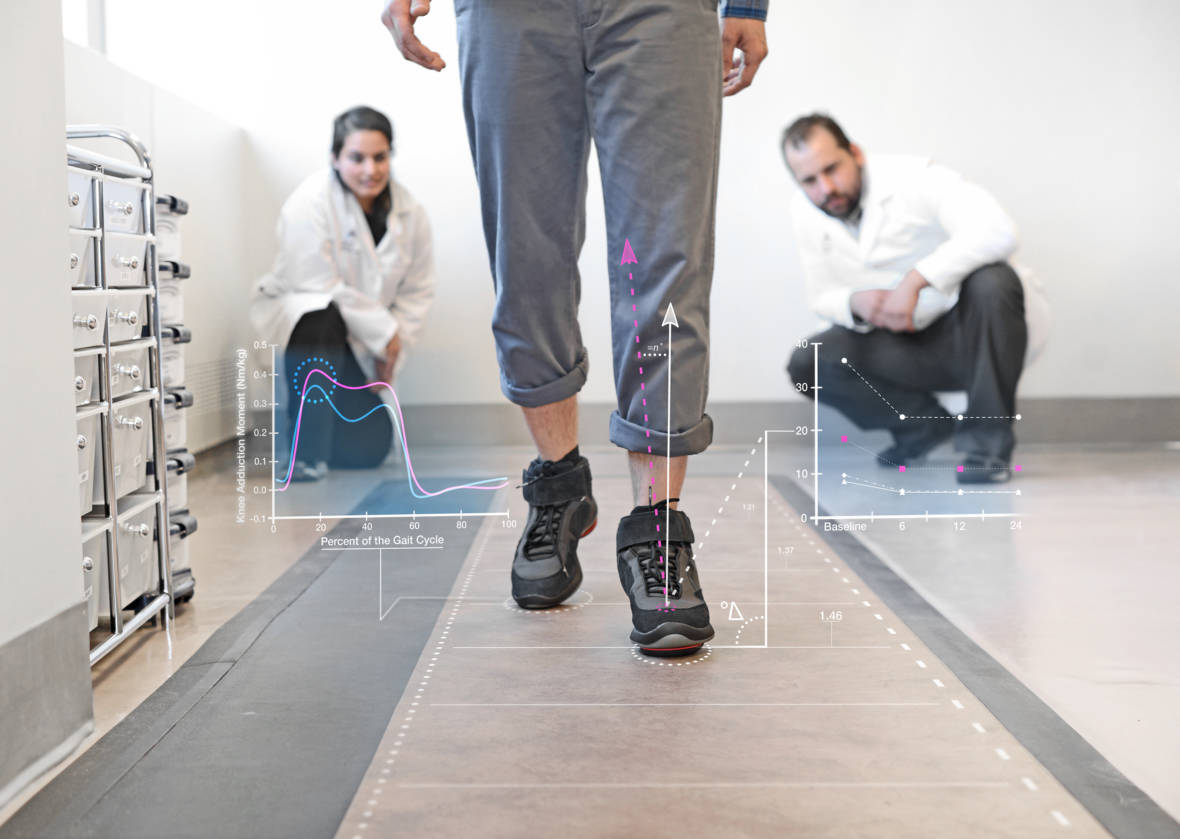
"content": "\u003cp>Typically, when people suffer from back or knee pain, they reach for the anti-inflammatories or the pain meds.\u003c/p>\n\u003cp>But one company has come up with a shoe it thinks can be just as effective.\u003c/p>\n\u003cp>\u003ca href=\"https://www.apostherapy.com/\" target=\"_blank\">AposTherapy's\u003c/a> space-age-looking footwear is designed to reduce knee, hip and back pain by realigning the way patients walk.\u003c/p>\n\u003cp>The shoes get good reviews from one location in the U.S. currently prescribing them, Mt. Sinai Hospital in Manhattan. But the $5,000 out-of-pocket price tag and only minimal evidence that the shoe works has raised concerns among some doctors.\u003c/p>\n\u003cp>\u003cstrong>How Is the Shoe Supposed to Work?\u003c/strong>\u003c/p>\n\u003cp>[ad fullwidth]\u003c/p>\n\u003cp>Currently prescribed by doctors at Mount Sinai and administered by physical therapists, the sneakers are outfitted with two semi-oval pods on the bottom of each sole. These are meant to redistribute weight and strengthen weaker muscles, reducing the stress on knee, hip and back joints.\u003c/p>\n\u003cp>When patients are in pain, they often change the way they walk, says Mount Sinai physical therapist Steven Venegas. They favor one leg over the other, shorten their stride or bend their knees less to reduce the impact on joints,\u003c/p>\n\u003cp>This walking pattern means some muscles start to work less and others work more to compensate, he says.\u003c/p>\n\u003cp>The AposTherapy shoes are intended to \u003cspan style=\"font-weight: 400\">correct a person's gait and allow them to start engaging the underutilized muscles again. \u003c/span>\u003cstrong>\u003cspan style=\"font-weight: 400\">Better muscle control and stability then alleviate pressure on painful joints.\u003c/span>\u003c/strong>\u003c/p>\n\u003cp>The company got its start in Israel in 2005, expanded to the UK, and is now headquartered in New York City, the only place in the U.S. where the shoes are currently available. A handful of physical therapy practices and hospitals are trying them out. Healthfirst is the only insurer in the U.S. to cover the cost of the shoes.\u003c/p>\n\u003cp>Dr. Joseph Herrera, the chair of Mount Sinai's rehabilitation medicine department, has been recommending the shoes to his patients.\u003c/p>\n\u003cp>\"It’s actually been remarkable,\" he says, \"we’ve had great patient satisfaction.\"\u003c/p>\n\u003cp>Researchers at the hospital are actively enrolling more patients to join the 30 already participating in a clinical trial.\u003c/p>\n\u003cp>\u003cstrong>Satisfied Customer\u003c/strong>\u003c/p>\n\u003cp>One satisfied patient\u003cstrong> \u003c/strong>is 35-year-old Summer Dion, a professional hip-hop dancer with a medial meniscus tear, mild knee osteoarthritis and a stress fracture in her back.\u003c/p>\n\u003cp>After having received a cortisone shot and physical therapy, her left knee started to swell, she says, so Herrera recommended Apos. Dion says the pain in her back subsided after a week of wearing the shoes.\u003c/p>\n\u003cp>\"I feel like it’s working and I wish I could wear them longer,\" she says. \"What sucks is taking them off because then you have to put regular shoes on or you’re walking barefoot and you're not in that perfect alignment anymore.\"\u003c/p>\n\u003cp>The therapy has received a smattering of \u003ca href=\"http://www.cnbc.com/2015/04/06/apos-therapy-catches-the-eye-of-ex-pro-athletes.html\" target=\"_blank\">positive press\u003c/a> over the last few years, but not everyone is enthusiastic. Stanford \u003ca href=\"http://ortho.stanford.edu/spine/todd-alamin-profile.html\">spine surgeon Todd Alamin\u003c/a> questioned Apos' medical studies, calling them, \"relatively poor,\" with \"weak evidence.\"\u003c/p>\n\u003cp>And then there's the price. The out-of-pocket cost is $5,000, Herrera says, for those not covered by Healthfirst.\u003c/p>\n\u003cp>Apos says health care providers set the price and the cost includes a fitting with a physical therapist and multiple follow-up sessions.\u003c/p>\n\u003cp>Alamin says, \"If their shoe is worth the money, they should have better data.\"\u003c/p>\n\u003cp>\u003ca href=\"http://bmcmusculoskeletdisord.biomedcentral.com/articles/10.1186/1471-2474-11-179\">One study\u003c/a>, published in BMC Musculoskeletal Disorders\u003cem>,\u003c/em> lasted eight weeks and involved 57 patients, including a control group. It found significant improvements in the patients who used the shoe, and no improvements in the control group.\u003c/p>\n\u003cp>A \u003ca href=\"http://www.hindawi.com/journals/arthritis/2013/689236/#B21\" target=\"_blank\">lengthier study \u003c/a>followed 40 participants over two years, but didn't find a meaningful difference in improvement between those using the shoes and a control group.\u003c/p>\n\u003cp>Researchers expect results in the Mount Sinai trial by the end of this year.\u003c/p>\n\u003cp>\u003c/p>\n\u003cp> \u003c/p>\n\n",
"disqusIdentifier": "183979 http://ww2.kqed.org/futureofyou/?p=183979",
"disqusUrl": "https://ww2.kqed.org/futureofyou/2016/07/20/patients-attempt-walk-off-pain-wearable-therapy/",
"stats": {
"hasVideo": false,
"hasChartOrMap": false,
"hasAudio": false,
"hasPolis": false,
"wordCount": 688,
"hasGoogleForm": false,
"hasGallery": false,
"hasHearkenModule": false,
"iframeSrcs": [],
"paragraphCount": 26
},
"modified": 1475119731,
"excerpt": "Special sneakers meant to realign the way people with knee, hip and back pain walk are now being tested at a handful of hospitals. But not everyone is on board with the concept.",
"headData": {
"twImgId": "",
"twTitle": "",
"ogTitle": "",
"ogImgId": "",
"twDescription": "",
"description": "Special sneakers meant to realign the way people with knee, hip and back pain walk are now being tested at a handful of hospitals. But not everyone is on board with the concept.",
"title": "Patients Attempt to 'Walk Off' Pain With Wearable Therapy | KQED",
"ogDescription": "",
"schema": {
"@context": "https://schema.org",
"@type": "Article",
"headline": "Patients Attempt to 'Walk Off' Pain With Wearable Therapy",
"datePublished": "2016-07-20T14:11:12-07:00",
"dateModified": "2016-09-28T20:28:51-07:00",
"image": "https://cdn.kqed.org/wp-content/uploads/2020/02/KQED-OG-Image@1x.png"
}
},
"guestAuthors": [],
"slug": "patients-attempt-walk-off-pain-wearable-therapy",
"status": "publish",
"path": "/futureofyou/183979/patients-attempt-walk-off-pain-wearable-therapy",
"audioTrackLength": null,
"parsedContent": [
{
"type": "contentString",
"content": "\u003cdiv class=\"post-body\">\u003cp>\u003cp>Typically, when people suffer from back or knee pain, they reach for the anti-inflammatories or the pain meds.\u003c/p>\n\u003cp>But one company has come up with a shoe it thinks can be just as effective.\u003c/p>\n\u003cp>\u003ca href=\"https://www.apostherapy.com/\" target=\"_blank\">AposTherapy's\u003c/a> space-age-looking footwear is designed to reduce knee, hip and back pain by realigning the way patients walk.\u003c/p>\n\u003cp>The shoes get good reviews from one location in the U.S. currently prescribing them, Mt. Sinai Hospital in Manhattan. But the $5,000 out-of-pocket price tag and only minimal evidence that the shoe works has raised concerns among some doctors.\u003c/p>\n\u003cp>\u003cstrong>How Is the Shoe Supposed to Work?\u003c/strong>\u003c/p>\n\u003cp>\u003c/p>\u003c/div>",
"attributes": {
"named": {},
"numeric": []
}
},
{
"type": "component",
"content": "",
"name": "ad",
"attributes": {
"named": {
"label": "fullwidth"
},
"numeric": [
"fullwidth"
]
}
},
{
"type": "contentString",
"content": "\u003cdiv class=\"post-body\">\u003cp>\u003c/p>\n\u003cp>Currently prescribed by doctors at Mount Sinai and administered by physical therapists, the sneakers are outfitted with two semi-oval pods on the bottom of each sole. These are meant to redistribute weight and strengthen weaker muscles, reducing the stress on knee, hip and back joints.\u003c/p>\n\u003cp>When patients are in pain, they often change the way they walk, says Mount Sinai physical therapist Steven Venegas. They favor one leg over the other, shorten their stride or bend their knees less to reduce the impact on joints,\u003c/p>\n\u003cp>This walking pattern means some muscles start to work less and others work more to compensate, he says.\u003c/p>\n\u003cp>The AposTherapy shoes are intended to \u003cspan style=\"font-weight: 400\">correct a person's gait and allow them to start engaging the underutilized muscles again. \u003c/span>\u003cstrong>\u003cspan style=\"font-weight: 400\">Better muscle control and stability then alleviate pressure on painful joints.\u003c/span>\u003c/strong>\u003c/p>\n\u003cp>The company got its start in Israel in 2005, expanded to the UK, and is now headquartered in New York City, the only place in the U.S. where the shoes are currently available. A handful of physical therapy practices and hospitals are trying them out. Healthfirst is the only insurer in the U.S. to cover the cost of the shoes.\u003c/p>\n\u003cp>Dr. Joseph Herrera, the chair of Mount Sinai's rehabilitation medicine department, has been recommending the shoes to his patients.\u003c/p>\n\u003cp>\"It’s actually been remarkable,\" he says, \"we’ve had great patient satisfaction.\"\u003c/p>\n\u003cp>Researchers at the hospital are actively enrolling more patients to join the 30 already participating in a clinical trial.\u003c/p>\n\u003cp>\u003cstrong>Satisfied Customer\u003c/strong>\u003c/p>\n\u003cp>One satisfied patient\u003cstrong> \u003c/strong>is 35-year-old Summer Dion, a professional hip-hop dancer with a medial meniscus tear, mild knee osteoarthritis and a stress fracture in her back.\u003c/p>\n\u003cp>After having received a cortisone shot and physical therapy, her left knee started to swell, she says, so Herrera recommended Apos. Dion says the pain in her back subsided after a week of wearing the shoes.\u003c/p>\n\u003cp>\"I feel like it’s working and I wish I could wear them longer,\" she says. \"What sucks is taking them off because then you have to put regular shoes on or you’re walking barefoot and you're not in that perfect alignment anymore.\"\u003c/p>\n\u003cp>The therapy has received a smattering of \u003ca href=\"http://www.cnbc.com/2015/04/06/apos-therapy-catches-the-eye-of-ex-pro-athletes.html\" target=\"_blank\">positive press\u003c/a> over the last few years, but not everyone is enthusiastic. Stanford \u003ca href=\"http://ortho.stanford.edu/spine/todd-alamin-profile.html\">spine surgeon Todd Alamin\u003c/a> questioned Apos' medical studies, calling them, \"relatively poor,\" with \"weak evidence.\"\u003c/p>\n\u003cp>And then there's the price. The out-of-pocket cost is $5,000, Herrera says, for those not covered by Healthfirst.\u003c/p>\n\u003cp>Apos says health care providers set the price and the cost includes a fitting with a physical therapist and multiple follow-up sessions.\u003c/p>\n\u003cp>Alamin says, \"If their shoe is worth the money, they should have better data.\"\u003c/p>\n\u003cp>\u003ca href=\"http://bmcmusculoskeletdisord.biomedcentral.com/articles/10.1186/1471-2474-11-179\">One study\u003c/a>, published in BMC Musculoskeletal Disorders\u003cem>,\u003c/em> lasted eight weeks and involved 57 patients, including a control group. It found significant improvements in the patients who used the shoe, and no improvements in the control group.\u003c/p>\n\u003cp>A \u003ca href=\"http://www.hindawi.com/journals/arthritis/2013/689236/#B21\" target=\"_blank\">lengthier study \u003c/a>followed 40 participants over two years, but didn't find a meaningful difference in improvement between those using the shoes and a control group.\u003c/p>\n\u003cp>Researchers expect results in the Mount Sinai trial by the end of this year.\u003c/p>\n\u003cp>\u003c/p>\n\u003cp> \u003c/p>\n\n\u003c/div>\u003c/p>",
"attributes": {
"named": {},
"numeric": []
}
}
],
"link": "/futureofyou/183979/patients-attempt-walk-off-pain-wearable-therapy",
"authors": [
"5432"
],
"categories": [
"futureofyou_1060",
"futureofyou_1062"
],
"tags": [
"futureofyou_988",
"futureofyou_987",
"futureofyou_989"
],
"featImg": "futureofyou_184629",
"label": "futureofyou"
},
"futureofyou_201621": {
"type": "posts",
"id": "futureofyou_201621",
"meta": {
"index": "posts_1716263798",
"site": "futureofyou",
"id": "201621",
"score": null,
"sort": [
1468607103000
]
},
"parent": 0,
"labelTerm": {
"site": "futureofyou"
},
"blocks": [],
"publishDate": 1468607103,
"format": "standard",
"disqusTitle": "In a First, Scientists Restore Eyesight in Mice With Glaucoma-Like Damage",
"title": "In a First, Scientists Restore Eyesight in Mice With Glaucoma-Like Damage",
"headTitle": "KQED Future of You | KQED Science",
"content": "\u003cp>Scientists at Stanford university have restored partial vision to mice whose optic nerves were damaged.\u003c/p>\n\u003cp>The researchers say the experiment, \u003ca href=\"http://MhOLhewhBjsADxJx0wCEiSglKXbSpoyu_qY6wsuDzuCLFharMPoFgbGpof8PP2eXSMnl86GUDAXNsWS1ydKxpPp_7E8KhL6_mecP5Ir6jPjL5DfupjU\" target=\"_blank\">published\u003c/a> this week in the journal Nature Neuroscience, is the first time \"multiple key aspects of vision\" have been restored in a mammal.\u003c/p>\n\u003cp>The implication of the research is that people who are completely blind due to glaucoma, tumors, or other conditions that damage the optic nerve may be able to regain some vision.\u003c/p>\n\u003caside class=\"pullquote alignright\">The visual capability of the mice was tantamount to an individual being able, perhaps, to move out of the way of traffic, or walk through a room without bumping into objects or people.\u003c/aside>\n\u003cp>The team will next test out noninvasive ways of achieving the same result in humans, says Dr. Andrew Huberman, an associate professor of neurobiology at Stanford University and a co-author of the study.\u003c/p>\n\u003cp>But even in a best-case scenario, in which researchers can replicate the results in humans, any benefit is at least 10 years away, says Dr. Andrew Iwach, chairman of the board for the Glaucoma Research Foundation, a study co-funder.\u003c/p>\n\u003cp>[ad fullwidth]\u003c/p>\n\u003cp>The vast majority of an estimated 3 million Americans with glaucoma do not go blind, but the foundation says it is still the second-leading cause of blindness, after cataracts. In the U.S., more than 120,000 people have lost their sight due to the disease.\u003c/p>\n\u003cp>\u003cstrong>Partial Restoration\u003c/strong>\u003c/p>\n\u003cp>The mice had limited vision restored. Translating the improvement into human terms, Huberman described their visual capacity as tantamount to an individual being able to walk through a room without bumping into objects or people, or, perhaps, dodge traffic.\u003c/p>\n\u003cp>\"There is some recovery of important functions,\" he says, \"but not the kind of things that would be involved in reaching out for a pen on a table or texting or reading fine print.\"\u003c/p>\n\u003cp>The mouses' vision is still being monitored, and it may improve over time, Huberman says. \"The brain is really good at plasticity.\"\u003c/p>\n\u003cp>\u003cstrong>Regeneration of Brain Cells\u003c/strong>\u003c/p>\n\u003cp>The scientists were able to partially restore vision in the mice by regenerating, in the retina, extensions called axons on the ends of cells called ganglia. These cells receive visual information and send it to the brain through the axons.\u003c/p>\n\u003cfigure id=\"attachment_204224\" class=\"wp-caption aligncenter\" style=\"max-width: 1157px\">\u003ca href=\"http://ww2.kqed.org/futureofyou/wp-content/uploads/sites/13/2016/07/axons-use-this.jpg\">\u003cimg class=\"size-full wp-image-204224\" src=\"http://ww2.kqed.org/futureofyou/wp-content/uploads/sites/13/2016/07/axons-use-this.jpg\" alt=\"Mouse retinal ganglion cell axons (magenta and green) are regenerating, extending from site of the optic nerve injury (left). \" width=\"1157\" height=\"895\" srcset=\"https://ww2.kqed.org/app/uploads/sites/13/2016/07/axons-use-this.jpg 1157w, https://ww2.kqed.org/app/uploads/sites/13/2016/07/axons-use-this-400x309.jpg 400w, https://ww2.kqed.org/app/uploads/sites/13/2016/07/axons-use-this-776x600.jpg 776w, https://ww2.kqed.org/app/uploads/sites/13/2016/07/axons-use-this-768x594.jpg 768w, https://ww2.kqed.org/app/uploads/sites/13/2016/07/axons-use-this-960x743.jpg 960w\" sizes=\"(max-width: 1157px) 100vw, 1157px\">\u003c/a>\u003cfigcaption class=\"wp-caption-text\">Mouse retinal ganglion cell axons (magenta and green) are regenerating, extending from site of the optic nerve injury (left). \u003ccite>(Andrew D. Huberman/Stanford University)\u003c/cite>\u003c/figcaption>\u003c/figure>\n\u003cp>In glaucoma, retinal cells constrict from pressure, and the axons attached to them \"pull out of the brain,\" says Huberman. When this occurs, the affected cells cannot pass the visual information on to the brain.\u003c/p>\n\u003cp>The researchers started the experiment by injecting the first of three groups of mice with a virus that carried a gene called \u003ca href=\"https://www.google.com/search?q=mtor\" target=\"_blank\">mTOR\u003c/a>, which shifted the retinal ganglion cells into a state of growth.\u003c/p>\n\u003cp>\"Think of this kind of like steroids or exercise for retinal ganglion cells,\" Huberman says.\u003c/p>\n\u003cp>The researchers then induced an injury in the optic nerves of the mice -- an injury similar to the damage caused by glaucoma. The mTOR gene then prompted the axons to regenerate down the optic nerve, but they not all the way into the brain -- so no vision-enabling connection was made.\u003c/p>\n\u003cp>In the second group of mice, the researchers damaged the optic nerve without injecting the gene that triggers axon growth. Instead, the mice were treated with daily visual stimulation.\u003c/p>\n\u003cp>[contextly_sidebar id=\"ZVcu5xg3bObrRBWVQDUCzWishOH9hkB8\"]\"The animals were placed in kind of an IMAX theater, where they viewed movies of high-contrast, black-and-white bars moving around,\" Huberman says, adding that's a visual pattern good for stimulating electrical activity of retinal ganglia.\u003c/p>\n\u003cp>The third and luckiest group of mice received both the gene injection and the visual stimulation. The results, Huberman says, were \"spectacular.\"\u003c/p>\n\u003cp>\"What we found was there was this enormous synergistic effect. The axons grew 500 times farther and faster than they would with either condition alone. And they grew so far and so fast, in fact, that they managed to get back into the brain.\"\u003c/p>\n\u003cp>\u003cstrong>The Right Wiring\u003c/strong>\u003c/p>\n\u003cp>Huberman says the most important question answered in the study was whether \u003ca href=\"http://www.biology-online.org/dictionary/Neuron\" target=\"_blank\">neurons \u003c/a>-- in this case, the retinal ganglion cells that convey visual information to the brain -- would make the proper connections when regenerated. If not, \"it might be worse to have the wrong regeneration than no regeneration at all.\"\u003c/p>\n\u003cp>There are 30 types of retinal ganglion cells, he says, connecting their axons to different areas of the brain and controlling different functions.\u003c/p>\n\u003cp>\"You could imagine it would be a very bad thing to regenerate, say, the motion-sensitive neurons to the area of the brain involved in mood. Then every time something moves through your visual field, you'd have a readjustment of your mood.\"\u003c/p>\n\u003cp>But these misroutings didn't occur.\u003c/p>\n\u003cp>\"So what this means is, if you kickstart one of these cells into a regenerative state, once they get into the milieu in which they have to figure out which way to go, they remember it like a city they grew up in, and they go to the right place.\"\u003c/p>\n\u003cp>Dr. Iwach of the Glaucoma Research Foundation said the findings were \"preliminary, but very exciting.\"\u003c/p>\n\u003cp>\"We currently manage glaucoma by lowering eye pressure and trying to save what is left,\" he says. \"We have not had the ability to regenerate these connections in humans. If you lose them, your vision cannot be brought back.\"\u003c/p>\n\u003cp>\"I'm hopeful,\" Iwach says. \"I'm in the middle of seeing [glaucoma] patients, and they're struggling.\"\u003c/p>\n\u003cp>\u003c/p>\n\u003cp>Huberman says the next step for his research team is to partner with a virtual reality group at Stanford to run a human study on ways in which noninvasive approaches can stimulate specific sets of neurons to regenerate, or can enhance their growth.\u003c/p>\n\n",
"disqusIdentifier": "201621 http://ww2.kqed.org/futureofyou/?p=201621",
"disqusUrl": "https://ww2.kqed.org/futureofyou/2016/07/15/in-a-first-scientists-restore-eyesight-in-mice-with-glaucoma-like-damage/",
"stats": {
"hasVideo": false,
"hasChartOrMap": false,
"hasAudio": false,
"hasPolis": false,
"wordCount": 1012,
"hasGoogleForm": false,
"hasGallery": false,
"hasHearkenModule": false,
"iframeSrcs": [],
"paragraphCount": 32
},
"modified": 1475120208,
"excerpt": "The experiment restored 'multiple key aspects of vision' in mice who'd been blinded from optic nerve damage.",
"headData": {
"twImgId": "",
"twTitle": "",
"ogTitle": "",
"ogImgId": "",
"twDescription": "",
"description": "The experiment restored 'multiple key aspects of vision' in mice who'd been blinded from optic nerve damage.",
"title": "In a First, Scientists Restore Eyesight in Mice With Glaucoma-Like Damage | KQED",
"ogDescription": "",
"schema": {
"@context": "https://schema.org",
"@type": "Article",
"headline": "In a First, Scientists Restore Eyesight in Mice With Glaucoma-Like Damage",
"datePublished": "2016-07-15T11:25:03-07:00",
"dateModified": "2016-09-28T20:36:48-07:00",
"image": "https://cdn.kqed.org/wp-content/uploads/2020/02/KQED-OG-Image@1x.png"
}
},
"guestAuthors": [],
"slug": "in-a-first-scientists-restore-eyesight-in-mice-with-glaucoma-like-damage",
"status": "publish",
"path": "/futureofyou/201621/in-a-first-scientists-restore-eyesight-in-mice-with-glaucoma-like-damage",
"audioTrackLength": null,
"parsedContent": [
{
"type": "contentString",
"content": "\u003cdiv class=\"post-body\">\u003cp>\u003cp>Scientists at Stanford university have restored partial vision to mice whose optic nerves were damaged.\u003c/p>\n\u003cp>The researchers say the experiment, \u003ca href=\"http://MhOLhewhBjsADxJx0wCEiSglKXbSpoyu_qY6wsuDzuCLFharMPoFgbGpof8PP2eXSMnl86GUDAXNsWS1ydKxpPp_7E8KhL6_mecP5Ir6jPjL5DfupjU\" target=\"_blank\">published\u003c/a> this week in the journal Nature Neuroscience, is the first time \"multiple key aspects of vision\" have been restored in a mammal.\u003c/p>\n\u003cp>The implication of the research is that people who are completely blind due to glaucoma, tumors, or other conditions that damage the optic nerve may be able to regain some vision.\u003c/p>\n\u003caside class=\"pullquote alignright\">The visual capability of the mice was tantamount to an individual being able, perhaps, to move out of the way of traffic, or walk through a room without bumping into objects or people.\u003c/aside>\n\u003cp>The team will next test out noninvasive ways of achieving the same result in humans, says Dr. Andrew Huberman, an associate professor of neurobiology at Stanford University and a co-author of the study.\u003c/p>\n\u003cp>But even in a best-case scenario, in which researchers can replicate the results in humans, any benefit is at least 10 years away, says Dr. Andrew Iwach, chairman of the board for the Glaucoma Research Foundation, a study co-funder.\u003c/p>\n\u003cp>\u003c/p>\u003c/div>",
"attributes": {
"named": {},
"numeric": []
}
},
{
"type": "component",
"content": "",
"name": "ad",
"attributes": {
"named": {
"label": "fullwidth"
},
"numeric": [
"fullwidth"
]
}
},
{
"type": "contentString",
"content": "\u003cdiv class=\"post-body\">\u003cp>\u003c/p>\n\u003cp>The vast majority of an estimated 3 million Americans with glaucoma do not go blind, but the foundation says it is still the second-leading cause of blindness, after cataracts. In the U.S., more than 120,000 people have lost their sight due to the disease.\u003c/p>\n\u003cp>\u003cstrong>Partial Restoration\u003c/strong>\u003c/p>\n\u003cp>The mice had limited vision restored. Translating the improvement into human terms, Huberman described their visual capacity as tantamount to an individual being able to walk through a room without bumping into objects or people, or, perhaps, dodge traffic.\u003c/p>\n\u003cp>\"There is some recovery of important functions,\" he says, \"but not the kind of things that would be involved in reaching out for a pen on a table or texting or reading fine print.\"\u003c/p>\n\u003cp>The mouses' vision is still being monitored, and it may improve over time, Huberman says. \"The brain is really good at plasticity.\"\u003c/p>\n\u003cp>\u003cstrong>Regeneration of Brain Cells\u003c/strong>\u003c/p>\n\u003cp>The scientists were able to partially restore vision in the mice by regenerating, in the retina, extensions called axons on the ends of cells called ganglia. These cells receive visual information and send it to the brain through the axons.\u003c/p>\n\u003cfigure id=\"attachment_204224\" class=\"wp-caption aligncenter\" style=\"max-width: 1157px\">\u003ca href=\"http://ww2.kqed.org/futureofyou/wp-content/uploads/sites/13/2016/07/axons-use-this.jpg\">\u003cimg class=\"size-full wp-image-204224\" src=\"http://ww2.kqed.org/futureofyou/wp-content/uploads/sites/13/2016/07/axons-use-this.jpg\" alt=\"Mouse retinal ganglion cell axons (magenta and green) are regenerating, extending from site of the optic nerve injury (left). \" width=\"1157\" height=\"895\" srcset=\"https://ww2.kqed.org/app/uploads/sites/13/2016/07/axons-use-this.jpg 1157w, https://ww2.kqed.org/app/uploads/sites/13/2016/07/axons-use-this-400x309.jpg 400w, https://ww2.kqed.org/app/uploads/sites/13/2016/07/axons-use-this-776x600.jpg 776w, https://ww2.kqed.org/app/uploads/sites/13/2016/07/axons-use-this-768x594.jpg 768w, https://ww2.kqed.org/app/uploads/sites/13/2016/07/axons-use-this-960x743.jpg 960w\" sizes=\"(max-width: 1157px) 100vw, 1157px\">\u003c/a>\u003cfigcaption class=\"wp-caption-text\">Mouse retinal ganglion cell axons (magenta and green) are regenerating, extending from site of the optic nerve injury (left). \u003ccite>(Andrew D. Huberman/Stanford University)\u003c/cite>\u003c/figcaption>\u003c/figure>\n\u003cp>In glaucoma, retinal cells constrict from pressure, and the axons attached to them \"pull out of the brain,\" says Huberman. When this occurs, the affected cells cannot pass the visual information on to the brain.\u003c/p>\n\u003cp>The researchers started the experiment by injecting the first of three groups of mice with a virus that carried a gene called \u003ca href=\"https://www.google.com/search?q=mtor\" target=\"_blank\">mTOR\u003c/a>, which shifted the retinal ganglion cells into a state of growth.\u003c/p>\n\u003cp>\"Think of this kind of like steroids or exercise for retinal ganglion cells,\" Huberman says.\u003c/p>\n\u003cp>The researchers then induced an injury in the optic nerves of the mice -- an injury similar to the damage caused by glaucoma. The mTOR gene then prompted the axons to regenerate down the optic nerve, but they not all the way into the brain -- so no vision-enabling connection was made.\u003c/p>\n\u003cp>In the second group of mice, the researchers damaged the optic nerve without injecting the gene that triggers axon growth. Instead, the mice were treated with daily visual stimulation.\u003c/p>\n\u003cp>\u003c/p>\u003cp>\u003c/p>\u003cp>\"The animals were placed in kind of an IMAX theater, where they viewed movies of high-contrast, black-and-white bars moving around,\" Huberman says, adding that's a visual pattern good for stimulating electrical activity of retinal ganglia.\u003c/p>\n\u003cp>The third and luckiest group of mice received both the gene injection and the visual stimulation. The results, Huberman says, were \"spectacular.\"\u003c/p>\n\u003cp>\"What we found was there was this enormous synergistic effect. The axons grew 500 times farther and faster than they would with either condition alone. And they grew so far and so fast, in fact, that they managed to get back into the brain.\"\u003c/p>\n\u003cp>\u003cstrong>The Right Wiring\u003c/strong>\u003c/p>\n\u003cp>Huberman says the most important question answered in the study was whether \u003ca href=\"http://www.biology-online.org/dictionary/Neuron\" target=\"_blank\">neurons \u003c/a>-- in this case, the retinal ganglion cells that convey visual information to the brain -- would make the proper connections when regenerated. If not, \"it might be worse to have the wrong regeneration than no regeneration at all.\"\u003c/p>\n\u003cp>There are 30 types of retinal ganglion cells, he says, connecting their axons to different areas of the brain and controlling different functions.\u003c/p>\n\u003cp>\"You could imagine it would be a very bad thing to regenerate, say, the motion-sensitive neurons to the area of the brain involved in mood. Then every time something moves through your visual field, you'd have a readjustment of your mood.\"\u003c/p>\n\u003cp>But these misroutings didn't occur.\u003c/p>\n\u003cp>\"So what this means is, if you kickstart one of these cells into a regenerative state, once they get into the milieu in which they have to figure out which way to go, they remember it like a city they grew up in, and they go to the right place.\"\u003c/p>\n\u003cp>Dr. Iwach of the Glaucoma Research Foundation said the findings were \"preliminary, but very exciting.\"\u003c/p>\n\u003cp>\"We currently manage glaucoma by lowering eye pressure and trying to save what is left,\" he says. \"We have not had the ability to regenerate these connections in humans. If you lose them, your vision cannot be brought back.\"\u003c/p>\n\u003cp>\"I'm hopeful,\" Iwach says. \"I'm in the middle of seeing [glaucoma] patients, and they're struggling.\"\u003c/p>\n\u003cp>\u003c/p>\n\u003cp>Huberman says the next step for his research team is to partner with a virtual reality group at Stanford to run a human study on ways in which noninvasive approaches can stimulate specific sets of neurons to regenerate, or can enhance their growth.\u003c/p>\n\n\u003c/div>\u003c/p>",
"attributes": {
"named": {},
"numeric": []
}
}
],
"link": "/futureofyou/201621/in-a-first-scientists-restore-eyesight-in-mice-with-glaucoma-like-damage",
"authors": [
"80"
],
"categories": [
"futureofyou_1062"
],
"tags": [
"futureofyou_977",
"futureofyou_80",
"futureofyou_978"
],
"featImg": "futureofyou_203765",
"label": "futureofyou"
},
"futureofyou_202267": {
"type": "posts",
"id": "futureofyou_202267",
"meta": {
"index": "posts_1716263798",
"site": "futureofyou",
"id": "202267",
"score": null,
"sort": [
1468348399000
]
},
"parent": 0,
"labelTerm": {
"site": "futureofyou"
},
"blocks": [],
"publishDate": 1468348399,
"format": "standard",
"disqusTitle": "For Some With Autism, a Miracle Treatment That Fades Fast",
"title": "For Some With Autism, a Miracle Treatment That Fades Fast",
"headTitle": "KQED Future of You | KQED Science",
"content": "\u003cp>The story is a familiar one: the saga of a loving parent's quest to save a child. This time it's about the mother of a boy with autism. The mother scours the medical literature in search of any kind of treatment, however far-fetched and experimental. She finds one that seems promising, something involving magnetic fields, and moves mountains to get it for her son as part of a research protocol.\u003c/p>\n\u003caside class=\"pullquote alignright\">One teen goes from being a boy with no friends to a boy asked to the homecoming dance by four different girls. But the benefits began to fade after just a few months.\u003c/aside>\n\u003cp>Then, seeing that it helps, she devotes herself to getting more of it. Ultimately the mother starts a foundation to promote research into the new treatment, hoping to prove its value and one day make it part of standard care, not just for her son but for other children with autism, too.\u003c/p>\n\u003cp>This particular version of the story, though, is tinged with irony. The treatment in this case is \u003ca href=\"http://www.nimh.nih.gov/health/topics/brain-stimulation-therapies/brain-stimulation-therapies.shtml#part_152879\">transcranial magnetic stimulation\u003c/a>, and the mother is a Minneapolis woman named Kim Hollingsworth Taylor. In 2012, Taylor's son, age 14 at the time and on the high-functioning end of the autism spectrum, was part of a trial of TMS that seemed to relieve a few of his autism symptoms for several days, making him able to read social cues more accurately and to complete cognitive tasks in far less time than before.\u003c/p>\n\u003cp>Pleased with the results, Taylor found a way the following year for her son to get more treatments in Boston, twice a week over the course of 10 weeks, even though TMS had not been approved by the Food and Drug Administration for autism symptoms (and still has not).\u003c/p>\n\u003cp>During this time, Taylor says, her son's autism symptoms disappeared, and he went from being a boy with no friends to being a boy who was asked to the homecoming dance by four different girls. The change thrilled her so much that she started a small nonprofit to advance research into the use of TMS for autism. Taylor, who has a background as a financial analyst in the medical technology industry, called the foundation \u003ca href=\"https://clearlypresent.org/\">Clearly Present\u003c/a>, the phrase her son used to describe how he felt after treatment. \"It's like there's more of me here now,\" he told her.\u003c/p>\n\u003cp>[ad fullwidth]\u003c/p>\n\u003cp>[contextly_sidebar id=\"RlJDDGPFUABA2mxpccf34tsLq1ak6UvR\"]\u003c/p>\n\u003cp>But the benefits began to fade after just a few months. Three years after his last treatment, Taylor's now 18-year-old son is back to where he was before he started on TMS. And he says he doesn't want to try it again if it means again disrupting the family life and moving to Boston with his father for another three-month stretch.\u003c/p>\n\u003cp>So here is Taylor, committed to organizing scientific conferences and soliciting research funding through the Clearly Present Foundation, with the personal impetus for her labors having disappeared.\u003c/p>\n\u003cp>\"Like most people I would crawl on broken glass to make things a little better for my kid,\" Taylor said in a recent phone interview. So she finds it \"profoundly sad\" that there's no place closer to home that could offer TMS to her son — and frustrating to be in the midst of a demanding volunteer project that, for now at least, doesn't seem likely to help her own child.\u003c/p>\n\u003cp>In an \u003ca href=\"https://spectrumnews.org/features/deep-dive/magnetic-promise-can-brain-stimulation-treat-autism-2/\">article on TMS\u003c/a> for Spectrum, a Web magazine about autism science, the writer Lydia Denworth called the story of the Clearly Present Foundation \"a cautionary tale for anyone who reads too much into TMS' benefits.\" Another cautionary tale is \u003ca href=\"http://www.npr.org/sections/health-shots/2016/07/08/484812170/what-an-hour-of-emotion-makes-visible\">featured\u003c/a> in the latest episode of NPR's podcast and program \u003ca href=\"http://www.npr.org/podcasts/510307/invisibilia\">Invisibilia\u003c/a>, about a middle-aged physician on the autism spectrum who also tried TMS. The treatment, which the woman (also named Kim, but not related to Taylor) underwent twice, enabled her to perceive subtle emotions in others for the first time in her life. Then, after less than an hour, that insight disappeared.\u003c/p>\n\u003cp>How did she feel about getting this brief insight into how most people experience feelings? \"It could be that you would get a glimpse of this and you couldn't have it, and it would be completely heartbreaking and you couldn't get over it,\" she told Invisibilia host Alix Spiegel. But after reflection, the physician told Spiegel, her feelings were mixed — depression, yes, but also gratitude that she'd had a chance to gain a deeper understanding of what it means to be human.\u003c/p>\n\u003cp>Autism is a developmental disorder that \u003ca href=\"http://www.cdc.gov/ncbddd/autism/hcp-dsm.html\">can be disabling\u003c/a>, and there's no cure. That makes families uniquely vulnerable to the potential of untested treatment. The fear is that TMS could turn out to be the latest in a \u003ca href=\"http://oepf.org/sites/default/files/Desperate%20for%20an%20autism%20cure.pdf\">long string\u003c/a> of untested or off-label treatments for autism, from chelation therapy to hyperbaric oxygen chambers to gluten-free diets, that desperate parents have been spending money on for decades.\u003c/p>\n\u003cp>None of these treatments has proven beneficial in clinical trials, and some have actually caused harm. FDA officials worry that even if a treatment is relatively safe, it could still divert precious resources away from proven treatments, such as behavioral interventions and certain drugs.\u003c/p>\n\u003cp>Companies promoting untested approaches face \"possible legal action if they continue to make false or misleading claims about products and therapies claiming to treat or cure autism,\" the FDA wrote in a \u003ca href=\"http://www.fda.gov/ForConsumers/ConsumerUpdates/ucm394757.htm\">consumer bulletin\u003c/a> in 2014. \"Some of these so-called therapies carry significant health risks.\"\u003c/p>\n\u003cp>It's easy to understand the enthusiasm for a treatment like TMS, which is noninvasive, nonpharmacological and already has FDA clearance for one condition — \u003ca href=\"http://www.ncbi.nlm.nih.gov/pmc/articles/PMC4492646/\">severe depression\u003c/a> that doesn't respond to other treatments. It has \u003ca href=\"http://www.ncbi.nlm.nih.gov/pmc/articles/PMC4122183/\">few known side effects\u003c/a>, though it has been shown, in very rare cases, to cause seizures.\u003c/p>\n\u003cp>The treatment involves placing a relatively small and very powerful electromagnet on the scalp, and sending pulses of magnetic waves directly into the brain to activate or deactivate particular neurons. It has been used experimentally in autism, mostly in hopes of developing a better diagnostic tool. But as news percolates of this research application, more and more people want to try it for themselves or their children.\u003c/p>\n\u003cp>\u003cstrong>Research on TMS\u003c/strong>\u003c/p>\n\u003cp>But for autism, the science of TMS treatment is, according to researcher \u003ca href=\"https://vivo.brown.edu/display/loberman\">Lindsay Oberman\u003c/a>, \"still in its infancy.\"\u003c/p>\n\u003cp>\"I know it's easy to get overly optimistic given the media coverage and web posts about the remarkable responses some people with autism have reported after participating in a TMS study,\" Oberman, a research psychologist at Brown University and Bradley Hospital in Rhode Island, wrote last March in a \u003ca href=\"https://www.autismspeaks.org/blog/2016/03/25/transcranial-magnetic-stimulation-autism-evidence-benefit\">blog post\u003c/a> for the advocacy group Autism Speaks.\u003c/p>\n\u003cp>But those studies have been very few — just \u003ca href=\"http://www.ncbi.nlm.nih.gov/pubmed/24127165\">13 in the medical literature to date\u003c/a> — and they tend to focus on only a select group of subjects: adults, generally male, who are high-functioning and do not have epilepsy. It's risky, then, to generalize to how TMS would affect women or children with autism, or people with more severe symptoms.\u003c/p>\n\u003cp>\"I caution against drawing conclusions from the preliminary results of the TMS studies that I and others have conducted,\" wrote Oberman in her blog post.\u003c/p>\n\u003cp>Among those 13 trials of TMS for autism, which involve fewer than 200 people altogether, only one is a double-blind, randomized trial — the type of trial designed to rule out the so-called placebo effect (improvements that occur because subjects expect them to).\u003c/p>\n\u003cp>In the \u003ca href=\"http://www.ncbi.nlm.nih.gov/pubmed/24280031\">double-blind study\u003c/a>, conducted in Australia on 28 high-functioning adults diagnosed with autism or Asperger's syndrome, the 15 people in the treatment group showed some improvement, compared with the 13 controls, in terms of better social skills and reduced anxiety, both immediately after the treatment and at the one-month follow-up.\u003c/p>\n\u003cp>The real excitement over TMS for autism, however, does not come from the medical literature. It comes from popular testimonials of people on the autism spectrum who credit TMS for heightening their emotional sensitivity and leading to fewer obsessions, fewer repetitive actions and improved social skills.\u003c/p>\n\u003cp>John Elder Robison, an author and autism activist, describes his own experience in his \u003ca href=\"http://www.npr.org/sections/health-shots/2016/04/21/475112703/electric-currents-and-an-emotional-awakening-for-one-man-with-autism\">latest book\u003c/a>, \u003cem>Switched On: A Memoir of Brain Change and Emotional Awakening\u003c/em>. The alterations of TMS were life-affirming, he writes, but they were tinged with sadness, too, because his insights into others' emotions showed him how troubled most people's inner lives really are.\u003c/p>\n\u003cp>\"Before the TMS, I had fantasized that the emotional cues I was missing in my autism would bring me closer to people,\" \u003ca href=\"http://well.blogs.nytimes.com/2016/03/18/an-experimental-autism-treatment-cost-me-my-marriage/?_r=5\">Robison wrote\u003c/a> earlier this year in \u003cem>The New York Times\u003c/em>. \"The reality was very different. The signals I now picked up about what my fellow humans were feeling overwhelmed me. They seemed scared, alarmed, worried and even greedy. The beauty I envisioned was nowhere to be found.\"\u003c/p>\n\u003cp>But while Robison says his heightened emotions have generally persisted in the eight years since his first treatment, even his doctors say his response is unusually robust.\u003c/p>\n\u003cp>It's easy to see why parents would grab at cures that promise to bring back their sons and daughters, to give their children a voice, stop them from self-harm, or offer them a chance at friendship and independence. But quite apart from the question of whether the traits of autism are symptoms to be treated or differences to be embraced — a debate at the heart of the \u003ca href=\"http://stevesilberman.com/book/neurotribes/\">neurodiversity movement\u003c/a> — Oberman says it's too soon to institute TMS as a treatment, especially for children, whose brains are still developing.\u003c/p>\n\u003cp>It's difficult to predict the long-term consequences for children of routinely disrupting their brain activity. And it's hard to know, for children and adults alike, the details of how best to offer TMS for autism: how often it should be used, for how long a period, in which regions of the brain, and for what purposes.\u003c/p>\n\u003cp>\"There are still many things that we do not understand about how the developing brain responds to TMS or any form of neural intervention,\" Oberman told me by email this week. \"And if the goal with TMS is to 'rewire' or affect the connectivity of the brain in order to improve symptoms, we first have to understand what degree of connectivity and wiring is healthy at any given age, and what type of stimulation will improve the functioning of these areas.\"\u003c/p>\n\u003cp>In other words, scientific evidence about the efficacy of TMS in autism is not in yet, and it's accumulating the way most scientific evidence does: with painful slowness.\u003c/p>\n\u003cp>Among the still-unanswered questions about TMS is how it works and which autistic behaviors it best targets. Put 10 clinicians in a room, Oberman says, and you're likely to get 10 different answers. Her own research interest is in social communication, she says, but other symptoms — poor executive functioning, depression, irritability, poor language skills — are just as likely to be affected.\u003c/p>\n\u003cp>\"We've been using TMS for adults with autism who have other co-morbid conditions such as obsessive-compulsive disorder and depression,\" says Eric Hollander, director of the Autism and OCD Spectrum Program at Montefiore Medical Center and the Albert Einstein College of Medicine in the Bronx. \"And we've had good luck in terms of reducing the severity of some compulsive behaviors, as well as anxiety.\"\u003c/p>\n\u003cp>Hollander has found TMS useful for relieving such autism symptoms as agitation, self-injury, and behavioral rigidity. But he says many questions about TMS for autism are still unanswered, including which brain regions to target, the optimal frequency and duration of treatment, and the best schedule for booster therapy for long-term maintenance.\u003c/p>\n\u003cp>In addition to all these questions about \u003cem>how\u003c/em> TMS should be used, scientists don't really know much about who the best candidates for TMS are. Is it best aimed at those on the high-functioning end of the spectrum? Only for adults? Only for those without epilepsy or other co-existing problems?\u003c/p>\n\u003cp>And what are the ethical implications of recommending TMS for a use not approved by the FDA? Even though it is legal (doctors can prescribe any FDA-approved drug or device for any purpose, not only the purpose for which it was originally approved), that does not make it the right thing to do.\u003c/p>\n\u003cp>One way to answer these questions is through a multicenter therapeutic trial of TMS for autism, something that Taylor and the Clearly Present Foundation have been trying to help organize. But clinical trials are expensive and would require a major grant, which members of the coalition of researchers Taylor has assembled, known as the \u003ca href=\"http://onlinelibrary.wiley.com/doi/10.1002/aur.1567/abstract\">TMS Therapy for Autism Consensus Group\u003c/a>, have spent the past two years trying to obtain. They're talking now about first coordinating a number of pilot studies at individual institutions, on the way to gearing up to a large-scale, multicenter clinical trial.\u003c/p>\n\u003cp>There are already a few studies of TMS and autism underway: One in Canada is looking for improvement in executive function in 50 adolescents and young adults; another in France is looking for changes in social cognition in 60 adults; and one in Israel (the one most relevant to children) is looking for changes in social interaction in 20 children and adolescents who have autism or an intellectual disability or both.\u003c/p>\n\u003cp>In the meantime, Oberman says the only safe way to receive TMS for autism, for adults and children alike, is by being part of a research trial — which means going to \u003ca href=\"https://clinicaltrials.gov/ct2/results?term=autism+tms&Search=Search\">clinicaltrials.gov\u003c/a> to volunteer to be a study subject.\u003c/p>\n\u003cp>\"I would not recommend receiving TMS 'treatments' from a clinician outside of a research study,\" she says, \"as there is no standard protocol, nor strong evidence that any given protocol is likely to lead to long-term improvements in symptoms of autism spectrum disorder. Anyone who tells you otherwise is simply misleading you.\"\u003c/p>\n\u003cp>[ad floatright]\u003c/p>\n\u003cp>\u003cem>Science writer \u003c/em>\u003ca href=\"http://www.robinhenig.com/\">Robin Marantz Henig\u003c/a> \u003cem>is a contributing writer for \u003c/em>The New York Times Magazine\u003cem> and the author of nine books.\u003c/em> \u003cem>She also serves on the board of advisers for\u003c/em> \u003cem>Spectrum magazine.\u003c/em>\u003c/p>\n\u003cdiv class=\"fullattribution\">Copyright 2016 NPR. To see more, visit http://www.npr.org/.\u003cimg src=\"http://www.google-analytics.com/__utm.gif?utmac=UA-5828686-4&utmdt=Hope+Still+Races+Ahead+Of+Evidence+In+Magnet+Treatment+For+Autism&utme=8(APIKey)9(MDAxOTAwOTE4MDEyMTkxMDAzNjczZDljZA004)\">\u003c/div>\n\n",
"disqusIdentifier": "202267 http://ww2.kqed.org/futureofyou/?p=202267",
"disqusUrl": "https://ww2.kqed.org/futureofyou/2016/07/12/for-some-with-autism-a-miracle-treatment-that-fades-fast/",
"stats": {
"hasVideo": false,
"hasChartOrMap": false,
"hasAudio": false,
"hasPolis": false,
"wordCount": 2371,
"hasGoogleForm": false,
"hasGallery": false,
"hasHearkenModule": false,
"iframeSrcs": [],
"paragraphCount": 43
},
"modified": 1475120189,
"excerpt": "A few people with high-functioning autism say they've been briefly helped by exposure to transcranial magnetic stimulation. But there's a cost, one mother found, to getting ahead of the science.",
"headData": {
"twImgId": "",
"twTitle": "",
"ogTitle": "",
"ogImgId": "",
"twDescription": "",
"description": "A few people with high-functioning autism say they've been briefly helped by exposure to transcranial magnetic stimulation. But there's a cost, one mother found, to getting ahead of the science.",
"title": "For Some With Autism, a Miracle Treatment That Fades Fast | KQED",
"ogDescription": "",
"schema": {
"@context": "https://schema.org",
"@type": "Article",
"headline": "For Some With Autism, a Miracle Treatment That Fades Fast",
"datePublished": "2016-07-12T11:33:19-07:00",
"dateModified": "2016-09-28T20:36:29-07:00",
"image": "https://cdn.kqed.org/wp-content/uploads/2020/02/KQED-OG-Image@1x.png"
}
},
"guestAuthors": [],
"slug": "for-some-with-autism-a-miracle-treatment-that-fades-fast",
"status": "publish",
"nprApiLink": "http://api.npr.org/query?id=484810552&apiKey=MDAxOTAwOTE4MDEyMTkxMDAzNjczZDljZA004",
"nprByline": "Robin Marantz Henig\u003cbr />NPR Shots",
"nprStoryDate": "Sat, 09 Jul 2016 07:00:00 -0400",
"nprLastModifiedDate": "Mon, 11 Jul 2016 13:37:32 -0400",
"nprHtmlLink": "http://www.npr.org/sections/health-shots/2016/07/09/484810552/hope-still-races-ahead-of-evidence-in-magnet-treatment-for-autism?ft=nprml&f=484810552",
"nprImageAgency": " Katherine Streeter for NPR",
"nprStoryId": "484810552",
"nprRetrievedStory": "1",
"nprPubDate": "Mon, 11 Jul 2016 13:37:00 -0400",
"path": "/futureofyou/202267/for-some-with-autism-a-miracle-treatment-that-fades-fast",
"audioTrackLength": null,
"parsedContent": [
{
"type": "contentString",
"content": "\u003cdiv class=\"post-body\">\u003cp>\u003cp>The story is a familiar one: the saga of a loving parent's quest to save a child. This time it's about the mother of a boy with autism. The mother scours the medical literature in search of any kind of treatment, however far-fetched and experimental. She finds one that seems promising, something involving magnetic fields, and moves mountains to get it for her son as part of a research protocol.\u003c/p>\n\u003caside class=\"pullquote alignright\">One teen goes from being a boy with no friends to a boy asked to the homecoming dance by four different girls. But the benefits began to fade after just a few months.\u003c/aside>\n\u003cp>Then, seeing that it helps, she devotes herself to getting more of it. Ultimately the mother starts a foundation to promote research into the new treatment, hoping to prove its value and one day make it part of standard care, not just for her son but for other children with autism, too.\u003c/p>\n\u003cp>This particular version of the story, though, is tinged with irony. The treatment in this case is \u003ca href=\"http://www.nimh.nih.gov/health/topics/brain-stimulation-therapies/brain-stimulation-therapies.shtml#part_152879\">transcranial magnetic stimulation\u003c/a>, and the mother is a Minneapolis woman named Kim Hollingsworth Taylor. In 2012, Taylor's son, age 14 at the time and on the high-functioning end of the autism spectrum, was part of a trial of TMS that seemed to relieve a few of his autism symptoms for several days, making him able to read social cues more accurately and to complete cognitive tasks in far less time than before.\u003c/p>\n\u003cp>Pleased with the results, Taylor found a way the following year for her son to get more treatments in Boston, twice a week over the course of 10 weeks, even though TMS had not been approved by the Food and Drug Administration for autism symptoms (and still has not).\u003c/p>\n\u003cp>During this time, Taylor says, her son's autism symptoms disappeared, and he went from being a boy with no friends to being a boy who was asked to the homecoming dance by four different girls. The change thrilled her so much that she started a small nonprofit to advance research into the use of TMS for autism. Taylor, who has a background as a financial analyst in the medical technology industry, called the foundation \u003ca href=\"https://clearlypresent.org/\">Clearly Present\u003c/a>, the phrase her son used to describe how he felt after treatment. \"It's like there's more of me here now,\" he told her.\u003c/p>\n\u003cp>\u003c/p>\u003c/div>",
"attributes": {
"named": {},
"numeric": []
}
},
{
"type": "component",
"content": "",
"name": "ad",
"attributes": {
"named": {
"label": "fullwidth"
},
"numeric": [
"fullwidth"
]
}
},
{
"type": "contentString",
"content": "\u003cdiv class=\"post-body\">\u003cp>\u003c/p>\n\u003cp>\u003c/p>\u003cp>\u003c/p>\u003cp>\u003c/p>\n\u003cp>But the benefits began to fade after just a few months. Three years after his last treatment, Taylor's now 18-year-old son is back to where he was before he started on TMS. And he says he doesn't want to try it again if it means again disrupting the family life and moving to Boston with his father for another three-month stretch.\u003c/p>\n\u003cp>So here is Taylor, committed to organizing scientific conferences and soliciting research funding through the Clearly Present Foundation, with the personal impetus for her labors having disappeared.\u003c/p>\n\u003cp>\"Like most people I would crawl on broken glass to make things a little better for my kid,\" Taylor said in a recent phone interview. So she finds it \"profoundly sad\" that there's no place closer to home that could offer TMS to her son — and frustrating to be in the midst of a demanding volunteer project that, for now at least, doesn't seem likely to help her own child.\u003c/p>\n\u003cp>In an \u003ca href=\"https://spectrumnews.org/features/deep-dive/magnetic-promise-can-brain-stimulation-treat-autism-2/\">article on TMS\u003c/a> for Spectrum, a Web magazine about autism science, the writer Lydia Denworth called the story of the Clearly Present Foundation \"a cautionary tale for anyone who reads too much into TMS' benefits.\" Another cautionary tale is \u003ca href=\"http://www.npr.org/sections/health-shots/2016/07/08/484812170/what-an-hour-of-emotion-makes-visible\">featured\u003c/a> in the latest episode of NPR's podcast and program \u003ca href=\"http://www.npr.org/podcasts/510307/invisibilia\">Invisibilia\u003c/a>, about a middle-aged physician on the autism spectrum who also tried TMS. The treatment, which the woman (also named Kim, but not related to Taylor) underwent twice, enabled her to perceive subtle emotions in others for the first time in her life. Then, after less than an hour, that insight disappeared.\u003c/p>\n\u003cp>How did she feel about getting this brief insight into how most people experience feelings? \"It could be that you would get a glimpse of this and you couldn't have it, and it would be completely heartbreaking and you couldn't get over it,\" she told Invisibilia host Alix Spiegel. But after reflection, the physician told Spiegel, her feelings were mixed — depression, yes, but also gratitude that she'd had a chance to gain a deeper understanding of what it means to be human.\u003c/p>\n\u003cp>Autism is a developmental disorder that \u003ca href=\"http://www.cdc.gov/ncbddd/autism/hcp-dsm.html\">can be disabling\u003c/a>, and there's no cure. That makes families uniquely vulnerable to the potential of untested treatment. The fear is that TMS could turn out to be the latest in a \u003ca href=\"http://oepf.org/sites/default/files/Desperate%20for%20an%20autism%20cure.pdf\">long string\u003c/a> of untested or off-label treatments for autism, from chelation therapy to hyperbaric oxygen chambers to gluten-free diets, that desperate parents have been spending money on for decades.\u003c/p>\n\u003cp>None of these treatments has proven beneficial in clinical trials, and some have actually caused harm. FDA officials worry that even if a treatment is relatively safe, it could still divert precious resources away from proven treatments, such as behavioral interventions and certain drugs.\u003c/p>\n\u003cp>Companies promoting untested approaches face \"possible legal action if they continue to make false or misleading claims about products and therapies claiming to treat or cure autism,\" the FDA wrote in a \u003ca href=\"http://www.fda.gov/ForConsumers/ConsumerUpdates/ucm394757.htm\">consumer bulletin\u003c/a> in 2014. \"Some of these so-called therapies carry significant health risks.\"\u003c/p>\n\u003cp>It's easy to understand the enthusiasm for a treatment like TMS, which is noninvasive, nonpharmacological and already has FDA clearance for one condition — \u003ca href=\"http://www.ncbi.nlm.nih.gov/pmc/articles/PMC4492646/\">severe depression\u003c/a> that doesn't respond to other treatments. It has \u003ca href=\"http://www.ncbi.nlm.nih.gov/pmc/articles/PMC4122183/\">few known side effects\u003c/a>, though it has been shown, in very rare cases, to cause seizures.\u003c/p>\n\u003cp>The treatment involves placing a relatively small and very powerful electromagnet on the scalp, and sending pulses of magnetic waves directly into the brain to activate or deactivate particular neurons. It has been used experimentally in autism, mostly in hopes of developing a better diagnostic tool. But as news percolates of this research application, more and more people want to try it for themselves or their children.\u003c/p>\n\u003cp>\u003cstrong>Research on TMS\u003c/strong>\u003c/p>\n\u003cp>But for autism, the science of TMS treatment is, according to researcher \u003ca href=\"https://vivo.brown.edu/display/loberman\">Lindsay Oberman\u003c/a>, \"still in its infancy.\"\u003c/p>\n\u003cp>\"I know it's easy to get overly optimistic given the media coverage and web posts about the remarkable responses some people with autism have reported after participating in a TMS study,\" Oberman, a research psychologist at Brown University and Bradley Hospital in Rhode Island, wrote last March in a \u003ca href=\"https://www.autismspeaks.org/blog/2016/03/25/transcranial-magnetic-stimulation-autism-evidence-benefit\">blog post\u003c/a> for the advocacy group Autism Speaks.\u003c/p>\n\u003cp>But those studies have been very few — just \u003ca href=\"http://www.ncbi.nlm.nih.gov/pubmed/24127165\">13 in the medical literature to date\u003c/a> — and they tend to focus on only a select group of subjects: adults, generally male, who are high-functioning and do not have epilepsy. It's risky, then, to generalize to how TMS would affect women or children with autism, or people with more severe symptoms.\u003c/p>\n\u003cp>\"I caution against drawing conclusions from the preliminary results of the TMS studies that I and others have conducted,\" wrote Oberman in her blog post.\u003c/p>\n\u003cp>Among those 13 trials of TMS for autism, which involve fewer than 200 people altogether, only one is a double-blind, randomized trial — the type of trial designed to rule out the so-called placebo effect (improvements that occur because subjects expect them to).\u003c/p>\n\u003cp>In the \u003ca href=\"http://www.ncbi.nlm.nih.gov/pubmed/24280031\">double-blind study\u003c/a>, conducted in Australia on 28 high-functioning adults diagnosed with autism or Asperger's syndrome, the 15 people in the treatment group showed some improvement, compared with the 13 controls, in terms of better social skills and reduced anxiety, both immediately after the treatment and at the one-month follow-up.\u003c/p>\n\u003cp>The real excitement over TMS for autism, however, does not come from the medical literature. It comes from popular testimonials of people on the autism spectrum who credit TMS for heightening their emotional sensitivity and leading to fewer obsessions, fewer repetitive actions and improved social skills.\u003c/p>\n\u003cp>John Elder Robison, an author and autism activist, describes his own experience in his \u003ca href=\"http://www.npr.org/sections/health-shots/2016/04/21/475112703/electric-currents-and-an-emotional-awakening-for-one-man-with-autism\">latest book\u003c/a>, \u003cem>Switched On: A Memoir of Brain Change and Emotional Awakening\u003c/em>. The alterations of TMS were life-affirming, he writes, but they were tinged with sadness, too, because his insights into others' emotions showed him how troubled most people's inner lives really are.\u003c/p>\n\u003cp>\"Before the TMS, I had fantasized that the emotional cues I was missing in my autism would bring me closer to people,\" \u003ca href=\"http://well.blogs.nytimes.com/2016/03/18/an-experimental-autism-treatment-cost-me-my-marriage/?_r=5\">Robison wrote\u003c/a> earlier this year in \u003cem>The New York Times\u003c/em>. \"The reality was very different. The signals I now picked up about what my fellow humans were feeling overwhelmed me. They seemed scared, alarmed, worried and even greedy. The beauty I envisioned was nowhere to be found.\"\u003c/p>\n\u003cp>But while Robison says his heightened emotions have generally persisted in the eight years since his first treatment, even his doctors say his response is unusually robust.\u003c/p>\n\u003cp>It's easy to see why parents would grab at cures that promise to bring back their sons and daughters, to give their children a voice, stop them from self-harm, or offer them a chance at friendship and independence. But quite apart from the question of whether the traits of autism are symptoms to be treated or differences to be embraced — a debate at the heart of the \u003ca href=\"http://stevesilberman.com/book/neurotribes/\">neurodiversity movement\u003c/a> — Oberman says it's too soon to institute TMS as a treatment, especially for children, whose brains are still developing.\u003c/p>\n\u003cp>It's difficult to predict the long-term consequences for children of routinely disrupting their brain activity. And it's hard to know, for children and adults alike, the details of how best to offer TMS for autism: how often it should be used, for how long a period, in which regions of the brain, and for what purposes.\u003c/p>\n\u003cp>\"There are still many things that we do not understand about how the developing brain responds to TMS or any form of neural intervention,\" Oberman told me by email this week. \"And if the goal with TMS is to 'rewire' or affect the connectivity of the brain in order to improve symptoms, we first have to understand what degree of connectivity and wiring is healthy at any given age, and what type of stimulation will improve the functioning of these areas.\"\u003c/p>\n\u003cp>In other words, scientific evidence about the efficacy of TMS in autism is not in yet, and it's accumulating the way most scientific evidence does: with painful slowness.\u003c/p>\n\u003cp>Among the still-unanswered questions about TMS is how it works and which autistic behaviors it best targets. Put 10 clinicians in a room, Oberman says, and you're likely to get 10 different answers. Her own research interest is in social communication, she says, but other symptoms — poor executive functioning, depression, irritability, poor language skills — are just as likely to be affected.\u003c/p>\n\u003cp>\"We've been using TMS for adults with autism who have other co-morbid conditions such as obsessive-compulsive disorder and depression,\" says Eric Hollander, director of the Autism and OCD Spectrum Program at Montefiore Medical Center and the Albert Einstein College of Medicine in the Bronx. \"And we've had good luck in terms of reducing the severity of some compulsive behaviors, as well as anxiety.\"\u003c/p>\n\u003cp>Hollander has found TMS useful for relieving such autism symptoms as agitation, self-injury, and behavioral rigidity. But he says many questions about TMS for autism are still unanswered, including which brain regions to target, the optimal frequency and duration of treatment, and the best schedule for booster therapy for long-term maintenance.\u003c/p>\n\u003cp>In addition to all these questions about \u003cem>how\u003c/em> TMS should be used, scientists don't really know much about who the best candidates for TMS are. Is it best aimed at those on the high-functioning end of the spectrum? Only for adults? Only for those without epilepsy or other co-existing problems?\u003c/p>\n\u003cp>And what are the ethical implications of recommending TMS for a use not approved by the FDA? Even though it is legal (doctors can prescribe any FDA-approved drug or device for any purpose, not only the purpose for which it was originally approved), that does not make it the right thing to do.\u003c/p>\n\u003cp>One way to answer these questions is through a multicenter therapeutic trial of TMS for autism, something that Taylor and the Clearly Present Foundation have been trying to help organize. But clinical trials are expensive and would require a major grant, which members of the coalition of researchers Taylor has assembled, known as the \u003ca href=\"http://onlinelibrary.wiley.com/doi/10.1002/aur.1567/abstract\">TMS Therapy for Autism Consensus Group\u003c/a>, have spent the past two years trying to obtain. They're talking now about first coordinating a number of pilot studies at individual institutions, on the way to gearing up to a large-scale, multicenter clinical trial.\u003c/p>\n\u003cp>There are already a few studies of TMS and autism underway: One in Canada is looking for improvement in executive function in 50 adolescents and young adults; another in France is looking for changes in social cognition in 60 adults; and one in Israel (the one most relevant to children) is looking for changes in social interaction in 20 children and adolescents who have autism or an intellectual disability or both.\u003c/p>\n\u003cp>In the meantime, Oberman says the only safe way to receive TMS for autism, for adults and children alike, is by being part of a research trial — which means going to \u003ca href=\"https://clinicaltrials.gov/ct2/results?term=autism+tms&Search=Search\">clinicaltrials.gov\u003c/a> to volunteer to be a study subject.\u003c/p>\n\u003cp>\"I would not recommend receiving TMS 'treatments' from a clinician outside of a research study,\" she says, \"as there is no standard protocol, nor strong evidence that any given protocol is likely to lead to long-term improvements in symptoms of autism spectrum disorder. Anyone who tells you otherwise is simply misleading you.\"\u003c/p>\n\u003cp>\u003c/p>\u003c/div>",
"attributes": {
"named": {},
"numeric": []
}
},
{
"type": "component",
"content": "",
"name": "ad",
"attributes": {
"named": {
"label": "floatright"
},
"numeric": [
"floatright"
]
}
},
{
"type": "contentString",
"content": "\u003cdiv class=\"post-body\">\u003cp>\u003c/p>\n\u003cp>\u003cem>Science writer \u003c/em>\u003ca href=\"http://www.robinhenig.com/\">Robin Marantz Henig\u003c/a> \u003cem>is a contributing writer for \u003c/em>The New York Times Magazine\u003cem> and the author of nine books.\u003c/em> \u003cem>She also serves on the board of advisers for\u003c/em> \u003cem>Spectrum magazine.\u003c/em>\u003c/p>\n\u003cdiv class=\"fullattribution\">Copyright 2016 NPR. To see more, visit http://www.npr.org/.\u003cimg src=\"http://www.google-analytics.com/__utm.gif?utmac=UA-5828686-4&utmdt=Hope+Still+Races+Ahead+Of+Evidence+In+Magnet+Treatment+For+Autism&utme=8(APIKey)9(MDAxOTAwOTE4MDEyMTkxMDAzNjczZDljZA004)\">\u003c/div>\n\n\u003c/div>\u003c/p>",
"attributes": {
"named": {},
"numeric": []
}
}
],
"link": "/futureofyou/202267/for-some-with-autism-a-miracle-treatment-that-fades-fast",
"authors": [
"byline_futureofyou_202267"
],
"categories": [
"futureofyou_1062"
],
"tags": [
"futureofyou_555",
"futureofyou_80",
"futureofyou_974"
],
"featImg": "futureofyou_202268",
"label": "futureofyou"
},
"futureofyou_199177": {
"type": "posts",
"id": "futureofyou_199177",
"meta": {
"index": "posts_1716263798",
"site": "futureofyou",
"id": "199177",
"score": null,
"sort": [
1467923441000
]
},
"parent": 0,
"labelTerm": {
"site": "futureofyou"
},
"blocks": [],
"publishDate": 1467923441,
"format": "aside",
"disqusTitle": "Video: Scientists Create Artificial Stingray From Rat Cells",
"title": "Video: Scientists Create Artificial Stingray From Rat Cells",
"headTitle": "KQED Future of You | KQED Science",
"content": "\u003cp>https://www.youtube.com/watch?v=xe1JFTIgHJ0\u003c/p>\n\u003cp>Scientists have created a synthetic stingray that's propelled by living muscle cells and controlled by light, a team \u003ca href=\"http://science.sciencemag.org/cgi/doi/10.1126/science.aaf4292\">reports\u003c/a> Thursday in the journal \u003cem>Science\u003c/em>.\u003c/p>\n\u003cp>And it should be possible to build an artificial heart using some of the same techniques, the researchers say.\u003c/p>\n\u003caside class=\"pullquote alignright\">\"I said, 'we're going to take a rat apart; we're going to rebuild it as a stingray; and then we're going to use a light to guide it.' And the look on his face was both sorrow and horror.\"\u003c/aside>\n\u003cp>\"I want to build an artificial heart, but you're not going to go from zero to a whole heart overnight,\" says \u003ca href=\"http://wyss.harvard.edu/viewpage/126/kevin-kit-parker\">Kit Parker\u003c/a>, a bioengineer and physicist at Harvard University's Wyss Institute. \"This is a training exercise.\"\u003c/p>\n\u003cp>Previous artificial hearts have been versions of mechanical pumps. An artificial heart made from living muscle cells would behave more like a natural heart, Parker says, and would be able to grow and change over time.\u003c/p>\n\u003cp>[ad fullwidth]\u003c/p>\n\u003cp>\"The heart's built the way it is for a reason,\" he says. \"And we're trying to replicate as much of that function as we possibly can.\"\u003c/p>\n\u003cp>A heart and a stingray may seem pretty different. But both need to overcome problems that involve fluid and motion, Parker explains. A stingray has to propel itself through the water. A heart has to propel blood through the circulatory system.\u003c/p>\n\u003cp>And all that was on Parker's mind a couple of years ago when he visited an aquarium with his daughter. At an exhibit where visitors can touch rays as they swim by, his daughter put her hand in the water. \"The stingray was coming at it,\" he says, \"and with a quick flick of its pectoral fin it just smoothly evaded her hand.\"\u003c/p>\n\u003cp>Parker realized that this sort of split-second adjustment is something the heart does all the time as it senses changes in blood flow or pressure.\u003c/p>\n\u003cfigure id=\"attachment_199237\" class=\"wp-caption aligncenter\" style=\"max-width: 800px\">\u003ca href=\"http://ww2.kqed.org/futureofyou/wp-content/uploads/sites/13/2016/07/stingray.jpg\">\u003cimg class=\"size-full wp-image-199237\" src=\"http://ww2.kqed.org/futureofyou/wp-content/uploads/sites/13/2016/07/stingray.jpg\" alt=\"The coin-sized synthetic stingray (left) next to a skate that nature made, Luecoraja erinacea.\" width=\"800\" height=\"533\" srcset=\"https://ww2.kqed.org/app/uploads/sites/13/2016/07/stingray.jpg 800w, https://ww2.kqed.org/app/uploads/sites/13/2016/07/stingray-400x267.jpg 400w, https://ww2.kqed.org/app/uploads/sites/13/2016/07/stingray-768x512.jpg 768w\" sizes=\"(max-width: 800px) 100vw, 800px\">\u003c/a>\u003cfigcaption class=\"wp-caption-text\">The coin-sized synthetic stingray (left) next to a skate that nature made, Luecoraja erinacea. \u003ccite>(Karaghen Hudson/Science)\u003c/cite>\u003c/figcaption>\u003c/figure>\n\u003cp>\"The idea just hit me like a thunderbolt,\" he says.\u003c/p>\n\u003cp>By building an artificial stingray, Parker figured, he could learn how to replicate the animal's ability to respond instantly to changing conditions.\u003c/p>\n\u003cp>So he came up with a strategy and presented it to \u003ca href=\"https://scholar.google.com/citations?user=7FGiT2YAAAAJ&hl=en\">Sung-Jin Park\u003c/a>, a researcher in his lab.\u003c/p>\n\u003cp>\"I sat down with him,\" Parker says, \"and I said, 'Sung-Jin, we're going to take a rat apart; we're going to rebuild it as a stingray; and then we're going to use a light to guide it.' And the look on his face was both sorrow and horror.\"\u003c/p>\n\u003cp>Parker's lab had previously built an \u003ca href=\"http://wyss.harvard.edu/viewpressrelease/90/artificial-jellyfish-swims-in-a-heartbeat;jsessionid=A13395C9FAD6F89185308246648E07B2.wyss2\">artificial jellyfish\u003c/a>. But a ray was much more complicated. And the team was facing tough questions like, how do you to take cells from a rat and make them swim like a fish?\u003c/p>\n\u003cp>Park and the rest of the team started working, though. And, eventually, they succeeded.\u003c/p>\n\u003cp>Their synthetic ray, which is about the size of a nickel, has a transparent body made of silicone and a rudimentary skeleton made of gold.\u003c/p>\n\u003cp>The ray is propelled by 200,000 heart muscle cells taken from a rat. The cells have been genetically altered to allow the hybrid creature to follow a pair of blue lights.\u003c/p>\n\u003cp>\"We can guide this thing around,\" Parker says. \"It swims through obstacle courses.\"\u003c/p>\n\u003cp>And the creature displays the rhythmic, undulating motion of a real stingray. Replicating that motion is one of the project's key accomplishments, says \u003ca href=\"http://dabirilab.com/people/\">John Dabiri\u003c/a>, a professor of engineering at Stanford who worked with Parker on the artificial jellyfish.\u003c/p>\n\u003cp>To get the ray's tail to undulate, the team had to come up with a way to trigger muscle cells in sequence. The effect is similar to when the crowd at a ballgame does \u003ca href=\"https://www.youtube.com/watch?v=H0K2dvB-7WY\">the wave\u003c/a>, Dabiri says.\u003c/p>\n\u003cp>\"You have one group standing up and then the next and then the next. Well, in the case of the muscle here, they're doing the same thing,\" he says. \"They're able to get a certain section of muscle to contract and then the next and then the next.\"\u003c/p>\n\u003cp>That coordinated movement is necessary for many biological functions, like swallowing. It's also the way the heart beats, with areas contracting in a precise sequence.\u003c/p>\n\u003cp>Another advance is the ability to activate muscle cells with light rather than electricity, Dabiri says. That allows scientists to control precisely which part of a muscle contracts. So light could act as a sort of pacemaker in an artificial heart that's made this way.\u003c/p>\n\u003cp>The artificial stingray is likely to make some people uncomfortable, Dabiri says, because it raises questions about when a machine becomes a living organism.\u003c/p>\n\u003cp>In this case, the artificial ray pretty clearly isn't an organism, he says. It can't grow, adapt, or reproduce. But scientists should be considering the possibilities as they pursue other projects like this, he says.\u003c/p>\n\u003cp>\u003c/p>\n\u003cp>\"We want to make sure we think about the ethical issues hand in hand with just asking what we can do,\" Dabiri says.\u003c/p>\n\u003cdiv class=\"fullattribution\">Copyright 2016 NPR. To see more, visit http://www.npr.org/.\u003cimg src=\"http://www.google-analytics.com/__utm.gif?utmac=UA-5828686-4&utmdt=Synthetic+Stingray+May+Lead+To+A+Better+Artificial+Heart&utme=8(APIKey)9(MDAxOTAwOTE4MDEyMTkxMDAzNjczZDljZA004)\">\u003c/div>\n\n",
"disqusIdentifier": "199177 http://ww2.kqed.org/futureofyou/?p=199177",
"disqusUrl": "https://ww2.kqed.org/futureofyou/2016/07/07/video-scientists-create-artificial-stingray-from-rat-cells/",
"stats": {
"hasVideo": true,
"hasChartOrMap": false,
"hasAudio": false,
"hasPolis": false,
"wordCount": 871,
"hasGoogleForm": false,
"hasGallery": false,
"hasHearkenModule": false,
"iframeSrcs": [],
"paragraphCount": 27
},
"modified": 1475120223,
"excerpt": "Scientists have created a synthetic stingray that's propelled by living muscle cells and controlled by light.",
"headData": {
"twImgId": "",
"twTitle": "",
"ogTitle": "",
"ogImgId": "",
"twDescription": "",
"description": "Scientists have created a synthetic stingray that's propelled by living muscle cells and controlled by light.",
"title": "Video: Scientists Create Artificial Stingray From Rat Cells | KQED",
"ogDescription": "",
"schema": {
"@context": "https://schema.org",
"@type": "Article",
"headline": "Video: Scientists Create Artificial Stingray From Rat Cells",
"datePublished": "2016-07-07T13:30:41-07:00",
"dateModified": "2016-09-28T20:37:03-07:00",
"image": "https://cdn.kqed.org/wp-content/uploads/2020/02/KQED-OG-Image@1x.png"
}
},
"guestAuthors": [],
"slug": "video-scientists-create-artificial-stingray-from-rat-cells",
"status": "publish",
"nprApiLink": "http://api.npr.org/query?id=484950849&apiKey=MDAxOTAwOTE4MDEyMTkxMDAzNjczZDljZA004",
"nprByline": "Jon Hamilton\u003cbr />NPR Shots",
"nprStoryDate": "Thu, 07 Jul 2016 14:02:00 -0400",
"nprLastModifiedDate": "Thu, 07 Jul 2016 14:08:31 -0400",
"nprHtmlLink": "http://www.npr.org/sections/health-shots/2016/07/07/484950849/synthetic-stingray-may-lead-to-a-better-artificial-heart?ft=nprml&f=484950849",
"nprImageAgency": "Karaghen Hudson and Michael Rosnach/Science",
"nprStoryId": "484950849",
"nprRetrievedStory": "1",
"nprPubDate": "Thu, 07 Jul 2016 14:00:00 -0400",
"path": "/futureofyou/199177/video-scientists-create-artificial-stingray-from-rat-cells",
"audioTrackLength": null,
"parsedContent": [
{
"type": "contentString",
"content": "\u003cdiv class=\"post-body\">\u003cp>\u003c/p>\u003cp>\u003cspan class='utils-parseShortcode-shortcodes-__youtubeShortcode__embedYoutube'>\n \u003cspan class='utils-parseShortcode-shortcodes-__youtubeShortcode__embedYoutubeInside'>\n \u003ciframe\n loading='lazy'\n class='utils-parseShortcode-shortcodes-__youtubeShortcode__youtubePlayer'\n type='text/html'\n src='//www.youtube.com/embed/xe1JFTIgHJ0'\n title='//www.youtube.com/embed/xe1JFTIgHJ0'\n allowfullscreen='true'\n style='border:0;'>\u003c/iframe>\n \u003c/span>\n \u003c/span>\u003c/p>\u003cp>\u003cp>Scientists have created a synthetic stingray that's propelled by living muscle cells and controlled by light, a team \u003ca href=\"http://science.sciencemag.org/cgi/doi/10.1126/science.aaf4292\">reports\u003c/a> Thursday in the journal \u003cem>Science\u003c/em>.\u003c/p>\n\u003cp>And it should be possible to build an artificial heart using some of the same techniques, the researchers say.\u003c/p>\n\u003caside class=\"pullquote alignright\">\"I said, 'we're going to take a rat apart; we're going to rebuild it as a stingray; and then we're going to use a light to guide it.' And the look on his face was both sorrow and horror.\"\u003c/aside>\n\u003cp>\"I want to build an artificial heart, but you're not going to go from zero to a whole heart overnight,\" says \u003ca href=\"http://wyss.harvard.edu/viewpage/126/kevin-kit-parker\">Kit Parker\u003c/a>, a bioengineer and physicist at Harvard University's Wyss Institute. \"This is a training exercise.\"\u003c/p>\n\u003cp>Previous artificial hearts have been versions of mechanical pumps. An artificial heart made from living muscle cells would behave more like a natural heart, Parker says, and would be able to grow and change over time.\u003c/p>\n\u003cp>\u003c/p>\u003c/div>",
"attributes": {
"named": {},
"numeric": []
}
},
{
"type": "component",
"content": "",
"name": "ad",
"attributes": {
"named": {
"label": "fullwidth"
},
"numeric": [
"fullwidth"
]
}
},
{
"type": "contentString",
"content": "\u003cdiv class=\"post-body\">\u003cp>\u003c/p>\n\u003cp>\"The heart's built the way it is for a reason,\" he says. \"And we're trying to replicate as much of that function as we possibly can.\"\u003c/p>\n\u003cp>A heart and a stingray may seem pretty different. But both need to overcome problems that involve fluid and motion, Parker explains. A stingray has to propel itself through the water. A heart has to propel blood through the circulatory system.\u003c/p>\n\u003cp>And all that was on Parker's mind a couple of years ago when he visited an aquarium with his daughter. At an exhibit where visitors can touch rays as they swim by, his daughter put her hand in the water. \"The stingray was coming at it,\" he says, \"and with a quick flick of its pectoral fin it just smoothly evaded her hand.\"\u003c/p>\n\u003cp>Parker realized that this sort of split-second adjustment is something the heart does all the time as it senses changes in blood flow or pressure.\u003c/p>\n\u003cfigure id=\"attachment_199237\" class=\"wp-caption aligncenter\" style=\"max-width: 800px\">\u003ca href=\"http://ww2.kqed.org/futureofyou/wp-content/uploads/sites/13/2016/07/stingray.jpg\">\u003cimg class=\"size-full wp-image-199237\" src=\"http://ww2.kqed.org/futureofyou/wp-content/uploads/sites/13/2016/07/stingray.jpg\" alt=\"The coin-sized synthetic stingray (left) next to a skate that nature made, Luecoraja erinacea.\" width=\"800\" height=\"533\" srcset=\"https://ww2.kqed.org/app/uploads/sites/13/2016/07/stingray.jpg 800w, https://ww2.kqed.org/app/uploads/sites/13/2016/07/stingray-400x267.jpg 400w, https://ww2.kqed.org/app/uploads/sites/13/2016/07/stingray-768x512.jpg 768w\" sizes=\"(max-width: 800px) 100vw, 800px\">\u003c/a>\u003cfigcaption class=\"wp-caption-text\">The coin-sized synthetic stingray (left) next to a skate that nature made, Luecoraja erinacea. \u003ccite>(Karaghen Hudson/Science)\u003c/cite>\u003c/figcaption>\u003c/figure>\n\u003cp>\"The idea just hit me like a thunderbolt,\" he says.\u003c/p>\n\u003cp>By building an artificial stingray, Parker figured, he could learn how to replicate the animal's ability to respond instantly to changing conditions.\u003c/p>\n\u003cp>So he came up with a strategy and presented it to \u003ca href=\"https://scholar.google.com/citations?user=7FGiT2YAAAAJ&hl=en\">Sung-Jin Park\u003c/a>, a researcher in his lab.\u003c/p>\n\u003cp>\"I sat down with him,\" Parker says, \"and I said, 'Sung-Jin, we're going to take a rat apart; we're going to rebuild it as a stingray; and then we're going to use a light to guide it.' And the look on his face was both sorrow and horror.\"\u003c/p>\n\u003cp>Parker's lab had previously built an \u003ca href=\"http://wyss.harvard.edu/viewpressrelease/90/artificial-jellyfish-swims-in-a-heartbeat;jsessionid=A13395C9FAD6F89185308246648E07B2.wyss2\">artificial jellyfish\u003c/a>. But a ray was much more complicated. And the team was facing tough questions like, how do you to take cells from a rat and make them swim like a fish?\u003c/p>\n\u003cp>Park and the rest of the team started working, though. And, eventually, they succeeded.\u003c/p>\n\u003cp>Their synthetic ray, which is about the size of a nickel, has a transparent body made of silicone and a rudimentary skeleton made of gold.\u003c/p>\n\u003cp>The ray is propelled by 200,000 heart muscle cells taken from a rat. The cells have been genetically altered to allow the hybrid creature to follow a pair of blue lights.\u003c/p>\n\u003cp>\"We can guide this thing around,\" Parker says. \"It swims through obstacle courses.\"\u003c/p>\n\u003cp>And the creature displays the rhythmic, undulating motion of a real stingray. Replicating that motion is one of the project's key accomplishments, says \u003ca href=\"http://dabirilab.com/people/\">John Dabiri\u003c/a>, a professor of engineering at Stanford who worked with Parker on the artificial jellyfish.\u003c/p>\n\u003cp>To get the ray's tail to undulate, the team had to come up with a way to trigger muscle cells in sequence. The effect is similar to when the crowd at a ballgame does \u003ca href=\"https://www.youtube.com/watch?v=H0K2dvB-7WY\">the wave\u003c/a>, Dabiri says.\u003c/p>\n\u003cp>\"You have one group standing up and then the next and then the next. Well, in the case of the muscle here, they're doing the same thing,\" he says. \"They're able to get a certain section of muscle to contract and then the next and then the next.\"\u003c/p>\n\u003cp>That coordinated movement is necessary for many biological functions, like swallowing. It's also the way the heart beats, with areas contracting in a precise sequence.\u003c/p>\n\u003cp>Another advance is the ability to activate muscle cells with light rather than electricity, Dabiri says. That allows scientists to control precisely which part of a muscle contracts. So light could act as a sort of pacemaker in an artificial heart that's made this way.\u003c/p>\n\u003cp>The artificial stingray is likely to make some people uncomfortable, Dabiri says, because it raises questions about when a machine becomes a living organism.\u003c/p>\n\u003cp>In this case, the artificial ray pretty clearly isn't an organism, he says. It can't grow, adapt, or reproduce. But scientists should be considering the possibilities as they pursue other projects like this, he says.\u003c/p>\n\u003cp>\u003c/p>\n\u003cp>\"We want to make sure we think about the ethical issues hand in hand with just asking what we can do,\" Dabiri says.\u003c/p>\n\u003cdiv class=\"fullattribution\">Copyright 2016 NPR. To see more, visit http://www.npr.org/.\u003cimg src=\"http://www.google-analytics.com/__utm.gif?utmac=UA-5828686-4&utmdt=Synthetic+Stingray+May+Lead+To+A+Better+Artificial+Heart&utme=8(APIKey)9(MDAxOTAwOTE4MDEyMTkxMDAzNjczZDljZA004)\">\u003c/div>\n\n\u003c/div>\u003c/p>",
"attributes": {
"named": {},
"numeric": []
}
}
],
"link": "/futureofyou/199177/video-scientists-create-artificial-stingray-from-rat-cells",
"authors": [
"byline_futureofyou_199177"
],
"categories": [
"futureofyou_1062"
],
"tags": [
"futureofyou_80"
],
"featImg": "futureofyou_199237",
"label": "futureofyou"
},
"futureofyou_198536": {
"type": "posts",
"id": "futureofyou_198536",
"meta": {
"index": "posts_1716263798",
"site": "futureofyou",
"id": "198536",
"score": null,
"sort": [
1467831376000
]
},
"parent": 0,
"labelTerm": {
"site": "futureofyou"
},
"blocks": [],
"publishDate": 1467831376,
"format": "standard",
"disqusTitle": "New DNA Vaccines for Zika Show Promise",
"title": "New DNA Vaccines for Zika Show Promise",
"headTitle": "KQED Future of You | KQED Science",
"content": "\u003cp>This summer, it's not just athletes who are looking to set world records. Scientists are also trying to break a record — for how quickly they can make a vaccine for a new virus.\u003c/p>\n\u003cp>It's for Zika. And one team is leading the pack.\u003c/p>\n\u003cp>The biotech company Inovio just got the first approval from the Food and Drug Administration to test an experimental vaccine in people. They've already shown the virus protects monkeys from Zika, says the company's president, \u003ca href=\"http://www.inovio.com/company/leadership/management/\">Joseph Kim\u003c/a>. And a small study begins in people in a few weeks.\u003c/p>\n\u003cp>\"We'll be testing 40 people at three locations on the East Coast,\" he says. From that study, they'll be able to see if the vaccine is safe. If so, they'll start a larger trial in South America or the Caribbean by the end of the year, Kim says.\u003c/p>\n\u003cp>In many ways, Inovio has done what seemed impossible a few years ago: They've created a promising vaccine in just a few months. And they're not the only ones to do it.\u003c/p>\n\u003cp>[ad fullwidth]\u003c/p>\n\u003cp>Last week, researchers at Harvard Medical School \u003ca href=\"http://www.nature.com/nature/journal/vaap/ncurrent/full/nature18952.html\">reported\u003c/a> in the journal \u003cem>Nature\u003c/em> two experimental vaccines that completely protect mice from Zika.\u003c/p>\n\u003cp>\"The protection was shocking,\" says \u003ca href=\"http://cvvr.hms.harvard.edu/barouch/\">Dr. Dan Barouch\u003c/a>, who led the study. Usually the Zika virus replicates to high levels in these mice, he says. But when they gave the animals the vaccines, they couldn't detect any virus.\u003c/p>\n\u003cp>One reason scientists have created these experimental vaccines so quickly is they're using a relatively new technology. It's called \u003ca href=\"http://www.ncbi.nlm.nih.gov/pmc/articles/PMC3202319/\">DNA vaccines\u003c/a>.\u003c/p>\n\u003cp>\"It is really the vaccine trend of the future,\" says \u003ca href=\"https://www.niaid.nih.gov/about/directors/Pages/default.aspx\">Dr. Anthony Fauci\u003c/a>, who leads the National Institute of Allergies and Infectious Diseases.\u003c/p>\n\u003cp>Traditional vaccines — like for the flu or measles — contain whole viruses. They're crippled or inactivated. But to make the shots, you have to grow up batches of live virus. That can be dangerous and usually requires special permits.\u003c/p>\n\u003cp>By comparison, a DNA vaccine contains just a tiny piece of a virus's genetic code. It's harmless and easy to work with.\u003c/p>\n\u003cp>\"So it's a simpler, more efficient and ultimately a safer approach,\" Fauci says.\u003c/p>\n\u003cp>So far, no DNA vaccines have made it through clinical trials and been approved by the FDA. But in recent years, the vaccines have improved quite a bit, both Kim and Fauci say.\u003c/p>\n\u003cp>In particular, researchers had to develop a new way of delivering the vaccine. For these vaccines to work, they have to get inside cells — which is much harder for a piece of DNA than a whole virus.\u003c/p>\n\u003cp>In one delivery system, Fauci says, there's a device that actually shoots the DNA vaccine in through the skin without necessarily using a needle. \"It's kind of like a jet stream that puts the virus in the vaccine right through the skin into the tissue,\" he says.\u003c/p>\n\u003cp>Inovio has made another system, Kim says. It actually gives the person a low voltage electrical shock to coax the vaccine into cells. \"That happens very quickly, like in millisecond or a hundredth of a second,\" he says, \"so the pain level is similar to that of a regular needle.\"\u003c/p>\n\u003cp>Researchers at NIH are also working on a DNA vaccine for Zika, Fauci says. They hope to begin clinical trails in a few months.\u003c/p>\n\u003cp>\u003c/p>\n\u003cp>That means at least four Zika vaccines are showing promise. And with a little luck, one of these could make it through approval sometime in early 2018, Fauci says. \u003cstrong>\u003cbr>\n\u003c/strong>\u003c/p>\n\u003cdiv class=\"fullattribution\">Copyright 2016 NPR. To see more, visit http://www.npr.org/.\u003cimg src=\"http://www.google-analytics.com/__utm.gif?utmac=UA-5828686-4&utmdt=How+An+Electric+Shock+Could+One+Day+Protect+You+From+Zika&utme=8(APIKey)9(MDAxOTAwOTE4MDEyMTkxMDAzNjczZDljZA004)\">\u003c/div>\n\n",
"disqusIdentifier": "198536 http://ww2.kqed.org/futureofyou/?p=198536",
"disqusUrl": "https://ww2.kqed.org/futureofyou/2016/07/06/new-dna-vaccines-for-zika-show-promise/",
"stats": {
"hasVideo": false,
"hasChartOrMap": false,
"hasAudio": false,
"hasPolis": false,
"wordCount": 604,
"hasGoogleForm": false,
"hasGallery": false,
"hasHearkenModule": false,
"iframeSrcs": [],
"paragraphCount": 20
},
"modified": 1475120249,
"excerpt": "Scientists are making impressive progress in creating a vaccine for Zika. And they're using a new technology that makes vaccine development faster than ever.",
"headData": {
"twImgId": "",
"twTitle": "",
"ogTitle": "",
"ogImgId": "",
"twDescription": "",
"description": "Scientists are making impressive progress in creating a vaccine for Zika. And they're using a new technology that makes vaccine development faster than ever.",
"title": "New DNA Vaccines for Zika Show Promise | KQED",
"ogDescription": "",
"schema": {
"@context": "https://schema.org",
"@type": "Article",
"headline": "New DNA Vaccines for Zika Show Promise",
"datePublished": "2016-07-06T11:56:16-07:00",
"dateModified": "2016-09-28T20:37:29-07:00",
"image": "https://cdn.kqed.org/wp-content/uploads/2020/02/KQED-OG-Image@1x.png"
}
},
"guestAuthors": [],
"slug": "new-dna-vaccines-for-zika-show-promise",
"status": "publish",
"nprApiLink": "http://api.npr.org/query?id=483694436&apiKey=MDAxOTAwOTE4MDEyMTkxMDAzNjczZDljZA004",
"nprByline": "Michaeleen Doucleff\u003cbr />NPR",
"nprStoryDate": "Tue, 28 Jun 2016 17:54:00 -0400",
"nprLastModifiedDate": "Tue, 28 Jun 2016 19:37:22 -0400",
"nprHtmlLink": "http://www.npr.org/sections/goatsandsoda/2016/06/28/483694436/how-an-electric-shock-could-one-day-protect-you-from-zika?ft=nprml&f=483694436",
"nprAudio": "http://pd.npr.org/anon.npr-mp3/npr/atc/2016/06/20160628_atc_zika_vaccines_start_trials.mp3?orgId=1&topicId=1031&d=203&p=2&story=483694436&t=progseg&e=483840996&seg=8&ft=nprml&f=483694436",
"nprAudioM3u": "http://api.npr.org/m3u/1483890412-6f769c.m3u?orgId=1&topicId=1031&d=203&p=2&story=483694436&t=progseg&e=483840996&seg=8&ft=nprml&f=483694436",
"nprStoryId": "483694436",
"nprRetrievedStory": "1",
"nprPubDate": "Tue, 28 Jun 2016 19:57:00 -0400",
"path": "/futureofyou/198536/new-dna-vaccines-for-zika-show-promise",
"audioUrl": "http://pd.npr.org/anon.npr-mp3/npr/atc/2016/06/20160628_atc_zika_vaccines_start_trials.mp3?orgId=1&topicId=1031&d=203&p=2&story=483694436&t=progseg&e=483840996&seg=8&ft=nprml&f=483694436",
"audioTrackLength": null,
"parsedContent": [
{
"type": "contentString",
"content": "\u003cdiv class=\"post-body\">\u003cp>\u003cp>This summer, it's not just athletes who are looking to set world records. Scientists are also trying to break a record — for how quickly they can make a vaccine for a new virus.\u003c/p>\n\u003cp>It's for Zika. And one team is leading the pack.\u003c/p>\n\u003cp>The biotech company Inovio just got the first approval from the Food and Drug Administration to test an experimental vaccine in people. They've already shown the virus protects monkeys from Zika, says the company's president, \u003ca href=\"http://www.inovio.com/company/leadership/management/\">Joseph Kim\u003c/a>. And a small study begins in people in a few weeks.\u003c/p>\n\u003cp>\"We'll be testing 40 people at three locations on the East Coast,\" he says. From that study, they'll be able to see if the vaccine is safe. If so, they'll start a larger trial in South America or the Caribbean by the end of the year, Kim says.\u003c/p>\n\u003cp>In many ways, Inovio has done what seemed impossible a few years ago: They've created a promising vaccine in just a few months. And they're not the only ones to do it.\u003c/p>\n\u003cp>\u003c/p>\u003c/div>",
"attributes": {
"named": {},
"numeric": []
}
},
{
"type": "component",
"content": "",
"name": "ad",
"attributes": {
"named": {
"label": "fullwidth"
},
"numeric": [
"fullwidth"
]
}
},
{
"type": "contentString",
"content": "\u003cdiv class=\"post-body\">\u003cp>\u003c/p>\n\u003cp>Last week, researchers at Harvard Medical School \u003ca href=\"http://www.nature.com/nature/journal/vaap/ncurrent/full/nature18952.html\">reported\u003c/a> in the journal \u003cem>Nature\u003c/em> two experimental vaccines that completely protect mice from Zika.\u003c/p>\n\u003cp>\"The protection was shocking,\" says \u003ca href=\"http://cvvr.hms.harvard.edu/barouch/\">Dr. Dan Barouch\u003c/a>, who led the study. Usually the Zika virus replicates to high levels in these mice, he says. But when they gave the animals the vaccines, they couldn't detect any virus.\u003c/p>\n\u003cp>One reason scientists have created these experimental vaccines so quickly is they're using a relatively new technology. It's called \u003ca href=\"http://www.ncbi.nlm.nih.gov/pmc/articles/PMC3202319/\">DNA vaccines\u003c/a>.\u003c/p>\n\u003cp>\"It is really the vaccine trend of the future,\" says \u003ca href=\"https://www.niaid.nih.gov/about/directors/Pages/default.aspx\">Dr. Anthony Fauci\u003c/a>, who leads the National Institute of Allergies and Infectious Diseases.\u003c/p>\n\u003cp>Traditional vaccines — like for the flu or measles — contain whole viruses. They're crippled or inactivated. But to make the shots, you have to grow up batches of live virus. That can be dangerous and usually requires special permits.\u003c/p>\n\u003cp>By comparison, a DNA vaccine contains just a tiny piece of a virus's genetic code. It's harmless and easy to work with.\u003c/p>\n\u003cp>\"So it's a simpler, more efficient and ultimately a safer approach,\" Fauci says.\u003c/p>\n\u003cp>So far, no DNA vaccines have made it through clinical trials and been approved by the FDA. But in recent years, the vaccines have improved quite a bit, both Kim and Fauci say.\u003c/p>\n\u003cp>In particular, researchers had to develop a new way of delivering the vaccine. For these vaccines to work, they have to get inside cells — which is much harder for a piece of DNA than a whole virus.\u003c/p>\n\u003cp>In one delivery system, Fauci says, there's a device that actually shoots the DNA vaccine in through the skin without necessarily using a needle. \"It's kind of like a jet stream that puts the virus in the vaccine right through the skin into the tissue,\" he says.\u003c/p>\n\u003cp>Inovio has made another system, Kim says. It actually gives the person a low voltage electrical shock to coax the vaccine into cells. \"That happens very quickly, like in millisecond or a hundredth of a second,\" he says, \"so the pain level is similar to that of a regular needle.\"\u003c/p>\n\u003cp>Researchers at NIH are also working on a DNA vaccine for Zika, Fauci says. They hope to begin clinical trails in a few months.\u003c/p>\n\u003cp>\u003c/p>\n\u003cp>That means at least four Zika vaccines are showing promise. And with a little luck, one of these could make it through approval sometime in early 2018, Fauci says. \u003cstrong>\u003cbr>\n\u003c/strong>\u003c/p>\n\u003cdiv class=\"fullattribution\">Copyright 2016 NPR. To see more, visit http://www.npr.org/.\u003cimg src=\"http://www.google-analytics.com/__utm.gif?utmac=UA-5828686-4&utmdt=How+An+Electric+Shock+Could+One+Day+Protect+You+From+Zika&utme=8(APIKey)9(MDAxOTAwOTE4MDEyMTkxMDAzNjczZDljZA004)\">\u003c/div>\n\n\u003c/div>\u003c/p>",
"attributes": {
"named": {},
"numeric": []
}
}
],
"link": "/futureofyou/198536/new-dna-vaccines-for-zika-show-promise",
"authors": [
"byline_futureofyou_198536"
],
"categories": [
"futureofyou_1062"
],
"tags": [
"futureofyou_970",
"futureofyou_753"
],
"featImg": "futureofyou_198545",
"label": "futureofyou"
},
"futureofyou_197936": {
"type": "posts",
"id": "futureofyou_197936",
"meta": {
"index": "posts_1716263798",
"site": "futureofyou",
"id": "197936",
"score": null,
"sort": [
1467759393000
]
},
"parent": 0,
"labelTerm": {
"site": "futureofyou"
},
"blocks": [],
"publishDate": 1467759393,
"format": "standard",
"disqusTitle": "Hundreds of U.S. Stem Cell Clinics Offering Questionable Treatment",
"title": "Hundreds of U.S. Stem Cell Clinics Offering Questionable Treatment",
"headTitle": "KQED Future of You | KQED Science",
"content": "\u003cp>The phenomenon of stem cell tourism has been associated with travel to exotic locations such as China, Argentina or Mexico, where commercial clinics offer high hopes, expectations and — sometimes — the idea of miracle treatments for diseases ranging from muscular dystrophy to spinal cord injury, with little accountability.\u003c/p>\n\u003caside class=\"pullquote alignright\">'People should try to educate themselves and not be preyed upon.'\u003c/aside>\n\u003cp>However, research out June 30 suggests the destinations for such “stem cell tourism” might be changing, as clinics are becoming more common in the United States.\u003c/p>\n\u003cp>A \u003ca href=\"http://www.cell.com/cell-stem-cell/fulltext/S1934-5909(16)30157-6\">study\u003c/a> published in the journal Cell Stem Cell concluded that Americans don’t have to go abroad to get these treatments. The researchers found at least 351 businesses operating 570 such clinics domestically, and many offer services that claim to treat a wide range of illnesses with a lack of scientific evidence or oversight.\u003c/p>\n\u003cp>\"We’ve been following this for a while … to find 351 distinct businesses, that is an awful lot of businesses making marketing claims about stem cell interventions,” said Leigh Turner, coauthor of the study and a bioethicist at University of Minnesota. “There are businesses operating in the United States that are making marketing claims that are just as problematic as businesses in other countries.”\u003c/p>\n\u003cp>Stem cells, also known as master cells, are specialized cells in the human body that can multiply and evolve with remarkable potential for healing. For example, blood stem cells have been used for decades with the Food and Drug Administration’s approval to treat leukemia and several blood disorders. More recently, some high-profile experimental therapies have been credited with healing well-known sports figures such as Peyton Manning and Bartolo Colon. But much of this science and understanding is still taking shape, with stem cells sometimes proving difficult to control, and in some instances causing tumors and other adverse outcomes.\u003c/p>\n\u003cp>[ad fullwidth]\u003c/p>\n\u003cp>[contextly_sidebar id=\"0bnKDX77mmMAqj7DW0FBMnppwy2jHSWT\"]For example, the New England Journal of Medicine and The New York Times chronicled the \u003ca href=\"http://www.nytimes.com/2016/06/23/health/a-cautionary-tale-of-stem-cell-tourism.html\">story\u003c/a> of a 66-year-old man who sought stem cell treatments abroad for the effects of a stroke. But instead of a reversal of his symptoms, he started losing his ability to walk and had to seek for medical help. The doctors were startled to find a bloody mass of tissue growing in his spinal cord.\u003c/p>\n\u003cp>Turner’s coauthor, Paul Knoepfler, a professor at UC Davis School of Medicine, started this investigation when he noted an uptick in the frequency of people inquiring online about these clinics in the U.S. rather than abroad. The researchers collected information by searching the internet for keywords such as “stem cell treatment” and analyzing the companies’ websites. The search covers the time frame between Sept. 1, 2015 and Feb. 29, 2016.\u003c/p>\n\u003cp>“They make strong marketing claims offering stem cell treatments for things like ALS, muscular dystrophy, Parkinson’s disease, Alzheimer’s … that’s where there are pretty profound questions on whether they are compliant with the FDA regulations,” Turner said.\u003c/p>\n\u003cp>Through their searches, Turner and Knoepfler found great variation in these clinics. The treatments they offered ranged from anti-aging and other cosmetic applications to therapies for diabetes, cardiac and ophthalmological diseases as well as Parkinson’s and other degenerative conditions. Most clinics advertised stem cell treatments for orthopedic uses, followed by pain relief and sports injuries. Thirty-three clinics made marketing claims regarding muscular dystrophy and nine clinics each promoted stem cell treatments for autism and cerebral palsy, targeting parents and family members of patients.\u003c/p>\n\u003cp>The prevalence of these advertisements raise ethical issues because most of these claims lack peer-reviewed scientific evidence that it is safe or even effective, noted the authors. The FDA has issued a warning about some of the claims. Meanwhile, the International Society for Stem Cell Research released guidelines last month that warned the majority of treatments these clinics offer are unproven, with “adverse events” frequently reported after these procedures.\u003c/p>\n\u003cp>“When you’re seeing a company that is making claims that it is offering stem cell treatments for 30 or 40 disorders, there are good reasons to think that that is not compliant,” Turner said. “It’s kind of mystifying why the FDA hasn’t taken a closer look at these businesses.”\u003c/p>\n\u003cp>The FDA is, in fact, cracking down on stem cell clinics, with multiple warning letters given and draft and final guidelines issued. But Turner is concerned that, without strong and consistent regulation and enforcement, more of these businesses will crop up.\u003c/p>\n\u003cp>Meanwhile, stem cells are being explored as treatment options for ailments ranging from stroke and heart diseases to bone fractures and many others, but the vast majority of these treatments are still in clinical trials.\u003c/p>\n\u003cp>“There are very few stem cell therapies that are ready for clinical application,” said Timothy Caulfield, research director of the Health Law Institute at the University of Alberta in Canada and member of the stem cell society’s guideline task force. “It is often portrayed [by clinics] as if there are some kind of regulatory hurdles keeping these treatments from getting to [them]. That is not the case. The case is that the science for most cases is not there yet.” Caulfield was not affiliated with the study.\u003c/p>\n\u003cp>Though there has been considerable news coverage regarding stem cell treatments gone bad, there have also been documented successes. And Turner is worried that likely negative results from unregulated stem cell clinics might undermine the credible, peer-reviewed research that is underway.\u003c/p>\n\u003cp>\u003c/p>\n\u003cp>“A lot of businesses are making claims with no substantial evidence behind it,” he said. “People should try to educate themselves and not be preyed upon.”\u003c/p>\n\n",
"disqusIdentifier": "197936 http://ww2.kqed.org/futureofyou/?p=197936",
"disqusUrl": "https://ww2.kqed.org/futureofyou/2016/07/05/hundreds-of-u-s-stem-cell-clinics-offer-questionable-treatment/",
"stats": {
"hasVideo": false,
"hasChartOrMap": false,
"hasAudio": false,
"hasPolis": false,
"wordCount": 972,
"hasGoogleForm": false,
"hasGallery": false,
"hasHearkenModule": false,
"iframeSrcs": [],
"paragraphCount": 18
},
"modified": 1475120336,
"excerpt": "Researchers discovered many businesses that offered stem cell treatments for a range of illnesses, despite a lack of scientific evidence or oversight.",
"headData": {
"twImgId": "",
"twTitle": "",
"ogTitle": "",
"ogImgId": "",
"twDescription": "",
"description": "Researchers discovered many businesses that offered stem cell treatments for a range of illnesses, despite a lack of scientific evidence or oversight.",
"title": "Hundreds of U.S. Stem Cell Clinics Offering Questionable Treatment | KQED",
"ogDescription": "",
"schema": {
"@context": "https://schema.org",
"@type": "Article",
"headline": "Hundreds of U.S. Stem Cell Clinics Offering Questionable Treatment",
"datePublished": "2016-07-05T15:56:33-07:00",
"dateModified": "2016-09-28T20:38:56-07:00",
"image": "https://cdn.kqed.org/wp-content/uploads/2020/02/KQED-OG-Image@1x.png"
}
},
"guestAuthors": [],
"slug": "hundreds-of-u-s-stem-cell-clinics-offer-questionable-treatment",
"status": "publish",
"nprByline": " Zhai Yun Tan \u003cbr />Kaiser Health News",
"path": "/futureofyou/197936/hundreds-of-u-s-stem-cell-clinics-offer-questionable-treatment",
"audioTrackLength": null,
"parsedContent": [
{
"type": "contentString",
"content": "\u003cdiv class=\"post-body\">\u003cp>\u003cp>The phenomenon of stem cell tourism has been associated with travel to exotic locations such as China, Argentina or Mexico, where commercial clinics offer high hopes, expectations and — sometimes — the idea of miracle treatments for diseases ranging from muscular dystrophy to spinal cord injury, with little accountability.\u003c/p>\n\u003caside class=\"pullquote alignright\">'People should try to educate themselves and not be preyed upon.'\u003c/aside>\n\u003cp>However, research out June 30 suggests the destinations for such “stem cell tourism” might be changing, as clinics are becoming more common in the United States.\u003c/p>\n\u003cp>A \u003ca href=\"http://www.cell.com/cell-stem-cell/fulltext/S1934-5909(16)30157-6\">study\u003c/a> published in the journal Cell Stem Cell concluded that Americans don’t have to go abroad to get these treatments. The researchers found at least 351 businesses operating 570 such clinics domestically, and many offer services that claim to treat a wide range of illnesses with a lack of scientific evidence or oversight.\u003c/p>\n\u003cp>\"We’ve been following this for a while … to find 351 distinct businesses, that is an awful lot of businesses making marketing claims about stem cell interventions,” said Leigh Turner, coauthor of the study and a bioethicist at University of Minnesota. “There are businesses operating in the United States that are making marketing claims that are just as problematic as businesses in other countries.”\u003c/p>\n\u003cp>Stem cells, also known as master cells, are specialized cells in the human body that can multiply and evolve with remarkable potential for healing. For example, blood stem cells have been used for decades with the Food and Drug Administration’s approval to treat leukemia and several blood disorders. More recently, some high-profile experimental therapies have been credited with healing well-known sports figures such as Peyton Manning and Bartolo Colon. But much of this science and understanding is still taking shape, with stem cells sometimes proving difficult to control, and in some instances causing tumors and other adverse outcomes.\u003c/p>\n\u003cp>\u003c/p>\u003c/div>",
"attributes": {
"named": {},
"numeric": []
}
},
{
"type": "component",
"content": "",
"name": "ad",
"attributes": {
"named": {
"label": "fullwidth"
},
"numeric": [
"fullwidth"
]
}
},
{
"type": "contentString",
"content": "\u003cdiv class=\"post-body\">\u003cp>\u003c/p>\n\u003cp>\u003c/p>\u003cp>\u003c/p>\u003cp>For example, the New England Journal of Medicine and The New York Times chronicled the \u003ca href=\"http://www.nytimes.com/2016/06/23/health/a-cautionary-tale-of-stem-cell-tourism.html\">story\u003c/a> of a 66-year-old man who sought stem cell treatments abroad for the effects of a stroke. But instead of a reversal of his symptoms, he started losing his ability to walk and had to seek for medical help. The doctors were startled to find a bloody mass of tissue growing in his spinal cord.\u003c/p>\n\u003cp>Turner’s coauthor, Paul Knoepfler, a professor at UC Davis School of Medicine, started this investigation when he noted an uptick in the frequency of people inquiring online about these clinics in the U.S. rather than abroad. The researchers collected information by searching the internet for keywords such as “stem cell treatment” and analyzing the companies’ websites. The search covers the time frame between Sept. 1, 2015 and Feb. 29, 2016.\u003c/p>\n\u003cp>“They make strong marketing claims offering stem cell treatments for things like ALS, muscular dystrophy, Parkinson’s disease, Alzheimer’s … that’s where there are pretty profound questions on whether they are compliant with the FDA regulations,” Turner said.\u003c/p>\n\u003cp>Through their searches, Turner and Knoepfler found great variation in these clinics. The treatments they offered ranged from anti-aging and other cosmetic applications to therapies for diabetes, cardiac and ophthalmological diseases as well as Parkinson’s and other degenerative conditions. Most clinics advertised stem cell treatments for orthopedic uses, followed by pain relief and sports injuries. Thirty-three clinics made marketing claims regarding muscular dystrophy and nine clinics each promoted stem cell treatments for autism and cerebral palsy, targeting parents and family members of patients.\u003c/p>\n\u003cp>The prevalence of these advertisements raise ethical issues because most of these claims lack peer-reviewed scientific evidence that it is safe or even effective, noted the authors. The FDA has issued a warning about some of the claims. Meanwhile, the International Society for Stem Cell Research released guidelines last month that warned the majority of treatments these clinics offer are unproven, with “adverse events” frequently reported after these procedures.\u003c/p>\n\u003cp>“When you’re seeing a company that is making claims that it is offering stem cell treatments for 30 or 40 disorders, there are good reasons to think that that is not compliant,” Turner said. “It’s kind of mystifying why the FDA hasn’t taken a closer look at these businesses.”\u003c/p>\n\u003cp>The FDA is, in fact, cracking down on stem cell clinics, with multiple warning letters given and draft and final guidelines issued. But Turner is concerned that, without strong and consistent regulation and enforcement, more of these businesses will crop up.\u003c/p>\n\u003cp>Meanwhile, stem cells are being explored as treatment options for ailments ranging from stroke and heart diseases to bone fractures and many others, but the vast majority of these treatments are still in clinical trials.\u003c/p>\n\u003cp>“There are very few stem cell therapies that are ready for clinical application,” said Timothy Caulfield, research director of the Health Law Institute at the University of Alberta in Canada and member of the stem cell society’s guideline task force. “It is often portrayed [by clinics] as if there are some kind of regulatory hurdles keeping these treatments from getting to [them]. That is not the case. The case is that the science for most cases is not there yet.” Caulfield was not affiliated with the study.\u003c/p>\n\u003cp>Though there has been considerable news coverage regarding stem cell treatments gone bad, there have also been documented successes. And Turner is worried that likely negative results from unregulated stem cell clinics might undermine the credible, peer-reviewed research that is underway.\u003c/p>\n\u003cp>\u003c/p>\n\u003cp>“A lot of businesses are making claims with no substantial evidence behind it,” he said. “People should try to educate themselves and not be preyed upon.”\u003c/p>\n\n\u003c/div>\u003c/p>",
"attributes": {
"named": {},
"numeric": []
}
}
],
"link": "/futureofyou/197936/hundreds-of-u-s-stem-cell-clinics-offer-questionable-treatment",
"authors": [
"byline_futureofyou_197936"
],
"categories": [
"futureofyou_1062"
],
"tags": [
"futureofyou_80",
"futureofyou_680"
],
"featImg": "futureofyou_197965",
"label": "futureofyou"
},
"futureofyou_187778": {
"type": "posts",
"id": "futureofyou_187778",
"meta": {
"index": "posts_1716263798",
"site": "futureofyou",
"id": "187778",
"score": null,
"sort": [
1466609452000
]
},
"parent": 0,
"labelTerm": {},
"blocks": [],
"publishDate": 1466609452,
"format": "standard",
"disqusTitle": "Stem Cells: Where Science, Hope and Hype Meet",
"title": "Stem Cells: Where Science, Hope and Hype Meet",
"headTitle": "KQED Future of You | KQED Science",
"content": "\u003cp>When stem cells burst on to the public scene 20 years ago, hand-wringing and excitement in equal measure ensued.\u003c/p>\n\u003cp>Scientists had known about these precursors to different types of cells \u003ca href=\"http://stemcell.childrenshospital.org/about-stem-cells/history/\" target=\"_blank\">since the 19th century\u003c/a>, but it wasn't until 1998, when researchers developed a method to \u003ca href=\"http://www.sciencemag.org/cgi/content/abstract/282/5391/1145\" target=\"_blank\">derive stem cells from human embryos\u003c/a> and grow them in the laboratory, that the excitement began to build. After discovering that these cells could transform into any kind of specialized cell in the body (a quality called \"pluripotent\"), the research team expressed hope stem cells could be used to aid in drug discovery or replace diseased or damaged tissue.\u003c/p>\n\u003caside class=\"pullquote alignright\">'People always say, 'You promised us cures, where are they now?'\u003ccite>Kevin McCormack, California Institute for Regenerative Medicine, the state's stem cell agency\u003c/cite>\u003c/aside>\n\u003cp>The outcry was swift. Though the cells were derived from the unused embryos created for \u003cem>in vitro\u003c/em> fertilization\u003cstrong> \u003c/strong>and were donated for research with informed consent, many anti-abortion groups believed using the cells was tantamount to taking human life. With this perspective in mind, President George W. Bush in 2001 \u003ca href=\"https://www.ncbi.nlm.nih.gov/pmc/articles/PMC2744932/\" target=\"_blank\">banned federal funding\u003c/a> for any studies using newly created stem cell lines.\u003c/p>\n\u003cp>But in 2004, Californians voted to circumvent these federal restrictions, passing Proposition 71, a bond measure that gave the state $3 billion to create a state stem cell research agency, now called the \u003ca href=\"https://www.cirm.ca.gov/\" target=\"_blank\">California Institute for Regenerative Medicine\u003c/a>.\u003c/p>\n\u003cp>CIRM's website reflects the early optimism over stem cells, prominently featuring the slogan,\u003cstrong> \u003c/strong>\"Turning stem cells into cures.\" To date, however, none of the research CIRM has funded has resulted in an approved therapy. Currently, the only widely used stem cell-based therapy is for \u003ca href=\"http://www.cancer.gov/about-cancer/treatment/types/stem-cell-transplant/stem-cell-fact-sheet\" target=\"_blank\">bone marrow transplantation\u003c/a>.\u003c/p>\n\u003cp>[ad fullwidth]\u003c/p>\n\u003cp>\"Basically, voters were led to believe in California that stem cell therapies were miraculous cures that were right around the corner,\" says David Jensen, a retired newspaper reporter, and prolific blogger who maintains the \u003ca href=\"https://californiastemcellreport.blogspot.com/\" target=\"_blank\">\u003cem>California Stem Cell Report\u003c/em>\u003c/a>. \"But that didn't really reflect scientific reality.\" \u003cstrong>\u003cbr>\n\u003c/strong>\u003c/p>\n\u003cp>CIRM's Kevin McCormack, director of public communications and patient advocate outreach, agrees that Proposition 71 advertising overpromised. \"That's something [the agency has] had to live with,\" he says. \"People always say, 'You promised us cures, where are they now?' One of the things I try to do is have people's expectations be hopeful, but realistic.\"\u003c/p>\n\u003cp>[contextly_sidebar id=\"s9GqcNF4iASu8YBnWid9VM8vpABjyCc4\"]CIRM has around $900 million left of its $3 billion initial funding, which McCormack says will last about another five years at the current rate of spending. The agency has been \u003ca href=\"http://www.consumerwatchdog.org/story/stem-cell-researchers-under-pressure-produce\">under pressure\u003c/a> the last several years to streamline the funding and research process. McCormack points to the \u003ca href=\"https://www.cirm.ca.gov/our-progress/funding-clinical-trials\" target=\"_blank\">16 clinical trials\u003c/a> the agency is currently funding, and a \u003ca href=\"https://www.cirm.ca.gov/about-cirm/newsroom/press-releases/06152016/cirm-creates-first-its-kind-center-accelerate-stem-cell\">stem cell accelerator\u003c/a> project recently announced. CIRM is also in discussion with the FDA, other stem cell organizations and patient advocacy groups to create a better system for regulating and approving therapies.\u003c/p>\n\u003cp>But the frustration many voters feel about CIRM may have more to do with the problematic way researchers, institutional communicators and the media talk about scientific progress in general, and stem cells in particular, than it does with the agency's performance.\u003c/p>\n\u003cp>\"\u003cspan style=\"font-weight: 400\">There has always been this high-stakes, extreme rhetoric around stem cells,\" says \u003ca href=\"http://www.hli.ualberta.ca/People/TimothyCaulfield.aspx\" target=\"_blank\">Timothy Caulfield\u003c/a>, who teaches science and health policy at the University of Alberta. Caulfield says because stem cell research was so embattled, many spoke of its promise in hyperbolic terms. \u003c/span>\u003c/p>\n\u003cp>\u003cspan style=\"font-weight: 400\">\"P\u003c/span>\u003cspan style=\"font-weight: 400\">eople had to make bold statements about the future of stem cells in order to counteract those that wanted to have strict laws to stop it. So you have to say, 'This is going to save lives. This is going to cure a variety of diseases.' Right from the beginning, the late '90s, you have that language appearing in the popular press.\" \u003c/span>\u003c/p>\n\u003cp>Caulfield, who co-authored an opinion piece in \u003cem>Science\u003c/em> titled \"\u003ca href=\"http://science.sciencemag.org/content/352/6287/776\" target=\"_blank\">Confronting stem cell hype\u003c/a>,\" and who researches the way scientific claims\u003cstrong> \u003c/strong>are exaggerated\u003cstrong>, \u003c/strong>says that even as the debate over the ethics of stem cell research has waned, a hyperbole hangover lingers. \"W\u003cspan style=\"font-weight: 400\">e're still seeing all this breakthrough miracle language,\" he says. \u003c/span>\u003c/p>\n\u003cp>Some in the scientific establishment are trying to tone things down. In May, the \u003ca href=\"http://www.isscr.org/\" target=\"_blank\">International Society for Stem Cell Research\u003c/a> released updated guidelines for how stem cell science should be conducted, as well as how it should be communicated.\u003c/p>\n\u003cp>That effort may be facing long odds. There are systemic problems, Caulfield says, in how research is funded and promoted. He asserts that every step in the process of disseminating scientific information is driven by incentives to make progress sound a little rosier than reality.\u003c/p>\n\u003cp>\"\u003cspan style=\"font-weight: 400\">It's really the invisible hand of hype,\" he says. \"\u003c/span>\u003cspan style=\"font-weight: 400\">In most cases these pressures are largely unconscious -- whether you're talking about the media, the researchers, the institutions or the funding agencies.\"\u003c/span>\u003c/p>\n\u003cp>\u003cstrong>New and Improved Studies\u003c/strong>\u003c/p>\n\u003cp>Scientists are of course excited about their work and are under pressure from their institutions to publish. Abstracts (summaries placed at the beginning of research papers) have been shown to frequently feature a little extra oomph in promoting the research that follows. One study found that scientific abstracts containing eye-catching words like \"innovative,\" \"unprecedented,\" and \"robust\" were up \u003ca href=\"http://blogs.scientificamerican.com/cross-check/study-reveals-amazing-surge-in-scientific-hype/\" target=\"_blank\">nearly 900% \u003c/a>in 2014 compared to 1974.\u003c/p>\n\u003cp>The press releases announcing researchers' findings \u003ca href=\"http://www.nature.com/news/study-points-to-press-releases-as-sources-of-hype-1.16551\" target=\"_blank\">go even further\u003c/a>.\u003c/p>\n\u003cp>\u003cspan style=\"font-weight: 400\">Caulfield says j\u003c/span>\u003cspan style=\"font-weight: 400\">ournalists, for lack of space or time, often leave out critical information like a study's small size, the difference between \u003ca href=\"http://www.stats.org/causation-vs-correlation/\" target=\"_blank\">correlation and causation\u003c/a>, and researchers' conflicts of interest. What results are stripped-down stories omitting important caveats, and that can produce more certainty than merited.\u003c/span>\u003c/p>\n\u003cp>Such exaggerations make the stem cell field vulnerable to exploitation. \"Once you move to the market the hype is brought up further,\" says Caulfield. For example, some \u003cspan style=\"font-weight: 400\">clinics offer \u003ca href=\"http://www.webmd.com/a-to-z-guides/features/stem-cell-treatments-false-hope-warning-signs\" target=\"_blank\">unproven and even dangerous\u003c/a> stem cell treatments for everything from baldness to Lou Gehrig's disease. \u003c/span>\u003c/p>\n\u003cp>What to do? Patients and health care writers and journalists should cultivate a healthy skepticism, for one. One source for a critical look at reported health studies is the watchdog site \u003ca href=\"http://www.healthnewsreview.org/\" target=\"_blank\">Health News Review\u003c/a>, where \u003ca href=\"http://www.healthnewsreview.org/review/abc-news-joins-bandwagon-puts-rosy-spin-on-stem-cell-therapy-for-muscular-dystrophy-patient/\" target=\"_blank\">an ABC News story\u003c/a> reporting on stem cell therapy for muscular dystrophy was recently criticized for potentially inducing false hope in those who have the disease.\u003c/p>\n\u003cp>Individuals with this type of serious condition often feel desperate and short on time.\u003c/p>\n\u003cp>\"I get calls every single day from people asking me if we have clinical trials for all manner of different diseases,\" says McCormack at CIRM. \"Today it was a person calling about his mother who has Alzheimer's.\" He notes that CIRM is not currently running any trials for the disease.\u003c/p>\n\u003cp>\u003cspan style=\"font-weight: 400\">\"There is this sense of frustration,\" McCormack says. \"They've been hearing about this work for 10 years and, why is it no nearer to being able to help people?\"\u003c/span>\u003c/p>\n\u003cp>The answer is that medical science works best when it proceeds cautiously, he says. And, undeniably, progress is being made in stem cell science, even if it seems slow. A search for \u003ca href=\"https://clinicaltrials.gov/ct2/results?term=%22stem+cells%22&recr=Open&no_unk=Y\" target=\"_blank\">stem cell clinical trials\u003c/a> at ClinicalTrials.gov, for example, brings up 1,545 open trials, which are a necessary precursor to approval by the FDA.\u003c/p>\n\u003cp>Researchers like \u003ca href=\"http://www.ohri.ca/profile/mrudnicki\" target=\"_blank\">Michael Rudnicki\u003c/a>, director of the Regenerative Medicine Program and the Sprott Centre for Stem Cell Research in Ottawa, believe that an age of new stem cell therapies does lie ahead.\u003c/p>\n\u003cp>[ad floatright]\u003c/p>\n\u003cp>\"\u003cspan style=\"font-weight: 400\">We are starting to see stem cells applications getting into the clinic at an increasingly rapid rate,\" Rudnicki says. \u003c/span>\u003cspan style=\"font-weight: 400\">\"I think we’re at a tipping point, things are simply starting to come of age.\"\u003c/span>\u003c/p>\n\n",
"disqusIdentifier": "187778 http://ww2.kqed.org/futureofyou/?p=187778",
"disqusUrl": "https://ww2.kqed.org/futureofyou/2016/06/22/stem-cells-where-science-hope-and-hype-meet/",
"stats": {
"hasVideo": false,
"hasChartOrMap": false,
"hasAudio": false,
"hasPolis": false,
"wordCount": 1345,
"hasGoogleForm": false,
"hasGallery": false,
"hasHearkenModule": false,
"iframeSrcs": [],
"paragraphCount": 29
},
"modified": 1475120557,
"excerpt": "Stem cells were sold to the public as a way to cure the most debilitating of diseases, offering a case study in how scientific progress is often exaggerated.",
"headData": {
"twImgId": "",
"twTitle": "",
"ogTitle": "",
"ogImgId": "",
"twDescription": "",
"description": "Stem cells were sold to the public as a way to cure the most debilitating of diseases, offering a case study in how scientific progress is often exaggerated.",
"title": "Stem Cells: Where Science, Hope and Hype Meet | KQED",
"ogDescription": "",
"schema": {
"@context": "https://schema.org",
"@type": "Article",
"headline": "Stem Cells: Where Science, Hope and Hype Meet",
"datePublished": "2016-06-22T08:30:52-07:00",
"dateModified": "2016-09-28T20:42:37-07:00",
"image": "https://cdn.kqed.org/wp-content/uploads/2020/02/KQED-OG-Image@1x.png"
}
},
"guestAuthors": [],
"slug": "stem-cells-where-science-hope-and-hype-meet",
"status": "publish",
"source": "Future of You",
"path": "/futureofyou/187778/stem-cells-where-science-hope-and-hype-meet",
"audioTrackLength": null,
"parsedContent": [
{
"type": "contentString",
"content": "\u003cdiv class=\"post-body\">\u003cp>\u003cp>When stem cells burst on to the public scene 20 years ago, hand-wringing and excitement in equal measure ensued.\u003c/p>\n\u003cp>Scientists had known about these precursors to different types of cells \u003ca href=\"http://stemcell.childrenshospital.org/about-stem-cells/history/\" target=\"_blank\">since the 19th century\u003c/a>, but it wasn't until 1998, when researchers developed a method to \u003ca href=\"http://www.sciencemag.org/cgi/content/abstract/282/5391/1145\" target=\"_blank\">derive stem cells from human embryos\u003c/a> and grow them in the laboratory, that the excitement began to build. After discovering that these cells could transform into any kind of specialized cell in the body (a quality called \"pluripotent\"), the research team expressed hope stem cells could be used to aid in drug discovery or replace diseased or damaged tissue.\u003c/p>\n\u003caside class=\"pullquote alignright\">'People always say, 'You promised us cures, where are they now?'\u003ccite>Kevin McCormack, California Institute for Regenerative Medicine, the state's stem cell agency\u003c/cite>\u003c/aside>\n\u003cp>The outcry was swift. Though the cells were derived from the unused embryos created for \u003cem>in vitro\u003c/em> fertilization\u003cstrong> \u003c/strong>and were donated for research with informed consent, many anti-abortion groups believed using the cells was tantamount to taking human life. With this perspective in mind, President George W. Bush in 2001 \u003ca href=\"https://www.ncbi.nlm.nih.gov/pmc/articles/PMC2744932/\" target=\"_blank\">banned federal funding\u003c/a> for any studies using newly created stem cell lines.\u003c/p>\n\u003cp>But in 2004, Californians voted to circumvent these federal restrictions, passing Proposition 71, a bond measure that gave the state $3 billion to create a state stem cell research agency, now called the \u003ca href=\"https://www.cirm.ca.gov/\" target=\"_blank\">California Institute for Regenerative Medicine\u003c/a>.\u003c/p>\n\u003cp>CIRM's website reflects the early optimism over stem cells, prominently featuring the slogan,\u003cstrong> \u003c/strong>\"Turning stem cells into cures.\" To date, however, none of the research CIRM has funded has resulted in an approved therapy. Currently, the only widely used stem cell-based therapy is for \u003ca href=\"http://www.cancer.gov/about-cancer/treatment/types/stem-cell-transplant/stem-cell-fact-sheet\" target=\"_blank\">bone marrow transplantation\u003c/a>.\u003c/p>\n\u003cp>\u003c/p>\u003c/div>",
"attributes": {
"named": {},
"numeric": []
}
},
{
"type": "component",
"content": "",
"name": "ad",
"attributes": {
"named": {
"label": "fullwidth"
},
"numeric": [
"fullwidth"
]
}
},
{
"type": "contentString",
"content": "\u003cdiv class=\"post-body\">\u003cp>\u003c/p>\n\u003cp>\"Basically, voters were led to believe in California that stem cell therapies were miraculous cures that were right around the corner,\" says David Jensen, a retired newspaper reporter, and prolific blogger who maintains the \u003ca href=\"https://californiastemcellreport.blogspot.com/\" target=\"_blank\">\u003cem>California Stem Cell Report\u003c/em>\u003c/a>. \"But that didn't really reflect scientific reality.\" \u003cstrong>\u003cbr>\n\u003c/strong>\u003c/p>\n\u003cp>CIRM's Kevin McCormack, director of public communications and patient advocate outreach, agrees that Proposition 71 advertising overpromised. \"That's something [the agency has] had to live with,\" he says. \"People always say, 'You promised us cures, where are they now?' One of the things I try to do is have people's expectations be hopeful, but realistic.\"\u003c/p>\n\u003cp>\u003c/p>\u003cp>\u003c/p>\u003cp>CIRM has around $900 million left of its $3 billion initial funding, which McCormack says will last about another five years at the current rate of spending. The agency has been \u003ca href=\"http://www.consumerwatchdog.org/story/stem-cell-researchers-under-pressure-produce\">under pressure\u003c/a> the last several years to streamline the funding and research process. McCormack points to the \u003ca href=\"https://www.cirm.ca.gov/our-progress/funding-clinical-trials\" target=\"_blank\">16 clinical trials\u003c/a> the agency is currently funding, and a \u003ca href=\"https://www.cirm.ca.gov/about-cirm/newsroom/press-releases/06152016/cirm-creates-first-its-kind-center-accelerate-stem-cell\">stem cell accelerator\u003c/a> project recently announced. CIRM is also in discussion with the FDA, other stem cell organizations and patient advocacy groups to create a better system for regulating and approving therapies.\u003c/p>\n\u003cp>But the frustration many voters feel about CIRM may have more to do with the problematic way researchers, institutional communicators and the media talk about scientific progress in general, and stem cells in particular, than it does with the agency's performance.\u003c/p>\n\u003cp>\"\u003cspan style=\"font-weight: 400\">There has always been this high-stakes, extreme rhetoric around stem cells,\" says \u003ca href=\"http://www.hli.ualberta.ca/People/TimothyCaulfield.aspx\" target=\"_blank\">Timothy Caulfield\u003c/a>, who teaches science and health policy at the University of Alberta. Caulfield says because stem cell research was so embattled, many spoke of its promise in hyperbolic terms. \u003c/span>\u003c/p>\n\u003cp>\u003cspan style=\"font-weight: 400\">\"P\u003c/span>\u003cspan style=\"font-weight: 400\">eople had to make bold statements about the future of stem cells in order to counteract those that wanted to have strict laws to stop it. So you have to say, 'This is going to save lives. This is going to cure a variety of diseases.' Right from the beginning, the late '90s, you have that language appearing in the popular press.\" \u003c/span>\u003c/p>\n\u003cp>Caulfield, who co-authored an opinion piece in \u003cem>Science\u003c/em> titled \"\u003ca href=\"http://science.sciencemag.org/content/352/6287/776\" target=\"_blank\">Confronting stem cell hype\u003c/a>,\" and who researches the way scientific claims\u003cstrong> \u003c/strong>are exaggerated\u003cstrong>, \u003c/strong>says that even as the debate over the ethics of stem cell research has waned, a hyperbole hangover lingers. \"W\u003cspan style=\"font-weight: 400\">e're still seeing all this breakthrough miracle language,\" he says. \u003c/span>\u003c/p>\n\u003cp>Some in the scientific establishment are trying to tone things down. In May, the \u003ca href=\"http://www.isscr.org/\" target=\"_blank\">International Society for Stem Cell Research\u003c/a> released updated guidelines for how stem cell science should be conducted, as well as how it should be communicated.\u003c/p>\n\u003cp>That effort may be facing long odds. There are systemic problems, Caulfield says, in how research is funded and promoted. He asserts that every step in the process of disseminating scientific information is driven by incentives to make progress sound a little rosier than reality.\u003c/p>\n\u003cp>\"\u003cspan style=\"font-weight: 400\">It's really the invisible hand of hype,\" he says. \"\u003c/span>\u003cspan style=\"font-weight: 400\">In most cases these pressures are largely unconscious -- whether you're talking about the media, the researchers, the institutions or the funding agencies.\"\u003c/span>\u003c/p>\n\u003cp>\u003cstrong>New and Improved Studies\u003c/strong>\u003c/p>\n\u003cp>Scientists are of course excited about their work and are under pressure from their institutions to publish. Abstracts (summaries placed at the beginning of research papers) have been shown to frequently feature a little extra oomph in promoting the research that follows. One study found that scientific abstracts containing eye-catching words like \"innovative,\" \"unprecedented,\" and \"robust\" were up \u003ca href=\"http://blogs.scientificamerican.com/cross-check/study-reveals-amazing-surge-in-scientific-hype/\" target=\"_blank\">nearly 900% \u003c/a>in 2014 compared to 1974.\u003c/p>\n\u003cp>The press releases announcing researchers' findings \u003ca href=\"http://www.nature.com/news/study-points-to-press-releases-as-sources-of-hype-1.16551\" target=\"_blank\">go even further\u003c/a>.\u003c/p>\n\u003cp>\u003cspan style=\"font-weight: 400\">Caulfield says j\u003c/span>\u003cspan style=\"font-weight: 400\">ournalists, for lack of space or time, often leave out critical information like a study's small size, the difference between \u003ca href=\"http://www.stats.org/causation-vs-correlation/\" target=\"_blank\">correlation and causation\u003c/a>, and researchers' conflicts of interest. What results are stripped-down stories omitting important caveats, and that can produce more certainty than merited.\u003c/span>\u003c/p>\n\u003cp>Such exaggerations make the stem cell field vulnerable to exploitation. \"Once you move to the market the hype is brought up further,\" says Caulfield. For example, some \u003cspan style=\"font-weight: 400\">clinics offer \u003ca href=\"http://www.webmd.com/a-to-z-guides/features/stem-cell-treatments-false-hope-warning-signs\" target=\"_blank\">unproven and even dangerous\u003c/a> stem cell treatments for everything from baldness to Lou Gehrig's disease. \u003c/span>\u003c/p>\n\u003cp>What to do? Patients and health care writers and journalists should cultivate a healthy skepticism, for one. One source for a critical look at reported health studies is the watchdog site \u003ca href=\"http://www.healthnewsreview.org/\" target=\"_blank\">Health News Review\u003c/a>, where \u003ca href=\"http://www.healthnewsreview.org/review/abc-news-joins-bandwagon-puts-rosy-spin-on-stem-cell-therapy-for-muscular-dystrophy-patient/\" target=\"_blank\">an ABC News story\u003c/a> reporting on stem cell therapy for muscular dystrophy was recently criticized for potentially inducing false hope in those who have the disease.\u003c/p>\n\u003cp>Individuals with this type of serious condition often feel desperate and short on time.\u003c/p>\n\u003cp>\"I get calls every single day from people asking me if we have clinical trials for all manner of different diseases,\" says McCormack at CIRM. \"Today it was a person calling about his mother who has Alzheimer's.\" He notes that CIRM is not currently running any trials for the disease.\u003c/p>\n\u003cp>\u003cspan style=\"font-weight: 400\">\"There is this sense of frustration,\" McCormack says. \"They've been hearing about this work for 10 years and, why is it no nearer to being able to help people?\"\u003c/span>\u003c/p>\n\u003cp>The answer is that medical science works best when it proceeds cautiously, he says. And, undeniably, progress is being made in stem cell science, even if it seems slow. A search for \u003ca href=\"https://clinicaltrials.gov/ct2/results?term=%22stem+cells%22&recr=Open&no_unk=Y\" target=\"_blank\">stem cell clinical trials\u003c/a> at ClinicalTrials.gov, for example, brings up 1,545 open trials, which are a necessary precursor to approval by the FDA.\u003c/p>\n\u003cp>Researchers like \u003ca href=\"http://www.ohri.ca/profile/mrudnicki\" target=\"_blank\">Michael Rudnicki\u003c/a>, director of the Regenerative Medicine Program and the Sprott Centre for Stem Cell Research in Ottawa, believe that an age of new stem cell therapies does lie ahead.\u003c/p>\n\u003cp>\u003c/p>\u003c/div>",
"attributes": {
"named": {},
"numeric": []
}
},
{
"type": "component",
"content": "",
"name": "ad",
"attributes": {
"named": {
"label": "floatright"
},
"numeric": [
"floatright"
]
}
},
{
"type": "contentString",
"content": "\u003cdiv class=\"post-body\">\u003cp>\u003c/p>\n\u003cp>\"\u003cspan style=\"font-weight: 400\">We are starting to see stem cells applications getting into the clinic at an increasingly rapid rate,\" Rudnicki says. \u003c/span>\u003cspan style=\"font-weight: 400\">\"I think we’re at a tipping point, things are simply starting to come of age.\"\u003c/span>\u003c/p>\n\n\u003c/div>\u003c/p>",
"attributes": {
"named": {},
"numeric": []
}
}
],
"link": "/futureofyou/187778/stem-cells-where-science-hope-and-hype-meet",
"authors": [
"11088"
],
"categories": [
"futureofyou_1062"
],
"tags": [
"futureofyou_961",
"futureofyou_962",
"futureofyou_680"
],
"featImg": "futureofyou_188656",
"label": "source_futureofyou_187778"
},
"futureofyou_175807": {
"type": "posts",
"id": "futureofyou_175807",
"meta": {
"index": "posts_1716263798",
"site": "futureofyou",
"id": "175807",
"score": null,
"sort": [
1465320552000
]
},
"parent": 0,
"labelTerm": {
"site": "futureofyou"
},
"blocks": [],
"publishDate": 1465320552,
"format": "standard",
"disqusTitle": "Taking Tylenol for Heartache: The Relationship Between Physical and Emotional Pain",
"title": "Taking Tylenol for Heartache: The Relationship Between Physical and Emotional Pain",
"headTitle": "KQED Future of You | KQED Science",
"content": "\u003cp>\u003cem>Adapted excerpt from WE HAVE THE TECHNOLOGY: How Biohackers, Foodies, Physicians, and Scientists are Transforming Human Perception, Once Sense at a Time by Kara Platoni. Copyright (c) 2015. Available from Basic Books, an imprint of Perseus Books, a division of PBG Publishing, LLC, a subsidiary of Hachette Book Group, Inc.\u003c/em>\u003c/p>\n\u003cp>\u003cspan style=\"font-size: 4.6875em;float: left;line-height: 0.733em;padding: 0.05em 0.1em 0 0;font-family: times, serif, georgia\">N\u003c/span>aomi Eisenberger's office overlooks the sprawling UCLA campus. She’s been here her entire career, starting as a graduate student in health psychology. She was intrigued right off the bat by the connection between the social and the physical— “How is it that what goes on in our heads seems to influence what goes on in our bodies? Why does stress make us sick?”— and drawn to the neuroscientific techniques that have made these connections increasingly possible to examine.\u003c/p>\n\u003cp>She got hooked on studying social pain from the very beginning. “I think I have just always been curious about rejection,” she says in a soft, soothing voice. “Why does it seem to affect people so much? A lot of people have memories of early childhood experiences of being picked last for teams or left out by their friends on the playground.” In her own life as a grad student, she’d noticed this fear of rejection showing up as nervousness about public speaking.\u003c/p>\n\u003caside class=\"pullquote alignright\">If we turn up physical pain, does that turn up social pain? If we turn down social pain, does that turn down physical pain?\u003c/aside>\n\u003cp>One time, when she had a quiet moment by herself before a speech, she became suddenly aware of how rapidly her heart was beating. “It really feels like I’m being held up at gunpoint,” she thought to herself, “and this is weird, because all I’m doing is giving a talk.”\u003c/p>\n\u003cp>Eisenberger began studying the brain activity of people who had been socially rejected as part of a lab experiment. One day as she was looking at her data, she happened to be sitting next to a friend who was analyzing data from a pain study of patients with irritable bowel syndrome. “We just sort of noticed, ‘Isn’t that weird? The activations that you are seeing in your irritable bowel syndrome patients who are being exposed to painful stimulation look really similar to what we are seeing in this rejection study,’ ” she recalls. “These two things, maybe they are more similar than we thought. Maybe it’s not just a metaphor.”\u003c/p>\n\u003cp>[ad fullwidth]\u003c/p>\n\u003cp>\u003cstrong>What is Pain?\u003c/strong>\u003c/p>\n\u003cp>Now if you want to get to the bottom of whether social rejection actually hurts, the first dumb question you have to ask is, well, what is pain? And it turns out that the answer is not so obvious. When I ask Eisenberger, there’s a long pause. “That’s a super hard question!” she finally says with a light laugh.\u003c/p>\n\u003cp>“And I think depending on who you are talking to, different people care about different aspects of pain.”\u003c/p>\n\u003cp>For the record, she points out, there is an official definition, issued in 1979 by the International Association for the Study of Pain, a group of scientists, doctors, and others who research and advocate for pain relief. Their definition is “an unpleasant sensory and emotional experience associated with actual or potential tissue damage, or described in terms of such damage.” That’s incredibly broad; it really tells you a lot more about how pain feels (bad) than how it works. But it’s telling that it encompasses the very linguistic mystery that Eisenberger and her colleagues set out to unpack. What is a broken heart if not an emotional experience described in terms of tissue damage?\u003c/p>\n\u003cp>There are reasons why describing pain is so hard. For one thing, it’s difficult to objectively measure something that is inherently subjective, points out Dr. Sean Mackey, chief of the Division of Pain Medicine at Stanford University, whose lab has also researched the idea of overlap between social and physical pain. How do you turn the sensation of pain into something you can count? “There is not a direct one-to-one correspondence between a specific quantum of stimulus and experience of pain,” Mackey says. How much pain a person experiences from a given stimulus can vary greatly— what is awful for one person might be tolerable, or even barely noticeable, for the next. Without an objective way to measure how much pain a person is in, medical and mental health practitioners must rely on the same feedback mechanism: the patient's self-report.\u003c/p>\n\u003caside class=\"pullquote alignright\">After three weeks, subjects taking acetaminophen reported fewer hurt feelings than those on a placebo.\u003c/aside>\n\u003cp>Pain is also polysensory; we feel it through many channels. People often think of touch first when it comes to pain, and some researchers indeed classify pain as a subset of somatosensation, the larger category that includes touch and temperature. We have nociceptors, or pain sensors, throughout our skin and soft tissue that are sensitive to environmental changes that might cause us bodily damage— pressure, temperature, chemical acidity. These nociceptors let us know when we’ve pinched our fingers in a drawer or burned our tongues on hot pizza or gotten shampoo in our eyes. It’s important to note that when we experience pain this way, it’s not because we’ve overstimulated the regular touch mechanoreceptors. We’ve actually activated an entirely separate system of receptors that don’t kick on until the force, temperature, or chemical irritant we are experiencing reaches a certain dangerous level. These impulses are relayed to the brain through a pathway separate from touch.\u003c/p>\n\u003cp class=\"p1\">But, Mackey argues, you can experience pain through any of your senses, not just touch. Ordinary light doesn’t hurt the eyes, but if the light’s too bright, he asks, “ doesn’t the light stimulus then become painful? And the same with sound. If you happen to have your ear next to a gunshot, isn’t that painful? You are exceeding a certain threshold for the sound pressure waves to be perceived as painful. What we believe is that these other sensory inputs can actually engage the same type of pain systems as if you hit your thumb with a hammer.”\u003c/p>\n\u003cp class=\"p1\">That’s an important idea: Pain has multiple sensory pathways that all feedback to the brain. Technically, Mackey says, what happens in the body (what a neuroscientist would refer to as the periphery, made up of the nerves and the spinal cord) is not exactly pain. It’s nociception, or the translation of real-world data into electrochemical signals signaling pain. Those signals get piped to the brain, where perception truly happens. “Pain is fundamentally a brain-related phenomenon,” Mackey says. The brain is where it all registers, “where the perception of pain is processed and perceived and modulated.”\u003c/p>\n\u003cfigure id=\"attachment_178526\" class=\"wp-caption alignright\" style=\"max-width: 321px\">\u003cimg class=\"wp-image-178526 size-full\" src=\"http://ww2.kqed.org/futureofyou/wp-content/uploads/sites/13/2017/06/havetech.jpg\" alt=\"Excerpt from 'We Have the Technology,' by Kara Platoni.\" width=\"321\" height=\"499\">\u003cfigcaption class=\"wp-caption-text\">Book excerpt from 'We Have the Technology,' by Kara Platoni.\u003c/figcaption>\u003c/figure>\n\u003cp class=\"p1\">Another complication is that pain has several components, although not all researchers tally them up the same way. Eisenberger likes to speak of pain as having two main parts. The first is its sensory component, which is mainly objective information: Where is the pain coming from on the body, how intense is it, what is its nature? For example, she says, “is it a burning pain or an aching pain?” The second is its affective or emotional valence, how distressing or bothersome it is, and your urge to reduce its unpleasantness. Mackey thinks there are at least three components, possibly four. The third he calls the “cognitive evaluative” component, or your thought processes about how to get away from the pain and what the pain means. The fourth, which he says is less accepted and perhaps related to the third, is the idea of behavioral avoidance, or doing things to prevent future pain. In fact, that behavioral and motivational aspect of pain is probably the key missing component of the definition of pain, Mackey says. (Some experts combine these last three categories under a broader \"affective- motivational” heading.)\u003c/p>\n\u003cp>Different brain areas seem to be in charge of handling these dimensions of pain. As you might expect, the somatosensory cortex, which is involved with sensing touch, is involved with sensory pain. The anterior cingulate cortex and insular cortex— involved in processing emotion— are involved with pain’s affective dimension. The prefrontal area, which is involved in planning and decision making, is linked with its cognitive aspects. But, says Mackey, there’s really no clean break between these areas, which function as part of a larger system. “All of these regions are intimately connected to each other and each one is modulating the others,” he says. Many researchers refer to this as the “pain matrix,” says Eisenberger, a distributed network of regions that activate when you feel pain. “Some are involved more in sensory components, and some are more involved in the affective experience,” she says.\u003c/p>\n\u003cp>\u003cstrong>Tylenol and Lost Love\u003c/strong>\u003c/p>\n\u003cp class=\"p1\">And it’s here, within this idea of overlap and blur, that we get to Tylenol and lost love and \u003ca href=\"http://fmri.ucsd.edu/Research/whatisfmri.html\" target=\"_blank\">fMRI scanners\u003c/a>. If these areas are truly cross-chatting, painkillers that work to calm muscle tension should work to quell heartache, and vice versa -- love should be a balm. Or in experimental terms, says Eisenberger, “if we turn up physical pain, does that turn up social pain? If we turn down social pain, does that turn down physical pain?”\u003c/p>\n\u003cp class=\"p1\">This idea has its roots in the 1970s, when neuroscientist Jaak Panksepp realized that giving infant monkeys morphine— a potent painkiller— made them produce fewer distress cries when separated from their mothers. It was an important clue that an analgesic for physical pain reduced social pain. Other research avenues have explored how psychological factors can influence physical pain perception, like how the context of pain changes how strongly you feel it. Then there’s the placebo effect: Why do people taking inactive pills report that they feel better? But Eisenberger’s group was the first to test Panksepp’s idea in humans by putting people into a scanner and, well, rejecting them.\u003c/p>\n\u003cp class=\"p1\">It’s actually hard to reject someone who is lying inside a giant magnet. You can’t get anyone else in there. They’re not allowed to talk or move. It’s so noisy that they can’t really hear. But they can play Cyberball. Cyberball is the brainchild of Kipling Williams, a psychology professor at Purdue University, who came up with the idea after being slowly excluded from a real-life game of Frisbee that he’d run across in a park. In Cyberball, study subjects are asked to pass a virtual ball back and forth with several other players. At first, the other players pass the ball back. Then they start ignoring the subject, making it a game of virtual keep-away. The other “players” are actually a computer, programmed to eventually exclude the person. But the subject doesn’t know that, and feels stung by the snub.\u003c/p>\n\u003cp class=\"p1\">In their first 2003 study, Eisenberger and Williams’ group found that rejecting Cyberball players caused greater activity in the dorsal anterior cingular cortex (dACC) and anterior insula (AI), both regions otherwise associated with physical pain. And over the next several years, Eisenberger’s lab explored variations on this theme. They found that people who score high on tests for sensitivity to rejection have a heightened dACC response when shown images of disapproving faces. People asked to participate in an interview and then get feedback from an “evaluator” (really, a lab researcher) while lying in the scanner showed a bounce in dACC and AI activity after hearing themselves described with words like “boring” that connote rejection, but not after hearing neutral or accepting words. Teenagers who spend more time with friends show less activity in these pain areas when rejected during Cyberball.\u003c/p>\n\u003cp class=\"p1\">Other labs were exploring, too. One particularly interesting 2011 study, led by social psychologist Ethan Kross at the University of Michigan, asked people who had just been through unwanted breakups to look at pictures of their exes, arguing that this painful stimulus would be even more acute than being left out of an imaginary game or criticized by strangers. Subjects lying in the scanner either looked at a picture of their former partner and thought about being rejected by them or viewed a photo of a friend and recalled a recent positive experience with them. To establish a baseline of which brain areas react to physical pain, a separate group of subjects was scanned while feeling either painfully hot or neutrally warm stimulation on their forearms. (Pain in these experiments is typically administered to the arm using a small\u003cbr>\nwand with an electric thermode at the end that delivers a sharp heat; it feels, Eisenberger says, more like a sting than a burn.) The researchers found that not only did people report more pain when looking at their exes, but their brains showed more activity in the dACC and AI areas— the same ones that became more active for the people touching the hot object.\u003c/p>\n\u003cp class=\"p1\">With the evidence mounting that social pain inflames the brain’s physical pain centers, it was time to try the reverse: to see if you could use physical pain remedies to calm social pain down. In 2010, social psychologist Dr. C. Nathan DeWall at the University of Kentucky, collaborating with Eisenberger and others, tested the social pain-killing power of Tylenol, or rather, the generic acetaminophen. DeWall first asked his subjects to take either acetaminophen or placebo pills daily. Every night, they logged how much social pain they had experienced that day using a “Hurt Feelings Scale” developed to gauge the pain of rejection, but not other negative emotions. They also recorded their day using a separate scale that measured positive feelings. After three weeks, the subjects taking the acetaminophen reported fewer hurt feelings than those on the placebo, but not an increase in good ones, suggesting that the drug was tamping down bad feelings, not enhancing the positive ones.\u003c/p>\n\u003cp class=\"p1\">In the next stage of the study, DeWall’s subjects once again took either acetaminophen or a placebo for three weeks, and then got in the scanner to play Cyberball and be roundly rejected. The participants who took the acetaminophen showed less activation in both the dACC and the bilateral anterior insula. (Interestingly, while their brain activity differed, being left out of Cyberball felt equally distressing to both groups.) These results, DeWall says, suggest that “we put all of these different painful or unpleasant events in separate buckets in our heads, but there is a common mechanism underlying them.”\u003c/p>\n\u003cp class=\"p1\">So should doctors start prescribing Tylenol for people going through breakups? “I don’t know,” DeWall muses. While the authors didn’t go so far as to recommend that people start routinely popping Tylenol to inure themselves to negative feelings, they did write that it might offer temporary relief from social pain, and suggested further research to see if it can also dampen the aggression and antisocial behavior that can follow rejection. Since the study came out, DeWall says, he’s gotten a lot of letters from people sharing anecdotes about their own attempts to self- medicate for a broken heart, but so far there’s been no clinical trial testing Tylenol on the lovelorn.\u003c/p>\n\u003cp>[ad floatright]\u003c/p>\n\u003cp class=\"p1\">There’s an X factor, too, in that it’s not very well understood how acetaminophen kills pain in the first place. “Does it work on central pain versus peripheral pain?” asks DeWall. “Honestly, we don’t know enough to make a definitive statement about it.” But he does know that it activates cannabinoid1 brain receptors, which are also activated by THC, the psychoactive component of marijuana. In 2013, along with several collaborators, he published the results of four studies investigating the effect of pot on social pain. The first three were correlational analyses, in which they argued that marijuana use correlates with lower self-reports of loneliness and incidents of serious depression, both indicators of social alienation. The fourth asked people to play Cyberball, but only half of them got a version in which other players excluded them. Afterward, the players filled out a scale that assessed how threatened they felt their emotional needs— self-esteem, belonging, control— were during the game. Frequent marijuana smokers reported feeling less threatened than the infrequent ones. Again, the authors didn’t suggest everyone light up to avoid social pain—in fact, they wrote, people might smoke pot because they feel socially rejected. But they did suggest that both drugs suppress social pain by acting on the same cannabinoid 1 receptors, and pointed out that once again a drug that is—at least in some states— legally used for physical pain seems to also alleviate social distress.\u003c/p>\n\n",
"disqusIdentifier": "175807 http://ww2.kqed.org/futureofyou/?p=175807",
"disqusUrl": "https://ww2.kqed.org/futureofyou/2016/06/07/can-taking-tylenol-help-you-get-over-a-romantic-breakup-maybe/",
"stats": {
"hasVideo": false,
"hasChartOrMap": false,
"hasAudio": false,
"hasPolis": false,
"wordCount": 3073,
"hasGoogleForm": false,
"hasGallery": false,
"hasHearkenModule": false,
"iframeSrcs": [],
"paragraphCount": 15
},
"modified": 1514569141,
"excerpt": "The pain from hitting your thumb with a hammer and the pain from getting dumped engage the same areas of the brain. Meaning painkillers that work to calm muscle tension could work to quell heartache, and vice versa.",
"headData": {
"twImgId": "",
"twTitle": "",
"ogTitle": "",
"ogImgId": "",
"twDescription": "",
"description": "The pain from hitting your thumb with a hammer and the pain from getting dumped engage the same areas of the brain. Meaning painkillers that work to calm muscle tension could work to quell heartache, and vice versa.",
"title": "Taking Tylenol for Heartache: The Relationship Between Physical and Emotional Pain | KQED",
"ogDescription": "",
"schema": {
"@context": "https://schema.org",
"@type": "Article",
"headline": "Taking Tylenol for Heartache: The Relationship Between Physical and Emotional Pain",
"datePublished": "2016-06-07T10:29:12-07:00",
"dateModified": "2017-12-29T09:39:01-08:00",
"image": "https://cdn.kqed.org/wp-content/uploads/2020/02/KQED-OG-Image@1x.png"
}
},
"guestAuthors": [],
"slug": "can-taking-tylenol-help-you-get-over-a-romantic-breakup-maybe",
"status": "publish",
"nprByline": "Kara Platoni",
"path": "/futureofyou/175807/can-taking-tylenol-help-you-get-over-a-romantic-breakup-maybe",
"audioTrackLength": null,
"parsedContent": [
{
"type": "contentString",
"content": "\u003cdiv class=\"post-body\">\u003cp>\u003cp>\u003cem>Adapted excerpt from WE HAVE THE TECHNOLOGY: How Biohackers, Foodies, Physicians, and Scientists are Transforming Human Perception, Once Sense at a Time by Kara Platoni. Copyright (c) 2015. Available from Basic Books, an imprint of Perseus Books, a division of PBG Publishing, LLC, a subsidiary of Hachette Book Group, Inc.\u003c/em>\u003c/p>\n\u003cp>\u003cspan style=\"font-size: 4.6875em;float: left;line-height: 0.733em;padding: 0.05em 0.1em 0 0;font-family: times, serif, georgia\">N\u003c/span>aomi Eisenberger's office overlooks the sprawling UCLA campus. She’s been here her entire career, starting as a graduate student in health psychology. She was intrigued right off the bat by the connection between the social and the physical— “How is it that what goes on in our heads seems to influence what goes on in our bodies? Why does stress make us sick?”— and drawn to the neuroscientific techniques that have made these connections increasingly possible to examine.\u003c/p>\n\u003cp>She got hooked on studying social pain from the very beginning. “I think I have just always been curious about rejection,” she says in a soft, soothing voice. “Why does it seem to affect people so much? A lot of people have memories of early childhood experiences of being picked last for teams or left out by their friends on the playground.” In her own life as a grad student, she’d noticed this fear of rejection showing up as nervousness about public speaking.\u003c/p>\n\u003caside class=\"pullquote alignright\">If we turn up physical pain, does that turn up social pain? If we turn down social pain, does that turn down physical pain?\u003c/aside>\n\u003cp>One time, when she had a quiet moment by herself before a speech, she became suddenly aware of how rapidly her heart was beating. “It really feels like I’m being held up at gunpoint,” she thought to herself, “and this is weird, because all I’m doing is giving a talk.”\u003c/p>\n\u003cp>Eisenberger began studying the brain activity of people who had been socially rejected as part of a lab experiment. One day as she was looking at her data, she happened to be sitting next to a friend who was analyzing data from a pain study of patients with irritable bowel syndrome. “We just sort of noticed, ‘Isn’t that weird? The activations that you are seeing in your irritable bowel syndrome patients who are being exposed to painful stimulation look really similar to what we are seeing in this rejection study,’ ” she recalls. “These two things, maybe they are more similar than we thought. Maybe it’s not just a metaphor.”\u003c/p>\n\u003cp>\u003c/p>\u003c/div>",
"attributes": {
"named": {},
"numeric": []
}
},
{
"type": "component",
"content": "",
"name": "ad",
"attributes": {
"named": {
"label": "fullwidth"
},
"numeric": [
"fullwidth"
]
}
},
{
"type": "contentString",
"content": "\u003cdiv class=\"post-body\">\u003cp>\u003c/p>\n\u003cp>\u003cstrong>What is Pain?\u003c/strong>\u003c/p>\n\u003cp>Now if you want to get to the bottom of whether social rejection actually hurts, the first dumb question you have to ask is, well, what is pain? And it turns out that the answer is not so obvious. When I ask Eisenberger, there’s a long pause. “That’s a super hard question!” she finally says with a light laugh.\u003c/p>\n\u003cp>“And I think depending on who you are talking to, different people care about different aspects of pain.”\u003c/p>\n\u003cp>For the record, she points out, there is an official definition, issued in 1979 by the International Association for the Study of Pain, a group of scientists, doctors, and others who research and advocate for pain relief. Their definition is “an unpleasant sensory and emotional experience associated with actual or potential tissue damage, or described in terms of such damage.” That’s incredibly broad; it really tells you a lot more about how pain feels (bad) than how it works. But it’s telling that it encompasses the very linguistic mystery that Eisenberger and her colleagues set out to unpack. What is a broken heart if not an emotional experience described in terms of tissue damage?\u003c/p>\n\u003cp>There are reasons why describing pain is so hard. For one thing, it’s difficult to objectively measure something that is inherently subjective, points out Dr. Sean Mackey, chief of the Division of Pain Medicine at Stanford University, whose lab has also researched the idea of overlap between social and physical pain. How do you turn the sensation of pain into something you can count? “There is not a direct one-to-one correspondence between a specific quantum of stimulus and experience of pain,” Mackey says. How much pain a person experiences from a given stimulus can vary greatly— what is awful for one person might be tolerable, or even barely noticeable, for the next. Without an objective way to measure how much pain a person is in, medical and mental health practitioners must rely on the same feedback mechanism: the patient's self-report.\u003c/p>\n\u003caside class=\"pullquote alignright\">After three weeks, subjects taking acetaminophen reported fewer hurt feelings than those on a placebo.\u003c/aside>\n\u003cp>Pain is also polysensory; we feel it through many channels. People often think of touch first when it comes to pain, and some researchers indeed classify pain as a subset of somatosensation, the larger category that includes touch and temperature. We have nociceptors, or pain sensors, throughout our skin and soft tissue that are sensitive to environmental changes that might cause us bodily damage— pressure, temperature, chemical acidity. These nociceptors let us know when we’ve pinched our fingers in a drawer or burned our tongues on hot pizza or gotten shampoo in our eyes. It’s important to note that when we experience pain this way, it’s not because we’ve overstimulated the regular touch mechanoreceptors. We’ve actually activated an entirely separate system of receptors that don’t kick on until the force, temperature, or chemical irritant we are experiencing reaches a certain dangerous level. These impulses are relayed to the brain through a pathway separate from touch.\u003c/p>\n\u003cp class=\"p1\">But, Mackey argues, you can experience pain through any of your senses, not just touch. Ordinary light doesn’t hurt the eyes, but if the light’s too bright, he asks, “ doesn’t the light stimulus then become painful? And the same with sound. If you happen to have your ear next to a gunshot, isn’t that painful? You are exceeding a certain threshold for the sound pressure waves to be perceived as painful. What we believe is that these other sensory inputs can actually engage the same type of pain systems as if you hit your thumb with a hammer.”\u003c/p>\n\u003cp class=\"p1\">That’s an important idea: Pain has multiple sensory pathways that all feedback to the brain. Technically, Mackey says, what happens in the body (what a neuroscientist would refer to as the periphery, made up of the nerves and the spinal cord) is not exactly pain. It’s nociception, or the translation of real-world data into electrochemical signals signaling pain. Those signals get piped to the brain, where perception truly happens. “Pain is fundamentally a brain-related phenomenon,” Mackey says. The brain is where it all registers, “where the perception of pain is processed and perceived and modulated.”\u003c/p>\n\u003cfigure id=\"attachment_178526\" class=\"wp-caption alignright\" style=\"max-width: 321px\">\u003cimg class=\"wp-image-178526 size-full\" src=\"http://ww2.kqed.org/futureofyou/wp-content/uploads/sites/13/2017/06/havetech.jpg\" alt=\"Excerpt from 'We Have the Technology,' by Kara Platoni.\" width=\"321\" height=\"499\">\u003cfigcaption class=\"wp-caption-text\">Book excerpt from 'We Have the Technology,' by Kara Platoni.\u003c/figcaption>\u003c/figure>\n\u003cp class=\"p1\">Another complication is that pain has several components, although not all researchers tally them up the same way. Eisenberger likes to speak of pain as having two main parts. The first is its sensory component, which is mainly objective information: Where is the pain coming from on the body, how intense is it, what is its nature? For example, she says, “is it a burning pain or an aching pain?” The second is its affective or emotional valence, how distressing or bothersome it is, and your urge to reduce its unpleasantness. Mackey thinks there are at least three components, possibly four. The third he calls the “cognitive evaluative” component, or your thought processes about how to get away from the pain and what the pain means. The fourth, which he says is less accepted and perhaps related to the third, is the idea of behavioral avoidance, or doing things to prevent future pain. In fact, that behavioral and motivational aspect of pain is probably the key missing component of the definition of pain, Mackey says. (Some experts combine these last three categories under a broader \"affective- motivational” heading.)\u003c/p>\n\u003cp>Different brain areas seem to be in charge of handling these dimensions of pain. As you might expect, the somatosensory cortex, which is involved with sensing touch, is involved with sensory pain. The anterior cingulate cortex and insular cortex— involved in processing emotion— are involved with pain’s affective dimension. The prefrontal area, which is involved in planning and decision making, is linked with its cognitive aspects. But, says Mackey, there’s really no clean break between these areas, which function as part of a larger system. “All of these regions are intimately connected to each other and each one is modulating the others,” he says. Many researchers refer to this as the “pain matrix,” says Eisenberger, a distributed network of regions that activate when you feel pain. “Some are involved more in sensory components, and some are more involved in the affective experience,” she says.\u003c/p>\n\u003cp>\u003cstrong>Tylenol and Lost Love\u003c/strong>\u003c/p>\n\u003cp class=\"p1\">And it’s here, within this idea of overlap and blur, that we get to Tylenol and lost love and \u003ca href=\"http://fmri.ucsd.edu/Research/whatisfmri.html\" target=\"_blank\">fMRI scanners\u003c/a>. If these areas are truly cross-chatting, painkillers that work to calm muscle tension should work to quell heartache, and vice versa -- love should be a balm. Or in experimental terms, says Eisenberger, “if we turn up physical pain, does that turn up social pain? If we turn down social pain, does that turn down physical pain?”\u003c/p>\n\u003cp class=\"p1\">This idea has its roots in the 1970s, when neuroscientist Jaak Panksepp realized that giving infant monkeys morphine— a potent painkiller— made them produce fewer distress cries when separated from their mothers. It was an important clue that an analgesic for physical pain reduced social pain. Other research avenues have explored how psychological factors can influence physical pain perception, like how the context of pain changes how strongly you feel it. Then there’s the placebo effect: Why do people taking inactive pills report that they feel better? But Eisenberger’s group was the first to test Panksepp’s idea in humans by putting people into a scanner and, well, rejecting them.\u003c/p>\n\u003cp class=\"p1\">It’s actually hard to reject someone who is lying inside a giant magnet. You can’t get anyone else in there. They’re not allowed to talk or move. It’s so noisy that they can’t really hear. But they can play Cyberball. Cyberball is the brainchild of Kipling Williams, a psychology professor at Purdue University, who came up with the idea after being slowly excluded from a real-life game of Frisbee that he’d run across in a park. In Cyberball, study subjects are asked to pass a virtual ball back and forth with several other players. At first, the other players pass the ball back. Then they start ignoring the subject, making it a game of virtual keep-away. The other “players” are actually a computer, programmed to eventually exclude the person. But the subject doesn’t know that, and feels stung by the snub.\u003c/p>\n\u003cp class=\"p1\">In their first 2003 study, Eisenberger and Williams’ group found that rejecting Cyberball players caused greater activity in the dorsal anterior cingular cortex (dACC) and anterior insula (AI), both regions otherwise associated with physical pain. And over the next several years, Eisenberger’s lab explored variations on this theme. They found that people who score high on tests for sensitivity to rejection have a heightened dACC response when shown images of disapproving faces. People asked to participate in an interview and then get feedback from an “evaluator” (really, a lab researcher) while lying in the scanner showed a bounce in dACC and AI activity after hearing themselves described with words like “boring” that connote rejection, but not after hearing neutral or accepting words. Teenagers who spend more time with friends show less activity in these pain areas when rejected during Cyberball.\u003c/p>\n\u003cp class=\"p1\">Other labs were exploring, too. One particularly interesting 2011 study, led by social psychologist Ethan Kross at the University of Michigan, asked people who had just been through unwanted breakups to look at pictures of their exes, arguing that this painful stimulus would be even more acute than being left out of an imaginary game or criticized by strangers. Subjects lying in the scanner either looked at a picture of their former partner and thought about being rejected by them or viewed a photo of a friend and recalled a recent positive experience with them. To establish a baseline of which brain areas react to physical pain, a separate group of subjects was scanned while feeling either painfully hot or neutrally warm stimulation on their forearms. (Pain in these experiments is typically administered to the arm using a small\u003cbr>\nwand with an electric thermode at the end that delivers a sharp heat; it feels, Eisenberger says, more like a sting than a burn.) The researchers found that not only did people report more pain when looking at their exes, but their brains showed more activity in the dACC and AI areas— the same ones that became more active for the people touching the hot object.\u003c/p>\n\u003cp class=\"p1\">With the evidence mounting that social pain inflames the brain’s physical pain centers, it was time to try the reverse: to see if you could use physical pain remedies to calm social pain down. In 2010, social psychologist Dr. C. Nathan DeWall at the University of Kentucky, collaborating with Eisenberger and others, tested the social pain-killing power of Tylenol, or rather, the generic acetaminophen. DeWall first asked his subjects to take either acetaminophen or placebo pills daily. Every night, they logged how much social pain they had experienced that day using a “Hurt Feelings Scale” developed to gauge the pain of rejection, but not other negative emotions. They also recorded their day using a separate scale that measured positive feelings. After three weeks, the subjects taking the acetaminophen reported fewer hurt feelings than those on the placebo, but not an increase in good ones, suggesting that the drug was tamping down bad feelings, not enhancing the positive ones.\u003c/p>\n\u003cp class=\"p1\">In the next stage of the study, DeWall’s subjects once again took either acetaminophen or a placebo for three weeks, and then got in the scanner to play Cyberball and be roundly rejected. The participants who took the acetaminophen showed less activation in both the dACC and the bilateral anterior insula. (Interestingly, while their brain activity differed, being left out of Cyberball felt equally distressing to both groups.) These results, DeWall says, suggest that “we put all of these different painful or unpleasant events in separate buckets in our heads, but there is a common mechanism underlying them.”\u003c/p>\n\u003cp class=\"p1\">So should doctors start prescribing Tylenol for people going through breakups? “I don’t know,” DeWall muses. While the authors didn’t go so far as to recommend that people start routinely popping Tylenol to inure themselves to negative feelings, they did write that it might offer temporary relief from social pain, and suggested further research to see if it can also dampen the aggression and antisocial behavior that can follow rejection. Since the study came out, DeWall says, he’s gotten a lot of letters from people sharing anecdotes about their own attempts to self- medicate for a broken heart, but so far there’s been no clinical trial testing Tylenol on the lovelorn.\u003c/p>\n\u003cp>\u003c/p>\u003c/div>",
"attributes": {
"named": {},
"numeric": []
}
},
{
"type": "component",
"content": "",
"name": "ad",
"attributes": {
"named": {
"label": "floatright"
},
"numeric": [
"floatright"
]
}
},
{
"type": "contentString",
"content": "\u003cdiv class=\"post-body\">\u003cp>\u003c/p>\n\u003cp class=\"p1\">There’s an X factor, too, in that it’s not very well understood how acetaminophen kills pain in the first place. “Does it work on central pain versus peripheral pain?” asks DeWall. “Honestly, we don’t know enough to make a definitive statement about it.” But he does know that it activates cannabinoid1 brain receptors, which are also activated by THC, the psychoactive component of marijuana. In 2013, along with several collaborators, he published the results of four studies investigating the effect of pot on social pain. The first three were correlational analyses, in which they argued that marijuana use correlates with lower self-reports of loneliness and incidents of serious depression, both indicators of social alienation. The fourth asked people to play Cyberball, but only half of them got a version in which other players excluded them. Afterward, the players filled out a scale that assessed how threatened they felt their emotional needs— self-esteem, belonging, control— were during the game. Frequent marijuana smokers reported feeling less threatened than the infrequent ones. Again, the authors didn’t suggest everyone light up to avoid social pain—in fact, they wrote, people might smoke pot because they feel socially rejected. But they did suggest that both drugs suppress social pain by acting on the same cannabinoid 1 receptors, and pointed out that once again a drug that is—at least in some states— legally used for physical pain seems to also alleviate social distress.\u003c/p>\n\n\u003c/div>\u003c/p>",
"attributes": {
"named": {},
"numeric": []
}
}
],
"link": "/futureofyou/175807/can-taking-tylenol-help-you-get-over-a-romantic-breakup-maybe",
"authors": [
"byline_futureofyou_175807"
],
"categories": [
"futureofyou_1062"
],
"tags": [
"futureofyou_1439",
"futureofyou_880",
"futureofyou_80",
"futureofyou_379",
"futureofyou_881"
],
"featImg": "futureofyou_179244",
"label": "futureofyou"
},
"futureofyou_169681": {
"type": "posts",
"id": "futureofyou_169681",
"meta": {
"index": "posts_1716263798",
"site": "futureofyou",
"id": "169681",
"score": null,
"sort": [
1464105435000
]
},
"parent": 0,
"labelTerm": {},
"blocks": [],
"publishDate": 1464105435,
"format": "standard",
"disqusTitle": "Building an Antibiotic to Kill Bad Microbes While Sparing Good Ones",
"title": "Building an Antibiotic to Kill Bad Microbes While Sparing Good Ones",
"headTitle": "KQED Future of You | KQED Science",
"content": "\u003cp>Antibiotics can save lives, but sometimes they can work \u003cem>too\u003c/em> well.\u003c/p>\n\u003cp>Most antibiotics can't tell the difference between good and bad bacteria. That means the medicines kill helpful bacteria in your gut while they're obliterating the bacteria making you sick.\u003c/p>\n\u003cp>The helpful bacteria make up what's known as your \u003ca href=\"http://www.actigenomics.com/2012/09/microbiota/\">microbiome\u003c/a>. Damaging the microbiome can cause a number of health problems, including making people more vulnerable to infections from other bacteria such as \u003cem>Clostridium difficile,\u003c/em> which can cause debilitating diarrhea and be difficult to treat.\u003c/p>\n\u003cp>Researchers are working on an antibiotic that targets specific, harmful bacteria while sparing the microbiome.\u003c/p>\n\u003cp>A group from St. Jude Children's Research Hospital in Memphis, Tenn., is testing an experimental drug, Debio 1452, that targets the bacteria that cause \u003ca href=\"http://www.mayoclinic.org/diseases-conditions/staph-infections/basics/definition/con-20031418\">staph infections\u003c/a>. Staph bacteria include dangerous strains of methicillin-resistant \u003cem>Staphylococcus aureus,\u003c/em> or MRSA, common causes of skin infections that can spread in hospitals. The study was \u003ca href=\"http://aac.asm.org/content/early/2016/04/19/AAC.00535-16.abstract\">published\u003c/a> online by \u003cem>Antimicrobial Agents and Chemotherapy\u003c/em> in early May.\u003c/p>\n\u003cp>[ad fullwidth]\u003c/p>\n\u003cp>Historically, antibiotics were designed to kill as many bacteria as possible. But not this one. \"The idea was to develop a drug against staph, not against anything else,\" said the leader of the study, who works in the infectious disease department at St. Jude's. \"This type of approach to antibiotic discovery and development is not very common.\"\u003c/p>\n\u003cp>The antibiotic targets a protein that is common to all staph bacteria. This protein, called \u003ca href=\"http://www.ncbi.nlm.nih.gov/pubmed/18193820\">FabI\u003c/a>, isn't found in many other types of bacteria. When FabI is disrupted by Debio 1452, the structure of the bacterial cell is compromised.\u003c/p>\n\u003cp>The scientists working on the drug compared the microbiomes of mice treated with Debio 1452 or commonly used antibiotics, such as clindamycin and amoxicillin. The microbiomes in mice that received Debio 1452 didn't change much. In contrast, the microbiomes of mice treated with the other antibiotics were significantly depleted.\u003c/p>\n\u003cp>Once the mice were taken off antibiotics, their microbiomes began to return to normal. After two days, the microbiomes of the mice that were treated with Debio 1452 bounced back almost completely. The populations of good bacteria in the mice on the other antibiotics took up to a week to recover. It took even longer, up to 20 days, for the diversity of bacteria to return to normal.\u003c/p>\n\u003cp>The quick return in the variety of gut bacteria after Debio 1452 is important, the scientists say, because their diversity could be as important or more than their total number.\u003c/p>\n\u003cp>\"All in all I am very enthusiastic about this,\" says \u003ca href=\"http://gilmorelab.com/?page_id=38\">Michael Gilmore\u003c/a>, the Sir William Osler professor of ophthalmology, and microbiology and immunobiology at Harvard Medical School. \"Staph is a good target because it is so common and the treatment will usually be right.\"\u003c/p>\n\u003cp>But, Gilmore says, better ways are needed to diagnose patients to make sure a targeted antibiotic is the right choice.\u003c/p>\n\u003cp>\u003c/p>\n\u003cp>The latest results, of course, apply only to mice. Although Debio 1452, being developed by Swiss drugmaker \u003ca href=\"https://www.debiopharm.com/about-us/debiopharm-group.html\">Debiopharm Group\u003c/a>, has completed preliminary safety and effectiveness testing in human, the drug would have to successfully pass larger clinical trials in humans and be approved by the Food and Drug Administration before doctors could prescribe it. Even if all the studies go perfectly, a drug wouldn't reach the market for years.\u003c/p>\n\u003cdiv class=\"fullattribution\">Copyright 2016 NPR. To see more, visit http://www.npr.org/.\u003cimg src=\"http://www.google-analytics.com/__utm.gif?utmac=UA-5828686-4&utmdt=Building+An+Antibiotic+To+Kill+Bad+Microbes+While+Sparing+Good+Ones+&utme=8(APIKey)9(MDAxOTAwOTE4MDEyMTkxMDAzNjczZDljZA004)\">\u003c/div>\n\n",
"disqusIdentifier": "169681 http://ww2.kqed.org/futureofyou/?p=169681",
"disqusUrl": "https://ww2.kqed.org/futureofyou/2016/05/24/building-an-antibiotic-to-kill-bad-microbes-while-sparing-good-ones/",
"stats": {
"hasVideo": false,
"hasChartOrMap": false,
"hasAudio": false,
"hasPolis": false,
"wordCount": 557,
"hasGoogleForm": false,
"hasGallery": false,
"hasHearkenModule": false,
"iframeSrcs": [],
"paragraphCount": 15
},
"modified": 1476849890,
"excerpt": "Most antibiotics can't tell the difference between good and bad bacteria. That means medicines can kill helpful bacteria in your gut while they're obliterating the ones making you sick.",
"headData": {
"twImgId": "",
"twTitle": "",
"ogTitle": "",
"ogImgId": "",
"twDescription": "",
"description": "Most antibiotics can't tell the difference between good and bad bacteria. That means medicines can kill helpful bacteria in your gut while they're obliterating the ones making you sick.",
"title": "Building an Antibiotic to Kill Bad Microbes While Sparing Good Ones | KQED",
"ogDescription": "",
"schema": {
"@context": "https://schema.org",
"@type": "Article",
"headline": "Building an Antibiotic to Kill Bad Microbes While Sparing Good Ones",
"datePublished": "2016-05-24T08:57:15-07:00",
"dateModified": "2016-10-18T21:04:50-07:00",
"image": "https://cdn.kqed.org/wp-content/uploads/2020/02/KQED-OG-Image@1x.png"
}
},
"guestAuthors": [],
"slug": "building-an-antibiotic-to-kill-bad-microbes-while-sparing-good-ones",
"status": "publish",
"sourceUrl": "http://www.npr.org/",
"nprApiLink": "http://api.npr.org/query?id=479191841&apiKey=MDAxOTAwOTE4MDEyMTkxMDAzNjczZDljZA004",
"nprByline": "Madeline K. Sofia\u003c/br>NPR",
"nprStoryDate": "Mon, 23 May 2016 15:36:00 -0400",
"nprLastModifiedDate": "Mon, 23 May 2016 16:58:51 -0400",
"nprHtmlLink": "http://www.npr.org/sections/health-shots/2016/05/23/479191841/building-an-antibiotic-to-kill-bad-microbes-while-sparing-good-ones?ft=nprml&f=479191841",
"nprImageAgency": "NIAID/Flickr",
"source": "NPR",
"nprStoryId": "479191841",
"nprRetrievedStory": "1",
"nprPubDate": "Mon, 23 May 2016 16:58:00 -0400",
"path": "/futureofyou/169681/building-an-antibiotic-to-kill-bad-microbes-while-sparing-good-ones",
"audioTrackLength": null,
"parsedContent": [
{
"type": "contentString",
"content": "\u003cdiv class=\"post-body\">\u003cp>\u003cp>Antibiotics can save lives, but sometimes they can work \u003cem>too\u003c/em> well.\u003c/p>\n\u003cp>Most antibiotics can't tell the difference between good and bad bacteria. That means the medicines kill helpful bacteria in your gut while they're obliterating the bacteria making you sick.\u003c/p>\n\u003cp>The helpful bacteria make up what's known as your \u003ca href=\"http://www.actigenomics.com/2012/09/microbiota/\">microbiome\u003c/a>. Damaging the microbiome can cause a number of health problems, including making people more vulnerable to infections from other bacteria such as \u003cem>Clostridium difficile,\u003c/em> which can cause debilitating diarrhea and be difficult to treat.\u003c/p>\n\u003cp>Researchers are working on an antibiotic that targets specific, harmful bacteria while sparing the microbiome.\u003c/p>\n\u003cp>A group from St. Jude Children's Research Hospital in Memphis, Tenn., is testing an experimental drug, Debio 1452, that targets the bacteria that cause \u003ca href=\"http://www.mayoclinic.org/diseases-conditions/staph-infections/basics/definition/con-20031418\">staph infections\u003c/a>. Staph bacteria include dangerous strains of methicillin-resistant \u003cem>Staphylococcus aureus,\u003c/em> or MRSA, common causes of skin infections that can spread in hospitals. The study was \u003ca href=\"http://aac.asm.org/content/early/2016/04/19/AAC.00535-16.abstract\">published\u003c/a> online by \u003cem>Antimicrobial Agents and Chemotherapy\u003c/em> in early May.\u003c/p>\n\u003cp>\u003c/p>\u003c/div>",
"attributes": {
"named": {},
"numeric": []
}
},
{
"type": "component",
"content": "",
"name": "ad",
"attributes": {
"named": {
"label": "fullwidth"
},
"numeric": [
"fullwidth"
]
}
},
{
"type": "contentString",
"content": "\u003cdiv class=\"post-body\">\u003cp>\u003c/p>\n\u003cp>Historically, antibiotics were designed to kill as many bacteria as possible. But not this one. \"The idea was to develop a drug against staph, not against anything else,\" said the leader of the study, who works in the infectious disease department at St. Jude's. \"This type of approach to antibiotic discovery and development is not very common.\"\u003c/p>\n\u003cp>The antibiotic targets a protein that is common to all staph bacteria. This protein, called \u003ca href=\"http://www.ncbi.nlm.nih.gov/pubmed/18193820\">FabI\u003c/a>, isn't found in many other types of bacteria. When FabI is disrupted by Debio 1452, the structure of the bacterial cell is compromised.\u003c/p>\n\u003cp>The scientists working on the drug compared the microbiomes of mice treated with Debio 1452 or commonly used antibiotics, such as clindamycin and amoxicillin. The microbiomes in mice that received Debio 1452 didn't change much. In contrast, the microbiomes of mice treated with the other antibiotics were significantly depleted.\u003c/p>\n\u003cp>Once the mice were taken off antibiotics, their microbiomes began to return to normal. After two days, the microbiomes of the mice that were treated with Debio 1452 bounced back almost completely. The populations of good bacteria in the mice on the other antibiotics took up to a week to recover. It took even longer, up to 20 days, for the diversity of bacteria to return to normal.\u003c/p>\n\u003cp>The quick return in the variety of gut bacteria after Debio 1452 is important, the scientists say, because their diversity could be as important or more than their total number.\u003c/p>\n\u003cp>\"All in all I am very enthusiastic about this,\" says \u003ca href=\"http://gilmorelab.com/?page_id=38\">Michael Gilmore\u003c/a>, the Sir William Osler professor of ophthalmology, and microbiology and immunobiology at Harvard Medical School. \"Staph is a good target because it is so common and the treatment will usually be right.\"\u003c/p>\n\u003cp>But, Gilmore says, better ways are needed to diagnose patients to make sure a targeted antibiotic is the right choice.\u003c/p>\n\u003cp>\u003c/p>\n\u003cp>The latest results, of course, apply only to mice. Although Debio 1452, being developed by Swiss drugmaker \u003ca href=\"https://www.debiopharm.com/about-us/debiopharm-group.html\">Debiopharm Group\u003c/a>, has completed preliminary safety and effectiveness testing in human, the drug would have to successfully pass larger clinical trials in humans and be approved by the Food and Drug Administration before doctors could prescribe it. Even if all the studies go perfectly, a drug wouldn't reach the market for years.\u003c/p>\n\u003cdiv class=\"fullattribution\">Copyright 2016 NPR. To see more, visit http://www.npr.org/.\u003cimg src=\"http://www.google-analytics.com/__utm.gif?utmac=UA-5828686-4&utmdt=Building+An+Antibiotic+To+Kill+Bad+Microbes+While+Sparing+Good+Ones+&utme=8(APIKey)9(MDAxOTAwOTE4MDEyMTkxMDAzNjczZDljZA004)\">\u003c/div>\n\n\u003c/div>\u003c/p>",
"attributes": {
"named": {},
"numeric": []
}
}
],
"link": "/futureofyou/169681/building-an-antibiotic-to-kill-bad-microbes-while-sparing-good-ones",
"authors": [
"byline_futureofyou_169681"
],
"categories": [
"futureofyou_1062"
],
"tags": [
"futureofyou_80"
],
"featImg": "futureofyou_169682",
"label": "source_futureofyou_169681"
},
"futureofyou_162264": {
"type": "posts",
"id": "futureofyou_162264",
"meta": {
"index": "posts_1716263798",
"site": "futureofyou",
"id": "162264",
"score": null,
"sort": [
1463587225000
]
},
"parent": 0,
"labelTerm": {
"site": "futureofyou"
},
"blocks": [],
"publishDate": 1463587225,
"format": "standard",
"disqusTitle": "Identification of Breast Cancer Genes Raises Hopes for More Personalized Treatment",
"title": "Identification of Breast Cancer Genes Raises Hopes for More Personalized Treatment",
"headTitle": "KQED Future of You | KQED Science",
"content": "\u003cp>In the next year, over 300,000 women and 2,600 men will be \u003ca href=\"http://www.breastcancer.org/symptoms/understand_bc/statistics\">diagnosed with breast cancer\u003c/a>. The mutations involved in each of these cancers will unfold in different patterns scattered across patients' DNA.\u003c/p>\n\u003cp>Like snowflakes, cancers are unique.\u003c/p>\n\u003cp>And that is what makes them so hard to defend against -- different tumors will not always react the same to one type of treatment.\u003c/p>\n\u003cp>Many cancers, however, do have important characteristics in common. This means that with a bit of analysis, they can be grouped into broad categories that help doctors choose the best treatment. For example, if a tumor tests positive for the \u003ca href=\"http://www.mayoclinic.org/breast-cancer/expert-answers/faq-20058066\">HER2\u003c/a> protein, then the drug \u003ca href=\"http://www.breastcancer.org/treatment/targeted_therapies/herceptin/how_works\">Herceptin\u003c/a> will almost certainly be effective.\u003c/p>\n\u003cp>And now, a pair of studies recently published in the journals \u003cem>Nature\u003c/em> and \u003cem>Nature Communications \u003c/em>could bring us closer to that kind of specific treatment for different cases of breast cancer.\u003c/p>\n\u003cp>[ad fullwidth]\u003c/p>\n\u003cp>Researchers looked at the DNA of 560 different breast tumors and identified 93 different genes that can start a cell down the path to malignancy. Researchers say most of the common genes involved in breast cancer were identified, five of which were not previously connected to the disease.\u003c/p>\n\u003cp>Because the researchers were able to group the different cancers by which mutated genes caused the disease, medicines can be used that already target some of these genes, and new treatments can potentially be created.\u003c/p>\n\u003cp>\u003cstrong>Precision Medicine\u003c/strong>\u003c/p>\n\u003cp>All of this is part of what President Obama was hoping for when he launched his \u003ca href=\"https://www.nih.gov/precision-medicine-initiative-cohort-program\">Precision Medicine Initiative\u003c/a>—figuring out personalized medicines based on the unique characteristics of patients, as opposed to the way most cases are approached today, with the same treatments given to all patients with a specific disease.\u003c/p>\n\u003cp>As DNA sequencing becomes less expensive, the tumors of a greater number of people will be sequenced, hopefully leading to more and more specific treatments, with fewer side effects. (And let’s hope that any newly designed drugs won't be priced so high that patients can't make use of them.)\u003c/p>\n\u003cp>\u003cstrong>More Computing Power Applied \u003c/strong>\u003c/p>\n\u003cp>Finding these 93 genes was a herculean task. In fact, it could not have been done even a few years ago; because of the way cancer starts and progresses, the amount of DNA sequencing and the computational power necessary is extraordinary.\u003c/p>\n\u003cp>Cancer begins when key parts of a cell’s DNA are altered. When the parts of our cells that fix this damage become broken -- due to our environment, health choices, or just bad luck -- that is where the trouble starts, as the mutations are now free to accumulate in a big way.\u003c/p>\n\u003cp>Most of those mutations, however, have nothing to do with the cell being cancerous. So, distinguishing the few \"driver\" mutations, the ones that contribute to the cancer, from the inconsequential \"passenger\" mutations is extremely time-intensive. The process is made even more complex due to the fact that not all of a tumor's cancer cells share the same mutations.\u003c/p>\n\u003cp>\u003c/p>\n\u003cp>But with a lot of computational work, this group has been able to pinpoint the genes that, when damaged, can cause a cell to become cancerous. As these brute force techniques are applied to different types of cancers, new and better treatments may be revealed as well.\u003c/p>\n\n",
"disqusIdentifier": "162264 http://ww2.kqed.org/futureofyou/?p=162264",
"disqusUrl": "https://ww2.kqed.org/futureofyou/2016/05/18/identification-of-breast-cancer-genes-raises-hopes-for-more-personalized-treatment/",
"stats": {
"hasVideo": false,
"hasChartOrMap": false,
"hasAudio": false,
"hasPolis": false,
"wordCount": 577,
"hasGoogleForm": false,
"hasGallery": false,
"hasHearkenModule": false,
"iframeSrcs": [],
"paragraphCount": 17
},
"modified": 1476850103,
"excerpt": "A pair of recently published studies could open the door to treating breast cancer more precisely.",
"headData": {
"twImgId": "",
"twTitle": "",
"ogTitle": "",
"ogImgId": "",
"twDescription": "",
"description": "A pair of recently published studies could open the door to treating breast cancer more precisely.",
"title": "Identification of Breast Cancer Genes Raises Hopes for More Personalized Treatment | KQED",
"ogDescription": "",
"schema": {
"@context": "https://schema.org",
"@type": "Article",
"headline": "Identification of Breast Cancer Genes Raises Hopes for More Personalized Treatment",
"datePublished": "2016-05-18T09:00:25-07:00",
"dateModified": "2016-10-18T21:08:23-07:00",
"image": "https://cdn.kqed.org/wp-content/uploads/2020/02/KQED-OG-Image@1x.png"
}
},
"guestAuthors": [],
"slug": "identification-of-breast-cancer-genes-raises-hopes-for-more-personalized-treatment",
"status": "publish",
"nprByline": "Barry Starr",
"path": "/futureofyou/162264/identification-of-breast-cancer-genes-raises-hopes-for-more-personalized-treatment",
"audioTrackLength": null,
"parsedContent": [
{
"type": "contentString",
"content": "\u003cdiv class=\"post-body\">\u003cp>\u003cp>In the next year, over 300,000 women and 2,600 men will be \u003ca href=\"http://www.breastcancer.org/symptoms/understand_bc/statistics\">diagnosed with breast cancer\u003c/a>. The mutations involved in each of these cancers will unfold in different patterns scattered across patients' DNA.\u003c/p>\n\u003cp>Like snowflakes, cancers are unique.\u003c/p>\n\u003cp>And that is what makes them so hard to defend against -- different tumors will not always react the same to one type of treatment.\u003c/p>\n\u003cp>Many cancers, however, do have important characteristics in common. This means that with a bit of analysis, they can be grouped into broad categories that help doctors choose the best treatment. For example, if a tumor tests positive for the \u003ca href=\"http://www.mayoclinic.org/breast-cancer/expert-answers/faq-20058066\">HER2\u003c/a> protein, then the drug \u003ca href=\"http://www.breastcancer.org/treatment/targeted_therapies/herceptin/how_works\">Herceptin\u003c/a> will almost certainly be effective.\u003c/p>\n\u003cp>And now, a pair of studies recently published in the journals \u003cem>Nature\u003c/em> and \u003cem>Nature Communications \u003c/em>could bring us closer to that kind of specific treatment for different cases of breast cancer.\u003c/p>\n\u003cp>\u003c/p>\u003c/div>",
"attributes": {
"named": {},
"numeric": []
}
},
{
"type": "component",
"content": "",
"name": "ad",
"attributes": {
"named": {
"label": "fullwidth"
},
"numeric": [
"fullwidth"
]
}
},
{
"type": "contentString",
"content": "\u003cdiv class=\"post-body\">\u003cp>\u003c/p>\n\u003cp>Researchers looked at the DNA of 560 different breast tumors and identified 93 different genes that can start a cell down the path to malignancy. Researchers say most of the common genes involved in breast cancer were identified, five of which were not previously connected to the disease.\u003c/p>\n\u003cp>Because the researchers were able to group the different cancers by which mutated genes caused the disease, medicines can be used that already target some of these genes, and new treatments can potentially be created.\u003c/p>\n\u003cp>\u003cstrong>Precision Medicine\u003c/strong>\u003c/p>\n\u003cp>All of this is part of what President Obama was hoping for when he launched his \u003ca href=\"https://www.nih.gov/precision-medicine-initiative-cohort-program\">Precision Medicine Initiative\u003c/a>—figuring out personalized medicines based on the unique characteristics of patients, as opposed to the way most cases are approached today, with the same treatments given to all patients with a specific disease.\u003c/p>\n\u003cp>As DNA sequencing becomes less expensive, the tumors of a greater number of people will be sequenced, hopefully leading to more and more specific treatments, with fewer side effects. (And let’s hope that any newly designed drugs won't be priced so high that patients can't make use of them.)\u003c/p>\n\u003cp>\u003cstrong>More Computing Power Applied \u003c/strong>\u003c/p>\n\u003cp>Finding these 93 genes was a herculean task. In fact, it could not have been done even a few years ago; because of the way cancer starts and progresses, the amount of DNA sequencing and the computational power necessary is extraordinary.\u003c/p>\n\u003cp>Cancer begins when key parts of a cell’s DNA are altered. When the parts of our cells that fix this damage become broken -- due to our environment, health choices, or just bad luck -- that is where the trouble starts, as the mutations are now free to accumulate in a big way.\u003c/p>\n\u003cp>Most of those mutations, however, have nothing to do with the cell being cancerous. So, distinguishing the few \"driver\" mutations, the ones that contribute to the cancer, from the inconsequential \"passenger\" mutations is extremely time-intensive. The process is made even more complex due to the fact that not all of a tumor's cancer cells share the same mutations.\u003c/p>\n\u003cp>\u003c/p>\n\u003cp>But with a lot of computational work, this group has been able to pinpoint the genes that, when damaged, can cause a cell to become cancerous. As these brute force techniques are applied to different types of cancers, new and better treatments may be revealed as well.\u003c/p>\n\n\u003c/div>\u003c/p>",
"attributes": {
"named": {},
"numeric": []
}
}
],
"link": "/futureofyou/162264/identification-of-breast-cancer-genes-raises-hopes-for-more-personalized-treatment",
"authors": [
"byline_futureofyou_162264"
],
"categories": [
"futureofyou_1062"
],
"tags": [
"futureofyou_17",
"futureofyou_120",
"futureofyou_112"
],
"featImg": "futureofyou_165428",
"label": "futureofyou"
},
"futureofyou_165394": {
"type": "posts",
"id": "futureofyou_165394",
"meta": {
"index": "posts_1716263798",
"site": "futureofyou",
"id": "165394",
"score": null,
"sort": [
1463524437000
]
},
"parent": 0,
"labelTerm": {
"site": "futureofyou"
},
"blocks": [],
"publishDate": 1463524437,
"format": "standard",
"disqusTitle": "Invention Translates Sign Language Into Speech; Deaf Community Unimpressed",
"title": "Invention Translates Sign Language Into Speech; Deaf Community Unimpressed",
"headTitle": "KQED Future of You | KQED Science",
"content": "\u003cp>For years, inventors have been trying to \u003ca href=\"https://www.nidcd.nih.gov/news/2002/teenage-inventor-brings-sign-translating-glove-nidcd\" target=\"_blank\">convert some sign language\u003c/a> words and letters into \u003ca href=\"http://www.dailymail.co.uk/sciencetech/article-2481515/Microsoft-Kinect-sensor-converts-sign-language-speech-text.html\" target=\"_blank\">text\u003c/a> and \u003ca href=\"http://www.dailymail.co.uk/sciencetech/article-2171677/Ukrainian-inventors-create-super-glove-converts-sign-language-speech.html\" target=\"_blank\">speech\u003c/a>. Now a pair of University of Washington undergraduates have created \u003ca href=\"http://www.washington.edu/news/2016/04/12/uw-undergraduate-team-wins-10000-lemelson-mit-student-prize-for-gloves-that-translate-sign-language/\">gloves called SignAloud\u003c/a>. Sensors attached to the gloves measure hand position and movement, data is sent to a computer via Bluetooth, and it's then converted into spoken word and text.\u003c/p>\n\u003caside class=\"pullquote alignright\">\"A lot of the feedback that we've been receiving goes down to this idea that we are not understanding the culture ...\"\u003c/aside>\n\u003cp>Theirs is one of seven inventions recently awarded a \u003ca href=\"http://lemelson.mit.edu/news/collegiate-inventors-awarded-lemelson-mit-student-prize\">Lemelson-MIT Student Prize\u003c/a>, with awards ranging from $10,000 to $15,000.\u003c/p>\n\u003cp>Inventors Navid Azodi and Thomas Pryor, both college sophomores, say the gloves will help create a \u003ca href=\"https://www.youtube.com/watch?v=l01sdzJHCCM\" target=\"_blank\">communication bridge\u003c/a> between deaf and hearing communities. The gloves, they say, will help deaf people better communicate with the rest of the world without changing the way they already interact with each other.\u003c/p>\n\u003cp>However, the invention has \u003ca href=\"https://www.facebook.com/RocketsAreCool/videos/869313316531534/\" target=\"_blank\">been met with criticism\u003c/a> that the bridge they want to create goes only one way — and it's not necessarily one the deaf community has been clamoring for.\u003c/p>\n\u003cp>\"A lot of the feedback that we've been receiving goes down to this idea that we are not understanding the culture — there's a whole deaf culture around this — and by no means are we trying to interfere or impose something in that culture or community,\" Azodi tells NPR's Renee Montagne.\u003c/p>\n\u003cp>[ad fullwidth]\u003c/p>\n\u003cp>https://www.youtube.com/watch?time_continue=145&v=l01sdzJHCCM\u003c/p>\n\u003cp>Azodi says he and Pryor are moving beyond their prototype and are working closer with those who use American Sign Language to develop new versions. They're also working on better understanding ASL, which is more than just hand movements; it also uses facial expressions and body language to convey meaning. For example, in ASL, shaking your head or frowning while signing something indicates a negative of that word.\u003c/p>\n\u003cp>\"That speaks to the complexities and nuances of American Sign Language,\" Azodi says. \"By no means have we completely tackled that but we are moving in that direction.\"\u003c/p>\n\u003cp>\u003c/p>\n\u003cp>Other 2016 Lemelson-MIT undergraduate winners include teams that created an \u003ca href=\"https://www.youtube.com/watch?v=nbU4bz1mHX4\" target=\"_blank\">all-automated restaurant called Spyce\u003c/a> as well as that created \u003ca href=\"https://www.youtube.com/watch?v=IBDhgqvxRa0\" target=\"_blank\">Highlight, a powdered additive\u003c/a> for disinfectants that helps the process of infectious disease decontamination. You can read about all \u003ca href=\"http://lemelson.mit.edu/winners_circle\" target=\"_blank\">seven 2016 winners here\u003c/a>.\u003c/p>\n\u003cdiv class=\"fullattribution\">Copyright 2016 NPR. To see more, visit http://www.npr.org/.\u003cimg src=\"http://www.google-analytics.com/__utm.gif?utmac=UA-5828686-4&utmdt=These+Gloves+Offer+A+Modern+Twist+On+Sign+Language&utme=8(APIKey)9(MDAxOTAwOTE4MDEyMTkxMDAzNjczZDljZA004)\">\u003c/div>\n\n",
"disqusIdentifier": "165394 http://ww2.kqed.org/futureofyou/?p=165394",
"disqusUrl": "https://ww2.kqed.org/futureofyou/2016/05/17/invention-translates-sign-language-into-speech-some-in-deaf-community-unimpressed/",
"stats": {
"hasVideo": true,
"hasChartOrMap": false,
"hasAudio": false,
"hasPolis": false,
"wordCount": 405,
"hasGoogleForm": false,
"hasGallery": false,
"hasHearkenModule": false,
"iframeSrcs": [],
"paragraphCount": 10
},
"modified": 1476850281,
"excerpt": "Two college students developed SignAloud, gloves that connect to a computer and convert some sign language words and letters into speech and text.",
"headData": {
"twImgId": "",
"twTitle": "",
"ogTitle": "",
"ogImgId": "",
"twDescription": "",
"description": "Two college students developed SignAloud, gloves that connect to a computer and convert some sign language words and letters into speech and text.",
"title": "Invention Translates Sign Language Into Speech; Deaf Community Unimpressed | KQED",
"ogDescription": "",
"schema": {
"@context": "https://schema.org",
"@type": "Article",
"headline": "Invention Translates Sign Language Into Speech; Deaf Community Unimpressed",
"datePublished": "2016-05-17T15:33:57-07:00",
"dateModified": "2016-10-18T21:11:21-07:00",
"image": "https://cdn.kqed.org/wp-content/uploads/2020/02/KQED-OG-Image@1x.png"
}
},
"guestAuthors": [],
"slug": "invention-translates-sign-language-into-speech-some-in-deaf-community-unimpressed",
"status": "publish",
"nprApiLink": "http://api.npr.org/query?id=478244421&apiKey=MDAxOTAwOTE4MDEyMTkxMDAzNjczZDljZA004",
"nprByline": "NPR All Tech Considered",
"nprStoryDate": "Tue, 17 May 2016 04:57:00 -0400",
"nprLastModifiedDate": "Tue, 17 May 2016 12:01:30 -0400",
"nprHtmlLink": "http://www.npr.org/sections/alltechconsidered/2016/05/17/478244421/these-gloves-offer-a-modern-twist-on-sign-language?ft=nprml&f=478244421",
"nprAudio": "http://pd.npr.org/anon.npr-mp3/npr/me/2016/05/20160517_me_these_gloves_offer_a_modern_twist_on_sign_language.mp3?orgId=1&topicId=1019&d=230&p=3&story=478244421&t=progseg&e=478337091&seg=7&ft=nprml&f=478244421",
"nprImageAgency": "Univ of Washington, CoMotion",
"nprImageCredit": "Conrado Tapado",
"nprAudioM3u": "http://api.npr.org/m3u/1478337194-aa1e0b.m3u?orgId=1&topicId=1019&d=230&p=3&story=478244421&t=progseg&e=478337091&seg=7&ft=nprml&f=478244421",
"nprStoryId": "478244421",
"nprRetrievedStory": "1",
"nprPubDate": "Tue, 17 May 2016 12:01:00 -0400",
"path": "/futureofyou/165394/invention-translates-sign-language-into-speech-some-in-deaf-community-unimpressed",
"audioUrl": "http://pd.npr.org/anon.npr-mp3/npr/me/2016/05/20160517_me_these_gloves_offer_a_modern_twist_on_sign_language.mp3?orgId=1&topicId=1019&d=230&p=3&story=478244421&t=progseg&e=478337091&seg=7&ft=nprml&f=478244421",
"audioTrackLength": null,
"parsedContent": [
{
"type": "contentString",
"content": "\u003cdiv class=\"post-body\">\u003cp>\u003cp>For years, inventors have been trying to \u003ca href=\"https://www.nidcd.nih.gov/news/2002/teenage-inventor-brings-sign-translating-glove-nidcd\" target=\"_blank\">convert some sign language\u003c/a> words and letters into \u003ca href=\"http://www.dailymail.co.uk/sciencetech/article-2481515/Microsoft-Kinect-sensor-converts-sign-language-speech-text.html\" target=\"_blank\">text\u003c/a> and \u003ca href=\"http://www.dailymail.co.uk/sciencetech/article-2171677/Ukrainian-inventors-create-super-glove-converts-sign-language-speech.html\" target=\"_blank\">speech\u003c/a>. Now a pair of University of Washington undergraduates have created \u003ca href=\"http://www.washington.edu/news/2016/04/12/uw-undergraduate-team-wins-10000-lemelson-mit-student-prize-for-gloves-that-translate-sign-language/\">gloves called SignAloud\u003c/a>. Sensors attached to the gloves measure hand position and movement, data is sent to a computer via Bluetooth, and it's then converted into spoken word and text.\u003c/p>\n\u003caside class=\"pullquote alignright\">\"A lot of the feedback that we've been receiving goes down to this idea that we are not understanding the culture ...\"\u003c/aside>\n\u003cp>Theirs is one of seven inventions recently awarded a \u003ca href=\"http://lemelson.mit.edu/news/collegiate-inventors-awarded-lemelson-mit-student-prize\">Lemelson-MIT Student Prize\u003c/a>, with awards ranging from $10,000 to $15,000.\u003c/p>\n\u003cp>Inventors Navid Azodi and Thomas Pryor, both college sophomores, say the gloves will help create a \u003ca href=\"https://www.youtube.com/watch?v=l01sdzJHCCM\" target=\"_blank\">communication bridge\u003c/a> between deaf and hearing communities. The gloves, they say, will help deaf people better communicate with the rest of the world without changing the way they already interact with each other.\u003c/p>\n\u003cp>However, the invention has \u003ca href=\"https://www.facebook.com/RocketsAreCool/videos/869313316531534/\" target=\"_blank\">been met with criticism\u003c/a> that the bridge they want to create goes only one way — and it's not necessarily one the deaf community has been clamoring for.\u003c/p>\n\u003cp>\"A lot of the feedback that we've been receiving goes down to this idea that we are not understanding the culture — there's a whole deaf culture around this — and by no means are we trying to interfere or impose something in that culture or community,\" Azodi tells NPR's Renee Montagne.\u003c/p>\n\u003cp>\u003c/p>\u003c/div>",
"attributes": {
"named": {},
"numeric": []
}
},
{
"type": "component",
"content": "",
"name": "ad",
"attributes": {
"named": {
"label": "fullwidth"
},
"numeric": [
"fullwidth"
]
}
},
{
"type": "contentString",
"content": "\u003cdiv class=\"post-body\">\u003cp>\u003c/p>\u003c/p>\u003cp>\u003cspan class='utils-parseShortcode-shortcodes-__youtubeShortcode__embedYoutube'>\n \u003cspan class='utils-parseShortcode-shortcodes-__youtubeShortcode__embedYoutubeInside'>\n \u003ciframe\n loading='lazy'\n class='utils-parseShortcode-shortcodes-__youtubeShortcode__youtubePlayer'\n type='text/html'\n src='//www.youtube.com/embed/l01sdzJHCCM'\n title='//www.youtube.com/embed/l01sdzJHCCM'\n allowfullscreen='true'\n style='border:0;'>\u003c/iframe>\n \u003c/span>\n \u003c/span>\u003c/p>\u003cp>\u003cp>Azodi says he and Pryor are moving beyond their prototype and are working closer with those who use American Sign Language to develop new versions. They're also working on better understanding ASL, which is more than just hand movements; it also uses facial expressions and body language to convey meaning. For example, in ASL, shaking your head or frowning while signing something indicates a negative of that word.\u003c/p>\n\u003cp>\"That speaks to the complexities and nuances of American Sign Language,\" Azodi says. \"By no means have we completely tackled that but we are moving in that direction.\"\u003c/p>\n\u003cp>\u003c/p>\n\u003cp>Other 2016 Lemelson-MIT undergraduate winners include teams that created an \u003ca href=\"https://www.youtube.com/watch?v=nbU4bz1mHX4\" target=\"_blank\">all-automated restaurant called Spyce\u003c/a> as well as that created \u003ca href=\"https://www.youtube.com/watch?v=IBDhgqvxRa0\" target=\"_blank\">Highlight, a powdered additive\u003c/a> for disinfectants that helps the process of infectious disease decontamination. You can read about all \u003ca href=\"http://lemelson.mit.edu/winners_circle\" target=\"_blank\">seven 2016 winners here\u003c/a>.\u003c/p>\n\u003cdiv class=\"fullattribution\">Copyright 2016 NPR. To see more, visit http://www.npr.org/.\u003cimg src=\"http://www.google-analytics.com/__utm.gif?utmac=UA-5828686-4&utmdt=These+Gloves+Offer+A+Modern+Twist+On+Sign+Language&utme=8(APIKey)9(MDAxOTAwOTE4MDEyMTkxMDAzNjczZDljZA004)\">\u003c/div>\n\n\u003c/div>\u003c/p>",
"attributes": {
"named": {},
"numeric": []
}
}
],
"link": "/futureofyou/165394/invention-translates-sign-language-into-speech-some-in-deaf-community-unimpressed",
"authors": [
"byline_futureofyou_165394"
],
"categories": [
"futureofyou_1060",
"futureofyou_1062"
],
"featImg": "futureofyou_165395",
"label": "futureofyou"
},
"stateofhealth_185632": {
"type": "posts",
"id": "stateofhealth_185632",
"meta": {
"index": "posts_1716263798",
"site": "stateofhealth",
"id": "185632",
"score": null,
"sort": [
1463506976000
]
},
"parent": 0,
"labelTerm": {
"site": "stateofhealth"
},
"blocks": [],
"publishDate": 1463506976,
"format": "standard",
"disqusTitle": "GMOs Not Harmful to Human Health, Major Study Concludes",
"title": "GMOs Not Harmful to Human Health, Major Study Concludes",
"headTitle": "State of Health | KQED News",
"content": "\u003cp>Genetically manipulated food remains generally safe for humans and the environment, a high-powered science advisory board declared in a report Tuesday.\u003c/p>\n\u003cp>The National Academies of Science, Engineering and Medicine concluded that tinkering with the genetics of what we eat doesn't produce the \"Frankenfood\" monster some opponents claim — but it isn't feeding the world with substantially increased yields, as proponents promised.\u003c/p>\n\u003cp>With the line between engineered and natural foods blurring thanks to newer techniques such as gene editing, the 408-page report said, regulators need to make their safety focus more on the end-product of the food that's made rather than the nuts and bolts of how it's made.\u003c/p>\n\u003cp>The report waltzed a bit around the hot political issue of whether genetically modified food should be labeled. The study's authors said labels aren't needed for food safety reasons but potentially could be justified because of transparency, social and cultural factors, somewhat similar to made-in-America stickers. That stance was praised by some environmental and consumer groups, but criticized by some scientists as unnecessary because the food poses no unique risks.\u003c/p>\n\u003cp>There's no evidence of environmental problems caused by genetically modified crops, but pesticide resistance is a problem, the report said. Farms that use genetically modified crops in general are helped, but it may be a different story for smaller farmers and in poorer areas of the world, it said.\u003c/p>\n\u003cp>[ad fullwidth]\u003c/p>\n\u003cp>Most of the modified plants are soybean, cotton, corn and canola; in most cases, genetic tinkering has made them resistant to certain herbicides and insects. When farms switched from conventional crops to the engineered varieties, there was no substantial change in the yield compared to non-engineered food. Production in general is increasing in agriculture, but U.S. Department of Agriculture data don't show that genetically engineered crops are increasing at a higher rate, despite experimental results suggest that they should, the report said.\u003c/p>\n\u003cp>\"Farmers in general are gaining,\" with less pesticide use and a bit higher yield, academy committee chairman Fred Gould said at a Tuesday news conference.\u003c/p>\n\u003cp>The nuanced report first said it is important not to make sweeping statements on genetically engineered foods, which it called GE. Still, \"the committee concluded that no differences have been found that implicate a higher risk to human health safety from these GE foods than from their non-GE counterparts.\"\u003c/p>\n\u003cp>The National Academy, established by President Abraham Lincoln to provide scientific advice, has issued reports before saying it could find no safety problem with eating genetically modified food. But the academy committee chairman Fred Gould of North Carolina State University said this report is different because his study team started by listening to critics of such foods and examined anew more than 1,000 studies.\u003c/p>\n\u003cp>\"To some extent we know more about some genetically engineered food than we do about other food,\" committee member Dominique Brossard of the University of Wisconsin said. \"There are limits to what can be known about any food. That's something we're not used to hearing as consumers.\"\u003c/p>\n\u003cp>Many scientists who work on the issue but weren't part of the study team lauded the report as sensible, but not surprising.\u003c/p>\n\u003cp>Mark Sorrells at Cornell called it \"very well balanced, accurate, and reiterates much of what has already been published many times.\"\u003c/p>\n\u003cp>\"Science is science, facts are facts,\" emailed Bruce Chassy, an emeritus professor of biochemistry and food science at the University of Illinois. \"There's just no sound basis for their opposition just as there was never any scientific basis to believe GM plants should be viewed any differently than any other,\"\u003c/p>\n\u003cp>One dissenter was Charles Benbrook, who used to be at Washington State University but is now a private consultant. He said he feels the risks of genetically engineered food are more serious than more mainstream scientists do, and that the human health assessments aren't ample enough.\u003c/p>\n\u003cp>Some groups critical of genetically engineering foods criticized the report before it came out. Food & Water Watch criticized the National Academy as taking funding from biotechnology firms and using \"pro-GMO scientists\" to write its reports. The report was funded by the Burroughs Wellcome Fund, the Gordon and Betty Moore Foundation, the New Venture Fund, the U.S. Department of Agriculture and the academy itself — none of which have direct connections to the agricultural biotechnology industry. It was peer reviewed by outside experts and committee members are vetted for financial conflicts of interests, said academy spokesman William Kearney.\u003c/p>\n\u003cp>\u003c/p>\n\u003cp>Unlike many scientists, Marion Nestle of New York University, who was a reviewer but not author of the report, said \"the report reveals how little is known about the effects of GE foods.\" She said if the people behind the report wanted to end the polarization over these foods, \"this won't do the trick.\"\u003c/p>\n\n",
"disqusIdentifier": "185632 http://ww2.kqed.org/stateofhealth/?p=185632",
"disqusUrl": "https://ww2.kqed.org/stateofhealth/2016/05/17/gmos-not-harmful-to-human-health/",
"stats": {
"hasVideo": false,
"hasChartOrMap": false,
"hasAudio": false,
"hasPolis": false,
"wordCount": 812,
"hasGoogleForm": false,
"hasGallery": false,
"hasHearkenModule": false,
"iframeSrcs": [],
"paragraphCount": 18
},
"modified": 1463526503,
"excerpt": "The finding comes from the prestigious National Academies of Sciences in a 400-page report.",
"headData": {
"twImgId": "",
"twTitle": "",
"ogTitle": "",
"ogImgId": "",
"twDescription": "",
"description": "The finding comes from the prestigious National Academies of Sciences in a 400-page report.",
"title": "GMOs Not Harmful to Human Health, Major Study Concludes | KQED",
"ogDescription": "",
"schema": {
"@context": "https://schema.org",
"@type": "Article",
"headline": "GMOs Not Harmful to Human Health, Major Study Concludes",
"datePublished": "2016-05-17T10:42:56-07:00",
"dateModified": "2016-05-17T16:08:23-07:00",
"image": "https://cdn.kqed.org/wp-content/uploads/2020/02/KQED-OG-Image@1x.png"
}
},
"guestAuthors": [],
"slug": "gmos-not-harmful-to-human-health",
"status": "publish",
"nprByline": "Seth Borenstein, AP Science Writer",
"path": "/stateofhealth/185632/gmos-not-harmful-to-human-health",
"audioTrackLength": null,
"parsedContent": [
{
"type": "contentString",
"content": "\u003cdiv class=\"post-body\">\u003cp>\u003cp>Genetically manipulated food remains generally safe for humans and the environment, a high-powered science advisory board declared in a report Tuesday.\u003c/p>\n\u003cp>The National Academies of Science, Engineering and Medicine concluded that tinkering with the genetics of what we eat doesn't produce the \"Frankenfood\" monster some opponents claim — but it isn't feeding the world with substantially increased yields, as proponents promised.\u003c/p>\n\u003cp>With the line between engineered and natural foods blurring thanks to newer techniques such as gene editing, the 408-page report said, regulators need to make their safety focus more on the end-product of the food that's made rather than the nuts and bolts of how it's made.\u003c/p>\n\u003cp>The report waltzed a bit around the hot political issue of whether genetically modified food should be labeled. The study's authors said labels aren't needed for food safety reasons but potentially could be justified because of transparency, social and cultural factors, somewhat similar to made-in-America stickers. That stance was praised by some environmental and consumer groups, but criticized by some scientists as unnecessary because the food poses no unique risks.\u003c/p>\n\u003cp>There's no evidence of environmental problems caused by genetically modified crops, but pesticide resistance is a problem, the report said. Farms that use genetically modified crops in general are helped, but it may be a different story for smaller farmers and in poorer areas of the world, it said.\u003c/p>\n\u003cp>\u003c/p>\u003c/div>",
"attributes": {
"named": {},
"numeric": []
}
},
{
"type": "component",
"content": "",
"name": "ad",
"attributes": {
"named": {
"label": "fullwidth"
},
"numeric": [
"fullwidth"
]
}
},
{
"type": "contentString",
"content": "\u003cdiv class=\"post-body\">\u003cp>\u003c/p>\n\u003cp>Most of the modified plants are soybean, cotton, corn and canola; in most cases, genetic tinkering has made them resistant to certain herbicides and insects. When farms switched from conventional crops to the engineered varieties, there was no substantial change in the yield compared to non-engineered food. Production in general is increasing in agriculture, but U.S. Department of Agriculture data don't show that genetically engineered crops are increasing at a higher rate, despite experimental results suggest that they should, the report said.\u003c/p>\n\u003cp>\"Farmers in general are gaining,\" with less pesticide use and a bit higher yield, academy committee chairman Fred Gould said at a Tuesday news conference.\u003c/p>\n\u003cp>The nuanced report first said it is important not to make sweeping statements on genetically engineered foods, which it called GE. Still, \"the committee concluded that no differences have been found that implicate a higher risk to human health safety from these GE foods than from their non-GE counterparts.\"\u003c/p>\n\u003cp>The National Academy, established by President Abraham Lincoln to provide scientific advice, has issued reports before saying it could find no safety problem with eating genetically modified food. But the academy committee chairman Fred Gould of North Carolina State University said this report is different because his study team started by listening to critics of such foods and examined anew more than 1,000 studies.\u003c/p>\n\u003cp>\"To some extent we know more about some genetically engineered food than we do about other food,\" committee member Dominique Brossard of the University of Wisconsin said. \"There are limits to what can be known about any food. That's something we're not used to hearing as consumers.\"\u003c/p>\n\u003cp>Many scientists who work on the issue but weren't part of the study team lauded the report as sensible, but not surprising.\u003c/p>\n\u003cp>Mark Sorrells at Cornell called it \"very well balanced, accurate, and reiterates much of what has already been published many times.\"\u003c/p>\n\u003cp>\"Science is science, facts are facts,\" emailed Bruce Chassy, an emeritus professor of biochemistry and food science at the University of Illinois. \"There's just no sound basis for their opposition just as there was never any scientific basis to believe GM plants should be viewed any differently than any other,\"\u003c/p>\n\u003cp>One dissenter was Charles Benbrook, who used to be at Washington State University but is now a private consultant. He said he feels the risks of genetically engineered food are more serious than more mainstream scientists do, and that the human health assessments aren't ample enough.\u003c/p>\n\u003cp>Some groups critical of genetically engineering foods criticized the report before it came out. Food & Water Watch criticized the National Academy as taking funding from biotechnology firms and using \"pro-GMO scientists\" to write its reports. The report was funded by the Burroughs Wellcome Fund, the Gordon and Betty Moore Foundation, the New Venture Fund, the U.S. Department of Agriculture and the academy itself — none of which have direct connections to the agricultural biotechnology industry. It was peer reviewed by outside experts and committee members are vetted for financial conflicts of interests, said academy spokesman William Kearney.\u003c/p>\n\u003cp>\u003c/p>\n\u003cp>Unlike many scientists, Marion Nestle of New York University, who was a reviewer but not author of the report, said \"the report reveals how little is known about the effects of GE foods.\" She said if the people behind the report wanted to end the polarization over these foods, \"this won't do the trick.\"\u003c/p>\n\n\u003c/div>\u003c/p>",
"attributes": {
"named": {},
"numeric": []
}
}
],
"link": "/stateofhealth/185632/gmos-not-harmful-to-human-health",
"authors": [
"byline_stateofhealth_185632"
],
"categories": [
"stateofhealth_2407",
"stateofhealth_14",
"stateofhealth_2746"
],
"tags": [
"stateofhealth_2519",
"stateofhealth_461"
],
"featImg": "stateofhealth_185634",
"label": "stateofhealth"
}
},
"podcastsReducer": {
"isFetching": false,
"fetchFailed": false,
"hasFetched": false,
"podcasts": {}
},
"radioProgramsReducer": {
"isFetching": false,
"fetchFailed": false,
"hasFetched": false,
"radioPrograms": {}
},
"radioSearchSegmentsReducer": {},
"programsReducer": {
"all-things-considered": {
"id": "all-things-considered",
"title": "All Things Considered",
"info": "Every weekday, \u003cem>All Things Considered\u003c/em> hosts Robert Siegel, Audie Cornish, Ari Shapiro, and Kelly McEvers present the program's trademark mix of news, interviews, commentaries, reviews, and offbeat features. Michel Martin hosts on the weekends.",
"airtime": "MON-FRI 1pm-2pm, 4:30pm-6:30pm\u003cbr />SAT-SUN 5pm-6pm",
"imageSrc": "https://cdn.kqed.org/wp-content/uploads/2024/04/All-Things-Considered-Podcast-Tile-360x360-1.jpg",
"officialWebsiteLink": "https://www.npr.org/programs/all-things-considered/",
"meta": {
"site": "news",
"source": "npr"
},
"link": "/radio/program/all-things-considered"
},
"american-suburb-podcast": {
"id": "american-suburb-podcast",
"title": "American Suburb: The Podcast",
"tagline": "The flip side of gentrification, told through one town",
"info": "Gentrification is changing cities across America, forcing people from neighborhoods they have long called home. Call them the displaced. Now those priced out of the Bay Area are looking for a better life in an unlikely place. American Suburb follows this migration to one California town along the Delta, 45 miles from San Francisco. But is this once sleepy suburb ready for them?",
"imageSrc": "https://cdn.kqed.org/wp-content/uploads/2024/04/American-Suburb-Podcast-Tile-703x703-1.jpg",
"officialWebsiteLink": "/news/series/american-suburb-podcast",
"meta": {
"site": "news",
"source": "kqed",
"order": 19
},
"link": "/news/series/american-suburb-podcast/",
"subscribe": {
"npr": "https://rpb3r.app.goo.gl/RBrW",
"apple": "https://itunes.apple.com/WebObjects/MZStore.woa/wa/viewPodcast?mt=2&id=1287748328",
"tuneIn": "https://tunein.com/radio/American-Suburb-p1086805/",
"rss": "https://ww2.kqed.org/news/series/american-suburb-podcast/feed/podcast",
"google": "https://podcasts.google.com/feed/aHR0cHM6Ly9mZWVkcy5tZWdhcGhvbmUuZm0vS1FJTkMzMDExODgxNjA5"
}
},
"baycurious": {
"id": "baycurious",
"title": "Bay Curious",
"tagline": "Exploring the Bay Area, one question at a time",
"info": "KQED’s new podcast, Bay Curious, gets to the bottom of the mysteries — both profound and peculiar — that give the Bay Area its unique identity. And we’ll do it with your help! You ask the questions. You decide what Bay Curious investigates. And you join us on the journey to find the answers.",
"imageSrc": "https://cdn.kqed.org/wp-content/uploads/2024/04/Bay-Curious-Podcast-Tile-703x703-1.jpg",
"imageAlt": "KQED Bay Curious",
"officialWebsiteLink": "/news/series/baycurious",
"meta": {
"site": "news",
"source": "kqed",
"order": 3
},
"link": "/podcasts/baycurious",
"subscribe": {
"apple": "https://podcasts.apple.com/us/podcast/bay-curious/id1172473406",
"npr": "https://www.npr.org/podcasts/500557090/bay-curious",
"rss": "https://ww2.kqed.org/news/category/bay-curious-podcast/feed/podcast",
"amazon": "https://music.amazon.com/podcasts/9a90d476-aa04-455d-9a4c-0871ed6216d4/bay-curious",
"stitcher": "https://www.stitcher.com/podcast/kqed/bay-curious",
"spotify": "https://open.spotify.com/show/6O76IdmhixfijmhTZLIJ8k"
}
},
"bbc-world-service": {
"id": "bbc-world-service",
"title": "BBC World Service",
"info": "The day's top stories from BBC News compiled twice daily in the week, once at weekends.",
"airtime": "MON-FRI 9pm-10pm, TUE-FRI 1am-2am",
"imageSrc": "https://cdn.kqed.org/wp-content/uploads/2024/04/BBC-World-Service-Podcast-Tile-360x360-1.jpg",
"officialWebsiteLink": "https://www.bbc.co.uk/sounds/play/live:bbc_world_service",
"meta": {
"site": "news",
"source": "BBC World Service"
},
"link": "/radio/program/bbc-world-service",
"subscribe": {
"apple": "https://itunes.apple.com/us/podcast/global-news-podcast/id135067274?mt=2",
"tuneIn": "https://tunein.com/radio/BBC-World-Service-p455581/",
"rss": "https://podcasts.files.bbci.co.uk/p02nq0gn.rss"
}
},
"californiareport": {
"id": "californiareport",
"title": "The California Report",
"tagline": "California, day by day",
"info": "KQED’s statewide radio news program providing daily coverage of issues, trends and public policy decisions.",
"imageSrc": "https://cdn.kqed.org/wp-content/uploads/2024/04/The-California-Report-Podcast-Tile-703x703-1.jpg",
"imageAlt": "KQED The California Report",
"officialWebsiteLink": "/californiareport",
"meta": {
"site": "news",
"source": "kqed",
"order": 8
},
"link": "/californiareport",
"subscribe": {
"apple": "https://podcasts.apple.com/us/podcast/kqeds-the-california-report/id79681292",
"amazon": "https://music.amazon.com/podcasts/26099305-72af-4542-9dde-ac1807fe36d5/kqed-s-the-california-report",
"npr": "https://www.npr.org/podcasts/432285393/the-california-report",
"stitcher": "https://www.stitcher.com/podcast/kqedfm-kqeds-the-california-report-podcast-8838",
"rss": "https://ww2.kqed.org/news/tag/tcram/feed/podcast"
}
},
"californiareportmagazine": {
"id": "californiareportmagazine",
"title": "The California Report Magazine",
"tagline": "Your state, your stories",
"info": "Every week, The California Report Magazine takes you on a road trip for the ears: to visit the places and meet the people who make California unique. The in-depth storytelling podcast from the California Report.",
"airtime": "FRI 4:30pm-5pm, 6:30pm-7pm, 11pm-11:30pm",
"imageSrc": "https://cdn.kqed.org/wp-content/uploads/2024/04/The-California-Report-Magazine-Podcast-Tile-703x703-1.jpg",
"imageAlt": "KQED The California Report Magazine",
"officialWebsiteLink": "/californiareportmagazine",
"meta": {
"site": "news",
"source": "kqed",
"order": 10
},
"link": "/californiareportmagazine",
"subscribe": {
"apple": "https://podcasts.apple.com/us/podcast/the-california-report-magazine/id1314750545",
"google": "https://podcasts.google.com/feed/aHR0cHM6Ly9mZWVkcy5tZWdhcGhvbmUuZm0vS1FJTkM3NjkwNjk1OTAz",
"npr": "https://www.npr.org/podcasts/564733126/the-california-report-magazine",
"stitcher": "https://www.stitcher.com/podcast/kqed/the-california-report-magazine",
"rss": "https://ww2.kqed.org/news/tag/tcrmag/feed/podcast"
}
},
"city-arts": {
"id": "city-arts",
"title": "City Arts & Lectures",
"info": "A one-hour radio program to hear celebrated writers, artists and thinkers address contemporary ideas and values, often discussing the creative process. Please note: tapes or transcripts are not available",
"imageSrc": "https://ww2.kqed.org/radio/wp-content/uploads/sites/50/2018/05/cityartsandlecture-300x300.jpg",
"officialWebsiteLink": "https://www.cityarts.net/",
"airtime": "SUN 1pm-2pm, TUE 10pm, WED 1am",
"meta": {
"site": "news",
"source": "City Arts & Lectures"
},
"link": "https://www.cityarts.net",
"subscribe": {
"tuneIn": "https://tunein.com/radio/City-Arts-and-Lectures-p692/",
"rss": "https://www.cityarts.net/feed/"
}
},
"closealltabs": {
"id": "closealltabs",
"title": "Close All Tabs",
"tagline": "Your irreverent guide to the trends redefining our world",
"info": "Close All Tabs breaks down how digital culture shapes our world through thoughtful insights and irreverent humor.",
"imageSrc": "https://cdn.kqed.org/wp-content/uploads/2025/02/CAT_2_Tile-scaled.jpg",
"imageAlt": "KQED Close All Tabs",
"officialWebsiteLink": "/podcasts/closealltabs",
"meta": {
"site": "news",
"source": "kqed",
"order": 1
},
"link": "/podcasts/closealltabs",
"subscribe": {
"apple": "https://podcasts.apple.com/us/podcast/close-all-tabs/id214663465",
"rss": "https://feeds.megaphone.fm/KQINC6993880386",
"amazon": "https://music.amazon.com/podcasts/92d9d4ac-67a3-4eed-b10a-fb45d45b1ef2/close-all-tabs",
"spotify": "https://open.spotify.com/show/6LAJFHnGK1pYXYzv6SIol6?si=deb0cae19813417c"
}
},
"code-switch-life-kit": {
"id": "code-switch-life-kit",
"title": "Code Switch / Life Kit",
"info": "\u003cem>Code Switch\u003c/em>, which listeners will hear in the first part of the hour, has fearless and much-needed conversations about race. Hosted by journalists of color, the show tackles the subject of race head-on, exploring how it impacts every part of society — from politics and pop culture to history, sports and more.\u003cbr />\u003cbr />\u003cem>Life Kit\u003c/em>, which will be in the second part of the hour, guides you through spaces and feelings no one prepares you for — from finances to mental health, from workplace microaggressions to imposter syndrome, from relationships to parenting. The show features experts with real world experience and shares their knowledge. Because everyone needs a little help being human.\u003cbr />\u003cbr />\u003ca href=\"https://www.npr.org/podcasts/510312/codeswitch\">\u003cem>Code Switch\u003c/em> offical site and podcast\u003c/a>\u003cbr />\u003ca href=\"https://www.npr.org/lifekit\">\u003cem>Life Kit\u003c/em> offical site and podcast\u003c/a>\u003cbr />",
"airtime": "SUN 9pm-10pm",
"imageSrc": "https://cdn.kqed.org/wp-content/uploads/2024/04/Code-Switch-Life-Kit-Podcast-Tile-360x360-1.jpg",
"meta": {
"site": "radio",
"source": "npr"
},
"link": "/radio/program/code-switch-life-kit",
"subscribe": {
"apple": "https://podcasts.apple.com/podcast/1112190608?mt=2&at=11l79Y&ct=nprdirectory",
"google": "https://podcasts.google.com/feed/aHR0cHM6Ly93d3cubnByLm9yZy9yc3MvcG9kY2FzdC5waHA_aWQ9NTEwMzEy",
"spotify": "https://open.spotify.com/show/3bExJ9JQpkwNhoHvaIIuyV",
"rss": "https://feeds.npr.org/510312/podcast.xml"
}
},
"commonwealth-club": {
"id": "commonwealth-club",
"title": "Commonwealth Club of California Podcast",
"info": "The Commonwealth Club of California is the nation's oldest and largest public affairs forum. As a non-partisan forum, The Club brings to the public airwaves diverse viewpoints on important topics. The Club's weekly radio broadcast - the oldest in the U.S., dating back to 1924 - is carried across the nation on public radio stations and is now podcasting. Our website archive features audio of our recent programs, as well as selected speeches from our long and distinguished history. This podcast feed is usually updated twice a week and is always un-edited.",
"airtime": "THU 10pm, FRI 1am",
"imageSrc": "https://cdn.kqed.org/wp-content/uploads/2024/04/Commonwealth-Club-Podcast-Tile-360x360-1.jpg",
"officialWebsiteLink": "https://www.commonwealthclub.org/podcasts",
"meta": {
"site": "news",
"source": "Commonwealth Club of California"
},
"link": "/radio/program/commonwealth-club",
"subscribe": {
"apple": "https://itunes.apple.com/us/podcast/commonwealth-club-of-california-podcast/id976334034?mt=2",
"google": "https://podcasts.google.com/feed/aHR0cDovL3d3dy5jb21tb253ZWFsdGhjbHViLm9yZy9hdWRpby9wb2RjYXN0L3dlZWtseS54bWw",
"tuneIn": "https://tunein.com/radio/Commonwealth-Club-of-California-p1060/"
}
},
"forum": {
"id": "forum",
"title": "Forum",
"tagline": "The conversation starts here",
"info": "KQED’s live call-in program discussing local, state, national and international issues, as well as in-depth interviews.",
"airtime": "MON-FRI 9am-11am, 10pm-11pm",
"imageSrc": "https://cdn.kqed.org/wp-content/uploads/2024/04/Forum-Podcast-Tile-703x703-1.jpg",
"imageAlt": "KQED Forum with Mina Kim and Alexis Madrigal",
"officialWebsiteLink": "/forum",
"meta": {
"site": "news",
"source": "kqed",
"order": 9
},
"link": "/forum",
"subscribe": {
"apple": "https://podcasts.apple.com/us/podcast/kqeds-forum/id73329719",
"google": "https://podcasts.google.com/feed/aHR0cHM6Ly9mZWVkcy5tZWdhcGhvbmUuZm0vS1FJTkM5NTU3MzgxNjMz",
"npr": "https://www.npr.org/podcasts/432307980/forum",
"stitcher": "https://www.stitcher.com/podcast/kqedfm-kqeds-forum-podcast",
"rss": "https://feeds.megaphone.fm/KQINC9557381633"
}
},
"freakonomics-radio": {
"id": "freakonomics-radio",
"title": "Freakonomics Radio",
"info": "Freakonomics Radio is a one-hour award-winning podcast and public-radio project hosted by Stephen Dubner, with co-author Steve Levitt as a regular guest. It is produced in partnership with WNYC.",
"imageSrc": "https://ww2.kqed.org/news/wp-content/uploads/sites/10/2018/05/freakonomicsRadio.png",
"officialWebsiteLink": "http://freakonomics.com/",
"airtime": "SUN 1am-2am, SAT 3pm-4pm",
"meta": {
"site": "radio",
"source": "WNYC"
},
"link": "/radio/program/freakonomics-radio",
"subscribe": {
"npr": "https://rpb3r.app.goo.gl/4s8b",
"apple": "https://itunes.apple.com/us/podcast/freakonomics-radio/id354668519",
"tuneIn": "https://tunein.com/podcasts/WNYC-Podcasts/Freakonomics-Radio-p272293/",
"rss": "https://feeds.feedburner.com/freakonomicsradio"
}
},
"fresh-air": {
"id": "fresh-air",
"title": "Fresh Air",
"info": "Hosted by Terry Gross, \u003cem>Fresh Air from WHYY\u003c/em> is the Peabody Award-winning weekday magazine of contemporary arts and issues. One of public radio's most popular programs, Fresh Air features intimate conversations with today's biggest luminaries.",
"airtime": "MON-FRI 7pm-8pm",
"imageSrc": "https://cdn.kqed.org/wp-content/uploads/2024/04/Fresh-Air-Podcast-Tile-360x360-1.jpg",
"officialWebsiteLink": "https://www.npr.org/programs/fresh-air/",
"meta": {
"site": "radio",
"source": "npr"
},
"link": "/radio/program/fresh-air",
"subscribe": {
"npr": "https://rpb3r.app.goo.gl/4s8b",
"apple": "https://itunes.apple.com/WebObjects/MZStore.woa/wa/viewPodcast?s=143441&mt=2&id=214089682&at=11l79Y&ct=nprdirectory",
"tuneIn": "https://tunein.com/radio/Fresh-Air-p17/",
"rss": "https://feeds.npr.org/381444908/podcast.xml"
}
},
"here-and-now": {
"id": "here-and-now",
"title": "Here & Now",
"info": "A live production of NPR and WBUR Boston, in collaboration with stations across the country, Here & Now reflects the fluid world of news as it's happening in the middle of the day, with timely, in-depth news, interviews and conversation. Hosted by Robin Young, Jeremy Hobson and Tonya Mosley.",
"airtime": "MON-THU 11am-12pm",
"imageSrc": "https://cdn.kqed.org/wp-content/uploads/2024/04/Here-And-Now-Podcast-Tile-360x360-1.jpg",
"officialWebsiteLink": "http://www.wbur.org/hereandnow",
"meta": {
"site": "news",
"source": "npr"
},
"link": "/radio/program/here-and-now",
"subsdcribe": {
"apple": "https://itunes.apple.com/WebObjects/MZStore.woa/wa/viewPodcast?mt=2&id=426698661",
"tuneIn": "https://tunein.com/radio/Here--Now-p211/",
"rss": "https://feeds.npr.org/510051/podcast.xml"
}
},
"hidden-brain": {
"id": "hidden-brain",
"title": "Hidden Brain",
"info": "Shankar Vedantam uses science and storytelling to reveal the unconscious patterns that drive human behavior, shape our choices and direct our relationships.",
"imageSrc": "https://ww2.kqed.org/radio/wp-content/uploads/sites/50/2018/05/hiddenbrain.jpg",
"officialWebsiteLink": "https://www.npr.org/series/423302056/hidden-brain",
"airtime": "SUN 7pm-8pm",
"meta": {
"site": "news",
"source": "NPR"
},
"link": "/radio/program/hidden-brain",
"subscribe": {
"apple": "https://itunes.apple.com/us/podcast/hidden-brain/id1028908750?mt=2",
"tuneIn": "https://tunein.com/podcasts/Science-Podcasts/Hidden-Brain-p787503/",
"rss": "https://feeds.npr.org/510308/podcast.xml"
}
},
"how-i-built-this": {
"id": "how-i-built-this",
"title": "How I Built This with Guy Raz",
"info": "Guy Raz dives into the stories behind some of the world's best known companies. How I Built This weaves a narrative journey about innovators, entrepreneurs and idealists—and the movements they built.",
"imageSrc": "https://ww2.kqed.org/news/wp-content/uploads/sites/10/2018/05/howIBuiltThis.png",
"officialWebsiteLink": "https://www.npr.org/podcasts/510313/how-i-built-this",
"airtime": "SUN 7:30pm-8pm",
"meta": {
"site": "news",
"source": "npr"
},
"link": "/radio/program/how-i-built-this",
"subscribe": {
"npr": "https://rpb3r.app.goo.gl/3zxy",
"apple": "https://itunes.apple.com/us/podcast/how-i-built-this-with-guy-raz/id1150510297?mt=2",
"tuneIn": "https://tunein.com/podcasts/Arts--Culture-Podcasts/How-I-Built-This-p910896/",
"rss": "https://feeds.npr.org/510313/podcast.xml"
}
},
"hyphenacion": {
"id": "hyphenacion",
"title": "Hyphenación",
"tagline": "Where conversation and cultura meet",
"info": "What kind of no sabo word is Hyphenación? For us, it’s about living within a hyphenation. Like being a third-gen Mexican-American from the Texas border now living that Bay Area Chicano life. Like Xorje! Each week we bring together a couple of hyphenated Latinos to talk all about personal life choices: family, careers, relationships, belonging … everything is on the table. ",
"imageSrc": "https://cdn.kqed.org/wp-content/uploads/2025/03/Hyphenacion_FinalAssets_PodcastTile.png",
"imageAlt": "KQED Hyphenación",
"officialWebsiteLink": "/podcasts/hyphenacion",
"meta": {
"site": "news",
"source": "kqed",
"order": 15
},
"link": "/podcasts/hyphenacion",
"subscribe": {
"apple": "https://podcasts.apple.com/us/podcast/hyphenaci%C3%B3n/id1191591838",
"spotify": "https://open.spotify.com/show/2p3Fifq96nw9BPcmFdIq0o?si=39209f7b25774f38",
"youtube": "https://www.youtube.com/c/kqedarts",
"amazon": "https://music.amazon.com/podcasts/6c3dd23c-93fb-4aab-97ba-1725fa6315f1/hyphenaci%C3%B3n",
"rss": "https://feeds.megaphone.fm/KQINC2275451163"
}
},
"jerrybrown": {
"id": "jerrybrown",
"title": "The Political Mind of Jerry Brown",
"tagline": "Lessons from a lifetime in politics",
"info": "The Political Mind of Jerry Brown brings listeners the wisdom of the former Governor, Mayor, and presidential candidate. Scott Shafer interviewed Brown for more than 40 hours, covering the former governor's life and half-century in the political game – and Brown has some lessons he'd like to share. ",
"imageSrc": "https://cdn.kqed.org/wp-content/uploads/2024/04/The-Political-Mind-of-Jerry-Brown-Podcast-Tile-703x703-1.jpg",
"imageAlt": "KQED The Political Mind of Jerry Brown",
"officialWebsiteLink": "/podcasts/jerrybrown",
"meta": {
"site": "news",
"source": "kqed",
"order": 18
},
"link": "/podcasts/jerrybrown",
"subscribe": {
"npr": "https://www.npr.org/podcasts/790253322/the-political-mind-of-jerry-brown",
"apple": "https://itunes.apple.com/us/podcast/id1492194549",
"rss": "https://ww2.kqed.org/news/series/jerrybrown/feed/podcast/",
"tuneIn": "http://tun.in/pjGcK",
"stitcher": "https://www.stitcher.com/podcast/kqed/the-political-mind-of-jerry-brown",
"spotify": "https://open.spotify.com/show/54C1dmuyFyKMFttY6X2j6r?si=K8SgRCoISNK6ZbjpXrX5-w",
"amazon": "https://music.amazon.com/podcasts/44420f75-3b0e-4301-ab3b-16da6b09e543/the-political-mind-of-jerry-brown"
}
},
"latino-usa": {
"id": "latino-usa",
"title": "Latino USA",
"airtime": "MON 1am-2am, SUN 6pm-7pm",
"info": "Latino USA, the radio journal of news and culture, is the only national, English-language radio program produced from a Latino perspective.",
"imageSrc": "https://ww2.kqed.org/radio/wp-content/uploads/sites/50/2018/04/latinoUsa.jpg",
"officialWebsiteLink": "http://latinousa.org/",
"meta": {
"site": "news",
"source": "npr"
},
"link": "/radio/program/latino-usa",
"subscribe": {
"npr": "https://rpb3r.app.goo.gl/xtTd",
"apple": "https://itunes.apple.com/WebObjects/MZStore.woa/wa/viewPodcast?s=143441&mt=2&id=79681317&at=11l79Y&ct=nprdirectory",
"tuneIn": "https://tunein.com/radio/Latino-USA-p621/",
"rss": "https://feeds.npr.org/510016/podcast.xml"
}
},
"marketplace": {
"id": "marketplace",
"title": "Marketplace",
"info": "Our flagship program, helmed by Kai Ryssdal, examines what the day in money delivered, through stories, conversations, newsworthy numbers and more. Updated Monday through Friday at about 3:30 p.m. PT.",
"airtime": "MON-FRI 4pm-4:30pm, MON-WED 6:30pm-7pm",
"imageSrc": "https://cdn.kqed.org/wp-content/uploads/2024/04/Marketplace-Podcast-Tile-360x360-1.jpg",
"officialWebsiteLink": "https://www.marketplace.org/",
"meta": {
"site": "news",
"source": "American Public Media"
},
"link": "/radio/program/marketplace",
"subscribe": {
"apple": "https://itunes.apple.com/WebObjects/MZStore.woa/wa/viewPodcast?s=143441&mt=2&id=201853034&at=11l79Y&ct=nprdirectory",
"tuneIn": "https://tunein.com/radio/APM-Marketplace-p88/",
"rss": "https://feeds.publicradio.org/public_feeds/marketplace-pm/rss/rss"
}
},
"masters-of-scale": {
"id": "masters-of-scale",
"title": "Masters of Scale",
"info": "Masters of Scale is an original podcast in which LinkedIn co-founder and Greylock Partner Reid Hoffman sets out to describe and prove theories that explain how great entrepreneurs take their companies from zero to a gazillion in ingenious fashion.",
"airtime": "Every other Wednesday June 12 through October 16 at 8pm (repeats Thursdays at 2am)",
"imageSrc": "https://cdn.kqed.org/wp-content/uploads/2024/04/Masters-of-Scale-Podcast-Tile-360x360-1.jpg",
"officialWebsiteLink": "https://mastersofscale.com/",
"meta": {
"site": "radio",
"source": "WaitWhat"
},
"link": "/radio/program/masters-of-scale",
"subscribe": {
"apple": "http://mastersofscale.app.link/",
"rss": "https://rss.art19.com/masters-of-scale"
}
},
"mindshift": {
"id": "mindshift",
"title": "MindShift",
"tagline": "A podcast about the future of learning and how we raise our kids",
"info": "The MindShift podcast explores the innovations in education that are shaping how kids learn. Hosts Ki Sung and Katrina Schwartz introduce listeners to educators, researchers, parents and students who are developing effective ways to improve how kids learn. We cover topics like how fed-up administrators are developing surprising tactics to deal with classroom disruptions; how listening to podcasts are helping kids develop reading skills; the consequences of overparenting; and why interdisciplinary learning can engage students on all ends of the traditional achievement spectrum. This podcast is part of the MindShift education site, a division of KQED News. KQED is an NPR/PBS member station based in San Francisco. You can also visit the MindShift website for episodes and supplemental blog posts or tweet us \u003ca href=\"https://twitter.com/MindShiftKQED\">@MindShiftKQED\u003c/a> or visit us at \u003ca href=\"/mindshift\">MindShift.KQED.org\u003c/a>",
"imageSrc": "https://cdn.kqed.org/wp-content/uploads/2024/04/Mindshift-Podcast-Tile-703x703-1.jpg",
"imageAlt": "KQED MindShift: How We Will Learn",
"officialWebsiteLink": "/mindshift/",
"meta": {
"site": "news",
"source": "kqed",
"order": 12
},
"link": "/podcasts/mindshift",
"subscribe": {
"apple": "https://podcasts.apple.com/us/podcast/mindshift-podcast/id1078765985",
"google": "https://podcasts.google.com/feed/aHR0cHM6Ly9mZWVkcy5tZWdhcGhvbmUuZm0vS1FJTkM1NzY0NjAwNDI5",
"npr": "https://www.npr.org/podcasts/464615685/mind-shift-podcast",
"stitcher": "https://www.stitcher.com/podcast/kqed/stories-teachers-share",
"spotify": "https://open.spotify.com/show/0MxSpNYZKNprFLCl7eEtyx"
}
},
"morning-edition": {
"id": "morning-edition",
"title": "Morning Edition",
"info": "\u003cem>Morning Edition\u003c/em> takes listeners around the country and the world with multi-faceted stories and commentaries every weekday. Hosts Steve Inskeep, David Greene and Rachel Martin bring you the latest breaking news and features to prepare you for the day.",
"airtime": "MON-FRI 3am-9am",
"imageSrc": "https://cdn.kqed.org/wp-content/uploads/2024/04/Morning-Edition-Podcast-Tile-360x360-1.jpg",
"officialWebsiteLink": "https://www.npr.org/programs/morning-edition/",
"meta": {
"site": "news",
"source": "npr"
},
"link": "/radio/program/morning-edition"
},
"onourwatch": {
"id": "onourwatch",
"title": "On Our Watch",
"tagline": "Deeply-reported investigative journalism",
"info": "For decades, the process for how police police themselves has been inconsistent – if not opaque. In some states, like California, these proceedings were completely hidden. After a new police transparency law unsealed scores of internal affairs files, our reporters set out to examine these cases and the shadow world of police discipline. On Our Watch brings listeners into the rooms where officers are questioned and witnesses are interrogated to find out who this system is really protecting. Is it the officers, or the public they've sworn to serve?",
"imageSrc": "https://cdn.kqed.org/wp-content/uploads/2024/04/On-Our-Watch-Podcast-Tile-703x703-1.jpg",
"imageAlt": "On Our Watch from NPR and KQED",
"officialWebsiteLink": "/podcasts/onourwatch",
"meta": {
"site": "news",
"source": "kqed",
"order": 11
},
"link": "/podcasts/onourwatch",
"subscribe": {
"apple": "https://podcasts.apple.com/podcast/id1567098962",
"google": "https://podcasts.google.com/feed/aHR0cHM6Ly9mZWVkcy5ucHIub3JnLzUxMDM2MC9wb2RjYXN0LnhtbD9zYz1nb29nbGVwb2RjYXN0cw",
"npr": "https://rpb3r.app.goo.gl/onourwatch",
"spotify": "https://open.spotify.com/show/0OLWoyizopu6tY1XiuX70x",
"tuneIn": "https://tunein.com/radio/On-Our-Watch-p1436229/",
"stitcher": "https://www.stitcher.com/show/on-our-watch",
"rss": "https://feeds.npr.org/510360/podcast.xml"
}
},
"on-the-media": {
"id": "on-the-media",
"title": "On The Media",
"info": "Our weekly podcast explores how the media 'sausage' is made, casts an incisive eye on fluctuations in the marketplace of ideas, and examines threats to the freedom of information and expression in America and abroad. For one hour a week, the show tries to lift the veil from the process of \"making media,\" especially news media, because it's through that lens that we see the world and the world sees us",
"airtime": "SUN 2pm-3pm, MON 12am-1am",
"imageSrc": "https://ww2.kqed.org/radio/wp-content/uploads/sites/50/2018/04/onTheMedia.png",
"officialWebsiteLink": "https://www.wnycstudios.org/shows/otm",
"meta": {
"site": "news",
"source": "wnyc"
},
"link": "/radio/program/on-the-media",
"subscribe": {
"apple": "https://itunes.apple.com/us/podcast/on-the-media/id73330715?mt=2",
"tuneIn": "https://tunein.com/radio/On-the-Media-p69/",
"rss": "http://feeds.wnyc.org/onthemedia"
}
},
"pbs-newshour": {
"id": "pbs-newshour",
"title": "PBS NewsHour",
"info": "Analysis, background reports and updates from the PBS NewsHour putting today's news in context.",
"airtime": "MON-FRI 3pm-4pm",
"imageSrc": "https://cdn.kqed.org/wp-content/uploads/2024/04/PBS-News-Hour-Podcast-Tile-360x360-1.jpg",
"officialWebsiteLink": "https://www.pbs.org/newshour/",
"meta": {
"site": "news",
"source": "pbs"
},
"link": "/radio/program/pbs-newshour",
"subscribe": {
"apple": "https://itunes.apple.com/us/podcast/pbs-newshour-full-show/id394432287?mt=2",
"tuneIn": "https://tunein.com/radio/PBS-NewsHour---Full-Show-p425698/",
"rss": "https://www.pbs.org/newshour/feeds/rss/podcasts/show"
}
},
"perspectives": {
"id": "perspectives",
"title": "Perspectives",
"tagline": "KQED's series of daily listener commentaries since 1991",
"info": "KQED's series of daily listener commentaries since 1991.",
"imageSrc": "https://cdn.kqed.org/wp-content/uploads/2025/01/Perspectives_Tile_Final.jpg",
"imageAlt": "KQED Perspectives",
"officialWebsiteLink": "/perspectives/",
"meta": {
"site": "radio",
"source": "kqed",
"order": 14
},
"link": "/perspectives",
"subscribe": {
"apple": "https://podcasts.apple.com/us/podcast/id73801135",
"npr": "https://www.npr.org/podcasts/432309616/perspectives",
"rss": "https://ww2.kqed.org/perspectives/category/perspectives/feed/",
"google": "https://podcasts.google.com/feed/aHR0cHM6Ly93dzIua3FlZC5vcmcvcGVyc3BlY3RpdmVzL2NhdGVnb3J5L3BlcnNwZWN0aXZlcy9mZWVkLw"
}
},
"planet-money": {
"id": "planet-money",
"title": "Planet Money",
"info": "The economy explained. Imagine you could call up a friend and say, Meet me at the bar and tell me what's going on with the economy. Now imagine that's actually a fun evening.",
"airtime": "SUN 3pm-4pm",
"imageSrc": "https://ww2.kqed.org/radio/wp-content/uploads/sites/50/2018/04/planetmoney.jpg",
"officialWebsiteLink": "https://www.npr.org/sections/money/",
"meta": {
"site": "news",
"source": "npr"
},
"link": "/radio/program/planet-money",
"subscribe": {
"npr": "https://rpb3r.app.goo.gl/M4f5",
"apple": "https://itunes.apple.com/us/podcast/planet-money/id290783428?mt=2",
"tuneIn": "https://tunein.com/podcasts/Business--Economics-Podcasts/Planet-Money-p164680/",
"rss": "https://feeds.npr.org/510289/podcast.xml"
}
},
"politicalbreakdown": {
"id": "politicalbreakdown",
"title": "Political Breakdown",
"tagline": "Politics from a personal perspective",
"info": "Political Breakdown is a new series that explores the political intersection of California and the nation. Each week hosts Scott Shafer and Marisa Lagos are joined with a new special guest to unpack politics -- with personality — and offer an insider’s glimpse at how politics happens.",
"airtime": "THU 6:30pm-7pm",
"imageSrc": "https://cdn.kqed.org/wp-content/uploads/2024/04/Political-Breakdown-2024-Podcast-Tile-703x703-1.jpg",
"imageAlt": "KQED Political Breakdown",
"officialWebsiteLink": "/podcasts/politicalbreakdown",
"meta": {
"site": "radio",
"source": "kqed",
"order": 5
},
"link": "/podcasts/politicalbreakdown",
"subscribe": {
"apple": "https://podcasts.apple.com/us/podcast/political-breakdown/id1327641087",
"amazon": "https://music.amazon.com/podcasts/e0c2d153-ad36-4c8d-901d-f1da6a724824/political-breakdown",
"npr": "https://www.npr.org/podcasts/572155894/political-breakdown",
"stitcher": "https://www.stitcher.com/podcast/kqed/political-breakdown",
"spotify": "https://open.spotify.com/show/07RVyIjIdk2WDuVehvBMoN",
"rss": "https://ww2.kqed.org/news/tag/political-breakdown/feed/podcast"
}
},
"possible": {
"id": "possible",
"title": "Possible",
"info": "Possible is hosted by entrepreneur Reid Hoffman and writer Aria Finger. Together in Possible, Hoffman and Finger lead enlightening discussions about building a brighter collective future. The show features interviews with visionary guests like Trevor Noah, Sam Altman and Janette Sadik-Khan. Possible paints an optimistic portrait of the world we can create through science, policy, business, art and our shared humanity. It asks: What if everything goes right for once? How can we get there? Each episode also includes a short fiction story generated by advanced AI GPT-4, serving as a thought-provoking springboard to speculate how humanity could leverage technology for good.",
"airtime": "SUN 2pm",
"imageSrc": "https://cdn.kqed.org/wp-content/uploads/2024/04/Possible-Podcast-Tile-360x360-1.jpg",
"officialWebsiteLink": "https://www.possible.fm/",
"meta": {
"site": "news",
"source": "Possible"
},
"link": "/radio/program/possible",
"subscribe": {
"apple": "https://podcasts.apple.com/us/podcast/possible/id1677184070",
"spotify": "https://open.spotify.com/show/730YpdUSNlMyPQwNnyjp4k"
}
},
"pri-the-world": {
"id": "pri-the-world",
"title": "PRI's The World: Latest Edition",
"info": "Each weekday, host Marco Werman and his team of producers bring you the world's most interesting stories in an hour of radio that reminds us just how small our planet really is.",
"airtime": "MON-FRI 2pm-3pm",
"imageSrc": "https://cdn.kqed.org/wp-content/uploads/2024/04/The-World-Podcast-Tile-360x360-1.jpg",
"officialWebsiteLink": "https://www.pri.org/programs/the-world",
"meta": {
"site": "news",
"source": "PRI"
},
"link": "/radio/program/pri-the-world",
"subscribe": {
"apple": "https://itunes.apple.com/us/podcast/pris-the-world-latest-edition/id278196007?mt=2",
"tuneIn": "https://tunein.com/podcasts/News--Politics-Podcasts/PRIs-The-World-p24/",
"rss": "http://feeds.feedburner.com/pri/theworld"
}
},
"radiolab": {
"id": "radiolab",
"title": "Radiolab",
"info": "A two-time Peabody Award-winner, Radiolab is an investigation told through sounds and stories, and centered around one big idea. In the Radiolab world, information sounds like music and science and culture collide. Hosted by Jad Abumrad and Robert Krulwich, the show is designed for listeners who demand skepticism, but appreciate wonder. WNYC Studios is the producer of other leading podcasts including Freakonomics Radio, Death, Sex & Money, On the Media and many more.",
"airtime": "SUN 12am-1am, SAT 2pm-3pm",
"imageSrc": "https://ww2.kqed.org/radio/wp-content/uploads/sites/50/2018/04/radiolab1400.png",
"officialWebsiteLink": "https://www.wnycstudios.org/shows/radiolab/",
"meta": {
"site": "science",
"source": "WNYC"
},
"link": "/radio/program/radiolab",
"subscribe": {
"apple": "https://itunes.apple.com/us/podcast/radiolab/id152249110?mt=2",
"tuneIn": "https://tunein.com/radio/RadioLab-p68032/",
"rss": "https://feeds.wnyc.org/radiolab"
}
},
"reveal": {
"id": "reveal",
"title": "Reveal",
"info": "Created by The Center for Investigative Reporting and PRX, Reveal is public radios first one-hour weekly radio show and podcast dedicated to investigative reporting. Credible, fact based and without a partisan agenda, Reveal combines the power and artistry of driveway moment storytelling with data-rich reporting on critically important issues. The result is stories that inform and inspire, arming our listeners with information to right injustices, hold the powerful accountable and improve lives.Reveal is hosted by Al Letson and showcases the award-winning work of CIR and newsrooms large and small across the nation. In a radio and podcast market crowded with choices, Reveal focuses on important and often surprising stories that illuminate the world for our listeners.",
"airtime": "SAT 4pm-5pm",
"imageSrc": "https://ww2.kqed.org/radio/wp-content/uploads/sites/50/2018/04/reveal300px.png",
"officialWebsiteLink": "https://www.revealnews.org/episodes/",
"meta": {
"site": "news",
"source": "npr"
},
"link": "/radio/program/reveal",
"subscribe": {
"apple": "https://itunes.apple.com/us/podcast/reveal/id886009669",
"tuneIn": "https://tunein.com/radio/Reveal-p679597/",
"rss": "http://feeds.revealradio.org/revealpodcast"
}
},
"rightnowish": {
"id": "rightnowish",
"title": "Rightnowish",
"tagline": "Art is where you find it",
"info": "Rightnowish digs into life in the Bay Area right now… ish. Journalist Pendarvis Harshaw takes us to galleries painted on the sides of liquor stores in West Oakland. We'll dance in warehouses in the Bayview, make smoothies with kids in South Berkeley, and listen to classical music in a 1984 Cutlass Supreme in Richmond. Every week, Pen talks to movers and shakers about how the Bay Area shapes what they create, and how they shape the place we call home.",
"imageSrc": "https://cdn.kqed.org/wp-content/uploads/2024/04/Rightnowish-Podcast-Tile-500x500-1.jpg",
"imageAlt": "KQED Rightnowish with Pendarvis Harshaw",
"officialWebsiteLink": "/podcasts/rightnowish",
"meta": {
"site": "arts",
"source": "kqed",
"order": 16
},
"link": "/podcasts/rightnowish",
"subscribe": {
"npr": "https://www.npr.org/podcasts/721590300/rightnowish",
"rss": "https://ww2.kqed.org/arts/programs/rightnowish/feed/podcast",
"apple": "https://podcasts.apple.com/us/podcast/rightnowish/id1482187648",
"stitcher": "https://www.stitcher.com/podcast/kqed/rightnowish",
"google": "https://podcasts.google.com/feed/aHR0cHM6Ly9mZWVkcy5tZWdhcGhvbmUuZm0vS1FJTkMxMjU5MTY3NDc4",
"spotify": "https://open.spotify.com/show/7kEJuafTzTVan7B78ttz1I"
}
},
"science-friday": {
"id": "science-friday",
"title": "Science Friday",
"info": "Science Friday is a weekly science talk show, broadcast live over public radio stations nationwide. Each week, the show focuses on science topics that are in the news and tries to bring an educated, balanced discussion to bear on the scientific issues at hand. Panels of expert guests join host Ira Flatow, a veteran science journalist, to discuss science and to take questions from listeners during the call-in portion of the program.",
"airtime": "FRI 11am-1pm",
"imageSrc": "https://cdn.kqed.org/wp-content/uploads/2024/04/Science-Friday-Podcast-Tile-360x360-1.jpg",
"officialWebsiteLink": "https://www.wnycstudios.org/shows/science-friday",
"meta": {
"site": "news",
"source": "npr"
},
"link": "/radio/program/science-friday",
"subscribe": {
"apple": "https://itunes.apple.com/WebObjects/MZStore.woa/wa/viewPodcast?s=143441&mt=2&id=73329284&at=11l79Y&ct=nprdirectory",
"tuneIn": "https://tunein.com/radio/Science-Friday-p394/",
"rss": "http://feeds.wnyc.org/science-friday"
}
},
"snap-judgment": {
"id": "snap-judgment",
"title": "Snap Judgment",
"tagline": "Real stories with killer beats",
"info": "The Snap Judgment radio show and podcast mixes real stories with killer beats to produce cinematic, dramatic radio. Snap's musical brand of storytelling dares listeners to see the world through the eyes of another. This is storytelling... with a BEAT!! Snap first aired on public radio stations nationwide in July 2010. Today, Snap Judgment airs on over 450 public radio stations and is brought to the airwaves by KQED & PRX.",
"airtime": "SAT 1pm-2pm, 9pm-10pm",
"imageSrc": "https://cdn.kqed.org/wp-content/uploads/2024/05/Snap-Judgment-Podcast-Tile-703x703-1.jpg",
"imageAlt": "KQED Snap Judgment",
"officialWebsiteLink": "https://snapjudgment.org",
"meta": {
"site": "arts",
"source": "kqed",
"order": 4
},
"link": "https://snapjudgment.org",
"subscribe": {
"apple": "https://podcasts.apple.com/us/podcast/snap-judgment/id283657561",
"npr": "https://www.npr.org/podcasts/449018144/snap-judgment",
"stitcher": "https://www.pandora.com/podcast/snap-judgment/PC:241?source=stitcher-sunset",
"spotify": "https://open.spotify.com/show/3Cct7ZWmxHNAtLgBTqjC5v",
"rss": "https://snap.feed.snapjudgment.org/"
}
},
"soldout": {
"id": "soldout",
"title": "SOLD OUT: Rethinking Housing in America",
"tagline": "A new future for housing",
"info": "Sold Out: Rethinking Housing in America",
"imageSrc": "https://cdn.kqed.org/wp-content/uploads/2024/04/Sold-Out-Podcast-Tile-703x703-1.jpg",
"imageAlt": "KQED Sold Out: Rethinking Housing in America",
"officialWebsiteLink": "/podcasts/soldout",
"meta": {
"site": "news",
"source": "kqed",
"order": 13
},
"link": "/podcasts/soldout",
"subscribe": {
"npr": "https://www.npr.org/podcasts/911586047/s-o-l-d-o-u-t-a-new-future-for-housing",
"apple": "https://podcasts.apple.com/us/podcast/introducing-sold-out-rethinking-housing-in-america/id1531354937",
"rss": "https://feeds.megaphone.fm/soldout",
"spotify": "https://open.spotify.com/show/38dTBSk2ISFoPiyYNoKn1X",
"stitcher": "https://www.stitcher.com/podcast/kqed/sold-out-rethinking-housing-in-america",
"tunein": "https://tunein.com/radio/SOLD-OUT-Rethinking-Housing-in-America-p1365871/"
}
},
"spooked": {
"id": "spooked",
"title": "Spooked",
"tagline": "True-life supernatural stories",
"info": "",
"imageSrc": "https://cdn.kqed.org/wp-content/uploads/2024/10/Spooked-Podcast-Tile-703x703-1.jpg",
"imageAlt": "KQED Spooked",
"officialWebsiteLink": "https://spookedpodcast.org/",
"meta": {
"site": "news",
"source": "kqed",
"order": 7
},
"link": "https://spookedpodcast.org/",
"subscribe": {
"apple": "https://podcasts.apple.com/us/podcast/spooked/id1279361017",
"npr": "https://www.npr.org/podcasts/549547848/snap-judgment-presents-spooked",
"spotify": "https://open.spotify.com/show/76571Rfl3m7PLJQZKQIGCT",
"rss": "https://feeds.simplecast.com/TBotaapn"
}
},
"tech-nation": {
"id": "tech-nation",
"title": "Tech Nation Radio Podcast",
"info": "Tech Nation is a weekly public radio program, hosted by Dr. Moira Gunn. Founded in 1993, it has grown from a simple interview show to a multi-faceted production, featuring conversations with noted technology and science leaders, and a weekly science and technology-related commentary.",
"airtime": "FRI 10pm",
"imageSrc": "https://cdn.kqed.org/wp-content/uploads/2024/04/Tech-Nation-Radio-Podcast-Tile-360x360-1.jpg",
"officialWebsiteLink": "http://technation.podomatic.com/",
"meta": {
"site": "science",
"source": "Tech Nation Media"
},
"link": "/radio/program/tech-nation",
"subscribe": {
"rss": "https://technation.podomatic.com/rss2.xml"
}
},
"ted-radio-hour": {
"id": "ted-radio-hour",
"title": "TED Radio Hour",
"info": "The TED Radio Hour is a journey through fascinating ideas, astonishing inventions, fresh approaches to old problems, and new ways to think and create.",
"airtime": "SUN 3pm-4pm, SAT 10pm-11pm",
"imageSrc": "https://ww2.kqed.org/radio/wp-content/uploads/sites/50/2018/04/tedRadioHour.jpg",
"officialWebsiteLink": "https://www.npr.org/programs/ted-radio-hour/?showDate=2018-06-22",
"meta": {
"site": "news",
"source": "npr"
},
"link": "/radio/program/ted-radio-hour",
"subscribe": {
"npr": "https://rpb3r.app.goo.gl/8vsS",
"apple": "https://itunes.apple.com/WebObjects/MZStore.woa/wa/viewPodcast?s=143441&mt=2&id=523121474&at=11l79Y&ct=nprdirectory",
"tuneIn": "https://tunein.com/radio/TED-Radio-Hour-p418021/",
"rss": "https://feeds.npr.org/510298/podcast.xml"
}
},
"thebay": {
"id": "thebay",
"title": "The Bay",
"tagline": "Local news to keep you rooted",
"info": "Host Devin Katayama walks you through the biggest story of the day with reporters and newsmakers.",
"imageSrc": "https://cdn.kqed.org/wp-content/uploads/2024/04/The-Bay-Podcast-Tile-703x703-1.jpg",
"imageAlt": "KQED The Bay",
"officialWebsiteLink": "/podcasts/thebay",
"meta": {
"site": "radio",
"source": "kqed",
"order": 2
},
"link": "/podcasts/thebay",
"subscribe": {
"apple": "https://podcasts.apple.com/us/podcast/the-bay/id1350043452",
"amazon": "https://music.amazon.com/podcasts/d800ea4c-7a2c-42f2-b861-edaf78a5db0b/the-bay",
"npr": "https://www.npr.org/podcasts/586725995/the-bay",
"stitcher": "https://www.stitcher.com/podcast/kqed/the-bay",
"spotify": "https://open.spotify.com/show/4BIKBKIujizLHlIlBNaAqQ",
"rss": "https://feeds.megaphone.fm/KQINC8259786327"
}
},
"thelatest": {
"id": "thelatest",
"title": "The Latest",
"tagline": "Trusted local news in real time",
"info": "",
"imageSrc": "https://cdn.kqed.org/wp-content/uploads/2025/05/The-Latest-2025-Podcast-Tile-703x703-1.jpg",
"imageAlt": "KQED The Latest",
"officialWebsiteLink": "/thelatest",
"meta": {
"site": "news",
"source": "kqed",
"order": 6
},
"link": "/thelatest",
"subscribe": {
"apple": "https://podcasts.apple.com/us/podcast/the-latest-from-kqed/id1197721799",
"npr": "https://www.npr.org/podcasts/1257949365/the-latest-from-k-q-e-d",
"spotify": "https://open.spotify.com/show/5KIIXMgM9GTi5AepwOYvIZ?si=bd3053fec7244dba",
"rss": "https://feeds.megaphone.fm/KQINC9137121918"
}
},
"theleap": {
"id": "theleap",
"title": "The Leap",
"tagline": "What if you closed your eyes, and jumped?",
"info": "Stories about people making dramatic, risky changes, told by award-winning public radio reporter Judy Campbell.",
"imageSrc": "https://cdn.kqed.org/wp-content/uploads/2024/04/The-Leap-Podcast-Tile-703x703-1.jpg",
"imageAlt": "KQED The Leap",
"officialWebsiteLink": "/podcasts/theleap",
"meta": {
"site": "news",
"source": "kqed",
"order": 17
},
"link": "/podcasts/theleap",
"subscribe": {
"apple": "https://podcasts.apple.com/us/podcast/the-leap/id1046668171",
"npr": "https://www.npr.org/podcasts/447248267/the-leap",
"stitcher": "https://www.stitcher.com/podcast/kqed/the-leap",
"spotify": "https://open.spotify.com/show/3sSlVHHzU0ytLwuGs1SD1U",
"rss": "https://ww2.kqed.org/news/programs/the-leap/feed/podcast"
}
},
"the-moth-radio-hour": {
"id": "the-moth-radio-hour",
"title": "The Moth Radio Hour",
"info": "Since its launch in 1997, The Moth has presented thousands of true stories, told live and without notes, to standing-room-only crowds worldwide. Moth storytellers stand alone, under a spotlight, with only a microphone and a roomful of strangers. The storyteller and the audience embark on a high-wire act of shared experience which is both terrifying and exhilarating. Since 2008, The Moth podcast has featured many of our favorite stories told live on Moth stages around the country. For information on all of our programs and live events, visit themoth.org.",
"airtime": "SAT 8pm-9pm and SUN 11am-12pm",
"imageSrc": "https://ww2.kqed.org/radio/wp-content/uploads/sites/50/2018/04/theMoth.jpg",
"officialWebsiteLink": "https://themoth.org/",
"meta": {
"site": "arts",
"source": "prx"
},
"link": "/radio/program/the-moth-radio-hour",
"subscribe": {
"apple": "https://itunes.apple.com/us/podcast/the-moth-podcast/id275699983?mt=2",
"tuneIn": "https://tunein.com/radio/The-Moth-p273888/",
"rss": "http://feeds.themoth.org/themothpodcast"
}
},
"the-new-yorker-radio-hour": {
"id": "the-new-yorker-radio-hour",
"title": "The New Yorker Radio Hour",
"info": "The New Yorker Radio Hour is a weekly program presented by the magazine's editor, David Remnick, and produced by WNYC Studios and The New Yorker. Each episode features a diverse mix of interviews, profiles, storytelling, and an occasional burst of humor inspired by the magazine, and shaped by its writers, artists, and editors. This isn't a radio version of a magazine, but something all its own, reflecting the rich possibilities of audio storytelling and conversation. Theme music for the show was composed and performed by Merrill Garbus of tUnE-YArDs.",
"airtime": "SAT 10am-11am",
"imageSrc": "https://cdn.kqed.org/wp-content/uploads/2024/04/The-New-Yorker-Podcast-Tile-360x360-1.jpg",
"officialWebsiteLink": "https://www.wnycstudios.org/shows/tnyradiohour",
"meta": {
"site": "arts",
"source": "WNYC"
},
"link": "/radio/program/the-new-yorker-radio-hour",
"subscribe": {
"apple": "https://itunes.apple.com/us/podcast/id1050430296",
"tuneIn": "https://tunein.com/podcasts/WNYC-Podcasts/New-Yorker-Radio-Hour-p803804/",
"rss": "https://feeds.feedburner.com/newyorkerradiohour"
}
},
"the-sam-sanders-show": {
"id": "the-sam-sanders-show",
"title": "The Sam Sanders Show",
"info": "One of public radio's most dynamic voices, Sam Sanders helped launch The NPR Politics Podcast and hosted NPR's hit show It's Been A Minute. Now, the award-winning host returns with something brand new, The Sam Sanders Show. Every week, Sam Sanders and friends dig into the culture that shapes our lives: what's driving the biggest trends, how artists really think, and even the memes you can't stop scrolling past. Sam is beloved for his way of unpacking the world and bringing you up close to fresh currents and engaging conversations. The Sam Sanders Show is smart, funny and always a good time.",
"airtime": "FRI 12-1pm AND SAT 11am-12pm",
"imageSrc": "https://cdn.kqed.org/wp-content/uploads/2025/11/The-Sam-Sanders-Show-Podcast-Tile-400x400-1.jpg",
"officialWebsiteLink": "https://www.kcrw.com/shows/the-sam-sanders-show/latest",
"meta": {
"site": "arts",
"source": "KCRW"
},
"link": "https://www.kcrw.com/shows/the-sam-sanders-show/latest",
"subscribe": {
"rss": "https://feed.cdnstream1.com/zjb/feed/download/ac/28/59/ac28594c-e1d0-4231-8728-61865cdc80e8.xml"
}
},
"the-splendid-table": {
"id": "the-splendid-table",
"title": "The Splendid Table",
"info": "\u003cem>The Splendid Table\u003c/em> hosts our nation's conversations about cooking, sustainability and food culture.",
"imageSrc": "https://cdn.kqed.org/wp-content/uploads/2024/04/The-Splendid-Table-Podcast-Tile-360x360-1.jpg",
"officialWebsiteLink": "https://www.splendidtable.org/",
"airtime": "SUN 10-11 pm",
"meta": {
"site": "radio",
"source": "npr"
},
"link": "/radio/program/the-splendid-table"
},
"this-american-life": {
"id": "this-american-life",
"title": "This American Life",
"info": "This American Life is a weekly public radio show, heard by 2.2 million people on more than 500 stations. Another 2.5 million people download the weekly podcast. It is hosted by Ira Glass, produced in collaboration with Chicago Public Media, delivered to stations by PRX The Public Radio Exchange, and has won all of the major broadcasting awards.",
"airtime": "SAT 12pm-1pm, 7pm-8pm",
"imageSrc": "https://ww2.kqed.org/radio/wp-content/uploads/sites/50/2018/04/thisAmericanLife.png",
"officialWebsiteLink": "https://www.thisamericanlife.org/",
"meta": {
"site": "news",
"source": "wbez"
},
"link": "/radio/program/this-american-life",
"subscribe": {
"apple": "https://itunes.apple.com/WebObjects/MZStore.woa/wa/viewPodcast?s=143441&mt=2&id=201671138&at=11l79Y&ct=nprdirectory",
"rss": "https://www.thisamericanlife.org/podcast/rss.xml"
}
},
"tinydeskradio": {
"id": "tinydeskradio",
"title": "Tiny Desk Radio",
"info": "We're bringing the best of Tiny Desk to the airwaves, only on public radio.",
"airtime": "SUN 8pm and SAT 9pm",
"imageSrc": "https://cdn.kqed.org/wp-content/uploads/2025/04/300x300-For-Member-Station-Logo-Tiny-Desk-Radio-@2x.png",
"officialWebsiteLink": "https://www.npr.org/series/g-s1-52030/tiny-desk-radio",
"meta": {
"site": "news",
"source": "npr"
},
"link": "/radio/program/tinydeskradio",
"subscribe": {
"rss": "https://feeds.npr.org/g-s1-52030/rss.xml"
}
},
"wait-wait-dont-tell-me": {
"id": "wait-wait-dont-tell-me",
"title": "Wait Wait... Don't Tell Me!",
"info": "Peter Sagal and Bill Kurtis host the weekly NPR News quiz show alongside some of the best and brightest news and entertainment personalities.",
"airtime": "SUN 10am-11am, SAT 11am-12pm, SAT 6pm-7pm",
"imageSrc": "https://cdn.kqed.org/wp-content/uploads/2024/04/Wait-Wait-Podcast-Tile-300x300-1.jpg",
"officialWebsiteLink": "https://www.npr.org/programs/wait-wait-dont-tell-me/",
"meta": {
"site": "news",
"source": "npr"
},
"link": "/radio/program/wait-wait-dont-tell-me",
"subscribe": {
"npr": "https://rpb3r.app.goo.gl/Xogv",
"apple": "https://itunes.apple.com/WebObjects/MZStore.woa/wa/viewPodcast?s=143441&mt=2&id=121493804&at=11l79Y&ct=nprdirectory",
"tuneIn": "https://tunein.com/radio/Wait-Wait-Dont-Tell-Me-p46/",
"rss": "https://feeds.npr.org/344098539/podcast.xml"
}
},
"weekend-edition-saturday": {
"id": "weekend-edition-saturday",
"title": "Weekend Edition Saturday",
"info": "Weekend Edition Saturday wraps up the week's news and offers a mix of analysis and features on a wide range of topics, including arts, sports, entertainment, and human interest stories. The two-hour program is hosted by NPR's Peabody Award-winning Scott Simon.",
"airtime": "SAT 5am-10am",
"imageSrc": "https://cdn.kqed.org/wp-content/uploads/2024/04/Weekend-Edition-Podcast-Tile-360x360-1.jpg",
"officialWebsiteLink": "https://www.npr.org/programs/weekend-edition-saturday/",
"meta": {
"site": "news",
"source": "npr"
},
"link": "/radio/program/weekend-edition-saturday"
},
"weekend-edition-sunday": {
"id": "weekend-edition-sunday",
"title": "Weekend Edition Sunday",
"info": "Weekend Edition Sunday features interviews with newsmakers, artists, scientists, politicians, musicians, writers, theologians and historians. The program has covered news events from Nelson Mandela's 1990 release from a South African prison to the capture of Saddam Hussein.",
"airtime": "SUN 5am-10am",
"imageSrc": "https://cdn.kqed.org/wp-content/uploads/2024/04/Weekend-Edition-Podcast-Tile-360x360-1.jpg",
"officialWebsiteLink": "https://www.npr.org/programs/weekend-edition-sunday/",
"meta": {
"site": "news",
"source": "npr"
},
"link": "/radio/program/weekend-edition-sunday"
}
},
"racesReducer": {},
"racesGenElectionReducer": {},
"racesGenElection2026Reducer": {},
"racesGenElection2026PresidentialReducer": {},
"radioSchedulesReducer": {},
"listsReducer": {
"posts/futureofyou?category=hopehype": {
"isFetching": false,
"latestQuery": {
"from": 216,
"size": 12
},
"vitalsOnly": false,
"totalRequested": 12,
"isLoading": false,
"isLoadingMore": true,
"total": {
"value": 292,
"relation": "eq"
},
"items": [
"futureofyou_183979",
"futureofyou_201621",
"futureofyou_202267",
"futureofyou_199177",
"futureofyou_198536",
"futureofyou_197936",
"futureofyou_187778",
"futureofyou_175807",
"futureofyou_169681",
"futureofyou_162264",
"futureofyou_165394",
"stateofhealth_185632"
],
"complete": true
}
},
"recallGuideReducer": {
"intros": {},
"policy": {},
"candidates": {}
},
"savedArticleReducer": {
"articles": [],
"status": {}
},
"newslettersReducer": {
"isFetching": false,
"fetchFailed": false,
"hasFetched": false,
"newsletters": {},
"isSubscribing": false,
"isUnsubscribing": false,
"subscribedNewsletters": {}
},
"termsReducer": {
"about": {
"name": "About",
"type": "terms",
"id": "about",
"slug": "about",
"link": "/about",
"taxonomy": "site"
},
"arts": {
"name": "Arts & Culture",
"grouping": [
"arts",
"pop",
"trulyca"
],
"description": "KQED Arts provides daily in-depth coverage of the Bay Area's music, art, film, performing arts, literature and arts news, as well as cultural commentary and criticism.",
"type": "terms",
"id": "arts",
"slug": "arts",
"link": "/arts",
"taxonomy": "site"
},
"artschool": {
"name": "Art School",
"parent": "arts",
"type": "terms",
"id": "artschool",
"slug": "artschool",
"link": "/artschool",
"taxonomy": "site"
},
"bayareabites": {
"name": "KQED food",
"grouping": [
"food",
"bayareabites",
"checkplease"
],
"parent": "food",
"type": "terms",
"id": "bayareabites",
"slug": "bayareabites",
"link": "/food",
"taxonomy": "site"
},
"bayareahiphop": {
"name": "Bay Area Hiphop",
"type": "terms",
"id": "bayareahiphop",
"slug": "bayareahiphop",
"link": "/bayareahiphop",
"taxonomy": "site"
},
"campaign21": {
"name": "Campaign 21",
"type": "terms",
"id": "campaign21",
"slug": "campaign21",
"link": "/campaign21",
"taxonomy": "site"
},
"careers": {
"name": "Careers",
"type": "terms",
"id": "careers",
"slug": "careers",
"link": "/careers",
"taxonomy": "site"
},
"checkplease": {
"name": "KQED food",
"grouping": [
"food",
"bayareabites",
"checkplease"
],
"parent": "food",
"type": "terms",
"id": "checkplease",
"slug": "checkplease",
"link": "/food",
"taxonomy": "site"
},
"education": {
"name": "Education",
"grouping": [
"education"
],
"type": "terms",
"id": "education",
"slug": "education",
"link": "/education",
"taxonomy": "site"
},
"elections": {
"name": "Elections",
"type": "terms",
"id": "elections",
"slug": "elections",
"link": "/elections",
"taxonomy": "site"
},
"events": {
"name": "Events",
"type": "terms",
"id": "events",
"slug": "events",
"link": "/events",
"taxonomy": "site"
},
"event": {
"name": "Event",
"alias": "events",
"type": "terms",
"id": "event",
"slug": "event",
"link": "/event",
"taxonomy": "site"
},
"filmschoolshorts": {
"name": "Film School Shorts",
"type": "terms",
"id": "filmschoolshorts",
"slug": "filmschoolshorts",
"link": "/filmschoolshorts",
"taxonomy": "site"
},
"food": {
"name": "KQED food",
"grouping": [
"food",
"bayareabites",
"checkplease"
],
"type": "terms",
"id": "food",
"slug": "food",
"link": "/food",
"taxonomy": "site"
},
"forum": {
"name": "Forum",
"relatedContentQuery": "posts/forum?",
"parent": "news",
"type": "terms",
"id": "forum",
"slug": "forum",
"link": "/forum",
"taxonomy": "site"
},
"futureofyou": {
"name": "Future of You",
"grouping": [
"science",
"futureofyou"
],
"parent": "science",
"type": "terms",
"id": "futureofyou",
"slug": "futureofyou",
"link": "/futureofyou",
"taxonomy": "site"
},
"jpepinheart": {
"name": "KQED food",
"relatedContentQuery": "posts/food,bayareabites,checkplease",
"parent": "food",
"type": "terms",
"id": "jpepinheart",
"slug": "jpepinheart",
"link": "/food",
"taxonomy": "site"
},
"liveblog": {
"name": "Live Blog",
"type": "terms",
"id": "liveblog",
"slug": "liveblog",
"link": "/liveblog",
"taxonomy": "site"
},
"livetv": {
"name": "Live TV",
"parent": "tv",
"type": "terms",
"id": "livetv",
"slug": "livetv",
"link": "/livetv",
"taxonomy": "site"
},
"lowdown": {
"name": "The Lowdown",
"relatedContentQuery": "posts/lowdown?",
"parent": "news",
"type": "terms",
"id": "lowdown",
"slug": "lowdown",
"link": "/lowdown",
"taxonomy": "site"
},
"mindshift": {
"name": "Mindshift",
"parent": "news",
"description": "MindShift explores the future of education by highlighting the innovative – and sometimes counterintuitive – ways educators and parents are helping all children succeed.",
"type": "terms",
"id": "mindshift",
"slug": "mindshift",
"link": "/mindshift",
"taxonomy": "site"
},
"news": {
"name": "News",
"grouping": [
"news",
"forum"
],
"type": "terms",
"id": "news",
"slug": "news",
"link": "/news",
"taxonomy": "site"
},
"newsletters": {
"name": "newsletters",
"type": "terms",
"id": "newsletters",
"slug": "newsletters",
"link": "/newsletters",
"taxonomy": "site"
},
"perspectives": {
"name": "Perspectives",
"parent": "radio",
"type": "terms",
"id": "perspectives",
"slug": "perspectives",
"link": "/perspectives",
"taxonomy": "site"
},
"podcasts": {
"name": "Podcasts",
"type": "terms",
"id": "podcasts",
"slug": "podcasts",
"link": "/podcasts",
"taxonomy": "site"
},
"pop": {
"name": "Pop",
"parent": "arts",
"type": "terms",
"id": "pop",
"slug": "pop",
"link": "/pop",
"taxonomy": "site"
},
"pressroom": {
"name": "Pressroom",
"type": "terms",
"id": "pressroom",
"slug": "pressroom",
"link": "/pressroom",
"taxonomy": "site"
},
"quest": {
"name": "Quest",
"parent": "science",
"type": "terms",
"id": "quest",
"slug": "quest",
"link": "/quest",
"taxonomy": "site"
},
"radio": {
"name": "Radio",
"grouping": [
"forum",
"perspectives"
],
"description": "Listen to KQED Public Radio – home of Forum and The California Report – on 88.5 FM in San Francisco, 89.3 FM in Sacramento, 88.3 FM in Santa Rosa and 88.1 FM in Martinez.",
"type": "terms",
"id": "radio",
"slug": "radio",
"link": "/radio",
"taxonomy": "site"
},
"root": {
"name": "KQED",
"image": "https://ww2.kqed.org/app/uploads/2020/02/KQED-OG-Image@1x.png",
"imageWidth": 1200,
"imageHeight": 630,
"headData": {
"title": "KQED | News, Radio, Podcasts, TV | Public Media for Northern California",
"description": "KQED provides public radio, television, and independent reporting on issues that matter to the Bay Area. We’re the NPR and PBS member station for Northern California."
},
"type": "terms",
"id": "root",
"slug": "root",
"link": "/root",
"taxonomy": "site"
},
"science": {
"name": "Science",
"grouping": [
"science",
"futureofyou"
],
"description": "KQED Science brings you award-winning science and environment coverage from the Bay Area and beyond.",
"type": "terms",
"id": "science",
"slug": "science",
"link": "/science",
"taxonomy": "site"
},
"stateofhealth": {
"name": "State of Health",
"parent": "science",
"type": "terms",
"id": "stateofhealth",
"slug": "stateofhealth",
"link": "/stateofhealth",
"taxonomy": "site"
},
"support": {
"name": "Support",
"type": "terms",
"id": "support",
"slug": "support",
"link": "/support",
"taxonomy": "site"
},
"thedolist": {
"name": "The Do List",
"parent": "arts",
"type": "terms",
"id": "thedolist",
"slug": "thedolist",
"link": "/thedolist",
"taxonomy": "site"
},
"trulyca": {
"name": "Truly CA",
"grouping": [
"arts",
"pop",
"trulyca"
],
"parent": "arts",
"type": "terms",
"id": "trulyca",
"slug": "trulyca",
"link": "/trulyca",
"taxonomy": "site"
},
"tv": {
"name": "TV",
"type": "terms",
"id": "tv",
"slug": "tv",
"link": "/tv",
"taxonomy": "site"
},
"voterguide": {
"name": "Voter Guide",
"parent": "elections",
"alias": "elections",
"type": "terms",
"id": "voterguide",
"slug": "voterguide",
"link": "/voterguide",
"taxonomy": "site"
},
"guiaelectoral": {
"name": "Guia Electoral",
"parent": "elections",
"alias": "elections",
"type": "terms",
"id": "guiaelectoral",
"slug": "guiaelectoral",
"link": "/guiaelectoral",
"taxonomy": "site"
},
"futureofyou_category_hopehype": {
"isLoading": true
},
"futureofyou_1062": {
"type": "terms",
"id": "futureofyou_1062",
"meta": {
"index": "terms_1716263798",
"site": "futureofyou",
"id": "1062",
"found": true
},
"relationships": {},
"featImg": null,
"name": "Hope/Hype",
"description": null,
"taxonomy": "category",
"headData": {
"twImgId": null,
"twTitle": null,
"ogTitle": null,
"ogImgId": null,
"twDescription": null,
"description": null,
"title": "Hope/Hype Archives | KQED Arts",
"ogDescription": null
},
"ttid": 1062,
"slug": "hopehype",
"isLoading": false,
"link": "/futureofyou/category/hopehype"
},
"source_futureofyou_187778": {
"type": "terms",
"id": "source_futureofyou_187778",
"meta": {
"override": true
},
"name": "Future of You",
"isLoading": false
},
"source_futureofyou_169681": {
"type": "terms",
"id": "source_futureofyou_169681",
"meta": {
"override": true
},
"name": "NPR",
"link": "http://www.npr.org/",
"isLoading": false
},
"futureofyou_1060": {
"type": "terms",
"id": "futureofyou_1060",
"meta": {
"index": "terms_1716263798",
"site": "futureofyou",
"id": "1060",
"found": true
},
"relationships": {},
"featImg": null,
"name": "DIY Health",
"description": null,
"taxonomy": "category",
"headData": {
"twImgId": null,
"twTitle": null,
"ogTitle": null,
"ogImgId": null,
"twDescription": null,
"description": null,
"title": "DIY Health Archives | KQED Arts",
"ogDescription": null
},
"ttid": 1060,
"slug": "diy-health",
"isLoading": false,
"link": "/futureofyou/category/diy-health"
},
"futureofyou_988": {
"type": "terms",
"id": "futureofyou_988",
"meta": {
"index": "terms_1716263798",
"site": "futureofyou",
"id": "988",
"found": true
},
"relationships": {},
"featImg": null,
"name": "back pain",
"description": null,
"taxonomy": "tag",
"headData": {
"twImgId": null,
"twTitle": null,
"ogTitle": null,
"ogImgId": null,
"twDescription": null,
"description": null,
"title": "back pain Archives | KQED Arts",
"ogDescription": null
},
"ttid": 988,
"slug": "back-pain",
"isLoading": false,
"link": "/futureofyou/tag/back-pain"
},
"futureofyou_987": {
"type": "terms",
"id": "futureofyou_987",
"meta": {
"index": "terms_1716263798",
"site": "futureofyou",
"id": "987",
"found": true
},
"relationships": {},
"featImg": null,
"name": "knee pain",
"description": null,
"taxonomy": "tag",
"headData": {
"twImgId": null,
"twTitle": null,
"ogTitle": null,
"ogImgId": null,
"twDescription": null,
"description": null,
"title": "knee pain Archives | KQED Arts",
"ogDescription": null
},
"ttid": 987,
"slug": "knee-pain",
"isLoading": false,
"link": "/futureofyou/tag/knee-pain"
},
"futureofyou_989": {
"type": "terms",
"id": "futureofyou_989",
"meta": {
"index": "terms_1716263798",
"site": "futureofyou",
"id": "989",
"found": true
},
"relationships": {},
"featImg": null,
"name": "shoes",
"description": null,
"taxonomy": "tag",
"headData": {
"twImgId": null,
"twTitle": null,
"ogTitle": null,
"ogImgId": null,
"twDescription": null,
"description": null,
"title": "shoes Archives | KQED Arts",
"ogDescription": null
},
"ttid": 989,
"slug": "shoes",
"isLoading": false,
"link": "/futureofyou/tag/shoes"
},
"futureofyou_977": {
"type": "terms",
"id": "futureofyou_977",
"meta": {
"index": "terms_1716263798",
"site": "futureofyou",
"id": "977",
"found": true
},
"relationships": {},
"featImg": null,
"name": "glaucoma",
"description": null,
"taxonomy": "tag",
"headData": {
"twImgId": null,
"twTitle": null,
"ogTitle": null,
"ogImgId": null,
"twDescription": null,
"description": null,
"title": "glaucoma Archives | KQED Arts",
"ogDescription": null
},
"ttid": 977,
"slug": "glaucoma",
"isLoading": false,
"link": "/futureofyou/tag/glaucoma"
},
"futureofyou_80": {
"type": "terms",
"id": "futureofyou_80",
"meta": {
"index": "terms_1716263798",
"site": "futureofyou",
"id": "80",
"found": true
},
"relationships": {},
"featImg": null,
"name": "kqedscience",
"description": null,
"taxonomy": "tag",
"headData": {
"twImgId": null,
"twTitle": null,
"ogTitle": null,
"ogImgId": null,
"twDescription": null,
"description": null,
"title": "kqedscience Archives | KQED Arts",
"ogDescription": null
},
"ttid": 80,
"slug": "kqedscience",
"isLoading": false,
"link": "/futureofyou/tag/kqedscience"
},
"futureofyou_978": {
"type": "terms",
"id": "futureofyou_978",
"meta": {
"index": "terms_1716263798",
"site": "futureofyou",
"id": "978",
"found": true
},
"relationships": {},
"featImg": null,
"name": "mice",
"description": null,
"taxonomy": "tag",
"headData": {
"twImgId": null,
"twTitle": null,
"ogTitle": null,
"ogImgId": null,
"twDescription": null,
"description": null,
"title": "mice Archives | KQED Arts",
"ogDescription": null
},
"ttid": 978,
"slug": "mice",
"isLoading": false,
"link": "/futureofyou/tag/mice"
},
"futureofyou_555": {
"type": "terms",
"id": "futureofyou_555",
"meta": {
"index": "terms_1716263798",
"site": "futureofyou",
"id": "555",
"found": true
},
"relationships": {},
"featImg": null,
"name": "autism",
"description": null,
"taxonomy": "tag",
"headData": {
"twImgId": null,
"twTitle": null,
"ogTitle": null,
"ogImgId": null,
"twDescription": null,
"description": null,
"title": "autism Archives | KQED Arts",
"ogDescription": null
},
"ttid": 555,
"slug": "autism",
"isLoading": false,
"link": "/futureofyou/tag/autism"
},
"futureofyou_974": {
"type": "terms",
"id": "futureofyou_974",
"meta": {
"index": "terms_1716263798",
"site": "futureofyou",
"id": "974",
"found": true
},
"relationships": {},
"featImg": null,
"name": "TMS",
"description": null,
"taxonomy": "tag",
"headData": {
"twImgId": null,
"twTitle": null,
"ogTitle": null,
"ogImgId": null,
"twDescription": null,
"description": null,
"title": "TMS Archives | KQED Arts",
"ogDescription": null
},
"ttid": 974,
"slug": "tms",
"isLoading": false,
"link": "/futureofyou/tag/tms"
},
"futureofyou_970": {
"type": "terms",
"id": "futureofyou_970",
"meta": {
"index": "terms_1716263798",
"site": "futureofyou",
"id": "970",
"found": true
},
"relationships": {},
"featImg": null,
"name": "DNA vaccines",
"description": null,
"taxonomy": "tag",
"headData": {
"twImgId": null,
"twTitle": null,
"ogTitle": null,
"ogImgId": null,
"twDescription": null,
"description": null,
"title": "DNA vaccines Archives | KQED Arts",
"ogDescription": null
},
"ttid": 970,
"slug": "dna-vaccines",
"isLoading": false,
"link": "/futureofyou/tag/dna-vaccines"
},
"futureofyou_753": {
"type": "terms",
"id": "futureofyou_753",
"meta": {
"index": "terms_1716263798",
"site": "futureofyou",
"id": "753",
"found": true
},
"relationships": {},
"featImg": null,
"name": "Zika virus",
"description": null,
"taxonomy": "tag",
"headData": {
"twImgId": null,
"twTitle": null,
"ogTitle": null,
"ogImgId": null,
"twDescription": null,
"description": null,
"title": "Zika virus Archives | KQED Arts",
"ogDescription": null
},
"ttid": 753,
"slug": "zika-virus",
"isLoading": false,
"link": "/futureofyou/tag/zika-virus"
},
"futureofyou_680": {
"type": "terms",
"id": "futureofyou_680",
"meta": {
"index": "terms_1716263798",
"site": "futureofyou",
"id": "680",
"found": true
},
"relationships": {},
"featImg": null,
"name": "stem cells",
"description": null,
"taxonomy": "tag",
"headData": {
"twImgId": null,
"twTitle": null,
"ogTitle": null,
"ogImgId": null,
"twDescription": null,
"description": null,
"title": "stem cells Archives | KQED Arts",
"ogDescription": null
},
"ttid": 680,
"slug": "stem-cells",
"isLoading": false,
"link": "/futureofyou/tag/stem-cells"
},
"futureofyou_961": {
"type": "terms",
"id": "futureofyou_961",
"meta": {
"index": "terms_1716263798",
"site": "futureofyou",
"id": "961",
"found": true
},
"relationships": {},
"featImg": null,
"name": "CIRM",
"description": null,
"taxonomy": "tag",
"headData": {
"twImgId": null,
"twTitle": null,
"ogTitle": null,
"ogImgId": null,
"twDescription": null,
"description": null,
"title": "CIRM Archives | KQED Arts",
"ogDescription": null
},
"ttid": 961,
"slug": "cirm",
"isLoading": false,
"link": "/futureofyou/tag/cirm"
},
"futureofyou_962": {
"type": "terms",
"id": "futureofyou_962",
"meta": {
"index": "terms_1716263798",
"site": "futureofyou",
"id": "962",
"found": true
},
"relationships": {},
"featImg": null,
"name": "Proposition 71",
"description": null,
"taxonomy": "tag",
"headData": {
"twImgId": null,
"twTitle": null,
"ogTitle": null,
"ogImgId": null,
"twDescription": null,
"description": null,
"title": "Proposition 71 Archives | KQED Arts",
"ogDescription": null
},
"ttid": 962,
"slug": "proposition-71",
"isLoading": false,
"link": "/futureofyou/tag/proposition-71"
},
"futureofyou_1439": {
"type": "terms",
"id": "futureofyou_1439",
"meta": {
"index": "terms_1716263798",
"site": "futureofyou",
"id": "1439",
"found": true
},
"relationships": {},
"featImg": null,
"name": "book excerpts",
"description": null,
"taxonomy": "tag",
"headData": {
"twImgId": null,
"twTitle": null,
"ogTitle": null,
"ogImgId": null,
"twDescription": null,
"description": null,
"title": "book excerpts Archives | KQED Arts",
"ogDescription": null
},
"ttid": 1439,
"slug": "book-excerpts",
"isLoading": false,
"link": "/futureofyou/tag/book-excerpts"
},
"futureofyou_880": {
"type": "terms",
"id": "futureofyou_880",
"meta": {
"index": "terms_1716263798",
"site": "futureofyou",
"id": "880",
"found": true
},
"relationships": {},
"featImg": null,
"name": "Kara Platoni",
"description": null,
"taxonomy": "tag",
"headData": {
"twImgId": null,
"twTitle": null,
"ogTitle": null,
"ogImgId": null,
"twDescription": null,
"description": null,
"title": "Kara Platoni Archives | KQED Arts",
"ogDescription": null
},
"ttid": 880,
"slug": "kara-platoni",
"isLoading": false,
"link": "/futureofyou/tag/kara-platoni"
},
"futureofyou_379": {
"type": "terms",
"id": "futureofyou_379",
"meta": {
"index": "terms_1716263798",
"site": "futureofyou",
"id": "379",
"found": true
},
"relationships": {},
"featImg": null,
"name": "pain",
"description": null,
"taxonomy": "tag",
"headData": {
"twImgId": null,
"twTitle": null,
"ogTitle": null,
"ogImgId": null,
"twDescription": null,
"description": null,
"title": "pain Archives | KQED Arts",
"ogDescription": null
},
"ttid": 379,
"slug": "pain",
"isLoading": false,
"link": "/futureofyou/tag/pain"
},
"futureofyou_881": {
"type": "terms",
"id": "futureofyou_881",
"meta": {
"index": "terms_1716263798",
"site": "futureofyou",
"id": "881",
"found": true
},
"relationships": {},
"featImg": null,
"name": "We Have the Technology",
"description": null,
"taxonomy": "tag",
"headData": {
"twImgId": null,
"twTitle": null,
"ogTitle": null,
"ogImgId": null,
"twDescription": null,
"description": null,
"title": "We Have the Technology Archives | KQED Arts",
"ogDescription": null
},
"ttid": 881,
"slug": "we-have-the-technology",
"isLoading": false,
"link": "/futureofyou/tag/we-have-the-technology"
},
"futureofyou_17": {
"type": "terms",
"id": "futureofyou_17",
"meta": {
"index": "terms_1716263798",
"site": "futureofyou",
"id": "17",
"found": true
},
"relationships": {},
"featImg": null,
"name": "DNA",
"description": null,
"taxonomy": "tag",
"headData": {
"twImgId": null,
"twTitle": null,
"ogTitle": null,
"ogImgId": null,
"twDescription": null,
"description": null,
"title": "DNA Archives | KQED Arts",
"ogDescription": null
},
"ttid": 17,
"slug": "dna",
"isLoading": false,
"link": "/futureofyou/tag/dna"
},
"futureofyou_120": {
"type": "terms",
"id": "futureofyou_120",
"meta": {
"index": "terms_1716263798",
"site": "futureofyou",
"id": "120",
"found": true
},
"relationships": {},
"featImg": null,
"name": "genetics",
"description": null,
"taxonomy": "tag",
"headData": {
"twImgId": null,
"twTitle": null,
"ogTitle": null,
"ogImgId": null,
"twDescription": null,
"description": null,
"title": "genetics Archives | KQED Arts",
"ogDescription": null
},
"ttid": 120,
"slug": "genetics",
"isLoading": false,
"link": "/futureofyou/tag/genetics"
},
"futureofyou_112": {
"type": "terms",
"id": "futureofyou_112",
"meta": {
"index": "terms_1716263798",
"site": "futureofyou",
"id": "112",
"found": true
},
"relationships": {},
"featImg": null,
"name": "precision medicine",
"description": null,
"taxonomy": "tag",
"headData": {
"twImgId": null,
"twTitle": null,
"ogTitle": null,
"ogImgId": null,
"twDescription": null,
"description": null,
"title": "precision medicine Archives | KQED Arts",
"ogDescription": null
},
"ttid": 112,
"slug": "precision-medicine",
"isLoading": false,
"link": "/futureofyou/tag/precision-medicine"
},
"stateofhealth_2407": {
"type": "terms",
"id": "stateofhealth_2407",
"meta": {
"index": "terms_1716263798",
"site": "stateofhealth",
"id": "2407",
"found": true
},
"relationships": {},
"featImg": null,
"name": "Digital Health",
"description": null,
"taxonomy": "category",
"headData": {
"twImgId": null,
"twTitle": null,
"ogTitle": null,
"ogImgId": null,
"twDescription": null,
"description": null,
"title": "Digital Health Archives | KQED Arts",
"ogDescription": null
},
"ttid": 2418,
"slug": "digital-health",
"isLoading": false,
"link": "/stateofhealth/category/digital-health"
},
"stateofhealth_14": {
"type": "terms",
"id": "stateofhealth_14",
"meta": {
"index": "terms_1716263798",
"site": "stateofhealth",
"id": "14",
"found": true
},
"relationships": {},
"featImg": null,
"name": "Policy",
"description": "Actions by people in power – lawmakers, regulators and the like – can make a difference to your health, for better or for worse. We keep you informed",
"taxonomy": "category",
"headData": {
"twImgId": null,
"twTitle": null,
"ogTitle": null,
"ogImgId": null,
"twDescription": null,
"description": "Actions by people in power – lawmakers, regulators and the like – can make a difference to your health, for better or for worse. We keep you informed",
"title": "Policy Archives | KQED Arts",
"ogDescription": null
},
"ttid": 14,
"slug": "policy",
"isLoading": false,
"link": "/stateofhealth/category/policy"
},
"stateofhealth_2746": {
"type": "terms",
"id": "stateofhealth_2746",
"meta": {
"index": "terms_1716263798",
"site": "stateofhealth",
"id": "2746",
"found": true
},
"relationships": {},
"featImg": null,
"name": "Public Health",
"description": null,
"taxonomy": "category",
"headData": {
"twImgId": null,
"twTitle": null,
"ogTitle": null,
"ogImgId": null,
"twDescription": null,
"description": null,
"title": "Public Health Archives | KQED Arts",
"ogDescription": null
},
"ttid": 2755,
"slug": "public-health",
"isLoading": false,
"link": "/stateofhealth/category/public-health"
},
"stateofhealth_2519": {
"type": "terms",
"id": "stateofhealth_2519",
"meta": {
"index": "terms_1716263798",
"site": "stateofhealth",
"id": "2519",
"found": true
},
"relationships": {},
"featImg": null,
"name": "News",
"description": null,
"taxonomy": "tag",
"headData": {
"twImgId": null,
"twTitle": null,
"ogTitle": null,
"ogImgId": null,
"twDescription": null,
"description": null,
"title": "News Archives | KQED Arts",
"ogDescription": null
},
"ttid": 2528,
"slug": "news",
"isLoading": false,
"link": "/stateofhealth/tag/news"
},
"stateofhealth_461": {
"type": "terms",
"id": "stateofhealth_461",
"meta": {
"index": "terms_1716263798",
"site": "stateofhealth",
"id": "461",
"found": true
},
"relationships": {},
"featImg": null,
"name": "Science",
"description": null,
"taxonomy": "tag",
"headData": {
"twImgId": null,
"twTitle": null,
"ogTitle": null,
"ogImgId": null,
"twDescription": null,
"description": null,
"title": "Science Archives | KQED Arts",
"ogDescription": null
},
"ttid": 462,
"slug": "science",
"isLoading": false,
"link": "/stateofhealth/tag/science"
}
},
"userPermissionsReducer": {
"wpLoggedIn": false
},
"eventsReducer": {},
"fssReducer": {},
"tvDailyScheduleReducer": {},
"tvWeeklyScheduleReducer": {},
"tvPrimetimeScheduleReducer": {},
"tvMonthlyScheduleReducer": {},
"userAccountReducer": {
"user": {
"email": null,
"emailStatus": "EMAIL_UNVALIDATED",
"loggedStatus": "LOGGED_OUT",
"loggingChecked": false,
"articles": [],
"firstName": null,
"lastName": null,
"phoneNumber": null,
"fetchingMembership": false,
"membershipError": false,
"memberships": [
{
"id": null,
"startDate": null,
"firstName": null,
"lastName": null,
"familyNumber": null,
"memberNumber": null,
"memberSince": null,
"expirationDate": null,
"pfsEligible": false,
"isSustaining": false,
"membershipLevel": "Prospect",
"membershipStatus": "Non Member",
"lastGiftDate": null,
"renewalDate": null,
"lastDonationAmount": null
}
]
},
"authModal": {
"isOpen": false,
"view": "LANDING_VIEW"
},
"error": null
},
"youthMediaReducer": {},
"checkPleaseReducer": {
"filterData": {
"region": {
"key": "Restaurant Region",
"filters": [
"Any Region"
]
},
"cuisine": {
"key": "Restaurant Cuisine",
"filters": [
"Any Cuisine"
]
}
},
"restaurantDataById": {},
"restaurantIdsSorted": [],
"error": null
},
"userAgentReducer": {
"userAgent": "Mozilla/5.0 AppleWebKit/537.36 (KHTML, like Gecko; compatible; ClaudeBot/1.0; +claudebot@anthropic.com)",
"isBot": true
},
"requestOutcomesReducer": {
"notFound": []
}
}