‘The Vanishing Family’ Examines the Toll of Dementia Across Generations
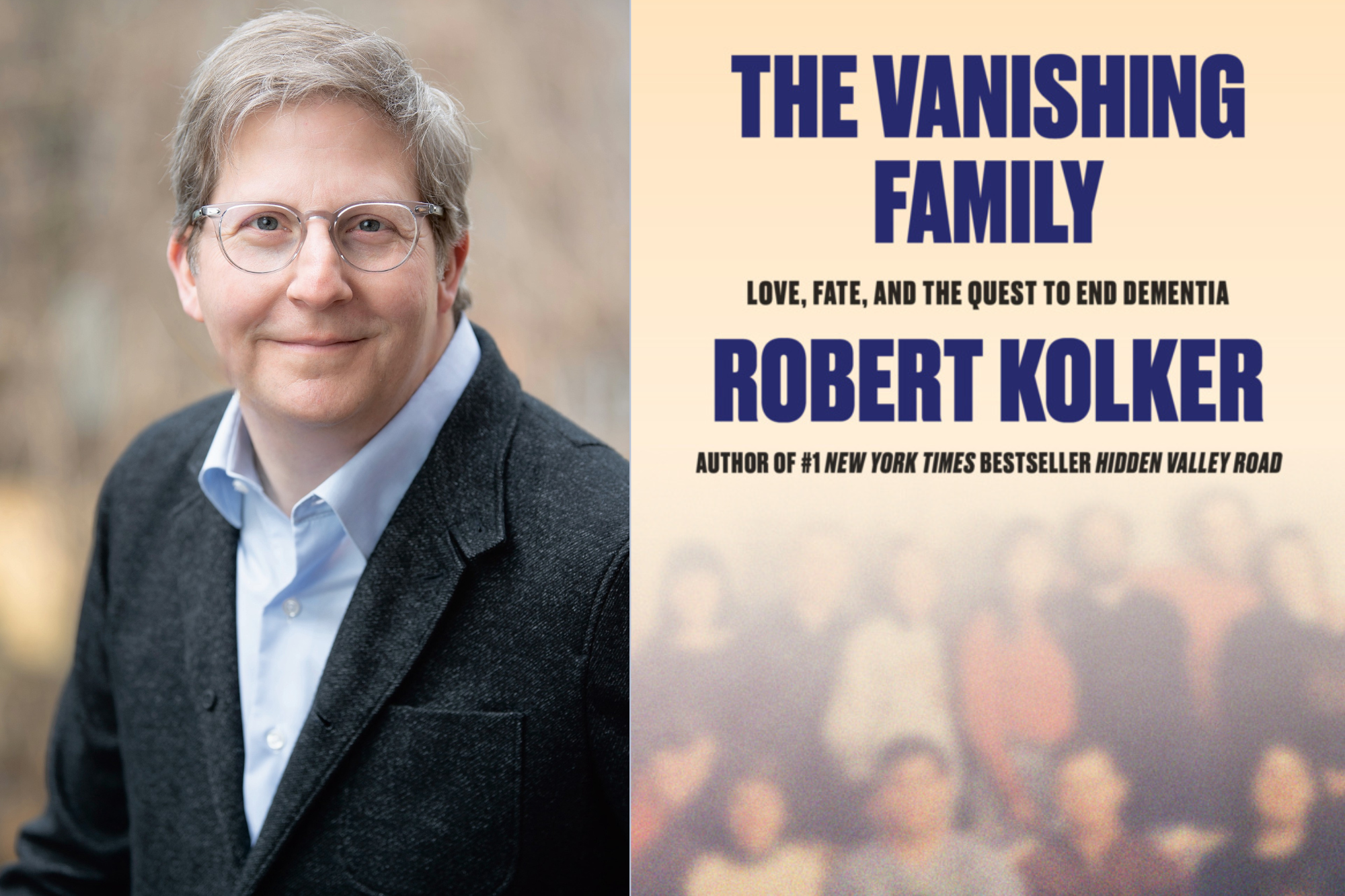
Airdate: Monday, Oct. 26 at 10 am
Would you want to know if you carried a gene that would cause dementia, even if there was no cure? And how would that knowledge change the way you lived? These are questions facing one family in which a rare brain disease known as frontotemporal dementia (FTD) has passed from one generation to the next. Journalist Robert Kolker, who spent years following their story, exposes the hard choices families face, what dementia reveals about personality and identity, and what FTD research is uncovering about how our brains work. We talk to Kolker about his new book “The Vanishing Family.” How has dementia affected your family?
Guest:
- Robert Kolker, author of “The Vanishing Family: Love, Fate and the Quest to End Dementia” and a contributor to the New York Times Magazine.
Episode Transcript
This is a computer-generated transcript. While our team has reviewed it, there may be errors.
Mina Kim: Welcome to Forum. I’m Mina Kim. In his new book, The Vanishing Family, Robert Kolker tells the true story of a large family with an inherited form of early dementia. It’s an unusual type of dementia, frontotemporal dementia, that shows up first as personality changes rather than memory changes, like difficulty reading social cues or feeling empathy. Or, as Kolker writes, there’s no longer such a thing as embarrassment or shame.
Kolker’s book delves deeply into what it’s like to watch a loved one’s personality gradually disappear as early as their 40s, and what it’s like to know you have a 50% chance of the same thing happening to you because of the same genetic mutation. Would you want to know? Bob Kolker joins me now. Welcome to Forum.
Robert Kolker: Hi, Mina. I’m so glad to be here.
Mina Kim: I’m really glad to have you with us. So first, tell us about this family, Bob. The parents are Ollie and Jean. They have nine children, a big family, but still a pretty normal upper-middle-class Pennsylvania family, right?
Robert Kolker: This is the thing that a lot of readers have been saying to me since it came out: at heart, they’re just an ordinary family. They’re a little larger than most, with nine children. But apart from that, you know, they’re a middle-class family. Many of the kids go to college. A couple of them get graduate degrees. Some of them go and work for Fortune 500 companies. Others are still figuring it out.
But one by one, they all leave home, and by the time the youngest daughter is left in the house, the mother is going through some pretty drastic personality changes that are written off as a drinking problem or perhaps depression because the marriage is not what it could be.
Before they can figure it out, the mother, Jean, dies of breast cancer at the age of 60. And so they all sort of shake off this tragedy, thinking that maybe she should have taken better care of herself, seen a doctor sooner. They don’t understand why she withdrew so much, why she used to be so well put together, such a planful, active, proactive parent, who then, in her final years, was just sort of sitting in the living room. Even after she stopped drinking, she would just sort of sit by herself, watch TV, not engage with her kids.
And so it was an open mystery that they thought they had solved. Then, years later, the children start to develop other symptoms that seem very similar to what the mother went through, and the mystery begins.
Mina Kim: It is so striking, the difference in the mother. As you say, she ends up sitting for hours in front of the TV, when earlier, right, she would cook two dinners a night, one for the kids and then one for her and her partner.
Robert Kolker: That’s right. And she was always enthralled with her husband and rather passive around him. And so when he decided to essentially leave her and live somewhere else with someone else, she didn’t put up a fight. The kids didn’t see anything unusual in that, necessarily. They were disappointed in her and disappointed in the whole situation. But on that score, at least, they thought, well, you know, Mom is just depressed. You might be like that, too.
The problem here was that she was so drastically different, and the symptoms tracked as mental health or addiction issues, not neurological ones. And that’s the trick about FTD: it kind of bumps right up against psychiatry. It’s like where neurology and psychiatry meet, and that’s what makes it such an existential neurological disease to have, one that makes us wonder what a personality is at all.
Mina Kim: Right, right. So many big questions. So one by one, as you say, the kids, as they grow older, start to exhibit similar behaviors to Jean. First the second-oldest, I think Christy, and then Mary. Can you just tell us a bit about these two? Because both had high-powered careers, right?
Robert Kolker: That’s right. Christy worked for a big pharmaceutical company. She traveled around the world doing marketing for them. She was married to a guy who was in advertising, and the two of them lived in a wealthy suburb in New Jersey, in a five-bedroom house, with a nanny and a maid, two kids, and all seemed to be going quite well.
Sometime in her mid-30s, she either got fired or laid off from her job. It was impossible to tell exactly what happened there. And she announced that she was going to stay at home from then on and that she was glad she wasn’t working anymore, which was kind of a big pivot for her, but not a pivot that other people haven’t made in that same situation.
But soon, after a couple of years, aside from maybe running the Girl Scout troop, she really was doing basically nothing. And there’s a moment when her younger sister Jenny, fresh out of high school, comes to live with them for a summer, and she starts to see that this storybook life her sister is leading is just not what it could be.
And she says something to the effect of, “I don’t understand what’s happening with my sister,” or maybe, “I understand it too well,” because she’s thinking about their mother and how their mother sort of withdrew.
Christy is not connecting with her husband, not connecting with her kids, and is kind of passive and socially tone-deaf, saying the wrong thing at dinners, kind of playing the part of the person she used to be and not terribly bummed out about it.
People might say, “Oh, maybe she’s depressed,” but in fact, she’s rather passive and removed, like she’s living in a whole other world. And again, it’s written off as some sort of midlife issue, perhaps a menopausal issue. Her husband drifts away. The marriage ends, and she barely parents the kids until finally they have to go live with their dad. She’s left alone, sort of eating out of junk food containers and watching TV until finally she’s hospitalized and misdiagnosed with schizophrenia and depression. And of course, the meds for that don’t work.
The whole thing begins again. And of course, people like Jenny and some of the other siblings do wonder, “Is this what Mom had?” Nobody really stops and thinks that it’s a brain disease. They often think, well, maybe this is just the sort of thing that our family does when our lives hit reversals. Maybe this is our brand of melancholia that happens in our family.
And so there are alarm bells, but no one can agree on what it might be. She finally is diagnosed with a small brain disease, one that is very rare. That’s what I meant by small. And one that could shorten her lifespan, but that’s incorrect, too. There’s just a lot of gray areas here that they have to sort through.
Mina Kim: So talk about the disease they do all end up having, FTD, or frontotemporal dementia, and what are the hallmarks of the type that they have?
Robert Kolker: This was the amazing thing to me, Mina. I think growing up, most of us probably thought that Alzheimer’s and dementia were basically the same thing. You could say one and mean the other. But in fact, these days, they estimate that it could be only 60 percent, or maybe even less, of all dementias that are Alzheimer’s disease. The rest are many, many other dementias.
FTD is an umbrella term for a lot of those dementias, and this family’s FTD is an inherited behavioral variant. And the behavioral variant, as you said in the intro, doesn’t affect your memory first, and it doesn’t affect your cognitive ability first. You could still drive a car or even go to work. But your personality changes. You become more impulsive and compulsive. You become apathetic. The people closest to you in your life seem distant from you, and you’re unengaged with anything that happens to them.
Some people drain their bank accounts out of compulsion. Some people drink. Some people have affairs. Some people just fall out of love with their spouses and their marriages.
And it feels so psychological to our modern eyes that it’s taken years for the disease to even be named a disease. It finally got a name around the time Christy was hospitalized in the 1990s. But the family didn’t get diagnosed for another 10 years after that. So that means the family went 18 years without a diagnosis, and that’s enough time for them to have children. Those children became at risk as well.
This is how rare FTD is, and yet a lot of people who study it believe that it has to be an undercount because it’s misdiagnosed for so long. Every family that I ran into has a story like this family, of going years without being diagnosed.
Mina Kim: Talk about that more. What made their story so relatable, even though the particular type of dementia they have is known to be rare, of course, with the caveat that it could be an undercount? But what is it in their story that really compelled you to want to write about them?
Robert Kolker: It hits on so many different levels. The first is that we all want to know what the future brings, and here’s a family that knows their future. If they want to, they can look into the crystal ball and take a DNA test now that they know what their genetic mutation is and see what the future is. And not everyone wants to look into that crystal ball.
Then there’s the fact that FTD has just one genetic mutation that causes it. Unlike Alzheimer’s, which is so complicated, no one’s really gotten to the bottom of exactly what causes it yet. This family knows, and yet we’re living in the era of gene editing, and they still don’t have a cure. So it opens up all kinds of questions about how long we have to wait for the miracle of gene editing to really take hold in these diseases.
Then there’s the question of our personality. If people can change this drastically because of one genetic mutation, then what is a personality? What about any of us is real and lasting?
And then there are just two others. I’m sorry, it hits a lot of bases. The two other questions that really bowled me over were, first, that this particular brand of FTD involves a protein that also figures prominently in Alzheimer’s. So treatments for this disease actually might lead to treatments that help the 55 or 60 million people worldwide who suffer from Alzheimer’s disease.
This is something the family feels very acutely. They go to bed every night knowing, you know, we’re sitting here holding the key to this. Why isn’t anybody trying to help us?
And then finally, there’s a family here, an ordinary family, that is basically facing incredible fragility. And so the question becomes: how do they move through it? How do they remain committed to one another, knowing that they could change at any moment, knowing that their siblings could change at any moment? How do they talk to their kids? How do they plan to have children if they haven’t had them yet? And how do they plan for the future? And do they? Do they just chuck it all and give up, or do they cling to one another?
The privilege of writing a nonfiction book like this is that I can tell the story over decades and see how people change their minds two or three times over the course of decades about how they’re going to deal with this issue. And I can sort of chart their thinking, which has been just stunning to me.
Mina Kim: Yeah. Let me invite listeners into the conversation. Would you want to know if you carried a gene that caused a debilitating disease that changed your personality and your relationships so dramatically? What questions do you have for Bob Kolker about the family he profiled in his new book, called The Vanishing Family: Love, Fate, and the Quest to End Dementia? Join the conversation at 866-733-6786, on our social channels, Discord, Bluesky, Facebook, or Instagram, or by emailing [email protected].
More after the break. I’m Mina Kim. You’re listening to Forum. I’m Mina Kim.
We’re talking about a new book this hour that examines the toll of an inherited form of dementia across generations, and whether you choose to know if you have the gene that causes it. It’s by my guest, Bob Kolker, and it’s called The Vanishing Family. You may also know Bob’s work from his previous book, Hidden Valley Road, and Lost Girls. He’s also a contributor to The New York Times Magazine.
Join the conversation at [email protected], on Discord, Bluesky, Facebook, or Instagram at KQED Forum. Call 866-733-6786. Does someone you know have FTD or another form of dementia? Tell us about your experiences and what you’ve observed of their experiences.
So, Bob, the book opens with the youngest child of Ollie and Jean, Barb, who’s around 40 and is deciding whether to open an envelope containing the test result of whether or not she’s positive for the gene that causes this type of dementia afflicting her family. Describe that moment. What is she grappling with?
Robert Kolker: She’s been grappling with this moment for a year, actually. She got tested a year earlier, and that was only after another nine or 10 years of kicking the can down the road and not getting tested at all.
So she’s really terrified. She’s got a lot on her mind, Barb does. She’s about 40 years old, and she has small kids and she’s married. When she was a little girl, she was the one who was left behind, waiting, you know, wondering what was going on with her mother while her mother was withdrawing. These were really the hardest years of her life, those four or five years in her childhood while she was alone with her mom.
So she knows that if she tests positive, she’s going to become like her mother. That’s the first thing. The second thing is that her kids are going to have a childhood similar to hers. They’re going to have to watch their mother change the way she did, and that was just really too much for her to bear.
And then there’s the worst thing of all: if she’s positive, then the kids inherit the same 50-50 coin toss of perhaps having the same condition, which has no cure.
And so rather than look into that crystal ball, she’s decided to buy herself some time, to try to feel normal, to try to feel like anyone else out there who doesn’t know their future. But of course, it fails because it’s like saying, “Don’t think of elephants.” All you suddenly can do is think of elephants here.
You wake up every morning wondering, “Am I changing today? What will happen to my kids if I do change? Or is this the day that I will forget my car keys and decide that it’s a symptom? Or what about my sister? I was on the phone with her last week, and she sounded a little different. Is she changing?”
And so it dominates her life no matter what. This, I think, you know, it may seem like a strange and foreign thing for the family to go through, but I find in writing about families that whenever there’s a difficult situation like this, people behave in very understandable and relatable ways.
When you’re going through something hard, sometimes the last person you want to talk about it with is a spouse or a child or a parent, because you don’t want to lay it all on their shoulders, and you don’t want to ruin their day, and you don’t want to inflate the problem, or you don’t want to make the problem seem more real.
So for many of those 10 years, Barb was tied up in knots inside, going through this. The privilege, again, of writing a nonfiction book about a family like this is that you can — I can — let you know her frame of mind when she’s 30, when she’s 35, when she’s 40, and then how she feels when she’s standing there with the envelope, which is how the book begins.
Mina Kim: Yeah. Let me go to caller Kate, who’s on the line with us. Kate in Santa Rosa, go ahead. You’re on.
Kate: Hi, yes. So I find this topic really interesting. My father passed away from early-onset dementia when I was 11. So I’ve lived most of my life with this 50-50 chance hanging over me.
Unlike this family, we don’t have the genetic marker identified. So although I participate in research studies, and both my aunt’s brain as well as my dad’s brain are in that research study, I don’t have the opportunity to know for sure.
And it certainly impacted my life a lot. But I was able to really let it help me live life to the fullest and really take opportunities on, but it didn’t make me elect not to have children of my own.
Mina Kim: Kate, thanks for sharing that. And yes, it really is similar to what you write about, Bob. Talk about why some of the people in this case, when they had the opportunity to know, chose not to know.
Robert Kolker: Sure. First of all, thank you, Kate. That was amazing to hear. I certainly hope that continued participation in the research study will lead to perhaps the possibility of diagnosing early, to find some early biomarker.
But it’s true that FTD and other dementias are kind of all over the place, and it’s like each mutation or each variety of it makes up its own rules. Scientists are still playing catch-up, trying to figure out how to treat and also how to diagnose.
The question of whether or not to have children runs all through this book. It’s a large family, and over many generations, maybe nine or 10 different people grapple with this question in nine or 10 different ways.
One guy has a vasectomy almost immediately after testing positive. Another woman is still untested today and is married and has two children who are also untested. They’re sort of the two extremes.
And in the middle are people like Barb, who’s already had kids and is, you know, putting off being tested because she doesn’t want the truth to infect their childhood.
Then there’s someone who tries to do embryo screening, you know, like what you do if you have a disease that can be detected. You can do IVF and screen the embryos for the mutation and only implant the embryos that don’t have the mutation. That would stop the condition in its tracks for future generations.
But four rounds of IVF later, she’s still not pregnant. And then one day she does get pregnant without IVF, and she and her husband decide, “This is the way we’re going to play it. We’re going to live our lives the way they’ve been handed to us.”
And that was a breathtaking moment, as far as I was concerned. They were sort of choosing to think that the crystal ball wasn’t the whole story. They say things like, “We could all get hit by a bus tomorrow,” or, “Any number of us could have a genetic predisposition to an awful disease and just not know about it.”
So they’re tired of feeling singled out because they have this mutation, and they feel like they have a right to a normal life, too. That might be what the caller, what Kate, might have been saying, a version of that, when she said, you know, it hasn’t stopped her from having children.
Mina Kim: Exactly. Would you want to know? Bob, I’m sure you must have asked yourself this question as you were reporting and then ultimately writing this story.
Robert Kolker: I should have graphed it, right? Like, month to month, where I was on the yes-or-no question, because I really was all over the place.
In the beginning, I thought that I’d want to know because I’m a journalist and I want all the information. But then I started to walk a mile in the shoes of folks who are facing an incurable disease, one they can’t do anything about, and wondering, you know, how would it affect my day-to-day life? And maybe they have a point.
And then there’s the third truth, which is that, for this particular disease, you’re not the one who’s suffering. You might actually be in a pretty good mood with this disease, but it’s the people around you who will have to care for you. So you really have to have them in mind when making this decision as well.
And, you know, of course, that’s a deep topic of discussion: whether they should be informed, whether they should be provided for, how to plan for such a future.
Mina Kim: Yeah. Jenny, ever practical, is like, “I would want to know so that I could sort of put everything in place,” right? To make sure I handled what I need to handle for my family.
Robert Kolker: That’s right. And that’s an ongoing project, because what this family learns is that whether they’re positive or not, they’re going to be taking care of each other for the duration. Just because one of them is negative doesn’t mean they aren’t going to have to be taking care of other people who are positive.
And they have all kinds of conversations. They think, maybe we should buy a compound, like a little neighborhood of our own, where we all can be together and take care of each other, keep costs down, or maybe we should create a third place where people can come and be there with other people and sort of trade off time there.
They’re inspirational, actually, in the way that they eventually attack this problem together.
Mina Kim: Yeah. Let me go to Melissa in Piedmont next. Melissa, go ahead. You’re on.
Melissa: You know, I think the premium on — I have personal experience. My husband passed away in March of 2024 from Lewy body dementia, and, um, it’s great. It’s totally in great transition from what you were just talking about, because we were fortunate enough — we had long-term care insurance.
I’ve been in a support group, specifically a group called the Brain Support Network, where I’ve watched people get wrecked over how much this costs. And I’ve read that Lewy body dementia is the most expensive to manage because a lot of times you don’t forget who you are.
It’s extraordinarily expensive, even if you have lifetime unlimited long-term care, which I had. It’s not sold anymore. Over the four years that I was — I had to claim, to give people an idea — nobody talked about money. Over the four years that I was paying about 40 percent of the bill, because the insurance covered 60 percent, that company paid out over half a million dollars. It wrecks a family financially.
And, you know, people need to know. I would want to know. I would want to know.
Mina Kim: Melissa, thank you so much for sharing that. And, Bob, your thoughts on what Melissa shared? But also, what she’s saying reminds me so much of something you also say in your book, which is there is a price to be paid, whatever the crystal ball reveals.
Robert Kolker: It’s true. Your responsibilities don’t end if you’re not directly affected. Melissa’s comment was priceless, I think.
You see in this family story, there are some branches of the family where they don’t do very basic things like power of attorney or insurance or applying for long-term disability because they’re having such difficulty engaging with the reality that it might actually happen.
I’m thinking specifically of Jenny, who lost her job as well and could have applied for long-term disability the second she tested positive for this mutation. But really, it took 10, perhaps even 15, years before they sat down and got serious about this stuff. And now, financially, it’s a real gray zone for them how this is going to pan out.
She’s still living at home, and her son and her husband are still largely taking care of her, but the next move is really — they’re really in the dark on this.
And this is a very intelligent, well-resourced family that simply was having a hard time dealing with the bomb that had gone off in the family.
You see other people deal with it much differently. They’ve set up something for their kids, and now they’re determined to pretend as if they don’t have it and just let whatever happens, happen. And it’s almost like a radical optimism: if you’re facing a horrible prophecy, the most radical choice is to be hopeful, hopeful for treatments, perhaps hopeful that it will affect you a little bit later.
You see the whole range of reactions in this story.
Mina Kim: Yes. And interestingly, with this particular form of dementia, the person who tests positive, as it starts to affect them, suddenly is in denial that they have it, right? They go into almost, yeah…
Robert Kolker: Yeah. So Peggy, for instance, is a very scientific person, studied science her whole life, believes in testing, believes in the whole thing. And as the years go on, she doesn’t believe she has it.
Finally, her loved ones, almost like an intervention, form a circle around her and say, “It’s time to learn the truth.” And she says, “Okay, but I’m sure I don’t have it.” She tests positive for the mutation, and her position immediately flips from “I don’t have it” to “I have it, but I’m not symptomatic. I’ve avoided actually having fully active FTD. I just have the mutation.”
And everybody at that point has sort of given up arguing with her because the facts are what they are.
Mina Kim: The other thing you say is that, in terms of just the price we pay, for people who have some knowledge and understanding and have really lived with this person as they were one particular way, watching them change is like witnessing a living death.
Robert Kolker: This is, I think, what this family shares with all of us who have dementia in our lives in one way or another, whether it’s a loved one or the prospect of it happening to ourselves.
We wonder not just, “How long will I stay the person that I recognize myself to be?” or, “How long will my loved one stay that way?” But once it happens to a loved one, you wonder, “Are they still there?”
And this family is an extreme, very dramatic rendering of that issue. Again, readers can sort of go shopping as they read the book and wonder, would it be more like this? Would it be like that? And the question is, are they gone? Are they really gone?
Christy, for instance, as I’d said before, this high-powered executive became essentially childlike and was cared for for decades by her sister Sue, an amazing, inspirational person in her own right. The two of them, their lives become enmeshed. But for Sue, it’s like caring for a whole new person.
Christy was someone she used to look up to and idolize, and now she’s basically a child who needs care 24 hours a day. And through Sue’s story, you see how to reckon with such a situation.
I paid close attention to this while working on the book because I had this question for myself: the people in my life who have Alzheimer’s or other dementias, are they still themselves?
And I came away inspired again that there are answers to these questions. There are ways to reframe dementia. I think I started this book treating dementia as almost like an on-off switch, like if you don’t have it, good for you, and if you do have it, well, let’s put that in a box and not think about that scenario because you certainly wouldn’t want it to happen to you.
But what I’ve learned is that the brain is incredibly complex, that any of us, if we live long enough into our 80s or 90s, might have more than one neurodegenerative condition in our brains. The symptoms are all over the place. They aren’t just like the classic Alzheimer’s symptoms. Someone with Lewy bodies can change drastically in a way that doesn’t look like Alzheimer’s at all.
And so maybe it’s time to take dementia out of the box and realize that it is just one of many, many personality-altering conditions out there.
Medical people I talk to say this a lot. They say, you know, everything changes us. Cancer changes us. Depression changes us. Physical infirmities change us. Success and good things change us, too. None of us are going to move through life being really the same people we always were.
And so that shared vulnerability might help people reframe the issue and not look at what’s happening as a living death, but look at it as a particularly vivid transition that their loved ones are taking. That doesn’t solve the problem, again, but it might keep it from becoming a worse problem.
Mina Kim: Yeah. You talk about Harry Lesser in your book, who is like a British scientist or philosopher, and he basically says that no matter how different the person is, they’re still themselves, because we all will decay, and illness can’t obliterate identity when it is part of our identity to begin with.
Robert Kolker: Yes, and I think he really got my attention with the way he framed it. Because I think in our society, you’re either sick or you’re well. And the people who are sick, you try not to think about or dwell on it too much. When people ask you how you’re doing, you say you’re fine, even if there’s something on your mind that’s bugging you.
We wall ourselves off from suffering all the time. And what if instead, like Harry Lesser, we realize that all of us are vulnerable? All of us are decaying. All of us are changing. Wouldn’t that help ease the pain of watching your loved ones suffer, and maybe even ease your own suffering, too, when things happen to you?
Instead of thinking of it as, like, you made some horrible mistake, like, “Oh, that foolish person, they got Alzheimer’s,” what if instead we realized that something will happen to all of us, and that connects us? Our vulnerability, our shared vulnerability, can bring us together.
Mina Kim: We’re with Bob Kolker, a journalist and author whose new book is The Vanishing Family: Love, Fate, and the Quest to End Dementia, about a family affected by a rare inherited form of dementia, frontotemporal dementia, which causes their personalities to change dramatically at an early age.
We’re asking listeners if you’d want to know if you have it, and about all the ways that you have experienced neurodegeneration. More after the break. I’m Mina Kim. You’re listening to Forum. I’m Mina Kim.
We’re talking about the experiences of a family affected by a rare genetic form of dementia called frontotemporal dementia, which causes their personalities to change dramatically at an early age. It’s one of the many types of frontotemporal dementia, or FTD, out there. We’re talking about what it takes to care for a loved one with dementia with Bob Kolker, a journalist and author who’s written a new book called The Vanishing Family.
You listeners are joining the conversation at 866-733-6786, at [email protected], and by posting on Discord, Bluesky, Facebook, or Instagram. Let me go to Ariel in Oakland. Hi, Ariel. You’re on.
Ariel: Hi, thanks so much for this topic. I have a parent — my father has vascular dementia — and I can really relate to this topic, just in terms of Lewy body dementia not getting as much attention or research dollars.
When they were talking about the CRISPR technology and when it’s going to kind of come in and assist them, it’s vascular dementia that affects African Americans the most. My father’s African American, and it’s really heartbreaking when you see folks talking about Alzheimer’s and amyloid plaques and all these things, which, you know, rightfully so, should be studied.
But you kind of think about yourself and your family, and you’re like, “Well, wait a minute. We also have a dementia, and there’s also a community of us that needs support and needs resources and needs research.” You just kind of feel left behind, even though you’re happy for others and the research that’s taking place there.
Um, and yeah, I just wanted to add that comment. And I can really also relate to the concept of the living death, and whether the person who you’re caring for — my father — is still the same person. You kind of get glimpses, but you also know that they would have handled certain situations completely differently 15, 20, 30 years ago.
So it’s a little bit heartbreaking, but there are some upsides. My dad is also a lot more jovial and laughing and jokey, so there’s some silver lining.
Mina Kim: Ariel, thanks for sharing that. I feel what you are feeling. I, too, have people in my extended family with vascular dementia.
Robert in Fremont writes: “I have been diagnosed with early-stage, early-onset dementia affecting my frontotemporal regions and also impacting my mental processing speed. One of my biggest fears is the future. As a former registered nurse, I know what the progression looks like and know what is ahead of me, which I think makes it harder.
“My biggest issue is the limited government resources, especially those locally in Fremont, geared toward senior citizens dealing with this. And as I’m only 53 years old, I cannot even get a return call from anyone.”
So, Bob, we’re hearing about concerns and frustrations with trying to get help when there’s a lot of attention that feels like it’s being paid toward neurodegenerative diseases, but maybe not yours in particular.
Robert Kolker: Certainly, those two calls — and thank you both — have that commonality. The more we understand that dementia is a many and varied thing, and not just Alzheimer’s, not just one thing, the more our clinicians can look out for it early and diagnose it earlier. And the more the idea that an early diagnosis of a condition that might be earlier-onset isn’t out of the ordinary, isn’t so unheard of, is something that perhaps governments should cover and insurance companies should be on the lookout for. These are small things that can make a huge difference.
In The Vanishing Family, they have this one genetic mutation that involves a protein called tau that’s been overlooked for decades because, in Alzheimer’s, they’ve been studying a different protein, the beta-amyloid protein. They’ve made great strides with beta-amyloid, but they haven’t cured Alzheimer’s.
So I think this went through my mind as I heard the first caller there. I thought, well, yeah, they’re working really hard to cure the bigger disease, but the bigger disease isn’t getting cured either. There’s a little bit of impact, but not a lot, because they have such tunnel vision trying to get a grand-slam home run.
This is what I’ve come to see about the pharmaceutical world: they only want to put resources into helping the most people, which I guess could be admirable, but they also only want to fund a massive, huge miracle cure. It’s almost like their whole business plan is based on that miracle cure.
And if it’s anything else, if it’s for a rarer disease or if it’s for a base hit of a drug, they’re really going to walk away from it before long. And this is a tragedy for rarer diseases like Lewy bodies, vascular dementia, and FTD.
The irony is that studying some of these diseases can be a back door, or an in, to finding treatments for the more complicated diseases. The easy wins — and I really think FTD would be an easy win, because it’s just one gene that needs to be edited — could be a game changer for lots of other tau-related diseases, for instance.
Mina Kim: Yes, you talk about how studying rare forms of dementia has helped us understand so many new things about the way the brain works, the brain’s role in loss of inhibition or in organizing our emotional states, right?
Robert Kolker: Yeah, it’s stunning. The other thing about FTD is that scientists, particularly a group I spent time with in San Francisco at the University of California, San Francisco, are studying FTD almost as a window into understanding how all of our brains work: how we process emotions, why we interpret the world the way we do, what makes us different from other species, and also what dementia might actually have in common, at a very brain-network level, with other disorders that seem to impact social cognition, like autism or even schizophrenia.
They all seem to operate in the same brain network, which is really another stunning thing I learned.
Mina Kim: Let me go to caller Evan in Berkeley. Hi, Evan. You’re on. Go ahead.
Evan: Hi, yeah. I just was wondering, given that this is a neurological condition, not a psychological one, if you caught it early enough with something like cognitive behavioral therapy —
Caller: Offset kind of, I guess, ultimately later the denial about it, being aware of, like, the potential symptoms. I don’t know if that makes sense.
Mina Kim: Yeah, it does. Evan, thanks for sharing that. Your thoughts, Bob, on cognitive behavioral therapy, but also, what does treatment for FTD sort of look like now, broadly speaking?
Robert Kolker: Yeah, thank you, Evan. I think the short answer for cognitive behavioral therapy is no, not right now, and there doesn’t appear to be an effective treatment for FTD right now.
But the fact of the matter is that we’re still sorting out how much environmental changes can have an impact on a condition like this, because it’s only been a few years since we’ve started to be able to diagnose it that much earlier, before onset.
So they’re still trying to come up with biomarkers to measure authoritatively what will happen with Alzheimer’s. And they’re trying to do it with other conditions, too.
As soon as we have those early biomarkers, then we can track things like CBT, but also, perhaps more relevantly, diet, exercise, and lifestyle changes, which everyone believes affect later onset. But we’ll really know for sure if we’re able to measure these things when you’re in your 20s.
The dream here really is for doctors to be able to treat a condition long before it happens, the way they do with heart disease. In your 20s, you would go in and take tests, and they would come back, and the doctor would say, “Well, your heart numbers don’t look so great. Here, take this statin. And your brain numbers look a little iffy, too. Take these drugs as well, or change your lifestyle, or try to do CBT,” something environmental, something to keep those proteins from clumping up where they shouldn’t be in your brain.
There’s so much we don’t know about how that works preventatively because we haven’t learned that it exists early on, the way that we do now.
Mina Kim: Yeah, you mentioned the UCSF scientists. We actually had Dr. Bruce Miller on our program to talk about frontotemporal dementia, and in this case, it was about the new skills and creativity that can show up even if the frontal lobes are starting to experience degeneration, and what sort of broader effects it can have.
We also had Virginia Sturm join us that day, who is also in your book. But one of the things I was interested in reading about was the fact that, in this particular family, for example, they have the gene and live with that mutated gene for a really long time, for decades, without showing really any signs of FTD.
Are they looking at how that can be, and in that process seeing what it might reveal about keeping this kind of degeneration at bay?
Robert Kolker: That’s a fantastic question, and it’s one that they’re just beginning to ask again. The idea is that if you’re born with this vulnerability, maybe you are successfully fighting it off until you no longer can. And maybe this is an early onset for that reason, because the body could only fight it off for so long.
So what if we could harness what is protecting people from that onset? That could be something that’s not just true for FTD, but for any number of brain-health conditions that are progressive in nature.
You know, not every neurodegenerative illness is progressive. There are some that affect our ability to remember names and words, word-retrieval issues, and it may appear in our 50s. I know it’s happening to me, but it doesn’t necessarily get any worse through time.
So clearly your body is able to negotiate some of these issues and can’t negotiate others. And so brain health and brain resilience is something that’ll probably be a topic on your show six different ways in the years to come, not just about dementia, but about perfecting our human brain skills as AI becomes competitive, but also fighting off, building greater resilience against mental illness.
And I think brain health, with dementia, will wind up becoming Topic A as well.
Mina Kim: Yeah. How promising is CRISPR as a way to forestall symptoms in a genetic form of dementia?
Robert Kolker: Um, CRISPR is incredibly promising, but it has two big issues. The first is that, for any brain disease, it has to get into the brain to change the brain cells. And getting any sort of medicine into the brain is a tremendous challenge.
People talk about the blood-brain barrier. I used to think it was just a figure of speech, but it’s real. It’s a membrane that keeps toxicity out of your brain. You want the blood-brain barrier. It’s a good thing, but getting medicine into the brain is hard.
And so you could get a gene-editing process like CRISPR into the brain, but then the question is, will it hurt things that shouldn’t be hurt? Will there be unintended consequences? Will there be precision? Will it get all of it? Should it get all of it?
And there’s a team at UCSF led by Claire Cleland, who has a partnership with Jennifer Doudna, the CRISPR Nobel laureate. She’s focusing on FTD. And what she says to me is, “The CRISPR part’s the easy part. Getting into the brain’s the hard part.”
And to me, that’s an optimistic statement, because once they’re able to lick that problem, then these treatments might be available.
But then there’s the second problem, which is the cost. And we’ve seen it with CRISPR and sickle cell anemia, which is not a brain disease. But in order to treat one case of sickle cell anemia, the patient needs a stem cell transplant, needs chemo, needs to be hospitalized for a long time. It could be something like $3 million.
I thought of sickle cell when your caller was talking about having a parent who’s African American, because here is a condition that affects a disproportionately large, disenfranchised population that isn’t going to be able to afford a $3 million cure like this, and yet it disproportionately affects them.
So, as miraculous as CRISPR is, it can’t print money. So it’s a growing problem.
Mina Kim: Yes. Let me remind listeners, you’re listening to Forum. I’m Mina Kim. Let me go to caller Eamon in Santa Rosa. Hi, Eamon. You’re on.
Eamon: Good morning. My wife just passed away two weeks ago from this illness, and it arrived almost 20 years ago, in her midlife. So for the first seven years, it was chaos, and now I think it’s one of the only illnesses that will actually talk to you in a different personality, because you’re dealing with somebody who is totally different from the person you first knew.
And so it took us seven years before she was even diagnosed because of the chaos that it created. She did not think she was ill and confronted everybody around her, so we about ran for cover.
But once it was diagnosed, then we kind of picked up the pieces and just walked the journey to what the eventual outcome was.
There’s a richness in caring that I found, and even up to the last day of her death, her core spirit was there. That’s what carried her through all the many stages of the illness: her tenacity, her bravery. And it was really a privilege for me to navigate that.
But now, however, she’s passed on, I feel her faculties are restored and her personality is restored.
But we also have a son, and that’s the chaos I want to avoid, as the possibility is there for him to be prepared and to ask the serious questions, because it is a life sentence. You know, once it’s there, you need to deal with it.
Mina Kim: Oh, Eamon, it is just a privilege to have your call. Thank you so much for sharing that, and I’m very sorry for your loss.
Robert Kolker: My condolences. Yeah, Eamon, thank you. It does sound a lot like Christy in The Vanishing Family, who was cared for for 30 years by her sister Sue, and who, by the end, Sue was a joyful person, was connecting with Christy and understanding what she had to offer as a person.
Their lives were enmeshed. It did take, you know, seven or eight years for a real diagnosis, too. And so there was that same mysterious period where nobody really knew exactly what was happening to Christy.
I’ve met other families with similar stories, but, Eamon, it sounds to me like your journey really has been an inspiring one. I hope everyone around you appreciates what you’ve been able to bring to this situation. It’s simply so moving.
Mina Kim: Bob, what is so remarkable is the fact that, even in Eamon’s story, this is still playing out in real time, right? This next generation is learning whether or not they have this, as your book has gone out there, has been released into the world. What are you finding in this next generation that you are taking with you?
Robert Kolker: Um, more inspiration, frankly. They’re better informed. There’s more clarity about the condition, and so they really can decide. They have control over whether they want to know the future or not.
There is a woman in her 20s, in her late 20s, who is Jenny’s daughter. Her name is Annika. When I first started reporting on this book, she was sort of a post-college person who was feeling her way through the world and figuring out what to do with life and sorting through the issues of her childhood.
And now, four years later, she’s about to turn 30. She’s married. She has become — she’s found community among the people who are advocating for treatments for FTD. She’s devoted part of her life to this cause.
She spent a lot of time around other people who were tested, and regardless of what the outcome of the test was, they have meaningful, happy, joyful lives. And so she was able to process her fears and eventually come to decide to get tested herself.
For a sad story, it’s about as happy as it gets. It’s really quite inspirational to see someone like that grow and evolve over time.
Mina Kim: Yes. You also have this letter from one of Barb’s nephews who says, “There’s still no cure, but we know so much more. I hope it happens soon enough for me, but if not, I hope that it happens soon enough for my little brother, my cousins. I wish that it had been soon enough for you.”
It’s really a beautiful way of looking at life and the time we have. And that’s all the time we have, Bob, but thank you so much for coming on with us.
Robert Kolker: Thank you, Mina. This has been a pleasure.
Mina Kim: And thank you for the book, The Vanishing Family, and, as always, to our listeners for sharing such deep personal stories and reflections and great questions. My thanks to Susie Britton for producing this segment. You’ve been listening to Forum. I’m Mina Kim.
Announcer: Funds for the production of Forum are provided by the Jenerosity Family Fund and the members of KQED.