‘Oh, Mary!’ National Tour Comes to California
Airdate: Thursday, October 15, 2026 at 10 AM
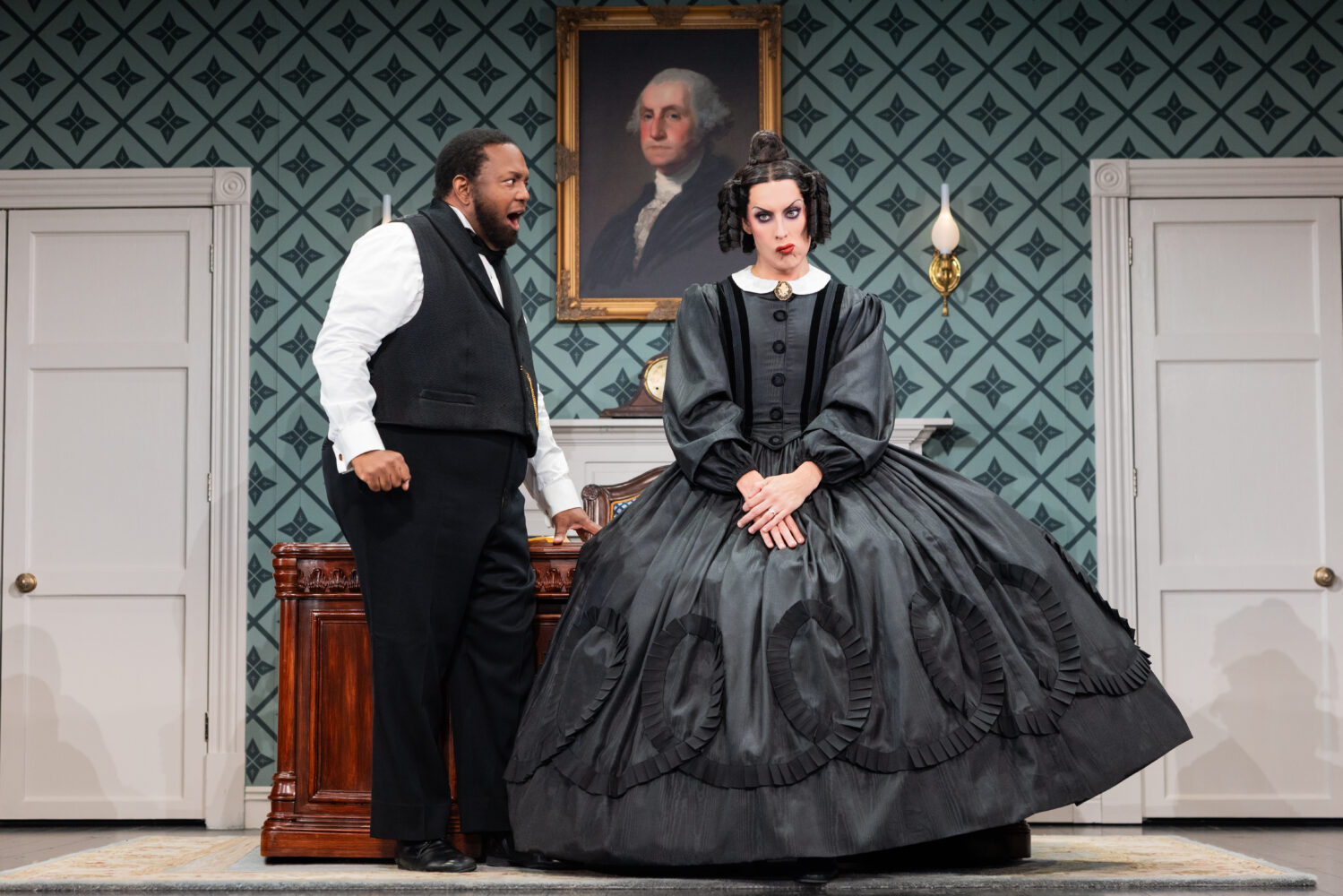
Mary Todd Lincoln served as first lady from 1861 until President Abraham Lincoln’s assassination in 1865. 144 years later, comedian Cole Escola sent themself an email asking: What if Lincoln’s death had been “a good thing” for Mary Todd? That tongue-in-cheek question became the basis for the smash-hit Broadway comedy “Oh, Mary!”, which has now won two Tonys and was a finalist for the Pulitzer Prize in drama. Following Escola’s departure as Mary Todd Lincoln, the role has been taken on by actors including Bowen Yang, Maya Rudolph, John Cameron Mitchell, Jane Krakowski and Titus Burgess — and is now being played by “RuPaul’s Drag Race” star Alaska in a national tour. We’ll speak with the director and stars about the play’s unexpected success, its blend of stupidity and wit, and the long, queer legacy of camp.
Guests:
- Sam Pinkleton, Tony Award-winning director “Oh, Mary!”, directed the Broadway revival of “The Rocky Horror Show”, will direct the 50th anniversary revival of “Annie” next year
- Alaska, plays Mary Todd Lincoln in “Oh, Mary!”, drag queen and singer, won the second season of “RuPaul’s Drag Race All Stars”
- John-Andrew Morrison, plays Mary’s Husband in “Oh, Mary!”, also played the role on Broadway, OBIE Award recipient for work in the Pulitzer Prize-winning musical “A Strange Loop”
Episode Transcript
This is a computer-generated transcript. While our team has reviewed it, there may be errors.
Mina Kim: Welcome to Forum. I’m Mina Kim. What if Mary Todd Lincoln was forbidden from being a cabaret star by her husband, who was so busy with the Civil War? That question, not based on any historical account whatsoever, animates the smash-hit Broadway comedy Oh, Mary!, which has come to San Francisco and later heads to Los Angeles. Featuring RuPaul’s Drag Race All Stars winner Alaska in the title role, the Tony Award-winning play written by Cole Escola was a Pulitzer Prize finalist in drama, with the board describing its outrageous humor as an empathetic celebration of anyone who’s been marginalized or misunderstood.
Listeners, have you seen Oh, Mary! or can’t wait to? We’ve got the director and stars with us this hour. Sam Pinkleton is its Tony Award-winning director. Sam, it’s so great to have you on.
Sam Pinkleton: I’m really happy to be here.
Mina Kim: Also with us is John-Andrew Morrison, who plays Mary’s husband. Welcome, John-Andrew. And, of course, Alaska, whose full name I am not allowed to say.
Alaska: Yeah.
Mina Kim: Mary Todd Lincoln in Oh, Mary!, welcome.
Alaska: Hi. Thank you so much.
Mina Kim: I am so sorry to hear that you’ve been sick, so tonight will be your San Francisco debut.
Alaska: I know. How suspenseful.
Mina Kim: Yeah, I’m glad you’re feeling better.
Alaska: I am.
Mina Kim: And John-Andrew, you have been performing for the San Francisco crowd. How’s that been?
John-Andrew Morrison: They’re wild. They love it, and we’re enjoying doing the show for them. They’re all miscreants and terrible people. We love them. We love all of them.
Mina Kim: So this will be a spoiler-free conversation. I got the list of all the things that I cannot say, and I want that to be a warning for you, Forum listeners. If you’ve seen it, please don’t mention any of the surprises of the show. So, given that, Sam, given the fact that there’s a whole list of things we cannot say, you describe the plot. Tell us what it’s about.
Sam Pinkleton: So, Oh, Mary! is a wildly historically inaccurate depiction of Mary Todd Lincoln in the days leading up to the death of Abraham Lincoln. In the play, she is an alcoholic, aspiring cabaret singer who will do absolutely anything to get what she wants during the most stressful time in the American Civil War, which, to be clear, is a period of time that Cole Escola and myself know nothing about.
Mina Kim: Alaska, what has it meant for you to play Mary in this show? I’ve heard you say that it would be a fantasy to play Mary.
Alaska: Well, indeed it is. I mean, it’s the best role in the best play ever. It just is. And so to get a chance to do it is really amazing.
Mina Kim: When people say that every Mary sort of approaches it differently, what have you thought about with regard to your own approach to it?
Alaska: I don’t know.
Mina Kim: It just sort of happens when you’re out there?
Alaska: I just, I really see the script as, like, really serious, and her story is really serious in this. And so that’s how I’m approaching it.
Mina Kim: What do you mean by serious?
Alaska: I mean, her struggle is absolutely real. And, like you said in your description, which was so beautiful, it is sort of like the story of anyone who has felt, like, pushed to the —
Mina Kim: And she does it like nothing’s gonna stop her, right?
Alaska: Yeah.
Mina Kim: So, John-Andrew, you’ve played Mary’s husband now with four different Marys?
John-Andrew Morrison: Actually, um… six.
Alaska: Wow! So I’m not your first and only? I’m so sorry. Oh, this is… But you’re the sweetest.
John-Andrew Morrison: Oh, thank you. Yeah, you’re the sweetest one.
Alaska: Wow. Jane Krakowski found dead.
John-Andrew Morrison: Oh, no! Well, I’m trying to come up with different adjectives — sweetest, best, you know? Okay, but, like, okay.
Alaska: Don’t do that to me!
John-Andrew Morrison: But, yeah, I’ve played it with six Marys. That’s amazing. And yesterday was my Oh, Mary! debut on Broadway — the anniversary of when I debuted on Broadway with Oh, Mary!.
Mina Kim: Wow. So tell me about that, like how you think about the role. Do you have to adapt for all the different Marys?
John-Andrew Morrison: Absolutely, and it’s been a great education doing this show in being nimble and adaptable and just being present onstage, because, you know, the rules of the game are — we protect the surprises. And Sam gave a great direction: the rule is to say all the words in the right order. That was the rule. So, yeah, radical, but, um, every single Mary plays the game differently, right? So you just have to kind of show up and be on your toes and be adaptable and be present to receive what they’re giving, and then also help drive the piece along. So it’s been fun. It’s been a real kind of education in, oh, yeah, this is how you show up and you do that.
Mina Kim: Can you give me an example of one way you’ve stretched for a Mary — how I have pushed you?
John-Andrew Morrison: So, I will say, Jane, who was the Mary that I rehearsed the show with, it felt like she was in — we were doing Gone with the Wind, right? It was very, very serious. And then Jinkx Monsoon was the next one and was so much more physical. And it felt very — I kind of likened it always to the Australian guy in Jurassic Park going, “You clever girl.” It felt like Abe Lincoln the whole time was trying to wrestle —
Sam Pinkleton: It was an extreme sport with you and Jinkx.
John-Andrew Morrison: Yeah, it was, like, a different — so everyone brings their own kind of quirk, and we just have to say all the words in the right order. But how each Mary interprets it is completely different, as with Alaska, too, you know.
Mina Kim: Alaska, is there something that you would say is sort of all your own, or your stamp on Mary?
Alaska: Like, no. I didn’t go into this being like, “How can I make this my own?” I was just like, “I want to service the script, and I want to service this role, and I want to do it in a really pure and honest way.”
Mina Kim: I love that you say that, because I was just talking about this with my producers and my editor, but I get this feeling when I watch Mary of total generosity. There’s something — I feel like everybody is really trying to give, or maybe I’m just feeling given to as I watch it.
Sam Pinkleton: That’s the nicest thing you could say about the play, I think. I mean, obviously, many people see it as such a wacky comedy, and it is. But it was also made as this extreme act of love. Cole and I both were theater nerds, and it’s made with a great amount of affection for putting on a play and how ridiculous it is that there’s flimsy walls and fake books and bad wigs. I hope that it is generous with the audience, and at its best, it does take itself really seriously. As Alaska — who I disagree with when you say there’s nothing distinct about your Mary — said, there is a warmth to it and a seriousness to it, I hope. That does make it way more than just, like, “What a crazy night of laughs.”
Mina Kim: And I love hearing John-Andrew describe how strict you are about making sure that the words are right and the surprises hit. Talk about the importance of surprise. It almost feels like it’s the element that you’re really prioritizing in this.
Sam Pinkleton: Totally. I believe that Stephen Sondheim said that surprise is the engine of theater. And if he didn’t, I’m just giving him credit for that, because I quote it all the time. But it is the thing that’s most important to Cole — that the play constantly stays ahead of the audience. So there’s this ride where you think it’s gonna do this, but it’s going to do something else. When they were writing it, they talked a lot about the film The Graduate, where, like, everything happens in the last 10 minutes. So there is this kind of punch, punch, punch, punch, punch of surprises. I agree with John-Andrew that there are so many different ways to interpret the play, but there has to be a base agreement: we have to really, really, really stay ahead of the audience and protect the surprises, because it just makes it more fun for them and for us.
Mina Kim: So then the pacing of the show must be so crucial. I mean, I love that it was so tight — 80 minutes. I was actually really shocked when those 80 minutes were over, because it literally felt like 30 minutes. I mean that. I don’t know if everybody appreciates just how important that is, and when you’re incorporating surprise into it, too.
Sam Pinkleton: Yeah, we say that it’s breathless, not fast. And that isn’t just like, “Whoa, look how fast we can go.” It is about just really — in a live theater experience, you feel the people around you kind of reaching for the thing. We don’t want the audience to sit back. We want them to feel like a cold plunge, that there’s something electric about being there. And that is about finding this balance, which is hard to find, and sometimes we slip. It’s not just fast for the sake of being fast, but also faster than real life, because, frankly, the stakes are so high. It’s the Civil War. The stakes are really high. These people are running out of time. They’re in a constant state of emergency — every character in the play. So the pace thing isn’t just like some director guy was like, “Go faster.” It is actually the truth of the context that they’re in, which is just a really intense moment.
Mina Kim: Wow. Yeah. In terms of the way the audience has responded in those surprise moments, are they consistent when they’re watching the show? I’m so curious how, as you’re performing this, the audience feedback has surprised you or really delighted you, Alaska.
Alaska: Well, I think that it fluctuates. Every audience is different, but some moments are always consistent. I’m protecting the piece. I’m not saying too much. But some moments are consistent because the piece is really good. The play is really, really good, and it’s built so well and so strong. It’s just a really good piece of theater.
Mina Kim: I think that’s a really good way to describe it. It is built so strong, which makes sense if you are going to incorporate those elements of surprise.
All right, let me invite the listeners into the conversation. Have you seen Oh, Mary!, listeners, or want to? And how did it make you feel if you saw it? What do you want to ask or tell its creatives? And again, if you have seen it, no spoilers, please. Why do you think this kind of story that Sam is describing resonates so much with a wide audience?
You can email Forum at kqed.org, find us on Discord, Bluesky, Facebook, or Instagram at KQED Forum, or call us at 866-733-6786. Again, that’s 866-733-6786.
Sam Pinkleton is the Tony Award-winning director of Oh, Mary!. He’s also directed the Broadway revival of The Rocky Horror Show and will direct the 50th-anniversary revival of Annie next year. Alaska, who plays Mary Todd Lincoln in Oh, Mary!, is a drag queen and singer who won the second season of RuPaul’s Drag Race All Stars. John-Andrew Morrison is with us, playing Mary’s husband in Oh, Mary!. He also played the role on Broadway and won an Obie Award for his work in the Pulitzer Prize-winning musical A Strange Loop.
We’ve got them all with us, so join us after the break. I’m Mina Kim. You’re listening to Forum.
Mina Kim: I’m Mina Kim. Oh, Mary! is an 80-minute, historically absurd, one-act dark comedy about a miserable, alcohol-loving Mary Todd Lincoln in the weeks leading up to Abraham Lincoln’s assassination. And we have the stars and director with us: Alaska, who plays Mary Todd Lincoln; Sam Pinkleton, who directs it; and John-Andrew Morrison, who plays Mary’s husband.
And we have you, our listeners, at 866-733-6786 — 866-733-6786. Email address: [email protected]. Find us on Discord, Bluesky, Facebook, or Instagram. We’re at KQED Forum.
Discord user Annalise writes, “I was in the balcony for last night’s performance. One of the things I love about this play is that, despite it being not at all based on historical reality, just enough facts or near-facts are sprinkled into the script to give a history nerd slash theater nerd joy.”
Sam Pinkleton: Yes.
Mina Kim: Really? I was like, “I see no —”
Sam Pinkleton: I think Cole always says that it’s as much history as you would have as, like, a second grader, I think.
Mina Kim: About Mary Todd in it, yeah.
Sam Pinkleton: Yeah. And actually, when we did the show in London, we were like, “Are they gonna know?” And someone very kindly was like, “Yeah, people know that Abraham Lincoln was the president of the United States, you fools.” But we did actually add a little thing at the beginning that’s like, “This is the historical context of the play you’re about to see.” So maybe we’re lying when we say there’s no history.
Mina Kim: Yeah, it was just funny hearing Cole Escola in interviews being like, “I did less than no research on this whatsoever.” We’ve also got a call from Sarah on the line. Sarah, go ahead. You’re on.
Sarah: Oh my gosh, I’m so excited to talk to you. I’ve seen it twice in New York City, with Bowen Yang and John Cameron Mitchell. So wildly different. Unbelievable show. Best show I’ve ever seen in decades. Oh my God.
Mina Kim: Thank you. So I want to talk a little more about the visuals of this play. First, Alaska, can you describe what Mary wears?
Alaska: She wears this very — there’s, like, if you Google Mary Todd Lincoln, the first image that comes up, that’s what she’s wearing. So it’s like a portrait, and she has a black dress on, and it has sort of a lacy collar. And she had these curls at the side of her head, which Cole describes as bratty curls. And, yeah, that’s what she looks like.
Mina Kim: What was it like for you when you first put it all on?
Alaska: It was thrilling. It was amazing.
Mina Kim: I remember watching — I think I watched a video of you getting into the outfit. Yeah, I could tell you were really feeling it.
Alaska: Oh, it’s incredible because it’s so iconic. Mary Todd Lincoln made it iconic, and then this play made it iconic again.
Sam Pinkleton: Oh, it’s also the same height as Mary Todd Lincoln.
Alaska: People don’t know that she was six-foot-four.
Sam Pinkleton: She was six-seven.
Alaska: That’s not true. That’s absolutely not true.
Mina Kim: Again, counterfactual. Well, and also, just talk about the set. Can you describe it for me a little bit, John-Andrew? Like the walls, the —
John-Andrew Morrison: It feels like a high school production in Framingham, Massachusetts, with a set from another show that they’ve just reused and maybe painted a little bit. And so that’s the aesthetic. And they’ve stolen the principal’s desk for the weekend run of the show. So it is a little hodgepodge. I will say the set on the road is a little bit more secure than the one on Broadway.
Mina Kim: Mm.
John-Andrew Morrison: Yeah.
Mina Kim: The walls don’t rock quite as much.
John-Andrew Morrison: I will say the door handles have popped out on Broadway, so it is rickety, to say the least.
Mina Kim: Well, our producer Caroline loved the liquor bottles on the shelves and how they literally spell out, like, “whiskey” and “rum.” That feel that John-Andrew’s describing, Sam, you really thought a lot about that, right?
Sam Pinkleton: Well, for me, you know, when I was in theater, when I was in a play in high school, I wasn’t thinking, “Isn’t this crappy?” I was thinking, “This is amazing. I’m in something amazing.” And then you look at photos of it and you’re like, “Oh my gosh, there’s a sad flat set that’s gonna fall over.” But that isn’t what it feels like in the moment. And so I would say it was made — it absolutely looks like a high school play in Framingham, Massachusetts, and one where those high schoolers are like, “This is awesome.” I feel very allergic to snark. It’s not winking at the thing. It actually is like, “We’re doing the best we can with what we have,” which is kind of what theater always is.
Mina Kim: It reminds me of what you just said before the break, where you said that it loves theater. Is that what you mean, in part? I read that you wanted to evoke the feel of community theater.
Sam Pinkleton: Yeah, it’s a play that kind of has to be a play. It’s a play with a desk and a bookshelf and a fake window and a dumb little tree outside of the window, and there are big dresses. It’s kind of everything that I think many people think a play is when you’re in middle school. And there’s just a way that, you know, honestly, just because we like it — we’re theater nerds — it was really made with love for the form itself. And there is a real liveness to seeing it.
John-Andrew Morrison: But there’s also a sense of play about it. Like, you know, you’re talking about it’s a play, it’s play. When you’re in high school and you’re doing this thing, you are playing, and you get to be imaginative. And that’s the fun of it. And so there is something about that rickety set that makes you feel you’re allowed to expand and play in a way that it doesn’t necessarily take itself so seriously when you’re doing other Broadway shows where the sets are big automated pieces and all of that. There is this sense of joyous, kind of childlike play within the structure of this rickety thing that is joyous and wonderful. And I think that translates to the audience, too.
Mina Kim: Absolutely. This is from an Oakland listener who writes, “It’s become a bit of a parlor game to imagine who could play Mary. Do you all have a dream Mary? Besides Alaska, I am trying to manifest Heidi N Closet.” Do you all have a dream?
Sam Pinkleton: She’d be great. She’d be amazing. Oh, yeah. Sally, are you listening to Forum?
Alaska: Lisa Rinna is campaigning. She’s campaigning, and I think she could do it. She’s campaigning, and I think she’d be great.
Sam Pinkleton: I will say my dream Mary was Alaska, but I’ve always said, rest her soul, Catherine O’Hara.
Alaska: Oh, my heavens. Yeah, yeah.
Mina Kim: I know. That one really does a gut punch.
John-Andrew Morrison: I mean, maybe I want to do it at some point in time, but I’ll get back to you.
Mina Kim: Well, I want to ask this to the audience as well. Besides Alaska, listeners, who would be your dream Mary? Another listener, Colette in the East Bay, writes, “What is it about the play, especially the main role of Mary, that makes it so flexible for so many performers?”
Alaska: I think it’s the truth, the truth with which it’s written. I think it’s so based in universal truth that it can relate to anybody. So everybody who steps into it, it just feels real.
Mina Kim: What do you look for, Sam, when you’re thinking about the next Mary? Who would be good to play Mary?
Sam Pinkleton: I think it’s Mary as a character who is totally misunderstood by the world and who so thoroughly knows and believes that there is greatness in her, and there’s something that’s just clawing to get out. And that is every character actress I’ve ever loved. It’s a role for people who are singular and uncontainable, and who have so many gifts that they rarely get to show off at one time, much like Mary herself.
So it’s very much by design that no two Marys look alike, sound alike, or approach it alike. But the thing they have in common is that they are unique and singular and ferocious and connected to this truth that Alaska speaks of, this feeling of believing that there is more for them out there.
I love that we’ve had a lot of Marys who are usually the third-from-last person to bow, and they get to be the last person to bow, you know? It’s a lot of people who are the funny person from that thing. And it’s like, no, no, no, the funny person from that is a whole universe and a whole realized person. And getting to put the funny person from the thing — which I’m not saying you are, Alaska, okay? You’ve always been a star. You’ve always been the last person to bow, not the third person. But I do think that is the thing that can sometimes link the Marys.
John-Andrew Morrison: Jane had that experience, because for all of the stuff that she had done, she had never been the lead, right?
Mina Kim: Right.
John-Andrew Morrison: She was the funny friend. And so for her, it was so serious to be able to be the person who takes that last bow and is the driving force. She really was very serious about it, yeah.
Mina Kim: So I think you’re really getting at one of the other things I really wanted to hear what you think about, which is why this particular story has resonated with such a wide audience. And I ask that because it’s been so clear from Cole Escola, the original creator and an original star, that it was such a personal project. And actually, I want to play a clip from when Cole was on Late Night with Seth Meyers.
Seth Meyers: How did you want to play this Mary Todd Lincoln, who’s a sort of frustrated former cabaret star, alcoholic? Yeah. And how did you come to those two details?
Cole Escola: Well, because, Seth, you’re looking at a former cabaret star alcoholic. Thank you. Yeah, clap for that. Clap for that. Thank you. So, yeah, it’s literally me. It’s a show about me and all my feelings. And, yeah, genuinely, I hope that’s why it works.
Mina Kim: Right, so any of you feel free to weigh in. One of the things is the honesty of it, almost the specificity of it, because I feel like you have been saying that in so many different ways, Alaska — the truth, you know, it’s serious. Anyway, yeah, so there’s that element of it. Plus, there’s the universal element of somebody who has been denied the things they feel they were meant to do or be as another piece of it. But I’m also wondering what else you think there is.
John-Andrew Morrison: I was saying this to Alaska a couple of days ago, because, hearing the play again, there’s an idea in it about what would you do if you had no responsibility, if you had nothing holding you back? What is your wild dream? And I think everyone in that audience has some relationship to a wild dream, right? They’ve either lived it, or they’re questioning it and thinking about it, or the idea has never occurred to them before. But I think that is the thing that makes it universal. There is a big, beating heart in the show, and it’s told in the most absolute, ridiculous Cole Escola way. But for me, one of the ideas in the piece that makes it very universal for people to watch and come in and fall in love with her is that idea of, what would you do if you didn’t have any restrictions or limitations? What is your biggest, wildest dream? And I think everybody has some relationship with that question.
Mina Kim: But Sam, you said that you didn’t think — or you were worried that it would not register with people on vacation from Wisconsin. Who was it intended for? Because it was not necessarily intended for a wide audience.
Sam Pinkleton: No, we thought we were making it for our dumb gay friends. That’s it. I mean, the play was created and incubated in a very pure way, which never happens, but the producers just trusted Cole and me and our collaborators. It was eight weeks downtown in a small theater, and we got to make the thing that was in Cole’s head. We thought, you know, just funny people from downtown would come, and that’s it. And if we had done it for eight weeks, that would have been a triumph. We just wanted the play to happen.
And, yeah, when we said we were gonna go to Broadway, I was like, “That’s a terrible idea. It’s a horrible idea. Who’s gonna come?” And I was wrong, as I usually am. I do think it’s kind of old-fashioned in its way. It’s very recognizable. It’s like, “Oh, yeah, it’s a play with a couch.” And I realized, watching people on vacation from Wisconsin watch it, that if you love Carol Burnett, if you love I Love Lucy, if you love The Muppet Show, you’re gonna find a way into this. And it actually was very limiting, I think, for us to think that it was just a show for our dumb gay friends. If we had set out to be like, “We’re gonna make a thing that’s broadly appealing,” it would have been terrible, because we would have watered it down.
Mina Kim: How has that felt, especially in this moment, to see something for your gay friends be so widely beloved, so widely accepted, viewed, watched, when the community has been so maligned, especially by people in the highest levels of power?
Sam Pinkleton: I mean, for me, at least, it means absolutely everything, because this was made — I mean, it’s so, so gay, and it’s not just gay, it’s everything. And it was made without the tiniest shred of “What are people gonna think? Will people like it? Will they buy tickets?” And that it has been rewarded is encouraging to me, sure, but more importantly, I hope, to other people to make their weird, gay, loud thing that they think only five people want to see. It’s been such a vote of confidence, and it’s made me such a brat about being unwilling to work anyway. But that —
Mina Kim: Your acceptance speech for the Tony, when you said, “Make what you love and not what you think people want to see,” I think really speaks to exactly what —
Sam Pinkleton: I did mean that. I did really mean that, and I just want — I’m happy for our play, but I’m even more happy for the hundreds and thousands of other weirdos in their basements making stuff that they think only two people are going to see.
Mina Kim: Yeah, it’s amazing when you don’t worry about that piece of it, right? When you just say what you want to say, your truth. This listener, Laura, writes, “It was so ridiculously stupid in the absolutely best kind of way. I am so glad that the show has found the kind of popular acclaim it deserves.”
Let me go to Megan, who’s on the line in San Francisco. Megan, you’re on. Hi!
Megan: Hi, Alaska. Hi, Sam. Thank you both for the gorgeous work you put in the world. I had a question for Alaska. I’m curious to hear, for you as a performer and a storyteller, what feels different about your drag, where you’re building this whole world as Alaska, versus stepping into this world that Mary exists within? I am so curious how that’s impacted your experiences onstage.
Alaska: Thanks, Megan. It’s definitely a different set of muscles that I’m using, because when I’m doing drag, I mean, it doesn’t matter what I’m gonna say. I don’t even know what I am gonna sing half the time when I go onstage. It’s very unstructured, and it’s very just like, “I’m just gonna vibe. What happens, happens.” But this — I mean, doing any kind of theater is like, no, you have to say the words in order. And also, I’m not out there alone. And so we’re a team. And that has felt really, really great, to have an entire family onstage and also behind the scenes. It feels really, really great.
Mina Kim: And also probably a lot of responsibility.
Alaska: Um, well, sure, you know, yes, but I don’t think about that too much.
Mina Kim: Yeah, you try not to. Yeah. We’re talking with Alaska and John-Andrew Morrison, who plays Mary’s husband. Alaska plays Mary Todd Lincoln in Oh, Mary!, and Sam Pinkleton, who directs it and has been directing it from the start. More with them and with you, listeners, after the break. You’re listening to Forum. I’m Mina Kim.
Mina Kim: Mary Todd Lincoln was born in Kentucky in 1818, married Abraham Lincoln in 1842, and served as the first lady from 1861 until President Lincoln’s assassination in 1865. Then, in 2009, 144 years later, comedian Cole Escola sent an email to themself asking, “What if his death was a good thing for Mary Todd Lincoln?” That provocative question became the basis for the smash-hit Broadway comedy Oh, Mary!, which has won two Tonys and was a finalist in drama for the Pulitzer Prize.
And we are here with Oh, Mary! stars and its creative team on their tour through San Francisco and lots of other cities. Sam Pinkleton is the director of Oh, Mary!, who’s with us, along with Alaska, who plays Mary Todd Lincoln, the drag queen and singer who won the second season of RuPaul’s Drag Race All Stars and has done so many amazing projects. John-Andrew Morrison plays Mary’s husband in Oh, Mary! He also played the role on Broadway and won an Obie Award for the Pulitzer Prize-winning musical A Strange Loop.
Listeners, have you seen Oh, Mary! or want to? What do you want to ask or tell its creatives? Again, no spoilers. And why do you think it’s resonated with such a wide audience? Besides Alaska, who would be your dream Mary? 866-733-6786, 866-733-6786. You can find us on Discord, Bluesky, Facebook, and Instagram. We’re at KQED Forum. You can reach us at the email address [email protected].
And let me be clear about the tour dates and where this is heading. It plays in San Francisco from October 13 to November 1 at The Curran Theatre. And then, from November 10 through December 6, it’s at the Ahmanson Theatre in Los Angeles.
Let me read this comment from Kevis on Discord, who writes, “I saw Oh, Mary! in New York in March with John Cameron Mitchell, and it was just unbelievably great. One of the best 80 minutes I ever spent seeing anything. The reviews understated it. Everyone who loves theater should see it.”
And listener MC writes, “I saw that Oh, Mary! is headed to HBO. How do you think the recording will work on TV? Is there anything you did differently to translate the magic?” That sounds like a question for you, Sam.
Sam Pinkleton: You know, much like when I said moving to Broadway was a terrible idea, when they were like, “We’re going to film it for HBO,” I was like, “That’s an awful idea. This is a disaster.” Especially after all this talking about how it has to be theater. But we filmed it over the summer in London with Cole Escola and some of the original Broadway cast, some of the original London cast. Michael Urie was in it. And unfortunately, we had an amazing time.
It was incredible to bring Cole back into the role, because it was a very different performance from what they were doing originally. And I think, to the thing you were saying about the truth, Alaska, I found that Cole came to it in a very grounded way. It felt like we were making this historical drama for HBO.
So we filmed it. We’re editing it right now. There are, I think, ways that it will capture the experience of seeing the play live, and there are ways that it will be its own thing that’s really specific to the format of a play on film. So it’s going to be great fun and extremely stupid.
Mina Kim: I know that you would never have expected the kind of success Oh, Mary! has had, but were there signs early on that this was something special or different from something you’ve done before, Sam?
Sam Pinkleton: We rehearsed the play in a room the size of a closet. It didn’t fit, and we had so much fun doing it. It really made us laugh. And there was a moment in, like, the second week of rehearsal in the original production. I was in the elevator with Bianca Leigh, who’s the original Louise, and she said under her breath, “I think this is gonna be a good one. I keep waiting for a piano to fall out of the sky.” And she and I referenced that all the time. It was such a specific moment of, like, you don’t wanna curse it, but we just felt that we were having such a good time that maybe other people would have a good time, too.
And pretty early in the Off-Broadway run, we kind of looked at each other and were like, “Oh, it’s not our stupid gay friends. People really want to see this thing and are going through something.” I mean, they were screaming like they were at Six Flags in the early days of this. It was crazy.
Mina Kim: John-Andrew Morrison, you told the Chronicle that it’s wonderful that this level of subversive, very intelligent, brilliant, and stupid theater is gaining such a wide audience now. Talk about what this reminded you of, or the whole theater world that this came from that you’re referencing.
John-Andrew Morrison: Oh, yeah. So I spent many years working downtown at La MaMa and doing, like, you know, I did work with H.M. Koutoukas, and then there’s Charles Ludlam and Bush and all of that kind of subversive, thumbing-your-nose-at-the-establishment theater. It’s alive and very alive and well below 14th Street. So it’s just really exciting that it’s on Broadway and that people are eating it up.
But, yeah, it is subversive to have someone of color playing Lincoln and someone of a different gender identity playing Mary Todd Lincoln, and having everybody come into the pool and play the story. So, yeah, it’s joyous that it’s actually a big old hit show and it’s on Broadway. But this kind of theater and that kind of play is very much alive and well below 14th Street in New York. People from Pacoima are discovering it, and that’s very exciting.
Mina Kim: In a way, it’s like — I mean, subversive. Alaska, you said you first found your people in the theater. Can you share what you mean about that, but also some of those early memories?
Alaska: Yeah, because, I mean, as a kid, I would draw pictures in my room and not do anything. I didn’t do sports. My parents tried. They put me in every sport. And I got a basketball hoop once, but it was for the wrong team. So it wasn’t until I tried theater — it was the last thing to try. I’d done everything else, and I was like, “Oh, these weirdos. These are my people.” And so in college, that’s where, you know, that’s why I met the theater freaks. And, yeah, I love them. I’m a theater person.
Mina Kim: Let me go to Lisa in San Carlos, who’s with us. Lisa, go ahead. You’re on.
Lisa: Hi, thanks a lot. I saw Mr. Morrison with Jane Krakowski in Oh, Mary!, and I would like to tell you, you were so amazing, and the production was so amazing. And I want to know if it’s really true that Jane Krakowski wanted to do that.
Mina Kim: Well, let’s — I’m gonna just stop you right there, okay?
John-Andrew Morrison: I will say it was wonderful to get to do the play with Jane Krakowski. She was a very generous and kind, wonderful spirit, and the sense of play that she brought was wonderful. And Sam is very collaborative and is — yeah. No spoilers!
Mina Kim: Discord user Moms writes, “I saw Alaska for the first time just a couple of days ago as a player on Dungeons and Drag Queens on YouTube. She is wonderful in that, as are her teammates.” You want to talk about Dungeons and Drag Queens?
Alaska: Yeah, it was so fun. And that was, you know, I’ve done a lot of things as a drag queen, and I like to do a lot of different things. But I went — we did this, and it was a few of us, and we played Dungeons & Dragons. But this show has reached so many people, and people I hadn’t talked to in 20 years were like, “Oh my God, I love that Dungeons & Dragons show.” So that one really pierced through, and it’s really, really good.
Mina Kim: A listener, Sarah, writes, “I just saw this with Bowen Yang and fangirled out. Feminism?” Is that something you’ve heard a lot, Sam?
Sam Pinkleton: Wow. I mean, great. Absolutely. Period. Yeah, period.
Mina Kim: I mean, people interpret it in so many different ways. And just like with anything, while the specificity of the original material is so clear, the fact that people interpret and imagine so much from your things — I’m sure you just love to let them go wild.
Sam Pinkleton: Totally. And I also love when people tell me what it means. I love when people are like, “You are reclaiming this narrative.” And I’m like, “Yes. I’m not smart enough to say a sentence about reclaiming narratives, but I love theater.” I’ve had people come to me sobbing after the play. I’ve had people give me an academic read of it that’s so beyond anything that I could ever guess. But I’m like, absolutely — that’s the joy of theater. You’re having a different experience than the person next to you, and you’re both right.
Mina Kim: Woo! So, Sam, you just directed the Broadway revival of The Rocky Horror Show, and you’ll direct the 50th-anniversary revival of Annie next year. So, as someone who directs revivals, what’s the approach for a revival versus something completely new, like Oh, Mary!?
Sam Pinkleton: I don’t know. Yeah, you know, once you’ve worked with Cole Escola, you’re like, “I never want to work with a living playwright again.” So I only do revivals now. I mean, I think I’m attracted to, honestly, big gay stuff that you have to be in a theater to experience. So I don’t really think about what’s a revival and what’s not. Also, I don’t know what the word “revival” means. It’s just directing. I’m just doing a show. It’s just a show that has existed before that people are going to come to being like, “Why didn’t you do this?”
But I like to bounce between things, and I mostly just want to have a nice time and invite people to come and also have a nice time, because, frankly, there are so many reasons to not have a nice time. So let’s try to enjoy our time in the theater, you know what I mean?
Mina Kim: But do you feel — I mean, I gotta imagine that the approach must have been so different in the process of developing Oh, Mary!, right?
Sam Pinkleton: I mean, Oh, Mary! is the vision of Cole’s brain. We definitely collaborated on what it looks like and how it feels and who’s in it, but Cole came to me with this razor-sharp idea. So ultimately, my job was to protect that idea and to fan the flames of it and to make that initial impulse four-dimensional. Cole and I are a really good team. We really like each other. We really work together. We still, to this day, talk for hours daily. And I think it’s only because of that collaboration that the play was able to exist the way that it has. But when I’m making a revival, I’m just talking to myself.
Mina Kim: Mm-hmm. Let me remind listeners you’re listening to Forum. I’m Mina Kim. You used the word “protect.” Protected from what?
Sam Pinkleton: Diluting it, watering it down, being afraid of the things about the play that are risky or that might scare people or that may offend people. It’s a big swing. When we were making the play, there were things about it that felt totally outrageous. Our choices were to either go for it 100 percent or not go for it at all.
Sometimes I think, especially in commercial art, things get watered down because committees are weighing in on them. And there’s a way that this play was just like, keep your hands around the flame of Cole. They know what it is. Let it be what it wants to be.
Mina Kim: A listener writes, “I just learned the Oh, Mary! poster is an homage to a 1930s Broadway show starring Tallulah Bankhead.” That’s so funny. What other old Hollywood leading ladies inform Mary’s character?
Sam Pinkleton: You know, it’s actually not a Broadway show. It’s actually Tallulah Bankhead doing The Little Foxes for one night only in a high school auditorium.
Mina Kim: Wow, that’s great.
Sam Pinkleton: And if that’s not Oh, Mary!, I don’t know what it is. You know, we often get asked about what specific references there are, and I’m not able to answer that too specifically, because the fact is the show is made by a lot of gay people who grew up surviving on old movies and old musicals. And so all of those references are just embedded. Every new person — I assume, Alaska and John-Andrew, you’ve brought your own references to it. It might feel like Gone with the Wind to you. It might feel like The Little Foxes to you. They’re all just kind of in there, but there’s no moment in the play where we’re like, “And this is the Bette Davis moment.” Because this is just what we’re made out of. You can’t extract the references from any of us, I don’t think.
Alaska: Yeah, I feel like Bette Davis in this play, but I also feel like Bette Davis often in my life.
Mina Kim: I think even, Sam, you called Alaska your Bette Davis, right?
Sam Pinkleton: Yeah. Alaska and I have worked together in the theater quite a few times, and I think that Alaska is one of our great stage actresses of our time.
Mina Kim: Our time. What is it about Bette Davis, Alaska?
Alaska: I don’t know. She’s just good. Yeah, she can really…
Mina Kim: Yeah, I wish people could see you in the studio, because the expression you’re making is so Bette Davis. That’s it. Yeah, just — well, this listener, Paul, writes, “Do you worry about the hype that people come in having heard so much about this show? How do you manage those expectations, Alaska? Do you worry about the hype it’s gotten, that you have to meet a certain expectation?”
Alaska: I would be worried if it didn’t back it up. You know, like we said before, it’s just a really good piece of theater that has been written. I mean, I think it’s like A Doll’s House or Gypsy or Shakespeare. I think it’s a — and that’s another reason why people can show up knowing nothing about it, not being gay or whatever, just showing up and appreciating it, because it’s just really good and really strong.
Mina Kim: Do you ever worry about the hype, Sam?
Sam Pinkleton: Totally. I mean, I’m always like, “Guys, it’s just a play. Calm down. It’s a play.” And I always say, to me, my favorite Oh, Mary! shows are not the ones where people are screaming with laughter. They’re the ones where people are gasping at the surprises. I think sometimes, especially on Broadway, there’s this feeling of, “I’ve heard so many things about it, and I paid all this money to see it, so it better be good.” And I’m like, “No, no, no, no. Imagine that it’s just a place that you’re going to. Let yourself be surprised.”
Mina Kim: Well, the listener writes, “I saw the radical reinvention of Oklahoma! here in San Francisco, and the audience did not get it. Does the show work differently in New York versus other cities across the U.S.? Are there moments that you’ve had to tweak for the road?” Let me put that to you, John-Andrew Morrison.
John-Andrew Morrison: I think the show is the show, you know?
Mina Kim: We’ve talked about how clear and confident the structure is, but have you ever —
John-Andrew Morrison: Um, and, you know, I guess we will discover this. It’s just the third city. So it’ll be interesting to see what happens when we go to, like, Charlotte, or some of the other places. But I think we are honoring Cole’s vision and doing the show as fully as we can. And, you know, not everything is for everybody, so we will see what we will.
Even in New York, even on Broadway, there were people who walked out. And it’s kind of a little bit of a badge of honor when they do walk out, I’m not gonna lie. I’m gonna be like, “Oh, we kind of hit a nerve. Okay, you’re gonna be talking about us for the next two days.” So it’ll be interesting to see. But I think, also, audiences are ready to have joy, and they know that they’re probably in for a good time when they come to see this. So it’ll be interesting to see, but the people who are showing up for it and coming to it, I think, are ready for a great time and ready for some play.
Sam Pinkleton: And we made it for San Francisco. I know you’re not supposed to play favorites, but we made the show for the city and for these audiences.
Mina Kim: Yeah. What does it mean to have it here, Sam?
Sam Pinkleton: Oh, it means everything. I mean, I love working in San Francisco. I’ve made some of my favorite things here. And The Curran — speaking of Bette Davis, All About Eve — The Curran is, I think, the greatest theater in America, just as a space. So it feels — I texted Cole after the show last night, and I was like, “It feels so serendipitous to get to do the play here. It feels like it’s where it was always meant to be.”
Mina Kim: Sam Pinkleton, director of Oh, Mary!; Alaska, who plays Mary Todd Lincoln in Oh, Mary!, the title role; and John-Andrew Morrison, who plays Mary’s husband. Thank you all so much for being with us and for everything you’ve brought to us through Oh, Mary! And my thanks as well to Caroline Smith for producing this segment, and, as always, to our listeners. You’ve been listening to Forum. I’m Mina Kim.
Announcer: Funds for the production of Forum are provided by the Generosity Family Fund and the members of KQED.