‘Oakland Faith Project’ Documents a Shifting Religious Landscape
Airdate: Tuesday, October 13, 2026 at 9 AM
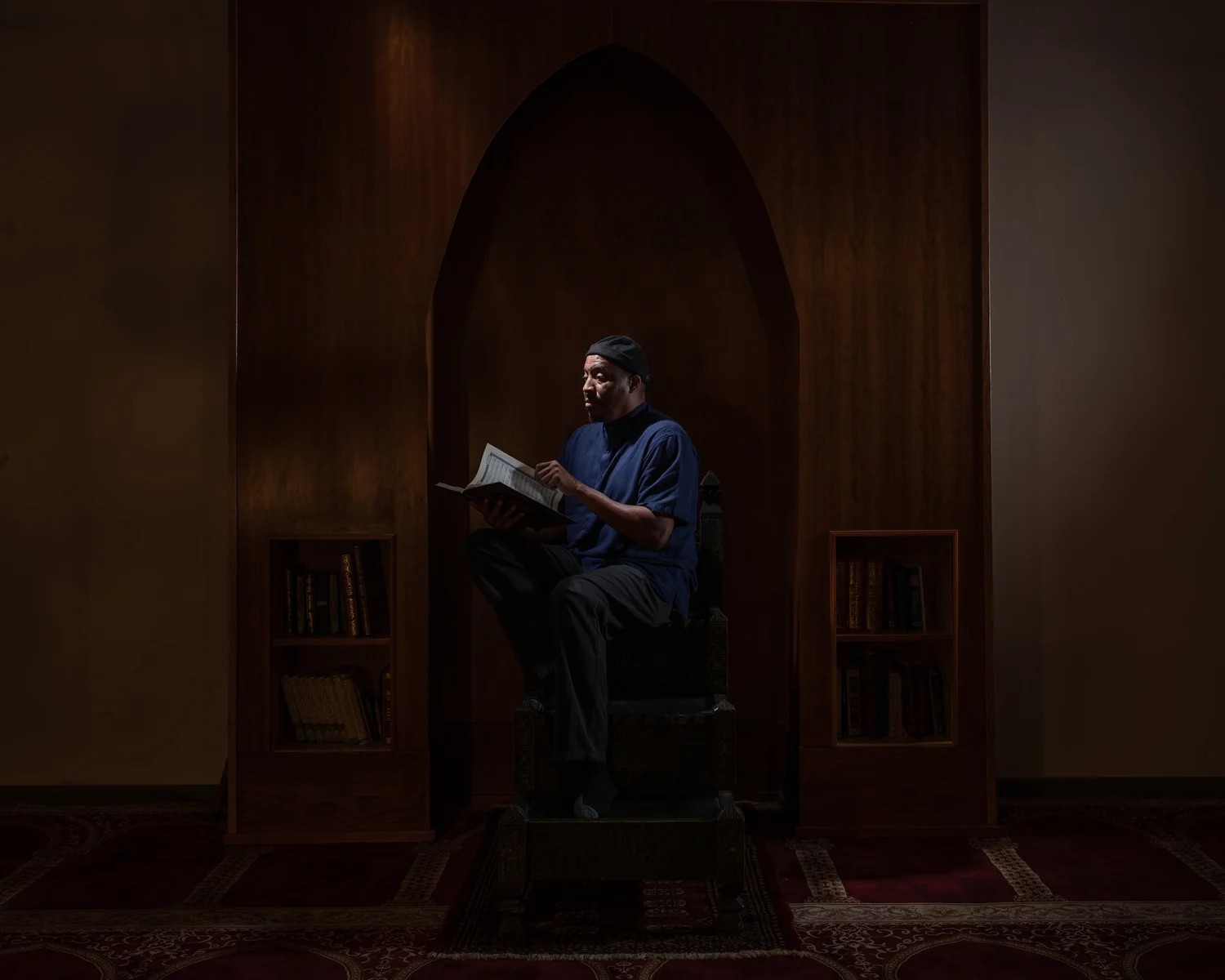
Oakland is home to dozens of houses of worship, and the “Oakland Faith Project,” aims to document these spaces and their leaders at a time when many are turning away from religion. Photographer and documentarian Nicolò Sertorio’s website includes stark black and white photography and interviews with religious leaders who represent various walks of life, identity and beliefs. We’ll talk with Sertorio, project partners and some of Oakland’s religious leaders about “de-churching” in the Bay Area and the future of organized religion.
Guests:
- Nicolò Sertorio, founder, artist and photographer, Oakland Faith Project
- James Campbell, Edgar E Robinson professor in United States History, Stanford University; partner, Oakland Faith Project
- Jacqueline Mates-Muchin, senior rabbi, Temple Sinai
- Sundiata Rashid, imam, Lighthouse Mosque; Muslim Chaplain, University of San Francisco
- Michael Wallace, pastor, Mt. Zion Missionary Baptist Church
Episode Transcript
This is a computer-generated transcript. While our team has reviewed it, there may be errors.
Alexis Madrigal: Welcome to Forum. I’m Alexis Madrigal. Like many people, Nicolò Sertorio had his life turned upside down by COVID. He was a photographer, and suddenly his normal business was gone. Italian by birth and raised by two science professors, he’d been on his own spiritual path and had been struck by the pluralism of the religious scene in his adoptive home of Oakland. So when the pandemic started, he set out on a personal quest to photograph all of the city’s churches, mosques, synagogues, and other places of worship. Four hundred and sixty-six locations later, the Oakland Faith Project has expanded to include portraits of faith leaders and fascinating audio of them talking about their views and work in the community.
So this hour, we’re going to be joined by some faith leaders, as well as the Oakland Faith Project folks. We’re joined first by Nicolò himself. Welcome.
Nicolò Sertorio: Thank you. It’s a pleasure to be here.
Alexis Madrigal: We’re also joined by James Campbell, Edgar E. Robinson Professor in United States History at Stanford, a partner and, I guess, the house historian at the Oakland Faith Project. Welcome, Jim.
James Campbell: Thank you so much for having me.
Alexis Madrigal: Nicolò, when COVID hit, you started this project. What do you think you were getting from this work of photographing these houses of worship?
Nicolò Sertorio: Well, taking a brief step back, like you mentioned, and you can probably derive from my accent, I grew up in Italy. And so I was used to having pretty much just one church in each town, the Roman Catholic church. And they typically all kind of look the same. They’re all made of stone in the shape of a cross.
So one of the first things that really struck me when I came, moved to the U.S. was the number and diversity of houses of worship, particularly in Oakland, and how free and diverse they are. At the same time, I kept noticing how many of them were shutting down, being torn down, or reconverted into private apartments. And for years, I was wondering why nobody was recording this cultural phenomenon happening right around us.
And so, like you mentioned, when COVID hit and all of a sudden all my businesses were shut down within hours, I realized this was something I was the one who had to do, and this was the perfect time. Honestly, at the time, I didn’t know what I was getting into.
Alexis Madrigal: But do you consider yourself more or less religious since you started working on this?
Nicolò Sertorio: Oh, since I started? Yeah. Um, interesting question. I still consider myself spiritual but not religious, but I was positively impressed by the people that I met during this project. And so I confess I might have entered with a little bit of a bias from my Italian heritage, and instead I found people who are truly open-minded and liberal, and many have become friends.
Alexis Madrigal: That’s cool. Jim, give us some of the sociological context here. I mean, we know in Europe, obviously, religious affiliation started declining a long time ago. And the U.S. didn’t really follow that trend at first, but now has.
James Campbell: Yeah, I think the United States is an outlier in this. There’s just no question. You know, when we started getting a General Social Survey in the 1970s, American respondents were asked — I don’t think it was a very finely grained survey. It’s given every two years. You had five categories. You could identify yourself as Catholic, Protestant, Jewish, another world religion, or none of the above, religiously unaffiliated.
When that survey started, about 5% of Americans identified themselves as religiously unaffiliated. By the 1990s, believe it or not, that figure had only gone up to about 7%. Today, the General Social Survey has that figure over 30%. Some surveys put it significantly higher, particularly among younger people.
So the general phenomenon does look like what happened in Europe, a kind of broad process of de-churching, but it’s happening considerably later in this country.
Alexis Madrigal: Do you think it’s just de-churching, or is it secularization? Are there ways of thinking about splitting out people who are spiritual but not religious?
James Campbell: That’s a great question. When Nicolò just said, “Well, I consider myself spiritual but not religious,” that’s probably the largest church, if you will, in the United States in some fashion.
So there’s a debate among scholars about this, whether what we’re seeing represents a process of secularization per se, or more a shift in the meaning of spirituality or in the nature of religious experience. There’s a scholar, Robert, I think at Princeton, who writes about this, and a distinction he makes is a shift between what he calls a spirituality of dwelling, which is, you know, you attend the same church every week that your parents attended, and so forth, to a spirituality of seeking.
And I think that’s a really thought-provoking distinction. For me, a lot of Americans feel free now to fashion spiritual creeds of their own from eclectic materials, in ways that might look less orthodox on the surface. But if you scratch at it and start asking them about specific religious beliefs — do they believe in an afterlife? Do they believe in the presence of angels? — you find actually surprisingly orthodox beliefs even among many people who profess to be religiously unaffiliated.
Alexis Madrigal: Is there anything specific about our history of religion here in the Bay Area, or in Oakland even more specifically, that’s worth dwelling on?
James Campbell: Well, you know, there certainly is a stereotype in the rest of the country that this area is full of godless heathens.
Alexis Madrigal: Exactly.
James Campbell: That we’re this kind of godless, forlorn people. I mean, I think the most significant factor here, which really defines the entire Bay Area and Oakland specifically, is that it’s a city of immigrants, and it always has been.
Churches and mosques and synagogues and other houses of worship have played a critical role in enabling immigrant communities to find their feet in a new setting, and also to retain some connection to ways of being, cultural practices, linguistic practices, even foodways, of the nations that they have left behind.
And that is certainly what happened in the late 19th and early 20th centuries as Italians and Irish arrived. There were seven different Lutheran churches here in the early 20th century for various Scandinavian migrants. And now you would see the same thing with immigrants from Tonga, Ethiopia, or Eritrea.
So in that sense, there’s a kind of persistent through line. It’s just different immigrant groups, and the specifics of their religious practices might look different.
Alexis Madrigal: Interesting. Nicolò, as you worked on this project, you had a vision for what you wanted to ask these faith leaders about, right? You didn’t want just a general conversation. You had some specific things you asked them. What did you want to know from these faith leaders?
Nicolò Sertorio: So I wanted to scratch a little bit under the surface. I wanted to talk to them about the issues that are happening around Oakland, and some of the issues that, at least in my upbringing, had pushed people away from traditional churchgoing.
So I’ve asked them about same-sex marriage. I’ve asked them about the drug epidemic, about the role of their church vis-à-vis politics. And that’s how I started to be so positively surprised by the people I was talking to.
Alexis Madrigal: Great. Well, let’s bring in a few of these faith leaders that we’ve got here. We’ve got Jacqueline Mates-Muchin, who’s senior rabbi at Temple Sinai. Welcome.
Jacqueline Mates-Muchin: Thank you.
Alexis Madrigal: We’ve got Sundiata Rashid, who’s an imam at Lighthouse Mosque and also the Muslim chaplain at the University of San Francisco. Welcome!
Sundiata Rashid: Thank you!
Alexis Madrigal: And we’ve got Michael Wallace, pastor at Mount Zion Missionary Baptist Church. Thank you.
Michael Wallace: We’re having a s—
Alexis Madrigal: Yeah, thanks so much for coming in, everyone. What was it like, Michael Wallace, to have Nicolò come to you and say, “Hey, I want to photograph the church. I want to talk to you about things”?
Michael Wallace: When he shared his vision that he wanted to highlight the faith community and Oakland’s legacy as a faith mecca for many different faiths, I was extremely excited and definitely lent all my support behind the project.
I thought that we have such a rich legacy in faith and in the city of Oakland, and so I wanted to be a part of that and make sure we captured the historic aspects of the faith community in Oakland over the years.
Alexis Madrigal: And your church rank goes back to 1870, is that right?
Michael Wallace: Our church was actually established in 1922, so we’re 104 years in the West Oakland community. We have primarily served as the mecca church. Many churches have come out of our church.
But more importantly, when many of our ancestors migrated from the South to the North to work in the shipyards, naval supply, on the trains, and things of that nature, they all came to Mount Zion. And we housed veterans after the wars, so it has always been a community hub for the community.
Alexis Madrigal: Cynthia, what’s the brief summary of how the Lighthouse Mosque came about?
Sundiata Rashid: So the Lighthouse Mosque, we definitely didn’t start in 1922. We started in about 2007, and in 2013 we were actually able to purchase the church that we’re at now.
And yeah, so we’re really the new people on the block. We’re really the new ones, because I grew up in West Oakland, South Berkeley, so I remember all of the Star Bethel and Mount Zion. Those are kind of the historical churches I remember in the East Bay.
You know, I love Pastor Mike Wallace. We actually went to Los Angeles together one time. No, I’m saying—
Alexis Madrigal: And so, yeah. Yeah, that’s great. And Jacqueline Mates-Muchin, tell us a little bit about Temple Sinai.
Jacqueline Mates-Muchin: So Temple Sinai was actually founded in 1875, so we’re almost 151 years old. And we had a couple of different locations, but our current sanctuary was finished the same year that Oakland City Hall was finished. So we really see ourselves as a part of the growth of Oakland over time, and have been a consistent presence here in Oakland.
Alexis Madrigal: That’s great. So we’re going to get into a discussion between all these faith leaders about the things that they’re seeing in the community. And, of course, we also want to hear from our listeners.
Are you a member of a faith community in Oakland or your city? Do you seek comfort in those spaces, or have you moved away from it? Or do you consider yourself religious or spiritual but not religious? We want to hear your story. 866-733-6786. That’s 866-733-6786. You can email Forum at kqed.org. Friends on Bluesky, on Instagram, on Discord, we’re KQED Forum.
This morning, we’ve got Nicolò Sertorio, who’s founder, artist, and photographer at the Oakland Faith Project. We’ve got James Campbell. He’s a professor in United States history at Stanford, and we’ve got three faith leaders with us. We’ve got Rabbi Jacqueline Mates-Muchin, Sundiata Rashid, imam at Lighthouse Mosque, and Pastor Mike Wallace from Mount Zion Missionary Baptist Church.
I’m Alexis Madrigal. Stay tuned for more right after the break.
Alexis Madrigal: Well, welcome back to Forum. I’m Alexis Madrigal. We’re here talking with faith leaders about the Oakland Faith Project. We’ve got Rabbi Jacqueline Mates-Muchin from Temple Sinai. We’ve got Sundiata Rashid from Lighthouse Mosque. We’ve got Mike Wallace from Mount Zion Missionary Baptist Church.
Sundiata, let’s talk a little bit about how you got started on the path to becoming an imam at this mosque.
Sundiata Rashid: Yeah, so, you know, I’m a Pisces. No, I’m just playing. No, so I actually, okay, yeah. So when I was younger, I was in the U.S. Marine Corps, and I was Muslim when I went in. And during the Gulf War, a lot of service people converted to Islam.
But there weren’t a lot of people who knew about Islam. So because I already had been Muslim, I just kind of got pushed into this thing of teaching people how to pray, leading services, working with other people who were called lay leaders in the military. So they weren’t like the chaplain, but they might run services at a certain base or something like that.
So then that kind of carried over. When I got out of the military, I kept on trying to teach classes and doing that for different masajid. And then in 2007, I ended up at Lighthouse Mosque, and Imam Zaid Shakir, who started the mosque, found out that I taught classes and he called me one time. I was so starstruck. He was like, “Oh, this is Imam Zaid Shakir,” and I was like, “Stop playing on my phone. Who’s this?” And he’s like, “No, it’s really Imam Zaid Shakir.”
He started asking me to teach and get involved, and now, from 2008 until now, that’s just what I’ve been kind of doing.
Alexis Madrigal: Um, Jacqueline, you’re the first Chinese American rabbi in the U.S., as I understand it. What does that distinction mean? How do you think it shaped your spiritual journey?
Jacqueline Mates-Muchin: I actually think it has given me a unique perspective of being able to understand multiple communities and see myself as belonging and grounded in multiple histories and heritages.
And I think that has actually been a really good experience when we look at Oakland and we see Oakland’s amazing diversity, and the approach that we try to have to be open and understanding of where everyone’s coming from. We recognize that we’re going to the same place. We’re all trying to make the world a better place, and we’re trying to do good here.
So I think it’s been really helpful in trying to get a much, much broader picture of life and experience.
Alexis Madrigal: Um, Pastor Mike, did you grow up in the church?
Michael Wallace: Yes, I did. I grew up in a Christian family. I’m really grateful for my parents. My father served as a deacon in a church, and my mother was an evangelist, one of the first women evangelists in a local church. And so I grew up in a Christian home. I was saved and baptized at the age of 11, and I thank God for my journey.
With respect to this, that’s on my life. I knew it early on in life, that I had a sacred calling on my life as a teenager. As I progressed through school and college, I pursued a legal profession. So I worked in the legal profession for a number of years and then transitioned over to finance.
For a while, I served as associate minister at the New St. Paul Missionary Baptist Church in West Oakland, where I received acknowledgment of my calling. And then I served under Dr. C.J. Anderson at the St. John Missionary Baptist Church. He was a historic pastor in our community.
Continuing to work in the finance industry for a number of years, I accepted my call bivocationally. I was associate minister at the local church, and I worked in finance. And I received the call to go to the historic Mount Zion Missionary Baptist Church. I retired from finance and went full-time into ministry. And now I’ve served at Mount Zion as senior pastor for the last 18 years.
Alexis Madrigal: What does a senior pastor do?
Michael Wallace: Well, it varies from church to church, but you basically oversee the whole operation in the ministry. You cast a vision, you empower the people to run with the vision, you teach, you preach, you lead, you serve, and the most important thing is that you serve the people.
So I am constantly trying to meet the needs of our congregation, as well as the needs of the greater community, because my calling is beyond the four walls of the church. And so, as a result, I try to empower our people to take the ministry from beyond the stained-glass windows to the community, to the heart of the people, and try to meet people right—
Alexis Madrigal: Where they are. Sundiata, how do you take that on, like the kind of going beyond the walls of the mosque?
Sundiata Rashid: You know, um, I’ve just always been kind of a people person myself, so I love to get out and talk to folks.
And I was telling Nicolò earlier that, really, the pandemic was kind of an opportunity, because when a lot of mosques were closed in Oakland, we actually started doing our services at a local park. That park is known in West Oakland. It’s Mr. Fab’s Park. And so people would see us there, and people who wanted to come to a service started coming to our park service.
And so after the pandemic, we almost had a whole new congregation of all these new folks who found us, just because we kept operating. We kind of tried to keep things going, because I myself just don’t like to be by myself. So even in a pandemic, I was like, “I gotta get a microphone and talk to people.”
There’s something about ministers and microphones. We just can’t leave them alone. It’s like—
Alexis Madrigal: I understand. We might share this.
Alexis Madrigal: You know, Jacqueline, let’s talk a little bit about the people who are not affiliated with a particular faith institution, even if they consider themselves to be religious in some ways. You noted to the Oakland Faith Project that actually a small portion of Jewish residents in Oakland belong to a synagogue. Why do you think that is?
Jacqueline Mates-Muchin: You know, I think, and it was sort of mentioned by Dr. Campbell earlier as well, that there is a sense of spirituality that’s in the water in the Bay Area, especially in the East Bay. So I think that there are some folks who find that sense of spirituality and connection and community in different sorts of places.
The Jewish community, or rather, a synagogue, has always been the center of Jewish life. So for some folks, they come around because they feel specifically religious, and for other folks, they’re looking for community or that shared sense of heritage and ethnicity that Judaism is, and so they’re looking to develop their sense of Jewish identity.
You know, we have found actually in the last couple of years, with the uptick in antisemitism, that there are more people who are seeking out synagogues and seeking out community in that way.
So I think the question of why aren’t there more is always a great question, but I’m really glad to see that there are folks who are, and I’m proud to know that we’re kind of a through line throughout the history here, so that if and when people want to connect, we are here for them.
Alexis Madrigal: One listener writes in to say, you know, Eddie writes, “My primary struggle with organized religion is the message that their approach is the right way to worship God. I don’t believe that God is so vain as to require that we worship them or worship in any specific way. I believe that’s one reason many people have shifted to spirituality over religion. You can choose how you want to appreciate God.”
James Campbell, this strikes me as quite a modern sensibility, right, that someone would see things in this way.
James Campbell: Look, I think this is absolutely right. And in some ways, the attitude you’ve just reflected or expressed in that quotation immediately harkens to the great cultural ruptures of the 1960s and early 1970s, when the Bay Area was kind of ground zero. And not just in the realm of organized religion, but in an extraordinary array of different registers.
Young people and seekers of various kinds were not necessarily rejecting spirituality, not rejecting community, but rejecting what they regarded as the ossified forms in which that had come to be expressed. And I think the roots of an enormous cultural war that we are still fighting in some fashion today are embedded in that quotation.
Alexis Madrigal: Nicolò, your project is a tiny bit different, even just as I think about its underlying philosophy, right? It’s not just to go away from all these institutions. It’s actually to go into as many of them as possible, which is kind of different.
Nicolò Sertorio: So first of all, I just wanted to add something to the earlier conversation. I think the spiritual leaders may have been too modest to mention that a lot of these houses of worship play a very vital role in the city beyond the church walls, supporting the community, providing food, shelter, showers, safe housing in their parking lots overnight. And that is a very important role that we need to acknowledge about what the houses of worship are doing in Oakland.
In terms of your question, I think it kind of links the points together in that, although I belong to that growing denomination, I, like everybody else, have this thirst for a higher self and belonging and community. And so, maybe consciously or unconsciously, there was a desire to understand and explore that world around me.
And the extreme fascination with this incredible diversity — one of the big parts that brought me to the project was, as you mentioned, during COVID, when everything was locked down and there was all this bad news about Oakland, I wanted to focus on something positive. And to me, having multiple denominations literally sometimes next door to each other, if you go on International Boulevard in Oakland, that’s something very unique. And that’s something very powerful that also reflects the ethnic and social diversity of the city.
Alexis Madrigal: Of Oakland. Sundiata, one of the things that I have wondered about is how having this war in Gaza, having a war in Iran, having these things going on around the world ends up reflecting back for you inside the mosque.
Sundiata Rashid: You know, so I think a lot of those tragedies do build up attendance at the mosque. Because I think one of the things is that when people leave organized religion, that might be almost a sense of entitlement because they’re not going through things in life.
So, like, once they start — if you were even here and you were kind of comfortable, but you’re identifying with your relatives or even just Muslims who you feel an affinity for because of the same religion, and you see the things happening to them — you’ll still be looking for those signs of spiritual answers.
And so a lot of times, that’s what religious institutions provide. It’s like, we can answer some of the questions. And like the guy said, sometimes it might be dogmatic, like, “This is the right answer, and anything else is astray.” But I think that most people who encounter religion are just looking for an answer to some of the grief that they’re feeling.
And those institutions, like the mosque, especially during the genocide in Gaza and those kinds of things, were able to drive up attendance, get people coming out and organizing. So many programs at the mosque were centered around those kinds of things that were happening in Iran and things like that.
Alexis Madrigal: Um, another listener, Ryan, and Rabbi Jacqueline, this one’s coming to you. Ryan writes, “I grew up in a secular Jewish household in Boise, Idaho. I later married a man who was raised observant in the South Bay, and I waded hesitantly but excitedly into a more Jewish life. In 2022, we sent our first child to Temple Sinai’s preschool program.
“But after the events of October 7, 2023, and the Israeli attacks on Gaza, both of us began feeling increasingly uncomfortable being associated with Jewish organizations that did not condemn those attacks. For the first time in my life, I feel ashamed to be Jewish. But even sadder for me is that this is also true for my husband. He used to take great comfort in his religious practice.
“I think we’re at a generational turning point for Jewish Americans that will drive many of us further from the faith.”
Obviously, this has been an incredibly difficult issue across American life, but specifically Jewish life. How have you been counseling people in your congregation?
Jacqueline Mates-Muchin: So I think there’s a wide range of ways to understand what is happening and different ways to talk about it. I will say that it’s kind of hard to hear “the genocide in Gaza,” which I wasn’t necessarily expecting in this particular conversation. But I will save that.
I think the role of the synagogue is to grapple with the word Israel, because the country is actually named after the people. So we call ourselves Israel, Yisrael, and it means those who wrestle with God.
And so the point of being a part of a Jewish community is to be able to bring your concerns, bring your questions, bring your values, and bring your frustrations together so that we can have those kinds of conversations and figure out what it means for all of us. And it’s totally fine to disagree on certain kinds of things.
I think the problem that we’re seeing right now, not just in the Jewish community but in a much greater way, is that people are choosing sides and teams and not having those kinds of conversations, not trying to understand other people and grapple with the things that are happening in the world and the things happening in our lives.
So I would actually argue that if you are looking for a place to be able to do that, it might not be one synagogue or one church or one mosque or the other, but it could be somewhere in that realm where you can find places to wrestle with the things that are difficult and be able to understand what it means for your life.
Alexis Madrigal: Michael Wallace, how do you see your role in this sort of cross-faith collaboration? Do you do a lot of it? Do you not do a lot of it?
Michael Wallace: We engage a lot in collaboration across denominational lines, faith traditions, generations, as well as culture. It’s absolutely essential because we have to move from our silos to systems. And we realize that collectively we can have a greater impact, a more meaningful impact, in our communities and the people that we serve.
I just want to allude to something that you mentioned earlier: the Black church in our culture has always been on the front line of addressing inequalities in our society. We have always been on the front line of addressing disparities within our society. We’ve always been at the forefront of addressing injustice in our society.
And so, in that tradition, in that vein, it’s absolutely essential that we continue to address injustices anywhere among any people, regardless of their race, creed, or color.
And so, as a result of that, we do build collaborations. I work with a number of groups. One particular group is Impact Oakland Now, ION, and it’s a collective of six progressive pastors and churches that are basically addressing social, economic, educational, and spiritual needs within the community. So we do a lot of work collectively to have an impact for the most marginalized within our communities.
Collaboration is absolutely essential. As he indicated earlier, we went to Los Angeles together to work in collaboration. And so I work a lot with the Church of Jesus Christ of Latter-day Saints. I served as the chairperson of Faith in Action East Bay, which consists of a lot of rabbis and Jewish synagogues. And so we find that working together, we can have much more of an impact on our society.
Alexis Madrigal: Sundiata, I was thinking about this. I mean, you’re the Muslim chaplain at USF, which I think of as a very Catholic university.
Sundiata Rashid: Go down. How does that work? You know, every university is going to be diverse, but USF is rated as the most diverse campus in the United States, right here in San Francisco.
I took my daughter there when I first got the job, and I’ve been to different MSAs and worked with different Muslim Student Associations. She would always tag along, her and my son, and she was shocked at just how many people of color there were.
And then I was like, “Let’s count the Black folks.” So when I was young and we lived in Berkeley, my dad used to play a game called “Let’s Count the Vovos,” because there were always a lot of Vovos in Berkeley. So we were like, let’s count, and we gave up counting when we got to about 100.
You know, it’s a small campus, but we got to about 110 Black people just walking through. Tonight — if you’re biracial or something, my daughter wasn’t counting that. She was like, “So these were, like, you know, 110.” They’re not saying biracial folks aren’t authentic, but there were no, no — so that’s me at USF.
Alexis Madrigal: That’s interesting. We’re talking about religious communities in Oakland, the future of religious traditions. We’re joined by a trio of faith leaders, as well as the people working on the Oakland Faith Project, including its founder, Nicolò Sertorio. We’ll be back with more right after the break.
Alexis Madrigal: Welcome back to Forum. Alexis Madrigal here, joined by Nicolò Sertorio, who is founder, artist, and photographer of the Oakland Faith Project. He’s got his house of worship story, and James Campbell is also Edgar E. Robinson Professor in United States History at Stanford. We’ve got Rabbi Jacqueline Mates-Muchin, who is senior rabbi at Temple Sinai. We’ve got Sundiata Rashid, imam at Lighthouse Mosque and Muslim chaplain at the University of San Francisco, and we’ve got Pastor Michael Wallace of Mount Zion Missionary Baptist Church.
This project began, Nicolò, with the photographs that you were taking, and you actually now have them up in a show at 1500 Broadway, is that right?
Nicolò Sertorio: Yes. The project exploded in some ways. So I did start with the houses of worship, and then for the second part I partnered with my good friend and colleague, and also a good photographer, J. Michael Tucker, in taking the portraits. And furthermore, we decided to start recording their oral histories.
Later, after doing a solo show at Oakland City Hall, I was offered the opportunity to exhibit in this empty commercial space at 1500 Broadway. It’s a very large, over 2,000-square-foot space that we now have open Monday to Friday.
And it’s been really interesting to see the constant flow of people and the conversations that I have encouraged just by people listening to spiritual leaders and discovering new sides of them.
And also, I think it’s important that we don’t move away from difficult conversations, but rather confront them full-on. To me, that is actually one of the biggest measures of a successful art project: if people talk about it, good or bad.
Alexis Madrigal: Yeah. We’ve got a few different folks who have been grappling with these various topics. Some folks with other religious beliefs. One listener writes, “My friends and I believe that nature is my church.”
And Peggy writes in to say, “I belong to the Buddhist Church of Oakland. The Buddhist teachings make sense to me and are based on gratitude and compassion for all living beings. I also find great community in our church. We have our annual Spring Bazaar and our Obon Festival in early August, and everyone is welcome.
“Our church was founded in 1901 and survived the mass incarceration of Japanese and Japanese Americans during World War II. This year, we are celebrating our 125th anniversary.”
I mean, one of the things that strikes me, Pastor Michael Wallace, out of this is just that there’s something to the fact that these institutions have been around for so long. Maybe a hundred years old, 120 years old, whatever it is.
Michael Wallace: No, that’s true, and that just really is a tribute to them surviving through some more difficult times. If you’ve been around a church or a facility or a house of faith that’s been around for over a hundred years, that means they have seen the pendulum swing from one side to the other.
They have lived through the dark days of the Depression. They have lived through the turbulent times of the ’60s. They have lived through the free speech movements of the ’70s and so forth.
So, as a result, I think it’s a testament to that particular institution or that place of faith that they have been able to weather many storms. But you don’t just weather storms. In order to survive that long, you have to be doing something positive, having a meaningful impact, meeting the needs of the people. And so I think that’s a true testament to their survival.
Alexis Madrigal: Especially at a time when there’s so much change in the Bay Area and so much change in Oakland over the last even just 20 years, let alone 120 years.
Michael Wallace: Oh, absolutely. I mean, just say post-pandemic. Let’s just be in the last five years. It has been really different because, prior to the pandemic, we had a lot of people attending services. During the pandemic, people were not allowed to gather. And then post-pandemic, there was a large falling away.
But now we have this political and social climate that we’re currently existing in that, to me, has more people turning back to places of faith, to their faith, in order to find how to navigate through the challenging and difficult days that we’re facing right now.
Alexis Madrigal: Let’s bring in a couple of callers here. Let’s go to Art in West Sacramento. Welcome, Art.
Art: Hi.
Alexis Madrigal: Hi. Hello? Yep, we can hear you. Go ahead.
Art: Okay.
Alexis Madrigal: We could hear you, at least, that is to say. Sorry about that, Art. We’ll try and come back to you. I don’t know what’s going on with the phones this morning.
Let’s talk a little bit about one major topic. And maybe, Rabbi Jacqueline, I’ll come to you on this. One of the things that I think has been — I don’t want to put a value judgment on it — but many people have gone to AI chatbots, kind of asking for life advice, even borderline spiritual advice, as people try to figure out what they want and find meaning in life. How do you approach something like that and kind of bring people towards other people?
Jacqueline Mates-Muchin: I think it’s rough, just because everybody needs to find an outlet that makes the most sense for them. I think the best thing that we can do is to ensure a thriving community and make people aware that we are here if they want to connect.
You know, I think it is hard to hear sometimes folks say that they don’t go to religious institutions because they think that we’re going to be dogmatic. But you actually don’t know what’s happening unless you give it a try.
So it is a worry in our world now that folks are tending to be a little bit more isolated and not necessarily wanting to make themselves vulnerable, which can happen if you are a part of a community. Then you become a part of the community in all sorts of ways.
But my hope is just that if you’re curious, if you have any desire to see what it is, or even if you’re thinking that we are saying one thing, you know, come in and see if it’s true. And hopefully you’ll be able to find a community that’s meaningful. And if it isn’t meaningful, then that’s okay, too.
Alexis Madrigal: Yeah. Jim, one of the things that I think is interesting about some of the research around these things is that our churches have gotten more sorted politically. Can you talk to us a little bit about that?
James Campbell: Yeah. I mean, I also want to point out one thing, since you had one of the people who wrote in about the Buddhist Church of Oakland. That group not only survived the experience of Japanese American incarceration during the Second World War, they also survived the interstate road system.
That’s one of the churches that, under eminent domain, was slated for destruction, and the people in it actually sawed it in half, put it on trucks, and moved it, preserving it. So there’s lots of vicissitudes.
One of the messages that came out of doing this research for me about religious life in Oakland was just its extraordinary resiliency. But, in any event, on the question you asked, if you go back not very long ago, maybe even to the turn of the century—
Alexis Madrigal: That is to say, the year 2000.
James Campbell: Correct. The people sitting in the pews next to you were just as likely to be Democrats as they were likely to be Republicans. And that is manifestly not the case now.
I mean, the process of people moving away from traditional religions and denominations is across the board. It’s happening among evangelicals, mainstream Protestants, Catholics, and so forth, but it does correlate with political affiliation.
And one of the things that, to me, is most alarming as someone who grew up in a Christian tradition is the way in which that tradition in our country today is increasingly being appropriated or donned as a mantle by certain kinds of political actors who, I think, make a mockery of the teachings of the person they profess to worship.
And I don’t mean to be overly political about this, but I think that’s happened. I think a very large part of the movement away from orthodox religion in recent years — there’s been a dramatic, phenomenal outflow of people, measured in millions nationally, in the wake of the election of 2016, for example.
And so that’s clearly one of the things that’s happening now, and I think it’s really unhealthy for our country. You know, part of what the United States always had was a very robust civic life, not just churches, but Rotary clubs and bowling leagues, and the list goes on and on, including Little Leagues, where you routinely interacted with people who voted for different political parties from you.
That tradition is eroding in our society, and I think that’s very threatening for our democracy.
Alexis Madrigal: Let’s see if we can get Art in West Sacramento back here.
Art: Hey, Art, sorry about that.
Alexis Madrigal: Hey, no worries.
Art: I’m 11th in a family of 15. I was a former Catholic, Seventh-day Adventist, Pentecostal. I was going on the Pentecostal track. I attended the University of California, Davis. I decided that I could not become a Pentecostal minister because they wanted me to preach against my sister being a lesbian. And I said, “She’s not going to hell. It’s not possible. I cannot preach that way.”
And it turns out the guy that was leading me was actually using me as a young person to paint homes and making money off of me, and just was running a puppy mill later on in life. This guy was being sued by the city that I grew up in.
It just is really… And then let’s add to that things like Tammy Faye, Tammy’s magic stories that come out of… And it’s no wonder, in my mind, why we have the kind of leadership we have in the country, in one way.
The second part is that, of course, people are going to turn away from things that they can’t have trust in. And to rebuild that trust doesn’t necessarily come down to belief in God or some supernatural power, because people have that. What they don’t believe in is the people who are mediating the process. And I’ll leave it at that.
Alexis Madrigal: Yeah, thank you. Great, great comment. I’m glad you hung with us there.
I mean, yeah, Pastor Michael, I think this is, you know, growing up in an era of televangelists myself, and just seeing them on and being like, “Boy, what is this? What does this have to do with the Bible or anything?”
Michael Wallace: Well, yeah. I mean, without question, the swell of the televangelists over the years, particularly during that era, was enormous because they were on the airwaves 24/7. You could not miss it. And as a result, those individuals became bigger than life.
And so what you have is a personality-driven church. And anytime you have a personality-driven church, that means it’s centered around the human being that’s, quote-unquote, the personality of that church. And so when that personality is defective or false, then that whole movement shifts to a decline.
And so that’s what we’ve seen with some of the great movements, from Jimmy Swaggart to Jim Bakker to many others who were personality-driven.
And so what we have to do, and I think our society is demanding this, is shift from personality-driven to either Christ-centered or centered on whomever your higher authority is. But it has to be centered on that person and not the human individual.
Alexis Madrigal: Sundiata?
Sundiata Rashid: I mean, I think it’s fine for people. I mean, for me, it’s not one size fits all. So, like, there are probably many Muslims who don’t go to the mosque, but they’re still Muslim, you know what I’m saying? And then there are many Muslims who do go to the mosque.
There might be, you know, like in Oakland, we might have 10 or 11 masajid, or mosques. For me, if Lighthouse isn’t your thing and you want to go to, you know, we always name our mosques after streets, 31st Street or 47th or whatever, I’m always fine with that. I’m like, that’s cool, just do you.
So, like, for somebody who might have had a tragic experience and got turned away from religion, I’m not going to try to recruit them or try to get them back. They should just do what they’re comfortable with, you know what I’m saying?
Alexis Madrigal: Yeah, yeah. Let’s bring in Gail in Oakland with a comment here. Welcome, Gail.
Gail: Kate, thanks, Alexis. Nice to talk to you. I knew you in my former iteration as an Oakland restaurant owner.
I wanted to let listeners know or remind them about the Oakland Interfaith Gospel Choir. I’m a member of the Oakland Interfaith Community Choir, which is one of the sister choirs under the umbrella of OIGC. And OIGC has been around for 41 years, and I’ve been singing with them and recently became a board member because I love it so much.
It’s a huge joy in my life, and I think a beautiful reflection of the 23 religions represented in our choir, singing together, learning a lot about Black history, really inspiring joy in our audiences and our performances, and just an incredible reflection of the diversity of Oakland.
Alexis Madrigal: It’s kind of like the sonic version of your project, Nicolò.
Nicolò Sertorio: Yeah, and I would like to take the opportunity to invite you to come and sing at 1500 Broadway.
Michael Wallace: Oh, yeah, that’s a good idea, actually. The Oakland Interfaith Choir is absolutely amazing. Minister Terrence Kelly, who has served as the leader of that, they do a tremendous job. It’s a collective collaboration of many faith traditions coming together and unified, pulling in the same direction. And they are really amazing.
Gail, the people want to hear you sing, though.
Gail: That’s not going to happen. It’s totally fine, but I’m going to come to our conference.
Alexis Madrigal: I had to try. I had to try. Producer Grace made me.
Gail: Yeah, you had to try. Good try, good try.
Alexis Madrigal: All right, thank you, Gail. Thank you so much. Lots of comments here from listeners who’ve just found their place, which is kind of nice.
Rishi on the Discord writes, “I’m so glad to have found my local UCC congregational church of Sunnyvale. Progressive but not zealous, just kind, sensible people. I love my UCC church for the solstice celebration. I also try to practice nonsectarian meditation, a way of life taught by the Buddha. And I volunteered at a local food distribution organization founded by a group of like-minded Indians. As my Hindu saints told me, helping others is doing God’s work.”
So many. Here’s another comment. Gina writes, “I grew up attending a couple of different Oakland synagogues, but as a young person, I couldn’t see what relevance most of these ancient Jewish texts and rules could have to my life. And I couldn’t believe in the God I saw represented there.
“I saw the problems religious conflict had caused throughout history and how religion was used as a reason to cast out certain types of people, and I wanted none of it. But once I had a kid, I decided to keep an open mind and seek out a different approach to bringing Judaism into my life, into my family.
“I found an organization called Jewish Gateways, a community based in Albany that doesn’t have its own building but offers a variety of educational programs for families and adults that have changed my perspective on Judaism and helped me see its relevance to living an ethical and meaningful life in community.”
Rabbi Jacqueline, how often do you see someone come back to the temple because they want their family to have some of this shared basis of faith?
Jacqueline Mates-Muchin: I actually think it’s very common that folks, once they have children and want to try to help create a lens and help their kids form their identity, it’s very common for folks to come back and want to put their kids into a religious school and Hebrew school, and to have them have some sense of what it means to be a part of the Jewish community.
So I’d say it’s actually very common, and I appreciate it. I think that that’s a part of the stage of life that makes a lot of sense, that you’re developing a sense of your home and your household, with traditions and roots. And so it’s very welcome.
Alexis Madrigal: Last one. Alison writes, “I found the Oakland Unitarian Church along with my partner fairly recently. We needed a faith community that was engaged in resistance to the cruelty of our current national politics. It has been wonderful to be engaged with other seekers who have made the commitment to not accept our present circumstances, but rather to fight for justice for all marginalized people. It is a spiritual quest and a way to feel connected to what is good.”
We have been talking about religious communities in Oakland and the future of religious traditions. You can go take a look at the Oakland Faith Project’s exhibition at 1500 Broadway.
We’ve been joined by its founder, Nicolò Sertorio. Thank you.
Nicolò Sertorio: All right. Thank you.
Alexis Madrigal: And Jim Campbell, Edgar E. Robinson Professor in United States History at Stanford. Thank you. Might have lost him.
Rabbi Jacqueline Mates-Muchin at Temple Sinai, thank you.
Jacqueline Mates-Muchin: Thank you. Thanks for having me.
Alexis Madrigal: Sundiata Rashid from Lighthouse Mosque, thank you.
Sundiata Rashid: Thank you.
Alexis Madrigal: And Michael Wallace, pastor at Mount Zion Missionary Baptist Church in West Oakland. Thank you.
Michael Wallace: Thank you so much.
Alexis Madrigal: Thanks so much to all of our callers and listeners. Sorry about those problems on the phones. I’m Alexis Madrigal. Stay tuned for another hour of Forum ahead with Mina.
Announcer: Funds for the production of Forum are provided by the Jenerosity Family Fund and the members of KQED.