Novelist Min Jin Lee on Education, Sacrifice and ‘American Hagwon’
Airdate: Monday, October 12, 2026 at 10 AM
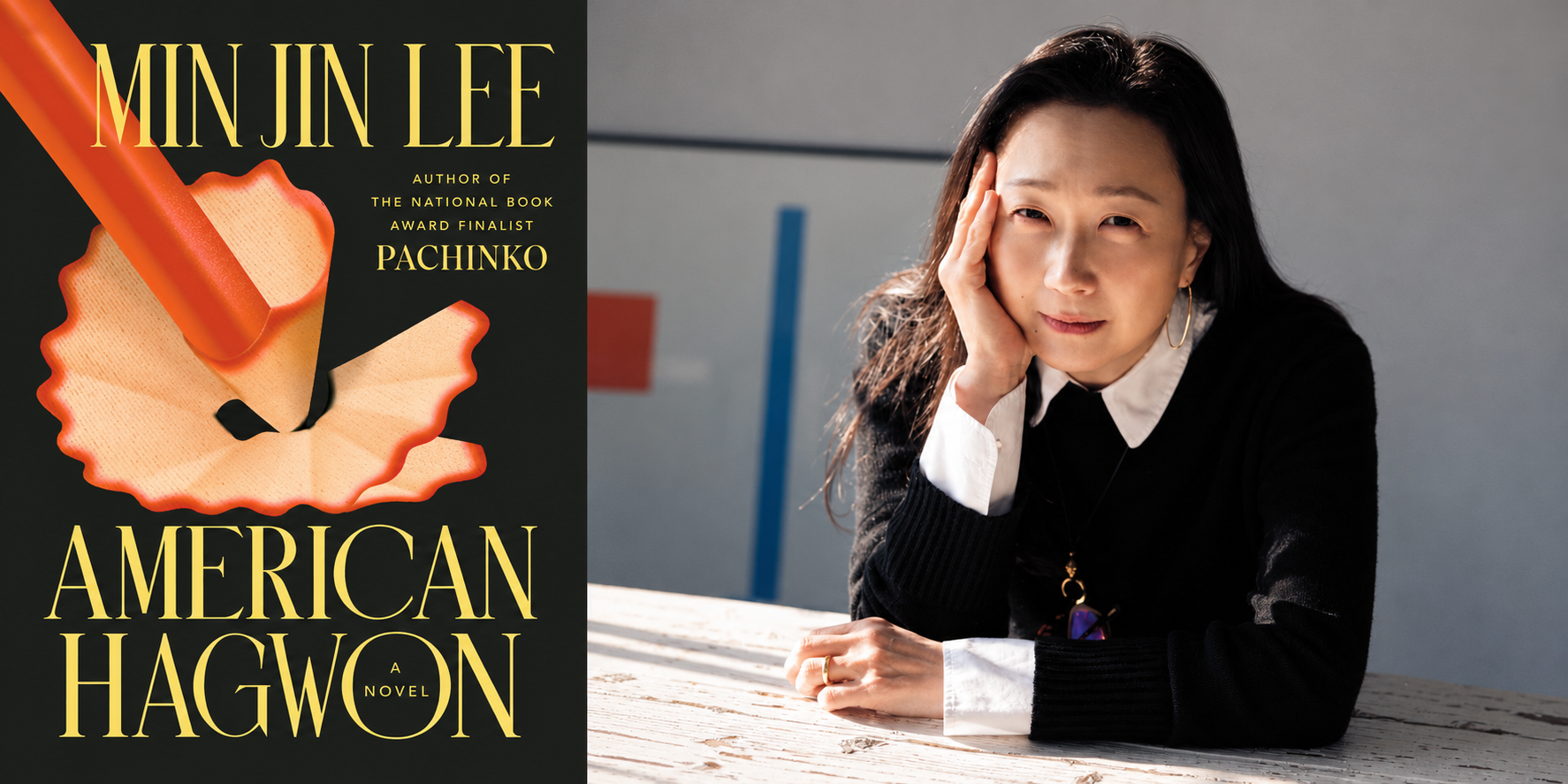
Much like her acclaimed novel “Pachinko,” author Min Jin Lee’s new book, “American Hagwon,” is a multi-generational story that spans decades and continents. This one, set in South Korea, Australia and Southern California, focuses on education — and the sacrifices families make for their children to succeed in a fast-changing and increasingly competitive global economy. We’ll talk to Lee about what her novel has to say about diaspora, education and how we prepare for an uncertain future.
Guest:
- Min Jin Lee, author of the new novel “American Hagwon,” as well as the books “Pachinko” and “Free Food for Millionaires”
Episode Transcript
This is a computer-generated transcript. While our team has reviewed it, there may be errors.
Mina Kim: Welcome to Forum. I’m Mina Kim. Min Jin Lee’s new novel, American Hagwon, tells the story of a middle-class Korean family in the ’90s whose lives are repeatedly upended as they try to educate and provide for their children in Seoul, Sydney, Australia, and eventually Southern California. Largely set in hagwons, or learning centers where Korean children receive tutoring, test prep, or college admissions guidance, the novel, like Lee’s previous work, Pachinko, includes betrayal, loss, and the bonds of family as it explores the relentless pursuit of educational attainment and upward mobility. Min Jin Lee joins me now. Welcome to Forum.
Min Jin Lee: Hello, Mina. How are you?
Mina Kim: I’m well. Thank you so much for being with us. Min Jin, did you ever go to a hagwon yourself?
Min Jin Lee: I haven’t gone to a Korean hagwon. However, I did go to Princeton Review when I was in high school for, I think, about six weeks to study for the SATs.
Mina Kim: So that would be like an American equivalent of a hagwon. What are some other examples of that that you came across?
Min Jin Lee: When I was in law school, after I graduated, I took this exam called the law — I’m sorry, I took the bar exam. And then the program that I took was called Barbri, which is, again, another hagwon. And, of course, in America, what’s widely known as Kumon, that’s also a hagwon.
Mina Kim: Well, you were exploring hagwons for this book. What did you find were sort of the key differences between hagwons in Korea and the ones that mainly catered to Korean American kids, especially young kids, right? And sort of the way America looks at them?
Min Jin Lee: I think that what’s important to know about hagwons is that although the word hagwon connotes a sense of cram school, in Korea, a hagwon is really where you can learn anything, and you pay money for it. So the thing that I wanted to stress is that even though a hagwon may incite a kind of sense of fear for students, it’s also a place in which you can do tap dancing or learn how to play a musical instrument or learn how to be a gourmet cook. You go to a hagwon, which is part of the culture. So if you said you wanted to learn something, you’d go to a hagwon, not necessarily a formal school. And I wanted to highlight that because it really expresses this kind of deep wish to self-improve, and that’s in the culture.
Now, going back to what you asked about children, in South Korea, about 80% of kids start around age four or five to learn how to speak English. And they go to a hagwon.
Mina Kim: They go to a hagwon. And then also, it feels like you really wanted to focus on the ones in the U.S., the ones that really teach kids how to academically excel and get into a good college. Why did you want to focus on that type of hagwon? What was the broader issue or question that you really wanted to talk about?
Min Jin Lee: Dig into. So I started to write this novel because I wanted to understand what was the most important value to Koreans around the world. And the thing that was very clear to me after doing so many interviews was that every Korean that I ever met who’s diasporic mentioned their path of education, and they had expressed very controversial feelings. Not everyone thought education was great. Many people had regrets about it, but very often they harbored a real, deep wish to make their children have a certain kind of education.
So I thought, okay, well, my third novel is going to be about education, and how will I handle that? And the more research that I did, I got kind of sad because I kept on hearing about certifications and the transactionalism of what education can mean and the brand names of the schools. And I thought, well, this is what I really want to write about. Do I really want to spend almost a decade of my life focusing on this subject? And I realized, no, what I care about is wisdom. So then I really explored how human beings seek wisdom in light of education. And they’re not always the same.
Mina Kim: Yeah. Well, tell me about the inspiration for the family at the center of this book. This is the Ko family, and they do hold some degree of faith in the power of educational attainment, but are also, in a way, very much victims, I think, of the transactionalism that you’re talking about.
Min Jin Lee: That’s correct. So I chose this family in particular, and I chose them because in all my interviews, what I really noticed was that if you are middle class, no matter how well-educated you are, without generational wealth, it is difficult to ride out the storms of economic shocks.
And the two economic shocks that I decided to focus on in this novel were the Asian financial crisis, which is called the IMF crisis in Korea, and that happened in the winter of 1997. And then I decided to end the book right before the U.S. global financial crisis takes place because I wanted to show what happens when you have these external shocks and you are doing your best.
And the question that I really wanted to answer for myself personally was, why do really terrible things happen to good people? So it was very intentional for me that this is a family that’s decent and they’re trying their best, and yet terrible things happen to them, and I needed to answer that question for myself.
Mina Kim: It feels like you have a lot in common with the daughter character, Mido, who, as a middle schooler, rarely speaks. And you’ve described yourself as rarely speaking as a kid as well.
Min Jin Lee: So I didn’t really start talking until almost middle school. And then since then, I’ve worked a lot on being able to do this conversation right now.
Mina Kim: And what people often attribute to that? You know, I mean, you probably had your own sense of why that was, right? But also, and I’m curious about what that is, but also what people attributed it to.
Min Jin Lee: Well, in Korea, I didn’t talk very much either. And I’m one of three girls in the family. I’m the middle child, and both my sisters spoke very well, and they had lots of friends, and they were popular. So I always just thought I was sort of quiet, and it wasn’t a big deal when I was a kid.
And then when I came to America, I was equally quiet, and that was considered a bit strange. And people often equated my silence and quiet with being less intelligent. And it could be that I’m less intelligent, but often I was just quiet, and I couldn’t really understand how to connect with the other children. And that was more of a problem because I didn’t really have friends until the end of middle school, and definitely I felt very, very good in high school.
Mina Kim: What kind of work, you say, did you have to do quite a bit of work to be able to even have this conversation that we’re having now. What kind of work did you do?
Min Jin Lee: I took public speaking classes, like formal public speaking classes. I took two of them. And then I had some media training, which was for exactly one day. And I read books about public speaking. And I’ve also studied famous speeches. And I listened to — well, it was interesting because it wasn’t always a podcast back then. But as soon as podcasts really arrived, I really listened to them because I wanted to understand the art of conversation, which I think is very important.
Mina Kim: And what ultimately — I mean, I imagine those helped you, right? But what about them helped you?
Min Jin Lee: The thing that really helped me more than anything, and if I can save somebody who’s listening some trouble, is if you really can forget yourself entirely and just focus on the person that you’re speaking with.
Mina Kim: Mm-hmm. Then…
Min Jin Lee: The fear is unjustified. Because most of the fear and the anxiety, for me anyway, not for everybody, was — I thought that I wouldn’t be able to measure up. I couldn’t hold my end of the conversation. And I think I didn’t know if I had any utility in that conversation.
Whereas now, I think if I really focus on the person that I’m speaking with or the audience that I have, then I think that I can be of service. And that’s a very different way to look at conversation.
Mina Kim: Is that how you approach writing?
Min Jin Lee: Oh, absolutely. I really don’t think about myself. I don’t think it’s that interesting. My life is actually quite traditional and very without drama.
Mina Kim: Yet, at the same time, would you say it is accurate that your character Mido does have a lot of your characteristics, or at least has a lot of your experiences? Because at one point, Mido is slapped on the hands by a teacher, you know, with a ruler for getting a math problem wrong.
Min Jin Lee: So that actually happened to me, but not for getting a math problem wrong. So when I was in Korea and I was in first grade, I finished my worksheet, and it’s a very large class because, at that point — this is 1975 — there were more students than there are now in public schools.
And because I’m tall, I was asked to sit at the very back of the class. And I finished my worksheet, and instead of just sitting there, I was wandering back and forth, which you’re not supposed to do. But I didn’t know any better, so I was walking back and forth.
At this point, I’m six years old, and I was asked to come forward to the front of the classroom by the teacher. And I didn’t understand why, because, again, I didn’t really understand my surroundings. And the teacher said, “Hold out your hands.” And I thought that I was going to get a present. I actually was such a dumb child in some way, or clueless, that I really thought I was going to get a present.
And rather than the present, I got several thwacks on my hands with a ruler. It was very — it was more like a stinging than violent pain. But I think what I really remember about it was just the public humiliation, that in front of my peers, someone could do that to my hands.
And I thought for almost all of my life that it happened to me because I was wandering in the back. But then later on, after I actually spoke about this in front of a very large audience at a university, my mother was in attendance, and afterwards she said, “Do you know why you were hit?”
And I said, “No, it’s because I finished my worksheet and I was walking back and forth, and I’m not supposed to do that in class. You’re supposed to sit still.”
And she said, “No, that teacher came to visit me and then asked me for money, like a bribe.” And I didn’t know this until I was 50.
Mina Kim: Wow. What did hearing that tell you? Sorry, we’re coming up on a break. But did you believe that there was something wrong with you?
Min Jin Lee: Right? Yes. I definitely thought there was something wrong with me because I knew that I wasn’t like the other children. I couldn’t quite do the things that other girls could do, or boys. So I thought there’s something wrong with me, and it was very funny to me that around the age of 50, I thought, oh, you’re not supposed to walk back and forth in a classroom. You’re supposed to sit still, but the teacher was also corrupt.
Mina Kim: We’re talking with Min Jin Lee about her new novel, American Hagwon. You might also know Min Jin from Pachinko and Free Food for Millionaires. Share whatever you’d like to ask or tell Min Jin Lee, or, if you’re a fan of her work, after the break. You’re listening to Forum. I’m Mina Kim.
Welcome back to Forum. I’m Mina Kim. We’re talking this hour with author Min Jin Lee, whose novels include Pachinko and Free Food for Millionaires. Her new one is called American Hagwon, about the role educational attainment plays in Korean and American culture, and so many other things, of course: family bonds, sacrifice, and so on.
Listeners, what role has the pursuit of educational attainment played for you? Did you or your kids go to a hagwon or participate in a similar system? What did you take away from it? Why did you do that? What were you hoping to achieve? Are you a fan of Min Jin’s work? You can tell us by emailing [email protected], finding us on Discord, Bluesky, Facebook, or Instagram at KQED Forum, or by calling 866-733-6786. 866-733-6786.
You know, we were just talking about that experience before the break, about a teacher who was allowed to slap kids’ hands. I know, when I share that, I spent a year in Korea when my dad was on sabbatical there when I was in kindergarten and witnessed the same thing. I think the teachers were a little bit easier on me because I was coming from Canada at the time. But I did witness the slapping of the hands.
And there’s this sort of, you know, I feel like it contributes to the idea that Koreans and Asians in general, East Asians in particular, but also South Asians, will do anything for their kids’ educational attainment and hold teachers in very high esteem, and also hold it as a key thing that children must learn to achieve as well.
But we were talking about how you play very different roles, sometimes even positive roles, but it does feel like your book is a cautionary tale of when a belief in the spoils of educational attainment, for lack of a better word, becomes all too consuming.
Min Jin Lee: Yeah, I think that what drives parents or guardians of children to choose certain paths is often driven by a wish and a love to protect the child. I think that’s actually a beautiful thing. And I think if you are a parent, you know that you want the best for your kid, or most parents do. I think that’s really been my experience in terms of my research.
And I think that when we, in the West, especially in the West, look down on or pathologize the way Asians — and the category “Asians” is almost like a misnomer, and it has no meaning because there are so many different kinds of Asians — but in particular, right, in terms of the high-achieving, in terms of high academic people who are of Asian descent, and that could be South Asians, Southeast Asians, it could be East Asians, and also they could be born elsewhere or be multigenerationally fitting into the United States landscape.
I think very often we’re put in this sort of large, blanket group of parents or children who have grown up in kind of a toxic environment, and somehow Asians are considered robots. And if they do achieve, it’s considered almost natural rather than based on effort. And I really have to argue with that. I just think that’s racist. I think, yes, silly.
Mina Kim: I really appreciate you saying that because I do think that — it’s not just the fact that, you know, I hated those types of stereotypes, and also the whole, what I think is sort of the racist tiger mom phenomenon and all of that, because of the fact that it is so oversimplifying and also very negative, and a reason to look poorly on a particular group of people.
But also, it really wasn’t my own experience. My mother was not like that at all. Actually, she was pretty — I feel like if we put any academic pressures on ourselves, it was put on by ourselves. Like, I was really, you know, just sort of left to try to see what I could accomplish.
Min Jin Lee: I think that culturally speaking, and I can speak for East Asians — that’s the group that I really studied — if you look at, let’s say, China or Japan or Korea, that are a bit more Confucian, there is a real belief that if you take an exam and the exam score is very high, you have proximity to the leader, the emperor, the king, the prime minister now, and all those presidents. That idea of a test, and being tested and assessed for what you know, is very related to the issue of power.
And that idea still exists, and that idea also transports with the bodies as Asians move to other countries. And that’s the thing that I was really studying. But in terms of the way we approach education, it is so unfairly criticized.
And I had a really very serious problem with this. I will take to task the term “tiger parenting” and “tiger mother.” And even though this term was created by an Asian American woman, and perhaps because it was created by an Asian American woman, it seems as if we have somehow agreed that she is correct.
Mina Kim: Yes.
Min Jin Lee: And I think that it’s a racial epithet. I think the reason why it’s a racial epithet, and it’s deeply insulting to anyone who is a child or parent of Asian descent, is because it prohibits you from advocating fairly for yourself or for your child.
So if the other person who is witnessing your wish to advocate on behalf of your child, or if you are the child and you’re trying to advocate for yourself, and if the person is under the illusion that all Asians are tiger families, then they will not listen to the actual concern or the issue fairly.
So until we eliminate this idea of tiger parenting, we’re not going to be seen fairly. And I say this very seriously, because if you look at the mental health issues that Asian American kids have, and Asian kids have around the world, people will immediately blame the parents. And it’s not true. It just isn’t true.
Mina Kim: Well, Paul in the East Bay writes, “How do the interviews Min Jin Lee talks about shape her novel? What role does research play in her writing?”
Min Jin Lee: I do the research of a kind of fake social scientist and a fake journalist, and I say that seriously because I think social sciences and journalism have real disciplines. But I’m a fiction writer, which means that I don’t have to hold the same kind of rules that they have, or certainly not the deadlines of a journalist.
But at the same time, I think those different disciplines have so much to teach novelists who write social fiction. So I do a lot of academic research first. I read a lot about that field and all the different fields that are related to my subject matter. I read the mainstream literature as well. And then I go out to the field itself.
And when I go to the field, I talk to the people, but mostly I listen. And in the process of interviewing and listening, I realize how there are these enormous gaps between the academic literature and the lived experiences of people.
So it’s not that the academic literature is wrong. It’s just that very often academic literature, like any literature, has a point of view and a thesis to prove. And that may not actually be the experience of the people that I listen to.
Mina Kim: Well, Laura in San Francisco writes, “Min Jin Lee, your writing is phenomenal. I’ve consumed Pachinko many times in many ways: reading the book, watching the TV adaptation, and listening to the book again, too. Thank you for your phenomenal books and voice.”
Min Jin Lee: Oh, thank you so much. My goodness.
Mina Kim: Listeners, we’re talking with Min Jin Lee. What are you hearing that resonates with you or that you want to ask Min Jin about or tell her? What role has the pursuit of educational attainment played in your life? Maybe your child went to a hagwon or participated in a similar system. Why, and what did you take away from that? Or you have questions about Min Jin Lee’s research or how she structures her novels. Feel free to share that, too, at 866-733-6786, 866-733-6786, at the email address [email protected], or find us on Discord, Bluesky, Facebook, or Instagram at KQED Forum.
So, as you talk about the way that certain racist ideas and stereotypes interact with the way that Asians will pursue educational attainment, you also have, as a very central piece in American Hagwon, a hagwon in Orange County, right, with the owner and teacher making a case for valuing children and their well-being, well above educational attainment.
There is a heavy burden of pressure and fear of failure that our kids are forced to carry. And it is a speech that he is giving, you know, to like 500 parents. Can you talk about crafting that, and why, in a way, you were writing a speech that sort of seems to affirm some of the racist ideas or stereotypes that people have about Asian parents or Korean parents?
Min Jin Lee: Oh, I think that’s a really good question, because it isn’t the case that all Asian parents were like your parents, who were relaxed about your achievements. And my own parents were also very laissez-faire about my academic achievements. So you and I, just in this conversation, are two people who were given the freedom to choose learning if we wanted to.
That said, what I have experienced is that many Asian parents who do not have a lot of cultural support or institutional knowledge, especially if they are new immigrants, really rely on the idea that education is the only pathway.
And I think what’s really important to remember is the context of why people feel this way. And I think what Lion does — Lion is the owner of the two hagwons — is he understands and perceives why the people who are in front of him, the parents, might be afraid. And he tries to teach them by exploring this idea of the fables and the culture and the realities of the parents. He says, these are the reasons why you might be feeling this way, but I’m telling you that your children are really unhappy and they’re really stressed out.
And yet the parents resist his philosophy and his arguments because they have their own reasoning. And I think that they probably see him as being too idealistic rather than being quite pragmatic, when the owner of the hagwon has a far larger data set than any parent because they have seen hundreds and hundreds of children, if not thousands.
And what I really admired about Lion’s speech is that he was trying to understand the importance of the fable Hong Gildong. And Hong Gildong is an important concept, deeply embedded in Korean culture. And people have said that Hong Gildong is kind of like the Korean Robin Hood. And one can argue that, but what’s far more important is to understand the genesis of the character Hong Gildong.
He is a child, the biological child of an important man, a great man, depending upon which version of the story that you hear. And what’s more important is that his mother is not the wife of this great man. So he could have been the product of a relationship between the alleged great man and a servant or a concubine.
But regardless, he is not the rightful heir. And therefore, with this chip on his shoulder, with the kind of social rejection of his birth, he tries to strive and achieve his father’s recognition. And that’s really the painful part of the story.
And the important thing is that Hong Gildong, because of his abilities, has almost supernatural abilities in every fable. He can fly. He can learn faster. He could outdistance, outfight anybody. And this kind of outsider who wants to get recognition — he is the rightful heir because of his qualifications.
This concept and this character are throughout Korean culture and Korean storytelling. So Lion decides, you know, he tries to tell the parents, “I recognize that Hong Gildong is an important part of our culture, but our children cannot be heroes. That’s not how we should raise them.”
Mina Kim: You touched on this a moment ago, but why do you think it was so hard for the parents to accept Lion’s argument, even if it meant the well-being of their children was at stake?
Min Jin Lee: When I looked at the modern Korean psyche, it occurred to me that the most important trauma — I hate to use that word, but I don’t know what else to call it — that the modern South Korean seems to have experienced, especially people who are about 40 and above, and a little bit below, was not the Korean War. It was not colonization, but rather the Asian financial crisis.
And the Asian financial crisis, which is called the IMF crisis, was when the Korean currency was devalued against the pegged dollar, putting the nation in a kind of default. And all of a sudden, businesses failed, people lost their jobs, couldn’t find employment for years, and some people never actually recovered their original status.
And why is this important? Because the lived experience of those folks when they had their children was not to not educate their children, but it caused a kind of education hysteria. And if they stayed in Korea, they really perceived all the different processes of education and educational attainment to be a kind of hell. I heard the word “hell” so many times that I was really stunned.
And every middle-class parent, if they could have, thought they should get their child out of this educational hell because there are only a few spots at certain schools. And even if you get into those certain schools, you have to fight again to get the very few spots at the large, prestigious companies that you want to get into, or go to the right graduate programs.
And when I really learned about that, I thought, well, you know what? And I’ll just speak for Koreans now rather than any other group, because this is my lane. When you see how the Koreans moved to other countries after the IMF crisis, their lived experience was that they actually had to leave a country, and it became a kind of economic diaspora. And when they got to the new place, they had to start again.
But their memory was based on something catastrophic. And I wanted to talk about that because if you did not have generational wealth to help you ride out the storm of a global economic shock, and if you were to come down on the world, so to speak, then it was very difficult for you to figure out how to start again. And that humiliation was something that I really heard when I talked to the Koreans who moved.
Mina Kim: Yes, the extent of the damage or the trauma, as you say, for lack of a better word, that it caused. Your book is really the first time that I heard it spoken about, or read it spoken about, in that dimension. I had not realized the degree to which it has shaped the psyches of so many people.
And in fact, this is a book that takes place — it ends in 2007, so before the Great Recession. And this listener in Oakland writes, “A similar financial crisis, the Great Recession, shaped the lives of my generation in the U.S. I graduated from college in 2009, and I remember so many of my peers feeling like we did everything right, only to have the rug pulled out from under us.”
We’re talking with Min Jin Lee. Her new novel, American Hagwon, is out now. And you can join the conversation at 866-733-6786, at the email address [email protected], or find us on Discord, Bluesky, Facebook, or Instagram. What is Min Jin saying that resonates with you? What do you want to ask or tell Min Jin Lee? More after the break.
I’m Mina Kim. This is Forum.
I’m Mina Kim. We’re talking with Min Jin Lee about her new novel, American Hagwon. You might also know Min Jin for her previous works, Pachinko and Free Food for Millionaires. And you can join the conversation at 866-733-6786, on our social channels, or at the email address [email protected].
And this is where Steve was really struck by your story of the teacher — you know, smacking the child, getting hit in class, the teacher asking her mom for money. Was this like a protection racket? Pay or I hit your kid? Or was the teacher looking for a special reward for specially training the kid, or dot, dot, dot? Do you want to give Steve a little context?
Min Jin Lee: Yeah, Steve, I think you’re right. I think that it is really wrong to demand money from people and to possibly threaten abuse. It should be criminal. And as a matter of fact, there have been changes in South Korean education in which you’re not allowed to hit the child anymore. It’s a fairly recent phenomenon, but if you ask average South Korean people, they will tell you, “We saw it,” or, “We were there,” or, “It happened to us.”
And there were some very, very violent situations, because sometimes people can get out of hand. And I don’t defend corporal punishment, so I don’t know what to say, and I certainly don’t defend asking for money in exchange for protection.
That said, my mother said she was never against teachers getting a gift at the end of the year because she thought that the teachers were inadequately paid. That’s what she said. And she thought — despite the fact that it was a real job and it was a hard-earned job — it’s not easy to be a teacher in Korea. You actually have to pass all sorts of qualifications, and getting good teaching gigs is very, very hard.
So these are highly educated, highly disciplined people who end up in positions of power over children. It’s not that different from American parents, or people who live in America who are parents, who want to give, let’s say, a Christmas gift at the end of the year.
I actually think that if every parent, let’s say, donated $25 and put it into a pool and got a gift card for a teacher, I think that’s actually a very, very nice thing, rather than, let’s say, giving them, I don’t know, a mug or a baseball hat or a T-shirt they don’t need.
So, you can argue with me about that, I guess, if you wanted to, but teachers are not adequately paid either here or abroad. But the idea that you could demand protection money before the beginning of the year, it’s really quite, I think, reprehensible.
Mina Kim: Elon writes, “I can see why the guest is opposed to the idea of a tiger mom, because it sort of fetishizes a much broader and more complex phenomenon of generational trauma and behavior. I do notice that a number of my Asian friends, particularly Chinese, do share a stressor about being raised by parents who survived a lot of difficulty back in the mainland. It seems to me like we as a society want to understand and empathize with the things that shape us without resorting to pop psychology or airport-book levels of analysis.”
One of the things I wanted to ask you about was the fact that Lion’s speech to the parents happens in a church setting, because it’s just the space large enough for him to be able to accommodate all the parents who are there. But there is also a sermon in the early part of the book, at the very beginning, which asks the question, “To what gods do we sacrifice our children? To which gods do we sacrifice our most prized ideals? And why?”
How do you think about sacrifice in this book, and what makes a worthy one?
Min Jin Lee: Well, I think there’s good sacrifice and bad sacrifice. I think that there’s a good wish to have education, and there could be a very bad wish to have education. And I wanted to give context for why people do what they do.
I think it’s really foolish to say things like, “I hate hagwons,” or, “I hate tutoring,” because some children really respond to tutoring and need it. And just because it might cost more money doesn’t mean that it’s not necessary.
Like, if I had an ideal world, it would be really wonderful if public school teachers could say, “This child needs tutoring and can get it.” And this is exactly what happens at college campuses. So, on college campuses, once you’re in, if you need tutoring in any subject, in many good schools, or many well-resourced schools, I should say, they actually have tutoring available.
And I think that, in that sense, we recognize that students have better learning experiences if they can be in a safe space in which they don’t feel foolish around other students by admitting ignorance: “I don’t know how to do that.”
And I think that if you could do this, then all children would benefit. I wish there was actually just a larger national discussion about what’s going on in America about education. Because right now, globally speaking, American students are really falling behind. I mean, really dramatically falling behind. And if you don’t even compare it globally, even if you compared it to pre-COVID levels, students have really fallen behind.
And a lot of the public school teachers and educators who have looked into it have said it’s no longer just about COVID. It’s the fact that we have had such tremendous economic, industrial, and technological disruptions, and children in America have been forced to become the beta testers of technology creeping into the classroom.
Mina Kim: Yes, you’ve often said that the first line of your books is the thesis of your book, and the first line of American Hagwon is, “The rules of engagement have changed already.” It feels very connected to what you’re talking about.
Min Jin Lee: About right now? Yeah, absolutely, because the thing that I noticed more than anything is that the average person in America feels really left behind. And they feel like they have to live in a world in which they did not decide the rules of engagement. And it’s not the rules of engagement that they received as they became adults.
People are afraid to go to work and receive an email in which their entire department can be eliminated by email. The rules of engagement of firing have changed already, and you had nothing to do with that.
You can go into any airport restaurant, and all of a sudden it’s a QR code, and the servers are not waiters anymore. They’re just literally delivering the food to you. We’re just preparing for the robots to come in and deliver the food, because that is actually what they do in other countries.
So we are eliminating positions and talking about something very immediate, which exists today. And one can argue that we shouldn’t be against advancements in technology, and that’s certainly the case. I’m not against technology or science or change.
However, the feeling of anxiety and fear that we’re not keeping up, that we don’t have input in the changes that occur in our lives, is something that I wanted to recognize and to explain, because it explains so much of the reason why parents feel really stressed out and they keep thinking that maybe the old ways of going into a fancy college will somehow protect them, when all of us have anecdotal evidence of somebody who went to a good school, or you might even have 10 people in your life who went to a fancy school or a name-brand school who did not have outcomes in their lives that they thought they would.
Mina Kim: Yes. And so, my question earlier with regard to sacrifice, right, is that upheaval — and it does feel like sometimes we are on the precipice of, again, major upheavals — does require sacrifice. And I guess what I’m curious about is what you have uncovered as the sacrifices that are worth making that will help us through upheaval, if you were able to kind of answer that question to some degree in writing this book.
Min Jin Lee: Yeah, there’s lots of sacrifices one can make, and there’s a lot of changes that one can’t make. And different countries have different solutions for what’s going on right now. So that’s a reason why I put Australia in, because Australia has several different schemes and rules and policies which have really protected their people.
So you have something called HECS, H-E-C-S, and it’s a kind of student loan scheme which is incredibly favorable to the student. And it doesn’t cause stress to the family or to the child. So then education becomes something that can be looked at as something that’s transformational and important, but not necessarily an investment on which you have to demand a return on investment.
They have something called TAFE, T-A-F-E, which are vocational schools that are run by the state and in which a student who does not wish to go to college could learn different kinds of jobs, many, many kinds of jobs, and be interned and mentored by somebody who actually practices those skills. And they’re directed literally toward another job.
And that’s something that the state has, and it’s something we can certainly have. So whether or not you want to become a hairdresser or a baker or an accountant or a kind of technical engineer or, you know, high-paying jobs, you can go to a TAFE school.
And I thought, well, they have these things. And above all, the thing that Australia has that I really envy is there’s nationalized voting, and it’s mandatory. Everyone must vote. There’s a day off given to workers to vote. And when you go vote, they do something really fun called the sausage sizzle, in which there’s a kind of snack, and you vote and you get your sausage. And I thought that was really fun and communal.
So those are policies that other countries have. And, of course, Australia has nationalized health care. And when you tie work with health care, you cause a different kind of anxiety.
And as we know, in America, I believe the age that you age out of getting health insurance through your parents, if your parents are lucky enough to have a job, is, I think, 25 or 26. Which means that if you’re not employed at that age, that means that you have to purchase your own health insurance, which, as we know, is extraordinarily prohibitive for the average person.
So imagine you’re thinking, I have to go to college to get a job, and my job has to pay X, and it has to have health insurance. Which means that you may not necessarily take a job, if you can get one, that is suitable for you. And I find that to be really difficult.
So what was my answer for America if we cannot have these sort of amazing policies that other countries have? What I noticed works for the Koreans who survived the IMF crisis, who did not have generational wealth, was, one, their ability to adapt naturally, but also they had really strong family bonds. And they had very, very strong friendship bonds. And that was how they were able to manage all the different pivots. If you didn’t have those bonds, it wasn’t possible.
So the sacrifice that I’m going to argue that we should all make is actually changing the way we live. We have to actually invest more in other people in our lives. Not because we want something from them, but we cannot make it without them.
Mina Kim: Let me remind listeners, you’re listening to Forum. Lizzie writes on Discord, curious as to how Min Jin Lee approached her own son’s…
Min Jin Lee: I don’t talk about my son because I think that he has the right to have privacy. He’s 28 years old. He’s wonderful, and we have a good relationship. And the thing that I can say, what I can share, because he has a right to privacy, and I may be a public person and I have written novels, but that’s not what he wanted to do, what I can say is I have always really tried to listen to him.
Mina Kim: Yeah. Let me go to caller Andrew in Berkeley next. Andrew, go ahead. You’re on.
Andrew: Yeah, thanks for taking my call, and, Min Jin Lee, thank you for your book. I’m in the process of reading it, and I haven’t made it that far into the book. But one thing I’ve noticed, this is a little bit on a different topic than education, is that the narrator seems to be drawn a lot to people’s appearance, what they’re wearing, brand names, ideas of beauty, kind of the attractiveness of people.
I’m thinking of the mother who works at the fancy department store in Sydney, and it’s confusing me because I keep waiting for the narrative voice to kind of call that. It feels like those things are kind of accepted at face value, as though those are good things and those are things to aspire to.
And I’m half Korean. I grew up in the States, but I’m half Korean, and I’ve been to Korea many times. So I’ve made some observations of what Korean culture looks like. If you walk down the street in Seoul, how people are dressed and that kind of thing, it always struck me — maybe as an American and as a kind of person who tries to minimize the importance of appearance or brand names or status — it’s confusing to me. I’m waiting for the narrative voice to kind of call it into question, and I don’t know if that’s going to happen.
Mina Kim: Andrew, thanks. Thoughts, Min Jin?
Min Jin Lee: Yeah, I think Andrew’s comments are really important because the appearances of my characters are really what I saw. And I think that before we judge people for caring about appearances or for the things they purchase, it is important to contextualize why they felt it was so important.
So, I live in Harlem, and I am around people who are routinely rejected and considered not important because the assumption is that we are poor because we look a certain way or we’re born with a certain kind of physiognomy.
Asian Americans and Asians in America are routinely dismissed culturally. And so if you look at the purchase patterns and the consumption rates and the actual dollars that Asians and Asian Americans spend on things which are easily legible as class-status markers, you can judge them and say, oh, these are ignorant people who are just materialistic. Or you can ask why. And I’ve really asked why.
And very often it’s because they are so routinely ignored. If you look at the culture of America, very rarely will you see Asians and Asian Americans being considered cool or important, or people that you listen to for their ideas. And I think that I understand why people do this.
In the same way, there are actually very few designer names that are mentioned in this book, but appearances and why things are — so I might say something is an imported good, or this came from a certain country, to indicate that we bought something called myeongpum, which is a luxury good.
So luxury goods are considered very important in South Korea. And so if somebody buys, let’s say, an incredibly expensive handbag, you can say, gosh, aren’t they foolish? Or perhaps more importantly, they thought this was an important thing to buy for themselves or somebody else to indicate a moment of arrival. “I have arrived at this new status because I can purchase this thing for myself, for my mother, or for another person.”
So it’s very controversial, luxury items. There’s very controversy about appearances. So we can talk about plastic surgery, for example, because Koreans are routinely criticized for plastic surgery.
And when I looked into this issue, many of them said to me, well, I did this because I wanted to get a better job, because attractive people are hired. And attractiveness, according to the social norms, is, let’s say, considered to mean having very large eyes. So if you didn’t have very large eyes, then they weren’t going to get hired.
And I thought to myself, well, you know, they have survived the Asian financial crisis. They remember what it’s like to lose everything and to not get hired for several years. They remember having to move to another country. If they want to get plastic surgery because your photograph is very prominent in the actual presentation package for getting a job, then who am I to say you shouldn’t do that because it’s something that I don’t believe in?
Mina Kim: It is a photo required, right? You have said — and we have just less than a minute — that American Hagwon is part of a quartet of books, actually, with Pachinko, Free Food for Millionaires, and Marshall Plan. I don’t know if what you’re talking about is the subject of Marshall Plan, but is there anything you can tell us about this upcoming book?
Min Jin Lee: Of course. So I’m writing about the Koreans who left South Korea and went to West Germany to work as nurses and miners in the ’60s and early ’70s, and about the remittances they sent back to South Korea.
And I’m also writing about South Koreans who went to Europe to learn how to become artists and performers, and also writing about women who married GIs. But above all, I’m writing about the idea of remittances and reconstruction.
Mina Kim: Min Jin Lee, of the Korean diaspora. I’ve learned so much of it through life and through you. Thank you so much for talking with us, and my thanks as well to Matt Collette for producing this segment. And, as always, to our listeners, this is Forum.
Announcer: Funds for the production of Forum are provided by the Jenerosity Family Fund and the members of KQED.