Prop. 45: Will California Vote to Trade Environmental Regulation for Quicker Housing Development?
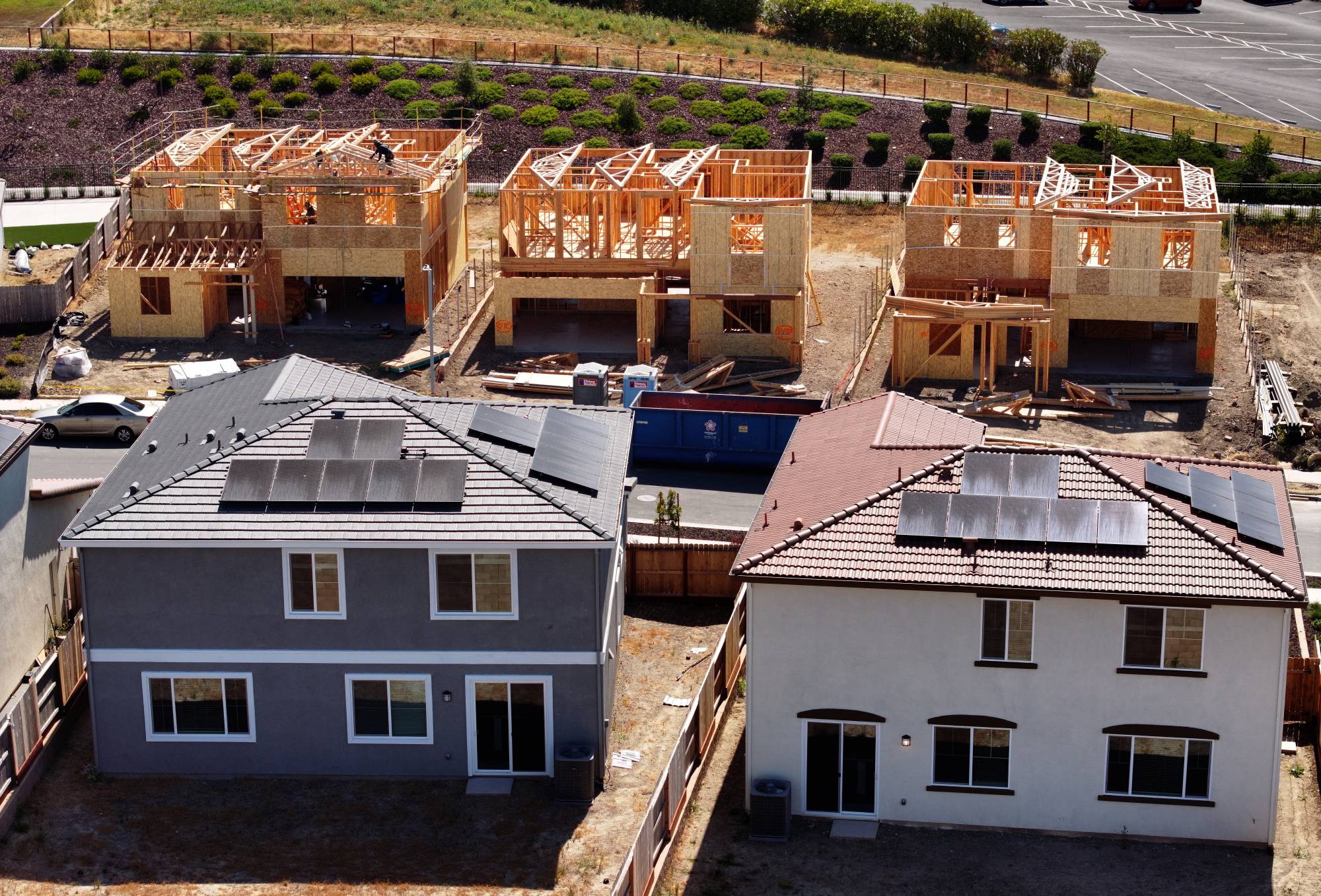
Airdate: Wednesday, October 7, 2026 at 10 AM
The California Environmental Quality Act (CEQA), which requires most proposed public and private development projects to go through a thorough environmental impact review process, has long been blamed for slowing or stopping the development of new construction in the state. This November, Californians will vote on Proposition 45, which attempts to streamline CEQA review for certain “essential” projects. We’ll look at how changes could impact housing, data centers and more.
Guests:
- Ethan Elkind, director of the Climate Program at the Center for Law, Energy and the Environment, UC Berkeley School of Law; podcast host, Climate Break
- Jason Elliott, president, Versus Solutions; former deputy chief of staff to Governor Gavin Newsom, helped craft Prop 45
- Jordan Grimes, legislative director, Greenbelt Alliance
Episode Transcript
This is a computer-generated transcript. While our team has reviewed it, there may be errors.
Laura Klivans: Welcome to Forum. I’m Laura Klivans in for Mina Kim. When then-Governor Ronald Reagan signed the California Environmental Quality Act in 1970, it was meant to keep bulldozers from tearing up sensitive ecosystems. Fifty-six years later, CEQA is one of the most fiercely debated laws in the state. Its champions say it gives marginalized communities a means to stop harmful development. Critics say it’s been weaponized to block housing and drive up costs.
For decades, politicians wouldn’t go near CEQA reform, but as California’s housing crisis has deepened and clean energy projects must roll out at a faster pace, the calculation has shifted. Legislation passed last year made huge changes to the law, and this year, potentially more could come in the form of Proposition 45.
We’re going to hear from the people who’ve brought this initiative and those who oppose it, and we’ll talk about how unexpected players — data centers — have entered the conversation. But first, we’re joined by Ethan Elkind, Director of the Climate Program at UC Berkeley Center for Law, Energy, and the Environment. Welcome, Ethan.
Ethan Elkind: Thank you, Laura. Good to be with you.
Laura Klivans: Well, thanks for joining us, Ethan. I’ve spoken to you a lot. I’m a climate reporter here at KQED. Today we are talking about CEQA, which is, of course, the California Environmental Quality Act. Tell us, what is actually in this? What does it mean?
Ethan Elkind: Yes. Well, as you mentioned, it was signed by Ronald Reagan, and it was originally just proposed to apply to major public infrastructure projects. And the point of the law was to require decision-makers, in advance of deciding on a big project, to figure out what are the likely environmental impacts of that project. And if there are significant negative environmental impacts, then decision-makers would have to mitigate those impacts if it’s feasible to do so.
Now, if it is not feasible, the project is just going to have a lot of impacts and there’s nothing you can really do, then the project could proceed. But basically, it was a way to inform decision-makers and inform the public about the project’s scope of impacts, and also potential alternatives to the project.
Now, the courts have dramatically expanded it. And there was a big decision in 1972 that basically said now all projects that require some sort of public approval, which is basically all projects, now have to go through the CEQA process. So it has been greatly expanded by the courts based on what Ronald Reagan thought he was signing — I’m assuming what he thought he was signing in 1970.
Laura Klivans: So it started out as something that’s like, this is about, you know, dams. And then now it’s like, this is about your neighbor’s house.
Ethan Elkind: Yes, although many projects are exempt or face very streamlined review. Now, the biggest projects have to undergo what’s called an environmental impact report. And these can be like multiple phone-book-sized documents that look at all types of impacts. But that’s really just a very small percentage of projects.
And then once those environmental impact reports come out, and really almost all steps in the process of CEQA, there’s opportunities for the public to sue if they feel like decision-makers have done an inadequate job in analyzing those impacts. And that’s really where a lot of the controversy around CEQA has come into play, that it provides members of the public with opportunities to have pretty extreme leverage in some cases over particularly large projects.
Laura Klivans: And so talk me through that. CEQA has been criticized for stunting development. So take us through the process of what a developer actually must do to comply with it.
Ethan Elkind: Well, like I say, it really depends on how big the project is. Many projects are completely exempt. If a project just has a very narrow set of likely impacts, then often it’s very easy to just come up with some simple mitigation measures, and then the developer can move forward.
But for big projects that have a lot of impacts — think of, like, a big industrial project, maybe a large subdivision out on green space, farmland, maybe transmission lines, logging projects, et cetera. Those kinds of projects have multiple types of impacts. They’ll impact the air quality, they’ll impact endangered species habitat, they will impact noise, visual aesthetics, archaeological resources, historical resources. All of these types of impacts have to be analyzed for these large projects and mitigated where feasible.
And at that point, the public, if there’s maybe an economic competitor, if they’re neighbors, uh… There’s environmental groups — they have the ability to sue if those impacts are not analyzed properly and the mitigation measures aren’t adequate, uh… And so that’s really where the leverage comes into play, and it’s often at the very end of the process when a developer’s already sort of lined up a lot of their financing, figured out where legally they’re allowed to proceed under the land-use laws.
And so for developers, for industry, they hate this law because it injects a huge amount of uncertainty really right at the end of the process. And by delaying projects, that costs money. I mean, time is money for developers. And while the law is not meant to stop any projects, it can effectively do so if there’s litigation that draws out the timelines by many years.
Laura Klivans: Okay. And then, so how long does CEQA review actually take in some of those instances? On average, maybe, and then in the worst-case scenarios.
Ethan Elkind: Yeah, I haven’t really looked at the data on this. I mean, anecdotally, what you hear is that if it does go to an environmental impact report and is litigated, it can take a couple of years sometimes. I mean, in some cases, there have been some high-profile cases that have lasted decades. Those are very controversial, very large projects. And usually, there’s other factors involved. But I would guess that’s probably a year or two to resolve.
Laura Klivans: And then CEQA — you know, we see CEQA come up again for folks who are just tuning in, the California Environmental Quality Act. So Ethan Elkind, people are often critical of CEQA saying, like, look at what happened at Berkeley with student housing. Can you sort of spell out what was that example for us, and what is — how common is that kind of thing to happen?
Ethan Elkind: Well, this is the issue that there are these high-profile lawsuits that just look kind of ridiculous on their face, and then people throw up their hands and say CEQA is being abused and it really should go away.
So in this particular case, you had student housing proposed at People’s Park in Berkeley, and the courts ruled that essentially students were an environmental impact. I mean, I’m sort of saying this a little superficially here, but the result of it was to hold up a really badly needed student housing project that the university wanted to move forward on.
And the legislature immediately stepped in in response to the negative publicity, and they amended the law in an emergency statute so that it would go into effect right away instead of in the next year to overrule what the court had decided.
But in reality, there are less than 200 lawsuits a year. This has been very well tracked by multiple sources. So litigation is actually quite infrequent. But when it does happen, it makes a lot of headlines. And so you get a sort of anecdotally driven debate on CEQA. We’re not really looking at the actual numbers, which are quite rare.
Although I will say that the threat of lawsuits is very — has a really chilling effect. It’s a big deterrent for a lot of developers. A lot of developers I spoke to, if they think there’s any risk of a CEQA lawsuit for a project, they won’t move forward. They’ll choose a different area or they’ll design the project differently. So even though litigation is rare, I do acknowledge that it has a chilling effect on a lot of developers.
Laura Klivans: Okay.
So now let’s talk about Prop 45. Californians are going to see that on our ballots this year. If you’ve already received yours in the mail, it’s right there. What is Prop 45 proposing?
Ethan Elkind: Well, Prop 45 would dramatically scale back the scope and timeline of environmental review for what its backers have called essential projects. And these are high-impact, often very polluting types of projects.
So housing, which would mean all types of subdivisions, large-scale subdivisions over open space that generate a lot of traffic and can eat up a lot of endangered species habitat. Renewable energy projects. All types of transportation projects, with the exception of high-speed rail, so freeways, freeway widening. Uh… Dams and irrigation projects, logging projects. Broadband infrastructure projects, which some have interpreted to potentially cover data centers as well.
So it’s a wide swath of projects. These are backed by some of the big industry groups in the state. This proposition is backed by some big industry groups in the state. And it would essentially allow the developer to define the scope of the impact. So it would be a greatly narrowed set of impacts.
There would be a dramatically reduced shot clock on deeming the CEQA review complete, so just 90 days, with some exceptions. And it will be really hard for the public to be able to challenge any of these CEQA decisions. It raises the bar for any sort of judicial attacks on what decision-makers have done on CEQA. It’s hard and will make it hard for the legislature to amend this proposition. It would require a two-thirds majority of the legislature to amend itself.
Basically, for some of the biggest projects in the state, it would dramatically scale back the type of review, the shot clock, and the ability of the public to challenge any decision-making under CEQA.
Laura Klivans: Okay, and then I want to talk about data centers because that has really come into this conversation in the last few months, and we are already getting lots of comments on that. So, okay, talk about why people are concerned that data centers might be part of this proposition.
Ethan Elkind: Well, the issue is that they’re not explicitly excluded. This project — this proposition — does explicitly exclude high-speed rail, as I mentioned. It also excludes a Delta conveyance tunnel, but it did not exclude data centers, and the way that they’ve written what an essential project is for broadband infrastructure could arguably include data centers.
I don’t think it’s an open-and-shut case, but I think you’re gonna see developers of all types of projects try to argue that their projects are essential. And we don’t know how courts would decide on this. They’re supposed to be giving a lot of deference to industry under this proposition. And so I don’t think we have any assurance that data centers wouldn’t qualify for the benefits that Prop 45 would offer.
Laura Klivans: Interesting, because a lot of this debate about data centers is looking into the future and saying, well, maybe a lawsuit could happen. And from your position, Ethan Elkind, at UC Berkeley as a lawyer, it potentially could.
Ethan Elkind: Absolutely. That’s the whole issue with this. It’s going to create a lot of judicial uncertainty because there’s a lot of vagueness in how essential projects are defined. You’re going to want to see every single project developer argue that their project is essential.
Because of the way this proposition is written, we don’t know how courts are going to come out on this. So it does inject a lot of uncertainty. Like I said, they knew they could have excluded data centers. When they wrote this proposition, data centers were unpopular at the time. There’s a reason they excluded high-speed rail and Delta conveyance and some other things. They chose not to exclude data centers. So that, I think, is very telling on its face.
Laura Klivans: All right, well, briefly, when CEQA is at its best, what does it do?
Ethan Elkind: Well, I think it allows the public to have some information about what a project is going to do to the environment, to their community. It gives the public an opportunity to weigh in, and it gives decision-makers an opportunity to understand what they’re approving.
And more importantly than all of this is that when there are impacts, they’re required to be mitigated, again, when feasible. And so it not only gives the public and decision-makers information, it makes sure that we try to lessen the environmental impacts of big projects.
Laura Klivans: Thank you.
All right, this is Forum. I’m Laura Klivans in for Mina Kim. We are talking about Proposition 45, a ballot measure proposing changes to California’s landmark environmental protection law, known as CEQA. And we are joined by Ethan Elkind, Director of the Climate Program at UC Berkeley Center for Law, Energy, and the Environment.
And we want to hear from you. What are your questions about Prop 45 and the California Environmental Quality Act? Give us a call. Or email your comments and questions to [email protected]. Find us on Discord, Bluesky, Facebook, and Instagram. All those places, we’re at KQED Forum. Or give us a call now at 866-733-6786.
This is Forum. I’m Laura Klivans in for Mina Kim. We’re talking about Proposition 45, a ballot measure proposing changes to California’s landmark environmental protection law, which is called CEQA. That just rolls off the tongue.
And we’re joined by Ethan Elkind. He’s the director of the Climate Program at UC Berkeley Center for Law, Energy, and the Environment. And we are now welcoming in two additional people.
We have Jason Elliott. He is the president of policy consulting firm Versus Solutions. He helped craft Prop 45. And we also have Jordan Grimes. He’s the legislative director with the environmental nonprofit Greenbelt Alliance. He’s part of the Know on Prop 45 campaign.
So you have heard Ethan. He shared his interpretations of CEQA and Prop 45. Jason, I saw that you were shaking your head a bit on some of that stuff. Give us what that shaking of a head was about.
Jason Elliott: First of all, thanks for hosting this Forum today. I think that everyone wants to talk for an hour about the intricacies of environmental review law.
Laura Klivans: So stick with us, folks. That and Taylor Swift.
Jason Elliott: I can get Taylor Swift in here somehow.
So I appreciate the professor’s blessings upon Ethan for explaining CEQA, which is one of the most complicated laws in California. I do take a little bit of exception to some of the characterization of Prop 45, because I’ve heard some of those talking points, and they’re the talking points of our opponents.
But let’s talk about what is happening here. Look, California has decided what it wants. It wants cleaner air. It wants clean water. It wants affordable and clean energy. It wants housing you can afford.
Frankly, over the years, voters have voted on and the legislature has passed a number of bills to move us towards those goals. We funded it, we’ve passed bonds, we’ve done spending programs, but what we haven’t done is we haven’t built those things. We haven’t provided housing you could afford. We haven’t provided abundant clean energy at the level we need.
Prop 45 is on the ballot because a state that can’t build what it promises isn’t protecting the environment. It’s not creating cleaner water. It’s protecting the status quo. And that’s really what Prop 45 was about. It’s about shaking up that status quo.
We have the toughest environmental rules in America, in California. I worked in government for 18 years. I helped craft a number of those environmental rules. I’m very proud of those.
Proposition 45 leaves every single environmental protection that’s in law today — leaves it intact. That’s true for laws that protect against paving over prime agricultural land. It’s true about laws that protect against paving over wetlands. It’s true about laws that protect against clear-cutting in our forests. All of those laws continue to exist untouched by Proposition 45.
What Proposition 45 does do is it ends the acceptance of endless delay as the status quo. As I said, I’ve worked in California politics and state and local government for 17, 18 years before I left and founded my firm. No one ever once said to me, California builds things way too fast. That’s never been the problem, right?
Our inability to execute against our own environmental and housing goals erodes our credibility to lead on environmentalism and inclusion. Prop 45 speeds up schools. It speeds up electricity projects and water without sacrificing any environmental review.
I just want to make one sort of clarification. This is less an argument about Prop 45 and more just a thing that I think would maybe be helpful for the listeners.
CEQA, as Ethan described it, he described what CEQA is, I think, very well. CEQA is environmental review. What CEQA is not is land-use decision-making or environmental regulation setting.
So in California, the state government and local governments decide where they wanna put housing, and then they zone for it. They decide how much new electricity infrastructure and where they want schools, and they zone for those things. The state has planning processes around providing clean water to people. They decide how to deploy money.
All of those processes, all of the land-use processes and the law-setting processes, are different than CEQA. Those happen through public process with public comment, publicly noticed meetings, and so forth, and years of council hearings. That’s a totally different thing than CEQA.
CEQA is the environmental review that occurs after a community has decided, we think this is where housing should go. We wanna get water infrastructure, we wanna get a new hospital built here.
Once the community has decided we’re gonna zone this parcel of land over here for a hospital, developers do their thing or public agencies do their thing and bring a project forward. And then CEQA is the safety review at the end of that planning process.
So I think it’s really important for people to understand that Proposition 45 doesn’t touch, or purport to touch in any way, the land-use planning powers that state and local governments have. They — every data center was mentioned in the intro. Proposition 45 does not cover data centers, period. We can have a longer conversation about that.
Laura Klivans: Yeah, we’ll talk about that in a little bit.
Jason Elliott: But just to make the point, and I won’t fight that fight right now because I’m sure it’ll come up. If a community doesn’t want a data center in their city, just don’t zone for one, just don’t approve one. And then CEQA is irrelevant because the underlying land use won’t allow for that data center.
And I think that’s a key point to make, is that we’re gonna keep differentiating because opponents of this measure obscure that line to try to be hyperbolic. I think it’s important to pull those things apart.
Land-use authority, what goes in your community, remains the power of your mayor, your city council, your board of supervisors. Prop 45 doesn’t impact that.
Laura Klivans: We’re hearing from Jason Elliott. He’s the president of policy consulting firm Versus Solutions. We also have Jordan Grimes here, the legislative director with environmental nonprofit Greenbelt Alliance.
Jordan, what we’ve just heard is largely an argument around streamlining CEQA. It is not about the decision around land use, as Jason’s telling us. What about Prop 45 concerns you? You’re part of the Know on Prop 45 campaign.
Jordan Grimes: Yes, thank you so much for having me back. Great to be here.
You know, there are many, I would say, problematic aspects with the measure. It’s hard to know where to start with, I think, the things that are most concerning.
You know, to step back, as we are discussing both with Jason and with Ethan, the Environmental Quality Act is fundamentally this law that provides protection to communities. It’s not about delay, although certainly that has been a tactic that bad actors have used. But fundamentally, it is about review. It is about looking at and analyzing whether or not there’s potential for environmental harm and then requiring mitigation of that harm.
And so it is the first line of defense for many communities. And ultimately, what Prop 45 does is strip away many of the protections inherent in that law.
The timelines, I think, are some of the most reasonable pieces of the initiative, although, again, it doesn’t differentiate between size of projects. It doesn’t differentiate, I think, between geography, where a project is, if it’s in a greenfield, if you’re paving over open space, or if you are in a city, for example. So I think that is inherently problematic in the initiative.
Laura Klivans: Will Jordan tell us what those timelines are?
Jordan Grimes: Yeah, the explicit timelines in the initiative are, generally speaking, 365 days for a full environmental impact report. Okay. You know, there are other timelines dependent on the type of environmental review, some jargony acronyms that we won’t get into too much, as we sort of discussed.
Jason Elliott: Basically —
Laura Klivans: Jargon for this.
It’s basically putting a time limit on the environmental review and then also curtailing lawsuits around it, right? But it’s not just letting them go on for an indefinite period of time.
Jordan Grimes: Exactly. And we’ve talked about that, but it’s actually quite a bit more than that.
Laura Klivans: What are the other concerns you have with it?
Jordan Grimes: Quite a few. I think the most concerning one for me is a new private right of action for developers to be able to sue municipalities if they deny a project or if they require sort of different mitigations that the developer views as unlawful.
That’s something that is a huge change to CEQA, that is to the Environmental Quality Act, that isn’t there right now. There’s also a provision that basically says if there is a conflict between other environmental laws, that the initiative provisions prevail.
There are provisions that severely limit what a court can consider and that severely limits what a court can consider even after — even if environmental harm has been found. The court is very limited in its remedies under the initiative.
So there are, I think, a litany of different things with this measure that go far beyond the timelines, many of which I think would be reasonable for certain projects. If we are talking about an apartment building in San Francisco, for example, the timelines that the initiative have in place might even be too long. It might not even make sense to do a year for an apartment project in Hayes Valley.
Laura Klivans: Okay.
Jordan Grimes: Um, but if you’re talking about, uh, a new, you know, exurban development in the wildland-urban interface in a high-fire area, um, one of your, uh, I would say probably wouldn’t be enough.
Laura Klivans: I want to go to a caller now. We have Jim in Richmond. Jim, welcome to Forum. Thanks for calling in.
Jim: Yeah, thank you, and thank you for holding the show. As somebody who has read CEQA documents here in the Bay Area on really, frankly, bad projects, I want to tell you that as a citizen, we will — and even the city will — approach a developer to try to cause less damage to habitat or traffic, and without CEQA, or without the ability to challenge it, this really feels like one of those TV shows where you’re running across a lake and you’re competing against people, you know, jumping across these rubber balls or whatever.
It’s so many obstacles. It just seems impossible at this point. It really feels undemocratic. And I’d like you to address the cost of this as reported in the state pamphlet. Thank you.
Laura Klivans: Thank you. Jason, can you address this? Does it take away someone’s ability to challenge?
Jason Elliott: And thanks for the call, Jim. I appreciate your advocacy.
No, it doesn’t take away someone’s ability to challenge it. Let me draw an analogy. I mean, I could go through the provision measure by measure, but this show isn’t long enough. So let me draw an analogy.
If you think about CEQA and the environmental impact report, so CEQA requires big projects to do the environmental impact report, which is what Ethan had laid out at the top of the hour. Think about the environmental impact report like the SAT test that we probably all endured when we were high schoolers.
The question — Prop 45 doesn’t make the questions on the SAT easier. It doesn’t allow you to skip the SAT and go straight to college. Proposition 45 doesn’t limit any of those things.
What Proposition 45 does is say, once you’ve done the SAT, the grader — the state, the city — has a timeline in which they have to grade the SAT and give you your score back, so you can go ahead and apply to college in a timely fashion.
It’s a timeline, right? It also says that while the grader’s grading your SAT test, the grader can’t say, well, you know, we don’t think that that’s how calculus works anymore. We’re gonna just, like, change one of the rules about log functions. And so you kind of have — you have to start over on the SAT.
That’s how CEQA works today. The way CEQA works is you can finish your environmental impact report with mitigations to make sure that you’re having that conversation with community and local government, get rid of the worst parts of a project that are the most harmful to communities, right?
All of that stays intact. All of the mitigation processes, all of that public feedback all stays intact. But once you’re done with that EIR, with that SAT test, it gets graded in a timely fashion, so you can build your project.
In our case, we estimate that it will cut the time for projects with EIRs in half, from about 3.1 years to about one and a half years. So it’s half the time, but all the protections.
And I think that’s the key point: it doesn’t strip away any protections. It doesn’t eliminate CEQA. So what I heard in Jim’s question was, Prop 45 would eliminate the public’s ability to raise these concerns. It won’t eliminate it. That’s a misconception, so I want to address that.
But it does say that let’s get this stuff done in a timely fashion, so that we can get good projects approved.
And last point I’ll make on this, Proposition 45 leaves intact every local government’s ability to reject an EIR and reject the project. There are no automatic approvals anywhere in Proposition 45. So if a developer brings forward a truly bad environmental project, the city council could just go ahead and reject it and reject the EIR and/or reject the underlying project.
Laura Klivans: Jordan, how does this sound for you when we’re thinking about what Jim is saying, the ability to challenge a project? Do you feel like it would be harder when Prop 45, if it passes?
Jordan Grimes: Absolutely. A hundred percent. You’re significantly limiting in terms of what the public is allowed to comment on, right? There are provisions that severely limit public comment. You are limiting the timelines in which the public comments are made.
Laura Klivans: Do it for —
Jason Elliott: It’s a time limitation. It’s not a qualitative limitation, so let’s make sure we’re accurate about what the measure does.
Laura Klivans: Right, but it does put a date —
Jason Elliott: Like the amount of days, okay?
Laura Klivans: Yes, it’s a time limit, not a subjective limit.
Jordan Grimes: You are limited in terms of vesting. If environmental conditions change on the ground, you are locked into a certain vesting schedule. So basically, things would go — everything would shift.
So, for example, right now, if an EIR was being conducted and conditions changed —
Laura Klivans: That’s the environmental impact report.
Jordan Grimes: Yes. Sorry about the jargon. If an environmental impact report was being conducted and conditions on the ground shifted in terms of habitat, in terms of various other things, right now, as the process works, those things can be considered.
The way the initiative would change the Environmental Quality Act would mean that you could not consider those. The conditions on the ground at the time of the project application would be locked in.
Laura Klivans: Like, read the very start.
Jordan Grimes: Exactly. And then the last thing I’ll just say is, yes, a city council or local jurisdiction could deny a project, with the potential that a developer could sue. And so there’s this chilling effect now under this new private right of action, right, where a municipality would have to weigh, do we want to deny this project? Do we want to risk getting sued by a project developer?
And again, we’re not just talking about projects that are potentially environmentally beneficial, right? You know, new housing in places we want to see it, bike lanes, public transit. We’re talking about some really potentially harmful projects.
Jason Elliott: Schools, clinics, hospitals, parks.
Jordan Grimes: Clean energy, clean water facilities.
Laura Klivans: Sure, that’s the side that’s a —
But I’ve also seen the no side saying, well, what about freeway expansion? We’re talking, like, we’re talking —
Jordan Grimes: Is that also included? Freeway expansions are absolutely included. We’re talking about CO2 pipelines. We are talking about exurban developments in high-fire areas. There’s a lot of different things that this project allows. Some of them are good. Some of them, I think, deserve that streamlining.
What we are looking at is, on net, is this better than the status quo? And our calculation is absolutely not.
Laura Klivans: Okay, okay. We’re gonna go to — we’re going to go to a caller, and then there’s lots of time to talk about these different things.
Okay. Lisa, we are going to go to you in San Francisco. Lisa, thank you for calling.
Lisa: Good morning. My head is spinning.
Laura Klivans: You’re not the only one.
Lisa: Yeah. This is a great debate, but I think for me, in this horrific time where, you know, these astroturf super PACs pop up named, you know, Neighborhoods for San Francisco or whatever. And it’s the real estate lobby or the apartment owners association or what have you, or developers, market-rate developers.
What I want to know from both of your guests, the proponent and the opponent, I would like to know who the major sponsors pro and their money, and I would like to know who are the sponsors against? Because we know that organizations like the San Francisco — the Sierra Club has been captured by real estate forces. I mean, everything is through the looking glass now.
So who are the funders of this initiative?
Laura Klivans: That’s a great question. Streamline, I’m triggered. Yes, there’s millions of dollars behind this initiative.
So actually, I know you were asking to go to Jason and Jordan. I’m gonna actually see if Ethan, if you could answer this one. Ethan Elkind with UC Berkeley, where’s the money coming from from both sides?
Ethan Elkind: Yeah, I don’t have encyclopedic knowledge, but I have looked at the backers. I mean, you have the Building Industry Association as a major backer of this. They’re the big sprawl developers in the state. You have the Chamber of Commerce supporting this initiative.
You basically have a lot of industry groups that are supporting this. On the con side, you’ve got environmental groups, and then you’ve got labor unions that often use CEQA as leverage to try to get project labor agreements, uh… for their union members, uh… And then, you know, it’s a grab bag of other folks, but I’m sure Jordan and Jason could speak in more detail. But that’s the general gist on the yes and the no side.
Laura Klivans: We’re going to come back to that because we’re about to take a break. This is Forum. I’m Laura Klivans in for Mina Kim. We’re talking about Proposition 45, a ballot measure proposing changes to California’s landmark environmental protection law.
And we’re joined by Ethan Elkind of UC Berkeley, Jason Elliott, president of the policy consulting firm Versus Solutions, and Jordan Grimes, legislative director with environmental nonprofit Greenbelt Alliance.
And we want to hear from you. How are you planning to vote on Prop 45 and why? Email your comments and questions to [email protected]. Find us on Discord, Bluesky, Facebook, and Instagram. We’re at KQED Forum, or give us a call now at 866-733-6786.
Welcome back to Forum. I’m Laura Klivans in for Mina Kim. We are talking about Proposition 45. It’s a ballot measure that is proposing changes to California’s landmark environmental protection law called CEQA.
We are joined by Ethan Elkind, the Director of the Climate Program at UC Berkeley Center for Law, Energy and the Environment; Jason Elliott, President of the policy consulting firm Versus Solutions; and Jordan Grimes, Legislative Director with environmental nonprofit Greenbelt Alliance.
I want to go to a question that comes from listener Jeff. Jeff writes, “To what extent do the guests believe the passage of Prop 45 will meaningfully change the speed of development, and in what sectors? Is that clean energy, roads, housing?”
Jason, let’s go to you.
Jason Elliott: Sure. Well, we do believe that it will speed up development, and that’s the purpose for crafting this measure. And speeding up development, let me say why that’s important.
Speed on its own is not necessarily a good thing. But when you have housing and clean energy and clean water projects, hospital projects, school projects that are delivered faster, that creates cost savings for local governments.
Of the non-housing projects that this measure covers, 76% of them that we expect would be covered by EIRs are projects that are brought forward by your local government, by your city, by your county. So they’re looking to fix a bridge, they’re looking to improve a public restroom facility, they’re looking to build a new school campus, high school campus, whatever it might be.
These — the overwhelming majority of projects we believe, not housing, we can talk about housing, is a little different because governments don’t build housing. But of the non-housing projects, the overwhelming majority are public projects.
The longer that those delay, the more the cost goes up. And it’s not some greedy developer hiding in a back room that bears that cost. It’s you, the taxpayer. So this really is around taxpayer protection.
In terms of housing, because the housing part of this measure and the non-housing part of the measure are similar, but they operate, they function in different ways in terms of speeding things up.
In terms of housing, the average — we estimate that the average delay from CEQA alone increases the cost when an EIR has to be performed, increases the cost by $75,000 per new home that’s built by the private sector. So reducing time does reduce cost, which makes houses more affordable.
So this really is all around reducing the cost of living by reducing how expensive it is to build stuff.
Laura Klivans: California. And this is one of the reasons why it seems like the Cal Chamber wanted to bring this.
Jason Elliott: That’s right.
Laura Klivans: And so, can you actually give us a number, a year number, like right now it takes an average of this many years to build housing and after this it would, we believe —
Jason Elliott: Well, I’ll give you a number that I can stand behind, which is how long CEQA delays projects, because how long it takes to build housing can depend on so many factors.
But in terms of housing, housing projects that have to perform this environmental impact report that we’ve been discussing take on average 3.1 years. Non-housing projects that also have to perform an EIR take on an average of 3.0 years, so about three years.
We anticipate that our measure would, because of the timelines that Jordan mentioned, conclude in 17 months. So you’re talking about roughly half the time. You’re cutting that roughly in half without diminishing any of the underlying environmental protections.
And I think that’s just a key point that keeps getting lost here. The underlying legal environmental protections all remain in place under Proposition 45.
Laura Klivans: Okay.
Jordan Grimes from the environmental nonprofit Greenbelt Alliance. What is your take on how much this, if we pass Prop 45, would speed up development? And then I wanna ask you about cost as well.
Jordan Grimes: Yeah, absolutely. I think the concern, the biggest concern to us, is that it will tremendously speed up projects that are going to harm the environment.
I actually don’t think it will do very much at all for projects that are environmentally beneficial, for the projects that I think people care most about. The California legislature last year granted a clean, complete statutory exemption to infill housing projects. It was a watershed moment for the state in acknowledging that environmental review can be used. For infill, the legislature remedied it.
So if you want to build an apartment in Beverly Hills or Palo Alto, you no longer have to go through that environmental review, which will be a huge boon to solving our housing crisis.
Likewise, the legislature has provided statutory exemptions for bike lanes, for bus projects, for public transit, for clean energy. And so, realistically, I think the types of projects that Californians are really demanding — the clean energy, the housing projects that we need — we have already exempted those things.
And so I do think it will speed up projects, but they’re the projects that we don’t want to see. It’s new subdivisions in high wildfire areas. It’s the CO2 pipelines. It’s potentially data centers, right?
Laura Klivans: Let’s talk about that, just that housing piece. So what you are saying is that because last year California passed what was called AB 130, it is now — housing developments are exempt in urban areas, right? From CEQA, from all this stuff.
And so I have seen the no side say, listen, why do we need this if we’ve already gotten that? It’s still rolling out. And that you believe that housing, it would be easier to build housing in wildfire-prone areas. Like a place like Paradise that is, you know, in this gorgeous wooded area, but also very fire-prone, right?
So Jordan, if you could — or excuse me, Jason, can you tell me what is your take on that? Is it gonna be easier to build housing in these places where we don’t necessarily wanna promote it?
Jason Elliott: Yeah, great. And thanks, Jordan, for mentioning Assembly Bill 130. I worked for years when I was inside state government to bring that policy forward, to do the politics and the policy, and thank God for Buffy Wicks and Scott Wiener. Amen. Yeah. And they brought that forward.
So that’s a huge win. Really proud of the work on that and Governor Newsom for pushing it through the budget. But he pushed it through the budget. The legislature did that. They found their courage, and thank God for Scott Wiener and Buffy Wicks.
But, you know, the courage of a couple of legislators is not a statewide housing policy. And in this state, we are millions of units short. I ran housing policy for the state for a number of years. We’re millions of years short, right? Yeah, we’re millions of units short.
And when you have this much of a housing deficit in California, you have to build up, but you also have to build out, right?
And I think it’s really important that we just acknowledge that reality, the uncomfortable reality that some of our environmental opponents — about 100 organizations who opposed AB 130 — we met in the hall, and I know that’s not you, but 100-plus environmental organizations that opposed Assembly Bill 130 last year, that streamlining we were just talking about, they called it, quote, “the worst anti-environmental law in recent history.”
That exact same coalition is now opposing Proposition 45. And I’m not trying to put this on you, Jordan, we just met. You seem like you’re a pro-housing guy, and I appreciate your leadership on that. But let’s talk about who’s behind the opposition to this measure.
It is the same anti-housing environmental groups that for decades, decades, have been blocking the kinds of housing we need.
Because here’s the thing about Proposition 45. I think it’s another important point to make. Jordan keeps mentioning, and some of the opponents of the measure talk about, well, it’s not just housing. It’s all these other things.
All those other things are what make housing complete neighborhoods. A housing unit is just a housing unit until you attach it to water, until you build a school nearby, so forth.
And, you know, I see housing — just last point I wanna make on this — you know I’ve been working on these issues for years and years, and the way that I see housing development, it’s like a complicated safe in, like, one of those safe-cracking movies where you gotta get every little pin lined up.
And if you don’t have the water and the electricity, you know, one of the big problems we have in this state is interconnection. A new building gets built, but you can’t get power to it, so it just stays empty.
You gotta get all these pins, and if one of these pins is just a hair off, you can’t unlock that new neighborhood, you can’t move families in.
So Proposition 45 absolutely does streamline a number of those other things that are necessary. People drive on highways, right? People need to turn on the lights and have clean energy, power their microwaves and so forth.
So yes, Proposition 45 is about building those complete neighborhoods because a housing unit is just a paper promise until we connect it to all that infrastructure. Then it becomes a home.
Laura Klivans: I want to bring in Ethan Elkind. He’s from UC Berkeley, a legal expert.
Ethan, from your legal standpoint, you have seen that AB 130 passed last year. It’s begun to be implemented. How much Prop 45 changes housing development compared to the reforms of the past?
Ethan Elkind: Well, I think, as Jordan said, infill housing — the kinds of environmentally beneficial housing that we want to see — basically got a free pass under CEQA.
And the reality is — and Jason basically described this — there are so many barriers to all sorts of projects in the state that go well beyond where environmental review comes into the process, that, you know, by blaming CEQA for all the delays that we have, we’re taking our eye off the ball of all these other problems.
I mean, Jason described how CEQA does not [involve] local land-use decision-making, but that’s exactly why we’re not really getting at the heart of the problem as to why there are so many delays for projects in the state. We have a lot of different local governments, special districts, utilities, all of which could create a lot of delays for projects that CEQA does not touch.
And so your question around how housing is affected, because we’ve already carved out an exemption that really just went into effect for all infill housing projects: the beneficiaries of Prop 45, by narrowing the scope of environmental review, by narrowing the alternatives, by dramatically shortening the shot clock for any sort of challenges, by raising the bar to judicial challenges, the only beneficiaries of that are going to be these sort of large subdivision projects, because all other types of housing in the state is now essentially exempted.
So those are the beneficiaries. It’s going to be a lot harder for the public to be able to hold to account decision-makers who are approving these large subdivisions. We’re going to lose the ability to require mitigation and analyze those impacts really adequately in advance.
Jason Elliott: That’s not true that we lose the ability. I’m sorry, but that’s a mischaracterization of the measure.
Ethan Elkind: Well, but by dramatically reducing the scope of the impacts, by reducing the alternatives, and by putting a really dramatically increased shot clock, you’re limiting the ability of the public to understand what the impacts are and to challenge them because they’re not going to have the time and the information to be able to do so.
And if they do want to challenge them in court, the bar to challenging them in the court has now been raised dramatically by Prop 45.
Laura Klivans: I’m going to interrupt this one because we’re going to go to a caller. I want to remind us all this is Forum. I’m Laura Klivans, I’m in for Mina Kim.
We are talking about Proposition 45, which you can tell is contentious. It’s a ballot measure proposing changes to California’s landmark environmental protection law. We are joined with Ethan Elkind, Jason Elliott, Jordan Grimes, and we want to hear from you.
Are there — were you in California when CEQA got started in the ’60s and ’70s? What do you make of the way it’s evolved over the decades? Email us your comments and questions to [email protected]. You can find us on all the online things. You can call us at 1-866-733-6786.
I wanna go now to a caller, Douglas in San Leandro. Thank you so much for joining us, Douglas. What’s your question?
Douglas: Uh… Good morning. It may be, uh… more of a comment. I’d like to bring data centers back to the conversation, with the data centers, which are huge energy and water demand for exactly the kind of thing that CEQA was intended to address.
Uh… And yet, uh… you know, what’s happening at 70% or more the public has indicated they’re really not in favor, is that the independent developers are rushing, rushing, rushing to get stuff done.
And, you know, the idea that, well, we can just go to the city council and get them to defeat it, or we can look at our zoning codes and say, well, it’s not zoned for data centers — it’s not true.
What just happened in the city of Hayward next door to me is, right, the Planning Commission approved a humongous data center, more than 300,000 square feet. It never went to the City Council. The people of Hayward never knew about it. It was approved as office space, and we’re faced with the same thing here in San Leandro, where our Planning Commission just approved a conditional use permit for a similarly sized place, and it looks like it’s primed to be a data center.
Nowhere are there any codes about data centers. It would be good if there were because then it would flag us for it.
So the problem about shortening the timeline is we don’t know what’s going on. And it’s these data center developers are, you know, they’re having our official sign non-disclosure agreements, so what the heck is happening in closed session? We don’t know.
So the time is actually really quite an important protection for us, the public.
Laura Klivans: And given what Ethan Elkind said earlier in the hour is that he believes from his legal perspective that data centers could be included in this proposition, Prop 45.
Jordan Grimes from the Greenbelt Alliance, why do you consider data centers as potentially part of this legislation?
Jordan Grimes: Yeah, well, I’ll say it’s not just me. It’s attorneys and legal scholars from UC Berkeley, from UC Davis. But essentially, the way the provision is drafted, right? “Essential broadband internet access project.”
Laura Klivans: Um —
Jordan Grimes: What that language means and the broad applicability of that, we absolutely believe covers data centers.
Laura Klivans: There’s also a provision — why do you think that? Because it says broadband access, right?
Jordan Grimes: I think fundamentally that could absolutely — broadband access could, given the legal definition, be applied to data centers.
Laura Klivans: Okay. There’s a co-location of a broadband center and a data center, and that would get —
Jordan Grimes: Potentially. There’s also the provision in the measure that allows for the provisions of the measure to apply to ancillary infrastructure. So if you’re locating a broadband internet access project in a facility that houses multiple tenants, there is that aspect, but there’s the aspect that you could apply this would be required to furnish those things.
Laura Klivans: That’s okay.
Uh… Merit matters. I think it is about time to hear — if you want to hear your response.
Jason Elliott: Yeah, data centers are not covered by Proposition 45, and I appreciate that the opponents of this measure, as you’ve heard, want to assert that they are.
We have a former CPUC Public Utilities Commissioner, former FCC Commissioner, a bunch of lawyers who are not affiliated with the campaign who have published opinions that they don’t think data centers are covered, so we can go lawyer for lawyer, I suppose.
But, you know, the data center coalition itself, the sort of industry arm, mouthpiece of the data center industry, has declined to support the measure because they say that data centers — this measure doesn’t help data centers. So I suppose that’s probably the greatest validation of all.
But look, this question around data centers… I’ve been doing campaigns a long time. I get why the opponents are using data centers. I have seen polling too. We have our own polling. Data centers are profoundly unpopular. It’s why we didn’t include them in the measure.
Laura Klivans: Right. The measure does have carve-outs, right? It says, okay, clean energy projects are included, but not nuclear. So why did it say, but not —
Jason Elliott: Data centers. It’s a great question. Let’s take high-speed rail, for example.
Laura Klivans: Yeah, but why does it say not data centers?
Jason Elliott: I’m going to explain why using high-speed rail. So high-speed rail was excluded or carved out, as you said, because transportation projects otherwise are included. So had we not carved out high-speed rail or the Delta Tunnel, as was mentioned earlier, that would be covered under existing central project definitions.
Data centers just don’t factor into this because despite Jordan’s best attempts, a data center is not a broadband line. They’re just different things.
And if you read the text of the measure, you will see that they are, just by plain reading, different things. Will someone somewhere try to make some argument? Sure, but the text of the measure is absolutely clear that data centers are just simply not covered, right?
The list of things that are not covered is quite literally infinite. I mean, you could just keep going and going and doing, but we excluded things that would have otherwise been covered.
And, you know, I just like — I think that there’s a key point here. Campaigns, you can basically say anything you want with a glossy mailer or like on a social media ad, right? Here’s where you can’t say anything. You can’t say anything you want in the official ballot argument that you actually have to submit to the Secretary of State.
That’s where there’s a legal bar for truthfulness and veracity, right? Because you can litigate those, right? Guess where data centers does not appear in the official ballot argument. The opponents of this measure know that it’s a specious argument, and so they didn’t put it in their official ballot arguments, and that’s kind of all you need to know.
They’re using it because it polls. Well, I would do the same thing if I were in their shoes, but let’s not use scare tactics. Let’s talk about what’s actually in the —
Jordan Grimes: I do really want to push back on the idea that these are scare tactics.
You have data center developers who are donating to this campaign. You have Prologis, who, by the way… Prologis builds solar. Prologis is building five data centers right now in San Jose.
Laura Klivans: And then the campaign finance rate, isn’t there something around $15 million that has been donated by a PAC that does have representatives from data centers?
Jordan Grimes: Absolutely.
Laura Klivans: For the pro side.
Jordan Grimes: Absolutely. And again, the Prologis — the PUC expert that was cited, you know, is a board member of Prologis, right? You have them giving half a million dollars to the campaign.
Okay, I don’t think they would be doing that, quite frankly, if they, you know, weren’t getting something pretty significant.
Jason Elliott: The no side has received $16 million in contributions from one billionaire. Okay, so, like, if we’re gonna have a discussion about funding, I’ll tell you where our money comes from and our support. The infill builders have supported our measure.
Laura Klivans: I’m so sorry, we are gonna have to leave it there. There is so much to talk about. The time goes very quickly. Let’s do another hour.
This is Forum. I’m Laura Klivans. I’m in for Mina Kim. We’ve been talking about Prop 45. We’ve been joined by Ethan Elkind, the director of the Climate Program at UC Berkeley Center for Law, Energy, and the Environment; Jason Elliott of Versus Solutions; Jordan Grimes from the Greenbelt Alliance.
Thank you so much for joining us. Have a great day.
Jason Elliott: Thanks so much.