How the UC System Transformed California
Airdate: Tuesday, October 6, 2026 at 10 AM
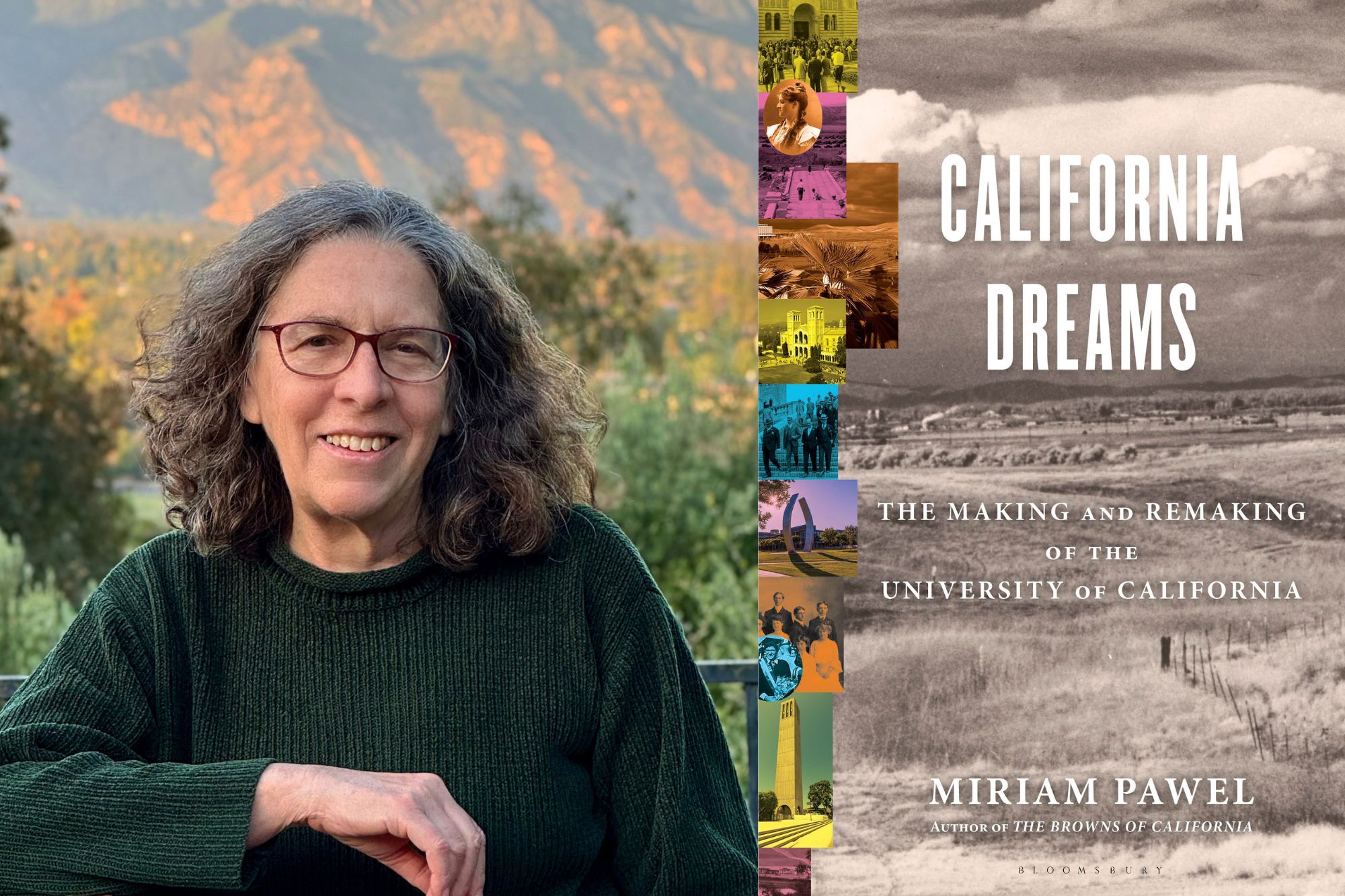
Historian Miriam Pawel says the University of California system is unique in its commitment to being “an engine of social, intellectual, and economic mobility.” But even with record-high applications this year, it’s facing profound challenges, like federal funding cuts and fierce debates over whether it should reinstate the SAT. We’ll talk with Pawel about how the history of the UC is the history of California – and how the futures of both are intertwined. Her new book is “California Dreams: The Making and Remaking of the University of California.”
Guest:
- Miriam Pawel, journalist and author, California Dreams: The Making and Remaking of the University of California and The Browns of California: The Family Dynasty That Transformed a State and Shaped a Nation
Episode Transcript
This is a computer-generated transcript. While our team has reviewed it, there may be errors.
Mina Kim: Welcome to Forum, I’m Mina Kim. Chances are you, or someone you know, went to a UC. Historian Miriam Pawel calls the University of California system an educational juggernaut. Quote, “Its research programs earn top rankings, its campuses boast record numbers of Nobel Prize laureates, its employees are the second largest workforce in a state that is itself the fourth largest economy in the world.” And Pawel writes, “It has arguably made its most important contribution in the lives of those not born into privilege.” As the UC and colleges nationwide face attacks from the federal government and broader questions about the value of a university education, Miriam Pawel’s new book shows us what’s possible when a higher ed system is founded with a commitment to access, as long as it can maintain it. It’s called California Dreams: The Making and Remaking of the University of California. And Miriam Pawel joins me now. Welcome to Forum.
Miriam Pawel: Thank you so much.
Mina Kim: I just noted the incredible reach of the UC, but actually you —
Miriam Pawel: Go to a UC. That’s correct. I’m actually a New Yorker originally, which surprises people. But it was partly because of coming from New York and moving to California in 2000 that I’ve sort of been fascinated by the whole system of public higher education in California, because no state has anything remotely comparable, not just to the UC, but the UCs, the Cal States, and the community colleges, that whole system. Is just a real commitment to publicly funded higher education, even though of course, as we all know, that commitment has wavered at different times. But that just was one of the things about California that impressed me the most when I moved here.
Mina Kim: You also write about the unique bond people seem to have here to their UC.
Miriam Pawel: Yeah, like this whole Go Bears thing, which is kind of a cult, if you know, but, but it’s true. And it’s, it’s not just here in Berkeley, but across the state, people really feel a connection. They love it. They hate it. They struggle with it. They feel betrayed by it. They’re loyal to it. And you don’t find that in other states. I mean, as a New Yorker, it is not like people run around saying, you know, “I went to SUNY Albany,” which is… It’s not the same thing. And I think that’s a reflection of the role that the university has played from its start in the development of the state. And of course, partly because so many Californians stay here when they graduate and maintain those ties. Yes.
Mina Kim: And then, of course, there’s the founding mission of this university system. Talk about that and how those sort of principles came to be.
Miriam Pawel: Yeah, so I came to that sort of backwards in the sense that, as I said, I was sort of so interested in the system from the start, and then the longer I lived here, the more people I met whose lives had been so transformed by the university, people who would not have had access to that kind of education if not for the University of California. And I didn’t know when I started this how much that was sort of built in to the founding of the school. It was founded in 1868. In those post-Gold Rush years, when there was not a social caste system in San Francisco yet, you know, people were just pouring in. And it’s explicitly founded as a place for the children of working people who cannot afford to send their kids to Harvard and Yale. And so that really is kind of built in from the start.
There’s a famous quote from the second president, Daniel Coit Gilman, where he says in his inaugural, “This must be a university for the people of California. You know, it is not the University of Connecticut, we’re not in Connecticut or Berlin, this is a different place and a different time.” And that quote gets repeated over the decades by different people as they wrestle with how the university needs to change to adapt to the changes in California. Right, because California changes demographically so dramatically from those early years. So how does it continue to be a university for the people of California, and what does that mean? Those become, you know, very heated debates sometimes.
Mina Kim: Yeah, and you write also very beautifully about the tension of being sort of an elite institution and an accessible institution.
Miriam Pawel: Right, those two principles are often in conflict. I think we’re seeing that again right now, as you see regents review whether to bring back the SATs and how to change the admissions requirements. The idea that those two principles should not be in conflict, that it is possible to be an elite university and also be accessible. And I mean, one of the sort of concrete ways that that plays out is in terms of high schools in California and their enormous inequality. So you have kids who are going to great public high schools or private schools that offer advanced courses and AP courses and so on. And then kids who were going to schools that don’t offer any of that. And how do you make sure that they have opportunities as well, and that they’re not shut out simply by virtue of living in a community that doesn’t have a good high school?
Mina Kim: Right, and so often people of color are concentrated in the schools that have more resources as well. We’re talking with Miriam Pawel, listeners, about the UC system, and I want to invite you to join the conversation. Tell me if you went to a UC, if you feel a unique bond with your campus or credit it with changing your life trajectory, and how do you feel toward the UC system these days? Proud? Frustrated? You can email [email protected]. You can find us on Discord, Bluesky, Facebook or Instagram at KQED Forum. You can call us at 866-733-6786, 866-733-6786. And of course, if you have questions about the making of the UC system or a specific campus, feel free to share those too.
One of the ways that you point out that it does live up to its mission of trying to be accessible and admitting people that probably were not, and essentially were not being admitted in its early years, was its commitment to admitting women students almost immediately.
Miriam Pawel: Right. It made it very unusual. I mean, a lot of people, I think, don’t realize that in 1870, the UC admitted women. It was this very — and they were proud of it. The regents put out a statement saying, you know, “We are different. We welcome women and we’re not offering a second-class education.” So Harvard, for example, set up Radcliffe as a separate women’s-only school. And UC very deliberately did not do that. Now, that doesn’t mean that there were not professors who thought women shouldn’t be there or treated them as, you know, curiosities, but women had that opportunity and many of them took advantage of it.
Mina Kim: Tell us about Millicent Shinn. You profile the history of this university through the profiles of people who went there, and not necessarily the most famous people either.
Miriam Pawel: Right, the book is structured around five people who I call pioneers, because each of them was in some way a pioneer, and they anchored different sections of the book as the history of the university unfolds and as it expands. And the first person is Millicent Shinn, who is just a fascinating character. She’s from, she’s a local Bay Area resident, grows up in Fremont. Her home, the Shinn House, is now on the National Historic Register, because her family was one of the earliest nurseries in California.
Just to back up for a second to that time period, people are realizing, as the Gold Rush sort of subsides, what the needs are of all the people who’ve come here for the Gold Rush. One of them is food. And so that’s the beginning of the agricultural industry that becomes so important in California. So, Millicent Shinn goes to the… University of California as an undergrad and she graduates in 1880 and then is actually the editor of the Overland Monthly, which she only gets to do because of the connections that she made at the university and her mentor, who was a poet and an English teacher, who helps her get that job. And then comes back and becomes a graduate student and is the woman to get a PhD in, and sort of pioneers really the field of child psychology, with a book she writes based largely on observations she makes of her niece. So she’s a fascinating character and left this wonderful, because she was a writer, she left this great sort of, you know, treasure trove of material that I was able to use. Yeah.
Mina Kim: Discord user Noelle writes, “I went to community college, then used the community college to UC transfer program. My dad was the first in his family to go to college, went to Cal, then got into UCSF medical school. It definitely changed his life. Go Bears!” Thanks.
Miriam Pawel: Both my dad and me. So many people with stories like that, and the importance of the community college system, you know, from in 1960, when the Master Plan for Higher Education sort of delineated the jurisdictions of the three different systems, the idea then was that the community college would be an important vehicle for people transferring. That has, you know, had a very shaky history over the years, but particularly in recent years, there have been a lot of efforts to streamline that so that the community college can be a place where, especially first-generation students, students who wanna live at home for the first two years. And at this point, almost a third of the new students in the UC system are transfers, overwhelmingly from the community college system. So it’s become a really important vehicle, and particularly for Latino students and others who come from communities that don’t have that kind of history of college-going culture.
Mina Kim: Yeah, let me go to Cheryl in Sacramento, who’s on the line. Cheryl, go ahead.
Cheryl: Hello, thanks for taking my call. I called in just to support what you’re talking about. I am not a UC graduate myself. I attended the Cal State system, as did my husband. And I have two daughters. We are working-class people. My oldest daughter excelled in high school and went straight to UC San Diego. And my younger daughter really didn’t excel in high school. At the end of high school she didn’t qualify to attend any four-year college, but she went to our local community college, did very well there. I think she ended with about a 3.9 GPA, and she was accepted to UC San Diego, UC Irvine, and UC, and she chose Berkeley. The daughter who didn’t do well in high school, I believe, like, she just didn’t fit into the high school system. She did very well in the junior college and did very well at Berkeley, and she has since earned her PhD.
Mina Kim: Wow, what an incredible example, as you say, Cheryl, of what Miriam Pawel is describing. Her book is California Dreams: The Making and Remaking of the University of California, all about how the UC would face challenges to following its mission of accessibility, fall short of it at times, and return to it throughout its history. We’ll have more with Miriam and with you, listeners, after the break. Stay with us. This is Forum. I’m Mina Kim.
Welcome back to Forum, I’m Mina Kim. We’re talking about the University of California system this hour, how its mission of access and upward mobility was unique and transformative, shaping the history of California. All things I learned reading Miriam Pawel’s new book, California Dreams: The Making and Remaking of the University of California. And listeners, did you go to a UC? Do you feel a special connection to it or credit it with changing your life trajectory? How do you feel toward the UC system these days? Proud, frustrated, angry, loyal? You can email Forum at kqed.org, find us on Discord, Bluesky, Facebook or Instagram at KQED Forum, or call us at 866-733-6786, 866-733-6786.
Dave in Humboldt County writes, “My first two years of college were at Glassboro State College in New Jersey. In the evenings, I did homework for a couple hours, then partied with my friends until 2 a.m. and got good grades. Then I moved west and continued my education at UC Santa Cruz. There I fell asleep at 2 a.m. with my face in a book.”
The demand for the university, or the desire to expand it, right, we know it now is having 10 campuses. There was a lot of debate over that, which I found so fascinating when I read your book, that while it was a feature of the system to be accessible, that there were some real concerns from some folks in Berkeley about expanding and creating a new campus called UCLA.
Miriam Pawel: Right, and it was not called UCLA until many years later, you know, and I always… And actually it was called, dismissively, the twig for a while. Right, the Southern Branch, and other students in the private schools, like USC and Occidental, referred to the students there as twigs because they went to the Southern Branch. There was a big fight over expanding to LA, and again at sort of, you know, so much of the history of the university mirrors the history of California, not surprisingly, but… You know, as water comes to L.A. and spurs this enormous growth in Southern California in the population, people there, leaders there, and business people want their own campus of the university. They don’t want to have to send their students to Berkeley. So for the first 50 years, Cal is the university, that’s it. And there’s a lot of reluctance and a lot of resistance to expanding on the part of the people in Berkeley. They’re afraid that it’s going to drain resources from Berkeley, and they just have a certain disdain for Southern California, which I would say has not completely evaporated to this day.
But in any case, in 1919, they grudgingly agree to the Southern Branch, which is at first a two-year school and then eventually a four-year school, and begins at a site that is in downtown Los Angeles. And then they realized very quickly that the demand there is so great that they need a larger campus, and end up in Westwood, where we know UCLA to be today, where there was nothing then, it was just a big empty space.
Mina Kim: And everything grew up around that university, right? So UCLA is established as the Southern Branch, or the twig, with Berkeley understanding itself, I guess, as the tree, in 1919. But then there’s this massive period of expansion. 1944, UC Santa Barbara. 1954, UC Riverside. 1959, UC Davis. 1960, UC San Diego. 1964, San Francisco. And then ’65, UC Irvine. ’65, also Santa Cruz. Until we get to Merced in 2005. So they got over their whole experience.
Miriam Pawel: Yeah, I mean, again, in the 1960s and in the, so much changes post–World War II, and the whole nature of research universities changes after the war, when the federal government takes on the responsibility of financing research, and that becomes an enormous engine. And then the, you know, the postwar baby boom and expansion of the population of California, the demand for spots becomes so great in the ’60s that they have to figure out how to, how to deal with that. And that’s when you get the Master Plan, because there’s competition coming from the Cal States, they want to be able to offer advanced degrees as well, and the UC wants to preserve the crown jewels, as they refer to, the ability to grant PhDs and advanced degrees.
So that’s a remarkable period of time, in those early 1960s, when especially Santa Cruz and Irvine, just from scratch, overnight, like, Irvine becomes known as the instant university because there was nothing there on the Irvine Ranch. When you look at the photo on the cover, the book, it is Irvine before anything was there. And again, the city grows up around the university campus. So that’s, you know, and that ability to start a university from scratch, the people who it attracts are people who are all pioneers in a sense. And that gets repeated later on in Merced, but with a lot more complications, because you can’t start a university overnight anymore in these days.
Mina Kim: Let me go to caller Mark in Orange County. Hi, Mark, go ahead, you’re on.
Mark: Thank you. I just sent my first-born to college, and he went out of state after looking into the UC system. We were, uh, very frustrated for a few reasons, but mainly that you have to apply to the specific college in each of the colleges at UC, as opposed to every other school all over the country, where they encourage you to declare a major at the end of your sophomore year. What 18-year-old knows exactly what they want to do, uh, when they enter college? Most of us, your listeners, do not know at 18 what they wanted to do, and having to apply to the engineering at UCLA or at San Diego, as opposed to not declaring that, uh, was a big frustration. I’m so glad he’s going out of state. In addition, the access from our family and friends who, uh, their kids did not get in, top students, didn’t get into any UC school. One of them got into Harvard and didn’t get into any UC school, so it just made no sense, and really, uh, turned it off in the UC system.
Mina Kim: Well, Mark, thanks for sharing your experience, and yeah, sort of what you were just saying, the incredible demand for the university outstripping the spots that are available, just creating its own set of problems, Miriam.
Miriam Pawel: Right. And, you know, until 1986, you only applied to one school, and if you were eligible for admission but rejected by that school, they sort of offered you another placement, but not necessarily your second choice. And then that changes in 1986, and you can apply to as many different schools as you want. That, of course, also means that more people are getting rejected. So that generates some of the feelings that your listener mentioned.
The one thing I’m gonna say about that point about the different campuses also is it’s something that makes the University of California very unusual, in that it has not a single — most public university systems in other states have a flagship school, like UT Austin, and then other campuses which are very clearly secondary to the flagship. And you see, was… This is largely because of Clark Kerr, very committed to the idea that there was no flagship school, although some people still think of Berkeley in that way, but in theory, there is no flagship school, and that each school should have its own identity. And that’s really very true. The campuses are very different from each other, very different emphasis, character, and each of them has its own admissions process. And there are certain, you know, basic requirements that you, in terms of your GPA and your A through G requirements and all that, that are common to all of the admissions. But after that, different campuses weigh different factors.
And the only thing I would sort of add to this discussion specifically is the idea that, and this came up recently at a regents meeting, in the University of Minnesota, we’re very clear about the idea that what they are looking for is students who made the most of the opportunities they had. And this again gets back to that issue of schools that don’t offer advanced courses. That what they want is to make a difference for those students who might not have other opportunities, but specifically for people who stand out because of what they were able to do wherever they were in that context.
Mina Kim: Matthew writes, “I was a poor kid from Campbell for whom the UC has been foundational to my life. I entered Cal in ’74 at the tender age of 16 and eventually emerged in 2004 with a B.A., M.A. and Ph.D. from Davis. I learned to teach and became a professor at five institutions. All this was fully subsidized, so that I emerged with no debt. I so appreciate the investment in me, in my future. I lament that my story is now quite rare. Isn’t it time for a new master plan for the state? Where is Clark Kerr when we need him?”
Miriam Pawel: Yeah, you know, the Master Plan is subtitled 1960 to 1975. That was how it was envisioned as being a 15-year plan, but partly because it is so politically complicated, it’s very hard to unravel it. There have been some adjustments, but there are people who feel right now, looking at the system, the demand for UC continues to increase, whereas the Cal States are struggling more for students. And would it make sense for some of the Cal States to become part of the University of California? That might make sense in principle, but it’s politically going to be extremely difficult.
Mina Kim: Well, we’ll talk about what happens with, you know, resident fees, right? Especially you talk about Ronald Reagan when he’s elected governor of California, in part on his campaign that was weaponizing the Free Speech Movement at Cal. Explain that period of time for us and how it, how it really does contribute to a shifting in the ability of people to, of —
Miriam Pawel: Reagan gets elected in 1966, and one of his first acts is to sort of help orchestrate the ouster of Clark Kerr. And that is really significant, not only because Kerr was such an important figure in shaping the university and is such a leader in that, but also, when I was reading all the letters that people sent to Kerr when he was fired, one of the things that became clear to me is that people saw that as a real inflection point, that the climate had changed, that public opinion had shifted, and there was no longer sort of that commitment to public higher education as a public trust, as a, a public good, that something had shifted there. And Reagan is the first to propose tuition. It doesn’t get called tuition for many years, but it becomes fees, and the fees gradually increase and increase, increase.
And the other thing about the financing of the university system, because UC is constitutionally independent, also very unusual, only five or six states have that, it means that the legislature cannot control it, much often to their frustration. And the one way that they can influence UC is through the budget and through the allocation. So it’s often, when, in bad fiscal times, it’s easy, that’s an easy place for them to cut. And their response is, “Well, you can always just increase tuition to make up for that.” And that, of course, puts more burden on. However, there also is a Cal Grants program that is pegged to the tuition. So there is some compensation for that, and I don’t know the exact figure today, but sort of roughly 50% of the students don’t pay tuition because their family income is below a certain level. The statistics for students graduating debt-free are also very good. About half are debt-free, and the ones who do have debt, it’s much lower than students at, you know, on a national scale. So there has been attention to that. They’ve also changed the system recently, within the last 10 years, so that you, whatever you pay in tuition when you enter as a freshman, you are guaranteed that that will be the tuition for all four or five or six years, and it won’t increase. And that just helps people planning and knowing what their costs are going to be.
I will say that the fact that students don’t pay tuition, many of them, doesn’t mean that the financial burdens are not significant, for the same reasons that financial burdens are so onerous for so many people in California, which is the cost of living. And the flip side of having campuses in these incredibly beautiful places is that housing costs are very high and housing is scarce. And so there is a lot of financial pressure, and again, why many students choose to spend the first two years at a community college, because it saves a lot of money.
Mina Kim: I think we have a comment on tuition from Kevin in San Francisco. Kevin, go ahead, join us. You’re on Forum.
Kevin: Hello, this is Kevin McCapp, good morning. And as the author led with a critical observation, that Californians feel very, very passionate about our university system. My mom went to UCLA at age 16, I went to Davis in 1984, I was born the year that Ronald Reagan made that shift, and the author will acknowledge that the charter of the UC is supposed to be free. And my mom was paying something like six bucks a semester at UCLA in 1960, and I was paying about 350 bucks, including health insurance, in the spring of 1989. Now, tuition is literally an exponent higher than that. Now, I think kids are now paying $3,000 a quarter, a semester. And I graduated, despite, uh… And yet I graduated by working the graveyard shift at the 7-Eleven and waiting tables in Davis. I graduated with a $10,000 debt, and I would like to thank Ronald Reagan yet again for not believing in the public good, not believing that education matters. And, uh, I’m really looking forward to reading the book and have enjoyed this film.
Mina Kim: Well, thank you.
Miriam Pawel: Sharing your story. And I will say that, you know, again, the university reflects the priorities of the people in the state of California. And so when Californians elect governors and state legislators who choose to spend more on prisons than on universities, you see what the results are. And I think, you know, that changes over time and hopefully will change back.
Mina Kim: You profile another man in the book, David Mas Masumoto, or Mas, the celebrated Fresno organic peach farmer, who actually has his foot in Berkeley and also in Davis. He’s attracted to Berkeley because of the excitement of the Free Speech Movement.
Miriam Pawel: Mas, or David Masumoto, as he was then known, grows up the third generation in a Japanese American family. His parents actually met in an incarceration camp during the war. They come out, they buy this farm. It’s an organic, not an organic farm at that point. It’s just a conventional farm outside of Fresno. He grows up there, he’s a really smart kid. He is, when he applies to Berkeley without ever having been here, he just, sight unseen. What he knows is, this is the early 1970s, what he knows is what he’s seen on television about the excitement there and the Free Speech Movement and the protests and so on. And tells his father, you know, “Sell the farm, Dad. I’m not coming back, I’m out of here.”
And it is through his experiences at Berkeley, with faculty who are hired as a result of the Free Speech Movement and the Third World Liberation Front and the growth of ethnic studies and other disciplines at Berkeley, that he, you know, becomes transformed and realizes that agriculture can be, you know, a radical endeavor, and decides to become, you know, an organic farmer, and gets a master’s degree at Davis, as you said, in, you know, in community development. And, you know, his life is radically changed and he goes back and he takes over the farm. So that’s a different kind of transformative experience from what some other people, you know, find. I think people come to Berkeley and other campuses, depending on where they’re coming from, it becomes a different kind of transformative experience.
Robert Haas, who is also a Bay Area resident, completely different, coming from the Levi Strauss family and heir, coming from a world of white privilege, and coming to Berkeley in the early 1960s. For him, this is like an eye-opening experience. Ends up leaving and going into the Peace Corps. So, that is to me kind of the essence of the university, that it just is an environment where people can discover different kinds of intellectual, cultural experiences.
Mina Kim: Well, Lance writes, “For me, UC Davis was the single biggest life-changing event, full stop. I learned to be an adult, learned the basic skills for my career, and most importantly joined the Cal Aggie Marching Band, the Band-uh! Welcome to all, regardless of musical skill. Mine was abysmal, but I could march. The acceptance of anyone meant you had to learn adult skills in dealing with situations, something my parents manifestly failed to do for me.”
We’re talking with you, listeners, and Miriam Pawel, journalist and author of California Dreams: The Making and Remaking of the University of California. Miriam’s other books include The Browns of California and The Crusades of Cesar Chavez. Listeners, did you go to a UC? Do you feel a unique bond or credit the university with changing your life trajectory? How do you feel toward the system these days? Proud, frustrated? Tell us after the break. This is Forum, I’m Mina Kim.
Welcome back to Forum, I’m Mina Kim. We’re talking this hour about the University of California system, how its mission of access and upward mobility was unique and transformative and shaped the history of California, as well as it was shaped by California. And how this mission, in Miriam Pawel’s view, should guide its approach to present-day challenges. Miriam Pawel is the author of California Dreams: The Making and Remaking of the University of California. And listeners, join the conversation at 866-733-6786, at the email address [email protected], or find us on Discord, Bluesky, Facebook or Instagram at KQED Forum.
Nancy writes, “As an attendee to UCSC in 1969, I was the beneficiary of the now-abandoned No Grade program. I had no formal background in music and signed up for Music 101 in my first year, needing help from colleagues to get through my harmony exercises and everything else that was new to me. Had I received the grade I had probably earned, I might have dropped my love of music for different pursuits. I am now an experienced and well-trained music teacher. I love living in the Redwoods and being able to walk through them from class to class. Superb campus.”
Miriam Pawel: That’s a great comment. And so Nancy would have been in the original class at Santa Cruz. That was the first graduating class in 1969. And it was so popular when it opened that it was harder to get into than Berkeley. Nancy Skinner, who’s a recently retired state legislator from the Bay Area, ended up at Berkeley because she was rejected from Santa Cruz, so it was very hard to get into at that point because it was so small and experimental. Clark Kerr regarded Santa Cruz as his greatest failure, because he had envisioned it as a way to prove that you could have a small residential liberal arts college in sort of the Oxbridge model, where people’s intellectual lives were centered on their individual college. That you could marry that with being a first-class research university, and it didn’t really work over time, but they were incredible classes in those early years, and a very heady experience.
Mina Kim: We actually have another comment from someone at UCSC, or who went to UCSC. Elizabeth writes, “I went to UC Santa Cruz in the ’90s with no debt. I worked part-time and studied hard. I had amazing professors and received a great science-backed education. Angela Davis was a visiting professor for one of my classes, walking through the woods to classes, taking naps in the science library while trying to study organic chemistry, yoga classes every morning in the dome. It was a very special place. Now the regents only care about themselves and they are very, very powerful.” In Elizabeth’s view.
But yes, I mean, you talk a lot about so many moments in history and policy and leadership, right, that has the university waver or come back to its mission with regard to trying to be accessible and also trying to reflect the demographics of California. Can you talk about where the university, the kinds of challenges it’s facing today? Because you do sort of describe it as perilous times for this particular system.
Miriam Pawel: Right, so some of the perilous times apply to all institutions of higher education right now because of the threats from the federal government, the withdrawal of research grants, the difficulties in getting visas for international students. Recently was a policy change that limits the ability of international students to work, which severely affects their ability to afford to be here. The policies towards undocumented students. You see California in general has been very progressive about allowing undocumented students to pay resident tuition and to qualify for student aid. Every campus now has an undocumented student center. All of those are, you know, so under attack in these times from Washington that it poses a lot of risks.
And then also, I don’t deal in the book with the health centers and the hospitals, but they have become an enormous source of revenue for the entire university system. And that whole system of financing is also under attack from Washington and the changes in policies that affect Medi-Cal and other forms of health care financing. So difficult times in terms of the economy and the uncertainty surrounding the finances.
And then, you know, you alluded to this early on, a general sense of questioning about the value of higher education and the mission of it, how much of it is driven by the idea that you have to prove that you can get your money’s worth, in the sense of it leading to a better-paying job. There are people who find that very upsetting in terms of challenge to the more intellectual missions of the university. And then the access question. The regents are in the process of undertaking a thorough review of the admissions requirements and the question of what does it mean to be college-ready today, the role of AI and how that’s gonna play out, the ability to, how do you expand access without creating more physical campuses? Should there be more online experiences? All of those are debates that are circling.
Mina Kim: Yeah, and you do, though, seem to return often to redoubling its efforts to achieve its mission, founding principles, right, to mirror the state’s demographics. Our way of protecting it, how so?
Miriam Pawel: Well, you know, all of that begins to surface in the 1970s, I would say, where California is rapidly becoming a majority Latino state, or heading that way. And Latinos are concentrated in areas often with poorer high schools. They are coming from families that do not have a college-going culture. So by the 1970s, the leaders of the university are saying, “We have a problem.” You know, we’re looking at a system where overall, 12% of the high school grads, the top 12%, are supposed to be eligible for UC. And among the Latino population, it’s like 4%. So what are we going to do about that? And Blacks are also not qualifying in the same proportion, but they are so much of a smaller group that the focus often becomes on the Latinos.
And follow major debates over the years about affirmative action, affirmative action. The university regents, in a very contentious process, vote in 1995 to ban affirmative action, a year before voters banned it in California altogether with Prop 209, because the more competition there is for a limited number of spaces, you know, the greater those debates become. And because there are people who argue that you are diluting the system by allowing in minorities over better-qualified white students. That becomes an ongoing debate that we’re having again today, I think.
And so that idea of renewing the commitment to the idea, not just in principle, but in practice, that you do not have to sacrifice excellence in order to achieve a greater diversity in your student body. That’s easier said than done. It involves outreach requirements. And it poses this tension between California having the best system of public higher education in the country and one of the weakest K through 12 systems. What does that mean when the university is depending on that K through 12 system? What is the university’s responsibility to do something about that? That’s again been an issue over the years. The university has a tripartite mission: education, research, and service. Service always is a far distant third place.
Mina Kim: Yes, something it wrestles with so much. Can you talk about the difference outreach, when it was really trying to do outreach into communities to try to bring more of the California population to its system, the difference it made in the life of Jose Manuel Alamillo, right, the pioneering Chicano scholar whose life was profoundly changed by those efforts?
Miriam Pawel: Right. Jose was, you know, smuggled across the border as a child, grew up undocumented, before undocumented was a term, but in a farmworker family in Ventura. And because of UC Santa Barbara’s commitment to outreach and their Educational Opportunity Program, which sent counselors to high schools to look for kids who might, you know, never consider applying to university, and he gets recruited for a summer program, a two-week summer program on the UC Santa Barbara campus, and that becomes, when he’s in just going into high school. Yeah, he’s junior high, middle school. And that, you know, that exposure, and then the counselor who stays in touch with him throughout high school and makes sure that he applies, and that… You know, he’s the first in his family to ever go to a four-year school or even a two-year school, and, you know, becomes an academic, because people there, I mean, he struggles when he gets there, but there are people and there is a system in place to support students like him. So it has to be a combination also of outreach and also support for students who struggle, especially in their first year making that transition.
And the height of that outreach program really comes after the… But after the university bans affirmative action, Dick Atkinson, who was the president, Gray Davis was governor during part of that period, commit a lot of money to having the university form relationships with high schools and even with middle schools in order to make sure students get on the right track, take the courses that they need. But as the economy crashes at various times, that financial commitment evaporates.
Mina Kim: Let me go to caller Noah in Oakland next. Noah, go ahead, you’re on.
Noah: All right, my thanks. I was a graduate student at UC Riverside from 2016 to 2022. What I want to talk about is from the employer side. I think the UC has a kind of dark underside that a lot of people don’t hear about. I think, as a graduate student teaching assistant and research assistant, UC actually is a fairly abusive employer. The graduate student teaching assistants contribute the majority of teaching hours at UC campuses, not professors, and yet teaching assistants are kept at poverty wages, just above the line at which they would qualify for public benefits like CalFresh and public health insurance.
During the UC student strike several years ago, I listened to the UC labor relations representative come on this program on KQED Forum and say they couldn’t give a cost-of-living allowance or raises to students because they couldn’t predict how much housing prices would increase over the next several years, without saying that the UC is the single largest landlord in the state of California. So I think I want to echo what some other, another caller said, that UC regents really care far more about themselves and about the private side of the public-private partnership. The people who are doing most of the teaching at the UCs are not well treated. The UC protects abusive professors who commit sexual harassment, I could go on. I think people really need to pay attention to what the UC has become.
Mina Kim: Well, Noah, thanks for sharing your experience with that. And I know, Miriam, that you focus on undergrads and on access in your particular book, but if you have any thoughts on what Noah is saying.
Miriam Pawel: Well, I think it certainly goes to the financial pressures. The, you know, as, as I’m sure your caller knows, many of the graduate students have unionized for the reasons that he describes, and there was the strike and there was a settlement. And the financial pressures, there is a lot of concern on the part of people that financial pressures dictate changes in ways that they shouldn’t, that full, you know, philanthropy has become a major source of revenue for the university as it lost more and more state funding. If you look at the percentage of the state budget that goes through the university now, it’s a fraction of what it used to be. So, you know, one solution to all of this, or one mitigating factor, would be for there to be greater public support for the university. But, you know, in a time of such conflicting demands, that becomes harder and harder to do.
And the only other thing I would add to that is there is an ongoing tension between, you know, again, the teaching and the research missions. And in the, there was a period when, in the 1920s and the 1930s, when the most preeminent professors taught introductory courses. And obviously that’s long in the past. And so, you know, as things play out, we may see a return to professors being forced to do more teaching than they would like.
Mina Kim: Let me remind listeners, you’re listening to Forum, I’m Mina Kim. Well, John writes, “The state only provides 12% of the annual operating budget to UC Berkeley. It was over 50% in the ’90s. The precipitous decline in state funding has limited Berkeley’s ability to accept more students and has required tuition to be charged. Folks complaining about acceptances and tuition need to press their representatives to move more state funding to higher ed.”
Another listener, Gloria, writes, “As a first-generation Mexican American, UC Berkeley changed my life. Transferring from Laney College, I graduated with a degree in criminology in 1975 and urban and city planning degree in 1979. Surrounded by activists of the Chicano and Black Power movements, I felt all was possible and the world was open to me. UC paved the way for me, and I hope other low-income young people will have the same opportunities that I did to see a world much bigger than the one I lived in.”
Sarah writes, “My husband and I are middle-class, multi-generational Bay Area residents who graduated from Berkeley and Davis in ’92. The UC system gave us a world-class education with minimal debt, allowing us to build a life here. However, looking at today’s admissions environment, we wouldn’t stand a chance. Our own high schoolers and many of their friends were shut out of the UCs, yet got into elite out-of-state schools like Carnegie Mellon. While I fully support the UC mission to prioritize low-income and first-generation students, I feel like the middle and upper middle class are being left behind.”
Let me go to Sharon next in Santa Barbara. Sharon, go ahead.
Sharon: Uh, yes, I am Sharon. I went to Davis as an undergraduate. I was a single mom and really appreciated the support that I received there and was able to move into family student housing. From there, I went on to get a teacher certification. I became a teacher in Davis and then went on to get my master’s degree. I finished up at UCLA and then got a PhD from UC Santa Barbara, so I always say I was institutionalized in the UC system. I’m an African American woman, and now I’m a professor in the UC system, so it was a lot that happened to me that was very positive.
I ended up, unfortunately, with a lot of debt because I had children and I was a single mom and a couple of kids when I went back, but I have to say, you know, it was great opportunity, and I truly appreciated everything that I experienced at Davis, because Davis to me set the path for my future education. And I knew when I met some professors there, I wanted to be a professor also. And that’s what I ended up doing. I also taught at Cal State East Bay. I grew up in Oakland, just to tell you that, and went to Castlemont High School. So not the best high school in the state. And I also went to the community college. So I’ve touched on every single aspect of the university and college system, whether I was teaching there or whether I was a student.
Mina Kim: You sure have, Sharon. Wow. Well, thank you so much for sharing that. You know, we just have a minute and a half left, but you have noted that the development of the newest school, UC Merced, is in some ways a reflection of what UC is meant to be. Quickly remind us why that campus is so unique.
Miriam Pawel: UC Merced, I think, is in many ways the future of the university. And it took 20 years to open a university in the Central Valley. The Central Valley is the area of the state that had the lowest educational attainment of the population. For high school students there, Fresno State was the epitome of where they thought they could go. So its impact in its short life has been enormous on the Valley, just in changing the aspirations of students, in understanding that they could go to a university, not just Merced, which is helpful for people who want to stay closer to home, but within the first 10 years that it was open, the applications to any UC campus doubled from high school students in the Valley. So it’s really opened up all kinds of worlds. And in their building, they’ve developed a medical program with UCSF that will provide doctors for the Valley, so it’s fascinating. Example of the impact to the university.
Mina Kim: Well, so much rich history in your book, Miriam, and the push and pull of all the different forces, right, that affect the university and, by extension, us as Californians. Thank you so much for sharing it.
Miriam Pawel: Thank you for having me.
Mina Kim: The book is called California Dreams: The Making and Remaking of the University of California. And my thanks as well to Caroline Smith for producing this segment, and as always to our listeners for their heartwarming and heartwrenching stories of their experiences in the UC, and as always for their questions and insights. This is Forum. I’m Mina Kim.
Announcer: Funds for the production of Forum are provided by the Jenerosity Family Fund and the members of KQED.