How Social Media is Shaping How We Experience Our Lives IRL
Airdate: Thursday, October 1, 2026 at 10am
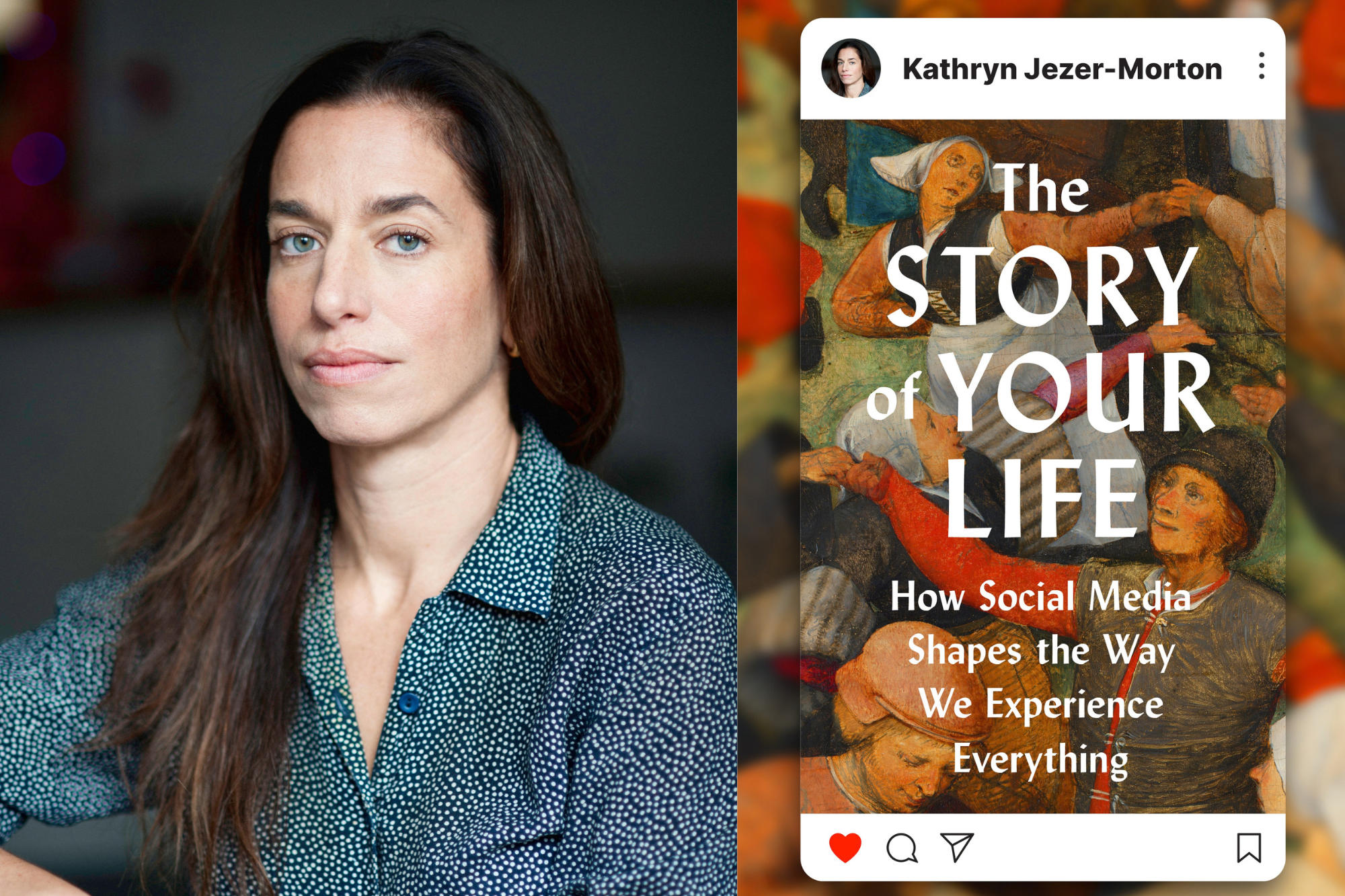
What we choose to post (or not post) to social media — the moments we highlight, the wording of our captions — tells a story about who we are. Those stories, says author Kathryn Jezer-Morton, then shape key parts of our offline lives, like the milestones we value and who we maintain relationships with. Jezer-Morton joins us to talk about her new book: “The Story of Your Life: How Social Media Shapes the Way We Experience Everything.”
Guest:
- Kathryn Jezer-Morton, columnist, The Cut, New York Magazine, author, “The Story of Your Life: How Social Media Shapes the Way We Experience Everything”
Episode Transcript
This is a computer-generated transcript. While our team has reviewed it, there may be errors.
Mina Kim: Welcome to Forum. I’m Mina Kim. For all the ways we’re recognizing the effects of social media on our kids, our discourse, or our attention spans, one that hasn’t gotten much attention, says Kathryn Jezer-Morton, is how it affects the way we make sense of the arc of our lives. In her new book, The Story of Your Life: How Social Media Shapes the Way We Experience Everything, Jezer-Morton explores how social media has changed the way we tell stories about ourselves, turning them into curated and color-corrected versions of our history, and how we struggle to notice the impact that’s having. Kathryn Jezer-Morton writes the newsletter Brooding for The Cut. Kathryn, great to have you back on Forum.
Kathryn Jezer-Morton: Thank you so much for having me back.
Mina Kim: So, one thing you make clear from the outset of your book is that you love social media. What do you love about it?
Kathryn Jezer-Morton: Yeah, I’ve been a poster from the very start. I think I just find it a fun, creative opportunity at its best to make people laugh, to share, just to have people know things about you that they might not otherwise know — things you like, things you find funny. I just find it a very inviting medium of expression.
Mina Kim: Yeah, and you said you are, or were, a poster from the start. So talk to me about how you got to experience social media before it was algorithmically optimized for profit. When did it enter your life?
Kathryn Jezer-Morton: Yeah, I mean, I was in college when I first started using it, and I was using Friendster, which was a not-very-long-lived precursor to Facebook. I was never really a MySpace person, but I used Friendster and thought it was fun. And that was really — there was no newsfeed. This was just where you had a profile, and the whole project was kind of updating your profile. That was all you did. And then you would write little messages on your friends’ walls. But there was nothing really real-time about it. We weren’t using smartphones yet.
Then I migrated to Facebook once it became available to the general public, and I found early Facebook totally fun. I found it really novel to be connecting with people from my earlier life. I just found it pure fun. What can I say? The groups, everything about it.
Mina Kim: Yeah, yeah. So you write about looking back at your Instagram account, which you’ve had since 2012. What were your early posts like on Instagram, and how did that compare to what your life was actually like at that time?
Kathryn Jezer-Morton: Yeah. So I joined Instagram, I think, in 2012. And this was before the algorithmic feed. It was a chronological feed. And it was also before there was quite so much brand infiltration. So it was really just people who knew each other, largely. And then you would start adding some influencers.
I was really telling a story about — I had little kids, and I was basically creating a persona, in an amateur way. I wasn’t trying to be an influencer at all. It was just like, I think, a young mom having fun, trying to get by with two kids. And mostly I tried to make my life look fun because that’s all that would have occurred to me to do. Nothing else. That was the only option, so I did that.
But I was in graduate school. I had very little money. My husband and I were both students. And it was, I would say, a time of stress in our life, and we were pretty isolated socially. You never would have perceived any of that from the posts that I was making at that time.
Mina Kim: Yeah, I mean, which isn’t unusual, right? Most people share their best moments or try to share the happy and good times in their life. And it’s not like anyone had the right to know your struggles at the time if you didn’t want to share them. But what I found so interesting as you were reflecting back on this is that you wondered, even if you had wanted to, how much of the medium would have accommodated it. What do you mean by that?
Kathryn Jezer-Morton: Yeah, there was no possible way to be and to tell any different story, I realized. Partly, the fact that there are comments, right? We take this for granted. When you make a post, people can comment on it. It invites feedback that is, I think, inhibiting because you don’t want people to pity you.
Let’s say I’m having a hard day, or I want to account for my experience in a way that doesn’t seem like pure success. Maybe I want to talk about something that was hard or disappointing. The fact that there are comments means that people are going to feel compelled to say, “Oh, I’m so sorry,” or somehow offer some kind of sympathy, which, in the context of these comments, is often not really what we want. And I think for a lot of people, it’s very uncomfortable to feel as though you’re seeking pity. So I think it inhibits that kind of sharing because you know what kind of response it will get.
Mina Kim: Yeah. And then also, the algorithms have entered at this time, right? Do you think the types of things that the platforms were rewarding were also inhibiting?
Kathryn Jezer-Morton: Definitely. I think it took us a few years to learn what the platforms were prioritizing. But the algorithms want really easily legible content. Familiar faces, a picture that you can glance at and understand what you’re looking at pretty quickly.
So that really means that it’s actually inhibiting a more artistic, if you will, way of accounting for things. And I think we started to learn that, obviously, selfies and, even more so, pictures where you’re in a cute outfit or a bikini, if that’s your thing, are the types of posts that get the most engagement. If you post something that’s kind of confusing and it’s hard to tell even what’s in the picture, no one is going to see it.
Mina Kim: So do you think that we started internalizing the priorities of the algorithm without maybe even noticing it?
Kathryn Jezer-Morton: I absolutely think that. I just think it’s because we started to see what types of posts got the most engagement and what types of posts didn’t. And we’re always kind of A/B testing our own personas in these spaces without realizing it. I think most people who post keep almost a kind of mental spreadsheet about the performance of the posts that they make, whether they mean to do this or not. And I do think that over time, this leads us to lean in a certain direction with the way that we talk about ourselves. I think we do this absolutely without realizing it.
Mina Kim: Yeah, and now, essentially, what you’re exploring is what happens when millions of people are doing this together at the same time.
Kathryn Jezer-Morton: Yeah, exactly, over the course of 20 years. And now, for a lot of people, especially younger people, this is the only medium that they use for everything. They’re getting their news, they’re getting all their entertainment, and then their personal updates and their events and everything are coming through the same feed. And I think it’s structuring the entire thing. Absolutely.
Mina Kim: And what are you noticing about how other people share themselves? It sounds like you’ve noticed that there are some pretty common narratives that people will turn to as a way to narrate the story of their lives.
Kathryn Jezer-Morton: Yeah, I mean, the theme that really came out in my research was this kind of compulsory resilience that people really feel they have to show. So if you go through a setback, whether it’s illness or divorce or job loss, whatever, you have to figure out a way to tell the story where you’re going to be fine. Often, that means not talking about it until you’ve kind of recovered from the hard part, and now you can talk about how you found a new partner or you’re excited about your new job opportunity or whatever it is.
And I think that’s just such a profound part of our culture, and I think it leaves out a huge part of human experience and emotional capacity that is just never expressed when you’re only talking about your resilience.
Mina Kim: And what are the dangers of that?
Kathryn Jezer-Morton: Well, I think that when you’re only seeing people talk about life at a particular register, it can be hard to learn, because we’re so social, right? Obviously, a lot of our emotions come from our minds, and they’re physical, but a lot of emotional expression is something that we learn through being exposed to other people expressing themselves. We’re like, “Oh, that’s a way you can express sadness.” We influence each other.
And I think that when you aren’t exposed to people experiencing ambivalence, experiencing these very natural human experiences — disappointment, just a feeling of, “Well, just another ordinary day, nothing really special here” — you start to lose sight of the fact that that is what life is mostly about. It’s mostly about ambivalence. It’s mostly about these kinds of peaks and valleys, but nothing spectacular.
And I think it can create an alienating sense of disappointment in your own life if your life isn’t spectacular. People talk about the comparison trap, right, where you see these people with their beautiful lives, and you’re like, “Why don’t I have that?” I don’t think this is exactly the same thing. I think this is really about losing the ability to express the emotions at all.
Mina Kim: We’re talking with Kathryn Jezer-Morton, who’s written a new book called The Story of Your Life: How Social Media Shapes the Way We Experience Everything. And listeners, have you noticed or felt the kinds of effects that Kathryn is talking about? Do you yourself feel like you have developed a persona or a brand that you’re beholden to? Or have you noticed friends or family posting in that way?
You can email Forum at KQED.org, find us on Discord, Bluesky, Facebook, or Instagram at KQED Forum, or call us at 866-733-6786.
Kathryn, do you find the effects go beyond people who post, meaning lurkers, or people who just don’t post? Can they, too, internalize this narrative of what’s desirable and acceptable and possible?
Kathryn Jezer-Morton: I totally do. And I think we’re seeing that fewer people are posting now. I don’t think there’s any dip in people using social media. I think it’s as strong as ever, if not stronger, but fewer people are making posts.
But I think the experience of being a lurker is very much about being influenced by this. This is the water you’re swimming in. This is where you’re seeing all the information about culture coming through. So I think it is enormously influential.
And I also think we see some of this influence in broader conversations at the social level. I’m thinking about climate change, and I’m thinking about communities that are affected by disasters, like wildfires or floods. There’s this kind of knee-jerk reaction of, “We’re going to be fine. We’re going to build back. We’ll come back, and we’re going to be better than ever.”
To me, this is a direct echo of this kind of compulsory resilience that we have developed on social media over the last 20 years. And I just think that people don’t know how else to express themselves. I think it’s like the only option. And I do think if you think about that, when you really zoom out, it’s a really interesting thing.
Mina Kim: We’ll have more with Kathryn and Joseph Martin after the break.
This is Forum. This is Forum. I’m Mina Kim. We’re talking this hour about how social media is shaping how we experience our lives. It’s how we narrate our lives and even make sense of them. We’re talking with Kathryn Jezer-Morton, who’s explored this in a new book called The Story of Your Life: How Social Media Shapes the Way We Experience Everything. Kathryn is a columnist for The Cut, part of New York Magazine.
Listeners, do you use social media to share parts of your life? Why or why not? What have you noticed about the way you feel when you are posting or what you’re trying to convey? Do you feel like you’ve developed an online brand that you’re beholden to, or felt like other people have? Have you tried to push back on social media’s pressures? If so, we’d love to hear how you’ve done that, too, at 866-733-6786. That’s 866-733-6786. You can email us at [email protected] and find us on Discord, Bluesky, Facebook, or Instagram at KQED Forum.
Discord user MJ writes, “Facebook used to be a way to keep track of what your friends and relatives are up to. Now it is a steady stream of things the algorithm thinks you might be interested in, suggestions to follow friends or friends of friends, and nonstop ads.”
One of the things you note, Kathryn, is that we know — and it’s been well documented — the profit-making motive of social media companies, despite the kind of value add you might get from catching up on your friends and relatives. We know this, and yet we’re uncomfortable talking about our participation in this. Can you talk a little bit about what you noticed when you were starting to really dig in with people about why they post the way that they do?
Kathryn Jezer-Morton: It’s a really personal question to ask someone, like, “What are you trying to say about yourself when you’re doing this?” I found that I really had to develop a lot of trust with people before they were comfortable answering that question. And it is kind of asking someone to expose something very vulnerable about themselves if they’re going to be honest.
But that’s part of why I wanted to write this book, because I was like, we’re doing these things in public, but when we’re asked about what we’re doing, it makes us deeply uncomfortable. So there’s something kind of contradictory there that I found really interesting.
Mina Kim: Yeah, it really does get to your vulnerabilities. Well, I want to dig into some of the impacts you’ve noticed first — the offline impacts. You say weddings were where you first began to notice physical traces of social media’s influence. What were you noticing about weddings?
Kathryn Jezer-Morton: Yeah, weddings. In the early Pinterest era, that was when I started going to a lot of weddings, and I began to really see them as opportunities for a couple to demonstrate their taste in this really specific way, and obviously their purchasing power. And then it just got more and more amplified, to the point where now, when I’m at a big wedding, it’s sort of like attending a trade show for vendors in the event space.
Every vendor there will have a “tag me” invite, like a little mention of their socials, so that you can produce content about them and tag them. And if you’re at a wedding with a band, for example, like recently, a band was playing and they were creating Reels while they were playing. They had their phone set up right on stage. And you feel as though you’re kind of part of the performance. You’re on camera from multiple angles the entire time, which is a really intense experience.
Mina Kim: Yeah. The other thing that I think is really common, and you raise this, too, is the way that it has sort of flattened our vacations. Can you talk about the effect this has had on people’s vacations?
Kathryn Jezer-Morton: Yeah, I mean, vacations have now become sort of an opportunity to demonstrate your fitness, and I don’t mean that literally, although it’s part of it. I mean your fitness in general — your ability to find all the best spots, to find them at times that are not crowded so you can get the perfect photo. It’s like you’re savvy as a consumer. Obviously, your spending power, how much you can afford to fly and visit. All of this stuff, then, you can produce evidence of it through your posts.
And it does feel like these vacation posts are almost like proof of concept for your ability to thrive in the economy as it currently exists. It all feels like a lot of work. It’s a ton of work to stage really nice vacation photos nowadays because the expectations are so high.
Mina Kim: Let me go to caller Sarah, who’s on the line. Sarah from Oakland, join us. You’re on.
Sarah: Hi there. This is a fascinating conversation. I really appreciate it. I will confess I’m a bit of a “let-eye.” I don’t really use social media that much. I am a lurker, so I can’t really — I’m in no danger of falling off my high horse.
But I’m curious what your perspective is on this arc of compulsory resilience that you’re kind of imagining is coming through, not telling the story until the end, until the sort of happy resolution. And I’m wondering, what’s the flip side of that? In my life, sometimes I don’t share until there’s a resolution because I’m just not ready to. Do you want people processing in real time on social media? Is that the alternative? And if so, is it a good thing?
Mina Kim: Sarah, thanks. Kathryn?
Kathryn Jezer-Morton: That’s a really interesting question. I don’t think that we necessarily want people to be processing in real time. I do think that there is a whole genre of social media on TikTok that’s about that. It’s mostly younger people. It’s Gen Z who do major trauma dumps, or they’re crying. They set up their phone and they’re crying and talking about it. So that does exist.
I don’t think that is the solution to this sort of compulsory resilience, though. It’s its own prison, just a separate one — the prison next door. I don’t think it’s so much that we need to change or that we need a harsh antidote. I just think that we are losing contact with other ways of thinking about our experience. And maybe social media just isn’t the place for that corrective, but I’m not sure. It’s funny, I’ve thought about this, too, and I don’t know if I have an answer exactly. But it is a really interesting question. What’s the corrective?
Mina Kim: Yeah, is social media, in its current form, sort of salvageable as a solution if people just started diversifying their posts? Or do we need to look at something, you know, a total alternative? Do you have some thoughts on that, Kathryn?
Kathryn Jezer-Morton: I mean, I think the total alternative is always going to be real relationships with people that you have in person, connections to, because I do think that we can process our experience in real time with our friends, over the phone or in the privacy of our house. I think that’s where we get the most from that. I think that’s what’s meant to happen.
And I guess I just worry that if we’re not seeing that kind of processing at all on social media, I worry that we aren’t necessarily doing it in real life in the same way. That’s kind of my fear, I guess.
Mina Kim: Yeah. Another thing that you worry about, or note, is the fact that we’ve really normalized improving, tuning up our photos, right? You note that it’s common for everyday people to use filters, but also to use Photoshop and AI to alter the way that they appear. What does that — and what are you concerned about that leading into?
Kathryn Jezer-Morton: Yeah, I mean, I spoke to people who routinely had their baby pictures touched up. I think it starts at birth. Now, if we’re thinking about maintaining a kind of separate version of ourselves that exists in a digital space, and then there’s the real-life version of ourselves, and there are two different things, there’s something very alienating to the self about having a splintered self. You have the one version that’s perfect, and then the imperfect one.
Because I think it can make it harder to show yourself, to put yourself out there, to stand and be seen and be perceived in your material, physical form that you didn’t have time to touch up. I do think it could have that effect, definitely on younger people. I see that in the world as I go around.
Mina Kim: Yeah. Bingo writes, “What is the difference between online identity and real-life identity? Who were we before the internet, and who are we now? I think the internet magnifies human nature.”
You also note the prevalence of exaggeration, right? Exaggerated language in our posts. Can you talk about what you have seen with regard to how we communicate and speak on social media?
Kathryn Jezer-Morton: Yeah. I think that’s another consequence of the algorithm. We’ve learned, we’ve internalized these rules. And one of them is that you’re trying to compete for attention with all the other stuff in the feed. And that just compels us to juice up the affect a little bit, because otherwise we just won’t be heard over the noise. And this is just common sense, really.
So then, rather than just saying, “Oh, I had a nice day in London,” people say, “Most gorgeous day ever in London,” or, “Having the time of my life.” We describe our experiences in hyperbole and superlatives as a matter of habit. That becomes the baseline, just in a bid for basic attention.
And so all the ordinary stuff, like a day spent at home doing nothing, just doesn’t rate. You can’t really include that because it’s not part of the superlative menu of experiences.
Mina Kim: And it’s a very short leap from hyperbole and exaggeration to lying, you point out. Do you feel like it has normalized or helped normalize lying?
Kathryn Jezer-Morton: Yeah. This kind of started for me early on social media, when I would be talking about it with older family members who were in their 70s. They were looking at it and saying, “My God, all these people are just lying. How can you tolerate this? These are all lies.”
And I was like, “Your definition of lies is really different than most people’s. There’s a lot of omission, but that’s not lying.” So I saw this real generational divide in terms of what constitutes honesty and truth.
And I just noticed that the version of, “Listen, it’s not altogether true, but it doesn’t make it a lie,” has become the standard. So we’ve all just accepted that this is not your real life. Everyone knows that’s not your vacation. Everyone knows that’s not necessarily your real family, in the sense that everyone looks perfect in the beach photo and everyone’s smiling. Your real friends know that maybe you and your partner are on the outs, or your kids are always fighting. We accept the fake version happily. We’re like, “This is normal. This is how we communicate.”
And I think that makes us comfortable with lies as a matter of course, to a degree that just wasn’t true 20 years ago.
Mina Kim: Let me go to Amy in the East Bay, who’s on the line. Amy, go ahead.
Amy: Hi, thanks for taking my call. So, yeah, I’m a mom of a younger child, and I struggle with this a lot. Obviously, I’m not going to let him get on social media for quite some time, if ever, as long as I can control it. But where does this lead? What does this do to future generations, and where do we want to guide them?
Those of us who have been around social media for so long know kind of what’s going on, the ins and outs. I’m teaching my kid about emotions, and I’m literally learning with him because, kind of to your point earlier, I don’t know that people are prepared for emotions. Do we want to be doing this compulsory thing instead? If I look at what my child is learning about emotions, I don’t even know. I think I’m done. I’m just flummoxed. And yet, I just can’t read your book without thinking, it’s wild. It’s wild.
Mina Kim: Yeah, Amy, thanks so much. And Kathryn, you’ve thought a lot about this as a parent as well. We had you on talking about your kid and friction-maxing not that long ago. What are your thoughts, with regard to what Amy is saying, about how the next generation will manage this?
Kathryn Jezer-Morton: Oh, man. I really feel for you, Amy, completely. My kids are a little older, and so I didn’t really have to deal with social media in quite the same way. Now they’re teens, and they don’t use it. I’m very comfortable saying you shouldn’t, and maybe even you can’t. I haven’t had to ban it.
But I feel as though you shouldn’t use it until you’re an older teen because it just doesn’t have the benefits. The costs way outweigh the benefits. And I just think that for kids, building relationships in person is the way to go. That’s where you get the back-and-forth. That’s when you see how another person’s face responds when you say certain things. And I think those are the lessons that kids have to learn. What happens when I do this, and I have to then deal with the way I made someone feel, and they’re sitting right across from me? That’s what you have to learn how to do, I think. And you don’t learn that on social media.
Mina Kim: Yeah, I think Henry has a related point. Henry in Santa Rosa, join us. Go ahead. You’re on.
Henry: You know, I was just looking at an old story, and you’re getting to senior ages and watching these kids. Algorithmic social media seems to be a narcissism delivery device. It seems to be created for the dopamine hit. If this is the case, and we’re looking at a lack of empathy, potentially the eradication of that — narcissism negates empathy — what is the hope of the human race?
An indication of this, and I don’t want to put it so that you make a political statement here, but an individual was assassinated in the street in Manhattan because of being an insurance CEO. This itself is horrific, but there is a broad-based celebration of this because of the industry he worked in and the harm that he has done. Is this an indicator of the end of empathy? And if so, what hope for us?
Mina Kim: Henry, thanks. Have you also connected this to a sense of a lack of empathy that seems to be growing in society, that people have pointed out or been concerned about, Kathryn?
Kathryn Jezer-Morton: Yeah, I have. And I’ve been thinking about this actually just today, in the context of the news coming out of Cornell University and this whole lawsuit against the frat. I think we’re talking about the increased prevalence of dehumanizing other people and the way that these platforms allow us to do that, because we’re looking at people as avatars.
And I think 10 years ago, I would have thought that was maybe alarmist. I don’t know if I would have bought that. And I would say today, I absolutely do. I think we’re seeing it unfold in a lot of different spaces, where it’s just easier to think of people as categories rather than as fellow human beings.
Mina Kim: Listeners, we’re talking with Kathryn Jezer-Morton about the effects of social media. We know of so many of them, but there are also subtle ones with regard to how we understand ourselves and others through the stories we tell about ourselves, or the stories that we read other people telling about themselves on social media.
Have you experienced some of the effects that Kathryn is talking about? Do you feel like you are beholden to a certain idea of yourself on social media that you try to contribute to? Or maybe you have figured out effective ways to push back on social media pressures? 866-733-6786 is the number. Find us on Discord, Bluesky, Facebook, or Instagram, our social media channels at KQED Forum. Email [email protected].
Discord user Mulzaho writes, “Social media changed the way I looked at things like trees, people, and food. I found myself wanting to experience things simply to post on social media and get likes, attention, and validation. Looking back, it feels gross. I’ve grown out of this desire and value more discretion, privacy, and face-to-face interactions. Now I limit my screen time, don’t bring my phone into my bedroom, and make sure the phone is not my first choice in the morning.”
Cole writes, “I got off Twitter in 2015. I followed a lot of comedy accounts and found myself imitating their style. I noticed that the moment something amusing happened, I was already composing the tweet in my head. I wasted so much time trying to get the right wording for maximum impact.”
Wow, that does feel so much like something a brand manager would tell you to do, Kathryn.
Kathryn Jezer-Morton: Yes, I can really relate to that, also. I have spent a lot of time on Twitter, and, yeah, no, that’s all very, very familiar — feelings that I myself have had and seen.
Mina Kim: The other thing, too, that it reminds me of is just the running through your mind of the different ways what you write or post could be misconstrued. Can you talk a little bit about that? I think you even talked about this a little bit with just wanting to post about a marriage milestone.
Kathryn Jezer-Morton: Right, yeah. Speaking of brand managers, I think that we’ve kind of adopted the priorities of a brand manager in talking about ourselves, where we have to manage our reputation. We want to correct and anticipate, like you said, misunderstandings.
I worried that when I had a 20th wedding anniversary and was going to post about it. Then I thought to myself, “Well, what if this comes across as offensive to people who never got married, who were divorced? I don’t want to be seen as the ultimate marriage booster,” if you see what I mean.
Mina Kim: We’re talking with Kathryn Jezer-Morton. Her book is The Story of Your Life: How Social Media Shapes the Way We Experience Everything, and it’s very much about how social media is a storytelling device, and if we’re telling certain types of stories, what effect is that having on us?
We’ll have more with Kathryn and with you after the break, listeners. This is Forum. I’m Mina Kim.
This is Forum. I’m Mina Kim. We’re talking this hour about how social media is shaping how we experience our lives, both online and in real life, how we narrate our lives, the stories we tell and make sense of.
Listeners, you’re joining the conversation at 866-733-6786, at the email address [email protected], and on Forum social channels on Discord, Bluesky, Facebook, and Instagram.
Let me go next to caller Kathleen in Virginia. Hi, Kathleen. Go ahead, you’re on.
Kathleen: Hey, I was just commenting that I feel like social media is necessary, and it’s a great tool for some communities. My son was diagnosed with a rare disease in 2009, and at the time, it was thought to be more rare than it actually was. It’s been a great tool for families and patients to rally together. We’ve been able to come up with some effective platforms to do good and to garner more funding for research as a group.
For the first time, I’ve been able to unite like this, and it’s easier for patients who don’t have to leave their house. It’s not like having to go to a meeting. Patients all over the world have been able to join together. And as a military member, it’s been a great way for me to keep in touch with all of my friends who still live nearby, even when I can’t have an actual face-to-face conversation with them.
Mina Kim: Yeah, Kathleen. I’m so glad it’s been all those things for you. And it underscores some of the things you said right at the outset, Kathryn, just about how much you loved it and what was good about it, right? How it could be this place for all the things that Kathleen is describing. And I do wonder, is it possible to have all those good things without all the other things?
Kathryn Jezer-Morton: Yeah, I think what Kathleen was talking about reminds me of the culture of closed groups, groups that are often on Facebook or Discord. They operate this way, where you have a group of people who really are part of a community and can share resources. I think it’s a very, very well-suited tool for that.
I think where you find problems is when you expose yourself to the full algorithm and just the feed as a kind of uncut experience. It becomes more harmful. But in the privacy of closed spaces, social media can be incredibly generative and a place of real belonging.
Mina Kim: Let me go to Alice in Petaluma next. Alice, go ahead.
Alice: Hi there, thanks for having me on. I work in the creator economy, and I love this conversation. I just want to flag for you and for the listeners that there are alternatives that are starting to emerge. I work with one called Divine, which is based around the old Vine six-second looping video app. And we have banned any AI content at all. We don’t have an advertising-based algorithm, and it’s so amazing to see what people are creating, like puppet shows. Really, just basic human creativity is coming to the forefront. So I just want to say that there’s hope and there are new forms of social media emerging.
Mina Kim: Well, I’m so glad to hear about that, Alice. Thank you. Thank you so much.
I’d love to get your thoughts on this comment from Kyler. Kyler writes, “The drive to post takes people out of the present. I see people capturing content for social media in public, and they look like they are feeling nothing in the moment, which is sad, because often there is something amazing in front of them.”
You talk about this and how this might be evolving. What are your thoughts for Kyler?
Kathryn Jezer-Morton: Yeah, that’s such an astute comment. I think that when people are capturing content like that, what they’re often doing is actually trying to feel the kind of spark of experience that can happen when you’re in the midst of something unfolding that’s beautiful and fun and unexpected. I think they’re trying to conjure that feeling sometimes through a capture. By trying to capture it, they’re actually standing in the way of that feeling being possible.
I think that feeling of, like, we’re all here together, we’re having a time, we have this sense of belonging — I write about this at quite some length in the book. I think that’s what everyone is thirsty for all the time.
When we’re taking pictures at a concert, you see this all the time. At festivals, people are just filming the performance or filming themselves at the performance. I think they’re really trying to convince themselves that they’re feeling it, that they are in the moment. But this developed habit of filming it is a bit of a detriment to the feeling itself. Yeah, it’s a real thing that we’re doing. We’re very much habituated to doing this now.
Mina Kim: Yeah. Well, this Discord user, Kevis, writes, “I started with Facebook when my son was in college in order to use Messenger because he didn’t answer his non-smartphone or emails. But I grew to love Facebook. I caught up with high school friends I hadn’t seen in years, put out notices of parties and events, and enjoyed hearing from everyone.
“Years passed, Facebook and Instagram changed. And after the November 2020 election, I decided to take a month off social media. I felt so much better. A month turned into two months. Then I checked it again and still do maybe once a month. But I don’t scroll through everything. I am so much happier this way.”
I feel like I’m noticing that people are getting off social media more than I thought. Yeah?
Kathryn Jezer-Morton: I’m seeing that, too, definitely. For myself, Instagram is kind of like my drug of choice, you might say, and I will take it off my phone during the week and have it on the weekends, just because I feel like I use it too much. I can fall into it mindlessly, and often when I reinstall it, the first few moments I’m like, “Oh, this is terrible. God, all of these people are nuts. Everything about this is a huge mistake. I should leave.” But then I don’t, and I’m just pulled right back in.
And this happens again and again and again. There’s probably a psychological term that describes exactly what is happening to me. But I don’t think this is a demographically significant chunk of people leaving. It is something that people are doing, though, or they’re limiting their access. They’re kind of using it as a controlled substance, basically, which is what I’m doing. And I think that’s what works for a lot of people.
Mina Kim: Do you think that people also either worry or even call you out if they don’t see you responding to things? I was reading a review of your book and a couple of other articles where people were talking about getting called out for not being responsive on social media, as well. Can you talk a little about your own exploration of this and what you think is happening here?
Kathryn Jezer-Morton: Yeah, this is really where things get tough. There’ll be a big news story or something controversial that everyone’s talking about. I don’t think this necessarily affects most ordinary, everyday folks. But if you’re someone who habitually posts about stuff, who maybe has kind of made a bit of a name for yourself as someone who has a political point of view, and then you leave and you’re silent on it, it’s not impossible that people who have been paying attention might say, “Well, this person is silent. That must mean that they either don’t care or are somehow complicit with this larger problem.”
This is something that’s happened. I spoke to people in my book who had this experience, and these people really feel as though there’s this kind of responsibility to speak in these environments. And I think that’s really tough.
I have that experience sometimes because I’m active on these sites, and sometimes I do worry, like, “Oh boy, if I’m gone for too long, people will have messaged me and I won’t reply, and then they’ll take offense.” There are so many social dynamics at work. It’s the real world transposed, right? It’s as complex as the real world. So, yeah, there is a lot of entanglement and this sense of accountability that makes it hard to step away, I think, for a lot of people.
Mina Kim: Yeah, the entanglement of that sense of accountability. And then there’s also a sense that people are noticing when you’re not posting, that they’re sort of quietly surveilling you.
Kathryn Jezer-Morton: Yeah, I mean, it is the worst thing to feel as though people are quietly surveilling you. I think it’s much healthier, as a rule, to assume that no one cares and no one notices, because I think that just lets everybody off the hook, and that’s probably advisable in general. But it’s not always true. Sometimes people do notice, and that is just a fact.
Mina Kim: Yeah. It’s such an interesting feature of all of this.
Tony writes, “Everything I’m hearing just makes me glad I’m not on these platforms. The range of experiences they provide is so narrow. It seems pointed, and yet it expands the complications of navigating real-life society.”
Another listener, Stephanie, writes, “I love to take photos when I travel and add captions with factoids about the image on Facebook to share with my small group of friends and family, but young tourists seem most interested in cutesy images for TikTok and Instagram. On my last vacation, visitors had to line up to take their selfies in front of iconic sites.”
We’re talking with Kathryn Jezer-Morton, listeners. The book is The Story of Your Life: How Social Media Shapes the Way We Experience Everything. You’re sharing how you use social media, if you’ve noticed some of the effects Kathryn’s talking about, or some of the feelings or discomforts, or even if there’s a consistency of posting or a persona that you’re beholden to keep. You’re also sharing ways that you’ve tried to push back on social media’s pressures.
Heather writes, “It’s important to remember social media is just a snippet of human interaction. Perhaps the antidote is not limiting time, but also seeking other forms of connection, like real-life interactions and longer storytelling. Think The Moth podcast.”
Kathryn, one thing that you seem to be reassured by, I would say, was the fact that when you did go out to talk with people and engage with them face-to-face, their ability to engage and tell stories seemed to be there, no matter what. Kind of like riding a bike — you could still do it and still enjoy it.
Kathryn Jezer-Morton: Thank you. Yeah, no, I met a lot of really interesting people while researching this book, and they told me their stories. People were incredibly candid with me in ways that did hearten me, because people were willing to tell me about the complicated inner workings of their lives and motivations for posting. That was so honest and intimate, and it did include so much human nuance and ambivalence and all the spectrum of feelings.
So I was heartened. And in the end, this book — obviously, we’re talking about all the bad stuff about social media, which we could talk about for many, many books. But I’m really just interested in storytelling. This has been how we tell stories for the last 20 years, but our need to tell stories is not going anywhere. We are storytellers. So we’re going to take this maybe to another medium eventually, hopefully. Who knows?
Mina Kim: Let me remind listeners, you’re listening to Forum. I’m Mina Kim. I want to talk about that a little bit — the power of storytelling and what you discovered about how much we need it as human beings. Could you say a little about that? And then I’d also love for you to talk about the role of storytelling in your own life, growing up on a commune.
Kathryn Jezer-Morton: Yeah. If you look back in history, we’ve been telling stories for our entire species’ history. We were telling stories in the oral tradition. We’ve always been doing this. We’re usually making sense of things that are hard through our stories. We’re trying to make sense of weather events and tragedy, and, like, why is being a human so hard and why is love so painful? These are the big questions that animate fairy tales. And we’re trying to teach our children lessons: Here’s how you should try to act with charity. This is at the basis of so many folktales.
So it’s fun to think about social media in this longer historical context because it does belong to the exact same tradition.
For myself personally, I grew up on a commune in southern Vermont. Storytelling was the whole place. It was a group of people who had come to live together 20 years before I was born. They were artists, they were writers, they were making theater. And a lot of it was held together by a story about how they were a merry band of misfits.
I think a lot of communities still operate that way. So for me, I always could feel like I come from a culture, this tiny little subculture, where storytelling is life. It’s what we do. Without these stories, we would just be a group of people living in a dirty house. It’s what makes everything come to life. So I think I’ve always really found stories to be not something to be taken for granted, I guess you could say.
Mina Kim: Yeah, yeah, very powerful stories. I mean, it is the foundation of so much, right? How we convey what’s happening in the world through journalism. And it makes a lot of sense that your life is all those things — journalism, writing books, and so on.
Let me go to Tracy in Hayward next. Hi, Tracy. Thanks for waiting. Go ahead.
Tracy: Oh, thank you for having me on. This is so fascinating. Now, real quick, I know you don’t have much time. I’m an older father — they call me Grandpa Daddy. I’m 60 years old, and I’ve got a seven-year-old and a five-year-old. My wife is 40. She’s 20 years younger than me. She’s a Filipino woman, a Filipino nurse, and she grew up with social media, right? So she’s always on it. Facebook — her and Facebook, oh my goodness. There are times when the kids even say, “Mommy, can you get off the phone and play with us?” And I look at her and say, “Ah, they got you,” right? I love that one.
But I’m actually scared for the kids growing up, because you’ve got to keep them off this stuff. It is really going to affect them, and I’m scared for my own children.
They’ve got these phones, right? They’ve got those phones where you can give your kid a phone that you can monitor everything they do. They’ve got their own little social media page, but it’s not really social media. And then you can monitor their contacts, who they can talk to, and all that. I think that’s the way to go.
Mina Kim: Tracy, let me get Kathryn’s thoughts on just keeping them off of it altogether. I guess one of the things I hear when people are saying, “That’s it, right? That’s the only way to do it,” is that it’s really hard because, as you say, this has become the main medium of storytelling in our culture, and storytelling is so important.
What are your thoughts about that? You have this interesting story about how Gen Z has been handling the end-of-month retrospective photo dump as maybe a sign that they’re actually learning, through using the tool, how to control it better to meet their own needs.
Kathryn Jezer-Morton: Yeah, I think younger folks are doing a little bit less aggressive narration. They’re just putting up a bunch of pictures with no caption, and it’s kind of like, you make sense of it. This is impressionistic storytelling, which I think is really cool, because millennials like me are kind of always trying to insert our own version of things and insist on a narrative.
So I think there’s hope that younger people are going to be using it differently and not as rigidly as my generation. But as far as little kids go, and to the caller’s point, it is really hard, and it puts a lot of pressure on parents to offer alternatives to this. It’s hard to present things that aren’t this, that are fun. I really sympathize a lot with that pressure.
I think as little exposure as possible is good, but it’s hard to be perfect. I think perfection is not a realistic goal for anybody, ever. So I just think, as much as you can do stuff with your family that isn’t being captured on social media, that’s probably the best you can hope for. And that’s something real.
Mina Kim: Yeah, like the way you sing to the trees in winter, Kathryn.
Kathryn Jezer-Morton: Sure, like create some weird ritual that you do every year that you guys are into, that you don’t take pictures of. That’s a good start.
Mina Kim: Kathryn, thank you so much for talking with us.
Kathryn Jezer-Morton: Thank you so much, Mina.
Mina Kim: Kathryn Jezer-Morton’s book is The Story of Your Life: How Social Media Shapes the Way We Experience Everything. My thanks as well to all our listeners for sharing and being candid about the way that they use, feel, and worry about social media, and how they want to tell better stories and know people in more intimate ways.
Caroline Smith produced this segment. You’ve been listening to Forum. I’m Mina Kim.