Xavier Becerra Keeps Low Profile – and Solid Lead – in Race for Governor
Airdate: Wednesday, September 30, 2026 at 10 am
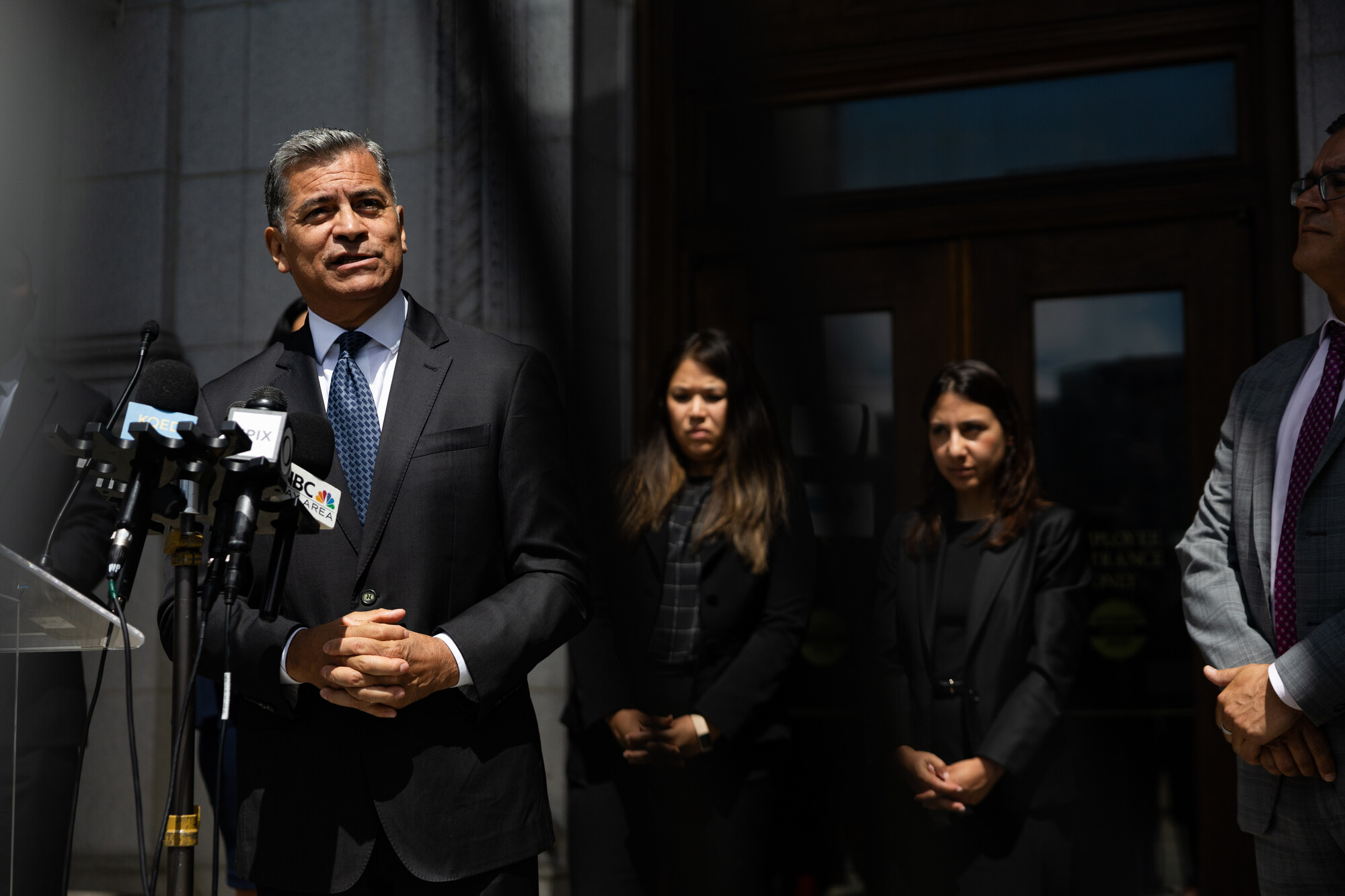
In the race to be California’s next governor, Democrat and former Health and Human Services Secretary Xavier Becerra has maintained a sizable lead despite keeping a low public profile. Meanwhile, Republican Steve Hilton has been pressing his case as an outsider who will cut taxes and support the working class. Ahead of their debate on CNN on Wednesday evening, we’ll look at why enthusiasm for the Democratic front-runner is lagging.
Guests:
- Jeanne Kuang, Capitol reporter, CalMatters
- Guy Marzorati, correspondent, KQED’s California Politics and Government Desk
- Jeremy B. White, senior politics reporter, POLITICO
Episode Transcript
This is a computer-generated transcript. While our team has reviewed it, there may be errors.
Mina Kim: Welcome to Forum. I’m Mina Kim. Democratic nominee for California governor Javier Becerra and Republican Steve Hilton debate tonight on CNN in what will likely be the only chance to see the candidates side by side and hear them in an unscripted environment, especially Becerra, who’s been keeping a low profile as most polls show him leading by some 20 points, a reflection of the state’s Democratic voter registration advantage.
But with less than a week before ballots go out, some voters, along with business and labor leaders and lobbyists, say they’re still not sure what Becerra’s priorities would be as governor if elected. Listeners, do you feel this way? Do you feel like you know enough about what Javier Becerra would do if elected as governor? What questions do you have about his record or past statements? And what kind of governor do you want California to have in this moment?
Here with me to discuss is Guy Marzorati, a correspondent on KQED’s California Politics and Government Desk. Hey, Guy.
Guy Marzorati: Hey, good morning.
Mina Kim: Also, Jeanne Kuang is with us, Capitol Reporter at CalMatters.
Jeanne Kuang: Hi there. Thanks for having me.
Mina Kim: Thank you for joining us. With us in studio, Jeremy B. White, Senior Politics Reporter at Politico. Hi, Jeremy.
Jeremy B. White: Hey, Mina. Always a pleasure.
Mina Kim: Always glad to have you on with us, too. So, Guy, how would you sum up how quiet Javier Becerra has been since he advanced to November?
Guy Marzorati: I mean, he seems to be running not to lose, has largely avoided a lot of media appearances, run a very low-profile campaign. There’s no evidence it’s hurting him, right? Like, if you look at the public polling that’s out there, his vote share is roughly in the range, high 50s, low 60s, of where Democratic candidates for governor end up. So there’s no sign that’s taking a toll on him with voters.
I think the question is, what’s the cost for him for governing? You know, assuming he’s going to win in November. And I think the charitable case is that by keeping a low profile, by avoiding promises — by the way he won the gubernatorial primary, not having maybe some of the obligations that previous governors had — maybe he enters office with freedom, with ability to kind of maneuver.
I think that the less charitable case would be that, you know, he lacks a why. He lacks a real thesis for the campaign. And a campaign without clarity could easily turn into a governorship without direction.
Mina Kim: Do you think it would make it harder for him, say, to rally support that would urge lawmakers, for example, to pass the things that he cares about?
Guy Marzorati: Yeah, I mean, that would be like the mandate theory. Oh, if he gets — if there’s this, if he has a certain mandate, then that would influence his ability to govern. I’m not, I don’t — I think, honestly, the governor’s race is one in which people are voting Democrat and Republican. And if he ends up with anywhere between 60 to 64% of the vote, does that give him more or less of a mandate than Newsom would finish in a similar range? I’m not entirely convinced of that.
I do think there’s a lot of questions from folks in Sacramento about what exactly he prioritized because he actually — I mean, he’s laid out positions on issues. But I think the real question is, like, what is his top priority? What is the thing that’s really the driving force? I mentioned the why. Like, if I had to articulate a thesis for him, it’d probably be, “I have the experience to stand up to Donald Trump.” I’m not sure what it is beyond that.
Mina Kim: Well, Jeremy, similarly, I want to know how you feel about the way he’s running his campaign and whether this is to his advantage, but also just how unusual his low profile is because, you know, we know because of the voter registration advantage in California that Democrats have that candidates facing Republicans in the general don’t campaign as hard as they would in a primary. But keeping this low of a profile that Javier has…
Jeremy B. White: I think you use the word unusual, and so much of this flows from the fact that this was a really unusual governor’s race. The primary, as you pointed out, in deeply Democratic California, these races are often won or lost in the primary.
Unlike previous times when Gavin Newsom was the clear front-runner from early on, Javier Becerra sort of rose to the top after other candidates had been in first place. Kamala Harris took a look and decided not to run. Alex Padilla did. Eric Swalwell was leading until he imploded. And so by the time Javier Becerra became the front-runner, it was so close to voting time that he was fairly undefined.
As Guy noted, he wasn’t the pick of a lot of these powerful interest groups like labor unions, where maybe you make some promises to them. That primary really turned into a choice between Tom Steyer, the progressive who was promising ambitious but concrete things — single-payer health care, dismantle the utilities — versus Javier Becerra, who really presented himself as more of a steady, reliable option and was not taking big, ambitious policy positions. And so I think you’ve seen that reflected now in the general.
Mina Kim: Yeah, and the effect of people not really knowing what he thinks or what he’ll do on day one if elected. You quote a lobbyist in your August piece who says, “So we are all trying to get through multiple-choice questions by eliminating obviously wrong answers and then making an educated guess.” Jeanne, I’d love to hear whether you think that this is all strategic or who Javier Becerra is.
Jeanne Kuang: Yeah, it’s an interesting question. I mean, I did sit down with him in August to talk through this kind of reputation he has as somebody who’s been slow to commit to a priority or slow to roll out a really concrete policy. And you got the sense talking to him that this is part of who he is. It is his style. He’s not somebody who likes to declare something flashy to him. And he thinks that a lot of politicians do that just for the sake of doing it, just so that they can say that they have a promise.
He doesn’t want to overpromise. He doesn’t want to commit to anything too, you know, specific because he wants to be able to deliver on it. And he is just somebody who’s been very deliberative. He wants to think things through. You know, I agree with Guy that could have its disadvantages when it comes to governing.
Mina Kim: Yeah, that sort of style and approach, you note in your CalMatters piece that it has been sort of the result of a couple of important political moments in his life. Can you share what some of those defining moments were?
Jeanne Kuang: Yeah, he talked to me about how he was persuaded, despite disagreeing with NAFTA when he first entered Congress, to vote for it because he thought he was told that, you know, if we put in some programs to help displaced workers, like everything would be okay. And, of course, we all know from the past few decades that it did have a lot of impacts on the American workforce.
And he said that he thought pretty soon afterwards that it was a mistake for him to be talked into this thing so easily. And so he has really framed his career as being one where he wants to make sure that he’s talked to everyone on all sides and done all the research and really thought things through before he really commits to anything.
“No one really earns my vote until I know exactly what I’m voting for.” And I think that that has really come through in his campaign, as everyone has already said. He’s been really vague, honestly, because he’s — he doesn’t want to say that he’ll commit to a thing until he’s certain about it.
But I do think it’s unusual in a gubernatorial candidate, especially in a state as big and vast as California, where we often have leaders and politicians who are making grand declarations. And I think sometimes people look to leaders for that kind of direction. And I don’t think that’s necessarily his style.
Mina Kim: Yeah, we actually have a clip of Becerra on stage with Politico’s Melanie Mason on August 11th. This was one of his very few public interviews since the June primary. Let’s hear it.
Javier Becerra: Everyone in politics has to understand what the voters are saying. You can’t just tell us what you will do, you gotta show us. And they need proof, they wanna see actual outcomes. And that’s why I think it’s so incumbent upon anybody who will get into leadership to actually deliver some true results.
That’s also why I can’t do pie-in-the-sky, inflated promises, because people wanna see you deliver.
Mina Kim: Jeremy, I am so struck by hearing not just that clip, but also Jeanne mentioning earlier that it was an experience related to NAFTA that got him more cautious. So it’s just a reminder of how long his political record or how long he’s been in public office.
Jeremy B. White: And you know what was so striking to me is talking to people in Sacramento, elected lobbyists, what have you, how despite the fact Javier Becerra has been in various elected offices for decades, how he’s still so much of kind of a cipher or a mystery to a lot of people in Sacramento.
And, you know, thinking about that clip and what Jeanne was saying, I think part of what we see here in the way that Javier Becerra has run and positioned himself, again, in contrast to, say, like, a Tom Steyer. I think in ways it’s a microcosm of this larger debate Democrats are having of, do we want to be taking these big, ambitious swings? Voters think the system is broken, they want really bold change, or is it more of back-to-basics?
One thing Javier Becerra has talked about a lot is affordability. California is unaffordable, not a new thing to hear a politician say, but in ways, it’s sort of one vision of where the Democrats need to go, which is rather than talking about these huge, politically complex and maybe polarizing swings, we just focus on sort of these more simple quality-of-life issues.
Mina Kim: So, what’s an example of that? Like his energy break in the middle of the day? Yeah. So, one of —
Jeremy B. White: The power hour, one of the few sort of explicit things Javier Becerra has said is — I was thinking of something else, but yeah. Well, he called a power hour sort of a way to bring down your utility bills with a period of free electricity. Something that sounds nice, doesn’t really sound like a governing vision, right? To Guy’s point earlier.
Guy Marzorati: Well, also, in that same Politico interview with Melanie, he said he was going to cover all of the costs of the Trump health care cuts, which actually is a massive promise that would cost a lot of money. And he hasn’t really followed up with exactly how he’d do that. So he hasn’t been completely immune from, like, the big promise.
But I agree. I mean, I think if you look back to Newsom taking office in 2019, he entered office with these huge promises of this many housing units are going to be built. I’m going to deliver single-payer health care. And you could argue maybe some of those things weighed on him over the years as he was unable to deliver.
Mina Kim: What does he tend to say, Guy, when pressed on the fact that there are not a lot of specific promises that he’s made or his plans?
Guy Marzorati: I mean, I think it’s back to that. It’s back to, well, look, people don’t wanna — I don’t want to be put in a situation where I’m making these big promises. He’s pointed to his time as HHS secretary and said, well, if I were to go out and say, I’ll have this many ventilators for this community by this date and then didn’t have it, well, then I could be blamed if someone died or something like that.
So he’s argued that it’s just not in his governing style. But again, it hasn’t really left any tea leaves to, like, what does he stand for? At the end of the day, he’s gonna be having to make decisions about priorities and priorities for state funding. What are those?
Mina Kim: Well, the other thing I feel like I hear him say, or read him say quite a bit, is look at my record. And so we’ll dig into that record right after the break.
Listeners, join the conversation with your questions about Javier Becerra’s record, and also about how you feel your sense of him going into the general election, if you feel like you know enough about him. And if he is emanating the qualities you would like to see in a California governor. 866-733-6786, the number, email address, [email protected]. Find us on Discord, Bluesky, Facebook or Instagram, at KQED Forum.
We’ll have more with Jeremy, Guy and Jeanne after the break. Stay with us. I’m Mina Kim.
Welcome back to Forum. I’m Mina Kim. Javier Becerra’s campaign has declined interviews with major public media outlets, including this program and KPBS, CapRadio and others. Javier Becerra was also called out by SoCal News Group, the editorial board, on X on Monday for avoiding a sit-down with them as well, even as we approach just weeks away from the midterm election and Javier Becerra is the front-runner for California governor against Republican Steve Hilton.
And we’re examining why with Jeanne Kuang, Capitol reporter at CalMatters; Guy Marzorati, correspondent at KQED’s California Politics and Government Desk; and Jeremy B. White, senior politics reporter at Politico. And with you, our listeners.
Email your comments and questions to [email protected]. Find us on our social channels at KQED Forum. Call us at 866-733-6786, 866-733-6786. Do you feel you have a sense of what Javier Becerra would do as governor, or maybe you’re fired up about him and feel just fine? What questions do you have about his record or past statements or where he stands on certain issues? What kind of governor do you want California to have in this moment?
So one of the things that I wanted to dig into just a little bit more is how he might specifically act with regard to health care and affordability. The two things that you have all noted are things that he does seem to be quite passionate about. So, Jeremy, your thoughts on, you know, his health care record, his support for, say, single-payer, for example. What has he said around any of those things?
Jeremy B. White: So Javier Becerra, people really tried to put him on the record about single-payer during the primary. And he articulated what essentially sounded like where Gavin Newsom ended up, which is I support covering everyone, but I recognize doing it on a state level is going to be very difficult.
I mean, as Guy said, he committed to anybody who loses their insurance because of the Trump administration’s cuts, we’ll keep it under him. That’s a big, costly proposal.
And then I would also note that there has been a ton of pressure, principally coming from organized labor, to find more revenue, including a tax on corporations. And Javier Becerra has kind of committed to that one. So that is one that in his first time in office, he could face some pressure to deliver some votes. It would be hard to deliver that, wouldn’t it?
Mina Kim: To deliver that, wouldn’t it?
Jeremy B. White: It’s something that has been floating around for many years and has yet to get the requisite two-thirds vote. And so I was surprised to see Javier Becerra say, “I’m gonna get that done.” I have that circled, actually, as a big early test of his ability to whip some votes in the legislature if he really follows through.
Mina Kim: Yeah, and so the question for you is whether or not he will follow through.
Jeremy B. White: That’s right.
Mina Kim: Jeanne, the other thing that he does seem to care a lot about is immigration. Can you tell us a little bit about his background and what you think his moves will be in that direction?
Jeanne Kuang: Yeah, I think we can expect to see a lot of what the state has already been doing, you know, defending its sanctuary law, which prohibits police from collaborating too much with immigration agents. He was the attorney general in California the last time Trump was president. And so he often talks about how many lawsuits he led against the Trump administration back then.
So I think we can expect to see that. Same level of pushback with him as governor.
I also think, you know, he has been pretty vocal about supporting the state coverage of undocumented immigrants in its Medi-Cal program. So I think, I don’t know if he’s, you know, full out said that, yes, we will restore all these cuts that did happen under Governor Newsom with our budget deficits the past couple years, but I think he has expressed an interest in restoring them and, as Guy mentioned earlier, making sure that anyone who loses their health care will get it back, which, you know, we’ll have to see whether he can raise the money for that.
Mina Kim: Yeah. And he’s the child of Mexican immigrant parents, right? Is that, in part, what drives his conviction around immigration, you think?
Jeanne Kuang: Yeah, I heard from some of his colleagues when he was in Congress that that background of his is very much a driving force for his political career, that any time they talked about legislation, you know, just the experience of not just immigrants but working-class people was a kind of North Star for him.
Mina Kim: Well, we’ve got calls coming in. Let me go to Cindy in Orange County to start us off. Cindy, go ahead.
Cindy: Hi. My issue with Javier Becerra was when we were discussing the problems with early voting, and his solution was everyone should just vote early. We don’t need to put more money towards counting.
And my thought at the time was I was going to vote for Eric Swalwell, and if I had voted early, he wouldn’t have an opportunity for my vote. But I’ve always voted day of since I was 18 years old.
Mina Kim: Well, Cindy, thanks for sharing that. Do you think that this is sort of reflective of a savviness or maybe a temperament that Javier Becerra has or lacks for this moment?
Guy Marzorati: I mean, Cindy’s right in the sense that, like, for a lot of even our current governor, the solution has been less of let’s give money to counties so they can speed up the count and more let’s try to do a kind of a public-relations campaign to encourage people to vote earlier.
But yeah, there’s some folks like Cindy who say, I’m not interested in that. I want to see these candidates run through the tape. I want a vote as late as possible.
And we certainly saw that. I mean, this governor’s primary, there were a lot of Democrats who held onto their ballots late into the race, for precisely that reason — that there was the Swalwell fallout, a feeling like they didn’t have a good grasp of the candidates, and maybe just waiting for, like, one last shoe to drop before they finally settled on their candidate.
So that certainly was the case in June. You know, we’ll see if that carries over at all into November. There probably will be more emphasis to get ballots in early given, you know, changes in mailing practices at the USPS. But it’s certainly still a live issue, like this, you know, does California’s ballot accessibility and our rules that allow ballots to be counted even after, you know, they arrive after Election Day — ballot curing — how do you weigh that against the desire to have definitive results as quickly as possible after polls close?
Mina Kim: Yeah. Speaking of speed, I’m thinking about Jeremy, how Jeanne was describing Javier Becerra’s method for making decisions, right? That he rigorously studies issues and talks with all the different stakeholders and can be somewhat slow to respond. I’m curious, from the people you’ve spoken to, if people have raised that as a concern in a governor in this moment.
Jeremy B. White: I think it’s less of a concern and more it feeds this sense of the unknown. And again, to sort of borrow Guy’s framing, the more charitable explanation is he’s a rigorous, thoughtful guy, he’s a trained lawyer, he really examines all the available evidence and then arrives at the best decision.
The less charitable interpretation is there’s a lack of core conviction there, and so it’s sort of death by committee and studying everything rather than being decisive. You would think you would want some mix in a leader, but certainly that description — that he really takes his time and studies it and vets it through his staff — pretty consistent from everybody I have spoken to.
Guy Marzorati: And that’s why I think, I mean, Jeremy wrote about this really well in his story, why there’s such a speculation about, okay, who is he going to surround himself with on a staff level?
I mean, I was talking to an Assembly member a couple weeks ago and I said, you know, what are you looking for in the first month of Becerra? And he said, well, tell me who his chief of staff is and then I’ll answer that question. Like, I want to see who’s running point there to give a sense of kind of how things will play out.
Now, Becerra’s longtime chief of staff, he’s, you know, has been embroiled in a criminal case involving stealing Becerra’s campaign funds. So Becerra will have to put together a leadership team, and maybe through that we’ll get some kind of clues as to kind of how the early parts of his first-term rollout.
Mina Kim: Yeah. Do you have any thoughts on that, Jeanne, with regard to who he’ll surround himself with or the front-runners right now in this election, how he’ll work with them, you know, those like Rob Bonta, you know, who is favored to have Bonta’s age.
Jeanne Kuang: Yeah, I mean, he does have close allies in the legislature, you know, both leaders of the Assembly as well as the Senate endorsed him and have been standing strongly behind him.
I do think that question of waiting to see who he surrounds himself with, I think it could open himself up to some criticism that if you’re not committing on your own core convictions to a certain policy or to a certain position here, you know, are you waiting for someone else to tell you what position to take here? Are you waiting for special interests to weigh in?
You know, he faced a lot of criticism, mostly from progressives during the primary, about the vast amount of different business interests and other special interests that backed his campaign. And so, you know, I think it is something to watch for of, like, you know, how will he be influenced by others?
Mina Kim: Well, Guy Hawley wants to know, you know, what his core convictions are around climate. Hawley writes, “Do your guests think Becerra will deliver truly ambitious climate policies, especially given that he has taken funding from fossil fuel interests? Our climate issues are tightly linked to our insurance, wildfire, flooding, health and equity issues. As the fourth-largest economy in the world, we need a governor who will stand up to the Trump administration and the fossil fuel and petrochemical industry.”
Guy Marzorati: I mean, that was one of the most clear dividing points in the primary between Becerra and Steyer was on climate issues. I remember there was an NBC debate where Becerra was asked point-blank if it meant importing more oil or if it meant not having to import as much oil, would you favor more drilling in California? And he said, yes, I would favor more drilling.
And so that puts him at odds, maybe not with where Governor Gavin Newsom has kind of pivoted to in the last year, but certainly where Newsom was his first term — first, I would say, probably six years as governor.
Now, how far does that go? Does Becerra start to chip away at some of the commitments that Newsom has made on the climate front? And then on the wildfire, you know, utility piece, that’ll be another one that’s like right on the front door when he arrives, right?
There was this deal potentially to address wildfire liability that fell through at the very end of the legislative session. That’s still going to be there. Those outstanding issues over who’s responsible financially in the wake of devastating wildfires, that’s not going away.
So that’s another, you know, Jeremy mentioned the question about taxes on corporations to fund health care, that’ll be there. But also this wildfire piece is going to be there waiting for Becerra.
Mina Kim: Yeah, you have, though, noted, Guy, that climate may be really interesting with regard to it being the biggest dividing line from Newsom. What do you mean by that?
Guy Marzorati: Well, certainly Newsom in his first term, and I would say into his second term, was antagonistic towards the oil industry, called multiple special sessions, called out oil industry executives for, you know, price gouging.
Now he’s somewhat shifted on that. He’s said, you know, in the wake of refinery closures that that’s an industry that the state needs to make sure doesn’t completely fall out in California. He’s, you know, signed a bill last year that opened the door to more drilling in Kern County and included a provision that allowed him to enact changes in our fuel blend, which he actually did this week.
So Newsom is somewhat pivoted in that. I think Democrats broadly have viewed these issues of climate as one in which, when it comes to gas prices in California, sometimes is on a collision course with affordability.
But I think that piece, climate and affordability, whether that’s viewed through the lens of electricity prices and utilities, insurance prices, like that, that’s going to be a defining issue for the next governor of California.
And I think the clues that we got over the course of the primary was Becerra is probably more likely to maybe approach some of California’s climate ambition with more skepticism.
Now, I will say, as he’s been quiet on a lot of issues in the primary and in the general election, one issue where he has spoken out is wildfire preparation. He did an event in Los Angeles where he said the state needs to put more money into helping people fireproof their homes. That’s an area that honestly has fallen off in funding in the state budget. So maybe that’s one area where Becerra really looks to invest.
Mina Kim: Jeremy, you have written how every governor is measured against their predecessors. Talk about the contrasts with Newsom.
Jeremy B. White: I think a lot of it is stylistic. Look, Gavin Newsom is somebody who came into office with this sort of charisma, kind of looked like a presidential candidate before he even finished his first year as governor, is clearly positioning for that, and is somebody that loves to take big swings and roll stuff out with a lot of fanfare and maybe it’s not always as fully realized in the back end.
And Javier Becerra has very clearly said, “That’s not me. I’m not going to be that guy.”
He’s at a point in his career in which it’s easy to imagine that this is the last thing that he runs for. And so I do think some of the skepticism or maybe some of eyebrow-raising around Javier Becerra is that contrast.
Before Gavin Newsom, you had Jerry Brown, a sort of towering figure who nobody had to try to figure out what he was about. And then, of course, Arnold Schwarzenegger before that.
So I do think in ways maybe Javier Becerra suffers a bit from the comparison to these sort of larger-than-life figures who preceded him. And again, it is just striking to me for somebody who has been a statewide elected official, a cabinet official, or a member of Congress in leadership, that he still is seen as this sort of quiet, kind of mild-mannered guy by a lot of people.
Mina Kim: Well, Laura writes, “I don’t worry about Becerra becoming our next California governor. When my ballot arrives, there will be no question as to my vote. Personality-wise, I appreciate an elected official like Mr. Becerra, who can and will deliberate critical situations. No drama, Javier. Works for me.”
Johnny writes, “As they say, out of sight, out of mind. I DON’T want a wallflower as governor.”
Guy Marzorati: I mean, you do see that in history, right? Like reactions to the last governor, Newsom. I think a big thesis of his run in 2018 was like a correction towards ambition. This idea that, oh, California, the biggest blue state in the country in the Trump era, our ambition cannot be, you know, a rainy-day fund and a gas tax for road repair. We need to be thinking, like, bigger. We need to really project what progressive governance can do.
And yeah, maybe Becerra is tilting back towards, no, we want to make sure things work. We can — you know, I’m not going to be trying to grab headlines.
One piece that will be interesting, though, is Newsom, if he runs for president, that will all be playing out as Becerra is in his early days as governor. So you might have this thing where Newsom is still kind of litigating his tenure as governor as Becerra is trying to define himself, and how that gets covered and what kind of effect that has on Becerra will be.
Mina Kim: Yeah, that will be interesting, right, Jeanne? The question of whether he will protect and manage Newsom’s legacy and really that the biggest differences he’ll have with Newsom are stylistic. What do you think?
Jeanne Kuang: Yeah, I mean, I think there’s a big question of how much he’s going to keep around, how much of that ambition that Newsom, you know, set forth within state government, is he going to keep around? You know, things like that EV mandate, you know, having all cars, new cars sold in the state be electric by 2035.
I mean, he’s been questioned about whether that’s something he wants to keep around. And we’ve talked about how he might waiver on those kinds of big deadlines.
But at the same time, you know, a lot of what Newsom did was set these grand goals. Some of them might not be achievable, but he has gotten a lot of credit for taking those issues on, bringing attention to them.
Housing is another area where he set, you know, a hugely ambitious goal. We’ve come nowhere near the number of houses built that he promised, but, you know, he steered a lot of resources to it.
So I think Becerra is going to face this question of, you want to set only an achievable goal, I think that makes sense, but, you know, how much does that drive energy and attention and political will towards some of the stuff that you say are important to you?
Jeremy B. White: And the thing that we haven’t talked about yet is that Javier Becerra is almost certainly going to face some pretty painful budget deficits.
A lot of what Gavin Newsom was able to do is that for a lot of his tenure, there were huge surpluses. Now, California’s budget notoriously volatile because it relies on top earners. So some IPOs can change things quickly, but whether it’s the sort of federal health care cuts or just the budget analysts predicting multi-year structural deficits, that’s going to constrain what Javier Becerra can do in a real way.
Guy Marzorati: Are you really rooting for Prop 40?
Mina Kim: Well, maybe that’s why the corporate tax is something that he’s, you know, drawing in revenue that way, though he’s against the billionaire tax, right, Jeremy?
Jeremy B. White: That’s right. Like Gavin Newsom and a lot of the sort of political powers, Javier Becerra is against the wealth tax. And so we’ll see. We’ll see what happens with that.
Mina Kim: Well, we’re talking with Jeremy B. White, senior politics reporter at Politico, Guy Marzorati, correspondent at KQED’s California Politics and Government Desk, and Jeanne Kuang, Capitol reporter at CalMatters.
And we’re talking about what, less than a week before ballots are mailed out, why some voters, along with business and labor leaders and lobbyists, are saying they’re still not sure what Becerra’s priorities would be as governor. And we are trying to suss that out as we look at his record, his past statements, things that he has said and done since he advanced from the primary.
Barbara writes, “It seems like Mr. Becerra benefited from circumstance. Kamala Harris not running, Eric Swalwell dropped out. Would Becerra have been the nominee if Harris had chosen to run?” I mean, I don’t think a lot of people probably would have been.
Guy Marzorati: Would he have been the nominee if Rob Bonta chose to run?
Mina Kim: Yeah, I think that there are a lot of questions around that with, as you all have pointed out, the very unusual primary.
Tony writes, “After we stop the hemorrhaging of democratic institutions, I definitely prefer a steady, gradual and timely adjustment towards progress in our politics over shock and awe. I prefer my politics boring yet progressive.”
We’ll hear from more of our listeners at 866-733-6786 after the break. The email address, [email protected], and on our social channels. Post on Discord, Bluesky, Facebook, or Instagram. More after the break. I’m Mina Kim.
You’re listening to Forum. I’m Mina Kim. We’re talking about the low profile the Democratic front-runner for California governor, Javier Becerra, has been keeping as he prepares to debate Republican Steve Hilton tonight on CNN.
We’re talking about it with Jeremy B. White, senior politics reporter at Politico; Guy Marzorati of our California Politics and Government Desk, correspondent with KQED; Jeanne Kuang, CalMatters Capitol reporter; and with you, our listeners.
Do you feel you know enough about what Javier Becerra would do as governor? Or maybe you’re fired up about him. Let me go to Ken in Daly City, who’s been waiting. Ken, go ahead. You’re on.
Ken: Hi. Well, you know, the turnout grade doesn’t really — we don’t think of probably ever care, but as it applies to him. But, you know, being an activist, a gay activist, in the late 1990s, he was one of a few congressmen that would sit down with us activists to work out how he could affect the legislation for H.I.D. 8 and other issues.
And I think, you know, we have to consider his long tenure and he hasn’t had a lot of scandals, and it’s amazing. I think he’s like a real worker. He doesn’t like make the headlines, but I think he’s done a lot, and I wish you guys would examine more of that sort of stuff that he’s done while he’s been in office.
Mina Kim: Yeah, I mean, Jeanne, that is what people who have worked with Javier Becerra for a long time have said about him, right?
Jeanne Kuang: Yeah, absolutely. I mean, he was described to me as being incredibly detail-oriented, really getting in the weeds of policy. And I was told that he’s one of those politicians that’s just quietly progressive and works within the system to be able to advance progressive ideals, which I thought was a really interesting characterization.
Mina Kim: Well, Jeff on Discord writes, “I don’t mind that Becerra isn’t making promises because Hilton’s promises are so implausible. Three-dollar gas? How’s he going to end the war? No income taxes under $150,000 per year? How is that going to be paid for? Lowering utility bills? How’s he going to get the equipment to trim vegetation around power lines?”
Jeanne, talk to me about Becerra’s opponent, Steve Hilton, who he’s facing tonight. And I should note Hilton is scheduled to be on our show for a Monday. So tell us a little bit more about Hilton, what he’s running on.
Jeanne Kuang: Yeah, Steve Hilton, what a character. He’s, you know, very much running the exact opposite kind of campaign. He is not trying to lay low. He has thrown out a variety of different ideas, like abolishing the DMV and, as you mentioned, $3 gas.
And yeah, he’s just, you know, kind of barnstorming the state as well, going all over the place and holding these town calls. He’s a really, um, hard-to-pin-down character. You know, obviously he ran with the Trump endorsement in the primary. And, uh, since then has, you know, really tried to urge voters, um, you know, you can oppose Trump, but you don’t have to oppose me. You know, I’m just, you know, he’s trying to play himself off as the common-sense, common-sense guy who’s just here to lower costs.
And his ideas have really spanned the political spectrum from back when he was an advisor to David Cameron in the UK, to when he came to Silicon Valley and wrote a book about just ways to make various social and government institutions better. He’s really hard to put in a box. He’s more of, as his friend in the U.K. told me, he’s really more of a contrarian.
Mina Kim: Yeah, I mean, interestingly, he — well, obviously, too, he — it’s he has every incentive, Hilton, to be going out and speaking to as many people as possible. A marked contrast, right, from Javier Becerra at this moment.
I think the latest Berkeley IGS poll had him at like 33%, Guy, and 58% for Javier Becerra. Is there anything Hilton could do to make this race more competitive, or what would it take to make this race more competitive? It almost sounds like it would have to be some kind of scandal or something on Javier’s part to even —
Guy Marzorati: Yeah, I mean, I really do think you have to look at Trump’s endorsement of Hilton as kind of a kiss of death — like, that endorsement probably secured his spot in the top two, but also left him really unable to pivot away from Trump and the National Republican Party.
If I could boil down where this race stands in one stat, Berkeley did a part of their governor polling, they asked what is the top priority for Becerra supporters, top priority for Hilton supporters. Fifty-nine percent of Becerra’s supporters said our top priority is someone who will fight Trump. That was their top wish list. One percent of Hilton supporters felt that way.
So it’s like, if voters are expressly looking for someone to take on the president, they’re just not going to really have room in their hearts to vote for someone who has been endorsed by the president.
Mina Kim: Let me go to Robert in Los Altos on that. Robert, go ahead. You’re on.
Robert: Yeah, I mean, just very, very briefly. I mean, you know, talk about, like, you know, flash and personality and all that stuff — that stuff doesn’t matter. I mean, people are tired of the nonsense, business about, you know, three-dollar gas, you know, kind of empty promises that another Republican like you don’t know will make. It is just nonsense.
It will prove Becerra, many people vote for him, you know. He’s a common-sense guy and we’re sick of the chaos. I told him to just save his time.
Mina Kim: Well, Robert, thanks for sharing where you’re at with this. Jeremy, tell me what you think you’ll see tonight from the two candidates in terms of style and substance, the debate.
Jeremy B. White: I would expect that Steve Hilton is going to be the one on the offensive. He is the one who needs to make up ground and obviously has nothing to lose.
So he’s really tried to portray Becerra as this sort of bumbling, hapless extension of a Democratic machine, an interchangeable politician. I’m sure we will hear a lot more of that and sort of a, listen, you’ve gone with Democrats for the last 20 years. Has that served you? Look how expensive it is. Why not try something different?
I think Javier Becerra is probably gonna sit back and just try not to screw up. That’s my best guess.
Mina Kim: What do you think, Guy? You’re nodding there.
Guy Marzorati: No, I agree with that wholeheartedly. I think, you know, part of the reason that I think some Republicans were drawn to Hilton is, okay, we can’t win this race. Can we win the argument in some way?
And Brian Dahle, who was the Republican nominee the last time, was much more of someone who kind of came up through the ranks in Republican leadership, was not really interested in having a partisan argument, wanted to focus more on state issues, performed not very well in the debate against Newsom.
So maybe Hilton is that person who can come out in a debate, throw punches, maybe come away winning an argument at the end of the night.
But also, I mean, he might win the expectations game. I think people generally have low expectations for him heading into this. It’s more of, like Jeremy said, don’t fall on your face. Maybe he’s a beneficiary of that.
And I think it’s no surprise his team chose to do this CNN debate. Maybe they’re thinking some of the questioning is going to be more of a national frame, maybe not pinning him down on the finer points of wildfire liability policy, but talking about Trump and kind of California’s national position, which Becerra would be much more comfortable speaking about.
Jeremy B. White: Also just note, Guy, that whatever you think of his policy prescriptions, Steve Hilton is pretty quick on his feet, and he’s certainly a guy who can kind of get into the give and take. So…
Mina Kim: Well, Chris writes, “I consider myself a moderate Democrat. I worry that Javier Becerra is just another insider to swing voters who will default to Steve Hilton. Does the political environment in our state prevent the ascension of Democrats like Texas’s James Talarico?”
Jeanne, do you have a sense of swing voters, where they are, how large a group they are in California these days, and whether or not Hilton would have some sway?
Jeanne Kuang: You know, I think it’s just a really tough year for Republicans. I mean, they are being completely — I mean, in California, they’re completely being overshadowed by what’s going on nationally. And, um, it’s — you’re already, you know, several points behind just for being a Republican in California. This year in particular is going to be tough. Yeah.
Mina Kim: Well, let me go to caller Henry in Santa Rosa. Henry, go ahead, join us.
Henry: I’m a swing voter, 40-year Democrat, non-independent, but there is convictions. May as well play Where’s Waldo. What I’m looking at is where we come — when we don’t care because we don’t have to. What’s her name in the genome of the — are wondering if any supermajority in this state supported by persons such as myself for decades has led to no, no, no accountability, so much so that Becerra won’t even talk to friendly press.
Mina Kim: I think, yeah, I get your point there, Henry, and maybe not too dissimilar from Mike’s point, who writes, “Only in California can a candidate ignore his would-be constituents by running against a POTUS. Becerra is an apparatchik of a political machine which will only continue to hurt California.”
There does seem to be some sort of, like, it’s a little bit sad, right? A little, a little bit of a lament around the fact that… That this is the circumstance, Jeremy.
Jeremy B. White: I have certainly heard that. I mean, look, I would just go back to how strange this primary was. And there was this dynamic throughout of, okay, who’s it gonna be? Is it gonna Kamala Harris? No. Maybe it’ll be Alex Padilla. No. Oh, I guess I’ll get behind Eric Swalwell. Oops.
And so when that wheel stopped spinning, it kind of landed on Javier Becerra, who for a lot of people, I think was the sort of good-enough Democrat. And I don’t say that to cast aspersions. He has some fervent supporters, too, but it did sort of feel in a way like this casting a ballot for who’s it gonna be, who’s it gonna be, who’s gonna be, and he ended up being the guy as opposed to he put out this really sort of inspiring message that people rallied behind.
Jeanne Kuang: And let’s not forget that at that point, too, voters had caught up to the possibility that two Republicans could make it into the runoff, even though perhaps at that point, yeah, like, perhaps the chances of that were pretty much near zero at that point. But voters were really anxious about it.
So I think that also really helped them coalesce around somebody that they could, you know, accept.
Mina Kim: Yes, but what do voters lose in an environment like that, Jeanne, right? When you don’t really have to show that much. But, you know, as long as you’re part of the quote-unquote right party, you know.
Jeanne Kuang: Yeah, I mean, absolutely. I think that especially tonight at the debate, I think we can expect Hilton to attack, um, Becerra for essentially running on being opposed to Trump.
I think there’s a lot of criticism that the Democrats could face for that being their primary platform and having not done a ton to lower the cost of living for Californians. Um, I think that’s something that Republicans, you know, can easily point to.
Um, that being said, I think Becerra’s play is, look, trust me, I’m an experienced guy. I’m gonna steer us through these troubled times. And then that’s, I think, you know, we’ve even heard from listeners today, that is a lot of what people are looking for. I think they don’t wanna think about it that much and they want to just have someone who can run the government.
Mina Kim: Let me remind listeners, you’re listening to Forum. I’m Mina Kim. And to that point, Guy, this is going to be on CNN, right? It’s going to be national, essentially. So what do you anticipate the moderators are going to ask about? What are the issues nationally that will probably draw the kind of attention and then, as a result, the questions that they want?
Guy Marzorati: I mean, I would expect, like, collision points between California and the federal government — immigration. I mean, climate to some extent falls into that. Voting rights.
I mean, that actually is an issue on voting where Hilton has deviated a bit from Trump and said, I have no issue with vote-by-mail. I’m not looking to restrict vote-by-mail anyway.
So maybe some of those issues. Also, I wonder, like, when you’re thinking about ways in which Becerra could captivate or excite the electorate. One issue I’ve been honestly wondering how much you’ll articulate is he’ll be the first Latino governor in modern history.
To what extent is he running on that expressly? Because that’s one area where in the polling, I’ve seen a real variance. You know, the PPIC — sorry, the Berkeley IGS poll has him with Latino voters basically where Newsom ended up four years ago. PPIC has him much higher.
Now, where does he land? And what does that say, honestly, about kind of the changing nature of Latino voters in California, where you see third-, fourth-, fifth-generation voting much more on, you know, what’s your educational attainment? What’s your income? And less on kind of an ethnic identity?
How does that break down in the final tally? And if he is able — if it’s — if that’s not the case, and he is to excite Latino voters around an ethnic appeal of his historic candidacy, are there tailwinds there for Democrats in places like the Central Valley, where they’re going to need a large Latino turnout in some of these congressional districts?
So how does he frame that candidacy and what kind of effect that has? Or are we kind of past those days and will he end up just where every other Democrat does?
Mina Kim: Yeah, well, one of the few places where I heard him talk about that background, Jeremy, was after he won or got out of the primary, right, as the winner. But since then, I really don’t know how much he’s been using that.
Jeremy B. White: I think Guy makes a great point, which is despite the historic nature of this candidacy, it has been close to a non-factor.
When he went and spoke to NALEO, a longstanding Latino political group, he emphasized it. But in his general messaging to voters, he talks about his biography as the child of Mexican immigrants, but we don’t hear a ton about how he’s going to be a first.
And I think part of that is the nature of the campaign. I think it’s also interesting to note, assuming he’s governor, we’re gonna have the governor and both legislative leaders all be Latino or Latina. You know, in ways, it’s sort of a story of California politics and the rise of the Latino Democrat that’s really sort of transformed politics in this state.
Mina Kim: Well, there are just a couple more issues that listeners have been raising with us with regard to just curiosity about where Becerra stands.
One of them, Jeanne, is how Becerra would approach AI, AI regulation and so on. What do you know along those lines?
Jeanne Kuang: Yeah, he has stated pretty strongly that we do need more regulations on AI, he believes, and he’s also floated the possibility of the state having a share in some of these AI companies, that kind of, like, share-the-wealth proposal that’s been floating around some tech regulation circles and among progressives.
He hasn’t, you know, as is his habit, fully committed to any of those policies. Recently, when Gavin Newsom announced that he was essentially backing or having the state research things like requiring these large models to have a kill switch and just adding more regulations on those kinds of potential catastrophic risks, Becerra seemed pretty behind it. He issued a pretty supportive statement.
Guy Marzorati: That would be another good issue tonight.
Mina Kim: Yeah, and I wouldn’t be surprised if it gets raised.
Marjorie writes, “Proposition 45 on CEQA reform would eliminate health, safety and environmental review of a huge array of development projects and fast-track everything else. The initiative would bring many more expenses to California taxpayers, not the least of which would be mountains of litigation over whether local governments can continue to have any say in what is built, like data centers.”
So we know where Marjorie stands on this, but Marjorie writes, and yet, Becerra has refused to take a position.
Jeremy B. White: You know, I find Prop 45 fascinating because we’ve seen the politics shift on this dramatically under Gavin Newsom, where for years that law, despite efforts by people like Jerry Brown to change it, was protected by this political alliance of environmentalists and labor unions and it was sort of sacrosanct.
And you saw that change under Gavin Newsom when the sort of pro-housing YIMBY faction, with Newsom taking an active role, really kind of broke through. They enacted some major CEQA changes for the first time in years. That was a Sacramento thing.
Now it’s going to voters, some of whom obviously don’t love it. And I think it’s gonna be a fascinating gauge of whether this sort of old-school environmentalism prevails or whether this more recent YIMBY abundance mindset carries the day.
Guy Marzorati: Yeah, if I had to do a draft right now of the props in terms of just interesting, I’d probably take that second after the billionaire tax. It’s like abundance versus AI.
And the polling was really great when it was presented through an abundance framework and, oh, you know, we need to change these rules in order to build more housing. As soon as it started to get labeled around data centers — oh, could this apply to data centers, which is still an open question, probably will be litigated at some point if this does pass — then all of a sudden, you saw the polling start to tank.
So where do voters end up on Prop 45? Um, and yet, to my knowledge, I don’t — I haven’t heard Becerra talk about that.
Mina Kim: Well, and that was Marjorie’s point, exactly. It’s a politically tricky one, for sure.
But in the meantime, while he hasn’t been talking that much publicly, right, and maybe that will change in October, he is doing stuff, right, Jeremy? Talk a little bit about who he’s meeting with. Like, what are you hearing with regard to where he really is trying to, you know, do some of the prep work if he’s elected?
Jeremy B. White: Look, assuming he’s gonna win, which I think it’s fair to assume, he’s going to have to present a budget, you know, and again, probably in bad budget times in his first couple of weeks in office.
And so certainly, they’re not assuming victory. But I think Javier Becerra and the people around him are studying up on issues like the budget, energy, insurance, the major things that are going to be on his plate should he win, knowing that you don’t have much time to really get to work.
And so, you know, everybody wants to be Javier Becerra’s friend now and get a meeting with him now that he’s going to be the guy. And we have seen him do some campaigning. You know, he has become a face of the opposition to this voter ID measure. So it’s not as if the man’s doing—
Mina Kim: Right, exactly. Jeremy White of Politico, Guy Marzorati of KQED, a correspondent for us, Jeanne Kuang of CalMatters. Thanks all of you for your insights today, and also to our listeners for sharing where they’re at with this.
And as I mentioned, Steve Hilton is expected to join us Monday. Javier Becerra, the invitation is still live to you as well to join us live with your listeners on Forum.
Thanks to Susie Britton for producing this segment. I’m Mina Kim.