Neuroscientist Antonio Damasio on Why Feeling is the Key to Consciousness
Airdate: Tuesday, September 14, 2026 at 9am
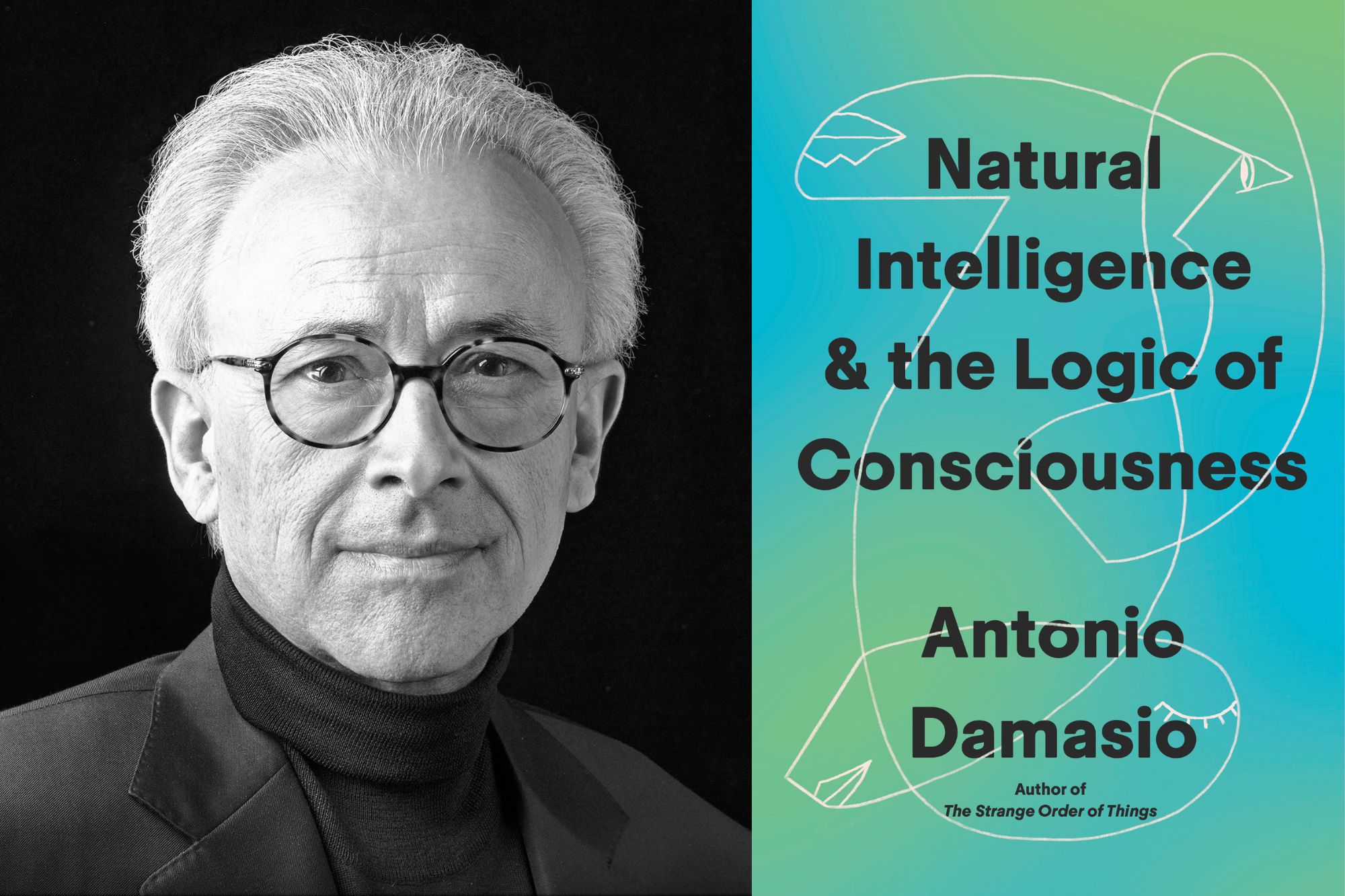
In his new book, “Natural Intelligence and the Logic of Consciousness,” pioneering neuroscientist Antonio Damasio synthesizes his decades of research in neurobiology and philosophy of mind into a central idea: we are conscious because we feel. “It is traditionally said that we are able to feel our feelings because we are conscious,” he writes, but instead, “we must be able to feel in order to become conscious.” We talk to Damasio about his lifetime of research into the mind and his thoughts on the possibility of conscious AI.
Guests:
- Antonio Damasio, psychology, philosophy and neurology professor and director of the Brain and Creativity Institute, University of Southern California; author, “Natural Intelligence and the Logic of Consciousness”
Episode Transcript
This is a computer-generated transcript. While our team has reviewed it, there may be errors.
Alexis Madrigal: Welcome to Forum. I’m Alexis Madrigal. There’s a lot of talk about consciousness these days. The better computers get at simulating people and doing cognitive work, the more us humans seem to be focusing on what might make us a little bit special, which is this subjective experience we have being conscious individuals.
But maybe consciousness is just about computation, some people argue. And if it is, doesn’t that mean that setting up a computer in the right way would make it conscious? They think consciousness is substrate independent, which is to say you could do it in silicon as easily as in cells and living beings.
What these accounts and questions lack is a grounding in the realities of our bodies. And it is in that flesh that Antonio Damasio’s theory of consciousness lives. We’re not conscious, he argues in a new book, because of our massive cerebral cortex, but because of the older nervous system networks of the body, which help keep us alive through the process of homeostasis. As he puts it in the book, consciousness is a welcome side effect of the indispensable process of regulating life.
This is a radical idea in the current study of consciousness, and it has some heavy implications on how far conscious experience extends throughout the evolutionary tree. It’s laid out in the book Natural Intelligence and the Logic of Consciousness. Of course, Antonio Damasio joins us this morning. He’s a professor of neuroscience, psychology, and philosophy at the University of Southern California, where he’s director of the Brain and Creativity Institute. Welcome, Antonio.
Antonio Damasio: My pleasure. Good to be here.
Alexis Madrigal: So let’s just start with, for our listeners, a little breathing exercise. Everyone out there can just, you know, inhale, feel your breath, feel your heart rate, feel the sort of your internal state. When we feel into that, Antonio, what are we actually feeling? Like, what’s happening?
Antonio Damasio: Well, we’re creating very good descriptions of the state of our interior. You know, we really live in a body which is made of living cells and tissues, and we are getting some kind of purchase on the state of our body, the state of our life at that given moment.
And it’s something that we normally leave aside. We don’t, except for people who practice meditation, by the way, I’m not one of them. But at any rate, people tend not to concentrate on what’s there before all the very interesting stuff that is happening in our day-to-day, the connections we have with places and with people and so forth. But it’s there, and it’s there in ways in which I tend to describe as feelings of existence and feelings of the life state.
The feelings of existence actually are very interesting because they have to do with breathing, with our heartbeat, with the temperature of our bodies, and we hardly ever concentrate on them unless something is going wrong.
Alexis Madrigal: It goes wrong.
Antonio Damasio: Yeah. So if you’re sick and you’ve got a fever, then you concentrate on that, but otherwise you don’t. And then you have all of these other feelings that I call homeostatic feelings, because they have to do with the regulation of life, which has this technical term, homeostasis.
And they include things such as hunger, thirst, well-being, malaise, pain. And these are all things that we feel, hopefully not pain, every day, but the others we feel them every day. Every day we can be in states that we describe as well-being, or states that would describe as not so good. Every day we have moments where you feel hunger, where you’ll feel thirst, and you also have that other big signal, which is pain, which is also a feeling.
So what is interesting is that when you think of all of these different processes, the processes that are telling you something very important about the state of life in your living organism, in your living body. And whether you have well-being and you feel like you’re the boss, or you’re worried about something going wrong, and you are actually concerned about the signals that come to you, we have feelings. We have things that are not just descriptions of the world around, but rather descriptions of how life is in your organism. That’s very important.
Alexis Madrigal: How do these signals, I think sometimes people call this interoception, rather than perception out there in the world — interoception’s on the inside — how do these signals get to our brains and how do we actually, how do we feel what we feel?
Antonio Damasio: Right. Well, something very interesting is that we have nerve terminals over our entire body. And this, let me just make a little parenthesis, which is very helpful, is that people very often think about what we’re talking about, feelings, consciousness, as something that has to do with the nervous system alone. And that’s not really correct.
Everything that has to do with our consciousness has to — with our feelings, yes, it has to do with our nervous system, but it has to do with our body. What we feel primarily is states of our body, states of our living organism.
And to talk about consciousness as if it were a province of the nervous system alone does not make much sense, because before we feel, for example, right now, I’m aware of the construction of the studio and the different objects in it, but at the same time I am feeling the state of my body. Am I feeling well or not so well? Am I hungry or thirsty? Do I have pain somewhere or not?
All of those signals are being projected at the same time, and a lot of them, as you realize, have to do with the body. They do not have to do with the so-called mind. It’s really a conjunction of mind and body. It’s the two things together.
Now, so when you feel something, you’re going to get a lot of signals that are coming from a distribution of nerve endings, literally all over your body. And of course, you would say, well, but haven’t I gotten also signals that are coming through my ears, because right now you’re hearing me, and of course you do. Haven’t I got signals that come through what I see? Of course you do.
But what is very important for people to realize is that, contrary to what our culture pushes us into, we’re not just about what we see and hear. We also are about what we feel in our bodies and what we feel. It’s very difficult to talk about feeling without talking about our bodies. That’s all critical.
Now, you will want to know, how does that come to be? How is that elaborate? What really is happening is that we have all of these nerve terminals that are distributed literally in every nook and cranny of our bodies. They are not just in our skin, but they are in the thick of our organisms. They are in our muscles, they are in our viscera. And they are constantly in operation and informing the central nervous system, which is another way of talking about the brain in the most large sense.
They are informing us of the state of life in the organism. And if that state is relatively harmonious, everything is functioning well. Guess what? You feel what we call traditionally well-being. And if you’re not feeling so well, if you are starting to get the flu or something like that, you feel what you call sick. You don’t feel so well. Or if you have something which is perfectly regular in your day, you feel thirsty or you feel hungry, you report that as well.
And in your mind, you have that sense. But that sense is not magic. That sense is coming from the nervous system describing into the central controls what is going on in your body. It’s not an invention. It’s something that is physiologically describable in great detail and literally has to do with this huge distribution of probes all over your body. Isn’t that marvelous?
Alexis Madrigal: It’s marvelous. We are talking with Antonio Damasio, professor of psychology, philosophy and neurology at USC. This is Forum. I’m Alexis Madrigal.
One of the things that I found myself fascinated by was thinking about the sort of the language of feelings, or the coarseness or refinement of those signals that are coming from our nervous systems. Um, do you think people can get better or worse at tuning into those, or do you think it’s just sort of, it just is? Like those signals are coming in and that is consciousness and we can’t really get better?
Antonio Damasio: I think we can get better, and I think the people that try very hard to get better and they use all sorts of techniques, for example, meditation is something that will help. Somebody — some people actually feel more of what’s going on in their organisms, in their lives.
But I think it varies a lot. The people that are very sensitive to these signals and respond easily, and people that are more sort of walled off from those signals. I think it just depends on your organization. I mean, we are all extremely similar, extremely comparable, because our organizations are fundamentally — they have the same architectural plan, but we’re also very different in the way, in the intensities of the lightness with which we take the signals that come from our bodies.
What is very important is to make this distinction, which people tend to ignore, is that there is a difference between what comes in from your body, from life in the moment, and what comes in through your eyes and ears and has to do with what is around you.
And I think that realizing that fundamental distinction is critical because our culture that normally pushes us into concentrating on what is on the outside. After all, that’s where we get our feeding. That’s where we get our work. That’s how we connect with others. But before we connect with others and before we know what to do in our professions, we have to live. We have to be alive.
And the governance of our lives is sort of conveniently pushed a little bit aside by all this marvelous world. No.
Alexis Madrigal: And, you know, perception is just straight-up easier to study, too, which we’ll talk about when we get back. Of course, we’re talking with Antonio Damasio, professor of psychology, philosophy, and neurology at USC. His new book is Natural Intelligence and the Logic of Consciousness. I’m Alexis Madrigal. Stay tuned.