SF Renters Face Buyout Offers and Evictions as AI Boom Sends Prices Soaring
Airdate: Wednesday, September 9, 2026 at 9am
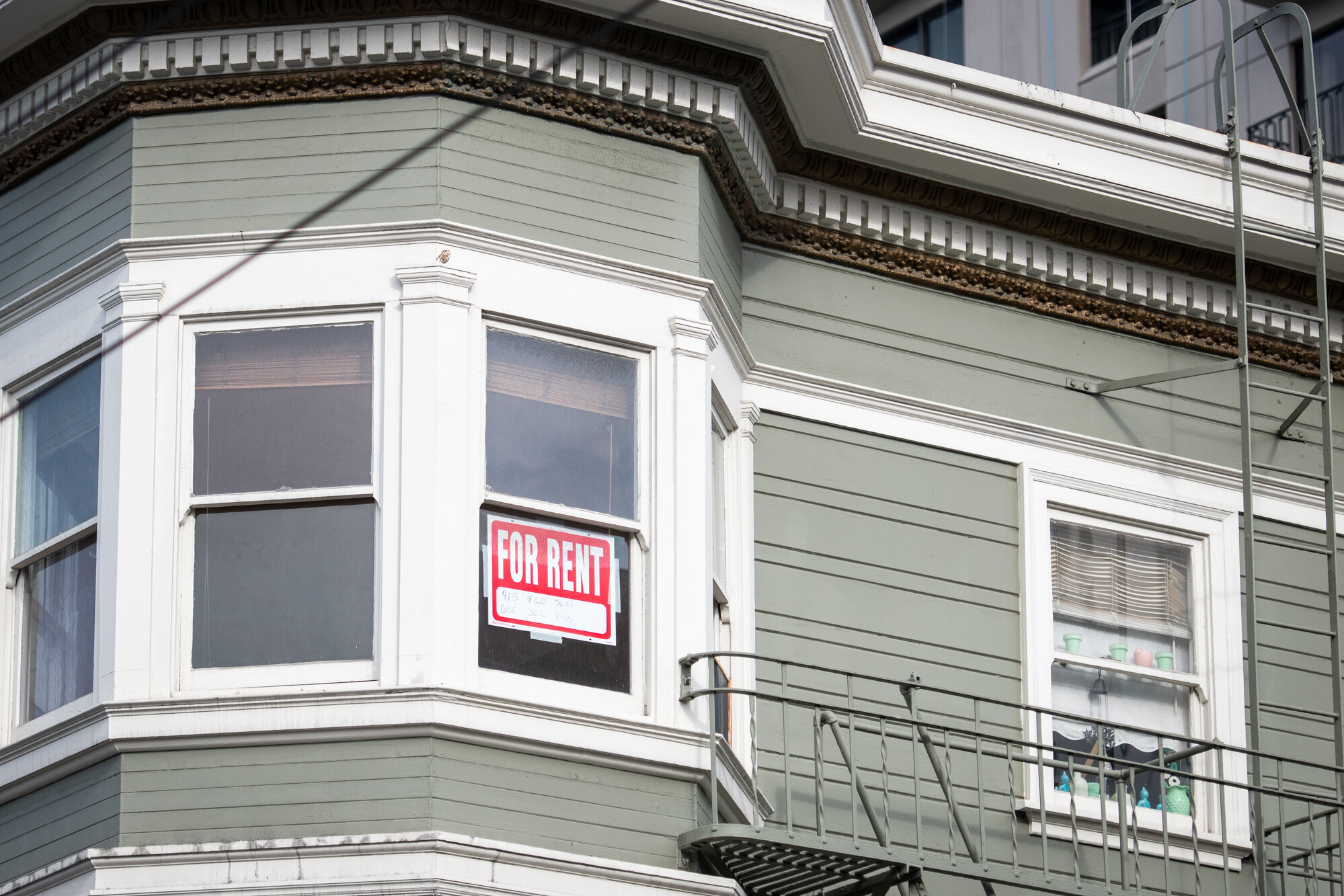
Rents are shooting through the roof in San Francisco as the AI boom creates yet another new class of wealthy people. The average rent for a two-bedroom apartment in the city is now $4,600, according to Apartment List, up more than 25% from last year. Some landlords are looking to cash in by clearing out tenants from rent-controlled homes, so renters say they’re being offered massive buyouts – some above six figures – to leave their apartments or else face no-fault eviction. We’ll talk about wild times in San Francisco’s rental market and how landlords, renters and those in search for a place to live are adjusting.
Guests:
- Kami Rieck, contributing writer New York Times, based in San Francisco
- Tuesday Thornton, organizer with the San Francisco Anti-Displacement Coalition, eviction defense lawyer and part of the tenants union
- Joshua Howard, executive vice president, California Apartment Association
- J.K. Dineen, Bay Area housing reporter, San Francisco Chronicle
Episode Transcript
This is a computer-generated transcript. While our team has reviewed it, there may be errors.
Alexis Madrigal: Welcome to Forum. I’m Alexis Madrigal. Stop me if you’ve heard this one before: rents are going up in San Francisco. Just a quick history of the subject. In San Francisco, rents have been going up for a long time, with some major exceptions, the busts that have followed various tech booms. Of course, it was the pandemic that actually sent rents down — actually down for a time — but they bounced back, and now they are exceeding the absolute and inflation-adjusted numbers of recent history.
We’re going to explore the dynamics of the rental market this morning. What’s the same as always? What might be different this time around? And we’re going to hear your stories of woe and triumph. Although mostly woe, I’m guessing.
Joining us first to set the stage, we’ve got J.K. Dineen, Bay Area housing reporter with the SF Chronicle, of course. Welcome, J.K.
J.K. Dineen: Thanks for having me.
Alexis Madrigal: Give us some numbers. Just put some meat on the bones here of how much have rents actually gone up. It seems extreme over the last year.
J.K. Dineen: So rents are up 26% year over year, about 42% in the last five years. It’s very uneven. There’s some parts of the city where rents were up closer to 40%. And there’s places where they never really went down that much, like neighborhoods like the Sunset and the Richmond and Noe Valley that sort of became magnets during COVID, where people were escaping downtown and no longer needed to be at the office.
And so, yeah, now you’ve got $4,000 for a one-bedroom. You’ve got, you know, $5,500, $6,000 for two bedrooms. It’s just ridiculous. You would have to make $150,000 to afford a one-bedroom. I mean, a sous chef in San Francisco makes 80. A teacher makes 80, a fully credentialed K-through-12 teacher. And so it’s just the numbers are frightening, frightening, yeah.
Alexis Madrigal: You’ve been around a long time. You’ve been reporting on this stuff for a long time. How do you compare the sort of current frenzy to previous times, like, you know, right before the pandemic?
J.K. Dineen: I think it’s been faster, and I also think it has been more skewed towards the upper end of the market. I talked to a broker last week who said that he does both apartments and for sale, sort of focusing on the downtown neighborhoods, and he was saying that now about 15% of these high-end apartments, the tenants are offering to pay a full year in advance.
He had one tenant at one of the Rincon Hill towers, the towers right at the base of the Bay Bridge. I think it was on the top floor or the second-highest floor. The landlord was asking $21,000, and the tenant paid a full year. So with first and last and security, the tenant put down over $250,000 for an apartment for a year.
Alexis Madrigal: I mean, I guess I want to ask: Is it the AI companies? Is that really what it is? That if you’re an AI person, you want to be in this city, you’re willing to pay kind of whatever it takes to be here?
J.K. Dineen: I think that’s right. I also think that the, you know, the nature of work has changed. People want more space. So before the pandemic, there was a real move towards small units and tighter workspaces, too, just in terms of offices. And people were averaging — tech companies were averaging 100 square feet per worker and people building studios, the new construction, largely 600-square-foot, 500-square-foot studios.
And now it’s sort of the opposite. The AI companies are averaging closer to 200 square feet per employee, and people want space. They want to work from home, they want all the bells and whistles and gyms and yoga rooms and all that, too. But, yeah, so there’s just been a real shift.
Alexis Madrigal: Another thing we should ask about, because it’s obviously part of this, too: It’s not as if San Francisco has been building a lot of units, in particular market-rate units. I mean, it has kind of collapsed since the pandemic.
J.K. Dineen: Yeah.
Alexis Madrigal: There’s —
J.K. Dineen: Been zero, basically, built. Some on Treasure Island, about a thousand units have been built on Treasure Island. 555 Bryant is one building that was built during the pandemic that’s been wildly successful. Besides that, really none. You’ve had maybe some 30-unit, 40-unit, like smaller buildings in the Mission.
And now we’re seeing, finally, that developers are dusting off their plans and filing their permits and actually starting construction. But, you know, these buildings won’t be ready until, you know, Trump’s out of office, right? I mean, it is two years from the time you break ground to when people are moving in, at least.
Alexis Madrigal: Yeah. And so we’re talking also just — the state had given the city of San Francisco a goal of over 10,000 units a year to build. And we’ve been falling far, far short of that. Is it just interest rates? Is that the kind of main answer there? Or was it just that people weren’t really willing to bet on San Francisco in that kind of wobbly early post-pandemic time?
J.K. Dineen: Yeah, it’s both. I mean, interest rates, operating expenses, everything went up 30% in terms of expenses, and construction costs went up 20%, 30%. And rents were flat for a long time or even down.
And some neighborhoods that actually did produce a lot of housing, like SoMa and Civic Center, that’s where rents are down the most. And so you saw, you know, in some cases, rents were down 30%. No longer is that the case.
Alexis Madrigal: Yeah, yeah, yeah. Well, I know people want to hear some of the Oakland side of this story. Last time J.K. was on, we talked a lot about that as well. Building of these one-bedroom apartments in Oakland seemed to be holding rents down there, at least for a time.
So you’ve got these buildings. We’ve got what we’ve basically got, the housing stock that we have. And so that has led to all of these strange things happening in the rental market.
Kami Rieck is a contributing writer for The New York Times based in San Francisco, who has written about the buyouts that are happening. Kami, welcome.
Kami Rieck: Thanks for having me.
Alexis Madrigal: So the thing that’s wild about these buyouts, at least this is how I understand what happens: There’s a landlord and there’s a renter, and the landlord wants to say, sell the building. So they go to the tenants and they say, okay, I can’t kick you out necessarily. So here’s X number of dollars to just leave so that I can do something with this building. Tell me some of those stories that you’ve heard. How much are people getting in these buyouts? What are these negotiations like? Like, what’s the deal?
Kami Rieck: Yeah, so since rents are rising, there’s a lot of landlords who might want to charge, especially tenants who have lived there for decades, who are covered by rent control. They may want to charge market-rate rent to a new tenant, or they might want to pursue a no-fault eviction through the Ellis Act if they want to take the entirety, all of the property’s units, off the market or, say, move into the building.
So, um, these landlords are allowed to offer tenants a buyout. And I think the most that I saw, the people that I talked to, they accepted $100,000 to move out of their five-bedroom. This was split among five different people.
The landlord I talked to, he always knew that he wanted to sell his luxury building in Nob Hill, and the market has never been more competitive right now. And in these instances, I think the attorneys that represent tenants have said that tenants actually have a lot of leverage here.
For this instance, the landlord acknowledged that he wouldn’t be able to sell the building if it was occupied. And it would be —
Alexis Madrigal: Certainly not.
Kami Rieck: It wouldn’t be as valuable. And even if he were to go through the no-fault eviction, that could take up to a year. That’s time that’s not on the rental market. He can’t do the renovations that he wanted. So he was incentivized to buy out these people.
I think after talking to them, it was in the middle of the summer. The rents are astronomical. They would have preferred to stay in their current apartment, but they also know that, okay, my landlord can also pursue a no-fault eviction, which would only require my landlord to pay me the minimum payment required by law. So do I take this risk of being left with that minimum relocation payment?
Alexis Madrigal: I mean, it’s also — it’s so interesting because, of course, $100,000 sounds like a lot, but in the San Francisco home purchase market, it ends up being a point whatever, right? It’s point one. So, you know, eventually the building that you’re describing listed for seven point something?
Kami Rieck: Seven point 25 million.
Alexis Madrigal: Yeah, so there you go. I mean, he now — so he didn’t list it for 7.15. He’s listed for 7.25 and made his money back. I mean, that’s a really interesting scenario.
I mean, J.K., do you remember seeing buyouts like this at any other time?
J.K. Dineen: I think this is precedent-setting. There’s certainly buyouts that you heard about during the — we call it the app boom or the Twitter boom in 2015-16. But I don’t remember seeing much over like 80 grand, maybe 100. But now you’re seeing a lot higher than that.
Alexis Madrigal: I mean, one of the people in your story, Kami, that had to admire the gumption — I think their landlord offered a few $10,000, and they countered with $600,000 or something crazy.
Kami Rieck: Yeah, he is actually facing eviction, and he’s lived in the apartment for about 40 years and has been protected by rent control, so was paying way below market. And, you know, like you said, these buyouts seem like so much, but an attorney that represents tenants was telling me that with today’s competitive prices and demand for housing, the costs that it would take to move to even find a comparable place in the Bay — like, pay for lawyers, potentially moving costs — that really eats in very quickly to the buyout payment.
And the $600,000 was what I think this tenant calculated the potential rent difference in today’s market by 20 years, how long he expects to live.
Alexis Madrigal: Yeah, man.
We’re talking about the San Francisco rental market. What’s happening with it? What are the dynamics driving it? How’s it working similarly to previous booms and also a little bit different as well?
We’re joined by Kami Rieck, who is a contributing writer with The New York Times based in San Francisco. We’ve also got the Chronicle‘s J.K. Dineen, of course, who covers housing for the Chronicle.
We’re going to talk with an eviction defense lawyer and someone from the California Apartment Association after the break. And, of course, we also want to hear from you. Are you looking to rent in San Francisco right now? So sorry. How’s the search been for you? What have you noticed? Maybe you’re a current tenant. Are you worried about eviction? Maybe you are a landlord and you’re trying to manage these dynamics right now as well.
Give us a call: 866-733-6786. That’s 866-733-6786. You can email [email protected], or you can find us on social media — BlueSky, Instagram, Discord, or KQED Forum. I’m Alexis Madrigal. Stay tuned for more.