Why Schools are Changing Their Tune on Screens
Airdate: Tuesday, September 8, 2026 at 10am
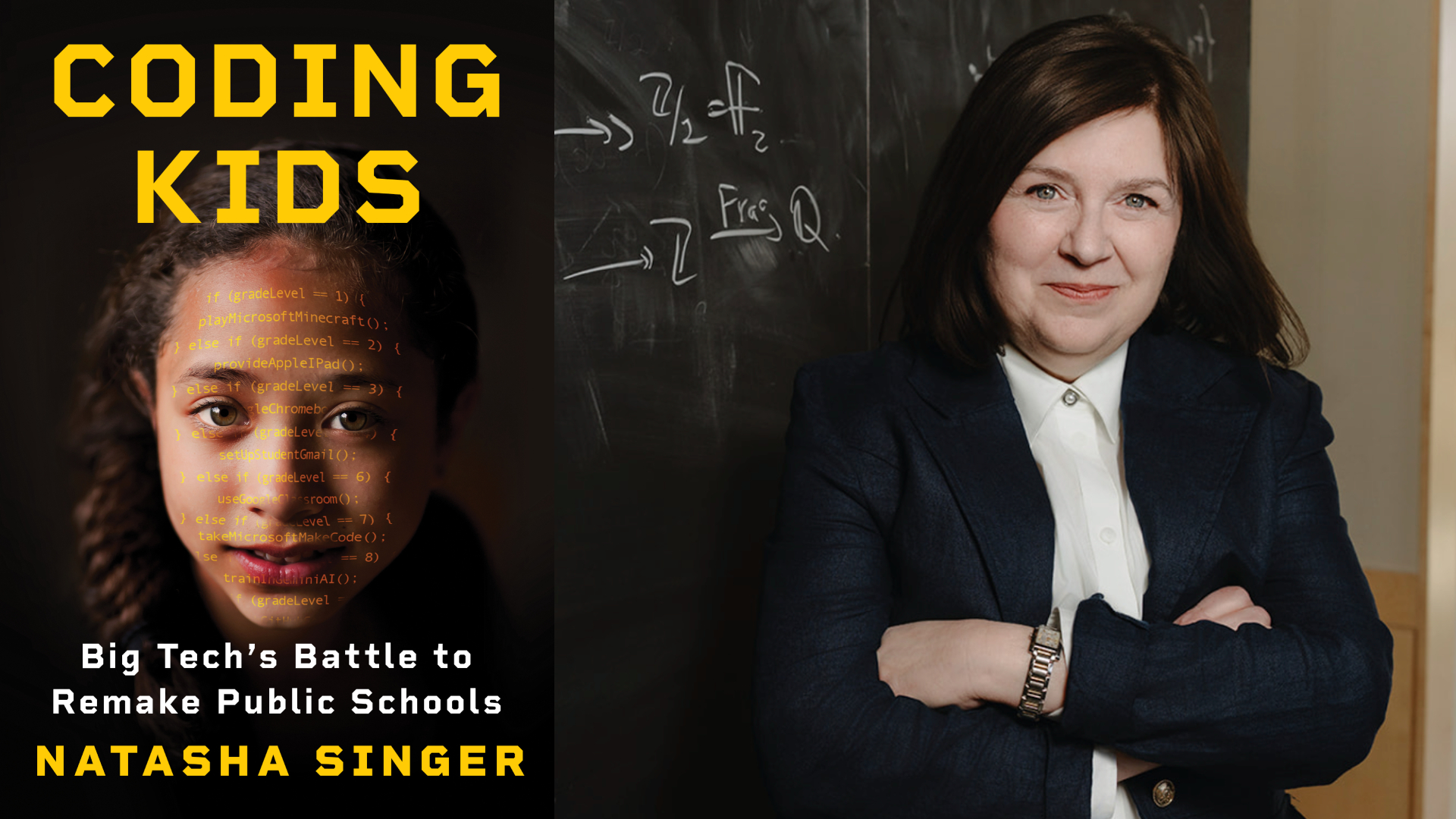
Los Angeles students began this school year with new limits on screen time, both in-school and for homework. It’s a trend starting to appear statewide, with even parents in Silicon Valley fighting for similar restrictions on laptops and tablets – especially in younger grades. This comes a year into the statewide ban on cell phones in classrooms, and as teachers across California are evaluating the broader role of technology and generative AI in the classroom. New York Times reporter Natasha Singer interviewed parents, educators and students across California. She joins us to talk about what’s inspiring the movement and how the tech industry came to have such an outsized presence in the classroom. Her new book is “Coding Kids: Big Tech’s Battle to Remake Public Schools.”
Guests:
- Natasha Singer, reporter covering technology in schools, The New York Times; author, “Coding Kids: Big Tech’s Battle to Remake Public Schools”
Episode Transcript
This is a computer-generated transcript. While our team has reviewed it, there may be errors.
Mina Kim: Welcome to Forum. I’m Mina Kim. Los Angeles Unified, the nation’s second-largest school district, has adopted a moratorium on student use of generative AI. This comes as LA students were already beginning the school year with new limits on screen time, and as New York City schools ban the use of AI tools in preschool through eighth grade.
The Times’ Natasha Singer has been following the shift away from initial enthusiasm for tech in classrooms. She has looked at how the tech industry came to have an outsized presence to begin with in a new book called Coding Kids: Big Tech’s Battle to Remake Public Schools. Natasha, welcome to Forum.
Natasha Singer: Thanks so much for having me. Really glad to have you.
Mina Kim: First, tell us about these changes that have been happening in Los Angeles at LAUSD. It’s really incredible.
Natasha Singer: I’ve been covering tech in schools for the New York Times for more than a decade, and we’ve never seen this kind of parent pushback against school tech happening across the country. And LAUSD is one of the places where it began. Parents got concerned about tech, and they pushed the school district to act.
And we saw this spring that the school board in Los Angeles voted to eliminate devices like iPads and Chromebooks for pre-K, kindergarten, and first grade. They’re cutting back on the amount of time that elementary and middle school students can spend on devices, with, like, you know, a number of minutes-per-day guidelines.
They have barred things like YouTube. They have also said students can no longer use their school-issued devices during lunch or recess for entertainment purposes.
And so we’re really seeing a move away from, you can use your device all the time, or, you know, we’re in elementary school and we’re going to be doing lots of stuff on an iPad, including, like, reading apps, math apps, research, to there are going to be specific times when kids can use specific tools, especially in elementary, and that they’re moving toward a more, you know, human-centered education as opposed to device-centered classrooms.
Mina Kim: And then we just heard last week about this announcement of a moratorium on generative AI use for LAUSD students, which sounds pretty momentous. So…
Natasha Singer: It’s not really clear yet what LAUSD is doing because it came out in a meeting in which LAUSD employees were describing that they had turned off student access to AI tools and features. So we know that they’ve turned off this access for students. We don’t have a lot of concrete details about what it means and how long it’s going to be in place.
But the parents who had pushed for restrictions on school tech then came back with a petition. More than 1,000 parents signed to ask the district to restrict AI or to actually put a moratorium on AI. And so we see that parents are having enormous power in some major school districts to say, like, tech has had runaway power in schools, and parents now want more control.
Mina Kim: What have been these parents’ main concerns about these school-issued devices?
Natasha Singer: Well, I think one of the things is, you know, it’s helpful to look at the progression of what happened. That first, parents were concerned about social media in schools, and so were teachers and administrators. They were a distraction.
Parents across the country were concerned about cell phones in schools. And we’ve seen dozens of states pass new laws or put in new policies to either bar student cell phone use during school or to restrict it during class.
And so, having cracked down on social media and phones in school, I think parents woke up and said, wow, actually the Chromebook or the iPad is just a big phone. And all the things we were worried that kids were doing on their phones, like accessing social media or playing games or bullying each other or watching YouTube videos, they’re doing on their school devices.
So I think that was one of the issues. And then another issue is there are some math and reading apps that parents find very problematic. They’re gamified. They have noises, they have points. Kids have to push all these buttons and click things before they actually get to a math problem.
And parents feel like there isn’t enough evidence for schools to be paying millions of dollars for these apps, and that if schools are going to use these apps, they want schools to produce evidence that these math and reading apps actually benefit student learning.
Mina Kim: And it sounds like LAUSD’s fiasco with a chatbot a couple of years ago helped lead to that conclusion and question around how well, you know, tech tools are vetted. Can you remind us what happened with that?
Natasha Singer: Yes, and also I think it’s a really important example because we go through these cycles of hype in schools where companies and school leaders are like, look, we’ve got this amazing new technology, it’s going to transform education, it’ll help kids, and there’s this huge fanfare — and then it doesn’t.
And so what happened was, in 2024, LAUSD introduced a chatbot called Ed, and it was made by a startup that basically nobody had heard of. I think the contract amount was more than $6 million.
And the Ed chatbot was supposed to be able to help students and show them their assignments and help parents see where their kids were and suggest specific extra assignments or tools that would help kids thrive.
And there was a huge press conference in which the school superintendent said it was going to revolutionize education, and it had all kinds of problems with the mechanism about how it worked.
Then the Justice Department came in and charged the founder of the startup, which was called All Here, with embezzlement and defrauding investors.
And then, so that was, like, 2024. And then in 2026, earlier this year, the FBI raided the home and the office of the LAUSD superintendent, and it was connected to this chatbot that the school district was rolling out.
And so parents then got up in arms that this thing that was untested, and the startup nobody had heard of, got this contract in the second-largest U.S. school district.
Mina Kim: Yeah. What has LAUSD said about this, about how they evaluate the quality of, you know, technology, who to enter into contracts with, and whether or not these tools have intended, you know, educational results or value?
Natasha Singer: So two things have happened. First of all, the school district has said that they have rigorous processes for evaluating educational digital technologies.
And second of all, as part of their push for more controlled use of tech in schools, this parent group called Schools Beyond Screens, which was the catalyst for all this in LAUSD, asked the school district for an audit. They wanted the district to audit recent tech contracts, both for spending and also for efficacy and student privacy and security.
And the school board passed a resolution, you know, among other things, restricting student access to tech, but also saying, yeah, actually we do need an audit of all the digital tools we’re using and to see evidence of benefit to kids’ learning.
Mina Kim: And do you think, based on your reporting, that public schools have the resource and knowledge to adequately vet classroom tech?
Natasha Singer: Different school districts have different resources, and some school districts have very experienced, very cautious and meticulous school tech directors. And some school districts are small and the tech director has six other jobs.
And so we saw Denver Public Schools do an audit, and they found that there were more than a thousand different apps and software programs being used in the district, and they cut it back to a couple hundred.
And, you know, it’s really a really interesting process in Denver, where they now feel like there are certain apps, like math apps, that teachers can use, and a whole bunch of stuff that doesn’t have evidence that teachers cannot use with students.
And then we saw a report from the controller in New York saying that New York City Department of Education did not have a good grasp of the kinds of digital tools and apps that local schools were using in New York City schools. So it varies.
Mina Kim: So obviously what’s happening in Los Angeles is happening elsewhere, and these LA parents are probably not alone in their complaints about the tools that are being used in the classroom. Can you just give me a sense of just how broad these concerns are across the country?
Natasha Singer: I think it’s hard to pinpoint because the parents who are concerned and are raising their voices are getting a lot of media attention.
So we know that there are some places, like right outside of Philadelphia, New York City, Fairfax, Virginia, D.C., Los Angeles, some parts of Oregon, where they’re really active parent groups.
But Schools Beyond Screens, the Los Angeles parent group, has really started a movement across the country, and we see that they have had hundreds of districts where their parents start spin-off groups. I think they told me it was in more than 40 states.
There’s also other groups. There’s one called Fair Play that has been a child advocacy group for years, looking at the risks of digital tools and social media. And there’s another group, you know, Smartphone Free Schools, that also has groups across the country.
And so, like, I visited Kansas this year. And there are a whole bunch of active parents in Wichita, and also I went to a town called McPherson who have concerns, and we’re seeing also schools in Kansas pull back. We see concerns in Florida.
So I would say it’s a nationwide phenomenon, but I can’t tell you — we have more than 13,000 school districts in the U.S. I can tell you right now how many school districts have active parent groups pushing their schools to use more intentional approaches to…
Mina Kim: Yeah, we’ve seen reporting, too, that here in Silicon Valley, where a lot of the tools in schools have been developed, parents are also sounding alarms about the school-issued devices.
I want to invite listeners into the conversation. Listeners, what tech do you see students using in the classroom, and does it worry you? Would you like to see restrictions? Or maybe you have concerns these restrictions will not be good for students.
Are you a teacher or student? What impacts have you seen in tech like screens or AI have in the classroom, and what questions do you have about the role of the tech industry in public schools?
We’re talking all about this with Natasha Singer, a New York Times reporter covering tech and schools and author of the new book Coding Kids: Big Tech’s Battle to Remake Public Schools. And you can join us at 866-733-6786, at the email address [email protected], and you can find us on Discord, Bluesky, Facebook or Instagram. We’re at KQED Forum.
So, Natasha, even though, you know, it’s not entirely clear, because as you say, there are a lot of parent groups, local parent groups that are getting a lot of attention right now, how widespread this is across the country, you have said that we are at sort of a national reckoning when it comes to tech in classrooms. Are you seeing us at an inflection point?
Natasha Singer: I think we’re definitely at an extraordinary moment that’s an inflection point. And I think the larger context is we’re seeing consumers and communities across the country feel like big tech has runaway power, and they have steered us in some directions, like social media, that many people feel now did more harm and caused more discord than good.
And so we’re seeing communities rise up against big data centers being built to fuel AI. We’re seeing people push back against locked surveillance cameras. We’re seeing people push back against Meta’s glasses that have cameras in them that people are calling surveillance glasses or spy glasses.
And so I think, in the context of this, the pushback against tech in schools isn’t just about the classroom. It’s about parents feeling they want more…
Mina Kim: More after the break. I’m Mina Kim.