The Long Reach of the “Marinaissance”
Airdate: Monday, August 31, 2026 at 9 AM
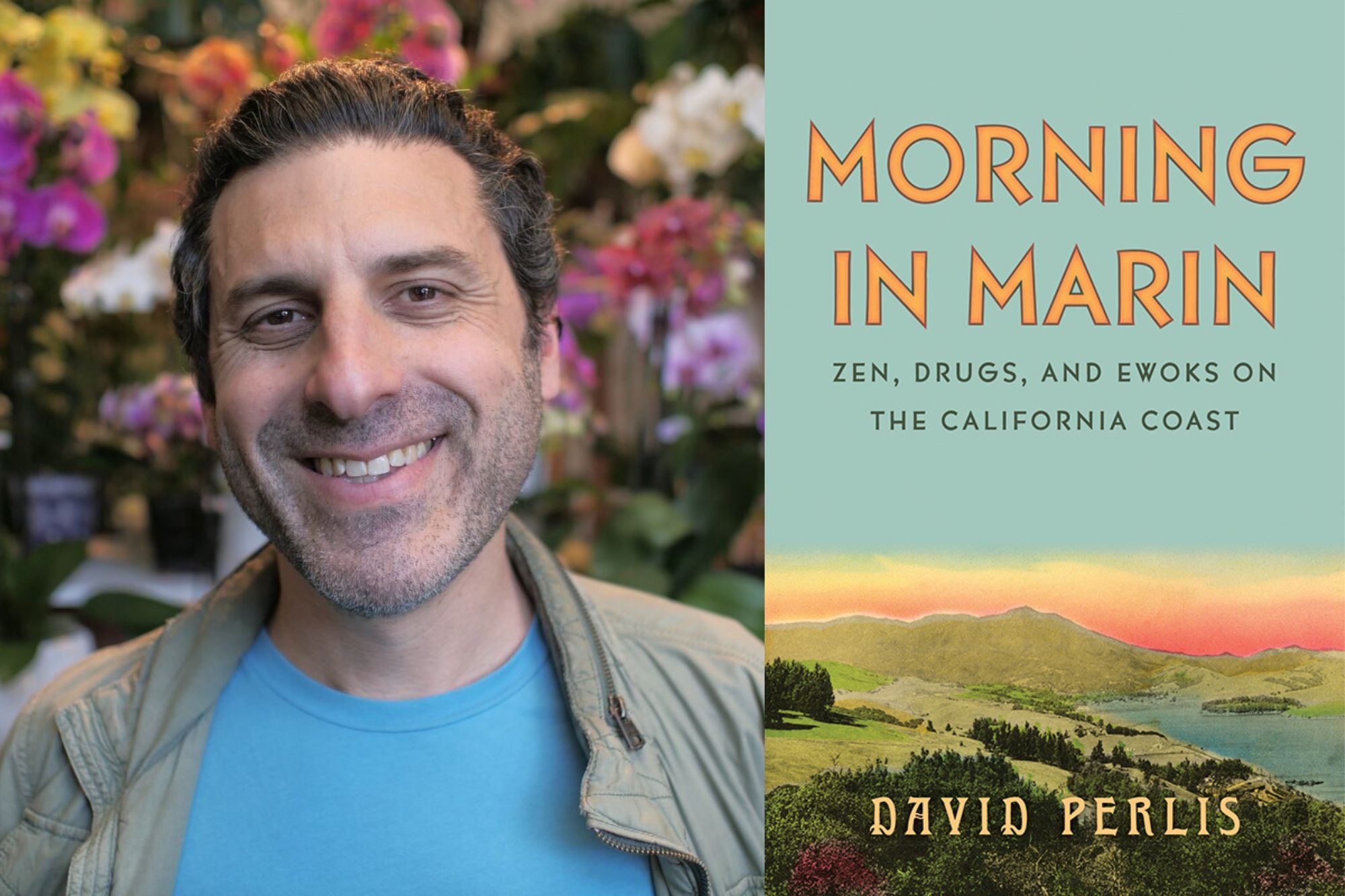
Growing up in San Rafael in the 80’s and 90’s, writer David Perlis sensed that he had just missed something incredible. “I wanted to know what happened here before I was born,” he writes. That kicked off a quest to uncover Marin County’s “seismic cultural awakening” throughout the midcentury that he chronicles in his new book “Morning in Marin: Zen, Drugs, and Ewoks on the California Coast.” Perlis argues that what emerged from “the Marinaissance” was adopted by popular culture across America — yet its influence has been overlooked. We talk to Perlis about the long reach of Marin’s cultural influence and the legendary artists and thought leaders who found refuge there, including Alan Watts, Robin Williams, Anna Halprin, George Lucas and many more.
Guest:
- David Perlis, writer, musician, filmmaker and author, “Morning in Marin: Zen, Drugs, and Ewoks on the California Coast”
Episode Transcript
This is a computer-generated transcript. While our team has reviewed it, there may be errors.
Alexis Madrigal: Welcome to Forum. I’m Alexis Madrigal. To hear David Perlis tell it in his new book, Morning in Marin: Zen, Drugs, and Ewoks on the California Coast, the Marin thing really begins when some people started to party on an old ferry, emceed by Yonko Varda, down at the waterfront in Sausalito. And next thing you knew, Marin was a crucial artistic center known around the world.
How? Why? Quote, “Because of the fault and the mountain, the moon and the tides, because for so long there were no bridges and then there were,” Perlis writes. “Because of the radio and small presses and breathtaking risk, Marin was the future. Maybe, too, because Eastern art, poetry and philosophy in many different guises began to diffuse into America from this place. For Pacific exchanges, what I learned can be summed up like this: Oakland was the port, but Marin was portal.”
Perlis calls this time period, from about 1950-ish to 1980-ish, the Marinessance — a seismic cultural awakening encompassing literature, music, dance, painting, philosophy, religion, architecture and film. If that sounds grand, let me assure you that it might even undersell what happened in Marin right under the noses of the rich and mostly conservative people who lived up there.
And we have Perlis here with us in the studio. Welcome, David.
David Perlis: Thanks, Alexis. Thanks for having me on the show.
Alexis Madrigal: So what’s your connection to Marin? What made you want to do this book?
David Perlis: Well, I grew up in suburban Spielberg in San Rafael, very much a “kids on bikes” neighborhood where an alien might land in your backyard, although unfortunately no alien ever did. I never got to bond in that way.
And the short answer is because I had to, because there was a magic I sensed in the air in suburban San Rafael and the hills of Mill Valley, driving by the houseboats, Waldo Point, and looking out the window as a kid and saying, “What are those, and how long have they been there, and who made them?”
It was a magic that called to me over the years until I was old enough to understand what it was asking. And that was to solve the mystery and to find the source of the magic.
And I looked around for a book that would explain that to me, and I found the answers scattered across hundreds, if not thousands, of books. And it felt important to put them all in one place. And I think maybe that’s what Marin was calling on me to do — put it all in one place, and so that other people could experience it and to solve the mystery and to find out that, in fact, yes, there was a divergent, distinctive awakening that took place in my hometown of Marin County.
Alexis Madrigal: Do you think that one reason there hasn’t been this sort of regional explanation is that people who are, say, exploring the growth of nature writing and poetry in America in the mid-century are like, okay, it’s like Gary Snyder and it’s the Bolinas poets, or people who were approaching George Lucas in film are like — they go down that route. And what taking this regional approach allows you to do is to sort of draw all the connections individual disciplines don’t do.
David Perlis: Absolutely. There are many wonderful books written about the Grateful Dead. There are many books written by George Lucas and Industrial Light & Magic and Star Wars. But what they don’t have is the context to connect Philip K. Dick and Alan Watts and George Lucas and the Halprin family, Lawrence and Anna Halprin and Daria — to see that they were all part of the same awakening and that there were some common beliefs and values that underlie their work, which were shared and intrinsically tied to the landscape of Marin County.
Alexis Madrigal: Yeah. What do you think were the values that informed the Marinessance?
David Perlis: Well, when we talk about the Marinessance, we are talking about almost a half century. And in some ways, maybe it’s still going. I do think that the embers still glow.
But — so we have to think about the beliefs and values as changing over that period of time, and the way that they were interpreted throughout the movement. But there are three that I think really consistently informed the movement from the beginning to the end.
One would be an embrace of Eastern philosophy and mysticism. And we have to see this in the context of World War II, because the artists who were embracing this were actually rebelling. They were rejecting the old world and they were embracing this Eastern mysticism and philosophy.
There was a long streak of anti-Asian racism in California going back to when the Chinese came over to build the railroad. And so these people embracing Buddhism, embracing Taoism, was an absolute rebellion.
I’d say a second core principle would be the idea of self-sufficiency. Yes, as advocated for by the transcendentalists like Emerson and Thoreau, but more so and especially as practiced by Indigenous cultures of the Americas, especially the Coast Miwok of Marin County, because they exhibited a certain self-sufficiency in making their own clothes, their own shelters, growing their own food and having a deep respect for nature and seeing their resources as not bottomless.
Whereas the old world had this attitude often that Indigenous cultures were somehow inferior, primitive, savage, the Marinessance was one of the first movements in America to see these cultures as equal to, if not superior to, the cultures, the so-called civilized cultures of the old world.
And I would say the third core principle that lasted throughout was this idea of human potential, which took the form of experimentation, which is where the drugs of the subtitle come in.
And these drugs go back to the early Marinessance. Speed was huge, because think of the productivity that can be achieved while on speed. The instant enlightenment of acid.
And then I would also say experimentation, but also, as you mentioned earlier, risk-taking — human potential. Putting it all on the line.
I think too often these days artists do not put it all on the line in the name of achieving purity of artistic vision. These people risked their homes, they risked their livelihoods, they risked their sanity to achieve purity of artistic vision, which is really the truest and purest form of creation.
Alexis Madrigal: We’re talking with David Perlis about his book, Morning in Marin: Zen, Drugs, and Ewoks on the California Coast. Listen, we want to hear from you. You’re hearing David’s theory about how Marin came to be the cultural center that it is. What do you think? What is it about Marin that has generated such tremendous creativity over these decades?
The number is 866-733-6786. That’s 866-733-6786. You can email [email protected]. You can find us on social media, BlueSky, Instagram, Discord or @KQEDForum.
I sent out a note about the Marinessance in this book to my newsletter subscribers. Got a ton of people writing in, stories like this, for example.
Tom wrote in to say, “I was in the Navy from ’66 to ’70. Sometime during one of our import periods, a few of us decided to go to a concert, which was being held on Mount Tam. We drove over, parked, and then started the trek up to concert. As you can imagine, our haircut left no doubt that we were in the service. A few insults here and there as we walked up the road, and then this big convertible pulls up and asks us if we wanted a ride up. Came to find out he was a local disc jockey and was an emcee at the concert. We got in, got great access, and had a wonderful time. Just one of the smaller stories of the Marinessance there.”
Why don’t we go to where you begin the book? So, you know, if you tell someone Eastern philosophy, self-sufficiency, interest in Indigenous — they might be like, “Flash, Gary Snyder.” But you have a bunch of other figures who were also crucial, even if they became not necessarily international or globally famous. Tell us about Elsa Gidlow and Violet Tommy, Henry Anderson.
David Perlis: Yeah, I would love to talk about Elsa Gidlow. The book does start with her for several reasons. And one is, basically, that she was one of the first artists to permanently reside there who held those core beliefs and values in Marin County, and she faced quite a lot of adversity.
Elsa, for those of you who don’t know, was a poet and a radical feminist who was a co-founder of an intentional community called Druid Heights, on Mount Tamalpais. But before that, she came to the town of Fairfax, which was largely summer homes and things of that nature, and she established herself there.
She is known for writing one of the first openly gay poetry volumes, called On a Grey Thread. And she faced some persecution in Fairfax, which I thought was an interesting way to begin the story because while you did have an incredible artistic awakening in Marin County, some of Marin County’s mainstream Marin County was very conservative and resisted that.
And she was actually scrutinized by the Tenney Committee for Un-American Activities because her neighbors didn’t like that she was hanging out with Chinese people, didn’t like that she was living with a woman. And though her name was ultimately cleared, it was more than enough for her to decide to go live up on top of the mountain and get out of Fairfax at that time.
Alexis Madrigal: I mean, I feel like these people are all part of sort of the committee to promote anti-American activity. It’s kind of like the whole point of the thing, you know?
You know, it’s interesting, too, because you note the kind of Sausalito boat life, too. That’s another one. I mean, Yonko Varda comes across in this book as deadbeat, libertine, bohemian, but also absolute heartbeat or soul of this early movement.
David Perlis: Yeah. I don’t like to use the word hippie because I think it can be perceived as a little derogatory to just the young people who are doing their own thing, you know. But Yonko was probably the first hippie, and long before — in 1949, 1950, way before the Summer of Love — Yonko was showing people how to dress the way they felt inside and to behave the way they felt inside and give permission.
He was an authentic European bohemian in Sausalito. And, you know, you drive by Waldo Point now and all the houseboats are lined up in these neat little rows. But you have to think back to the 1950s. It was a jumble out there, you know. There were planks and gangways, and this is how people were getting across the boats, and they were flushing their sewage into the water and the tides weren’t quite carrying it out. So it might have smelled a little bit.
It was a wild and woolly place out there with Varda, who also held these wonderful parties. There were many kind of nexuses of the Marinessance, including Druid Heights, including the ferryboat Vallejo, where Yonko Varda lived, that really brought people to Marin and brought the great minds of the Marinessance together to share and exchange ideas.
Alexis Madrigal: I do love when Anne Halprin says, “All of us went to Varda’s barge all the time for wild parties. It wasn’t the drug period at all. It was just going to a party with your friends and having a good time.”
David Perlis: Awesome!
Alexis Madrigal: Listen, we’re talking with David Perlis about his new book, Morning in Marin: Zen, Drugs, and Ewoks on the California Coast. Maybe you’ve got a Marinessance story to share with us. You can give us a call, 866-733-6786. Were you there? I bet you were. [email protected].
I’m Alexis Madrigal. Stay tuned.