Historian Jill Lepore Warns Against Letting Robots Take Over Our Democracy
Airdate: Wednesday, August 26, 2026 at 9 am
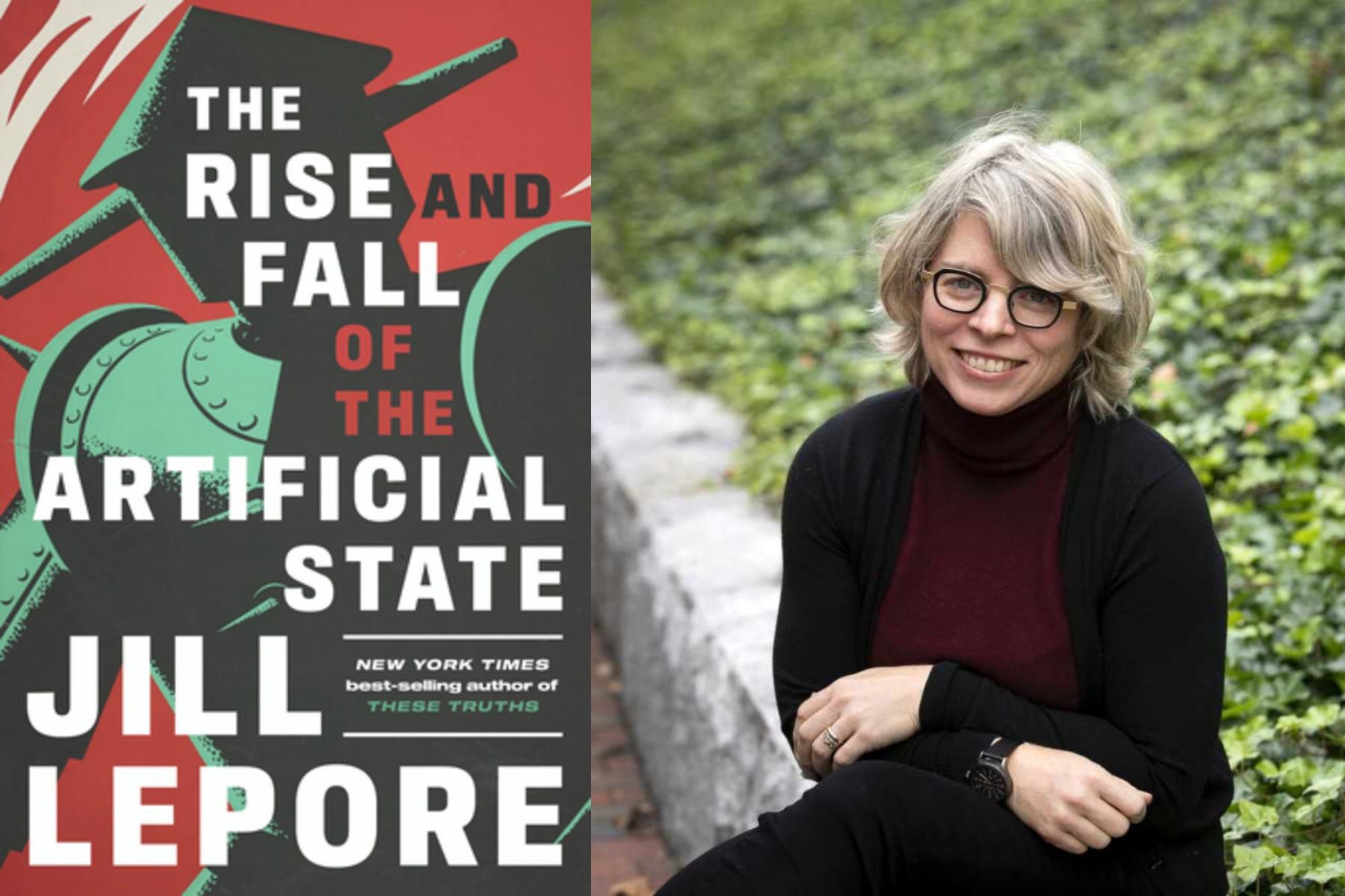
In her new book, “The Rise and Fall of the Artificial State,” Harvard historian and New Yorker writer Jill Lepore issues a warning that in our desire for more efficient, data-driven governance we’re falling into “the rule of humans by machines manufactured by corporations.” Her book is an alarming call to action and, she writes, an “inquiry into what humans mean and intend in abandoning constitutional democracy, the liberal nation-state and even humanity itself for rule by automation, government by machine and replacement by artificial intelligence.”
Guest:
- Jill Lepore, professor of American history, Harvard University; staff writer, The New Yorker; author, “The Rise and Fall of the Artificial State”
Episode Transcript
This is a computer-generated transcript. While our team has reviewed it, there may be errors.
Alexis Madrigal: Welcome to Forum. I’m Alexis Madrigal. When you stop to think about it, the idea — as much an assumption as anything else — that if we develop superintelligent machines, they will immediately turn on humanity and try to kill us is so strange. Why wouldn’t these superintelligences just go off on their own and leave us be, as they do in, for instance, Ursula K. Le Guin’s Always Coming Home? Or maybe they’d like humans. Seems possible, at least.
But that is not the orthodox view within many Silicon Valley circles, where the human extinction risk from superintelligence is solid cocktail-party conversation. And one way to read Jill Lepore’s new book, The Rise and Fall of the Artificial State, is as an X-ray machine for the strange set of beliefs that have accompanied the rise of the genuinely astonishing success of recent machine-learning techniques.
If you’ve ever wanted an intellectual history of this very powerful and very unusual fantasy about humans, the Earth and our world governments, this is the book. And we have its author, Harvard historian Jill Lepore, with us this morning. Welcome.
Jill Lepore: Hey, thanks so much for having me.
Alexis Madrigal: So in this book, you approach AI, Silicon Valley, from a bunch of different very clever angles, and you bring your own expertise from American history to bear on the topic. But let’s just start with the basics here. What do you mean by the artificial state?
Jill Lepore: So we live in the United States in a liberal democratic nation-state, a constitutional democracy. This is historically a novelty. We are celebrating this year the 250th anniversary of the founding of the United States — the world’s first modern democracy, right? So 250 years is a long time in human lifetime, but it’s really not long in the history of humanity. So we shouldn’t really particularly expect the liberal nation-state to live forever, to endure forever.
So what I wanted to do in this book is give a name to what I think is emerging and challenging the liberal nation-state. So the artificial state is, in lieu of government by consent, government by machines, where — and it’s not something that has been built. Its construction is underway. Much of it happened by accident, and a lot of it is a fantasy, but in which increasingly we have surrendered more and more of our obligations, the exercise of our obligations as citizens, to machines and sort of outsourced things that we are supposed to be doing face-to-face with other human beings.
You know, democracy requires participation, representation and deliberation. I’m not sure people are really doing those things anymore. There are tools that have been given to us that can do some of those things for us, or we believe are doing those things for us. But in fact, we’re, I think, yielding our own sovereignty to machines owned by corporations that have very different interests than governments do.
Alexis Madrigal: Yeah, I guess that’s the first question. How did we lose this agency? Did we give away the consent somehow, or did it get taken away from us?
Jill Lepore: I don’t know, maybe it’s a little bit of both. I mean, it depends on what you’re looking at.
I mean, obviously, states use machines all the time for the running of governments, right? Like, our census is tabulated by computer and has been since the 1950 census, which was the first tabulated on a mainframe computer. We have had Social Security numbers since 1935, and those were used largely to provide benefits of the social welfare state to people.
There’s a lot of data that governments have — state, municipal, national governments — about people, and the machines that organize that data can be used for good purposes, and they can be used for malign purposes.
It’s not really the machines that are the problem. I think it really isn’t that this is coming from government. It is coming from tools that are available commercially and are sold to us commercially, but that have gradually replaced the functions of citizenship.
So if you think about the degree to which social media is really largely responsible for the decline of local news coverage and really the crisis of journalism, and therefore the kind of what people call the epistemological crisis — like, no one knows what’s true anymore — there’s an incredible rise of conspiratorial thinking, and there’s not kind of an agreed-upon national anything that really is from social media.
Is that what social media was designed to do? Although when it started doing it, like when Facebook News — when Facebook released Facebook News and it saw the effects Facebook News was having on local journalism, I think Facebook was actually pleased about that rather than regretting it.
So have we given those things up? I mean, social media is probably the easiest way for people to see whether they have or have not surrendered or abandoned or failed to meet the obligations of citizens to stay well-informed and make good decisions, make informed choices as voters.
Social media is not helping you make better decisions. And this is the first election where people are actually using AI to make decisions. So this is a lot of anecdotal reporting about people saying, “Here are the issues I care about. Who should I vote for?” Which doesn’t seem like an irrational thing to do.
Nor does checking social media to find out what the news of the day is seem like quick, efficient, fast, easy and seemingly to you cheap. I mean, the costs are hidden from you. But then when you think about what it’s supplanting, that’s the piece that I think most people find hard to do.
Like, all right, well, you’re going to ask ChatGPT. That’s different than what about having a dinner party, talking to a bunch of your friends? Let’s actually try to work this out. Like, “Oh, I’m gonna go for a walk with my cousin and see how she’s thinking about this election,” or, “I was just talking to my neighbor over the fence. Like, I don’t know, he seems to want to vote for this guy, but I was trying to convince him to vote for that guy.”
All those kind of daily interactions that are full of friction, that’s nevertheless the kind of glue that holds civil society together. So you just kind of picture the scale of that, of like each of the conversations that you might have chatting with somebody about the upcoming election. Maybe they’re arguments, maybe they’re not that fun, versus each of those being abandoned, set aside, replaced with, like, “Dear Claude, what should I do?” Like, that’s a diminishment of our capacity.
Alexis Madrigal: And Claude’s like, “Great question. I can’t wait to answer this for you.”
So we have this rollout of these social media platforms. That data, of course, is informing, training all these artificial intelligence models. You know, the whole internet has been sunk into them, more or less.
What about the possibility that governments can rein in these actors, these technology companies? I mean, obviously I’m thinking about this morning, you know, Meta paying $17 billion — this is The New York Times headline — in a landmark settlement over social media addiction claims. You know, it’s not the only thing the government has ever done. The Biden administration made various moves. The Trump administration before that was very annoyed with social media companies at times.
To what extent can the current nation-state actually respond to this sort of insurgent artificial state that you describe, in which many of the functions of the government just become sort of obviated?
Jill Lepore: So I think what you’re seeing now, of course, with the settlement today, but if you think of, like, Australia’s ban on social media for people under 16 and the EU contemplating something similar, these are legislative and judicial ways of dealing with known harms. They are social harms, and they’ve been known for a long time.
And you could think, well, some of these people who are happy about the settlements are really gratified that it came about. I think other people would find it’s kind of late in the day.
We can look back to — remember those hearings, those Facebook hearings, where —
Alexis Madrigal: 2017.
Jill Lepore: Yeah. Senator Orrin Hatch famously asked Mark Zuckerberg, like, “I don’t understand. How do you make money? Do you sell ads?” And we’re just like, does he not have a staff? I mean, I understand these guys are all like — is there no one explaining how these tools work?
This is a person we are paying to represent our interests. Like, there’s — you didn’t prepare for the hearing?
Alexis Madrigal: Yeah, “We sell ads, Senator,” was the like, uh —
Jill Lepore: So I think that congressional inaction is a part of the piece of the story. And you see now there’s so much more action in the states than there is federally regarding AI.
But, you know, the House passed a bill in 2025, I think, prohibiting states from limiting the development of AI in any way.
Alexis Madrigal: Mm-hmm.
Jill Lepore: Yeah, the Senate didn’t pass it, so it didn’t go anywhere. But, like, it’s not just that Congress hasn’t acted on the AI point, but has actually — is really trying hard to prevent action from taking place.
Alexis Madrigal: And I think it’s worth, just in terms of the Meta settlement, contextualizing in terms of their capital expenditures on data centers and AI, probably going to be something in the range of $130 billion, $140 billion. So if they pay off the states with $17 billion, it’s just worth keeping in mind the scale of these things.
Think about resistance coming from other places. You know, we’ve seen really — there was some remarkable poll I saw in the publication Heatmap that showed solid majorities of the American public turning against a data center in their area. We’ve experienced that here in the Bay Area and Gilroy and out in Pittsburgh, opposition to these things. Is that like a kind of bottom-up response, you think?
Jill Lepore: I do think it’s a bottom-up response, but it’s also bipartisan or nonpartisan, which is like a miracle because nothing in this country at the moment is, and it will be a disaster if someone manages to code it as a culture-war issue.
But it’s, you know, upwards of 70% of Americans are opposed to building data centers near them. And there’s similar numbers in Europe if data centers are built that aren’t involving renewables.
So I think the data center opposition is really interesting. I don’t know how long it will last or what form it will ultimately take. And I think it’s about the data centers, but I actually think it’s also about everything else.
It’s about a series of false promises that go back to the 1980s. The personal computer will liberate you. The internet will allow for direct democracy. Social media will connect the world together and end all wars. AI will usher in a new era for humanity of infinite prosperity and abundance.
And people are like, they’ve been through however many of these cycles you’ve been through, there’s a kind of great howl of, like, “Stop.”
Alexis Madrigal: Right. It’s like, “Ya basta,” yeah. What, like, I’m not, like —
Jill Lepore: These tools are miracles. Like, large language models are incredible. It’s unbelievably fascinating and important. But now we’re going to use it to ask what recipe to use for dinner tonight? Can’t we use it for oceanography and public health?
Why does it — just remember that guy, Chris Hughes, who was a founder of Facebook, and he says, “The best minds — I went in this to actually do, make the world a better place, connect human beings to one another.”
Alexis Madrigal: The best —
Jill Lepore: The best minds of my generation are getting people to click on ads.
Alexis Madrigal: Right. Still true. At least, best minds of a particular kind.
We’re talking with Harvard historian and New Yorker staff writer Jill Lepore about her new book, The Rise and Fall of the Artificial State. We’re curious if you have questions about sort of ideologies that have informed Silicon Valley over these years and what impacts they’ve had on your life. 866-733-6786. The email is [email protected]. Or you can find us on social media. We’re KQED Forum there, too. I’m Alexis Madrigal. Stay tuned.