What’s Going on at the Department of Homeland Security?
Airdate: Wednesday, August 12, 2026 at 10 AM
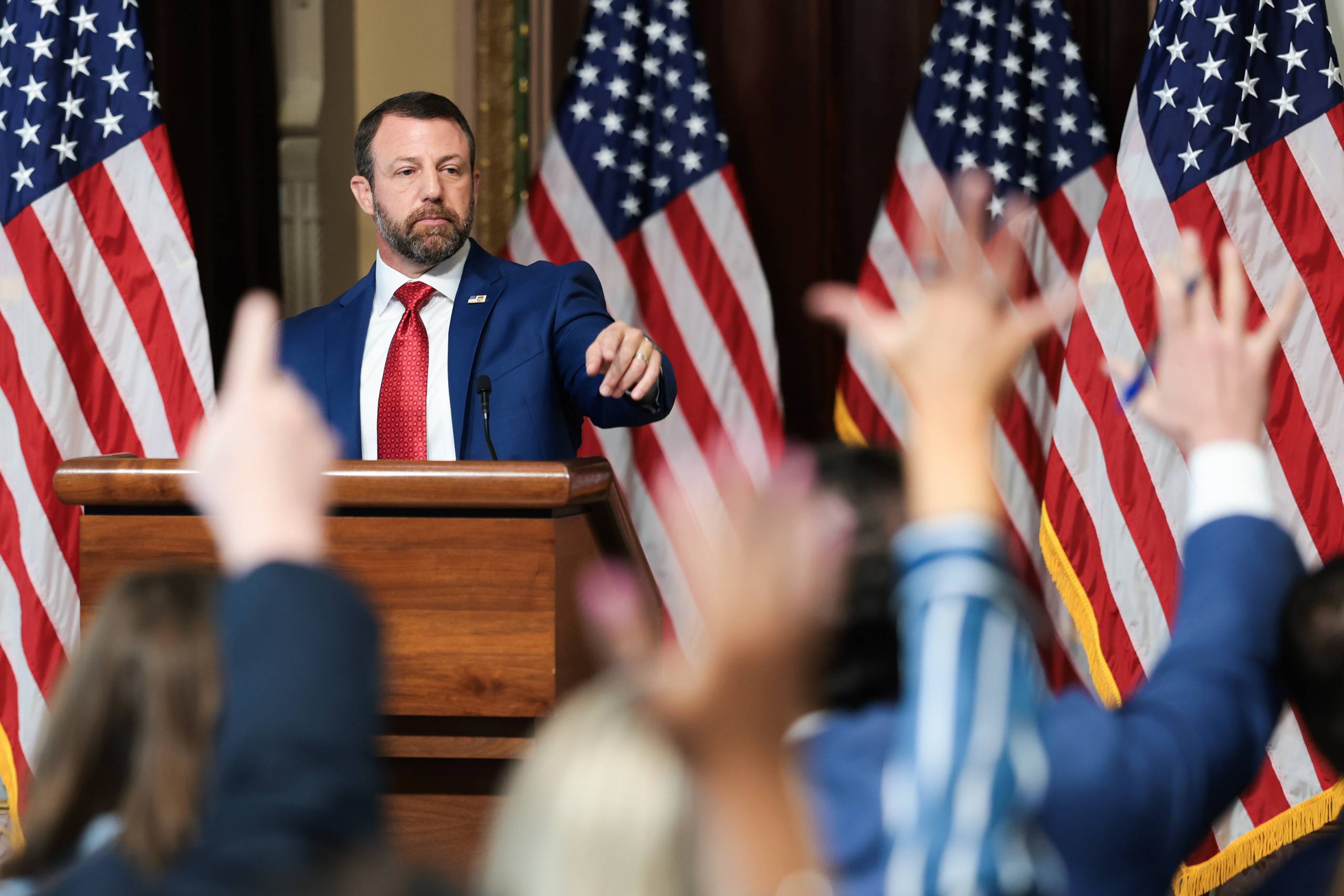
The Trump administration’s push to execute the largest deportation campaign in U.S. history is unfolding in “a fog of fake numbers and statistical subterfuge.” That’s according to The Atlantic’s Nick Miroff, who covers immigration and the Department of Homeland Security. We talk to Miroff about the political pressures shaping the deportation push, the unintended consequences of blue state backlash to ICE detention facilities and how Homeland Security secretary Markwayne Mullin is responding to attacks from far-right critics who say he’s not aggressive enough on immigration.
Guests:
- Nick Miroff, staff writer covering immigration, the Department of Homeland Security and the U.S.-Mexico border, The Atlantic
Episode Transcript
This is a computer-generated transcript. While our team has reviewed it, there may be errors.
Mina Kim: Welcome to Forum. I’m Mina Kim.
The White House’s benchmark for success in its immigration crackdown is well-known and often repeated: arresting and deporting 1 million people a year.
Nick Miroff, who covers immigration and the Department of Homeland Security for The Atlantic, has been carefully monitoring how the effort to hit that benchmark is playing out. Key to the 1 million-a-year goal, according to Trump officials, is boosting capacity at ICE detention centers to 100,000. They currently hold 65,000. But the agency is struggling, as intense public pushback has blocked or limited the number of ICE jails.
It’s one of several challenges DHS faces as it seeks to execute the largest deportation campaign in U.S. history. Nick Miroff joins me now. Nick, thanks so much for coming on.
Nick Miroff: Good to be with you, Mina.
Mina Kim: So remind us of some of the struggles DHS has faced in trying to build more ICE detention sites.
Nick Miroff: I mean, it all sort of starts with Trump’s campaign promise for the largest mass deportation campaign in U.S. history, a promise that excited his base and has certainly been aligned with the way he has led his whole political career, right? This has been kind of his pet issue.
And so he made this superlative campaign promise that has been translated by the White House into a goal of a million deportations a year. And it’s just, you know, ICE in its history has never deported half that many people. So from the get-go, it was a major operational and logistical challenge to just kind of deliver on what the president had promised and not make him look bad.
And so much of the politics and the theater and the information fog that certainly all the reporters, but the broader public, have been facing partly kind of all stem from this one campaign promise of the president’s. And really, the department is still kind of scrambling to try to deliver on his goals.
And whenever ICE gets kind of too aggressive, as we saw certainly illustrated very graphically in January in Minneapolis, when ICE becomes too aggressive, too violent, there’s a public pushback that forces the administration to readjust.
Mina Kim: Yeah. And one of the things, of course, to be able to make this 1 million-a-year push a reality is they’ve got to apprehend people and put them in detention centers as a pathway toward deporting them or getting them to deport. And I imagine they did not anticipate the incredible public pushback that they would receive when they were just trying to buy more sites, right? Like warehouses and so on.
Nick Miroff: That’s right. Yeah. I mean, what’s different today is that ICE and the Department of Homeland Security more broadly really just have a bottomless pool of money because Congress, Republicans in Congress, through the reconciliation process have given them a quarter of a trillion dollars over the last 18 months — a quarter of a trillion for their immigration, for the president’s immigration enforcement agenda and his mass deportation campaign.
And so they developed this plan last year to go out and, in order to expand the ICE detention system to have capacity for 100,000 people at any given time, they went out and bought all of these empty warehouses around the country on this buying spree. This was under Kristi Noem and her top adviser, Corey Lewandowski.
And they were expecting, I think, more sympathy from Republican districts and states where some of these warehouses were located. And instead, they ran into a lot of NIMBYism, and they didn’t do kind of the public relations work necessary for this type of land use.
And so they faced this situation in which both Democratic- and Republican-led jurisdictions were opposing their ICE detention plans that were identified as this kind of urgent necessity. They had all the money in the world to spend, but if they couldn’t get approvals for the kind of water and sewer line conversions that they needed to turn warehouses into mass detention centers, then they couldn’t go forward.
And so what we’ve seen under Secretary Markwayne Mullin since he took over in March, they really kind of backed off that plan. They haven’t abandoned it, but they’ve scaled it down. They’re going to sell some of the facilities that they purchased. They’re going to readjust their plans.
But that isn’t to say that they are backing off their goals. They’re arresting more people than ever. They are running deportations as aggressively as — and even if it isn’t as visible as it was in Minneapolis, when they were intentionally going out and trying to make a big spectacle of things, they are still hurtling toward their goal of the biggest campaign ever.
Mina Kim: Right. And so one of the things they’re saying is they’re just expanding capacity, right, at the ICE jails that already exist in, like, Texas and Louisiana, among other plans.
But, you know, you write this piece in The Atlantic called “The Problem with Shutting Down ICE in Blue States,” and basically what you describe is that, yes, blocking or limiting ICE detention centers has generally been an effective tactic for people who want to push back on the immigration crackdown. But you also warn that it has unintended consequences. Tell me what you mean by that.
Nick Miroff: Well, you know, we are increasingly heading to this dynamic in which ICE’s detention system is already skewed in that there are very few detention centers in the northern and coastal states, including California and the Northeast, where there are large numbers of immigrants that ICE wants to arrest.
And that is partly the result of the successful efforts of sanctuary jurisdictions and advocates and activists who have opposed the expansion of ICE detention centers in these places.
And so for many years, the ICE system has really developed in this skewed way in which most of the detention centers that they operate are in Texas, Louisiana, and some other places across the South.
And in the past, that has been a way to limit ICE’s ability to arrest and deport people from northern and coastal areas and blue states. But when ICE just has all the money it could ever dream of, which it has now, it can simply transfer those people — the people it arrests in northern coastal cities — to the South, where they have no family, where legal aid services are limited, where immigration courts are among the toughest and the least likely to grant asylum or some other form of protection to people.
So there’s a real downside that I think often goes unexamined in the debate about keeping ICE out and shutting down ICE that ends up significantly leading to worse outcomes for detainees and the immigrants and their families who are fighting deportation.
Mina Kim: Yeah, you talked about how the judges in Texas and Louisiana reject asylum claims at some of the highest rates in the country, and of course the other issues related to being far away from family or your lawyers and so on.
It’s interesting, even Border Czar Tom Homan, you quote, is saying as much against protesters pushing back on ICE facilities. You quote him as saying, “You want to shut down the facility? Then every illegal alien” — his words — “we arrest in that state, we’ll fly to Texas, we’ll go to Arizona.”
Nick Miroff: It’s not an idle threat.
Mina Kim: Yeah, no, I’m fully aware of it.
So then what options remain, Nick? You know, like here in the Bay Area, for example, the building of a new detention center near Gilroy has been paused because of a state and local lawsuit. And I think for many who oppose the administration’s immigration enforcement tactics, they see that as a win.
Nick Miroff: I think it’s a win, but it can end up being a short-sighted win.
I’m saying that this is something that I’ve talked to immigration attorneys about. If there were a facility in the Bay Area where ICE held people, they would have access to a lot more legal aid, they’d be closer to their families, and they would potentially, at least for the time being, have immigration judges who would be more sympathetic to their cases.
So a number of them would probably avoid deportation. As it is now, if someone is arrested in the Bay Area, they can be taken to Texas and Louisiana, and that’s probably it for them. The chances that they are going to successfully fight their deportation are much lower.
There are advocacy organizations and legal aid organizations that are trying to develop a bigger presence in those areas and have had some success. But again, the courts are really stacked against them.
And so these are the kinds of trade-offs that I think folks who are opposed to ICE and to the Trump administration’s agenda at least have to grapple with. There aren’t great outcomes in either direction, but I think it’s a little too facile to see the closure or the cancellation of an ICE facility as a complete win when it means that maybe a lot of these people are going to end up getting deported.
Mina Kim: Yeah, because ICE is so flush and DHS is so flush.
Nick Miroff: Because they have so much money, right.
Mina Kim: Yeah. And you have also stated very clearly in your piece that it’s not that advocates and activists have no reason to fight these facilities.
You note that at least 52 detainees have died while detained by ICE since Trump returned to office. That’s two and a half times the rate of fatalities from his first term, is the stat that you put in there.
But what should happen, or what has been described to you as tactics that activists and local communities against the deportation push could try that could be impactful? Is it the continued push to get better conditions in these facilities?
Nick Miroff: You know, that is something that some opponents of the administration have talked about and said, “Look, conditions in these ICE facilities are terrible now, and that is one of the reasons why we oppose them, and we don’t want anybody confined in these circumstances.”
But at the same time, if you oppose an ICE facility in the Bay Area or a Delaney Hall, and so the detainees are just sent to even worse conditions in Texas or Louisiana, is that really a win?
And so having a fair, transparent, well-run, safe immigration enforcement system can, in some ways, lead to better outcomes and more fair outcomes, more humane outcomes, than shutting it down in blue states and having it just run unfettered in red states.
Mina Kim: Fascinating. And I want to ask our audience what you want to know about how activists have been able to limit Trump’s deportation push and what you think about what Nick is saying about its effects and potentially unintended consequences.
We’ll get to a lot more after the break. We’re talking with Nick Miroff about the deportation push. This is Mina Kim.