Chang-Rae Lee's Novel, 'A Tender Age' Is A Personal Story
Airdate: Monday, August 11, 2026 at 9 AM
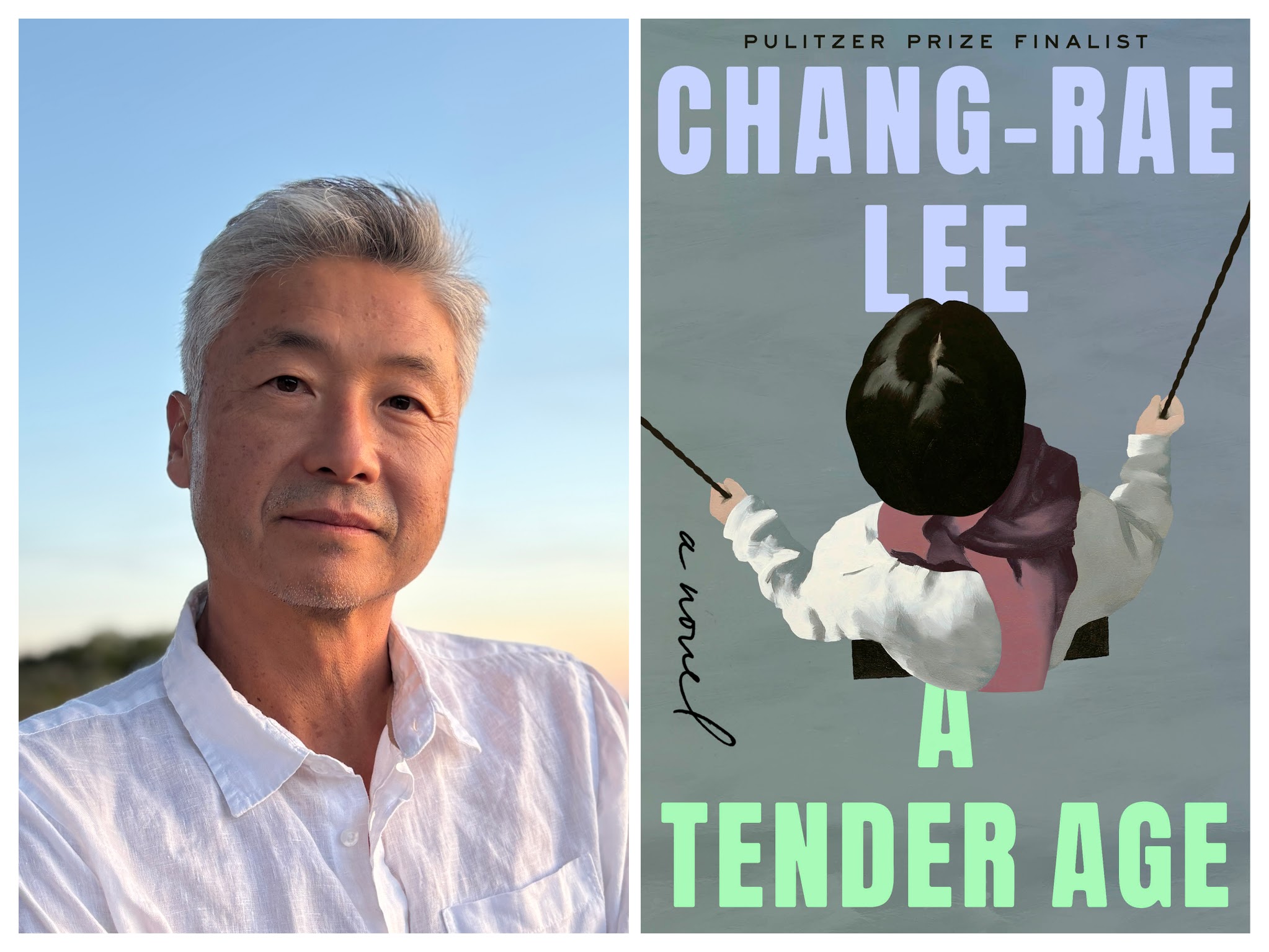
“I’ve not gone back to any of the old places,” reflects the protagonist in the new novel “A Tender Age.” But that is just what the author Chang-rae Lee does, in this, his most personal book yet. Set in the 70s, the story follows an eleven-year-old Korean American boy caught between his doting immigrant parents and a roving pack of neighborhood kids — until one summer changes everything. Lee, a Stanford professor and Pulitzer Prize finalist joins us.
Guest:
Chang-Rae Lee, author, “A Tender Age,” He is also the author of the award-winning novel “Native Speaker” and the Pulitzer Prize-nominated “The Surrendered,” among other works. He is a professor of creative writing at Stanford University
Episode Transcript
This is a computer-generated transcript. While our team has reviewed it, there may be errors.
Grace Won: This is Forum. I’m Grace Won, in for Alexis Madrigal. Chang-Rae Lee’s latest novel, A Tender Age, centers around Jung Gi, an 11-year-old son of devoted Korean immigrant parents. J.G., as he’s called by friends, is at an age when he, quote, “had no yearnings to grow up or know anything more.” It’s the summer of 1976. Kids in his neighborhood go out after breakfast and come home when the streetlights come on. Free-range wasn’t a parenting style. It was just how kids were allowed to be.
It’s also a summer when a rash moment will mark J.G.’s life forever. Lee himself is the son of Korean-American immigrants. He attended Exeter and Yale and worked on Wall Street before quitting to become a writer. His 1995 novel, Native Speaker, about a Korean-American man hired to spy on his own community, won the PEN/Hemingway Award. Six books followed, no two alike. And his novel The Surrendered was a Pulitzer Prize finalist. He says that this, his latest book, is the closest to home he’s ever gone, and he joins us now. Welcome to Forum, Chang-Rae.
Chang-Rae Lee: Well, thank you so much, Grace.
Grace Won: Well, tell us about Jung Gi. Who is this boy at the start of the summer that the book covers? What is his world like?
Chang-Rae Lee: Well, as you partly described, you know, and it’s, of course, period in that sense. You know, as most kids were back then, and I was, even at the age of 10, even younger, in fact, you know, probably from the age of five or six, we were allowed to, by necessity and by choice, to wander, to explore.
And luckily I lived in a place where, much like the tenement complex described in the book, that had a yard, you know, had a kind of property with a playground and a little ball field and kind of dusty tennis courts that no one ever used. But it was really, for me, I mean, people talk about, you know, are talking about the Odyssey so much today, but it was like that for me. Those were my Greek islands, my Thracian islands.
You know, because you saw, you knew, every day, even though, of course, you had your little set of friends. There were other little groups. And there were lots of kids at the time, at least where I grew up, and this is what J.G. is seeing in the novel, is you just had all these kind of colorful characters from all different kinds of backgrounds, all certainly different expectations for what might happen that day. And so, you know, you tilted a little bit, you had a little swordplay.
Grace Won: Yes.
Chang-Rae Lee: There were, you know, loyalties, promises made, promises broken. And everything, of course, seemed so intense and huge. And maybe that’s every childhood, but it was certainly mine, and certainly for J.G.
Grace Won: Well, you’ve noted that there are moments of childhood that are kind of laser-etched on us. And I think probably setting this in the 1970s, when there were few distractions and also more of a monoculture, kind of helped titrate what this moment was about.
Chang-Rae Lee: Yeah, for sure. I mean, you know, he’s stuck, in a way, in both a wonderful way and eventually what becomes of it is a difficult way. You know, it’s so intramural, this world. And so he’s testing, you know, and this is what I think all kids do, and certainly a blank slate, but he’s also someone who has some kinds of impulses, yearnings, that don’t really hew to the kinds of programs that his mother particularly wants for him, to be a good, decent, successful little boy.
He wants all those things. He, you know, it’s how he’s been raised and it’s in his programming, and yet certain moments will come up, just as they do in life, where his urges or his impulses come out a little bit darker, a little less decent, and it begins to, I think, inform him about who he is.
I guess that’s maturation. I think that one of the propositions of the book early on is that, you know, we think childhood is a time when you are totally formed, but of course it’s also a time, perhaps only on looking back, that were revealed. That were revealed as maybe how we really were, you know. Yeah.
Grace Won: Yes, yes. I mean, the book took me back. I mean, as a child who grew up in the ’70s, even the small details like Toughskins, which some of our listeners may remember were a brand of jeans from Sears, which some other listeners may remember was a department store that we all lived for and went through that catalog.
But that was the most ’70s moment. And I thought also, kind of, you know, metaphor — it’s like you’re tough and then you’re not, you know? That’s what the ’70s felt like it was about.
Chang-Rae Lee: Yeah, well, I remember my Toughskins. They always split, and I suppose they were designed that way, so you bought cereal, went to the store all the time, but my mother would be furious at me.
But again, that’s a testament to, of course, how exuberantly we played and what we were doing out there, right? It’s, you know, at that time, too, you know, ’76 was a kind of special year, of course. It was the bicentennial. And you remember those quarters that the Mint issued. And we’re all kind of in a mood, I suppose, about ourselves.
And particularly, as an immigrant boy, I remember marching in the town parade. And because I was on the baseball team, we all got in our baseball uniforms, and I felt so patriotic and I thought, boy, this is what a place this is, you know, and how intimately and I hoped inextricably belonged to, you know, this place.
Grace Won: Yeah, you’re probably thinking, this America is one big party, this is amazing.
Chang-Rae Lee: Yeah, yeah. And that’s the part of the book that I did want. It’s a book that’s ultimately quite serious, but I hope that I could capture some of that wonder and some of that color, some of the glee, really, of not just childhood, but that time.
And it’s funny because I saw the book was kind of listed in some, oh, here are the books of the summer. It was listed as one of the outlets listed it as a historical novel. So I guess Toughskins is sort of like a hair shirt or something in a different way.
Grace Won: That’s got to make us all feel old. Just because I know what Toughskins and Sears are doesn’t mean it’s historical. Although I think some of my fellow producers are like, “What? Sears again?”
Well, the narrator of this book is J.G., who tells the story as an adult. And I wondered if you could read a short passage from the book from his perspective.
Chang-Rae Lee: Sure. This is just very early on, when he’s kind of setting things up for the reader.
“And yet we can’t help but keep going back to old times, futilely scratching at a spot. It doesn’t matter how significant a certain event or instance was. Sometimes the barest irritation will draw incommensurate attention, and the skin can go raw before you realize it. Lately, I can’t seem to help but linger on this time or that. Those tender ages, rife with curiosities, and go over in serial fashion what I might have done or said to diffuse a tricky situation or take a more principled stand or else assuage my frustrated heart. So many chances seeded. What remains are these disparate patches of existence that end up knitting vaster and less randomly than you would have ever imagined.”
Grace Won: That was Chang-Rae Lee reading from his new novel, A Tender Age. And, you know, the narrator, J.G., talks about a tender age in that passage. And, you know, tender age, it’s such an interesting title because tender can mean sweet and kind, but it can also mean sore and painful.
That age, the time right before adolescence, what we modern people call tween years — I mean, tell me how you see it as a tender age.
Chang-Rae Lee: Yeah, I thought a lot about the title, and when I came up with it, I thought immediately, yes, this fits. As you say, it’s both those things, and essentially it’s also an age of vulnerability.
And so I thought that before, of course, before the big flush of the hormonal flush of true adolescence, pubescence, you know, J.G. is at an age when he’s still very much a child. He wants to cling to his mother, he wants to be in the nest, but he also has enough intellectual capacity, as 10-year-olds do going on 11, to really see things and to begin to form ideas about them.
So he’s at that moment when there’s so much possibility and yet there’s so much confusion as well. And so he’s — but in his particular situation, he’s, even though he’s very close to his family, even though there’s a lot of love in the home, and probably it’s because he’s an immigrant kid and he has immigrant parents, they live very separate lives.
There’s a private world of the home where mother has sway and dominion, and then there’s a world outside, which is really, you know, anything goes, again, filled with all these characters and situations that, you know, couldn’t be expected.
And so he has to, you know, in one world, he has a certain role, and in the other world, particularly the outside world, he has a little bit more reach, he has a little bit more sway, he has a little more agency. But of course, with agency at that age comes a lot of confusing and difficult moments when you have to decide, as the narrator said in the passage I just read, what you might do and what you should do, and those things don’t always align.
Grace Won: Yeah, that’s an age where you think you know everything, but you know nothing.
Chang-Rae Lee: And then you have to go with it. Yes, yes. And that’s the thing. And especially with J.G. out in the wilds of the playground in 1976. That’s all he has.
Grace Won: Well, we’re talking with the author and Stanford professor Chang-Rae Lee about his new novel, A Tender Age. It comes out tomorrow. Lee is the author of Native Speaker, A Gesture of Life, and The Surrendered. His new novel tells the story of an 11-year-old Korean-American boy growing up in the ’70s and the moments, big and small, that shaped his life.
And we want to hear from you. What do you remember about growing up in the ’70s, and how did that shape you as a kid? Give us a call, 866-733-6786. I’m Grace Won, in for Alexis Madrigal. More Forum after the break.