Why Danny McBride Makes Fun of American Men
Airdate: Thursday, August 5, 2026 10 AM
Actor and screenwriter Danny McBride has built his career portraying immature men. From
“Eastbound and Down” to “The Righteous Gemstones,” McBride weaves satire and profanity to
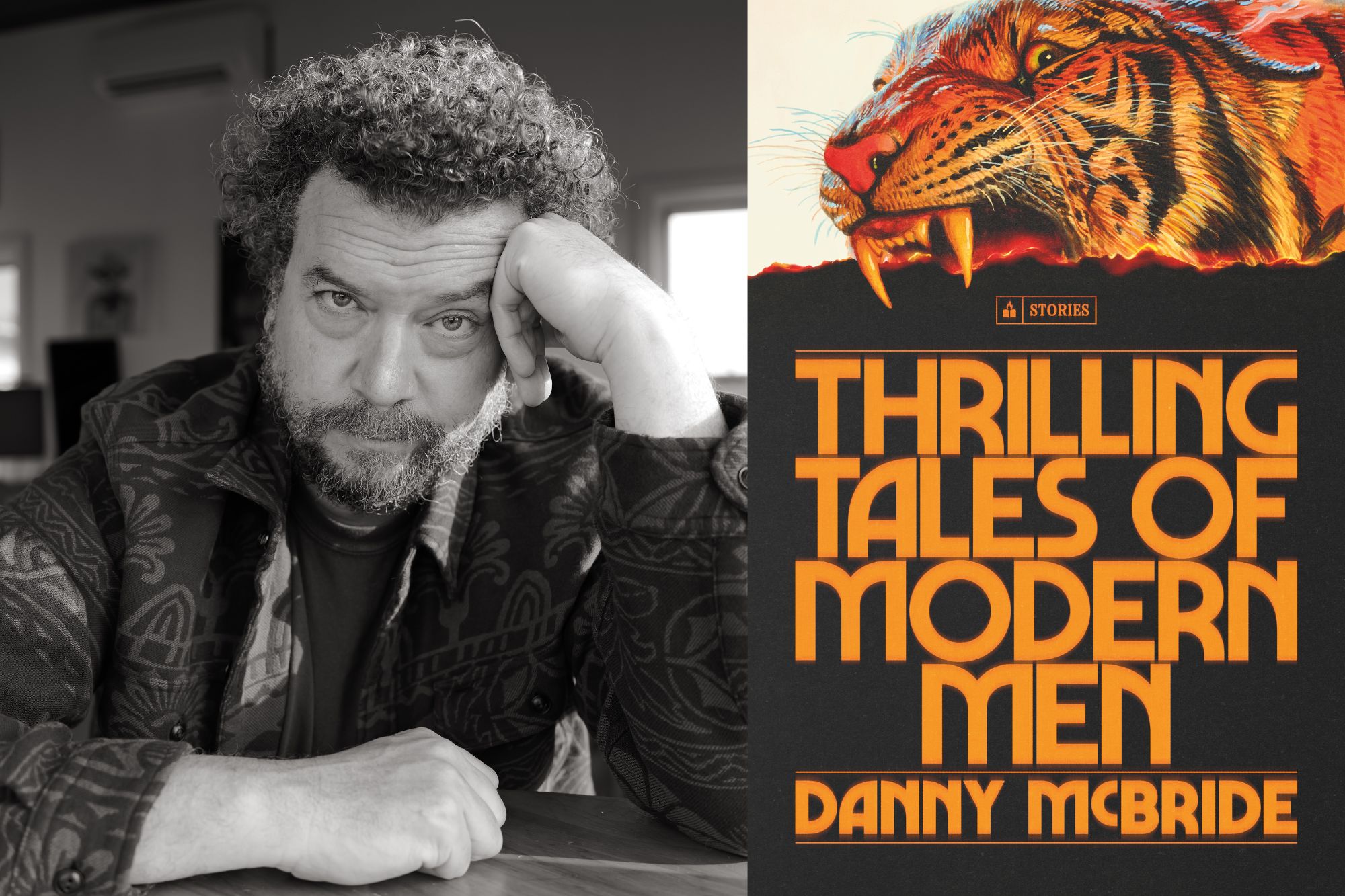
comment on American culture. In his new book, “Thrilling Tales of Modern Men,” McBride offers a collection of short stories about complicated men, and asks whether we can empathize with deeply unlikeable characters. He joins us to talk about what his new book has to say about modern American masculinity.
Guests:
- Danny McBride, author, “Thrilling Tales of Modern Men;” writer, producer, and actor, “Eastbound & Down,” “Vice Principals,” and “The Righteous Gemstones”
Episode Transcript
This is a computer-generated transcript. While our team has reviewed it, there may be errors.
Mina Kim: Welcome to Forum. I’m Mina Kim.
Actor, screenwriter, producer, and now author Danny McBride has a debut collection of short stories about men who are insecure and the things they’ll do to prove that they’re not. And if that sounds very McBride to you, you’re probably familiar with the TV characters he’s created, like Jesse, the preacher with an inflated ego in The Righteous Gemstones, or Kenny Powers from Eastbound & Down, a major leaguer who was once great and has now become his hometown gym teacher.
Clip: My dad said you ruined baseball.
Danny McBride (clip): You know what? I can already tell that I don’t like you, and I’m probably not gonna like you no matter how many pull-ups or push-ups you do. Or if anybody wants to pick on anybody in class, aim for him, because I ain’t watching.
Mina Kim: McBride’s new book is called Thrilling Tales of Modern Men, and he joins me now. So great to have you on Forum, Danny McBride.
Danny McBride: I appreciate you having me on. Thank you.
Mina Kim: So you and your publisher, I think, told The Hollywood Reporter that your new book explores the darker afflictions of today’s man. So what are these afflictions that you speak of?
Danny McBride: You know, I don’t want the book to sound like it’s homework, but with a lot of these characters that I’ve portrayed or told stories about, it’s just sort of trying to find a clown to center a story around. Classic comedy always has a clown at the center, and so when I wanted to create my clowns, I just kind of looked around at the world around me and tried to pinpoint the exact types of dudes that annoyed me.
So I started kind of just taking notes and seeing that inflated egos and an inflated sense of self are fun things to take aim at.
Mina Kim: Yeah, fun things to take aim at. Yet you also play them with a lot of sincerity. So what did you learn about what makes them annoying that you could sort of sympathize with?
Danny McBride: You know, I think with everything, whenever you write anything, you always want to try to find the version of a character that feels the most realistic, even if they’re doing outlandish things.
For me, that’s maybe a little bit of writing and also performing — trying to find their point of view. I don’t think it’s necessarily to find empathy for them, but it’s just to understand how they operate, how they function, and ultimately, hopefully, to make a character that has more dimension so that the places the character can go are more interesting.
That’s just what I’ve always wanted to do. And when I’m on these shows like Eastbound & Down or The Righteous Gemstones, I work with actors like Walton Goggins, who demand that sort of exploration of their characters. They don’t want to portray just a buffoon. They want to have something to sink their teeth into. I think that has always pushed me to try to achieve that with any of these characters.
Mina Kim: Yeah, you’ve often said that your characters are realizing that they’re often less special than they thought they were, or were brought up to think.
Danny McBride: Exactly. I think being a kid who grew up in the ’80s, movies, video stores, blockbuster movies — they played a massive part in my evolution and growing up. And I think for a lot of people my age, it was the same thing.
When you see those stories, in the classic Hollywood story there’s a main character, there’s someone all the events revolve around, and everything works out for them. I do think, if you’ve grown up looking at life that way, it can be devastating when you realize that that is just in the movies.
Mina Kim: Who were the characters from TV and film that really defined masculinity for you?
Danny McBride: I don’t know if there was one. Growing up in the ’80s, that was obviously the height of the action hero. So guys like Chuck Norris and Arnold Schwarzenegger and Jean-Claude Van Damme.
I guess when I was a kid, it was anyone who could fight, with a tinge of martial arts. That was what it took to be a man — and maybe solve crimes. Maybe Tom Selleck in Magnum, P.I. Those were what you needed to be able to do if you wanted to be a real man.
Mina Kim: Well, your characters in your book are certainly dealing with this realization that they’re not as special as they think they are in sometimes really hilarious, sometimes really violent ways. You have a guy who decides to live in a glass cube suspended from the ceiling of a mall for a month.
Danny McBride: You know, it’s something relatable. Everyone has wanted to be an escape artist at some point.
Clip: Yeah, that’s not magic. If he can do it without eating and drinking, it’s not magic.
Mina Kim: And then in the story that’s on the book’s cover, there’s a man who deals with the death of his wife in a tiger-mauling incident by burning copies of a book he thinks is based on the incident.
You also have these other smaller, relatable things, like a guy who revenge-pees all over his neighbor’s boat because he doesn’t like it blocking his view.
I couldn’t help but wonder if they were based on real-life people or incidents or news stories — like this guy who burns the author’s book because he thinks the author stole the story from news coverage of the tiger-mauling incident. Did anything like that inspire these characters?
Danny McBride: Nothing is really inspired by anything that’s real or that I’ve seen in the real world — at least not consciously.
With all of these stories, I was coming off writing The Righteous Gemstones for seven years. We had COVID and the strikes that elongated that period, but through that it was four seasons, almost 40 episodes of that show.
I loved writing on that show, and I loved writing for those characters, but every day when you sat down to write, it became a story in this world about these characters.
To jump to a short story collection, where suddenly you could create stories about any character in any situation with anything going on, there was something really appealing about that after writing for television.
So how I would start with all of them was just kind of messing around, doodling around, and figuring out which ideas kept me coming back for more. Most of them were really inspired by me being creatively selfish and trying to make myself laugh.
Mina Kim: So then you often didn’t sit down to write one of these stories knowing how it would end. It was more an exploration of where this character would go if things got absurd.
Danny McBride: Yeah, and that’s kind of how I write everything. I’ll start from a place where I don’t know where it’s going, and that’s what’s fun about the process.
Eventually, sometimes you’ll end up in a place that’s terrible, and that’s what rewrites are for. Then suddenly you understand what story you were trying to tell, even if you didn’t know where it was going.
In the preliminary steps, I love not knowing. I don’t outline things. I don’t plan them out. It’s fun to get caught up in that momentum. Then, as you get deeper into it, you start thinking, “All right, where is this going?” That just becomes another fun part of the process.
Mina Kim: We’re talking with Danny McBride, author of Thrilling Tales of Modern Men, a collection of short stories.
He’s a comedian, writer, producer, and star of the HBO comedy series The Righteous Gemstones, Eastbound & Down, and Vice Principals.
Listeners, you’re invited to join the conversation. Are you a fan? What do you want to ask or tell Danny McBride? What are your favorite shows, movies, or characters from Danny? What character in TV, film, or books was your model of masculinity? And I’m curious what you would say is a healthy model now.
You can tell us by emailing [email protected], finding us on Discord, Bluesky, Facebook, or Instagram at @KQEDForum, or by calling 866-733-6786.
We were talking earlier about how you play your characters with a lot of sincerity because your protagonists are not typically heroic. Some can even be repulsive. Yet you make them relatable.
How do you accomplish that? Can you walk me through the way you like to approach storytelling and characters?
Danny McBride: For me, even growing up, comedies weren’t necessarily my favorite type of film. I think I got into comedy because that’s just the way I see the world.
I always felt that the downside of a lot of comedies was that you’d laugh a lot in the first act, continue to laugh — but not quite as much — in the second, and then by the third act you’re checking your watch and ready for the show to be over.
I felt that was because sometimes comedies keep everything on the surface. If they’re just punchline-driven, after an hour and a half you’ve kind of gotten what you’re going to get.
For me, I wanted to make sure that even if you’re laughing, it’s all adding up to something. Hopefully there’s something unexpected or a depth to it that you might not have anticipated from the start.
So it’s all about telling a compelling story. Then I’ll use the comedy and these ridiculous characters as tools to tell that story. I ultimately want it to add up to something, and I think the way you do that is by creating layers and finding truth in all of these strange morons.
Mina Kim: Do you ever worry that people didn’t get the joke?
The reason I’m asking is because it feels like right now the fragile masculinity that you poke fun at or satirize — though you also make it relatable — feels like an inescapable part of our lives. Even just the things Defense Secretary Pete Hegseth says, it feels like we’re living in one of your creations.
Danny McBride: Well, whether people get the joke or not, I think my job is just to speak to whatever I’m seeing in the world around me and the types of people I’m seeing, and translate that through my art.
However that lands with people, I think it can be interpreted lots of different ways. I don’t often think about what the social commentary will be afterward.
I just try to satirize human nature and find what I feel is alive and well in the world, and then find my take on it. However people interpret that is up to them.
I don’t want to tell people what to think. I just want to present them with a story that maybe ends up being thought-provoking.
Mina Kim: Yeah, we’re coming up on a break, but have you been surprised by how beloved people like Kenny Powers and Neal Gamby have become?
Danny McBride: Yes, for sure. But I’m glad they are.
That was the whole point of those characters. Eastbound & Down especially was trying to challenge ourselves to create a vile character and see if we could make people feel for him by the end of the day.
Mina Kim: We’ll have more with Danny McBride after the break. You’re listening to Forum. I’m Mina Kim.