From Cash Checks to Shelter Mandates, The South Bay Is Betting Big on Homelessness Solutions
Airdate: Thursday, August 5, 2026 9 AM
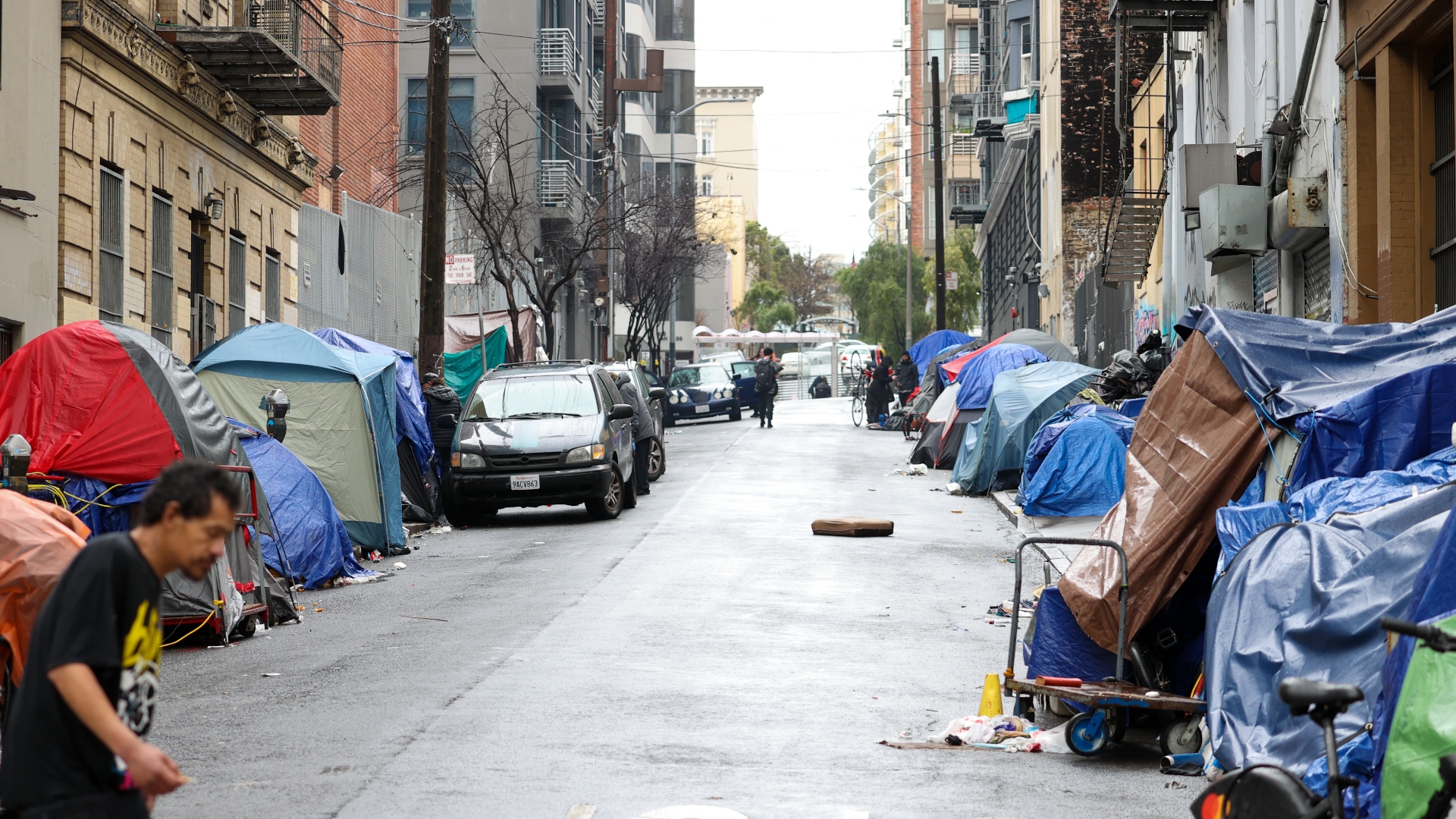
The Bay Area’s homelessness crisis is one of the most acute in the nation, and it has concentrated in the region’s biggest cities, like San Jose. Many communities have adopted new policies aimed at mitigating the crisis – from checks aimed at stabilizing vulnerable renters to making it illegal to refuse shelter beds. We examine the causes and potential solutions being implemented around the Bay Area, with a special look at a series of controversial new policies being implemented in the South Bay, including an effort to redirect funding from permanent housing projects to build more forms of temporary shelter.
Guests:
- Dr. Margot Kushel, director, Benioff Homelessness and Housing Initiative; professor of medicine, UCSF
- Luis Melecio-Zambrano, journalist covering Cupertino, Milpitas and Sunnyvale, Bay Area News Group
- Ethan Varian, accountability reporter, Bay Area News Group. Luis and Ethan’s recent reporting examines why homelessness is so severe in the Bay Area, what sets the region apart and what could help.
Episode Transcript
This is a computer-generated transcript. While our team has reviewed it, there may be errors.
Guy Marzorati: Welcome to Forum. I’m Guy Marzorati, in for Alexis Madrigal.
The Bay Area has experienced something of a shelter shift in recent years. Some local leaders, most notably San Jose Mayor Matt Mahan, have invested heavily in building short-term shelter for people experiencing homelessness. But a new analysis from the Bay Area News Group finds our region still has a massive shortage of shelter beds, and for most people living in shelters, they’re not serving as an immediate jumping-off point for permanent housing.
Joining us to discuss their reporting are the co-authors of the series: Luis Melecio-Zambrano. Luis covers Cupertino, Milpitas, and Sunnyvale for the Bay Area News Group. Hey, Luis.
Luis Melecio-Zambrano: Hey.
Guy Marzorati: And Ethan Varian, accountability reporter for the Bay Area News Group. Thanks for joining us, Ethan.
Ethan Varian: Thanks for having us.
Guy Marzorati: Also joining us, Dr. Margot Kushel, director of UCSF’s Benioff Homelessness and Housing Initiative. Dr. Kushel, thanks so much for taking the time to be here.
Dr. Margot Kushel: Thanks for having me.
Guy Marzorati: So, Ethan, maybe I’ll start with you. In San Jose, they’ve arguably gone further than any other city in the Bay Area in focusing on building out a shelter system. What does that actually look like?
Ethan Varian: Yeah. So San Jose, starting under the previous mayor, Sam Liccardo, and really under current Mayor Matt Mahan, has invested a lot in building out a shelter system — a specific kind of shelter. It’s different than the group shelters with bunk beds that you may be imagining. It’s a lot of tiny homes with locked doors, more privacy, as well as converted motel rooms, which was a push that started a few years ago, really during the pandemic, to start converting these motel rooms into places for homeless people where they can stay temporarily. They don’t have to pay rent, and the goal is to connect them with services and, for most sites at least — and when you talk to most officials — to help them into permanent housing.
San Jose has added hundreds of these types of shelter units. They’re referred to as interim housing units, including these tiny homes, motel rooms, and some other modular housing developments. San Jose has, according to the last count, about 2,000 of these beds that it’s currently operating.
Guy Marzorati: And Dr. Kushel, do you see a meaningful difference in terms of maybe health outcomes or housing outcomes between what we traditionally think of as shelters — these larger congregate facilities — and these newer models that Ethan is describing in San Jose?
Dr. Margot Kushel: There’s no question that one of the most important things for people in deciding whether to accept shelter are really what we call the four Ps: having privacy, being able to bring their possessions, having their partner be with them, and being able to bring pets with them.
These single-occupancy units — or, if people are in a partnership, units for two people — can really provide a lot of those things. They provide protection from some infectious diseases, but more importantly, I think, psychological safety, the ability to sleep, and all of those things.
Guy Marzorati: Yeah. And Ethan, I know for this series you spent time with a man named Fernando Alcantara, who had been living in one of the largest homeless encampments in San Jose. Tell us a little bit about his story.
Ethan Varian: Yeah. Fernando was living in an RV at Columbus Park, which had been one of the largest — almost certainly the largest — encampments in San Jose, down by the airport.
It was a very dangerous encampment, frankly. Fernando did not feel at risk there, but it was not a great place to be. It’s not a place he wanted to stay. So when outreach teams with the city found him and offered him a space in one of these interim housing units, he really jumped at the chance to take it.
One of his biggest worries living on the street in an RV was constantly worrying about being ticketed or towed and losing his housing in his RV. So getting into one of those tiny homes really gave him the stability to not have to worry about that and then work with city outreach teams to eventually find housing in an affordable housing complex in San Jose.
So it was a real success story, but it took a lot of work to get him there, a lot of effort on the city’s part, and they had to find the housing for him, which, as our reporting shows, is often quite a challenge to get everyone in a shelter into housing.
Guy Marzorati: Yeah, let’s talk about that. Luis, as part of this project, you took a look at the wider shelter inventory across the Bay Area and also where people who were exiting shelter ended up. What did you find?
Luis Melecio-Zambrano: Yeah. So we looked at shelter data from HUD from across the country, really, and compared it to the Bay Area. The brass tacks here are that, in the United States, about two in three homeless people are in shelter. But in the Bay Area, that’s just over one in three. So we have a serious shortage here of shelter.
And what that shelter is doing is often not getting people into housing. This actually isn’t unique to the Bay Area. Both in California and in the United States at large, it’s also about one in three people who, in a given year, go from shelter to housing. A lot of those people who aren’t going into housing end up either back on the streets or in another shelter situation.
So that goal of transitioning someone from the street to a shelter to housing is not as clean a transition as we might expect or hope, really.
Guy Marzorati: Yeah. And on that first point, why is it that the Bay Area has ended up in a place with far fewer shelter beds than these other cities that you looked at?
Luis Melecio-Zambrano: So this isn’t a question we dove into too deeply, but my understanding here is that it’s a difference in policy priorities.
New York City and Washington, D.C., for example, both have some form of right-to-shelter law. These are largely tied — in D.C. explicitly — to freezing temperatures. All of these other places in the Northeast, which is kind of the other large concentration besides the West Coast of homeless populations, have much harsher winters, whereas here there isn’t as much of a drive to avoid loss of life by keeping people off the streets in the winter.
So it’s, in my view, based on my reporting, a policy choice based on that climate reality.
Ethan Varian: I’ll add that there are often court orders in those cold-weather cities enforcing a right to shelter, or more or less requiring cities to offer people shelter if they’re on the street or don’t have a place to go.
Guy Marzorati: And when you all looked at this data across the Bay Area — both the count of shelters and these exit rates, where people are going from shelter — did you find differences within our region? Are some places doing better than others as far as developing a system that is pushing people toward permanent housing?
Luis Melecio-Zambrano: The data is really messy and varies from year to year, sometimes really dramatically.
One thing we did notice — and this is based on an independent analysis of San Mateo County’s shelter system — is that there is a really significant difference between transitional housing —
Ethan Varian: Or interim housing.
Luis Melecio-Zambrano: Or interim housing, thanks.
Ethan Varian: The tiny homes and the motel conversions.
Luis Melecio-Zambrano: Yeah. And these congregate shelters — these groups of bunk beds. In San Mateo County’s case, they saw that three times as many people were able to transition from this interim housing to permanent housing than from these congregate shelters.
A hint as to why that might be is that a lot of the experts we spoke to talked about this revolving door between shelter and what we classically think of as homelessness, like living on the street.
The median amount of time someone was spending in these congregate shelters — these group shelters — was only three weeks. So if you’re in and out of these shelters, it’s a lot harder for someone to get you hooked up with a social worker, get you connected to services, and get you into housing.
Guy Marzorati: Yeah. Dr. Kushel, what do these findings say to you?
Dr. Margot Kushel: Yeah, I think it’s not surprising.
I think we know, for instance, that it is true that it’s easier to stay longer in these tiny homes. They’re often better staffed, and so people have more access to do the things that they need to do — in some ways, the minimum needed to get into housing: get their paperwork together, a driver’s license or some form of ID, certification of their income, all of those things that we make people do to get into housing.
But the bottom-line problem is that we just don’t have enough housing.
In the Bay Area, if you look in San Jose or so, the housing wage is about $67 an hour. That’s what someone would need to earn to get a one-bedroom apartment that isn’t subsidized. And we only have a very limited amount of subsidized housing.
So in a way, it is very helpful and necessary to have people get all their paperwork together so they can get into one of these subsidized units. And it’s easier to do that when you have your own tiny place. But if those subsidized units aren’t there, at the end of the day there’s really no place to go.
Guy Marzorati: It also strikes me, looking at this data about the lack of shelter beds, that it almost suggests the debate we often hear about what to do with people who are refusing shelter might be a little premature. Is that fair?
Dr. Margot Kushel: I think that’s absolutely fair.
We found in our studies that the vast majority of people would accept a shelter bed, but there just isn’t one.
And if people don’t accept a shelter bed, it’s really important to understand that does not mean they wouldn’t accept housing.
When I talk to people who refuse shelter, it’s people who are being asked to go into rooms of 400 people. There might be someone they’re afraid of there, someone they’ve had a conflict with. They might feel frail. There are often only top bunks, and much of our homeless population is aging and can’t get up there.
But the truth is, for every rare person who says no, there is a long line of people waiting to get in. So in some ways, exactly as you said, it’s the wrong conversation to be having.
Guy Marzorati: This is Dr. Margot Kushel, director of UCSF’s Benioff Homelessness and Housing Initiative.
We’re also talking with Luis Melecio-Zambrano and Ethan Varian, reporters with the Bay Area News Group, who have a new analysis about shelter capacity and homelessness in the Bay Area.
And we want to hear from you. How do you think your city is doing on this issue? Is there a policy that you’ve changed your mind about after seeing how it’s played out locally? Have you noticed a shelter or a tiny home site or a permanent supportive housing project open up in your neighborhood? Or, if you have experienced homelessness or are experiencing homelessness, what’s actually helped in your case?
You can give us a call at 866-733-6786. That’s 866-733-6786. You can find us on our social media channels — we’re @KQEDForum — or you can send us an email at [email protected].
We’re going to take a short break. When we come back: Why is homelessness so severe in the Bay Area? Our guests found one factor that stands out above all others.
Stay with us.