The Challenges and Dangers Security Guards Face
Airdate: Wednesday, July 29, 2026 at 10 AM
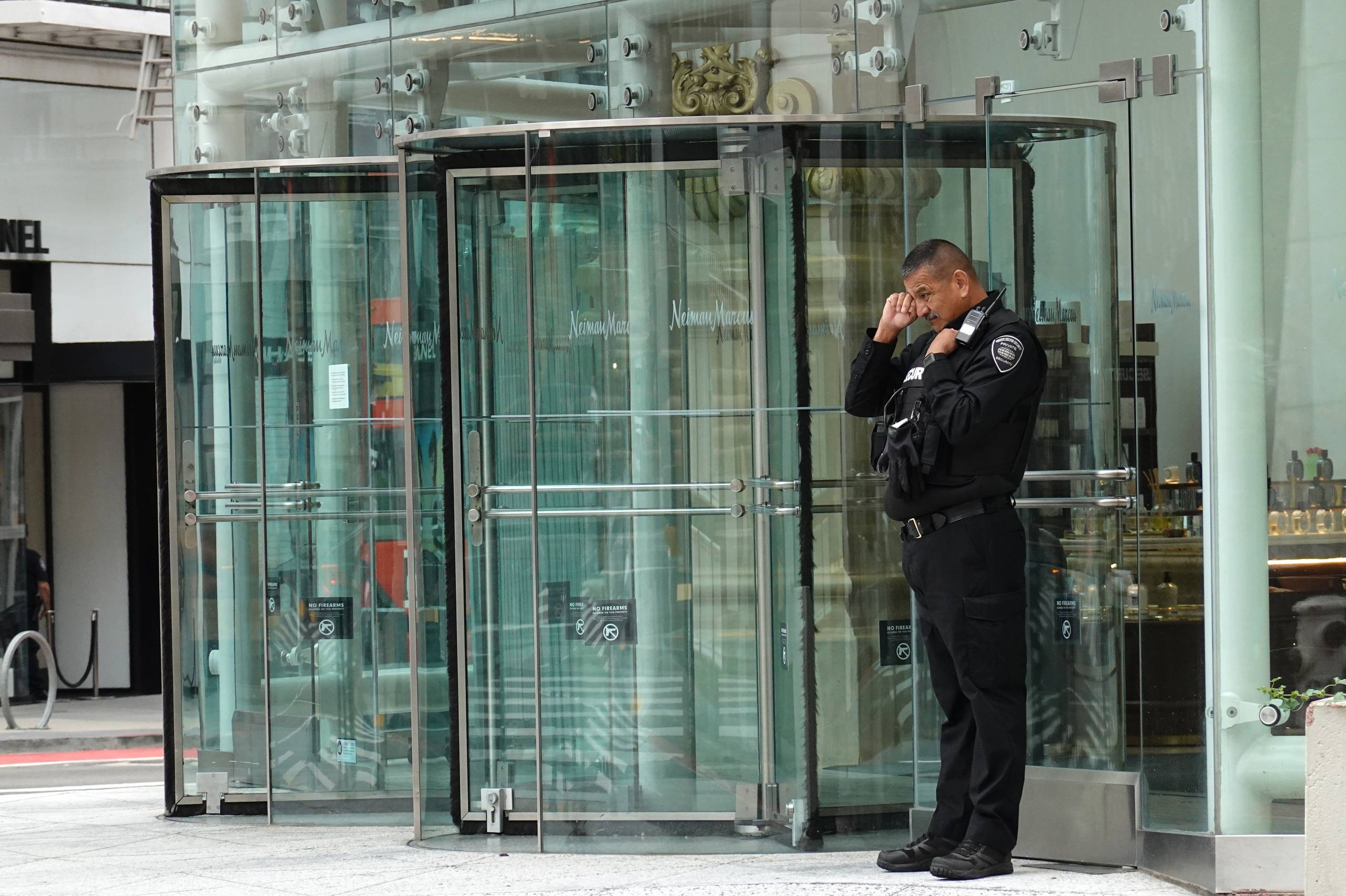
More than 1.3 million people work as security guards in the United States, making the job one of the most commonly-held in the country and one that outnumbers police and sheriff’s patrol officers. Yet new research from the UC Berkeley Labor Center finds security guards tend to be underpaid, inadequately trained, and more likely to be hurt or injured on the job — factors that lead to a high turnover rate. A bill before the California legislature would raise pay and training standards; it has the backing of labor groups but the firms that employ many of the state’s security guards are opposed. We’ll explore the research and potential legislation, and answer your questions about working in security.
Guests:
- Enrique Lopezlira, director, Low-Wage Work Program at the UC Berkeley Labor Center
- Latasha Reed, security officer in San Leandro
- David Huerta, president, United Service Workers West (SEIU-USWW)
- David Chandler, president, CALSAGA (California Association of Licensed Security Agencies, Guards, and Associates)
Episode Transcript
This is a computer-generated transcript. While our team has reviewed it, there may be errors.
Mina Kim: Welcome to Forum. I’m Mina Kim.
Security is a dangerous job. Among those killed at the Islamic Center of San Diego in April was 51-year-old Amin Abdullah, who alerted people inside the mosque to the shooter and was credited with saving countless lives.
A new report from the UC Berkeley Labor Center finds security guards face a high risk of injury and death on the job and are more likely to be underpaid and undertrained for the work they’re expected to do in stores and hospitals, schools, and office buildings.
Listeners, does this ring true to you? Have you worked as a security guard? You can tell us by calling 866-733-6786, by emailing [email protected], or by finding us on Discord, Bluesky, Facebook, or Instagram.
Enrique Lopezlira is co-author of the UC Berkeley Labor Center report and director of the Low-Wage Work Program there. The report is called Underpaid, Undervalued, and Essential: The Security Guard Workforce in the United States. Welcome to Forum, Enrique.
Hi, Enrique. Are you there?
Enrique Lopezlira: Good morning. Thank you for having me.
Mina Kim: Yeah, really glad to have you. Good morning.
How common are instances of security guards being injured or even killed on duty?
Sorry, can you repeat the question again? I’m wondering how common instances of security guards being injured or killed on duty are.
Enrique Lopezlira: Yeah. Security guards die on the job at more than twice the rate of the average worker, and nearly two-thirds of their fatal injuries result from assaults or other violent acts on the job.
Mina Kim: Wow. That is a very, very high rate.
Tell me how you define “security guard,” because it seems like there is a typical scope of work and sort of our understanding of what their scope of work really is.
Enrique Lopezlira: Yeah. So what we looked at was the private security officer workforce in the United States. The report culminates a series of fact sheets that we did on this workforce across the country, starting last summer with New York City, given the size of that workforce and also because, at the time, another security officer had been killed on the job as well.
These workers are essential. They were deemed essential during COVID. What they do is protect hospitals, stores, critical infrastructure, and office buildings. Almost every portion of the economy relies on security guards.
Their job responsibilities have increased quite a bit, especially since COVID, where they’re having to deal with people experiencing mental health issues and other customers. They really are the first responders because they are on location first. So they have to de-escalate. They have to protect. And many times they are not trained for those situations. They are also largely unarmed, so when they encounter an armed assailant, that puts them in a very precarious position.
Mina Kim: Yeah. I was really struck by that description of the scope of work of a security guard, and I know that it varies from workplace to workplace. But I was a museum security guard at one point, and the only thing I was asked to do was observe — watch people and report them if they were doing something, right, to a supervisor, who would then report them to a higher-level authority.
It sounded like, in your report, that generally is what most security guards are asked to do. And yet their jobs changed into this much more involved role.
Enrique Lopezlira: That’s right. Yes, you’re absolutely right. But as a human being, it’s hard not to want to help others who are in danger. And being that you’re a security officer, many times you have no choice but to act.
Mina Kim: Right, exactly.
And you noted that the COVID pandemic really drove demand for security guards. How so?
Enrique Lopezlira: Well, first of all, in almost every state they were included in the essential workforce. Especially because people went to work remotely in many parts of the economy, they were left to guard those buildings, especially office buildings that were without workers during the pandemic.
So while other workers could work from home, they had to be on the job. They had to protect all the infrastructure and businesses that were there, even though, for the most part, many employees were working remotely.
Mina Kim: Yeah. I want to bring into the conversation now Latasha Reed, a security officer in San Leandro.
Latasha, thanks so much for coming on Forum.
Latasha Reed: Hello. Good morning. How are you?
Mina Kim: I’m well.
I wanted to ask you about some of the things Enrique is pointing out. What do you do as a security guard in San Leandro? What do you wish people understood about your job?
Latasha Reed: Well, first and foremost, our job is not only to observe and report. Our job is to make sure everyone is safe, all property is protected, and we’re protecting everyone. And no one’s protecting us. Security needs protection as well.
Mina Kim: Yeah. What do you mean by “no one is protecting us”?
Latasha Reed: We’re out on the front line, and every time something happens, they have to come and find us. But no one is protecting security. We are the ones on the front line doing all of the protecting.
Mina Kim: What are some of the types of things you’ve had to deal with? And do you feel like your training prepared you for the work that you do?
Latasha Reed: No. The training modules they give us do not prepare us for the actual work that’s done on the ground.
The actual work that’s done on the ground is hands-on, and it’s not an observe-and-report type of thing. Sometimes you have to step in and intervene in critical situations without the proper training.
People are getting stabbed at work. People are being punched in the face. People are dealing with, like Enrique said, mental health issues, also dealing with drug addiction. It’s just a crisis out here in the world right now because of all those issues we have going on.
Mina Kim: Yeah. What did your actual training consist of?
Latasha Reed: Our actual training is just modules on a computer that we’re supposed to do while we’re on duty, which interrupts us from paying attention to the property and the things going on because we’re reading modules on a computer for an hour, two hours, three hours at a time.
Mina Kim: How do you like your job? Do you see a future in this job? Can you imagine yourself doing it for a long time?
Latasha Reed: I actually have been doing it for a long time, and I do plan to retire from this job. I’ve been in it 17 years, so I plan to retire, yes.
And I love what I do. I love making sure people are safe. I love making sure the community around me is safe.
Mina Kim: But having been a security guard for that long, you must have really seen changes from when you started to now that you’re looking toward retiring.
Did you see changes in expectations, things you were asked to do, especially during COVID?
Latasha Reed: Yes. And there’s also an issue with what the client wants and what the employer wants us to do. That’s kind of conflicting, which has security officers — security professionals — confused about what to do.
There’s no real direction from either party. It’s just, “Do this,” or “Do that.” There’s no direction.
Mina Kim: Say more about that. So you’re probably hired by a firm, right? Not by, quote-unquote, the client where you’re serving as a security guard.
Latasha Reed: Yes. We’re hired by the security company, not the client where we’re working. The place that I work doesn’t pay me directly. The client pays the security company.
Mina Kim: And whenever there were conflicts in understanding, how was that dealt with?
Latasha Reed: It depends on the situation. Sometimes it’s swept under the rug. Sometimes it’s handled. Sometimes we have to go to the union to handle certain situations.
Mina Kim: You ended up staying for a long time, but do you see high turnover in your job?
Latasha Reed: Every day. Every time you turn around, there’s a security officer coming in and a security officer leaving. It’s a very high turnover.
We have a lot of young people who come in, see what goes on, and don’t want to stay. They want to look for other jobs. We do have a lot of older people who stay, but it’s usually the younger people who account for the high turnover.
Mina Kim: And what are some of the key things — you’ve touched on this — that you hear from them as to why they don’t want to stay?
Latasha Reed: Because they don’t want to do the work that’s required of them. The job is dangerous. The pay is low.
For most of the people just getting started, the pay is really, really low. If you’ve been here for a while, it’s okay, but it’s still not what we deserve for the things we do and the risks we take by putting our lives on the line.
Mina Kim: Latasha, thanks so much for speaking with us. I really appreciate it.
Latasha Reed: No problem. Anytime.
I just want to close out by giving condolences to one of our sisters that we lost this week, Nadira Manbuki. Our USWW family took a big loss last week, so I just wanted to give condolences to her family.
Mina Kim: Latasha, thank you for doing that. I appreciate that very much.
Enrique, could you put some numbers on some of the things that Latasha said? What is the turnover rate? I know you researched this.
Enrique Lopezlira: Yes. The turnover rate is almost 100%. It reached 100% right after the pandemic, and then it came down a little bit, but it’s still in the high 80s for security guards.
When you have that high of a turnover, you have less experienced workers on the job. And like Latasha said, it’s not just an issue for the workers — it becomes a public safety issue for the public as well.
We know from prior research that when you improve wages and labor standards, that has a tremendous effect on lowering turnover.
Mina Kim: Well, I want to invite listeners into the conversation.
Listeners, do you or someone you know work as a security guard? What’s the experience like? Do you have a notable experience with a security guard as a customer or someone navigating a public space? Is there a time you felt they really helped — or hindered — the situation?
You can tell us by calling 866-733-6786, by emailing [email protected], or by finding us on Discord, Bluesky, Facebook, or Instagram at KQED Forum.
We’re talking with Enrique Lopezlira, director of the Low-Wage Work Program at the UC Berkeley Labor Center and co-author of a report looking at the working conditions of security guards, one of the most commonly held jobs in the United States and a massive workforce here in California.
More after the break. I’m Mina Kim.