Why Everyone Should Take a Sabbatical
Airdate: Thursday, July 23 at 10 AM
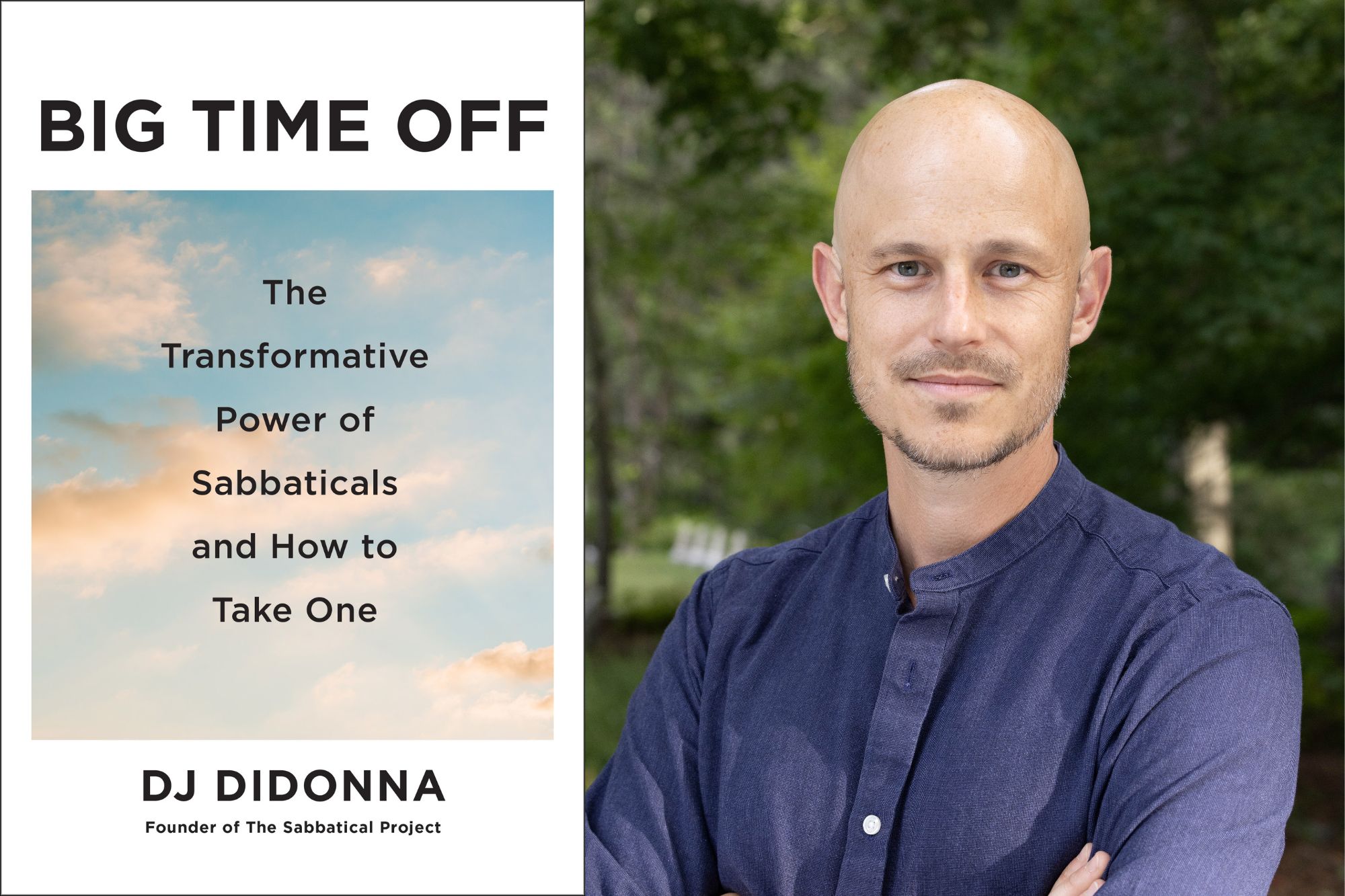
Americans are notoriously bad at taking time off from work. Once entering the workforce, we expect to be devoutly productive for decades on end, awarded with an extended break only upon retirement. In his new book, “Big Time Off: The Transformative Power of Sabbaticals and How to Take One,” Harvard Business School’s DJ DiDonna urges us to step away from our desks to take an extended break from work – something that for many feels culturally, personally or financially impossible. He argues that taking a break from work can lead to powerful self-transformation by making time for the things we often ignore: learning, rest, play, relationships and reflection. Is there a future where we can all step away from our productivity and into the world?
Guests:
- DJ DiDonna, lecturer, Harvard Business School; author, “Big Time Off: The Transformative Power of Sabbaticals and How to Take One”
Episode Transcript
This is a computer-generated transcript. While our team has reviewed it, there may be errors.
Mina Kim: Welcome to Forum. I’m Mina Kim.
Yes, Americans are notoriously bad at taking time off work. Once we enter the workforce, we devote ourselves to being productive for decades and then reward ourselves with retirement.
But what if we “borrowed” a few years from retirement and sprinkled them across our working lives, writes Harvard Business School’s DJ DiDonna. In his new book, Big Time Off, DiDonna says sabbaticals have enormous value and are even essential to understanding who we are and being truly present in our lives. And, DiDonna says, sabbaticals are probably more accessible than you might think.
DJ DiDonna is a Harvard Business School lecturer and founder of The Sabbatical Project. DJ, welcome to Forum.
DJ DiDonna: It’s so awesome to be here.
Mina Kim: Well, it’s great to have you.
I was struck by your description of the state you were in when you realized you needed a sabbatical, or big time off. Can you share with listeners where you were?
DJ DiDonna: Well, it’s a bit of a bookend story because I had just been interviewed at WGBH in Boston about my company.
I was fortunate enough to create my dream job. It was a company that did good in the world. I loved the people I worked with. But after working there for seven or eight years, I was no longer feeling fulfilled. I was feeling a bit burned out and just not my best self.
I think that was confusing because if you design your perfect job and it’s no longer fulfilling, then what’s going to fulfill you, right? So it sent me into a little bit of a tizzy.
That was this burnout story, which I think a lot of people are familiar with, where I felt like I was being pushed out of what I was doing. But there was also this pull toward wanting to do things with my life, spend more time with family, and investigate a spiritual search that was building up inside me that I just couldn’t find the time and space to pursue.
Kind of the important things versus the urgent.
Mina Kim: I was taken by the description of your parents when you were in that state — no longer reaching out to you because they were worried they’d catch you in a bad mood, right? Or in some time zone they couldn’t navigate.
DJ DiDonna: Yeah, it’s not great, especially as an only child.
Mina Kim: And I imagine that’s a sign, right, that you do need something more than a vacation.
Burnout was an accessible term for it, but it sounds like you quickly realized that word didn’t really capture what you were feeling.
DJ DiDonna: I think from all the interviews that I did, the research came up with this term: functional workaholism.
Think about a functional alcoholic. They’re performing at a high level from the outside looking in. It’s not until they can’t perform anymore that it becomes obvious there was a problem.
Similarly, we talk about burnout, which I believe is more of an end state. You’re burned out.
But what we find with sabbaticals is that when you’re able to zoom out from work long enough — and from your work identity — you realize how you were working and how you were living.
Health problems can clear up — eczema, trigger finger — and you gain the perspective that you were actually living more like a machine than a human. Eating, sleeping, recharging, then expelling the battery again.
But you need perspective and enough time to realize that.
Mina Kim: Yeah. Say more about that. How are sabbaticals different from a vacation?
DJ DiDonna: Everyone who’s taken a sabbatical has also taken vacations, and all of those people say it’s profoundly different.
That was really the research question that spurred me on this journey because it was certainly my experience. It was identity-shifting. It was healing. It was fun. It was difficult. It was much more than a vacation.
One of the concepts I talk about is that a vacation is about doing. You’re doing something. You’re going somewhere. You’re traveling.
A sabbatical is about being. You’re just yourself again.
You have enough time to run experiments, try things on for size, heal, and do joyful things. It’s just a different container.
Mina Kim: And about how long do you think it takes?
I know you don’t want to prescribe an exact length, but through your research, what have you generally landed on?
DJ DiDonna: People don’t like this answer because I’m kind of a stickler about it.
One of the most common questions I get is, “What’s the minimum amount of time I can take to get the benefits?”
Mina Kim: It sounds like someone who needs a sabbatical.
DJ DiDonna: Yeah, exactly.
I have a friend, James, who says it’s like asking the minimum amount of time to spend in Paris. If you’re asking the minimum amount of time to be in Paris, you probably need more time in Paris.
The same is true with sabbaticals.
I think a good sabbatical should be measured in months, not days or weeks.
We found in the research that it takes about six to eight weeks just to become yourself again — to stop being governed by your calendar and your inbox, to remember who you are and what you enjoy outside of work, and to stop feeling guilty when you’re not doing something “productive.”
I’d never taken more than two weeks off since middle school. That’s ingrained in our culture and in our story about work.
So I know how that sounds, but we’re talking months.
Mina Kim: Yeah. And you took four months off, which sounds amazing, but it also feels nearly impossible for many Americans to fit into their lives or survive financially without a paycheck.
DJ DiDonna: That’s right.
Mina Kim: So how do you think about that?
DJ DiDonna: What I try to do in the book is tell stories about people who’ve managed to make it work.
One of the biggest predictors of feeling like you can take a sabbatical is simply knowing someone who’s taken one. You have an example that shows what it took to prepare, what happened afterward, and that they didn’t disappear. They got another job. Everything turned out okay.
Ultimately, we’re trying to create a movement where companies have sabbatical policies and governments provide support.
Australia, for example, has long-service leave for civil servants, and many companies offer sabbaticals as well.
We’re trying to get to a point where people don’t have to worry so much about the financial or logistical consequences because it’s simply part of employment.
Until then, I encourage people to set the calendar far ahead.
Let’s talk about 2031 instead of the first quarter of 2027.
If you decide now that you’re taking two months off in the summer of 2031 and tell your employer, “Let’s plan for it,” that’s something you can save for financially, and your company can prepare for your absence.
People leave companies all the time. They take parental leave. Organizations figure it out.
If we value it enough, we can make it work.
Mina Kim: If we value it enough.
So there’s a lot of intrinsic motivation that has to exist as well.
I want to invite listeners into the conversation.
Have you taken a sabbatical? Extended time off? Maybe a gap year? What did you do? How did it affect you?
Do you find this idea of sabbaticals for everyone compelling or accessible? Maybe you’re skeptical.
What questions do you have about making a sabbatical a reality? What pressures keep you from taking extended time off?
You can tell us by emailing [email protected], finding us on Discord, Bluesky, Facebook, or Instagram at KQED Forum, or by calling 866-733-6786.
I was struck, DJ, by your reminder that more people than we realize are forced into extended breaks unexpectedly — whether because they’re caring for someone, they’ve been laid off, or something else.
Did you find that across the board?
DJ DiDonna: Do you mind if I quickly mention something while people are thinking about calling in?
The term “sabbatical” is tricky because it sounds like this prestigious thing that only professors get.
Mina Kim: My dad was a professor, so I always associated it with him simply not teaching for a while.
DJ DiDonna: Exactly.
I talk in the chapter on defining a sabbatical about hoping we eventually live in a world where we don’t even need the word “sabbatical.”
Taking meaningful time off at important moments in your life should simply be normal, not exceptional.
As people think about whether they’ve taken one or whether they’d like to, I encourage them to ask themselves: What would you regret not doing by the end of your life?
Maybe it’s walking the Camino de Santiago. Maybe it’s living abroad with your kids.
Once you identify something concrete that’s deeply meaningful, that’s really what a sabbatical is about.
Thinking about it as a personal goal rather than this lofty concept makes it feel much more attainable.
Mina Kim: And if you hadn’t planned for it, it sounds like those are the kinds of questions that can help make unexpected time away meaningful.
DJ DiDonna: Yeah.
To your earlier question, we found that about two-thirds of sabbaticals are catalyzed by negative events.
As people, we’re not great at embracing change. We don’t like uncertainty. We’d rather keep doing what we’re already doing.
So we wait until something pulls us out.
For me, it was burnout. For others it’s a health crisis, a relationship crisis, or losing a job.
Those experiences pull people out of the soup and make them ask, “What are my priorities, and how can I align my life with them?”
What we’re trying to do is help people become proactive instead.
Mina Kim: Let me go to Tiffany in San Francisco.
Tiffany, go ahead.
Tiffany: Oh, thanks.
Actually, this really aligns with what you were just saying.
I’m a schoolteacher, and in November I slipped while hiking and tore my patellar tendon, which required about five months away from work.
While I was waiting to be rescued, I just had this feeling of surrender.
There was nothing I could do, and the world was going to keep spinning whether I was in my classroom or not.
It was really interesting.
I did go back to work after five months, but that feeling has stayed with me. It’s all just as important as you make it, and work is wonderful, but sometimes you have to step away and surrender to what’s happening.
We also had to figure out the finances, of course.
Sometimes life makes the decision for you, so I really appreciate what you’re saying today.
Mina Kim: Well, thanks, Tiffany.
That was very much on point with what we’re trying to understand.
You’ve also called sabbaticals “regret insurance.”
What do you mean by that, DJ?
DJ DiDonna: I alluded to it earlier when talking about the definition.
What we consistently find is that, at the end of life, people regret the things they didn’t do more often than the things they did.
Can you make a list of the things you really want to do with your life and actually try them?
Maybe you discover you don’t want to be a writer after trying to write a book.
But a sabbatical gives you enough time and space to experiment with those identities and find out.
Mina Kim: We’re talking with DJ DiDonna, lecturer at Harvard Business School and founder of The Sabbatical Project.
His new book is Big Time Off: The Transformative Power of Sabbaticals and How to Take One.
We’re talking about why DJ says sabbaticals can’t just be the province of the privileged. We have to make them a reality for more people.
Stay with us.
This is Forum. I’m Mina Kim