Why California Wants to Block the Paramount-Warner Bros. Merger
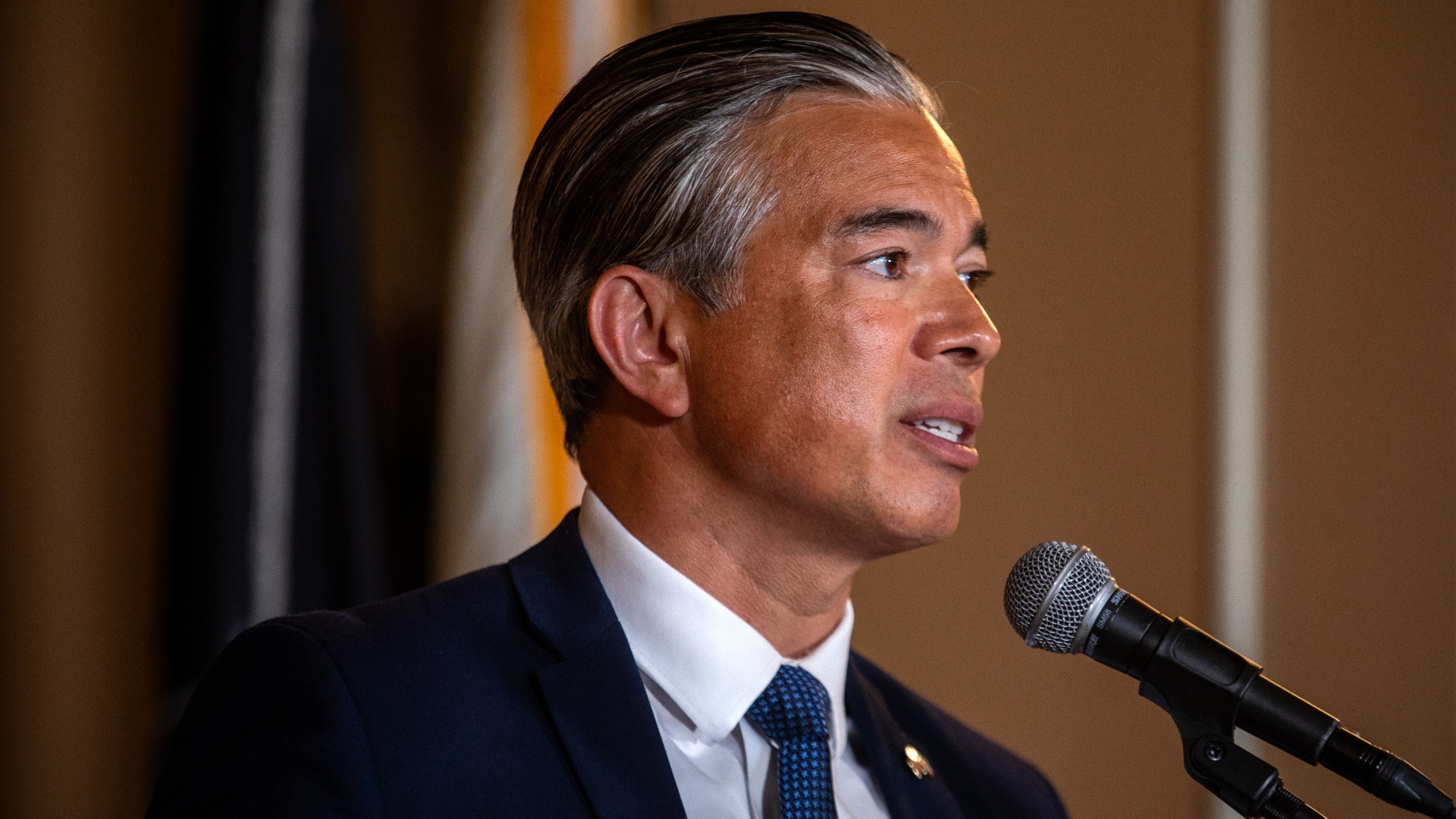
Airdate: Wednesday, July 15, 2026 at 10AM
A coalition of 12 states, including California, has filed a lawsuit to block Paramount’s $110 billion acquisition of Warner Bros. Discovery. California Attorney General Rob Bonta argues the merger of the two entertainment “behemoths” would lead to higher prices, lower quality and less content for consumers. Meanwhile the federal Justice Department, which has already approved the merger, says it believes the deal won’t hurt competition. Bonta joins us to explain the multistate effort seeking to stop the merger.
Guests:
- Rob Bonta, California Attorney General
- Daniel Miller, reporter, POLITICO
This partial transcript was computer-generated. While our team has reviewed it, there may be errors.
Mina Kim: Welcome to Forum. I’m Mina Kim.
California is leading a coalition of 12 states in suing to stop Paramount Skydance’s more than $110 billion acquisition of Warner Bros. Discovery. Attorney General Rob Bonta says the merger would lead to higher prices, fewer movies, and lower-quality, less diverse content. But Paramount says the deal would allow for stronger competition against dominant streaming giants that have disrupted the entertainment industry.
President Trump’s Justice Department has already approved the merger. So can — and should — it be stopped?
Listeners, what do you think?
Joining me now is Daniel Miller, a reporter at Politico who covers the intersection of entertainment and politics, among other things. Daniel, welcome to Forum.
Daniel Miller: Hi. Thanks so much for having me.
Mina Kim: Attorney General Bonta joins us later in the hour. I’d love to get from you the context that will help us understand how we got to California’s lawsuit Monday to block this merger.
So first, why does Paramount want to merge with Warner Bros. Discovery? What would it allow them to do?
Daniel Miller: Sure. So, Warner Bros. Discovery is widely seen as a crown jewel of the entertainment and media industries. It has very strong assets, such as CNN, HBO Max, and, obviously, a namesake film and television studio.
Acquiring this company would allow Paramount to really scale up. What we’ve seen in Hollywood in recent years is a quest for scale. Companies have grown so that they can try to win things like the streaming wars.
Five or six years ago, peak TV was all the rage, and you had companies making the decision, “Look, if we don’t get bigger, we’re going to die.”
I think it’s fair to say that a splashy purchase like this one would give Paramount a ton of momentum. Also, at the same time, David Ellison acquired Paramount last year. His company, Skydance Media, acquired it last year. And I think by buying Warner Bros. Discovery, it would really signal to the world that he is here in Hollywood as a mogul to be reckoned with.
Mina Kim: Yeah, and also take out a major, major competitor. Can you talk about how fierce competitors Paramount and Warner have been?
Daniel Miller: Yeah. Look, I think it’s important to note there are five traditional film studios here in Los Angeles. We all know the names: Disney, Sony, Paramount, Warner Bros., and Universal.
These studios have been in competition for something like 100 years, right? Whether it’s fighting over which studio gets which release date in the summer for a big blockbuster or poaching talent, they are rivals. They compete fiercely.
And I think for many people, because of that, it’s strange to think of these two companies being joined.
Mina Kim: So what did Ellison have to promise to win over the Warner Bros. Discovery board of directors, especially after Netflix dropped out of bidding for it?
Daniel Miller: Well, look, I think it’s important to note that the deal is quite lucrative for Warner Bros. Discovery, and that’s perhaps why its shareholders overwhelmingly approved it this spring.
The stock was trading below $10 before this deal was announced. It was trading below $10 last year, and now this deal would value the company at more than $30 a share.
So I think we need look no further than that to get a sense of why this makes sense for shareholders of Warner Bros. Discovery.
At the same time, there are many in Hollywood who are wringing their hands over this transaction and what it might do to the industry.
Mina Kim: Yeah. Talk about those concerns coming from Hollywood. Almost immediately, many started raising concerns about the merger — about job losses, about so many things. Walk us through some of them.
Daniel Miller: Sure. And look, the important context is this: the local entertainment industry economy here in California, and in Southern California especially, has been bludgeoned over the last couple of years.
We had a labor stoppage in 2023 that really hurt the business and derailed some of the momentum it had. We’ve seen production depart the state for years now, and there’s really a crisis in that area.
L.A. County has lost something like 42,000 entertainment industry jobs in the last few years. So when people heard about this prospective merger, I think many worried — and perhaps rightly so — about the prospect of major layoffs at these studios.
There’s a long history: after consolidation, the job cuts come. And I think many would simply point to Skydance Media’s purchase of Paramount just last year. After that occurred, layoffs ensued.
Mina Kim: Yeah, layoffs ensued. And also, it sounds like Paramount and Warner Bros. in many ways have similar assets, so it feels like there are going to be redundancies that would lead to job losses.
Daniel Miller: That’s right. They do have similar assets.
One good example is they both have streaming services. Paramount has Paramount+, and Warner Bros. Discovery has HBO Max. Under this transaction, if it does go through, those services would be combined to create a new service with something like 200 million subscribers.
That may be good for the merged company and its fight against Netflix, but perhaps you’re going to see some cuts.
Mina Kim: So, Daniel, what has Paramount said in an effort to assuage those fears of job losses and other concerns about the merger?
Daniel Miller: Sure. David Ellison, who I think it’s fair to say is a film buff and a lover of cinema, has been very vocal in saying that this newly combined company is going to make at least 30 films a year.
He said that releasing so many films will lead to an economic uplift, that workers are going to get back to work, and that it’s going to be a boost to the Hollywood economy.
The company has also signaled that it would increase television production. So these are areas where I think the company is trying to assuage some of those concerns about cuts, consolidation, and losses.
I will say there is some skepticism in the industry about the company being able to release 30-plus films a year. Studio output over the long term has been decreasing, so 30-plus films is a big number.
Mina Kim: Yeah, that was my question: whether 30 movies a year, theatrically, was realistic.
And also, it sounds like, as you say, there is such a high price for this merger that whether or not they can invest that much in making that happen is also a question.
Daniel Miller: I think that’s fair to say because, as we’ve said a few times now, consolidation often leads to cuts, and economies of scale mean that there’s just a smaller output.
At the same time, Paramount has really been banging the drum on this one. I saw David Ellison speak at CinemaCon in Las Vegas this spring. This is a gathering of exhibitors from all across the country, and he was very steadfast in his commitment to that number.
Mina Kim: We’re talking with Daniel Miller, reporter at Politico, who covers the intersection of entertainment and politics, and whose recent piece is “As California Tests Its Antitrust Muscle in Hollywood.”
We’re talking about the lawsuit filed by a dozen state attorneys general to block Paramount’s more than $110 billion acquisition of Warner Bros. Discovery. And, of course, this lawsuit is led by California Attorney General Rob Bonta.
Listeners, we want to hear from you. What are your questions about this potential Paramount-Warner merger? What concerns do you have, or do you support it?
If you have concerns, do you think the merger would lower the quality of films and television, as Bonta has said, or create large-scale job losses? Or do you feel like the streaming market needs more robust competitors?
You can tell us by emailing [email protected], finding us on Discord, Bluesky, Facebook, and Instagram. We’re @KQEDForum. Or you can call us at 866-733-6786. That’s 866-733-6786.
And Annie from San Jose writes, “Stop the MAGAfication of our media. Stop the merger.”
Daniel, another concern about this merger is that it’s financially backed by Larry Ellison, David Ellison’s father and a prominent ally of President Trump, whose Justice Department, as we’ve noted, has already approved the merger.
Can you lay out the concerns about what that relationship could mean? And obviously, from Annie’s comment, there have definitely been concerns raised in the journalism space.
Daniel Miller: Sure. So yes, Larry Ellison is a longtime friend of President Trump. That’s not the case for David Ellison, although he has worked to develop a relationship with the president. He hosted a dinner in D.C. earlier this year that honored President Trump.
I think we can talk a little bit about what’s happened at CBS News since David Ellison took over Paramount. This has been a real flashpoint and has, I think, led to concerns among many everyday Americans and, of course, people in the media about what might happen if CNN and CBS are brought under one roof.
There have been very notable changes at CBS News. Bari Weiss has been brought in as the head of the organization. She’s a well-known conservative. And there’s been a big shake-up at the prominent television news magazine 60 Minutes. We’ve seen veteran correspondents and producers leave. We saw Anderson Cooper leave. That was a name that got many people’s attention.
So I think people are wondering: if David Ellison is able to combine these two studios and bring CBS and CNN under one roof, could we see similar changes at CNN that we’ve seen at CBS News?
I think that’s a cause for concern in some corners, for sure.
Mina Kim: And, of course, Trump has repeatedly attacked CNN and says he wants to change that network as well, which is raising concerns.
Also, there was reporting today from ProPublica that found that during the Skydance merger with Paramount, members of the FCC accepted pricey tickets to the Kennedy Center — basically expensive gifts — during that merger as well. So there’s some concern about Paramount trying to get the FCC to approve this merger through unethical means.
Daniel Miller: Yeah. I saw that report just before we came on air, and I think what I would say is this: there are concerns in many corners about the Trump administration and the Justice Department not scrutinizing this deal and perhaps even cheerleading for it to be approved and concluded.
I think we need only look to the comments of California Attorney General Rob Bonta to get a sense of that. He said at his press conference earlier this week — and I’m paraphrasing — that effectively his office and the offices of the other attorneys general had to step in because the federal government wasn’t doing its job.
I think if you read between the lines there, you have a sense of why people are frustrated and perhaps angry.
Mina Kim: California Attorney General Rob Bonta said that the merger of Paramount and Warner Bros. Discovery would lead to higher prices, lower quality, and less content for consumers, and that it violates antitrust law.
President Trump’s Justice Department says the deal won’t hurt competition and has already signed off on the merger.
We’re talking about it with Daniel Miller, a reporter at Politico, and with you, our listeners, at 866-733-6786.
You can find us on Discord, Bluesky, Facebook, or Instagram at @KQEDForum. Or you can email [email protected].
Tell us what you think of the merger, the concerns that you have about it, or whether or not you support it, and why.
More after the break. I’m Mina Kim.