This partial transcript was computer-generated. While our team has reviewed it, there may be errors.
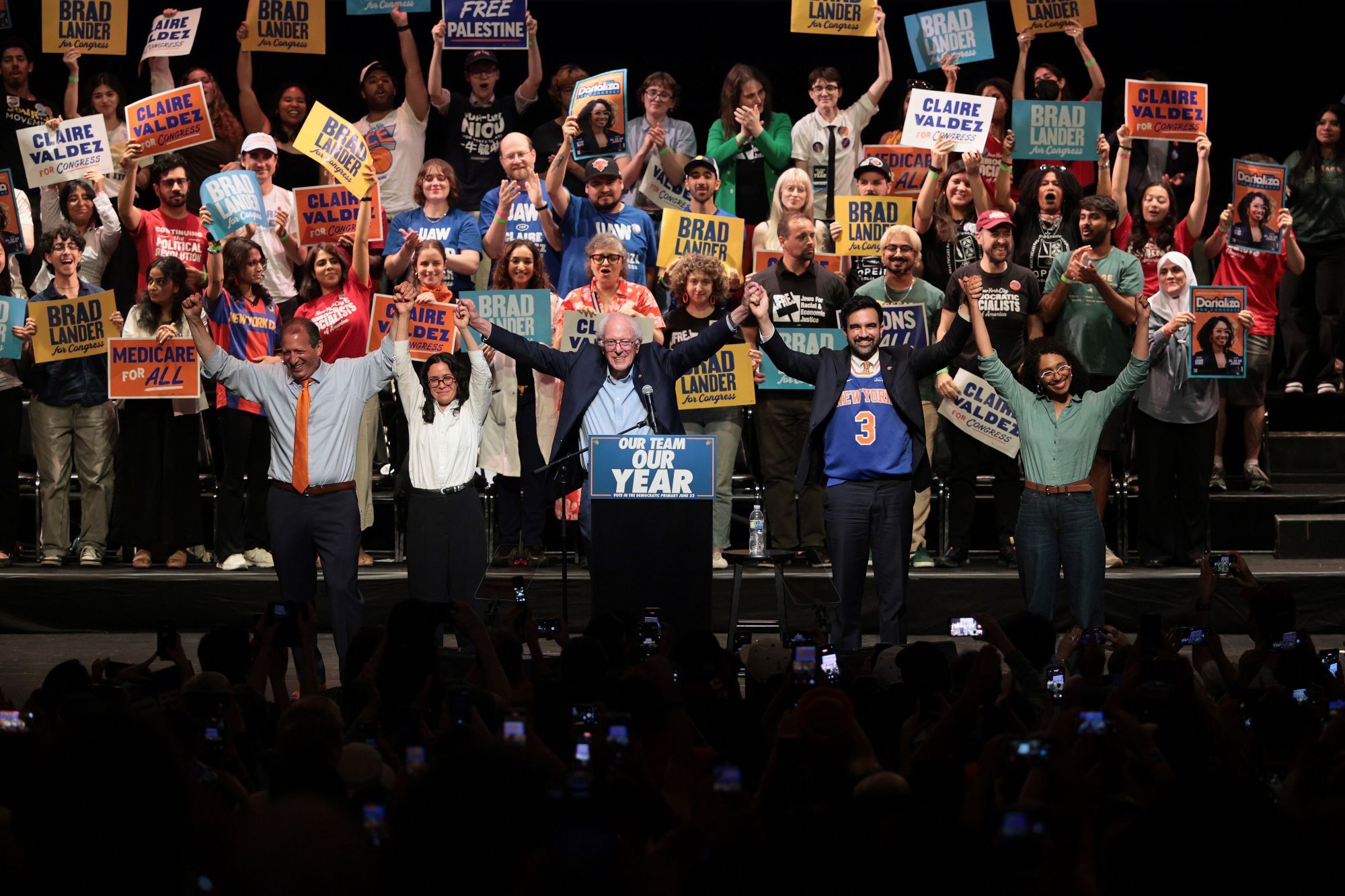
Guy Marzorati: This is Forum. I’m Guy Marzorati, in for Mina Kim. Progressives are on a winning streak in Democratic primaries this summer. In New York, three House candidates backed by Mayor Zohran Mamdani rolled to victory, knocking off two Democratic incumbents. And last week, Democratic Socialist Melat Kiros toppled long-time Democratic Congress member Diana DeGette in Denver.
So, is the left experiencing a Tea Party moment? Joining me this hour to discuss, Erin Covey, U.S. House of Representatives editor at The Cook Political Report. Hey, Erin!
Erin Covey: Hey, Guy, thanks for having me on!
Guy Marzorati: So great to have you — and David Weigel, politics reporter at Semafor, thanks for joining us as well.
David Weigel: Oh, good to be here. Thank you.
Guy Marzorati: So, Erin, maybe to start, catch us up to speed on these progressive winds that we’ve been seeing this summer in House primaries. What’s the through line here?
Erin Covey: Yeah, so the through line is that the left is certainly having a much better cycle than they have had in a while — really, since 2018. The Squad currently has seven members. It’s on track to double in size in the House. And that’s both because you have seen insurgent left-wing candidates unseating incumbents like Congressman Adriano Espaillat and Congresswoman Diana DeGette, but also because you’ve seen Democratic Socialists, or DSA-aligned candidates, win a handful of other open seats — primaries for open seats.
So they’re certainly having a moment. However, I think the question is whether or not this is actually going to affect the party brand enough, or affect the outcome of primaries in competitive districts enough, to affect whether Democrats are able to take control of the House and Senate in November.
Guy Marzorati: Yeah, and David, I don’t think of any of the three Democratic incumbents who lost in Colorado and New York as centrists, necessarily. So is this about policies? Is this about temperament? What do you see?
David Weigel: They were not centrists. I’d start the clock back in November 2024 — which every Democrat wants to relive. Kamala Harris loses. Bernie Sanders, having campaigned for post-COVID candidate Kamala Harris, instantly says the reason she lost is because Democrats abandoned the working class, and he’s going to start changing that. And Sanders takes up this project to find working-class candidates, as he calls them, around the country, and promote and endorse them. He’s much more aggressive this cycle than really any other cycle. He’s working outside the tent again, after working inside the tent in the Biden administration.
With this argument, which is also used by DSA, Democratic Socialists of America, that when Democrats lost, they lost because they were not running progressive enough, visible enough, and aggressive and working-class enough campaigns. So you’re right — some of the losers have been safe-seat Democrats who were older, and Diana DeGette, for example, in her late 60s, but were less visible and were not on board with every left-wing position.
So it’s very entrepreneurial. Democrats — I’d say primary-voting Democrats — did not all move left after the election. What happened is they got very dissatisfied with party leadership and incumbents, and progressives were positioned to say, “We have an answer for that. You should go with our candidates because they’re the real fighters.”
Guy Marzorati: And Erin, what do you make of the Tea Party parallels here to what Republicans experienced at the beginning of the last decade?
Erin Covey: Yeah, I mean, I guess there are some parallels in the sense that we certainly saw the rise of the Tea Party in 2010, which was still a midterm cycle where Republicans were quite successful — they picked up 60 seats in the House. But it made a lot of Republicans concerned about their ability to win winnable races.
I think what is different in terms of the two parties is that we have seen historically — and this is still the case, though maybe less so than it was earlier — that Democratic voters tend to care more about electability than Republican voters. And so, as a result, in these red and purple states and districts where there are competitive Democratic primary contests, voters are typically picking the candidate who is a bit more moderate, and who they think has a better chance at winning in November and appealing to some of the Republican and independent voters that they will need to win over in order to win those races.
So I think that is kind of where the comparison starts to fall apart a little bit. And I would say, at the same time, we have not seen that even in deep-blue districts these candidates are winning a majority of the Democratic primary vote. For the most part, they’re winning maybe 40%, maybe 30% of the vote. So it’s not like the wing of the party that identifies as Democratic Socialist is a majority of the party’s — certainly not — and not even within a primary electorate, which tends to be a little bit more ideological, a little bit further left. They’re still not making up a majority of Democratic voters.
Guy Marzorati: Yeah, and Erin, you referenced the Squad earlier — that’s a group of progressive Democratic Congress members, spearheaded by Alexandria Ocasio-Cortez. They emerged in 2018. Do you feel like the House nominees we’re seeing on the Democratic side emerging from these primaries are kind of an extension of that? Are they different in any way from the Squad that came about in 2018?
Erin Covey: Yeah, it’s a good question. They are a natural extension of it. Many of these new progressives who are incoming are backed by the Justice Democrats, which was the organization that was established ahead of 2018 that supported folks like AOC.
But I will say, I think in the current moment, how these candidates talk about certain issues has changed a little bit. I think we have seen further-left candidates be much more focused on economic populism, more so than we saw in 2018. Cultural issues have taken a bit of a backseat, so you’re not really seeing folks talk as much about racial issues and gender issues that certainly were a polarizing issue in the last election. Most folks are really sticking to the affordability issue. We obviously saw this with Zohran Mamdani’s victory in New York City, and I think that, for the most part, candidates are following that blueprint. I think some of these candidates certainly are pretty far left on cultural issues as well — it’s not like they’re moderating, necessarily. They’re just not talking about them as much.
Guy Marzorati: David, is the evolution of progressive media part of the story here, too?
David Weigel: It’s a big part — thank you for bringing it up — because a commonality that I think has not been explored between the Tea Party and what we’re talking about is that conservative media was very strong in 2008, and was very willing and ready to fill the gap left by George Bush’s exit. Remember, the key figure at the beginning of the Tea Party was Rush Limbaugh — he was almost the spokesman for Republicans. The key network promoting Tea Party events was Fox News.
Now, skipping back to where we are today — progressive media is much stronger than it was in 2018. There are outlets that did not exist, like Drop Site, like Zeteo. There are outlets that did exist but have really moved to the left, like Crooked Media. And I mentioned three just now that have been very promotional for the candidates we’re talking about — very positive, until very recently, of Graham Platner.
The Platner situation is one that I think would have unfolded very differently in 2018, because the media that mattered — and I was at The Washington Post at the time, I’m at a startup now, that’s part of the story — the media at the time, it still mattered if candidates were taken seriously by The New York Times, by The Washington Post, by CNN — one of those hits. There’s a lot more streaming, scrolling, and podcasting media now that gets a lot of views among primary voters and drives discourse — that’s flipped, on the sites people use. They’ll go to Facebook, they’ll go to X, and they’ll see these clips of candidates talking. They have a direct pipeline to voters that was not as strong when they were running before.
Hassan Piker, who has been profiled many times and has campaigned for candidates — that matters. Hassan is filling the role that a lot of the Tea Party celebrities did in 2010 for Republicans — showing up, validating people, and giving them attention. And the rest of the Democratic Party has struggled to do that. Maybe the DNC created a news show after Ken Martin took over that wasn’t watched very much, because their brand is “the Democrats we just lost” — the brand of all this media I’m talking about is “we’re exciting and new, and we’re trying to fix things.”
Guy Marzorati: Yeah, and just to catch folks up on Graham Platner — he was the outsider Democrat. He had won the party’s Senate nomination in Maine. He ended his campaign yesterday after an allegation, first reported by Politico, that he had sexually assaulted a woman in Maine. David, is the argument that he would have never made it past a series of earlier scandals in a previous media environment — controversial Reddit posts, a controversial tattoo?
David Weigel: The vetting would have been different, but also the media consumed by primary voters is different. I’ve only been to Maine a few times during this campaign — I’ve talked to a lot of voters, I talked to Platner before he dropped out — and whenever I go somewhere, I ask voters (I did the Trump rallies, Democratic events) what media do you consume? And I find that they’re mentioning stuff like Majority Report, which is a live YouTube show, and Breaking Points, which has a YouTube show. They were not taking seriously, the way they would have before, the mainstream media outlets that were covering Platner critically.
So the campaign — and this is something that reminded me a lot of what I saw covering Republicans — something negative would appear in the mainstream media, and it was very easy for their validators to say, “Well, this is the mainstream corporate media that’s trying to smear a progressive. Do you trust them, or do you trust the non-corporate independent media?”
It’s very clear that, as these primaries have gone on, candidates who did not debut — remember, in 2018, people might have had a viral video, gotten a bunch of TV interviews, and made a couple million dollars — that’s not happening now. They’ve built a very strong network. They’ve also built political networks like the American Priorities PAC, which is helping pro-Gaza candidates. Those didn’t exist. The left was kind of underfunded and taking advantage of low-turnout primaries in the past, which was tough. It now has more funding, more media, more credibility, more of a network, more celebrities. And Bernie Sanders is more popular — Zohran Mamdani is much more popular than, let’s say, Chuck Schumer or Hakeem Jeffries in New York. That’s why the New York story was so potent.
Guy Marzorati: And we have about a minute till break, but I’m thinking back — a byproduct of Tea Party 1.0 was the elevation of some Republican candidates who ended up being seen as too extreme by the general electorate. I think Todd Akin in Missouri is like the poster child for this. In your mind, are we seeing similar concerns that these primary successes by progressives are then going to create riskier, more competitive general elections?
Erin Covey: Yeah, it’s a good question. I took a look at this last week — at the primaries we have seen in the competitive House races so far this cycle — and the large majority of those primaries have been won by candidates who are either explicitly backed by the Democratic Party, the DCCC, or by center-left organizations. So, so far, we really haven’t seen it hit Democratic primaries in competitive districts. There have been a handful of exceptions to that rule, and a handful of upcoming primaries I’m watching. The Michigan Senate race is one crucial one to watch, but so far, not as much of a factor.
Guy Marzorati: Interesting. We’re going to take a short break. When we come back, we’re going to dive into more of what we’ve learned from this summer’s House primaries, and, as Erin previewed, what it means for the November election. Stay with us.