This partial transcript was computer-generated. While our team has reviewed it, there may be errors.
Leslie McClurg: Welcome to Forum. I’m Leslie McClurg. I’m in today for Mina Kim.
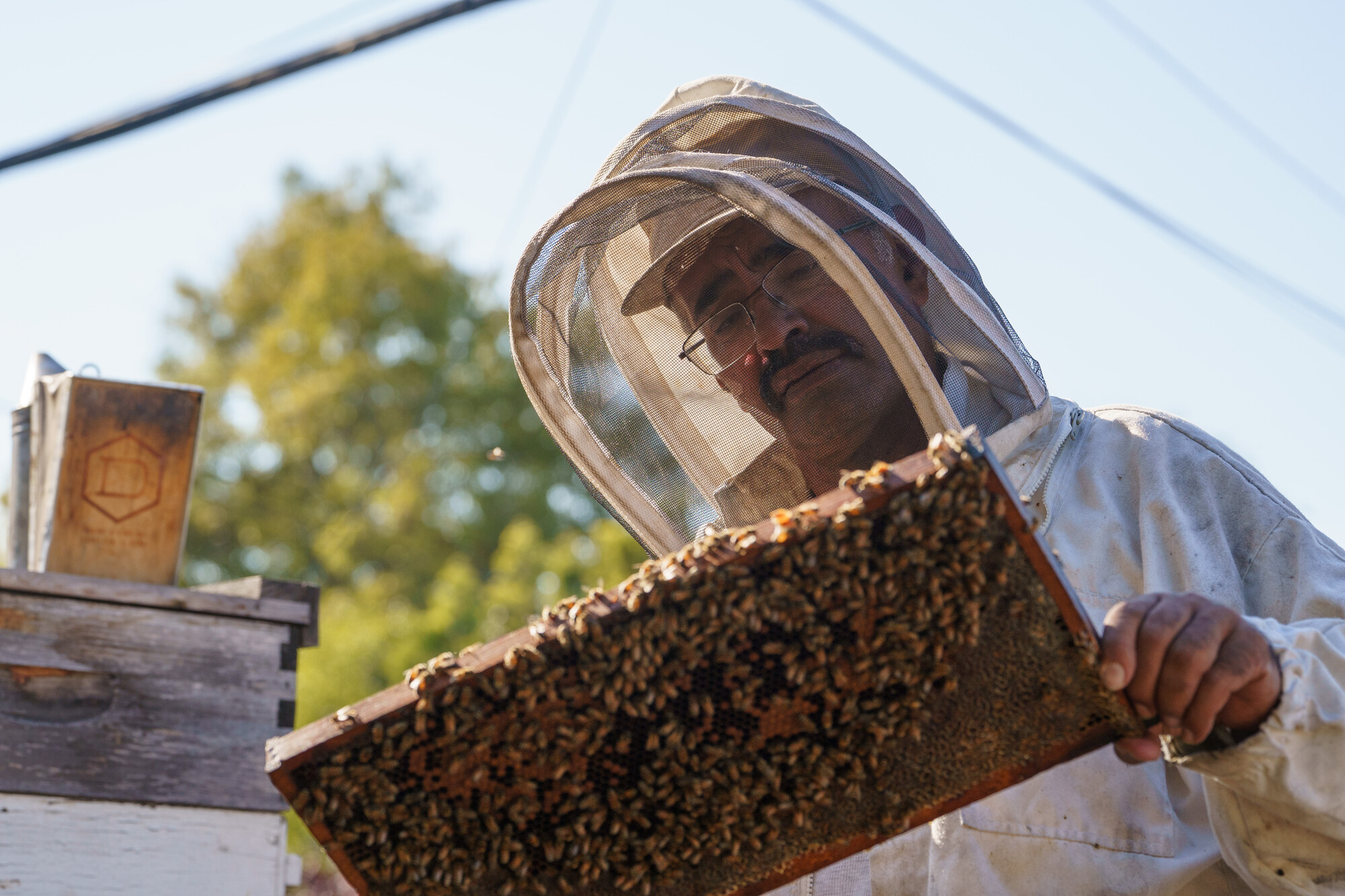
Every February, something happens that most of us never see. Nearly all of the country’s commercial honeybees are trucked in from all over the US. They converge on California’s Central Valley for a few very frantic weeks of almond pollination. It’s called the Super Bowl of beekeeping. But journalist Jenny Durant argues that this annual migration is pushing America’s bees, basically, to the brink. In her new book, Bitter Honey: Big Ag’s Threat to Bees and the Fight to Save Them, she says the crisis isn’t just about pesticides or about climate change — it’s about a food system built for scale.
Welcome, Jenny.
Jennie Durant: Thank you so much for having me.
Leslie McClurg: One thing that was so clear to me in your book is how much you loved bees. Tell us why.
Jennie Durant: You know, I got interested in bees when I was living in the Philippines. I was on a Fulbright scholarship, and I was really homesick at the time. And I read Sue Monk Kidd’s The Secret Life of Bees. And I was like, you know, what’ll cure my homesickness is going to hang out with bees.
Leslie McClurg: Interesting.
Jennie Durant: And so I went down and I found this woman who had kind of like a bee-themed farm and a resort area. And she had these little hexagonally shaped buildings, and I went and interned with her for about ten days. And my first time getting in the hive was really magical. She brought me over — I didn’t have on any gear, I was just wearing a hat — and she cracked open the box, and the bees were just kind of humming and buzzing inside. And there was this scent of, you know, warm wax and honey. And it really kind of enveloped me — the sound, the scents. And then the more I really started getting into them, and then the more I just understood about how they operate and how they, you know, collect honey and just all these nuances about them, I just kind of kept falling more in love with them.
Leslie McClurg: In your writing, like I said, it’s very clear. Can you read us a couple paragraphs?
Jennie Durant: Yeah, so this is from the introduction.
It’s easy to overlook the insect pollinators that surround us. During the day, bees and butterflies visit thousands of flowers. Beetles chew through leaves and petals to feed, passing pollen from one bloom to the next. Bumblebees perform buzz pollination by gripping onto flowers and vibrating their flight muscles to release pollen. Tiny midges no larger than a pinhead pollinate cacao, giving us chocolate, while a variety of bees, wasps, flies, and other insects pollinate coffee plants. Even mosquitoes play a role — some species pollinate orchids, and all mosquitoes drink floral nectar and may transfer pollen as well.
As the sun sets, nocturnal pollinators emerge, drawn to pale, fragrant flowers that only bloom at night. Long-tongued moths seek out the deep nectaries in honeysuckle, yucca, and orchids. They’re joined by an ensemble of insects on the night shift — flies, beetles, short-tongued moths, and even some nocturnal bees and wasps. When winter comes, many of these insects enter diapause, a kind of insect hibernation, where they wait in suspended animation, like dormant seeds, until spring arrives and wakes them to pollinate once more.
Over millions of years, flowers and pollinators coevolved. Pollinators’ unique traits — like their tongue length, flight patterns, and body shapes — influenced flowers’ form and function. Flowers, in turn, shaped the pollinators. These interdependent relationships have fostered an incredible diversity of trees, shrubs, and flowers that sustain life on our planet. Today, around ninety percent of the world’s flowering plants and seventy-five percent of the world’s major food crops benefit from pollination services provided by insects and other animal pollinators. Their decline threatens the stability of our environment, our food systems, and the intricate web of life that depends on them.
Leslie McClurg: It’s so clear — that intricacy is so clear in your language. Let’s talk about the Super Bowl of pollination, as you describe it. Why almonds specifically? And why do we need so many bees to come to Central California?
Jennie Durant: Yeah, so almonds depend on bee pollination. A lot of crops benefit from bee pollination — it may increase their harvest or the size of the fruit — but almonds, most almond varieties, actually need bees to pollinate in order to provide fruit. And so, because of insurance rules, most almond orchards need two colonies of bees per acre of almonds. And we currently have about almost one point four million acres of almonds in California.
Leslie McClurg: Which is the size of Delaware.
Jennie Durant: Exactly, yeah. And so then we have twice that many, you know, number of acres we need in bee colonies. And so that ends up being some, you know, over two million bee colonies. I think we have something close to maybe two point seven, two point nine million colonies commercially managed in the US. And nearly — at least ninety, some say ninety-nine percent — of all commercially managed colonies are coming to California to pollinate almonds each February.
Leslie McClurg: And what does that massive event look like?
Jennie Durant: So it’s kind of wild. There are these beekeepers coming from all over the United States, and they’re loading colonies onto semi trucks and shipping them here. So imagine a big semi truck loaded — you know, I can’t remember how many high, but maybe like eight to ten colonies high — and they’re on these pallets, and they use forklifts to load the pallets onto the semi trucks. And then the semi trucks are often covered with a net, and then they cross the US — depending on where they’re coming from, however long it takes. They come into California, if they’re coming from out of state, and they get inspected at the border. They sometimes have to get washed down if there’s, like, fire ants or, you know, problematic pests on the outside that they see during the inspection. And then they’ll bring the colonies in — they bring them into various places, a lot of times holding yards outside an almond orchard. Typically, they don’t bring them right into an almond orchard because they need to spray chemicals and stuff before pollination. And then they’ll hang out around the orchards, and then they’re brought in. They’re almost always moved at night. And so there’s kind of this, like, night shift that happens, where they bring that semi truck in at night, and they’re unloading the colonies throughout the orchard. And then by sunrise, the bees, you know, go off and start pollinating.
Leslie McClurg: And if that didn’t happen, would we have almonds?
Jennie Durant: No. The vast majority of almonds — there are some species, like a variety called Independence, aptly named, that requires less pollination. We thought originally that maybe it didn’t need any pollination, but it turns out it benefits from having at least one colony of bees. And so most do require at least two for a robust harvest. And so, yeah, without bees, we would not have almonds.
Leslie McClurg: Does that mean that commercial beekeepers these days are more dependent on renting out their bees than making honey, like in the past?
Jennie Durant: Yeah, it’s been a big transition that’s happened over the past couple of decades, where beekeepers have transitioned from primarily focusing on honey production to almond pollination, or commercial pollination in general. I think the recent statistic is about fifty percent of their income comes from almond, or from pollination, and fifty from honey production. And of that fifty percent for pollination, about eighty percent of that is from almonds for most beekeepers. So it’s providing the vast majority of pollination income, and at least fifty percent, you know, of that income is from pollinating crops.
Leslie McClurg: And just to remind us, what other crops are dependent on our bees — on these commercial honeybees?
Jennie Durant: Yeah, so there’s apples, pears, avocados, cherries, plums, blueberries, a lot of squash, like zucchini, cucumber, pumpkins, melons. There’s a lot of crops that benefit from bee pollination.
Leslie McClurg: And we need these managed colonies — nature could not do this for us?
Jennie Durant: At the scale at which our current agricultural system operates, we do need managed colonies. A lot of this is because we’ve just lost a lot of the wild spaces around our farms and our, you know, landscapes that would provide a home and, like, food and habitat for native bees. And then also, here in California, we tend to have these large-scale farm systems, where you have, like, all kinds of one crop, and then, you know, a long distance away, another kind of crop. And so there’s kind of a feast-and-famine that happens, where there’s a lot of food at once and then there’s no food at all. And so beekeepers are also forced to move their colonies around from place to place to feed them. And then this kind of system has created — we’ve created a system where we have a need for these managed bees, and it also kind of supports this large-scale beekeeping as well.
Leslie McClurg: And we tend to think that pesticides are either safe or dangerous for our bees, but you argue that it’s a lot more complicated than that. So, all the pesticides that we spray on our crops — how are the bees adapting, or not adapting, to the pesticides?
Jennie Durant: Well, our regulation is pretty solid around the agrochemicals that are acutely toxic for bees. What I mean by that is there’s testing that’s done that really helps us understand which agrochemicals are bee-toxic on an acute level, meaning it would kill them right away. But what we’re less clear around is which agrochemicals are sub-lethally toxic — so maybe they affect foraging abilities, or they affect a queen’s ability to lay eggs, or a bee’s ability to learn how to forage. And so that’s where the labels don’t reflect that as well. And so farmers do end up spraying more of those agrochemicals, because the labels don’t say, “Don’t spray — these are toxic for bees.” They are sub-lethally toxic. They’re harder to trace in the lab, harder to trace prior to the labeling process. But they do have a definite effect on bees.
And then another issue that happens is pesticides can get mixed in the tank before they get sprayed, and we really don’t understand what that synergistic toxicity — the effects of that mix on bees — really is. Some of them can be really problematic, like a fungicide mixed with a pesticide. And we’re still kind of on the forefront of understanding how these mixes can affect bees as well.
Leslie McClurg: So that’s one part of the puzzle. What about climate change?
Jennie Durant: Climate change is playing a role. In the book, I talk about this one beekeeper, Eric Oliver. One winter — it was 2021 — there was a major storm here in California, and his bees were suffocated by snowfall, because the snow kind of covered the front of the hive, the entrance. They couldn’t get out. In another apiary, they were attacked by bears, because a tree fell and took out the electric fence that kept the bears out, and they love to eat not just honey, but bee larvae — it’s a high-protein source. And then, in another place, his bees were swept away by a river that flooded. This is all at once. He lost — it was like, I think, a quarter of his operation. And so beekeepers are having issues with losing their colonies in that way.
They’re also suffering from droughts, which wipe out the availability of flowers, and flowers need water to produce nectar. So if there’s a significant drought, then they can just lose this whole patch of prairie that they relied on for honey production. And then also, we are seeing some increases in, like, spring arriving earlier, and that can really mess with both managed and wild bees. So that can be an issue as well.
Leslie McClurg: Absolutely. We’re talking about our country’s honeybees and their health. We’re joined by Jenny Durant. She’s author of Bitter Honey: Big Ag’s Threat to Bees and the Fight to Save Them. We’ll get into agriculture right after this break.