window.__IS_SSR__=true
window.__INITIAL_STATE__={
"attachmentsReducer": {
"audio_0": {
"type": "attachments",
"id": "audio_0",
"imgSizes": {
"kqedFullSize": {
"file": "https://ww2.kqed.org/news/wp-content/themes/KQED-unified/img/audio_bgs/background0.jpg"
}
}
},
"audio_1": {
"type": "attachments",
"id": "audio_1",
"imgSizes": {
"kqedFullSize": {
"file": "https://ww2.kqed.org/news/wp-content/themes/KQED-unified/img/audio_bgs/background1.jpg"
}
}
},
"audio_2": {
"type": "attachments",
"id": "audio_2",
"imgSizes": {
"kqedFullSize": {
"file": "https://ww2.kqed.org/news/wp-content/themes/KQED-unified/img/audio_bgs/background2.jpg"
}
}
},
"audio_3": {
"type": "attachments",
"id": "audio_3",
"imgSizes": {
"kqedFullSize": {
"file": "https://ww2.kqed.org/news/wp-content/themes/KQED-unified/img/audio_bgs/background3.jpg"
}
}
},
"audio_4": {
"type": "attachments",
"id": "audio_4",
"imgSizes": {
"kqedFullSize": {
"file": "https://ww2.kqed.org/news/wp-content/themes/KQED-unified/img/audio_bgs/background4.jpg"
}
}
},
"placeholder": {
"type": "attachments",
"id": "placeholder",
"imgSizes": {
"thumbnail": {
"file": "https://cdn.kqed.org/wp-content/uploads/2024/12/KQED-Default-Image-816638274-2000x1333-1-160x107.jpg",
"width": 160,
"height": 107,
"mimeType": "image/jpeg"
},
"medium": {
"file": "https://cdn.kqed.org/wp-content/uploads/2024/12/KQED-Default-Image-816638274-2000x1333-1-800x533.jpg",
"width": 800,
"height": 533,
"mimeType": "image/jpeg"
},
"medium_large": {
"file": "https://cdn.kqed.org/wp-content/uploads/2024/12/KQED-Default-Image-816638274-2000x1333-1-768x512.jpg",
"width": 768,
"height": 512,
"mimeType": "image/jpeg"
},
"large": {
"file": "https://cdn.kqed.org/wp-content/uploads/2024/12/KQED-Default-Image-816638274-2000x1333-1-1020x680.jpg",
"width": 1020,
"height": 680,
"mimeType": "image/jpeg"
},
"1536x1536": {
"file": "https://cdn.kqed.org/wp-content/uploads/2024/12/KQED-Default-Image-816638274-2000x1333-1-1536x1024.jpg",
"width": 1536,
"height": 1024,
"mimeType": "image/jpeg"
},
"fd-lrg": {
"file": "https://cdn.kqed.org/wp-content/uploads/2024/12/KQED-Default-Image-816638274-2000x1333-1-1536x1024.jpg",
"width": 1536,
"height": 1024,
"mimeType": "image/jpeg"
},
"fd-med": {
"file": "https://cdn.kqed.org/wp-content/uploads/2024/12/KQED-Default-Image-816638274-2000x1333-1-1020x680.jpg",
"width": 1020,
"height": 680,
"mimeType": "image/jpeg"
},
"fd-sm": {
"file": "https://cdn.kqed.org/wp-content/uploads/2024/12/KQED-Default-Image-816638274-2000x1333-1-800x533.jpg",
"width": 800,
"height": 533,
"mimeType": "image/jpeg"
},
"post-thumbnail": {
"file": "https://cdn.kqed.org/wp-content/uploads/2024/12/KQED-Default-Image-816638274-2000x1333-1-672x372.jpg",
"width": 672,
"height": 372,
"mimeType": "image/jpeg"
},
"twentyfourteen-full-width": {
"file": "https://cdn.kqed.org/wp-content/uploads/2024/12/KQED-Default-Image-816638274-2000x1333-1-1038x576.jpg",
"width": 1038,
"height": 576,
"mimeType": "image/jpeg"
},
"xxsmall": {
"file": "https://cdn.kqed.org/wp-content/uploads/2024/12/KQED-Default-Image-816638274-2000x1333-1-160x107.jpg",
"width": 160,
"height": 107,
"mimeType": "image/jpeg"
},
"xsmall": {
"file": "https://cdn.kqed.org/wp-content/uploads/2024/12/KQED-Default-Image-816638274-2000x1333-1-672x372.jpg",
"width": 672,
"height": 372,
"mimeType": "image/jpeg"
},
"small": {
"file": "https://cdn.kqed.org/wp-content/uploads/2024/12/KQED-Default-Image-816638274-2000x1333-1-672x372.jpg",
"width": 672,
"height": 372,
"mimeType": "image/jpeg"
},
"xlarge": {
"file": "https://cdn.kqed.org/wp-content/uploads/2024/12/KQED-Default-Image-816638274-2000x1333-1-1020x680.jpg",
"width": 1020,
"height": 680,
"mimeType": "image/jpeg"
},
"full-width": {
"file": "https://cdn.kqed.org/wp-content/uploads/2024/12/KQED-Default-Image-816638274-2000x1333-1-1920x1280.jpg",
"width": 1920,
"height": 1280,
"mimeType": "image/jpeg"
},
"guest-author-32": {
"file": "https://cdn.kqed.org/wp-content/uploads/2025/01/KQED-Default-Image-816638274-1333x1333-1-160x160.jpg",
"width": 32,
"height": 32,
"mimeType": "image/jpeg"
},
"guest-author-50": {
"file": "https://cdn.kqed.org/wp-content/uploads/2025/01/KQED-Default-Image-816638274-1333x1333-1-160x160.jpg",
"width": 50,
"height": 50,
"mimeType": "image/jpeg"
},
"guest-author-64": {
"file": "https://cdn.kqed.org/wp-content/uploads/2025/01/KQED-Default-Image-816638274-1333x1333-1-160x160.jpg",
"width": 64,
"height": 64,
"mimeType": "image/jpeg"
},
"guest-author-96": {
"file": "https://cdn.kqed.org/wp-content/uploads/2025/01/KQED-Default-Image-816638274-1333x1333-1-160x160.jpg",
"width": 96,
"height": 96,
"mimeType": "image/jpeg"
},
"guest-author-128": {
"file": "https://cdn.kqed.org/wp-content/uploads/2025/01/KQED-Default-Image-816638274-1333x1333-1-160x160.jpg",
"width": 128,
"height": 128,
"mimeType": "image/jpeg"
},
"detail": {
"file": "https://cdn.kqed.org/wp-content/uploads/2025/01/KQED-Default-Image-816638274-1333x1333-1-160x160.jpg",
"width": 160,
"height": 160,
"mimeType": "image/jpeg"
},
"kqedFullSize": {
"file": "https://cdn.kqed.org/wp-content/uploads/2024/12/KQED-Default-Image-816638274-2000x1333-1.jpg",
"width": 2000,
"height": 1333
}
}
},
"bayareabites_81729": {
"type": "attachments",
"id": "bayareabites_81729",
"meta": {
"index": "attachments_1716263798",
"site": "bayareabites",
"id": "81729",
"found": true
},
"parent": 81342,
"imgSizes": {
"kqedFullSize": {
"file": "https://ww2.kqed.org/app/uploads/sites/24/2014/05/frittata-slice640x360.jpg",
"width": 640,
"height": 360
}
},
"publishDate": 1399605092,
"modified": 1399605092,
"caption": null,
"description": null,
"title": "frittata-slice640x360",
"credit": null,
"status": "inherit",
"isLoading": false,
"fetchFailed": false
},
"bayareabites_81460": {
"type": "attachments",
"id": "bayareabites_81460",
"meta": {
"index": "attachments_1716263798",
"site": "bayareabites",
"id": "81460",
"found": true
},
"parent": 81287,
"imgSizes": {
"kqedFullSize": {
"file": "https://ww2.kqed.org/app/uploads/sites/24/2014/05/final-muffin640x360.jpg",
"width": 640,
"height": 360
}
},
"publishDate": 1399425063,
"modified": 1399425063,
"caption": null,
"description": null,
"title": "final-muffin640x360",
"credit": null,
"status": "inherit",
"isLoading": false,
"fetchFailed": false
},
"bayareabites_80621": {
"type": "attachments",
"id": "bayareabites_80621",
"meta": {
"index": "attachments_1716263798",
"site": "bayareabites",
"id": "80621",
"found": true
},
"parent": 80590,
"imgSizes": {
"kqedFullSize": {
"file": "https://ww2.kqed.org/app/uploads/sites/24/2014/04/13726_1397292709_131_13726.jpg",
"width": 468,
"height": 321
}
},
"publishDate": 1397712951,
"modified": 1397712951,
"caption": "Gardening at the SF Earth Day in 2013. Photo: SF Earth Day",
"description": null,
"title": "13726_1397292709_131_13726",
"credit": null,
"status": "inherit",
"isLoading": false,
"fetchFailed": false
},
"bayareabites_80661": {
"type": "attachments",
"id": "bayareabites_80661",
"meta": {
"index": "attachments_1716263798",
"site": "bayareabites",
"id": "80661",
"found": true
},
"parent": 79934,
"imgSizes": {
"kqedFullSize": {
"file": "https://ww2.kqed.org/app/uploads/sites/24/2014/04/charles-phan-kitchen640x360.jpg",
"width": 640,
"height": 360
}
},
"publishDate": 1397768376,
"modified": 1397768376,
"caption": null,
"description": null,
"title": "charles-phan-kitchen640x360",
"credit": null,
"status": "inherit",
"isLoading": false,
"fetchFailed": false
},
"bayareabites_80518": {
"type": "attachments",
"id": "bayareabites_80518",
"meta": {
"index": "attachments_1716263798",
"site": "bayareabites",
"id": "80518",
"found": true
},
"parent": 80502,
"imgSizes": {
"kqedFullSize": {
"file": "https://ww2.kqed.org/app/uploads/sites/24/2014/04/finished-peeps-640x360.jpg",
"width": 640,
"height": 360
}
},
"publishDate": 1397612186,
"modified": 1397612186,
"caption": null,
"description": null,
"title": "finished-peeps-640x360",
"credit": null,
"status": "inherit",
"isLoading": false,
"fetchFailed": false
},
"bayareabites_80360": {
"type": "attachments",
"id": "bayareabites_80360",
"meta": {
"index": "attachments_1716263798",
"site": "bayareabites",
"id": "80360",
"found": true
},
"parent": 80324,
"imgSizes": {
"kqedFullSize": {
"file": "https://ww2.kqed.org/app/uploads/sites/24/2014/04/final-matzo640x360.jpg",
"width": 640,
"height": 360
}
},
"publishDate": 1397185075,
"modified": 1397185075,
"caption": null,
"description": null,
"title": "final-matzo640x360",
"credit": null,
"status": "inherit",
"isLoading": false,
"fetchFailed": false
},
"bayareabites_80300": {
"type": "attachments",
"id": "bayareabites_80300",
"meta": {
"index": "attachments_1716263798",
"site": "bayareabites",
"id": "80300",
"found": true
},
"parent": 80289,
"imgSizes": {
"kqedFullSize": {
"file": "https://ww2.kqed.org/app/uploads/sites/24/2014/04/slaughter-meat.jpg",
"width": 624,
"height": 351
}
},
"publishDate": 1397087813,
"modified": 1397087813,
"caption": null,
"description": null,
"title": "slaughter-meat",
"credit": null,
"status": "inherit",
"isLoading": false,
"fetchFailed": false
},
"bayareabites_80246": {
"type": "attachments",
"id": "bayareabites_80246",
"meta": {
"index": "attachments_1716263798",
"site": "bayareabites",
"id": "80246",
"found": true
},
"parent": 80234,
"imgSizes": {
"kqedFullSize": {
"file": "https://ww2.kqed.org/app/uploads/sites/24/2014/04/quinoa-passover.jpg",
"width": 624,
"height": 350
}
},
"publishDate": 1396974214,
"modified": 1396974214,
"caption": null,
"description": null,
"title": "quinoa-passover",
"credit": null,
"status": "inherit",
"isLoading": false,
"fetchFailed": false
},
"bayareabites_79859": {
"type": "attachments",
"id": "bayareabites_79859",
"meta": {
"index": "attachments_1716263798",
"site": "bayareabites",
"id": "79859",
"found": true
},
"parent": 79851,
"imgSizes": {
"kqedFullSize": {
"file": "https://ww2.kqed.org/app/uploads/sites/24/2014/04/girlscoutcookies.jpg",
"width": 624,
"height": 350
}
},
"publishDate": 1396372108,
"modified": 1396372108,
"caption": null,
"description": null,
"title": "girlscoutcookies",
"credit": null,
"status": "inherit",
"isLoading": false,
"fetchFailed": false
},
"bayareabites_79170": {
"type": "attachments",
"id": "bayareabites_79170",
"meta": {
"index": "attachments_1716263798",
"site": "bayareabites",
"id": "79170",
"found": true
},
"parent": 79164,
"imgSizes": {
"kqedFullSize": {
"file": "https://ww2.kqed.org/app/uploads/sites/24/2014/03/stpatricksday.jpg",
"width": 624,
"height": 350
}
},
"publishDate": 1395075754,
"modified": 1395075754,
"caption": null,
"description": null,
"title": "stpatricksday",
"credit": null,
"status": "inherit",
"isLoading": false,
"fetchFailed": false
},
"bayareabites_79139": {
"type": "attachments",
"id": "bayareabites_79139",
"meta": {
"index": "attachments_1716263798",
"site": "bayareabites",
"id": "79139",
"found": true
},
"parent": 78994,
"imgSizes": {
"kqedFullSize": {
"file": "https://ww2.kqed.org/app/uploads/sites/24/2014/03/purim800.jpg",
"width": 800,
"height": 666
}
},
"publishDate": 1394855161,
"modified": 1553104319,
"caption": "Gluten-Free Hamantaschen for Purim. ",
"description": "Gluten-Free Hamantaschen for Purim. ",
"title": "gluten-free-hamantaschen-purim-recipe",
"credit": "Stephanie Rosenbaum",
"status": "inherit",
"isLoading": false,
"fetchFailed": false
},
"bayareabites_78645": {
"type": "attachments",
"id": "bayareabites_78645",
"meta": {
"index": "attachments_1716263798",
"site": "bayareabites",
"id": "78645",
"found": true
},
"parent": 78635,
"imgSizes": {
"kqedFullSize": {
"file": "https://ww2.kqed.org/app/uploads/sites/24/2014/02/donuts640.jpg",
"width": 624,
"height": 380
}
},
"publishDate": 1393436937,
"modified": 1393436937,
"caption": "A Mardi Gras treat fit for a king. Photo: Emily Hilliard/NPR",
"description": null,
"title": "doughnutsmain",
"credit": null,
"status": "inherit",
"isLoading": false,
"fetchFailed": false
}
},
"audioPlayerReducer": {
"postId": "stream_live",
"isPaused": true,
"isPlaying": false,
"pfsActive": false,
"pledgeModalIsOpen": true,
"playerDrawerIsOpen": false,
"liveAudioPlayStartedAt": 0,
"liveAudioPlayContext": ""
},
"authorsReducer": {
"byline_bayareabites_80289": {
"type": "authors",
"id": "byline_bayareabites_80289",
"meta": {
"override": true
},
"slug": "byline_bayareabites_80289",
"name": "Sidsel Overgaard",
"isLoading": false
},
"byline_bayareabites_80234": {
"type": "authors",
"id": "byline_bayareabites_80234",
"meta": {
"override": true
},
"slug": "byline_bayareabites_80234",
"name": "Marc Silver",
"isLoading": false
},
"byline_bayareabites_79851": {
"type": "authors",
"id": "byline_bayareabites_79851",
"meta": {
"override": true
},
"slug": "byline_bayareabites_79851",
"name": "Eliza Barclay",
"isLoading": false
},
"byline_bayareabites_79164": {
"type": "authors",
"id": "byline_bayareabites_79164",
"meta": {
"override": true
},
"slug": "byline_bayareabites_79164",
"name": "Maria Godoy",
"isLoading": false
},
"byline_bayareabites_78635": {
"type": "authors",
"id": "byline_bayareabites_78635",
"meta": {
"override": true
},
"slug": "byline_bayareabites_78635",
"name": "Emily Hilliard",
"isLoading": false
},
"rachael-myrow": {
"type": "authors",
"id": "251",
"meta": {
"index": "authors_1716337520",
"id": "251",
"found": true
},
"name": "Rachael Myrow",
"firstName": "Rachael",
"lastName": "Myrow",
"slug": "rachael-myrow",
"email": "rmyrow@kqed.org",
"display_author_email": true,
"staff_mastheads": [
"news"
],
"title": "Senior Editor of KQED's Silicon Valley News Desk",
"bio": "• I write and edit stories about how Silicon Valley power and policies shape everyday life in California. I’m also passionate about making Bay Area history and culture more accessible to a broad public. • I’ve been a journalist for most of my life, starting in high school with The Franklin Press in Los Angeles, where I grew up. While earning my first degree in English at UC Berkeley, I got my start in public radio at KALX-FM. After completing a second degree in journalism at Cal, I landed my first professional job at Marketplace, then moved on to KPCC (now LAist), and then KQED, where I hosted The California Report for more than seven years. • My reporting has appeared on NPR, The World, WBUR’s \u003ci>Here & Now\u003c/i>, and the BBC. I also guest host for KQED’s \u003ci>Forum\u003c/i>, as well as the Commonwealth Club in San Francisco. • I speak periodically on media, democracy and technology issues, and do voiceover work for documentaries and educational video projects. • Outside of the studio, you'll find me hiking Bay Area trails and whipping up Insta-ready meals in my kitchen. • I do not accept gifts, money, or favors from anyone connected to my reporting, I don't pay people for information, and I do not support or donate to political causes. • I strive to treat the people I report on with fairness, honesty, and respect. I also recognize there are often multiple sides to a story and work to verify information through multiple sources and documentation. If I get something wrong, I correct it.",
"avatar": "https://secure.gravatar.com/avatar/3ed8a3c5f26025e4a805ba634cda8cd764906b97438a6d9ce216b044e340da4e?s=600&d=blank&r=g",
"twitter": "rachaelmyrow",
"bluesky": null,
"facebook": null,
"instagram": null,
"linkedin": "https://www.linkedin.com/in/rachaelmyrow/",
"sites": [
{
"site": "arts",
"roles": [
"administrator"
]
},
{
"site": "news",
"roles": [
"edit_others_posts",
"editor"
]
},
{
"site": "futureofyou",
"roles": [
"editor"
]
},
{
"site": "bayareabites",
"roles": [
"editor"
]
},
{
"site": "stateofhealth",
"roles": [
"editor"
]
},
{
"site": "science",
"roles": [
"editor"
]
},
{
"site": "food",
"roles": [
"editor"
]
},
{
"site": "forum",
"roles": [
"editor"
]
},
{
"site": "liveblog",
"roles": [
"author"
]
}
],
"headData": {
"title": "Rachael Myrow | KQED",
"description": "Senior Editor of KQED's Silicon Valley News Desk",
"ogImgSrc": "https://secure.gravatar.com/avatar/3ed8a3c5f26025e4a805ba634cda8cd764906b97438a6d9ce216b044e340da4e?s=600&d=blank&r=g",
"twImgSrc": "https://secure.gravatar.com/avatar/3ed8a3c5f26025e4a805ba634cda8cd764906b97438a6d9ce216b044e340da4e?s=600&d=blank&r=g"
},
"isLoading": false,
"link": "/author/rachael-myrow"
},
"kdomara": {
"type": "authors",
"id": "1459",
"meta": {
"index": "authors_1716337520",
"id": "1459",
"found": true
},
"name": "Kelly O'Mara",
"firstName": "Kelly",
"lastName": "O'Mara",
"slug": "kdomara",
"email": "komara@kqed.org",
"display_author_email": false,
"staff_mastheads": [
"news"
],
"title": "KQED Contributor",
"bio": "Kelly O'Mara is a writer and reporter in the San Francisco Bay Area. She writes about food, health, sports, travel, business and California news. Her work has appeared on KQED, online for Outside Magazine, epsnW, VICE and in Competitor Magazine, among others. Follow Kelly on Twitter \u003ca href=\"https://twitter.com/kellydomara\">@kellydomara\u003c/a>.",
"avatar": "https://secure.gravatar.com/avatar/768fec7412028b72f13bdd0f5f9d8186?s=600&d=blank&r=g",
"twitter": null,
"facebook": null,
"instagram": null,
"linkedin": null,
"sites": [
{
"site": "arts",
"roles": []
},
{
"site": "news",
"roles": []
},
{
"site": "bayareabites",
"roles": []
},
{
"site": "stateofhealth",
"roles": []
},
{
"site": "science",
"roles": []
},
{
"site": "checkplease",
"roles": [
"editor"
]
},
{
"site": "food",
"roles": []
},
{
"site": "forum",
"roles": [
"editor"
]
},
{
"site": "liveblog",
"roles": [
"editor"
]
}
],
"headData": {
"title": "Kelly O'Mara | KQED",
"description": "KQED Contributor",
"ogImgSrc": "https://secure.gravatar.com/avatar/768fec7412028b72f13bdd0f5f9d8186?s=600&d=blank&r=g",
"twImgSrc": "https://secure.gravatar.com/avatar/768fec7412028b72f13bdd0f5f9d8186?s=600&d=blank&r=g"
},
"isLoading": false,
"link": "/author/kdomara"
},
"wendy-goodfriend": {
"type": "authors",
"id": "5014",
"meta": {
"index": "authors_1716337520",
"id": "5014",
"found": true
},
"name": "Wendy Goodfriend",
"firstName": "Wendy",
"lastName": "Goodfriend",
"slug": "wendy-goodfriend",
"email": "wendy@wendygoodfriend.com",
"display_author_email": false,
"staff_mastheads": [],
"title": "KQED Contributor",
"bio": "I was the Senior Digital Producer for KQED Food up until July, 2018. Since 2001, I designed, produced, managed and contributed to mostly food-related websites and blogs for KQED including: KQED.org; KQED Food; Bay Area Bites; Check, Please! Bay Area; Taste This; Celebrity Chefs; seven of Jacques Pepin's TV series websites; and Joanne Weir's Cooking in the City. I initiated the majority of KQED Food's social media feeds and maintained them up until 2017. As far as content creation, photography is my passion and I also shoot video and write stories. My photos have been used in articles for KQED Food, News, Arts, and Science as well as for promotional purposes in print and online. Professional education and training includes: clinical psychology, photography, commercial cooking, web design, information architecture and UX.",
"avatar": "https://secure.gravatar.com/avatar/dfba64372339cc34cf17e446e6f18fa8?s=600&d=blank&r=g",
"twitter": null,
"facebook": "bayareabites",
"instagram": null,
"linkedin": "wendygoodfriend",
"sites": [
{
"site": "jpepinheart",
"roles": []
},
{
"site": "about",
"roles": [
"editor"
]
},
{
"site": "bayareabites",
"roles": [
"subscriber"
]
},
{
"site": "science",
"roles": [
"administrator"
]
},
{
"site": "checkplease",
"roles": [
"subscriber"
]
},
{
"site": "food",
"roles": [
"author"
]
},
{
"site": "essentialpepin",
"roles": [
"administrator"
]
}
],
"headData": {
"title": "Wendy Goodfriend | KQED",
"description": "KQED Contributor",
"ogImgSrc": "https://secure.gravatar.com/avatar/dfba64372339cc34cf17e446e6f18fa8?s=600&d=blank&r=g",
"twImgSrc": "https://secure.gravatar.com/avatar/dfba64372339cc34cf17e446e6f18fa8?s=600&d=blank&r=g"
},
"isLoading": false,
"link": "/author/wendy-goodfriend"
},
"kim-laidlaw": {
"type": "authors",
"id": "5015",
"meta": {
"index": "authors_1716337520",
"id": "5015",
"found": true
},
"name": "Kim Laidlaw",
"firstName": "Kim",
"lastName": "Laidlaw",
"slug": "kim-laidlaw",
"email": "kim_laidlaw@yahoo.com",
"display_author_email": false,
"staff_mastheads": [],
"title": null,
"bio": "Kim Laidlaw is a cookbook author, editor, food writer, producer, project manager, and baker who has been in the kitchen covered in flour since she was big enough to stir the biscuit dough. She has over 16 years of experience in book and online publishing, and a lifetime of experience in the kitchen. \r\n\r\nHer first cookbook, Home Baked Comfort, was published in 2011; her second cookbook, Baby & Toddler On the Go, was published in April 2013; and her third cookbook, Williams-Sonoma Dessert of the Day, was published in October 2013. \r\n\r\nShe was the first blogger on KQED’s Bay Area Bites blog, which launched in 2005, and previously worked as a professional baker at La Farine French Bakery in Oakland, CA. She lives in Petaluma with her husband and their child, whom she cooks for everyday. Find out more at \u003ca href=\"http://www.kimlaidlaw.com\">http://www.kimlaidlaw.com\u003c/a>.",
"avatar": "https://secure.gravatar.com/avatar/284503bc296b6f7822eb38b816292376?s=600&d=blank&r=g",
"twitter": null,
"facebook": "kimilaw",
"instagram": null,
"linkedin": "kimlaidlaw",
"sites": [
{
"site": "bayareabites",
"roles": [
"contributor"
]
},
{
"site": "food",
"roles": [
"contributor"
]
}
],
"headData": {
"title": "Kim Laidlaw | KQED",
"description": null,
"ogImgSrc": "https://secure.gravatar.com/avatar/284503bc296b6f7822eb38b816292376?s=600&d=blank&r=g",
"twImgSrc": "https://secure.gravatar.com/avatar/284503bc296b6f7822eb38b816292376?s=600&d=blank&r=g"
},
"isLoading": false,
"link": "/author/kim-laidlaw"
},
"stephanie-rosenbaum": {
"type": "authors",
"id": "5038",
"meta": {
"index": "authors_1716337520",
"id": "5038",
"found": true
},
"name": "Stephanie Rosenbaum Klassen",
"firstName": "Stephanie",
"lastName": "Rosenbaum Klassen",
"slug": "stephanie-rosenbaum",
"email": "dixieday@aol.com",
"display_author_email": false,
"staff_mastheads": [],
"title": "KQED Contributor",
"bio": "Stephanie Rosenbaum Klassen is a longtime local food writer, author, and cook. Her books include The Art of Vintage Cocktails (Egg & Dart Press), World of Doughnuts (Egg & Dart Press); Kids in the Kitchen: Fun Food (Williams Sonoma); Honey from Flower to Table (Chronicle Books) and The Astrology Cookbook: A Cosmic Guide to Feasts of Love (Manic D Press). She has studied organic farming at UCSC and holds a certificate in Ecological Horticulture from the Center for Agroecology and Sustainable Food Systems. She does frequent cooking demonstrations at local farmers’ markets and has taught food writing at Media Alliance in San Francisco and the Continuing Education program at Stanford University. She has been the lead restaurant critic for the San Francisco Bay Guardian as well as for San Francisco magazine. She has been an assistant chef at the Headlands Center for the Arts, an artists' residency program located in the Marin Headlands, and a production cook at the Marin Sun Farms Cafe in Pt Reyes Station. After some 20 years in San Francisco interspersed with stints in Oakland, Santa Cruz, Brooklyn, and Manhattan, she recently moved to Sonoma county but still writes in San Francisco several days a week.",
"avatar": "https://secure.gravatar.com/avatar/26520681f950a766c2c0eb9872646dec42b88de07cc4cdd65958385671e93cf7?s=600&d=mm&r=g",
"twitter": "sjrosenbaum",
"bluesky": null,
"facebook": null,
"instagram": null,
"linkedin": null,
"sites": [
{
"site": "bayareabites",
"roles": [
"subscriber"
]
},
{
"site": "food",
"roles": [
"subscriber"
]
}
],
"headData": {
"title": "Stephanie Rosenbaum Klassen | KQED",
"description": "KQED Contributor",
"ogImgSrc": "https://secure.gravatar.com/avatar/26520681f950a766c2c0eb9872646dec42b88de07cc4cdd65958385671e93cf7?s=600&d=mm&r=g",
"twImgSrc": "https://secure.gravatar.com/avatar/26520681f950a766c2c0eb9872646dec42b88de07cc4cdd65958385671e93cf7?s=600&d=mm&r=g"
},
"isLoading": false,
"link": "/author/stephanie-rosenbaum"
},
"katewilliams": {
"type": "authors",
"id": "5485",
"meta": {
"index": "authors_1716337520",
"id": "5485",
"found": true
},
"name": "Kate Williams",
"firstName": "Kate",
"lastName": "Williams",
"slug": "katewilliams",
"email": "williaka@gmail.com",
"display_author_email": false,
"staff_mastheads": [],
"title": null,
"bio": "Kate Williams grew up outside of Atlanta, where twenty-pound baskets of peaches were an end-of-summer tradition. After spending time in Boston developing recipes for America's Test Kitchen and pretending to be a New Englander, she moved to sunny Berkeley. Here she works as a personal chef and food writer, covering topics ranging from taco trucks to modernist cookbooks. In addition to KQED's Bay Area Bites, Kate's work appears on Serious Eats, Berkeleyside NOSH, The Oxford American, America's Test Kitchen cookbooks, and Food52.",
"avatar": "https://secure.gravatar.com/avatar/25623fe56e181fe8b6ee92fd0ea077de?s=600&d=blank&r=g",
"twitter": "KateHWilliams",
"facebook": null,
"instagram": null,
"linkedin": null,
"sites": [
{
"site": "bayareabites",
"roles": [
"contributor"
]
},
{
"site": "food",
"roles": [
"contributor"
]
}
],
"headData": {
"title": "Kate Williams | KQED",
"description": null,
"ogImgSrc": "https://secure.gravatar.com/avatar/25623fe56e181fe8b6ee92fd0ea077de?s=600&d=blank&r=g",
"twImgSrc": "https://secure.gravatar.com/avatar/25623fe56e181fe8b6ee92fd0ea077de?s=600&d=blank&r=g"
},
"isLoading": false,
"link": "/author/katewilliams"
}
},
"pagesReducer": {
"bayareabites_category_holidays-and-traditions": {
"type": "terms",
"id": "bayareabites_1763",
"meta": {
"index": "terms_1716263798",
"site": "bayareabites",
"id": "1763",
"score": 14.405985
},
"featImg": null,
"name": "holidays and traditions",
"description": null,
"taxonomy": "category",
"headData": {
"twImgId": null,
"twTitle": null,
"ogTitle": null,
"ogImgId": null,
"twDescription": null,
"description": null,
"title": "holidays and traditions Archives | KQED Bay Area Bites",
"ogDescription": null
},
"ttid": 1254,
"slug": "holidays-and-traditions",
"isLoading": false,
"title": "holidays and traditions",
"pageMeta": {
"site": "bayareabites",
"WpPageTemplate": "page-topic-editorial",
"currentPage": 25
},
"blocks": [
{
"blockName": "kqed/post-list",
"attrs": {
"layout": "cardArticle2",
"query": "posts/bayareabites?category=holidays-and-traditions",
"seeMore": false,
"paginated": true,
"page": 25
}
},
{
"blockName": "kqed/ad"
}
]
}
},
"pfsSessionReducer": {},
"postsReducer": {
"stream_live": {
"type": "live",
"id": "stream_live",
"audioUrl": "https://streams.kqed.org/kqedradio",
"title": "Live Stream",
"excerpt": "Live Stream information currently unavailable.",
"link": "/radio",
"featImg": "",
"label": {
"name": "KQED Live",
"link": "/"
}
},
"stream_kqedNewscast": {
"type": "posts",
"id": "stream_kqedNewscast",
"audioUrl": "https://www.kqed.org/.stream/anon/radio/RDnews/newscast.mp3?_=1",
"title": "KQED Newscast",
"featImg": "",
"label": {
"name": "88.5 FM",
"link": "/"
}
},
"bayareabites_81342": {
"type": "posts",
"id": "bayareabites_81342",
"meta": {
"index": "posts_1716263798",
"site": "bayareabites",
"id": "81342",
"score": null,
"sort": [
1399651324000
]
},
"parent": 0,
"labelTerm": {
"site": "bayareabites"
},
"blocks": [],
"publishDate": 1399651324,
"format": "aside",
"disqusTitle": "Springtime Frittata with Asparagus, Leeks, and Herbs",
"title": "Springtime Frittata with Asparagus, Leeks, and Herbs",
"headTitle": "Bay Area Bites | KQED Food",
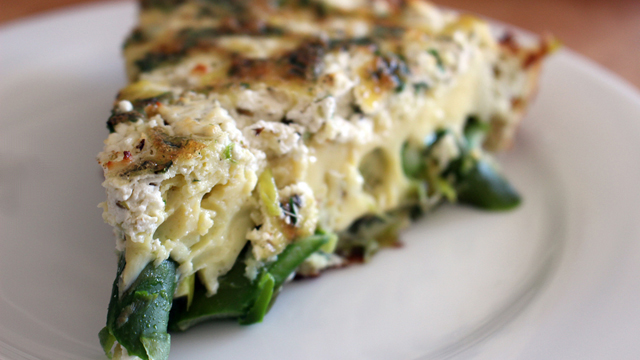
"content": "\u003cfigure id=\"attachment_81700\" class=\"wp-caption aligncenter\" style=\"max-width: 700px\">\u003ca href=\"http://ww2.kqed.org/bayareabites/wp-content/uploads/sites/24/2014/05/frittata-slice-pan700.jpg\">\u003cimg class=\"size-full wp-image-81700\" src=\"http://ww2.kqed.org/bayareabites/wp-content/uploads/sites/24/2014/05/frittata-slice-pan700.jpg\" alt=\"Slice of Springtime Frittata. Photo: Wendy Goodfriend\" width=\"700\" height=\"1050\">\u003c/a>\u003cfigcaption class=\"wp-caption-text\">Slice of Springtime Frittata. Photo: \u003ca href=\"http://ww2.kqed.org/bayareabites/author/wendy-goodfriend/\">Wendy Goodfriend\u003c/a>\u003c/figcaption>\u003c/figure>\n\u003cp>Eggs pose a big problem when you are serving brunch for a whole lot of people. They tend to need to be cooked last minute, and generally need to be served hot. So poached, fried, even scrambled is usually off my list.\u003c/p>\n\u003cp>[contextly_sidebar id=\"BWueW9TPatHIDgwVFydogwqjOPQOuQn9\"]\u003c/p>\n\u003cp>I like frittata because it is one of the most versatile, easy, and so-not-time-consuming ways to serve eggs at brunch. Not only that, but you can serve it hot or at room temperature and no one will get annoyed that it’s not hot enough. That means you can make it ahead of time, or at least pop it in the oven just when your guests arrive (or wake up, depending).\u003c/p>\n\u003cp>Part of the whole versatile draw is also that you can throw JUST ABOUT anything into them. No, really. Bacon, ham, chicken, sausage, crab, potatoes, roasted peppers, corn, cherry tomatoes, broccoli, peas, the world is your oyster. Hell, you can even throw in some oysters and do a crazy Hangtown fry-inspired frittata.\u003c/p>\n\u003cp>This one is a favorite of mine. It’s the epitome of springtime, and it just looks pretty to boot. Loaded with asparagus, one of my absolute favorite vegetables, and plenty of herbs, buttery leeks, and tangy goat cheese, this would be a very welcome addition to my breakfast-in-bed on Mother’s Day. Ahem.\u003c/p>\n\u003cp>[ad fullwidth]\u003c/p>\n\u003cp>Feel free to use this as a starting off point and create your own frittata with your favorite ingredients!\u003c/p>\n\u003cfigure id=\"attachment_81699\" class=\"wp-caption aligncenter\" style=\"max-width: 1000px\">\u003ca href=\"http://ww2.kqed.org/bayareabites/wp-content/uploads/sites/24/2014/05/frittata-ingredients1000.jpg\">\u003cimg class=\"size-full wp-image-81699\" src=\"http://ww2.kqed.org/bayareabites/wp-content/uploads/sites/24/2014/05/frittata-ingredients1000.jpg\" alt=\"Springtime Frittata ingredients. Photo: Wendy Goodfriend\" width=\"1000\" height=\"667\">\u003c/a>\u003cfigcaption class=\"wp-caption-text\">Springtime Frittata ingredients. Photo: \u003ca href=\"http://ww2.kqed.org/bayareabites/author/wendy-goodfriend/\">Wendy Goodfriend\u003c/a>\u003c/figcaption>\u003c/figure>\n\u003ch3>Springtime Frittata\u003c/h3>\n\u003cp>\u003cem>Serves 6 to 8\u003c/em>\u003c/p>\n\u003cp>\u003cstrong>Ingredients:\u003c/strong>\u003c/p>\n\u003cul>\n\u003cli>1 1/2 lb medium-sized asparagus, tough ends snapped and cut into 3/4-inch pieces\u003c/li>\n\u003cli>Kosher salt and freshly ground pepper\u003c/li>\n\u003cli>12 large eggs\u003c/li>\n\u003cli>2 tbsp finely chopped fresh chives, plus more for garnish\u003c/li>\n\u003cli>1 heaping tsp finely chopped fresh tarragon, plus more for garnish\u003c/li>\n\u003cli>6 oz fresh goat cheese, ideally garlic-herb, crumbled\u003c/li>\n\u003cli>1 tbsp olive oil\u003c/li>\n\u003cli>2 tbsp unsalted butter\u003c/li>\n\u003cli>1 leek, white and pale green parts only, halved lengthwise, rinsed well, and thinly sliced\u003c/li>\n\u003c/ul>\n\u003cp>[gallery type=\"slideshow\" link=\"file\" ids=\"81710,81709,81711\"]\u003c/p>\n\u003cp>\u003cstrong>Instructions:\u003c/strong>\u003c/p>\n\u003col>\n\u003cli style=\"list-style-type: none\">\n\u003col>\n\u003cli>Preheat the oven to 400F. Fill a saucepan half full of salted water and bring the water to a boil over medium-high heat. Add the asparagus and boil for about 2 minutes, just until crisp-tender. Drain and rinse under cold water to stop the cooking.\u003c/li>\n\u003cli>In a bowl, whisk together the eggs, chives, tarragon, 1 tsp salt, and a few grinds of pepper.\u003c/li>\n\u003cli>In a 10-inch heavy, ovenproof frying pan over medium heat, warm the olive oil with 1 tbsp butter. When the butter is melted, add the leek and a pinch of salt and cook until the leek is tender, about 6 minutes. Add the asparagus and remaining butter and stir to combine, cooking until warmed through, about 1 minute.\u003c/li>\n\u003cli>Re-whisk the egg mixture and gently pour it over the vegetables in the pan. Cook until the eggs at the edge of the pan begin to set, running a heatproof rubber spatula along the edge to let the egg slide under the frittata, about 2-3 minutes.\u003c/li>\n\u003cli>Sprinkle the goat cheese evenly over the top of the frittata.\u003c/li>\n\u003c/ol>\n\u003c/li>\n\u003c/ol>\n\u003cp>\u003c/p>\n\u003cp>[gallery type=\"slideshow\" link=\"file\" ids=\"81720,81721,81722\"]\u003c/p>\n\u003col>\n\u003cli>Put the pan in the oven and bake until the eggs are set, about 10 minutes. Turn on the broiler and broil the frittata for a few minutes to brown the top, if you like. Check for doneness by cutting a slit in the center of the frittata; it should be just set. Let cool for about 5 minutes, then slice into wedges and serve.\u003c/li>\n\u003c/ol>\n\u003cfigure id=\"attachment_81715\" class=\"wp-caption aligncenter\" style=\"max-width: 1000px\">\u003ca href=\"http://ww2.kqed.org/bayareabites/wp-content/uploads/sites/24/2014/05/frittata-cooked-pan1000a.jpg\">\u003cimg class=\"size-full wp-image-81715\" src=\"http://ww2.kqed.org/bayareabites/wp-content/uploads/sites/24/2014/05/frittata-cooked-pan1000a.jpg\" alt=\"Fresh out-of-the-oven Springtime Frittata. Photo: Wendy Goodfriend\" width=\"1000\" height=\"667\">\u003c/a>\u003cfigcaption class=\"wp-caption-text\">Fresh out-of-the-oven Springtime Frittata. Photo: Wendy Goodfriend\u003c/figcaption>\u003c/figure>\n\u003cfigure id=\"attachment_81703\" class=\"wp-caption aligncenter\" style=\"max-width: 1000px\">\u003ca href=\"http://ww2.kqed.org/bayareabites/wp-content/uploads/sites/24/2014/05/frittata-slice1000.jpg\">\u003cimg class=\"size-full wp-image-81703\" src=\"http://ww2.kqed.org/bayareabites/wp-content/uploads/sites/24/2014/05/frittata-slice1000.jpg\" alt=\"Slice Frittata into wedges and serve. Photo: Wendy Goodfriend\" width=\"1000\" height=\"667\">\u003c/a>\u003cfigcaption class=\"wp-caption-text\">Slice Frittata into wedges and serve. Photo: Wendy Goodfriend\u003c/figcaption>\u003c/figure>\n\n",
"disqusIdentifier": "81342 http://blogs.kqed.org/bayareabites/?p=81342",
"disqusUrl": "https://ww2.kqed.org/bayareabites/2014/05/09/springtime-frittata-with-asparagus-leeks-and-herbs/",
"stats": {
"hasVideo": false,
"hasChartOrMap": false,
"hasAudio": false,
"hasPolis": false,
"wordCount": 637,
"hasGoogleForm": false,
"hasGallery": true,
"hasHearkenModule": false,
"iframeSrcs": [],
"paragraphCount": 13
},
"modified": 1550267629,
"excerpt": "Eggs can be a problem when serving brunch for lots of people. Enter the versatile, amazing, and delicious frittata, all gussied up for springtime.",
"headData": {
"twImgId": "",
"twTitle": "",
"ogTitle": "",
"ogImgId": "",
"twDescription": "",
"description": "Eggs can be a problem when serving brunch for lots of people. Enter the versatile, amazing, and delicious frittata, all gussied up for springtime.",
"title": "Springtime Frittata with Asparagus, Leeks, and Herbs | KQED",
"ogDescription": "",
"schema": {
"@context": "https://schema.org",
"@type": "Article",
"headline": "Springtime Frittata with Asparagus, Leeks, and Herbs",
"datePublished": "2014-05-09T09:02:04-07:00",
"dateModified": "2019-02-15T13:53:49-08:00",
"image": "https://cdn.kqed.org/wp-content/uploads/2020/02/KQED-OG-Image@1x.png"
}
},
"guestAuthors": [],
"slug": "springtime-frittata-with-asparagus-leeks-and-herbs",
"status": "publish",
"path": "/bayareabites/81342/springtime-frittata-with-asparagus-leeks-and-herbs",
"audioTrackLength": null,
"parsedContent": [
{
"type": "contentString",
"content": "\u003cdiv class=\"post-body\">\u003cp>\u003cfigure id=\"attachment_81700\" class=\"wp-caption aligncenter\" style=\"max-width: 700px\">\u003ca href=\"http://ww2.kqed.org/bayareabites/wp-content/uploads/sites/24/2014/05/frittata-slice-pan700.jpg\">\u003cimg class=\"size-full wp-image-81700\" src=\"http://ww2.kqed.org/bayareabites/wp-content/uploads/sites/24/2014/05/frittata-slice-pan700.jpg\" alt=\"Slice of Springtime Frittata. Photo: Wendy Goodfriend\" width=\"700\" height=\"1050\">\u003c/a>\u003cfigcaption class=\"wp-caption-text\">Slice of Springtime Frittata. Photo: \u003ca href=\"http://ww2.kqed.org/bayareabites/author/wendy-goodfriend/\">Wendy Goodfriend\u003c/a>\u003c/figcaption>\u003c/figure>\n\u003cp>Eggs pose a big problem when you are serving brunch for a whole lot of people. They tend to need to be cooked last minute, and generally need to be served hot. So poached, fried, even scrambled is usually off my list.\u003c/p>\n\u003cp>\u003c/p>\u003cp>\u003c/p>\u003cp>\u003c/p>\n\u003cp>I like frittata because it is one of the most versatile, easy, and so-not-time-consuming ways to serve eggs at brunch. Not only that, but you can serve it hot or at room temperature and no one will get annoyed that it’s not hot enough. That means you can make it ahead of time, or at least pop it in the oven just when your guests arrive (or wake up, depending).\u003c/p>\n\u003cp>Part of the whole versatile draw is also that you can throw JUST ABOUT anything into them. No, really. Bacon, ham, chicken, sausage, crab, potatoes, roasted peppers, corn, cherry tomatoes, broccoli, peas, the world is your oyster. Hell, you can even throw in some oysters and do a crazy Hangtown fry-inspired frittata.\u003c/p>\n\u003cp>This one is a favorite of mine. It’s the epitome of springtime, and it just looks pretty to boot. Loaded with asparagus, one of my absolute favorite vegetables, and plenty of herbs, buttery leeks, and tangy goat cheese, this would be a very welcome addition to my breakfast-in-bed on Mother’s Day. Ahem.\u003c/p>\n\u003cp>\u003c/p>\u003c/div>",
"attributes": {
"named": {},
"numeric": []
}
},
{
"type": "component",
"content": "",
"name": "ad",
"attributes": {
"named": {
"label": "fullwidth"
},
"numeric": [
"fullwidth"
]
}
},
{
"type": "contentString",
"content": "\u003cdiv class=\"post-body\">\u003cp>\u003c/p>\n\u003cp>Feel free to use this as a starting off point and create your own frittata with your favorite ingredients!\u003c/p>\n\u003cfigure id=\"attachment_81699\" class=\"wp-caption aligncenter\" style=\"max-width: 1000px\">\u003ca href=\"http://ww2.kqed.org/bayareabites/wp-content/uploads/sites/24/2014/05/frittata-ingredients1000.jpg\">\u003cimg class=\"size-full wp-image-81699\" src=\"http://ww2.kqed.org/bayareabites/wp-content/uploads/sites/24/2014/05/frittata-ingredients1000.jpg\" alt=\"Springtime Frittata ingredients. Photo: Wendy Goodfriend\" width=\"1000\" height=\"667\">\u003c/a>\u003cfigcaption class=\"wp-caption-text\">Springtime Frittata ingredients. Photo: \u003ca href=\"http://ww2.kqed.org/bayareabites/author/wendy-goodfriend/\">Wendy Goodfriend\u003c/a>\u003c/figcaption>\u003c/figure>\n\u003ch3>Springtime Frittata\u003c/h3>\n\u003cp>\u003cem>Serves 6 to 8\u003c/em>\u003c/p>\n\u003cp>\u003cstrong>Ingredients:\u003c/strong>\u003c/p>\n\u003cul>\n\u003cli>1 1/2 lb medium-sized asparagus, tough ends snapped and cut into 3/4-inch pieces\u003c/li>\n\u003cli>Kosher salt and freshly ground pepper\u003c/li>\n\u003cli>12 large eggs\u003c/li>\n\u003cli>2 tbsp finely chopped fresh chives, plus more for garnish\u003c/li>\n\u003cli>1 heaping tsp finely chopped fresh tarragon, plus more for garnish\u003c/li>\n\u003cli>6 oz fresh goat cheese, ideally garlic-herb, crumbled\u003c/li>\n\u003cli>1 tbsp olive oil\u003c/li>\n\u003cli>2 tbsp unsalted butter\u003c/li>\n\u003cli>1 leek, white and pale green parts only, halved lengthwise, rinsed well, and thinly sliced\u003c/li>\n\u003c/ul>\n\u003cp>\u003c/p>\u003c/div>",
"attributes": {
"named": {},
"numeric": []
}
},
{
"type": "component",
"content": "",
"name": "gallery",
"attributes": {
"named": {
"type": "slideshow",
"link": "file",
"ids": "81710,81709,81711",
"label": ""
},
"numeric": []
}
},
{
"type": "contentString",
"content": "\u003cdiv class=\"post-body\">\u003cp>\u003c/p>\n\u003cp>\u003cstrong>Instructions:\u003c/strong>\u003c/p>\n\u003col>\n\u003cli style=\"list-style-type: none\">\n\u003col>\n\u003cli>Preheat the oven to 400F. Fill a saucepan half full of salted water and bring the water to a boil over medium-high heat. Add the asparagus and boil for about 2 minutes, just until crisp-tender. Drain and rinse under cold water to stop the cooking.\u003c/li>\n\u003cli>In a bowl, whisk together the eggs, chives, tarragon, 1 tsp salt, and a few grinds of pepper.\u003c/li>\n\u003cli>In a 10-inch heavy, ovenproof frying pan over medium heat, warm the olive oil with 1 tbsp butter. When the butter is melted, add the leek and a pinch of salt and cook until the leek is tender, about 6 minutes. Add the asparagus and remaining butter and stir to combine, cooking until warmed through, about 1 minute.\u003c/li>\n\u003cli>Re-whisk the egg mixture and gently pour it over the vegetables in the pan. Cook until the eggs at the edge of the pan begin to set, running a heatproof rubber spatula along the edge to let the egg slide under the frittata, about 2-3 minutes.\u003c/li>\n\u003cli>Sprinkle the goat cheese evenly over the top of the frittata.\u003c/li>\n\u003c/ol>\n\u003c/li>\n\u003c/ol>\n\u003cp>\u003c/p>\n\u003cp>\u003c/p>\u003c/div>",
"attributes": {
"named": {},
"numeric": []
}
},
{
"type": "component",
"content": "",
"name": "gallery",
"attributes": {
"named": {
"type": "slideshow",
"link": "file",
"ids": "81720,81721,81722",
"label": ""
},
"numeric": []
}
},
{
"type": "contentString",
"content": "\u003cdiv class=\"post-body\">\u003cp>\u003c/p>\n\u003col>\n\u003cli>Put the pan in the oven and bake until the eggs are set, about 10 minutes. Turn on the broiler and broil the frittata for a few minutes to brown the top, if you like. Check for doneness by cutting a slit in the center of the frittata; it should be just set. Let cool for about 5 minutes, then slice into wedges and serve.\u003c/li>\n\u003c/ol>\n\u003cfigure id=\"attachment_81715\" class=\"wp-caption aligncenter\" style=\"max-width: 1000px\">\u003ca href=\"http://ww2.kqed.org/bayareabites/wp-content/uploads/sites/24/2014/05/frittata-cooked-pan1000a.jpg\">\u003cimg class=\"size-full wp-image-81715\" src=\"http://ww2.kqed.org/bayareabites/wp-content/uploads/sites/24/2014/05/frittata-cooked-pan1000a.jpg\" alt=\"Fresh out-of-the-oven Springtime Frittata. Photo: Wendy Goodfriend\" width=\"1000\" height=\"667\">\u003c/a>\u003cfigcaption class=\"wp-caption-text\">Fresh out-of-the-oven Springtime Frittata. Photo: Wendy Goodfriend\u003c/figcaption>\u003c/figure>\n\u003cfigure id=\"attachment_81703\" class=\"wp-caption aligncenter\" style=\"max-width: 1000px\">\u003ca href=\"http://ww2.kqed.org/bayareabites/wp-content/uploads/sites/24/2014/05/frittata-slice1000.jpg\">\u003cimg class=\"size-full wp-image-81703\" src=\"http://ww2.kqed.org/bayareabites/wp-content/uploads/sites/24/2014/05/frittata-slice1000.jpg\" alt=\"Slice Frittata into wedges and serve. Photo: Wendy Goodfriend\" width=\"1000\" height=\"667\">\u003c/a>\u003cfigcaption class=\"wp-caption-text\">Slice Frittata into wedges and serve. Photo: Wendy Goodfriend\u003c/figcaption>\u003c/figure>\n\n\u003c/div>\u003c/p>",
"attributes": {
"named": {},
"numeric": []
}
}
],
"link": "/bayareabites/81342/springtime-frittata-with-asparagus-leeks-and-herbs",
"authors": [
"5015",
"5014"
],
"categories": [
"bayareabites_752",
"bayareabites_12869",
"bayareabites_12550",
"bayareabites_1763",
"bayareabites_1246",
"bayareabites_12",
"bayareabites_1873"
],
"tags": [
"bayareabites_828",
"bayareabites_33",
"bayareabites_1290",
"bayareabites_13328",
"bayareabites_3992",
"bayareabites_16157",
"bayareabites_8986"
],
"featImg": "bayareabites_81729",
"label": "bayareabites"
},
"bayareabites_81287": {
"type": "posts",
"id": "bayareabites_81287",
"meta": {
"index": "posts_1716263798",
"site": "bayareabites",
"id": "81287",
"score": null,
"sort": [
1399479981000
]
},
"parent": 0,
"labelTerm": {
"site": "bayareabites"
},
"blocks": [],
"publishDate": 1399479981,
"format": "aside",
"disqusTitle": "Little Springtime Strawberry-Lemon Muffins",
"title": "Little Springtime Strawberry-Lemon Muffins",
"headTitle": "Bay Area Bites | KQED Food",
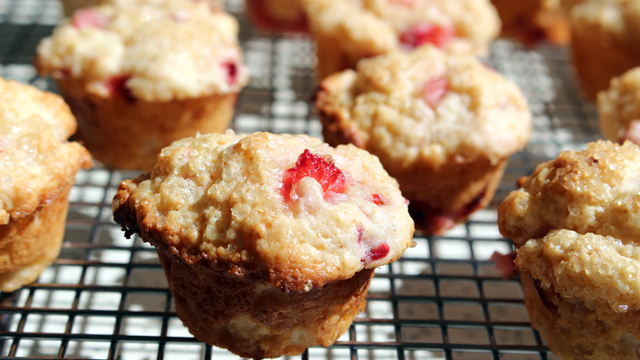
"content": "\u003cfigure id=\"attachment_81365\" class=\"wp-caption aligncenter\" style=\"max-width: 1000px\">\u003ca href=\"http://ww2.kqed.org/bayareabites/wp-content/uploads/sites/24/2014/05/final-muffin1000.jpg\">\u003cimg class=\"size-full wp-image-81365\" src=\"http://ww2.kqed.org/bayareabites/wp-content/uploads/sites/24/2014/05/final-muffin1000.jpg\" alt=\"Springtime Strawberry-lemon mini muffins. Photo: Wendy Goodfriend\" width=\"1000\" height=\"667\">\u003c/a>\u003cfigcaption class=\"wp-caption-text\">Springtime Strawberry-lemon mini muffins. Photo: \u003ca href=\"http://ww2.kqed.org/bayareabites/author/wendy-goodfriend/\">Wendy Goodfriend\u003c/a>\u003c/figcaption>\u003c/figure>\n\u003cp>I’m a big fan of muffins, especially cute little homemade ones that you can just pop into your mouth (the small size means they have fewer calories...yeah right). I think they make the perfect addition to a brunch table offering up a yummy, sweet option that isn’t a pain to make. However, as much as I love muffins, I’m really picky about them.\u003c/p>\n\u003cp>[contextly_sidebar id=\"sO3G6N3sYZQLEsuSvJlICYNqtueFcvQw\"]\u003c/p>\n\u003cp>First of all, I like fruity muffins. None of this chocolate-chocolate chip or stodgy bran with walnuts nonsense for me...I want fruit. As in, fruit in every bite. There is little that disappoints me more in a muffin than breaking it in half to reveal 3 blueberries. Rip off! Secondly, I don’t like weighty, heavy, dense muffins. I want light, fluffy muffins. Delicate and cake-like, but like a buttery layer cake not a pound cake.\u003c/p>\n\u003cp>And finally, I want them to have a balance of great flavor, and not be overwhelmed by sweetness.\u003c/p>\n\u003cfigure id=\"attachment_81433\" class=\"wp-caption aligncenter\" style=\"max-width: 1000px\">\u003ca href=\"http://ww2.kqed.org/bayareabites/wp-content/uploads/sites/24/2014/05/muffin-ingredients1000.jpg\">\u003cimg class=\"size-full wp-image-81433\" src=\"http://ww2.kqed.org/bayareabites/wp-content/uploads/sites/24/2014/05/muffin-ingredients1000.jpg\" alt=\"Strawberry-lemon mini muffin ingredients. Photo: Wendy Goodfriend\" width=\"1000\" height=\"667\">\u003c/a>\u003cfigcaption class=\"wp-caption-text\">Strawberry-lemon mini muffin ingredients. Photo: Wendy Goodfriend\u003c/figcaption>\u003c/figure>\n\u003cp>This recipe is all that, and makes use of plump, juicy, sweet spring strawberries which are all over the market now (at least the farmers’ market near my house!). They are superb both on their own (even slathered with a little homemade strawberry jam) or as an addition to a special brunch spread, such as Mother’s Day. I for one would love these to be served to me on a lovely tray alongside a cuppa tea, a mimosa, and a slice of frittata. Husband, are you listening?\u003c/p>\n\u003cp>[ad fullwidth]\u003c/p>\n\u003cp>A few things to note: look for the sweetest organic strawberries you can find. You can also make these in a standard 12 cup pan, just be sure to fill the cups nearly to the top and you might need to bake them for a few additional minutes. Also, instead of the crunchy sugar topping, you can sprinkle the tops with your favorite streusel if you like. Just be warned: these are addictive, you cannot stop at just one!\u003c/p>\n\u003cfigure id=\"attachment_81436\" class=\"wp-caption aligncenter\" style=\"max-width: 1000px\">\u003ca href=\"http://ww2.kqed.org/bayareabites/wp-content/uploads/sites/24/2014/05/cooked-muffins-tin1000b.jpg\">\u003cimg class=\"size-full wp-image-81436\" src=\"http://ww2.kqed.org/bayareabites/wp-content/uploads/sites/24/2014/05/cooked-muffins-tin1000b.jpg\" alt=\"Fresh baked strawberry-lemon mini muffins in tin. Photo: Wendy Goodfriend\" width=\"1000\" height=\"667\">\u003c/a>\u003cfigcaption class=\"wp-caption-text\">Fresh baked strawberry-lemon mini muffins in tin. Photo: Wendy Goodfriend\u003c/figcaption>\u003c/figure>\n\u003ch3>Strawberry-lemon mini muffins\u003c/h3>\n\u003cp>\u003cem>Makes 48 mini muffins or 12 large muffins\u003c/em>\u003c/p>\n\u003cp>\u003cstrong>Ingredients:\u003c/strong>\u003c/p>\n\u003cul>\n\u003cli>2 cups all-purpose flour\u003c/li>\n\u003cli>2 tsp baking powder\u003c/li>\n\u003cli>1⁄2 tsp baking soda\u003c/li>\n\u003cli>1/2 tsp kosher salt (or 1/4 tsp sea salt)\u003c/li>\n\u003cli>1⁄2 cup unsalted butter, cut into chunks\u003c/li>\n\u003cli>2⁄3 cup sugar\u003c/li>\n\u003cli>Finely grated zest and juice of 1 large lemon\u003c/li>\n\u003cli>2 large eggs\u003c/li>\n\u003cli>1 tsp pure vanilla extract\u003c/li>\n\u003cli>1 cup sour cream\u003c/li>\n\u003cli>12 oz fresh strawberries, hulled and diced\u003c/li>\n\u003cli>Coarse sugar, such as turbinado, for sprinkling (optional)\u003c/li>\n\u003c/ul>\n\u003cfigure id=\"attachment_81440\" class=\"wp-caption aligncenter\" style=\"max-width: 1000px\">\u003ca href=\"http://ww2.kqed.org/bayareabites/wp-content/uploads/sites/24/2014/05/hulled-strawberry1000.jpg\">\u003cimg class=\"size-full wp-image-81440\" src=\"http://ww2.kqed.org/bayareabites/wp-content/uploads/sites/24/2014/05/hulled-strawberry1000.jpg\" alt=\"Hull and then dice the strawberries. Photo: Wendy Goodfriend\" width=\"1000\" height=\"667\">\u003c/a>\u003cfigcaption class=\"wp-caption-text\">Hull and then dice the strawberries. Photo: Wendy Goodfriend\u003c/figcaption>\u003c/figure>\n\u003cfigure id=\"attachment_81435\" class=\"wp-caption aligncenter\" style=\"max-width: 1000px\">\u003ca href=\"http://ww2.kqed.org/bayareabites/wp-content/uploads/sites/24/2014/05/lemon-zest1000.jpg\">\u003cimg class=\"size-full wp-image-81435\" src=\"http://ww2.kqed.org/bayareabites/wp-content/uploads/sites/24/2014/05/lemon-zest1000.jpg\" alt=\"Zest lemon to add to the muffin mixture. Photo: Wendy Goodfriend\" width=\"1000\" height=\"667\">\u003c/a>\u003cfigcaption class=\"wp-caption-text\">Zest lemon to add to the muffin mixture. Photo: Wendy Goodfriend\u003c/figcaption>\u003c/figure>\n\u003cp>\u003cstrong>Instructions:\u003c/strong>\u003cbr>\nPosition a rack in the middle of the oven and preheat to 400°F (200°C). Spray two 24-cup mini muffin pans generously with cooking spray or line with paper liners.\u003c/p>\n\u003cp>In a bowl, sift together the flour, baking powder, baking soda, and salt. In the bowl of a mixer fitted with the paddle attachment, beat the butter, granulated sugar, and lemon zest on medium-high speed until fluffy, about 1 minute. Beat in the eggs, one at a time, then the vanilla, until well combined, scraping down the sides of the bowl with a rubber spatula. Add the sour cream and lemon juice and beat on low speed. Add the dry ingredients and beat on low speed just until evenly moistened. Gently stir in the strawberries on low speed. The batter will be super thick.\u003c/p>\n\u003cfigure id=\"attachment_81453\" class=\"wp-caption aligncenter\" style=\"max-width: 1000px\">\u003ca href=\"http://ww2.kqed.org/bayareabites/wp-content/uploads/sites/24/2014/05/mixed-dough1000.jpg\">\u003cimg class=\"size-full wp-image-81453\" src=\"http://ww2.kqed.org/bayareabites/wp-content/uploads/sites/24/2014/05/mixed-dough1000.jpg\" alt=\"The mixed batter should be super thick. Photo: Wendy Goodfriend\" width=\"1000\" height=\"667\">\u003c/a>\u003cfigcaption class=\"wp-caption-text\">The mixed batter should be super thick. Photo: Wendy Goodfriend\u003c/figcaption>\u003c/figure>\n\u003cp>Using a tablespoon, heap the batter into the greased muffin cups, filling them nearly full.\u003c/p>\n\u003cfigure id=\"attachment_81450\" class=\"wp-caption aligncenter\" style=\"max-width: 1000px\">\u003ca href=\"http://ww2.kqed.org/bayareabites/wp-content/uploads/sites/24/2014/05/dough-in-tin1000.jpg\">\u003cimg class=\"size-full wp-image-81450\" src=\"http://ww2.kqed.org/bayareabites/wp-content/uploads/sites/24/2014/05/dough-in-tin1000.jpg\" alt=\"Muffin dough mixture ready for baking in greased muffin tin. Photo: Wendy Goodfriend\" width=\"1000\" height=\"667\">\u003c/a>\u003cfigcaption class=\"wp-caption-text\">Muffin dough mixture ready for baking in greased muffin tin. Photo: \u003ca href=\"http://ww2.kqed.org/bayareabites/author/wendy-goodfriend/\">Wendy Goodfriend\u003c/a>\u003c/figcaption>\u003c/figure>\n\u003cp>Sprinkle each with a big pinch of coarse sugar, if you like.\u003c/p>\n\u003cfigure id=\"attachment_81452\" class=\"wp-caption aligncenter\" style=\"max-width: 500px\">\u003ca href=\"http://ww2.kqed.org/bayareabites/wp-content/uploads/sites/24/2014/05/sugar-on-top700.jpg\">\u003cimg class=\"size-full wp-image-81452\" src=\"http://ww2.kqed.org/bayareabites/wp-content/uploads/sites/24/2014/05/sugar-on-top700.jpg\" alt=\"Sprinkle turbinado sugar on top of each muffin. Photo: Wendy Goodfriend\" width=\"500\">\u003c/a>\u003cfigcaption class=\"wp-caption-text\">Optionally sprinkle turbinado sugar on top of each muffin. Photo: Wendy Goodfriend\u003c/figcaption>\u003c/figure>\n\u003cp>\u003c/p>\n\u003cp>Bake until the muffins are golden brown and a toothpick inserted into the center of one comes out clean, about 10 minutes. Let the muffins cool in the pan on a wire rack for about 5 minutes, then unmold onto the rack. Smear them with butter if you like, and eat while they’re still warm.\u003c/p>\n\u003cfigure id=\"attachment_81364\" class=\"wp-caption aligncenter\" style=\"max-width: 1000px\">\u003ca href=\"http://ww2.kqed.org/bayareabites/wp-content/uploads/sites/24/2014/05/poppy-eating-muffin1000.jpg\">\u003cimg class=\"size-full wp-image-81364\" src=\"http://ww2.kqed.org/bayareabites/wp-content/uploads/sites/24/2014/05/poppy-eating-muffin1000.jpg\" alt=\"Enjoy the goodness of a fresh baked fruity mini muffin. Photo: Wendy Goodfriend\" width=\"1000\" height=\"667\">\u003c/a>\u003cfigcaption class=\"wp-caption-text\">Enjoy the goodness of a fresh baked fruity mini muffin. Photo: \u003ca href=\"http://ww2.kqed.org/bayareabites/author/wendy-goodfriend/\">Wendy Goodfriend\u003c/a>\u003c/figcaption>\u003c/figure>\n\n",
"disqusIdentifier": "81287 http://blogs.kqed.org/bayareabites/?p=81287",
"disqusUrl": "https://ww2.kqed.org/bayareabites/2014/05/07/little-springtime-strawberry-lemon-muffins/",
"stats": {
"hasVideo": false,
"hasChartOrMap": false,
"hasAudio": false,
"hasPolis": false,
"wordCount": 750,
"hasGoogleForm": false,
"hasGallery": false,
"hasHearkenModule": false,
"iframeSrcs": [],
"paragraphCount": 15
},
"modified": 1546901632,
"excerpt": "I love muffins. And I particularly love these adorable, super-fruity strawberry-lemon muffins, which are perfect for spring and your mom’s special day!",
"headData": {
"twImgId": "",
"twTitle": "",
"ogTitle": "",
"ogImgId": "",
"twDescription": "",
"description": "I love muffins. And I particularly love these adorable, super-fruity strawberry-lemon muffins, which are perfect for spring and your mom’s special day!",
"title": "Little Springtime Strawberry-Lemon Muffins | KQED",
"ogDescription": "",
"schema": {
"@context": "https://schema.org",
"@type": "Article",
"headline": "Little Springtime Strawberry-Lemon Muffins",
"datePublished": "2014-05-07T09:26:21-07:00",
"dateModified": "2019-01-07T14:53:52-08:00",
"image": "https://cdn.kqed.org/wp-content/uploads/2020/02/KQED-OG-Image@1x.png"
}
},
"guestAuthors": [],
"slug": "little-springtime-strawberry-lemon-muffins",
"status": "publish",
"path": "/bayareabites/81287/little-springtime-strawberry-lemon-muffins",
"audioTrackLength": null,
"parsedContent": [
{
"type": "contentString",
"content": "\u003cdiv class=\"post-body\">\u003cp>\u003cfigure id=\"attachment_81365\" class=\"wp-caption aligncenter\" style=\"max-width: 1000px\">\u003ca href=\"http://ww2.kqed.org/bayareabites/wp-content/uploads/sites/24/2014/05/final-muffin1000.jpg\">\u003cimg class=\"size-full wp-image-81365\" src=\"http://ww2.kqed.org/bayareabites/wp-content/uploads/sites/24/2014/05/final-muffin1000.jpg\" alt=\"Springtime Strawberry-lemon mini muffins. Photo: Wendy Goodfriend\" width=\"1000\" height=\"667\">\u003c/a>\u003cfigcaption class=\"wp-caption-text\">Springtime Strawberry-lemon mini muffins. Photo: \u003ca href=\"http://ww2.kqed.org/bayareabites/author/wendy-goodfriend/\">Wendy Goodfriend\u003c/a>\u003c/figcaption>\u003c/figure>\n\u003cp>I’m a big fan of muffins, especially cute little homemade ones that you can just pop into your mouth (the small size means they have fewer calories...yeah right). I think they make the perfect addition to a brunch table offering up a yummy, sweet option that isn’t a pain to make. However, as much as I love muffins, I’m really picky about them.\u003c/p>\n\u003cp>\u003c/p>\u003cp>\u003c/p>\u003cp>\u003c/p>\n\u003cp>First of all, I like fruity muffins. None of this chocolate-chocolate chip or stodgy bran with walnuts nonsense for me...I want fruit. As in, fruit in every bite. There is little that disappoints me more in a muffin than breaking it in half to reveal 3 blueberries. Rip off! Secondly, I don’t like weighty, heavy, dense muffins. I want light, fluffy muffins. Delicate and cake-like, but like a buttery layer cake not a pound cake.\u003c/p>\n\u003cp>And finally, I want them to have a balance of great flavor, and not be overwhelmed by sweetness.\u003c/p>\n\u003cfigure id=\"attachment_81433\" class=\"wp-caption aligncenter\" style=\"max-width: 1000px\">\u003ca href=\"http://ww2.kqed.org/bayareabites/wp-content/uploads/sites/24/2014/05/muffin-ingredients1000.jpg\">\u003cimg class=\"size-full wp-image-81433\" src=\"http://ww2.kqed.org/bayareabites/wp-content/uploads/sites/24/2014/05/muffin-ingredients1000.jpg\" alt=\"Strawberry-lemon mini muffin ingredients. Photo: Wendy Goodfriend\" width=\"1000\" height=\"667\">\u003c/a>\u003cfigcaption class=\"wp-caption-text\">Strawberry-lemon mini muffin ingredients. Photo: Wendy Goodfriend\u003c/figcaption>\u003c/figure>\n\u003cp>This recipe is all that, and makes use of plump, juicy, sweet spring strawberries which are all over the market now (at least the farmers’ market near my house!). They are superb both on their own (even slathered with a little homemade strawberry jam) or as an addition to a special brunch spread, such as Mother’s Day. I for one would love these to be served to me on a lovely tray alongside a cuppa tea, a mimosa, and a slice of frittata. Husband, are you listening?\u003c/p>\n\u003cp>\u003c/p>\u003c/div>",
"attributes": {
"named": {},
"numeric": []
}
},
{
"type": "component",
"content": "",
"name": "ad",
"attributes": {
"named": {
"label": "fullwidth"
},
"numeric": [
"fullwidth"
]
}
},
{
"type": "contentString",
"content": "\u003cdiv class=\"post-body\">\u003cp>\u003c/p>\n\u003cp>A few things to note: look for the sweetest organic strawberries you can find. You can also make these in a standard 12 cup pan, just be sure to fill the cups nearly to the top and you might need to bake them for a few additional minutes. Also, instead of the crunchy sugar topping, you can sprinkle the tops with your favorite streusel if you like. Just be warned: these are addictive, you cannot stop at just one!\u003c/p>\n\u003cfigure id=\"attachment_81436\" class=\"wp-caption aligncenter\" style=\"max-width: 1000px\">\u003ca href=\"http://ww2.kqed.org/bayareabites/wp-content/uploads/sites/24/2014/05/cooked-muffins-tin1000b.jpg\">\u003cimg class=\"size-full wp-image-81436\" src=\"http://ww2.kqed.org/bayareabites/wp-content/uploads/sites/24/2014/05/cooked-muffins-tin1000b.jpg\" alt=\"Fresh baked strawberry-lemon mini muffins in tin. Photo: Wendy Goodfriend\" width=\"1000\" height=\"667\">\u003c/a>\u003cfigcaption class=\"wp-caption-text\">Fresh baked strawberry-lemon mini muffins in tin. Photo: Wendy Goodfriend\u003c/figcaption>\u003c/figure>\n\u003ch3>Strawberry-lemon mini muffins\u003c/h3>\n\u003cp>\u003cem>Makes 48 mini muffins or 12 large muffins\u003c/em>\u003c/p>\n\u003cp>\u003cstrong>Ingredients:\u003c/strong>\u003c/p>\n\u003cul>\n\u003cli>2 cups all-purpose flour\u003c/li>\n\u003cli>2 tsp baking powder\u003c/li>\n\u003cli>1⁄2 tsp baking soda\u003c/li>\n\u003cli>1/2 tsp kosher salt (or 1/4 tsp sea salt)\u003c/li>\n\u003cli>1⁄2 cup unsalted butter, cut into chunks\u003c/li>\n\u003cli>2⁄3 cup sugar\u003c/li>\n\u003cli>Finely grated zest and juice of 1 large lemon\u003c/li>\n\u003cli>2 large eggs\u003c/li>\n\u003cli>1 tsp pure vanilla extract\u003c/li>\n\u003cli>1 cup sour cream\u003c/li>\n\u003cli>12 oz fresh strawberries, hulled and diced\u003c/li>\n\u003cli>Coarse sugar, such as turbinado, for sprinkling (optional)\u003c/li>\n\u003c/ul>\n\u003cfigure id=\"attachment_81440\" class=\"wp-caption aligncenter\" style=\"max-width: 1000px\">\u003ca href=\"http://ww2.kqed.org/bayareabites/wp-content/uploads/sites/24/2014/05/hulled-strawberry1000.jpg\">\u003cimg class=\"size-full wp-image-81440\" src=\"http://ww2.kqed.org/bayareabites/wp-content/uploads/sites/24/2014/05/hulled-strawberry1000.jpg\" alt=\"Hull and then dice the strawberries. Photo: Wendy Goodfriend\" width=\"1000\" height=\"667\">\u003c/a>\u003cfigcaption class=\"wp-caption-text\">Hull and then dice the strawberries. Photo: Wendy Goodfriend\u003c/figcaption>\u003c/figure>\n\u003cfigure id=\"attachment_81435\" class=\"wp-caption aligncenter\" style=\"max-width: 1000px\">\u003ca href=\"http://ww2.kqed.org/bayareabites/wp-content/uploads/sites/24/2014/05/lemon-zest1000.jpg\">\u003cimg class=\"size-full wp-image-81435\" src=\"http://ww2.kqed.org/bayareabites/wp-content/uploads/sites/24/2014/05/lemon-zest1000.jpg\" alt=\"Zest lemon to add to the muffin mixture. Photo: Wendy Goodfriend\" width=\"1000\" height=\"667\">\u003c/a>\u003cfigcaption class=\"wp-caption-text\">Zest lemon to add to the muffin mixture. Photo: Wendy Goodfriend\u003c/figcaption>\u003c/figure>\n\u003cp>\u003cstrong>Instructions:\u003c/strong>\u003cbr>\nPosition a rack in the middle of the oven and preheat to 400°F (200°C). Spray two 24-cup mini muffin pans generously with cooking spray or line with paper liners.\u003c/p>\n\u003cp>In a bowl, sift together the flour, baking powder, baking soda, and salt. In the bowl of a mixer fitted with the paddle attachment, beat the butter, granulated sugar, and lemon zest on medium-high speed until fluffy, about 1 minute. Beat in the eggs, one at a time, then the vanilla, until well combined, scraping down the sides of the bowl with a rubber spatula. Add the sour cream and lemon juice and beat on low speed. Add the dry ingredients and beat on low speed just until evenly moistened. Gently stir in the strawberries on low speed. The batter will be super thick.\u003c/p>\n\u003cfigure id=\"attachment_81453\" class=\"wp-caption aligncenter\" style=\"max-width: 1000px\">\u003ca href=\"http://ww2.kqed.org/bayareabites/wp-content/uploads/sites/24/2014/05/mixed-dough1000.jpg\">\u003cimg class=\"size-full wp-image-81453\" src=\"http://ww2.kqed.org/bayareabites/wp-content/uploads/sites/24/2014/05/mixed-dough1000.jpg\" alt=\"The mixed batter should be super thick. Photo: Wendy Goodfriend\" width=\"1000\" height=\"667\">\u003c/a>\u003cfigcaption class=\"wp-caption-text\">The mixed batter should be super thick. Photo: Wendy Goodfriend\u003c/figcaption>\u003c/figure>\n\u003cp>Using a tablespoon, heap the batter into the greased muffin cups, filling them nearly full.\u003c/p>\n\u003cfigure id=\"attachment_81450\" class=\"wp-caption aligncenter\" style=\"max-width: 1000px\">\u003ca href=\"http://ww2.kqed.org/bayareabites/wp-content/uploads/sites/24/2014/05/dough-in-tin1000.jpg\">\u003cimg class=\"size-full wp-image-81450\" src=\"http://ww2.kqed.org/bayareabites/wp-content/uploads/sites/24/2014/05/dough-in-tin1000.jpg\" alt=\"Muffin dough mixture ready for baking in greased muffin tin. Photo: Wendy Goodfriend\" width=\"1000\" height=\"667\">\u003c/a>\u003cfigcaption class=\"wp-caption-text\">Muffin dough mixture ready for baking in greased muffin tin. Photo: \u003ca href=\"http://ww2.kqed.org/bayareabites/author/wendy-goodfriend/\">Wendy Goodfriend\u003c/a>\u003c/figcaption>\u003c/figure>\n\u003cp>Sprinkle each with a big pinch of coarse sugar, if you like.\u003c/p>\n\u003cfigure id=\"attachment_81452\" class=\"wp-caption aligncenter\" style=\"max-width: 500px\">\u003ca href=\"http://ww2.kqed.org/bayareabites/wp-content/uploads/sites/24/2014/05/sugar-on-top700.jpg\">\u003cimg class=\"size-full wp-image-81452\" src=\"http://ww2.kqed.org/bayareabites/wp-content/uploads/sites/24/2014/05/sugar-on-top700.jpg\" alt=\"Sprinkle turbinado sugar on top of each muffin. Photo: Wendy Goodfriend\" width=\"500\">\u003c/a>\u003cfigcaption class=\"wp-caption-text\">Optionally sprinkle turbinado sugar on top of each muffin. Photo: Wendy Goodfriend\u003c/figcaption>\u003c/figure>\n\u003cp>\u003c/p>\n\u003cp>Bake until the muffins are golden brown and a toothpick inserted into the center of one comes out clean, about 10 minutes. Let the muffins cool in the pan on a wire rack for about 5 minutes, then unmold onto the rack. Smear them with butter if you like, and eat while they’re still warm.\u003c/p>\n\u003cfigure id=\"attachment_81364\" class=\"wp-caption aligncenter\" style=\"max-width: 1000px\">\u003ca href=\"http://ww2.kqed.org/bayareabites/wp-content/uploads/sites/24/2014/05/poppy-eating-muffin1000.jpg\">\u003cimg class=\"size-full wp-image-81364\" src=\"http://ww2.kqed.org/bayareabites/wp-content/uploads/sites/24/2014/05/poppy-eating-muffin1000.jpg\" alt=\"Enjoy the goodness of a fresh baked fruity mini muffin. Photo: Wendy Goodfriend\" width=\"1000\" height=\"667\">\u003c/a>\u003cfigcaption class=\"wp-caption-text\">Enjoy the goodness of a fresh baked fruity mini muffin. Photo: \u003ca href=\"http://ww2.kqed.org/bayareabites/author/wendy-goodfriend/\">Wendy Goodfriend\u003c/a>\u003c/figcaption>\u003c/figure>\n\n\u003c/div>\u003c/p>",
"attributes": {
"named": {},
"numeric": []
}
}
],
"link": "/bayareabites/81287/little-springtime-strawberry-lemon-muffins",
"authors": [
"5015",
"5014"
],
"categories": [
"bayareabites_1516",
"bayareabites_752",
"bayareabites_12550",
"bayareabites_1763",
"bayareabites_1246",
"bayareabites_12"
],
"tags": [
"bayareabites_253",
"bayareabites_3992",
"bayareabites_1314",
"bayareabites_8986",
"bayareabites_1012"
],
"featImg": "bayareabites_81460",
"label": "bayareabites"
},
"bayareabites_80590": {
"type": "posts",
"id": "bayareabites_80590",
"meta": {
"index": "posts_1716263798",
"site": "bayareabites",
"id": "80590",
"score": null,
"sort": [
1397839408000
]
},
"parent": 0,
"labelTerm": {
"site": "bayareabites"
},
"blocks": [],
"publishDate": 1397839408,
"format": "aside",
"disqusTitle": "Earth Day 2014: What You Need to Know About Food and How to Celebrate in the Bay Area",
"title": "Earth Day 2014: What You Need to Know About Food and How to Celebrate in the Bay Area",
"headTitle": "Bay Area Bites | KQED Food",
"content": "\u003cfigure id=\"attachment_80621\" class=\"wp-caption aligncenter\" style=\"max-width: 468px\">\u003ca href=\"http://ww2.kqed.org/bayareabites/wp-content/uploads/sites/24/2014/04/13726_1397292709_131_13726.jpg\">\u003cimg src=\"http://ww2.kqed.org/bayareabites/wp-content/uploads/sites/24/2014/04/13726_1397292709_131_13726.jpg\" alt=\"Gardening at the SF Earth Day in 2013. Photo: SF Earth Day\" width=\"468\" height=\"321\" class=\"size-full wp-image-80621\">\u003c/a>\u003cfigcaption class=\"wp-caption-text\">Gardening at the SF Earth Day in 2013. Photo: SF Earth Day\u003c/figcaption>\u003c/figure>\n\u003cp>On April 22, the Bay Area -- and the rest of the country and, presumably, the planet -- will celebrate the earth. Fortunately, celebrating Earth Day can be pretty tasty. \u003c/p>\n\u003cp>\u003cstrong>\u003ca href=\"http://www.earthdaysf.org/organic-chef-demos_2.html\" target=\"_blank\">Earth Day SF\u003c/a>:\u003c/strong> The San Francisco festival this Saturday, April 19 will feature an entire showcase of organic chefs doing demonstrations from noon to 5 p.m. \u003ca href=\"http://ww2.kqed.org/bayareabites/2012/03/29/iso-rabins-of-foragesf-plans-his-next-%e2%80%9cfoodtrepreneur%e2%80%9d-venture-forage-kitchen/\" title=\"Iso Rabins of forageSF plans his next “foodtrepreneur” venture: Forage Kitchen\" target=\"_blank\">ForageSF's Iso Rabins\u003c/a> will demonstrate how to cure meat; Paula Tejeda will make ensalada chilena; and Danny Garbriner of \u003ca href=\"http://www.sourflour.org/\" target=\"_blank\">Sour Flour\u003c/a> will show you how to make a bread starter. Check \u003ca href=\"http://www.earthdaysf.org/organic-chef-demos_2.html\" target=\"_blank\">the schedule of food demonstrations\u003c/a> to pick your favorite.\u003c/p>\n\u003cp>[youtube //www.youtube.com/watch?v=IUx8sUWiyLc]\u003c/p>\n\u003cp>\u003cstrong>\u003ca href=\"http://www.berkeleyveganearthday.com/\" target=\"_blank\">Berkeley Vegan Earth Day\u003c/a>:\u003c/strong> There's an argument to be made that many of the sustainability issues facing the earth come down to how we're going to feed the millions of people on the planet. Berkeley's 4th annual Vegan Earth Day on Saturday, April 19 tackles that issue head on. \u003ca href=\"http://www.berkeleyveganearthday.com/Will-Tuttle/\" target=\"_blank\">Dr. Will Tuttle\u003c/a> will talk about his book, \u003cem>The World Peace Diet\u003c/em>, and how to implement that in your life. \u003ca href=\"http://www.berkeleyveganearthday.com/keegan-kuhn-veganic-urban-gardener/\" target=\"_blank\">Keegan Kuhn\u003c/a> will show you how to start a micro-vegan garden in any small space. And, of course, there'll be more vegan goodies than you could eat in one afternoon.\u003c/p>\n\u003cp>\u003cstrong>\u003ca href=\"http://eatlowcarbon.org/\" target=\"_blank\">Low Carbon Diet Day\u003c/a>:\u003c/strong> Bon Appetit Management Company, which provides food for Google, Electronic Arts, and The Exploratorium, will celebrate Low Carbon Day on Thursday, April 24. The day will include cooking demonstrations and ways to change standard recipes to make them slightly more climate-friendly. Check out the \u003ca href=\"http://eatlowcarbon.org/diet-tips/\" target=\"_blank\">eatlowcarbon.org\u003c/a> website for diet tips and where the cafes-turned-classrooms will pop up around the Bay Area.\u003c/p>\n\u003cp>[ad fullwidth]\u003c/p>\n\u003cp>\u003cstrong>\u003ca href=\"http://alamedaca.gov/recreation-uncategorized/events/2099\" target=\"_blank\">Alameda's Earth Day Festival\u003c/a>:\u003c/strong> While you're festivaling, check out the farmers market stands for some local produce at the Alameda Earth Day festival -- or at your regular farmers market.\u003c/p>\n\u003cp>\u003cstrong>\u003ca href=\"http://www.wwwpallas.com/EarthDay/vendors.htm\" target=\"_blank\">Earth Day Napa\u003c/a>\u003c/strong>: And, what would a Napa Earth Day celebration (4/19) be without a beer and wine garden? Why not learn about \u003ca href=\"http://science.kqed.org/quest/2009/09/04/reporters-notes-the-politics-of-green-wine/\" target=\"_blank\">sustainable wines with this story from KQED's QUEST\u003c/a> while you're at it? Learn and drink at the same time.\u003c/p>\n\u003cp>As you're snacking, don't forget to recycle your containers and compost (\u003ca href=\"http://ww2.kqed.org/bayareabites/2013/10/14/food-waste/\" title=\"In the Trash: The Wasted 40% of Food\" target=\"_blank\">or donate\u003c/a>) your leftovers. \u003c/p>\n\u003cp>In fact, there won't be a better time to take a composting workshop -- like the one being offered at \u003ca href=\"http://www.ercsjsu.org/earth-day.html\" target=\"_blank\">San Jose State's Earth Day celebration\u003c/a> on Tuesday, April 22. Or, turn your vegetable garden into a sustainable, water-friendly plot with tips at \u003ca href=\"http://whhs.com/green\" target=\"_blank\">the Washington Hospital Earth Day celebration\u003c/a> on Saturday, April 26.\u003c/p>\n\u003cp>Throughout the year, you can also take composting and urban gardening classes around the Bay Area at places like \u003ca href=\"http://ucanr.edu/sites/MarinMG/\" target=\"_blank\">Marin Master Gardeners\u003c/a> or \u003ca href=\"http://www.co.contra-costa.ca.us/depart/cd/recycle/rrr_schedule.htm\" target=\"_blank\">Contra Costa's Home Composting Workshops\u003c/a> or \u003ca href=\"http://baynature.org/organization/alameda-county-master-gardeners/\" target=\"_blank\">the Alameda County Master Gardeners\u003c/a> -- or \u003ca href=\"http://www.acterra.org/programs/stewardship/class_information.html\" target=\"_blank\">get certified as a green gardener\u003c/a>. Just don't forget that \u003ca href=\"http://ww2.kqed.org/bayareabites/2014/04/05/newbie-urban-gardeners-may-not-be-aware-of-soils-dirty-legacy/\" target=\"_blank\">urban soil can be contaminated\u003c/a>!\u003c/p>\n\u003cp>\u003ca href=\"http://science.kqed.org/quest/video/heat-and-harvest/\" target=\"_blank\">As climate change affects our harvest yields and food supplies\u003c/a>, increasingly we'll rely on \u003ca href=\"http://www.kqed.org/tv/programs/index.jsp?pgmid=21122\" target=\"_blank\">biotech\u003c/a> and sustainable farming methods. Learn about what's coming from \u003ca href=\"http://www.foodforward.tv/\" target=\"_blank\">PBS' Food Forward series\u003c/a> or \u003ca href=\"http://ww2.kqed.org/bayareabites/tag/the-lexicon-of-sustainability/\" target=\"_blank\">The Lexicon of Sustainability\u003c/a>.\u003c/p>\n\u003cp>\u003c/p>\n\u003cp>\u003cem>This is only a sampling of everything planned to celebrate the Earth. Check out the schedule of \u003ca href=\"http://www.calrecycle.ca.gov/PublicEd/EarthDay/Events/#BayArea\" target=\"_blank\">all the Bay Area Earth Day on Cal Recycle's website\u003c/a>.\u003c/em>\u003c/p>\n\n",
"disqusIdentifier": "80590 http://blogs.kqed.org/bayareabites/?p=80590",
"disqusUrl": "https://ww2.kqed.org/bayareabites/2014/04/18/earth-day-2014-what-you-need-to-know-about-food-and-celebrations-in-the-bay-area/",
"stats": {
"hasVideo": true,
"hasChartOrMap": false,
"hasAudio": false,
"hasPolis": false,
"wordCount": 552,
"hasGoogleForm": false,
"hasGallery": false,
"hasHearkenModule": false,
"iframeSrcs": [],
"paragraphCount": 14
},
"modified": 1398183728,
"excerpt": "On April 22, the Bay Area -- and the rest of the country and, presumably, the planet -- will celebrate the earth. Fortunately, celebrating Earth Day can be pretty tasty. BAB has gathered local foodcentric events and resources to help you participate in the festivities.",
"headData": {
"twImgId": "",
"twTitle": "",
"ogTitle": "",
"ogImgId": "",
"twDescription": "",
"description": "On April 22, the Bay Area -- and the rest of the country and, presumably, the planet -- will celebrate the earth. Fortunately, celebrating Earth Day can be pretty tasty. BAB has gathered local foodcentric events and resources to help you participate in the festivities.",
"title": "Earth Day 2014: What You Need to Know About Food and How to Celebrate in the Bay Area | KQED",
"ogDescription": "",
"schema": {
"@context": "https://schema.org",
"@type": "Article",
"headline": "Earth Day 2014: What You Need to Know About Food and How to Celebrate in the Bay Area",
"datePublished": "2014-04-18T09:43:28-07:00",
"dateModified": "2014-04-22T09:22:08-07:00",
"image": "https://cdn.kqed.org/wp-content/uploads/2020/02/KQED-OG-Image@1x.png"
}
},
"guestAuthors": [],
"slug": "earth-day-2014-what-you-need-to-know-about-food-and-celebrations-in-the-bay-area",
"status": "publish",
"path": "/bayareabites/80590/earth-day-2014-what-you-need-to-know-about-food-and-celebrations-in-the-bay-area",
"audioTrackLength": null,
"parsedContent": [
{
"type": "contentString",
"content": "\u003cdiv class=\"post-body\">\u003cp>\u003cfigure id=\"attachment_80621\" class=\"wp-caption aligncenter\" style=\"max-width: 468px\">\u003ca href=\"http://ww2.kqed.org/bayareabites/wp-content/uploads/sites/24/2014/04/13726_1397292709_131_13726.jpg\">\u003cimg src=\"http://ww2.kqed.org/bayareabites/wp-content/uploads/sites/24/2014/04/13726_1397292709_131_13726.jpg\" alt=\"Gardening at the SF Earth Day in 2013. Photo: SF Earth Day\" width=\"468\" height=\"321\" class=\"size-full wp-image-80621\">\u003c/a>\u003cfigcaption class=\"wp-caption-text\">Gardening at the SF Earth Day in 2013. Photo: SF Earth Day\u003c/figcaption>\u003c/figure>\n\u003cp>On April 22, the Bay Area -- and the rest of the country and, presumably, the planet -- will celebrate the earth. Fortunately, celebrating Earth Day can be pretty tasty. \u003c/p>\n\u003cp>\u003cstrong>\u003ca href=\"http://www.earthdaysf.org/organic-chef-demos_2.html\" target=\"_blank\">Earth Day SF\u003c/a>:\u003c/strong> The San Francisco festival this Saturday, April 19 will feature an entire showcase of organic chefs doing demonstrations from noon to 5 p.m. \u003ca href=\"http://ww2.kqed.org/bayareabites/2012/03/29/iso-rabins-of-foragesf-plans-his-next-%e2%80%9cfoodtrepreneur%e2%80%9d-venture-forage-kitchen/\" title=\"Iso Rabins of forageSF plans his next “foodtrepreneur” venture: Forage Kitchen\" target=\"_blank\">ForageSF's Iso Rabins\u003c/a> will demonstrate how to cure meat; Paula Tejeda will make ensalada chilena; and Danny Garbriner of \u003ca href=\"http://www.sourflour.org/\" target=\"_blank\">Sour Flour\u003c/a> will show you how to make a bread starter. Check \u003ca href=\"http://www.earthdaysf.org/organic-chef-demos_2.html\" target=\"_blank\">the schedule of food demonstrations\u003c/a> to pick your favorite.\u003c/p>\n\u003cp>\u003c/p>\u003cp>\u003cspan class='utils-parseShortcode-shortcodes-__youtubeShortcode__embedYoutube'>\n \u003cspan class='utils-parseShortcode-shortcodes-__youtubeShortcode__embedYoutubeInside'>\n \u003ciframe\n loading='lazy'\n class='utils-parseShortcode-shortcodes-__youtubeShortcode__youtubePlayer'\n type='text/html'\n src='//www.youtube.com/embed/IUx8sUWiyLc'\n title='//www.youtube.com/embed/IUx8sUWiyLc'\n allowfullscreen='true'\n style='border:0;'>\u003c/iframe>\n \u003c/span>\n \u003c/span>\u003c/p>\u003cp>\u003c/p>\n\u003cp>\u003cstrong>\u003ca href=\"http://www.berkeleyveganearthday.com/\" target=\"_blank\">Berkeley Vegan Earth Day\u003c/a>:\u003c/strong> There's an argument to be made that many of the sustainability issues facing the earth come down to how we're going to feed the millions of people on the planet. Berkeley's 4th annual Vegan Earth Day on Saturday, April 19 tackles that issue head on. \u003ca href=\"http://www.berkeleyveganearthday.com/Will-Tuttle/\" target=\"_blank\">Dr. Will Tuttle\u003c/a> will talk about his book, \u003cem>The World Peace Diet\u003c/em>, and how to implement that in your life. \u003ca href=\"http://www.berkeleyveganearthday.com/keegan-kuhn-veganic-urban-gardener/\" target=\"_blank\">Keegan Kuhn\u003c/a> will show you how to start a micro-vegan garden in any small space. And, of course, there'll be more vegan goodies than you could eat in one afternoon.\u003c/p>\n\u003cp>\u003cstrong>\u003ca href=\"http://eatlowcarbon.org/\" target=\"_blank\">Low Carbon Diet Day\u003c/a>:\u003c/strong> Bon Appetit Management Company, which provides food for Google, Electronic Arts, and The Exploratorium, will celebrate Low Carbon Day on Thursday, April 24. The day will include cooking demonstrations and ways to change standard recipes to make them slightly more climate-friendly. Check out the \u003ca href=\"http://eatlowcarbon.org/diet-tips/\" target=\"_blank\">eatlowcarbon.org\u003c/a> website for diet tips and where the cafes-turned-classrooms will pop up around the Bay Area.\u003c/p>\n\u003cp>\u003c/p>\u003c/div>",
"attributes": {
"named": {},
"numeric": []
}
},
{
"type": "component",
"content": "",
"name": "ad",
"attributes": {
"named": {
"label": "fullwidth"
},
"numeric": [
"fullwidth"
]
}
},
{
"type": "contentString",
"content": "\u003cdiv class=\"post-body\">\u003cp>\u003c/p>\n\u003cp>\u003cstrong>\u003ca href=\"http://alamedaca.gov/recreation-uncategorized/events/2099\" target=\"_blank\">Alameda's Earth Day Festival\u003c/a>:\u003c/strong> While you're festivaling, check out the farmers market stands for some local produce at the Alameda Earth Day festival -- or at your regular farmers market.\u003c/p>\n\u003cp>\u003cstrong>\u003ca href=\"http://www.wwwpallas.com/EarthDay/vendors.htm\" target=\"_blank\">Earth Day Napa\u003c/a>\u003c/strong>: And, what would a Napa Earth Day celebration (4/19) be without a beer and wine garden? Why not learn about \u003ca href=\"http://science.kqed.org/quest/2009/09/04/reporters-notes-the-politics-of-green-wine/\" target=\"_blank\">sustainable wines with this story from KQED's QUEST\u003c/a> while you're at it? Learn and drink at the same time.\u003c/p>\n\u003cp>As you're snacking, don't forget to recycle your containers and compost (\u003ca href=\"http://ww2.kqed.org/bayareabites/2013/10/14/food-waste/\" title=\"In the Trash: The Wasted 40% of Food\" target=\"_blank\">or donate\u003c/a>) your leftovers. \u003c/p>\n\u003cp>In fact, there won't be a better time to take a composting workshop -- like the one being offered at \u003ca href=\"http://www.ercsjsu.org/earth-day.html\" target=\"_blank\">San Jose State's Earth Day celebration\u003c/a> on Tuesday, April 22. Or, turn your vegetable garden into a sustainable, water-friendly plot with tips at \u003ca href=\"http://whhs.com/green\" target=\"_blank\">the Washington Hospital Earth Day celebration\u003c/a> on Saturday, April 26.\u003c/p>\n\u003cp>Throughout the year, you can also take composting and urban gardening classes around the Bay Area at places like \u003ca href=\"http://ucanr.edu/sites/MarinMG/\" target=\"_blank\">Marin Master Gardeners\u003c/a> or \u003ca href=\"http://www.co.contra-costa.ca.us/depart/cd/recycle/rrr_schedule.htm\" target=\"_blank\">Contra Costa's Home Composting Workshops\u003c/a> or \u003ca href=\"http://baynature.org/organization/alameda-county-master-gardeners/\" target=\"_blank\">the Alameda County Master Gardeners\u003c/a> -- or \u003ca href=\"http://www.acterra.org/programs/stewardship/class_information.html\" target=\"_blank\">get certified as a green gardener\u003c/a>. Just don't forget that \u003ca href=\"http://ww2.kqed.org/bayareabites/2014/04/05/newbie-urban-gardeners-may-not-be-aware-of-soils-dirty-legacy/\" target=\"_blank\">urban soil can be contaminated\u003c/a>!\u003c/p>\n\u003cp>\u003ca href=\"http://science.kqed.org/quest/video/heat-and-harvest/\" target=\"_blank\">As climate change affects our harvest yields and food supplies\u003c/a>, increasingly we'll rely on \u003ca href=\"http://www.kqed.org/tv/programs/index.jsp?pgmid=21122\" target=\"_blank\">biotech\u003c/a> and sustainable farming methods. Learn about what's coming from \u003ca href=\"http://www.foodforward.tv/\" target=\"_blank\">PBS' Food Forward series\u003c/a> or \u003ca href=\"http://ww2.kqed.org/bayareabites/tag/the-lexicon-of-sustainability/\" target=\"_blank\">The Lexicon of Sustainability\u003c/a>.\u003c/p>\n\u003cp>\u003c/p>\n\u003cp>\u003cem>This is only a sampling of everything planned to celebrate the Earth. Check out the schedule of \u003ca href=\"http://www.calrecycle.ca.gov/PublicEd/EarthDay/Events/#BayArea\" target=\"_blank\">all the Bay Area Earth Day on Cal Recycle's website\u003c/a>.\u003c/em>\u003c/p>\n\n\u003c/div>\u003c/p>",
"attributes": {
"named": {},
"numeric": []
}
}
],
"link": "/bayareabites/80590/earth-day-2014-what-you-need-to-know-about-food-and-celebrations-in-the-bay-area",
"authors": [
"1459"
],
"categories": [
"bayareabites_109",
"bayareabites_752",
"bayareabites_50",
"bayareabites_1763",
"bayareabites_60"
],
"tags": [
"bayareabites_836",
"bayareabites_2524",
"bayareabites_3905",
"bayareabites_14769",
"bayareabites_2222"
],
"featImg": "bayareabites_80621",
"label": "bayareabites"
},
"bayareabites_79934": {
"type": "posts",
"id": "bayareabites_79934",
"meta": {
"index": "posts_1716263798",
"site": "bayareabites",
"id": "79934",
"score": null,
"sort": [
1397781690000
]
},
"parent": 0,
"labelTerm": {
"site": "bayareabites"
},
"blocks": [],
"publishDate": 1397781690,
"format": "aside",
"disqusTitle": "Food & Spirituality: A Visit to Charles Phan's Home Kitchen",
"title": "Food & Spirituality: A Visit to Charles Phan's Home Kitchen",
"headTitle": "Bay Area Bites | KQED Food",
"content": "\u003cp>Charles Phan is a local boy, through and through: before he became a celebrity chef with the runaway success of the \u003ca href=\"http://www.slanteddoor.com/\">Slanted Door\u003c/a>, he went to UC Berkeley and Mission High School. He spent his teen years in San Francisco's Chinatown and recalls it nostalgically, even though his family struggled financially at the time. In the 1970s, his mother was making $2 an hour.\u003c/p>\n\u003cp>Today, Phan employs more than 20 of his relatives at \u003ca href=\"www.slanteddoor.com/restaurants\">eight\u003c/a> restaurants in San Francisco. Even an ostensibly non-local restaurant concept like \u003ca href=\"http://www.coachmansf.com/#/food/\">The Coachman\u003c/a> ties back to Phan's first job in the US, bussing at a different Coachman that closed years ago.\u003c/p>\n\u003cp>Place and time figure heavily in Phan’s approach to cooking -- and life. \"When you don’t have the story [behind a dish or a menu], it just means a little less. It’s about flavor now, and there’s nothing that ties you back to the past, to why people do what they do.\"\u003c/p>\n\u003cfigure id=\"attachment_80602\" class=\"wp-caption aligncenter\" style=\"max-width: 1000px\">\u003ca href=\"http://ww2.kqed.org/bayareabites/wp-content/uploads/sites/24/2014/04/charles-phan-bookcase1000.jpg\">\u003cimg class=\"size-full wp-image-80602\" src=\"http://ww2.kqed.org/bayareabites/wp-content/uploads/sites/24/2014/04/charles-phan-bookcase1000.jpg\" alt=\"Charles Phan at home in front of his bookcase. Photo: Wendy Goodfriend\" width=\"1000\" height=\"667\">\u003c/a>\u003cfigcaption class=\"wp-caption-text\">Charles Phan at home in front of his bookcase. Photo: Wendy Goodfriend\u003c/figcaption>\u003c/figure>\n\u003cp>Now that he's expanded beyond his home cuisine of Vietnam, Phan has been researching to connect his restaurants and their menus to story. A vast bookcase across from his open kitchen is filled with cookbooks, but he also travels, to taste and taste and taste again. Phan jokes that he exhausts the patience of his children, who get dragged along on these research trips.\u003c/p>\n\u003cp>\"I have to eat the same dishes five, six times to get a bearing: What’s everybody think? Food’s very personal. Everybody will have their secret way of doing it, but after awhile you get a sense of -- sometimes it’s physical. The location, the weather, the material [ingredients] that you have.\"\u003c/p>\n\u003cp>[ad fullwidth]\u003c/p>\n\u003cp>He has to research Vietnamese food, too. After all, he left Vietnam when he was 13 years-old. But also, traditions continue to change and evolve over time.\u003c/p>\n\u003cp>\"You know, what the Vietnamese ate 50, 100 years ago, I’m sure was completely different.\" So, he says, when he talks about his Vietnamese tradition, he's talking about something drawn from his family's experience in the last half century. \"Not that far back.\"\u003c/p>\n\u003cp>Hence the story of how his mother developed the peanut sauce for the \u003ca href=\"http://numnums.com/recipes/873/slanted-door-s-spring-rolls\">spring rolls\u003c/a> that helped launch the original Slanted Door restaurant nearly 20 years ago. Waiting for the bus that would take her to work, Phan's mother traded recipes and cooking tips with other Vietnamese immigrants. That's where she heard about using sticky rice and miso as blending agents for the peanut sauce, to develop the perfect taste and viscosity. As he explained to KQED host Thuy Vu on \u003ca href=\"http://ww2.kqed.org/bayareabites/2013/01/03/kqeds-forum-charles-phan-on-home-cooking/\">Forum\u003c/a>, use too much peanut butter, and you'll get something \"almost like \u003ca href=\"http://www.peanutbutter.com/products.html\">Skippy\u003c/a>, with Thai chili in it.\"\u003c/p>\n\u003cp>Vietnamese cuisine, he notes, is an amalgamation, heavily influenced by Chinese and French cuisine. The other secret ingredient in his mom's spring roll? Mayonnaise, a legacy of a job she held at a French hospital in Saigon (now Ho Chi Minh City).\u003c/p>\n\u003cp>Phan brings that expansive attitude to the menu at the Slanted Door. He's using ingredients local to Northern California. But the aesthetic is also Vietnamese-American, like him.\u003c/p>\n\u003cp>That's not true of the dish he prepares for Bay Area Bites on the day we come to visit. We've asked him to make a holiday dish, a dish with religious significance, for KQED's Food & Spirituality series. He obliges with a dish he doesn't typically prepare because his mother is the one that makes it.\u003c/p>\n\u003cfigure id=\"attachment_80610\" class=\"wp-caption aligncenter\" style=\"max-width: 1000px\">\u003ca href=\"http://ww2.kqed.org/bayareabites/wp-content/uploads/sites/24/2014/04/banh-chung1000.jpg\">\u003cimg class=\"size-full wp-image-80610\" src=\"http://ww2.kqed.org/bayareabites/wp-content/uploads/sites/24/2014/04/banh-chung1000.jpg\" alt=\"Banh Chung. Photo: Wendy Goodfriend\" width=\"1000\" height=\"667\">\u003c/a>\u003cfigcaption class=\"wp-caption-text\">Banh Chung. Photo: Wendy Goodfriend\u003c/figcaption>\u003c/figure>\n\u003cp>It's \u003cem>banh chưng\u003c/em>, a savory sticky, rice cake cooked in banana leaves, like a tamale -- a dish familiar to Chinese and Vietnamese people as a new year's treat. Phan's father fled Southern China to Vietnam during the Cultural Revolution, and his family serves banh chưng during \u003cem>\u003ca href=\"http://ww2.kqed.org/bayareabites/2014/01/30/this-lunar-new-year-the-horse-gallops-in-with-traditional-foods-of-tet/\">Tết\u003c/a>\u003c/em>, or Chinese New Year.\u003c/p>\n\u003cfigure id=\"attachment_80657\" class=\"wp-caption aligncenter\" style=\"max-width: 1000px\">\u003ca href=\"http://ww2.kqed.org/bayareabites/wp-content/uploads/sites/24/2014/04/xing-huang1000.jpg\">\u003cimg class=\"size-full wp-image-80657\" src=\"http://ww2.kqed.org/bayareabites/wp-content/uploads/sites/24/2014/04/xing-huang1000.jpg\" alt=\"Xing Huang prepare banh chưng. Photo: Wendy Goodfriend\" width=\"1000\" height=\"667\">\u003c/a>\u003cfigcaption class=\"wp-caption-text\">Xing Huang helps prepare banh chưng. Photo: Wendy Goodfriend\u003c/figcaption>\u003c/figure>\n\u003cp>Inside the banana leaves, inside a base of glutinous rice, are all sorts of goodies: mung bean, pork belly, pork shoulder, Chinese sausage, dried shrimp, and last but not least, a salted duck egg in the center. \"That’s one of my favorite things,\" Phan says, \"to find a salted duck egg in the middle.\"\u003c/p>\n\u003cfigure id=\"attachment_80607\" class=\"wp-caption aligncenter\" style=\"max-width: 1000px\">\u003ca href=\"http://ww2.kqed.org/bayareabites/wp-content/uploads/sites/24/2014/04/banh-chung-ingredients1000.jpg\">\u003cimg class=\"size-full wp-image-80607\" src=\"http://ww2.kqed.org/bayareabites/wp-content/uploads/sites/24/2014/04/banh-chung-ingredients1000.jpg\" alt=\"Banh Chung ingredients. Photo: Wendy Goodfriend\" width=\"1000\" height=\"667\">\u003c/a>\u003cfigcaption class=\"wp-caption-text\">Banh Chung ingredients. Photo: Wendy Goodfriend\u003c/figcaption>\u003c/figure>\n\u003cp>So what's the story behind \u003cem>banh chưng\u003c/em>? In Vietnam, one version of the \u003ca href=\"http://learningtogive.org/resources/folktales/EarthCakes.asp\">story\u003c/a> goes, there was a king who had 18 sons. To choose the next king, he held a cooking competition. Most of the princes opted for rare and fancy ingredients. The youngest son was too poor for that. He created a dish inspired by the countryside he lived in -- rice from the nearby fields, green leaves from the forest. His humility, and the simple purity of his approach, won the king over.\u003c/p>\n\u003cfigure id=\"attachment_80606\" class=\"wp-caption aligncenter\" style=\"max-width: 1000px\">\u003ca href=\"http://ww2.kqed.org/bayareabites/wp-content/uploads/sites/24/2014/04/banh-chung-cooking1000.jpg\">\u003cimg class=\"size-full wp-image-80606\" src=\"http://ww2.kqed.org/bayareabites/wp-content/uploads/sites/24/2014/04/banh-chung-cooking1000.jpg\" alt=\"Boiling the prepared Banh Chung. Photo: Wendy Goodfriend\" width=\"1000\" height=\"667\">\u003c/a>\u003cfigcaption class=\"wp-caption-text\">Boiling the prepared Banh Chung. Photo: Wendy Goodfriend\u003c/figcaption>\u003c/figure>\n\u003cp>\"You know,\" says Phan, \"a lot of Vietnamese cuisine’s about that. It’s never about the expensive \u003cem>foie gras\u003c/em> or caviar. It’s always about simple ingredients -- and what can you turn these ingredients into, to create food that's just amazing.\"\u003c/p>\n\u003cp>It's a dish that usually involves a small army of women getting together in the kitchen to prepare and combine the ingredients, then hover over the pots in which piles of \u003cem>banh chưng\u003c/em> are boiled. Small, hungry children typically watch with great interest, but the first \u003cem>banh chưng\u003c/em> go to the family's altar honoring ancestors.\u003c/p>\n\u003cp>The story of why people come to the Bay Area from a foreign land is often a painful one. Poverty, political upheaval, and war compel people to risk everything for a future in the US. But over time, it becomes more and more difficult to hold on to memories of the homeland, and to the cultural traditions that make less and less sense as the years pass. But food is an easy link...provided you hang on to the recipes.\u003c/p>\n\u003cfigure id=\"attachment_80617\" class=\"wp-caption aligncenter\" style=\"max-width: 500px\">\u003ca href=\"http://ww2.kqed.org/bayareabites/wp-content/uploads/sites/24/2014/04/charles-phan-slicing700.jpg\">\u003cimg class=\"size-full wp-image-80617\" src=\"http://ww2.kqed.org/bayareabites/wp-content/uploads/sites/24/2014/04/charles-phan-slicing700.jpg\" alt=\"Charles Phan slicing banh chưng to saute. Photo: Wendy Goodfriend\" width=\"500\">\u003c/a>\u003cfigcaption class=\"wp-caption-text\">Charles Phan slicing banh chưng to saute. Photo: Wendy Goodfriend\u003c/figcaption>\u003c/figure>\n\u003cp>With the flash of a sharp knife, Phan slices through the string that holds the banana leaves together. The boiled \u003cem>banh chưng\u003c/em> can be re-steamed, or sliced and sauteed, then topped with a drizzle of soy sauce or Maggi, another condiment that's a favorite of the Vietnamese. The glutinous rice with mung bean recalls grits, and the sausage and egg inside pair perfectly, recalling the classic American breakfast of grits, eggs and ham or sausage.\u003c/p>\n\u003cfigure id=\"attachment_80654\" class=\"wp-caption aligncenter\" style=\"max-width: 1000px\">\u003ca href=\"http://ww2.kqed.org/bayareabites/wp-content/uploads/sites/24/2014/04/sliced-banh-chung1000.jpg\">\u003cimg class=\"size-full wp-image-80654\" src=\"http://ww2.kqed.org/bayareabites/wp-content/uploads/sites/24/2014/04/sliced-banh-chung1000.jpg\" alt=\"Sliced banh chưng. Photo: Wendy Goodfriend\" width=\"1000\" height=\"667\">\u003c/a>\u003cfigcaption class=\"wp-caption-text\">Sliced banh chưng. Photo: Wendy Goodfriend\u003c/figcaption>\u003c/figure>\n\u003cp>Phan says you can find \u003cem>banh chưng\u003c/em> in dim sum houses, especially around Chinese New Year, but not in his restaurants.\u003c/p>\n\u003cp>[ad floatright]\u003c/p>\n\u003cp>\"It’s just stuck in my head that it’s a religious food, so I won’t serve it in a restaurant. Seems sacrilegious.\" He laughs, and tucks again into the fruit of his labor.\u003c/p>\n\u003cfigure id=\"attachment_80614\" class=\"wp-caption aligncenter\" style=\"max-width: 1000px\">\u003ca href=\"http://ww2.kqed.org/bayareabites/wp-content/uploads/sites/24/2014/04/charles-phan-cooking-1000.jpg\">\u003cimg class=\"size-full wp-image-80614\" src=\"http://ww2.kqed.org/bayareabites/wp-content/uploads/sites/24/2014/04/charles-phan-cooking-1000.jpg\" alt=\"Charles Phan cooking sliced banh chưng. Photo: Wendy Goodfriend\" width=\"1000\" height=\"667\">\u003c/a>\u003cfigcaption class=\"wp-caption-text\">Charles Phan cooking sliced banh chưng. Photo: Wendy Goodfriend\u003c/figcaption>\u003c/figure>\n\n",
"disqusIdentifier": "79934 http://blogs.kqed.org/bayareabites/?p=79934",
"disqusUrl": "https://ww2.kqed.org/bayareabites/2014/04/17/food-spirituality-a-visit-to-charles-phans-home-kitchen/",
"stats": {
"hasVideo": false,
"hasChartOrMap": false,
"hasAudio": false,
"hasPolis": false,
"wordCount": 1210,
"hasGoogleForm": false,
"hasGallery": false,
"hasHearkenModule": false,
"iframeSrcs": [],
"paragraphCount": 22
},
"modified": 1642779412,
"excerpt": "We journey into the kitchen of Charles Phan, Vietnamese-American chef of The Slanted Door Group, to cook a dish served during Tet.",
"headData": {
"twImgId": "",
"twTitle": "",
"ogTitle": "",
"ogImgId": "",
"twDescription": "",
"description": "We journey into the kitchen of Charles Phan, Vietnamese-American chef of The Slanted Door Group, to cook a dish served during Tet.",
"title": "Food & Spirituality: A Visit to Charles Phan's Home Kitchen | KQED",
"ogDescription": "",
"schema": {
"@context": "https://schema.org",
"@type": "Article",
"headline": "Food & Spirituality: A Visit to Charles Phan's Home Kitchen",
"datePublished": "2014-04-17T17:41:30-07:00",
"dateModified": "2022-01-21T07:36:52-08:00",
"image": "https://cdn.kqed.org/wp-content/uploads/2020/02/KQED-OG-Image@1x.png"
}
},
"guestAuthors": [],
"slug": "food-spirituality-a-visit-to-charles-phans-home-kitchen",
"status": "publish",
"excludeFromSiteSearch": "Include",
"path": "/bayareabites/79934/food-spirituality-a-visit-to-charles-phans-home-kitchen",
"audioTrackLength": null,
"parsedContent": [
{
"type": "contentString",
"content": "\u003cdiv class=\"post-body\">\u003cp>\u003cp>Charles Phan is a local boy, through and through: before he became a celebrity chef with the runaway success of the \u003ca href=\"http://www.slanteddoor.com/\">Slanted Door\u003c/a>, he went to UC Berkeley and Mission High School. He spent his teen years in San Francisco's Chinatown and recalls it nostalgically, even though his family struggled financially at the time. In the 1970s, his mother was making $2 an hour.\u003c/p>\n\u003cp>Today, Phan employs more than 20 of his relatives at \u003ca href=\"www.slanteddoor.com/restaurants\">eight\u003c/a> restaurants in San Francisco. Even an ostensibly non-local restaurant concept like \u003ca href=\"http://www.coachmansf.com/#/food/\">The Coachman\u003c/a> ties back to Phan's first job in the US, bussing at a different Coachman that closed years ago.\u003c/p>\n\u003cp>Place and time figure heavily in Phan’s approach to cooking -- and life. \"When you don’t have the story [behind a dish or a menu], it just means a little less. It’s about flavor now, and there’s nothing that ties you back to the past, to why people do what they do.\"\u003c/p>\n\u003cfigure id=\"attachment_80602\" class=\"wp-caption aligncenter\" style=\"max-width: 1000px\">\u003ca href=\"http://ww2.kqed.org/bayareabites/wp-content/uploads/sites/24/2014/04/charles-phan-bookcase1000.jpg\">\u003cimg class=\"size-full wp-image-80602\" src=\"http://ww2.kqed.org/bayareabites/wp-content/uploads/sites/24/2014/04/charles-phan-bookcase1000.jpg\" alt=\"Charles Phan at home in front of his bookcase. Photo: Wendy Goodfriend\" width=\"1000\" height=\"667\">\u003c/a>\u003cfigcaption class=\"wp-caption-text\">Charles Phan at home in front of his bookcase. Photo: Wendy Goodfriend\u003c/figcaption>\u003c/figure>\n\u003cp>Now that he's expanded beyond his home cuisine of Vietnam, Phan has been researching to connect his restaurants and their menus to story. A vast bookcase across from his open kitchen is filled with cookbooks, but he also travels, to taste and taste and taste again. Phan jokes that he exhausts the patience of his children, who get dragged along on these research trips.\u003c/p>\n\u003cp>\"I have to eat the same dishes five, six times to get a bearing: What’s everybody think? Food’s very personal. Everybody will have their secret way of doing it, but after awhile you get a sense of -- sometimes it’s physical. The location, the weather, the material [ingredients] that you have.\"\u003c/p>\n\u003cp>\u003c/p>\u003c/div>",
"attributes": {
"named": {},
"numeric": []
}
},
{
"type": "component",
"content": "",
"name": "ad",
"attributes": {
"named": {
"label": "fullwidth"
},
"numeric": [
"fullwidth"
]
}
},
{
"type": "contentString",
"content": "\u003cdiv class=\"post-body\">\u003cp>\u003c/p>\n\u003cp>He has to research Vietnamese food, too. After all, he left Vietnam when he was 13 years-old. But also, traditions continue to change and evolve over time.\u003c/p>\n\u003cp>\"You know, what the Vietnamese ate 50, 100 years ago, I’m sure was completely different.\" So, he says, when he talks about his Vietnamese tradition, he's talking about something drawn from his family's experience in the last half century. \"Not that far back.\"\u003c/p>\n\u003cp>Hence the story of how his mother developed the peanut sauce for the \u003ca href=\"http://numnums.com/recipes/873/slanted-door-s-spring-rolls\">spring rolls\u003c/a> that helped launch the original Slanted Door restaurant nearly 20 years ago. Waiting for the bus that would take her to work, Phan's mother traded recipes and cooking tips with other Vietnamese immigrants. That's where she heard about using sticky rice and miso as blending agents for the peanut sauce, to develop the perfect taste and viscosity. As he explained to KQED host Thuy Vu on \u003ca href=\"http://ww2.kqed.org/bayareabites/2013/01/03/kqeds-forum-charles-phan-on-home-cooking/\">Forum\u003c/a>, use too much peanut butter, and you'll get something \"almost like \u003ca href=\"http://www.peanutbutter.com/products.html\">Skippy\u003c/a>, with Thai chili in it.\"\u003c/p>\n\u003cp>Vietnamese cuisine, he notes, is an amalgamation, heavily influenced by Chinese and French cuisine. The other secret ingredient in his mom's spring roll? Mayonnaise, a legacy of a job she held at a French hospital in Saigon (now Ho Chi Minh City).\u003c/p>\n\u003cp>Phan brings that expansive attitude to the menu at the Slanted Door. He's using ingredients local to Northern California. But the aesthetic is also Vietnamese-American, like him.\u003c/p>\n\u003cp>That's not true of the dish he prepares for Bay Area Bites on the day we come to visit. We've asked him to make a holiday dish, a dish with religious significance, for KQED's Food & Spirituality series. He obliges with a dish he doesn't typically prepare because his mother is the one that makes it.\u003c/p>\n\u003cfigure id=\"attachment_80610\" class=\"wp-caption aligncenter\" style=\"max-width: 1000px\">\u003ca href=\"http://ww2.kqed.org/bayareabites/wp-content/uploads/sites/24/2014/04/banh-chung1000.jpg\">\u003cimg class=\"size-full wp-image-80610\" src=\"http://ww2.kqed.org/bayareabites/wp-content/uploads/sites/24/2014/04/banh-chung1000.jpg\" alt=\"Banh Chung. Photo: Wendy Goodfriend\" width=\"1000\" height=\"667\">\u003c/a>\u003cfigcaption class=\"wp-caption-text\">Banh Chung. Photo: Wendy Goodfriend\u003c/figcaption>\u003c/figure>\n\u003cp>It's \u003cem>banh chưng\u003c/em>, a savory sticky, rice cake cooked in banana leaves, like a tamale -- a dish familiar to Chinese and Vietnamese people as a new year's treat. Phan's father fled Southern China to Vietnam during the Cultural Revolution, and his family serves banh chưng during \u003cem>\u003ca href=\"http://ww2.kqed.org/bayareabites/2014/01/30/this-lunar-new-year-the-horse-gallops-in-with-traditional-foods-of-tet/\">Tết\u003c/a>\u003c/em>, or Chinese New Year.\u003c/p>\n\u003cfigure id=\"attachment_80657\" class=\"wp-caption aligncenter\" style=\"max-width: 1000px\">\u003ca href=\"http://ww2.kqed.org/bayareabites/wp-content/uploads/sites/24/2014/04/xing-huang1000.jpg\">\u003cimg class=\"size-full wp-image-80657\" src=\"http://ww2.kqed.org/bayareabites/wp-content/uploads/sites/24/2014/04/xing-huang1000.jpg\" alt=\"Xing Huang prepare banh chưng. Photo: Wendy Goodfriend\" width=\"1000\" height=\"667\">\u003c/a>\u003cfigcaption class=\"wp-caption-text\">Xing Huang helps prepare banh chưng. Photo: Wendy Goodfriend\u003c/figcaption>\u003c/figure>\n\u003cp>Inside the banana leaves, inside a base of glutinous rice, are all sorts of goodies: mung bean, pork belly, pork shoulder, Chinese sausage, dried shrimp, and last but not least, a salted duck egg in the center. \"That’s one of my favorite things,\" Phan says, \"to find a salted duck egg in the middle.\"\u003c/p>\n\u003cfigure id=\"attachment_80607\" class=\"wp-caption aligncenter\" style=\"max-width: 1000px\">\u003ca href=\"http://ww2.kqed.org/bayareabites/wp-content/uploads/sites/24/2014/04/banh-chung-ingredients1000.jpg\">\u003cimg class=\"size-full wp-image-80607\" src=\"http://ww2.kqed.org/bayareabites/wp-content/uploads/sites/24/2014/04/banh-chung-ingredients1000.jpg\" alt=\"Banh Chung ingredients. Photo: Wendy Goodfriend\" width=\"1000\" height=\"667\">\u003c/a>\u003cfigcaption class=\"wp-caption-text\">Banh Chung ingredients. Photo: Wendy Goodfriend\u003c/figcaption>\u003c/figure>\n\u003cp>So what's the story behind \u003cem>banh chưng\u003c/em>? In Vietnam, one version of the \u003ca href=\"http://learningtogive.org/resources/folktales/EarthCakes.asp\">story\u003c/a> goes, there was a king who had 18 sons. To choose the next king, he held a cooking competition. Most of the princes opted for rare and fancy ingredients. The youngest son was too poor for that. He created a dish inspired by the countryside he lived in -- rice from the nearby fields, green leaves from the forest. His humility, and the simple purity of his approach, won the king over.\u003c/p>\n\u003cfigure id=\"attachment_80606\" class=\"wp-caption aligncenter\" style=\"max-width: 1000px\">\u003ca href=\"http://ww2.kqed.org/bayareabites/wp-content/uploads/sites/24/2014/04/banh-chung-cooking1000.jpg\">\u003cimg class=\"size-full wp-image-80606\" src=\"http://ww2.kqed.org/bayareabites/wp-content/uploads/sites/24/2014/04/banh-chung-cooking1000.jpg\" alt=\"Boiling the prepared Banh Chung. Photo: Wendy Goodfriend\" width=\"1000\" height=\"667\">\u003c/a>\u003cfigcaption class=\"wp-caption-text\">Boiling the prepared Banh Chung. Photo: Wendy Goodfriend\u003c/figcaption>\u003c/figure>\n\u003cp>\"You know,\" says Phan, \"a lot of Vietnamese cuisine’s about that. It’s never about the expensive \u003cem>foie gras\u003c/em> or caviar. It’s always about simple ingredients -- and what can you turn these ingredients into, to create food that's just amazing.\"\u003c/p>\n\u003cp>It's a dish that usually involves a small army of women getting together in the kitchen to prepare and combine the ingredients, then hover over the pots in which piles of \u003cem>banh chưng\u003c/em> are boiled. Small, hungry children typically watch with great interest, but the first \u003cem>banh chưng\u003c/em> go to the family's altar honoring ancestors.\u003c/p>\n\u003cp>The story of why people come to the Bay Area from a foreign land is often a painful one. Poverty, political upheaval, and war compel people to risk everything for a future in the US. But over time, it becomes more and more difficult to hold on to memories of the homeland, and to the cultural traditions that make less and less sense as the years pass. But food is an easy link...provided you hang on to the recipes.\u003c/p>\n\u003cfigure id=\"attachment_80617\" class=\"wp-caption aligncenter\" style=\"max-width: 500px\">\u003ca href=\"http://ww2.kqed.org/bayareabites/wp-content/uploads/sites/24/2014/04/charles-phan-slicing700.jpg\">\u003cimg class=\"size-full wp-image-80617\" src=\"http://ww2.kqed.org/bayareabites/wp-content/uploads/sites/24/2014/04/charles-phan-slicing700.jpg\" alt=\"Charles Phan slicing banh chưng to saute. Photo: Wendy Goodfriend\" width=\"500\">\u003c/a>\u003cfigcaption class=\"wp-caption-text\">Charles Phan slicing banh chưng to saute. Photo: Wendy Goodfriend\u003c/figcaption>\u003c/figure>\n\u003cp>With the flash of a sharp knife, Phan slices through the string that holds the banana leaves together. The boiled \u003cem>banh chưng\u003c/em> can be re-steamed, or sliced and sauteed, then topped with a drizzle of soy sauce or Maggi, another condiment that's a favorite of the Vietnamese. The glutinous rice with mung bean recalls grits, and the sausage and egg inside pair perfectly, recalling the classic American breakfast of grits, eggs and ham or sausage.\u003c/p>\n\u003cfigure id=\"attachment_80654\" class=\"wp-caption aligncenter\" style=\"max-width: 1000px\">\u003ca href=\"http://ww2.kqed.org/bayareabites/wp-content/uploads/sites/24/2014/04/sliced-banh-chung1000.jpg\">\u003cimg class=\"size-full wp-image-80654\" src=\"http://ww2.kqed.org/bayareabites/wp-content/uploads/sites/24/2014/04/sliced-banh-chung1000.jpg\" alt=\"Sliced banh chưng. Photo: Wendy Goodfriend\" width=\"1000\" height=\"667\">\u003c/a>\u003cfigcaption class=\"wp-caption-text\">Sliced banh chưng. Photo: Wendy Goodfriend\u003c/figcaption>\u003c/figure>\n\u003cp>Phan says you can find \u003cem>banh chưng\u003c/em> in dim sum houses, especially around Chinese New Year, but not in his restaurants.\u003c/p>\n\u003cp>\u003c/p>\u003c/div>",
"attributes": {
"named": {},
"numeric": []
}
},
{
"type": "component",
"content": "",
"name": "ad",
"attributes": {
"named": {
"label": "floatright"
},
"numeric": [
"floatright"
]
}
},
{
"type": "contentString",
"content": "\u003cdiv class=\"post-body\">\u003cp>\u003c/p>\n\u003cp>\"It’s just stuck in my head that it’s a religious food, so I won’t serve it in a restaurant. Seems sacrilegious.\" He laughs, and tucks again into the fruit of his labor.\u003c/p>\n\u003cfigure id=\"attachment_80614\" class=\"wp-caption aligncenter\" style=\"max-width: 1000px\">\u003ca href=\"http://ww2.kqed.org/bayareabites/wp-content/uploads/sites/24/2014/04/charles-phan-cooking-1000.jpg\">\u003cimg class=\"size-full wp-image-80614\" src=\"http://ww2.kqed.org/bayareabites/wp-content/uploads/sites/24/2014/04/charles-phan-cooking-1000.jpg\" alt=\"Charles Phan cooking sliced banh chưng. Photo: Wendy Goodfriend\" width=\"1000\" height=\"667\">\u003c/a>\u003cfigcaption class=\"wp-caption-text\">Charles Phan cooking sliced banh chưng. Photo: Wendy Goodfriend\u003c/figcaption>\u003c/figure>\n\n\u003c/div>\u003c/p>",
"attributes": {
"named": {},
"numeric": []
}
}
],
"link": "/bayareabites/79934/food-spirituality-a-visit-to-charles-phans-home-kitchen",
"authors": [
"251",
"5014"
],
"categories": [
"bayareabites_2998",
"bayareabites_109",
"bayareabites_63",
"bayareabites_12493",
"bayareabites_12549",
"bayareabites_12550",
"bayareabites_1763",
"bayareabites_45",
"bayareabites_1875",
"bayareabites_90"
],
"tags": [
"bayareabites_1676",
"bayareabites_1784",
"bayareabites_3529",
"bayareabites_4028",
"bayareabites_8900",
"bayareabites_8892",
"bayareabites_9917",
"bayareabites_68",
"bayareabites_10756",
"bayareabites_10985",
"bayareabites_17079"
],
"featImg": "bayareabites_80661",
"label": "bayareabites"
},
"bayareabites_80502": {
"type": "posts",
"id": "bayareabites_80502",
"meta": {
"index": "posts_1716263798",
"site": "bayareabites",
"id": "80502",
"score": null,
"sort": [
1397667360000
]
},
"parent": 0,
"labelTerm": {
"site": "bayareabites"
},
"blocks": [],
"publishDate": 1397667360,
"format": "aside",
"disqusTitle": "DIY Peeps: Embrace The Simple Sugary Pleasure of Homemade Marshmallow Peeps this Easter",
"title": "DIY Peeps: Embrace The Simple Sugary Pleasure of Homemade Marshmallow Peeps this Easter",
"headTitle": "Bay Area Bites | KQED Food",
"content": "\u003cfigure id=\"attachment_80511\" class=\"wp-caption aligncenter\" style=\"max-width: 955px\">\u003ca href=\"http://ww2.kqed.org/bayareabites/wp-content/uploads/sites/24/2014/04/finished-peeps-1.jpg\">\u003cimg src=\"http://ww2.kqed.org/bayareabites/wp-content/uploads/sites/24/2014/04/finished-peeps-1.jpg\" alt=\"Homemade marshmallow Peeps are a fun treat for Easter. Photo: Kate Williams\" width=\"955\" height=\"605\" class=\"size-full wp-image-80511\">\u003c/a>\u003cfigcaption class=\"wp-caption-text\">Homemade marshmallow Peeps are a fun treat for Easter. Photo: Kate Williams\u003c/figcaption>\u003c/figure>\n\u003cp>I have eaten at least one marshmallow Peep every Easter Sunday as far back as I can remember. I can’t confirm the presence of Peeps in my house back in my toddler years, but I’m willing to guess that they made an appearance.\u003cbr>\n[aside postID=\"bayareabites_93590,bayareabites_104647\" label=\"Try More DIY\"]\u003cbr>\nMy mom, you see, has a fondness for the cottony, sugar-coated candies, and she still mails them to me from across the country every spring. (Never mind the fact that Peeps line the shelves of every supermarket and drugstore coast-to-coast come springtime.) As a kid, I relished this unabashed freedom to ruin dinner with an ungodly amount of sugar; I viewed the Peeps-bonanza a fair bribe for my cooperation during church. \u003c/p>\n\u003cp>These days, I’ll make my way through a single Peep, my reasoning powered more by nostalgia than desire. Store-bought Peeps are, after all, a sorry version of a marshmallow—a mere vehicle for a soda’s worth of sugar. But now that I’ve learned to make Peeps from scratch, I will likely up my intake. \u003c/p>\n\u003cfigure id=\"attachment_80513\" class=\"wp-caption aligncenter\" style=\"max-width: 1000px\">\u003ca href=\"http://ww2.kqed.org/bayareabites/wp-content/uploads/sites/24/2014/04/ingredients.jpg\">\u003cimg src=\"http://ww2.kqed.org/bayareabites/wp-content/uploads/sites/24/2014/04/ingredients.jpg\" alt=\"You’ll need lots of sugar, plus gelatin, food coloring, cocoa, and vanilla to make homemade Peeps. Photo: Kate Williams\" width=\"1000\" height=\"759\" class=\"size-full wp-image-80513\">\u003c/a>\u003cfigcaption class=\"wp-caption-text\">You’ll need lots of sugar, plus gelatin, food coloring, cocoa, and vanilla to make homemade Peeps. Photo: Kate Williams\u003c/figcaption>\u003c/figure>\n\u003cp>First, let’s get this straight: homemade Peeps are far from wholesome. Indeed, for the best results, granulated sugar and corn syrup are necessities. However, the flavor and texture of the DIY candies are exponentially better than the shrink-wrapped variety. I like to use organic cane sugar for its slightly more complex flavor, but traditional granulated sugar will work just fine. I use food coloring to dye the sugar for coating the Peeps, vanilla to flavor the marshmallow, and cocoa to form the eyes. You will also need a piping bag (use a disposable one for easy clean-up), a large (1/2-inch wide) piping tip, a stand mixer with a whisk attachment, and candy thermometer. \u003c/p>\n\u003cfigure id=\"attachment_80508\" class=\"wp-caption aligncenter\" style=\"max-width: 1000px\">\u003ca href=\"http://ww2.kqed.org/bayareabites/wp-content/uploads/sites/24/2014/04/coloring-2.jpg\">\u003cimg src=\"http://ww2.kqed.org/bayareabites/wp-content/uploads/sites/24/2014/04/coloring-2.jpg\" alt=\"Use food coloring to dye sugar for coating the peeps. Photo: Kate Williams\" width=\"1000\" height=\"690\" class=\"size-full wp-image-80508\">\u003c/a>\u003cfigcaption class=\"wp-caption-text\">Use food coloring to dye sugar for coating the peeps. Photo: Kate Williams\u003c/figcaption>\u003c/figure>\n\u003cp>First, dye your sugar. I like to make classic yellow Peeps, but feel free to use any color you’d like. You could even go au natural. Measure out 2 cups of sugar into a large bowl and add 5 or 6 drops of food coloring. Use a spoon (or your hands if you don’t mind the mess) to rub the food coloring into the sand. Once the color is evenly distributed, you can choose to add more coloring if you want a more vibrant color. For this batch, I used 10 drops of yellow food coloring. Spread about half of the dyed sugar across a parchment paper-lined rimmed baking sheet. Save the rest in the bowl for later. Now is also a good time to fit the piping tip into the piping bag. Snip off the bottom of the piping bag and push the tip into the bottom. Continue to trim the bag until the piping tip fits perfectly in the hole in the bottom of the bag. Fold over the top 4 inches of the bag.\u003c/p>\n\u003cfigure id=\"attachment_80512\" class=\"wp-caption aligncenter\" style=\"max-width: 1000px\">\u003ca href=\"http://ww2.kqed.org/bayareabites/wp-content/uploads/sites/24/2014/04/gelatin-bloomed.jpg\">\u003cimg src=\"http://ww2.kqed.org/bayareabites/wp-content/uploads/sites/24/2014/04/gelatin-bloomed.jpg\" alt=\"Once the gelatin is properly hydrated (or bloomed) it will form a clear, springy gel in the bottom of the mixing bowl. Photo: Kate Williams\" width=\"1000\" height=\"706\" class=\"size-full wp-image-80512\">\u003c/a>\u003cfigcaption class=\"wp-caption-text\">Once the gelatin is properly hydrated (or bloomed) it will form a clear, springy gel in the bottom of the mixing bowl. Photo: Kate Williams\u003c/figcaption>\u003c/figure>\n\u003cp>Next, bloom the gelatin in 1/3 cup of water. Gelatin is what provides the marshmallow mixture with structure. Almost all commercial marshmallows rely on gelatin, and it is the easiest to use at home. If you are vegan, there are resources online for learning to substitute other stabilizers, like agar, for the gelatin. Powdered gelatin must be hydrated (or bloomed) before use. To save bowls, I do this step in the bowl of my stand mixer. Stir the gelatin into the water until there are no longer any large clumps. The gelatin then needs to sit for around 10-15 minutes to soften. While the gelatin softens, make the sugar syrup.\u003c/p>\n\u003cp>[ad fullwidth]\u003c/p>\n\u003cp>This sugar syrup is made from a mixture of water, sugar, and corn syrup. The corn syrup helps prevent the sugar from crystallizing and it also gives the Peeps the ideal chewy texture. That said, I have seen recipes for homemade Peeps that forgo corn syrup altogether. If you’re weary of corn syrup, you can try substituting it for an equal amount of granulated sugar. (But really, if you don’t want to eat a little corn syrup, you probably don’t want to eat Peeps either.) \u003c/p>\n\u003cfigure id=\"attachment_80516\" class=\"wp-caption aligncenter\" style=\"max-width: 1000px\">\u003ca href=\"http://ww2.kqed.org/bayareabites/wp-content/uploads/sites/24/2014/04/sugar-in-pot.jpg\">\u003cimg src=\"http://ww2.kqed.org/bayareabites/wp-content/uploads/sites/24/2014/04/sugar-in-pot.jpg\" alt=\"Pour the sugar into the center of the saucepan to avoid hitting the sides. Photo: Kate Williams\" width=\"1000\" height=\"676\" class=\"size-full wp-image-80516\">\u003c/a>\u003cfigcaption class=\"wp-caption-text\">Pour the sugar into the center of the saucepan to avoid hitting the sides. Photo: Kate Williams\u003c/figcaption>\u003c/figure>\n\u003cp>Boiling sugar syrup isn’t difficult, but there are a few tricks to making it foolproof. First, combine the corn syrup and water in a large saucepan. Then pour the sugar carefully into the center of the pot, making a mound that doesn’t touch the sides of the pot. Crystallization can happen when melted sugar gets stuck to the sides of the pot, so it’s best to avoid that problem from the get-go. Now bring the water up to a rolling boil over medium heat. While the mixture is heating, gently swirl the pot to slowly dissolve the sugar into the water. This will get easier as the sugar melts. Once the mound of sugar is gone, you can stop swirling the pan. Don’t stir it. \u003c/p>\n\u003cfigure id=\"attachment_80506\" class=\"wp-caption aligncenter\" style=\"max-width: 1000px\">\u003ca href=\"http://ww2.kqed.org/bayareabites/wp-content/uploads/sites/24/2014/04/at-temp.jpg\">\u003cimg src=\"http://ww2.kqed.org/bayareabites/wp-content/uploads/sites/24/2014/04/at-temp.jpg\" alt=\"The sugar syrup for Peeps needs to be cooked to 245 degrees, or the firm-ball stage to ensure that the marshmallow mixture will set properly when it is piped. Photo: Kate Williams\" width=\"1000\" height=\"697\" class=\"size-full wp-image-80506\">\u003c/a>\u003cfigcaption class=\"wp-caption-text\">The sugar syrup for Peeps needs to be cooked to 245 degrees, or the firm-ball stage to ensure that the marshmallow mixture will set properly when it is piped. Photo: Kate Williams\u003c/figcaption>\u003c/figure>\n\u003cp>Monitor the temperature of the sugar syrup as it boils; you’re looking for 245 degrees, or the firm-ball stage. Try to take the temperature of the syrup in 3 or 4 places as it is heating. Sugar tends to form heat pockets, and you’ll want to confirm that the entire mixture has reached 245 before moving on.\u003c/p>\n\u003cp>Once the syrup is cooked, remove the pot from the heat. Now turn the stand mixer to low. Carefully pour the sugar syrup into the gelatin while trying to avoid both the sides of the bowl and the whisk. If you hit the side, some of the sugar will likely harden on the bowl and not get mixed in. This problem is smaller than the splattering that could occur should you hit the whisk. In other words, you definitely want to stay away from the whisk. Once all of the sugar syrup has been mixed in, slowly raise the speed of the mixer to high. \u003c/p>\n\u003cfigure id=\"attachment_80517\" class=\"wp-caption aligncenter\" style=\"max-width: 1000px\">\u003ca href=\"http://ww2.kqed.org/bayareabites/wp-content/uploads/sites/24/2014/04/whipping-marshmallow.jpg\">\u003cimg src=\"http://ww2.kqed.org/bayareabites/wp-content/uploads/sites/24/2014/04/whipping-marshmallow.jpg\" alt=\"The marshmallow mixture must be whipped for a long time to add volume while it cools. You’ll know it is ready when the mixture loses its gloss and holds tightly to the whisk. The marshmallow mixture on the left is glossy and trails off of the beater; it is not quite finished. The marshmallow mixture on the right is matte and forms a stiff mound on the whisk; it is ready to go. Photos: Kate Williams\" width=\"1000\" height=\"625\" class=\"size-full wp-image-80517\">\u003c/a>\u003cfigcaption class=\"wp-caption-text\">The marshmallow mixture must be whipped for a long time to add volume while it cools. You’ll know it is ready when the mixture loses its gloss and holds tightly to the whisk. The marshmallow mixture on the left is glossy and trails off of the beater; it is not quite finished. The marshmallow mixture on the right is matte and forms a stiff mound on the whisk; it is ready to go. Photos: Kate Williams\u003c/figcaption>\u003c/figure>\n\u003cp>As the marshmallow mixes, it will cool and increase in volume rapidly. You will notice the color change to white and the mixture will slowly lose its gloss. Once the mixture is thick, add 1 teaspoon of vanilla. Continue to beat until the marshmallow is very thick and does not stream down off of the whisk when pulled out of the bowl.\u003c/p>\n\u003cfigure id=\"attachment_80510\" class=\"wp-caption aligncenter\" style=\"max-width: 700px\">\u003ca href=\"http://ww2.kqed.org/bayareabites/wp-content/uploads/sites/24/2014/04/filling-piping-bag.jpg\">\u003cimg src=\"http://ww2.kqed.org/bayareabites/wp-content/uploads/sites/24/2014/04/filling-piping-bag.jpg\" alt=\"Be sure to twist and pinch the bottom of the piping bag to prevent the marshmallow mixture from leaking out while it is being added to the piping bag. Photo: Kate Williams\" width=\"700\" height=\"876\" class=\"size-full wp-image-80510\">\u003c/a>\u003cfigcaption class=\"wp-caption-text\">Be sure to twist and pinch the bottom of the piping bag to prevent the marshmallow mixture from leaking out while it is being added to the piping bag. Photo: Kate Williams\u003c/figcaption>\u003c/figure>\n\u003cp>Now transfer the marshmallow mixture to the piping bag. To keep the marshmallow from falling out of the tip, make sure the bag is twisted right above the tip. Do your best to transfer all of the marshmallow mixture to the bag. Unfold the top of the bag and compress the marshmallow towards the tip.\u003c/p>\n\u003cfigure id=\"attachment_80514\" class=\"wp-caption aligncenter\" style=\"max-width: 1000px\">\u003ca href=\"http://ww2.kqed.org/bayareabites/wp-content/uploads/sites/24/2014/04/piping-body.jpg\">\u003cimg src=\"http://ww2.kqed.org/bayareabites/wp-content/uploads/sites/24/2014/04/piping-body.jpg\" alt=\"Start by piping the body of the Peep on to the sugar-lined baking sheet. Photo: Kate Williams\" width=\"1000\" height=\"607\" class=\"size-full wp-image-80514\">\u003c/a>\u003cfigcaption class=\"wp-caption-text\">Start by piping the body of the Peep on to the sugar-lined baking sheet. Photo: Kate Williams\u003c/figcaption>\u003c/figure>\n\u003cp>Here comes the tricky part: piping. I must admit that I never really got the hang of making perfect Peeps, so don’t sweat it if your Peeps look more like sea lions than baby chicks. They’ll still taste good. To shape the Peeps, start by forming the body: Hold the bag about 1 inch above the sugar-lined baking sheet at a 90-degree angle. Squeeze the marshmallow mixture out of the bag, allowing it to form a 1-inch round before beginning to taper. You should try to form a body in the shape of a fat tadpole. Release the pressure on the bag and pull the bag upwards to form the tail. You may need to wiggle the bag a little to get the marshmallow to separate.\u003c/p>\n\u003cfigure id=\"attachment_80515\" class=\"wp-caption aligncenter\" style=\"max-width: 1000px\">\u003ca href=\"http://ww2.kqed.org/bayareabites/wp-content/uploads/sites/24/2014/04/piping-head.jpg\">\u003cimg src=\"http://ww2.kqed.org/bayareabites/wp-content/uploads/sites/24/2014/04/piping-head.jpg\" alt=\"Pipe a smaller mound of marshmallow mixture on top of the body to form the head, snaking the direction of the marshmallow to form a beak. Photo: Kate Williams\" width=\"1000\" height=\"628\" class=\"size-full wp-image-80515\">\u003c/a>\u003cfigcaption class=\"wp-caption-text\">Pipe a smaller mound of marshmallow mixture on top of the body to form the head, snaking the direction of the marshmallow to form a beak. Photo: Kate Williams\u003c/figcaption>\u003c/figure>\n\u003cp>Form the head by placing the bag at a 90-degree angle above the widest part of the body. Slow pipe more marshmallow mixture onto the body, moving the bag back towards the tail. Once you reach the middle of the body, reverse directions and move the bag back towards the front. At the same time, release pressure on the bag so that the marshmallow stops flowing and forms something of a beak shape. Again, you will likely need to wiggle the bag a little to separate the Peep from the tip. Continue piping Peeps until you run out of marshmallow. If you need to do any touch ups or move the Peeps around on the tray, use slightly damp fingers. \u003c/p>\n\u003cfigure id=\"attachment_80507\" class=\"wp-caption aligncenter\" style=\"max-width: 1000px\">\u003ca href=\"http://ww2.kqed.org/bayareabites/wp-content/uploads/sites/24/2014/04/coating-in-sugar.jpg\">\u003cimg src=\"http://ww2.kqed.org/bayareabites/wp-content/uploads/sites/24/2014/04/coating-in-sugar.jpg\" alt=\"Coat the piped Peeps with the remaining dyed sugar. Photo: Kate Williams\" width=\"1000\" height=\"684\" class=\"size-full wp-image-80507\">\u003c/a>\u003cfigcaption class=\"wp-caption-text\">Coat the piped Peeps with the remaining dyed sugar. Photo: Kate Williams\u003c/figcaption>\u003c/figure>\n\u003cp>Once you’ve piped all of the Peeps, sprinkle them with the remaining dyed sugar. I found that it was easiest to coat the tops and broad sides of the Peeps first, and then turning them to coat until the head, neck, and tail. Once they’ve got a layer of sugar, you should be able to handle them without sticking.\u003c/p>\n\u003cp>Finally, make the eyes. Some recipes called for making icing to paint onto the Peeps, but that additional process seemed unnecessary. All you really need is a little cocoa powder and water. I found that a 2:1 ratio of cocoa to water makes a good chocolate paint. Mix the cocoa and water together well to get out any errant clumps. Then use a toothpick to dot eyes and any other decorations you’d like to add to the Peeps. If you’re making Peeps with kids, you may want to let them take some creative license and transform the Peeps into marshmallow dinosaurs. (It wouldn’t be a stretch.)\u003c/p>\n\u003cfigure id=\"attachment_80509\" class=\"wp-caption aligncenter\" style=\"max-width: 1000px\">\u003ca href=\"http://ww2.kqed.org/bayareabites/wp-content/uploads/sites/24/2014/04/eyes-2.jpg\">\u003cimg src=\"http://ww2.kqed.org/bayareabites/wp-content/uploads/sites/24/2014/04/eyes-2.jpg\" alt=\"Use a mixture of cocoa powder and water to form the eyes. Photo: Kate Williams\" width=\"1000\" height=\"656\" class=\"size-full wp-image-80509\">\u003c/a>\u003cfigcaption class=\"wp-caption-text\">Use a mixture of cocoa powder and water to form the eyes. Photo: Kate Williams\u003c/figcaption>\u003c/figure>\n\u003cp>Let the decorated Peeps sit out at room temperature for 4 to 6 hours to let the marshmallow dry and set. You can eat them right away, but they will be extremely soft and messy. The Peeps will maintain their texture for 2 to 3 days, covered in an airtight container. If you like stale Peeps (I do), you can store them for much longer.\u003c/p>\n\u003ch3>Recipe: DIY Marshmallow Peeps\u003c/h3>\n\u003cp>\u003cem>Makes about 18 candies\u003c/em>\u003c/p>\n\u003cp>[ad floatright]\u003c/p>\n\u003cp>\u003cstrong>Note:\u003c/strong> Large piping tips are often sold in sets of 10-15 tips. If you only want to buy the single tip used in this recipe, you will likely need to order it online or visit a specialty pastry store, like Spun Sugar in Berkeley. Disposable plastic piping bags are widely available online and at stores like Sur la Table. You will need a stand mixer for this recipe; it cannot be hand-whipped. The recipe can be easily doubled if necessary. You will not need to double the colored sugar mixture.\u003c/p>\n\u003cul>\n\u003cstrong>Ingredients:\u003c/strong>\n\u003cli>3 cups granulated sugar\u003c/li>\n\u003cli>Food coloring\u003c/li>\n\u003cli>2 1/2 teaspoons (1 packet) unflavored gelatin\u003c/li>\n\u003cli>Water, at room temperature\u003c/li>\n\u003cli>1 tablespoon corn syrup\u003c/li>\n\u003cli>1 teaspoon vanilla extract\u003c/li>\n\u003cli>1 tablespoon cocoa powder\u003c/li>\n\u003c/ul>\n\u003cul>\n\u003cstrong>Equipment:\u003c/strong> \n\u003cli>Baking sheet\u003c/li>\n\u003cli>Parchment or wax paper\u003c/li>\n\u003cli>Disposable plastic piping bag\u003c/li>\n\u003cli>1/2-inch wide piping tip\u003c/li>\n\u003cli>Stand mixer with whisk attachment\u003c/li>\n\u003cli>Large saucepan\u003c/li>\n\u003cli>Instant-read or candy thermometer\u003c/li>\n\u003cli>Toothpick\u003c/li>\n\u003c/ul>\n\u003col>\n\u003cstrong>Instructions:\u003c/strong>\n\u003cli>Place 2 cups of the granulated sugar in a large bowl. Add 5 to 10 drops of food coloring (in the color of your choice) to the sugar. Using a spoon or your fingers, mix the coloring evenly into the sugar. Add more color if necessary. Transfer half of the sugar onto a parchment- or wax paper-lined baking sheet, leaving the remaining sugar in the bowl. Set aside.\u003c/li>\n\u003cli>Fit a piping bag with a 1/2-inch wide round tip. Set aside.\u003c/li>\n\u003cli>In the bowl of a stand mixer fitted with a whisk attachment, combine the gelatin with 1/3 cup water. Let gelatin sit while preparing the sugar syrup to let the gelatin soften.\u003c/li>\n\u003cli>In a large saucepan, combine the corn syrup with 1/4 cup water. Pour the remaining 1 cup sugar in the center of the pot so that it doesn’t touch the sides of the pan. Bring mixture to a boil over medium heat without stirring. Continue to cook without stirring until the mixture registers 245 degrees, gently swirling the pan to dissolve the sugar.\u003c/li>\n\u003cli>Turn mixer on to low speed and carefully pour the hot sugar syrup into the bowl with the gelatin. Gradually increase the mixer speed to high, and continue to mix until the mixture lightens in color, about 6 minutes. Beat in the vanilla. Continue to beat the mixer until the marshmallow has lost its gloss and is very thick, 1 to 3 more minutes. Using a spatula, transfer the marshmallow mixture to the piping bag.\u003c/li>\n\u003cli>Starting with the body, begin piping the Peeps onto the sugar-lined baking sheet: Hold the bag about 1 inch above the sugar at a 90-degree angle. Squeeze the marshmallow out of the bag, allowing it to form a 1-inch round before pulling it back towards you. Taper the marshmallow as you go, forming a body. Release the pressure on the bag and pull the bag upwards to form the tail. Form the head by placing the bag at a 90-degree angle above the widest part of the body. Pipe onto the body, moving the bag back towards the tail. Once reaching the middle of the body, reverse directions and move the bag back towards the front. At the same time, release pressure on the bag so that the marshmallow stops flowing and forms a beak shape. Repeat with the remaining marshmallow mixture.\u003c/li>\n\u003cli>Using a spoon, sprinkle the Peeps to coat with the remaining 1 cup colored sugar.\u003c/li>\n\u003cli>Mix the cocoa powder with 1 1/2 teaspoons water until it forms a thick paste. Use a toothpick or thin brush to dab the chocolate mixture onto the Peeps to form eyes.\u003c/li>\n\u003cli>Let the Peeps sit out uncovered at room temperature for 4-6 hours to set the marshmallow before serving. Transfer to an airtight container for storage. The Peeps will keep for at least 2 to 3 days at room temperature.\u003c/li>\n\u003c/ol>\n\n",
"disqusIdentifier": "80502 http://blogs.kqed.org/bayareabites/?p=80502",
"disqusUrl": "https://ww2.kqed.org/bayareabites/2014/04/16/diy-peeps-embrace-the-simple-sugary-pleasure-of-homemade-marshmallow-peeps-this-easter/",
"stats": {
"hasVideo": false,
"hasChartOrMap": false,
"hasAudio": false,
"hasPolis": false,
"wordCount": 2571,
"hasGoogleForm": false,
"hasGallery": false,
"hasHearkenModule": false,
"iframeSrcs": [],
"paragraphCount": 20
},
"modified": 1554151383,
"excerpt": "Think you've outgrown marshmallow Peeps? Think again. The homemade version offers just as much fun and far more flavor than the original. Kate Williams will show you how to make them for Easter.",
"headData": {
"twImgId": "",
"twTitle": "",
"ogTitle": "",
"ogImgId": "",
"twDescription": "",
"description": "Think you've outgrown marshmallow Peeps? Think again. The homemade version offers just as much fun and far more flavor than the original. Kate Williams will show you how to make them for Easter.",
"title": "DIY Peeps: Embrace The Simple Sugary Pleasure of Homemade Marshmallow Peeps this Easter | KQED",
"ogDescription": "",
"schema": {
"@context": "https://schema.org",
"@type": "Article",
"headline": "DIY Peeps: Embrace The Simple Sugary Pleasure of Homemade Marshmallow Peeps this Easter",
"datePublished": "2014-04-16T09:56:00-07:00",
"dateModified": "2019-04-01T13:43:03-07:00",
"image": "https://cdn.kqed.org/wp-content/uploads/2020/02/KQED-OG-Image@1x.png"
}
},
"guestAuthors": [],
"slug": "diy-peeps-embrace-the-simple-sugary-pleasure-of-homemade-marshmallow-peeps-this-easter",
"status": "publish",
"path": "/bayareabites/80502/diy-peeps-embrace-the-simple-sugary-pleasure-of-homemade-marshmallow-peeps-this-easter",
"audioTrackLength": null,
"parsedContent": [
{
"type": "contentString",
"content": "\u003cdiv class=\"post-body\">\u003cp>\u003cfigure id=\"attachment_80511\" class=\"wp-caption aligncenter\" style=\"max-width: 955px\">\u003ca href=\"http://ww2.kqed.org/bayareabites/wp-content/uploads/sites/24/2014/04/finished-peeps-1.jpg\">\u003cimg src=\"http://ww2.kqed.org/bayareabites/wp-content/uploads/sites/24/2014/04/finished-peeps-1.jpg\" alt=\"Homemade marshmallow Peeps are a fun treat for Easter. Photo: Kate Williams\" width=\"955\" height=\"605\" class=\"size-full wp-image-80511\">\u003c/a>\u003cfigcaption class=\"wp-caption-text\">Homemade marshmallow Peeps are a fun treat for Easter. Photo: Kate Williams\u003c/figcaption>\u003c/figure>\n\u003cp>I have eaten at least one marshmallow Peep every Easter Sunday as far back as I can remember. I can’t confirm the presence of Peeps in my house back in my toddler years, but I’m willing to guess that they made an appearance.\u003cbr>\n\u003c/p>\u003c/div>",
"attributes": {
"named": {},
"numeric": []
}
},
{
"type": "component",
"content": "",
"name": "aside",
"attributes": {
"named": {
"postid": "bayareabites_93590,bayareabites_104647",
"label": "Try More DIY "
},
"numeric": []
}
},
{
"type": "contentString",
"content": "\u003cdiv class=\"post-body\">\u003cp>\u003cbr>\nMy mom, you see, has a fondness for the cottony, sugar-coated candies, and she still mails them to me from across the country every spring. (Never mind the fact that Peeps line the shelves of every supermarket and drugstore coast-to-coast come springtime.) As a kid, I relished this unabashed freedom to ruin dinner with an ungodly amount of sugar; I viewed the Peeps-bonanza a fair bribe for my cooperation during church. \u003c/p>\n\u003cp>These days, I’ll make my way through a single Peep, my reasoning powered more by nostalgia than desire. Store-bought Peeps are, after all, a sorry version of a marshmallow—a mere vehicle for a soda’s worth of sugar. But now that I’ve learned to make Peeps from scratch, I will likely up my intake. \u003c/p>\n\u003cfigure id=\"attachment_80513\" class=\"wp-caption aligncenter\" style=\"max-width: 1000px\">\u003ca href=\"http://ww2.kqed.org/bayareabites/wp-content/uploads/sites/24/2014/04/ingredients.jpg\">\u003cimg src=\"http://ww2.kqed.org/bayareabites/wp-content/uploads/sites/24/2014/04/ingredients.jpg\" alt=\"You’ll need lots of sugar, plus gelatin, food coloring, cocoa, and vanilla to make homemade Peeps. Photo: Kate Williams\" width=\"1000\" height=\"759\" class=\"size-full wp-image-80513\">\u003c/a>\u003cfigcaption class=\"wp-caption-text\">You’ll need lots of sugar, plus gelatin, food coloring, cocoa, and vanilla to make homemade Peeps. Photo: Kate Williams\u003c/figcaption>\u003c/figure>\n\u003cp>First, let’s get this straight: homemade Peeps are far from wholesome. Indeed, for the best results, granulated sugar and corn syrup are necessities. However, the flavor and texture of the DIY candies are exponentially better than the shrink-wrapped variety. I like to use organic cane sugar for its slightly more complex flavor, but traditional granulated sugar will work just fine. I use food coloring to dye the sugar for coating the Peeps, vanilla to flavor the marshmallow, and cocoa to form the eyes. You will also need a piping bag (use a disposable one for easy clean-up), a large (1/2-inch wide) piping tip, a stand mixer with a whisk attachment, and candy thermometer. \u003c/p>\n\u003cfigure id=\"attachment_80508\" class=\"wp-caption aligncenter\" style=\"max-width: 1000px\">\u003ca href=\"http://ww2.kqed.org/bayareabites/wp-content/uploads/sites/24/2014/04/coloring-2.jpg\">\u003cimg src=\"http://ww2.kqed.org/bayareabites/wp-content/uploads/sites/24/2014/04/coloring-2.jpg\" alt=\"Use food coloring to dye sugar for coating the peeps. Photo: Kate Williams\" width=\"1000\" height=\"690\" class=\"size-full wp-image-80508\">\u003c/a>\u003cfigcaption class=\"wp-caption-text\">Use food coloring to dye sugar for coating the peeps. Photo: Kate Williams\u003c/figcaption>\u003c/figure>\n\u003cp>First, dye your sugar. I like to make classic yellow Peeps, but feel free to use any color you’d like. You could even go au natural. Measure out 2 cups of sugar into a large bowl and add 5 or 6 drops of food coloring. Use a spoon (or your hands if you don’t mind the mess) to rub the food coloring into the sand. Once the color is evenly distributed, you can choose to add more coloring if you want a more vibrant color. For this batch, I used 10 drops of yellow food coloring. Spread about half of the dyed sugar across a parchment paper-lined rimmed baking sheet. Save the rest in the bowl for later. Now is also a good time to fit the piping tip into the piping bag. Snip off the bottom of the piping bag and push the tip into the bottom. Continue to trim the bag until the piping tip fits perfectly in the hole in the bottom of the bag. Fold over the top 4 inches of the bag.\u003c/p>\n\u003cfigure id=\"attachment_80512\" class=\"wp-caption aligncenter\" style=\"max-width: 1000px\">\u003ca href=\"http://ww2.kqed.org/bayareabites/wp-content/uploads/sites/24/2014/04/gelatin-bloomed.jpg\">\u003cimg src=\"http://ww2.kqed.org/bayareabites/wp-content/uploads/sites/24/2014/04/gelatin-bloomed.jpg\" alt=\"Once the gelatin is properly hydrated (or bloomed) it will form a clear, springy gel in the bottom of the mixing bowl. Photo: Kate Williams\" width=\"1000\" height=\"706\" class=\"size-full wp-image-80512\">\u003c/a>\u003cfigcaption class=\"wp-caption-text\">Once the gelatin is properly hydrated (or bloomed) it will form a clear, springy gel in the bottom of the mixing bowl. Photo: Kate Williams\u003c/figcaption>\u003c/figure>\n\u003cp>Next, bloom the gelatin in 1/3 cup of water. Gelatin is what provides the marshmallow mixture with structure. Almost all commercial marshmallows rely on gelatin, and it is the easiest to use at home. If you are vegan, there are resources online for learning to substitute other stabilizers, like agar, for the gelatin. Powdered gelatin must be hydrated (or bloomed) before use. To save bowls, I do this step in the bowl of my stand mixer. Stir the gelatin into the water until there are no longer any large clumps. The gelatin then needs to sit for around 10-15 minutes to soften. While the gelatin softens, make the sugar syrup.\u003c/p>\n\u003cp>\u003c/p>\u003c/div>",
"attributes": {
"named": {},
"numeric": []
}
},
{
"type": "component",
"content": "",
"name": "ad",
"attributes": {
"named": {
"label": "fullwidth"
},
"numeric": [
"fullwidth"
]
}
},
{
"type": "contentString",
"content": "\u003cdiv class=\"post-body\">\u003cp>\u003c/p>\n\u003cp>This sugar syrup is made from a mixture of water, sugar, and corn syrup. The corn syrup helps prevent the sugar from crystallizing and it also gives the Peeps the ideal chewy texture. That said, I have seen recipes for homemade Peeps that forgo corn syrup altogether. If you’re weary of corn syrup, you can try substituting it for an equal amount of granulated sugar. (But really, if you don’t want to eat a little corn syrup, you probably don’t want to eat Peeps either.) \u003c/p>\n\u003cfigure id=\"attachment_80516\" class=\"wp-caption aligncenter\" style=\"max-width: 1000px\">\u003ca href=\"http://ww2.kqed.org/bayareabites/wp-content/uploads/sites/24/2014/04/sugar-in-pot.jpg\">\u003cimg src=\"http://ww2.kqed.org/bayareabites/wp-content/uploads/sites/24/2014/04/sugar-in-pot.jpg\" alt=\"Pour the sugar into the center of the saucepan to avoid hitting the sides. Photo: Kate Williams\" width=\"1000\" height=\"676\" class=\"size-full wp-image-80516\">\u003c/a>\u003cfigcaption class=\"wp-caption-text\">Pour the sugar into the center of the saucepan to avoid hitting the sides. Photo: Kate Williams\u003c/figcaption>\u003c/figure>\n\u003cp>Boiling sugar syrup isn’t difficult, but there are a few tricks to making it foolproof. First, combine the corn syrup and water in a large saucepan. Then pour the sugar carefully into the center of the pot, making a mound that doesn’t touch the sides of the pot. Crystallization can happen when melted sugar gets stuck to the sides of the pot, so it’s best to avoid that problem from the get-go. Now bring the water up to a rolling boil over medium heat. While the mixture is heating, gently swirl the pot to slowly dissolve the sugar into the water. This will get easier as the sugar melts. Once the mound of sugar is gone, you can stop swirling the pan. Don’t stir it. \u003c/p>\n\u003cfigure id=\"attachment_80506\" class=\"wp-caption aligncenter\" style=\"max-width: 1000px\">\u003ca href=\"http://ww2.kqed.org/bayareabites/wp-content/uploads/sites/24/2014/04/at-temp.jpg\">\u003cimg src=\"http://ww2.kqed.org/bayareabites/wp-content/uploads/sites/24/2014/04/at-temp.jpg\" alt=\"The sugar syrup for Peeps needs to be cooked to 245 degrees, or the firm-ball stage to ensure that the marshmallow mixture will set properly when it is piped. Photo: Kate Williams\" width=\"1000\" height=\"697\" class=\"size-full wp-image-80506\">\u003c/a>\u003cfigcaption class=\"wp-caption-text\">The sugar syrup for Peeps needs to be cooked to 245 degrees, or the firm-ball stage to ensure that the marshmallow mixture will set properly when it is piped. Photo: Kate Williams\u003c/figcaption>\u003c/figure>\n\u003cp>Monitor the temperature of the sugar syrup as it boils; you’re looking for 245 degrees, or the firm-ball stage. Try to take the temperature of the syrup in 3 or 4 places as it is heating. Sugar tends to form heat pockets, and you’ll want to confirm that the entire mixture has reached 245 before moving on.\u003c/p>\n\u003cp>Once the syrup is cooked, remove the pot from the heat. Now turn the stand mixer to low. Carefully pour the sugar syrup into the gelatin while trying to avoid both the sides of the bowl and the whisk. If you hit the side, some of the sugar will likely harden on the bowl and not get mixed in. This problem is smaller than the splattering that could occur should you hit the whisk. In other words, you definitely want to stay away from the whisk. Once all of the sugar syrup has been mixed in, slowly raise the speed of the mixer to high. \u003c/p>\n\u003cfigure id=\"attachment_80517\" class=\"wp-caption aligncenter\" style=\"max-width: 1000px\">\u003ca href=\"http://ww2.kqed.org/bayareabites/wp-content/uploads/sites/24/2014/04/whipping-marshmallow.jpg\">\u003cimg src=\"http://ww2.kqed.org/bayareabites/wp-content/uploads/sites/24/2014/04/whipping-marshmallow.jpg\" alt=\"The marshmallow mixture must be whipped for a long time to add volume while it cools. You’ll know it is ready when the mixture loses its gloss and holds tightly to the whisk. The marshmallow mixture on the left is glossy and trails off of the beater; it is not quite finished. The marshmallow mixture on the right is matte and forms a stiff mound on the whisk; it is ready to go. Photos: Kate Williams\" width=\"1000\" height=\"625\" class=\"size-full wp-image-80517\">\u003c/a>\u003cfigcaption class=\"wp-caption-text\">The marshmallow mixture must be whipped for a long time to add volume while it cools. You’ll know it is ready when the mixture loses its gloss and holds tightly to the whisk. The marshmallow mixture on the left is glossy and trails off of the beater; it is not quite finished. The marshmallow mixture on the right is matte and forms a stiff mound on the whisk; it is ready to go. Photos: Kate Williams\u003c/figcaption>\u003c/figure>\n\u003cp>As the marshmallow mixes, it will cool and increase in volume rapidly. You will notice the color change to white and the mixture will slowly lose its gloss. Once the mixture is thick, add 1 teaspoon of vanilla. Continue to beat until the marshmallow is very thick and does not stream down off of the whisk when pulled out of the bowl.\u003c/p>\n\u003cfigure id=\"attachment_80510\" class=\"wp-caption aligncenter\" style=\"max-width: 700px\">\u003ca href=\"http://ww2.kqed.org/bayareabites/wp-content/uploads/sites/24/2014/04/filling-piping-bag.jpg\">\u003cimg src=\"http://ww2.kqed.org/bayareabites/wp-content/uploads/sites/24/2014/04/filling-piping-bag.jpg\" alt=\"Be sure to twist and pinch the bottom of the piping bag to prevent the marshmallow mixture from leaking out while it is being added to the piping bag. Photo: Kate Williams\" width=\"700\" height=\"876\" class=\"size-full wp-image-80510\">\u003c/a>\u003cfigcaption class=\"wp-caption-text\">Be sure to twist and pinch the bottom of the piping bag to prevent the marshmallow mixture from leaking out while it is being added to the piping bag. Photo: Kate Williams\u003c/figcaption>\u003c/figure>\n\u003cp>Now transfer the marshmallow mixture to the piping bag. To keep the marshmallow from falling out of the tip, make sure the bag is twisted right above the tip. Do your best to transfer all of the marshmallow mixture to the bag. Unfold the top of the bag and compress the marshmallow towards the tip.\u003c/p>\n\u003cfigure id=\"attachment_80514\" class=\"wp-caption aligncenter\" style=\"max-width: 1000px\">\u003ca href=\"http://ww2.kqed.org/bayareabites/wp-content/uploads/sites/24/2014/04/piping-body.jpg\">\u003cimg src=\"http://ww2.kqed.org/bayareabites/wp-content/uploads/sites/24/2014/04/piping-body.jpg\" alt=\"Start by piping the body of the Peep on to the sugar-lined baking sheet. Photo: Kate Williams\" width=\"1000\" height=\"607\" class=\"size-full wp-image-80514\">\u003c/a>\u003cfigcaption class=\"wp-caption-text\">Start by piping the body of the Peep on to the sugar-lined baking sheet. Photo: Kate Williams\u003c/figcaption>\u003c/figure>\n\u003cp>Here comes the tricky part: piping. I must admit that I never really got the hang of making perfect Peeps, so don’t sweat it if your Peeps look more like sea lions than baby chicks. They’ll still taste good. To shape the Peeps, start by forming the body: Hold the bag about 1 inch above the sugar-lined baking sheet at a 90-degree angle. Squeeze the marshmallow mixture out of the bag, allowing it to form a 1-inch round before beginning to taper. You should try to form a body in the shape of a fat tadpole. Release the pressure on the bag and pull the bag upwards to form the tail. You may need to wiggle the bag a little to get the marshmallow to separate.\u003c/p>\n\u003cfigure id=\"attachment_80515\" class=\"wp-caption aligncenter\" style=\"max-width: 1000px\">\u003ca href=\"http://ww2.kqed.org/bayareabites/wp-content/uploads/sites/24/2014/04/piping-head.jpg\">\u003cimg src=\"http://ww2.kqed.org/bayareabites/wp-content/uploads/sites/24/2014/04/piping-head.jpg\" alt=\"Pipe a smaller mound of marshmallow mixture on top of the body to form the head, snaking the direction of the marshmallow to form a beak. Photo: Kate Williams\" width=\"1000\" height=\"628\" class=\"size-full wp-image-80515\">\u003c/a>\u003cfigcaption class=\"wp-caption-text\">Pipe a smaller mound of marshmallow mixture on top of the body to form the head, snaking the direction of the marshmallow to form a beak. Photo: Kate Williams\u003c/figcaption>\u003c/figure>\n\u003cp>Form the head by placing the bag at a 90-degree angle above the widest part of the body. Slow pipe more marshmallow mixture onto the body, moving the bag back towards the tail. Once you reach the middle of the body, reverse directions and move the bag back towards the front. At the same time, release pressure on the bag so that the marshmallow stops flowing and forms something of a beak shape. Again, you will likely need to wiggle the bag a little to separate the Peep from the tip. Continue piping Peeps until you run out of marshmallow. If you need to do any touch ups or move the Peeps around on the tray, use slightly damp fingers. \u003c/p>\n\u003cfigure id=\"attachment_80507\" class=\"wp-caption aligncenter\" style=\"max-width: 1000px\">\u003ca href=\"http://ww2.kqed.org/bayareabites/wp-content/uploads/sites/24/2014/04/coating-in-sugar.jpg\">\u003cimg src=\"http://ww2.kqed.org/bayareabites/wp-content/uploads/sites/24/2014/04/coating-in-sugar.jpg\" alt=\"Coat the piped Peeps with the remaining dyed sugar. Photo: Kate Williams\" width=\"1000\" height=\"684\" class=\"size-full wp-image-80507\">\u003c/a>\u003cfigcaption class=\"wp-caption-text\">Coat the piped Peeps with the remaining dyed sugar. Photo: Kate Williams\u003c/figcaption>\u003c/figure>\n\u003cp>Once you’ve piped all of the Peeps, sprinkle them with the remaining dyed sugar. I found that it was easiest to coat the tops and broad sides of the Peeps first, and then turning them to coat until the head, neck, and tail. Once they’ve got a layer of sugar, you should be able to handle them without sticking.\u003c/p>\n\u003cp>Finally, make the eyes. Some recipes called for making icing to paint onto the Peeps, but that additional process seemed unnecessary. All you really need is a little cocoa powder and water. I found that a 2:1 ratio of cocoa to water makes a good chocolate paint. Mix the cocoa and water together well to get out any errant clumps. Then use a toothpick to dot eyes and any other decorations you’d like to add to the Peeps. If you’re making Peeps with kids, you may want to let them take some creative license and transform the Peeps into marshmallow dinosaurs. (It wouldn’t be a stretch.)\u003c/p>\n\u003cfigure id=\"attachment_80509\" class=\"wp-caption aligncenter\" style=\"max-width: 1000px\">\u003ca href=\"http://ww2.kqed.org/bayareabites/wp-content/uploads/sites/24/2014/04/eyes-2.jpg\">\u003cimg src=\"http://ww2.kqed.org/bayareabites/wp-content/uploads/sites/24/2014/04/eyes-2.jpg\" alt=\"Use a mixture of cocoa powder and water to form the eyes. Photo: Kate Williams\" width=\"1000\" height=\"656\" class=\"size-full wp-image-80509\">\u003c/a>\u003cfigcaption class=\"wp-caption-text\">Use a mixture of cocoa powder and water to form the eyes. Photo: Kate Williams\u003c/figcaption>\u003c/figure>\n\u003cp>Let the decorated Peeps sit out at room temperature for 4 to 6 hours to let the marshmallow dry and set. You can eat them right away, but they will be extremely soft and messy. The Peeps will maintain their texture for 2 to 3 days, covered in an airtight container. If you like stale Peeps (I do), you can store them for much longer.\u003c/p>\n\u003ch3>Recipe: DIY Marshmallow Peeps\u003c/h3>\n\u003cp>\u003cem>Makes about 18 candies\u003c/em>\u003c/p>\n\u003cp>\u003c/p>\u003c/div>",
"attributes": {
"named": {},
"numeric": []
}
},
{
"type": "component",
"content": "",
"name": "ad",
"attributes": {
"named": {
"label": "floatright"
},
"numeric": [
"floatright"
]
}
},
{
"type": "contentString",
"content": "\u003cdiv class=\"post-body\">\u003cp>\u003c/p>\n\u003cp>\u003cstrong>Note:\u003c/strong> Large piping tips are often sold in sets of 10-15 tips. If you only want to buy the single tip used in this recipe, you will likely need to order it online or visit a specialty pastry store, like Spun Sugar in Berkeley. Disposable plastic piping bags are widely available online and at stores like Sur la Table. You will need a stand mixer for this recipe; it cannot be hand-whipped. The recipe can be easily doubled if necessary. You will not need to double the colored sugar mixture.\u003c/p>\n\u003cul>\n\u003cstrong>Ingredients:\u003c/strong>\n\u003cli>3 cups granulated sugar\u003c/li>\n\u003cli>Food coloring\u003c/li>\n\u003cli>2 1/2 teaspoons (1 packet) unflavored gelatin\u003c/li>\n\u003cli>Water, at room temperature\u003c/li>\n\u003cli>1 tablespoon corn syrup\u003c/li>\n\u003cli>1 teaspoon vanilla extract\u003c/li>\n\u003cli>1 tablespoon cocoa powder\u003c/li>\n\u003c/ul>\n\u003cul>\n\u003cstrong>Equipment:\u003c/strong> \n\u003cli>Baking sheet\u003c/li>\n\u003cli>Parchment or wax paper\u003c/li>\n\u003cli>Disposable plastic piping bag\u003c/li>\n\u003cli>1/2-inch wide piping tip\u003c/li>\n\u003cli>Stand mixer with whisk attachment\u003c/li>\n\u003cli>Large saucepan\u003c/li>\n\u003cli>Instant-read or candy thermometer\u003c/li>\n\u003cli>Toothpick\u003c/li>\n\u003c/ul>\n\u003col>\n\u003cstrong>Instructions:\u003c/strong>\n\u003cli>Place 2 cups of the granulated sugar in a large bowl. Add 5 to 10 drops of food coloring (in the color of your choice) to the sugar. Using a spoon or your fingers, mix the coloring evenly into the sugar. Add more color if necessary. Transfer half of the sugar onto a parchment- or wax paper-lined baking sheet, leaving the remaining sugar in the bowl. Set aside.\u003c/li>\n\u003cli>Fit a piping bag with a 1/2-inch wide round tip. Set aside.\u003c/li>\n\u003cli>In the bowl of a stand mixer fitted with a whisk attachment, combine the gelatin with 1/3 cup water. Let gelatin sit while preparing the sugar syrup to let the gelatin soften.\u003c/li>\n\u003cli>In a large saucepan, combine the corn syrup with 1/4 cup water. Pour the remaining 1 cup sugar in the center of the pot so that it doesn’t touch the sides of the pan. Bring mixture to a boil over medium heat without stirring. Continue to cook without stirring until the mixture registers 245 degrees, gently swirling the pan to dissolve the sugar.\u003c/li>\n\u003cli>Turn mixer on to low speed and carefully pour the hot sugar syrup into the bowl with the gelatin. Gradually increase the mixer speed to high, and continue to mix until the mixture lightens in color, about 6 minutes. Beat in the vanilla. Continue to beat the mixer until the marshmallow has lost its gloss and is very thick, 1 to 3 more minutes. Using a spatula, transfer the marshmallow mixture to the piping bag.\u003c/li>\n\u003cli>Starting with the body, begin piping the Peeps onto the sugar-lined baking sheet: Hold the bag about 1 inch above the sugar at a 90-degree angle. Squeeze the marshmallow out of the bag, allowing it to form a 1-inch round before pulling it back towards you. Taper the marshmallow as you go, forming a body. Release the pressure on the bag and pull the bag upwards to form the tail. Form the head by placing the bag at a 90-degree angle above the widest part of the body. Pipe onto the body, moving the bag back towards the tail. Once reaching the middle of the body, reverse directions and move the bag back towards the front. At the same time, release pressure on the bag so that the marshmallow stops flowing and forms a beak shape. Repeat with the remaining marshmallow mixture.\u003c/li>\n\u003cli>Using a spoon, sprinkle the Peeps to coat with the remaining 1 cup colored sugar.\u003c/li>\n\u003cli>Mix the cocoa powder with 1 1/2 teaspoons water until it forms a thick paste. Use a toothpick or thin brush to dab the chocolate mixture onto the Peeps to form eyes.\u003c/li>\n\u003cli>Let the Peeps sit out uncovered at room temperature for 4-6 hours to set the marshmallow before serving. Transfer to an airtight container for storage. The Peeps will keep for at least 2 to 3 days at room temperature.\u003c/li>\n\u003c/ol>\n\n\u003c/div>\u003c/p>",
"attributes": {
"named": {},
"numeric": []
}
}
],
"link": "/bayareabites/80502/diy-peeps-embrace-the-simple-sugary-pleasure-of-homemade-marshmallow-peeps-this-easter",
"authors": [
"5485"
],
"categories": [
"bayareabites_1516",
"bayareabites_752",
"bayareabites_2638",
"bayareabites_12550",
"bayareabites_1763",
"bayareabites_1246",
"bayareabites_12"
],
"tags": [
"bayareabites_987",
"bayareabites_2044",
"bayareabites_11167",
"bayareabites_2043",
"bayareabites_14738",
"bayareabites_8986"
],
"featImg": "bayareabites_80518",
"label": "bayareabites"
},
"bayareabites_80324": {
"type": "posts",
"id": "bayareabites_80324",
"meta": {
"index": "posts_1716263798",
"site": "bayareabites",
"id": "80324",
"score": null,
"sort": [
1397238430000
]
},
"parent": 0,
"labelTerm": {
"site": "bayareabites"
},
"blocks": [],
"publishDate": 1397238430,
"format": "aside",
"disqusTitle": "This Year, Try Making Your Own DIY Matzo for Passover",
"title": "This Year, Try Making Your Own DIY Matzo for Passover",
"headTitle": "Bay Area Bites | KQED Food",
"content": "\u003cfigure id=\"attachment_80359\" class=\"wp-caption aligncenter\" style=\"max-width: 1000px\">\u003ca href=\"http://ww2.kqed.org/bayareabites/wp-content/uploads/sites/24/2014/04/final-matzo.jpg\">\u003cimg src=\"http://ww2.kqed.org/bayareabites/wp-content/uploads/sites/24/2014/04/final-matzo.jpg\" alt=\"The only trick to making homemade matzo is getting the timing right. Photo: Kate Williams\" width=\"1000\" height=\"666\" class=\"size-full wp-image-80359\">\u003c/a>\u003cfigcaption class=\"wp-caption-text\">The only trick to making homemade matzo is getting the timing right. Photo: Kate Williams\u003c/figcaption>\u003c/figure>\n\u003cp>Homemade matzo doesn’t sound like a challenging proposition. I’ve made plenty of homemade crackers in the last several years, and I’m pretty adept with a rolling pin. What could possibly be so different about making Passover matzo? It is just flour and water, right?\u003cbr>\n[aside postID=\"bayareabites_108527,bayareabites_94355\"]\u003cbr>\nThe answer? There’s a third ingredient in kosher matzo—time. According to the kosher rules during Passover, matzo dough must not sit out for longer than \u003ca href=\"http://www.betemunah.org/eighteen.html\">\u003cstrong>18\u003c/strong>\u003c/a> minutes before being cooked. After 18 minutes, it is said that the dough will begin to ferment and thus leaven, making the crackers unsuitable for the holiday. This time limit doesn’t leave much wiggle room. But homemade matzo in 18 minutes can be done, even if you’re not the quickest cook in the kitchen. The secret is to scale down the recipe to a workable volume.\u003c/p>\n\u003cfigure id=\"attachment_80364\" class=\"wp-caption aligncenter\" style=\"max-width: 1000px\">\u003ca href=\"http://ww2.kqed.org/bayareabites/wp-content/uploads/sites/24/2014/04/timer.jpg\">\u003cimg src=\"http://ww2.kqed.org/bayareabites/wp-content/uploads/sites/24/2014/04/timer.jpg\" alt=\"Kosher matzo must be mixed, rolled, and transferred to the oven in 18 minutes or less. Photo: Kate Williams\" width=\"1000\" height=\"781\" class=\"size-full wp-image-80364\">\u003c/a>\u003cfigcaption class=\"wp-caption-text\">Kosher matzo must be mixed, rolled, and transferred to the oven in 18 minutes or less. Photo: Kate Williams\u003c/figcaption>\u003c/figure>\n\u003cp>But before even thinking about mixing the dough, turn on your oven. If you have a pizza stone, place it on the lowest rack available. If not, use an overturned baking sheet, placing it on the lowest rack. Turn the oven up as high as it will go—mine gets up to about 525ºF. Let the oven heat up for 30 to 45 minutes to ensure that it and the pizza stone is ripping hot.\u003c/p>\n\u003cp>While the oven heats, measure out the ingredients. Traditionally, matzo is made from nothing more than flour and water. If you’d like to go this route, you can certainly make the crackers using only these two ingredients. I like to add just a bit of flavor to my matzo by adding a little salt and olive oil. It also should go without saying that if you need your matzo to be kosher for Passover, you will need to use kosher flour, salt and olive oil in the recipe. \u003c/p>\n\u003cp>The ratio of flour to water is the biggest variable when making matzo. Recipes for matzo call for anything from a 2:1 ratio of flour to water to a 4:1 ratio. Recipes with the most flour produce the stiffest dough, making crackers that are hard to roll but very fast (think 3 minutes, max) to cook. The more water introduced into the dough, the easier it is to roll. However, matzo with too much water takes a long time to dry out and crisp in the oven. I decided to make my matzo with a dough that is somewhere in the middle (Goldilocks matzo, if you will), using 2 cups flour and 2/3 of a cup of liquid. Since I use a little olive oil, I lower the amount of water needed to 1/3 cup plus a few tablespoons, and then make up the rest of the volume with extra-virgin olive oil. \u003c/p>\n\u003cp>I measure the flour and salt into a large bowl, and mix with my fingers until the salt is evenly incorporated. In a small measuring cup, I measure the liquids. Then I wait until the oven is ready.\u003c/p>\n\u003cfigure id=\"attachment_80362\" class=\"wp-caption aligncenter\" style=\"max-width: 1000px\">\u003ca href=\"http://ww2.kqed.org/bayareabites/wp-content/uploads/sites/24/2014/04/hand-mixing.jpg\">\u003cimg src=\"http://ww2.kqed.org/bayareabites/wp-content/uploads/sites/24/2014/04/hand-mixing.jpg\" alt=\"Start your 18-minute timer as soon as you add the water mixture to the flour. Photo: Kate Williams\" width=\"1000\" height=\"679\" class=\"size-full wp-image-80362\">\u003c/a>\u003cfigcaption class=\"wp-caption-text\">Start your 18-minute timer as soon as you add the water mixture to the flour. Photo: Kate Williams\u003c/figcaption>\u003c/figure>\n\u003cp>The 18-minute clock starts ticking as soon as the liquid mixture is added to the flour, so it is imperative to move quickly. I also like to make the matzo in fairly small batches so that I don’t run out of time when rolling the dough. If you’d like to make more matzo than is made by following the recipe below, I’d recommend baking through the entire recipe once before beginning again. \u003c/p>\n\u003cp>[ad fullwidth]\u003c/p>\n\u003cp>Once the oven is hot, set a timer for 18 minutes, and pour the liquid mixture into the large bowl with the flour. I use my hands to mix the liquid into the flour. Once the mixture begins to come together, you will need to more forcefully knead the dough together. Turn the mixture out onto the counter if you need to. However, keep in mind that matzo is not bread, so don’t worry too much about kneading here. You simply want to bring the flour and water together to form a rollable dough. If you find that the mixture is either too dry or too wet to successfully come together, add a little more flour or water (about 1 teaspoon at a time), until you’re happy with the dough. Be mindful of the timer; mixing and kneading usually takes me about 4 minutes.\u003c/p>\n\u003cfigure id=\"attachment_80358\" class=\"wp-caption aligncenter\" style=\"max-width: 1000px\">\u003ca href=\"http://ww2.kqed.org/bayareabites/wp-content/uploads/sites/24/2014/04/dividing-dough.jpg\">\u003cimg src=\"http://ww2.kqed.org/bayareabites/wp-content/uploads/sites/24/2014/04/dividing-dough.jpg\" alt=\"Once the dough has come together, divide it into four pieces that are approximately the same size. Photo: Kate Williams\" width=\"1000\" height=\"653\" class=\"size-full wp-image-80358\">\u003c/a>\u003cfigcaption class=\"wp-caption-text\">Once the dough has come together, divide it into four pieces that are approximately the same size. Photo: Kate Williams\u003c/figcaption>\u003c/figure>\n\u003cp>Now divide the dough into four pieces that are approximately the same size. Set two pieces aside for a moment. Take one piece of dough and flatten it out into a rectangle. Roll it out as thin as you can on a lightly floured counter. Shape is not terribly important, and is a matter of personal preference. I like to roll the matzo into a long rectangle because they fit the best on my pizza stone. If you’d like to square off the edges, you can. \u003c/p>\n\u003cfigure id=\"attachment_80363\" class=\"wp-caption aligncenter\" style=\"max-width: 1000px\">\u003ca href=\"http://ww2.kqed.org/bayareabites/wp-content/uploads/sites/24/2014/04/poking-holes.jpg\">\u003cimg src=\"http://ww2.kqed.org/bayareabites/wp-content/uploads/sites/24/2014/04/poking-holes.jpg\" alt=\"Use a fork to poke holes across the entire cracker sheet. These holes will prevent the matzo from forming giant bubbles. Photo: Kate Williams\" width=\"1000\" height=\"621\" class=\"size-full wp-image-80363\">\u003c/a>\u003cfigcaption class=\"wp-caption-text\">Use a fork to poke holes across the entire cracker sheet. These holes will prevent the matzo from forming giant bubbles. Photo: Kate Williams\u003c/figcaption>\u003c/figure>\n\u003cp>Next, take a fork and prick holes across the entire surface of the dough. The holes will keep the matzo from puffing up too much in the heat of the oven. (Although matzo isn’t leavened, it does contain gluten. The gluten networks in the dough will trap the water that quickly turns to steam in the oven. If there are no vent holes in the cracker, this steam will create a gigantic bubble in the cracker. It is very difficult to spread butter on gigantic cracker bubbles.) Set this pricked dough aside and roll out a second piece of dough in the same manner. \u003c/p>\n\u003cp>Very carefully transfer both of these dough sheets directly to the hot pizza stone in the oven. I like to pull the oven rack out a bit to make it easier to lay the dough down flat. As quickly as you can, shut the oven door and cook the matzo for about 2 1/2 minutes on the first side. Using tongs, a potholder, or your fingers (if you’re brave), reach in and flip the crackers. They should be stiff and speckled with golden brown spots. Continue to bake the matzo for 2 to 2 1/2 more minutes, until the second side is golden brown. Remove the matzo from the oven and let them cool on a cooling rack.\u003c/p>\n\u003cfigure id=\"attachment_80361\" class=\"wp-caption aligncenter\" style=\"max-width: 1000px\">\u003ca href=\"http://ww2.kqed.org/bayareabites/wp-content/uploads/sites/24/2014/04/flipped-matzo.jpg\">\u003cimg src=\"http://ww2.kqed.org/bayareabites/wp-content/uploads/sites/24/2014/04/flipped-matzo.jpg\" alt=\"Bake the matzo directly on a pizza stone until golden brown on both sides. Photo: Kate Williams\" width=\"1000\" height=\"667\" class=\"size-full wp-image-80361\">\u003c/a>\u003cfigcaption class=\"wp-caption-text\">Bake the matzo directly on a pizza stone until golden brown on both sides. Photo: Kate Williams\u003c/figcaption>\u003c/figure>\n\u003cp>While you’ve got the first batch in the oven, roll out the second two pieces of dough. It should take 5 to 6 minutes, which means that you should be able to stick this second batch in the oven right after you remove the first. Provided you’ve been working fairly quickly, you should get everything in the oven well under the 18-minute mark. If not, and if you’re concerned about following the kosher rules, you will need to toss out the offending dough and begin again.\u003c/p>\n\u003cp>All of this said, if you aren’t concerned about keeping the matzo kosher, you’ve got a lot more flexibility. Letting the dough rest for 10 to 15 minutes before rolling it out will improve its texture and will make it easier to roll. You can also experiment with different toppings for the crackers. An egg white wash (egg whites whisked until frothy) will hold most toppings on to the crackers; I am a big fan of za’atar-covered matzo. You can also try sprinkling the rolled dough with coarse sea salt.\u003c/p>\n\u003cp>Either way, matzo is best served with a thick smear of room temperature butter.\u003c/p>\n\u003cfigure id=\"attachment_80357\" class=\"wp-caption aligncenter\" style=\"max-width: 1000px\">\u003ca href=\"http://ww2.kqed.org/bayareabites/wp-content/uploads/sites/24/2014/04/buttered-matzo-1.jpg\">\u003cimg src=\"http://ww2.kqed.org/bayareabites/wp-content/uploads/sites/24/2014/04/buttered-matzo-1.jpg\" alt=\"DIY matzo crackers. Photo: Kate Williams\" width=\"1000\" height=\"684\" class=\"size-full wp-image-80357\">\u003c/a>\u003cfigcaption class=\"wp-caption-text\">DIY matzo crackers. Photo: Kate Williams\u003c/figcaption>\u003c/figure>\n\u003ch3>Recipe: DIY Matzo\u003c/h3>\n\u003cp>\u003cem>Makes 4 large cracker sheets\u003c/em>\u003c/p>\n\u003cp>[ad floatright]\u003c/p>\n\u003cp>\u003cstrong>Note:\u003c/strong> In order for the matzo to be kosher for Passover, the dough needs to be mixed and place in the oven in under 18 minutes to prevent any leavening from occurring. The flour and salt should also be certified kosher for Passover. If you would like to increase the recipe, wait to mix subsequent batches until you are finished baking the first round. If you are not worried about keeping the matzo kosher, you can ignore the time and flour constraints. Let the dough rest for 10-15 minutes after mixing to make it easier to roll.\u003c/p>\n\u003cul>\n\u003cstrong>Ingredients:\u003c/strong>\n\u003cli>2 cups all-purpose flour, plus extra as needed\u003c/li>\n\u003cli>1/2 teaspoon kosher salt\u003c/li>\n\u003cli>1/3 cup plus 3 tablespoons water, plus extra as needed\u003c/li>\n\u003cli>2 tablespoons plus 1 teaspoon olive oil\u003c/li>\n\u003c/ul>\n\u003cul>\n\u003cstrong>Equipment:\u003c/strong>\n\u003cli>Pizza stone\u003c/li>\n\u003cli>Mixing bowl\u003c/li>\n\u003cli>Rolling Pin\u003c/li>\n\u003cli>Timer\u003c/li>\n\u003c/ul>\n\u003col>\n\u003cstrong>Instructions:\u003c/strong>\n\u003cli>Place a pizza stone or overturned baking sheet on the bottom rack of the oven and preheat the oven to at least 500°F.\u003c/li>\n\u003cli>Combine flour and salt in a large bowl. In a separate small bowl or measuring cup, combine the water and olive oil.\u003c/li>\n\u003cli>Once the oven is preheated, set a timer for 18 minutes.\u003c/li>\n\u003cli>Working quickly, pour the liquid mixture into the flour mixture and start the timer. Mix the flour and water together until they begin to come together. Continue to knead until the dough turns soft and supple. If the dough is too dry, add additional water one tablespoon at a time. If the dough is too wet, add additional flour one tablespoon at a time. Mixing should take 4-5 minutes.\u003c/li>\n\u003cli>Continuing to work quickly, divide the dough into 4 pieces. On a lightly floured counter, roll two pieces into very thin rectangles. Trim the edges if you want to have perfect rectangles. Using a fork, prick holes in the surface of the dough.\u003c/li>\n\u003cli>Carefully transfer these rolled pieces of dough onto the pizza stone. They can fit snugly, as the matzo should not expand. Bake until the surface of the matzo pieces are golden brown and bubbly, 2 to 2 1/2 minutes. Using tongs, carefully flip the matzo pieces and continue to bake until the second side is golden brown, 2 to 2 1/2 minutes. Remove to a cooling rack.\u003c/li>\n\u003cli>While the first matzo are cooking, roll the remaining two pieces of dough into rectangles and prick with a fork. Bake as with the first batch. If the timer goes off before all of the mixed dough is baked, you will need to discard that batch and begin again.\u003c/li>\n\u003c/ol>\n\n",
"disqusIdentifier": "80324 http://blogs.kqed.org/bayareabites/?p=80324",
"disqusUrl": "https://ww2.kqed.org/bayareabites/2014/04/11/this-year-try-making-your-own-diy-matzo-for-passover/",
"stats": {
"hasVideo": false,
"hasChartOrMap": false,
"hasAudio": false,
"hasPolis": false,
"wordCount": 1825,
"hasGoogleForm": false,
"hasGallery": false,
"hasHearkenModule": false,
"iframeSrcs": [],
"paragraphCount": 17
},
"modified": 1554136899,
"excerpt": "Homemade matzo isn't complicated, but it does come with a set of rules for keeping it kosher. Want to try making it for Passover this year? Kate Williams will show you how.",
"headData": {
"twImgId": "",
"twTitle": "",
"ogTitle": "",
"ogImgId": "",
"twDescription": "",
"description": "Homemade matzo isn't complicated, but it does come with a set of rules for keeping it kosher. Want to try making it for Passover this year? Kate Williams will show you how.",
"title": "This Year, Try Making Your Own DIY Matzo for Passover | KQED",
"ogDescription": "",
"schema": {
"@context": "https://schema.org",
"@type": "Article",
"headline": "This Year, Try Making Your Own DIY Matzo for Passover",
"datePublished": "2014-04-11T10:47:10-07:00",
"dateModified": "2019-04-01T09:41:39-07:00",
"image": "https://cdn.kqed.org/wp-content/uploads/2020/02/KQED-OG-Image@1x.png"
}
},
"guestAuthors": [],
"slug": "this-year-try-making-your-own-diy-matzo-for-passover",
"status": "publish",
"path": "/bayareabites/80324/this-year-try-making-your-own-diy-matzo-for-passover",
"audioTrackLength": null,
"parsedContent": [
{
"type": "contentString",
"content": "\u003cdiv class=\"post-body\">\u003cp>\u003cfigure id=\"attachment_80359\" class=\"wp-caption aligncenter\" style=\"max-width: 1000px\">\u003ca href=\"http://ww2.kqed.org/bayareabites/wp-content/uploads/sites/24/2014/04/final-matzo.jpg\">\u003cimg src=\"http://ww2.kqed.org/bayareabites/wp-content/uploads/sites/24/2014/04/final-matzo.jpg\" alt=\"The only trick to making homemade matzo is getting the timing right. Photo: Kate Williams\" width=\"1000\" height=\"666\" class=\"size-full wp-image-80359\">\u003c/a>\u003cfigcaption class=\"wp-caption-text\">The only trick to making homemade matzo is getting the timing right. Photo: Kate Williams\u003c/figcaption>\u003c/figure>\n\u003cp>Homemade matzo doesn’t sound like a challenging proposition. I’ve made plenty of homemade crackers in the last several years, and I’m pretty adept with a rolling pin. What could possibly be so different about making Passover matzo? It is just flour and water, right?\u003cbr>\n\u003c/p>\u003c/div>",
"attributes": {
"named": {},
"numeric": []
}
},
{
"type": "component",
"content": "",
"name": "aside",
"attributes": {
"named": {
"postid": "bayareabites_108527,bayareabites_94355",
"label": ""
},
"numeric": []
}
},
{
"type": "contentString",
"content": "\u003cdiv class=\"post-body\">\u003cp>\u003cbr>\nThe answer? There’s a third ingredient in kosher matzo—time. According to the kosher rules during Passover, matzo dough must not sit out for longer than \u003ca href=\"http://www.betemunah.org/eighteen.html\">\u003cstrong>18\u003c/strong>\u003c/a> minutes before being cooked. After 18 minutes, it is said that the dough will begin to ferment and thus leaven, making the crackers unsuitable for the holiday. This time limit doesn’t leave much wiggle room. But homemade matzo in 18 minutes can be done, even if you’re not the quickest cook in the kitchen. The secret is to scale down the recipe to a workable volume.\u003c/p>\n\u003cfigure id=\"attachment_80364\" class=\"wp-caption aligncenter\" style=\"max-width: 1000px\">\u003ca href=\"http://ww2.kqed.org/bayareabites/wp-content/uploads/sites/24/2014/04/timer.jpg\">\u003cimg src=\"http://ww2.kqed.org/bayareabites/wp-content/uploads/sites/24/2014/04/timer.jpg\" alt=\"Kosher matzo must be mixed, rolled, and transferred to the oven in 18 minutes or less. Photo: Kate Williams\" width=\"1000\" height=\"781\" class=\"size-full wp-image-80364\">\u003c/a>\u003cfigcaption class=\"wp-caption-text\">Kosher matzo must be mixed, rolled, and transferred to the oven in 18 minutes or less. Photo: Kate Williams\u003c/figcaption>\u003c/figure>\n\u003cp>But before even thinking about mixing the dough, turn on your oven. If you have a pizza stone, place it on the lowest rack available. If not, use an overturned baking sheet, placing it on the lowest rack. Turn the oven up as high as it will go—mine gets up to about 525ºF. Let the oven heat up for 30 to 45 minutes to ensure that it and the pizza stone is ripping hot.\u003c/p>\n\u003cp>While the oven heats, measure out the ingredients. Traditionally, matzo is made from nothing more than flour and water. If you’d like to go this route, you can certainly make the crackers using only these two ingredients. I like to add just a bit of flavor to my matzo by adding a little salt and olive oil. It also should go without saying that if you need your matzo to be kosher for Passover, you will need to use kosher flour, salt and olive oil in the recipe. \u003c/p>\n\u003cp>The ratio of flour to water is the biggest variable when making matzo. Recipes for matzo call for anything from a 2:1 ratio of flour to water to a 4:1 ratio. Recipes with the most flour produce the stiffest dough, making crackers that are hard to roll but very fast (think 3 minutes, max) to cook. The more water introduced into the dough, the easier it is to roll. However, matzo with too much water takes a long time to dry out and crisp in the oven. I decided to make my matzo with a dough that is somewhere in the middle (Goldilocks matzo, if you will), using 2 cups flour and 2/3 of a cup of liquid. Since I use a little olive oil, I lower the amount of water needed to 1/3 cup plus a few tablespoons, and then make up the rest of the volume with extra-virgin olive oil. \u003c/p>\n\u003cp>I measure the flour and salt into a large bowl, and mix with my fingers until the salt is evenly incorporated. In a small measuring cup, I measure the liquids. Then I wait until the oven is ready.\u003c/p>\n\u003cfigure id=\"attachment_80362\" class=\"wp-caption aligncenter\" style=\"max-width: 1000px\">\u003ca href=\"http://ww2.kqed.org/bayareabites/wp-content/uploads/sites/24/2014/04/hand-mixing.jpg\">\u003cimg src=\"http://ww2.kqed.org/bayareabites/wp-content/uploads/sites/24/2014/04/hand-mixing.jpg\" alt=\"Start your 18-minute timer as soon as you add the water mixture to the flour. Photo: Kate Williams\" width=\"1000\" height=\"679\" class=\"size-full wp-image-80362\">\u003c/a>\u003cfigcaption class=\"wp-caption-text\">Start your 18-minute timer as soon as you add the water mixture to the flour. Photo: Kate Williams\u003c/figcaption>\u003c/figure>\n\u003cp>The 18-minute clock starts ticking as soon as the liquid mixture is added to the flour, so it is imperative to move quickly. I also like to make the matzo in fairly small batches so that I don’t run out of time when rolling the dough. If you’d like to make more matzo than is made by following the recipe below, I’d recommend baking through the entire recipe once before beginning again. \u003c/p>\n\u003cp>\u003c/p>\u003c/div>",
"attributes": {
"named": {},
"numeric": []
}
},
{
"type": "component",
"content": "",
"name": "ad",
"attributes": {
"named": {
"label": "fullwidth"
},
"numeric": [
"fullwidth"
]
}
},
{
"type": "contentString",
"content": "\u003cdiv class=\"post-body\">\u003cp>\u003c/p>\n\u003cp>Once the oven is hot, set a timer for 18 minutes, and pour the liquid mixture into the large bowl with the flour. I use my hands to mix the liquid into the flour. Once the mixture begins to come together, you will need to more forcefully knead the dough together. Turn the mixture out onto the counter if you need to. However, keep in mind that matzo is not bread, so don’t worry too much about kneading here. You simply want to bring the flour and water together to form a rollable dough. If you find that the mixture is either too dry or too wet to successfully come together, add a little more flour or water (about 1 teaspoon at a time), until you’re happy with the dough. Be mindful of the timer; mixing and kneading usually takes me about 4 minutes.\u003c/p>\n\u003cfigure id=\"attachment_80358\" class=\"wp-caption aligncenter\" style=\"max-width: 1000px\">\u003ca href=\"http://ww2.kqed.org/bayareabites/wp-content/uploads/sites/24/2014/04/dividing-dough.jpg\">\u003cimg src=\"http://ww2.kqed.org/bayareabites/wp-content/uploads/sites/24/2014/04/dividing-dough.jpg\" alt=\"Once the dough has come together, divide it into four pieces that are approximately the same size. Photo: Kate Williams\" width=\"1000\" height=\"653\" class=\"size-full wp-image-80358\">\u003c/a>\u003cfigcaption class=\"wp-caption-text\">Once the dough has come together, divide it into four pieces that are approximately the same size. Photo: Kate Williams\u003c/figcaption>\u003c/figure>\n\u003cp>Now divide the dough into four pieces that are approximately the same size. Set two pieces aside for a moment. Take one piece of dough and flatten it out into a rectangle. Roll it out as thin as you can on a lightly floured counter. Shape is not terribly important, and is a matter of personal preference. I like to roll the matzo into a long rectangle because they fit the best on my pizza stone. If you’d like to square off the edges, you can. \u003c/p>\n\u003cfigure id=\"attachment_80363\" class=\"wp-caption aligncenter\" style=\"max-width: 1000px\">\u003ca href=\"http://ww2.kqed.org/bayareabites/wp-content/uploads/sites/24/2014/04/poking-holes.jpg\">\u003cimg src=\"http://ww2.kqed.org/bayareabites/wp-content/uploads/sites/24/2014/04/poking-holes.jpg\" alt=\"Use a fork to poke holes across the entire cracker sheet. These holes will prevent the matzo from forming giant bubbles. Photo: Kate Williams\" width=\"1000\" height=\"621\" class=\"size-full wp-image-80363\">\u003c/a>\u003cfigcaption class=\"wp-caption-text\">Use a fork to poke holes across the entire cracker sheet. These holes will prevent the matzo from forming giant bubbles. Photo: Kate Williams\u003c/figcaption>\u003c/figure>\n\u003cp>Next, take a fork and prick holes across the entire surface of the dough. The holes will keep the matzo from puffing up too much in the heat of the oven. (Although matzo isn’t leavened, it does contain gluten. The gluten networks in the dough will trap the water that quickly turns to steam in the oven. If there are no vent holes in the cracker, this steam will create a gigantic bubble in the cracker. It is very difficult to spread butter on gigantic cracker bubbles.) Set this pricked dough aside and roll out a second piece of dough in the same manner. \u003c/p>\n\u003cp>Very carefully transfer both of these dough sheets directly to the hot pizza stone in the oven. I like to pull the oven rack out a bit to make it easier to lay the dough down flat. As quickly as you can, shut the oven door and cook the matzo for about 2 1/2 minutes on the first side. Using tongs, a potholder, or your fingers (if you’re brave), reach in and flip the crackers. They should be stiff and speckled with golden brown spots. Continue to bake the matzo for 2 to 2 1/2 more minutes, until the second side is golden brown. Remove the matzo from the oven and let them cool on a cooling rack.\u003c/p>\n\u003cfigure id=\"attachment_80361\" class=\"wp-caption aligncenter\" style=\"max-width: 1000px\">\u003ca href=\"http://ww2.kqed.org/bayareabites/wp-content/uploads/sites/24/2014/04/flipped-matzo.jpg\">\u003cimg src=\"http://ww2.kqed.org/bayareabites/wp-content/uploads/sites/24/2014/04/flipped-matzo.jpg\" alt=\"Bake the matzo directly on a pizza stone until golden brown on both sides. Photo: Kate Williams\" width=\"1000\" height=\"667\" class=\"size-full wp-image-80361\">\u003c/a>\u003cfigcaption class=\"wp-caption-text\">Bake the matzo directly on a pizza stone until golden brown on both sides. Photo: Kate Williams\u003c/figcaption>\u003c/figure>\n\u003cp>While you’ve got the first batch in the oven, roll out the second two pieces of dough. It should take 5 to 6 minutes, which means that you should be able to stick this second batch in the oven right after you remove the first. Provided you’ve been working fairly quickly, you should get everything in the oven well under the 18-minute mark. If not, and if you’re concerned about following the kosher rules, you will need to toss out the offending dough and begin again.\u003c/p>\n\u003cp>All of this said, if you aren’t concerned about keeping the matzo kosher, you’ve got a lot more flexibility. Letting the dough rest for 10 to 15 minutes before rolling it out will improve its texture and will make it easier to roll. You can also experiment with different toppings for the crackers. An egg white wash (egg whites whisked until frothy) will hold most toppings on to the crackers; I am a big fan of za’atar-covered matzo. You can also try sprinkling the rolled dough with coarse sea salt.\u003c/p>\n\u003cp>Either way, matzo is best served with a thick smear of room temperature butter.\u003c/p>\n\u003cfigure id=\"attachment_80357\" class=\"wp-caption aligncenter\" style=\"max-width: 1000px\">\u003ca href=\"http://ww2.kqed.org/bayareabites/wp-content/uploads/sites/24/2014/04/buttered-matzo-1.jpg\">\u003cimg src=\"http://ww2.kqed.org/bayareabites/wp-content/uploads/sites/24/2014/04/buttered-matzo-1.jpg\" alt=\"DIY matzo crackers. Photo: Kate Williams\" width=\"1000\" height=\"684\" class=\"size-full wp-image-80357\">\u003c/a>\u003cfigcaption class=\"wp-caption-text\">DIY matzo crackers. Photo: Kate Williams\u003c/figcaption>\u003c/figure>\n\u003ch3>Recipe: DIY Matzo\u003c/h3>\n\u003cp>\u003cem>Makes 4 large cracker sheets\u003c/em>\u003c/p>\n\u003cp>\u003c/p>\u003c/div>",
"attributes": {
"named": {},
"numeric": []
}
},
{
"type": "component",
"content": "",
"name": "ad",
"attributes": {
"named": {
"label": "floatright"
},
"numeric": [
"floatright"
]
}
},
{
"type": "contentString",
"content": "\u003cdiv class=\"post-body\">\u003cp>\u003c/p>\n\u003cp>\u003cstrong>Note:\u003c/strong> In order for the matzo to be kosher for Passover, the dough needs to be mixed and place in the oven in under 18 minutes to prevent any leavening from occurring. The flour and salt should also be certified kosher for Passover. If you would like to increase the recipe, wait to mix subsequent batches until you are finished baking the first round. If you are not worried about keeping the matzo kosher, you can ignore the time and flour constraints. Let the dough rest for 10-15 minutes after mixing to make it easier to roll.\u003c/p>\n\u003cul>\n\u003cstrong>Ingredients:\u003c/strong>\n\u003cli>2 cups all-purpose flour, plus extra as needed\u003c/li>\n\u003cli>1/2 teaspoon kosher salt\u003c/li>\n\u003cli>1/3 cup plus 3 tablespoons water, plus extra as needed\u003c/li>\n\u003cli>2 tablespoons plus 1 teaspoon olive oil\u003c/li>\n\u003c/ul>\n\u003cul>\n\u003cstrong>Equipment:\u003c/strong>\n\u003cli>Pizza stone\u003c/li>\n\u003cli>Mixing bowl\u003c/li>\n\u003cli>Rolling Pin\u003c/li>\n\u003cli>Timer\u003c/li>\n\u003c/ul>\n\u003col>\n\u003cstrong>Instructions:\u003c/strong>\n\u003cli>Place a pizza stone or overturned baking sheet on the bottom rack of the oven and preheat the oven to at least 500°F.\u003c/li>\n\u003cli>Combine flour and salt in a large bowl. In a separate small bowl or measuring cup, combine the water and olive oil.\u003c/li>\n\u003cli>Once the oven is preheated, set a timer for 18 minutes.\u003c/li>\n\u003cli>Working quickly, pour the liquid mixture into the flour mixture and start the timer. Mix the flour and water together until they begin to come together. Continue to knead until the dough turns soft and supple. If the dough is too dry, add additional water one tablespoon at a time. If the dough is too wet, add additional flour one tablespoon at a time. Mixing should take 4-5 minutes.\u003c/li>\n\u003cli>Continuing to work quickly, divide the dough into 4 pieces. On a lightly floured counter, roll two pieces into very thin rectangles. Trim the edges if you want to have perfect rectangles. Using a fork, prick holes in the surface of the dough.\u003c/li>\n\u003cli>Carefully transfer these rolled pieces of dough onto the pizza stone. They can fit snugly, as the matzo should not expand. Bake until the surface of the matzo pieces are golden brown and bubbly, 2 to 2 1/2 minutes. Using tongs, carefully flip the matzo pieces and continue to bake until the second side is golden brown, 2 to 2 1/2 minutes. Remove to a cooling rack.\u003c/li>\n\u003cli>While the first matzo are cooking, roll the remaining two pieces of dough into rectangles and prick with a fork. Bake as with the first batch. If the timer goes off before all of the mixed dough is baked, you will need to discard that batch and begin again.\u003c/li>\n\u003c/ol>\n\n\u003c/div>\u003c/p>",
"attributes": {
"named": {},
"numeric": []
}
}
],
"link": "/bayareabites/80324/this-year-try-making-your-own-diy-matzo-for-passover",
"authors": [
"5485"
],
"categories": [
"bayareabites_1516",
"bayareabites_752",
"bayareabites_2638",
"bayareabites_12550",
"bayareabites_1763"
],
"tags": [
"bayareabites_987",
"bayareabites_3662",
"bayareabites_2042",
"bayareabites_11436",
"bayareabites_2041",
"bayareabites_3664"
],
"featImg": "bayareabites_80360",
"label": "bayareabites"
},
"bayareabites_80289": {
"type": "posts",
"id": "bayareabites_80289",
"meta": {
"index": "posts_1716263798",
"site": "bayareabites",
"id": "80289",
"score": null,
"sort": [
1397087847000
]
},
"parent": 0,
"labelTerm": {
"site": "bayareabites"
},
"blocks": [],
"publishDate": 1397087847,
"format": "aside",
"disqusTitle": "Banning Traditional Animal Slaughter, Denmark Stokes Religous Ire",
"title": "Banning Traditional Animal Slaughter, Denmark Stokes Religous Ire",
"headTitle": "Bay Area Bites | KQED Food",
"content": "\u003cfigure id=\"attachment_80290\" class=\"wp-caption aligncenter\" style=\"max-width: 1672px\">\u003ca href=\"http://ww2.kqed.org/bayareabites/wp-content/uploads/sites/24/2014/04/ap111213114106_new_wide-60c229c306bcbb4f6673190ff8b64fc5f91ac936.jpg\">\u003cimg src=\"http://ww2.kqed.org/bayareabites/wp-content/uploads/sites/24/2014/04/ap111213114106_new_wide-60c229c306bcbb4f6673190ff8b64fc5f91ac936.jpg\" alt=\"Ritually slaughtered lamb is delivered at a halal butcher shop in The Hague, Netherlands, in 2011. Denmark, Sweden and Norway are among the countries requiring animals to be stunned before slaughter. Dutch lawmakers took up the issue in 2012. Photo: Peter Dejong/AP\" width=\"1672\" height=\"941\" class=\"size-full wp-image-80290\">\u003c/a>\u003cfigcaption class=\"wp-caption-text\">Ritually slaughtered lamb is delivered at a halal butcher shop in The Hague, Netherlands, in 2011. Denmark, Sweden and Norway are among the countries requiring animals to be stunned before slaughter. Dutch lawmakers took up the issue in 2012. Photo: Peter Dejong/AP\u003c/figcaption>\u003c/figure>\n\u003cp>\u003cstrong>Listen to the Story\u003c/strong> on \u003ca href=\"http://www.npr.org/blogs/thesalt/2014/04/09/291887381/banning-traditional-animal-slaughter-denmark-stokes-religous-ire\">All Things Considered\u003c/a> [audio src=\"http://pd.npr.org/anon.npr-mp3/npr/atc/2014/04/20140409_atc_denmark_stokes_religous_ire_by_banning_traditional_animal_slaughter.mp3\"] \u003c/p>\n\u003cp>by Sidsel Overgaard, \u003ca href=\"http://www.npr.org/blogs/thesalt/2014/04/09/291887381/banning-traditional-animal-slaughter-denmark-stokes-religous-ire\">The Salt at NPR Food\u003c/a> (4/9/14)\u003c/p>\n\u003cp>In a conflict that pits animal welfare against religious rights, Denmark has ordered that all food animals must be stunned before being killed. The move effectively bans the ritual slaughter methods prescribed in both Muslim and Jewish tradition.\u003c/p>\n\u003cfigure id=\"attachment_80291\" class=\"wp-caption alignleft\" style=\"max-width: 290px\">\u003ca href=\"http://ww2.kqed.org/bayareabites/wp-content/uploads/sites/24/2014/04/screen-shot-2014-04-09-at-2.45.06-pm_wide-dde6ae9779ff0fe7a6755a0b92a847afe49ffc27.png\">\u003cimg src=\"http://ww2.kqed.org/bayareabites/wp-content/uploads/sites/24/2014/04/screen-shot-2014-04-09-at-2.45.06-pm_wide-dde6ae9779ff0fe7a6755a0b92a847afe49ffc27-290x162.png\" alt=\"Finn Schwarz, president of the Jewish Congregation in Copenhagen, and Benyones Essabar of Danish Halal discuss the new slaughter rule on Danish TV. Photo: Nyhedeme\" width=\"290\" height=\"162\" class=\"size-medium wp-image-80291\">\u003c/a>\u003cfigcaption class=\"wp-caption-text\">Finn Schwarz, president of the Jewish Congregation in Copenhagen, and Benyones Essabar of Danish Halal discuss the new slaughter rule on Danish TV. Photo: \u003ca href=\"http://nyhederne.tv2.dk/2014-02-12-nu-er-det-slut-med-slagtning-uden-bed%C3%B8velse\">Nyhedeme\u003c/a>\u003c/figcaption>\u003c/figure>\n\u003cp>(Yes, this is the same country that recently made news for killing an \"extra male\" giraffe at the zoo and \u003ca href=\"http://www.npr.org/blogs/thetwo-way/2014/02/10/274750447/copenhagen-zoos-scientific-director-defends-killing-giraffe\">dissecting it in public\u003c/a>.)\u003c/p>\n\u003cp>For biologist and animal welfare activist Peter Mollerup, the slaughter issue is pretty straightforward.\u003c/p>\n\u003cp>[ad fullwidth]\u003c/p>\n\u003cp>\"Danish legislation tells us that if you want to kill an animal, you should do it as quick and painless [as] possible,\" says Mollerup. And that simply can't be done if the animal is conscious when it's killed. For him, even if the difference between life and death is a matter of a few extra seconds, animal welfare must come before religion.\u003c/p>\n\u003cp>\"I have [deep] respect for those people and their way to think about God, but it must not hurt any living creature,\" he says.\u003c/p>\n\u003cp>Jews and Muslims, meanwhile, argue that there is evidence to suggest that, if done \u003ca href=\"http://www.grandin.com/ritual/kosher.slaugh.html\">correctly\u003c/a>, ritual slaughter can be just as humane as conventional slaughter. The Danish minister for agriculture has invited local religious leaders to submit that proof, which they promised to do.\u003c/p>\n\u003cp>On a practical level, the rule doesn't change much for Denmark's Jews and Muslims. The last Danish slaughterhouse willing to forgo stunning before slaughter shut down in 2004. Since then, Denmark's estimated 8,000 Jews have imported all kosher meat.\u003c/p>\n\u003cp>And while most Islamic authorities agree that stunning is not ideal, many say that animals stunned before slaughter are still considered halal as long as the concussion is not the cause of death. According to that interpretation, 99 percent of the poultry slaughtered in Denmark is, and will continue to be, halal. And while that works for many of Denmark's 230,000 Muslims, those with concerns about how carefully religious tradition is being followed can opt for imported meat.\u003c/p>\n\u003cp>Denmark is not the first country to invoke a stun first rule: Sweden and Norway have had similar bans on the books for decades. But Denmark's move is the most recent development in a discussion that seems to be growing louder in other parts of Europe. Dutch lawmakers took up the issue in 2012, and even Britain's top veterinarian is now making \u003ca href=\"http://www.theguardian.com/world/2014/mar/06/reform-of-kosher-and-halal-slaughter-practices\">headlines\u003c/a> by suggesting his country would do well to follow the Danish example.\u003c/p>\n\u003cp>As Europe grows more secular, says Finn Schwarz, president of the \u003ca href=\"http://www.eurojewcong.org/communities/denmark.html\">Jewish Congregation in Copenhagen\u003c/a>, \"religious tradition\" is no longer a valid argument for much of anything, he says.\u003c/p>\n\u003cp>Benyones Essabar with the group \u003ca href=\"http://www.danishhalal.com/\">Danish Halal\u003c/a> agrees.\u003c/p>\n\u003cp>\"Religion itself in Europe doesn't play the big role ... it does in other countries. So every time we speak about something that [has] to do with religion,\" he says, \"it will always be looked at as something from medieval times, and something that doesn't have any scientific place in our modern days.\"\u003c/p>\n\u003cp>The possibility that Denmark's rule could spread to other countries, or other traditions\u003cem>, \u003c/em>is Essabar's biggest fear.\u003c/p>\n\u003cp>\"Now they've banned the ritual slaughter,\" Essabar says. \"The next step they are debating is actually banning the circumcision of boys.\"\u003c/p>\n\u003cp>And yet both Schwarz and Essabar hesitate to use words like \"Islamophobia\" or \"anti-Semitism\" when discussing these issues. Essabar frames it as \"a lot of people afraid of different things,\" but Schwarz sees it as an easy way for politicians to score points with a mostly secular public.\u003c/p>\n\u003cp>\"Today we are ... living in a very complex world, and our problems in Denmark, like all other countries, are very complex,\" he says. \"What should we do with unemployment? What should we do with the kids that [don't] get an education? But these issues — the circumcision, the slaughtering — it's so easy\u003cem>.\u003c/em> And everyone can have their own opinion.\"\u003c/p>\n\u003cp>But there may be one bright spot for Denmark's religious minorities in all this. During one of the many recent TV debates featuring this Jew and Muslim on the same side of the table, Schwarz reached out to pat Essabar on the back.\u003c/p>\n\u003cp>\"I totally agree,\" Schwarz said. \"It's nice that we can agree on something once in a while.\"\u003c/p>\n\u003cp>\u003c/p>\n\u003cp>\u003cem>Copyright 2014 \u003ca href=\"http://www.npr.org/\">NPR\u003c/a>.\u003c/em> \u003c/p>\n\n",
"disqusIdentifier": "80289 http://blogs.kqed.org/bayareabites/?p=80289",
"disqusUrl": "https://ww2.kqed.org/bayareabites/2014/04/09/banning-traditional-animal-slaughter-denmark-stokes-religous-ire/",
"stats": {
"hasVideo": false,
"hasChartOrMap": false,
"hasAudio": true,
"hasPolis": false,
"wordCount": 820,
"hasGoogleForm": false,
"hasGallery": false,
"hasHearkenModule": false,
"iframeSrcs": [],
"paragraphCount": 23
},
"modified": 1397087847,
"excerpt": "The country's move to require animals to be stunned before being killed is seen by some as an affront to religious methods of slaughter. But now Jews and Muslims are working together to protest it.",
"headData": {
"twImgId": "",
"twTitle": "",
"ogTitle": "",
"ogImgId": "",
"twDescription": "",
"description": "The country's move to require animals to be stunned before being killed is seen by some as an affront to religious methods of slaughter. But now Jews and Muslims are working together to protest it.",
"title": "Banning Traditional Animal Slaughter, Denmark Stokes Religous Ire | KQED",
"ogDescription": "",
"schema": {
"@context": "https://schema.org",
"@type": "Article",
"headline": "Banning Traditional Animal Slaughter, Denmark Stokes Religous Ire",
"datePublished": "2014-04-09T16:57:27-07:00",
"dateModified": "2014-04-09T16:57:27-07:00",
"image": "https://cdn.kqed.org/wp-content/uploads/2020/02/KQED-OG-Image@1x.png"
}
},
"guestAuthors": [],
"slug": "banning-traditional-animal-slaughter-denmark-stokes-religous-ire",
"status": "publish",
"nprApiLink": "http://api.npr.org/query?id=291887381&apiKey=MDAxOTAwOTE4MDEyMTkxMDAzNjczZDljZA004",
"nprByline": "Sidsel Overgaard",
"nprStoryDate": "Wed, 09 Apr 2014 16:49:00 -0400",
"nprLastModifiedDate": "Wed, 09 Apr 2014 18:32:50 -0400",
"nprHtmlLink": "http://www.npr.org/blogs/thesalt/2014/04/09/291887381/banning-traditional-animal-slaughter-denmark-stokes-religous-ire?ft=3&f=291887381",
"nprAudio": "http://pd.npr.org/anon.npr-mp3/npr/atc/2014/04/20140409_atc_denmark_stokes_religous_ire_by_banning_traditional_animal_slaughter.mp3?orgId=1&topicId=1053&ft=3&f=291887381",
"nprAudioM3u": "http://api.npr.org/m3u/1301028097-a72333.m3u?orgId=1&topicId=1053&ft=3&f=291887381",
"nprStoryId": "291887381",
"nprRetrievedStory": "1",
"nprPubDate": "Wed, 09 Apr 2014 18:48:00 -0400",
"path": "/bayareabites/80289/banning-traditional-animal-slaughter-denmark-stokes-religous-ire",
"audioUrl": "http://pd.npr.org/anon.npr-mp3/npr/atc/2014/04/20140409_atc_denmark_stokes_religous_ire_by_banning_traditional_animal_slaughter.mp3?orgId=1&topicId=1053&ft=3&f=291887381",
"audioDuration": null,
"audioTrackLength": null,
"parsedContent": [
{
"type": "contentString",
"content": "\u003cdiv class=\"post-body\">\u003cp>\u003cfigure id=\"attachment_80290\" class=\"wp-caption aligncenter\" style=\"max-width: 1672px\">\u003ca href=\"http://ww2.kqed.org/bayareabites/wp-content/uploads/sites/24/2014/04/ap111213114106_new_wide-60c229c306bcbb4f6673190ff8b64fc5f91ac936.jpg\">\u003cimg src=\"http://ww2.kqed.org/bayareabites/wp-content/uploads/sites/24/2014/04/ap111213114106_new_wide-60c229c306bcbb4f6673190ff8b64fc5f91ac936.jpg\" alt=\"Ritually slaughtered lamb is delivered at a halal butcher shop in The Hague, Netherlands, in 2011. Denmark, Sweden and Norway are among the countries requiring animals to be stunned before slaughter. Dutch lawmakers took up the issue in 2012. Photo: Peter Dejong/AP\" width=\"1672\" height=\"941\" class=\"size-full wp-image-80290\">\u003c/a>\u003cfigcaption class=\"wp-caption-text\">Ritually slaughtered lamb is delivered at a halal butcher shop in The Hague, Netherlands, in 2011. Denmark, Sweden and Norway are among the countries requiring animals to be stunned before slaughter. Dutch lawmakers took up the issue in 2012. Photo: Peter Dejong/AP\u003c/figcaption>\u003c/figure>\n\u003cp>\u003cstrong>Listen to the Story\u003c/strong> on \u003ca href=\"http://www.npr.org/blogs/thesalt/2014/04/09/291887381/banning-traditional-animal-slaughter-denmark-stokes-religous-ire\">All Things Considered\u003c/a> \u003c/p>\u003c/div>",
"attributes": {
"named": {},
"numeric": []
}
},
{
"type": "component",
"content": "",
"name": "audio",
"attributes": {
"named": {
"src": "http://pd.npr.org/anon.npr-mp3/npr/atc/2014/04/20140409_atc_denmark_stokes_religous_ire_by_banning_traditional_animal_slaughter.mp3",
"label": ""
},
"numeric": []
}
},
{
"type": "contentString",
"content": "\u003cdiv class=\"post-body\">\u003cp> \u003c/p>\n\u003cp>by Sidsel Overgaard, \u003ca href=\"http://www.npr.org/blogs/thesalt/2014/04/09/291887381/banning-traditional-animal-slaughter-denmark-stokes-religous-ire\">The Salt at NPR Food\u003c/a> (4/9/14)\u003c/p>\n\u003cp>In a conflict that pits animal welfare against religious rights, Denmark has ordered that all food animals must be stunned before being killed. The move effectively bans the ritual slaughter methods prescribed in both Muslim and Jewish tradition.\u003c/p>\n\u003cfigure id=\"attachment_80291\" class=\"wp-caption alignleft\" style=\"max-width: 290px\">\u003ca href=\"http://ww2.kqed.org/bayareabites/wp-content/uploads/sites/24/2014/04/screen-shot-2014-04-09-at-2.45.06-pm_wide-dde6ae9779ff0fe7a6755a0b92a847afe49ffc27.png\">\u003cimg src=\"http://ww2.kqed.org/bayareabites/wp-content/uploads/sites/24/2014/04/screen-shot-2014-04-09-at-2.45.06-pm_wide-dde6ae9779ff0fe7a6755a0b92a847afe49ffc27-290x162.png\" alt=\"Finn Schwarz, president of the Jewish Congregation in Copenhagen, and Benyones Essabar of Danish Halal discuss the new slaughter rule on Danish TV. Photo: Nyhedeme\" width=\"290\" height=\"162\" class=\"size-medium wp-image-80291\">\u003c/a>\u003cfigcaption class=\"wp-caption-text\">Finn Schwarz, president of the Jewish Congregation in Copenhagen, and Benyones Essabar of Danish Halal discuss the new slaughter rule on Danish TV. Photo: \u003ca href=\"http://nyhederne.tv2.dk/2014-02-12-nu-er-det-slut-med-slagtning-uden-bed%C3%B8velse\">Nyhedeme\u003c/a>\u003c/figcaption>\u003c/figure>\n\u003cp>(Yes, this is the same country that recently made news for killing an \"extra male\" giraffe at the zoo and \u003ca href=\"http://www.npr.org/blogs/thetwo-way/2014/02/10/274750447/copenhagen-zoos-scientific-director-defends-killing-giraffe\">dissecting it in public\u003c/a>.)\u003c/p>\n\u003cp>For biologist and animal welfare activist Peter Mollerup, the slaughter issue is pretty straightforward.\u003c/p>\n\u003cp>\u003c/p>\u003c/div>",
"attributes": {
"named": {},
"numeric": []
}
},
{
"type": "component",
"content": "",
"name": "ad",
"attributes": {
"named": {
"label": "fullwidth"
},
"numeric": [
"fullwidth"
]
}
},
{
"type": "contentString",
"content": "\u003cdiv class=\"post-body\">\u003cp>\u003c/p>\n\u003cp>\"Danish legislation tells us that if you want to kill an animal, you should do it as quick and painless [as] possible,\" says Mollerup. And that simply can't be done if the animal is conscious when it's killed. For him, even if the difference between life and death is a matter of a few extra seconds, animal welfare must come before religion.\u003c/p>\n\u003cp>\"I have [deep] respect for those people and their way to think about God, but it must not hurt any living creature,\" he says.\u003c/p>\n\u003cp>Jews and Muslims, meanwhile, argue that there is evidence to suggest that, if done \u003ca href=\"http://www.grandin.com/ritual/kosher.slaugh.html\">correctly\u003c/a>, ritual slaughter can be just as humane as conventional slaughter. The Danish minister for agriculture has invited local religious leaders to submit that proof, which they promised to do.\u003c/p>\n\u003cp>On a practical level, the rule doesn't change much for Denmark's Jews and Muslims. The last Danish slaughterhouse willing to forgo stunning before slaughter shut down in 2004. Since then, Denmark's estimated 8,000 Jews have imported all kosher meat.\u003c/p>\n\u003cp>And while most Islamic authorities agree that stunning is not ideal, many say that animals stunned before slaughter are still considered halal as long as the concussion is not the cause of death. According to that interpretation, 99 percent of the poultry slaughtered in Denmark is, and will continue to be, halal. And while that works for many of Denmark's 230,000 Muslims, those with concerns about how carefully religious tradition is being followed can opt for imported meat.\u003c/p>\n\u003cp>Denmark is not the first country to invoke a stun first rule: Sweden and Norway have had similar bans on the books for decades. But Denmark's move is the most recent development in a discussion that seems to be growing louder in other parts of Europe. Dutch lawmakers took up the issue in 2012, and even Britain's top veterinarian is now making \u003ca href=\"http://www.theguardian.com/world/2014/mar/06/reform-of-kosher-and-halal-slaughter-practices\">headlines\u003c/a> by suggesting his country would do well to follow the Danish example.\u003c/p>\n\u003cp>As Europe grows more secular, says Finn Schwarz, president of the \u003ca href=\"http://www.eurojewcong.org/communities/denmark.html\">Jewish Congregation in Copenhagen\u003c/a>, \"religious tradition\" is no longer a valid argument for much of anything, he says.\u003c/p>\n\u003cp>Benyones Essabar with the group \u003ca href=\"http://www.danishhalal.com/\">Danish Halal\u003c/a> agrees.\u003c/p>\n\u003cp>\"Religion itself in Europe doesn't play the big role ... it does in other countries. So every time we speak about something that [has] to do with religion,\" he says, \"it will always be looked at as something from medieval times, and something that doesn't have any scientific place in our modern days.\"\u003c/p>\n\u003cp>The possibility that Denmark's rule could spread to other countries, or other traditions\u003cem>, \u003c/em>is Essabar's biggest fear.\u003c/p>\n\u003cp>\"Now they've banned the ritual slaughter,\" Essabar says. \"The next step they are debating is actually banning the circumcision of boys.\"\u003c/p>\n\u003cp>And yet both Schwarz and Essabar hesitate to use words like \"Islamophobia\" or \"anti-Semitism\" when discussing these issues. Essabar frames it as \"a lot of people afraid of different things,\" but Schwarz sees it as an easy way for politicians to score points with a mostly secular public.\u003c/p>\n\u003cp>\"Today we are ... living in a very complex world, and our problems in Denmark, like all other countries, are very complex,\" he says. \"What should we do with unemployment? What should we do with the kids that [don't] get an education? But these issues — the circumcision, the slaughtering — it's so easy\u003cem>.\u003c/em> And everyone can have their own opinion.\"\u003c/p>\n\u003cp>But there may be one bright spot for Denmark's religious minorities in all this. During one of the many recent TV debates featuring this Jew and Muslim on the same side of the table, Schwarz reached out to pat Essabar on the back.\u003c/p>\n\u003cp>\"I totally agree,\" Schwarz said. \"It's nice that we can agree on something once in a while.\"\u003c/p>\n\u003cp>\u003c/p>\n\u003cp>\u003cem>Copyright 2014 \u003ca href=\"http://www.npr.org/\">NPR\u003c/a>.\u003c/em> \u003c/p>\n\n\u003c/div>\u003c/p>",
"attributes": {
"named": {},
"numeric": []
}
}
],
"link": "/bayareabites/80289/banning-traditional-animal-slaughter-denmark-stokes-religous-ire",
"authors": [
"byline_bayareabites_80289"
],
"categories": [
"bayareabites_1763",
"bayareabites_10916",
"bayareabites_2035",
"bayareabites_34"
],
"tags": [
"bayareabites_9887",
"bayareabites_13253",
"bayareabites_11364",
"bayareabites_2385",
"bayareabites_71",
"bayareabites_2042",
"bayareabites_13254",
"bayareabites_10921"
],
"featImg": "bayareabites_80300",
"label": "bayareabites"
},
"bayareabites_80234": {
"type": "posts",
"id": "bayareabites_80234",
"meta": {
"index": "posts_1716263798",
"site": "bayareabites",
"id": "80234",
"score": null,
"sort": [
1396974474000
]
},
"parent": 0,
"labelTerm": {
"site": "bayareabites"
},
"blocks": [],
"publishDate": 1396974474,
"format": "aside",
"disqusTitle": "Quinoa Is Kosher For Passover, But Mom May Not Approve",
"title": "Quinoa Is Kosher For Passover, But Mom May Not Approve",
"headTitle": "Bay Area Bites | KQED Food",
"content": "\u003cfigure id=\"attachment_80235\" class=\"wp-caption aligncenter\" style=\"max-width: 1674px\">\u003ca href=\"http://ww2.kqed.org/bayareabites/wp-content/uploads/sites/24/2014/04/istock_000034450318large_wide-448c67357152976858d52de96d97be6508e78288.jpg\">\u003cimg src=\"http://ww2.kqed.org/bayareabites/wp-content/uploads/sites/24/2014/04/istock_000034450318large_wide-448c67357152976858d52de96d97be6508e78288.jpg\" alt=\"Factories that got the all-clear now produce quinoa that will bear the OU-P symbol, meaning they're kosher for Passover. Photo: Iryna Melnyk/iStockphoto\" width=\"1674\" height=\"940\" class=\"size-full wp-image-80235\">\u003c/a>\u003cfigcaption class=\"wp-caption-text\">Factories that got the all-clear now produce quinoa that will bear the OU-P symbol, meaning they're kosher for Passover. Photo: Iryna Melnyk/iStockphoto\u003c/figcaption>\u003c/figure>\n\u003cp>by Marc Silver, \u003ca href=\"http://www.npr.org/blogs/thesalt/2014/04/08/300248498/quinoa-is-kosher-for-passover-but-mom-may-not-approve\">The Salt at NPR Food\u003c/a> (4/8/14)\u003c/p>\n\u003cp>Passover is famously the holiday when Jews ask\u003cstrong>\u003c/strong> four questions at the ceremonial meal, most notably, \"Why is this night different from all other nights?\"\u003c/p>\n\u003cp>This year, there's a new answer: For the first time, the Orthodox Union, the ultimate authority on kosher foods, \u003ca href=\"http://www.ou.org/news/quinoa_kosher_for_passover_/\">has put\u003c/a> its \"kosher for Passover\" symbol on certain brands of quinoa.\u003c/p>\n\u003cp>Can other trendy ancient grains — like buckwheat, sorghum and \u003ca href=\"http://www.npr.org/blogs/thesalt/2013/10/02/227889550/can-millet-take-on-quinoa-first-itll-need-a-makeover\">millet\u003c/a> — be far behind?\u003c/p>\n\u003cp>To find out, we asked a rabbi. Or two.\u003c/p>\n\u003cp>[ad fullwidth]\u003c/p>\n\u003cp>First, let's review the Passover rules. Five kinds of grains are prohibited: wheat, rye, barley, oats and spelt. Why? Because these grains begin to ferment and rise when they come into contact with water for 18 minutes.\u003c/p>\n\u003cp>In Hebrew, that rising grain is called \u003cem>chametz.\u003c/em> The Bible bans it during Passover as a reminder that when the Israelites fled Egypt, they left with unrisen dough in their packs.\u003c/p>\n\u003cp>So these grains can be used to make matzo, aka unleavened bread, as long as the baking process is under 18 minutes. Jewish law requires Jews to eat matzo on the first night of Passover, and it's the go-to carb for holiday meals for the entire week of celebrating.\u003c/p>\n\u003cp>But there's more to the Passover starch story. Over the years, Central and Eastern European Jews cooked up a bunch of additional complicated customs.\u003c/p>\n\u003cp>To avoid confusion over the grain ban, the rabbis prohibit foods that look like the forbidden grains or that can be ground into flour that resembles flour from a forbidden grain. Also banned: Foods that might intermingle with forbidden grains as they're grown or processed and packaged.\u003c/p>\n\u003cp>\"It's sort of a ... how might one say this ... obsessiveness,\" says food historian and ordained rabbi \u003ca href=\"http://www.gilmarks.com/\">Gil Marks\u003c/a>, author of \u003cem>The Encyclopedia of Jewish Food\u003c/em> and a James Beard award winner for his cookbook \u003cem>Olive Trees and Honey\u003c/em>.\u003c/p>\n\u003cp>Quinoa was, of course, not part of any longstanding forbidden list because up until recently, European Jews (and most people outside South America) hadn't heard of it. But in the past decade, quinoa has become a \u003ca href=\"http://www.npr.org/blogs/thesalt/2012/11/29/166155875/quinoa-craze-inspires-north-america-to-start-growing-its-own\">culinary superstar\u003c/a>, praised for its high protein content. It's not a true grain (defined as growing on grasses) but a so-called pseudo-cereal, related to spinach and tumbleweed.\u003c/p>\n\u003cp>So ... OK for Passover? Or not? Last winter, reports Rabbi Moshe Elefant, chief operating officer of \u003ca href=\"http://oukosher.org/\">Orthodox Union Kosher\u003c/a>, decided to check it out.\u003c/p>\n\u003cp>\"This rabbi went all the way to Bolivia and Peru,\" Elefant reports. \"He saw that quinoa grows near the top of the mountain and grain grows near the bottom of the mountain.\" Thus, there was no chance for the intermingling that might happen with crops planted near wheat. Another plus for quinoa, says Elefant: \"Many rabbis are of the opinion that anything that wasn't part of the original custom is not included in the custom.\"\u003c/p>\n\u003cp>All that was left for the rabbis was inspection of factories that package quinoa to see if forbidden grains are processed on the same equipment that processes it. And some passed. Those factories that got the all-clear now produce quinoa that will bear the OU-P symbol, meaning they're kosher for Passover.\u003c/p>\n\u003cp>\u003ccookbook author marks is a fan of quinoa for its texture and protein content. healthy tasty there nothing wrong with eating it on passover he says. uses to stuff cabbage combines dried cranberries pine nuts mint olive oil salad will even make pilaf rice the forbidden list in matzo ball soup not balls themselves adds body adds. what about say buckwheat like grain related rhubarb. chasidim permitted says marks. but notes rabbi elefant grown near wheat produces wheatlike flour. so sorry. no plans certify flour as kosher passover. millet href=\"http://www.npr.org/blogs/thesalt/2013/10/31/231509864/heat-drought-draw-farmers-back-to-sorghum-the-camel-of-crops\">sorghum and other foods forbidden by custom are also not candidates to leap onto the \"OK\" list for similar reasons.\u003c/cookbook>\u003c/p>\n\u003cp>That's not the only big news in the kosher-for-Passover world this spring. The other development has to do with foods that were on the \"no way\" list for European Jews but deemed acceptable by Jews whose roots go back to Mediterranean or Arab countries, where food customs were more mellow.\u003c/p>\n\u003cp>Among the new items: popcorn, rice cakes and peanut butter. This year, the classic kosher food company Manischewitz has launched a line of U.S. products \"catering to the Sephardic tradition\" using the \u003ca href=\"http://manischewitz.com/kitni.html\">Kitni\u003c/a> brand. (It's a play on the Hebrew word for the forbidden lookalike products — \u003cem>kitniyot\u003c/em>.)\u003c/p>\n\u003cp>But the Jews of European background most likely won't choose to break with their tradition and indulge in the new Kitni products. Custom can be just as powerful as law, if not more so, says Rabbi Paul Plotkin, who chairs a \u003ca href=\"http://www.rabbinicalassembly.org/jewish-law/kashrut\">kashrut committee\u003c/a> for the Rabbinical Assembly, the body of Conservative rabbis. \"Most Jews would say, 'My mother would never put that on the table; no way I'm doing that,' \" he says.\u003c/p>\n\u003cp>Whichever foods you choose, get your shopping list ready. Passover starts Monday night. \u003c/p>\n\u003cp>\u003c/p>\n\u003cp>\u003cem>Copyright 2014 \u003ca href=\"http://www.npr.org/\">NPR\u003c/a>.\u003c/em>\u003c/p>\n\n",
"disqusIdentifier": "80234 http://blogs.kqed.org/bayareabites/?p=80234",
"disqusUrl": "https://ww2.kqed.org/bayareabites/2014/04/08/quinoa-is-kosher-for-passover-but-mom-may-not-approve/",
"stats": {
"hasVideo": false,
"hasChartOrMap": false,
"hasAudio": false,
"hasPolis": false,
"wordCount": 786,
"hasGoogleForm": false,
"hasGallery": false,
"hasHearkenModule": false,
"iframeSrcs": [],
"paragraphCount": 23
},
"modified": 1396974474,
"excerpt": "The Orthodox arbiters of kosher inspected quinoa fields in the mountains of Peru and Bolivia. And now for the first time, they've given their Passover seal of approval to the ancient \"pseudo-cereal.\"",
"headData": {
"twImgId": "",
"twTitle": "",
"ogTitle": "",
"ogImgId": "",
"twDescription": "",
"description": "The Orthodox arbiters of kosher inspected quinoa fields in the mountains of Peru and Bolivia. And now for the first time, they've given their Passover seal of approval to the ancient "pseudo-cereal."",
"title": "Quinoa Is Kosher For Passover, But Mom May Not Approve | KQED",
"ogDescription": "",
"schema": {
"@context": "https://schema.org",
"@type": "Article",
"headline": "Quinoa Is Kosher For Passover, But Mom May Not Approve",
"datePublished": "2014-04-08T09:27:54-07:00",
"dateModified": "2014-04-08T09:27:54-07:00",
"image": "https://cdn.kqed.org/wp-content/uploads/2020/02/KQED-OG-Image@1x.png"
}
},
"guestAuthors": [],
"slug": "quinoa-is-kosher-for-passover-but-mom-may-not-approve",
"status": "publish",
"nprApiLink": "http://api.npr.org/query?id=300248498&apiKey=MDAxOTAwOTE4MDEyMTkxMDAzNjczZDljZA004",
"nprByline": "Marc Silver",
"nprStoryDate": "Tue, 08 Apr 2014 10:25:00 -0400",
"nprLastModifiedDate": "Tue, 08 Apr 2014 12:06:39 -0400",
"nprHtmlLink": "http://www.npr.org/blogs/thesalt/2014/04/08/300248498/quinoa-is-kosher-for-passover-but-mom-may-not-approve?ft=3&f=300248498",
"nprStoryId": "300248498",
"nprRetrievedStory": "1",
"nprPubDate": "Tue, 08 Apr 2014 12:06:00 -0400",
"path": "/bayareabites/80234/quinoa-is-kosher-for-passover-but-mom-may-not-approve",
"audioTrackLength": null,
"parsedContent": [
{
"type": "contentString",
"content": "\u003cdiv class=\"post-body\">\u003cp>\u003cfigure id=\"attachment_80235\" class=\"wp-caption aligncenter\" style=\"max-width: 1674px\">\u003ca href=\"http://ww2.kqed.org/bayareabites/wp-content/uploads/sites/24/2014/04/istock_000034450318large_wide-448c67357152976858d52de96d97be6508e78288.jpg\">\u003cimg src=\"http://ww2.kqed.org/bayareabites/wp-content/uploads/sites/24/2014/04/istock_000034450318large_wide-448c67357152976858d52de96d97be6508e78288.jpg\" alt=\"Factories that got the all-clear now produce quinoa that will bear the OU-P symbol, meaning they're kosher for Passover. Photo: Iryna Melnyk/iStockphoto\" width=\"1674\" height=\"940\" class=\"size-full wp-image-80235\">\u003c/a>\u003cfigcaption class=\"wp-caption-text\">Factories that got the all-clear now produce quinoa that will bear the OU-P symbol, meaning they're kosher for Passover. Photo: Iryna Melnyk/iStockphoto\u003c/figcaption>\u003c/figure>\n\u003cp>by Marc Silver, \u003ca href=\"http://www.npr.org/blogs/thesalt/2014/04/08/300248498/quinoa-is-kosher-for-passover-but-mom-may-not-approve\">The Salt at NPR Food\u003c/a> (4/8/14)\u003c/p>\n\u003cp>Passover is famously the holiday when Jews ask\u003cstrong>\u003c/strong> four questions at the ceremonial meal, most notably, \"Why is this night different from all other nights?\"\u003c/p>\n\u003cp>This year, there's a new answer: For the first time, the Orthodox Union, the ultimate authority on kosher foods, \u003ca href=\"http://www.ou.org/news/quinoa_kosher_for_passover_/\">has put\u003c/a> its \"kosher for Passover\" symbol on certain brands of quinoa.\u003c/p>\n\u003cp>Can other trendy ancient grains — like buckwheat, sorghum and \u003ca href=\"http://www.npr.org/blogs/thesalt/2013/10/02/227889550/can-millet-take-on-quinoa-first-itll-need-a-makeover\">millet\u003c/a> — be far behind?\u003c/p>\n\u003cp>To find out, we asked a rabbi. Or two.\u003c/p>\n\u003cp>\u003c/p>\u003c/div>",
"attributes": {
"named": {},
"numeric": []
}
},
{
"type": "component",
"content": "",
"name": "ad",
"attributes": {
"named": {
"label": "fullwidth"
},
"numeric": [
"fullwidth"
]
}
},
{
"type": "contentString",
"content": "\u003cdiv class=\"post-body\">\u003cp>\u003c/p>\n\u003cp>First, let's review the Passover rules. Five kinds of grains are prohibited: wheat, rye, barley, oats and spelt. Why? Because these grains begin to ferment and rise when they come into contact with water for 18 minutes.\u003c/p>\n\u003cp>In Hebrew, that rising grain is called \u003cem>chametz.\u003c/em> The Bible bans it during Passover as a reminder that when the Israelites fled Egypt, they left with unrisen dough in their packs.\u003c/p>\n\u003cp>So these grains can be used to make matzo, aka unleavened bread, as long as the baking process is under 18 minutes. Jewish law requires Jews to eat matzo on the first night of Passover, and it's the go-to carb for holiday meals for the entire week of celebrating.\u003c/p>\n\u003cp>But there's more to the Passover starch story. Over the years, Central and Eastern European Jews cooked up a bunch of additional complicated customs.\u003c/p>\n\u003cp>To avoid confusion over the grain ban, the rabbis prohibit foods that look like the forbidden grains or that can be ground into flour that resembles flour from a forbidden grain. Also banned: Foods that might intermingle with forbidden grains as they're grown or processed and packaged.\u003c/p>\n\u003cp>\"It's sort of a ... how might one say this ... obsessiveness,\" says food historian and ordained rabbi \u003ca href=\"http://www.gilmarks.com/\">Gil Marks\u003c/a>, author of \u003cem>The Encyclopedia of Jewish Food\u003c/em> and a James Beard award winner for his cookbook \u003cem>Olive Trees and Honey\u003c/em>.\u003c/p>\n\u003cp>Quinoa was, of course, not part of any longstanding forbidden list because up until recently, European Jews (and most people outside South America) hadn't heard of it. But in the past decade, quinoa has become a \u003ca href=\"http://www.npr.org/blogs/thesalt/2012/11/29/166155875/quinoa-craze-inspires-north-america-to-start-growing-its-own\">culinary superstar\u003c/a>, praised for its high protein content. It's not a true grain (defined as growing on grasses) but a so-called pseudo-cereal, related to spinach and tumbleweed.\u003c/p>\n\u003cp>So ... OK for Passover? Or not? Last winter, reports Rabbi Moshe Elefant, chief operating officer of \u003ca href=\"http://oukosher.org/\">Orthodox Union Kosher\u003c/a>, decided to check it out.\u003c/p>\n\u003cp>\"This rabbi went all the way to Bolivia and Peru,\" Elefant reports. \"He saw that quinoa grows near the top of the mountain and grain grows near the bottom of the mountain.\" Thus, there was no chance for the intermingling that might happen with crops planted near wheat. Another plus for quinoa, says Elefant: \"Many rabbis are of the opinion that anything that wasn't part of the original custom is not included in the custom.\"\u003c/p>\n\u003cp>All that was left for the rabbis was inspection of factories that package quinoa to see if forbidden grains are processed on the same equipment that processes it. And some passed. Those factories that got the all-clear now produce quinoa that will bear the OU-P symbol, meaning they're kosher for Passover.\u003c/p>\n\u003cp>\u003ccookbook author marks is a fan of quinoa for its texture and protein content. healthy tasty there nothing wrong with eating it on passover he says. uses to stuff cabbage combines dried cranberries pine nuts mint olive oil salad will even make pilaf rice the forbidden list in matzo ball soup not balls themselves adds body adds. what about say buckwheat like grain related rhubarb. chasidim permitted says marks. but notes rabbi elefant grown near wheat produces wheatlike flour. so sorry. no plans certify flour as kosher passover. millet href=\"http://www.npr.org/blogs/thesalt/2013/10/31/231509864/heat-drought-draw-farmers-back-to-sorghum-the-camel-of-crops\">sorghum and other foods forbidden by custom are also not candidates to leap onto the \"OK\" list for similar reasons.\u003c/cookbook>\u003c/p>\n\u003cp>That's not the only big news in the kosher-for-Passover world this spring. The other development has to do with foods that were on the \"no way\" list for European Jews but deemed acceptable by Jews whose roots go back to Mediterranean or Arab countries, where food customs were more mellow.\u003c/p>\n\u003cp>Among the new items: popcorn, rice cakes and peanut butter. This year, the classic kosher food company Manischewitz has launched a line of U.S. products \"catering to the Sephardic tradition\" using the \u003ca href=\"http://manischewitz.com/kitni.html\">Kitni\u003c/a> brand. (It's a play on the Hebrew word for the forbidden lookalike products — \u003cem>kitniyot\u003c/em>.)\u003c/p>\n\u003cp>But the Jews of European background most likely won't choose to break with their tradition and indulge in the new Kitni products. Custom can be just as powerful as law, if not more so, says Rabbi Paul Plotkin, who chairs a \u003ca href=\"http://www.rabbinicalassembly.org/jewish-law/kashrut\">kashrut committee\u003c/a> for the Rabbinical Assembly, the body of Conservative rabbis. \"Most Jews would say, 'My mother would never put that on the table; no way I'm doing that,' \" he says.\u003c/p>\n\u003cp>Whichever foods you choose, get your shopping list ready. Passover starts Monday night. \u003c/p>\n\u003cp>\u003c/p>\n\u003cp>\u003cem>Copyright 2014 \u003ca href=\"http://www.npr.org/\">NPR\u003c/a>.\u003c/em>\u003c/p>\n\n\u003c/div>\u003c/p>",
"attributes": {
"named": {},
"numeric": []
}
}
],
"link": "/bayareabites/80234/quinoa-is-kosher-for-passover-but-mom-may-not-approve",
"authors": [
"byline_bayareabites_80234"
],
"categories": [
"bayareabites_2090",
"bayareabites_1763",
"bayareabites_10916"
],
"tags": [
"bayareabites_71",
"bayareabites_2042",
"bayareabites_2041",
"bayareabites_4207",
"bayareabites_10921"
],
"featImg": "bayareabites_80246",
"label": "bayareabites"
},
"bayareabites_79851": {
"type": "posts",
"id": "bayareabites_79851",
"meta": {
"index": "posts_1716263798",
"site": "bayareabites",
"id": "79851",
"score": null,
"sort": [
1396382150000
]
},
"parent": 0,
"labelTerm": {
"site": "bayareabites"
},
"blocks": [],
"publishDate": 1396382150,
"format": "aside",
"disqusTitle": "Do Girl Scout Cookies Still Make The World A Better Place?",
"title": "Do Girl Scout Cookies Still Make The World A Better Place?",
"headTitle": "Bay Area Bites | KQED Food",
"content": "\u003cfigure id=\"attachment_79852\" class=\"wp-caption aligncenter\" style=\"max-width: 1674px\">\u003ca href=\"http://ww2.kqed.org/bayareabites/wp-content/uploads/sites/24/2014/04/160975416_wide-55bde97e4f2523531c1fca1cf57b55362f1cd7be.jpg\">\u003cimg src=\"http://ww2.kqed.org/bayareabites/wp-content/uploads/sites/24/2014/04/160975416_wide-55bde97e4f2523531c1fca1cf57b55362f1cd7be.jpg\" alt=\"Girl Scouts sell cookies as a winter storm moves in on February 8, 2013 in New York City. Photo: John Moore/Getty Images\" width=\"1674\" height=\"940\" class=\"size-full wp-image-79852\">\u003c/a>\u003cfigcaption class=\"wp-caption-text\">Girl Scouts sell cookies as a winter storm moves in on February 8, 2013 in New York City. Photo: John Moore/Getty Images\u003c/figcaption>\u003c/figure>\n\u003cp>by Eliza Barclay, \u003ca href=\"http://www.npr.org/blogs/thesalt/2014/04/01/295748000/do-girl-scout-cookies-still-make-the-world-a-better-place\">The Salt at NPR Food\u003c/a> (4/1/13)\u003c/p>\n\u003cp>It's a pretty bold move to blast Girl Scout cookies, those precious sugary treats whose limited run from late winter to early spring is just about over for the year.\u003c/p>\n\u003cp>But a few brave voices argue it's no longer all that delightful to see little girls peddling packaged cookies, or to buy them in the name of supporting the community. (And no, this is not an April Fools joke.)\u003c/p>\n\u003cfigure id=\"attachment_79853\" class=\"wp-caption alignleft\" style=\"max-width: 290px\">\u003ca href=\"http://ww2.kqed.org/bayareabites/wp-content/uploads/sites/24/2014/04/girl-scout-cookies-1511f86cbe6717b5e8cce866803a995e3364712d.jpg\">\u003cimg src=\"http://ww2.kqed.org/bayareabites/wp-content/uploads/sites/24/2014/04/girl-scout-cookies-1511f86cbe6717b5e8cce866803a995e3364712d-290x217.jpg\" alt=\"Could you possibly eat just one Thin Mint or Samoa? Photo: Andrew Prince/NPR\" width=\"290\" height=\"217\" class=\"size-medium wp-image-79853\">\u003c/a>\u003cfigcaption class=\"wp-caption-text\">Could you possibly eat just one Thin Mint or Samoa? Photo: Andrew Prince/NPR\u003c/figcaption>\u003c/figure>\n\u003cp>To some doctors and parents, the tradition increasingly feels out of step with the uncomfortable public health realities of our day.\u003c/p>\n\u003cp>\"The problem is that selling high-fat sugar-laden cookies to an increasingly calorie-addicted populace is no longer congruent with [the Girl Scouts' aim to make the world a better place.]\" That's what John Mandrola, a heart doctor in Louisville, Ky., \u003ca href=\"http://www.drjohnm.org/2014/03/dear-girl-scouts-its-time-to-cut-out-the-cookies/\">wrote\u003c/a> on his blog in March. (He also blogs for Medscape Cardiology.)\u003c/p>\n\u003cp>[ad fullwidth]\u003c/p>\n\u003cp>The sentiment was echoed by Diana Hartman, a writer and editor in Denver, who penned an indignant \u003ca href=\"http://www.denverpost.com/opinion/ci_25418121/why-are-we-letting-girl-scouts-sell-these?source=rss\">op-ed\u003c/a> in the \u003cem>Denver Post\u003c/em>, entitled \"Why are we letting Girl Scouts sell these fattening cookies?\"\u003c/p>\n\u003cp>\"They have some trans fat, some palm oil and are high carb ... all those things you've probably been trying to avoid,\" writes Hartman. As Allison Aubrey \u003ca href=\"http://ww2.kqed.org/bayareabites/2014/03/31/rethinking-fat-the-case-for-adding-some-into-your-diet/\">just reported\u003c/a>, it's the refined carbs in our diets doctors say we really should be cutting.\u003c/p>\n\u003cp>Unsurprisingly, Hartman and Mandrola took some flack from readers for questioning the tradition, which is almost a century old and touted by the Girl Scouts of America as \"the premier entrepreneurship opportunity for girls.\" Cookie revenue (65 to 75 percent of the cookie retail price), of course, goes to local Girl Scout councils, which typically spend it on Girl Scout activities, camps and properties.\u003c/p>\n\u003cp>And come on, it's not like we eat Girl Scout cookies all year round, right?\u003c/p>\n\u003cp>\"Girl Scout cookies are sold for a short time each year,\" Girl Scouts of the USA's chief communications officer, Kelly Parisi, tells The Salt in an email. \"As such, Girl Scout cookies are considered a snack treat and are intended to be enjoyed in moderation.\"\u003c/p>\n\u003cp>But as \u003ca href=\"http://profiles.ucsf.edu/robert.lustig\">Robert Lustig\u003c/a>, the passionate anti-sugar crusader and pediatric endocrinologist at the University of California, San Francisco, notes, that argument just doesn't fly anymore.\u003c/p>\n\u003cp>That's because Girl Scout cookies are followed by a steady stream of other seasonal snack treats intended to be enjoyed in moderation: like Peeps and Cadbury cream eggs and candy corn and candy canes. (McDonald's knows this trick, and every year rakes in the profits with limited-time-only marketing of its \u003ca href=\"http://www.npr.org/blogs/thesalt/2012/12/17/167455904/sandwich-monday-the-mighty-mcrib-returns\">McRib sandwich\u003c/a>.)\u003c/p>\n\u003cp>\"If you gorge out on Girl Scout cookies and that's all you did all year, it wouldn't matter,\" says Lustig. \"But you don't. Girl Scout cookies are just another sign of the problem of hyper-consumption ... It's no better than Tony the Tiger selling Frosted Flakes, and in a way it's worse because you're co-opting innocent children.\"\u003c/p>\n\u003cp>Indeed, Girl Scout cookies are addictive. And one glance at Twitter suggests no one's really eating them in moderation:\u003c/p>\n\u003cblockquote class=\"twitter-tweet\" lang=\"en\">\n\u003cp>If no one sees me in my dark basement eating a sleeve of Girl Scout cookies, it never really happened.\u003c/p>\n\u003cp>— Kim Bongiorno (@LetMeStart) \u003ca href=\"https://twitter.com/LetMeStart/statuses/446813413608816640\">March 21, 2014\u003c/a>\u003c/p>\u003c/blockquote>\n\u003cp>\u003cscript async src=\"//platform.twitter.com/widgets.js\" charset=\"utf-8\">\u003c/script>\u003c/p>\n\u003cblockquote class=\"twitter-tweet\" lang=\"en\">\n\u003cp>When life hands you Girl Scout Cookies.. you eat them all immediately.\u003c/p>\n\u003cp>— The Ceremonies (@theCEREMONIES) \u003ca href=\"https://twitter.com/theCEREMONIES/statuses/449629396773527552\">March 28, 2014\u003c/a>\u003c/p>\u003c/blockquote>\n\u003cp>\u003cscript async src=\"//platform.twitter.com/widgets.js\" charset=\"utf-8\">\u003c/script>\u003c/p>\n\u003cp>\u003cem>The New Yorker\u003c/em> captured our collective guilty tendency to rip through boxes of cookies perfectly in this week's Shouts and Murmurs \u003ca href=\"http://www.newyorker.com/online/blogs/shouts/2014/03/nutrition-facts.html\">column\u003c/a> on revisions to the nutrition label:\u003c/p>\n\u003cblockquote>\n\u003cp>\"Girl Scout Cookies, Samoas, 7 ounces\u003cbr>Serving size: Just one more cookie.\u003cbr>Servings per container: Look, I'm really sorry, O.K.? I know they're your favorite. I don't know what happened. I promise I'll get you some more when I go out later. Just chill out. Jesus.\"\u003c/p>\n\u003c/blockquote>\n\u003cp>OK, so the cookies are a guilty pleasure.\u003c/p>\n\u003cp>But what bothers Mandrola, the doctor whose blog post challenged the Girl Scouts to reconsider the ethics of selling cookies, is that this addictive relationship we now have with sugary foods is showing up every day in his office, in the form of heart rhythm disorders linked to obesity and hypertension.\u003c/p>\n\u003cp>\"I spend my days telling patients to eat less, eat better and exercise,\" he tells us. \"So to me it seems like the Girl Scouts are profiteering off an obvious public health problem.\"\u003c/p>\n\u003cp>Hartman, the writer in Denver, has a suggestions for what the Girl Scouts might sell instead: energy efficient lightbulbs.\u003c/p>\n\u003cp>What do you think? Should the Girl Scouts find something more healthful to sell for their fundraising? \u003c/p>\n\u003cp>\u003c/p>\n\u003cp>\u003cem>Copyright 2014 \u003ca href=\"http://www.npr.org/\">NPR\u003c/a>.\u003c/em> \u003c/p>\n\n",
"disqusIdentifier": "79851 http://blogs.kqed.org/bayareabites/?p=79851",
"disqusUrl": "https://ww2.kqed.org/bayareabites/2014/04/01/do-girl-scout-cookies-still-make-the-world-a-better-place/",
"stats": {
"hasVideo": false,
"hasChartOrMap": false,
"hasAudio": false,
"hasPolis": false,
"wordCount": 824,
"hasGoogleForm": false,
"hasGallery": false,
"hasHearkenModule": false,
"iframeSrcs": [],
"paragraphCount": 30
},
"modified": 1396382150,
"excerpt": "Obesity docs say it's time for the Girl Scouts to ditch the processed, sugary cookies and find another way to raise money. But the tradition is deeply ingrained and has been around for a century.",
"headData": {
"twImgId": "",
"twTitle": "",
"ogTitle": "",
"ogImgId": "",
"twDescription": "",
"description": "Obesity docs say it's time for the Girl Scouts to ditch the processed, sugary cookies and find another way to raise money. But the tradition is deeply ingrained and has been around for a century.",
"title": "Do Girl Scout Cookies Still Make The World A Better Place? | KQED",
"ogDescription": "",
"schema": {
"@context": "https://schema.org",
"@type": "Article",
"headline": "Do Girl Scout Cookies Still Make The World A Better Place?",
"datePublished": "2014-04-01T12:55:50-07:00",
"dateModified": "2014-04-01T12:55:50-07:00",
"image": "https://cdn.kqed.org/wp-content/uploads/2020/02/KQED-OG-Image@1x.png"
}
},
"guestAuthors": [],
"slug": "do-girl-scout-cookies-still-make-the-world-a-better-place",
"status": "publish",
"nprApiLink": "http://api.npr.org/query?id=295748000&apiKey=MDAxOTAwOTE4MDEyMTkxMDAzNjczZDljZA004",
"nprByline": "Eliza Barclay",
"nprStoryDate": "Tue, 01 Apr 2014 12:05:00 -0400",
"nprLastModifiedDate": "Tue, 01 Apr 2014 12:14:18 -0400",
"nprHtmlLink": "http://www.npr.org/blogs/thesalt/2014/04/01/295748000/do-girl-scout-cookies-still-make-the-world-a-better-place?ft=3&f=295748000",
"nprStoryId": "295748000",
"nprRetrievedStory": "1",
"nprPubDate": "Tue, 01 Apr 2014 12:14:00 -0400",
"path": "/bayareabites/79851/do-girl-scout-cookies-still-make-the-world-a-better-place",
"audioTrackLength": null,
"parsedContent": [
{
"type": "contentString",
"content": "\u003cdiv class=\"post-body\">\u003cp>\u003cfigure id=\"attachment_79852\" class=\"wp-caption aligncenter\" style=\"max-width: 1674px\">\u003ca href=\"http://ww2.kqed.org/bayareabites/wp-content/uploads/sites/24/2014/04/160975416_wide-55bde97e4f2523531c1fca1cf57b55362f1cd7be.jpg\">\u003cimg src=\"http://ww2.kqed.org/bayareabites/wp-content/uploads/sites/24/2014/04/160975416_wide-55bde97e4f2523531c1fca1cf57b55362f1cd7be.jpg\" alt=\"Girl Scouts sell cookies as a winter storm moves in on February 8, 2013 in New York City. Photo: John Moore/Getty Images\" width=\"1674\" height=\"940\" class=\"size-full wp-image-79852\">\u003c/a>\u003cfigcaption class=\"wp-caption-text\">Girl Scouts sell cookies as a winter storm moves in on February 8, 2013 in New York City. Photo: John Moore/Getty Images\u003c/figcaption>\u003c/figure>\n\u003cp>by Eliza Barclay, \u003ca href=\"http://www.npr.org/blogs/thesalt/2014/04/01/295748000/do-girl-scout-cookies-still-make-the-world-a-better-place\">The Salt at NPR Food\u003c/a> (4/1/13)\u003c/p>\n\u003cp>It's a pretty bold move to blast Girl Scout cookies, those precious sugary treats whose limited run from late winter to early spring is just about over for the year.\u003c/p>\n\u003cp>But a few brave voices argue it's no longer all that delightful to see little girls peddling packaged cookies, or to buy them in the name of supporting the community. (And no, this is not an April Fools joke.)\u003c/p>\n\u003cfigure id=\"attachment_79853\" class=\"wp-caption alignleft\" style=\"max-width: 290px\">\u003ca href=\"http://ww2.kqed.org/bayareabites/wp-content/uploads/sites/24/2014/04/girl-scout-cookies-1511f86cbe6717b5e8cce866803a995e3364712d.jpg\">\u003cimg src=\"http://ww2.kqed.org/bayareabites/wp-content/uploads/sites/24/2014/04/girl-scout-cookies-1511f86cbe6717b5e8cce866803a995e3364712d-290x217.jpg\" alt=\"Could you possibly eat just one Thin Mint or Samoa? Photo: Andrew Prince/NPR\" width=\"290\" height=\"217\" class=\"size-medium wp-image-79853\">\u003c/a>\u003cfigcaption class=\"wp-caption-text\">Could you possibly eat just one Thin Mint or Samoa? Photo: Andrew Prince/NPR\u003c/figcaption>\u003c/figure>\n\u003cp>To some doctors and parents, the tradition increasingly feels out of step with the uncomfortable public health realities of our day.\u003c/p>\n\u003cp>\"The problem is that selling high-fat sugar-laden cookies to an increasingly calorie-addicted populace is no longer congruent with [the Girl Scouts' aim to make the world a better place.]\" That's what John Mandrola, a heart doctor in Louisville, Ky., \u003ca href=\"http://www.drjohnm.org/2014/03/dear-girl-scouts-its-time-to-cut-out-the-cookies/\">wrote\u003c/a> on his blog in March. (He also blogs for Medscape Cardiology.)\u003c/p>\n\u003cp>\u003c/p>\u003c/div>",
"attributes": {
"named": {},
"numeric": []
}
},
{
"type": "component",
"content": "",
"name": "ad",
"attributes": {
"named": {
"label": "fullwidth"
},
"numeric": [
"fullwidth"
]
}
},
{
"type": "contentString",
"content": "\u003cdiv class=\"post-body\">\u003cp>\u003c/p>\n\u003cp>The sentiment was echoed by Diana Hartman, a writer and editor in Denver, who penned an indignant \u003ca href=\"http://www.denverpost.com/opinion/ci_25418121/why-are-we-letting-girl-scouts-sell-these?source=rss\">op-ed\u003c/a> in the \u003cem>Denver Post\u003c/em>, entitled \"Why are we letting Girl Scouts sell these fattening cookies?\"\u003c/p>\n\u003cp>\"They have some trans fat, some palm oil and are high carb ... all those things you've probably been trying to avoid,\" writes Hartman. As Allison Aubrey \u003ca href=\"http://ww2.kqed.org/bayareabites/2014/03/31/rethinking-fat-the-case-for-adding-some-into-your-diet/\">just reported\u003c/a>, it's the refined carbs in our diets doctors say we really should be cutting.\u003c/p>\n\u003cp>Unsurprisingly, Hartman and Mandrola took some flack from readers for questioning the tradition, which is almost a century old and touted by the Girl Scouts of America as \"the premier entrepreneurship opportunity for girls.\" Cookie revenue (65 to 75 percent of the cookie retail price), of course, goes to local Girl Scout councils, which typically spend it on Girl Scout activities, camps and properties.\u003c/p>\n\u003cp>And come on, it's not like we eat Girl Scout cookies all year round, right?\u003c/p>\n\u003cp>\"Girl Scout cookies are sold for a short time each year,\" Girl Scouts of the USA's chief communications officer, Kelly Parisi, tells The Salt in an email. \"As such, Girl Scout cookies are considered a snack treat and are intended to be enjoyed in moderation.\"\u003c/p>\n\u003cp>But as \u003ca href=\"http://profiles.ucsf.edu/robert.lustig\">Robert Lustig\u003c/a>, the passionate anti-sugar crusader and pediatric endocrinologist at the University of California, San Francisco, notes, that argument just doesn't fly anymore.\u003c/p>\n\u003cp>That's because Girl Scout cookies are followed by a steady stream of other seasonal snack treats intended to be enjoyed in moderation: like Peeps and Cadbury cream eggs and candy corn and candy canes. (McDonald's knows this trick, and every year rakes in the profits with limited-time-only marketing of its \u003ca href=\"http://www.npr.org/blogs/thesalt/2012/12/17/167455904/sandwich-monday-the-mighty-mcrib-returns\">McRib sandwich\u003c/a>.)\u003c/p>\n\u003cp>\"If you gorge out on Girl Scout cookies and that's all you did all year, it wouldn't matter,\" says Lustig. \"But you don't. Girl Scout cookies are just another sign of the problem of hyper-consumption ... It's no better than Tony the Tiger selling Frosted Flakes, and in a way it's worse because you're co-opting innocent children.\"\u003c/p>\n\u003cp>Indeed, Girl Scout cookies are addictive. And one glance at Twitter suggests no one's really eating them in moderation:\u003c/p>\n\u003cblockquote class=\"twitter-tweet\" lang=\"en\">\n\u003cp>If no one sees me in my dark basement eating a sleeve of Girl Scout cookies, it never really happened.\u003c/p>\n\u003cp>— Kim Bongiorno (@LetMeStart) \u003ca href=\"https://twitter.com/LetMeStart/statuses/446813413608816640\">March 21, 2014\u003c/a>\u003c/p>\u003c/blockquote>\n\u003cp>\u003cscript async src=\"//platform.twitter.com/widgets.js\" charset=\"utf-8\">\u003c/script>\u003c/p>\n\u003cblockquote class=\"twitter-tweet\" lang=\"en\">\n\u003cp>When life hands you Girl Scout Cookies.. you eat them all immediately.\u003c/p>\n\u003cp>— The Ceremonies (@theCEREMONIES) \u003ca href=\"https://twitter.com/theCEREMONIES/statuses/449629396773527552\">March 28, 2014\u003c/a>\u003c/p>\u003c/blockquote>\n\u003cp>\u003cscript async src=\"//platform.twitter.com/widgets.js\" charset=\"utf-8\">\u003c/script>\u003c/p>\n\u003cp>\u003cem>The New Yorker\u003c/em> captured our collective guilty tendency to rip through boxes of cookies perfectly in this week's Shouts and Murmurs \u003ca href=\"http://www.newyorker.com/online/blogs/shouts/2014/03/nutrition-facts.html\">column\u003c/a> on revisions to the nutrition label:\u003c/p>\n\u003cblockquote>\n\u003cp>\"Girl Scout Cookies, Samoas, 7 ounces\u003cbr>Serving size: Just one more cookie.\u003cbr>Servings per container: Look, I'm really sorry, O.K.? I know they're your favorite. I don't know what happened. I promise I'll get you some more when I go out later. Just chill out. Jesus.\"\u003c/p>\n\u003c/blockquote>\n\u003cp>OK, so the cookies are a guilty pleasure.\u003c/p>\n\u003cp>But what bothers Mandrola, the doctor whose blog post challenged the Girl Scouts to reconsider the ethics of selling cookies, is that this addictive relationship we now have with sugary foods is showing up every day in his office, in the form of heart rhythm disorders linked to obesity and hypertension.\u003c/p>\n\u003cp>\"I spend my days telling patients to eat less, eat better and exercise,\" he tells us. \"So to me it seems like the Girl Scouts are profiteering off an obvious public health problem.\"\u003c/p>\n\u003cp>Hartman, the writer in Denver, has a suggestions for what the Girl Scouts might sell instead: energy efficient lightbulbs.\u003c/p>\n\u003cp>What do you think? Should the Girl Scouts find something more healthful to sell for their fundraising? \u003c/p>\n\u003cp>\u003c/p>\n\u003cp>\u003cem>Copyright 2014 \u003ca href=\"http://www.npr.org/\">NPR\u003c/a>.\u003c/em> \u003c/p>\n\n\u003c/div>\u003c/p>",
"attributes": {
"named": {},
"numeric": []
}
}
],
"link": "/bayareabites/79851/do-girl-scout-cookies-still-make-the-world-a-better-place",
"authors": [
"byline_bayareabites_79851"
],
"categories": [
"bayareabites_1653",
"bayareabites_1245",
"bayareabites_1763",
"bayareabites_10916"
],
"tags": [
"bayareabites_11518",
"bayareabites_1911",
"bayareabites_2613",
"bayareabites_9224",
"bayareabites_511",
"bayareabites_10921"
],
"featImg": "bayareabites_79859",
"label": "bayareabites"
},
"bayareabites_79164": {
"type": "posts",
"id": "bayareabites_79164",
"meta": {
"index": "posts_1716263798",
"site": "bayareabites",
"id": "79164",
"score": null,
"sort": [
1395075847000
]
},
"parent": 0,
"labelTerm": {
"site": "bayareabites"
},
"blocks": [],
"publishDate": 1395075847,
"format": "aside",
"disqusTitle": "The Dark History Of Green Food On St. Patrick's Day",
"title": "The Dark History Of Green Food On St. Patrick's Day",
"headTitle": "Bay Area Bites | KQED Food",
"content": "\u003cfigure id=\"attachment_79165\" class=\"wp-caption aligncenter\" style=\"max-width: 1024px\">\u003ca href=\"http://ww2.kqed.org/bayareabites/wp-content/uploads/sites/24/2014/03/istock_000015814205medium_wide-16a614b0f43cad7ae207ab2e936a6410b48bfb33.jpg\">\u003cimg src=\"http://ww2.kqed.org/bayareabites/wp-content/uploads/sites/24/2014/03/istock_000015814205medium_wide-16a614b0f43cad7ae207ab2e936a6410b48bfb33-1024x575.jpg\" alt=\"Green cupcakes may mean party time in America, but in Ireland, emerald-tinged edibles harken back to a desperate past. Photo: Ro Jo Images/iStockphoto\" width=\"1024\" height=\"575\" class=\"size-large wp-image-79165\">\u003c/a>\u003cfigcaption class=\"wp-caption-text\">Green cupcakes may mean party time in America, but in Ireland, emerald-tinged edibles harken back to a desperate past. Photo: Ro Jo Images/iStockphoto\u003c/figcaption>\u003c/figure>\n\u003cp>Post by Maria Godoy, \u003ca href=\"http://www.npr.org/blogs/thesalt/2014/03/17/290259538/the-dark-history-of-green-food-on-st-patricks-day\">The Salt at NPR Food\u003c/a> (3/17/14)\u003c/p>\n\u003cp>Green food may mean party time in America, where St. Patrick's Day has long been an excuse to break out the food dye. But in Ireland, where the Irish celebrate their patron saint on March 17, green food has bitter connotations that recall the nation's darkest chapter, says historian \u003ca href=\"http://www.users.drew.edu/ckinealy/\">Christine Kinealy\u003c/a>.\u003c/p>\n\u003cp>The reason, Kinealy explains, is the Irish potato famine of the 1840s, which forced so many Irish to flee mass starvation in their homeland in search of better times in America and elsewhere. Those who stayed behind turned to desperate measures.\u003c/p>\n\u003cp>\"People were so deprived of food that they resorted to eating grass,\" Kinealy tells The Salt. \"In Irish folk memory, they talk about people's mouths being green as they died.\"\u003c/p>\n\u003cp>At least a million Irish died in the span of six years, says Kinealy, the founding director of \u003ca href=\"http://www.quinnipiac.edu/institutes-and-centers/irelands-great-hunger-institute/\">Ireland's Great Hunger Institute\u003c/a> at Quinnipiac University in Connecticut. Which is why, for an Irishwoman like Kinealy, who hails from Dublin and County Mayo, the sight of green-tinged edibles intended as a joyous nod to Irish history can be jolting, she says.\u003c/p>\n\u003cp>[ad fullwidth]\u003c/p>\n\u003cp>\"Before I came to America, I'd never seen a green bagel.\" She says. \"For Irish-Americans, they think of dying food green, they think everything is happy. But really, in terms of the famine, this is very sad imagery.\"\u003c/p>\n\u003cp>Of course, Americans have long embraced St. Patrick's Day traditions that might bemuse the folks back in Ireland, where festivities are a lot more subdued, Kinealy notes.\u003c/p>\n\u003cp>For instance, St. Paddy's Day Parades? Those originated here in the late 1700s. (George Washington was known to give his Irish soldiers the day off so they could join the celebrations, she says.)\u003c/p>\n\u003cp>And that quintessential dish of the holiday, corned beef — it may be delicious, but it's most definitely not Irish.\u003c/p>\n\u003cp>As Smithsonian.com \u003ca href=\"http://www.smithsonianmag.com/arts-culture/is-corned-beef-really-irish-2839144/?no-ist\">noted\u003c/a> last year, in Gaelic Ireland, cows were a symbol of wealth and a sacred animal, kept more for their milk than their meat – which was only consumed once an animals' milking days were over. In the Irish diet, meat meant pork. It wasn't until Britain conquered most of Ireland that Irish \"corned beef\" came into existence — to satisfy the beef-loving English.\u003c/p>\n\u003cp>\"Ironically, the ones producing the corned beef, the Irish people, could not afford beef or corned beef for themselves,\" Smithsonian notes.\u003c/p>\n\u003cp>Funny enough, the Irish didn't learn to love corned beef until coming to America – where they picked up the taste from their Jewish neighbors in the urban melting pot of New York City.\u003c/p>\n\u003cp>But these days, even the Irish back in the homeland have to come to accept this Irish-American dietary quirk, Kinealy says. As tourist season revs up and Americans head to the Emerald Isle to celebrate St. Paddy's Day, \"a lot of pubs in Ireland will offer corned beef because they know the tourists like it. It's come full circle.\"\u003c/p>\n\u003cp>\u003c/p>\n\u003cp>\u003cem>Copyright 2014 \u003ca href=\"http://www.npr.org/\">NPR\u003c/a>.\u003c/em> \u003c/p>\n\n",
"disqusIdentifier": "79164 http://blogs.kqed.org/bayareabites/?p=79164",
"disqusUrl": "https://ww2.kqed.org/bayareabites/2014/03/17/the-dark-history-of-green-food-on-st-patricks-day/",
"stats": {
"hasVideo": false,
"hasChartOrMap": false,
"hasAudio": false,
"hasPolis": false,
"wordCount": 539,
"hasGoogleForm": false,
"hasGallery": false,
"hasHearkenModule": false,
"iframeSrcs": [],
"paragraphCount": 16
},
"modified": 1395075847,
"excerpt": "Cupcakes, cookies and beer dyed green may mean party time in America, but on the Emerald Isle, they harken back to a desperate past. Still, Ireland has learned to embrace the kitsch for the tourists.",
"headData": {
"twImgId": "",
"twTitle": "",
"ogTitle": "",
"ogImgId": "",
"twDescription": "",
"description": "Cupcakes, cookies and beer dyed green may mean party time in America, but on the Emerald Isle, they harken back to a desperate past. Still, Ireland has learned to embrace the kitsch for the tourists.",
"title": "The Dark History Of Green Food On St. Patrick's Day | KQED",
"ogDescription": "",
"schema": {
"@context": "https://schema.org",
"@type": "Article",
"headline": "The Dark History Of Green Food On St. Patrick's Day",
"datePublished": "2014-03-17T10:04:07-07:00",
"dateModified": "2014-03-17T10:04:07-07:00",
"image": "https://cdn.kqed.org/wp-content/uploads/2020/02/KQED-OG-Image@1x.png"
}
},
"guestAuthors": [],
"slug": "the-dark-history-of-green-food-on-st-patricks-day",
"status": "publish",
"nprApiLink": "http://api.npr.org/query?id=290259538&apiKey=MDAxOTAwOTE4MDEyMTkxMDAzNjczZDljZA004",
"nprByline": "Maria Godoy",
"nprStoryDate": "Mon, 17 Mar 2014 12:47:00 -0400",
"nprLastModifiedDate": "Mon, 17 Mar 2014 12:47:27 -0400",
"nprHtmlLink": "http://www.npr.org/blogs/thesalt/2014/03/17/290259538/the-dark-history-of-green-food-on-st-patricks-day?ft=3&f=290259538",
"nprStoryId": "290259538",
"nprRetrievedStory": "1",
"nprPubDate": "Mon, 17 Mar 2014 12:47:00 -0400",
"path": "/bayareabites/79164/the-dark-history-of-green-food-on-st-patricks-day",
"audioTrackLength": null,
"parsedContent": [
{
"type": "contentString",
"content": "\u003cdiv class=\"post-body\">\u003cp>\u003cfigure id=\"attachment_79165\" class=\"wp-caption aligncenter\" style=\"max-width: 1024px\">\u003ca href=\"http://ww2.kqed.org/bayareabites/wp-content/uploads/sites/24/2014/03/istock_000015814205medium_wide-16a614b0f43cad7ae207ab2e936a6410b48bfb33.jpg\">\u003cimg src=\"http://ww2.kqed.org/bayareabites/wp-content/uploads/sites/24/2014/03/istock_000015814205medium_wide-16a614b0f43cad7ae207ab2e936a6410b48bfb33-1024x575.jpg\" alt=\"Green cupcakes may mean party time in America, but in Ireland, emerald-tinged edibles harken back to a desperate past. Photo: Ro Jo Images/iStockphoto\" width=\"1024\" height=\"575\" class=\"size-large wp-image-79165\">\u003c/a>\u003cfigcaption class=\"wp-caption-text\">Green cupcakes may mean party time in America, but in Ireland, emerald-tinged edibles harken back to a desperate past. Photo: Ro Jo Images/iStockphoto\u003c/figcaption>\u003c/figure>\n\u003cp>Post by Maria Godoy, \u003ca href=\"http://www.npr.org/blogs/thesalt/2014/03/17/290259538/the-dark-history-of-green-food-on-st-patricks-day\">The Salt at NPR Food\u003c/a> (3/17/14)\u003c/p>\n\u003cp>Green food may mean party time in America, where St. Patrick's Day has long been an excuse to break out the food dye. But in Ireland, where the Irish celebrate their patron saint on March 17, green food has bitter connotations that recall the nation's darkest chapter, says historian \u003ca href=\"http://www.users.drew.edu/ckinealy/\">Christine Kinealy\u003c/a>.\u003c/p>\n\u003cp>The reason, Kinealy explains, is the Irish potato famine of the 1840s, which forced so many Irish to flee mass starvation in their homeland in search of better times in America and elsewhere. Those who stayed behind turned to desperate measures.\u003c/p>\n\u003cp>\"People were so deprived of food that they resorted to eating grass,\" Kinealy tells The Salt. \"In Irish folk memory, they talk about people's mouths being green as they died.\"\u003c/p>\n\u003cp>At least a million Irish died in the span of six years, says Kinealy, the founding director of \u003ca href=\"http://www.quinnipiac.edu/institutes-and-centers/irelands-great-hunger-institute/\">Ireland's Great Hunger Institute\u003c/a> at Quinnipiac University in Connecticut. Which is why, for an Irishwoman like Kinealy, who hails from Dublin and County Mayo, the sight of green-tinged edibles intended as a joyous nod to Irish history can be jolting, she says.\u003c/p>\n\u003cp>\u003c/p>\u003c/div>",
"attributes": {
"named": {},
"numeric": []
}
},
{
"type": "component",
"content": "",
"name": "ad",
"attributes": {
"named": {
"label": "fullwidth"
},
"numeric": [
"fullwidth"
]
}
},
{
"type": "contentString",
"content": "\u003cdiv class=\"post-body\">\u003cp>\u003c/p>\n\u003cp>\"Before I came to America, I'd never seen a green bagel.\" She says. \"For Irish-Americans, they think of dying food green, they think everything is happy. But really, in terms of the famine, this is very sad imagery.\"\u003c/p>\n\u003cp>Of course, Americans have long embraced St. Patrick's Day traditions that might bemuse the folks back in Ireland, where festivities are a lot more subdued, Kinealy notes.\u003c/p>\n\u003cp>For instance, St. Paddy's Day Parades? Those originated here in the late 1700s. (George Washington was known to give his Irish soldiers the day off so they could join the celebrations, she says.)\u003c/p>\n\u003cp>And that quintessential dish of the holiday, corned beef — it may be delicious, but it's most definitely not Irish.\u003c/p>\n\u003cp>As Smithsonian.com \u003ca href=\"http://www.smithsonianmag.com/arts-culture/is-corned-beef-really-irish-2839144/?no-ist\">noted\u003c/a> last year, in Gaelic Ireland, cows were a symbol of wealth and a sacred animal, kept more for their milk than their meat – which was only consumed once an animals' milking days were over. In the Irish diet, meat meant pork. It wasn't until Britain conquered most of Ireland that Irish \"corned beef\" came into existence — to satisfy the beef-loving English.\u003c/p>\n\u003cp>\"Ironically, the ones producing the corned beef, the Irish people, could not afford beef or corned beef for themselves,\" Smithsonian notes.\u003c/p>\n\u003cp>Funny enough, the Irish didn't learn to love corned beef until coming to America – where they picked up the taste from their Jewish neighbors in the urban melting pot of New York City.\u003c/p>\n\u003cp>But these days, even the Irish back in the homeland have to come to accept this Irish-American dietary quirk, Kinealy says. As tourist season revs up and Americans head to the Emerald Isle to celebrate St. Paddy's Day, \"a lot of pubs in Ireland will offer corned beef because they know the tourists like it. It's come full circle.\"\u003c/p>\n\u003cp>\u003c/p>\n\u003cp>\u003cem>Copyright 2014 \u003ca href=\"http://www.npr.org/\">NPR\u003c/a>.\u003c/em> \u003c/p>\n\n\u003c/div>\u003c/p>",
"attributes": {
"named": {},
"numeric": []
}
}
],
"link": "/bayareabites/79164/the-dark-history-of-green-food-on-st-patricks-day",
"authors": [
"byline_bayareabites_79164"
],
"categories": [
"bayareabites_1763",
"bayareabites_10916"
],
"tags": [
"bayareabites_476",
"bayareabites_123",
"bayareabites_10921"
],
"featImg": "bayareabites_79170",
"label": "bayareabites"
},
"bayareabites_78994": {
"type": "posts",
"id": "bayareabites_78994",
"meta": {
"index": "posts_1716263798",
"site": "bayareabites",
"id": "78994",
"score": null,
"sort": [
1394898548000
]
},
"parent": 0,
"labelTerm": {
"site": "bayareabites"
},
"blocks": [],
"publishDate": 1394898548,
"format": "standard",
"disqusTitle": "Celebrate the Jewish Holiday Purim with Gluten-Free Hamantaschen",
"title": "Celebrate the Jewish Holiday Purim with Gluten-Free Hamantaschen",
"headTitle": "Bay Area Bites | KQED Food",
"content": "\u003cp>\u003cstrong>A cultural truth:\u003c/strong> if you're celebrating a Jewish holiday, someone's been spending quality time in the kitchen to make it happen. Every holiday has its special food, whether it's \u003ca href=\"http://ww2.kqed.org/bayareabites/tag/latkes/\">latkes\u003c/a> for Chanukah, apples and honey (or honey cake) for Rosh Hashanah, or \u003ca href=\"http://ww2.kqed.org/bayareabites/tag/passover/\">matzoh\u003c/a> for Passover. But my favorite holiday treats are the \u003ca href=\"http://ww2.kqed.org/bayareabites/2010/02/28/eating-hamans-hat-hamantaschen-for-purim/\">hamantaschen\u003c/a> baked for Purim, the early-spring, kid-friendly holiday that celebrates the bravery of Queen Esther, a wife of the Persian king Ahasuerus, in revealing a plot by Haman, the king's advisor, to destroy a community of Persian Jews. By exposing her own previously concealed Jewish identity, Esther, the king's favorite, was able to plead for mercy for her people, and Haman and his plotters perished in their stead. \u003c/p>\n\u003cp>It's a holiday that's cultural and historical, rather than specifically religious, and is celebrated accordingly as a kind of Jewish Mardi Gras, with reveling, drinking, dressing up, house-to-house visits, and (my favorite), \u003cem>mishloach manot\u003c/em>, gifts of food shared with friends and neighbors. And always included in the \u003cem>mishloach manot\u003c/em> are hamantaschen, triangular cookies with a plump center pocket filled with jam, ground poppy seeds, or chocolate. Some say they represent Haman's hat, others his ears or his pockets. However you translate them, they're a delicious, buttery cookie with a sweet and tasty filling.\u003c/p>\n\u003cp>This gluten-free version uses a mixture of potato starch, tapioca flour, and rice flour. We've also taken a little inspiration from a recent posting about \u003ca href=\"http://www.jewcy.com/jewish-food/not-your-bubbes-purim-cookies-kolooschen-recipe\">koolooschen\u003c/a> on Jewcy, Tablet magazine's lifestyle blog. Writer Rachel Harkham's invention is a cardamom-scented cookie that's part Persian koloocheh, part Eastern European hamantaschen. For filling, she suggests whole or pureed dried sour cherries; we suggest raspberry jam or a tangy filling made from dried cherries, dried cranberries, and golden raisins. \u003c/p>\n\u003ch3>Recipe: Gluten-Free Hamantaschen\u003c/h3>\n\u003cp>You can fill these with any number of fillings. Tradition calls for apricot or prune lekvar, made from dried fruit simmered with citrus juice, sugar, and water until soft, then pureed. You can also use a thick fruit spread, like raspberry or blueberry. We've included a recipe for a tart cherry-cranberry filling, made from dried sour cherries and dried cranberries. Note that the dough needs to be chilled for a few hours before rolling. If your dough remains too soft for rolling, you can roll it into balls instead. Poke the tip of your finger into the center to make an indentation for the filling, add a spoonful of jam or filling, then gently push the sides into a triangle shape. \u003c/p>\n\u003cul>\u003cstrong>Ingredients:\u003c/strong>\n\u003cp>\u003cstrong>Gluten-Free Cookie Dough\u003c/strong>\t\u003c/p>\n\u003cli>8 tbsp (1 stick, 4 oz) butter or margarine, softened\t\u003c/li>\n\u003cli>1/2 cup + 2 tbsp sugar\u003c/li>\n\u003cli>1/2 tsp grated lemon rind\t\u003c/li>\n\u003cli>1 egg\u003c/li>\n\u003cli>1 tsp rosewater, orange-blossom water, or vanilla extract\u003c/li>\n\u003cli>1 tbsp fresh lemon juice\u003c/li>\n\u003cli>1 1/3 cup white rice flour\u003c/li>\n\u003cli>1/4 cup tapioca starch\u003c/li>\n\u003cli>1/3 cup potato starch\u003c/li>\n\u003cli>1 tsp ground cardamom\u003c/li>\n\u003cli>1 1/4 tsp baking powder\u003c/li>\n\u003cli>1/4 tsp salt \u003c/li>\n\u003c/ul>\n\u003cul>\n\u003cstrong>Tart Cherry-Cranberry Filling\u003c/strong> \n\u003cli>1/2 cup dried sour cherries\u003c/li>\n\u003cli>1/2 cup dried cranberries\u003c/li>\n\u003cli>1/2 cup golden raisins\u003c/li>\n\u003cli>Juice of 1 orange\u003c/li>\n\u003cli>1 tbsp water\u003c/li>\n\u003cli>2 tbsp sugar or honey, or to taste\u003c/li>\n\u003c/ul>\n\u003cp>\u003cstrong>Preparation:\u003c/strong>\u003c/p>\n\u003cp>[ad fullwidth]\u003c/p>\n\u003cp>1. Mix lemon rind and sugar together. Using a hand-held or stand mixer or a wooden spoon, cream butter with sugar until fluffy. Beat in egg, orange juice, and rosewater, orange-blossom water, or vanilla. In a separate bowl, whisk together flours, potato starch, baking powder, cardamom, and salt. Stir flour mixture into butter mixture, mixing gently until a soft dough is formed.\u003c/p>\n\u003cp>2. Flatten into a round, wrap in plastic wrap or pop into a resealable plastic bag. Chill in the refrigerator for at least 2 hours or overnight. (Otherwise, dough will be too sticky to roll out.) While dough is chilling, making filling.\u003c/p>\n\u003cp>3. \u003cstrong>To make filling:\u003c/strong> Place ingredients in a small, heavy saucepan. Warm over low heat, stirring frequently, until fruit has softened and plumped up, raisins have plumped up, about 6 minutes. Let cool for a few minutes, then transfer to a food processor or blender. Puree until smooth. Taste and add more sugar or honey, as needed. \u003c/p>\n\u003cp>4. Preheat oven to 350ºF. Lightly dust a large wooden cutting board or countertop with rice flour. Because this dough tends to be sticky, it’s easiest to roll it out with a sheet of waxed paper between the dough and the rolling pin. This will prevent the dough from sticking and tearing as you roll. Roll out dough into a broad round, about 1/4 inch thick.\u003c/p>\n\u003cp>5. Using a 3-inch cookie cutter or a drinking glass, stamp out circles of dough. Using a spatula, move the circles onto a cookie sheet, leaving an inch or so between each one. It’s important to fill the rounds on the cookie sheet (rather than on the countertop) as they are hard to move without tearing once they’re filled. \u003c/p>\n\u003cp>6. Place a generous spoonful (about 1 tsp, depending on the size of the round) of filling in the center of each round. Fold the right and left sides of the circle into the middle and pinch the top into a point. Fold the bottom half up to meet the folded-in sides. Pinch each side to seal, forming a triangle with a patch of filling peeking out from the middle.\u003c/p>\n\u003cp>\u003c/p>\n\u003cp>7. Bake for 15-18 minutes, until cookies are pale golden brown around the edges. Let cool on a rack.\u003c/p>\n\n",
"disqusIdentifier": "78994 http://blogs.kqed.org/bayareabites/?p=78994",
"disqusUrl": "https://ww2.kqed.org/bayareabites/2014/03/15/celebrate-the-jewish-holiday-purim-with-gluten-free-hamantaschen/",
"stats": {
"hasVideo": false,
"hasChartOrMap": false,
"hasAudio": false,
"hasPolis": false,
"wordCount": 935,
"hasGoogleForm": false,
"hasGallery": false,
"hasHearkenModule": false,
"iframeSrcs": [],
"paragraphCount": 15
},
"modified": 1553104518,
"excerpt": "This Saturday is Purim, a lively festival often dubbed the Jewish Mardi Gras. Stephanie Rosenbaum shares a tasty recipe for Gluten-Free Hamantaschen, the traditional triangle-shaped cookies that symbolizes the holiday. ",
"headData": {
"twImgId": "",
"twTitle": "",
"ogTitle": "",
"ogImgId": "",
"twDescription": "",
"description": "This Saturday is Purim, a lively festival often dubbed the Jewish Mardi Gras. Stephanie Rosenbaum shares a tasty recipe for Gluten-Free Hamantaschen, the traditional triangle-shaped cookies that symbolizes the holiday. ",
"title": "Celebrate the Jewish Holiday Purim with Gluten-Free Hamantaschen | KQED",
"ogDescription": "",
"schema": {
"@context": "https://schema.org",
"@type": "Article",
"headline": "Celebrate the Jewish Holiday Purim with Gluten-Free Hamantaschen",
"datePublished": "2014-03-15T08:49:08-07:00",
"dateModified": "2019-03-20T10:55:18-07:00",
"image": "https://cdn.kqed.org/wp-content/uploads/2020/02/KQED-OG-Image@1x.png"
}
},
"guestAuthors": [],
"slug": "celebrate-the-jewish-holiday-purim-with-gluten-free-hamantaschen",
"status": "publish",
"path": "/bayareabites/78994/celebrate-the-jewish-holiday-purim-with-gluten-free-hamantaschen",
"audioTrackLength": null,
"parsedContent": [
{
"type": "contentString",
"content": "\u003cdiv class=\"post-body\">\u003cp>\u003cp>\u003cstrong>A cultural truth:\u003c/strong> if you're celebrating a Jewish holiday, someone's been spending quality time in the kitchen to make it happen. Every holiday has its special food, whether it's \u003ca href=\"http://ww2.kqed.org/bayareabites/tag/latkes/\">latkes\u003c/a> for Chanukah, apples and honey (or honey cake) for Rosh Hashanah, or \u003ca href=\"http://ww2.kqed.org/bayareabites/tag/passover/\">matzoh\u003c/a> for Passover. But my favorite holiday treats are the \u003ca href=\"http://ww2.kqed.org/bayareabites/2010/02/28/eating-hamans-hat-hamantaschen-for-purim/\">hamantaschen\u003c/a> baked for Purim, the early-spring, kid-friendly holiday that celebrates the bravery of Queen Esther, a wife of the Persian king Ahasuerus, in revealing a plot by Haman, the king's advisor, to destroy a community of Persian Jews. By exposing her own previously concealed Jewish identity, Esther, the king's favorite, was able to plead for mercy for her people, and Haman and his plotters perished in their stead. \u003c/p>\n\u003cp>It's a holiday that's cultural and historical, rather than specifically religious, and is celebrated accordingly as a kind of Jewish Mardi Gras, with reveling, drinking, dressing up, house-to-house visits, and (my favorite), \u003cem>mishloach manot\u003c/em>, gifts of food shared with friends and neighbors. And always included in the \u003cem>mishloach manot\u003c/em> are hamantaschen, triangular cookies with a plump center pocket filled with jam, ground poppy seeds, or chocolate. Some say they represent Haman's hat, others his ears or his pockets. However you translate them, they're a delicious, buttery cookie with a sweet and tasty filling.\u003c/p>\n\u003cp>This gluten-free version uses a mixture of potato starch, tapioca flour, and rice flour. We've also taken a little inspiration from a recent posting about \u003ca href=\"http://www.jewcy.com/jewish-food/not-your-bubbes-purim-cookies-kolooschen-recipe\">koolooschen\u003c/a> on Jewcy, Tablet magazine's lifestyle blog. Writer Rachel Harkham's invention is a cardamom-scented cookie that's part Persian koloocheh, part Eastern European hamantaschen. For filling, she suggests whole or pureed dried sour cherries; we suggest raspberry jam or a tangy filling made from dried cherries, dried cranberries, and golden raisins. \u003c/p>\n\u003ch3>Recipe: Gluten-Free Hamantaschen\u003c/h3>\n\u003cp>You can fill these with any number of fillings. Tradition calls for apricot or prune lekvar, made from dried fruit simmered with citrus juice, sugar, and water until soft, then pureed. You can also use a thick fruit spread, like raspberry or blueberry. We've included a recipe for a tart cherry-cranberry filling, made from dried sour cherries and dried cranberries. Note that the dough needs to be chilled for a few hours before rolling. If your dough remains too soft for rolling, you can roll it into balls instead. Poke the tip of your finger into the center to make an indentation for the filling, add a spoonful of jam or filling, then gently push the sides into a triangle shape. \u003c/p>\n\u003cul>\u003cstrong>Ingredients:\u003c/strong>\n\u003cp>\u003cstrong>Gluten-Free Cookie Dough\u003c/strong>\t\u003c/p>\n\u003cli>8 tbsp (1 stick, 4 oz) butter or margarine, softened\t\u003c/li>\n\u003cli>1/2 cup + 2 tbsp sugar\u003c/li>\n\u003cli>1/2 tsp grated lemon rind\t\u003c/li>\n\u003cli>1 egg\u003c/li>\n\u003cli>1 tsp rosewater, orange-blossom water, or vanilla extract\u003c/li>\n\u003cli>1 tbsp fresh lemon juice\u003c/li>\n\u003cli>1 1/3 cup white rice flour\u003c/li>\n\u003cli>1/4 cup tapioca starch\u003c/li>\n\u003cli>1/3 cup potato starch\u003c/li>\n\u003cli>1 tsp ground cardamom\u003c/li>\n\u003cli>1 1/4 tsp baking powder\u003c/li>\n\u003cli>1/4 tsp salt \u003c/li>\n\u003c/ul>\n\u003cul>\n\u003cstrong>Tart Cherry-Cranberry Filling\u003c/strong> \n\u003cli>1/2 cup dried sour cherries\u003c/li>\n\u003cli>1/2 cup dried cranberries\u003c/li>\n\u003cli>1/2 cup golden raisins\u003c/li>\n\u003cli>Juice of 1 orange\u003c/li>\n\u003cli>1 tbsp water\u003c/li>\n\u003cli>2 tbsp sugar or honey, or to taste\u003c/li>\n\u003c/ul>\n\u003cp>\u003cstrong>Preparation:\u003c/strong>\u003c/p>\n\u003cp>\u003c/p>\u003c/div>",
"attributes": {
"named": {},
"numeric": []
}
},
{
"type": "component",
"content": "",
"name": "ad",
"attributes": {
"named": {
"label": "fullwidth"
},
"numeric": [
"fullwidth"
]
}
},
{
"type": "contentString",
"content": "\u003cdiv class=\"post-body\">\u003cp>\u003c/p>\n\u003cp>1. Mix lemon rind and sugar together. Using a hand-held or stand mixer or a wooden spoon, cream butter with sugar until fluffy. Beat in egg, orange juice, and rosewater, orange-blossom water, or vanilla. In a separate bowl, whisk together flours, potato starch, baking powder, cardamom, and salt. Stir flour mixture into butter mixture, mixing gently until a soft dough is formed.\u003c/p>\n\u003cp>2. Flatten into a round, wrap in plastic wrap or pop into a resealable plastic bag. Chill in the refrigerator for at least 2 hours or overnight. (Otherwise, dough will be too sticky to roll out.) While dough is chilling, making filling.\u003c/p>\n\u003cp>3. \u003cstrong>To make filling:\u003c/strong> Place ingredients in a small, heavy saucepan. Warm over low heat, stirring frequently, until fruit has softened and plumped up, raisins have plumped up, about 6 minutes. Let cool for a few minutes, then transfer to a food processor or blender. Puree until smooth. Taste and add more sugar or honey, as needed. \u003c/p>\n\u003cp>4. Preheat oven to 350ºF. Lightly dust a large wooden cutting board or countertop with rice flour. Because this dough tends to be sticky, it’s easiest to roll it out with a sheet of waxed paper between the dough and the rolling pin. This will prevent the dough from sticking and tearing as you roll. Roll out dough into a broad round, about 1/4 inch thick.\u003c/p>\n\u003cp>5. Using a 3-inch cookie cutter or a drinking glass, stamp out circles of dough. Using a spatula, move the circles onto a cookie sheet, leaving an inch or so between each one. It’s important to fill the rounds on the cookie sheet (rather than on the countertop) as they are hard to move without tearing once they’re filled. \u003c/p>\n\u003cp>6. Place a generous spoonful (about 1 tsp, depending on the size of the round) of filling in the center of each round. Fold the right and left sides of the circle into the middle and pinch the top into a point. Fold the bottom half up to meet the folded-in sides. Pinch each side to seal, forming a triangle with a patch of filling peeking out from the middle.\u003c/p>\n\u003cp>\u003c/p>\n\u003cp>7. Bake for 15-18 minutes, until cookies are pale golden brown around the edges. Let cool on a rack.\u003c/p>\n\n\u003c/div>\u003c/p>",
"attributes": {
"named": {},
"numeric": []
}
}
],
"link": "/bayareabites/78994/celebrate-the-jewish-holiday-purim-with-gluten-free-hamantaschen",
"authors": [
"5038"
],
"categories": [
"bayareabites_1516",
"bayareabites_752",
"bayareabites_12550",
"bayareabites_1763",
"bayareabites_1246",
"bayareabites_12"
],
"tags": [
"bayareabites_138",
"bayareabites_11034",
"bayareabites_1919",
"bayareabites_1920"
],
"featImg": "bayareabites_79139",
"label": "bayareabites"
},
"bayareabites_78635": {
"type": "posts",
"id": "bayareabites_78635",
"meta": {
"index": "posts_1716263798",
"site": "bayareabites",
"id": "78635",
"score": null,
"sort": [
1393451267000
]
},
"parent": 0,
"labelTerm": {
"site": "bayareabites"
},
"blocks": [],
"publishDate": 1393451267,
"format": "aside",
"disqusTitle": "Fat Tuesday: The Many Different Doughnuts of Mardi Gras",
"title": "Fat Tuesday: The Many Different Doughnuts of Mardi Gras",
"headTitle": "Bay Area Bites | KQED Food",
"content": "\u003cfigure id=\"attachment_78636\" class=\"wp-caption aligncenter\" style=\"max-width: 1606px\">\u003ca href=\"http://ww2.kqed.org/bayareabites/wp-content/uploads/sites/24/2014/02/doughnutsmain_custom-f86530e52c1bce57498ff026f52c75ed0302f9f1.jpg\">\u003cimg src=\"http://ww2.kqed.org/bayareabites/wp-content/uploads/sites/24/2014/02/doughnutsmain_custom-f86530e52c1bce57498ff026f52c75ed0302f9f1.jpg\" alt=\"A Mardi Gras treat fit for a king. Photo: Emily Hilliard/NPR\" width=\"1606\" height=\"980\" class=\"size-full wp-image-78636\">\u003c/a>\u003cfigcaption class=\"wp-caption-text\">A Mardi Gras treat fit for a king. Photo: Emily Hilliard/NPR\u003c/figcaption>\u003c/figure>\n\u003cp>Post by Emily Hilliard, \u003ca href=\"http://www.npr.org/2014/02/26/282908382/fat-tuesday-the-many-different-doughnuts-of-mardi-gras\" target=\"_blank\">Kitchen Window at NPR Food\u003c/a> (2/26/2014)\u003c/p>\n\u003cp>Get recipes for \u003ca href=\"#paczki\">Paczki\u003c/a>, \u003ca href=\"#fasnacht\">Fasnacht\u003c/a>, \u003ca href=\"#beignets\">Beignets\u003c/a> and \u003ca href=\"#cenci\">Cenci\u003c/a>.\u003c/p>\n\u003cp>The history of doughnuts is intrinsically linked to the celebration of Mardi Gras. \"Fat Tuesday\" — the Christian day of revelry and indulgence before the austere season of Lent — features dough deep-fried in fat as its main staple.\u003c/p>\n\u003cp>Among the first foods to be deep-fried were Roman \u003cem>scriblita\u003c/em>, a precursor to today's doughnuts and fritters. Originating in the medieval era, most Christian European traditions have developed a version of fried dough for Shrove Tuesday (another name for the day before Lent starts). The rich treats presented a way to use up all of the butter, sugar and fat in the house prior to the self-denying diets of Lent. Traditionally it was an opportunity for indulgence, a day when, once a year, communities would go through the labor-intensive and expensive process of deep-frying in order to partake in a luxurious treat.\u003c/p>\n\u003cp>In Poland and Polish communities in the United States, such as in the Midwest, Fat Tuesday is given another name — \"Paczki Day,\" referring to the dense yet puffy jelly-filled doughnuts enjoyed on the occasion. \u003ca href=\"http://www.americanfoodroots.com/features/polish-paczki-the-midwests-last-fling-before-lent/\">\u003cem>Paczki\u003c/em>\u003c/a> were traditionally filled with rose hip jam or a stewed plum concoction called \u003cem>powidla\u003c/em>, though today they often contain a variety of different jams and custards.\u003c/p>\n\u003cp>[ad fullwidth]\u003c/p>\n\u003cp>The history of colonization and immigration from the \"old world\" to the new can be traced through the evolution of doughnuts such as \u003cem>paczki\u003c/em>. These celebration foods were important, and were both preserved and altered as they interacted with new ingredients and other influences in their new homes\u003c/p>\n\u003cp>Portuguese \u003cem>malasadas\u003c/em>, also enjoyed on Shrove Tuesday, or \"Malasada Day,\" were another such confection. The raised doughnuts were brought to Hawaii by sugar plantation workers in the late 1800s. Though originally they had no holes or fillings, they have evolved there to include fillings with Hawaiian ingredients such as guava and coconut. They are also popular among Portuguese communities in New England.\u003c/p>\n\u003cp>The German take on pre-Lenten doughnuts are called \u003cem>fastnachts\u003c/em> (or \u003cem>fasnachts\u003c/em>), bearing the same name as the traditional Carnival celebration, which translates as \"fast night.\" The golden-brown yeasted treats, related to bismarks and berliners, are also found in Pennsylvania Dutch and Moravian enclaves in the United States. (In Maryland, the same doughnuts are called kinklings.) Traditional \u003cem>fastnachts\u003c/em> are fried in lard and, like \u003cem>malasadas,\u003c/em> do not have a hole or contain filling. The Pennsylvania Dutch version often includes mashed potatoes in the recipe, making a heartier and denser doughnut — something to stick to your ribs until the end of Lent.\u003c/p>\n\u003cp>Beignets are the most widely known Mardi Gras doughnut. The recipe for the light and eggy pillows of fried dough was brought to Louisiana when French Acadians were deported there in the 18th century. But there is another, lesser-known Carnival doughnut in New Orleans — \u003ca href=\"http://www.americanfoodroots.com/50-states/calas-and-beignets-both-in-new-orleans-to-party/\">calas\u003c/a>. Sweet, fried rice dumplings, calas originate from the West African enslaved people who were brought to the area in the late 1700s. The recipe was passed on among Catholic African-American families who served them at Mardi Gras and other celebrations, and they're making a comeback in New Orleans restaurants, where they're offered as both savory and sweet dishes.\u003c/p>\n\u003cp>Italy has two pre-Lenten fried confections: Both \u003cem>castagnoles\u003c/em>, fried cake puffs soaked in liqueur, and \u003cem>cenci\u003c/em> (also called \u003cem>frappe\u003c/em>), crispy strips of fried pastry similar to funnel cake, are enjoyed during \u003cem>Carnevale\u003c/em>.\u003c/p>\n\u003cp>As it goes with traditional recipes that have undergone many relocations, transitions and generations, there are many variations and not one definitive source for all of these varying Carnival delights. No matter which you chose, celebrate next Tuesday the way it's supposed to be — with a hearty helping of dough and fat.\u003c/p>\n\u003chr>\n\u003ch3>\u003ca name=\"paczki\">\u003c/a>Paczki\u003c/h3>\n\u003cp>\u003cem>Polish paczki are dense yet puffy fruit-filled doughnuts that have become a Fat Tuesday mainstay in Polish communities across the United States. They're traditionally filled with rose hip jam or stewed plums, but you can use your favorite jam. This recipe is adapted from \u003c/em>Polish Heritage Cookery\u003cem> by Robert and Maria Stybel (Hippocrene, 2005).\u003c/em>\u003c/p>\n\u003cfigure id=\"attachment_78637\" class=\"wp-caption aligncenter\" style=\"max-width: 1536px\">\u003ca href=\"http://ww2.kqed.org/bayareabites/wp-content/uploads/sites/24/2014/02/doughnutspaczki_custom-42eb4a41eddf1317c88322fab4bb0064dcde4c3a.jpg\">\u003cimg src=\"http://ww2.kqed.org/bayareabites/wp-content/uploads/sites/24/2014/02/doughnutspaczki_custom-42eb4a41eddf1317c88322fab4bb0064dcde4c3a.jpg\" alt=\"Paczki. Photo: Emily Hilliard/NPR\" width=\"1536\" height=\"1023\" class=\"size-full wp-image-78637\">\u003c/a>\u003cfigcaption class=\"wp-caption-text\">Paczki. Photo: Emily Hilliard/NPR\u003c/figcaption>\u003c/figure>\n\u003cp>\u003cem>Makes approximately 2 dozen\u003c/em>\u003c/p>\n\u003cp>2 packets active dry yeast\u003c/p>\n\u003cp>1 cup whole milk, lukewarm\u003c/p>\n\u003cp>3 1/2 cups all-purpose flour, plus additional for rolling\u003c/p>\n\u003cp>1 tablespoon white sugar\u003c/p>\n\u003cp>8 large egg yolks\u003c/p>\n\u003cp>2/3 cup powdered sugar, plus more for dusting\u003c/p>\n\u003cp>1 teaspoon vanilla extract\u003c/p>\n\u003cp>3 tablespoons rum\u003c/p>\n\u003cp>1 stick salted butter, melted and lukewarm\u003c/p>\n\u003cp>Canola oil for frying (or lard for a more traditional paczki)\u003c/p>\n\u003cp>Jam for filling\u003c/p>\n\u003cp>In a medium bowl, dissolve yeast in lukewarm milk. Sift in 1 cup of the flour and the white sugar. Whisk together, cover and let stand in a warm place to let rise, 5 to 10 minutes.\u003c/p>\n\u003cp>Using a stand mixer, or whisk and large bowl, beat the egg yolks with powdered sugar and vanilla until fluffy. In a large bowl, sift remaining flour, add yeast mixture, egg mixture and rum.\u003c/p>\n\u003cp>Knead dough until it is smooth and glossy. Return to the bowl and mix in melted butter and continue to knead until dough no longer clings to the hands and bowl and air bubbles begin to appear.\u003c/p>\n\u003cp>Cover bowl with cloth and let rise in a warm place until doubled, about 1 hour. Punch dough down and let it rise again, about 45 minutes. Transfer dough to a floured surface, and roll out about 1/2-inch thick. With a biscuit cutter, cut into rounds. Place on a baking sheet covered with parchment paper and cover with a cloth while you heat the oil.\u003c/p>\n\u003cp>Pour oil into a deep, heavy saucepan with high sides, until about 3 inches deep. Bring to 360 to 375 degrees F over medium heat. Working in batches, fry paczki until puffed and golden brown, about 2 minutes on each side. Transfer to a paper towel-lined plate and let cool.\u003c/p>\n\u003cp>Once cool, insert a small hole into the side of the doughnut and fill with jam using a pastry bag. Dust with powdered sugar and eat fresh.\u003c/p>\n\u003chr>\n\u003ch3>\u003ca name=\"fasnacht\">\u003c/a>Fasnacht (Or Fastnacht)\u003c/h3>\n\u003cp>\u003cem>Fastnachts are yeasted doughnuts of German descent that bear the same name as the traditional pre-Lenten celebration, which translates as \"fast night.\" They typically have no hole or filling and are dusted with powdered sugar. This recipe, like many Pennsylvania Dutch recipes for fasnacht, uses powdered sugar. \u003c/em>\u003c/p>\n\u003cfigure id=\"attachment_78638\" class=\"wp-caption aligncenter\" style=\"max-width: 1536px\">\u003ca href=\"http://ww2.kqed.org/bayareabites/wp-content/uploads/sites/24/2014/02/doughnutsfasnacht_enl-2e4a25232d0654a41291aacecc9cda63c12b4136.jpg\">\u003cimg src=\"http://ww2.kqed.org/bayareabites/wp-content/uploads/sites/24/2014/02/doughnutsfasnacht_enl-2e4a25232d0654a41291aacecc9cda63c12b4136.jpg\" alt=\"Fasnacht. Photo: Emily Hilliard/NPR\" width=\"1536\" height=\"1023\" class=\"size-full wp-image-78638\">\u003c/a>\u003cfigcaption class=\"wp-caption-text\">Fasnacht. Photo: Emily Hilliard/NPR\u003c/figcaption>\u003c/figure>\n\u003cp>\u003cem>Makes approximately 2 dozen\u003c/em>\u003c/p>\n\u003cp>1 packet active dry yeast\u003c/p>\n\u003cp>1/2 cup whole milk, lukewarm\u003c/p>\n\u003cp>1/2 cup sugar, plus a pinch\u003c/p>\n\u003cp>2 1/2 cups all-purpose flour\u003c/p>\n\u003cp>1/2 cup mashed potatoes\u003c/p>\n\u003cp>1/2 teaspoon salt\u003c/p>\n\u003cp>1 1/2 tablespoon unsalted butter, melted\u003c/p>\n\u003cp>1 large egg, beaten\u003c/p>\n\u003cp>Canola oil for frying (or traditionally, lard)\u003c/p>\n\u003cp>Powdered sugar, for dusting\u003c/p>\n\u003cp>In a medium bowl, sprinkle the yeast over the warm milk, add a pinch of sugar and whisk together. Set aside in a warm place to rise, 5 to 10 minutes.\u003c/p>\n\u003cp>In a large bowl or in the bowl of a stand mixer fitted with the dough hook, combine flour, mashed potatoes, 1/2 cup sugar and salt. Add the yeast mixture, butter and beaten egg. Mix together until combined.\u003c/p>\n\u003cp>Turn the dough out on a floured surface and knead until the dough is elastic and not sticky, about 3 to 4 minutes. Roll out dough about 1/2-inch thick and cut into squares (a round biscuit cutter is also OK, though squares are traditional).\u003c/p>\n\u003cp>Place the cut doughnuts on a floured cookie sheet, cover with a cloth, and let rise 30 to 40 minutes.\u003c/p>\n\u003cp>Meanwhile, in a deep, heavy saucepan with high sides, pour oil about 3 inches deep. Bring to 360-375 degrees F over medium heat. Working in batches, fry fasnacht until puffed and golden brown, about 2 minutes on each side. Transfer to a paper towel-lined plate and let cool.\u003c/p>\n\u003cp>Once cool, dust with powdered sugar and serve warm.\u003c/p>\n\u003chr>\n\u003ch3>\u003ca name=\"beignets\">\u003c/a>Beignets\u003c/h3>\n\u003cp>\u003cem>Beignets are the classic pillowy, fried dough confections traditionally eaten at French Mardi Gras celebrations and now ubiquitous in Louisiana and other areas of the South. I recommend making the dough the night before so you can fry and eat them fresh first thing the next morning. This recipe is adapted from \u003ca href=\"http://whatscookingamerica.net/History/BeignetsHistory.htm\">What's Cooking America\u003c/a>.\u003c/em>\u003c/p>\n\u003cfigure id=\"attachment_78639\" class=\"wp-caption aligncenter\" style=\"max-width: 1539px\">\u003ca href=\"http://ww2.kqed.org/bayareabites/wp-content/uploads/sites/24/2014/02/doughnutsbeignets_custom-fa9cf533a0937def36e01073c658044821c6baef.jpg\">\u003cimg src=\"http://ww2.kqed.org/bayareabites/wp-content/uploads/sites/24/2014/02/doughnutsbeignets_custom-fa9cf533a0937def36e01073c658044821c6baef.jpg\" alt=\"Beignets. Photo: Emily Hilliard/NPR\" width=\"1539\" height=\"1022\" class=\"size-full wp-image-78639\">\u003c/a>\u003cfigcaption class=\"wp-caption-text\">Beignets. Photo: Emily Hilliard/NPR\u003c/figcaption>\u003c/figure>\n\u003cp>\u003cem>Makes 18 to 24 beignets\u003c/em>\u003c/p>\n\u003cp>1 cup lukewarm water\u003c/p>\n\u003cp>3 teaspoons active dry yeast\u003c/p>\n\u003cp>1/4 cup white sugar, plus a pinch\u003c/p>\n\u003cp>4 cups all-purpose flour\u003c/p>\n\u003cp>1/2 teaspoon salt\u003c/p>\n\u003cp>1 large egg, beaten\u003c/p>\n\u003cp>2 tablespoons unsalted butter, softened\u003c/p>\n\u003cp>1/2 cup evaporated milk\u003c/p>\n\u003cp>Vegetable oil for deep-frying\u003c/p>\n\u003cp>Powdered sugar for dusting\u003c/p>\n\u003cp>In a medium bowl, place water, yeast and pinch of sugar. Whisk together and let sit to dissolve yeast, 5 to 10 minutes.\u003c/p>\n\u003cp>In a large bowl or bowl of a stand mixer fitted with the dough hook, combine flour, 1/4 cup sugar and salt.\u003c/p>\n\u003cp>Add yeast mixture and stir until incorporated. Add egg, butter and evaporated milk and mix until well combined and dough is smooth.\u003c/p>\n\u003cp>Remove dough from bowl and roll out onto a lightly oiled surface. Form dough into a ball and place in a lightly greased bowl. Cover with plastic wrap and refrigerate until chilled, 3 to 4 hours or overnight.\u003c/p>\n\u003cp>Once chilled, remove dough from the refrigerator and roll out on a lightly floured surface about 1/2-inch thick. Cut into squares and place on a baking sheet lined with parchment paper. Cover with a cloth and set aside while you heat the oil.\u003c/p>\n\u003cp>In a deep heavy saucepan with high sides, heat 3 inches of oil to 360-375 degrees F. Working in batches, fry the beignets for 2 minutes on each side, until puffed and golden brown. Using a wire skimmer or slotted spatula, transfer to a paper towel-lined plate to drain. Transfer to a baking sheet and let cool completely. Dust with powdered sugar and serve warm or at room temperature.\u003c/p>\n\u003chr>\n\u003ch3>\u003ca name=\"cenci\">\u003c/a>Cenci\u003c/h3>\n\u003cp>\u003cem>Different from the other recipes featured here, Italian \u003c/em>cenci\u003cem> (literally, \"rags\") are strips of fried pastry that are said to have been made from leftover scraps of dough. They are known by different names across Italy and are akin to elephant ears or funnel cake in the United States. This recipe is adapted from \u003c/em>Cucina Povera: Tuscan Peasant Cooking\u003cem> by Pamela Sheldon Johns (Andrews McMeel, 2011).\u003c/em>\u003c/p>\n\u003cfigure id=\"attachment_78640\" class=\"wp-caption aligncenter\" style=\"max-width: 1592px\">\u003ca href=\"http://ww2.kqed.org/bayareabites/wp-content/uploads/sites/24/2014/02/doughnutscenci_custom-6cc92f7d6c3e1bc704dfbe4774e2016216e23c57.jpg\">\u003cimg src=\"http://ww2.kqed.org/bayareabites/wp-content/uploads/sites/24/2014/02/doughnutscenci_custom-6cc92f7d6c3e1bc704dfbe4774e2016216e23c57.jpg\" alt=\"Cenci. Photo: Emily Hilliard/NPR\" width=\"1592\" height=\"988\" class=\"size-full wp-image-78640\">\u003c/a>\u003cfigcaption class=\"wp-caption-text\">Cenci. Photo: Emily Hilliard/NPR\u003c/figcaption>\u003c/figure>\n\u003cp>\u003cem>Makes about 3 dozen\u003c/em>\u003c/p>\n\u003cp>1/3 cup white sugar\u003c/p>\n\u003cp>4 large eggs\u003c/p>\n\u003cp>4 tablespoons unsalted butter, softened\u003c/p>\n\u003cp>1 cup sparkling water, dry white wine or vin santo\u003c/p>\n\u003cp>Grated zest of 1 lemon\u003c/p>\n\u003cp>Pinch of salt\u003c/p>\n\u003cp>3 cups all-purpose flour\u003c/p>\n\u003cp>Vegetable oil for deep-frying\u003c/p>\n\u003cp>Powdered sugar for dusting\u003c/p>\n\u003cp>In a large bowl or bowl of a stand mixer, combine the sugar, eggs and butter. Beat with a wooden spoon or stand mixer until creamy.\u003c/p>\n\u003cp>Stir in the sparkling water or wine, lemon zest and salt. Stir in the flour, blending until well-combined and dough is stiff, though sticky. Cover with plastic wrap and refrigerate for 1 hour.\u003c/p>\n\u003cp>On a lightly floured surface, roll the dough out to a thickness of 1/8 inch. Using a fluted pastry wheel, cut the dough into 1-by-3-inch strips. Make a cut down the center of each strip, leaving the ends attached.\u003c/p>\n\u003cp>In a deep heavy saucepan with high sides, heat 3 inches of oil to 360-375 degrees F. Working in batches, fry the pastry for 3 to 4 minutes, or until golden. Using a wire skimmer or slotted spatula, transfer to a paper towel-lined plate to drain. Transfer to a baking sheet and let cool completely.\u003c/p>\n\u003cp>Dust with powdered sugar and serve warm or at room temperature. \u003c/p>\n\u003chr>\n\u003ch3>About the Author\u003c/h3>\n\u003cp>Emily Hilliard is a folklorist and writer living in Washington, D.C. She writes the pie blog \u003ca href=\"http://www.nothinginthehouse.com/\">Nothing-in-the-House\u003c/a> and recently released the cookbook \u003ca href=\"http://www.etsy.com/listing/113875269/pie-a-hand-drawn-almanac\">PIE. A Hand Drawn Almanac\u003c/a> with illustrator \u003ca href=\"http://www.elizabethgraeber.com/\">Elizabeth Graeber\u003c/a>. Find more of Emily's work on \u003ca href=\"http://emilyehilliard.com/\">her website\u003c/a>.\u003c/p>\n\u003cp>[ad floatright]\u003c/p>\n\u003cp>\u003cem>Copyright 2014 \u003ca href=\"http://www.npr.org/\" target=\"_blank\">NPR\u003c/a>. \u003c/em>\u003c/p>\n\n",
"disqusIdentifier": "78635 http://blogs.kqed.org/bayareabites/?p=78635",
"disqusUrl": "https://ww2.kqed.org/bayareabites/2014/02/26/fat-tuesday-the-many-different-doughnuts-of-mardi-gras/",
"stats": {
"hasVideo": false,
"hasChartOrMap": false,
"hasAudio": false,
"hasPolis": false,
"wordCount": 2030,
"hasGoogleForm": false,
"hasGallery": false,
"hasHearkenModule": false,
"iframeSrcs": [],
"paragraphCount": 86
},
"modified": 1393436967,
"excerpt": "On the day of indulgence before the austere season of Lent, celebrate as you're meant to: with a hearty helping of dough and fat.",
"headData": {
"twImgId": "",
"twTitle": "",
"ogTitle": "",
"ogImgId": "",
"twDescription": "",
"description": "On the day of indulgence before the austere season of Lent, celebrate as you're meant to: with a hearty helping of dough and fat.",
"title": "Fat Tuesday: The Many Different Doughnuts of Mardi Gras | KQED",
"ogDescription": "",
"schema": {
"@context": "https://schema.org",
"@type": "Article",
"headline": "Fat Tuesday: The Many Different Doughnuts of Mardi Gras",
"datePublished": "2014-02-26T13:47:47-08:00",
"dateModified": "2014-02-26T09:49:27-08:00",
"image": "https://cdn.kqed.org/wp-content/uploads/2020/02/KQED-OG-Image@1x.png"
}
},
"guestAuthors": [],
"slug": "fat-tuesday-the-many-different-doughnuts-of-mardi-gras",
"status": "publish",
"nprApiLink": "http://api.npr.org/query?id=282908382&apiKey=MDAxOTAwOTE4MDEyMTkxMDAzNjczZDljZA004",
"nprByline": "Emily Hilliard",
"nprStoryDate": "Wed, 26 Feb 2014 10:34:00 -0500",
"nprLastModifiedDate": "Wed, 26 Feb 2014 11:02:29 -0500",
"nprHtmlLink": "http://www.npr.org/2014/02/26/282908382/fat-tuesday-the-many-different-doughnuts-of-mardi-gras?ft=3&f=282908382",
"nprStoryId": "282908382",
"nprRetrievedStory": "1",
"nprPubDate": "Wed, 26 Feb 2014 11:02:00 -0500",
"path": "/bayareabites/78635/fat-tuesday-the-many-different-doughnuts-of-mardi-gras",
"audioTrackLength": null,
"parsedContent": [
{
"type": "contentString",
"content": "\u003cdiv class=\"post-body\">\u003cp>\u003cfigure id=\"attachment_78636\" class=\"wp-caption aligncenter\" style=\"max-width: 1606px\">\u003ca href=\"http://ww2.kqed.org/bayareabites/wp-content/uploads/sites/24/2014/02/doughnutsmain_custom-f86530e52c1bce57498ff026f52c75ed0302f9f1.jpg\">\u003cimg src=\"http://ww2.kqed.org/bayareabites/wp-content/uploads/sites/24/2014/02/doughnutsmain_custom-f86530e52c1bce57498ff026f52c75ed0302f9f1.jpg\" alt=\"A Mardi Gras treat fit for a king. Photo: Emily Hilliard/NPR\" width=\"1606\" height=\"980\" class=\"size-full wp-image-78636\">\u003c/a>\u003cfigcaption class=\"wp-caption-text\">A Mardi Gras treat fit for a king. Photo: Emily Hilliard/NPR\u003c/figcaption>\u003c/figure>\n\u003cp>Post by Emily Hilliard, \u003ca href=\"http://www.npr.org/2014/02/26/282908382/fat-tuesday-the-many-different-doughnuts-of-mardi-gras\" target=\"_blank\">Kitchen Window at NPR Food\u003c/a> (2/26/2014)\u003c/p>\n\u003cp>Get recipes for \u003ca href=\"#paczki\">Paczki\u003c/a>, \u003ca href=\"#fasnacht\">Fasnacht\u003c/a>, \u003ca href=\"#beignets\">Beignets\u003c/a> and \u003ca href=\"#cenci\">Cenci\u003c/a>.\u003c/p>\n\u003cp>The history of doughnuts is intrinsically linked to the celebration of Mardi Gras. \"Fat Tuesday\" — the Christian day of revelry and indulgence before the austere season of Lent — features dough deep-fried in fat as its main staple.\u003c/p>\n\u003cp>Among the first foods to be deep-fried were Roman \u003cem>scriblita\u003c/em>, a precursor to today's doughnuts and fritters. Originating in the medieval era, most Christian European traditions have developed a version of fried dough for Shrove Tuesday (another name for the day before Lent starts). The rich treats presented a way to use up all of the butter, sugar and fat in the house prior to the self-denying diets of Lent. Traditionally it was an opportunity for indulgence, a day when, once a year, communities would go through the labor-intensive and expensive process of deep-frying in order to partake in a luxurious treat.\u003c/p>\n\u003cp>In Poland and Polish communities in the United States, such as in the Midwest, Fat Tuesday is given another name — \"Paczki Day,\" referring to the dense yet puffy jelly-filled doughnuts enjoyed on the occasion. \u003ca href=\"http://www.americanfoodroots.com/features/polish-paczki-the-midwests-last-fling-before-lent/\">\u003cem>Paczki\u003c/em>\u003c/a> were traditionally filled with rose hip jam or a stewed plum concoction called \u003cem>powidla\u003c/em>, though today they often contain a variety of different jams and custards.\u003c/p>\n\u003cp>\u003c/p>\u003c/div>",
"attributes": {
"named": {},
"numeric": []
}
},
{
"type": "component",
"content": "",
"name": "ad",
"attributes": {
"named": {
"label": "fullwidth"
},
"numeric": [
"fullwidth"
]
}
},
{
"type": "contentString",
"content": "\u003cdiv class=\"post-body\">\u003cp>\u003c/p>\n\u003cp>The history of colonization and immigration from the \"old world\" to the new can be traced through the evolution of doughnuts such as \u003cem>paczki\u003c/em>. These celebration foods were important, and were both preserved and altered as they interacted with new ingredients and other influences in their new homes\u003c/p>\n\u003cp>Portuguese \u003cem>malasadas\u003c/em>, also enjoyed on Shrove Tuesday, or \"Malasada Day,\" were another such confection. The raised doughnuts were brought to Hawaii by sugar plantation workers in the late 1800s. Though originally they had no holes or fillings, they have evolved there to include fillings with Hawaiian ingredients such as guava and coconut. They are also popular among Portuguese communities in New England.\u003c/p>\n\u003cp>The German take on pre-Lenten doughnuts are called \u003cem>fastnachts\u003c/em> (or \u003cem>fasnachts\u003c/em>), bearing the same name as the traditional Carnival celebration, which translates as \"fast night.\" The golden-brown yeasted treats, related to bismarks and berliners, are also found in Pennsylvania Dutch and Moravian enclaves in the United States. (In Maryland, the same doughnuts are called kinklings.) Traditional \u003cem>fastnachts\u003c/em> are fried in lard and, like \u003cem>malasadas,\u003c/em> do not have a hole or contain filling. The Pennsylvania Dutch version often includes mashed potatoes in the recipe, making a heartier and denser doughnut — something to stick to your ribs until the end of Lent.\u003c/p>\n\u003cp>Beignets are the most widely known Mardi Gras doughnut. The recipe for the light and eggy pillows of fried dough was brought to Louisiana when French Acadians were deported there in the 18th century. But there is another, lesser-known Carnival doughnut in New Orleans — \u003ca href=\"http://www.americanfoodroots.com/50-states/calas-and-beignets-both-in-new-orleans-to-party/\">calas\u003c/a>. Sweet, fried rice dumplings, calas originate from the West African enslaved people who were brought to the area in the late 1700s. The recipe was passed on among Catholic African-American families who served them at Mardi Gras and other celebrations, and they're making a comeback in New Orleans restaurants, where they're offered as both savory and sweet dishes.\u003c/p>\n\u003cp>Italy has two pre-Lenten fried confections: Both \u003cem>castagnoles\u003c/em>, fried cake puffs soaked in liqueur, and \u003cem>cenci\u003c/em> (also called \u003cem>frappe\u003c/em>), crispy strips of fried pastry similar to funnel cake, are enjoyed during \u003cem>Carnevale\u003c/em>.\u003c/p>\n\u003cp>As it goes with traditional recipes that have undergone many relocations, transitions and generations, there are many variations and not one definitive source for all of these varying Carnival delights. No matter which you chose, celebrate next Tuesday the way it's supposed to be — with a hearty helping of dough and fat.\u003c/p>\n\u003chr>\n\u003ch3>\u003ca name=\"paczki\">\u003c/a>Paczki\u003c/h3>\n\u003cp>\u003cem>Polish paczki are dense yet puffy fruit-filled doughnuts that have become a Fat Tuesday mainstay in Polish communities across the United States. They're traditionally filled with rose hip jam or stewed plums, but you can use your favorite jam. This recipe is adapted from \u003c/em>Polish Heritage Cookery\u003cem> by Robert and Maria Stybel (Hippocrene, 2005).\u003c/em>\u003c/p>\n\u003cfigure id=\"attachment_78637\" class=\"wp-caption aligncenter\" style=\"max-width: 1536px\">\u003ca href=\"http://ww2.kqed.org/bayareabites/wp-content/uploads/sites/24/2014/02/doughnutspaczki_custom-42eb4a41eddf1317c88322fab4bb0064dcde4c3a.jpg\">\u003cimg src=\"http://ww2.kqed.org/bayareabites/wp-content/uploads/sites/24/2014/02/doughnutspaczki_custom-42eb4a41eddf1317c88322fab4bb0064dcde4c3a.jpg\" alt=\"Paczki. Photo: Emily Hilliard/NPR\" width=\"1536\" height=\"1023\" class=\"size-full wp-image-78637\">\u003c/a>\u003cfigcaption class=\"wp-caption-text\">Paczki. Photo: Emily Hilliard/NPR\u003c/figcaption>\u003c/figure>\n\u003cp>\u003cem>Makes approximately 2 dozen\u003c/em>\u003c/p>\n\u003cp>2 packets active dry yeast\u003c/p>\n\u003cp>1 cup whole milk, lukewarm\u003c/p>\n\u003cp>3 1/2 cups all-purpose flour, plus additional for rolling\u003c/p>\n\u003cp>1 tablespoon white sugar\u003c/p>\n\u003cp>8 large egg yolks\u003c/p>\n\u003cp>2/3 cup powdered sugar, plus more for dusting\u003c/p>\n\u003cp>1 teaspoon vanilla extract\u003c/p>\n\u003cp>3 tablespoons rum\u003c/p>\n\u003cp>1 stick salted butter, melted and lukewarm\u003c/p>\n\u003cp>Canola oil for frying (or lard for a more traditional paczki)\u003c/p>\n\u003cp>Jam for filling\u003c/p>\n\u003cp>In a medium bowl, dissolve yeast in lukewarm milk. Sift in 1 cup of the flour and the white sugar. Whisk together, cover and let stand in a warm place to let rise, 5 to 10 minutes.\u003c/p>\n\u003cp>Using a stand mixer, or whisk and large bowl, beat the egg yolks with powdered sugar and vanilla until fluffy. In a large bowl, sift remaining flour, add yeast mixture, egg mixture and rum.\u003c/p>\n\u003cp>Knead dough until it is smooth and glossy. Return to the bowl and mix in melted butter and continue to knead until dough no longer clings to the hands and bowl and air bubbles begin to appear.\u003c/p>\n\u003cp>Cover bowl with cloth and let rise in a warm place until doubled, about 1 hour. Punch dough down and let it rise again, about 45 minutes. Transfer dough to a floured surface, and roll out about 1/2-inch thick. With a biscuit cutter, cut into rounds. Place on a baking sheet covered with parchment paper and cover with a cloth while you heat the oil.\u003c/p>\n\u003cp>Pour oil into a deep, heavy saucepan with high sides, until about 3 inches deep. Bring to 360 to 375 degrees F over medium heat. Working in batches, fry paczki until puffed and golden brown, about 2 minutes on each side. Transfer to a paper towel-lined plate and let cool.\u003c/p>\n\u003cp>Once cool, insert a small hole into the side of the doughnut and fill with jam using a pastry bag. Dust with powdered sugar and eat fresh.\u003c/p>\n\u003chr>\n\u003ch3>\u003ca name=\"fasnacht\">\u003c/a>Fasnacht (Or Fastnacht)\u003c/h3>\n\u003cp>\u003cem>Fastnachts are yeasted doughnuts of German descent that bear the same name as the traditional pre-Lenten celebration, which translates as \"fast night.\" They typically have no hole or filling and are dusted with powdered sugar. This recipe, like many Pennsylvania Dutch recipes for fasnacht, uses powdered sugar. \u003c/em>\u003c/p>\n\u003cfigure id=\"attachment_78638\" class=\"wp-caption aligncenter\" style=\"max-width: 1536px\">\u003ca href=\"http://ww2.kqed.org/bayareabites/wp-content/uploads/sites/24/2014/02/doughnutsfasnacht_enl-2e4a25232d0654a41291aacecc9cda63c12b4136.jpg\">\u003cimg src=\"http://ww2.kqed.org/bayareabites/wp-content/uploads/sites/24/2014/02/doughnutsfasnacht_enl-2e4a25232d0654a41291aacecc9cda63c12b4136.jpg\" alt=\"Fasnacht. Photo: Emily Hilliard/NPR\" width=\"1536\" height=\"1023\" class=\"size-full wp-image-78638\">\u003c/a>\u003cfigcaption class=\"wp-caption-text\">Fasnacht. Photo: Emily Hilliard/NPR\u003c/figcaption>\u003c/figure>\n\u003cp>\u003cem>Makes approximately 2 dozen\u003c/em>\u003c/p>\n\u003cp>1 packet active dry yeast\u003c/p>\n\u003cp>1/2 cup whole milk, lukewarm\u003c/p>\n\u003cp>1/2 cup sugar, plus a pinch\u003c/p>\n\u003cp>2 1/2 cups all-purpose flour\u003c/p>\n\u003cp>1/2 cup mashed potatoes\u003c/p>\n\u003cp>1/2 teaspoon salt\u003c/p>\n\u003cp>1 1/2 tablespoon unsalted butter, melted\u003c/p>\n\u003cp>1 large egg, beaten\u003c/p>\n\u003cp>Canola oil for frying (or traditionally, lard)\u003c/p>\n\u003cp>Powdered sugar, for dusting\u003c/p>\n\u003cp>In a medium bowl, sprinkle the yeast over the warm milk, add a pinch of sugar and whisk together. Set aside in a warm place to rise, 5 to 10 minutes.\u003c/p>\n\u003cp>In a large bowl or in the bowl of a stand mixer fitted with the dough hook, combine flour, mashed potatoes, 1/2 cup sugar and salt. Add the yeast mixture, butter and beaten egg. Mix together until combined.\u003c/p>\n\u003cp>Turn the dough out on a floured surface and knead until the dough is elastic and not sticky, about 3 to 4 minutes. Roll out dough about 1/2-inch thick and cut into squares (a round biscuit cutter is also OK, though squares are traditional).\u003c/p>\n\u003cp>Place the cut doughnuts on a floured cookie sheet, cover with a cloth, and let rise 30 to 40 minutes.\u003c/p>\n\u003cp>Meanwhile, in a deep, heavy saucepan with high sides, pour oil about 3 inches deep. Bring to 360-375 degrees F over medium heat. Working in batches, fry fasnacht until puffed and golden brown, about 2 minutes on each side. Transfer to a paper towel-lined plate and let cool.\u003c/p>\n\u003cp>Once cool, dust with powdered sugar and serve warm.\u003c/p>\n\u003chr>\n\u003ch3>\u003ca name=\"beignets\">\u003c/a>Beignets\u003c/h3>\n\u003cp>\u003cem>Beignets are the classic pillowy, fried dough confections traditionally eaten at French Mardi Gras celebrations and now ubiquitous in Louisiana and other areas of the South. I recommend making the dough the night before so you can fry and eat them fresh first thing the next morning. This recipe is adapted from \u003ca href=\"http://whatscookingamerica.net/History/BeignetsHistory.htm\">What's Cooking America\u003c/a>.\u003c/em>\u003c/p>\n\u003cfigure id=\"attachment_78639\" class=\"wp-caption aligncenter\" style=\"max-width: 1539px\">\u003ca href=\"http://ww2.kqed.org/bayareabites/wp-content/uploads/sites/24/2014/02/doughnutsbeignets_custom-fa9cf533a0937def36e01073c658044821c6baef.jpg\">\u003cimg src=\"http://ww2.kqed.org/bayareabites/wp-content/uploads/sites/24/2014/02/doughnutsbeignets_custom-fa9cf533a0937def36e01073c658044821c6baef.jpg\" alt=\"Beignets. Photo: Emily Hilliard/NPR\" width=\"1539\" height=\"1022\" class=\"size-full wp-image-78639\">\u003c/a>\u003cfigcaption class=\"wp-caption-text\">Beignets. Photo: Emily Hilliard/NPR\u003c/figcaption>\u003c/figure>\n\u003cp>\u003cem>Makes 18 to 24 beignets\u003c/em>\u003c/p>\n\u003cp>1 cup lukewarm water\u003c/p>\n\u003cp>3 teaspoons active dry yeast\u003c/p>\n\u003cp>1/4 cup white sugar, plus a pinch\u003c/p>\n\u003cp>4 cups all-purpose flour\u003c/p>\n\u003cp>1/2 teaspoon salt\u003c/p>\n\u003cp>1 large egg, beaten\u003c/p>\n\u003cp>2 tablespoons unsalted butter, softened\u003c/p>\n\u003cp>1/2 cup evaporated milk\u003c/p>\n\u003cp>Vegetable oil for deep-frying\u003c/p>\n\u003cp>Powdered sugar for dusting\u003c/p>\n\u003cp>In a medium bowl, place water, yeast and pinch of sugar. Whisk together and let sit to dissolve yeast, 5 to 10 minutes.\u003c/p>\n\u003cp>In a large bowl or bowl of a stand mixer fitted with the dough hook, combine flour, 1/4 cup sugar and salt.\u003c/p>\n\u003cp>Add yeast mixture and stir until incorporated. Add egg, butter and evaporated milk and mix until well combined and dough is smooth.\u003c/p>\n\u003cp>Remove dough from bowl and roll out onto a lightly oiled surface. Form dough into a ball and place in a lightly greased bowl. Cover with plastic wrap and refrigerate until chilled, 3 to 4 hours or overnight.\u003c/p>\n\u003cp>Once chilled, remove dough from the refrigerator and roll out on a lightly floured surface about 1/2-inch thick. Cut into squares and place on a baking sheet lined with parchment paper. Cover with a cloth and set aside while you heat the oil.\u003c/p>\n\u003cp>In a deep heavy saucepan with high sides, heat 3 inches of oil to 360-375 degrees F. Working in batches, fry the beignets for 2 minutes on each side, until puffed and golden brown. Using a wire skimmer or slotted spatula, transfer to a paper towel-lined plate to drain. Transfer to a baking sheet and let cool completely. Dust with powdered sugar and serve warm or at room temperature.\u003c/p>\n\u003chr>\n\u003ch3>\u003ca name=\"cenci\">\u003c/a>Cenci\u003c/h3>\n\u003cp>\u003cem>Different from the other recipes featured here, Italian \u003c/em>cenci\u003cem> (literally, \"rags\") are strips of fried pastry that are said to have been made from leftover scraps of dough. They are known by different names across Italy and are akin to elephant ears or funnel cake in the United States. This recipe is adapted from \u003c/em>Cucina Povera: Tuscan Peasant Cooking\u003cem> by Pamela Sheldon Johns (Andrews McMeel, 2011).\u003c/em>\u003c/p>\n\u003cfigure id=\"attachment_78640\" class=\"wp-caption aligncenter\" style=\"max-width: 1592px\">\u003ca href=\"http://ww2.kqed.org/bayareabites/wp-content/uploads/sites/24/2014/02/doughnutscenci_custom-6cc92f7d6c3e1bc704dfbe4774e2016216e23c57.jpg\">\u003cimg src=\"http://ww2.kqed.org/bayareabites/wp-content/uploads/sites/24/2014/02/doughnutscenci_custom-6cc92f7d6c3e1bc704dfbe4774e2016216e23c57.jpg\" alt=\"Cenci. Photo: Emily Hilliard/NPR\" width=\"1592\" height=\"988\" class=\"size-full wp-image-78640\">\u003c/a>\u003cfigcaption class=\"wp-caption-text\">Cenci. Photo: Emily Hilliard/NPR\u003c/figcaption>\u003c/figure>\n\u003cp>\u003cem>Makes about 3 dozen\u003c/em>\u003c/p>\n\u003cp>1/3 cup white sugar\u003c/p>\n\u003cp>4 large eggs\u003c/p>\n\u003cp>4 tablespoons unsalted butter, softened\u003c/p>\n\u003cp>1 cup sparkling water, dry white wine or vin santo\u003c/p>\n\u003cp>Grated zest of 1 lemon\u003c/p>\n\u003cp>Pinch of salt\u003c/p>\n\u003cp>3 cups all-purpose flour\u003c/p>\n\u003cp>Vegetable oil for deep-frying\u003c/p>\n\u003cp>Powdered sugar for dusting\u003c/p>\n\u003cp>In a large bowl or bowl of a stand mixer, combine the sugar, eggs and butter. Beat with a wooden spoon or stand mixer until creamy.\u003c/p>\n\u003cp>Stir in the sparkling water or wine, lemon zest and salt. Stir in the flour, blending until well-combined and dough is stiff, though sticky. Cover with plastic wrap and refrigerate for 1 hour.\u003c/p>\n\u003cp>On a lightly floured surface, roll the dough out to a thickness of 1/8 inch. Using a fluted pastry wheel, cut the dough into 1-by-3-inch strips. Make a cut down the center of each strip, leaving the ends attached.\u003c/p>\n\u003cp>In a deep heavy saucepan with high sides, heat 3 inches of oil to 360-375 degrees F. Working in batches, fry the pastry for 3 to 4 minutes, or until golden. Using a wire skimmer or slotted spatula, transfer to a paper towel-lined plate to drain. Transfer to a baking sheet and let cool completely.\u003c/p>\n\u003cp>Dust with powdered sugar and serve warm or at room temperature. \u003c/p>\n\u003chr>\n\u003ch3>About the Author\u003c/h3>\n\u003cp>Emily Hilliard is a folklorist and writer living in Washington, D.C. She writes the pie blog \u003ca href=\"http://www.nothinginthehouse.com/\">Nothing-in-the-House\u003c/a> and recently released the cookbook \u003ca href=\"http://www.etsy.com/listing/113875269/pie-a-hand-drawn-almanac\">PIE. A Hand Drawn Almanac\u003c/a> with illustrator \u003ca href=\"http://www.elizabethgraeber.com/\">Elizabeth Graeber\u003c/a>. Find more of Emily's work on \u003ca href=\"http://emilyehilliard.com/\">her website\u003c/a>.\u003c/p>\n\u003cp>\u003c/p>\u003c/div>",
"attributes": {
"named": {},
"numeric": []
}
},
{
"type": "component",
"content": "",
"name": "ad",
"attributes": {
"named": {
"label": "floatright"
},
"numeric": [
"floatright"
]
}
},
{
"type": "contentString",
"content": "\u003cdiv class=\"post-body\">\u003cp>\u003c/p>\n\u003cp>\u003cem>Copyright 2014 \u003ca href=\"http://www.npr.org/\" target=\"_blank\">NPR\u003c/a>. \u003c/em>\u003c/p>\n\n\u003c/div>\u003c/p>",
"attributes": {
"named": {},
"numeric": []
}
}
],
"link": "/bayareabites/78635/fat-tuesday-the-many-different-doughnuts-of-mardi-gras",
"authors": [
"byline_bayareabites_78635"
],
"categories": [
"bayareabites_1516",
"bayareabites_1653",
"bayareabites_12550",
"bayareabites_1763",
"bayareabites_10916",
"bayareabites_12"
],
"tags": [
"bayareabites_9065",
"bayareabites_2889",
"bayareabites_11086",
"bayareabites_9064"
],
"featImg": "bayareabites_78645",
"label": "bayareabites"
}
},
"podcastsReducer": {
"isFetching": false,
"fetchFailed": false,
"hasFetched": false,
"podcasts": {}
},
"radioProgramsReducer": {
"isFetching": false,
"fetchFailed": false,
"hasFetched": false,
"radioPrograms": {}
},
"radioSearchSegmentsReducer": {},
"programsReducer": {
"all-things-considered": {
"id": "all-things-considered",
"title": "All Things Considered",
"info": "Every weekday, \u003cem>All Things Considered\u003c/em> hosts Robert Siegel, Audie Cornish, Ari Shapiro, and Kelly McEvers present the program's trademark mix of news, interviews, commentaries, reviews, and offbeat features. Michel Martin hosts on the weekends.",
"airtime": "MON-FRI 1pm-2pm, 4:30pm-6:30pm\u003cbr />SAT-SUN 5pm-6pm",
"imageSrc": "https://cdn.kqed.org/wp-content/uploads/2024/04/All-Things-Considered-Podcast-Tile-360x360-1.jpg",
"officialWebsiteLink": "https://www.npr.org/programs/all-things-considered/",
"meta": {
"site": "news",
"source": "npr"
},
"link": "/radio/program/all-things-considered"
},
"american-suburb-podcast": {
"id": "american-suburb-podcast",
"title": "American Suburb: The Podcast",
"tagline": "The flip side of gentrification, told through one town",
"info": "Gentrification is changing cities across America, forcing people from neighborhoods they have long called home. Call them the displaced. Now those priced out of the Bay Area are looking for a better life in an unlikely place. American Suburb follows this migration to one California town along the Delta, 45 miles from San Francisco. But is this once sleepy suburb ready for them?",
"imageSrc": "https://cdn.kqed.org/wp-content/uploads/2024/04/American-Suburb-Podcast-Tile-703x703-1.jpg",
"officialWebsiteLink": "/news/series/american-suburb-podcast",
"meta": {
"site": "news",
"source": "kqed",
"order": 19
},
"link": "/news/series/american-suburb-podcast/",
"subscribe": {
"npr": "https://rpb3r.app.goo.gl/RBrW",
"apple": "https://itunes.apple.com/WebObjects/MZStore.woa/wa/viewPodcast?mt=2&id=1287748328",
"tuneIn": "https://tunein.com/radio/American-Suburb-p1086805/",
"rss": "https://ww2.kqed.org/news/series/american-suburb-podcast/feed/podcast",
"google": "https://podcasts.google.com/feed/aHR0cHM6Ly9mZWVkcy5tZWdhcGhvbmUuZm0vS1FJTkMzMDExODgxNjA5"
}
},
"baycurious": {
"id": "baycurious",
"title": "Bay Curious",
"tagline": "Exploring the Bay Area, one question at a time",
"info": "KQED’s new podcast, Bay Curious, gets to the bottom of the mysteries — both profound and peculiar — that give the Bay Area its unique identity. And we’ll do it with your help! You ask the questions. You decide what Bay Curious investigates. And you join us on the journey to find the answers.",
"imageSrc": "https://cdn.kqed.org/wp-content/uploads/2024/04/Bay-Curious-Podcast-Tile-703x703-1.jpg",
"imageAlt": "KQED Bay Curious",
"officialWebsiteLink": "/news/series/baycurious",
"meta": {
"site": "news",
"source": "kqed",
"order": 3
},
"link": "/podcasts/baycurious",
"subscribe": {
"apple": "https://podcasts.apple.com/us/podcast/bay-curious/id1172473406",
"npr": "https://www.npr.org/podcasts/500557090/bay-curious",
"rss": "https://ww2.kqed.org/news/category/bay-curious-podcast/feed/podcast",
"amazon": "https://music.amazon.com/podcasts/9a90d476-aa04-455d-9a4c-0871ed6216d4/bay-curious",
"stitcher": "https://www.stitcher.com/podcast/kqed/bay-curious",
"spotify": "https://open.spotify.com/show/6O76IdmhixfijmhTZLIJ8k"
}
},
"bbc-world-service": {
"id": "bbc-world-service",
"title": "BBC World Service",
"info": "The day's top stories from BBC News compiled twice daily in the week, once at weekends.",
"airtime": "MON-FRI 9pm-10pm, TUE-FRI 1am-2am",
"imageSrc": "https://cdn.kqed.org/wp-content/uploads/2024/04/BBC-World-Service-Podcast-Tile-360x360-1.jpg",
"officialWebsiteLink": "https://www.bbc.co.uk/sounds/play/live:bbc_world_service",
"meta": {
"site": "news",
"source": "BBC World Service"
},
"link": "/radio/program/bbc-world-service",
"subscribe": {
"apple": "https://itunes.apple.com/us/podcast/global-news-podcast/id135067274?mt=2",
"tuneIn": "https://tunein.com/radio/BBC-World-Service-p455581/",
"rss": "https://podcasts.files.bbci.co.uk/p02nq0gn.rss"
}
},
"californiareport": {
"id": "californiareport",
"title": "The California Report",
"tagline": "California, day by day",
"info": "KQED’s statewide radio news program providing daily coverage of issues, trends and public policy decisions.",
"imageSrc": "https://cdn.kqed.org/wp-content/uploads/2024/04/The-California-Report-Podcast-Tile-703x703-1.jpg",
"imageAlt": "KQED The California Report",
"officialWebsiteLink": "/californiareport",
"meta": {
"site": "news",
"source": "kqed",
"order": 8
},
"link": "/californiareport",
"subscribe": {
"apple": "https://podcasts.apple.com/us/podcast/kqeds-the-california-report/id79681292",
"amazon": "https://music.amazon.com/podcasts/26099305-72af-4542-9dde-ac1807fe36d5/kqed-s-the-california-report",
"npr": "https://www.npr.org/podcasts/432285393/the-california-report",
"stitcher": "https://www.stitcher.com/podcast/kqedfm-kqeds-the-california-report-podcast-8838",
"rss": "https://ww2.kqed.org/news/tag/tcram/feed/podcast"
}
},
"californiareportmagazine": {
"id": "californiareportmagazine",
"title": "The California Report Magazine",
"tagline": "Your state, your stories",
"info": "Every week, The California Report Magazine takes you on a road trip for the ears: to visit the places and meet the people who make California unique. The in-depth storytelling podcast from the California Report.",
"airtime": "FRI 4:30pm-5pm, 6:30pm-7pm, 11pm-11:30pm",
"imageSrc": "https://cdn.kqed.org/wp-content/uploads/2024/04/The-California-Report-Magazine-Podcast-Tile-703x703-1.jpg",
"imageAlt": "KQED The California Report Magazine",
"officialWebsiteLink": "/californiareportmagazine",
"meta": {
"site": "news",
"source": "kqed",
"order": 10
},
"link": "/californiareportmagazine",
"subscribe": {
"apple": "https://podcasts.apple.com/us/podcast/the-california-report-magazine/id1314750545",
"google": "https://podcasts.google.com/feed/aHR0cHM6Ly9mZWVkcy5tZWdhcGhvbmUuZm0vS1FJTkM3NjkwNjk1OTAz",
"npr": "https://www.npr.org/podcasts/564733126/the-california-report-magazine",
"stitcher": "https://www.stitcher.com/podcast/kqed/the-california-report-magazine",
"rss": "https://ww2.kqed.org/news/tag/tcrmag/feed/podcast"
}
},
"city-arts": {
"id": "city-arts",
"title": "City Arts & Lectures",
"info": "A one-hour radio program to hear celebrated writers, artists and thinkers address contemporary ideas and values, often discussing the creative process. Please note: tapes or transcripts are not available",
"imageSrc": "https://ww2.kqed.org/radio/wp-content/uploads/sites/50/2018/05/cityartsandlecture-300x300.jpg",
"officialWebsiteLink": "https://www.cityarts.net/",
"airtime": "SUN 1pm-2pm, TUE 10pm, WED 1am",
"meta": {
"site": "news",
"source": "City Arts & Lectures"
},
"link": "https://www.cityarts.net",
"subscribe": {
"tuneIn": "https://tunein.com/radio/City-Arts-and-Lectures-p692/",
"rss": "https://www.cityarts.net/feed/"
}
},
"closealltabs": {
"id": "closealltabs",
"title": "Close All Tabs",
"tagline": "Your irreverent guide to the trends redefining our world",
"info": "Close All Tabs breaks down how digital culture shapes our world through thoughtful insights and irreverent humor.",
"imageSrc": "https://cdn.kqed.org/wp-content/uploads/2025/02/CAT_2_Tile-scaled.jpg",
"imageAlt": "KQED Close All Tabs",
"officialWebsiteLink": "/podcasts/closealltabs",
"meta": {
"site": "news",
"source": "kqed",
"order": 1
},
"link": "/podcasts/closealltabs",
"subscribe": {
"apple": "https://podcasts.apple.com/us/podcast/close-all-tabs/id214663465",
"rss": "https://feeds.megaphone.fm/KQINC6993880386",
"amazon": "https://music.amazon.com/podcasts/92d9d4ac-67a3-4eed-b10a-fb45d45b1ef2/close-all-tabs",
"spotify": "https://open.spotify.com/show/6LAJFHnGK1pYXYzv6SIol6?si=deb0cae19813417c"
}
},
"code-switch-life-kit": {
"id": "code-switch-life-kit",
"title": "Code Switch / Life Kit",
"info": "\u003cem>Code Switch\u003c/em>, which listeners will hear in the first part of the hour, has fearless and much-needed conversations about race. Hosted by journalists of color, the show tackles the subject of race head-on, exploring how it impacts every part of society — from politics and pop culture to history, sports and more.\u003cbr />\u003cbr />\u003cem>Life Kit\u003c/em>, which will be in the second part of the hour, guides you through spaces and feelings no one prepares you for — from finances to mental health, from workplace microaggressions to imposter syndrome, from relationships to parenting. The show features experts with real world experience and shares their knowledge. Because everyone needs a little help being human.\u003cbr />\u003cbr />\u003ca href=\"https://www.npr.org/podcasts/510312/codeswitch\">\u003cem>Code Switch\u003c/em> offical site and podcast\u003c/a>\u003cbr />\u003ca href=\"https://www.npr.org/lifekit\">\u003cem>Life Kit\u003c/em> offical site and podcast\u003c/a>\u003cbr />",
"airtime": "SUN 9pm-10pm",
"imageSrc": "https://cdn.kqed.org/wp-content/uploads/2024/04/Code-Switch-Life-Kit-Podcast-Tile-360x360-1.jpg",
"meta": {
"site": "radio",
"source": "npr"
},
"link": "/radio/program/code-switch-life-kit",
"subscribe": {
"apple": "https://podcasts.apple.com/podcast/1112190608?mt=2&at=11l79Y&ct=nprdirectory",
"google": "https://podcasts.google.com/feed/aHR0cHM6Ly93d3cubnByLm9yZy9yc3MvcG9kY2FzdC5waHA_aWQ9NTEwMzEy",
"spotify": "https://open.spotify.com/show/3bExJ9JQpkwNhoHvaIIuyV",
"rss": "https://feeds.npr.org/510312/podcast.xml"
}
},
"commonwealth-club": {
"id": "commonwealth-club",
"title": "Commonwealth Club of California Podcast",
"info": "The Commonwealth Club of California is the nation's oldest and largest public affairs forum. As a non-partisan forum, The Club brings to the public airwaves diverse viewpoints on important topics. The Club's weekly radio broadcast - the oldest in the U.S., dating back to 1924 - is carried across the nation on public radio stations and is now podcasting. Our website archive features audio of our recent programs, as well as selected speeches from our long and distinguished history. This podcast feed is usually updated twice a week and is always un-edited.",
"airtime": "THU 10pm, FRI 1am",
"imageSrc": "https://cdn.kqed.org/wp-content/uploads/2024/04/Commonwealth-Club-Podcast-Tile-360x360-1.jpg",
"officialWebsiteLink": "https://www.commonwealthclub.org/podcasts",
"meta": {
"site": "news",
"source": "Commonwealth Club of California"
},
"link": "/radio/program/commonwealth-club",
"subscribe": {
"apple": "https://itunes.apple.com/us/podcast/commonwealth-club-of-california-podcast/id976334034?mt=2",
"google": "https://podcasts.google.com/feed/aHR0cDovL3d3dy5jb21tb253ZWFsdGhjbHViLm9yZy9hdWRpby9wb2RjYXN0L3dlZWtseS54bWw",
"tuneIn": "https://tunein.com/radio/Commonwealth-Club-of-California-p1060/"
}
},
"forum": {
"id": "forum",
"title": "Forum",
"tagline": "The conversation starts here",
"info": "KQED’s live call-in program discussing local, state, national and international issues, as well as in-depth interviews.",
"airtime": "MON-FRI 9am-11am, 10pm-11pm",
"imageSrc": "https://cdn.kqed.org/wp-content/uploads/2024/04/Forum-Podcast-Tile-703x703-1.jpg",
"imageAlt": "KQED Forum with Mina Kim and Alexis Madrigal",
"officialWebsiteLink": "/forum",
"meta": {
"site": "news",
"source": "kqed",
"order": 9
},
"link": "/forum",
"subscribe": {
"apple": "https://podcasts.apple.com/us/podcast/kqeds-forum/id73329719",
"google": "https://podcasts.google.com/feed/aHR0cHM6Ly9mZWVkcy5tZWdhcGhvbmUuZm0vS1FJTkM5NTU3MzgxNjMz",
"npr": "https://www.npr.org/podcasts/432307980/forum",
"stitcher": "https://www.stitcher.com/podcast/kqedfm-kqeds-forum-podcast",
"rss": "https://feeds.megaphone.fm/KQINC9557381633"
}
},
"freakonomics-radio": {
"id": "freakonomics-radio",
"title": "Freakonomics Radio",
"info": "Freakonomics Radio is a one-hour award-winning podcast and public-radio project hosted by Stephen Dubner, with co-author Steve Levitt as a regular guest. It is produced in partnership with WNYC.",
"imageSrc": "https://ww2.kqed.org/news/wp-content/uploads/sites/10/2018/05/freakonomicsRadio.png",
"officialWebsiteLink": "http://freakonomics.com/",
"airtime": "SUN 1am-2am, SAT 3pm-4pm",
"meta": {
"site": "radio",
"source": "WNYC"
},
"link": "/radio/program/freakonomics-radio",
"subscribe": {
"npr": "https://rpb3r.app.goo.gl/4s8b",
"apple": "https://itunes.apple.com/us/podcast/freakonomics-radio/id354668519",
"tuneIn": "https://tunein.com/podcasts/WNYC-Podcasts/Freakonomics-Radio-p272293/",
"rss": "https://feeds.feedburner.com/freakonomicsradio"
}
},
"fresh-air": {
"id": "fresh-air",
"title": "Fresh Air",
"info": "Hosted by Terry Gross, \u003cem>Fresh Air from WHYY\u003c/em> is the Peabody Award-winning weekday magazine of contemporary arts and issues. One of public radio's most popular programs, Fresh Air features intimate conversations with today's biggest luminaries.",
"airtime": "MON-FRI 7pm-8pm",
"imageSrc": "https://cdn.kqed.org/wp-content/uploads/2024/04/Fresh-Air-Podcast-Tile-360x360-1.jpg",
"officialWebsiteLink": "https://www.npr.org/programs/fresh-air/",
"meta": {
"site": "radio",
"source": "npr"
},
"link": "/radio/program/fresh-air",
"subscribe": {
"npr": "https://rpb3r.app.goo.gl/4s8b",
"apple": "https://itunes.apple.com/WebObjects/MZStore.woa/wa/viewPodcast?s=143441&mt=2&id=214089682&at=11l79Y&ct=nprdirectory",
"tuneIn": "https://tunein.com/radio/Fresh-Air-p17/",
"rss": "https://feeds.npr.org/381444908/podcast.xml"
}
},
"here-and-now": {
"id": "here-and-now",
"title": "Here & Now",
"info": "A live production of NPR and WBUR Boston, in collaboration with stations across the country, Here & Now reflects the fluid world of news as it's happening in the middle of the day, with timely, in-depth news, interviews and conversation. Hosted by Robin Young, Jeremy Hobson and Tonya Mosley.",
"airtime": "MON-THU 11am-12pm",
"imageSrc": "https://cdn.kqed.org/wp-content/uploads/2024/04/Here-And-Now-Podcast-Tile-360x360-1.jpg",
"officialWebsiteLink": "http://www.wbur.org/hereandnow",
"meta": {
"site": "news",
"source": "npr"
},
"link": "/radio/program/here-and-now",
"subsdcribe": {
"apple": "https://itunes.apple.com/WebObjects/MZStore.woa/wa/viewPodcast?mt=2&id=426698661",
"tuneIn": "https://tunein.com/radio/Here--Now-p211/",
"rss": "https://feeds.npr.org/510051/podcast.xml"
}
},
"hidden-brain": {
"id": "hidden-brain",
"title": "Hidden Brain",
"info": "Shankar Vedantam uses science and storytelling to reveal the unconscious patterns that drive human behavior, shape our choices and direct our relationships.",
"imageSrc": "https://ww2.kqed.org/radio/wp-content/uploads/sites/50/2018/05/hiddenbrain.jpg",
"officialWebsiteLink": "https://www.npr.org/series/423302056/hidden-brain",
"airtime": "SUN 7pm-8pm",
"meta": {
"site": "news",
"source": "NPR"
},
"link": "/radio/program/hidden-brain",
"subscribe": {
"apple": "https://itunes.apple.com/us/podcast/hidden-brain/id1028908750?mt=2",
"tuneIn": "https://tunein.com/podcasts/Science-Podcasts/Hidden-Brain-p787503/",
"rss": "https://feeds.npr.org/510308/podcast.xml"
}
},
"how-i-built-this": {
"id": "how-i-built-this",
"title": "How I Built This with Guy Raz",
"info": "Guy Raz dives into the stories behind some of the world's best known companies. How I Built This weaves a narrative journey about innovators, entrepreneurs and idealists—and the movements they built.",
"imageSrc": "https://ww2.kqed.org/news/wp-content/uploads/sites/10/2018/05/howIBuiltThis.png",
"officialWebsiteLink": "https://www.npr.org/podcasts/510313/how-i-built-this",
"airtime": "SUN 7:30pm-8pm",
"meta": {
"site": "news",
"source": "npr"
},
"link": "/radio/program/how-i-built-this",
"subscribe": {
"npr": "https://rpb3r.app.goo.gl/3zxy",
"apple": "https://itunes.apple.com/us/podcast/how-i-built-this-with-guy-raz/id1150510297?mt=2",
"tuneIn": "https://tunein.com/podcasts/Arts--Culture-Podcasts/How-I-Built-This-p910896/",
"rss": "https://feeds.npr.org/510313/podcast.xml"
}
},
"hyphenacion": {
"id": "hyphenacion",
"title": "Hyphenación",
"tagline": "Where conversation and cultura meet",
"info": "What kind of no sabo word is Hyphenación? For us, it’s about living within a hyphenation. Like being a third-gen Mexican-American from the Texas border now living that Bay Area Chicano life. Like Xorje! Each week we bring together a couple of hyphenated Latinos to talk all about personal life choices: family, careers, relationships, belonging … everything is on the table. ",
"imageSrc": "https://cdn.kqed.org/wp-content/uploads/2025/03/Hyphenacion_FinalAssets_PodcastTile.png",
"imageAlt": "KQED Hyphenación",
"officialWebsiteLink": "/podcasts/hyphenacion",
"meta": {
"site": "news",
"source": "kqed",
"order": 15
},
"link": "/podcasts/hyphenacion",
"subscribe": {
"apple": "https://podcasts.apple.com/us/podcast/hyphenaci%C3%B3n/id1191591838",
"spotify": "https://open.spotify.com/show/2p3Fifq96nw9BPcmFdIq0o?si=39209f7b25774f38",
"youtube": "https://www.youtube.com/c/kqedarts",
"amazon": "https://music.amazon.com/podcasts/6c3dd23c-93fb-4aab-97ba-1725fa6315f1/hyphenaci%C3%B3n",
"rss": "https://feeds.megaphone.fm/KQINC2275451163"
}
},
"jerrybrown": {
"id": "jerrybrown",
"title": "The Political Mind of Jerry Brown",
"tagline": "Lessons from a lifetime in politics",
"info": "The Political Mind of Jerry Brown brings listeners the wisdom of the former Governor, Mayor, and presidential candidate. Scott Shafer interviewed Brown for more than 40 hours, covering the former governor's life and half-century in the political game – and Brown has some lessons he'd like to share. ",
"imageSrc": "https://cdn.kqed.org/wp-content/uploads/2024/04/The-Political-Mind-of-Jerry-Brown-Podcast-Tile-703x703-1.jpg",
"imageAlt": "KQED The Political Mind of Jerry Brown",
"officialWebsiteLink": "/podcasts/jerrybrown",
"meta": {
"site": "news",
"source": "kqed",
"order": 18
},
"link": "/podcasts/jerrybrown",
"subscribe": {
"npr": "https://www.npr.org/podcasts/790253322/the-political-mind-of-jerry-brown",
"apple": "https://itunes.apple.com/us/podcast/id1492194549",
"rss": "https://ww2.kqed.org/news/series/jerrybrown/feed/podcast/",
"tuneIn": "http://tun.in/pjGcK",
"stitcher": "https://www.stitcher.com/podcast/kqed/the-political-mind-of-jerry-brown",
"spotify": "https://open.spotify.com/show/54C1dmuyFyKMFttY6X2j6r?si=K8SgRCoISNK6ZbjpXrX5-w",
"amazon": "https://music.amazon.com/podcasts/44420f75-3b0e-4301-ab3b-16da6b09e543/the-political-mind-of-jerry-brown"
}
},
"latino-usa": {
"id": "latino-usa",
"title": "Latino USA",
"airtime": "MON 1am-2am, SUN 6pm-7pm",
"info": "Latino USA, the radio journal of news and culture, is the only national, English-language radio program produced from a Latino perspective.",
"imageSrc": "https://ww2.kqed.org/radio/wp-content/uploads/sites/50/2018/04/latinoUsa.jpg",
"officialWebsiteLink": "http://latinousa.org/",
"meta": {
"site": "news",
"source": "npr"
},
"link": "/radio/program/latino-usa",
"subscribe": {
"npr": "https://rpb3r.app.goo.gl/xtTd",
"apple": "https://itunes.apple.com/WebObjects/MZStore.woa/wa/viewPodcast?s=143441&mt=2&id=79681317&at=11l79Y&ct=nprdirectory",
"tuneIn": "https://tunein.com/radio/Latino-USA-p621/",
"rss": "https://feeds.npr.org/510016/podcast.xml"
}
},
"marketplace": {
"id": "marketplace",
"title": "Marketplace",
"info": "Our flagship program, helmed by Kai Ryssdal, examines what the day in money delivered, through stories, conversations, newsworthy numbers and more. Updated Monday through Friday at about 3:30 p.m. PT.",
"airtime": "MON-FRI 4pm-4:30pm, MON-WED 6:30pm-7pm",
"imageSrc": "https://cdn.kqed.org/wp-content/uploads/2024/04/Marketplace-Podcast-Tile-360x360-1.jpg",
"officialWebsiteLink": "https://www.marketplace.org/",
"meta": {
"site": "news",
"source": "American Public Media"
},
"link": "/radio/program/marketplace",
"subscribe": {
"apple": "https://itunes.apple.com/WebObjects/MZStore.woa/wa/viewPodcast?s=143441&mt=2&id=201853034&at=11l79Y&ct=nprdirectory",
"tuneIn": "https://tunein.com/radio/APM-Marketplace-p88/",
"rss": "https://feeds.publicradio.org/public_feeds/marketplace-pm/rss/rss"
}
},
"masters-of-scale": {
"id": "masters-of-scale",
"title": "Masters of Scale",
"info": "Masters of Scale is an original podcast in which LinkedIn co-founder and Greylock Partner Reid Hoffman sets out to describe and prove theories that explain how great entrepreneurs take their companies from zero to a gazillion in ingenious fashion.",
"airtime": "Every other Wednesday June 12 through October 16 at 8pm (repeats Thursdays at 2am)",
"imageSrc": "https://cdn.kqed.org/wp-content/uploads/2024/04/Masters-of-Scale-Podcast-Tile-360x360-1.jpg",
"officialWebsiteLink": "https://mastersofscale.com/",
"meta": {
"site": "radio",
"source": "WaitWhat"
},
"link": "/radio/program/masters-of-scale",
"subscribe": {
"apple": "http://mastersofscale.app.link/",
"rss": "https://rss.art19.com/masters-of-scale"
}
},
"mindshift": {
"id": "mindshift",
"title": "MindShift",
"tagline": "A podcast about the future of learning and how we raise our kids",
"info": "The MindShift podcast explores the innovations in education that are shaping how kids learn. Hosts Ki Sung and Katrina Schwartz introduce listeners to educators, researchers, parents and students who are developing effective ways to improve how kids learn. We cover topics like how fed-up administrators are developing surprising tactics to deal with classroom disruptions; how listening to podcasts are helping kids develop reading skills; the consequences of overparenting; and why interdisciplinary learning can engage students on all ends of the traditional achievement spectrum. This podcast is part of the MindShift education site, a division of KQED News. KQED is an NPR/PBS member station based in San Francisco. You can also visit the MindShift website for episodes and supplemental blog posts or tweet us \u003ca href=\"https://twitter.com/MindShiftKQED\">@MindShiftKQED\u003c/a> or visit us at \u003ca href=\"/mindshift\">MindShift.KQED.org\u003c/a>",
"imageSrc": "https://cdn.kqed.org/wp-content/uploads/2024/04/Mindshift-Podcast-Tile-703x703-1.jpg",
"imageAlt": "KQED MindShift: How We Will Learn",
"officialWebsiteLink": "/mindshift/",
"meta": {
"site": "news",
"source": "kqed",
"order": 12
},
"link": "/podcasts/mindshift",
"subscribe": {
"apple": "https://podcasts.apple.com/us/podcast/mindshift-podcast/id1078765985",
"google": "https://podcasts.google.com/feed/aHR0cHM6Ly9mZWVkcy5tZWdhcGhvbmUuZm0vS1FJTkM1NzY0NjAwNDI5",
"npr": "https://www.npr.org/podcasts/464615685/mind-shift-podcast",
"stitcher": "https://www.stitcher.com/podcast/kqed/stories-teachers-share",
"spotify": "https://open.spotify.com/show/0MxSpNYZKNprFLCl7eEtyx"
}
},
"morning-edition": {
"id": "morning-edition",
"title": "Morning Edition",
"info": "\u003cem>Morning Edition\u003c/em> takes listeners around the country and the world with multi-faceted stories and commentaries every weekday. Hosts Steve Inskeep, David Greene and Rachel Martin bring you the latest breaking news and features to prepare you for the day.",
"airtime": "MON-FRI 3am-9am",
"imageSrc": "https://cdn.kqed.org/wp-content/uploads/2024/04/Morning-Edition-Podcast-Tile-360x360-1.jpg",
"officialWebsiteLink": "https://www.npr.org/programs/morning-edition/",
"meta": {
"site": "news",
"source": "npr"
},
"link": "/radio/program/morning-edition"
},
"onourwatch": {
"id": "onourwatch",
"title": "On Our Watch",
"tagline": "Deeply-reported investigative journalism",
"info": "For decades, the process for how police police themselves has been inconsistent – if not opaque. In some states, like California, these proceedings were completely hidden. After a new police transparency law unsealed scores of internal affairs files, our reporters set out to examine these cases and the shadow world of police discipline. On Our Watch brings listeners into the rooms where officers are questioned and witnesses are interrogated to find out who this system is really protecting. Is it the officers, or the public they've sworn to serve?",
"imageSrc": "https://cdn.kqed.org/wp-content/uploads/2024/04/On-Our-Watch-Podcast-Tile-703x703-1.jpg",
"imageAlt": "On Our Watch from NPR and KQED",
"officialWebsiteLink": "/podcasts/onourwatch",
"meta": {
"site": "news",
"source": "kqed",
"order": 11
},
"link": "/podcasts/onourwatch",
"subscribe": {
"apple": "https://podcasts.apple.com/podcast/id1567098962",
"google": "https://podcasts.google.com/feed/aHR0cHM6Ly9mZWVkcy5ucHIub3JnLzUxMDM2MC9wb2RjYXN0LnhtbD9zYz1nb29nbGVwb2RjYXN0cw",
"npr": "https://rpb3r.app.goo.gl/onourwatch",
"spotify": "https://open.spotify.com/show/0OLWoyizopu6tY1XiuX70x",
"tuneIn": "https://tunein.com/radio/On-Our-Watch-p1436229/",
"stitcher": "https://www.stitcher.com/show/on-our-watch",
"rss": "https://feeds.npr.org/510360/podcast.xml"
}
},
"on-the-media": {
"id": "on-the-media",
"title": "On The Media",
"info": "Our weekly podcast explores how the media 'sausage' is made, casts an incisive eye on fluctuations in the marketplace of ideas, and examines threats to the freedom of information and expression in America and abroad. For one hour a week, the show tries to lift the veil from the process of \"making media,\" especially news media, because it's through that lens that we see the world and the world sees us",
"airtime": "SUN 2pm-3pm, MON 12am-1am",
"imageSrc": "https://ww2.kqed.org/radio/wp-content/uploads/sites/50/2018/04/onTheMedia.png",
"officialWebsiteLink": "https://www.wnycstudios.org/shows/otm",
"meta": {
"site": "news",
"source": "wnyc"
},
"link": "/radio/program/on-the-media",
"subscribe": {
"apple": "https://itunes.apple.com/us/podcast/on-the-media/id73330715?mt=2",
"tuneIn": "https://tunein.com/radio/On-the-Media-p69/",
"rss": "http://feeds.wnyc.org/onthemedia"
}
},
"pbs-newshour": {
"id": "pbs-newshour",
"title": "PBS NewsHour",
"info": "Analysis, background reports and updates from the PBS NewsHour putting today's news in context.",
"airtime": "MON-FRI 3pm-4pm",
"imageSrc": "https://cdn.kqed.org/wp-content/uploads/2024/04/PBS-News-Hour-Podcast-Tile-360x360-1.jpg",
"officialWebsiteLink": "https://www.pbs.org/newshour/",
"meta": {
"site": "news",
"source": "pbs"
},
"link": "/radio/program/pbs-newshour",
"subscribe": {
"apple": "https://itunes.apple.com/us/podcast/pbs-newshour-full-show/id394432287?mt=2",
"tuneIn": "https://tunein.com/radio/PBS-NewsHour---Full-Show-p425698/",
"rss": "https://www.pbs.org/newshour/feeds/rss/podcasts/show"
}
},
"perspectives": {
"id": "perspectives",
"title": "Perspectives",
"tagline": "KQED's series of daily listener commentaries since 1991",
"info": "KQED's series of daily listener commentaries since 1991.",
"imageSrc": "https://cdn.kqed.org/wp-content/uploads/2025/01/Perspectives_Tile_Final.jpg",
"imageAlt": "KQED Perspectives",
"officialWebsiteLink": "/perspectives/",
"meta": {
"site": "radio",
"source": "kqed",
"order": 14
},
"link": "/perspectives",
"subscribe": {
"apple": "https://podcasts.apple.com/us/podcast/id73801135",
"npr": "https://www.npr.org/podcasts/432309616/perspectives",
"rss": "https://ww2.kqed.org/perspectives/category/perspectives/feed/",
"google": "https://podcasts.google.com/feed/aHR0cHM6Ly93dzIua3FlZC5vcmcvcGVyc3BlY3RpdmVzL2NhdGVnb3J5L3BlcnNwZWN0aXZlcy9mZWVkLw"
}
},
"planet-money": {
"id": "planet-money",
"title": "Planet Money",
"info": "The economy explained. Imagine you could call up a friend and say, Meet me at the bar and tell me what's going on with the economy. Now imagine that's actually a fun evening.",
"airtime": "SUN 3pm-4pm",
"imageSrc": "https://ww2.kqed.org/radio/wp-content/uploads/sites/50/2018/04/planetmoney.jpg",
"officialWebsiteLink": "https://www.npr.org/sections/money/",
"meta": {
"site": "news",
"source": "npr"
},
"link": "/radio/program/planet-money",
"subscribe": {
"npr": "https://rpb3r.app.goo.gl/M4f5",
"apple": "https://itunes.apple.com/us/podcast/planet-money/id290783428?mt=2",
"tuneIn": "https://tunein.com/podcasts/Business--Economics-Podcasts/Planet-Money-p164680/",
"rss": "https://feeds.npr.org/510289/podcast.xml"
}
},
"politicalbreakdown": {
"id": "politicalbreakdown",
"title": "Political Breakdown",
"tagline": "Politics from a personal perspective",
"info": "Political Breakdown is a new series that explores the political intersection of California and the nation. Each week hosts Scott Shafer and Marisa Lagos are joined with a new special guest to unpack politics -- with personality — and offer an insider’s glimpse at how politics happens.",
"airtime": "THU 6:30pm-7pm",
"imageSrc": "https://cdn.kqed.org/wp-content/uploads/2024/04/Political-Breakdown-2024-Podcast-Tile-703x703-1.jpg",
"imageAlt": "KQED Political Breakdown",
"officialWebsiteLink": "/podcasts/politicalbreakdown",
"meta": {
"site": "radio",
"source": "kqed",
"order": 5
},
"link": "/podcasts/politicalbreakdown",
"subscribe": {
"apple": "https://podcasts.apple.com/us/podcast/political-breakdown/id1327641087",
"amazon": "https://music.amazon.com/podcasts/e0c2d153-ad36-4c8d-901d-f1da6a724824/political-breakdown",
"npr": "https://www.npr.org/podcasts/572155894/political-breakdown",
"stitcher": "https://www.stitcher.com/podcast/kqed/political-breakdown",
"spotify": "https://open.spotify.com/show/07RVyIjIdk2WDuVehvBMoN",
"rss": "https://ww2.kqed.org/news/tag/political-breakdown/feed/podcast"
}
},
"possible": {
"id": "possible",
"title": "Possible",
"info": "Possible is hosted by entrepreneur Reid Hoffman and writer Aria Finger. Together in Possible, Hoffman and Finger lead enlightening discussions about building a brighter collective future. The show features interviews with visionary guests like Trevor Noah, Sam Altman and Janette Sadik-Khan. Possible paints an optimistic portrait of the world we can create through science, policy, business, art and our shared humanity. It asks: What if everything goes right for once? How can we get there? Each episode also includes a short fiction story generated by advanced AI GPT-4, serving as a thought-provoking springboard to speculate how humanity could leverage technology for good.",
"airtime": "SUN 2pm",
"imageSrc": "https://cdn.kqed.org/wp-content/uploads/2024/04/Possible-Podcast-Tile-360x360-1.jpg",
"officialWebsiteLink": "https://www.possible.fm/",
"meta": {
"site": "news",
"source": "Possible"
},
"link": "/radio/program/possible",
"subscribe": {
"apple": "https://podcasts.apple.com/us/podcast/possible/id1677184070",
"spotify": "https://open.spotify.com/show/730YpdUSNlMyPQwNnyjp4k"
}
},
"pri-the-world": {
"id": "pri-the-world",
"title": "PRI's The World: Latest Edition",
"info": "Each weekday, host Marco Werman and his team of producers bring you the world's most interesting stories in an hour of radio that reminds us just how small our planet really is.",
"airtime": "MON-FRI 2pm-3pm",
"imageSrc": "https://cdn.kqed.org/wp-content/uploads/2024/04/The-World-Podcast-Tile-360x360-1.jpg",
"officialWebsiteLink": "https://www.pri.org/programs/the-world",
"meta": {
"site": "news",
"source": "PRI"
},
"link": "/radio/program/pri-the-world",
"subscribe": {
"apple": "https://itunes.apple.com/us/podcast/pris-the-world-latest-edition/id278196007?mt=2",
"tuneIn": "https://tunein.com/podcasts/News--Politics-Podcasts/PRIs-The-World-p24/",
"rss": "http://feeds.feedburner.com/pri/theworld"
}
},
"radiolab": {
"id": "radiolab",
"title": "Radiolab",
"info": "A two-time Peabody Award-winner, Radiolab is an investigation told through sounds and stories, and centered around one big idea. In the Radiolab world, information sounds like music and science and culture collide. Hosted by Jad Abumrad and Robert Krulwich, the show is designed for listeners who demand skepticism, but appreciate wonder. WNYC Studios is the producer of other leading podcasts including Freakonomics Radio, Death, Sex & Money, On the Media and many more.",
"airtime": "SUN 12am-1am, SAT 2pm-3pm",
"imageSrc": "https://ww2.kqed.org/radio/wp-content/uploads/sites/50/2018/04/radiolab1400.png",
"officialWebsiteLink": "https://www.wnycstudios.org/shows/radiolab/",
"meta": {
"site": "science",
"source": "WNYC"
},
"link": "/radio/program/radiolab",
"subscribe": {
"apple": "https://itunes.apple.com/us/podcast/radiolab/id152249110?mt=2",
"tuneIn": "https://tunein.com/radio/RadioLab-p68032/",
"rss": "https://feeds.wnyc.org/radiolab"
}
},
"reveal": {
"id": "reveal",
"title": "Reveal",
"info": "Created by The Center for Investigative Reporting and PRX, Reveal is public radios first one-hour weekly radio show and podcast dedicated to investigative reporting. Credible, fact based and without a partisan agenda, Reveal combines the power and artistry of driveway moment storytelling with data-rich reporting on critically important issues. The result is stories that inform and inspire, arming our listeners with information to right injustices, hold the powerful accountable and improve lives.Reveal is hosted by Al Letson and showcases the award-winning work of CIR and newsrooms large and small across the nation. In a radio and podcast market crowded with choices, Reveal focuses on important and often surprising stories that illuminate the world for our listeners.",
"airtime": "SAT 4pm-5pm",
"imageSrc": "https://ww2.kqed.org/radio/wp-content/uploads/sites/50/2018/04/reveal300px.png",
"officialWebsiteLink": "https://www.revealnews.org/episodes/",
"meta": {
"site": "news",
"source": "npr"
},
"link": "/radio/program/reveal",
"subscribe": {
"apple": "https://itunes.apple.com/us/podcast/reveal/id886009669",
"tuneIn": "https://tunein.com/radio/Reveal-p679597/",
"rss": "http://feeds.revealradio.org/revealpodcast"
}
},
"rightnowish": {
"id": "rightnowish",
"title": "Rightnowish",
"tagline": "Art is where you find it",
"info": "Rightnowish digs into life in the Bay Area right now… ish. Journalist Pendarvis Harshaw takes us to galleries painted on the sides of liquor stores in West Oakland. We'll dance in warehouses in the Bayview, make smoothies with kids in South Berkeley, and listen to classical music in a 1984 Cutlass Supreme in Richmond. Every week, Pen talks to movers and shakers about how the Bay Area shapes what they create, and how they shape the place we call home.",
"imageSrc": "https://cdn.kqed.org/wp-content/uploads/2024/04/Rightnowish-Podcast-Tile-500x500-1.jpg",
"imageAlt": "KQED Rightnowish with Pendarvis Harshaw",
"officialWebsiteLink": "/podcasts/rightnowish",
"meta": {
"site": "arts",
"source": "kqed",
"order": 16
},
"link": "/podcasts/rightnowish",
"subscribe": {
"npr": "https://www.npr.org/podcasts/721590300/rightnowish",
"rss": "https://ww2.kqed.org/arts/programs/rightnowish/feed/podcast",
"apple": "https://podcasts.apple.com/us/podcast/rightnowish/id1482187648",
"stitcher": "https://www.stitcher.com/podcast/kqed/rightnowish",
"google": "https://podcasts.google.com/feed/aHR0cHM6Ly9mZWVkcy5tZWdhcGhvbmUuZm0vS1FJTkMxMjU5MTY3NDc4",
"spotify": "https://open.spotify.com/show/7kEJuafTzTVan7B78ttz1I"
}
},
"science-friday": {
"id": "science-friday",
"title": "Science Friday",
"info": "Science Friday is a weekly science talk show, broadcast live over public radio stations nationwide. Each week, the show focuses on science topics that are in the news and tries to bring an educated, balanced discussion to bear on the scientific issues at hand. Panels of expert guests join host Ira Flatow, a veteran science journalist, to discuss science and to take questions from listeners during the call-in portion of the program.",
"airtime": "FRI 11am-1pm",
"imageSrc": "https://cdn.kqed.org/wp-content/uploads/2024/04/Science-Friday-Podcast-Tile-360x360-1.jpg",
"officialWebsiteLink": "https://www.wnycstudios.org/shows/science-friday",
"meta": {
"site": "news",
"source": "npr"
},
"link": "/radio/program/science-friday",
"subscribe": {
"apple": "https://itunes.apple.com/WebObjects/MZStore.woa/wa/viewPodcast?s=143441&mt=2&id=73329284&at=11l79Y&ct=nprdirectory",
"tuneIn": "https://tunein.com/radio/Science-Friday-p394/",
"rss": "http://feeds.wnyc.org/science-friday"
}
},
"snap-judgment": {
"id": "snap-judgment",
"title": "Snap Judgment",
"tagline": "Real stories with killer beats",
"info": "The Snap Judgment radio show and podcast mixes real stories with killer beats to produce cinematic, dramatic radio. Snap's musical brand of storytelling dares listeners to see the world through the eyes of another. This is storytelling... with a BEAT!! Snap first aired on public radio stations nationwide in July 2010. Today, Snap Judgment airs on over 450 public radio stations and is brought to the airwaves by KQED & PRX.",
"airtime": "SAT 1pm-2pm, 9pm-10pm",
"imageSrc": "https://cdn.kqed.org/wp-content/uploads/2024/05/Snap-Judgment-Podcast-Tile-703x703-1.jpg",
"imageAlt": "KQED Snap Judgment",
"officialWebsiteLink": "https://snapjudgment.org",
"meta": {
"site": "arts",
"source": "kqed",
"order": 4
},
"link": "https://snapjudgment.org",
"subscribe": {
"apple": "https://podcasts.apple.com/us/podcast/snap-judgment/id283657561",
"npr": "https://www.npr.org/podcasts/449018144/snap-judgment",
"stitcher": "https://www.pandora.com/podcast/snap-judgment/PC:241?source=stitcher-sunset",
"spotify": "https://open.spotify.com/show/3Cct7ZWmxHNAtLgBTqjC5v",
"rss": "https://snap.feed.snapjudgment.org/"
}
},
"soldout": {
"id": "soldout",
"title": "SOLD OUT: Rethinking Housing in America",
"tagline": "A new future for housing",
"info": "Sold Out: Rethinking Housing in America",
"imageSrc": "https://cdn.kqed.org/wp-content/uploads/2024/04/Sold-Out-Podcast-Tile-703x703-1.jpg",
"imageAlt": "KQED Sold Out: Rethinking Housing in America",
"officialWebsiteLink": "/podcasts/soldout",
"meta": {
"site": "news",
"source": "kqed",
"order": 13
},
"link": "/podcasts/soldout",
"subscribe": {
"npr": "https://www.npr.org/podcasts/911586047/s-o-l-d-o-u-t-a-new-future-for-housing",
"apple": "https://podcasts.apple.com/us/podcast/introducing-sold-out-rethinking-housing-in-america/id1531354937",
"rss": "https://feeds.megaphone.fm/soldout",
"spotify": "https://open.spotify.com/show/38dTBSk2ISFoPiyYNoKn1X",
"stitcher": "https://www.stitcher.com/podcast/kqed/sold-out-rethinking-housing-in-america",
"tunein": "https://tunein.com/radio/SOLD-OUT-Rethinking-Housing-in-America-p1365871/"
}
},
"spooked": {
"id": "spooked",
"title": "Spooked",
"tagline": "True-life supernatural stories",
"info": "",
"imageSrc": "https://cdn.kqed.org/wp-content/uploads/2024/10/Spooked-Podcast-Tile-703x703-1.jpg",
"imageAlt": "KQED Spooked",
"officialWebsiteLink": "https://spookedpodcast.org/",
"meta": {
"site": "news",
"source": "kqed",
"order": 7
},
"link": "https://spookedpodcast.org/",
"subscribe": {
"apple": "https://podcasts.apple.com/us/podcast/spooked/id1279361017",
"npr": "https://www.npr.org/podcasts/549547848/snap-judgment-presents-spooked",
"spotify": "https://open.spotify.com/show/76571Rfl3m7PLJQZKQIGCT",
"rss": "https://feeds.simplecast.com/TBotaapn"
}
},
"tech-nation": {
"id": "tech-nation",
"title": "Tech Nation Radio Podcast",
"info": "Tech Nation is a weekly public radio program, hosted by Dr. Moira Gunn. Founded in 1993, it has grown from a simple interview show to a multi-faceted production, featuring conversations with noted technology and science leaders, and a weekly science and technology-related commentary.",
"airtime": "FRI 10pm",
"imageSrc": "https://cdn.kqed.org/wp-content/uploads/2024/04/Tech-Nation-Radio-Podcast-Tile-360x360-1.jpg",
"officialWebsiteLink": "http://technation.podomatic.com/",
"meta": {
"site": "science",
"source": "Tech Nation Media"
},
"link": "/radio/program/tech-nation",
"subscribe": {
"rss": "https://technation.podomatic.com/rss2.xml"
}
},
"ted-radio-hour": {
"id": "ted-radio-hour",
"title": "TED Radio Hour",
"info": "The TED Radio Hour is a journey through fascinating ideas, astonishing inventions, fresh approaches to old problems, and new ways to think and create.",
"airtime": "SUN 3pm-4pm, SAT 10pm-11pm",
"imageSrc": "https://ww2.kqed.org/radio/wp-content/uploads/sites/50/2018/04/tedRadioHour.jpg",
"officialWebsiteLink": "https://www.npr.org/programs/ted-radio-hour/?showDate=2018-06-22",
"meta": {
"site": "news",
"source": "npr"
},
"link": "/radio/program/ted-radio-hour",
"subscribe": {
"npr": "https://rpb3r.app.goo.gl/8vsS",
"apple": "https://itunes.apple.com/WebObjects/MZStore.woa/wa/viewPodcast?s=143441&mt=2&id=523121474&at=11l79Y&ct=nprdirectory",
"tuneIn": "https://tunein.com/radio/TED-Radio-Hour-p418021/",
"rss": "https://feeds.npr.org/510298/podcast.xml"
}
},
"thebay": {
"id": "thebay",
"title": "The Bay",
"tagline": "Local news to keep you rooted",
"info": "Host Devin Katayama walks you through the biggest story of the day with reporters and newsmakers.",
"imageSrc": "https://cdn.kqed.org/wp-content/uploads/2024/04/The-Bay-Podcast-Tile-703x703-1.jpg",
"imageAlt": "KQED The Bay",
"officialWebsiteLink": "/podcasts/thebay",
"meta": {
"site": "radio",
"source": "kqed",
"order": 2
},
"link": "/podcasts/thebay",
"subscribe": {
"apple": "https://podcasts.apple.com/us/podcast/the-bay/id1350043452",
"amazon": "https://music.amazon.com/podcasts/d800ea4c-7a2c-42f2-b861-edaf78a5db0b/the-bay",
"npr": "https://www.npr.org/podcasts/586725995/the-bay",
"stitcher": "https://www.stitcher.com/podcast/kqed/the-bay",
"spotify": "https://open.spotify.com/show/4BIKBKIujizLHlIlBNaAqQ",
"rss": "https://feeds.megaphone.fm/KQINC8259786327"
}
},
"thelatest": {
"id": "thelatest",
"title": "The Latest",
"tagline": "Trusted local news in real time",
"info": "",
"imageSrc": "https://cdn.kqed.org/wp-content/uploads/2025/05/The-Latest-2025-Podcast-Tile-703x703-1.jpg",
"imageAlt": "KQED The Latest",
"officialWebsiteLink": "/thelatest",
"meta": {
"site": "news",
"source": "kqed",
"order": 6
},
"link": "/thelatest",
"subscribe": {
"apple": "https://podcasts.apple.com/us/podcast/the-latest-from-kqed/id1197721799",
"npr": "https://www.npr.org/podcasts/1257949365/the-latest-from-k-q-e-d",
"spotify": "https://open.spotify.com/show/5KIIXMgM9GTi5AepwOYvIZ?si=bd3053fec7244dba",
"rss": "https://feeds.megaphone.fm/KQINC9137121918"
}
},
"theleap": {
"id": "theleap",
"title": "The Leap",
"tagline": "What if you closed your eyes, and jumped?",
"info": "Stories about people making dramatic, risky changes, told by award-winning public radio reporter Judy Campbell.",
"imageSrc": "https://cdn.kqed.org/wp-content/uploads/2024/04/The-Leap-Podcast-Tile-703x703-1.jpg",
"imageAlt": "KQED The Leap",
"officialWebsiteLink": "/podcasts/theleap",
"meta": {
"site": "news",
"source": "kqed",
"order": 17
},
"link": "/podcasts/theleap",
"subscribe": {
"apple": "https://podcasts.apple.com/us/podcast/the-leap/id1046668171",
"npr": "https://www.npr.org/podcasts/447248267/the-leap",
"stitcher": "https://www.stitcher.com/podcast/kqed/the-leap",
"spotify": "https://open.spotify.com/show/3sSlVHHzU0ytLwuGs1SD1U",
"rss": "https://ww2.kqed.org/news/programs/the-leap/feed/podcast"
}
},
"the-moth-radio-hour": {
"id": "the-moth-radio-hour",
"title": "The Moth Radio Hour",
"info": "Since its launch in 1997, The Moth has presented thousands of true stories, told live and without notes, to standing-room-only crowds worldwide. Moth storytellers stand alone, under a spotlight, with only a microphone and a roomful of strangers. The storyteller and the audience embark on a high-wire act of shared experience which is both terrifying and exhilarating. Since 2008, The Moth podcast has featured many of our favorite stories told live on Moth stages around the country. For information on all of our programs and live events, visit themoth.org.",
"airtime": "SAT 8pm-9pm and SUN 11am-12pm",
"imageSrc": "https://ww2.kqed.org/radio/wp-content/uploads/sites/50/2018/04/theMoth.jpg",
"officialWebsiteLink": "https://themoth.org/",
"meta": {
"site": "arts",
"source": "prx"
},
"link": "/radio/program/the-moth-radio-hour",
"subscribe": {
"apple": "https://itunes.apple.com/us/podcast/the-moth-podcast/id275699983?mt=2",
"tuneIn": "https://tunein.com/radio/The-Moth-p273888/",
"rss": "http://feeds.themoth.org/themothpodcast"
}
},
"the-new-yorker-radio-hour": {
"id": "the-new-yorker-radio-hour",
"title": "The New Yorker Radio Hour",
"info": "The New Yorker Radio Hour is a weekly program presented by the magazine's editor, David Remnick, and produced by WNYC Studios and The New Yorker. Each episode features a diverse mix of interviews, profiles, storytelling, and an occasional burst of humor inspired by the magazine, and shaped by its writers, artists, and editors. This isn't a radio version of a magazine, but something all its own, reflecting the rich possibilities of audio storytelling and conversation. Theme music for the show was composed and performed by Merrill Garbus of tUnE-YArDs.",
"airtime": "SAT 10am-11am",
"imageSrc": "https://cdn.kqed.org/wp-content/uploads/2024/04/The-New-Yorker-Podcast-Tile-360x360-1.jpg",
"officialWebsiteLink": "https://www.wnycstudios.org/shows/tnyradiohour",
"meta": {
"site": "arts",
"source": "WNYC"
},
"link": "/radio/program/the-new-yorker-radio-hour",
"subscribe": {
"apple": "https://itunes.apple.com/us/podcast/id1050430296",
"tuneIn": "https://tunein.com/podcasts/WNYC-Podcasts/New-Yorker-Radio-Hour-p803804/",
"rss": "https://feeds.feedburner.com/newyorkerradiohour"
}
},
"the-sam-sanders-show": {
"id": "the-sam-sanders-show",
"title": "The Sam Sanders Show",
"info": "One of public radio's most dynamic voices, Sam Sanders helped launch The NPR Politics Podcast and hosted NPR's hit show It's Been A Minute. Now, the award-winning host returns with something brand new, The Sam Sanders Show. Every week, Sam Sanders and friends dig into the culture that shapes our lives: what's driving the biggest trends, how artists really think, and even the memes you can't stop scrolling past. Sam is beloved for his way of unpacking the world and bringing you up close to fresh currents and engaging conversations. The Sam Sanders Show is smart, funny and always a good time.",
"airtime": "FRI 12-1pm AND SAT 11am-12pm",
"imageSrc": "https://cdn.kqed.org/wp-content/uploads/2025/11/The-Sam-Sanders-Show-Podcast-Tile-400x400-1.jpg",
"officialWebsiteLink": "https://www.kcrw.com/shows/the-sam-sanders-show/latest",
"meta": {
"site": "arts",
"source": "KCRW"
},
"link": "https://www.kcrw.com/shows/the-sam-sanders-show/latest",
"subscribe": {
"rss": "https://feed.cdnstream1.com/zjb/feed/download/ac/28/59/ac28594c-e1d0-4231-8728-61865cdc80e8.xml"
}
},
"the-splendid-table": {
"id": "the-splendid-table",
"title": "The Splendid Table",
"info": "\u003cem>The Splendid Table\u003c/em> hosts our nation's conversations about cooking, sustainability and food culture.",
"imageSrc": "https://cdn.kqed.org/wp-content/uploads/2024/04/The-Splendid-Table-Podcast-Tile-360x360-1.jpg",
"officialWebsiteLink": "https://www.splendidtable.org/",
"airtime": "SUN 10-11 pm",
"meta": {
"site": "radio",
"source": "npr"
},
"link": "/radio/program/the-splendid-table"
},
"this-american-life": {
"id": "this-american-life",
"title": "This American Life",
"info": "This American Life is a weekly public radio show, heard by 2.2 million people on more than 500 stations. Another 2.5 million people download the weekly podcast. It is hosted by Ira Glass, produced in collaboration with Chicago Public Media, delivered to stations by PRX The Public Radio Exchange, and has won all of the major broadcasting awards.",
"airtime": "SAT 12pm-1pm, 7pm-8pm",
"imageSrc": "https://ww2.kqed.org/radio/wp-content/uploads/sites/50/2018/04/thisAmericanLife.png",
"officialWebsiteLink": "https://www.thisamericanlife.org/",
"meta": {
"site": "news",
"source": "wbez"
},
"link": "/radio/program/this-american-life",
"subscribe": {
"apple": "https://itunes.apple.com/WebObjects/MZStore.woa/wa/viewPodcast?s=143441&mt=2&id=201671138&at=11l79Y&ct=nprdirectory",
"rss": "https://www.thisamericanlife.org/podcast/rss.xml"
}
},
"tinydeskradio": {
"id": "tinydeskradio",
"title": "Tiny Desk Radio",
"info": "We're bringing the best of Tiny Desk to the airwaves, only on public radio.",
"airtime": "SUN 8pm and SAT 9pm",
"imageSrc": "https://cdn.kqed.org/wp-content/uploads/2025/04/300x300-For-Member-Station-Logo-Tiny-Desk-Radio-@2x.png",
"officialWebsiteLink": "https://www.npr.org/series/g-s1-52030/tiny-desk-radio",
"meta": {
"site": "news",
"source": "npr"
},
"link": "/radio/program/tinydeskradio",
"subscribe": {
"rss": "https://feeds.npr.org/g-s1-52030/rss.xml"
}
},
"wait-wait-dont-tell-me": {
"id": "wait-wait-dont-tell-me",
"title": "Wait Wait... Don't Tell Me!",
"info": "Peter Sagal and Bill Kurtis host the weekly NPR News quiz show alongside some of the best and brightest news and entertainment personalities.",
"airtime": "SUN 10am-11am, SAT 11am-12pm, SAT 6pm-7pm",
"imageSrc": "https://cdn.kqed.org/wp-content/uploads/2024/04/Wait-Wait-Podcast-Tile-300x300-1.jpg",
"officialWebsiteLink": "https://www.npr.org/programs/wait-wait-dont-tell-me/",
"meta": {
"site": "news",
"source": "npr"
},
"link": "/radio/program/wait-wait-dont-tell-me",
"subscribe": {
"npr": "https://rpb3r.app.goo.gl/Xogv",
"apple": "https://itunes.apple.com/WebObjects/MZStore.woa/wa/viewPodcast?s=143441&mt=2&id=121493804&at=11l79Y&ct=nprdirectory",
"tuneIn": "https://tunein.com/radio/Wait-Wait-Dont-Tell-Me-p46/",
"rss": "https://feeds.npr.org/344098539/podcast.xml"
}
},
"weekend-edition-saturday": {
"id": "weekend-edition-saturday",
"title": "Weekend Edition Saturday",
"info": "Weekend Edition Saturday wraps up the week's news and offers a mix of analysis and features on a wide range of topics, including arts, sports, entertainment, and human interest stories. The two-hour program is hosted by NPR's Peabody Award-winning Scott Simon.",
"airtime": "SAT 5am-10am",
"imageSrc": "https://cdn.kqed.org/wp-content/uploads/2024/04/Weekend-Edition-Podcast-Tile-360x360-1.jpg",
"officialWebsiteLink": "https://www.npr.org/programs/weekend-edition-saturday/",
"meta": {
"site": "news",
"source": "npr"
},
"link": "/radio/program/weekend-edition-saturday"
},
"weekend-edition-sunday": {
"id": "weekend-edition-sunday",
"title": "Weekend Edition Sunday",
"info": "Weekend Edition Sunday features interviews with newsmakers, artists, scientists, politicians, musicians, writers, theologians and historians. The program has covered news events from Nelson Mandela's 1990 release from a South African prison to the capture of Saddam Hussein.",
"airtime": "SUN 5am-10am",
"imageSrc": "https://cdn.kqed.org/wp-content/uploads/2024/04/Weekend-Edition-Podcast-Tile-360x360-1.jpg",
"officialWebsiteLink": "https://www.npr.org/programs/weekend-edition-sunday/",
"meta": {
"site": "news",
"source": "npr"
},
"link": "/radio/program/weekend-edition-sunday"
}
},
"racesReducer": {},
"racesGenElectionReducer": {},
"racesGenElection2026Reducer": {},
"radioSchedulesReducer": {},
"listsReducer": {
"posts/bayareabites?category=holidays-and-traditions": {
"isFetching": false,
"latestQuery": {
"from": 288,
"size": 12
},
"vitalsOnly": false,
"totalRequested": 12,
"isLoading": false,
"isLoadingMore": true,
"total": {
"value": 651,
"relation": "eq"
},
"items": [
"bayareabites_81342",
"bayareabites_81287",
"bayareabites_80590",
"bayareabites_79934",
"bayareabites_80502",
"bayareabites_80324",
"bayareabites_80289",
"bayareabites_80234",
"bayareabites_79851",
"bayareabites_79164",
"bayareabites_78994",
"bayareabites_78635"
],
"complete": true
}
},
"recallGuideReducer": {
"intros": {},
"policy": {},
"candidates": {}
},
"savedArticleReducer": {
"articles": [],
"status": {}
},
"newslettersReducer": {
"isFetching": false,
"fetchFailed": false,
"hasFetched": false,
"newsletters": {},
"isSubscribing": false,
"isUnsubscribing": false,
"subscribedNewsletters": {}
},
"termsReducer": {
"about": {
"name": "About",
"type": "terms",
"id": "about",
"slug": "about",
"link": "/about",
"taxonomy": "site"
},
"arts": {
"name": "Arts & Culture",
"grouping": [
"arts",
"pop",
"trulyca"
],
"description": "KQED Arts provides daily in-depth coverage of the Bay Area's music, art, film, performing arts, literature and arts news, as well as cultural commentary and criticism.",
"type": "terms",
"id": "arts",
"slug": "arts",
"link": "/arts",
"taxonomy": "site"
},
"artschool": {
"name": "Art School",
"parent": "arts",
"type": "terms",
"id": "artschool",
"slug": "artschool",
"link": "/artschool",
"taxonomy": "site"
},
"bayareabites": {
"name": "KQED food",
"grouping": [
"food",
"bayareabites",
"checkplease"
],
"parent": "food",
"type": "terms",
"id": "bayareabites",
"slug": "bayareabites",
"link": "/food",
"taxonomy": "site"
},
"bayareahiphop": {
"name": "Bay Area Hiphop",
"type": "terms",
"id": "bayareahiphop",
"slug": "bayareahiphop",
"link": "/bayareahiphop",
"taxonomy": "site"
},
"campaign21": {
"name": "Campaign 21",
"type": "terms",
"id": "campaign21",
"slug": "campaign21",
"link": "/campaign21",
"taxonomy": "site"
},
"careers": {
"name": "Careers",
"type": "terms",
"id": "careers",
"slug": "careers",
"link": "/careers",
"taxonomy": "site"
},
"checkplease": {
"name": "KQED food",
"grouping": [
"food",
"bayareabites",
"checkplease"
],
"parent": "food",
"type": "terms",
"id": "checkplease",
"slug": "checkplease",
"link": "/food",
"taxonomy": "site"
},
"education": {
"name": "Education",
"grouping": [
"education"
],
"type": "terms",
"id": "education",
"slug": "education",
"link": "/education",
"taxonomy": "site"
},
"elections": {
"name": "Elections",
"type": "terms",
"id": "elections",
"slug": "elections",
"link": "/elections",
"taxonomy": "site"
},
"events": {
"name": "Events",
"type": "terms",
"id": "events",
"slug": "events",
"link": "/events",
"taxonomy": "site"
},
"event": {
"name": "Event",
"alias": "events",
"type": "terms",
"id": "event",
"slug": "event",
"link": "/event",
"taxonomy": "site"
},
"filmschoolshorts": {
"name": "Film School Shorts",
"type": "terms",
"id": "filmschoolshorts",
"slug": "filmschoolshorts",
"link": "/filmschoolshorts",
"taxonomy": "site"
},
"food": {
"name": "KQED food",
"grouping": [
"food",
"bayareabites",
"checkplease"
],
"type": "terms",
"id": "food",
"slug": "food",
"link": "/food",
"taxonomy": "site"
},
"forum": {
"name": "Forum",
"relatedContentQuery": "posts/forum?",
"parent": "news",
"type": "terms",
"id": "forum",
"slug": "forum",
"link": "/forum",
"taxonomy": "site"
},
"futureofyou": {
"name": "Future of You",
"grouping": [
"science",
"futureofyou"
],
"parent": "science",
"type": "terms",
"id": "futureofyou",
"slug": "futureofyou",
"link": "/futureofyou",
"taxonomy": "site"
},
"jpepinheart": {
"name": "KQED food",
"relatedContentQuery": "posts/food,bayareabites,checkplease",
"parent": "food",
"type": "terms",
"id": "jpepinheart",
"slug": "jpepinheart",
"link": "/food",
"taxonomy": "site"
},
"liveblog": {
"name": "Live Blog",
"type": "terms",
"id": "liveblog",
"slug": "liveblog",
"link": "/liveblog",
"taxonomy": "site"
},
"livetv": {
"name": "Live TV",
"parent": "tv",
"type": "terms",
"id": "livetv",
"slug": "livetv",
"link": "/livetv",
"taxonomy": "site"
},
"lowdown": {
"name": "The Lowdown",
"relatedContentQuery": "posts/lowdown?",
"parent": "news",
"type": "terms",
"id": "lowdown",
"slug": "lowdown",
"link": "/lowdown",
"taxonomy": "site"
},
"mindshift": {
"name": "Mindshift",
"parent": "news",
"description": "MindShift explores the future of education by highlighting the innovative – and sometimes counterintuitive – ways educators and parents are helping all children succeed.",
"type": "terms",
"id": "mindshift",
"slug": "mindshift",
"link": "/mindshift",
"taxonomy": "site"
},
"news": {
"name": "News",
"grouping": [
"news",
"forum"
],
"type": "terms",
"id": "news",
"slug": "news",
"link": "/news",
"taxonomy": "site"
},
"newsletters": {
"name": "newsletters",
"type": "terms",
"id": "newsletters",
"slug": "newsletters",
"link": "/newsletters",
"taxonomy": "site"
},
"perspectives": {
"name": "Perspectives",
"parent": "radio",
"type": "terms",
"id": "perspectives",
"slug": "perspectives",
"link": "/perspectives",
"taxonomy": "site"
},
"podcasts": {
"name": "Podcasts",
"type": "terms",
"id": "podcasts",
"slug": "podcasts",
"link": "/podcasts",
"taxonomy": "site"
},
"pop": {
"name": "Pop",
"parent": "arts",
"type": "terms",
"id": "pop",
"slug": "pop",
"link": "/pop",
"taxonomy": "site"
},
"pressroom": {
"name": "Pressroom",
"type": "terms",
"id": "pressroom",
"slug": "pressroom",
"link": "/pressroom",
"taxonomy": "site"
},
"quest": {
"name": "Quest",
"parent": "science",
"type": "terms",
"id": "quest",
"slug": "quest",
"link": "/quest",
"taxonomy": "site"
},
"radio": {
"name": "Radio",
"grouping": [
"forum",
"perspectives"
],
"description": "Listen to KQED Public Radio – home of Forum and The California Report – on 88.5 FM in San Francisco, 89.3 FM in Sacramento, 88.3 FM in Santa Rosa and 88.1 FM in Martinez.",
"type": "terms",
"id": "radio",
"slug": "radio",
"link": "/radio",
"taxonomy": "site"
},
"root": {
"name": "KQED",
"image": "https://ww2.kqed.org/app/uploads/2020/02/KQED-OG-Image@1x.png",
"imageWidth": 1200,
"imageHeight": 630,
"headData": {
"title": "KQED | News, Radio, Podcasts, TV | Public Media for Northern California",
"description": "KQED provides public radio, television, and independent reporting on issues that matter to the Bay Area. We’re the NPR and PBS member station for Northern California."
},
"type": "terms",
"id": "root",
"slug": "root",
"link": "/root",
"taxonomy": "site"
},
"science": {
"name": "Science",
"grouping": [
"science",
"futureofyou"
],
"description": "KQED Science brings you award-winning science and environment coverage from the Bay Area and beyond.",
"type": "terms",
"id": "science",
"slug": "science",
"link": "/science",
"taxonomy": "site"
},
"stateofhealth": {
"name": "State of Health",
"parent": "science",
"type": "terms",
"id": "stateofhealth",
"slug": "stateofhealth",
"link": "/stateofhealth",
"taxonomy": "site"
},
"support": {
"name": "Support",
"type": "terms",
"id": "support",
"slug": "support",
"link": "/support",
"taxonomy": "site"
},
"thedolist": {
"name": "The Do List",
"parent": "arts",
"type": "terms",
"id": "thedolist",
"slug": "thedolist",
"link": "/thedolist",
"taxonomy": "site"
},
"trulyca": {
"name": "Truly CA",
"grouping": [
"arts",
"pop",
"trulyca"
],
"parent": "arts",
"type": "terms",
"id": "trulyca",
"slug": "trulyca",
"link": "/trulyca",
"taxonomy": "site"
},
"tv": {
"name": "TV",
"type": "terms",
"id": "tv",
"slug": "tv",
"link": "/tv",
"taxonomy": "site"
},
"voterguide": {
"name": "Voter Guide",
"parent": "elections",
"alias": "elections",
"type": "terms",
"id": "voterguide",
"slug": "voterguide",
"link": "/voterguide",
"taxonomy": "site"
},
"guiaelectoral": {
"name": "Guia Electoral",
"parent": "elections",
"alias": "elections",
"type": "terms",
"id": "guiaelectoral",
"slug": "guiaelectoral",
"link": "/guiaelectoral",
"taxonomy": "site"
},
"bayareabites_category_holidays-and-traditions": {
"isLoading": true
},
"bayareabites_1763": {
"type": "terms",
"id": "bayareabites_1763",
"meta": {
"index": "terms_1716263798",
"site": "bayareabites",
"id": "1763",
"found": true
},
"relationships": {},
"featImg": null,
"name": "holidays and traditions",
"description": null,
"taxonomy": "category",
"headData": {
"twImgId": null,
"twTitle": null,
"ogTitle": null,
"ogImgId": null,
"twDescription": null,
"description": null,
"title": "holidays and traditions Archives | KQED Bay Area Bites",
"ogDescription": null
},
"ttid": 1254,
"slug": "holidays-and-traditions",
"isLoading": false,
"link": "/bayareabites/category/holidays-and-traditions"
},
"bayareabites_752": {
"type": "terms",
"id": "bayareabites_752",
"meta": {
"index": "terms_1716263798",
"site": "bayareabites",
"id": "752",
"found": true
},
"relationships": {},
"featImg": null,
"name": "Bay Area Bites Food + Drink",
"description": null,
"taxonomy": "category",
"headData": {
"twImgId": null,
"twTitle": null,
"ogTitle": null,
"ogImgId": null,
"twDescription": null,
"description": null,
"title": "Bay Area Bites Food + Drink Archives | KQED Bay Area Bites",
"ogDescription": null
},
"ttid": 1,
"slug": "food-and-drink",
"isLoading": false,
"link": "/bayareabites/category/food-and-drink"
},
"bayareabites_12869": {
"type": "terms",
"id": "bayareabites_12869",
"meta": {
"index": "terms_1716263798",
"site": "bayareabites",
"id": "12869",
"found": true
},
"relationships": {},
"featImg": null,
"name": "healthy recipes and guides",
"description": null,
"taxonomy": "category",
"headData": {
"twImgId": null,
"twTitle": null,
"ogTitle": null,
"ogImgId": null,
"twDescription": null,
"description": null,
"title": "healthy recipes and guides Archives | KQED Bay Area Bites",
"ogDescription": null
},
"ttid": 7332,
"slug": "healthy-recipes",
"isLoading": false,
"link": "/bayareabites/category/healthy-recipes"
},
"bayareabites_12550": {
"type": "terms",
"id": "bayareabites_12550",
"meta": {
"index": "terms_1716263798",
"site": "bayareabites",
"id": "12550",
"found": true
},
"relationships": {},
"featImg": null,
"name": "holiday recipes",
"description": null,
"taxonomy": "category",
"headData": {
"twImgId": null,
"twTitle": null,
"ogTitle": null,
"ogImgId": null,
"twDescription": null,
"description": null,
"title": "holiday recipes Archives | KQED Bay Area Bites",
"ogDescription": null
},
"ttid": 7013,
"slug": "holiday-recipes",
"isLoading": false,
"link": "/bayareabites/category/holiday-recipes"
},
"bayareabites_1246": {
"type": "terms",
"id": "bayareabites_1246",
"meta": {
"index": "terms_1716263798",
"site": "bayareabites",
"id": "1246",
"found": true
},
"relationships": {},
"featImg": null,
"name": "kids and family",
"description": null,
"taxonomy": "category",
"headData": {
"twImgId": null,
"twTitle": null,
"ogTitle": null,
"ogImgId": null,
"twDescription": null,
"description": null,
"title": "kids and family Archives | KQED Bay Area Bites",
"ogDescription": null
},
"ttid": 1085,
"slug": "kids-and-family",
"isLoading": false,
"link": "/bayareabites/category/kids-and-family"
},
"bayareabites_12": {
"type": "terms",
"id": "bayareabites_12",
"meta": {
"index": "terms_1716263798",
"site": "bayareabites",
"id": "12",
"found": true
},
"relationships": {},
"featImg": null,
"name": "recipes",
"description": null,
"taxonomy": "category",
"headData": {
"twImgId": null,
"twTitle": null,
"ogTitle": null,
"ogImgId": null,
"twDescription": null,
"description": null,
"title": "recipes Archives | KQED Bay Area Bites",
"ogDescription": null
},
"ttid": 10,
"slug": "recipes",
"isLoading": false,
"link": "/bayareabites/category/recipes"
},
"bayareabites_1873": {
"type": "terms",
"id": "bayareabites_1873",
"meta": {
"index": "terms_1716263798",
"site": "bayareabites",
"id": "1873",
"found": true
},
"relationships": {},
"featImg": null,
"name": "vegetarian and vegan",
"description": null,
"taxonomy": "category",
"headData": {
"twImgId": null,
"twTitle": null,
"ogTitle": null,
"ogImgId": null,
"twDescription": null,
"description": null,
"title": "vegetarian and vegan Archives | KQED Bay Area Bites",
"ogDescription": null
},
"ttid": 1451,
"slug": "vegetarian-and-vegan",
"isLoading": false,
"link": "/bayareabites/category/vegetarian-and-vegan"
},
"bayareabites_828": {
"type": "terms",
"id": "bayareabites_828",
"meta": {
"index": "terms_1716263798",
"site": "bayareabites",
"id": "828",
"found": true
},
"relationships": {},
"featImg": null,
"name": "asparagus",
"description": null,
"taxonomy": "tag",
"headData": {
"twImgId": null,
"twTitle": null,
"ogTitle": null,
"ogImgId": null,
"twDescription": null,
"description": null,
"title": "asparagus Archives | KQED Bay Area Bites",
"ogDescription": null
},
"ttid": 825,
"slug": "asparagus",
"isLoading": false,
"link": "/bayareabites/tag/asparagus"
},
"bayareabites_33": {
"type": "terms",
"id": "bayareabites_33",
"meta": {
"index": "terms_1716263798",
"site": "bayareabites",
"id": "33",
"found": true
},
"relationships": {},
"featImg": null,
"name": "eggs",
"description": null,
"taxonomy": "tag",
"headData": {
"twImgId": null,
"twTitle": null,
"ogTitle": null,
"ogImgId": null,
"twDescription": null,
"description": null,
"title": "eggs Archives | KQED Bay Area Bites",
"ogDescription": null
},
"ttid": 1497,
"slug": "eggs",
"isLoading": false,
"link": "/bayareabites/tag/eggs"
},
"bayareabites_1290": {
"type": "terms",
"id": "bayareabites_1290",
"meta": {
"index": "terms_1716263798",
"site": "bayareabites",
"id": "1290",
"found": true
},
"relationships": {},
"featImg": null,
"name": "frittata",
"description": null,
"taxonomy": "tag",
"headData": {
"twImgId": null,
"twTitle": null,
"ogTitle": null,
"ogImgId": null,
"twDescription": null,
"description": null,
"title": "frittata Archives | KQED Bay Area Bites",
"ogDescription": null
},
"ttid": 1129,
"slug": "frittata",
"isLoading": false,
"link": "/bayareabites/tag/frittata"
},
"bayareabites_13328": {
"type": "terms",
"id": "bayareabites_13328",
"meta": {
"index": "terms_1716263798",
"site": "bayareabites",
"id": "13328",
"found": true
},
"relationships": {},
"featImg": null,
"name": "leeks",
"description": null,
"taxonomy": "tag",
"headData": {
"twImgId": null,
"twTitle": null,
"ogTitle": null,
"ogImgId": null,
"twDescription": null,
"description": null,
"title": "leeks Archives | KQED Bay Area Bites",
"ogDescription": null
},
"ttid": 7796,
"slug": "leeks",
"isLoading": false,
"link": "/bayareabites/tag/leeks"
},
"bayareabites_3992": {
"type": "terms",
"id": "bayareabites_3992",
"meta": {
"index": "terms_1716263798",
"site": "bayareabites",
"id": "3992",
"found": true
},
"relationships": {},
"featImg": null,
"name": "mother's day",
"description": null,
"taxonomy": "tag",
"headData": {
"twImgId": null,
"twTitle": null,
"ogTitle": null,
"ogImgId": null,
"twDescription": null,
"description": null,
"title": "mother's day Archives | KQED Bay Area Bites",
"ogDescription": null
},
"ttid": 2522,
"slug": "mothers-day",
"isLoading": false,
"link": "/bayareabites/tag/mothers-day"
},
"bayareabites_16157": {
"type": "terms",
"id": "bayareabites_16157",
"meta": {
"index": "terms_1716263798",
"site": "bayareabites",
"id": "16157",
"found": true
},
"relationships": {},
"featImg": null,
"name": "mothers day recipes",
"description": null,
"taxonomy": "tag",
"headData": {
"twImgId": null,
"twTitle": null,
"ogTitle": null,
"ogImgId": null,
"twDescription": null,
"description": null,
"title": "mothers day recipes Archives | KQED Bay Area Bites",
"ogDescription": null
},
"ttid": 100487,
"slug": "mothers-day-recipes",
"isLoading": false,
"link": "/bayareabites/tag/mothers-day-recipes"
},
"bayareabites_8986": {
"type": "terms",
"id": "bayareabites_8986",
"meta": {
"index": "terms_1716263798",
"site": "bayareabites",
"id": "8986",
"found": true
},
"relationships": {},
"featImg": null,
"name": "spring recipes",
"description": null,
"taxonomy": "tag",
"headData": {
"twImgId": null,
"twTitle": null,
"ogTitle": null,
"ogImgId": null,
"twDescription": null,
"description": null,
"title": "spring recipes Archives | KQED Bay Area Bites",
"ogDescription": null
},
"ttid": 3439,
"slug": "spring-recipes",
"isLoading": false,
"link": "/bayareabites/tag/spring-recipes"
},
"bayareabites_1516": {
"type": "terms",
"id": "bayareabites_1516",
"meta": {
"index": "terms_1716263798",
"site": "bayareabites",
"id": "1516",
"found": true
},
"relationships": {},
"featImg": null,
"name": "baking and bakeries",
"description": null,
"taxonomy": "category",
"headData": {
"twImgId": null,
"twTitle": null,
"ogTitle": null,
"ogImgId": null,
"twDescription": null,
"description": null,
"title": "baking and bakeries Archives | KQED Bay Area Bites",
"ogDescription": null
},
"ttid": 1253,
"slug": "baking-and-bakeries",
"isLoading": false,
"link": "/bayareabites/category/baking-and-bakeries"
},
"bayareabites_253": {
"type": "terms",
"id": "bayareabites_253",
"meta": {
"index": "terms_1716263798",
"site": "bayareabites",
"id": "253",
"found": true
},
"relationships": {},
"featImg": null,
"name": "baking",
"description": null,
"taxonomy": "tag",
"headData": {
"twImgId": null,
"twTitle": null,
"ogTitle": null,
"ogImgId": null,
"twDescription": null,
"description": null,
"title": "baking Archives | KQED Bay Area Bites",
"ogDescription": null
},
"ttid": 218,
"slug": "baking",
"isLoading": false,
"link": "/bayareabites/tag/baking"
},
"bayareabites_1314": {
"type": "terms",
"id": "bayareabites_1314",
"meta": {
"index": "terms_1716263798",
"site": "bayareabites",
"id": "1314",
"found": true
},
"relationships": {},
"featImg": null,
"name": "muffins",
"description": null,
"taxonomy": "tag",
"headData": {
"twImgId": null,
"twTitle": null,
"ogTitle": null,
"ogImgId": null,
"twDescription": null,
"description": null,
"title": "muffins Archives | KQED Bay Area Bites",
"ogDescription": null
},
"ttid": 1151,
"slug": "muffins",
"isLoading": false,
"link": "/bayareabites/tag/muffins"
},
"bayareabites_1012": {
"type": "terms",
"id": "bayareabites_1012",
"meta": {
"index": "terms_1716263798",
"site": "bayareabites",
"id": "1012",
"found": true
},
"relationships": {},
"featImg": null,
"name": "strawberries",
"description": null,
"taxonomy": "tag",
"headData": {
"twImgId": null,
"twTitle": null,
"ogTitle": null,
"ogImgId": null,
"twDescription": null,
"description": null,
"title": "strawberries Archives | KQED Bay Area Bites",
"ogDescription": null
},
"ttid": 923,
"slug": "strawberries",
"isLoading": false,
"link": "/bayareabites/tag/strawberries"
},
"bayareabites_109": {
"type": "terms",
"id": "bayareabites_109",
"meta": {
"index": "terms_1716263798",
"site": "bayareabites",
"id": "109",
"found": true
},
"relationships": {},
"featImg": null,
"name": "bay area",
"description": null,
"taxonomy": "category",
"headData": {
"twImgId": null,
"twTitle": null,
"ogTitle": null,
"ogImgId": null,
"twDescription": null,
"description": null,
"title": "bay area Archives | KQED Bay Area Bites",
"ogDescription": null
},
"ttid": 73,
"slug": "bay-area",
"isLoading": false,
"link": "/bayareabites/category/bay-area"
},
"bayareabites_50": {
"type": "terms",
"id": "bayareabites_50",
"meta": {
"index": "terms_1716263798",
"site": "bayareabites",
"id": "50",
"found": true
},
"relationships": {},
"featImg": null,
"name": "events",
"description": null,
"taxonomy": "category",
"headData": {
"twImgId": null,
"twTitle": null,
"ogTitle": null,
"ogImgId": null,
"twDescription": null,
"description": null,
"title": "events Archives | KQED Bay Area Bites",
"ogDescription": null
},
"ttid": 750,
"slug": "events",
"isLoading": false,
"link": "/bayareabites/category/events"
},
"bayareabites_60": {
"type": "terms",
"id": "bayareabites_60",
"meta": {
"index": "terms_1716263798",
"site": "bayareabites",
"id": "60",
"found": true
},
"relationships": {},
"featImg": null,
"name": "sustainability, environment, climate change",
"description": null,
"taxonomy": "category",
"headData": {
"twImgId": null,
"twTitle": null,
"ogTitle": null,
"ogImgId": null,
"twDescription": null,
"description": null,
"title": "sustainability, environment, climate change Archives | KQED Bay Area Bites",
"ogDescription": null
},
"ttid": 23,
"slug": "sustainability",
"isLoading": false,
"link": "/bayareabites/category/sustainability"
},
"bayareabites_836": {
"type": "terms",
"id": "bayareabites_836",
"meta": {
"index": "terms_1716263798",
"site": "bayareabites",
"id": "836",
"found": true
},
"relationships": {},
"featImg": null,
"name": "climate change",
"description": null,
"taxonomy": "tag",
"headData": {
"twImgId": null,
"twTitle": null,
"ogTitle": null,
"ogImgId": null,
"twDescription": null,
"description": null,
"title": "climate change Archives | KQED Bay Area Bites",
"ogDescription": null
},
"ttid": 834,
"slug": "climate-change",
"isLoading": false,
"link": "/bayareabites/tag/climate-change"
},
"bayareabites_2524": {
"type": "terms",
"id": "bayareabites_2524",
"meta": {
"index": "terms_1716263798",
"site": "bayareabites",
"id": "2524",
"found": true
},
"relationships": {},
"featImg": null,
"name": "compost",
"description": null,
"taxonomy": "tag",
"headData": {
"twImgId": null,
"twTitle": null,
"ogTitle": null,
"ogImgId": null,
"twDescription": null,
"description": null,
"title": "compost Archives | KQED Bay Area Bites",
"ogDescription": null
},
"ttid": 1822,
"slug": "compost",
"isLoading": false,
"link": "/bayareabites/tag/compost"
},
"bayareabites_3905": {
"type": "terms",
"id": "bayareabites_3905",
"meta": {
"index": "terms_1716263798",
"site": "bayareabites",
"id": "3905",
"found": true
},
"relationships": {},
"featImg": null,
"name": "earth day",
"description": null,
"taxonomy": "tag",
"headData": {
"twImgId": null,
"twTitle": null,
"ogTitle": null,
"ogImgId": null,
"twDescription": null,
"description": null,
"title": "earth day Archives | KQED Bay Area Bites",
"ogDescription": null
},
"ttid": 2492,
"slug": "earth-day",
"isLoading": false,
"link": "/bayareabites/tag/earth-day"
},
"bayareabites_14769": {
"type": "terms",
"id": "bayareabites_14769",
"meta": {
"index": "terms_1716263798",
"site": "bayareabites",
"id": "14769",
"found": true
},
"relationships": {},
"featImg": null,
"name": "gardening and urban farming",
"description": null,
"taxonomy": "tag",
"headData": {
"twImgId": null,
"twTitle": null,
"ogTitle": null,
"ogImgId": null,
"twDescription": null,
"description": null,
"title": "gardening and urban farming Archives | KQED Bay Area Bites",
"ogDescription": null
},
"ttid": 166,
"slug": "gardening-and-urban-farming",
"isLoading": false,
"link": "/bayareabites/tag/gardening-and-urban-farming"
},
"bayareabites_2222": {
"type": "terms",
"id": "bayareabites_2222",
"meta": {
"index": "terms_1716263798",
"site": "bayareabites",
"id": "2222",
"found": true
},
"relationships": {},
"featImg": null,
"name": "sustainable",
"description": null,
"taxonomy": "tag",
"headData": {
"twImgId": null,
"twTitle": null,
"ogTitle": null,
"ogImgId": null,
"twDescription": null,
"description": null,
"title": "sustainable Archives | KQED Bay Area Bites",
"ogDescription": null
},
"ttid": 1654,
"slug": "sustainable",
"isLoading": false,
"link": "/bayareabites/tag/sustainable"
},
"bayareabites_2998": {
"type": "terms",
"id": "bayareabites_2998",
"meta": {
"index": "terms_1716263798",
"site": "bayareabites",
"id": "2998",
"found": true
},
"relationships": {},
"featImg": null,
"name": "asian food and drink",
"description": null,
"taxonomy": "category",
"headData": {
"twImgId": null,
"twTitle": null,
"ogTitle": null,
"ogImgId": null,
"twDescription": null,
"description": null,
"title": "asian food and drink Archives | KQED Bay Area Bites",
"ogDescription": null
},
"ttid": 58,
"slug": "asian-food-and-drink",
"isLoading": false,
"link": "/bayareabites/category/asian-food-and-drink"
},
"bayareabites_63": {
"type": "terms",
"id": "bayareabites_63",
"meta": {
"index": "terms_1716263798",
"site": "bayareabites",
"id": "63",
"found": true
},
"relationships": {},
"featImg": null,
"name": "chefs",
"description": null,
"taxonomy": "category",
"headData": {
"twImgId": null,
"twTitle": null,
"ogTitle": null,
"ogImgId": null,
"twDescription": null,
"description": null,
"title": "chefs Archives | KQED Bay Area Bites",
"ogDescription": null
},
"ttid": 27,
"slug": "chefs",
"isLoading": false,
"link": "/bayareabites/category/chefs"
},
"bayareabites_12493": {
"type": "terms",
"id": "bayareabites_12493",
"meta": {
"index": "terms_1716263798",
"site": "bayareabites",
"id": "12493",
"found": true
},
"relationships": {},
"featImg": null,
"name": "Food & Spirituality",
"description": null,
"taxonomy": "category",
"headData": {
"twImgId": null,
"twTitle": null,
"ogTitle": null,
"ogImgId": null,
"twDescription": null,
"description": null,
"title": "Food & Spirituality Archives | KQED Bay Area Bites",
"ogDescription": null
},
"ttid": 6956,
"slug": "food-spirituality",
"isLoading": false,
"link": "/bayareabites/category/food-spirituality"
},
"bayareabites_12549": {
"type": "terms",
"id": "bayareabites_12549",
"meta": {
"index": "terms_1716263798",
"site": "bayareabites",
"id": "12549",
"found": true
},
"relationships": {},
"featImg": null,
"name": "holiday recipe videos",
"description": null,
"taxonomy": "category",
"headData": {
"twImgId": null,
"twTitle": null,
"ogTitle": null,
"ogImgId": null,
"twDescription": null,
"description": null,
"title": "holiday recipe videos Archives | KQED Bay Area Bites",
"ogDescription": null
},
"ttid": 7012,
"slug": "holiday-recipe-videos",
"isLoading": false,
"link": "/bayareabites/category/holiday-recipe-videos"
},
"bayareabites_45": {
"type": "terms",
"id": "bayareabites_45",
"meta": {
"index": "terms_1716263798",
"site": "bayareabites",
"id": "45",
"found": true
},
"relationships": {},
"featImg": null,
"name": "KQED",
"description": null,
"taxonomy": "category",
"headData": {
"twImgId": null,
"twTitle": null,
"ogTitle": null,
"ogImgId": null,
"twDescription": null,
"description": null,
"title": "KQED Archives | KQED Bay Area Bites",
"ogDescription": null
},
"ttid": 7,
"slug": "kqed",
"isLoading": false,
"link": "/bayareabites/category/kqed"
},
"bayareabites_1875": {
"type": "terms",
"id": "bayareabites_1875",
"meta": {
"index": "terms_1716263798",
"site": "bayareabites",
"id": "1875",
"found": true
},
"relationships": {},
"featImg": null,
"name": "local food businesses",
"description": null,
"taxonomy": "category",
"headData": {
"twImgId": null,
"twTitle": null,
"ogTitle": null,
"ogImgId": null,
"twDescription": null,
"description": null,
"title": "local food businesses Archives | KQED Bay Area Bites",
"ogDescription": null
},
"ttid": 1453,
"slug": "local-food-businesses",
"isLoading": false,
"link": "/bayareabites/category/local-food-businesses"
},
"bayareabites_90": {
"type": "terms",
"id": "bayareabites_90",
"meta": {
"index": "terms_1716263798",
"site": "bayareabites",
"id": "90",
"found": true
},
"relationships": {},
"featImg": null,
"name": "san francisco",
"description": null,
"taxonomy": "category",
"headData": {
"twImgId": null,
"twTitle": null,
"ogTitle": null,
"ogImgId": null,
"twDescription": null,
"description": null,
"title": "san francisco Archives | KQED Bay Area Bites",
"ogDescription": null
},
"ttid": 54,
"slug": "san-francisco",
"isLoading": false,
"link": "/bayareabites/category/san-francisco"
},
"bayareabites_1676": {
"type": "terms",
"id": "bayareabites_1676",
"meta": {
"index": "terms_1716263798",
"site": "bayareabites",
"id": "1676",
"found": true
},
"relationships": {},
"featImg": null,
"name": "Charles Phan",
"description": null,
"taxonomy": "tag",
"headData": {
"twImgId": null,
"twTitle": null,
"ogTitle": null,
"ogImgId": null,
"twDescription": null,
"description": null,
"title": "Charles Phan Archives | KQED Bay Area Bites",
"ogDescription": null
},
"ttid": 1339,
"slug": "charles-phan",
"isLoading": false,
"link": "/bayareabites/tag/charles-phan"
},
"bayareabites_1784": {
"type": "terms",
"id": "bayareabites_1784",
"meta": {
"index": "terms_1716263798",
"site": "bayareabites",
"id": "1784",
"found": true
},
"relationships": {},
"featImg": null,
"name": "chinese new year",
"description": null,
"taxonomy": "tag",
"headData": {
"twImgId": null,
"twTitle": null,
"ogTitle": null,
"ogImgId": null,
"twDescription": null,
"description": null,
"title": "chinese new year Archives | KQED Bay Area Bites",
"ogDescription": null
},
"ttid": 1399,
"slug": "chinese-new-year",
"isLoading": false,
"link": "/bayareabites/tag/chinese-new-year"
},
"bayareabites_3529": {
"type": "terms",
"id": "bayareabites_3529",
"meta": {
"index": "terms_1716263798",
"site": "bayareabites",
"id": "3529",
"found": true
},
"relationships": {},
"featImg": null,
"name": "lunar new year",
"description": null,
"taxonomy": "tag",
"headData": {
"twImgId": null,
"twTitle": null,
"ogTitle": null,
"ogImgId": null,
"twDescription": null,
"description": null,
"title": "lunar new year Archives | KQED Bay Area Bites",
"ogDescription": null
},
"ttid": 2343,
"slug": "lunar-new-year",
"isLoading": false,
"link": "/bayareabites/tag/lunar-new-year"
},
"bayareabites_4028": {
"type": "terms",
"id": "bayareabites_4028",
"meta": {
"index": "terms_1716263798",
"site": "bayareabites",
"id": "4028",
"found": true
},
"relationships": {},
"featImg": null,
"name": "out the door",
"description": null,
"taxonomy": "tag",
"headData": {
"twImgId": null,
"twTitle": null,
"ogTitle": null,
"ogImgId": null,
"twDescription": null,
"description": null,
"title": "out the door Archives | KQED Bay Area Bites",
"ogDescription": null
},
"ttid": 2540,
"slug": "out-the-door",
"isLoading": false,
"link": "/bayareabites/tag/out-the-door"
},
"bayareabites_8900": {
"type": "terms",
"id": "bayareabites_8900",
"meta": {
"index": "terms_1716263798",
"site": "bayareabites",
"id": "8900",
"found": true
},
"relationships": {},
"featImg": null,
"name": "tet",
"description": null,
"taxonomy": "tag",
"headData": {
"twImgId": null,
"twTitle": null,
"ogTitle": null,
"ogImgId": null,
"twDescription": null,
"description": null,
"title": "tet Archives | KQED Bay Area Bites",
"ogDescription": null
},
"ttid": 3353,
"slug": "tet",
"isLoading": false,
"link": "/bayareabites/tag/tet"
},
"bayareabites_8892": {
"type": "terms",
"id": "bayareabites_8892",
"meta": {
"index": "terms_1716263798",
"site": "bayareabites",
"id": "8892",
"found": true
},
"relationships": {},
"featImg": null,
"name": "Tet vietnamese new year",
"description": null,
"taxonomy": "tag",
"headData": {
"twImgId": null,
"twTitle": null,
"ogTitle": null,
"ogImgId": null,
"twDescription": null,
"description": null,
"title": "Tet vietnamese new year Archives | KQED Bay Area Bites",
"ogDescription": null
},
"ttid": 3345,
"slug": "tet-vietnamese-new-year",
"isLoading": false,
"link": "/bayareabites/tag/tet-vietnamese-new-year"
},
"bayareabites_9917": {
"type": "terms",
"id": "bayareabites_9917",
"meta": {
"index": "terms_1716263798",
"site": "bayareabites",
"id": "9917",
"found": true
},
"relationships": {},
"featImg": null,
"name": "The Slanted Door",
"description": null,
"taxonomy": "tag",
"headData": {
"twImgId": null,
"twTitle": null,
"ogTitle": null,
"ogImgId": null,
"twDescription": null,
"description": null,
"title": "The Slanted Door Archives | KQED Bay Area Bites",
"ogDescription": null
},
"ttid": 4371,
"slug": "the-slanted-door",
"isLoading": false,
"link": "/bayareabites/tag/the-slanted-door"
},
"bayareabites_68": {
"type": "terms",
"id": "bayareabites_68",
"meta": {
"index": "terms_1716263798",
"site": "bayareabites",
"id": "68",
"found": true
},
"relationships": {},
"featImg": null,
"name": "vietnamese",
"description": null,
"taxonomy": "tag",
"headData": {
"twImgId": null,
"twTitle": null,
"ogTitle": null,
"ogImgId": null,
"twDescription": null,
"description": null,
"title": "vietnamese Archives | KQED Bay Area Bites",
"ogDescription": null
},
"ttid": 32,
"slug": "vietnamese",
"isLoading": false,
"link": "/bayareabites/tag/vietnamese"
},
"bayareabites_10756": {
"type": "terms",
"id": "bayareabites_10756",
"meta": {
"index": "terms_1716263798",
"site": "bayareabites",
"id": "10756",
"found": true
},
"relationships": {},
"featImg": null,
"name": "vietnamese food",
"description": null,
"taxonomy": "tag",
"headData": {
"twImgId": null,
"twTitle": null,
"ogTitle": null,
"ogImgId": null,
"twDescription": null,
"description": null,
"title": "vietnamese food Archives | KQED Bay Area Bites",
"ogDescription": null
},
"ttid": 5210,
"slug": "vietnamese-food",
"isLoading": false,
"link": "/bayareabites/tag/vietnamese-food"
},
"bayareabites_10985": {
"type": "terms",
"id": "bayareabites_10985",
"meta": {
"index": "terms_1716263798",
"site": "bayareabites",
"id": "10985",
"found": true
},
"relationships": {},
"featImg": null,
"name": "Vietnamese Home Cooking",
"description": null,
"taxonomy": "tag",
"headData": {
"twImgId": null,
"twTitle": null,
"ogTitle": null,
"ogImgId": null,
"twDescription": null,
"description": null,
"title": "Vietnamese Home Cooking Archives | KQED Bay Area Bites",
"ogDescription": null
},
"ttid": 5444,
"slug": "vietnamese-home-cooking",
"isLoading": false,
"link": "/bayareabites/tag/vietnamese-home-cooking"
},
"bayareabites_17079": {
"type": "terms",
"id": "bayareabites_17079",
"meta": {
"index": "terms_1716263798",
"site": "bayareabites",
"id": "17079",
"found": true
},
"relationships": {},
"featImg": null,
"name": "Vietnamese-Americans",
"description": null,
"taxonomy": "tag",
"headData": {
"twImgId": null,
"twTitle": null,
"ogTitle": null,
"ogImgId": null,
"twDescription": null,
"description": null,
"title": "Vietnamese-Americans Archives | KQED Bay Area Bites",
"ogDescription": null
},
"ttid": 101409,
"slug": "vietnamese-americans",
"isLoading": false,
"link": "/bayareabites/tag/vietnamese-americans"
},
"bayareabites_2638": {
"type": "terms",
"id": "bayareabites_2638",
"meta": {
"index": "terms_1716263798",
"site": "bayareabites",
"id": "2638",
"found": true
},
"relationships": {},
"featImg": null,
"name": "DIY, foraging, urban homesteading",
"description": null,
"taxonomy": "category",
"headData": {
"twImgId": null,
"twTitle": null,
"ogTitle": null,
"ogImgId": null,
"twDescription": null,
"description": null,
"title": "DIY, foraging, urban homesteading Archives | KQED Bay Area Bites",
"ogDescription": null
},
"ttid": 1880,
"slug": "diy-and-urban-homesteading",
"isLoading": false,
"link": "/bayareabites/category/diy-and-urban-homesteading"
},
"bayareabites_987": {
"type": "terms",
"id": "bayareabites_987",
"meta": {
"index": "terms_1716263798",
"site": "bayareabites",
"id": "987",
"found": true
},
"relationships": {},
"featImg": null,
"name": "DIY",
"description": null,
"taxonomy": "tag",
"headData": {
"twImgId": null,
"twTitle": null,
"ogTitle": null,
"ogImgId": null,
"twDescription": null,
"description": null,
"title": "DIY Archives | KQED Bay Area Bites",
"ogDescription": null
},
"ttid": 898,
"slug": "diy",
"isLoading": false,
"link": "/bayareabites/tag/diy"
},
"bayareabites_2044": {
"type": "terms",
"id": "bayareabites_2044",
"meta": {
"index": "terms_1716263798",
"site": "bayareabites",
"id": "2044",
"found": true
},
"relationships": {},
"featImg": null,
"name": "easter",
"description": null,
"taxonomy": "tag",
"headData": {
"twImgId": null,
"twTitle": null,
"ogTitle": null,
"ogImgId": null,
"twDescription": null,
"description": null,
"title": "easter Archives | KQED Bay Area Bites",
"ogDescription": null
},
"ttid": 1542,
"slug": "easter",
"isLoading": false,
"link": "/bayareabites/tag/easter"
},
"bayareabites_11167": {
"type": "terms",
"id": "bayareabites_11167",
"meta": {
"index": "terms_1716263798",
"site": "bayareabites",
"id": "11167",
"found": true
},
"relationships": {},
"featImg": null,
"name": "marshmallow",
"description": null,
"taxonomy": "tag",
"headData": {
"twImgId": null,
"twTitle": null,
"ogTitle": null,
"ogImgId": null,
"twDescription": null,
"description": null,
"title": "marshmallow Archives | KQED Bay Area Bites",
"ogDescription": null
},
"ttid": 5626,
"slug": "marshmallow",
"isLoading": false,
"link": "/bayareabites/tag/marshmallow"
},
"bayareabites_2043": {
"type": "terms",
"id": "bayareabites_2043",
"meta": {
"index": "terms_1716263798",
"site": "bayareabites",
"id": "2043",
"found": true
},
"relationships": {},
"featImg": null,
"name": "peeps",
"description": null,
"taxonomy": "tag",
"headData": {
"twImgId": null,
"twTitle": null,
"ogTitle": null,
"ogImgId": null,
"twDescription": null,
"description": null,
"title": "peeps Archives | KQED Bay Area Bites",
"ogDescription": null
},
"ttid": 1541,
"slug": "peeps",
"isLoading": false,
"link": "/bayareabites/tag/peeps"
},
"bayareabites_14738": {
"type": "terms",
"id": "bayareabites_14738",
"meta": {
"index": "terms_1716263798",
"site": "bayareabites",
"id": "14738",
"found": true
},
"relationships": {},
"featImg": null,
"name": "recipes",
"description": null,
"taxonomy": "tag",
"headData": {
"twImgId": null,
"twTitle": null,
"ogTitle": null,
"ogImgId": null,
"twDescription": null,
"description": null,
"title": "recipes Archives | KQED Bay Area Bites",
"ogDescription": null
},
"ttid": 831,
"slug": "recipes",
"isLoading": false,
"link": "/bayareabites/tag/recipes"
},
"bayareabites_3662": {
"type": "terms",
"id": "bayareabites_3662",
"meta": {
"index": "terms_1716263798",
"site": "bayareabites",
"id": "3662",
"found": true
},
"relationships": {},
"featImg": null,
"name": "Jewish food",
"description": null,
"taxonomy": "tag",
"headData": {
"twImgId": null,
"twTitle": null,
"ogTitle": null,
"ogImgId": null,
"twDescription": null,
"description": null,
"title": "Jewish food Archives | KQED Bay Area Bites",
"ogDescription": null
},
"ttid": 2419,
"slug": "jewish-food",
"isLoading": false,
"link": "/bayareabites/tag/jewish-food"
},
"bayareabites_2042": {
"type": "terms",
"id": "bayareabites_2042",
"meta": {
"index": "terms_1716263798",
"site": "bayareabites",
"id": "2042",
"found": true
},
"relationships": {},
"featImg": null,
"name": "kosher",
"description": null,
"taxonomy": "tag",
"headData": {
"twImgId": null,
"twTitle": null,
"ogTitle": null,
"ogImgId": null,
"twDescription": null,
"description": null,
"title": "kosher Archives | KQED Bay Area Bites",
"ogDescription": null
},
"ttid": 1540,
"slug": "kosher",
"isLoading": false,
"link": "/bayareabites/tag/kosher"
},
"bayareabites_11436": {
"type": "terms",
"id": "bayareabites_11436",
"meta": {
"index": "terms_1716263798",
"site": "bayareabites",
"id": "11436",
"found": true
},
"relationships": {},
"featImg": null,
"name": "matzo",
"description": null,
"taxonomy": "tag",
"headData": {
"twImgId": null,
"twTitle": null,
"ogTitle": null,
"ogImgId": null,
"twDescription": null,
"description": null,
"title": "matzo Archives | KQED Bay Area Bites",
"ogDescription": null
},
"ttid": 5896,
"slug": "matzo",
"isLoading": false,
"link": "/bayareabites/tag/matzo"
},
"bayareabites_2041": {
"type": "terms",
"id": "bayareabites_2041",
"meta": {
"index": "terms_1716263798",
"site": "bayareabites",
"id": "2041",
"found": true
},
"relationships": {},
"featImg": null,
"name": "passover",
"description": null,
"taxonomy": "tag",
"headData": {
"twImgId": null,
"twTitle": null,
"ogTitle": null,
"ogImgId": null,
"twDescription": null,
"description": null,
"title": "passover Archives | KQED Bay Area Bites",
"ogDescription": null
},
"ttid": 1539,
"slug": "passover",
"isLoading": false,
"link": "/bayareabites/tag/passover"
},
"bayareabites_3664": {
"type": "terms",
"id": "bayareabites_3664",
"meta": {
"index": "terms_1716263798",
"site": "bayareabites",
"id": "3664",
"found": true
},
"relationships": {},
"featImg": null,
"name": "passover recipes",
"description": null,
"taxonomy": "tag",
"headData": {
"twImgId": null,
"twTitle": null,
"ogTitle": null,
"ogImgId": null,
"twDescription": null,
"description": null,
"title": "passover recipes Archives | KQED Bay Area Bites",
"ogDescription": null
},
"ttid": 2421,
"slug": "passover-recipes",
"isLoading": false,
"link": "/bayareabites/tag/passover-recipes"
},
"bayareabites_10916": {
"type": "terms",
"id": "bayareabites_10916",
"meta": {
"index": "terms_1716263798",
"site": "bayareabites",
"id": "10916",
"found": true
},
"relationships": {},
"featImg": null,
"name": "NPR food",
"description": null,
"taxonomy": "category",
"headData": {
"twImgId": null,
"twTitle": null,
"ogTitle": null,
"ogImgId": null,
"twDescription": null,
"description": null,
"title": "NPR food Archives | KQED Bay Area Bites",
"ogDescription": null
},
"ttid": 5375,
"slug": "npr-food",
"isLoading": false,
"link": "/bayareabites/category/npr-food"
},
"bayareabites_2035": {
"type": "terms",
"id": "bayareabites_2035",
"meta": {
"index": "terms_1716263798",
"site": "bayareabites",
"id": "2035",
"found": true
},
"relationships": {},
"featImg": null,
"name": "politics, activism, food safety",
"description": null,
"taxonomy": "category",
"headData": {
"twImgId": null,
"twTitle": null,
"ogTitle": null,
"ogImgId": null,
"twDescription": null,
"description": null,
"title": "politics, activism, food safety Archives | KQED Bay Area Bites",
"ogDescription": null
},
"ttid": 943,
"slug": "politics-activism-food-safety",
"isLoading": false,
"link": "/bayareabites/category/politics-activism-food-safety"
},
"bayareabites_34": {
"type": "terms",
"id": "bayareabites_34",
"meta": {
"index": "terms_1716263798",
"site": "bayareabites",
"id": "34",
"found": true
},
"relationships": {},
"featImg": null,
"name": "radio",
"description": null,
"taxonomy": "category",
"headData": {
"twImgId": null,
"twTitle": null,
"ogTitle": null,
"ogImgId": null,
"twDescription": null,
"description": null,
"title": "radio Archives | KQED Bay Area Bites",
"ogDescription": null
},
"ttid": 1158,
"slug": "radio",
"isLoading": false,
"link": "/bayareabites/category/radio"
},
"bayareabites_9887": {
"type": "terms",
"id": "bayareabites_9887",
"meta": {
"index": "terms_1716263798",
"site": "bayareabites",
"id": "9887",
"found": true
},
"relationships": {},
"featImg": null,
"name": "animal rights",
"description": null,
"taxonomy": "tag",
"headData": {
"twImgId": null,
"twTitle": null,
"ogTitle": null,
"ogImgId": null,
"twDescription": null,
"description": null,
"title": "animal rights Archives | KQED Bay Area Bites",
"ogDescription": null
},
"ttid": 4341,
"slug": "animal-rights",
"isLoading": false,
"link": "/bayareabites/tag/animal-rights"
},
"bayareabites_13253": {
"type": "terms",
"id": "bayareabites_13253",
"meta": {
"index": "terms_1716263798",
"site": "bayareabites",
"id": "13253",
"found": true
},
"relationships": {},
"featImg": null,
"name": "animal slaughter",
"description": null,
"taxonomy": "tag",
"headData": {
"twImgId": null,
"twTitle": null,
"ogTitle": null,
"ogImgId": null,
"twDescription": null,
"description": null,
"title": "animal slaughter Archives | KQED Bay Area Bites",
"ogDescription": null
},
"ttid": 7719,
"slug": "animal-slaughter",
"isLoading": false,
"link": "/bayareabites/tag/animal-slaughter"
},
"bayareabites_11364": {
"type": "terms",
"id": "bayareabites_11364",
"meta": {
"index": "terms_1716263798",
"site": "bayareabites",
"id": "11364",
"found": true
},
"relationships": {},
"featImg": null,
"name": "denmark",
"description": null,
"taxonomy": "tag",
"headData": {
"twImgId": null,
"twTitle": null,
"ogTitle": null,
"ogImgId": null,
"twDescription": null,
"description": null,
"title": "denmark Archives | KQED Bay Area Bites",
"ogDescription": null
},
"ttid": 5824,
"slug": "denmark",
"isLoading": false,
"link": "/bayareabites/tag/denmark"
},
"bayareabites_2385": {
"type": "terms",
"id": "bayareabites_2385",
"meta": {
"index": "terms_1716263798",
"site": "bayareabites",
"id": "2385",
"found": true
},
"relationships": {},
"featImg": null,
"name": "Halal",
"description": null,
"taxonomy": "tag",
"headData": {
"twImgId": null,
"twTitle": null,
"ogTitle": null,
"ogImgId": null,
"twDescription": null,
"description": null,
"title": "Halal Archives | KQED Bay Area Bites",
"ogDescription": null
},
"ttid": 1772,
"slug": "halal",
"isLoading": false,
"link": "/bayareabites/tag/halal"
},
"bayareabites_71": {
"type": "terms",
"id": "bayareabites_71",
"meta": {
"index": "terms_1716263798",
"site": "bayareabites",
"id": "71",
"found": true
},
"relationships": {},
"featImg": null,
"name": "Jewish",
"description": null,
"taxonomy": "tag",
"headData": {
"twImgId": null,
"twTitle": null,
"ogTitle": null,
"ogImgId": null,
"twDescription": null,
"description": null,
"title": "Jewish Archives | KQED Bay Area Bites",
"ogDescription": null
},
"ttid": 35,
"slug": "jewish",
"isLoading": false,
"link": "/bayareabites/tag/jewish"
},
"bayareabites_13254": {
"type": "terms",
"id": "bayareabites_13254",
"meta": {
"index": "terms_1716263798",
"site": "bayareabites",
"id": "13254",
"found": true
},
"relationships": {},
"featImg": null,
"name": "Muslim",
"description": null,
"taxonomy": "tag",
"headData": {
"twImgId": null,
"twTitle": null,
"ogTitle": null,
"ogImgId": null,
"twDescription": null,
"description": null,
"title": "Muslim Archives | KQED Bay Area Bites",
"ogDescription": null
},
"ttid": 7720,
"slug": "muslim",
"isLoading": false,
"link": "/bayareabites/tag/muslim"
},
"bayareabites_10921": {
"type": "terms",
"id": "bayareabites_10921",
"meta": {
"index": "terms_1716263798",
"site": "bayareabites",
"id": "10921",
"found": true
},
"relationships": {},
"featImg": null,
"name": "the salt",
"description": null,
"taxonomy": "tag",
"headData": {
"twImgId": null,
"twTitle": null,
"ogTitle": null,
"ogImgId": null,
"twDescription": null,
"description": null,
"title": "the salt Archives | KQED Bay Area Bites",
"ogDescription": null
},
"ttid": 5380,
"slug": "the-salt",
"isLoading": false,
"link": "/bayareabites/tag/the-salt"
},
"bayareabites_2090": {
"type": "terms",
"id": "bayareabites_2090",
"meta": {
"index": "terms_1716263798",
"site": "bayareabites",
"id": "2090",
"found": true
},
"relationships": {},
"featImg": null,
"name": "food history and celebrities",
"description": null,
"taxonomy": "category",
"headData": {
"twImgId": null,
"twTitle": null,
"ogTitle": null,
"ogImgId": null,
"twDescription": null,
"description": null,
"title": "food history and celebrities Archives | KQED Bay Area Bites",
"ogDescription": null
},
"ttid": 1561,
"slug": "food-history-and-celebrities",
"isLoading": false,
"link": "/bayareabites/category/food-history-and-celebrities"
},
"bayareabites_4207": {
"type": "terms",
"id": "bayareabites_4207",
"meta": {
"index": "terms_1716263798",
"site": "bayareabites",
"id": "4207",
"found": true
},
"relationships": {},
"featImg": null,
"name": "quinoa",
"description": null,
"taxonomy": "tag",
"headData": {
"twImgId": null,
"twTitle": null,
"ogTitle": null,
"ogImgId": null,
"twDescription": null,
"description": null,
"title": "quinoa Archives | KQED Bay Area Bites",
"ogDescription": null
},
"ttid": 2636,
"slug": "quinoa",
"isLoading": false,
"link": "/bayareabites/tag/quinoa"
},
"bayareabites_1653": {
"type": "terms",
"id": "bayareabites_1653",
"meta": {
"index": "terms_1716263798",
"site": "bayareabites",
"id": "1653",
"found": true
},
"relationships": {},
"featImg": null,
"name": "dessert and chocolate",
"description": null,
"taxonomy": "category",
"headData": {
"twImgId": null,
"twTitle": null,
"ogTitle": null,
"ogImgId": null,
"twDescription": null,
"description": null,
"title": "dessert and chocolate Archives | KQED Bay Area Bites",
"ogDescription": null
},
"ttid": 12,
"slug": "dessert-and-chocolate",
"isLoading": false,
"link": "/bayareabites/category/dessert-and-chocolate"
},
"bayareabites_1245": {
"type": "terms",
"id": "bayareabites_1245",
"meta": {
"index": "terms_1716263798",
"site": "bayareabites",
"id": "1245",
"found": true
},
"relationships": {},
"featImg": null,
"name": "health and nutrition",
"description": null,
"taxonomy": "category",
"headData": {
"twImgId": null,
"twTitle": null,
"ogTitle": null,
"ogImgId": null,
"twDescription": null,
"description": null,
"title": "health and nutrition Archives | KQED Bay Area Bites",
"ogDescription": null
},
"ttid": 1078,
"slug": "health-and-nutrition",
"isLoading": false,
"link": "/bayareabites/category/health-and-nutrition"
},
"bayareabites_11518": {
"type": "terms",
"id": "bayareabites_11518",
"meta": {
"index": "terms_1716263798",
"site": "bayareabites",
"id": "11518",
"found": true
},
"relationships": {},
"featImg": null,
"name": "fat",
"description": null,
"taxonomy": "tag",
"headData": {
"twImgId": null,
"twTitle": null,
"ogTitle": null,
"ogImgId": null,
"twDescription": null,
"description": null,
"title": "fat Archives | KQED Bay Area Bites",
"ogDescription": null
},
"ttid": 5979,
"slug": "fat",
"isLoading": false,
"link": "/bayareabites/tag/fat"
},
"bayareabites_1911": {
"type": "terms",
"id": "bayareabites_1911",
"meta": {
"index": "terms_1716263798",
"site": "bayareabites",
"id": "1911",
"found": true
},
"relationships": {},
"featImg": null,
"name": "Girl Scout cookies",
"description": null,
"taxonomy": "tag",
"headData": {
"twImgId": null,
"twTitle": null,
"ogTitle": null,
"ogImgId": null,
"twDescription": null,
"description": null,
"title": "Girl Scout cookies Archives | KQED Bay Area Bites",
"ogDescription": null
},
"ttid": 1468,
"slug": "girl-scout-cookies",
"isLoading": false,
"link": "/bayareabites/tag/girl-scout-cookies"
},
"bayareabites_2613": {
"type": "terms",
"id": "bayareabites_2613",
"meta": {
"index": "terms_1716263798",
"site": "bayareabites",
"id": "2613",
"found": true
},
"relationships": {},
"featImg": null,
"name": "obesity",
"description": null,
"taxonomy": "tag",
"headData": {
"twImgId": null,
"twTitle": null,
"ogTitle": null,
"ogImgId": null,
"twDescription": null,
"description": null,
"title": "obesity Archives | KQED Bay Area Bites",
"ogDescription": null
},
"ttid": 1907,
"slug": "obesity",
"isLoading": false,
"link": "/bayareabites/tag/obesity"
},
"bayareabites_9224": {
"type": "terms",
"id": "bayareabites_9224",
"meta": {
"index": "terms_1716263798",
"site": "bayareabites",
"id": "9224",
"found": true
},
"relationships": {},
"featImg": null,
"name": "Robert Lustig",
"description": null,
"taxonomy": "tag",
"headData": {
"twImgId": null,
"twTitle": null,
"ogTitle": null,
"ogImgId": null,
"twDescription": null,
"description": null,
"title": "Robert Lustig Archives | KQED Bay Area Bites",
"ogDescription": null
},
"ttid": 3678,
"slug": "robert-lustig",
"isLoading": false,
"link": "/bayareabites/tag/robert-lustig"
},
"bayareabites_511": {
"type": "terms",
"id": "bayareabites_511",
"meta": {
"index": "terms_1716263798",
"site": "bayareabites",
"id": "511",
"found": true
},
"relationships": {},
"featImg": null,
"name": "sugar",
"description": null,
"taxonomy": "tag",
"headData": {
"twImgId": null,
"twTitle": null,
"ogTitle": null,
"ogImgId": null,
"twDescription": null,
"description": null,
"title": "sugar Archives | KQED Bay Area Bites",
"ogDescription": null
},
"ttid": 476,
"slug": "sugar",
"isLoading": false,
"link": "/bayareabites/tag/sugar"
},
"bayareabites_476": {
"type": "terms",
"id": "bayareabites_476",
"meta": {
"index": "terms_1716263798",
"site": "bayareabites",
"id": "476",
"found": true
},
"relationships": {},
"featImg": null,
"name": "irish",
"description": null,
"taxonomy": "tag",
"headData": {
"twImgId": null,
"twTitle": null,
"ogTitle": null,
"ogImgId": null,
"twDescription": null,
"description": null,
"title": "irish Archives | KQED Bay Area Bites",
"ogDescription": null
},
"ttid": 441,
"slug": "irish",
"isLoading": false,
"link": "/bayareabites/tag/irish"
},
"bayareabites_123": {
"type": "terms",
"id": "bayareabites_123",
"meta": {
"index": "terms_1716263798",
"site": "bayareabites",
"id": "123",
"found": true
},
"relationships": {},
"featImg": null,
"name": "st. patrick's day",
"description": null,
"taxonomy": "tag",
"headData": {
"twImgId": null,
"twTitle": null,
"ogTitle": null,
"ogImgId": null,
"twDescription": null,
"description": null,
"title": "st. patrick's day Archives | KQED Bay Area Bites",
"ogDescription": null
},
"ttid": 87,
"slug": "st-patricks-day",
"isLoading": false,
"link": "/bayareabites/tag/st-patricks-day"
},
"bayareabites_138": {
"type": "terms",
"id": "bayareabites_138",
"meta": {
"index": "terms_1716263798",
"site": "bayareabites",
"id": "138",
"found": true
},
"relationships": {},
"featImg": null,
"name": "gluten-free",
"description": null,
"taxonomy": "tag",
"headData": {
"twImgId": null,
"twTitle": null,
"ogTitle": null,
"ogImgId": null,
"twDescription": null,
"description": null,
"title": "gluten-free Archives | KQED Bay Area Bites",
"ogDescription": null
},
"ttid": 103,
"slug": "gluten-free",
"isLoading": false,
"link": "/bayareabites/tag/gluten-free"
},
"bayareabites_11034": {
"type": "terms",
"id": "bayareabites_11034",
"meta": {
"index": "terms_1716263798",
"site": "bayareabites",
"id": "11034",
"found": true
},
"relationships": {},
"featImg": null,
"name": "gluten-free baking",
"description": null,
"taxonomy": "tag",
"headData": {
"twImgId": null,
"twTitle": null,
"ogTitle": null,
"ogImgId": null,
"twDescription": null,
"description": null,
"title": "gluten-free baking Archives | KQED Bay Area Bites",
"ogDescription": null
},
"ttid": 5493,
"slug": "gluten-free-baking",
"isLoading": false,
"link": "/bayareabites/tag/gluten-free-baking"
},
"bayareabites_1919": {
"type": "terms",
"id": "bayareabites_1919",
"meta": {
"index": "terms_1716263798",
"site": "bayareabites",
"id": "1919",
"found": true
},
"relationships": {},
"featImg": null,
"name": "hamantaschen",
"description": null,
"taxonomy": "tag",
"headData": {
"twImgId": null,
"twTitle": null,
"ogTitle": null,
"ogImgId": null,
"twDescription": null,
"description": null,
"title": "hamantaschen Archives | KQED Bay Area Bites",
"ogDescription": null
},
"ttid": 1469,
"slug": "hamantaschen",
"isLoading": false,
"link": "/bayareabites/tag/hamantaschen"
},
"bayareabites_1920": {
"type": "terms",
"id": "bayareabites_1920",
"meta": {
"index": "terms_1716263798",
"site": "bayareabites",
"id": "1920",
"found": true
},
"relationships": {},
"featImg": null,
"name": "purim",
"description": null,
"taxonomy": "tag",
"headData": {
"twImgId": null,
"twTitle": null,
"ogTitle": null,
"ogImgId": null,
"twDescription": null,
"description": null,
"title": "purim Archives | KQED Bay Area Bites",
"ogDescription": null
},
"ttid": 1470,
"slug": "purim",
"isLoading": false,
"link": "/bayareabites/tag/purim"
},
"bayareabites_9065": {
"type": "terms",
"id": "bayareabites_9065",
"meta": {
"index": "terms_1716263798",
"site": "bayareabites",
"id": "9065",
"found": true
},
"relationships": {},
"featImg": null,
"name": "beignets",
"description": null,
"taxonomy": "tag",
"headData": {
"twImgId": null,
"twTitle": null,
"ogTitle": null,
"ogImgId": null,
"twDescription": null,
"description": null,
"title": "beignets Archives | KQED Bay Area Bites",
"ogDescription": null
},
"ttid": 3519,
"slug": "beignets",
"isLoading": false,
"link": "/bayareabites/tag/beignets"
},
"bayareabites_2889": {
"type": "terms",
"id": "bayareabites_2889",
"meta": {
"index": "terms_1716263798",
"site": "bayareabites",
"id": "2889",
"found": true
},
"relationships": {},
"featImg": null,
"name": "donuts",
"description": null,
"taxonomy": "tag",
"headData": {
"twImgId": null,
"twTitle": null,
"ogTitle": null,
"ogImgId": null,
"twDescription": null,
"description": null,
"title": "donuts Archives | KQED Bay Area Bites",
"ogDescription": null
},
"ttid": 2017,
"slug": "donuts",
"isLoading": false,
"link": "/bayareabites/tag/donuts"
},
"bayareabites_11086": {
"type": "terms",
"id": "bayareabites_11086",
"meta": {
"index": "terms_1716263798",
"site": "bayareabites",
"id": "11086",
"found": true
},
"relationships": {},
"featImg": null,
"name": "kitchen window",
"description": null,
"taxonomy": "tag",
"headData": {
"twImgId": null,
"twTitle": null,
"ogTitle": null,
"ogImgId": null,
"twDescription": null,
"description": null,
"title": "kitchen window Archives | KQED Bay Area Bites",
"ogDescription": null
},
"ttid": 5545,
"slug": "kitchen-window",
"isLoading": false,
"link": "/bayareabites/tag/kitchen-window"
},
"bayareabites_9064": {
"type": "terms",
"id": "bayareabites_9064",
"meta": {
"index": "terms_1716263798",
"site": "bayareabites",
"id": "9064",
"found": true
},
"relationships": {},
"featImg": null,
"name": "Mardi Gras",
"description": null,
"taxonomy": "tag",
"headData": {
"twImgId": null,
"twTitle": null,
"ogTitle": null,
"ogImgId": null,
"twDescription": null,
"description": null,
"title": "Mardi Gras Archives | KQED Bay Area Bites",
"ogDescription": null
},
"ttid": 3518,
"slug": "mardi-gras",
"isLoading": false,
"link": "/bayareabites/tag/mardi-gras"
}
},
"userPermissionsReducer": {
"wpLoggedIn": false
},
"eventsReducer": {},
"fssReducer": {},
"tvDailyScheduleReducer": {},
"tvWeeklyScheduleReducer": {},
"tvPrimetimeScheduleReducer": {},
"tvMonthlyScheduleReducer": {},
"userAccountReducer": {
"user": {
"email": null,
"emailStatus": "EMAIL_UNVALIDATED",
"loggedStatus": "LOGGED_OUT",
"loggingChecked": false,
"articles": [],
"firstName": null,
"lastName": null,
"phoneNumber": null,
"fetchingMembership": false,
"membershipError": false,
"memberships": [
{
"id": null,
"startDate": null,
"firstName": null,
"lastName": null,
"familyNumber": null,
"memberNumber": null,
"memberSince": null,
"expirationDate": null,
"pfsEligible": false,
"isSustaining": false,
"membershipLevel": "Prospect",
"membershipStatus": "Non Member",
"lastGiftDate": null,
"renewalDate": null,
"lastDonationAmount": null
}
]
},
"authModal": {
"isOpen": false,
"view": "LANDING_VIEW"
},
"error": null
},
"youthMediaReducer": {},
"checkPleaseReducer": {
"filterData": {
"region": {
"key": "Restaurant Region",
"filters": [
"Any Region"
]
},
"cuisine": {
"key": "Restaurant Cuisine",
"filters": [
"Any Cuisine"
]
}
},
"restaurantDataById": {},
"restaurantIdsSorted": [],
"error": null
},
"userAgentReducer": {
"userAgent": "Mozilla/5.0 AppleWebKit/537.36 (KHTML, like Gecko; compatible; ClaudeBot/1.0; +claudebot@anthropic.com)",
"isBot": true
},
"requestOutcomesReducer": {
"notFound": []
}
}