window.__IS_SSR__=true
window.__INITIAL_STATE__={
"attachmentsReducer": {
"audio_0": {
"type": "attachments",
"id": "audio_0",
"imgSizes": {
"kqedFullSize": {
"file": "https://ww2.kqed.org/news/wp-content/themes/KQED-unified/img/audio_bgs/background0.jpg"
}
}
},
"audio_1": {
"type": "attachments",
"id": "audio_1",
"imgSizes": {
"kqedFullSize": {
"file": "https://ww2.kqed.org/news/wp-content/themes/KQED-unified/img/audio_bgs/background1.jpg"
}
}
},
"audio_2": {
"type": "attachments",
"id": "audio_2",
"imgSizes": {
"kqedFullSize": {
"file": "https://ww2.kqed.org/news/wp-content/themes/KQED-unified/img/audio_bgs/background2.jpg"
}
}
},
"audio_3": {
"type": "attachments",
"id": "audio_3",
"imgSizes": {
"kqedFullSize": {
"file": "https://ww2.kqed.org/news/wp-content/themes/KQED-unified/img/audio_bgs/background3.jpg"
}
}
},
"audio_4": {
"type": "attachments",
"id": "audio_4",
"imgSizes": {
"kqedFullSize": {
"file": "https://ww2.kqed.org/news/wp-content/themes/KQED-unified/img/audio_bgs/background4.jpg"
}
}
},
"placeholder": {
"type": "attachments",
"id": "placeholder",
"imgSizes": {
"thumbnail": {
"file": "https://cdn.kqed.org/wp-content/uploads/2024/12/KQED-Default-Image-816638274-2000x1333-1-160x107.jpg",
"width": 160,
"height": 107,
"mimeType": "image/jpeg"
},
"medium": {
"file": "https://cdn.kqed.org/wp-content/uploads/2024/12/KQED-Default-Image-816638274-2000x1333-1-800x533.jpg",
"width": 800,
"height": 533,
"mimeType": "image/jpeg"
},
"medium_large": {
"file": "https://cdn.kqed.org/wp-content/uploads/2024/12/KQED-Default-Image-816638274-2000x1333-1-768x512.jpg",
"width": 768,
"height": 512,
"mimeType": "image/jpeg"
},
"large": {
"file": "https://cdn.kqed.org/wp-content/uploads/2024/12/KQED-Default-Image-816638274-2000x1333-1-1020x680.jpg",
"width": 1020,
"height": 680,
"mimeType": "image/jpeg"
},
"1536x1536": {
"file": "https://cdn.kqed.org/wp-content/uploads/2024/12/KQED-Default-Image-816638274-2000x1333-1-1536x1024.jpg",
"width": 1536,
"height": 1024,
"mimeType": "image/jpeg"
},
"fd-lrg": {
"file": "https://cdn.kqed.org/wp-content/uploads/2024/12/KQED-Default-Image-816638274-2000x1333-1-1536x1024.jpg",
"width": 1536,
"height": 1024,
"mimeType": "image/jpeg"
},
"fd-med": {
"file": "https://cdn.kqed.org/wp-content/uploads/2024/12/KQED-Default-Image-816638274-2000x1333-1-1020x680.jpg",
"width": 1020,
"height": 680,
"mimeType": "image/jpeg"
},
"fd-sm": {
"file": "https://cdn.kqed.org/wp-content/uploads/2024/12/KQED-Default-Image-816638274-2000x1333-1-800x533.jpg",
"width": 800,
"height": 533,
"mimeType": "image/jpeg"
},
"post-thumbnail": {
"file": "https://cdn.kqed.org/wp-content/uploads/2024/12/KQED-Default-Image-816638274-2000x1333-1-672x372.jpg",
"width": 672,
"height": 372,
"mimeType": "image/jpeg"
},
"twentyfourteen-full-width": {
"file": "https://cdn.kqed.org/wp-content/uploads/2024/12/KQED-Default-Image-816638274-2000x1333-1-1038x576.jpg",
"width": 1038,
"height": 576,
"mimeType": "image/jpeg"
},
"xxsmall": {
"file": "https://cdn.kqed.org/wp-content/uploads/2024/12/KQED-Default-Image-816638274-2000x1333-1-160x107.jpg",
"width": 160,
"height": 107,
"mimeType": "image/jpeg"
},
"xsmall": {
"file": "https://cdn.kqed.org/wp-content/uploads/2024/12/KQED-Default-Image-816638274-2000x1333-1-672x372.jpg",
"width": 672,
"height": 372,
"mimeType": "image/jpeg"
},
"small": {
"file": "https://cdn.kqed.org/wp-content/uploads/2024/12/KQED-Default-Image-816638274-2000x1333-1-672x372.jpg",
"width": 672,
"height": 372,
"mimeType": "image/jpeg"
},
"xlarge": {
"file": "https://cdn.kqed.org/wp-content/uploads/2024/12/KQED-Default-Image-816638274-2000x1333-1-1020x680.jpg",
"width": 1020,
"height": 680,
"mimeType": "image/jpeg"
},
"full-width": {
"file": "https://cdn.kqed.org/wp-content/uploads/2024/12/KQED-Default-Image-816638274-2000x1333-1-1920x1280.jpg",
"width": 1920,
"height": 1280,
"mimeType": "image/jpeg"
},
"guest-author-32": {
"file": "https://cdn.kqed.org/wp-content/uploads/2025/01/KQED-Default-Image-816638274-1333x1333-1-160x160.jpg",
"width": 32,
"height": 32,
"mimeType": "image/jpeg"
},
"guest-author-50": {
"file": "https://cdn.kqed.org/wp-content/uploads/2025/01/KQED-Default-Image-816638274-1333x1333-1-160x160.jpg",
"width": 50,
"height": 50,
"mimeType": "image/jpeg"
},
"guest-author-64": {
"file": "https://cdn.kqed.org/wp-content/uploads/2025/01/KQED-Default-Image-816638274-1333x1333-1-160x160.jpg",
"width": 64,
"height": 64,
"mimeType": "image/jpeg"
},
"guest-author-96": {
"file": "https://cdn.kqed.org/wp-content/uploads/2025/01/KQED-Default-Image-816638274-1333x1333-1-160x160.jpg",
"width": 96,
"height": 96,
"mimeType": "image/jpeg"
},
"guest-author-128": {
"file": "https://cdn.kqed.org/wp-content/uploads/2025/01/KQED-Default-Image-816638274-1333x1333-1-160x160.jpg",
"width": 128,
"height": 128,
"mimeType": "image/jpeg"
},
"detail": {
"file": "https://cdn.kqed.org/wp-content/uploads/2025/01/KQED-Default-Image-816638274-1333x1333-1-160x160.jpg",
"width": 160,
"height": 160,
"mimeType": "image/jpeg"
},
"kqedFullSize": {
"file": "https://cdn.kqed.org/wp-content/uploads/2024/12/KQED-Default-Image-816638274-2000x1333-1.jpg",
"width": 2000,
"height": 1333
}
}
},
"arts_13844060": {
"type": "attachments",
"id": "arts_13844060",
"meta": {
"index": "attachments_1716263798",
"site": "arts",
"id": "13844060",
"found": true
},
"parent": 13844052,
"imgSizes": {
"small": {
"file": "https://ww2.kqed.org/app/uploads/sites/2/2018/11/RichieBucher.MAIN_-520x293.jpg",
"width": 520,
"mimeType": "image/jpeg",
"height": 293
},
"twentyfourteen-full-width": {
"file": "https://ww2.kqed.org/app/uploads/sites/2/2018/11/RichieBucher.MAIN_-1038x576.jpg",
"width": 1038,
"mimeType": "image/jpeg",
"height": 576
},
"thumbnail": {
"file": "https://ww2.kqed.org/app/uploads/sites/2/2018/11/RichieBucher.MAIN_-160x90.jpg",
"width": 160,
"mimeType": "image/jpeg",
"height": 90
},
"fd-sm": {
"file": "https://ww2.kqed.org/app/uploads/sites/2/2018/11/RichieBucher.MAIN_-960x540.jpg",
"width": 960,
"mimeType": "image/jpeg",
"height": 540
},
"post-thumbnail": {
"file": "https://ww2.kqed.org/app/uploads/sites/2/2018/11/RichieBucher.MAIN_-672x372.jpg",
"width": 672,
"mimeType": "image/jpeg",
"height": 372
},
"xsmall": {
"file": "https://ww2.kqed.org/app/uploads/sites/2/2018/11/RichieBucher.MAIN_-375x211.jpg",
"width": 375,
"mimeType": "image/jpeg",
"height": 211
},
"kqedFullSize": {
"file": "https://ww2.kqed.org/app/uploads/sites/2/2018/11/RichieBucher.MAIN_.jpg",
"width": 1920,
"height": 1080
},
"large": {
"file": "https://ww2.kqed.org/app/uploads/sites/2/2018/11/RichieBucher.MAIN_-1020x574.jpg",
"width": 1020,
"mimeType": "image/jpeg",
"height": 574
},
"xlarge": {
"file": "https://ww2.kqed.org/app/uploads/sites/2/2018/11/RichieBucher.MAIN_-1180x664.jpg",
"width": 1180,
"mimeType": "image/jpeg",
"height": 664
},
"complete_open_graph": {
"file": "https://ww2.kqed.org/app/uploads/sites/2/2018/11/RichieBucher.MAIN_-1200x675.jpg",
"width": 1200,
"mimeType": "image/jpeg",
"height": 675
},
"guest-author-50": {
"file": "https://ww2.kqed.org/app/uploads/sites/2/2018/11/RichieBucher.MAIN_-50x50.jpg",
"width": 50,
"mimeType": "image/jpeg",
"height": 50
},
"guest-author-96": {
"file": "https://ww2.kqed.org/app/uploads/sites/2/2018/11/RichieBucher.MAIN_-96x96.jpg",
"width": 96,
"mimeType": "image/jpeg",
"height": 96
},
"medium": {
"file": "https://ww2.kqed.org/app/uploads/sites/2/2018/11/RichieBucher.MAIN_-800x450.jpg",
"width": 800,
"mimeType": "image/jpeg",
"height": 450
},
"guest-author-64": {
"file": "https://ww2.kqed.org/app/uploads/sites/2/2018/11/RichieBucher.MAIN_-64x64.jpg",
"width": 64,
"mimeType": "image/jpeg",
"height": 64
},
"guest-author-32": {
"file": "https://ww2.kqed.org/app/uploads/sites/2/2018/11/RichieBucher.MAIN_-32x32.jpg",
"width": 32,
"mimeType": "image/jpeg",
"height": 32
},
"fd-lrg": {
"file": "https://ww2.kqed.org/app/uploads/sites/2/2018/11/RichieBucher.MAIN_-1920x1080.jpg",
"width": 1920,
"mimeType": "image/jpeg",
"height": 1080
},
"fd-med": {
"file": "https://ww2.kqed.org/app/uploads/sites/2/2018/11/RichieBucher.MAIN_-1180x664.jpg",
"width": 1180,
"mimeType": "image/jpeg",
"height": 664
},
"full-width": {
"file": "https://ww2.kqed.org/app/uploads/sites/2/2018/11/RichieBucher.MAIN_-1920x1080.jpg",
"width": 1920,
"mimeType": "image/jpeg",
"height": 1080
},
"detail": {
"file": "https://ww2.kqed.org/app/uploads/sites/2/2018/11/RichieBucher.MAIN_-150x150.jpg",
"width": 150,
"mimeType": "image/jpeg",
"height": 150
},
"medium_large": {
"file": "https://ww2.kqed.org/app/uploads/sites/2/2018/11/RichieBucher.MAIN_-768x432.jpg",
"width": 768,
"mimeType": "image/jpeg",
"height": 432
},
"guest-author-128": {
"file": "https://ww2.kqed.org/app/uploads/sites/2/2018/11/RichieBucher.MAIN_-128x128.jpg",
"width": 128,
"mimeType": "image/jpeg",
"height": 128
},
"xxsmall": {
"file": "https://ww2.kqed.org/app/uploads/sites/2/2018/11/RichieBucher.MAIN_-240x135.jpg",
"width": 240,
"mimeType": "image/jpeg",
"height": 135
}
},
"publishDate": 1541144931,
"modified": 1541144999,
"caption": "Richie Bucher (center) illustrated Green Day's 'Dookie' album cover, which Vince Staples paid tribute to this week with 'FM!'",
"description": "Richie Bucher (center) illustrated Green Day's 'Dookie' album cover, which Vince Staples paid tribute to this week with 'FM!'",
"title": "RichieBucher.MAIN",
"credit": null,
"status": "inherit",
"isLoading": false,
"fetchFailed": false
},
"arts_13820099": {
"type": "attachments",
"id": "arts_13820099",
"meta": {
"index": "attachments_1716263798",
"site": "arts",
"id": "13820099",
"found": true
},
"parent": 13820065,
"imgSizes": {
"small": {
"file": "https://ww2.kqed.org/app/uploads/sites/2/2018/01/students-and-mural-1-e1516927295771-520x293.jpg",
"width": 520,
"mimeType": "image/jpeg",
"height": 293
},
"twentyfourteen-full-width": {
"file": "https://ww2.kqed.org/app/uploads/sites/2/2018/01/students-and-mural-1-e1516927295771-1038x576.jpg",
"width": 1038,
"mimeType": "image/jpeg",
"height": 576
},
"thumbnail": {
"file": "https://ww2.kqed.org/app/uploads/sites/2/2018/01/students-and-mural-1-e1516927295771-160x90.jpg",
"width": 160,
"mimeType": "image/jpeg",
"height": 90
},
"fd-sm": {
"file": "https://ww2.kqed.org/app/uploads/sites/2/2018/01/students-and-mural-1-e1516927295771-960x542.jpg",
"width": 960,
"mimeType": "image/jpeg",
"height": 542
},
"post-thumbnail": {
"file": "https://ww2.kqed.org/app/uploads/sites/2/2018/01/students-and-mural-1-e1516927295771-672x372.jpg",
"width": 672,
"mimeType": "image/jpeg",
"height": 372
},
"xsmall": {
"file": "https://ww2.kqed.org/app/uploads/sites/2/2018/01/students-and-mural-1-e1516927295771-375x212.jpg",
"width": 375,
"mimeType": "image/jpeg",
"height": 212
},
"kqedFullSize": {
"file": "https://ww2.kqed.org/app/uploads/sites/2/2018/01/students-and-mural-1-e1516927295771.jpg",
"width": 2022,
"height": 1141
},
"large": {
"file": "https://ww2.kqed.org/app/uploads/sites/2/2018/01/students-and-mural-1-e1516927295771-1020x576.jpg",
"width": 1020,
"mimeType": "image/jpeg",
"height": 576
},
"xlarge": {
"file": "https://ww2.kqed.org/app/uploads/sites/2/2018/01/students-and-mural-1-e1516927295771-1180x666.jpg",
"width": 1180,
"mimeType": "image/jpeg",
"height": 666
},
"guest-author-50": {
"file": "https://ww2.kqed.org/app/uploads/sites/2/2018/01/students-and-mural-1-e1516927295771-50x50.jpg",
"width": 50,
"mimeType": "image/jpeg",
"height": 50
},
"guest-author-96": {
"file": "https://ww2.kqed.org/app/uploads/sites/2/2018/01/students-and-mural-1-e1516927295771-96x96.jpg",
"width": 96,
"mimeType": "image/jpeg",
"height": 96
},
"medium": {
"file": "https://ww2.kqed.org/app/uploads/sites/2/2018/01/students-and-mural-1-e1516927295771-800x451.jpg",
"width": 800,
"mimeType": "image/jpeg",
"height": 451
},
"guest-author-64": {
"file": "https://ww2.kqed.org/app/uploads/sites/2/2018/01/students-and-mural-1-e1516927295771-64x64.jpg",
"width": 64,
"mimeType": "image/jpeg",
"height": 64
},
"guest-author-32": {
"file": "https://ww2.kqed.org/app/uploads/sites/2/2018/01/students-and-mural-1-e1516927295771-32x32.jpg",
"width": 32,
"mimeType": "image/jpeg",
"height": 32
},
"fd-lrg": {
"file": "https://ww2.kqed.org/app/uploads/sites/2/2018/01/students-and-mural-1-e1516927295771-1920x1083.jpg",
"width": 1920,
"mimeType": "image/jpeg",
"height": 1083
},
"fd-med": {
"file": "https://ww2.kqed.org/app/uploads/sites/2/2018/01/students-and-mural-1-e1516927295771-1180x666.jpg",
"width": 1180,
"mimeType": "image/jpeg",
"height": 666
},
"full-width": {
"file": "https://ww2.kqed.org/app/uploads/sites/2/2018/01/students-and-mural-1-e1516927295771-1920x1083.jpg",
"width": 1920,
"mimeType": "image/jpeg",
"height": 1083
},
"detail": {
"file": "https://ww2.kqed.org/app/uploads/sites/2/2018/01/students-and-mural-1-e1516927295771-150x150.jpg",
"width": 150,
"mimeType": "image/jpeg",
"height": 150
},
"medium_large": {
"file": "https://ww2.kqed.org/app/uploads/sites/2/2018/01/students-and-mural-1-e1516927295771-768x433.jpg",
"width": 768,
"mimeType": "image/jpeg",
"height": 433
},
"guest-author-128": {
"file": "https://ww2.kqed.org/app/uploads/sites/2/2018/01/students-and-mural-1-e1516927295771-128x128.jpg",
"width": 128,
"mimeType": "image/jpeg",
"height": 128
},
"xxsmall": {
"file": "https://ww2.kqed.org/app/uploads/sites/2/2018/01/students-and-mural-1-e1516927295771-240x135.jpg",
"width": 240,
"mimeType": "image/jpeg",
"height": 135
}
},
"publishDate": 1516927108,
"modified": 1516927184,
"caption": "Pinole Valley High students take a break from working on their mural.",
"description": "Pinole Valley High students take a break from working on their mural.",
"title": "students and mural 1",
"credit": "Photo: Chloe Veltman/KQED",
"status": "inherit",
"isLoading": false,
"fetchFailed": false
},
"arts_12374070": {
"type": "attachments",
"id": "arts_12374070",
"meta": {
"index": "attachments_1716263798",
"site": "arts",
"id": "12374070",
"found": true
},
"parent": 12373880,
"imgSizes": {
"small": {
"file": "https://ww2.kqed.org/app/uploads/sites/2/2016/11/GettyImages-624767284-e1479705156619-520x293.jpg",
"width": 520,
"mimeType": "image/jpeg",
"height": 293
},
"twentyfourteen-full-width": {
"file": "https://ww2.kqed.org/app/uploads/sites/2/2016/11/GettyImages-624767284-e1479705156619-1021x576.jpg",
"width": 1021,
"mimeType": "image/jpeg",
"height": 576
},
"thumbnail": {
"file": "https://ww2.kqed.org/app/uploads/sites/2/2016/11/GettyImages-624767284-e1479705156619-160x90.jpg",
"width": 160,
"mimeType": "image/jpeg",
"height": 90
},
"fd-sm": {
"file": "https://ww2.kqed.org/app/uploads/sites/2/2016/11/GettyImages-624767284-e1479705156619-960x542.jpg",
"width": 960,
"mimeType": "image/jpeg",
"height": 542
},
"post-thumbnail": {
"file": "https://ww2.kqed.org/app/uploads/sites/2/2016/11/GettyImages-624767284-e1479705156619-672x372.jpg",
"width": 672,
"mimeType": "image/jpeg",
"height": 372
},
"xsmall": {
"file": "https://ww2.kqed.org/app/uploads/sites/2/2016/11/GettyImages-624767284-e1479705156619-375x212.jpg",
"width": 375,
"mimeType": "image/jpeg",
"height": 212
},
"kqedFullSize": {
"file": "https://ww2.kqed.org/app/uploads/sites/2/2016/11/GettyImages-624767284-e1479705156619.jpg",
"width": 1021,
"height": 576
},
"large": {
"file": "https://ww2.kqed.org/app/uploads/sites/2/2016/11/GettyImages-624767284-e1479705156619-1020x575.jpg",
"width": 1020,
"mimeType": "image/jpeg",
"height": 575
},
"guest-author-50": {
"file": "https://ww2.kqed.org/app/uploads/sites/2/2016/11/GettyImages-624767284-e1479705156619-50x50.jpg",
"width": 50,
"mimeType": "image/jpeg",
"height": 50
},
"guest-author-96": {
"file": "https://ww2.kqed.org/app/uploads/sites/2/2016/11/GettyImages-624767284-e1479705156619-96x96.jpg",
"width": 96,
"mimeType": "image/jpeg",
"height": 96
},
"medium": {
"file": "https://ww2.kqed.org/app/uploads/sites/2/2016/11/GettyImages-624767284-e1479705156619-800x451.jpg",
"width": 800,
"mimeType": "image/jpeg",
"height": 451
},
"guest-author-64": {
"file": "https://ww2.kqed.org/app/uploads/sites/2/2016/11/GettyImages-624767284-e1479705156619-64x64.jpg",
"width": 64,
"mimeType": "image/jpeg",
"height": 64
},
"guest-author-32": {
"file": "https://ww2.kqed.org/app/uploads/sites/2/2016/11/GettyImages-624767284-e1479705156619-32x32.jpg",
"width": 32,
"mimeType": "image/jpeg",
"height": 32
},
"detail": {
"file": "https://ww2.kqed.org/app/uploads/sites/2/2016/11/GettyImages-624767284-e1479705156619-150x150.jpg",
"width": 150,
"mimeType": "image/jpeg",
"height": 150
},
"medium_large": {
"file": "https://ww2.kqed.org/app/uploads/sites/2/2016/11/GettyImages-624767284-e1479705156619-768x433.jpg",
"width": 768,
"mimeType": "image/jpeg",
"height": 433
},
"guest-author-128": {
"file": "https://ww2.kqed.org/app/uploads/sites/2/2016/11/GettyImages-624767284-e1479705156619-128x128.jpg",
"width": 128,
"mimeType": "image/jpeg",
"height": 128
},
"xxsmall": {
"file": "https://ww2.kqed.org/app/uploads/sites/2/2016/11/GettyImages-624767284-e1479705156619-240x135.jpg",
"width": 240,
"mimeType": "image/jpeg",
"height": 135
}
},
"publishDate": 1479704285,
"modified": 1479704317,
"caption": "Musicians Billie Joe Armstrong (L) and Tre Cool of Green Day perform onstage during the 2016 American Music Awards at Microsoft Theater on November 20, 2016 in Los Angeles.",
"description": null,
"title": "2016 American Music Awards - Show",
"credit": "Kevin Winter/Getty Images",
"status": "inherit",
"isLoading": false,
"fetchFailed": false
},
"arts_13243068": {
"type": "attachments",
"id": "arts_13243068",
"meta": {
"index": "attachments_1716263798",
"site": "arts",
"id": "13243068",
"found": true
},
"parent": 13239750,
"imgSizes": {
"small": {
"file": "https://ww2.kqed.org/app/uploads/sites/2/2017/05/BJ.OPIVY_-520x311.jpg",
"width": 520,
"mimeType": "image/jpeg",
"height": 311
},
"twentyfourteen-full-width": {
"file": "https://ww2.kqed.org/app/uploads/sites/2/2017/05/BJ.OPIVY_-1038x576.jpg",
"width": 1038,
"mimeType": "image/jpeg",
"height": 576
},
"thumbnail": {
"file": "https://ww2.kqed.org/app/uploads/sites/2/2017/05/BJ.OPIVY_-160x96.jpg",
"width": 160,
"mimeType": "image/jpeg",
"height": 96
},
"fd-sm": {
"file": "https://ww2.kqed.org/app/uploads/sites/2/2017/05/BJ.OPIVY_-960x575.jpg",
"width": 960,
"mimeType": "image/jpeg",
"height": 575
},
"post-thumbnail": {
"file": "https://ww2.kqed.org/app/uploads/sites/2/2017/05/BJ.OPIVY_-672x372.jpg",
"width": 672,
"mimeType": "image/jpeg",
"height": 372
},
"xsmall": {
"file": "https://ww2.kqed.org/app/uploads/sites/2/2017/05/BJ.OPIVY_-375x225.jpg",
"width": 375,
"mimeType": "image/jpeg",
"height": 225
},
"kqedFullSize": {
"file": "https://ww2.kqed.org/app/uploads/sites/2/2017/05/BJ.OPIVY_.jpg",
"width": 1920,
"height": 1150
},
"large": {
"file": "https://ww2.kqed.org/app/uploads/sites/2/2017/05/BJ.OPIVY_-1020x611.jpg",
"width": 1020,
"mimeType": "image/jpeg",
"height": 611
},
"xlarge": {
"file": "https://ww2.kqed.org/app/uploads/sites/2/2017/05/BJ.OPIVY_-1180x707.jpg",
"width": 1180,
"mimeType": "image/jpeg",
"height": 707
},
"guest-author-50": {
"file": "https://ww2.kqed.org/app/uploads/sites/2/2017/05/BJ.OPIVY_-50x50.jpg",
"width": 50,
"mimeType": "image/jpeg",
"height": 50
},
"guest-author-96": {
"file": "https://ww2.kqed.org/app/uploads/sites/2/2017/05/BJ.OPIVY_-96x96.jpg",
"width": 96,
"mimeType": "image/jpeg",
"height": 96
},
"medium": {
"file": "https://ww2.kqed.org/app/uploads/sites/2/2017/05/BJ.OPIVY_-800x479.jpg",
"width": 800,
"mimeType": "image/jpeg",
"height": 479
},
"guest-author-64": {
"file": "https://ww2.kqed.org/app/uploads/sites/2/2017/05/BJ.OPIVY_-64x64.jpg",
"width": 64,
"mimeType": "image/jpeg",
"height": 64
},
"guest-author-32": {
"file": "https://ww2.kqed.org/app/uploads/sites/2/2017/05/BJ.OPIVY_-32x32.jpg",
"width": 32,
"mimeType": "image/jpeg",
"height": 32
},
"fd-lrg": {
"file": "https://ww2.kqed.org/app/uploads/sites/2/2017/05/BJ.OPIVY_-1920x1150.jpg",
"width": 1920,
"mimeType": "image/jpeg",
"height": 1150
},
"fd-med": {
"file": "https://ww2.kqed.org/app/uploads/sites/2/2017/05/BJ.OPIVY_-1180x707.jpg",
"width": 1180,
"mimeType": "image/jpeg",
"height": 707
},
"full-width": {
"file": "https://ww2.kqed.org/app/uploads/sites/2/2017/05/BJ.OPIVY_-1920x1150.jpg",
"width": 1920,
"mimeType": "image/jpeg",
"height": 1150
},
"detail": {
"file": "https://ww2.kqed.org/app/uploads/sites/2/2017/05/BJ.OPIVY_-150x150.jpg",
"width": 150,
"mimeType": "image/jpeg",
"height": 150
},
"medium_large": {
"file": "https://ww2.kqed.org/app/uploads/sites/2/2017/05/BJ.OPIVY_-768x460.jpg",
"width": 768,
"mimeType": "image/jpeg",
"height": 460
},
"guest-author-128": {
"file": "https://ww2.kqed.org/app/uploads/sites/2/2017/05/BJ.OPIVY_-128x128.jpg",
"width": 128,
"mimeType": "image/jpeg",
"height": 128
},
"xxsmall": {
"file": "https://ww2.kqed.org/app/uploads/sites/2/2017/05/BJ.OPIVY_-240x144.jpg",
"width": 240,
"mimeType": "image/jpeg",
"height": 144
}
},
"publishDate": 1494962212,
"modified": 1494962241,
"caption": "Billie Joe Armstrong (third from right) sings with Operation Ivy onstage at 924 Gilman, circa 1988. ",
"description": "Billie Joe Armstrong (third from right) sings with Operation Ivy onstage at 924 Gilman, circa 1988. ",
"title": "BJ.OPIVY",
"credit": "Photo: Murray Bowles",
"status": "inherit",
"isLoading": false,
"fetchFailed": false
},
"arts_11336203": {
"type": "attachments",
"id": "arts_11336203",
"meta": {
"index": "attachments_1716263798",
"site": "arts",
"id": "11336203",
"found": true
},
"parent": 11333286,
"imgSizes": {
"thumbnail": {
"file": "https://ww2.kqed.org/app/uploads/sites/2/2016/02/GDGilmanMAIN-400x225.jpg",
"width": 400,
"mimeType": "image/jpeg",
"height": 225
},
"post-thumbnail": {
"file": "https://ww2.kqed.org/app/uploads/sites/2/2016/02/GDGilmanMAIN-672x372.jpg",
"width": 672,
"mimeType": "image/jpeg",
"height": 372
},
"kqedFullSize": {
"file": "https://ww2.kqed.org/app/uploads/sites/2/2016/02/GDGilmanMAIN.jpg",
"width": 800,
"height": 450
},
"guest-author-96": {
"file": "https://ww2.kqed.org/app/uploads/sites/2/2016/02/GDGilmanMAIN-96x96.jpg",
"width": 96,
"mimeType": "image/jpeg",
"height": 96
},
"medium": {
"file": "https://ww2.kqed.org/app/uploads/sites/2/2016/02/GDGilmanMAIN-800x450.jpg",
"width": 800,
"mimeType": "image/jpeg",
"height": 450
},
"guest-author-64": {
"file": "https://ww2.kqed.org/app/uploads/sites/2/2016/02/GDGilmanMAIN-64x64.jpg",
"width": 64,
"mimeType": "image/jpeg",
"height": 64
},
"detail": {
"file": "https://ww2.kqed.org/app/uploads/sites/2/2016/02/GDGilmanMAIN-75x75.jpg",
"width": 75,
"mimeType": "image/jpeg",
"height": 75
},
"guest-author-32": {
"file": "https://ww2.kqed.org/app/uploads/sites/2/2016/02/GDGilmanMAIN-32x32.jpg",
"width": 32,
"mimeType": "image/jpeg",
"height": 32
},
"medium_large": {
"file": "https://ww2.kqed.org/app/uploads/sites/2/2016/02/GDGilmanMAIN-768x432.jpg",
"width": 768,
"mimeType": "image/jpeg",
"height": 432
},
"guest-author-128": {
"file": "https://ww2.kqed.org/app/uploads/sites/2/2016/02/GDGilmanMAIN-128x128.jpg",
"width": 128,
"mimeType": "image/jpeg",
"height": 128
}
},
"publishDate": 1455749405,
"modified": 1455749441,
"caption": "Green Day at 924 Gilman in the early 1990s.",
"description": "Green Day at 924 Gilman in the early 1990s.",
"title": "GDGilmanMAIN",
"credit": "Murray Bowles",
"status": "inherit",
"isLoading": false,
"fetchFailed": false
},
"arts_12235993": {
"type": "attachments",
"id": "arts_12235993",
"meta": {
"index": "attachments_1716263798",
"site": "arts",
"id": "12235993",
"found": true
},
"parent": 12234613,
"imgSizes": {
"small": {
"file": "https://ww2.kqed.org/app/uploads/sites/2/2016/10/GreenDay.MAIN_-520x325.jpg",
"width": 520,
"mimeType": "image/jpeg",
"height": 325
},
"twentyfourteen-full-width": {
"file": "https://ww2.kqed.org/app/uploads/sites/2/2016/10/GreenDay.MAIN_-1038x576.jpg",
"width": 1038,
"mimeType": "image/jpeg",
"height": 576
},
"thumbnail": {
"file": "https://ww2.kqed.org/app/uploads/sites/2/2016/10/GreenDay.MAIN_-160x100.jpg",
"width": 160,
"mimeType": "image/jpeg",
"height": 100
},
"fd-sm": {
"file": "https://ww2.kqed.org/app/uploads/sites/2/2016/10/GreenDay.MAIN_-960x600.jpg",
"width": 960,
"mimeType": "image/jpeg",
"height": 600
},
"post-thumbnail": {
"file": "https://ww2.kqed.org/app/uploads/sites/2/2016/10/GreenDay.MAIN_-672x372.jpg",
"width": 672,
"mimeType": "image/jpeg",
"height": 372
},
"xsmall": {
"file": "https://ww2.kqed.org/app/uploads/sites/2/2016/10/GreenDay.MAIN_-375x234.jpg",
"width": 375,
"mimeType": "image/jpeg",
"height": 234
},
"kqedFullSize": {
"file": "https://ww2.kqed.org/app/uploads/sites/2/2016/10/GreenDay.MAIN_.jpg",
"width": 1920,
"height": 1200
},
"large": {
"file": "https://ww2.kqed.org/app/uploads/sites/2/2016/10/GreenDay.MAIN_-1020x638.jpg",
"width": 1020,
"mimeType": "image/jpeg",
"height": 638
},
"xlarge": {
"file": "https://ww2.kqed.org/app/uploads/sites/2/2016/10/GreenDay.MAIN_-1180x738.jpg",
"width": 1180,
"mimeType": "image/jpeg",
"height": 738
},
"guest-author-50": {
"file": "https://ww2.kqed.org/app/uploads/sites/2/2016/10/GreenDay.MAIN_-50x50.jpg",
"width": 50,
"mimeType": "image/jpeg",
"height": 50
},
"guest-author-96": {
"file": "https://ww2.kqed.org/app/uploads/sites/2/2016/10/GreenDay.MAIN_-96x96.jpg",
"width": 96,
"mimeType": "image/jpeg",
"height": 96
},
"medium": {
"file": "https://ww2.kqed.org/app/uploads/sites/2/2016/10/GreenDay.MAIN_-800x500.jpg",
"width": 800,
"mimeType": "image/jpeg",
"height": 500
},
"guest-author-64": {
"file": "https://ww2.kqed.org/app/uploads/sites/2/2016/10/GreenDay.MAIN_-64x64.jpg",
"width": 64,
"mimeType": "image/jpeg",
"height": 64
},
"guest-author-32": {
"file": "https://ww2.kqed.org/app/uploads/sites/2/2016/10/GreenDay.MAIN_-32x32.jpg",
"width": 32,
"mimeType": "image/jpeg",
"height": 32
},
"fd-lrg": {
"file": "https://ww2.kqed.org/app/uploads/sites/2/2016/10/GreenDay.MAIN_-1920x1200.jpg",
"width": 1920,
"mimeType": "image/jpeg",
"height": 1200
},
"fd-med": {
"file": "https://ww2.kqed.org/app/uploads/sites/2/2016/10/GreenDay.MAIN_-1180x738.jpg",
"width": 1180,
"mimeType": "image/jpeg",
"height": 738
},
"full-width": {
"file": "https://ww2.kqed.org/app/uploads/sites/2/2016/10/GreenDay.MAIN_-1920x1200.jpg",
"width": 1920,
"mimeType": "image/jpeg",
"height": 1200
},
"detail": {
"file": "https://ww2.kqed.org/app/uploads/sites/2/2016/10/GreenDay.MAIN_-150x150.jpg",
"width": 150,
"mimeType": "image/jpeg",
"height": 150
},
"medium_large": {
"file": "https://ww2.kqed.org/app/uploads/sites/2/2016/10/GreenDay.MAIN_-768x480.jpg",
"width": 768,
"mimeType": "image/jpeg",
"height": 480
},
"guest-author-128": {
"file": "https://ww2.kqed.org/app/uploads/sites/2/2016/10/GreenDay.MAIN_-128x128.jpg",
"width": 128,
"mimeType": "image/jpeg",
"height": 128
},
"xxsmall": {
"file": "https://ww2.kqed.org/app/uploads/sites/2/2016/10/GreenDay.MAIN_-240x150.jpg",
"width": 240,
"mimeType": "image/jpeg",
"height": 150
}
},
"publishDate": 1477064058,
"modified": 1477064107,
"caption": "Billie Joe Armstrong makes one teenager's life at the UC Theatre in Berkeley, Oct. 20, 2016. ",
"description": "Billie Joe Armstrong makes one teenager's life at the UC Theatre in Berkeley, Oct. 20, 2016. ",
"title": "GreenDay.MAIN",
"credit": "Emma Silvers/KQED",
"status": "inherit",
"isLoading": false,
"fetchFailed": false
},
"arts_11338818": {
"type": "attachments",
"id": "arts_11338818",
"meta": {
"index": "attachments_1716263798",
"site": "arts",
"id": "11338818",
"found": true
},
"parent": 11333286,
"imgSizes": {
"twentyfourteen-full-width": {
"file": "https://ww2.kqed.org/app/uploads/sites/2/2016/02/GDGilman.MAIN_-1038x576.jpg",
"width": 1038,
"mimeType": "image/jpeg",
"height": 576
},
"thumbnail": {
"file": "https://ww2.kqed.org/app/uploads/sites/2/2016/02/GDGilman.MAIN_-400x250.jpg",
"width": 400,
"mimeType": "image/jpeg",
"height": 250
},
"fd-sm": {
"file": "https://ww2.kqed.org/app/uploads/sites/2/2016/02/GDGilman.MAIN_-960x601.jpg",
"width": 960,
"mimeType": "image/jpeg",
"height": 601
},
"post-thumbnail": {
"file": "https://ww2.kqed.org/app/uploads/sites/2/2016/02/GDGilman.MAIN_-672x372.jpg",
"width": 672,
"mimeType": "image/jpeg",
"height": 372
},
"kqedFullSize": {
"file": "https://ww2.kqed.org/app/uploads/sites/2/2016/02/GDGilman.MAIN_.jpg",
"width": 1400,
"height": 876
},
"large": {
"file": "https://ww2.kqed.org/app/uploads/sites/2/2016/02/GDGilman.MAIN_-1180x738.jpg",
"width": 1180,
"mimeType": "image/jpeg",
"height": 738
},
"guest-author-96": {
"file": "https://ww2.kqed.org/app/uploads/sites/2/2016/02/GDGilman.MAIN_-96x96.jpg",
"width": 96,
"mimeType": "image/jpeg",
"height": 96
},
"medium": {
"file": "https://ww2.kqed.org/app/uploads/sites/2/2016/02/GDGilman.MAIN_-800x501.jpg",
"width": 800,
"mimeType": "image/jpeg",
"height": 501
},
"guest-author-64": {
"file": "https://ww2.kqed.org/app/uploads/sites/2/2016/02/GDGilman.MAIN_-64x64.jpg",
"width": 64,
"mimeType": "image/jpeg",
"height": 64
},
"guest-author-32": {
"file": "https://ww2.kqed.org/app/uploads/sites/2/2016/02/GDGilman.MAIN_-32x32.jpg",
"width": 32,
"mimeType": "image/jpeg",
"height": 32
},
"fd-med": {
"file": "https://ww2.kqed.org/app/uploads/sites/2/2016/02/GDGilman.MAIN_-1180x738.jpg",
"width": 1180,
"mimeType": "image/jpeg",
"height": 738
},
"detail": {
"file": "https://ww2.kqed.org/app/uploads/sites/2/2016/02/GDGilman.MAIN_-75x75.jpg",
"width": 75,
"mimeType": "image/jpeg",
"height": 75
},
"medium_large": {
"file": "https://ww2.kqed.org/app/uploads/sites/2/2016/02/GDGilman.MAIN_-768x481.jpg",
"width": 768,
"mimeType": "image/jpeg",
"height": 481
},
"guest-author-128": {
"file": "https://ww2.kqed.org/app/uploads/sites/2/2016/02/GDGilman.MAIN_-128x128.jpg",
"width": 128,
"mimeType": "image/jpeg",
"height": 128
}
},
"publishDate": 1455825864,
"modified": 1455825873,
"caption": "Green Day at 924 Gilman in the early 1990s.",
"description": "Green Day at 924 Gilman in the early 1990s.",
"title": "GDGilman.MAIN",
"credit": "Murray Bowles",
"status": "inherit",
"isLoading": false,
"fetchFailed": false
},
"arts_10669565": {
"type": "attachments",
"id": "arts_10669565",
"meta": {
"index": "attachments_1716263798",
"site": "arts",
"id": "10669565",
"found": true
},
"parent": 10668782,
"imgSizes": {
"twentyfourteen-full-width": {
"file": "https://cdn.kqed.org/wp-content/uploads/sites/2/2015/05/GreenDayMain-1038x576.jpg",
"width": 1038,
"mimeType": "image/jpeg",
"height": 576
},
"thumbnail": {
"file": "https://cdn.kqed.org/wp-content/uploads/sites/2/2015/05/GreenDayMain-400x225.jpg",
"width": 400,
"mimeType": "image/jpeg",
"height": 225
},
"fd-sm": {
"file": "https://cdn.kqed.org/wp-content/uploads/sites/2/2015/05/GreenDayMain-960x540.jpg",
"width": 960,
"mimeType": "image/jpeg",
"height": 540
},
"post-thumbnail": {
"file": "https://cdn.kqed.org/wp-content/uploads/sites/2/2015/05/GreenDayMain-672x372.jpg",
"width": 672,
"mimeType": "image/jpeg",
"height": 372
},
"kqedFullSize": {
"file": "https://cdn.kqed.org/wp-content/uploads/sites/2/2015/05/GreenDayMain.jpg",
"width": 1400,
"height": 788
},
"large": {
"file": "https://cdn.kqed.org/wp-content/uploads/sites/2/2015/05/GreenDayMain-1180x664.jpg",
"width": 1180,
"mimeType": "image/jpeg",
"height": 664
},
"guest-author-96": {
"file": "https://cdn.kqed.org/wp-content/uploads/sites/2/2015/05/GreenDayMain-96x96.jpg",
"width": 96,
"mimeType": "image/jpeg",
"height": 96
},
"medium": {
"file": "https://cdn.kqed.org/wp-content/uploads/sites/2/2015/05/GreenDayMain-800x450.jpg",
"width": 800,
"mimeType": "image/jpeg",
"height": 450
},
"guest-author-64": {
"file": "https://cdn.kqed.org/wp-content/uploads/sites/2/2015/05/GreenDayMain-64x64.jpg",
"width": 64,
"mimeType": "image/jpeg",
"height": 64
},
"guest-author-32": {
"file": "https://cdn.kqed.org/wp-content/uploads/sites/2/2015/05/GreenDayMain-32x32.jpg",
"width": 32,
"mimeType": "image/jpeg",
"height": 32
},
"fd-med": {
"file": "https://cdn.kqed.org/wp-content/uploads/sites/2/2015/05/GreenDayMain-1180x664.jpg",
"width": 1180,
"mimeType": "image/jpeg",
"height": 664
},
"detail": {
"file": "https://cdn.kqed.org/wp-content/uploads/sites/2/2015/05/GreenDayMain-75x75.jpg",
"width": 75,
"mimeType": "image/jpeg",
"height": 75
},
"guest-author-128": {
"file": "https://cdn.kqed.org/wp-content/uploads/sites/2/2015/05/GreenDayMain-128x128.jpg",
"width": 128,
"mimeType": "image/jpeg",
"height": 128
}
},
"publishDate": 1431944585,
"modified": 1712690645,
"caption": "Green Day returning to 924 Gilman, May 17, 2015.",
"description": null,
"title": "GreenDayMain",
"credit": "Gabe Meline/KQED",
"status": "inherit",
"altTag": null,
"isLoading": false,
"fetchFailed": false
}
},
"audioPlayerReducer": {
"postId": "stream_live",
"isPaused": true,
"isPlaying": false,
"pfsActive": false,
"pledgeModalIsOpen": true,
"playerDrawerIsOpen": false,
"liveAudioPlayStartedAt": 0,
"liveAudioPlayContext": ""
},
"authorsReducer": {
"gmeline": {
"type": "authors",
"id": "185",
"meta": {
"index": "authors_1716337520",
"id": "185",
"found": true
},
"name": "Gabe Meline",
"firstName": "Gabe",
"lastName": "Meline",
"slug": "gmeline",
"email": "gmeline@kqed.org",
"display_author_email": true,
"staff_mastheads": [
"arts"
],
"title": "Senior Editor, KQED Arts & Culture",
"bio": "Gabe Meline entered journalism at age 15 making photocopied zines, and has since earned awards from the Edward R. Murrow Awards, the Society for Professional Journalists, the Online Journalism Awards, the Association of Alternative Newsweeklies and the California Newspaper Publishers Association. Prior to KQED, he was the editor of the \u003cem>North Bay Bohemian\u003c/em> and a touring musician. He lives with his wife and daughter in his hometown of Santa Rosa, CA.",
"avatar": "https://secure.gravatar.com/avatar/5bebe57be0d8bc2dd318934feb47299e2d2d10cba28d09d8d7afb389a2ce2bdd?s=600&d=blank&r=g",
"twitter": null,
"bluesky": null,
"facebook": null,
"instagram": null,
"linkedin": null,
"sites": [
{
"site": "",
"roles": [
"editor"
]
},
{
"site": "arts",
"roles": [
"administrator"
]
},
{
"site": "artschool",
"roles": [
"editor"
]
},
{
"site": "news",
"roles": [
"author"
]
},
{
"site": "pop",
"roles": [
"editor"
]
},
{
"site": "bayareabites",
"roles": [
"editor"
]
},
{
"site": "food",
"roles": [
"editor"
]
},
{
"site": "forum",
"roles": [
"administrator"
]
},
{
"site": "liveblog",
"roles": [
"editor"
]
},
{
"site": "hiphop",
"roles": [
"editor"
]
}
],
"headData": {
"title": "Gabe Meline | KQED",
"description": "Senior Editor, KQED Arts & Culture",
"ogImgSrc": "https://secure.gravatar.com/avatar/5bebe57be0d8bc2dd318934feb47299e2d2d10cba28d09d8d7afb389a2ce2bdd?s=600&d=blank&r=g",
"twImgSrc": "https://secure.gravatar.com/avatar/5bebe57be0d8bc2dd318934feb47299e2d2d10cba28d09d8d7afb389a2ce2bdd?s=600&d=blank&r=g"
},
"isLoading": false,
"link": "/author/gmeline"
},
"rachael-myrow": {
"type": "authors",
"id": "251",
"meta": {
"index": "authors_1716337520",
"id": "251",
"found": true
},
"name": "Rachael Myrow",
"firstName": "Rachael",
"lastName": "Myrow",
"slug": "rachael-myrow",
"email": "rmyrow@kqed.org",
"display_author_email": true,
"staff_mastheads": [
"news"
],
"title": "Senior Editor of KQED's Silicon Valley News Desk",
"bio": "• I write and edit stories about how Silicon Valley power and policies shape everyday life in California. I’m also passionate about making Bay Area history and culture more accessible to a broad public. • I’ve been a journalist for most of my life, starting in high school with The Franklin Press in Los Angeles, where I grew up. While earning my first degree in English at UC Berkeley, I got my start in public radio at KALX-FM. After completing a second degree in journalism at Cal, I landed my first professional job at Marketplace, then moved on to KPCC (now LAist), and then KQED, where I hosted The California Report for more than seven years. • My reporting has appeared on NPR, The World, WBUR’s \u003ci>Here & Now\u003c/i>, and the BBC. I also guest host for KQED’s \u003ci>Forum\u003c/i>, as well as the Commonwealth Club in San Francisco. • I speak periodically on media, democracy and technology issues, and do voiceover work for documentaries and educational video projects. • Outside of the studio, you'll find me hiking Bay Area trails and whipping up Insta-ready meals in my kitchen. • I do not accept gifts, money, or favors from anyone connected to my reporting, I don't pay people for information, and I do not support or donate to political causes. • I strive to treat the people I report on with fairness, honesty, and respect. I also recognize there are often multiple sides to a story and work to verify information through multiple sources and documentation. If I get something wrong, I correct it.",
"avatar": "https://secure.gravatar.com/avatar/3ed8a3c5f26025e4a805ba634cda8cd764906b97438a6d9ce216b044e340da4e?s=600&d=blank&r=g",
"twitter": "rachaelmyrow",
"bluesky": null,
"facebook": null,
"instagram": null,
"linkedin": "https://www.linkedin.com/in/rachaelmyrow/",
"sites": [
{
"site": "arts",
"roles": [
"administrator"
]
},
{
"site": "news",
"roles": [
"edit_others_posts",
"editor"
]
},
{
"site": "futureofyou",
"roles": [
"editor"
]
},
{
"site": "bayareabites",
"roles": [
"editor"
]
},
{
"site": "stateofhealth",
"roles": [
"editor"
]
},
{
"site": "science",
"roles": [
"editor"
]
},
{
"site": "food",
"roles": [
"editor"
]
},
{
"site": "forum",
"roles": [
"editor"
]
},
{
"site": "liveblog",
"roles": [
"author"
]
}
],
"headData": {
"title": "Rachael Myrow | KQED",
"description": "Senior Editor of KQED's Silicon Valley News Desk",
"ogImgSrc": "https://secure.gravatar.com/avatar/3ed8a3c5f26025e4a805ba634cda8cd764906b97438a6d9ce216b044e340da4e?s=600&d=blank&r=g",
"twImgSrc": "https://secure.gravatar.com/avatar/3ed8a3c5f26025e4a805ba634cda8cd764906b97438a6d9ce216b044e340da4e?s=600&d=blank&r=g"
},
"isLoading": false,
"link": "/author/rachael-myrow"
},
"esilvers": {
"type": "authors",
"id": "7237",
"meta": {
"index": "authors_1716337520",
"id": "7237",
"found": true
},
"name": "Emma Silvers",
"firstName": "Emma",
"lastName": "Silvers",
"slug": "esilvers",
"email": "esilvers@kqed.org",
"display_author_email": false,
"staff_mastheads": [],
"title": "KQED Contributor",
"bio": "Emma Silvers is an editor at KQED Arts and a former digital producer at KQED News. Born and raised in the Bay Area, she has previously been an arts and entertainment editor at the \u003cem>San Francisco Chronicle\u003c/em>, \u003cem>SF Weekly\u003c/em> and the \u003cem>San Francisco Bay Guardian.\u003c/em> \u003ca href=\"https://www.emmasilvers.com\">Her work\u003c/a> has also appeared in \u003cem>Rolling Stone\u003c/em>, Pitchfork and \u003cem>Mother Jones\u003c/em>. In 2017 she was the recipient of the Society of Professional Journalists-Northern California's award for arts and culture reporting. In 1993 she \u003ca href=\"https://www.kqed.org/pop/16759/wait-what-my-coworker-was-a-voice-over-hyperventilator-for-jurassic-park\">hyperventilated in \u003cem>Jurassic Park\u003c/em>\u003c/a>.",
"avatar": "https://secure.gravatar.com/avatar/247beada39b88ea5759db1f51dba05cf?s=600&d=blank&r=g",
"twitter": "emmaruthless",
"facebook": null,
"instagram": null,
"linkedin": null,
"sites": [
{
"site": "arts",
"roles": [
"editor"
]
},
{
"site": "news",
"roles": [
"editor"
]
},
{
"site": "pop",
"roles": [
"contributor"
]
},
{
"site": "bayareabites",
"roles": [
"editor"
]
},
{
"site": "food",
"roles": [
"contributor"
]
},
{
"site": "liveblog",
"roles": [
"editor"
]
}
],
"headData": {
"title": "Emma Silvers | KQED",
"description": "KQED Contributor",
"ogImgSrc": "https://secure.gravatar.com/avatar/247beada39b88ea5759db1f51dba05cf?s=600&d=blank&r=g",
"twImgSrc": "https://secure.gravatar.com/avatar/247beada39b88ea5759db1f51dba05cf?s=600&d=blank&r=g"
},
"isLoading": false,
"link": "/author/esilvers"
},
"cveltman": {
"type": "authors",
"id": "8608",
"meta": {
"index": "authors_1716337520",
"id": "8608",
"found": true
},
"name": "Chloe Veltman",
"firstName": "Chloe",
"lastName": "Veltman",
"slug": "cveltman",
"email": "cveltman@kqed.org",
"display_author_email": true,
"staff_mastheads": [],
"title": "Arts and Culture Reporter",
"bio": "Chloe Veltman is a former arts and culture reporter for KQED. Prior to joining the organization, she launched and led the arts bureau at Colorado Public Radio, served as the Bay Area's culture columnist for the New York Times, and was the founder, host and executive producer of VoiceBox, a national award-winning weekly podcast/radio show and live events series all about the human voice. Chloe is the recipient of numerous prizes, grants and fellowships including a Webby Award for her work on interactive storytelling, both the John S Knight Journalism Fellowship and Humanities Center Fellowship at Stanford University, the Sundance Arts Writing Fellowship and a Library of Congress Research Fellowship. She is the author of the book \"On Acting\" and has appeared as a guest lecturer at Yale University and the San Francisco Conservatory of Music among other institutions. She holds a BA in english literature from King's College, Cambridge, and a Masters in Dramaturgy from the Central School of Speech and Drama/Harvard Institute for Advanced Theater Training.\r\n\u003ca href=\"https://www.chloeveltman.com\">www.chloeveltman.com\u003c/a>",
"avatar": "https://secure.gravatar.com/avatar/55403394b00a1ddab683952c2eb2cf85?s=600&d=blank&r=g",
"twitter": "chloeveltman",
"facebook": null,
"instagram": null,
"linkedin": null,
"sites": [
{
"site": "arts",
"roles": []
},
{
"site": "news",
"roles": [
"author"
]
},
{
"site": "pop",
"roles": [
"editor"
]
},
{
"site": "science",
"roles": []
}
],
"headData": {
"title": "Chloe Veltman | KQED",
"description": "Arts and Culture Reporter",
"ogImgSrc": "https://secure.gravatar.com/avatar/55403394b00a1ddab683952c2eb2cf85?s=600&d=blank&r=g",
"twImgSrc": "https://secure.gravatar.com/avatar/55403394b00a1ddab683952c2eb2cf85?s=600&d=blank&r=g"
},
"isLoading": false,
"link": "/author/cveltman"
},
"jbote": {
"type": "authors",
"id": "11371",
"meta": {
"index": "authors_1716337520",
"id": "11371",
"found": true
},
"name": "Joshua Bote",
"firstName": "Joshua",
"lastName": "Bote",
"slug": "jbote",
"email": "jbote@kqed.org",
"display_author_email": false,
"staff_mastheads": [],
"title": null,
"bio": "\u003cp class=\"p1\">Joshua Bote is an intern for KQED Arts. A senior at UC Berkeley, Joshua previously served as the Arts & Entertainment Editor at \u003ci>The Daily Californian\u003c/i>, UC Berkeley’s independently-run student newspaper. His work has been published in the \u003cem>East Bay Express.\u003c/em>\u003c/p>\r\n\u003cp class=\"p1\">He’s deeply enamored with Twitter culture, Carly Rae Jepsen, and love-oriented podcasts. He's also slowly learning to appreciate bad award shows. Follow him on Twitter \u003ca href=\"http://twitter.com/joshuaboat\">@joshuaboat\u003c/a>.\u003c/p>",
"avatar": "https://secure.gravatar.com/avatar/f060759cb27bc8b191022334ab99fc5a?s=600&d=blank&r=g",
"twitter": null,
"facebook": null,
"instagram": null,
"linkedin": null,
"sites": [
{
"site": "arts",
"roles": [
"author"
]
}
],
"headData": {
"title": "Joshua Bote | KQED",
"description": null,
"ogImgSrc": "https://secure.gravatar.com/avatar/f060759cb27bc8b191022334ab99fc5a?s=600&d=blank&r=g",
"twImgSrc": "https://secure.gravatar.com/avatar/f060759cb27bc8b191022334ab99fc5a?s=600&d=blank&r=g"
},
"isLoading": false,
"link": "/author/jbote"
}
},
"pagesReducer": {
"arts_tag_green-day": {
"type": "terms",
"id": "arts_1543",
"meta": {
"index": "terms_1716263798",
"site": "arts",
"id": "1543",
"score": 9.892588
},
"featImg": null,
"name": "green day",
"description": null,
"taxonomy": "tag",
"headData": {
"twImgId": null,
"twTitle": null,
"ogTitle": null,
"ogImgId": null,
"twDescription": null,
"description": null,
"title": "green day Archives | KQED Arts",
"ogDescription": null
},
"ttid": 1555,
"slug": "green-day",
"isLoading": false,
"title": "green day",
"pageMeta": {
"site": "arts",
"WpPageTemplate": "page-topic-editorial",
"currentPage": 2
},
"blocks": [
{
"blockName": "kqed/post-list",
"attrs": {
"layout": "cardArticle2",
"query": "posts/arts?tag=green-day",
"seeMore": false,
"paginated": true,
"page": 2
}
},
{
"blockName": "kqed/ad"
}
]
}
},
"pfsSessionReducer": {},
"postsReducer": {
"stream_live": {
"type": "live",
"id": "stream_live",
"audioUrl": "https://streams.kqed.org/kqedradio",
"title": "Live Stream",
"excerpt": "Live Stream information currently unavailable.",
"link": "/radio",
"featImg": "",
"label": {
"name": "KQED Live",
"link": "/"
}
},
"stream_kqedNewscast": {
"type": "posts",
"id": "stream_kqedNewscast",
"audioUrl": "https://www.kqed.org/.stream/anon/radio/RDnews/newscast.mp3?_=1",
"title": "KQED Newscast",
"featImg": "",
"label": {
"name": "88.5 FM",
"link": "/"
}
},
"arts_13844052": {
"type": "posts",
"id": "arts_13844052",
"meta": {
"index": "posts_1716263798",
"site": "arts",
"id": "13844052",
"score": null,
"sort": [
1541147410000
]
},
"parent": 0,
"labelTerm": {
"site": "arts"
},
"blocks": [],
"publishDate": 1541147410,
"format": "image",
"title": "Vince Staples and Green Day: Talking With 'Dookie' Cover Artist Richie Bucher",
"headTitle": "Vince Staples and Green Day: Talking With ‘Dookie’ Cover Artist Richie Bucher | KQED",
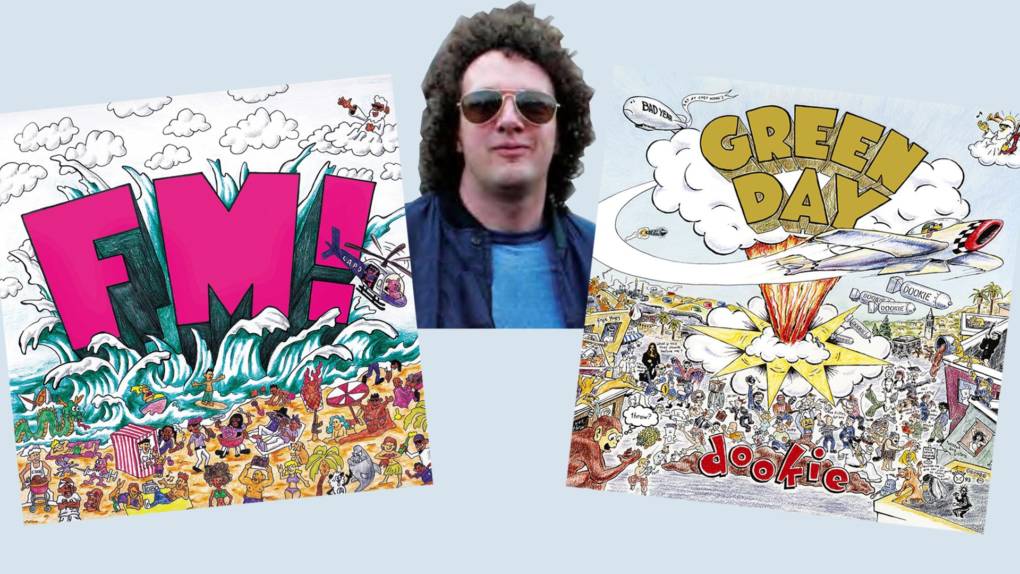
"content": "\u003cp>You may not know the name Richie Bucher, but you’ve almost certainly seen his artwork.\u003c/p>\n\u003cp>Bucher, an East Bay \u003ca href=\"http://www.rbucherart.com/\" rel=\"noopener\" target=\"_blank\">artist\u003c/a> and \u003ca href=\"https://www.discogs.com/artist/1377685-Richie-Bucher\" rel=\"noopener\" target=\"_blank\">musician\u003c/a>, drew the cover art for Green Day’s \u003cem>Dookie\u003c/em>, an album that’s sold 20 million copies. The record cover is now as iconic as it is detailed—one that teenagers around the world have stared into for hours on end, getting lost in its Berkeley in-jokes, characters, and pop-culture references. \u003c/p>\n\u003cp>Today, rapper Vince Staples released his new album, \u003ca href=\"https://vincestaples.lnk.to/FM\" rel=\"noopener\" target=\"_blank\">\u003cem>FM!\u003c/em>\u003c/a>, and the cover is a clear tribute to Green Day’s \u003cem>Dookie\u003c/em>.\u003c/p>\n\u003cp>\u003cimg loading=\"lazy\" decoding=\"async\" src=\"https://ww2.kqed.org/arts/wp-content/uploads/sites/2/2018/11/CoversSidebySide-800x367.jpg\" alt=\"\" width=\"800\" height=\"367\" class=\"aligncenter size-medium wp-image-13844063\" srcset=\"https://cdn.kqed.org/wp-content/uploads/sites/2/2018/11/CoversSidebySide-800x367.jpg 800w, https://cdn.kqed.org/wp-content/uploads/sites/2/2018/11/CoversSidebySide-160x73.jpg 160w, https://cdn.kqed.org/wp-content/uploads/sites/2/2018/11/CoversSidebySide-768x352.jpg 768w, https://cdn.kqed.org/wp-content/uploads/sites/2/2018/11/CoversSidebySide-1020x467.jpg 1020w, https://cdn.kqed.org/wp-content/uploads/sites/2/2018/11/CoversSidebySide-960x440.jpg 960w, https://cdn.kqed.org/wp-content/uploads/sites/2/2018/11/CoversSidebySide-240x110.jpg 240w, https://cdn.kqed.org/wp-content/uploads/sites/2/2018/11/CoversSidebySide-375x172.jpg 375w, https://cdn.kqed.org/wp-content/uploads/sites/2/2018/11/CoversSidebySide-520x238.jpg 520w, https://cdn.kqed.org/wp-content/uploads/sites/2/2018/11/CoversSidebySide.jpg 1100w\" sizes=\"(max-width: 800px) 100vw, 800px\">\u003c/p>\n\u003cp>Instead of Telegraph Avenue in Berkeley, the scene is Long Beach, Staples’ hometown. But the style is the same, and the details are familiar—including the arced 3D lettering, the flying aircraft, the police, and the “Cool God” in the upper right-hand corner.\u003c/p>\n\u003cp>[ad fullwidth]\u003c/p>\n\u003cp>I called up Bucher the day of \u003cem>FM!\u003c/em>‘s release to see what he thinks of Vince Staples’ homage.\u003c/p>\n\u003cp> \u003c/p>\n\u003cp>\u003cstrong>So, did you know who Vince Staples was before tonight?\u003c/strong>\u003c/p>\n\u003cp>No! I don’t know Vince Staples. I just listened to it, it sounds pretty good.\u003c/p>\n\u003cp>\u003cstrong>What do you think of his album cover?\u003c/strong>\u003c/p>\n\u003cp>I think it’s really cool! I just looked at it a little more closely, and I gotta say, I love stuff like this. It seems really clever and respectful. I have absolutely nothing bad to say about it—I think it’s really cool.\u003c/p>\n\u003cfigure id=\"attachment_13844067\" class=\"wp-caption aligncenter\" style=\"max-width: 453px\">\u003cimg loading=\"lazy\" decoding=\"async\" src=\"https://ww2.kqed.org/arts/wp-content/uploads/sites/2/2018/11/Richie.Artshow.jpg\" alt=\"Richie Bucher.\" width=\"453\" height=\"453\" class=\"size-full wp-image-13844067\" srcset=\"https://cdn.kqed.org/wp-content/uploads/sites/2/2018/11/Richie.Artshow.jpg 453w, https://cdn.kqed.org/wp-content/uploads/sites/2/2018/11/Richie.Artshow-160x160.jpg 160w, https://cdn.kqed.org/wp-content/uploads/sites/2/2018/11/Richie.Artshow-240x240.jpg 240w, https://cdn.kqed.org/wp-content/uploads/sites/2/2018/11/Richie.Artshow-375x375.jpg 375w, https://cdn.kqed.org/wp-content/uploads/sites/2/2018/11/Richie.Artshow-32x32.jpg 32w, https://cdn.kqed.org/wp-content/uploads/sites/2/2018/11/Richie.Artshow-50x50.jpg 50w, https://cdn.kqed.org/wp-content/uploads/sites/2/2018/11/Richie.Artshow-64x64.jpg 64w, https://cdn.kqed.org/wp-content/uploads/sites/2/2018/11/Richie.Artshow-96x96.jpg 96w, https://cdn.kqed.org/wp-content/uploads/sites/2/2018/11/Richie.Artshow-128x128.jpg 128w, https://cdn.kqed.org/wp-content/uploads/sites/2/2018/11/Richie.Artshow-150x150.jpg 150w\" sizes=\"(max-width: 453px) 100vw, 453px\">\u003cfigcaption class=\"wp-caption-text\">Richie Bucher.\u003c/figcaption>\u003c/figure>\n\u003cp>\u003cstrong>There’ve been \u003ca href=\"https://www.picclickimg.com/d/l400/pict/323501516742_/GREEN-DAY-GUM-DAY-Dookie-Stickie-spoof.jpg\" rel=\"noopener\" target=\"_blank\">plenty\u003c/a> \u003ca href=\"https://derpicdn.net/img/2012/8/1/63828/large.png\" rel=\"noopener\" target=\"_blank\">spoofs\u003c/a> or \u003ca href=\"https://i.redd.it/ca15p4kyrgoy.jpg\" rel=\"noopener\" target=\"_blank\">tributes\u003c/a> over the years of the \u003cem>Dookie\u003c/em> cover. Do you see them all?\u003c/strong>\u003c/p>\n\u003cp>I don’t have any way of seeing all the stuff, unless someone sends it to me. But I don’t think I’ve ever seen anything that I didn’t get a kick out of. I’m always really flattered by it. Why would they bother doing it if they didn’t enjoy what I did?\u003c/p>\n\u003cp>Growing up, drawing, I had my influences. The \u003cem>Dookie\u003c/em> cover that I did was an homage to other artists as well. So if somebody younger is doing something that’s a takeoff of what I did, it’s just part of a long line of art tradition. It’s a lucky crowd to be part of.\u003c/p>\n\u003cp>\u003cstrong>What sort of artists were you paying homage to with \u003cem>Dookie\u003c/em>?\u003c/strong>\u003c/p>\n\u003cp>Specifically, Gilbert Shelton—he did \u003cem>\u003ca href=\"https://en.wikipedia.org/wiki/The_Fabulous_Furry_Freak_Brothers\" rel=\"noopener\" target=\"_blank\">The Fabulous Furry Freak Brothers\u003c/a>\u003c/em>, and I grew up loving that stuff—but he did a cover for the Grateful Dead album \u003cem>\u003ca href=\"https://images-na.ssl-images-amazon.com/images/I/91oM2vyXD7L._SL1500_.jpg\" rel=\"noopener\" target=\"_blank\">Shakedown Street\u003c/a>\u003c/em>. Another big one was John Holmstrom, who did \u003ca href=\"https://greenandblackmusic.com/home/2016/05/01/rocket-to-russia-the-punk-rock-art-of-the-ramones/\" rel=\"noopener\" target=\"_blank\">the Ramones’ \u003cem>Rocket to Russia\u003c/em>\u003c/a>. That’s where “Eat at Chef Wong’s” comes from, it’s on someone’s T-shirt on the lyric sheet. And the other pretty direct influence was the band War, and \u003cem>\u003ca href=\"https://images.genius.com/03254402acffbc8defb4f05f05474548.1000x1000x1.jpg\" rel=\"noopener\" target=\"_blank\">The World Is a Ghetto\u003c/a>\u003c/em> artwork, and the artwork for \u003cem>\u003ca href=\"https://c1.staticflickr.com/8/7222/7276466912_b299d7d5ab_b.jpg\" rel=\"noopener\" target=\"_blank\">Why Can’t We Be Friends?\u003c/a>\u003c/em> All that stuff, that was the feeling around Berkeley when I was growing up. Just a whole bunch of people getting down and living together in the city. That was the feeling that I wanted to convey. \u003c/p>\n\u003cp>Listening to Vince Staples tonight, and looking at his artwork, it’s like, they have their world, they have their feeling, and that’s what \u003cem>they’re\u003c/em> trying to convey! It’s the same sentiment, but their localized version, and that’s cool. \u003c/p>\n\u003cp>\u003cimg loading=\"lazy\" decoding=\"async\" src=\"https://ww2.kqed.org/arts/wp-content/uploads/sites/2/2018/11/War.Freak_-800x281.jpg\" alt=\"\" width=\"800\" height=\"281\" class=\"aligncenter size-medium wp-image-13844065\" srcset=\"https://cdn.kqed.org/wp-content/uploads/sites/2/2018/11/War.Freak_-800x281.jpg 800w, https://cdn.kqed.org/wp-content/uploads/sites/2/2018/11/War.Freak_-160x56.jpg 160w, https://cdn.kqed.org/wp-content/uploads/sites/2/2018/11/War.Freak_-768x270.jpg 768w, https://cdn.kqed.org/wp-content/uploads/sites/2/2018/11/War.Freak_-1020x359.jpg 1020w, https://cdn.kqed.org/wp-content/uploads/sites/2/2018/11/War.Freak_-960x338.jpg 960w, https://cdn.kqed.org/wp-content/uploads/sites/2/2018/11/War.Freak_-240x84.jpg 240w, https://cdn.kqed.org/wp-content/uploads/sites/2/2018/11/War.Freak_-375x132.jpg 375w, https://cdn.kqed.org/wp-content/uploads/sites/2/2018/11/War.Freak_-520x183.jpg 520w, https://cdn.kqed.org/wp-content/uploads/sites/2/2018/11/War.Freak_.jpg 1100w\" sizes=\"(max-width: 800px) 100vw, 800px\">\u003c/p>\n\u003cp>\u003cstrong>Did anyone from Vince Staples’ team or label get in touch with you about it?\u003c/strong>\u003c/p>\n\u003cp>No, not at all.\u003c/p>\n\u003cp>\u003cstrong>What are you doing nowadays? I saw that \u003cem>New Noise\u003c/em> magazine with \u003ca href=\"http://www.rbucherart.com/img/ART-New-Noise-Cover.jpg\" rel=\"noopener\" target=\"_blank\">your artwork on the cover\u003c/a>.\u003c/strong>\u003c/p>\n\u003cp>I’ve been doing things like that. I’ve been doing a couple of commissions. Longer term, I’ve been working on graphic stories that I want to compile into a book. And working on paintings here and there. Some stuff for my dad. Just a couple different projects that are going simultaneously. \u003c/p>\n\u003cp>\u003cstrong>How can people get in touch with you?\u003c/strong>\u003c/p>\n\u003cp>I have a \u003ca href=\"http://www.rbucherart.com/\" rel=\"noopener\" target=\"_blank\">website\u003c/a>. And of course, people can keep up with my art \u003ca href=\"https://www.instagram.com/richiebuchzart/\" rel=\"noopener\" target=\"_blank\">on Instagram\u003c/a>.\u003c/p>\n\u003cp>\u003c/p>\n\u003cp>\u003cimg loading=\"lazy\" decoding=\"async\" src=\"https://ww2.kqed.org/arts/wp-content/uploads/sites/2/2016/09/Q.Logo_.Break_-800x78.jpg\" alt=\"\" width=\"800\" height=\"78\" class=\"aligncenter size-medium wp-image-12127869\" srcset=\"https://cdn.kqed.org/wp-content/uploads/sites/2/2016/09/Q.Logo_.Break_.jpg 800w, https://cdn.kqed.org/wp-content/uploads/sites/2/2016/09/Q.Logo_.Break_-400x39.jpg 400w, https://cdn.kqed.org/wp-content/uploads/sites/2/2016/09/Q.Logo_.Break_-768x75.jpg 768w\" sizes=\"(max-width: 800px) 100vw, 800px\">\u003c/p>\n\n",
"stats": {
"hasVideo": false,
"hasChartOrMap": false,
"hasAudio": false,
"hasPolis": false,
"wordCount": 714,
"hasGoogleForm": false,
"hasGallery": false,
"hasHearkenModule": false,
"iframeSrcs": [],
"paragraphCount": 26
},
"modified": 1705027062,
"excerpt": "Vince Staples' 'FM' album cover pays tribute to Green Day—so we chatted with the original artist for 'Dookie' about it.",
"headData": {
"twImgId": "",
"twTitle": "",
"ogTitle": "",
"ogImgId": "",
"twDescription": "",
"description": "Vince Staples' 'FM' album cover pays tribute to Green Day—so we chatted with the original artist for 'Dookie' about it.",
"title": "Vince Staples and Green Day: Talking With 'Dookie' Cover Artist Richie Bucher | KQED",
"ogDescription": "",
"schema": {
"@context": "https://schema.org",
"@type": "Article",
"headline": "Vince Staples and Green Day: Talking With 'Dookie' Cover Artist Richie Bucher",
"datePublished": "2018-11-02T01:30:10-07:00",
"dateModified": "2024-01-11T18:37:42-08:00",
"image": "https://cdn.kqed.org/wp-content/uploads/2020/02/KQED-OG-Image@1x.png"
}
},
"guestAuthors": [],
"slug": "vince-staples-and-green-day-talking-with-dookie-cover-artist-richie-bucher",
"status": "publish",
"sticky": false,
"path": "/arts/13844052/vince-staples-and-green-day-talking-with-dookie-cover-artist-richie-bucher",
"audioTrackLength": null,
"parsedContent": [
{
"type": "contentString",
"content": "\u003cdiv class=\"post-body\">\u003cp>\u003cp>You may not know the name Richie Bucher, but you’ve almost certainly seen his artwork.\u003c/p>\n\u003cp>Bucher, an East Bay \u003ca href=\"http://www.rbucherart.com/\" rel=\"noopener\" target=\"_blank\">artist\u003c/a> and \u003ca href=\"https://www.discogs.com/artist/1377685-Richie-Bucher\" rel=\"noopener\" target=\"_blank\">musician\u003c/a>, drew the cover art for Green Day’s \u003cem>Dookie\u003c/em>, an album that’s sold 20 million copies. The record cover is now as iconic as it is detailed—one that teenagers around the world have stared into for hours on end, getting lost in its Berkeley in-jokes, characters, and pop-culture references. \u003c/p>\n\u003cp>Today, rapper Vince Staples released his new album, \u003ca href=\"https://vincestaples.lnk.to/FM\" rel=\"noopener\" target=\"_blank\">\u003cem>FM!\u003c/em>\u003c/a>, and the cover is a clear tribute to Green Day’s \u003cem>Dookie\u003c/em>.\u003c/p>\n\u003cp>\u003cimg loading=\"lazy\" decoding=\"async\" src=\"https://ww2.kqed.org/arts/wp-content/uploads/sites/2/2018/11/CoversSidebySide-800x367.jpg\" alt=\"\" width=\"800\" height=\"367\" class=\"aligncenter size-medium wp-image-13844063\" srcset=\"https://cdn.kqed.org/wp-content/uploads/sites/2/2018/11/CoversSidebySide-800x367.jpg 800w, https://cdn.kqed.org/wp-content/uploads/sites/2/2018/11/CoversSidebySide-160x73.jpg 160w, https://cdn.kqed.org/wp-content/uploads/sites/2/2018/11/CoversSidebySide-768x352.jpg 768w, https://cdn.kqed.org/wp-content/uploads/sites/2/2018/11/CoversSidebySide-1020x467.jpg 1020w, https://cdn.kqed.org/wp-content/uploads/sites/2/2018/11/CoversSidebySide-960x440.jpg 960w, https://cdn.kqed.org/wp-content/uploads/sites/2/2018/11/CoversSidebySide-240x110.jpg 240w, https://cdn.kqed.org/wp-content/uploads/sites/2/2018/11/CoversSidebySide-375x172.jpg 375w, https://cdn.kqed.org/wp-content/uploads/sites/2/2018/11/CoversSidebySide-520x238.jpg 520w, https://cdn.kqed.org/wp-content/uploads/sites/2/2018/11/CoversSidebySide.jpg 1100w\" sizes=\"(max-width: 800px) 100vw, 800px\">\u003c/p>\n\u003cp>Instead of Telegraph Avenue in Berkeley, the scene is Long Beach, Staples’ hometown. But the style is the same, and the details are familiar—including the arced 3D lettering, the flying aircraft, the police, and the “Cool God” in the upper right-hand corner.\u003c/p>\n\u003cp>\u003c/p>\u003c/div>",
"attributes": {
"named": {},
"numeric": []
}
},
{
"type": "component",
"content": "",
"name": "ad",
"attributes": {
"named": {
"label": "fullwidth"
},
"numeric": [
"fullwidth"
]
}
},
{
"type": "contentString",
"content": "\u003cdiv class=\"post-body\">\u003cp>\u003c/p>\n\u003cp>I called up Bucher the day of \u003cem>FM!\u003c/em>‘s release to see what he thinks of Vince Staples’ homage.\u003c/p>\n\u003cp> \u003c/p>\n\u003cp>\u003cstrong>So, did you know who Vince Staples was before tonight?\u003c/strong>\u003c/p>\n\u003cp>No! I don’t know Vince Staples. I just listened to it, it sounds pretty good.\u003c/p>\n\u003cp>\u003cstrong>What do you think of his album cover?\u003c/strong>\u003c/p>\n\u003cp>I think it’s really cool! I just looked at it a little more closely, and I gotta say, I love stuff like this. It seems really clever and respectful. I have absolutely nothing bad to say about it—I think it’s really cool.\u003c/p>\n\u003cfigure id=\"attachment_13844067\" class=\"wp-caption aligncenter\" style=\"max-width: 453px\">\u003cimg loading=\"lazy\" decoding=\"async\" src=\"https://ww2.kqed.org/arts/wp-content/uploads/sites/2/2018/11/Richie.Artshow.jpg\" alt=\"Richie Bucher.\" width=\"453\" height=\"453\" class=\"size-full wp-image-13844067\" srcset=\"https://cdn.kqed.org/wp-content/uploads/sites/2/2018/11/Richie.Artshow.jpg 453w, https://cdn.kqed.org/wp-content/uploads/sites/2/2018/11/Richie.Artshow-160x160.jpg 160w, https://cdn.kqed.org/wp-content/uploads/sites/2/2018/11/Richie.Artshow-240x240.jpg 240w, https://cdn.kqed.org/wp-content/uploads/sites/2/2018/11/Richie.Artshow-375x375.jpg 375w, https://cdn.kqed.org/wp-content/uploads/sites/2/2018/11/Richie.Artshow-32x32.jpg 32w, https://cdn.kqed.org/wp-content/uploads/sites/2/2018/11/Richie.Artshow-50x50.jpg 50w, https://cdn.kqed.org/wp-content/uploads/sites/2/2018/11/Richie.Artshow-64x64.jpg 64w, https://cdn.kqed.org/wp-content/uploads/sites/2/2018/11/Richie.Artshow-96x96.jpg 96w, https://cdn.kqed.org/wp-content/uploads/sites/2/2018/11/Richie.Artshow-128x128.jpg 128w, https://cdn.kqed.org/wp-content/uploads/sites/2/2018/11/Richie.Artshow-150x150.jpg 150w\" sizes=\"(max-width: 453px) 100vw, 453px\">\u003cfigcaption class=\"wp-caption-text\">Richie Bucher.\u003c/figcaption>\u003c/figure>\n\u003cp>\u003cstrong>There’ve been \u003ca href=\"https://www.picclickimg.com/d/l400/pict/323501516742_/GREEN-DAY-GUM-DAY-Dookie-Stickie-spoof.jpg\" rel=\"noopener\" target=\"_blank\">plenty\u003c/a> \u003ca href=\"https://derpicdn.net/img/2012/8/1/63828/large.png\" rel=\"noopener\" target=\"_blank\">spoofs\u003c/a> or \u003ca href=\"https://i.redd.it/ca15p4kyrgoy.jpg\" rel=\"noopener\" target=\"_blank\">tributes\u003c/a> over the years of the \u003cem>Dookie\u003c/em> cover. Do you see them all?\u003c/strong>\u003c/p>\n\u003cp>I don’t have any way of seeing all the stuff, unless someone sends it to me. But I don’t think I’ve ever seen anything that I didn’t get a kick out of. I’m always really flattered by it. Why would they bother doing it if they didn’t enjoy what I did?\u003c/p>\n\u003cp>Growing up, drawing, I had my influences. The \u003cem>Dookie\u003c/em> cover that I did was an homage to other artists as well. So if somebody younger is doing something that’s a takeoff of what I did, it’s just part of a long line of art tradition. It’s a lucky crowd to be part of.\u003c/p>\n\u003cp>\u003cstrong>What sort of artists were you paying homage to with \u003cem>Dookie\u003c/em>?\u003c/strong>\u003c/p>\n\u003cp>Specifically, Gilbert Shelton—he did \u003cem>\u003ca href=\"https://en.wikipedia.org/wiki/The_Fabulous_Furry_Freak_Brothers\" rel=\"noopener\" target=\"_blank\">The Fabulous Furry Freak Brothers\u003c/a>\u003c/em>, and I grew up loving that stuff—but he did a cover for the Grateful Dead album \u003cem>\u003ca href=\"https://images-na.ssl-images-amazon.com/images/I/91oM2vyXD7L._SL1500_.jpg\" rel=\"noopener\" target=\"_blank\">Shakedown Street\u003c/a>\u003c/em>. Another big one was John Holmstrom, who did \u003ca href=\"https://greenandblackmusic.com/home/2016/05/01/rocket-to-russia-the-punk-rock-art-of-the-ramones/\" rel=\"noopener\" target=\"_blank\">the Ramones’ \u003cem>Rocket to Russia\u003c/em>\u003c/a>. That’s where “Eat at Chef Wong’s” comes from, it’s on someone’s T-shirt on the lyric sheet. And the other pretty direct influence was the band War, and \u003cem>\u003ca href=\"https://images.genius.com/03254402acffbc8defb4f05f05474548.1000x1000x1.jpg\" rel=\"noopener\" target=\"_blank\">The World Is a Ghetto\u003c/a>\u003c/em> artwork, and the artwork for \u003cem>\u003ca href=\"https://c1.staticflickr.com/8/7222/7276466912_b299d7d5ab_b.jpg\" rel=\"noopener\" target=\"_blank\">Why Can’t We Be Friends?\u003c/a>\u003c/em> All that stuff, that was the feeling around Berkeley when I was growing up. Just a whole bunch of people getting down and living together in the city. That was the feeling that I wanted to convey. \u003c/p>\n\u003cp>Listening to Vince Staples tonight, and looking at his artwork, it’s like, they have their world, they have their feeling, and that’s what \u003cem>they’re\u003c/em> trying to convey! It’s the same sentiment, but their localized version, and that’s cool. \u003c/p>\n\u003cp>\u003cimg loading=\"lazy\" decoding=\"async\" src=\"https://ww2.kqed.org/arts/wp-content/uploads/sites/2/2018/11/War.Freak_-800x281.jpg\" alt=\"\" width=\"800\" height=\"281\" class=\"aligncenter size-medium wp-image-13844065\" srcset=\"https://cdn.kqed.org/wp-content/uploads/sites/2/2018/11/War.Freak_-800x281.jpg 800w, https://cdn.kqed.org/wp-content/uploads/sites/2/2018/11/War.Freak_-160x56.jpg 160w, https://cdn.kqed.org/wp-content/uploads/sites/2/2018/11/War.Freak_-768x270.jpg 768w, https://cdn.kqed.org/wp-content/uploads/sites/2/2018/11/War.Freak_-1020x359.jpg 1020w, https://cdn.kqed.org/wp-content/uploads/sites/2/2018/11/War.Freak_-960x338.jpg 960w, https://cdn.kqed.org/wp-content/uploads/sites/2/2018/11/War.Freak_-240x84.jpg 240w, https://cdn.kqed.org/wp-content/uploads/sites/2/2018/11/War.Freak_-375x132.jpg 375w, https://cdn.kqed.org/wp-content/uploads/sites/2/2018/11/War.Freak_-520x183.jpg 520w, https://cdn.kqed.org/wp-content/uploads/sites/2/2018/11/War.Freak_.jpg 1100w\" sizes=\"(max-width: 800px) 100vw, 800px\">\u003c/p>\n\u003cp>\u003cstrong>Did anyone from Vince Staples’ team or label get in touch with you about it?\u003c/strong>\u003c/p>\n\u003cp>No, not at all.\u003c/p>\n\u003cp>\u003cstrong>What are you doing nowadays? I saw that \u003cem>New Noise\u003c/em> magazine with \u003ca href=\"http://www.rbucherart.com/img/ART-New-Noise-Cover.jpg\" rel=\"noopener\" target=\"_blank\">your artwork on the cover\u003c/a>.\u003c/strong>\u003c/p>\n\u003cp>I’ve been doing things like that. I’ve been doing a couple of commissions. Longer term, I’ve been working on graphic stories that I want to compile into a book. And working on paintings here and there. Some stuff for my dad. Just a couple different projects that are going simultaneously. \u003c/p>\n\u003cp>\u003cstrong>How can people get in touch with you?\u003c/strong>\u003c/p>\n\u003cp>I have a \u003ca href=\"http://www.rbucherart.com/\" rel=\"noopener\" target=\"_blank\">website\u003c/a>. And of course, people can keep up with my art \u003ca href=\"https://www.instagram.com/richiebuchzart/\" rel=\"noopener\" target=\"_blank\">on Instagram\u003c/a>.\u003c/p>\n\u003cp>\u003c/p>\n\u003cp>\u003cimg loading=\"lazy\" decoding=\"async\" src=\"https://ww2.kqed.org/arts/wp-content/uploads/sites/2/2016/09/Q.Logo_.Break_-800x78.jpg\" alt=\"\" width=\"800\" height=\"78\" class=\"aligncenter size-medium wp-image-12127869\" srcset=\"https://cdn.kqed.org/wp-content/uploads/sites/2/2016/09/Q.Logo_.Break_.jpg 800w, https://cdn.kqed.org/wp-content/uploads/sites/2/2016/09/Q.Logo_.Break_-400x39.jpg 400w, https://cdn.kqed.org/wp-content/uploads/sites/2/2016/09/Q.Logo_.Break_-768x75.jpg 768w\" sizes=\"(max-width: 800px) 100vw, 800px\">\u003c/p>\n\n\u003c/div>\u003c/p>",
"attributes": {
"named": {},
"numeric": []
}
}
],
"link": "/arts/13844052/vince-staples-and-green-day-talking-with-dookie-cover-artist-richie-bucher",
"authors": [
"185"
],
"categories": [
"arts_69",
"arts_70"
],
"tags": [
"arts_1118",
"arts_1543",
"arts_596"
],
"featImg": "arts_13844060",
"label": "arts"
},
"arts_13820065": {
"type": "posts",
"id": "arts_13820065",
"meta": {
"index": "posts_1716263798",
"site": "arts",
"id": "13820065",
"score": null,
"sort": [
1518530429000
]
},
"parent": 0,
"labelTerm": {
"site": "arts"
},
"blocks": [],
"publishDate": 1518530429,
"format": "audio",
"title": "Reproductions of Famous Paintings Cover Former Green Day High School",
"headTitle": "Reproductions of Famous Paintings Cover Former Green Day High School | KQED",
"content": "\u003cp>\u003ca href=\"https://www.wccusd.net/pinolevalley\" target=\"_blank\" rel=\"noopener\">Pinole Valley High School\u003c/a> in the East Bay already has one big claim to fame: t\u003cspan style=\"font-weight: 400\">wo members of the rock band \u003ca href=\"http://www.greenday.com/\" target=\"_blank\" rel=\"noopener\">Green Day\u003c/a> were students there before they made it big. Now the school is earning a reputation for a different type of art, as its fast-growing collection of outdoor murals is transforming the campus — and the lives of its students.\u003c/span>\u003c/p>\n\u003cp>But to newcomers, Pinole Valley High doesn’t look much like a hotbed of artistic creativity. \u003cspan style=\"font-weight: 400\">Half the campus is a building site. The other half is a sprawl of squat mobile buildings. Principal Kibby Kleiman says his students and staff are stuck in the temporary structures for at least five years while the school undergoes renovations.\u003c/span>\u003c/p>\n\u003cfigure id=\"attachment_13820103\" class=\"wp-caption aligncenter\" style=\"max-width: 800px\">\u003cimg loading=\"lazy\" decoding=\"async\" class=\"size-medium wp-image-13820103\" src=\"https://ww2.kqed.org/arts/wp-content/uploads/sites/2/2018/01/campus-800x600.jpg\" alt=\"A part of the Pinole Valley High School campus that isn’t yet adorned with art.\" width=\"800\" height=\"600\" srcset=\"https://cdn.kqed.org/wp-content/uploads/sites/2/2018/01/campus-800x600.jpg 800w, https://cdn.kqed.org/wp-content/uploads/sites/2/2018/01/campus-160x120.jpg 160w, https://cdn.kqed.org/wp-content/uploads/sites/2/2018/01/campus-768x576.jpg 768w, https://cdn.kqed.org/wp-content/uploads/sites/2/2018/01/campus-1020x765.jpg 1020w, https://cdn.kqed.org/wp-content/uploads/sites/2/2018/01/campus-1920x1440.jpg 1920w, https://cdn.kqed.org/wp-content/uploads/sites/2/2018/01/campus-1180x885.jpg 1180w, https://cdn.kqed.org/wp-content/uploads/sites/2/2018/01/campus-960x720.jpg 960w, https://cdn.kqed.org/wp-content/uploads/sites/2/2018/01/campus-240x180.jpg 240w, https://cdn.kqed.org/wp-content/uploads/sites/2/2018/01/campus-375x281.jpg 375w, https://cdn.kqed.org/wp-content/uploads/sites/2/2018/01/campus-520x390.jpg 520w, https://cdn.kqed.org/wp-content/uploads/sites/2/2018/01/campus.jpg 2048w\" sizes=\"(max-width: 800px) 100vw, 800px\">\u003cfigcaption class=\"wp-caption-text\">A part of the Pinole Valley High School campus that isn’t yet completely adorned with art. \u003ccite>(Photo: Chloe Veltman/KQED)\u003c/cite>\u003c/figcaption>\u003c/figure>\n\u003cp>“Everything is in a portable,” Kleiman says. “My office is a portable. The bathrooms are portables. This book room, that library, are portable. There’s a multipurpose room that’s just kind of a bigger portable.”\u003c/p>\n\u003cp>When the school moved into the mobiles in 2014, Kleiman feared the uninspiring environment would lower morale, and even cause dropouts. Then art teacher Jan Barzottini came along, with bright ideas and a great sense of humor.\u003c/p>\n\u003cfigure id=\"attachment_13820102\" class=\"wp-caption aligncenter\" style=\"max-width: 800px\">\u003cimg loading=\"lazy\" decoding=\"async\" class=\"size-medium wp-image-13820102\" src=\"https://ww2.kqed.org/arts/wp-content/uploads/sites/2/2018/01/jan-and-shaye-800x600.jpg\" alt=\"Art teacher Jan Barzottini right) poses with recent grad Shaye Maxey. Maxey won a full ride scholarship to the Academy of Art University, partly for her work on the mural project.\" width=\"800\" height=\"600\" srcset=\"https://cdn.kqed.org/wp-content/uploads/sites/2/2018/01/jan-and-shaye-800x600.jpg 800w, https://cdn.kqed.org/wp-content/uploads/sites/2/2018/01/jan-and-shaye-160x120.jpg 160w, https://cdn.kqed.org/wp-content/uploads/sites/2/2018/01/jan-and-shaye-768x576.jpg 768w, https://cdn.kqed.org/wp-content/uploads/sites/2/2018/01/jan-and-shaye-1020x765.jpg 1020w, https://cdn.kqed.org/wp-content/uploads/sites/2/2018/01/jan-and-shaye-1920x1440.jpg 1920w, https://cdn.kqed.org/wp-content/uploads/sites/2/2018/01/jan-and-shaye-1180x885.jpg 1180w, https://cdn.kqed.org/wp-content/uploads/sites/2/2018/01/jan-and-shaye-960x720.jpg 960w, https://cdn.kqed.org/wp-content/uploads/sites/2/2018/01/jan-and-shaye-240x180.jpg 240w, https://cdn.kqed.org/wp-content/uploads/sites/2/2018/01/jan-and-shaye-375x281.jpg 375w, https://cdn.kqed.org/wp-content/uploads/sites/2/2018/01/jan-and-shaye-520x390.jpg 520w, https://cdn.kqed.org/wp-content/uploads/sites/2/2018/01/jan-and-shaye.jpg 2048w\" sizes=\"(max-width: 800px) 100vw, 800px\">\u003cfigcaption class=\"wp-caption-text\">Art teacher Jan Barzottini (right) poses with recent grad Shaye Maxey. Maxey won a full ride scholarship to the Academy of Art University, partly for her work on the mural project. \u003ccite>(Photo: Chloe Veltman/KQED)\u003c/cite>\u003c/figcaption>\u003c/figure>\n\u003cp>“There’s one kid this year who calls me Miss Fettuccini,” Barzottini jokes. “He has a whole realm of Italian foods that he calls me.”\u003c/p>\n\u003cp>[ad fullwidth]\u003c/p>\n\u003cp>Where most of her colleagues and students saw nothing but cheaply-constructed, cookie-cutter portables with walls the color of sludge, Barzottini saw a big, open canvas. She recruited students to cover the brown facades with reproductions of famous works of art.\u003c/p>\n\u003cp>“You see Roy De Forest on the right, you see a glimpse of Jasper Johns on the left, and you’ve got Diego Rivera right next to you,” Barzottini says as we tour the campus, checking out the many student murals that adorn the mobile walls. “So every time you turn a corner, there should be something that catches your eye and either identifies where you are or adds a little bit of color to your day.”\u003c/p>\n\u003cfigure id=\"attachment_13820101\" class=\"wp-caption aligncenter\" style=\"max-width: 800px\">\u003cimg loading=\"lazy\" decoding=\"async\" class=\"size-medium wp-image-13820101\" src=\"https://ww2.kqed.org/arts/wp-content/uploads/sites/2/2018/01/students-and-mural-2-800x600.jpg\" alt=\"Pinole Valley High students pose in front of their work.\" width=\"800\" height=\"600\" srcset=\"https://cdn.kqed.org/wp-content/uploads/sites/2/2018/01/students-and-mural-2-800x600.jpg 800w, https://cdn.kqed.org/wp-content/uploads/sites/2/2018/01/students-and-mural-2-160x120.jpg 160w, https://cdn.kqed.org/wp-content/uploads/sites/2/2018/01/students-and-mural-2-768x576.jpg 768w, https://cdn.kqed.org/wp-content/uploads/sites/2/2018/01/students-and-mural-2-1020x765.jpg 1020w, https://cdn.kqed.org/wp-content/uploads/sites/2/2018/01/students-and-mural-2-1920x1440.jpg 1920w, https://cdn.kqed.org/wp-content/uploads/sites/2/2018/01/students-and-mural-2-1180x885.jpg 1180w, https://cdn.kqed.org/wp-content/uploads/sites/2/2018/01/students-and-mural-2-960x720.jpg 960w, https://cdn.kqed.org/wp-content/uploads/sites/2/2018/01/students-and-mural-2-240x180.jpg 240w, https://cdn.kqed.org/wp-content/uploads/sites/2/2018/01/students-and-mural-2-375x281.jpg 375w, https://cdn.kqed.org/wp-content/uploads/sites/2/2018/01/students-and-mural-2-520x390.jpg 520w, https://cdn.kqed.org/wp-content/uploads/sites/2/2018/01/students-and-mural-2.jpg 2048w\" sizes=\"(max-width: 800px) 100vw, 800px\">\u003cfigcaption class=\"wp-caption-text\">Pinole Valley High students pose in front of their work. \u003ccite>(Photo: Chloe Veltman/KQED)\u003c/cite>\u003c/figcaption>\u003c/figure>\n\u003cp>Even though the students are working with fairly rudimentary tools — house paint, brushes and canvases made out of wooden boards — Barzottini is proud of the care they have taken to recreate the masterworks.\u003c/p>\n\u003cp>“This is Diego Rivera,” Barzottini says as we pause in front of a student reproduction of the artist’s painting depicting two girls washing their hair outdoors in front of a field of sunflowers. “A lot of different blending techniques to get all the ripples in their skirts.”\u003c/p>\n\u003cp>At first, Barzottini focused on 20th century masterworks because they’re bold, colorful and relatively easy to paint. “And that gave the kids confidence,” she says.\u003c/p>\n\u003cfigure id=\"attachment_13820100\" class=\"wp-caption aligncenter\" style=\"max-width: 800px\">\u003cimg loading=\"lazy\" decoding=\"async\" class=\"size-medium wp-image-13820100\" src=\"https://ww2.kqed.org/arts/wp-content/uploads/sites/2/2018/01/Jason-Capuyan-800x600.jpg\" alt=\"Student Jason Capuyan works on his mural -- the cover art for Green Days 1994 album ‘Dookie’.\" width=\"800\" height=\"600\" srcset=\"https://cdn.kqed.org/wp-content/uploads/sites/2/2018/01/Jason-Capuyan-800x600.jpg 800w, https://cdn.kqed.org/wp-content/uploads/sites/2/2018/01/Jason-Capuyan-160x120.jpg 160w, https://cdn.kqed.org/wp-content/uploads/sites/2/2018/01/Jason-Capuyan-768x576.jpg 768w, https://cdn.kqed.org/wp-content/uploads/sites/2/2018/01/Jason-Capuyan-1020x765.jpg 1020w, https://cdn.kqed.org/wp-content/uploads/sites/2/2018/01/Jason-Capuyan-1920x1440.jpg 1920w, https://cdn.kqed.org/wp-content/uploads/sites/2/2018/01/Jason-Capuyan-1180x885.jpg 1180w, https://cdn.kqed.org/wp-content/uploads/sites/2/2018/01/Jason-Capuyan-960x720.jpg 960w, https://cdn.kqed.org/wp-content/uploads/sites/2/2018/01/Jason-Capuyan-240x180.jpg 240w, https://cdn.kqed.org/wp-content/uploads/sites/2/2018/01/Jason-Capuyan-375x281.jpg 375w, https://cdn.kqed.org/wp-content/uploads/sites/2/2018/01/Jason-Capuyan-520x390.jpg 520w, https://cdn.kqed.org/wp-content/uploads/sites/2/2018/01/Jason-Capuyan.jpg 2048w\" sizes=\"(max-width: 800px) 100vw, 800px\">\u003cfigcaption class=\"wp-caption-text\">Student Jason Capuyan works on his mural — the cover art for Green Days 1994 album ‘Dookie’. \u003ccite>(Photo: Chloe Veltman/KQED)\u003c/cite>\u003c/figcaption>\u003c/figure>\n\u003cp>Soon the students started seeking inspiration outside the realm of traditional museum art.\u003c/p>\n\u003cp>When I visit Barzottini’s classroom, I chat with 18-year-old student Jason Capuyan as he painstakingly recreates the intricate cover art from Green Day’s 1994 album \u003cem>Dookie. \u003c/em>It’s a tribute to his musical heroes. “I listen to them a lot,” Capuyan says.\u003c/p>\n\u003cp>Capuyan spends his lunch breaks working on his mural and loves how art is transforming the campus. “The environment is a little more vivid now because we have more murals and bright colors popping up,” Capuyan says.\u003c/p>\n\u003cp>Principal Kleiman says around 150 students have participated in the project, including students who don’t even take art class.\u003c/p>\n\u003cfigure id=\"attachment_13820097\" class=\"wp-caption aligncenter\" style=\"max-width: 800px\">\u003cimg loading=\"lazy\" decoding=\"async\" class=\"size-medium wp-image-13820097\" src=\"https://ww2.kqed.org/arts/wp-content/uploads/sites/2/2018/01/shaye-maxey-800x600.jpg\" alt=\"Pinole Valley High School grad Shaye Maxey poses with her mural, a reproduction of Modigliani's 'Alice'.\" width=\"800\" height=\"600\" srcset=\"https://cdn.kqed.org/wp-content/uploads/sites/2/2018/01/shaye-maxey-800x600.jpg 800w, https://cdn.kqed.org/wp-content/uploads/sites/2/2018/01/shaye-maxey-160x120.jpg 160w, https://cdn.kqed.org/wp-content/uploads/sites/2/2018/01/shaye-maxey-768x576.jpg 768w, https://cdn.kqed.org/wp-content/uploads/sites/2/2018/01/shaye-maxey-1020x765.jpg 1020w, https://cdn.kqed.org/wp-content/uploads/sites/2/2018/01/shaye-maxey-1920x1440.jpg 1920w, https://cdn.kqed.org/wp-content/uploads/sites/2/2018/01/shaye-maxey-1180x885.jpg 1180w, https://cdn.kqed.org/wp-content/uploads/sites/2/2018/01/shaye-maxey-960x720.jpg 960w, https://cdn.kqed.org/wp-content/uploads/sites/2/2018/01/shaye-maxey-240x180.jpg 240w, https://cdn.kqed.org/wp-content/uploads/sites/2/2018/01/shaye-maxey-375x281.jpg 375w, https://cdn.kqed.org/wp-content/uploads/sites/2/2018/01/shaye-maxey-520x390.jpg 520w, https://cdn.kqed.org/wp-content/uploads/sites/2/2018/01/shaye-maxey.jpg 2048w\" sizes=\"(max-width: 800px) 100vw, 800px\">\u003cfigcaption class=\"wp-caption-text\">Pinole Valley High School grad Shaye Maxey poses with her mural, a reproduction of Modigliani’s ‘Alice’. \u003ccite>(Photo: Chloe Veltman/KQED)\u003c/cite>\u003c/figcaption>\u003c/figure>\n\u003cp>One recent grad, Shaye Maxey, won a full ride scholarship to San Francisco’s \u003ca href=\"https://www.academyart.edu/\" target=\"_blank\" rel=\"noopener\">Academy of Art University\u003c/a>, partly as a result of her take on “Alice,” a famous 1915 portrait of a young girl by the Italian artist Amedeo Modigliani.\u003c/p>\n\u003cp>“This mural made me feel like I could accomplish a lot more than I thought I could beforehand,” Maxey says.\u003c/p>\n\u003cp>And in the ultimate sign of teen approval, students are snapping selfies in front of the murals and sharing them on \u003ca href=\"https://www.instagram.com/pvhsamazingart/?hl=en\" target=\"_blank\" rel=\"noopener\">Instagram\u003c/a>.\u003c/p>\n\u003cp>\u003ca href=\"https://www.instagram.com/p/BcLcq0jhx2W/?hl=en&taken-by=pvhsamazingart\">https://www.instagram.com/p/BcLcq0jhx2W/?hl=en&taken-by=pvhsamazingart\u003c/a>\u003c/p>\n\u003cp>Barzottini says there are around 40 works of art up right now and many more to come.\u003c/p>\n\u003cp>I ask the art teacher when she plans to finish the project.\u003c/p>\n\u003cp>\u003c/p>\n\u003cp>“When there’s not another speck to fill when you turn a corner,” she responds. “I still see a million corners as we’re walking around. I think it’s going to be a while.”\u003c/p>\n\u003cfigure id=\"attachment_13820105\" class=\"wp-caption aligncenter\" style=\"max-width: 800px\">\u003cimg loading=\"lazy\" decoding=\"async\" class=\"size-medium wp-image-13820105\" src=\"https://ww2.kqed.org/arts/wp-content/uploads/sites/2/2018/01/gumball-mural-thiebaud-800x600.jpg\" alt=\"A student reproduction of Wayne Thiebaud’s ‘Three Machines’. The original hangs in the de Young Museum in San Francisco.\" width=\"800\" height=\"600\" srcset=\"https://cdn.kqed.org/wp-content/uploads/sites/2/2018/01/gumball-mural-thiebaud-800x600.jpg 800w, https://cdn.kqed.org/wp-content/uploads/sites/2/2018/01/gumball-mural-thiebaud-160x120.jpg 160w, https://cdn.kqed.org/wp-content/uploads/sites/2/2018/01/gumball-mural-thiebaud-768x576.jpg 768w, https://cdn.kqed.org/wp-content/uploads/sites/2/2018/01/gumball-mural-thiebaud-1020x765.jpg 1020w, https://cdn.kqed.org/wp-content/uploads/sites/2/2018/01/gumball-mural-thiebaud-1920x1440.jpg 1920w, https://cdn.kqed.org/wp-content/uploads/sites/2/2018/01/gumball-mural-thiebaud-1180x885.jpg 1180w, https://cdn.kqed.org/wp-content/uploads/sites/2/2018/01/gumball-mural-thiebaud-960x720.jpg 960w, https://cdn.kqed.org/wp-content/uploads/sites/2/2018/01/gumball-mural-thiebaud-240x180.jpg 240w, https://cdn.kqed.org/wp-content/uploads/sites/2/2018/01/gumball-mural-thiebaud-375x281.jpg 375w, https://cdn.kqed.org/wp-content/uploads/sites/2/2018/01/gumball-mural-thiebaud-520x390.jpg 520w, https://cdn.kqed.org/wp-content/uploads/sites/2/2018/01/gumball-mural-thiebaud.jpg 2048w\" sizes=\"(max-width: 800px) 100vw, 800px\">\u003cfigcaption class=\"wp-caption-text\">A student reproduction of Wayne Thiebaud’s ‘Three Machines’. The original hangs in the de Young Museum in San Francisco. \u003ccite>(Photo: Chloe Veltman/KQED)\u003c/cite>\u003c/figcaption>\u003c/figure>\n\n",
"stats": {
"hasVideo": false,
"hasChartOrMap": false,
"hasAudio": false,
"hasPolis": false,
"wordCount": 916,
"hasGoogleForm": false,
"hasGallery": false,
"hasHearkenModule": false,
"iframeSrcs": [],
"paragraphCount": 22
},
"modified": 1705028530,
"excerpt": "Pinole Valley High School already has a musical claim to fame. Now the East Bay school is earning a reputation for a different type of art. ",
"headData": {
"twImgId": "",
"twTitle": "",
"ogTitle": "",
"ogImgId": "",
"twDescription": "",
"description": "Pinole Valley High School already has a musical claim to fame. Now the East Bay school is earning a reputation for a different type of art. ",
"title": "Reproductions of Famous Paintings Cover Former Green Day High School | KQED",
"ogDescription": "",
"schema": {
"@context": "https://schema.org",
"@type": "Article",
"headline": "Reproductions of Famous Paintings Cover Former Green Day High School",
"datePublished": "2018-02-13T06:00:29-08:00",
"dateModified": "2024-01-11T19:02:10-08:00",
"image": "https://cdn.kqed.org/wp-content/uploads/2020/02/KQED-OG-Image@1x.png"
}
},
"guestAuthors": [],
"slug": "reproductions-of-famous-paintings-cover-former-green-day-high-school",
"status": "publish",
"audioUrl": "https://www.kqed.org/.stream/anon/radio/RDnews/2018/02/VeltmanPinoleSchoolMurals.mp3",
"sticky": false,
"path": "/arts/13820065/reproductions-of-famous-paintings-cover-former-green-day-high-school",
"audioDuration": 230000,
"audioTrackLength": null,
"parsedContent": [
{
"type": "contentString",
"content": "\u003cdiv class=\"post-body\">\u003cp>\u003cp>\u003ca href=\"https://www.wccusd.net/pinolevalley\" target=\"_blank\" rel=\"noopener\">Pinole Valley High School\u003c/a> in the East Bay already has one big claim to fame: t\u003cspan style=\"font-weight: 400\">wo members of the rock band \u003ca href=\"http://www.greenday.com/\" target=\"_blank\" rel=\"noopener\">Green Day\u003c/a> were students there before they made it big. Now the school is earning a reputation for a different type of art, as its fast-growing collection of outdoor murals is transforming the campus — and the lives of its students.\u003c/span>\u003c/p>\n\u003cp>But to newcomers, Pinole Valley High doesn’t look much like a hotbed of artistic creativity. \u003cspan style=\"font-weight: 400\">Half the campus is a building site. The other half is a sprawl of squat mobile buildings. Principal Kibby Kleiman says his students and staff are stuck in the temporary structures for at least five years while the school undergoes renovations.\u003c/span>\u003c/p>\n\u003cfigure id=\"attachment_13820103\" class=\"wp-caption aligncenter\" style=\"max-width: 800px\">\u003cimg loading=\"lazy\" decoding=\"async\" class=\"size-medium wp-image-13820103\" src=\"https://ww2.kqed.org/arts/wp-content/uploads/sites/2/2018/01/campus-800x600.jpg\" alt=\"A part of the Pinole Valley High School campus that isn’t yet adorned with art.\" width=\"800\" height=\"600\" srcset=\"https://cdn.kqed.org/wp-content/uploads/sites/2/2018/01/campus-800x600.jpg 800w, https://cdn.kqed.org/wp-content/uploads/sites/2/2018/01/campus-160x120.jpg 160w, https://cdn.kqed.org/wp-content/uploads/sites/2/2018/01/campus-768x576.jpg 768w, https://cdn.kqed.org/wp-content/uploads/sites/2/2018/01/campus-1020x765.jpg 1020w, https://cdn.kqed.org/wp-content/uploads/sites/2/2018/01/campus-1920x1440.jpg 1920w, https://cdn.kqed.org/wp-content/uploads/sites/2/2018/01/campus-1180x885.jpg 1180w, https://cdn.kqed.org/wp-content/uploads/sites/2/2018/01/campus-960x720.jpg 960w, https://cdn.kqed.org/wp-content/uploads/sites/2/2018/01/campus-240x180.jpg 240w, https://cdn.kqed.org/wp-content/uploads/sites/2/2018/01/campus-375x281.jpg 375w, https://cdn.kqed.org/wp-content/uploads/sites/2/2018/01/campus-520x390.jpg 520w, https://cdn.kqed.org/wp-content/uploads/sites/2/2018/01/campus.jpg 2048w\" sizes=\"(max-width: 800px) 100vw, 800px\">\u003cfigcaption class=\"wp-caption-text\">A part of the Pinole Valley High School campus that isn’t yet completely adorned with art. \u003ccite>(Photo: Chloe Veltman/KQED)\u003c/cite>\u003c/figcaption>\u003c/figure>\n\u003cp>“Everything is in a portable,” Kleiman says. “My office is a portable. The bathrooms are portables. This book room, that library, are portable. There’s a multipurpose room that’s just kind of a bigger portable.”\u003c/p>\n\u003cp>When the school moved into the mobiles in 2014, Kleiman feared the uninspiring environment would lower morale, and even cause dropouts. Then art teacher Jan Barzottini came along, with bright ideas and a great sense of humor.\u003c/p>\n\u003cfigure id=\"attachment_13820102\" class=\"wp-caption aligncenter\" style=\"max-width: 800px\">\u003cimg loading=\"lazy\" decoding=\"async\" class=\"size-medium wp-image-13820102\" src=\"https://ww2.kqed.org/arts/wp-content/uploads/sites/2/2018/01/jan-and-shaye-800x600.jpg\" alt=\"Art teacher Jan Barzottini right) poses with recent grad Shaye Maxey. Maxey won a full ride scholarship to the Academy of Art University, partly for her work on the mural project.\" width=\"800\" height=\"600\" srcset=\"https://cdn.kqed.org/wp-content/uploads/sites/2/2018/01/jan-and-shaye-800x600.jpg 800w, https://cdn.kqed.org/wp-content/uploads/sites/2/2018/01/jan-and-shaye-160x120.jpg 160w, https://cdn.kqed.org/wp-content/uploads/sites/2/2018/01/jan-and-shaye-768x576.jpg 768w, https://cdn.kqed.org/wp-content/uploads/sites/2/2018/01/jan-and-shaye-1020x765.jpg 1020w, https://cdn.kqed.org/wp-content/uploads/sites/2/2018/01/jan-and-shaye-1920x1440.jpg 1920w, https://cdn.kqed.org/wp-content/uploads/sites/2/2018/01/jan-and-shaye-1180x885.jpg 1180w, https://cdn.kqed.org/wp-content/uploads/sites/2/2018/01/jan-and-shaye-960x720.jpg 960w, https://cdn.kqed.org/wp-content/uploads/sites/2/2018/01/jan-and-shaye-240x180.jpg 240w, https://cdn.kqed.org/wp-content/uploads/sites/2/2018/01/jan-and-shaye-375x281.jpg 375w, https://cdn.kqed.org/wp-content/uploads/sites/2/2018/01/jan-and-shaye-520x390.jpg 520w, https://cdn.kqed.org/wp-content/uploads/sites/2/2018/01/jan-and-shaye.jpg 2048w\" sizes=\"(max-width: 800px) 100vw, 800px\">\u003cfigcaption class=\"wp-caption-text\">Art teacher Jan Barzottini (right) poses with recent grad Shaye Maxey. Maxey won a full ride scholarship to the Academy of Art University, partly for her work on the mural project. \u003ccite>(Photo: Chloe Veltman/KQED)\u003c/cite>\u003c/figcaption>\u003c/figure>\n\u003cp>“There’s one kid this year who calls me Miss Fettuccini,” Barzottini jokes. “He has a whole realm of Italian foods that he calls me.”\u003c/p>\n\u003cp>\u003c/p>\u003c/div>",
"attributes": {
"named": {},
"numeric": []
}
},
{
"type": "component",
"content": "",
"name": "ad",
"attributes": {
"named": {
"label": "fullwidth"
},
"numeric": [
"fullwidth"
]
}
},
{
"type": "contentString",
"content": "\u003cdiv class=\"post-body\">\u003cp>\u003c/p>\n\u003cp>Where most of her colleagues and students saw nothing but cheaply-constructed, cookie-cutter portables with walls the color of sludge, Barzottini saw a big, open canvas. She recruited students to cover the brown facades with reproductions of famous works of art.\u003c/p>\n\u003cp>“You see Roy De Forest on the right, you see a glimpse of Jasper Johns on the left, and you’ve got Diego Rivera right next to you,” Barzottini says as we tour the campus, checking out the many student murals that adorn the mobile walls. “So every time you turn a corner, there should be something that catches your eye and either identifies where you are or adds a little bit of color to your day.”\u003c/p>\n\u003cfigure id=\"attachment_13820101\" class=\"wp-caption aligncenter\" style=\"max-width: 800px\">\u003cimg loading=\"lazy\" decoding=\"async\" class=\"size-medium wp-image-13820101\" src=\"https://ww2.kqed.org/arts/wp-content/uploads/sites/2/2018/01/students-and-mural-2-800x600.jpg\" alt=\"Pinole Valley High students pose in front of their work.\" width=\"800\" height=\"600\" srcset=\"https://cdn.kqed.org/wp-content/uploads/sites/2/2018/01/students-and-mural-2-800x600.jpg 800w, https://cdn.kqed.org/wp-content/uploads/sites/2/2018/01/students-and-mural-2-160x120.jpg 160w, https://cdn.kqed.org/wp-content/uploads/sites/2/2018/01/students-and-mural-2-768x576.jpg 768w, https://cdn.kqed.org/wp-content/uploads/sites/2/2018/01/students-and-mural-2-1020x765.jpg 1020w, https://cdn.kqed.org/wp-content/uploads/sites/2/2018/01/students-and-mural-2-1920x1440.jpg 1920w, https://cdn.kqed.org/wp-content/uploads/sites/2/2018/01/students-and-mural-2-1180x885.jpg 1180w, https://cdn.kqed.org/wp-content/uploads/sites/2/2018/01/students-and-mural-2-960x720.jpg 960w, https://cdn.kqed.org/wp-content/uploads/sites/2/2018/01/students-and-mural-2-240x180.jpg 240w, https://cdn.kqed.org/wp-content/uploads/sites/2/2018/01/students-and-mural-2-375x281.jpg 375w, https://cdn.kqed.org/wp-content/uploads/sites/2/2018/01/students-and-mural-2-520x390.jpg 520w, https://cdn.kqed.org/wp-content/uploads/sites/2/2018/01/students-and-mural-2.jpg 2048w\" sizes=\"(max-width: 800px) 100vw, 800px\">\u003cfigcaption class=\"wp-caption-text\">Pinole Valley High students pose in front of their work. \u003ccite>(Photo: Chloe Veltman/KQED)\u003c/cite>\u003c/figcaption>\u003c/figure>\n\u003cp>Even though the students are working with fairly rudimentary tools — house paint, brushes and canvases made out of wooden boards — Barzottini is proud of the care they have taken to recreate the masterworks.\u003c/p>\n\u003cp>“This is Diego Rivera,” Barzottini says as we pause in front of a student reproduction of the artist’s painting depicting two girls washing their hair outdoors in front of a field of sunflowers. “A lot of different blending techniques to get all the ripples in their skirts.”\u003c/p>\n\u003cp>At first, Barzottini focused on 20th century masterworks because they’re bold, colorful and relatively easy to paint. “And that gave the kids confidence,” she says.\u003c/p>\n\u003cfigure id=\"attachment_13820100\" class=\"wp-caption aligncenter\" style=\"max-width: 800px\">\u003cimg loading=\"lazy\" decoding=\"async\" class=\"size-medium wp-image-13820100\" src=\"https://ww2.kqed.org/arts/wp-content/uploads/sites/2/2018/01/Jason-Capuyan-800x600.jpg\" alt=\"Student Jason Capuyan works on his mural -- the cover art for Green Days 1994 album ‘Dookie’.\" width=\"800\" height=\"600\" srcset=\"https://cdn.kqed.org/wp-content/uploads/sites/2/2018/01/Jason-Capuyan-800x600.jpg 800w, https://cdn.kqed.org/wp-content/uploads/sites/2/2018/01/Jason-Capuyan-160x120.jpg 160w, https://cdn.kqed.org/wp-content/uploads/sites/2/2018/01/Jason-Capuyan-768x576.jpg 768w, https://cdn.kqed.org/wp-content/uploads/sites/2/2018/01/Jason-Capuyan-1020x765.jpg 1020w, https://cdn.kqed.org/wp-content/uploads/sites/2/2018/01/Jason-Capuyan-1920x1440.jpg 1920w, https://cdn.kqed.org/wp-content/uploads/sites/2/2018/01/Jason-Capuyan-1180x885.jpg 1180w, https://cdn.kqed.org/wp-content/uploads/sites/2/2018/01/Jason-Capuyan-960x720.jpg 960w, https://cdn.kqed.org/wp-content/uploads/sites/2/2018/01/Jason-Capuyan-240x180.jpg 240w, https://cdn.kqed.org/wp-content/uploads/sites/2/2018/01/Jason-Capuyan-375x281.jpg 375w, https://cdn.kqed.org/wp-content/uploads/sites/2/2018/01/Jason-Capuyan-520x390.jpg 520w, https://cdn.kqed.org/wp-content/uploads/sites/2/2018/01/Jason-Capuyan.jpg 2048w\" sizes=\"(max-width: 800px) 100vw, 800px\">\u003cfigcaption class=\"wp-caption-text\">Student Jason Capuyan works on his mural — the cover art for Green Days 1994 album ‘Dookie’. \u003ccite>(Photo: Chloe Veltman/KQED)\u003c/cite>\u003c/figcaption>\u003c/figure>\n\u003cp>Soon the students started seeking inspiration outside the realm of traditional museum art.\u003c/p>\n\u003cp>When I visit Barzottini’s classroom, I chat with 18-year-old student Jason Capuyan as he painstakingly recreates the intricate cover art from Green Day’s 1994 album \u003cem>Dookie. \u003c/em>It’s a tribute to his musical heroes. “I listen to them a lot,” Capuyan says.\u003c/p>\n\u003cp>Capuyan spends his lunch breaks working on his mural and loves how art is transforming the campus. “The environment is a little more vivid now because we have more murals and bright colors popping up,” Capuyan says.\u003c/p>\n\u003cp>Principal Kleiman says around 150 students have participated in the project, including students who don’t even take art class.\u003c/p>\n\u003cfigure id=\"attachment_13820097\" class=\"wp-caption aligncenter\" style=\"max-width: 800px\">\u003cimg loading=\"lazy\" decoding=\"async\" class=\"size-medium wp-image-13820097\" src=\"https://ww2.kqed.org/arts/wp-content/uploads/sites/2/2018/01/shaye-maxey-800x600.jpg\" alt=\"Pinole Valley High School grad Shaye Maxey poses with her mural, a reproduction of Modigliani's 'Alice'.\" width=\"800\" height=\"600\" srcset=\"https://cdn.kqed.org/wp-content/uploads/sites/2/2018/01/shaye-maxey-800x600.jpg 800w, https://cdn.kqed.org/wp-content/uploads/sites/2/2018/01/shaye-maxey-160x120.jpg 160w, https://cdn.kqed.org/wp-content/uploads/sites/2/2018/01/shaye-maxey-768x576.jpg 768w, https://cdn.kqed.org/wp-content/uploads/sites/2/2018/01/shaye-maxey-1020x765.jpg 1020w, https://cdn.kqed.org/wp-content/uploads/sites/2/2018/01/shaye-maxey-1920x1440.jpg 1920w, https://cdn.kqed.org/wp-content/uploads/sites/2/2018/01/shaye-maxey-1180x885.jpg 1180w, https://cdn.kqed.org/wp-content/uploads/sites/2/2018/01/shaye-maxey-960x720.jpg 960w, https://cdn.kqed.org/wp-content/uploads/sites/2/2018/01/shaye-maxey-240x180.jpg 240w, https://cdn.kqed.org/wp-content/uploads/sites/2/2018/01/shaye-maxey-375x281.jpg 375w, https://cdn.kqed.org/wp-content/uploads/sites/2/2018/01/shaye-maxey-520x390.jpg 520w, https://cdn.kqed.org/wp-content/uploads/sites/2/2018/01/shaye-maxey.jpg 2048w\" sizes=\"(max-width: 800px) 100vw, 800px\">\u003cfigcaption class=\"wp-caption-text\">Pinole Valley High School grad Shaye Maxey poses with her mural, a reproduction of Modigliani’s ‘Alice’. \u003ccite>(Photo: Chloe Veltman/KQED)\u003c/cite>\u003c/figcaption>\u003c/figure>\n\u003cp>One recent grad, Shaye Maxey, won a full ride scholarship to San Francisco’s \u003ca href=\"https://www.academyart.edu/\" target=\"_blank\" rel=\"noopener\">Academy of Art University\u003c/a>, partly as a result of her take on “Alice,” a famous 1915 portrait of a young girl by the Italian artist Amedeo Modigliani.\u003c/p>\n\u003cp>“This mural made me feel like I could accomplish a lot more than I thought I could beforehand,” Maxey says.\u003c/p>\n\u003cp>And in the ultimate sign of teen approval, students are snapping selfies in front of the murals and sharing them on \u003ca href=\"https://www.instagram.com/pvhsamazingart/?hl=en\" target=\"_blank\" rel=\"noopener\">Instagram\u003c/a>.\u003c/p>\n\u003cp>\u003ca href=\"https://www.instagram.com/p/BcLcq0jhx2W/?hl=en&taken-by=pvhsamazingart\">https://www.instagram.com/p/BcLcq0jhx2W/?hl=en&taken-by=pvhsamazingart\u003c/a>\u003c/p>\n\u003cp>Barzottini says there are around 40 works of art up right now and many more to come.\u003c/p>\n\u003cp>I ask the art teacher when she plans to finish the project.\u003c/p>\n\u003cp>\u003c/p>\n\u003cp>“When there’s not another speck to fill when you turn a corner,” she responds. “I still see a million corners as we’re walking around. I think it’s going to be a while.”\u003c/p>\n\u003cfigure id=\"attachment_13820105\" class=\"wp-caption aligncenter\" style=\"max-width: 800px\">\u003cimg loading=\"lazy\" decoding=\"async\" class=\"size-medium wp-image-13820105\" src=\"https://ww2.kqed.org/arts/wp-content/uploads/sites/2/2018/01/gumball-mural-thiebaud-800x600.jpg\" alt=\"A student reproduction of Wayne Thiebaud’s ‘Three Machines’. The original hangs in the de Young Museum in San Francisco.\" width=\"800\" height=\"600\" srcset=\"https://cdn.kqed.org/wp-content/uploads/sites/2/2018/01/gumball-mural-thiebaud-800x600.jpg 800w, https://cdn.kqed.org/wp-content/uploads/sites/2/2018/01/gumball-mural-thiebaud-160x120.jpg 160w, https://cdn.kqed.org/wp-content/uploads/sites/2/2018/01/gumball-mural-thiebaud-768x576.jpg 768w, https://cdn.kqed.org/wp-content/uploads/sites/2/2018/01/gumball-mural-thiebaud-1020x765.jpg 1020w, https://cdn.kqed.org/wp-content/uploads/sites/2/2018/01/gumball-mural-thiebaud-1920x1440.jpg 1920w, https://cdn.kqed.org/wp-content/uploads/sites/2/2018/01/gumball-mural-thiebaud-1180x885.jpg 1180w, https://cdn.kqed.org/wp-content/uploads/sites/2/2018/01/gumball-mural-thiebaud-960x720.jpg 960w, https://cdn.kqed.org/wp-content/uploads/sites/2/2018/01/gumball-mural-thiebaud-240x180.jpg 240w, https://cdn.kqed.org/wp-content/uploads/sites/2/2018/01/gumball-mural-thiebaud-375x281.jpg 375w, https://cdn.kqed.org/wp-content/uploads/sites/2/2018/01/gumball-mural-thiebaud-520x390.jpg 520w, https://cdn.kqed.org/wp-content/uploads/sites/2/2018/01/gumball-mural-thiebaud.jpg 2048w\" sizes=\"(max-width: 800px) 100vw, 800px\">\u003cfigcaption class=\"wp-caption-text\">A student reproduction of Wayne Thiebaud’s ‘Three Machines’. The original hangs in the de Young Museum in San Francisco. \u003ccite>(Photo: Chloe Veltman/KQED)\u003c/cite>\u003c/figcaption>\u003c/figure>\n\n\u003c/div>\u003c/p>",
"attributes": {
"named": {},
"numeric": []
}
}
],
"link": "/arts/13820065/reproductions-of-famous-paintings-cover-former-green-day-high-school",
"authors": [
"8608"
],
"categories": [
"arts_235",
"arts_70"
],
"tags": [
"arts_1448",
"arts_1118",
"arts_1543",
"arts_596"
],
"featImg": "arts_13820099",
"label": "arts"
},
"arts_13805050": {
"type": "posts",
"id": "arts_13805050",
"meta": {
"index": "posts_1716263798",
"site": "arts",
"id": "13805050",
"score": null,
"sort": [
1502402904000
]
},
"parent": 0,
"labelTerm": {
"site": "arts"
},
"blocks": [],
"publishDate": 1502402904,
"format": "standard",
"title": "Green Day Drops Manager After 21 Years",
"headTitle": "Green Day Drops Manager After 21 Years | KQED",
"content": "\u003cp>Green Day may have just celebrated its storied past \u003ca href=\"https://ww2.kqed.org/arts/2017/05/16/the-definitive-documentary-on-east-bay-punk-is-coming-pit-warning/\" target=\"_blank\" rel=\"noopener noreferrer\">by producing a documentary on East Bay punk,\u003c/a> but as of Thursday, they’re abandoning another part of their history.\u003c/p>\n\u003cp>\u003ca href=\"http://variety.com/2017/music/news/green-day-manager-pat-magnarella-split-after-21-years-1202522141/\" target=\"_blank\" rel=\"noopener noreferrer\">\u003cem>Variety\u003c/em>\u003c/a> reports that, after 21 years, Green Day is no longer being represented by longtime manager Pat Magnarella. The band will now be represented by Crush Music, who manages the likes of Lorde, Courtney Love and Weezer. As for the move, neither the band or Magnarella have commented publicly on why it happened.\u003c/p>\n\u003caside class=\"alignright\">\u003ca id=\"3NeOjrErR8tIrBA57CUsEg\" class=\"gie-single\" href=\"http://www.gettyimages.com/detail/107817213\" target=\"_blank\" style=\"color:#a7a7a7;text-decoration:none;font-weight:normal !important;border:none;display:inline-block;\" rel=\"noopener\">Embed from Getty Images\u003c/a>\u003cscript>window.gie=window.gie||function(c){(gie.q=gie.q||[]).push(c)};gie(function(){gie.widgets.load({id:'3NeOjrErR8tIrBA57CUsEg',sig:'7QNqZZhQBG_mX2UG9IOql0pUlzfIT_TP9l29v9Qn-F8=',w:'392px',h:'594px',items:'107817213',caption: true ,tld:'com',is360: false })});\u003c/script>\u003cscript src=\"//embed-cdn.gettyimages.com/widgets.js\" charset=\"utf-8\" async>\u003c/script>\u003c/aside>\n\u003cp>Magnarella and Green Day’s partnership began a year after the release of its second major-label album, 1995’s \u003cem>Insomniac\u003c/em>. Since then, Magnarella guided the band’s rise from pop-punk prodigies to arena-rock fixtures.\u003c/p>\n\u003cp>In addition to his managerial duties, Magnarella left his mark on Green Day’s multimedia work. He has producer credits on their tour documentary, 2005’s \u003cem>Bullet in a Bible\u003c/em>, and their Broadway rock opera \u003cem>American Idiot\u003c/em>. He’s also managed other alt-rock staples, such as Goo Goo Dolls and the All-American Rejects.\u003c/p>\n\u003cp>Green Day’s twelfth album, \u003cem>Revolution Radio\u003c/em>, was released in 2016. The band are currently on tour in support of the record, playing a homecoming show at the Oakland Coliseum last Saturday.\u003c/p>\n\u003cp>[ad fullwidth]\u003c/p>\u003cp>\u003c/p>\n",
"stats": {
"hasVideo": false,
"hasChartOrMap": false,
"hasAudio": false,
"hasPolis": false,
"wordCount": 254,
"hasGoogleForm": false,
"hasGallery": false,
"hasHearkenModule": false,
"iframeSrcs": [],
"paragraphCount": 7
},
"modified": 1705029807,
"excerpt": "Green Day is no longer being represented by longtime manager Pat Magnarella, according to 'Variety'",
"headData": {
"twImgId": "",
"twTitle": "",
"ogTitle": "",
"ogImgId": "",
"twDescription": "",
"description": "Green Day is no longer being represented by longtime manager Pat Magnarella, according to 'Variety'",
"title": "Green Day Drops Manager After 21 Years | KQED",
"ogDescription": "",
"schema": {
"@context": "https://schema.org",
"@type": "Article",
"headline": "Green Day Drops Manager After 21 Years",
"datePublished": "2017-08-10T15:08:24-07:00",
"dateModified": "2024-01-11T19:23:27-08:00",
"image": "https://cdn.kqed.org/wp-content/uploads/2020/02/KQED-OG-Image@1x.png"
}
},
"guestAuthors": [],
"slug": "green-day-drops-manager-after-21-years",
"status": "publish",
"sticky": false,
"path": "/arts/13805050/green-day-drops-manager-after-21-years",
"audioTrackLength": null,
"parsedContent": [
{
"type": "contentString",
"content": "\u003cdiv class=\"post-body\">\u003cp>\u003cp>Green Day may have just celebrated its storied past \u003ca href=\"https://ww2.kqed.org/arts/2017/05/16/the-definitive-documentary-on-east-bay-punk-is-coming-pit-warning/\" target=\"_blank\" rel=\"noopener noreferrer\">by producing a documentary on East Bay punk,\u003c/a> but as of Thursday, they’re abandoning another part of their history.\u003c/p>\n\u003cp>\u003ca href=\"http://variety.com/2017/music/news/green-day-manager-pat-magnarella-split-after-21-years-1202522141/\" target=\"_blank\" rel=\"noopener noreferrer\">\u003cem>Variety\u003c/em>\u003c/a> reports that, after 21 years, Green Day is no longer being represented by longtime manager Pat Magnarella. The band will now be represented by Crush Music, who manages the likes of Lorde, Courtney Love and Weezer. As for the move, neither the band or Magnarella have commented publicly on why it happened.\u003c/p>\n\u003caside class=\"alignright\">\u003ca id=\"3NeOjrErR8tIrBA57CUsEg\" class=\"gie-single\" href=\"http://www.gettyimages.com/detail/107817213\" target=\"_blank\" style=\"color:#a7a7a7;text-decoration:none;font-weight:normal !important;border:none;display:inline-block;\" rel=\"noopener\">Embed from Getty Images\u003c/a>\u003cscript>window.gie=window.gie||function(c){(gie.q=gie.q||[]).push(c)};gie(function(){gie.widgets.load({id:'3NeOjrErR8tIrBA57CUsEg',sig:'7QNqZZhQBG_mX2UG9IOql0pUlzfIT_TP9l29v9Qn-F8=',w:'392px',h:'594px',items:'107817213',caption: true ,tld:'com',is360: false })});\u003c/script>\u003cscript src=\"//embed-cdn.gettyimages.com/widgets.js\" charset=\"utf-8\" async>\u003c/script>\u003c/aside>\n\u003cp>Magnarella and Green Day’s partnership began a year after the release of its second major-label album, 1995’s \u003cem>Insomniac\u003c/em>. Since then, Magnarella guided the band’s rise from pop-punk prodigies to arena-rock fixtures.\u003c/p>\n\u003cp>In addition to his managerial duties, Magnarella left his mark on Green Day’s multimedia work. He has producer credits on their tour documentary, 2005’s \u003cem>Bullet in a Bible\u003c/em>, and their Broadway rock opera \u003cem>American Idiot\u003c/em>. He’s also managed other alt-rock staples, such as Goo Goo Dolls and the All-American Rejects.\u003c/p>\n\u003cp>Green Day’s twelfth album, \u003cem>Revolution Radio\u003c/em>, was released in 2016. The band are currently on tour in support of the record, playing a homecoming show at the Oakland Coliseum last Saturday.\u003c/p>\n\u003cp>\u003c/p>\u003c/div>",
"attributes": {
"named": {},
"numeric": []
}
},
{
"type": "component",
"content": "",
"name": "ad",
"attributes": {
"named": {
"label": "fullwidth"
},
"numeric": [
"fullwidth"
]
}
},
{
"type": "contentString",
"content": "\u003cdiv class=\"post-body\">\u003cp>\u003c/p>\u003cp>\u003c/p>\n\u003c/div>\u003c/p>",
"attributes": {
"named": {},
"numeric": []
}
}
],
"link": "/arts/13805050/green-day-drops-manager-after-21-years",
"authors": [
"11371"
],
"categories": [
"arts_69",
"arts_235"
],
"tags": [
"arts_1448",
"arts_1543",
"arts_596"
],
"featImg": "arts_12374070",
"label": "arts"
},
"arts_13239750": {
"type": "posts",
"id": "arts_13239750",
"meta": {
"index": "posts_1716263798",
"site": "arts",
"id": "13239750",
"score": null,
"sort": [
1494968403000
]
},
"guestAuthors": [],
"slug": "the-definitive-documentary-on-east-bay-punk-is-coming-pit-warning",
"title": "The Definitive Documentary on East Bay Punk is Here (@: Pit Warning)",
"publishDate": 1494968403,
"format": "image",
"headTitle": "The Definitive Documentary on East Bay Punk is Here (@: Pit Warning) | KQED",
"labelTerm": {
"site": "arts"
},
"content": "\u003cp>After watching the new documentary \u003cem>Turn It Around: The Story of East Bay Punk\u003c/em>, I can’t help but think about a teenager named Jimmy Mahoney, who last year was \u003ca href=\"https://youtu.be/rC2zISCslcI?t=3m4s\" target=\"_blank\" rel=\"noopener noreferrer\">called up on stage by Billie Joe Armstrong\u003c/a> from Green Day for a dream opportunity: to play guitar with his favorite band in front of thousands of people.\u003c/p>\n\u003cp>The band does this for a fan routinely, almost every night on tour, but on this night at the Oracle Arena, after two songs, Billie Joe unexpectedly gave Mahoney his guitar to keep, covered in stickers from early-’90s East Bay punk bands like Monsula, Econochrist and Spitboy.\u003c/p>\n\u003cp>You have to wonder: Was the guitar intentionally decorated with those band’s stickers beforehand? As clues, perhaps, for its young new owner in a musical treasure hunt? Did Jimmy bring the guitar home and Google those bands, and discover the influence they had on his teenage heroes?\u003c/p>\n\u003cfigure id=\"attachment_13243288\" class=\"wp-caption aligncenter\" style=\"max-width: 800px\">\u003cimg loading=\"lazy\" decoding=\"async\" class=\"size-medium wp-image-13243288\" src=\"https://ww2.kqed.org/arts/wp-content/uploads/sites/2/2017/05/KAMALA-PARKS-AT-A-SHOW-IN-PINOLE-CA-1989-PHOTO-BY-MURRAY-BOWLES-800x533.jpg\" alt=\"Kamala Parks at a backyard show in Pinole, 1989.\" width=\"800\" height=\"533\" srcset=\"https://cdn.kqed.org/wp-content/uploads/sites/2/2017/05/KAMALA-PARKS-AT-A-SHOW-IN-PINOLE-CA-1989-PHOTO-BY-MURRAY-BOWLES-800x533.jpg 800w, https://cdn.kqed.org/wp-content/uploads/sites/2/2017/05/KAMALA-PARKS-AT-A-SHOW-IN-PINOLE-CA-1989-PHOTO-BY-MURRAY-BOWLES-160x107.jpg 160w, https://cdn.kqed.org/wp-content/uploads/sites/2/2017/05/KAMALA-PARKS-AT-A-SHOW-IN-PINOLE-CA-1989-PHOTO-BY-MURRAY-BOWLES-768x512.jpg 768w, https://cdn.kqed.org/wp-content/uploads/sites/2/2017/05/KAMALA-PARKS-AT-A-SHOW-IN-PINOLE-CA-1989-PHOTO-BY-MURRAY-BOWLES-1020x680.jpg 1020w, https://cdn.kqed.org/wp-content/uploads/sites/2/2017/05/KAMALA-PARKS-AT-A-SHOW-IN-PINOLE-CA-1989-PHOTO-BY-MURRAY-BOWLES.jpg 1920w, https://cdn.kqed.org/wp-content/uploads/sites/2/2017/05/KAMALA-PARKS-AT-A-SHOW-IN-PINOLE-CA-1989-PHOTO-BY-MURRAY-BOWLES-1180x787.jpg 1180w, https://cdn.kqed.org/wp-content/uploads/sites/2/2017/05/KAMALA-PARKS-AT-A-SHOW-IN-PINOLE-CA-1989-PHOTO-BY-MURRAY-BOWLES-960x640.jpg 960w, https://cdn.kqed.org/wp-content/uploads/sites/2/2017/05/KAMALA-PARKS-AT-A-SHOW-IN-PINOLE-CA-1989-PHOTO-BY-MURRAY-BOWLES-240x160.jpg 240w, https://cdn.kqed.org/wp-content/uploads/sites/2/2017/05/KAMALA-PARKS-AT-A-SHOW-IN-PINOLE-CA-1989-PHOTO-BY-MURRAY-BOWLES-375x250.jpg 375w, https://cdn.kqed.org/wp-content/uploads/sites/2/2017/05/KAMALA-PARKS-AT-A-SHOW-IN-PINOLE-CA-1989-PHOTO-BY-MURRAY-BOWLES-520x347.jpg 520w\" sizes=\"(max-width: 800px) 100vw, 800px\">\u003cfigcaption class=\"wp-caption-text\">Kamala Parks at a backyard show in Pinole, 1989. \u003ccite>(Murray Bowles)\u003c/cite>\u003c/figcaption>\u003c/figure>\n\u003cp>\u003cem>\u003ca href=\"https://eastbaypunk.com/\" target=\"_blank\" rel=\"noopener noreferrer\">Turn It Around\u003c/a>\u003c/em>, a 158-minute documentary produced by members of Green Day which opens May 31, is that same idea in extended cinematic form. Released during Green Day’s current world tour of sold-out arenas, it’s their way of telling the world: \u003cem>We didn’t do this alone. The East Bay is special. Here’s where we came from\u003c/em>.\u003c/p>\n\u003cp>It’s a job that tireless director Corbett Redford, 41, didn’t take lightly. “I know I’ve been tasked to represent a sacred history,” the musician, filmmaker and Pinole native says. “I spent four years of my life letting it consume me. But it had to be done right.”\u003c/p>\n\u003cp>[ad fullwidth]\u003c/p>\n\u003cp>Narrated by Iggy Pop and featuring commentary from 150 band members, zine editors, volunteers and more, \u003cem>Turn It Around\u003c/em> is a massive, authoritative document of the scene around the Berkeley all-ages club 924 Gilman that would eventually change punk rock all over the world. Packed with previously unseen footage — Operation Ivy’s early rehearsals, Miranda July’s 1992 play staged at Gilman, unearthed images from photographer Murray Bowles’ vast archive — the film brings in perspective from observant outsiders like Bikini Kill’s Kathleen Hanna and Fugazi’s Ian MacKaye on down to less-celebrated contributors like the drummer of \u003ca href=\"https://www.youtube.com/watch?v=QHgMQwmHRmY\" target=\"_blank\" rel=\"noopener noreferrer\">Sewer Trout\u003c/a> and that one guy who got too drunk once in Eggplant’s backyard.\u003c/p>\n\u003cfigure id=\"attachment_13243289\" class=\"wp-caption aligncenter\" style=\"max-width: 800px\">\u003cimg loading=\"lazy\" decoding=\"async\" class=\"size-medium wp-image-13243289\" src=\"https://ww2.kqed.org/arts/wp-content/uploads/sites/2/2017/05/Director-Corbett-Redford-interviews-Adrienne-Melanie-Stone-of-Spitboy-for-the-documentary.-Photo-by-Melissa-Dale-1-800x530.jpg\" alt=\"Director Corbett Redford interview Adrienne Melanie Stone of Spitboy for 'Turn It Around.'\" width=\"800\" height=\"530\" srcset=\"https://cdn.kqed.org/wp-content/uploads/sites/2/2017/05/Director-Corbett-Redford-interviews-Adrienne-Melanie-Stone-of-Spitboy-for-the-documentary.-Photo-by-Melissa-Dale-1-800x530.jpg 800w, https://cdn.kqed.org/wp-content/uploads/sites/2/2017/05/Director-Corbett-Redford-interviews-Adrienne-Melanie-Stone-of-Spitboy-for-the-documentary.-Photo-by-Melissa-Dale-1-160x106.jpg 160w, https://cdn.kqed.org/wp-content/uploads/sites/2/2017/05/Director-Corbett-Redford-interviews-Adrienne-Melanie-Stone-of-Spitboy-for-the-documentary.-Photo-by-Melissa-Dale-1-768x509.jpg 768w, https://cdn.kqed.org/wp-content/uploads/sites/2/2017/05/Director-Corbett-Redford-interviews-Adrienne-Melanie-Stone-of-Spitboy-for-the-documentary.-Photo-by-Melissa-Dale-1-1020x676.jpg 1020w, https://cdn.kqed.org/wp-content/uploads/sites/2/2017/05/Director-Corbett-Redford-interviews-Adrienne-Melanie-Stone-of-Spitboy-for-the-documentary.-Photo-by-Melissa-Dale-1.jpg 1920w, https://cdn.kqed.org/wp-content/uploads/sites/2/2017/05/Director-Corbett-Redford-interviews-Adrienne-Melanie-Stone-of-Spitboy-for-the-documentary.-Photo-by-Melissa-Dale-1-1180x782.jpg 1180w, https://cdn.kqed.org/wp-content/uploads/sites/2/2017/05/Director-Corbett-Redford-interviews-Adrienne-Melanie-Stone-of-Spitboy-for-the-documentary.-Photo-by-Melissa-Dale-1-960x637.jpg 960w, https://cdn.kqed.org/wp-content/uploads/sites/2/2017/05/Director-Corbett-Redford-interviews-Adrienne-Melanie-Stone-of-Spitboy-for-the-documentary.-Photo-by-Melissa-Dale-1-240x159.jpg 240w, https://cdn.kqed.org/wp-content/uploads/sites/2/2017/05/Director-Corbett-Redford-interviews-Adrienne-Melanie-Stone-of-Spitboy-for-the-documentary.-Photo-by-Melissa-Dale-1-375x249.jpg 375w, https://cdn.kqed.org/wp-content/uploads/sites/2/2017/05/Director-Corbett-Redford-interviews-Adrienne-Melanie-Stone-of-Spitboy-for-the-documentary.-Photo-by-Melissa-Dale-1-520x345.jpg 520w\" sizes=\"(max-width: 800px) 100vw, 800px\">\u003cfigcaption class=\"wp-caption-text\">Director Corbett Redford interviews Adrienne Melanie Stone of Spitboy for ‘Turn It Around.’ \u003ccite>(Melissa Dale)\u003c/cite>\u003c/figcaption>\u003c/figure>\n\u003cp>Because of this breadth and length, there’s no singular narrative driving \u003cem>Turn It Around\u003c/em>, no easy-entry character study for a mainstream public. It’s unlikely the film will have the same crossover success as, say, \u003cem>Searching for Sugarman\u003c/em> or \u003cem>Standing in the Shadows of Motown\u003c/em>, or other \u003ca href=\"http://www.twingalaxies.com/forumdisplay.php/406-The-King-of-Kong-Official-Statement\" target=\"_blank\" rel=\"noopener noreferrer\">looser documentaries\u003c/a> that don’t let the truth get in the way of a good story.\u003c/p>\n\u003cp>But that’s why it’s definitive. As someone who spent his formative teenage years going to Gilman, volunteering there and yes, even sleeping at the club during the years in the film (which, full disclosure, I’m seen in for a split second), I can’t find much that it omits. For others who were there, and for the growing number of kids worldwide interested in the era, there’s value in this. Redford says he originally cut a five-hour version from 500 hours of footage before the final two-and-a-half-hour cut, and with any luck, that extra footage will surface as DVD extras or on streaming services after this theatrical run. Ask anyone involved in the punk scene at the time, and they’ll tell you that it’s impossible to boil it down to one simple story. \u003c/p>\n\u003cp>\u003cimg loading=\"lazy\" decoding=\"async\" src=\"https://ww2.kqed.org/arts/wp-content/uploads/sites/2/2017/05/TurnItAroundHeaderArt-800x354.jpg\" alt=\"\" width=\"800\" height=\"354\" class=\"aligncenter size-medium wp-image-13243602\" srcset=\"https://cdn.kqed.org/wp-content/uploads/sites/2/2017/05/TurnItAroundHeaderArt-800x354.jpg 800w, https://cdn.kqed.org/wp-content/uploads/sites/2/2017/05/TurnItAroundHeaderArt-160x71.jpg 160w, https://cdn.kqed.org/wp-content/uploads/sites/2/2017/05/TurnItAroundHeaderArt-768x340.jpg 768w, https://cdn.kqed.org/wp-content/uploads/sites/2/2017/05/TurnItAroundHeaderArt-1020x452.jpg 1020w, https://cdn.kqed.org/wp-content/uploads/sites/2/2017/05/TurnItAroundHeaderArt.jpg 1920w, https://cdn.kqed.org/wp-content/uploads/sites/2/2017/05/TurnItAroundHeaderArt-1180x522.jpg 1180w, https://cdn.kqed.org/wp-content/uploads/sites/2/2017/05/TurnItAroundHeaderArt-960x425.jpg 960w, https://cdn.kqed.org/wp-content/uploads/sites/2/2017/05/TurnItAroundHeaderArt-240x106.jpg 240w, https://cdn.kqed.org/wp-content/uploads/sites/2/2017/05/TurnItAroundHeaderArt-375x166.jpg 375w, https://cdn.kqed.org/wp-content/uploads/sites/2/2017/05/TurnItAroundHeaderArt-520x230.jpg 520w\" sizes=\"(max-width: 800px) 100vw, 800px\">\u003c/p>\n\u003cp>The film crew itself evinces a “by the punks, for the punks” philosophy: both \u003cem>Absolutely Zippo\u003c/em> editor Robert Eggplant and drummer and booker Kamala Parks served on the production crew, and the titles and illustrations were hand-drawn by \u003cem>Cometbus\u003c/em> editor Aaron Cometbus, Rancid’s Tim Armstrong and Operation Ivy’s Jesse Michaels. Before this, his first full-length film, Redford had mainly directed videos for his band, Bobby Joe Ebola and the Children Macnuggits.\u003c/p>\n\u003cp>That band name hints at the humor in the film, and also the idea, embraced by figures like \u003cem>Tales of Blarg\u003c/em> editor Janelle Hessig (and bands like \u003ca href=\"https://www.youtube.com/watch?v=u7MOxF5gz9A\" target=\"_blank\" rel=\"noopener noreferrer\">Stikky\u003c/a>), that despite the East Bay punk scene’s impact, it isn’t to be taken too seriously. \u003cem>Turn it Around\u003c/em>’s release during the current \u003ca href=\"https://ww2.kqed.org/arts/2017/04/12/de-young-summer-of-love-50th-anniversary/\" target=\"_blank\" rel=\"noopener noreferrer\">50th anniversary bonanza for the Summer of Love\u003c/a> is a curious study in contrasts on how to commemorate a musical moment.\u003c/p>\n\u003cfigure id=\"attachment_13243291\" class=\"wp-caption aligncenter\" style=\"max-width: 800px\">\u003cimg loading=\"lazy\" decoding=\"async\" class=\"size-medium wp-image-13243291\" src=\"https://ww2.kqed.org/arts/wp-content/uploads/sites/2/2017/05/Tim-Armstrong-Murray-Bowles-Robert-Eggplant-and-Corbett-Redford-after-sorting-through-Murrays-photo-archive-800x600.jpg\" alt=\"Tim Armstrong, Murray Bowles, Robert Eggplant and Corbett Redford, sorting through Bowles' 30,000-strong photo archive. \" width=\"800\" height=\"600\" srcset=\"https://cdn.kqed.org/wp-content/uploads/sites/2/2017/05/Tim-Armstrong-Murray-Bowles-Robert-Eggplant-and-Corbett-Redford-after-sorting-through-Murrays-photo-archive-800x600.jpg 800w, https://cdn.kqed.org/wp-content/uploads/sites/2/2017/05/Tim-Armstrong-Murray-Bowles-Robert-Eggplant-and-Corbett-Redford-after-sorting-through-Murrays-photo-archive-160x120.jpg 160w, https://cdn.kqed.org/wp-content/uploads/sites/2/2017/05/Tim-Armstrong-Murray-Bowles-Robert-Eggplant-and-Corbett-Redford-after-sorting-through-Murrays-photo-archive-768x576.jpg 768w, https://cdn.kqed.org/wp-content/uploads/sites/2/2017/05/Tim-Armstrong-Murray-Bowles-Robert-Eggplant-and-Corbett-Redford-after-sorting-through-Murrays-photo-archive-240x180.jpg 240w, https://cdn.kqed.org/wp-content/uploads/sites/2/2017/05/Tim-Armstrong-Murray-Bowles-Robert-Eggplant-and-Corbett-Redford-after-sorting-through-Murrays-photo-archive-375x281.jpg 375w, https://cdn.kqed.org/wp-content/uploads/sites/2/2017/05/Tim-Armstrong-Murray-Bowles-Robert-Eggplant-and-Corbett-Redford-after-sorting-through-Murrays-photo-archive-520x390.jpg 520w, https://cdn.kqed.org/wp-content/uploads/sites/2/2017/05/Tim-Armstrong-Murray-Bowles-Robert-Eggplant-and-Corbett-Redford-after-sorting-through-Murrays-photo-archive.jpg 808w\" sizes=\"(max-width: 800px) 100vw, 800px\">\u003cfigcaption class=\"wp-caption-text\">Tim Armstrong, Robert Eggplant, Murray Bowles, and Corbett Redford, after sorting through Bowles’ 30,000-strong photo archive.\u003c/figcaption>\u003c/figure>\n\u003cp>“One thing we’re not trying to do is mystify that time,” Redford says, citing the Chicago punk documentary title \u003cem>\u003ca href=\"http://www.imdb.com/title/tt1340142/\" target=\"_blank\" rel=\"noopener noreferrer\">You Weren’t There\u003c/a>\u003c/em> as an elitist idea he wanted to oppose. “We’re just trying to show how human or normal a lot of these larger-than-life figures were, how they did their best to try to make something good. We’re not saying, ‘This is the best scene ever.’ You know?”\u003c/p>\n\u003cp>That said, the film doesn’t lack in context. It opens with then-California governor Ronald Reagan ordering gas to be dropped on protesting students at People’s Park in Berkeley, soon moving to \u003cem>MaximumRockNRoll\u003c/em> founder Tim Yohannon’s on-air argument about punk with rock promoter Bill Graham. Many cultural forces coalesced in the 1970s to guide Bay Area punk, and even Kirk Hammett from Metallica and Duff McKagan from Guns ‘N’ Roses attest to the notion of the 1980s San Francisco punk scene as the country’s strongest.\u003c/p>\n\u003cfigure id=\"attachment_13243299\" class=\"wp-caption aligncenter\" style=\"max-width: 800px\">\u003cimg loading=\"lazy\" decoding=\"async\" class=\"size-medium wp-image-13243299\" src=\"https://ww2.kqed.org/arts/wp-content/uploads/sites/2/2017/05/The-Turn-It-Around-production-crew-pack-for-a-location-interview.-Photo-by-Greg-Schneider-800x533.jpg\" alt=\"The 'Turn It Around' production crew packs for an interview, with Corbett Redford at left.\" width=\"800\" height=\"533\" srcset=\"https://cdn.kqed.org/wp-content/uploads/sites/2/2017/05/The-Turn-It-Around-production-crew-pack-for-a-location-interview.-Photo-by-Greg-Schneider-800x533.jpg 800w, https://cdn.kqed.org/wp-content/uploads/sites/2/2017/05/The-Turn-It-Around-production-crew-pack-for-a-location-interview.-Photo-by-Greg-Schneider-160x107.jpg 160w, https://cdn.kqed.org/wp-content/uploads/sites/2/2017/05/The-Turn-It-Around-production-crew-pack-for-a-location-interview.-Photo-by-Greg-Schneider-768x512.jpg 768w, https://cdn.kqed.org/wp-content/uploads/sites/2/2017/05/The-Turn-It-Around-production-crew-pack-for-a-location-interview.-Photo-by-Greg-Schneider-1020x680.jpg 1020w, https://cdn.kqed.org/wp-content/uploads/sites/2/2017/05/The-Turn-It-Around-production-crew-pack-for-a-location-interview.-Photo-by-Greg-Schneider.jpg 1920w, https://cdn.kqed.org/wp-content/uploads/sites/2/2017/05/The-Turn-It-Around-production-crew-pack-for-a-location-interview.-Photo-by-Greg-Schneider-1180x787.jpg 1180w, https://cdn.kqed.org/wp-content/uploads/sites/2/2017/05/The-Turn-It-Around-production-crew-pack-for-a-location-interview.-Photo-by-Greg-Schneider-960x640.jpg 960w, https://cdn.kqed.org/wp-content/uploads/sites/2/2017/05/The-Turn-It-Around-production-crew-pack-for-a-location-interview.-Photo-by-Greg-Schneider-240x160.jpg 240w, https://cdn.kqed.org/wp-content/uploads/sites/2/2017/05/The-Turn-It-Around-production-crew-pack-for-a-location-interview.-Photo-by-Greg-Schneider-375x250.jpg 375w, https://cdn.kqed.org/wp-content/uploads/sites/2/2017/05/The-Turn-It-Around-production-crew-pack-for-a-location-interview.-Photo-by-Greg-Schneider-520x347.jpg 520w\" sizes=\"(max-width: 800px) 100vw, 800px\">\u003cfigcaption class=\"wp-caption-text\">The ‘Turn It Around’ production crew packs for an interview, with Corbett Redford at left. \u003ccite>(Greg Schneider)\u003c/cite>\u003c/figcaption>\u003c/figure>\n\u003cp>Berkeley was a bastard child of it all, a place where kids of hippies and college professors resisted trends. The film hits its stride with the founding of the Gilman Street Project, and its philosophical opposition to knuckleheaded thrash shows with drink minimums and violent pits. In fact, the pits at Gilman are decidedly silly: “geekcore” punks play leapfrog in a circle, or ride tricycles. The band Isocracy hauls in hundreds of pounds of garbage from dumpsters, and throws it on the crowd and themselves. Inexplicably, an odd trend emerges of stagediving into bushes, and \u003ca href=\"https://www.youtube.com/watch?v=46ZtNtiZrCc\" target=\"_blank\" rel=\"noopener noreferrer\">an anthem for it\u003c/a> is written.\u003c/p>\n\u003cp>Gilman goes through various changes, including an infiltration by skinheads (in an uplifting segment of the film, the geeks fight back), but a running theme is the folly of fame. Operation Ivy breaks up because they get too popular. Yohannon suddenly closes Gilman when he feels it’s achieved all it can. The insider nature of “\u003ca href=\"http://www.foopee.com/punk/the-list/\" target=\"_blank\" rel=\"noopener noreferrer\">THE LIST\u003c/a>,” replete with “@:pit warnings” by veteran Steve Koepke, is lauded as a secret, pre-internet social network. When Gilman reopens, and Green Day starts packing in a more normal, preppy crowd than usually frequents the club, many diehards get nervous. By the film’s end, Green Day signs to a major label, a trenchant debate over what constitutes “punk” rages, Tim Yohannon passes away, and Gilman goes on to enjoy an influx — continuing to this day — of enthusiastic kids ready to start something new.\u003c/p>\n\u003cfigure id=\"attachment_13243294\" class=\"wp-caption aligncenter\" style=\"max-width: 800px\">\u003cimg loading=\"lazy\" decoding=\"async\" class=\"size-medium wp-image-13243294\" src=\"https://ww2.kqed.org/arts/wp-content/uploads/sites/2/2017/05/GREEN-DAY-AT-GILMAN-1990-PHOTO-BY-MURRAY-BOWLES-800x533.jpg\" alt=\"Green Day with first drummer John Kiffmeyer at Gilman, circa 1990.\" width=\"800\" height=\"533\" srcset=\"https://cdn.kqed.org/wp-content/uploads/sites/2/2017/05/GREEN-DAY-AT-GILMAN-1990-PHOTO-BY-MURRAY-BOWLES-800x533.jpg 800w, https://cdn.kqed.org/wp-content/uploads/sites/2/2017/05/GREEN-DAY-AT-GILMAN-1990-PHOTO-BY-MURRAY-BOWLES-160x107.jpg 160w, https://cdn.kqed.org/wp-content/uploads/sites/2/2017/05/GREEN-DAY-AT-GILMAN-1990-PHOTO-BY-MURRAY-BOWLES-768x512.jpg 768w, https://cdn.kqed.org/wp-content/uploads/sites/2/2017/05/GREEN-DAY-AT-GILMAN-1990-PHOTO-BY-MURRAY-BOWLES-1020x680.jpg 1020w, https://cdn.kqed.org/wp-content/uploads/sites/2/2017/05/GREEN-DAY-AT-GILMAN-1990-PHOTO-BY-MURRAY-BOWLES.jpg 1920w, https://cdn.kqed.org/wp-content/uploads/sites/2/2017/05/GREEN-DAY-AT-GILMAN-1990-PHOTO-BY-MURRAY-BOWLES-1180x787.jpg 1180w, https://cdn.kqed.org/wp-content/uploads/sites/2/2017/05/GREEN-DAY-AT-GILMAN-1990-PHOTO-BY-MURRAY-BOWLES-960x640.jpg 960w, https://cdn.kqed.org/wp-content/uploads/sites/2/2017/05/GREEN-DAY-AT-GILMAN-1990-PHOTO-BY-MURRAY-BOWLES-240x160.jpg 240w, https://cdn.kqed.org/wp-content/uploads/sites/2/2017/05/GREEN-DAY-AT-GILMAN-1990-PHOTO-BY-MURRAY-BOWLES-375x250.jpg 375w, https://cdn.kqed.org/wp-content/uploads/sites/2/2017/05/GREEN-DAY-AT-GILMAN-1990-PHOTO-BY-MURRAY-BOWLES-520x347.jpg 520w\" sizes=\"(max-width: 800px) 100vw, 800px\">\u003cfigcaption class=\"wp-caption-text\">Green Day with first drummer John Kiffmeyer at Gilman, circa 1990. \u003ccite>(Murray Bowles)\u003c/cite>\u003c/figcaption>\u003c/figure>\n\u003cp>No punk scene is without its scandals, and \u003cem>Turn it Around\u003c/em> conspicuously ignores them and other unsavory bits of lore: Jello Biafra getting his leg broken by crust punks; Sam McBride from Fang being convicted of killing his girlfriend; the Feederz throwing a dead dog into the crowd. (Readers can find these stories in Jack Boulware and Silke Tudor’s \u003ca href=\"http://www.bohemian.com/northbay/yellin-in-my-ear/Content?oid=2173776\" target=\"_blank\" rel=\"noopener noreferrer\">excellent oral history\u003c/a> \u003cem>Gimme Something Better: The Profound, Progressive, and Occasionally Pointless History of Bay Area Punk\u003c/em>.)\u003c/p>\n\u003cp>That’s intentional, Redford says, and ultimately, the film’s theme isn’t Do It Yourself so much as Do It Together. “The emergence of the Gilman Street Project is a pretty good example of the good things that can happen when people are nice to each other, when they decide to cooperate and build as opposed to destroy or backbite,” he says. “And again, our scene isn’t perfect, but I think that in the world today, places where outliers can converge are very important.”\u003c/p>\n\u003cfigure id=\"attachment_13243293\" class=\"wp-caption aligncenter\" style=\"max-width: 800px\">\u003cimg loading=\"lazy\" decoding=\"async\" class=\"size-medium wp-image-13243293\" src=\"https://ww2.kqed.org/arts/wp-content/uploads/sites/2/2017/05/Orlando.SPecialForces-800x796.jpg\" alt=\"Orlando and Turner Babcock of Special Forces.\" width=\"800\" height=\"796\" srcset=\"https://cdn.kqed.org/wp-content/uploads/sites/2/2017/05/Orlando.SPecialForces-800x796.jpg 800w, https://cdn.kqed.org/wp-content/uploads/sites/2/2017/05/Orlando.SPecialForces-160x159.jpg 160w, https://cdn.kqed.org/wp-content/uploads/sites/2/2017/05/Orlando.SPecialForces-768x764.jpg 768w, https://cdn.kqed.org/wp-content/uploads/sites/2/2017/05/Orlando.SPecialForces-240x239.jpg 240w, https://cdn.kqed.org/wp-content/uploads/sites/2/2017/05/Orlando.SPecialForces-375x373.jpg 375w, https://cdn.kqed.org/wp-content/uploads/sites/2/2017/05/Orlando.SPecialForces-520x518.jpg 520w, https://cdn.kqed.org/wp-content/uploads/sites/2/2017/05/Orlando.SPecialForces-32x32.jpg 32w, https://cdn.kqed.org/wp-content/uploads/sites/2/2017/05/Orlando.SPecialForces-50x50.jpg 50w, https://cdn.kqed.org/wp-content/uploads/sites/2/2017/05/Orlando.SPecialForces-64x64.jpg 64w, https://cdn.kqed.org/wp-content/uploads/sites/2/2017/05/Orlando.SPecialForces-96x96.jpg 96w, https://cdn.kqed.org/wp-content/uploads/sites/2/2017/05/Orlando.SPecialForces-128x128.jpg 128w, https://cdn.kqed.org/wp-content/uploads/sites/2/2017/05/Orlando.SPecialForces-150x150.jpg 150w, https://cdn.kqed.org/wp-content/uploads/sites/2/2017/05/Orlando.SPecialForces.jpg 853w\" sizes=\"(max-width: 800px) 100vw, 800px\">\u003cfigcaption class=\"wp-caption-text\">Orlando and Turner Babcock of Special Forces. \u003ccite>(Murray Bowles)\u003c/cite>\u003c/figcaption>\u003c/figure>\n\u003cp>That’s evident in the diverse alumni of Gilman’s scene. Queercore groups like Tribe 8 and Pansy Division; feminist bands Spitboy and the Yeastie Girlz; black performers like the Beatnigs’ Michael Franti or Special Forces’ Orlando all weigh in. Stylistically, too, the music ranges from the Beatles-inspired harmonies of Sweet Baby to the nascent emo of Jawbreaker and the hardcore nihilism of Christ on Parade. Billie Joe, singer for one of the poppiest bands on the planet, saves his strongest words of enthusiasm for apocalyptic doom-punk overlords Neurosis.\u003c/p>\n\u003cp>And that may be the underpinning lesson of \u003cem>Turn it Around\u003c/em>: that it’s about something bigger than music.\u003c/p>\n\u003cp>“East Bay punk to me was always just a thoughtful, heartfelt, intellectual kind of thing,” says Redford. “And it taught me that punk, as opposed to just a costume or spitting on authority, is about potentially being a better citizen of the world. You know?”\u003c/p>\n\u003cp>\u003cimg loading=\"lazy\" decoding=\"async\" class=\"aligncenter size-full wp-image-12127869\" src=\"https://ww2.kqed.org/arts/wp-content/uploads/sites/2/2016/09/Q.Logo_.Break_.jpg\" alt=\"\" width=\"800\" height=\"78\" srcset=\"https://cdn.kqed.org/wp-content/uploads/sites/2/2016/09/Q.Logo_.Break_.jpg 800w, https://cdn.kqed.org/wp-content/uploads/sites/2/2016/09/Q.Logo_.Break_-400x39.jpg 400w, https://cdn.kqed.org/wp-content/uploads/sites/2/2016/09/Q.Logo_.Break_-768x75.jpg 768w\" sizes=\"(max-width: 800px) 100vw, 800px\">\u003c/p>\n\u003cp>[ad floatright]\u003c/p>\n\u003cp>\u003cem>‘Turn it Around: The Story of East Bay Punk’ premieres on \u003ca href=\"http://prod3.agileticketing.net/websales/pages/info.aspx?evtinfo=284925~50c99741-ceec-4bfa-94b4-b7d919a3c410&epguid=accf668f-e555-48ca-a4fc-f10c8aa7f53d&\" target=\"_blank\" rel=\"noopener noreferrer\">Wednesday, May 31\u003c/a>, at the Alamo Drafthouse New Mission Theater in San Francisco as part of SF DocFest. A Q&A with the director, an afterparty, and others from the cast and crew are all part of the premiere; \u003ca href=\"http://prod3.agileticketing.net/websales/pages/info.aspx?evtinfo=284925~50c99741-ceec-4bfa-94b4-b7d919a3c410&epguid=accf668f-e555-48ca-a4fc-f10c8aa7f53d&\" target=\"_blank\" rel=\"noopener noreferrer\">details here\u003c/a>. A national theatrical run begins June 2. For more details and photos from the film, \u003ca href=\"https://eastbaypunk.com/\">see here\u003c/a>.\u003c/em>\u003c/p>\n\n",
"blocks": [],
"excerpt": "'Turn It Around' centers on the fertile years of 1986–1994, when a new club on Gilman Street in Berkeley spawned an all-ages scene that changed punk around the world.",
"status": "publish",
"parent": 0,
"modified": 1733266236,
"stats": {
"hasAudio": false,
"hasVideo": false,
"hasChartOrMap": false,
"iframeSrcs": [],
"hasGoogleForm": false,
"hasGallery": false,
"hasHearkenModule": false,
"hasPolis": false,
"paragraphCount": 24,
"wordCount": 1713
},
"headData": {
"title": "The Definitive Documentary on East Bay Punk is Here (@: Pit Warning) | KQED",
"description": "'Turn It Around' centers on the fertile years of 1986–1994, when a new club on Gilman Street in Berkeley spawned an all-ages scene that changed punk around the world.",
"ogTitle": "",
"ogDescription": "",
"ogImgId": "",
"twTitle": "",
"twDescription": "",
"twImgId": "",
"schema": {
"@context": "https://schema.org",
"@type": "Article",
"headline": "The Definitive Documentary on East Bay Punk is Here (@: Pit Warning)",
"datePublished": "2017-05-16T14:00:03-07:00",
"dateModified": "2024-12-03T14:50:36-08:00",
"image": "https://cdn.kqed.org/wp-content/uploads/2020/02/KQED-OG-Image@1x.png"
}
},
"sticky": false,
"templateType": "standard",
"featuredImageType": "standard",
"excludeFromSiteSearch": "Include",
"articleAge": "0",
"path": "/arts/13239750/the-definitive-documentary-on-east-bay-punk-is-coming-pit-warning",
"audioTrackLength": null,
"parsedContent": [
{
"type": "contentString",
"content": "\u003cdiv class=\"post-body\">\u003cp>\u003cp>After watching the new documentary \u003cem>Turn It Around: The Story of East Bay Punk\u003c/em>, I can’t help but think about a teenager named Jimmy Mahoney, who last year was \u003ca href=\"https://youtu.be/rC2zISCslcI?t=3m4s\" target=\"_blank\" rel=\"noopener noreferrer\">called up on stage by Billie Joe Armstrong\u003c/a> from Green Day for a dream opportunity: to play guitar with his favorite band in front of thousands of people.\u003c/p>\n\u003cp>The band does this for a fan routinely, almost every night on tour, but on this night at the Oracle Arena, after two songs, Billie Joe unexpectedly gave Mahoney his guitar to keep, covered in stickers from early-’90s East Bay punk bands like Monsula, Econochrist and Spitboy.\u003c/p>\n\u003cp>You have to wonder: Was the guitar intentionally decorated with those band’s stickers beforehand? As clues, perhaps, for its young new owner in a musical treasure hunt? Did Jimmy bring the guitar home and Google those bands, and discover the influence they had on his teenage heroes?\u003c/p>\n\u003cfigure id=\"attachment_13243288\" class=\"wp-caption aligncenter\" style=\"max-width: 800px\">\u003cimg loading=\"lazy\" decoding=\"async\" class=\"size-medium wp-image-13243288\" src=\"https://ww2.kqed.org/arts/wp-content/uploads/sites/2/2017/05/KAMALA-PARKS-AT-A-SHOW-IN-PINOLE-CA-1989-PHOTO-BY-MURRAY-BOWLES-800x533.jpg\" alt=\"Kamala Parks at a backyard show in Pinole, 1989.\" width=\"800\" height=\"533\" srcset=\"https://cdn.kqed.org/wp-content/uploads/sites/2/2017/05/KAMALA-PARKS-AT-A-SHOW-IN-PINOLE-CA-1989-PHOTO-BY-MURRAY-BOWLES-800x533.jpg 800w, https://cdn.kqed.org/wp-content/uploads/sites/2/2017/05/KAMALA-PARKS-AT-A-SHOW-IN-PINOLE-CA-1989-PHOTO-BY-MURRAY-BOWLES-160x107.jpg 160w, https://cdn.kqed.org/wp-content/uploads/sites/2/2017/05/KAMALA-PARKS-AT-A-SHOW-IN-PINOLE-CA-1989-PHOTO-BY-MURRAY-BOWLES-768x512.jpg 768w, https://cdn.kqed.org/wp-content/uploads/sites/2/2017/05/KAMALA-PARKS-AT-A-SHOW-IN-PINOLE-CA-1989-PHOTO-BY-MURRAY-BOWLES-1020x680.jpg 1020w, https://cdn.kqed.org/wp-content/uploads/sites/2/2017/05/KAMALA-PARKS-AT-A-SHOW-IN-PINOLE-CA-1989-PHOTO-BY-MURRAY-BOWLES.jpg 1920w, https://cdn.kqed.org/wp-content/uploads/sites/2/2017/05/KAMALA-PARKS-AT-A-SHOW-IN-PINOLE-CA-1989-PHOTO-BY-MURRAY-BOWLES-1180x787.jpg 1180w, https://cdn.kqed.org/wp-content/uploads/sites/2/2017/05/KAMALA-PARKS-AT-A-SHOW-IN-PINOLE-CA-1989-PHOTO-BY-MURRAY-BOWLES-960x640.jpg 960w, https://cdn.kqed.org/wp-content/uploads/sites/2/2017/05/KAMALA-PARKS-AT-A-SHOW-IN-PINOLE-CA-1989-PHOTO-BY-MURRAY-BOWLES-240x160.jpg 240w, https://cdn.kqed.org/wp-content/uploads/sites/2/2017/05/KAMALA-PARKS-AT-A-SHOW-IN-PINOLE-CA-1989-PHOTO-BY-MURRAY-BOWLES-375x250.jpg 375w, https://cdn.kqed.org/wp-content/uploads/sites/2/2017/05/KAMALA-PARKS-AT-A-SHOW-IN-PINOLE-CA-1989-PHOTO-BY-MURRAY-BOWLES-520x347.jpg 520w\" sizes=\"(max-width: 800px) 100vw, 800px\">\u003cfigcaption class=\"wp-caption-text\">Kamala Parks at a backyard show in Pinole, 1989. \u003ccite>(Murray Bowles)\u003c/cite>\u003c/figcaption>\u003c/figure>\n\u003cp>\u003cem>\u003ca href=\"https://eastbaypunk.com/\" target=\"_blank\" rel=\"noopener noreferrer\">Turn It Around\u003c/a>\u003c/em>, a 158-minute documentary produced by members of Green Day which opens May 31, is that same idea in extended cinematic form. Released during Green Day’s current world tour of sold-out arenas, it’s their way of telling the world: \u003cem>We didn’t do this alone. The East Bay is special. Here’s where we came from\u003c/em>.\u003c/p>\n\u003cp>It’s a job that tireless director Corbett Redford, 41, didn’t take lightly. “I know I’ve been tasked to represent a sacred history,” the musician, filmmaker and Pinole native says. “I spent four years of my life letting it consume me. But it had to be done right.”\u003c/p>\n\u003cp>\u003c/p>\u003c/div>",
"attributes": {
"named": {},
"numeric": []
}
},
{
"type": "component",
"content": "",
"name": "ad",
"attributes": {
"named": {
"label": "fullwidth"
},
"numeric": [
"fullwidth"
]
}
},
{
"type": "contentString",
"content": "\u003cdiv class=\"post-body\">\u003cp>\u003c/p>\n\u003cp>Narrated by Iggy Pop and featuring commentary from 150 band members, zine editors, volunteers and more, \u003cem>Turn It Around\u003c/em> is a massive, authoritative document of the scene around the Berkeley all-ages club 924 Gilman that would eventually change punk rock all over the world. Packed with previously unseen footage — Operation Ivy’s early rehearsals, Miranda July’s 1992 play staged at Gilman, unearthed images from photographer Murray Bowles’ vast archive — the film brings in perspective from observant outsiders like Bikini Kill’s Kathleen Hanna and Fugazi’s Ian MacKaye on down to less-celebrated contributors like the drummer of \u003ca href=\"https://www.youtube.com/watch?v=QHgMQwmHRmY\" target=\"_blank\" rel=\"noopener noreferrer\">Sewer Trout\u003c/a> and that one guy who got too drunk once in Eggplant’s backyard.\u003c/p>\n\u003cfigure id=\"attachment_13243289\" class=\"wp-caption aligncenter\" style=\"max-width: 800px\">\u003cimg loading=\"lazy\" decoding=\"async\" class=\"size-medium wp-image-13243289\" src=\"https://ww2.kqed.org/arts/wp-content/uploads/sites/2/2017/05/Director-Corbett-Redford-interviews-Adrienne-Melanie-Stone-of-Spitboy-for-the-documentary.-Photo-by-Melissa-Dale-1-800x530.jpg\" alt=\"Director Corbett Redford interview Adrienne Melanie Stone of Spitboy for 'Turn It Around.'\" width=\"800\" height=\"530\" srcset=\"https://cdn.kqed.org/wp-content/uploads/sites/2/2017/05/Director-Corbett-Redford-interviews-Adrienne-Melanie-Stone-of-Spitboy-for-the-documentary.-Photo-by-Melissa-Dale-1-800x530.jpg 800w, https://cdn.kqed.org/wp-content/uploads/sites/2/2017/05/Director-Corbett-Redford-interviews-Adrienne-Melanie-Stone-of-Spitboy-for-the-documentary.-Photo-by-Melissa-Dale-1-160x106.jpg 160w, https://cdn.kqed.org/wp-content/uploads/sites/2/2017/05/Director-Corbett-Redford-interviews-Adrienne-Melanie-Stone-of-Spitboy-for-the-documentary.-Photo-by-Melissa-Dale-1-768x509.jpg 768w, https://cdn.kqed.org/wp-content/uploads/sites/2/2017/05/Director-Corbett-Redford-interviews-Adrienne-Melanie-Stone-of-Spitboy-for-the-documentary.-Photo-by-Melissa-Dale-1-1020x676.jpg 1020w, https://cdn.kqed.org/wp-content/uploads/sites/2/2017/05/Director-Corbett-Redford-interviews-Adrienne-Melanie-Stone-of-Spitboy-for-the-documentary.-Photo-by-Melissa-Dale-1.jpg 1920w, https://cdn.kqed.org/wp-content/uploads/sites/2/2017/05/Director-Corbett-Redford-interviews-Adrienne-Melanie-Stone-of-Spitboy-for-the-documentary.-Photo-by-Melissa-Dale-1-1180x782.jpg 1180w, https://cdn.kqed.org/wp-content/uploads/sites/2/2017/05/Director-Corbett-Redford-interviews-Adrienne-Melanie-Stone-of-Spitboy-for-the-documentary.-Photo-by-Melissa-Dale-1-960x637.jpg 960w, https://cdn.kqed.org/wp-content/uploads/sites/2/2017/05/Director-Corbett-Redford-interviews-Adrienne-Melanie-Stone-of-Spitboy-for-the-documentary.-Photo-by-Melissa-Dale-1-240x159.jpg 240w, https://cdn.kqed.org/wp-content/uploads/sites/2/2017/05/Director-Corbett-Redford-interviews-Adrienne-Melanie-Stone-of-Spitboy-for-the-documentary.-Photo-by-Melissa-Dale-1-375x249.jpg 375w, https://cdn.kqed.org/wp-content/uploads/sites/2/2017/05/Director-Corbett-Redford-interviews-Adrienne-Melanie-Stone-of-Spitboy-for-the-documentary.-Photo-by-Melissa-Dale-1-520x345.jpg 520w\" sizes=\"(max-width: 800px) 100vw, 800px\">\u003cfigcaption class=\"wp-caption-text\">Director Corbett Redford interviews Adrienne Melanie Stone of Spitboy for ‘Turn It Around.’ \u003ccite>(Melissa Dale)\u003c/cite>\u003c/figcaption>\u003c/figure>\n\u003cp>Because of this breadth and length, there’s no singular narrative driving \u003cem>Turn It Around\u003c/em>, no easy-entry character study for a mainstream public. It’s unlikely the film will have the same crossover success as, say, \u003cem>Searching for Sugarman\u003c/em> or \u003cem>Standing in the Shadows of Motown\u003c/em>, or other \u003ca href=\"http://www.twingalaxies.com/forumdisplay.php/406-The-King-of-Kong-Official-Statement\" target=\"_blank\" rel=\"noopener noreferrer\">looser documentaries\u003c/a> that don’t let the truth get in the way of a good story.\u003c/p>\n\u003cp>But that’s why it’s definitive. As someone who spent his formative teenage years going to Gilman, volunteering there and yes, even sleeping at the club during the years in the film (which, full disclosure, I’m seen in for a split second), I can’t find much that it omits. For others who were there, and for the growing number of kids worldwide interested in the era, there’s value in this. Redford says he originally cut a five-hour version from 500 hours of footage before the final two-and-a-half-hour cut, and with any luck, that extra footage will surface as DVD extras or on streaming services after this theatrical run. Ask anyone involved in the punk scene at the time, and they’ll tell you that it’s impossible to boil it down to one simple story. \u003c/p>\n\u003cp>\u003cimg loading=\"lazy\" decoding=\"async\" src=\"https://ww2.kqed.org/arts/wp-content/uploads/sites/2/2017/05/TurnItAroundHeaderArt-800x354.jpg\" alt=\"\" width=\"800\" height=\"354\" class=\"aligncenter size-medium wp-image-13243602\" srcset=\"https://cdn.kqed.org/wp-content/uploads/sites/2/2017/05/TurnItAroundHeaderArt-800x354.jpg 800w, https://cdn.kqed.org/wp-content/uploads/sites/2/2017/05/TurnItAroundHeaderArt-160x71.jpg 160w, https://cdn.kqed.org/wp-content/uploads/sites/2/2017/05/TurnItAroundHeaderArt-768x340.jpg 768w, https://cdn.kqed.org/wp-content/uploads/sites/2/2017/05/TurnItAroundHeaderArt-1020x452.jpg 1020w, https://cdn.kqed.org/wp-content/uploads/sites/2/2017/05/TurnItAroundHeaderArt.jpg 1920w, https://cdn.kqed.org/wp-content/uploads/sites/2/2017/05/TurnItAroundHeaderArt-1180x522.jpg 1180w, https://cdn.kqed.org/wp-content/uploads/sites/2/2017/05/TurnItAroundHeaderArt-960x425.jpg 960w, https://cdn.kqed.org/wp-content/uploads/sites/2/2017/05/TurnItAroundHeaderArt-240x106.jpg 240w, https://cdn.kqed.org/wp-content/uploads/sites/2/2017/05/TurnItAroundHeaderArt-375x166.jpg 375w, https://cdn.kqed.org/wp-content/uploads/sites/2/2017/05/TurnItAroundHeaderArt-520x230.jpg 520w\" sizes=\"(max-width: 800px) 100vw, 800px\">\u003c/p>\n\u003cp>The film crew itself evinces a “by the punks, for the punks” philosophy: both \u003cem>Absolutely Zippo\u003c/em> editor Robert Eggplant and drummer and booker Kamala Parks served on the production crew, and the titles and illustrations were hand-drawn by \u003cem>Cometbus\u003c/em> editor Aaron Cometbus, Rancid’s Tim Armstrong and Operation Ivy’s Jesse Michaels. Before this, his first full-length film, Redford had mainly directed videos for his band, Bobby Joe Ebola and the Children Macnuggits.\u003c/p>\n\u003cp>That band name hints at the humor in the film, and also the idea, embraced by figures like \u003cem>Tales of Blarg\u003c/em> editor Janelle Hessig (and bands like \u003ca href=\"https://www.youtube.com/watch?v=u7MOxF5gz9A\" target=\"_blank\" rel=\"noopener noreferrer\">Stikky\u003c/a>), that despite the East Bay punk scene’s impact, it isn’t to be taken too seriously. \u003cem>Turn it Around\u003c/em>’s release during the current \u003ca href=\"https://ww2.kqed.org/arts/2017/04/12/de-young-summer-of-love-50th-anniversary/\" target=\"_blank\" rel=\"noopener noreferrer\">50th anniversary bonanza for the Summer of Love\u003c/a> is a curious study in contrasts on how to commemorate a musical moment.\u003c/p>\n\u003cfigure id=\"attachment_13243291\" class=\"wp-caption aligncenter\" style=\"max-width: 800px\">\u003cimg loading=\"lazy\" decoding=\"async\" class=\"size-medium wp-image-13243291\" src=\"https://ww2.kqed.org/arts/wp-content/uploads/sites/2/2017/05/Tim-Armstrong-Murray-Bowles-Robert-Eggplant-and-Corbett-Redford-after-sorting-through-Murrays-photo-archive-800x600.jpg\" alt=\"Tim Armstrong, Murray Bowles, Robert Eggplant and Corbett Redford, sorting through Bowles' 30,000-strong photo archive. \" width=\"800\" height=\"600\" srcset=\"https://cdn.kqed.org/wp-content/uploads/sites/2/2017/05/Tim-Armstrong-Murray-Bowles-Robert-Eggplant-and-Corbett-Redford-after-sorting-through-Murrays-photo-archive-800x600.jpg 800w, https://cdn.kqed.org/wp-content/uploads/sites/2/2017/05/Tim-Armstrong-Murray-Bowles-Robert-Eggplant-and-Corbett-Redford-after-sorting-through-Murrays-photo-archive-160x120.jpg 160w, https://cdn.kqed.org/wp-content/uploads/sites/2/2017/05/Tim-Armstrong-Murray-Bowles-Robert-Eggplant-and-Corbett-Redford-after-sorting-through-Murrays-photo-archive-768x576.jpg 768w, https://cdn.kqed.org/wp-content/uploads/sites/2/2017/05/Tim-Armstrong-Murray-Bowles-Robert-Eggplant-and-Corbett-Redford-after-sorting-through-Murrays-photo-archive-240x180.jpg 240w, https://cdn.kqed.org/wp-content/uploads/sites/2/2017/05/Tim-Armstrong-Murray-Bowles-Robert-Eggplant-and-Corbett-Redford-after-sorting-through-Murrays-photo-archive-375x281.jpg 375w, https://cdn.kqed.org/wp-content/uploads/sites/2/2017/05/Tim-Armstrong-Murray-Bowles-Robert-Eggplant-and-Corbett-Redford-after-sorting-through-Murrays-photo-archive-520x390.jpg 520w, https://cdn.kqed.org/wp-content/uploads/sites/2/2017/05/Tim-Armstrong-Murray-Bowles-Robert-Eggplant-and-Corbett-Redford-after-sorting-through-Murrays-photo-archive.jpg 808w\" sizes=\"(max-width: 800px) 100vw, 800px\">\u003cfigcaption class=\"wp-caption-text\">Tim Armstrong, Robert Eggplant, Murray Bowles, and Corbett Redford, after sorting through Bowles’ 30,000-strong photo archive.\u003c/figcaption>\u003c/figure>\n\u003cp>“One thing we’re not trying to do is mystify that time,” Redford says, citing the Chicago punk documentary title \u003cem>\u003ca href=\"http://www.imdb.com/title/tt1340142/\" target=\"_blank\" rel=\"noopener noreferrer\">You Weren’t There\u003c/a>\u003c/em> as an elitist idea he wanted to oppose. “We’re just trying to show how human or normal a lot of these larger-than-life figures were, how they did their best to try to make something good. We’re not saying, ‘This is the best scene ever.’ You know?”\u003c/p>\n\u003cp>That said, the film doesn’t lack in context. It opens with then-California governor Ronald Reagan ordering gas to be dropped on protesting students at People’s Park in Berkeley, soon moving to \u003cem>MaximumRockNRoll\u003c/em> founder Tim Yohannon’s on-air argument about punk with rock promoter Bill Graham. Many cultural forces coalesced in the 1970s to guide Bay Area punk, and even Kirk Hammett from Metallica and Duff McKagan from Guns ‘N’ Roses attest to the notion of the 1980s San Francisco punk scene as the country’s strongest.\u003c/p>\n\u003cfigure id=\"attachment_13243299\" class=\"wp-caption aligncenter\" style=\"max-width: 800px\">\u003cimg loading=\"lazy\" decoding=\"async\" class=\"size-medium wp-image-13243299\" src=\"https://ww2.kqed.org/arts/wp-content/uploads/sites/2/2017/05/The-Turn-It-Around-production-crew-pack-for-a-location-interview.-Photo-by-Greg-Schneider-800x533.jpg\" alt=\"The 'Turn It Around' production crew packs for an interview, with Corbett Redford at left.\" width=\"800\" height=\"533\" srcset=\"https://cdn.kqed.org/wp-content/uploads/sites/2/2017/05/The-Turn-It-Around-production-crew-pack-for-a-location-interview.-Photo-by-Greg-Schneider-800x533.jpg 800w, https://cdn.kqed.org/wp-content/uploads/sites/2/2017/05/The-Turn-It-Around-production-crew-pack-for-a-location-interview.-Photo-by-Greg-Schneider-160x107.jpg 160w, https://cdn.kqed.org/wp-content/uploads/sites/2/2017/05/The-Turn-It-Around-production-crew-pack-for-a-location-interview.-Photo-by-Greg-Schneider-768x512.jpg 768w, https://cdn.kqed.org/wp-content/uploads/sites/2/2017/05/The-Turn-It-Around-production-crew-pack-for-a-location-interview.-Photo-by-Greg-Schneider-1020x680.jpg 1020w, https://cdn.kqed.org/wp-content/uploads/sites/2/2017/05/The-Turn-It-Around-production-crew-pack-for-a-location-interview.-Photo-by-Greg-Schneider.jpg 1920w, https://cdn.kqed.org/wp-content/uploads/sites/2/2017/05/The-Turn-It-Around-production-crew-pack-for-a-location-interview.-Photo-by-Greg-Schneider-1180x787.jpg 1180w, https://cdn.kqed.org/wp-content/uploads/sites/2/2017/05/The-Turn-It-Around-production-crew-pack-for-a-location-interview.-Photo-by-Greg-Schneider-960x640.jpg 960w, https://cdn.kqed.org/wp-content/uploads/sites/2/2017/05/The-Turn-It-Around-production-crew-pack-for-a-location-interview.-Photo-by-Greg-Schneider-240x160.jpg 240w, https://cdn.kqed.org/wp-content/uploads/sites/2/2017/05/The-Turn-It-Around-production-crew-pack-for-a-location-interview.-Photo-by-Greg-Schneider-375x250.jpg 375w, https://cdn.kqed.org/wp-content/uploads/sites/2/2017/05/The-Turn-It-Around-production-crew-pack-for-a-location-interview.-Photo-by-Greg-Schneider-520x347.jpg 520w\" sizes=\"(max-width: 800px) 100vw, 800px\">\u003cfigcaption class=\"wp-caption-text\">The ‘Turn It Around’ production crew packs for an interview, with Corbett Redford at left. \u003ccite>(Greg Schneider)\u003c/cite>\u003c/figcaption>\u003c/figure>\n\u003cp>Berkeley was a bastard child of it all, a place where kids of hippies and college professors resisted trends. The film hits its stride with the founding of the Gilman Street Project, and its philosophical opposition to knuckleheaded thrash shows with drink minimums and violent pits. In fact, the pits at Gilman are decidedly silly: “geekcore” punks play leapfrog in a circle, or ride tricycles. The band Isocracy hauls in hundreds of pounds of garbage from dumpsters, and throws it on the crowd and themselves. Inexplicably, an odd trend emerges of stagediving into bushes, and \u003ca href=\"https://www.youtube.com/watch?v=46ZtNtiZrCc\" target=\"_blank\" rel=\"noopener noreferrer\">an anthem for it\u003c/a> is written.\u003c/p>\n\u003cp>Gilman goes through various changes, including an infiltration by skinheads (in an uplifting segment of the film, the geeks fight back), but a running theme is the folly of fame. Operation Ivy breaks up because they get too popular. Yohannon suddenly closes Gilman when he feels it’s achieved all it can. The insider nature of “\u003ca href=\"http://www.foopee.com/punk/the-list/\" target=\"_blank\" rel=\"noopener noreferrer\">THE LIST\u003c/a>,” replete with “@:pit warnings” by veteran Steve Koepke, is lauded as a secret, pre-internet social network. When Gilman reopens, and Green Day starts packing in a more normal, preppy crowd than usually frequents the club, many diehards get nervous. By the film’s end, Green Day signs to a major label, a trenchant debate over what constitutes “punk” rages, Tim Yohannon passes away, and Gilman goes on to enjoy an influx — continuing to this day — of enthusiastic kids ready to start something new.\u003c/p>\n\u003cfigure id=\"attachment_13243294\" class=\"wp-caption aligncenter\" style=\"max-width: 800px\">\u003cimg loading=\"lazy\" decoding=\"async\" class=\"size-medium wp-image-13243294\" src=\"https://ww2.kqed.org/arts/wp-content/uploads/sites/2/2017/05/GREEN-DAY-AT-GILMAN-1990-PHOTO-BY-MURRAY-BOWLES-800x533.jpg\" alt=\"Green Day with first drummer John Kiffmeyer at Gilman, circa 1990.\" width=\"800\" height=\"533\" srcset=\"https://cdn.kqed.org/wp-content/uploads/sites/2/2017/05/GREEN-DAY-AT-GILMAN-1990-PHOTO-BY-MURRAY-BOWLES-800x533.jpg 800w, https://cdn.kqed.org/wp-content/uploads/sites/2/2017/05/GREEN-DAY-AT-GILMAN-1990-PHOTO-BY-MURRAY-BOWLES-160x107.jpg 160w, https://cdn.kqed.org/wp-content/uploads/sites/2/2017/05/GREEN-DAY-AT-GILMAN-1990-PHOTO-BY-MURRAY-BOWLES-768x512.jpg 768w, https://cdn.kqed.org/wp-content/uploads/sites/2/2017/05/GREEN-DAY-AT-GILMAN-1990-PHOTO-BY-MURRAY-BOWLES-1020x680.jpg 1020w, https://cdn.kqed.org/wp-content/uploads/sites/2/2017/05/GREEN-DAY-AT-GILMAN-1990-PHOTO-BY-MURRAY-BOWLES.jpg 1920w, https://cdn.kqed.org/wp-content/uploads/sites/2/2017/05/GREEN-DAY-AT-GILMAN-1990-PHOTO-BY-MURRAY-BOWLES-1180x787.jpg 1180w, https://cdn.kqed.org/wp-content/uploads/sites/2/2017/05/GREEN-DAY-AT-GILMAN-1990-PHOTO-BY-MURRAY-BOWLES-960x640.jpg 960w, https://cdn.kqed.org/wp-content/uploads/sites/2/2017/05/GREEN-DAY-AT-GILMAN-1990-PHOTO-BY-MURRAY-BOWLES-240x160.jpg 240w, https://cdn.kqed.org/wp-content/uploads/sites/2/2017/05/GREEN-DAY-AT-GILMAN-1990-PHOTO-BY-MURRAY-BOWLES-375x250.jpg 375w, https://cdn.kqed.org/wp-content/uploads/sites/2/2017/05/GREEN-DAY-AT-GILMAN-1990-PHOTO-BY-MURRAY-BOWLES-520x347.jpg 520w\" sizes=\"(max-width: 800px) 100vw, 800px\">\u003cfigcaption class=\"wp-caption-text\">Green Day with first drummer John Kiffmeyer at Gilman, circa 1990. \u003ccite>(Murray Bowles)\u003c/cite>\u003c/figcaption>\u003c/figure>\n\u003cp>No punk scene is without its scandals, and \u003cem>Turn it Around\u003c/em> conspicuously ignores them and other unsavory bits of lore: Jello Biafra getting his leg broken by crust punks; Sam McBride from Fang being convicted of killing his girlfriend; the Feederz throwing a dead dog into the crowd. (Readers can find these stories in Jack Boulware and Silke Tudor’s \u003ca href=\"http://www.bohemian.com/northbay/yellin-in-my-ear/Content?oid=2173776\" target=\"_blank\" rel=\"noopener noreferrer\">excellent oral history\u003c/a> \u003cem>Gimme Something Better: The Profound, Progressive, and Occasionally Pointless History of Bay Area Punk\u003c/em>.)\u003c/p>\n\u003cp>That’s intentional, Redford says, and ultimately, the film’s theme isn’t Do It Yourself so much as Do It Together. “The emergence of the Gilman Street Project is a pretty good example of the good things that can happen when people are nice to each other, when they decide to cooperate and build as opposed to destroy or backbite,” he says. “And again, our scene isn’t perfect, but I think that in the world today, places where outliers can converge are very important.”\u003c/p>\n\u003cfigure id=\"attachment_13243293\" class=\"wp-caption aligncenter\" style=\"max-width: 800px\">\u003cimg loading=\"lazy\" decoding=\"async\" class=\"size-medium wp-image-13243293\" src=\"https://ww2.kqed.org/arts/wp-content/uploads/sites/2/2017/05/Orlando.SPecialForces-800x796.jpg\" alt=\"Orlando and Turner Babcock of Special Forces.\" width=\"800\" height=\"796\" srcset=\"https://cdn.kqed.org/wp-content/uploads/sites/2/2017/05/Orlando.SPecialForces-800x796.jpg 800w, https://cdn.kqed.org/wp-content/uploads/sites/2/2017/05/Orlando.SPecialForces-160x159.jpg 160w, https://cdn.kqed.org/wp-content/uploads/sites/2/2017/05/Orlando.SPecialForces-768x764.jpg 768w, https://cdn.kqed.org/wp-content/uploads/sites/2/2017/05/Orlando.SPecialForces-240x239.jpg 240w, https://cdn.kqed.org/wp-content/uploads/sites/2/2017/05/Orlando.SPecialForces-375x373.jpg 375w, https://cdn.kqed.org/wp-content/uploads/sites/2/2017/05/Orlando.SPecialForces-520x518.jpg 520w, https://cdn.kqed.org/wp-content/uploads/sites/2/2017/05/Orlando.SPecialForces-32x32.jpg 32w, https://cdn.kqed.org/wp-content/uploads/sites/2/2017/05/Orlando.SPecialForces-50x50.jpg 50w, https://cdn.kqed.org/wp-content/uploads/sites/2/2017/05/Orlando.SPecialForces-64x64.jpg 64w, https://cdn.kqed.org/wp-content/uploads/sites/2/2017/05/Orlando.SPecialForces-96x96.jpg 96w, https://cdn.kqed.org/wp-content/uploads/sites/2/2017/05/Orlando.SPecialForces-128x128.jpg 128w, https://cdn.kqed.org/wp-content/uploads/sites/2/2017/05/Orlando.SPecialForces-150x150.jpg 150w, https://cdn.kqed.org/wp-content/uploads/sites/2/2017/05/Orlando.SPecialForces.jpg 853w\" sizes=\"(max-width: 800px) 100vw, 800px\">\u003cfigcaption class=\"wp-caption-text\">Orlando and Turner Babcock of Special Forces. \u003ccite>(Murray Bowles)\u003c/cite>\u003c/figcaption>\u003c/figure>\n\u003cp>That’s evident in the diverse alumni of Gilman’s scene. Queercore groups like Tribe 8 and Pansy Division; feminist bands Spitboy and the Yeastie Girlz; black performers like the Beatnigs’ Michael Franti or Special Forces’ Orlando all weigh in. Stylistically, too, the music ranges from the Beatles-inspired harmonies of Sweet Baby to the nascent emo of Jawbreaker and the hardcore nihilism of Christ on Parade. Billie Joe, singer for one of the poppiest bands on the planet, saves his strongest words of enthusiasm for apocalyptic doom-punk overlords Neurosis.\u003c/p>\n\u003cp>And that may be the underpinning lesson of \u003cem>Turn it Around\u003c/em>: that it’s about something bigger than music.\u003c/p>\n\u003cp>“East Bay punk to me was always just a thoughtful, heartfelt, intellectual kind of thing,” says Redford. “And it taught me that punk, as opposed to just a costume or spitting on authority, is about potentially being a better citizen of the world. You know?”\u003c/p>\n\u003cp>\u003cimg loading=\"lazy\" decoding=\"async\" class=\"aligncenter size-full wp-image-12127869\" src=\"https://ww2.kqed.org/arts/wp-content/uploads/sites/2/2016/09/Q.Logo_.Break_.jpg\" alt=\"\" width=\"800\" height=\"78\" srcset=\"https://cdn.kqed.org/wp-content/uploads/sites/2/2016/09/Q.Logo_.Break_.jpg 800w, https://cdn.kqed.org/wp-content/uploads/sites/2/2016/09/Q.Logo_.Break_-400x39.jpg 400w, https://cdn.kqed.org/wp-content/uploads/sites/2/2016/09/Q.Logo_.Break_-768x75.jpg 768w\" sizes=\"(max-width: 800px) 100vw, 800px\">\u003c/p>\n\u003cp>\u003c/p>\u003c/div>",
"attributes": {
"named": {},
"numeric": []
}
},
{
"type": "component",
"content": "",
"name": "ad",
"attributes": {
"named": {
"label": "floatright"
},
"numeric": [
"floatright"
]
}
},
{
"type": "contentString",
"content": "\u003cdiv class=\"post-body\">\u003cp>\u003c/p>\n\u003cp>\u003cem>‘Turn it Around: The Story of East Bay Punk’ premieres on \u003ca href=\"http://prod3.agileticketing.net/websales/pages/info.aspx?evtinfo=284925~50c99741-ceec-4bfa-94b4-b7d919a3c410&epguid=accf668f-e555-48ca-a4fc-f10c8aa7f53d&\" target=\"_blank\" rel=\"noopener noreferrer\">Wednesday, May 31\u003c/a>, at the Alamo Drafthouse New Mission Theater in San Francisco as part of SF DocFest. A Q&A with the director, an afterparty, and others from the cast and crew are all part of the premiere; \u003ca href=\"http://prod3.agileticketing.net/websales/pages/info.aspx?evtinfo=284925~50c99741-ceec-4bfa-94b4-b7d919a3c410&epguid=accf668f-e555-48ca-a4fc-f10c8aa7f53d&\" target=\"_blank\" rel=\"noopener noreferrer\">details here\u003c/a>. A national theatrical run begins June 2. For more details and photos from the film, \u003ca href=\"https://eastbaypunk.com/\">see here\u003c/a>.\u003c/em>\u003c/p>\n\n\u003c/div>\u003c/p>",
"attributes": {
"named": {},
"numeric": []
}
}
],
"link": "/arts/13239750/the-definitive-documentary-on-east-bay-punk-is-coming-pit-warning",
"authors": [
"185"
],
"categories": [
"arts_69"
],
"tags": [
"arts_21795",
"arts_1119",
"arts_1118",
"arts_1543",
"arts_596",
"arts_913",
"arts_769"
],
"featImg": "arts_13243068",
"label": "arts"
},
"arts_12978058": {
"type": "posts",
"id": "arts_12978058",
"meta": {
"index": "posts_1716263798",
"site": "arts",
"id": "12978058",
"score": null,
"sort": [
1490912367000
]
},
"guestAuthors": [],
"slug": "municipal-honors-for-924-gilman-punk-really-is-dead",
"title": "Municipal Honors for 924 Gilman? Punk Really is Dead",
"publishDate": 1490912367,
"format": "standard",
"headTitle": "Municipal Honors for 924 Gilman? Punk Really is Dead | KQED",
"labelTerm": {
"site": "arts"
},
"content": "\u003cp>Maybe it was inevitable. Those who grew up with punk are going to find some way to tie a bow on 30 years of wild and woolly music in an official sense, and that happened Tuesday night, when the Berkeley City Council took a moment at the start of its meeting to honor \u003ca href=\"http://www.924gilman.org/\" target=\"_blank\" rel=\"noopener\">924 Gilman\u003c/a>.\u003c/p>\n\u003cp>No, seriously. Check out this clip from the video the city makes available for public download. That’s Berkeley Mayor Jesse Arreguin speaking first:\u003c/p>\n\u003cp>[youtube https://www.youtube.com/watch?v=Lp6Obyn20gg]\u003c/p>\n\u003cp>924 Gilman, you’ll recall, is the music collective that helped birth \u003ca href=\"http://www.greenday.com/\" target=\"_blank\" rel=\"noopener\">Green Day\u003c/a>, \u003ca href=\"http://rancidrancid.com/\" target=\"_blank\" rel=\"noopener\">Rancid\u003c/a> and a host of other East Bay punk bands, starting in the 1980s. At the time, its founders proclaimed it to be a safe, all-ages space without drugs, alcohol, or violence, and it’s managed to hang on to that credo through several generations of music lovers. Now 924 Gilman is a non-profit, and turning 30 — 30! — which means it’s middle-aged.\u003c/p>\n\u003cp>“It was pretty surreal,” says Jesse Townley, who became involved with 924 Gilman with his first band, \u003ca href=\"https://www.facebook.com/blatzpunk/\" target=\"_blank\" rel=\"noopener\">Blatz\u003c/a>. “This is the only time it’s happened to us in 30 years. It’s pretty great that we were able to gain recognition as a DIY underground space, run by a ragtag bunch of volunteers.”\u003c/p>\n\u003cp>[ad fullwidth]\u003c/p>\n\u003cp>Townley (who notes he speaks for himself and not the collective) says 924 Gilman had a testy relationship with local police back in 1989/1990, leading him to get interested in zoning politics. Around that time, a zoning board member called the club a “festering sore,” and 924 Gilman’s supporters readily adopted that as their nickname.\u003c/p>\n\u003cp>Townley has since become a longtime, elected commissioner on the \u003ca href=\"http://www.ci.berkeley.ca.us/Rent_Stabilization_Board/Home/Meet/Contact_the_Board.aspx\" target=\"_blank\" rel=\"noopener\">Berkeley Rent Stabilization Board\u003c/a>, and he says relations with the police have improved.\u003c/p>\n\u003cp>As word of the city’s commendation spread on Townley’s \u003ca href=\"https://www.facebook.com/jesse.townley.3/posts/1599779710062720\" target=\"_blank\" rel=\"noopener\">Facebook\u003c/a> page, one Mark Grody affectionately commented “Did anyone tag the lectern?!!!??”\u003c/p>\n\u003cfigure id=\"attachment_11336197\" class=\"wp-caption aligncenter\" style=\"max-width: 448px\">\u003cimg loading=\"lazy\" decoding=\"async\" class=\"size-medium wp-image-11336197\" src=\"https://ww2.kqed.org/arts/wp-content/uploads/sites/2/2016/02/gilmanrules-448x600.jpg\" alt=\"The rules posted at the entry to 924 Gilman.\" width=\"448\" height=\"600\" srcset=\"https://cdn.kqed.org/wp-content/uploads/sites/2/2016/02/gilmanrules-448x600.jpg 448w, https://cdn.kqed.org/wp-content/uploads/sites/2/2016/02/gilmanrules-400x536.jpg 400w, https://cdn.kqed.org/wp-content/uploads/sites/2/2016/02/gilmanrules.jpg 478w\" sizes=\"(max-width: 448px) 100vw, 448px\">\u003cfigcaption class=\"wp-caption-text\">The rules posted at the entry to 924 Gilman. \u003ccite>(Courtesy 924 Gilman)\u003c/cite>\u003c/figcaption>\u003c/figure>\n\u003cp>\u003cstrong>All grown up\u003c/strong>\u003c/p>\n\u003cp>If anything, 924 Gilman’s greatest threat these days is \u003ca href=\"https://ww2.kqed.org/arts/2016/02/17/green-day-dookie-924-gilman/\" target=\"_blank\" rel=\"noopener\">gentrification\u003c/a>. There’s a Whole Foods two blocks away, and some of the club’s most stalwart supporters are raising money to buy it preemptively, even though the owner is also a longtime supporter of the club, and there are no imminent indications he’s considering any offers from condo developers yet.\u003c/p>\n\u003cp>In the meantime, the club continues to function as a safe space to appreciate punk music, for young and old alike. \u003ca href=\"http://offspring.com/\" target=\"_blank\" rel=\"noopener\">The Offspring\u003c/a> have announced they’re going to play their classic 1992 album \u003cem>Ignition\u003c/em> in its entirety at a \u003ca href=\"http://dyingscene.com/news/the-offspring-to-play-the-entire-ignition-album-at-benefit-for-924-gilman-new-album-to-be-announced-soon/\" target=\"_blank\" rel=\"noopener\">30th anniversary birthday bash\u003c/a> on April 13th.\u003c/p>\n\u003cp>Also, indie distributor \u003ca href=\"http://abramorama.com/\" target=\"_blank\" rel=\"noopener\">Abramorama \u003c/a>is \u003ca href=\"http://deadline.com/2017/03/turn-it-around-the-story-of-east-bay-punk-green-day-abramorama-movie-1202054886/\" target=\"_blank\" rel=\"noopener\">teaming up with Green Day\u003c/a> to distribute \u003ca href=\"http://eastbaypunk.com/\" target=\"_blank\" rel=\"noopener\">\u003cem>Turn It Around: The Story Of East Bay Punk\u003c/em>\u003c/a>, a documentary directed by Corbett Redford and executive produced by the band. Iggy Pop narrates, naturally.\u003c/p>\n\u003cp>\u003c/p>\n\u003cp>\u003cimg loading=\"lazy\" decoding=\"async\" class=\"aligncenter size-medium wp-image-12127869\" src=\"https://ww2.kqed.org/arts/wp-content/uploads/sites/2/2016/09/Q.Logo_.Break_-800x78.jpg\" alt=\"Q.Logo.Break\" width=\"800\" height=\"78\" srcset=\"https://cdn.kqed.org/wp-content/uploads/sites/2/2016/09/Q.Logo_.Break_.jpg 800w, https://cdn.kqed.org/wp-content/uploads/sites/2/2016/09/Q.Logo_.Break_-400x39.jpg 400w, https://cdn.kqed.org/wp-content/uploads/sites/2/2016/09/Q.Logo_.Break_-768x75.jpg 768w\" sizes=\"(max-width: 800px) 100vw, 800px\">\u003c/p>\n\n",
"blocks": [],
"excerpt": "The Berkeley City Council issued an official commendation for 924 Gilman, a punk music institution in the best sense of the word.",
"status": "publish",
"parent": 0,
"modified": 1733265614,
"stats": {
"hasAudio": false,
"hasVideo": true,
"hasChartOrMap": false,
"iframeSrcs": [],
"hasGoogleForm": false,
"hasGallery": false,
"hasHearkenModule": false,
"hasPolis": false,
"paragraphCount": 15,
"wordCount": 528
},
"headData": {
"title": "Municipal Honors for 924 Gilman? Punk Really is Dead | KQED",
"description": "The Berkeley City Council issued an official commendation for 924 Gilman, a punk music institution in the best sense of the word.",
"ogTitle": "",
"ogDescription": "",
"ogImgId": "",
"twTitle": "",
"twDescription": "",
"twImgId": "",
"schema": {
"@context": "https://schema.org",
"@type": "Article",
"headline": "Municipal Honors for 924 Gilman? Punk Really is Dead",
"datePublished": "2017-03-30T15:19:27-07:00",
"dateModified": "2024-12-03T14:40:14-08:00",
"image": "https://cdn.kqed.org/wp-content/uploads/2020/02/KQED-OG-Image@1x.png"
}
},
"sticky": false,
"templateType": "standard",
"featuredImageType": "standard",
"excludeFromSiteSearch": "Include",
"articleAge": "0",
"path": "/arts/12978058/municipal-honors-for-924-gilman-punk-really-is-dead",
"audioTrackLength": null,
"parsedContent": [
{
"type": "contentString",
"content": "\u003cdiv class=\"post-body\">\u003cp>\u003cp>Maybe it was inevitable. Those who grew up with punk are going to find some way to tie a bow on 30 years of wild and woolly music in an official sense, and that happened Tuesday night, when the Berkeley City Council took a moment at the start of its meeting to honor \u003ca href=\"http://www.924gilman.org/\" target=\"_blank\" rel=\"noopener\">924 Gilman\u003c/a>.\u003c/p>\n\u003cp>No, seriously. Check out this clip from the video the city makes available for public download. That’s Berkeley Mayor Jesse Arreguin speaking first:\u003c/p>\n\u003cp>\u003c/p>\u003cp>\u003cspan class='utils-parseShortcode-shortcodes-__youtubeShortcode__embedYoutube'>\n \u003cspan class='utils-parseShortcode-shortcodes-__youtubeShortcode__embedYoutubeInside'>\n \u003ciframe\n loading='lazy'\n class='utils-parseShortcode-shortcodes-__youtubeShortcode__youtubePlayer'\n type='text/html'\n src='//www.youtube.com/embed/Lp6Obyn20gg'\n title='//www.youtube.com/embed/Lp6Obyn20gg'\n allowfullscreen='true'\n style='border:0;'>\u003c/iframe>\n \u003c/span>\n \u003c/span>\u003c/p>\u003cp>\u003c/p>\n\u003cp>924 Gilman, you’ll recall, is the music collective that helped birth \u003ca href=\"http://www.greenday.com/\" target=\"_blank\" rel=\"noopener\">Green Day\u003c/a>, \u003ca href=\"http://rancidrancid.com/\" target=\"_blank\" rel=\"noopener\">Rancid\u003c/a> and a host of other East Bay punk bands, starting in the 1980s. At the time, its founders proclaimed it to be a safe, all-ages space without drugs, alcohol, or violence, and it’s managed to hang on to that credo through several generations of music lovers. Now 924 Gilman is a non-profit, and turning 30 — 30! — which means it’s middle-aged.\u003c/p>\n\u003cp>“It was pretty surreal,” says Jesse Townley, who became involved with 924 Gilman with his first band, \u003ca href=\"https://www.facebook.com/blatzpunk/\" target=\"_blank\" rel=\"noopener\">Blatz\u003c/a>. “This is the only time it’s happened to us in 30 years. It’s pretty great that we were able to gain recognition as a DIY underground space, run by a ragtag bunch of volunteers.”\u003c/p>\n\u003cp>\u003c/p>\u003c/div>",
"attributes": {
"named": {},
"numeric": []
}
},
{
"type": "component",
"content": "",
"name": "ad",
"attributes": {
"named": {
"label": "fullwidth"
},
"numeric": [
"fullwidth"
]
}
},
{
"type": "contentString",
"content": "\u003cdiv class=\"post-body\">\u003cp>\u003c/p>\n\u003cp>Townley (who notes he speaks for himself and not the collective) says 924 Gilman had a testy relationship with local police back in 1989/1990, leading him to get interested in zoning politics. Around that time, a zoning board member called the club a “festering sore,” and 924 Gilman’s supporters readily adopted that as their nickname.\u003c/p>\n\u003cp>Townley has since become a longtime, elected commissioner on the \u003ca href=\"http://www.ci.berkeley.ca.us/Rent_Stabilization_Board/Home/Meet/Contact_the_Board.aspx\" target=\"_blank\" rel=\"noopener\">Berkeley Rent Stabilization Board\u003c/a>, and he says relations with the police have improved.\u003c/p>\n\u003cp>As word of the city’s commendation spread on Townley’s \u003ca href=\"https://www.facebook.com/jesse.townley.3/posts/1599779710062720\" target=\"_blank\" rel=\"noopener\">Facebook\u003c/a> page, one Mark Grody affectionately commented “Did anyone tag the lectern?!!!??”\u003c/p>\n\u003cfigure id=\"attachment_11336197\" class=\"wp-caption aligncenter\" style=\"max-width: 448px\">\u003cimg loading=\"lazy\" decoding=\"async\" class=\"size-medium wp-image-11336197\" src=\"https://ww2.kqed.org/arts/wp-content/uploads/sites/2/2016/02/gilmanrules-448x600.jpg\" alt=\"The rules posted at the entry to 924 Gilman.\" width=\"448\" height=\"600\" srcset=\"https://cdn.kqed.org/wp-content/uploads/sites/2/2016/02/gilmanrules-448x600.jpg 448w, https://cdn.kqed.org/wp-content/uploads/sites/2/2016/02/gilmanrules-400x536.jpg 400w, https://cdn.kqed.org/wp-content/uploads/sites/2/2016/02/gilmanrules.jpg 478w\" sizes=\"(max-width: 448px) 100vw, 448px\">\u003cfigcaption class=\"wp-caption-text\">The rules posted at the entry to 924 Gilman. \u003ccite>(Courtesy 924 Gilman)\u003c/cite>\u003c/figcaption>\u003c/figure>\n\u003cp>\u003cstrong>All grown up\u003c/strong>\u003c/p>\n\u003cp>If anything, 924 Gilman’s greatest threat these days is \u003ca href=\"https://ww2.kqed.org/arts/2016/02/17/green-day-dookie-924-gilman/\" target=\"_blank\" rel=\"noopener\">gentrification\u003c/a>. There’s a Whole Foods two blocks away, and some of the club’s most stalwart supporters are raising money to buy it preemptively, even though the owner is also a longtime supporter of the club, and there are no imminent indications he’s considering any offers from condo developers yet.\u003c/p>\n\u003cp>In the meantime, the club continues to function as a safe space to appreciate punk music, for young and old alike. \u003ca href=\"http://offspring.com/\" target=\"_blank\" rel=\"noopener\">The Offspring\u003c/a> have announced they’re going to play their classic 1992 album \u003cem>Ignition\u003c/em> in its entirety at a \u003ca href=\"http://dyingscene.com/news/the-offspring-to-play-the-entire-ignition-album-at-benefit-for-924-gilman-new-album-to-be-announced-soon/\" target=\"_blank\" rel=\"noopener\">30th anniversary birthday bash\u003c/a> on April 13th.\u003c/p>\n\u003cp>Also, indie distributor \u003ca href=\"http://abramorama.com/\" target=\"_blank\" rel=\"noopener\">Abramorama \u003c/a>is \u003ca href=\"http://deadline.com/2017/03/turn-it-around-the-story-of-east-bay-punk-green-day-abramorama-movie-1202054886/\" target=\"_blank\" rel=\"noopener\">teaming up with Green Day\u003c/a> to distribute \u003ca href=\"http://eastbaypunk.com/\" target=\"_blank\" rel=\"noopener\">\u003cem>Turn It Around: The Story Of East Bay Punk\u003c/em>\u003c/a>, a documentary directed by Corbett Redford and executive produced by the band. Iggy Pop narrates, naturally.\u003c/p>\n\u003cp>\u003c/p>\n\u003cp>\u003cimg loading=\"lazy\" decoding=\"async\" class=\"aligncenter size-medium wp-image-12127869\" src=\"https://ww2.kqed.org/arts/wp-content/uploads/sites/2/2016/09/Q.Logo_.Break_-800x78.jpg\" alt=\"Q.Logo.Break\" width=\"800\" height=\"78\" srcset=\"https://cdn.kqed.org/wp-content/uploads/sites/2/2016/09/Q.Logo_.Break_.jpg 800w, https://cdn.kqed.org/wp-content/uploads/sites/2/2016/09/Q.Logo_.Break_-400x39.jpg 400w, https://cdn.kqed.org/wp-content/uploads/sites/2/2016/09/Q.Logo_.Break_-768x75.jpg 768w\" sizes=\"(max-width: 800px) 100vw, 800px\">\u003c/p>\n\n\u003c/div>\u003c/p>",
"attributes": {
"named": {},
"numeric": []
}
}
],
"link": "/arts/12978058/municipal-honors-for-924-gilman-punk-really-is-dead",
"authors": [
"251"
],
"categories": [
"arts_69",
"arts_235"
],
"tags": [
"arts_21795",
"arts_1448",
"arts_1254",
"arts_1543",
"arts_596",
"arts_913"
],
"featImg": "arts_11336203",
"label": "arts"
},
"arts_12373880": {
"type": "posts",
"id": "arts_12373880",
"meta": {
"index": "posts_1716263798",
"site": "arts",
"id": "12373880",
"score": null,
"sort": [
1479704764000
]
},
"parent": 0,
"labelTerm": {
"site": "arts"
},
"blocks": [],
"publishDate": 1479704764,
"format": "standard",
"title": "WATCH: Green Day Leads Anti-Trump Chant During AMA Performance",
"headTitle": "WATCH: Green Day Leads Anti-Trump Chant During AMA Performance | KQED",
"content": "\u003cp>Many people will tell you that it’s been decades since Berkeley natives Green Day could truly be considered a punk band. (I am one of those people, sometimes — \u003ca href=\"https://ww2.kqed.org/arts/2016/10/21/live-review-green-day-drinks-from-the-fountain-of-youth-at-berkeleys-uc-theatre/\" target=\"_blank\" rel=\"noopener\">it’s, well, complicated\u003c/a>.)\u003c/p>\n\u003cp>But no matter what you think of Green Day’s ascent from \u003ca href=\"https://ww2.kqed.org/arts/2016/02/17/green-day-dookie-924-gilman/\" target=\"_blank\" rel=\"noopener\">924 Gilman darlings\u003c/a> to major-label rock stardom, it doesn’t mean Billie Joe, Mike Dirnt, and Tre Cool have forgotten how to voice dissent through music. Need proof? The band performed at the American Music Awards in Los Angeles on Sunday, Nov. 20, and took the opportunity to make a highly unambiguous statement about where they stand on the recent presidential election, interrupting their song “Bang Bang” with a recurring chant of “No Trump! / No KKK! / No fascist USA!”\u003c/p>\n\u003cp>Here’s a quick clip of the chant, captured on Twitter.\u003c/p>\n\u003cp>https://twitter.com/ErickFernandez/status/800541942652223488?ref_src=twsrc%5Etfw\u003c/p>\n\u003cp>And here’s a video of the full performance below. (Billie Joe Armstrong starts the chant at about 2:15.)\u003c/p>\n\u003cp>[ad fullwidth]\u003c/p>\n\u003cp>https://www.youtube.com/watch?v=eSZ0KzA9e1s\u003c/p>\n\u003cp>Bonus points for local punk fans: some will no doubt recognize the chant as a reference to the song “Born to Die,” by 1980s San Francisco hardcore band MDC. That song begins and ends with the lyrics “No war / No KKK / No fascist USA.”\u003c/p>\n\u003cp>https://www.youtube.com/watch?v=CjOYxqgKceg\u003c/p>\n\u003cp>\u003c/p>\n\u003cp>Green Day’s \u003cem>Revolution Radio, \u003c/em>the band’s 12th studio album,\u003cem> \u003c/em>was\u003cem> \u003c/em>released just last month. \u003ca href=\"http://www.rollingstone.com/music/features/billie-joe-armstrong-on-green-days-topical-new-lp-w433483\" target=\"_blank\" rel=\"noopener\">Armstrong told\u003cem> Rolling Stone\u003c/em>\u003c/a> that “Bang Bang,” the record’s lead single, is about “the culture of mass shooting that happens in America mixed with narcissistic social media.”\u003c/p>\n\n",
"stats": {
"hasVideo": true,
"hasChartOrMap": false,
"hasAudio": false,
"hasPolis": false,
"wordCount": 300,
"hasGoogleForm": false,
"hasGallery": false,
"hasHearkenModule": false,
"iframeSrcs": [],
"paragraphCount": 8
},
"modified": 1705032431,
"excerpt": "Live on network television, the Berkeley boys changed their song \"Bang Bang\" to include a chant of \"No Trump, no KKK, no fascist USA.\"",
"headData": {
"twImgId": "",
"twTitle": "",
"ogTitle": "",
"ogImgId": "",
"twDescription": "",
"description": "Live on network television, the Berkeley boys changed their song "Bang Bang" to include a chant of "No Trump, no KKK, no fascist USA."",
"title": "WATCH: Green Day Leads Anti-Trump Chant During AMA Performance | KQED",
"ogDescription": "",
"schema": {
"@context": "https://schema.org",
"@type": "Article",
"headline": "WATCH: Green Day Leads Anti-Trump Chant During AMA Performance",
"datePublished": "2016-11-20T21:06:04-08:00",
"dateModified": "2024-01-11T20:07:11-08:00",
"image": "https://cdn.kqed.org/wp-content/uploads/2020/02/KQED-OG-Image@1x.png"
}
},
"guestAuthors": [],
"slug": "watch-green-day-leads-anti-trump-chant-during-ama-performance",
"status": "publish",
"sticky": false,
"path": "/arts/12373880/watch-green-day-leads-anti-trump-chant-during-ama-performance",
"audioTrackLength": null,
"parsedContent": [
{
"type": "contentString",
"content": "\u003cdiv class=\"post-body\">\u003cp>\u003cp>Many people will tell you that it’s been decades since Berkeley natives Green Day could truly be considered a punk band. (I am one of those people, sometimes — \u003ca href=\"https://ww2.kqed.org/arts/2016/10/21/live-review-green-day-drinks-from-the-fountain-of-youth-at-berkeleys-uc-theatre/\" target=\"_blank\" rel=\"noopener\">it’s, well, complicated\u003c/a>.)\u003c/p>\n\u003cp>But no matter what you think of Green Day’s ascent from \u003ca href=\"https://ww2.kqed.org/arts/2016/02/17/green-day-dookie-924-gilman/\" target=\"_blank\" rel=\"noopener\">924 Gilman darlings\u003c/a> to major-label rock stardom, it doesn’t mean Billie Joe, Mike Dirnt, and Tre Cool have forgotten how to voice dissent through music. Need proof? The band performed at the American Music Awards in Los Angeles on Sunday, Nov. 20, and took the opportunity to make a highly unambiguous statement about where they stand on the recent presidential election, interrupting their song “Bang Bang” with a recurring chant of “No Trump! / No KKK! / No fascist USA!”\u003c/p>\n\u003cp>Here’s a quick clip of the chant, captured on Twitter.\u003c/p>\u003c/p>\u003c/div>",
"attributes": {
"named": {},
"numeric": []
}
},
{
"type": "component",
"content": "",
"name": "singleTwitterStatus",
"attributes": {
"named": {
"id": "800541942652223488"
},
"numeric": []
}
},
{
"type": "contentString",
"content": "\u003cdiv class=\"post-body\">\u003cp>\n\u003cp>And here’s a video of the full performance below. (Billie Joe Armstrong starts the chant at about 2:15.)\u003c/p>\n\u003cp>\u003c/p>\u003c/div>",
"attributes": {
"named": {},
"numeric": []
}
},
{
"type": "component",
"content": "",
"name": "ad",
"attributes": {
"named": {
"label": "fullwidth"
},
"numeric": [
"fullwidth"
]
}
},
{
"type": "contentString",
"content": "\u003cdiv class=\"post-body\">\u003cp>\u003c/p>\u003c/p>\u003cp>\u003cspan class='utils-parseShortcode-shortcodes-__youtubeShortcode__embedYoutube'>\n \u003cspan class='utils-parseShortcode-shortcodes-__youtubeShortcode__embedYoutubeInside'>\n \u003ciframe\n loading='lazy'\n class='utils-parseShortcode-shortcodes-__youtubeShortcode__youtubePlayer'\n type='text/html'\n src='//www.youtube.com/embed/eSZ0KzA9e1s'\n title='//www.youtube.com/embed/eSZ0KzA9e1s'\n allowfullscreen='true'\n style='border:0;'>\u003c/iframe>\n \u003c/span>\n \u003c/span>\u003c/p>\u003cp>\u003cp>Bonus points for local punk fans: some will no doubt recognize the chant as a reference to the song “Born to Die,” by 1980s San Francisco hardcore band MDC. That song begins and ends with the lyrics “No war / No KKK / No fascist USA.”\u003c/p>\u003c/p>\u003cp>\u003cspan class='utils-parseShortcode-shortcodes-__youtubeShortcode__embedYoutube'>\n \u003cspan class='utils-parseShortcode-shortcodes-__youtubeShortcode__embedYoutubeInside'>\n \u003ciframe\n loading='lazy'\n class='utils-parseShortcode-shortcodes-__youtubeShortcode__youtubePlayer'\n type='text/html'\n src='//www.youtube.com/embed/CjOYxqgKceg'\n title='//www.youtube.com/embed/CjOYxqgKceg'\n allowfullscreen='true'\n style='border:0;'>\u003c/iframe>\n \u003c/span>\n \u003c/span>\u003c/p>\u003cp>\u003cp>\u003c/p>\n\u003cp>Green Day’s \u003cem>Revolution Radio, \u003c/em>the band’s 12th studio album,\u003cem> \u003c/em>was\u003cem> \u003c/em>released just last month. \u003ca href=\"http://www.rollingstone.com/music/features/billie-joe-armstrong-on-green-days-topical-new-lp-w433483\" target=\"_blank\" rel=\"noopener\">Armstrong told\u003cem> Rolling Stone\u003c/em>\u003c/a> that “Bang Bang,” the record’s lead single, is about “the culture of mass shooting that happens in America mixed with narcissistic social media.”\u003c/p>\n\n\u003c/div>\u003c/p>",
"attributes": {
"named": {},
"numeric": []
}
}
],
"link": "/arts/12373880/watch-green-day-leads-anti-trump-chant-during-ama-performance",
"authors": [
"7237"
],
"categories": [
"arts_69",
"arts_235"
],
"tags": [
"arts_9943",
"arts_1118",
"arts_1543",
"arts_596"
],
"featImg": "arts_12374070",
"label": "arts"
},
"arts_12234613": {
"type": "posts",
"id": "arts_12234613",
"meta": {
"index": "posts_1716263798",
"site": "arts",
"id": "12234613",
"score": null,
"sort": [
1477064313000
]
},
"parent": 0,
"labelTerm": {
"site": "arts"
},
"blocks": [],
"publishDate": 1477064313,
"format": "image",
"title": "Live Review: Green Day Drinks From the Fountain of Youth At Berkeley's UC Theatre",
"headTitle": "Live Review: Green Day Drinks From the Fountain of Youth At Berkeley’s UC Theatre | KQED",
"content": "\u003cp>The thing about being an aging punk band — one that defies expectations of longevity, doesn’t combust, doesn’t \u003ca href=\"https://ww2.kqed.org/arts/2015/04/14/live-review-the-replacements-still-beautifully-ramshackle-at-the-masonic/\" target=\"_blank\" rel=\"noopener\">go down in romantic flames\u003c/a> — is that you really can’t win. Punk rock is, nearly by definition, young people’s music. It’s rebellion and angst, and it’s the struggles, fierce pride, idealism and incredible sense of identity that come with that outsider status.\u003c/p>\n\u003cp>The tricky part about anti-establishment art, of course, is that if you’re great at it, if it resonates with enough people, it eventually crosses over to the establishment. So what do you do when you write songs about being a bored 15-year-old in Berkeley, getting stoned and jerking off, and the chord progressions are really simple but your lyrics are universal and your songwriting and showmanship hit that sweet spot in people’s hearts and a major label looks at you and sees dollar signs and that sounds pretty okay to you, and then the next thing you know not only are you \u003ca href=\"https://ww2.kqed.org/arts/2015/05/18/live-review-green-day-plays-924-gilman-for-the-first-time-in-21-years/\" target=\"_blank\" rel=\"noopener\">banned from the underground club that raised you\u003c/a>, you’re being inducted into the Rock and Roll Hall of Fame — which is, if we’re being honest, a little like being banned from getting to claim punk credibility ever again — and all of a sudden it’s 25 years later and tickets to your very corporate-feeling shows cost hundreds of dollars and you’re basically a solid nostalgia-rock band instead of a snotty teenage punk band and \u003ca href=\"http://www.rollingstone.com/music/features/billie-joe-armstrong-on-green-days-topical-new-lp-w433483\" target=\"_blank\" rel=\"noopener\">\u003cem>Rolling Stone\u003c/em> is writing about your post-rehab comeback album \u003c/a>and goddamn, who even reads\u003cem> Rolling Stone \u003c/em>anymore anyway?\u003c/p>\n\u003cfigure id=\"attachment_12235006\" class=\"wp-caption aligncenter\" style=\"max-width: 515px\">\u003ca href=\"http://ww2.kqed.org/arts/wp-content/uploads/sites/2/2016/10/billie.jpg\">\u003cimg loading=\"lazy\" decoding=\"async\" class=\" wp-image-12235006\" src=\"http://ww2.kqed.org/arts/wp-content/uploads/sites/2/2016/10/billie-1020x680.jpg\" alt=\"Billie Joe Armstrong\" width=\"515\" height=\"343\" srcset=\"https://cdn.kqed.org/wp-content/uploads/sites/2/2016/10/billie-1020x680.jpg 1020w, https://cdn.kqed.org/wp-content/uploads/sites/2/2016/10/billie-160x107.jpg 160w, https://cdn.kqed.org/wp-content/uploads/sites/2/2016/10/billie-800x533.jpg 800w, https://cdn.kqed.org/wp-content/uploads/sites/2/2016/10/billie-768x512.jpg 768w, https://cdn.kqed.org/wp-content/uploads/sites/2/2016/10/billie-1920x1280.jpg 1920w, https://cdn.kqed.org/wp-content/uploads/sites/2/2016/10/billie-1180x787.jpg 1180w, https://cdn.kqed.org/wp-content/uploads/sites/2/2016/10/billie-960x640.jpg 960w, https://cdn.kqed.org/wp-content/uploads/sites/2/2016/10/billie-240x160.jpg 240w, https://cdn.kqed.org/wp-content/uploads/sites/2/2016/10/billie-375x250.jpg 375w, https://cdn.kqed.org/wp-content/uploads/sites/2/2016/10/billie-520x347.jpg 520w\" sizes=\"(max-width: 515px) 100vw, 515px\">\u003c/a>\u003cfigcaption class=\"wp-caption-text\">Billie Joe Armstrong at the UC Theatre in Berkeley, Oct. 20, 2016.\u003c/figcaption>\u003c/figure>\n\u003cp>These are the questions I want to ask Green Day. There’s something allegorical, cautionary about their career arc — and yes, it’s extra-personal if, like me, you grew up in the East Bay, Billie Joe’s funny nasally pseudo-British accent confusing the adults around you in the absolute best of ways when you insisted on staying up to watch their 1994 \u003cem>Saturday Night Live\u003c/em> debut. Those three-minute, three-chord songs are in your DNA, so it makes sense that there’s a sense of ownership, a stab of betrayal. And a resigned understanding that, much like a charming high-school boyfriend you would never date again in a million years, you will never truly get over them.\u003c/p>\n\u003cp>https://www.youtube.com/watch?v=FJPLrIpb4YM\u003c/p>\n\u003cp>Now is when I should probably mention that Green Day actually put on an objectively very good, very loud show last night, Oct. 20, at Berkeley’s newly refurbished UC Theatre. After an appearance from their standard hype man of the last few years, the Drunk Bunny, the band emerged and launched directly into “Know Your Enemy,” off 2009’s \u003cem>21st Century Breakdown\u003c/em>, “Bang Bang,” off the new \u003cem>Revolution Radio\u003c/em>, and “Holiday” from 2004 comeback \u003cem>American Idiot\u003c/em> — all pomp and bombast and power chords; Billie Joe Armstrong in a ruffled red shirt with black suspenders, successfully exhorting the sold-out crowd to jump and scream and fist-pump on command.\u003c/p>\n\u003cp>[ad fullwidth]\u003c/p>\n\u003cp>\u003ca href=\"http://ww2.kqed.org/arts/wp-content/uploads/sites/2/2016/10/V0A8069-1.jpg\">\u003cimg loading=\"lazy\" decoding=\"async\" class=\"aligncenter size-large wp-image-12235409\" src=\"http://ww2.kqed.org/arts/wp-content/uploads/sites/2/2016/10/V0A8069-1-1020x680.jpg\" alt=\"_V0A8069\" width=\"640\" height=\"427\" srcset=\"https://cdn.kqed.org/wp-content/uploads/sites/2/2016/10/V0A8069-1-1020x680.jpg 1020w, https://cdn.kqed.org/wp-content/uploads/sites/2/2016/10/V0A8069-1-160x107.jpg 160w, https://cdn.kqed.org/wp-content/uploads/sites/2/2016/10/V0A8069-1-800x533.jpg 800w, https://cdn.kqed.org/wp-content/uploads/sites/2/2016/10/V0A8069-1-768x512.jpg 768w, https://cdn.kqed.org/wp-content/uploads/sites/2/2016/10/V0A8069-1-1920x1280.jpg 1920w, https://cdn.kqed.org/wp-content/uploads/sites/2/2016/10/V0A8069-1-1180x787.jpg 1180w, https://cdn.kqed.org/wp-content/uploads/sites/2/2016/10/V0A8069-1-960x640.jpg 960w, https://cdn.kqed.org/wp-content/uploads/sites/2/2016/10/V0A8069-1-240x160.jpg 240w, https://cdn.kqed.org/wp-content/uploads/sites/2/2016/10/V0A8069-1-375x250.jpg 375w, https://cdn.kqed.org/wp-content/uploads/sites/2/2016/10/V0A8069-1-520x347.jpg 520w\" sizes=\"(max-width: 640px) 100vw, 640px\">\u003c/a>\u003c/p>\n\u003cp>Then came a blur of \u003cem>Kerplunk\u003c/em> and \u003cem>Dookie\u003c/em> and \u003cem>Insomniac\u003c/em> hits: spirited, warm, and increasingly loud versions of “Longview,” “Armatage Shanks,” “Christie Road,” “When I Come Around,” “Welcome to Paradise,” “She” and “Stuart and the Ave.” — that last one, as Armstrong was quick to point out, referencing a Berkeley intersection a few blocks from the theater.\u003c/p>\n\u003cfigure id=\"attachment_12235010\" class=\"wp-caption aligncenter\" style=\"max-width: 640px\">\u003ca href=\"http://ww2.kqed.org/arts/wp-content/uploads/sites/2/2016/10/V0A8066-1.jpg\">\u003cimg loading=\"lazy\" decoding=\"async\" class=\"size-large wp-image-12235010\" src=\"http://ww2.kqed.org/arts/wp-content/uploads/sites/2/2016/10/V0A8066-1-1020x1530.jpg\" alt=\"Jason white\" width=\"640\" height=\"960\" srcset=\"https://cdn.kqed.org/wp-content/uploads/sites/2/2016/10/V0A8066-1-1020x1530.jpg 1020w, https://cdn.kqed.org/wp-content/uploads/sites/2/2016/10/V0A8066-1-160x240.jpg 160w, https://cdn.kqed.org/wp-content/uploads/sites/2/2016/10/V0A8066-1-800x1200.jpg 800w, https://cdn.kqed.org/wp-content/uploads/sites/2/2016/10/V0A8066-1-768x1152.jpg 768w, https://cdn.kqed.org/wp-content/uploads/sites/2/2016/10/V0A8066-1-1920x2880.jpg 1920w, https://cdn.kqed.org/wp-content/uploads/sites/2/2016/10/V0A8066-1-1180x1770.jpg 1180w, https://cdn.kqed.org/wp-content/uploads/sites/2/2016/10/V0A8066-1-960x1440.jpg 960w, https://cdn.kqed.org/wp-content/uploads/sites/2/2016/10/V0A8066-1-240x360.jpg 240w, https://cdn.kqed.org/wp-content/uploads/sites/2/2016/10/V0A8066-1-375x563.jpg 375w, https://cdn.kqed.org/wp-content/uploads/sites/2/2016/10/V0A8066-1-520x780.jpg 520w\" sizes=\"(max-width: 640px) 100vw, 640px\">\u003c/a>\u003cfigcaption class=\"wp-caption-text\">Touring guitarist Jason White\u003c/figcaption>\u003c/figure>\n\u003cp>“We’re gonna give it our all tonight,” he promised at one point, “because we always save the best for the hometown shows!” It was one of about a dozen references over the course of the evening to Gilman, Berkeley Square, “Oaktown,” etc., not counting the times Armstrong simply screamed “EAST BAY!” Other stage banter included references to the Raiders and a prideful “You progressive motherf*ckers!”\u003c/p>\n\u003cp>\u003ca href=\"http://ww2.kqed.org/arts/wp-content/uploads/sites/2/2016/10/V0A8058.jpg\">\u003cimg loading=\"lazy\" decoding=\"async\" class=\"aligncenter size-large wp-image-12235210\" src=\"http://ww2.kqed.org/arts/wp-content/uploads/sites/2/2016/10/V0A8058-1020x1411.jpg\" alt=\"_V0A8058\" width=\"640\" height=\"885\" srcset=\"https://cdn.kqed.org/wp-content/uploads/sites/2/2016/10/V0A8058-1020x1411.jpg 1020w, https://cdn.kqed.org/wp-content/uploads/sites/2/2016/10/V0A8058-160x221.jpg 160w, https://cdn.kqed.org/wp-content/uploads/sites/2/2016/10/V0A8058-800x1107.jpg 800w, https://cdn.kqed.org/wp-content/uploads/sites/2/2016/10/V0A8058-768x1062.jpg 768w, https://cdn.kqed.org/wp-content/uploads/sites/2/2016/10/V0A8058-1920x2656.jpg 1920w, https://cdn.kqed.org/wp-content/uploads/sites/2/2016/10/V0A8058-1180x1632.jpg 1180w, https://cdn.kqed.org/wp-content/uploads/sites/2/2016/10/V0A8058-960x1328.jpg 960w, https://cdn.kqed.org/wp-content/uploads/sites/2/2016/10/V0A8058-240x332.jpg 240w, https://cdn.kqed.org/wp-content/uploads/sites/2/2016/10/V0A8058-375x519.jpg 375w, https://cdn.kqed.org/wp-content/uploads/sites/2/2016/10/V0A8058-520x719.jpg 520w\" sizes=\"(max-width: 640px) 100vw, 640px\">\u003c/a>\u003c/p>\n\u003cp>Did the gestures feel forced? A little. Did either of the young teenagers Armstrong pulled onto the stage to sing, then instructed lovingly on stage-diving and crowdsurfing technique seem to mind? Not in the least. I’m certainly not going to forget that first kid anytime soon. She was shaking. He made her life. And it \u003cem>almost\u003c/em> made up for all the people in the back in tucked-in polos who sat down throughout the entire show.\u003c/p>\n\u003cfigure id=\"attachment_12235208\" class=\"wp-caption aligncenter\" style=\"max-width: 640px\">\u003ca href=\"http://ww2.kqed.org/arts/wp-content/uploads/sites/2/2016/10/tre-1.jpg\">\u003cimg loading=\"lazy\" decoding=\"async\" class=\"size-large wp-image-12235208\" src=\"http://ww2.kqed.org/arts/wp-content/uploads/sites/2/2016/10/tre-1-1020x761.jpg\" alt=\"Tre Cool\" width=\"640\" height=\"477\" srcset=\"https://cdn.kqed.org/wp-content/uploads/sites/2/2016/10/tre-1-1020x761.jpg 1020w, https://cdn.kqed.org/wp-content/uploads/sites/2/2016/10/tre-1-160x119.jpg 160w, https://cdn.kqed.org/wp-content/uploads/sites/2/2016/10/tre-1-800x597.jpg 800w, https://cdn.kqed.org/wp-content/uploads/sites/2/2016/10/tre-1-768x573.jpg 768w, https://cdn.kqed.org/wp-content/uploads/sites/2/2016/10/tre-1-1920x1433.jpg 1920w, https://cdn.kqed.org/wp-content/uploads/sites/2/2016/10/tre-1-1180x881.jpg 1180w, https://cdn.kqed.org/wp-content/uploads/sites/2/2016/10/tre-1-960x716.jpg 960w, https://cdn.kqed.org/wp-content/uploads/sites/2/2016/10/tre-1-240x179.jpg 240w, https://cdn.kqed.org/wp-content/uploads/sites/2/2016/10/tre-1-375x280.jpg 375w, https://cdn.kqed.org/wp-content/uploads/sites/2/2016/10/tre-1-520x388.jpg 520w\" sizes=\"(max-width: 640px) 100vw, 640px\">\u003c/a>\u003cfigcaption class=\"wp-caption-text\">Tre Cool\u003c/figcaption>\u003c/figure>\n\u003cp>Those people, for what it’s worth, came most alive when the band, cued by a blue-haired Tré Cool and joined by keyboardist Jason Freese on saxophone, launched into a hard-winking medley of “Shout,” “Have You Ever Seen the Rain,” “(I Can’t Get No) Satisfaction,” “Hey Jude,” Journey’s “Lights,” and so on. The joke being that those songs are cheesy classic rock, get it? Which is, like, really different from what Green Day does, right? Just try not to think too hard about the 44-year-old frontman with the dye job and the eyeliner. And \u003cem>definitely\u003c/em> don’t think about what \u003ca href=\"http://www.gq-magazine.co.uk/article/desert-trip-2016-review-oldchella\" target=\"_blank\" rel=\"noopener\">Oldchella\u003c/a> will look like in another 15 years.\u003c/p>\n\u003cp>\u003ca href=\"http://ww2.kqed.org/arts/wp-content/uploads/sites/2/2016/10/FullSizeRender-31.jpg\">\u003cimg loading=\"lazy\" decoding=\"async\" class=\"aligncenter size-large wp-image-12235404\" src=\"http://ww2.kqed.org/arts/wp-content/uploads/sites/2/2016/10/FullSizeRender-31-1020x765.jpg\" alt=\"FullSizeRender (31)\" width=\"640\" height=\"480\" srcset=\"https://cdn.kqed.org/wp-content/uploads/sites/2/2016/10/FullSizeRender-31-1020x765.jpg 1020w, https://cdn.kqed.org/wp-content/uploads/sites/2/2016/10/FullSizeRender-31-160x120.jpg 160w, https://cdn.kqed.org/wp-content/uploads/sites/2/2016/10/FullSizeRender-31-800x600.jpg 800w, https://cdn.kqed.org/wp-content/uploads/sites/2/2016/10/FullSizeRender-31-768x576.jpg 768w, https://cdn.kqed.org/wp-content/uploads/sites/2/2016/10/FullSizeRender-31-1920x1440.jpg 1920w, https://cdn.kqed.org/wp-content/uploads/sites/2/2016/10/FullSizeRender-31-1180x885.jpg 1180w, https://cdn.kqed.org/wp-content/uploads/sites/2/2016/10/FullSizeRender-31-960x720.jpg 960w, https://cdn.kqed.org/wp-content/uploads/sites/2/2016/10/FullSizeRender-31-240x180.jpg 240w, https://cdn.kqed.org/wp-content/uploads/sites/2/2016/10/FullSizeRender-31-375x281.jpg 375w, https://cdn.kqed.org/wp-content/uploads/sites/2/2016/10/FullSizeRender-31-520x390.jpg 520w\" sizes=\"(max-width: 640px) 100vw, 640px\">\u003c/a>\u003c/p>\n\u003cp>After encore songs “American Idiot,” “Jesus of Suburbia,” “Forever Now,” and solo performances of “Ordinary World” and “Time of Your Life,” Armstrong’s bandmates, grinning, nearly carried him offstage. The house music came up, and the sweaty humans all around me began to carry their own grins toward the exits, adolescent euphoria radiating off even some of the most senior attendees.\u003c/p>\n\u003cp>And then, on the way out, I passed a group of maybe 14-year-old boys I’d seen earlier, receiving a stern talking-to from someone’s mom as she dropped them off — and in a matter of seconds, their dazed, energized, mischievous expressions as they plotted their next move (Nation’s, boys, Nation’s!) answered every question I had about whether or not Green Day still represents something pure and true and rebellious to anyone in this world.\u003c/p>\n\u003cfigure id=\"attachment_12235406\" class=\"wp-caption aligncenter\" style=\"max-width: 640px\">\u003ca href=\"http://ww2.kqed.org/arts/wp-content/uploads/sites/2/2016/10/V0A8045.jpg\">\u003cimg loading=\"lazy\" decoding=\"async\" class=\"wp-image-12235406 size-large\" src=\"http://ww2.kqed.org/arts/wp-content/uploads/sites/2/2016/10/V0A8045-1020x1530.jpg\" alt=\"_V0A8045\" width=\"640\" height=\"960\" srcset=\"https://cdn.kqed.org/wp-content/uploads/sites/2/2016/10/V0A8045-1020x1530.jpg 1020w, https://cdn.kqed.org/wp-content/uploads/sites/2/2016/10/V0A8045-160x240.jpg 160w, https://cdn.kqed.org/wp-content/uploads/sites/2/2016/10/V0A8045-800x1200.jpg 800w, https://cdn.kqed.org/wp-content/uploads/sites/2/2016/10/V0A8045-768x1152.jpg 768w, https://cdn.kqed.org/wp-content/uploads/sites/2/2016/10/V0A8045-1920x2880.jpg 1920w, https://cdn.kqed.org/wp-content/uploads/sites/2/2016/10/V0A8045-1180x1770.jpg 1180w, https://cdn.kqed.org/wp-content/uploads/sites/2/2016/10/V0A8045-960x1440.jpg 960w, https://cdn.kqed.org/wp-content/uploads/sites/2/2016/10/V0A8045-240x360.jpg 240w, https://cdn.kqed.org/wp-content/uploads/sites/2/2016/10/V0A8045-375x563.jpg 375w, https://cdn.kqed.org/wp-content/uploads/sites/2/2016/10/V0A8045-520x780.jpg 520w\" sizes=\"(max-width: 640px) 100vw, 640px\">\u003c/a>\u003cfigcaption class=\"wp-caption-text\">Bille Joe Armstrong and Mike Dirnt.\u003c/figcaption>\u003c/figure>\n\u003cp>Look, no matter how long they’ve been a Very Famous Mainstream Rock Band, there’s always going to be something surreal about seeing the best-known graduates of Berkeley’s most proudly grungy DIY scene playing something like the Disneyland version of punk in a big shiny room featuring expensive chandeliers. (“These guys would make a great Green Day cover band,” went some nonsensical part of my brain near the end of the two-and-a-half-hour set.)\u003c/p>\n\u003cp>\u003ca href=\"http://ww2.kqed.org/arts/wp-content/uploads/sites/2/2016/10/FullSizeRender-32.jpg\">\u003cimg loading=\"lazy\" decoding=\"async\" class=\"aligncenter size-large wp-image-12235602\" src=\"http://ww2.kqed.org/arts/wp-content/uploads/sites/2/2016/10/FullSizeRender-32-1020x755.jpg\" alt=\"FullSizeRender (32)\" width=\"640\" height=\"474\" srcset=\"https://cdn.kqed.org/wp-content/uploads/sites/2/2016/10/FullSizeRender-32-1020x755.jpg 1020w, https://cdn.kqed.org/wp-content/uploads/sites/2/2016/10/FullSizeRender-32-160x119.jpg 160w, https://cdn.kqed.org/wp-content/uploads/sites/2/2016/10/FullSizeRender-32-800x593.jpg 800w, https://cdn.kqed.org/wp-content/uploads/sites/2/2016/10/FullSizeRender-32-768x569.jpg 768w, https://cdn.kqed.org/wp-content/uploads/sites/2/2016/10/FullSizeRender-32-1920x1422.jpg 1920w, https://cdn.kqed.org/wp-content/uploads/sites/2/2016/10/FullSizeRender-32-1180x874.jpg 1180w, https://cdn.kqed.org/wp-content/uploads/sites/2/2016/10/FullSizeRender-32-960x711.jpg 960w, https://cdn.kqed.org/wp-content/uploads/sites/2/2016/10/FullSizeRender-32-240x178.jpg 240w, https://cdn.kqed.org/wp-content/uploads/sites/2/2016/10/FullSizeRender-32-375x278.jpg 375w, https://cdn.kqed.org/wp-content/uploads/sites/2/2016/10/FullSizeRender-32-520x385.jpg 520w\" sizes=\"(max-width: 640px) 100vw, 640px\">\u003c/a>\u003c/p>\n\u003cp>But if today’s 14-year-olds are still picking up \u003cem>Dookie\u003c/em> (or, hell, \u003cem>Revolution Radio\u003c/em>) and searing those three-minute, three-chord songs onto their DNA — and then maybe, hopefully, going to 924 Gilman to check out the next-generation iteration who doesn’t cost hundreds of dollars to see, or maybe even to \u003cem>start\u003c/em> that band — well, who am I to say that’s not punk?\u003c/p>\n\u003cp>Take it away, teens: This is your band now. Take good care of them. And please don’t forget to stagedive.\u003c/p>\n\u003cp>\u003ca href=\"http://ww2.kqed.org/arts/wp-content/uploads/sites/2/2016/10/IMG_2372.jpg\">\u003cimg loading=\"lazy\" decoding=\"async\" class=\"aligncenter size-large wp-image-12235403\" src=\"http://ww2.kqed.org/arts/wp-content/uploads/sites/2/2016/10/IMG_2372-1020x1020.jpg\" alt=\"IMG_2372\" width=\"640\" height=\"640\" srcset=\"https://cdn.kqed.org/wp-content/uploads/sites/2/2016/10/IMG_2372-1020x1020.jpg 1020w, https://cdn.kqed.org/wp-content/uploads/sites/2/2016/10/IMG_2372-160x160.jpg 160w, https://cdn.kqed.org/wp-content/uploads/sites/2/2016/10/IMG_2372-800x800.jpg 800w, https://cdn.kqed.org/wp-content/uploads/sites/2/2016/10/IMG_2372-768x768.jpg 768w, https://cdn.kqed.org/wp-content/uploads/sites/2/2016/10/IMG_2372-1920x1920.jpg 1920w, https://cdn.kqed.org/wp-content/uploads/sites/2/2016/10/IMG_2372-1180x1180.jpg 1180w, https://cdn.kqed.org/wp-content/uploads/sites/2/2016/10/IMG_2372-960x960.jpg 960w, https://cdn.kqed.org/wp-content/uploads/sites/2/2016/10/IMG_2372-240x240.jpg 240w, https://cdn.kqed.org/wp-content/uploads/sites/2/2016/10/IMG_2372-375x375.jpg 375w, https://cdn.kqed.org/wp-content/uploads/sites/2/2016/10/IMG_2372-520x520.jpg 520w, https://cdn.kqed.org/wp-content/uploads/sites/2/2016/10/IMG_2372-32x32.jpg 32w, https://cdn.kqed.org/wp-content/uploads/sites/2/2016/10/IMG_2372-50x50.jpg 50w, https://cdn.kqed.org/wp-content/uploads/sites/2/2016/10/IMG_2372-64x64.jpg 64w, https://cdn.kqed.org/wp-content/uploads/sites/2/2016/10/IMG_2372-96x96.jpg 96w, https://cdn.kqed.org/wp-content/uploads/sites/2/2016/10/IMG_2372-128x128.jpg 128w, https://cdn.kqed.org/wp-content/uploads/sites/2/2016/10/IMG_2372-150x150.jpg 150w\" sizes=\"(max-width: 640px) 100vw, 640px\">\u003c/a>\u003c/p>\n\u003cp>\u003cstrong>Neither here nor there:\u003c/strong>\u003c/p>\n\u003cul>\n\u003cli>Mike Dirnt is a very celebrated bassist and yet I still feel like he’s underrated.\u003c/li>\n\u003cli>Very curious about these shirts at the merch table that bore the \u003ca href=\"https://41.media.tumblr.com/c1342a4eadbe09c268101bb0eecc329c/tumblr_mmqg6l9LC91sqj8g9o1_500.jpg\" target=\"_blank\" rel=\"noopener\">famous rules posted at 924 Gilman\u003c/a>; hope it’s some version of a fundraiser.\u003c/li>\n\u003cli>There’s something to be said for genuine hometown energy: I heard the band’s guest list was roughly 400 people long.\u003c/li>\n\u003c/ul>\n\u003cp>[ad floatright]\u003c/p>\n\u003cp>\u003cimg loading=\"lazy\" decoding=\"async\" class=\"aligncenter size-medium wp-image-12127869\" src=\"http://ww2.kqed.org/arts/wp-content/uploads/sites/2/2016/09/Q.Logo_.Break_-800x78.jpg\" alt=\"Q.Logo.Break\" width=\"800\" height=\"78\" srcset=\"https://cdn.kqed.org/wp-content/uploads/sites/2/2016/09/Q.Logo_.Break_.jpg 800w, https://cdn.kqed.org/wp-content/uploads/sites/2/2016/09/Q.Logo_.Break_-400x39.jpg 400w, https://cdn.kqed.org/wp-content/uploads/sites/2/2016/09/Q.Logo_.Break_-768x75.jpg 768w\" sizes=\"(max-width: 800px) 100vw, 800px\">\u003c/p>\n\n",
"stats": {
"hasVideo": true,
"hasChartOrMap": false,
"hasAudio": false,
"hasPolis": false,
"wordCount": 1376,
"hasGoogleForm": false,
"hasGallery": false,
"hasHearkenModule": false,
"iframeSrcs": [],
"paragraphCount": 22
},
"modified": 1705032717,
"excerpt": "The most famous graduates of the East Bay punk scene might have broken some hearts -- but there are plenty of teenagers still lining up to fall in love.",
"headData": {
"twImgId": "",
"twTitle": "",
"ogTitle": "",
"ogImgId": "",
"twDescription": "",
"description": "The most famous graduates of the East Bay punk scene might have broken some hearts -- but there are plenty of teenagers still lining up to fall in love.",
"title": "Live Review: Green Day Drinks From the Fountain of Youth At Berkeley's UC Theatre | KQED",
"ogDescription": "",
"schema": {
"@context": "https://schema.org",
"@type": "Article",
"headline": "Live Review: Green Day Drinks From the Fountain of Youth At Berkeley's UC Theatre",
"datePublished": "2016-10-21T08:38:33-07:00",
"dateModified": "2024-01-11T20:11:57-08:00",
"image": "https://cdn.kqed.org/wp-content/uploads/2020/02/KQED-OG-Image@1x.png"
}
},
"guestAuthors": [],
"slug": "live-review-green-day-drinks-from-the-fountain-of-youth-at-berkeleys-uc-theatre",
"status": "publish",
"sticky": false,
"path": "/arts/12234613/live-review-green-day-drinks-from-the-fountain-of-youth-at-berkeleys-uc-theatre",
"audioTrackLength": null,
"parsedContent": [
{
"type": "contentString",
"content": "\u003cdiv class=\"post-body\">\u003cp>\u003cp>The thing about being an aging punk band — one that defies expectations of longevity, doesn’t combust, doesn’t \u003ca href=\"https://ww2.kqed.org/arts/2015/04/14/live-review-the-replacements-still-beautifully-ramshackle-at-the-masonic/\" target=\"_blank\" rel=\"noopener\">go down in romantic flames\u003c/a> — is that you really can’t win. Punk rock is, nearly by definition, young people’s music. It’s rebellion and angst, and it’s the struggles, fierce pride, idealism and incredible sense of identity that come with that outsider status.\u003c/p>\n\u003cp>The tricky part about anti-establishment art, of course, is that if you’re great at it, if it resonates with enough people, it eventually crosses over to the establishment. So what do you do when you write songs about being a bored 15-year-old in Berkeley, getting stoned and jerking off, and the chord progressions are really simple but your lyrics are universal and your songwriting and showmanship hit that sweet spot in people’s hearts and a major label looks at you and sees dollar signs and that sounds pretty okay to you, and then the next thing you know not only are you \u003ca href=\"https://ww2.kqed.org/arts/2015/05/18/live-review-green-day-plays-924-gilman-for-the-first-time-in-21-years/\" target=\"_blank\" rel=\"noopener\">banned from the underground club that raised you\u003c/a>, you’re being inducted into the Rock and Roll Hall of Fame — which is, if we’re being honest, a little like being banned from getting to claim punk credibility ever again — and all of a sudden it’s 25 years later and tickets to your very corporate-feeling shows cost hundreds of dollars and you’re basically a solid nostalgia-rock band instead of a snotty teenage punk band and \u003ca href=\"http://www.rollingstone.com/music/features/billie-joe-armstrong-on-green-days-topical-new-lp-w433483\" target=\"_blank\" rel=\"noopener\">\u003cem>Rolling Stone\u003c/em> is writing about your post-rehab comeback album \u003c/a>and goddamn, who even reads\u003cem> Rolling Stone \u003c/em>anymore anyway?\u003c/p>\n\u003cfigure id=\"attachment_12235006\" class=\"wp-caption aligncenter\" style=\"max-width: 515px\">\u003ca href=\"http://ww2.kqed.org/arts/wp-content/uploads/sites/2/2016/10/billie.jpg\">\u003cimg loading=\"lazy\" decoding=\"async\" class=\" wp-image-12235006\" src=\"http://ww2.kqed.org/arts/wp-content/uploads/sites/2/2016/10/billie-1020x680.jpg\" alt=\"Billie Joe Armstrong\" width=\"515\" height=\"343\" srcset=\"https://cdn.kqed.org/wp-content/uploads/sites/2/2016/10/billie-1020x680.jpg 1020w, https://cdn.kqed.org/wp-content/uploads/sites/2/2016/10/billie-160x107.jpg 160w, https://cdn.kqed.org/wp-content/uploads/sites/2/2016/10/billie-800x533.jpg 800w, https://cdn.kqed.org/wp-content/uploads/sites/2/2016/10/billie-768x512.jpg 768w, https://cdn.kqed.org/wp-content/uploads/sites/2/2016/10/billie-1920x1280.jpg 1920w, https://cdn.kqed.org/wp-content/uploads/sites/2/2016/10/billie-1180x787.jpg 1180w, https://cdn.kqed.org/wp-content/uploads/sites/2/2016/10/billie-960x640.jpg 960w, https://cdn.kqed.org/wp-content/uploads/sites/2/2016/10/billie-240x160.jpg 240w, https://cdn.kqed.org/wp-content/uploads/sites/2/2016/10/billie-375x250.jpg 375w, https://cdn.kqed.org/wp-content/uploads/sites/2/2016/10/billie-520x347.jpg 520w\" sizes=\"(max-width: 515px) 100vw, 515px\">\u003c/a>\u003cfigcaption class=\"wp-caption-text\">Billie Joe Armstrong at the UC Theatre in Berkeley, Oct. 20, 2016.\u003c/figcaption>\u003c/figure>\n\u003cp>These are the questions I want to ask Green Day. There’s something allegorical, cautionary about their career arc — and yes, it’s extra-personal if, like me, you grew up in the East Bay, Billie Joe’s funny nasally pseudo-British accent confusing the adults around you in the absolute best of ways when you insisted on staying up to watch their 1994 \u003cem>Saturday Night Live\u003c/em> debut. Those three-minute, three-chord songs are in your DNA, so it makes sense that there’s a sense of ownership, a stab of betrayal. And a resigned understanding that, much like a charming high-school boyfriend you would never date again in a million years, you will never truly get over them.\u003c/p>\u003c/p>\u003cp>\u003cspan class='utils-parseShortcode-shortcodes-__youtubeShortcode__embedYoutube'>\n \u003cspan class='utils-parseShortcode-shortcodes-__youtubeShortcode__embedYoutubeInside'>\n \u003ciframe\n loading='lazy'\n class='utils-parseShortcode-shortcodes-__youtubeShortcode__youtubePlayer'\n type='text/html'\n src='//www.youtube.com/embed/FJPLrIpb4YM'\n title='//www.youtube.com/embed/FJPLrIpb4YM'\n allowfullscreen='true'\n style='border:0;'>\u003c/iframe>\n \u003c/span>\n \u003c/span>\u003c/p>\u003cp>\u003cp>Now is when I should probably mention that Green Day actually put on an objectively very good, very loud show last night, Oct. 20, at Berkeley’s newly refurbished UC Theatre. After an appearance from their standard hype man of the last few years, the Drunk Bunny, the band emerged and launched directly into “Know Your Enemy,” off 2009’s \u003cem>21st Century Breakdown\u003c/em>, “Bang Bang,” off the new \u003cem>Revolution Radio\u003c/em>, and “Holiday” from 2004 comeback \u003cem>American Idiot\u003c/em> — all pomp and bombast and power chords; Billie Joe Armstrong in a ruffled red shirt with black suspenders, successfully exhorting the sold-out crowd to jump and scream and fist-pump on command.\u003c/p>\n\u003cp>\u003c/p>\u003c/div>",
"attributes": {
"named": {},
"numeric": []
}
},
{
"type": "component",
"content": "",
"name": "ad",
"attributes": {
"named": {
"label": "fullwidth"
},
"numeric": [
"fullwidth"
]
}
},
{
"type": "contentString",
"content": "\u003cdiv class=\"post-body\">\u003cp>\u003c/p>\n\u003cp>\u003ca href=\"http://ww2.kqed.org/arts/wp-content/uploads/sites/2/2016/10/V0A8069-1.jpg\">\u003cimg loading=\"lazy\" decoding=\"async\" class=\"aligncenter size-large wp-image-12235409\" src=\"http://ww2.kqed.org/arts/wp-content/uploads/sites/2/2016/10/V0A8069-1-1020x680.jpg\" alt=\"_V0A8069\" width=\"640\" height=\"427\" srcset=\"https://cdn.kqed.org/wp-content/uploads/sites/2/2016/10/V0A8069-1-1020x680.jpg 1020w, https://cdn.kqed.org/wp-content/uploads/sites/2/2016/10/V0A8069-1-160x107.jpg 160w, https://cdn.kqed.org/wp-content/uploads/sites/2/2016/10/V0A8069-1-800x533.jpg 800w, https://cdn.kqed.org/wp-content/uploads/sites/2/2016/10/V0A8069-1-768x512.jpg 768w, https://cdn.kqed.org/wp-content/uploads/sites/2/2016/10/V0A8069-1-1920x1280.jpg 1920w, https://cdn.kqed.org/wp-content/uploads/sites/2/2016/10/V0A8069-1-1180x787.jpg 1180w, https://cdn.kqed.org/wp-content/uploads/sites/2/2016/10/V0A8069-1-960x640.jpg 960w, https://cdn.kqed.org/wp-content/uploads/sites/2/2016/10/V0A8069-1-240x160.jpg 240w, https://cdn.kqed.org/wp-content/uploads/sites/2/2016/10/V0A8069-1-375x250.jpg 375w, https://cdn.kqed.org/wp-content/uploads/sites/2/2016/10/V0A8069-1-520x347.jpg 520w\" sizes=\"(max-width: 640px) 100vw, 640px\">\u003c/a>\u003c/p>\n\u003cp>Then came a blur of \u003cem>Kerplunk\u003c/em> and \u003cem>Dookie\u003c/em> and \u003cem>Insomniac\u003c/em> hits: spirited, warm, and increasingly loud versions of “Longview,” “Armatage Shanks,” “Christie Road,” “When I Come Around,” “Welcome to Paradise,” “She” and “Stuart and the Ave.” — that last one, as Armstrong was quick to point out, referencing a Berkeley intersection a few blocks from the theater.\u003c/p>\n\u003cfigure id=\"attachment_12235010\" class=\"wp-caption aligncenter\" style=\"max-width: 640px\">\u003ca href=\"http://ww2.kqed.org/arts/wp-content/uploads/sites/2/2016/10/V0A8066-1.jpg\">\u003cimg loading=\"lazy\" decoding=\"async\" class=\"size-large wp-image-12235010\" src=\"http://ww2.kqed.org/arts/wp-content/uploads/sites/2/2016/10/V0A8066-1-1020x1530.jpg\" alt=\"Jason white\" width=\"640\" height=\"960\" srcset=\"https://cdn.kqed.org/wp-content/uploads/sites/2/2016/10/V0A8066-1-1020x1530.jpg 1020w, https://cdn.kqed.org/wp-content/uploads/sites/2/2016/10/V0A8066-1-160x240.jpg 160w, https://cdn.kqed.org/wp-content/uploads/sites/2/2016/10/V0A8066-1-800x1200.jpg 800w, https://cdn.kqed.org/wp-content/uploads/sites/2/2016/10/V0A8066-1-768x1152.jpg 768w, https://cdn.kqed.org/wp-content/uploads/sites/2/2016/10/V0A8066-1-1920x2880.jpg 1920w, https://cdn.kqed.org/wp-content/uploads/sites/2/2016/10/V0A8066-1-1180x1770.jpg 1180w, https://cdn.kqed.org/wp-content/uploads/sites/2/2016/10/V0A8066-1-960x1440.jpg 960w, https://cdn.kqed.org/wp-content/uploads/sites/2/2016/10/V0A8066-1-240x360.jpg 240w, https://cdn.kqed.org/wp-content/uploads/sites/2/2016/10/V0A8066-1-375x563.jpg 375w, https://cdn.kqed.org/wp-content/uploads/sites/2/2016/10/V0A8066-1-520x780.jpg 520w\" sizes=\"(max-width: 640px) 100vw, 640px\">\u003c/a>\u003cfigcaption class=\"wp-caption-text\">Touring guitarist Jason White\u003c/figcaption>\u003c/figure>\n\u003cp>“We’re gonna give it our all tonight,” he promised at one point, “because we always save the best for the hometown shows!” It was one of about a dozen references over the course of the evening to Gilman, Berkeley Square, “Oaktown,” etc., not counting the times Armstrong simply screamed “EAST BAY!” Other stage banter included references to the Raiders and a prideful “You progressive motherf*ckers!”\u003c/p>\n\u003cp>\u003ca href=\"http://ww2.kqed.org/arts/wp-content/uploads/sites/2/2016/10/V0A8058.jpg\">\u003cimg loading=\"lazy\" decoding=\"async\" class=\"aligncenter size-large wp-image-12235210\" src=\"http://ww2.kqed.org/arts/wp-content/uploads/sites/2/2016/10/V0A8058-1020x1411.jpg\" alt=\"_V0A8058\" width=\"640\" height=\"885\" srcset=\"https://cdn.kqed.org/wp-content/uploads/sites/2/2016/10/V0A8058-1020x1411.jpg 1020w, https://cdn.kqed.org/wp-content/uploads/sites/2/2016/10/V0A8058-160x221.jpg 160w, https://cdn.kqed.org/wp-content/uploads/sites/2/2016/10/V0A8058-800x1107.jpg 800w, https://cdn.kqed.org/wp-content/uploads/sites/2/2016/10/V0A8058-768x1062.jpg 768w, https://cdn.kqed.org/wp-content/uploads/sites/2/2016/10/V0A8058-1920x2656.jpg 1920w, https://cdn.kqed.org/wp-content/uploads/sites/2/2016/10/V0A8058-1180x1632.jpg 1180w, https://cdn.kqed.org/wp-content/uploads/sites/2/2016/10/V0A8058-960x1328.jpg 960w, https://cdn.kqed.org/wp-content/uploads/sites/2/2016/10/V0A8058-240x332.jpg 240w, https://cdn.kqed.org/wp-content/uploads/sites/2/2016/10/V0A8058-375x519.jpg 375w, https://cdn.kqed.org/wp-content/uploads/sites/2/2016/10/V0A8058-520x719.jpg 520w\" sizes=\"(max-width: 640px) 100vw, 640px\">\u003c/a>\u003c/p>\n\u003cp>Did the gestures feel forced? A little. Did either of the young teenagers Armstrong pulled onto the stage to sing, then instructed lovingly on stage-diving and crowdsurfing technique seem to mind? Not in the least. I’m certainly not going to forget that first kid anytime soon. She was shaking. He made her life. And it \u003cem>almost\u003c/em> made up for all the people in the back in tucked-in polos who sat down throughout the entire show.\u003c/p>\n\u003cfigure id=\"attachment_12235208\" class=\"wp-caption aligncenter\" style=\"max-width: 640px\">\u003ca href=\"http://ww2.kqed.org/arts/wp-content/uploads/sites/2/2016/10/tre-1.jpg\">\u003cimg loading=\"lazy\" decoding=\"async\" class=\"size-large wp-image-12235208\" src=\"http://ww2.kqed.org/arts/wp-content/uploads/sites/2/2016/10/tre-1-1020x761.jpg\" alt=\"Tre Cool\" width=\"640\" height=\"477\" srcset=\"https://cdn.kqed.org/wp-content/uploads/sites/2/2016/10/tre-1-1020x761.jpg 1020w, https://cdn.kqed.org/wp-content/uploads/sites/2/2016/10/tre-1-160x119.jpg 160w, https://cdn.kqed.org/wp-content/uploads/sites/2/2016/10/tre-1-800x597.jpg 800w, https://cdn.kqed.org/wp-content/uploads/sites/2/2016/10/tre-1-768x573.jpg 768w, https://cdn.kqed.org/wp-content/uploads/sites/2/2016/10/tre-1-1920x1433.jpg 1920w, https://cdn.kqed.org/wp-content/uploads/sites/2/2016/10/tre-1-1180x881.jpg 1180w, https://cdn.kqed.org/wp-content/uploads/sites/2/2016/10/tre-1-960x716.jpg 960w, https://cdn.kqed.org/wp-content/uploads/sites/2/2016/10/tre-1-240x179.jpg 240w, https://cdn.kqed.org/wp-content/uploads/sites/2/2016/10/tre-1-375x280.jpg 375w, https://cdn.kqed.org/wp-content/uploads/sites/2/2016/10/tre-1-520x388.jpg 520w\" sizes=\"(max-width: 640px) 100vw, 640px\">\u003c/a>\u003cfigcaption class=\"wp-caption-text\">Tre Cool\u003c/figcaption>\u003c/figure>\n\u003cp>Those people, for what it’s worth, came most alive when the band, cued by a blue-haired Tré Cool and joined by keyboardist Jason Freese on saxophone, launched into a hard-winking medley of “Shout,” “Have You Ever Seen the Rain,” “(I Can’t Get No) Satisfaction,” “Hey Jude,” Journey’s “Lights,” and so on. The joke being that those songs are cheesy classic rock, get it? Which is, like, really different from what Green Day does, right? Just try not to think too hard about the 44-year-old frontman with the dye job and the eyeliner. And \u003cem>definitely\u003c/em> don’t think about what \u003ca href=\"http://www.gq-magazine.co.uk/article/desert-trip-2016-review-oldchella\" target=\"_blank\" rel=\"noopener\">Oldchella\u003c/a> will look like in another 15 years.\u003c/p>\n\u003cp>\u003ca href=\"http://ww2.kqed.org/arts/wp-content/uploads/sites/2/2016/10/FullSizeRender-31.jpg\">\u003cimg loading=\"lazy\" decoding=\"async\" class=\"aligncenter size-large wp-image-12235404\" src=\"http://ww2.kqed.org/arts/wp-content/uploads/sites/2/2016/10/FullSizeRender-31-1020x765.jpg\" alt=\"FullSizeRender (31)\" width=\"640\" height=\"480\" srcset=\"https://cdn.kqed.org/wp-content/uploads/sites/2/2016/10/FullSizeRender-31-1020x765.jpg 1020w, https://cdn.kqed.org/wp-content/uploads/sites/2/2016/10/FullSizeRender-31-160x120.jpg 160w, https://cdn.kqed.org/wp-content/uploads/sites/2/2016/10/FullSizeRender-31-800x600.jpg 800w, https://cdn.kqed.org/wp-content/uploads/sites/2/2016/10/FullSizeRender-31-768x576.jpg 768w, https://cdn.kqed.org/wp-content/uploads/sites/2/2016/10/FullSizeRender-31-1920x1440.jpg 1920w, https://cdn.kqed.org/wp-content/uploads/sites/2/2016/10/FullSizeRender-31-1180x885.jpg 1180w, https://cdn.kqed.org/wp-content/uploads/sites/2/2016/10/FullSizeRender-31-960x720.jpg 960w, https://cdn.kqed.org/wp-content/uploads/sites/2/2016/10/FullSizeRender-31-240x180.jpg 240w, https://cdn.kqed.org/wp-content/uploads/sites/2/2016/10/FullSizeRender-31-375x281.jpg 375w, https://cdn.kqed.org/wp-content/uploads/sites/2/2016/10/FullSizeRender-31-520x390.jpg 520w\" sizes=\"(max-width: 640px) 100vw, 640px\">\u003c/a>\u003c/p>\n\u003cp>After encore songs “American Idiot,” “Jesus of Suburbia,” “Forever Now,” and solo performances of “Ordinary World” and “Time of Your Life,” Armstrong’s bandmates, grinning, nearly carried him offstage. The house music came up, and the sweaty humans all around me began to carry their own grins toward the exits, adolescent euphoria radiating off even some of the most senior attendees.\u003c/p>\n\u003cp>And then, on the way out, I passed a group of maybe 14-year-old boys I’d seen earlier, receiving a stern talking-to from someone’s mom as she dropped them off — and in a matter of seconds, their dazed, energized, mischievous expressions as they plotted their next move (Nation’s, boys, Nation’s!) answered every question I had about whether or not Green Day still represents something pure and true and rebellious to anyone in this world.\u003c/p>\n\u003cfigure id=\"attachment_12235406\" class=\"wp-caption aligncenter\" style=\"max-width: 640px\">\u003ca href=\"http://ww2.kqed.org/arts/wp-content/uploads/sites/2/2016/10/V0A8045.jpg\">\u003cimg loading=\"lazy\" decoding=\"async\" class=\"wp-image-12235406 size-large\" src=\"http://ww2.kqed.org/arts/wp-content/uploads/sites/2/2016/10/V0A8045-1020x1530.jpg\" alt=\"_V0A8045\" width=\"640\" height=\"960\" srcset=\"https://cdn.kqed.org/wp-content/uploads/sites/2/2016/10/V0A8045-1020x1530.jpg 1020w, https://cdn.kqed.org/wp-content/uploads/sites/2/2016/10/V0A8045-160x240.jpg 160w, https://cdn.kqed.org/wp-content/uploads/sites/2/2016/10/V0A8045-800x1200.jpg 800w, https://cdn.kqed.org/wp-content/uploads/sites/2/2016/10/V0A8045-768x1152.jpg 768w, https://cdn.kqed.org/wp-content/uploads/sites/2/2016/10/V0A8045-1920x2880.jpg 1920w, https://cdn.kqed.org/wp-content/uploads/sites/2/2016/10/V0A8045-1180x1770.jpg 1180w, https://cdn.kqed.org/wp-content/uploads/sites/2/2016/10/V0A8045-960x1440.jpg 960w, https://cdn.kqed.org/wp-content/uploads/sites/2/2016/10/V0A8045-240x360.jpg 240w, https://cdn.kqed.org/wp-content/uploads/sites/2/2016/10/V0A8045-375x563.jpg 375w, https://cdn.kqed.org/wp-content/uploads/sites/2/2016/10/V0A8045-520x780.jpg 520w\" sizes=\"(max-width: 640px) 100vw, 640px\">\u003c/a>\u003cfigcaption class=\"wp-caption-text\">Bille Joe Armstrong and Mike Dirnt.\u003c/figcaption>\u003c/figure>\n\u003cp>Look, no matter how long they’ve been a Very Famous Mainstream Rock Band, there’s always going to be something surreal about seeing the best-known graduates of Berkeley’s most proudly grungy DIY scene playing something like the Disneyland version of punk in a big shiny room featuring expensive chandeliers. (“These guys would make a great Green Day cover band,” went some nonsensical part of my brain near the end of the two-and-a-half-hour set.)\u003c/p>\n\u003cp>\u003ca href=\"http://ww2.kqed.org/arts/wp-content/uploads/sites/2/2016/10/FullSizeRender-32.jpg\">\u003cimg loading=\"lazy\" decoding=\"async\" class=\"aligncenter size-large wp-image-12235602\" src=\"http://ww2.kqed.org/arts/wp-content/uploads/sites/2/2016/10/FullSizeRender-32-1020x755.jpg\" alt=\"FullSizeRender (32)\" width=\"640\" height=\"474\" srcset=\"https://cdn.kqed.org/wp-content/uploads/sites/2/2016/10/FullSizeRender-32-1020x755.jpg 1020w, https://cdn.kqed.org/wp-content/uploads/sites/2/2016/10/FullSizeRender-32-160x119.jpg 160w, https://cdn.kqed.org/wp-content/uploads/sites/2/2016/10/FullSizeRender-32-800x593.jpg 800w, https://cdn.kqed.org/wp-content/uploads/sites/2/2016/10/FullSizeRender-32-768x569.jpg 768w, https://cdn.kqed.org/wp-content/uploads/sites/2/2016/10/FullSizeRender-32-1920x1422.jpg 1920w, https://cdn.kqed.org/wp-content/uploads/sites/2/2016/10/FullSizeRender-32-1180x874.jpg 1180w, https://cdn.kqed.org/wp-content/uploads/sites/2/2016/10/FullSizeRender-32-960x711.jpg 960w, https://cdn.kqed.org/wp-content/uploads/sites/2/2016/10/FullSizeRender-32-240x178.jpg 240w, https://cdn.kqed.org/wp-content/uploads/sites/2/2016/10/FullSizeRender-32-375x278.jpg 375w, https://cdn.kqed.org/wp-content/uploads/sites/2/2016/10/FullSizeRender-32-520x385.jpg 520w\" sizes=\"(max-width: 640px) 100vw, 640px\">\u003c/a>\u003c/p>\n\u003cp>But if today’s 14-year-olds are still picking up \u003cem>Dookie\u003c/em> (or, hell, \u003cem>Revolution Radio\u003c/em>) and searing those three-minute, three-chord songs onto their DNA — and then maybe, hopefully, going to 924 Gilman to check out the next-generation iteration who doesn’t cost hundreds of dollars to see, or maybe even to \u003cem>start\u003c/em> that band — well, who am I to say that’s not punk?\u003c/p>\n\u003cp>Take it away, teens: This is your band now. Take good care of them. And please don’t forget to stagedive.\u003c/p>\n\u003cp>\u003ca href=\"http://ww2.kqed.org/arts/wp-content/uploads/sites/2/2016/10/IMG_2372.jpg\">\u003cimg loading=\"lazy\" decoding=\"async\" class=\"aligncenter size-large wp-image-12235403\" src=\"http://ww2.kqed.org/arts/wp-content/uploads/sites/2/2016/10/IMG_2372-1020x1020.jpg\" alt=\"IMG_2372\" width=\"640\" height=\"640\" srcset=\"https://cdn.kqed.org/wp-content/uploads/sites/2/2016/10/IMG_2372-1020x1020.jpg 1020w, https://cdn.kqed.org/wp-content/uploads/sites/2/2016/10/IMG_2372-160x160.jpg 160w, https://cdn.kqed.org/wp-content/uploads/sites/2/2016/10/IMG_2372-800x800.jpg 800w, https://cdn.kqed.org/wp-content/uploads/sites/2/2016/10/IMG_2372-768x768.jpg 768w, https://cdn.kqed.org/wp-content/uploads/sites/2/2016/10/IMG_2372-1920x1920.jpg 1920w, https://cdn.kqed.org/wp-content/uploads/sites/2/2016/10/IMG_2372-1180x1180.jpg 1180w, https://cdn.kqed.org/wp-content/uploads/sites/2/2016/10/IMG_2372-960x960.jpg 960w, https://cdn.kqed.org/wp-content/uploads/sites/2/2016/10/IMG_2372-240x240.jpg 240w, https://cdn.kqed.org/wp-content/uploads/sites/2/2016/10/IMG_2372-375x375.jpg 375w, https://cdn.kqed.org/wp-content/uploads/sites/2/2016/10/IMG_2372-520x520.jpg 520w, https://cdn.kqed.org/wp-content/uploads/sites/2/2016/10/IMG_2372-32x32.jpg 32w, https://cdn.kqed.org/wp-content/uploads/sites/2/2016/10/IMG_2372-50x50.jpg 50w, https://cdn.kqed.org/wp-content/uploads/sites/2/2016/10/IMG_2372-64x64.jpg 64w, https://cdn.kqed.org/wp-content/uploads/sites/2/2016/10/IMG_2372-96x96.jpg 96w, https://cdn.kqed.org/wp-content/uploads/sites/2/2016/10/IMG_2372-128x128.jpg 128w, https://cdn.kqed.org/wp-content/uploads/sites/2/2016/10/IMG_2372-150x150.jpg 150w\" sizes=\"(max-width: 640px) 100vw, 640px\">\u003c/a>\u003c/p>\n\u003cp>\u003cstrong>Neither here nor there:\u003c/strong>\u003c/p>\n\u003cul>\n\u003cli>Mike Dirnt is a very celebrated bassist and yet I still feel like he’s underrated.\u003c/li>\n\u003cli>Very curious about these shirts at the merch table that bore the \u003ca href=\"https://41.media.tumblr.com/c1342a4eadbe09c268101bb0eecc329c/tumblr_mmqg6l9LC91sqj8g9o1_500.jpg\" target=\"_blank\" rel=\"noopener\">famous rules posted at 924 Gilman\u003c/a>; hope it’s some version of a fundraiser.\u003c/li>\n\u003cli>There’s something to be said for genuine hometown energy: I heard the band’s guest list was roughly 400 people long.\u003c/li>\n\u003c/ul>\n\u003cp>\u003c/p>\u003c/div>",
"attributes": {
"named": {},
"numeric": []
}
},
{
"type": "component",
"content": "",
"name": "ad",
"attributes": {
"named": {
"label": "floatright"
},
"numeric": [
"floatright"
]
}
},
{
"type": "contentString",
"content": "\u003cdiv class=\"post-body\">\u003cp>\u003c/p>\n\u003cp>\u003cimg loading=\"lazy\" decoding=\"async\" class=\"aligncenter size-medium wp-image-12127869\" src=\"http://ww2.kqed.org/arts/wp-content/uploads/sites/2/2016/09/Q.Logo_.Break_-800x78.jpg\" alt=\"Q.Logo.Break\" width=\"800\" height=\"78\" srcset=\"https://cdn.kqed.org/wp-content/uploads/sites/2/2016/09/Q.Logo_.Break_.jpg 800w, https://cdn.kqed.org/wp-content/uploads/sites/2/2016/09/Q.Logo_.Break_-400x39.jpg 400w, https://cdn.kqed.org/wp-content/uploads/sites/2/2016/09/Q.Logo_.Break_-768x75.jpg 768w\" sizes=\"(max-width: 800px) 100vw, 800px\">\u003c/p>\n\n\u003c/div>\u003c/p>",
"attributes": {
"named": {},
"numeric": []
}
}
],
"link": "/arts/12234613/live-review-green-day-drinks-from-the-fountain-of-youth-at-berkeleys-uc-theatre",
"authors": [
"7237"
],
"categories": [
"arts_69"
],
"tags": [
"arts_1118",
"arts_1543",
"arts_596",
"arts_769"
],
"featImg": "arts_12235993",
"label": "arts"
},
"arts_11333286": {
"type": "posts",
"id": "arts_11333286",
"meta": {
"index": "posts_1716263798",
"site": "arts",
"id": "11333286",
"score": null,
"sort": [
1455751832000
]
},
"guestAuthors": [],
"slug": "green-day-dookie-924-gilman",
"title": "Facing Gentrification, 924 Gilman's Stability Boosted by Green Day Tribute",
"publishDate": 1455751832,
"format": "image",
"headTitle": "Facing Gentrification, 924 Gilman’s Stability Boosted by Green Day Tribute | KQED",
"labelTerm": {
"site": "arts"
},
"content": "\u003cp>Billie Joe Armstrong still has the date memorized: Sept. 6, 1993.\u003c/p>\n\u003cp>That’s the last time Green Day was allowed to play at 924 Gilman before signing to a major label — and consequently seeing their faces plastered on \u003cem>Rolling Stone\u003c/em>, their videos on MTV and their Warner Bros. debut \u003cem>Dookie\u003c/em> eventually sell a staggering 20 million copies worldwide.\u003c/p>\n\u003cp>Here in the Bay Area, \u003cem>Dookie\u003c/em> marked the point at which the band no longer belonged to us. Green Day swiftly belonged to the world, and the split was not wholly amicable: the punk scene around 924 Gilman, which already bred contempt for Green Day’s melodic music and “normal” fan base, was particularly damning. Branded sellouts, Armstrong, bassist Mike Dirnt and drummer Tré Cool were famously banned from playing the stringently anti-major-label collective that they once called home.\u003c/p>\n\u003cfigure id=\"attachment_10669565\" class=\"wp-caption alignright\" style=\"max-width: 1400px\">\u003cimg loading=\"lazy\" decoding=\"async\" src=\"http://ww2.kqed.org/arts/wp-content/uploads/sites/2/2015/05/GreenDayMain.jpg\" alt=\"Green Day returning to 924 Gilman, May 17, 2015.\" width=\"1400\" height=\"788\" class=\"size-full wp-image-10669565\" srcset=\"https://cdn.kqed.org/wp-content/uploads/sites/2/2015/05/GreenDayMain.jpg 1400w, https://cdn.kqed.org/wp-content/uploads/sites/2/2015/05/GreenDayMain-400x225.jpg 400w, https://cdn.kqed.org/wp-content/uploads/sites/2/2015/05/GreenDayMain-800x450.jpg 800w, https://cdn.kqed.org/wp-content/uploads/sites/2/2015/05/GreenDayMain-1180x664.jpg 1180w, https://cdn.kqed.org/wp-content/uploads/sites/2/2015/05/GreenDayMain-960x540.jpg 960w\" sizes=\"(max-width: 1400px) 100vw, 1400px\">\u003cfigcaption class=\"wp-caption-text\">Green Day returning to 924 Gilman, May 17, 2015. \u003ccite>(Gabe Meline/KQED)\u003c/cite>\u003c/figcaption>\u003c/figure>\n\u003cp>But the last few years have seen a slowly shifting reconciliation. First, Armstrong’s other band Pinhead Gunpowder returned to play \u003ca href=\"http://citysound.bohemian.com/2008/02/11/pinhead-gunpowder-at-gilman-street/\" target=\"_blank\" rel=\"noopener\">a pair of shows\u003c/a> at Gilman. Then a new sound system showed up at the club, \u003ca href=\"https://www.punknews.org/article/28003/pinhead-gunpowder-green-day-buys-924-gilman-new-sound-system\" target=\"_blank\" rel=\"noopener\">paid for\u003c/a> by members of the band. Finally, last year, the unthinkable happened: Green Day was \u003ca href=\"http://ww2.kqed.org/arts/2015/05/18/live-review-green-day-plays-924-gilman-for-the-first-time-in-21-years/\" target=\"_blank\" rel=\"noopener\">welcomed back to play a show\u003c/a> at Gilman — and in the wake of being inducted into the Rock ‘n’ Roll Hall of Fame, at that.\u003c/p>\n\u003cp>This week, the reunion continues when \u003cem>Dookie\u003c/em> is paid tribute by 15 different Bay Area bands in an epic tribute produced by UnderCover Presents at the Fox Theater in Oakland. Along with diverse acts like the Jazz Mafia, La Plebe, MC Rai and Goodnight, Texas, some not-so-secret special guests have been teased as headliners on social media.\u003c/p>\n\u003cp>[ad fullwidth]\u003c/p>\n\u003cp>The entire show is a benefit for — you guessed it — 924 Gilman, to help the collective buy their modest little building in a Berkeley neighborhood that’s gentrifying faster than the rapid-fire drum fill that kicks off \u003cem>Dookie\u003c/em>’s first track “Burnout.”\u003c/p>\n\u003cfigure id=\"attachment_11336196\" class=\"wp-caption alignright\" style=\"max-width: 900px\">\u003cimg loading=\"lazy\" decoding=\"async\" src=\"http://ww2.kqed.org/arts/wp-content/uploads/sites/2/2016/02/Ghoul.jpg\" alt=\"Ghoul perform at 924 Gilman in 2015. \" width=\"900\" height=\"600\" class=\"size-full wp-image-11336196\" srcset=\"https://cdn.kqed.org/wp-content/uploads/sites/2/2016/02/Ghoul.jpg 900w, https://cdn.kqed.org/wp-content/uploads/sites/2/2016/02/Ghoul-400x267.jpg 400w, https://cdn.kqed.org/wp-content/uploads/sites/2/2016/02/Ghoul-800x533.jpg 800w, https://cdn.kqed.org/wp-content/uploads/sites/2/2016/02/Ghoul-768x512.jpg 768w\" sizes=\"(max-width: 900px) 100vw, 900px\">\u003cfigcaption class=\"wp-caption-text\">Ghoul perform at 924 Gilman in 2015. \u003ccite>(Taylor Keahey/Flickr)\u003c/cite>\u003c/figcaption>\u003c/figure>\n\u003ch3>Some Call it Slums, Some Call it Nice\u003c/h3>\n\u003cp>“At this point, 30 years on, Gilman is accepted as a revered Berkeley institution, a cultural landmark,” says Jesse Townley, a longtime Gilman volunteer, as well as a musician, the general manager of record label Alternative Tentacles, and a member of Berkeley’s rent stabilization board. “Which is bizarre, considering at one point I watched a member of the [Berkeley] zoning board call us a festering sore.”\u003c/p>\n\u003cp>Of all the challenges faced by the club in its 30 years in existence — struggles to make rent, skepticism and worse from neighbors and police, the inevitable personnel turnover and inefficiencies that come with any all-volunteer, collectively-run enterprise –the biggest threat to 924 Gilman’s continued existence has been the land it sits on. Or, rather, its potential value to developers.\u003c/p>\n\u003cp>The building’s landlord Jim Widess, who runs the adjacent Caning Shop, has always been above-and-beyond welcoming to the club, says Kamala Lyn Parks — a longtime volunteer who, alongside Townley, is steering much of Gilman’s current fundraising efforts. (Both organizers are adamant that they do not represent the collective; they’re merely longtime friends of the club working to help stabilize it financially.) Widess’ hospitable attitude toward the club is the only thing that allowed Parks and her co-founders, Victor Hayden and \u003cem>Maximumrocknroll\u003c/em>’s Tim Yohannan, to establish 924 Gilman there in the first place, in 1986.\u003c/p>\n\u003cfigure id=\"attachment_11336198\" class=\"wp-caption alignright\" style=\"max-width: 960px\">\u003cimg loading=\"lazy\" decoding=\"async\" src=\"http://ww2.kqed.org/arts/wp-content/uploads/sites/2/2016/02/Blatz.jpg\" alt=\"Jesse Townley (at left), fronting the band Blatz at 924 Gilman in the early 1990s.\" width=\"960\" height=\"782\" class=\"size-full wp-image-11336198\" srcset=\"https://cdn.kqed.org/wp-content/uploads/sites/2/2016/02/Blatz.jpg 960w, https://cdn.kqed.org/wp-content/uploads/sites/2/2016/02/Blatz-400x326.jpg 400w, https://cdn.kqed.org/wp-content/uploads/sites/2/2016/02/Blatz-737x600.jpg 737w, https://cdn.kqed.org/wp-content/uploads/sites/2/2016/02/Blatz-768x626.jpg 768w\" sizes=\"(max-width: 960px) 100vw, 960px\">\u003cfigcaption class=\"wp-caption-text\">Jesse Townley (at left), fronting the band Blatz at 924 Gilman in the early 1990s. \u003ccite>(Murray Bowles)\u003c/cite>\u003c/figcaption>\u003c/figure>\n\u003cp>But the nicest landlord in the world can’t stem the tide of what organizers see as an inevitable tide of gentrification in West Berkeley, one of the last traditionally industrial areas in the city.\u003c/p>\n\u003cp>First it was the Pyramid Alehouse that proved the street’s viability as a commercial corridor. In 2013, a plan was drawn up to modify the zoning for all of Gilman from 6th Street to San Pablo Avenue as retail, according to Townley — a move that would have sent the rent per square foot at 924 Gilman skyrocketing.\u003c/p>\n\u003cp>“So I took two then-current collective members with me to talk to the mayor, to talk to city council members, and we said ‘If you do this, you’re going to be pricing out this iconic cultural resource. Don’t do this,'” says Townley, who’s become heavily involved in local politics over the course of his years advocating for 924 Gilman. “[Local government officials] know me by now; they know me as someone who came out of Gilman Street. And the proposal that moved forward to City Council excluded Gilman’s side of the street from 8th down to 6th Street. Just because we showed up to talk about it.”\u003c/p>\n\u003cp>In the wake of the rezoning, characterized by Townley as “a wake-up call,” a Philz Coffee and Whole Foods opened just blocks from the club.\u003c/p>\n\u003cfigure id=\"attachment_11336197\" class=\"wp-caption alignright\" style=\"max-width: 478px\">\u003cimg loading=\"lazy\" decoding=\"async\" src=\"http://ww2.kqed.org/arts/wp-content/uploads/sites/2/2016/02/gilmanrules.jpg\" alt=\"The rules posted at the entry to 924 Gilman.\" width=\"478\" height=\"640\" class=\"size-full wp-image-11336197\" srcset=\"https://cdn.kqed.org/wp-content/uploads/sites/2/2016/02/gilmanrules.jpg 478w, https://cdn.kqed.org/wp-content/uploads/sites/2/2016/02/gilmanrules-400x536.jpg 400w, https://cdn.kqed.org/wp-content/uploads/sites/2/2016/02/gilmanrules-448x600.jpg 448w\" sizes=\"(max-width: 478px) 100vw, 478px\">\u003cfigcaption class=\"wp-caption-text\">The rules posted at the entry to 924 Gilman. \u003ccite>(Courtesy 924 Gilman)\u003c/cite>\u003c/figcaption>\u003c/figure>\n\u003cp>Because of the neighborhood’s rapid changes, together with the club’s 30th anniversary this year and its newfound nonprofit status, 2016 seemed like a good year to launch efforts to buy the club. The ultimate goal, says Parks, is to raise $1 million, but if they manage $600,000 or $700,000, organizers will feel good about making Widess an offer.\u003c/p>\n\u003cp>One thing working in the club’s favor that certainly wasn’t the case 30 years ago: Rarely does anyone call it a “festering sore” anymore. After three decades of building relationships with neighbors, 924 Gilman has a widespread legacy of being, well, exactly what its founders proclaimed it to be: a safe, all-ages space that actively bans drugs, alcohol, and violence. A venue for young, outspoken bands who wouldn’t be welcomed at more traditional rock clubs. And as a community center for kids who might not feel they belong elsewhere, it’s more than proven its worth.\u003c/p>\n\u003cp>“There are generations that have passed through here,” says Parks. That “alumni” base means parent-teen teams doing volunteer shifts together; it also means, since launching the fundraiser, that Parks is hearing from former Gilman-goers as far off as New Zealand. “People are donating money, writing in to say ‘I moved away years ago, but…it’s still such a special place to me.'”\u003c/p>\n\u003cfigure id=\"attachment_11338819\" class=\"wp-caption alignright\" style=\"max-width: 800px\">\u003cimg loading=\"lazy\" decoding=\"async\" src=\"http://ww2.kqed.org/arts/wp-content/uploads/sites/2/2016/02/GD.Singalong.jpg\" alt=\"A fan sings along with Billie Joe Armstrong at 924 Gilman in the early 1990s.\" width=\"800\" height=\"1020\" class=\"size-full wp-image-11338819\" srcset=\"https://cdn.kqed.org/wp-content/uploads/sites/2/2016/02/GD.Singalong.jpg 800w, https://cdn.kqed.org/wp-content/uploads/sites/2/2016/02/GD.Singalong-400x510.jpg 400w, https://cdn.kqed.org/wp-content/uploads/sites/2/2016/02/GD.Singalong-471x600.jpg 471w, https://cdn.kqed.org/wp-content/uploads/sites/2/2016/02/GD.Singalong-768x979.jpg 768w\" sizes=\"(max-width: 800px) 100vw, 800px\">\u003cfigcaption class=\"wp-caption-text\">A fan sings along with Billie Joe Armstrong at 924 Gilman in the early 1990s. \u003ccite>(Murray Bowles)\u003c/cite>\u003c/figcaption>\u003c/figure>\n\u003cp>And then, of course, it’s impossible to ignore the part of Gilman’s legacy that comes from having been the breeding ground for Green Day, who parlayed their popularity in the underground scene into widespread commercial success on a major label — a decision that the band made, Parks notes, while wholly understanding its consequences. Whether or not you find it ironic that \u003cem>Dookie\u003c/em>, the record that launched a thousand accusations of “sellout!”, would be the album around which the biggest 924 Gilman fundraiser ever would coalesce — well, that probably depends on your age.\u003c/p>\n\u003cp>Parks is diplomatic in acknowledging the tension; she says organizers plan to touch on it during the live show. The record remains divisive after all these years, and she understands why some longtime Gilman people might be upset. And yet.\u003c/p>\n\u003cp>“Another real big thing that’s different now is a number of current Gilman volunteers got into punk \u003cem>through\u003c/em> Green Day,” she says. “You’re talking about a whole new generation.”\u003c/p>\n\u003ch3>Grasping to Control: Reinterpreting a Classic\u003c/h3>\n\u003cfigure id=\"attachment_11336200\" class=\"wp-caption alignright\" style=\"max-width: 1920px\">\u003cimg loading=\"lazy\" decoding=\"async\" src=\"http://ww2.kqed.org/arts/wp-content/uploads/sites/2/2016/02/Dookiecover.jpg\" alt=\"Upon its release, 'Dookie,' and the multinational corporation which released it, were scorned by many Gilman regulars.\" width=\"1920\" height=\"1409\" class=\"size-full wp-image-11336200\" srcset=\"https://cdn.kqed.org/wp-content/uploads/sites/2/2016/02/Dookiecover.jpg 1920w, https://cdn.kqed.org/wp-content/uploads/sites/2/2016/02/Dookiecover-400x294.jpg 400w, https://cdn.kqed.org/wp-content/uploads/sites/2/2016/02/Dookiecover-800x587.jpg 800w, https://cdn.kqed.org/wp-content/uploads/sites/2/2016/02/Dookiecover-768x564.jpg 768w, https://cdn.kqed.org/wp-content/uploads/sites/2/2016/02/Dookiecover-1180x866.jpg 1180w, https://cdn.kqed.org/wp-content/uploads/sites/2/2016/02/Dookiecover-960x705.jpg 960w\" sizes=\"(max-width: 1920px) 100vw, 1920px\">\u003cfigcaption class=\"wp-caption-text\">Upon its release, ‘Dookie,’ and the multinational corporation which released it, were scorned by many Gilman regulars. \u003ccite>(Gabe Meline)\u003c/cite>\u003c/figcaption>\u003c/figure>\n\u003cp>That very new generation speaks to a plain truth: Whatever the album originally meant to the scene around Gilman, out in the wild \u003cem>Dookie\u003c/em> resonated with teenagers everywhere.\u003c/p>\n\u003cp>Brian Adam McCune was one of those teenagers, growing up on the East Coast in a household that played “either ultra-Christian music, or salsa-merengue-cumbia dance music.” After he came across the \u003ca href=\"https://www.youtube.com/watch?v=NUTGr5t3MoY\" target=\"_blank\" rel=\"noopener\">video for “Basket Case”\u003c/a> on MTV, \u003cem>Dookie\u003c/em> became the first CD that McCune ever went out and bought, lured by its themes of alienation, bisexuality, weed, boredom — essentially a laundry list of a teenage boy’s mind. “It was finally something that spoke to me at the verge of adolescence,” he says.\u003c/p>\n\u003cp>McCune is the guest musical director for this week’s \u003cem>Dookie\u003c/em> tribute, and at a time when note-for-note cover bands and in-its-entirety album tours are rampant with nostalgia for the ’90s on full blast, he’s done something very refreshing. Rather than validating fans’ teenage years by recreating \u003cem>Dookie\u003c/em>’s style, he’s urged the bands involved to drastically reinterpret the album’s songs.\u003c/p>\n\u003cdiv id=\"fb-root\">\u003c/div>\n\u003cp>\u003cscript>(function(d, s, id) { var js, fjs = d.getElementsByTagName(s)[0]; if (d.getElementById(id)) return; js = d.createElement(s); js.id = id; js.src = \"//connect.facebook.net/en_US/sdk.js#xfbml=1&version=v2.3\"; fjs.parentNode.insertBefore(js, fjs);}(document, 'script', 'facebook-jssdk'));\u003c/script>\u003c/p>\n\u003cdiv class=\"fb-video\" data-allowfullscreen=\"1\" data-href=\"/UnderCoverPresents/videos/vb.115819335144911/1030259520367550/?type=3\" width=\"670\" style=\"padding-left:200px;\">\n\u003cdiv class=\"fb-xfbml-parse-ignore\" align=\"center\">\n\u003cblockquote cite=\"https://www.facebook.com/UnderCoverPresents/videos/1030259520367550/\">\u003cp>\u003ca href=\"https://www.facebook.com/UnderCoverPresents/videos/1030259520367550/\">\u003c/a>\u003c/p>\n\u003cp>Awesöme Orchestra Collective rehearsing F.O.D. with Tilt and Bill Collins. See it live on Friday, February 19th at The Fox! #Dookie2016\u003c/p>\n\u003cp>Posted by \u003ca href=\"https://www.facebook.com/UnderCoverPresents/\">UnderCover\u003c/a> on Sunday, February 14, 2016\u003c/p>\u003c/blockquote>\n\u003c/div>\n\u003c/div>\n\u003cp>\u003c/p>\n\u003cp>“I’m not interested in re-recording it,” McCune says. “They already did it right.”\u003c/p>\n\u003cp>Hence, “She” becomes a barren minor-key desert ballad in the hands of Goodnight, Texas. “Longview” gets a completely dazzling, intricate \u003ca href=\"https://www.facebook.com/UnderCoverPresents/videos/966075010119335/\" target=\"_blank\" rel=\"noopener\">choral arrangement by the Jazz Mafia’s Choral Syndicate\u003c/a>. “Chump” is a gospel-funk burner by Sal’s Greenhouse and “Welcome to Paradise” is a prog-rock fantasy by Moetar.\u003c/p>\n\u003cp>“Part of why I picked this album,” explains McCune, “is that the pop-punk idiom, by the nature of its deceptive simplicity, is a really strong springboard to jump off in any direction.” So while \u003ca href=\"https://www.facebook.com/UnderCoverPresents/videos/1030259520367550/\" target=\"_blank\" rel=\"noopener\">“F.O.D.” by Tilt with the Awesöme Orchestra\u003c/a> hews closer to Green Day’s original version, there’s also an “Arabic Urban Rai Fusion” version of “Sassafras Roots,” as well as the Fuxedos’ demented comedic reworking of “Basket Case.”\u003c/p>\n\u003cdiv id=\"fb-root\">\u003c/div>\n\u003cp>\u003cscript>(function(d, s, id) { var js, fjs = d.getElementsByTagName(s)[0]; if (d.getElementById(id)) return; js = d.createElement(s); js.id = id; js.src = \"//connect.facebook.net/en_US/sdk.js#xfbml=1&version=v2.3\"; fjs.parentNode.insertBefore(js, fjs);}(document, 'script', 'facebook-jssdk'));\u003c/script>\u003c/p>\n\u003cdiv class=\"fb-video\" data-allowfullscreen=\"1\" data-href=\"/UnderCoverPresents/videos/vb.115819335144911/966075010119335/?type=3\" width=\"670\" style=\"padding-left:200px;\">\n\u003cdiv class=\"fb-xfbml-parse-ignore\">\n\u003cblockquote cite=\"https://www.facebook.com/UnderCoverPresents/videos/966075010119335/\">\u003cp>\u003ca href=\"https://www.facebook.com/UnderCoverPresents/videos/966075010119335/\">\u003c/a>\u003c/p>\n\u003cp>\"Longview\" recording session at Fantasy Recording Studios with Jazz Mafia. Many thanks to Larceny Bourbon for keeping this choir loose. #Dookie2016\u003c/p>\n\u003cp>Posted by \u003ca href=\"https://www.facebook.com/UnderCoverPresents/\">UnderCover\u003c/a> on Thursday, October 8, 2015\u003c/p>\u003c/blockquote>\n\u003c/div>\n\u003c/div>\n\u003cp>\u003c/p>\n\u003cp>It’s reassuring, too, that La Plebe and Love Songs, bands who have been house favorites at Gilman for over 10 years, are part of the action. McCune says that until taking on this tribute, he was unaware that \u003cem>Dookie\u003c/em> caused such fury at Gilman upon its release — and is glad to see some long-ago burned bridges being rebuilt.\u003c/p>\n\u003cp>“It has been really heartwarming to see how much people are making amends with the past, and are forgiving, and coming together to do something good,” McCune says. “That’s what music should do, right?”\u003c/p>\n\u003chr>\n\u003cp>[ad floatright]\u003c/p>\n\u003cp>\u003cem>UnderCover Presents ‘A Tribute to Dookie’ on Friday, Feb. 19, at the Fox Theater in Oakland; \u003ca href=\"http://www.undercoverpresents.com/\" target=\"_blank\" rel=\"noopener\">details here\u003c/a>. Ongoing support for 924 Gilman can be accessed \u003ca href=\"http://www.helpgilman.org/\" target=\"_blank\" rel=\"noopener\">here\u003c/a>.\u003c/em>\u003c/p>\n\n",
"blocks": [],
"excerpt": "As Berkeley's famous all-ages club raises funds to buy its building, an album by its best-known alumni is paid tribute by 15 different local bands.",
"status": "publish",
"parent": 0,
"modified": 1733265501,
"stats": {
"hasAudio": false,
"hasVideo": false,
"hasChartOrMap": false,
"iframeSrcs": [],
"hasGoogleForm": false,
"hasGallery": false,
"hasHearkenModule": false,
"hasPolis": false,
"paragraphCount": 40,
"wordCount": 2025
},
"headData": {
"title": "Facing Gentrification, 924 Gilman's Stability Boosted by Green Day Tribute | KQED",
"description": "As Berkeley's famous all-ages club raises funds to buy its building, an album by its best-known alumni is paid tribute by 15 different local bands.",
"ogTitle": "",
"ogDescription": "",
"ogImgId": "",
"twTitle": "",
"twDescription": "",
"twImgId": "",
"schema": {
"@context": "https://schema.org",
"@type": "Article",
"headline": "Facing Gentrification, 924 Gilman's Stability Boosted by Green Day Tribute",
"datePublished": "2016-02-17T15:30:32-08:00",
"dateModified": "2024-12-03T14:38:21-08:00",
"image": "https://cdn.kqed.org/wp-content/uploads/2020/02/KQED-OG-Image@1x.png"
}
},
"sticky": false,
"templateType": "standard",
"featuredImageType": "standard",
"excludeFromSiteSearch": "Include",
"articleAge": "0",
"path": "/arts/11333286/green-day-dookie-924-gilman",
"audioTrackLength": null,
"parsedContent": [
{
"type": "contentString",
"content": "\u003cdiv class=\"post-body\">\u003cp>\u003cp>Billie Joe Armstrong still has the date memorized: Sept. 6, 1993.\u003c/p>\n\u003cp>That’s the last time Green Day was allowed to play at 924 Gilman before signing to a major label — and consequently seeing their faces plastered on \u003cem>Rolling Stone\u003c/em>, their videos on MTV and their Warner Bros. debut \u003cem>Dookie\u003c/em> eventually sell a staggering 20 million copies worldwide.\u003c/p>\n\u003cp>Here in the Bay Area, \u003cem>Dookie\u003c/em> marked the point at which the band no longer belonged to us. Green Day swiftly belonged to the world, and the split was not wholly amicable: the punk scene around 924 Gilman, which already bred contempt for Green Day’s melodic music and “normal” fan base, was particularly damning. Branded sellouts, Armstrong, bassist Mike Dirnt and drummer Tré Cool were famously banned from playing the stringently anti-major-label collective that they once called home.\u003c/p>\n\u003cfigure id=\"attachment_10669565\" class=\"wp-caption alignright\" style=\"max-width: 1400px\">\u003cimg loading=\"lazy\" decoding=\"async\" src=\"http://ww2.kqed.org/arts/wp-content/uploads/sites/2/2015/05/GreenDayMain.jpg\" alt=\"Green Day returning to 924 Gilman, May 17, 2015.\" width=\"1400\" height=\"788\" class=\"size-full wp-image-10669565\" srcset=\"https://cdn.kqed.org/wp-content/uploads/sites/2/2015/05/GreenDayMain.jpg 1400w, https://cdn.kqed.org/wp-content/uploads/sites/2/2015/05/GreenDayMain-400x225.jpg 400w, https://cdn.kqed.org/wp-content/uploads/sites/2/2015/05/GreenDayMain-800x450.jpg 800w, https://cdn.kqed.org/wp-content/uploads/sites/2/2015/05/GreenDayMain-1180x664.jpg 1180w, https://cdn.kqed.org/wp-content/uploads/sites/2/2015/05/GreenDayMain-960x540.jpg 960w\" sizes=\"(max-width: 1400px) 100vw, 1400px\">\u003cfigcaption class=\"wp-caption-text\">Green Day returning to 924 Gilman, May 17, 2015. \u003ccite>(Gabe Meline/KQED)\u003c/cite>\u003c/figcaption>\u003c/figure>\n\u003cp>But the last few years have seen a slowly shifting reconciliation. First, Armstrong’s other band Pinhead Gunpowder returned to play \u003ca href=\"http://citysound.bohemian.com/2008/02/11/pinhead-gunpowder-at-gilman-street/\" target=\"_blank\" rel=\"noopener\">a pair of shows\u003c/a> at Gilman. Then a new sound system showed up at the club, \u003ca href=\"https://www.punknews.org/article/28003/pinhead-gunpowder-green-day-buys-924-gilman-new-sound-system\" target=\"_blank\" rel=\"noopener\">paid for\u003c/a> by members of the band. Finally, last year, the unthinkable happened: Green Day was \u003ca href=\"http://ww2.kqed.org/arts/2015/05/18/live-review-green-day-plays-924-gilman-for-the-first-time-in-21-years/\" target=\"_blank\" rel=\"noopener\">welcomed back to play a show\u003c/a> at Gilman — and in the wake of being inducted into the Rock ‘n’ Roll Hall of Fame, at that.\u003c/p>\n\u003cp>This week, the reunion continues when \u003cem>Dookie\u003c/em> is paid tribute by 15 different Bay Area bands in an epic tribute produced by UnderCover Presents at the Fox Theater in Oakland. Along with diverse acts like the Jazz Mafia, La Plebe, MC Rai and Goodnight, Texas, some not-so-secret special guests have been teased as headliners on social media.\u003c/p>\n\u003cp>\u003c/p>\u003c/div>",
"attributes": {
"named": {},
"numeric": []
}
},
{
"type": "component",
"content": "",
"name": "ad",
"attributes": {
"named": {
"label": "fullwidth"
},
"numeric": [
"fullwidth"
]
}
},
{
"type": "contentString",
"content": "\u003cdiv class=\"post-body\">\u003cp>\u003c/p>\n\u003cp>The entire show is a benefit for — you guessed it — 924 Gilman, to help the collective buy their modest little building in a Berkeley neighborhood that’s gentrifying faster than the rapid-fire drum fill that kicks off \u003cem>Dookie\u003c/em>’s first track “Burnout.”\u003c/p>\n\u003cfigure id=\"attachment_11336196\" class=\"wp-caption alignright\" style=\"max-width: 900px\">\u003cimg loading=\"lazy\" decoding=\"async\" src=\"http://ww2.kqed.org/arts/wp-content/uploads/sites/2/2016/02/Ghoul.jpg\" alt=\"Ghoul perform at 924 Gilman in 2015. \" width=\"900\" height=\"600\" class=\"size-full wp-image-11336196\" srcset=\"https://cdn.kqed.org/wp-content/uploads/sites/2/2016/02/Ghoul.jpg 900w, https://cdn.kqed.org/wp-content/uploads/sites/2/2016/02/Ghoul-400x267.jpg 400w, https://cdn.kqed.org/wp-content/uploads/sites/2/2016/02/Ghoul-800x533.jpg 800w, https://cdn.kqed.org/wp-content/uploads/sites/2/2016/02/Ghoul-768x512.jpg 768w\" sizes=\"(max-width: 900px) 100vw, 900px\">\u003cfigcaption class=\"wp-caption-text\">Ghoul perform at 924 Gilman in 2015. \u003ccite>(Taylor Keahey/Flickr)\u003c/cite>\u003c/figcaption>\u003c/figure>\n\u003ch3>Some Call it Slums, Some Call it Nice\u003c/h3>\n\u003cp>“At this point, 30 years on, Gilman is accepted as a revered Berkeley institution, a cultural landmark,” says Jesse Townley, a longtime Gilman volunteer, as well as a musician, the general manager of record label Alternative Tentacles, and a member of Berkeley’s rent stabilization board. “Which is bizarre, considering at one point I watched a member of the [Berkeley] zoning board call us a festering sore.”\u003c/p>\n\u003cp>Of all the challenges faced by the club in its 30 years in existence — struggles to make rent, skepticism and worse from neighbors and police, the inevitable personnel turnover and inefficiencies that come with any all-volunteer, collectively-run enterprise –the biggest threat to 924 Gilman’s continued existence has been the land it sits on. Or, rather, its potential value to developers.\u003c/p>\n\u003cp>The building’s landlord Jim Widess, who runs the adjacent Caning Shop, has always been above-and-beyond welcoming to the club, says Kamala Lyn Parks — a longtime volunteer who, alongside Townley, is steering much of Gilman’s current fundraising efforts. (Both organizers are adamant that they do not represent the collective; they’re merely longtime friends of the club working to help stabilize it financially.) Widess’ hospitable attitude toward the club is the only thing that allowed Parks and her co-founders, Victor Hayden and \u003cem>Maximumrocknroll\u003c/em>’s Tim Yohannan, to establish 924 Gilman there in the first place, in 1986.\u003c/p>\n\u003cfigure id=\"attachment_11336198\" class=\"wp-caption alignright\" style=\"max-width: 960px\">\u003cimg loading=\"lazy\" decoding=\"async\" src=\"http://ww2.kqed.org/arts/wp-content/uploads/sites/2/2016/02/Blatz.jpg\" alt=\"Jesse Townley (at left), fronting the band Blatz at 924 Gilman in the early 1990s.\" width=\"960\" height=\"782\" class=\"size-full wp-image-11336198\" srcset=\"https://cdn.kqed.org/wp-content/uploads/sites/2/2016/02/Blatz.jpg 960w, https://cdn.kqed.org/wp-content/uploads/sites/2/2016/02/Blatz-400x326.jpg 400w, https://cdn.kqed.org/wp-content/uploads/sites/2/2016/02/Blatz-737x600.jpg 737w, https://cdn.kqed.org/wp-content/uploads/sites/2/2016/02/Blatz-768x626.jpg 768w\" sizes=\"(max-width: 960px) 100vw, 960px\">\u003cfigcaption class=\"wp-caption-text\">Jesse Townley (at left), fronting the band Blatz at 924 Gilman in the early 1990s. \u003ccite>(Murray Bowles)\u003c/cite>\u003c/figcaption>\u003c/figure>\n\u003cp>But the nicest landlord in the world can’t stem the tide of what organizers see as an inevitable tide of gentrification in West Berkeley, one of the last traditionally industrial areas in the city.\u003c/p>\n\u003cp>First it was the Pyramid Alehouse that proved the street’s viability as a commercial corridor. In 2013, a plan was drawn up to modify the zoning for all of Gilman from 6th Street to San Pablo Avenue as retail, according to Townley — a move that would have sent the rent per square foot at 924 Gilman skyrocketing.\u003c/p>\n\u003cp>“So I took two then-current collective members with me to talk to the mayor, to talk to city council members, and we said ‘If you do this, you’re going to be pricing out this iconic cultural resource. Don’t do this,'” says Townley, who’s become heavily involved in local politics over the course of his years advocating for 924 Gilman. “[Local government officials] know me by now; they know me as someone who came out of Gilman Street. And the proposal that moved forward to City Council excluded Gilman’s side of the street from 8th down to 6th Street. Just because we showed up to talk about it.”\u003c/p>\n\u003cp>In the wake of the rezoning, characterized by Townley as “a wake-up call,” a Philz Coffee and Whole Foods opened just blocks from the club.\u003c/p>\n\u003cfigure id=\"attachment_11336197\" class=\"wp-caption alignright\" style=\"max-width: 478px\">\u003cimg loading=\"lazy\" decoding=\"async\" src=\"http://ww2.kqed.org/arts/wp-content/uploads/sites/2/2016/02/gilmanrules.jpg\" alt=\"The rules posted at the entry to 924 Gilman.\" width=\"478\" height=\"640\" class=\"size-full wp-image-11336197\" srcset=\"https://cdn.kqed.org/wp-content/uploads/sites/2/2016/02/gilmanrules.jpg 478w, https://cdn.kqed.org/wp-content/uploads/sites/2/2016/02/gilmanrules-400x536.jpg 400w, https://cdn.kqed.org/wp-content/uploads/sites/2/2016/02/gilmanrules-448x600.jpg 448w\" sizes=\"(max-width: 478px) 100vw, 478px\">\u003cfigcaption class=\"wp-caption-text\">The rules posted at the entry to 924 Gilman. \u003ccite>(Courtesy 924 Gilman)\u003c/cite>\u003c/figcaption>\u003c/figure>\n\u003cp>Because of the neighborhood’s rapid changes, together with the club’s 30th anniversary this year and its newfound nonprofit status, 2016 seemed like a good year to launch efforts to buy the club. The ultimate goal, says Parks, is to raise $1 million, but if they manage $600,000 or $700,000, organizers will feel good about making Widess an offer.\u003c/p>\n\u003cp>One thing working in the club’s favor that certainly wasn’t the case 30 years ago: Rarely does anyone call it a “festering sore” anymore. After three decades of building relationships with neighbors, 924 Gilman has a widespread legacy of being, well, exactly what its founders proclaimed it to be: a safe, all-ages space that actively bans drugs, alcohol, and violence. A venue for young, outspoken bands who wouldn’t be welcomed at more traditional rock clubs. And as a community center for kids who might not feel they belong elsewhere, it’s more than proven its worth.\u003c/p>\n\u003cp>“There are generations that have passed through here,” says Parks. That “alumni” base means parent-teen teams doing volunteer shifts together; it also means, since launching the fundraiser, that Parks is hearing from former Gilman-goers as far off as New Zealand. “People are donating money, writing in to say ‘I moved away years ago, but…it’s still such a special place to me.'”\u003c/p>\n\u003cfigure id=\"attachment_11338819\" class=\"wp-caption alignright\" style=\"max-width: 800px\">\u003cimg loading=\"lazy\" decoding=\"async\" src=\"http://ww2.kqed.org/arts/wp-content/uploads/sites/2/2016/02/GD.Singalong.jpg\" alt=\"A fan sings along with Billie Joe Armstrong at 924 Gilman in the early 1990s.\" width=\"800\" height=\"1020\" class=\"size-full wp-image-11338819\" srcset=\"https://cdn.kqed.org/wp-content/uploads/sites/2/2016/02/GD.Singalong.jpg 800w, https://cdn.kqed.org/wp-content/uploads/sites/2/2016/02/GD.Singalong-400x510.jpg 400w, https://cdn.kqed.org/wp-content/uploads/sites/2/2016/02/GD.Singalong-471x600.jpg 471w, https://cdn.kqed.org/wp-content/uploads/sites/2/2016/02/GD.Singalong-768x979.jpg 768w\" sizes=\"(max-width: 800px) 100vw, 800px\">\u003cfigcaption class=\"wp-caption-text\">A fan sings along with Billie Joe Armstrong at 924 Gilman in the early 1990s. \u003ccite>(Murray Bowles)\u003c/cite>\u003c/figcaption>\u003c/figure>\n\u003cp>And then, of course, it’s impossible to ignore the part of Gilman’s legacy that comes from having been the breeding ground for Green Day, who parlayed their popularity in the underground scene into widespread commercial success on a major label — a decision that the band made, Parks notes, while wholly understanding its consequences. Whether or not you find it ironic that \u003cem>Dookie\u003c/em>, the record that launched a thousand accusations of “sellout!”, would be the album around which the biggest 924 Gilman fundraiser ever would coalesce — well, that probably depends on your age.\u003c/p>\n\u003cp>Parks is diplomatic in acknowledging the tension; she says organizers plan to touch on it during the live show. The record remains divisive after all these years, and she understands why some longtime Gilman people might be upset. And yet.\u003c/p>\n\u003cp>“Another real big thing that’s different now is a number of current Gilman volunteers got into punk \u003cem>through\u003c/em> Green Day,” she says. “You’re talking about a whole new generation.”\u003c/p>\n\u003ch3>Grasping to Control: Reinterpreting a Classic\u003c/h3>\n\u003cfigure id=\"attachment_11336200\" class=\"wp-caption alignright\" style=\"max-width: 1920px\">\u003cimg loading=\"lazy\" decoding=\"async\" src=\"http://ww2.kqed.org/arts/wp-content/uploads/sites/2/2016/02/Dookiecover.jpg\" alt=\"Upon its release, 'Dookie,' and the multinational corporation which released it, were scorned by many Gilman regulars.\" width=\"1920\" height=\"1409\" class=\"size-full wp-image-11336200\" srcset=\"https://cdn.kqed.org/wp-content/uploads/sites/2/2016/02/Dookiecover.jpg 1920w, https://cdn.kqed.org/wp-content/uploads/sites/2/2016/02/Dookiecover-400x294.jpg 400w, https://cdn.kqed.org/wp-content/uploads/sites/2/2016/02/Dookiecover-800x587.jpg 800w, https://cdn.kqed.org/wp-content/uploads/sites/2/2016/02/Dookiecover-768x564.jpg 768w, https://cdn.kqed.org/wp-content/uploads/sites/2/2016/02/Dookiecover-1180x866.jpg 1180w, https://cdn.kqed.org/wp-content/uploads/sites/2/2016/02/Dookiecover-960x705.jpg 960w\" sizes=\"(max-width: 1920px) 100vw, 1920px\">\u003cfigcaption class=\"wp-caption-text\">Upon its release, ‘Dookie,’ and the multinational corporation which released it, were scorned by many Gilman regulars. \u003ccite>(Gabe Meline)\u003c/cite>\u003c/figcaption>\u003c/figure>\n\u003cp>That very new generation speaks to a plain truth: Whatever the album originally meant to the scene around Gilman, out in the wild \u003cem>Dookie\u003c/em> resonated with teenagers everywhere.\u003c/p>\n\u003cp>Brian Adam McCune was one of those teenagers, growing up on the East Coast in a household that played “either ultra-Christian music, or salsa-merengue-cumbia dance music.” After he came across the \u003ca href=\"https://www.youtube.com/watch?v=NUTGr5t3MoY\" target=\"_blank\" rel=\"noopener\">video for “Basket Case”\u003c/a> on MTV, \u003cem>Dookie\u003c/em> became the first CD that McCune ever went out and bought, lured by its themes of alienation, bisexuality, weed, boredom — essentially a laundry list of a teenage boy’s mind. “It was finally something that spoke to me at the verge of adolescence,” he says.\u003c/p>\n\u003cp>McCune is the guest musical director for this week’s \u003cem>Dookie\u003c/em> tribute, and at a time when note-for-note cover bands and in-its-entirety album tours are rampant with nostalgia for the ’90s on full blast, he’s done something very refreshing. Rather than validating fans’ teenage years by recreating \u003cem>Dookie\u003c/em>’s style, he’s urged the bands involved to drastically reinterpret the album’s songs.\u003c/p>\n\u003cdiv id=\"fb-root\">\u003c/div>\n\u003cp>\u003cscript>(function(d, s, id) { var js, fjs = d.getElementsByTagName(s)[0]; if (d.getElementById(id)) return; js = d.createElement(s); js.id = id; js.src = \"//connect.facebook.net/en_US/sdk.js#xfbml=1&version=v2.3\"; fjs.parentNode.insertBefore(js, fjs);}(document, 'script', 'facebook-jssdk'));\u003c/script>\u003c/p>\n\u003cdiv class=\"fb-video\" data-allowfullscreen=\"1\" data-href=\"/UnderCoverPresents/videos/vb.115819335144911/1030259520367550/?type=3\" width=\"670\" style=\"padding-left:200px;\">\n\u003cdiv class=\"fb-xfbml-parse-ignore\" align=\"center\">\n\u003cblockquote cite=\"https://www.facebook.com/UnderCoverPresents/videos/1030259520367550/\">\u003cp>\u003ca href=\"https://www.facebook.com/UnderCoverPresents/videos/1030259520367550/\">\u003c/a>\u003c/p>\n\u003cp>Awesöme Orchestra Collective rehearsing F.O.D. with Tilt and Bill Collins. See it live on Friday, February 19th at The Fox! #Dookie2016\u003c/p>\n\u003cp>Posted by \u003ca href=\"https://www.facebook.com/UnderCoverPresents/\">UnderCover\u003c/a> on Sunday, February 14, 2016\u003c/p>\u003c/blockquote>\n\u003c/div>\n\u003c/div>\n\u003cp>\u003c/p>\n\u003cp>“I’m not interested in re-recording it,” McCune says. “They already did it right.”\u003c/p>\n\u003cp>Hence, “She” becomes a barren minor-key desert ballad in the hands of Goodnight, Texas. “Longview” gets a completely dazzling, intricate \u003ca href=\"https://www.facebook.com/UnderCoverPresents/videos/966075010119335/\" target=\"_blank\" rel=\"noopener\">choral arrangement by the Jazz Mafia’s Choral Syndicate\u003c/a>. “Chump” is a gospel-funk burner by Sal’s Greenhouse and “Welcome to Paradise” is a prog-rock fantasy by Moetar.\u003c/p>\n\u003cp>“Part of why I picked this album,” explains McCune, “is that the pop-punk idiom, by the nature of its deceptive simplicity, is a really strong springboard to jump off in any direction.” So while \u003ca href=\"https://www.facebook.com/UnderCoverPresents/videos/1030259520367550/\" target=\"_blank\" rel=\"noopener\">“F.O.D.” by Tilt with the Awesöme Orchestra\u003c/a> hews closer to Green Day’s original version, there’s also an “Arabic Urban Rai Fusion” version of “Sassafras Roots,” as well as the Fuxedos’ demented comedic reworking of “Basket Case.”\u003c/p>\n\u003cdiv id=\"fb-root\">\u003c/div>\n\u003cp>\u003cscript>(function(d, s, id) { var js, fjs = d.getElementsByTagName(s)[0]; if (d.getElementById(id)) return; js = d.createElement(s); js.id = id; js.src = \"//connect.facebook.net/en_US/sdk.js#xfbml=1&version=v2.3\"; fjs.parentNode.insertBefore(js, fjs);}(document, 'script', 'facebook-jssdk'));\u003c/script>\u003c/p>\n\u003cdiv class=\"fb-video\" data-allowfullscreen=\"1\" data-href=\"/UnderCoverPresents/videos/vb.115819335144911/966075010119335/?type=3\" width=\"670\" style=\"padding-left:200px;\">\n\u003cdiv class=\"fb-xfbml-parse-ignore\">\n\u003cblockquote cite=\"https://www.facebook.com/UnderCoverPresents/videos/966075010119335/\">\u003cp>\u003ca href=\"https://www.facebook.com/UnderCoverPresents/videos/966075010119335/\">\u003c/a>\u003c/p>\n\u003cp>\"Longview\" recording session at Fantasy Recording Studios with Jazz Mafia. Many thanks to Larceny Bourbon for keeping this choir loose. #Dookie2016\u003c/p>\n\u003cp>Posted by \u003ca href=\"https://www.facebook.com/UnderCoverPresents/\">UnderCover\u003c/a> on Thursday, October 8, 2015\u003c/p>\u003c/blockquote>\n\u003c/div>\n\u003c/div>\n\u003cp>\u003c/p>\n\u003cp>It’s reassuring, too, that La Plebe and Love Songs, bands who have been house favorites at Gilman for over 10 years, are part of the action. McCune says that until taking on this tribute, he was unaware that \u003cem>Dookie\u003c/em> caused such fury at Gilman upon its release — and is glad to see some long-ago burned bridges being rebuilt.\u003c/p>\n\u003cp>“It has been really heartwarming to see how much people are making amends with the past, and are forgiving, and coming together to do something good,” McCune says. “That’s what music should do, right?”\u003c/p>\n\u003chr>\n\u003cp>\u003c/p>\u003c/div>",
"attributes": {
"named": {},
"numeric": []
}
},
{
"type": "component",
"content": "",
"name": "ad",
"attributes": {
"named": {
"label": "floatright"
},
"numeric": [
"floatright"
]
}
},
{
"type": "contentString",
"content": "\u003cdiv class=\"post-body\">\u003cp>\u003c/p>\n\u003cp>\u003cem>UnderCover Presents ‘A Tribute to Dookie’ on Friday, Feb. 19, at the Fox Theater in Oakland; \u003ca href=\"http://www.undercoverpresents.com/\" target=\"_blank\" rel=\"noopener\">details here\u003c/a>. Ongoing support for 924 Gilman can be accessed \u003ca href=\"http://www.helpgilman.org/\" target=\"_blank\" rel=\"noopener\">here\u003c/a>.\u003c/em>\u003c/p>\n\n\u003c/div>\u003c/p>",
"attributes": {
"named": {},
"numeric": []
}
}
],
"link": "/arts/11333286/green-day-dookie-924-gilman",
"authors": [
"7237",
"185"
],
"categories": [
"arts_69"
],
"tags": [
"arts_21795",
"arts_1119",
"arts_1118",
"arts_1543",
"arts_596",
"arts_913"
],
"featImg": "arts_11338818",
"label": "arts"
},
"arts_10668782": {
"type": "posts",
"id": "arts_10668782",
"meta": {
"index": "posts_1716263798",
"site": "arts",
"id": "10668782",
"score": null,
"sort": [
1431961255000
]
},
"parent": 0,
"labelTerm": {
"site": "arts"
},
"blocks": [],
"publishDate": 1431961255,
"format": "standard",
"title": "Live Review: Green Day Plays 924 Gilman, Welcomed Back After 21 Years",
"headTitle": "Live Review: Green Day Plays 924 Gilman, Welcomed Back After 21 Years | KQED",
"content": "\u003cp>“So, we come from this place called Gilman Street. It’s a club. It’s in Berkeley.”\u003c/p>\n\u003cp>That’s how Billie Joe Armstrong characterized his band in \u003ca href=\"http://www.rollingstone.com/music/news/green-day-thank-vans-fans-rock-roll-at-hall-of-fame-read-the-speech-20150418?page=5\" target=\"_blank\" rel=\"noopener\">a speech for Green Day’s induction into the Rock ‘n’ Roll Hall of Fame\u003c/a> last month. And last night, in an incredible, nearly two-hour set for less than a few hundred people, Green Day made a historic return to the stage at \u003ca href=\"http://www.924gilman.org/\" target=\"_blank\" rel=\"noopener\">924 Gilman\u003c/a> — the all-ages, non-profit club that famously served as the band’s early home.\u003c/p>\n\u003cp>Before set opener “99 Revolutions,” Armstrong reiterated what he’s said over and over again about the venue: “I really think of this place as a very important place to me,” he \u003ca href=\"https://www.youtube.com/watch?v=_1xQw8PHylw\" target=\"_blank\" rel=\"noopener\">intoned from the stage\u003c/a>, “and it’s in my heart forever.” (Earlier, bassist Mike Dirnt \u003ca href=\"https://instagram.com/p/2zQrP4NyyS/\" target=\"_blank\" rel=\"noopener\">referred to Gilman as “church.”\u003c/a>)\u003c/p>\n\u003cfigure id=\"attachment_10669570\" class=\"wp-caption aligncenter\" style=\"max-width: 640px\">\u003cimg loading=\"lazy\" decoding=\"async\" src=\"https://cdn.kqed.org/wp-content/uploads/sites/2/2015/05/GreenDayInline1.jpg\" alt=\"Green Day at 924 Gilman\" width=\"640\" height=\"457\" class=\"size-full wp-image-10669570\" srcset=\"https://cdn.kqed.org/wp-content/uploads/sites/2/2015/05/GreenDayInline1.jpg 640w, https://cdn.kqed.org/wp-content/uploads/sites/2/2015/05/GreenDayInline1-400x286.jpg 400w\" sizes=\"(max-width: 640px) 100vw, 640px\">\u003cfigcaption class=\"wp-caption-text\">Green Day at 924 Gilman, May 17, 2015. \u003ccite>(Gabe Meline/KQED)\u003c/cite>\u003c/figcaption>\u003c/figure>\n\u003cp>And so Green Day’s set last night was more than just an ordinary show. Introduced by \u003ca href=\"http://en.wikipedia.org/wiki/Jello_Biafra\" target=\"_blank\" rel=\"noopener\">Jello Biafra\u003c/a>, the band played a marathon setlist with plenty early material befitting the venue — deep cuts like “Paper Lanterns,” “2,000 Light Years Away,” “Only of You,” “Private Ale” and “Christie Road.” They brought up Tim Armstrong from Rancid for \u003ca href=\"https://instagram.com/p/2z4LUUSSbe/\" target=\"_blank\" rel=\"noopener\">a faithful version of “Knowledge”\u003c/a> by Operation Ivy. They joked with the crowd and each other, they extended the microphone to let a few of the many crowdsurfers sing, they swapped articles of clothing with fans, and left everyone inside the small room with shirts drenched in sweat and ears ringing.\u003c/p>\n\u003cp>In other words, it was pretty much like a typical Green Day show at Gilman in 1993. \u003c/p>\n\u003cp>[ad fullwidth]\u003c/p>\n\u003cp>https://www.youtube.com/watch?v=9nZz_Za4vW8\u003c/p>\n\u003cp>Green Day playing at Gilman is special. It’s like Springsteen playing the Stone Pony. It’s like the Ramones playing CBGB. Except for one key difference: because of 924 Gilman’s longstanding ban on major-label bands, Green Day hasn’t been allowed to play the one place most dear to their hearts for the past 21 years. They’ve talked about it in interviews, they’ve \u003ca href=\"https://www.youtube.com/watch?v=OCOfynekLvs\" target=\"_blank\" rel=\"noopener\">written songs\u003c/a> about it, and they’ve no doubt felt stung by it.\u003c/p>\n\u003cp>In fact, early in the night, I happened to be standing by Gilman’s side door and witnessed Tré Cool denied admittance by a large security guard, who didn’t recognize him and slammed the door in the drummer’s face for not having a wristband for the show. Yes, it was funny (“I just got dicked! Did you see that?” he exclaimed to those nearby, chuckling at the scene), but it was also a metaphor for how the club has treated its most famous alumni for the last two decades.\u003c/p>\n\u003cp>Last night was different — the show was a benefit for those affected by \u003ca href=\"http://ww2.kqed.org/news/2015/04/07/weeks-later-fatal-fire-in-west-oakland-still-hurts/\" target=\"_blank\" rel=\"noopener\">the March 21 fire in West Oakland\u003c/a> that killed two residents, displaced 34 others, and severely damaged both \u003ca href=\"http://www.akpress.org/\" target=\"_blank\" rel=\"noopener\">AK Press\u003c/a> and \u003ca href=\"http://www.1984printing.com/\" target=\"_blank\" rel=\"noopener\">1984 Printing\u003c/a>, publishing and printing companies well-known and loved in the punk scene. The membership of 924 Gilman voted to make a one-time exemption to the major-label ban for the benefit (a vote that “didn’t seem very controversial to the membership,” as Jesse Townley, long involved with the club, told me last night), and it was agreed that Green Day could play, billed as “Special Guests.”\u003c/p>\n\u003cp>Of course, word got out on who the special guests were. So when tickets went on sale, at $20 each, they were gone in under 10 seconds. \u003ca href=\"https://www.facebook.com/events/1589768671240089\" target=\"_blank\" rel=\"noopener\">Speculation swirled\u003c/a> that the tickets had been bought by bots created by Silicon Valley developers, and that the show might be full of tech bros.\u003c/p>\n\u003cfigure id=\"attachment_10669571\" class=\"wp-caption aligncenter\" style=\"max-width: 457px\">\u003cimg loading=\"lazy\" decoding=\"async\" src=\"https://cdn.kqed.org/wp-content/uploads/sites/2/2015/05/GreenDayInline2.jpg\" alt=\"Billie Joe Armstrong of Green Day at 924 Gilman\" width=\"457\" height=\"640\" class=\"size-full wp-image-10669571\" srcset=\"https://cdn.kqed.org/wp-content/uploads/sites/2/2015/05/GreenDayInline2.jpg 457w, https://cdn.kqed.org/wp-content/uploads/sites/2/2015/05/GreenDayInline2-400x560.jpg 400w, https://cdn.kqed.org/wp-content/uploads/sites/2/2015/05/GreenDayInline2-428x600.jpg 428w\" sizes=\"(max-width: 457px) 100vw, 457px\">\u003cfigcaption class=\"wp-caption-text\">Billie Joe Armstrong of Green Day at 924 Gilman, May 17, 2015. \u003ccite>(Gabe Meline/KQED)\u003c/cite>\u003c/figcaption>\u003c/figure>\n\u003cp>But no — it was still the classic Gilman atmosphere, with the crowd goofily chanting “Nick-el-back! Nick-el-back!” before Green Day went on. Gilman history was represented, too, in the opening bands. \u003ca href=\"http://bobbyjoeebola.com/\" target=\"_blank\" rel=\"noopener\">Bobby Joe Ebola and the Children MacNuggits\u003c/a> featured \u003ca href=\"http://en.wikipedia.org/wiki/Operation_Ivy_%28band%29\" target=\"_blank\" rel=\"noopener\">Operation Ivy\u003c/a>’s Dave Mello on drums, and a reunited \u003ca href=\"http://www.punknews.org/review/1251/the-enemies-seize-the-day\" target=\"_blank\" rel=\"noopener\">Enemies\u003c/a> had \u003ca href=\"http://en.wikipedia.org/wiki/Neurosis_%28band%29\" target=\"_blank\" rel=\"noopener\">Neurosis\u003c/a>’ Dave Edwardson on bass; both bands had plenty of fans singing along. Behind me in line to get inside was Richie Bucher, the artist, \u003ca href=\"https://www.youtube.com/watch?v=_J6ba-v_QgY\" target=\"_blank\" rel=\"noopener\">musician\u003c/a> and \u003ca href=\"http://en.wikipedia.org/wiki/Aaron_Cometbus\" target=\"_blank\" rel=\"noopener\">\u003cem>Cometbus\u003c/em>\u003c/a> regular who illustrated \u003ca href=\"http://www.wweek.com/portland/article-22020-where%E2%80%99s_angu.html\" target=\"_blank\" rel=\"noopener\">the iconic cover\u003c/a> of Green Day’s best-known album, \u003cem>Dookie\u003c/em>. And in the crowd, as Armstrong noted between songs, there were far more punks with mohawks than there ever were at the band’s Gilman shows in the early 1990s. \u003c/p>\n\u003cp>Armstrong also pinpointed the exact last show Green Day played at Gilman: “Sept. 6, 1993,” rattling it off like a memorized date from history class (and also commented that \u003ca href=\"https://www.youtube.com/watch?v=uABXKwkYiLI&list=PL46D56D34AAAEE875\" target=\"_blank\" rel=\"noopener\">Green Day hopping onstage in 2001\u003c/a> to do some songs on another band’s equipment “didn’t really count”). And although Armstrong \u003ca href=\"http://citysound.bohemian.com/2008/02/11/pinhead-gunpowder-at-gilman-street/\" target=\"_blank\" rel=\"noopener\">has played Gilman\u003c/a> twice with his other band Pinhead Gunpowder since then, last night truly was a different kind of homecoming.\u003c/p>\n\u003cp>Indeed, during the show’s closing block of \u003cem>American Idiot\u003c/em> songs — culminating in the epic “Jesus of Suburbia,” which Armstrong dedicated to everyone in West Contra Costa County — it seemed a given they’d play that Grammy-winning album’s “Homecoming,” which ends with the repeated refrain: “Home / We’re coming home again.”\u003c/p>\n\u003cp>Instead, they encored with “Minority,” slapped some high-fives to the crowd, jumped off the stage and out the side door, and piled into a black minivan with tinted windows and drove away. Ever to return? Time will tell, especially with the club’s \u003ca href=\"http://www.helpgilman.org/\" target=\"_blank\" rel=\"noopener\">fundraising efforts\u003c/a> and \u003ca href=\"http://www.eastbayexpress.com/oakland/924-gilman-streets-alumni-donor-retention-program/Content?oid=4278773\" target=\"_blank\" rel=\"noopener\">current negotiations about the future of the building\u003c/a>.\u003c/p>\n\u003cp>But for Green Day — the prodigal sons of 924 Gilman — and for the few hundred people there to witness their return, it was a night to remember indeed.\u003c/p>\n\u003cp> \u003c/p>\n\u003cp>\u003cstrong>Setlist:\u003c/strong>\u003c/p>\n\u003cp>99 Revolutions\u003cbr>\nHoliday\u003cbr>\nKnow Your Enemy\u003cbr>\nWelcome to Paradise\u003cbr>\n2,000 Light Years Away\u003cbr>\nPrivate Ale\u003cbr>\nChristie Road\u003cbr>\nPaper Lanterns\u003cbr>\nOnly of You\u003cbr>\nStuart and the Ave.\u003cbr>\nShe\u003cbr>\nGoing To Pasalacqua\u003cbr>\nBurnout\u003cbr>\nLongview\u003cbr>\nBasketcase\u003cbr>\nWhen I Come Around\u003cbr>\nAre We The Waiting\u003cbr>\nSt. Jimmy\u003cbr>\nAmerican Idiot\u003cbr>\nJesus Of Suburbia\u003cbr>\n–\u003cbr>\nMinority\u003c/p>\n\u003cp> \u003c/p>\n\u003cp>\u003cstrong>Benefit Info.:\u003c/strong>\u003c/p>\n\u003cp>\u003ca href=\"http://www.gofundme.com/akpressfire\" target=\"_blank\" rel=\"noopener\">Fire Relief for AK Press\u003c/a>\u003c/p>\n\u003cp>\u003ca href=\"http://www.gofundme.com/1984printing\" target=\"_blank\" rel=\"noopener\">Fire Relief for 1984 Printing\u003c/a>\u003c/p>\n\u003cp>\u003ca href=\"http://www.gofundme.com/shipwreckoakland\" target=\"_blank\" rel=\"noopener\">Fire Relief for Shipwreck Studios\u003c/a>\u003c/p>\n\u003cp>\u003c/p>\n\u003cp>\u003ca href=\"http://www.helpgilman.org/\" target=\"_blank\" rel=\"noopener\">Fundraising for 924 Gilman\u003c/a>\u003c/p>\n\n",
"stats": {
"hasVideo": true,
"hasChartOrMap": false,
"hasAudio": false,
"hasPolis": false,
"wordCount": 1121,
"hasGoogleForm": false,
"hasGallery": false,
"hasHearkenModule": false,
"iframeSrcs": [],
"paragraphCount": 23
},
"modified": 1712690652,
"excerpt": "With the club's ban on major-label bands lifted for one night, Green Day returned to their early stomping grounds for a nearly two-hour set to benefit those affected by the recent West Oakland fire.",
"headData": {
"twImgId": "",
"twTitle": "",
"ogTitle": "",
"ogImgId": "",
"twDescription": "",
"description": "With the club's ban on major-label bands lifted for one night, Green Day returned to their early stomping grounds for a nearly two-hour set to benefit those affected by the recent West Oakland fire.",
"title": "Live Review: Green Day Plays 924 Gilman, Welcomed Back After 21 Years | KQED",
"ogDescription": "",
"schema": {
"@context": "https://schema.org",
"@type": "Article",
"headline": "Live Review: Green Day Plays 924 Gilman, Welcomed Back After 21 Years",
"datePublished": "2015-05-18T08:00:55-07:00",
"dateModified": "2024-04-09T12:24:12-07:00",
"image": "https://cdn.kqed.org/wp-content/uploads/2020/02/KQED-OG-Image@1x.png"
}
},
"guestAuthors": [],
"slug": "live-review-green-day-plays-924-gilman-for-the-first-time-in-21-years",
"status": "publish",
"templateType": "standard",
"excludeFromSiteSearch": "Include",
"featuredImageType": "standard",
"sticky": false,
"articleAge": "0",
"path": "/arts/10668782/live-review-green-day-plays-924-gilman-for-the-first-time-in-21-years",
"audioTrackLength": null,
"parsedContent": [
{
"type": "contentString",
"content": "\u003cdiv class=\"post-body\">\u003cp>\u003cp>“So, we come from this place called Gilman Street. It’s a club. It’s in Berkeley.”\u003c/p>\n\u003cp>That’s how Billie Joe Armstrong characterized his band in \u003ca href=\"http://www.rollingstone.com/music/news/green-day-thank-vans-fans-rock-roll-at-hall-of-fame-read-the-speech-20150418?page=5\" target=\"_blank\" rel=\"noopener\">a speech for Green Day’s induction into the Rock ‘n’ Roll Hall of Fame\u003c/a> last month. And last night, in an incredible, nearly two-hour set for less than a few hundred people, Green Day made a historic return to the stage at \u003ca href=\"http://www.924gilman.org/\" target=\"_blank\" rel=\"noopener\">924 Gilman\u003c/a> — the all-ages, non-profit club that famously served as the band’s early home.\u003c/p>\n\u003cp>Before set opener “99 Revolutions,” Armstrong reiterated what he’s said over and over again about the venue: “I really think of this place as a very important place to me,” he \u003ca href=\"https://www.youtube.com/watch?v=_1xQw8PHylw\" target=\"_blank\" rel=\"noopener\">intoned from the stage\u003c/a>, “and it’s in my heart forever.” (Earlier, bassist Mike Dirnt \u003ca href=\"https://instagram.com/p/2zQrP4NyyS/\" target=\"_blank\" rel=\"noopener\">referred to Gilman as “church.”\u003c/a>)\u003c/p>\n\u003cfigure id=\"attachment_10669570\" class=\"wp-caption aligncenter\" style=\"max-width: 640px\">\u003cimg loading=\"lazy\" decoding=\"async\" src=\"https://cdn.kqed.org/wp-content/uploads/sites/2/2015/05/GreenDayInline1.jpg\" alt=\"Green Day at 924 Gilman\" width=\"640\" height=\"457\" class=\"size-full wp-image-10669570\" srcset=\"https://cdn.kqed.org/wp-content/uploads/sites/2/2015/05/GreenDayInline1.jpg 640w, https://cdn.kqed.org/wp-content/uploads/sites/2/2015/05/GreenDayInline1-400x286.jpg 400w\" sizes=\"(max-width: 640px) 100vw, 640px\">\u003cfigcaption class=\"wp-caption-text\">Green Day at 924 Gilman, May 17, 2015. \u003ccite>(Gabe Meline/KQED)\u003c/cite>\u003c/figcaption>\u003c/figure>\n\u003cp>And so Green Day’s set last night was more than just an ordinary show. Introduced by \u003ca href=\"http://en.wikipedia.org/wiki/Jello_Biafra\" target=\"_blank\" rel=\"noopener\">Jello Biafra\u003c/a>, the band played a marathon setlist with plenty early material befitting the venue — deep cuts like “Paper Lanterns,” “2,000 Light Years Away,” “Only of You,” “Private Ale” and “Christie Road.” They brought up Tim Armstrong from Rancid for \u003ca href=\"https://instagram.com/p/2z4LUUSSbe/\" target=\"_blank\" rel=\"noopener\">a faithful version of “Knowledge”\u003c/a> by Operation Ivy. They joked with the crowd and each other, they extended the microphone to let a few of the many crowdsurfers sing, they swapped articles of clothing with fans, and left everyone inside the small room with shirts drenched in sweat and ears ringing.\u003c/p>\n\u003cp>In other words, it was pretty much like a typical Green Day show at Gilman in 1993. \u003c/p>\n\u003cp>\u003c/p>\u003c/div>",
"attributes": {
"named": {},
"numeric": []
}
},
{
"type": "component",
"content": "",
"name": "ad",
"attributes": {
"named": {
"label": "fullwidth"
},
"numeric": [
"fullwidth"
]
}
},
{
"type": "contentString",
"content": "\u003cdiv class=\"post-body\">\u003cp>\u003c/p>\u003c/p>\u003cp>\u003cspan class='utils-parseShortcode-shortcodes-__youtubeShortcode__embedYoutube'>\n \u003cspan class='utils-parseShortcode-shortcodes-__youtubeShortcode__embedYoutubeInside'>\n \u003ciframe\n loading='lazy'\n class='utils-parseShortcode-shortcodes-__youtubeShortcode__youtubePlayer'\n type='text/html'\n src='//www.youtube.com/embed/9nZz_Za4vW8'\n title='//www.youtube.com/embed/9nZz_Za4vW8'\n allowfullscreen='true'\n style='border:0;'>\u003c/iframe>\n \u003c/span>\n \u003c/span>\u003c/p>\u003cp>\u003cp>Green Day playing at Gilman is special. It’s like Springsteen playing the Stone Pony. It’s like the Ramones playing CBGB. Except for one key difference: because of 924 Gilman’s longstanding ban on major-label bands, Green Day hasn’t been allowed to play the one place most dear to their hearts for the past 21 years. They’ve talked about it in interviews, they’ve \u003ca href=\"https://www.youtube.com/watch?v=OCOfynekLvs\" target=\"_blank\" rel=\"noopener\">written songs\u003c/a> about it, and they’ve no doubt felt stung by it.\u003c/p>\n\u003cp>In fact, early in the night, I happened to be standing by Gilman’s side door and witnessed Tré Cool denied admittance by a large security guard, who didn’t recognize him and slammed the door in the drummer’s face for not having a wristband for the show. Yes, it was funny (“I just got dicked! Did you see that?” he exclaimed to those nearby, chuckling at the scene), but it was also a metaphor for how the club has treated its most famous alumni for the last two decades.\u003c/p>\n\u003cp>Last night was different — the show was a benefit for those affected by \u003ca href=\"http://ww2.kqed.org/news/2015/04/07/weeks-later-fatal-fire-in-west-oakland-still-hurts/\" target=\"_blank\" rel=\"noopener\">the March 21 fire in West Oakland\u003c/a> that killed two residents, displaced 34 others, and severely damaged both \u003ca href=\"http://www.akpress.org/\" target=\"_blank\" rel=\"noopener\">AK Press\u003c/a> and \u003ca href=\"http://www.1984printing.com/\" target=\"_blank\" rel=\"noopener\">1984 Printing\u003c/a>, publishing and printing companies well-known and loved in the punk scene. The membership of 924 Gilman voted to make a one-time exemption to the major-label ban for the benefit (a vote that “didn’t seem very controversial to the membership,” as Jesse Townley, long involved with the club, told me last night), and it was agreed that Green Day could play, billed as “Special Guests.”\u003c/p>\n\u003cp>Of course, word got out on who the special guests were. So when tickets went on sale, at $20 each, they were gone in under 10 seconds. \u003ca href=\"https://www.facebook.com/events/1589768671240089\" target=\"_blank\" rel=\"noopener\">Speculation swirled\u003c/a> that the tickets had been bought by bots created by Silicon Valley developers, and that the show might be full of tech bros.\u003c/p>\n\u003cfigure id=\"attachment_10669571\" class=\"wp-caption aligncenter\" style=\"max-width: 457px\">\u003cimg loading=\"lazy\" decoding=\"async\" src=\"https://cdn.kqed.org/wp-content/uploads/sites/2/2015/05/GreenDayInline2.jpg\" alt=\"Billie Joe Armstrong of Green Day at 924 Gilman\" width=\"457\" height=\"640\" class=\"size-full wp-image-10669571\" srcset=\"https://cdn.kqed.org/wp-content/uploads/sites/2/2015/05/GreenDayInline2.jpg 457w, https://cdn.kqed.org/wp-content/uploads/sites/2/2015/05/GreenDayInline2-400x560.jpg 400w, https://cdn.kqed.org/wp-content/uploads/sites/2/2015/05/GreenDayInline2-428x600.jpg 428w\" sizes=\"(max-width: 457px) 100vw, 457px\">\u003cfigcaption class=\"wp-caption-text\">Billie Joe Armstrong of Green Day at 924 Gilman, May 17, 2015. \u003ccite>(Gabe Meline/KQED)\u003c/cite>\u003c/figcaption>\u003c/figure>\n\u003cp>But no — it was still the classic Gilman atmosphere, with the crowd goofily chanting “Nick-el-back! Nick-el-back!” before Green Day went on. Gilman history was represented, too, in the opening bands. \u003ca href=\"http://bobbyjoeebola.com/\" target=\"_blank\" rel=\"noopener\">Bobby Joe Ebola and the Children MacNuggits\u003c/a> featured \u003ca href=\"http://en.wikipedia.org/wiki/Operation_Ivy_%28band%29\" target=\"_blank\" rel=\"noopener\">Operation Ivy\u003c/a>’s Dave Mello on drums, and a reunited \u003ca href=\"http://www.punknews.org/review/1251/the-enemies-seize-the-day\" target=\"_blank\" rel=\"noopener\">Enemies\u003c/a> had \u003ca href=\"http://en.wikipedia.org/wiki/Neurosis_%28band%29\" target=\"_blank\" rel=\"noopener\">Neurosis\u003c/a>’ Dave Edwardson on bass; both bands had plenty of fans singing along. Behind me in line to get inside was Richie Bucher, the artist, \u003ca href=\"https://www.youtube.com/watch?v=_J6ba-v_QgY\" target=\"_blank\" rel=\"noopener\">musician\u003c/a> and \u003ca href=\"http://en.wikipedia.org/wiki/Aaron_Cometbus\" target=\"_blank\" rel=\"noopener\">\u003cem>Cometbus\u003c/em>\u003c/a> regular who illustrated \u003ca href=\"http://www.wweek.com/portland/article-22020-where%E2%80%99s_angu.html\" target=\"_blank\" rel=\"noopener\">the iconic cover\u003c/a> of Green Day’s best-known album, \u003cem>Dookie\u003c/em>. And in the crowd, as Armstrong noted between songs, there were far more punks with mohawks than there ever were at the band’s Gilman shows in the early 1990s. \u003c/p>\n\u003cp>Armstrong also pinpointed the exact last show Green Day played at Gilman: “Sept. 6, 1993,” rattling it off like a memorized date from history class (and also commented that \u003ca href=\"https://www.youtube.com/watch?v=uABXKwkYiLI&list=PL46D56D34AAAEE875\" target=\"_blank\" rel=\"noopener\">Green Day hopping onstage in 2001\u003c/a> to do some songs on another band’s equipment “didn’t really count”). And although Armstrong \u003ca href=\"http://citysound.bohemian.com/2008/02/11/pinhead-gunpowder-at-gilman-street/\" target=\"_blank\" rel=\"noopener\">has played Gilman\u003c/a> twice with his other band Pinhead Gunpowder since then, last night truly was a different kind of homecoming.\u003c/p>\n\u003cp>Indeed, during the show’s closing block of \u003cem>American Idiot\u003c/em> songs — culminating in the epic “Jesus of Suburbia,” which Armstrong dedicated to everyone in West Contra Costa County — it seemed a given they’d play that Grammy-winning album’s “Homecoming,” which ends with the repeated refrain: “Home / We’re coming home again.”\u003c/p>\n\u003cp>Instead, they encored with “Minority,” slapped some high-fives to the crowd, jumped off the stage and out the side door, and piled into a black minivan with tinted windows and drove away. Ever to return? Time will tell, especially with the club’s \u003ca href=\"http://www.helpgilman.org/\" target=\"_blank\" rel=\"noopener\">fundraising efforts\u003c/a> and \u003ca href=\"http://www.eastbayexpress.com/oakland/924-gilman-streets-alumni-donor-retention-program/Content?oid=4278773\" target=\"_blank\" rel=\"noopener\">current negotiations about the future of the building\u003c/a>.\u003c/p>\n\u003cp>But for Green Day — the prodigal sons of 924 Gilman — and for the few hundred people there to witness their return, it was a night to remember indeed.\u003c/p>\n\u003cp> \u003c/p>\n\u003cp>\u003cstrong>Setlist:\u003c/strong>\u003c/p>\n\u003cp>99 Revolutions\u003cbr>\nHoliday\u003cbr>\nKnow Your Enemy\u003cbr>\nWelcome to Paradise\u003cbr>\n2,000 Light Years Away\u003cbr>\nPrivate Ale\u003cbr>\nChristie Road\u003cbr>\nPaper Lanterns\u003cbr>\nOnly of You\u003cbr>\nStuart and the Ave.\u003cbr>\nShe\u003cbr>\nGoing To Pasalacqua\u003cbr>\nBurnout\u003cbr>\nLongview\u003cbr>\nBasketcase\u003cbr>\nWhen I Come Around\u003cbr>\nAre We The Waiting\u003cbr>\nSt. Jimmy\u003cbr>\nAmerican Idiot\u003cbr>\nJesus Of Suburbia\u003cbr>\n–\u003cbr>\nMinority\u003c/p>\n\u003cp> \u003c/p>\n\u003cp>\u003cstrong>Benefit Info.:\u003c/strong>\u003c/p>\n\u003cp>\u003ca href=\"http://www.gofundme.com/akpressfire\" target=\"_blank\" rel=\"noopener\">Fire Relief for AK Press\u003c/a>\u003c/p>\n\u003cp>\u003ca href=\"http://www.gofundme.com/1984printing\" target=\"_blank\" rel=\"noopener\">Fire Relief for 1984 Printing\u003c/a>\u003c/p>\n\u003cp>\u003ca href=\"http://www.gofundme.com/shipwreckoakland\" target=\"_blank\" rel=\"noopener\">Fire Relief for Shipwreck Studios\u003c/a>\u003c/p>\n\u003cp>\u003c/p>\n\u003cp>\u003ca href=\"http://www.helpgilman.org/\" target=\"_blank\" rel=\"noopener\">Fundraising for 924 Gilman\u003c/a>\u003c/p>\n\n\u003c/div>\u003c/p>",
"attributes": {
"named": {},
"numeric": []
}
}
],
"link": "/arts/10668782/live-review-green-day-plays-924-gilman-for-the-first-time-in-21-years",
"authors": [
"185"
],
"categories": [
"arts_1",
"arts_69"
],
"tags": [
"arts_21795",
"arts_1543",
"arts_596",
"arts_22057",
"arts_769"
],
"featImg": "arts_10669565",
"label": "arts"
}
},
"podcastsReducer": {
"isFetching": false,
"fetchFailed": false,
"hasFetched": false,
"podcasts": {}
},
"radioProgramsReducer": {
"isFetching": false,
"fetchFailed": false,
"hasFetched": false,
"radioPrograms": {}
},
"radioSearchSegmentsReducer": {},
"programsReducer": {
"all-things-considered": {
"id": "all-things-considered",
"title": "All Things Considered",
"info": "Every weekday, \u003cem>All Things Considered\u003c/em> hosts Robert Siegel, Audie Cornish, Ari Shapiro, and Kelly McEvers present the program's trademark mix of news, interviews, commentaries, reviews, and offbeat features. Michel Martin hosts on the weekends.",
"airtime": "MON-FRI 1pm-2pm, 4:30pm-6:30pm\u003cbr />SAT-SUN 5pm-6pm",
"imageSrc": "https://cdn.kqed.org/wp-content/uploads/2024/04/All-Things-Considered-Podcast-Tile-360x360-1.jpg",
"officialWebsiteLink": "https://www.npr.org/programs/all-things-considered/",
"meta": {
"site": "news",
"source": "npr"
},
"link": "/radio/program/all-things-considered"
},
"american-suburb-podcast": {
"id": "american-suburb-podcast",
"title": "American Suburb: The Podcast",
"tagline": "The flip side of gentrification, told through one town",
"info": "Gentrification is changing cities across America, forcing people from neighborhoods they have long called home. Call them the displaced. Now those priced out of the Bay Area are looking for a better life in an unlikely place. American Suburb follows this migration to one California town along the Delta, 45 miles from San Francisco. But is this once sleepy suburb ready for them?",
"imageSrc": "https://cdn.kqed.org/wp-content/uploads/2024/04/American-Suburb-Podcast-Tile-703x703-1.jpg",
"officialWebsiteLink": "/news/series/american-suburb-podcast",
"meta": {
"site": "news",
"source": "kqed",
"order": 19
},
"link": "/news/series/american-suburb-podcast/",
"subscribe": {
"npr": "https://rpb3r.app.goo.gl/RBrW",
"apple": "https://itunes.apple.com/WebObjects/MZStore.woa/wa/viewPodcast?mt=2&id=1287748328",
"tuneIn": "https://tunein.com/radio/American-Suburb-p1086805/",
"rss": "https://ww2.kqed.org/news/series/american-suburb-podcast/feed/podcast",
"google": "https://podcasts.google.com/feed/aHR0cHM6Ly9mZWVkcy5tZWdhcGhvbmUuZm0vS1FJTkMzMDExODgxNjA5"
}
},
"baycurious": {
"id": "baycurious",
"title": "Bay Curious",
"tagline": "Exploring the Bay Area, one question at a time",
"info": "KQED’s new podcast, Bay Curious, gets to the bottom of the mysteries — both profound and peculiar — that give the Bay Area its unique identity. And we’ll do it with your help! You ask the questions. You decide what Bay Curious investigates. And you join us on the journey to find the answers.",
"imageSrc": "https://cdn.kqed.org/wp-content/uploads/2024/04/Bay-Curious-Podcast-Tile-703x703-1.jpg",
"imageAlt": "KQED Bay Curious",
"officialWebsiteLink": "/news/series/baycurious",
"meta": {
"site": "news",
"source": "kqed",
"order": 3
},
"link": "/podcasts/baycurious",
"subscribe": {
"apple": "https://podcasts.apple.com/us/podcast/bay-curious/id1172473406",
"npr": "https://www.npr.org/podcasts/500557090/bay-curious",
"rss": "https://ww2.kqed.org/news/category/bay-curious-podcast/feed/podcast",
"amazon": "https://music.amazon.com/podcasts/9a90d476-aa04-455d-9a4c-0871ed6216d4/bay-curious",
"stitcher": "https://www.stitcher.com/podcast/kqed/bay-curious",
"spotify": "https://open.spotify.com/show/6O76IdmhixfijmhTZLIJ8k"
}
},
"bbc-world-service": {
"id": "bbc-world-service",
"title": "BBC World Service",
"info": "The day's top stories from BBC News compiled twice daily in the week, once at weekends.",
"airtime": "MON-FRI 9pm-10pm, TUE-FRI 1am-2am",
"imageSrc": "https://cdn.kqed.org/wp-content/uploads/2024/04/BBC-World-Service-Podcast-Tile-360x360-1.jpg",
"officialWebsiteLink": "https://www.bbc.co.uk/sounds/play/live:bbc_world_service",
"meta": {
"site": "news",
"source": "BBC World Service"
},
"link": "/radio/program/bbc-world-service",
"subscribe": {
"apple": "https://itunes.apple.com/us/podcast/global-news-podcast/id135067274?mt=2",
"tuneIn": "https://tunein.com/radio/BBC-World-Service-p455581/",
"rss": "https://podcasts.files.bbci.co.uk/p02nq0gn.rss"
}
},
"californiareport": {
"id": "californiareport",
"title": "The California Report",
"tagline": "California, day by day",
"info": "KQED’s statewide radio news program providing daily coverage of issues, trends and public policy decisions.",
"imageSrc": "https://cdn.kqed.org/wp-content/uploads/2024/04/The-California-Report-Podcast-Tile-703x703-1.jpg",
"imageAlt": "KQED The California Report",
"officialWebsiteLink": "/californiareport",
"meta": {
"site": "news",
"source": "kqed",
"order": 8
},
"link": "/californiareport",
"subscribe": {
"apple": "https://podcasts.apple.com/us/podcast/kqeds-the-california-report/id79681292",
"amazon": "https://music.amazon.com/podcasts/26099305-72af-4542-9dde-ac1807fe36d5/kqed-s-the-california-report",
"npr": "https://www.npr.org/podcasts/432285393/the-california-report",
"stitcher": "https://www.stitcher.com/podcast/kqedfm-kqeds-the-california-report-podcast-8838",
"rss": "https://ww2.kqed.org/news/tag/tcram/feed/podcast"
}
},
"californiareportmagazine": {
"id": "californiareportmagazine",
"title": "The California Report Magazine",
"tagline": "Your state, your stories",
"info": "Every week, The California Report Magazine takes you on a road trip for the ears: to visit the places and meet the people who make California unique. The in-depth storytelling podcast from the California Report.",
"airtime": "FRI 4:30pm-5pm, 6:30pm-7pm, 11pm-11:30pm",
"imageSrc": "https://cdn.kqed.org/wp-content/uploads/2024/04/The-California-Report-Magazine-Podcast-Tile-703x703-1.jpg",
"imageAlt": "KQED The California Report Magazine",
"officialWebsiteLink": "/californiareportmagazine",
"meta": {
"site": "news",
"source": "kqed",
"order": 10
},
"link": "/californiareportmagazine",
"subscribe": {
"apple": "https://podcasts.apple.com/us/podcast/the-california-report-magazine/id1314750545",
"google": "https://podcasts.google.com/feed/aHR0cHM6Ly9mZWVkcy5tZWdhcGhvbmUuZm0vS1FJTkM3NjkwNjk1OTAz",
"npr": "https://www.npr.org/podcasts/564733126/the-california-report-magazine",
"stitcher": "https://www.stitcher.com/podcast/kqed/the-california-report-magazine",
"rss": "https://ww2.kqed.org/news/tag/tcrmag/feed/podcast"
}
},
"city-arts": {
"id": "city-arts",
"title": "City Arts & Lectures",
"info": "A one-hour radio program to hear celebrated writers, artists and thinkers address contemporary ideas and values, often discussing the creative process. Please note: tapes or transcripts are not available",
"imageSrc": "https://ww2.kqed.org/radio/wp-content/uploads/sites/50/2018/05/cityartsandlecture-300x300.jpg",
"officialWebsiteLink": "https://www.cityarts.net/",
"airtime": "SUN 1pm-2pm, TUE 10pm, WED 1am",
"meta": {
"site": "news",
"source": "City Arts & Lectures"
},
"link": "https://www.cityarts.net",
"subscribe": {
"tuneIn": "https://tunein.com/radio/City-Arts-and-Lectures-p692/",
"rss": "https://www.cityarts.net/feed/"
}
},
"closealltabs": {
"id": "closealltabs",
"title": "Close All Tabs",
"tagline": "Your irreverent guide to the trends redefining our world",
"info": "Close All Tabs breaks down how digital culture shapes our world through thoughtful insights and irreverent humor.",
"imageSrc": "https://cdn.kqed.org/wp-content/uploads/2025/02/CAT_2_Tile-scaled.jpg",
"imageAlt": "KQED Close All Tabs",
"officialWebsiteLink": "/podcasts/closealltabs",
"meta": {
"site": "news",
"source": "kqed",
"order": 1
},
"link": "/podcasts/closealltabs",
"subscribe": {
"apple": "https://podcasts.apple.com/us/podcast/close-all-tabs/id214663465",
"rss": "https://feeds.megaphone.fm/KQINC6993880386",
"amazon": "https://music.amazon.com/podcasts/92d9d4ac-67a3-4eed-b10a-fb45d45b1ef2/close-all-tabs",
"spotify": "https://open.spotify.com/show/6LAJFHnGK1pYXYzv6SIol6?si=deb0cae19813417c"
}
},
"code-switch-life-kit": {
"id": "code-switch-life-kit",
"title": "Code Switch / Life Kit",
"info": "\u003cem>Code Switch\u003c/em>, which listeners will hear in the first part of the hour, has fearless and much-needed conversations about race. Hosted by journalists of color, the show tackles the subject of race head-on, exploring how it impacts every part of society — from politics and pop culture to history, sports and more.\u003cbr />\u003cbr />\u003cem>Life Kit\u003c/em>, which will be in the second part of the hour, guides you through spaces and feelings no one prepares you for — from finances to mental health, from workplace microaggressions to imposter syndrome, from relationships to parenting. The show features experts with real world experience and shares their knowledge. Because everyone needs a little help being human.\u003cbr />\u003cbr />\u003ca href=\"https://www.npr.org/podcasts/510312/codeswitch\">\u003cem>Code Switch\u003c/em> offical site and podcast\u003c/a>\u003cbr />\u003ca href=\"https://www.npr.org/lifekit\">\u003cem>Life Kit\u003c/em> offical site and podcast\u003c/a>\u003cbr />",
"airtime": "SUN 9pm-10pm",
"imageSrc": "https://cdn.kqed.org/wp-content/uploads/2024/04/Code-Switch-Life-Kit-Podcast-Tile-360x360-1.jpg",
"meta": {
"site": "radio",
"source": "npr"
},
"link": "/radio/program/code-switch-life-kit",
"subscribe": {
"apple": "https://podcasts.apple.com/podcast/1112190608?mt=2&at=11l79Y&ct=nprdirectory",
"google": "https://podcasts.google.com/feed/aHR0cHM6Ly93d3cubnByLm9yZy9yc3MvcG9kY2FzdC5waHA_aWQ9NTEwMzEy",
"spotify": "https://open.spotify.com/show/3bExJ9JQpkwNhoHvaIIuyV",
"rss": "https://feeds.npr.org/510312/podcast.xml"
}
},
"commonwealth-club": {
"id": "commonwealth-club",
"title": "Commonwealth Club of California Podcast",
"info": "The Commonwealth Club of California is the nation's oldest and largest public affairs forum. As a non-partisan forum, The Club brings to the public airwaves diverse viewpoints on important topics. The Club's weekly radio broadcast - the oldest in the U.S., dating back to 1924 - is carried across the nation on public radio stations and is now podcasting. Our website archive features audio of our recent programs, as well as selected speeches from our long and distinguished history. This podcast feed is usually updated twice a week and is always un-edited.",
"airtime": "THU 10pm, FRI 1am",
"imageSrc": "https://cdn.kqed.org/wp-content/uploads/2024/04/Commonwealth-Club-Podcast-Tile-360x360-1.jpg",
"officialWebsiteLink": "https://www.commonwealthclub.org/podcasts",
"meta": {
"site": "news",
"source": "Commonwealth Club of California"
},
"link": "/radio/program/commonwealth-club",
"subscribe": {
"apple": "https://itunes.apple.com/us/podcast/commonwealth-club-of-california-podcast/id976334034?mt=2",
"google": "https://podcasts.google.com/feed/aHR0cDovL3d3dy5jb21tb253ZWFsdGhjbHViLm9yZy9hdWRpby9wb2RjYXN0L3dlZWtseS54bWw",
"tuneIn": "https://tunein.com/radio/Commonwealth-Club-of-California-p1060/"
}
},
"forum": {
"id": "forum",
"title": "Forum",
"tagline": "The conversation starts here",
"info": "KQED’s live call-in program discussing local, state, national and international issues, as well as in-depth interviews.",
"airtime": "MON-FRI 9am-11am, 10pm-11pm",
"imageSrc": "https://cdn.kqed.org/wp-content/uploads/2024/04/Forum-Podcast-Tile-703x703-1.jpg",
"imageAlt": "KQED Forum with Mina Kim and Alexis Madrigal",
"officialWebsiteLink": "/forum",
"meta": {
"site": "news",
"source": "kqed",
"order": 9
},
"link": "/forum",
"subscribe": {
"apple": "https://podcasts.apple.com/us/podcast/kqeds-forum/id73329719",
"google": "https://podcasts.google.com/feed/aHR0cHM6Ly9mZWVkcy5tZWdhcGhvbmUuZm0vS1FJTkM5NTU3MzgxNjMz",
"npr": "https://www.npr.org/podcasts/432307980/forum",
"stitcher": "https://www.stitcher.com/podcast/kqedfm-kqeds-forum-podcast",
"rss": "https://feeds.megaphone.fm/KQINC9557381633"
}
},
"freakonomics-radio": {
"id": "freakonomics-radio",
"title": "Freakonomics Radio",
"info": "Freakonomics Radio is a one-hour award-winning podcast and public-radio project hosted by Stephen Dubner, with co-author Steve Levitt as a regular guest. It is produced in partnership with WNYC.",
"imageSrc": "https://ww2.kqed.org/news/wp-content/uploads/sites/10/2018/05/freakonomicsRadio.png",
"officialWebsiteLink": "http://freakonomics.com/",
"airtime": "SUN 1am-2am, SAT 3pm-4pm",
"meta": {
"site": "radio",
"source": "WNYC"
},
"link": "/radio/program/freakonomics-radio",
"subscribe": {
"npr": "https://rpb3r.app.goo.gl/4s8b",
"apple": "https://itunes.apple.com/us/podcast/freakonomics-radio/id354668519",
"tuneIn": "https://tunein.com/podcasts/WNYC-Podcasts/Freakonomics-Radio-p272293/",
"rss": "https://feeds.feedburner.com/freakonomicsradio"
}
},
"fresh-air": {
"id": "fresh-air",
"title": "Fresh Air",
"info": "Hosted by Terry Gross, \u003cem>Fresh Air from WHYY\u003c/em> is the Peabody Award-winning weekday magazine of contemporary arts and issues. One of public radio's most popular programs, Fresh Air features intimate conversations with today's biggest luminaries.",
"airtime": "MON-FRI 7pm-8pm",
"imageSrc": "https://cdn.kqed.org/wp-content/uploads/2024/04/Fresh-Air-Podcast-Tile-360x360-1.jpg",
"officialWebsiteLink": "https://www.npr.org/programs/fresh-air/",
"meta": {
"site": "radio",
"source": "npr"
},
"link": "/radio/program/fresh-air",
"subscribe": {
"npr": "https://rpb3r.app.goo.gl/4s8b",
"apple": "https://itunes.apple.com/WebObjects/MZStore.woa/wa/viewPodcast?s=143441&mt=2&id=214089682&at=11l79Y&ct=nprdirectory",
"tuneIn": "https://tunein.com/radio/Fresh-Air-p17/",
"rss": "https://feeds.npr.org/381444908/podcast.xml"
}
},
"here-and-now": {
"id": "here-and-now",
"title": "Here & Now",
"info": "A live production of NPR and WBUR Boston, in collaboration with stations across the country, Here & Now reflects the fluid world of news as it's happening in the middle of the day, with timely, in-depth news, interviews and conversation. Hosted by Robin Young, Jeremy Hobson and Tonya Mosley.",
"airtime": "MON-THU 11am-12pm",
"imageSrc": "https://cdn.kqed.org/wp-content/uploads/2024/04/Here-And-Now-Podcast-Tile-360x360-1.jpg",
"officialWebsiteLink": "http://www.wbur.org/hereandnow",
"meta": {
"site": "news",
"source": "npr"
},
"link": "/radio/program/here-and-now",
"subsdcribe": {
"apple": "https://itunes.apple.com/WebObjects/MZStore.woa/wa/viewPodcast?mt=2&id=426698661",
"tuneIn": "https://tunein.com/radio/Here--Now-p211/",
"rss": "https://feeds.npr.org/510051/podcast.xml"
}
},
"hidden-brain": {
"id": "hidden-brain",
"title": "Hidden Brain",
"info": "Shankar Vedantam uses science and storytelling to reveal the unconscious patterns that drive human behavior, shape our choices and direct our relationships.",
"imageSrc": "https://ww2.kqed.org/radio/wp-content/uploads/sites/50/2018/05/hiddenbrain.jpg",
"officialWebsiteLink": "https://www.npr.org/series/423302056/hidden-brain",
"airtime": "SUN 7pm-8pm",
"meta": {
"site": "news",
"source": "NPR"
},
"link": "/radio/program/hidden-brain",
"subscribe": {
"apple": "https://itunes.apple.com/us/podcast/hidden-brain/id1028908750?mt=2",
"tuneIn": "https://tunein.com/podcasts/Science-Podcasts/Hidden-Brain-p787503/",
"rss": "https://feeds.npr.org/510308/podcast.xml"
}
},
"how-i-built-this": {
"id": "how-i-built-this",
"title": "How I Built This with Guy Raz",
"info": "Guy Raz dives into the stories behind some of the world's best known companies. How I Built This weaves a narrative journey about innovators, entrepreneurs and idealists—and the movements they built.",
"imageSrc": "https://ww2.kqed.org/news/wp-content/uploads/sites/10/2018/05/howIBuiltThis.png",
"officialWebsiteLink": "https://www.npr.org/podcasts/510313/how-i-built-this",
"airtime": "SUN 7:30pm-8pm",
"meta": {
"site": "news",
"source": "npr"
},
"link": "/radio/program/how-i-built-this",
"subscribe": {
"npr": "https://rpb3r.app.goo.gl/3zxy",
"apple": "https://itunes.apple.com/us/podcast/how-i-built-this-with-guy-raz/id1150510297?mt=2",
"tuneIn": "https://tunein.com/podcasts/Arts--Culture-Podcasts/How-I-Built-This-p910896/",
"rss": "https://feeds.npr.org/510313/podcast.xml"
}
},
"hyphenacion": {
"id": "hyphenacion",
"title": "Hyphenación",
"tagline": "Where conversation and cultura meet",
"info": "What kind of no sabo word is Hyphenación? For us, it’s about living within a hyphenation. Like being a third-gen Mexican-American from the Texas border now living that Bay Area Chicano life. Like Xorje! Each week we bring together a couple of hyphenated Latinos to talk all about personal life choices: family, careers, relationships, belonging … everything is on the table. ",
"imageSrc": "https://cdn.kqed.org/wp-content/uploads/2025/03/Hyphenacion_FinalAssets_PodcastTile.png",
"imageAlt": "KQED Hyphenación",
"officialWebsiteLink": "/podcasts/hyphenacion",
"meta": {
"site": "news",
"source": "kqed",
"order": 15
},
"link": "/podcasts/hyphenacion",
"subscribe": {
"apple": "https://podcasts.apple.com/us/podcast/hyphenaci%C3%B3n/id1191591838",
"spotify": "https://open.spotify.com/show/2p3Fifq96nw9BPcmFdIq0o?si=39209f7b25774f38",
"youtube": "https://www.youtube.com/c/kqedarts",
"amazon": "https://music.amazon.com/podcasts/6c3dd23c-93fb-4aab-97ba-1725fa6315f1/hyphenaci%C3%B3n",
"rss": "https://feeds.megaphone.fm/KQINC2275451163"
}
},
"jerrybrown": {
"id": "jerrybrown",
"title": "The Political Mind of Jerry Brown",
"tagline": "Lessons from a lifetime in politics",
"info": "The Political Mind of Jerry Brown brings listeners the wisdom of the former Governor, Mayor, and presidential candidate. Scott Shafer interviewed Brown for more than 40 hours, covering the former governor's life and half-century in the political game – and Brown has some lessons he'd like to share. ",
"imageSrc": "https://cdn.kqed.org/wp-content/uploads/2024/04/The-Political-Mind-of-Jerry-Brown-Podcast-Tile-703x703-1.jpg",
"imageAlt": "KQED The Political Mind of Jerry Brown",
"officialWebsiteLink": "/podcasts/jerrybrown",
"meta": {
"site": "news",
"source": "kqed",
"order": 18
},
"link": "/podcasts/jerrybrown",
"subscribe": {
"npr": "https://www.npr.org/podcasts/790253322/the-political-mind-of-jerry-brown",
"apple": "https://itunes.apple.com/us/podcast/id1492194549",
"rss": "https://ww2.kqed.org/news/series/jerrybrown/feed/podcast/",
"tuneIn": "http://tun.in/pjGcK",
"stitcher": "https://www.stitcher.com/podcast/kqed/the-political-mind-of-jerry-brown",
"spotify": "https://open.spotify.com/show/54C1dmuyFyKMFttY6X2j6r?si=K8SgRCoISNK6ZbjpXrX5-w",
"amazon": "https://music.amazon.com/podcasts/44420f75-3b0e-4301-ab3b-16da6b09e543/the-political-mind-of-jerry-brown"
}
},
"latino-usa": {
"id": "latino-usa",
"title": "Latino USA",
"airtime": "MON 1am-2am, SUN 6pm-7pm",
"info": "Latino USA, the radio journal of news and culture, is the only national, English-language radio program produced from a Latino perspective.",
"imageSrc": "https://ww2.kqed.org/radio/wp-content/uploads/sites/50/2018/04/latinoUsa.jpg",
"officialWebsiteLink": "http://latinousa.org/",
"meta": {
"site": "news",
"source": "npr"
},
"link": "/radio/program/latino-usa",
"subscribe": {
"npr": "https://rpb3r.app.goo.gl/xtTd",
"apple": "https://itunes.apple.com/WebObjects/MZStore.woa/wa/viewPodcast?s=143441&mt=2&id=79681317&at=11l79Y&ct=nprdirectory",
"tuneIn": "https://tunein.com/radio/Latino-USA-p621/",
"rss": "https://feeds.npr.org/510016/podcast.xml"
}
},
"marketplace": {
"id": "marketplace",
"title": "Marketplace",
"info": "Our flagship program, helmed by Kai Ryssdal, examines what the day in money delivered, through stories, conversations, newsworthy numbers and more. Updated Monday through Friday at about 3:30 p.m. PT.",
"airtime": "MON-FRI 4pm-4:30pm, MON-WED 6:30pm-7pm",
"imageSrc": "https://cdn.kqed.org/wp-content/uploads/2024/04/Marketplace-Podcast-Tile-360x360-1.jpg",
"officialWebsiteLink": "https://www.marketplace.org/",
"meta": {
"site": "news",
"source": "American Public Media"
},
"link": "/radio/program/marketplace",
"subscribe": {
"apple": "https://itunes.apple.com/WebObjects/MZStore.woa/wa/viewPodcast?s=143441&mt=2&id=201853034&at=11l79Y&ct=nprdirectory",
"tuneIn": "https://tunein.com/radio/APM-Marketplace-p88/",
"rss": "https://feeds.publicradio.org/public_feeds/marketplace-pm/rss/rss"
}
},
"masters-of-scale": {
"id": "masters-of-scale",
"title": "Masters of Scale",
"info": "Masters of Scale is an original podcast in which LinkedIn co-founder and Greylock Partner Reid Hoffman sets out to describe and prove theories that explain how great entrepreneurs take their companies from zero to a gazillion in ingenious fashion.",
"airtime": "Every other Wednesday June 12 through October 16 at 8pm (repeats Thursdays at 2am)",
"imageSrc": "https://cdn.kqed.org/wp-content/uploads/2024/04/Masters-of-Scale-Podcast-Tile-360x360-1.jpg",
"officialWebsiteLink": "https://mastersofscale.com/",
"meta": {
"site": "radio",
"source": "WaitWhat"
},
"link": "/radio/program/masters-of-scale",
"subscribe": {
"apple": "http://mastersofscale.app.link/",
"rss": "https://rss.art19.com/masters-of-scale"
}
},
"mindshift": {
"id": "mindshift",
"title": "MindShift",
"tagline": "A podcast about the future of learning and how we raise our kids",
"info": "The MindShift podcast explores the innovations in education that are shaping how kids learn. Hosts Ki Sung and Katrina Schwartz introduce listeners to educators, researchers, parents and students who are developing effective ways to improve how kids learn. We cover topics like how fed-up administrators are developing surprising tactics to deal with classroom disruptions; how listening to podcasts are helping kids develop reading skills; the consequences of overparenting; and why interdisciplinary learning can engage students on all ends of the traditional achievement spectrum. This podcast is part of the MindShift education site, a division of KQED News. KQED is an NPR/PBS member station based in San Francisco. You can also visit the MindShift website for episodes and supplemental blog posts or tweet us \u003ca href=\"https://twitter.com/MindShiftKQED\">@MindShiftKQED\u003c/a> or visit us at \u003ca href=\"/mindshift\">MindShift.KQED.org\u003c/a>",
"imageSrc": "https://cdn.kqed.org/wp-content/uploads/2024/04/Mindshift-Podcast-Tile-703x703-1.jpg",
"imageAlt": "KQED MindShift: How We Will Learn",
"officialWebsiteLink": "/mindshift/",
"meta": {
"site": "news",
"source": "kqed",
"order": 12
},
"link": "/podcasts/mindshift",
"subscribe": {
"apple": "https://podcasts.apple.com/us/podcast/mindshift-podcast/id1078765985",
"google": "https://podcasts.google.com/feed/aHR0cHM6Ly9mZWVkcy5tZWdhcGhvbmUuZm0vS1FJTkM1NzY0NjAwNDI5",
"npr": "https://www.npr.org/podcasts/464615685/mind-shift-podcast",
"stitcher": "https://www.stitcher.com/podcast/kqed/stories-teachers-share",
"spotify": "https://open.spotify.com/show/0MxSpNYZKNprFLCl7eEtyx"
}
},
"morning-edition": {
"id": "morning-edition",
"title": "Morning Edition",
"info": "\u003cem>Morning Edition\u003c/em> takes listeners around the country and the world with multi-faceted stories and commentaries every weekday. Hosts Steve Inskeep, David Greene and Rachel Martin bring you the latest breaking news and features to prepare you for the day.",
"airtime": "MON-FRI 3am-9am",
"imageSrc": "https://cdn.kqed.org/wp-content/uploads/2024/04/Morning-Edition-Podcast-Tile-360x360-1.jpg",
"officialWebsiteLink": "https://www.npr.org/programs/morning-edition/",
"meta": {
"site": "news",
"source": "npr"
},
"link": "/radio/program/morning-edition"
},
"onourwatch": {
"id": "onourwatch",
"title": "On Our Watch",
"tagline": "Deeply-reported investigative journalism",
"info": "For decades, the process for how police police themselves has been inconsistent – if not opaque. In some states, like California, these proceedings were completely hidden. After a new police transparency law unsealed scores of internal affairs files, our reporters set out to examine these cases and the shadow world of police discipline. On Our Watch brings listeners into the rooms where officers are questioned and witnesses are interrogated to find out who this system is really protecting. Is it the officers, or the public they've sworn to serve?",
"imageSrc": "https://cdn.kqed.org/wp-content/uploads/2024/04/On-Our-Watch-Podcast-Tile-703x703-1.jpg",
"imageAlt": "On Our Watch from NPR and KQED",
"officialWebsiteLink": "/podcasts/onourwatch",
"meta": {
"site": "news",
"source": "kqed",
"order": 11
},
"link": "/podcasts/onourwatch",
"subscribe": {
"apple": "https://podcasts.apple.com/podcast/id1567098962",
"google": "https://podcasts.google.com/feed/aHR0cHM6Ly9mZWVkcy5ucHIub3JnLzUxMDM2MC9wb2RjYXN0LnhtbD9zYz1nb29nbGVwb2RjYXN0cw",
"npr": "https://rpb3r.app.goo.gl/onourwatch",
"spotify": "https://open.spotify.com/show/0OLWoyizopu6tY1XiuX70x",
"tuneIn": "https://tunein.com/radio/On-Our-Watch-p1436229/",
"stitcher": "https://www.stitcher.com/show/on-our-watch",
"rss": "https://feeds.npr.org/510360/podcast.xml"
}
},
"on-the-media": {
"id": "on-the-media",
"title": "On The Media",
"info": "Our weekly podcast explores how the media 'sausage' is made, casts an incisive eye on fluctuations in the marketplace of ideas, and examines threats to the freedom of information and expression in America and abroad. For one hour a week, the show tries to lift the veil from the process of \"making media,\" especially news media, because it's through that lens that we see the world and the world sees us",
"airtime": "SUN 2pm-3pm, MON 12am-1am",
"imageSrc": "https://ww2.kqed.org/radio/wp-content/uploads/sites/50/2018/04/onTheMedia.png",
"officialWebsiteLink": "https://www.wnycstudios.org/shows/otm",
"meta": {
"site": "news",
"source": "wnyc"
},
"link": "/radio/program/on-the-media",
"subscribe": {
"apple": "https://itunes.apple.com/us/podcast/on-the-media/id73330715?mt=2",
"tuneIn": "https://tunein.com/radio/On-the-Media-p69/",
"rss": "http://feeds.wnyc.org/onthemedia"
}
},
"pbs-newshour": {
"id": "pbs-newshour",
"title": "PBS NewsHour",
"info": "Analysis, background reports and updates from the PBS NewsHour putting today's news in context.",
"airtime": "MON-FRI 3pm-4pm",
"imageSrc": "https://cdn.kqed.org/wp-content/uploads/2024/04/PBS-News-Hour-Podcast-Tile-360x360-1.jpg",
"officialWebsiteLink": "https://www.pbs.org/newshour/",
"meta": {
"site": "news",
"source": "pbs"
},
"link": "/radio/program/pbs-newshour",
"subscribe": {
"apple": "https://itunes.apple.com/us/podcast/pbs-newshour-full-show/id394432287?mt=2",
"tuneIn": "https://tunein.com/radio/PBS-NewsHour---Full-Show-p425698/",
"rss": "https://www.pbs.org/newshour/feeds/rss/podcasts/show"
}
},
"perspectives": {
"id": "perspectives",
"title": "Perspectives",
"tagline": "KQED's series of daily listener commentaries since 1991",
"info": "KQED's series of daily listener commentaries since 1991.",
"imageSrc": "https://cdn.kqed.org/wp-content/uploads/2025/01/Perspectives_Tile_Final.jpg",
"imageAlt": "KQED Perspectives",
"officialWebsiteLink": "/perspectives/",
"meta": {
"site": "radio",
"source": "kqed",
"order": 14
},
"link": "/perspectives",
"subscribe": {
"apple": "https://podcasts.apple.com/us/podcast/id73801135",
"npr": "https://www.npr.org/podcasts/432309616/perspectives",
"rss": "https://ww2.kqed.org/perspectives/category/perspectives/feed/",
"google": "https://podcasts.google.com/feed/aHR0cHM6Ly93dzIua3FlZC5vcmcvcGVyc3BlY3RpdmVzL2NhdGVnb3J5L3BlcnNwZWN0aXZlcy9mZWVkLw"
}
},
"planet-money": {
"id": "planet-money",
"title": "Planet Money",
"info": "The economy explained. Imagine you could call up a friend and say, Meet me at the bar and tell me what's going on with the economy. Now imagine that's actually a fun evening.",
"airtime": "SUN 3pm-4pm",
"imageSrc": "https://ww2.kqed.org/radio/wp-content/uploads/sites/50/2018/04/planetmoney.jpg",
"officialWebsiteLink": "https://www.npr.org/sections/money/",
"meta": {
"site": "news",
"source": "npr"
},
"link": "/radio/program/planet-money",
"subscribe": {
"npr": "https://rpb3r.app.goo.gl/M4f5",
"apple": "https://itunes.apple.com/us/podcast/planet-money/id290783428?mt=2",
"tuneIn": "https://tunein.com/podcasts/Business--Economics-Podcasts/Planet-Money-p164680/",
"rss": "https://feeds.npr.org/510289/podcast.xml"
}
},
"politicalbreakdown": {
"id": "politicalbreakdown",
"title": "Political Breakdown",
"tagline": "Politics from a personal perspective",
"info": "Political Breakdown is a new series that explores the political intersection of California and the nation. Each week hosts Scott Shafer and Marisa Lagos are joined with a new special guest to unpack politics -- with personality — and offer an insider’s glimpse at how politics happens.",
"airtime": "THU 6:30pm-7pm",
"imageSrc": "https://cdn.kqed.org/wp-content/uploads/2024/04/Political-Breakdown-2024-Podcast-Tile-703x703-1.jpg",
"imageAlt": "KQED Political Breakdown",
"officialWebsiteLink": "/podcasts/politicalbreakdown",
"meta": {
"site": "radio",
"source": "kqed",
"order": 5
},
"link": "/podcasts/politicalbreakdown",
"subscribe": {
"apple": "https://podcasts.apple.com/us/podcast/political-breakdown/id1327641087",
"amazon": "https://music.amazon.com/podcasts/e0c2d153-ad36-4c8d-901d-f1da6a724824/political-breakdown",
"npr": "https://www.npr.org/podcasts/572155894/political-breakdown",
"stitcher": "https://www.stitcher.com/podcast/kqed/political-breakdown",
"spotify": "https://open.spotify.com/show/07RVyIjIdk2WDuVehvBMoN",
"rss": "https://ww2.kqed.org/news/tag/political-breakdown/feed/podcast"
}
},
"possible": {
"id": "possible",
"title": "Possible",
"info": "Possible is hosted by entrepreneur Reid Hoffman and writer Aria Finger. Together in Possible, Hoffman and Finger lead enlightening discussions about building a brighter collective future. The show features interviews with visionary guests like Trevor Noah, Sam Altman and Janette Sadik-Khan. Possible paints an optimistic portrait of the world we can create through science, policy, business, art and our shared humanity. It asks: What if everything goes right for once? How can we get there? Each episode also includes a short fiction story generated by advanced AI GPT-4, serving as a thought-provoking springboard to speculate how humanity could leverage technology for good.",
"airtime": "SUN 2pm",
"imageSrc": "https://cdn.kqed.org/wp-content/uploads/2024/04/Possible-Podcast-Tile-360x360-1.jpg",
"officialWebsiteLink": "https://www.possible.fm/",
"meta": {
"site": "news",
"source": "Possible"
},
"link": "/radio/program/possible",
"subscribe": {
"apple": "https://podcasts.apple.com/us/podcast/possible/id1677184070",
"spotify": "https://open.spotify.com/show/730YpdUSNlMyPQwNnyjp4k"
}
},
"pri-the-world": {
"id": "pri-the-world",
"title": "PRI's The World: Latest Edition",
"info": "Each weekday, host Marco Werman and his team of producers bring you the world's most interesting stories in an hour of radio that reminds us just how small our planet really is.",
"airtime": "MON-FRI 2pm-3pm",
"imageSrc": "https://cdn.kqed.org/wp-content/uploads/2024/04/The-World-Podcast-Tile-360x360-1.jpg",
"officialWebsiteLink": "https://www.pri.org/programs/the-world",
"meta": {
"site": "news",
"source": "PRI"
},
"link": "/radio/program/pri-the-world",
"subscribe": {
"apple": "https://itunes.apple.com/us/podcast/pris-the-world-latest-edition/id278196007?mt=2",
"tuneIn": "https://tunein.com/podcasts/News--Politics-Podcasts/PRIs-The-World-p24/",
"rss": "http://feeds.feedburner.com/pri/theworld"
}
},
"radiolab": {
"id": "radiolab",
"title": "Radiolab",
"info": "A two-time Peabody Award-winner, Radiolab is an investigation told through sounds and stories, and centered around one big idea. In the Radiolab world, information sounds like music and science and culture collide. Hosted by Jad Abumrad and Robert Krulwich, the show is designed for listeners who demand skepticism, but appreciate wonder. WNYC Studios is the producer of other leading podcasts including Freakonomics Radio, Death, Sex & Money, On the Media and many more.",
"airtime": "SUN 12am-1am, SAT 2pm-3pm",
"imageSrc": "https://ww2.kqed.org/radio/wp-content/uploads/sites/50/2018/04/radiolab1400.png",
"officialWebsiteLink": "https://www.wnycstudios.org/shows/radiolab/",
"meta": {
"site": "science",
"source": "WNYC"
},
"link": "/radio/program/radiolab",
"subscribe": {
"apple": "https://itunes.apple.com/us/podcast/radiolab/id152249110?mt=2",
"tuneIn": "https://tunein.com/radio/RadioLab-p68032/",
"rss": "https://feeds.wnyc.org/radiolab"
}
},
"reveal": {
"id": "reveal",
"title": "Reveal",
"info": "Created by The Center for Investigative Reporting and PRX, Reveal is public radios first one-hour weekly radio show and podcast dedicated to investigative reporting. Credible, fact based and without a partisan agenda, Reveal combines the power and artistry of driveway moment storytelling with data-rich reporting on critically important issues. The result is stories that inform and inspire, arming our listeners with information to right injustices, hold the powerful accountable and improve lives.Reveal is hosted by Al Letson and showcases the award-winning work of CIR and newsrooms large and small across the nation. In a radio and podcast market crowded with choices, Reveal focuses on important and often surprising stories that illuminate the world for our listeners.",
"airtime": "SAT 4pm-5pm",
"imageSrc": "https://ww2.kqed.org/radio/wp-content/uploads/sites/50/2018/04/reveal300px.png",
"officialWebsiteLink": "https://www.revealnews.org/episodes/",
"meta": {
"site": "news",
"source": "npr"
},
"link": "/radio/program/reveal",
"subscribe": {
"apple": "https://itunes.apple.com/us/podcast/reveal/id886009669",
"tuneIn": "https://tunein.com/radio/Reveal-p679597/",
"rss": "http://feeds.revealradio.org/revealpodcast"
}
},
"rightnowish": {
"id": "rightnowish",
"title": "Rightnowish",
"tagline": "Art is where you find it",
"info": "Rightnowish digs into life in the Bay Area right now… ish. Journalist Pendarvis Harshaw takes us to galleries painted on the sides of liquor stores in West Oakland. We'll dance in warehouses in the Bayview, make smoothies with kids in South Berkeley, and listen to classical music in a 1984 Cutlass Supreme in Richmond. Every week, Pen talks to movers and shakers about how the Bay Area shapes what they create, and how they shape the place we call home.",
"imageSrc": "https://cdn.kqed.org/wp-content/uploads/2024/04/Rightnowish-Podcast-Tile-500x500-1.jpg",
"imageAlt": "KQED Rightnowish with Pendarvis Harshaw",
"officialWebsiteLink": "/podcasts/rightnowish",
"meta": {
"site": "arts",
"source": "kqed",
"order": 16
},
"link": "/podcasts/rightnowish",
"subscribe": {
"npr": "https://www.npr.org/podcasts/721590300/rightnowish",
"rss": "https://ww2.kqed.org/arts/programs/rightnowish/feed/podcast",
"apple": "https://podcasts.apple.com/us/podcast/rightnowish/id1482187648",
"stitcher": "https://www.stitcher.com/podcast/kqed/rightnowish",
"google": "https://podcasts.google.com/feed/aHR0cHM6Ly9mZWVkcy5tZWdhcGhvbmUuZm0vS1FJTkMxMjU5MTY3NDc4",
"spotify": "https://open.spotify.com/show/7kEJuafTzTVan7B78ttz1I"
}
},
"science-friday": {
"id": "science-friday",
"title": "Science Friday",
"info": "Science Friday is a weekly science talk show, broadcast live over public radio stations nationwide. Each week, the show focuses on science topics that are in the news and tries to bring an educated, balanced discussion to bear on the scientific issues at hand. Panels of expert guests join host Ira Flatow, a veteran science journalist, to discuss science and to take questions from listeners during the call-in portion of the program.",
"airtime": "FRI 11am-1pm",
"imageSrc": "https://cdn.kqed.org/wp-content/uploads/2024/04/Science-Friday-Podcast-Tile-360x360-1.jpg",
"officialWebsiteLink": "https://www.wnycstudios.org/shows/science-friday",
"meta": {
"site": "news",
"source": "npr"
},
"link": "/radio/program/science-friday",
"subscribe": {
"apple": "https://itunes.apple.com/WebObjects/MZStore.woa/wa/viewPodcast?s=143441&mt=2&id=73329284&at=11l79Y&ct=nprdirectory",
"tuneIn": "https://tunein.com/radio/Science-Friday-p394/",
"rss": "http://feeds.wnyc.org/science-friday"
}
},
"snap-judgment": {
"id": "snap-judgment",
"title": "Snap Judgment",
"tagline": "Real stories with killer beats",
"info": "The Snap Judgment radio show and podcast mixes real stories with killer beats to produce cinematic, dramatic radio. Snap's musical brand of storytelling dares listeners to see the world through the eyes of another. This is storytelling... with a BEAT!! Snap first aired on public radio stations nationwide in July 2010. Today, Snap Judgment airs on over 450 public radio stations and is brought to the airwaves by KQED & PRX.",
"airtime": "SAT 1pm-2pm, 9pm-10pm",
"imageSrc": "https://cdn.kqed.org/wp-content/uploads/2024/05/Snap-Judgment-Podcast-Tile-703x703-1.jpg",
"imageAlt": "KQED Snap Judgment",
"officialWebsiteLink": "https://snapjudgment.org",
"meta": {
"site": "arts",
"source": "kqed",
"order": 4
},
"link": "https://snapjudgment.org",
"subscribe": {
"apple": "https://podcasts.apple.com/us/podcast/snap-judgment/id283657561",
"npr": "https://www.npr.org/podcasts/449018144/snap-judgment",
"stitcher": "https://www.pandora.com/podcast/snap-judgment/PC:241?source=stitcher-sunset",
"spotify": "https://open.spotify.com/show/3Cct7ZWmxHNAtLgBTqjC5v",
"rss": "https://snap.feed.snapjudgment.org/"
}
},
"soldout": {
"id": "soldout",
"title": "SOLD OUT: Rethinking Housing in America",
"tagline": "A new future for housing",
"info": "Sold Out: Rethinking Housing in America",
"imageSrc": "https://cdn.kqed.org/wp-content/uploads/2024/04/Sold-Out-Podcast-Tile-703x703-1.jpg",
"imageAlt": "KQED Sold Out: Rethinking Housing in America",
"officialWebsiteLink": "/podcasts/soldout",
"meta": {
"site": "news",
"source": "kqed",
"order": 13
},
"link": "/podcasts/soldout",
"subscribe": {
"npr": "https://www.npr.org/podcasts/911586047/s-o-l-d-o-u-t-a-new-future-for-housing",
"apple": "https://podcasts.apple.com/us/podcast/introducing-sold-out-rethinking-housing-in-america/id1531354937",
"rss": "https://feeds.megaphone.fm/soldout",
"spotify": "https://open.spotify.com/show/38dTBSk2ISFoPiyYNoKn1X",
"stitcher": "https://www.stitcher.com/podcast/kqed/sold-out-rethinking-housing-in-america",
"tunein": "https://tunein.com/radio/SOLD-OUT-Rethinking-Housing-in-America-p1365871/"
}
},
"spooked": {
"id": "spooked",
"title": "Spooked",
"tagline": "True-life supernatural stories",
"info": "",
"imageSrc": "https://cdn.kqed.org/wp-content/uploads/2024/10/Spooked-Podcast-Tile-703x703-1.jpg",
"imageAlt": "KQED Spooked",
"officialWebsiteLink": "https://spookedpodcast.org/",
"meta": {
"site": "news",
"source": "kqed",
"order": 7
},
"link": "https://spookedpodcast.org/",
"subscribe": {
"apple": "https://podcasts.apple.com/us/podcast/spooked/id1279361017",
"npr": "https://www.npr.org/podcasts/549547848/snap-judgment-presents-spooked",
"spotify": "https://open.spotify.com/show/76571Rfl3m7PLJQZKQIGCT",
"rss": "https://feeds.simplecast.com/TBotaapn"
}
},
"tech-nation": {
"id": "tech-nation",
"title": "Tech Nation Radio Podcast",
"info": "Tech Nation is a weekly public radio program, hosted by Dr. Moira Gunn. Founded in 1993, it has grown from a simple interview show to a multi-faceted production, featuring conversations with noted technology and science leaders, and a weekly science and technology-related commentary.",
"airtime": "FRI 10pm",
"imageSrc": "https://cdn.kqed.org/wp-content/uploads/2024/04/Tech-Nation-Radio-Podcast-Tile-360x360-1.jpg",
"officialWebsiteLink": "http://technation.podomatic.com/",
"meta": {
"site": "science",
"source": "Tech Nation Media"
},
"link": "/radio/program/tech-nation",
"subscribe": {
"rss": "https://technation.podomatic.com/rss2.xml"
}
},
"ted-radio-hour": {
"id": "ted-radio-hour",
"title": "TED Radio Hour",
"info": "The TED Radio Hour is a journey through fascinating ideas, astonishing inventions, fresh approaches to old problems, and new ways to think and create.",
"airtime": "SUN 3pm-4pm, SAT 10pm-11pm",
"imageSrc": "https://ww2.kqed.org/radio/wp-content/uploads/sites/50/2018/04/tedRadioHour.jpg",
"officialWebsiteLink": "https://www.npr.org/programs/ted-radio-hour/?showDate=2018-06-22",
"meta": {
"site": "news",
"source": "npr"
},
"link": "/radio/program/ted-radio-hour",
"subscribe": {
"npr": "https://rpb3r.app.goo.gl/8vsS",
"apple": "https://itunes.apple.com/WebObjects/MZStore.woa/wa/viewPodcast?s=143441&mt=2&id=523121474&at=11l79Y&ct=nprdirectory",
"tuneIn": "https://tunein.com/radio/TED-Radio-Hour-p418021/",
"rss": "https://feeds.npr.org/510298/podcast.xml"
}
},
"thebay": {
"id": "thebay",
"title": "The Bay",
"tagline": "Local news to keep you rooted",
"info": "Host Devin Katayama walks you through the biggest story of the day with reporters and newsmakers.",
"imageSrc": "https://cdn.kqed.org/wp-content/uploads/2024/04/The-Bay-Podcast-Tile-703x703-1.jpg",
"imageAlt": "KQED The Bay",
"officialWebsiteLink": "/podcasts/thebay",
"meta": {
"site": "radio",
"source": "kqed",
"order": 2
},
"link": "/podcasts/thebay",
"subscribe": {
"apple": "https://podcasts.apple.com/us/podcast/the-bay/id1350043452",
"amazon": "https://music.amazon.com/podcasts/d800ea4c-7a2c-42f2-b861-edaf78a5db0b/the-bay",
"npr": "https://www.npr.org/podcasts/586725995/the-bay",
"stitcher": "https://www.stitcher.com/podcast/kqed/the-bay",
"spotify": "https://open.spotify.com/show/4BIKBKIujizLHlIlBNaAqQ",
"rss": "https://feeds.megaphone.fm/KQINC8259786327"
}
},
"thelatest": {
"id": "thelatest",
"title": "The Latest",
"tagline": "Trusted local news in real time",
"info": "",
"imageSrc": "https://cdn.kqed.org/wp-content/uploads/2025/05/The-Latest-2025-Podcast-Tile-703x703-1.jpg",
"imageAlt": "KQED The Latest",
"officialWebsiteLink": "/thelatest",
"meta": {
"site": "news",
"source": "kqed",
"order": 6
},
"link": "/thelatest",
"subscribe": {
"apple": "https://podcasts.apple.com/us/podcast/the-latest-from-kqed/id1197721799",
"npr": "https://www.npr.org/podcasts/1257949365/the-latest-from-k-q-e-d",
"spotify": "https://open.spotify.com/show/5KIIXMgM9GTi5AepwOYvIZ?si=bd3053fec7244dba",
"rss": "https://feeds.megaphone.fm/KQINC9137121918"
}
},
"theleap": {
"id": "theleap",
"title": "The Leap",
"tagline": "What if you closed your eyes, and jumped?",
"info": "Stories about people making dramatic, risky changes, told by award-winning public radio reporter Judy Campbell.",
"imageSrc": "https://cdn.kqed.org/wp-content/uploads/2024/04/The-Leap-Podcast-Tile-703x703-1.jpg",
"imageAlt": "KQED The Leap",
"officialWebsiteLink": "/podcasts/theleap",
"meta": {
"site": "news",
"source": "kqed",
"order": 17
},
"link": "/podcasts/theleap",
"subscribe": {
"apple": "https://podcasts.apple.com/us/podcast/the-leap/id1046668171",
"npr": "https://www.npr.org/podcasts/447248267/the-leap",
"stitcher": "https://www.stitcher.com/podcast/kqed/the-leap",
"spotify": "https://open.spotify.com/show/3sSlVHHzU0ytLwuGs1SD1U",
"rss": "https://ww2.kqed.org/news/programs/the-leap/feed/podcast"
}
},
"the-moth-radio-hour": {
"id": "the-moth-radio-hour",
"title": "The Moth Radio Hour",
"info": "Since its launch in 1997, The Moth has presented thousands of true stories, told live and without notes, to standing-room-only crowds worldwide. Moth storytellers stand alone, under a spotlight, with only a microphone and a roomful of strangers. The storyteller and the audience embark on a high-wire act of shared experience which is both terrifying and exhilarating. Since 2008, The Moth podcast has featured many of our favorite stories told live on Moth stages around the country. For information on all of our programs and live events, visit themoth.org.",
"airtime": "SAT 8pm-9pm and SUN 11am-12pm",
"imageSrc": "https://ww2.kqed.org/radio/wp-content/uploads/sites/50/2018/04/theMoth.jpg",
"officialWebsiteLink": "https://themoth.org/",
"meta": {
"site": "arts",
"source": "prx"
},
"link": "/radio/program/the-moth-radio-hour",
"subscribe": {
"apple": "https://itunes.apple.com/us/podcast/the-moth-podcast/id275699983?mt=2",
"tuneIn": "https://tunein.com/radio/The-Moth-p273888/",
"rss": "http://feeds.themoth.org/themothpodcast"
}
},
"the-new-yorker-radio-hour": {
"id": "the-new-yorker-radio-hour",
"title": "The New Yorker Radio Hour",
"info": "The New Yorker Radio Hour is a weekly program presented by the magazine's editor, David Remnick, and produced by WNYC Studios and The New Yorker. Each episode features a diverse mix of interviews, profiles, storytelling, and an occasional burst of humor inspired by the magazine, and shaped by its writers, artists, and editors. This isn't a radio version of a magazine, but something all its own, reflecting the rich possibilities of audio storytelling and conversation. Theme music for the show was composed and performed by Merrill Garbus of tUnE-YArDs.",
"airtime": "SAT 10am-11am",
"imageSrc": "https://cdn.kqed.org/wp-content/uploads/2024/04/The-New-Yorker-Podcast-Tile-360x360-1.jpg",
"officialWebsiteLink": "https://www.wnycstudios.org/shows/tnyradiohour",
"meta": {
"site": "arts",
"source": "WNYC"
},
"link": "/radio/program/the-new-yorker-radio-hour",
"subscribe": {
"apple": "https://itunes.apple.com/us/podcast/id1050430296",
"tuneIn": "https://tunein.com/podcasts/WNYC-Podcasts/New-Yorker-Radio-Hour-p803804/",
"rss": "https://feeds.feedburner.com/newyorkerradiohour"
}
},
"the-sam-sanders-show": {
"id": "the-sam-sanders-show",
"title": "The Sam Sanders Show",
"info": "One of public radio's most dynamic voices, Sam Sanders helped launch The NPR Politics Podcast and hosted NPR's hit show It's Been A Minute. Now, the award-winning host returns with something brand new, The Sam Sanders Show. Every week, Sam Sanders and friends dig into the culture that shapes our lives: what's driving the biggest trends, how artists really think, and even the memes you can't stop scrolling past. Sam is beloved for his way of unpacking the world and bringing you up close to fresh currents and engaging conversations. The Sam Sanders Show is smart, funny and always a good time.",
"airtime": "FRI 12-1pm AND SAT 11am-12pm",
"imageSrc": "https://cdn.kqed.org/wp-content/uploads/2025/11/The-Sam-Sanders-Show-Podcast-Tile-400x400-1.jpg",
"officialWebsiteLink": "https://www.kcrw.com/shows/the-sam-sanders-show/latest",
"meta": {
"site": "arts",
"source": "KCRW"
},
"link": "https://www.kcrw.com/shows/the-sam-sanders-show/latest",
"subscribe": {
"rss": "https://feed.cdnstream1.com/zjb/feed/download/ac/28/59/ac28594c-e1d0-4231-8728-61865cdc80e8.xml"
}
},
"the-splendid-table": {
"id": "the-splendid-table",
"title": "The Splendid Table",
"info": "\u003cem>The Splendid Table\u003c/em> hosts our nation's conversations about cooking, sustainability and food culture.",
"imageSrc": "https://cdn.kqed.org/wp-content/uploads/2024/04/The-Splendid-Table-Podcast-Tile-360x360-1.jpg",
"officialWebsiteLink": "https://www.splendidtable.org/",
"airtime": "SUN 10-11 pm",
"meta": {
"site": "radio",
"source": "npr"
},
"link": "/radio/program/the-splendid-table"
},
"this-american-life": {
"id": "this-american-life",
"title": "This American Life",
"info": "This American Life is a weekly public radio show, heard by 2.2 million people on more than 500 stations. Another 2.5 million people download the weekly podcast. It is hosted by Ira Glass, produced in collaboration with Chicago Public Media, delivered to stations by PRX The Public Radio Exchange, and has won all of the major broadcasting awards.",
"airtime": "SAT 12pm-1pm, 7pm-8pm",
"imageSrc": "https://ww2.kqed.org/radio/wp-content/uploads/sites/50/2018/04/thisAmericanLife.png",
"officialWebsiteLink": "https://www.thisamericanlife.org/",
"meta": {
"site": "news",
"source": "wbez"
},
"link": "/radio/program/this-american-life",
"subscribe": {
"apple": "https://itunes.apple.com/WebObjects/MZStore.woa/wa/viewPodcast?s=143441&mt=2&id=201671138&at=11l79Y&ct=nprdirectory",
"rss": "https://www.thisamericanlife.org/podcast/rss.xml"
}
},
"tinydeskradio": {
"id": "tinydeskradio",
"title": "Tiny Desk Radio",
"info": "We're bringing the best of Tiny Desk to the airwaves, only on public radio.",
"airtime": "SUN 8pm and SAT 9pm",
"imageSrc": "https://cdn.kqed.org/wp-content/uploads/2025/04/300x300-For-Member-Station-Logo-Tiny-Desk-Radio-@2x.png",
"officialWebsiteLink": "https://www.npr.org/series/g-s1-52030/tiny-desk-radio",
"meta": {
"site": "news",
"source": "npr"
},
"link": "/radio/program/tinydeskradio",
"subscribe": {
"rss": "https://feeds.npr.org/g-s1-52030/rss.xml"
}
},
"wait-wait-dont-tell-me": {
"id": "wait-wait-dont-tell-me",
"title": "Wait Wait... Don't Tell Me!",
"info": "Peter Sagal and Bill Kurtis host the weekly NPR News quiz show alongside some of the best and brightest news and entertainment personalities.",
"airtime": "SUN 10am-11am, SAT 11am-12pm, SAT 6pm-7pm",
"imageSrc": "https://cdn.kqed.org/wp-content/uploads/2024/04/Wait-Wait-Podcast-Tile-300x300-1.jpg",
"officialWebsiteLink": "https://www.npr.org/programs/wait-wait-dont-tell-me/",
"meta": {
"site": "news",
"source": "npr"
},
"link": "/radio/program/wait-wait-dont-tell-me",
"subscribe": {
"npr": "https://rpb3r.app.goo.gl/Xogv",
"apple": "https://itunes.apple.com/WebObjects/MZStore.woa/wa/viewPodcast?s=143441&mt=2&id=121493804&at=11l79Y&ct=nprdirectory",
"tuneIn": "https://tunein.com/radio/Wait-Wait-Dont-Tell-Me-p46/",
"rss": "https://feeds.npr.org/344098539/podcast.xml"
}
},
"weekend-edition-saturday": {
"id": "weekend-edition-saturday",
"title": "Weekend Edition Saturday",
"info": "Weekend Edition Saturday wraps up the week's news and offers a mix of analysis and features on a wide range of topics, including arts, sports, entertainment, and human interest stories. The two-hour program is hosted by NPR's Peabody Award-winning Scott Simon.",
"airtime": "SAT 5am-10am",
"imageSrc": "https://cdn.kqed.org/wp-content/uploads/2024/04/Weekend-Edition-Podcast-Tile-360x360-1.jpg",
"officialWebsiteLink": "https://www.npr.org/programs/weekend-edition-saturday/",
"meta": {
"site": "news",
"source": "npr"
},
"link": "/radio/program/weekend-edition-saturday"
},
"weekend-edition-sunday": {
"id": "weekend-edition-sunday",
"title": "Weekend Edition Sunday",
"info": "Weekend Edition Sunday features interviews with newsmakers, artists, scientists, politicians, musicians, writers, theologians and historians. The program has covered news events from Nelson Mandela's 1990 release from a South African prison to the capture of Saddam Hussein.",
"airtime": "SUN 5am-10am",
"imageSrc": "https://cdn.kqed.org/wp-content/uploads/2024/04/Weekend-Edition-Podcast-Tile-360x360-1.jpg",
"officialWebsiteLink": "https://www.npr.org/programs/weekend-edition-sunday/",
"meta": {
"site": "news",
"source": "npr"
},
"link": "/radio/program/weekend-edition-sunday"
}
},
"racesReducer": {},
"racesGenElectionReducer": {},
"racesGenElection2026Reducer": {},
"radioSchedulesReducer": {},
"listsReducer": {
"posts/arts?tag=green-day": {
"isFetching": false,
"latestQuery": {
"from": 12,
"size": 12
},
"vitalsOnly": false,
"totalRequested": 9,
"isLoading": false,
"isLoadingMore": true,
"total": {
"value": 21,
"relation": "eq"
},
"items": [
"arts_13844052",
"arts_13820065",
"arts_13805050",
"arts_13239750",
"arts_12978058",
"arts_12373880",
"arts_12234613",
"arts_11333286",
"arts_10668782"
],
"complete": true
}
},
"recallGuideReducer": {
"intros": {},
"policy": {},
"candidates": {}
},
"savedArticleReducer": {
"articles": [],
"status": {}
},
"newslettersReducer": {
"isFetching": false,
"fetchFailed": false,
"hasFetched": false,
"newsletters": {},
"isSubscribing": false,
"isUnsubscribing": false,
"subscribedNewsletters": {}
},
"termsReducer": {
"about": {
"name": "About",
"type": "terms",
"id": "about",
"slug": "about",
"link": "/about",
"taxonomy": "site"
},
"arts": {
"name": "Arts & Culture",
"grouping": [
"arts",
"pop",
"trulyca"
],
"description": "KQED Arts provides daily in-depth coverage of the Bay Area's music, art, film, performing arts, literature and arts news, as well as cultural commentary and criticism.",
"type": "terms",
"id": "arts",
"slug": "arts",
"link": "/arts",
"taxonomy": "site"
},
"artschool": {
"name": "Art School",
"parent": "arts",
"type": "terms",
"id": "artschool",
"slug": "artschool",
"link": "/artschool",
"taxonomy": "site"
},
"bayareabites": {
"name": "KQED food",
"grouping": [
"food",
"bayareabites",
"checkplease"
],
"parent": "food",
"type": "terms",
"id": "bayareabites",
"slug": "bayareabites",
"link": "/food",
"taxonomy": "site"
},
"bayareahiphop": {
"name": "Bay Area Hiphop",
"type": "terms",
"id": "bayareahiphop",
"slug": "bayareahiphop",
"link": "/bayareahiphop",
"taxonomy": "site"
},
"campaign21": {
"name": "Campaign 21",
"type": "terms",
"id": "campaign21",
"slug": "campaign21",
"link": "/campaign21",
"taxonomy": "site"
},
"careers": {
"name": "Careers",
"type": "terms",
"id": "careers",
"slug": "careers",
"link": "/careers",
"taxonomy": "site"
},
"checkplease": {
"name": "KQED food",
"grouping": [
"food",
"bayareabites",
"checkplease"
],
"parent": "food",
"type": "terms",
"id": "checkplease",
"slug": "checkplease",
"link": "/food",
"taxonomy": "site"
},
"education": {
"name": "Education",
"grouping": [
"education"
],
"type": "terms",
"id": "education",
"slug": "education",
"link": "/education",
"taxonomy": "site"
},
"elections": {
"name": "Elections",
"type": "terms",
"id": "elections",
"slug": "elections",
"link": "/elections",
"taxonomy": "site"
},
"events": {
"name": "Events",
"type": "terms",
"id": "events",
"slug": "events",
"link": "/events",
"taxonomy": "site"
},
"event": {
"name": "Event",
"alias": "events",
"type": "terms",
"id": "event",
"slug": "event",
"link": "/event",
"taxonomy": "site"
},
"filmschoolshorts": {
"name": "Film School Shorts",
"type": "terms",
"id": "filmschoolshorts",
"slug": "filmschoolshorts",
"link": "/filmschoolshorts",
"taxonomy": "site"
},
"food": {
"name": "KQED food",
"grouping": [
"food",
"bayareabites",
"checkplease"
],
"type": "terms",
"id": "food",
"slug": "food",
"link": "/food",
"taxonomy": "site"
},
"forum": {
"name": "Forum",
"relatedContentQuery": "posts/forum?",
"parent": "news",
"type": "terms",
"id": "forum",
"slug": "forum",
"link": "/forum",
"taxonomy": "site"
},
"futureofyou": {
"name": "Future of You",
"grouping": [
"science",
"futureofyou"
],
"parent": "science",
"type": "terms",
"id": "futureofyou",
"slug": "futureofyou",
"link": "/futureofyou",
"taxonomy": "site"
},
"jpepinheart": {
"name": "KQED food",
"relatedContentQuery": "posts/food,bayareabites,checkplease",
"parent": "food",
"type": "terms",
"id": "jpepinheart",
"slug": "jpepinheart",
"link": "/food",
"taxonomy": "site"
},
"liveblog": {
"name": "Live Blog",
"type": "terms",
"id": "liveblog",
"slug": "liveblog",
"link": "/liveblog",
"taxonomy": "site"
},
"livetv": {
"name": "Live TV",
"parent": "tv",
"type": "terms",
"id": "livetv",
"slug": "livetv",
"link": "/livetv",
"taxonomy": "site"
},
"lowdown": {
"name": "The Lowdown",
"relatedContentQuery": "posts/lowdown?",
"parent": "news",
"type": "terms",
"id": "lowdown",
"slug": "lowdown",
"link": "/lowdown",
"taxonomy": "site"
},
"mindshift": {
"name": "Mindshift",
"parent": "news",
"description": "MindShift explores the future of education by highlighting the innovative – and sometimes counterintuitive – ways educators and parents are helping all children succeed.",
"type": "terms",
"id": "mindshift",
"slug": "mindshift",
"link": "/mindshift",
"taxonomy": "site"
},
"news": {
"name": "News",
"grouping": [
"news",
"forum"
],
"type": "terms",
"id": "news",
"slug": "news",
"link": "/news",
"taxonomy": "site"
},
"newsletters": {
"name": "newsletters",
"type": "terms",
"id": "newsletters",
"slug": "newsletters",
"link": "/newsletters",
"taxonomy": "site"
},
"perspectives": {
"name": "Perspectives",
"parent": "radio",
"type": "terms",
"id": "perspectives",
"slug": "perspectives",
"link": "/perspectives",
"taxonomy": "site"
},
"podcasts": {
"name": "Podcasts",
"type": "terms",
"id": "podcasts",
"slug": "podcasts",
"link": "/podcasts",
"taxonomy": "site"
},
"pop": {
"name": "Pop",
"parent": "arts",
"type": "terms",
"id": "pop",
"slug": "pop",
"link": "/pop",
"taxonomy": "site"
},
"pressroom": {
"name": "Pressroom",
"type": "terms",
"id": "pressroom",
"slug": "pressroom",
"link": "/pressroom",
"taxonomy": "site"
},
"quest": {
"name": "Quest",
"parent": "science",
"type": "terms",
"id": "quest",
"slug": "quest",
"link": "/quest",
"taxonomy": "site"
},
"radio": {
"name": "Radio",
"grouping": [
"forum",
"perspectives"
],
"description": "Listen to KQED Public Radio – home of Forum and The California Report – on 88.5 FM in San Francisco, 89.3 FM in Sacramento, 88.3 FM in Santa Rosa and 88.1 FM in Martinez.",
"type": "terms",
"id": "radio",
"slug": "radio",
"link": "/radio",
"taxonomy": "site"
},
"root": {
"name": "KQED",
"image": "https://ww2.kqed.org/app/uploads/2020/02/KQED-OG-Image@1x.png",
"imageWidth": 1200,
"imageHeight": 630,
"headData": {
"title": "KQED | News, Radio, Podcasts, TV | Public Media for Northern California",
"description": "KQED provides public radio, television, and independent reporting on issues that matter to the Bay Area. We’re the NPR and PBS member station for Northern California."
},
"type": "terms",
"id": "root",
"slug": "root",
"link": "/root",
"taxonomy": "site"
},
"science": {
"name": "Science",
"grouping": [
"science",
"futureofyou"
],
"description": "KQED Science brings you award-winning science and environment coverage from the Bay Area and beyond.",
"type": "terms",
"id": "science",
"slug": "science",
"link": "/science",
"taxonomy": "site"
},
"stateofhealth": {
"name": "State of Health",
"parent": "science",
"type": "terms",
"id": "stateofhealth",
"slug": "stateofhealth",
"link": "/stateofhealth",
"taxonomy": "site"
},
"support": {
"name": "Support",
"type": "terms",
"id": "support",
"slug": "support",
"link": "/support",
"taxonomy": "site"
},
"thedolist": {
"name": "The Do List",
"parent": "arts",
"type": "terms",
"id": "thedolist",
"slug": "thedolist",
"link": "/thedolist",
"taxonomy": "site"
},
"trulyca": {
"name": "Truly CA",
"grouping": [
"arts",
"pop",
"trulyca"
],
"parent": "arts",
"type": "terms",
"id": "trulyca",
"slug": "trulyca",
"link": "/trulyca",
"taxonomy": "site"
},
"tv": {
"name": "TV",
"type": "terms",
"id": "tv",
"slug": "tv",
"link": "/tv",
"taxonomy": "site"
},
"voterguide": {
"name": "Voter Guide",
"parent": "elections",
"alias": "elections",
"type": "terms",
"id": "voterguide",
"slug": "voterguide",
"link": "/voterguide",
"taxonomy": "site"
},
"guiaelectoral": {
"name": "Guia Electoral",
"parent": "elections",
"alias": "elections",
"type": "terms",
"id": "guiaelectoral",
"slug": "guiaelectoral",
"link": "/guiaelectoral",
"taxonomy": "site"
},
"arts_tag_green-day": {
"isLoading": true
},
"arts_1543": {
"type": "terms",
"id": "arts_1543",
"meta": {
"index": "terms_1716263798",
"site": "arts",
"id": "1543",
"found": true
},
"relationships": {},
"featImg": null,
"name": "green day",
"description": null,
"taxonomy": "tag",
"headData": {
"twImgId": null,
"twTitle": null,
"ogTitle": null,
"ogImgId": null,
"twDescription": null,
"description": null,
"title": "green day Archives | KQED Arts",
"ogDescription": null
},
"ttid": 1555,
"slug": "green-day",
"isLoading": false,
"link": "/arts/tag/green-day"
},
"arts_69": {
"type": "terms",
"id": "arts_69",
"meta": {
"index": "terms_1716263798",
"site": "arts",
"id": "69",
"found": true
},
"relationships": {},
"featImg": null,
"name": "Music",
"description": null,
"taxonomy": "category",
"headData": {
"twImgId": null,
"twTitle": null,
"ogTitle": null,
"ogImgId": null,
"twDescription": null,
"description": null,
"title": "Music Archives | KQED Arts",
"ogDescription": null
},
"ttid": 70,
"slug": "music",
"isLoading": false,
"link": "/arts/category/music"
},
"arts_70": {
"type": "terms",
"id": "arts_70",
"meta": {
"index": "terms_1716263798",
"site": "arts",
"id": "70",
"found": true
},
"relationships": {},
"featImg": null,
"name": "Visual Arts",
"description": null,
"taxonomy": "category",
"headData": {
"twImgId": null,
"twTitle": null,
"ogTitle": null,
"ogImgId": null,
"twDescription": null,
"description": null,
"title": "Visual Arts Archives | KQED Arts",
"ogDescription": null
},
"ttid": 71,
"slug": "visualarts",
"isLoading": false,
"link": "/arts/category/visualarts"
},
"arts_1118": {
"type": "terms",
"id": "arts_1118",
"meta": {
"index": "terms_1716263798",
"site": "arts",
"id": "1118",
"found": true
},
"relationships": {},
"featImg": null,
"name": "featured",
"description": null,
"taxonomy": "tag",
"headData": {
"twImgId": null,
"twTitle": null,
"ogTitle": null,
"ogImgId": null,
"twDescription": null,
"description": null,
"title": "featured Archives | KQED Arts",
"ogDescription": null
},
"ttid": 1135,
"slug": "featured",
"isLoading": false,
"link": "/arts/tag/featured"
},
"arts_596": {
"type": "terms",
"id": "arts_596",
"meta": {
"index": "terms_1716263798",
"site": "arts",
"id": "596",
"found": true
},
"relationships": {},
"featImg": null,
"name": "ntv",
"description": null,
"taxonomy": "tag",
"headData": {
"twImgId": null,
"twTitle": null,
"ogTitle": null,
"ogImgId": null,
"twDescription": null,
"description": null,
"title": "ntv Archives | KQED Arts",
"ogDescription": null
},
"ttid": 602,
"slug": "ntv",
"isLoading": false,
"link": "/arts/tag/ntv"
},
"arts_235": {
"type": "terms",
"id": "arts_235",
"meta": {
"index": "terms_1716263798",
"site": "arts",
"id": "235",
"found": true
},
"relationships": {},
"featImg": null,
"name": "News",
"description": null,
"taxonomy": "category",
"headData": {
"twImgId": null,
"twTitle": null,
"ogTitle": null,
"ogImgId": null,
"twDescription": null,
"description": null,
"title": "News Archives | KQED Arts",
"ogDescription": null
},
"ttid": 236,
"slug": "news",
"isLoading": false,
"link": "/arts/category/news"
},
"arts_1448": {
"type": "terms",
"id": "arts_1448",
"meta": {
"index": "terms_1716263798",
"site": "arts",
"id": "1448",
"found": true
},
"relationships": {},
"featImg": null,
"name": "art wire",
"description": null,
"taxonomy": "tag",
"headData": {
"twImgId": null,
"twTitle": null,
"ogTitle": null,
"ogImgId": null,
"twDescription": null,
"description": null,
"title": "art wire Archives | KQED Arts",
"ogDescription": null
},
"ttid": 1460,
"slug": "art-wire",
"isLoading": false,
"link": "/arts/tag/art-wire"
},
"arts_21795": {
"type": "terms",
"id": "arts_21795",
"meta": {
"index": "terms_1716263798",
"site": "arts",
"id": "21795",
"found": true
},
"relationships": {},
"featImg": null,
"name": "924 gilman",
"description": null,
"taxonomy": "tag",
"headData": {
"twImgId": null,
"twTitle": null,
"ogTitle": null,
"ogImgId": null,
"twDescription": null,
"description": null,
"title": "924 gilman Archives | KQED Arts",
"ogDescription": null
},
"ttid": 21807,
"slug": "924-gilman",
"isLoading": false,
"link": "/arts/tag/924-gilman"
},
"arts_1119": {
"type": "terms",
"id": "arts_1119",
"meta": {
"index": "terms_1716263798",
"site": "arts",
"id": "1119",
"found": true
},
"relationships": {},
"featImg": null,
"name": "feature",
"description": null,
"taxonomy": "tag",
"headData": {
"twImgId": null,
"twTitle": null,
"ogTitle": null,
"ogImgId": null,
"twDescription": null,
"description": null,
"title": "feature Archives | KQED Arts",
"ogDescription": null
},
"ttid": 1136,
"slug": "feature",
"isLoading": false,
"link": "/arts/tag/feature"
},
"arts_913": {
"type": "terms",
"id": "arts_913",
"meta": {
"index": "terms_1716263798",
"site": "arts",
"id": "913",
"found": true
},
"relationships": {},
"featImg": null,
"name": "punk",
"description": null,
"taxonomy": "tag",
"headData": {
"twImgId": null,
"twTitle": null,
"ogTitle": null,
"ogImgId": null,
"twDescription": null,
"description": null,
"title": "punk Archives | KQED Arts",
"ogDescription": null
},
"ttid": 931,
"slug": "punk",
"isLoading": false,
"link": "/arts/tag/punk"
},
"arts_769": {
"type": "terms",
"id": "arts_769",
"meta": {
"index": "terms_1716263798",
"site": "arts",
"id": "769",
"found": true
},
"relationships": {},
"featImg": null,
"name": "review",
"description": null,
"taxonomy": "tag",
"headData": {
"twImgId": null,
"twTitle": null,
"ogTitle": null,
"ogImgId": null,
"twDescription": null,
"description": null,
"title": "review Archives | KQED Arts",
"ogDescription": null
},
"ttid": 787,
"slug": "review",
"isLoading": false,
"link": "/arts/tag/review"
},
"arts_1254": {
"type": "terms",
"id": "arts_1254",
"meta": {
"index": "terms_1716263798",
"site": "arts",
"id": "1254",
"found": true
},
"relationships": {},
"featImg": null,
"name": "exclude",
"description": null,
"taxonomy": "tag",
"headData": {
"twImgId": null,
"twTitle": null,
"ogTitle": null,
"ogImgId": null,
"twDescription": null,
"description": null,
"title": "exclude Archives | KQED Arts",
"ogDescription": null
},
"ttid": 1266,
"slug": "exclude",
"isLoading": false,
"link": "/arts/tag/exclude"
},
"arts_9943": {
"type": "terms",
"id": "arts_9943",
"meta": {
"index": "terms_1716263798",
"site": "arts",
"id": "9943",
"found": true
},
"relationships": {},
"featImg": null,
"name": "Awards",
"description": null,
"taxonomy": "tag",
"headData": {
"twImgId": null,
"twTitle": null,
"ogTitle": null,
"ogImgId": null,
"twDescription": null,
"description": null,
"title": "Awards Archives | KQED Arts",
"ogDescription": null
},
"ttid": 9955,
"slug": "awards",
"isLoading": false,
"link": "/arts/tag/awards"
},
"arts_1": {
"type": "terms",
"id": "arts_1",
"meta": {
"index": "terms_1716263798",
"site": "arts",
"id": "1",
"found": true
},
"relationships": {},
"featImg": null,
"name": "Arts",
"description": null,
"taxonomy": "category",
"headData": {
"twImgId": null,
"twTitle": null,
"ogTitle": null,
"ogImgId": null,
"twDescription": null,
"description": null,
"title": "Arts Archives | KQED Arts",
"ogDescription": null
},
"ttid": 1,
"slug": "arts",
"isLoading": false,
"link": "/arts/category/arts"
},
"arts_22057": {
"type": "terms",
"id": "arts_22057",
"meta": {
"index": "terms_1716263798",
"site": "arts",
"id": "22057",
"found": true
},
"relationships": {},
"featImg": null,
"name": "punk rock",
"description": null,
"taxonomy": "tag",
"headData": {
"twImgId": null,
"twTitle": null,
"ogTitle": null,
"ogImgId": null,
"twDescription": null,
"description": null,
"title": "punk rock Archives | KQED Arts",
"ogDescription": null
},
"ttid": 22069,
"slug": "punk-rock",
"isLoading": false,
"link": "/arts/tag/punk-rock"
}
},
"userPermissionsReducer": {
"wpLoggedIn": false
},
"eventsReducer": {},
"fssReducer": {},
"tvDailyScheduleReducer": {},
"tvWeeklyScheduleReducer": {},
"tvPrimetimeScheduleReducer": {},
"tvMonthlyScheduleReducer": {},
"userAccountReducer": {
"user": {
"email": null,
"emailStatus": "EMAIL_UNVALIDATED",
"loggedStatus": "LOGGED_OUT",
"loggingChecked": false,
"articles": [],
"firstName": null,
"lastName": null,
"phoneNumber": null,
"fetchingMembership": false,
"membershipError": false,
"memberships": [
{
"id": null,
"startDate": null,
"firstName": null,
"lastName": null,
"familyNumber": null,
"memberNumber": null,
"memberSince": null,
"expirationDate": null,
"pfsEligible": false,
"isSustaining": false,
"membershipLevel": "Prospect",
"membershipStatus": "Non Member",
"lastGiftDate": null,
"renewalDate": null,
"lastDonationAmount": null
}
]
},
"authModal": {
"isOpen": false,
"view": "LANDING_VIEW"
},
"error": null
},
"youthMediaReducer": {},
"checkPleaseReducer": {
"filterData": {
"region": {
"key": "Restaurant Region",
"filters": [
"Any Region"
]
},
"cuisine": {
"key": "Restaurant Cuisine",
"filters": [
"Any Cuisine"
]
}
},
"restaurantDataById": {},
"restaurantIdsSorted": [],
"error": null
},
"userAgentReducer": {
"userAgent": "Mozilla/5.0 AppleWebKit/537.36 (KHTML, like Gecko; compatible; ClaudeBot/1.0; +claudebot@anthropic.com)",
"isBot": true
},
"requestOutcomesReducer": {
"notFound": []
}
}